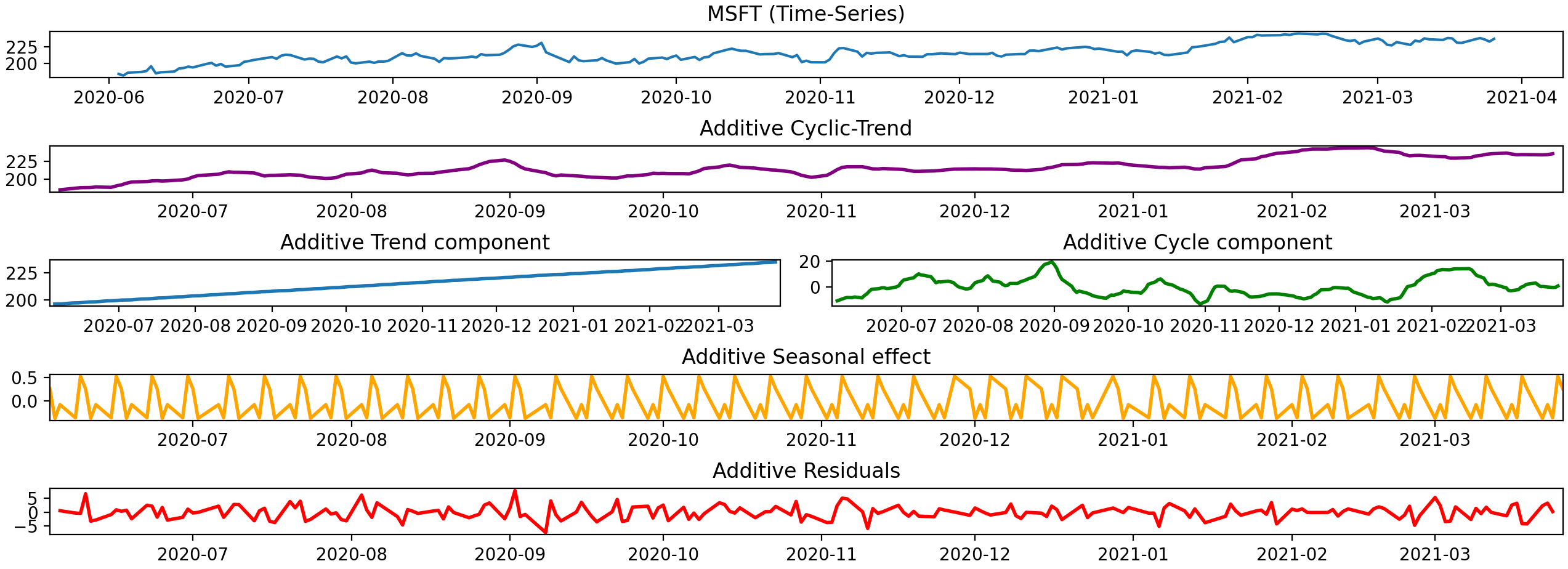
```text
usage: decompose [-m] [--export {csv,json,xlsx}] [-h]
```
This type of forcasting attempts to separate and index factors thought to have meaningful impact on the otherwise random movements in stock prices.
Decompose time series as:
- Additive Time Series = Level + CyclicTrend + Residual + Seasonality
- Multiplicative Time Series = Level * CyclicTrend *
Residual * Seasonality
For a detailed research paper discussing analysis of the Indian Auto Sector, download the PDF here: https://www.researchgate.net/publication/290263806_Decomposition_of_Time_Series_Data_of_Stock_Markets_and_its_Implications_for_Prediction_-_An_Application_for_the_Indian_Auto_Sector
"This will help in stock selection in the following ways. First, it will indicate the overall trend of the sector, hence the stock price, and help in taking a position. Second, if seasonality patterns can be seen, then during which month which sector and hence which stock should be a good buy, can be inferred. Third, the random component will throw some light on the volatility pattern of the sector and hence the stock. This decomposition will indicate which of the three components are stronger and can shed further light on the efficient market hypothesis. The decomposition will bring out the overall macroeconomic characteristic of a sector, which affects the fundamentals of a company."
```
optional arguments:
-m, --multiplicative decompose using multiplicative model instead of additive (default: False)
--export {csv,json,xlsx}
Export dataframe data to csv,json,xlsx file (default: )
-h, --help show this help message (default: False)
```