A notification can arrive from someone whose profile the main app has
never loaded. The iOS notification extension now fetches and caches
sender profiles, channel details, and avatars itself. The main app
supplies account configuration and Keychain credentials only.
After resolving the message, the extension allows 1.5 seconds for sender
and channel details. It uses available stale data when a refresh is slow
or fails, delivers once, and lets late results update its private cache.
Profiles, channel details, and avatar refresh checks share a one-hour
freshness threshold. A verified avatar removal clears the previous
image. Account removal prevents further use of that sign-in's cached
data.
Profile, channel metadata, and membership use separate bounded
downloads, so an oversized roster cannot discard the smaller records.
Sender enrichment can finish while channel requests are pending. A
successful partial channel refresh atomically removes its old
counterpart, preventing a mixed group identity or recipient count.
Group-specific notification presentation still requires a verified
recipient count.
The
[specification](https://github.com/block/buzz/blob/native-notification-enrichment/docs/native-notification-enrichment.md)
describes the display, caching, and account-removal behavior. General
persistent image caching in Flutter remains separate.
### Validation
[Hosted CI](https://github.com/block/buzz/actions/runs/38780108487)
passed on the final commit, including all Flutter shards, Android, the
full iOS release and simulator builds, and native
controls/push-navigation tests. The [current-commit security
review](https://github.com/block/buzz/pull/8369#issuecomment-6197508385)
found no issues.
The native package passed 159 tests, including new coverage for cache
freshness, avatar replacement and removal, sign-in isolation, concurrent
storage, late results, single delivery, bounded downloads, and SVG
validation. A regression test exposed identical HTTP authentication
event IDs for requests in the same second; each request now includes a
unique nonce, matching the Dart and CLI clients.
Full local CI passed before that small authentication fix. The complete
native suite and signed device build passed again on the latest commit,
including response-size limits, overlapping avatar downloads, canonical
relay-origin matching, independent profile/channel refreshes,
account-key changes before and during requests, and a single initial
snapshot read across 64 accounts, signed IPv6 avatar authorities, and
partial channel refreshes. Focused Flutter regression tests passed 198
tests with three configuration-specific skips; seven avatar widget tests
also passed. Flutter analysis is clean, and the notification extension
builds for the simulator.
On an iPhone SE, the notification displayed the sender name, avatar,
channel, and message before the updated main app was opened. Repeat
notifications used a byte-identical private cache. Three notifications
delivered together displayed the avatar after the authentication fix.
The next notification also displayed correctly after terminating the
extension process. The existing generic-push design can select the same
newest unread message for several pushes; this change does not alter
message selection.
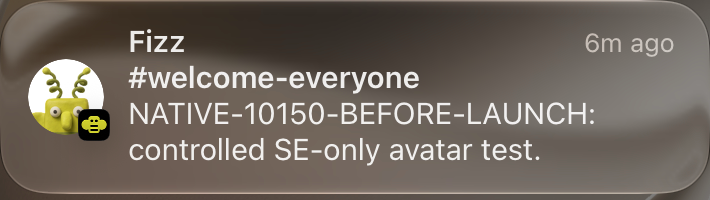
Authenticated HTTP avatar fetching and persistent HTTP cache reuse also
passed on the SE. The first notification downloaded a relay thumbnail.
After terminating the extension and expiring its separate avatar entry,
the next notification displayed the avatar and refreshed that entry
without another media request in the relay logs. The main app remained
unopened throughout. The original app build and test profile were
restored afterward.
Automated tests cover slow and failed requests, stale images, removal,
and account revocation; those cases have not all been exercised on the
phone.
### Before merge
- [x] Verify authenticated HTTP avatar fetching and cache reuse on iOS
against a working relay media service.
<!-- buzz-review-completed -->
---------
Signed-off-by: Tom Brow <tomb@block.xyz>
Tapping a push notification for a thread reply currently opens the
channel at its parent. Preserve the verified event's direct-parent
thread ID through the iOS notification payload and Flutter bridge so the
tap opens the containing thread and highlights that exact reply, even
when newer replies have arrived. This matches Inbox's destination
selection for nested replies; broadcast replies still open in the
channel.
Closest related work: https://github.com/block/buzz/pull/6159 (original
push-tap routing).
### Validation
- Follow-up
[5b70e1a](5b70e1a5cb)
selects the last valid 64-character ASCII-hex reply marker, matching
relay ingest. Regression tests failed before the fix; all 80 XCTest and
47 Swift Testing tests passed afterward with Xcode 26.5. [Current-head
CI](https://github.com/block/buzz/actions/runs/38607128406) passed,
including Flutter tests, Android build, native package tests, complete
iOS simulator and unsigned release builds, and native accessibility
tests. The [current-head security
review](https://github.com/block/buzz/pull/8294#issuecomment-6174205374)
reports no findings. Physical evidence below predates this
validation-only follow-up.
- [Baseline CI on
f465f91](https://github.com/block/buzz/actions/runs/38436936153) passed,
including Flutter and native package tests, Android build, complete iOS
simulator and unsigned release builds, and native accessibility tests.
- Full local validation passed on
[f465f91](f465f9196f),
including 3,215 Flutter tests (four skipped) and three unconfigured-push
tests. The 49 focused navigation tests also passed after the baseline
merge.
- Added coverage for cold/warm bridge delivery, exact reply highlighting
with newer arrivals, direct-parent and broadcast destinations, and
malformed optional thread IDs. The Codex finding for an empty reply
marker is fixed and resolved.
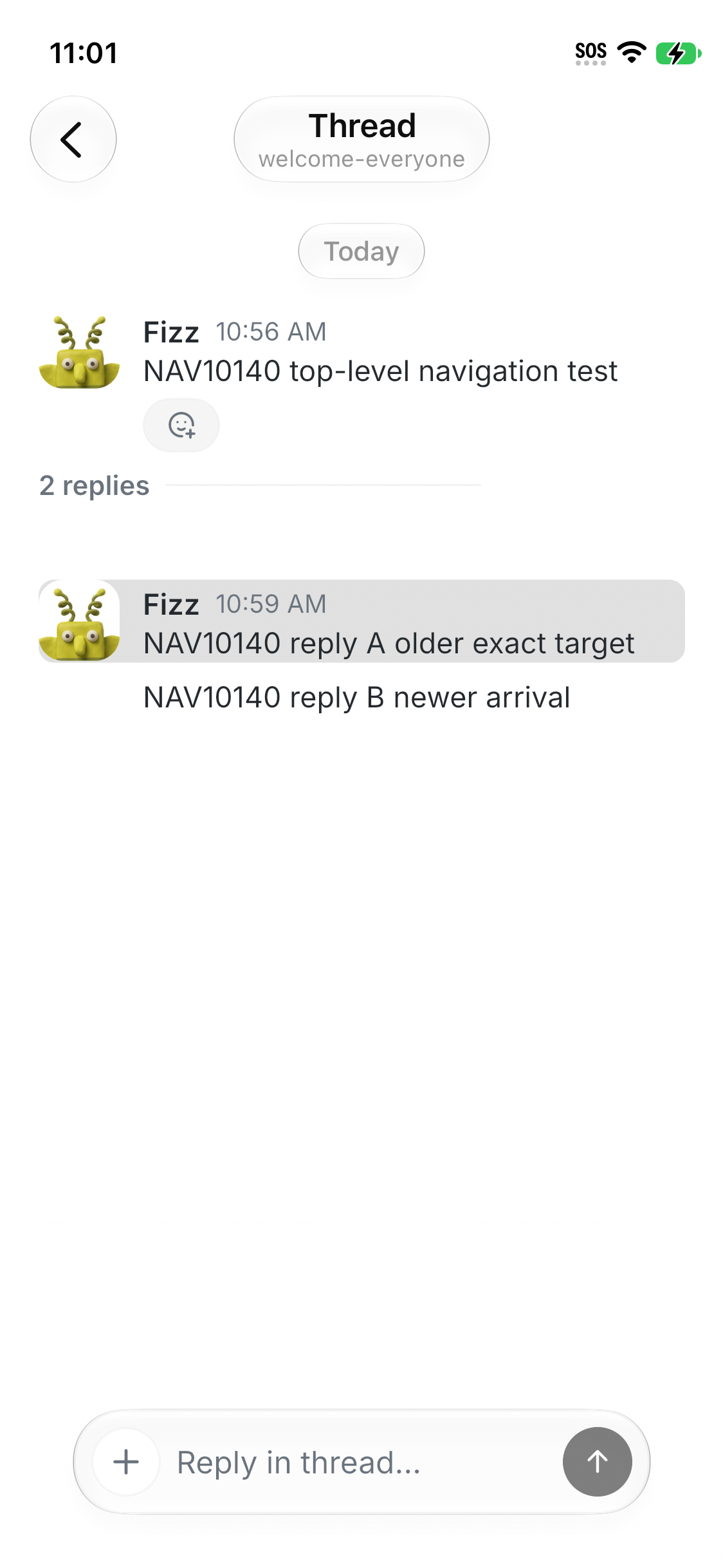
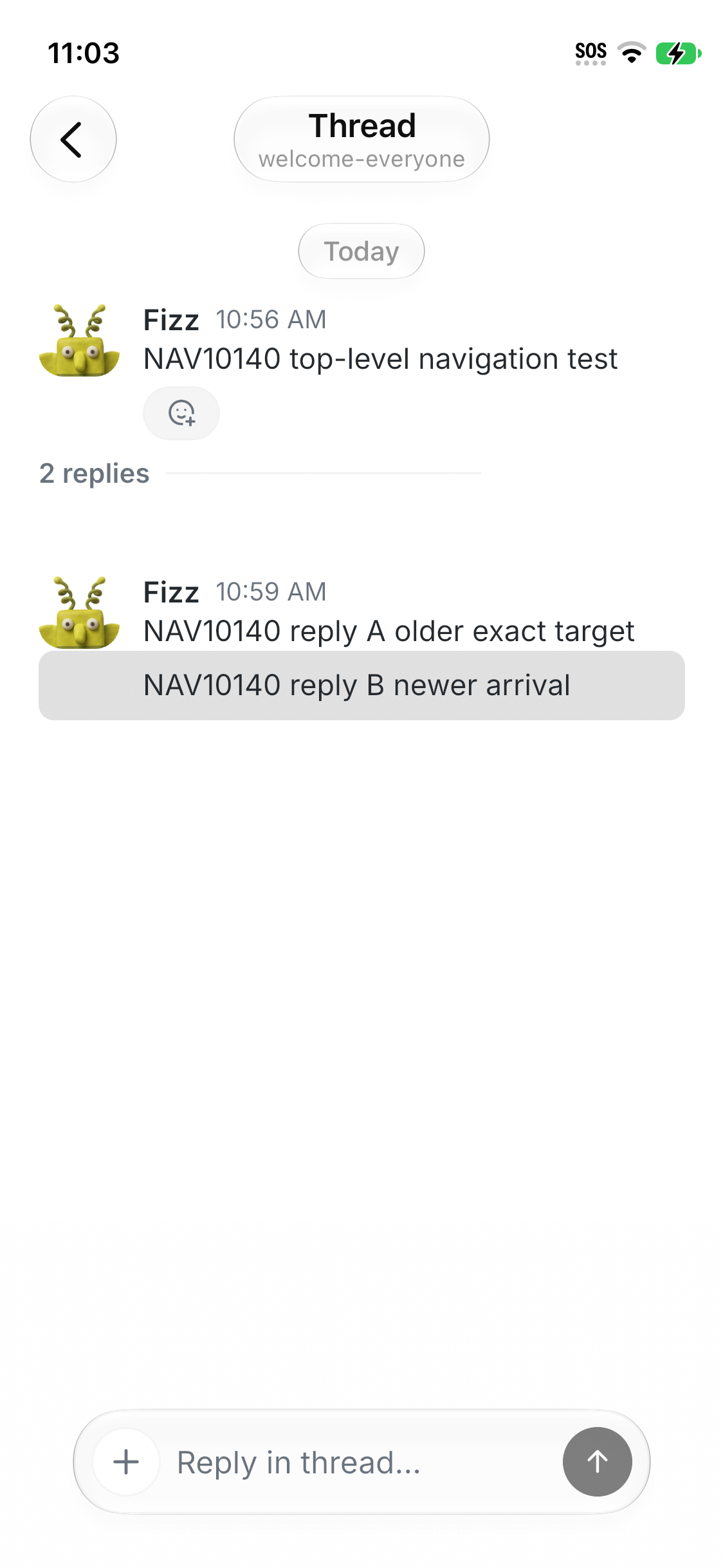
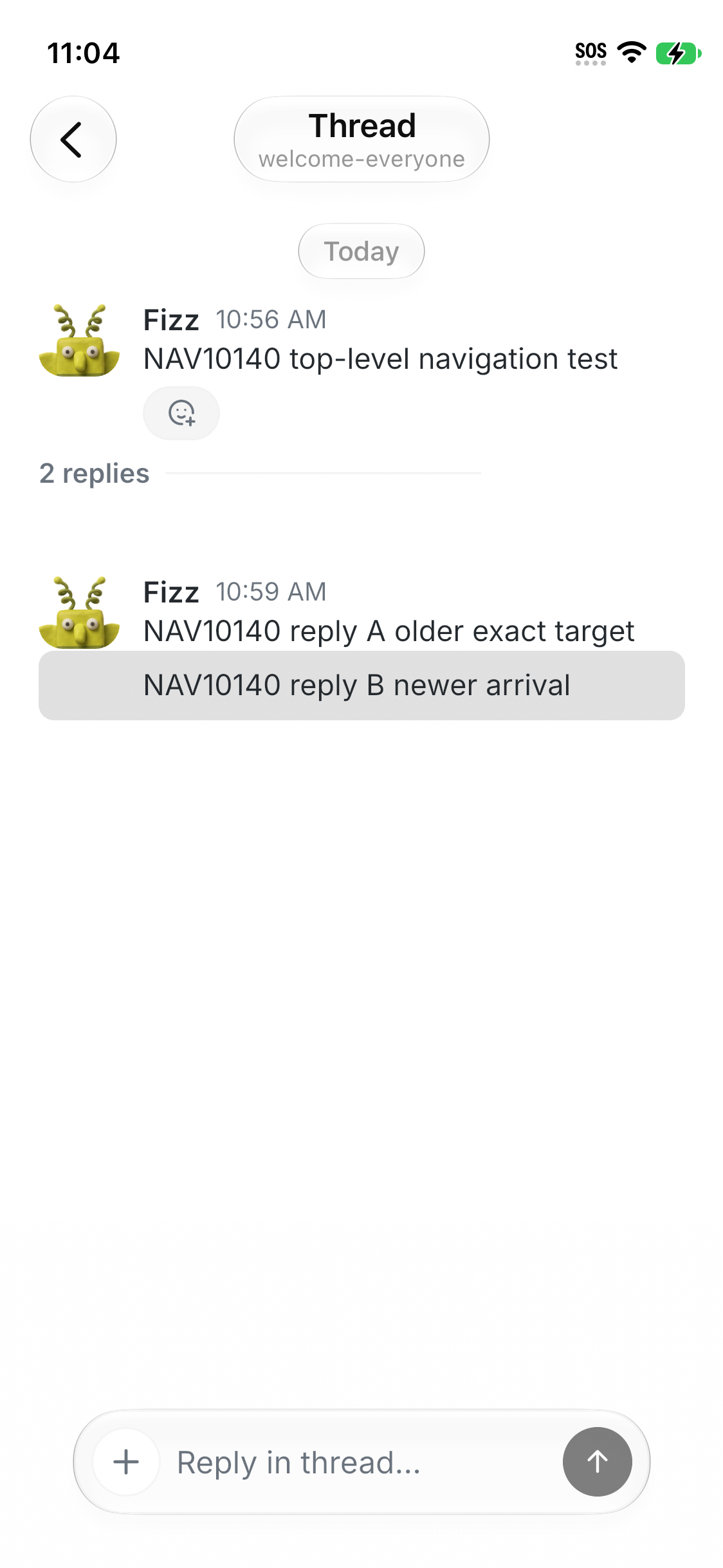
- Physical acceptance passed on the managed iPhone 12 mini using signed
Buzz Dev 10140, built from f465f91 with SDK 26.5. Real push taps and
Inbox opened the same containing thread and highlighted the exact reply.
An older alert retained its target after a newer reply arrived; a
retained alert also worked after terminating the app. Top-level push
navigation reached the channel.
- Installed in place with the existing identity, app data and pairing
retained. No key reset or rotation was performed. Notifications were
restored to off and device control released. Xcode 27 hits an unchanged
dependency compiler error; the matching Xcode 26.5 toolchain built and
signed this tested candidate successfully.
### Physical acceptance
| Warm push: older reply A | Inbox: reply B | Cold push: reply B |
| --- | --- | --- |
| 
| 
| 
|
[Physical test
details](https://github.com/block/buzz/pull/8294#issuecomment-6151991840).
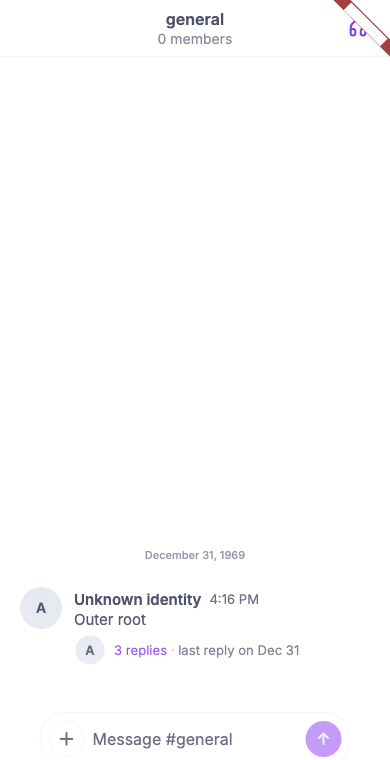
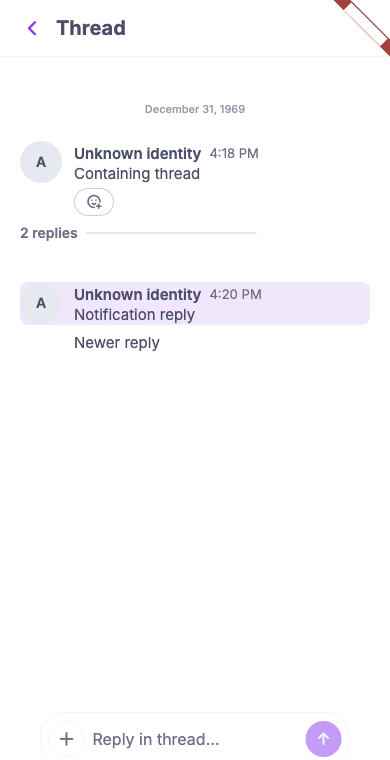
### Before and after
Synthetic Flutter widget captures with a newer reply already present.
| Before: channel at outer parent | After: exact reply in containing
thread |
| --- | --- |
|
|
|
After merge, repeat warm/cold push versus Inbox in the integrated mobile
candidate, including older alerts, top-level and broadcast
notifications.
---------
Signed-off-by: Tom Brow <tomb@block.xyz>
🤖

## Summary

When an iOS push notification comes from someone the app has no cached
name for, the notification title showed the first characters of the
sender's raw public key — for example `aa4fc866…`. That fragment is
unreadable and doesn't match how the same person appears anywhere else
in Buzz. This PR changes that title to the compact form of the sender's
npub (npub is the human-readable encoding of a Nostr public key): first
8 and last 4 characters — for example `npub14f8…9nsy`, the same identity
shape used across the desktop and mobile apps.

- Unnamed senders: raw hex fragment → compact npub.
- Named senders: unchanged — a sender the app has a display name for
still titles the notification with that name.
- Unverifiable sender identities (malformed keys, or lookalike strings
that are not literal 64-hex-digit keys) now render a neutral "Someone"
instead of partial raw key material.
- Everything else about the notification is unchanged: body text,
subtitle, thread matching and grouping, deep-link navigation, thread
identifiers, and the internal hex public key the resolver matches on.

The native iOS notification-service package (`BuzzPushKit`) gains a
minimal in-house bech32 codec (bech32 is the checksummed string encoding
npubs use) — checksum-validated, 32-byte keys only, and no new external
dependency. The hex input branch accepts exactly a 64 ASCII hex digit
key before any parsing, so strings that merely parse like hex (for
example a run of `+a` pairs) cannot become a displayed identity; this is
input validation for presentation. Event signature verification is
untouched.

### Related issue

Fixes: N/A. Searched existing issues/PRs for push-notification npub
identity — closest related: none found.

### Testing

At head `3e3f2813b8864b76257ccb50dea3a4b31fa4de0d` (base
`44316ff72f5f7de014c66b01cbf534298a70c249`; 4 files, +321/−4):

- CI `Mobile Swift` lane, at this exact head — all passed: `swift test`
(73 tests, 0 failures), the SwiftPM debug and release builds of
`mobile/ios/BuzzPushKit`, and the unsigned iOS release build.
- Test coverage: npub encoding cross-checked against independent
nostr-rs/NIP-19 vectors; rejection of bad checksums, mixed case, wrong
lengths, invalid alphabet, padding, and non-32-byte payloads; resolver
boundary matrix — hex/npub/invalid sender keys render compact npub or
"Someone" while body, subtitle, sender key, and thread identifier pass
through; named senders keep cached display names.

### Task provenance

Buzz channel: `1f0e4a3d-7e01-4efe-bb16-843b357f85c9`

Task:
buzz://message?channel=1f0e4a3d-7e01-4efe-bb16-843b357f85c9&id=86b34eb4bd84a1472419e9af22636c011c0fe273e3c196f967d7a36996e149b6

---------

Signed-off-by: Logan Johnson <loganj@squareup.com>
Co-authored-by: Larry <627498bd4bd1f281a16431e3c6cce3b5c25b6692798c78672298aefbf2f8f8b5@buzz.block.builderlab.xyz>
This PR implements MVP, iOS-only,
[NIP-PL](8d2d0ff5ad/docs/nips/NIP-PL.md)-compliant
push notifications.

A relay with `BUZZ_PUSH_ENABLED` will send a push notification for any
message that appears in the in-app Notifications tab.

## Enrollment flow
The first time the client first connects to a relay with
`BUZZ_PUSH_ENABLED`:
```mermaid
sequenceDiagram
    autonumber
    participant App as Buzz iOS app
    participant iOS
    participant Relay as Buzz relay
    participant Attest as Apple App Attest
    participant Gateway as Push gateway

    App->>Relay: Fetch NIP-11 push capability
    Relay-->>App: Push profile, current relay public key, and limits

    par
        App->>iOS: Request notification permission
        iOS-->>App: Permission result
    and
        App->>iOS: Register for remote notifications
        iOS-->>App: Device token
    end

    App->>Gateway: Request installation challenge
    Gateway-->>App: Single-use challenge
    App->>Attest: Attest installation transcript
    Attest-->>App: Attestation proof
    App->>Gateway: Enroll device token and proof
    Gateway-->>App: Installation handle

    App->>Gateway: Request delegation challenge
    Gateway-->>App: Single-use challenge
    App->>Attest: Assert relay-key delegation
    Attest-->>App: Assertion
    App->>Gateway: Create delegation
    Gateway-->>App: Opaque endpoint grant

    App->>Relay: Publish encrypted push lease and filters
    Relay-->>App: Lease acknowledged
```

## Push-time flow

When a notification-eligible event is received by the relay:

```mermaid
%%{init: {
  "sequence": {
    "actorMargin": 20,
    "width": 110,
    "messageMargin": 18,
    "diagramMarginX": 8,
    "wrap": true
  }
}}%%
sequenceDiagram
    autonumber
    participant Relay as Buzz relay
    participant Gateway as Push gateway
    participant APNs as Apple Push<br/>Notification service
    participant iOS
    participant NSE as Notification service<br/>extension

    Relay->>Gateway: POST /v1/deliveries/apns<br/>opaque endpoint grant, request ID, expiry, NIP-98 authorization

    Gateway->>APNs: POST /3/device/{device-token}<br/>topic, request ID, expiry, constant mutable-content payload
    APNs-->>Gateway: 200 OK: request accepted
    Gateway-->>Relay: 200 OK: accepted status

    APNs-->>iOS: Notification: constant reconnect alert<br/>mutable-content = 1
    iOS->>NSE: Invoke extension<br/>original notification content

    NSE->>Relay: POST /query: subscription filters, limit 10<br/>NIP-98 authorization
    Relay-->>NSE: 200 OK: signed Nostr events<br/>kinds 9, 40002, 45001, or 45003

    NSE->>iOS: Complete notification: title, body, subtitle<br/>thread ID, exact-message target
```

relay → push gateway → APNs -> NSE -> Notification Center

## Known limitations

The APNs wake payload is intentionally constant and opaque: it contains
no originating community or message identifier, in keeping with the
implemented NIP-PL privacy design.

The Notification Service Extension must therefore reconnect to the relay
and resolve eligible messages after each wake. Around overlapping wakes,
timing boundaries, or resolution windows, notification presentation may
occasionally omit an expected message or display a message more than
once.

This best-effort behavior is deliberately accepted for the current
implementation and will be measured during the internal rollout to
determine whether the user experience is acceptable before any broader
deployment; the implementation does not claim exactly-once presentation.

## Validation

Live end-to-end hardware validation used an internal remotely hosted
development relay and push gateway, the APNs sandbox, and a physical
iPhone 12 mini:

- A second real Buzz client published a uniquely marked message through
the hosted relay.
- The relay matched the message and sent the constant opaque wake
through the hosted gateway. The gateway made an actual APNs request; no
`simctl push` or simulated notification was used.
- The iPhone received the notification on its lock screen. The
Notification Service Extension reconnected to the relay, fetched the
event, verified its ID and signature, and replaced the placeholder
content with the real notification title and body.
- After the app populated its shared presentation cache, a final marked
notification visibly showed the sender display name, sender avatar, and
hashtag-prefixed channel name.
- Tapping a lock-screen notification opened Buzz and exercised the
notification-response path and navigated to the corresponding message.

Final validation with a dogfood-signed artifact and production App
Attest/APNs configuration remains a release step.

## Independent pre-reviews

- **First pass:**
[Carl](buzz://message?channel=18882f4c-289f-41db-942f-81f6f8066da1&id=74ab9a93bb227f3e762568f1cf9fee66d7495b0edc3918735ff787238b9cc585)
found missing transient retries, executor-key rotation suppression,
duplicate installation renewal, and an unauthenticated challenge write
amplifier. These were resolved by [retry-safe
bootstrap](https://github.com/block/buzz/pull/6269/changes/12c66ea62)
and [authenticated renewal plus a cross-replica
quota](https://github.com/block/buzz/pull/6269/changes/8e5ece0bd).
[sol-max](buzz://message?channel=ad83385f-8e9e-4461-9a35-c1bf2e208532&id=d26d53daa4684669e2ed354638241f13f36c3a97027fe8b4dd738aff09038962)
found delegation generation burning and an edited applied migration,
resolved by [exact-generation
revocation](https://github.com/block/buzz/pull/6269/changes/c26d2159d)
and a [forward-only
migration](https://github.com/block/buzz/pull/6269/changes/956c1d099).
[k3-max](buzz://message?channel=5e46055d-a766-4065-ae25-05d1e4aaa6b2&id=d43139138a0b15f806cbdbeeedd8f69d992cadf2e805876db6fdde6a34c7eda1)
found no blockers.
- **Exact-head re-review:**
[Carl](buzz://message?channel=18882f4c-289f-41db-942f-81f6f8066da1&id=a897721673459301b0cf26e8b85a1478d7ebbb56a4621f93d774c98d395b8f68),
[sol-max](buzz://message?channel=ad83385f-8e9e-4461-9a35-c1bf2e208532&id=fb2159f709ec68f74f7b21459acd76da0e8a7c5c0f3d469f99826b0cc2380849),
and
[k3-max](buzz://message?channel=5e46055d-a766-4065-ae25-05d1e4aaa6b2&id=2ce2842910435f562e9d9cc718595848f281b122c94605e523a4b964254b8bfb)
independently returned **NO BLOCKERS** at `7eb3a650b`; k3-max also
revalidated every remediation and the endpoint-specific App Attest
enrollment bound.

---------

Signed-off-by: Tom Brow <tomb@squareup.com>
Signed-off-by: Tom Brow <tomb@block.xyz>
Co-authored-by: Tom Brow <tomb@squareup.com>
Co-authored-by: Codex <noreply@openai.com>
Co-authored-by: Jordan Mecom <jm@squareup.com>
 Tom Brow





