mirror of
https://github.com/block/buzz.git
synced 2026-11-07 09:52:03 +00:00
codex/buzz-271-draft-prep
19 Commits
| Author | SHA1 | Message | Date | |
|---|---|---|---|---|
 Tom Brow |
e558f15faa |
Mobile: one New chat screen (#9079)
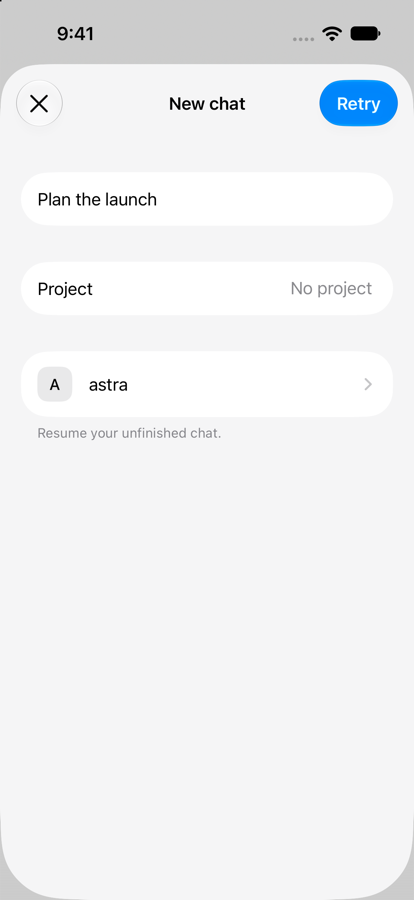
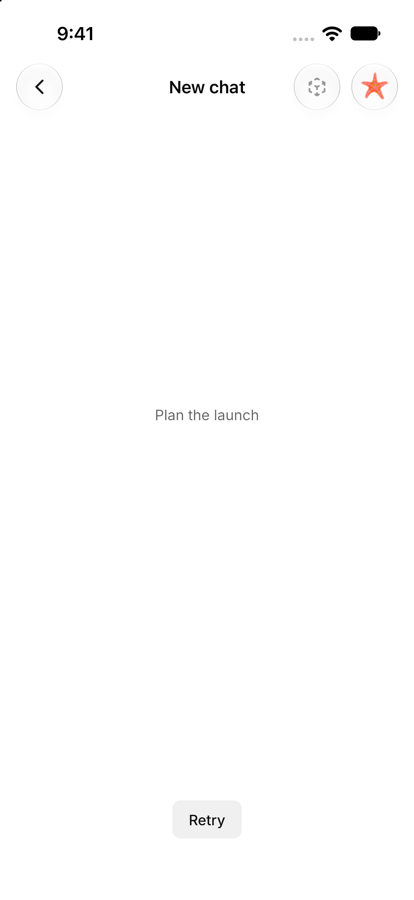
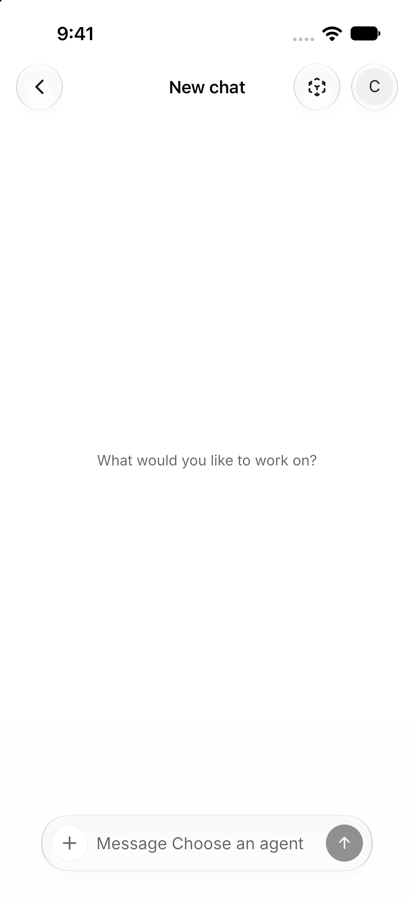
Mobile had two New chat screens. [#8884](https://github.com/block/buzz/pull/8884) made the Flutter draft page (first send creates and names the chat) the New chat screen, but kept the older create form (a native iOS sheet, with a Flutter bottom sheet on Android) for one case: resuming a creation that an older build had saved with a chat name and no first message. Nothing creates that state anymore, so the old form only appeared for users with an interrupted creation from before that change. This removes the old form. Every New chat, including that resume case, now opens the draft page: - **New chat**: unchanged. - **Resuming an interrupted creation**: after the existing Resume / Discard setup / Later prompt, the draft page shows the saved chat with its agent and workspace locked and a Retry button, the same choices the old sheet offered when it locked its fields. A creation saved with a first message resumes exactly as before. One saved without a message finishes without one, because a saved creation can't change after its first relay write. The iOS editor's chat-only code (`presentChat`, `updateChatAssistants`, the agent list, and its avatar loader) goes too. The same editor still handles profile fields, channel details and workspace names. The native test and CI step that covered only the removed chat form are removed. ### Screenshots Resuming an interrupted creation saved without a first message: | Before: old native sheet (removed) | After: draft page (kept) | | --- | --- | | <img src="https://raw.githubusercontent.com/block/buzz/5d0a502e92fc3dfeffbe4fa95d63ba8f73d1e612/pr-9079--01-before-resume-native-sheet.png" width="300"> | <img src="https://raw.githubusercontent.com/block/buzz/5d0a502e92fc3dfeffbe4fa95d63ba8f73d1e612/pr-9079--02-after-resume-draft-page.png" width="300"> | A brand new chat already opened the draft page and is unchanged: <img src="https://raw.githubusercontent.com/block/buzz/5d0a502e92fc3dfeffbe4fa95d63ba8f73d1e612/pr-9079--03-new-chat-draft-page.png" width="300"> ### Validation - Changed tests: `me_page_test` checks that Resume and Discard setup both open the draft page and that no native sheet is requested. `solo_creation_tags_test` checks that recovering an interrupted named creation through the draft page's Retry continues with member setup, keeps the saved name and agent, and adds no first message. - Full mobile Flutter suite (4,431 passed) and `flutter analyze` (clean). iOS debug simulator build succeeds. - Automated simulator run (iPhone 17 Pro, iOS 27, signed-in account): New chat opened the draft page, the agent picker selected an agent, and the first send created the chat, which then appeared under Solo. New workspace still opened the native editor, enabled Create once named, and showed the Discard changes prompt on cancel. The recording isn't attached here because it shows internal account content. - Resuming an interrupted pre-[#8884](https://github.com/block/buzz/pull/8884) creation can't be produced by the current build. For the screenshots above, a capture-only, uncommitted patch to a `main` build seeded one; the branch build installed over it resumed it on the draft page. The widget tests cover finishing it. - `solo_creation_tags_test` also covers a conflicting pending Solo organization edit during that Retry: the draft offers the Conflicting Solo changes dialog, keeps the saved creation, and the next Retry finishes it. 🤖 Generated with [Claude Code](https://claude.com/claude-code) buzz-review-completed --------- Signed-off-by: Tom Brow <tomb@squareup.com> Co-authored-by: Tom Brow <tomb@squareup.com> Co-authored-by: studio <dc2fc481343672df31a689840c09299972e704dac592e0da6f18486646a7ee3e@buzz.block.builderlab.xyz> Co-authored-by: Claude Opus 5.5 <noreply@anthropic.com> |
||
|
John Matthew Tennant
|
33eaa73c83 |
fix(mobile): let users sign out after leaving all communities (#8993)
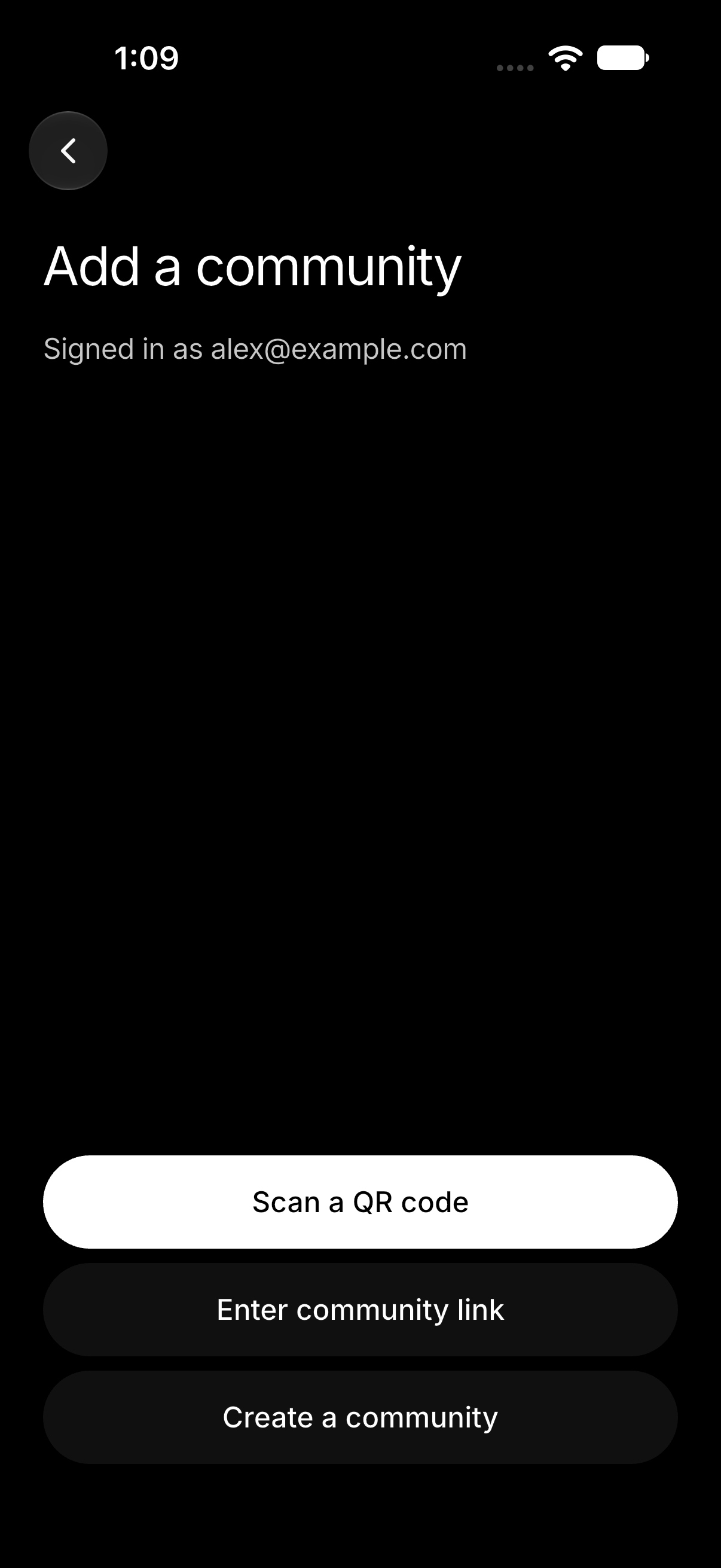
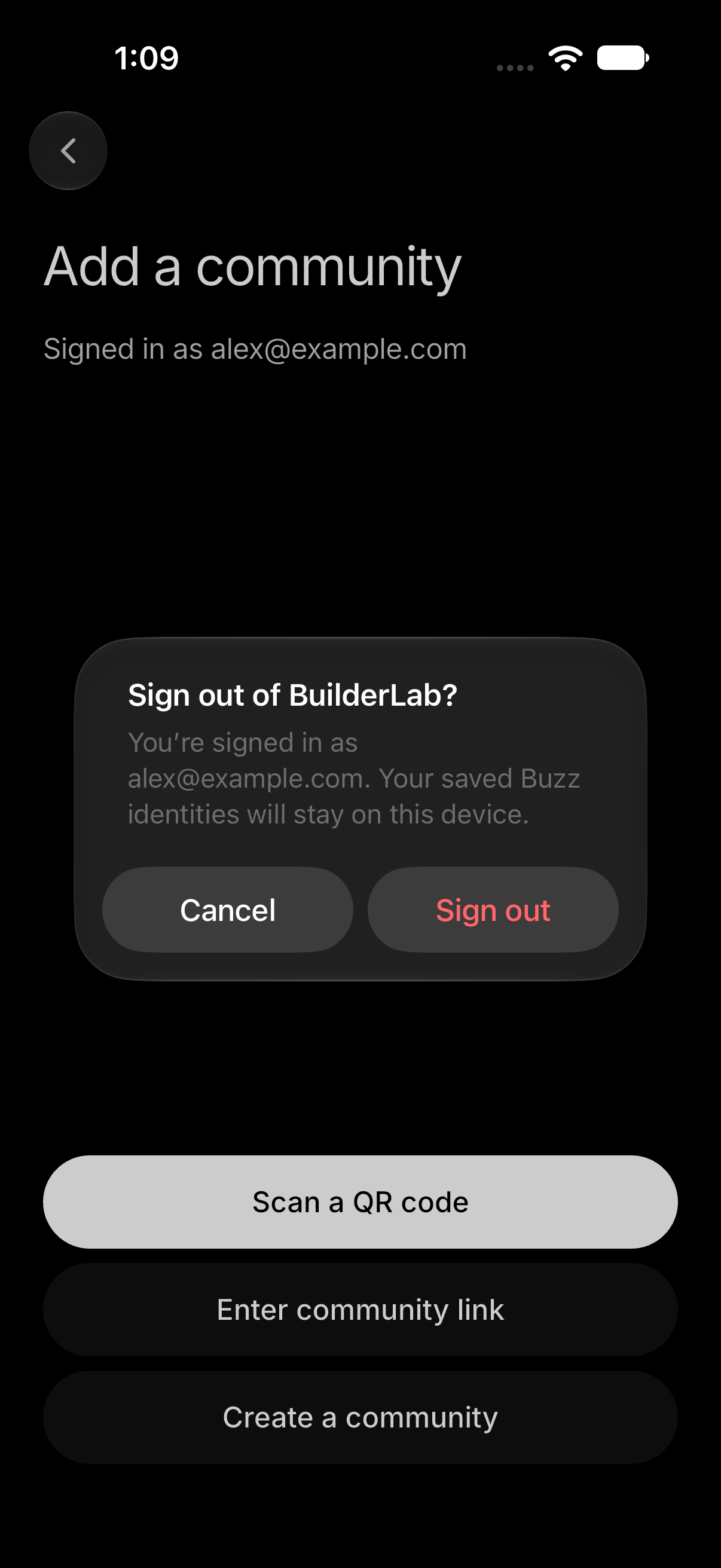
## Summary Fixes a dead-end in signed-in mobile onboarding: after leaving every community, Back kept returning to the same Add a community screen without a way to end the account session. Show “Signed in as [email]” on that screen. Back asks “Sign out of BuilderLab?” with the email; Cancel keeps the session, and Sign out returns to the welcome screen while retaining saved Buzz identities. Nested Back and Add community from an existing session keep their navigation behavior. ### Related issue None found in the existing issue and PR search for onboarding sign-out. ### Testing The new widget journey failed before the change and passes through the real onboarding widgets, account client, storage and flow with external HTTP/browser boundaries mocked. It covers nested Back, Cancel, system Back, durable session removal, retained identity/backup, and starting email sign-in again. The existing hosted onboarding journey also covers accounts without an email. On iPhone 18 Pro simulator (iOS 27), rendered the production onboarding screen and native confirmation using a disposable account fixture. Live browser account selection has not been verified; this clears the app session, not website cookies. To reproduce on an auth-enabled mobile build: sign in, leave all communities, check the displayed email, tap Back, and choose Cancel. Tap Back again and choose Sign out. The yellow welcome screen should appear, with email sign-in available. ## Screenshots Before, from the original reported phone screen: <img src="https://raw.githubusercontent.com/block/buzz/07440b3b10c3f48a6fd19c923f2ee5ba66d574f0/pr-8993--before.png" alt="Before: account state not shown" width="300"> After: Signed-in landing and native sign-out confirmation, using a disposable account: <img src="https://raw.githubusercontent.com/block/buzz/a4e18c85bc3a19d971b08ff595ba6b081c67e20f/pr-8993--landing.png" alt="Signed-in landing" width="300"> <img src="https://raw.githubusercontent.com/block/buzz/a4e18c85bc3a19d971b08ff595ba6b081c67e20f/pr-8993--confirmation.png" alt="Sign-out confirmation" width="300"> --------- Signed-off-by: Aaron <f425b86c3b780d43f8d9cf1802429d04dd985bf92eac44fca9468b5ad3887c5e@buzz.block.builderlab.xyz> Signed-off-by: John Tennant <jtennant@squareup.com> Co-authored-by: Aaron <f425b86c3b780d43f8d9cf1802429d04dd985bf92eac44fca9468b5ad3887c5e@buzz.block.builderlab.xyz> |
||
|
Tom Brow
|
fa395e9e80 |
feat(mobile): open a prefilled Create agent form from Builderlab agent cards (#8912)
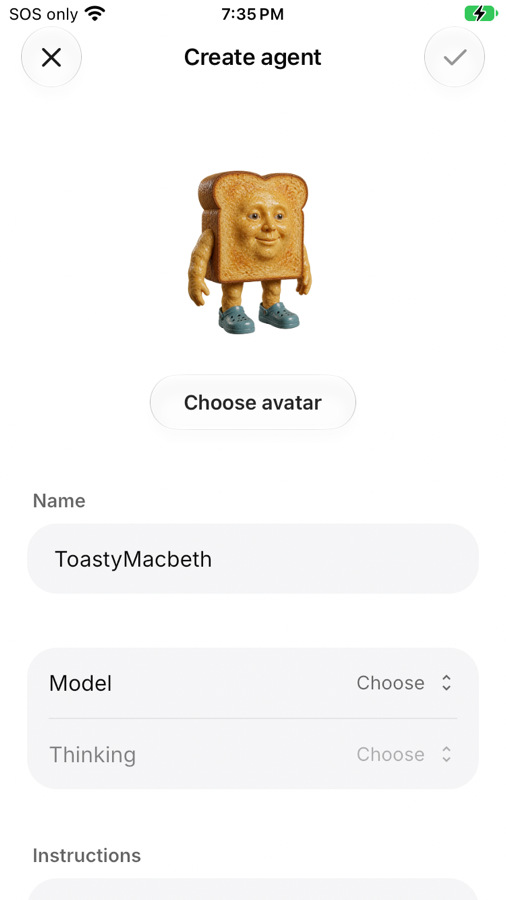
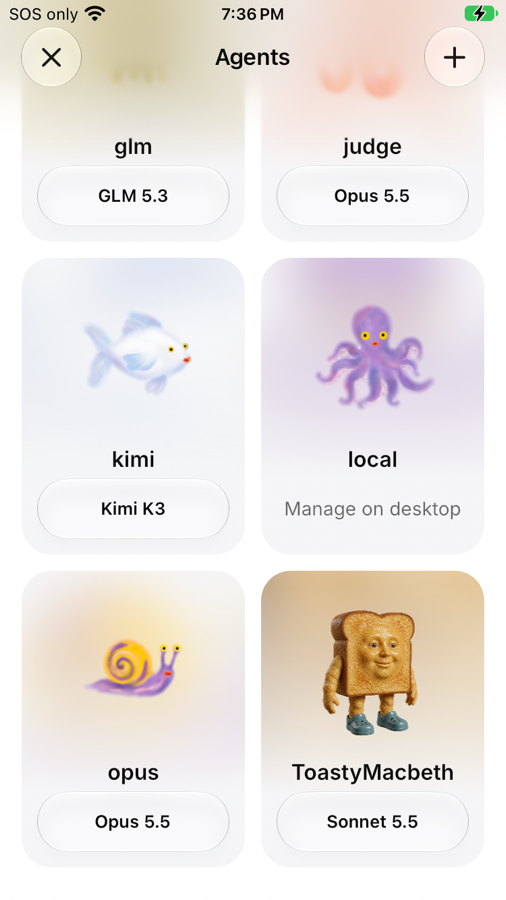
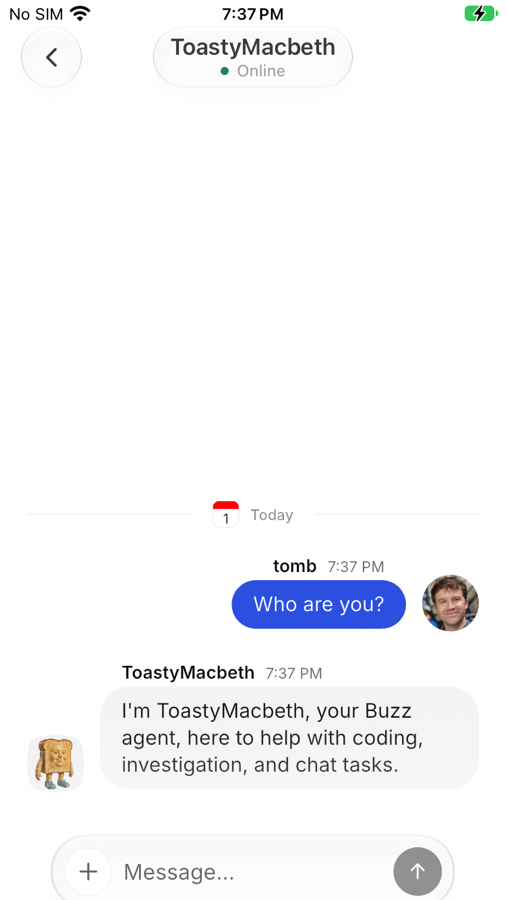
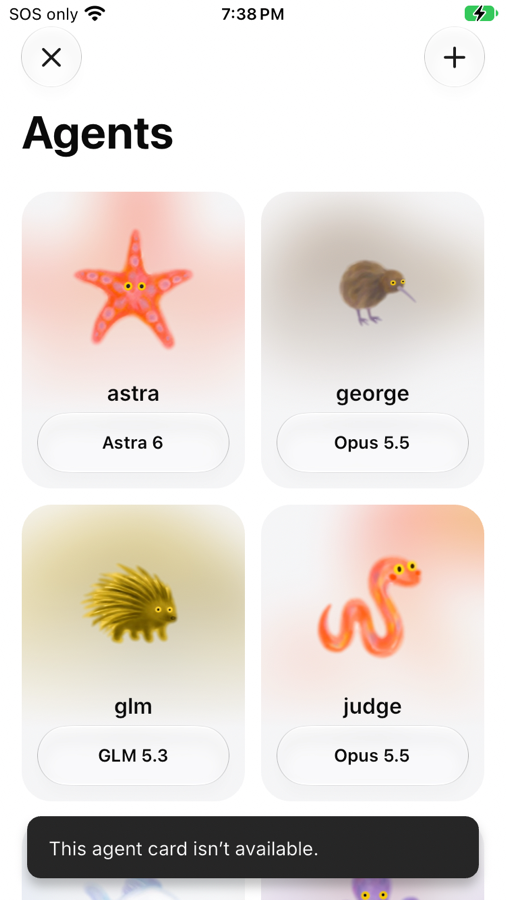
Builderlab agent cards (printed for the event, and generated at the kiosk) carry a QR to a share page, `app.builderlab.xyz/a/<id>`. Its **Add to Buzz** button opens `buzz://agent/new?card=<id>`, which no Buzz client handled until now. This PR makes mobile handle it. ### Behavior - Opening the link shows the Agents page, then a Create agent form prefilled from the card. Everything stays editable, and nothing is created until the user taps Create. - The app fetches the card's `agent.json` from the avatars CDN for this build's Builderlab environment (production or staging). The link carries only the card id, never a host, so the QR stays small no matter how long a card's instructions get. - `agent.json` is validated against the card schema. `id` (matching the link), `name` and `avatarUrl` (an https URL) are required. `instructions`, `model` and `reasoningEffort` are optional (published cards don't have them yet) and left for the user when absent. A missing required field or a wrongly typed known field rejects the card; any other key is ignored whatever its type, including `v` and `description` (Buzz agents have no description to prefill), so Builderlab can add fields without breaking released apps. The model and effort are preselected only if the live catalog offers them. The card id is opaque: any non-empty id is accepted and percent-encoded into the URL. - The fetch uses the same limits as image downloads, now shared in `bounded_fetch.dart`: aborted after 20 s without a byte or 5 min overall, and rejected over 2 MB. `MediaImageProvider` now calls the same helper, with no behavior change. - The link waits for sign-in, then reloads the registry for the signed-in account before anything else. It's dropped with a message if the card is unavailable (403/404), invalid, can't be loaded (any other response), or an agent setup is unfinished, including a setup saved before a sign-in the link triggered. - A link that arrives while Agents shows only its list replaces that page instead of stacking a second one. If a form or sheet is open there, the link is dropped with "Finish or close what’s open in Agents, then reopen the link." and the open work is kept. ### Demo Simulator (iPhone 17 Pro, debug build of this branch plus the sign-in fix from [#8914](https://github.com/block/buzz/pull/8914) and the hidden debug banner from [#8915](https://github.com/block/buzz/pull/8915), signed in to Builderlab, remote-agent-pilot), recorded in one take with idle time trimmed: the card's share page in Safari, Add to Buzz, the prefilled Create agent form, a model, thinking level and instructions, Create, then a message and the agent's reply. https://github.com/user-attachments/assets/e66aae17-884a-4e68-a1b8-ecb40562be1d ### Validation Added tests: - Table tests for the link shape (only `?card=<id>` with an opaque id; the inline `#` form, extra parameters and dot segments are rejected) and for reading `agent.json` (a published card, a card with instructions and model defaults, unknown keys of any type ignored, including `v`, `description`, arrays, objects and null, and invalid cards: missing or mismatched required fields, wrong types, and non-https or relative avatars). - Table tests for fetching: the request goes to this build's CDN without following redirects, with the id percent-encoded as one path segment; 403/404, a redirect, a 500, a network error, declared and streamed oversize bodies, non-JSON and a JSON array each give a specific message. The image loader's existing stall, deadline, cap and cancel tests now cover the shared helper. - A journey test from link to Create against a fake CDN: prefill and edit, then submit; an unavailable card; a failed model catalog whose Retry then preselects the card's model; a Builderlab account change while the card loads, which drops the draft; a v1 card with no instructions and an unknown model; an unfinished setup; a link arriving while a Create form with edits is open, which keeps the form and its edits; and a link arriving while Agents is open. Disabling the https or id check makes the table test fail, and removing either the account recheck or the loaded-catalog check fails the journey. The journey runs through the production root scope (removing its link handler fails it) and runs in CI's configured-authentication-domains step. Full mobile check and test suite pass locally. Live data: a real staging card's `agent.json` (`av_MioTAG6dm7q3Zcm0UV2j8A`) has the v1 shape the table test uses, and an unknown id returns 403 from the CDN. Live run on an iPhone SE (build of 63ed54c749, Builderlab sign-in enabled, remote-agent-pilot, signed in as builderlab@tombrow.com) with a real production card, [ToastyMacbeth](https://app.builderlab.xyz/a/av_lrmRlJR6ylrQKvJkoLWCOQ) (a v1 card with no instructions and an extra `description` key): - Opening `buzz://agent/new?card=av_lrmRlJR6ylrQKvJkoLWCOQ` from a cold start opens Create agent prefilled with the card's name and avatar. - After choosing a model and adding instructions, Create adds the agent with the card avatar, and it replies in a DM. - An unknown card id shows "This agent card isn’t available." | Prefilled | Created | Reply | Unknown card | | --- | --- | --- | --- | | <img src="https://raw.githubusercontent.com/block/buzz/b9222db494758c3e536b8e2011032ba7cec86daa/pr-8912--01-prefilled.png" width="200"> | <img src="https://raw.githubusercontent.com/block/buzz/b9222db494758c3e536b8e2011032ba7cec86daa/pr-8912--02-created.png" width="200"> | <img src="https://raw.githubusercontent.com/block/buzz/b9222db494758c3e536b8e2011032ba7cec86daa/pr-8912--03-reply.png" width="200"> | <img src="https://raw.githubusercontent.com/block/buzz/b9222db494758c3e536b8e2011032ba7cec86daa/pr-8912--04-unavailable.png" width="200"> | Before this PR, the app had no handler for `buzz://agent/new`, so the link did nothing. A separate widget test covers a link that needs Builderlab sign-in first: once sign-in lands, a setup saved for that account blocks the card, which is never fetched. Removing the registry reload fails it, as does removing the busy-Agents guard for the journey step above. ### Before merge - [x] Human live check waived under the repository owner's standing testing exception. In its place, agent-driven full-app runs exercised the flow end to end: the iPhone SE device run and the simulator demo above (a real card's share page, **Add to Buzz**, the prefilled form, Create and a reply from the agent). Limitation: those runs predate [ |
||
|
Tom Brow
|
daeb463f37 |
fix(mobile): prompt Builderlab sign-in instead of labeling agents desktop-only (#8907)
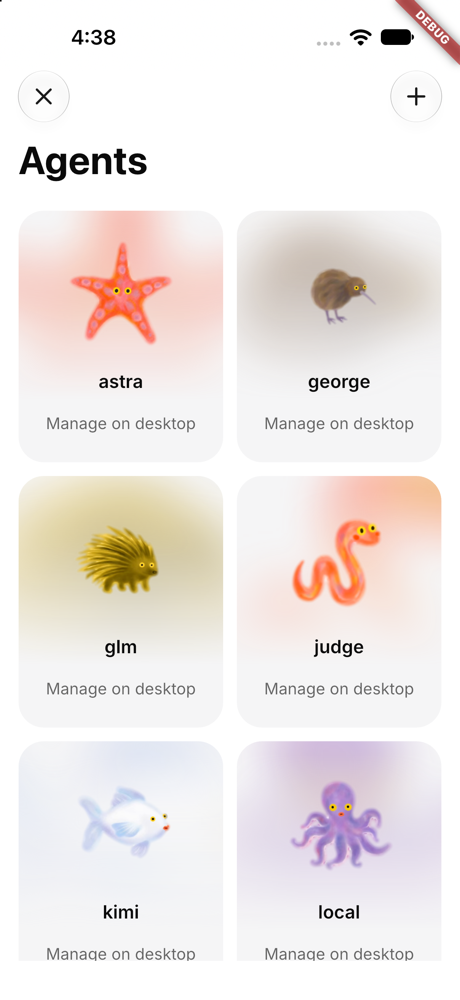
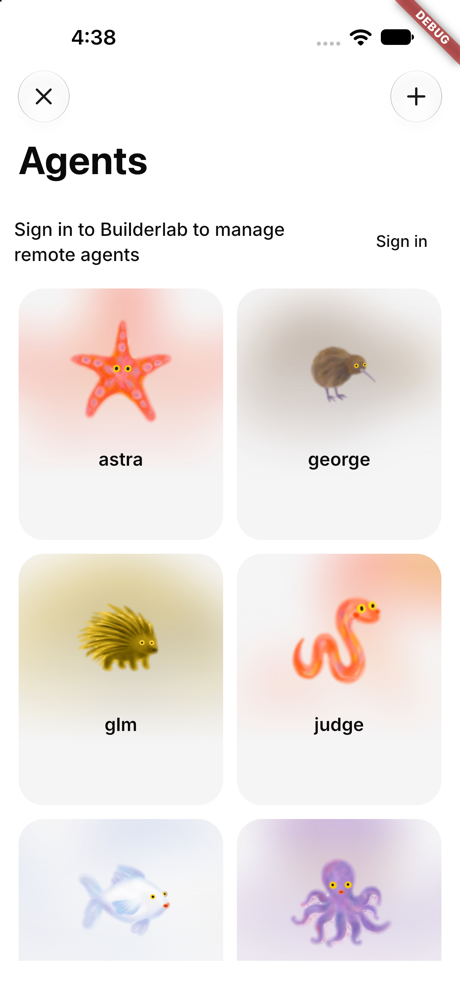
Without a Builderlab session, mobile can't tell which agents run on Builderbot, so the Agents page labeled every agent "Manage on desktop", including remote ones. Now, when the community supports remote agents and there's no Builderlab session: - The Agents page shows "Sign in to Builderlab to manage remote agents" with a **Sign in** button (the same reconnect flow as Add). - Agent cards and the navigation subtitle drop the "Manage on desktop" label. - An agent's profile says to sign in to see whether it runs on Builderbot or desktop. ### Before / after iOS simulator, signed in to the remote-agent-pilot community with no Builderlab session. | Before (main) | After (this PR) | | --- | --- | | <img src="https://raw.githubusercontent.com/block/buzz/9be9cebedc8f5ff172e97a3df2cbf505a90e41c4/pr-8907--before-agents.png" width="300"> | <img src="https://raw.githubusercontent.com/block/buzz/9be9cebedc8f5ff172e97a3df2cbf505a90e41c4/pr-8907--after-agents.png" width="300"> | ### Validation - New widget test `agents_signed_out_prompt_test.dart` (runs with `BUZZ_AUTH_DOMAINS`, added to the CI list). - `just mobile-check` and the mobile test suite pass. - Checked the signed-out Agents page in the iOS simulator. buzz-review-completed (manual testing waived by Tom) 🤖 Generated with [Claude Code](https://claude.com/claude-code) --------- Signed-off-by: Tom Brow <tomb@squareup.com> Co-authored-by: Tom Brow <tomb@squareup.com> Co-authored-by: Claude Opus 5.5 <noreply@anthropic.com> |
||
|
Tom Brow
|
db4478e8d2 |
feat(mobile): organization sign-in for NIP-FI relays (#8700)
Block is turning on NIP-FI enforcement on the Block relay. Desktop gets organization sign-in in block/buzz-app#1424. Mobile can already attach NIP-FI assertions, but only for Builderlab-hosted communities, through the build's single Builderlab account. The dogfood build needs that account for public hosted communities, so it can't simply be pointed at the Block tenant. This adds a separate **organization realm**, configured at build time: - `BUZZ_ORGANIZATION_URL`: the tenant's HTTPS origin (for example `https://block.builderlab.xyz`). - `BUZZ_ORGANIZATION_RELAYS`: the exact relay hosts that trust that tenant. The two must be set together. The app refuses to start if they're malformed, overlap a hosted community, or reuse the hosted origin. Without them, nothing changes. For a configured relay: - The app keeps its own organization session and signs in through the browser at the tenant's existing login (`/api/goose/v1/auth/login`). Block SSO happens there. - It requests assertions from the same `/v1/buzz/identity/assertions` route that hosted communities use, and attaches them to the relay socket, HTTP, media, huddle and remote-agent requests. - Unlike the hosted path, it doesn't require an identity backup before the first binding. As on desktop, the tenant binds the member's existing key on first issuance. A key already bound to a different one is refused before any request is sent. - When signed out, it connects without an assertion and lets the relay decide. A bottom banner offers **Sign in**. After sign-in, the relay reconnects with a fresh assertion. Hosted communities keep their existing banner and flow. The tenant accepts only the registered `xyz.block.buzz.mobile:/auth/callback` return URL, so both realms share it. Each `BrowserAuth` owner leaves callbacks whose `state` belongs to another owner's attempt to that owner. ### Before merge - [ ] Kenny Lopez reviews the visible changes. ### Validation Added tests (`organization_relay_auth_test.dart`): - Configuration parsing and exact host matching. - An assertion is issued for the exact relay and key, then cached. - A different bound key is refused. - Signed out connects without an assertion. - Other relays never receive the assertion. - The shared callback is routed between the hosted and organization owners. Full `mobile-check` and `mobile-test` pass. RunnerTests pass locally except `testNativeNavigationTitleExpandsAgainAtTop`, which this PR doesn't touch. Added tests (`organization_sign_in_test.dart`, `relay_auth_isolation_test.dart`, `builderlab_account_test.dart`), each failing without its fix: - Concurrent account restores at cold start share one adopted account. - An exchange from a cancelled attempt never changes a newer sign-in. - Storage failures while clearing the intent or cancelling leave the busy state. - An unreadable saved organization session is replaced by signing in again. - A stalled organization issuer never delays a hosted relay's assertion. This test needs `BUZZ_AUTH_DOMAINS` and skips without it. CI's configured-auth-domains step doesn't list it yet, because that workflow change needs a token with `workflow` scope. Added tests also cover a restore after an offline start (the banner clears once a relay retry restores the session) and the iOS bridge allowlist (`/auth/native` and tenant login on Builderlab subdomains; other hosts, paths, ports, userinfo and fragments refused). Simulator (iPhone 17, iOS 27) with the dogfood defines against the production Block relay `buzz.block.builderlab.xyz`, on a WARP Mac: - The app starts with the organization configuration and connects to the relay while signed out, showing the organization **Sign in** banner. - **Sign in** opens the system sign-in session for `block.builderlab.xyz`, and the banner shows **Finishing organization sign-in…**. Cancelling returns to **Sign in** with no error. Before the bridge fix, no browser opened and the banner reported that sign-in did not finish. - The bottom banners (organization sign-in, hosted reconnect, and the sign-in recovery row) now sit above Home's floating Search/New bar, which used to cover **Sign in**. A journey test checks the banner clears the bar, and fails without the fix.  - The simulator run stopped at the system consent prompt (SSO does not work in the simulator). The app calls were driven through the VM service (the same `signIn()`/`cancel()` the banner buttons call) because the simulator could not be tapped. Device (iPhone 12 mini) against bb-block staging in enforce mode, where every probe without an assertion gets 401: - Signed out, the organization banner shows and the app stays responsive. Cancel at the consent prompt returns to **Sign in**, and retry works. - Block SSO through Okta completes, and the relay admits the reconnect with the assertion. - After relaunch the app connects, loads channel history, and shows no banner for over 60 seconds. - Before the restore fix, 2 of 4 cold starts showed "cannot use this community with this key" although the session was valid. With it, 8 of 8 cold starts connected. Known limitation: adding an enforcing organization relay by community link is tracked in #8791. The dogfood build enables this in squareup/buzz-releases (`tomb/dogfood-organization-sign-in`). App Store builds stay unchanged. 🤖 Generated with [Claude Code](https://claude.com/claude-code) --------- Signed-off-by: Tom Brow <tomb@squareup.com> Co-authored-by: Tom Brow <tomb@squareup.com> Co-authored-by: Claude Opus 5.5 <noreply@anthropic.com> |
||
|
Matt Toohey
|
eafd77e9f6 |
ci: bound Hermit fetches and let relay builds run without sccache (#8739)
## Summary

Two CI-workflow fixes from the 23–30 Oct flake audit. This is one of six
PRs split from the reviewed `flakey-tests` branch (siblings below). Each
PR applies on its own to `main`.

### Hermit tool downloads (5 runs, 1 on main)

- **Runs:** 40635610550 and 40941660945, in Detect Changed Paths
(`node`). The selection step printed nothing for 9–10 min, the job hit
its cap, and every gate failed as cancelled. Three more, 40373404267 on
main (PostgreSQL Tests and Desktop E2E Integration 1/3, `pgschema`),
40373003333 (Mobile Android, `cmake`) and 40373467575 (Desktop Build
macOS, `just`), got 504s during GitHub's release-asset outage on 10-26,
~17:54–18:00 UTC.
- **Cause:** jobs start with an empty Hermit cache, so a tool's first
call downloads it, with no deadline. Hermit v0.54.1 tries three times, a
second apart, then gives up.
- **Change:** a new `scripts/ci-hermit-retry.sh` runs a no-op tool
command with a 90 s deadline per attempt, three attempts and 15 s × n
backoff. The deadline is plain bash: job control gives each attempt its
own process group, which gets TERM and then KILL. macOS runners have no
`timeout(1)` and may run bash 3.2. A "Fetch Hermit tools" step calls it
for:
- `node` and `just` in Detect Changed Paths, where one stall cancels
every gate. One `sh -c` invocation covers both, so the worst case is 345
s, inside the 10-minute cap. Two invocations would take 690 s.
- `pgschema` in PostgreSQL Tests, Desktop E2E Integration and Backend
Integration (via `--help`, since it has no `--version`).
  - `just` and `cmake` in the Android lane.
  - `just` in Desktop Build (macOS).

The test, `scripts/ci-hermit-retry.test.mjs`, joins Detect Changed
Paths' `node --test` list, and the script joins the rust and mobile path
filters. One stalled attempt costs ~105 s, which fits every job's cap.
- A killed attempt doesn't break the retry. Hermit downloads to a temp
file and unpacks to a temp dir, and renames each into place only once
it's complete. Its lock is a kernel flock.

### sccache storage failures (2 runs)

- **Runs:** 40355289475 (Desktop E2E Relay postgres-tests, 10-26,
"Egress is over the account limit") and 40714034945 (relay-binaries,
10-28, "send http request").
- **Cause:** the sccache server checks its GHA cache storage at startup
and won't start if that fails. Cargo's first `sccache rustc -vV` spawns
it, so the build fails. `SCCACHE_IGNORE_SERVER_IO_ERROR` doesn't help
here: in v0.16.0 it is read only when a running server's compile
response fails.
- **Change:** a "Start sccache" step runs `sccache --start-server`. It
outputs `wrapper=sccache`, or an empty wrapper and a warning if the
server won't start. The three build steps take `RUSTC_WRAPPER` from it,
and cargo treats an empty `RUSTC_WRAPPER` as no wrapper.
- The fallback doesn't fail the job later, in sccache-action's post
step. At the pinned fc920bf, that step runs `sccache --show-stats` and
the JSON form, and fails the job if either exits non-zero. With no
server running, v0.16.0's `--show-stats` doesn't start one. It returns
zero stats from the client side and exits 0. So the step keeps its stats
annotation, and `disable_annotations` stays unset.

### Related issue

None found. **Overlaps #8213** ("ci: fix empty root-workspace Rust
caches and merge test-unit nextest runs"). #8213 already conflicts with
`main`, and this PR adds a conflict in `.github/workflows/ci.yml` (path
filters).

### Testing

Verified locally:
- With a fresh Hermit state dir, `node` was SIGKILLed mid-download, then
mid-unpack while holding the lock, then stopped with TERM by the
script's own 1 s deadline. Each retry produced a working v24.15.0, at
clean-unpack speed. The `sh -c` form fetched both tools, and a 1 s
deadline on `sh -c 'sleep 37 && ...'` stopped `sh` and its child,
leaving no orphan. Tested under macOS bash 3.2 and Debian bash 5.2.
- sccache v0.16.0 (aarch64-apple-darwin) ran against a GHA cache whose
`ACTIONS_RESULTS_URL` refused connections, in READ_ONLY and READ_WRITE
modes. `--start-server` exited 2 ("Server startup failed: cache storage
failed to read"). Both `--show-stats` forms then exited 0, with zero
stats and valid JSON. `--stop-server` exited 2, which shows no server
had started.

Only hosted CI can show:
- the script under the runners' real shells, and that healthy runs only
pay a few seconds;
- whether ~3 min of spaced attempts rides out the next outage. The 10-26
outage lasted ~6 min, longer than this covers;
- that the explicit `--start-server` behaves like cargo's implicit start
against the real GHA cache. The fallback branch needs a storage outage
to run in CI.

Not covered here: first fetches of other tools (rustup, uv, pnpm) still
have no deadline. A per-job Hermit package cache is the follow-up.

Pushed with `git push --no-verify`, because the pre-push suites fail
when the laptop is under load.

### Readiness

An agent review of the combined `flakey-tests` branch (b432453af) found
no blockers. `buzz-review-completed` is not added, because the human
test step (AGENTS.md "Before opening a PR", step 3) hasn't happened yet.

### Siblings

- #8740 test(relay): thread_window aux-page hold and `api::media`
Postgres tests
- #8741 test(mobile): RunnerTests title fade and alert wait
- #8742 fix(desktop): deep-linked message hold (product change)
- #8743 test(desktop): four specs racing scroll settles and focus
- #8744 test(desktop): five settle classes and remote-owned-mentions

🤖 Generated with [Claude Code](https://claude.com/claude-code)

Signed-off-by: Matt Toohey <contact@matttoohey.com>
Co-authored-by: Claude Opus 5.5 <noreply@anthropic.com>
|
||
|
Tom Brow
|
c609d33e8c |
ci: pin JDK 17 for the Android lane (#8711)
`ubuntu-latest` now resolves to Ubuntu 26.04, whose default JDK is 25.
Gradle 8.14.5 doesn't support JDK 25, so every Android CI build fails at
project configuration ("Gradle build failed due to Java/Gradle
incompatibility"). This breaks main and every open mobile PR. The last
green Android run (18:09Z today) was on the 24.04 image, which defaults
to JDK 17.

This pins Temurin JDK 17 with `actions/setup-java` (SHA-pinned to
v6.1.0) for the Android lane only. Other lanes are unchanged.

### Validation

- The pinned `actions/setup-java` SHA matches the upstream `v6.1.0` tag.
- This PR's own Android lane is the end-to-end check.

🤖 Generated with [Claude Code](https://claude.com/claude-code)

Signed-off-by: Tom Brow <tomb@squareup.com>
Co-authored-by: Tom Brow <tomb@squareup.com>
Co-authored-by: studio <dc2fc481343672df31a689840c09299972e704dac592e0da6f18486646a7ee3e@buzz.block.builderlab.xyz>
|
||
|
Tom Brow
|
4ff02bf03b |
perf(mobile): sign events with native libsecp256k1 on iOS and Android (#8654)
Mobile signs every Nostr event (sends, relay AUTH, media auth headers, preference writes) in pure Dart on the UI isolate. On an iPhone SE (2nd gen, Profile build) one BIP-340 signature costs about 10.7 ms and deriving the public key another 5.6 ms, so a burst of signed writes drops frames. This adds `mobile/packages/buzz_secp256k1`, a small FFI package that builds vendored bitcoin-core/libsecp256k1 v0.8.0 (ecdh, extrakeys, schnorrsig modules) through a Dart build hook, so the same C and the same Dart API ship on iOS and Android with no platform bridge code. All 13 `nostr.Event.from` signing sites now go through `signNostrEvent`, which keeps the `nostr` package's event-id serialization and moves only key derivation and signing to native code. Calls stay synchronous. The package also exposes `schnorrVerify` and `ecdhX`; follow-up PRs move verification and the NIP-44 conversation key over. Incoming relay events are still not verified, unchanged by this PR. Safety: the signing context is randomized once per isolate, secret keys and keypairs are wiped from the native scratch buffer after each call, aux randomness comes from `Random.secure()`, and the static verify context runs libsecp256k1's self test before first use. ### Validation - Added tests: BIP-340 official vectors and native-vs-pure-Dart differential tests in the package; `event_signing_test.dart` signs with 64 random keys and checks pubkey, event id and signature against the existing `nostr` builder and verifier, plus malformed-key rejection. - Full mobile analyze and test suite pass locally. - Builds: iOS release (framework ~1.3 MB) and Android debug APK with the library for arm64-v8a, armeabi-v7a and x86_64 (~1.2–1.3 MB each). - On-device (iPhone SE 2nd gen, Profile, median per op): sign 10,736 µs → 41 µs, derive pubkey 5,580 µs → 16.5 µs, full signed event 10,744 µs → 65 µs. Event-id JSON and SHA-256 are 23 µs, so they stay in Dart. - Device, iOS (iPhone SE 2nd gen, Profile): `buzz_secp256k1.framework` embedded; the signed-in app authenticated to a real community relay, loaded channels and history, and paged older messages. No native-asset or secp256k1 errors in the console. - Device, Android (emulator, debug): APK contains `libbuzz_secp256k1.so` and loads it. Against a local mock relay that verifies with the pure-Dart `nostr` package, the app's NIP-42 AUTH, NIP-98 `POST /query` headers, and kind 20001/30078 events all verified. - Blossom GET auth, iOS: the dev relay returns 401 for unauthenticated `/media/` GETs. From inside the running app, the production `MediaGetAuthService.headersFor()` header for a nonexistent hash got 404 (accepted, file missing), compared with 401 without it. The community has no relay-hosted image, so none was rendered. buzz-review-completed (agent review, Codex and security review clean; device validation above; human app test not applicable under the mobile testing exception) 🤖 Generated with [Claude Code](https://claude.com/claude-code) --------- Signed-off-by: Tom Brow <tomb@block.xyz> Co-authored-by: george <973be878edd6d4f79692a3827f20a6f7fe0ed0362f269ff6b6ba8867033d7d8e@sprout-oss.stage.blox.sqprod.co> Co-authored-by: Claude Opus 5.5 <noreply@anthropic.com> |
||
|
Tom Brow
|
d4a07063c8 |
feat(mobile): manage Builderlab remote agents (#8626)
Adds Builderlab remote agents to mobile: a member signed in to Builderlab can list, create and delete their own hosted agents from the channels header, and active remote agents show as Online. Everything is gated by `HostedEnvironment.enabled` (the build-time `BUZZ_AUTH_DOMAINS` define). App Store and internal release builds do not set it, so they render and fetch nothing new. ### Behavior - **Agents** button in the channels header (native iOS bar and Material header) for hosted communities only. It opens a sheet listing the community's agents; tapping one pushes its profile inside the same sheet. - **Create**: for the member's own agents (the NIP-OA owner is the member, not the community). Registers the agent with Beekeeper, attests it to the community, saves optional private instructions, subscribes it to the relay, then publishes the kind 30177 registration with a NIP-OA owner proof. A failed step resumes with the same agent identity on retry; instructions stay in secure storage, never in preferences. - **Delete**: removes the relay registration, confirms it is gone, then deletes the Beekeeper agent. A partial failure keeps a retry row in the list. - **Presence**: an ACTIVE agent with a live kind 30177 registration on the active relay shows Online in profiles, channel rows, DMs and mentions, since remote agents wake on messages. Local presence data is unchanged. - Sign-in reuses the shared hosted flow. The account's saved Buzz key must match the server binding; nothing is adopted or rewritten. - `BuilderlabAccountClient` gains an allowlist for the six Beekeeper routes desktop already uses. Not included from the prototype: the separate entrypoint and second sign-in, test-community creation, staging-only hosts, QR-code agent links, and the USB proxy. ### Validation - Added tests: build-time gate, account/key binding before listing, setup resume with private instructions, deletion contract and retry, owner-proof verification, status parsing, presented presence requiring a live registration in the active community and following registration publish and removal (mutation-checked), account-change clearing, load retry, recovery of a pending setup whose instructions were lost, a lost registration response that can only resume with the same idempotency key (from any community), an HTTP-rejected registration that can be discarded, deletion of other agents while a setup is unfinished, rejection of owner proofs whose signed conditions or profile signature fail, registration publish and removal over a loopback WebSocket relay for an `http://`-saved community, and widget tests for in-sheet detail navigation, creation overlay with failure then resume, and delete confirmation. - The new tests also run in the CI lane with `BUZZ_AUTH_DOMAINS` configured, so the enabled path is covered. - Full mobile format, analyze and test suite pass locally. - Independent agent review: no gate leak or key-handling issue found; its robustness findings (discarding a setup that never got a server identity, clearing registry state on account change, retrying a skipped load, guarded notifications) are fixed; discard and account change have added tests. - Simulator: a `BUZZ_AUTH_DOMAINS` debug build launches to Builderlab sign-in. The signed-in flow was not re-run on this branch. - Codex Security Review: an earlier head received a published review, and its two findings were fixed. On |
||
|
Wes
|
edbfbf08db |
test(mobile): journey-first testing guidance and suite cleanup (#8397)
## Summary This PR does two things. It updates the mobile testing conventions to favor a few journey tests over many small logic tests. It also applies those conventions to the existing mobile suite, one commit per step. ### Testing conventions (`AGENTS.md`, `mobile/README.md`) - Start with one widget journey per user-visible flow, driven through the real widgets, notifiers and coordinators. Assert what the user sees and what is durably saved. - Cover retry, cancel and resume as steps inside the journey, not as separate tests. - Fake only external boundaries (network, relay, OS, browser, storage). - Use focused, table-driven tests only for security and data-loss invariants, protocol or crypto vectors, and pure functions with many input combinations. - When review finds a defect, extend an existing journey or table instead of adding a test per finding. - Delete a lower-level test only once a journey demonstrably catches the same failures. - Every test must fail when the production code it guards is broken. These conventions keep the Review-Proven Rules' safety bar and change only how coverage is organized. ### Suite inventory and plan The suite has 234 Dart test files, about 110k lines and about 2,600 declared tests. Native tests are separate: BuzzPushKit, RunnerTests, NativeControlTests and Android. Line-saving estimates are hypotheses, not a deletion budget. Each deletion needs a replacement that rejects a representative production mutation. 1. **CI and reliability.** Run the native tests CI skipped, make time-dependent tests deterministic, and make tests that could not fail falsifiable. *(done, see below)* 2. **Shared harness.** Add one fake relay (socket plus HTTP boundary, with the real `RelaySessionNotifier`) in `test/helpers/`. Today 38 files each write their own `RelaySessionNotifier` fake. *(done, see below)* 3. **Per-area journeys.** Convert page tests that fake the flow's own notifiers (for example, `channel_detail_page_test` overrides about 60 providers). Fold near-duplicates into tables. Remove constant-pinning, pixel-geometry and call-count tests once a journey covers the outcome. Split `channel_detail_page_test.dart` (17.7k lines). Each area commit reports before/after counts and the mutation it rejects. 4. **CI speed.** Shard by file instead of by test, since every shard currently compiles the whole suite. *(done, see below)* Keep as-is: relay protocol and NIP handling, crypto vectors, auth, push security, persistence and journal invariants, recipient routing, and real-socket transport and cancellation tests. ### Step 1 changes - **Android CI** runs the 23 JVM unit tests, which were never run before. It retries the APK build once, only on SDK or plugin download failures (the cause of 4 recent `main` failures). - **iOS CI** runs all RunnerTests (previously 2 of 99) and the previously uncalled Me-agent accessibility script. The Swift Native lane builds the simulator app once, in the background while the simulator boots and runs the native-control scripts, instead of twice. The lane stays non-required. - **Stale RunnerTests.** Two reaction-details tests still expected the filter list that #8280 replaced; they now cover the toggle list. #8393 moved navigation bar controls onto a shared glass surface and made unknown Tabler symbols assert. The avatar and members-activity tests now find controls on that surface, three tests use real symbol names, and a 240 pt title width pinned to the old control sizes is removed (its gap assertions remain). - **Known bug, not fixed here.** Since #8393 the DM title avatar image is nil, because `makeItem` returns avatar data as a custom-view item. No screen passes a title avatar yet. The test marks it `XCTExpectFailure`. - **Typing retry** and **sections backoff** tests use fake time instead of about 37 s of real sleeps and a `Stopwatch < 100ms` threshold. - **Manage-channel sheet tests** previously asserted inside callbacks that the sheet's `catch (_)` swallows. A wrong saved description made the test loop until killed. The tests now record arguments, assert outside the caught code, and cancel instead of re-presenting endlessly. - **`video_viewer_transport_test` removed.** It exercised only `package:http`. Removing the production `request.sink.close()` already fails `video_viewer_test`. ### Step 2 changes - **`test/helpers/fake_relay.dart`** fakes only the websocket (through the session's socket factory) and the HTTP bridge (through its client). The real `RelaySessionNotifier` still connects from `build()`, handles OK and CLOSED, batches events, backs off and replays subscriptions. - The fake serves the NIP-CW channel window. It can hold OK and live echo independently, reject a chosen publish, and drop the connection. Any request it cannot answer faithfully fails the test at teardown, because the app often catches relay errors and falls back. - **`channel_messages_journey_test`**: history through the channel window, a live message, a send that is pending until OK and stays one row after the echo, a rejected send rolled back, then drop and reconnect with missed and later messages. - **`channel_send_journey_test`**: type and send on `ChannelDetailPage` with no feature-notifier overrides. The row and sending spinner show at once, OK settles them, and a rejected send puts the text back in the composer and shows a snackbar. - Existing per-file relay fakes and `SidebarRelay` are unchanged. Step 3 migrates them area by area. ### Step 4 changes - `scripts/mobile-test-shard.sh` splits the 235 test files across the 3 shards, balanced by line count. `flutter test --total-shards` split tests, so each shard compiled and loaded every file. Locally at 4 workers, one shard took 63 s instead of 73 s and used 40% less CPU. `channel_detail_page_test.dart` (17.7k lines) is now the long pole; splitting it in step 3 shortens the slowest shard. Out of scope here: requiring branches to be up to date before merge (a repository setting), and the onboarding tests in #8375. ## Validation - Mutation checks: - Typing retry bound: test fails. - Sections backoff reset: test fails. - Wrong saved description: fails in about 11 s. The old tests hung instead. - Removed sink close: `video_viewer_test` fails. - Changed Dart files pass locally, and `flutter analyze` is clean. - Android `testDebugUnitTest` passes locally (23 tests). The Me-agent accessibility script passes on a local simulator. - Step 2 mutation checks, each made a journey fail: accepted OK ignored, rejected row not rolled back, optimistic row not added, draft not restored, local message left pending after OK, channel window replaced by the fallback, live subscriptions not replayed after reconnect. - Both journeys run in about 1 s on fake time. - All 99 RunnerTests pass on an iPhone 16 iOS 26.5 simulator, the CI destination, after rebasing on #8398. - The shard script partitions all 235 test files exactly once. 🤖 Generated with [Claude Code](https://claude.com/claude-code) --------- Signed-off-by: Wes <wesbillman@users.noreply.github.com> Co-authored-by: Carl <32a2e2c9d428ee08902cab75d956da2c1d235a22d4766b0dd4138bf6e2e5db1d@buzz.block.builderlab.xyz> Co-authored-by: Claude Opus 5.5 <noreply@anthropic.com> |
||
|
Wes
|
b6aa5539e3 |
feat(mobile): account onboarding, key recovery and hosted reconnect (#8375)
## Behavior Adds optional mobile Builderlab sign-in, identity backup/recovery, community discovery/creation, and account-aware reconnect. **Builderlab features are disabled by default:** when `BUZZ_AUTH_DOMAINS` is unset or empty, account login, creation, backup/recovery, reconnect prompts, and background account restoration are hidden/disabled. QR/code pairing, links, and invites retain Nostr-only entry. Saved account state is retained for later opt-in. `--dart-define=BUZZ_AUTH_DOMAINS=communities.buzz.xyz,communities.public.builderlabstaging.xyz` opts those DNS domains and their subdomains into required account setup. The same policy gates pairing, deep links, durable community admission, and reconnect. A nonempty list enables Builderlab features; `BUZZ_BUILDERLAB_URL` alone does not. Enabled flows still require their backend services. Existing Nostr relay authentication remains mandatory. `BUZZ_HOSTED_RELAY_AUTH=true` enables scoped relay assertions and reconnect prompts only for configured authentication domains. Configure assertion issuance and each community's issuer binding before enabling assertions; enable relay enforcement last. Account credentials stay at Builderlab. Wrong-account recovery preserves keys; failed writes are not replayed; authentication is bounded by request deadlines. Hosted flows preserve keys across cancellation/restart, reconcile interrupted creation/invitation acceptance, and support manual nsec file import/export. Account identities are scoped to backend and authenticated subject; reusing an existing local key for an unbound account requires an explicit selection. Recovery reconciles the advertised and recovered inventories before automatic selection. Successful self-hosted admission retires its pending key, and iOS startup removes interrupted export files. Adds authenticated relay `GET /operator/communities/joined` for the companion Builderlab membership endpoint. ## Validation - Follow-up review repair at `66a12ac92`: self-hosted entry presents readable choices and import despite incomplete enumeration, while generation still requires a complete empty inventory; explicit selection uses exact-key lookup. Consuming a value-equal duplicate now advances dispatch. Reconnect requires an existing account binding or a subject-scoped backup receipt before signing an assertion, and pins the subject inside the serialized account request. An empty different account is refused without sending key proof. Focused checks: configured domains 58 passed; default 49 passed, 9 hosted-only skips. Separate isolated mutations fail the incomplete-inventory sheet, exact-key reuse, duplicate dispatch and reconnect journeys (including an empty-account-only bypass); restored controls pass. Evidence uses synthetic storage/network boundaries, not physical Android or live backend association. All mandatory commit/push hooks passed; fresh GitHub CI is pending. - Bounded review repair at `d3cc0003f`: incomplete secure-storage enumeration now blocks automatic identity generation while explicit known-key reads retain their fallback; declined/failed onboarding links release the queue; HTTP 429/5xx keeps Retry regardless of response encoding. Default app-gate coverage exercises a bind link followed by ordinary community entry. Focused checks: configured domains 47 passed; default 38 passed, 9 hosted-only skips. Removing the three production fixes in an isolated source/Git/build copy fails the identity-resolution, declined/failed queue, and Retry journey assertions; clean and restored controls pass. Storage and HTTP failures are synthetic; physical Android and live outage behavior were not exercised. Published after all mandatory commit/push hooks passed (mobile analysis/tests, branch-skew and file-size gates); fresh GitHub CI remains pending. - Existing whole-PR source review cleared the reconnect defects at `fb15d5b82`. - Domain-policy increment: focused environment, entry, app-gate, pairing and onboarding journeys pass with empty and configured domains. Existing pairing provider/page tests pass. Changed Dart files analyze cleanly. - Isolated source/Git/build mutation: forcing paired credentials through hosted login fails the default-build journey; clean and restored controls pass. CI now runs configured-domain journeys in addition to the default-build suite. - Integrated main through `5b433d929` at `0067c069c`, including its pinned Flutter upgrade. Preserved the PR welcome UI with the updated transition API and added Material surfaces around onboarding selection/consent rows. Focused post-merge runs pass in both configurations; all mandatory local push gates passed (mobile analysis/tests, Rust tests, desktop-native checks, branch-skew and file-size checks). - Merge-review repair at `a315bce11`: focused identity/storage/admission and widget journeys pass, including account switching with an empty or already-bound second account, explicit reuse, and self-hosted removal/rejoin with another key. Default-domain journeys pass too (hosted-only cases intentionally skip there). - Isolated source/Git/build mutation checks: bypassing account scoping, reuse consent, pending-key retirement, or recovery inventory reconciliation fails the relevant journey/invariant assertions; clean and restored controls pass. - Native `RunnerTests/IdentityFilePluginTests`: both tests pass on the iPhone 18 Pro iOS 27 simulator with an isolated app identifier. At `24a0dcaac`, the picker journey seeds residue in Library/Caches, matching path_provider_foundation, and verifies plugin startup removes it while preserving an unrelated file. The earlier tmp-only fixture did not exercise the actual export location. This is synthetic native cleanup/picker evidence, not a real terminated-share or live account round trip. - Follow-up: Caches and tmp cleanup; fallback to individually known identity slots when Android bulk enumeration fails; explicit replacement of a refused self-hosted key preserves its original before swapping the retry slot. Configured-domain journeys/invariants: 34 passed; default: 31 passed, 3 hosted-only skips. Isolated enumeration/retry mutations fail with passing controls. Bulk-read fallback preserves but cannot enumerate arbitrary other-account slots until bulk reads recover. - Configured-domain CI exposed a stale pairing-status assertion after account scoping. The repaired test checks the admission mismatch, preserved account/transfer keys, and no admitted community. The configured-domain CI selection passes locally (56 tests); removing the production mismatch guard fails the updated test, with clean/restored controls passing. This is synthetic coordinator evidence, not physical QR acceptance. - Final review repair (`40e1e6101`): native iOS export creation uses atomic complete file protection; normal and restart cleanup remain. Account/policy/claim HTTP uses one 30-second total deadline with request abort and body cancellation. Removed the unrelated NIP-FA spec edit. - Focused account/admission/export tests: 25 pass; configured-domain account/admission/onboarding journeys: 33 pass. Isolated deadline and native-dispatch mutations fail, with passing clean/restored controls. Native export/picker tests: 2 pass on iOS 27 simulator. The real file-protection attribute assertion is physical-device-only because simulator provides no Data Protection attribute; locked-device protection and interrupted real sharing have not been observed. - Opt-in UI: configured-domain CI selection passes (57 tests); default selection passes (7 tests, 10 hosted-only skips); URL-only plus whitespace/empty domains passes (6 tests, 9 hosted-only skips). Changed Dart files analyze cleanly. Independent mutations that unconditionally initialize the coordinator in the app gate, welcome entry, or link form fail the default journey; clean/restored controls pass. - Native welcome screens exercised on iPhone 18 Pro / iOS 27 simulator in default and configured builds: default exposes community link / QR / pairing code only; configured build additionally exposes Builderlab connection and community creation. No live hosted login was exercised in this check. - Delivery at `e48fe73a9`: all mandatory push hooks passed (full mobile analysis/tests, Rust tests, desktop-native checks, branch and file-size checks). GitHub checks had not yet populated at the immediate post-push snapshot. ## Review disposition | Feedback | Disposition | | --- | --- | | Explicit self-hosted entry under unreadable inventory, duplicate invite dispatch, reconnect cross-account binding ([entry](https://github.com/block/buzz/pull/8375#discussion_r4318421622), [queue](https://github.com/block/buzz/pull/8375#discussion_r4318421640), [reconnect](https://github.com/block/buzz/pull/8375#discussion_r4318455512)) | Repaired at `66a12ac92`; evidence above. Reconnect refuses unproven ownership rather than silently establishing a binding. | | Incomplete Android identity inventory, stranded deep-link queue, transient HTTP retry classification ([review](https://github.com/block/buzz/pull/8375#pullrequestreview-5576864143)) | All three repaired in `d3cc0003f`; focused journeys and isolated mutation evidence above. | | Account cross-link, incomplete recovery inventory, committed invite checkpoint, pending local key retirement/replacement | Repaired in the preceding commits; journey and mutation evidence above. | | iOS interrupted key export ([review](https://github.com/block/buzz/pull/8375#pullrequestreview-5575253252)) | Native cleanup plus complete protection at creation implemented. Physical-device lock and real interrupted sharing acceptance remains pending. | | Trickle responses bypass idle timeout; unrelated NIP-FA edit ([review](https://github.com/block/buzz/pull/8375#pullrequestreview-5575764556)) | Total request deadline/abort implemented; spec edit removed. | | Production domains rejected | Ordinary entry now needs no Builderlab configuration. Opt-in account-required domains must still use supported community mappings. | | Lost Android Keystore recovery | Backup exclusions prevent the reviewed stale-restore scenario; genuine key loss still has no in-app recovery/reset and remains deferred. | | Native secp256k1 dependency question | Obsolete against the current base: upstream C integration landed in #8398; no package diff remains here. | | Operator membership endpoint contract | Documentation now states the operator chooses the pubkey; no end-user session binding is implied. Additional handler-level coverage is optional follow-up. | | Optional Android partial document cleanup/activity retention; local work after backup cancellation | Follow-up hardening, not claimed implemented. Cancellation prevents remote backup upload. | | Semgrep crypto inventory notices | Informational inventory, not demonstrated defects. | ## Remaining draft gates Native QR/browser-return acceptance remains unverified for this revision. Optional Builderlab onboarding still needs backend backup-status and joined-community routes, recovery policy/configuration, and real backup/recovery/reconnect acceptance. The empty-domain build removes these services as prerequisites for ordinary pairing; it does not make the optional hosted flows backend-ready. Human acceptance and current CI are still required before merge. Review dispositions retained: production auth-domain configuration must use supported community mappings; enabling `builderlab.xyz` does not add support for `buzz.block.builderlab.xyz`. Recovery after genuinely losing an Android Keystore key remains a follow-up, not a newly implemented capability. Human acceptance steps: build once without `BUZZ_AUTH_DOMAINS` (including with a previously saved account) and confirm no Builderlab controls/restoration while ordinary link and QR/code entry work. Build with supported domains and confirm connection/creation appear; exercise browser return and live backup/recovery/reconnect. On physical iOS, exercise export and interrupted sharing/locked-device protection. Record results before marking review complete. --------- Signed-off-by: Wes <wesbillman@users.noreply.github.com> Co-authored-by: Brain <1a02c72794dcd0f07058a353bc3a81f4028b8c77c92c87fce6d5c8b85970a20b@buzz.block.builderlab.xyz> Co-authored-by: Brain <1a02c72794dcd0f07058a353bc3a81f4028b8c77c92c87fce6d5c8b85970a20b@wes.communities.public.builderlabstaging.xyz> |
||
|
klopez4212
|
d61fe2071d |
Use native UIKit scrolling for iOS photo carousels (#8361)
Builds on the mobile polish merged in #8359; this PR now targets `main`. On iOS, inline photo galleries now use a UIKit collection view for dragging, deceleration, and snapping. Photo taps retain the existing full-screen viewer and reply/more actions; gallery scrolling continues to fade the message avatar. The final photo stops at the full message gutter rather than the smaller gap between photos. Android keeps the current Flutter carousel. Visible cells subscribe to continuing frames from Flutter's existing authenticated image providers, preserving animated GIF/APNG/WebP media. Request IDs fence late frames and cancel subscriptions on reuse/disappearance/disposal. A four-slot bound includes retired unresolved loads until their transport terminates. Shared media fetches now use abortable HTTP requests with a 30-second deadline through response-body completion, so stalled requests release their slots without leaving live transports behind; native eager precaching is disabled so it cannot bypass that bound. Frame conversion coalesces to the newest pending frame. Native cells expose photo labels and positions to VoiceOver, support RTL, and preserve the selected photo during resizing. Validation: - Mobile formatting and analysis passed. - Native simulator regression checks passed for geometry, RTL, snapping, taps, frame replacement, cancellation, and resizing. The native CI lane now runs the carousel executable. - Full mobile suite and pre-push gates passed, including two-frame GIF delivery, delayed-provider bounds/cancellation, real HTTP stalled-header/body recovery with four requests maximum, disposal, and unconfigured-push tests. - Signed iPhone Release build of the frame/subscription implementation passed. Physical iPhone testing covered the earlier carousel/gutter revision; the new animation/cancellation changes have local Flutter and native simulator coverage, not a new physical-device journey. Preview-only signing overrides preserve its bundle/Keychain group; production entitlements are unchanged. Local provisioning excludes production push/App Attest capabilities. - Full `just ci` was started but stopped after unrelated Rust/desktop compilation consumed about 5 GB; broad CI is incomplete. Device build required local Xcode 27 workarounds: iOS 16 deployment target and a generated swift-secp256k1 cache compatibility edit. Neither changes repository source. --------- Signed-off-by: kenny lopez <klopez4212@gmail.com> Co-authored-by: Terp <5856f6900e8e0a4e0ea1f4f8d2ee33e4753d2119bc122f94ecafc660b46c0511@buzz.block.builderlab.xyz> |
||
|
Wes
|
b77ba86262 |
perf(mobile): cut test wall time and run mobile CI lanes in parallel (#8347)
## Problem Mobile pushes and PRs are slow. - **Pre-push takes ~133s on a mobile-only change.** About 115s of that is `flutter test`, and the finish time is set by a few files that wait on real clocks. - `push_presentation_export_test` (75s) and `push_presentation_recovery_test` (19s) sleep through the full 7.75s retry backoff. - `channel_messages_provider_test` (70s) sleeps through recount and ownership retry backoff on real time. - **The required Mobile CI job takes ~15–16 min.** It runs tests (390–430s on a 4-vCPU runner, 2 test files at a time) and then the Android debug APK build (~400s, no Gradle cache) back to back. - **Mobile Swift takes 18–21 min.** The unsigned release build (~4.5 min) waits behind the simulator tests. Pre-commit is ~3s and isn't part of the problem. ## Change **Tests** (each one still asserts what it did before) - **Push exports.** Production retries wait through `debugPushPresentationRetryWait`, which defaults to `Future.delayed`. The export and recovery tests skip the real waits and assert the exact 250ms → 4s backoff schedule instead. Export fixtures sign each event once per file. - **`channel_messages_provider_test`.** Every test runs on `fakeAsync`. A file-local `test` wrapper keeps the 90 call sites unchanged. Timers fire in their real order, and a test that waits on work outside fake time fails instead of hanging. Raising the production retry bound (`attempt < 2` → `3`) still fails the 5 exhausted-retry tests. - **`signed qualified caller`.** This test mounts the page 48 times and opens the profile sheet twice per mount. It now disables the sheet animation; it asserts which pubkey and labels show, not motion. **CI** - **Mobile runs as five parallel matrix lanes:** checks (format, analyze, unconfigured push test, recipe test), three `flutter test --total-shards=3` shards, and the Android build. The required `Mobile` gate still reads the combined result. - **Android restores a Gradle cache,** which is saved only on pushes to `main`. - **Mobile Swift builds the unsigned release** in a parallel lane beside the native build, tests and simulator checks. ## Validation Measured locally on an 18-core Mac with warm caches: | | Before | After | |---|---|---| | `flutter test` (full suite) | 115s | 74s | | Summed per-test time | 411s | 307s | | `push_presentation_export_test` | 75s | 38s | | `channel_messages_provider_test` | 70s | 22s | | Pre-push, mobile-only push | 133s | 95s | - The CI lane timings come from this PR's own run. - `actionlint` passes, and so do `scripts/test-ci-required-context-isolation.sh` and `scripts/ci-required-gates.test.mjs`. - The pre-push hook (format, analyze, full `flutter test`) passed on push. ## Not in this PR - `channel_detail_page_test` (~55s) is now the local long pole. Splitting it into shard files would let it run in parallel, but it is one 16k-line library with `part` files, so that is a separate refactor. - Caching Hermit and pub on macOS would cut ~100s of setup from each Mobile Swift lane. 🤖 Generated with [Claude Code](https://claude.com/claude-code) Signed-off-by: Wes <wesbillman@users.noreply.github.com> Co-authored-by: Carl <32a2e2c9d428ee08902cab75d956da2c1d235a22d4766b0dd4138bf6e2e5db1d@buzz.block.builderlab.xyz> Co-authored-by: Claude Opus 5.5 <noreply@anthropic.com> |
||
|
Tom Brow
|
8222e99915 |
fix(mobile): keep thread references consistent across push and Inbox (#8332)
Follow-up to [#8294](https://github.com/block/buzz/pull/8294). Malformed trailing thread tags could make a notification open the right thread while Flutter indexed its reply elsewhere; uppercase references could similarly miss lowercase event IDs. Share one validated thread-reference parser between the mobile timeline, Inbox, and feed helper. It ignores malformed markers, keeps the last valid root/reply, and normalizes lookup IDs to lowercase. Native push parsing now uses the same casing. Existing thread fixtures use valid event IDs so they continue exercising real thread relationships. Add RunnerTests coverage for the production native-to-Flutter argument conversion, including buffered cold-start navigation and omitted optional thread IDs, and run it in the native CI lane. ### Validation - New parser and Inbox regressions cover malformed markers and uppercase references. Widget regressions open and highlight the exact reply for valid, uppercase, and trailing-malformed tags. - After integrating [#8106](https://github.com/block/buzz/pull/8106), Flutter analysis and the complete mobile suite pass: 3,337 tests, four existing skips. Integration preserves per-event read predicates and migrates incoming thread fixtures to valid IDs. An unchanged keyboard-history test also failed with main's original parser; recording reads before the scroll transition fixes its timing assumption while retaining visibility assertions. - Native package tests passed (127 tests), and both Runner bridge tests passed on an iOS simulator with Xcode 26.5. Removing the production `threadRootId` assignment made the bridge regression fail; restoring it passed. Native code is unchanged by the main integration. - [Current-head CI passed](https://github.com/block/buzz/actions/runs/38659307247), including Mobile and Mobile Swift. [Codex review](https://github.com/block/buzz/pull/8332#issuecomment-6181458528) and [security review](https://github.com/block/buzz/pull/8332#issuecomment-6181449235) found no issues on the integrated commit. [Owner approval](https://github.com/block/buzz/pull/8332#pullrequestreview-5526812957) covers the exact integrated commit. - Standards and spec reviews found no blockers, including the merge resolutions and test adjustments. Validation is scoped to mobile/native per VISION_MOBILE; unrelated repository-wide checks were stopped, not counted as passing. The bridge test covers serialization and buffering, not end-to-end APNs delivery or app launch. No new physical-device acceptance is claimed; routine post-merge dogfood remains human-owned. --------- Signed-off-by: Tom Brow <tomb@block.xyz> |
||
|
klopez4212
|
7e8aac4403 |
fix(mobile): polish channel management and iOS Settings (#8171)
## Summary Use native iOS sheets for channel editing and Add Members, with profile avatars, matching search, and destructive removal dialogs. Canvas content becomes a tappable preview with Add/Remove actions. Fix the Settings availability menu and clipped copy confirmation. Align channel action messages with chat styling and keep agent identities distinguishable across selection, attribution, and profile surfaces. ### Related issue No duplicate found in the existing mobile Settings/channel issues and PRs. ### Testing - Flutter analysis, formatting, file-size checks, focused collision regressions, and the full mobile test suite passed. - Production UIKit picker simulator check passed: distinct visible/accessibility labels, avatar updates, selected rows, and pubkey callbacks. Wired into Mobile Swift CI. - Original UI was built and tested on the physical iPhone with author confirmation; profile/community data preserved. - Review fixes await renewed author device confirmation before restoring `buzz-review-completed` and ready-for-review status. --------- Signed-off-by: kenny lopez <klopez4212@gmail.com> |
||
|
klopez4212
|
f0eb5575ff |
fix(mobile): polish photo carousels and video viewer controls (#8079)
## Summary - Keep neighboring carousel photos visible, add page-change haptics, and reuse appearance-style dots with native iOS glass and grouped actions. - Refine full-screen video controls with fading transport, cycling speeds, pinch-to-zoom, and double-tap reset before swipe-to-dismiss. ### Related issue N/A. Checked recent open PRs; repository issue search was unavailable. ### Testing - Mobile analysis/format checks, file-size guards, and full Flutter suite passed (2,680 tests; 4 skipped). - Built, installed, and manually verified on the connected iPhone. - `just ci` was attempted but blocked fetching a Rust dependency because this Mac could not connect to GitHub. --------- Signed-off-by: kenny lopez <klopez4212@gmail.com> Signed-off-by: klopez4212 <klopez4212@gmail.com> |
||
|
Tom Brow
|
76f7e5ef0c |
feat(push): make gateway origin configurable (#7261)
Make the push gateway origin configurable across the relay, gateway, mobile client, and deployment chart. This is a fresh deployment. The gateway has only run on personal development infrastructure, and push has no existing enabled users. Legacy migration, configured-to-unconfigured mobile transitions, and rolling upgrades from pre-launch gateway binaries are not supported. Populated pre-launch databases are rejected with an informative error before migrations run; their data is untouched. Mobile builds may omit the gateway URL, leaving push unavailable. Once push is enabled, subsequent builds must retain that configuration. ### Validation - All applicable CI checks pass at `5f546cfaf403f0386f146d213adfb4392f4ec29c`, including Rust, mobile/Swift, desktop/integration, security, image builds, and Helm checks. An unrelated agent cancellation test passed on retry. - PostgreSQL CI passed 384 tests, including the production-entry-point regression for refusing populated pre-launch databases before migrations, fresh initialization, and subsequent initialized deployments. - Focused local validation passed all 10 gateway PostgreSQL tests under the CI discovery filter and all 3 unconfigured-mobile tests. Repository-wide PostgreSQL discovery validation and the complete pre-push hooks passed. - Physical-device APNs/App Attest behavior and deployment to a live cluster were not verified in this work. --------- Signed-off-by: Tom Brow <tomb@block.xyz> Co-authored-by: Codex <noreply@openai.com> |
||
|
Tom Brow
|
7c789dee09 |
Fix Apple Silicon iOS simulator builds (#7646)
Apple Silicon simulator builds fail because MLImage and MLKit contain device-labelled ARM64 objects. Enable the Flutter ML Kit package's upstream compatibility helper, which restores device labels for iPhone builds. This preserves the MLKit-based functionality (avatar background removal) and complements the notification-extension linker isolation in #7187. Adds a complete iOS simulator build to CI to catch this build regression. --------- Signed-off-by: Tom Brow <tomb@block.xyz> |
||
|
Luke Tornquist
|
0e878664b0 |
ci: split CI into reusable workflows (#7168)
## Why The monolithic CI workflow is a frequent merge-conflict hotspot. Splitting cohesive domains into same-repository reusable workflows keeps one centrally filtered entry point while letting Rust, desktop, relay/PostgreSQL, client, and security CI evolve independently. ## What - Keep `ci.yml` as the only push/pull-request orchestrator with unchanged concurrency and path detection. - Move 18 execution jobs into five `workflow_call`-only domain workflows without changing their runners, steps, matrices, caches, artifacts, permissions, or timeouts. - Keep the relay artifact producer with desktop integration, the complete PostgreSQL lane, and relay E2E consumers. - Preserve all 12 existing required GitHub Actions contexts through lightweight top-level compatibility gates, so the repository ruleset does not need to change. - Update the Rust-cache contract to follow Unit Tests into `_ci-rust.yml`. ## Risk Assessment CI-only change with moderate workflow-orchestration risk. The main risks are reusable-workflow output propagation, skip behavior, and visible check naming; the old required names remain explicit top-level jobs, and the draft will stay open until an exact-head GitHub Actions run and independent review are complete. Generated with Codex --------- Signed-off-by: Luke Tornquist <tornquist@squareup.com> Signed-off-by: tornquist <tornquist@squareup.com> |