mirror of
https://github.com/block/buzz.git
synced 2026-11-02 23:41:08 +00:00
codex/buzz-271-draft-prep
6 Commits
| Author | SHA1 | Message | Date | |
|---|---|---|---|---|
 Tom Brow |
d263e2c7f7 |
fix(mobile): resolve iOS pushes on a fresh connection and retry a stale one (#8722)
## Summary

iOS users were seeing a run of push notifications that just said
"Reconnect to your relay now". That is the push gateway's fixed APNs
body. It shows when the Notification Service Extension (NSE) can't fetch
the message from the relay.

On-device logs from one affected iPhone over a full day showed 12 of 385
NSE runs fail to resolve. Each failed relay `/query`: 10 hit the 8
second timeout and 2 got `NSURLErrorNetworkConnectionLost` (-1005). All
12 ran on a reused pooled connection from `URLSession.shared` in a
long-lived NSE process. That process lived for hours while the network
path changed between VPN and cellular. Of the fresh connections, 0 of
473 failed.

This change:

- Gives each notification its own ephemeral session, so it never
inherits a pooled connection. The session is cancelled when the
extension finishes or expires.
- Retries `/query` once if it times out or loses its connection
mid-request. The retry uses a new session and a freshly signed NIP-98
proof, because the relay rejects a replayed proof. Other failures (HTTP
errors, offline, cancellation) are not retried. The retry is bounded to
one attempt, so the worst case is about 16 seconds, inside the NSE's
roughly 30 second budget.
- Replaces the gateway body with "You have a new message." when the NSE
can't resolve the push. The restricted fallback ("Open Buzz to view this
message.") is unchanged, and so is the gateway payload.

### Related issue

N/A. Reported in Buzz #buzz-mobile.

### Validation

- Added tests in `BuzzPushNotificationResolverTests`:
- A timeout or -1005 is retried once, on a new session and with a
different `Authorization` proof, and resolves.
  - Repeated timeouts stop after 2 attempts.
  - `notConnectedToInternet` is not retried.
- The retry is skipped if the account key changed during the first
attempt.
- `cancel()` (called when the NSE finishes or expires) stops a pending
retry.
- Each new test fails when the behavior it covers is removed: the retry,
the new session, the account recheck, or the cancel guard.
- The full BuzzPushKit `swift test` suite passes.
- A debug simulator build of Runner and the NotificationService
extension succeeded.
- An agent review of the diff found no blockers. Its suggestions to
create the session per `didReceive` and to cancel it on expiry are
included.
- Limitations:
- The NSE target has no unit tests, so the fallback text and the session
lifecycle are covered only by build and review.
- I couldn't send a real push through the NSE. Test phones run a
personal-team bundle that isn't the gateway's APNs topic. In the
simulator, `simctl push` needs notification permission, which the app
only requests after joining a community.
- Under the mobile testing exception, the human-test step does not
apply.

🤖 Generated with [Claude Code](https://claude.com/claude-code)

---------

Signed-off-by: Tom Brow <tomb@squareup.com>
Co-authored-by: Tom Brow <tomb@squareup.com>
Co-authored-by: studio <dc2fc481343672df31a689840c09299972e704dac592e0da6f18486646a7ee3e@localhost>
Co-authored-by: Claude Opus 5.5 <noreply@anthropic.com>
|
||
|
Tom Brow
|
73962435b6 |
Use upstream C secp256k1 for native Nostr signatures (#8398)
Replace the Swift secp256k1 wrapper with a small native adapter over Bitcoin Core libsecp256k1. This is an alternative to the wrapper upgrade in [#8381](https://github.com/block/buzz/pull/8381), not an additional change to merge alongside it. The adapter covers the three Nostr operations Buzz needs: x-only public-key derivation, BIP-340 signing, and signature verification. It compiles pinned, unmodified upstream C source through SwiftPM. There is no build plugin, plugin approval script, or underscored Swift import. The app and notification extension use an explicit C module map and header search path. This trades the third-party Swift wrapper for a Buzz-owned adapter and responsibility for updating the vendored C source. Upstream v0.8.0 source, its license, and update provenance are included. The release Xcode pin remains separate in [buzz-releases#110](https://github.com/squareup/buzz-releases/pull/110). ### Validation - Native package tests passed on Xcode 27.0 and 26.5: 96 XCTest tests and 65 Swift Testing tests per toolchain. - Added tests cover the official BIP-340 vectors for 32-byte Nostr messages, invalid secret keys, and malformed input lengths. - Full unsigned Release app and notification extension build passed on exact Xcode 27.0. - Vendored files were compared byte-for-byte with upstream v0.8.0. - Full local `just ci` passed. - [Hosted full unsigned iOS Release build](https://github.com/block/buzz/actions/runs/38924020583/job/117051237094) passed. [Hosted Native Swift validation](https://github.com/block/buzz/actions/runs/38924020583/job/117051237153) passed, including the complete simulator build and native controls/push navigation tests. - Codex code review and security review completed with no findings. ### Before merge - [x] Tom selected the direct-C approach with vendored upstream source; [the wrapper alternative](https://github.com/block/buzz/pull/8381) is closed. Signed-off-by: Tom Brow <tomb@block.xyz> |
||
|
Tom Brow
|
fea02d174d |
fix(ios): fetch profiles and avatars in notification extension (#8369)
A notification can arrive from someone whose profile the main app has never loaded. The iOS notification extension now fetches and caches sender profiles, channel details, and avatars itself. The main app supplies account configuration and Keychain credentials only. After resolving the message, the extension allows 1.5 seconds for sender and channel details. It uses available stale data when a refresh is slow or fails, delivers once, and lets late results update its private cache. Profiles, channel details, and avatar refresh checks share a one-hour freshness threshold. A verified avatar removal clears the previous image. Account removal prevents further use of that sign-in's cached data. Profile, channel metadata, and membership use separate bounded downloads, so an oversized roster cannot discard the smaller records. Sender enrichment can finish while channel requests are pending. A successful partial channel refresh atomically removes its old counterpart, preventing a mixed group identity or recipient count. Group-specific notification presentation still requires a verified recipient count. The [specification](https://github.com/block/buzz/blob/native-notification-enrichment/docs/native-notification-enrichment.md) describes the display, caching, and account-removal behavior. General persistent image caching in Flutter remains separate. ### Validation [Hosted CI](https://github.com/block/buzz/actions/runs/38780108487) passed on the final commit, including all Flutter shards, Android, the full iOS release and simulator builds, and native controls/push-navigation tests. The [current-commit security review](https://github.com/block/buzz/pull/8369#issuecomment-6197508385) found no issues. The native package passed 159 tests, including new coverage for cache freshness, avatar replacement and removal, sign-in isolation, concurrent storage, late results, single delivery, bounded downloads, and SVG validation. A regression test exposed identical HTTP authentication event IDs for requests in the same second; each request now includes a unique nonce, matching the Dart and CLI clients. Full local CI passed before that small authentication fix. The complete native suite and signed device build passed again on the latest commit, including response-size limits, overlapping avatar downloads, canonical relay-origin matching, independent profile/channel refreshes, account-key changes before and during requests, and a single initial snapshot read across 64 accounts, signed IPv6 avatar authorities, and partial channel refreshes. Focused Flutter regression tests passed 198 tests with three configuration-specific skips; seven avatar widget tests also passed. Flutter analysis is clean, and the notification extension builds for the simulator. On an iPhone SE, the notification displayed the sender name, avatar, channel, and message before the updated main app was opened. Repeat notifications used a byte-identical private cache. Three notifications delivered together displayed the avatar after the authentication fix. The next notification also displayed correctly after terminating the extension process. The existing generic-push design can select the same newest unread message for several pushes; this change does not alter message selection. 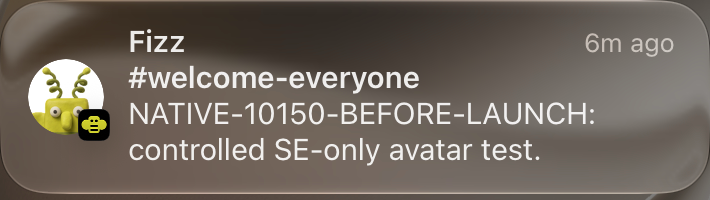 Authenticated HTTP avatar fetching and persistent HTTP cache reuse also passed on the SE. The first notification downloaded a relay thumbnail. After terminating the extension and expiring its separate avatar entry, the next notification displayed the avatar and refreshed that entry without another media request in the relay logs. The main app remained unopened throughout. The original app build and test profile were restored afterward. Automated tests cover slow and failed requests, stale images, removal, and account revocation; those cases have not all been exercised on the phone. ### Before merge - [x] Verify authenticated HTTP avatar fetching and cache reuse on iOS against a working relay media service. <!-- buzz-review-completed --> --------- Signed-off-by: Tom Brow <tomb@block.xyz> |
||
|
Tom Brow
|
7b9551aba8 |
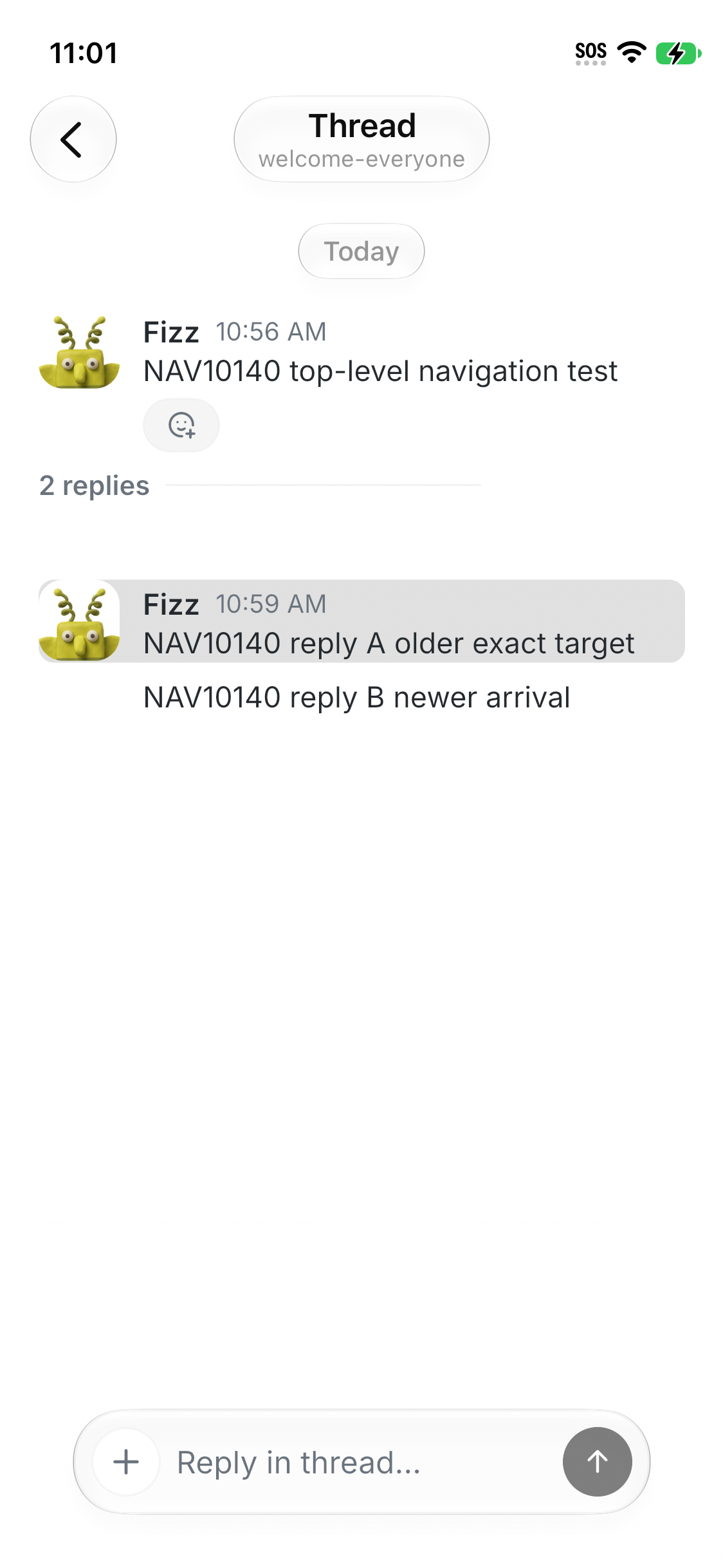
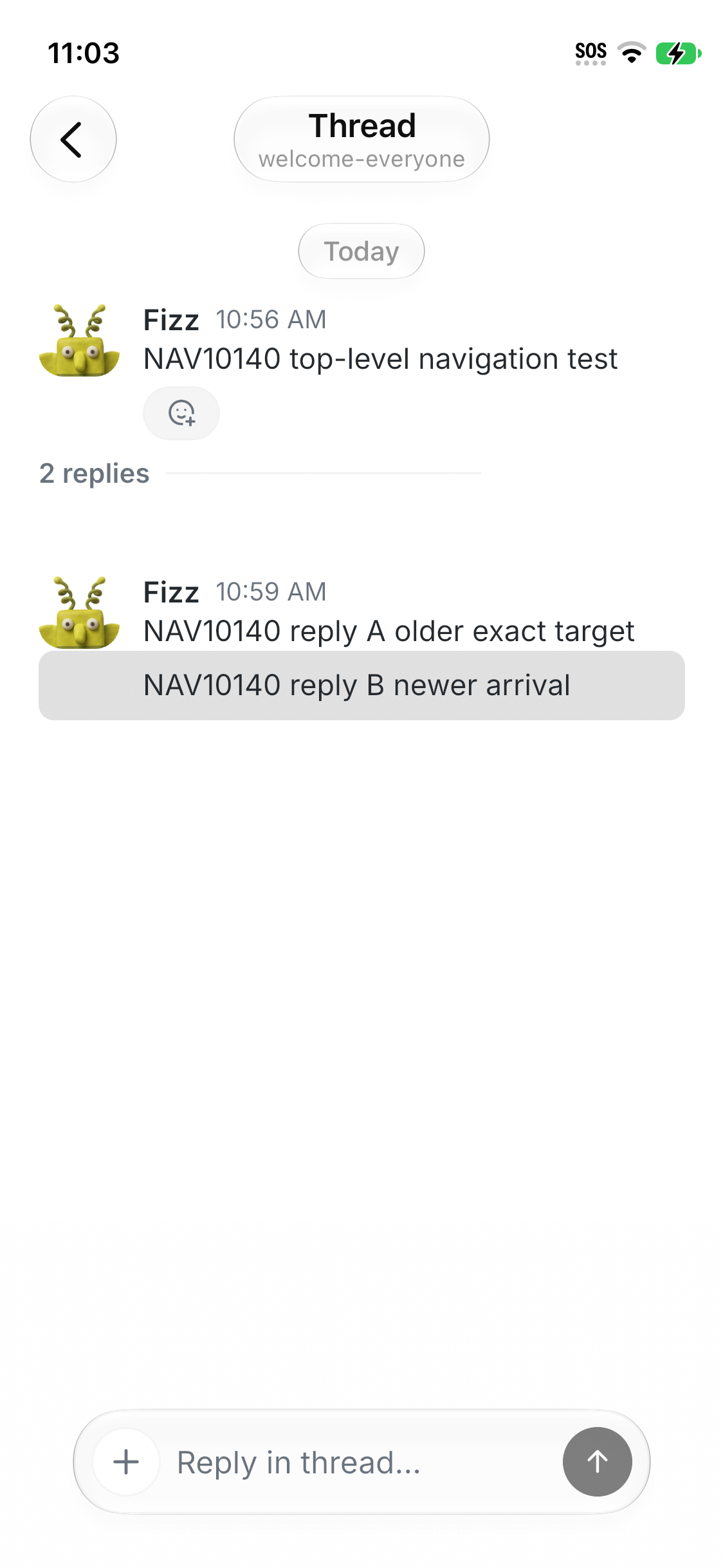
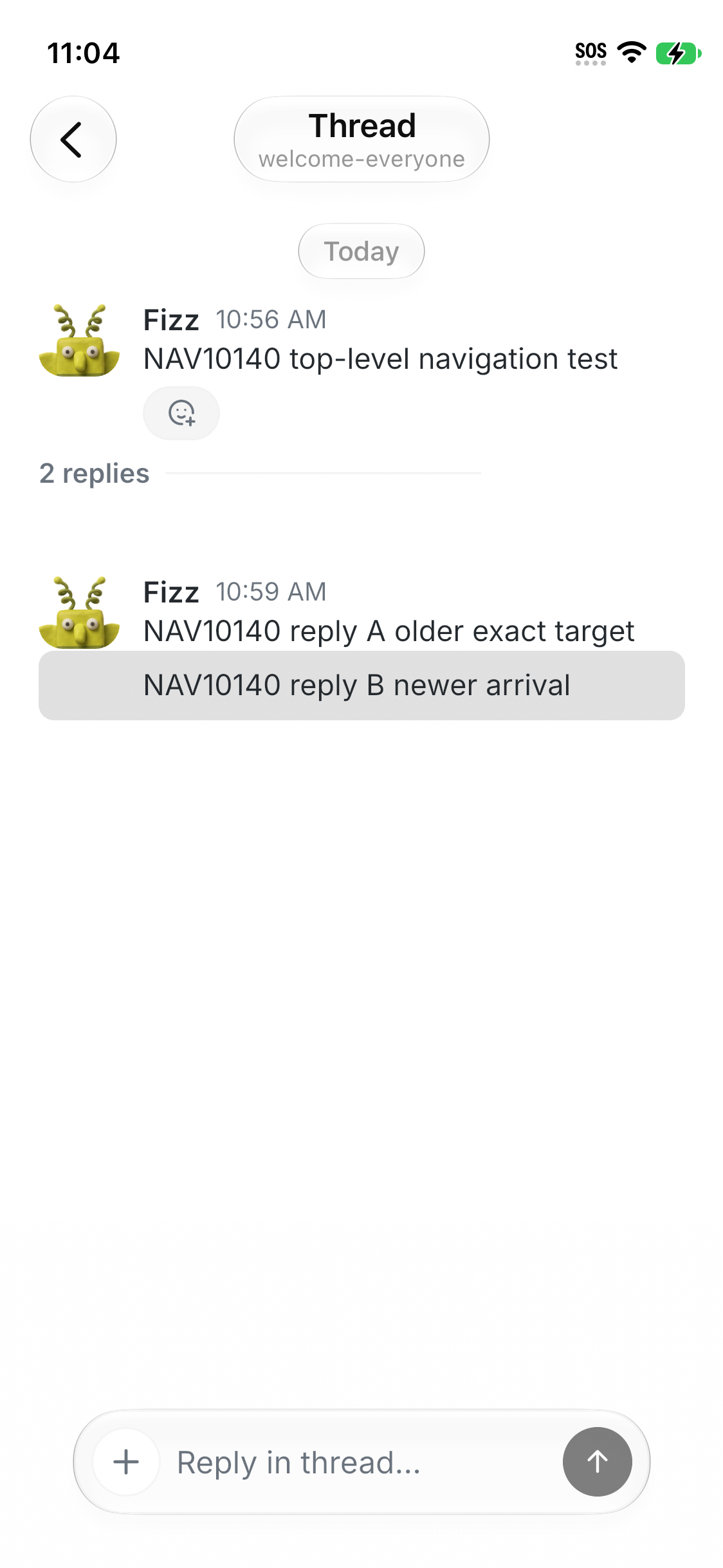
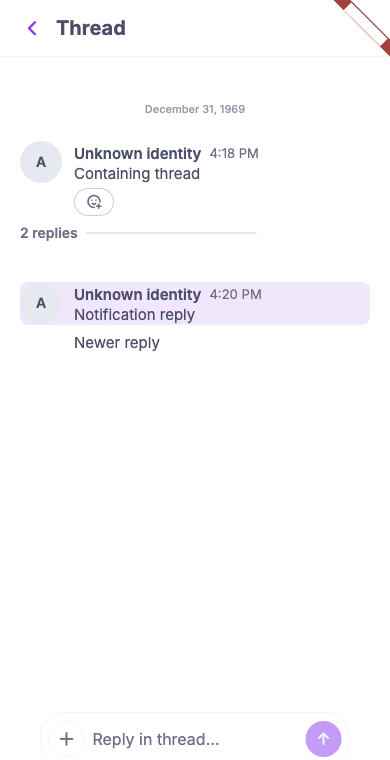
fix(ios): open push replies in their containing thread (#8294)
Tapping a push notification for a thread reply currently opens the channel at its parent. Preserve the verified event's direct-parent thread ID through the iOS notification payload and Flutter bridge so the tap opens the containing thread and highlights that exact reply, even when newer replies have arrived. This matches Inbox's destination selection for nested replies; broadcast replies still open in the channel. Closest related work: https://github.com/block/buzz/pull/6159 (original push-tap routing). ### Validation - Follow-up [ |
||
|
Logan Johnson
|
93761e411c |
fix(mobile): render push notification sender identity as npub (#7494)
🤖 ## Summary When an iOS push notification comes from someone the app has no cached name for, the notification title showed the first characters of the sender's raw public key — for example `aa4fc866…`. That fragment is unreadable and doesn't match how the same person appears anywhere else in Buzz. This PR changes that title to the compact form of the sender's npub (npub is the human-readable encoding of a Nostr public key): first 8 and last 4 characters — for example `npub14f8…9nsy`, the same identity shape used across the desktop and mobile apps. - Unnamed senders: raw hex fragment → compact npub. - Named senders: unchanged — a sender the app has a display name for still titles the notification with that name. - Unverifiable sender identities (malformed keys, or lookalike strings that are not literal 64-hex-digit keys) now render a neutral "Someone" instead of partial raw key material. - Everything else about the notification is unchanged: body text, subtitle, thread matching and grouping, deep-link navigation, thread identifiers, and the internal hex public key the resolver matches on. The native iOS notification-service package (`BuzzPushKit`) gains a minimal in-house bech32 codec (bech32 is the checksummed string encoding npubs use) — checksum-validated, 32-byte keys only, and no new external dependency. The hex input branch accepts exactly a 64 ASCII hex digit key before any parsing, so strings that merely parse like hex (for example a run of `+a` pairs) cannot become a displayed identity; this is input validation for presentation. Event signature verification is untouched. ### Related issue Fixes: N/A. Searched existing issues/PRs for push-notification npub identity — closest related: none found. ### Testing At head `3e3f2813b8864b76257ccb50dea3a4b31fa4de0d` (base `44316ff72f5f7de014c66b01cbf534298a70c249`; 4 files, +321/−4): - CI `Mobile Swift` lane, at this exact head — all passed: `swift test` (73 tests, 0 failures), the SwiftPM debug and release builds of `mobile/ios/BuzzPushKit`, and the unsigned iOS release build. - Test coverage: npub encoding cross-checked against independent nostr-rs/NIP-19 vectors; rejection of bad checksums, mixed case, wrong lengths, invalid alphabet, padding, and non-32-byte payloads; resolver boundary matrix — hex/npub/invalid sender keys render compact npub or "Someone" while body, subtitle, sender key, and thread identifier pass through; named senders keep cached display names. ### Task provenance Buzz channel: `1f0e4a3d-7e01-4efe-bb16-843b357f85c9` Task: buzz://message?channel=1f0e4a3d-7e01-4efe-bb16-843b357f85c9&id=86b34eb4bd84a1472419e9af22636c011c0fe273e3c196f967d7a36996e149b6 --------- Signed-off-by: Logan Johnson <loganj@squareup.com> Co-authored-by: Larry <627498bd4bd1f281a16431e3c6cce3b5c25b6692798c78672298aefbf2f8f8b5@buzz.block.builderlab.xyz> |
||
|
Tom Brow
|
c432a111ca |
feat(mobile): push notifications MVP (#6269)
This PR implements MVP, iOS-only,
[NIP-PL](
|