mirror of
https://github.com/block/buzz.git
synced 2026-11-11 20:01:09 +00:00
codex/buzz-271-draft-prep
7 Commits
| Author | SHA1 | Message | Date | |
|---|---|---|---|---|
 Tom Brow |
ff6ab96e42 |
fix(mobile): drop the # from Solo chat names in push notifications (#8955)
## Summary

Push notifications for Solo chats were titled like channels (`#Trip
planning`). The iOS notification extension added `#` to every stream and
forum conversation name, but the app presents Solo chats as personal
chats, not channels.

- `BuzzPushCachedChannel` gains optional `isSolo` and `creatorPubkey`,
derived from relay kind 39000 metadata. `isSolo` uses the same rule as
the app's `Channel.isSolo`: a private stream whose NIP-CL labels (every
`t` after the leading type) include `buzz.solo`. `creatorPubkey` is the
relay-authored `P` tag.
- The resolver uses the bare channel name only for the viewer's own Solo
chats (matching `Channel.isPersonalChat`, which requires `createdBy ==
viewer`). Someone else's Solo chat, and every other channel, keeps
`#name`.
- `isSolo` is optional, so existing App Group caches still decode.
Entries cached before this change have no flag and keep the `#` until
their metadata is refreshed.

## Validation

- `swift test --package-path mobile/ios/BuzzPushKit`: 104 XCTest and 66
Swift Testing tests pass, including two new ones:
- `testOnlyOwnSoloChatConversationNameDropsChannelHash`: a fresh Solo
metadata fetch yields `Trip planning` when the viewer created the chat
and `#Trip planning` when someone else did. Removing the creator check
makes it fail.
- `soloClassification`: only private `stream` channels labelled
`buzz.solo` are marked Solo (open, forum, label-only and unlabelled
private streams are not), and the `P` creator is cached lowercased.
- Live relay check: a local relay with synthetic identities, a Solo chat
("Weekend plans") and a private channel ("design-review"), each with a
second member who posts. The production `BuzzPushNotificationResolver`
(the code the notification extension calls), run against relay-built
kind 39000 metadata, gives:

  | | Solo chat | Channel |
  |---|---|---|
  | main | `#Weekend plans` | `#design-review` |
  | this PR | `Weekend plans` | `#design-review` |

- Not covered: a banner rendered by the notification extension. `simctl
push` delivers to the simulator as a local notification and never
launches the extension, and a real APNs push needs credentials this
machine doesn't have.

## Follow-up after merge

Merging on the live relay check above. Still to do once a dogfood build
includes this change:

- [ ] On-device push check on a BLIMP: a Solo chat push shows the bare
name and a channel push keeps `#name`.
- [ ] Before/after notification screenshots.

🤖 Generated with [Claude Code](https://claude.com/claude-code)

---------

Signed-off-by: Tom Brow <tomb@squareup.com>
Co-authored-by: Tom Brow <tomb@squareup.com>
Co-authored-by: Claude Opus 5.5 <noreply@anthropic.com>
|
||
|
Tom Brow
|
73962435b6 |
Use upstream C secp256k1 for native Nostr signatures (#8398)
Replace the Swift secp256k1 wrapper with a small native adapter over Bitcoin Core libsecp256k1. This is an alternative to the wrapper upgrade in [#8381](https://github.com/block/buzz/pull/8381), not an additional change to merge alongside it. The adapter covers the three Nostr operations Buzz needs: x-only public-key derivation, BIP-340 signing, and signature verification. It compiles pinned, unmodified upstream C source through SwiftPM. There is no build plugin, plugin approval script, or underscored Swift import. The app and notification extension use an explicit C module map and header search path. This trades the third-party Swift wrapper for a Buzz-owned adapter and responsibility for updating the vendored C source. Upstream v0.8.0 source, its license, and update provenance are included. The release Xcode pin remains separate in [buzz-releases#110](https://github.com/squareup/buzz-releases/pull/110). ### Validation - Native package tests passed on Xcode 27.0 and 26.5: 96 XCTest tests and 65 Swift Testing tests per toolchain. - Added tests cover the official BIP-340 vectors for 32-byte Nostr messages, invalid secret keys, and malformed input lengths. - Full unsigned Release app and notification extension build passed on exact Xcode 27.0. - Vendored files were compared byte-for-byte with upstream v0.8.0. - Full local `just ci` passed. - [Hosted full unsigned iOS Release build](https://github.com/block/buzz/actions/runs/38924020583/job/117051237094) passed. [Hosted Native Swift validation](https://github.com/block/buzz/actions/runs/38924020583/job/117051237153) passed, including the complete simulator build and native controls/push navigation tests. - Codex code review and security review completed with no findings. ### Before merge - [x] Tom selected the direct-C approach with vendored upstream source; [the wrapper alternative](https://github.com/block/buzz/pull/8381) is closed. Signed-off-by: Tom Brow <tomb@block.xyz> |
||
|
Tom Brow
|
fea02d174d |
fix(ios): fetch profiles and avatars in notification extension (#8369)
A notification can arrive from someone whose profile the main app has never loaded. The iOS notification extension now fetches and caches sender profiles, channel details, and avatars itself. The main app supplies account configuration and Keychain credentials only. After resolving the message, the extension allows 1.5 seconds for sender and channel details. It uses available stale data when a refresh is slow or fails, delivers once, and lets late results update its private cache. Profiles, channel details, and avatar refresh checks share a one-hour freshness threshold. A verified avatar removal clears the previous image. Account removal prevents further use of that sign-in's cached data. Profile, channel metadata, and membership use separate bounded downloads, so an oversized roster cannot discard the smaller records. Sender enrichment can finish while channel requests are pending. A successful partial channel refresh atomically removes its old counterpart, preventing a mixed group identity or recipient count. Group-specific notification presentation still requires a verified recipient count. The [specification](https://github.com/block/buzz/blob/native-notification-enrichment/docs/native-notification-enrichment.md) describes the display, caching, and account-removal behavior. General persistent image caching in Flutter remains separate. ### Validation [Hosted CI](https://github.com/block/buzz/actions/runs/38780108487) passed on the final commit, including all Flutter shards, Android, the full iOS release and simulator builds, and native controls/push-navigation tests. The [current-commit security review](https://github.com/block/buzz/pull/8369#issuecomment-6197508385) found no issues. The native package passed 159 tests, including new coverage for cache freshness, avatar replacement and removal, sign-in isolation, concurrent storage, late results, single delivery, bounded downloads, and SVG validation. A regression test exposed identical HTTP authentication event IDs for requests in the same second; each request now includes a unique nonce, matching the Dart and CLI clients. Full local CI passed before that small authentication fix. The complete native suite and signed device build passed again on the latest commit, including response-size limits, overlapping avatar downloads, canonical relay-origin matching, independent profile/channel refreshes, account-key changes before and during requests, and a single initial snapshot read across 64 accounts, signed IPv6 avatar authorities, and partial channel refreshes. Focused Flutter regression tests passed 198 tests with three configuration-specific skips; seven avatar widget tests also passed. Flutter analysis is clean, and the notification extension builds for the simulator. On an iPhone SE, the notification displayed the sender name, avatar, channel, and message before the updated main app was opened. Repeat notifications used a byte-identical private cache. Three notifications delivered together displayed the avatar after the authentication fix. The next notification also displayed correctly after terminating the extension process. The existing generic-push design can select the same newest unread message for several pushes; this change does not alter message selection. 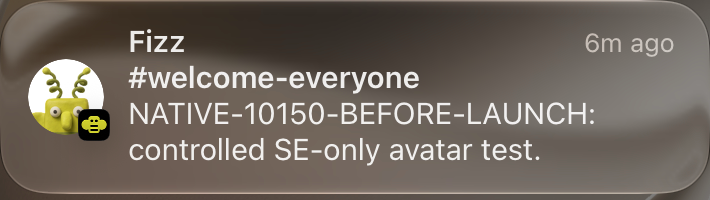 Authenticated HTTP avatar fetching and persistent HTTP cache reuse also passed on the SE. The first notification downloaded a relay thumbnail. After terminating the extension and expiring its separate avatar entry, the next notification displayed the avatar and refreshed that entry without another media request in the relay logs. The main app remained unopened throughout. The original app build and test profile were restored afterward. Automated tests cover slow and failed requests, stale images, removal, and account revocation; those cases have not all been exercised on the phone. ### Before merge - [x] Verify authenticated HTTP avatar fetching and cache reuse on iOS against a working relay media service. <!-- buzz-review-completed --> --------- Signed-off-by: Tom Brow <tomb@block.xyz> |
||
|
Tom Brow
|
779af8886c |
fix(mobile): fail open when age checks are unavailable (#7714)
Age-check errors previously blocked Buzz startup. Normal app startup now proceeds immediately; only a valid under-18 response from the current launch request can restrict access. Age check enforcement remains disabled at compile time by default. Builds can opt in with `--dart-define=BUZZ_AGE_GATING_ENABLED=true`. --------- Signed-off-by: Tom Brow <tomb@block.xyz> |
||
|
Tom Brow
|
b8aa0233f9 |
perf(mobile): verify notification cache events in background (#7650)
On iOS, Buzz stores verified profile and channel information for the notification extension. The extension uses this cache to show sender and channel names. Loading profiles or channels also updates the cache. Cache updates currently check event signatures on the UI thread, even when the caller does not wait for the update. This can delay taps and screen updates. This change moves those checks to a background worker. Signature checks, event selection, community boundaries, and the order of native writes are preserved. The worker accepts up to eight batches. When it is busy, later profile requests stay coalesced before fetching; profiles already loaded remain available immediately. Overlapping channel updates trigger a fresh joined-channel cache snapshot after the current export finishes, without delaying or restarting the channel screen. Queue saturation gets up to five retries per operation. Pending updates get their own recovery attempt even if the preceding export fails. Recovery fetches joined-channel data once and retries cache admission without repeating relay reads. It does not fetch the open-channel directory. Verified payloads are split into native-sized writes (256 profiles or 512 paired channels), keeping the same export ordering. Native profile/channel write failures retry the same verified chunk while retaining the export's queue position. All chunks share five retries with 7.75 seconds total backoff; other native errors fail immediately. Terminal failures are recorded, and later successful writes do not hide them. Captured batches keep their original community. Pending channel refetches are retired on a community switch and refreshed when the user returns. The cache remains best effort; prolonged failures can still prevent delivery. Tests through the production APIs reduced UI delay from 27–31 ms to below 0.3 ms for four profiles, and from 59–60 ms to below 0.3 ms for four channel and membership pairs. The native payloads were identical. This does not measure overall screen speed. Validation: 2,225 mobile tests passed (one skipped), along with 18 focused export tests, 12 recovery tests, 39 native Swift tests, 35 focused profile tests, and static analysis. Production regressions cover 13-entity bursts, invalid newer events, community rebuilds, reentrant refreshes, and terminal failures. Regression tests fail when producer recovery controls, terminal-failure draining, or member-only recovery scope are removed. --------- Signed-off-by: Tom Brow <tomb@block.xyz> |
||
|
Tom Brow
|
f78a32cf03 |
feat(mobile): hard-block under-18 users on the store age signal (#4665)
### What changed? Buzz mobile checks the app-store age signal at launch and hard-blocks the app behind a full-screen 18+ notice when the store says the signed-in person is under 18. No age signal (e.g. declined permission, indeterminate value, unsupported OS versions) results in no block. The age value is never persisted. It is read, used to compute one boolean, and discarded. Nothing is written to disk, and neither the age value nor the range is logged or sent to analytics. Platform notes: - **New dependency `com.google.android.play:age-signals:0.0.4`.** This is the only way to read the Play signal. Its AAR declares `minSdkVersion 23`, below the app's 24, so it forces **no minSdk bump**, and it self-declares its own consent activity, so **no AndroidManifest change** is needed. - **iOS entitlement and linking.** `DeclaredAgeRange` autolinks from the import. `Runner.entitlements` now declares `com.apple.developer.declared-age-range`, and the call remains behind `#available(iOS 26.0, *)`. ### Why? App stores now expose a declared-age range, and Buzz's Terms require users to be 18 or older. This wires the store signal to that rule with the smallest change that is defensible. Absent signals, declined or undeterminable results, and unsupported OS versions allow the app through. A transient native request failure does not become evidence that access is allowed: the app remains gated until a retry produces a result. Only an affirmative under-18 signal produces the permanent restriction screen. ### How is it tested? Added tests: - [`age_signal_provider_test`](https://github.com/block/buzz/tree/main/mobile/test/features/age_gate) covers the 17/18 boundary, open-ended ranges, no-signal, transient recovery, bounded retry exhaustion, malformed payloads, and request-once behavior - [`age_gate_app_test`](https://github.com/block/buzz/tree/main/mobile/test/features/age_gate) proves authenticated content remains unmounted while the signal is pending or retryable, and verifies the retry path - [`age_restriction_page_test`](https://github.com/block/buzz/tree/main/mobile/test/features/age_gate) asserts the block screen offers no bypass affordance - [`community_provider_test`](https://github.com/block/buzz/tree/main/mobile/test/shared/community) verifies age restriction clears push state, persists inactive leases, and retries a failed tombstone - [`AgeSignalPayloadTest`](https://github.com/block/buzz/tree/main/mobile/android/app/src/test/kotlin/xyz/block/buzz/mobile) pins the Android success payload to exactly `{status, ageUpper}` and verifies failures return the distinct retryable platform error ### Deployment note Enable the Declared Age Range capability and regenerate signing profiles carrying the entitlement. This relops/App Store Connect task is not performed by this PR. *🤖 This PR was authored [with an agent](codex://threads/019e5128-536b-73b3-8348-88651123f6da).* | Age restriction screen | | --- | | <img src="https://github.com/user-attachments/assets/5b0f48b1-df9b-4a60-9800-80b33f128535" alt="Age restriction screen" width="320"> | --------- Signed-off-by: Tom Brow <tomb@block.xyz> Co-authored-by: npub12wpjffj7q5qjsky5jvk4ldwlxmse5xll3d8gytk4wqd0c5y7jvwspg37n6 <538324a65e0501285894932d5fb5df36e19a1bff8b4e822ed5701afc509e931d@buzz.block.builderlab.xyz> Co-authored-by: npub1tquskdu6yc4h8l7xxtceculxw600grekeq0xg2ukqfrwl7vrzg3quz3gmp <58390b379a262b73ffc632f19c73e6769ef40f36c81e642b960246eff9831222@buzz.block.builderlab.xyz> Co-authored-by: Codex <noreply@openai.com> |
||
|
Tom Brow
|
c432a111ca |
feat(mobile): push notifications MVP (#6269)
This PR implements MVP, iOS-only,
[NIP-PL](
|
