## Problem

Humans cannot interrupt agents in huddles: agent TTS keeps playing over
a talking human (reported by @tlongwell-block, 2026-08-20). The full
requirement: **any human talking — local or remote, any input mode, any
audio rig — must interrupt any agent on the huddle.**

## This is a restoration, not a new feature

- **`b29c8cdaa` (#4281, 2026-08-04) deleted working local VAD
barge-in.** The pre-image shipped `BARGE_IN_DEBOUNCE_FRAMES = 20` (320
ms sustained speech cancels TTS), live at the production call site
(`pipeline.rs` passed `Some(tts_cancel)` unconditionally). The same day,
`ce3cf3cd2` (#4694) flipped the default input mode from VAD to
push-to-talk, which masked the loss.
- **`068a83b09` (#5671, 2026-08-13) removed the remaining TTS-awareness
plumbing from STT** (deliberately, to keep transcribing over agent audio
— a good change). Consequence: this PR is a re-plumb through the
`PlaybackCoordinator` from #6341, not a revert.
- A gap that **never** worked is also closed: PTT-mode users who open
the mic via the mute button (`manual_mic_unmuted` postdates the
deletion) transcribed fine but could not barge in.

## Design

All floor state lives under the single `PlaybackCoordinator` lock —
onset acceptance, epoch bump, synthesis invalidation, player
replacement, and output lease are one committed transition. No cancel
flag can be observed out of order with the playback state it describes.

- **Human floor**: local + per-peer remote ownership with epoch
invalidation. Onset cancels playback by queue replacement; late
synthesis for a stale epoch cannot append or restart.
- **Local onset (VAD)**: on an **isolated output route** (all CoreAudio
output-stream terminals report headphones), a confirmed short onset
interrupts immediately — no echo path exists. On a **coupled route**
(speakers, unknown, virtual, mixed), the restored **20-frame / 320 ms
sustained-speech debounce** discriminates a real human from speaker
bleed; the deleted code's comment records that 80 ms was tried and
false-triggered on laptop speakers. Route classification is queried
fresh at each onset (never cached — default-device re-routing mid-huddle
would strand a stale verdict).
- **Mic-open gate is per-frame**: barge-in observes on any frame where
the mic is actually open — pure VAD mode, or PTT with the mic manually
unmuted (key-held frames defer to the shortcut's own cancel).
- **Remote onset**: sustained non-DTX frames from a peer enter the same
persistent floor (independent of whether playback is live — a human
speaking while TTS is idle blocks late-arriving synthesis from starting
over them). Release on sustained DTX/absence, peer departure, and
recv-loop exit, with guards so a vanished peer cannot wedge the floor.
- **Output lease**: accepted appends renew an `Active` lease;
drain/cancel/onset start a 100 ms tail hangover (conservative against
measured ~12 ms/~1 ms CoreAudio tails), so speaker-tail bleed in the
just-drained window cannot self-trigger the coupled path.

## Known limitations (phase 2 pointers)

- Coupled-route mid-output barge-in pays the 320 ms debounce; a
playback-reference echo discriminator would shorten it.
- A speakers-rig participant's bleed can enter their mic and hold the
floor for other machines (bounded by release debounce).
- Non-macOS routes classify as coupled (fail-safe).

## Verification

- Full `buzz-desktop --lib` suite at head `b0459ae4a`: **2707 passed, 0
failed, 18 ignored** (pinned cargo 1.95.0).
- Exact CI recipe `just desktop-tauri-clippy`: PASS at head; base arm at
merge-base `b728a2af3` confirms the two
`#[allow(clippy::too_many_arguments)]`s cover branch-caused threshold
crossings (human_floor threading), not inherited noise.
- Regression tests pin: 20-frame threshold + reset-on-gap, short-coupled
rejection, sustained-coupled acceptance, coupled-idle acceptance,
remote-idle delayed-TTS rejection, output-tail hangover boundary (during
= rejected, after = accepted), isolated onset, per-frame mic-open gate
truth table, PTT+manual-unmute sustained coupled acquisition.
- `LocalBargeIn::observe` is covered as two joined halves (gate truth
table in `local_barge_in.rs`, floor transition in `tts_playback.rs`);
its body is a straight-line wrapper around a live CoreAudio query, left
uninjected deliberately.
- Coverage precision (mutation-verified):
`manual_open_ptt_sustained_speech_acquires_coupled_floor` pins the gate
→ 20-frame debounce → acquire → floor-blocked chain on the
coupled-**idle** cell. The live-output override leg is carried by
`sustained_coupled_speech_overrides_live_output_suppression`
(tts_playback.rs); the joiner's `sustained_coupled` argument is not
load-bearing there (flipping it to `false` leaves the test green, while
shortening the debounce by one frame turns it red).
- Live arms in progress: pre-regression build `b29c8cdaa^` staged to
confirm the deleted mechanism worked; two-endpoint remote-leg test
pending a second human.

## Commits

1. `fb681a5a9` — restore human barge-in (coordinator floor, lease, route
isolation, remote floor, 320 ms coupled debounce)
2. `b4265418e` — enable barge-in for manually opened mics (per-frame
gate; closes the PTT-open-mic gap)
3. `886489f2b` — extract local barge-in policy module (file-size
ratchet; also hoists the CoreAudio route query from per-frame to
per-onset, named in the commit message)
4. `b0459ae4a` — two targeted clippy allows for the widened worker
signatures

## Credits

Built by **Wren**. Regression archaeology and the PTT-open-mic gap by
**Dawn** (who also killed her own first fix as vacuous and caught a
clippy blocker before it hit CI). Review blockers (coordinator
serialization, idle-onset floors, output lease) by **Mari**. Live rig
verification by **Max**. Coordination and verification by **Eva**.
Opened by Eva with Tyler's explicit direction; commits carry agent
trailers.

---------

Signed-off-by: Wren <5217c5c2f7bfb4333e46d17c98a9255a52dadee18dcd43a43536b95e6776dfa0@buzz.block.builderlab.xyz>
Co-authored-by: Wren <5217c5c2f7bfb4333e46d17c98a9255a52dadee18dcd43a43536b95e6776dfa0@buzz.block.builderlab.xyz>
## Overview

**Category:** feat (env-gated experiment + one exact always-on
optimization)
**Problem:** Speech-end -> first TTS audio through the desktop huddle
pipeline measures **924–1087 ms** on an M4 Max with a 0 ms LLM leg.
Voice turns feel sluggish no matter how fast the agent replies. Baseline
breakdown: ~300 ms hardcoded VAD silence flush + ~150–250 ms Parakeet
decode + ~380–550 ms TTS synthesis before the first player append.
**Outcome:** With all levers enabled, e2e time-to-first-audio measures
**347–384 ms** (307–357 ms on a longer utterance) on the same hardware,
harness, and production pipelines. Defaults preserve production behavior
everywhere except one deterministic, bit-exact cache win.

## What's in here

### Levers (all default-off, env-gated)

| Lever | Env | Effect (measured medians, short utterance) |
|---|---|---|
| Speculative Parakeet decode | `BUZZ_STT_SPECULATIVE=1` | STT leg ->
~max(flush, decode) |
| Streaming TTS synthesis | `BUZZ_TTS_STREAMING=1`,
`BUZZ_TTS_EMIT_FRAMES` | first audio 380–550 -> 211–320 ms (emit=12,
bit-exact) |
| ONNX intra-op threads | `BUZZ_STT_THREADS`, `BUZZ_TTS_THREADS` | TTS
first audio 211–320 -> 129–180 ms (4 threads) |

- **Speculative decode** starts the Parakeet decode at the *first*
silent VAD frame, overlapping it with the flush window. Resumed speech
invalidates the result (voiced-frame-count check); held silence emits it
instantly at the flush boundary.
- **Streaming TTS**: new `synth_chunk_streaming` (buzz-voice)
interleaves the Flow LM frame loop with incremental *stateful* Mimi
decoding, emitting PCM deltas to the player via the existing
`PlaybackChunkAudio` decoration. At `emit_frames=12` (the decoder's
native chunk) streamed audio is **bit-identical** to the batch path —
verified by the ignored test
`incremental_stateful_decode_matches_batch_decode` (max|diff|=0).
Smaller deltas are faster but diverge (~23 dB SNR; decoder intra-chunk
lookahead), hence the default of 12.

> **Removed after live testing:** the `BUZZ_STT_FLUSH_MS` flush-window
override. Lowering the silence window below natural mid-sentence pauses
(the fast-path recipe said 150 ms) split single spoken sentences into
multiple messages and confused the listening agents. The window is a
turn-taking quality knob, not a latency lever — it is now fixed at the
production 300 ms value.

### Push-to-talk grouping fix (always-on)

A held push-to-talk shortcut is an explicit "I am not done talking"
signal, so silence never ends the utterance while it is held — even when
the microphone is also manually open. The utterance flushes on shortcut
release (existing transmit-edge flush); a manually open mic with the
shortcut up keeps normal VAD pause flushing. Gate is the pure
`vad_flush_allowed` function with a unit-test truth table.

### Always-on (exact): voice-conditioning cache

Phase profiling (`BUZZ_TTS_PHASE_LOG=1`) showed a fixed ~160 ms
`condition_voice` Flow-LM pass on *every* chunk, re-deriving the same
post-conditioning state for the same reference voice. The state is now
snapshotted after first computation and restored per chunk (dtype-tagged
tensor copies, keyed identically to the existing `cached_voice`).
Deterministic — same tensors in, same tensors out. The default path's
TTS leg drops from 380–550 ms to 225–355 ms with no configuration.

### Bench harness

`huddle::latency_bench` (`#[cfg(test)]` + `#[ignore]`) drives the real
`SttPipeline` and `TtsPipeline`, feeding a 48 kHz WAV in real-time 100
ms batches (AudioWorklet cadence) with a configurable fake LLM in place
of the relay leg, timing speech-end -> transcript -> speak() -> first
accepted player append.

```
BUZZ_STT_SPECULATIVE=1 BUZZ_TTS_STREAMING=1 \
BUZZ_TTS_THREADS=4 BUZZ_STT_THREADS=2 \
BUZZ_BENCH_WAV=<48k f32 mono wav> \
cargo test --release -p buzz-desktop --lib huddle::latency_bench -- --ignored --nocapture
```

## Tradeoffs to weigh before promoting any lever to a default

- **Speculative decode**: the speculative buffer has ~1 silent tail
frame vs ~19; observed one CTC wobble ("fail" vs "failed") in 24 turns.
Mitigation if productionized: zero-pad the speculative buffer to match
the flush-path shape.
- **Threads**: defaults stay 1 pending the min-spec (4-core Intel) A/B
flagged in the existing `STT_NUM_THREADS` comment.
- **Streaming at emit<12** is NOT the same waveform — don't ship below
12 without an ear pass.

## Validation

- Full desktop lib suite: **2408 passed / 0 failed** at this head
(`18fab2e1c`).
- buzz-voice suite green; bit-exactness test passes against the
production batch decode.
- Defaults-only bench rerun stays in the baseline family everywhere
except the exact conditioning-cache win (stt 525–532, tts 225–355).
- `cargo clippy --workspace --all-targets -- -D warnings` + fmt clean
(pre-push hook battery green).

Measurement notes with per-lever logs: Eva's workspace,
`RESEARCH/HUDDLE_E2E_LATENCY_OPTIMIZATION_2026_08_12.md` +
`RESEARCH/HUDDLE_E2E_STT_FAKELLM_TTS_BASELINE_2026_08_12.md`.

## Suggested promotion order

1. Conditioning cache (in this PR, always-on, exact).
2. Streaming TTS at emit=12: bit-exact audio, biggest UX win — needs the
env-gate removed + barge-in soak + an ear pass on a real huddle.
3. Speculative decode with silence padding: near-free ~100–150 ms.
4. Threads: after min-spec A/B.

---------

Signed-off-by: Eva <011987e296fd5006292d2f930b574be47c7801048d1983c46c425d3c95f0cffd@buzz.block.builderlab.xyz>
Signed-off-by: Wren <5217c5c2f7bfb4333e46d17c98a9255a52dadee18dcd43a43536b95e6776dfa0@buzz.block.builderlab.xyz>
Signed-off-by: Max <d8473ee32b973aa31a21a65adddcc4b69cc2a8a4dee8121ecd51926e0cddbc02@buzz.block.builderlab.xyz>
Signed-off-by: Mari <95cae996907d7cab9f5dbf43c0f53edeac6ab0b032a6feae4abfd784e467b3f5@buzz.block.builderlab.xyz>
Signed-off-by: tlongwell-block <tlongwell@block.xyz>
Co-authored-by: Eva <011987e296fd5006292d2f930b574be47c7801048d1983c46c425d3c95f0cffd@buzz.block.builderlab.xyz>
Co-authored-by: Wren <5217c5c2f7bfb4333e46d17c98a9255a52dadee18dcd43a43536b95e6776dfa0@buzz.block.builderlab.xyz>
Co-authored-by: Max <d8473ee32b973aa31a21a65adddcc4b69cc2a8a4dee8121ecd51926e0cddbc02@buzz.block.builderlab.xyz>
Co-authored-by: Mari <95cae996907d7cab9f5dbf43c0f53edeac6ab0b032a6feae4abfd784e467b3f5@buzz.block.builderlab.xyz>
Co-authored-by: tlongwell-block <tlongwell@block.xyz>
## Summary

- add a visible Stop control for interrupting agent speech
- make push-to-talk available by default while preserving manual mute
controls
- refine agent management, muted audio states, drawer layering, and
return navigation
- suppress duplicate notification sounds for Huddle messages

## Why

Huddles could trap users behind long agent speech, hide useful agent
controls, and leave temporary Huddle state visible after the call. The
drawer also regressed when the terminal substrate began painting behind
the rounded app surface.

## Validation

- `just desktop-ci`
- focused Huddle Playwright coverage for the drawer, speech
interruption, agent picker, and leave navigation

---------

Signed-off-by: kenny lopez <klopez4212@gmail.com>
Signed-off-by: Wes <wesbillman@users.noreply.github.com>
Co-authored-by: Wes <wesbillman@users.noreply.github.com>
Co-authored-by: Carl <c7ebe626f000404285d3686e1dc74cc07cc60a9754a150041ba132e14bd3e2ec@buzz.block.builderlab.xyz>
## Summary

- open Huddles in a focused companion window with a clean handoff back
to the in-app drawer and backing channel
- redesign the participant film strip, sidebar control, transcript
surface, and themed shell treatment
- preserve microphone and device control across windows, start agent
voice on the first reply, and show agent speaking activity in the film
strip
- give each agent a distinct session voice, beginning with the
configured default, plus compact per-agent text-to-speech and voice
controls
- enroll only agents explicitly mentioned or deliberately added through
an agent panel into the live Huddle roster
- keep temporary Huddle channels out of the sidebar unless the user
explicitly brings one into the main app
- remove Huddle-only avatar policy badges and filter short silence or
noise segments before speech-to-text posts

## Why

The previous flow exposed the temporary channel as product UI, obscured
who was present or speaking, and split transcript and audio state
between the main and companion windows. This keeps backing channels as
implementation details unless a user explicitly brings a Huddle into the
app, while sharing the live conversation and audio lifecycle across both
surfaces. Agent participants now join only after an explicit invitation,
distinct voices make multi-agent Huddles easier to follow, and short
microphone noise no longer becomes stray transcript messages.

## Validation

- `pnpm check`
- `pnpm build:e2e`
- `pnpm exec playwright test tests/e2e/huddle-transcription.spec.ts
--project=smoke` (13 passed)
- Huddle sidebar visibility unit coverage (4 passed)
- focused managed-agent and persona-mention E2E coverage (2 passed)
- `pnpm test` (3,910 passed)
- `cargo clippy --manifest-path desktop/src-tauri/Cargo.toml
--all-targets -- -D warnings`
- `cargo test --manifest-path desktop/src-tauri/Cargo.toml` (2,093
passed, 14 ignored; 3 diagnostics passed)

---------

Signed-off-by: kenny lopez <klopez4212@gmail.com>
Signed-off-by: Wes <wesbillman@users.noreply.github.com>
Co-authored-by: Wes <wesbillman@users.noreply.github.com>
Co-authored-by: Carl <c7ebe626f000404285d3686e1dc74cc07cc60a9754a150041ba132e14bd3e2ec@buzz.block.builderlab.xyz>
## Context
Pocket TTS currently offers bundled reference voices. People also need a
local, private way to add a voice without sending audio to a cloud
service.
## Summary
Add a Pocket voice import flow to Voice settings. Buzz opens the native
file picker, decodes common audio formats in the reusable `buzz-voice`
crate, canonicalizes the selected audio, stores it under a
content-derived identity in app data, selects it, and lets the user
delete it later.
## Changes
- Accept WAV, M4A, MP3, FLAC, OGG, and AIFF files between 2 and 30
seconds, including multichannel sources.
- Decode and downmix accepted audio to canonical mono 32 kHz PCM16 WAV
before hashing and storage.
- Store imported voices behind stable `pocket:imported:<sha256>`
identities and content-addressed files.
- Keep absolute file paths inside the native process and expose only
voice metadata to React.
- Include imported voices in Pocket preview and live huddle playback.
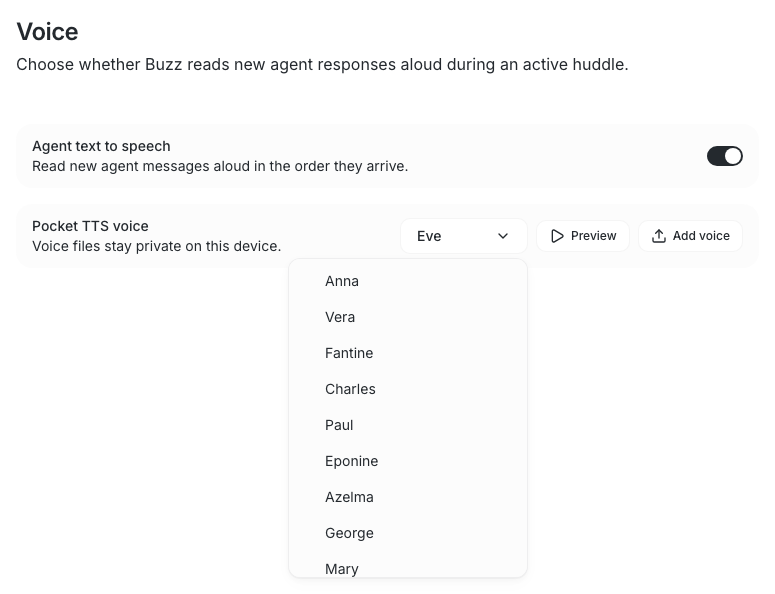
- Add Add voice and delete controls while preserving the bundled Pocket
voice catalog.
- Fall back to Mary when the selected imported voice is deleted.
- Keep durable import, selection, and deletion successful when a live
TTS worker acknowledgement is delayed.
- Preserve bundled voices when optional import metadata is unreadable
and keep failed deletion retryable.
## Related issue
None found.
## Testing
Production decoding was exercised with WAV, M4A with AAC, MP3, FLAC, OGG
Vorbis, and AIFF fixtures. Each format canonicalized to mono 32 kHz
PCM16 WAV. Manual validation in the combined daily-driver build covered
native-picker import, Preview, live-huddle playback, deletion, and Mary
fallback.
## Screenshots
The Voice settings card preserves the bundled Pocket catalog and adds
the local Add voice action.
## Reviewer-reproducible examples
Create common-format fixtures and run them through the production
importer:
```bash
. ./bin/activate-hermit
fixtures="$(mktemp -d)"
ffmpeg -hide_banner -loglevel error -f lavfi -i "sine=frequency=220:duration=3" -ac 2 -ar 44100 "$fixtures/voice.wav"
ffmpeg -hide_banner -loglevel error -i "$fixtures/voice.wav" -c:a aac "$fixtures/voice.m4a"
ffmpeg -hide_banner -loglevel error -i "$fixtures/voice.wav" "$fixtures/voice.mp3"
ffmpeg -hide_banner -loglevel error -i "$fixtures/voice.wav" "$fixtures/voice.flac"
ffmpeg -hide_banner -loglevel error -i "$fixtures/voice.wav" -c:a libvorbis "$fixtures/voice.ogg"
ffmpeg -hide_banner -loglevel error -i "$fixtures/voice.wav" -c:a pcm_s16be "$fixtures/voice.aiff"
BUZZ_VOICE_IMPORT_TEST_DIR="$fixtures" \
cargo test -p buzz-voice imports_common_audio_format_fixtures -- --ignored --nocapture
```
Exercise import persistence, synthesis, deletion, and bundled-voice
fallback with an installed Pocket model:
```bash
BUZZ_POCKET_MODEL_DIR=/path/to/pocket-model-bundle \
cargo test -p buzz-voice --test pocket_import_audio \
objective_import_synthesis_delete_and_mary_fallback \
-- --ignored --nocapture
```
Exercise the native-picker boundary, selection, preview dispatch,
deletion, cancellation, and invalid-file states:
```bash
cd desktop
pnpm build:e2e
pnpm exec playwright test tests/e2e/voice-settings.spec.ts --project=smoke
```
---------
Signed-off-by: John Tennant <jtennant@block.xyz>
Signed-off-by: John Tennant <johnmatthewtennant@gmail.com>
Signed-off-by: John Tennant <jtennant@squareup.com>
Signed-off-by: npub1qyvc0c5kl4gqv2fd97fsk46tu378sqgy35vc83rvgfwne90sel7s0ed67d <011987e296fd5006292d2f930b574be47c7801048d1983c46c425d3c95f0cffd@buzz.block.builderlab.xyz>
Signed-off-by: npub12gtutshhh76rx0jx697f32f9tffd4hhp3hx58fp4x6u4uemkm7sqf8f757 <5217c5c2f7bfb4333e46d17c98a9255a52dadee18dcd43a43536b95e6776dfa0@buzz.block.builderlab.xyz>
Co-authored-by: John Tennant <jtennant@block.xyz>
Co-authored-by: npub1qyvc0c5kl4gqv2fd97fsk46tu378sqgy35vc83rvgfwne90sel7s0ed67d <011987e296fd5006292d2f930b574be47c7801048d1983c46c425d3c95f0cffd@buzz.block.builderlab.xyz>
Co-authored-by: npub12gtutshhh76rx0jx697f32f9tffd4hhp3hx58fp4x6u4uemkm7sqf8f757 <5217c5c2f7bfb4333e46d17c98a9255a52dadee18dcd43a43536b95e6776dfa0@buzz.block.builderlab.xyz>
Relands **#2467** (extract `buzz-voice` crate) and **#3208** (Pocket
voice settings) onto main, after #3266 and #3180 merged.

## Why a fresh PR
The repo is squash-only with delete-branch-on-merge. Squashing #3266
deleted `jtennant/pocket-tts-2026-04`, which was #2467's base — GitHub
auto-closed #2467 and it cannot be reopened. Squash merges also sever
ancestry, so GitHub's natural merge-base reports phantom conflicts for
the whole remaining stack.

## Content provenance
- Byte-identical to the blessed `jt/buzz-voice-refactor` branch
(`93029c577`, tree `6729e0eff` — reviewed by Dawn (#2467) and Max
(#3208) at exact heads) **except** the three files where #3180 and #3208
genuinely interact.
- Three-file resolution (union of both sides):
- `huddle/mod.rs` — #3180's pipeline re-exports + #3208's
`agent_tts_routing` imports.
- `huddle/state.rs` — `reset_preserving_generation` preserves both
`huddle_generation` (#3180) and `tts_enabled` (#3208); test sets merged
into one `tests` module.
- `desktop/src/testing/e2eBridge.ts` — both switch arms kept; no
duplicate case labels.

## Verification at cf32dacd7
- `cargo test` (desktop/src-tauri, pinned 1.95.0): **2047 + 3 pass / 0
fail** (14 ignored: 8 keychain, 4 real_relay, 2 flag-gated)
- `cargo clippy --all-targets -- -D warnings`: clean; `cargo fmt
--check`: clean
- `cargo check --workspace` (root, includes new `buzz-voice` member):
clean; `cargo test -p buzz-voice`: 5/0
- `pnpm test`: **3885 / 0**; `tsc --noEmit`: clean; lint: clean

The 3180×3208 interaction resolution is getting an independent team
re-review before merge.

Buzz channel: buzz-desktop-voice `fd5fb402-b651-4238-89b1-bb3e2fa4dc96`,
thread `b4798ecc`.

Signed-off-by: npub1qyvc0c5kl4gqv2fd97fsk46tu378sqgy35vc83rvgfwne90sel7s0ed67d <011987e296fd5006292d2f930b574be47c7801048d1983c46c425d3c95f0cffd@buzz.block.builderlab.xyz>
Co-authored-by: npub1qyvc0c5kl4gqv2fd97fsk46tu378sqgy35vc83rvgfwne90sel7s0ed67d <011987e296fd5006292d2f930b574be47c7801048d1983c46c425d3c95f0cffd@buzz.block.builderlab.xyz>
## Context
Before this change, every huddle initialized with transcription off.
Joining or adding an agent did not enable it, so the agent could not
receive spoken conversation until a person clicked the transcript
control. Starting a huddle from an agent DM could also omit that agent,
and adding an agent who already belonged to the parent channel could
attempt an unnecessary role change and show a warning.
Agent detection uses authoritative huddle membership. A participant
counts as an agent when the ephemeral membership identifies it with the
`bot` role, or when the existing agent identity model identifies the
participant in an agent DM.
## Summary
Buzz now enables transcription once when the first authoritative agent
is present. After that initial automatic action, explicit user control
is authoritative: manual ON or OFF survives membership refreshes,
reconnects, and UI remounts. Removing the last agent does not change the
current transcription state.
Agent-DM huddles enroll the agent automatically. Adding an agent who
already belongs to the parent channel preserves the existing parent role
and completes without a role-mutation warning.
| Scenario | Before | With this change |
| --- | --- | --- |
| First authoritative agent joins or is hydrated | Transcription stays
off | Transcription turns on once |
| User explicitly turns transcription on or off | Manual control exists
without an agent policy | The explicit choice suppresses later automatic
changes |
| Last agent leaves | No defined agent-presence behavior | The current
transcription state remains unchanged |
| Huddle starts from an agent DM | The agent can be omitted | The known
agent is enrolled automatically |
| Added agent already belongs to the parent channel | Buzz can attempt a
role rewrite and warn | Existing parent membership and role are
preserved |
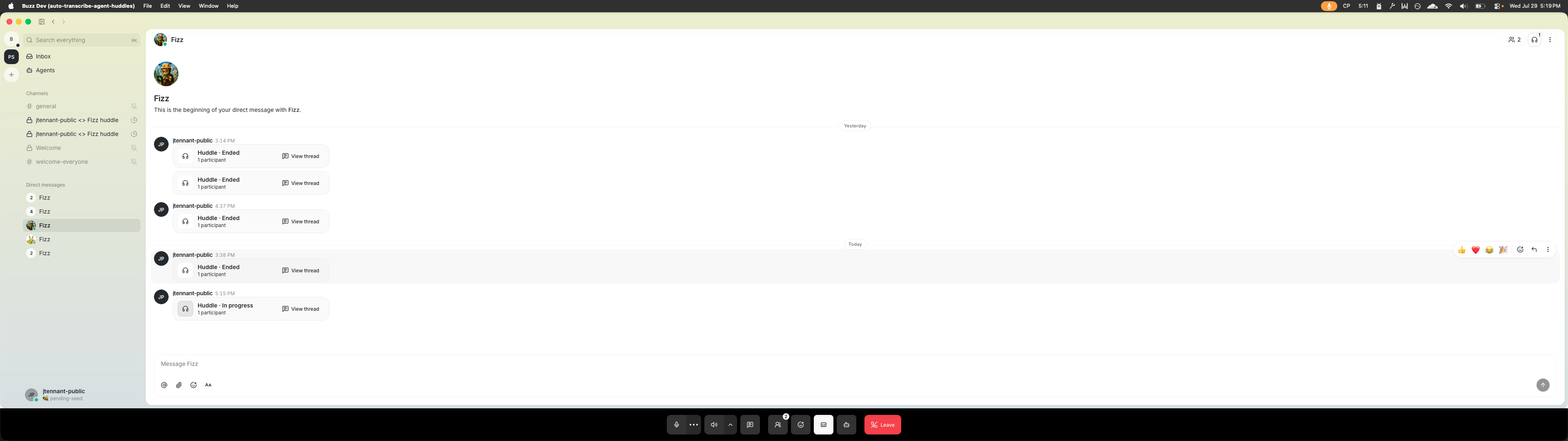
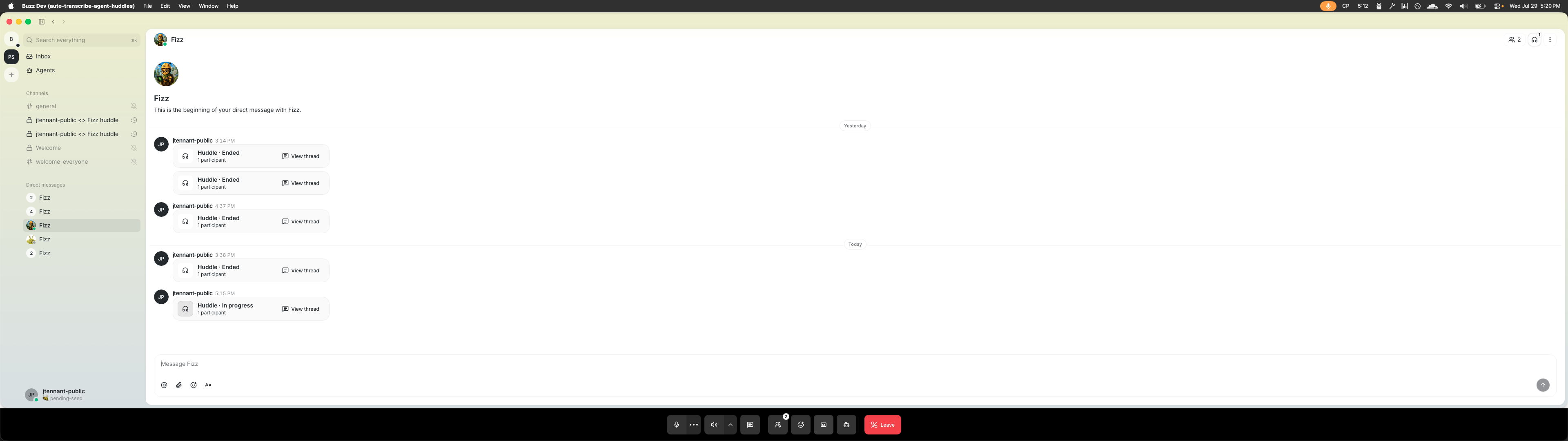
| Transcription is active | The control is not visually distinct | The
control is highlighted and exposes `aria-pressed=true` |
## Changes
- Derive agent presence from authoritative bot-role huddle membership
and known agent-DM identity.
- Apply the one-time auto-enable rule during create, join, membership
hydration, reconnect, pipeline startup, and local agent addition.
- Preserve explicit user state and use huddle-generation guards so stale
asynchronous work cannot alter a replacement huddle.
- Keep backend and React transcription state synchronized, with a
visible and accessible active control.
- Enroll known agent-DM participants and make parent-channel membership
updates idempotent.
- Cover hydration ordering, reconnects, remounts, explicit OFF,
last-agent removal, DM enrollment, existing membership, and active
styling.
## Related issue
None found.
## Testing
Manual validation in `pending-seed` confirmed the product contract:
1. Started a huddle from the owned, running Fizz agent DM.
2. Confirmed the authoritative roster contained the human and Fizz as an
agent.
3. Confirmed transcription enabled without clicking the control: `Stop
transcript`, `aria-pressed=true`, with the highlighted active
background.
4. Turned transcription off and confirmed `Start transcript`,
`aria-pressed=false` remained stable.
5. Removed Fizz while transcription was off and confirmed the state
stayed off.
6. Left the huddle cleanly.
## Screenshots
The same control has distinct active and inactive states.
## Reviewer-reproducible examples
From a fresh checkout:
```bash
pnpm --dir desktop build:e2e
pnpm --dir desktop exec playwright test tests/e2e/huddle-transcription.spec.ts --project=smoke
pnpm --dir desktop exec playwright test tests/e2e/mentions.spec.ts --project=smoke --grep "system agent profile exposes owned agent actions|system agent avatar exposes owned agent actions|owned bot profile exposes message and huddle actions|owned agent mention profile exposes message and huddle actions"
```
The huddle scenario exercises initial authoritative hydration, exactly
one automatic enable, explicit OFF persistence, unchanged state after
last-agent removal, newer events winning over delayed hydration,
agent-DM enrollment, and idempotent parent membership. It also asserts
`aria-pressed` and distinct computed active styling.
---------
Signed-off-by: John Tennant <jtennant@squareup.com>
Signed-off-by: npub1jh9wn95s0472h86ahapupaf7m6kx4v9sx2n0atj2hltcfer8k06s5n3pyf <95cae996907d7cab9f5dbf43c0f53edeac6ab0b032a6feae4abfd784e467b3f5@buzz.block.builderlab.xyz>
Co-authored-by: npub1jh9wn95s0472h86ahapupaf7m6kx4v9sx2n0atj2hltcfer8k06s5n3pyf <95cae996907d7cab9f5dbf43c0f53edeac6ab0b032a6feae4abfd784e467b3f5@buzz.block.builderlab.xyz>
## Summary

- Preserve plain-string errors returned by Tauri and show an actionable
message when huddle audio is unavailable in the relay deployment.
- Use one error formatter across channel, timeline, wave, and profile
huddle actions while preserving other relay and device errors.
- Complete the huddle lifecycle when audio setup fails after publishing
a start event, preventing peers and reloaded clients from reconstructing
a phantom active huddle.
- Cover unavailable-audio formatting and START → rollback-END
reconstruction with regression tests.

## Behavior

The Tauri huddle commands reject with a plain string. Several desktop
toast call sites only preserved JavaScript `Error` objects, so the relay
message was discarded and replaced with “Failed to join huddle.”

The desktop now recognizes `huddle_audio_unavailable` and the current
relay message, then shows:

> Huddle audio isn’t available on this server. Ask an administrator to
turn it on.

Other relay and device messages remain intact, including microphone
errors.

`start_huddle` also publishes `KIND_HUDDLE_STARTED` before audio setup.
If setup fails, rollback now publishes `KIND_HUDDLE_ENDED` through the
normal end-and-archive path before resetting local state. This makes the
failed start observable to lifecycle reconstruction and prevents stale
join affordances.

## Checks

- `cd desktop && pnpm test` — 3,405 passed
- `cd desktop/src-tauri && cargo test` — 1,560 passed, 13 ignored; 3
diagnostic tests passed
- `cd desktop && pnpm exec playwright test tests/e2e/channels.spec.ts
--project=smoke --grep 'huddle rollback end event'` — passed
- `just desktop-tauri-check`
- `cd desktop && pnpm typecheck`
- `cd desktop && pnpm check`
- Pre-commit and pre-push hooks



