mirror of
https://github.com/block/buzz.git
synced 2026-10-27 12:40:30 +00:00
main
16 Commits
| Author | SHA1 | Message | Date | |
|---|---|---|---|---|
 Logan Johnson |
d97f6b4c6e |
feat(relay): add announce channels with a join_role setting (#8143)
🤖 ## Summary Channels are Buzz's main way to control access, but today they cannot separate reading from writing. In an open channel, anyone who can read can also write. So there is no way to say "many people read, a few people write". Announcements, release feeds, plugin release records and shared configuration all need that. This PR adds **announce channels**: anyone can follow and read them, but only members can post. It does this with one new channel setting and without changing what any role means. - **Roles mean the same thing in every channel.** A *guest* can read and leave, but cannot write. A *member* (or *bot*) can write. *Admins* and *owners* also manage the channel. The relay already had the guest role, but no client used it until now. - **A new setting, `join_role` (`member` | `guest`), picks the role a new person gets** when nobody chooses one: when they join by themselves, or when someone adds them without a role. The default, `member`, keeps today's behavior for every existing channel. - **An open channel with `join_role = guest` is an announce channel.** Anyone can find, read and join it. People who join are guests, so they cannot write until someone makes them a member. The relay enforces these rules, so a client cannot get around them. What each role can do (the same in every channel): | Action | Guest | Member or bot | Admin / owner | | --- | --- | --- | --- | | Read, leave | ✅ | ✅ | ✅ | | Post, reply, edit, delete own, react, artifacts, canvas, forum, pins, topic, typing, workflow messages, save or run workflows, huddles | ❌ | ✅ | ✅ | | Add people | ❌ | ✅ as member, guest or bot | ✅ any role | | Make a guest a member (person or agent) | ❌ | ✅ | ✅ | | Any other role change | ❌ | ❌ | ✅ | | Change name, about, visibility, TTL, `join_role` | ❌ | ❌ | ✅ | Other rules: - **Joining by yourself.** A person who joins (kind:9021), or adds themselves (kind:9000 with their own key), gets the channel's `join_role`. They may ask for `join_role` or a lower role, never a higher one. So in an announce channel nobody can join as a member by themselves. - **Non-members.** A non-member may write only where joining would let them write: an open channel with `join_role = member`. That is today's behavior for open channels. - **Agents.** Agents follow the same rules as people. Any member who can write may make a guest agent a member. Limits that only an agent's owner may lift belong to the later IFC work (its "restricted" agent level), not to this PR. That work only refuses more actions, so it can be added later without breaking anything here. - **Leaving always works.** A member may leave an archived channel too (kind:9022, or kind:9001 naming themselves). The last owner still cannot leave. - **Agent owners keep edit and delete.** Today the human owner of an agent can edit (kind:40003) and delete (kind:9005) that agent's messages without being a member. This PR keeps that existing behavior in announce channels too, and documents and tests it. It does not let the owner post. - **Changing the setting changes no roles.** Existing members can still write after a change to `guest`. Existing guests stay read-only after a change back to `member`. A refused write gets `restricted: only members can post in this channel`. ## Details - **One write rule.** The relay's channel write check decides from the actor's role and the channel's `join_role`. Some event types skip that check and run their own: message edit, deleting your own message (kind:9005), topic and purpose (kind:9002), add-member (kind:9000), workflow messages and joining a huddle. Each of these now uses the same rule. Membership changes (add, remove, leave) do not need write access, so a guest can always leave. If the relay finds a stored `join_role` value it does not know, it treats it as `guest`, so an unknown value can never give more access. - **Admission is decided in the database transaction.** The membership write (`put_member`) makes the whole admission decision inside its transaction, after it takes the channel's membership lock: `join_role` for a missing role tag, the self-join ceiling, guests cannot add people, who may grant admin or owner, and role changes (`MemberRole::may_change_role`). The relay's request check uses the same rules, but the database is the authority, so a write that skips the request check cannot get around them. A change to `visibility` or `join_role` takes the same lock, so an add and a setting change cannot interleave. - **No creator exception.** `put_member` used to give owner to a channel's creator who added themselves to a private channel without an active membership. A removed creator could use that: their join (kind:9021) passes the open-channel check, the channel becomes private before the join takes the membership lock, and the join restored them as owner. Channel creation already makes the creator owner in the same transaction, so the exception is removed. A removed creator is now admitted like anyone else. - **Huddles.** Joining a huddle needs write access in the huddle channel **and** in its parent channel. The relay checks both before the join. When it commits the join, it applies the same rule again while it holds both channels' membership locks: a member needs a role that can post, and a non-member needs an open channel whose `join_role` is `member`. A guest in either channel cannot join. A join is also refused when the joiner loses membership or the channel's `join_role` changes before the commit. - **One lock order.** Each writer that takes more than one of a channel's locks takes them in this order: membership lock, TTL lock, channel row. Settings changes, roster publication, TTL refresh and huddle joins all use this order. Before this change, a `join_role` change on an ephemeral channel at the same time as a roster publication could deadlock. - **Workflows.** Saving a workflow (kind:30620) skips the generic write check, so it now checks the sender's role itself and needs a writing role before anything is stored. Every path that starts a workflow run, including the manual trigger (kind:46020), needs the workflow's owner to hold a writing role now (and an elevated role for an elevated workflow). So a workflow saved while its owner was a member stops running after the owner is made a guest. - **Channel names are checked before storage.** kind:9002 and kind:9007 refuse a name longer than the `channels.name` column (255 characters) before the event is stored. Before this, the relay accepted the event, then the name update failed, and the rest of the update (for example `join_role`) was silently skipped. This PR only adds this check. Storing the event and applying the update in one transaction is a larger change, and it is not in this PR. - **Changing the setting.** Owners and admins send a channel-metadata update (kind:9002) with `["join_role", "guest"]` or `["join_role", "member"]`. Buzz applies these updates as partial updates; a missing tag means "no change". The relay posts a `join_role_changed` system message in the channel. - **What clients see.** The relay signs a channel description event (kind:39000) that clients read. One shared builder now writes it for both the relay and the `buzz-admin` backfill, which had a copy that had drifted from the relay's. It always publishes an explicit `["join_role", …]` tag, plus the standard NIP-29 group access flags: | `visibility` | `join_role` | `public` / `private` | `restricted` | `closed` | | --- | --- | --- | --- | --- | | open | `member` | public | | | | open | `guest` | public | ✓ | | | private | either | private | ✓ | ✓ | This also fixes an old bug: `closed` ("join requests are ignored") was published for every channel, even open channels that accept joins. - **CLI and SDK.** `buzz channels update --join-role guest|member`. `buzz_sdk::build_update_channel` takes a new `join_role` argument and always writes it as an explicit tag. - **Docs.** `NOSTR.md` has an "Announce channels" section with the role table and the flag table. - **Tests.** Relay end-to-end tests, run in the CI relay E2E step: - `test_nip29_announce_channel_wire`: who can set `join_role`, the kind:39000 flags, joining as a guest, refused guest and non-member posts, reactions and adds, member posts, a member making a guest a member who then posts, changing the setting back without changing roles, and leaving. - `test_nip29_member_raises_guest_agent`: a member who is not the agent's owner can make a guest agent a member. - `test_nip29_announce_channel_wire_workflow_send_needs_write_role`: a guest's workflow message is refused; a member's is accepted. - `test_nip29_departure_wire_archived_channel_allows_self_leave`: guests and members can leave an archived channel. - `test_private_channel_any_member_can_invite` now expects a private-channel guest to be refused when it adds someone (it used to expect success). - `test_nip29_announce_channel_wire_workflow_commands_need_write_role`: saving and triggering a workflow, by a member and by a guest, in announce and normal channels; a guest cannot run a workflow saved while it was a member. - `test_nip29_announce_channel_wire_overlong_name_is_refused_before_storage`: a kind:9002 with an overlong name and `join_role` is refused, and kind:39000 still shows the old settings. - `test_nip29_announce_channel_wire_agent_owner_exception`: an agent's owner, as a guest and as a non-member, can edit and delete the agent's messages, while ordinary guests are still refused. - `test_nip29_guest_is_read_only_in_normal_channel`: a guest in an ordinary channel cannot write, and joining an ordinary channel still gives `member`. Unit tables cover the self-join rule for each `join_role`, and every actor, current role and requested role for the role-change rule. Database tests check the admission rules in `put_member` (`put_member_enforces_announce_admission`), that an add which waits on an uncommitted change to `guest` is decided on the new setting (`put_member_waits_for_a_concurrent_join_role_change`), and that a member can make a guest a member but not an admin. Unit tests cover the name limit and the workflow owner rule (`owner_authority_denies_roles_that_cannot_write`). A relay test covers huddle joins with different roles in the huddle and its parent, and a commit after a demotion, a `join_role` change or a lost membership (`huddle_join_needs_a_write_role_in_the_huddle_and_its_parent`). Lock-order tests: `join_role_change_waits_for_a_roster_publication_on_an_ephemeral_channel` reproduced a real deadlock (`40P01`) against the old order. `f2d_join_lock_order_serializes_membership_and_settings_writers` checks that membership and settings writers wait for a join and then succeed. `removed_creator_cannot_rejoin_a_private_channel` checks that `put_member` refuses a removed creator on a private channel, and `removed_creator_join_racing_a_private_switch_is_refused` holds the membership lock so a removed creator's kind:9021 passes the open-channel check, then makes the channel private before the join continues. Each new test was run against the old code and failed. ## Rollout 1. **Before the deploy, count guest rows** (`SELECT count(*) FROM channel_members WHERE role = 'guest' AND removed_at IS NULL`). We expect none. Any guest that exists loses the ability to post, change the topic and add people when this ships. If some exist, decide first whether to make them members. 2. Deploy. Every channel stays `join_role = member`, so nothing else changes. 3. **Do not set any channel to `join_role = guest` until no old relay is running.** Old relays ignore the column, so they would let guests and non-members write in that channel. 4. Rerun the `buzz-admin` channel reconcile so open channels drop the wrong `closed` flag. ## Migration and rollback - Migration `0067` adds `channels.join_role TEXT NOT NULL DEFAULT 'member'` with a CHECK constraint. Postgres stores a constant default in table metadata, so existing rows are not rewritten and there is no backfill. The relay runs the migration at startup. - Existing channels keep the old `closed` flag until their next change, or until the reconcile in Rollout step 4. - **Before rolling back the relay**, set every announce channel back to `join_role = member`. An older relay ignores the column and does not stop guests from writing, so those channels would accept posts from their guests and give `member` to new joiners again. ## Not in this PR Client UI: a Follow button, hiding the composer for guests, and an admin toggle. Clients that ignore the new tag keep working. A guest who tries to post sees the `restricted` error. ## Stack 1. #8143 (this PR): announce channels 2. #8494: store the bot role only for keys with a recorded agent owner --------- Signed-off-by: Logan Johnson <loganj@squareup.com> Co-authored-by: Larry <627498bd4bd1f281a16431e3c6cce3b5c25b6692798c78672298aefbf2f8f8b5@buzz.block.builderlab.xyz> |
||
|
Luke Tornquist
|
039e1c8d59 |
feat(relay): write the NIP-43 member list in the membership transaction (#8482)
## Summary The relay-signed NIP-43 member list (kind:13534) was published after each membership change had already committed. If that publish failed, or if a change never republished at all (startup `bootstrap_owner`), the list stayed wrong until the background reconcile sweep found and fixed it. #8467 moved that sweep off the startup path. This PR removes the reason the sweep exists. Now every `buzz-db` function that changes `relay_members` writes the new list **in the same transaction**, as its last statement before commit: - It takes the per-community list lock last, reads the members, signs the list, retires the old one and inserts the new one. - If the list write fails, the membership change rolls back and the caller gets an error. - A call that changes nothing (already a member, role mismatch, host exists, limit reached) writes no list. The functions return `MembershipWrite<T> { outcome, snapshot }`. Callers push `snapshot` to live subscribers after commit. That push is the only thing left outside the transaction; if it fails, live clients see the change on their next fetch, and the stored list is already correct. Write paths covered (RPR #2, every write path): `add_relay_member`, `claim_relay_membership`, `claim_relay_invite`, `remove_relay_member`, `remove_relay_member_if_role`, `update_relay_member_role`, `bootstrap_owner` / `provision_owner`, `transfer_ownership`, `backfill_from_allowlist`, and the owner insert in `create_community_with_owner[_and_nip_fi_issuers]`. Community deletion removes the members together with the community, so it writes no list. The relay keypair is passed in explicitly instead of being stored on `Db`, so the compiler finds every caller. ### Behavior changes - **Open relays get an accurate list too.** Provisioning and ownership transfer used to publish only when `require_relay_membership` was on. The write is now unconditional. - **Same-second changes can't reuse an id.** The list's `created_at` is one second past the newest earlier list for that community, including retired ones, or the current time if that is later. Before, adding and then removing a member in the same second could produce an event with the same id as an earlier list. The insert then failed, and the stale list stayed live. A burst of changes can push `created_at` ahead of the clock by up to one second per change; it returns to the clock once the burst ends. - **`buzz-admin add-member` / `remove-member`** no longer build their own list (`publish_membership_list_with_bump` is deleted). They push the list the database wrote. Concurrent CLI runs now serialize on the database lock rather than depending on `run.sh` running one at a time. - **Owner mutations lock the community row `FOR NO KEY UPDATE`.** `transfer_ownership` and `bootstrap_owner` used `FOR UPDATE`. The list insert takes `FOR KEY SHARE` on that row through `events.community_id`'s foreign key, so a repair holding the list lock, or a removal or role update holding a member row, deadlocked with a concurrent owner change. `FOR NO KEY UPDATE` still conflicts with archive, unarchive and deletion admission, so the lifecycle ordering is unchanged. - **Startup delivers its list to other replicas.** When backfill or `bootstrap_owner` changes members at startup, the relay fans the newest list out through pub/sub once its state is ready, so clients connected to other replicas during a rolling deploy see an owner rotation without a refetch. - **New `buzz-admin republish-members`.** Rewrites the community's list from the stored members in one community-write transaction and pushes it live. This replaces the sweep as the repair for a list that is missing or stale: a `relay_members` change made directly in SQL, a restore, or a deployment that turns on `BUZZ_REQUIRE_RELAY_MEMBERSHIP` after running without it. ## Rollout Nothing rewrites a list automatically once the sweep is gone. A community whose list drifted before this deploys stays wrong until its next membership change or until an operator runs `buzz-admin republish-members`. Either deploy #8467 and let its sweep complete one pass first, or run `republish-members` for each community after this deploys. The command repairs only the community that `RELAY_URL` maps to, so on a relay hosting many communities, run it once per community host. ## What got simpler Deleted: - `reconcile_nip43_membership_snapshots`, `spawn_nip43_membership_reconciler`, its leader lock key and #8467's standby retry - the three `nip43_membership_snapshot_needs_reconciliation*` drift reads (one already deprecated) - `publish_nip43_membership_list` / `publish_nip43_membership_locked`, the separate after-commit republish at every call site, and `buzz-admin`'s duplicate publisher - the reconcile metrics `buzz_nip43_membership_reconciliations_total` and `buzz_nip43_membership_reconciliation_failures_total` - the after-commit publish metrics `buzz_nip43_membership_publications_total` and `buzz_nip43_membership_publication_seconds`, and the `publish_nip43_membership_locked` transaction metric label. A failed list write is now a failed membership write and shows up in the caller's existing error handling and the transaction metrics of its write path. - the `BUZZ_NIP43_RECONCILE_INTERVAL_SECS` setting There is now one way the list gets written, and it can't disagree with `relay_members` after commit. **Unused deploy config (outside this repo):** hosted deployments that set `BUZZ_NIP43_RECONCILE_INTERVAL_SECS` can drop it. It is now ignored. Dashboards or alerts on the four deleted metrics will stop receiving data. ## Testing New Postgres tests (`buzz-db`): - `relay_members::every_membership_write_commits_its_list`: for each write path, the returned list is the single live kind:13534 and names exactly the committed members. No-op calls return no list and leave the live list alone. - `relay_members::a_failed_list_write_rolls_back_the_membership_change`: holds the list lock, waits for the join to block on it, cancels that statement, and checks that the member was not added and the previous list is still live. - `relay_members::concurrent_joins_all_land_in_the_list`: 8 concurrent joins; the final list names all 8. - `relay_members::same_second_return_to_an_earlier_membership_writes_a_new_list`: add, remove, add, remove within a second; every list is newer than the last and no id repeats. - `relay_members::owner_transfer_and_list_repair_both_commit` and `relay_members::owner_transfer_and_member_removal_both_commit`: hold a repair (list lock) or removal (member row) open, wait until a transfer blocks behind it, then finish it. Both transactions commit; with `FOR UPDATE` back in place, one of them fails. - `community::create_community_with_owner_is_atomic_and_create_only` and `relay_invite::bounded_claim_exhausts_and_existing_member_retry_does_not_consume` now also check the list. Each new test was checked to fail against a mutation of the new code that brings back the old behavior (details in the thread). Stacked on #8467. Merge order: #8467, then #8468, then this. --------- Signed-off-by: Elrond <28d6302a099e5225b02c4155ac4236e4912603df2ab08dbfc2f4fef08ce598c8@buzz.block.builderlab.xyz> Co-authored-by: Elrond <28d6302a099e5225b02c4155ac4236e4912603df2ab08dbfc2f4fef08ce598c8@buzz.block.builderlab.xyz> |
||
|
Luke Tornquist
|
bd73490418 |
ci: run PostgreSQL tests in isolated lane (#6730)
## Why PR #6660 introduced four PostgreSQL-backed persistence tests and a focused CI selector, but an exact test-name list does not automatically cover future database tests. Broad ignored-test execution also exposed shared-schema races and ambiguity between desired-state and migration-applied schema expectations. ## What - Establish a discoverable convention: PostgreSQL unit modules use `postgres_tests`, PostgreSQL integration binaries use a `postgres_` prefix, and unrelated external-infrastructure tests use an `external_infra_` prefix. - Add a dedicated nextest PostgreSQL profile and archive-backed CI job covering the relevant crates without enumerating test names. - Create a run-scoped desired-state source database and a unique PostgreSQL database per test process for parallel-safe isolation, with cleanup on success, failure, or interruption. - Route destructive migration and migration-parity tests to clean `template0` databases while desired-state tests clone the desired-state database. - Document discovery, schema modes, required role privileges, and a bounded portable local runner. - Keep the existing infrastructure-free unit-test jobs unchanged. This is intentionally limited to test and CI harness behavior. It does not move production database code, change persistence semantics, or implement issue #20's broader shared test-utility refactor. ## Risk Low production risk because all changes are confined to tests, CI configuration, documentation, and test harness scripts. Remaining operational risks: - Cleanup retries `dropdb --force` five times across roughly four seconds. Exhaustion warns with the database name but deliberately does not mask the test result; individual PostgreSQL diagnostics are suppressed. - The seven-package boundary is duplicated between the runner and CI archive and must remain synchronized if PostgreSQL tests move to a new crate. - Portable SHA fallback branches were exercised on Linux; no macOS Blox workstation was needed for this Linux CI artifact. - GitHub's unchanged generic Unit Tests job currently fails while cold-linking `buzz-voice` because `sherpa-onnx-c-api` is absent. The branch changes no voice/build/toolchain inputs; the exact parent previously passed that job, and Blox passes the same infrastructure-free suite (1,450/1,450). A prior-head one-job retry and the final-head run both reproduced the hosted-runner failure. ## Verification Author Blox workstation `2020088`: - `cargo fmt --all -- --check` - `just clippy` - `just test-unit`: 1,450 passed; PostgreSQL tests remain skipped in fast jobs - PR #6660 focused tests: 4/4 passed through the final runner - Full lane: 282/282 passed in 10.087s with a non-superuser role limited to `CREATEDB`, `CREATEROLE`, and `pg_read_all_stats` - 272 desired-state tests - 10 migration-applied tests - 6 explicitly filtered external-infrastructure tests - Cleanup fault injection: a deliberately underprivileged 282-test run produced the expected 277 passes and 5 failures, and the post-run catalog audit found zero lane databases after retry cleanup. The restored successful run also left zero lane databases. GitHub exact final head `92c231e48f299ea2af23817763f5ae80ac013d68`: - [PostgreSQL Tests](https://github.com/block/buzz/actions/runs/32789030203/job/97630827823): 282/282 passed across 10 binaries in 98.886s; 1,240 skipped, including 6 via the profile filter - The shared relay/PostgreSQL archive predecessor completed successfully - [Unit Tests](https://github.com/block/buzz/actions/runs/32789030203/job/97626930420): unrelated `sherpa-onnx-c-api` native-link failure described above - Independent exact-head review on separate Blox workstation `2022762`: no substantive findings after all initial findings were addressed. The reviewer independently verified cleanup retry behavior, exit-status preservation, shell portability, syntax, and a clean exact-head worktree. ## References - Stacked on #6660 at exact head `561de54be4d9c2b622b7c2aa5b61bc3068f47e2a` - https://github.com/TheSentinel454/buzz/issues/20 - https://github.com/TheSentinel454/buzz/issues/20#issuecomment-5398526792 Generated with Codex. ## Update — August 24, 2026 review follow-up - Centralized the repeated PostgreSQL test URL resolution in crate-local, test-only helpers without introducing the broader shared utility refactor from issue #20. - Restored descriptive hybrid/Redis test function names. Structural `external_infra_*_tests` modules now own exclusion, and the nextest filter only recognizes module path segments. - Added a three-second source guard that scans every Rust file and fails CI when an ignored PostgreSQL test would be omitted or an external-infrastructure test would be included. Fixture tests cover accepted modules/binaries and both failure modes. - Removed the two implementation-plan documents. Performance profiling on Blox workstation `2027352` (same prebuilt archive and cargo-nextest 0.9.143 for every comparison): - Current per-test database model, 8 workers: 10.15–10.40s across three runs. The 283 `createdb` calls and 284 `dropdb` calls consumed 28.85–29.46 aggregate seconds, about 39–40% of aggregate test-process duration. - Reusing one database per worker without cleanup: 6.55–6.84s, about 35% faster, but all three runs failed because global matcher-queue tests inherited a quiesced community from an earlier test; the failing test varied with scheduling. - Reusing workers with `TRUNCATE … RESTART IDENTITY CASCADE`: all 282 tests passed, but total time regressed to 10.47–10.67s. The 265 truncate calls consumed 24.34–25.45 aggregate seconds, so truncation merely replaced most clone/drop cost. - Raising concurrency to 16 workers reduced one isolated-database run to 8.79s, but 24 workers exposed a cluster-global `pg_stat_activity` race. The profile remains at the proven-safe 8 workers. Decision: retain unique per-test databases. Harness cleanup uses `dropdb --if-exists --force`; it drops the database rather than truncating tables or deleting rows. Verification at local branch head `60086c1f6ee34a193c342255a5e8e6293b60e988`: - Discovery inventory: exactly 282 intended tests; all 6 hybrid/Redis tests present and structurally excluded. - PR #6660 focused persistence tests: 4/4 passed. - Full PostgreSQL lane: 282/282 passed three times; 1,240 skipped each run; wall time 9.72–9.96s without profiling shims. - Non-ignored tests with a desired-state database: 1,234/1,234 passed; one mesh-demo timeout from the first run passed immediately in isolation. - `cargo fmt --all -- --check` and all-target/all-feature clippy for `buzz-db`, `buzz-deletion`, and `buzz-relay` passed. Final independent re-review at exact head `42097c0136ab3fa8f0efe5720ae829c04575b9b6` on separate Blox workstation `2028455`: no substantive residual findings. The reviewer independently exercised ordinary strings, zero/one/three-hash raw strings, line/block comments, and string-contained lookalikes, then reran the full 353-file scan, shell syntax, Python AST parsing, and diff check. Independent review found that the source guard's initial regular expression could miss raw-string ignore reasons and treat a commented attribute as real. Final head `42097c0136ab3fa8f0efe5720ae829c04575b9b6` parses valid ordinary/raw Rust string literals only at attributes found in comment-sanitized source; regression fixtures cover both cases. The fixture suite, Python compilation, shell syntax, diff check, and full 353-file repository scan pass on Blox. ## Update — August 25, 2026 restack PR #6660 merged, so this follow-up was rebased from its former exact parent onto current `origin/main` (`8d2d0ff5ad42733e9949442c4b6358d0ba87f9a8`). The final candidate head is `05dcc2ab28948e3ab79bb44839a69f2ba44648a2`; the PR no longer carries #6660's pre-squash history. Fresh exact-head verification on Blox workstation `2028572`: - Discovery guard passed across 353 Rust files; inventory remained exactly 282 intended PostgreSQL tests. - PR #6660 focused persistence tests: 4/4 passed. - Full PostgreSQL lane: 282/282 passed three times; 1,243 skipped each run; wall time 9.70–9.87s. - `cargo fmt --all -- --check` and all-target/all-feature clippy for `buzz-db`, `buzz-deletion`, and `buzz-relay` passed. ## Update — August 25, 2026 final hosted verification - [GitHub PostgreSQL Tests](https://github.com/block/buzz/actions/runs/32801679226/job/97667835080): 282/282 passed in 53.787s; 1,243 skipped. - The final guard scanned all 353 Rust files successfully before the hosted lane ran. - The shared relay/archive prerequisite and infrastructure-free Unit Tests job both passed at exact final head `42097c0136ab3fa8f0efe5720ae829c04575b9b6`. --------- Signed-off-by: Luke Tornquist <tornquist@squareup.com> Signed-off-by: tornquist <tornquist@squareup.com> |
||
|
Wes
|
93237b4a74 |
fix(acp): wake agents from workflow messages (#6953)
> Pinky, an AI agent, is opening this PR on Wes's behalf.

## Summary

Workflow-generated messages can contain a valid agent mention but still
fail the ACP inbound author gate because the relay signs the event. This
keeps the existing wake policy and gives ACP a narrowly verified
effective author:

- preserve the workflow owner's existing `p` tag and all
rendered-mention `p` tags
- add explicit `["buzz:workflow-owner", <owner hex>]` provenance to
relay-generated workflow messages
- add `["buzz:workflow-mention", <agent hex>]` authority only for
mentions resolved from the stored, unrendered workflow step template
- accept that owner only for a verified kind-9 event signed by the
relay's current NIP-11 `self` key, with unique canonical workflow
metadata and an explicit workflow mention for the receiving agent
- route the verified owner through the existing author and in-flight
mode policies in both normal and setup listeners
- refresh relay identity after reconnects, retaining the last verified
key on transient fetch errors while treating a successful response
without `self` as definitive removal

Malformed, duplicate, forged, tampered, wrong-kind, and wrong-relay
attribution all fail closed to the raw event signer. `respond-to=nobody`
remains absolute. Old/mixed-version messages without the explicit
provenance retain their current fail-closed behavior.

## Trust boundary

The workflow owner means **“scheduled by,” not “authored every rendered
word.”** Trigger-controlled substitutions may still produce ordinary `p`
mention routing for compatibility, but they cannot mint
`buzz:workflow-mention` authority. Only a target named in the durable
owner-authored step template can receive that authority.

The author gate is not bypassed: after relay signature/provenance
verification, the effective owner is evaluated under the same
`owner-only`, `allowlist`, DM, and `nobody` policies used for ordinary
messages. Owner control commands continue to use the raw event signer.

## Why this PR

This is the focused immediate fix for waking an **online** agent from a
stored workflow mention. Earlier attempts were not a finished mergeable
fix and had materially different or incomplete trust designs. Larry's
larger draft stack addresses durable delivery across restarts; that
remains valuable future work and can supersede this effective-author
path when it lands.

## Validation

At exact clean commit `fe5b55619fe44176343eefb4cb7fe180df45a7d8`:

- `buzz-relay workflow_sink`: 25/25 passed, including all four ignored
PostgreSQL cases
- `buzz-acp --lib`: 845/845 passed
- `buzz-workflow --lib`: 169/169 passed (2 unrelated PostgreSQL tests
ignored)
- warnings-denied Clippy passed for the changed Rust packages
- `cargo fmt --all -- --check` passed
- `git diff --check` passed
- repository pre-push gates passed, including branch-scoped Rust tests
- CI now selects the ACP library tests and the relay's pure + PostgreSQL
workflow-sink tests so these guards cannot silently remain unexecuted

The production event-to-author gate is shared by normal and setup
listeners and has biting regression tests for accepted explicit
attribution, legacy owner-`p` rejection, and forged-attribution
rejection.

## Exact-head local relay + ACP proof

Following the release-binary/local-relay shape in `TESTING.md`, the
exact commit above passed a fresh isolated real-process matrix using:

- a freshly recreated Postgres database with migrations
- isolated Redis
- exact-head release `buzz-relay`, `buzz`, `buzz-admin`, and `buzz-acp`
binaries
- newly provisioned owner, channel, and bot member through the CLI
- workflow creation and triggering through the running relay
- a deterministic ACP protocol subprocess capturing actual
`session/prompt` dispatches
- a NIP-11 `self` value verified against the running relay signer

Cases:

1. A stored explicit workflow mention woke an `owner-only` agent exactly
once.
2. A workflow message without an agent mention did not wake it.
3. A non-relay signer forging every workflow authority tag did not wake
it.
4. Trigger-controlled `{{trigger.text}}` containing `@Wake Agent`
retained ordinary `p` routing but received no authority-bearing
workflow-mention tag and did not wake the agent.
5. `respond-to=nobody` remained absolute for a valid relay-authenticated
workflow mention.

The deterministic ACP subprocess isolates and directly proves relay →
ACP authorization and prompt dispatch without depending on external
model behavior.

## Deployment and residual risk

Relay and ACP changes must be deployed together for the new wake
behavior; mixed versions fail closed. Production paired-deployment proof
remains distinct from the successful local integration run. Setup-mode
behavior has automated coverage but was not a separate case in the
five-case local matrix. Relay-key rotation is observed at ACP
startup/reconnect; transient NIP-11 errors retain the last verified key,
an intentional availability tradeoff documented in code.

---------

Signed-off-by: Pinky <5f5ab050ec58ae208332edd544ebf705221e24c1b86d82a6ca07038a7a8f6ac9@buzz.block.builderlab.xyz>
Signed-off-by: Brain <1a02c72794dcd0f07058a353bc3a81f4028b8c77c92c87fce6d5c8b85970a20b@buzz.block.builderlab.xyz>
Signed-off-by: Wes <wesbillman@users.noreply.github.com>
Co-authored-by: Pinky <5f5ab050ec58ae208332edd544ebf705221e24c1b86d82a6ca07038a7a8f6ac9@buzz.block.builderlab.xyz>
Co-authored-by: LioLionel <62820906+LioLionel@users.noreply.github.com>
Co-authored-by: Brain <1a02c72794dcd0f07058a353bc3a81f4028b8c77c92c87fce6d5c8b85970a20b@buzz.block.builderlab.xyz>
Co-authored-by: Carl <9d00794d3df50972eb8b615511783cab12a77a8fd5dd5edd58073ec73b54bd8b@buzz.block.builderlab.xyz>
|
||
|
Will Pfleger
|
c6e3fe7dfa |
feat(workflows): reply in-thread from send_message action (#6178)
The `send_message` workflow action could only post new top-level channel
messages. This adds a `reply_in_thread` option so a `message_posted`
workflow can reply in the triggering message's thread, plus a
`trigger_is_reply` filter variable so a workflow can fire only on
top-level messages.

Every NIP-10 thread-marker reader in the tree now routes through one
shared parser and one collapse rule in `buzz-core`, deleting four
hand-rolled copies that had drifted on id-validity and marker semantics.

## What changed

- **Schema** (`crates/buzz-workflow/src/schema.rs`): new
`reply_in_thread: bool` (serde default `false`) on
`ActionDef::SendMessage`. `validate()` rejects `reply_in_thread: true`
on `schedule`/`webhook` triggers — they carry no message to reply to.
- **Executor** (`crates/buzz-workflow/src/executor.rs`): threads
`reply_to: Option<&str>` (the trigger `message_id`) through
`ActionSink::send_message` when `reply_in_thread` is set; errors clearly
if the trigger has no `message_id`. `resolve_step_templates` carries the
new field. Adds `trigger_is_reply` (boolean) to the eval context.
- **Relay sink** (`crates/buzz-relay/src/workflow_sink.rs`): when
`reply_to` is set, resolves parent/root/depth from the known trigger
event, persists real thread metadata instead of the hardcoded top-level
`depth: 0`, and pushes the live kind:39005 thread-summary overlay after
insert so subscribed desktops update the root's reply badge without
refetching — matching the human ingest path. Emits the same NIP-10
`e`-tag shape as `buzz_sdk::builders::thread_tags`: a single `["e", id,
"", "reply"]` tag for a direct reply (parent == root), and the `root` +
`reply` pair only when nested — so every writer produces one wire shape
per reply kind.
- **Ingest resolver** (`crates/buzz-relay/src/handlers/ingest.rs`): new
`resolve_relay_reply_thread_meta` + `ReplyAncestry`. Unlike the
client-facing `resolve_nip10_thread_meta` (which validates
client-supplied tags), this computes root/depth from the known parent
and enforces the same same-channel and depth-limit invariants. When the
parent has no `thread_metadata` row, both resolvers share
`derive_ancestry_from_parent_tags`, which applies
`ThreadMarkers::resolve()`: a marked nested parent remains depth 2,
while a root-only, malformed, or unmarked parent is top-level and starts
its reply thread at itself. Both the client resolver and the
parent-ancestor fallback now read markers via the shared parser instead
of hand-scanning `e`-tags.
- **Shared NIP-10 parser** (`crates/buzz-core/src/nip10.rs`):
`parse_thread_markers` reads an event's `root`/`reply` markers, honoring
a marker only when its event id is exactly 64 ASCII-hex characters.
`ThreadMarkers::resolve()` is the single definition of the (root, reply)
→ (root_id, parent_id) collapse: `root`+`reply` as-is, `reply`-only →
`(reply, reply)`, a lone `root` or neither → top-level. A slice-based
`parse_thread_markers_from_parts` entry point serves consumers holding
raw JSON tag arrays. Relay ingest, the workflow `trigger_is_reply`
predicate, ACP anchoring, and the CLI reply resolver all call these, so
they cannot drift on marker, id-validity, or collapse semantics.
- **ACP** (`crates/buzz-acp/src/queue.rs`): `parse_thread_tags`
delegates marker parsing and collapse to `buzz_core::nip10`, keeping
only its local `p`-tag mention collection. This fixes a parity gap with
ingest: a malformed non-64-hex marker id is no longer counted as a
thread link, and a lone `root` marker is now top-level rather than being
treated as root == parent.
- **CLI** (`crates/buzz-cli/src/commands/messages.rs`):
`find_root_from_tags` routes its JSON tags through the shared slice
parser and collapse rule. CLI replies to root-only, malformed, or
unmarked parents now correctly start at that immediate parent;
reply-only and root+reply parent ancestry remain intact.
- **Trigger context** (`crates/buzz-workflow/src/lib.rs`):
`build_trigger_context` derives `is_reply` solely from a valid NIP-10
`reply` marker (no DB hit). A lone `root` marker is top-level to ingest,
so it does not count; neither does a `reply` marker whose event id is
malformed, nor a bare/unmarked `e`-tag (mentions, quotes).
- **Desktop** (`workflowFormTypes.ts`, `WorkflowStepCard.tsx`):
`replyInThread` form field with YAML round-trip, and a "Reply to
triggering message in thread" checkbox shown only for message-based
triggers. Switching to `schedule` or `webhook` clears the option on
every step before serialization, so a value hidden behind an action
change cannot resurrect when the action is switched back. The form
parser also requires `reply_in_thread` to be a boolean and refuses
`reply_in_thread: true` under an ineligible trigger, falling back to
YAML mode rather than silently normalizing a backend-invalid definition.

## Usage

```yaml
trigger:
  on: message_posted
  filter: trigger_is_reply == false
steps:
  - id: auto_reply
    action: send_message
    text: "pre-written reply text"
    reply_in_thread: true
```

---------

Signed-off-by: Will Pfleger <pfleger.will@gmail.com>
Co-authored-by: Duncan <dcfd242e557282d7a1e2cf2e6877522682f1e5c6156dc92ca7d90eaedd3b0f95@buzz.block.builderlab.xyz>
|
||
|
Taylor Ho
|
1934e83bf5 |
feat(workflows): add workflow editor (#6248)
**Category:** new-feature **User Impact:** Users can create, edit, duplicate, and deep-link to workflows in a responsive visual editor without losing unsupported YAML or unsaved work. **Problem:** Workflow editing was split across disconnected surfaces and lacked reliable URL state, lifecycle protection, and parity between Form and YAML modes. **Solution:** This adds a route-addressable editor foundation with stable pane identity, guarded dirty exits, lossless Form/YAML transitions, responsive workflow and channel controls, and matching reaction-filter execution support. <details> <summary>File changes</summary> **crates/buzz-workflow/src/lib.rs** Apply reaction trigger filters during workflow execution and cover target-message gating. **crates/buzz-workflow/src/schema.rs** Extend the reaction trigger schema with the editor-owned filter field. **desktop/src/app/navigation/useAppNavigation.ts** Add navigation helpers for explicit workflow create, edit, and duplicate editor modes. **desktop/src/app/routes/WorkflowsRouteScreen.tsx** Coordinate route state with the shared workflow library and editor dialog. **desktop/src/app/routes/lazyWorkflowsRouteScreen.ts** Share one lazy route component across workflow route entry points to avoid loading flashes. **desktop/src/app/routes/workflows.$workflowId.tsx** Parse workflow editor modes and pane deep links for workflow-specific URLs. **desktop/src/app/routes/workflows.tsx** Parse library-level create state and render the shared workflow route screen. **desktop/src/app/AppWorkflowEditorOverlayProvider.tsx** Host the shared workflow editor at the app-shell level so channel-originated workflow dialogs stay above the active channel instead of replacing it. **desktop/src/shared/context/WorkflowEditorOverlayContext.tsx** Expose route-independent open-existing and create-new workflow actions to channel settings. **desktop/src/features/workflows/ui/WorkflowEditorHost.tsx** Share editor loading, unavailable, and dialog lifecycle wiring between canonical workflow routes and the channel overlay. **desktop/src/features/channels/ui/ChannelManagementSheet.tsx** Add an experiment-gated, Canvas-style Workflows ingress below Canvas, including channel-scoped loading, error, empty, and list states plus open/create actions; disabled users issue no workflow query. **desktop/src/features/channels/ui/ChannelWorkflowsSection.tsx** Render the channel workflow list and New workflow action without pushing the existing settings sheet past its file-size ceiling. **desktop/src/features/workflows/ui/ChannelCombobox.tsx** Adopt the final channel presentation, portalled scrolling, and one-shot create-flow opening behavior. **desktop/src/features/workflows/ui/CreateWorkflowDialog.tsx** Remove the superseded create-only dialog in favor of the unified workflow editor. **desktop/src/features/workflows/ui/WorkflowCard.tsx** Open workflow cards in the detail and run-history modal while preserving explicit edit and duplicate actions. **desktop/src/features/workflows/ui/WorkflowDetailDialog.tsx** Present workflow Trigger/Steps in the shared modal chrome, with top-chrome ingress to a responsive right-side run-history inspector and an explicit edit action. **desktop/src/features/workflows/ui/WorkflowDialog.tsx** Unify create, edit, and duplicate lifecycle handling with URL panes, generated-name synchronization, dirty-exit guards, stale-write preservation, and protected webhook-secret handoff. **desktop/src/features/workflows/ui/WorkflowFormBuilder.tsx** Build the responsive Form/YAML editor shell, stable step selection, insertion and removal behavior, and lossless canonical-YAML synchronization. **desktop/src/features/workflows/ui/WorkflowStepCard.tsx** Align workflow step controls and presentation with the final editor interaction model. **desktop/src/features/workflows/ui/WorkflowUnavailableDialog.tsx** Show a non-disclosing loading or unavailable state for missing and inaccessible workflow links, with retry and close actions. **desktop/src/features/workflows/ui/WorkflowWebhookSecretDialog.tsx** Obscure one-time webhook secrets by default and require explicit confirmation before any close or navigation discards them. **desktop/src/features/workflows/ui/WorkflowsScreen.tsx** Connect library state and workflow actions to the route-addressable editor. **desktop/src/features/workflows/ui/WorkflowsView.tsx** Restore the responsive workflow library, create tile, cards, loading states, and shared action menu. **desktop/src/features/workflows/ui/workflowEditorPane.test.mjs** Cover pane parsing, serialization, and stable step-ID reconciliation. **desktop/src/features/workflows/ui/workflowEditorPane.ts** Define explicit trigger and stable step pane URL state. **desktop/src/features/workflows/ui/workflowYamlDocument.ts** Read and update header fields independently of full form validation so incomplete steps cannot clear or disable the workflow title. **desktop/src/features/workflows/ui/workflowYamlDocument.test.mjs** Cover document-level workflow header reads and writes for incomplete definitions. **desktop/tests/e2e/workflow-title-stability.spec.ts** Verify generated, renamed, saved, and duplicated titles remain stable while moving between trigger and step panes. **desktop/src/features/workflows/ui/workflowFormTypes.test.mjs** Cover lossless Form/YAML round trips and actionable fallback for unsupported fields. **desktop/src/features/workflows/ui/workflowFormTypes.ts** Own canonical workflow YAML conversion while preserving supported trigger and step fields. **desktop/src/shared/ui/PortalledScrollArea.tsx** Provide bounded scrolling for popovers rendered outside their dialog container. **desktop/src/shared/ui/popover.tsx** Allow workflow popovers to use the shared portalled scroll container. **desktop/tests/e2e/channels.spec.ts** Cover disabled and enabled Workflows experiment states, including suppressed queries while disabled, placement beneath Canvas, channel workflow listing and opening, channel-preselected workflow creation, and direct return to the channel Workflows panel after close, discard, or cancel. **desktop/tests/e2e/workflows.spec.ts** Exercise library actions, deep links, create/edit/duplicate lifecycle, dirty exits, responsive editor behavior, YAML safety, stale updates, and one-shot channel selection. </details> ## Reproduction steps 1. Open **Workflows** and confirm the responsive card library, create tile, card action menu, and card-to-detail/run-history modal navigation. 2. Open `?view=create`; confirm the channel chooser opens once, the trigger inspector stays hidden until a channel is selected, and closing the chooser does not make it reopen after unrelated edits. 3. Create a workflow, switch between Form and YAML, add and remove steps, refresh a pane deep link, and confirm the selected trigger or stable step remains addressable. 4. Edit or duplicate a workflow, make an unsaved change, and confirm close, Escape, browser navigation, and route target changes require discard confirmation while pane-only navigation does not. 5. Enter unsupported YAML and confirm Form mode gives an actionable fallback without rewriting the definition; verify reaction triggers preserve and execute their filter. 6. Open a channel’s settings, select **Workflows** below **Canvas**, and open or create a workflow; confirm the shared modal stays over the channel, the channel URL does not change, New workflow preselects that channel, and closing or discarding returns directly to the channel’s **Workflows** panel. 7. In create, edit, and duplicate modes, move between the trigger and incomplete step panes and confirm the generated or edited title remains visible and editable. ## Screenshots Fresh captures from product head `c5c3abc91a71fe511d43e6cc9168b1626d0c217c`; the later review-guidance fix does not alter these pictured states. ### Workflow library and actions 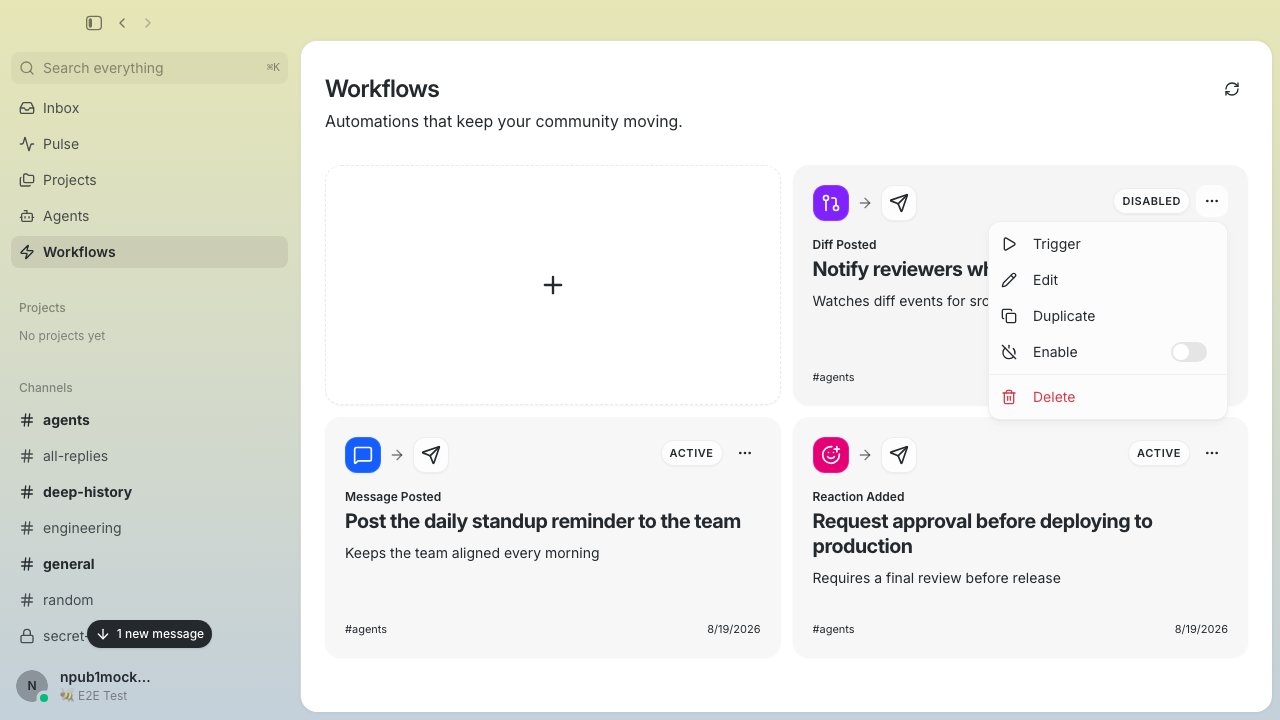 ### Workflow editor — wide 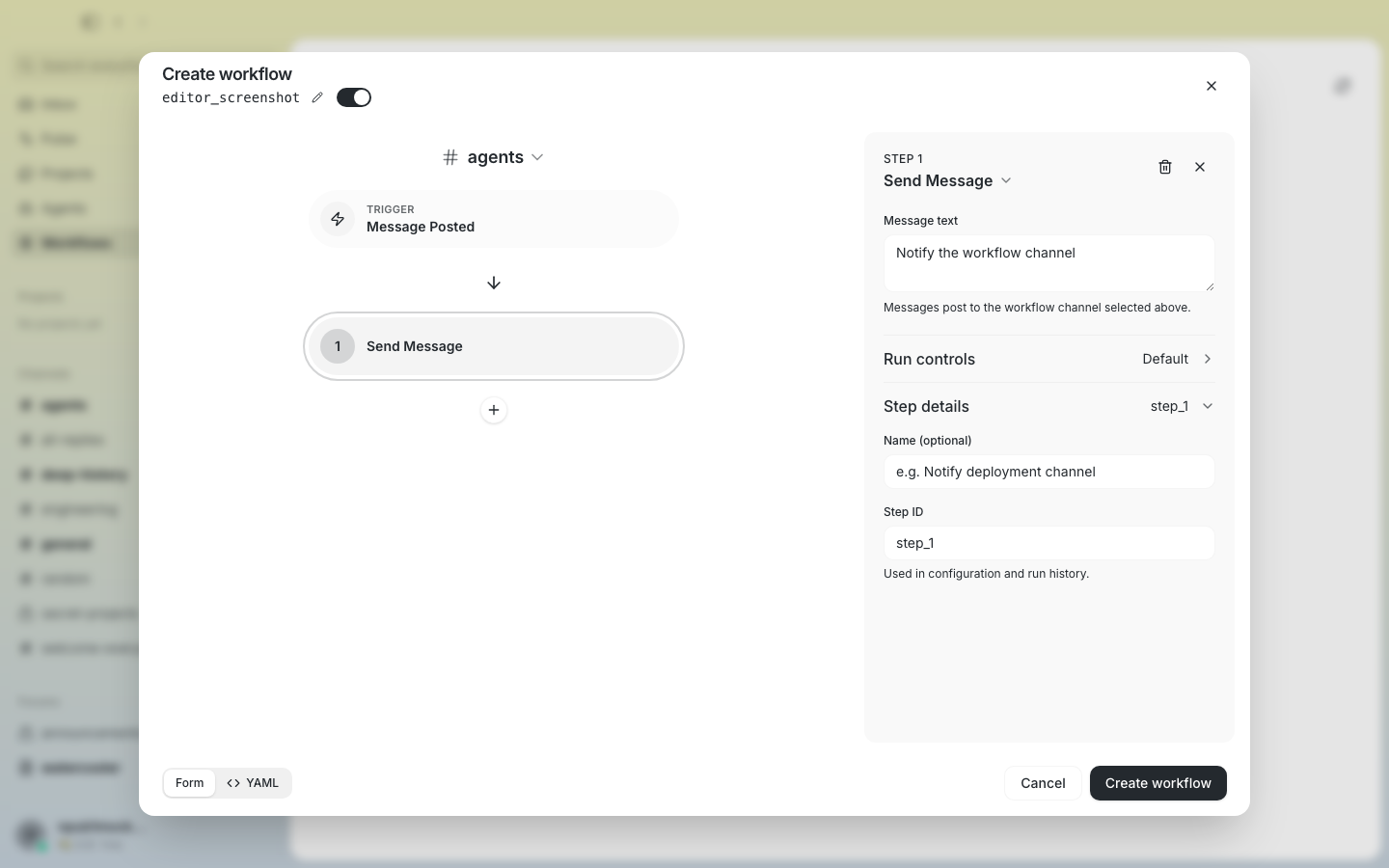 ### Workflow editor — narrow inspector overlay 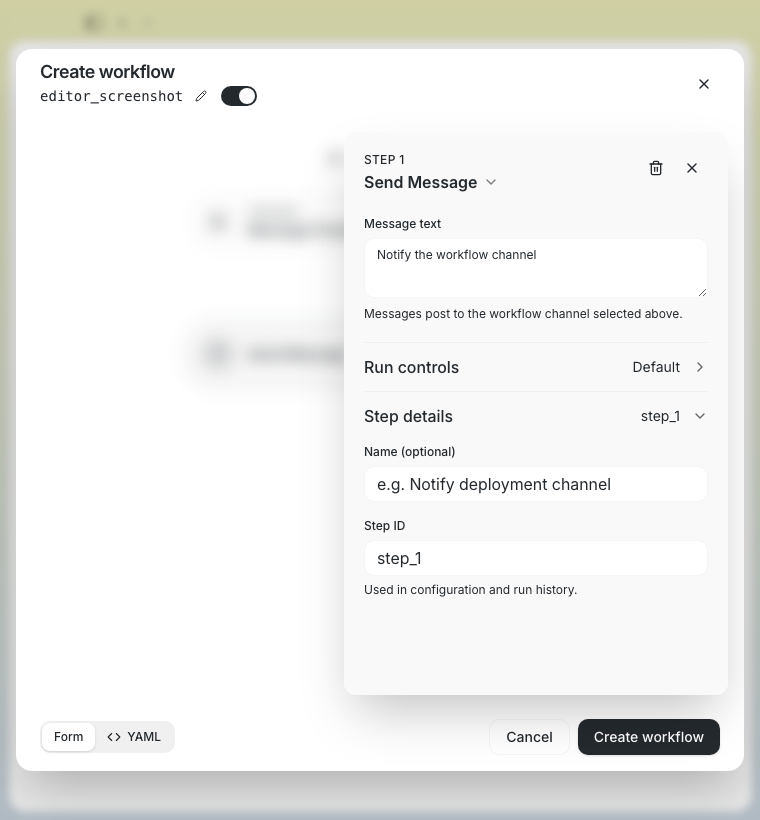 ### Workflow editor — active channel overlay 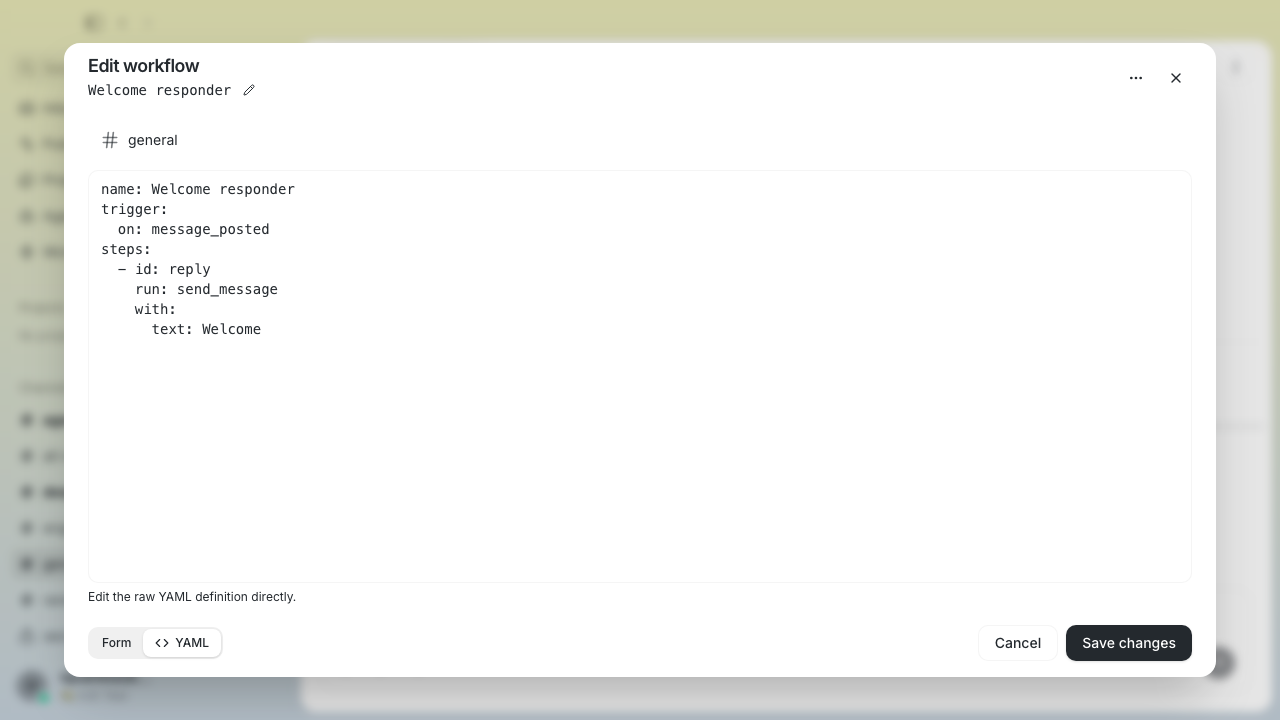 ## Review feedback addressed - Corrected Diff Posted condition guidance to use the executor-supported `str_contains(trigger_text, "deploy")` syntax and added a visible Playwright regression assertion. - Scoped direct workflow-detail navigation coverage to the stable `Edit workflow` dialog name, asserted the workflow title separately, and retained the trigger-node assertion. - Routed dirty channel-overlay Duplicate/Edit transitions through the existing discard confirmation, preserving the original YAML draft when the user keeps editing. - Made workflow deletion await relay success, remain non-dismissible while pending, and retain the confirmation/editor/draft with an actionable inline error on rejection. - Gated the channel-settings Workflows ingress and channel workflow query behind the `workflows` experiment, with defensive rendering if the flag changes while that view is active. - Matched the Reaction Added trigger to the prototype reaction picker, preserving native/custom/legacy values in canonical YAML and providing an explicit clear action. - Kept a channel’s Workflows panel mounted beneath channel-origin editors so clean close, dirty discard, and create cancel return directly to that panel without changing the channel URL. ## Verification Verified at exact pushed head `76ebba7b7ace1e13445744200da70ca9da231b7e`: - Push hooks passed: destination-org policy, branch-skew, differential file-size, Desktop checks, TypeScript typecheck, and **5,115/5,115** Desktop unit tests - Focused channel lifecycle E2E passed: dirty edit discard returns directly to the channel Workflows panel; create cancel does the same while preserving the channel URL and preselected channel - E2E production build, standalone TypeScript typecheck, and Biome checks on both touched files passed - Reaction-picker regression spec remains recorded at `dc28ffa98ec34b4e0656757fb2dd93e60a84674d`: **5/5 passed** (picker interaction, canonical YAML persistence/clear, legacy-value preservation, save/reopen round trip, narrow viewport containment) - Blox existing workflow E2E regression set at `dc28ffa98ec34b4e0656757fb2dd93e60a84674d`: **36/36 passed** - Earlier blocker and review regressions remain recorded at `3760c3d657a525f5af98e8d0f98bdd03999d8e61`: **5,114/5,114** Desktop unit tests and the dirty-overlay/deletion focused checks - Working tree clean; local branch, remote branch, and PR head all match the exact SHA above ### Related issue None found. Closest prior work: #231. --------- Signed-off-by: Taylor Ho <taylorkmho@gmail.com> Co-authored-by: Codex <noreply@openai.com> |
||
|
Wes
|
2693e0db1f |
Make workflow run history authoritative in Desktop (#5780)
## Summary - persist stable workflow run `error_code` values separately from human diagnostics - expose NIP-98 authenticated, channel-authorized run history and approval reads with stable keyset pagination - connect Desktop to those authoritative reads and return the relay-created run ID on trigger - show truthful loading, failure, and pending-trace states, and do not render approval actions from non-actionable stored hashes ## Validation - pre-push `branch-skew`, `desktop-typecheck`, `desktop-test`, `rust-tests`, `desktop-tauri-checks`, and `desktop-check` all passed on `a097dbe5f` - Desktop tests: 4,761 passed, 0 failed - `cargo check -p buzz-relay` - `git diff --check` ## Remaining gate This does not claim a relay-backed Playwright workflow journey. The browser relay bridge still routes workflow invokes through in-memory handlers; that production-shaped acceptance gate remains follow-up work before Workflows can leave preview. --------- Signed-off-by: Wes <wesbillman@users.noreply.github.com> Co-authored-by: Carl <c7ebe626f000404285d3686e1dc74cc07cc60a9754a150041ba132e14bd3e2ec@buzz.block.builderlab.xyz> Co-authored-by: Mongo <5c25403eab7271f9f94ddd4f2b270e8cac2c92e2c830c51877cca6ec974ffb3f@buzz.block.builderlab.xyz> Co-authored-by: Princess Donut <68157ebd23b3897c1991015c3038658ea916200c67d3a54620b0754d1b92f6e0@buzz.block.builderlab.xyz> |
||
|
Kalvin C
|
8a2c9af2db |
feat(deletion): add durable whole-community deletion (#4425)
## Summary Adds a durable, operator-controlled V1 for deleting an entire Buzz community without deleting another tenant's data. The workflow is exposed through `buzz-admin deletions`: - `sweep` records independent fleet storage-taxonomy observations - `submit`, `list`, `inspect`, and `approve` manage a deletion request - `unblock` resumes a fail-closed request after an operator records remediation identity and reason - `run` and `drain` execute bounded work Requests advance through a PostgreSQL-backed state machine and stop at `retention_pending` after logical deletion has been independently verified across PostgreSQL, object storage, and Redis. This PR ships the engine and CLI, not a continuously running worker or Kubernetes packaging. For V1, a cluster/VM administrator invokes `/usr/local/bin/buzz-admin` from the existing relay image, for example with `kubectl exec` or an equivalent container/VM exec path. ## What whole-community V1 removes For the target community, V1 removes: - rows from the allowlisted community-scoped PostgreSQL catalog, including members, profiles, authored events and bodies, DMs, reactions, mentions, memberships, tokens, workflows, moderation, audit, feedback, and rate-limit state - media sidecars and upload-attribution records under `_meta/<community>/` and `_uploads/<community>/` - Git repository pointers under `repos/<community>/` - Redis keys under `buzz:<community>:*` The community row survives as a permanent tombstone, and deletion control-plane records remain as evidence of the request, approval, execution, and result. ## Safety model Deletion is not a broad `DELETE CASCADE` followed by optimistic cleanup. The destructive boundaries are durable and fail closed. ### 1. Inventory and approval - `submit` resolves the target and freezes the schema plus summary-only storage inventory. - Approval is bound to the exact request, community, and frozen inventory digest. - Unsupported manifest versions, malformed keys inside the target's owned prefixes, live scoped-table/write-fence coverage drift, frozen-inventory mismatch, and approval mismatch block execution rather than guessing. Migration and catalog revision numbers are not authorization gates; the executor validates the live safety shape instead. - Storage inventory is server-side prefix scoped to exactly: - `_meta/<community>/` - `_uploads/<community>/` - `repos/<community>/` - The deletion path never lists the whole shared bucket and has no arbitrary per-community object cap. Its listing work is proportional to the target community's bindings, not total fleet storage. - Fleet-wide taxonomy sweeps remain independent observability. They report unknown writer shapes but do not gate deletion submission, fencing, or destructive progress. Maintainers must add deletion taxonomy coverage whenever a new community-owned object-key class is introduced; writer-coverage tests bind the current media and Git writers to that contract. ### 2. Quiesce, fence, and destructive freeze - Writes continue through submission, inventory, and approval. They stop when execution moves the target into `quiescing` and then establishes the durable fence. - Already-admitted external effects finish under heartbeated serving-write leases; the exact admitted lease may renew while the community is quiescing, but new lease acquisition is rejected. The executor drains admitted leases before destructive work. - Invite minting after quiescing begins fails as typed `AccessDenied` (HTTP 503 at the relay boundary) before an invite can be persisted. - Database triggers enforce the community write fence across the complete catalog of community-scoped tables. Startup/readiness and destructive execution validate that catalog so a newly added but unfenced table cannot silently escape. - **Named isolation assumption — fresh write snapshot.** Every writer transaction that can reach a community-fenced relation must use PostgreSQL `READ COMMITTED`; each guarded write therefore observes a statement snapshot no older than acquisition of the community deletion lock. `REPEATABLE READ` and `SERIALIZABLE` can retain a pre-fence snapshot and are unsupported for writers. The writer pool refuses non-`READ COMMITTED` sessions at connection setup, and both SQL fence functions reject an explicit per-transaction isolation override with SQLSTATE `25000`. Configuration-delivered bad isolation can surface through SQLx as a pool-acquire timeout because every `after_connect` attempt is rejected; the precise `community writes require READ COMMITTED isolation` reason remains observable when the SQL guard is reached. Read-only replica transactions are outside this assumption. - Holding the shared advisory lock until the guarded write executes is a separate liveness condition: under `READ COMMITTED`, releasing it early does not permit resurrection because the trigger rechecks the fence, but it can turn a fleet sweep into a statement-wide SQLSTATE `55000` abort. - After the fence closes writers, storage is re-enumerated into chunked side-table rows. Per-prefix counts and digests bind those concrete keys to the destructive manifest. - Manifest chunk insertion, update, and deletion are protected after freeze. This closes the race where an unbound key could otherwise appear after the manifest was committed. ### 3. Checkpointed destruction - Target-owned object bindings are deleted from the frozen destructive manifest in bounded batches with durable progress. - The concrete key list lives in chunked side-table rows rather than one request-row JSON value. It supports large communities, resumable execution, and terminal cleanup. - Missing objects are accepted as idempotent crash-window outcomes; malformed ownership, changed evidence, and unexplained target-prefix drift fail closed. - PostgreSQL purging remains scoped by `community_id`, including the guarded NIP-RS hard-delete path discovered with real Desktop kind `30078` read-state data. - Redis cleanup explicitly scans and `UNLINK`s only `buzz:<community_id>:*`. Natural expiry is insufficient because some keys, including tunnel generation counters used as fencing state, are deliberately persistent. ### 4. Independent verification - PostgreSQL logical absence is checked after purge. - The three target-owned storage prefixes are freshly inventoried again and must be empty. - Redis requires two complete empty namespace scans. - Only after all three stores pass does the request advance through `logically_verified` to `retention_pending`. ## What V1 deliberately does not erase ### Shared content-addressed storage Per-community deletion removes bindings, metadata, attribution records, and Git pointers. It does **not** physically delete fleet-shared CAS bytes that another community may still reference: - media blobs and thumbnails - Git manifests, packs, and indexes (`manifests/`, `packs/`, and `idx/`) Safe reclamation requires a separate fleet-wide reachability and retention GC. Unknown keys elsewhere in the shared bucket do not block one community's deletion; malformed or unrecognized keys inside that community's three owned prefixes still fail closed. ### External retained copies The online logical-deletion proof does not erase object versions/replicas, database backups/WAL, CDN copies, provider retention copies, or observability exports. Those require their own retention and purge controls. ### Member-only erasure This PR erases a whole community. It does not implement the different operation "erase one npub while preserving the community." Removing membership or accepting NIP-09 is not member erasure. A member-only workflow would need to find and selectively remove or redact authored event content and pubkeys, profile data, DMs, reactions, mentions, memberships/roles, tokens, workflows/subscriptions, upload attribution, moderation/audit history, repository attribution, and identity embedded in tags or JSON. It would also need explicit rules for ownership transfer, surviving replies and thread metadata, audit-chain integrity, immutable Git history, and shared-CAS reachability. That requires a pubkey-level fence and selective graph rewrite; it is a separate deletion product, not a safe extension of this whole-tenant worker. ## In scope - migration `0029_community_deletion.sql`: requests, approvals, leases, manifest chunks, checkpoints, tombstones, and the universal write-fence catalog - durable executor leases, generations, heartbeats, retry/block state, and resumable stage transitions - operator-driven `sweep`, `submit`, `list`, `inspect`, `approve`, `unblock`, `run`, and `drain` commands - serving-path fences for database writes and external effects across event ingest, media, Git, workflow, push, invites, mesh/tunnel, and related paths - target-prefix-only storage inventory, summary manifests, post-fence destructive chunks, and bounded batch deletion - exact community Redis namespace purge and two-pass absence verification - cross-community isolation, crash/resume, manifest-integrity, writer-taxonomy, and schema/migration regressions - desired-state `schema/schema.sql` support without requiring a SQLx migration ledger ## Deferred / not covered - dedicated Helm/chart worker Deployment, service account, secrets, probes, resources, and network policy - autonomous `buzz-admin deletions worker` poll loop and worker-only health server - least-privilege separation among migration, relay-serving, and destructive execution roles - fleet-wide shared-CAS physical GC - backup/provider/CDN/observability retention completion - member-only erasure - provider-native conditional-delete improvements - a general force-continue escape hatch; permanent safety failures remain fail closed unless an operator remediates the cause and records an audited `unblock` The removed continuous-worker implementation remains deferred; no remote follow-up branch is claimed by this PR. ## Validation ### Current PR head and repository state Current pushed head: `359d8402ee15f049768f54156f67b953c7a7e2ed`, rebased onto `cc9a2f783375e51a6e8d1f2f9d01d5f7e22813d1` (`origin/main` at push time). The complete PR diff is now 47 files, 9,834 additions, and 517 deletions. The bespoke source-scanner stack was removed to keep this PR scoped to community deletion. Tyler/team requested the underlying fenced-write safety behavior, not `ast-grep`, `crates/buzz-db/tests/community_fenced_writes.rs`, its 27 fixtures, or the new `scripts/lints/community_*.yml` rules. Those scanner-specific files, dependencies, Hermit links, and runner wiring are absent from the current tree. The production database write fence, startup/destructive live-catalog validation, and deletion behavior remain. Source validation on this exact SHA passed: - `cargo fmt --all -- --check` - `bash -n scripts/run-tests.sh` - `cargo nextest run -p buzz-db --all-targets`: 102 passed, 173 skipped, 0 failed - `cargo nextest run -p buzz-deletion --all-targets`: 10 passed, 9 skipped, 0 failed - `cargo nextest run -p buzz-admin --all-targets`: 1 passed, 0 failed - affected-package/all-target Clippy with warnings denied - lockfile consistency - Helm 3.16.4 lint and all 44 chart unit tests - Helm region controls using that fixture: default `BUZZ_S3_REGION=us-east-1`, explicit `eu-west-2` override, and blank-region schema rejection The prior Kubernetes battery below was run against `928992237358a3294621ac0280830b77155abc04`. It remains useful evidence for the patch-equivalent production deletion implementation, but it is **not** claimed as exact-SHA evidence for current head `359d8402ee15f049768f54156f67b953c7a7e2ed`; the current cleanup removes only scanner/test/tooling infrastructure. CI restarted for the new head after the rebase and is pending. Human review remains `CHANGES_REQUESTED`. ### Prior-head live Kubernetes deletion and safety gates The full program used one immutable image, real PostgreSQL, Redis, MinIO, and a three-relay Kubernetes release: - source: `928992237358a3294621ac0280830b77155abc04` (**prior head**) - image: `buzz-e2e:sha-928992237358` - immutable image digest: `sha256:a1a204f4618ac22d9e210be5e5290645a15d79831ae30b0e44379357c8e4a895` - evidence root: `/tmp/buzz-e2e/20260807T033025Z-928992237358-full-gates/` - evidence-manifest digest: `82875c5bc9bea7370b796a7aef3457b3a1c8306c84c59e0f7388bbb5ad30e865` Passed gates at that prior head: - **Chart/operator region:** default `us-east-1`, explicit nondefault propagation, blank-region schema rejection, live in-pod environment, and an in-pod taxonomy sweep over 18 objects with zero unknown. - **Fenced writers and lifecycle:** open-write/fence ordering; 100-attempt anti-starvation; invite, push matcher, and exhausted-reaper bystander isolation; non-`READ-COMMITTED` rejection; manifest/tombstone contracts; eight-failure stage block and audited `unblock`. - **Destructive lifecycle:** submit → approve → run → `retention_pending`; PostgreSQL tombstone and Redis/S3 verification true; zero retries/errors; terminal reruns rejected with exit 5. - **Fresh 10,001-object crash boundary:** exactly two chunks (10,000 + 1). The executor deleted chunk 0 from MinIO while its PostgreSQL stamp was row-lock-blocked, was killed with `SIGKILL`, left one object and both stamps absent, then resumed the same request under generation 2 to zero objects and terminal state. - **Independent dead-owner recovery:** a dedicated executor claimed generation 1, blocked before effects, and was killed through containerd with `SIGKILL` (no TERM cleanup). The request remained owned and unreclaimable before lease expiry; a successor claimed generation 2 after 60 seconds and completed with two attempts and zero retries. - **Three-pod socket isolation:** ordinary NIP-42 and joined huddle-audio target witnesses on every replica received exact `1008 / community deleted`; healthy-tenant witnesses on those pods remained live; deleted-host reconnect returned HTTP 404. - **Health/provenance:** all replicas independently returned ready and retained the exact image digest before/after destructive runs and an audio-enabled rolling restart; PostgreSQL, Redis, and MinIO were healthy at close. Instrument corrections were retained as evidence rather than counted as product failures: a foreground PostgreSQL forward caused an initial `PoolTimedOut`; Kubernetes pod deletion exercised graceful TERM rather than dead-owner recovery; shell-background socket witnesses died with their parent; and the first image build hit the corporate TLS proxy. Detached forwarding/witnesses, containerd `SIGKILL`, and the configured internal CA/Artifactory mirror produced the discriminating runs without weakening product security. ### Prior-head cleanup For the prior-head Kubernetes run, the Helm release was removed, namespace absence was verified, run-owned Screen sessions were absent, and that source worktree remained clean. The evidence manifest was independently recomputed and every indexed artifact passed `shasum -a 256 -c`. The current `359d8402` source worktree is also clean after the scanner-only cleanup and push. --------- Signed-off-by: npub122y0pqkertljmedu303rl0aqrj3w8pvu43t6jxm6875lzg6f2pwqegc3xc <5288f082d91aff2de5bc8be23fbfa01ca2e3859cac57a91b7a3fa9f12349505c@buzz.block.builderlab.xyz> Signed-off-by: npub1dccv64krpcpse5cmkzfeh998cftungyatw3djt8jwdw6g43f7fyqzzmrf7 <6e30cd56c30e030cd31bb0939b94a7c257c9a09d5ba2d92cf2735da45629f248@buzz.block.builderlab.xyz> Signed-off-by: Kalvin Chau <kalvin@block.xyz> Signed-off-by: am <6e30cd56c30e030cd31bb0939b94a7c257c9a09d5ba2d92cf2735da45629f248@buzz.block.builderlab.xyz> Signed-off-by: cid <d9f92a72922bf45c17379a47d64dae84b6020397c2d5a52b5317d512068cd9d3@buzz.block.builderlab.xyz> Co-authored-by: npub122y0pqkertljmedu303rl0aqrj3w8pvu43t6jxm6875lzg6f2pwqegc3xc <5288f082d91aff2de5bc8be23fbfa01ca2e3859cac57a91b7a3fa9f12349505c@buzz.block.builderlab.xyz> Co-authored-by: npub1dccv64krpcpse5cmkzfeh998cftungyatw3djt8jwdw6g43f7fyqzzmrf7 <6e30cd56c30e030cd31bb0939b94a7c257c9a09d5ba2d92cf2735da45629f248@buzz.block.builderlab.xyz> Co-authored-by: cid <d9f92a72922bf45c17379a47d64dae84b6020397c2d5a52b5317d512068cd9d3@buzz.block.builderlab.xyz> |
||
|
Jordan Mecom
|
885bed35ee |
fix(workflow): bind trigger author to the signed event (#4607)
This change derives `trigger_author` exclusively from the signed event pubkey. Actor tags remain available as event data but cannot override the identity used by author-sensitive workflow conditions. This removes the impersonation path without changing workflow definitions or requiring stored-data migration. ## Testing - `bin/cargo test -p buzz-workflow` at `78819df`: 154 passed, 2 Postgres-dependent tests ignored - `git diff --check origin/main...codex/security-workflow-trigger-author` Originating Buzz thread: `buzz://message?channel=3928fe05-df61-4b5d-b9c7-d623b9b10ea1&id=3c6c02312f763fbe0d2bfc33a6c1a362f91d0354f3d18b039cf7a0558c1439d1` Signed-off-by: Jordan Mecom <jm@squareup.com> |
||
|
Tyler
|
9b0f744804 |
resolve findings (#3150)
Fixes all six HIGH findings from the buzz security report, one commit per finding. Independently reviewed to approval by Max at `0158ae542`, plus a deep isolated live pass (clean-room compose stack, weird ports, full product matrix) at the same head — see the buzz-security thread for evidence. `fe65c07c3` merges current `origin/main` on top (new commit, no rebase), inheriting the nostr 0.44.6 bump (#3135) and relay-admin ban gate (#3128). ## Findings and fixes | Finding | Commit | Fix | |---|---|---| | 003 — quinn-proto RUSTSEC-2026-0185 | `e5dcdec72` | Bump quinn-proto 0.11.14 → 0.11.16 (lockfile-only) | | 002/004 — linkify-it quadratic-parse DoS (GHSA-22p9-wv53-3rq4, GHSA-v245-v573-v5vm) | `923b3c20f` | pnpm override `linkify-it: ^5.0.2`; `pnpm why` confirms a single 5.0.2 copy | | 001 — media reads served unauthenticated by default | `0f277e3e2` | Helm `requireMediaGetAuth` defaults to `true` + rendered-chart test pinning the default | | 006 — removed workflow owners retain webhook-exfiltration authority | `4749bd56c` | Fail-closed per-fire authority gate (current owner/admin membership) on **all four** trigger doors (on_event, scheduler pre-claim, manual trigger, webhook — masked as generic 404), save-time gate for `call_webhook` defs, durable disable-on-removal wired to kinds 9001 + 9022 | | 005 — git Smart-HTTP reads ignore channel membership | `e648f2dba` + `0158ae542` | `authorize_git_read`: caller's **current active membership** in the repo's bound channel, checked before any hydration/subprocess on all three read doors (`info_refs` for both services + `upload_pack` POST). Uniform generic 404 denials (no membership probing), no repo-owner bypass, first-`buzz-channel`-tag binding semantics fail closed on ambiguous duplicates (mutation-verified test). Resolution follows the live kind:30617 announcement, so deleted/replaced announcements deny immediately. The committed `e2e-git-perms.sh` guest scenario previously asserted the vulnerability — now asserts denial. | ## Behavior changes to be aware of 1. **Unbound repos fail closed for git reads.** `buzz repos create` emits no `buzz-channel` tag, so CLI-created repos without a binding are unreadable via git HTTP. Correct per finding 005's fail-closed posture; a follow-up could bind CLI-created repos at creation time. 2. **006 is conservative:** a workflow disabled on owner removal does not auto-re-enable if the owner is re-added — explicit re-enable required. 3. Merge conflict resolution in `fe65c07c3`: kept main's `@radix-ui/react-dismissable-layer` 1.1.19 bump alongside the linkify-it security override (`pnpm-workspace.yaml` + lockfile). ## Verification at the merge head `fe65c07c3` (same shell) - buzz-relay `--lib`: 761 passed / 1 failed — the lone red is the known pre-existing `mesh_demo::demo_join_forwarded_arm_round_trips_echo` 504 flake, present on main - SEC-005 module incl. PG behavioral matrix: 8/8 (removed-member, never-member, owner-no-bypass, deleted-30617, malformed/ambiguous binding, owner-mismatch all denied) - buzz-workflow 153/0, buzz-db 84/0; `clippy --all-targets -D warnings` + `fmt --check` clean - Desktop JS 3637/3637, tsc clean, biome clean, file-size/px-text/pubkey-truncation gates clean - `helm lint` + `helm unittest` (40/40) on `deploy/charts/buzz` - All five pre-push hooks green (desktop-check, desktop-test, rust-tests, desktop-tauri-test, branch-skew) Prior review evidence at `0158ae542` (pre-merge): Max's independent exact-head approval + clean-room live regression pass (`WORK_LOGS/2026-07-27_SECURITY_HIGH_LIVE_TEST.md` in his workspace). Max will re-run the deep local pass at this post-merge head before merge. --------- Signed-off-by: Tyler Longwell <tlongwell@block.xyz> Signed-off-by: npub1qyvc0c5kl4gqv2fd97fsk46tu378sqgy35vc83rvgfwne90sel7s0ed67d <011987e296fd5006292d2f930b574be47c7801048d1983c46c425d3c95f0cffd@buzz.block.builderlab.xyz> Co-authored-by: npub1qyvc0c5kl4gqv2fd97fsk46tu378sqgy35vc83rvgfwne90sel7s0ed67d <011987e296fd5006292d2f930b574be47c7801048d1983c46c425d3c95f0cffd@buzz.block.builderlab.xyz> Co-authored-by: Tyler Longwell <tlongwell@block.xyz> |
||
|
Alex Rosenzweig
|
60a171b19e |
fix(workflow): bypass system proxies for webhooks (#2800)
## Summary Disable automatic system-proxy discovery for workflow webhook requests. ## Why Webhook destinations are resolved, validated, and pinned before the request to prevent DNS-rebinding SSRF. If reqwest uses a system proxy, the proxy can resolve the original hostname itself instead of connecting to the validated address, bypassing that pinning guarantee. Calling `no_proxy()` keeps these security-sensitive requests on the directly validated connection path. Redirects remain disabled. ## Test plan - `cargo fmt --all -- --check` - `cargo test -p buzz-workflow --features reqwest` (149 passed) - `cargo clippy -p buzz-workflow --all-targets --features reqwest -- -D warnings` - `git diff --check` Co-authored-by: Amp <amp@ampcode.com> |
||
|
Wes
|
777babf393 |
feat(desktop): canonical <PubKey> component — hover to view/copy full keys, owner "you" labels (#1589)
Signed-off-by: Wes <wesbillman@users.noreply.github.com> Co-authored-by: Pinky <44b8e82baa6e0e254e0208d68f335c283c94e7b78dd1fa10d5a49d3f13dd0435@sprout-oss.stage.blox.sqprod.co> Co-authored-by: Brain <21994759fc7a6fa6b965551d35cfd7897d262f2495467f2d78694ddcfa6a5c7e@sprout-oss.stage.blox.sqprod.co> |
||
|
Tyler
|
a504ad6197 |
E1+E3: reduce relay ingest/fan-out DB round trips; ack p99 −7–16%, fd p99 −6–28%, p999 tails −29–53% vs PR #1453 tip (#1454)
Signed-off-by: Tyler Longwell <tlongwell@block.xyz> Co-authored-by: npub1qyvc0c5kl4gqv2fd97fsk46tu378sqgy35vc83rvgfwne90sel7s0ed67d <011987e296fd5006292d2f930b574be47c7801048d1983c46c425d3c95f0cffd@sprout-oss.stage.blox.sqprod.co> Co-authored-by: Tyler Longwell <tlongwell@block.xyz> |
||
|
Tyler
|
14fba21e57 |
Multi-tenant Buzz relay: community_id as a server-resolved key (comprehensive rewrite) (#1321)
Signed-off-by: tlongwell-block <109685178+tlongwell-block@users.noreply.github.com> Signed-off-by: npub1jh9wn95s0472h86ahapupaf7m6kx4v9sx2n0atj2hltcfer8k06s5n3pyf <95cae996907d7cab9f5dbf43c0f53edeac6ab0b032a6feae4abfd784e467b3f5@sprout-oss.stage.blox.sqprod.co> Signed-off-by: Tyler Longwell <tlongwell@block.xyz> Signed-off-by: npub1t2tgm7d8f995uqvmnm8h88sg3wnpp9a5xysjf6dg3tjmgt3ltulqdp8ehr <5a968df9a7494b4e019b9ecf739e088ba61097b4312124e9a88ae5b42e3f5f3e@sprout-oss.stage.blox.sqprod.co> Signed-off-by: npub17jjz49l9jjmhhk7cac63j8yt9z555n9cw8vk7v5jz4vzw4ppld5qgj57cc <f4a42a97e594b77bdbd8ee35191c8b28a94a4cb871d96f32921558275421fb68@sprout-oss.stage.blox.sqprod.co> Co-authored-by: Eva <011987e296fd5006292d2f930b574be47c7801048d1983c46c425d3c95f0cffd@sprout-oss.stage.blox.sqprod.co> Co-authored-by: Mari <95cae996907d7cab9f5dbf43c0f53edeac6ab0b032a6feae4abfd784e467b3f5@sprout-oss.stage.blox.sqprod.co> Co-authored-by: Sami <f4a42a97e594b77bdbd8ee35191c8b28a94a4cb871d96f32921558275421fb68@sprout-oss.stage.blox.sqprod.co> Co-authored-by: Max <d8473ee32b973aa31a21a65adddcc4b69cc2a8a4dee8121ecd51926e0cddbc02@sprout-oss.stage.blox.sqprod.co> Co-authored-by: Quinn <96f056ad5f2305c8ddf637dc65d048aa4c12d7daeb8867690e34fca46b0ef64c@sprout-oss.stage.blox.sqprod.co> Co-authored-by: Dawn <c6237ef84fa537c78dcee78efd2d4e59f728859c7f194da42ac51ededfa0be05@sprout-oss.stage.blox.sqprod.co> Co-authored-by: Tyler Longwell <tlongwell@block.xyz> Co-authored-by: Sami <sami@sprout-oss.stage.blox.sqprod.co> Co-authored-by: npub1t2tgm7d8f995uqvmnm8h88sg3wnpp9a5xysjf6dg3tjmgt3ltulqdp8ehr <5a968df9a7494b4e019b9ecf739e088ba61097b4312124e9a88ae5b42e3f5f3e@sprout-oss.stage.blox.sqprod.co> |
||
|
Tyler
|
73cc31cc52 |
chore: remove LLM-slop comments across the codebase (#1277)
Signed-off-by: Tyler Longwell <tlongwell@block.xyz> Co-authored-by: npub1qyvc0c5kl4gqv2fd97fsk46tu378sqgy35vc83rvgfwne90sel7s0ed67d <011987e296fd5006292d2f930b574be47c7801048d1983c46c425d3c95f0cffd@sprout-oss.stage.blox.sqprod.co> Co-authored-by: Max <d8473ee32b973aa31a21a65adddcc4b69cc2a8a4dee8121ecd51926e0cddbc02@sprout-oss.stage.blox.sqprod.co> Co-authored-by: Mari <95cae996907d7cab9f5dbf43c0f53edeac6ab0b032a6feae4abfd784e467b3f5@sprout-oss.stage.blox.sqprod.co> Co-authored-by: Quinn <96f056ad5f2305c8ddf637dc65d048aa4c12d7daeb8867690e34fca46b0ef64c@sprout-oss.stage.blox.sqprod.co> Co-authored-by: Sami <f4a42a97e594b77bdbd8ee35191c8b28a94a4cb871d96f32921558275421fb68@sprout-oss.stage.blox.sqprod.co> Co-authored-by: Perci <5a968df9a7494b4e019b9ecf739e088ba61097b4312124e9a88ae5b42e3f5f3e@sprout-oss.stage.blox.sqprod.co> Co-authored-by: Tyler Longwell <tlongwell@block.xyz> |
||
|
Will Pfleger
|
d99ad131f1 |
refactor: rename sprout backend to buzz (#958)
Signed-off-by: Will Pfleger <pfleger.will@gmail.com> Signed-off-by: Will Pfleger <wpfleger@block.xyz> Signed-off-by: Will Pfleger <wpfleger@squareup.com> Signed-off-by: Will Pfleger <wpfleger96@gmail.com> Co-authored-by: npub1mn7jgtj4w2pd0g0zeuhxsa6jy6p0rewxz4kujt98my82ahfmp72sxjexk7 <dcfd242e557282d7a1e2cf2e6877522682f1e5c6156dc92ca7d90eaedd3b0f95@sprout-oss.stage.blox.sqprod.co> Co-authored-by: npub1fgdl5qqnh3k3f2xkqrvt7cujalhm623x4s7fdjdj5yrtp5fzjl9qrjpucw <4a1bfa0013bc6d14a8d600d8bf6392efefbd2a26ac3c96c9b2a106b0d12297ca@sprout-oss.stage.blox.sqprod.co> Co-authored-by: npub16v54tttfqacx9ycvc3k0ut0npj564ahcuajzy6qjvh57ntmsf4uq4806j2 <d32955ad69077062930cc46cfe2df30ca9aaf6f8e76422681265e9e9af704d78@sprout-oss.stage.blox.sqprod.co> Co-authored-by: Will Pfleger <wpfleger96@gmail.com> |



