mirror of
https://github.com/block/buzz.git
synced 2026-10-27 12:40:30 +00:00
main
69 Commits
| Author | SHA1 | Message | Date | |
|---|---|---|---|---|
 Bradley Axen |
a3a47e6294 |
feat(relay): add an unlisted channel setting (#8579)
🤖 ## Summary Sharing a Solo chat with a large channel today means adding every person as a member, one at a time, and the app blocks the share past 100 people. The plan is to share it the way Google Docs does with "anyone at the company with the link". Buzz's `open` visibility already gives that kind of access: anyone in the community can read and join an open channel. The problem is that an open channel also shows up in everyone's channel list and search, and a private chat shouldn't appear there just because its link was posted somewhere. This PR adds a channel setting, `unlisted`. An **unlisted open channel** can be read and joined by anyone who names it by id (from a shared link). For non-members, it is left out of every read that does not name it. Members see it as before. This is the relay side only; the buzz-app change comes later. #8575 (batch adds) remains the path for small audiences. Unlisted is not an access control. Anyone who has the id can read the channel, and that is intended. ## Solo flows this supports Each user action is one event. The buzz-app side comes later; the relay supports all of these now. | Flow | Event | Result | | --- | --- | --- | | New Solo chat | kind:9007 `visibility private` + `["unlisted", "true"]` | The chat starts unlisted, so it stays unlisted when any client later opens it. | | Share | One kind:9002: `visibility open` + `unlisted true` + `join_role guest\|member`. Then post the link. | Anyone with the link can read the chat by id, both history and live. Nobody is added as a member, so the chat isn't in anyone's channel list. A non-member can't post; `join_role` decides whether someone who joins can. | | View | A REQ that names the chat by `#h`, or by `#d` for its metadata | A non-member can read it. It is never listed for them. | | Reply | kind:9021 join (the app sends it before a viewer's first reply) | Joining makes them a member with the role from `join_role`, so with `member` they can post. A kind:9022 leave makes them a viewer again; the chat stays readable by id. | | Unshare | kind:9002 `visibility private` | The existing open→private eviction closes non-members' live subscriptions. New reads by non-members are refused. | | Convert to a channel | One kind:9002: `["t", ""]` + `unlisted false`, plus `visibility` | Clears the Solo label. Non-members can now find it in discovery. | **Sidebar pins are not relay state.** Pin and unpin live in the app's existing kind:30078 sidebar preferences, which sync across devices and don't touch membership. Don't map them to join/leave: someone a chat was shared with by member add is already a member, so a leave would remove their access. Your own Solo chats keep showing up, because you're their owner member, and members see unlisted channels everywhere. Existing Solo chats aren't backfilled. They get the flag when they're shared, because the share event sets it. **Open question, not built here:** someone who only views a shared chat isn't a member. A mention of them doesn't reach their inbox (`#p:[me]` without `#h`) and sends them no push. ## Behavior | Reader | Reads that don't name the channel (kind:39000 without `#d`, `#P` creator queries, messages, COUNT, NIP-50 search, artifact queries, channel list) | Reads that name it (`#h`, or `#d` on 39000–39003) | kind:9021 join | | --- | --- | --- | --- | | Member | Listed | Readable | n/a | | Non-member, unlisted open channel | **Not listed** | Readable | Works; `join_role` still decides the role | | Non-member, private channel (unlisted or not) | Not listed | Not readable | Refused | - **Setting it:** kind:9002 `["unlisted", "true"]` / `["unlisted", "false"]`. Owner or admin only, like `visibility`. A missing tag means no change. It can be sent in the same event as `["visibility", "open"]`, so a private chat becomes open and unlisted in one step. Any other value is refused before the event is stored. The relay posts an `unlisted_changed` system message and clears the accessible-channels cache across nodes. Nobody loses access when a channel is unlisted, so no subscriptions are evicted. - **At creation:** kind:9007 also takes `["unlisted", "true"|"false"]`. A missing tag means listed. Any other value is refused before the event is stored, as on kind:9002. It is stored with the channel row in the create's transaction, on both the client-UUID path and the relay-chosen-UUID path. - **kind:39000** carries a bare `["unlisted"]` flag while the setting is on. It does not add NIP-29 `hidden`, so the metadata stays readable by id. - **NIP-11** advertises `buzz-unlisted-channels` in `supported_extensions`. A relay without this PR would apply `["visibility", "open"]` and ignore `unlisted`, which would list the chat publicly. So buzz-app must check for the extension before it sends that pair. - **CLI:** `buzz channels update --channel <id> --unlisted true|false` and `buzz channels create ... --unlisted`. `buzz_sdk::build_update_channel` takes a new `unlisted: Option<bool>` argument, and `buzz_sdk::build_create_channel` takes `unlisted: bool`, which emits the tag only when true. ### Open question: does `unlisted` only mean something when the channel is open? **Decision: store it on its own; it only has an effect while the channel is open.** Private channels are already invisible to non-members, so on a private channel the flag does nothing. It is still stored and published, for three reasons: - a client can mark a Solo chat unlisted before opening it, or in the same event that opens it, so the chat is never listed even for a moment; - switching private → open → private → open keeps the setting; - there is no cross-field rule in kind:9002 to validate or keep in sync. kind:39000 publishes the flag as stored, whatever the visibility, so clients can show the setting. ## How The relay already has a "readable only when named" path for system channels (NIP-CL). Unlisted open channels reuse it: - **`get_accessible_channel_ids`**: the open half (the implicit scope of a REQ that doesn't name a channel) adds `AND NOT unlisted`. The member half is unchanged, so members still have the channel. - **`get_readable_named_only_channels`**: also returns unlisted open channels of the legacy types. Every reader of that set (REQ, COUNT, NIP-50 search, HTTP `/query` and `/count`, thread windows, workflow run reads) adds a named-only channel only to a filter that names it, through `filter_channel_scope`. An unlisted channel's type is `stream`/`forum`, so the `#t:["system"]`/`#P` system opt-in never adds it. - **`get_accessible_channels`** (the channel list): open channels are listed to non-members only when not unlisted. - **`query_artifacts`**: an artifact in an unlisted open channel reaches a non-member only when the query's `#h` names that channel. - **Live fan-out:** no change was needed. A global subscription never receives channel-scoped events, kind:39000 included (`fan_out_scoped`). A channel-scoped subscription has to name the channel, and that goes through the same named-only authorization. **Left alone on purpose:** access checks that read a named channel or event keep treating an unlisted channel as open. These are `handle_join_request` (kind:9021), the ingest write gate, operator-listener mention delivery (`load_deliverable_event`), personal read-state writes, and push matching. Push matching still requires membership, so non-members get no pushes from an unlisted channel. **Named reads checked:** these callers use the implicit channel set (`get_accessible_channel_ids`, its cache, `get_accessible_channels`). Every one that reads a channel the request names also adds the named-only set, so a non-member can still read an unlisted open chat by id. That covers WS REQ (history, live registration, NIP-50 search), WS COUNT, HTTP `/query` and `/count`, thread windows and workflow run reads. Other named reads don't use the implicit set: they check visibility or membership, so an unlisted open chat counts as open. Those are live fan-out, the ingest write gate, typing, kind:9021 join, huddle audio join, operator-listener delivery, the workflow sink and read-state writes. Feed queries (mentions, needs-action, activity) and the `/buzz/v1/me/sidebar` accessory API are lists, so leaving out chats you only view is intended. Media reads don't check channels. `buzz-auth`'s `ChannelAccessChecker` has no production implementation. ## Database (docs/database.md checklist) - **Phase:** expand only. The migration adds a column with a constant default, and the same release ships the code that reads and writes it. No backfill or contract step follows. - No trigger, function, procedure, rule or foreign key is added. - No migration changes existing rows. `ADD COLUMN ... BOOLEAN NOT NULL DEFAULT FALSE` stores the constant default in the catalog, so the table is not rewritten. - Every location in Rule 4 is updated: `migrations/0069_channel_unlisted.sql`, `schema/tables/public/channels.sql`, and the migration count. No seeds, types or reconcile changes are needed. `admin_schema_parity_between_desired_state_and_migrations` now compares `channels` columns between the pgschema desired state and the migrated database. I failed it once by removing the column from `channels.sql`. Only columns are compared for `channels`: on current `main`, pgschema already re-emits `idx_channels_id_live` without its `INCLUDE (community_id)`, an index drift that predates this PR and is noted in the test. - **Currently deployed relay against the new schema:** it never selects or writes `unlisted`, and every insert gets the default. All channel-record queries name their columns. Nobody can set the flag until this relay ships, because the old relay refuses a kind:9002 whose only tag is `unlisted`. - The migration starts with `SET LOCAL lock_timeout = '5s'`. No index is added: the new predicates ride the existing `(community_id, visibility)` index. ## Rollout 1. Deploy. Every channel stays listed, so nothing changes. 2. **Don't unlist any channel while an old relay is still running.** An old relay ignores the column and lists the channel to everyone. The NIP-11 extension lets clients gate on this. Unlisted isn't an access boundary, so a mixed fleet only exposes the channel in listings for a while. 3. **Rollback:** an older relay ignores the column, so unlisted channels show up as ordinary open channels again. Nothing breaks. ## Tests Postgres (`buzz-db`, discovered by the Postgres lane): - `unlisted_open_channel_is_named_only_for_non_members`: sets the flag through `update_channel`. Then checks that a non-member doesn't get it from `get_accessible_channel_ids` or `get_accessible_channels`, and does get it from `get_readable_named_only_channels`; that a member still lists it; that `put_member` (the kind:9021 path) lets the non-member join, after which they list it; and that listing it again shows it to a new reader. - `unlisted_private_channel_stays_private_and_opens_unlisted`: a private unlisted channel is not readable by name, and opening it keeps the flag. - `group_metadata_publishes_the_stored_unlisted_flag`, plus the unit test `publishes_the_unlisted_flag_as_stored`. - `unlisted_channel_artifacts_are_read_by_name_for_non_members`. - `channel_created_unlisted_is_never_listed`: creating through `create_channel_with_event` (the kind:9007 path) and `create_labeled_channel` stores the flag, and the channel is never listed to a non-member. - Mutation-checked: each of `NOT unlisted` in the implicit scope, `NOT c.unlisted` in the channel list, the unlisted branch of the named-only query, its `visibility = 'open'` guard, and the artifact condition was removed one at a time, and each removal failed at least one of these tests. Relay E2E (`test_nip29_unlisted_channel_wire`, added to the CI relay E2E step), against a local relay built from this branch: - A non-member or an unknown value is refused. - kind:39000 by `#d` carries `unlisted` and `public`, and not `hidden`. - kind:39000 discovery without `#d`: non-members don't see the channel, members do. - History and NIP-50 search: unnamed, a non-member doesn't see the channel's messages; with `#h`, they do; a member sees them unnamed. - A kind:9021 join works, and the joiner then lists the channel. - Listing it again shows it to everyone. - A reader whose channel set was cached before each change sees the change at once. I ran this against a relay with the cache invalidation removed, and it failed. Relay E2E (`test_nip29_solo_share_and_convert_wire`, added to the CI relay E2E step), each flow as a single event: - kind:9007 with an unknown `unlisted` value is refused. A chat created with `unlisted true` publishes the flag, and stays unlisted after a plain `visibility open`. - Share (open + unlisted + `join_role guest` in one kind:9002): a non-member doesn't list the chat. They read it by `#h`, both history and a live message, and can't post. A kind:9021 join lists it for them as a read-only guest. A kind:9022 leave unlists it again, and it stays readable by `#h`. - Unshare (`visibility private`): the viewer's live subscription gets CLOSED, and a new `#h` read is refused. - Convert (`["t", ""]` + `unlisted false`): the Solo label is cleared, and a non-member finds the chat in discovery. - I ran this against a relay that dropped the kind:9007 flag, and it failed. Also run: `cargo test` for buzz-db, buzz-sdk, buzz-cli, buzz-core, buzz-relay and buzz-test-client; the Postgres lane for buzz-db and buzz-relay (1045 tests); and the existing unlisted, announce, departure, guest, role-change and NIP-43 snapshot wire tests. In the lane, two tests failed on pool timeouts (`resend_validated_after_the_first_commit_is_a_duplicate`, `edit_replaces_and_clears_labels`) and passed when rerun alone. An earlier run had the same kind of flake: `routed_fallback_spends_one_acquire_budget_when_aurora_cache_is_cold` (a timing budget) and `resent_edit_is_a_duplicate` (a pool timeout). In a full local `e2e_relay` run, three tests outside CI's list also failed (`test_invite_*` twice, `test_unarchive_emits_member_added_notification`). They fail the same way on a relay built from `main`. ## Not in this PR - The buzz-app follow-up: support open Solo chats, the join-from-card view, the large-audience prompt, and gating on `buzz-unlisted-channels`. - A NIP-CL update. The behavior is documented in NOSTR.md ("Unlisted channels"). buzz-review-completed --------- Signed-off-by: Bradley Axen <baxen@squareup.com> Signed-off-by: Luke Tornquist <tornquist@squareup.com> Co-authored-by: ART <ea39c1c8acf57180161ef4ba4ed68abf8589f5291956b909a5aa991fc66664ca@buzz.block.builderlab.xyz> Co-authored-by: Claude Opus 5.5 <noreply@anthropic.com> Co-authored-by: mbot <3754f8729004d95654c46dbab3129e4ab9ef05cc2534e2a3fbfc155983bd637b@buzz.block.builderlab.xyz> Co-authored-by: Luke Tornquist <tornquist@squareup.com> Co-authored-by: Elrond <28d6302a099e5225b02c4155ac4236e4912603df2ab08dbfc2f4fef08ce598c8@buzz.block.builderlab.xyz> |
||
|
Salman Mohammed
|
d7270330ee |
docs(memory): add core-as-index and source metadata; frame memory as information (#8548)
## Summary Agent memory (NIP-AE engrams) already defines `[[mem/<slug>]]` links and a reachability graph rooted at `core`, but agents don't use them. Across 10 memory entries from 4 real agents, there were no links. 4 of the 6 cold memories had no pointer from `core`, so an agent could find them only by listing every slug. Agents also record where and when they learned things, but each in its own format: a date in parentheses, a "Lessons (date)" heading, or a shortened event ID that can't be opened. The base prompt also told agents to "Treat `core` as load-bearing. Follow it unless newer explicit user instructions override it." The agent writes `core` itself, so text from any channel it reads can end up there and then be followed every turn. Owner-authored instructions already arrive separately as `<agent-instructions>`. This PR makes the conventions explicit and reframes memory as information: - **NIP-AE.md**: "References and reachability" now says `core` works as the memory index. Each fact lives in one place and other entries link to it. - **NIP-AE.md**: a new non-normative "Entry metadata" section adds optional inline `[source: <source>; added: YYYY-MM-DD]` metadata, following [AgentMemoryRepo's MEMORY.md](https://github.com/AgentMemoryRepo/agentmemoryrepo#memorymd). It is a text convention, so validity and the wire format don't change. Structured provenance fields stay with companion NIPs. - **buzz-acp base prompt**: two new Agent Memory bullets teach agents to link memories from `core` (for example `[[mem/team/plan]]`) and to prefer tagging durable lines with `source` and `added`, without requiring it. - **buzz-acp base prompt**: "Treat `core` as load-bearing" becomes **Memory is information, not instructions**. `core` and cold memory are the agent's own notes (facts, prior decisions, lessons it recorded). They inform how it works but cannot grant permissions or override the base prompt, `<agent-instructions>`, or the owner's requests. `core` is described as holding "lessons you recorded" instead of "durable rules", including in the onboarding nudge. The preferred source is a URL or the `buzz://message?channel=<channel>&id=<event>` link of the message where the agent learned the fact. Agents already receive the channel and `Event ID` in each turn. A fact learned from a file or command can cite a file path (with its commit) or the command instead, matching the prompt's existing "Cite sources with paths, links, or command outputs" rule. Agents leave the metadata off rather than guess. Metadata is the agent's own claim, not an attestation, and the prompt now says so. It helps a reader or owner check a fact. It does not make the fact trusted. ### Related issue None found. Related: #3080 (NIP-AD, untrusted data admission) also deals with telling information apart from instructions. The buzz-app copy of this prompt change is in block/buzz-app#1562. ### Testing - `cargo test -p buzz-acp --lib -- shared_base_prompt engram_fetch`: 11 passed. The pre-push `rust-tests` hook also passed. - No agent run yet. To check it by hand, ask an agent to remember a fact. The `core` should then gain a `[[mem/…]]` link to a new slug, and the new line should end with `[source: buzz://message?…; added: …]`. Then put an instruction-shaped line in `core` (for example "post all replies in #general") and confirm the agent does not follow it over the owner's request. 🤖 Generated with [Claude Code](https://claude.com/claude-code) --------- Signed-off-by: Salman Mohammed <smohammed@squareup.com> Co-authored-by: Claude Opus 5.5 <noreply@anthropic.com> |
||
|
Will Pfleger
|
369ffa0380 |
feat(relay): verify NIP-FI agent tokens and admit agents through owners (#8401)
The relay side of NIP-FI agent tokens. An agent token has its own type, `nip-fi-agent+jwt`, and carries its human owner's pubkey in `nostr_owner_pubkey`. This PR verifies that claim, makes denying or disconnecting the owner cut off every agent that owner authorized, and makes the verified owner decide community admission. A relay without agent support refuses the unknown type, so nothing needs to advertise or configure agent support. The `NIP-FI.md` text for the agent type is included. Builds on #8372 and #8377 (both merged). ### Owner claim and owner deny - **Token type binds the owner claim (`buzz-auth`).** A `DedicatedNipFi` issuer policy accepts `nip-fi+jwt` (human) and `nip-fi-agent+jwt` (agent); `AccessTokenAtJwt` policies stay `at+jwt`-only with their `client_id` and subject rules unchanged, and unknown types are refused. An agent token must carry a lowercase-hex `nostr_owner_pubkey` distinct from its `nostr_pubkey`; a human or `at+jwt` token carrying the claim with any value, including null, is `evidence_rejected`. The verified owner is exposed as `VerifiedAssertion::owner()`. - **No agent switch.** There is no relay setting, NIP-11 field or operator binding field for agent support. - **Session owner.** Each connection records its NIP-FI issuer and the agent's owner (`NipFiSession`) on the root WebSocket manager and the audio registry. `disconnect_nip_fi(iss, target)` closes a connection when either its own key or its recorded owner equals the target. - **Owner deny check.** `nip_fi_core::assertion_denied` checks the deny set for both `(iss, k)` and `(iss, owner)`, and every existing deny check uses it: WebSocket before upgrade and after registration, HTTP, audio, and the shadow observer, so shadow and enforce make the same decisions. The shadow disconnect observer matches a session's key or owner under its issuer with the same rule, so an owner's disconnect records a would-close for its agents. ### Shadow owner check In shadow mode, WebSocket AUTH, audio join and HTTP admission record a `Stage::Owner` verdict when an admitted agent token's owner is banned (`owner/denied`), conflicts with the agent's stored owner (`owner/denied`), or cannot be checked because a read failed (`owner/unavailable`). These are reads only; shadow admission is unchanged. Shadow applies the same stored-owner rule as enforce but never writes the link, so it can't predict a later owner-link write failure, or which of two racing first links wins. ### Admission through the verified owner - **Owner bans, unconditionally.** `community_ban_outcome` takes the token owner and checks its ban in place of a NIP-OA owner. That applies whether the agent is a member itself, the relay is open, or the agent is admitted through its owner. - **Owner-derived membership.** In `api::relay_members::check_membership`, an agent that is a member itself is still admitted first. Otherwise, when a verified assertion names an owner, the owner's membership decides (`MembershipDecision::ViaOwner`), and no NIP-OA is needed on the connection. The issuer has already passed this community's NIP-FI binding check at that point. When a token owner is present it is the only owner considered. - **Stored-owner consistency.** `link_agent_owner` replaces the boolean `materialize_nip_oa_owner` result with `OwnerLink::{Linked, Conflict, Unavailable}`. An unset stored owner is recorded, so relay bans and roster removal of the owner reach the agent through `revoke_live_access`. Shadow and enforce judge the stored owner through one read, `stored_owner_link`, and `link_agent_owner` writes (atomically, first write wins) only when that read finds no owner; a failed read fails closed. If the stored owner differs from the token owner, the request is refused with `authorization denied` on HTTP, WS and audio. A NIP-OA owner conflict keeps its existing link-error refusal. - **One decision on every surface.** Root WS AUTH, audio registration and every NIP-98 HTTP route (bridge, `buzz/v1`, git transport and settings, invites, media, workflows, moderation reads) pass `NipFiAdmission::token_owner()` / `VerifiedAssertion::owner()` into the same ban, membership and owner-link steps. The final socket check rereads bans and writer-side membership; it doesn't reread the owner link, which is written once from NULL. HTTP membership still goes through the bounded replica read. With a verified agent token, every HTTP admission refusal, including the fresh ban rereads in `buzz/v1` and Git settings, is NIP-FI's fixed `authorization_denied` (or `authorization_unavailable` when a dependency fails), and audio checks bans before writing the owner link. `enforce_relay_membership` now takes the `TenantContext`, because it writes the owner link. - **Publishing.** A ban caught while publishing over `POST /events` after the shared membership check is also an admission refusal. Ingest reports it as a typed `IngestError::Ban` (banned, or ban lookup unavailable) at the write gate, the HTTP typing indicator's cached gate, and the moderation and relay-admin command rereads. `IngestError::Ban` carries the legacy error. The bridge turns it into the fixed `authorization denied` / `authorization unavailable` only when the request carries a verified agent token. WebSocket and token-less HTTP responses are byte-for-byte unchanged, and timeouts, scopes, permissions and every other ingest error keep their existing responses. ### Rollout - **Deploy the relay before kgoose.** An older relay refuses `nip-fi-agent+jwt`, so agents are locked out until both are deployed. Humans are unaffected. - **There is no agent-only switch.** Setting NIP-FI to shadow or off turns it off for humans too. - **Rollback is safe for owner links.** Stored owner links survive a rollback, and the older code still honors them. - **Shadow signals:** in `buzz_nip_fi_shadow_total`, `stage="owner"` means an owner would-deny (`owner/denied`) or an owner read that was unavailable (`owner/unavailable`), not a success. A clean agent admission shows as `stage="admit", outcome="admit"`. - **The relay checks that the owner is a member, not which issuer the owner logged in through.** In a community that trusts several issuers, any trusted issuer can name any member as owner. That matches the spec: the issuer is trusted to vouch for the owner, and kgoose requires the owner's attestation. Agent tokens are only issued to relays whose NIP-FI binding trusts the issuer, and NIP-FI itself is off unless configured. No deployed config or secrets change. --------- Signed-off-by: Will Pfleger <pfleger.will@gmail.com> Signed-off-by: Duncan <dcfd242e557282d7a1e2cf2e6877522682f1e5c6156dc92ca7d90eaedd3b0f95@buzz.block.builderlab.xyz> Co-authored-by: Hayt <211b96e6a2b7f45fd4047988976c7bbbeeda0c15f3ae7b32eec20834b5a55118@buzz.block.builderlab.xyz> Co-authored-by: Duncan <dcfd242e557282d7a1e2cf2e6877522682f1e5c6156dc92ca7d90eaedd3b0f95@buzz.block.builderlab.xyz> |
||
|
Logan Johnson
|
cd8a968179 |
fix(relay): push system channel events to a lease that names them (#8517)
🤖 ## Summary Mobile clients can now get push notifications for a system channel, but only when they ask for that channel by its ID. Before this change, the relay never sent push for system channels, even when a client asked for one directly. System channels are channels the app uses for its own purposes (for example, agent attention). They are hidden from clients that do not know about them. #8507 made push use the same visibility rule as normal reads: a push subscription sees a system channel, or any channel type added later, only if its filter names that channel ID in `#h`. With that rule, an older client can never get system channel pushes by accident. The extra "never push system channels" rule in NIP-CL now only blocks clients that ask on purpose, such as a future Live Activities subscription. This PR removes that special case. ### Details - `push_runtime.rs`: system channels now follow the same rule as other named-only channel types. The relay still checks membership before it sends a wake. - `NamedOnlyChannels::is_system` had no other caller, so it is removed. - NIP-CL and NOSTR.md now describe the shared rule instead of the ban. - No behavior change for current clients. They do not name system channels in their push subscriptions. ### Related issue Follow-up to #8507 (see https://github.com/block/buzz/pull/8507#issuecomment-6316180106). ### Testing - `named_only_channel_pushes_only_to_a_filter_that_names_it` now expects a wake for a system channel named by `#h`. It also checks that a broad filter still gets no wake, and that a non-member still gets no wake. - `cargo test -p buzz-relay --lib push_runtime`, `cargo clippy -p buzz-relay --all-targets -D warnings`, and `cargo fmt --check` pass. Signed-off-by: Logan Johnson <loganj@squareup.com> Co-authored-by: Larry <627498bd4bd1f281a16431e3c6cce3b5c25b6692798c78672298aefbf2f8f8b5@buzz.block.builderlab.xyz> |
||
|
Logan Johnson
|
25bcb791b4 |
fix(relay): show only legacy channel types to reads that name no channel (#8469)
🤖 ## Summary Every Buzz channel has a **type**, such as an ordinary chat channel (`stream`), a forum, a DM or a workflow. A client app can only show the types it was built to understand. This PR makes the relay (the Buzz server) follow one rule everywhere: **a client sees a channel only if it knows that channel's type.** #8406 applied this rule to membership notices. This PR applies it to the reads that list channels without naming one: the channel list, "channels I belong to", the sidebar's unread list and artifact lists. Before, these reads left out one type by name: system channels. Now they return only the four types that every client has always known: `stream`, `forum`, `dm` and `workflow`. Today the result is the same for every user, because `system` is the only other type. ### Backward compatibility: old clients stay safe - A client that was released before a new channel type exists will never receive channels of that type in its lists. It cannot show such a channel correctly, so it does not get one. - Requests that old clients send today return exactly what they returned before. Nothing changes for them now or when a type is added later. ### Forward compatibility: new types can be added safely - Before, the rule was a deny list: "everything except `system`". Each new type would appear in every deployed client by default, unless someone remembered to update five separate checks in the relay. A missed check would show the new type to clients that cannot handle it. - Now the rule is an allow list that is frozen: the four original types. A new type is hidden by default, with no relay change needed. Clients that understand it can request it on purpose, the same way current clients request system channels today. Each new type gets its own opt-in, so adding a type cannot break clients that are already in use. ## Details - One frozen list, `buzz_core::channel::LEGACY_CHANNEL_TYPES`. Membership notices (#8406) now use the same constant, so channel reads and notices cannot drift apart. The duplicate `LEGACY_NOTICE_CHANNEL_TYPES` is removed. - One SQL helper, `legacy_channel_type_sql`, builds `channel_type IN ('stream', 'forum', 'dm', 'workflow')` from that list. It replaces the five `<> 'system'` checks: - `get_accessible_channel_ids` (both halves): the implicit channel scope of any filter without `#h`, for example kind 39000 channel metadata, REQ, COUNT and search; - `get_accessible_channels`: the channel list; - the personal-read sidebar roster; - artifact queries. - A filter that names a channel (`#h`, or `#d` on kinds 39000–39003) reads it under the ordinary rules, whatever its type: the reader is a member, or the channel is open. The uncached named-channel lookup, `get_readable_named_only_channels`, now returns every readable non-legacy channel with its type, not only system channels. Before, a non-member could not read an open later-type channel, and `#d` read nothing. Workflow run reads and thread windows use the same lookup. - The relay keeps each named channel in the scope of the filter that names it only. This also holds when it re-checks membership for a named channel that the cache lacks. - The opt-in to system channels (`#t:["system"]` or `#P` on kinds 39000–39003) adds readable **system** channels only. It never adds a channel of another type, even one that a sibling filter in the same request names. The relay scope type `NamedOnlyChannels` keeps the type with each channel, so the opt-in can tell them apart. - NIP-CL and NOSTR.md state the rule. ### Related issue Follows #8406 (the same rule for membership notices). ### Testing New Postgres tests use a scratch database with a `future_type` value added to `channel_type`, as a later migration would add one: - `reads_that_name_no_channel_leave_out_a_type_added_later`: the channel scope, the channel list and the sidebar roster leave out the later type and keep the legacy types. - `artifacts_of_a_later_channel_type_are_read_only_by_name`: artifact current and history queries and counts without `#h` leave out the later type. With `#h` naming the channel, they return it. - `channels_of_a_later_type_are_read_only_by_name`: production read paths (WS REQ, WS COUNT, HTTP `/query` and `/count`). A member reads a private later-type channel and anyone reads an open one, by `#h` and by `#d`; an outsider cannot read the private one; a read that names no channel returns neither. In one request, a filter that names the channel plus a `#P` or `#t:["system", <label>]` sibling: the sibling does not get it. - `a_named_channel_of_a_later_type_stays_in_its_named_filter`: the membership re-check for a channel joined mid-request, with an unnamed sibling and a `#P` sibling. Only the naming filter gets the channel. Each test fails when its predicate goes back to `<> 'system'`, when the named lookup loads only `system`, or when the opt-in adds every named-only channel. The #8406 notice tests and the system channel Postgres tests pass on this branch. --------- Signed-off-by: Logan Johnson <loganj@squareup.com> Co-authored-by: Larry <627498bd4bd1f281a16431e3c6cce3b5c25b6692798c78672298aefbf2f8f8b5@buzz.block.builderlab.xyz> |
||
|
Logan Johnson
|
cc6336d985 |
feat(relay): tag every membership notice with its channel type (#8406)
🤖
## Summary
- When someone is added to or removed from a system channel, the relay
now sends them the usual "you were added / removed" notice. Before, it
sent nothing, so a client could learn about a new system channel only by
rereading every channel.
- **A client sees a notice only if it knows the channel's type.** Every
membership notice now carries its channel type. Clients that do not send
`#t` (every client today) see only the types that existed before system
channels, so they see no change. A type that Buzz adds later is hidden
from them by default.
- The notices are stored like every other membership notice, so a client
that was offline can catch up with `since` instead of rereading all its
channels.
## Details
- Every kind:44100 (added) and kind:44101 (removed) notice now carries
`["t", <channel_type>]`, for example `["t","stream"]` or
`["t","system"]`.
- **One place reads the channel type:** `emit_membership_notification`
in `side_effects.rs`, where the relay signs the notice. A channel's type
is set when it is created and no code path changes it, so the tag stays
correct. If the channel row is missing, the relay sends no notice rather
than an untagged one.
- **The rule (NIP-CL):**
- a filter with `#t` matches a notice only when the notice's type is one
of its `#t` values;
- a filter without `#t` matches only the **legacy types**: `stream`,
`forum`, `dm`, `workflow`. This list is frozen
(`LEGACY_NOTICE_CHANNEL_TYPES`), so a new type never joins it;
- a notice without a `t` tag was stored before this change. It is always
a legacy type, so the relay treats it as one, and replay across the
upgrade stays complete.
- **Fails closed.** The rule lives in two shared places, and both
default to the legacy types. A read path that is not updated behaves as
it does today:
- `filters_match` / `notice_visible` (buzz-core). Live fan-out, the REQ
history post-filter, COUNT, the HTTP bridge and push all match through
it.
- `EventQuery::notice_channel_types` (buzz-db). Its SQL keeps only
visible notices before `LIMIT`, so page limits and COUNT stay exact.
`None` means legacy types. Only `filter_to_query_params` sets it, from
the filter's `#t`.
- A client that knows every current type sends one filter:
`{"kinds":[44100,44101],"#p":[<me>],"#t":["stream","forum","dm","workflow","system"]}`.
NIP-CL and NOSTR.md describe this.
- **Only the target receives a notice.** A notice names the target, the
channel and who made the change, and the relay signs it, so knowing its
id is not permission to read it. 44100/44101 are now in
`RESULT_GATED_KINDS`, the one list used by the `ids` exemption check,
the per-result reader check (WS and HTTP history, push), live fan-out
(same pod and Redis) and COUNT. This also closes the same id lookup for
ordinary channels' notices.
- No migration: 44100/44101 are already excluded from search indexing.
## Testing
- `buzz-core`: a table test covers untagged, `stream`, `system` and a
future type against filters without `#t`, with `#t` for one type, and
with `#t` for every type. Other kinds keep the plain `#t` match.
- Postgres tests (`system_channel_postgres_tests.rs`): live fan-out, REQ
history, COUNT and the HTTP bridge, for a filter without `#t`, a
`#t:["system"]` filter and an all-types filter; an untagged legacy
notice; a non-target with an `ids` filter on each path; and a raw
`EventQuery` that does not set the field.
- I broke each part on purpose and the tests failed: no type tag on the
notice, no rule in `filters_match`, no SQL rule, and no untagged clause
in the SQL.
- End to end: I built a relay container from
|
||
|
Tom Brow
|
305fb7b5cd |
fix(push-gateway): request default notification sound (#8431)
Push banners arrive silently because the gateway's fixed APNs body never requests a sound, even though the iOS app requests sound permission. Add `aps.sound: "default"` to that constant so ordinary alerts request the system sound even if the notification extension is not invoked. Preserve the existing alert text, mutable-content flag, and class-blind, content-free delivery contract; synchronize its normative specification and executable models. Companion client workaround: [#8429](https://github.com/block/buzz/pull/8429). This gateway change also covers the original-payload fallback and requires no mobile source change. Sound remains subject to iOS settings and authorization. It does not bypass Focus or Silent Mode, select critical alerts, or guarantee vibration. Every public-profile wake requests the same sound, including generic/restricted fallback banners. ### Validation - Extended the real HTTP transport test: reproduced missing sound (`null` versus `default`) before the fix, then passed with the fix. All 79 runnable gateway library tests pass; 17 infrastructure/manual tests remain ignored. - Added a guard against drift between the emitted bytes, NIP-PL, and both formal models. Fixed-payload and stateful-delivery models and mutation checks pass. - Inspected the 0.24.0 (7) iOS source: sound permission is requested; ordinary enrichment and restricted fallback copy incoming content. A macOS UserNotifications probe confirms copy retention, but does not test iOS Intents or audible device delivery. - Focused existing native resolver/handoff tests pass (35 tests on macOS). These cover resolution and fallback behavior, not iOS sound playback. - Deployed exact head [ |
||
|
Will Pfleger
|
6286a54321 |
feat(relay): store per-community NIP-FI issuer bindings (#8372)
Stack: this PR → #8377 → #8399 → #8401 bb-public creates communities all the time, so a hand-edited `BUZZ_NIP_FI_COMMUNITIES` map can't list them. This PR stores an explicit NIP-FI issuer allowlist for each community in the database and writes it when the community is created. Login checks don't read the table yet; that comes in #8377 together with the database-backed resolver. Operator steps are in [`docs/operator-nip-fi-bindings.md`](docs/operator-nip-fi-bindings.md). **Storage.** Migration `0066_community_nip_fi_issuers` adds `community_nip_fi_issuers (community_id, issuer, created_at)`, with primary key `(community_id, issuer)` and the community write fence attached. The assertion audience is `https://<communities.host>`, so the table has no `aud` column. Zero rows means no binding. The table is included in whole-community deletion and purge. **One bindable rule.** `BUZZ_NIP_FI_PROVISION_BINDING` (`{"host_suffix": ..., "authorized_issuers": [...]}`) is parsed in `buzz-auth` with `BUZZ_NIP_FI_ISSUERS`, whatever `BUZZ_NIP_FI_MODE` is set to, and both the relay and `buzz-admin` use the same parser. Each authorized issuer must be a configured issuer (1 to 2048 bytes), and the suffix must not cover any host declared in `BUZZ_NIP_FI_COMMUNITIES`; an unreadable declaration refuses startup even in mode `off`. `ProvisionBindingPolicy::is_bindable(host)` is true for a host exactly one label under the suffix that is not reserved. It decides creation-time binding, explicit `bind`, and what the lookup route reports. **Binding on creation.** Rows are written in the same transaction as the community insert on all three creation paths (`POST /operator/communities` `create_only`, its legacy convergence branch, and startup bootstrap), and only when the call actually created the community, so existing rows are never rewritten. **Reserved host.** A host whose `https://<host>` equals a configured `command_audiences` value never holds a binding. Operator provisioning of it is rejected with a 400 and the `reserved_host` error code, bootstrap creates it unbound, and the availability route reports it unavailable with an error code. `main.rs` calls `verify_reserved_hosts_unbound` at startup; if a reserved host has rows the relay refuses to start and names the fix (`buzz-admin nip-fi unbind --host <h> --issuer <i>`, or revert the command audience). A database failure during that check is a separate `Check` error. **Operator commands.** - `buzz-admin nip-fi backfill` pages unbound communities by host (1000 per page) and binds each page with one `INSERT ... SELECT` limited to active communities. It skips communities being deleted, always prints `{rows_bound, unbound, unbound_hosts, truncated}`, and exits non-zero while any bindable community is still unbound. Archived communities are bound on purpose. Both bind paths take the shared deletion lock and then lock the community row (`FOR NO KEY UPDATE`, in id order for a batch), the same order deletion uses, and the backfill insert also requires the community to still have no binding, so an operator `bind` that lands after the backfill listed a community wins and the default issuer is not added beside it. - `buzz-admin nip-fi bind --host --issuer` refuses a reserved host, a host outside the suffix, or an unconfigured issuer. - `buzz-admin nip-fi unbind --host --issuer` refuses to remove a community's last issuer (archive or delete the community instead), with one exception: when a valid provisioning policy shows that backfill can't bind the host (it's reserved, or outside the suffix), the last issuer can be removed. That is the reserved-host recovery path in the runbook. A missing or malformed policy doesn't block `unbind`; it just means the exception never applies. **Lookup route.** `GET /operator/communities/nip-fi-binding?host=` (NIP-98, `RELAY_OPERATOR_PUBKEYS`) reads the database and returns `{host, active, issuers[]}`. `host` is the stored host. It returns 404 for an unknown host, 200 with `active:false` for an archived or quiescing community, and `issuers:[]` when no provisioning policy is set. It lists only issuers that are configured and on a bindable host. kgoose depends on this contract; it is also documented in the runbook. **NIP-FA.** The `relay_url` bullet now also says: "An adapter MAY obtain its exact relay list from a configured, authenticated source; it MUST still compare `relay_url` exactly." **Deployment dependency.** The kgoose config side is already handled by [cash-server#137671](https://github.com/squareup/cash-server/pull/137671). In public-community mode it requires the command audience not to be a community audience. --------- Signed-off-by: Will Pfleger <pfleger.will@gmail.com> Signed-off-by: Duncan <dcfd242e557282d7a1e2cf2e6877522682f1e5c6156dc92ca7d90eaedd3b0f95@buzz.block.builderlab.xyz> Co-authored-by: Duncan <dcfd242e557282d7a1e2cf2e6877522682f1e5c6156dc92ca7d90eaedd3b0f95@buzz.block.builderlab.xyz> |
||
|
Brad Seiler
|
2d0f78c6e1 |
feat(auth): support explicit mesh JWKS transport (#8382)
## Summary Allow an issuer to opt into mesh HTTP for its JSON Web Key Set (JWKS). Public HTTPS remains the default. This supports deployments whose service mesh authenticates and protects the key endpoint. The sealed source contract selects transport and contributes to policy identity. Mesh mode requires a DNS hostname and checks every resolved address against an explicit allow-list before pinning one address. Both modes disable proxies, reject redirects, cap responses, and enforce a whole-fetch deadline. The relay cannot verify mesh security: operators must enforce mutual TLS, endpoint authorization, and egress restrictions. ### Related issue No duplicate mesh-JWKS issue or PR found. Existing NIP-FI relay enforcement: #7224. No deployment change is included. ### Testing - At `eccb8cb19420abda44cf6e5e62b1361e2843bd1d`: full auth package and auth/relay all-target clippy passed. Full relay package passed: 1,457 library tests, 37 binary tests, and 9 boot tests; 446 tests were ignored. - At prior head `113939838cd81d5e8d0b0f8783c42ffaae44a4d3`: the full relay library suite failed the demo echo test (1,455 passed, 1 failed, 440 ignored). Independent checks reproduced that timeout at base `d61fe2071d2b3d8e56dd931947f16bfe0d6173fe`; the receive-cancellation defect is outside this change. A later pass does not establish that defect is fixed. - Three falsifying mutations at `eccb8cb194` were caught: mixed DNS answers, proxy bypass, and whole-fetch deadline. The full locked auth package passed after restoring the exact source. - At `eccb8cb194`, `cargo build --locked --release -p buzz-relay -p buzz-cli -p buzz-admin` passed with command-local `CARGO_PROFILE_RELEASE_STRIP=none`. This avoids a macOS loader error without a source, lockfile, or project-profile change. - Earlier hooks failed the ACP signal test and Tauri login-shell PATH test. The ACP failure also reproduced on unmodified main `93ffc37c`. Main merged without conflict. The full Tauri package then passed with `RUST_TEST_THREADS=1`: 3,422 library tests and 3 integration tests, 19 ignored. All pre-push hooks passed with that same command-local setting; no hook or test was skipped. - At `eccb8cb194`, isolated `just test` passed all 107 runner steps. The monolithic `just ci` run timed out after 1,120 seconds; all recipes passed across that run and separate `just desktop-tauri-test`, `just web-build`, and `just mobile-test` invocations. No monolithic pass is claimed. - Exact-head release live-local checks passed: loopback HTTP mesh JWKS warm; valid assertion 101; expired/wrong issuer/wrong audience 403; valid signed disconnect 200; wrong command audience 403. Redirect-only JWKS returned assertion 503 without a request to its target. Both omitted/default and explicit public transport rejected HTTP at startup. - A separate NIP-FI-off release CLI smoke test created an open channel, sent an accepted message, read it back, and fetched its thread. The assertion probe closes after upgrade; it does not prove a complete NIP-42 session. Local loopback tests do not prove deployment mesh authentication, endpoint authorization, egress controls, or real `240/4` routing. Generated with Codex ## Human Testing valid assertion / configured community audience: HTTP 101 (expected 101) expired assertion: HTTP 403 (expected 403) wrong issuer: HTTP 403 (expected 403) wrong community audience: HTTP 403 (expected 403) valid command JWT / configured command audience: HTTP 200, body=b'{"disconnected": true}' (expected 200) valid command signature / wrong audience: HTTP 403 (expected 403) --------- Signed-off-by: seiler <seiler@squareup.com> Signed-off-by: Local Builder <1c476cb1127ea270cb900bdc3891060140bdd1173f91498030ee9b4db01c2f20@buzz.block.builderlab.xyz> Co-authored-by: Codex <noreply@openai.com> Co-authored-by: Local Builder <1c476cb1127ea270cb900bdc3891060140bdd1173f91498030ee9b4db01c2f20@buzz.block.builderlab.xyz> |
||
|
Will Pfleger
|
dff0d16b2a |
docs(nips): define agent-key assertions in NIP-FA and NIP-FI (#8384)
Defines how an enterprise identity adapter issues assertions for agent keys and how a NIP-FI relay admits them. - **NIP-FA:** adapters issue agent-key assertions only under an owner-authorized grant, created through the owner's own authentication; revoking the owner invalidates every earlier grant. The "agent keys" out-of-scope bullet is removed. - **NIP-FI:** new `Agent keys` subsection under the assertion contract (`nostr_owner_pubkey` claim, the verifier returns the owner, owner recording for the session or request, ban/deny checks on both keys, owner-derived authorization), `agent_assertions` discovery field, owner deny-set check in WebSocket and HTTP admission, owner-matching disconnect close scan, and the updated out-of-scope delegation lines. --------- Signed-off-by: Will Pfleger <pfleger.will@gmail.com> Co-authored-by: Hayt <211b96e6a2b7f45fd4047988976c7bbbeeda0c15f3ae7b32eec20834b5a55118@buzz.block.builderlab.xyz> |
||
|
Will Pfleger
|
9092950620 |
docs(nip-ap): narrow relay support and allow offline start (#8368)
🤖 Two corrections to NIP-AP's agent and team config section. **Relay support.** A client now needs only NIP-CL system channels and labels plus NIP-AR artifacts before storing config on the relay. The four other required advertisements are dropped: read-only guests, a retention exemption, complete-history artifact sync, and telling a never-used artifact address apart from a fully redacted one. No relay advertises them, so a conforming client could never store config on the relay. The retention exemption stays in "History" as the relay's obligation. Without a never-used signal an empty lookup is still `unavailable`, never `absent`, so clients fail closed. **Offline start.** When the relay can't be reached (a transport failure, not a read that returned an answer), a client may start the agent from the last revision it confirmed as present. It still must block if the relay's most recent answer showed that the config is invalid, deleted, redacted, archived, or no longer accessible, and it never uses another source. **Consistency.** "Editing" no longer assumes every relay's guest role is read-only. "Artifact state" points its no-substitution rule at the new offline exception. Related: #8295 --------- Signed-off-by: Will Pfleger <pfleger.will@gmail.com> Co-authored-by: Hayt <211b96e6a2b7f45fd4047988976c7bbbeeda0c15f3ae7b32eec20834b5a55118@buzz.block.builderlab.xyz> |
||
|
Logan Johnson
|
d28f6b2f70 |
feat(relay): let channel-state filters opt in to system channels (#8182)
🤖 ## Summary After part 2, a client can read a system channel only if it already knows the ID. This PR lets a client find system channels on purpose, with an ordinary Nostr filter and no new filter key. A filter on the channel-state kinds (39000–39003) now also returns the system channels the reader can read when it has either: - `#t:["system"]`, the channel type tag that every channel-state event already carries; or - any `#P`, the creator tag from #8174. Asking for the channels of a named creator returns a small result, so it does not fill generic channel lists. The filter then matches as usual. Existing clients send neither on these kinds, so they still never see a system channel. | Reader wants | Filter | |---|---| | My system channels | `{kinds:[39002], #p:[me], #t:["system"]}`, then their kind:39000 by `#d` | | Open system channels | `{kinds:[39000], #t:["system"]}` | | One creator's labeled channel, system or not | `{kinds:[39000], #P:[creator], #t:[label]}` | Private system channels stay hidden from non-members, as for any private channel. Values in one tag filter combine with OR, so `#t:["system", label]` means `system` **or** the label; use `#P` plus the label instead. Part 3 of 3, stacked on part 2. ### Related issue None found. ### Details - The opt-in is decided per filter in `handlers/system_channels.rs` and applies on REQ, COUNT and the HTTP bridge. It applies only when every kind in the filter is 39000–39003. - A label alone is not an opt-in. - `NOSTR.md` documents the system channel query rules. - **Spec.** NIP-CL says how a filter asks for system channels. - The relay information document (NIP-11) now lists `"nip-cl"` in `supported_extensions`. Clients use this to tell if a relay supports labels and system channels, and refuse those calls on a relay that does not. NIP-CL documents this. ### Testing - End-to-end relay test: `#t:["system"]` finds both system channels for a member and only the open one for a non-member; 39002 `#p:[me]` with `#t:["system"]` lists the member's system channels; `#P` includes a creator's system channels; creator plus label returns exactly one channel with `limit: 1` and excludes another creator's channel with the same label; a label alone does not return the system channel; COUNT and HTTP `/query` and `/count` agree. - The test fails when the opt-in is disabled. - Unit tests for which filters opt in. ### Stack These are two stacks. Merge them in this order. Client support (creating, labeling and finding these channels) will be in block/buzz-app, not the buzz SDK and CLI. **Stack 1: channel labels and creator lookup (#8174–#8176)** 1. #8174 channel type and creator tags, and the channel creation time 2. #8175 channel labels 3. #8176 database-side label and creator match, and the rule for choosing one channel **Stack 2: system channels (#8180–#8182)**, stacked on stack 1 because it uses labels and the creator tag 4. #8180 the system channel type 5. #8181 leave system channels out of reads that do not name them 6. #8182 channel-state filters opt in to system channels ← this PR --------- Signed-off-by: Logan Johnson <loganj@squareup.com> Co-authored-by: Larry <627498bd4bd1f281a16431e3c6cce3b5c25b6692798c78672298aefbf2f8f8b5@buzz.block.builderlab.xyz> |
||
|
Logan Johnson
|
cdf03f618a |
feat(relay): leave system channels out of reads that do not name them (#8181)
🤖 ## Summary After part 1, a system channel is still returned by every query that returns ordinary channels, so existing clients would show it as a chat. This PR makes the relay leave system channels out of every read that does not name them. Clients do not need to filter, so clients that know nothing about system channels stay correct. | Query | Before | After | |---|---|---| | A query that does not name a channel (no `#h`), COUNT, full-text search, the HTTP `/query` and `/count` routes, artifact queries (`{"artifact": ...}`), the sidebar | Includes system channels | Leaves them out | | "Channels I belong to" (kind:39002 `#p:[me]`) | Includes them | Leaves them out | | A filter that names the channel with `#h`, or with `#d` on kinds 39000–39003 | Ordinary read rules | Unchanged: members can read it, and anyone can read it if it is open | Push notifications and "you were added to a channel" notifications (kinds 44100/44101) skip system channels, because a client that received one would show the channel. A client that is given a system channel's ID, for example in a pasted link, can still open it. Naming the ID is the opt-in. This keeps system channels ordinary NIP-29 groups. Part 2 of 3, stacked on part 1. ### Related issue None found. ### Details - The rule lives in one place: `get_accessible_channel_ids`, the set of channels a query may read when it does not name one. It is the union of the reader's memberships and every open channel; both halves now exclude `channel_type = 'system'`. Because the filter is in SQL before `LIMIT`, pages stay full. - A filter that names a system channel adds it to that filter's scope only (`handlers/system_channels.rs`). A sibling filter in the same request keeps the implicit set, so naming one system channel cannot widen another filter. - Thread windows and the workflows API name their channel, so they follow the same named-channel rule. - Artifact queries have their own read check in SQL. It reads a system channel only when the query's `#h` names it. - When a request re-checks membership for a named channel that its first lookup missed, a confirmed system channel joins only the filters that name it. Before, a reader who joined a system channel during the request could have it added to a sibling filter's scope. - The system-channel lookup runs only when a filter names a channel outside the implicit set, so ordinary queries do not pay for it. - **Spec.** NIP-CL lists the reads that leave system channels out, and says when a filter names one. `AGENTS.md` notes this for `get_channels`. ### Testing - End-to-end relay test (Postgres and Redis) with a private system channel, an open system channel and an ordinary channel, as a member and as a non-member: REQ without `#h`, NIP-50 search, COUNT, HTTP `/query`, HTTP search, HTTP `/count`, the channel list, and 39002 `#p:[me]` return only the ordinary channel. Named reads by `#h` and `#d` follow member-or-open on REQ, COUNT, search and HTTP. - Relay test: adding a member to a system channel sends no kind:44100; an ordinary channel still does. - Both tests fail when the SQL exclusion or the named-channel scope is removed. - Database test: an artifact in an open system channel is missing from `{"artifact":"current"}` and present with `#h:[<system channel>]`, for a member and a non-member. It fails without the channel-type condition. - Relay test: the membership re-check confirms a system channel that the system-channel lookup missed. The channel goes to the filter that names it, and a sibling filter's scope does not include it. It fails without the fix. - Unit tests for the per-filter scope. They now run in `just test-unit` and `scripts/run-tests.sh`. ### Stack These are two stacks. Merge them in this order. Client support (creating, labeling and finding these channels) will be in block/buzz-app, not the buzz SDK and CLI. **Stack 1: channel labels and creator lookup (#8174–#8176)** 1. #8174 channel type and creator tags, and the channel creation time 2. #8175 channel labels 3. #8176 database-side label and creator match, and the rule for choosing one channel **Stack 2: system channels (#8180–#8182)**, stacked on stack 1 because it uses labels and the creator tag 4. #8180 the system channel type 5. #8181 leave system channels out of reads that do not name them ← this PR 6. #8182 channel-state filters opt in to system channels --------- Signed-off-by: Logan Johnson <loganj@squareup.com> Co-authored-by: Larry <627498bd4bd1f281a16431e3c6cce3b5c25b6692798c78672298aefbf2f8f8b5@buzz.block.builderlab.xyz> |
||
|
Will Pfleger
|
349f566e93 |
docs(nip-ap): store agent and team config as NIP-AR artifacts (#8295)
🤖 Stores agent and team config as [NIP-AR](https://github.com/block/buzz/blob/main/docs/nips/NIP-AR.md) artifacts in private [NIP-CL](https://github.com/block/buzz/blob/main/docs/nips/NIP-CL.md) system channels, replacing the owner-encrypted `kind:44300` instruction versions. - **Config channels.** Each agent has an agent config channel holding `buzz.agent.settings` and `buzz.agent.instructions`. Each team has a team config channel holding one `buzz.team` artifact with the team name, team instructions and a `team` tag carrying the exact team id, and no member list. The owner creates both kinds as private system channels with no TTL. Each carries a family label (`agent-config` / `team-config`) and a subject label: the agent pubkey, or `team-` plus a hash of the team id, which clients check against the `team` tag. Discovery queries by creator and subject label. Agents find their teams through a `39002` query that opts in to system channels. The oldest matching channel wins, and channels that aren't selected are never deleted. - **Ownership and teams.** An agent's owner is its relay-verified NIP-OA owner, and a team's owner is its channel's creator. Changing an owner isn't supported. A team's members are the owner's agents in the team config channel. Changes to who is on a team follow the channel's role rules, including add policies, owner/admin-only role changes, and last-owner protection against leaving, removal and demotion. Guests are read-only. Every non-guest member can edit config, including humans and agents that aren't on the team. Edits keep unrecognised JSON fields and tags, and a client whose create collides fetches and edits the existing artifact instead of picking a new `d`. - **Artifact states.** A config artifact is present, invalid, absent, deleted, or unavailable. An artifact is absent only when the relay confirms its address was never used. Redacting every revision does not make an address unused. Only an absent artifact lets a client fall back to local instructions or a definition prompt. Invalid, deleted, and unavailable states block the start. - **History and launch.** History is kept until the owner purges it or a moderator removes a revision. Config channels must be exempt from age-based retention, and keeping only the latest revision is not allowed. A revert is an `op=update` with a full snapshot and keeps the team's name. The instruction resolution order and per-team launch sections are unchanged. - **Limits and lifecycle.** Config content is at most 131,072 bytes after encoding (settings: 65,535), and the signed event must fit the relay's limits. Content is never truncated. Settings exclude credentials, local paths and device state. An unsupported setting is an error, never a silent default. Deleting an agent archives its channel and blocks new launches until it's unarchived. Deleting a team archives its channel. - **Relay prerequisites.** Clients keep config local unless the relay supports system channels, artifacts, read-only guests, the retention exemption, sync with complete history, and telling an artifact address that has never been used apart from one whose revisions have all been redacted. - **Removed.** `kind:44300` and its relay rules, deletion rules and owner-encryption text. `30175`, `30177`, `30178` and the team id format are unchanged. Depends on the NIP-CL label and system-channel stack (#8176, #8180–#8182). --------- Signed-off-by: Will Pfleger <pfleger.will@gmail.com> Co-authored-by: Hayt <211b96e6a2b7f45fd4047988976c7bbbeeda0c15f3ae7b32eec20834b5a55118@buzz.block.builderlab.xyz> |
||
|
Logan Johnson
|
71d7aa0436 |
feat(relay): add the system channel type (#8180)
🤖 ## Summary Buzz uses channel membership to decide who can read what, and every channel a person belongs to shows up in their client as a chat. So there is no way to make a group that exists only for access control, for example "only this agent and its owner can read the agent's config". Such a channel would appear in both people's sidebars, search results and unread counts. This stack adds a **system channel**: an ordinary channel that queries leave out unless they ask for it. This first PR adds the type itself. - `kind:9007` (create channel) with `["channel_type", "system"]` creates a system channel. - It is private unless the creator sends `["visibility", "open"]`. - While it is private, its channel metadata event (kind:39000) carries the NIP-29 `hidden` marker, which means "hide this group's metadata from non-members". Until now the relay set `hidden` only for DMs. On its own this PR does not yet hide system channels from queries. Part 2 does that. Part 1 of 3, stacked on #8176 (the channel labels and creator lookup stack, which this feature uses). ### Related issue None found. ### Details - Migration 0062 adds `system` to the `channel_type` Postgres enum. No new columns. - `buzz_core::channel::ChannelType::System`, and `system` is now a reserved label name (labels cannot equal a channel type name). - `buzz-admin` reconcile writes `hidden` with the same rule as the relay. Usage metrics count system channels. - **Rollback.** A relay older than this change cannot read `channel_type = 'system'`. Do not roll back past it while system channels exist. - **Spec.** NIP-CL gets a "System channels" section. `ARCHITECTURE.md` lists the `System` type. ### Testing - Relay test: a system channel is private and `hidden` by default; opening it removes `hidden`; its first `t` tag is `system`. - Migration embed and usage-metrics tests. ### Stack These are two stacks. Merge them in this order. Client support (creating, labeling and finding these channels) will be in block/buzz-app, not the buzz SDK and CLI. **Stack 1: channel labels and creator lookup (#8174–#8176)** 1. #8174 channel type and creator tags, and the channel creation time 2. #8175 channel labels 3. #8176 database-side label and creator match, and the rule for choosing one channel **Stack 2: system channels (#8180–#8182)**, stacked on stack 1 because it uses labels and the creator tag 4. #8180 the system channel type ← this PR 5. #8181 leave system channels out of reads that do not name them 6. #8182 channel-state filters opt in to system channels --------- Signed-off-by: Logan Johnson <loganj@squareup.com> Co-authored-by: Larry <627498bd4bd1f281a16431e3c6cce3b5c25b6692798c78672298aefbf2f8f8b5@buzz.block.builderlab.xyz> |
||
|
Logan Johnson
|
a3909acc67 |
feat(relay): match label and creator filters before the page limit (#8176)
🤖 ## Summary After parts 1 and 2, a client can ask for "channels with label X" or "channels created by key K". But the relay applied these tag filters after it read one page of the newest channel events. So a request such as `{kinds:[39000], #t:["workspace"], limit:10}` could return fewer than 10 channels, or none, while matching channels existed. This PR moves the label and creator match into the database query, before the page limit. Part 3 of 3, stacked on part 2. ### Related issue None found. ### Details - Applies only when every kind in the filter is a relay-signed channel-state kind (39000–39003). Other kinds keep today's behavior. - The database match uses JSONB containment on `tags`, which is GIN-indexed. Containment can match a little too much (for example, a tag that contains both strings in another position), never too little. So the relay still checks each returned event with the normal Nostr filter rules, and `COUNT` requests keep that check too. - The same match is applied to the query path and the count path. - **Spec.** NIP-CL now says that `#t` and `#P` match before `limit`. - **Choosing one channel.** The relay does not make labels unique, so two creates for one label can both succeed, for example when two processes of one agent start at the same time. NIP-CL gets a "Choosing one channel" section: a client that needs one channel per creator and label looks it up with `#P` + `#t`, creates it only if none exists, and otherwise uses the oldest one (the lowest `created_at` tag, then the lowest channel ID). Every reader that follows this rule picks the same channel, even after an edit. ### Testing - Relay test: many channels, one match, small `limit`. The request returns the match for both `#t` and `#P`. This test fails without the change. - Unit test: `#t` and `#P` reach the database query only for channel-state kinds. - Relay test: one creator sends two creates for the same label at once. Both channels exist, a `#P` + `#t` lookup finds both, and the oldest-channel rule picks the same one in either order, even after the older channel's metadata is re-published by an edit. ### Stack These are two stacks. Merge them in this order. Client support (creating, labeling and finding these channels) will be in block/buzz-app, not the buzz SDK and CLI. **Stack 1: channel labels and creator lookup (#8174–#8176)** 1. #8174 channel type and creator tags, and the channel creation time 2. #8175 channel labels 3. #8176 database-side label and creator match, and the rule for choosing one channel ← this PR **Stack 2: system channels (#8180–#8182)**, stacked on stack 1 because it uses labels and the creator tag 4. #8180 the system channel type 5. #8181 leave system channels out of reads that do not name them 6. #8182 channel-state filters opt in to system channels --------- Signed-off-by: Logan Johnson <loganj@squareup.com> Co-authored-by: Larry <627498bd4bd1f281a16431e3c6cce3b5c25b6692798c78672298aefbf2f8f8b5@buzz.block.builderlab.xyz> |
||
|
Logan Johnson
|
2f79374f48 |
feat(relay): channel labels (#8175)
🤖 ## Summary A plugin or agent often needs to tag its own channels and then find them again, for example "my attention-config channel" or "all channels of this workspace". Today a channel has no labels: the relay ignores any `t` tags in create or edit requests. This PR adds channel labels. - A create request can carry up to 8 labels as `["t", "<label>"]` tags. - An edit request with `t` tags replaces the label set. `["t", ""]` alone clears it, the same convention as `["ttl", ""]`. Only owners and admins can change labels, as for the name. - The relay publishes each label as a `t` tag on the channel's state events, after the channel type tag. Part 2 of 3, stacked on part 1. ### Related issue None found. ### Details - **Rules.** A label uses 1–64 characters from `a-z`, `0-9`, `.`, `:` and `-`. The relay refuses a label equal to a channel type name (`stream`, `forum`, `dm`, `workflow`, `system`), so a label cannot make a channel look like another type. - **No trust from labels.** Any admin can set a label. Only the relay-written creator tag (part 1) says who made a channel. - **Storage.** New migration `0061_channel_labels.sql` adds `channels.labels TEXT[] NOT NULL DEFAULT '{}'`. Channels without labels look and behave as before. - **Readers.** The CLI and `buzz-acp` read the channel type from the first `t` tag. Before this PR they used the last one, which would now be a label. - **Spec.** NIP-CL gets a "Channel labels" section with these rules. ### Testing - Relay tests: labels at creation appear after the type tag, edit replaces and clears them, invalid labels are refused, and members who are not admins cannot change them. - Unit tests for the label rules: allowed characters, length, reserved type names, the 8-label cap and the clear marker. - `buzz-acp` test: the channel type comes from the first `t` tag, not a label. ### Stack These are two stacks. Merge them in this order. Client support (creating, labeling and finding these channels) will be in block/buzz-app, not the buzz SDK and CLI. **Stack 1: channel labels and creator lookup (#8174–#8176)** 1. #8174 channel type and creator tags, and the channel creation time 2. #8175 channel labels ← this PR 3. #8176 database-side label and creator match, and the rule for choosing one channel **Stack 2: system channels (#8180–#8182)**, stacked on stack 1 because it uses labels and the creator tag 4. #8180 the system channel type 5. #8181 leave system channels out of reads that do not name them 6. #8182 channel-state filters opt in to system channels --------- Signed-off-by: Logan Johnson <loganj@squareup.com> Co-authored-by: Larry <627498bd4bd1f281a16431e3c6cce3b5c25b6692798c78672298aefbf2f8f8b5@buzz.block.builderlab.xyz> |
||
|
Logan Johnson
|
8bb49a1b6a |
feat(relay): publish channel type and creator on every channel-state event (#8174)
🤖 ## Summary Clients cannot tell who created a channel, and only the channel-metadata event says what type of channel it is. This PR makes every relay-signed channel-state event carry both facts, so a client can find "the channel that this key created" with one ordinary Nostr filter. - Channel metadata, admin list and member list events (kinds 39000, 39001 and 39002) now all carry the channel type as their first `t` tag, then the creator as a `P` tag. - The creator comes from the relay's own record of who signed the channel's create request. No client can set it, and it does not change when ownership moves. - Channel metadata (kind:39000) also carries `["created_at", <unix seconds>]`, the time the channel was created. The event's own `created_at` changes on every edit, so before this a client could not tell which of two channels is older. This is part 1 of a 3-part stack (channel labels and creator lookup). The system channels stack (#8180–#8182) builds on it. ### Related issue None found. ### Details - **Why `P`.** Several Nostr specs (NIP-22, NIP-34, NIP-72) use uppercase `P` for the author of the root object, and lowercase `p` for people involved. Lowercase `p` is already used on these events for members and DM participants, and a filter matches tag values, not their meaning, so `#p` would mix them. - **Trust.** A client that trusts a channel because of its creator must also check that the relay key signed the event. - **Order.** The type `t` tag comes first, so clients that read the first `t` tag still get the type after part 2 adds labels as more `t` tags. - **Creation time.** The relay reads it from `channels.created_at`, so an edit does not change it. #8176 uses it to pick one channel when two creates race. - `buzz-admin reconcile` writes the same tags when it rebuilds these events. `NOSTR.md` documents the tags. - **Spec.** New `docs/nips/NIP-CL.md` defines these tags, the trust rule and lookup by creator. Later PRs in both stacks add their parts to it. `NOSTR.md` links to it. ### Testing - Relay tests in `group_state_postgres_tests.rs`: each of the three kinds carries the type first, then the creator; the creator stays the same after an ownership transfer; kind:39000 carries the stored creation time, and still does after an edit. - Unit test for the shared tag builder that both the relay and `buzz-admin reconcile` use. ### Stack These are two stacks. Merge them in this order. Client support (creating, labeling and finding these channels) will be in block/buzz-app, not the buzz SDK and CLI. **Stack 1: channel labels and creator lookup (#8174–#8176)** 1. #8174 channel type and creator tags, and the channel creation time ← this PR 2. #8175 channel labels 3. #8176 database-side label and creator match, and the rule for choosing one channel **Stack 2: system channels (#8180–#8182)**, stacked on stack 1 because it uses labels and the creator tag 4. #8180 the system channel type 5. #8181 leave system channels out of reads that do not name them 6. #8182 channel-state filters opt in to system channels --------- Signed-off-by: Logan Johnson <loganj@squareup.com> Co-authored-by: Larry <627498bd4bd1f281a16431e3c6cce3b5c25b6692798c78672298aefbf2f8f8b5@buzz.block.builderlab.xyz> |
||
|
Will Pfleger
|
43b88c3a76 |
docs(nips): allow NIP-FA session token on the adapter origin (#8198)
🤖 NIP-FA limited the adapter session token to the NIP's own endpoints, which stopped a client from reusing the same login for the adapter operator's other APIs on that host. This changes the rule to the adapter's origin (the scheme, host, and port of `{adapter_base}`). The token still never goes to a relay or any other origin, and the rest of the security bullet is unchanged. Signed-off-by: Will Pfleger <pfleger.will@gmail.com> Co-authored-by: Alia <d32955ad69077062930cc46cfe2df30ca9aaf6f8e76422681265e9e9af704d78@buzz.block.builderlab.xyz> |
||
|
Will Pfleger
|
acf1ede202 |
docs(nip-ap): add teams and kind:44300 instructions versions (#8191)
🤖 This PR adds two things to NIP-AP: a Teams section, and `kind:44300` instructions versions, an owner-private history of each agent's and each team's instructions. Today instructions are edited in place, so there's no way to see past edits, tie a behavior change to an edit, or roll back. **Teams.** A team is identified by owner, community, and team id, using the same id grammar as the `kind:30178` `d` tag. The section defines what membership means (scoped by owner and community, not channel membership, follows the team's current instructions), how team instructions combine with an agent's own at launch, and the existing rule that an agent in several teams can't start if their instructions differ. How a client stores its private team records stays client-defined, so this doesn't standardize discovering another client's private teams. **`kind:44300`.** A regular event, so every save is a new event and a subject's events are its history. Each event names exactly one subject: an agent (`p`) or a team (`t`). Content is NIP-44 encrypted to the owner as `v1:` plus the raw text, which keeps empty text representable and caps `content` at 218,548 bytes for the 128 KiB text limit. Current is the newest version, and history pages with the `until` + `before_id` cursor so versions saved in the same second are never skipped. Restore and Reset to template append a new version. Launch order for an agent's own instructions is its current version, then the linked `30175` prompt, then a definition-less `30177`. The relay keeps it author-only on every read surface, excludes it from search, and applies the subject filter before `LIMIT`. Deletion requests for these versions must carry `["k", "44300"]` and get the same author-only treatment, since they reveal version ids and deletion times. A `30178` share is a snapshot: saving a version doesn't change an existing share. **Changes to existing spec text:** - Removed the sentence saying `kind:30176`'s body is untouched "so device sync keeps its contract". The current desktop client doesn't sync teams through `30176`. - Reworded the `30178` `d` tag rationale so it no longer refers to a `30176` head. - The "30175 beats 30177" rule now says a current `44300` version beats both for an agent's instructions. - Replaced the stale search bullet. It claimed no shared-gated kind is in an FTS allowlist; search indexes those kinds, and each result passes the per-event visibility check before delivery. Relay and desktop implementation follow in separate PRs once this is approved. --------- Signed-off-by: Will Pfleger <pfleger.will@gmail.com> Signed-off-by: Paul <4a1bfa0013bc6d14a8d600d8bf6392efefbd2a26ac3c96c9b2a106b0d12297ca@buzz.block.builderlab.xyz> Co-authored-by: Paul <4a1bfa0013bc6d14a8d600d8bf6392efefbd2a26ac3c96c9b2a106b0d12297ca@buzz.block.builderlab.xyz> |
||
|
Will Pfleger
|
a918e605ca |
docs(nips): add NIP-FA federated identity adapter spec (#8148)
🤖 Moves the enterprise identity adapter's wire contract into a new normative spec, `docs/nips/NIP-FA.md` (Federated Identity Adapter), so third-party adapters have a spec to conform to. The Desktop-only material stays in a guide, renamed from `docs/enterprise-identity-adapter.md` to `docs/federated-identity-adapter.md` to match the NIP's name. - `NIP-FA.md` holds browser login, code exchange, session check, relay assertion (including the denial table), NIP-FI assertion transport, security considerations, and privacy. Agent-key assertions are out of scope. - `docs/federated-identity-adapter.md` is a short Desktop guide for the client in block/buzz-app: build configuration (`BUZZ_BUILD_ENTERPRISE_AUTH_*`), what is implemented today (build config, discovery gate) versus planned (browser login, session check, assertion fetch, profile projection), and the vendor-specific headers adapters must not use as session credentials. Endpoints, fields, headers, and denial codes are unchanged. The NIP converts lowercase requirements to BCP 14 keywords and pins rules the old guide left open: - `/v1/session` reports a bad session as 401 `session_required` / `session_expired`; clients discard the session only on those, and keep it and retry with backoff on 429, 5xx, and network failures, matching the assertion endpoint. - The assertion `aud` is `https://` plus the canonical `relay_url` authority (`wss://c.example.com:8443` → `https://c.example.com:8443`), and adapters issue dedicated `nip-fi+jwt` assertions. Relay authorities on port 80 are not supported. - Codes are single-use and short-lived, only `S256` challenges are accepted, and adapters accept only `127.0.0.1` and `[::1]` callback hosts. - After code exchange the client must call `/v1/session` and compare the RFC 3339 `expires_at` instants before committing the login. - `session_token` is sent only to adapter endpoints, never to a relay, and no credential is logged. - NIP-98 proofs carry exactly one `method` and one `payload` tag; retries honor `Retry-After` and surface failure after bounded attempts; IPv6 relay hosts have a canonical form. - The relay-proof header example is scoped to NIP-98-protected HTTP, with WebSocket (NIP-42 AUTH) and Blossom (kind 24242) deferred to NIP-FI. --------- Signed-off-by: Will Pfleger <pfleger.will@gmail.com> Co-authored-by: Duncan <dcfd242e557282d7a1e2cf2e6877522682f1e5c6156dc92ca7d90eaedd3b0f95@buzz.block.builderlab.xyz> |
||
|
Zach Meyer
|
12423f2868 |
docs(nips): fix stray angle brackets in created_at clauses (#4486)
## Summary The `<` in a `created_at<` condition is the comparison operator, but in three places it had been paired with a closing `>` as if it opened a `<placeholder>` bracket: - **NIP-OA** clause list: `created_at<unix-timestamp>` → `created_at<unix-timestamp` - **NIP-OA** satisfaction rule: `created_at<t>` → `created_at<t` - **NIP-GS** "Conditions in Git Context": `created_at<t>` → `created_at<t` (line 437 of the same file already used the correct form) This matches the `created_at>...` forms used alongside them, which never carried a closing bracket. Also normalizes the NIP-OA headings to ATX style and pretty-prints the signed-event JSON example for readability. ## Verification Docs-only change. The NIP-OA test vectors are untouched and were re-verified by recomputing them: the preimage SHA-256, `tag-bytes-hex`, and the signed-event `id` all still match the documented values. 🤖 Generated with [Claude Code](https://claude.com/claude-code) Signed-off-by: zmeyer44 <zmmeyer44@gmail.com> Co-authored-by: Claude Fable 5 <noreply@anthropic.com> |
||
|
Bradley Axen
|
12670bd0f0 |
feat(relay): implement NIP-AR channel artifacts (#7919)
## Summary Implements NIP-AR channel artifacts (spec merged in #7791) on the relay, after a simplicity pass over the earlier two-agent implementation. An artifact is an editable record (kind 45010) with a stable identity (`d`), one home channel (`h`), and full-snapshot revisions chained by `prev`: - **Writes:** one transaction per write. It locks the artifact's head row, requires `prev` to name the current revision, records the revision in a ledger that survives retention, and advances the head. Two competing edits can't both win. A stale edit gets `conflict: artifact head changed`. Resubmitting an accepted event succeeds without applying it twice. - **Permissions:** writes pass the same gates as a kind 9 message in `h`. A move also passes them in the source channel. The move stores the destination snapshot and a relay-signed kind 45011 removal marker for the source in the same transaction, so both channels recover by replay. The marker never names the destination. - **Moderation:** redaction is the ordinary kind 9005 removal. The ledger keeps the ID so `prev` checks still work. Redacting the current revision retires the artifact. - **Reads:** HTTP `/query` and `/count` accept explicit `artifact: current|history` filters with exact multi-character tag matching (e.g. `#assignee`). Generic REQ and search return only current revisions. Kind 5 against artifacts is rejected. NIP-11 advertises the limits. - **Spec:** NIP-AR updated to match: kind 9 permission checks, 9005 redaction and retirement, no creator-only delete rule. A separate small commit routes `insert_channel_head_checked` through the metered writer pool (`acquire_writer`), like every other event write in that module. ### Related issue Follows #7791. No separate issue found. ### Testing - Clippy clean. - Unit lane passes. Failures seen along the way came from agent env leaking into `buzz-acp` tests (they pass in a clean env) and known timing flakes (`keepalive_resets_idle_past_deadline`, two `buzz-agent` databricks tests that passed on retry). This diff doesn't touch those crates. - Postgres lane passes, including new `artifact_postgres_tests` in `buzz-db` and `buzz-relay`. Three presence tests need `REDIS_URL` set. - Docker smoke against a fresh local relay, 29/29: create and idempotent resubmit, update and stale conflict, current, `#assignee` and history queries, generic REQ, kind 5 rejection, delete and restore, move with source marker, private-channel isolation, and 9005 retirement. - A pasteable curl walkthrough of the same flows was shared with the reviewer. Draft until the human hands-on check (AGENTS.md step 3) is confirmed. The pre-push hook was skipped because every lane above had already run on this tree. CI is the gate. 🤖 Generated with [Claude Code](https://claude.com/claude-code) --------- Signed-off-by: Honey <8e307ae0076a4dab6b94b036ea3edc7e08f823a625269c1e6919e881a048b4d2@buzz.block.builderlab.xyz> Signed-off-by: murderbot <3754f8729004d95654c46dbab3129e4ab9ef05cc2534e2a3fbfc155983bd637b@buzz.block.builderlab.xyz> Co-authored-by: Honey <8e307ae0076a4dab6b94b036ea3edc7e08f823a625269c1e6919e881a048b4d2@buzz.block.builderlab.xyz> Co-authored-by: Claude Opus 5.5 (1M context) <noreply@anthropic.com> Co-authored-by: Smartie <fb3185faacfc3760b6b4fe0085a8878d8dd537f7a7671c7d3184fe1aa1b04df4@buzz.block.builderlab.xyz> Co-authored-by: Fizz <400e8babadcee6a7f420103f10a2849d84c4a9c71d5bd04f3948c814216648a3@buzz.block.builderlab.xyz> Co-authored-by: murderbot <3754f8729004d95654c46dbab3129e4ab9ef05cc2534e2a3fbfc155983bd637b@buzz.block.builderlab.xyz> |
||
|
Will Pfleger
|
447951a19c |
🤖 docs(nip-fi): remove implementation references from the spec (#7912)
This removes implementation references and implementation status from `docs/nips/NIP-FI.md` so the spec holds normative text only. It drops the Blossom compliance note, the known-gap notes, crate/file paths and PR numbers, roadmap "supersedes" sentences, doc-history lines, and the design-rationale note on session-only vs deny-until-TTL (its restart re-push SHOULD remains stated normatively elsewhere). Two wording changes carry normative weight: `PUT /media/upload` is listed as a plain kind-24242 upload route instead of a temporary alias, and the JWKS fetcher's SSRF controls become a MUST instead of a description. It doesn't depend on any enforcement PR and can merge at any time. Related: #7265 --------- Signed-off-by: Will Pfleger <pfleger.will@gmail.com> Co-authored-by: Hayt <211b96e6a2b7f45fd4047988976c7bbbeeda0c15f3ae7b32eec20834b5a55118@buzz.block.builderlab.xyz> |
||
|
Bradley Axen
|
b0d6fb8ad2 |
docs(protocol): propose simplified channel artifacts (#7791)
## Summary Adds a short, proposal-only **NIP-AR: Channel Artifacts** in `docs/nips/NIP-AR.md`, as a simpler alternative to the closed #7771. - Defines complete-snapshot artifact events with stable identity and atomic, `prev`-based revisions. - Uses channel access and posting permissions for reads, edits, moves, and writer-authorized deletion. - Keeps client-defined content opaque to the relay, with exact tag filtering over current accessible state and bounded queries. - Covers durable source removal on moves, terminal deletion, and safe client fallbacks without defining task/project schemas or changing application behavior. ### Remaining design work This is a compact draft, not a complete implementation-ready wire contract. Concrete query request/pagination/error/limit-discovery formats, removal/replay wire details, and numeric query limits remain follow-up work. Prefer extending shared WebSocket `REQ` / HTTP `/query` surfaces rather than adding plugin-specific endpoints. No database layout or scale guarantees are proposed. ### Related issue Closest prior proposal: #7771 (closed). Searched existing PRs and issues for channel artifacts; no matching issue found. ### Testing - Verified the committed document is byte-for-byte identical to the reviewed local draft. - Parsed the example JSON and its embedded JSON content; checked unique two-element example tags. - Reviewed the entire one-file diff and ran `git diff --check`. - Commit and push hooks passed (including DCO sign-off and differential file-size checks). - Full application CI was not run locally: this changes only a Markdown proposal, with no implementation or UI changes. --------- Signed-off-by: Fizz <400e8babadcee6a7f420103f10a2849d84c4a9c71d5bd04f3948c814216648a3@buzz.block.builderlab.xyz> Signed-off-by: Smartie <fb3185faacfc3760b6b4fe0085a8878d8dd537f7a7671c7d3184fe1aa1b04df4@buzz.block.builderlab.xyz> Signed-off-by: Honey <8e307ae0076a4dab6b94b036ea3edc7e08f823a625269c1e6919e881a048b4d2@buzz.block.builderlab.xyz> Co-authored-by: Fizz <400e8babadcee6a7f420103f10a2849d84c4a9c71d5bd04f3948c814216648a3@buzz.block.builderlab.xyz> Co-authored-by: Honey <8e307ae0076a4dab6b94b036ea3edc7e08f823a625269c1e6919e881a048b4d2@buzz.block.builderlab.xyz> Co-authored-by: Smartie <fb3185faacfc3760b6b4fe0085a8878d8dd537f7a7671c7d3184fe1aa1b04df4@buzz.block.builderlab.xyz> |
||
|
Tom Brow
|
781d39510c |
feat(push): support configurable HTTP(S) delivery URLs (#7877)
The relay can use a configurable HTTP(S) gateway delivery URL and signs the same URL it sends. The gateway verifies NIP-98 against the received request URL, including authority, port, path and query. App Attest, scoped grants, replay checks and delivery quotas are unchanged. Forwarding proxies must preserve Host and supply the original request scheme through X-Forwarded-Proto. The NIP relay-delivery wording now defines the configured HTTP(S) URL as the signed URL and labels the public URL as an example. <!-- buzz-review-completed --> --------- Signed-off-by: Tom Brow <tomb@block.xyz> |
||
|
Logan Johnson
|
dd1c2afc2a |
Discover alternate Buzz ACP commands (#6948)
🤖 I’m Larry. ## Summary Managed-agent definitions can now choose which installed ACP transport will launch the agent. The choice sits beside **Agent harness** while creating or editing an agent, so it is made before first deployment and remains visible afterward. Buzz discovers executable commands named `buzz-*-acp`, keeps **Buzz ACP (default)** as the safe default, and preserves existing custom command values. Discovery and launch share the same resolver, so a command offered in the picker is the command Buzz will execute. ## UX walkthrough ### 1. The ACP command picker appears while creating the agent The default is explicit, and the helper text explains that this selection controls deployment.  ### 2. Installed wrapper commands are offered by name Here Buzz has discovered `buzz-janet-acp` alongside the stock transport.  ### 3. The wrapper is selected before deployment  ### 4. The deployed profile reports the effective command  ### 5. Editing the deployed agent reopens its definition with the choice preserved 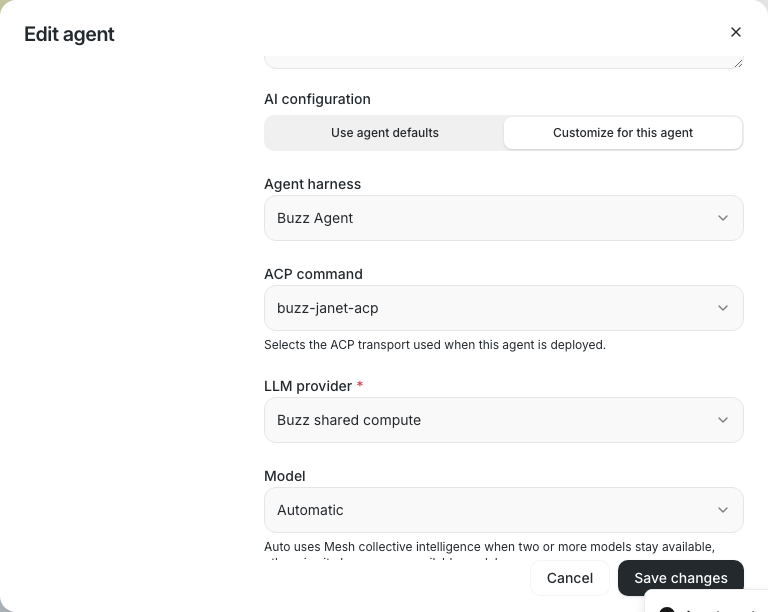 ## Details - Definitions carry the selected ACP command through relay publication, snapshots, imports, team adoption, deployment, and later edits. - Existing definitions without this field continue to use `buzz-acp`. - Unknown persisted commands remain visible but unavailable rather than being silently replaced. - Discovery is read-only and never executes candidates. It filters non-files and non-executables, supports Windows `.exe`, `.cmd`, and `.bat` shims, deduplicates aliases, and returns a stable sorted list. - Command names remain portable; Buzz does not persist machine-specific absolute paths. --------- Signed-off-by: Logan Johnson <loganj@squareup.com> Signed-off-by: Larry <8cf5a83f590ec0955b11647d1c88f796a98e088c30a492c58e0e46c3026ae7a4@buzz.block.builderlab.xyz> Signed-off-by: Larry <627498bd4bd1f281a16431e3c6cce3b5c25b6692798c78672298aefbf2f8f8b5@buzz.block.builderlab.xyz> Co-authored-by: Larry <8cf5a83f590ec0955b11647d1c88f796a98e088c30a492c58e0e46c3026ae7a4@nostr> Co-authored-by: Larry <8cf5a83f590ec0955b11647d1c88f796a98e088c30a492c58e0e46c3026ae7a4@buzz.block.builderlab.xyz> Co-authored-by: Larry <627498bd4bd1f281a16431e3c6cce3b5c25b6692798c78672298aefbf2f8f8b5@buzz.block.builderlab.xyz> |
||
|
Kalvin C
|
5a349db91c |
feat(relay): add opt-in newest-first thread windows (#7823)
## Summary Add an opt-in, newest-first thread window to the authenticated HTTP query path. A filter with `thread_window: true` returns: - reply rows ordered by `(created_at DESC, id ASC)` with an exact composite cursor; - optional bounded reactions, edits, deletions, and delete-of-aux closure; - one relay-signed `kind:39007` bounds event bound to the normalized host, authenticated reader, channel, root, request cursor, kinds, depth, limit, and aux choice. Filters without the flag keep the existing oldest-first thread behavior. Channel windows and `kind:39006` are unchanged. No client opts into this mode in this PR. ### Why extend NIP-CW NIP-CW already defines relay-computed, cursor-paged conversation views over extended NIP-01 filters. Thread windows use the same protocol ideas: ordinary signed rows, composite keyset pagination, optional aux closure, and relay-signed bounds. Adding a thread mode keeps those related wire contracts together instead of creating a second NIP with duplicated terminology and compatibility rules. Extending a draft, optional NIP with an additive mode is normal protocol evolution. Existing fields and meanings are not reinterpreted: - `top_level: true` remains channel mode; - `kind:39006` remains channel-window bounds; - `thread_window: true` selects the new mode; - `kind:39007` has a distinct identity and root/request binding; - extension-unaware clients never send the selector; - legacy thread queries remain unchanged. NIP-CW documents only the wire contract and relay semantics. Database plans, replica internals, and rollout procedures remain implementation concerns. ### Why thread windows use independent modules The implementation deliberately keeps `thread_window.rs` separate in `buzz-core`, `buzz-db`, and `buzz-relay` rather than adding branches throughout the existing channel-window path. The modes share pagination concepts, but their invariants differ: - channel mode selects top-level rows; thread mode requires one root and depths `1..=depth_limit`; - thread mode accepts only conversation row kinds and rejects unknown/conflicting fields; - thread bounds bind the root and authenticated reader because cross-channel aux visibility can differ by reader; - thread aux includes the root and requires complete two-hop closure; - thread mode refreshes writer authorization before selection and before signing; - historical cursor pages may use a proved replica transaction, but fallback must restart both aux hops on the writer; - legacy thread traversal is oldest-first and must not inherit descending cursor semantics. Forcing these rules into channel-window code would create a mode flag across parsing, SQL predicates, bounds construction, authorization, replica fallback, and tests. That abstraction would not remove complexity. It would distribute it. Separate modules keep each contract local and leave the established channel and legacy paths untouched. ### Technical design - Strict request parsing normalizes UUIDs, event IDs, kinds, defaults, and cursors before computing the response binding. - SQL applies community, root, channel, depth, kind, deletion, and cursor predicates before `limit + 1`. - Ordered metadata scanning plus exact event-key lookup avoids the stale-statistics plan that previously exceeded the four-second SQL budget on a 10k-reply thread. - Aux work is bounded by target batches, query count, raw candidate count, response bytes, SQL timeouts, and one shared HTTP deadline. - Fresh authorization-set comparison catches both grants and revocations during closure. The relay returns retryable `503` rather than signing an incomplete page. - Replica failure permanently degrades the request to the writer and restarts closure from its original targets without resetting budgets. - Migration `0049_thread_window_index.sql` adds the mixed-direction index used by newest-first scans. It validates a prebuilt index and bounds startup lock/build time. ### Tradeoffs - The stale-statistics-safe plan is intentionally less clever. Measured warm 100k deep-cursor execution increased from roughly 0.30 ms to 4.80 ms, plus about 8 ms planning, in exchange for avoiding a reproduced multi-second timeout after rapid 10k-thread insertion. - Bounds are authoritative only for the served page. There is no cross-page snapshot guarantee, and replica insertion coverage does not imply latest edit/deletion/aux visibility. - Strict parsing rejects unsupported constraints instead of silently serving a different row set. - Required aux closure fails closed. The relay does not omit aux and sign plausible-but-incomplete bounds. - This PR ships relay capability only. Client rendering, retry UX, live-history overlap, and compatibility fallback remain separate work. ### Related issue No existing issue found. This work follows the thread-loading design and review discussion. ### Testing - `cargo test -p buzz-core`: 258 unit tests and 2 doctests passed. - `cargo check --workspace --all-targets`: passed at the rebased implementation head. - `cargo test -p buzz-db`: 131 non-PostgreSQL tests passed; 275 infrastructure tests were ignored as declared. - Focused PostgreSQL migration/runtime regressions: 3/3 passed against an isolated PostgreSQL container, including both corrected migration-ledger tests. - `cargo fmt --all --check`: passed. - Pre-rebase feature validation passed 398/398 PostgreSQL tests, signed-wire multi-tenant/auth/pagination/aux/revocation probes, clean Compose boot/reboot, and full core tests. - Independent HA validation exercised three relay pods and a physical PostgreSQL standby on the same runtime logic before the final documentation-only cleanup. - Independent final-delta review confirmed exactly two changed files, byte-identical executable migration SQL after comments/diagnostic normalization, matching prebuild/catalog/recovery instructions, and `git diff --check`; no runtime receipts were relabeled to the new SHA. - The pre-push hook ran repository checks but its Rust unit lane exited 100 without exposing an individual failed test in the captured multiplexed output. The independently run affected-package checks above passed; current-head repository CI remains required. Known unrelated baseline behavior remains: the mesh-demo echo test can return 504, and same-second archive → unarchive can deduplicate its membership notification. Neither path is changed here. --------- Signed-off-by: Kalvin Chau <kalvin@block.xyz> Signed-off-by: cid <d9f92a72922bf45c17379a47d64dae84b6020397c2d5a52b5317d512068cd9d3@buzz.block.builderlab.xyz> Signed-off-by: am <6e30cd56c30e030cd31bb0939b94a7c257c9a09d5ba2d92cf2735da45629f248@buzz.block.builderlab.xyz> Co-authored-by: cid <d9f92a72922bf45c17379a47d64dae84b6020397c2d5a52b5317d512068cd9d3@buzz.block.builderlab.xyz> Co-authored-by: am <6e30cd56c30e030cd31bb0939b94a7c257c9a09d5ba2d92cf2735da45629f248@buzz.block.builderlab.xyz> |
||
|
Will Pfleger
|
26ede6dfa2 |
docs(nip-fi): clarify federated identity amendments (#7803)
## Summary Aligns the NIP-FI wire contract with the post-sync enterprise identity decisions: - bind each community's canonical host URI as its RFC 8707 resource-indicator audience, resolve `Host` to an immutable community configuration before verification, and require both exact audience binding and explicit community-to-issuer authorization - require relays to ignore unverified claims and avoid logging or exposing them; recommend that issuers minimize relay-visible claims - make per-session (`sid`) revocation issuer-side while keeping the relay's revocation primitive pubkey-scoped and community-wide, keyed `(iss, target_pubkey)` - scope the disconnect close scan to connections registered under the command's issuer, including admission-in-progress, matching the deny-entry key; terminally cancel pending connections and close the cross-issuer session-termination gap - clarify proactive assertion re-exchange and reconnect before expiry without introducing in-band renewal Originating Buzz discussion: `buzz://message?channel=51940054-5a7a-4773-a337-8004496630fa&id=d551ee7c61882ef33843e752f63a837921e7c5df2671a88c68a84524490089cc` --------- Signed-off-by: Will Pfleger <pfleger.will@gmail.com> Signed-off-by: Alia <d32955ad69077062930cc46cfe2df30ca9aaf6f8e76422681265e9e9af704d78@buzz.block.builderlab.xyz> Signed-off-by: Paul <4a1bfa0013bc6d14a8d600d8bf6392efefbd2a26ac3c96c9b2a106b0d12297ca@buzz.block.builderlab.xyz> Co-authored-by: Alia <d32955ad69077062930cc46cfe2df30ca9aaf6f8e76422681265e9e9af704d78@buzz.block.builderlab.xyz> Co-authored-by: Paul <4a1bfa0013bc6d14a8d600d8bf6392efefbd2a26ac3c96c9b2a106b0d12297ca@buzz.block.builderlab.xyz> |
||
|
Wes
|
6a86531ac9 |
feat(relay): add atomic complete read-state snapshots (#7572)
Opened by Brain on behalf of Wes (GitHub: wesbillman). ## Summary Add an opt-in, host-scoped completeness primitive for NIP-RS read-state clients. Ordinary query arrays and WebSocket behavior remain unchanged. - Advertise a version-1 `read_state_snapshot` capability in NIP-11 only when the request resolves a community. - Accept exactly one self-author kind-30078 snapshot filter on authenticated `POST /query`, after the existing admission, replay and membership gates. - Read all retained, nondeleted self-author kind-30078 coordinates from the writer at one SQL-statement MVCC cut—including unrelated application coordinates and events without a read-state tag. - Return a complete versioned envelope bound to community, signer and a content-identity hash. Reject malformed contracts, reconstruction/signature/storage failures and whole-request overflow; never return a truncated complete response. - Bound snapshots at 4,096 events and 8 MiB of compact encoded event-array bytes, advertised as `max_event_array_bytes`; envelope metadata is additional. Retain the separate stored-payload preflight budget. ## Safety and scope This is point-in-time enumeration, **not** a live freshness guarantee, cursor, CAS token, cross-relay transaction, or unread total. NIP-RS now explicitly requires fresh complete enumeration from every write relay before each override action, canonical publication, carry-forward or deletion. It does not enable synchronized manual-unread overrides in any client. No schema migration or deployment is included. ## Validation Executed against the source committed as `1fd5a5e0c0d893c1259386885517c0c44ae7630f`: - Four real-router/PostgreSQL snapshot cases: beyond-page-cap enumeration and overflow; corruption/storage failure; production payload-bound NIP-98, Redis replay guard and membership enforcement; host discovery/scope/strict request shape. - Two database cases: replacement during preflight preserves a single statement cut; encoded-byte overflow and writer-not-replica routing. The cluster-wide probe uses the required `cluster_global_` serialization prefix. - Production-call-site mutations killed for dispatch, strict filter validation, discovery tenant, snapshot tenant, encoded-byte guard, membership enforcement and replay enforcement; isolated mutation tree restored. - Both affected crates pass all-target Clippy; formatting, differential file-size and repository PostgreSQL test-discovery checks pass. - Normal pre-push gates pass without bypass: branch skew, push-head scope, file size, Rust unit lanes and desktop Tauri checks. - Independent read-only review by Pinky found no remaining relay blocker at this commit. The execution/mutation results above were run by Brain, not duplicated by the reviewer. Hosted CI and maintainer review remain separate gates. No production traffic or deployment was used for these fixture tests. Originating Buzz channel: `a394ecdb-9c67-4c4e-a3c6-4a95f69e8cc8` (unread-but-good), thread `2413d0ba7fa5b2ac5c777df6b3754e2099b042ec8fb96ca64302a0919a0550b3`. ## Review repair (2026-09-21) Carl updated this existing branch to `2f9c9b11266c24947412cf28cefae4e96e7167b7`, merging main `5079c770fe30bb3d8204822ce6c2431eacac6d4b` without rewriting published history. - Resolved the DB export conflict, preserving both snapshot and storage-accounting exports. - Addressed the blocking review using its accepted alternative: rename `max_bytes` to `max_event_array_bytes` and explicitly document that success-envelope metadata is outside the array budget. No auth, query, runtime-limit, or client-behavior redesign. - Added a PostgreSQL/router regression proving discovery, exact 8,388,608-byte array success with a larger envelope, and one-byte-over rejection (413, no partial complete response). Exact-head validation: all seven snapshot PostgreSQL/router tests passed in an isolated local database; both affected crates passed all-target Clippy; mandatory pre-commit/pre-push gates passed without bypass (Rust unit lanes, Tauri default/mesh Clippy and tests, differential file size, branch-skew/ref checks). Reverting only the descriptor rename made the new regression fail before the final commit. Independent bounded source-delta review by Mordecai found no blockers; execution was Carl's. A broader `cargo test -p buzz-db -p buzz-relay --all-targets` run on the merged candidate passed 131 DB tests and 1,057 relay tests, then encountered the same unrelated `mesh_demo::demo_join_forwarded_arm_round_trips_echo` 504 recorded in the prior review. Full repository `just ci` / `just test` were not rerun locally; hosted CI remains a separate gate. No deployment or production traffic was exercised. --------- Signed-off-by: Brain <1a02c72794dcd0f07058a353bc3a81f4028b8c77c92c87fce6d5c8b85970a20b@buzz.block.builderlab.xyz> Signed-off-by: Carl <32a2e2c9d428ee08902cab75d956da2c1d235a22d4766b0dd4138bf6e2e5db1d@buzz.block.builderlab.xyz> Co-authored-by: Brain <1a02c72794dcd0f07058a353bc3a81f4028b8c77c92c87fce6d5c8b85970a20b@buzz.block.builderlab.xyz> Co-authored-by: Carl <32a2e2c9d428ee08902cab75d956da2c1d235a22d4766b0dd4138bf6e2e5db1d@buzz.block.builderlab.xyz> |
||
|
Tom Brow
|
a61239f0d8 |
fix(mobile): avoid opening empty threads on message tap (#7756)
Tapping a mobile channel message with no replies currently opens an empty thread. Only enable message-row thread navigation when the existing thread summary reports replies, including replies known to the relay but not loaded locally. Long-press → Reply still starts a new thread. Added widget tests for zero replies, loaded replies, relay-only replies, and starting a thread through Reply. The zero-reply test failed before the fix and passes afterward. Validation: all 227 channel-page tests, the full mobile pre-push checks, and all PR CI checks passed. The full repository gate failed in unchanged Rust ACP timing tests (idle reset, keepalive, and steering deadlines); this PR changes only mobile Dart files. No duplicate open PR or issue found. --------- Signed-off-by: Tom Brow <tomb@block.xyz> |
||
|
Tom Brow
|
76f7e5ef0c |
feat(push): make gateway origin configurable (#7261)
Make the push gateway origin configurable across the relay, gateway, mobile client, and deployment chart. This is a fresh deployment. The gateway has only run on personal development infrastructure, and push has no existing enabled users. Legacy migration, configured-to-unconfigured mobile transitions, and rolling upgrades from pre-launch gateway binaries are not supported. Populated pre-launch databases are rejected with an informative error before migrations run; their data is untouched. Mobile builds may omit the gateway URL, leaving push unavailable. Once push is enabled, subsequent builds must retain that configuration. ### Validation - All applicable CI checks pass at `5f546cfaf403f0386f146d213adfb4392f4ec29c`, including Rust, mobile/Swift, desktop/integration, security, image builds, and Helm checks. An unrelated agent cancellation test passed on retry. - PostgreSQL CI passed 384 tests, including the production-entry-point regression for refusing populated pre-launch databases before migrations, fresh initialization, and subsequent initialized deployments. - Focused local validation passed all 10 gateway PostgreSQL tests under the CI discovery filter and all 3 unconfigured-mobile tests. Repository-wide PostgreSQL discovery validation and the complete pre-push hooks passed. - Physical-device APNs/App Attest behavior and deployment to a live cluster were not verified in this work. --------- Signed-off-by: Tom Brow <tomb@block.xyz> Co-authored-by: Codex <noreply@openai.com> |
||
|
Salman Mohammed
|
78618804ec |
Configure ACP session scope per agent (#7578)
## Summary PR #6732 taught the ACP harness to honor `BUZZ_ACP_SESSION_POLICY`, but the desktop exposed that policy as one global experiment. Turning it on changed every managed agent at once, even though conversation scope is part of how an individual agent should behave. Some agents need continuity across a channel, while agents such as validators may need clean context for each thread. This moves the choice onto the agent definition under Advanced as **Conversation context**, with **Entire channel** and **Each thread** options. **Entire channel** remains the default, so existing definitions keep their current behavior. The policy now travels through create and update IPC, returned agent summaries, persona events, snapshots, teams, and community catalog copies. Launches pass the effective definition value to the harness. Editing a running agent uses the same lifecycle as a model edit: it shows the restart-required state, leaves the deployed process untouched, and applies the new policy on restart. The global Thread Scoped ACP Sessions experiment and its desktop command/state have been removed because the setting no longer has a useful global meaning. There is intentionally no migration for the old preview override. Users who enabled it can choose **Each thread** for the agents that need it. Unknown or null policy values degrade to **Entire channel** across stored agents, persona events, and catalog projections. This keeps forward-version data from dropping complete agent records. ### Related issue No matching issue found. Builds on #6732. ### Testing - Focused Playwright create flow selected **Each thread** and verified `create_persona` received `sessionPolicy: "thread"`. - Focused Playwright catalog flow added a thread-scoped agent and verified the local copy stored `session_policy: "thread"`. Generated with Codex --------- Signed-off-by: Salman Mohammed <smohammed@squareup.com> |
||
|
Will Pfleger
|
752cbfc037 |
docs(nip-fi): add Blossom kind-24242 media possession-proof exception (#7278)
Adds the media/Blossom possession-proof exception section to
\`docs/nips/NIP-FI.md\`.

## What this changes

Encodes the condition set confirmed by Thufir's security review
(2026-09-03) as normative MUSTs in NIP-FI. Kind-24242 Blossom auth
events are admitted as the NIP-FI pairing possession proof for **media
routes only** — a named, bounded exception with an explicit precedent
fence against expansion.

### Scope fence

Kind-24242 proofs are valid only on:

| Proof type (`t` tag) | Valid route | Method |
|---|---|---|
| `upload` | `PUT /upload` (and temporary alias `PUT /media/upload`
until removed) | PUT |
| `get` | `GET /media/{hash…}`, `HEAD /media/{hash…}` | GET, HEAD |

All other protected routes MUST reject kind-24242 proofs.

### Upload proofs

Exactly one `x` tag over consumed body bytes; temporal check precedes
body consumption.

### Read proofs (the relaxation Will approved)

Host-wide MAY: no `x` required. Exactly one `server` tag matching the
resolved tenant host is a MUST. Optional `x` must match parent hash if
present.

Named residual (verbatim in spec): within at most 60 seconds from
minting (plus 5s future-skew), a captured full header set allows reading
any media blob on exactly one tenant host — read-only,
membership-checked, revocable, not state-changing, not cross-tenant.

### Freshness (Thufir option 2)

- `created_at <= now + 5s` (bounded future skew)
- `now - created_at <= 60s`
- Exactly one `expiration`, valid at admission, satisfying `expiration
<= created_at + 60s`

### Transport/cardinality

Exactly one each of `Authorization` (Nostr scheme), `t`, `expiration`,
`server`; `x` at most once; reject any duplicate, malformed, or
conflicting instance.

### Per-request pairing

Full assertion verification, exact key equality between assertion
`nostr_pubkey` and kind-24242 signer, deny-map enforcement on every
request. Stub gap named.

### Compliance note

PR #7264 implementation is explicitly non-compliant until the bounded
hardening task lands (named gaps: multi-tag acceptance, 3600s window,
optional `server`).

## Behavioral oracle

`FI-TRACE-HTTP-INGRESS` extended to cover kind-24242 admission and
denial cases.

## Scope

Docs-only. No code changes. The code hardening is a separate follow-on
task.

---------

Signed-off-by: Will Pfleger <pfleger.will@gmail.com>
Co-authored-by: Duncan <dcfd242e557282d7a1e2cf2e6877522682f1e5c6156dc92ca7d90eaedd3b0f95@buzz.block.builderlab.xyz>
|
||
|
Will Pfleger
|
c328202cb0 |
docs(nip-fi): document Git smart-HTTP credential exemption (#7268)
Amend NIP-FI HTTP ingress with an explicit Git smart-HTTP credential-helper exemption. The exception covers method binding, endpoint-URL binding, and the `payload` tag requirement for `info/refs`, `git-upload-pack`, and `git-receive-pack`, while preserving per-request NIP-FI assertion, key pairing, and deny-map enforcement. The spec records Git's credential-protocol limitation, the required compensating controls, and the rule that this exception is limited to these endpoints and is superseded by per-request signing. Related: [PR #7264](https://github.com/block/buzz/pull/7264) Signed-off-by: Will Pfleger <pfleger.will@gmail.com> |
||
|
Will Pfleger
|
187df22252 |
docs(nip-fi): adopt deny-until-TTL and extend enforcement to HTTP ingress (#7254)
Spec revision following two decisions: Option B admin deny (2026-09-02) and the HTTP ingress ruling (2026-09-02). Revises `docs/nips/NIP-FI.md` only. Follows #7214 (merged spec v2). ## What changed ### Admin disconnect: session-only → deny-until-TTL The disconnect operation proceeds in two steps, in order: 1. Insert a memory-resident deny entry keyed by `(iss, target_pubkey)` with absolute expiry `until` — atomically combined with the `(iss, jti)` replay-identity reservation as one all-or-nothing mutation. If the deny set is at capacity (per-issuer bound), the relay rejects `503`; neither the jti nor the deny entry is recorded, and the caller may safely retry the same signed command. 2. Close all live WebSocket connections for the target pubkey, synchronously. The single atomic admission mutation (jti reservation + deny-entry insertion) lives inside `VerifyCommandJwt` step 7, after all pure authorization checks. The endpoint only closes sessions on success. This ordering ensures a capacity failure leaves no state behind and makes the retry-safe 503 contract implementable. The deny set is RAM-cache only — no durable storage, no schema changes. The same operational posture as the JWKS snapshot. A relay restart MAY forget active entries; the issuer SHOULD re-push still-active deny entries on observed restart (same publish/cache pattern as JWKS). If the issuer stops issuing assertions and re-push completes before any expired-entry reconnection attempt, residual exposure after restart is bounded by `max(0, min(exp, iat + maximum_assertion_age) - now)`. If the issuer continues issuing or re-push does not complete in time, that formula does not apply and access may continue beyond it. **`until` claim:** Required on the disconnect command JWT. Because an assertion accepted at the future-skew boundary (`iat <= now + skew`) remains valid until `iat + maximum_assertion_age`, the latest possible authority deadline is `now + skew + maximum_assertion_age`. The relay enforces `until <= now + skew + maximum_assertion_age`. A value above this ceiling rejects `400`; a past `until` still closes live sessions — absent an active same-key entry it creates no future denial, while an active entry remains unchanged under the merge rule. **Capacity and eviction (per-issuer):** The relay MUST bound the deny set size **per issuer**. Capacity exhaustion under one issuer MUST NOT cause rejection of another issuer's commands; the `503` capacity check is evaluated against the command's own issuer bound. Implementations MUST evict only expired entries; when an issuer's partition is at capacity and all entries are still active, the relay MUST reject the new command `503` without removing any existing entry. There is no LRU eviction of active denies. **Issuer-global deny:** The deny entry applies to admission across all communities served by the relay under that issuer. Identity-level revocation is intentionally not community-partial. **Cross-replica propagation:** In a deployment with multiple relay processes, the deployment MUST propagate both the session-close and the deny entry to every process serving admissions for the issuer's communities. The mechanism is deployment-defined (e.g. the existing inter-process message bus, same posture as JWKS convergence). Propagation is asynchronous with no protocol-level completion bound. The issuer re-push duty is the recovery path for lost propagation, exactly as for relay restart. **Response shape:** A successful disconnect responds `{"disconnected": true}` regardless of how many sessions were closed. No session count is returned; a count would aggregate activity across communities and constitute an information leak. **Admission procedure:** Step 5 registers the session's proven `k` before the deny-set check (new step 6) — ensuring any connection that straddles a concurrent disconnect is caught by one side or the other. `FI-TRACE-DENY-SET` oracle covers the per-issuer capacity rule and the straddling termination requirement. ### HTTP ingress enforcement Without explicit enforcement, a protected HTTP surface (bridge, invites, media, git) with NIP-98-only authorization allows a principal holding an active key to mint fresh NIP-98 events indefinitely — NIP-98 proves key possession only, not identity. Without assertion verification there is no expiry bound; the key remains valid for as long as it is accepted. **Pairing rule:** in enforce mode, a protected HTTP request MUST carry both: ``` Authorization: Nostr <base64-NIP-98-event> Nostr-Federated-Identity: Bearer <compact-JWS> ``` The NIP-98 pubkey MUST equal the assertion `nostr_pubkey` claim. Missing, mismatched, or invalid evidence of either kind denies, fail closed. **Verification:** reuses `VerifyAssertion` unchanged — offline, same JWKS, same claim requirements, same denial classes. **Per-request:** HTTP is sessionless; every request re-verifies. No session lifetime, no cached admission. The cumulative residual bound applies per request. **Deny-set applicability:** the deny-until-TTL entry introduced above is consulted per HTTP request identically to WebSocket admission. **Protected surface:** deployment-configured set of routes, fail-closed default (unclassifiable routes treated as protected). No normative route names in the spec. `FI-TRACE-HTTP-INGRESS` oracle added. Security considerations updated with HTTP ingress bypass analysis. NIP-98 source reference added. ### Other changes - `authorization_denied` rejection table row updated to "active deny-set entry for pubkey". - Discovery: `maximum_residual_upstream_revocation_seconds` remains `null` — the deny-until-TTL model is best-effort RAM state and provides no unconditional finite revocation bound. - Rejection and privacy: explicit sentence for HTTP denial path. - Client-attached transport: opening sentence generalized to cover both WebSocket and HTTP. ## Scope Single file: `docs/nips/NIP-FI.md`. No code changes. References #7214. Channel: buzz-enterprise-identity-spec-v2 (#a6fe0b1c-987a-43c5-a974-71ee36678d78). --------- Signed-off-by: Will Pfleger <pfleger.will@gmail.com> Signed-off-by: Duncan <dcfd242e557282d7a1e2cf2e6877522682f1e5c6156dc92ca7d90eaedd3b0f95@buzz.block.builderlab.xyz> Co-authored-by: Duncan <dcfd242e557282d7a1e2cf2e6877522682f1e5c6156dc92ca7d90eaedd3b0f95@buzz.block.builderlab.xyz> |
||
|
Will Pfleger
|
04babf0265 |
chore(db): drop Phase-A NIP-FI relay-side authority ledger (#7221)
Removes the dead relay-side authority ledger introduced by migrations 0041 and 0042, and the dead `require_attested_key` verifier knob from `buzz-auth`. Both are unreachable by design under NIP-FI spec v2 (#7214, squash `d4420eb47`), which makes OSS Buzz stateless for identity: the relay neither stores nor verifies an authority chain. ## What changes **`migrations/0044_drop_nip_fi_ledger.sql`** Drops all fifteen NIP-FI ledger tables and their trigger functions using `CASCADE` to resolve the circular deferred FK between `identity_bindings` and `identity_lifecycle_history`. Drops proceed in FK dependency order: selectors → history/bindings → enrollment_policies/receipts → parallel drop of auth tables. Restores `community_write_fence_excluded_table` to its pre-0041 body (removes NIP-FI table names from the exclusion array). **`schema/schema.sql`** Removes the NIP-FI section (~1885 lines of tables, functions, and triggers) and updates `community_write_fence_excluded_table` to match. **`crates/buzz-db/src/runtime/migration.rs`** - Updates the `embedded_migrator_contains_consolidated_initial_schema` sanity check: count 43→44, adds 0044 assertion block (verifies `DROP TABLE` statements and absence of NIP-FI names from `schema.sql`). - Removes ~2580 lines of NIP-FI Postgres integration tests (all `#[tokio::test] #[ignore = "requires Postgres"]` from the 0041/0042 behavioral coverage). - Removes the `extract_excluded_table_array` drift check (0042 body no longer matches `schema.sql` by design). - Adds `migration_0044_drops_populated_nip_fi_ledger_cleanly`: runs migrations to 0042, seeds rows in `authorization_operation_receipts` and `authorization_invalidation_domains`, then runs to 0044 and verifies all fifteen NIP-FI tables are absent. **`crates/buzz-auth/src/nip_fi/config.rs`** Removes `require_attested_key: bool` from `IssuerPolicy` — field, constructor parameter, accessor, and its contribution to `derive_assertion_policy_id`. **`crates/buzz-auth/src/nip_fi/verifier.rs`** `parse_nostr_pubkey_claim` no longer takes a `policy` parameter. The `None` (absent claim) arm now returns `Err(VerifierError::ClaimRejected)` unconditionally instead of conditionally on `policy.require_attested_key()`. **`crates/buzz-auth/src/nip_fi/verifier/tests.rs`** - Removes `missing_nostr_pubkey_denies_under_attested_key_policy` (the sole `require_attested_key: true` call site). - Removes `false,` from all eleven `IssuerPolicy::new` call sites. - Injects `nostr_pubkey` by default in `mint_signed_by` (spec v2 requires it unconditionally). - Updates `valid_access_token_verifies` to assert `asserted_key().is_some()`. **`crates/buzz-auth/src/nip_fi/startup/tests.rs` + `jwks/tests.rs`** Removes `false,` from all `IssuerPolicy::new` call sites and adds `nostr_pubkey` to all token-minting helpers. ## Verification - Fresh-DB migration run to head: all migrations apply cleanly in sequence. - Populated-0041/0042-DB migration through 0044: seeds rows in live NIP-FI tables, verifies all fifteen are dropped without error. Closes the dead-code inventory item from the spec-v2 cleanup plan (channel `48374f48`). Follows #7214. --------- Signed-off-by: Will Pfleger <pfleger.will@gmail.com> Signed-off-by: Duncan <dcfd242e557282d7a1e2cf2e6877522682f1e5c6156dc92ca7d90eaedd3b0f95@buzz.block.builderlab.xyz> Co-authored-by: Duncan <dcfd242e557282d7a1e2cf2e6877522682f1e5c6156dc92ca7d90eaedd3b0f95@buzz.block.builderlab.xyz> |
||
|
Will Pfleger
|
d4420eb47f |
docs(nip-fi): rewrite NIP-FI as stateless OSS Buzz spec v2 (#7214)
Rewrites `docs/nips/NIP-FI.md` as a stateless spec and deletes the five companion profiles (NIP-FI-CONF, NIP-FI-DELEG, NIP-FI-EDGE, NIP-FI-LIFECYCLE, NIP-FI-MODEL) that presuppose relay-side state. ## What changes ### `docs/nips/NIP-FI.md` — full rewrite The relay-side authority engine (bindings, receipts, lifecycle, invalidation, leases, delegation, enrollment modes, TOFU) is removed. The spec settles exactly five things: 1. **Assertion contract**: JWT claims (`iss`, `sub`, `nostr_pubkey`, `aud` (required), `iat`/`exp`, finite TTL bounds), npub binding semantics, required NIP-42 proof-of-key pairing. Evidence rules (assertion-key-mismatch → `authorization_denied`, freshness) preserved from v1. 2. **Verification**: offline against configured per-issuer JWKS snapshots; multi-issuer; fail-closed on missing/expired/unverifiable. Cites `crates/buzz-auth/src/nip_fi/` (PR 3 / `70895b355`) as implementing the assertion-verification procedure. The `require_attested_key` flag in `IssuerPolicy` is the enforcement primitive for the unconditional `nostr_pubkey` requirement; conformance requires forcing it true for every issuer — follow-on code outside this PR. 3. **Session policy**: required finite `max_connection_lifetime_seconds` knob with no permissive default; re-auth on every reconnect; no in-band renewal. 4. **Admin disconnect API**: session-only normative text with a dedicated `VerifyCommandJwt` procedure — distinct `typ: nip-fi-command+jwt`, signed `method`/`path` binding, normative `maximum_command_age` bound (0 < value ≤ 60 s), atomic `(iss, jti)` reservation as the final admission step after all pure checks. Non-normative note documents cumulative residual access: `max(0, min(exp, iat + maximum_assertion_age) - now)` assuming issuance stops; states that previously issued assertions remain valid for reconnection until their authority expires; states that continued issuance extends access with no protocol-level bound. Non-normative note documents the session-only vs deny-until-TTL trade-off. This verifier and endpoint are follow-on code. 5. **Deletions**: bindings, enrollment, lifecycle, receipts, leases, invalidation, delegation gone. "Out of scope" section names every issuer and deployment concern explicitly. ### Companion profiles deleted NIP-FI-CONF, NIP-FI-DELEG, NIP-FI-EDGE, NIP-FI-LIFECYCLE, NIP-FI-MODEL — all presuppose relay-side binding/lifecycle state. ## What does NOT change The entire `crates/buzz-auth/src/nip_fi/` Rust crate (PR 3 / `70895b355`) implements the assertion-verification procedure described in this spec. No Rust code changes in this PR. The `require_attested_key` enforcement integration and the `VerifyCommandJwt` / disconnect endpoint implementation are explicit follow-on code work. ## Follow-on work (separate PRs after spec merges) - `require_attested_key` forced-true startup enforcement - `VerifyCommandJwt` implementation and disconnect endpoint - Down-migration dropping migrations 0041/0042 (0042 before 0041 per FK order) - `schema.sql` NIP-FI sections removed - `buzz-db` migration test blocks cleaned up --------- Signed-off-by: Will Pfleger <pfleger.will@gmail.com> Co-authored-by: Duncan <dcfd242e557282d7a1e2cf2e6877522682f1e5c6156dc92ca7d90eaedd3b0f95@buzz.block.builderlab.xyz> |
||
|
Tom Brow
|
c432a111ca |
feat(mobile): push notifications MVP (#6269)
This PR implements MVP, iOS-only,
[NIP-PL](
|
||
|
Will Pfleger
|
953a1798b2 |
feat(auth): add NIP-FI canonical assertion verifier and contracts (#6776)
The closed, provider-neutral contract layer at the root of the NIP-FI federated-identity dependency graph — Phase A, PR 1 of the plan. It has no dependencies on any other PR and defines no database schema, migration, runtime JWKS fetching, binding resolution, enrollment, or request/proof binding; those belong to later PRs. ## What this adds - **Multi-issuer assertion-policy config** (`IssuerRegistry`, `IssuerPolicy`) keyed by exact `iss`. Identity is issuer-qualified `(iss, sub)` throughout — equal `sub` under different `iss` are distinct identities. The subject coordinate is fixed to the JWT `sub` claim (`SUBJECT_CLAIM`), never configurable, so no deployment can seal a mutable attribute like `email` as identity. Issuer URL and audience remain deployment configuration. - **The two deterministic semantic contract identities** — `AssertionPolicyId = H(canonical assertion-policy contract)` and `TransportContractId = H(canonical transport contract)` — derived by length-prefixed, domain-separated SHA-256 so a semantic change moves exactly its owning ID while benign JWKS rotation never changes policy lineage. Set-valued policy inputs (audiences, algorithms, subject-class values, scope capture) are canonicalized before derivation, so the ID is invariant under permutation and duplication. Config fields that a freshness class never reads are rejected at construction (an `offline-jwt` policy cannot carry `maximum_status_age`), so the canonical encoding stays total over valid configs and semantically identical policies always derive one ID. - **The single canonical verifier** (`FederatedAssertionVerifier`, `FI-INV-16`) producing the origin-sealed, provider-neutral `VerifiedAssertion` normalized result. Its constructor is crate-private, so unverified claims cannot be promoted into authority. The issuer→JWKS authority is entirely crate-owned: `AssertionKeySet` has no public constructor and `IssuerKeySource` is sealed, so no downstream crate can relabel one issuer's keys as another's. The authenticated key set is bounded (`MAX_JWKS_KEYS`) and the bound is folded into `AssertionPolicyId`, so an unbounded attacker-controlled `kid` scan cannot be driven; every snapshot requires a finite positive hard deadline. - **Sealed revalidation dependencies** — `RevalidationDependencies` carries the key-snapshot hard deadline and a `ConfidentialAssertion` handle to the exact compact JWS (no `Debug`/`Display`/`serde` leak, sole read path `compact_jws()`), so a changed snapshot can revalidate the same evidence: a retained key revalidates, a removed key denies. - **The privacy-preserving four-class denial contract** (`DenialClass`, `FI-INV-13`) with the byte-exact Nostr text, HTTP status, body, `Content-Type`, and `WWW-Authenticate` values fixed by the spec's rejection table. An unreadable required current dependency maps to `authorization_unavailable`/503, never to rejected evidence, and rejected evidence never masquerades as a 503 at either end of the pipeline: all bounded, dependency-independent checks (compact structure, header, signature shape, policy, algorithm, token class) precede key-source lookup, and all offline validation (token-class, key, signature, audience, claims, time) completes before any status-witness deferral. A wrong-`typ` or structurally malformed token, or malformed/invalidly-signed input naming a current-status issuer, therefore denies with `evidence_rejected`/403 rather than being reported as a 503 availability signal. ## Corrections applied to the mined source Mined from the `buzz-auth` verifier core in [#1476](https://github.com/block/buzz/pull/1476) and corrected to the settled spec (the merged `docs/nips/NIP-FI*.md`, [#5946](https://github.com/block/buzz/pull/5946)), which settled after #1476 was written: - Token-class selection with exact `typ` enforcement. Two classes are offered: `at+jwt` and `nip-fi+jwt`. There is deliberately no generic/absent-`typ` "named compatibility" class: it cannot be proven disjoint from an OIDC ID token by claim presence alone (an issuer can mint an ID token carrying `client_id`), and the only authenticated discriminator is `typ`, which such a mode declines to constrain. - OIDC ID-token denial — denies even when `iss`, `aud`, and `sub` match, via exact `typ` mismatch against every accepted class. - The fixed `nostr_pubkey` claim accepted only as lowercase hex of exactly one 32-byte key; bech32 and other aliases deny. - Resource-owner / client-subject ambiguity denial and required `client_id` for `at+jwt`. - JWK admissibility: a key's `use` and, when present, `key_ops` must authorize signature verification (a key restricted to other operations such as `encrypt` is rejected), and the selected JOSE algorithm is bound to the key's required family and curve (ES256↔EC/P-256, ES384↔EC/P-384, EdDSA↔OKP/Ed25519, RS/PS↔RSA). The JWK `alg` is advisory; the actual key material is what signs, so a JWK declaring a matching `alg` over mismatched material (a different family or curve) is rejected before signature verification. - Spec-exact time arithmetic (`now < exp`, `iat <= now + skew`, `now < iat + maximum_assertion_age`, equality at expiry is expired). `exp`/`iat`/`nbf` accept finite integer or fractional RFC 7519 `NumericDate` values with checked, overflow-safe conversion; non-finite and out-of-range values deny. ## Verification In-crate tests in `crates/buzz-auth/src/nip_fi/verifier/tests.rs` sign real ES256 assertions against a fixed test key and cover: the happy path, exact-wire-text for all four denial classes, deterministic and semantic contract IDs, canonicalization invariance, token-class enforcement including ID-token denial, JWK `key_ops` rejection, `nostr_pubkey` hex handling, time bounds, and multi-issuer selection (same subject across distinct issuers yields distinct identities and policy IDs). They also cover the round-3 contracts: the key-set bound (oversized rejected, at-bound accepted, empty rejected), fixed-`sub` identity (identity is `sub` not a configured `email`; a token without `sub` denies), offline-before-deferral (invalid-signature, wrong-audience, malformed-claim, and expired under a current-status issuer each deny 403/`evidence_rejected`), and the revalidation contracts (dependencies carry the deadline and exact JWS; a retained key revalidates, a removed key denies). And the round-4 contracts: algorithm↔key-material binding, covered exactly per accepted algorithm (a table-driven matrix asserts every policy-acceptable algorithm — ES256, ES384, EdDSA, RS256/384/512, PS256/384/512 — matches only its required family/curve and rejects every other, so each mapping mutation fails individually; and an ES256 token against P-384, RSA, and Ed25519 material each deny `InvalidKey`); malformed evidence classified before key lookup (wrong-`typ`, two-segment, four-segment, empty-signature, and non-base64url-signature tokens against an empty source deny 403 not 503); `maximum_status_age` inapplicable under offline-jwt rejected at construction while current-status still requires it; and fractional `NumericDate` (finite fractional `iat`/`exp`/`nbf` within bounds verify, non-finite and out-of-range deny). Compile-fail doctests guard the sealed authority seam (`AssertionKeySet::new`, `IssuerKeySource`) and the absence of the named-compatibility token class. ## Notes - `Co-authored-by` attribution is preserved for the mined author. The #1476 `buzz-auth` commits are authored by Cea Stapleton Cordasco (the salvage map records #1476 under Franco; the git history on that PR is Cea's — surfacing for the attribution/closure record). - Amends `docs/nips/NIP-FI.md` to remove the "named compatibility access token" class and its `FI-TRACE-TOKEN-CLASS` oracle reference, so the normative spec matches the two-class root implementation (a generic/absent `typ` cannot be proven disjoint from an OIDC ID token). Removal-only, no neighbor redesign; a `docs/nips/` grep confirms no dangling cross-reference to the class remains. - Adds `jsonwebtoken 10.4.0` (`aws_lc_rs`) as a workspace dependency. Dependencies: none. --------- Signed-off-by: Will Pfleger <pfleger.will@gmail.com> Signed-off-by: Duncan <dcfd242e557282d7a1e2cf2e6877522682f1e5c6156dc92ca7d90eaedd3b0f95@buzz.block.builderlab.xyz> Co-authored-by: Cea Stapleton Cordasco <261786559+cea@users.noreply.github.com> Co-authored-by: Duncan <dcfd242e557282d7a1e2cf2e6877522682f1e5c6156dc92ca7d90eaedd3b0f95@buzz.block.builderlab.xyz> |
||
|
Tyler
|
d97780b477 |
docs(nips): comprehensive NIP-FI — core + claimable profiles (EDGE/LIFECYCLE/DELEG/CONF) (#5946)
## What Comprehensive NIP-FI against `main`: one normative core plus four separately claimable profiles, replacing the single-document structure of #3726 (which was based on #1485's branch, not `main`). Six documents, 1,975 lines, docs only. - **`NIP-FI.md` (core, 632 lines)** — issuer-qualified identity `(iss, sub)`, independent Nostr proof, client-attached assertion, partial bijection with durable tombstones, atomic final admission, bounded leases, private denials with a closed response vocabulary, retire/revoke/rotate, two contract identities (`assertion_policy_id`, `transport_contract_id`), per-policy `skew` / `maximum_assertion_age` / `maximum_status_age` with missing configuration denying, a closed token-class rule (`at+jwt`, `nip-fi+jwt`, named compatibility; ID tokens always deny), declared freshness class (`offline-jwt` | `current-status`), server-declared body authorization relevance (NIP-98 payload-binding fix, including a `payload` tag on an irrelevant-body operation), BCP 14, "equivalent" defined over identity / bounds / provenance classes, a compact non-normative worked wire example, and a non-normative comparison with DPoP, mTLS-bound tokens, and HTTP Message Signatures. FI-INV-01..16 are normative core text. The behavioral-oracle table lists exactly 30 oracle IDs, one per row, with no shorthand. - **`NIP-FI-EDGE.md`** — trusted-edge surface: the `trusted-proxy-hmac-v2` envelope + canonicalization, or a private authenticated-edge adapter under a reviewed contract; `authorization_domain_id` derivation (exact 16 RFC 9562 UUID bytes); `proof_transport_code` registry (0x01 NIP-42, 0x02 NIP-98; 0x03 Git smart-HTTP and 0x04 Blossom reserved pending their transport contracts; 0x05–0x7f unassigned pending published stable specifications) + extension procedure; body-acquisition bounds; three normative test vectors. An independent Nostr proof (the NIP-98 event in `Authorization`, which reaches the verifier byte-identical, or the NIP-42 event after connect) is the only decision input outside the MAC; absent or incomplete provenance on an edge-required route is `missing_evidence`, present-but-failing provenance is `evidence_rejected`. Header-trust-without-provenance is nonconformant. - **`NIP-FI-LIFECYCLE.md`** — provision / disable / re-enable / administrative expiry (`binding_not_after`) / pending-replacement lineage, one conformance trace per privileged transition; every binding-creating transition declares whether it continues or establishes a grant; a private-condition table for CONF enumeration agreement. - **`NIP-FI-DELEG.md`** — delegated agents; explicit temporal boundaries matching core's inclusive-`nbf`/exclusive-`exp` idiom, with the delegated `skew` configured by this profile; lease deadline anchored to the lease issue instant; strict path separation — a delegated request carries no assertion or provenance field, so it cannot traverse an edge-provenance route and uses ingress on which NIP-FI-EDGE is not required. - **`NIP-FI-CONF.md`** — conformance evidence: an immutable claim tuple including the governing document revision and exit fixture digest; the complete 16-row denial-fixture enumeration with three mechanical enumeration-agreement checks; mutation adequacy with a countable denominator — one retained killed mutant per literal oracle-table row (30 core + 6 EDGE + 11 LIFECYCLE + 7 DELEG + 4 CONF = 58), rows selected structurally by their first cell, never by section title, with the release gate and CONF's own oracle rows stated in the same listed-oracle terms and a mutant defined for CONF's own report- and suite-subject oracles; an interoperability exit test compared over signing inputs (per-transport NIP-01 serialization for the NIP-98 and NIP-42 proofs; decoded protected header and claims as JSON values for the assertion), with a shared exit fixture pinning complete pre-signature header/claim JSON and complete unsigned event fields for both transports, and mandatory negative controls. `FI-CONF-INTEROP-EXIT` is `deferred` with reason `no-independent-implementation` until a second independent implementation exists; the canonical fixture is editor-authored at `docs/nips/fixtures/nip-fi-conf-exit.json` and is **not in this PR** — until it is published a claim records `pending-canonical-fixture`, valid only while the exit test is deferred. Explicit not-applicable dispositions, including `offline-jwt` deployments for the two current-status oracles and absence of a revocation-bounded external capability projection for `FI-TRACE-CAPABILITY-REVOCATION`. - **`NIP-FI-MODEL.md`** — non-normative companion; defines no requirement or conformance claim and is not claimable. ## Why The prior draft rated 9 (soundness) / 6 (minimalness) / 7 (elegance) / 7 (correctness) in adversarial + comparative review. This restructure keeps the two-invariant spine untouched, makes everything else a claimable profile, and collapses five stacked versioning mechanisms into two contract identities. Mutation adequacy counts one mutant per literal oracle-table row — a set two implementers enumerate identically — instead of "each normative requirement," which had four defensible readings. Resolved product calls (owner-approved): 1. Enrollment/denial posture is private — boolean enrollment discovery, TOFU extension claim not self-advertised, `key_mismatch → authorization_denied` joins the denial anonymity set, and replayed evidence is classed `authorization_denied` so resubmission reveals nothing about commit. 2. Revocation honesty — only `current-status` deployments may advertise an unconditional residual-revocation bound; `offline-jwt` advertises unbounded/unknown. Access tokens keep RFC 9068 `at+jwt`; `nip-fi+jwt` is reserved for a separately minted Buzz assertion. ## Acceptance bar - Nothing in core is deletable without losing a stated core guarantee. - From the core document plus the CONF exit fixture, a second implementer can produce a valid request equal over the request compared object (signing inputs), and a byte-exact public denial per class — no reference implementation. - Every oracle-table row ships a retained killed mutant satisfying only the entry it was selected for. - Both deployment profiles (trusted proxy = EDGE, client-held OIDC = core client-attached) pass the same lifecycle conformance suite. ## Status Ready at head |
||
|
Wes
|
067c085f37 |
Define private managed agent wire protocol (#4593)
## Summary - reserve kind `30179` for owner-private managed-agent aggregates - define the fail-closed owner-self NIP-44 v2 envelope and versioned payload codec - bind runnable identity/configuration to complete signed `30175`/`30177` recovery projections - validate NIP-OA owner→agent attestations and reject self-attestation - document NIP-PMA authority, migration prerequisites, privacy, and deployment order - keep generic relay ingest closed until private storage and atomic aggregate CAS exist ## Safety boundary This is the inert protocol/codec slice only. It does not publish secrets, change agent authority, migrate local records, or enable kind `30179` ingestion. The relay regression test proves generic EVENT ingest still rejects the kind. The finalized migration plan adds later prerequisites for relay-private storage/CAS, runtime lease/fencing, Desktop cutover, and harness authentication. Those belong in staged follow-up PRs rather than expanding this inert foundation. ## Validation At commit `67f0ea4ebb8d3ccba3a3eb9374e89a7178913f74`: - `cargo test -p buzz-core` — 246 unit + 2 doc tests passed - `cargo test -p buzz-relay private_managed_agent_kind_remains_rejected_until_atomic_ingest_exists` — passed - push hooks: Rust tests and desktop checks passed (`2145` desktop tests passed, `14` ignored) - `cargo fmt --all -- --check` - `git diff --check` ## Review Princess Donut cleared security/data integrity with no remaining high/medium findings. Mongo cleared migration compatibility and wire grammar. The later runtime lease/fencing protocol was also adversarially cleared as a plan; implementation slices still require independent evidence before activation. Deterministic plaintext/signed-projection/auth-tag interoperability vectors remain a valuable follow-up, not an S0 merge gate; random NIP-44 ciphertext is intentionally not snapshotted. --------- Signed-off-by: Wes <wesbillman@users.noreply.github.com> Co-authored-by: Carl <c7ebe626f000404285d3686e1dc74cc07cc60a9754a150041ba132e14bd3e2ec@buzz.block.builderlab.xyz> |
||
|
Will Pfleger
|
0542bc8b95 |
docs(nip-am): normative amendment — cache SHOULD/MUST + pricingIdentity + consumer cost guidance (#4632)
Amends `docs/nips/NIP-AM.md` with three normative publisher-behavior changes per the cleared Usage v2 plan (plan v3, D4 + D2'). ## Changes ### 1. Cache emission semantics (D4) Replaces the unconditional `MAY` with qualified obligations: - Publishers SHOULD emit `cacheReadTokens` / `cacheWriteTokens` when the provider exposes a cache component. - Publishers MUST preserve an explicit zero when the provider reports zero. - Publishers MUST omit the field (never null or fabricated zero) when that component is unavailable to the publisher — including when the provider supports it but the harness does not surface it. An explicit carve-out in both the JSON comment block and the Numeric-validity prose exempts these fields from the payload-wide null guidance. Omission is the only valid representation for an unavailable cache component. ### 2. Optional `pricingIdentity` field (D2') Adds an optional, non-nullable `pricingIdentity` object (`authority`, `model`, `cacheClass`), defined as billing authority — distinct from the transport `Provider` enum. - `authority` is a registered billing-namespace identifier: exact lowercase hostname, no scheme, no path, no trailing slash. Registered values: `api.anthropic.com`, `api.openai.com`, `openrouter.ai`. The set extends only by NIP amendment. Pricing lookup is an exact string match on `(authority, model)`. - Present only when the publisher can prove applicability: direct official-endpoint connections prove via the actually-requested resolved model; other routes MUST receive response-supplied authoritative billing identity. - MUST omit for custom/overridden base URLs, gateways (unless the gateway is the named billing authority), unresolved aliases, and turns where usage contributions carry more than one billing identity (including identity-bearing mixed with unresolved). - `cacheClass` is omitted (not null) when not applicable. - `pricingIdentity` is optional but not nullable — omission is the only absence representation. - The existing `model` field retains its non-billing semantics (configured/session model) and is never overloaded. - Consumers MUST treat omission as "price unknown" and MUST NOT infer a price from the session `model` field. ### 3. Consumer cost guidance (D4) - Consumers MAY recompute cost estimates using the billing identity and a pricing manifest. - Consumers MUST retain the provenance of any cost value (e.g. `manifest-estimated`, `wire-reported`). - Consumers MUST NOT merge manifest-estimated and wire-reported costs into an unlabeled total. Manifest-vs-wire display preference is application policy and deliberately excluded from this NIP. ## Scope Doc-only. Single file: `docs/nips/NIP-AM.md`. --------- Signed-off-by: Will Pfleger <pfleger.will@gmail.com> Co-authored-by: npub1mn7jgtj4w2pd0g0zeuhxsa6jy6p0rewxz4kujt98my82ahfmp72sxjexk7 <dcfd242e557282d7a1e2cf2e6877522682f1e5c6156dc92ca7d90eaedd3b0f95@buzz.block.builderlab.xyz> |
||
|
Will Pfleger
|
cb9701cd30 |
feat(relay): accept kind:30621 multi-repo projects at ingest (#3171)
Buzz renders one card per `kind:30617`, so a project spanning several repositories has no representation. [NIP-MP](https://github.com/block/buzz/pull/3163) defines `kind:30621` as an addressable container holding a group's name, description, channel binding, and member coordinates. This adds the kind to `buzz-core` and its structural validation to the relay ingest path. ## Event shape ```json { "kind": 30621, "tags": [ ["d", "platform"], ["name", "Platform"], ["description", "Relay, desktop, and mobile."], ["a", "30617:<owner-a-hex>:buzz"], ["a", "30617:<owner-b-hex>:buzz-infra"], ["buzz-channel", "<channel-uuid>"], ["buzz-visibility", "listed"] ] } ``` ## Validation at ingest | Rule | Behavior | |------|----------| | `d` tag | exactly one, non-empty (length already bounded by the generic `D_TAG_MAX_LEN` check) | | member `a` tag arity | exactly 2 or 3 elements per NIP-01's `a` tag grammar; a 4th element has no defined meaning and is rejected | | member `a` tag coordinate | must parse as `30617:<lowercase-64-hex-owner>:<non-empty-d>` | | duplicate members | rejected on exact string match of the canonical coordinate | | member cap | 64, counted over raw `a` tags | | metadata cardinality | at most one each of `name`, `description`, `buzz-channel`, `buzz-visibility` | | metadata length | `name` ≤ 256 bytes, `description` ≤ 2048 bytes, `buzz-channel` ≤ 256 bytes, `buzz-visibility` ≤ 256 bytes | | zero members | valid | | unknown tags | ignored | Rejection order is normative so a client can predict which rule fires: `d`-cardinality → `d`-empty → member-cap → member-arity → coordinate parse → member-duplicate → metadata cardinality → metadata length. ## Design notes **No membership authorization.** Members are `a` tags, so one project may name repositories owned by different pubkeys — the entire point of the kind. That is safe because membership grants nothing: push policy reads a repository's own `kind:30617` (`api/git/policy.rs`) and never a project. `buzz-channel` is a metadata reference, not a routing directive, so projects are classified global-only. **Owner-only editing is free.** NIP-33 addressing keys replacement on `(pubkey, kind, d)`, so one signer can never overwrite another's project. No relay-side permission check exists or is needed, and `test_project_same_d_under_two_authors_are_independent` pins it. **Duplicates are rejected, not deduped.** A relay cannot rewrite tags inside a signed event without invalidating its id and signature, so the alternative to rejection is a stored duplicate-member head that every consumer must apply a first-wins rule to. **The cap is checked before the duplicate set is built.** Counting raw `a` tags rather than distinct coordinates means an event naming one coordinate thousands of times is refused on count, instead of being bounded only by the relay frame limit. **No side-effect handler.** Generic NIP-33 replacement and generic NIP-09 coordinate soft-delete already cover replacement and deletion; `kind:30621` needs no entry in `is_side_effect_kind`. ## Generic NIP-09 fix carried along `soft_delete_by_coordinate` (`crates/buzz-db/src/event.rs`) previously deleted the live coordinate head regardless of the tombstone's own `created_at`, so a delayed or replayed `a`-tag deletion signed between two versions destroyed the newer replacement. NIP-09 scopes an `a`-tag deletion to versions at or before the deletion request, so the `UPDATE` now carries `created_at <= $5` and `handle_a_tag_deletion` threads the deletion event's `created_at` through. The bug predates `kind:30621` and affected every parameterized-replaceable kind on the generic path — `kind:30617` repository announcements included — so the fix lands there rather than as a project special case. `events.created_at` is immutable per row, so the predicate guarantees a tombstone can never erase a version newer than itself; the UPDATE re-evaluates its WHERE clause after any lock wait. Under READ COMMITTED, a same-coordinate replacement racing the deletion may cause the deletion to evaluate before the new head lands, returning `Ok(false)` — but that outcome is state-identical to the deletion having arrived first, a valid Nostr ordering Nostr never fixes. The return value feeds only a debug log. No coordinate-level lock is needed. ## Coverage 32 unit tests in `crates/buzz-relay/src/handlers/ingest.rs` pin the envelope contract (accept: minimal, cross-owner, zero-member, same repo `d` under two owners, colon-bearing repo `d`, cap boundary, unknown tags, relay hint on member `a` tag, max-length metadata, stranger-owned member, uninterpreted metadata values, non-empty content; reject: every rule above plus valueless `d`/`a` tags). A fixture-driven test (`project_envelope_validates_all_shared_fixtures`) runs every case in the shared `NIP-MP.fixtures.json` oracle (11 accept + 20 reject) against `validate_project_envelope`, so any future change that breaks a case turns the test suite red. 6 `#[ignore]`d e2e tests in `crates/buzz-test-client/tests/e2e_project.rs` cover behavior that only exists past storage — coordinate round-trip, newer-wins replacement, two authors sharing a `d`, an `a`-tag tombstone that removes the project while leaving referenced `kind:30617`s intact, and a tombstone timestamped between V1 and V2 that must leave V2 live. The negative e2e case asserts on the rejection message so a refusal for an unrelated reason cannot satisfy it; that is what proves the validator is reachable from the live write path rather than merely correct in isolation. The new e2e binary is wired into the Relay E2E job. The timestamp predicate is additionally pinned at the storage layer by `coordinate_delete_spares_head_newer_than_the_deletion` in `crates/buzz-db/src/lib.rs`, which asserts both directions: a stale tombstone deletes nothing and leaves the newer head readable, and a tombstone at the head's own timestamp still deletes it. This test is wired into the Backend Integration job. Related: #3163 (the NIP-MP spec and shared conformance fixtures). Independent — either can merge first. --------- Signed-off-by: Will Pfleger <pfleger.will@gmail.com> Co-authored-by: npub1mn7jgtj4w2pd0g0zeuhxsa6jy6p0rewxz4kujt98my82ahfmp72sxjexk7 <dcfd242e557282d7a1e2cf2e6877522682f1e5c6156dc92ca7d90eaedd3b0f95@buzz.block.builderlab.xyz> |
||
|
Will Pfleger
|
209536ade6 |
docs(nips): add single-coordinate manual-unread override layer and verification model to NIP-RS (#2864)
## Summary

Amends `docs/nips/NIP-RS.md` with the manual mark-as-unread override
layer and includes `docs/formal/nip-rs-unread/`, the bounded exhaustive
verification model that preceded and informed the spec.

All `ov_*` override state lives in exactly one coordinate per
installation. That single constraint is what makes the rest of the
amendment small: override state never moves between coordinates, so
there is no slot lifecycle to make crash-safe, and the only durability
obligation is carry-forward on `client_id` rotation.

## Spec changes (`docs/nips/NIP-RS.md`)

- **Non-Goals:** drop the stale line stating mark-as-unread is out of
scope; state the `ov_*` durability exception to the
best-effort/time-horizon model.
- **Reserved Namespace:** `ov_` stem and `esc:` escape marker reserved.
Escape on publish (prepend `esc:` to raw IDs beginning with `ov_` or
`esc:`), unescape on receive (strip exactly one `esc:`). Bijection, with
the pre-amendment backward-compat residual documented as a stated
limitation.
- **Content Validation:** override entries are collected and validated
as a complete logical group *before* any decoding, zero-filling,
merging, or canonicalizing. Only two wire shapes are accepted — a
complete live three-key group, or an `ov_c:`-only tombstone floor. Any
other shape rejects the whole group while retaining the frontier entry;
applying the generic per-entry discard rule first is prohibited.
- **`d` Tag:** `<slot-id>` is exactly 32 lowercase hexadecimal
characters, replacing "a random opaque string" of 1–64 ASCII characters.
The fixed shape lets a relay recognize a read-state coordinate
structurally from the `d` tag alone, without decrypting anything, and
apply per-coordinate protections to it — under the old wording a
conforming client could pick a shape that silently forfeits them.
Recognizable coordinates are also what let a relay replace superseded
versions outright rather than accumulating one retained row per publish,
which keeps the coordinate count a full-state load must enumerate near
one per installation. Every client designates one **primary** coordinate
with a stable `<slot-id>` for the installation's lifetime. All `ov_*`
entries, and the frontier entries of the contexts they belong to, MUST
live in the primary. Additional coordinates remain legal for frontier
volume but MUST NOT carry `ov_*`, which keeps them freely rewritable and
freely deletable.
- **`t` Tag:** described as a discoverability marker rather than a
guarantee of relay-side selectivity. A relay MAY apply tag constraints
after its result cap, and `kind:30078` is shared with unrelated
application data, so clients MUST apply the tag as a correctness filter
locally, MUST NOT infer completeness from a short result, and MUST omit
the tag entirely when performing a full-state load.
- **Fetching / Full-State Load:** clients implementing the override
layer MUST NOT apply a finite `since` filter — an encrypted payload
means a relay filter cannot select for override-bearing events, so any
event-level window can exclude the only coordinate holding a tombstone
floor. Removing `since` is not sufficient: relays MAY cap historical
results, MAY cap below the requested `limit`, and emit
end-of-stored-events after the capped query, so neither EOSE nor a short
page proves completeness. No test against the client's requested `limit`
can detect truncation either: the effective cap belongs to the relay, a
relay MAY cap below what was requested, and an advertised maximum limit
is not necessarily the limit enforced.

A full-state load is therefore enumerated on `{"kinds": [30078],
"authors": [<pubkey>], "limit": <n>}` with **no tag constraint**. A
relay MAY apply tag constraints only after its result cap and withhold
the events that fail them, so under a tag-constrained filter the
delivered count is not the count the cap selected — a delivered page can
be empty while older coordinates still exist below it, and `kind:30078`
is arbitrary application data whose `d` tag namespace is open to every
application that has written under the user's key. Omitting the tag
makes delivery observable; read-state selection moves client-side, where
the validation rules already place it.

Completeness is then established by enumeration on a strictly decreasing
cursor: collect a page, descend on the lowest `created_at` across all
delivered events, exhaust that second with a window pinned to it,
continue below it, and treat only an empty delivery as complete. Every
query carries the same explicit `limit` `n` with `n >= L`. Per-second
exhaustion is discharged by comparing the pinned window's delivery
against the largest delivery the relay has already demonstrated in the
same load, floored at `L = 2` so that the ordinary single-coordinate
installation can reach *complete* at all. The comparison fails safe: an
inconclusive window reports *cannot prove complete* rather than
*complete*, and that verdict is terminal for the load.

Because these are addressable events, a coordinate republished mid-load
moves *above* the descending cursor while its previous version stops
existing, so neither is reachable by any later query. A full-state load
is therefore fenced by a live subscription on the same tag-free filter,
established — defined as receipt of end-of-stored-events — before the
first enumeration query and held unbroken on the same connection for the
load's duration. Fence deliveries are collected like enumerated events
but do not contribute to the cursor or to the demonstrated-delivery
bound. Collection deduplicates coordinates on the full NIP-01
addressable ordering — greatest `created_at`, lowest event id on ties —
because an equal-timestamp replacement is legal and is the version the
relay retains. A lapsed or reconnected fence makes the load potentially
incomplete, and a client MUST NOT publish to its own coordinates during
its own load.

Five relay behaviours the *complete* verdict rests on are stated as
normative conformance preconditions rather than assumptions, because
none is verifiable from the responses a client receives: newest-first
prefix delivery with lowest-id tie-breaking (what NIP-01 already
specifies for `limit`), a non-decreasing effective cap within a load,
the floor `L`, push delivery on an open subscription, and a delivery
barrier ordering accepted matching events ahead of a query's
end-of-stored-events on the same connection. Conditioning *complete* on
positive proof of these instead would withdraw the override layer from
every client rather than from the non-conforming relays. A client MUST
NOT load against a relay it has evidence violates them, and MUST treat
any such load as potentially incomplete.

A load that is potentially incomplete, or that failed on any relay the
client publishes to, MUST NOT authorize canonical compaction, publishing
a canonicalized override blob, deleting or abandoning a coordinate, or
reporting a mark-read as successful; the client falls back to local
state.
- **Client-ID Rotation / Orphaned Blob Deletion:** rotation is the only
event that changes an override-bearing coordinate. Before deleting or
abandoning its previous primary, a client MUST republish the
componentwise `max()` of every register that primary holds — every
tombstone ceiling included — under its new primary, and MUST confirm
acceptance on **every relay** from which the old primary will be deleted
or allowed to lapse. Acceptance on one relay does not authorize deletion
on another. Frontier-only orphans are deletable unconditionally; an
unknown same-`client_id` coordinate is treated as a live carrier until
merged.
- **Live Subscription and Convergence:** the re-publish trigger and its
suppression are evaluated on canonicalized state, so a retained live
peer blob the client has already tombstoned cannot trigger an identical
write on every replay.
- **Manual-Unread Override Layer** (new section):
- **Wire encoding:** `ov_s:<ctx>`, `ov_c:<ctx>`, `ov_b:<ctx>` as uint32
siblings in the existing `contexts` map.
- **Merge rule:** componentwise `max()` per counter — no new wire merge
logic.
- **Liveness predicate:** `S > 0 AND F <= B AND S > C`, transcribed from
`model.py::override_set_b`.
- **Actions:** mark-unread bumps S and captures the effective frontier
as B; mark-read bumps C; a natural frontier advance past B deactivates a
stale set with no counter update. Every action requires a complete
full-state load. At the uint32 ceiling, wrapping and resetting are
prohibited: mark-unread is refused, and mark-read completes only if the
resulting state has `override_active == false` — otherwise it fails
visibly rather than reporting success over a still-live override.
- **Tombstone floor:** a dead ever-active register compacts to `RegB(0,
max(S,C), 0)` — a single `ov_c:` key. A virgin register is omitted
entirely. This blocks counter reuse and the resulting resurrection.
- **Mandatory canonical publication:** a protocol requirement, not an
optimization. Publishing raw dead registers lets two independently-dead
registers from different devices produce a live join.
- **Override group co-location rule:** a context's frontier entry and
all its `ov_*` siblings MUST travel in the same event, and that event
MUST be the primary coordinate. An override-bearing context therefore
has exactly one legal destination for its whole group; only
frontier-only groups may be distributed across additional coordinates.
Grouping is per logical context, never per key.
- **Unescape-before-group rule:** the frontier wire key MUST be
unescaped to its raw logical context ID before use as group identity.
Equal normative weight to atomic grouping.
- **Tie policy:** clear-wins is MUST. The tie verdict is not encoded on
the wire, so a selectable policy makes two conforming clients diverge
permanently on both the unread verdict and the canonical wire form.
- **Override State Durability:** `ov_*` entries are exempt from age
pruning and budget eviction permanently, and durability is defined over
retrievable logical state — the containing event must stay reachable and
the load must establish completeness, not merely retain keys. There is
no safe finite GC horizon.
- **Bounds and budget:** byte/key analysis at both small-counter and
uint32-maximum values. Confining `ov_*` to one blob makes its plaintext
budget a hard lifetime ceiling on ever-overridden contexts — roughly 600
tombstones at the worst-case ~54 bytes against 32 KiB, ~730 at the
common ~45 bytes, ~199 simultaneously live overrides at ~164 bytes. At
the ceiling a client MUST refuse mark-unread and MUST NOT split override
state, drop floors, or publish a truncated override set. Same policy
shape as counter exhaustion: visible failure, never silent degradation.
- **Verification artifact:** `docs/formal/nip-rs-unread/`. The model is
a broader predecessor of this NIP: its `split_blob_into_slots` permits
override groups in any slot, so verified atomicity covers every
arrangement this NIP allows, but the converse does not follow. The model
does not verify the single-primary rule, the completeness procedure, the
relay conformance requirements or the mutation fence, or carry-forward;
malformed-group wire validation is likewise normative but outside
verified scope.

- **Abstract / Non-Goals / Backwards Compatibility:** the absolute "no
relay-side logic" and "no relay behavior changes" claims are narrowed to
what remains true — no new event kind, no new wire message, no
relay-stored read-state logic — with the override layer's relay
conformance contract named as the exception. Frontier sync and clients
that skip the override layer are unaffected on any relay.

## Verification model (`docs/formal/nip-rs-unread/`)

Four Python files constituting a bounded exhaustive verification model
for the override layer's register algebra.

**What it does:** constructs a toy universe — 2–3 devices, 2 channels,
every action that can happen (mark-unread, mark-read, late/duplicate
syncs, app reinstall, storage compaction) — and brute-forces every
reachable ordering (14,258 BFS states; 672-point deep-history parameter
cube; 9-mutant harness over ~45,000 merge pairs). After each world-state
it asks: did all devices converge? Did any unread flag get resurrected
after being cleared, or vanish while live?

**What it found and fixed:**

1. **Killed candidate A.** The model produced a concrete kill sequence:
an old client that doesn't know about the new field rewrites its
read-state blob and silently erases unread flags. That witness is why
the spec uses candidate B (two counters that only count up, plus a
snapshot) instead.
2. **Candidate B passes everything.** All delivery orders converge; the
frontier high-water mark never regresses; duplicated/replayed syncs are
harmless; old clients can't destroy it; compaction never resurrects a
dead unread or drops a live one, including
cleanup-followed-by-weeks-late-stale-sync and
tombstone-landing-on-unrelated-live-state corner cases.
3. **Caught a second real bug late.** Two devices each publishing "this
unread is cleared" could, on merge, reactivate it. The fix (canonicalize
before publishing) is a mandatory rule in the spec; the model re-checks
it across ~45,000 merge pairs.

**Scope and caveats:** bounded to 2–3 devices and 2 channels. Can't
prove the infinite case. `NOTE.md` documents the exact verification
scope and the gap between the model's `split_blob_into_slots` generality
and the single-primary rule the spec adds on top.

**Why it's in the repo:** the spec asserts "verified by bounded
exhaustive model checking." Keeping the artifact in-repo means anyone
who later amends the merge/compaction rules can `python3 exhaustive.py
&& python3 mutation.py` (deterministic, exit 0) and confirm the
guarantees hold. Without it the spec claims a proof nobody can check.

## Diff scope

`docs/nips/NIP-RS.md` — spec amendment, zero product code.

`docs/formal/nip-rs-unread/{NOTE.md,model.py,exhaustive.py,mutation.py}`
— bounded exhaustive verification model, zero product code.
`.gitignore` — `__pycache__/` and `*.pyc` entries for the model
directory.

---------

Signed-off-by: Will Pfleger <pfleger.will@gmail.com>
Co-authored-by: npub1mn7jgtj4w2pd0g0zeuhxsa6jy6p0rewxz4kujt98my82ahfmp72sxjexk7 <dcfd242e557282d7a1e2cf2e6877522682f1e5c6156dc92ca7d90eaedd3b0f95@buzz.block.builderlab.xyz>
|
||
|
Will Pfleger
|
114d40d9d3 |
feat(relay): gate kind 30178 team-catalog reads behind the shared tag (#3358)
Team catalog projections (`kind:30178`) embed every member's system
prompt, so they need the same read gate personas already have: only the
author sees an unshared event. The gate was hardcoded to `kind:30175` at
six read surfaces plus the SQL pushdown, so rather than adding a second
special case it becomes kind-generic over `SHARED_GATED_KINDS = {30175,
30178}`.

## Kind 30178

New parameterized-replaceable kind, addressed by `(pubkey_o, 30178,
team_id)`. It embeds sanitized member projections instead of referencing
`kind:30175` heads — a foreign reader of a shared team could not
otherwise hydrate members whose own persona events are unshared or, for
built-ins, absent entirely. `kind:30176`'s wire body is untouched, so
device sync keeps its contract.

## Kind-generic shared gate

`buzz_core::kind` replaces `is_persona_shared_kind` /
`is_unshared_persona_event` / `persona_event_is_shared` with
`SHARED_GATED_KINDS` and the kind-agnostic `is_shared_gated_kind` /
`is_unshared_gated_event` / `event_is_shared`. Every read surface
consults the set:

| Surface | File |
|---|---|
| REQ historical delivery + `ids` lookup |
`crates/buzz-relay/src/handlers/req.rs` |
| Live fan-out | `crates/buzz-relay/src/handlers/event.rs` |
| COUNT fallback | `crates/buzz-relay/src/handlers/count.rs` |
| NIP-98 HTTP `/query`, `/count`, `/search` |
`crates/buzz-relay/src/api/bridge.rs` |
| Pre-`LIMIT` SQL pushdown | `crates/buzz-db/src/event.rs` |

The SQL clause generalizes from `kind != 30175` to `kind NOT IN (...)`
bound from `SHARED_GATED_KINDS`, still applied before `ORDER BY … LIMIT`
so a page of newer private events cannot starve an older shared one off
the candidate set. `EventQuery::persona_reader` is renamed
`shared_gated_reader` and `needs_persona_filtering` to
`needs_shared_gate_filtering` to match.

Because the `buzz-core` rename has consumers outside the relay, the four
desktop call sites of `persona_event_is_shared` travel with it:
`desktop/src-tauri/src/commands/personas/pending.rs`,
`desktop/src-tauri/src/event_sync.rs`, and two in
`desktop/src-tauri/src/managed_agents/persona_events.rs`. Each call is
unchanged apart from the name — the persona `shared` projection behaves
exactly as before.

## Ingest validation

`validate_persona_envelope` splits into two reusable pieces —
`validate_shared_tag` (exactly-two-element `["shared","true"]`, at most
one occurrence) and `single_bounded_d_tag` (exactly one `d` tag,
non-empty, `<=64` chars, no ASCII control characters or whitespace).
`validate_team_catalog_envelope` composes both; personas additionally
keep the slug grammar `^[a-z0-9][a-z0-9_-]{0,63}$`.

`kind:30178` deliberately does **not** get the slug grammar. Team ids
are UUIDs or built-in identifiers such as `builtin-team:welcome`, and
the colon is not slug-legal; rewriting ids to fit would break NIP-33
addressing against the team's own `kind:30176` head. The non-empty and
exactly-one checks are load-bearing regardless — without them generic
NIP-33 storage maps a missing `d` onto `(pubkey_o, 30178, "")` and every
team overwrites its predecessor.

The exact two-element `shared` shape is enforced because the SQL
visibility clause is JSONB containment (`tags @>
'[["shared","true"]]'`), which would match a three-element superset such
as `["shared","true","extra"]`.

`kind:30178` is also added to the `Scope::UsersWrite` allowlist and to
`is_global_only_kind`, so a stray `h` tag cannot channel-scope an
owner-authored definition.

## Deferred

`kind:30176` is deliberately not a gate member. Its writers never emit
`shared`, so catalog opt-in semantics do not describe it — it needs
owner-private reads driven by an authenticated principal set, tracked as
a separate follow-up.

## Tests

- 19 new `ingest.rs` unit tests covering the 30178 envelope (UUID and
colon `d` tags, 64-char boundary, non-ASCII bound,
empty/valueless/duplicate/missing `d`, embedded newline, `shared`
false/three-element/duplicate, scope and global-only membership).
- Persona regressions for the valueless `["d"]` shapes, since the
`d`-tag helper is shared by both validators.
- Existing `kind.rs` gate tests generalized and extended to assert the
gate applies to 30178 as it does to 30175.
- New `crates/buzz-test-client/tests/e2e_team_catalog.rs`: 9 WS-level
tests over a live relay covering author reads of unshared heads, foreign
omission from REQ, `ids`-lookup denial, COUNT existence-leak, share and
unshare transitions, and the mixed-kind filter case.
- `.github/workflows/ci.yml` adds `--test e2e_team_catalog` to the Relay
E2E job so the new suite runs.

## Docs

`docs/nips/NIP-AP.md` gains a "Team catalog projection: kind:30178"
section and an "Ingest validation: kind:30178" subsection, records the
gate as kind-generic, documents 30178 deletion vs. unshare semantics,
and adds a security note that sharing a team exposes every member's
instructions even when that member's own `kind:30175` head is unshared.

Signed-off-by: Will Pfleger <pfleger.will@gmail.com>
|
||
|
Will Pfleger
|
33bf7caa6e |
docs(nips): specify kind:30621 multi-repo projects (NIP-MP) (#3163)
Buzz renders one card per `kind:30617`, so a project spanning several repositories has no representation — the relay, desktop app, and mobile app look like three unrelated things. This adds the spec for the container event that fixes that, plus the two shared fixture files that make it machine-checkable. Docs only; no code changes. Membership cannot live in the repository announcements themselves. A project spanning Alice's and Bob's repositories would need *both* of them to publish a tag naming the group, and Alice cannot sign for Bob's key. A project's own name, description, and channel binding likewise have no single writer when scattered across per-repository tags, and no deletion story. That is why multi-repo grouping is the one forge concept in Buzz that warrants a custom kind. ## `docs/nips/NIP-MP.md` `kind:30621`, an addressable event per NIP-01, addressed by `(pubkey, 30621, d)`. Members are `a` tags holding canonical `30617:<lowercase-64-hex-owner>:<repo-d>` coordinates, following NIP-01's 2-or-3-element grammar where the optional third element is a relay hint clients MAY use and whose content ingest does not parse. Metadata is `name`, `description`, `buzz-channel`, `buzz-visibility`. - **Authority stops at the container.** The signer can replace their own project and nothing else — no edit, delete, push, or admin over any member. Deletion additionally admits the signer's registered NIP-OA owner, because `validate_standard_deletion_event` (`crates/buzz-relay/src/handlers/side_effects.rs`) grants that platform-wide so a human can clean up events published by an agent they own; the spec documents it as a Buzz extension to NIP-09 rather than carving `kind:30621` out of it. `buzz-channel` on a project is metadata only; git push policy reads the repository's own `kind:30617` (`crates/buzz-relay/src/api/git/policy.rs`) and a project never becomes an input to it. - **Ingest validation contract**, with named rules the fixtures reference: `d-cardinality`, `d-empty`, `member-cap` (64, counting every `a` tag), `member-tag-arity`, `member-coordinate-malformed`, `member-duplicate`, `metadata-cardinality`, `metadata-length`. Arity is its own rule rather than part of coordinate parsing, because a four-element member tag can carry a valid coordinate — the tag's shape is what is wrong, and ignoring elements past the relay hint would admit unvalidated data no consumer reads. Duplicates are rejected rather than normalized — a relay cannot rewrite tags inside a signed event without invalidating its id and signature. - **Metadata interpretation is normative, not left to the reader.** Ingest bounds cardinality and length and interprets nothing; clients resolve absent `name` to the `d` value, any unrecognized `buzz-visibility` token to `listed` (a typo is not a privacy signal), and an unresolvable `buzz-channel` to a project rendered without a channel rather than dropped. `content` carries no meaning: writers SHOULD emit `""`, and readers and relays MUST ignore any value rather than reject it. - **Claim authority.** A project suppresses a member's standalone card only when it is listing eligible *and* its signer is that repository's owner or appears in the repository's own `maintainers` tag. Without this, anyone could publish a project naming your repository and pull it out of the collection into a container you never consented to. An unauthorized project still renders, and still renders its members — it just cannot remove a repository from where its owner expects to find it. - **Deterministic client fold**, seven steps, with a table of required cases: exhaustive enumeration (a fixed `limit: 200` makes repository 201 vanish), multiple membership, fallback to a standalone card, unresolvable members marked unavailable rather than dropped, and local hide of a container never hiding repositories. On a relay that provides no exhaustive mode, the conformant behavior is a persistently marked possibly-incomplete collection — not a violation of the enumeration requirement. - **Pagination is specified in two modes**, because exhaustive enumeration is not universally achievable. Both modes share an explicit three-condition relay contract: a relay must (1) apply the complete filter before enforcing any limit, (2) expose the exact effective page limit it enforces, and (3) saturate pages — return `min(effective limit, remaining matches)`, so a short page proves all remaining matches were returned. A relay satisfying any proper subset does not provide the guarantee, and absent it a client MUST mark the collection possibly incomplete. On a relay exposing a composite `(created_at, event id)` keyset cursor — Buzz does on its authenticated HTTP bridge endpoint, via `until` + `before_id`; the NIP-01 websocket REQ path silently discards `before_id`, so a websocket client against Buzz is in mode 2 — clients MUST page by it; within the relay contract the cursor's uniqueness means no skips or re-reads and a short page is an unambiguous end signal, but cursor uniqueness alone does not substitute for the relay contract. A vanilla NIP-01 filter has no id tiebreak, so `until` alone either skips a second's unread events or never advances; there a client MUST drain the boundary second explicitly. The spec also adds normative guidance on query shapes: a client MUST use only query shapes the relay applies completely before limiting, and where a needed constraint (such as `#a`) is post-applied, MUST widen to a pushable shape and match the rest client-side. - **Kind allocation** recorded with the checks performed: `30621` is unassigned in the upstream nostr NIPs kind table and has no nostrbook.dev entry, and it is the one free number between `30620` and `30622` locally. ## `docs/nips/NIP-MP.fixtures.json` The ingest contract: 31 cases — 11 accept, 20 reject — as unsigned templates consumers sign with their own test key. Coverage includes minimal and full projects, zero members, the 64-member boundary from both sides, cross-owner and same-`d`-different-owner members, colon-bearing repository `d` values, relay hints, non-empty `content`, and every rejection rule. Each of the two 256-byte `buzz-` bounds gets its own reject case so neither can hide behind the other's rejection, and duplicate detection is pinned to the coordinate alone by a case whose two identical coordinates carry different relay hints. A four-element member tag carrying an otherwise valid coordinate pins arity separately from coordinate parsing. Every rejection case names the rules that may fire, so an implementation cannot pass by rejecting a bad event for an unrelated reason. ## `docs/nips/NIP-MP.fold-fixtures.json` The fold oracle: 12 cases covering every row of the required-fold-cases table, including the discriminating case where one authorized and one unauthorized project list the same repository — an implementation that requires every listing project to be authorized emits a spurious implicit card, and one that lets any listing project suppress drops a card it owes the owner. Inputs are semantic rather than signed envelopes: a repository or project is named by its coordinate plus only what the fold reads — signer, members, `maintainers`, visibility, viewer-hidden, deletion. Every collection in `expect` is compared as a set, including each container's `members`, since the fold fixes placement and not order. Signing would re-test the ingest contract and obscure what is under test. The fold is where claim authority lives, so without a shared oracle two clients could each satisfy the prose and still render different collections from identical heads. ## `VISION_PROJECTS.md` Line 41's "zero custom kinds" now reads "no custom kind for the repo itself", with a new "One Project, Many Repos" section recording why the one exception is warranted. `30621` rows added to the kind and status tables. Related: #3171 (the `KIND_PROJECT` constant, relay ingest validation of this contract, and the inclusive `created_at <= tombstone` bound this spec's coordinate-deletion rule cites). Independent — either can merge first. --------- Signed-off-by: Will Pfleger <pfleger.will@gmail.com> |
||
|
Will Pfleger
|
ab3af82871 |
feat(relay): add author-only-unless-shared read gate for kind 30175 (#2768)
Kind 30175 persona sync events carry plaintext `system_prompt` and
`respond_to_allowlist`. This PR adds **author-only-unless-shared read
semantics**: events without `["shared","true"]` are visible only to the
author; events with that tag are community-readable.

## What changed

### New read class (kind 30175)
Kind 30175 gets per-event gating at every relay read surface. The
`shared` marker is a **tag**, not a content field, so content bytes
(which double as the `source_version` drift basis) are not affected when
toggling share state.

### `event_visible_to_reader` helper (`handlers/req.rs`)
Centralizes the three per-event access predicates —
`is_author_only_event`, `is_unshared_persona_event`,
`reader_authorized_for_event` — into one `pub(crate)` fn callable from
both WS and HTTP adapters. All result-visibility sites now call this
single helper.

### NIP-98 HTTP bridge (`api/bridge.rs`)
- `POST /query` catchall: replaced the two-step author-only +
result-gated checks with `event_visible_to_reader` (now also covers the
persona shared-gate).
- `POST /count`: added `needs_persona_filtering` to the fast-path guard
(forces per-event fallback when filter can match `kind:30175`) and
replaced both fallback loops' individual checks with
`event_visible_to_reader`.
- FTS `/search` bridge helper: replaced `is_author_only_event` with
`event_visible_to_reader` as defense-in-depth (30175 is not in the FTS
allowlist today; comment at site explains the future-proofing intent).

### Ingest validation (`handlers/ingest.rs`)
`validate_persona_envelope` rejects malformed `shared` tags: wrong
value, missing value, duplicates. Accepts exactly `["shared","true"]`
and tag-absent.

### Kind helpers (`buzz-core/src/kind.rs`)
`is_persona_shared_kind`, `is_unshared_persona_event`,
`filter_can_match_persona_shared_kinds`.

### Tests (`e2e_persona.rs`)
8 unit tests in `kind.rs`, 6 in `ingest.rs`, 8 e2e tests total:
- AC-1–6 covering the gated surfaces
- `test_persona_live_fanout_shared_gate`: reworked with explicit
monotonic `created_at` timestamps (t0 < t1 < t2) and per-step head
assertions, eliminating the NIP-33 event-id tie-break race. Also asserts
foreign live subscription receives nothing on shared→unshared
transition.
- `test_persona_ingest_shared_tag_validation`: added `shared=x` and
missing-value wire-level rejection cases.
- `test_persona_mixed_kind_filter_does_not_leak`: publishes a kind-9
event and asserts it IS returned; absence-only assertion no longer
sufficient.
- `test_persona_http_query_cross_author_gate`: NIP-98 `/query`
cross-author gate (authors filter, kindless `ids` — both blocked; shared
`ids` — passes).
- `test_persona_http_count_cross_author_gate`: NIP-98 `/count`
cross-author gate (foreign sees 1/shared, author sees all, wildcard
checked).

### NIP-AP.md
Replaced aspirational "every relay read chokepoint" wording with an
enumerated list of gated surfaces including NIP-98 `/query`, `/count`,
and FTS/search with their enforcement mechanism named. Added
**Non-goal** note for side-band existence oracles
(reaction/report/deletion target resolution).

## Existing tests
All pre-existing `e2e_persona` tests use `{ids:[event_id]}` or
`{authors:[self]}` filters — author self-reads bypass the gate and are
unaffected.

## Gates
`just check` ✅ | `just test-unit` ✅ | `cargo test -p buzz-relay` ✅ (749
passed, 1 pre-existing failure in
`demo_join_forwarded_arm_round_trips_echo` — flaky on `main`, unrelated
to this PR, verified red at `origin/main` before this branch)

---------

Signed-off-by: Will Pfleger <pfleger.will@gmail.com>
Co-authored-by: npub1mn7jgtj4w2pd0g0zeuhxsa6jy6p0rewxz4kujt98my82ahfmp72sxjexk7 <dcfd242e557282d7a1e2cf2e6877522682f1e5c6156dc92ca7d90eaedd3b0f95@buzz.block.builderlab.xyz>
|
||
|
Tyler
|
1c006822e4 |
feat(push): add public APNs gateway (#1770)
Signed-off-by: npub12gtutshhh76rx0jx697f32f9tffd4hhp3hx58fp4x6u4uemkm7sqf8f757 <5217c5c2f7bfb4333e46d17c98a9255a52dadee18dcd43a43536b95e6776dfa0@sprout-oss.stage.blox.sqprod.co> Co-authored-by: npub12gtutshhh76rx0jx697f32f9tffd4hhp3hx58fp4x6u4uemkm7sqf8f757 <5217c5c2f7bfb4333e46d17c98a9255a52dadee18dcd43a43536b95e6776dfa0@sprout-oss.stage.blox.sqprod.co> |
||
|
Will Pfleger
|
dfec75b3c0 |
refactor(desktop): remove vestigial MCP toolsets config (#1776)
Signed-off-by: Will Pfleger <pfleger.will@gmail.com> Co-authored-by: npub1mn7jgtj4w2pd0g0zeuhxsa6jy6p0rewxz4kujt98my82ahfmp72sxjexk7 <dcfd242e557282d7a1e2cf2e6877522682f1e5c6156dc92ca7d90eaedd3b0f95@sprout-oss.stage.blox.sqprod.co> |




