mirror of
https://github.com/block/buzz.git
synced 2026-10-30 14:01:37 +00:00
mobile-navigation-layout
8 Commits
| Author | SHA1 | Message | Date | |
|---|---|---|---|---|
 Tom Brow |
ccfc1490e4 |
perf(mobile): verify signatures with native libsecp256k1 (#8657)
The app already verifies signatures in a few places: NIP-OA agent
profiles and owner attestations, Solo `me_*` records (agent inventory,
archived agents, assistants, sync), and pairing events. Each used
`nostr.Event.fromJson`'s pure-Dart BIP-340 verify, about 11.2 ms per
event on an iPhone SE (2nd gen, Profile). This routes them through
`verifiedNostrEventFromJson` and `verifySchnorrHex`, which keep the same
checks (timestamp range, canonical id, Schnorr signature) and the same
`nostr` exception types, with the signature check in libsecp256k1 (40
µs). NIP-OA owner authorizations are now signed with `signSchnorrHex`,
which removes the last pure-Dart Schnorr call in `lib`.
Incoming relay events are still not verified; that stays a separate
decision.
A native trace showed pure-Dart Schnorr verify in `me_sync` and `nip_oa`
costs 100-125 ms per foreground. This PR moves exactly those sites.
### Validation
- Added tests: the native verifier accepts a valid event and rejects
tampered content, a wrong signature, a different pubkey, malformed and
short signatures, and a zero timestamp, each also rejected by the
pure-Dart verifier. Hex Schnorr helpers are checked in both directions
against `nostr.Schnorr`.
- Focused existing validation: crypto, NIP-OA, Solo/me, pairing and
agent tests pass. `just mobile-install mobile-check mobile-test` passes
at
|
||
|
Tom Brow
|
3dbc95c3f6 |
perf(mobile): compute NIP-44 ECDH with native libsecp256k1 (#8656)
`ecdhSharedSecret`, the input to every NIP-44 conversation key
(preferences, read state, reminders, themes, mutes, stars, sections,
sort, pairing, agent observer), used pointycastle's BigInt point
multiplication. That costs about 5.9 ms per call on an iPhone SE (2nd
gen, Profile) and is variable time in the secret scalar. It now calls
libsecp256k1's constant-time `secp256k1_ecdh` through `ecdhX` from #8654
(39.8 µs on the same device), returning the same raw x-coordinate NIP-44
requires. The decoded secret key bytes are zeroed after the call.
Invalid keys now throw `ArgumentError` instead of pointycastle's errors;
callers already treat any throw as a failed derivation.
### Validation
- Added tests: `ecdh_test.dart` compares the native result with the
previous pointycastle algorithm for 32 random key pairs, checks the
NIP-44 v2 `get_conversation_key` vector (secret 1, peer pubkey of secret
2), and checks rejection of a zero secret, an off-curve public key and
wrong lengths.
- Full mobile analyze and test suite pass after rebasing onto main at
|
||
|
Tom Brow
|
bad9d26142 |
fix(mobile): push every message in your own Solo chats (#8615)
## Summary Mobile push only covered Solo chats through explicit mentions. Solo chats are private streams rather than DMs, and the push lease subscribed channel-wide only to DMs. Agent replies in your own Solo chats therefore never woke the phone. The lease now subscribes channel-wide to the viewer's own joined, unarchived Solo chats, using the same predicate as the Solo tab, including older unlabelled Solo chats listed in the encrypted Solo record. Self-authored messages stay excluded through the existing lease ignores. Muted Solo chats stay out of the lease, like muted channels, so they push only on mention. The lease waits while the Solo record loads so an unresolved record never drops legacy Solo chats. If that record fails with no cached copy, DM and mention updates proceed without the legacy chats, which the Solo tab cannot list either, and they return when it recovers. Solo chats created by someone else still push only on mention, matching how they appear in the channel list. A lease is bounded by its channel count (750), by the relay's advertised plaintext and content sizes, and by NIP-44's 65535-byte plaintext ceiling. DMs always stay, as before. Solo chats fill the remaining room most recent first, sized with the publisher's own lease encoding, the exact NIP-44 payload length and the largest endpoint the relay accepts. Sizes are computed rather than built, so a relay's advertised limits never drive an allocation. Solo chats beyond the room push only on mention instead of failing the lease update or publication, and Notifications settings says how many. A relay too small even for DMs and mentions fails push setup visibly instead of saving a lease it would reject. Publication accepts only endpoint grants in the gateway's JSON-safe alphabet, so the sizing assumption holds. Thread replies outside DMs still do not push unless they mention you. That is a separate gap. ### Related issue None found. ### Validation - Added test: the desired lease includes joined DMs and the viewer's own Solo chats, and includes legacy Solo chats from the Solo record, and excludes archived and muted Solo chats, other people's Solo chats, and unlabelled private streams. It fails without the fix. - Added test: the sync provider holds the desired lease while the Solo record loads, proceeds without legacy chats if the record fails, and adds them once it arrives. It fails if loading is treated as empty or if a failure blocks updates. - Added tests: over the channel count, and over each size limit (relay plaintext, relay content, NIP-44 plaintext), the lease keeps every DM and exactly the newest Solo chats, reports the rest as omitted, and is accepted by `publishBuzzDevPushLease` with a grant at the relay's endpoint limit, while a max-length grant that JSON would escape is rejected as not a gateway grant. A relay advertising a 2^50-byte endpoint limit is sized without allocating. Each row fails if its guard is removed. - Added test: a relay whose content or plaintext limit cannot fit even the lease without Solo chats rejects that lease at publication, and the provider fails setup instead of saving it. It fails if the guard is removed. - Added test: the NIP-44 payload length matches real encryption at every padding boundary up to 65535 bytes. - Added test: Notifications settings shows "Older Solo chats notify only on mention" with the omitted count. It fails without the row. - Mobile lint and the full mobile test suite pass. - Not exercised end to end on a device. A signed dev build was installed on a test iPhone against a personal dev relay, but the phone's dev identity owns no assistant there, so the device could not create a Solo chat without exporting its key. This will be validated in dogfood. The relay matcher already handles channel-wide `#h` leases for DMs, and Solo messages use the same kind and scoping. buzz-review-completed 🤖 Generated with [Claude Code](https://claude.com/claude-code) --------- Signed-off-by: Tom Brow <tomb@block.xyz> Co-authored-by: Claude Opus 5.5 <noreply@anthropic.com> |
||
|
Tom Brow
|
4ff02bf03b |
perf(mobile): sign events with native libsecp256k1 on iOS and Android (#8654)
Mobile signs every Nostr event (sends, relay AUTH, media auth headers, preference writes) in pure Dart on the UI isolate. On an iPhone SE (2nd gen, Profile build) one BIP-340 signature costs about 10.7 ms and deriving the public key another 5.6 ms, so a burst of signed writes drops frames. This adds `mobile/packages/buzz_secp256k1`, a small FFI package that builds vendored bitcoin-core/libsecp256k1 v0.8.0 (ecdh, extrakeys, schnorrsig modules) through a Dart build hook, so the same C and the same Dart API ship on iOS and Android with no platform bridge code. All 13 `nostr.Event.from` signing sites now go through `signNostrEvent`, which keeps the `nostr` package's event-id serialization and moves only key derivation and signing to native code. Calls stay synchronous. The package also exposes `schnorrVerify` and `ecdhX`; follow-up PRs move verification and the NIP-44 conversation key over. Incoming relay events are still not verified, unchanged by this PR. Safety: the signing context is randomized once per isolate, secret keys and keypairs are wiped from the native scratch buffer after each call, aux randomness comes from `Random.secure()`, and the static verify context runs libsecp256k1's self test before first use. ### Validation - Added tests: BIP-340 official vectors and native-vs-pure-Dart differential tests in the package; `event_signing_test.dart` signs with 64 random keys and checks pubkey, event id and signature against the existing `nostr` builder and verifier, plus malformed-key rejection. - Full mobile analyze and test suite pass locally. - Builds: iOS release (framework ~1.3 MB) and Android debug APK with the library for arm64-v8a, armeabi-v7a and x86_64 (~1.2–1.3 MB each). - On-device (iPhone SE 2nd gen, Profile, median per op): sign 10,736 µs → 41 µs, derive pubkey 5,580 µs → 16.5 µs, full signed event 10,744 µs → 65 µs. Event-id JSON and SHA-256 are 23 µs, so they stay in Dart. - Device, iOS (iPhone SE 2nd gen, Profile): `buzz_secp256k1.framework` embedded; the signed-in app authenticated to a real community relay, loaded channels and history, and paged older messages. No native-asset or secp256k1 errors in the console. - Device, Android (emulator, debug): APK contains `libbuzz_secp256k1.so` and loads it. Against a local mock relay that verifies with the pure-Dart `nostr` package, the app's NIP-42 AUTH, NIP-98 `POST /query` headers, and kind 20001/30078 events all verified. - Blossom GET auth, iOS: the dev relay returns 401 for unauthenticated `/media/` GETs. From inside the running app, the production `MediaGetAuthService.headersFor()` header for a nonexistent hash got 404 (accepted, file missing), compared with 401 without it. The community has no relay-hosted image, so none was rendered. buzz-review-completed (agent review, Codex and security review clean; device validation above; human app test not applicable under the mobile testing exception) 🤖 Generated with [Claude Code](https://claude.com/claude-code) --------- Signed-off-by: Tom Brow <tomb@block.xyz> Co-authored-by: george <973be878edd6d4f79692a3827f20a6f7fe0ed0362f269ff6b6ba8867033d7d8e@sprout-oss.stage.blox.sqprod.co> Co-authored-by: Claude Opus 5.5 <noreply@anthropic.com> |
||
|
Tom Brow
|
a93f3282cc |
perf(mobile): retain preference crypto across reconnects (#8442)
Foreground reconnects rebuild preference managers and repeatedly derive the same NIP-44 keys on the UI isolate. Retain the six crypto objects in providers scoped to relay configuration and identity while preserving manager refresh, subscription, and publication behavior. Community changes, key rotation, and sign-out invalidate the retained objects. RelayConfig normalizes the signing key once at its shared accessor, so identity, theme encryption, event signing, and NIP-42 authentication receive the same value, including when an active configuration key has surrounding whitespace. The identity-export authorization snapshot uses the same normalized key for the active-identity check and the outgoing recovery payload. The branch incorporates main's relay-scoped preference managers. ### Validation - Regression exercises six production crypto providers across reconnects, configuration/key changes, and sign-out. Reintroducing a session dependency makes it fail. - Added a loopback WebSocket regression that exercises actual RelaySocket NIP-42 authentication with a padded key and verifies its challenge, relay, pubkey and signature. It fails before shared key normalization. - Added a connected-theme regression for whitespace-padded keys, encryption round-trip, and a valid published event signature. It fails before the normalization fix. - Added padded-key identity export coverage through authorization, SAS confirmation, exactly one normalized payload, and successful completion. Separate relay-change and key-rotation tests verify both fresh and expired grants fail closed. The padded-key regression failed before the fix. - Current head: all 48 focused pairing/crypto/auth tests and mobile analysis passed. All [CI checks](https://github.com/block/buzz/actions/runs/39497098787) passed, including mobile test shards, Android, native Swift tests and release builds. Codex feedback is addressed; Jude approved this exact head after independent regression and mutation checks. Fresh [Codex security review](https://github.com/block/buzz/pull/8442#issuecomment-6300273942) found no concrete issues. - Previous head: 122 config/socket/crypto/theme tests, 44 read-state tests, and all [GitHub CI checks](https://github.com/block/buzz/actions/runs/39491550425) passed, including mobile test shards, Android, native Swift tests and release builds. - Original implementation: native iOS Debug build and full local repository checks passed. A paired simulator background/resume capture had no samples in the targeted crypto constructors or key derivation; an 82 ms UI frame remained. Debug/JIT, profiler overhead and shared-host activity prevent an overall speedup claim. The later normalization change is covered by the production-provider regression above. - Two image decode timing failures occurred in the initial local full suite; direct baseline/patch runs, the subsequent full repository run, and the latest full mobile suite passed. Cold-start credential validation is unchanged: padded persisted keys are rejected by AuthNotifier before RelayConfig is constructed. The normalization regressions cover active configurations and identity export, not broader persisted-key acceptance. <!-- buzz-review-completed --> --------- Signed-off-by: Tom Brow <tomb@block.xyz> |
||
|
klopez4212
|
b1d60f98e2 |
Bring synced Solo chats and projects to mobile (#8337)
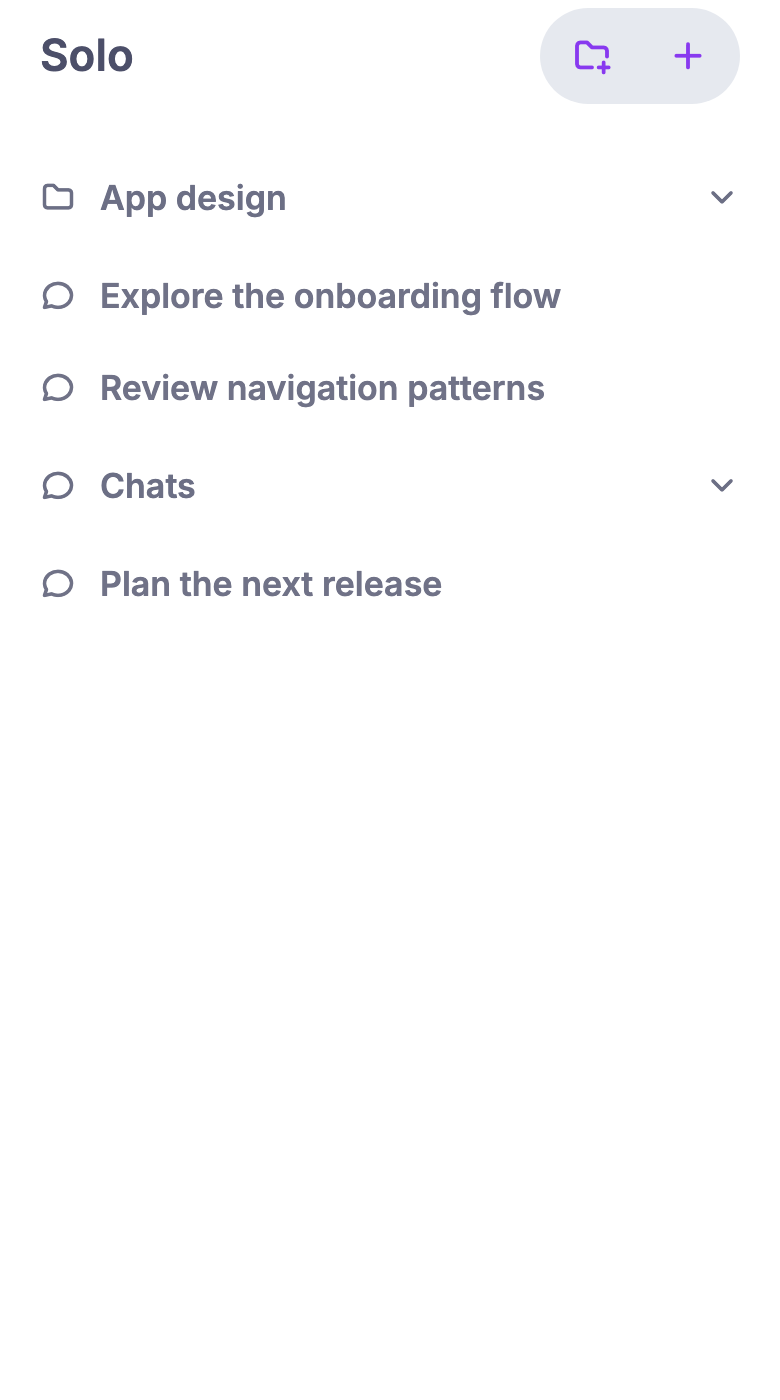
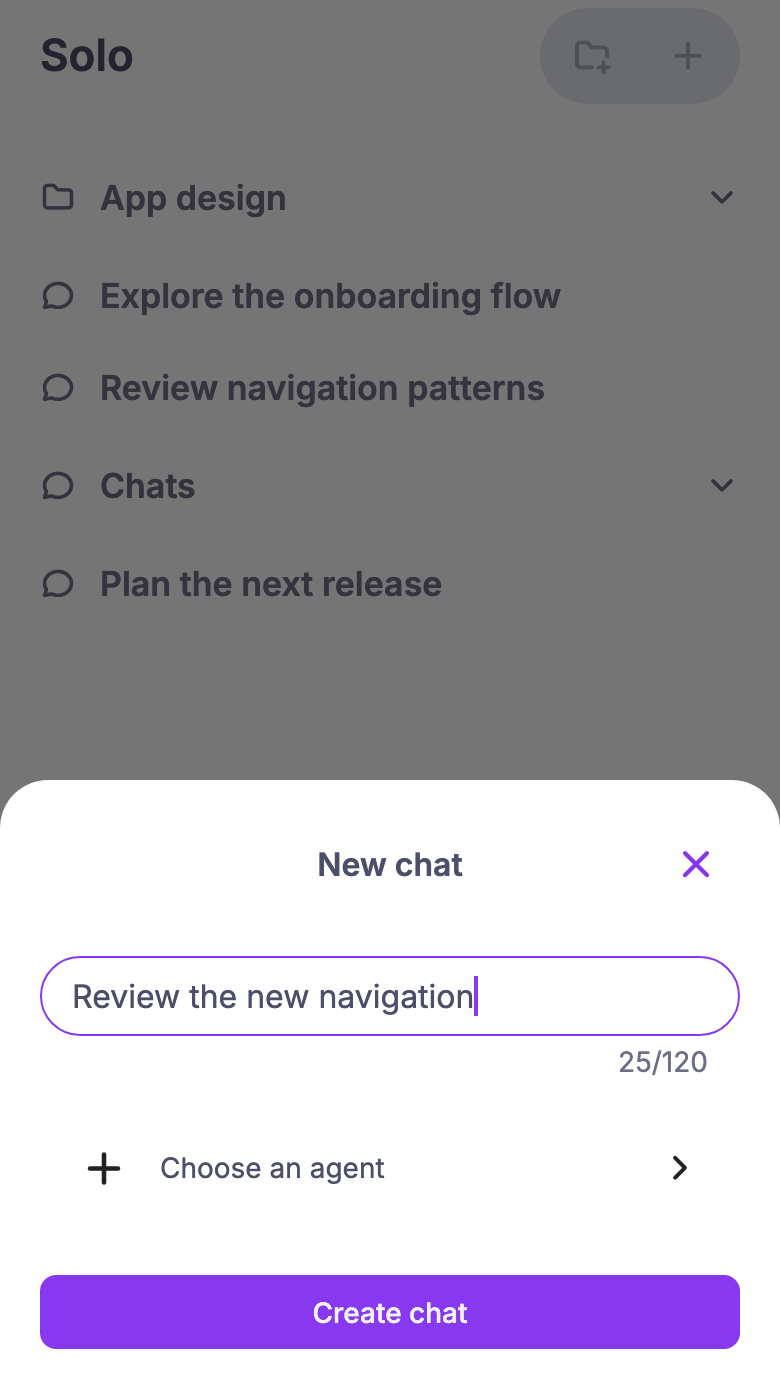
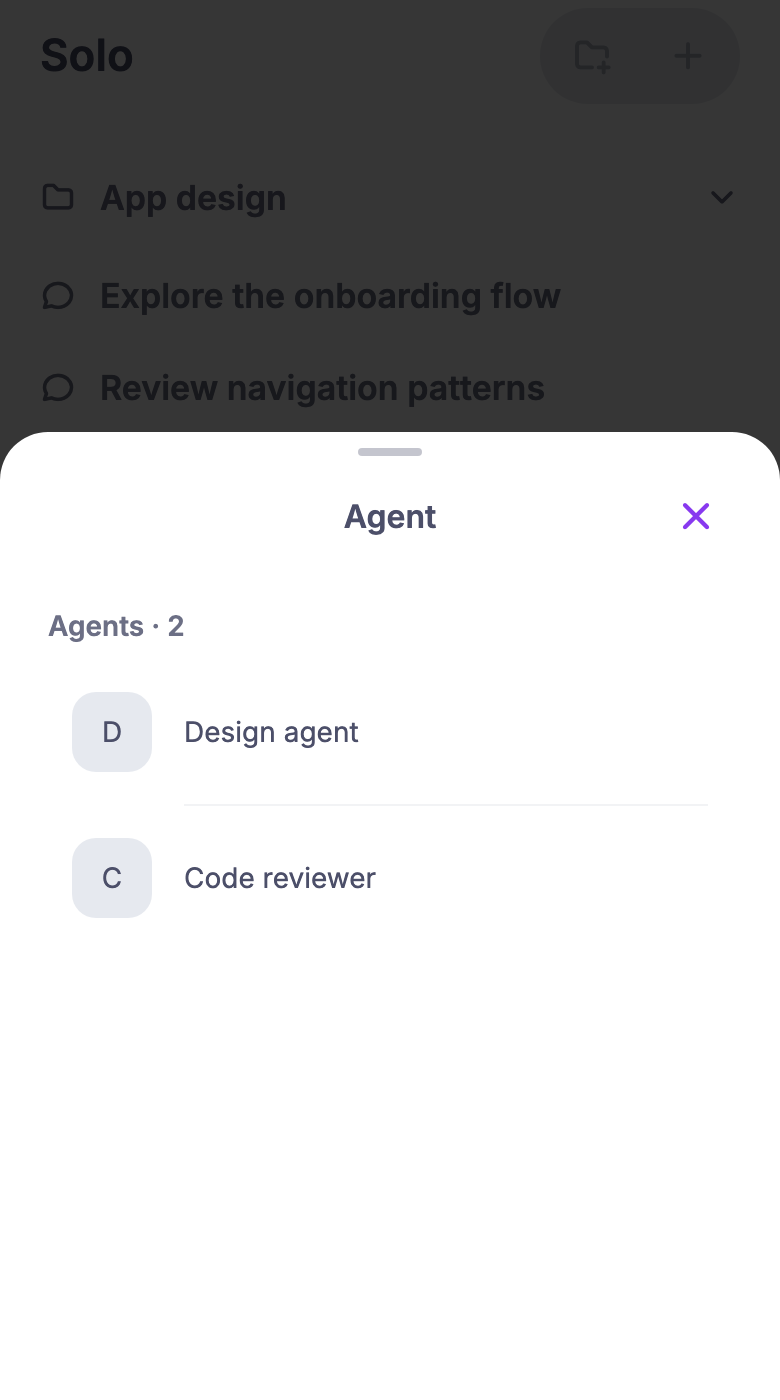
## Summary Bring desktop Solo chats and project organization to mobile, with synced collapsible sections, shared unread highlights and tab badges, agent selection, shared search, native iOS creation sheets, and inline typing bubbles that transition into replies. Resolve Solo placement for every chat entry route, retain encrypted organization snapshots for offline reading, and let users resume or discard unfinished chat and project setup without deleting existing messages. ### Related issue Related: #6565; expandable agent transcripts remain separate work. ### Testing - Fresh Solo read state seeds each active chat from its captured initial last-message timestamp before exposing row/section/tab unread state. Baselines survive intervening channel updates and reset across identity/community boundaries while surviving read-state readiness changes. Regressions cover multiple chats, events before read-state readiness and during/after seeding, and identity changes; removing either the seed or the display gate fails them. - Chat completion reconciles a retained Solo-save journal even when placement is already confirmed. False/throwing cleanup regressions ensure the outer intent remains until reconciliation and only one placement is published. Typing terminal-close loops remain bounded; the retry budget resets after an uninterrupted eight-second health interval or transport reconnect. - Typing retry budgets reset after sustained recovery; invalid Solo updates retain cached rows with a retry warning that survives failed refreshes. Project names use the editors’ 120-grapheme limit, including emoji and combining characters. Regression coverage exercises repeated recovery, invalid live/refresh heads, and character-limit boundaries. - Rebased onto current main, preserving the newer Search controls, Huddle timeline filtering, and message-media layout. - Failed project journal writes reload storage before claiming recovery and reopen the entered name for retry. Typing subscription rejections are caught; terminal closures clear stale indicators and retry with a bounded backoff, canceled on disposal. Regression tests cover both false/throwing storage writes and initial/late subscription rejection. - Explicit ordinary destinations skip optional Solo lookup waits. Generic destinations perform one bounded lookup in the destination (search no longer duplicates it); an unavailable classification falls back to ordinary sending per the product owner's explicit choice. Positively identified Solo destinations use Solo providers. - Terminal Solo subscription closure preserves cached rows and exposes live-update Retry. Page coverage verifies warning visibility, usable rows during recovery, and a subsequent terminal close. Removing the warning or the immediate ordinary-route guard fails its regression. - Generic channel entries share an ordinary default when Solo classification is unavailable, per the requested product behavior. Known Solo placement takes precedence; callers can explicitly require unresolved placement to remain blocked. Bounded initial lookup preserves known Solo deep-link routing. - Dirty newest snapshots and offline-save warnings survive transport reconnects; Retry persists that same event even if the relay returns an older head. Community changes replace the service, and agent-directory reconnect refresh remains intact. - Pending-save discard reloads failed removals. Repeated reconnect testing confirms typing subscriptions are released on provider rebuild and disposal; removing the existing cleanup fails the regression. - Ordinary Home/create routes explicitly preserve private-channel sending during Solo failures; identified Solo sends use the Solo sender and explicit unresolved routes remain fail-closed. Solo unread replies beyond the initial 200-event page are loaded through the oldest-unread boundary. - Chat/project/agent cleanup reloads failed removals, retains same-process recovery, and protects replaced records. False/throw regressions verify retries do not duplicate creation or membership. Route, unread, and cleanup guard-removal mutations each fail their regression. - Ordinary channels, DMs, and forums remain sendable when optional Solo sync fails; explicit unresolved placement stays blocked. Controlled cache races retain the newest verified snapshot, keep usable chats visible, and retry offline persistence without stale writes. Both protection-removal regressions fail as expected. - Confirmed journal cleanup checks false/throwing removal and exact-record identity. Interrupted agent choices are visible immediately, identify the saved agent, and cover Resume/Later/Discard with accessible name/key-fallback controls. - Notification deep links preserve the contiguous history cursor; same-second messages infer the newest agent consistently. Failed offline-cache writes surface Retry, with false/throwing storage failures and offline restart covered. - Composite history cursors cover 350 same-second events plus older history; removing the ID cursor makes the regression fail. Agent changes now journal before granting access, with restart/failure and Resume/Later/Discard widget coverage. Signed malformed profiles remain isolated. - Native iOS avatar tests passed on the simulator: visible-row loading, three-request concurrency, streamed byte limits, response validation, downsampling/pixel limits, cancellation, and visible avatar updates. - Solo and Home share observed-event/read-marker logic. Widget coverage verifies unread rows, collapsed-section indicators, the tab badge before first Solo visit, message/thread reads, forced unread, and filtering archived/nonmember/unplaced chats. - Chat intent is saved before ownership and organization preflight; tests cover interrupted ownership lookup and a disconnect while the native creation form is open. - Mobile analysis, formatting, file-size checks, and full mobile tests passed at `1d4c41354`. - Project creation persists its encrypted name/UUID before connectivity checks or relay reads. Restart tests cover Resume/Later/Discard, scope isolation, stale-intent rejection, and lost acknowledgements. Removing the pre-network save makes all four production-flow regressions fail. - Regression coverage includes notification/Activity routing, inline replies, unknown-placement send protection, restart recovery/discard, and encrypted offline cache isolation/refresh. - Earlier feature build exercised on a physical iPhone with existing account/community data; review follow-ups have not been reinstalled on the device. UIKit agent-row accessibility checks passed on an iOS simulator. - Earlier cross-platform `just ci` stopped on the existing `buzz-acp` test `signals_cancel_startup_turn_and_pending_stdin_without_hanging` (process exit-code assertion); no Rust production changes are included in this PR. ### Remaining review limitation Agent discovery is bounded to 10 pages / 1,000 profiles with automatic retries disabled. Owner-scoped discovery remains open because the current relay ignores `#auth` filters; supporting that query requires a relay change. ### Snapshots Sample data, shared Flutter/Android surface. Native iOS uses platform sheets and controls. | Solo: projects and chats | New chat | Choose an agent | | --- | --- | --- | | <img src="https://raw.githubusercontent.com/block/buzz/d9b29aa079a3b9a88e8ed89b70df8d6af06fa41b/pr-8337--01-solo.png" width="240" alt="Solo with collapsible projects and chats" /> | <img src="https://raw.githubusercontent.com/block/buzz/d9b29aa079a3b9a88e8ed89b70df8d6af06fa41b/pr-8337--02-new-chat.png" width="240" alt="New chat form" /> | <img src="https://raw.githubusercontent.com/block/buzz/d9b29aa079a3b9a88e8ed89b70df8d6af06fa41b/pr-8337--03-agent-picker.png" width="240" alt="Agent selection list" /> | --------- Signed-off-by: kenny lopez <klopez4212@gmail.com> Signed-off-by: Logan Johnson <loganj@squareup.com> Co-authored-by: Terp <5856f6900e8e0a4e0ea1f4f8d2ee33e4753d2119bc122f94ecafc660b46c0511@buzz.block.builderlab.xyz> Co-authored-by: Logan Johnson <loganj@squareup.com> Co-authored-by: Larry <627498bd4bd1f281a16431e3c6cce3b5c25b6692798c78672298aefbf2f8f8b5@buzz.block.builderlab.xyz> |
||
|
Taylor Ho
|
05150c1188 |
feat(mobile): sync themes per community (#3767)
**Category:** new-feature **User Impact:** Mobile now keeps each community’s appearance in sync with desktop, including theme, accent, and system-mode preference. **Problem:** Appearance choices were device-local, so the same account could look different between desktop and mobile. Live sync could also stop after the relay closed a subscription. **Solution:** Store each community’s encrypted appearance preference on its relay using the shared desktop wire contract, restore it from a local identity-scoped cache, and apply replacement events live. Closed subscriptions now recover with guarded backoff and fetch the latest preference so no update is lost during the gap. <details> <summary>File changes</summary> **mobile/lib/app.dart** Connects community appearance state to the authenticated app lifecycle. **mobile/lib/features/settings/accent_picker_page.dart** Aligns mobile accent choices and selection behavior with the shared catalog. **mobile/lib/features/settings/settings_page/appearance_section.dart** Clarifies the active appearance and hides accent controls when the Buzz theme owns its neutral accent. **mobile/lib/features/settings/theme_picker_page.dart** Persists catalog theme choices through the community-scoped provider. **mobile/lib/shared/theme/accent_colors.dart** Matches desktop’s accent catalog and wire values. **mobile/lib/shared/theme/buzz_theme.dart** Keeps Buzz visually neutral without discarding the user’s stored accent for other themes. **mobile/lib/shared/theme/community_theme_preference.dart** Defines and validates the versioned desktop-compatible appearance payload. **mobile/lib/shared/theme/community_theme_provider.dart** Coordinates cache-first appearance loading with account and community changes. **mobile/lib/shared/theme/community_theme_sync.dart** Adds encrypted NIP-78 relay persistence, live replacement handling, deterministic ordering, safe seeding, and resilient subscription recovery. **mobile/lib/shared/theme/theme.dart** Exports the community appearance modules. **mobile/test/features/settings/theme_picker_page_test.dart** Covers the updated settings behavior. **mobile/test/shared/crypto/nip44_interop_test.dart** Proves Dart decrypts a desktop-produced nostr-rs NIP-44 v2 preference. **mobile/test/shared/theme/buzz_theme_test.dart** Covers Buzz’s neutral rendering and stored-accent restoration. **mobile/test/shared/theme/community_theme_preference_test.dart** Covers wire parsing, validation, migration, and future-version handling. **mobile/test/shared/theme/community_theme_sync_test.dart** Covers cache/relay lifecycle, replacement ordering, switching races, absence-only seeding, and closed-subscription recovery. </details> ## Reproduction steps 1. Sign into desktop and mobile with the same account and join the same community relay. 2. On desktop, choose a distinctive non-Buzz theme and accent; mobile should update without a local toggle. 3. Restart mobile and confirm it restores the same appearance. 4. Change the mobile theme and accent and confirm desktop follows. 5. Leave mobile idle or backgrounded through a relay reconnect, then change desktop again; mobile should resubscribe and catch up automatically. 6. Switch communities and confirm each community restores only its own appearance. --------- Signed-off-by: Taylor Ho <taylorkmho@gmail.com> Co-authored-by: npub1223z34hd7vtwc6qj4s7flsxkj644nlre2nthu7lrrmkumhu3xddsrx9r6w <52a228d6edf316ec6812ac3c9fc0d696ab59fc7954d77e7be31eedcddf91335b@buzz.block.builderlab.xyz> |
||
|
Wes
|
e9318f66d8 |
mobile: thread scroll-to-bottom and desktop-parity mention autocomplete (#1499)
Signed-off-by: Wes <wesbillman@users.noreply.github.com> Co-authored-by: Brain <21994759fc7a6fa6b965551d35cfd7897d262f2495467f2d78694ddcfa6a5c7e@sprout-oss.stage.blox.sqprod.co> |