mirror of
https://github.com/block/buzz.git
synced 2026-11-24 18:21:59 +00:00
ss-dev-00/broker-tests-split
25 Commits
| Author | SHA1 | Message | Date | |
|---|---|---|---|---|
 ss-dev-00 |
df26470961 |
test(buzz-sdk): split broker/tests.rs into six concern modules
`crates/buzz-sdk/src/broker/tests.rs` is 2,638 lines against the repo's 1,000-line ceiling, and the next broker test addition would push it further. Split along the `// ── Section ──` headers the file already carried, so the cut lines are the ones the author already drew. | module | lines | holds | |---|---|---| | `tests/mod.rs` | 184 | shared fixtures, helpers, `mod` declarations | | `tests/schema.rs` | 689 | action coverage, envelope round-trip and rejection | | `tests/wire_schema.rs` | 361 | exact-key-set tables, the no-secret invariant | | `tests/validation.rs` | 714 | argument bounds, read provenance, result/status tables | | `tests/identities.rs` | 423 | one spelling per identity; the result type's absent reader | | `tests/client.rs` | 312 | identical-bytes retry, client trait, test doubles | Six modules, not the four #6746 sketched and not the five of the previous revision. Two sections each force their own module for the same reason: the wire-schema section would leave `schema.rs` at 1,045 lines, and the identity-canonicalization section added by #6742's review revision would leave `validation.rs` at roughly 1,130. Either would be a split that still violates the cap it exists to satisfy. Splitting them out keeps every file under the ceiling without moving a single test across a concern boundary. Verified as a pure move rather than asserted. Concatenating the six modules in the original section order and stripping only the added scaffolding — module docs, five `mod` declarations, per-file `use super::*` — reproduces the original file exactly, with a single deliberate exception: `member_paths` becomes `pub(super)` because it is now shared across two modules. That one-token visibility change is the whole diff of the reconstruction: -fn member_paths(value: &serde_json::Value, prefix: &str, out: &mut Vec<String>) { +pub(super) fn member_paths(value: &serde_json::Value, prefix: &str, out: &mut Vec<String>) { And the test set, not merely its size: the same 37 broker tests exist before and after, compared with module paths normalized away, so a rename plus a deletion could not hide behind a matching count. Validation: `cargo test -p buzz-sdk --all-targets` 299 passed / 0 failed, identical to the baseline at 7c853e0fb; package clippy `-D warnings` exit 0 with no dead-code warning from the moved helper; `cargo fmt --all --check` clean; `cargo doc` warning-free; every file under 1,000 lines. Closes #6746. Stacked on #6742. Contract context: #6467. Co-authored-by: Bradley Axen <baxen@squareup.com> Signed-off-by: Bradley Axen <baxen@squareup.com> Signed-off-by: ss-dev-00 <a02c4e0850e5e612b4ddf95dbe2f5c56467cf27c6552203bc833ff438fb31971@buzz.block.builderlab.xyz> |
||
|
ss-dev-00
|
7c853e0fba |
broker: give every identity one spelling, and the result one wire door
Two P2 review findings on #6742, both reproduced from an out-of-crate consumer
before being fixed, and each fix falsified by reverting it.
1. Identity spellings broke correlation (bugs-00, correlate.rs:42).
`channel()` validated a UUID with `Uuid::parse_str` and returned the caller's
spelling untouched, while `correlate_identities` compared the request's and the
outcome's `channelId` as strings. An uppercase request against a host's
canonical lowercase echo of the same channel therefore failed `validate_for` —
a *correct* answer rejected, which is worse than the mismatch the check exists
to catch, because it makes a working host unusable.
Fixed as a class, not as a UUID case. The finding named case; the validator
also admits the unhyphenated, `{braced}`, and `urn:uuid:` forms, and all four
froze un-canonicalized. Hex has the same property. So:
- Canonicalize where a value enters. `channel()` now returns the lowercase
hyphenated form, and every member holding an identity canonicalizes on
deserialize too (`channel_id`, `hex64_field`, `absent_or_valued_hex64`). The
wire is the door no `validated()` covers: those fields are public `String`s,
so a parsed payload reaches a caller without passing through any validator.
Both doors delegate to the same function, so they cannot drift.
- Compare parsed identities, not bytes. `correlate_identities` parses each
`channelId` as a `Uuid`; pubkeys are compared as `PubkeyHex`, which
lowercases in its only constructor and its serde path.
The two guards are deliberately independent and asserted separately, so neither
is the only thing holding. A genuinely different identity is still rejected.
Coverage is derived as well as enumerated: one test walks the real fixtures,
re-spells every identity-named member, and requires the canonical value back,
so a member added later with the wrong `deserialize_with` fails without anyone
extending a list.
2. `BrokerResult` was a second, lax wire door (bugs-00, mod.rs:586).
The envelope's strict reader requires the exact key set the declared status
admits, but the exported result type also derived its own reader, and that one
accepted and dropped arbitrary siblings: `status: failed` beside an `error` and
a `secretKey`, or a succeeded result beside an `error`. A consumer parsing the
result type directly got an `Ok` value whose complete wire shape had never been
vetted, from bytes that fail through the envelope.
Decision: take the type off the wire — it is no longer `Deserialize`. The
alternative, its own strict reader, would be a second copy of the per-status
contradiction rules, and two copies of a strictness check drift; this hole
exists precisely because one layer's strictness did not reach another's.
Removing the door leaves one implementation and nothing to keep in sync.
Nothing is lost: a bare `{"status": …}` object is not a payload this contract
defines, and the whole module is new in this PR, so it had no consumers.
`Serialize` is retained — it produces the envelope's flattened wire form — so
the wire form is unchanged and this is a read-side restriction only.
The absence is pinned at compile time, since a runtime test cannot call a
`Deserialize` impl that does not exist: a probe resolves to an inherent method
only when the bound holds, and it is first asserted against two types that *do*
have readers, so a broken probe cannot pass silently.
The contract docs gain a section on identity spelling, `validate_for`'s
nine-row table records that comparison is on parsed identities, and the
strictness section records the one-door rule.
Also: adding the identity docs pushed mod.rs to 1,021 lines, past the repo's
1,000-line ceiling, so the strict response reader moved to `broker/wire.rs`
(mod 913 / wire 121) — a pure move, same treatment `correlate.rs` already got.
The derived-coverage test matches identity members case-insensitively. An
earlier revision of it matched the suffix `"EventId"` exactly, which silently
skipped the outcome member spelled `eventId` and left every response-side wire
door unpinned — mutation testing caught it by removing the outcome `channelId`
door and surviving. It now walks response fixtures as well as request ones, and
floors the two directions separately, because a single combined floor would be
satisfied by the request side alone.
Validation: 299 tests pass in buzz-sdk (295 before), workspace clippy `-D
warnings` clean, fmt clean, `cargo doc` warning-free with the new section anchor
verified in the generated HTML, every touched file under 1,000 lines. Seven
mutations, one per guard, each killed by a named test. `cargo test --workspace`
is green except `test_120s_timeout` / `test_cancellation_immediate` in
buzz-pair-relay, a pre-existing flake reproduced 2-in-8 on unmodified main at
|
||
|
ss-dev-00
|
559eb306ea |
broker: freeze normalized args, correlate identities, close two strictness holes
Four review findings on #6742. Each was reproduced with a failing test before the fix, and each fix was mutation-tested by reverting it and confirming the new test dies. 1. Freeze normalized action arguments (Codex, mod.rs:230). `BrokerRequest::new` and `prepare` both called `validate()`, which is `validated().map(|_| ())` — it computes the normalized copy and throws it away. So `AgentTarget::Name(" helper ")` passed validation and stayed padded in the frozen wire body: the host would look up an agent the validator never approved. `new` now stores the normalized action, and `prepare` normalizes before serializing. `prepare` deliberately still validates. It is not redundant: every field of `BrokerRequest` is public and the type is `Deserialize`, so a value can reach `prepare` without passing through `new` — struct literal, parsed JSON, or mutated after construction. Freezing bytes is the last checkable point, so both paths now satisfy one invariant: the frozen body holds exactly what validation approved. To avoid validating args twice on that path, the envelope checks are split into `validate_envelope` and `prepare` takes the normalized value from a single `validated` call. 2. Correlate every echoed identity, not just the pubkey (Codex mod.rs:856, extended per bugs-00's agents.create finding). `validate_for` compared only requestId, action, and read limit, so a response with a matching requestId but a different `agentPubkey` — or a different `channelId` on agents.create — validated, and a host routing bug could hand a caller an outcome for another subject. Generalized rather than patched per action: `correlate::correlate_identities` matches exhaustively over `ActionArgs`, so adding an action is a compile error instead of a silent default to "not compared". The full table of what is and is not compared, with the reason for each omission, is on `validate_for` where a host author reads it; the private fn points there so there is one copy to keep true. Extracted to `broker/correlate.rs` because the table pushed mod.rs to 1,019 lines, past the repo's 1,000-line ceiling. 3. Nested action enums ignored sibling members (bugs-00). `ActionArgs`/`ActionOutcome` are adjacently tagged and lacked `deny_unknown_fields`, so a sibling of their two keys — `secretKey` beside `args` — was silently dropped when either type was deserialized directly. Both are public and wire-facing, so that is a real door the envelope's own strictness does not cover. Closed at the type level rather than documented as a limitation: it turned out to be a one-attribute fix that breaks nothing. 4. Duplicate object keys were accepted inside `outcome` (bugs-00). Confirmed and fixed, but narrower than reported: serde's derived readers already reject repeated fields, so top-level members, flattened members, typed error payloads, and `args` all rejected duplicates. `outcome` did not, because `WireResponse` buffered it through `serde_json::Value`, which collapses duplicates last-wins. That made it the one place a reader could observe a value the envelope's strictness never vetted — so it is a real divergence, not a style question, and `outcome` now re-parses the original bytes via `RawValue`. This enables serde_json's `raw_value` feature, which adds no dependency and leaves Cargo.lock unchanged. Validation: 295 tests pass in buzz-sdk (291 before, plus four new), full `cargo test --workspace` green, workspace clippy `-D warnings` clean, fmt clean, `cargo doc` warning-free, every touched file under 1,000 lines. Signed-off-by: ss-dev-00 <a02c4e0850e5e612b4ddf95dbe2f5c56467cf27c6552203bc833ff438fb31971@buzz.block.builderlab.xyz> Co-authored-by: Bradley Axen <baxen@squareup.com> Signed-off-by: Bradley Axen <baxen@squareup.com> |
||
|
ss-dev-00
|
0311d14797 |
broker: state the no-null rule where an implementer will read it
The rule that omission is the only spelling of absence was already enforced in code and pinned by test, but the only prose stating it was a paragraph inside "The no-secret rule" — a section about key material. A host written in another language does not read a secrets section looking for JSON encoding rules, so the first place that implementer would learn the rule is a rejected request. Promote it to its own top-level contract section, `Optional members: omission is the only spelling of absence`, and name the concrete failure mode: a serializer that emits `null` for an unset field (Go without `omitempty`, a `None` attribute through `json.dumps`, a map that assigns the key unconditionally) produces a payload this contract rejects in full. The fix on their side is one sentence long — omit unset members — which is worth saying outright rather than leaving to be inferred from an error string. Also point at it from the HTTP binding docs, since that is where someone configures the serializer that will get this wrong, and keep the reference from the no-secret rule so the third strictness hole is still traceable from where the other two are described. Docs only; no behavior change. The anchor both links resolve to is verified present in the generated HTML, since rustdoc does not check intra-doc fragments. Requested by ss-core-02 on #6742 as the doc half of the explicit-null fix. Signed-off-by: ss-dev-00 <a02c4e0850e5e612b4ddf95dbe2f5c56467cf27c6552203bc833ff438fb31971@buzz.block.builderlab.xyz> Co-authored-by: Bradley Axen <baxen@squareup.com> Signed-off-by: Bradley Axen <baxen@squareup.com> |
||
|
ss-dev-00
|
bc2625f6f2 |
broker: reject explicit null so absence has exactly one spelling
The strict response envelope could be walked straight past with JSON `null`.
`deny_unknown_fields` constrains *which* members may appear, not what they may
hold, and `#[serde(default)] Option<T>` maps an explicit `null` to `None` --
which is indistinguishable from absent. The per-status match reads absence as
"this status does not carry that member", so
{"status":"failed","action":null,"outcome":null}
and a succeeded response with `"error":null` both parsed as well-formed and
skipped the contradiction check entirely. `validate()` returned Ok on an
envelope that contradicts itself. The previous commit closed the value-shaped
version of this hole and left the null-shaped one open, which is the same class
of bug one spelling short.
The fix is a rule rather than three checks: **no optional member anywhere in
this contract accepts `null`.** Nothing here emits one -- `skip_serializing_if`
omits the member instead -- so `null` was never a value this contract defined,
only one serde happened to accept. A shared `absent_or_valued` deserializer
rejects it, applied to all 17 optional members across the response envelope,
every args type, and `MessagePage::next_cursor`.
Rejecting outright beats tracking presence beside the value, which was the other
option. Presence tracking preserves the ambiguity and moves the decision to
every reader: each one then has to answer what a present-but-null member meant,
and the answer only has to be gotten wrong once. With one spelling of absence
there is no such question -- and a host implementer never has to guess whether
`{"limit": null}` means the default or no limit, because it means neither.
Two members did not need the helper and are documented as such rather than
changed: `mentionsOnly` and `replayed` are plain `bool`, and `null` already
fails as a type error. Both rejections are pinned by test anyway, so the doc
cannot drift and a later change to `Option<bool>` -- which would need the guard
-- fails loudly.
Audited the other two strict layers for the same path, both clean: the request
envelope's flattened `ActionArgs` is adjacently tagged, so `action` and `args`
are required and reject `null` as a type error; `StrictEvent`'s seven canonical
members are all required, and each rejects `null` on type. Reported either way
per the review request.
Coverage is derived, not listed. `no_member_of_any_payload_accepts_an_explicit_null`
walks every JSON-pointer path in the real serialized fixtures -- every action,
every outcome, nested members and array elements included -- and nulls each in
turn, so an optional field added later is covered without anyone remembering to.
It asserts the untouched fixture parses first, since a probe that rejects for the
wrong reason proves nothing.
`a_status_incompatible_member_is_rejected_as_null_not_only_as_a_value` carries
the original repro, which the fixtures structurally cannot reach: a serialized
response never contains the member its own status forbids. Both assert on the
parse rather than on `validate()` -- a malformed envelope should never become a
value that some caller has to remember to check.
Falsified four ways against
|
||
|
ss-dev-00
|
5e2879a72c |
broker: make the contract's strictness hold at every layer it claims to
Four bug-pass findings on #6742, all one shape: a rule the contract states in
prose but does not enforce at some layer, so the layer above it decides.
**status/code contradictions.** `Indeterminate` carrying a known pre-dispatch
code passed validation, so `execute` returned Ok for a response contradicting
itself: `unauthenticated` means the host refused before running anything — a
known fate — while `indeterminate` means the fate is unknown. A caller reading
the status would reconcile side effects that provably never happened. We already
rejected the mirror case, `outcome_unknown` under `failed`.
Rather than add the reverse one-off check, the pairing is now a closed table.
`BrokerErrorCode::may_be_failed` and `may_be_indeterminate` are exhaustive
matches with no wildcard, so a new code cannot inherit an answer — it forces a
decision at both ends. `indeterminate` admits only `outcome_unknown` and
`internal`; a host fault mid-execution is the one legitimate "I don't know", and
every other code names a fate the host knows. The rationale lives once, in the
`BrokerErrorCode` docs, and `BrokerResponse::validate` consults the predicates
instead of restating them.
**A read page bounded only by the protocol cap.** `ActionOutcome::validate`
never sees the request, so it could only check `MAX_PAGE_LIMIT`: a host could
answer a one-message read with five hundred, within the cap and still an overrun
of what was asked. `validate_for` now applies the request's own number, the one
place both halves are in scope. An absent `limit` is held to the new
`DEFAULT_PAGE_LIMIT` (100) rather than treated as consent to an unbounded page —
the cap is what a host may ever send, the default is what it may send unasked,
so the two constants are deliberately different numbers.
**A response envelope that was silently non-strict.** `#[serde(flatten)]`
disables `deny_unknown_fields` — serde cannot combine them — and the note saying
so concluded strictness was enforced elsewhere. It was not: the envelope accepted
and discarded an unknown top-level key, and accepted an `error` beside a
succeeded outcome or an `outcome` beside a failure, dropping whichever half it
could not represent. Deserialization now routes through a private strict wire
form with an exact key set per status; serialization is untouched, so the wire
format does not change. The request envelope has the same `flatten` and was
checked for the same hole: it does not have one, because `ActionArgs` is
adjacently tagged and contributes exactly `action` and `args`, leaving
`deny_unknown_fields` in force. That is now pinned by test rather than assumed.
**Events could smuggle members past the schema.** `nostr`'s `Event` deserializer
accepts and discards unknown members, so a genuinely signed event could carry an
extra `secretKey` and parse clean — the no-secret rule stopping at the envelope
instead of reaching inside it. `BrokerMessage` now deserializes through a
`deny_unknown_fields` intermediary with exactly the seven canonical NIP-01
members, and the module docs state that the invariant extends inside event
objects.
The exact-key-set table now covers both envelopes and the error payload, not
just args and outcomes: a key set nobody pins is a key set a field can be added
to. A new test parses raw bytes through a transport, because the strict-envelope
and strict-event guards live in `Deserialize` and the typed test double could
never reach them — it hands back a value that was never on a wire.
Each guard was falsified separately against
|
||
|
ss-dev-00
|
5116ca2b34 |
broker: make validation the only door to a response
Four follow-ups from the delta review, all about closing the gap between what
the contract says and what it structurally allows.

`PreparedRequest::request()` is gone. It handed back the typed value whose
reserialization freezing the bytes exists to prevent, so an implementation
could have sent a second rendering of the same request and drawn a spurious
requestId conflict on retry. A transport needs correlation metadata, not the
value: `request_id()` and `action()` remain.

Response correlation is no longer advisory. `BrokerClient` is now the transport
primitive — `send` takes frozen bytes and returns an envelope unjudged — and
the blanket, unoverridable `BrokerClientExt::execute` is what callers use. It
runs `validate_for` and yields a `ValidatedResponse`, the only response type a
caller can obtain, so a mismatched envelope cannot arrive as `Ok` because an
implementation forgot a step. `send` additionally takes a `Dispatch` token
whose field is private to this module, which is what stops a caller from
skipping `execute` and calling the primitive itself; verified by probing all
three construction paths (tuple constructor, `Default`, struct literal) from
outside the crate. It does not defend against an implementation that stashes
its own input — that is deliberate code, not a forgotten check.

`actions.rs` is split into `actions/{mod,args,outcomes}.rs` for review
ergonomics: `Action` and the shared validators in the parent, one file per side
of a call. No logic moved — the item set is identical and the only content
changes are intra-doc link paths.

Dropped `only_housekeeping_actions_are_best_effort`, which asserted a constant
against itself.

Addresses the interface half of #6467.

Signed-off-by: ss-dev-00 <a02c4e0850e5e612b4ddf95dbe2f5c56467cf27c6552203bc833ff438fb31971@buzz.block.builderlab.xyz>
Co-authored-by: Bradley Axen <baxen@squareup.com>
Signed-off-by: Bradley Axen <baxen@squareup.com>
|
||
|
ss-dev-00
|
7b2e207957 |
Harden the broker contract against review
Five contract changes from the quality review, each closing a gap where the
contract documented a promise it did not structurally keep.

Retry means identical bytes, so the client trait can no longer take a typed
value it would have to reserialize. `BrokerRequest::prepare` validates and
serializes once into a `PreparedRequest`; `BrokerClient::execute` takes that,
and every attempt sends the same body. Two serializations of one value may
differ across serde versions, which would have surfaced as a spurious
requestId conflict on retry.

The read cursor is now an opaque host-issued string, not inclusive Unix
seconds. Second-precision paging can loop or skip when more events than
`limit` share a second, and a timestamp cursor would have committed every
future host to one ordering strategy. Cursors are validated for shape only
(bounded, printable ASCII) and never parsed.

Reads return signed Nostr events. `BrokerMessage` is a transparent newtype
over `nostr::Event` with a local `verify()`; the previous projection gave up
authorship provenance for nothing, since Schnorr verification needs no relay.
Ancestry and mentions are derived from the signed tags rather than stored
beside them, so no field can disagree with the signature.

Response validation is request-aware. `validate_for(&PreparedRequest)`
correlates requestId and rejects an outcome whose action is not the request's,
so a caller matching on the outcome enum cannot silently take the wrong
branch. `ActionOutcome::validate` checks the identifiers and cursors an
outcome asserts, and `OutcomeUnknown` paired with `Failed` is now rejected as
self-contradictory.

Auth is a host verdict, not transport. `CredentialRejected` is gone;
`Unauthenticated` arrives inside `Failed`, which carries the promise that
nothing ran. Transport errors are reserved for the absence of a usable
envelope (`NoEnvelope { status, detail }`), and clients are told to parse an
envelope regardless of HTTP status.

The no-secret invariant no longer rests on a source scanner, which aliases and
neutral names bypass and legitimate names trip. It is now an exact wire
key-set table over all nine args and nine outcome types plus
`deny_unknown_fields`, so no field can be added without a reviewer changing
that table. Fixtures populate every optional field, since the table can only
pin what serializes.

Density: fluent builders and per-outcome validators removed, repeated
rationale reduced to one canonical place with cross-references, tautological
tests dropped or merged.

buzz-sdk: 283 tests pass. Workspace clippy, fmt, and doc clean.
Signed-off-by: ss-dev-00 <a02c4e0850e5e612b4ddf95dbe2f5c56467cf27c6552203bc833ff438fb31971@buzz.block.builderlab.xyz>
Co-authored-by: Bradley Axen <baxen@squareup.com>
Signed-off-by: Bradley Axen <baxen@squareup.com>
|
||
|
ss-dev-00
|
9563c27e99 |
broker: define the agent-to-broker action contract
An agent that holds no secret key still has to work: read its channels, answer a mention, react, keep its profile, address its memory, and create the agents it needs. This is the contract for asking a host to do those things — the interface half of #6467, with no host, no transport, and no signing. The open question in that RFC is per-operation versus a single "sign this" primitive. This answers per-operation. A sign-anything primitive tells the broker who is asking but not what for, so the only policies it can express are "all" and "none" — it is a signing oracle with a nicer name. Named operations let a host serve channel.read while refusing agents.create, and give a later policy or IFC layer a per-operation surface to attach to. The cost is that a new operation needs a new variant, which is the point: adding one becomes a reviewable change to the contract instead of another use of an existing blank cheque. For the same reason signing, publishing, and NIP-42/44/98 are not actions. They are mechanisms internal to whoever holds the key, and this contract never names them. Identity is a pubkey and nothing else. `PubkeyHex` has no counterpart here for the corresponding secret, every args type is `deny_unknown_fields`, and no outcome can structurally hold key material — agents.create returns a pubkey and a handle, never the minted nsec. A test scans the module's own source for secret-key tokens, because a deserialization test can only reject fields someone thought to add, while the scanner fails the moment such a type appears in a signature at all. Both halves were checked against deliberate mutations rather than assumed. The envelope carries no requester, owner, or scope. Those come from the session credential the host authenticated, so authority is never something a body can assert: a request that could name its own subject would let any caller act as anyone. Ownership of a created agent follows the same rule — the owner is the requester, implicitly, which is what makes an agent able to own the agents it creates while the chain still ends at a human. Bounding that chain's depth needs resources and policy this contract cannot see, so it stays a host concern. Reads are actions too, because #6467 asks for a deployment where the host is the only route to the relay. One `channel.read` covers channel, thread, and mention-feed scopes: they differ by filter, not by permission, and three names for one decision would be three policy knobs pretending to be independent. Its outcome is a projection rather than a signed event, since a caller with no relay cannot verify signatures anyway — trust here is trust in the host, stated rather than implied. `presence.set` and `typing.set` are left out of v1. They are housekeeping a host may decline regardless, and a closed enum makes adding them purely additive. Carried over from #6543: the envelope, requestId validation, the three-way Succeeded/Failed/Indeterminate result, the error codes, the retry-is-identical- bytes contract, and the agents.* argument shapes. Changed deliberately: pubkeys are a validated `PubkeyHex` instead of `String`, `capability` is renamed `action`, `CapabilityFailed` becomes `ActionFailed`, and `Unsupported` is new so a host can decline a best-effort operation without it reading as a fault. #6543 also lands in this module path; whichever merges second needs a deliberate reconcile, which I own. Addresses the interface half of #6467. Signed-off-by: ss-dev-00 <a02c4e0850e5e612b4ddf95dbe2f5c56467cf27c6552203bc833ff438fb31971@buzz.block.builderlab.xyz> Co-authored-by: Bradley Axen <baxen@squareup.com> Signed-off-by: Bradley Axen <baxen@squareup.com> |
||
|
Taylor Ho
|
edc4a09aaa |
feat(workflows): add responsive library card actions (#6008)
**Category:** improvement **User Impact:** Users can scan what each workflow does and trigger, edit, duplicate, enable, disable, or delete it directly from the library. **Problem:** The workflow list buried common actions and did not expose each automation's trigger-to-action shape at a glance. **Solution:** Add a responsive workflow library with a persistent create tile, compact trigger/action diagrams, prominent workflow titles with supporting descriptions, and shared card actions while preserving existing detail, editor, and run-history entry points. Card toggles refresh both list and open-detail caches so status and definition stay consistent. <details> <summary>File changes</summary> **desktop/src/features/workflows/ui/WorkflowActionsMenu.tsx** Adds a shared card menu for trigger, edit, duplicate, enable/disable, and delete actions. **desktop/src/features/workflows/ui/WorkflowCard.tsx** Reworks cards around the prototype's visual hierarchy: color-coded trigger, action flow, sentence-case eyebrow, prominent title, supporting description, status, channel, and update date without a footer clock icon. **desktop/src/features/workflows/ui/WorkflowsView.tsx** Adds the responsive grid, create tile, mutation wiring, and list/detail cache invalidation. Container breakpoints keep cards two-across at medium widths and three-across in the 1280px desktop layout. **desktop/src/features/workflows/ui/workflowDefinition.ts** Adds immutable enabled-state updates plus narrow trigger and first-action readers used only to select card icons. **desktop/src/features/workflows/ui/workflowDefinition.test.mjs** Covers neutral icon selection, enabled-state immutability, and status presentation. **desktop/tests/e2e/workflows.spec.ts** Covers the create tile, title/description hierarchy, selected-card enable/disable consistency, and deterministic narrow/medium/wide captures while retaining existing action coverage. </details> ## Reproduction steps 1. Open **Workflows** and confirm the create tile stays first as cards flow from one to three columns with available width. 2. Confirm each card shows a sentence-case trigger eyebrow, prominent workflow title, supporting description when present, status, channel, and update date without a clock icon. 3. Open a card's overflow menu and trigger, edit, duplicate, enable/disable, or delete the workflow. 4. Leave the detail panel open while toggling and confirm its badge and JSON definition update with the card. ## Screenshots Real built E2E UI with representative workflow data at three viewport sizes. ### Narrow — 800 × 720 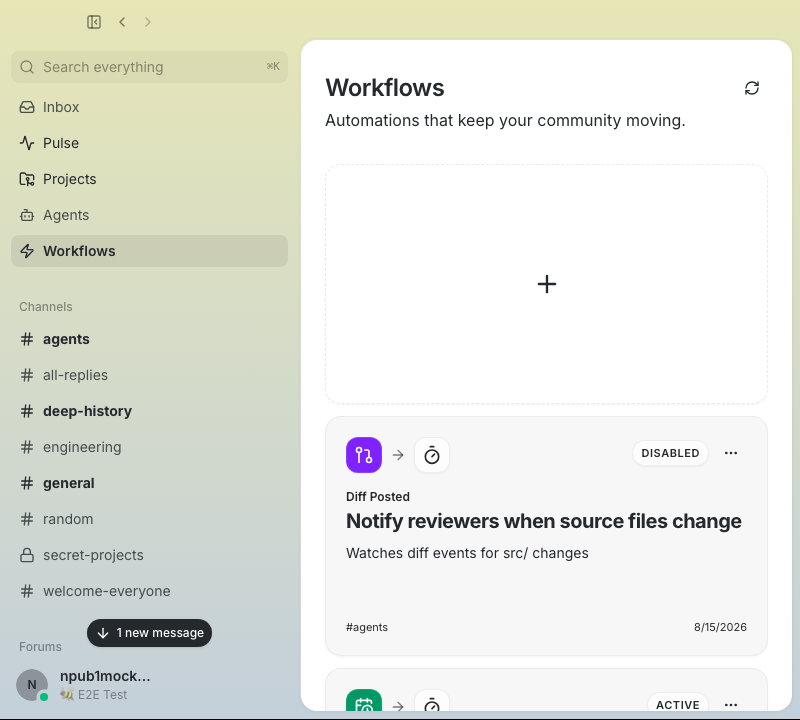 ### Medium — 1024 × 720 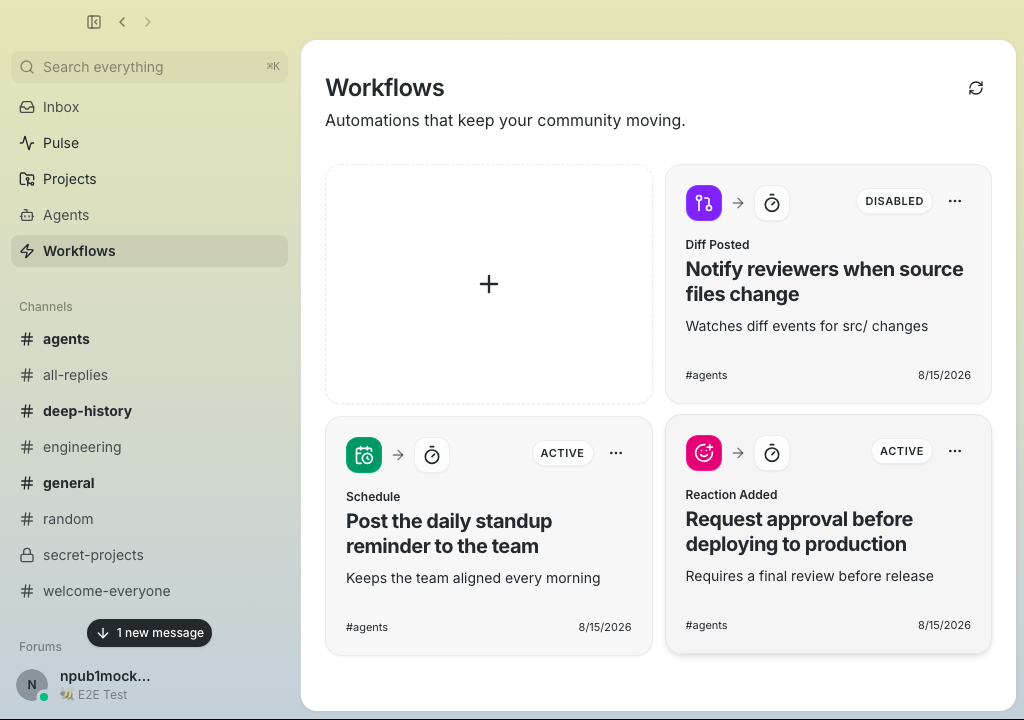 ### Wide — 1280 × 720 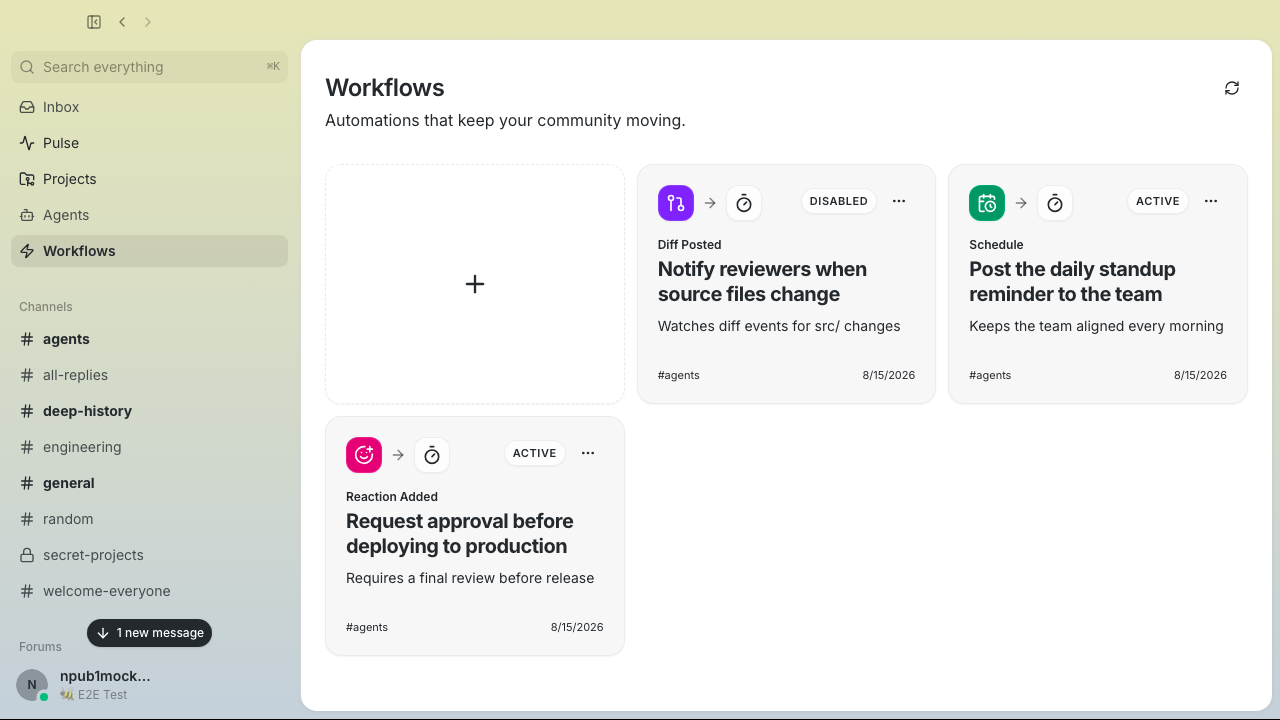 ### Card actions 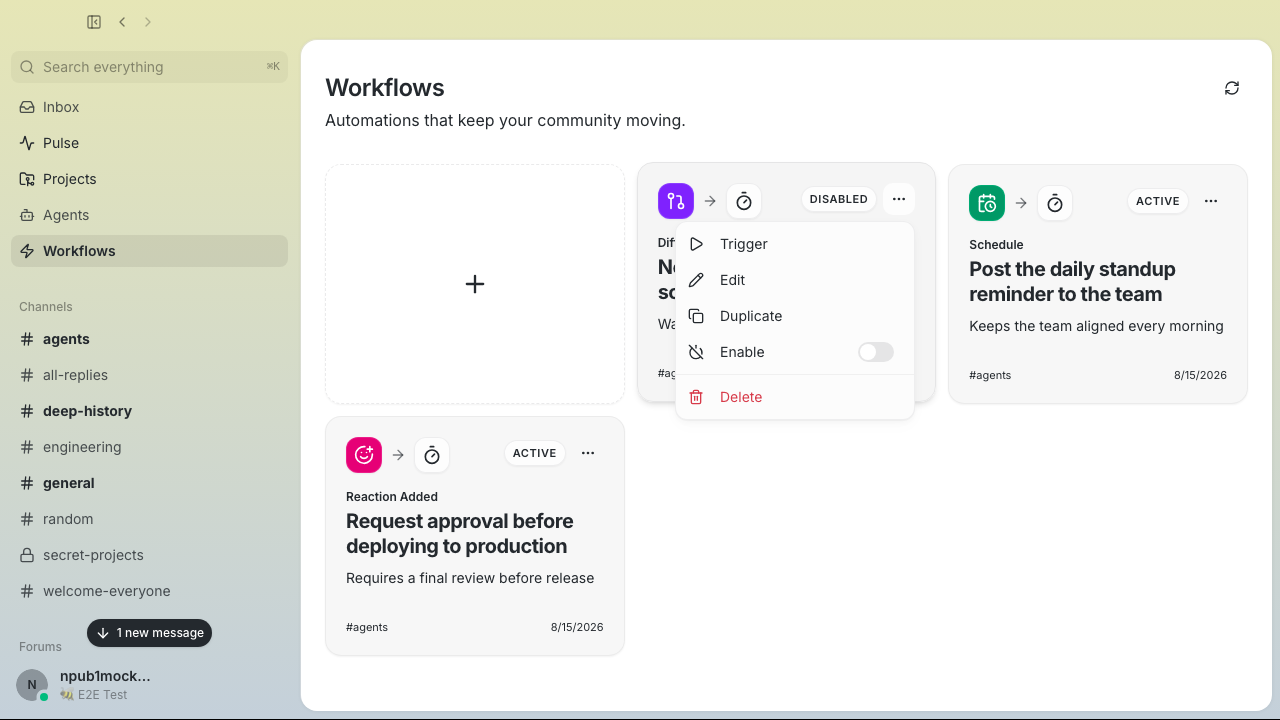 --------- Signed-off-by: Taylor Ho <taylorkmho@gmail.com> |
||
|
thomaspblock
|
122a8b8988 |
Projects v3: unify sharing, discussions, and issue ownership (#5792)
## Summary Projects v3 makes repository work shareable, discussion-aware, and easier to scan in one coherent workspace. People can copy canonical links, reopen the exact workspace tab, understand issue and pull-request context at a glance, find related channel conversations, and assign or unassign issues across Desktop and CLI. - **Unified workspace** — top-level sections sit above repository controls in one rounded workspace, with navigation positioned close to the page heading. README and Files retain branch selection; every section has a labeled icon header, and Issues and Pull Requests expose creation from a consistent right-aligned action. - **Repository management** — the repository selector is always available, including single-repository projects. Its integrated add flow lets project owners create a repository manually or select an existing repository without a separate toolbar button. - **Readable work-item lists** — issue and pull-request rows use plain-language context instead of opaque metadata. Files, commits, issues, pull requests, channels, and contributors share consistent row density and right-aligned timestamps, while deterministic fallback-avatar colors keep participants distinct on light backgrounds. Inbox pull-request metadata wraps between complete phrases and truncates long channel names instead of compressing copy into narrow columns. - **Reliable entity links** — projects, repositories, issues, pull requests, and commits have canonical `buzz://` links, preview cards, OS deep-link routing, and tab-aware navigation. Reopening the same link re-applies its destination instead of leaving the user on a locally selected tab. - **Related conversations** — repository and work-item views surface channels discussing the current entity, including participants, channel navigation, message context, and an explicit notice when discovery reaches its 500-result cap. - **Reversible issue ownership** — trusted assignment and unassignment events work across Desktop, Tauri, `buzz-sdk`, and `buzz issues`. Assignees appear in project views and the assigned inbox, while authorized users can remove assignments directly from the assignee row. Assignment state is derived chronologically from labeled Nostr notes. Issue authors and repository owners may change any assignee; other users may only assign or unassign themselves. Shared golden fixtures keep entity-link grammar and validation aligned across TypeScript and Rust. The branch also updates `webbrowser` to the patched release for RUSTSEC-2026-0257. ### Related issue N/A. ### Testing - [x] `just ci` — formatting, lint, typechecking, unit tests, and builds passed - [x] Full pre-push suite — organization, branch-skew, Desktop checks, typechecking, and tests passed on the latest push - [x] `cargo test -p buzz-cli` and focused `buzz-sdk` assignment tests passed - [x] Focused Tauri recipient-note and 500-result search-limit tests passed - [x] Desktop entity-link and issue-assignment unit tests passed - [x] Playwright smoke coverage passed for assignment, repeated entity-link navigation, repository create/select flows, section headers and actions, timestamp alignment, timeline icons, sentence-style issue/PR metadata, header spacing, avatar contrast, and Inbox metadata at stacked and side-rail breakpoints - [ ] Manual staging pass: link round-trips, Channels tab, assignment flows, and inbox routing ### Screenshots Pull requests explain who opened the request, where it lives, and which branch it comes from; fallback avatars remain visually distinct. 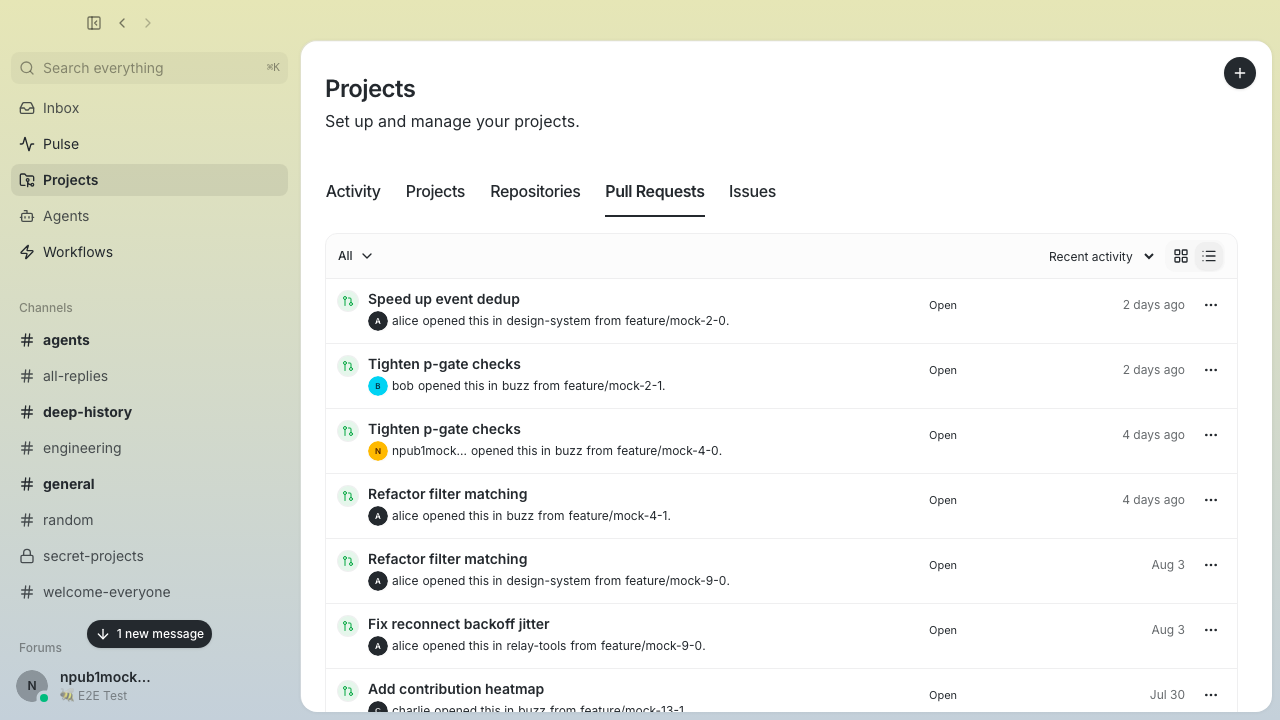 Issues use the same sentence-style hierarchy while keeping status and recency easy to scan. 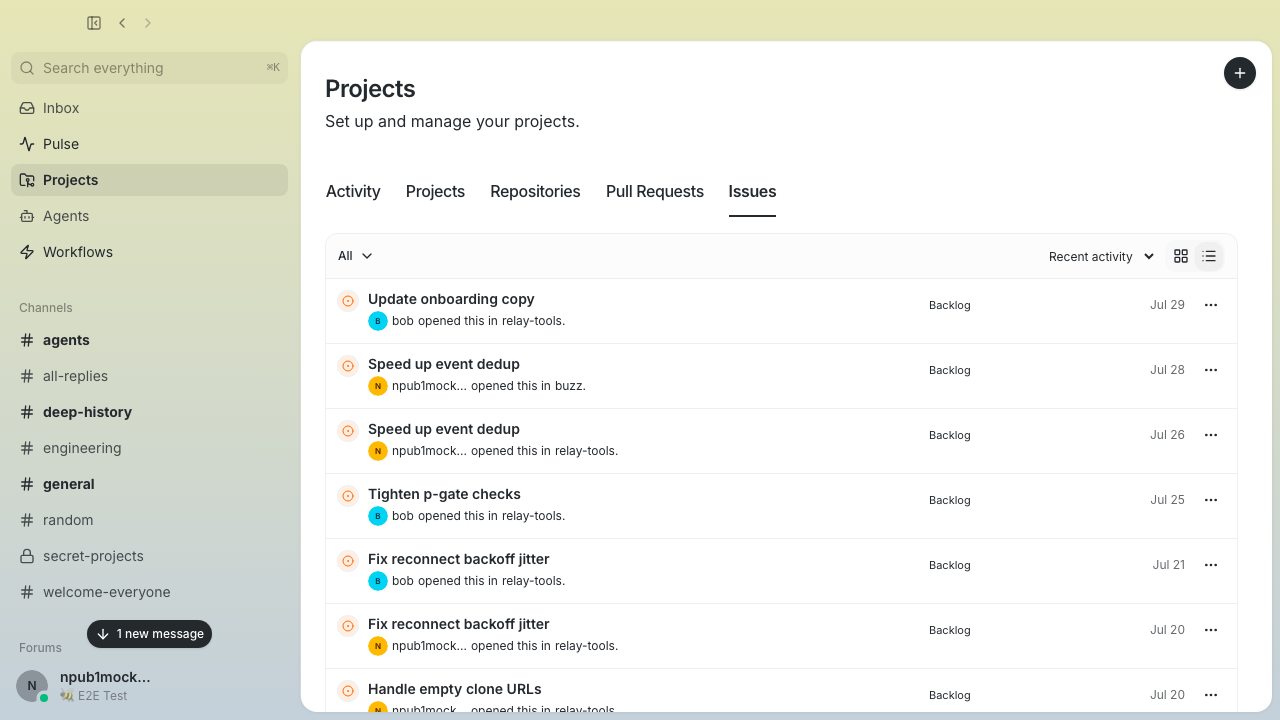 The wide Inbox detail keeps author, timestamp, and origin context readable beside its metadata rail. 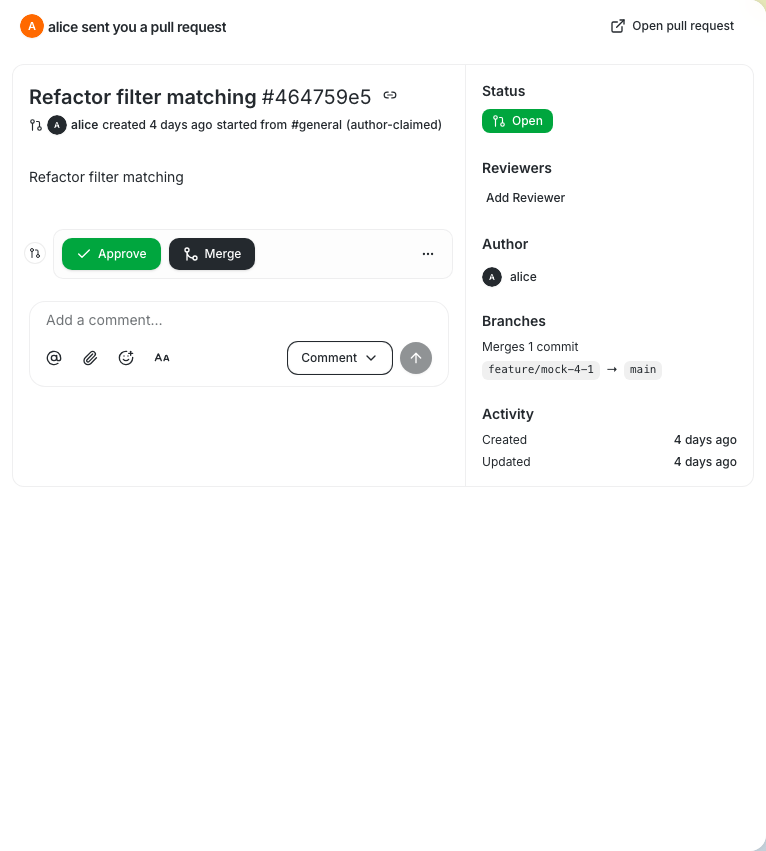 [View the complete six-state Projects v3 screenshot set](https://github.com/block/buzz/pull/5624#issuecomment-5268039672) and [the compact/wide Inbox comparison](https://github.com/block/buzz/pull/5624#issuecomment-5268614585). --- > Supersedes #5624, whose head commit accumulated permanently-queued required check suites (block-dco-check et al.) that GitHub never dispatched. History flattened into a single signed-off commit on latest main; tree verified byte-identical (`git merge-tree`) to merging the original branch into main. --------- Signed-off-by: Thomas Petersen <thomasp@squareup.com> Co-authored-by: Wintermute <3f1797424fd9ad6653a83665c660517777cd7f8c228c0d5907f49e01537f3ca5@buzz.block.builderlab.xyz> |
||
|
Brad Groux
|
78c87ae20e |
fix(sdk): preserve self-mention p tags in message and forum event builders (#4975)
## What users saw `buzz messages send` silently removed an explicitly supplied self-mention. The caller passed `--mention <sender-pubkey>` and received `accepted:true`, but the signed event had no matching `p` tag and `mention_pubkeys` was empty. ## Why it happened `nostr` 0.44 strips `p` tags matching the signer's pubkey by default. The codebase already opts out with `.allow_self_tagging()` for identity archive and unarchive requests, but the message and forum builders that accept mentions did not. The library therefore removed the tag during signing after the CLI had validated the explicit mention. ## What changed Added `.allow_self_tagging()` to all three event builders that accept mention tags: - `build_message` (kind 9) - `build_forum_post` (kind 45001) - `build_forum_comment` (kind 45003) An explicit mention now survives signing even when it matches the sender. ## How this was tested Added one regression test per builder. Each test signs with the same key included in the mention list and asserts that the resulting event preserves the self-referential `p` tag. Validation at `cd0f30bca`: ```text ./bin/cargo fmt --all -- --check cargo test -p buzz-sdk --lib cargo test -p buzz-cli --lib cargo clippy -p buzz-sdk -p buzz-cli --all-targets -- -D warnings ``` All 257 `buzz-sdk` tests and all 321 `buzz-cli` tests passed, and formatting and strict Clippy checks completed successfully. ## Scope and non-goals - Does not change mention validation, deduplication, or channel-member checks. - Does not change `normalize_mention_pubkeys`, which is not used by the messages-send path. - Does not add a dropped-mentions output field because the explicit tags are now preserved. Closes #4906. --------- Signed-off-by: Brad Groux <bradgroux@hotmail.com> Signed-off-by: npub17q2gdupkvswvk5kprwc7plergm4gn295uw6fe4mjyjv53ahuhtnq02jd3f <f01486f036641ccb52c11bb1e0ff2346ea89a8b4e3b49cd772249948f6fcbae6@digitalmeld.communities.buzz.xyz> Signed-off-by: Brad Groux <3053586+BradGroux@users.noreply.github.com> Signed-off-by: Wes <wesbillman@users.noreply.github.com> Co-authored-by: npub17q2gdupkvswvk5kprwc7plergm4gn295uw6fe4mjyjv53ahuhtnq02jd3f <f01486f036641ccb52c11bb1e0ff2346ea89a8b4e3b49cd772249948f6fcbae6@digitalmeld.communities.buzz.xyz> Co-authored-by: Wes <wesbillman@users.noreply.github.com> Co-authored-by: Carl <c7ebe626f000404285d3686e1dc74cc07cc60a9754a150041ba132e14bd3e2ec@buzz.block.builderlab.xyz> |
||
|
Taylor Ho
|
2ea9385015 |
fix(reactions): support max-length custom emoji (#3833)
**Category:** fix **User Impact:** Custom emoji with valid 64-character names can now be used as reactions without errors. **Problem:** Buzz accepted 64-character custom emoji names during registration, but rejected them as reactions after the required surrounding colons made the payload 66 characters. Validation also differed between desktop, SDK, relay, and storage boundaries. <img width="554" height="47" alt="image" src="https://github.com/user-attachments/assets/4013452f-210e-4dd3-9003-f45ff3b28dc8" /> **Solution:** Keep the product limit at 64 ASCII characters for custom emoji names, enforce it consistently when emoji sets are registered, and allow only valid matching custom reaction payloads up to 66 characters. Widen the reaction projection to preserve the wrapped payload while retaining the existing 64-character limit for ordinary reactions. <details> <summary>File changes</summary> **crates/buzz-sdk/src/builders.rs** Defines the shared custom emoji boundaries and covers accepted 64-character and rejected 65-character shortcodes. **crates/buzz-relay/src/handlers/ingest.rs** Validates emoji-set shortcodes and permits 66-character reactions only when they are valid colon-wrapped custom emoji with a matching tag. **crates/buzz-db/src/event.rs** Adds storage regression coverage for maximum-length custom emoji reactions. **crates/buzz-db/src/migration.rs** Verifies the reaction column migration is applied correctly. **desktop/src/shared/api/customEmoji.ts** Enforces the existing 64-character shortcode maximum during desktop normalization and registration/import. **desktop/src/shared/api/customEmoji.test.mjs** Covers the desktop shortcode boundary. **migrations/0027_long_reaction_payloads.sql** Widens stored reaction payloads to 66 characters for the two required surrounding colons. **schema/schema.sql** Keeps the desired schema aligned with the migration. </details> ## Reproduction Steps 1. Register or import a custom emoji whose ASCII shortcode is exactly 64 characters. 2. Select that emoji as a reaction to a message. 3. Confirm the reaction publishes, persists, and renders without an error. 4. Attempt to register a 65-character shortcode and confirm it is rejected. 5. Publish an ordinary or malformed reaction over 64 characters and confirm the relay rejects it. ## Verification - `cargo test -p buzz-sdk`: 243 passed - `cargo test -p buzz-db`: 94 passed, 152 Postgres-required tests ignored - `pnpm test` in `desktop`: 3,859 passed - `cargo test -p buzz-relay`: 795 passed, 9 existing Postgres-unavailable failures, 35 ignored; new reaction boundary tests pass directly - `cargo fmt --all -- --check` - `git diff --check` Originating Buzz channel: `f2ec9671-d78e-4cde-894c-9f4c458c7f1f` --------- Signed-off-by: Taylor Ho <taylorkmho@gmail.com> Co-authored-by: npub1223z34hd7vtwc6qj4s7flsxkj644nlre2nthu7lrrmkumhu3xddsrx9r6w <52a228d6edf316ec6812ac3c9fc0d696ab59fc7954d77e7be31eedcddf91335b@buzz.block.builderlab.xyz> |
||
|
Will Pfleger
|
b7bb15122e |
feat(projects): add buzz projects CLI commands (NIP-MP kind:30621) (#4020)
Implements the `buzz projects` command group — the NIP-MP Phase 2 write path for kind:30621 multi-repo projects. The relay accepted kind:30621 in #3171; this adds the two-layer Rust builder in `buzz-sdk` and the seven CLI commands. ## What this adds ### `crates/buzz-sdk/src/builders.rs` — two-layer builder **Layer A (protocol):** - `validate_project_envelope(tags, content)` — 8 NIP-MP rules in relay order: `d`-cardinality, `d`-empty/length, member-cap (≤64 `a` tags, checked before per-tag parse), member-tag-arity (2–3 elements), member-coordinate grammar (first-two-colons split, literal `30617`, lowercase 64-hex owner, non-empty remainder), member-duplicate (coordinate only, hint ignored), singleton metadata cardinality, byte bounds (`name` ≤256 / `description` ≤2048 / `buzz-channel` ≤256 / `buzz-visibility` ≤256). - `build_project_with_tags(content, tags)` — raw Layer A builder; RMW mutations path. - `ProjectMemberCoord` — `30617:<owner-hex>:<repo-d>` + optional opaque relay hint; equality/Hash by coordinate only. **Layer B (writer policy):** - `build_project(slug, name, description, members, channel, visibility)` — constructs `d` tag, enforces UUID channel and `listed|unlisted` visibility, forces empty content; composes onto Layer A. This is the `create` path. **Shared:** - `build_delete_addressable(kind, pubkey, d)` — generic NIP-09 kind:5 coordinate delete; `build_workflow_delete` now delegates to this. - All 31 `NIP-MP.fixtures.json` cases exercised through `build_project_with_tags`; count assertion guards against omissions. ### `crates/buzz-cli/` — seven commands ``` buzz projects create <slug> --repo <coord> [--name] [--description] [--channel <uuid>] [--visibility listed|unlisted] buzz projects get <slug> [--owner <pubkey>] buzz projects list [--owner <pubkey>] [--limit <n>] buzz projects add-repo <slug> --repo <coord> [--repo <coord>]... buzz projects remove-repo <slug> --repo <coord> [--repo <coord>]... buzz projects update <slug> [--name|--clear-name] [--description|--clear-description] [--channel <uuid>|--clear-channel] [--visibility listed|unlisted|--clear-visibility] buzz projects delete <slug> ``` Command semantics: - **`create`**: all local validation (slug, repos, channel, visibility, name length) fires before the collision preflight — invalid input returns `Usage` without a network call. Routes through Layer B (`build_project`). - **`update`**: at least one setter/clearer required — enforced by a clap `ArgGroup` with `required(true).multiple(true)`, with a runtime backstop for programmatic callers; setter + own clearer are mutually exclusive per clap conflicts. - **`add-repo`/`remove-repo`**: coordinate expansion and dedup fire before head fetch — malformed or duplicate `--repo` values return `Usage` without touching the relay. - **`delete`**: head-based tombstone at `created_at = head + 1`; post-submit re-query verifies tombstone landed. - All mutations: strip `auth`, re-validate full envelope through Layer A; `created_at` advances from observed head, never wall-clock. - Relay hints on existing member tags preserved verbatim through RMW. ## Limitations (recorded, not in scope) - **No relay-hint authoring**: `--repo` carries a coordinate only; existing hinted `a` tags survive RMW unchanged. - **Signer-self delete only**: NIP-OA owner-delete extension not exposed; `delete` targets the signer's own coordinate. - **Deletion durability**: watermark carry-over applies; `delete` is best-effort against a later-arriving replacement. ## Live round-trip 21-step transcript executed against a relay built from `origin/main` `b1b283cd4`, covering create, get, multi-field update (name + description + channel in one call), channel set/clear, add-repo, remove-repo, delete (tombstone verified at `head+1`, repeated delete → `NotFound`). Delta transcript confirmed multi-field update, channel set/clear, no-op add-repo → `Conflict` exit 5, empty update and setter+own-clearer both rejected at parse time. Duplicate create → `Conflict`. Cross-owner `add-repo` with full coordinate exercised. --------- Signed-off-by: Will Pfleger <pfleger.will@gmail.com> Co-authored-by: npub1mn7jgtj4w2pd0g0zeuhxsa6jy6p0rewxz4kujt98my82ahfmp72sxjexk7 <dcfd242e557282d7a1e2cf2e6877522682f1e5c6156dc92ca7d90eaedd3b0f95@buzz.block.builderlab.xyz> |
||
|
kagan yaldizkaya
|
60158fce3e |
feat(cli): add users set-status command for NIP-38 profile status (#3253)
## Summary The desktop client renders a persistent user status (NIP-38 kind:30315, `d:general`) as the status line on profiles, but the CLI had no way to set it — only ephemeral presence (`set-presence`, kind:20001). Integrations that want a scriptable, durable status line (for example a now-playing music bridge that shows the current TIDAL track on a profile) had no entry point. ## Screenshots <img width="1455" height="960" alt="1" src="https://github.com/user-attachments/assets/f1669ec6-212b-4f6e-ad53-07df9aacffc9" /> <img width="1455" height="960" alt="2" src="https://github.com/user-attachments/assets/5bf70f47-e5b5-4eb0-a426-b5f1ef90d2ec" /> This adds: ```bash buzz users set-status --text "Working on the relay" --emoji "🔧" buzz users set-status --text "" --emoji "🎶" # intentional emoji-only status buzz users set-status --clear # removes the status ``` - Signs and submits the replaceable kind:30315 event via the HTTP bridge (no WS needed — unlike presence, user status is a stored event). - Uses the `d:general` coordinate the desktop client already reads for the profile status line, and the same `emoji` tag shape `SetStatusDialog` publishes. - Event construction lives in `buzz_sdk::build_user_status()`, keyed off `buzz_core::kind::KIND_USER_STATUS`, so the CLI command is a thin sign/submit wrapper. Text and emoji are trimmed; a blank emoji is omitted rather than emitted as an empty tag. - Clearing is the explicit `--clear` flag, mutually exclusive with `--text`/`--emoji`. It publishes an empty-content event carrying only `d:general`, which the desktop treats as no status. `--text ""` with an `--emoji` is an emoji-only status, not a clear. --------- Signed-off-by: Kagan Yaldizkaya <kagan@squareup.com> Signed-off-by: Will Pfleger <pfleger.will@gmail.com> Co-authored-by: Will Pfleger <pfleger.will@gmail.com> |
||
|
thomaspblock
|
9081ab0ec9 | feat(desktop): make pull request reviews actionable (#2510) | ||
|
Logan Johnson
|
d0ab3fdb05 |
fix(channels): strip leading hash prefixes from names (#2250)
Signed-off-by: Logan Johnson <loganj@squareup.com> Signed-off-by: npub1z3hmzc9ryehxzedl5wzlvpyvja0d483peaja5zt6pd0209f9x2jspe2dxh <146fb160a3266e6165bfa385f6048c975eda9e21cf65da097a0b5ea7952532a5@buzz.block.builderlab.xyz> Signed-off-by: npub13n66s06epmqf2kc3v373ez8hj65cuzyvxzjf93vwpervxqn2u7jq2qd9je <8cf5a83f590ec0955b11647d1c88f796a98e088c30a492c58e0e46c3026ae7a4@buzz.block.builderlab.xyz> Co-authored-by: npub1z3hmzc9ryehxzedl5wzlvpyvja0d483peaja5zt6pd0209f9x2jspe2dxh <146fb160a3266e6165bfa385f6048c975eda9e21cf65da097a0b5ea7952532a5@buzz.block.builderlab.xyz> Co-authored-by: npub13n66s06epmqf2kc3v373ez8hj65cuzyvxzjf93vwpervxqn2u7jq2qd9je <8cf5a83f590ec0955b11647d1c88f796a98e088c30a492c58e0e46c3026ae7a4@buzz.block.builderlab.xyz> |
||
|
thomaspblock
|
f94324598d | feat(cli): manage repository protection rules (#2193) | ||
|
Will Pfleger
|
7d7992067b | feat(cli): add agents archive/unarchive/archived subcommands (#2173) | ||
|
Tyler
|
863aeb79f3 |
Community moderation Phase 1: reports, bans/timeouts, audit, tombstones, relay-DM notices (#1616)
Signed-off-by: Tyler Longwell <tlongwell@block.xyz> Signed-off-by: tlongwell-block <109685178+tlongwell-block@users.noreply.github.com> Signed-off-by: npub1mprnacetjua2xx3p5eddmhxyk6wv929ymm5py8kd2xfxurxahspqqlgyta <d8473ee32b973aa31a21a65adddcc4b69cc2a8a4dee8121ecd51926e0cddbc02@sprout-oss.stage.blox.sqprod.co> Co-authored-by: npub1qyvc0c5kl4gqv2fd97fsk46tu378sqgy35vc83rvgfwne90sel7s0ed67d <011987e296fd5006292d2f930b574be47c7801048d1983c46c425d3c95f0cffd@sprout-oss.stage.blox.sqprod.co> Co-authored-by: Tyler Longwell <tlongwell@block.xyz> Co-authored-by: npub17jjz49l9jjmhhk7cac63j8yt9z555n9cw8vk7v5jz4vzw4ppld5qgj57cc <f4a42a97e594b77bdbd8ee35191c8b28a94a4cb871d96f32921558275421fb68@sprout-oss.stage.blox.sqprod.co> Co-authored-by: npub1cc3ha7z055mu0rwwu7806t2wt8mj3pvu0uv5mfp2c50dahaqhczshdalg6 <c6237ef84fa537c78dcee78efd2d4e59f728859c7f194da42ac51ededfa0be05@sprout-oss.stage.blox.sqprod.co> Co-authored-by: npub1jmc9dt2lyvzu3h0kxlwxt5zg4fxp9476awyxw6gwxn72g6cw7exqs64whm <96f056ad5f2305c8ddf637dc65d048aa4c12d7daeb8867690e34fca46b0ef64c@sprout-oss.stage.blox.sqprod.co> Co-authored-by: npub1mprnacetjua2xx3p5eddmhxyk6wv929ymm5py8kd2xfxurxahspqqlgyta <d8473ee32b973aa31a21a65adddcc4b69cc2a8a4dee8121ecd51926e0cddbc02@sprout-oss.stage.blox.sqprod.co> |
||
|
Tyler
|
5fef9b727f |
Add NIP-34 git pull request CLI support (#1279)
Signed-off-by: Tyler Longwell <tlongwell@block.xyz> Co-authored-by: npub1qyvc0c5kl4gqv2fd97fsk46tu378sqgy35vc83rvgfwne90sel7s0ed67d <011987e296fd5006292d2f930b574be47c7801048d1983c46c425d3c95f0cffd@sprout-oss.stage.blox.sqprod.co> Co-authored-by: Tyler Longwell <tlongwell@block.xyz> Co-authored-by: npub1mprnacetjua2xx3p5eddmhxyk6wv929ymm5py8kd2xfxurxahspqqlgyta <d8473ee32b973aa31a21a65adddcc4b69cc2a8a4dee8121ecd51926e0cddbc02@sprout-oss.stage.blox.sqprod.co> |
||
|
Tyler
|
73cc31cc52 |
chore: remove LLM-slop comments across the codebase (#1277)
Signed-off-by: Tyler Longwell <tlongwell@block.xyz> Co-authored-by: npub1qyvc0c5kl4gqv2fd97fsk46tu378sqgy35vc83rvgfwne90sel7s0ed67d <011987e296fd5006292d2f930b574be47c7801048d1983c46c425d3c95f0cffd@sprout-oss.stage.blox.sqprod.co> Co-authored-by: Max <d8473ee32b973aa31a21a65adddcc4b69cc2a8a4dee8121ecd51926e0cddbc02@sprout-oss.stage.blox.sqprod.co> Co-authored-by: Mari <95cae996907d7cab9f5dbf43c0f53edeac6ab0b032a6feae4abfd784e467b3f5@sprout-oss.stage.blox.sqprod.co> Co-authored-by: Quinn <96f056ad5f2305c8ddf637dc65d048aa4c12d7daeb8867690e34fca46b0ef64c@sprout-oss.stage.blox.sqprod.co> Co-authored-by: Sami <f4a42a97e594b77bdbd8ee35191c8b28a94a4cb871d96f32921558275421fb68@sprout-oss.stage.blox.sqprod.co> Co-authored-by: Perci <5a968df9a7494b4e019b9ecf739e088ba61097b4312124e9a88ae5b42e3f5f3e@sprout-oss.stage.blox.sqprod.co> Co-authored-by: Tyler Longwell <tlongwell@block.xyz> |
||
|
Tyler
|
4f671a255c |
feat(cli): support ephemeral channels via --ttl on create/update (#1126)
Signed-off-by: npub1qyvc0c5kl4gqv2fd97fsk46tu378sqgy35vc83rvgfwne90sel7s0ed67d <011987e296fd5006292d2f930b574be47c7801048d1983c46c425d3c95f0cffd@sprout-oss.stage.blox.sqprod.co> Co-authored-by: npub1qyvc0c5kl4gqv2fd97fsk46tu378sqgy35vc83rvgfwne90sel7s0ed67d <011987e296fd5006292d2f930b574be47c7801048d1983c46c425d3c95f0cffd@sprout-oss.stage.blox.sqprod.co> |
||
|
tlongwell-block
|
cd8292fe9e |
feat(cli): add patches and issues commands for NIP-34 git collaboration (#1073)
Signed-off-by: Tyler Longwell <tlongwell@squareup.com> Co-authored-by: Dawn (buzz agent) <c6237ef84fa537c78dcee78efd2d4e59f728859c7f194da42ac51ededfa0be05@sprout-oss.stage.blox.sqprod.co> |
||
|
Will Pfleger
|
d99ad131f1 |
refactor: rename sprout backend to buzz (#958)
Signed-off-by: Will Pfleger <pfleger.will@gmail.com> Signed-off-by: Will Pfleger <wpfleger@block.xyz> Signed-off-by: Will Pfleger <wpfleger@squareup.com> Signed-off-by: Will Pfleger <wpfleger96@gmail.com> Co-authored-by: npub1mn7jgtj4w2pd0g0zeuhxsa6jy6p0rewxz4kujt98my82ahfmp72sxjexk7 <dcfd242e557282d7a1e2cf2e6877522682f1e5c6156dc92ca7d90eaedd3b0f95@sprout-oss.stage.blox.sqprod.co> Co-authored-by: npub1fgdl5qqnh3k3f2xkqrvt7cujalhm623x4s7fdjdj5yrtp5fzjl9qrjpucw <4a1bfa0013bc6d14a8d600d8bf6392efefbd2a26ac3c96c9b2a106b0d12297ca@sprout-oss.stage.blox.sqprod.co> Co-authored-by: npub16v54tttfqacx9ycvc3k0ut0npj564ahcuajzy6qjvh57ntmsf4uq4806j2 <d32955ad69077062930cc46cfe2df30ca9aaf6f8e76422681265e9e9af704d78@sprout-oss.stage.blox.sqprod.co> Co-authored-by: Will Pfleger <wpfleger96@gmail.com> |






