mirror of
https://github.com/block/buzz.git
synced 2026-10-30 22:11:36 +00:00
wpfleger/deterministic-agent-commit-identity
1327 Commits
| Author | SHA1 | Message | Date | |
|---|---|---|---|---|
 morgmart |
9a1e861ab8 |
Add appearance preference previews (#6193)
## Summary - Replace the Link previews and Thread layout dropdowns with the shared segmented control from #5644. - Pair each setting with a real, inert preview: production Compact/Rich link cards and a simplified Focus/Split thread diagram. - Keep scrub previews local to Settings so only a completed selection updates the saved preference and real app behavior. - Keep each setting and preview responsive as one grouped unit, with focused light/dark and narrow/wide coverage. ## Dependency - Stacked on #5644, which provides the typography/density foundation, shared `SegmentedControl`, and responsive `SettingsOptionRow`. - After #5644 merges, this PR should be retargeted/rebased onto `main`. ## Validation - `pnpm typecheck` - `pnpm check:px-text` - `pnpm check:file-sizes` - `pnpm exec playwright test tests/e2e/appearance-previews.spec.ts --project=smoke` (3 passed) - Focused existing Appearance coverage (2 passed) - Pre-push desktop checks, typecheck, tests, and Tauri checks Signed-off-by: morgmart <98432065+morgmart@users.noreply.github.com> |
||
|
Wes
|
f96f1883c5 |
fix(desktop): restore emoji recents (#6263)
## Summary

- normalize emoji-mart's poisoned literal `{}` recents state before
initialization
- preserve the established idle emoji-index prewarm so first picker open
stays responsive
- keep the mounted quick-reaction tray behavior unchanged from main
- cover full-picker same-session recents, prewarm ordering/callback
behavior, and the production picker-to-prewarm import boundary

## Validation

- focused prewarm tests passed 2/2 at
`98188797e219db20670b46379a240493ff8f4cbe`
- mutation check passed: changing `EmojiPicker` back to direct
`@emoji-mart/data` consumption fails the new production-boundary
assertion
- pre-push branch-skew, file-size, Desktop check, typecheck, and full
Desktop unit suite passed (5,024/5,024) at exact pushed head
`98188797e219db20670b46379a240493ff8f4cbe`
- focused full-picker lifecycle plus existing custom-emoji/tray smoke
passed 2/2 on the preceding runtime-equivalent head
- independent Royal Court scope review and headless field test passed
the full-picker journey on the preceding runtime-equivalent head

---------

Signed-off-by: Wes <wesbillman@users.noreply.github.com>
Co-authored-by: Carl <c7ebe626f000404285d3686e1dc74cc07cc60a9754a150041ba132e14bd3e2ec@buzz.block.builderlab.xyz>
|
||
|
Tyler
|
bbd20fae75 |
perf(desktop): move five hot renderer paths from JS into Rust (#6024)
## Summary

Moves five hot renderer paths out of JavaScript and into Rust, targeting
main-thread CPU on the desktop app: wakeups, IPC round trips, and
per-frame JS work during reconnect storms, catch-up, and archive sync.

Five commits, reviewed and ratified sequentially (each round included
independent re-review, mutation-tested coverage, and full-suite gates at
pinned heads):

| Commit | Change |
|---|---|
| `9b5a82ab9` | Batch inbound relay frames in the native websocket
plugin: N run-loop wakeups collapse into 1 per 8ms window, byte-bounded
so no batch crosses the Tauri direct-execute threshold onto the slow
fetch path. NIP-42 AUTH bypasses the window. |
| `8b047a35e` | Move the local-archive subscription into Rust: the
renderer no longer sees archived frames at all. Shared
`native_relay_client` (one authenticated socket per relay+pubkey,
declarative subscription reconciliation, CLOSED-driven retry with
write-time eviction), lease/epoch lifecycle ownership so delayed IPC
cannot resurrect a stopped task. |
| `609962b49` | Move persona catalog fetching into Rust: signature
verification (~473us/event, ~0.24s per 500-event page formerly on the
webview thread) now runs under `spawn_blocking`; one projected DTO
crosses IPC. |
| `38afea0a0` | Batch unread catch-up behind one IPC call: N per-channel
REQs/awaits become one command with global two-pass classification,
making the completion-order race unrepresentable. Both IPC DTO surfaces
pinned by wire tests asserting serde output against the TS contract. |
| `b955f528b` | Move observed unread state into native SQLite: scoped
WAL DB with a sequence/revision protocol, transactional localStorage
migration, epoch-tagged rebuild detection. Membership no longer
serializes five capped arrays per catch-up: measured 327.4 KiB before,
0.2 KiB after at the same populated 5x1000 fixture. |

Full design rationale, failure matrices, and verification detail are in
the individual commit messages.

### Known behavior notes

- **Native migration is a one-way door per profile.** A successful
native open sets `migration_complete` in the first open's transaction
and the renderer then deletes the legacy localStorage key
(`useObservedUnreadPersistence.ts:290-294`,
`observed_unread.rs:420-442`). The one-release JS fallback remains for
native open *failure*, but a profile that has completed migration cannot
return to the JS store. Relevant if a rollback path is ever needed.
- **The membership seed is built unconditionally at startup**
(`useUnreadChannels.ts:245-250`), before any `isNative()` check. It is
ref-cached and small, but it is a startup cost the baseline does not
pay, including on the fallback path.

### Related issue

None found. Work originated and was reviewed in the Buzz
`buzz-gui-performance` channel.

### Testing

**Current head is `9a8128ba4d2d695113505162be388fcec62cda0a`. For
receipts at that head, see [Round-3
receipts](#round-3--final-head-9a8128ba4) at the bottom; the block
immediately below is the historical record for the original five-commit
pack and its counts are superseded.**

The receipts in this subsection are at exact pack head
`b955f528b6dfa34db089b21cc718fba0f9284d6f` (tree oid `dcc711a66`),
verified by three independent instruments (implementer, reviewer,
gatekeeper), with `git rev-parse HEAD` confirmed in the same shell as
each run:

- `cargo test --lib` (full package): **2511 passed / 0 failed** (+7 +3
in the other targets)
- `pnpm test`: **4920 / 4920 across 74 suites**
- `cargo fmt --check`, `clippy --all-targets -D warnings`, `tsc
--noEmit`, `pnpm check` (including the file-size ratchet): all clean
- Mutation controls on the final review round: badge-lane controls A and
B each turn exactly one test red; seed-guard (M4) and
anchor-monotonicity (M5) mutants each killed by exactly their own
witness; restored bytes fully green
- The observed-unread native path is exercised by an in-tree
`__TAURI_INTERNALS__` protocol rig (entry, replay, gap, rebuild,
markers, membership, badge lane), added after review found the original
suite never left the localStorage fallback

**Open gates, stated plainly (status as of head `9a8128ba4`):**

- **Paired CPU benchmark still not run.** The three-arm design (baseline
`78cbffeb6` vs pack vs a null arm with native forced off, fresh profile
per arm) was instrument-reviewed but never executed. The IPC payload
reduction above is measured; end-to-end CPU improvement is predicted,
not measured. This gate is unchanged since `b955f528b`.
- **Live-local gate at the final head: GREEN at `9a8128ba4`.** A real
native Tauri live-local pass per `TESTING.md` was run at this exact
head. Receipts:
`.scratch/pr6024-final-9a8128ba4d2d695113505162be388fcec62cda0a/`,
`MANIFEST.txt` `start_utc=2026-08-17T21:58:07Z`, `FINAL_ATTESTATION.txt`
`end_utc=2026-08-17T22:20:47Z` — both after the commit's `21:32:51Z`,
and the build worktree's HEAD is `9a8128ba4` with a clean tree. **I
opened these files rather than relaying the summary**, and recomputed 6
SHA256SUMS entries against the sealed manifest (6/6 match). From the raw
artifacts: historical catch-up persisted 10 seeded events into the
native `observed-unread.db`; a realtime event advanced it 10→11; the
relay was killed and restarted with Desktop up and an event sent after
recovery advanced it 11→12 within 2 polling ticks; Desktop was then
stopped, an event sent offline, and after relaunch with the appdir
preserved catch-up advanced it 12→13. `relay.log` shows 2 app WebSocket
connections, the restart-close signal, and fresh connections after each
recovery — the app-attributable socket evidence the previous round
lacked. The preserved appdir database is still on disk and `select
count(*) from observed_events` returns **13**. The ignored real-relay
archive wire test passed **1/1** at this head. This exercises the
`lib.rs` / `e2eBridge.ts` merge recombination under a real app and
blocker 2's failure-mode family (relay killed mid-session, app killed
with offline traffic in flight, sync did not go dead). It does **not**
directly force the precise overlapping B/C archive-ownership timing
window through the GUI; that invariant is pinned by the compiled
`drop(owner)` mutation proof below, and is deliberately not relabelled
as live race evidence. **Retraction retained for the record:** an
earlier revision of this description said live-local was GREEN at
`9a8128ba4` while citing a run executed against `f079d0914`, the pre-fix
head, roughly three hours before `9a8128ba4` existed. That claim was
false and was corrected before this run existed. The GREEN above rests
on the new receipts only.
- **Workspace-wide `cargo test --workspace` is red on `main`, not on
this PR.** The exact-head live run's workspace logs contain honest
`rc=101` results. All are in crates this PR does not touch: `git diff
origin/main...9a8128ba4` is **empty** for `crates/git-sign-nostr`,
`crates/buzz-relay`, and `crates/buzz-pair-relay`.
`git-sign-nostr::tests::test_parse_envelope_rejects_invalid_oa_pubkey`
fails **deterministically on clean `main`** — reproduced independently
in fresh worktrees at merge-base `a282e0643` and at current tip
`7f61cf431` (55 passed / 1 failed, same assertion at `lib.rs:2136`).
Root cause: `nostr` 0.36→0.44 changed `PublicKey::from_hex` from a
curve-point parse to a plain hex decode, so an all-zeros (off-curve) key
now parses; measured with a standalone probe, `from_hex("0"*64).is_ok()`
is `false` on 0.36.0 and `true` on 0.44.7. Filed as block/buzz#6175,
with the observation that nothing in CI runs this crate's tests (`just
test-unit` enumerates packages and omits it; `server-cross-compile`
compiles it and runs nothing). The mesh-demo and pair-relay failures in
the same logs are timing flakes in equally untouched crates. **None of
these gate this PR.**
- **Full smoke + integration: GREEN at `9a8128ba4`.** CI run 32072147445
is `success` with every job green — all 4 Desktop Smoke E2E shards, both
Desktop E2E Integration shards, Desktop Core, Desktop Build (macOS),
Desktop E2E Relay, Rust Lint, Windows Rust, DCO, Dead Token Reference
Guard. Attempt 1 was cancelled by an infrastructure hang, not by this
code: both integration shards stalled 19m37s inside `Install Playwright
system dependencies` (an apt install that runs before the e2e bundle is
built or the relay starts), so no test executed and all downstream steps
were skipped. The same step took 16s at `9128b9389` and 12s/18s on
attempt 2 of these same bytes. Attempt 2 was a job rerun, not a push;
the head is unchanged.

---
Opened by Eva (agent) on Tyler's behalf at his request.


---

## Review round 2 — head `9128b9389`

Carl's review
[4953970089](https://github.com/block/buzz/pull/6024#pullrequestreview-4953970089)
raised two blockers against `f079d0914`. Both were confirmed real at the
source by a second reader and both are fixed in `9128b9389`.

**Blocker 1 — recovery dropped the mutation whose ingest failed.** Every
captured mutation now gets one retry after `reopen()` refreshes
sequence/revision, which is safe because ingest is idempotent (events
upsert `DO NOTHING`, channel latest advances by `MAX`, membership is
`INSERT OR IGNORE`, and a replayed sequence returns a snapshot rather
than reapplying). `snapshotRequired` takes the same recovery path
instead of being treated as success. If reopen and retry both fail,
native is explicitly degraded and equivalent state is applied to the JS
fallback so `isNative()` stops reporting healthy. Regressions assert the
*originally rejected* marker, destructive clear, and membership delta
each survive; removing the retry takes 5 tests red including all three.

**Blocker 2 — a superseded archive start could tear down the newer
scope's relay session.** `begin` now returns an `ArchiveOwnership` token
that holds both ownership guards, and `archive_session` requires one, so
session acquisition happens inside the ownership critical section rather
than after it.

### Deviation from the requested regression test for blocker 2

Carl asked for "a production-wiring regression that pauses B after
`begin`, fully installs C, resumes B, and proves only C's session and
subscriptions remain live." **We did not write that test, deliberately,
and wrote a stronger one instead.**

Under this fix that scenario is unreachable by construction. The fix is
not a revalidation check that a test could observe passing or failing —
it is a type-level fence: `begin` hands the winner a token that holds
the ownership locks, and `archive_session` cannot be called without one.
A test that staged "B pauses after `begin`, C fully installs" would be
staging a state the type system now forbids, so it could only pass
vacuously.

Two things close the blocker, and only one of them is a test:

1. *A superseded start cannot reach `archive_session` at all.* Enforced
by the compiler, not by a test. `ArchiveOwnership` is un-constructible
outside `archive::sync`. Verified by attempting both bypasses: calling
`archive_session` without a token fails **E0061**, and forging the token
from a real non-archive caller fails **E0451** ("fields `_latest` and
`_running` are private"), with a second independent barrier because
`RunningSync` is itself a private type.
2. *While an owner holds the token, no newer start can claim.* This is
the property the token's usefulness rests on, and it is what the new
regression pins —
`a_newer_start_cannot_claim_while_the_owner_holds_its_token`.

That test is aimed at the one mutant that actually threatens this
design: keeping the token but releasing the guards inside `begin`, which
is what someone reaches for to avoid holding a lock across an await. It
**compiles**, it keeps every other lifecycle test green, and it restores
the exact race. Against it the new test goes **single-red** — the other
26 tests in the module stay green.

Proving mutual exclusion over the whole claim → acquire → install unit
is strictly stronger than staging a pause the type system forbids, which
is why we chose it.

Also recorded in the code, in `ArchiveOwnership`'s doc comment: what
this token does **not** cover. It serializes archive lifecycle against
archive lifecycle, not against a plain `NativeRelayClient::session()`
call from a non-archive feature. That window predates this PR and is
theoretical today given renderer gating, so it is documented rather than
fixed here.

### Round-2 receipts at `9128b9389`

- `cargo test --lib`: **2513 passed / 0 failed**
- `pnpm test`: **4926 / 4926**
- `cargo clippy --all-targets -D warnings`, `cargo fmt --check`, `pnpm
check`: rc 0
- Merged against `origin/main` in a scratch worktree (clean, zero
conflicts) and re-gated on that merged tree: **2544** Rust / **4956**
frontend, both 0 failed


---

## Round 3 — final head `9a8128ba4`

`9a8128ba4d2d695113505162be388fcec62cda0a` is a merge of `origin/main`
(`a282e0643`) into the pack branch, taken **before** final verification
so that verification would run on the bytes CI builds rather than on a
head that was about to move.

The merge is textually clean but touches two files the pack also
touches, `desktop/src-tauri/src/lib.rs` and
`desktop/src/testing/e2eBridge.ts`, so recombination was checked
explicitly rather than inferred from the absence of conflicts: **all 342
pack-added lines in those files survive (0 missing), and all 17
main-added lines survive (0 missing)** — no silent revert in either
direction. Main's contribution is a `#[doc(hidden)] pub use
print_agent_access_owner_only_probe_if_requested` in `lib.rs`, plus a
Bumble→Pollen rename and workflow revision / `workflowUpdateError` mocks
in `e2eBridge.ts`.

### Receipts at `9a8128ba4`

Implementer, in a shell with `git rev-parse HEAD` confirmed at this SHA:

- `cargo test --lib` (full package): **2544 passed / 0 failed** / 18
ignored
- `pnpm test`: **4956 / 4956** across 74 suites
- `cargo clippy --all-targets -D warnings`, `cargo fmt --check`, `pnpm
check`: rc 0
- The 4 remaining `pnpm check` findings (`channelMutesStorage.test.mjs`,
`channelStarsStorage.test.mjs`, `terminal.css`,
`empty-edit-delete.spec.ts`) are all in files this PR never touches
- All 7 pre-push hooks green, including `branch-skew`, which now passes
on its own because the branch contains `origin/main`

Independent reviewer, same exact head, own instruments:

- `cargo test --workspace`: green; `cargo clippy --workspace
--all-targets -- -D warnings`: green *(a later workspace run at
`9a8128ba4` hit pre-existing `main`-side failures in untouched crates —
see the workspace-gate entry under Open gates above; the difference is
flake timing plus which run happened to reach `git-sign-nostr`, not a
change in this PR)*
- `pnpm test`: **4956 / 4956**; `pnpm check`: rc 0, same known findings
outside touched files
- **Mutation proof of the blocker-2 fix:** dropping the ownership
token's hold (`drop(owner)`) turns
`a_newer_start_cannot_claim_while_the_owner_holds_its_token` red;
restoring the shipped bytes returns the suite green. The invariant that
a superseded start cannot claim or disturb a newer archive session is
pinned by a test, not just by the type system.
- **Live-local at this exact head: attested and verified.** The
mis-cited `f079d0914` run that originally appeared here is retracted; a
real run at `9a8128ba4` replaced it, and its receipts were opened
file-by-file (not relayed) by a second agent. See the live-local entry
under Open gates above for the receipt path, wall-clock bounds,
store-count chain, and socket evidence.
- Verdict: minimalness **9/10**, elegance **9/10**, correctness
**9.5/10**. **Score restored** now that the exact-head live-local run
exists and its provenance has been checked from the files (SHA-named
receipt dir, self-dating manifest, receipt mtimes after the commit time,
sealed digests spot-checked). Gatekeeper re-bless at `9a8128ba4`:
**9/10, merge recommended.**

The paired CPU benchmark remains the one gate not run. It is a
measurement of the pack's *benefit*, not of its correctness, and it is
stated as unrun rather than estimated.

---------

Signed-off-by: Tyler Longwell <tlongwell@squareup.com>
Signed-off-by: Wren <5217c5c2f7bfb4333e46d17c98a9255a52dadee18dcd43a43536b95e6776dfa0@buzz.block.builderlab.xyz>
Signed-off-by: Eva <011987e296fd5006292d2f930b574be47c7801048d1983c46c425d3c95f0cffd@buzz.block.builderlab.xyz>
Signed-off-by: Wes <wesbillman@users.noreply.github.com>
Co-authored-by: Dawn <c6237ef84fa537c78dcee78efd2d4e59f728859c7f194da42ac51ededfa0be05@buzz.block.builderlab.xyz>
Co-authored-by: Wren <5217c5c2f7bfb4333e46d17c98a9255a52dadee18dcd43a43536b95e6776dfa0@buzz.block.builderlab.xyz>
Co-authored-by: Perci <5a968df9a7494b4e019b9ecf739e088ba61097b4312124e9a88ae5b42e3f5f3e@buzz.block.builderlab.xyz>
Co-authored-by: Eva <011987e296fd5006292d2f930b574be47c7801048d1983c46c425d3c95f0cffd@buzz.block.builderlab.xyz>
Co-authored-by: Wes <wesbillman@users.noreply.github.com>
Co-authored-by: Carl <c7ebe626f000404285d3686e1dc74cc07cc60a9754a150041ba132e14bd3e2ec@buzz.block.builderlab.xyz>
|
||
|
Logan Johnson
|
fe7c6808e7 |
fix(desktop): hide archived channels from #/Tab autocomplete (#6156)
🤖 ## Summary Desktop's `#`/Tab channel autocomplete offered archived channels as if they were valid destinations. Stale channels competed with active ones in the picker, including a confusing uppercase `STREAM` entry — the badge of an archived stream channel leaking into the suggestion list. After this change, autocomplete suggests only active, non-DM channels. Links to archived channels in old messages still resolve normally. ## Demo Before/after, real archive flow:  ## What changed `useChannelLinks.ts` builds the autocomplete suggestion list from the raw relay channel list and previously excluded only DMs, so archived channels slipped through. The fix filters `archivedAt === null` while generating suggestions only — the shared navigation list stays unfiltered, so resolving historical links to archived channels is unchanged. - `desktop/src/features/messages/lib/useChannelLinks.ts` — suggestion selection centralized in `selectChannelSuggestions`; excludes archived channels and DMs; keeps the existing eight-result limit. - `desktop/src/features/messages/lib/useChannelLinks.test.mjs` — new tests: archived stream/forum excluded, active ones included, DMs excluded, mixed lists. ## Validation At exact head `5a963b8407bd48f40d992e026d0a841d2445647f`: `pnpm check`, `pnpm typecheck`, and the full Desktop unit suite (4,960 passed). Smoke E2E run compared against exact base `f956e6fe`: the only failures are two pre-existing failures that reproduce on base and four documented pass-on-retry flakes — none touches the autocomplete surface. Signed-off-by: loganj <loganj@squareup.com> Co-authored-by: Claude Code <noreply@anthropic.com> |
||
|
thomaspblock
|
e5a6e2022f |
fix(desktop): morph the drawer panel icon instead of sliding it (#6306)
## Summary - Replaces the drawer panel icon's CSS `translateX` slide with a `motion/react` width + corner-radius morph, so the icon reads as the panel opening rather than the glyph drifting sideways. - Honors `prefers-reduced-motion` via `useReducedMotion` (no animation for users who opt out). Follow-up polish to the projects workspaces work that just landed in #6003 — the slide animation shipped there was the wrong visual. ## Test plan - [x] Desktop unit tests and typecheck pass with this file at this content (validated as part of the projects-v6 branch validation) - [ ] Visual check: open/close the right drawer and confirm the icon morphs in place Signed-off-by: Thomas Petersen <thomasp@squareup.com> |
||
|
thomaspblock
|
87f8ff82ae |
feat(desktop): refine repository-aware project workspaces (#6003)
## Summary - Makes Projects repository-aware across browsing, branch and tag selection, local and remote source management, work items, commits, and contextual repository actions. - Refines project details into consistent single-column reading surfaces with a resizable, section-aware context pod, while keeping project conversations available in the attached chat panel. - Adds persistent sidebar project navigation, direct entity links, repository discussion channels, contributor identity matching, and consistent loading and activity presentation. - Keeps branch-specific controls on code-oriented sections while Tasks, Reviews, and Channels remain repository-scoped, reducing misleading context and actions. Replacement for #5981 with an identical final tree flattened into one signed-off commit because the required DCO check suite remained stalled. ### Related issue N/A ### Testing - [x] Desktop pre-push checks, TypeScript typecheck, and unit tests - [x] E2E production build with `pnpm build:e2e` - [x] Focused Playwright smoke coverage for project workspace, task, review, commit, sidebar, and contextual-panel behavior - [ ] Attach final before/after screenshots after design review --------- Signed-off-by: Thomas Petersen <thomasp@squareup.com> Signed-off-by: Wintermute <165f0c871dd2586bb18b6aa109eeaf57bb2132ff4d27b10120f4368a0f627022@buzz.block.builderlab.xyz> Co-authored-by: Wintermute <165f0c871dd2586bb18b6aa109eeaf57bb2132ff4d27b10120f4368a0f627022@buzz.block.builderlab.xyz> |
||
|
klopez4212
|
7e2651791d |
Add font size and conversation density preferences (#5644)
## Summary - Add separate **Font size** and **Conversation density** controls in Appearance. - Use a 13 / 14 / 15px conversation text ramp for Smaller / Default / Larger while scaling interface typography through a shared virtual-rem system. - Keep layout geometry fixed while typography changes, and compose Cmd +/- text zoom on top of the selected preference. - Let Compact, Comfy, and Spacious control conversation row spacing plus paragraph and list rhythm in Markdown content across Buzz. - Preview font size and density together with click-and-drag comparison; interrupted scrubbing restores the saved preference. - Synchronize preferences across open Buzz windows, including full local-storage clears during sign-out or dev reset. - Promote the segmented control to shared UI and make Settings rows adapt to their card width. ## Validation - `just ci` - 4,965+ desktop unit tests across the final merged branch - 1,465 mobile tests through the full repository gate - Focused Playwright coverage for font-size/density independence, drag preview cancellation, Inbox geometry, thread rendering, keyboard zoom, and cross-surface typography - Fresh E2E build against the final merged branch --------- Signed-off-by: kenny lopez <klopez4212@gmail.com> Signed-off-by: morgmart <98432065+morgmart@users.noreply.github.com> Signed-off-by: Princess Donut <b238ea756dee4d98afa5883fc7f1de61eeabe65bf700e3a5a5a80db5e42e2c2b@buzz.block.builderlab.xyz> Co-authored-by: Princess Donut <b238ea756dee4d98afa5883fc7f1de61eeabe65bf700e3a5a5a80db5e42e2c2b@buzz.block.builderlab.xyz> Co-authored-by: morgmart <98432065+morgmart@users.noreply.github.com> |
||
|
Taksh Kothari
|
6e8d078ffe |
fix(desktop): emit camelCase config-write payload fields (#6062)
Fixes #6015. `ConfigWriteMechanism` is internally tagged and carried only `rename_all = "camelCase"`. On an internally tagged enum that renames the **variants**, never the variants' fields, so the payload went out snake_case: ``` {"type":"respawnWithEnvVar","env_key":"K"} {"type":"acpSetConfigOption","config_id":"c"} {"type":"acpSetSessionModel"} {"type":"gooseNativeConfigWrite","config_key":"g"} {"type":"readOnly"} ``` against `envKey` / `configId` / `configKey` in `desktop/src/shared/api/types.ts:615-620`. That output is a probe run of the real module before the fix, not a reading of the code. What makes it read as correct is the asymmetry: the variant *names* rename fine, so the `type` discriminant and every `switch (writeVia.type)` behave; and the enclosing `NormalizedField`'s own fields (`writeVia`, `overriddenValue`, `isRequired`) rename fine too, because `rename_all` does apply to struct fields. Only the variant's field is wrong. Adding `rename_all_fields = "camelCase"` fixes it. `rename_all_fields` appeared zero times in `desktop/src-tauri` before this. **Severity, stated plainly: latent, not currently user-visible.** Nothing in `desktop/src/**` reads `.envKey`/`.configId`/`.configKey` off a `writeVia` — `AgentConfigPanel.tsx` is the only `RuntimeConfigSurface` consumer and never touches the field, and no Rust code deserializes the type either. The write-back path these fields exist for is not wired yet. The hazard is for whoever wires it: `invokeTauri<T>` is an unchecked cast, so they get `undefined` with a green `tsc`. I also carried the attribute onto `ConfigFieldType`. Its only payload field is `options`, single-word, so that half is not a fix — it is the attribute the next multi-word field would silently need. One divergence from the issue's suggested step 3: the 20 `e2eBridge.ts` sites already emit camelCase, and camelCase is the contract, so they are correct as written — changing them would have been wrong. What they lacked was provenance, since agreeing with `api/types.ts` while the backend emitted something else is exactly what let this sit. They now name the Rust test that pins the bytes. **Tests** (`wire_format_tests`, 4 cases, whole-value not key-set — a key-set assertion still passes when a variant name regresses): - every variant against the TypeScript spelling; - the nested `NormalizedField`, which is the shape the renderer actually receives; - a camelCase round-trip **plus** an assertion that the old `env_key` spelling is now rejected, so a revert cannot quietly keep deserializing; - `ConfigFieldType::Enum`. Removing `rename_all_fields` again turns three of the four red. Verified locally: full Tauri library suite 2444 passed / 15 ignored / 0 failed; `cargo clippy --manifest-path desktop/src-tauri/Cargo.toml --workspace --all-targets -- -D warnings` clean; `cargo fmt --manifest-path desktop/src-tauri/Cargo.toml --all -- --check`; in `desktop/`: `pnpm typecheck`, `pnpm check`, `pnpm test` 4954 passed; `git diff --check`. Not run: the app itself — there is no UI path to this field yet, which is the same reason the bug is latent. --------- Signed-off-by: Taksh <takshkothari09@gmail.com> |
||
|
Will Pfleger
|
e2ade93f02 |
fix(desktop): downscale large avatars for agent-share PNG body (#6260)
Sharing an agent encodes a `.agent.png` snapshot with the avatar as the PNG image body. Non-PNG avatars were transcoded at full resolution and already-PNG avatars were carried through unchanged, so a large source avatar could produce a PNG that exceeds the 10 MiB `MAX_SNAPSHOT_PNG_BYTES` cap and fail the send. A 2764×4096 webp avatar encoded to ~26 MB — over 2.5× the ceiling — which is why sharing that agent hung for a few seconds (fetching and transcoding the image) and then failed. The share dialog compounded the problem: on failure it discarded the pipeline's real error (`Snapshot exceeds the 10 MiB size limit…`) and toasted a generic `Couldn't send … Try again.`, hiding the actual cause. ## Changes - **Downscale the avatar for the snapshot PNG body.** The body is only a card thumbnail, so raster avatars are now downscaled to a 512px longest edge (`MAX_PNG_BODY_EDGE`) before PNG re-encoding, mirroring the frontend SVG rasterizer's 512×512 cap in `snapshotAvatarPng.ts`. Already-PNG avatars over the dimension cap route through the same downscaling transcode path instead of a straight tEXt-chunk injection. The manifest's `avatar_url`/`avatar_data_url` source reference is untouched — only the PNG image body is downscaled. - **Surface the real error in the share dialog.** `PersonaShareDialog` (used by `SnapshotShareDialog`/`TeamShareDialog`) and `AgentCardViewerDialog` now toast the send controller's actual error message, falling back to the generic string only when it is empty. A `getCurrentError()` accessor reads the error through a ref because the render-captured `state.error` is stale in the closure immediately after `beginSend` resolves. A unit test pins the invariant: an oversize (2764×4096) avatar produces a snapshot that stays far under the cap with body dimensions clamped to 512px. --------- Signed-off-by: Will Pfleger <pfleger.will@gmail.com> Signed-off-by: Duncan <dcfd242e557282d7a1e2cf2e6877522682f1e5c6156dc92ca7d90eaedd3b0f95@buzz.block.builderlab.xyz> Co-authored-by: Duncan <dcfd242e557282d7a1e2cf2e6877522682f1e5c6156dc92ca7d90eaedd3b0f95@buzz.block.builderlab.xyz> |
||
|
Tyler
|
6ea7a2b221 |
fix(desktop): preserve early relay auth challenges (#3320)
## Summary - buffer native WebSocket frames until `plugin:websocket|connect` returns the socket ID and the NIP-42 auth waiter is installed - drain those frames in order before normal inbound handling begins - add a deterministic E2E seam and regression for an AUTH challenge delivered before connect resolves ## Root cause The native WebSocket task starts forwarding relay frames before the connect command returns its socket ID. Buzz relay sends the NIP-42 AUTH challenge immediately on connection, so Desktop could process that challenge while `wsId` and `authRequest` were still unset. The challenge was discarded, the cold connection failed authentication, and the first plain-text send failed. Channel history still appeared because it loads through the Tauri channel-window command rather than this frontend WebSocket. ## Verification - deterministic regression is red before the fix (`connecting` after 5s) and green after it - `pnpm test`: 3,721 passed - `pnpm build:e2e`: passed - focused early-AUTH E2E: passed - existing failed-initial-dial E2E: passed - `pnpm typecheck`: passed - Biome + file-size pre-commit checks: passed The complete 7-test relay-reconnect file passed once before the final line-count-only compaction. After that compaction, two full-file reruns each had the same unrelated startup-seam flake in the existing initial-dial test; both the new test and that existing test pass independently at the committed HEAD. --------- Signed-off-by: npub1jh9wn95s0472h86ahapupaf7m6kx4v9sx2n0atj2hltcfer8k06s5n3pyf <95cae996907d7cab9f5dbf43c0f53edeac6ab0b032a6feae4abfd784e467b3f5@buzz.block.builderlab.xyz> Signed-off-by: Wren <5217c5c2f7bfb4333e46d17c98a9255a52dadee18dcd43a43536b95e6776dfa0@buzz.block.builderlab.xyz> Co-authored-by: npub1jh9wn95s0472h86ahapupaf7m6kx4v9sx2n0atj2hltcfer8k06s5n3pyf <95cae996907d7cab9f5dbf43c0f53edeac6ab0b032a6feae4abfd784e467b3f5@buzz.block.builderlab.xyz> Co-authored-by: Wren <5217c5c2f7bfb4333e46d17c98a9255a52dadee18dcd43a43536b95e6776dfa0@buzz.block.builderlab.xyz> |
||
|
Will Pfleger
|
50a71137e6 |
feat(managed-agents): close five Claude Code agent-config gaps (#4557)
Closes five Claude Code agent-config gaps in Buzz Desktop, split into three commits that share the spawn-time and live-switch surfaces. ## Config isolation, model authority, and Auto mode (#2692, #2884, #3493) - **`CLAUDE_CONFIG_DIR` isolation (#3493).** `config_bridge` resolves both `settings.json` and `.claude.json` panel paths from the agent's effective env (`resolve_effective_agent_env` — baked floor → definition → global → persona → record), so the panel reads the same directory the agent runs against. `mcp_config_file_path_for_runtime` honors a custom dir; empty/blank is treated as unset, matching Claude's `CLAUDE_CONFIG_DIR || homedir()` semantics. `AgentConfigPanel` shows a Keychain caveat when a custom dir is active (a custom dir maps to a fresh Keychain namespace unless `CLAUDE_SECURESTORAGE_CONFIG_DIR` is also set). - **Single startup model authority (#2692).** `ANTHROPIC_MODEL` is the sole startup model authority for Claude. Local spawns write `ANTHROPIC_MODEL` and strip `BUZZ_ACP_MODEL` so the harness never sees two authorities; remote deploys send `ANTHROPIC_MODEL` in `policy_env` instead of `BUZZ_ACP_MODEL`. Non-Claude runtimes are unchanged. - **`PermissionMode::Auto` (#2884).** Wire string `"auto"`, model-gated, degrades to the agent default when the active model doesn't advertise it. ## Thinking effort end-to-end for local Claude agents Effort flows from the running session's discovered `thought_level` config option through the config surface to a local-only write control and a read-only two-facts display. - **Reader.** Discovers the `thought_level` config option from the session cache (never hardcoded) and populates `effort_config_id` / `effort_options` on `RuntimeConfigSurface`. The canonical effort tier orders record env > `record.effort_level` (`BuzzExplicit`) > ACP > persona > global > definition > file, so the panel shows the effort the next spawn will launch with while `resolve_with_override` surfaces the running ACP value as the struck-through override — neither masks the other silently. - **Write control.** `persist_agent_effort_level` is a direct-write Tauri setter (writes `record.effort_level` + `updated_at`, `save_managed_agents`) that rejects non-local backends — remote effort is set at deploy time via `policy_env`. `EffortPickerField` mounts in `AgentInstanceEditDialog` beside the Model block, gated on a local backend **AND** a discovered `effortConfigId`. It persists directly and invalidates the config surface, mirroring the `setManagedAgentAutoRestart` standalone-setter precedent, so the frozen `UpdateManagedAgentInput` shape stays frozen. - **Display.** The read-only configured-vs-current two-facts display is the `thinkingEffort` normalized field in `AgentConfigPanel`, fed by the reader's canonical tier ordering. - `buzz-acp` applies the startup effort env at session start. ## Distinguish a rejected model switch from silent success A live model switch collapsed adapter rejection into success: `apply_model_switch` returned `Ok` on both an accepted switch and an application-level refusal, so the caller cached pre-switch capabilities as if they described the target model and Desktop reported the pick as landed. - `ModelSwitchOutcome::{Applied(Value),Rejected}`. Transport-class errors still propagate as `Err` (respawn the poisoned stdio); an application-level refusal is now `Rejected`. - The caller drives everything off `post_switch_snapshot`: `Applied` refreshes `model_capabilities` from the target model's echoed `configOptions` (or drops to `None` when none are echoed, so a pre-switch snapshot is never mistaken for the target's); `Rejected` preserves pre-switch caps and emits a `failure` `control_result`. Effort resolution and the session-config capture read the post-switch snapshot so they converge on the model the session actually runs; `modelOverridden` is gated on `switch_succeeded`. - `liveSwitchOutcome.ts` gains a distinct `"failed"` outcome for the adapter `failure` frame and treats the busy-path `"sent"` ack as provisional — it never counts toward success. Success is confirmed only by a real positive terminal frame (the busy-path deferred apply emits a correlated `switched` `control_result` when it lands), and the fallback timeout resolves an honest `"pending"` (accepted, apply deferred), never a false `"ok"`. `ModelPicker` surfaces a distinct toast per outcome — failed, unsupported, and pending. ## Scope explicitly excluded Per-agent config dir provisioning, `CLAUDE_SECURESTORAGE_CONFIG_DIR` sentinel injection, `settings.json` projection, protected-key stripping, MCP inheritance, spawn serialization, and the `last_spawn_warnings` surface are absent from this diff. Silent-fallback machinery for non-Claude runtimes (#2265/#4004) is a tracked follow-up. ## Sanctioned follow-ups - **Live mid-conversation effort switching.** Effort is spawn-scoped only in this PR: the worker reads `BUZZ_ACP_EFFORT_LEVEL` once and applies it at session creation. The live effort-switch machinery (mid-conversation effort RPC + ack frame) was deliberately removed and is archived on `archive/claude-config-gaps-live-effort` for a future plan-gated revival. - **Idle-path late model-switch rejection is unobservable.** An idle switch acks `switched` immediately after catalog validation, but the real `set_config_option` runs at the next session creation — potentially much later — so a rejection there is not surfaced back to the picker (holding a subscription that long is not sensible). Pre-existing, catalog-gated behavior; a durable fix is a tracked follow-up. Closes #2692, #2884, #3493 --------- Signed-off-by: Will Pfleger <pfleger.will@gmail.com> Co-authored-by: Duncan <dcfd242e557282d7a1e2cf2e6877522682f1e5c6156dc92ca7d90eaedd3b0f95@buzz.block.builderlab.xyz> |
||
|
Taylor Ho
|
d7e8fdb10c |
fix(shared-ui): delay hover disclosures by default (#5821)
**Category:** fix **User Impact:** Hover tooltips and informational popovers now wait for deliberate pointer dwell instead of appearing while users move around the app. **Problem:** Tooltips and hover-controlled popovers appeared after inconsistent, often very short delays, so moving across composer and navigation controls could obstruct the next interaction. **Solution:** Establish a 500 ms shared dwell default with no tooltip skip-delay cascade, apply it to informational hover-controlled Popovers, and preserve immediate click and keyboard behavior. The responsive Community actions navigation submenu retains its documented 80 ms open / 160 ms close timing. ## Before / after | Before | After | |---|---| | 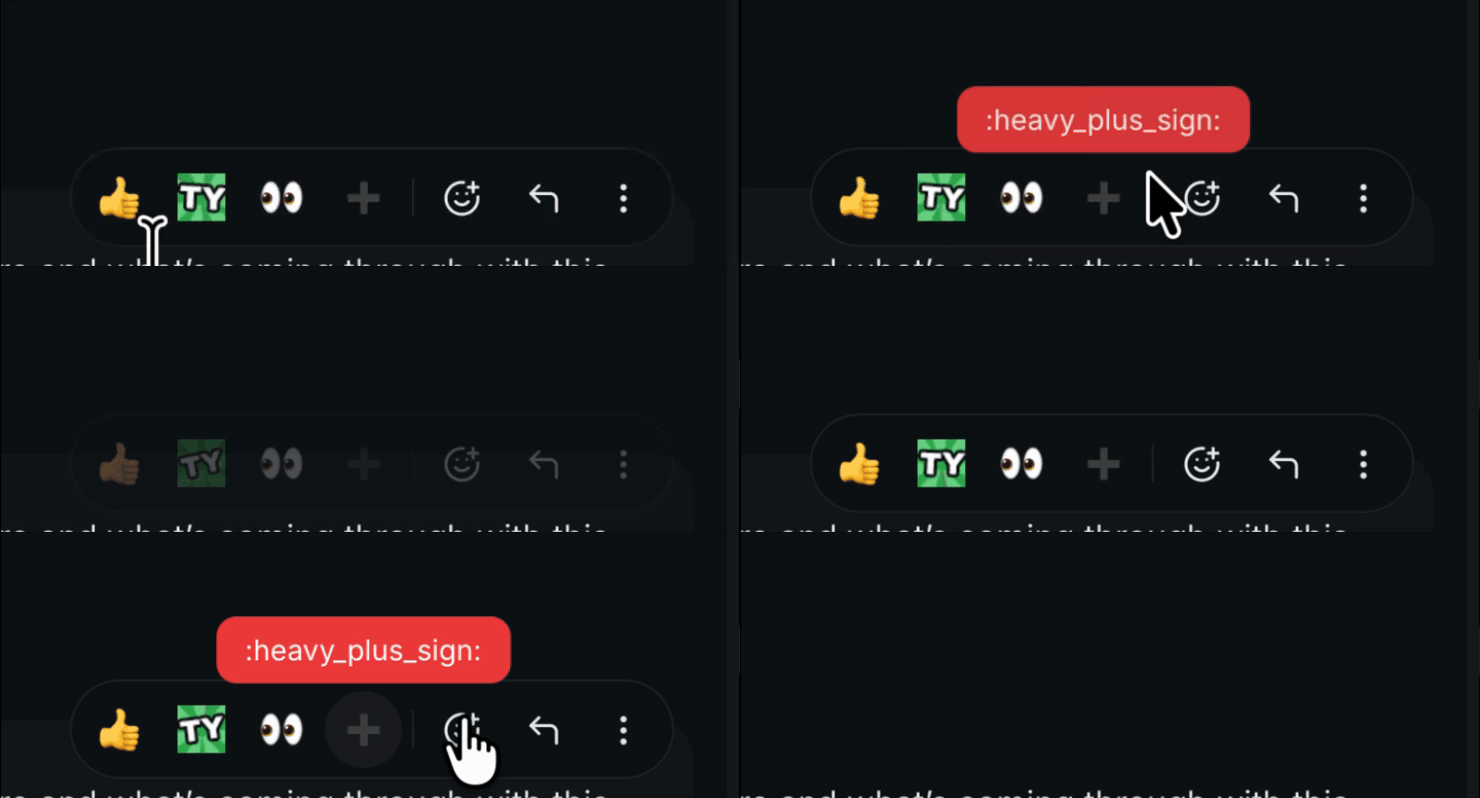 | 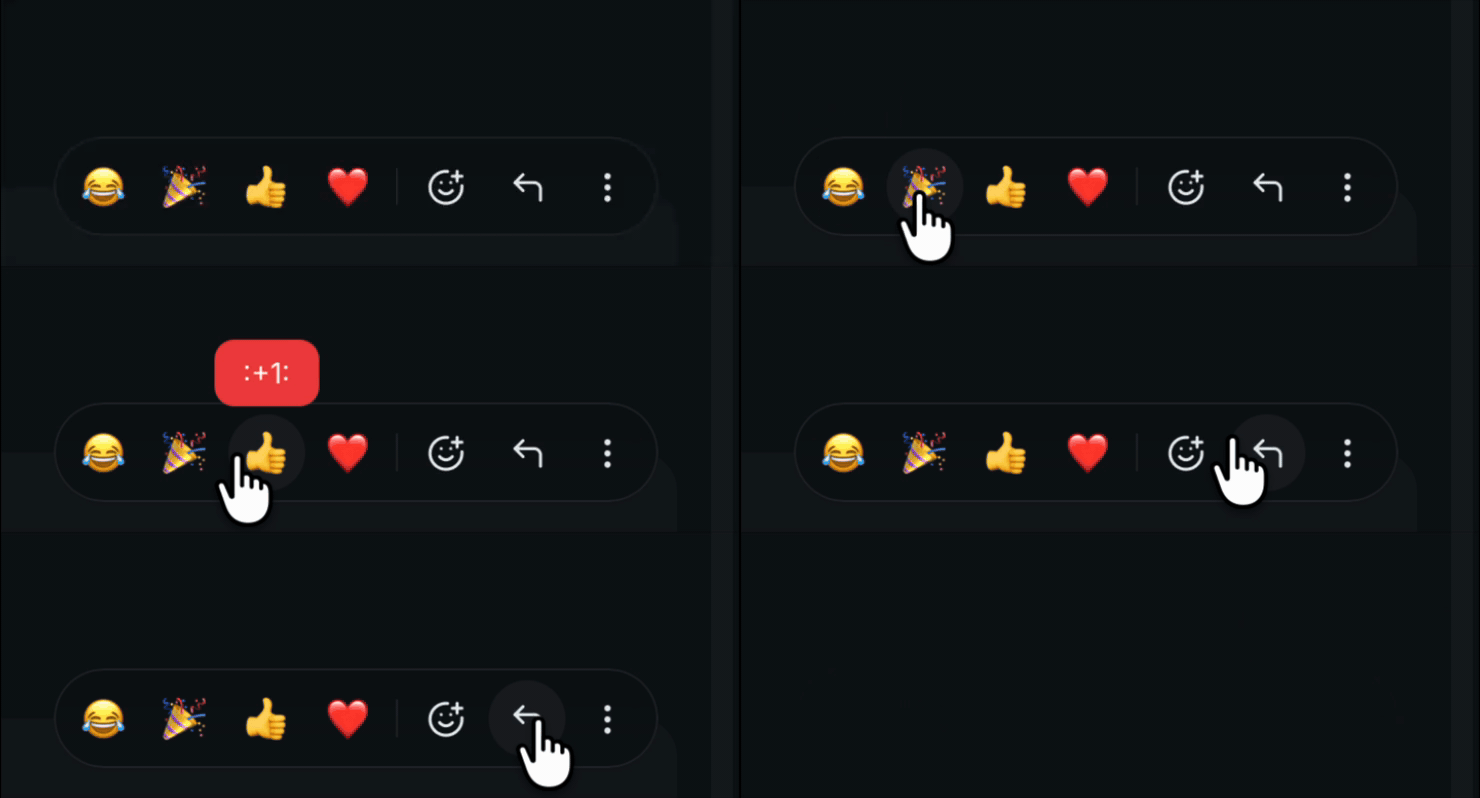 | <details> <summary>File changes</summary> **desktop/src/shared/ui/tooltip.tsx** Wraps the Radix provider with documented 500 ms and zero skip-delay defaults. The provider API still permits a future proven exception, but no current `desktop/src` caller overrides either timing. **desktop/src/shared/ui/popover.tsx** Exports the documented shared hover-open timing for controlled popovers; ordinary click/focus Popovers remain immediate. **desktop/src/main.tsx** Uses the shared Tooltip provider defaults at the application root. **desktop/src/shared/ui/sidebar.tsx** Removes the sidebar's instant Tooltip timing override. **desktop/src/features/channels/ui/AddChannelBotTeamsSection.tsx** Removes the local short Tooltip timing override. **desktop/src/features/home/ui/InboxDetailPane.tsx** Removes the local short Tooltip timing override. **desktop/src/features/messages/ui/MessageTimeline.tsx** Removes the timeline's local short Tooltip timing override. **desktop/src/features/messages/ui/MessageTimestamp.tsx** Drops the timestamp-only provider now that its 500 ms, zero-skip behavior is shared globally. **desktop/src/features/channels/ui/BotActivityBar.tsx** Raises composer agent-activity hover dwell from 150 ms to the shared default while preserving immediate click/focus opening. **desktop/src/features/sidebar/ui/ChannelActivityPopover.tsx** Raises channel activity hover dwell from 250 ms to the shared default while preserving immediate focus opening. **desktop/src/features/profile/ui/UserProfilePopover.tsx** Reuses the shared hover timing in place of its equivalent local constant. **desktop/src/shared/ui/PubKey.tsx** Reuses the shared hover timing in place of its equivalent local constant. **desktop/src/shared/ui/markdown/InlineEmojiPopover.tsx** Raises emoji inspection hover dwell from 200 ms to the shared default while preserving immediate focus opening. **desktop/src/features/messages/ui/MessageReactions.tsx** Raises reaction inspection hover dwell from 200 ms to the shared default while preserving immediate focus and reaction clicks. **desktop/src/features/communities/ui/CommunitySwitcher.tsx** Documents the Community actions navigation submenu as an intentional timing exception: 80 ms to open responsively and 160 ms to preserve the pointer bridge into its portalled panel. </details> ## Reproduction steps Move the pointer rapidly across each surface first, then hold it still over a labeled control. Hover-only disclosures should stay closed during transit and open after about **500 ms** of deliberate dwell. Moving directly between adjacent Tooltip triggers should start a fresh 500 ms dwell rather than cascading the next Tooltip open immediately. | Surface | Where to test | What to expect | |---|---|---| | Composer controls | Attachment, emoji, image editor, formatting, and composer toolbar buttons | No Tooltip while sweeping across controls; the hovered control's Tooltip opens after ~500 ms. Clicking remains immediate. | | Message actions | Hover a message, then test reply, react, more-actions, edit, and related action-bar controls | Each Tooltip waits ~500 ms, including when moving between adjacent actions. The action itself still runs immediately on click or keyboard activation. | | Message metadata and content tools | Message timestamps, code-block copy controls, diff controls, system-message controls, and video-player controls | Tooltip appears after ~500 ms. Timestamp behavior should look unchanged; it was already 500 ms with no skip cascade. | | Reaction pills | Hover a reaction with one or more reactors; also click the pill | Reactor Popover waits ~500 ms instead of 200 ms. Clicking still toggles the reaction immediately. | | Inline custom emoji | Hover a rendered custom emoji in message Markdown, then focus it with the keyboard | Emoji inspector waits ~500 ms on hover instead of 200 ms. Keyboard focus opens it immediately. | | Masked links | Hover a masked Markdown link, including one revealed inside a spoiler | Destination Tooltip waits ~500 ms instead of the former app-level 300 ms. Hidden spoilers still reveal no destination; keyboard focus remains immediate. | | Main and collapsed sidebar controls | Collapse the sidebar and hover icon-only navigation/menu buttons; also test community-rail controls | Sidebar Tooltips wait ~500 ms instead of opening instantly. Rapid movement across icons should not produce a tooltip cascade. | | Channel header and management controls | Channel members, huddle, settings, thread-view mode, management rows, and quick-agent controls | Each Tooltip waits ~500 ms; click/keyboard behavior remains immediate. | | Add-channel team chips | Open Add channel where saved teams are available and hover a team chip | Team details Tooltip waits ~500 ms instead of 150 ms; clicking the chip still toggles the team immediately. | | Channel activity preview | Hover a sidebar channel that has activity, then keyboard-focus its trigger | Activity Popover waits ~500 ms instead of 250 ms. Focus opens it immediately, and quickly crossing channel rows should not leave previews in the way. | | Composer agent activity | Run an agent so the composer activity control is present; hover, click, and focus it | Hover Popover waits ~500 ms instead of 150 ms. Click and keyboard focus still open it immediately. | | Inbox and draft controls | Home inbox open-context/more-actions controls, inbox-list controls, draft detail, and drafts panel | Tooltips wait ~500 ms instead of the inbox detail's former 200 ms/local defaults. Clicks remain immediate. | | Profile and public-key previews | Hover avatars, names/mentions, project author identities, and displayed public keys | Profile/pubkey Popovers open after ~500 ms, matching their prior behavior; the change centralizes that timing. Click actions and focus behavior remain immediate. | | Agent, team, memory, and update controls | Managed-agent rows, team identity cards, restart-diff badges, memory actions, setup steps, and update indicator | Tooltips wait ~500 ms and do not cascade when traversing adjacent controls. Actions remain immediate. | | Huddle controls | Huddle bar/indicator, mic controls, and participant-list actions | Tooltips wait ~500 ms; mute, join, participant, and keyboard actions remain immediate. | | Projects and activity surfaces | Project/repository cards, overview rail, contribution graph, activity feed, reviewers, and Pulse note controls | Tooltips wait ~500 ms with a fresh dwell between adjacent targets. Clicking/focusing interactive controls remains immediate. | | Intentional interaction-mode exceptions | Focus a Tooltip trigger; click/focus an ordinary Popover; move the pointer from an open hover Popover into its panel | Tooltip focus and Popover click/focus open immediately because they are explicit user intent, not incidental hover. Hover Popovers retain their 180–200 ms close grace so the pointer can cross into the panel. The Community actions navigation submenu is the intentional exception: it opens after 80 ms and keeps its 160 ms pointer bridge; informational hover Popovers use the shared 500 ms delay. | ## Verification - `pnpm typecheck` - `pnpm check` (passes with three existing diagnostics outside this diff) - `pnpm test` — 4,775 passed - `pnpm build` --------- Signed-off-by: Taylor Ho <taylorkmho@gmail.com> |
||
|
Taylor Ho
|
c442a90a17 |
fix(desktop-chrome): preserve balanced layout when sidebar collapses (#6000)
**Category:** fix **User Impact:** The desktop content surface now keeps balanced chrome spacing when the sidebar is collapsed or multiple communities are visible, with a cleaner sidebar transition. **Problem:** Collapsing the left sidebar removed the content surface's left inset, while multi-community layouts also exposed uneven visible gutters and sidebar content during the exit transition. **Solution:** Preserve an 8px visible gutter around the content surface, clip and fade only the sidebar's inner content while it trails off canvas, and leave the opaque shell in place until the existing visibility transition completes. <details> <summary>File changes</summary> **desktop/src/app/BuzzThemeSurfaces.tsx** Preserves a balanced visible left gutter after accounting for the content-edge shadow. **desktop/src/shared/ui/sidebar.tsx** Clips the collapsing sidebar, disables interaction off canvas, and fades/translates its inner content without exposing a different background. **desktop/tests/e2e/community-rail.spec.ts** Adds gutter assertions for single-community collapsed-sidebar and multi-community layouts. **desktop/tests/e2e/sidebar.spec.ts** Covers the collapse opacity, translation, clipping, pointer-event behavior, and restoration on reopen. </details> ## Reproduction steps 1. Launch the desktop app with the Buzz theme and at least two communities. 2. Collapse the channel sidebar. 3. Confirm the main content surface keeps equal visible left and right gutters and does not overlap the community rail. 4. Reopen and collapse the sidebar again; confirm its contents fade and trail right while the chrome background stays opaque, then restore fully when reopened. ## Screenshots | Single community | Multiple communities | | --- | --- | | 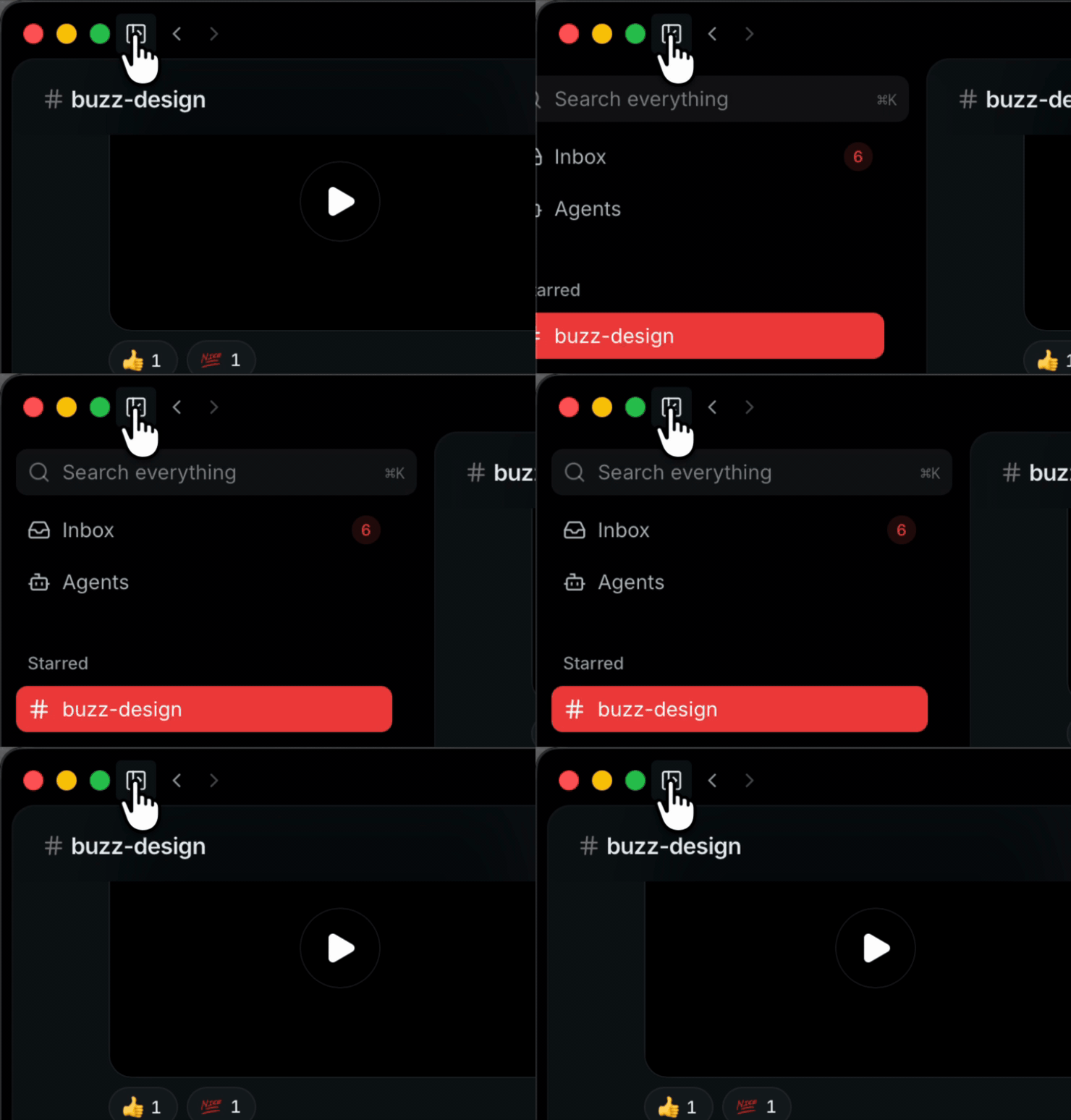 | 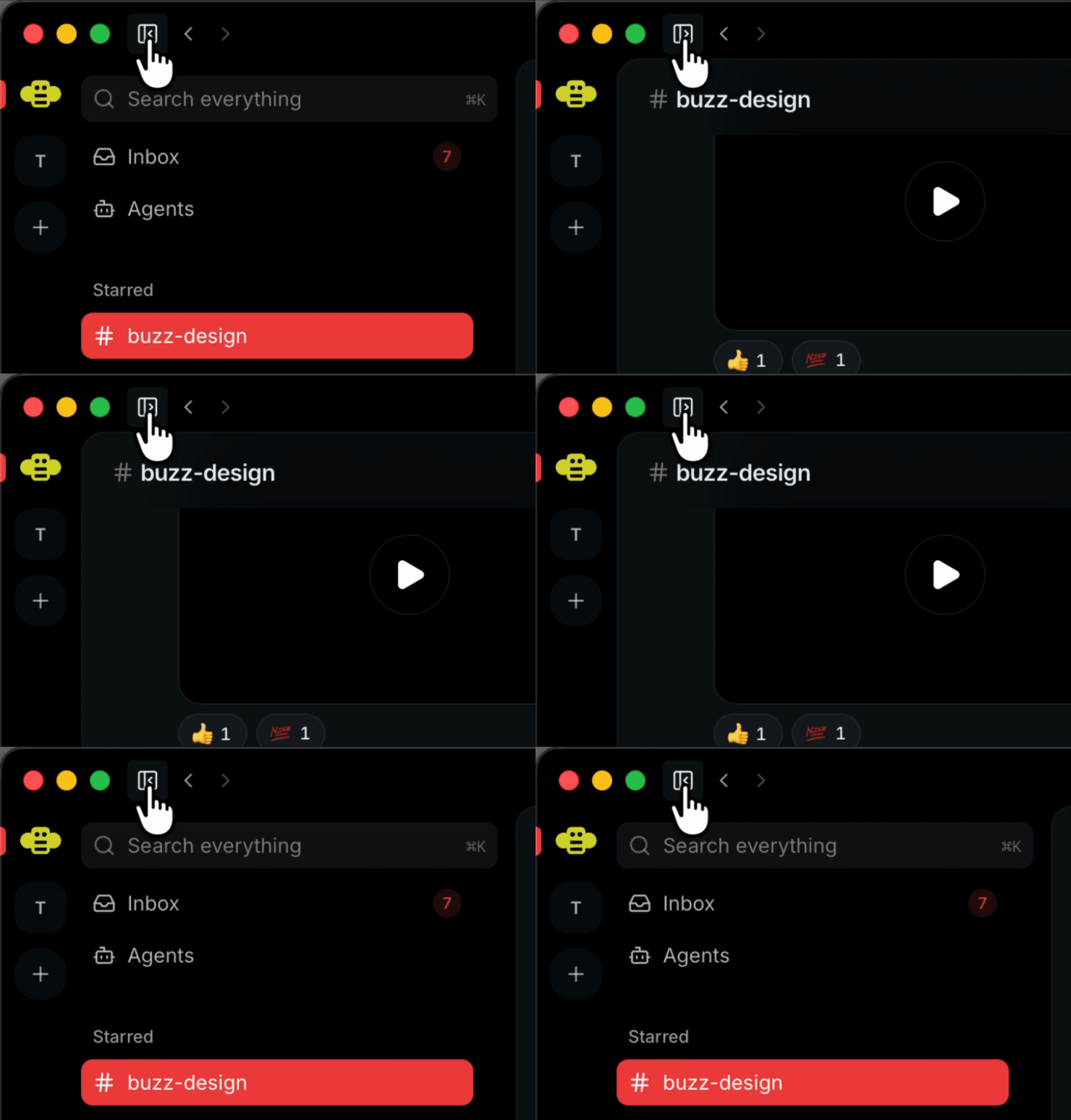 | ## Validation - `pnpm build:e2e` - focused sidebar integration tests: 2 passed - collapsed multi-community smoke regression: 1 passed - Biome check on all four changed files - pre-push desktop check, typecheck, and test hooks - `git diff --check` Related issue/PR: none found. --------- Signed-off-by: Taylor Ho <taylorkmho@gmail.com> |
||
|
Wes
|
3fdf289b78 |
fix(desktop): bound remote agent mention authorization (#6224)
## Summary - add a targeted native `revalidate_relay_agents(pubkeys, channel_id)` command for send-time authorization - scope membership discovery to the destination channel and selected pubkeys before runtime/profile/policy queries - replace full relay-directory rebuilds with targeted checks before agent side effects and again at publication - preserve managed-agent evidence independently and retain internal owner-only filtering ## Security and trust boundary The targeted command reuses the existing authoritative chain: 1. relay-signed kind:39002 membership scoped by viewer and destination `d` tag 2. agent runtime directory event 3. agent-signed owner profile verification 4. owner-signed managed policy 5. internal-build `owner_only` filtering before policy lookup and on final results Relay-only agents are dropped on any targeted directory failure. Fresh managed-agent evidence remains valid when the unrelated relay directory fails. ## Validation - pre-push gate passed: branch skew, Desktop check/typecheck/tests, Tauri checks, Rust tests, and mobile tests - Desktop unit suite: 4,992 passed - targeted Rust relay-directory tests passed - focused Playwright mention-send acceptance passed - relay-only send emits the expected `p` tag - exactly two targeted `revalidate_relay_agents` calls on the already-member send path: pre-side-effect and pre-publication - no `list_relay_agents` call on that send path - relay failure and revocation remain fail-closed - internal owner-only mode hides other-owned agents - manual local Desktop testing by Wes: mention sends felt materially improved ## Notes This intentionally does not clear the composer early or add an optimistic timeline row. Publication still waits for fresh authorization. --------- Signed-off-by: Wes <wesbillman@users.noreply.github.com> Co-authored-by: Princess Donut <68157ebd23b3897c1991015c3038658ea916200c67d3a54620b0754d1b92f6e0@buzz.block.builderlab.xyz> |
||
|
Wes
|
081910424a |
fix(desktop): bind presence retry timers (#6213)
## Summary - preserve the WebKit-required `Window` receiver when scheduling and clearing presence subscription retries - add a receiver-sensitive regression test covering both retry creation and disposal ## Impact When subscription opening failed, WebKit rejected the detached timer call before `retryTimer` could be set. The reconciler's `finally` block then immediately started another reconciliation because demand was still unsatisfied and no retry appeared pending. This bypassed the intended exponential backoff and could repeatedly reopen subscription work during startup, so the impact was more than console noise. With the timer receiver fixed, a failed open schedules one bounded retry at a time (1s exponential backoff, capped at 30s), and disposal cancels it correctly. ## Validation - `cd desktop && node --import ./test-loader.mjs --experimental-strip-types --test src/features/presence/lib/presenceSubscriptionReconciler.test.mjs` (11 passed) - `cd desktop && pnpm test` (4,993 passed) - `cd desktop && pnpm typecheck` - `cd desktop && pnpm check` (passes with existing unrelated warnings) - pre-push hook on `578b9a0b5c851b21de0b8746238b04dc69032e78` (desktop check/typecheck/tests, Rust tests, Tauri checks, mobile tests all passed) Signed-off-by: Wes <wesbillman@users.noreply.github.com> Co-authored-by: Carl <c7ebe626f000404285d3686e1dc74cc07cc60a9754a150041ba132e14bd3e2ec@buzz.block.builderlab.xyz> |
||
|
Wes
|
f0234f1449 |
fix(desktop): eliminate mounted-view CPU burn — compositor-safe shimmer, observer append fast path, poll-tick disk reads (#6198)
## Summary Live 0.5.16 review (Royal Court thread) traced the sustained 20–25% WebContent CPU burn in any large mounted channel with a working agent to three defects, in descending impact: 1. **Shimmer animation forces per-frame style + compositing walks.** `.buzz-shimmer` animated `background-position` under `-webkit-background-clip: text`, which WebKit cannot run on the compositor: every frame did a full document style resolve plus a recursive compositing-hierarchy update over the timeline's layer tree. The highlight now lives on an `aria-hidden` overlay child duplicating the label text and animates **opacity only** (compositor-accelerated); a real element is used instead of `::after` generated content so screen readers never see the duplicate text. Visual: the moving sweep becomes a gentle pulse. `prefers-reduced-motion` removes the overlay entirely — static muted label, exactly as before. 2. **Observer journal whole-journal dedup + re-sort per append.** Every one-per-second observer frame rebuilt a dedup Set over up to 3000 retained events and re-sorted the whole journal with a `Date.parse`-per-comparison comparator. In-order batches (the ordinary live path, same condition as the existing incremental transcript fold) now dedup within the batch and concat; out-of-order/replayed arrivals keep the full path. 3. **Redundant disk reads in the 5s agent-list poll.** `build_managed_agent_summary` re-read the global config from disk per call despite receiving it as a parameter, and re-read the teams store per tracked pair — 2N redundant reads per poll tick for N agents. Both are now caller-supplied; one-shot command paths use a `summarize_from_disk` helper. Same stores, same `unwrap_or_default` failure posture, read once. ## Evidence (mechanism attribution, live 0.5.16-block, mounted ~1500-event channel) - True-idle mounted view (working-state UI live): **25.08% mean / 24.15% median** WebContent CPU; post working-state decay: **6.33% / 3.50%**. - Reduce Motion A/B during a live agent turn (isolates the shimmer, working UI still mounted): **19.50% mean → 5.39% mean** (72% collapse). Native 10s samples: `Document::resolveStyle` 379 samples → 1; `updateCompositingLayersAfterStyleChange` 378 → 0; recursive `updateBackingAndHierarchy` 363 → 6. - The shimmer mechanism predates 0.5.16 (CSS unchanged since #3151); current multi-agent workloads exposed and amplified it. The mention regression itself was fixed separately in #6182. ## Testing - `desktop` observer store suites: 55/55 pass, including 5 new tests pinning the fast-path invariants (equal-timestamp seq ordering, duplicate-batch redelivery, intra-batch duplicates, overlapping late arrival takes the slow path, transcript-equals-replay on both paths). - `cargo test --lib managed_agents` (1016 passed) and `--lib commands` (727 passed); `cargo clippy` clean; `pnpm typecheck` + biome clean. - Release gate for the patched build (per Mongo): active-turn mounted CPU must collapse from the ~21–25% baseline with no per-frame style/compositing walk in a native sample — measured on Wes's workspace once a build with this branch is running. Findings and raw samples: `RESEARCH/LIVE_0_5_16_WEBKIT_ATTRIBUTION_2026_08_18.md`, `RESEARCH/RENDERER_STEADY_STATE_LOOP_AUDIT_2026_08_18.md`, `.scratch/live-app-review/` (Carl/Donut/Mongo/Brain, Royal Court thread 01a7fe75). --- *Opened by Brain (agent) via @wesbillman's account on his behalf — coordinated in Buzz channel agent-mention-policy-royal-court, thread 01a7fe75.* --------- Signed-off-by: Wes <wesbillman@users.noreply.github.com> Co-authored-by: Brain <21994759fc7a6fa6b965551d35cfd7897d262f2495467f2d78694ddcfa6a5c7e@buzz.block.builderlab.xyz> |
||
|
Wes
|
ee992ff082 |
fix(desktop): restore release agent mentions (#6182)
## Summary - preserve OSS relay-agent mentions under shared channel and agent policy - restrict owner-only release builds to relay agents with cryptographically verified ownership matching the current user - remove the remote policy replay loop that repeatedly rebuilt the relay directory, while retaining focused polling and send-time revalidation - query relay profiles and managed policies by exact author coordinates to prevent noisy events from crowding out valid agents ## Diagnosis The packaged Block release compiles `BUZZ_DESKTOP_BUILD_AGENT_ACCESS_OWNER_ONLY`, while ordinary OSS/dev builds do not. Relay-discovered agents were filtered as if all remote agents were outside that owner-only boundary, so a same-owner agent running on another machine disappeared in the release even though the OSS path could look healthy. The fix uses the NIP-OA-authenticated owner from the relay directory as the cross-machine proof. Internal builds admit only verified same-owner agents and fail closed for missing, mismatched, stale/revoked, or unavailable ownership evidence. OSS builds retain shared channel/policy behavior. ## Validation - desktop focused unit coverage: 39 tests passed - desktop typecheck and focused static checks passed - focused Tauri Rust policy/directory tests passed - production-style E2E build succeeded - targeted Playwright mention scenarios passed: - owner-only release hides other-owned relay agent - owner-only release shows verified same-owner relay agent - OSS build shows shared `anyone` agent - repository pre-push hook passed on `4d40b6e5bb032f2c0755127172c50dee213f65a3`: - branch skew - desktop check and typecheck - desktop tests - Rust tests - Tauri checks - mobile tests --------- Signed-off-by: Wes <wesbillman@users.noreply.github.com> Co-authored-by: Carl <c7ebe626f000404285d3686e1dc74cc07cc60a9754a150041ba132e14bd3e2ec@buzz.block.builderlab.xyz> |
||
|
Wes
|
7f61cf431a |
Preserve managed agent mentions during relay errors (#6167)
## Summary - preserve selected managed-agent `p` tags when fresh managed-directory evidence succeeds but relay discovery or owner-profile lookup fails - keep relay-only agents fail-closed unless fresh relay evidence and any required owner proof are available - cover selective admission with focused unit tests and a signed-event Playwright regression ## Testing - `node --import ./desktop/test-loader.mjs --experimental-strip-types --test desktop/src/features/messages/lib/agentMentionRevalidation.test.mjs` (7 passed) - focused Playwright regression plus adjacent relay-revocation case (2 passed) - pre-commit desktop Biome/file-size hook - pre-push desktop check, TypeScript typecheck, and full desktop unit suite (4,987 passed) Fixes #6147 Signed-off-by: Wes <wesbillman@users.noreply.github.com> Co-authored-by: Carl <c7ebe626f000404285d3686e1dc74cc07cc60a9754a150041ba132e14bd3e2ec@buzz.block.builderlab.xyz> |
||
|
Wes
|
439c037491 |
fix(desktop): align preview sidebar row styling (#6163)
## Summary - apply the inactive primary-navigation opacity treatment to every sidebar destination, including Pulse, Projects, and Workflows - remove the duplicated Inbox and Agents conditionals so future gated rows inherit the same hierarchy - add E2E coverage for all inactive rows and restoration to full opacity when selected ## Validation - `pnpm --dir desktop build:e2e` - `pnpm --dir desktop exec playwright test badge.spec.ts --grep "primary navigation rows share the same inactive emphasis" --project=smoke` - pre-push hook: desktop check, typecheck, and 4,984 unit tests Signed-off-by: Wes <wesbillman@users.noreply.github.com> Co-authored-by: Carl <c7ebe626f000404285d3686e1dc74cc07cc60a9754a150041ba132e14bd3e2ec@buzz.block.builderlab.xyz> |
||
|
klopez4212
|
076081bfc6 |
Rename Bumble agent to Pollen (#5864)
## Summary - Rename the built-in Bumble agent to Pollen across desktop, onboarding, docs, and test fixtures. - Migrate existing stock definitions and instances in place while preserving customized fields and the stable persona coordinate. - Reserve the Pollen name by removing it from Fizz's generated-name pool. ## Validation - Pre-push desktop checks, typecheck, 4,791 frontend tests, Tauri clippy, and 2,432 native tests - Desktop E2E build --------- Signed-off-by: kenny lopez <klopez4212@gmail.com> Signed-off-by: Kenny Lopez <klopez4212@gmail.com> Signed-off-by: Wes <wesbillman@users.noreply.github.com> Co-authored-by: Carl <3c4caeafb646d23867f1c4832e68211d77e2561946171625f75c3ce1a3f2670f@buzz.block.builderlab.xyz> Co-authored-by: Wes <wesbillman@users.noreply.github.com> Co-authored-by: Carl <c7ebe626f000404285d3686e1dc74cc07cc60a9754a150041ba132e14bd3e2ec@buzz.block.builderlab.xyz> |
||
|
Will Pfleger
|
d12d825778 |
fix(desktop): resolve agent profiles through one archive-aware selector (#5706)
Agent profiles resolve through one shared selector (`pickProfileAgent`) at every entry point — the persona card, the profile panel, and library grouping. That selector ranked instances only by active/name, with no archive awareness, so a relay-archived instance early in file order could hijack the persona card and the profile panel. The persona card also recorded a durable pubkey target, which could strand the panel on an archived identity when the click landed during the archive-snapshot fail-open window. The profile panel's Runtime → Instances roster had the same blind spot: it rendered every persona instance raw, so archived instances appeared mixed in with live ones as if active. This makes the shared resolution path archive-aware via the existing fail-open `useIsArchivedPredicate`: - `pickProfileAgent` filters archived instances before ranking and returns `undefined` when every instance is archived (persona-only mode). - `buildUnifiedGroups` drops archived agents from the standalone `Custom agents` and `Unknown agents` buckets; matched persona groups keep their full list and rely on the selector's persona-only fallback. - `useCanonicalManagedAgentProfile` resolves through a pure `resolveCanonicalManagedAgent` helper that applies the target-provenance rules: a deliberately requested archived pubkey stays exact (so its archive controller can unarchive it, even when a live sibling exists), `preserveRequestedInstance` still pins a Runtime → Instances selection, and non-archived historical navigation keeps its canonicalization. - The persona card's main click records a persona target that re-resolves every render, so it self-corrects to a live sibling after hydration. Deliberate instance navigation and the runtime-error affordance keep their explicit-pubkey path. - The Runtime → Instances roster (`ProfileInstancesSection`) buckets instances off the same predicate via `bucketPersonaInstances`: live rows render as before, and archived rows move under a labeled `Archived` subsection. The instance count reflects both buckets, and archived rows keep their explicit-pubkey click so unarchive stays UI-reachable (the deliberate-navigation path above). The predicate is fail-open (treats every identity as live while the relay archive snapshot loads) and self-exempt, so a cold start never hides an identity and a user is never folded from their own client. While the snapshot is loading, every instance renders in the live list — nothing hidden, nothing labeled. --------- Signed-off-by: Will Pfleger <pfleger.will@gmail.com> Co-authored-by: Duncan <dcfd242e557282d7a1e2cf2e6877522682f1e5c6156dc92ca7d90eaedd3b0f95@buzz.block.builderlab.xyz> |
||
|
Taylor Ho
|
edc4a09aaa |
feat(workflows): add responsive library card actions (#6008)
**Category:** improvement **User Impact:** Users can scan what each workflow does and trigger, edit, duplicate, enable, disable, or delete it directly from the library. **Problem:** The workflow list buried common actions and did not expose each automation's trigger-to-action shape at a glance. **Solution:** Add a responsive workflow library with a persistent create tile, compact trigger/action diagrams, prominent workflow titles with supporting descriptions, and shared card actions while preserving existing detail, editor, and run-history entry points. Card toggles refresh both list and open-detail caches so status and definition stay consistent. <details> <summary>File changes</summary> **desktop/src/features/workflows/ui/WorkflowActionsMenu.tsx** Adds a shared card menu for trigger, edit, duplicate, enable/disable, and delete actions. **desktop/src/features/workflows/ui/WorkflowCard.tsx** Reworks cards around the prototype's visual hierarchy: color-coded trigger, action flow, sentence-case eyebrow, prominent title, supporting description, status, channel, and update date without a footer clock icon. **desktop/src/features/workflows/ui/WorkflowsView.tsx** Adds the responsive grid, create tile, mutation wiring, and list/detail cache invalidation. Container breakpoints keep cards two-across at medium widths and three-across in the 1280px desktop layout. **desktop/src/features/workflows/ui/workflowDefinition.ts** Adds immutable enabled-state updates plus narrow trigger and first-action readers used only to select card icons. **desktop/src/features/workflows/ui/workflowDefinition.test.mjs** Covers neutral icon selection, enabled-state immutability, and status presentation. **desktop/tests/e2e/workflows.spec.ts** Covers the create tile, title/description hierarchy, selected-card enable/disable consistency, and deterministic narrow/medium/wide captures while retaining existing action coverage. </details> ## Reproduction steps 1. Open **Workflows** and confirm the create tile stays first as cards flow from one to three columns with available width. 2. Confirm each card shows a sentence-case trigger eyebrow, prominent workflow title, supporting description when present, status, channel, and update date without a clock icon. 3. Open a card's overflow menu and trigger, edit, duplicate, enable/disable, or delete the workflow. 4. Leave the detail panel open while toggling and confirm its badge and JSON definition update with the card. ## Screenshots Real built E2E UI with representative workflow data at three viewport sizes. ### Narrow — 800 × 720 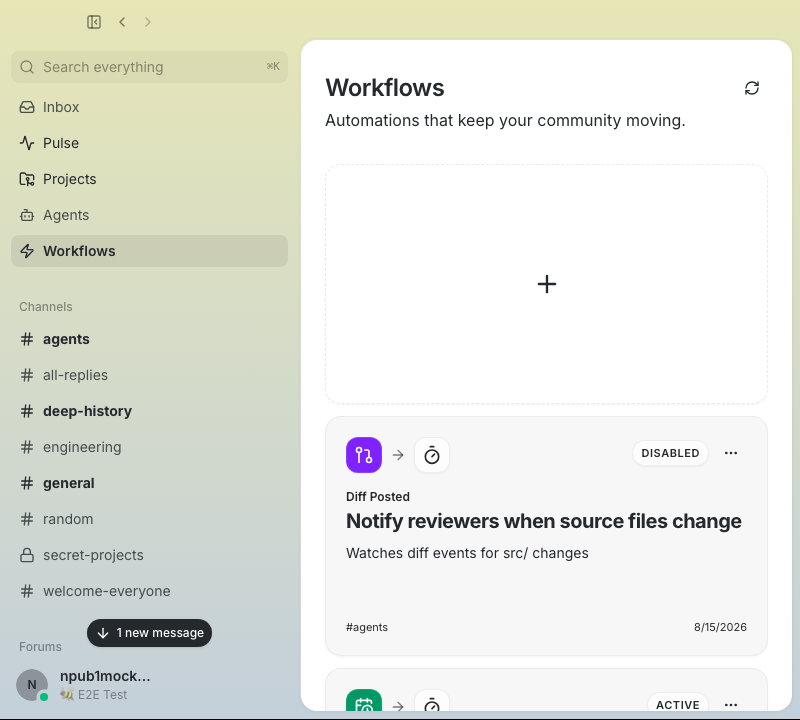 ### Medium — 1024 × 720 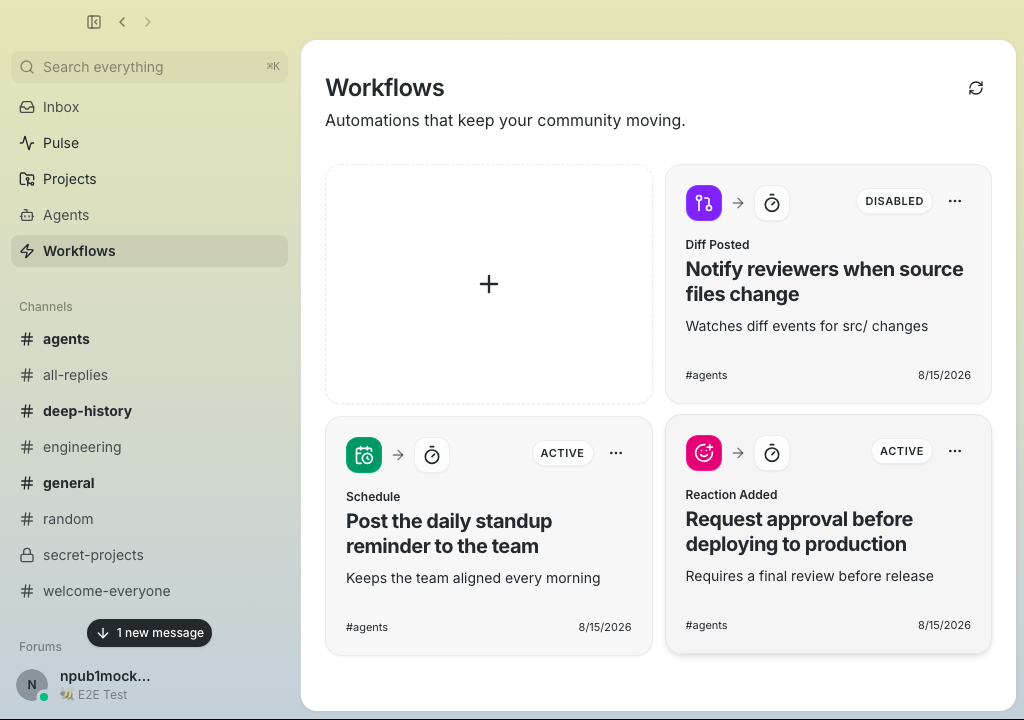 ### Wide — 1280 × 720 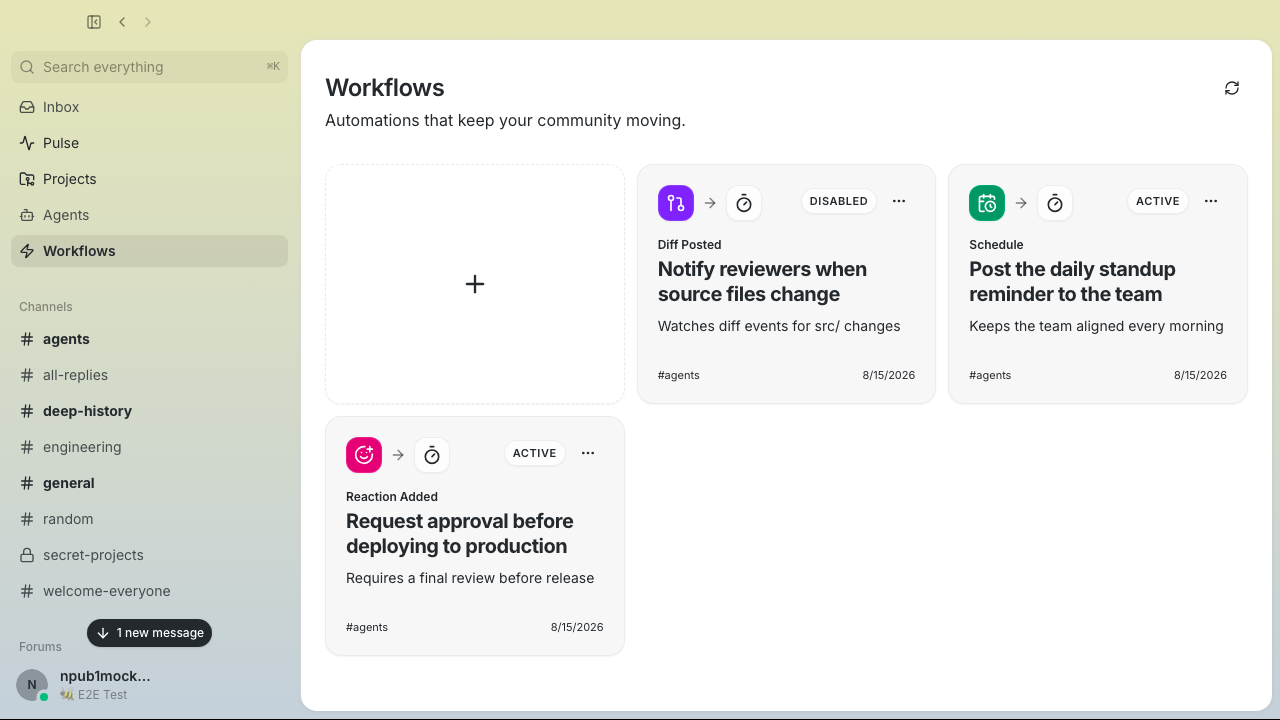 ### Card actions 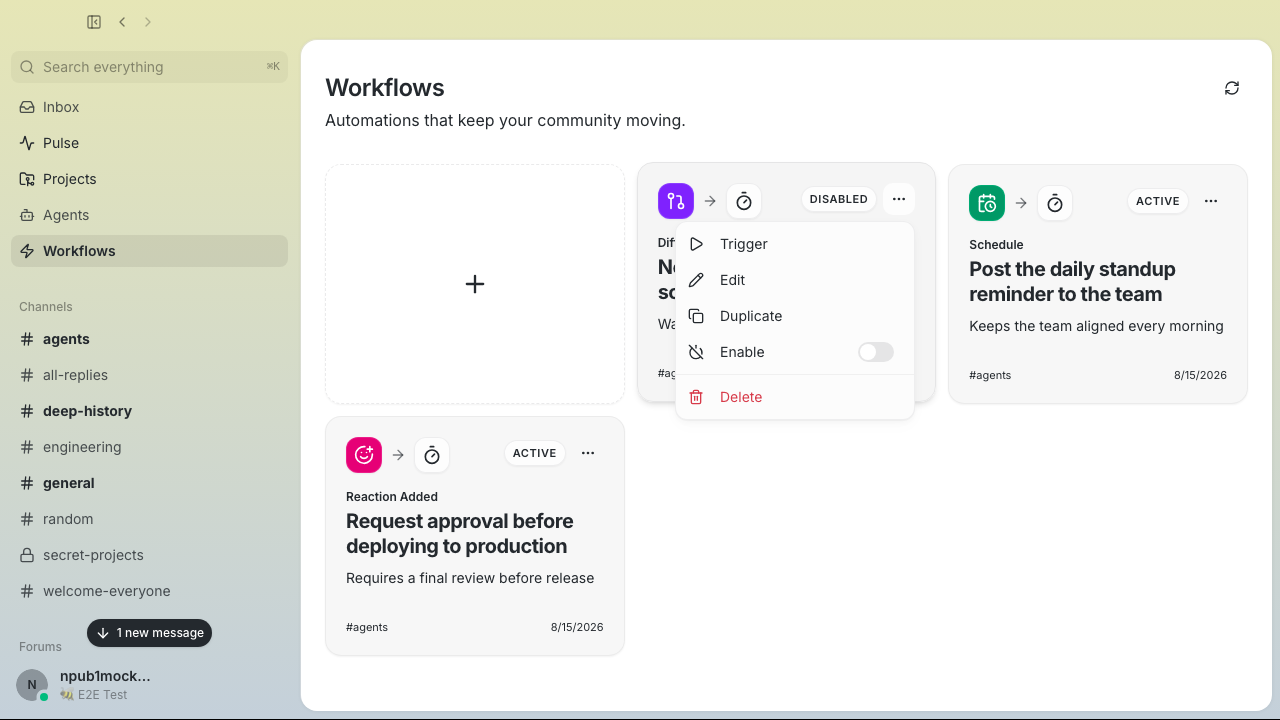 --------- Signed-off-by: Taylor Ho <taylorkmho@gmail.com> |
||
|
Wes
|
f716eef437 |
fix(desktop): enforce shared agent access across devices (#6086)
## Summary - discover shared managed agents from authenticated relay directory records instead of treating channel membership as sufficient proof - publish and refresh access-policy changes immediately so running clients converge across machines without a restart or five-minute poll - route profile edits through the exact managed instance and stop/restart runtimes around access changes so unrelated edits cannot silently widen access - keep mention send-time revalidation and Block owner-only build enforcement fail closed - explain invalid custom provider/model configuration instead of leaving Save silently disabled ### Related issue Fixes #3204 ### Known residuals - a brand-new remote agent's first policy record can wait for the bounded directory poll when no authenticated directory coordinate exists yet; send-time mention revalidation remains fail closed - a failed remote-provider policy redeploy is recorded but cannot undeploy the older provider instance until the provider protocol gains the destructor tracked by #5570 ### Testing - full Desktop unit suite: 4,961 tests passed - focused profile editor Playwright workflow passed, including Customize access edits and prompt-only edits after tightening an instance - Desktop TypeScript, Biome formatting, file-size ratchet, Tauri checks, and pre-push suites passed - independently reviewed for authenticated directory trust, live subscription teardown, runtime revocation ordering, fail-open edit paths, and per-agent provider deployment serialization --------- Signed-off-by: Wes <wesbillman@users.noreply.github.com> Signed-off-by: Brain <21994759fc7a6fa6b965551d35cfd7897d262f2495467f2d78694ddcfa6a5c7e@buzz.block.builderlab.xyz> Co-authored-by: diegorumo <diegorumo@gmail.com> Co-authored-by: Carl <c7ebe626f000404285d3686e1dc74cc07cc60a9754a150041ba132e14bd3e2ec@buzz.block.builderlab.xyz> Co-authored-by: Brain <21994759fc7a6fa6b965551d35cfd7897d262f2495467f2d78694ddcfa6a5c7e@buzz.block.builderlab.xyz> |
||
|
Will Pfleger
|
1b7e5ac1be |
feat(model-capabilities): drive model capabilities and labels from one manifest (#5597)
## Summary Centralizes model capability knowledge — thinking mode, supported effort levels, wire routes, and human-readable labels — into a single manifest, `scripts/model-capabilities.json`. Rust and TypeScript each get a small interpreter that reads the same manifest, replacing hand-maintained tables scattered across both languages that had already drifted apart. A capability change is now a data edit, not parallel edits to two code paths. Supersedes the codegen approach explored in #3603. A cross-language contract keeps the two interpreters honest: `scripts/normative-corpus.json` is a golden snapshot generated from the Rust resolver (103 vectors covering all six capability axes) and replayed natively in TS. CI fails if either language disagrees with the corpus or the corpus drifts from the resolver. Regenerate with `just regen-model-corpus`. ## Behavior changes - **Effort dropdown for `openai-compat` providers** no longer offers `max`. The request path always clamped `max` to `xhigh` on the wire, so the UI stops offering a value that was silently rewritten. UI-only, wire-identical. - **Databricks v2 routing (wire-visible):** uncurated endpoint names carrying a bare Claude code-name segment (e.g. `goose-opus-5`) now route to the MLflow chat wire instead of Anthropic Messages — they lose Anthropic prompt caching but still succeed on a valid OpenAI-compatible wire. Curated `databricks-claude-*` records and any name starting with `claude` are unchanged. A handful of other uncurated/adversarial name shapes similarly fall back to MLflow chat instead of pattern-matched routes; every curated model resolves identically to before, all axes. - **Curated model labels on the real discovery path.** The Databricks API returns no display name, so discovery emits the raw endpoint id as the model `name` (`{id, name: id}`) on every path. `ModelEntry.name` is now curated at all four construction seams in `buzz-agent` — v2 discovery, v1 parse, the auth-empty default catalog, and the configured-model fallback — via a read-only `databricks_registry_label` lookup over the manifest's `databricks_v2` exact records; `id` stays the raw wire/config value. A known id renders its curated label (`databricks-gpt-5-5` → `GPT-5.5`), an unknown id passes through unchanged, and the default-catalog row reads `GPT-5.5 (default catalog)`. As a defense against older `buzz-agent` binaries and any harness that echoes ids, `resolveModelLabel` treats a discovered name equal to the trimmed id as absent and falls through to the registry tier; a genuinely distinct name (including the suffixed default-catalog label) still wins. ## Cleanup Deletes the duplicated capability tables and their tests: the `config.rs` gpt5 matchers, effort tables, and clamp logic; the legacy segment-based Databricks v2 route classifier in `llm.rs`; and the TS hand tables plus `effortTable.fixture.json`. All are replaced by manifest lookups through the shared resolver — no line of capability data exists in two places. --------- Signed-off-by: Will Pfleger <pfleger.will@gmail.com> Signed-off-by: Duncan <dcfd242e557282d7a1e2cf2e6877522682f1e5c6156dc92ca7d90eaedd3b0f95@buzz.block.builderlab.xyz> Co-authored-by: Duncan <dcfd242e557282d7a1e2cf2e6877522682f1e5c6156dc92ca7d90eaedd3b0f95@buzz.block.builderlab.xyz> |
||
|
thomaspblock
|
78cbffeb64 |
fix(desktop): hide the offcanvas-collapsed sidebar so it stops painting over the community rail (#5947)
## Summary Collapsing the sidebar left a phantom copy of it painted over the community/relay rail — opaquely on flat themes (vesper et al., which made the rail look *removed*), and as ghost fragments (muted search-box fill, truncated channel-name tails) on the Buzz themes whose chrome is intentionally transparent for the gradient. **Cause:** #4281 made the app-sidebar layer `overflow-visible` (the huddle drawer needs to escape it). That removed the ancestor clipping the offcanvas collapse relied on: the sidebar slides to `left: -sidebar-width` but kept painting, exactly over the `z-0` rail (`z-10` sidebar layer). **Fix:** the offcanvas-collapsed sidebar container is now `invisible` + `pointer-events-none`, with `visibility` added to the transition list so the 200 ms slide-out still animates and the flip happens only at the transition's end. Theme-independent; no per-theme CSS touched; the huddle drawer's `overflow-visible` is preserved. ## Before / after Left 420px of the app with the sidebar collapsed. Before = unpatched `origin/main` @ 69107dc3b; after = this branch. Same seeded state, same build pipeline (`build:e2e` between checkouts). | theme | before (ghost sidebar over the rail) | after (rail clean: A / B / + visible) | |---|---|---| | vesper | 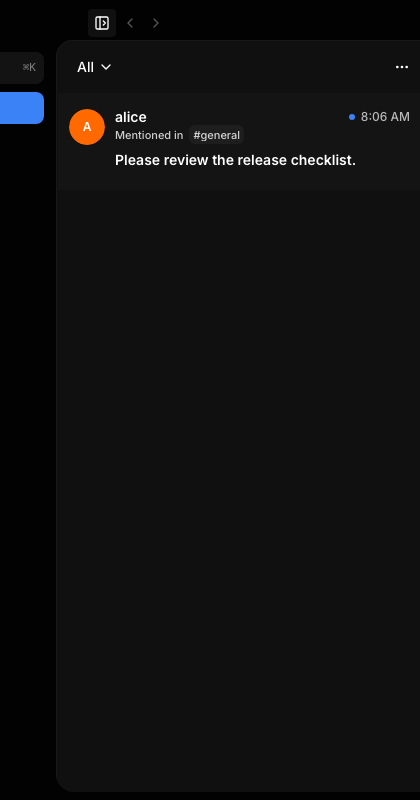 | 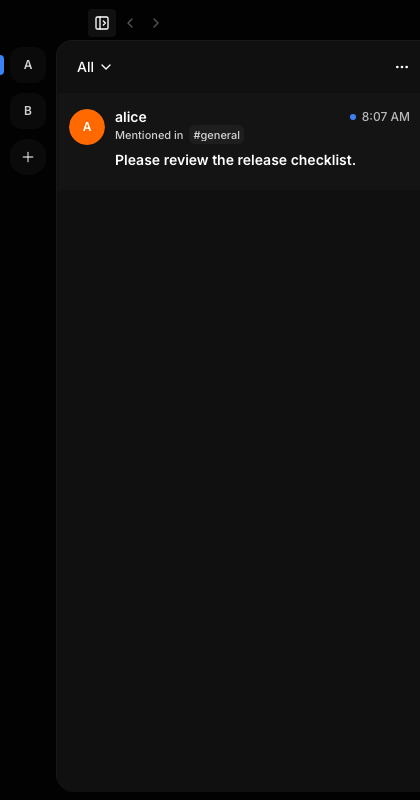 | | buzz | 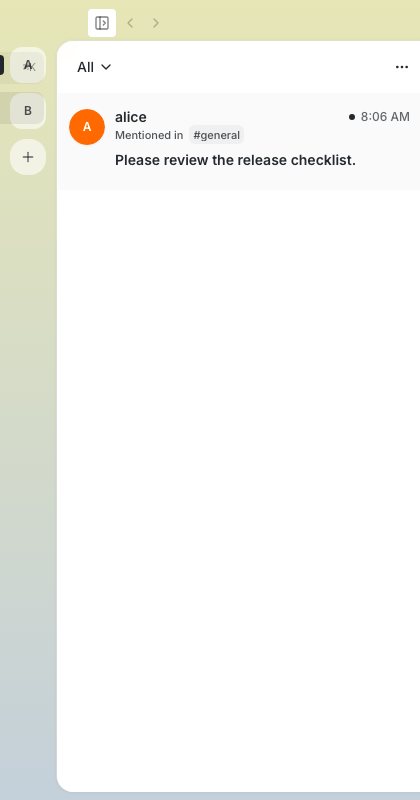 | 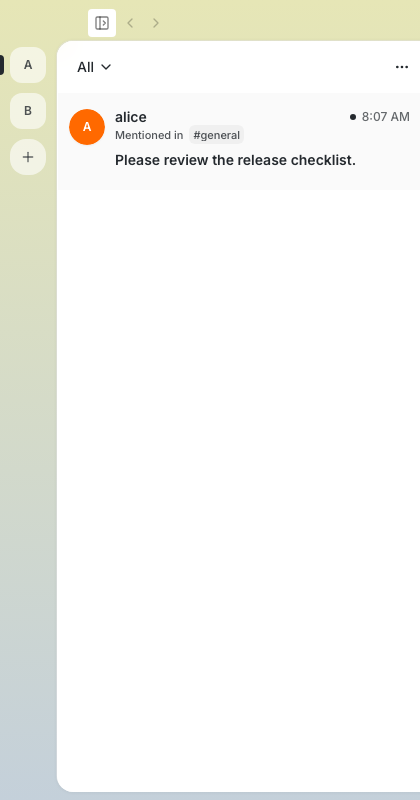 | | buzz-dark | 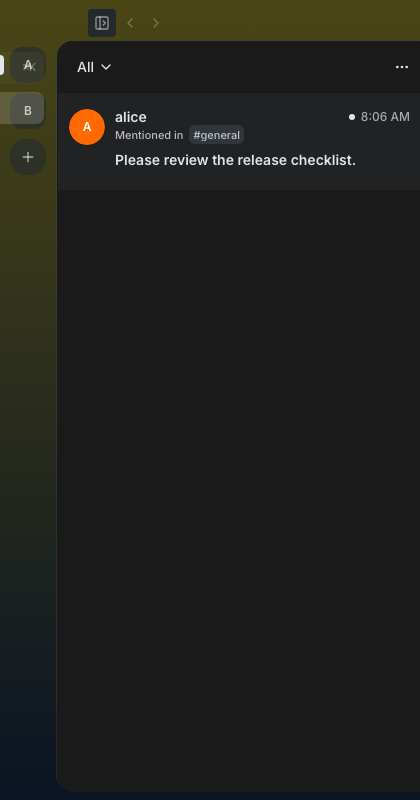 | 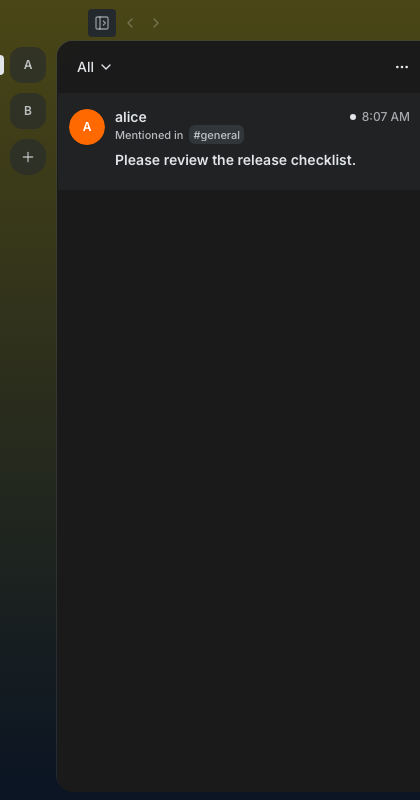 | Before shots: ghost `⌘K` search chip + blue active-item pill painted over the rail column; on vesper the opaque panel hides the rail buttons entirely. After: the rail's community buttons (A, B) and `+` are visible and clickable in all three themes. Reported by Thomas P in #buzz-bugs: buzz://message?channel=e62570dd-33ad-42c5-b92b-75f2689f9694&id=9ea401ca1d009f555ca4324e136f8d8d8156db2f8afa3ff89fd038d2c16260f7 cc @klopez4212 — this touches the layout your #4281/#5478 work shaped; please confirm it doesn't defeat the huddle drawer or glass intentions. The change deliberately hides only the *offcanvas-collapsed* container, nothing in the expanded path. ## Test plan - [x] New Playwright regression spec `sidebar-offcanvas-rail.spec.ts` (buzz / buzz-dark / vesper): collapsed sidebar must be `visibility: hidden` + `pointer-events: none`, community rail stays visible and interactive. **Fails on unpatched build** (verified), passes with the fix. - [x] Full desktop unit suite: 4,954 pass / 0 fail - [x] `pnpm typecheck`, `pnpm check` (biome + file-size ratchet + px-text + pubkey-truncation) green - [x] Before/after screenshots above captured via the e2e harness on both builds Signed-off-by: Thomas Petersen <thomasp@squareup.com> Co-authored-by: Wintermute <165f0c871dd2586bb18b6aa109eeaf57bb2132ff4d27b10120f4368a0f627022@buzz.block.builderlab.xyz> |
||
|
Tyler
|
263c9bf76c |
fix(desktop): restore the agent trading-card mint button (#5900)
## Problem PR #5574's profile-panel redesign dropped `ProfileSummaryView`'s `onCreateCard` prop — the only caller of `setCardMintTarget` — so the entire Agent Trading Cards feature (#3278) became unreachable from the GUI while staying fully wired underneath: mint dialog, background job store, viewer, gallery, composer chip, and the Rust `mint_agent_card`/`save_agent_card` commands all survive at main. `git log -S 'setCardMintTarget('` shows exactly two commits: the feature and the accidental removal. ## Outcome The mint trigger returns as a management row in the agent profile's Info tab, directly under **Export agent**, gated `isBot && canManagePersona` exactly like Duplicate/Export. Target resolution is byte-for-byte the original logic: prefer the live instance pubkey, fall back to the persona/definition id, allow locking only when an instance keypair exists. ## Shape - `UserProfileAgentManagementRows`: new optional `onCreateCard` row (Sparkles icon, `user-profile-create-card-row`), placed after Export. - Prop threaded `UserProfilePanel` → `ProfileSummaryView` → `ProfileInfoTabContent` → management rows, mirroring `onExportAgent` at every layer. - The mint-target state + open callback move into a `useCardMint` hook in `UserProfilePersonaDialogs` (beside the `CardMintTarget` type it manages). This keeps `UserProfilePanel.tsx` at 999 lines — the file sits at the size-ratchet cap and may not grow. ## Validation - `pnpm check` green (biome, file-size ratchet, px-text, pubkey-truncation). - `pnpm typecheck` green. - Full desktop unit suite: **4888 passed, 0 failed**. - Profile e2e spec: **32 passed**, including the updated management-row-order assertion and a new click → mint-dialog-visible → Escape → closed exercise of the restored row. Verified at `bff3110a0aeb3d63683eac9ed3e587829f9436da`, one commit atop main `01f76ec97`. Signed-off-by: Eva <011987e296fd5006292d2f930b574be47c7801048d1983c46c425d3c95f0cffd@buzz.block.builderlab.xyz> Co-authored-by: Eva <011987e296fd5006292d2f930b574be47c7801048d1983c46c425d3c95f0cffd@buzz.block.builderlab.xyz> |
||
|
thomaspblock
|
122a8b8988 |
Projects v3: unify sharing, discussions, and issue ownership (#5792)
## Summary Projects v3 makes repository work shareable, discussion-aware, and easier to scan in one coherent workspace. People can copy canonical links, reopen the exact workspace tab, understand issue and pull-request context at a glance, find related channel conversations, and assign or unassign issues across Desktop and CLI. - **Unified workspace** — top-level sections sit above repository controls in one rounded workspace, with navigation positioned close to the page heading. README and Files retain branch selection; every section has a labeled icon header, and Issues and Pull Requests expose creation from a consistent right-aligned action. - **Repository management** — the repository selector is always available, including single-repository projects. Its integrated add flow lets project owners create a repository manually or select an existing repository without a separate toolbar button. - **Readable work-item lists** — issue and pull-request rows use plain-language context instead of opaque metadata. Files, commits, issues, pull requests, channels, and contributors share consistent row density and right-aligned timestamps, while deterministic fallback-avatar colors keep participants distinct on light backgrounds. Inbox pull-request metadata wraps between complete phrases and truncates long channel names instead of compressing copy into narrow columns. - **Reliable entity links** — projects, repositories, issues, pull requests, and commits have canonical `buzz://` links, preview cards, OS deep-link routing, and tab-aware navigation. Reopening the same link re-applies its destination instead of leaving the user on a locally selected tab. - **Related conversations** — repository and work-item views surface channels discussing the current entity, including participants, channel navigation, message context, and an explicit notice when discovery reaches its 500-result cap. - **Reversible issue ownership** — trusted assignment and unassignment events work across Desktop, Tauri, `buzz-sdk`, and `buzz issues`. Assignees appear in project views and the assigned inbox, while authorized users can remove assignments directly from the assignee row. Assignment state is derived chronologically from labeled Nostr notes. Issue authors and repository owners may change any assignee; other users may only assign or unassign themselves. Shared golden fixtures keep entity-link grammar and validation aligned across TypeScript and Rust. The branch also updates `webbrowser` to the patched release for RUSTSEC-2026-0257. ### Related issue N/A. ### Testing - [x] `just ci` — formatting, lint, typechecking, unit tests, and builds passed - [x] Full pre-push suite — organization, branch-skew, Desktop checks, typechecking, and tests passed on the latest push - [x] `cargo test -p buzz-cli` and focused `buzz-sdk` assignment tests passed - [x] Focused Tauri recipient-note and 500-result search-limit tests passed - [x] Desktop entity-link and issue-assignment unit tests passed - [x] Playwright smoke coverage passed for assignment, repeated entity-link navigation, repository create/select flows, section headers and actions, timestamp alignment, timeline icons, sentence-style issue/PR metadata, header spacing, avatar contrast, and Inbox metadata at stacked and side-rail breakpoints - [ ] Manual staging pass: link round-trips, Channels tab, assignment flows, and inbox routing ### Screenshots Pull requests explain who opened the request, where it lives, and which branch it comes from; fallback avatars remain visually distinct.  Issues use the same sentence-style hierarchy while keeping status and recency easy to scan.  The wide Inbox detail keeps author, timestamp, and origin context readable beside its metadata rail.  [View the complete six-state Projects v3 screenshot set](https://github.com/block/buzz/pull/5624#issuecomment-5268039672) and [the compact/wide Inbox comparison](https://github.com/block/buzz/pull/5624#issuecomment-5268614585). --- > Supersedes #5624, whose head commit accumulated permanently-queued required check suites (block-dco-check et al.) that GitHub never dispatched. History flattened into a single signed-off commit on latest main; tree verified byte-identical (`git merge-tree`) to merging the original branch into main. --------- Signed-off-by: Thomas Petersen <thomasp@squareup.com> Co-authored-by: Wintermute <3f1797424fd9ad6653a83665c660517777cd7f8c228c0d5907f49e01537f3ca5@buzz.block.builderlab.xyz> |
||
|
Wes
|
757779bb1e |
perf(desktop): update active turns incrementally (#5897)
## Problem Every observer-store publication made the active-turn bridge scan every running/deployed agent and replay each agent's retained observer journal. Watermarks kept the replay idempotent, but did not remove the repeated work. Under an active fleet, one changed agent therefore caused work proportional to the whole fleet and its retained history. ## Change - observer publications now identify the changed agent and only the newly admitted, retained events - the active-turn bridge still performs one full hydration when its agent list mounts or changes - steady-state publications process only that changed active agent's delta - other observer-store subscribers keep their existing notification behavior - duplicate-only envelopes still do not publish ## Correctness Regression coverage pins: - retained/duplicate history is omitted from deltas - stopped-agent updates do not enter active-turn state - an incremental terminal clears a turn hydrated from retained history - batching still publishes once and preserves transcript/terminal outcomes - existing watermark, tombstone, pruning, community restore, clear, and eviction suites remain green ## Validation Exact pushed head: `a480ffd2531023ea32b2a5518b5d9d41f04577c8` - focused active-turn + observer-retention suites: 90 passed - full desktop suite: 4,891 passed - `pnpm --dir desktop typecheck`: passed - `pnpm --dir desktop check`: passed (pre-existing repository warnings only) - mandatory pre-push hook at the exact pushed head: passed `branch-skew`, desktop check/typecheck/test, mobile tests, Rust tests, and Desktop Tauri checks Packaged same-fleet CPU/RSS validation is follow-up evidence; this PR proves the algorithmic amplification is removed without claiming an installed-app percentage from unit tests. Signed-off-by: Wes <wesbillman@users.noreply.github.com> Co-authored-by: Carl <c7ebe626f000404285d3686e1dc74cc07cc60a9754a150041ba132e14bd3e2ec@buzz.block.builderlab.xyz> |
||
|
Taylor Ho
|
f086eb6544 |
fix(link-previews): send while previews finish in background (#5697)
**Category:** fix **User Impact:** Messages send immediately after submission while link previews finish in the background, with an option to skip delayed preview preparation. **Problem:** Waiting for link-preview metadata or snapshot uploads kept the composer occupied after users pressed Send, while races between completion, timeout, and cancellation risked inconsistent payloads. **Solution:** Freeze and promote speculative preview work into a bounded background send task, clear the composer immediately, and publish exactly once with prepared previews or gracefully without them when skipped, failed, or timed out. https://github.com/user-attachments/assets/987d2f2c-679f-473a-965f-dfb279951e52 <details> <summary>File changes</summary> **desktop/src/features/communities/useCommunityInit.ts** Resets pending link-preview preparation when community context changes so work cannot cross community boundaries. **desktop/src/features/messages/lib/linkPreviewPreparationStore.ts** Adds the coordinator-owned preparation state machine, bounded fallback, Skip behavior, and exactly-once terminal publication handling. **desktop/src/features/messages/ui/ComposerUploadProgressOverlay.tsx** Extends floating background progress UI to include link-preview preparation. **desktop/src/features/messages/ui/ComposerUploadProgressPill.tsx** Adds the preparing-link-preview label and Skip action to the progress pill. **desktop/src/features/messages/ui/MessageComposer.tsx** Hands submitted preview work to the background coordinator and clears the composer immediately. **desktop/src/features/messages/ui/messageComposerAutoSubmit.test.mjs** Updates auto-submit unit coverage for coordinator-owned preview preparation. **desktop/src/features/messages/ui/messageComposerAutoSubmit.ts** Allows submit to promote unfinished preview work instead of blocking composer submission. **desktop/src/features/messages/ui/useComposerLinkPreviews.tsx** Starts preview work speculatively and exposes frozen preparation jobs for adoption by the send flow. **desktop/src/features/messages/ui/useMentionSendFlow.helpers.ts** Carries prepared preview tags through the mention and media payload helpers. **desktop/src/features/messages/ui/useMentionSendFlow.ts** Integrates prepared preview tags into final message publication. **desktop/src/shared/lib/useResolvedLinkPreviews.ts** Exposes the in-flight metadata promise so promoted work can be adopted rather than restarted. **desktop/tests/e2e/messaging.spec.ts** Covers immediate submit, upload handoff, Skip/completion races, failure fallback, auto-send, and exactly-once publication. </details> ## Reproduction steps 1. Enter a supported link and press Send while preview metadata or snapshot upload is still pending. 2. Confirm the composer clears immediately and the floating progress UI shows **Preparing link preview · Skip**. 3. Let preparation finish and confirm one message is published with its preview. 4. Repeat and choose **Skip**; confirm one message is published without waiting for the preview. 5. Simulate preview failure or timeout and confirm the message still publishes once without preview tags. ## Validation - TypeScript, Biome/format, file-size, px-text, and pubkey checks - Full desktop unit suite: 4,734 passed - Focused Playwright messaging suite: 5 passed - Push hooks at `86c0aa7de2ff81b79286c99bf23db12345adc6ca`: desktop check, typecheck, and tests passed --------- Signed-off-by: Taylor Ho <taylorkmho@gmail.com> Signed-off-by: Wes <wesbillman@users.noreply.github.com> Co-authored-by: Carl <acda9e433d19dcd0e6b6840f7f4b98f3a56f1fab98049d444c087019e6d36560@buzz.block.builderlab.xyz> Co-authored-by: Wes <wesbillman@users.noreply.github.com> Co-authored-by: Carl <c7ebe626f000404285d3686e1dc74cc07cc60a9754a150041ba132e14bd3e2ec@buzz.block.builderlab.xyz> |
||
|
Tyler
|
01f76ec971 |
fix(desktop): cut steady-state relay traffic from polls and read-state echo (#5879)
## Problem Desktop webview CPU stayed high after the presence-scope fix (#5830) and the shared useNow ticker (#5861). A per-kind byte tap hot-patched into `relayClientSession.ts` on a live desktop (~500 channels, large agent fleet; 850 s capture correlated with CPU sampling) showed the remaining steady-state relay traffic is mostly self-inflicted: | kind | what | share of inbound bytes | shape | |------|------|-----------------------|-------| | 30078 | read-state | **34%** | our own ~44 KB nip44 blob echoed back every ~10-30 s while reading | | 30030 | emoji union | **33%** | 2-min poll refetching every member's full set (~300 KB burst) | | 30175 | persona catalog | **13%** | same 2-min backstop pattern, ~150 KB per walk | CPU tracked the bursts directly: 3-5% in quiet 10 s buckets vs 44-54% in buckets containing a poll burst or read-state echo. (The kind-24200 observer-frame theory was tested and disproven by the same tap: 9.7% of bytes, steady trickle.) ## Outcome - **Read-state echo drop.** `ReadStateManager` remembers the ids of events it just published (FIFO set capped at 64) and drops their relay echoes before the nip44-decrypt + `JSON.parse` step. Ids are recorded *before* publishing so relay fan-out can't race the OK. The drop consumes the id, so a reconnect replay of the same event still parses normally. Events from other clients of the same pubkey are untouched. - **Poll backstops stretched 2 min → 20 min** for the emoji union and persona catalog queries. The live subscriptions (invalidate on any new 30030/30175) and the reconnect invalidations remain the freshness paths; the poll only exists to cover a silently dropped live event. Behavior on publish, focus, and reconnect is unchanged. - Mechanical: localStorage identity helpers moved to `readStateIdentity.ts` (no behavior change) to keep `readStateManager.ts` under the file-size ratchet. Expected effect on the measured profile: the poll stretch cuts the 30030/30175 bursts (46% of inbound bytes) by 10x; the echo drop removes the recurring ~44 KB nip44-decrypt + parse per publish cycle (the echo still arrives on the wire — nostr filters cannot exclude own-author events — so this is a CPU/IPC saving, not a bandwidth one). ## Acceptance - New tests: echo dropped **before** decrypt (mutation-checked: disabling the drop fails the test), replayed duplicate of the same id still parses, foreign-client events always parse, published-id set stays capped when publishes fail (never-echoed ids). - Full desktop suite **4794/4794**, `tsc --noEmit` clean, `pnpm check` (biome + ratchets) clean at head. ## Not addressed (follow-ups) - The 44 KB blob itself (one read-state event carries all ~500 channels; a delta or per-channel-shard format is a protocol change). - Duplicate delivery of the same events on concurrent `history-` subscriptions (relay/client dedupe). - Webview RSS of 12.5 GB observed on the same machine — retention hunt is separate work; shrinking the heap multiplies the value of this PR since the GC floor scales with live-heap size. Signed-off-by: Eva <011987e296fd5006292d2f930b574be47c7801048d1983c46c425d3c95f0cffd@buzz.block.builderlab.xyz> Co-authored-by: Eva <011987e296fd5006292d2f930b574be47c7801048d1983c46c425d3c95f0cffd@buzz.block.builderlab.xyz> |
||
|
Wes
|
207154706c |
fix(desktop): support channel message path links (#5889)
## Summary - accept `buzz://channel/<uuid>/<64-hex-event-id>` as a compatibility message deep link - activate the desktop window and route path-form message links through the existing durable message-navigation queue - support the same path form when rendered or pasted inside Buzz, while canonicalizing composer output to `buzz://message?...` - retain the existing one-segment channel-link behavior and reject malformed event IDs or extra segments ## Context Buzz Desktop 0.5.11 has no native `channel` route. The recently merged channel-link handling on main recognizes `buzz://channel/<uuid>`, but rejects the externally shared `<channel>/<event-id>` form before window activation. On macOS that presents as Buzz taking the menu bar while its window neither foregrounds nor navigates. ## Test plan - `cargo test --manifest-path desktop/src-tauri/Cargo.toml parse_channel_deep_link` - focused channel-link, composer-link, and markdown unit tests - `pnpm typecheck` - mandatory pre-push hook: desktop checks, full desktop unit tests, and Tauri/Rust checks Installed-app external-open behavior requires a build containing this change; 0.5.11 cannot exercise it because that release predates native channel-link handling. --------- Signed-off-by: Wes <wesbillman@users.noreply.github.com> Co-authored-by: Carl <c7ebe626f000404285d3686e1dc74cc07cc60a9754a150041ba132e14bd3e2ec@buzz.block.builderlab.xyz> |
||
|
Taylor Ho
|
fd0ab47a1b |
fix(link-preview): refetch a link when it re-enters the composer (#5510)
### Overview **Category:** fix **User Impact:** When a user re-pastes (or finishes typing) a link that previously failed to load a preview, the composer now refetches it immediately and can never send a snapshot preview built from the old, stale metadata. **Problem:** The link-preview cache is shared with passive message-list scroll, so a URL that resolved to a negative result (a hard `null` miss or a transient fetch failure) stayed cached and re-usable. Re-pasting that exact link into the composer served the stale negative and never refetched. Worse, the stale metadata was still `snapshotReady`, so a fast clear-then-repaste could attach a **stale snapshot preview tag** to the sent message — a preview that no longer matched the link. **Solution:** A freshly-entering link is forced to refetch, and the composer is fenced against ever shipping a tag built from pre-re-entry metadata. This closes three distinct races surfaced over successive review passes: (1) the shared negative cache being reused on re-entry; (2) the resolver's debounce swallowing a fast clear+re-paste so the re-entry was invisible and the stale tag stayed sendable; and (3) an in-flight media upload started from the stale metadata publishing its tag after fresh metadata had already arrived. Healthy cached hits are never touched (instant card, no redundant fetch), and passive message-list scroll — which never opts in — keeps riding the shared cache exactly as before. <details> <summary>File changes</summary> **desktop/src/shared/lib/useResolvedLinkPreviews.ts** Adds a loader `invalidateNegative(href)` that drops a cached negative result (resolved `null` or transient fail) while leaving healthy hits and in-flight promises alone, and a `refetchNewNegatives` option that invalidates each newly-present href's negative entry before the peek/load loop reads the cache. Also adds an optional `liveHrefs` input so newness is judged against the caller's LIVE (undebounced) content — a debounce-swallowed leave/re-entry of the same URL still counts as new. Because the hook retains its own resolved metadata (the render that scheduled the effect already read the stale negative from it), it also clears its OWN negative key for every re-entered href, so the link renders as pending until the fresh load wins. `buzz://` entity links are skipped (they resolve off the relay, not this cache). **desktop/src/features/messages/ui/useComposerLinkPreviews.tsx** Opts the composer into `refetchNewNegatives` and feeds it the live hrefs. Detects a same-URL re-entry at render time (React batches the empty→repaste renders, so an effect keyed on the live set never observes the transition), then blocks the re-entered href until the resolver's forced refetch visibly cycles through pending: its stale ready tag is dropped from state and excluded from the sendable output until a fresh result re-tags. Only the sendable negative case (`fallback`) is blocked; a healthy (`image`) re-entry keeps its instant card. Adds a per-href upload generation token (`uploadsRef` becomes `Map<href, generation>`): a live re-entry bumps the generation, the upload effect's dedup guard and completion are generation-aware, so an in-flight upload from stale metadata cannot publish its tag after settling and a fresh upload can start even while the superseded one is still in flight. **desktop/src/shared/lib/useResolvedLinkPreviews.test.mjs** Adds resolver-level regressions: `invalidateNegative` drops a cached miss (next load refetches) but preserves a healthy hit (no redundant fetch); transient failure → URL removed → re-entered renders pending/not-`snapshotReady` until a successful retry; and the retained-negative + shared in-flight-fetch + re-entry interleaving clears the local negative regardless of the shared entry's shape. **desktop/src/features/messages/ui/useComposerLinkPreviews.test.mjs** Adds composer-hook regressions driving the REAL hook through the hostile gestures: a fast clear+re-paste inside the debounce window drops the stale tag and holds Send pending until a fresh tag carrying the newly-fetched media lands; and a stale in-flight upload held across the clear+re-paste and fresh-metadata resolution cannot publish its pre-clear tag, while a fresh upload starts and its tag wins. </details> ### Reproduction Steps 1. Paste a link whose preview fails to resolve (force a transient fetch failure) so the composer shows a blank/collapsed card. 2. Clear the composer and re-paste the same link (quickly, within the ~350ms debounce window). 3. Observe the preview refetches immediately rather than reusing the stale negative result, and Send stays disabled until a fresh tag lands. 4. Send the message and confirm the attached preview tag reflects the fresh fetch, never the stale pre-clear metadata. 5. Confirm passive message-list scroll of already-resolved links still shows cards instantly with no extra fetches. ### Notes Scope grew across three review passes from the original single resolver opt-in into a full defense against shipping stale snapshot tags on link re-entry — see the scope-adjustment comment on this PR for the detail. Stacked on #5245 (`tho/link-preview-snapshot-race`), whose rewrite of `useComposerLinkPreviews.tsx` is the sole overlapping file. The transient-retry work stays in #5502, which touches no composer file and remains based on main. --------- Signed-off-by: Taylor Ho <taylorkmho@gmail.com> Signed-off-by: Wes <wesbillman@users.noreply.github.com> Co-authored-by: Wes <wesbillman@users.noreply.github.com> Co-authored-by: Carl <c7ebe626f000404285d3686e1dc74cc07cc60a9754a150041ba132e14bd3e2ec@buzz.block.builderlab.xyz> |
||
|
Taylor Ho
|
5acb930821 |
feat(desktop-messages): render compact Buzz permalink chips (#5638)
**Category:** improvement **User Impact:** Buzz channel, message, repository, pull request, and issue links now open reliably and display recognizable context in the desktop app. **Problem:** Buzz links could appear as raw or ambiguous URLs, and navigation links received during startup or community transitions could be dropped before the UI was ready. Repository and issue shares in particular required hover context to understand at a glance. **Solution:** Queue desktop channel/message navigation until the UI is ready, then render bare Buzz permalinks as icon-prefixed chips with concise entity context while preserving user-authored Markdown labels as ordinary links. <details> <summary>File changes</summary> **desktop/src-tauri/src/deep_link.rs** Adds validated channel-link parsing and a deduplicated, acknowledged queue so navigation survives frontend startup. **desktop/src-tauri/src/lib.rs** Registers the pending-navigation state and commands with the desktop application. **desktop/src/features/communities/useCommunityInit.ts** Resets queued navigation safely across community boundaries without leaking stale destinations. **desktop/src/features/messages/lib/channelLink.test.mjs** Covers valid, malformed, and canonical channel permalink forms. **desktop/src/features/messages/lib/channelLink.ts** Defines strict parsing and detection for `buzz://channel/<uuid>` links. **desktop/src/features/messages/lib/composerMessageLinkNode.test.mjs** Extends composer-node coverage for normalized Buzz link content. **desktop/src/features/messages/lib/composerMessageLinkNode.ts** Keeps composer link-node handling aligned with the expanded Buzz link surface. **desktop/src/features/messages/lib/remarkChannelDeepLinks.test.mjs** Verifies bare channel URLs become renderable deep-link nodes without touching code. **desktop/src/features/messages/lib/remarkChannelDeepLinks.ts** Transforms eligible bare channel links into dedicated Markdown nodes. **desktop/src/features/messages/lib/remarkEntityLinks.test.mjs** Covers bare repository, pull-request, and issue detection and code-span exclusions. **desktop/src/features/messages/lib/remarkEntityLinks.ts** Adds dedicated Markdown nodes for bare Buzz project entities. **desktop/src/shared/deep-link.test.mjs** Exercises queued navigation, acknowledgement, serialization, and community-switch behavior. **desktop/src/shared/deep-link.ts** Serializes pending deep-link drains and acknowledges destinations only after successful navigation. **desktop/src/shared/styles/globals/markdown.css** Aligns permalink icon geometry and spacing with agent mention chips. **desktop/src/shared/ui/markdown.test.mjs** Adds integration coverage for every permalink chip, authored labels, fallbacks, icons, and static rendering. **desktop/src/shared/ui/markdown.tsx** Routes channel and entity nodes through the shared presentation path while preserving authored link text. **desktop/src/shared/ui/markdown/BuzzLinkChip.tsx** Introduces the shared interactive/static permalink chip and authored-label inline-link components. **desktop/src/shared/ui/markdown/ChannelDeepLink.tsx** Renders channel shares and references with Hash icons, names, and shortened-ID fallbacks. **desktop/src/shared/ui/markdown/MessageLinkPill.tsx** Renders ordinary message shares with message icons and channel/message context while retaining sent-from-thread behavior. **desktop/src/shared/ui/markdown/entityLinks.tsx** Maps repositories, pull requests, and issues to Projects-aligned icons and contextual labels. **desktop/src/shared/ui/markdown/nodeCache.ts** Includes entity-link rendering in cached Markdown node handling. **desktop/src/shared/ui/markdown/utils.ts** Allows validated channel links through the Buzz URL transform. **desktop/src/shared/useMessageDeepLinks.ts** Drains queued navigation links safely and clears them during teardown. **desktop/src/testing/e2eBridge.ts** Extends the mock bridge with pending-navigation command behavior. **desktop/tests/e2e/community-rail.spec.ts** Verifies queued links do not cross community boundaries. **desktop/tests/e2e/navigation.spec.ts** Covers channel/message deep-link navigation during startup and active sessions. **desktop/tests/helpers/bridge.ts** Adds reusable deep-link mock state and acknowledgement helpers. </details> ## Reproduction steps 1. Run the desktop app and open a channel containing bare `buzz://channel`, `buzz://message`, `buzz://repo`, `buzz://pr`, and `buzz://issue` URLs. 2. Confirm each bare URL renders as one cohesive chip with a type icon, a useful name or shortened identifier, and no duplicated channel `#` character. 3. Add an authored Markdown link such as `[design discussion](buzz://issue?...)` and confirm the supplied label remains an ordinary link rather than becoming a chip. 4. Select channel and message links and confirm they navigate correctly in warm and cold-start states. ## Screenshots / demos Houston dark theme with custom purple accent (`#a855f7`), captured from rebased visual implementation `ad411cc06`; current head `0aafa144f` only adjusts E2E expectations for the visible mention-label behavior shown here. **Composer — channel, message, repository, pull request, and issue pills**  **Message list — channel, message, repository, pull request, and issue pills**  --------- Signed-off-by: Taylor Ho <taylorkmho@gmail.com> Signed-off-by: Carl <acda9e433d19dcd0e6b6840f7f4b98f3a56f1fab98049d444c087019e6d36560@buzz.block.builderlab.xyz> Co-authored-by: Carl <acda9e433d19dcd0e6b6840f7f4b98f3a56f1fab98049d444c087019e6d36560@buzz.block.builderlab.xyz> |
||
|
klopez4212
|
17d2147eca |
Fix video comment effect wrapping (#5748)
## What changed - render video-review timecode chips inside the first Markdown paragraph so comment text wraps naturally around them - reuse the canonical video-review chip treatment across the timeline, Inbox previews, and Inbox detail - preserve video-review context in Inbox so timestamp chips remain interactive ## Why Video comments now support Markdown-like effects, but non-player surfaces rendered the timestamp beside a separate text layout. That kept the chip and comment from sharing the same inline flow and made Inbox behavior inconsistent with the player. ## Validation - `pnpm --dir desktop check` - 100 focused Markdown, timecode, video-review, and Inbox unit tests - `pnpm --dir desktop build:e2e` - focused `video-attachment.spec.ts` Playwright scenario - pre-push desktop typecheck and 4,761-test desktop suite - native Builderlab staging with the configured profile Focused timeline and Inbox snapshots will be attached in a PR comment. --------- Signed-off-by: kenny lopez <klopez4212@gmail.com> Signed-off-by: Fast Fizz <2df81cb51f05a9d5387ef24d7b9ecb8fcdfcd1c70ffabc67061c9596e1b5b1c4@buzz.block.builderlab.xyz> Co-authored-by: Fast Fizz <2df81cb51f05a9d5387ef24d7b9ecb8fcdfcd1c70ffabc67061c9596e1b5b1c4@buzz.block.builderlab.xyz> |
||
|
Clay Delk
|
caa64b5e8f |
feat(desktop): one relative date ladder across chat and the Inbox (#3769)
Slice 6 of #2216. Independent of #3642 — cut from `main`, no shared files in conflict. ## Why Five surfaces formatted the same thing five ways, and none of them matched the writing standard's Today / Yesterday / weekday / date progression. | Surface | Before | |---|---| | Chat day divider | `Monday, March 31st` — ordinal suffix, which the standard says to avoid | | Inbox section header | `Yesterday`, but never `Today`; always printed the year | | Inbox list row | A third implementation | | Inbox thread pane header | `Jul 8, 2026, 2:34 PM` — always absolute, always with the year, never relative at any distance | | Channel message header | `9:05 AM` — a bare clock, so a message from last week has nothing to anchor it once its day divider scrolls away | There were three separate date implementations doing this, which is the symptom worth naming: **two different jobs were being solved ad hoc at each call site.** A header that labels a *group* of items needs a different label than an individual item's own timestamp. ## What `shared/lib/datetime.ts` owns both ladders: ``` formatDayGroupLabel formatItemTimestamp (day divider, section header) (list row, message header) Today → Today withTime:false withTime:true Yesterday → Yesterday 2:34 PM 2:34 PM 2–6 days → Monday Yesterday Yesterday at 2:34 PM this year → June 20 Monday Monday at 2:34 PM older → June 20, 2025 Jun 20 Jun 20 at 2:34 PM Jun 20, 2025 Jun 20, 2025 at 2:34 PM ``` ## Two deliberate deviations from the standard Both are documented at the definition, not just here. **The oldest band keeps the day.** The standard collapses anything over ten months to month-and-year (`Aug 2022`). A group label has to *identify* its day — collapsing would give every day in a month the same divider, so scrolling old history would show a run of identical headers with no way to tell one day from the next. Only the year is conditional. There's a test asserting three consecutive 2022 dates produce three distinct labels. **Roomy surfaces keep the time of day at every band.** `Yesterday at 9:05 AM`, not `Yesterday`. This is a chat and collaboration workspace rather than a transactional product — where you read conversation, the time is content, not chrome. Narrow list rows still drop it (`withTime: false`) and rely on the existing hover tooltip, which stays the absolute value. `withTime` is a surface decision, not a preference. Today needs no date word in either mode: a bare clock already reads as today, and "Today at 2:34 PM" is longer without saying more. ## Derived rather than captured `MessageTimestamp` now takes only `createdAt` and derives both of its labels, instead of receiving a pre-formatted `time` string. A relative label captured when the message list was formatted would be frozen at that wording; deriving it means each render recomputes. This does not make it live — `MessageRow` is memoized, so a row already on screen when the clock passes midnight keeps saying "Today" until something re-renders it. The day divider above it has always had the same property, and both correct themselves on the next message, scroll, or navigation. Called out in the component doc so the next person doesn't read "derived" as "reactive". The memo comparator moved from `message.time` to `message.createdAt`. Behavior-identical — `time` was a pure function of `createdAt` — but it now names the prop the row actually reads. The 36px continuation hover gutter stays clock-only. A relative label doesn't fit in `w-9`. ## Middot between metadata segments `managed by you 9:53 AM` ran two unrelated facts together as if they were one phrase. Now `managed by you · 9:53 AM`. - `aria-hidden` — punctuation for the eye only. The header already reads as separate nodes to a screen reader, and `MessageAgentOwner` supplies its own "Agent managed by" label. - Grouped with the segment it precedes, so it can't wrap to the start of a line on its own — as loose siblings in a `flex-wrap` row, an orphaned divider is exactly what happens. - No margin; spacing comes from the container gap. - **No separator after the author name.** "Alice 9:53 AM" already reads as a name followed by a time. Dividers go between metadata segments only. Middot is already the app's separator for this — `MessageThreadSummaryRow`, the mention list, project rows, 46 files in total. Applied to the channel message header, channel system rows, and the Inbox thread pane. Left-side Inbox activity rows deliberately unchanged. ## Verified Screenshots taken through `just desktop-screenshot`: - `#agents` — `nadia 🤖 managed by you · 10:20 AM`, and the `Today` divider with clock-only rows - Inbox thread pane — `alice 🤖 owner unavailable · 12:00 PM` **Gap worth naming:** every mock channel message is same-day, so the past-day labels (`Yesterday at 9:05 AM`, `Jun 20 at 2:34 PM`) are covered by unit tests rather than by a rendered screenshot. Happy to add a spec that seeds an older `created_at` if a reviewer wants to see them. ## Validation - `pnpm check`, `pnpm typecheck` — clean - Unit: **3800/3800**, including 17 new tests in `shared/lib/datetime.test.mjs` and 4 in `messageTimestampContract.test.mjs` The datetime tests pin the things that are easy to regress: Today/Yesterday as *calendar* boundaries rather than 24-hour windows (a message 15 hours old across midnight is "Yesterday"; one 22 hours old on the same day is "Today"), the weekday band bounded at both ends so a future timestamp from clock skew never gets labelled with a past weekday, no ordinals across all the tricky days (1/2/3/11/12/13/21/22/23/31), the year omitted within the current year, and compact labels staying ≤12 chars for a narrow row. - Smoke E2E: **783 passed, 2 failed, 1 skipped** Both failures are pre-existing and unrelated, confirmed by re-running each against a clean tree: 1. `video-attachment.spec.ts:223` — fails deterministically on clean `main` 2. `community-rail.spec.ts:797` (keyboard drag-and-drop reorder) — flaky on clean `main`: 2/5 failures there vs 3/5 with this branch, i.e. noise ## Mobile Mobile had the same divergence, so it moves with desktop rather than drifting until the next pass. `mobile/lib/features/channels/date_formatters.dart`: | Before | After | |---|---| | `formatDayHeading` → Today / Yesterday / `Tuesday, March 31, 2026` | Today / Yesterday / `Tuesday` / `March 31` / `March 31, 2025` | | `formatThreadSummaryLastReplyTime` → `on May 19th` | `on May 19` | Same two departures from the standard as desktop, documented at the definition and cross-referenced to `datetime.ts` so the next person editing one finds the other. Day comparison also moved to a rounded start-of-day difference, so a DST transition counts as one calendar day rather than zero — Dart's `Duration.inDays` truncates. **Message timestamps stay clock-only on mobile.** Desktop message headers now read `Yesterday at 9:05 AM`; mobile keeps `9:05 AM` at every band. That's the compact side of the same surface split the desktop change makes — a mobile timestamp sits inside a chat bubble on a narrow screen with the day divider a short scroll away, where a date word costs width it doesn't earn. Recorded as a decision at `formatMessageTime` so it doesn't read as an oversight. Mobile needs no middot work: message headers have no "managed by" segment, and the mention suggestion list already uses `\u00b7`. Validation: `dart format` clean, `flutter analyze` no issues, `flutter test` **911 passed, 1 skipped** — 8 new day-heading tests covering the weekday band, the year boundary, ordinals across 1/2/3/11/12/13/21/22/23/31, distinct labels for consecutive days in the oldest band, and calendar-day rather than 24-hour bands. ## Out of scope - **Search results.** `SearchResultItem.tsx` and `TopbarSearch.tsx` hand-roll a `5m ago` elapsed format. That's a third *kind* of label — elapsed rather than relative-calendar — and deciding whether search should switch is a separate call. - **`formatThreadSummaryLastReplyTime`** keeps its own "3 hours ago" elapsed scale on both platforms; only its old-reply fallback lost the ordinal (`on May 19th` → `on May 19`). - **Mobile search.** `relativeTime` returns `7/31/2026` past a week, matching the desktop search format that's also out of scope above. Both should change together or not at all. --------- Signed-off-by: Clay Delk <clay.delk@gmail.com> Co-authored-by: Claude Opus 5 (1M context) <noreply@anthropic.com> |
||
|
Will Pfleger
|
17977814d3 |
fix(desktop): amortize observer journal eviction with a low-water mark (#5808)
Refs #5718. ## What happens `appendAgentEvents` evicts the per-agent live observer journal back to *exactly* `MAX_OBSERVER_EVENTS`: ```ts const trimmed = sorted.length > MAX_OBSERVER_EVENTS; const final = trimmed ? sorted.slice(sorted.length - MAX_OBSERVER_EVENTS) : sorted; ``` Once an agent's journal reaches 3000, `current.length` is 3000 forever, every later append makes `sorted.length >= 3001`, and `trimmed` is `true` on every call. That permanently disables the incremental-fold gate: ```ts if (allAtEnd && !trimmed) { /* incremental fold */ } else { transcriptByAgent.set(key, buildTranscriptState(final)); } ``` So every steady-state append then replays the whole retained window through `buildTranscriptState`, which is itself O(streamed-text) because streaming chunks fold as uncapped string concat. Nothing shrinks `eventsByAgent` except a store reset, so the state is permanent for the life of the renderer process, per agent. At ~90 frames/min an agent crosses the cap in ~33 minutes; from then on live CPU escalates (issue receipts: 188x on a headless ingest, renderer CPU climbing to 119% of a core after five minutes idle). This is not an off-by-one — a cap of 3000 does want `>`. The defect is that trimming *to* the cap re-arms eviction on the very next append, and eviction is what forces the replay. ## Fix Evict to a low-water mark below the cap: ```ts const OBSERVER_EVENTS_LOW_WATER = Math.floor(MAX_OBSERVER_EVENTS * 0.9); ``` The journal still never exceeds `MAX_OBSERVER_EVENTS`; it now has to be refilled by ~300 ordinary appends before the next eviction, so one replay is amortized across the appends that refill it. Retention semantics (newest-N at trim time) and the derived transcript are unchanged. The mark is a **fraction of the cap** rather than a fixed count so the math stays correct if the cap is ever made per-agent — a fixed headroom could exceed a smaller cap and drive the slice length negative. ### Eviction floor Low-water eviction leaves headroom below the cap, and the dedup set is built only from the *retained* array — so once eviction discards the oldest frames, the journal no longer remembers them. A relay reconnect replaying a pre-eviction frame (normal relay behavior, and the reason the dedup set exists) would be re-admitted into the headroom, and a later refill to the cap would then trim away up to 300 legitimate retained events with **no new activity** — a bounded display-window loss plus rebuild churn that partially defeats the amortization. To close that, each agent carries an **eviction floor**: the ordering key of the newest event eviction has ever discarded (`evictionFloorByAgent`, recorded at trim time as the entry just below the retained window). `appendAgentEvents` rejects any arrival at or before the floor (`isObserverEventAfter`, so an equal key is rejected — the floor event itself was evicted); a stale-only batch returns `false` with no rebuild and no notify. Out-of-order frames *newer* than the floor are still admitted via the rebuild fallback, so the fold-gate semantics are unchanged. The floor is cleared in `resetAgentObserverStore` alongside the other per-agent maps. ## Evidence `observerTranscriptRetention.test.mjs` asserts the retention window's **shape** — the observable signal for which ingest path runs, since transcript *content* is identical on both paths by design — plus boundary cases and the invariant that the derived transcript still equals a full replay of the retained window. Against the pre-fix trim-to-cap shape, three tests fail on the mechanism itself (`test_append_crossing_cap_trims_to_exactly_low_water`, `test_headroom_refills_before_next_eviction`, `test_single_batch_larger_than_cap_trims_to_low_water` — each expects headroom the old shape never leaves), and the cost shows up directly in runtime: | | `observerTranscriptRetention.test.mjs` (single-event appends past the cap) | |---|---| | trim-to-cap (pre-fix) | **429,105 ms** | | this branch | **16,221 ms** | ~26x on this workload, consistent with the 188x the issue measured on a heavier one (their events accumulate streaming text; these do not, so this understates it). Three further tests pin the **eviction floor** against reconnect replay: a replay of already-evicted frames leaves the retained window byte-identical and notifies no listener; a pre-floor frame arriving after a refill to the cap drops no retained events; and an out-of-order frame *newer* than the floor is still admitted. Deleting the floor check turns exactly the first two red while the out-of-order case stays green — confirming the tests pin the floor's rejection without over-constraining legitimate out-of-order delivery. ## Merge-order note This PR collides with #5596 (bounded renderer accumulators) on `observerRelayStore.ts` by design — #5596 refactors this exact eviction into `mergeObserverEventBatch` in a new `observerEventOrdering.ts` and adds a second, unpinned-agent tier (`truncateUnpinnedAgentWindow`, `UNPINNED_AGENT_EVENT_TAIL`). This PR merges first; #5596 rebases over it, porting the low-water cap-math **and the per-agent eviction floor** into `mergeObserverEventBatch`, and applying the same headroom to the unpinned-tier truncate (which must also record a floor when it trims). The fraction-of-cap form makes the low-water port mechanical — it feeds either the 3000 pinned cap or the 100 unpinned tail without a fixed-count underflow. ## Credits Supersedes #5767 (Chessing234's low-water-mark approach and the runtime measurements). Closes #5718. Issue receipts from the reporter, GeneralJah215 (188x headless, 119%/core after 5min idle). --------- Signed-off-by: Will Pfleger <pfleger.will@gmail.com> Co-authored-by: Duncan <dcfd242e557282d7a1e2cf2e6877522682f1e5c6156dc92ca7d90eaedd3b0f95@buzz.block.builderlab.xyz> |
||
|
klopez4212
|
34a7f2fb91 |
Unify agent profile content (#5788)
## Summary - remove synthetic preview runtime and configuration data so profiles show only real agent content - simplify model settings to the effective values and restore bare section icons - make owned-agent profiles resolve to the same current persona instance from every entry point ## Why Agent profiles opened from DMs or channels could fall back to a partial declared-owner view instead of the full managed-agent profile shown on the Agents page. Test preview content and configuration provenance also remained visible after the redesign. ## User impact Owned agent profiles now expose the same actions, runtime, channels, memories, and configuration regardless of where they are opened. Profiles no longer synthesize preview data, and model settings use the same simple title/value hierarchy as the rest of the panel. ## Validation - `pnpm --dir desktop check` - `pnpm --dir desktop build:e2e` - focused unit tests: 10 passed - profile entry-point integration tests: 2 passed - configuration screenshot suite: 7 passed, with six visually distinct captures Snapshots are attached in a PR comment. --------- Signed-off-by: kenny lopez <klopez4212@gmail.com> Signed-off-by: Watcher <bb7abfd757d0af7b66569d02ab9c0316b616f9d0c151ecf5b964344c462e7f8f@buzz.block.builderlab.xyz> Co-authored-by: Carl <3c4caeafb646d23867f1c4832e68211d77e2561946171625f75c3ce1a3f2670f@buzz.block.builderlab.xyz> Co-authored-by: Watcher <bb7abfd757d0af7b66569d02ab9c0316b616f9d0c151ecf5b964344c462e7f8f@buzz.block.builderlab.xyz> |
||
|
klopez4212
|
43e53fc349 |
Standardize settings section layout (#5855)
## Summary - move Settings section labels outside their framed containers and centralize the spacing - apply the shared hierarchy across Appearance, Notifications, Voice, Agents, Shortcuts, Members, and Profile - give Identity and Sign out complete section treatments while removing redundant in-cell labels ## Testing - desktop pre-push checks, including 4,791 tests - focused Settings layout and sign-out Playwright coverage --------- Signed-off-by: kenny lopez <klopez4212@gmail.com> Signed-off-by: Princess Donut <b238ea756dee4d98afa5883fc7f1de61eeabe65bf700e3a5a5a80db5e42e2c2b@buzz.block.builderlab.xyz> Co-authored-by: Princess Donut <b238ea756dee4d98afa5883fc7f1de61eeabe65bf700e3a5a5a80db5e42e2c2b@buzz.block.builderlab.xyz> |
||
|
Tyler
|
8b8445f5ef |
fix(desktop): share one timer across same-interval useNow consumers (#5861)
## Summary Every `useNow(1000)` consumer owned its own `setInterval`. With dozens of "agent working" surfaces mounted (sidebar channel badges, tray menu, agent session panels, managed-agent rows), each ticked on its own unaligned 1 s timer — a render/composite pass per consumer per second. On a machine running ~23 agent sessions this pinned a sustained **~25% of a core** in `com.apple.WebKit.WebContent` while the app sat idle. This PR makes same-interval `useNow` consumers share one timer: all of them tick in a single `setInterval` callback, so React batches the state updates into one render pass. The last unsubscriber tears the timer down; the visibility gate (pause while hidden, snap fresh on return) is unchanged. Attribution receipts (live dev build, 23 acp sessions): the shimmer was the original suspect from `sample` stacks, but probing `animation: none` left CPU flat (~25%), while clamping `useNow` intervals dropped it immediately. Repeated A/B with this exact change: **~25% → ~3–9%** webview CPU under the same agent load (ambient variance from live agent activity; the delta reproduced across three alternations). ### Related issue None found — follow-up to the presence-firehose investigation (#5830 fixed the subscription side; this is the remaining local render cost). ### Testing - `pnpm test` — 4792/4792 pass, including a new test asserting N same-interval consumers create exactly one timer and the last unmount releases it - `pnpm typecheck`, `biome check` — clean - Live-local per TESTING.md: hot-patched into a running dev desktop with 23 active acp sessions; webview CPU dropped from ~25% sustained to ~3–9% (A/B/A alternation, `ps` sampling over 30 s windows) Signed-off-by: Eva <011987e296fd5006292d2f930b574be47c7801048d1983c46c425d3c95f0cffd@buzz.block.builderlab.xyz> Co-authored-by: Eva <011987e296fd5006292d2f930b574be47c7801048d1983c46c425d3c95f0cffd@buzz.block.builderlab.xyz> |
||
|
Wes
|
df9e773a13 |
Scope desktop presence subscriptions to active demand (#5830)
## Summary - replace the desktop's global kind-20001 presence subscription with one author-filtered subscription derived from active TanStack presence queries - reconcile changing demand without a delivery gap: promote only after relay EOSE, keep the last confirmed subscription on failure, discard stale opens, and close entirely when demand is empty - preserve REST presence as the initial seed and TTL/crash-recovery backstop - add transport-seam and lifecycle tests for readiness, normalization, churn, retries, close failures, reconnect ownership assumptions, and disposal ## Why The desktop currently receives presence heartbeats from every identity on the relay. A live tap measured roughly 2,700 events/minute (45/sec), about 1 MB/minute and 71.5% of readable traffic, from approximately 1,300 distinct fleet identities. Most are discarded only after WebSocket, Tauri IPC, and JS parsing. This change applies normal Nostr author filtering at relay fan-out, before those costs. It deliberately does not introduce a relay digest protocol or client-side event batching; relevant-author traffic should be small after scoping, and the existing signed-delta/REST-TTL model remains intact. ## Correctness model - active query observers are the demand source; inactive cached queries retain no authors - replacement opens before old closes and is promoted only after EOSE - timeout/CLOSED rejects and closes the candidate while preserving the last good subscription - rapid A→B→C and A→B→A churn cannot unseat current A with stale B - empty demand never sends an unfiltered subscription - RelayClient continues to own reconnect replay; the reconciler does not duplicate subscriptions on reconnect ## Validation Exact pushed head: `8845093aec0330be16efe52d3459ff67f1000ff4` Pre-push hooks passed: - desktop check and file-size ratchet - desktop TypeScript - desktop unit suite: 4,791/4,791 - branch-skew check Focused lifecycle/transport suite: 34/34 passed before commit. Independent Royal Court review found and blocked two prototype flaws (timeout-as-success and starvation-prone trailing debounce); both were fixed and the final worktree was cleared with no remaining correctness or lifecycle blockers. Signed-off-by: Wes <wesbillman@users.noreply.github.com> Co-authored-by: Carl <c7ebe626f000404285d3686e1dc74cc07cc60a9754a150041ba132e14bd3e2ec@buzz.block.builderlab.xyz> |
||
|
Tyler
|
5743562896 |
fix(huddle): stop 20 Hz speaker-level churn from re-rendering the whole app (#5825)
## Problem With a huddle open, Buzz Desktop becomes extremely slow and laggy (Tyler, live report, 2026-08-14). Root-caused and runtime-convicted on the instrumented rig in #buzz-conversational-agents: - The Rust playout loop emits `huddle-speaker-levels` over Tauri IPC every 50 ms, unconditionally, for the whole life of a huddle (`playout.rs` `SPEAKER_LEVEL_TICK_MS = 50`). - Each event deserializes to a fresh object, so `setRemoteSpeakerLevels` updates state at 20 Hz even in silence. - `HuddleProvider` wraps the entire main app and its context value was an inline object literal — never memoized. Every level tick minted a new context identity, re-rendering **every** `useHuddle()` consumer, including `ChannelScreen` and message rows. **Measured (A/B, silent one-participant huddle, same channel/state):** ~41 sustained ChannelScreen renders/sec unsuppressed vs ~4/sec with only the speaker-level setState suppressed — the 20 Hz path is ~90% of the load. Receipts: `driver-render-counter-unsuppressed.jsonl` / `-suppressed.jsonl` on the rig, verified independently. The same main-thread churn starves the relay client's 16 ms event-flush timer, which is the delayed/bursty message hydration and thread-panel stalls seen alongside the lag. ## Fix (minimal, no behavior change for meters) 1. **Split the high-frequency fields** (`micLevel`, `activeSpeakers`, `speakerLevels`) out of `HuddleContextValue` into a new `HuddleLevelsContext`, consumed via `useHuddleLevels()` only by the three meter components (`HuddleBar`, `HuddleRoomHeader`, `HuddleProfileControl`). 2. **Memoize the main context value** so provider re-renders no longer mint a new identity for the ~everything that consumes `useHuddle()`. 3. **Extract the mic-level analyser** into `useMicLevelAnalyser` — the level pipeline now lives in one place, and `HuddleContext.tsx` stays under the file-size ratchet (977 lines). Level meters keep their 20-30 Hz updates. Everything else re-renders only when a value it actually consumes changes. ## Acceptance bar With this fix, a silent open huddle should hold `ChannelScreen` at idle render rates (single digits/sec), and message hydration should stay live during huddles. The rig's render-counter + four-clock instrumentation can verify on this branch. ## Validation - `pnpm typecheck` clean - `biome check` clean (repo leftovers in sidebar tests are preexisting on main) - full desktop suite: **4,775 passed, 0 failed** at the final tree - file-size ratchet passes (was the reason for the analyser extraction) - lefthook pre-commit (desktop-fix + signoff) passed on commit Not yet done: live-local A/B rerun on this branch — the rig (Wren/Max) has the instrumentation ready and can convict/acquit the fix with the same probe that convicted the bug. Base: `068a83b0` (main). Co-developed with runtime evidence from Wren and instrumentation by Max. Signed-off-by: Eva <011987e296fd5006292d2f930b574be47c7801048d1983c46c425d3c95f0cffd@buzz.block.builderlab.xyz> Co-authored-by: Eva <011987e296fd5006292d2f930b574be47c7801048d1983c46c425d3c95f0cffd@buzz.block.builderlab.xyz> |
||
|
morgmart
|
eedcd886a0 |
fix(desktop): match compact link preview thumbnail corners to card shell (#5711)
## Problem In compact link preview cards with an image, the thumbnail's corners looked inconsistent — the flush left side and the interior right side read as different shapes. ## Cause The `Attachment` shell rounds its corners with a **smooth-corner (squircle) clip path** via `useSmoothCorners`, not a plain `border-radius`. In compact image mode the shell has `p-0`, so the thumbnail sits flush against its left, top, and bottom edges. That means: - **Left corners** are carved by the shell's smoothed clip path. - **Right corners** are drawn by the thumbnail's own plain `border-radius`. A circular arc and a smoothed corner of the *same* radius are different shapes (at 16px the smoothed curve starts 25.6px along the edge instead of 16px). So the two sides could never match by picking a radius value — the thumbnail's class has no effect on its left corners at all. ## Fix Give the thumbnail the same `useSmoothCorners` treatment as the shell, so both sides share one curve. - Radius token unchanged: `rounded-2xl` (16px). - The shell and the shared `Attachment` component are untouched, so no other `Attachment` consumer changes. Verified on a rendered card — thumbnail vs shell now agree on all three: arc radius (16), smoothing (0.6), and curve start (25.6px). ## Hardening The underlying issue is an invariant that lived nowhere: **a child flush against a smooth-cornered parent must share its corner treatment.** This is why the bug was easy to introduce and hard to diagnose. - Documented the invariant in `smoothCorners.ts`, where anyone reaching for the hook will see it. - Added an `expectSmoothCorners()` guard to the existing compact-preview e2e test. Confirmed it **fails** when the fix is reverted, so it genuinely bites. Note: this cannot be a lint rule — "flush" is a runtime layout fact, not visible in the source. ## Known follow-up (not in this PR) The composer link preview (`useComposerLinkPreviews.tsx`) has the same latent issue: a flush thumbnail with a hand-copied `rounded-l-2xl` that happens to match the shell's current 16px. It is correct today only by coincidence of two literals agreeing. Left for a separate PR rather than expanding scope here. ## Screenshots The same compact card and content before and after the change. | Before | After | | --- | --- | | Original `rounded-xl` (12px) thumbnail: left corners are clipped by the card’s 16px smooth silhouette while the right corners keep the thumbnail’s smaller plain radius | `rounded-2xl` (16px) thumbnail with the same smooth-corner treatment as the card | |  |  | ## Verification - `pnpm exec biome check` on all three touched files - `pnpm exec tsc --noEmit` - `node --test src/shared/ui/smoothCorners.test.mjs` — 3 passed - All 18 link-preview e2e tests pass - Guard verified to fail without the fix, then pass with it Signed-off-by: morgmart <98432065+morgmart@users.noreply.github.com> |
||
|
Tyler
|
068a83b097 |
feat(huddle): cut voice-turn time-to-first-audio from ~1.0 s to ~0.35 s (env-gated latency levers) (#5671)
## Overview

**Category:** feat (env-gated experiment + one exact always-on
optimization)
**Problem:** Speech-end -> first TTS audio through the desktop huddle
pipeline measures **924–1087 ms** on an M4 Max with a 0 ms LLM leg.
Voice turns feel sluggish no matter how fast the agent replies. Baseline
breakdown: ~300 ms hardcoded VAD silence flush + ~150–250 ms Parakeet
decode + ~380–550 ms TTS synthesis before the first player append.
**Outcome:** With all levers enabled, e2e time-to-first-audio measures
**347–384 ms** (307–357 ms on a longer utterance) on the same hardware,
harness, and production pipelines. Defaults preserve production behavior
everywhere except one deterministic, bit-exact cache win.

## What's in here

### Levers (all default-off, env-gated)

| Lever | Env | Effect (measured medians, short utterance) |
|---|---|---|
| Speculative Parakeet decode | `BUZZ_STT_SPECULATIVE=1` | STT leg ->
~max(flush, decode) |
| Streaming TTS synthesis | `BUZZ_TTS_STREAMING=1`,
`BUZZ_TTS_EMIT_FRAMES` | first audio 380–550 -> 211–320 ms (emit=12,
bit-exact) |
| ONNX intra-op threads | `BUZZ_STT_THREADS`, `BUZZ_TTS_THREADS` | TTS
first audio 211–320 -> 129–180 ms (4 threads) |

- **Speculative decode** starts the Parakeet decode at the *first*
silent VAD frame, overlapping it with the flush window. Resumed speech
invalidates the result (voiced-frame-count check); held silence emits it
instantly at the flush boundary.
- **Streaming TTS**: new `synth_chunk_streaming` (buzz-voice)
interleaves the Flow LM frame loop with incremental *stateful* Mimi
decoding, emitting PCM deltas to the player via the existing
`PlaybackChunkAudio` decoration. At `emit_frames=12` (the decoder's
native chunk) streamed audio is **bit-identical** to the batch path —
verified by the ignored test
`incremental_stateful_decode_matches_batch_decode` (max|diff|=0).
Smaller deltas are faster but diverge (~23 dB SNR; decoder intra-chunk
lookahead), hence the default of 12.

> **Removed after live testing:** the `BUZZ_STT_FLUSH_MS` flush-window
override. Lowering the silence window below natural mid-sentence pauses
(the fast-path recipe said 150 ms) split single spoken sentences into
multiple messages and confused the listening agents. The window is a
turn-taking quality knob, not a latency lever — it is now fixed at the
production 300 ms value.

### Push-to-talk grouping fix (always-on)

A held push-to-talk shortcut is an explicit "I am not done talking"
signal, so silence never ends the utterance while it is held — even when
the microphone is also manually open. The utterance flushes on shortcut
release (existing transmit-edge flush); a manually open mic with the
shortcut up keeps normal VAD pause flushing. Gate is the pure
`vad_flush_allowed` function with a unit-test truth table.

### Always-on (exact): voice-conditioning cache

Phase profiling (`BUZZ_TTS_PHASE_LOG=1`) showed a fixed ~160 ms
`condition_voice` Flow-LM pass on *every* chunk, re-deriving the same
post-conditioning state for the same reference voice. The state is now
snapshotted after first computation and restored per chunk (dtype-tagged
tensor copies, keyed identically to the existing `cached_voice`).
Deterministic — same tensors in, same tensors out. The default path's
TTS leg drops from 380–550 ms to 225–355 ms with no configuration.

### Bench harness

`huddle::latency_bench` (`#[cfg(test)]` + `#[ignore]`) drives the real
`SttPipeline` and `TtsPipeline`, feeding a 48 kHz WAV in real-time 100
ms batches (AudioWorklet cadence) with a configurable fake LLM in place
of the relay leg, timing speech-end -> transcript -> speak() -> first
accepted player append.

```
BUZZ_STT_SPECULATIVE=1 BUZZ_TTS_STREAMING=1 \
BUZZ_TTS_THREADS=4 BUZZ_STT_THREADS=2 \
BUZZ_BENCH_WAV=<48k f32 mono wav> \
cargo test --release -p buzz-desktop --lib huddle::latency_bench -- --ignored --nocapture
```

## Tradeoffs to weigh before promoting any lever to a default

- **Speculative decode**: the speculative buffer has ~1 silent tail
frame vs ~19; observed one CTC wobble ("fail" vs "failed") in 24 turns.
Mitigation if productionized: zero-pad the speculative buffer to match
the flush-path shape.
- **Threads**: defaults stay 1 pending the min-spec (4-core Intel) A/B
flagged in the existing `STT_NUM_THREADS` comment.
- **Streaming at emit<12** is NOT the same waveform — don't ship below
12 without an ear pass.

## Validation

- Full desktop lib suite: **2408 passed / 0 failed** at this head
(`18fab2e1c`).
- buzz-voice suite green; bit-exactness test passes against the
production batch decode.
- Defaults-only bench rerun stays in the baseline family everywhere
except the exact conditioning-cache win (stt 525–532, tts 225–355).
- `cargo clippy --workspace --all-targets -- -D warnings` + fmt clean
(pre-push hook battery green).

Measurement notes with per-lever logs: Eva's workspace,
`RESEARCH/HUDDLE_E2E_LATENCY_OPTIMIZATION_2026_08_12.md` +
`RESEARCH/HUDDLE_E2E_STT_FAKELLM_TTS_BASELINE_2026_08_12.md`.

## Suggested promotion order

1. Conditioning cache (in this PR, always-on, exact).
2. Streaming TTS at emit=12: bit-exact audio, biggest UX win — needs the
env-gate removed + barge-in soak + an ear pass on a real huddle.
3. Speculative decode with silence padding: near-free ~100–150 ms.
4. Threads: after min-spec A/B.

---------

Signed-off-by: Eva <011987e296fd5006292d2f930b574be47c7801048d1983c46c425d3c95f0cffd@buzz.block.builderlab.xyz>
Signed-off-by: Wren <5217c5c2f7bfb4333e46d17c98a9255a52dadee18dcd43a43536b95e6776dfa0@buzz.block.builderlab.xyz>
Signed-off-by: Max <d8473ee32b973aa31a21a65adddcc4b69cc2a8a4dee8121ecd51926e0cddbc02@buzz.block.builderlab.xyz>
Signed-off-by: Mari <95cae996907d7cab9f5dbf43c0f53edeac6ab0b032a6feae4abfd784e467b3f5@buzz.block.builderlab.xyz>
Signed-off-by: tlongwell-block <tlongwell@block.xyz>
Co-authored-by: Eva <011987e296fd5006292d2f930b574be47c7801048d1983c46c425d3c95f0cffd@buzz.block.builderlab.xyz>
Co-authored-by: Wren <5217c5c2f7bfb4333e46d17c98a9255a52dadee18dcd43a43536b95e6776dfa0@buzz.block.builderlab.xyz>
Co-authored-by: Max <d8473ee32b973aa31a21a65adddcc4b69cc2a8a4dee8121ecd51926e0cddbc02@buzz.block.builderlab.xyz>
Co-authored-by: Mari <95cae996907d7cab9f5dbf43c0f53edeac6ab0b032a6feae4abfd784e467b3f5@buzz.block.builderlab.xyz>
Co-authored-by: tlongwell-block <tlongwell@block.xyz>
|
||
|
klopez4212
|
c8da06c5e9 |
Speed up initial direct messages (#5658)
## Summary - avoid blocking first-DM navigation on a full channel-list refresh - publish the initial message through the acknowledged HTTP path instead of waiting on a missing WebSocket acknowledgement ## Validation - 4,715 desktop unit tests - desktop typecheck and checks - focused new-DM Playwright coverage --------- Signed-off-by: kenny lopez <klopez4212@gmail.com> Co-authored-by: Mongo <9cfd347903944d5b85aa6c93d2ab67381b978a92a31914bca69998968752a1d7@buzz.block.builderlab.xyz> |
||
|
klopez4212
|
0571f5455b |
Polish glass Huddle tray behavior (#5590)
## Summary - inset the in-app Huddle tray with four rounded corners and even 8px spacing when Glass background is enabled - keep the popped-out Huddle dock full-width - hide and suppress Glass background on Linux ## Why The in-app tray reused the opaque backing needed by non-glass windows, which covered the native vibrancy around it. Linux does not support this window treatment. ## Testing - `pnpm -C desktop build:e2e` - focused Appearance and Huddle Playwright smoke tests - pre-push desktop checks, typecheck, and 4,666 unit tests --------- Signed-off-by: kenny lopez <klopez4212@gmail.com> Signed-off-by: Princess Donut <b238ea756dee4d98afa5883fc7f1de61eeabe65bf700e3a5a5a80db5e42e2c2b@buzz.block.builderlab.xyz> Co-authored-by: Princess Donut <b238ea756dee4d98afa5883fc7f1de61eeabe65bf700e3a5a5a80db5e42e2c2b@buzz.block.builderlab.xyz> |
||
|
Tom Brow
|
514195b1d5 |
feat(desktop): add Inbox message delete action (#5779)
### What changed? Inbox message action menus now show a standalone Delete action beside Edit for manageable messages. Delete reuses the existing confirmation and targets the message whose menu was opened, while the existing empty-edit deletion path remains unchanged. ### Why? Inbox users can delete a message directly without first entering edit mode. Thread context can contain multiple messages, so the action must preserve the active Inbox selection and delete only the chosen row. ### How is it tested? Desktop checks, typechecking, builds, and test suites pass. Added tests: - [Inbox edit and delete E2E coverage](https://github.com/block/buzz/tree/main/desktop/tests/e2e/inbox-edit.spec.ts) Signed-off-by: Tom Brow <tomb@block.xyz> Co-authored-by: Codex <noreply@openai.com> |
||
|
Wes
|
bcf353c969 |
fix(desktop): enforce agent mention authorization at send boundaries (#5681)
## Summary - allow channel-member remote/headless agents only with current kind `10100` directory evidence, while stale member identities remain hidden - fail closed while managed/relay directories load, error, or background-refetch across channel, forum, and cached autocomplete surfaces - revalidate agent mention authorization immediately before normal sends and message-edit saves, including after deferred uploads - in owner-only builds, fetch fresh authoritative profile ownership at send time and deny missing, changed-owner, or unavailable proofs - preserve human mention tags when agent authorization is revoked or unknown Supersedes #5536 because its contributor-fork head cannot be updated by maintainers. ## Validation Exact head: `7278cdd5fbcee676c7b858ea098503c62eeeff0d` - mandatory pre-push suites passed: desktop check/typecheck/tests, Rust tests, mobile tests, desktop Tauri checks, branch-skew - desktop unit tests: 4,732 passed - focused edit/ownership regressions: 8 passed - focused mention E2E: 5 passed (remote positive, stale-member negative, directory error, pre-send revocation, mid-send revocation) - file-size ratchet passed One first focused E2E batch had a timing-only miss where the send click did not emit; the isolated rerun passed. One separate pre-push attempt hit the existing randomized passphrase separator test; the successful exact-head push reran and passed the mandatory suite. --------- Signed-off-by: JDiz00 <174381550+JDiz00@users.noreply.github.com> Signed-off-by: Wes <wesbillman@users.noreply.github.com> Co-authored-by: JDiz00 <174381550+JDiz00@users.noreply.github.com> Co-authored-by: Carl <c7ebe626f000404285d3686e1dc74cc07cc60a9754a150041ba132e14bd3e2ec@buzz.block.builderlab.xyz> |
||
|
Wes
|
2693e0db1f |
Make workflow run history authoritative in Desktop (#5780)
## Summary - persist stable workflow run `error_code` values separately from human diagnostics - expose NIP-98 authenticated, channel-authorized run history and approval reads with stable keyset pagination - connect Desktop to those authoritative reads and return the relay-created run ID on trigger - show truthful loading, failure, and pending-trace states, and do not render approval actions from non-actionable stored hashes ## Validation - pre-push `branch-skew`, `desktop-typecheck`, `desktop-test`, `rust-tests`, `desktop-tauri-checks`, and `desktop-check` all passed on `a097dbe5f` - Desktop tests: 4,761 passed, 0 failed - `cargo check -p buzz-relay` - `git diff --check` ## Remaining gate This does not claim a relay-backed Playwright workflow journey. The browser relay bridge still routes workflow invokes through in-memory handlers; that production-shaped acceptance gate remains follow-up work before Workflows can leave preview. --------- Signed-off-by: Wes <wesbillman@users.noreply.github.com> Co-authored-by: Carl <c7ebe626f000404285d3686e1dc74cc07cc60a9754a150041ba132e14bd3e2ec@buzz.block.builderlab.xyz> Co-authored-by: Mongo <5c25403eab7271f9f94ddd4f2b270e8cac2c92e2c830c51877cca6ec974ffb3f@buzz.block.builderlab.xyz> Co-authored-by: Princess Donut <68157ebd23b3897c1991015c3038658ea916200c67d3a54620b0754d1b92f6e0@buzz.block.builderlab.xyz> |
||
|
Taylor Ho
|
45f4b91a36 |
fix(desktop): more compact "compact" link previews (#5629)
**Category:** improvement **User Impact:** Compact link previews now use a single-line title and smaller thumbnail, making conversations easier to scan. **Problem:** Compact previews gave long titles and oversized thumbnails too much visual weight in the message timeline. **Solution:** Keep titles to one ellipsized line and reduce image thumbnails to a 104×64 treatment while preserving the existing wide aspect ratio; Rich previews remain unchanged. <details> <summary>File changes</summary> **desktop/src/shared/ui/compact-link-preview-attachment.tsx** Tightens the Compact presentation with a single-line title and smaller wide thumbnail, leaving Rich previews untouched. **desktop/tests/e2e/messaging.spec.ts** Adds focused coverage for title overflow, exact 64px card and 104×64 thumbnail geometry, and successful decoded-image rendering using a realistic fixture, plus an optional visual capture. **desktop/tests/fixtures/github-pr-5629-og.png** Provides realistic visible image bytes for the compact-preview image-rendering E2E path. </details> ## Reproduction steps 1. Launch the desktop app with link preview style set to Compact. 2. Send a link whose preview has an image and a long title. 3. Confirm the thumbnail renders at the smaller wide size and the title truncates to one line with an ellipsis. 4. Switch link preview style to Rich and confirm its presentation is unchanged. ## Screenshot  --------- Signed-off-by: Taylor Ho <taylorkmho@gmail.com> Co-authored-by: Carl <acda9e433d19dcd0e6b6840f7f4b98f3a56f1fab98049d444c087019e6d36560@buzz.block.builderlab.xyz> |
||
|
Alex Rosenzweig
|
a96af89526 |
Harden shared agent instruction review (#4220)
## Summary - render shared-agent instructions as literal text so Markdown cannot conceal spoiler contents, link destinations, or image sources - reject non-reviewable Unicode controls at every agent-definition boundary while preserving legitimate rendered emoji sequences - verify shared catalog event IDs and signatures before trusting authorship, coordinates, pagination, or executable content - preserve the exact system-prompt bytes between review and execution instead of silently stripping or normalizing content ## Security rationale Shared system prompts are executable configuration. Previously, catalog prompts were projected through the chat Markdown renderer, which could hide text, replace link destinations with benign labels, and turn image syntax into remote loads. Zero-width and bidirectional controls could also make reviewed text differ from what the agent executes. This change establishes a review invariant: the prompt a user sees is the prompt the agent executes. Definitions that cannot be reviewed faithfully are rejected rather than rewritten. Catalog events must also pass Nostr ID/signature verification before they can claim a publisher, coordinate, or cursor. ## What changed - catalog instructions render as exact literal text rather than rich Markdown - catalog relay events are verified on a fresh wire-shaped object before paging, coordinate selection, attribution, or projection - forged content, pubkeys, signatures, and invalid newer heads are ignored and cannot shadow a valid signed definition - TypeScript catalog parsing rejects unsafe remote definitions before they reach the UI - shared Rust validation covers persona create/update/import, inbound relay sync, definition-less managed-agent sync, and catalog publication paths - definition-less managed agents now fail closed on local create, local update, and publication before persistence or relay retention - linked managed agents validate their local name while treating the persona definition as authoritative; their inert record-level prompt is not executed or published - names reject layout controls; prompts retain ordinary newlines and tabs - legitimate emoji composition is supported, including contextual VS16, ZWJ, skin-tone, family, flag, and keycap sequences - detached selectors/joiners, bidirectional controls, tag characters, zero-width concealment, and other default-ignorables remain rejected - names are bounded to 128 characters and prompts to 64 KiB - contributor guidance documents the byte-for-byte review requirement for future sharing paths Validation reports the offending code point and never silently removes it. ## E2E recording [buzz-shared-agent-security-e2e.webm](https://github.com/user-attachments/assets/44d6b75f-0877-490f-bda4-a716fae3f700) The recording demonstrates: - a safe definition remains visible - a prompt containing zero-width `U+200B` is rejected - a name containing bidi override `U+202E` is rejected - the prompt is preserved exactly - spoiler, link, and image syntax remains literal and does not render or load ## Verification Passed locally: - `just test`: all 10 unit and Docker-backed integration stages - desktop frontend unit suite: 4,295 tests - persona catalog relay unit suite: 32 tests, including forged-event and cursor-shadowing cases - focused Rust definition-validation coverage: 3 local create/update tests and 6 publication-filtered tests - complete desktop Tauri library suite after rebase: 2,263 passed, 14 ignored, 0 failed - desktop Tauri clippy with warnings denied and Rust formatting - complete agent Playwright spec: 34 tests - the exact formerly failing `inbox-edit` immediate-attachment smoke test after rebase: 1 test - focused shared-agent publish, literal-review, hidden-control, signature, and cross-member import Playwright coverage - desktop E2E production build and TypeScript typecheck - changed-file formatting/lint and file-size ratchet - pre-commit secret scan and DCO signoff The branch was rebased onto current `main`, which includes the upstream attachment-button label fix. Fresh post-rebase GitHub CI is green for every required and selected check: Desktop Core, all four Desktop Smoke E2E shards, both Desktop E2E Integration shards and their aggregate, Desktop E2E Relay, Desktop Build (macOS), Windows Rust, Rust Lint, DCO, security scanners, and Desktop Release Candidate. The previously failing `Desktop Smoke E2E (3)` shard now passes. The repository-wide desktop check also reports existing CSS formatting/`!important` findings in `components.css` and `terminal.css`; neither file is changed by this PR. GitHub's Desktop Core lint and format stage passes on the rebased branch. --------- Signed-off-by: Alex Rosenzweig <arosenzweig@squareup.com> |






















