mirror of
https://github.com/block/buzz.git
synced 2026-11-24 10:12:19 +00:00
008d72a133a83ffdbff68c8dbd42a1d8dbfde844
16 Commits
| Author | SHA1 | Message | Date | |
|---|---|---|---|---|
 Will Pfleger |
b624eb0f20 |
fix(mobile): recover stuck read-state updates and stale Mark Read (#9492)
## Summary Mobile read-state fixes within the current NIP-RS text. - **Stuck pending update.** When the relay refuses a pending update with `invalid: event timestamp too far from server time` and the update is older than the relay's 15-minute window by the device clock, the update is retired. The next pass reads a fresh snapshot and sends a strictly newer successor, journaled before it is sent, unless the relay already holds that update or an own-slot update covering every key in it. The marks come from the journaled local state, so nothing is lost. A refusal of an update that is not old by the device clock reports `ReadStateClockSkewError` and keeps the exact signed bytes. Unknown outcomes (timeouts, lost acknowledgements) still retry the exact bytes. - **Mark Read from the channel actions sheet.** The sheet is the only owner of the action, for custom-section channels too. It marks through the newest message known at the tap (the listed `lastMessageAt` or a newer observed unread event), not the `Channel` captured when the menu opened, so messages arriving after the tap stay unread. With no known message time it only releases forced-unread flags. - **Failed snapshot.** A failed snapshot, during startup or inside a publish, retries with backoff (5 s doubling to 5 min) while connected and on app resume; the retry re-syncs and sends journaled marks. When a publish's own snapshot read succeeds first, the pending retry is cancelled, the backoff resets to 5 s and the superseded snapshot error is cleared. A reconnect still re-syncs as before. The channels list shows a tappable "Unread status isn't syncing" notice while sync is failing. - **Marks in the manager gap.** A mark, seed or forced unread made after a dependency change retired the manager, but before the rebuild, now runs the pending rebuild and reaches the current manager instead of being dropped. The session-wide publishing switch-off after an unsupported-kind or missing-scope refusal is unchanged: marks stay journaled and the next manager (restart, re-authentication or community switch) publishes them. In that state the notice offers no retry and says to sign in again or restart Buzz. ## Tests - `read_state_manager_test.dart`: expired update with only partial coverage is renewed with a newer successor carrying every mark; expired update the relay already holds is retired with no new send; clock-skew refusal keeps the exact update and reports the skew error; failed snapshot retries on the backoff timer and stops after recovery; a snapshot failure inside a publish retries on its own and sends the marks; after an explicit flush whose snapshot read succeeds, no extra snapshot is read and the next failure retries after 5 s, whether the write succeeds or fails. - `channel_actions_sheet_test.dart`: Mark Read covers a message that arrived while the sheet was open; with no known message time it only releases forced unread. - `read_state_provider_test.dart`: a mark made between a community switch and the next manager's build is kept. Each new test fails without its fix. --------- Signed-off-by: Will Pfleger <wpfleger@block.xyz> Signed-off-by: Tom Brow <tomb@block.xyz> Co-authored-by: Hayt <211b96e6a2b7f45fd4047988976c7bbbeeda0c15f3ae7b32eec20834b5a55118@buzz.block.builderlab.xyz> Co-authored-by: Tom Brow <tomb@block.xyz> |
||
|
Tom Brow
|
3689241672 |
feat(mobile): reply to a message from its iOS notification (#9439)
On iOS, a notification that shows a channel or DM message now offers
**Reply**. The user types a reply in the notification and sends it
without opening the app.
- The reply goes in a subthread under the notified message (its thread
root is the message's own root, or the message itself when top-level). A
Solo chat takes no thread replies, so there it goes at the chat's top
level.
- It always mentions the notified message's sender, so the person or
agent being answered is notified. Typed `@name` text stays plain, since
a notification has no mention autocomplete.
- It is sent by the app's own send path. iOS starts the Flutter engine
when it wakes the app in the background, and the reply reopens the relay
connection (closed after the background grace period), waiting a bounded
time for it before sending.
- A sent reply marks the conversation read **up to the notified
message** (newer messages stay unread) and clears that notification and
earlier ones from the same conversation.
- An unsent reply (offline, relay error, timeout, a channel the user
isn't in) keeps the typed text as a draft, after any draft already
there, and shows a "Reply not sent" notification that opens the
conversation.
For now only notifications from the community selected in the app offer
Reply: replying must not switch communities, and the app can only reach
the selected one. Forum posts and fallback notifications that show no
message offer none. The design and the options considered are in
`docs/adr/0004-notification-reply.md`.
### Before / after
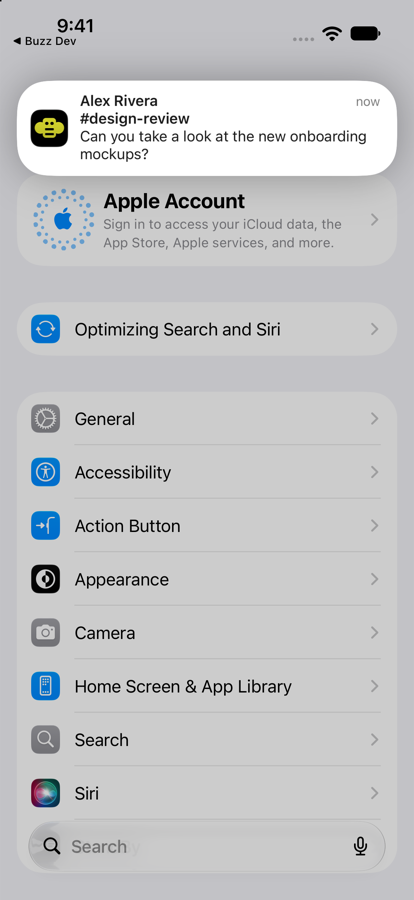
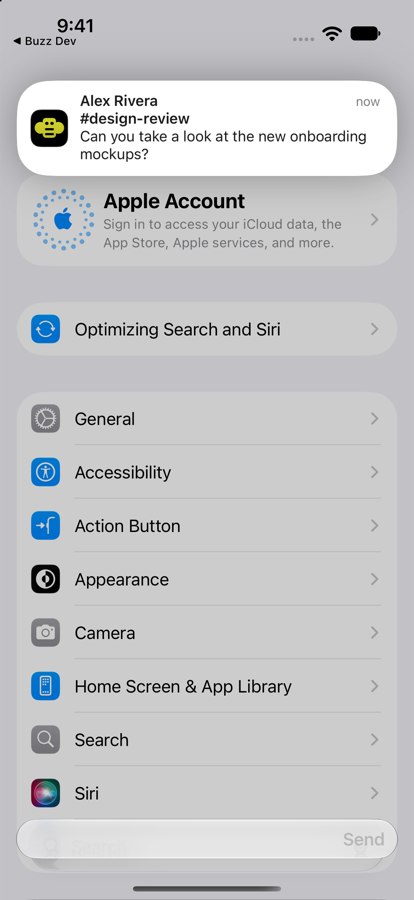
Long-pressing a message notification (synthetic names and text). Before
has no reply field (captured by sending the notification without its new
reply category, which is how main presents it); after shows one with
Send.
| Before | After |
| --- | --- |
|
|
|
### Demo
With the app backgrounded past the relay grace period, replying from the
notification lands the reply in a subthread under the message:
https://github.com/user-attachments/assets/37df7e28-aa46-4521-938e-8af5faa77b83
### Regressions
Nothing existing changes unless the user taps Reply. Notifications gain
a category and a small reply context in `userInfo`; tapping a
notification still opens the conversation as before. The relay reconnect
only happens for a pending reply and then falls back to the normal
background disconnect, so idle background behavior and network use are
unchanged. Reply failures end in a draft and a "Reply not sent"
notification rather than touching other state.
### Validation
- End to end on an iOS 27 simulator against a real community: with the
app backgrounded past the relay grace period, replied from the
notification; the reply appeared in a subthread under the message,
mentioning its sender. The demo above was recorded before the review
fixes (session hold, community fence, origin-community drafts, composer
draft sync); the same run was repeated on the current head,
|
||
|
Tom Brow
|
02535e1b53 |
perf(mobile): stop replaying stored read state on every resume (#9090)
Every time the mobile app reconnects (for example after more than 5 seconds in the background), the read-state live subscription asked the relay for up to 500 stored read-state events. That re-downloaded every read-state slot on the account, then the snapshot fetched the same events again right after. On a heavy account (28 slots) that replay alone was about 1.4 MB per resume. The live subscription now uses `limit: 0`, so it only delivers changes. It still opens before the snapshot, so the snapshot covers anything published in between. The subscription can also go live after `subscribe` has returned: on a cold start with slow AUTH, `subscribe` returns on its 500 ms fallback before the REQ is registered, after a transient CLOSED (rate limit, capacity) the session reopens it on the same socket, and a reconnect replays it. With `limit: 0` nothing replays marks published in that gap, so the manager reads the snapshot every time the subscription reports ready, as the channel list's `limit: 0` subscription already does. The session keeps live subscriptions across reconnects and replays them on the new socket, so a reconnect no longer resubscribes: the replay's ready reads the snapshot, once per reconnect. The manager opens a new subscription only after losing one (a terminal CLOSED or a failed subscribe), on the next reconnect. All snapshot reads outside a publish go through one sync loop. Initialize and each ready ask that loop for a snapshot. A request made before the current pass starts its read joins that read, and a request made during the read runs one more pass, so a ready can't be swallowed by a read already in flight. This needs no generation or ready-transition checks, at the cost of an occasional extra read (for example a cold start whose ready lands after the 500 ms fallback, when the first read has already started). Snapshot reads are numbered in start order, including a publish's own read, and only a read newer than every settled one decides whether the last snapshot succeeded. An older read finishing late cannot clear the retry a newer failed read needs. A failed read waits for the next trigger: the publish it schedules, which reads the snapshot in full after a failure, or a later ready, resume or reconnect. A publish with nothing to send skips its snapshot ([#9093 skip redundant publish](https://github.com/block/buzz/pull/9093)) only when the last snapshot succeeded, so after a failed resume snapshot the next publish still retries it. A publish snapshot now notifies readers of the marks it merged, since unchanged slots publish nothing whose echo would. ### Accepted gap If the snapshot fails (timeout, discovery or HTTP error) on a device with no local journal, read state stays local until the next successful snapshot, which every resume, reconnect, subscription recovery and publish retries. Falling back to a stored replay on failure would close the gap, but it adds a late subscription path for a rare failure that already heals on its own. ### Validation - Added test: `live subscription replays nothing and opens before the snapshot`. It fails without the change (`limit` 500). - Added test: `a clean reconnect through the real session replays one REQ and reads the snapshot once, and a lost subscription is reopened` drives the real `RelaySessionNotifier` with a recording socket: the connected listener runs, then the session's replay, then EOSE. It fails against the previous revision of this PR (two `l-2` REQs and two snapshot reads per reconnect). After a terminal CLOSED, the next reconnect opens a new subscription and reads the snapshot. - Added test: `readies during a held snapshot read share one more read`. - Added test: `a mark published while the live subscription retries is read once it recovers` puts the subscription into retry, lets another device publish a mark, then reports it ready. It fails without the read on ready. - Added test: `a failed late-ready read is retried by the next publish`. It fails without the retry. - Added test: `a reconnect while the first snapshot downloads is not swallowed by the cold-start connect` lets the cold-start connect queue behind initialize, then reconnects while the first read is still downloading and has a peer publish a mark. It fails against the previous revision of this PR (the queued pass swallowed the reconnect) and passes with the sync loop. - Added test: `an older snapshot finishing late keeps a newer failed read's retry` holds a publish's snapshot read, fails a newer read, then lets the older one finish. It fails against the previous revision of this PR (the older success cleared the retry) and passes with the read ordering. - Added test: `a mark published before a slow cold-start REQ goes live is read then` lets `subscribe` return before ready, publishes a mark, then reports ready. It fails without the read on ready. - `a publish after a failed snapshot retries it, then skips again` replaces the earlier skipped-publish test and fails without the snapshot check. It also checks that the retried snapshot's new marks notify readers, which fails without the notify. - Read-state suite (95 tests), `flutter analyze` and the full mobile suite pass. - iPhone 12 mini, Profile build with [#9089 gzip snapshot](https://github.com/block/buzz/pull/9089) applied, Home backgrounded 12 s and resumed, websocket bytes received in the 15 s after resume: | | Websocket in | Read-state replay | | --- | --- | --- | | Before (gzip fix only) | 2,087 KB | 1,458 KB (28 events) | | After (gzip fix + this) | 575 KB | none | The table counts websocket bytes only. Each resume reads the read-state snapshot once over HTTP, before and after this change. Automated app run on the same phone: Home, a large channel and search resumed after the reconnect grace period, with no read-state errors logged. Read marks were not compared across devices. 🤖 Generated with [Claude Code](https://claude.com/claude-code) --------- Signed-off-by: Tom Brow <tomb@squareup.com> Co-authored-by: Tom Brow <tomb@squareup.com> Co-authored-by: studio <dc2fc481343672df31a689840c09299972e704dac592e0da6f18486646a7ee3e@buzz.block.builderlab.xyz> Co-authored-by: Claude Opus 5.5 <noreply@anthropic.com> |
||
|
Tom Brow
|
dce37f74d7 |
fix(mobile): skip the read-state snapshot when nothing needs publishing (#9093)
Every mobile resume re-syncs read state and then schedules a read-state publish, whether or not anything changed. Each publish starts by downloading the full read-state snapshot (about 1 MB compressed on a heavy account) and only then finds nothing to send. Together with the re-sync's own snapshot, that is two full downloads per resume, and a third when a publish from before backgrounding retries. The publish now checks first, using the same packing it would publish, and returns before the snapshot when nothing is pending and no slot differs from what was last published. When something did change it behaves exactly as before, snapshot included. Today the snapshot fails before downloading on gzip-serving relays, so this only pays off once [#9089 read-state gzip fix](https://github.com/block/buzz/pull/9089) lands; without this PR, [#9089 read-state gzip fix](https://github.com/block/buzz/pull/9089) roughly doubles resume download on heavy accounts. It has no merge-order dependency. ### Validation - Added test: `a publish with nothing new skips the snapshot`. It publishes a change (one snapshot), publishes again with nothing new (no snapshot, no event), then publishes another change (snapshot and an event carrying both marks). It fails without the early return. - Existing read-state suite passes. - iPhone 12 mini, Profile build, Home backgrounded 12 s and resumed, all socket bytes received in the 15 s after resume: | Build | Download per resume | Snapshot fetches | | --- | --- | --- | | main (snapshot broken) | 3.07 MB | 0 completed | | [#9089 read-state gzip fix](https://github.com/block/buzz/pull/9089) | 6.85 MB | 3 | | [#9089 read-state gzip fix](https://github.com/block/buzz/pull/9089) + [#9090 no read-state replay](https://github.com/block/buzz/pull/9090) | 6.08 MB | 3 | | [#9089 read-state gzip fix](https://github.com/block/buzz/pull/9089) + [#9090 no read-state replay](https://github.com/block/buzz/pull/9090) + this | 2.71 MB | 1 | These are single runs on one account with 28 read-state slots, so treat the numbers as indicative. 🤖 Generated with [Claude Code](https://claude.com/claude-code) --------- Signed-off-by: Tom Brow <tomb@squareup.com> Co-authored-by: Tom Brow <tomb@squareup.com> Co-authored-by: studio <dc2fc481343672df31a689840c09299972e704dac592e0da6f18486646a7ee3e@buzz.block.builderlab.xyz> |
||
|
Tom Brow
|
237d794acb |
perf(mobile): skip re-decrypting read-state blobs (#8966)
## Summary Read-state blobs are NIP-44 encrypted, and the app decrypts them with pure-Dart ChaCha20 and HMAC-SHA256 on the UI isolate. Most of those decrypts repeat earlier work: - Every live subscription (each launch, resume and reconnect) replays all of the account's read-state slots, and `_handleIncomingEvent` decrypts each one again. The measured account has 27 slots of about 55 KB ciphertext each. - Before every publish, `_publishOnce` fetches the read-state snapshot and decrypts it, and decodes our own slots a second time to check they're readable. - The relay echoes each publish back, and our own blob is decrypted again. `ReadStateCrypto` now keeps a bounded memo from ciphertext to plaintext, one per conversation key. `decrypt` checks it first, and `encrypt` records the ciphertext it produced. NIP-44 payloads carry a random nonce and a MAC, so under one key the same ciphertext always decrypts to the same plaintext. Failed decrypts aren't cached and still throw every time. The memo is least recently used: a hit moves the entry to the newest end, so our own superseded blobs are evicted before live ones. It holds at most 8,000,000 code units across keys and values (about 8 MB, about 80 full slots). The first version used oldest-first eviction with a 2M bound, which saved nothing on the device: the 27 slots total about 2.6M, and a replay in slot order evicted each entry just before its next use. ## Measurements iPhone 12 mini, Profile/AOT, Tom's Block community. Each run resumes the app twice from the home screen and samples UI-isolate CPU for 15 s from each resume. | Build | `ReadStateCrypto.decrypt` per resume | | --- | --- | | `main` |
||
|
Tyler
|
dafe31bfe5 | feat(mobile): persist frontier-only NIP-RS read state across devices and restarts (#8998) | ||
|
Tom Brow
|
464448c7b2 |
fix(mobile): resync read state from the last fetch, not the whole week (#8903)
## Summary Every read-state resync (each reconnect and each resume from background) fetches every read-state blob (kind 30078, `#t: read-state`) from the past week, then opens a live subscription with no `since`, which replays the same blobs again. Merging keeps the newest mark per context, so blobs from before the previous fetch add nothing. Each blob is a whole device's read marks, about 100KB for a heavy reader. A later fetch and the live subscription now start `relayCrossDeviceSkewSeconds` (1860s) before the last successful fetch was sent. The relay rejects a `created_at` more than 900s from its clock, and blobs come from other devices, so a writer 900s slow and this phone 900s fast are at most 1800s apart. Every blob stored since that fetch falls inside the window. A failed fetch keeps the earlier start. The first fetch of a manager still covers the whole horizon. Companion to [#8901](https://github.com/block/buzz/pull/8901) and [#8902](https://github.com/block/buzz/pull/8902), which do the same for the unread catch-up and the latest-message query. Measured on an iPhone 12 mini against the internal relay, resuming after 60s in the background (kind 30078 websocket bytes, instrumented profile build): | | main | this PR | | --- | --- | --- | | Read-state resync on resume | about 1.8MB (91 blobs, fetch plus subscription replay) | 415KB (4 blobs changed since the last fetch) | ## Testing - New test: the first fetch covers the horizon, the live subscription and later fetches start 1860s before the last successful fetch was sent, and a failed fetch keeps that start. Confirmed it fails without the fix and with the earlier 960s window. - New test: after the clock moves back, a resync whose fetch fails isn't retried on every later read; the next reconnect fetches the whole horizon. Confirmed it fails without the fix. - `just mobile-check` and `just mobile-test` pass. - Device: resumed the app on the 12 mini on Wi-Fi; the resync fetched only the 4 blobs stored since the previous fetch, and the live subscription replayed none. 🤖 Generated with [Claude Code](https://claude.com/claude-code) --------- Signed-off-by: Tom Brow <tomb@squareup.com> Co-authored-by: Tom Brow <tomb@squareup.com> Co-authored-by: Claude Opus 5.5 <noreply@anthropic.com> |
||
|
Tom Brow
|
f6f6d9a673 |
chore(mobile): delete dead code with no remaining UI path (#8880)
## Summary Deletes mobile code that no longer has a user-reachable path and has no counterpart in buzz-app, so it is unlikely to come back for parity. Net: 104 files, about 5,500 lines removed. No intended behavior change. - **iOS native message menu and action surface:** `NativeMessageMenu.swift` and `NativeMessageActionSurface.swift`, the `message`/`supportsMessage` coordinator branches, and the Dart selection hook. Dart stopped creating this view in [#8280](https://github.com/block/buzz/pull/8280). The native reactions sheet in the same coordinator is kept. - **Old home quick-actions launcher and `ComposeMorphIcon`:** only instantiated in tests since the nav-bar creation actions replaced them. - **Retired local theme stack:** `ThemeNotifier`, `AccentNotifier`, `SchemeNotifier`, `adaptive_theme.dart`, `AccentPickerPage`, the appearance-mode sheet and their helpers. These predate per-community theme sync. The legacy prefs migration in `community_theme_preference.dart` is kept. - **Unused widgets:** `ProfileAvatar` and `MaskedAvatarBadge`. - **Push permission-status plumbing:** the iOS `notificationAuthorizationStatus`/`openNotificationSettings` handlers, plus the uncalled strict age-gate snapshot registration and its Swift `syncAgeGatePushSnapshot` path. - **Orphaned files** with no importer: `profile_text_edit_sheet`, `editor_option_button`, `retained_page_transition`, `tappable_flapping_bee`, `agent_model_info`, `community_bot_profiles`, `sheet_divider`, `success_haptic`. - **Uncalled helpers:** the `pickAndUpload*`/camera helpers in `media_upload.dart`, unused `NostrFilters` builders, `mediaGetHeadersFor*`, and about 20 other uncalled functions, providers and styles. - **Removed-UI leftovers:** the never-wired invite directory providers, `AuthNotifier.signOut` and `removeActiveCommunityForSignOut` (the Sign out row is gone), `renameCommunity`, `HomePage.profilePageBuilder`/`SettingsPage.embedded`, and the create-forum branches of the create-channel sheet. Forum viewing is unchanged. Tests that only covered deleted code are removed. Tests of surviving code that used deleted helpers as drivers were repointed to the surviving API. An audit of `mobile/android` found no dead Kotlin, resources, manifest entries or Gradle dependencies, so Android code is unchanged. ## Validation - `flutter analyze`: no issues. - After rebasing onto main ([ |
||
|
Tom Brow
|
8abcf2ea2a |
fix(mobile): keep read state across reconnects and resume (#8672)
### Context Every app resume and relay reconnect tore down `ReadStateManager` and built a new one. `ReadStateNotifier.build()` watched the whole `relaySessionProvider` state, so each status change (disconnected, connecting, connected) rebuilt the notifier. On an iPhone 12 mini each resume re-ran the full read-state fetch and decrypt (about 19 to 24 decrypts, 60 to 95 ms). The rebuild also cleared `_forcedUnreadContexts`, so a message or channel the user marked unread lost that flag on any connection change. The watch dates from #422, when the manager was built with `remoteEnabled` tied to the connection status. #802 made `remoteEnabled` constant and added the `ref.listen` that calls `reinitializeRemote()` on connect, but left the watch behind. ### Change - Watch `relaySessionProvider.notifier` instead of its state. Config, nsec, community, pubkey, crypto and a replaced session still rebuild. Status changes don't. - Reconnects re-sync through the existing listener (`reinitializeRemote()`: re-fetch, then re-subscribe, preserving the history and live overlap). - Re-syncs are serialized. One runs at a time after any pending `initialize()`, and reconnects that arrive while one waits share it. Overlapping passes could otherwise each install a live subscription and leak one. - A connect that lands while the first `initialize()` is running (the cold-start connect) skips the re-sync when that initialize fetched and subscribed successfully. Without this, cold start did the read-state work twice. ### Validation - Provider journey: disconnected, connecting and reconnecting cause no refetch, no re-subscribe and no readiness drop, and the forced-unread flag and read mark survive. Connected runs exactly one refetch and one live-subscription swap. A second reconnect behaves the same. Account and community switches still rebuild and clear forced flags. - Manager tests: a connect during a successful `initialize()` does not sync again; one during a failed `initialize()` does, and leaves one live subscription; three reconnects during a running re-sync produce one more shared pass and one live subscription. - Falsified: restoring the old watch fails the reconnect journey (`isReady` false, flag lost). The previous version without serialized re-syncs fails the overlap test (5 passes instead of 3). - `just mobile-check` and `just mobile-test` pass. iPhone 12 mini (Profile builds of base and this branch, real community over the production relay, instrumented manager lifecycle and live-subscription counts): | | base | this branch | | --- | --- | --- | | Resume after 3 s, 10 s (x3), 60 s background | 3 new managers and 3 initializes per resume | no new manager, 1 re-sync | | Live read-state subscriptions after resume | 1 | 1 | | Channel marked unread, then 10 s / 60 s background | flag lost after the first resume | still unread after both | | Read-state work per resume (median) | ~24 decrypts, ~176 ms main isolate | ~18 decrypts, ~125 ms | | Unread badges | same bold set | same bold set | The first device run also found the doubled cold-start sync, fixed above. A re-check on this head: | Cold launch | base | first version | this head | | --- | --- | --- | --- | | Managers built | 3 | 1 | 1 | | Read-state syncs | 2 initializes | 1 initialize + 1 re-sync | 1 initialize | | Decrypts | 19 | 30 | 15 | | Main-isolate ms in read-state code | 124 | 185 to 197 | 94 to 98 | Four resumes on this head: no new manager, 1 re-sync and 1 live subscription each, 17 to 20 decrypts. A foreground socket drop was not exercised on the device; every resume there was a full disconnect and reconnect. buzz-review-completed 🤖 Generated with [Claude Code](https://claude.com/claude-code) --------- Signed-off-by: Tom Brow <tomb@block.xyz> Co-authored-by: Claude Opus 5.5 <noreply@anthropic.com> |
||
|
Wes
|
8ceca8ac46 |
perf(mobile): batch initial channel read-state seeds (#8607)
## Summary Opening an uncached community seeded each previously unseen channel's read marker separately. Every seed copied and serialized the full read-state snapshot, started three preference writes, and notified listeners. Home now collects those seeds and saves/emits once, using the existing monotonic marker admission rules. For a 400-channel fixture with one existing marker, initial seeding falls from 399 full snapshot saves to one. Existing unread frontiers, local-only seeds and explicit read publishing keep their behavior. No transport, cache, relay or unread eligibility changes. This is independent of #8580 and #8490. ## Validation - `just mobile-install mobile-check mobile-test`: clean analysis; 3,779 tests passed, 19 skipped, plus four checks for builds without push configuration. - Real Home/channel-provider/read-state journey covers 400 channels, preservation of an existing unread highlight, persisted marks, no seed publication, and no repeated seed save on refresh. It replaces the earlier fake-notifier seed test. - Restoring the old per-channel loop makes the new journey fail at the single-snapshot assertion. - Diff and file-size checks pass. - Merged current main (`209fcd217`) at `d34d29627`; retained both the cold read-seeding and cached-community landing test registrations. The production diff is byte-for-byte unchanged from the version reviewed by the Court at `6a232ed37`. The complete mobile gates above passed again on the merged tree. Device latency is unmeasured. The Court source review found no blockers at `6a232ed37`; app/device testing and human acceptance remain unconfirmed. To try: open a community without a saved channel list, confirm its channels load and existing unread highlights remain correct, then refresh and reopen it. The performance claim here is reduced save work, not a measured end-to-end speedup. Signed-off-by: Wes <wesbillman@users.noreply.github.com> Co-authored-by: Star Lord <b89298dbe87c6b3fd8a425b535d9d161f23c88d555a47925ae0b04dfe02b201e@buzz.block.builderlab.xyz> |
||
|
Tom Brow
|
a93f3282cc |
perf(mobile): retain preference crypto across reconnects (#8442)
Foreground reconnects rebuild preference managers and repeatedly derive the same NIP-44 keys on the UI isolate. Retain the six crypto objects in providers scoped to relay configuration and identity while preserving manager refresh, subscription, and publication behavior. Community changes, key rotation, and sign-out invalidate the retained objects. RelayConfig normalizes the signing key once at its shared accessor, so identity, theme encryption, event signing, and NIP-42 authentication receive the same value, including when an active configuration key has surrounding whitespace. The identity-export authorization snapshot uses the same normalized key for the active-identity check and the outgoing recovery payload. The branch incorporates main's relay-scoped preference managers. ### Validation - Regression exercises six production crypto providers across reconnects, configuration/key changes, and sign-out. Reintroducing a session dependency makes it fail. - Added a loopback WebSocket regression that exercises actual RelaySocket NIP-42 authentication with a padded key and verifies its challenge, relay, pubkey and signature. It fails before shared key normalization. - Added a connected-theme regression for whitespace-padded keys, encryption round-trip, and a valid published event signature. It fails before the normalization fix. - Added padded-key identity export coverage through authorization, SAS confirmation, exactly one normalized payload, and successful completion. Separate relay-change and key-rotation tests verify both fresh and expired grants fail closed. The padded-key regression failed before the fix. - Current head: all 48 focused pairing/crypto/auth tests and mobile analysis passed. All [CI checks](https://github.com/block/buzz/actions/runs/39497098787) passed, including mobile test shards, Android, native Swift tests and release builds. Codex feedback is addressed; Jude approved this exact head after independent regression and mutation checks. Fresh [Codex security review](https://github.com/block/buzz/pull/8442#issuecomment-6300273942) found no concrete issues. - Previous head: 122 config/socket/crypto/theme tests, 44 read-state tests, and all [GitHub CI checks](https://github.com/block/buzz/actions/runs/39491550425) passed, including mobile test shards, Android, native Swift tests and release builds. - Original implementation: native iOS Debug build and full local repository checks passed. A paired simulator background/resume capture had no samples in the targeted crypto constructors or key derivation; an 82 ms UI frame remained. Debug/JIT, profiler overhead and shared-host activity prevent an overall speedup claim. The later normalization change is covered by the production-provider regression above. - Two image decode timing failures occurred in the initial local full suite; direct baseline/patch runs, the subsequent full repository run, and the latest full mobile suite passed. Cold-start credential validation is unchanged: padded persisted keys are rejected by AuthNotifier before RelayConfig is constructed. The normalization regressions cover active configurations and identity export, not broader persisted-key acceptance. <!-- buzz-review-completed --> --------- Signed-off-by: Tom Brow <tomb@block.xyz> |
||
|
Wes
|
3ec6327618 |
fix(mobile): keep cached state with its community (#8349)
## Summary One identity can be paired with several communities, but mobile keyed several caches by pubkey only. Mobile keeps a single `ProviderScope` and doesn't remount on a community switch, so one community's data showed up in another, and some of it was published to the other community's relay. - **Channel groups**: the second community showed the first community's groups. - **Read marks** (contexts, publishable set, NIP-RS client and slot IDs): the first community's context IDs were merged into, and published to, the second community's read-state slot. - **Inbox done/unread rows and thread follows**: one shared 500-entry cap, so activity in one community evicted another's entries. - **Channel stars and mutes**: union-merged across communities and published to every relay. Every one of these is now keyed by pubkey + normalized community relay, the same way channel sort already is. **Switching communities.** The relay session rebuilds for the new community before the previous community's managers are retired. Each manager (groups, read state, stars, mutes) now checks that the session still serves its own community before it publishes, merges a fetch, or handles a live event. Previously, a pending publish flushed on dispose, or an in-flight fetch, could cross into the next community. **Old pubkey-only entries.** Channel IDs can repeat across communities, so nothing tells us which community an old channel-keyed entry belongs to: - **Groups, stars, mutes and read marks** are dropped on upgrade, and each community restores its own from its relay. Any change that never reached a relay is lost, and a read mark the relay doesn't hold shows as unread once. That's an accepted tradeoff: such changes would be very old by now. - **Inbox, thread follows, and read-state slot and client IDs** seed every community, and the old entry is kept. The inbox and follows entries are event IDs, which only ever match their own community. The slot ID keeps each community publishing to the slot it already has on its relay. This PR also removes the **Pulse** feed (`features/pulse/` and the Nostr filters only it used). Nothing in the app navigates to it anymore, and its providers were among the community-unscoped caches. ### Related issue None found. ### Testing - Each affected store has a regression test through the real provider that switches A → B → A. For groups, read marks, stars and mutes, the test sets a value in A, switches to B while A's change is still pending, and checks two cases: B's data arriving live and B answering A's in-flight fetch. It asserts that nothing sent to B contains A's IDs, B shows only its own value, and A comes back unchanged. Each guard was removed in turn to confirm a test fails without it, except two that the current switch order never reaches: the groups merge guard and the read-state live-event guard. - Upgrade tests cover each kind of old entry: dropped for groups, stars, mutes and read marks, seeded for inbox, follows and slot IDs. - `flutter analyze` is clean, and the full mobile suite passes in the pre-push hook at `89ebfcc12`. - Not yet exercised in the app. 🤖 Generated with [Claude Code](https://claude.com/claude-code) --------- Signed-off-by: Wes <wesbillman@users.noreply.github.com> Co-authored-by: Carl <32a2e2c9d428ee08902cab75d956da2c1d235a22d4766b0dd4138bf6e2e5db1d@buzz.block.builderlab.xyz> Co-authored-by: Claude Opus 5.5 <noreply@anthropic.com> |
||
|
Logan Johnson
|
9ade5d1ad1 |
feat(mobile): write catch-up and visible-message read marks like the web app (#8106)
🤖 ## Summary When you read a channel or thread on the phone, the web and desktop app (buzz-app) should show it as read too, and the reverse. buzz-app no longer saves a "read" mark for each ordinary message. It saves one "caught up to here" mark per channel and per thread, and keeps per-message marks only for mentions, DMs, broadcasts and replies. Mobile already reads those marks. This PR makes mobile write them, so reading on the phone clears unread on other devices and saved read state stays small. What changes on the phone: - Reaching the bottom of a channel, and staying there for 300 ms, marks it caught up. Reaching the end of a thread does the same for that thread. - A message you see fully on screen, away from the bottom, is marked read on its own. - Mentions, DMs, broadcasts and thread replies you see keep their own read marks, as in buzz-app. - Automatic reading never marks the whole channel read. Only the explicit **Mark read** action does that. DMs and forums are the exception: opening one marks it all read, as mobile does today. - Reaching the bottom of a channel you marked unread ends that manual unread. Unseen mentions and replies stay unread. - Activity rows clear when you have read every message in the row, not just the newest. ### Related issue None found. buzz-app makes the same DM and manual-unread changes in https://github.com/block/buzz-app/pull/616. ### Testing - Unit tests cover the new write rules, Activity rows and the size limit on saved read state. - Widget tests cover reading on the channel page and the thread page, opening a DM, and reaching the bottom of a channel you marked unread. - No visual changes. ## Details **Read marks.** "Caught up" is saved as `activity:<channel>` for a channel and `thread-activity:<root>` for a thread. A caught-up mark reads only ordinary top-level messages (channel) or that thread's replies (thread). A per-message mark is `msg:<id>`. **Caught-up time.** The mark is set to the time of the bottom row, and never later than the current time. The time of a newer reply is not used. So a top-level message that arrives late, with an earlier timestamp, stays unread. A clock that runs fast, on this phone or the sender's, cannot mark messages read before they arrive. **Nested threads.** A thread opened on a nested reply shows only one branch. Reaching its end writes per-message marks only, so unread messages in other branches stay unread. **Reading delay.** The 300 ms reading delay now restarts only when messages arrive or leave. Before, any page rebuild restarted it, for example a typing indicator. **Activity rows.** A row that groups several events is done only when each event is read. Each event is checked against the channel mark, its own `msg:` mark, and its thread marks if it is a reply. Opening a row goes to the oldest unread event. **Publishing.** Mobile no longer republishes per-message marks it got from other devices. buzz-app removes those once a caught-up mark covers them. Broad marks (channel, thread, caught-up) are still republished, so they stay available after the fetch window. The published blob is capped at buzz-app's 40 KiB limit. Channel marks are kept first, then thread marks, then caught-up marks, then the newest per-message marks. Before, a blob over the encryption limit (about 64 KiB) turned off sync for the rest of the session. **DMs and manual unread.** Opening a DM reads it through the newest loaded message, replies included, as mobile does today. Reaching the bottom of a channel ends a manual unread. Manual unread on mobile is local to this session, so ending it does not change what other devices see. **Compatibility.** Older desktop builds read only channel and per-message marks. They may show extra unread for channels read on the phone. **Follow-ups, not in this PR** - Unread catch-up fetches start after the channel mark and are capped at 1,000 events. In a busy channel, an old unread mention can drop out of the badge. The fetch should also start from the caught-up mark, or load more pages. - Each mark triggers its own save and rebuild. They could be batched. - Broadcast replies are counted slightly differently from buzz-app. - buzz-app can also move its caught-up mark past the current time. --------- Signed-off-by: Larry <627498bd4bd1f281a16431e3c6cce3b5c25b6692798c78672298aefbf2f8f8b5@buzz.block.builderlab.xyz> Co-authored-by: Larry <627498bd4bd1f281a16431e3c6cce3b5c25b6692798c78672298aefbf2f8f8b5@buzz.block.builderlab.xyz> |
||
|
Logan Johnson
|
166d383ca7 |
feat(mobile): read web app catch-up marks for unread state (#8103)
🤖 ## Summary The web and desktop app (`buzz-app`) saves a "caught up" mark when you scroll to the bottom of a channel and stay there, and another one for a thread. Mobile did not understand these marks. It relied on the separate per-message read marks that `buzz-app` also kept. `buzz-app` is about to stop keeping those per-message marks under the "caught up" mark (block/buzz-app#590), to save space in the synced read state. With this change, mobile reads the "caught up" marks with the same rules as `buzz-app`: - `activity:<channel>` reads ordinary top-level messages up to its time. It does not read thread replies, mentions, broadcasts or DM messages, because reaching the bottom of the channel does not prove you saw those. - `thread-activity:<root>` reads the replies in that thread up to its time. So a message you read in `buzz-app` stays read on mobile: in the app badge, the channel list unread state, the "new messages" divider when you open a channel, and the Mark read / Mark unread action. Mobile does not write these marks. It only reads them. ### Related issue None found. Companion to block/buzz-app#590. The old desktop app in this repo is intentionally not changed. ### Testing - New badge tests: `activity:` clears an ordinary top-level message, and does not clear a mention, a thread reply or a DM. `thread-activity:` clears replies in its own thread only. The two "clears" tests fail without this change. - New tests for the per-message read check and the "ordinary message" rule. - `flutter analyze`, `dart format` check and the full mobile test suite pass locally. - Not yet exercised on a device. --------- Signed-off-by: Larry <627498bd4bd1f281a16431e3c6cce3b5c25b6692798c78672298aefbf2f8f8b5@buzz.block.builderlab.xyz> Co-authored-by: Larry <627498bd4bd1f281a16431e3c6cce3b5c25b6692798c78672298aefbf2f8f8b5@buzz.block.builderlab.xyz> |
||
|
Wes
|
7bee84da82 |
fix(mobile): stop oversized read-state retry loop (#4595)
## Summary - stop retrying remote read-state publishes after the local replacement blob exceeds NIP-44's 65,535-byte plaintext limit - preserve every local read marker and leave existing relay state untouched rather than truncating remote state - keep incoming remote read-state available while suppressing further invalid publishes for the manager lifetime ## Why A repaired/reconnecting relay exposed a 1,404-context read-state on iOS. The app repeatedly serialized and attempted to encrypt that structurally oversized blob while reconnect catch-up work was running, saturating Flutter's debug UI isolate and making channel navigation take roughly ten seconds. This is intentionally fail-closed and behavior-preserving: local read behavior continues, but remote publishing pauses until the manager is recreated. No protocol or persisted-data format changes. ## Verification - `flutter test` — 1,093 passed, 1 skipped - `flutter analyze` — no issues - pre-push `mobile-test` and `branch-skew` hooks passed at `0b6423c5d4d583194f0bbe69662912133b9ae1ef` - independent review by Princess Donut: no blocking findings; compatibility-safe and correctly fail-closed Signed-off-by: Wes <wesbillman@users.noreply.github.com> Co-authored-by: Carl <c7ebe626f000404285d3686e1dc74cc07cc60a9754a150041ba132e14bd3e2ec@buzz.block.builderlab.xyz> |
||
|
klopez4212
|
feccf4eabc |
Polish mobile inbox and media flows (#4512)
## Summary - make mobile unread state visible with bold channel names, an animated Inbox badge, and swipe-to-toggle Inbox rows - add directional transitions for top-level mobile navigation - let mobile send while media uploads, with cancellable progress UI - normalize iOS and Android video uploads, attach poster frames, and improve native video playback ## Validation - `just mobile-check` - `just mobile-test` - `cargo test -p buzz-media` - Pixel smoke test - iPhone smoke test Desktop background uploads moved to #4522 so the two platforms can be reviewed independently. --------- Signed-off-by: kenny lopez <klopez4212@gmail.com> Signed-off-by: Tom Brow <tomb@block.xyz> Co-authored-by: leader <71e9f2c44a6932b6772caaaccda1911d010463c3e2c6c40410b8329956046801@buzz.block.builderlab.xyz> Co-authored-by: Tom Brow <tomb@block.xyz> |

