mirror of
https://github.com/block/buzz.git
synced 2026-11-04 16:31:38 +00:00
009dc103f61582dbed5dcd84697365518a5fcf71
48 Commits
| Author | SHA1 | Message | Date | |
|---|---|---|---|---|
 Matt Toohey |
8216db1c71 |
chore(toolchain): bump Rust to 1.98.1 for macOS 27 proc-macro loading (#8598)
## Summary
Bump the pinned Rust toolchain from 1.95.0 to 1.98.1 so release builds
work on macOS 27 hosts.
Rust ≤ 1.97 strips Apple-target artifacts with its bundled
`llvm-objcopy`, which leaves the Mach-O `LC_SYMTAB` string pool
(`__LINKEDIT`) only 4-byte aligned. macOS 27's dyld refuses to `dlopen`
such images (`mis-aligned LINKEDIT string pool`). Because cargo applies
the release profile's default `strip = "debuginfo"` to proc-macro dylibs
too, `cargo build --release` of any crate that uses sqlx macros
(`buzz-db`, `buzz-relay`, `buzz-admin`, …) fails on macOS 27: rustc
cannot load `libsqlx_macros-*.dylib`. Dev builds pass because the dev
profile does not strip, which is why this only shows up as a
release/packaging failure.
The fix (llvm/llvm-project#203680, pulled into rustc by
rust-lang/rust#158410 for rust-lang/rust#157750) first shipped in Rust
1.98.0 and was never backported to 1.97.x. `block/buzz-app` pinned
1.98.1 for the same failure in block/buzz-app#529. With this bump the
`CARGO_PROFILE_RELEASE_BUILD_OVERRIDE_STRIP=none` / custom-linker
workarounds people have been using locally are no longer needed.
### What changes
Two commits: the toolchain bump (with the desktop clippy fixes), then
the workspace clippy fixes.
| Location | Change |
|---|---|
| `rust-toolchain.toml` | `channel = "1.95.0"` → `"1.98.1"` (profile
unchanged) |
| `Dockerfile`, `Dockerfile.push-gateway` | `ARG RUST_VERSION=1.95` →
`1.98` |
| `Dockerfile.sprig` | `rust:1.98-alpine3.22` with the manifest-list
digest verified on Docker Hub (shared by the `1.98` and `1.98.1` tags) |
| `.github/workflows/release.yml` | `dtolnay/rust-toolchain` pinned to
the tip of its `1.98.1` branch (`18f04874`) for the Windows desktop
release job |
| `benchmarks/harbor-buzz-orchestra` | `RUST_IMAGE = rust:1.98-alpine` |
| `_ci-rust.yml`, `windows-canary.yml`, `app_state_tests.rs` | stale
"1.95" comments reworded; the `unknown_lints` allow stays with a
version-agnostic rationale |
| `desktop/src-tauri` | lints clippy 1.98 newly raises under `-D
warnings`: `chunks_exact_to_as_chunks` at five fixed-width PCM/UTF-16
decoders, `needless_borrows_for_generic_args` on the `Copy` `norm`
closure in `config_bridge/reader.rs`, and a redundant `Engine as _`
import in `hpke_key_backup_tests.rs` that `use super::*` already
provides |
| Workspace crates (9) | the 30 lints clippy 1.98 newly raises in `cargo
clippy --workspace --all-targets -- -D warnings`, listed below |
Workspace lint fixes:
| Lint | Sites | Fix |
|---|---|---|
| `result_large_err` (20) | `buzz-relay` `api/git/transport.rs` (8),
`api/git/settings.rs` (6), `api/gifs.rs`, `api/workflows.rs`,
`api/profiles.rs`; `buzz-push-gateway` `verify_installation_assertion` |
Clippy 1.98 now checks `async fn`s, so every `async fn … -> Result<_,
axum::response::Response>` trips it. These follow the existing allow
pattern in `api/media.rs` and `nip_fi_http.rs` ("Response is the natural
error type for axum handlers"): module-level in the two git files,
per-function elsewhere. Boxing `Response` would touch every handler for
no runtime benefit. |
| `chunks_exact_to_as_chunks` (3) | `buzz-media` MP4 brand scan;
`buzz-voice` npy f32 reader and stereo test fixture | `chunks_exact(N)`
→ `as_chunks::<N>().0` |
| `question_mark` (3) | `buzz-acp` queue flush fallback and
slash-command mention skip; `buzz-agent` `find_git_root` | `match … {
None => return None }` → `?` |
| `useless_format` (2) | `buzz-auth` nip_fi startup test policies |
`format!("…")` → `"…".to_string()` |
| `useless_borrows_in_formatting` (1) | `buzz-pairing-cli` secret print
| drop the borrow |
| `manual_noop_waker` (1) | `buzz-sdk` broker test `block_on` |
`Waker::noop()` (stable since 1.85) |
All `as_chunks` rewrites keep `chunks_exact`'s remainder-dropping
semantics, and `as_chunks` is stable since 1.88, which is the MSRV.
One change in `api/git/transport.rs` is not a lint fix. Staging that
file trips the pre-commit secret scanner on its existing test-only ES256
fixture (`GIT_TEST_EC_PEM`), and the scanner only honours a suppression
marker on the flagged line. So the `\`-continued string literal is
rewritten as a byte-identical `concat!` whose `BEGIN` line carries
`sadscan:disable kingfisher.privkey.2`.
Left as is on purpose: `Cargo.toml` `rust-version = "1.88.0"` (MSRV
floor, a separate concern), the README/CONTRIBUTING "1.88+" text, Hermit
(no Rust packages there), the lockfiles, and the `(1.95.0)` comment in
`scripts/start-isolated-test-relay.sh` (the pre-commit secret scanner
flags that file's pre-existing dev-only `DATABASE_URL` whenever it is
staged).
### Related issue
Fixes #8074
### Testing
All under rustc/clippy 1.98.1 on a macOS 27 host (Darwin 27.0.0,
aarch64), with no `RUSTFLAGS` / `SDKROOT` / strip overrides in the
environment:
- `cargo build --release -p buzz-db` (the #8074 repro: the release
profile strips the proc-macro dylib): **builds**. The resulting
`libsqlx_macros-*.dylib` (14 MB) has `LC_SYMTAB stroff % 8 == 0` per
`otool -l`. The same build on 1.95.0 died with `mis-aligned LINKEDIT
string pool`.
- `just clippy` (workspace, `-D warnings`) and `cargo fmt --check`
(workspace and `desktop/src-tauri`): pass
- `just desktop-tauri-clippy` (default and `mesh-llm` feature sets):
pass
- `just test-unit`: every crate passes. The `buzz-acp` binary failed
only under pre-push lane contention; rerun solo it is 1060 passed, 0
failed.
- `just desktop-tauri-test`: 3422 passed, 0 failed
- After the lint fixes: lib/bin unit tests for `buzz-acp`, `buzz-agent`,
`buzz-auth`, `buzz-media`, `buzz-voice`, `buzz-sdk`, `buzz-pairing-cli`,
and `buzz-relay`'s `api:
|
||
|
Logan Johnson
|
a38fedb234 |
fix(desktop): recognize agents without NIP-OA in Huddles (#8544)
🤖 ## Summary In a Huddle (a voice call in a channel), Buzz Desktop decides which participants are agents. It uses that answer to choose whose text it speaks aloud, which agents can publish voice, and when the last person leaves and the Huddle ends. Desktop currently treats a participant as an agent only when its channel role is `bot`. #8494 changes the relay so that it gives `bot` only to agents with a verified owner attestation (NIP-OA). After that change, agents without an attestation join as ordinary members, and Desktop treats them as people: - their messages are not spoken, - their voice publisher is refused, - the Huddle stays open after the last person leaves while such an agent is still connected. With this PR, Desktop also counts a member as an agent when a trusted person has published a managed-agent record for it. Desktop already publishes such a record for every agent it runs, on every machine. Trusted people are: - **you**, so your own agents count as agents on all of your machines; - **the Huddle's owner**, usually the person who started it, so the agents they added count as agents for everyone who joins. Some agents without an attestation still count as people: an agent added by someone who does not own the Huddle, as seen from any machine other than that person's. The only way to recognize those agents is an owner attestation. This PR does not sign one. ### Details - `huddle/roster.rs` (`fetch_huddle_roster`) is now the only place that decides agent or person for Huddles. A member is an agent if its role is `bot`, or if the current user or a channel `owner` published a kind:30177 managed-agent record whose `d` tag is that member's key. Records from other authors are ignored. Records whose signature does not verify are ignored. - All Huddle checks use the roster: voice-publisher authorization, `get_huddle_agent_pubkeys` (spoken-text gating and the participant list), the periodic roster refresh, adding an agent, cleanup at the end of the Huddle, and the last-person check. - Trusting the owner's records is a compatibility policy for Huddles, not proof of identity. A record creates no owner. It lets the channel owner mark a member as an agent for every Huddle behavior that reads the roster: spoken text, voice publishing, remote transcription and turn-taking (both skip agent audio), cleanup, and the last-person check. Before #8494 the client chose the role, so an owner could already do this by labeling a member `bot`. - If the managed-agent records cannot be read, Desktop does not drop agents that have the `bot` role. Spoken text, voice publishing, adding agents and cleanup keep working for those agents. The Huddle does not end automatically, because an agent without an attestation could be counted as a person. When you join, and on each periodic refresh, Desktop adds the `bot` agents to its stored list and keeps stored agents that are still members. ### Related issue Follow-up to #8494 (the relay stores `bot` only for attested agents). No existing issue found. ### Testing - New helper-level unit tests in `huddle/roster.rs`. They do not run the relay query, the pipeline writers or the leave path. - the `bot` role, the user's own record and the owner's record each mark a member as an agent; - records from other members are ignored; - a record with a forged signature is ignored; - when the record read fails, `bot` agents stay agents, the Huddle cannot end automatically, and the next successful read restores the full roster. - when the record read fails, a joiner with no stored agents still stores the `bot` agents, an agent known only by its record stays stored, and a stored agent that left drops out. - New tests in `huddle/roster_hydration_tests.rs` run the real `post_connect_setup` and hot-start entrypoints against a fake relay whose managed-agent record read fails. The voice-model, audio and pipeline steps are passed in, so the tests replace them. Post-connect stores the `bot` agent before media setup starts; the hot-start refresh also keeps a still-member agent known from an earlier record and drops one that left; the same incomplete roster gives no human count for the last-person check. The tests fail when either entrypoint skips its roster read, and when the roster code accepts only complete rosters. - `cargo test --lib huddle::` (Huddle tests only), `cargo clippy --tests -D warnings` and `cargo fmt --check` pass in `desktop/src-tauri`. - Not yet tested in a live Huddle. --------- Signed-off-by: Logan Johnson <loganj@squareup.com> Co-authored-by: Larry <627498bd4bd1f281a16431e3c6cce3b5c25b6692798c78672298aefbf2f8f8b5@buzz.block.builderlab.xyz> |
||
|
klopez4212
|
5dc693aeaf |
Extract shared Huddle audio client for desktop consumers (#8129)
Huddle audio was embedded in the v0 desktop client, forcing other clients to duplicate its protocol and codec behavior. This extracts `buzz-audio-client` so v1 can depend on a pinned library revision without building the v0 application. The crate owns the bounded v2 audio handshake, roster parsing, wire format, Opus sender, and per-peer NetEQ jitter buffer. The v0 human and agent senders use it, and the desktop retains room admission, identity/signing, TLS policy, device routing, mute, and teardown. Receive decoding preserves v1's support for 120 ms Opus packets. No relay protocol changes, speech models, or model downloads are included. Docker builder stages include CMake because cargo-chef compiles the workspace dependency graph. Dependency security: Opus 0.4 replaces the unmaintained `audiopus_sys` backend with `opusic-sys`. NetEQ is pinned exactly to 0.8.3 because its published Rust sources never reference its declared ringbuf dependency. RUSTSEC-2026-0293 is documented as unreachable for this audited source, and a wrapper restriction rejects every other consumer of vulnerable ringbuf versions. Independent review confirmed the scope; re-audit/remove the exception when changing NetEQ. NetEQ 0.9.1 still declares ringbuf 0.3, so a version bump alone does not remove it. Local `cargo deny check` passes with this constrained exception. Validation: - All 21 shared-crate tests pass, including real loopback WebSocket authentication/cancellation, real Opus-to-NetEQ playback, malformed input, and 120 ms decoding. These tests are included in `just test-unit`. - Shared-crate, root workspace, and desktop Tauri Clippy pass; `just desktop-tauri-check` passes. - The desktop Tauri test workspace passes; native two-person listening/device checks remain separate. - All mandatory push checks pass at `d06bac5dc`, including the complete Rust unit gate and desktop workspace checks. Existing agent timing and relay log-capture tests failed under concurrent load, passed separately, and passed in the full serial test run; no tests or hooks were skipped. - One test-only fixture change allows cold Perl startup before the escaped-process test's inner timeout (2 seconds instead of 300 ms). Its independent 5-second watchdog, 300-second surviving pipe writer, and all assertions remain intact. All eight process-helper tests pass; independent review confirmed this still tests bounded drain completion. - Dependency inspection confirms the library brings in no desktop application, Tauri, identity store, relay server, or speech-model crates. - Independent source review found no correctness blockers. Draft: a native two-person call, mute/leave/cancellation, and microphone/speaker switching still need a runtime tryout and human review. Full `just ci` was stopped during the unrelated mobile toolchain download because of disk pressure; it is not a passing gate. Consumer integration is tracked in block/buzz-app#489. --------- Signed-off-by: kenny lopez <klopez4212@gmail.com> |
||
|
Will Pfleger
|
bd0896f5c0 |
fix(desktop): read channel metadata and member lists from writer after writes (#7999)
🤖 This fixes two problems with the same cause. Since #3268, the relay can answer an unpinned `/query` from the Aurora read replica, as long as the replica has proved it's within `BUZZ_REPLICA_READ_MAX_AGE_MS` (1000 ms) of the writer. That's fine for display reads, but it doesn't guarantee a client sees its own write. **Problem 1: channel creation (Wes's report).** Right after creating a channel, the desktop read back the channel's kind:39000 metadata by `#d`. If that read landed on a replica that hadn't replayed the event yet, it failed with `channel created but metadata not yet available`. The channel existed, but the chosen template (canvas, agents) was never applied. **Problem 2: member lists.** After any membership change, the member-list refetch could also hit a lagging replica. The relay returned the list from before the change, and the desktop cached it as fresh for five minutes (`CHANNEL_MEMBERS_STALE_TIME_MS`). Someone just removed could still show as a member, or someone just added could be missing. ## Fix 1: metadata read-backs go to the writer `channel_metadata_filter` is a shared builder that adds `"consistency": "strong"`, so the relay serves the read from the writer. It follows the same pattern as the canvas head reads. All four metadata read-backs that follow a write use it: `create_channel`, `update_channel`, `fetch_starter_channel_metadata` (its retry and fallback are unchanged) and the open-DM refetch in `dms.rs`. A unit test fails if the flag is removed from the builder. The template's agent-add step also reads channel members (kind:39002) right after create. `get_channel_members` takes an opt-in `read_your_writes` flag that sends `"consistency": "strong"`. Only `createChannelManagedAgents` sets it on that path, so the agent-add step sees the creator's membership. ## Fix 2: a 31-second writer-read window after membership changes Every membership write the desktop makes calls `noteChannelMembershipChange` for each channel it changed: - the native write wrappers `createChannel`, `openDm`, `joinChannel`, `leaveChannel`, `addChannelMembers`, `removeChannelMember` and `changeChannelMemberRole` - the Bestie conversation open - huddle agent add and remove, for both the huddle channel and its parent - `ensure_starter_channels` and `sync_agents_to_active_huddle`. Both return every channel they created, joined or changed in `changed_channel_ids`, including ones that landed before a later step failed. The original error text is rethrown unchanged. - live join, leave, removed and `admin_kick` system messages, and member-added and member-removed notifications - a report kick resolved from the Admin Console, once the relay confirms it succeeded and only when the report's channel is in the active community. The kick goes through the admin HTTP API, not a channel event. Ban, timeout and their lifts only change `community_bans`, not channel membership, so they need no record. For 31 seconds after a change, measured on `performance.now()`, `getChannelMembers` for that channel sends `readYourWrites`. Why 31 seconds: the relay caps its replica staleness budget at `FENCE_STALENESS` (30 s), so once the window closes, no supported configuration can serve the pre-change list. The constant's comment ties it to `FENCE_STALENESS`. One app-level listener cancels any roster fetch already in flight and refetches. When it registers, it also refreshes every channel whose window is still open. All other member-list reads still use the replica. **Community switch.** The window map is cleared when the community changes. Each awaited write captures a generation through `beginChannelMembershipWrite()` before its first native call, and the reset advances it. So a write that settles after a community switch records nothing in the new community. Live events don't need this fence, because the reset disconnects the relay client first and frames from the old connection are dropped. ## Coverage - A Rust test drives `ensure_starter_channels` against a stub relay that accepts the creates but never serves metadata, and checks that both created starter channels are still reported. - Desktop tests cover the writer-read window, the Admin Console kick, and writes that settle after a community switch. - The desktop E2E test bridge (`desktop/src/testing/e2eBridge.ts`) mirrors the strong reads and `changed_channel_ids`, so E2E runs exercise the fixed behavior. This doesn't address the smaller race in the relay's per-pod accessible-channels cache, and it doesn't change mobile. --------- Signed-off-by: Will Pfleger <pfleger.will@gmail.com> Co-authored-by: Duncan <dcfd242e557282d7a1e2cf2e6877522682f1e5c6156dc92ca7d90eaedd3b0f95@buzz.block.builderlab.xyz> |
||
|
Logan Johnson
|
4a9de1a3a1 |
feat(desktop): add isolated named demo builds (#6407)
🤖 I’m Larry, updating this description on Logan’s behalf. ## Summary Build named macOS demo apps without Finder automation or collisions with installed Buzz. `just desktop-demo-build "PR 6407 Demo"` produces a matching app and DMG, with a fresh build identity even when the same display name is reused. - The headless DMG packager uses `hdiutil`; optional Finder styling is bounded. The existing production release recipe is unchanged. - Each demo has independent app data, keychain, nest, CLI name, voice-model storage, repository discovery, and agent OAuth/config storage. Reset preserves production and sibling-demo state, and retains retry intent when credential removal or root resolution fails. - Native links accept only the active build’s registered scheme, then translate validated entity links into the frontend’s canonical `buzz:` format. - The recipe builds all six executable sidecars. Display names are capped at 31 ASCII characters so the generated identity fits Rust’s build-time limit. **Open delivery requirement:** downloaded demos must run without a Gatekeeper security override. The current recipe is ad-hoc signed and unnotarized; it does **not** satisfy this requirement. Trusted branch-demo signing/distribution remains blocked on establishing an approved signing path. This PR is not being presented as complete download-and-run delivery. ### Related issue N/A — reported in the Buzz DMG-packaging workstream. ### Testing At `11ce21ff97cb387ad676e7caa65b00964097d0bb`, macOS Blox passed the Tauri workspace suite and compiled-flags gate (including the full named-demo state; each library pass: 2,992 passed, 19 ignored), Tauri all-target clippy, the full `buzz-agent` package suite, and frontend lint/typecheck plus 5,733 tests. Regression coverage includes cold-start/running entity-link handling, wrong-build rejection, OAuth deletion failure and retry, unresolved credential roots, and production/sibling preservation. At the same head, an extra full named-demo/mesh-enabled run had 3,092 passing tests and one failure: a pre-existing shared-compute `auto` versus `mesh` expectation, also reproduced on the old published head `a77b25eca`. The ordinary and demo-state matrix above passes; this is not an all-features-green claim. Live macOS Launch Services delivery remains unverified. GitHub CI completed with 30 successful checks and 9 skipped. The exact-range security review has not run; its authorization notice remains open. CI success does not establish trusted signing or downloaded-app launch. Earlier demo artifacts established matching app/DMG names, side-by-side launch, and six non-empty executable arm64 sidecars. These screenshots show an earlier artifact, not a new build of the final repair commit. Signature-integrity checks are not Gatekeeper/notarization evidence. <img width="1032" height="548" alt="Buzz PR 6407 Demo disk image containing the matching app" src="https://github.com/user-attachments/assets/bca0277e-db03-4308-b280-fcad55e6d601" /> <img width="1186" height="821" alt="Buzz PR 6407 Demo running alongside other Buzz installations" src="https://github.com/user-attachments/assets/b4bf4ae5-c341-4e15-8090-9d2ea7c623b6" /> --------- Signed-off-by: Logan Johnson <loganj@squareup.com> Signed-off-by: Larry <8cf5a83f590ec0955b11647d1c88f796a98e088c30a492c58e0e46c3026ae7a4@buzz.block.builderlab.xyz> Co-authored-by: Other Brother Darryl <cee32d92756729ee0c097c5661b879c6199931cd25315c8cf398dcbf0f155cf1@buzz.block.builderlab.xyz> Co-authored-by: Larry <loganj+sandbox-larry@squareup.com> Co-authored-by: Larry <8cf5a83f590ec0955b11647d1c88f796a98e088c30a492c58e0e46c3026ae7a4@buzz.block.builderlab.xyz> |
||
|
klopez4212
|
8b812017a7 |
Fix mobile Huddle agent voice turn states (#6611)
## Summary - ignore mobile room tone when deciding whether human speech should interrupt agent audio - show a subtle waiting animation while an agent prepares a response, then restore its avatar when speech begins - render agents from Huddle membership before their audio peer starts transmitting ## Testing - `just ci` - signed Release build installed and launched on a physical iPhone - live Huddle voice and agent-membership behavior verified on device --------- Signed-off-by: kenny lopez <klopez4212@gmail.com> Co-authored-by: Mongo <9cfd347903944d5b85aa6c93d2ab67381b978a92a31914bca69998968752a1d7@buzz.block.builderlab.xyz> |
||
|
klopez4212
|
0720f5380c |
Downgrade desktop Huddles to audio protocol v2 (#6610)
## Summary - negotiate Huddle audio protocol v2 on desktop - decode the released one-byte peer-index prefix - retain roster-driven playout resets and document the missing v3 epoch fence ## Testing - `just desktop-tauri-fmt-check` - `just desktop-tauri-clippy` - `just desktop-tauri-test` Signed-off-by: kenny lopez <klopez4212@gmail.com> |
||
|
klopez4212
|
8c0f42e187 |
Add mobile Huddles voice MVP (#6056)
## Summary - add foreground mobile Huddles on Android and iOS with native Opus capture/playback, mute, speaker routing, participants, lifecycle, and minimized drawer UI - keep mobile Huddle cards and roster state live, including ended rooms, relay-resolved profiles, and agents - broadcast desktop agent TTS through the existing Huddle audio protocol ## Scope Foreground human-to-human voice MVP only. Agent setup/transcripts, background calling, recording, and advanced device controls remain out of scope. ## Validation - `just mobile-check` - `just mobile-test` — 1,500 passed - `just desktop-check` and `just desktop-test` — 4,957 passed - desktop typecheck, strict Clippy, and Tauri tests — 2,445 passed, 15 ignored - mobile worktree identity contract checks - physical Pixel/iPhone behavior reviewed during development --------- Signed-off-by: kenny lopez <klopez4212@gmail.com> Signed-off-by: Kenny Lopez <klopez4212@gmail.com> Signed-off-by: Princess Donut <b238ea756dee4d98afa5883fc7f1de61eeabe65bf700e3a5a5a80db5e42e2c2b@buzz.block.builderlab.xyz> Signed-off-by: Tom Brow <tomb@block.xyz> Co-authored-by: Carl <3c4caeafb646d23867f1c4832e68211d77e2561946171625f75c3ce1a3f2670f@buzz.block.builderlab.xyz> Co-authored-by: Princess Donut <b238ea756dee4d98afa5883fc7f1de61eeabe65bf700e3a5a5a80db5e42e2c2b@buzz.block.builderlab.xyz> Co-authored-by: leader <71e9f2c44a6932b6772caaaccda1911d010463c3e2c6c40410b8329956046801@buzz.block.builderlab.xyz> Co-authored-by: Tom Brow <tomb@block.xyz> Co-authored-by: Mongo <9cfd347903944d5b85aa6c93d2ab67381b978a92a31914bca69998968752a1d7@buzz.block.builderlab.xyz> |
||
|
Tyler
|
7da8f9abf3 |
Clarify huddle message destination (#6496)
## Summary - identify the injected channel ID as the attached main channel, not the live huddle channel - direct spoken replies to the channel UUID in the current Context block - pin the distinction with regression assertions ## Testing - `just desktop-tauri-test` - pre-push desktop Tauri checks Signed-off-by: Wren <5217c5c2f7bfb4333e46d17c98a9255a52dadee18dcd43a43536b95e6776dfa0@buzz.block.builderlab.xyz> Co-authored-by: Wren <5217c5c2f7bfb4333e46d17c98a9255a52dadee18dcd43a43536b95e6776dfa0@buzz.block.builderlab.xyz> |
||
|
Tyler
|
6039fed565 |
fix(desktop): restore human barge-in over agent TTS in huddles (#6431)
## Problem Humans cannot interrupt agents in huddles: agent TTS keeps playing over a talking human (reported by @tlongwell-block, 2026-08-20). The full requirement: **any human talking — local or remote, any input mode, any audio rig — must interrupt any agent on the huddle.** ## This is a restoration, not a new feature - **`b29c8cdaa` (#4281, 2026-08-04) deleted working local VAD barge-in.** The pre-image shipped `BARGE_IN_DEBOUNCE_FRAMES = 20` (320 ms sustained speech cancels TTS), live at the production call site (`pipeline.rs` passed `Some(tts_cancel)` unconditionally). The same day, `ce3cf3cd2` (#4694) flipped the default input mode from VAD to push-to-talk, which masked the loss. - **`068a83b09` (#5671, 2026-08-13) removed the remaining TTS-awareness plumbing from STT** (deliberately, to keep transcribing over agent audio — a good change). Consequence: this PR is a re-plumb through the `PlaybackCoordinator` from #6341, not a revert. - A gap that **never** worked is also closed: PTT-mode users who open the mic via the mute button (`manual_mic_unmuted` postdates the deletion) transcribed fine but could not barge in. ## Design All floor state lives under the single `PlaybackCoordinator` lock — onset acceptance, epoch bump, synthesis invalidation, player replacement, and output lease are one committed transition. No cancel flag can be observed out of order with the playback state it describes. - **Human floor**: local + per-peer remote ownership with epoch invalidation. Onset cancels playback by queue replacement; late synthesis for a stale epoch cannot append or restart. - **Local onset (VAD)**: on an **isolated output route** (all CoreAudio output-stream terminals report headphones), a confirmed short onset interrupts immediately — no echo path exists. On a **coupled route** (speakers, unknown, virtual, mixed), the restored **20-frame / 320 ms sustained-speech debounce** discriminates a real human from speaker bleed; the deleted code's comment records that 80 ms was tried and false-triggered on laptop speakers. Route classification is queried fresh at each onset (never cached — default-device re-routing mid-huddle would strand a stale verdict). - **Mic-open gate is per-frame**: barge-in observes on any frame where the mic is actually open — pure VAD mode, or PTT with the mic manually unmuted (key-held frames defer to the shortcut's own cancel). - **Remote onset**: sustained non-DTX frames from a peer enter the same persistent floor (independent of whether playback is live — a human speaking while TTS is idle blocks late-arriving synthesis from starting over them). Release on sustained DTX/absence, peer departure, and recv-loop exit, with guards so a vanished peer cannot wedge the floor. - **Output lease**: accepted appends renew an `Active` lease; drain/cancel/onset start a 100 ms tail hangover (conservative against measured ~12 ms/~1 ms CoreAudio tails), so speaker-tail bleed in the just-drained window cannot self-trigger the coupled path. ## Known limitations (phase 2 pointers) - Coupled-route mid-output barge-in pays the 320 ms debounce; a playback-reference echo discriminator would shorten it. - A speakers-rig participant's bleed can enter their mic and hold the floor for other machines (bounded by release debounce). - Non-macOS routes classify as coupled (fail-safe). ## Verification - Full `buzz-desktop --lib` suite at head `b0459ae4a`: **2707 passed, 0 failed, 18 ignored** (pinned cargo 1.95.0). - Exact CI recipe `just desktop-tauri-clippy`: PASS at head; base arm at merge-base `b728a2af3` confirms the two `#[allow(clippy::too_many_arguments)]`s cover branch-caused threshold crossings (human_floor threading), not inherited noise. - Regression tests pin: 20-frame threshold + reset-on-gap, short-coupled rejection, sustained-coupled acceptance, coupled-idle acceptance, remote-idle delayed-TTS rejection, output-tail hangover boundary (during = rejected, after = accepted), isolated onset, per-frame mic-open gate truth table, PTT+manual-unmute sustained coupled acquisition. - `LocalBargeIn::observe` is covered as two joined halves (gate truth table in `local_barge_in.rs`, floor transition in `tts_playback.rs`); its body is a straight-line wrapper around a live CoreAudio query, left uninjected deliberately. - Coverage precision (mutation-verified): `manual_open_ptt_sustained_speech_acquires_coupled_floor` pins the gate → 20-frame debounce → acquire → floor-blocked chain on the coupled-**idle** cell. The live-output override leg is carried by `sustained_coupled_speech_overrides_live_output_suppression` (tts_playback.rs); the joiner's `sustained_coupled` argument is not load-bearing there (flipping it to `false` leaves the test green, while shortening the debounce by one frame turns it red). - Live arms in progress: pre-regression build `b29c8cdaa^` staged to confirm the deleted mechanism worked; two-endpoint remote-leg test pending a second human. ## Commits 1. `fb681a5a9` — restore human barge-in (coordinator floor, lease, route isolation, remote floor, 320 ms coupled debounce) 2. `b4265418e` — enable barge-in for manually opened mics (per-frame gate; closes the PTT-open-mic gap) 3. `886489f2b` — extract local barge-in policy module (file-size ratchet; also hoists the CoreAudio route query from per-frame to per-onset, named in the commit message) 4. `b0459ae4a` — two targeted clippy allows for the widened worker signatures ## Credits Built by **Wren**. Regression archaeology and the PTT-open-mic gap by **Dawn** (who also killed her own first fix as vacuous and caught a clippy blocker before it hit CI). Review blockers (coordinator serialization, idle-onset floors, output lease) by **Mari**. Live rig verification by **Max**. Coordination and verification by **Eva**. Opened by Eva with Tyler's explicit direction; commits carry agent trailers. --------- Signed-off-by: Wren <5217c5c2f7bfb4333e46d17c98a9255a52dadee18dcd43a43536b95e6776dfa0@buzz.block.builderlab.xyz> Co-authored-by: Wren <5217c5c2f7bfb4333e46d17c98a9255a52dadee18dcd43a43536b95e6776dfa0@buzz.block.builderlab.xyz> |
||
|
Tyler
|
7ebe3ea699 |
fix(desktop): preserve huddle speech boundaries (#6397)
## Problem and intent Buzz huddles have been clipping speech into fragments: one live turn arrived as the single letter “M,” and another ended mid-sentence. The detector was making each frame decision independently, but the surrounding endpointing policy had no onset confirmation or pre-roll, used one threshold for both entering and leaving speech, and silently discarded short segments. This PR keeps Earshot 1.1.0 and fixes that policy around it. It is intentionally model-independent so the separate Earshot/Silero bake-off can evaluate detectors under the same segmentation behavior. ## What changed One production file changed: `desktop/src-tauri/src/huddle/stt.rs` (**+367/−79** versus `main`). - Add a pure `VadEndpoint` state machine around Earshot probabilities. - Preserve 256 ms (16 frames) of pre-roll before confirmed onset. - Require three consecutive frames above 0.50 to enter speech. - Use 0.35 to leave speech, preserving hysteresis-band audio. - Retain 96 ms (6 frames) of hangover while keeping the existing 304 ms silence-flush window. - Make short-segment drops visible in logs instead of silent. - Add boundary, onset, hysteresis, hangover, drop-path, and PTT policy tests. - Bind the thresholds to Earshot 1.1.0 in source. Earshot 1.2.x is deliberately parked pending a matched-policy bake-off; #6392 separately prevents Renovate from silently crossing that boundary. ## Boundary behavior and known tradeoffs A hard message boundary clears pre-roll. That prevents segment N audio from reaching segment N+1, but a fast follow-up turn may receive less than the full 256 ms onset window. On the 121-clip corpus, **12 of 25 non-first segments had truncated pre-roll, with 32 ms worst observed at the shipping constants**. This result **holds at both 208 ms and 256 ms on this corpus**; it is not independent of pre-roll. The observed follow-ups were bimodal—fast cases clustered at 2–10 frames and the next case was 19—so no larger pre-roll budget could reach those fast cases in this corpus. If a future refactor makes pre-roll survive a boundary, segment N reaches segment N+1 under the strict predicate: ```text gap < VAD_PRE_ROLL_FRAMES - VAD_ONSET_FRAMES ``` At the shipped values that means gaps 0–12 leak and gap 13 is the first clean case. Hangover and the silence-flush window do not enter this bound because leakage rides the pre-roll deque. Marker-origin tests exercise the real flush/reset and next-onset drain; a rolling-buffer mutant leaks 3,328 samples and fails them. Other known behavior: - `voiced_frames` now counts frames above the 0.35 exit threshold once speech begins, not only frames above 0.50. Corpus drop counts measured under `> 0.50` counting must be re-baselined rather than compared directly; the old “19 silent drops” figure is not a valid before/after baseline. - If PTT releases while the manually-open microphone flips or remains on, there is no combined-transmit falling edge. The uninterrupted utterance correctly closes on normal VAD timing instead of an edge flush. - The GUI-to-`push_audio_pcm` wiring is unchanged. The final acoustic gate exercises the checked-in release-profile latency harness against the real production `SttPipeline` and `TtsPipeline`; Tyler’s hand-test covers the live GUI leg by design. ## Verification ledger All gates attest exact head `2dad6bb0e2e2a0af115a9a06c26cf6183fedb633`. - **Implementation:** complete pre-push gate green; remote SHA matched local HEAD. - **Exact-SHA verification:** `cargo fmt --check`; `cargo clippy --all-targets -- -D warnings`; full `desktop/src-tauri` tests: **2,702 passed, 0 failed, 18 ignored**; HEAD re-confirmed unchanged afterward. - **Mutation review:** engine region SHA-256 `3c161d8f6e4d22c02dff3c76498430964beda51a034d34651dbdb03e8ff69aa0`; 5/5 policy mutants killed, including deleted-clear and rolling-buffer regressions. Direct gap sweep leaked at 0–12 and was clean from 13. - **Release acoustic gate:** negative control deliberately overstated the expected segment count and failed with exit 101. Soft/short onset produced 1/1 segment (`“I'm happy.”`). Natural-pause fixture used two exact 700 ms pauses (>304 ms) and produced the pre-registered 3/3 intact segments at the scripted boundaries. - **Release CPU beside Pocket TTS:** soft fixture median 32.1%, p95/max 56.8% (5 sparse samples); natural fixture median 14.55%, p95/max 17.2% (8 sparse samples). These are scoped process samples from synthesis start through append acceptance, not a general desktop CPU benchmark. Local review receipts (not committed to the repository): - `.scratch/vad-live-release-2dad6bb0e/` - `RESEARCH/VAD_ARM_B_MUTATION_RIG_2026_08_20/` - `RESEARCH/EARSHOT_1_1_0_TO_1_2_2_MEASUREMENT_2026_08_20.md` ## Hand-test focus Before merge, exercise the two live shapes that originally failed: 1. Soft short openers such as “M” and “yes.” 2. Natural mid-sentence pauses. Also try a reply immediately after the previous message commits; that is intentionally the least-protected onset case because hard boundaries clear pre-roll. --- Authorship disclosure: this change was implemented and the PR opened by **Wren**, Tyler’s Buzz agent, using Tyler’s GitHub identity after prior disclosure and authorization in the originating Buzz thread. Tyler remains the accountable human reviewer/operator. --------- Signed-off-by: Wren <5217c5c2f7bfb4333e46d17c98a9255a52dadee18dcd43a43536b95e6776dfa0@buzz.block.builderlab.xyz> Co-authored-by: Wren <5217c5c2f7bfb4333e46d17c98a9255a52dadee18dcd43a43536b95e6776dfa0@buzz.block.builderlab.xyz> |
||
|
Tyler
|
09718fbb60 |
refactor(desktop): coordinate TTS playback (#6341)
## Summary - introduce a `PlaybackCoordinator` as the exclusive owner of the rodio `Player` - serialize append, cancellation, synthesis-flight, and drain-release state - cancel without blocking the coordinator by replacing the player queue - preserve first-append/onset bookkeeping across cancellation - increase the existing playback lead-in from 20 ms (480 samples) to a derived 22 ms (528 samples), covering rodio 0.22.2's 512-source-sample add-time bootstrap span This is the behavior-preserving coordinator prerequisite for the follow-up floor-authorization policy. The only intentional playout difference is +2 ms silence at playback-chunk starts to prevent the measured fresh-player bootstrap chirp. ## Verification (all at this exact head, `8bfa4c0531834dce39f5ad0266f2674505e659bf`) - `cargo clippy --manifest-path desktop/src-tauri/Cargo.toml --workspace --all-targets -- -D warnings` — clean - `cargo test --manifest-path desktop/src-tauri/Cargo.toml --package buzz-desktop` — 2,596 passed / 17 ignored / 0 failed - coordinator concurrency tests: stalled cancellation, append-vs-cancel serialization, cancel election, first-append rearming, and the post-swap `starts_playback_chunk` invariant - headless known-answer sweep: 528-sample lead-in clean across 7/7 device configurations (incl. falsifier arm at 192k/96k/32k/16k/8k and 1/2/4/6 ch); current 480 dirty across 5/7 - live CoreAudio gate at production buffer shape (24 kHz mono, real `build_sentence_append_buffer` path): bootstrap chirp eliminated (660.1 Hz head vs 660 Hz control), no false drain, cancel-to-silence ~1 ms vs 12 ms baseline - independent line review + mutation testing on the shipping coordinator bytes: 4/6 mutants killed, 2 shown equivalent under rodio 0.22.2 `Player::drop` semantics ## Playout cost - +2 ms lead-in at each playback-chunk start versus main - first post-cancel utterance receives 22 ms total intentional silence (not stacked cushions) ## Provenance Authored and reviewed by Buzz agents (Wren: implementation; Dawn: line review, known-answer control, mutation testing; Max: live CoreAudio gates; Eva: coordination and final verification), with review records on the Buzz relay. This PR was briefly merged to main directly by mistake and reverted via ref reset; this is the same commit going through the front door. --------- Signed-off-by: Wren <5217c5c2f7bfb4333e46d17c98a9255a52dadee18dcd43a43536b95e6776dfa0@buzz.block.builderlab.xyz> Signed-off-by: Dawn <c6237ef84fa537c78dcee78efd2d4e59f728859c7f194da42ac51ededfa0be05@buzz.block.builderlab.xyz> Co-authored-by: Wren <5217c5c2f7bfb4333e46d17c98a9255a52dadee18dcd43a43536b95e6776dfa0@buzz.block.builderlab.xyz> Co-authored-by: Dawn <c6237ef84fa537c78dcee78efd2d4e59f728859c7f194da42ac51ededfa0be05@buzz.block.builderlab.xyz> |
||
|
Tyler
|
ea0960f8d0 |
Clarify immediate spoken huddle replies (#5863)
## Summary - state that only `buzz messages send` messages are spoken in a huddle - require the first tool call after being addressed to be a brief spoken pickup - explicitly override the normal no-bare-acknowledgment rule and bound follow-up speech - pin those invariants in the prompt test ## Test plan - `cargo test --workspace` from `desktop/src-tauri` - pre-push `desktop-tauri-checks` (clippy and full workspace tests) Signed-off-by: Wren <5217c5c2f7bfb4333e46d17c98a9255a52dadee18dcd43a43536b95e6776dfa0@buzz.block.builderlab.xyz> Co-authored-by: Wren <5217c5c2f7bfb4333e46d17c98a9255a52dadee18dcd43a43536b95e6776dfa0@buzz.block.builderlab.xyz> |
||
|
Tyler
|
068a83b097 |
feat(huddle): cut voice-turn time-to-first-audio from ~1.0 s to ~0.35 s (env-gated latency levers) (#5671)
## Overview

**Category:** feat (env-gated experiment + one exact always-on
optimization)
**Problem:** Speech-end -> first TTS audio through the desktop huddle
pipeline measures **924–1087 ms** on an M4 Max with a 0 ms LLM leg.
Voice turns feel sluggish no matter how fast the agent replies. Baseline
breakdown: ~300 ms hardcoded VAD silence flush + ~150–250 ms Parakeet
decode + ~380–550 ms TTS synthesis before the first player append.
**Outcome:** With all levers enabled, e2e time-to-first-audio measures
**347–384 ms** (307–357 ms on a longer utterance) on the same hardware,
harness, and production pipelines. Defaults preserve production behavior
everywhere except one deterministic, bit-exact cache win.

## What's in here

### Levers (all default-off, env-gated)

| Lever | Env | Effect (measured medians, short utterance) |
|---|---|---|
| Speculative Parakeet decode | `BUZZ_STT_SPECULATIVE=1` | STT leg ->
~max(flush, decode) |
| Streaming TTS synthesis | `BUZZ_TTS_STREAMING=1`,
`BUZZ_TTS_EMIT_FRAMES` | first audio 380–550 -> 211–320 ms (emit=12,
bit-exact) |
| ONNX intra-op threads | `BUZZ_STT_THREADS`, `BUZZ_TTS_THREADS` | TTS
first audio 211–320 -> 129–180 ms (4 threads) |

- **Speculative decode** starts the Parakeet decode at the *first*
silent VAD frame, overlapping it with the flush window. Resumed speech
invalidates the result (voiced-frame-count check); held silence emits it
instantly at the flush boundary.
- **Streaming TTS**: new `synth_chunk_streaming` (buzz-voice)
interleaves the Flow LM frame loop with incremental *stateful* Mimi
decoding, emitting PCM deltas to the player via the existing
`PlaybackChunkAudio` decoration. At `emit_frames=12` (the decoder's
native chunk) streamed audio is **bit-identical** to the batch path —
verified by the ignored test
`incremental_stateful_decode_matches_batch_decode` (max|diff|=0).
Smaller deltas are faster but diverge (~23 dB SNR; decoder intra-chunk
lookahead), hence the default of 12.

> **Removed after live testing:** the `BUZZ_STT_FLUSH_MS` flush-window
override. Lowering the silence window below natural mid-sentence pauses
(the fast-path recipe said 150 ms) split single spoken sentences into
multiple messages and confused the listening agents. The window is a
turn-taking quality knob, not a latency lever — it is now fixed at the
production 300 ms value.

### Push-to-talk grouping fix (always-on)

A held push-to-talk shortcut is an explicit "I am not done talking"
signal, so silence never ends the utterance while it is held — even when
the microphone is also manually open. The utterance flushes on shortcut
release (existing transmit-edge flush); a manually open mic with the
shortcut up keeps normal VAD pause flushing. Gate is the pure
`vad_flush_allowed` function with a unit-test truth table.

### Always-on (exact): voice-conditioning cache

Phase profiling (`BUZZ_TTS_PHASE_LOG=1`) showed a fixed ~160 ms
`condition_voice` Flow-LM pass on *every* chunk, re-deriving the same
post-conditioning state for the same reference voice. The state is now
snapshotted after first computation and restored per chunk (dtype-tagged
tensor copies, keyed identically to the existing `cached_voice`).
Deterministic — same tensors in, same tensors out. The default path's
TTS leg drops from 380–550 ms to 225–355 ms with no configuration.

### Bench harness

`huddle::latency_bench` (`#[cfg(test)]` + `#[ignore]`) drives the real
`SttPipeline` and `TtsPipeline`, feeding a 48 kHz WAV in real-time 100
ms batches (AudioWorklet cadence) with a configurable fake LLM in place
of the relay leg, timing speech-end -> transcript -> speak() -> first
accepted player append.

```
BUZZ_STT_SPECULATIVE=1 BUZZ_TTS_STREAMING=1 \
BUZZ_TTS_THREADS=4 BUZZ_STT_THREADS=2 \
BUZZ_BENCH_WAV=<48k f32 mono wav> \
cargo test --release -p buzz-desktop --lib huddle::latency_bench -- --ignored --nocapture
```

## Tradeoffs to weigh before promoting any lever to a default

- **Speculative decode**: the speculative buffer has ~1 silent tail
frame vs ~19; observed one CTC wobble ("fail" vs "failed") in 24 turns.
Mitigation if productionized: zero-pad the speculative buffer to match
the flush-path shape.
- **Threads**: defaults stay 1 pending the min-spec (4-core Intel) A/B
flagged in the existing `STT_NUM_THREADS` comment.
- **Streaming at emit<12** is NOT the same waveform — don't ship below
12 without an ear pass.

## Validation

- Full desktop lib suite: **2408 passed / 0 failed** at this head
(`18fab2e1c`).
- buzz-voice suite green; bit-exactness test passes against the
production batch decode.
- Defaults-only bench rerun stays in the baseline family everywhere
except the exact conditioning-cache win (stt 525–532, tts 225–355).
- `cargo clippy --workspace --all-targets -- -D warnings` + fmt clean
(pre-push hook battery green).

Measurement notes with per-lever logs: Eva's workspace,
`RESEARCH/HUDDLE_E2E_LATENCY_OPTIMIZATION_2026_08_12.md` +
`RESEARCH/HUDDLE_E2E_STT_FAKELLM_TTS_BASELINE_2026_08_12.md`.

## Suggested promotion order

1. Conditioning cache (in this PR, always-on, exact).
2. Streaming TTS at emit=12: bit-exact audio, biggest UX win — needs the
env-gate removed + barge-in soak + an ear pass on a real huddle.
3. Speculative decode with silence padding: near-free ~100–150 ms.
4. Threads: after min-spec A/B.

---------

Signed-off-by: Eva <011987e296fd5006292d2f930b574be47c7801048d1983c46c425d3c95f0cffd@buzz.block.builderlab.xyz>
Signed-off-by: Wren <5217c5c2f7bfb4333e46d17c98a9255a52dadee18dcd43a43536b95e6776dfa0@buzz.block.builderlab.xyz>
Signed-off-by: Max <d8473ee32b973aa31a21a65adddcc4b69cc2a8a4dee8121ecd51926e0cddbc02@buzz.block.builderlab.xyz>
Signed-off-by: Mari <95cae996907d7cab9f5dbf43c0f53edeac6ab0b032a6feae4abfd784e467b3f5@buzz.block.builderlab.xyz>
Signed-off-by: tlongwell-block <tlongwell@block.xyz>
Co-authored-by: Eva <011987e296fd5006292d2f930b574be47c7801048d1983c46c425d3c95f0cffd@buzz.block.builderlab.xyz>
Co-authored-by: Wren <5217c5c2f7bfb4333e46d17c98a9255a52dadee18dcd43a43536b95e6776dfa0@buzz.block.builderlab.xyz>
Co-authored-by: Max <d8473ee32b973aa31a21a65adddcc4b69cc2a8a4dee8121ecd51926e0cddbc02@buzz.block.builderlab.xyz>
Co-authored-by: Mari <95cae996907d7cab9f5dbf43c0f53edeac6ab0b032a6feae4abfd784e467b3f5@buzz.block.builderlab.xyz>
Co-authored-by: tlongwell-block <tlongwell@block.xyz>
|
||
|
klopez4212
|
b0795a10ea |
Add Send to channel for thread messages (#5305)
## Summary - Share eligible self-authored or owned-agent thread messages into the parent channel as new top-level messages. - Link the shared message back to the exact root thread with a semantic channel label and excerpt. - Add a dedicated channel-arrow icon plus ownership and navigation coverage. ## Validation - Desktop lint, size, and text guards - Desktop TypeScript build and all 4,543 unit tests - Focused Playwright send-to-channel and thread-link navigation tests --------- Signed-off-by: kenny lopez <klopez4212@gmail.com> Signed-off-by: Kenny Lopez <klopez4212@gmail.com> Signed-off-by: Wes <wesbillman@users.noreply.github.com> Co-authored-by: Carl <3c4caeafb646d23867f1c4832e68211d77e2561946171625f75c3ce1a3f2670f@buzz.block.builderlab.xyz> Co-authored-by: Princess Donut <b238ea756dee4d98afa5883fc7f1de61eeabe65bf700e3a5a5a80db5e42e2c2b@buzz.block.builderlab.xyz> Co-authored-by: Fast Fizz <2df81cb51f05a9d5387ef24d7b9ecb8fcdfcd1c70ffabc67061c9596e1b5b1c4@buzz.block.builderlab.xyz> Co-authored-by: Wes <wesbillman@users.noreply.github.com> Co-authored-by: Carl <c7ebe626f000404285d3686e1dc74cc07cc60a9754a150041ba132e14bd3e2ec@buzz.block.builderlab.xyz> |
||
|
Taylor Ho
|
1922d49cb2 |
feat(desktop): adding rich link previews to messages (#3818)
## Overview **Category:** improvement **User impact:** Link previews appear in the composer and travel as privacy-safe sender-authored snapshots, so recipients never contact the linked site merely by opening a conversation. **Problem:** Cold-cache link paste could freeze the composer before the URL painted; recipient-side unfurling leaked visits; invalid or unresolved preview work could interfere with sending or leave dead cards behind. **Solution:** Paint pasted links before starting cold resolver work, resolve only in the sender's composer, attach only complete validated snapshots at Send, and render authored snapshots without recipient fallback fetching. ## Behavior - **Cold paste stays responsive:** bare and angle-bracket URL paste paths commit the visible link before resolver work begins. - **Sender-only fetching:** metadata is resolved while composing; recipients render only the sender-authored snapshot. - **Send never waits:** pending, failed, invalid, and unsendable previews are omitted. They do not block or cancel the message. - **Terminal misses disappear:** failed, timed-out, or 404 resolver results remove the composer card while preserving visible link text. - **Display-text links work:** Markdown links such as `[review the pull request](…)` produce and send the same snapshots as bare URLs. - **Compact and Rich presentation:** Compact remains the default; Rich preserves source description line breaks and paragraphs. - **Immediate draft-wide dismissal:** clicking × immediately hides all previews for the draft, suppresses links pasted later, and emits only `["link-preview", "none"]`. No confirmation detour. Suppression resets after send or clearing the draft. - **Zero recipient fallback:** missing, stale, malformed, off-relay, unsupported, or suppressed snapshots remain ordinary visible links; recipients never regenerate them. ## Implementation - Resolve previews from deferred composer URL state so paste can paint first. - Upload finished preview media to the active community relay and snapshot only valid, sendable media references. - Atomically capture ready snapshots at submit time; never append a late preview after send. - Validate snapshot and suppression tags in desktop/native and relay ingestion, rejecting duplicate or mixed forms. - Render composer previews as stable 55px attachment cards at desktop and narrow widths. - Add deterministic E2E coverage for cold paste, ready/pending/failed/invalid previews, display-text links, multiline Rich descriptions, immediate dismissal, later-pasted links, and suppression reset. ## Validation Validated head: `9807ba8952f190e76153834abf8ab61dd40be5e2` - Push hooks passed: `check-push-org`, branch skew, desktop check, mobile tests, desktop tests, Rust tests, and desktop Tauri checks. - Focused screenshot E2E at the validated head: 5/5 passed across Compact/Rich composer and recipient states, 800px/420px geometry, display-text links, multiline descriptions, and immediate dismissal. - PR CI was triggered for this exact head and is currently running; completed checks are green at the time of this update. - Worktree is clean and both PR head and validated branch resolve to `9807ba895…`. ## Screenshots ### Compact composer | Loading | Ready | |---|---| | 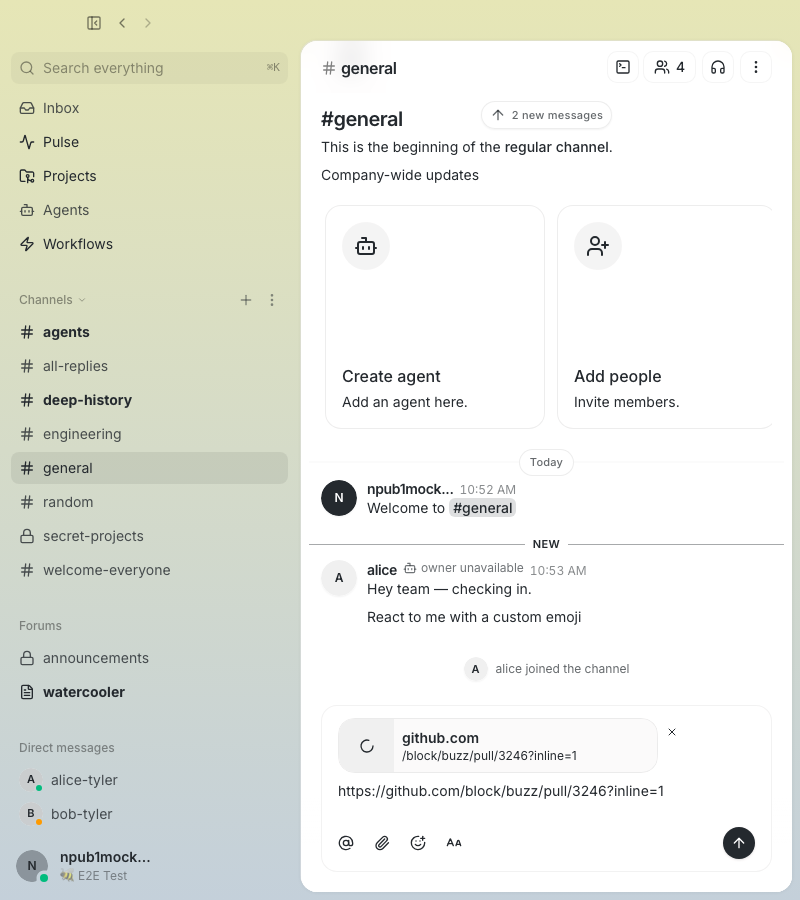 | 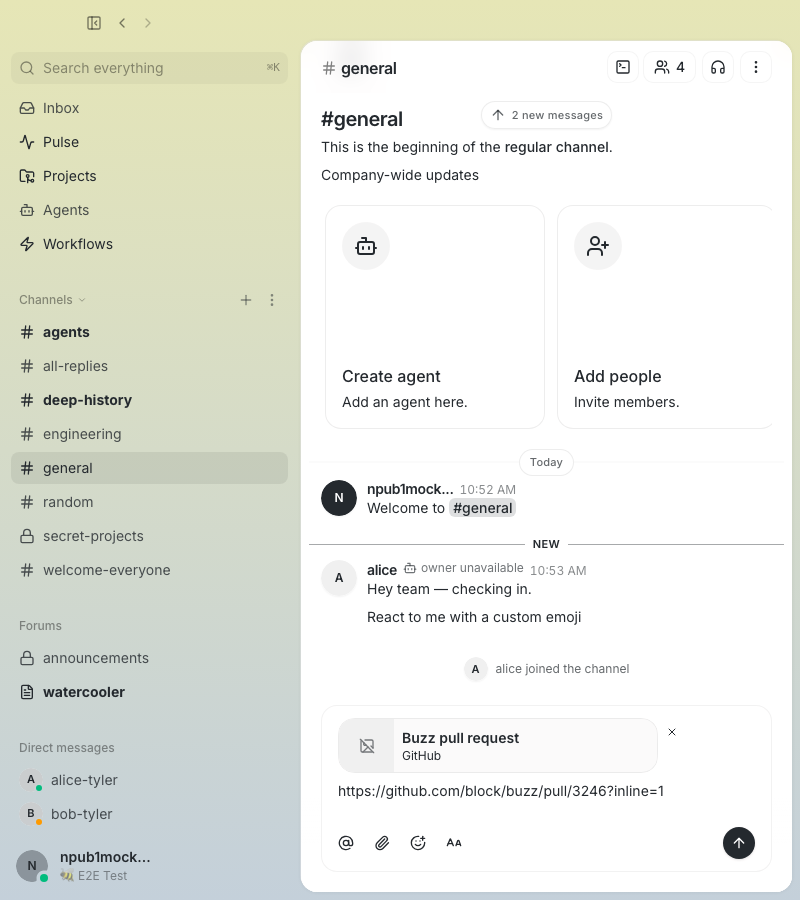 | ### Rich composer | Loading | Ready | |---|---| | 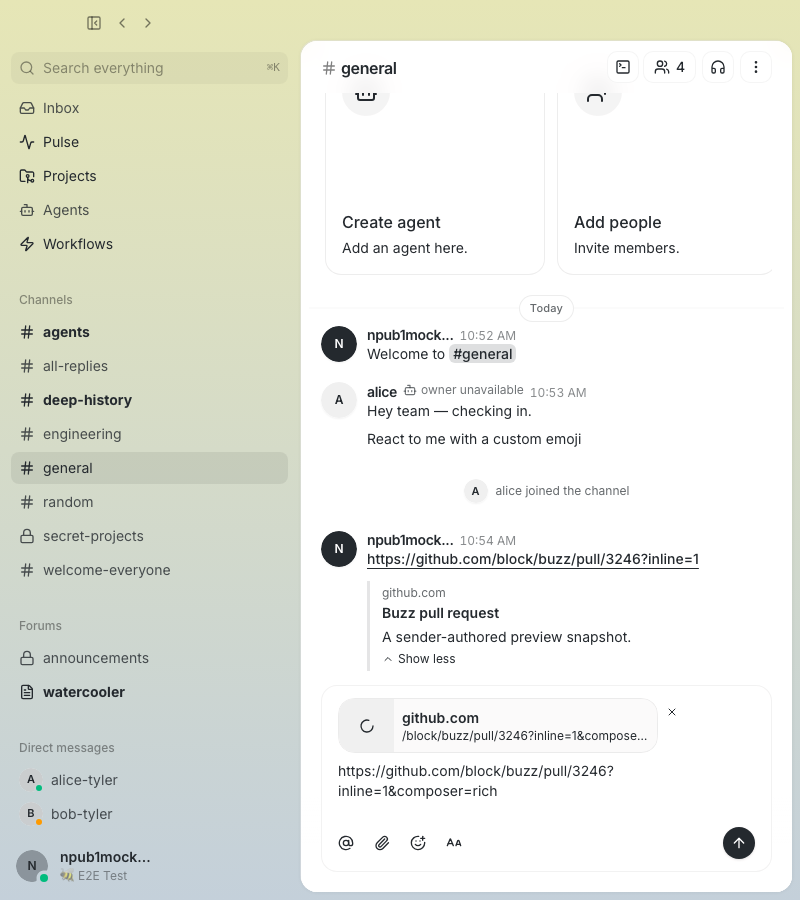 | 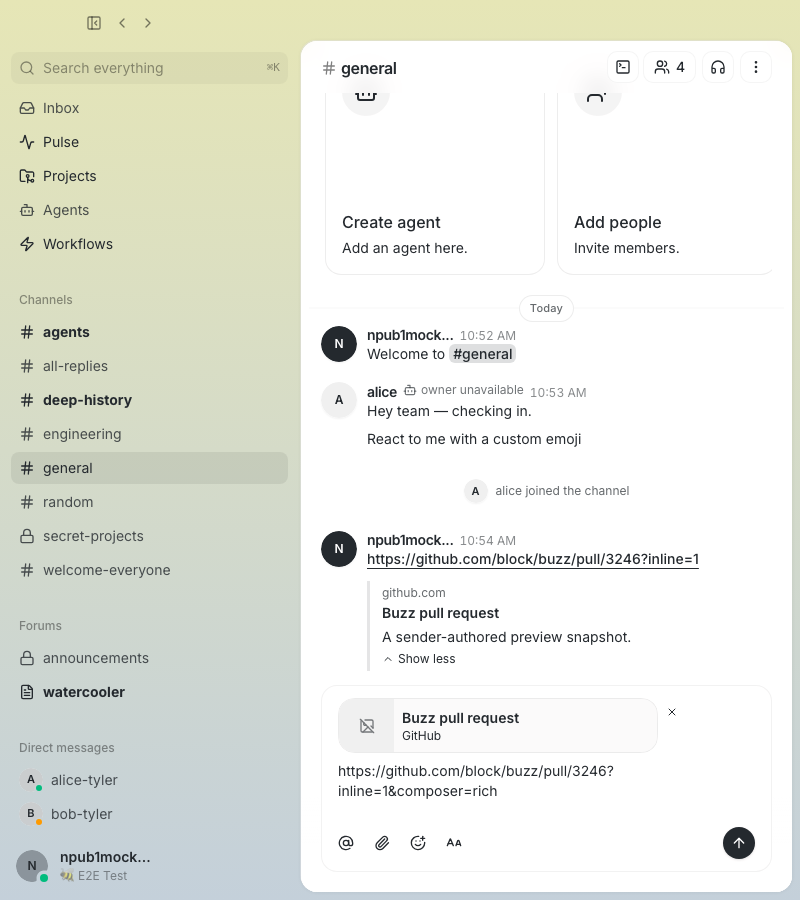 | ### Responsive composer | 800px loading | 800px ready | |---|---| | 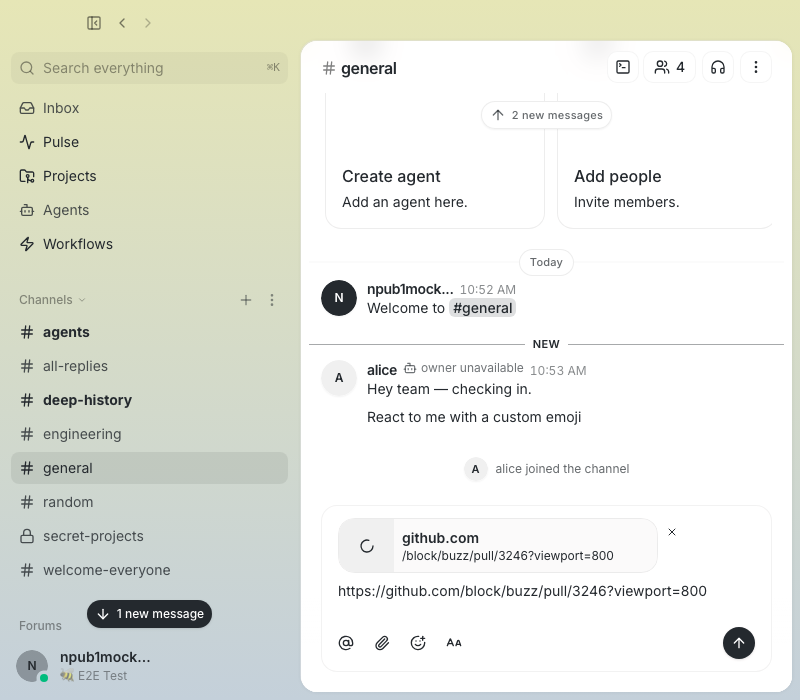 | 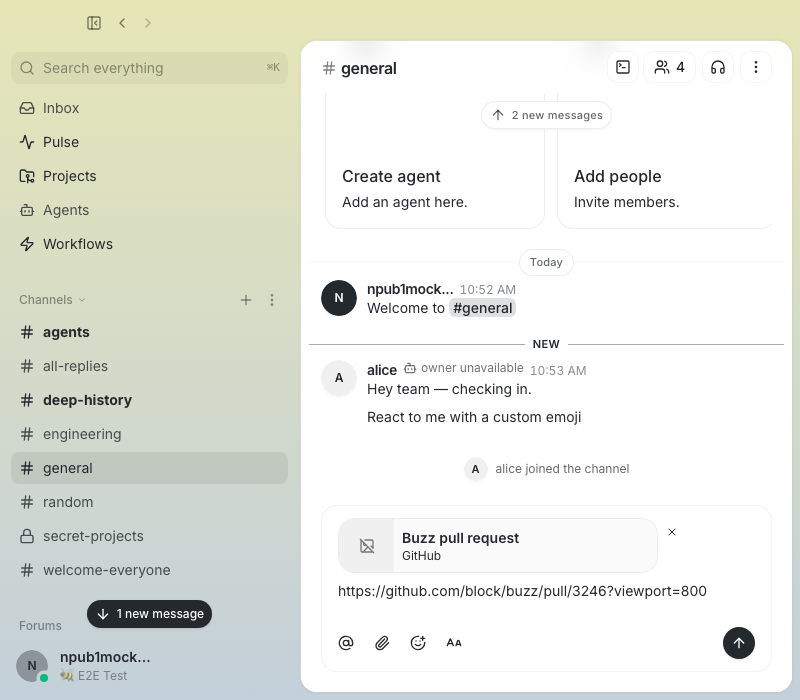 | | 420px loading | 420px ready | |---|---| | 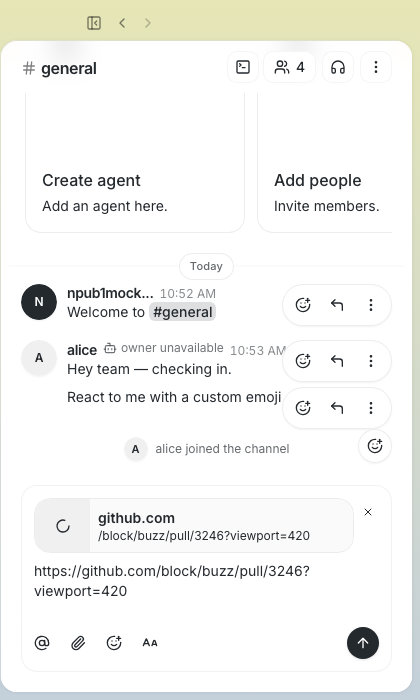 | 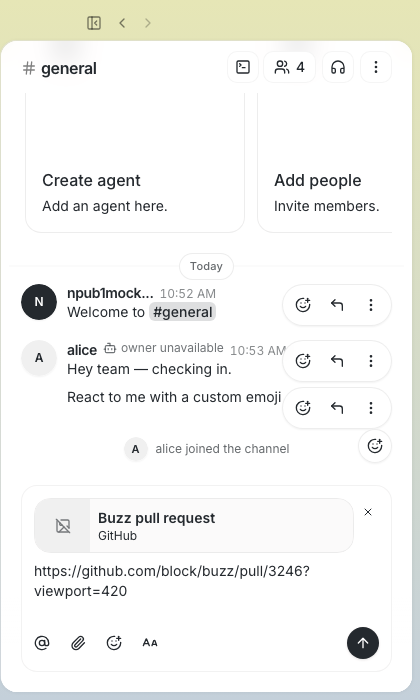 | ### Recipient presentation | Compact | Rich | |---|---| | 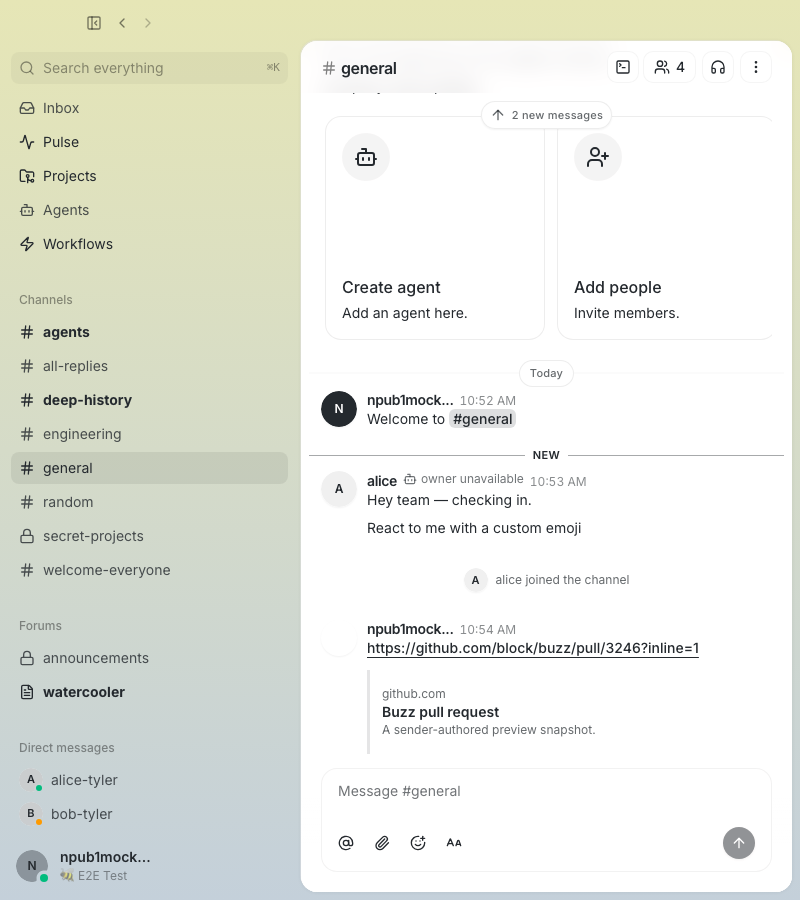 | 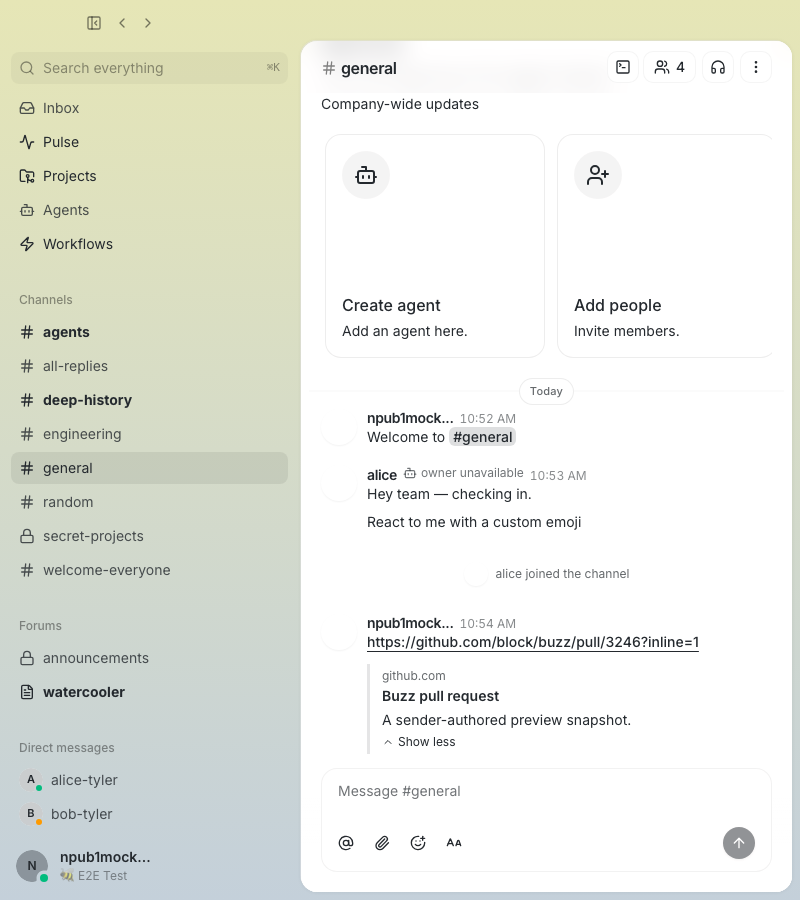 | ### Display-text Markdown link | Composer | Recipient | |---|---| | 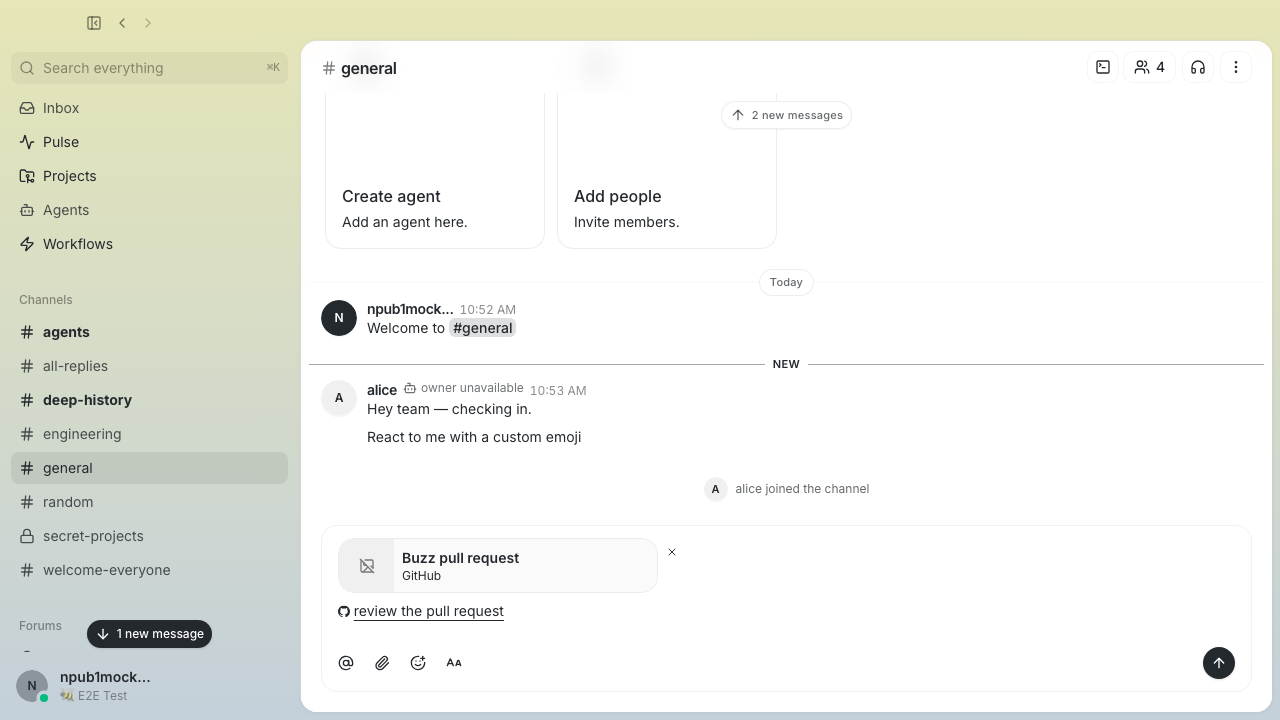 | 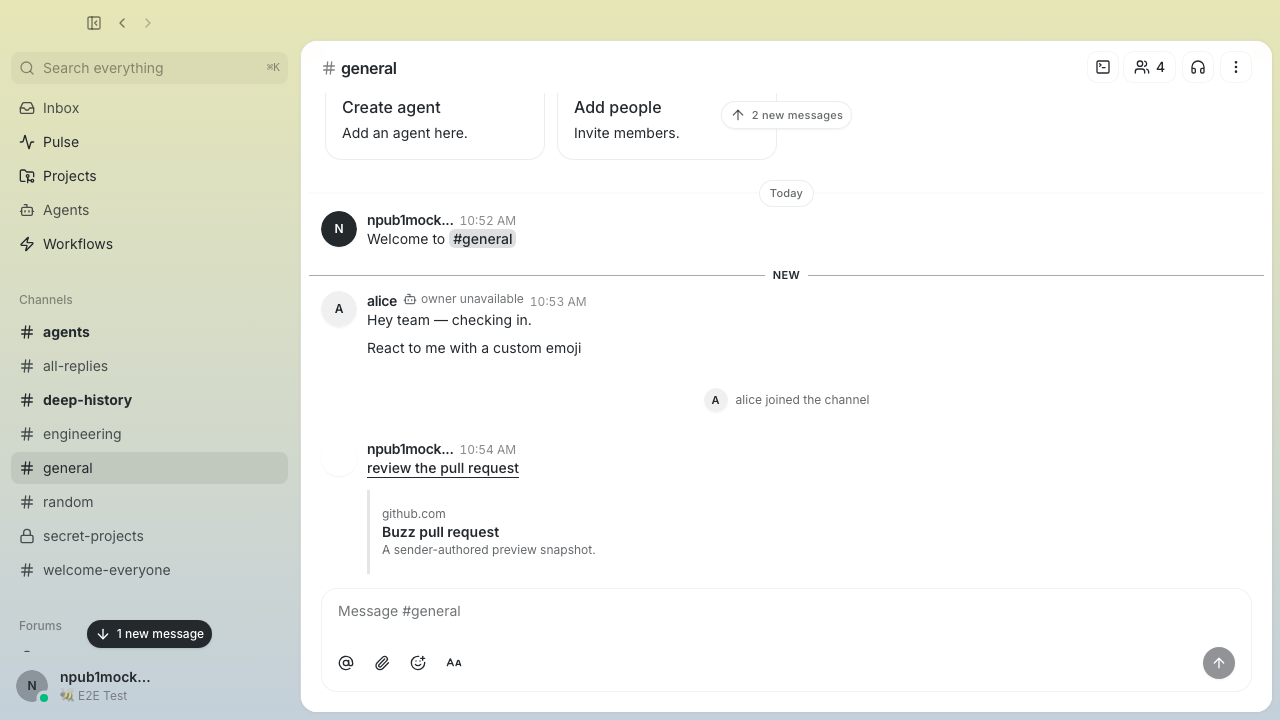 | ### Rich multiline description 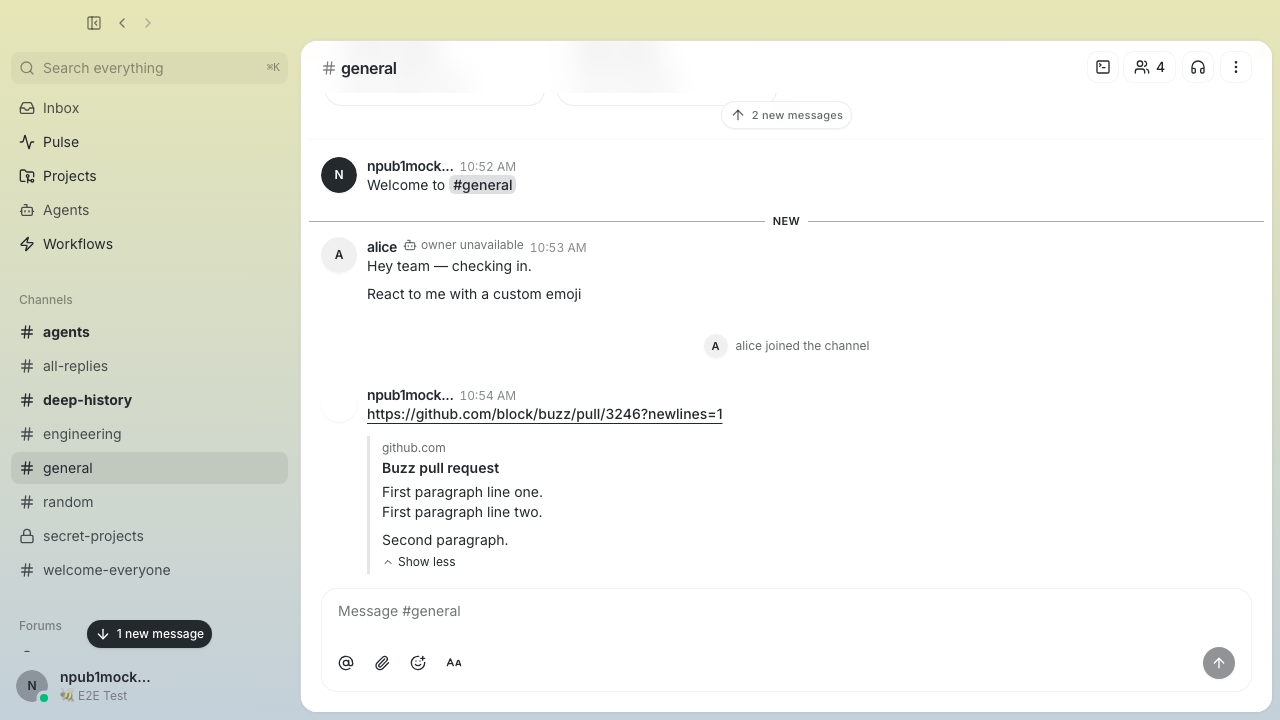 ### Immediate dismissal | Before × | Immediately after × | |---|---| | 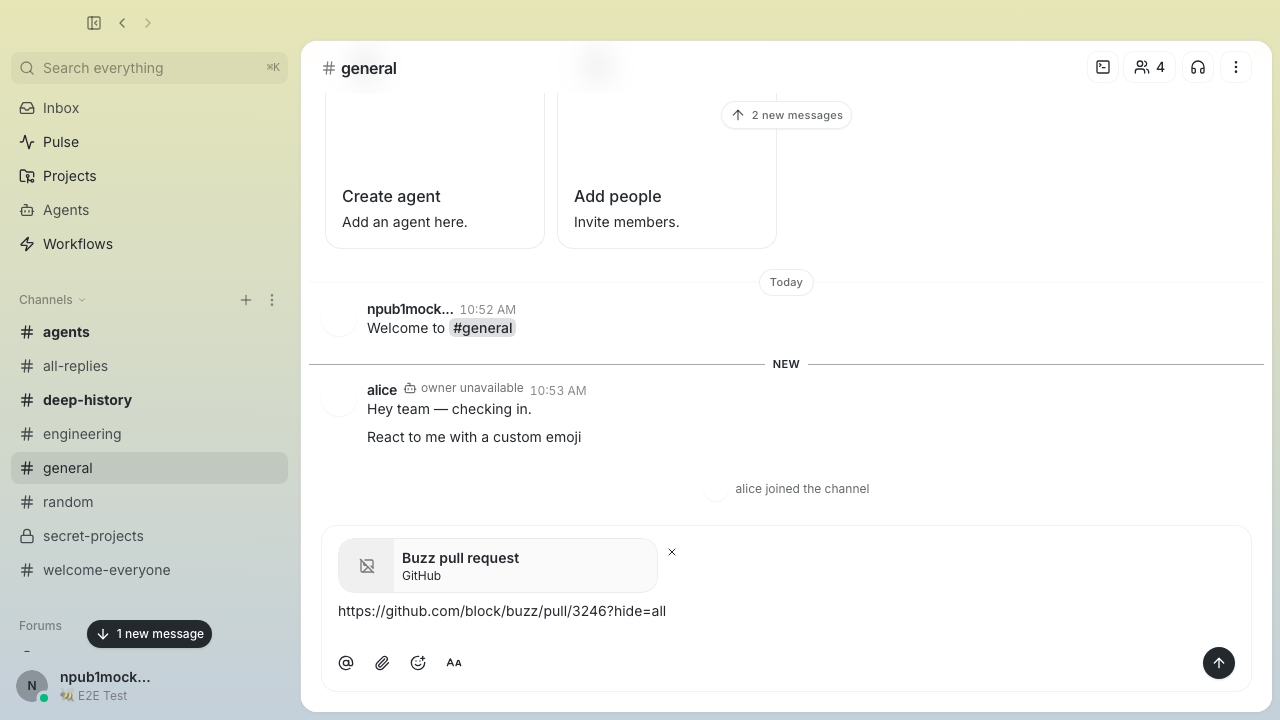 | 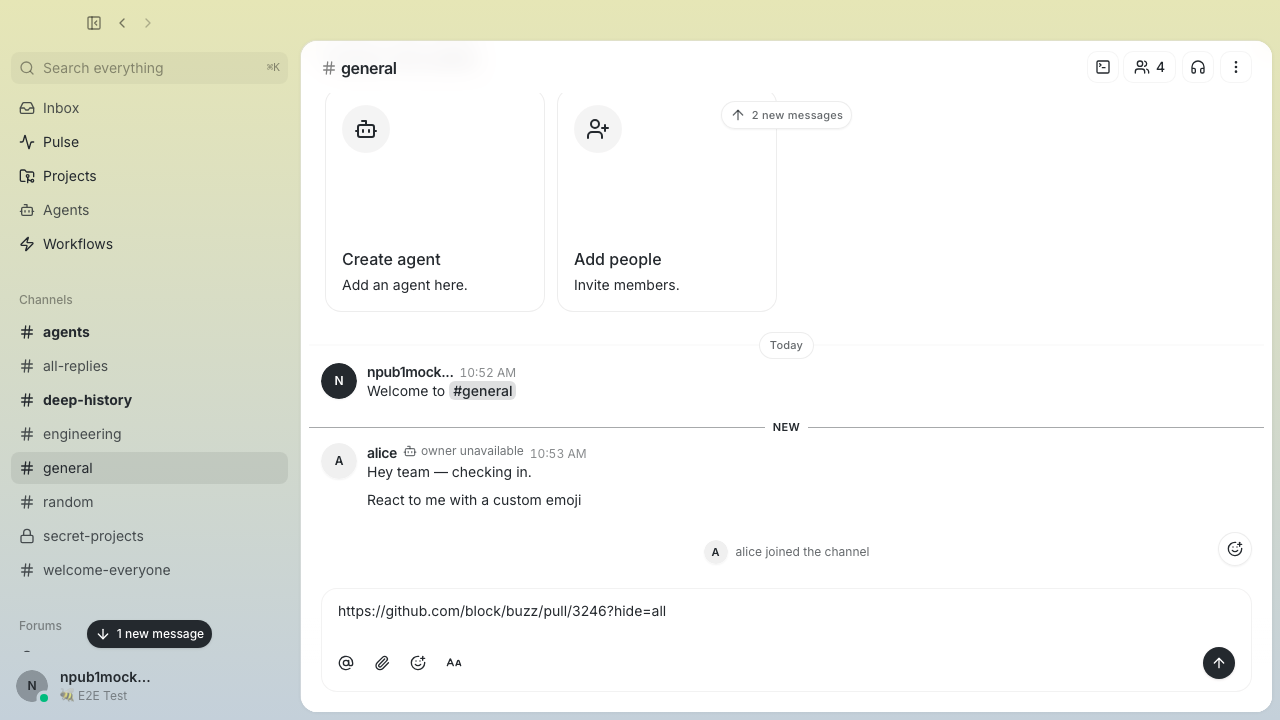 | --------- Signed-off-by: Taylor Ho <taylorkmho@gmail.com> |
||
|
klopez4212
|
ce3cf3cd25 |
Polish Huddle voice controls (#4694)
## Summary - add a visible Stop control for interrupting agent speech - make push-to-talk available by default while preserving manual mute controls - refine agent management, muted audio states, drawer layering, and return navigation - suppress duplicate notification sounds for Huddle messages ## Why Huddles could trap users behind long agent speech, hide useful agent controls, and leave temporary Huddle state visible after the call. The drawer also regressed when the terminal substrate began painting behind the rounded app surface. ## Validation - `just desktop-ci` - focused Huddle Playwright coverage for the drawer, speech interruption, agent picker, and leave navigation --------- Signed-off-by: kenny lopez <klopez4212@gmail.com> Signed-off-by: Wes <wesbillman@users.noreply.github.com> Co-authored-by: Wes <wesbillman@users.noreply.github.com> Co-authored-by: Carl <c7ebe626f000404285d3686e1dc74cc07cc60a9754a150041ba132e14bd3e2ec@buzz.block.builderlab.xyz> |
||
|
klopez4212
|
b29c8cdaa4 |
feat(desktop): redesign the Huddle experience (#4281)
## Summary - open Huddles in a focused companion window with a clean handoff back to the in-app drawer and backing channel - redesign the participant film strip, sidebar control, transcript surface, and themed shell treatment - preserve microphone and device control across windows, start agent voice on the first reply, and show agent speaking activity in the film strip - give each agent a distinct session voice, beginning with the configured default, plus compact per-agent text-to-speech and voice controls - enroll only agents explicitly mentioned or deliberately added through an agent panel into the live Huddle roster - keep temporary Huddle channels out of the sidebar unless the user explicitly brings one into the main app - remove Huddle-only avatar policy badges and filter short silence or noise segments before speech-to-text posts ## Why The previous flow exposed the temporary channel as product UI, obscured who was present or speaking, and split transcript and audio state between the main and companion windows. This keeps backing channels as implementation details unless a user explicitly brings a Huddle into the app, while sharing the live conversation and audio lifecycle across both surfaces. Agent participants now join only after an explicit invitation, distinct voices make multi-agent Huddles easier to follow, and short microphone noise no longer becomes stray transcript messages. ## Validation - `pnpm check` - `pnpm build:e2e` - `pnpm exec playwright test tests/e2e/huddle-transcription.spec.ts --project=smoke` (13 passed) - Huddle sidebar visibility unit coverage (4 passed) - focused managed-agent and persona-mention E2E coverage (2 passed) - `pnpm test` (3,910 passed) - `cargo clippy --manifest-path desktop/src-tauri/Cargo.toml --all-targets -- -D warnings` - `cargo test --manifest-path desktop/src-tauri/Cargo.toml` (2,093 passed, 14 ignored; 3 diagnostics passed) --------- Signed-off-by: kenny lopez <klopez4212@gmail.com> Signed-off-by: Wes <wesbillman@users.noreply.github.com> Co-authored-by: Wes <wesbillman@users.noreply.github.com> Co-authored-by: Carl <c7ebe626f000404285d3686e1dc74cc07cc60a9754a150041ba132e14bd3e2ec@buzz.block.builderlab.xyz> |
||
|
John Matthew Tennant
|
c104eecfb3 |
feat(desktop): import local Pocket voices (#3259)
## Context Pocket TTS currently offers bundled reference voices. People also need a local, private way to add a voice without sending audio to a cloud service. ## Summary Add a Pocket voice import flow to Voice settings. Buzz opens the native file picker, decodes common audio formats in the reusable `buzz-voice` crate, canonicalizes the selected audio, stores it under a content-derived identity in app data, selects it, and lets the user delete it later. ## Changes - Accept WAV, M4A, MP3, FLAC, OGG, and AIFF files between 2 and 30 seconds, including multichannel sources. - Decode and downmix accepted audio to canonical mono 32 kHz PCM16 WAV before hashing and storage. - Store imported voices behind stable `pocket:imported:<sha256>` identities and content-addressed files. - Keep absolute file paths inside the native process and expose only voice metadata to React. - Include imported voices in Pocket preview and live huddle playback. - Add Add voice and delete controls while preserving the bundled Pocket voice catalog. - Fall back to Mary when the selected imported voice is deleted. - Keep durable import, selection, and deletion successful when a live TTS worker acknowledgement is delayed. - Preserve bundled voices when optional import metadata is unreadable and keep failed deletion retryable. ## Related issue None found. ## Testing Production decoding was exercised with WAV, M4A with AAC, MP3, FLAC, OGG Vorbis, and AIFF fixtures. Each format canonicalized to mono 32 kHz PCM16 WAV. Manual validation in the combined daily-driver build covered native-picker import, Preview, live-huddle playback, deletion, and Mary fallback. ## Screenshots The Voice settings card preserves the bundled Pocket catalog and adds the local Add voice action. 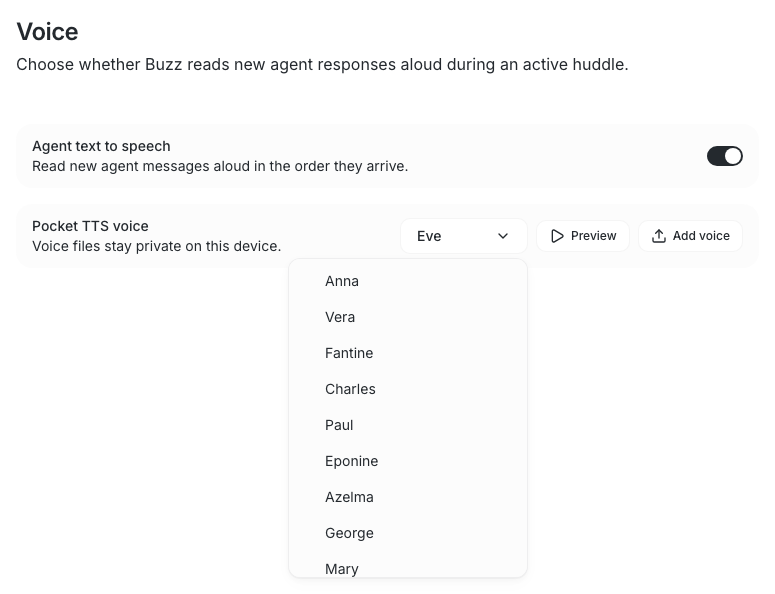 ## Reviewer-reproducible examples Create common-format fixtures and run them through the production importer: ```bash . ./bin/activate-hermit fixtures="$(mktemp -d)" ffmpeg -hide_banner -loglevel error -f lavfi -i "sine=frequency=220:duration=3" -ac 2 -ar 44100 "$fixtures/voice.wav" ffmpeg -hide_banner -loglevel error -i "$fixtures/voice.wav" -c:a aac "$fixtures/voice.m4a" ffmpeg -hide_banner -loglevel error -i "$fixtures/voice.wav" "$fixtures/voice.mp3" ffmpeg -hide_banner -loglevel error -i "$fixtures/voice.wav" "$fixtures/voice.flac" ffmpeg -hide_banner -loglevel error -i "$fixtures/voice.wav" -c:a libvorbis "$fixtures/voice.ogg" ffmpeg -hide_banner -loglevel error -i "$fixtures/voice.wav" -c:a pcm_s16be "$fixtures/voice.aiff" BUZZ_VOICE_IMPORT_TEST_DIR="$fixtures" \ cargo test -p buzz-voice imports_common_audio_format_fixtures -- --ignored --nocapture ``` Exercise import persistence, synthesis, deletion, and bundled-voice fallback with an installed Pocket model: ```bash BUZZ_POCKET_MODEL_DIR=/path/to/pocket-model-bundle \ cargo test -p buzz-voice --test pocket_import_audio \ objective_import_synthesis_delete_and_mary_fallback \ -- --ignored --nocapture ``` Exercise the native-picker boundary, selection, preview dispatch, deletion, cancellation, and invalid-file states: ```bash cd desktop pnpm build:e2e pnpm exec playwright test tests/e2e/voice-settings.spec.ts --project=smoke ``` --------- Signed-off-by: John Tennant <jtennant@block.xyz> Signed-off-by: John Tennant <johnmatthewtennant@gmail.com> Signed-off-by: John Tennant <jtennant@squareup.com> Signed-off-by: npub1qyvc0c5kl4gqv2fd97fsk46tu378sqgy35vc83rvgfwne90sel7s0ed67d <011987e296fd5006292d2f930b574be47c7801048d1983c46c425d3c95f0cffd@buzz.block.builderlab.xyz> Signed-off-by: npub12gtutshhh76rx0jx697f32f9tffd4hhp3hx58fp4x6u4uemkm7sqf8f757 <5217c5c2f7bfb4333e46d17c98a9255a52dadee18dcd43a43536b95e6776dfa0@buzz.block.builderlab.xyz> Co-authored-by: John Tennant <jtennant@block.xyz> Co-authored-by: npub1qyvc0c5kl4gqv2fd97fsk46tu378sqgy35vc83rvgfwne90sel7s0ed67d <011987e296fd5006292d2f930b574be47c7801048d1983c46c425d3c95f0cffd@buzz.block.builderlab.xyz> Co-authored-by: npub12gtutshhh76rx0jx697f32f9tffd4hhp3hx58fp4x6u4uemkm7sqf8f757 <5217c5c2f7bfb4333e46d17c98a9255a52dadee18dcd43a43536b95e6776dfa0@buzz.block.builderlab.xyz> |
||
|
Tyler
|
61ba9dfaa0 |
refactor(voice): extract reusable Pocket primitives + Pocket voice settings (relands #2467 + #3208) (#3910)
Relands **#2467** (extract `buzz-voice` crate) and **#3208** (Pocket
voice settings) onto main, after #3266 and #3180 merged.
## Why a fresh PR
The repo is squash-only with delete-branch-on-merge. Squashing #3266
deleted `jtennant/pocket-tts-2026-04`, which was #2467's base — GitHub
auto-closed #2467 and it cannot be reopened. Squash merges also sever
ancestry, so GitHub's natural merge-base reports phantom conflicts for
the whole remaining stack.
## Content provenance
- Byte-identical to the blessed `jt/buzz-voice-refactor` branch
(`93029c577`, tree `6729e0eff` — reviewed by Dawn (#2467) and Max
(#3208) at exact heads) **except** the three files where #3180 and #3208
genuinely interact.
- Three-file resolution (union of both sides):
- `huddle/mod.rs` — #3180's pipeline re-exports + #3208's
`agent_tts_routing` imports.
- `huddle/state.rs` — `reset_preserving_generation` preserves both
`huddle_generation` (#3180) and `tts_enabled` (#3208); test sets merged
into one `tests` module.
- `desktop/src/testing/e2eBridge.ts` — both switch arms kept; no
duplicate case labels.
## Verification at
|
||
|
John Matthew Tennant
|
4632c55041 |
feat(desktop): auto-enable huddle transcription for agents (#3180)
## Context Before this change, every huddle initialized with transcription off. Joining or adding an agent did not enable it, so the agent could not receive spoken conversation until a person clicked the transcript control. Starting a huddle from an agent DM could also omit that agent, and adding an agent who already belonged to the parent channel could attempt an unnecessary role change and show a warning. Agent detection uses authoritative huddle membership. A participant counts as an agent when the ephemeral membership identifies it with the `bot` role, or when the existing agent identity model identifies the participant in an agent DM. ## Summary Buzz now enables transcription once when the first authoritative agent is present. After that initial automatic action, explicit user control is authoritative: manual ON or OFF survives membership refreshes, reconnects, and UI remounts. Removing the last agent does not change the current transcription state. Agent-DM huddles enroll the agent automatically. Adding an agent who already belongs to the parent channel preserves the existing parent role and completes without a role-mutation warning. | Scenario | Before | With this change | | --- | --- | --- | | First authoritative agent joins or is hydrated | Transcription stays off | Transcription turns on once | | User explicitly turns transcription on or off | Manual control exists without an agent policy | The explicit choice suppresses later automatic changes | | Last agent leaves | No defined agent-presence behavior | The current transcription state remains unchanged | | Huddle starts from an agent DM | The agent can be omitted | The known agent is enrolled automatically | | Added agent already belongs to the parent channel | Buzz can attempt a role rewrite and warn | Existing parent membership and role are preserved | | Transcription is active | The control is not visually distinct | The control is highlighted and exposes `aria-pressed=true` | ## Changes - Derive agent presence from authoritative bot-role huddle membership and known agent-DM identity. - Apply the one-time auto-enable rule during create, join, membership hydration, reconnect, pipeline startup, and local agent addition. - Preserve explicit user state and use huddle-generation guards so stale asynchronous work cannot alter a replacement huddle. - Keep backend and React transcription state synchronized, with a visible and accessible active control. - Enroll known agent-DM participants and make parent-channel membership updates idempotent. - Cover hydration ordering, reconnects, remounts, explicit OFF, last-agent removal, DM enrollment, existing membership, and active styling. ## Related issue None found. ## Testing Manual validation in `pending-seed` confirmed the product contract: 1. Started a huddle from the owned, running Fizz agent DM. 2. Confirmed the authoritative roster contained the human and Fizz as an agent. 3. Confirmed transcription enabled without clicking the control: `Stop transcript`, `aria-pressed=true`, with the highlighted active background. 4. Turned transcription off and confirmed `Start transcript`, `aria-pressed=false` remained stable. 5. Removed Fizz while transcription was off and confirmed the state stayed off. 6. Left the huddle cleanly. ## Screenshots The same control has distinct active and inactive states. 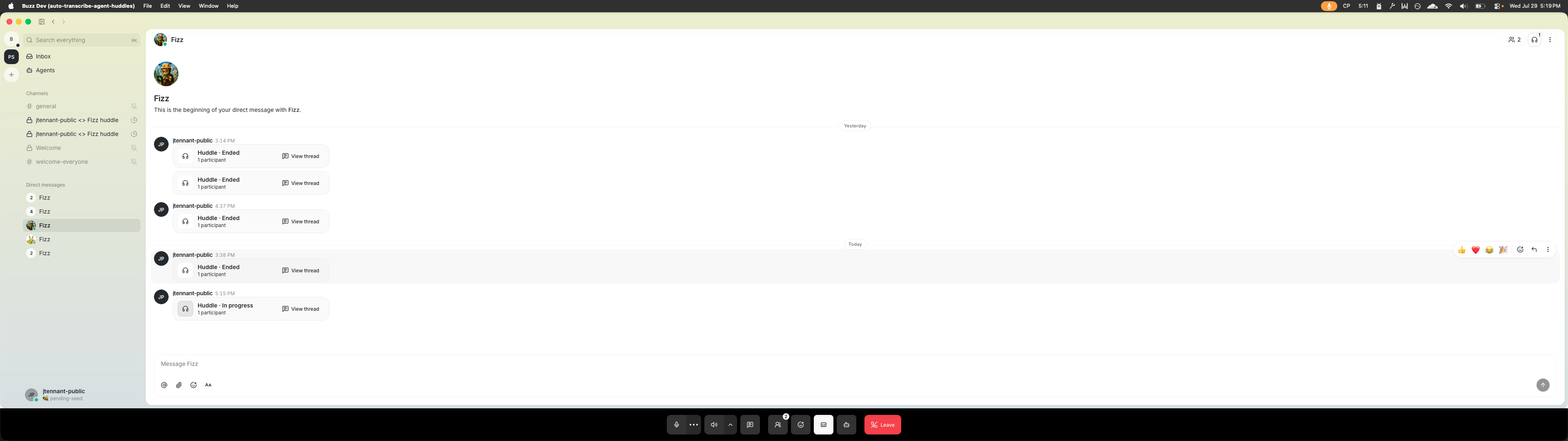 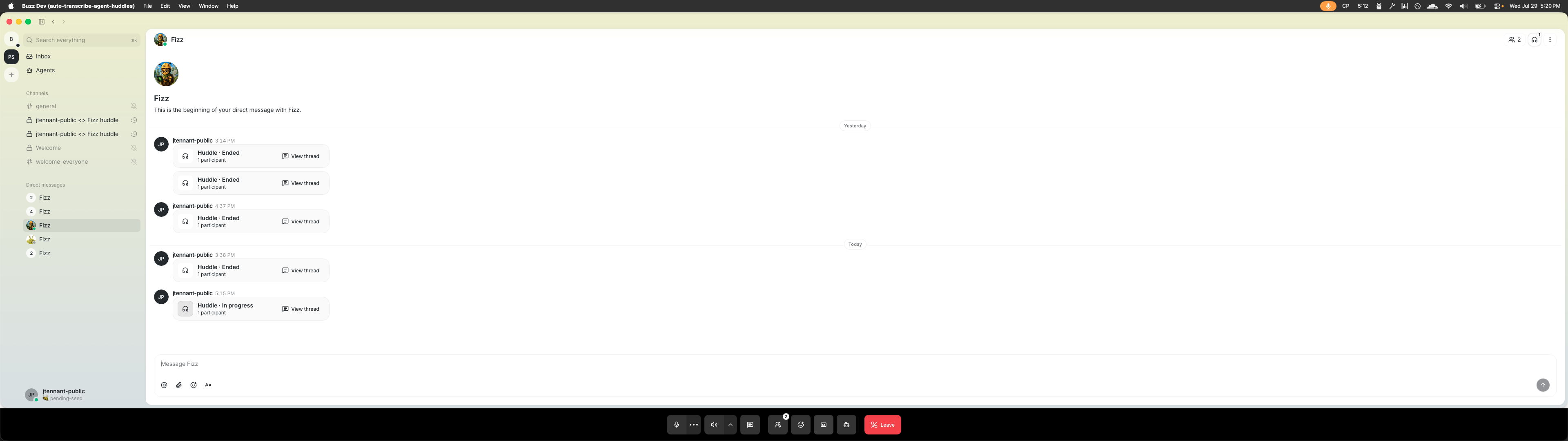 ## Reviewer-reproducible examples From a fresh checkout: ```bash pnpm --dir desktop build:e2e pnpm --dir desktop exec playwright test tests/e2e/huddle-transcription.spec.ts --project=smoke pnpm --dir desktop exec playwright test tests/e2e/mentions.spec.ts --project=smoke --grep "system agent profile exposes owned agent actions|system agent avatar exposes owned agent actions|owned bot profile exposes message and huddle actions|owned agent mention profile exposes message and huddle actions" ``` The huddle scenario exercises initial authoritative hydration, exactly one automatic enable, explicit OFF persistence, unchanged state after last-agent removal, newer events winning over delayed hydration, agent-DM enrollment, and idempotent parent membership. It also asserts `aria-pressed` and distinct computed active styling. --------- Signed-off-by: John Tennant <jtennant@squareup.com> Signed-off-by: npub1jh9wn95s0472h86ahapupaf7m6kx4v9sx2n0atj2hltcfer8k06s5n3pyf <95cae996907d7cab9f5dbf43c0f53edeac6ab0b032a6feae4abfd784e467b3f5@buzz.block.builderlab.xyz> Co-authored-by: npub1jh9wn95s0472h86ahapupaf7m6kx4v9sx2n0atj2hltcfer8k06s5n3pyf <95cae996907d7cab9f5dbf43c0f53edeac6ab0b032a6feae4abfd784e467b3f5@buzz.block.builderlab.xyz> |
||
|
John Matthew Tennant
|
d48b0e0eec |
feat(desktop): upgrade Pocket TTS model (#3266)
## Context Buzz Desktop currently installs an older Pocket TTS model bundle. The current bundle changes the tokenizer, learned BOS input, recurrent-state contract, and prompt behavior, so updating download URLs alone is not compatible. ## Summary This PR upgrades Buzz Desktop to the current pinned Pocket TTS model. It preserves existing product behavior and the hard 50-token model-input limit while adding the required runtime support, verified acquisition, and crash-safe cache migration. ## Changes - Pins an immutable Pocket TTS revision, artifact names, exact byte sizes, SHA-256 checksums, Mary reference voice, and license. - Loads the bundle-matched SentencePiece tokenizer, learned BOS embedding, and bundle-declared recurrent states. - Uses one pinned Pocket TTS configuration; no precision or model-version selector is added. - Preserves the resident engine's exact `<= 50` token contract without changing Desktop segmentation policy. - Bumps the Pocket cache manifest to v4, verifies size and checksum before adoption, atomically swaps the cache, and recovers the last verified cache after interrupted installs, including an incomplete final directory. - Keeps acquisition, cache migration, worker adoption, and tests within the existing Desktop implementation. - Removes the obsolete model-quality harness, which was coupled to the superseded production prompt and model layout. ## Related issue None. ## Testing Manual listening completed on the exact Desktop build. The updated model improved speech quality and resolved the phrase-start and sample-onset artifacts. Reproducible integrity and model checks are below. ## Screenshots N/A. This changes model installation and speech synthesis, not a visual surface. ## Reviewer-reproducible examples ### Before and after model identity ```sh git show 35305bfc8fd456ca9a17caa1ddbfaabd87d46981:desktop/src-tauri/src/huddle/models.rs \ | grep -E 'sherpa-onnx-pocket-tts|TTS_MODEL_VERSION' git show 211d17c58567448fe7ac95c4fa0ad2b88378849a:desktop/src-tauri/src/huddle/pocket_models.rs \ | grep -E 'MODEL_REPOSITORY|MODEL_REVISION|MODEL_PRECISION|MAX_TOKENS' ``` The target branch identifies the January bundle. The PR branch identifies the immutable April revision, INT8 precision, and 50-token maximum. ### Deterministic runtime validation Use the pinned artifacts listed in `pocket_models.rs` and run the model-dependent Pocket tests with the model directory supplied by the test environment. The checked-in long-sentence fixture must preserve its expected 48 and 44 token split and produce non-silent PCM. ### Manual listening validation John listened to an untrimmed Pocket TTS onset-stress clip generated from the exact user-provided passage, with every sentence synthesized separately and identical 100 ms digital-silence boundaries. The clip used no leading period, onset trimming, gain adjustment, or loudness normalization. The updated model produced better-quality speech and resolved the start-of-sample artifacts. --------- Signed-off-by: John Tennant <jtennant@block.xyz> Signed-off-by: npub1mprnacetjua2xx3p5eddmhxyk6wv929ymm5py8kd2xfxurxahspqqlgyta <d8473ee32b973aa31a21a65adddcc4b69cc2a8a4dee8121ecd51926e0cddbc02@buzz.block.builderlab.xyz> Co-authored-by: John Tennant <jtennant@block.xyz> Co-authored-by: npub1mprnacetjua2xx3p5eddmhxyk6wv929ymm5py8kd2xfxurxahspqqlgyta <d8473ee32b973aa31a21a65adddcc4b69cc2a8a4dee8121ecd51926e0cddbc02@buzz.block.builderlab.xyz> |
||
|
Taylor Ho
|
bd0bff24bf |
feat(desktop): add password-protected backups in settings (#3701)
**Category:** new-feature **User Impact:** Users can create, download, and verify a password-protected backup of their private identity from desktop Settings. **Problem:** Buzz does not currently give signed-in users a Settings-based path to protect or validate their private identity independently of onboarding. **Solution:** Add a focused backup menu to the private-key row, keep encryption and verification local in Rust, and preserve completed encrypted backups briefly so native saves can be retried without repeating encryption. <details> <summary>File changes</summary> **desktop/src/features/settings/** Adds the background backup lifecycle, create and test dialogs, private-key menu integration, password handling, and focused unit coverage. **desktop/src/features/onboarding/ui/NsecMaskedDisplay.tsx** Extends the masked private-key display with reusable overflow-menu actions used by Settings. **desktop/src/app/App.tsx** Mounts the backup provider at app scope so encryption and save work survive closing Settings or the modal. **desktop/src/shared/api/tauriIdentity.ts** Adds typed desktop bindings for local backup creation, save, selection, and verification. **desktop/src-tauri/src/key_backup.rs and desktop/src-tauri/src/commands/identity.rs** Implements local NIP-49 encryption, password generation, file handling, and public-identity-only verification results. **desktop/src-tauri/src/egress_guard.rs and guarded call sites** Blocks encrypted secret material from relay, websocket, snapshot, sharing, and huddle egress paths. **desktop/src-tauri tests and fixtures** Covers encryption, verification, file behavior, and fail-closed no-egress protections. **desktop/src/testing/e2eBridge.ts, desktop/tests/, and desktop/playwright.config.ts** Expands the mock native bridge and browser coverage across create, retry, expiry, and current/different-identity verification states. **desktop/src-tauri/Cargo.toml, Cargo.lock, and assets** Adds the local cryptography/password-generation dependencies and embedded short-word list. </details> ## Reproduction steps 1. Run the desktop app and open **Settings → Profile → Identity**. 2. Open the private-key overflow menu and choose **Create backup**. 3. Enter or generate a valid password, submit, and confirm progress continues if the dialog or Settings is closed. 4. Save the resulting `.ncryptsec` file; cancel and retry to confirm the temporary download remains available. 5. Choose **Test backup**, select the file, enter a wrong password, then retry with the correct password. 6. Confirm success identifies whether the backup matches the current identity and displays only the public `npub`. ## Screenshots | Settings identity | Private-key menu | Create backup | |---|---|---| | <img width="1280" height="720" alt="image" src="https://github.com/user-attachments/assets/981e391b-6829-4081-95ca-ca75a369de71" /> | <img width="1280" height="720" alt="image" src="https://github.com/user-attachments/assets/7972c68e-7635-47d8-b0ad-9639390d3e6c" /> | <img width="1280" height="720" alt="image" src="https://github.com/user-attachments/assets/4709c8f7-cf02-46f1-bec9-b3f98fe56fb2" /> | | Encrypting | Download available | Test success | |---|---|---| | <img width="1280" height="720" alt="image" src="https://github.com/user-attachments/assets/1ac3e934-2b4b-4135-bae6-126c715c8c59" /> | <img width="1280" height="720" alt="image" src="https://github.com/user-attachments/assets/cb6f07ee-a16f-44a5-b9a0-6b9fe0e4d40d" /> | <img width="1280" height="720" alt="image" src="https://github.com/user-attachments/assets/ea58b1b1-966c-46aa-8d59-92c9f06a25bd" /> | Visual review and additional states: [Buzz thread](buzz://message?channel=50ca7ef1-201e-4159-9499-40de3964b7c3&id=87eceb5f0f82fd50c32e560de3d35be48e293760f6620718aafdcef289d475fe) --------- Signed-off-by: Taylor Ho <taylorkmho@gmail.com> Co-authored-by: npub1223z34hd7vtwc6qj4s7flsxkj644nlre2nthu7lrrmkumhu3xddsrx9r6w <52a228d6edf316ec6812ac3c9fc0d696ab59fc7954d77e7be31eedcddf91335b@buzz.block.builderlab.xyz> |
||
|
damienrj
|
fb4a801adf |
Improve huddle audio failure handling (#2578)
## Summary - Preserve plain-string errors returned by Tauri and show an actionable message when huddle audio is unavailable in the relay deployment. - Use one error formatter across channel, timeline, wave, and profile huddle actions while preserving other relay and device errors. - Complete the huddle lifecycle when audio setup fails after publishing a start event, preventing peers and reloaded clients from reconstructing a phantom active huddle. - Cover unavailable-audio formatting and START → rollback-END reconstruction with regression tests. ## Behavior The Tauri huddle commands reject with a plain string. Several desktop toast call sites only preserved JavaScript `Error` objects, so the relay message was discarded and replaced with “Failed to join huddle.” The desktop now recognizes `huddle_audio_unavailable` and the current relay message, then shows: > Huddle audio isn’t available on this server. Ask an administrator to turn it on. Other relay and device messages remain intact, including microphone errors. `start_huddle` also publishes `KIND_HUDDLE_STARTED` before audio setup. If setup fails, rollback now publishes `KIND_HUDDLE_ENDED` through the normal end-and-archive path before resetting local state. This makes the failed start observable to lifecycle reconstruction and prevents stale join affordances. ## Checks - `cd desktop && pnpm test` — 3,405 passed - `cd desktop/src-tauri && cargo test` — 1,560 passed, 13 ignored; 3 diagnostic tests passed - `cd desktop && pnpm exec playwright test tests/e2e/channels.spec.ts --project=smoke --grep 'huddle rollback end event'` — passed - `just desktop-tauri-check` - `cd desktop && pnpm typecheck` - `cd desktop && pnpm check` - Pre-commit and pre-push hooks |
||
|
Tyler
|
87276320af |
fix(huddle): Pocket TTS quality — grouped chunking + FP32 model bundle (#2224)
Signed-off-by: npub1mprnacetjua2xx3p5eddmhxyk6wv929ymm5py8kd2xfxurxahspqqlgyta <d8473ee32b973aa31a21a65adddcc4b69cc2a8a4dee8121ecd51926e0cddbc02@sprout-oss.stage.blox.sqprod.co> Signed-off-by: Tyler Longwell <tlongwell@block.xyz> Co-authored-by: npub1mprnacetjua2xx3p5eddmhxyk6wv929ymm5py8kd2xfxurxahspqqlgyta <d8473ee32b973aa31a21a65adddcc4b69cc2a8a4dee8121ecd51926e0cddbc02@sprout-oss.stage.blox.sqprod.co> Co-authored-by: npub1qyvc0c5kl4gqv2fd97fsk46tu378sqgy35vc83rvgfwne90sel7s0ed67d <011987e296fd5006292d2f930b574be47c7801048d1983c46c425d3c95f0cffd@sprout-oss.stage.blox.sqprod.co> Co-authored-by: Tyler Longwell <tlongwell@block.xyz> |
||
|
Will Pfleger
|
258cc92064 |
fix(desktop): survive degraded networks with rate-limit-aware relay client (#2197)
Signed-off-by: Will Pfleger <pfleger.will@gmail.com> Co-authored-by: npub1mn7jgtj4w2pd0g0zeuhxsa6jy6p0rewxz4kujt98my82ahfmp72sxjexk7 <dcfd242e557282d7a1e2cf2e6877522682f1e5c6156dc92ca7d90eaedd3b0f95@sprout-oss.stage.blox.sqprod.co> Co-authored-by: npub1fgdl5qqnh3k3f2xkqrvt7cujalhm623x4s7fdjdj5yrtp5fzjl9qrjpucw <4a1bfa0013bc6d14a8d600d8bf6392efefbd2a26ac3c96c9b2a106b0d12297ca@sprout-oss.stage.blox.sqprod.co> |
||
|
Tyler
|
ccb021d713 |
Relay mesh: cross-pod tunnel + huddle transport (buzz-relay-mesh) (#1670)
Signed-off-by: Tyler Longwell <tlongwell@block.xyz> Signed-off-by: npub1mprnacetjua2xx3p5eddmhxyk6wv929ymm5py8kd2xfxurxahspqqlgyta <d8473ee32b973aa31a21a65adddcc4b69cc2a8a4dee8121ecd51926e0cddbc02@sprout-oss.stage.blox.sqprod.co> Signed-off-by: npub17jjz49l9jjmhhk7cac63j8yt9z555n9cw8vk7v5jz4vzw4ppld5qgj57cc <f4a42a97e594b77bdbd8ee35191c8b28a94a4cb871d96f32921558275421fb68@sprout-oss.stage.blox.sqprod.co> Signed-off-by: Tyler Longwell <tlongwell@squareup.com> Signed-off-by: tlongwell-block <109685178+tlongwell-block@users.noreply.github.com> Co-authored-by: npub1qyvc0c5kl4gqv2fd97fsk46tu378sqgy35vc83rvgfwne90sel7s0ed67d <011987e296fd5006292d2f930b574be47c7801048d1983c46c425d3c95f0cffd@sprout-oss.stage.blox.sqprod.co> Co-authored-by: Tyler Longwell <tlongwell@block.xyz> Co-authored-by: npub1mprnacetjua2xx3p5eddmhxyk6wv929ymm5py8kd2xfxurxahspqqlgyta <d8473ee32b973aa31a21a65adddcc4b69cc2a8a4dee8121ecd51926e0cddbc02@sprout-oss.stage.blox.sqprod.co> Co-authored-by: npub1cc3ha7z055mu0rwwu7806t2wt8mj3pvu0uv5mfp2c50dahaqhczshdalg6 <c6237ef84fa537c78dcee78efd2d4e59f728859c7f194da42ac51ededfa0be05@sprout-oss.stage.blox.sqprod.co> Co-authored-by: npub17jjz49l9jjmhhk7cac63j8yt9z555n9cw8vk7v5jz4vzw4ppld5qgj57cc <f4a42a97e594b77bdbd8ee35191c8b28a94a4cb871d96f32921558275421fb68@sprout-oss.stage.blox.sqprod.co> Co-authored-by: npub1jh9wn95s0472h86ahapupaf7m6kx4v9sx2n0atj2hltcfer8k06s5n3pyf <95cae996907d7cab9f5dbf43c0f53edeac6ab0b032a6feae4abfd784e467b3f5@sprout-oss.stage.blox.sqprod.co> Co-authored-by: npub1t2tgm7d8f995uqvmnm8h88sg3wnpp9a5xysjf6dg3tjmgt3ltulqdp8ehr <5a968df9a7494b4e019b9ecf739e088ba61097b4312124e9a88ae5b42e3f5f3e@sprout-oss.stage.blox.sqprod.co> Co-authored-by: npub12gtutshhh76rx0jx697f32f9tffd4hhp3hx58fp4x6u4uemkm7sqf8f757 <5217c5c2f7bfb4333e46d17c98a9255a52dadee18dcd43a43536b95e6776dfa0@sprout-oss.stage.blox.sqprod.co> |
||
|
Tyler
|
2cc0eb5396 |
perf(desktop): GUI performance sweep — async offload, poll reduction, render stabilization (#1641)
Signed-off-by: Tyler Longwell <tlongwell@block.xyz> Co-authored-by: npub17jjz49l9jjmhhk7cac63j8yt9z555n9cw8vk7v5jz4vzw4ppld5qgj57cc <f4a42a97e594b77bdbd8ee35191c8b28a94a4cb871d96f32921558275421fb68@sprout-oss.stage.blox.sqprod.co> Co-authored-by: Tyler Longwell <tlongwell@block.xyz> Co-authored-by: npub12gtutshhh76rx0jx697f32f9tffd4hhp3hx58fp4x6u4uemkm7sqf8f757 <5217c5c2f7bfb4333e46d17c98a9255a52dadee18dcd43a43536b95e6776dfa0@sprout-oss.stage.blox.sqprod.co> Co-authored-by: npub1cc3ha7z055mu0rwwu7806t2wt8mj3pvu0uv5mfp2c50dahaqhczshdalg6 <c6237ef84fa537c78dcee78efd2d4e59f728859c7f194da42ac51ededfa0be05@sprout-oss.stage.blox.sqprod.co> Co-authored-by: npub1jh9wn95s0472h86ahapupaf7m6kx4v9sx2n0atj2hltcfer8k06s5n3pyf <95cae996907d7cab9f5dbf43c0f53edeac6ab0b032a6feae4abfd784e467b3f5@sprout-oss.stage.blox.sqprod.co> Co-authored-by: npub1t2tgm7d8f995uqvmnm8h88sg3wnpp9a5xysjf6dg3tjmgt3ltulqdp8ehr <5a968df9a7494b4e019b9ecf739e088ba61097b4312124e9a88ae5b42e3f5f3e@sprout-oss.stage.blox.sqprod.co> Co-authored-by: npub1jmc9dt2lyvzu3h0kxlwxt5zg4fxp9476awyxw6gwxn72g6cw7exqs64whm <96f056ad5f2305c8ddf637dc65d048aa4c12d7daeb8867690e34fca46b0ef64c@sprout-oss.stage.blox.sqprod.co> Co-authored-by: npub1mprnacetjua2xx3p5eddmhxyk6wv929ymm5py8kd2xfxurxahspqqlgyta <d8473ee32b973aa31a21a65adddcc4b69cc2a8a4dee8121ecd51926e0cddbc02@sprout-oss.stage.blox.sqprod.co> |
||
|
klopez4212
|
b58f671b4e | Allow Huddle between 2 humans in DM (#1347) | ||
|
Wes
|
6c60cb59ab |
fix(desktop): reserve PTT shortcut only during active huddle (#1315)
Signed-off-by: Wes <wesbillman@users.noreply.github.com> Co-authored-by: Brain <21994759fc7a6fa6b965551d35cfd7897d262f2495467f2d78694ddcfa6a5c7e@sprout-oss.stage.blox.sqprod.co> |
||
|
klopez4212
|
5234fc8167 | Polish huddles UI (#1041) | ||
|
tlongwell-block
|
12433077ad |
fix(huddle): Pocket TTS quality overhaul — reference parity + cross-message pipelining (#997)
Signed-off-by: Tyler Longwell <tlongwell@squareup.com> Co-authored-by: npub1qyvc0c5kl4gqv2fd97fsk46tu378sqgy35vc83rvgfwne90sel7s0ed67d <011987e296fd5006292d2f930b574be47c7801048d1983c46c425d3c95f0cffd@sprout-oss.stage.blox.sqprod.co> |
||
|
tlongwell-block
|
2846a96ed2 |
feat(huddle): sentence-at-a-time voice-mode guidelines for lower TTS latency (#996)
Signed-off-by: Tyler Longwell <tlongwell@squareup.com> Co-authored-by: npub1qyvc0c5kl4gqv2fd97fsk46tu378sqgy35vc83rvgfwne90sel7s0ed67d <011987e296fd5006292d2f930b574be47c7801048d1983c46c425d3c95f0cffd@sprout-oss.stage.blox.sqprod.co> |
||
|
Wes
|
8f580f308c |
Rename desktop app to Buzz (#960)
Signed-off-by: Wes <wesbillman@users.noreply.github.com> Co-authored-by: Pinky <44b8e82baa6e0e254e0208d68f335c283c94e7b78dd1fa10d5a49d3f13dd0435@sprout-oss.stage.blox.sqprod.co> |
||
|
klopez4212
|
e9cd1c3926 | Improve mentions for agents + people (#942) | ||
|
Wes
|
2349421304 |
feat: custom emoji — user-owned NIP-30 sets with a client-side union (#816)
Signed-off-by: Wes <wesbillman@users.noreply.github.com> Signed-off-by: tlongwell-block <109685178+tlongwell-block@users.noreply.github.com> Co-authored-by: Brain <21994759fc7a6fa6b965551d35cfd7897d262f2495467f2d78694ddcfa6a5c7e@sprout-oss.stage.blox.sqprod.co> Co-authored-by: Pinky <44b8e82baa6e0e254e0208d68f335c283c94e7b78dd1fa10d5a49d3f13dd0435@sprout-oss.stage.blox.sqprod.co> Co-authored-by: tlongwell-block <109685178+tlongwell-block@users.noreply.github.com> |
||
|
Wes
|
c761a76ff2 | fix(release): sync release tags during preflight (#780) | ||
|
tlongwell-block
|
6e1418e571 |
feat(huddle): fix concurrent-speaker mixing + jitter buffer + protocol v2 (up to 10 peers) (#609)
Signed-off-by: tlongwell-block <109685178+tlongwell-block@users.noreply.github.com> |
||
|
tlongwell-block
|
c0eb5affcf |
refactor(huddle): switch local TTS to Pocket TTS (Kyutai/sherpa-onnx) (#607)
Signed-off-by: Tyler Longwell <tlongwell@squareup.com> Signed-off-by: npub1cc3ha7z055mu0rwwu7806t2wt8mj3pvu0uv5mfp2c50dahaqhczshdalg6 <c6237ef84fa537c78dcee78efd2d4e59f728859c7f194da42ac51ededfa0be05@sprout-oss.stage.blox.sqprod.co> Co-authored-by: npub1cc3ha7z055mu0rwwu7806t2wt8mj3pvu0uv5mfp2c50dahaqhczshdalg6 <c6237ef84fa537c78dcee78efd2d4e59f728859c7f194da42ac51ededfa0be05@sprout-oss.stage.blox.sqprod.co> |
||
|
tlongwell-block
|
3daf8d6ae1 |
feat(huddle): swap STT default to Parakeet TDT-CTC 110M (EN, int8) (#562)
Signed-off-by: Tyler Longwell <109685178+tlongwell-block@users.noreply.github.com> Signed-off-by: Tyler Longwell <tlongwell@squareup.com> |
||
|
tlongwell-block
|
454781caae | Sprout speaks Nostr. Nothing else. (#475) | ||
|
Wes
|
a9024c2c78 |
Add multi-workspace support to desktop app (#409)
Co-authored-by: Claude Opus 4.6 <noreply@anthropic.com> |
||
|
Wes
|
e970f0baaf |
chore: fix deprecation warnings and decompose AgentsView (#347)
Co-authored-by: Claude Opus 4.6 (1M context) <noreply@anthropic.com> |
||
|
tlongwell-block
|
70059efa4a | perf(tts): reduce Kokoro time-to-first-audio with session warmup and threading (#342) | ||
|
Wes
|
12dca80e1a |
feat(desktop): improve huddle bar UX + audio device selection (#340)
Co-authored-by: Claude Opus 4.6 (1M context) <noreply@anthropic.com> |
||
|
tlongwell-block
|
d99332e169 | fix: cancel TTS on remote human speech in multi-participant huddles (#332) | ||
|
tlongwell-block
|
811c8f3f07 | Replace LiveKit with WebSocket Opus audio relay (#326) | ||
|
tlongwell-block
|
dd6107d0d0 | feat: Sprout Huddles — voice conversations with AI agents (#299) |