mirror of
https://github.com/block/buzz.git
synced 2026-11-03 07:51:22 +00:00
018095ed7b6550ffe77a4daa510ba8237e58542d
613 Commits
| Author | SHA1 | Message | Date | |
|---|---|---|---|---|
 Duncan |
018095ed7b |
fix(acp): retransmit resolved permission edit until relay accepts it
When a permission decision resolves, finish_permission publishes the resolved kind-40003 edit that retires the UI card. This was fire-and-forget (publish_event only enqueues; the relay task drops non-observer publishes while disconnected), so a socket failure at that instant permanently lost the only resolved edit after the decision was already irreversible — the thread card stuck as "Timed out" while execution continued. Retransmit the same signed event through the acked lane (register_publish_ack), detached so the read loop never blocks: idempotent resend on Uncertain, bounded by the card's expiry deadline, terminal on Accepted/Rejected or a closed command channel. Mirrors the pending sentinel path's precedent. The lib.rs change adds the permission_decision_tx: None field to a TaskMeta construction that a main merge left incomplete. The two cancel-test edits transition each registered Ask entry Publishing -> Pending explicitly, as the production read loop does on relay ACK before the next request arrives, so the publish-in-flight guard does not deny the second registration. Co-authored-by: Will Pfleger <pfleger.will@gmail.com> Signed-off-by: Will Pfleger <pfleger.will@gmail.com> |
||
|
Duncan
|
1a19de3b67 |
Merge remote-tracking branch 'origin/main' into duncan/permission-policy
* origin/main: (21 commits) chore(deps): update rui314/setup-mold digest to 7e4f20a (#6663) chore(deps): update dependency vitest to v4.1.11 (#6667) chore(deps): update dependency @tanstack/react-virtual to v3.14.10 (#6666) chore(deps): update ubuntu:24.04 docker digest to 33ceb71 (#6664) fix(projects): allow owners to delete agent projects (#6533) Fade expanded video controls on hover (#6926) fix(db): exclude kind:30179 ciphertext from brownfield FTS (#6822) fix(client): resurface hidden DMs from live activity (#6885) fix(desktop): keep the draft space when typing right after a mention pick (#6875) broker: define the agent-to-broker action contract (#6742) fix(desktop): keep project sheets independent from threads (#6901) Add gated security reviews (#6816) fix(desktop): accent-colored mention badges that count thread mentions (#6900) Add Buzz benchmark evaluation layers (#6823) fix(desktop): show edited head content in thread panel (#6887) fix(desktop-tooltip): increase surface contrast (#6897) Deduplicate ACP thread prompt context (#6706) Apply access policy when reusing channel agents (#6838) feat(sidebar): prioritize unread DMs in overflow navigation (#6842) feat(projects): add agent and CLI project-home support (#6590) ... Signed-off-by: Duncan <dcfd242e557282d7a1e2cf2e6877522682f1e5c6156dc92ca7d90eaedd3b0f95@buzz.block.builderlab.xyz> |
||
|
Wes
|
9176e34405 |
fix(projects): allow owners to delete agent projects (#6533)
## Summary - expose project deletion when the current user directly owns the project or owns/manages its author agent - publish a viewer-signed, project-only tombstone after fetching the exact live head, then detect concurrent replacement - honor relay-authorized owner-signed tombstones in desktop project read models ## Testing - pre-push hook: desktop Biome, TypeScript, 5,358 desktop tests, Rust tests, Tauri checks, and file-size ratchet passed at `a36f7a4cf` - `cargo check -p buzz-test-client --tests` - relay E2E coverage added as ignored; not run against a live relay --------- Signed-off-by: Wes <wesbillman@users.noreply.github.com> Signed-off-by: Carl <32a2e2c9d428ee08902cab75d956da2c1d235a22d4766b0dd4138bf6e2e5db1d@buzz.block.builderlab.xyz> Signed-off-by: Carl <9d00794d3df50972eb8b615511783cab12a77a8fd5dd5edd58073ec73b54bd8b@buzz.block.builderlab.xyz> Co-authored-by: Carl <32a2e2c9d428ee08902cab75d956da2c1d235a22d4766b0dd4138bf6e2e5db1d@buzz.block.builderlab.xyz> Co-authored-by: Carl <9d00794d3df50972eb8b615511783cab12a77a8fd5dd5edd58073ec73b54bd8b@buzz.block.builderlab.xyz> |
||
|
Tyler
|
b3baa56ba8 |
fix(db): exclude kind:30179 ciphertext from brownfield FTS (#6822)
## Problem Kind `30179` (NIP-PMA private managed agent — NIP-44 ciphertext carrying the agent nsec, env vars, prompt) joined `AUTHOR_ONLY_KINDS` in #4593, but only **fresh** installs stopped indexing it: - `migrations/0008` installs the positive FTS allowlist only when `events` is empty; - `migrations/0014` wraps the retained brownfield expression for `30350` alone; - `schema/schema.sql` still carries the legacy negative skip-set without `30179`. So a relay upgraded in place keeps tokenizing `30179` ciphertext into `events.search_tsv`. Found by Wren while reviewing #4999 (which activates publication of 30179 from Desktop). No readable leak: `/query` applies `search_hit_accepted` + `event_visible_to_reader` before serialization and live foreign searches against builderlab returned `[]` — this is the storage-layer privacy invariant (`docs/nips/NIP-PMA.md` deployment step 2) plus wasted FTS work. ## Fix - `migrations/0033_private_managed_agent_fts.sql` — same shape as 0014: capture the current generated expression via `pg_get_expr`, drop/re-add `search_tsv` wrapped with `kind = 30179 → NULL`. Every other kind keeps whatever policy the database already had (fresh allowlist or brownfield skip-set). Rebuilds the GIN index; no heap-wide policy rewrite. - `schema/schema.sql` — add `30179` to the desired-state skip-set. ## Tests - `populated_upgrade_preserves_search_policy_except_for_private_kinds` (renamed from `…_push_leases`): provisions the **legacy negative expression** (migrations 1–7), inserts kind 1 / 30179 / 30350 rows, checkpoints after 0014 (30179 still searchable, 30350 not), then runs to head and asserts 30179 is NULL. **Proven red** with the 0033 file removed: `left: [(1, Some(true)), (30179, Some(true)), (30350, None)]`. - `embedded_migrator_contains_consolidated_initial_schema`: count 32→33, asserts 0033 shape and `schema.sql` parity. - `buzz-search/tests/fts_integration.rs` setup applies 0033 so the FTS tripwires run against the real chain. ## Verification (HEAD |
||
|
Bradley Axen
|
b622003f74 |
broker: define the agent-to-broker action contract (#6742)
Addresses the interface half of #6467. This is the contract for how a keyless agent asks a host to act on its behalf — and only that. No host, no transport, no signing, no Desktop code; the only implementation is a test double. An agent that holds no secret key still has to read its channels, answer a mention, react, keep its profile, address its memory, and create the agents it needs. This PR defines the vocabulary for those requests and the rules both sides must follow. **#6467's open question, answered: per-operation, not "sign this".** A raw signing primitive tells the host *who* is asking but not *what for*, so the only policies it can express are all-or-nothing. A closed set of named operations lets a host serve channel reads while refusing agent creation, and gives any later policy layer something to attach to. The cost is that adding an operation means changing the contract — which is the point. Signing, publishing, and the auth/encryption NIPs are deliberately *not* operations; they are mechanisms inside whoever holds the key, and a test pins that none of those names resolve. **Nine operations in v1:** read a channel (whole channel, one thread, or mentions-only — these differ by filter, not permission, so they share one operation), post, reply, react, set profile, derive a storage address, and create / update / delete agents. Presence and typing are deferred as housekeeping a host may decline regardless; streaming is deferred, so waking on a mention is a polled mentions-only read. Each operation has typed, validated arguments and a typed outcome. **What the contract enforces structurally rather than by instruction:** - *Retry means identical bytes.* A request is validated and serialized exactly once and the transport only ever sees that frozen form. There is no way to re-render it, so a retry can't drift and be mistaken for a conflicting request. - *Read cursors are opaque.* Host-issued strings, validated for shape only, never parsed or compared. The host owns ordering and paging stability instead of being locked into timestamps. - *Reads return signed Nostr events.* A keyless agent verifies authorship and content locally and trusts the host only for completeness and authorization. Reply ancestry and mentions are derived from the signed tags, so nothing can disagree with the signature. - *Validation is the only door to a response.* The transport primitive hands back an unjudged envelope; the only response a caller can actually obtain is one already checked against the request it answers — request id correlates, the outcome's operation matches, identifiers and cursors are well-formed. A mismatch counts as "no answer", not a failure verdict. The raw primitive can't be invoked from outside the crate (pinned by compile-failure checks), so skipping that step isn't an option. - *Authority is never asserted by a body.* The envelope has no requester, owner, scope, or credential field; all of that comes from the session the host authenticated. Ownership of a created agent is implicitly the requester, never a field — which is what lets agents own agents while the chain still ends at a human. - *No secret crosses the wire.* Agent creation returns a pubkey and handle, never the minted key. Every payload type rejects unknown fields, and a test pins the exact JSON key set of all eighteen argument and outcome types, so no field can be added without a reviewer touching that table. Two honest limits: a string can physically hold secret text, so keeping secrets out of message content is host policy; and nothing stops a host from *holding* keys — it just may not hand them over. - *Null is never legal; omission is the only spelling of absence.* Every optional member rejects an explicit null. Otherwise null and omitted would be indistinguishable, and a contradiction check on the response envelope could be skipped by sending one (a real hole in an earlier revision). Coverage is derived by walking every path in the real fixtures, so new optional members are covered automatically. Serializers that emit null by default (Go without `omitempty`, Python's default dump) need configuring — called out in the module docs. **Wire mapping.** One POST endpoint, JSON body is the frozen request, opaque bearer credential in the auth header. Every verdict the host reached — including failure and including a rejected credential — comes back as a well-formed envelope with 200, because a second copy of the verdict in the status line could only disagree with it. Clients still try to parse an envelope regardless of status (intermediaries may remap) and fall back to the status only when none is present. A rejected credential is a host verdict carrying the promise "the action did not run"; transport errors are reserved for "nothing can be concluded about side effects." Binding the credential to a specific agent and conversation is the host's job and deliberately unenforceable here. **Relationship to #6543.** Envelope, request-id rules, protocol version, the three-way succeeded / failed / indeterminate result, error codes, and the agent-management argument shapes carry over. Changed deliberately: pubkeys are a validated type rather than bare strings, "capability" became "action" throughout, and a new "unsupported" error lets a host decline a best-effort operation without it reading as a fault. Both PRs land in the same module path — whichever merges second needs a hand reconcile, which I own as the author of #6543. **Validation at `7c853e0fb`.** 299 tests in the sdk crate (full package run), workspace tests green apart from the pre-existing relay timeout flake, which I reproduced on unmodified `main`. Clippy with warnings denied, fmt, warning-free docs, and the pre-push gate all pass. Review findings were closed with mutation tests — each fix verified by reverting it and watching a named test fail. One of those exposed a gap in my own coverage (response-side fields weren't pinned); that's fixed and floored separately from the request side so neither can mask the other. **Size.** About 5,400 lines across 8 files, roughly half tests. Every source file is under the repo's 1,000-line cap except the test file; #6759 splits it mechanically, is stacked on this branch, retargets to `main` after merge, and lands before PR 2 of the stack. --------- Signed-off-by: ss-dev-00 <a02c4e0850e5e612b4ddf95dbe2f5c56467cf27c6552203bc833ff438fb31971@buzz.block.builderlab.xyz> Signed-off-by: Bradley Axen <baxen@squareup.com> Signed-off-by: ss-core-02 <cca2c695c61d409321106cc399009c2cc674d72cc8900b2999a68fe54577a411@buzz.block.builderlab.xyz> Co-authored-by: ss-dev-00 <a02c4e0850e5e612b4ddf95dbe2f5c56467cf27c6552203bc833ff438fb31971@buzz.block.builderlab.xyz> Co-authored-by: ss-core-02 <cca2c695c61d409321106cc399009c2cc674d72cc8900b2999a68fe54577a411@buzz.block.builderlab.xyz> |
||
|
Salman Mohammed
|
8f3566ad9e |
Deduplicate ACP thread prompt context (#6706)
## Why This is a small isolated follow-up to [#6503](https://github.com/block/buzz/pull/6503): remove two proven duplicate prompt fragments without adopting its broader framing experiment or changing Buzz-native routing and identity behavior. ## What - Remove parsed `parent=<id>` only when it exactly duplicates parsed `root=<id>`; retain `root=<id>`, nested parents where parent differs from root, raw event tags, event IDs, author identity, mention fields and rules, and the explicit `--reply-to` instruction. - Remove the full-history retrieval hint only when complete, untruncated conversation or thread context is included. Thread context must include its root and cover every event rendered in the batch; mixed-thread batches and root-missing windows retain retrieval guidance. Context that is absent, previously delivered, or truncated also retains retrieval guidance, and the context header, count, and messages remain unchanged. ## Risk Assessment Low — the change is confined to Buzz ACP prompt rendering and preserves all routing, identity, event, and retrieval information outside the two exact duplicate cases. ## Testing - `cargo test -p buzz-acp` — 804 unit tests and 9 lifecycle integration tests passed on the clean rerun - Focused mixed-thread, same-thread, and missing-root prompt regressions passed - The timing-sensitive `keepalive_resets_idle_past_deadline` test passed in isolation after one unrelated full-suite flake, then passed in the clean full rerun - `cargo clippy -p buzz-acp --all-targets -- -D warnings` - `cargo fmt --all -- --check` - `just file-size-check` - Repository pre-push gate at `1b88793574e74e22f00a1fd19bfe9aa8e86150fa` — file-size, branch, Rust unit-test, and Desktop Tauri lanes passed - `git diff --check` Generated with Codex Signed-off-by: Salman Mohammed <smohammed@squareup.com> |
||
|
thomaspblock
|
de188ebf06 |
feat(projects): add agent and CLI project-home support (#6590)
## Summary - inject bounded project-home identity and repository context into managed agent sessions - add project-aware CLI flows for creating projects, repositories, issues, and related channels - match project homes through the existing relay query surface, then filter channel metadata client-side This is Part 1 of the channel-first Projects stack. Part 2 contains project creation and model foundations. ## Testing - `cargo fmt --all -- --check` - `cargo clippy -p buzz-cli -p buzz-acp --all-targets -- -D warnings` - `cargo test -p buzz-cli -p buzz-acp` — 1,184 tests passed, 1 doc test ignored - full pre-push gate passed ## Post-Deploy Monitoring & Validation - validate project-home agent context and project-aware CLI commands against a staging relay - healthy signals: project context matches the active channel, explicit repo coordinates remain stable, and normal channels receive no project block - failure signals: cross-channel project context, duplicate project creation, or commands targeting an unrelated repository; mitigate by reverting this PR --------- Signed-off-by: Thomas Petersen <thomasp@squareup.com> Signed-off-by: Wrench <0eabe6ea5758c1e4c5b68cea4ac42b32c479072883cb28da8110b4a47c32b9a1@buzz.block.builderlab.xyz> Co-authored-by: Wrench <0eabe6ea5758c1e4c5b68cea4ac42b32c479072883cb28da8110b4a47c32b9a1@buzz.block.builderlab.xyz> |
||
|
Duncan
|
7bb298275e |
refactor(acp): bundle ask-only preflight gates into AskGates
run_admission_preflight took 8 positional args after the publish-in-flight guard was added, tripping clippy::too-many-arguments (8/7) — RED on CI Rust Lint and Windows Rust. The three ask-only gates the caller precomputes (is_duplicate_id, is_map_at_cap, is_publish_in_flight) are the same kind of flag, so fold them into an AskGates struct. Drops the signature to 6 args and names each gate at the call site. Zero behavior change. Co-authored-by: Will Pfleger <pfleger.will@gmail.com> Signed-off-by: Will Pfleger <pfleger.will@gmail.com> |
||
|
Duncan
|
8538058c63 |
test(acp): make publish-in-flight regression production-shaped
The prior `handle_permission_request_denies_second_while_publishing` seeded the Publishing entry and ACK receiver directly, so it never reached the real insertion path after preflight. Mutating the production `is_publish_in_flight` argument to `false` left the test green — the second request died at the unrelated "ask unavailable" gate while the assertions still saw one entry and a live receiver. Register the first entry through `handle_permission_request` with a silent publisher (never ACKs) under full owner/initiator/channel context, then submit the second request and assert its explicit publish-in-flight denial reason. Verified: forcing the production `is_publish_in_flight` argument to `false` turns this test red (second request admitted, map grows to 2). Co-authored-by: Will Pfleger <pfleger.will@gmail.com> Signed-off-by: Will Pfleger <pfleger.will@gmail.com> |
||
|
Duncan
|
0b967b5d45 |
fix(acp): bound Publishing entries and require edit provenance for resolved cards
Two blocking review findings on the permission-policy surface. Rust: the admission preflight counted only Pending|Writing against PERMISSION_MAP_CAP, and every admitted Ask request overwrote the single sentinel_ack_result_rx slot. With relay ACKs withheld a broken adapter could create unbounded Publishing entries/cards and strand all but the last ACK. Count Publishing toward the cap and admit at most one Publishing at a time — the single ACK slot is now correct by construction and the live set is bounded. Desktop: a kind-9 signed by the agent whose content is born state:"resolved" passed the D1 signer gate alone and rendered as a completed card with no edit provenance. Require editSignerPubkey, messageId, and a parseable pending preEditContent for any resolved payload; the legit history-replay path always overlays the kind-40003 edit and supplies all three, so no valid path regresses. Co-authored-by: Will Pfleger <pfleger.will@gmail.com> Signed-off-by: Will Pfleger <pfleger.will@gmail.com> |
||
|
Duncan
|
422e33661e |
Merge remote-tracking branch 'origin/main' into duncan/permission-policy
* origin/main: Use paired tags for standing & per-turn context (#6701) fix(cli): preserve signatures in event reads (#6884) refactor(db): finish replaceable event store extraction (#6777) Fix Admin feedback filter overflow (#6825) fix(desktop): stop pulsing addressed agents on send (#6873) fix(desktop): prioritize sidebar channel status (#6861) feat(desktop): hyperlink selected composer text on link paste (#6684) chore(release): release Buzz Desktop version 0.5.20 (#6839) feat(desktop): add KLIPY GIF search to composers (#5554) fix(desktop): respect automatic mention preference after send (#6837) fix(release): attribute desktop candidates to the operator (#6831) fix(ci): check out source in docker.yml merge job (#6833) Signed-off-by: Duncan <dcfd242e557282d7a1e2cf2e6877522682f1e5c6156dc92ca7d90eaedd3b0f95@buzz.block.builderlab.xyz> |
||
|
Salman Mohammed
|
f177f4909d |
Use paired tags for standing & per-turn context (#6701)
## Why PR #6503 bundled a broader context compiler with several prompt-shape and telemetry changes, making it difficult to isolate whether paired XML-like top-level boundaries improve agent behavior. This keeps the follow-up experiment focused on framing only. ## What - Replace top-level standing and per-turn bracket headers with paired tags while preserving inner section content and event/message framing - Carry only metadata already present in dynamic headers as attributes, such as thread counts, truncation, event type, and batch count - Preserve every section body verbatim so the model executes the exact bytes reviewed in Desktop - Keep routing metadata, event content, batching, and delivery behavior unchanged - Teach Desktop diagnostics to parse the new framing while retaining compatibility with archived bracket-framed sessions; ambiguous paired boundaries render as the complete captured prompt ## Risk Assessment Medium — the change is limited to agent prompt framing and diagnostic parsing, but it affects both standing context and every dynamic agent turn. Bodies and delivery behavior remain unchanged, and compatibility parsing remains for prior sessions. ## References - Follow-up to #6503, scoped only to the paired-tag framing hypothesis ## Update — 2026-08-24 - Addressed review feedback by removing entity encoding/decoding from the execution and diagnostic paths. - Added regressions for literal closing tags, placeholders, entity-looking text, ampersands, and authored boundary whitespace. - Verified `cargo test -p buzz-acp` (805 unit + 9 integration), Desktop tests (5,412 before the main sync; 5,439 in the pre-push gate), Desktop typechecking, and Tauri clippy/tests. - Live local relay startup and message ingestion passed. The live ACP reply step is blocked locally because installed Goose 1.0.23 no longer provides the documented `goose acp` command and no alternate ACP adapter is installed. --- **Update Aug 25, 12:13 EDT:** Extended paired tags to per-turn top-level sections. - Converted context, conversation/thread context, event batches, and steer/interrupt boundaries without changing their inner bodies. - Preserved existing header metadata as attributes only; added no new prompt metadata. - Verified 806 Buzz ACP unit tests plus 9 integration tests, 5,441 Desktop tests, Desktop typechecking and formatting, and all differential pre-push lanes. --- **Update Aug 25, 13:58 EDT:** Addressed framing review feedback. - Updated operational base instructions to reference the emitted `<context>` section and added a regression guard against stale `[Context]` instructions. - Restored batched steer/interrupt cardinality in Desktop diagnostic titles with focused coverage for both paths. - Verified 807 Buzz ACP unit tests plus 9 integration tests, 5,442 Desktop tests, Desktop typechecking and formatting, and every differential pre-push lane including Tauri clippy/tests. --- **Update Aug 25, 15:37 EDT:** Hardened legacy transcript compatibility. - Semantic standing-context parsing now requires paired framing at the start and complete input consumption. - Historical bracket-framed personas keep literal balanced tag examples in their original section; malformed or mixed current framing displays as the complete captured prompt. - Added regressions for the reported legacy persona case and trailing unframed text; verified 60 focused parser tests, 5,444 full Desktop tests, formatting, and typechecking. --- **Update Aug 25, 16:31 EDT:** Preserved slash-command prompt block boundaries. - Desktop now sets aside a valid connector-facing slash-command block only when the following block begins recognized paired framing, parses the semantic blocks normally, and retains the command as visible Prompt metadata. - Added an end-to-end transcript regression using the production three-block ACP shape, including the user bubble, author pubkey, event ID, and grouped prompt context. - Verified 113 combined transcript tests, 5,445 full Desktop tests, formatting, typechecking, and all applicable pre-push lanes. Generated with Codex --------- Signed-off-by: Salman Mohammed <smohammed@squareup.com> |
||
|
Wes
|
583af02299 |
fix(cli): preserve signatures in event reads (#6884)
## Summary
- preserve string Nostr `sig` values in normal `messages get`, `messages
thread`, `messages search`, and `feed get` output
- omit absent or non-string signatures instead of fabricating empty
values
- keep compact output at exactly `{id, content, created_at}` and update
CLI/managed-agent contract docs

## Validation
- `cargo test -p buzz-cli --lib` (367 passed at final head
`a2498faa0e07f90efc0ab0165606ba3b048327c7`)
- release candidate live-relay matrix: 49/49 normal events independently
recomputed to their NIP-01 IDs and passed BIP-340 verification; all four
compact commands preserved exact three-key output and ordering
- `git diff origin/main...HEAD --check`
- independent adversarial review: clear, no findings

## Compatibility
The normal JSON change is additive for valid relay events. In-repo
consumers use tolerant field lookup. Compact output is unchanged and
locked by regressions for both message and feed formatting.

Generated by Carl, an automated contributor working with Wes.

---------

Signed-off-by: Carl <9d00794d3df50972eb8b615511783cab12a77a8fd5dd5edd58073ec73b54bd8b@buzz.block.builderlab.xyz>
Co-authored-by: Carl <9d00794d3df50972eb8b615511783cab12a77a8fd5dd5edd58073ec73b54bd8b@buzz.block.builderlab.xyz>
|
||
|
Luke Tornquist
|
ef0d202568 |
refactor(db): finish replaceable event store extraction (#6777)
## Why Finish the replaceable-event slice of [tracker #2](https://github.com/TheSentinel454/buzz/issues/2) and [domain issue #6](https://github.com/TheSentinel454/buzz/issues/6) without disturbing the runtime/store boundary established by #6660 and #6668. PR #6700 has merged; this PR now targets current main containing its replacement lock and transaction observability. ## What - Move `Db::replace_addressable_event`, its SQL, lock/transaction instrumentation, and focused addressable/parameterized replacement tests from `lib.rs` to `replaceable.rs` - Preserve the transaction-required parameterized API, replacement ordering, rollback semantics, mention indexing, and exactly one datastore span per public operation - Keep implementation and focused PostgreSQL tests co-located; follow-up review removed the dedicated replaceable ownership source guard as low value ## Stack - Exact base: main at |
||
|
klopez4212
|
8471049c43 |
feat(desktop): add KLIPY GIF search to composers (#5554)
## Summary - Supersedes #1913 with a KLIPY-hosted URL implementation. - Adds KLIPY GIF search and trending results to desktop message and forum composers. - Keeps selected GIFs hosted by KLIPY; Buzz stores only the external URL and media metadata (no imeta tag, since relays only accept hash-backed local `/media/` entries). - Aligns the Emoji/GIF picker with Buzz's standard segmented control, theme surfaces, and motion behavior. ## Relay-to-provider boundary - The relay proxies KLIPY search/share so the `BUZZ_KLIPY_API_KEY` never reaches the desktop; the key stays server-side behind a redacted `Debug` impl. - The dedicated GIF `reqwest` client sets `redirect::Policy::none()`. Because the API key rides in the request path, following a provider `3xx` could replay a key-bearing URL to an attacker-chosen host (an SSRF/key-disclosure primitive). With redirects disabled, a `3xx` returns as a non-success status that the handlers map to a generic `502`; the `Location` target is never read or forwarded. - Admission reuses the established NIP-98, membership, replay, and per-pubkey rate-limit gates, with an upstream response-size cap and allowlisting so KLIPY error bodies never cross the relay boundary. ## Accessibility - Under `prefers-reduced-motion: reduce`, the picker grid renders a static provider poster (a normalized `jpg` asset) instead of the animated preview, or a named static placeholder when no poster is available. It reacts to preference changes while mounted. `no-preference` keeps the animated preview. - Selected GIFs carry their title through `ImetaMedia`'s `displayLabel`, so the composer thumbnail, preview dialog, editor, lightbox, and remove control all derive one non-empty accessible name instead of an empty `Attachment ` label. Ordinary hashed uploads keep their existing hash-derived names. --------- Signed-off-by: kenny lopez <klopez4212@gmail.com> Signed-off-by: Kenny Lopez <klopez4212@gmail.com> Signed-off-by: Will Pfleger <pfleger.will@gmail.com> Signed-off-by: Duncan <dcfd242e557282d7a1e2cf2e6877522682f1e5c6156dc92ca7d90eaedd3b0f95@buzz.block.builderlab.xyz> Signed-off-by: Hayt <9e1c23a3fd83f61da34420e4e88ff1b16e45cafcc0cd9019eb07d4ecfa8ca9b0@buzz.block.builderlab.xyz> Co-authored-by: Princess Donut <b238ea756dee4d98afa5883fc7f1de61eeabe65bf700e3a5a5a80db5e42e2c2b@buzz.block.builderlab.xyz> Co-authored-by: Duncan <dcfd242e557282d7a1e2cf2e6877522682f1e5c6156dc92ca7d90eaedd3b0f95@buzz.block.builderlab.xyz> Co-authored-by: Will Pfleger <pfleger.will@gmail.com> Co-authored-by: Hayt <9e1c23a3fd83f61da34420e4e88ff1b16e45cafcc0cd9019eb07d4ecfa8ca9b0@buzz.block.builderlab.xyz> |
||
|
Duncan
|
4a8305c813 |
docs(acp): correct total-content gate rationale for control-char inflation
The test comments claimed a per-field-valid producer sentinel is always well under 4096 bytes and the total gate only guards oversized signed content. That is false: JSON escaping expands control characters, so two distinct 200-byte option IDs built from U+0000/U+0001 pass the leaf byte caps yet, repeated as optionIds and label keys, push the serialized shape over 4096 and correctly fail closed at the producer. Reword both the desktop test and the Rust builder test comment; behavior unchanged. Co-authored-by: Will Pfleger <pfleger.will@gmail.com> Signed-off-by: Will Pfleger <pfleger.will@gmail.com> |
||
|
Duncan
|
05566b9a69 |
fix(acp): gate sentinel total-content bound on raw content before trim
The desktop parser measured MAX_CONTENT_BYTES against content.trim(), while the Rust producer bounds the complete serialized output. A valid sentinel padded with leading/trailing whitespace could exceed the frozen 4096-byte boundary and still parse — signed relay content bypassing the symmetric total-content limit up to the relay's generic ceiling. Gate the raw content before trimming so the parser bound matches producer output byte-for-byte; keep trimming afterward for ordinary small whitespace. Co-authored-by: Will Pfleger <pfleger.will@gmail.com> Signed-off-by: Will Pfleger <pfleger.will@gmail.com> |
||
|
Duncan
|
a183f25990 |
Merge remote-tracking branch 'origin/main' into duncan/permission-policy
* origin/main: chore(release): release Buzz Desktop version 0.5.19 (#6828) Remove public relay signing key fallback (#6729) Signed-off-by: Duncan <dcfd242e557282d7a1e2cf2e6877522682f1e5c6156dc92ca7d90eaedd3b0f95@buzz.block.builderlab.xyz> |
||
|
Duncan
|
926a02108c |
fix(acp): unify sentinel byte bounds across producer and parser
The permission-request sentinel bounded string fields inconsistently: the harness truncated labels by Rust char scalars and left sessionId, turnId, nonce, and total content unbounded, while the desktop parser bounded sessionId/turnId/labels by JavaScript UTF-16 code units. An oversized adapter-supplied sessionId (or a 200-code-point multibyte label) produced a card the harness published but the parser rejected, rendering as raw JSON until timeout. Freeze one limit set in UTF-8 bytes on both sides: every string leaf at 200 bytes and total serialized content at 4096 bytes. Labels truncate on a char boundary; every other field fails closed (synchronous deny, zero card events). Couple the cross-language contract test to a single checked-in fixture the Rust builder asserts byte-equal and the desktop boundary test parses, so a producer-side wire change breaks the test. Co-authored-by: Will Pfleger <pfleger.will@gmail.com> Signed-off-by: Will Pfleger <pfleger.will@gmail.com> |
||
|
Jordan Mecom
|
ee6ca5fa28 |
Remove public relay signing key fallback (#6729)
Require `BUZZ_RELAY_PRIVATE_KEY` on every relay startup and remove the shared public fallback key completely. For local development, `just bootstrap` now generates a random key once in the gitignored `.env` file. Re-running bootstrap preserves that key, so relay-authored events retain the same identity across restarts. The local relay recipes reload `.env`, while isolated CI and E2E launchers pass explicit per-run keys. Startup fails immediately when the key is missing or invalid, before connecting to Postgres or Redis. Deployed relays continue to receive their stable key from the existing chart-managed secret. Validated with: - `./scripts/test-ensure-local-relay-key.sh` - `cargo test -p buzz-relay --bin buzz-relay` - `cargo clippy -p buzz-relay --bin buzz-relay -- -D warnings` - `cargo fmt --all -- --check` - `shellcheck scripts/ensure-local-relay-key.sh scripts/test-ensure-local-relay-key.sh` Signed-off-by: Jordan Mecom <jm@squareup.com> |
||
|
Duncan
|
30bb1f8512 |
Merge remote-tracking branch 'origin/main' into duncan/permission-policy
* origin/main: docs(nest): make commit attribution policy-neutral (#6707) fix(desktop-messages): preserve inline agent mentions with persistent addressing (#6793) Qualify canonical relay images for staged delivery (#6781) feat(desktop): persist agent addressing across composer messages (#6714) feat: navigate images across message threads (#6705) Signed-off-by: Duncan <dcfd242e557282d7a1e2cf2e6877522682f1e5c6156dc92ca7d90eaedd3b0f95@buzz.block.builderlab.xyz> |
||
|
Duncan
|
e6014bea2c |
fix(acp): freeze permission card to a two-action contract
Thufir pass 1/3 flagged that the sentinel forwarded the adapter's raw option list, letting a durable allow_always surface as an actionable button (F1); the harness admitted up to 16 options while the desktop parser rejected >10 (F2); and requestNonce/optionId/label keys and count/chosenOptionId were unbounded (F3). The three share one root, so freeze the contract end-to-end instead of patching each. select_card_actions picks exactly one allow_once + one reject_once (fail closed if either is absent or ambiguous) and the harness emits only those two; the read-loop decision gate now accepts an option via CardActions::accepts (kind-checked) rather than mere snapshot membership. The desktop parser enforces exactly-two bounded, unique option IDs, bounded nonce, exact label-key count, and chosenOptionId membership. With no allow_always ever surfaced, the hasDurableRule / durableRuleNote disclosure fields are removed. Also fixes the removed PermissionMode::BypassPermissions test reference that broke Rust Lint and Windows Rust (F4), and adds resolved-payload correlation in computePermissionRequest: a resolved edit must name this card (originalEventId === message.id) and its nonce/session/turn must match the pending body it overlays, so a same-signer agent cannot cross-apply a resolution meant for another of its cards (F5). Co-authored-by: Will Pfleger <pfleger.will@gmail.com> Signed-off-by: Will Pfleger <pfleger.will@gmail.com> |
||
|
Luke Tornquist
|
f249710331 |
Qualify canonical relay images for staged delivery (#6781)
## Why Phase 1 of progressive delivery needs an explicit eligibility boundary before deployment automation can safely consume relay artifacts. Today the canonical Docker workflow can publish independently of the same-SHA CI result, the relay does not expose its source/build identity, and the Helm chart only renders mutable tags. The existing `ghcr.io/block/buzz-staging-dev` workflow in #6709 remains a manual pre-merge preview lane. It is deliberately not a canonical promotion input. ## What changed - Compile the full source SHA and GitHub Actions build identity into canonical relay binaries and expose it at `/_status`. - Gate creation of tagged multi-architecture manifests on the latest exact-SHA `CI` push run succeeding on `main` or `release`. - Preserve the signed SLSA provenance and add a signed, release-only deployment-eligibility predicate with source, build run, qualifying CI run, and exact compatible Buzz chart version. - Keep failed or pending builds untagged and without an eligibility predicate; preview-package artifacts are excluded by package and signer contract. - Add optional `image.digest` support to Buzz chart `0.1.8`, retaining the existing tag fallback. - Document verification and the intentional boundary between image/chart compatibility and backwards-compatible database migrations. ## Risk and rollout Canonical tag publication now waits for same-SHA CI and fails closed when the newest matching run fails. Per-architecture blobs may remain untagged after a failed qualification; they are not promotion inputs. Debug manifests are also CI-gated but do not receive the release eligibility predicate. There are no migration or schema-orchestration changes. The companion BuilderBot infrastructure PR will pin a separately verified canonical main digest and expose a read-only running-deployment inspection command. Signed eligibility is available only for artifacts published after this workflow lands. ## Verification - Blox: workflow contract fixtures, including stale-green rejection and predicate structure - Blox: `actionlint` for `ci.yml` and `docker.yml` - Blox: 46 Helm unit tests, chart lint, and production/quickstart render fixtures - Blox: relay status unit test, workspace Rust formatting, and workspace all-target clippy - Live evidence: exact-SHA CI selector chose successful run `32857345153` for source `9d1e4b257657f382d3111ce748f3da8d063b7671` - Existing canonical digest provenance verified with `gh attestation verify` ## References - #6709 — developer-preview precursor; intentionally separate from canonical eligibility - `docs/deployment-identity.md` *Generated with Codex* --------- Signed-off-by: Luke Tornquist <tornquist@squareup.com> |
||
|
Duncan
|
d9bed35b9e |
Merge remote-tracking branch 'origin/main' into duncan/permission-policy
* origin/main: Add database pressure observability (#6700) revert fixed mention highlight (#6716) Signed-off-by: Duncan <dcfd242e557282d7a1e2cf2e6877522682f1e5c6156dc92ca7d90eaedd3b0f95@buzz.block.builderlab.xyz> |
||
|
Luke Tornquist
|
113a33b7e4 |
Add database pressure observability (#6700)
## Why Database pressure currently collapses several distinct delays into one symptom. This adds the evidence layer needed to distinguish pool acquisition wait, logical database operation time, advisory-lock wait, and selected transaction duration before changing timeout or retry policy. This is the phase 2 Lane A observability bundle for [#26](https://github.com/TheSentinel454/buzz/issues/26), [#28](https://github.com/TheSentinel454/buzz/issues/28), and [#33](https://github.com/TheSentinel454/buzz/issues/33). It is stacked on #6668. ## What - Record explicit reader/writer checkout wait and acquisition outcomes with `buzz_db_pool_acquire_wait_seconds` and `buzz_db_pool_acquisitions_total`. - Extend the compile-time `#[datastore_span(name = "...")]` seam with `buzz_db_operation_duration_seconds`, so operation labels remain static source literals instead of request data. - Route correctness-critical replacement, membership, push-gate, deletion, and migration/schema-safety advisory locks through one observer without changing their SQL, order, scope, or blocking behavior. - Measure six internally owned transaction lifetimes with `buzz_db_transaction_duration_seconds`, starting after `BEGIN` succeeds and ending after explicit commit/rollback or scope exit. - Emit root slow-operation warnings at 500 ms, logging the first slow completion and then 1/100 per call site with only `operation`, `outcome`, and `elapsed_ms`. - Document names, units, fixed label vocabularies, measurement boundaries, and blind spots in this PR description. Fixed labels are deliberately small: - `pool_role`: `writer`, `reader` - `lock_type`: `replacement`, `membership`, `push_gate`, `deletion`, `migration_schema_safety` - `outcome`: `success`, `error`, `timeout` where SQLx/PostgreSQL can distinguish it accurately - `operation`: compile-time datastore names plus the six closed transaction operation names documented in the runbook No metric or slow warning contains community IDs, event IDs, event kinds, coordinates, d-tags, SQL/query text, query IDs, returned errors, or event content. ## Coverage boundaries - Operation duration is the complete annotated logical function body, not pure SQL execution; it may include implicit checkout, lock wait, nested operations, and application work. Cancelled futures do not reach its completion hook. - Pool timing covers explicit helper checkouts, including proved-reader routing and selected writer-owned transactions. Implicit SQLx checkout through `&PgPool` remains folded into operation duration. - Lock timing covers application-side blocking locks in the five named families. Trigger/stored-procedure locks, channel-TTL locking, the usage try-lock, and the audit service session lock remain outside this slice. - Transaction timing covers only the six wholly owned boundaries documented in the runbook. It excludes pool wait, `BEGIN`, asynchronous rollback cleanup after an early return, and caller-owned `Db::begin_transaction` lifetime. ## Relationship to #6229 #6229 is the incident-driven timeout precursor. This PR does not add or change `statement_timeout`, `lock_timeout`, `idle_in_transaction_session_timeout`, retries, audit durability, or client-visible conflicts. It provides the missing distributions needed to evaluate those policies later and intentionally leaves #6229's open audit retry/durability finding untouched. The branches overlap in `crates/buzz-db/src/lib.rs` and `crates/buzz-db/src/migration.rs`, so a later rebase may need textual conflict resolution, but the behavior is complementary rather than duplicated. ## Risk assessment Moderate-low. The primary risk is instrumentation overhead and added static series. Cardinality is source-bounded, slow logs are sampled/redacted root events, and the lock/transaction changes wrap existing awaits without changing policy or ordering. ## Verification Author workstation: `buzz-tornquist-db-pressure-observability` (`2010927`), exact head `d7cf833e26c528adfcde3917ded80daf6f4ddac9`, parent `6f50e6b2b2a996349149af61d35bdd6a355f77fd`. - `cargo fmt --all --check` — passed - `cargo clippy -p buzz-datastore-tracing -p buzz-db -p buzz-audit -p buzz-search -p buzz-relay --all-targets -- -D warnings` — passed - `cargo test -p buzz-datastore-tracing --quiet` — 4 passed - `cargo test -p buzz-db --quiet` — 109 passed, 200 ignored - `cargo test -p buzz-audit -p buzz-search --quiet` — 16 passed, 25 ignored - `cargo test -p buzz-relay --lib --quiet -- --test-threads=1` — 906 passed, 48 ignored - Native PostgreSQL focused tests for pool success/timeout/error, lock success/contention/timeout/error, replacement, membership serialization, push ordering, deletion fencing, migration/schema exclusion, and reader fallback — 8 passed The default-parallel relay run passed once; subsequent runs exposed the existing load-sensitive `api::mesh_demo::tests::demo_join_forwarded_arm_round_trips_echo` 504 at the end of the suite. That test passes in isolation and the full relay suite passes serially. Independent exact-head review workstation: `buzz-tornquist-db-pressure-observability-review` (`2013067`). Formatting, the same all-target clippy command, datastore instrumentation tests, DB unit tests, source privacy guards, and diff/non-goal audits passed; no review findings. Generated with Codex --------- Signed-off-by: tornquist <tornquist@squareup.com> |
||
|
Duncan
|
1725f16446 |
Merge remote-tracking branch 'origin/main' into duncan/permission-policy
* origin/main: fix(desktop): make lightbox zoom controls interactive (#6710) Support community deletion in versioned media buckets (#6738) Signed-off-by: Duncan <dcfd242e557282d7a1e2cf2e6877522682f1e5c6156dc92ca7d90eaedd3b0f95@buzz.block.builderlab.xyz> Co-authored-by: Will Pfleger <pfleger.will@gmail.com> Signed-off-by: Will Pfleger <pfleger.will@gmail.com> |
||
|
Duncan
|
3c0dfd7d27 |
Merge remote-tracking branch 'origin/main' into duncan/permission-policy
Co-authored-by: Will Pfleger <pfleger.will@gmail.com> Signed-off-by: Will Pfleger <pfleger.will@gmail.com> |
||
|
Brad Seiler
|
d12dea4e67 | Support community deletion in versioned media buckets (#6738) | ||
|
Will Pfleger
|
a1219070fa |
feat(buzz-agent): gate LLM tool calls on session/request_permission (#5712)
## Summary

buzz-agent now authorizes every LLM-issued MCP tool call through
`session/request_permission` before it executes, instead of running
tools unconditionally. The agent **always asks**; the client applies
`BUZZ_ACP_PERMISSION_POLICY` and answers. buzz-agent never reads the
policy — this keeps the policy decision on the client side, matching the
layering of the other ACP harnesses, and avoids duplicating policy logic
that would drift.

### Broker

A crate-local `PermissionBroker`
(`crates/buzz-agent/src/permission.rs`), owned by `App` for the
connection lifetime, owns the full request-correlation lifecycle:

- **Process-wide admission.** A global `Semaphore`
(`BUZZ_AGENT_MAX_PENDING_PERMISSIONS`, default 32, validated `>= 1`) is
acquired *before* any correlation entry is inserted. This is the
security bound: the per-turn tool semaphore is constructed fresh per
turn and `max_sessions` is unbounded by default, so neither bounds
simultaneously-outstanding asks process-wide.
- **Abort-safe cleanup.** A successful admission returns a
`PendingPermission` lease that owns the admission permit and the
correlation id. Its `Drop` synchronously removes the still-pending entry
and releases the slot, covering task abort/panic that bypasses the
normal `run_prompt` tail.
- **At-most-once resolution.** `deliver` claims (removes) the entry
*before* waking the waiter, so each id resolves once and a later lease
`Drop` is a no-op. Unknown/late ids are logged and dropped; only ids the
broker minted (`perm-<n>`) are recognized.
- **Single absolute deadline.** Admission, request enqueue, and response
wait all share one deadline (`BUZZ_AGENT_PERMISSION_TIMEOUT_SECS`,
default 330s, validated `>= 1`), so a saturated call cannot outlive one
timeout window even when a stalled writer blocks the enqueue.
Cancellation races inside every wait — resolution never depends on the
outer abort drain. A writer that dies mid-connection (stdout closed, or
a blocking write that only surfaces its error at flush) is
connection-fatal: it cancels all sessions, which resolves any ask
waiting on a reply that can never be written.

### Wire

`request_permission_params` (`crates/buzz-agent/src/wire.rs`) is
version-aware, keyed on the protocol version negotiated at `initialize`
and stored on `App` for the connection lifetime (never derived from a
later mutable session field). v2 nests the tool call under `subject:
{type: "tool_call", toolCall}` with top-level `title`/`options`; v1 uses
the legacy top-level `toolCall`. No hybrid shape. Both offered options
(`allow_once`, `reject_once`) carry `optionId == kind`, so the client's
`kind`-based selection and this side's `optionId`-based predicate agree
without a lookup table.

### Gate

In each spawned tool task (`crates/buzz-agent/src/agent.rs`) the
sequence is: acquire per-turn permit → argument-shape validation →
broker admission + request + wait → cancellation recheck →
`emit_in_progress` → `mcp.call`. Argument-shape validation is hoisted
out of `mcp.rs::do_call` into `validate_arg_shape` so a malformed
non-object argument is rejected locally without prompting for a call
that could never execute.

Authorization is fail-closed, stated once in `evaluate`: execute IFF
`outcome.outcome == "selected"` **and** the selected `optionId` equals
the offered allow option. Every other shape (reject, cancelled, JSON-RPC
error, malformed, unknown outcome, wrong/unknown option, timeout,
wire-channel closure) denies with a synthetic tool error, and the turn
continues.

### Scope

Only LLM-issued MCP calls are gated. The built-in `load_skill` tool and
`call_hooks` lifecycle calls (`_Stop`, `_PostCompact`) are exempt — they
are not model-issued. `readOnlyHint` is never treated as a security
boundary.

First cut ships `allow_once`/`reject_once` only; session-scoped grants
are deliberately out of scope.

### Related issue

Part of #4938. This PR and
[#5106](https://github.com/block/buzz/pull/5106) jointly implement the
feature: #5106 is the client-side policy engine and permission cards;
this PR is buzz-agent's asking side (`session/request_permission`).
Neither closes #4938 alone.

---------

Signed-off-by: Will Pfleger <pfleger.will@gmail.com>
Co-authored-by: Hayt <41ea58f1e64c243627e8acde7c89be667052ee6e17d8f021c1195be4324ebf04@buzz.block.builderlab.xyz>
Co-authored-by: Duncan <dcfd242e557282d7a1e2cf2e6877522682f1e5c6156dc92ca7d90eaedd3b0f95@buzz.block.builderlab.xyz>
|
||
|
Luke Tornquist
|
9d1e4b2576 |
Extract community persistence (#6668)
## Why Community persistence is the next incremental `buzz-db` store extraction, keeping tenant lifecycle SQL, records, tests, and instrumentation out of the database runtime module without changing behavior. ## What - Move community records and the existing `impl Db` operations into `community.rs` while preserving crate-root re-exports. - Move focused PostgreSQL tests with the implementation and enforce single ownership for each method and datastore span. ## Risk Assessment Low — this is a structural move of the existing records, SQL, method bodies, and focused tests; database runtime concerns, schema, and behavior remain unchanged. ## References - Architecture guardrail: https://github.com/TheSentinel454/buzz/issues/34 - Incremental tracker: https://github.com/TheSentinel454/buzz/issues/2 - Primary task: https://github.com/TheSentinel454/buzz/issues/5 - Stacked on: https://github.com/block/buzz/pull/6660 Generated with Codex Signed-off-by: tornquist <tornquist@squareup.com> |
||
|
Luke Tornquist
|
8d2d0ff5ad |
Centralize replaceable event persistence (#6660)
## Why Command persistence duplicated NIP-33 replacement SQL in the relay and obscured the boundary between database runtime concerns and domain-store behavior. This proving slice establishes that boundary inside the existing `buzz-db` crate. ## What - Centralize parameterized-replaceable coordinate locking, ordering, replacement, watermark, and mention-indexing behavior in `buzz-db` - Expose transaction-required replacement and ordinary-insertion seams while keeping transaction ownership and workflow conflict messages in the relay - Cover concurrency, same-second ties, stale writes, replay, caller rollback, nested rollback recovery, and mention-index atomicity with focused PostgreSQL tests ## Risk Assessment Medium — this changes core event persistence and command idempotency paths, while intentionally preserving NIP-33, NIP-RS, mesh, and workflow conflict semantics. ## References - Architecture guardrail: https://github.com/TheSentinel454/buzz/issues/34 - Proving slice: https://github.com/TheSentinel454/buzz/issues/3, https://github.com/TheSentinel454/buzz/issues/4, https://github.com/TheSentinel454/buzz/issues/6 Generated with Codex --------- Signed-off-by: tornquist <tornquist@squareup.com> |
||
|
Tyler
|
2d280376ad |
perf(desktop): persist channel heads, collapse thread reads and reply sends (#6572)
## Summary
Lands the build-now items from the desktop latency plan
(#ui-performance-deep-dive) as one change. Every perceived-latency hot
path a user hits on launch, channel open, thread open, and reply send
drops one or more round trips.
**A1 — persisted channel heads (the big one).** Native WAL SQLite cache
(`desktop/src-tauri/src/channel_head_cache.rs`) keyed by `{pubkey,
relayUrl}` scope, 32 rows/scope LRU, 1 MiB per-row drop cap,
schema-version reset, corrupt-row tolerance, checkpointed on shutdown.
Three blocking-pool commands: `channel_head_cache_load` / `_store` /
`_clear`. On the renderer side, `CommunityQueryProvider` kicks off
hydration of up to 12 heads when it constructs the query client — the
app, splash and relay preconnect mount immediately; only
`useChannelMessagesQuery` awaits the seed (`channelHeadHydration`), then
consumes a one-shot hydrated gate so a hydrated channel pays **zero**
`get_channel_window` calls on mount and exactly **one** on the
post-subscription refresh, whose response replaces page zero wholesale.
That refresh fires whether live-subscription setup succeeds or fails,
and is sequenced behind hydration so it is always a distinct
authoritative fetch (see Review follow-ups). Bounds-only persisted heads
(zero rows) are not hydrated and take the cold loading path. The
timeline loading latch recognizes native-hydrated rows as restart-safe
so they paint immediately instead of holding a skeleton. The cache is a
paint accelerator only — the relay response is always authoritative.
Replaces the legacy localStorage `messageSnapshot.ts` (removed, -401
lines).
Kill switch: `VITE_BUZZ_CHANNEL_HEAD_CACHE=off` at build time or
`localStorage["buzz-channel-head-cache"] = "off"` at runtime. Cache is
cleared on community removal and scoped per identity, so a replaced
signer never sees the previous identity's rows.
**B1 — thread aux in one response.** Relay thread filters accept
`include_aux`; the bridge appends the same authorized two-hop
reactions/edits/deletions closure a channel window gets
(`build_aux_query` shared with the window path). Renderer
`useThreadReplies` drops its two follow-up aux fetches. `next_cursor` is
computed from reply-kind rows only since aux rows are unpaged.
Documented in `docs/bridge-channel-window.md`. Thread queries keep
`staleTime: 0` (`bcfe04e2f`): an earlier revision raised it to 30s,
which CI's `thread-unread.spec.ts` caught — once the user leaves a
channel, the live subscription stops feeding that thread's cache, so a
reopen must always take the (now single) authoritative read.
**B2 — cached root on reply send.** `send_channel_message` gains
`root_event_id`; when the renderer already holds the parent (channel or
thread cache) it passes the NIP-10 root, and native signs without the
relay round trip that `resolve_thread_ref` used to make. Strict hex
parse; `root_event_id` requires `parent_event_id`; absent root falls
back to the existing relay resolution. The renderer never sends a
guessed root.
**B4** general HTTP pool idle 10s→300s, max idle per host 1→2. **B5**
relay preconnect fires as soon as identity is ready instead of waiting
for `requestIdleCallback`. One e2e test (`relay-reconnect.spec.ts`
"service restart close resets accumulated backoff") had been relying on
the idle-callback batching to skip past its own seeded dial failures
before the channel list painted; `8133d70bb` makes it wait for the
connected state instead (test-only, still fails with the 1012 backoff
reset disabled). **B6** profile freshness 60s→10 min (both the in-memory
entry check and the query `staleTime`). Tradeoff: another user's
display-name/avatar edit can take up to 10 min to propagate to a client
that already holds their profile (relay reconnect refetches
`users-batch` but resolves from the still-fresh per-pubkey entry); your
own edits still evict the entry immediately (`evictUsersBatchEntries` in
`useUpdateProfileMutation`).
### Related issue
Follows #6456/#6457/#6459/#6460 (already merged). #6455 is the
measurement instrument and is intentionally not folded in. No duplicate
PR found.
### Review follow-ups
Addressing Carl's reviews
[5001114109](https://github.com/block/buzz/pull/6572#pullrequestreview-5001114109)
and
[5002596542](https://github.com/block/buzz/pull/6572#pullrequestreview-5002596542),
each pushed as new commits (no rebase):
- `4f06b7770` fix(desktop): mount app while channel heads hydrate;
always revalidate — provider no longer gates children on the cache load;
`refreshAfterSubscribe` runs on subscribe failure too; bounds-only heads
skipped at seed; seed merges into an existing window store. +3 tests.
- `35834cb31` fix(relay): drain aux closure hops across the page clamp —
`query_all_pages` walks the `(created_at, id)` keyset via
`until`/`before_id` until a short page (`AUX_PAGE_LIMIT` =
`DEFAULT_MAX_PAGE_LIMIT`, `AUX_MAX_PAGES` = 64 warn+truncate) so
one-shot `limit: 1000` newest-first no longer drops the oldest
edits/deletions. +3 tests; `docs/bridge-channel-window.md` updated.
- `db21b0531` merge of `origin/main` `e23632941` (#6558, #6312 — no
overlap).
- `5a5566c0f` fix(desktop): sequence post-subscribe refresh behind
channel head hydration — `refreshChannelWindowMessages` awaits
`channelHeadHydration()` and, for a hydration-seeded query (`data !==
undefined && dataUpdatedAt === 0`), the in-flight snapshot fetch before
invalidating. Without this, a subscription that settles before the
SQLite load invalidated a data-less in-flight query; TanStack dedupes
that onto the existing fetch (`query-core` `fetch()` only cancels when
`state.data` exists), which returned the seeded snapshot — 0
authoritative fetches. Regression test reproduces Carl's exact ordering
(fails at `35834cb31` with 0 calls), plus a cold-channel guard that the
fix does not double-fetch.
- `b129231c8` fix(desktop): let concurrent post-hydration refreshes
share one window fetch — found independently by Max and Wren reviewing
`5a5566c0f`: subscribe settlement + reconnect both wake on the same
snapshot promise and both invalidate; the second (default
`cancelRefetch: true`) cancelled and replaced the first authoritative
fetch (3 queryFn calls, not 2, and the cancelled Tauri invoke still hits
the relay). The seeded branch now invalidates with `cancelRefetch:
false` so a second waker joins the in-flight fetch; cold/warm keep the
default (`test_canceled_stale_fetch_cannot_overwrite_catch_up_window`
relies on it). Concurrent regression test fails at `5a5566c0f` with 3.
### Testing
At `b129231c8` (PR head; verified in one shell with `git rev-parse HEAD`
= `b129231c8`): `pnpm check`, `tsc --noEmit`, desktop unit 5,393 / 0,
Playwright `boot-splash` + `channel-head-restart` + `relay-reconnect` +
`relay-reconnect-affordance` + `thread-unread` 34 / 34 on a fresh
`build:e2e`, pre-push hooks green.
At `5a5566c0f`: `pnpm check`, `tsc --noEmit`, desktop unit 5,392 / 0,
Playwright `boot-splash` + `channel-head-restart` + `relay-reconnect` +
`relay-reconnect-affordance` + `thread-unread` 34 / 34 on a fresh
`build:e2e`, pre-push hooks green.
At `35834cb31`: desktop unit 5,390 / 0; `cargo test -p buzz-relay --lib`
910 / 0; fmt + clippy `-D warnings` clean; Playwright 32 / 32 (same
specs minus affordance); GitHub CI green on every job except Smoke (3)
(unrelated project-review row-count + messaging timing flake, per Carl)
and Unit Tests (sherpa cache skeleton, below).
Earlier, all at `8133d70bb` (this PR head is `0c492366d` =
|
||
|
Salman Mohammed
|
f99532585a |
refactor(acp): clarify agent prompt sections (#6501)
## Why The ACP prompt puts a machine-specific Workspace prefix before static base guidance and labels the user-facing agent instruction layer as the generic System section. Because the cwd varies by launch and worktree, leading with it reduces reusable prompt-prefix stability. `[Workspace]` was added in [PR #1194](https://github.com/block/buzz/pull/1194) as a defensive fix after a broken `~/.sprout` → `~/.buzz` migration caused agents to scan `$HOME` and trigger macOS TCC prompts. This change retains that grounding while shrinking it to the current working directory and moving dynamic environment context after the static Base prompt. ## What - Emit the prompt in Base → Workspace → Agent Instructions order - Reduce Workspace to `Current working directory: <absolute path>` - Resolve cwd as an absolute native-platform path and preserve Windows drive/UNC paths instead of checking for a leading `/` - Emit Agent Instructions for persona and standalone agent instructions across modern and legacy ACP paths - Preserve parsing for archived observer frames that used System or the former Workspace-before-Base order, and align the persona catalog label ## Risk Assessment Medium-low — this changes prompt framing for every newly created agent session. Existing archived observer frames remain parseable, and execution still uses the same ACP working directory. Cwd resolution now fails clearly instead of substituting `/` when the process directory cannot be resolved. ## References - https://github.com/block/buzz/pull/1103 - https://github.com/block/buzz/pull/1194 Generated with Codex --------- Signed-off-by: Salman Mohammed <smohammed@squareup.com> |
||
|
klopez4212
|
8c0f42e187 |
Add mobile Huddles voice MVP (#6056)
## Summary - add foreground mobile Huddles on Android and iOS with native Opus capture/playback, mute, speaker routing, participants, lifecycle, and minimized drawer UI - keep mobile Huddle cards and roster state live, including ended rooms, relay-resolved profiles, and agents - broadcast desktop agent TTS through the existing Huddle audio protocol ## Scope Foreground human-to-human voice MVP only. Agent setup/transcripts, background calling, recording, and advanced device controls remain out of scope. ## Validation - `just mobile-check` - `just mobile-test` — 1,500 passed - `just desktop-check` and `just desktop-test` — 4,957 passed - desktop typecheck, strict Clippy, and Tauri tests — 2,445 passed, 15 ignored - mobile worktree identity contract checks - physical Pixel/iPhone behavior reviewed during development --------- Signed-off-by: kenny lopez <klopez4212@gmail.com> Signed-off-by: Kenny Lopez <klopez4212@gmail.com> Signed-off-by: Princess Donut <b238ea756dee4d98afa5883fc7f1de61eeabe65bf700e3a5a5a80db5e42e2c2b@buzz.block.builderlab.xyz> Signed-off-by: Tom Brow <tomb@block.xyz> Co-authored-by: Carl <3c4caeafb646d23867f1c4832e68211d77e2561946171625f75c3ce1a3f2670f@buzz.block.builderlab.xyz> Co-authored-by: Princess Donut <b238ea756dee4d98afa5883fc7f1de61eeabe65bf700e3a5a5a80db5e42e2c2b@buzz.block.builderlab.xyz> Co-authored-by: leader <71e9f2c44a6932b6772caaaccda1911d010463c3e2c6c40410b8329956046801@buzz.block.builderlab.xyz> Co-authored-by: Tom Brow <tomb@block.xyz> Co-authored-by: Mongo <9cfd347903944d5b85aa6c93d2ab67381b978a92a31914bca69998968752a1d7@buzz.block.builderlab.xyz> |
||
|
Brad Seiler
|
47526784d5 |
fix(deletion): allow IRSA S3 credentials (#6495)
## Why `buzz-admin deletions` runs inside bb-public relay pods, where S3 credentials are provided by the pod credential chain rather than static `BUZZ_S3_ACCESS_KEY` / `BUZZ_S3_SECRET_KEY` values. The deletion CLI was requiring those two env vars to be non-empty before constructing the shared media storage client, so it could not reach the existing default AWS credential chain. ## What - Treat missing/blank deletion S3 access key and secret key as an empty credential pair so `MediaStorage::new` can use `Credentials::default()`. - Keep the existing static-credential path unchanged when both values are non-empty. - Keep deletion unit tests deterministic by covering only deletion env normalization for missing/blank pair, trimmed static pair, and partial/whitespace-partial outputs; shared media tests continue to own credential-pair enforcement. ## Risk Assessment Low and scoped to the operator-only community deletion CLI startup path. The shared media storage credential validation still owns static-vs-default credential selection and still rejects mixed partial credentials. ## Testing At committed head `0a86c2914b1f97caf4788a771048aa8d9d9d88ac` with a clean worktree before and after (`git rev-parse HEAD` before/after matched): - `just fmt-check` — passed. - `cargo test -p buzz-deletion` — passed: 12 passed, 9 ignored. - `cargo test -p buzz-media` — passed: 120 passed; `static_creds_round_trip_against_minio` remained ignored because it requires live MinIO. - `cargo test -p buzz-admin` — passed: 1 passed. - `cargo clippy -p buzz-deletion --all-targets -- -D warnings` — passed. - Startup smoke at the same head: built `buzz-admin`, then ran `target/debug/buzz-admin deletions drain` with `BUZZ_S3_ACCESS_KEY=` and `BUZZ_S3_SECRET_KEY=' '` plus `AWS_ACCESS_KEY_ID` / `AWS_SECRET_ACCESS_KEY` fallback credentials; command exited `0`, proving startup transitions past deletion S3 key validation and exercises the shared default credential-chain branch using AWS env fallback credentials. - `git push origin HEAD:seiler/deletion-irsa-credentials` — passed; pre-push hooks passed. Not run: the full `TESTING.md` live-local relay workflow. Docker Desktop currently refuses CLI access on this machine with `Sign in to continue using Docker Desktop. Membership in the [squareup] organization is required.` ## References - Buzz channel: `buzz://message?channel=9e4aabc6-414c-4978-aba7-b9f5228776de&id=177c5b8ad9e78a647f438ec7040d25f0c20a7c2b8678dd0e34768effe053f7f4` Generated with Codex --------- Signed-off-by: coder 0 <d97ebdbb198c7237c94f84ea8bb8a73583ea067407eebd0062abbb3962527fb1@buzz.block.builderlab.xyz> Co-authored-by: coder 0 <d97ebdbb198c7237c94f84ea8bb8a73583ea067407eebd0062abbb3962527fb1@buzz.block.builderlab.xyz> |
||
|
Salman Mohammed
|
025425591e |
fix(benchmarks): wait for scripted event delivery (#6487)
## Why The Buzz-native runtime could stop a solo agent after one turn even when a scripted follow-up event was queued or already running. That could turn a harness timing race into a benchmark failure. Follow-up to #6448. ## What - Treat solo tasks with scripted events separately from ordinary one-turn tasks. - Wait until turn counts and authored message IDs remain idle and unchanged for several polls before stopping the agent. - Remove the message-count shortcut that could stop an active turn. - Add focused regressions for a delayed follow-up turn and an already-running turn with a `DONE:` message. ## Testing - `pytest -q tests/test_container_runtime.py -k "solo_turn_end or scripted_events"` — 3 passed - `ruff check` on the three touched Python files - `ruff format --check` on the three touched Python files - Local `buzz-native-solo-luna.yaml` Harbor run, one attempt per affected task: - `cross-thread-requests` — reward 1.0; all 6 task-specific checks passed - `interleaved-agent-reports` — reward 1.0; all 7 task-specific checks passed - 2 completed trials, 0 exceptions, 56 seconds total ## Risk Low. This only changes completion detection for solo benchmark tasks with scripted events. Ordinary solo tasks retain immediate completion after their first turn ends. --- **Update Aug 21, 13:07 EDT:** Replaced the fixed settle delay with exact delivery receipts after [review feedback](https://github.com/block/buzz/pull/6487#discussion_r3832050452). - ACP now records the event IDs delivered by each completed turn; the runtime also recognizes existing successful-steer receipts. - Scripted trials stop only after every expected event ID is acknowledged and no turn is active. Missing receipts wait for the trial budget instead of producing partial evidence. - TDD regression delayed delivery beyond the old five-poll boundary and failed before the implementation; the receipt parser and Rust receipt format are pinned independently. - Focused verification: 31 container-runtime tests passed, 6 ACP delivery tests passed, plus Ruff, rustfmt, and Clippy. - Receipt-gated Luna run: 2 completed trials and 0 exceptions. `interleaved-agent-reports` scored 1.0. `cross-thread-requests` completed both calculations and thread isolation but Luna omitted the user mention on ALPHA, so that model-output dimension scored 0. - Risk remains low: the ACP production change adds delivery receipt logging and restores a missing turn-end log on a completed-before-control race; it does not change queue dispatch behavior. Generated with Codex --------- Signed-off-by: Salman Mohammed <smohammed@squareup.com> |
||
|
Wes
|
24ec6a468e |
Repair stale large channel roster snapshots (#6251)
## Summary - detect relay-authored NIP-29 kind 39002 roster snapshots truncated by the former 1,000-member query cap and repair stale large rosters during relay startup - serialize canonical roster capture and replacement with membership writes, preserving tenant, channel, signer, pubkey, and role boundaries through mixed-version deployments - install migration 0032's fail-closed roster fence on the partitioned events table and verify its catalog shape plus behavior before opening relay listeners ## Rollout Migration 0032 is a hard schema-before-code compatibility boundary. Apply migrations before rolling this relay version. Startup refuses to open listeners when the parent/partition triggers are missing, disabled, mis-shaped, or behaviorally inert. For large installations, prefer `buzz-admin migrate` and monitor lock acquisition as documented in the chart README. ## Validation Exact head: `bcbba271f54bc0046a6683007e5a2b70403a11d5` - rebased onto `569308c23c9c2bf620dd3a9a5e4baecbcfa22e16`; the nine-file feature patch is byte-identical to pre-rebase head `be8ea0084f4d4c78c7c2550baad4399e4df8ce73` - pre-push hook passed at exact head: branch-skew, file-size, full Rust unit suite, Desktop Tauri clippy, and Desktop Tauri tests - `cargo fmt --all -- --check` - `cargo test -p buzz-relay group_members_snapshot_keeps_members_past_one_thousand -- --nocapture` - focused CI-mode Playwright regression: `selected relay agents revoked after the invite prompt cause no side effects` passed at exact head - prior exact-patch validation: `large_roster_reconciliation_candidates_respect_snapshot_count_and_signer`, mixed-writer locking/rollback, migration admission, partition trigger coverage, and desired-schema parity regressions ## Review Independent DB/relay review found no blocking issues in the exact feature patch. The concurrency fence holds the established replacement and membership locks on one transaction/connection through replacement; failures roll back both soft-delete and insert. Reconciliation remains tenant/channel/signer scoped and validates exact normalized pubkey-plus-role membership. The prior red Desktop shard was unrelated to this backend-only diff: its mocked mention test exercises no relay, database, or migration path. It reproduced as a timing flake on the old head, passed on retry/base, and now passes locally after rebasing onto current main. --------- Signed-off-by: Wes <wesbillman@users.noreply.github.com> Co-authored-by: Carl <32a2e2c9d428ee08902cab75d956da2c1d235a22d4766b0dd4138bf6e2e5db1d@buzz.block.builderlab.xyz> |
||
|
Will Pfleger
|
c6e3fe7dfa |
feat(workflows): reply in-thread from send_message action (#6178)
The `send_message` workflow action could only post new top-level channel
messages. This adds a `reply_in_thread` option so a `message_posted`
workflow can reply in the triggering message's thread, plus a
`trigger_is_reply` filter variable so a workflow can fire only on
top-level messages.

Every NIP-10 thread-marker reader in the tree now routes through one
shared parser and one collapse rule in `buzz-core`, deleting four
hand-rolled copies that had drifted on id-validity and marker semantics.

## What changed

- **Schema** (`crates/buzz-workflow/src/schema.rs`): new
`reply_in_thread: bool` (serde default `false`) on
`ActionDef::SendMessage`. `validate()` rejects `reply_in_thread: true`
on `schedule`/`webhook` triggers — they carry no message to reply to.
- **Executor** (`crates/buzz-workflow/src/executor.rs`): threads
`reply_to: Option<&str>` (the trigger `message_id`) through
`ActionSink::send_message` when `reply_in_thread` is set; errors clearly
if the trigger has no `message_id`. `resolve_step_templates` carries the
new field. Adds `trigger_is_reply` (boolean) to the eval context.
- **Relay sink** (`crates/buzz-relay/src/workflow_sink.rs`): when
`reply_to` is set, resolves parent/root/depth from the known trigger
event, persists real thread metadata instead of the hardcoded top-level
`depth: 0`, and pushes the live kind:39005 thread-summary overlay after
insert so subscribed desktops update the root's reply badge without
refetching — matching the human ingest path. Emits the same NIP-10
`e`-tag shape as `buzz_sdk::builders::thread_tags`: a single `["e", id,
"", "reply"]` tag for a direct reply (parent == root), and the `root` +
`reply` pair only when nested — so every writer produces one wire shape
per reply kind.
- **Ingest resolver** (`crates/buzz-relay/src/handlers/ingest.rs`): new
`resolve_relay_reply_thread_meta` + `ReplyAncestry`. Unlike the
client-facing `resolve_nip10_thread_meta` (which validates
client-supplied tags), this computes root/depth from the known parent
and enforces the same same-channel and depth-limit invariants. When the
parent has no `thread_metadata` row, both resolvers share
`derive_ancestry_from_parent_tags`, which applies
`ThreadMarkers::resolve()`: a marked nested parent remains depth 2,
while a root-only, malformed, or unmarked parent is top-level and starts
its reply thread at itself. Both the client resolver and the
parent-ancestor fallback now read markers via the shared parser instead
of hand-scanning `e`-tags.
- **Shared NIP-10 parser** (`crates/buzz-core/src/nip10.rs`):
`parse_thread_markers` reads an event's `root`/`reply` markers, honoring
a marker only when its event id is exactly 64 ASCII-hex characters.
`ThreadMarkers::resolve()` is the single definition of the (root, reply)
→ (root_id, parent_id) collapse: `root`+`reply` as-is, `reply`-only →
`(reply, reply)`, a lone `root` or neither → top-level. A slice-based
`parse_thread_markers_from_parts` entry point serves consumers holding
raw JSON tag arrays. Relay ingest, the workflow `trigger_is_reply`
predicate, ACP anchoring, and the CLI reply resolver all call these, so
they cannot drift on marker, id-validity, or collapse semantics.
- **ACP** (`crates/buzz-acp/src/queue.rs`): `parse_thread_tags`
delegates marker parsing and collapse to `buzz_core::nip10`, keeping
only its local `p`-tag mention collection. This fixes a parity gap with
ingest: a malformed non-64-hex marker id is no longer counted as a
thread link, and a lone `root` marker is now top-level rather than being
treated as root == parent.
- **CLI** (`crates/buzz-cli/src/commands/messages.rs`):
`find_root_from_tags` routes its JSON tags through the shared slice
parser and collapse rule. CLI replies to root-only, malformed, or
unmarked parents now correctly start at that immediate parent;
reply-only and root+reply parent ancestry remain intact.
- **Trigger context** (`crates/buzz-workflow/src/lib.rs`):
`build_trigger_context` derives `is_reply` solely from a valid NIP-10
`reply` marker (no DB hit). A lone `root` marker is top-level to ingest,
so it does not count; neither does a `reply` marker whose event id is
malformed, nor a bare/unmarked `e`-tag (mentions, quotes).
- **Desktop** (`workflowFormTypes.ts`, `WorkflowStepCard.tsx`):
`replyInThread` form field with YAML round-trip, and a "Reply to
triggering message in thread" checkbox shown only for message-based
triggers. Switching to `schedule` or `webhook` clears the option on
every step before serialization, so a value hidden behind an action
change cannot resurrect when the action is switched back. The form
parser also requires `reply_in_thread` to be a boolean and refuses
`reply_in_thread: true` under an ineligible trigger, falling back to
YAML mode rather than silently normalizing a backend-invalid definition.

## Usage

```yaml
trigger:
  on: message_posted
  filter: trigger_is_reply == false
steps:
  - id: auto_reply
    action: send_message
    text: "pre-written reply text"
    reply_in_thread: true
```

---------

Signed-off-by: Will Pfleger <pfleger.will@gmail.com>
Co-authored-by: Duncan <dcfd242e557282d7a1e2cf2e6877522682f1e5c6156dc92ca7d90eaedd3b0f95@buzz.block.builderlab.xyz>
|
||
|
Will Pfleger
|
b728a2af31 |
feat(llm): stamp thinking effort on call-completed log line (#6424)
The performance-analysis pipeline measures harness × provider × model × effort from production logs, but thinking effort was the only dimension not stamped per call — it had to be attributed by config-changeover timestamp. Add `thinking_effort = ?cfg.thinking_effort` to the `llm: call completed` `tracing::info!` in `Llm::complete()` so every call self-describes all four dimensions. `?`-formatting preserves the `None`-vs-`Some(...)` distinction the same way the token fields keep None-vs-zero. Signed-off-by: Will Pfleger <pfleger.will@gmail.com> Co-authored-by: Duncan <dcfd242e557282d7a1e2cf2e6877522682f1e5c6156dc92ca7d90eaedd3b0f95@buzz.block.builderlab.xyz> |
||
|
morgmart
|
84c095f8be |
feat(cli): accept Buzz message links for thread reads (#6359)
## Summary - let `buzz messages thread` accept a canonical `buzz://message` link directly - treat the selected message ID as authoritative, verify its channel, and derive its containing thread root from the event - reject stale or forged `thread` hints that disagree with the selected message - preserve the existing `--channel` / `--event` form while allowing it to target any message in a thread ## Why Agent skills should be able to hand first-class Buzz links to the public Buzz CLI instead of carrying their own URL parsing wrappers. Link handling belongs with the CLI that owns the protocol; identity and relay selection remain explicit through the existing Buzz CLI environment and do not read Buzz Desktop private state. ## Verification - `cargo test -p buzz-cli` — 360 passed - `cargo clippy -p buzz-cli -- -D warnings` - `cargo fmt --all -- --check` - repository pre-push gates, including 5,070 Desktop tests - final architecture/code review — no must-fix findings A relay-backed manual smoke test was not run because this session did not have `BUZZ_RELAY_URL` and `BUZZ_PRIVATE_KEY` configured; the change has focused parser, CLI argument, channel/root binding, and mismatch tests. --------- Signed-off-by: morgmart <98432065+morgmart@users.noreply.github.com> |
||
|
Taylor Ho
|
1934e83bf5 |
feat(workflows): add workflow editor (#6248)
**Category:** new-feature **User Impact:** Users can create, edit, duplicate, and deep-link to workflows in a responsive visual editor without losing unsupported YAML or unsaved work. **Problem:** Workflow editing was split across disconnected surfaces and lacked reliable URL state, lifecycle protection, and parity between Form and YAML modes. **Solution:** This adds a route-addressable editor foundation with stable pane identity, guarded dirty exits, lossless Form/YAML transitions, responsive workflow and channel controls, and matching reaction-filter execution support. <details> <summary>File changes</summary> **crates/buzz-workflow/src/lib.rs** Apply reaction trigger filters during workflow execution and cover target-message gating. **crates/buzz-workflow/src/schema.rs** Extend the reaction trigger schema with the editor-owned filter field. **desktop/src/app/navigation/useAppNavigation.ts** Add navigation helpers for explicit workflow create, edit, and duplicate editor modes. **desktop/src/app/routes/WorkflowsRouteScreen.tsx** Coordinate route state with the shared workflow library and editor dialog. **desktop/src/app/routes/lazyWorkflowsRouteScreen.ts** Share one lazy route component across workflow route entry points to avoid loading flashes. **desktop/src/app/routes/workflows.$workflowId.tsx** Parse workflow editor modes and pane deep links for workflow-specific URLs. **desktop/src/app/routes/workflows.tsx** Parse library-level create state and render the shared workflow route screen. **desktop/src/app/AppWorkflowEditorOverlayProvider.tsx** Host the shared workflow editor at the app-shell level so channel-originated workflow dialogs stay above the active channel instead of replacing it. **desktop/src/shared/context/WorkflowEditorOverlayContext.tsx** Expose route-independent open-existing and create-new workflow actions to channel settings. **desktop/src/features/workflows/ui/WorkflowEditorHost.tsx** Share editor loading, unavailable, and dialog lifecycle wiring between canonical workflow routes and the channel overlay. **desktop/src/features/channels/ui/ChannelManagementSheet.tsx** Add an experiment-gated, Canvas-style Workflows ingress below Canvas, including channel-scoped loading, error, empty, and list states plus open/create actions; disabled users issue no workflow query. **desktop/src/features/channels/ui/ChannelWorkflowsSection.tsx** Render the channel workflow list and New workflow action without pushing the existing settings sheet past its file-size ceiling. **desktop/src/features/workflows/ui/ChannelCombobox.tsx** Adopt the final channel presentation, portalled scrolling, and one-shot create-flow opening behavior. **desktop/src/features/workflows/ui/CreateWorkflowDialog.tsx** Remove the superseded create-only dialog in favor of the unified workflow editor. **desktop/src/features/workflows/ui/WorkflowCard.tsx** Open workflow cards in the detail and run-history modal while preserving explicit edit and duplicate actions. **desktop/src/features/workflows/ui/WorkflowDetailDialog.tsx** Present workflow Trigger/Steps in the shared modal chrome, with top-chrome ingress to a responsive right-side run-history inspector and an explicit edit action. **desktop/src/features/workflows/ui/WorkflowDialog.tsx** Unify create, edit, and duplicate lifecycle handling with URL panes, generated-name synchronization, dirty-exit guards, stale-write preservation, and protected webhook-secret handoff. **desktop/src/features/workflows/ui/WorkflowFormBuilder.tsx** Build the responsive Form/YAML editor shell, stable step selection, insertion and removal behavior, and lossless canonical-YAML synchronization. **desktop/src/features/workflows/ui/WorkflowStepCard.tsx** Align workflow step controls and presentation with the final editor interaction model. **desktop/src/features/workflows/ui/WorkflowUnavailableDialog.tsx** Show a non-disclosing loading or unavailable state for missing and inaccessible workflow links, with retry and close actions. **desktop/src/features/workflows/ui/WorkflowWebhookSecretDialog.tsx** Obscure one-time webhook secrets by default and require explicit confirmation before any close or navigation discards them. **desktop/src/features/workflows/ui/WorkflowsScreen.tsx** Connect library state and workflow actions to the route-addressable editor. **desktop/src/features/workflows/ui/WorkflowsView.tsx** Restore the responsive workflow library, create tile, cards, loading states, and shared action menu. **desktop/src/features/workflows/ui/workflowEditorPane.test.mjs** Cover pane parsing, serialization, and stable step-ID reconciliation. **desktop/src/features/workflows/ui/workflowEditorPane.ts** Define explicit trigger and stable step pane URL state. **desktop/src/features/workflows/ui/workflowYamlDocument.ts** Read and update header fields independently of full form validation so incomplete steps cannot clear or disable the workflow title. **desktop/src/features/workflows/ui/workflowYamlDocument.test.mjs** Cover document-level workflow header reads and writes for incomplete definitions. **desktop/tests/e2e/workflow-title-stability.spec.ts** Verify generated, renamed, saved, and duplicated titles remain stable while moving between trigger and step panes. **desktop/src/features/workflows/ui/workflowFormTypes.test.mjs** Cover lossless Form/YAML round trips and actionable fallback for unsupported fields. **desktop/src/features/workflows/ui/workflowFormTypes.ts** Own canonical workflow YAML conversion while preserving supported trigger and step fields. **desktop/src/shared/ui/PortalledScrollArea.tsx** Provide bounded scrolling for popovers rendered outside their dialog container. **desktop/src/shared/ui/popover.tsx** Allow workflow popovers to use the shared portalled scroll container. **desktop/tests/e2e/channels.spec.ts** Cover disabled and enabled Workflows experiment states, including suppressed queries while disabled, placement beneath Canvas, channel workflow listing and opening, channel-preselected workflow creation, and direct return to the channel Workflows panel after close, discard, or cancel. **desktop/tests/e2e/workflows.spec.ts** Exercise library actions, deep links, create/edit/duplicate lifecycle, dirty exits, responsive editor behavior, YAML safety, stale updates, and one-shot channel selection. </details> ## Reproduction steps 1. Open **Workflows** and confirm the responsive card library, create tile, card action menu, and card-to-detail/run-history modal navigation. 2. Open `?view=create`; confirm the channel chooser opens once, the trigger inspector stays hidden until a channel is selected, and closing the chooser does not make it reopen after unrelated edits. 3. Create a workflow, switch between Form and YAML, add and remove steps, refresh a pane deep link, and confirm the selected trigger or stable step remains addressable. 4. Edit or duplicate a workflow, make an unsaved change, and confirm close, Escape, browser navigation, and route target changes require discard confirmation while pane-only navigation does not. 5. Enter unsupported YAML and confirm Form mode gives an actionable fallback without rewriting the definition; verify reaction triggers preserve and execute their filter. 6. Open a channel’s settings, select **Workflows** below **Canvas**, and open or create a workflow; confirm the shared modal stays over the channel, the channel URL does not change, New workflow preselects that channel, and closing or discarding returns directly to the channel’s **Workflows** panel. 7. In create, edit, and duplicate modes, move between the trigger and incomplete step panes and confirm the generated or edited title remains visible and editable. ## Screenshots Fresh captures from product head `c5c3abc91a71fe511d43e6cc9168b1626d0c217c`; the later review-guidance fix does not alter these pictured states. ### Workflow library and actions 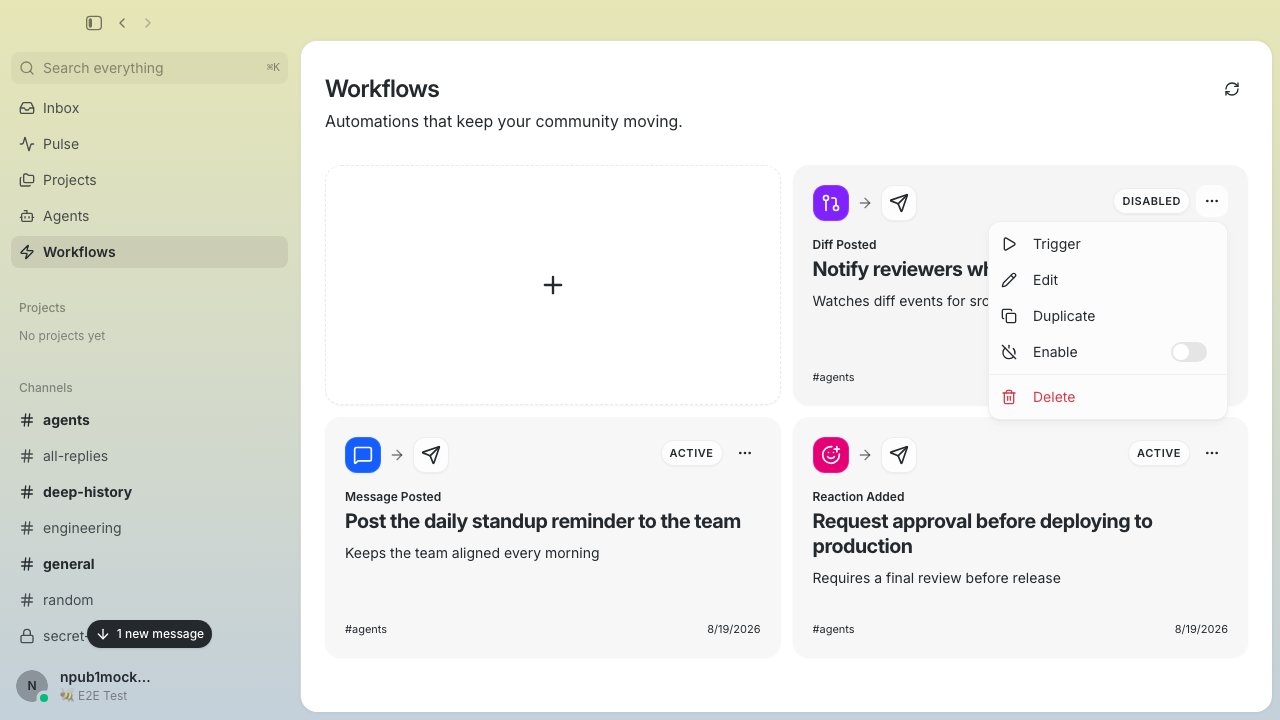 ### Workflow editor — wide 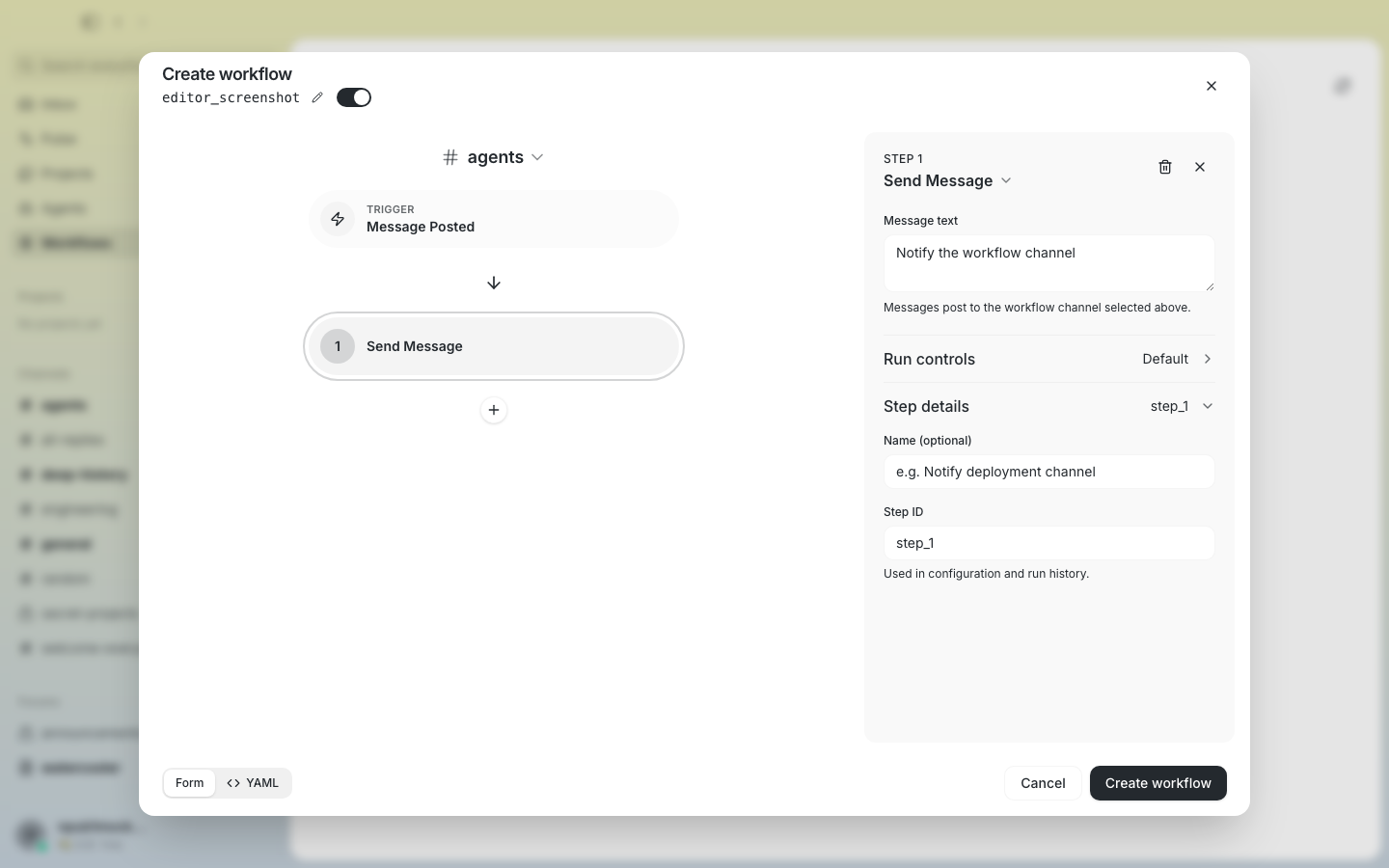 ### Workflow editor — narrow inspector overlay  ### Workflow editor — active channel overlay 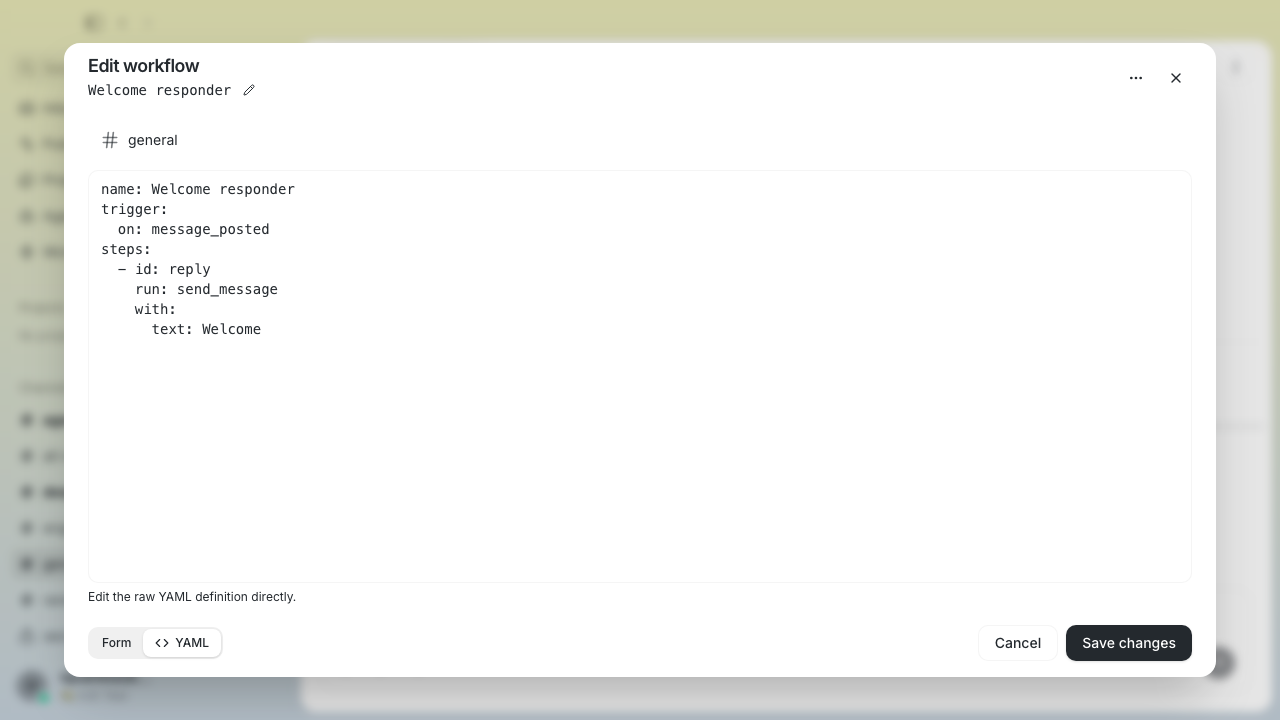 ## Review feedback addressed - Corrected Diff Posted condition guidance to use the executor-supported `str_contains(trigger_text, "deploy")` syntax and added a visible Playwright regression assertion. - Scoped direct workflow-detail navigation coverage to the stable `Edit workflow` dialog name, asserted the workflow title separately, and retained the trigger-node assertion. - Routed dirty channel-overlay Duplicate/Edit transitions through the existing discard confirmation, preserving the original YAML draft when the user keeps editing. - Made workflow deletion await relay success, remain non-dismissible while pending, and retain the confirmation/editor/draft with an actionable inline error on rejection. - Gated the channel-settings Workflows ingress and channel workflow query behind the `workflows` experiment, with defensive rendering if the flag changes while that view is active. - Matched the Reaction Added trigger to the prototype reaction picker, preserving native/custom/legacy values in canonical YAML and providing an explicit clear action. - Kept a channel’s Workflows panel mounted beneath channel-origin editors so clean close, dirty discard, and create cancel return directly to that panel without changing the channel URL. ## Verification Verified at exact pushed head `76ebba7b7ace1e13445744200da70ca9da231b7e`: - Push hooks passed: destination-org policy, branch-skew, differential file-size, Desktop checks, TypeScript typecheck, and **5,115/5,115** Desktop unit tests - Focused channel lifecycle E2E passed: dirty edit discard returns directly to the channel Workflows panel; create cancel does the same while preserving the channel URL and preselected channel - E2E production build, standalone TypeScript typecheck, and Biome checks on both touched files passed - Reaction-picker regression spec remains recorded at `dc28ffa98ec34b4e0656757fb2dd93e60a84674d`: **5/5 passed** (picker interaction, canonical YAML persistence/clear, legacy-value preservation, save/reopen round trip, narrow viewport containment) - Blox existing workflow E2E regression set at `dc28ffa98ec34b4e0656757fb2dd93e60a84674d`: **36/36 passed** - Earlier blocker and review regressions remain recorded at `3760c3d657a525f5af98e8d0f98bdd03999d8e61`: **5,114/5,114** Desktop unit tests and the dirty-overlay/deletion focused checks - Working tree clean; local branch, remote branch, and PR head all match the exact SHA above ### Related issue None found. Closest prior work: #231. --------- Signed-off-by: Taylor Ho <taylorkmho@gmail.com> Co-authored-by: Codex <noreply@openai.com> |
||
|
Will Pfleger
|
2ce8df8533 |
fix(models): curate Databricks alias-aware labels for 5 missing endpoints (#6360)
Curates Databricks model labels through prefix-stripping aliasing and materializes exact records for five endpoints missing from the Databricks catalog. **Alias-aware label resolution** (Databricks v2) - Strip workspace-specific prefixes (`goose-`, `team-x-`, etc.) before exact-record lookup so any prefixed alias resolves to its canonical label without enumerating every alias variant. - Return `None` for uncurated ids instead of falling back to a raw string; callers control the fallback display. **New exact records — label-only (Anthropic Messages route, axes from family rules)** - `databricks-claude-fable-5` → "Claude Fable 5" (materialized from `anthropic-adaptive-xhigh-fable-5`) - `databricks-claude-opus-4-8` → "Claude Opus 4.8" (materialized from `anthropic-adaptive-xhigh-opus-4-8`) - `databricks-claude-opus-5` → "Claude Opus 5" (materialized from `anthropic-adaptive-xhigh-opus-5`) - `databricks-claude-sonnet-5` → "Claude Sonnet 5" (materialized from `anthropic-adaptive-xhigh-sonnet-5`) **New capability-bearing record — Kimi K3 (MLflow Chat route)** - `databricks-kimi-k3` → "Kimi K3" with axes from models.dev Moonshot catalog: reasoning toggle + effort `[low, high, max]`, no default; `_reconciliation_doc` records the source and reconciliation policy. **Corpus and tests** - 6 new normative-corpus vectors (canonical + one `goose-*` alias per new id); executable vector count updated to 113 in both Rust and TS gates. - Rust and TS label tests extended to cover all 3 new canonical ids and their aliases via the prefix stripper. - Sentinel variable fix in discovery-provider test to prevent false failure in Databricks dev environments where `BUZZ_AGENT_PROVIDER` is set. --------- Signed-off-by: Will Pfleger <pfleger.will@gmail.com> Signed-off-by: Duncan <dcfd242e557282d7a1e2cf2e6877522682f1e5c6156dc92ca7d90eaedd3b0f95@buzz.block.builderlab.xyz> Co-authored-by: Duncan <dcfd242e557282d7a1e2cf2e6877522682f1e5c6156dc92ca7d90eaedd3b0f95@buzz.block.builderlab.xyz> |
||
|
Will Pfleger
|
d274a6e949 |
fix(acp): guard against unrequested public relay skills (#6394)
Adds a shared base-prompt instruction that agents must not read or blindly follow public Buzz relay skills unless a human explicitly requests them. --------- Signed-off-by: Will Pfleger <pfleger.will@gmail.com> Co-authored-by: Duncan <dcfd242e557282d7a1e2cf2e6877522682f1e5c6156dc92ca7d90eaedd3b0f95@buzz.block.builderlab.xyz> |
||
|
Salman Mohammed
|
2a236e4137 |
refactor(prompt): simplify Buzz agent guidance (#6340)
## Why The Buzz agent prompt carries verbose agent-draft instructions that add prompt weight without improving benchmark correctness. Buzz-native channel trials also showed agents creating permanent channels while claiming they had applied a one-hour TTL. The static CLI inventory remains for efficient command discovery by smaller agents. ## What - Retain the static Buzz CLI command table and direct agents to use `--help` for full usage - Compact the owner-reviewed agent-draft guidance without changing its workflow - Clarify that `buzz channels create` is permanent unless `--ttl` is provided ## Benchmark Results - Terminal-Bench retained 22/22 correctness in the initial no-table candidate while reducing prompt size, input tokens, tool calls, and cost; total active time was effectively flat. - Across two Buzz-native runs, the non-channel cases tied at 26/30; the CLI clarification directly addresses the observed TTL omission. ## Update — 2026-08-20 - Restored the CLI command table following review feedback about multistep discovery with smaller agents. The restored-table candidate has not been re-benchmarked. Signed-off-by: Salman Mohammed <smohammed@squareup.com> |
||
|
Salman Mohammed
|
a9640c7cc4 |
Add Buzz-native collaboration benchmarks (#6264)
## Why Terminal-Bench can show task correctness while missing Buzz-specific collaboration failures, such as posting a final answer outside the user's thread. Add a small Buzz-native suite that scores relay behavior directly. ## What - Add Harbor tasks for direct thread replies, event-level callback mentions to a three-word user identity, targeted reads of explicitly named paths outside the workspace, and exact temporary-channel membership against a seeded directory of 50 users and 10 bots - Export sanitized post-agent relay evidence and extend solo runtime/provisioning for deterministic verification - Expose channel TTL in CLI search output and cover positive and negative transcript/state fixtures ## Risk Assessment Low to medium — this primarily adds benchmark and testbed machinery. The CLI change is an additive `ttl_seconds` field in channel-search JSON; relay behavior is unchanged. ## References - Motivated by the Buzz-specific behavior observed while benchmarking https://github.com/block/buzz/pull/6128 - The named-path regression case covers the issue being fixed by https://github.com/block/buzz/pull/6261 - Local live Sonnet runs: `reply-to-thread`, `user-mention`, and `create-channel-invite-users` each scored reward 1.0 with zero exceptions - The current branch prompt scored 3/5 on a concurrent `read-named-path-outside-workspace` batch: one explicit workspace-boundary refusal and one missing final response Generated with Codex --------- Signed-off-by: Salman Mohammed <smohammed@squareup.com> |
||
|
Salman Mohammed
|
934f3325c3 |
fix(buzz-acp): loosen workspace-scan guardrail to allow named paths (#6261)
## Problem Agents refused to read a specific, user-named path outside `.buzz` (e.g. `~/.claude/skills/context-health-check/SKILL.md`), and behaved inconsistently — refusing in one channel, listing the same dir in another. This is the issue Aaron and Wes hit: buzz://message?channel=e62570dd-33ad-42c5-b92b-75f2689f9694&id=401199157f8a9734109fdddfbbce4603a1ff465fae895042f29738ad52a5d15f Root cause: two prompt fragments told agents not to search `$HOME` "or other directories". The intent (added in #1194 by Will Pfleger) was narrow — stop unscoped `$HOME` sweeps that fire macOS TCC dialogs or make a model invent its own workspace dir. But "or other directories" reads as a blanket filesystem wall, so a cautious model generalized it to "any path outside `.buzz`" and refused a targeted, named read. ## Fix Prompt-only. Reframe both fragments per context-engineering guidance — state the reason and trust judgement, rather than banning a technique: **`crates/buzz-acp/src/pool.rs` — `workspace_section()`** > …This is where you already are, so start here rather than scanning `$HOME`. Any specific path the user names is fine to read. **`crates/buzz-acp/src/base_prompt.md` line 106** > These paths are relative to your working directory — start there for your own files rather than scanning `$HOME` or `/`. When the user names a specific path, read it. Preserves the original anchor intent (start at the grounded workspace; avoid unscoped `$HOME` sweeps) while explicitly permitting a named-path read — the exact case that was broken. ## Testing `cargo test -p buzz-acp` — 816 unit + 9 integration tests pass, 0 failures. Prompt-only change; the doc comment at `pool.rs:1327-1333` already states the narrow intent and is left as-is. Signed-off-by: Salman Mohammed <smohammed@squareup.com> Co-authored-by: Leo <5faf251baee50ee6bcde338aef6acdd70bb3e60115664c2cd490d94a55dfc488@buzz.block.builderlab.xyz> |
||
|
Salman Mohammed
|
7f69b13b45 |
fix(buzz-dev-mcp): expand leading ~ in read_file/str_replace paths (#6271)
## Problem `resolve_path` (crates/buzz-dev-mcp/src/paths.rs) only ever treats a path as absolute or joins it onto the workspace root. A user-named tilde path like `~/.claude/skills/context-health-check/SKILL.md` is not absolute, so it resolves to `<workdir>/~/.claude/...` (e.g. `/app/~/.claude/...`), which never exists. The `shell` tool expands `~` via bash, so the file tools diverged from it. Surfaced in the PR #6261 named-path benchmark: all five agents initially passed a literal `~` to `read_file`, which resolved incorrectly under `/app/~`. They recovered, but the ergonomics are wrong — agents already expect `~` to work; the resolver violated that expectation. ## Fix Expand a leading `~` (bare `~` or `~/...`) to the user home directory at the single chokepoint `resolve_path`, matching shell semantics. Home is read from `$HOME` (`%USERPROFILE%` on Windows). Both `read_file` and `str_replace` route through `resolve_path`, so both are fixed. - `~user` (another user home) is intentionally NOT handled — it needs a passwd lookup and is out of scope, consistent with the conservative posture for un-mappable MSYS forms already in this file. `~user...` falls through untouched and fails with the clear `path not accessible` error. - `expand_tilde` takes `home` as a parameter so it stays pure and unit-testable without mutating process environment; env lookup lives in a thin `home_dir()` helper. - Tool/param descriptions are intentionally left unchanged: `~` is normal shared path behavior, not a per-tool feature. Advertising it in each `resolve_path` caller's description would spend prompt tokens on an implementation detail and invite drift across callers. The tests on `resolve_path` document the behavior. ## Tests - `expand_tilde_forms`: pure coverage of non-tilde passthrough, `~user`/`~foo` passthrough, bare `~`, `~/rest`, and unset/empty home. - `resolve_path_expands_tilde_against_home`: end-to-end through the real `home_dir()` env read (creates a marker file under `$HOME`, skips cleanly if no home). - Full package suite green: `cargo test -p buzz-dev-mcp` — 98 passed, 0 failed. `cargo clippy -p buzz-dev-mcp --all-targets` clean. Closes #6270 --- ## Follow-up (review by @wpfleger): honor `$HOME` on Windows + translate MSYS home The first cut read `%USERPROFILE%` on Windows and `$HOME` elsewhere. That diverges from the shell tool, which is the whole point of this fix: - `HOME` is passed through to the MCP child on **every** platform (`buzz-agent` `PASSTHROUGH_ENV`, not cfg-gated) and inherited verbatim by the `shell` tool (`shell.rs` spawns bash with no `env_clear`). Bash expands `~` against `HOME`. So on Windows the file tools and shell tool disagreed whenever `HOME != USERPROFILE` — e.g. a git-bash `HOME=/c/Users/x`, or an `mcpServers[].env` override setting `HOME`. - Ordering also mattered: `~` expansion runs **after** `msys_to_windows` in `resolve_path`, so a spliced-in MSYS home (`/c/Users/x`) never got translated and `canonicalize` rejected it on Windows. **Change (`paths.rs` only):** - Prefer non-empty `$HOME` on every platform; fall back to `%USERPROFILE%` only on Windows when `HOME` is unset. - On Windows, run the chosen home through `msys_to_windows` so `HOME=/c/Users/x` → `C:\Users\x`. An MSYS home with no Windows equivalent (`/home/x`) is left untranslated and fails with the clear `path not accessible` error — the intended conservative outcome. - Selection factored into a pure `select_home(home, userprofile)` so it is unit-testable without mutating process env. **Tests:** `select_home_prefers_home` (HOME-first + empty/unset fallback, all platforms) and `select_home_translates_msys_home_and_prefers_it` (Windows: MSYS translation + divergent `HOME`/`USERPROFILE`, which also fixes the prior test's silent no-op when `HOME` is unset on CI). `cargo test -p buzz-dev-mcp` — 99 passed, 0 failed; clippy clean. Pre-push `rust-tests` + `desktop-tauri-checks` green. HEAD `29e0082ff`. --------- Signed-off-by: Salman Mohammed <smohammed@squareup.com> Co-authored-by: Leo <5faf251baee50ee6bcde338aef6acdd70bb3e60115664c2cd490d94a55dfc488@buzz.block.builderlab.xyz> |
||
|
Jude Edwards
|
196d62f97c |
fix(media): accept portrait video resolutions (#6058)
## Summary - apply the existing 2160×3840 video resolution envelope independent of orientation - accept portrait recordings whose short/long edges fit that envelope - retain rejection coverage for either edge exceeding its limit - make the relay error describe the orientation-independent limits ## Why The iOS simulator produces portrait H.264 recordings such as 1206×2622. The relay previously checked `width <= 3840 && height <= 2160`, so the equivalent portrait dimensions were rejected while landscape dimensions were accepted. ## Validation - `bin/just ci` - `cargo test -p buzz-media` (120 passed; one MinIO integration test ignored by its existing live-service guard) - `cargo clippy -p buzz-media --all-targets -- -D warnings` - exact blocked artifact `/Users/judeedwards/.buzz/.scratch/pr5874-mongo-evidence/native/head-20260816T050317Z/video-bitexact.mp4` validated through `validate_video_file`: 1206×2622 accepted Signed-off-by: Carl <5f365698229751c0461f57bb03a4e93134e6e936bd7039ebe7b737282a43c754@buzz.block.builderlab.xyz> Co-authored-by: Carl <5f365698229751c0461f57bb03a4e93134e6e936bd7039ebe7b737282a43c754@buzz.block.builderlab.xyz> |
||
|
Luke Tornquist
|
08eb46ef3c |
Revert "fix(acp): gate relay-signed workflow messages on their attributed author" (#6311)
Reverts block/buzz#6129 |
||
|
Will Pfleger
|
121e4b3ce7 |
fix(desktop): exclude archived agents from nest, order regeneration (#5905)
The managed "Active Agents" table in `~/.buzz/AGENTS.md` was rendered from every managed-agent record with no filtering, so archived duplicate instances kept appearing under the active relay's header. This scopes the roster to identity-active agents and makes regeneration safe under concurrency. ## Roster filter: identity-archive only `render_dynamic_section` now drops only records whose pubkey is present in the relay's `kind:13535` archive snapshot. Local records can't tell they're archived — they all carry `is_active: true` (that flag is a *definition*-archive, not an identity-archive), so archive truth lives only relay-side. The read **fails open**: an unreachable relay yields an empty set and hides no one. There is deliberately **no** relay-scope filter. `relay_url` is a legacy creation-era field that `effective_agent_relay_url()` ignores — every agent is eligible on every community, and snapshot-imported records store `relay_url: ""` by design. Filtering on it would hide valid, runnable agents after a workspace switch or import. Foreign-relay relic records leave the table via record deletion, not code. ## Regeneration on archive / unarchive `archive_identity` and `unarchive_identity` submitted the relay event and returned without refreshing `AGENTS.md`, unlike the ~20 other mutation sites that call `try_regenerate_nest`. A just-archived agent therefore lingered on the roster until an unrelated edit or the next launch. Both commands now trigger a regeneration after a successful submit. Regeneration is bound through a `NestRegenTrigger` trait rather than constructing the `try_regenerate_nest` callback at the Tauri-command delegation site. The command cores take `regen: &impl NestRegenTrigger` and own the `|| regen.trigger()` binding; the thin wrappers only pass `&app` (whose `impl` calls `try_regenerate_nest`). This puts the regen wiring inside the unit-tested core — a `CountingRegen` double proves each core fires exactly one regeneration — instead of an untestable seam where a wrapper could silently lose the refresh while the suite stayed green. The regen races the relay's `kind:13535` snapshot update, so it's best-effort and fail-open — a stale render self-heals on the next cycle. ## Ordered regeneration `try_regenerate_nest` previously spawned unconstrained tasks that each snapshotted state, awaited two relay requests, then wrote — so a slow pre-edit generation could overwrite a newer one. Boot made this deterministic: the boot regen races the `apply_workspace` regen, and the fallback-relay render could finish last. `NestRegenGate` fixes this with a single `highest_requested` watermark. A monotonic generation is claimed *synchronously* at request time (encoding call order) and advances the watermark under one lock; the spawned task carries its generation and, at commit, reads the watermark under that same lock — the compare-and-write is atomic with no await held across it. A generation whose number is below the current watermark drops its result instead of rolling the file back. Gating on highest-*requested* rather than highest-*written* is the load-bearing choice: if a newer generation is requested but then fails its relay reads, an older in-flight generation must **not** publish its now-obsolete roster. Behavior delta: once a newer regeneration has been requested, no older generation will ever write; if that newer generation fails, the file is left as-is and self-heals on the next trigger rather than regressing to a stale snapshot. This is an ordered, latest-request-wins gate — not a work coalescer: superseded generations still perform their relay reads and drop the result at commit time. The gate's commit lock is acquired with a poison-to-`io::Error` mapping rather than `expect()`, so a poisoned lock degrades to the same warn-and-continue path as any other commit failure instead of panicking the desktop process (a best-effort housekeeping write must never take down the app). ## One relay target per regeneration A regeneration read the workspace relay override three times — the NIP-11 signer in `fetch_relay_self`, the snapshot query in `query_relay`, and the rendered footer — so a workspace switch mid-flight could pair one relay's advertised signer with another relay's snapshot, fail open, and render archived agents as active. `capture_relay_target` now resolves the effective relay (WebSocket + HTTP API base) once, before any network work, and `fetch_archived_pubkeys_at` threads that single target through both the NIP-11 fetch and the `/query`; the footer renders the same target. Signer, snapshot, and footer always belong to one relay. ## Monotonic archival snapshot publishing `publish_nipia_archival_list` stamped its `kind:13535` snapshot with a whole-second `created_at`. A rapid archive→unarchive within the same second produced two events whose NIP-16 replaceable-event tie-break (higher event id wins) could strand the older, stale archive state as canonical. Publishing now uses a bounded retry that re-reads current archive state and rebuilds the snapshot each attempt, so the published list reflects the latest intended state rather than a fixed same-second race loser. After the attempt budget (8) is exhausted the publisher `bail!`s; the sole caller treats that as a `warn!` side effect and continues, matching the surrounding best-effort submit path. ## Test-file split The renderer, `upsert_managed_section`, and the regeneration-gate tests moved to `nest/render_tests.rs` so each test file stays under the repository's 1000-line ratchet. --------- Signed-off-by: Will Pfleger <pfleger.will@gmail.com> Signed-off-by: Wes <wesbillman@users.noreply.github.com> Co-authored-by: Hayt <9e1c23a3fd83f61da34420e4e88ff1b16e45cafcc0cd9019eb07d4ecfa8ca9b0@buzz.block.builderlab.xyz> Co-authored-by: Wes <wesbillman@users.noreply.github.com> Co-authored-by: Mongo <5c25403eab7271f9f94ddd4f2b270e8cac2c92e2c830c51877cca6ec974ffb3f@buzz.block.builderlab.xyz> Co-authored-by: Duncan <dcfd242e557282d7a1e2cf2e6877522682f1e5c6156dc92ca7d90eaedd3b0f95@buzz.block.builderlab.xyz> |



