## Summary

- render every agent/AI identity as a 30% squircle across desktop and
mobile while keeping human avatars circular
- propagate agent identity through message, thread, profile, reaction,
member, DM, search, workflow, project, huddle, forum, pulse, and
agent-management surfaces
- preserve squircle geometry for fallbacks, focus/status treatments,
add-agent controls, and overlapping avatar outlines (`calc(30% + 2px)`
for the outer background)

### Related issue

None found. This change was requested and visually reviewed in the
originating Buzz thread.

### Testing

- `just desktop-test` — 5,799 passed
- `just mobile-test` — 2,008 passed
- pre-push gates passed at `0d59d77b120dcb90aac2f918e422c11c9fa5353b`:
desktop check, TypeScript typecheck, desktop full test suite, mobile
format/analyze and full test suite, Rust tests, Tauri checks, and
differential file-size gate
- deterministic desktop visual sweep covered channel messages/thread
summaries; thread, subthread, and sub-subthread depths; reactions and
reactor popovers; hover/full profiles; added-to-channel activity;
channel members/settings; agent library/team overlaps; agent creation;
mention autocomplete; and DM header/sidebar/settings

### UI evidence

The complete labeled visual matrix is available in the originating Buzz
review thread. GitHub-hosted copies will be added in a follow-up PR
comment using the repository screenshot script.

---------

Signed-off-by: Fizz <dae5f6af70b8695a8b83c8deae555f63be41630ec2b8cd493e41a439c9527dd8@buzz.block.builderlab.xyz>
Co-authored-by: Fizz <dae5f6af70b8695a8b83c8deae555f63be41630ec2b8cd493e41a439c9527dd8@buzz.block.builderlab.xyz>
## Summary
Communities joined via an invite link never connect: the app dials
`ws://` on port 80 instead of `wss://` on 443 and sits on
"Reconnecting…" indefinitely.
`RelayConfig.baseUrl` is documented as an HTTP origin, but the two
onboarding flows disagree on what they persist:
- **Device pairing** validates and stores `https://` —
`pairing_provider.dart:657` throws on anything else.
- **Invite join** stores the relay URL straight off the invite link, and
`deep_link.dart:165` always emits `ws://` or `wss://`.
`wsUrl` only special-cased `https://`, so a `wss://` base fell through
to the plaintext branch:
```dart
final scheme = uri.scheme == 'https' ? 'wss' : 'ws'; // 'wss' is not 'https'
```
The claim request itself succeeds, because `_claimUrlFromRelay`
(`invite_join_provider.dart:242`) maps `wss → https` explicitly. Only
the socket path is missing that conversion — which is why the community
appears, correctly named, and then never loads.
The same `baseUrl` also feeds `/query` (`relay_session.dart:136`), media
upload (`media_upload.dart:765`), Blossom auth (`media_auth.dart:128`)
and `relayClientProvider` (`relay_provider.dart:113`), so those requests
were malformed too. Where port 80 *does* answer, it is additionally a
silent TLS downgrade after `validateInviteRelayUri` insisted on
`wss://`.
This folds the websocket schemes back to their HTTP equivalents in
`baseUrl` itself, so every consumer is correct by construction rather
than needing a second getter remembered at each call site, and
communities **already persisted** with `wss://` are repaired on read
without a migration. `community_icon_provider.dart:46` already performs
this same conversion locally.
One subtlety worth flagging for review: the normalization is derived in
the getter rather than applied in the constructor, so the constructor
stays `const`. The compile-time fallback at `relay_provider.dart:77`
relies on const canonicalization for a stable identity across rebuilds,
and Riverpod's `defaultUpdateShouldNotify` is `previous != next`
(`element.dart:361`), which falls back to identity for this class. A
`factory` constructor here yields a fresh instance per rebuild, which
tears down and resubscribes every listener —
`channels_provider_test.dart` catches it as an unexpected unsubscribe
during reconnect.
### Related issue
Fixes#2662.
### Testing
`flutter test` — **705 passed, 1 skipped, 0 failed**
`flutter analyze` — No issues found
`dart format --set-exit-if-changed .` — 249 files, 0 changed
Run against the Hermit-pinned SDK (Flutter 3.41.7 / Dart 3.11.5),
matching CI.
10 new unit tests in `mobile/test/shared/relay/relay_config_test.dart`
covering both onboarding schemes, `http`/`https` passthrough,
non-default ports, and agreement between the invite and pairing paths
for the same relay.
Verified end-to-end against a self-hosted relay behind `tailscale
serve`, which terminates TLS on 443 and leaves port 80 closed. Relay
logs show the invite claim succeeding over HTTPS at the moment of
joining, while no WebSocket connection ever arrives — no `WebSocket
connection established`, no NIP-42 auth, no `kind:0` profile, no push
registration — across the relay's entire history, even though the member
row is present and correct. Port-80 refusals are not logged by
`tailscaled`'s netstack, which is why the retries leave no trace
server-side. Reproduced on both iOS and Android.
---------
Signed-off-by: Krishna C <github@kumb.uk>
## Summary
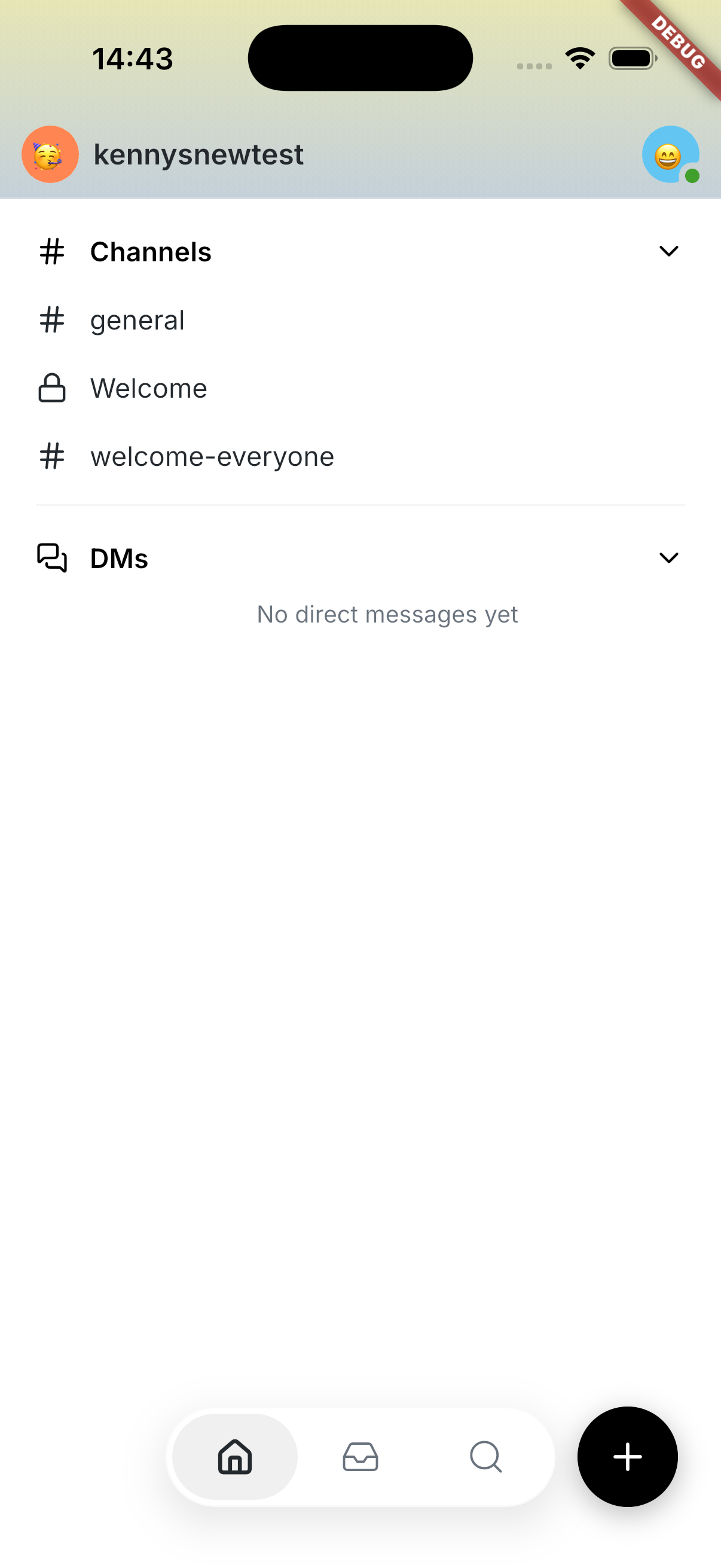
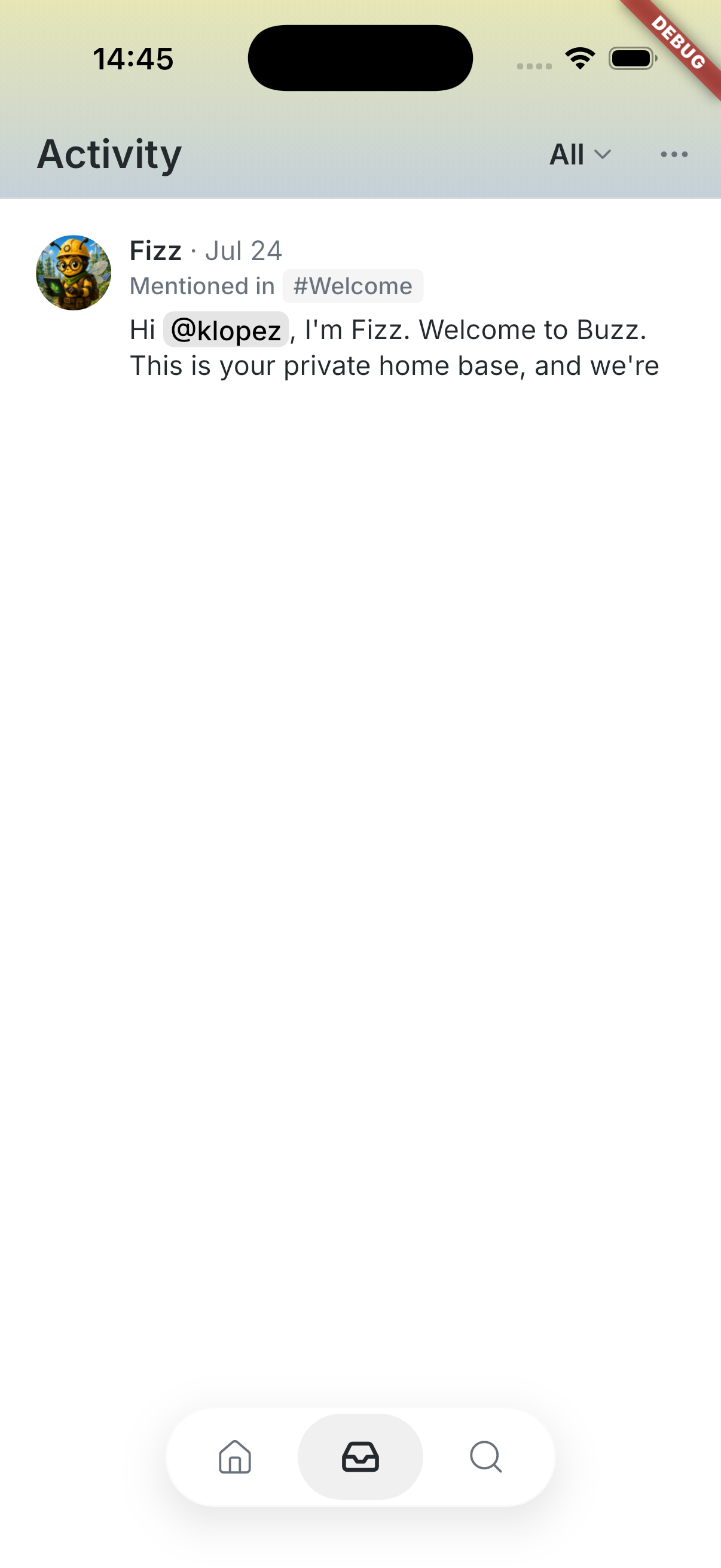
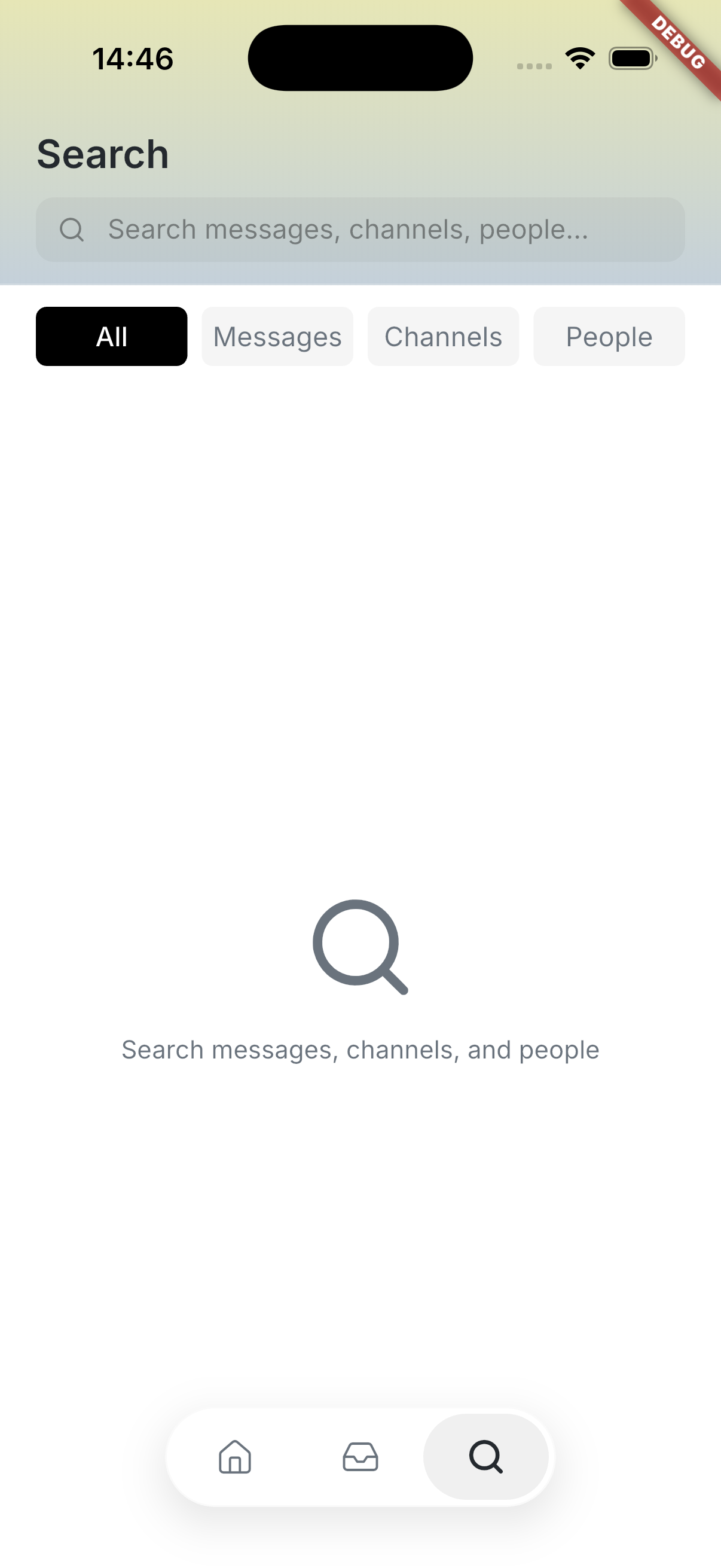
- Add a shared footer fade behind the floating tabs on Home, Activity,
and Search.
- Use a shared anchored popover for Activity filters and section
actions, with working section move controls.
- Polish message grouping/press states and remove the initial Search
back button.
<img width="630" height="1368" alt="Screenshot 2026-07-29 at 08 49 37"
src="https://github.com/user-attachments/assets/9e787adf-0bb3-49c6-8224-5819e8cfb1ad"
/>

### Testing
- `flutter analyze`
- `flutter test`
- Release build installed and checked on a connected iPhone

### Screenshots
A real-device Activity baseline showing the original solid footer is
attached in a PR comment. The updated review build was checked on the
connected iPhone.

---------

Signed-off-by: kenny lopez <klopez4212@gmail.com>