mirror of
https://github.com/block/buzz.git
synced 2026-10-27 12:40:30 +00:00
0e36dbc823f4754b98da64944cc015a9f7acbd6e
44 Commits
| Author | SHA1 | Message | Date | |
|---|---|---|---|---|
 Logan Johnson |
d97f6b4c6e |
feat(relay): add announce channels with a join_role setting (#8143)
🤖 ## Summary Channels are Buzz's main way to control access, but today they cannot separate reading from writing. In an open channel, anyone who can read can also write. So there is no way to say "many people read, a few people write". Announcements, release feeds, plugin release records and shared configuration all need that. This PR adds **announce channels**: anyone can follow and read them, but only members can post. It does this with one new channel setting and without changing what any role means. - **Roles mean the same thing in every channel.** A *guest* can read and leave, but cannot write. A *member* (or *bot*) can write. *Admins* and *owners* also manage the channel. The relay already had the guest role, but no client used it until now. - **A new setting, `join_role` (`member` | `guest`), picks the role a new person gets** when nobody chooses one: when they join by themselves, or when someone adds them without a role. The default, `member`, keeps today's behavior for every existing channel. - **An open channel with `join_role = guest` is an announce channel.** Anyone can find, read and join it. People who join are guests, so they cannot write until someone makes them a member. The relay enforces these rules, so a client cannot get around them. What each role can do (the same in every channel): | Action | Guest | Member or bot | Admin / owner | | --- | --- | --- | --- | | Read, leave | ✅ | ✅ | ✅ | | Post, reply, edit, delete own, react, artifacts, canvas, forum, pins, topic, typing, workflow messages, save or run workflows, huddles | ❌ | ✅ | ✅ | | Add people | ❌ | ✅ as member, guest or bot | ✅ any role | | Make a guest a member (person or agent) | ❌ | ✅ | ✅ | | Any other role change | ❌ | ❌ | ✅ | | Change name, about, visibility, TTL, `join_role` | ❌ | ❌ | ✅ | Other rules: - **Joining by yourself.** A person who joins (kind:9021), or adds themselves (kind:9000 with their own key), gets the channel's `join_role`. They may ask for `join_role` or a lower role, never a higher one. So in an announce channel nobody can join as a member by themselves. - **Non-members.** A non-member may write only where joining would let them write: an open channel with `join_role = member`. That is today's behavior for open channels. - **Agents.** Agents follow the same rules as people. Any member who can write may make a guest agent a member. Limits that only an agent's owner may lift belong to the later IFC work (its "restricted" agent level), not to this PR. That work only refuses more actions, so it can be added later without breaking anything here. - **Leaving always works.** A member may leave an archived channel too (kind:9022, or kind:9001 naming themselves). The last owner still cannot leave. - **Agent owners keep edit and delete.** Today the human owner of an agent can edit (kind:40003) and delete (kind:9005) that agent's messages without being a member. This PR keeps that existing behavior in announce channels too, and documents and tests it. It does not let the owner post. - **Changing the setting changes no roles.** Existing members can still write after a change to `guest`. Existing guests stay read-only after a change back to `member`. A refused write gets `restricted: only members can post in this channel`. ## Details - **One write rule.** The relay's channel write check decides from the actor's role and the channel's `join_role`. Some event types skip that check and run their own: message edit, deleting your own message (kind:9005), topic and purpose (kind:9002), add-member (kind:9000), workflow messages and joining a huddle. Each of these now uses the same rule. Membership changes (add, remove, leave) do not need write access, so a guest can always leave. If the relay finds a stored `join_role` value it does not know, it treats it as `guest`, so an unknown value can never give more access. - **Admission is decided in the database transaction.** The membership write (`put_member`) makes the whole admission decision inside its transaction, after it takes the channel's membership lock: `join_role` for a missing role tag, the self-join ceiling, guests cannot add people, who may grant admin or owner, and role changes (`MemberRole::may_change_role`). The relay's request check uses the same rules, but the database is the authority, so a write that skips the request check cannot get around them. A change to `visibility` or `join_role` takes the same lock, so an add and a setting change cannot interleave. - **No creator exception.** `put_member` used to give owner to a channel's creator who added themselves to a private channel without an active membership. A removed creator could use that: their join (kind:9021) passes the open-channel check, the channel becomes private before the join takes the membership lock, and the join restored them as owner. Channel creation already makes the creator owner in the same transaction, so the exception is removed. A removed creator is now admitted like anyone else. - **Huddles.** Joining a huddle needs write access in the huddle channel **and** in its parent channel. The relay checks both before the join. When it commits the join, it applies the same rule again while it holds both channels' membership locks: a member needs a role that can post, and a non-member needs an open channel whose `join_role` is `member`. A guest in either channel cannot join. A join is also refused when the joiner loses membership or the channel's `join_role` changes before the commit. - **One lock order.** Each writer that takes more than one of a channel's locks takes them in this order: membership lock, TTL lock, channel row. Settings changes, roster publication, TTL refresh and huddle joins all use this order. Before this change, a `join_role` change on an ephemeral channel at the same time as a roster publication could deadlock. - **Workflows.** Saving a workflow (kind:30620) skips the generic write check, so it now checks the sender's role itself and needs a writing role before anything is stored. Every path that starts a workflow run, including the manual trigger (kind:46020), needs the workflow's owner to hold a writing role now (and an elevated role for an elevated workflow). So a workflow saved while its owner was a member stops running after the owner is made a guest. - **Channel names are checked before storage.** kind:9002 and kind:9007 refuse a name longer than the `channels.name` column (255 characters) before the event is stored. Before this, the relay accepted the event, then the name update failed, and the rest of the update (for example `join_role`) was silently skipped. This PR only adds this check. Storing the event and applying the update in one transaction is a larger change, and it is not in this PR. - **Changing the setting.** Owners and admins send a channel-metadata update (kind:9002) with `["join_role", "guest"]` or `["join_role", "member"]`. Buzz applies these updates as partial updates; a missing tag means "no change". The relay posts a `join_role_changed` system message in the channel. - **What clients see.** The relay signs a channel description event (kind:39000) that clients read. One shared builder now writes it for both the relay and the `buzz-admin` backfill, which had a copy that had drifted from the relay's. It always publishes an explicit `["join_role", …]` tag, plus the standard NIP-29 group access flags: | `visibility` | `join_role` | `public` / `private` | `restricted` | `closed` | | --- | --- | --- | --- | --- | | open | `member` | public | | | | open | `guest` | public | ✓ | | | private | either | private | ✓ | ✓ | This also fixes an old bug: `closed` ("join requests are ignored") was published for every channel, even open channels that accept joins. - **CLI and SDK.** `buzz channels update --join-role guest|member`. `buzz_sdk::build_update_channel` takes a new `join_role` argument and always writes it as an explicit tag. - **Docs.** `NOSTR.md` has an "Announce channels" section with the role table and the flag table. - **Tests.** Relay end-to-end tests, run in the CI relay E2E step: - `test_nip29_announce_channel_wire`: who can set `join_role`, the kind:39000 flags, joining as a guest, refused guest and non-member posts, reactions and adds, member posts, a member making a guest a member who then posts, changing the setting back without changing roles, and leaving. - `test_nip29_member_raises_guest_agent`: a member who is not the agent's owner can make a guest agent a member. - `test_nip29_announce_channel_wire_workflow_send_needs_write_role`: a guest's workflow message is refused; a member's is accepted. - `test_nip29_departure_wire_archived_channel_allows_self_leave`: guests and members can leave an archived channel. - `test_private_channel_any_member_can_invite` now expects a private-channel guest to be refused when it adds someone (it used to expect success). - `test_nip29_announce_channel_wire_workflow_commands_need_write_role`: saving and triggering a workflow, by a member and by a guest, in announce and normal channels; a guest cannot run a workflow saved while it was a member. - `test_nip29_announce_channel_wire_overlong_name_is_refused_before_storage`: a kind:9002 with an overlong name and `join_role` is refused, and kind:39000 still shows the old settings. - `test_nip29_announce_channel_wire_agent_owner_exception`: an agent's owner, as a guest and as a non-member, can edit and delete the agent's messages, while ordinary guests are still refused. - `test_nip29_guest_is_read_only_in_normal_channel`: a guest in an ordinary channel cannot write, and joining an ordinary channel still gives `member`. Unit tables cover the self-join rule for each `join_role`, and every actor, current role and requested role for the role-change rule. Database tests check the admission rules in `put_member` (`put_member_enforces_announce_admission`), that an add which waits on an uncommitted change to `guest` is decided on the new setting (`put_member_waits_for_a_concurrent_join_role_change`), and that a member can make a guest a member but not an admin. Unit tests cover the name limit and the workflow owner rule (`owner_authority_denies_roles_that_cannot_write`). A relay test covers huddle joins with different roles in the huddle and its parent, and a commit after a demotion, a `join_role` change or a lost membership (`huddle_join_needs_a_write_role_in_the_huddle_and_its_parent`). Lock-order tests: `join_role_change_waits_for_a_roster_publication_on_an_ephemeral_channel` reproduced a real deadlock (`40P01`) against the old order. `f2d_join_lock_order_serializes_membership_and_settings_writers` checks that membership and settings writers wait for a join and then succeed. `removed_creator_cannot_rejoin_a_private_channel` checks that `put_member` refuses a removed creator on a private channel, and `removed_creator_join_racing_a_private_switch_is_refused` holds the membership lock so a removed creator's kind:9021 passes the open-channel check, then makes the channel private before the join continues. Each new test was run against the old code and failed. ## Rollout 1. **Before the deploy, count guest rows** (`SELECT count(*) FROM channel_members WHERE role = 'guest' AND removed_at IS NULL`). We expect none. Any guest that exists loses the ability to post, change the topic and add people when this ships. If some exist, decide first whether to make them members. 2. Deploy. Every channel stays `join_role = member`, so nothing else changes. 3. **Do not set any channel to `join_role = guest` until no old relay is running.** Old relays ignore the column, so they would let guests and non-members write in that channel. 4. Rerun the `buzz-admin` channel reconcile so open channels drop the wrong `closed` flag. ## Migration and rollback - Migration `0067` adds `channels.join_role TEXT NOT NULL DEFAULT 'member'` with a CHECK constraint. Postgres stores a constant default in table metadata, so existing rows are not rewritten and there is no backfill. The relay runs the migration at startup. - Existing channels keep the old `closed` flag until their next change, or until the reconcile in Rollout step 4. - **Before rolling back the relay**, set every announce channel back to `join_role = member`. An older relay ignores the column and does not stop guests from writing, so those channels would accept posts from their guests and give `member` to new joiners again. ## Not in this PR Client UI: a Follow button, hiding the composer for guests, and an admin toggle. Clients that ignore the new tag keep working. A guest who tries to post sees the `restricted` error. ## Stack 1. #8143 (this PR): announce channels 2. #8494: store the bot role only for keys with a recorded agent owner --------- Signed-off-by: Logan Johnson <loganj@squareup.com> Co-authored-by: Larry <627498bd4bd1f281a16431e3c6cce3b5c25b6692798c78672298aefbf2f8f8b5@buzz.block.builderlab.xyz> |
||
|
klopez4212
|
c9e35f8ac7 |
fix(mobile): restore Solo chats from channel labels (#8466)
Restore Solo chats and project placement on mobile using `buzz.solo`
labels and creator metadata. Invalidate stale channel details when
identity changes so opening and sending preserve refreshed Solo
identity; shared chats retain ordinary sending. New mobile Solo chats
publish the discovery label, and the personal send guard enforces
ownership even when route hints or legacy placement suggest Solo.
The current desktop producer lives in `block/buzz-app`. [Contract
documentation](
|
||
|
Logan Johnson
|
25bcb791b4 |
fix(relay): show only legacy channel types to reads that name no channel (#8469)
🤖 ## Summary Every Buzz channel has a **type**, such as an ordinary chat channel (`stream`), a forum, a DM or a workflow. A client app can only show the types it was built to understand. This PR makes the relay (the Buzz server) follow one rule everywhere: **a client sees a channel only if it knows that channel's type.** #8406 applied this rule to membership notices. This PR applies it to the reads that list channels without naming one: the channel list, "channels I belong to", the sidebar's unread list and artifact lists. Before, these reads left out one type by name: system channels. Now they return only the four types that every client has always known: `stream`, `forum`, `dm` and `workflow`. Today the result is the same for every user, because `system` is the only other type. ### Backward compatibility: old clients stay safe - A client that was released before a new channel type exists will never receive channels of that type in its lists. It cannot show such a channel correctly, so it does not get one. - Requests that old clients send today return exactly what they returned before. Nothing changes for them now or when a type is added later. ### Forward compatibility: new types can be added safely - Before, the rule was a deny list: "everything except `system`". Each new type would appear in every deployed client by default, unless someone remembered to update five separate checks in the relay. A missed check would show the new type to clients that cannot handle it. - Now the rule is an allow list that is frozen: the four original types. A new type is hidden by default, with no relay change needed. Clients that understand it can request it on purpose, the same way current clients request system channels today. Each new type gets its own opt-in, so adding a type cannot break clients that are already in use. ## Details - One frozen list, `buzz_core::channel::LEGACY_CHANNEL_TYPES`. Membership notices (#8406) now use the same constant, so channel reads and notices cannot drift apart. The duplicate `LEGACY_NOTICE_CHANNEL_TYPES` is removed. - One SQL helper, `legacy_channel_type_sql`, builds `channel_type IN ('stream', 'forum', 'dm', 'workflow')` from that list. It replaces the five `<> 'system'` checks: - `get_accessible_channel_ids` (both halves): the implicit channel scope of any filter without `#h`, for example kind 39000 channel metadata, REQ, COUNT and search; - `get_accessible_channels`: the channel list; - the personal-read sidebar roster; - artifact queries. - A filter that names a channel (`#h`, or `#d` on kinds 39000–39003) reads it under the ordinary rules, whatever its type: the reader is a member, or the channel is open. The uncached named-channel lookup, `get_readable_named_only_channels`, now returns every readable non-legacy channel with its type, not only system channels. Before, a non-member could not read an open later-type channel, and `#d` read nothing. Workflow run reads and thread windows use the same lookup. - The relay keeps each named channel in the scope of the filter that names it only. This also holds when it re-checks membership for a named channel that the cache lacks. - The opt-in to system channels (`#t:["system"]` or `#P` on kinds 39000–39003) adds readable **system** channels only. It never adds a channel of another type, even one that a sibling filter in the same request names. The relay scope type `NamedOnlyChannels` keeps the type with each channel, so the opt-in can tell them apart. - NIP-CL and NOSTR.md state the rule. ### Related issue Follows #8406 (the same rule for membership notices). ### Testing New Postgres tests use a scratch database with a `future_type` value added to `channel_type`, as a later migration would add one: - `reads_that_name_no_channel_leave_out_a_type_added_later`: the channel scope, the channel list and the sidebar roster leave out the later type and keep the legacy types. - `artifacts_of_a_later_channel_type_are_read_only_by_name`: artifact current and history queries and counts without `#h` leave out the later type. With `#h` naming the channel, they return it. - `channels_of_a_later_type_are_read_only_by_name`: production read paths (WS REQ, WS COUNT, HTTP `/query` and `/count`). A member reads a private later-type channel and anyone reads an open one, by `#h` and by `#d`; an outsider cannot read the private one; a read that names no channel returns neither. In one request, a filter that names the channel plus a `#P` or `#t:["system", <label>]` sibling: the sibling does not get it. - `a_named_channel_of_a_later_type_stays_in_its_named_filter`: the membership re-check for a channel joined mid-request, with an unnamed sibling and a `#P` sibling. Only the naming filter gets the channel. Each test fails when its predicate goes back to `<> 'system'`, when the named lookup loads only `system`, or when the opt-in adds every named-only channel. The #8406 notice tests and the system channel Postgres tests pass on this branch. --------- Signed-off-by: Logan Johnson <loganj@squareup.com> Co-authored-by: Larry <627498bd4bd1f281a16431e3c6cce3b5c25b6692798c78672298aefbf2f8f8b5@buzz.block.builderlab.xyz> |
||
|
Logan Johnson
|
cc6336d985 |
feat(relay): tag every membership notice with its channel type (#8406)
🤖
## Summary
- When someone is added to or removed from a system channel, the relay
now sends them the usual "you were added / removed" notice. Before, it
sent nothing, so a client could learn about a new system channel only by
rereading every channel.
- **A client sees a notice only if it knows the channel's type.** Every
membership notice now carries its channel type. Clients that do not send
`#t` (every client today) see only the types that existed before system
channels, so they see no change. A type that Buzz adds later is hidden
from them by default.
- The notices are stored like every other membership notice, so a client
that was offline can catch up with `since` instead of rereading all its
channels.
## Details
- Every kind:44100 (added) and kind:44101 (removed) notice now carries
`["t", <channel_type>]`, for example `["t","stream"]` or
`["t","system"]`.
- **One place reads the channel type:** `emit_membership_notification`
in `side_effects.rs`, where the relay signs the notice. A channel's type
is set when it is created and no code path changes it, so the tag stays
correct. If the channel row is missing, the relay sends no notice rather
than an untagged one.
- **The rule (NIP-CL):**
- a filter with `#t` matches a notice only when the notice's type is one
of its `#t` values;
- a filter without `#t` matches only the **legacy types**: `stream`,
`forum`, `dm`, `workflow`. This list is frozen
(`LEGACY_NOTICE_CHANNEL_TYPES`), so a new type never joins it;
- a notice without a `t` tag was stored before this change. It is always
a legacy type, so the relay treats it as one, and replay across the
upgrade stays complete.
- **Fails closed.** The rule lives in two shared places, and both
default to the legacy types. A read path that is not updated behaves as
it does today:
- `filters_match` / `notice_visible` (buzz-core). Live fan-out, the REQ
history post-filter, COUNT, the HTTP bridge and push all match through
it.
- `EventQuery::notice_channel_types` (buzz-db). Its SQL keeps only
visible notices before `LIMIT`, so page limits and COUNT stay exact.
`None` means legacy types. Only `filter_to_query_params` sets it, from
the filter's `#t`.
- A client that knows every current type sends one filter:
`{"kinds":[44100,44101],"#p":[<me>],"#t":["stream","forum","dm","workflow","system"]}`.
NIP-CL and NOSTR.md describe this.
- **Only the target receives a notice.** A notice names the target, the
channel and who made the change, and the relay signs it, so knowing its
id is not permission to read it. 44100/44101 are now in
`RESULT_GATED_KINDS`, the one list used by the `ids` exemption check,
the per-result reader check (WS and HTTP history, push), live fan-out
(same pod and Redis) and COUNT. This also closes the same id lookup for
ordinary channels' notices.
- No migration: 44100/44101 are already excluded from search indexing.
## Testing
- `buzz-core`: a table test covers untagged, `stream`, `system` and a
future type against filters without `#t`, with `#t` for one type, and
with `#t` for every type. Other kinds keep the plain `#t` match.
- Postgres tests (`system_channel_postgres_tests.rs`): live fan-out, REQ
history, COUNT and the HTTP bridge, for a filter without `#t`, a
`#t:["system"]` filter and an all-types filter; an untagged legacy
notice; a non-target with an `ids` filter on each path; and a raw
`EventQuery` that does not set the field.
- I broke each part on purpose and the tests failed: no type tag on the
notice, no rule in `filters_match`, no SQL rule, and no untagged clause
in the SQL.
- End to end: I built a relay container from
|
||
|
Bradley Axen
|
8b60dcf8e3 |
feat(relay): deliver full signed events to operator listeners (#8309)
## Summary

Operator-listener mention notifications now carry the full signed event,
so a listener such as kgoose can wake an agent without first fetching
the event (one signed round trip less on time-to-first-reply).

Because the notification now carries message content, two mitigations
come with it, as agreed in #buzz-security:

1. **Each target signs its own registration.** `POST
/operator/listener/pubkeys` takes `{"registrations": [proof, …]}`. Each
proof is a kind `24245` event signed by the target pubkey, with exactly
one `p` tag (the listener pubkey) and one `u` tag
(`{RELAY_OPERATOR_API_ORIGIN}/operator/listener/pubkeys`), and a
`created_at` within ±60s. The old unsigned `{"pubkeys": […]}` POST body
is rejected with 400. `DELETE` is unchanged.
2. **Only notify a target that can read the event.** Before each
delivery the relay re-checks, on the writer, that:
   - the registration still exists;
   - the event isn't deleted;
   - neither the target nor its recorded NIP-OA owner is banned;
- the target passes the relay-membership gate (with the owner path when
`allow_nip_oa_auth` is on);
   - the channel is open, or the target is an active member.

A delivery that fails the check retries with backoff instead of being
dropped, because a mention can commit just before the target is added to
the channel. It fails permanently, with no HTTP request, once attempts
are exhausted.

The payload is now `v: 2`: the v1 fields plus `event`, the full signed
NIP-01 event.

There's no migration. Existing registrations stay in place and age out
under the 30-day retention; only a configured listener could have
created them. Listeners must sign proofs to register new targets, so
receivers have to accept `v: 2`.

Companion kgoose change: squareup/cash-server#136794 signs registrations
with the agent key. The kgoose receiver in squareup/cash-server#136004
currently accepts only `v: 1` and bodies up to 4 KB, so it needs to
accept v2 and a larger body.

## Testing

- Unit tests:
- proof verification (forged signer, wrong kind, stale or future, other
or ambiguous listener, other or missing endpoint);
  - signed-only request bodies;
  - delivery payload carries a verifiable event;
- unreadable or failed loads retry, then fail, without an HTTP request.
- Postgres tests:
- every access predicate (open, member and non-member private,
channel-less, closed community with target or owner membership, owner
ban, removed member, deleted channel or event, removed registration);
- the route test (signed registration accepted; a proof for another
listener and the unsigned body both rejected).
- Mutation runs confirmed that the membership, owner, ban and
reader-visibility guards each fail a test when removed.
- Local relay exercise with a fake listener:
- signed registration returned 200; unsigned, stale and wrong-listener
proofs returned 400;
- open-channel mentions delivered v2 with an event whose id and
signature verify independently;
- a private-channel mention of a non-member retried without delivering,
then delivered once the target was added.

🤖 Generated with [Claude Code](https://claude.com/claude-code)

---------

Signed-off-by: Bradley Axen <baxen@squareup.com>
Co-authored-by: murderbot <3754f8729004d95654c46dbab3129e4ab9ef05cc2534e2a3fbfc155983bd637b@buzz.block.builderlab.xyz>
Co-authored-by: Claude Opus 5.5 <noreply@anthropic.com>
|
||
|
Logan Johnson
|
71d7aa0436 |
feat(relay): add the system channel type (#8180)
🤖 ## Summary Buzz uses channel membership to decide who can read what, and every channel a person belongs to shows up in their client as a chat. So there is no way to make a group that exists only for access control, for example "only this agent and its owner can read the agent's config". Such a channel would appear in both people's sidebars, search results and unread counts. This stack adds a **system channel**: an ordinary channel that queries leave out unless they ask for it. This first PR adds the type itself. - `kind:9007` (create channel) with `["channel_type", "system"]` creates a system channel. - It is private unless the creator sends `["visibility", "open"]`. - While it is private, its channel metadata event (kind:39000) carries the NIP-29 `hidden` marker, which means "hide this group's metadata from non-members". Until now the relay set `hidden` only for DMs. On its own this PR does not yet hide system channels from queries. Part 2 does that. Part 1 of 3, stacked on #8176 (the channel labels and creator lookup stack, which this feature uses). ### Related issue None found. ### Details - Migration 0062 adds `system` to the `channel_type` Postgres enum. No new columns. - `buzz_core::channel::ChannelType::System`, and `system` is now a reserved label name (labels cannot equal a channel type name). - `buzz-admin` reconcile writes `hidden` with the same rule as the relay. Usage metrics count system channels. - **Rollback.** A relay older than this change cannot read `channel_type = 'system'`. Do not roll back past it while system channels exist. - **Spec.** NIP-CL gets a "System channels" section. `ARCHITECTURE.md` lists the `System` type. ### Testing - Relay test: a system channel is private and `hidden` by default; opening it removes `hidden`; its first `t` tag is `system`. - Migration embed and usage-metrics tests. ### Stack These are two stacks. Merge them in this order. Client support (creating, labeling and finding these channels) will be in block/buzz-app, not the buzz SDK and CLI. **Stack 1: channel labels and creator lookup (#8174–#8176)** 1. #8174 channel type and creator tags, and the channel creation time 2. #8175 channel labels 3. #8176 database-side label and creator match, and the rule for choosing one channel **Stack 2: system channels (#8180–#8182)**, stacked on stack 1 because it uses labels and the creator tag 4. #8180 the system channel type ← this PR 5. #8181 leave system channels out of reads that do not name them 6. #8182 channel-state filters opt in to system channels --------- Signed-off-by: Logan Johnson <loganj@squareup.com> Co-authored-by: Larry <627498bd4bd1f281a16431e3c6cce3b5c25b6692798c78672298aefbf2f8f8b5@buzz.block.builderlab.xyz> |
||
|
Logan Johnson
|
2f79374f48 |
feat(relay): channel labels (#8175)
🤖 ## Summary A plugin or agent often needs to tag its own channels and then find them again, for example "my attention-config channel" or "all channels of this workspace". Today a channel has no labels: the relay ignores any `t` tags in create or edit requests. This PR adds channel labels. - A create request can carry up to 8 labels as `["t", "<label>"]` tags. - An edit request with `t` tags replaces the label set. `["t", ""]` alone clears it, the same convention as `["ttl", ""]`. Only owners and admins can change labels, as for the name. - The relay publishes each label as a `t` tag on the channel's state events, after the channel type tag. Part 2 of 3, stacked on part 1. ### Related issue None found. ### Details - **Rules.** A label uses 1–64 characters from `a-z`, `0-9`, `.`, `:` and `-`. The relay refuses a label equal to a channel type name (`stream`, `forum`, `dm`, `workflow`, `system`), so a label cannot make a channel look like another type. - **No trust from labels.** Any admin can set a label. Only the relay-written creator tag (part 1) says who made a channel. - **Storage.** New migration `0061_channel_labels.sql` adds `channels.labels TEXT[] NOT NULL DEFAULT '{}'`. Channels without labels look and behave as before. - **Readers.** The CLI and `buzz-acp` read the channel type from the first `t` tag. Before this PR they used the last one, which would now be a label. - **Spec.** NIP-CL gets a "Channel labels" section with these rules. ### Testing - Relay tests: labels at creation appear after the type tag, edit replaces and clears them, invalid labels are refused, and members who are not admins cannot change them. - Unit tests for the label rules: allowed characters, length, reserved type names, the 8-label cap and the clear marker. - `buzz-acp` test: the channel type comes from the first `t` tag, not a label. ### Stack These are two stacks. Merge them in this order. Client support (creating, labeling and finding these channels) will be in block/buzz-app, not the buzz SDK and CLI. **Stack 1: channel labels and creator lookup (#8174–#8176)** 1. #8174 channel type and creator tags, and the channel creation time 2. #8175 channel labels ← this PR 3. #8176 database-side label and creator match, and the rule for choosing one channel **Stack 2: system channels (#8180–#8182)**, stacked on stack 1 because it uses labels and the creator tag 4. #8180 the system channel type 5. #8181 leave system channels out of reads that do not name them 6. #8182 channel-state filters opt in to system channels --------- Signed-off-by: Logan Johnson <loganj@squareup.com> Co-authored-by: Larry <627498bd4bd1f281a16431e3c6cce3b5c25b6692798c78672298aefbf2f8f8b5@buzz.block.builderlab.xyz> |
||
|
Logan Johnson
|
8bb49a1b6a |
feat(relay): publish channel type and creator on every channel-state event (#8174)
🤖 ## Summary Clients cannot tell who created a channel, and only the channel-metadata event says what type of channel it is. This PR makes every relay-signed channel-state event carry both facts, so a client can find "the channel that this key created" with one ordinary Nostr filter. - Channel metadata, admin list and member list events (kinds 39000, 39001 and 39002) now all carry the channel type as their first `t` tag, then the creator as a `P` tag. - The creator comes from the relay's own record of who signed the channel's create request. No client can set it, and it does not change when ownership moves. - Channel metadata (kind:39000) also carries `["created_at", <unix seconds>]`, the time the channel was created. The event's own `created_at` changes on every edit, so before this a client could not tell which of two channels is older. This is part 1 of a 3-part stack (channel labels and creator lookup). The system channels stack (#8180–#8182) builds on it. ### Related issue None found. ### Details - **Why `P`.** Several Nostr specs (NIP-22, NIP-34, NIP-72) use uppercase `P` for the author of the root object, and lowercase `p` for people involved. Lowercase `p` is already used on these events for members and DM participants, and a filter matches tag values, not their meaning, so `#p` would mix them. - **Trust.** A client that trusts a channel because of its creator must also check that the relay key signed the event. - **Order.** The type `t` tag comes first, so clients that read the first `t` tag still get the type after part 2 adds labels as more `t` tags. - **Creation time.** The relay reads it from `channels.created_at`, so an edit does not change it. #8176 uses it to pick one channel when two creates race. - `buzz-admin reconcile` writes the same tags when it rebuilds these events. `NOSTR.md` documents the tags. - **Spec.** New `docs/nips/NIP-CL.md` defines these tags, the trust rule and lookup by creator. Later PRs in both stacks add their parts to it. `NOSTR.md` links to it. ### Testing - Relay tests in `group_state_postgres_tests.rs`: each of the three kinds carries the type first, then the creator; the creator stays the same after an ownership transfer; kind:39000 carries the stored creation time, and still does after an edit. - Unit test for the shared tag builder that both the relay and `buzz-admin reconcile` use. ### Stack These are two stacks. Merge them in this order. Client support (creating, labeling and finding these channels) will be in block/buzz-app, not the buzz SDK and CLI. **Stack 1: channel labels and creator lookup (#8174–#8176)** 1. #8174 channel type and creator tags, and the channel creation time ← this PR 2. #8175 channel labels 3. #8176 database-side label and creator match, and the rule for choosing one channel **Stack 2: system channels (#8180–#8182)**, stacked on stack 1 because it uses labels and the creator tag 4. #8180 the system channel type 5. #8181 leave system channels out of reads that do not name them 6. #8182 channel-state filters opt in to system channels --------- Signed-off-by: Logan Johnson <loganj@squareup.com> Co-authored-by: Larry <627498bd4bd1f281a16431e3c6cce3b5c25b6692798c78672298aefbf2f8f8b5@buzz.block.builderlab.xyz> |
||
|
Will Pfleger
|
40c1c474e7 |
fix(relay): hide deletions of author-only events from other readers (#8197)
🤖 Opened by an agent (Hayt) for Will Pfleger. The relay keeps `AUTHOR_ONLY_KINDS` (event reminders `30300`, push leases `30350`, private managed agents `30179`) readable only by their author, but a NIP-09 deletion request (`kind:5`) for one of those events was readable by any community reader. The deletion carries no `h` tag, so ingest stores it with its target's channel (none), and every read gate classified it by its own kind, `5`. Another reader could read and count it by author, by id, live, or over HTTP, learning the deleted ids, how many, and when. A deletion is now exactly as private as the event it deletes: - **Classification by the deletion's own `k` tag.** `buzz_core::kind::is_author_only_event_kind` treats a `kind:5` that names an author-only kind in a `k` tag as author-only. Only the canonical decimal spelling counts (`"30300"`, not `"030300"` or `"+30300"`), so Rust classification, ingest and the admin SQL (which matches the tag text) always agree. Because it reads the deletion, not a target lookup, the deletion stays private after its target is soft-deleted or gone. It is generic over `AUTHOR_ONLY_KINDS`, so a kind added to the list later (for example `44300`) is covered automatically. - **Every read surface.** The shared per-event gate (`is_author_only_event`, used by WS REQ historical and lookup by id, COUNT fallbacks, HTTP `/query`, `/count`, search hydration and the thread window), live fan-out in `handlers/event.rs`, the COUNT fast-path guard (`filter_can_match_author_only_kinds` now treats any filter that can match `kind:5`, including unfiltered and id-only filters, as needing per-event filtering), the channel-window aux closure in the bridge, and admin event preview plus report list and detail (SQL suppression of `kind:5` rows with a tag whose first two elements are `k` and an author-only kind, matching the Rust classifier; soft-deleted rows included). - **Enforcement still reaches the author.** The admin report query takes the private-deletion `k` list from its caller next to the hidden kinds. HTTP-facing reads pass both; `admin_get_report_for_enforcement` passes neither, so report-directed bans, timeouts and action recovery still resolve the stored author of a reported private deletion. - **Ingest agreement.** `validate_standard_deletion_event` rejects a deletion of a stored (including soft-deleted) author-only event, by `e` or by `a` coordinate, unless it carries the matching canonical `["k","<kind>"]`. It also rejects an author-only `k` on a deletion of any other kind, so a public deletion can't hide itself from the readers who need it. A deletion whose target is itself a private deletion is rejected with `invalid: cannot delete a private deletion request`: it would otherwise be stored as a public event revealing the private deletion's id and timing, and NIP-09 gives a deletion of a deletion no effect. A deletion of a public deletion is unchanged. The `k` tag only narrows who can read the request; it grants no one new deletion authority. - **Unauthorized deletions learn nothing about the target.** On every delete-by-id path, no target-dependent error (its kind, the artifact and `k`-marker errors, the artifact-removal-marker error, or where it lives) is returned until every access check that could block the deletion has passed. A sender who fails any of them gets `invalid: deletion target not found or not deletable by you`, the same text and status as for a missing target. Errors that depend only on the request, never on the target, are unchanged: for example a `kind:9005` whose own `h` channel is archived still gets `channel is archived`, for a missing target and a real one alike. "May not delete" includes an author who has since been removed from the target's private channel, an author whose token is scoped to a different channel, and anyone deleting in an archived channel. The single-target rule (exactly one `e` or `a` tag) now runs before any target lookup, so every target faces the gates. For `kind:5` with an `e` target, ingest decides authority (effective author or the owning human of the authoring agent) first, then takes the channel from that same lookup, soft-deleted targets included, so tombstones face the same gates; an authorized re-deletion of a soft-deleted target now keeps the target's stored channel instead of being treated as global, so historical access checks, `#h` filtering and live routing all use that channel: readers outside a private channel no longer see it, and that channel's members and subscribers do. The token channel scope, scoped-token global-event, membership and archived checks then reject with the shared denial, all before `validate_standard_deletion_event` returns its artifact and `k`-marker errors. Other kinds, and `kind:5` with only `a` coordinates, keep their existing errors. For NIP-29 `kind:9005`, a target outside the `h` channel is denied like a missing one, so the relay no longer returns "different channel" or "no channel"; `may_delete_channel_event` (the author while still a member or the channel is open, a channel owner/admin, or the owning human of the author agent) is then checked in the `h` channel before the artifact-removal-marker error. No access restriction is removed and nothing becomes newly deletable. An authorized sender who names the wrong `h` channel for a `kind:9005` now gets the shared denial. Whether kind:5 content is full-text indexed depends on how the database was built. The desired-state schema (`schema/schema.sql`, which CI applies) and databases created before migration `0008` index it; an empty database initialized through `0008` gets a positive allowlist that doesn't. Where it is indexed, the per-event gate on search hydration is what keeps a private deletion out of other readers' search results. No current client is affected by the new rejection. `buzz-app`'s signer only allows `kind:5` for channel messages (with `h`) and managed-agent `30177` coordinates, and neither `buzz-app` nor this repo's desktop or CLI publishes deletions for `30300`, `30350` or `30179` today. NIP-ER already requires `k=30300` on reminder deletions. Coverage: - `crates/buzz-test-client/tests/e2e_author_only_deletion.rs` (Backend Integration job): a non-author gets nothing from WS REQ, WS COUNT, HTTP `/query` and `/count` (by author, mixed kinds, and id), search, or live delivery, while the author gets the deletion. Search runs WS and HTTP against a private deletion and a public control deletion sharing a reason word; with `BUZZ_TEST_SEARCH_INDEXES_DELETIONS=1` (set by the CI step) the author must get exactly both and another reader exactly the control; ingest rejects a missing, wrong, non-canonical, or public-target marker, and an untagged deletion of an already soft-deleted target. - `e2e_author_only_deletion.rs` also sends one non-owner's deletions over HTTP and WS for a missing, live, soft-deleted, private-channel and global target, plus the `kind:9005` equivalents including a target in another channel and one with no channel, and requires the identical rejection text and HTTP status in every case; another member's deletion of a private event never names its kind. - `e2e_author_only_deletion.rs` `removed_author_deletion_does_not_reveal_target`: an author removed from a private channel gets the missing-target rejection over HTTP and WS for `kind:5` and `kind:9005` (with `h` set to a channel they can write to) against their retained message; the channel owner can still delete the removed author's message, and the author can still delete in a channel they can write to. - `e2e_author_only_deletion.rs` `archived_target_deletion_does_not_reveal_target`: over HTTP and WS, `kind:5` against a message, the same message with a wrong `k`, and an artifact in an archived channel, and `kind:9005` against the archived-channel message with `h` set to an active channel, all match the missing-target rejection; a `kind:9005` for an artifact-removal marker in the archived channel matches a missing target with the same `h`; in an active channel the owner still gets the `k`-mismatch and artifact errors. - `e2e_author_only_deletion.rs` `deletion_of_private_deletion_rejected`: over HTTP and WS, the author's deletion of their private deletion, with no `k` and with `k=5`, gets the rejection and stores nothing; a non-author's gets the missing-target rejection; a `kind:9005` against it gets the missing-target rejection; the private deletion stays hidden from another reader in WS REQ and COUNT, HTTP `/query` and `/count`, and live delivery; a deletion of a public deletion is still accepted. - `e2e_author_only_deletion.rs` `soft_deleted_target_keeps_its_channel`: an author removed from a private channel, and an author in an archived channel, re-deleting their own soft-deleted message get the missing-target rejection; a distinct successful re-deletion is readable by a channel member and not by an outsider, by id and by `#h`, and is delivered live to the member's `#h` subscription but not to the outsider's. - `e2e_author_only_deletion.rs` `multi_target_deletion_error_ignores_targets`: deletions with two `e` tags, or an `e` and an `a` tag, get the identical single-target error whether the first target is missing, live, in another private channel, a private reminder or an artifact. - `handlers::ingest::postgres_tests::scoped_token_deletion_rejection_does_not_reveal_target`: a non-owner and the target's author, each with a token scoped to another channel, get the same rejection for a missing, live, soft-deleted and global target, and the author's `kind:9005` naming the token's channel gets it for a missing target, a live target in another channel and a global target; a token scoped to the target's channel still deletes, and its re-deletion of the soft-deleted target is stored with that target's channel. - `thread_window::postgres_tests`: stored private deletions never reach a non-signer through the thread-window or channel-window aux closures, or by id once their target is gone. - `api::admin::postgres_tests`: ban and stranded-ban recovery on a reported private deletion reach the stored author while report detail hides it; `admin_moderation` tests treat non-canonical markers as public. --------- Signed-off-by: Will Pfleger <pfleger.will@gmail.com> Co-authored-by: Hayt <211b96e6a2b7f45fd4047988976c7bbbeeda0c15f3ae7b32eec20834b5a55118@buzz.block.builderlab.xyz> |
||
|
Bradley Axen
|
1d9f2c81a5 |
feat(relay): accept an owner's presence for its agents (kind 20003) (#8261)
## Summary App-hosted agents (buzz-app agents2) run inside the desktop app without a socket per agent, so they can't send their own kind 20001 presence and always read as offline — including to their owner on another device. This adds **kind 20003, an owner's presence for its agents**: - Owner-signed; `content` is the status (`online` / `away` / `offline`); each `p` tag names an agent (1–256 distinct). - WebSocket only (rejected on HTTP ingest, like 20001). - The relay keeps only the agents the signer owns (`users.agent_owner_pubkey`) — cached `true` from `observer_owner_cache`, the rest resolved with one `list_agents_for_owner` query. Only positive links are cached, so a just-linked agent isn't hidden for the cache TTL and the observer path isn't poisoned. - Sets (180s TTL) or clears each agent's presence in one Redis round trip, the same keys kind 20001 writes, so the presence snapshot reports them with no client change. - Not fanned out: live presence is matched by author, and the author here is the owner. A new kind rather than `p` tags on 20001, so a relay without this ignores the batch instead of storing it as the owner's own presence. ## Testing - `agent_presence_request_names_distinct_agents_with_a_known_status` (unit). - `presence_storage_postgres_tests::agent_presence_stores_only_owned_agents` (Postgres + Redis): only the owner's agent goes online, another owner's agent doesn't, a pre-cached `false` doesn't hide a linked agent, and `offline` clears it. All 5 presence Postgres tests pass via `scripts/postgres-test-run.sh -p buzz-relay --lib -E 'test(/presence/)'`. - `buzz-pubsub` ignored Redis test `test_presence_many_sets_with_ttl_and_clears` passes. - clippy clean. Plain `cargo test` failures locally were environmental only (buzz-media "role buzz does not exist", mesh_demo 504). - Not yet exercised end to end against a local relay + app. App side: block/buzz-app#862. 🤖 Generated with [Claude Code](https://claude.com/claude-code) --------- Signed-off-by: Bradley Axen <baxen@squareup.com> Co-authored-by: Claude Opus 5.5 <noreply@anthropic.com> |
||
|
klopez4212
|
5173fad660 |
feat(pairing): enter desktop codes on mobile (#8085)
## Summary Enter a desktop-only, random six-digit code on mobile to pair without a desktop confirmation click. Verification uses the encrypted session, limits guesses to five, and never treats the QR-derived transcript as approval. Older clients retain desktop confirmation. Adds digit-only error shakes and native haptics, a separate biometrics choice, and a direct community-icon arrival animation. Fixes dropped early offers and resets completed pairing so reopening or signing out cannot get stuck. ### Related issue Related: #8060; no duplicate code-entry PR found. <img width="780" height="1688" alt="01-enter-code" src="https://github.com/user-attachments/assets/a99ced3e-4305-4ac6-a6cc-d598ced423e7" /> <img width="780" height="1688" alt="02-incorrect-code" src="https://github.com/user-attachments/assets/19cdb109-1f10-40a9-a661-1d7ba89c81c1" /> <img width="780" height="1688" alt="03-biometrics" src="https://github.com/user-attachments/assets/af1b2924-9ab6-4d1a-b4b1-fccfdf446404" /> <img width="780" height="1688" alt="04-community-loading" src="https://github.com/user-attachments/assets/84145d82-843a-4c25-aef7-6492fc241d4b" /> <img width="897" height="388" alt="05-desktop-code" src="https://github.com/user-attachments/assets/d8a2e469-7e42-466a-988f-bab6b1df85fc" /> ### Release order Deploy the updated pairing relay first, then desktop, then mobile. The relay now allows eight events per connection (seven for a successful fifth guess plus room for cancellation), with a corresponding bounded delivery budget. Existing clients remain supported; older client combinations keep desktop confirmation. ### Testing - 103 mobile pairing tests, 270 core tests, 51 relay integration tests, and the new real-relay fifth-guess flow passed. - The real-relay regression verifies proof, decrypted identity import, and completion after four wrong guesses. Restoring the old six-event cap makes it fail. - A paused-clock desktop regression confirms slow readiness cannot extend the visible QR beyond protocol expiry. Mobile regression covers typing before negotiation completes. - Core/pair-relay Clippy and full native desktop Clippy/workspace tests passed. Mobile analysis passed; broad mobile runs each hit an unrelated failure (a gateway-script timeout and a native-menu missing-plugin error), and both affected test files passed separately. - Repository-wide Rust testing exhausted local disk space while compiling unrelated packages. The final push omitted that resource-blocked hook and avoided repeating the desktop/mobile runs above; hosted CI remains required. --------- Signed-off-by: kenny lopez <klopez4212@gmail.com> |
||
|
Will Pfleger
|
020193f8e3 |
feat(relay): add direct staff ban/timeout/delete with staff guard (#7883)
Relay staff (the `RELAY_OPERATOR_PUBKEYS` config roster, the owner fallback, and DB operator/moderator rows) can now ban, time out, and delete without a report through the admin API. Staff never join the community transport: these are admin-host, NIP-98 signed routes that drive the existing report enforcement state machine. Community admission, bans, and right-click menus are unchanged from `main`. Stack: this PR → #7904 ## Routes | Route | Body | |---|---| | `POST /api/admin/v1/members/{pubkey}/ban?communityHost=` | `{requestId, reason?}` | | `POST /api/admin/v1/members/{pubkey}/timeout?communityHost=` | `{requestId, expirationSecs, reason?}` | | `POST /api/admin/v1/events/{eventId}/delete?communityHost=` | `{requestId, reason?}` | Responses: `200 {actionId, state: "succeeded", replayed}`, `202 {state: "pending"}` when the action is accepted but not yet converged (the recovery worker finishes it; the same `requestId` replays), `409 request_id_conflict`, `409 target_is_staff`, `404 event_not_in_community`, `400 invalid_community_host` / `unknown_community_host`, and `422 enforcement_failed`. `422` is now the single failed-enforcement code for both the report and direct paths (shared `enforcement_failed()` mapping). ## Design - **Migration 0055.** `relay_admin_actions.report_id` becomes nullable. A direct row has `report_id NULL`, and `report_community_id` stays the tenant. New columns: `enforcement_target_event_id` and `timeout_secs`. The `relay_admin_actions_direct_shape` CHECK spells out each direct action: timeout needs both `timeout_secs` and `timeout_until`, ban and delete need neither, and delete needs both the event id and the author. A partial unique index on `(report_community_id, request_id) WHERE report_id IS NULL` makes direct actions idempotent. `pgschema` drops multi-column CHECKs, so `scripts/reconcile-schema-after-pgschema.sql` re-adds `relay_admin_actions_direct_shape` on desired-state databases. - **Atomic acceptance.** `claim_direct_action` inserts the action row and its `moderation_actions` audit row (`ban` / `timeout` / `delete_message`, `relay_operator` / `relay_moderator`) in one transaction. `ON CONFLICT DO NOTHING` sends a concurrent same-key request to the comparison. Retries compare actor, action, reason, `timeout_secs`, and the client-named target: the event id for delete, the pubkey otherwise. The event author, channel, and `timeout_until` are derived at acceptance and never compared. - **Retry racing its own first attempt.** Handler order: stored-action lookup → validation → staff guard → accept. If validation fails (for example B's event lookup runs after A already deleted the event), the handler re-reads the stored action. It returns a replay or 409 rather than 404. - **Report-less enforcement.** `finalize_success(report_id: Option<Uuid>)` skips the report CAS and the `reporter_notice` for direct actions. Tombstone and affected-user notices are unchanged. `recover_one` drives a direct action from its persisted row. `deliver_reporter_notice` treats a missing `report_id` as a terminal error instead of panicking. - **Permanent bans clear old expiry.** The ban upsert shared by direct and report-backed bans sets `ban_expires_at = NULL`, matching the kind-9040 path, so a permanent ban over an active or lapsed timed ban is in effect with no deadline. Timeouts are untouched. - **Community purge removes admin-action rows.** `purge_postgres` deletes the community's `relay_admin_outbox` rows (joined through their action), then its `relay_admin_actions` rows by `report_community_id`, before `moderation_reports`. That order satisfies both FKs and covers report-backed and direct (`report_id NULL`) rows in one pass. The same keyed row sources (`RELAY_ADMIN_TABLES`) feed the deletion inventory, which now records row counts for both tables, and post-purge logical verification, which now fails if either table still has a row for the community. Before this, a community with any admin-resolved report could never finish deletion (23503 on `relay_admin_actions_report_community_id_report_id_fkey`, stuck at `bindings_removed`). The `_operator_global_tables` registry reasons for both tables (seeded in migration 0036) are updated in 0055 and `schema.sql` to say community deletion purges them explicitly. - **Staff bans disconnect clusterwide.** The shared enforcement driver (`drive_enforcement`, used by the report and direct paths, fresh and recovery) calls `disconnect_pubkey_clusterwide` for `ban` before finalizing, matching the kind-9040 ban. A crash before finalize leaves the action non-terminal, so recovery re-runs the disconnect (idempotent) even when the ban step marker is already set. Timeouts do not disconnect, matching in-community timeout. - **Staff guard (D2).** `lookup_admin_principal` returns `Result<Option<AdminPrincipal>>`, with the same precedence as `resolve_admin_principal` (now a wrapper). `Ok(None)` means not staff. A roster lookup error is a 500, so the guard fails closed. Ban and timeout (direct) and ban/timeout/kick (via `resolve_report`) refuse any effective-roster target with `409 target_is_staff`, including the actor. The report path refuses before claim, so the report stays `open`. Delete is not guarded on either path. The check runs only when an action is first accepted: a replay or crash recovery completes an accepted action even if its target became staff afterwards. - **`communityHost` grammar (D4).** `buzz_core::tenant::validate_community_host` accepts only DNS labels and an optional port, and rejects schemes, paths, queries, userinfo, IP brackets, and whitespace before tenant binding. ## Tests binding fixes (red under mutation → green) Postgres tests are in `api/admin/mod.rs` `postgres_tests`, run against a DB migrated through 0055. Every rejection test seeds an existing restriction and asserts, through the shared `assert_no_effects` helper, that restriction values and action/audit/outbox/restriction/event counts are unchanged. | Fix | Test | Mutation → red | |---|---|---| | Racing retry replays | `direct_delete_retry_racing_first_attempt_replays_not_404` (barrier-paused HTTP interleaving; same-intent → 200 replay, conflicting reason → 409; the retry is checked with `assert_no_effects` against a snapshot taken after the first attempt, with the event author's restriction seeded) | drop the post-failure re-read → `left: 404 right: 200`; conflicting retry updates a restriction on the re-read path → `raced retry` snapshot mismatch (`ban_reason: "mutated"` vs `"seeded ban"`) | | Per-action retry comparison | `direct_ban_replays_same_request_and_conflicts_on_changed_intent` | drop `reason` from the comparison → `left: (200, None) right: (409, Some("request_id_conflict"))` | | Lookup fails closed (helper-level, calls `refuse_staff_target` directly) | `staff_lookup_failure_fails_closed` | `.unwrap_or(None)` on lookup error → panics on `unwrap_err` (guard passed) | | Direct staff guard | `direct_ban_and_timeout_refuse_staff_targets` (config/self and DB staff over HTTP with seeded restrictions unchanged; owner fallback checked at helper level via `refuse_staff_target`) | remove `refuse_staff_target` → `left: (200, None) right: (409, Some("target_is_staff"))` | | Report-path guard incl. kick | `resolve_report_refuses_kick_and_ban_of_staff_target` | remove report-path guard → `left: (200, None) right: (409, Some("target_is_staff"))` | | Accept-time-only check | `recovery_completes_accepted_ban_after_target_became_staff` | re-check staff in `drive_direct_action` → `left: "pending" right: "succeeded"` | | Timeout CHECK | `migration_0055_rejects_half_filled_direct_timeout` (buzz-db, migrated schema) and `direct_timeout_shape_check_holds_on_desired_state_schema` (buzz-relay, `pgschema` + reconcile schema) | loosen timeout branch of the CHECK, or drop the reconcile block → half-filled insert accepted | | No reporter notice for direct | `direct_ban_replays_…` (outbox assertion) | enqueue `reporter_notice` unconditionally → assertion at the `reporter_notice` check fails | | Delete unguarded | `direct_delete_removes_staff_authored_event` | — (behavioral control) | | Unauthorized direct requests have no effect | `direct_routes_refuse_unauthorized_requests_without_effects` (nonstaff, community owner, disabled auth, wrong host, wrong URL, altered body; restrictions on the targeted member and on the delete target's author, plus action/audit/outbox rows, unchanged) | roster bypass / drop mutation-principal check / admit owner / skip host check → `200 vs 403`; drop URL binding / payload hash → `200 vs 401` | | Foreign-community delete | `direct_delete_of_foreign_community_event_has_no_effect` | unscoped event lookup → `(200, None) vs (404, "event_not_in_community")` | | Banned staff actor still acts | `community_banned_staff_actor_still_acts_under_membership_enforcement` (membership enforcement on) | gate the actor on community bans → `403 vs 200` | | Timeout idempotency | `direct_timeout_keeps_expiry_on_retry_and_conflicts_on_changed_intent` | compare derived `timeout_until` → `409 vs 200`; compare action only → code `None vs Some("request_id_conflict")` | | Competing claims | `competing_direct_claims_accept_once` (identical → existing, conflicting → conflict; one action + one audit row each) | join skips compare → `[claimed, existing] vs [claimed, conflict]`; join always conflicts → the reverse | | Aborted acceptance rolls back | `aborted_direct_acceptance_rolls_back` | accept outside the transaction → effects `(1,0,0,0,0) vs (0,0,0,0,0)` | | Recovery exactly once | `recovery_after_committed_mutation_finalizes_exactly_once` (one recovery, `succeeded`, one `affected_user_notice`; each `recover_one` bounded by a 30s timeout) | ignore the enforcement step marker → `recovery did not converge: Elapsed(())` after 30s | | Permanent ban over a timed ban | `direct_ban_clears_prior_ban_expiry` (active and expired prior ban; asserts `ban_expires_at` NULL, admission `moderation_restriction_state` banned, timeout unchanged) | drop `ban_expires_at = NULL` → active: `left: Some(+1 day) right: None`; expired: `left: Some(-1 day) right: None` | | Rejections never rewrite restrictions | `direct_ban_and_timeout_refuse_staff_targets`, `resolve_report_refuses_kick_and_ban_of_staff_target` (value snapshot via `assert_no_effects`) | staff guard updates the target's existing restriction before returning 409 → counts equal but `ban_reason: "mutated"` vs `"seeded ban"` | | Purge with admin-action rows | `purge_postgres_succeeds_with_relay_admin_action_rows` (buzz-db; report-backed and direct rows with outbox rows; inventory counts both tables; deleted community left with none, second community untouched; a straggler direct row fails logical verification) | remove the new purge deletes → `23503 … violates foreign key constraint "relay_admin_actions_report_community_id_report_id_fkey"`; drop the relay admin tables from verification → `straggler relay admin action must fail verification` | | Ban disconnects, timeout doesn't | `direct_ban_disconnects_target_and_timeout_does_not` | remove the disconnect call (run alone) → `ban must close the target's socket` | | Recovery still disconnects | `recovery_past_ban_step_still_disconnects_target` | remove the disconnect call → `recovery must disconnect the banned target` | | Purge result keyed by table | `checkpointed_resume_is_idempotent_and_tombstone_blocks_name_reuse` compares returned keys to the scoped tables plus the two relay admin tables | — (existing regression, updated) | | Failed replay | `direct_replay_of_failed_action_returns_422_without_effects` | — (coverage) | | Pending under contention | `direct_action_under_contention_returns_202_pending` | — (coverage) | | Timeout/delete recovery | `recovery_completes_accepted_direct_timeout_and_delete` (test-only `claim_stranded` acquires just the requested action through `acquire_action_lease`, then runs `recover_one`, so tests don't claim each other's rows) | — (coverage) | ## Rollout note Before rolling the relay back to a binary without this PR, drain non-terminal direct rows (`report_id IS NULL AND state IN ('pending','enforcing')`). An older binary cannot decode `report_id NULL`, and recovery batches containing such rows stall. --------- Signed-off-by: Will Pfleger <pfleger.will@gmail.com> Co-authored-by: Duncan <dcfd242e557282d7a1e2cf2e6877522682f1e5c6156dc92ca7d90eaedd3b0f95@buzz.block.builderlab.xyz> |
||
|
Bradley Axen
|
12670bd0f0 |
feat(relay): implement NIP-AR channel artifacts (#7919)
## Summary Implements NIP-AR channel artifacts (spec merged in #7791) on the relay, after a simplicity pass over the earlier two-agent implementation. An artifact is an editable record (kind 45010) with a stable identity (`d`), one home channel (`h`), and full-snapshot revisions chained by `prev`: - **Writes:** one transaction per write. It locks the artifact's head row, requires `prev` to name the current revision, records the revision in a ledger that survives retention, and advances the head. Two competing edits can't both win. A stale edit gets `conflict: artifact head changed`. Resubmitting an accepted event succeeds without applying it twice. - **Permissions:** writes pass the same gates as a kind 9 message in `h`. A move also passes them in the source channel. The move stores the destination snapshot and a relay-signed kind 45011 removal marker for the source in the same transaction, so both channels recover by replay. The marker never names the destination. - **Moderation:** redaction is the ordinary kind 9005 removal. The ledger keeps the ID so `prev` checks still work. Redacting the current revision retires the artifact. - **Reads:** HTTP `/query` and `/count` accept explicit `artifact: current|history` filters with exact multi-character tag matching (e.g. `#assignee`). Generic REQ and search return only current revisions. Kind 5 against artifacts is rejected. NIP-11 advertises the limits. - **Spec:** NIP-AR updated to match: kind 9 permission checks, 9005 redaction and retirement, no creator-only delete rule. A separate small commit routes `insert_channel_head_checked` through the metered writer pool (`acquire_writer`), like every other event write in that module. ### Related issue Follows #7791. No separate issue found. ### Testing - Clippy clean. - Unit lane passes. Failures seen along the way came from agent env leaking into `buzz-acp` tests (they pass in a clean env) and known timing flakes (`keepalive_resets_idle_past_deadline`, two `buzz-agent` databricks tests that passed on retry). This diff doesn't touch those crates. - Postgres lane passes, including new `artifact_postgres_tests` in `buzz-db` and `buzz-relay`. Three presence tests need `REDIS_URL` set. - Docker smoke against a fresh local relay, 29/29: create and idempotent resubmit, update and stale conflict, current, `#assignee` and history queries, generic REQ, kind 5 rejection, delete and restore, move with source marker, private-channel isolation, and 9005 retirement. - A pasteable curl walkthrough of the same flows was shared with the reviewer. Draft until the human hands-on check (AGENTS.md step 3) is confirmed. The pre-push hook was skipped because every lane above had already run on this tree. CI is the gate. 🤖 Generated with [Claude Code](https://claude.com/claude-code) --------- Signed-off-by: Honey <8e307ae0076a4dab6b94b036ea3edc7e08f823a625269c1e6919e881a048b4d2@buzz.block.builderlab.xyz> Signed-off-by: murderbot <3754f8729004d95654c46dbab3129e4ab9ef05cc2534e2a3fbfc155983bd637b@buzz.block.builderlab.xyz> Co-authored-by: Honey <8e307ae0076a4dab6b94b036ea3edc7e08f823a625269c1e6919e881a048b4d2@buzz.block.builderlab.xyz> Co-authored-by: Claude Opus 5.5 (1M context) <noreply@anthropic.com> Co-authored-by: Smartie <fb3185faacfc3760b6b4fe0085a8878d8dd537f7a7671c7d3184fe1aa1b04df4@buzz.block.builderlab.xyz> Co-authored-by: Fizz <400e8babadcee6a7f420103f10a2849d84c4a9c71d5bd04f3948c814216648a3@buzz.block.builderlab.xyz> Co-authored-by: murderbot <3754f8729004d95654c46dbab3129e4ab9ef05cc2534e2a3fbfc155983bd637b@buzz.block.builderlab.xyz> |
||
|
Kalvin C
|
5a349db91c |
feat(relay): add opt-in newest-first thread windows (#7823)
## Summary Add an opt-in, newest-first thread window to the authenticated HTTP query path. A filter with `thread_window: true` returns: - reply rows ordered by `(created_at DESC, id ASC)` with an exact composite cursor; - optional bounded reactions, edits, deletions, and delete-of-aux closure; - one relay-signed `kind:39007` bounds event bound to the normalized host, authenticated reader, channel, root, request cursor, kinds, depth, limit, and aux choice. Filters without the flag keep the existing oldest-first thread behavior. Channel windows and `kind:39006` are unchanged. No client opts into this mode in this PR. ### Why extend NIP-CW NIP-CW already defines relay-computed, cursor-paged conversation views over extended NIP-01 filters. Thread windows use the same protocol ideas: ordinary signed rows, composite keyset pagination, optional aux closure, and relay-signed bounds. Adding a thread mode keeps those related wire contracts together instead of creating a second NIP with duplicated terminology and compatibility rules. Extending a draft, optional NIP with an additive mode is normal protocol evolution. Existing fields and meanings are not reinterpreted: - `top_level: true` remains channel mode; - `kind:39006` remains channel-window bounds; - `thread_window: true` selects the new mode; - `kind:39007` has a distinct identity and root/request binding; - extension-unaware clients never send the selector; - legacy thread queries remain unchanged. NIP-CW documents only the wire contract and relay semantics. Database plans, replica internals, and rollout procedures remain implementation concerns. ### Why thread windows use independent modules The implementation deliberately keeps `thread_window.rs` separate in `buzz-core`, `buzz-db`, and `buzz-relay` rather than adding branches throughout the existing channel-window path. The modes share pagination concepts, but their invariants differ: - channel mode selects top-level rows; thread mode requires one root and depths `1..=depth_limit`; - thread mode accepts only conversation row kinds and rejects unknown/conflicting fields; - thread bounds bind the root and authenticated reader because cross-channel aux visibility can differ by reader; - thread aux includes the root and requires complete two-hop closure; - thread mode refreshes writer authorization before selection and before signing; - historical cursor pages may use a proved replica transaction, but fallback must restart both aux hops on the writer; - legacy thread traversal is oldest-first and must not inherit descending cursor semantics. Forcing these rules into channel-window code would create a mode flag across parsing, SQL predicates, bounds construction, authorization, replica fallback, and tests. That abstraction would not remove complexity. It would distribute it. Separate modules keep each contract local and leave the established channel and legacy paths untouched. ### Technical design - Strict request parsing normalizes UUIDs, event IDs, kinds, defaults, and cursors before computing the response binding. - SQL applies community, root, channel, depth, kind, deletion, and cursor predicates before `limit + 1`. - Ordered metadata scanning plus exact event-key lookup avoids the stale-statistics plan that previously exceeded the four-second SQL budget on a 10k-reply thread. - Aux work is bounded by target batches, query count, raw candidate count, response bytes, SQL timeouts, and one shared HTTP deadline. - Fresh authorization-set comparison catches both grants and revocations during closure. The relay returns retryable `503` rather than signing an incomplete page. - Replica failure permanently degrades the request to the writer and restarts closure from its original targets without resetting budgets. - Migration `0049_thread_window_index.sql` adds the mixed-direction index used by newest-first scans. It validates a prebuilt index and bounds startup lock/build time. ### Tradeoffs - The stale-statistics-safe plan is intentionally less clever. Measured warm 100k deep-cursor execution increased from roughly 0.30 ms to 4.80 ms, plus about 8 ms planning, in exchange for avoiding a reproduced multi-second timeout after rapid 10k-thread insertion. - Bounds are authoritative only for the served page. There is no cross-page snapshot guarantee, and replica insertion coverage does not imply latest edit/deletion/aux visibility. - Strict parsing rejects unsupported constraints instead of silently serving a different row set. - Required aux closure fails closed. The relay does not omit aux and sign plausible-but-incomplete bounds. - This PR ships relay capability only. Client rendering, retry UX, live-history overlap, and compatibility fallback remain separate work. ### Related issue No existing issue found. This work follows the thread-loading design and review discussion. ### Testing - `cargo test -p buzz-core`: 258 unit tests and 2 doctests passed. - `cargo check --workspace --all-targets`: passed at the rebased implementation head. - `cargo test -p buzz-db`: 131 non-PostgreSQL tests passed; 275 infrastructure tests were ignored as declared. - Focused PostgreSQL migration/runtime regressions: 3/3 passed against an isolated PostgreSQL container, including both corrected migration-ledger tests. - `cargo fmt --all --check`: passed. - Pre-rebase feature validation passed 398/398 PostgreSQL tests, signed-wire multi-tenant/auth/pagination/aux/revocation probes, clean Compose boot/reboot, and full core tests. - Independent HA validation exercised three relay pods and a physical PostgreSQL standby on the same runtime logic before the final documentation-only cleanup. - Independent final-delta review confirmed exactly two changed files, byte-identical executable migration SQL after comments/diagnostic normalization, matching prebuild/catalog/recovery instructions, and `git diff --check`; no runtime receipts were relabeled to the new SHA. - The pre-push hook ran repository checks but its Rust unit lane exited 100 without exposing an individual failed test in the captured multiplexed output. The independently run affected-package checks above passed; current-head repository CI remains required. Known unrelated baseline behavior remains: the mesh-demo echo test can return 504, and same-second archive → unarchive can deduplicate its membership notification. Neither path is changed here. --------- Signed-off-by: Kalvin Chau <kalvin@block.xyz> Signed-off-by: cid <d9f92a72922bf45c17379a47d64dae84b6020397c2d5a52b5317d512068cd9d3@buzz.block.builderlab.xyz> Signed-off-by: am <6e30cd56c30e030cd31bb0939b94a7c257c9a09d5ba2d92cf2735da45629f248@buzz.block.builderlab.xyz> Co-authored-by: cid <d9f92a72922bf45c17379a47d64dae84b6020397c2d5a52b5317d512068cd9d3@buzz.block.builderlab.xyz> Co-authored-by: am <6e30cd56c30e030cd31bb0939b94a7c257c9a09d5ba2d92cf2735da45629f248@buzz.block.builderlab.xyz> |
||
|
klopez4212
|
c6ca9d94d9 |
Show status and huddle indicators beside names (#7112)
## Summary - show status and huddle emoji beside names in DMs and message rows - provide accessible tooltips, fallback status emoji, and profile-menu icon replacement - add the desktop status editor with preset durations, a ShadCN calendar, and a capped half-hour time menu ## Validation - desktop checks, typecheck, and file-size guard - 5,802 desktop tests - focused Playwright coverage (3 passed) - E2E build and native Builderlab staging verification Updated visual snapshots are attached in the PR comments. --------- Signed-off-by: kenny lopez <klopez4212@gmail.com> Signed-off-by: Princess Donut <b238ea756dee4d98afa5883fc7f1de61eeabe65bf700e3a5a5a80db5e42e2c2b@buzz.block.builderlab.xyz> Co-authored-by: Princess Donut <b238ea756dee4d98afa5883fc7f1de61eeabe65bf700e3a5a5a80db5e42e2c2b@buzz.block.builderlab.xyz> |
||
|
Will Pfleger
|
70895b355f |
feat(buzz-auth): add production NIP-FI federated assertion runtime (#7109)
Depends on #6994 (merged). Stack: PR 2 #6994 (merged) → this PR (#7109) → PR 4 #7148 → PR 5 ## What Production assertion runtime for NIP-FI Phase A: JWKS caching layer, SSRF-hardened HTTP fetcher, startup validation gate, NIP-11 discovery serialization, federated assertion verifier with sealed key-source authority, and supporting invariant tests. ## Changes ### `crates/buzz-auth/src/nip_fi/jwks/` `ProductionJwksSource<F>` implements the sealed `IssuerKeySource` trait: - `HttpJwksFetcher`: reqwest-backed fetch with SSRF protection — URI validation (HTTPS, no credentials, no fragment, no host matched by the shared enumerated deny policy), per-fetch DNS resolution rejecting any resolved address matched by the shared enumerated deny policy, address pinning to prevent DNS rebinding TOCTOU, redirect denial, incremental body streaming capped at 512 KiB before any parse - IPv6 host extraction via typed `Url::host()` accessor (strips brackets before SSRF check and provides the correct bare input form for reqwest `resolve()` pinning; the bracketed form from `host_str()` fails `IpAddr::parse` and does not match the URL authority key) - Complete-operation deadline via `tokio::time::timeout` covering DNS resolution through body streaming - Bounded periodic refresh with configurable interval and hard snapshot deadline - Cancellation-safe RAII refresh permit: dropped on future cancellation so the next caller can re-fetch - Content-digest-gated generation counter: identical re-fetches preserve generation; key rotations advance it - Injectable clock (`now_fn: Arc<dyn Fn() -> DateTime<Utc> + Send + Sync>`): production uses `Arc::new(Utc::now)`; all four deadline creation and expiry checks use `(self.now_fn)()`, enabling controlled-time testing without wall-clock sleep `JwksSourceContract`: a closed value type that is the single source of truth for the three deployment fields whose change alters which keys the runtime trusts and how long it trusts them: - `jwks_uri` — selects the authenticated key source; validated at construction (HTTPS, no credentials/fragment, no bare private-IP host); stored as the `Url`-normalized form so that equivalent spellings (uppercase host, explicit default port `:443`, dot-segment paths like `/.well-known/./jwks.json`) converge to the same `AssertionPolicyId` - `refresh_interval_seconds` — defines bounded refresh behavior; positive, ≤ 1 year, strictly < `key_snapshot_hard_deadline_seconds` - `key_snapshot_hard_deadline_seconds` — defines the source's accepted time rule; every `VerifiedAssertion.revalidation_dependencies` deadline derives from this `JwksSourceContract` is a required `IssuerPolicy` input and is included in `derive_assertion_policy_id` after a domain separator. `IssuerJwksConfig` embeds the contract instead of independently restating these fields — startup validation rejects any contract mismatch (`NipFiStartupError::JwksContractMismatch`). ### `crates/buzz-auth/src/nip_fi/verifier.rs` - `FederatedAssertionVerifier<S>`: provider-neutral verifier over a closed multi-issuer registry and sealed `IssuerKeySource` - `Arc<S>: IssuerKeySource` forwarding impl (blanket seal for `Arc<S>` in the sealed module) — one `Arc<ProductionJwksSource>` can be shared across multiple verifiers; all observe JWKS refreshes through the shared cache without rebuilding the verifier - `AssertionKeySet`: crate-private constructor seals issuer binding — no external crate can relabel issuer B's JWKS as issuer A - Sealed `IssuerKeySource` trait closes the authority-construction seam at both ends ### `crates/buzz-core/src/network.rs` Renamed `is_private_ip` to `is_not_global_unicast` (compat alias retained) and restored the complete IANA deny/exception table from this branch's own history (`272dacadb`). The predicate is an enumerated deny/explicit exception policy: addresses covered by a named deny rule are rejected; addresses not covered by any explicit deny rule (e.g. `fe00::1`) pass through. Deny rules are derived from the IANA Special-Purpose Address Space registries (last updated 2025-10-09), with globally-reachable exceptions carved out explicitly (e.g. PCP/TURN anycast inside 2001::/23). Blocked IPv4 classes: loopback (127/8), private RFC 1918 (10/8, 172.16/12, 192.168/16), link-local (169.254/16), unspecified (0/8), broadcast, CGNAT/RFC 6598 (100.64/10), benchmarking/RFC 2544 (198.18/15), IETF Protocol Assignments (192.0.0.0/24, globally reachable exceptions: 192.0.0.9 PCP anycast RFC 7723 and 192.0.0.10 TURN anycast RFC 8155), documentation/RFC 5737 (192.0.2/24, 198.51.100/24, 203.0.113/24), deprecated 6to4 relay anycast (192.88.99.0/24, RFC 7526, global=None → conservative deny), multicast/RFC 5771 (224/4), reserved class-E (240/4). Blocked IPv6 classes: loopback (::1), unspecified (::), ULA (fc00::/7), link-local (fe80::/10), deprecated site-local (fec0::/10, RFC 3879), multicast (ff00::/8), IETF Protocol Assignments envelope (2001::/23, globally reachable exceptions: 2001:1::1–::3 PCP/TURN/DNS-SD anycast, 2001:3::/32 AMT RFC 7450, 2001:4:112::/48 AS112-v6 RFC 7535, 2001:20::/28 ORCHIDv2 RFC 7343, 2001:30::/28 DETs RFC 9374), documentation (2001:db8::/32 RFC 3849, 3fff::/20 RFC 9637), 6to4 (2002::/16, RFC 3056), Discard-Only (100::/64, RFC 6666), Dummy IPv6 Prefix (100:0:0:1::/64, RFC 9780), SRv6 SIDs (5f00::/16, RFC 9252), NAT64 local-use (64:ff9b:1::/48, RFC 8215). IPv4 embedded in mapped, compatible, NAT64 well-known (64:ff9b::/96), and SIIT IPv4-translated (::ffff:0:0:0/96) forms is checked recursively. All three callers (JWKS boundary, webhook SSRF, link-preview SSRF) inherit the complete predicate through the inline `is_private_ip` compatibility alias. ### Invariant coverage **Canonical URI convergence.** `jwks_contract_uri_canonicalization_convergence_and_divergence` asserts that uppercase host, explicit `:443`, and dot-segment path (`/.well-known/./jwks.json`) each produce the same `AssertionPolicyId` as the canonical form; a genuinely different host or path diverges. Mutation: storing raw input bytes instead of `parsed.to_string()` turns the three convergence assertions red. **Resolved-target and pin-input seam.** `resolved_target_and_pin_key_seam_public_ipv6_and_fec0_rejection` carries a public `2606:4700::1` URI through all three stages of `fetch_jwks_inner`: `extract_url_host_and_port` yields the bare host (no brackets), `resolve_and_check_ssrf` takes the IP-literal fast path and returns the accepted `IpAddr`, and the extracted host string equals the URL authority form (verifying the correct bare input to reqwest's `resolve()` pin call). `fec0::1` traverses the same extraction and SSRF stages and is rejected as `InvalidUri`. Network-free: both addresses are IP literals with no DNS lookup. Mutation: restoring `host_str()` brackets the address, `IpAddr::parse` fails, the SSRF fast path is unreachable, and all three assertions flip red. **Controlled original-deadline rotation.** `shared_arc_source_verifier_rejects_expired_a1_accepts_a2` uses an `AtomicI64`-backed injectable clock to advance past A1's original absolute deadline without wall-clock sleep. A1's deadline is computed at T0 and never mutated. The clock advances to T0 + HARD_DEADLINE_SECS + 1; `get_snapshot` fires a re-fetch and installs A2. One unchanged `FederatedAssertionVerifier` then rejects A1-signed tokens (deadline enforced by the `key_set` read path) and accepts A2-signed tokens, proves A2's generation is strictly greater, and confirms A2's deadline is later than A1's original. Mutation oracle: replace the shared `Arc` with an independently constructed source built from the same configs and sharing the same controlled clock, warmed with a separate A1 fetch before advancement. Post-advancement, `key_set()` on the verifier's independent source filters the expired A1 snapshot (`filter(|c| now < c.hard_deadline)`) and returns no keys — the verifier never re-fetches and never observes A2. A1-reject stays green (the independent cache is also expired, so no A1 keys are served), but A2-accept flips red, because the verifier never observes A2. A2 acceptance is the reliable shared-source oracle. **Complete SSRF classifier boundary.** JWKS-boundary tests cover every newly restored class through `validate_jwks_uri` (URI-validation path): `192.0.0.1` (IETF Protocol Assignments interior), `192.0.0.9`/`.10` (PCP/TURN anycast global exceptions), `192.88.99.1` (deprecated 6to4 anycast), `2001:2::1` (2001::/23 interior), `2001:1::1` (2001::/23 global exception), `100::1` (Discard-Only), `3fff::1` (documentation), and `5f00::1` (SRv6 SIDs). URI validation and resolved-target enforcement share the same `is_not_global_unicast` predicate, so these URI-path tests exercise the complete classifier table. All pass mutation: removing any deny branch makes the rejection assertion red; removing any exception branch makes the acceptance assertion red. The resolved-target enforcement path is covered separately by `resolved_target_and_pin_key_seam_public_ipv6_and_fec0_rejection` for `::1` (loopback), public `2606:4700::1`, and `fec0::1`. --------- Signed-off-by: Will Pfleger <pfleger.will@gmail.com> Co-authored-by: Duncan <dcfd242e557282d7a1e2cf2e6877522682f1e5c6156dc92ca7d90eaedd3b0f95@buzz.block.builderlab.xyz> Co-authored-by: Cea Stapleton Cordasco <261786559+cea@users.noreply.github.com> |
||
|
Will Pfleger
|
c6e3fe7dfa |
feat(workflows): reply in-thread from send_message action (#6178)
The `send_message` workflow action could only post new top-level channel
messages. This adds a `reply_in_thread` option so a `message_posted`
workflow can reply in the triggering message's thread, plus a
`trigger_is_reply` filter variable so a workflow can fire only on
top-level messages.

Every NIP-10 thread-marker reader in the tree now routes through one
shared parser and one collapse rule in `buzz-core`, deleting four
hand-rolled copies that had drifted on id-validity and marker semantics.

## What changed

- **Schema** (`crates/buzz-workflow/src/schema.rs`): new
`reply_in_thread: bool` (serde default `false`) on
`ActionDef::SendMessage`. `validate()` rejects `reply_in_thread: true`
on `schedule`/`webhook` triggers — they carry no message to reply to.
- **Executor** (`crates/buzz-workflow/src/executor.rs`): threads
`reply_to: Option<&str>` (the trigger `message_id`) through
`ActionSink::send_message` when `reply_in_thread` is set; errors clearly
if the trigger has no `message_id`. `resolve_step_templates` carries the
new field. Adds `trigger_is_reply` (boolean) to the eval context.
- **Relay sink** (`crates/buzz-relay/src/workflow_sink.rs`): when
`reply_to` is set, resolves parent/root/depth from the known trigger
event, persists real thread metadata instead of the hardcoded top-level
`depth: 0`, and pushes the live kind:39005 thread-summary overlay after
insert so subscribed desktops update the root's reply badge without
refetching — matching the human ingest path. Emits the same NIP-10
`e`-tag shape as `buzz_sdk::builders::thread_tags`: a single `["e", id,
"", "reply"]` tag for a direct reply (parent == root), and the `root` +
`reply` pair only when nested — so every writer produces one wire shape
per reply kind.
- **Ingest resolver** (`crates/buzz-relay/src/handlers/ingest.rs`): new
`resolve_relay_reply_thread_meta` + `ReplyAncestry`. Unlike the
client-facing `resolve_nip10_thread_meta` (which validates
client-supplied tags), this computes root/depth from the known parent
and enforces the same same-channel and depth-limit invariants. When the
parent has no `thread_metadata` row, both resolvers share
`derive_ancestry_from_parent_tags`, which applies
`ThreadMarkers::resolve()`: a marked nested parent remains depth 2,
while a root-only, malformed, or unmarked parent is top-level and starts
its reply thread at itself. Both the client resolver and the
parent-ancestor fallback now read markers via the shared parser instead
of hand-scanning `e`-tags.
- **Shared NIP-10 parser** (`crates/buzz-core/src/nip10.rs`):
`parse_thread_markers` reads an event's `root`/`reply` markers, honoring
a marker only when its event id is exactly 64 ASCII-hex characters.
`ThreadMarkers::resolve()` is the single definition of the (root, reply)
→ (root_id, parent_id) collapse: `root`+`reply` as-is, `reply`-only →
`(reply, reply)`, a lone `root` or neither → top-level. A slice-based
`parse_thread_markers_from_parts` entry point serves consumers holding
raw JSON tag arrays. Relay ingest, the workflow `trigger_is_reply`
predicate, ACP anchoring, and the CLI reply resolver all call these, so
they cannot drift on marker, id-validity, or collapse semantics.
- **ACP** (`crates/buzz-acp/src/queue.rs`): `parse_thread_tags`
delegates marker parsing and collapse to `buzz_core::nip10`, keeping
only its local `p`-tag mention collection. This fixes a parity gap with
ingest: a malformed non-64-hex marker id is no longer counted as a
thread link, and a lone `root` marker is now top-level rather than being
treated as root == parent.
- **CLI** (`crates/buzz-cli/src/commands/messages.rs`):
`find_root_from_tags` routes its JSON tags through the shared slice
parser and collapse rule. CLI replies to root-only, malformed, or
unmarked parents now correctly start at that immediate parent;
reply-only and root+reply parent ancestry remain intact.
- **Trigger context** (`crates/buzz-workflow/src/lib.rs`):
`build_trigger_context` derives `is_reply` solely from a valid NIP-10
`reply` marker (no DB hit). A lone `root` marker is top-level to ingest,
so it does not count; neither does a `reply` marker whose event id is
malformed, nor a bare/unmarked `e`-tag (mentions, quotes).
- **Desktop** (`workflowFormTypes.ts`, `WorkflowStepCard.tsx`):
`replyInThread` form field with YAML round-trip, and a "Reply to
triggering message in thread" checkbox shown only for message-based
triggers. Switching to `schedule` or `webhook` clears the option on
every step before serialization, so a value hidden behind an action
change cannot resurrect when the action is switched back. The form
parser also requires `reply_in_thread` to be a boolean and refuses
`reply_in_thread: true` under an ineligible trigger, falling back to
YAML mode rather than silently normalizing a backend-invalid definition.

## Usage

```yaml
trigger:
  on: message_posted
  filter: trigger_is_reply == false
steps:
  - id: auto_reply
    action: send_message
    text: "pre-written reply text"
    reply_in_thread: true
```

---------

Signed-off-by: Will Pfleger <pfleger.will@gmail.com>
Co-authored-by: Duncan <dcfd242e557282d7a1e2cf2e6877522682f1e5c6156dc92ca7d90eaedd3b0f95@buzz.block.builderlab.xyz>
|
||
|
Taylor Ho
|
f7a01bda7b |
fix(workflows): preserve multi-channel listing semantics (#6009)
**Category:** fix **User Impact:** Workflow listings reliably include every accessible channel, including for users with more than 128 memberships and when connected to older relays. **Problem:** Multi-value `#h` filters could lose live delivery, apply channel scoping after SQL limits, mishandle partial authorization or revocation, and permit unbounded membership work. Desktop also submitted every channel in one request, exceeding the relay's new 128-value safety bound. **Solution:** Preserve NIP-01 OR semantics across relay query, count, and live-subscription paths while enforcing authorization and bounded explicit-channel work before database or Redis operations. Desktop keeps the older-relay-compatible one-channel-per-filter shape, sends filters in bounded batches, combines responses, and deduplicates signed events by event ID. <details> <summary>File changes</summary> **crates/buzz-db/src/event.rs** Distinguishes authorization channel scopes from explicit `#h` scopes in list and count SQL so requested channels are applied before limits without implicitly including global rows. **crates/buzz-relay/src/handlers/req.rs** Shares explicit-channel scope extraction and limits, preserves valid OR siblings when malformed branches cannot match, repairs request-local membership misses, and registers authorized live subscriptions per channel. **crates/buzz-relay/src/handlers/count.rs** Applies the same bounded explicit-channel authorization to COUNT and preserves channel scope when a multi-channel request narrows to one authorized channel. **crates/buzz-relay/src/api/bridge.rs** Brings HTTP query and count behavior in line with WebSocket semantics before SQL execution and rejects over-limit explicit-channel requests before membership I/O. **crates/buzz-relay/src/subscription.rs** Indexes multi-channel subscriptions by every authorized channel and shrinks, rather than destroys, their scope when one channel is revoked. **crates/buzz-relay/src/handlers/side_effects.rs** Releases only revoked channel topics and sends terminal closure only when no authorized channel remains. **crates/buzz-test-client/tests/e2e_relay.rs** Adds ignored relay integration coverage for multi-channel delivery and valid historical/live behavior with malformed or empty OR siblings. **desktop/src-tauri/src/commands/workflows.rs** Builds one single-channel filter per membership, submits at most 128 per relay request, combines batches, and deduplicates by immutable signed event ID. **desktop/src-tauri/src/commands/workflows_tests.rs** Covers filter compatibility, malformed input, 129-channel batching, and cross-batch event-ID deduplication. </details> ## Reproduction steps 1. Join multiple channels containing workflows, open **Workflows**, and confirm workflows from every accessible channel appear. 2. Repeat with more than 128 memberships and confirm the listing remains complete rather than failing the relay request. 3. Send a multi-value `#h` query/count and confirm only requested authorized channels affect SQL limits and counts. 4. Subscribe to channels A and B, revoke A, and confirm B continues delivering live events. 5. Subscribe with a valid channel branch plus a malformed or empty `#h` sibling and confirm valid history, EOSE, and post-EOSE live delivery still occur. ## Validation At pushed head `c419a923f05e483ab26c006a0b3a80cfb3c73844`: - Relay request tests: 53 passed. - Desktop full Rust unit suite: 2,468 passed, 17 ignored. - Relay E2E target compiled with `--no-run`. - Strict relay clippy passed. - Desktop Tauri clippy/check passed. - Pre-push Rust tests and Desktop Tauri checks passed. - Rust formatting and `git diff --check` passed. --------- Signed-off-by: Taylor Ho <taylorkmho@gmail.com> |
||
|
Will Pfleger
|
5e4c05f90b |
feat(desktop): NIP-AM agent-usage backend — P2 emission/transport/archive + P4a aggregation/D6 (#4000)
## What Implements Phases 2 and 4a of the Usage v2 plan (plan events `d0268cd0`/`0e95b035`), extending the archive backend to emit, transport, archive, and aggregate both cache categories and billing identity fail-closed. ### P2 — emission, transport, archive **Tri-state accumulators** (`Unseen`/`Exact`/`Unknown`) for cache-read and cache-write in `buzz-agent` turn and session state. Absent field = Unknown (never zero) through the full pipeline. No `unwrap_or(0)` on the cache path. Both cache folds are gated on usage-bearing responses (same gate as the total-state and identity folds) — a response with no usage at all must not poison either accumulator. **Overflow-aware input token parsing and accumulation** — closed end-to-end from parse through wire to ACP: - `sum_usage()` returns `SumUsageResult` (`Exact(u64)` | `Overflow`) — checked arithmetic, never clamps. `anthropic_input_tokens()` returns `Option<SumUsageResult>` since it sums three fields (`input_tokens + cache_read_input_tokens + cache_creation_input_tokens`) that can collectively overflow. Single-field callers (`prompt_tokens`, `completion_tokens`, etc.) convert via `.into_exact()` — their single-field sums cannot overflow. - `LlmResponse.input_tokens_overflowed: bool` propagates the parse-layer signal into the run loop. When set, `input_tokens` is `None` (clamped value discarded), the context-gate baseline (`last_request_input_tokens`) is frozen at its prior reading, and `turn_input_tokens` is poisoned to `TurnIOState::Poisoned` before any emission — including mid-turn `emit_usage_update` calls. A dedicated enum on `LlmResponse.input_tokens` would ripple into ~20 existing test assertions on `r.input_tokens == Some(...)`; the bool flag confines the change to the two call sites that check it. - `TurnIOState` (`Unseen`/`Exact`/`Poisoned`) for input and output: per-round fold uses `checked_add`; overflow poisons permanently at turn and session level, no healing. Absence does not poison (pass-2-cleared contract unchanged). Wire emission omits `accumulatedInputTokens`/`accumulatedOutputTokens` when poisoned — never null, never `u64::MAX`. ACP treats absent = publisher-poisoned: `delta_reliable: false`, null turn fields, null cumulative for that category; session cumulative stays unknown for all subsequent turns once poisoned. **Conditional wire emission** for `accumulatedCachedInputTokens` and new `accumulatedCacheWriteTokens`: fields are omitted when the cumulative is Unseen or Unknown. ACP `_goose/unstable/session/update` contract documented next to the payload with tests for all absence/zero variants. **`PricingIdentity` stamping (publisher-side)**: - `pricing_authority()`: canonical parsed-URL endpoint comparison against the official allowlist — HTTPS only, exact allowlisted host (lookalike-safe), default port (omitted or explicit :443), required API base path, rejects userinfo/query/fragment/path-prefix lookalikes. - Model: the actually-requested `request_model` after mesh/auto resolution (not `effective_model_str`). - Turn discipline: identity retained only while ALL usage in the current turn carries one identical proven identity; any mismatch, unproven-usage-bearing response, or unpaired cumulative snapshot poisons to absent; a later matching notification does not heal a mixed turn. **ACP `UsageTracker` identity fold**: per-in-flight-turn tri-state identity accumulator replacing last-update-wins. Any absent identity on a token-advancing notification or exact mismatch poisons to absent; poison survives later updates; reset in `begin_turn()`/`take()`; reset also when a request fails (baseline cleared so preflight gate cannot stay frozen sub-threshold on retries). **M3 migration**: adds `turn_cache_write_tokens`, `cumulative_cache_write_tokens`, `pricing_authority`, `pricing_model`, `pricing_cache_class` to `agent_metric_index`. Additive, idempotent, guarded per-column by marker. M2 migration also guarded per-column (turn and cumulative cache-read columns checked and added independently; marker commits only after both are present). Fresh-DB schema includes all columns. **First-turn baselines**: `seed_zero_baseline` seeds `last_input: Some(0)`, `last_output: Some(0)`, `last_cached_input: Some(0)`, `last_cache_write: Some(0)`, and `last_total: Some(0)` — all have the known-zero-at-spawn argument. Absent fields from incoming snapshots still produce unknown (tri-state unchanged). Sessions buzz-acp did not spawn (no seed) remain fail-closed on turn one. **`ReportedUsage` TS mirror**: `cacheReadTokens`, `cacheWriteTokens`, `freshInputTokens` added to `tauriArchive.ts` as `UsageField` members, field-for-field with the Rust struct. ### P4a — aggregation layer **Extended S-1 ladder** to cache-read and cache-write via the same `ladder_token` path as the existing token fields. **`freshInputTokens` derivation**: checked arithmetic, fail-closed — absent cache fields produce Unknown (not zero), overflow and `cacheRead+cacheWrite > input` both produce `incomplete: true`. Aggregated as a `UsageField`. **D6 comparator**: `sort_value()` = provider total when known, else `input+output` when both known, else `None` (unknown-last). Replaces the prior total-only comparator for both agent-level and model-level sort. Ships a pinned test vector that the TS render layer (P5) must match. ## Test coverage - `buzz-agent`: 440 lib + 15 integration (golden_transcripts) — includes 13 new `cache_total_state_tests`; 14 new `turn_io_state_tests`; 3 new `sum_usage_*` tests (exact single-field, exact two-field, overflow signals correctly); 3 new `parse_anthropic_*` tests (overflow flag set + value cleared, normal sum no flag, absent usage no flag); end-to-end golden transcript drives real subprocess with Anthropic-shaped `input_tokens: u64::MAX, cache_read: 1` response and asserts `accumulatedInputTokens` absent from the emitted `usage_update` — no logic duplication; 3 wire pin tests; 4 `fold_pricing_identity_*` tests; `pricing_authority()` explicit-:443 acceptance - `buzz-acp`: 700 tests (691 lib + 9 integration) — 4 new usage tests (absent input → unreliable+null; absent output → unreliable+null; goose-shaped both present unchanged; poison mid-session); 3 ACP behavior tests; 7 pool lifecycle tests - Desktop (Rust): 2259+ tests — 14 new P4a pinned tests; 2 M3 round-trip tests; 1 serde key-shape test; 2 M2 partial-schema migration tests; first-turn cache round-trip test ## Related PRs - P1 NIP-AM spec: [#4632](https://github.com/block/buzz/pull/4632) - P3 pricing table: [#4629](https://github.com/block/buzz/pull/4629) - UI (P5): [#4001](https://github.com/block/buzz/pull/4001) --------- Signed-off-by: Will Pfleger <pfleger.will@gmail.com> Signed-off-by: Duncan <dcfd242e557282d7a1e2cf2e6877522682f1e5c6156dc92ca7d90eaedd3b0f95@buzz.block.builderlab.xyz> Co-authored-by: npub1mn7jgtj4w2pd0g0zeuhxsa6jy6p0rewxz4kujt98my82ahfmp72sxjexk7 <dcfd242e557282d7a1e2cf2e6877522682f1e5c6156dc92ca7d90eaedd3b0f95@buzz.block.builderlab.xyz> |
||
|
Taylor Ho
|
6eb65919f1 |
feat(identity): recover desktop identity from a signed-in phone (#4845)
**Category:** new-feature **User Impact:** People who lose a desktop identity can securely restore it from a signed-in Buzz phone without creating a replacement identity. **Problem:** A fresh or identity-lost desktop could not recover its existing full Buzz identity from an already-authorized phone. **Solution:** Add a SAS-confirmed reverse NIP-AB transfer, durable desktop import, a dedicated mobile recovery entry point, and clearer desktop recovery dialogs with tested loading, drag-and-drop, and failure states. https://github.com/user-attachments/assets/e9215c9c-80d0-462f-9161-0fa184ca2f74 <details> <summary>File changes</summary> **crates/buzz-core/src/pairing/session.rs** Adds the reverse encrypted payload and source-completion state transitions used for phone-to-desktop recovery. **desktop/src-tauri/src/commands/identity.rs** Exposes the existing guarded identity commit path for recovery imports. **desktop/src-tauri/src/commands/pairing.rs** Adds recovery-mode pairing, durable nsec import, start serialization, stale-task protection, and explicit rejection of unsupported recovery payloads. **desktop/src-tauri/src/lib.rs** Registers the recovery pairing command. **desktop/src/app/App.tsx** Refreshes the recovered identity before continuing onboarding. **desktop/src/features/onboarding/machineOnboarding.ts** Adds recovery transitions to the onboarding state machine. **desktop/src/features/onboarding/ui/BackupPasswordTimeline.tsx** Adds the visual backup-to-password-to-unlock progression. **desktop/src/features/onboarding/ui/IdentityRecoveryPairing.tsx** Implements QR generation, copy fallback, SAS confirmation, cancellation, expiry, and completion UI. **desktop/src/features/onboarding/ui/MachineOnboardingFlow.tsx** Connects private-key, phone, and backup recovery paths to the onboarding flow. **desktop/src/features/onboarding/ui/NostrKeyImportForm.tsx** Polishes recovery dialogs, backup drag-and-drop, loading stability, and security copy. **desktop/src/shared/api/tauri.ts** Keeps the existing pairing API surface focused on standard desktop-to-mobile pairing. **desktop/src/shared/api/tauriPairing.ts** Adds the recovery pairing invoke without growing the ratcheted shared API file. **desktop/src/testing/e2eBridge.ts** Mocks recovery pairing commands and lifecycle events for browser tests. **desktop/tests/e2e/identity-lost.spec.ts** Covers lost-identity entry, QR/copy recovery, SAS, cancellation, expiry, success, errors, backup import, drag-and-drop, and screenshots. **desktop/tests/e2e/onboarding.spec.ts** Verifies recovered identities continue through harness setup without replacement-key side effects. **mobile/lib/features/pairing/pairing_page.dart** Adds recovery-only scanning and explicit identity-handoff warnings. **mobile/lib/features/pairing/pairing_provider.dart** Recognizes recovery codes, returns the signed-in nsec after mutual SAS approval, and waits for desktop completion. **mobile/lib/features/settings/settings_page.dart** Accepts the recovery route builder at the app composition boundary to preserve feature isolation. **mobile/lib/features/settings/settings_page/connection_section.dart** Adds the signed-in “Send identity to desktop” settings action. **mobile/test/features/pairing/pairing_page_test.dart** Covers recovery-only validation and handoff messaging. **mobile/test/features/pairing/pairing_provider_test.dart** Covers reverse payload encryption, confirmation ordering, success, failure, timeout, and cleanup. </details> ## Reproduction steps 1. Launch Buzz Desktop with identity-lost state and choose **Recover from your phone**. 2. Confirm the QR and persistent **Copy pairing code** fallback appear without layout shift. 3. On a signed-in phone, open **Settings → Send identity to desktop**, scan or paste the recovery code, and compare the six-digit SAS on both devices. 4. Confirm on both sides and verify Desktop restores the identity and continues to harness setup. 5. Repeat from identity-lost state with **Recover from a backup file**; verify picker and drag-and-drop both advance to password entry and restore the encrypted backup. 6. Exercise cancellation, mismatched/unsupported codes, expired sessions, and an invalid backup; verify each returns actionable, non-stuck UI. ## Screenshots ### Desktop phone recovery — complete flow | Recovery entry | Pairing QR | Code match | Receiving identity | |---|---|---|---| |  |  |  |  | ### iOS Simulator — complete handoff flow | Settings entry | Recovery scanner | Manual recovery code | Code confirmation | |---|---|---|---| |  |  |  | 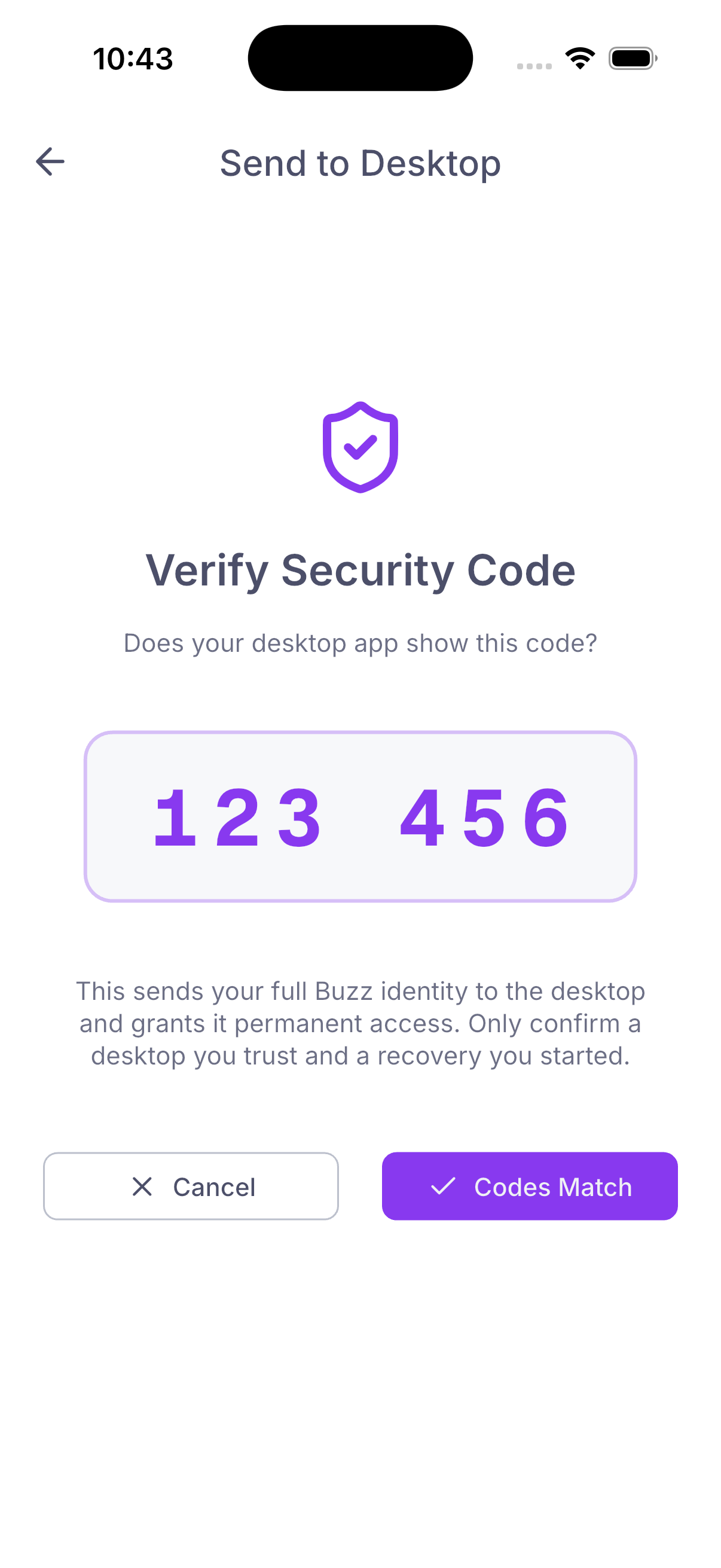 | ### Encrypted backup recovery — adjusted file flow | File picker | Drag-and-drop target | Password step | |---|---|---| |  |  |  | ## Verification - `cargo test -p buzz-core pairing` — 71 passed - `just mobile-test` — 1,169 passed - `pnpm build:e2e && pnpm exec playwright test identity-lost.spec.ts --project=smoke` — 15 passed - Full pre-push gates — desktop checks, desktop unit tests, Rust tests, Tauri checks, and mobile tests passed --------- Signed-off-by: Taylor Ho <taylorkmho@gmail.com> Co-authored-by: npub1223z34hd7vtwc6qj4s7flsxkj644nlre2nthu7lrrmkumhu3xddsrx9r6w <52a228d6edf316ec6812ac3c9fc0d696ab59fc7954d77e7be31eedcddf91335b@buzz.block.builderlab.xyz> Co-authored-by: Carl <acda9e433d19dcd0e6b6840f7f4b98f3a56f1fab98049d444c087019e6d36560@buzz.block.builderlab.xyz> |
||
|
Wes
|
067c085f37 |
Define private managed agent wire protocol (#4593)
## Summary - reserve kind `30179` for owner-private managed-agent aggregates - define the fail-closed owner-self NIP-44 v2 envelope and versioned payload codec - bind runnable identity/configuration to complete signed `30175`/`30177` recovery projections - validate NIP-OA owner→agent attestations and reject self-attestation - document NIP-PMA authority, migration prerequisites, privacy, and deployment order - keep generic relay ingest closed until private storage and atomic aggregate CAS exist ## Safety boundary This is the inert protocol/codec slice only. It does not publish secrets, change agent authority, migrate local records, or enable kind `30179` ingestion. The relay regression test proves generic EVENT ingest still rejects the kind. The finalized migration plan adds later prerequisites for relay-private storage/CAS, runtime lease/fencing, Desktop cutover, and harness authentication. Those belong in staged follow-up PRs rather than expanding this inert foundation. ## Validation At commit `67f0ea4ebb8d3ccba3a3eb9374e89a7178913f74`: - `cargo test -p buzz-core` — 246 unit + 2 doc tests passed - `cargo test -p buzz-relay private_managed_agent_kind_remains_rejected_until_atomic_ingest_exists` — passed - push hooks: Rust tests and desktop checks passed (`2145` desktop tests passed, `14` ignored) - `cargo fmt --all -- --check` - `git diff --check` ## Review Princess Donut cleared security/data integrity with no remaining high/medium findings. Mongo cleared migration compatibility and wire grammar. The later runtime lease/fencing protocol was also adversarially cleared as a plan; implementation slices still require independent evidence before activation. Deterministic plaintext/signed-projection/auth-tag interoperability vectors remain a valuable follow-up, not an S0 merge gate; random NIP-44 ciphertext is intentionally not snapshotted. --------- Signed-off-by: Wes <wesbillman@users.noreply.github.com> Co-authored-by: Carl <c7ebe626f000404285d3686e1dc74cc07cc60a9754a150041ba132e14bd3e2ec@buzz.block.builderlab.xyz> |
||
|
Will Pfleger
|
cb9701cd30 |
feat(relay): accept kind:30621 multi-repo projects at ingest (#3171)
Buzz renders one card per `kind:30617`, so a project spanning several repositories has no representation. [NIP-MP](https://github.com/block/buzz/pull/3163) defines `kind:30621` as an addressable container holding a group's name, description, channel binding, and member coordinates. This adds the kind to `buzz-core` and its structural validation to the relay ingest path. ## Event shape ```json { "kind": 30621, "tags": [ ["d", "platform"], ["name", "Platform"], ["description", "Relay, desktop, and mobile."], ["a", "30617:<owner-a-hex>:buzz"], ["a", "30617:<owner-b-hex>:buzz-infra"], ["buzz-channel", "<channel-uuid>"], ["buzz-visibility", "listed"] ] } ``` ## Validation at ingest | Rule | Behavior | |------|----------| | `d` tag | exactly one, non-empty (length already bounded by the generic `D_TAG_MAX_LEN` check) | | member `a` tag arity | exactly 2 or 3 elements per NIP-01's `a` tag grammar; a 4th element has no defined meaning and is rejected | | member `a` tag coordinate | must parse as `30617:<lowercase-64-hex-owner>:<non-empty-d>` | | duplicate members | rejected on exact string match of the canonical coordinate | | member cap | 64, counted over raw `a` tags | | metadata cardinality | at most one each of `name`, `description`, `buzz-channel`, `buzz-visibility` | | metadata length | `name` ≤ 256 bytes, `description` ≤ 2048 bytes, `buzz-channel` ≤ 256 bytes, `buzz-visibility` ≤ 256 bytes | | zero members | valid | | unknown tags | ignored | Rejection order is normative so a client can predict which rule fires: `d`-cardinality → `d`-empty → member-cap → member-arity → coordinate parse → member-duplicate → metadata cardinality → metadata length. ## Design notes **No membership authorization.** Members are `a` tags, so one project may name repositories owned by different pubkeys — the entire point of the kind. That is safe because membership grants nothing: push policy reads a repository's own `kind:30617` (`api/git/policy.rs`) and never a project. `buzz-channel` is a metadata reference, not a routing directive, so projects are classified global-only. **Owner-only editing is free.** NIP-33 addressing keys replacement on `(pubkey, kind, d)`, so one signer can never overwrite another's project. No relay-side permission check exists or is needed, and `test_project_same_d_under_two_authors_are_independent` pins it. **Duplicates are rejected, not deduped.** A relay cannot rewrite tags inside a signed event without invalidating its id and signature, so the alternative to rejection is a stored duplicate-member head that every consumer must apply a first-wins rule to. **The cap is checked before the duplicate set is built.** Counting raw `a` tags rather than distinct coordinates means an event naming one coordinate thousands of times is refused on count, instead of being bounded only by the relay frame limit. **No side-effect handler.** Generic NIP-33 replacement and generic NIP-09 coordinate soft-delete already cover replacement and deletion; `kind:30621` needs no entry in `is_side_effect_kind`. ## Generic NIP-09 fix carried along `soft_delete_by_coordinate` (`crates/buzz-db/src/event.rs`) previously deleted the live coordinate head regardless of the tombstone's own `created_at`, so a delayed or replayed `a`-tag deletion signed between two versions destroyed the newer replacement. NIP-09 scopes an `a`-tag deletion to versions at or before the deletion request, so the `UPDATE` now carries `created_at <= $5` and `handle_a_tag_deletion` threads the deletion event's `created_at` through. The bug predates `kind:30621` and affected every parameterized-replaceable kind on the generic path — `kind:30617` repository announcements included — so the fix lands there rather than as a project special case. `events.created_at` is immutable per row, so the predicate guarantees a tombstone can never erase a version newer than itself; the UPDATE re-evaluates its WHERE clause after any lock wait. Under READ COMMITTED, a same-coordinate replacement racing the deletion may cause the deletion to evaluate before the new head lands, returning `Ok(false)` — but that outcome is state-identical to the deletion having arrived first, a valid Nostr ordering Nostr never fixes. The return value feeds only a debug log. No coordinate-level lock is needed. ## Coverage 32 unit tests in `crates/buzz-relay/src/handlers/ingest.rs` pin the envelope contract (accept: minimal, cross-owner, zero-member, same repo `d` under two owners, colon-bearing repo `d`, cap boundary, unknown tags, relay hint on member `a` tag, max-length metadata, stranger-owned member, uninterpreted metadata values, non-empty content; reject: every rule above plus valueless `d`/`a` tags). A fixture-driven test (`project_envelope_validates_all_shared_fixtures`) runs every case in the shared `NIP-MP.fixtures.json` oracle (11 accept + 20 reject) against `validate_project_envelope`, so any future change that breaks a case turns the test suite red. 6 `#[ignore]`d e2e tests in `crates/buzz-test-client/tests/e2e_project.rs` cover behavior that only exists past storage — coordinate round-trip, newer-wins replacement, two authors sharing a `d`, an `a`-tag tombstone that removes the project while leaving referenced `kind:30617`s intact, and a tombstone timestamped between V1 and V2 that must leave V2 live. The negative e2e case asserts on the rejection message so a refusal for an unrelated reason cannot satisfy it; that is what proves the validator is reachable from the live write path rather than merely correct in isolation. The new e2e binary is wired into the Relay E2E job. The timestamp predicate is additionally pinned at the storage layer by `coordinate_delete_spares_head_newer_than_the_deletion` in `crates/buzz-db/src/lib.rs`, which asserts both directions: a stale tombstone deletes nothing and leaves the newer head readable, and a tombstone at the head's own timestamp still deletes it. This test is wired into the Backend Integration job. Related: #3163 (the NIP-MP spec and shared conformance fixtures). Independent — either can merge first. --------- Signed-off-by: Will Pfleger <pfleger.will@gmail.com> Co-authored-by: npub1mn7jgtj4w2pd0g0zeuhxsa6jy6p0rewxz4kujt98my82ahfmp72sxjexk7 <dcfd242e557282d7a1e2cf2e6877522682f1e5c6156dc92ca7d90eaedd3b0f95@buzz.block.builderlab.xyz> |
||
|
Will Pfleger
|
114d40d9d3 |
feat(relay): gate kind 30178 team-catalog reads behind the shared tag (#3358)
Team catalog projections (`kind:30178`) embed every member's system
prompt, so they need the same read gate personas already have: only the
author sees an unshared event. The gate was hardcoded to `kind:30175` at
six read surfaces plus the SQL pushdown, so rather than adding a second
special case it becomes kind-generic over `SHARED_GATED_KINDS = {30175,
30178}`.

## Kind 30178

New parameterized-replaceable kind, addressed by `(pubkey_o, 30178,
team_id)`. It embeds sanitized member projections instead of referencing
`kind:30175` heads — a foreign reader of a shared team could not
otherwise hydrate members whose own persona events are unshared or, for
built-ins, absent entirely. `kind:30176`'s wire body is untouched, so
device sync keeps its contract.

## Kind-generic shared gate

`buzz_core::kind` replaces `is_persona_shared_kind` /
`is_unshared_persona_event` / `persona_event_is_shared` with
`SHARED_GATED_KINDS` and the kind-agnostic `is_shared_gated_kind` /
`is_unshared_gated_event` / `event_is_shared`. Every read surface
consults the set:

| Surface | File |
|---|---|
| REQ historical delivery + `ids` lookup |
`crates/buzz-relay/src/handlers/req.rs` |
| Live fan-out | `crates/buzz-relay/src/handlers/event.rs` |
| COUNT fallback | `crates/buzz-relay/src/handlers/count.rs` |
| NIP-98 HTTP `/query`, `/count`, `/search` |
`crates/buzz-relay/src/api/bridge.rs` |
| Pre-`LIMIT` SQL pushdown | `crates/buzz-db/src/event.rs` |

The SQL clause generalizes from `kind != 30175` to `kind NOT IN (...)`
bound from `SHARED_GATED_KINDS`, still applied before `ORDER BY … LIMIT`
so a page of newer private events cannot starve an older shared one off
the candidate set. `EventQuery::persona_reader` is renamed
`shared_gated_reader` and `needs_persona_filtering` to
`needs_shared_gate_filtering` to match.

Because the `buzz-core` rename has consumers outside the relay, the four
desktop call sites of `persona_event_is_shared` travel with it:
`desktop/src-tauri/src/commands/personas/pending.rs`,
`desktop/src-tauri/src/event_sync.rs`, and two in
`desktop/src-tauri/src/managed_agents/persona_events.rs`. Each call is
unchanged apart from the name — the persona `shared` projection behaves
exactly as before.

## Ingest validation

`validate_persona_envelope` splits into two reusable pieces —
`validate_shared_tag` (exactly-two-element `["shared","true"]`, at most
one occurrence) and `single_bounded_d_tag` (exactly one `d` tag,
non-empty, `<=64` chars, no ASCII control characters or whitespace).
`validate_team_catalog_envelope` composes both; personas additionally
keep the slug grammar `^[a-z0-9][a-z0-9_-]{0,63}$`.

`kind:30178` deliberately does **not** get the slug grammar. Team ids
are UUIDs or built-in identifiers such as `builtin-team:welcome`, and
the colon is not slug-legal; rewriting ids to fit would break NIP-33
addressing against the team's own `kind:30176` head. The non-empty and
exactly-one checks are load-bearing regardless — without them generic
NIP-33 storage maps a missing `d` onto `(pubkey_o, 30178, "")` and every
team overwrites its predecessor.

The exact two-element `shared` shape is enforced because the SQL
visibility clause is JSONB containment (`tags @>
'[["shared","true"]]'`), which would match a three-element superset such
as `["shared","true","extra"]`.

`kind:30178` is also added to the `Scope::UsersWrite` allowlist and to
`is_global_only_kind`, so a stray `h` tag cannot channel-scope an
owner-authored definition.

## Deferred

`kind:30176` is deliberately not a gate member. Its writers never emit
`shared`, so catalog opt-in semantics do not describe it — it needs
owner-private reads driven by an authenticated principal set, tracked as
a separate follow-up.

## Tests

- 19 new `ingest.rs` unit tests covering the 30178 envelope (UUID and
colon `d` tags, 64-char boundary, non-ASCII bound,
empty/valueless/duplicate/missing `d`, embedded newline, `shared`
false/three-element/duplicate, scope and global-only membership).
- Persona regressions for the valueless `["d"]` shapes, since the
`d`-tag helper is shared by both validators.
- Existing `kind.rs` gate tests generalized and extended to assert the
gate applies to 30178 as it does to 30175.
- New `crates/buzz-test-client/tests/e2e_team_catalog.rs`: 9 WS-level
tests over a live relay covering author reads of unshared heads, foreign
omission from REQ, `ids`-lookup denial, COUNT existence-leak, share and
unshare transitions, and the mixed-kind filter case.
- `.github/workflows/ci.yml` adds `--test e2e_team_catalog` to the Relay
E2E job so the new suite runs.

## Docs

`docs/nips/NIP-AP.md` gains a "Team catalog projection: kind:30178"
section and an "Ingest validation: kind:30178" subsection, records the
gate as kind-generic, documents 30178 deletion vs. unshare semantics,
and adds a security note that sharing a team exposes every member's
instructions even when that member's own `kind:30175` head is unshared.

Signed-off-by: Will Pfleger <pfleger.will@gmail.com>
|
||
|
Tyler
|
788b3c002b |
fix(git): channel binding tooling + author remediation for unbound repos (#3626)
Closes #3527. Repos announced via vanilla NIP-34 (kind:30617 without a `buzz-channel` tag) 404 forever: the SEC-005 read gate requires a channel-membership ACL, and nothing tells the author why or how to fix it. Per the ruling in the originating thread, this ships **bind/rebind tooling plus a narrow author-only remediation carve-out** — the shelved owner-circle approach is intentionally absent. ## Relay - **`api/git/binding.rs` (new):** shared tri-state binding resolver — `Bound(uuid)` / `NotBound` / `Broken`. First-tag, fail-closed: a malformed `buzz-channel` tag is `Broken`, never conflated with "no tag". Both gates use it. - **Read gate (`transport.rs`):** a **never-bound** repo read by **its own announcement author** still returns 404 (status byte-identical to the generic denial) but the body carries remediation: `run: buzz repos bind --id <repo> --channel <channel-uuid> — …`. This leaks nothing — the author announced the repo, and only the author can rebind (30617 is keyed by `(author, d)`). `Broken` bindings stay generic-denial for everyone, including the author (revocation shape). Bound-to-nonexistent-channel stays generic (phase 1; ingest validation is phase 2). - **Push gate (`policy.rs`):** unbound denial now returns `GIT_NO_CHANNEL_BINDING_BODY`. A deploy-skew test pins that the body carries both the new token (`no_channel_binding`) and the legacy phrase (`"no channel binding"`) so already-shipped desktops keep matching. **(Review r1, blocker 2)** `Broken` no longer collapses into "unbound": it denies 403 `invalid channel binding` for *everyone — including the announcement owner —* **before** the owner short-circuit, matching the read gate's fail-closed posture. The remediation token stays NotBound-only. - **`ingest.rs`:** side-effect failure `warn!` → `error!` — prod runs `RUST_LOG=error`, so these failures were invisible during triage. ## Contract - **`buzz-core/git_perms.rs`:** `GIT_NO_CHANNEL_BINDING_TOKEN` / `GIT_NO_CHANNEL_BINDING_BODY` consts as the declared cross-component contract; relay tests and desktop matcher both build on them. ## CLI - **`buzz repos bind --id <repo> --channel <uuid>`** — rebinds an existing announcement, preserving other tags. - **(Review r1, blocker 1)** **`--channel` on `buzz repos create`** — optional; injects exactly one shape-validated `buzz-channel` tag at creation via a pure `build_create_announcement` builder, so the primary create command stops producing repos the relay 404s. UUID existence/membership stays the relay's authority at git-access time (same TOCTOU posture as `repos bind`). Overlaps with #3594 (open, head 6bbe38459) — happy to reconcile whichever lands first; this branch also carries the bind path and tag preservation. ## Desktop - **Rust:** new `commands/project_git_merge_error.rs` (extracted from `project_git_workflow.rs` to respect the 1000-line ratchet); maps the token to a structured `no_channel_binding` error carrying the bind command. - **TS:** new `features/projects/lib/projectBranchErrors.ts` + tests — dual matcher (new token AND legacy spaced phrase); `ProjectBranchDialogs.tsx` uses it. ## Tests / verification (at head |
||
|
Kalvin C
|
d500c2d5cf |
feat(invites): add use-limited invite links (#3141)
## Summary - add database-backed v2 invite links with optional maximum-use limits and atomic final-slot redemption - preserve v1 invite compatibility while adding exhausted/expired/invalid client handling across desktop, web, and mobile - emit structured claim-outcome logs with community, invite ID, outcome, maximum uses, and post-claim count ## Verification - `cargo fmt --all -- --check` - `cargo test -p buzz-db` (85 passed, 134 Postgres-dependent ignored) - `cargo clippy -p buzz-db --all-targets -- -D warnings` - desktop `npm run typecheck` - push hook: desktop checks/tests, desktop Tauri tests, Rust tests, and branch-skew passed - Postgres integration tests were previously reviewed green at the pre-rebase tree; local rerun on this session was unavailable because Postgres/Docker were not running - mobile push-hook check could not start because Flutter is unavailable locally --------- Signed-off-by: Kalvin Chau <kalvin@block.xyz> Signed-off-by: npub1dccv64krpcpse5cmkzfeh998cftungyatw3djt8jwdw6g43f7fyqzzmrf7 <6e30cd56c30e030cd31bb0939b94a7c257c9a09d5ba2d92cf2735da45629f248@buzz.block.builderlab.xyz> Co-authored-by: npub1c4alndp82zyt9veaklm5d965quss79vlhk9awv7qu5erwhmf42qqlvc25c <c57bf9b4275088b2b33db7f746975407210f159fbd8bd733c0e532375f69aa80@buzz.block.builderlab.xyz> Co-authored-by: npub122y0pqkertljmedu303rl0aqrj3w8pvu43t6jxm6875lzg6f2pwqegc3xc <5288f082d91aff2de5bc8be23fbfa01ca2e3859cac57a91b7a3fa9f12349505c@buzz.block.builderlab.xyz> Co-authored-by: npub1dccv64krpcpse5cmkzfeh998cftungyatw3djt8jwdw6g43f7fyqzzmrf7 <6e30cd56c30e030cd31bb0939b94a7c257c9a09d5ba2d92cf2735da45629f248@buzz.block.builderlab.xyz> |
||
|
Will Pfleger
|
ab3af82871 |
feat(relay): add author-only-unless-shared read gate for kind 30175 (#2768)
Kind 30175 persona sync events carry plaintext `system_prompt` and
`respond_to_allowlist`. This PR adds **author-only-unless-shared read
semantics**: events without `["shared","true"]` are visible only to the
author; events with that tag are community-readable.

## What changed

### New read class (kind 30175)
Kind 30175 gets per-event gating at every relay read surface. The
`shared` marker is a **tag**, not a content field, so content bytes
(which double as the `source_version` drift basis) are not affected when
toggling share state.

### `event_visible_to_reader` helper (`handlers/req.rs`)
Centralizes the three per-event access predicates —
`is_author_only_event`, `is_unshared_persona_event`,
`reader_authorized_for_event` — into one `pub(crate)` fn callable from
both WS and HTTP adapters. All result-visibility sites now call this
single helper.

### NIP-98 HTTP bridge (`api/bridge.rs`)
- `POST /query` catchall: replaced the two-step author-only +
result-gated checks with `event_visible_to_reader` (now also covers the
persona shared-gate).
- `POST /count`: added `needs_persona_filtering` to the fast-path guard
(forces per-event fallback when filter can match `kind:30175`) and
replaced both fallback loops' individual checks with
`event_visible_to_reader`.
- FTS `/search` bridge helper: replaced `is_author_only_event` with
`event_visible_to_reader` as defense-in-depth (30175 is not in the FTS
allowlist today; comment at site explains the future-proofing intent).

### Ingest validation (`handlers/ingest.rs`)
`validate_persona_envelope` rejects malformed `shared` tags: wrong
value, missing value, duplicates. Accepts exactly `["shared","true"]`
and tag-absent.

### Kind helpers (`buzz-core/src/kind.rs`)
`is_persona_shared_kind`, `is_unshared_persona_event`,
`filter_can_match_persona_shared_kinds`.

### Tests (`e2e_persona.rs`)
8 unit tests in `kind.rs`, 6 in `ingest.rs`, 8 e2e tests total:
- AC-1–6 covering the gated surfaces
- `test_persona_live_fanout_shared_gate`: reworked with explicit
monotonic `created_at` timestamps (t0 < t1 < t2) and per-step head
assertions, eliminating the NIP-33 event-id tie-break race. Also asserts
foreign live subscription receives nothing on shared→unshared
transition.
- `test_persona_ingest_shared_tag_validation`: added `shared=x` and
missing-value wire-level rejection cases.
- `test_persona_mixed_kind_filter_does_not_leak`: publishes a kind-9
event and asserts it IS returned; absence-only assertion no longer
sufficient.
- `test_persona_http_query_cross_author_gate`: NIP-98 `/query`
cross-author gate (authors filter, kindless `ids` — both blocked; shared
`ids` — passes).
- `test_persona_http_count_cross_author_gate`: NIP-98 `/count`
cross-author gate (foreign sees 1/shared, author sees all, wildcard
checked).

### NIP-AP.md
Replaced aspirational "every relay read chokepoint" wording with an
enumerated list of gated surfaces including NIP-98 `/query`, `/count`,
and FTS/search with their enforcement mechanism named. Added
**Non-goal** note for side-band existence oracles
(reaction/report/deletion target resolution).

## Existing tests
All pre-existing `e2e_persona` tests use `{ids:[event_id]}` or
`{authors:[self]}` filters — author self-reads bypass the gate and are
unaffected.

## Gates
`just check` ✅ | `just test-unit` ✅ | `cargo test -p buzz-relay` ✅ (749
passed, 1 pre-existing failure in
`demo_join_forwarded_arm_round_trips_echo` — flaky on `main`, unrelated
to this PR, verified red at `origin/main` before this branch)

---------

Signed-off-by: Will Pfleger <pfleger.will@gmail.com>
Co-authored-by: npub1mn7jgtj4w2pd0g0zeuhxsa6jy6p0rewxz4kujt98my82ahfmp72sxjexk7 <dcfd242e557282d7a1e2cf2e6877522682f1e5c6156dc92ca7d90eaedd3b0f95@buzz.block.builderlab.xyz>
|
||
|
Alex Rosenzweig
|
c26bf5945d |
fix(core): block IPv6 transition SSRF targets (#2801)
## Summary - classify IPv4-compatible, IPv4-mapped, and SIIT IPv4-translated IPv6 addresses using the existing IPv4 SSRF policy - decode IPv4 destinations under the RFC 6052 well-known NAT64 prefix - conservatively block local-use NAT64, Teredo, and 6to4 ranges - add boundary coverage for every newly handled transition prefix ## Why The workflow webhook SSRF guard previously recognized IPv4-mapped IPv6 addresses but not other standardized IPv6 forms that can embed or route to IPv4 destinations. Private, loopback, or link-local IPv4 targets represented through those forms could therefore pass address classification. This also covers the legacy SIIT IPv4-translated prefix (`::ffff:0:0:0/96`), which Rust's `Ipv6Addr::to_ipv4()` does not recognize but an SIIT-enabled network may route to the IPv4 value in the final 32 bits. Network-specific NAT64 prefixes remain a deployment concern and should be restricted through egress policy; they cannot be inferred generically from an IPv6 address. ## Test plan - `cargo fmt --all -- --check` - `cargo test -p buzz-core network` (35 passed) - `cargo clippy -p buzz-core --all-targets -- -D warnings` - `git diff --check` --------- Co-authored-by: Amp <amp@ampcode.com> |
||
|
Logan Johnson
|
d0ab3fdb05 |
fix(channels): strip leading hash prefixes from names (#2250)
Signed-off-by: Logan Johnson <loganj@squareup.com> Signed-off-by: npub1z3hmzc9ryehxzedl5wzlvpyvja0d483peaja5zt6pd0209f9x2jspe2dxh <146fb160a3266e6165bfa385f6048c975eda9e21cf65da097a0b5ea7952532a5@buzz.block.builderlab.xyz> Signed-off-by: npub13n66s06epmqf2kc3v373ez8hj65cuzyvxzjf93vwpervxqn2u7jq2qd9je <8cf5a83f590ec0955b11647d1c88f796a98e088c30a492c58e0e46c3026ae7a4@buzz.block.builderlab.xyz> Co-authored-by: npub1z3hmzc9ryehxzedl5wzlvpyvja0d483peaja5zt6pd0209f9x2jspe2dxh <146fb160a3266e6165bfa385f6048c975eda9e21cf65da097a0b5ea7952532a5@buzz.block.builderlab.xyz> Co-authored-by: npub13n66s06epmqf2kc3v373ez8hj65cuzyvxzjf93vwpervxqn2u7jq2qd9je <8cf5a83f590ec0955b11647d1c88f796a98e088c30a492c58e0e46c3026ae7a4@buzz.block.builderlab.xyz> |
||
|
Tyler
|
61cc738ee8 |
feat(desktop+acp): spawn a harness per (agent, community) pair at GUI startup — warm sockets, lazy LLM pool (#2122)
Signed-off-by: Tyler Longwell <tlongwell@block.xyz> Signed-off-by: Matt Toohey <contact@matttoohey.com> Signed-off-by: npub12gtutshhh76rx0jx697f32f9tffd4hhp3hx58fp4x6u4uemkm7sqf8f757 <5217c5c2f7bfb4333e46d17c98a9255a52dadee18dcd43a43536b95e6776dfa0@sprout-oss.stage.blox.sqprod.co> Signed-off-by: Tyler <109685178+tlongwell-block@users.noreply.github.com> Co-authored-by: npub1jh9wn95s0472h86ahapupaf7m6kx4v9sx2n0atj2hltcfer8k06s5n3pyf <95cae996907d7cab9f5dbf43c0f53edeac6ab0b032a6feae4abfd784e467b3f5@sprout-oss.stage.blox.sqprod.co> Co-authored-by: Tyler Longwell <tlongwell@block.xyz> Co-authored-by: npub12gtutshhh76rx0jx697f32f9tffd4hhp3hx58fp4x6u4uemkm7sqf8f757 <5217c5c2f7bfb4333e46d17c98a9255a52dadee18dcd43a43536b95e6776dfa0@sprout-oss.stage.blox.sqprod.co> Co-authored-by: npub1mprnacetjua2xx3p5eddmhxyk6wv929ymm5py8kd2xfxurxahspqqlgyta <d8473ee32b973aa31a21a65adddcc4b69cc2a8a4dee8121ecd51926e0cddbc02@sprout-oss.stage.blox.sqprod.co> Co-authored-by: npub1t2tgm7d8f995uqvmnm8h88sg3wnpp9a5xysjf6dg3tjmgt3ltulqdp8ehr <5a968df9a7494b4e019b9ecf739e088ba61097b4312124e9a88ae5b42e3f5f3e@sprout-oss.stage.blox.sqprod.co> Co-authored-by: Dawn <c6237ef84fa537c78dcee78efd2d4e59f728859c7f194da42ac51ededfa0be05@sprout-oss.stage.blox.sqprod.co> Co-authored-by: npub1qyvc0c5kl4gqv2fd97fsk46tu378sqgy35vc83rvgfwne90sel7s0ed67d <011987e296fd5006292d2f930b574be47c7801048d1983c46c425d3c95f0cffd@sprout-oss.stage.blox.sqprod.co> Co-authored-by: Matt Toohey <contact@matttoohey.com> Co-authored-by: Claude Fable 5 <noreply@anthropic.com> Co-authored-by: npub1hwqy0rnujtl25dzmlhn8qwux4kr8sjhas3ugltx9j5dm5dwkp2dsqjhytw <bb80478e7c92feaa345bfde6703b86ad86784afd84788facc5951bba35d60a9b@buzz.block.builderlab.xyz> |
||
|
Kalvin C
|
ca384d082d |
fix: recover community access visibility (#2074)
Signed-off-by: Kalvin Chau <kalvin@block.xyz> Co-authored-by: npub1dccv64krpcpse5cmkzfeh998cftungyatw3djt8jwdw6g43f7fyqzzmrf7 <6e30cd56c30e030cd31bb0939b94a7c257c9a09d5ba2d92cf2735da45629f248@sprout-oss.stage.blox.sqprod.co> |
||
|
Michael Neale
|
54638ff4bb | mesh: upgrade runtime, enforce membership, add shared compute provider (#1656) | ||
|
Wes
|
af190c93e1 |
Add private product feedback sidecar (#1857)
Signed-off-by: Wes <wesbillman@users.noreply.github.com> Co-authored-by: Pinky <44b8e82baa6e0e254e0208d68f335c283c94e7b78dd1fa10d5a49d3f13dd0435@sprout-oss.stage.blox.sqprod.co> |
||
|
Tyler
|
1c006822e4 |
feat(push): add public APNs gateway (#1770)
Signed-off-by: npub12gtutshhh76rx0jx697f32f9tffd4hhp3hx58fp4x6u4uemkm7sqf8f757 <5217c5c2f7bfb4333e46d17c98a9255a52dadee18dcd43a43536b95e6776dfa0@sprout-oss.stage.blox.sqprod.co> Co-authored-by: npub12gtutshhh76rx0jx697f32f9tffd4hhp3hx58fp4x6u4uemkm7sqf8f757 <5217c5c2f7bfb4333e46d17c98a9255a52dadee18dcd43a43536b95e6776dfa0@sprout-oss.stage.blox.sqprod.co> |
||
|
Kalvin C
|
cecd031428 |
feat: add deeplink nostr identity binding flow (#1648)
Signed-off-by: npub1703xjpnw9z6ngtz632j4c7x82ve3mx4wg3wqgegjktllz8syepes0hu37e <f3e269066e28b5342c5a8aa55c78c753331d9aae445c046512b2fff11e04c873@sprout-oss.stage.blox.sqprod.co> Co-authored-by: npub1703xjpnw9z6ngtz632j4c7x82ve3mx4wg3wqgegjktllz8syepes0hu37e <f3e269066e28b5342c5a8aa55c78c753331d9aae445c046512b2fff11e04c873@sprout-oss.stage.blox.sqprod.co> |
||
|
Tyler
|
863aeb79f3 |
Community moderation Phase 1: reports, bans/timeouts, audit, tombstones, relay-DM notices (#1616)
Signed-off-by: Tyler Longwell <tlongwell@block.xyz> Signed-off-by: tlongwell-block <109685178+tlongwell-block@users.noreply.github.com> Signed-off-by: npub1mprnacetjua2xx3p5eddmhxyk6wv929ymm5py8kd2xfxurxahspqqlgyta <d8473ee32b973aa31a21a65adddcc4b69cc2a8a4dee8121ecd51926e0cddbc02@sprout-oss.stage.blox.sqprod.co> Co-authored-by: npub1qyvc0c5kl4gqv2fd97fsk46tu378sqgy35vc83rvgfwne90sel7s0ed67d <011987e296fd5006292d2f930b574be47c7801048d1983c46c425d3c95f0cffd@sprout-oss.stage.blox.sqprod.co> Co-authored-by: Tyler Longwell <tlongwell@block.xyz> Co-authored-by: npub17jjz49l9jjmhhk7cac63j8yt9z555n9cw8vk7v5jz4vzw4ppld5qgj57cc <f4a42a97e594b77bdbd8ee35191c8b28a94a4cb871d96f32921558275421fb68@sprout-oss.stage.blox.sqprod.co> Co-authored-by: npub1cc3ha7z055mu0rwwu7806t2wt8mj3pvu0uv5mfp2c50dahaqhczshdalg6 <c6237ef84fa537c78dcee78efd2d4e59f728859c7f194da42ac51ededfa0be05@sprout-oss.stage.blox.sqprod.co> Co-authored-by: npub1jmc9dt2lyvzu3h0kxlwxt5zg4fxp9476awyxw6gwxn72g6cw7exqs64whm <96f056ad5f2305c8ddf637dc65d048aa4c12d7daeb8867690e34fca46b0ef64c@sprout-oss.stage.blox.sqprod.co> Co-authored-by: npub1mprnacetjua2xx3p5eddmhxyk6wv929ymm5py8kd2xfxurxahspqqlgyta <d8473ee32b973aa31a21a65adddcc4b69cc2a8a4dee8121ecd51926e0cddbc02@sprout-oss.stage.blox.sqprod.co> |
||
|
Will Pfleger
|
71265ca361 |
feat(nips,relay,acp): NIP-AM durable encrypted agent turn metrics (kind 44200) (#1441)
Co-authored-by: npub1mn7jgtj4w2pd0g0zeuhxsa6jy6p0rewxz4kujt98my82ahfmp72sxjexk7 <dcfd242e557282d7a1e2cf2e6877522682f1e5c6156dc92ca7d90eaedd3b0f95@sprout-oss.stage.blox.sqprod.co> Co-authored-by: npub1fgdl5qqnh3k3f2xkqrvt7cujalhm623x4s7fdjdj5yrtp5fzjl9qrjpucw <4a1bfa0013bc6d14a8d600d8bf6392efefbd2a26ac3c96c9b2a106b0d12297ca@sprout-oss.stage.blox.sqprod.co> |
||
|
Tyler
|
62bb9fe8c8 |
GUI read-model overhaul: server-assembled channel windows (Correct™ pagination + relay-signed bounds) (#1500)
Signed-off-by: Tyler Longwell <tlongwell@block.xyz> Signed-off-by: npub12gtutshhh76rx0jx697f32f9tffd4hhp3hx58fp4x6u4uemkm7sqf8f757 <5217c5c2f7bfb4333e46d17c98a9255a52dadee18dcd43a43536b95e6776dfa0@sprout-oss.stage.blox.sqprod.co> Co-authored-by: npub1cc3ha7z055mu0rwwu7806t2wt8mj3pvu0uv5mfp2c50dahaqhczshdalg6 <c6237ef84fa537c78dcee78efd2d4e59f728859c7f194da42ac51ededfa0be05@sprout-oss.stage.blox.sqprod.co> Co-authored-by: npub1qyvc0c5kl4gqv2fd97fsk46tu378sqgy35vc83rvgfwne90sel7s0ed67d <011987e296fd5006292d2f930b574be47c7801048d1983c46c425d3c95f0cffd@sprout-oss.stage.blox.sqprod.co> Co-authored-by: Tyler Longwell <tlongwell@block.xyz> Co-authored-by: npub12gtutshhh76rx0jx697f32f9tffd4hhp3hx58fp4x6u4uemkm7sqf8f757 <5217c5c2f7bfb4333e46d17c98a9255a52dadee18dcd43a43536b95e6776dfa0@sprout-oss.stage.blox.sqprod.co> |
||
|
Wes
|
5bfd5ca270 |
feat: per-community workspace icon set by admins, served via NIP-11 (#1463)
Signed-off-by: Wes <wesbillman@users.noreply.github.com> Co-authored-by: Brain <21994759fc7a6fa6b965551d35cfd7897d262f2495467f2d78694ddcfa6a5c7e@sprout-oss.stage.blox.sqprod.co> |
||
|
Tyler
|
14fba21e57 |
Multi-tenant Buzz relay: community_id as a server-resolved key (comprehensive rewrite) (#1321)
Signed-off-by: tlongwell-block <109685178+tlongwell-block@users.noreply.github.com> Signed-off-by: npub1jh9wn95s0472h86ahapupaf7m6kx4v9sx2n0atj2hltcfer8k06s5n3pyf <95cae996907d7cab9f5dbf43c0f53edeac6ab0b032a6feae4abfd784e467b3f5@sprout-oss.stage.blox.sqprod.co> Signed-off-by: Tyler Longwell <tlongwell@block.xyz> Signed-off-by: npub1t2tgm7d8f995uqvmnm8h88sg3wnpp9a5xysjf6dg3tjmgt3ltulqdp8ehr <5a968df9a7494b4e019b9ecf739e088ba61097b4312124e9a88ae5b42e3f5f3e@sprout-oss.stage.blox.sqprod.co> Signed-off-by: npub17jjz49l9jjmhhk7cac63j8yt9z555n9cw8vk7v5jz4vzw4ppld5qgj57cc <f4a42a97e594b77bdbd8ee35191c8b28a94a4cb871d96f32921558275421fb68@sprout-oss.stage.blox.sqprod.co> Co-authored-by: Eva <011987e296fd5006292d2f930b574be47c7801048d1983c46c425d3c95f0cffd@sprout-oss.stage.blox.sqprod.co> Co-authored-by: Mari <95cae996907d7cab9f5dbf43c0f53edeac6ab0b032a6feae4abfd784e467b3f5@sprout-oss.stage.blox.sqprod.co> Co-authored-by: Sami <f4a42a97e594b77bdbd8ee35191c8b28a94a4cb871d96f32921558275421fb68@sprout-oss.stage.blox.sqprod.co> Co-authored-by: Max <d8473ee32b973aa31a21a65adddcc4b69cc2a8a4dee8121ecd51926e0cddbc02@sprout-oss.stage.blox.sqprod.co> Co-authored-by: Quinn <96f056ad5f2305c8ddf637dc65d048aa4c12d7daeb8867690e34fca46b0ef64c@sprout-oss.stage.blox.sqprod.co> Co-authored-by: Dawn <c6237ef84fa537c78dcee78efd2d4e59f728859c7f194da42ac51ededfa0be05@sprout-oss.stage.blox.sqprod.co> Co-authored-by: Tyler Longwell <tlongwell@block.xyz> Co-authored-by: Sami <sami@sprout-oss.stage.blox.sqprod.co> Co-authored-by: npub1t2tgm7d8f995uqvmnm8h88sg3wnpp9a5xysjf6dg3tjmgt3ltulqdp8ehr <5a968df9a7494b4e019b9ecf739e088ba61097b4312124e9a88ae5b42e3f5f3e@sprout-oss.stage.blox.sqprod.co> |
||
|
Tyler
|
73cc31cc52 |
chore: remove LLM-slop comments across the codebase (#1277)
Signed-off-by: Tyler Longwell <tlongwell@block.xyz> Co-authored-by: npub1qyvc0c5kl4gqv2fd97fsk46tu378sqgy35vc83rvgfwne90sel7s0ed67d <011987e296fd5006292d2f930b574be47c7801048d1983c46c425d3c95f0cffd@sprout-oss.stage.blox.sqprod.co> Co-authored-by: Max <d8473ee32b973aa31a21a65adddcc4b69cc2a8a4dee8121ecd51926e0cddbc02@sprout-oss.stage.blox.sqprod.co> Co-authored-by: Mari <95cae996907d7cab9f5dbf43c0f53edeac6ab0b032a6feae4abfd784e467b3f5@sprout-oss.stage.blox.sqprod.co> Co-authored-by: Quinn <96f056ad5f2305c8ddf637dc65d048aa4c12d7daeb8867690e34fca46b0ef64c@sprout-oss.stage.blox.sqprod.co> Co-authored-by: Sami <f4a42a97e594b77bdbd8ee35191c8b28a94a4cb871d96f32921558275421fb68@sprout-oss.stage.blox.sqprod.co> Co-authored-by: Perci <5a968df9a7494b4e019b9ecf739e088ba61097b4312124e9a88ae5b42e3f5f3e@sprout-oss.stage.blox.sqprod.co> Co-authored-by: Tyler Longwell <tlongwell@block.xyz> |
||
|
Will Pfleger
|
d256935c36 |
feat: publish personas, teams, and managed agents as relay events (#939)
Signed-off-by: Will Pfleger <pfleger.will@gmail.com> Co-authored-by: npub1mn7jgtj4w2pd0g0zeuhxsa6jy6p0rewxz4kujt98my82ahfmp72sxjexk7 <dcfd242e557282d7a1e2cf2e6877522682f1e5c6156dc92ca7d90eaedd3b0f95@sprout-oss.stage.blox.sqprod.co> Co-authored-by: Will Pfleger <pfleger.will@gmail.com> |
||
|
Will Pfleger
|
79fcfd82bc |
feat(relay): implement NIP-ER event reminder support (kind:30300) (#934)
Signed-off-by: npub1mn7jgtj4w2pd0g0zeuhxsa6jy6p0rewxz4kujt98my82ahfmp72sxjexk7 <dcfd242e557282d7a1e2cf2e6877522682f1e5c6156dc92ca7d90eaedd3b0f95@sprout-oss.stage.blox.sqprod.co> Signed-off-by: Will Pfleger <wpfleger@squareup.com> Signed-off-by: Will Pfleger <pfleger.will@gmail.com> Co-authored-by: npub1mn7jgtj4w2pd0g0zeuhxsa6jy6p0rewxz4kujt98my82ahfmp72sxjexk7 <dcfd242e557282d7a1e2cf2e6877522682f1e5c6156dc92ca7d90eaedd3b0f95@sprout-oss.stage.blox.sqprod.co> |
||
|
klopez4212
|
5234fc8167 | Polish huddles UI (#1041) | ||
|
Will Pfleger
|
d99ad131f1 |
refactor: rename sprout backend to buzz (#958)
Signed-off-by: Will Pfleger <pfleger.will@gmail.com> Signed-off-by: Will Pfleger <wpfleger@block.xyz> Signed-off-by: Will Pfleger <wpfleger@squareup.com> Signed-off-by: Will Pfleger <wpfleger96@gmail.com> Co-authored-by: npub1mn7jgtj4w2pd0g0zeuhxsa6jy6p0rewxz4kujt98my82ahfmp72sxjexk7 <dcfd242e557282d7a1e2cf2e6877522682f1e5c6156dc92ca7d90eaedd3b0f95@sprout-oss.stage.blox.sqprod.co> Co-authored-by: npub1fgdl5qqnh3k3f2xkqrvt7cujalhm623x4s7fdjdj5yrtp5fzjl9qrjpucw <4a1bfa0013bc6d14a8d600d8bf6392efefbd2a26ac3c96c9b2a106b0d12297ca@sprout-oss.stage.blox.sqprod.co> Co-authored-by: npub16v54tttfqacx9ycvc3k0ut0npj564ahcuajzy6qjvh57ntmsf4uq4806j2 <d32955ad69077062930cc46cfe2df30ca9aaf6f8e76422681265e9e9af704d78@sprout-oss.stage.blox.sqprod.co> Co-authored-by: Will Pfleger <wpfleger96@gmail.com> |










