## Summary
This fixes transparent images showing a black background. Image
thumbnails were always JPEG, which can't store transparency, so a
transparent PNG or GIF upload, such as an agent avatar, rendered on
black wherever a client showed its thumbnail.
The relay now writes a lossy WebP thumbnail at `{sha256}.thumb.webp`,
which keeps transparency, alongside the existing `{sha256}.thumb.jpg`:
- **Encoding:** the WebP comes from libwebp through the `webp` crate,
built from vendored C source, so the relay needs no system library. A
GIF uses its first frame.
- **Upload responses:** the upload descriptor's `thumb`, and its
per-tenant rewrite, point to the WebP.
- **JPEG kept:** installed clients derive `.thumb.jpg` themselves, so
the relay keeps writing it until clients move to WebP with a JPEG
fallback. Existing images still have only their JPEG thumbnail.
- **Serving:** `/media/` serves both variants, each with its own content
type. Other `.thumb.*` extensions still return 404.
- **imeta:** a `thumb` may name either variant, and the relay checks
that the named object exists.
- **Storage sweep:** the bucket taxonomy counts both variants as the
image's thumbnail bytes instead of classifying `.thumb.webp` as unknown.
| 320px thumbnail | JPEG | PNG | lossy WebP (q80) |
|---|---|---|---|
| Transparent avatar (starter-team `fizz.png`) | 11.3 KB, black
background | 65.1 KB | 13.8 KB |
| Opaque avatar (`sprout-agent.png`) | 23.6 KB | 156.5 KB | 12.3 KB |
| Screenshot (`channel-thread.png`) | 13.4 KB | 62.5 KB | 6.4 KB |
Encoding a WebP thumbnail takes 3 to 20 ms.
### Related issue
Supersedes #8772, which served a PNG at the `.thumb.jpg` path.
### Testing
Red/green against a local relay on `:3000`, built from the branch under
test, with Postgres, Redis and MinIO from `docker compose`:
```bash
cargo test -p buzz-test-client --test e2e_media test_transparent_png_thumbnail_is_webp_with_alpha -- --ignored
cargo test -p buzz-test-client --test e2e_media_extended test_ws_imeta_webp_thumb -- --ignored
```
- **On `main`:** both tests fail. The descriptor's `thumb` is
`.thumb.jpg`, and the WebSocket send is rejected with `invalid: imeta
thumb must be a local .thumb.jpg path`.
- **On this branch:** both tests pass:
- Uploading a half-transparent PNG returns a `thumb` ending
`.thumb.webp`.
- HEAD and GET on that URL return `Content-Type: image/webp`.
- The decoded thumbnail keeps alpha 0 on the transparent half and alpha
255 on the opaque half.
- `.thumb.jpg` still returns `image/jpeg`.
- A kind 9 message whose imeta `thumb` names the `.thumb.webp` is
accepted.
## Screenshots
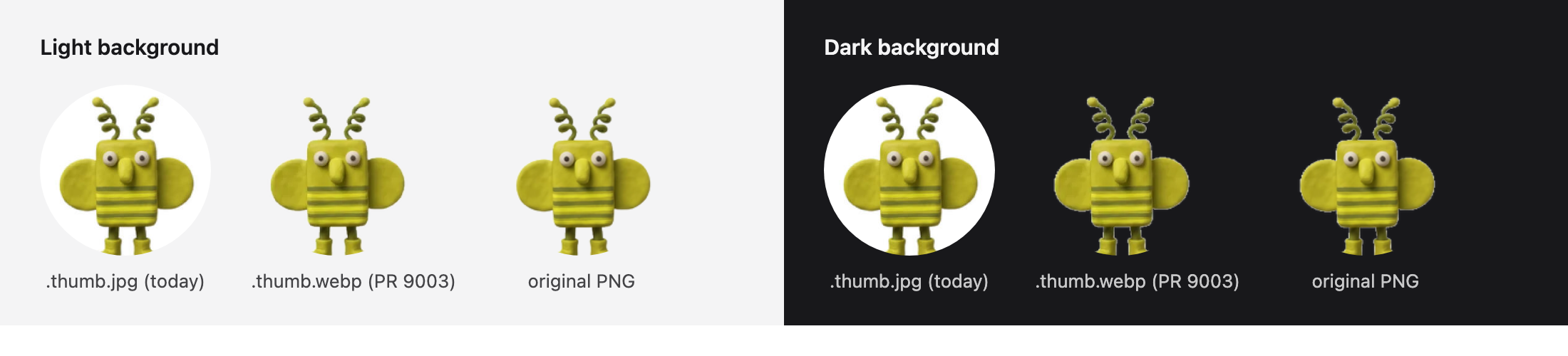
The starter-team `fizz.png` avatar uploaded to a relay built from this
branch. Both thumbnails are shown as round avatars beside the original
PNG. `.thumb.jpg` fills the transparent area with a solid disc, and
`.thumb.webp` keeps the transparency.
🤖 Generated with [Claude Code](https://claude.com/claude-code)
---------
Signed-off-by: John Matthew Tennant <jtennant@squareup.com>
Co-authored-by: Simone <0828be588d5c9c4d092c5b1cf01761d5aef63d6b104807fd8e8284d517dd1a99@buzz.block.builderlab.xyz>
Co-authored-by: Claude Opus 5.5 <noreply@anthropic.com>
## Summary

Buzz has no way to load-test the relay as a whole. `wamp_bench` sends
kind:9 messages from one identity to one channel, and
`perf/relay_bus_scaling.py` only measures Redis fan-out. Neither can
show what happens to a relay with many more users, channels, or deep
threads.

This PR adds `buzz-loadgen`, a load generator in
`crates/buzz-test-client`:

- `buzz-loadgen seed <scenario.toml>` creates communities (through `POST
/operator/communities`), channels, channel history, and deep threads.
- `buzz-loadgen run <scenario.toml>` drives simulated humans and agents
through ramp steps (1x, 2x, ...) and prints p50/p90/p99 latency, errors,
and rate-limit rejections per operation for each step.
- Humans hold a WebSocket with live subscriptions, fetch history on
connect, and send presence, typing, messages, thread replies, and
reactions. Agents authenticate with a NIP-OA tag, poll HTTP `/query`,
post through HTTP `/events`, and send encrypted observer frames to their
owner.
- Per-client rates come from the scenario. Set them to model a
deployment, and a step of `users = 10` means 10x that deployment's
population.
- Every identity, host, and channel id comes from the scenario's
`run_id`, so `--shard i/n` splits a population across machines with no
coordination.
- Each step measures from ramp start to hold end, so connect failures
during the ramp count. A step aborts the run when an operation's error
rate or p99 (delivery included) crosses the scenario's `[abort]` limits,
when a relay `CLOSED`s a live subscription often enough, or when a
client exits unexpectedly. The report names the limit that tripped.
- Each connect plus authentication has a deadline
(`target.connect_timeout_secs`), and shutdown is bounded, so a relay
that stalls connections still produces a report and a non-zero exit.
- `seed` exits non-zero unless the relay accepted every planned post.
- `NostrWsConnection::connect_to_addr` opens the TCP connection to a
given address while the URL still names the host. This lets a client
inside the relay's cluster reach a community host through the relay's
service address.
- `wamp_bench` is deleted. Its paced single-channel load is a subset of
a scenario.

What got simpler: one load tool instead of two partial ones. The change
touches only test tooling, the unit-test lane, and one additive method
in `buzz-ws-client`. Relay code is unchanged.

### Related issue

None found.

### Testing

Smoke run on a Linux workstation against a local relay built from this
branch, with its own Postgres, Redis, and MinIO containers:

```bash
cargo run --release -p buzz-test-client --bin buzz-loadgen -- seed perf/scenarios/local-smoke.toml
cargo run --release -p buzz-test-client --bin buzz-loadgen -- run perf/scenarios/local-smoke.toml
```

- `seed`: 710 of 710 posts accepted (10 channels, 200 history messages,
10 thread roots, 500 thread replies).
- `run`: both steps (1x = 50 humans + 5 agents, then 2x) completed with
0 errors and 0 rate-limit rejections. Every operation recorded traffic:
55/55 connect/auth, 205/205 live subscriptions, 150 history fetches,
presence/typing/observer frames, messages and reactions, HTTP `/query`,
HTTP `/events`, and publish→delivery. Delivery p99 was 45 ms at 1x and
42 ms at 2x.
- Failure paths are covered by unit tests: a listener that accepts TCP
but never answers (connect deadline, then `run` aborts and returns), a
fake `/events` server that rejects posts (`seed` fails), `CLOSED`
subscriptions, and invalid scenarios.

`just test-unit` (and its `scripts/run-tests.sh` fallback) now runs the
new `loadgen::` unit tests. Before this change, no CI lane ran
`buzz-test-client` lib tests.

🤖 Generated with [Claude Code](https://claude.com/claude-code)

---------

Signed-off-by: Luke Tornquist <tornquist@squareup.com>
Co-authored-by: Elrond <28d6302a099e5225b02c4155ac4236e4912603df2ab08dbfc2f4fef08ce598c8@buzz.block.builderlab.xyz>
Co-authored-by: Claude Opus 5.5 <noreply@anthropic.com>
## Summary

- add one strict `BUZZ_S3_ADDRESSING_STYLE=path|virtual` setting shared
by media and Git/CAS storage
- preserve path-style defaults for bundled Compose/Helm MinIO while
supporting Railway's virtual-hosted bucket contract
- fail startup on invalid or non-Unicode values before dependency
connection, and validate the Helm value with the same two choices
- document operator mappings and why endpoint and bucket remain separate
for routing and SigV4 signing

## Best-practice rationale

AWS documents both URL forms and favors virtual-hosted addressing for
S3, while compatibility endpoints such as the bundled MinIO deployment
can require path style. `rust-s3` defaults to virtual/subdomain
addressing and provides `with_path_style()` for the explicit
compatibility case.

Some providers buckets only support as virtual-hosted bucket styles.
This PR therefore uses one explicit, provider-neutral switch rather than
endpoint heuristics or fallback behavior, while retaining `path` as
Buzz's backward-compatible default.

Sources:
-
https://docs.aws.amazon.com/AmazonS3/latest/userguide/VirtualHosting.html
- https://docs.rs/rust-s3/0.37.0/s3/bucket/struct.Bucket.html
- https://docs.railway.com/storage-buckets#url-style
-
https://github.com/minio/minio/blob/master/docs/config/README.md#domain

## Validation

- `cargo fmt --all`
- `cargo check --workspace --all-targets`
- targeted `buzz-media` and `buzz-relay` parsing/client-construction
tests for defaults, strict errors, and both URL styles
- Helm unittest: 45/45 passed
- Compose config/render validation passed
- local MinIO path-mode relay startup passed the Git A3 conformance
probe and became ready
- unreachable object storage failed startup and readiness never opened
- push hooks completed the broader Rust and desktop suites successfully

---------

Signed-off-by: npub122y0pqkertljmedu303rl0aqrj3w8pvu43t6jxm6875lzg6f2pwqegc3xc <5288f082d91aff2de5bc8be23fbfa01ca2e3859cac57a91b7a3fa9f12349505c@buzz.block.builderlab.xyz>
Signed-off-by: Kalvin Chau <kalvin@block.xyz>
Co-authored-by: npub122y0pqkertljmedu303rl0aqrj3w8pvu43t6jxm6875lzg6f2pwqegc3xc <5288f082d91aff2de5bc8be23fbfa01ca2e3859cac57a91b7a3fa9f12349505c@buzz.block.builderlab.xyz>

