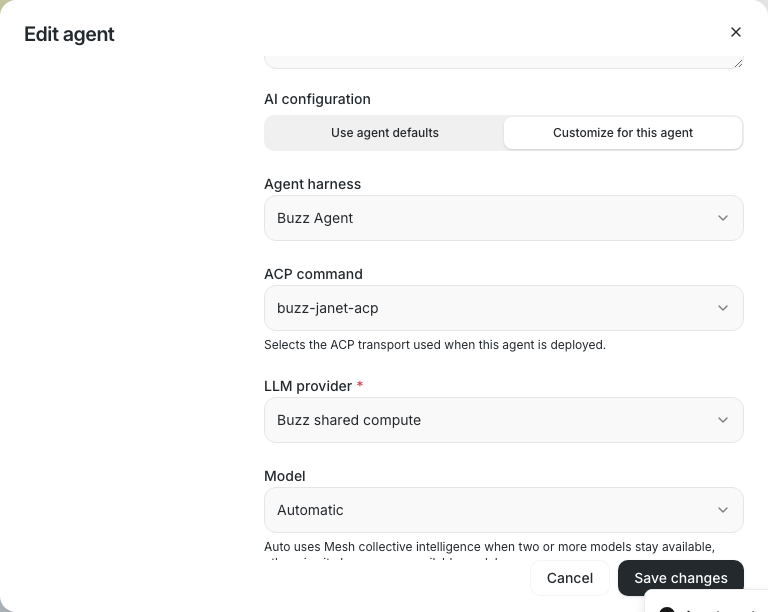
## Summary

By default on linux kimi is installed at `~/.kimi-code/bin/kimi` and
this was not detected automatically. This now fixes it by adding this
path to the detection

### Related issue

 N/A

### Testing

Before it did not appear / did not detect. Now it does :)

Signed-off-by: benthecarman <benthecarman@live.com>
## Summary

Buzz Desktop fails to detect a freshly-installed Kimi Code CLI, even
though `kimi --version` works fine in the terminal. Root cause is in
binary discovery, not in Kimi's install.

## Problem

After running Kimi Code's installer, Buzz Desktop's harness list doesn't
pick up the `kimi` binary — it stays undetected until the user manually
sources their shell config.

## Repro

1. Install Kimi Code: `curl ... code.kimi.com/kimi-code/install.sh |
bash` — installs to `~/.kimi-code/bin`, and the installer appends a PATH
export only to `~/.zshrc`.
2. Open a fresh terminal or restart Buzz Desktop without `source
~/.zshrc`.
3. Buzz Desktop does not detect `kimi`, even though it's on disk and
executable.

## Root cause

`find_via_login_shell()` in
`desktop/src-tauri/src/managed_agents/discovery.rs` resolves binaries by
spawning `zsh -l -c 'command -v <bin>'`. A login shell sources
`~/.zprofile`/`~/.zshenv`, but zsh only sources `~/.zshrc` for
*interactive* shells — so a PATH export that lives only in `~/.zshrc`
(which is where Kimi's installer puts it) is invisible to this probe.
`~/.kimi-code/bin` is also absent from the static fallback list in
`common_binary_paths()`.

This is the same root-cause class already handled for `nvm` in this file
(see the `find_nvm_default_bin` comment) — Kimi just doesn't have an
equivalent fallback yet.

## Fix

Add `~/.kimi-code/bin` to the Unix branch of `common_binary_paths()`,
alongside the existing `.volta/bin` / `.bun/bin` / `.asdf/shims`
entries.

## Scope note

This PR only fixes detection (finding the binary). It does not address
that Kimi shows a "Ready" badge regardless of login status — that's a
separate, larger gap affecting all five preset harnesses (Kimi,
OpenCode, Amp, Hermes, OpenClaw), tracked separately.

## Test plan

- [x] `just ci` passes
- [x] Manual: fresh Kimi install per repro steps above, confirm Buzz
Desktop shows it without sourcing `~/.zshrc`

Signed-off-by: Shawn Hank <shawn@shawnhank.com>
## Summary

Buzz considers codex-acp 1.6.2 current because the supported adapter
floor is still 1.1.7. That adapter bundles Codex 0.148.0, so updating a
separate Codex CLI to 0.153.4 leaves managed agents on the older runtime
and unable to use GPT-6 Astra.

Raise the supported adapter floor to the published 1.10.0 release, which
depends on `@openai/codex ^0.153.3`. Existing discovery and installation
code then classifies older adapters as outdated and offers the managed
reinstall path. Update the availability and install-plan regressions to
cover the observed 1.6.2 installation and the new minimum.

This follows the existing version-floor policy. It does not
automatically update a running installation: the user must complete
Buzz’s offered adapter upgrade. Future upstream compatibility changes
may require another floor update.

### Related issue

No exact duplicate found in searches for Astra, CODEX_PATH, bundled
Codex, outdated runtime, and codex-acp 1.10. Related: #3097 raised the
older floor to 1.1.7 (already present on main); #2422 covers lost error
details for runtime mismatches. Neither resolves this version gap.

Originating conversation:
buzz://message?channel=3286cd76-f83e-4c7d-8317-10a16580744d&id=8b79a73078217222b870fff144c27e7d27bcd5a67c966869c18fe726db716898

### Testing

- Isolated npm install of codex-acp 1.10.0 resolved bundled Codex
0.153.4, with no CODEX_PATH override.
- Live macOS ACP probe: initialize protocol v1 → session/new → select
gpt-6-astra[medium] → prompt. Received `OK` and `stopReason: end_turn`;
usage metadata confirms gpt-6-astra.
- Existing adapter 1.6.2 initialized but advertised no Astra model in
the same probe.
- Desktop Rust formatting and `git diff --check` pass.
- `just desktop-tauri-test`: 3,266 passed, 20 ignored, zero failures
across the Desktop workspace and integration tests.
- Workspace and Desktop Clippy, frontend static checks, and `just
file-size-check` pass.
- Repository `just ci`: still running the remaining
mobile/build/workspace-test stages.

The installed Buzz app and managed adapter were not replaced or
restarted. The live check validates the new adapter/runtime path; a
complete packaged Desktop upgrade workflow remains untested.

Signed-off-by: Stephen DeLorme <stephen@d.elor.me>
## Summary

- launch Pi through a private Buzz wrapper so managed Pi agents receive
Buzz's base prompt plus the configured thread/channel session model via
`--system-prompt`
- load the Buzz workspace skill directory with Pi's repeatable `--skill`
flag, making `~/.buzz/.agents/skills/buzz-cli` available alongside Pi's
normal global skill discovery
- report Pi and `pi-acp` installation states separately so setup
guidance points to the missing component

`pi-acp` does not currently consume the ACP `session/new` system prompt,
but its normal new-session and restore paths do honor
`PI_ACP_PI_COMMAND` as the executable used to launch Pi. Buzz reserves
that variable and sets it to a private generated launcher. The launcher
invokes `pi` from Buzz's effective `PATH`, adds `--system-prompt <file>`
and `--skill <workspace>/.agents/skills`, and forwards `pi-acp`'s RPC
and session arguments unchanged. This keeps the integration entirely in
`block/buzz`, without changes to Pi or `pi-acp`.

### How PI_ACP_PI_COMMAND works in `pi-acp`

`PI_ACP_PI_COMMAND` selects one executable; it does not accept
arguments. Therefore:

```bash
# Does not work
PI_ACP_PI_COMMAND="pi --skill ~/.buzz/.agents/skills"
```

Buzz does not expose this variable as user configuration. It creates a
private launcher and sets `PI_ACP_PI_COMMAND` only on the `pi-acp`
child. Conceptually, that launcher executes:

```sh
#!/bin/sh
exec pi \
  --system-prompt "$PRIVATE_SYSTEM_PROMPT" \
  --skill "$HOME/.buzz/.agents/skills" \
  "$@"
```

### Related issue

Follow-up to #7208. No duplicate issue or open PR found.

### Testing

- `just ci`
- `cargo test -p buzz-acp pi_launcher`
- `cargo test --manifest-path desktop/src-tauri/Cargo.toml
managed_agents::env_vars::tests`
- `cargo test --manifest-path desktop/src-tauri/Cargo.toml
managed_agents::discovery::presets::tests`
- pre-push branch checks

No screenshots: the UI change is state-dependent setup guidance only.

---
**Update Sep 4, 13:35:** Made `PI_ACP_PI_COMMAND` entirely Buzz-owned.
- Managed agent configuration now rejects the variable as a user
override.
- Buzz always launches `pi` from its effective `PATH` and rejects
inherited values before creating its private launcher.
- Removed the custom Pi executable discovery path and its internal
environment alias.

---
**Update Sep 4, 14:03:** Reject inherited `PI_ACP_PI_COMMAND` values
instead of replacing them.
- Pi startup now fails with an actionable message telling the user to
unset the variable.
- Removed the Pi-specific exception from the generic ACP environment
injection path.

Generated with Codex

---------

Signed-off-by: Salman Mohammed <smohammed@squareup.com>
## Summary

Genericizes the agent effort write-side so Goose participates in the
same canonical effort contract as buzz-agent. A spawn bridge translates
the canonical key to whatever the target harness expects at launch time.
Read/write/spawn paths all derive their vocabulary from runtime metadata
rather than a hardcoded buzz-agent list.

## What changed

### Rust — config bridge + spawn path

- `apply_spawn_effort_env` in `effort.rs`: production command-boundary
seam — writes baked env, runs the effort projection, strips per-runtime
suppress set, and emits exactly one projected key.
- `apply_effort_to_spawn_command` in `runtime.rs`: thin wrapper
returning a `#[must_use] EffortApplied(())` token (private field —
unforgeable outside the function). `spawn_agent_child` calls it as `let
effort = apply_effort_to_spawn_command(...)` and passes `effort` to
`spawn_with_effort_proof`. Deleting the call is a compile error:
`effort` is undefined at the `spawn_with_effort_proof` site. Deleting
`apply_spawn_effort_env` inside the wrapper turns the
production-sequence tests RED.
- `apply_record_field_updates` in `agent_models_update.rs`: returns
`Result<RecordFieldsApplied, String>` (`#[must_use]` token).
`update_managed_agent` calls it as `let applied =
apply_record_field_updates(...)?` then passes `applied` to
`stamp_record_updated_at`. Deleting the call is a compile error:
`applied` is undefined at the `stamp_record_updated_at` site.
- Unknown/custom-runtime passthrough: `apply_effort_launch_to_command`
skips the suppress loop when `preserve_passthrough && value.is_none()`,
preserving ambient ACP sentinels.
- `EnvVarGuard`: prior value stored as `OsString` (`var_os`) so
non-Unicode values are restored exactly on Drop. A single
`PROCESS_ENV_MUTEX` in `managed_agents/mod.rs` is shared by
`lock_path_mutex()` and `lock_env_mutex()` — any two tests calling
either helper are mutually exclusive with each other. Tests in other
modules (`app_state_tests`, `agent_config_tests`, `reader_tests`)
maintain their own independent locks and are not in this domain.
- Dead-code: `strip_effort_keys_from_command` marked `#[cfg(test)]`;
import path in `effort_cmd_tests.rs` fixed.
- Windows CI fix: platform-gated variants for inherited-env tests.

### TypeScript — renderer + model cleanup

- `AgentConfigFields` orphan-model cleanup effect: the
`isHarnessNativeEffort` early-return was skipping the model clear on
provider→Custom transitions. Refined to: return early only when model is
already null; clear model once while preserving the harness-native
effort key (Carl P2).
- Provider-empty convergence: when model is null and effort is native,
the cleanup effect returns early (nothing to clear) — prevents spurious
`onConfigChange` loop.
- `EffortSelectField` / `humanizeEffortLabel`: runtime-native option
labels title-cased (`off` → `Off`) with raw canonical values preserved
for round-trip fidelity.
- `AgentConfigFields`: drives effort renderer from
`selectedRuntime.effortCanonicalValues` (harness-native path) or the
model/provider catalog (buzz-agent/provider path), selected by
`isHarnessNativeEffort`.

### Docs

- `desktop/src/features/agents/AGENTS.md` item 14: updated from deleted
`persistAgentEffortLevel` direct-write contract to the shipped
Save-gated `update_managed_agent.effortLevel` path. Consistent with
`EffortPickerField`'s own doc comment.

### Tests

- `agent_models_update_tests.rs`: seam tests via
`apply_record_field_updates` — non-local rejects, local set/clear,
ordering invariant, ACP-sentinel sweep.
`record_field_updates_persist_effort_to_disk` (renamed from the prior
false-claim name) drives load→apply→stamp→save→load via a mock AppHandle
+ tempdir, asserting `effort_level` persists to disk. Manual HOME/XDG
restore replaced with RAII `EnvVarGuard` (panic-safe, `OsString`-exact).
- `effort_cmd_tests.rs` / `effort_tests.rs`: production-sequence seam
tests via `apply_effort_to_spawn_command`. Spawns `/usr/bin/env` to
verify child's real env. `EnvVarGuard` for panic-safe restore. Windows
twin using `cmd /c set`.
- `effortAutoClear.test.mjs`: five mounted stateful journeys via
`AgentConfigFields` with `useCustomSelect=true`. Covers: custom trigger
shows "Off" at mount; provider-empty mount is a stable fixed point;
provider→Custom switch converges; stale Anthropic model cleared on
Custom switch with Goose effort preserved (Carl P2 regression);
Settings-style Save/reread preserves effort.
- `agentDefaultsEditor.test.mjs`: two full Save/Next journey tests
through the real production parent trees. Both start with
`GOOSE_THINKING_EFFORT: "low"` and operate the real Popover-based effort
control (click trigger → click "off" option) before Save/Next, asserting
zero writes after selection. The `set_global_agent_config` stub captures
the submitted payload; each test asserts raw `GOOSE_THINKING_EFFORT:
"off"` in the captured config. The stub stores its canonical response
from the actual payload; the fresh remount's `get_global_agent_config`
returns that stored object (not a hand-written fixture), then asserts
"Off" shown. The `DefaultConfigStep` test starts with `isDirty: false` —
the real-control effort selection calls `onConfigChange → updateDraft →
isDirtyRef=true`, making the `commit()` on Next load-bearing.

## Mutation evidence

- Delete `let effort = apply_effort_to_spawn_command(...)` call from
`spawn_agent_child` → compile error: `error[E0425]: cannot find value
`effort`` at `spawn_with_effort_proof` site.
- Delete `let applied = apply_record_field_updates(...)?` from
`update_managed_agent` → compile error: `error[E0425]: cannot find value
`applied`` at `stamp_record_updated_at` site.
- Delete `apply_spawn_effort_env` from inside
`apply_effort_to_spawn_command` wrapper →
`production_sequence_goose_inherited_collision_resolved_in_child` RED.
- Revert `isHarnessNativeEffort &&` guard in cleanup `useEffect` to bare
`if (isHarnessNativeEffort) return` → stale model not cleared → Carl P2
regression test RED.
- Remove `isHarnessNativeEffort ||` from the nothing-to-clear condition
→ provider-empty mount emits `onConfigChange` → loop test RED.
- Remove `isHarnessNativeEffort` branch in
`AgentConfigFields.tsx:634-636` → both `agentDefaultsEditor.test.mjs`
mount assertions fail: trigger shows "Select" instead of initial effort
label.
- Remove `preserve_passthrough` guard in
`apply_effort_launch_to_command` →
`production_sequence_custom_inherited_acp_sentinel_survives` RED.
- Drop `GOOSE_THINKING_EFFORT` from the `set_global_agent_config` stub
payload → payload assertion in `agentDefaultsEditor.test.mjs` fails
(`undefined !== "off"`) → RED (verified).
- Remove the effort-select dirtying steps from the `DefaultConfigStep`
test (so `isDirty` stays false) → `commit()` is a no-op → write-count
assertion after Next fails (0 instead of 1) → RED.

---------

Signed-off-by: Will Pfleger <pfleger.will@gmail.com>
Signed-off-by: Duncan <dcfd242e557282d7a1e2cf2e6877522682f1e5c6156dc92ca7d90eaedd3b0f95@buzz.block.builderlab.xyz>
Signed-off-by: Hayt <9e1c23a3fd83f61da34420e4e88ff1b16e45cafcc0cd9019eb07d4ecfa8ca9b0@buzz.block.builderlab.xyz>
Co-authored-by: Duncan <dcfd242e557282d7a1e2cf2e6877522682f1e5c6156dc92ca7d90eaedd3b0f95@buzz.block.builderlab.xyz>
Co-authored-by: Hayt <9e1c23a3fd83f61da34420e4e88ff1b16e45cafcc0cd9019eb07d4ecfa8ca9b0@buzz.block.builderlab.xyz>
## Why
PR #6330 split agent harness/runtime detection into a cheap (cache-only)
path and a forced (spawning) path. Two regressions followed, both
surfacing as every harness showing "(not installed)" / "CLI missing"
across the agent create/edit picker, Agents > Agent defaults, and
Settings > Agents — blocking agent create/edit until the user clicked
Install in Settings > Agents.
## Root cause
One underlying bug, two victims:
- **Boot false-negative.** The resolve cache is in-memory, so it starts
cold on every launch. `resolve_command_cached` (the cheap path)
consulted only the Buzz-managed shim dirs plus that cold cache, and
`buzz_managed_command_path`'s allowlist structurally excludes
`buzz-agent`. The bundled sidecar could therefore never resolve on the
cheap path until a forced pass warmed the cache, so cheap-path surfaces
rendered all-missing at boot. App setup never warms the cache.
- **"Check again" hang.** `run_in_login_shell` used an untimeouted
`Command::output()`; a wedged login shell froze the whole forced
pipeline, leaving "Check again" spinning forever.
## What
- `resolve_command_cached` now also calls `resolve_workspace_command`,
resolving the bundled sidecar via a filesystem stat (no spawn) — the
same class of work the managed-shim check already performs. `buzz-agent`
can no longer report missing, even inside the boot warm window.
- New `discovery/bounded_command.rs` runs any discovery child under a
hard wall-clock deadline, polling with `try_wait` rather than blocking
on `wait()`. Stdout and stderr are piped to two drain threads whose
buffers share an aggregate `CAPTURE_LIMIT`; a breach fails closed (kill
the tree, return `None`), so a noisy or hostile probe can force neither
unbounded memory nor disk fill. Tree teardown runs on every exit path —
timeout, error, cap breach, *and* success — because a login-shell rc
file or auth CLI can legitimately background a descendant that would
otherwise outlive discovery. Ownership is deliberately asymmetric:
- **Unix:** the child leads its own process group (`process_group(0)`);
teardown is `SIGTERM` → bounded grace → `SIGKILL` on the group. A
descendant that leaves the group (`setsid`/`setpgid`) while holding a
pipe is not owned and may survive one probe, but can never hang or
unbound the helper: the Unix drains read nonblocking and end on
`WouldBlock` once teardown sets the stop flag, so the join returns
promptly without waiting on an escaped writer's EOF.
- **Windows:** the child is spawned `CREATE_SUSPENDED`, assigned to a
kill-on-close Job Object while frozen, then resumed. The job owns the
root before any descendant can exist and is created without breakaway,
so no writer can escape — a hard whole-tree guarantee, and closing the
job reaps the tree even after the root has exited. Any failure to
create, assign, or resume is fail-closed: the child is terminated and
reaped and the spawn returns `None` (discovery treats it as
command-not-found) rather than running unowned.
- Each login-shell candidate is bounded by a 10s timeout via that
helper, falling through to the next candidate on timeout instead of
aborting the resolve. The login-shell path cache is generation-aware: a
probe that loses to a concurrent refresh or lands mid-refresh returns
the authoritative cached value (or re-probes under the new generation)
rather than its own rejected local result, so a losing thread can never
settle the UI with a PATH-missing catalog while the cache holds a fresh
success.
- Warm the ACP runtime catalog once at `AppShell` mount and gate the
cheap-path surfaces on that pass. A module-level boot-warm state (`idle`
→ `pending` → `settled`/`failed`, deduped per launch) lets
`useAcpRuntimesQuery` present a cold catalog as *loading* while the
first forced pass runs and as a *retryable error* (carrying the probe's
real reason) if it fails, instead of blessing "every harness not
installed" as authoritative. A non-empty catalog always wins, so a
revalidation or later failure never blanks a good list; the gate only
overlays once the warm has started, so onboarding (which renders before
the warm) is unaffected. Deduping per launch also fixes the previous
per-remount re-fire.
## Verification
Unix teardown and the drain contract are runtime-proven by
`#[ignore]`-free tests that record a backgrounded descendant's real PID
and assert the helper returns promptly on both the success and timeout
paths without blocking on that writer. The generation-aware login-shell
cache is covered by deterministic tests through a `cfg(test)` injectable
probe seam that assert the function's return value under both
concurrent-refresh interleavings — the losing caller returns the peer's
committed success, and a mid-probe refresh forces a re-probe to the
fresh value. The Windows ownership contract has no CI lane, so
`bounded_command.rs` carries two `#[ignore]`-gated tests (spawn/assign
race, looped; and the timeout path) for a sanctioned run on a Windows
host. The boot-warm gate is covered by unit tests for the pure overlay
and the `startBootWarm` failure → retry → settle lifecycle.
Origin: [Buzz
thread](buzz://message?channel=5ef5d5bb-643f-4b87-bbf4-e8b64585ffeb&id=a4b1c4485de4d35cff0f914d4f4211c796f44f670e76de2ef9431f7e882c906e)
Fixes#6872
Related #6662
---------
Signed-off-by: Will Pfleger <pfleger.will@gmail.com>
Co-authored-by: Duncan <dcfd242e557282d7a1e2cf2e6877522682f1e5c6156dc92ca7d90eaedd3b0f95@buzz.block.builderlab.xyz>
Splits the `discover_acp_providers` Tauri command into a cheap cached
path and an explicit forced re-discovery path.

The profiling flight-recorder identified `discover_acp_providers` as the
acute UI-freeze correlate: a 20–65s probe pipeline (PATH re-fetch, CLI
auth probes, process spawns) was running on routine renders like channel
switches, because hot surfaces remounted the wrapping query and
automatic staleness refetches re-ran the full pipeline. This is
complementary to the idle auto-reload (#5588) and bounded-accumulator
(#5596) work.

## Backend
- Added a `force` parameter to `discover_acp_providers` /
`discover_acp_runtimes_from`. The default (cheap) path serves cached
availability and auth statuses with zero process spawns; `force: true`
runs the full pipeline (cache clear, PATH re-fetch, CLI auth probes).
- Added a single-flight coalescer (`forced_single_flight`) so concurrent
forced runs share one probe instead of stacking.
- Extracted the auth-status cache and `resolve_auth_statuses` into
`discovery/auth_status_cache.rs`.

## Renderer
- Raised `staleTime` to 30 min; forced refresh flows only through an
explicit `fetchQuery` path (`refreshAcpRuntimes`), so automatic
staleness refetches can never re-run probes.
- Added `useAcpRuntimesQueryForced` for Settings and onboarding
surfaces; connect/install/save/delete mutations force-refresh in
`onSettled`.
- Switched `SetupStep`, `HarnessCatalogDialog`, and
`HarnessesSettingsPanel` to the forced hook.

## Structure
The touched files were at or over the grandfathered 1000-line file-size
ceiling, so the change is delivered as cohesive extractions rather than
in-place growth: `forced_single_flight.rs`, `auth_status_cache.rs`,
`discovery/tests/forced_discovery.rs`, `acpRuntimesQuery.ts`, and
`tauriAcpDiscovery.ts`. Dependencies are one-directional (`hooks.ts`
imports from `acpRuntimesQuery.ts` and re-exports the forced hook, so
consumer imports are unchanged; no import cycle).

## Tests
Added Rust tests pinning the cheap-vs-forced split: a probe is spawned
only when forced, the cheap path reuses the cache, and auth status is
`Unknown` before any probe runs.

---------

Signed-off-by: Will Pfleger <pfleger.will@gmail.com>
Co-authored-by: Duncan <dcfd242e557282d7a1e2cf2e6877522682f1e5c6156dc92ca7d90eaedd3b0f95@buzz.block.builderlab.xyz>
OpenClaw connects to a single shared Gateway daemon. Spawning the
default 10 ACP workers per agent is both resource-expensive and
architecturally wrong — each worker opens a separate gateway connection.
Tyler's ruling: cap at 5, lower if needed.

## Contract

Store the requested value (1–32) verbatim at every persistence and wire
boundary. Apply `effective = min(requested, harness_cap)` only at the
four enforcement points:

| Boundary | Implementation |
|---|---|
| Local spawn | `BUZZ_ACP_AGENTS` env var in child `Command` |
| Remote deploy | `launch.policy_env["BUZZ_ACP_AGENTS"]` + legacy
`parallelism` field |
| Restart badge | `SpawnConfigSnapshot.parallelism` stores effective
value; the diff surface displays what actually runs |
| UI copy | Amber hint when requested > cap; no `max` attribute, no
save-path clamp |

`BUZZ_ACP_AGENTS` is added to `RESERVED_ENV_KEYS` — the Desktop resolves
the effective value into `policy_env`; a user-supplied override in `env`
would bypass the cap and is silently stripped.

## Changes

**`managed_agents/parallelism.rs`** (new) — policy core:
- `OPENCLAW_MAX_PARALLELISM = 5`
- `harness_max_parallelism(command)` — keyed on
`normalize_command_identity` so path prefixes, `.exe` suffixes, and
other cosmetic differences are ignored
- `effective_parallelism(command, value)` — identity for uncapped
harnesses
- `acp_agents_value(command, parallelism)` — `env("BUZZ_ACP_AGENTS", …)`
helper

**`runtime.rs`** — spawn clamp: `BUZZ_ACP_AGENTS =
acp_agents_value(effective_command, record.parallelism)`

**`agents_deploy.rs`** — deploy egress clamp: `build_deploy_payload`
resolves `effective_parallelism` once from `descriptor.command`; both
`launch.policy_env["BUZZ_ACP_AGENTS"]` and the legacy top-level
`parallelism` field use that value — the two are always consistent
regardless of stale `record.agent_command` pins

**`spawn_snapshot.rs`** — `from_inputs` stores
`effective_parallelism(&descriptor.command, record.parallelism)` in the
`parallelism` field. Over-cap edits that don't change the pool (e.g. 10
→ 8, both clamp to 5 on OpenClaw) produce equal snapshots; cap crossings
(8 → 3) produce different snapshots.

**`AcpRuntimeCatalogEntry.max_parallelism: Option<u32>`** — derived from
the static definition command, not the probed `entry.command` (which may
be `null` for unavailable entries), so unavailable OpenClaw entries
still carry the cap. Propagated through all four catalog constructors
(builtin discovery, preset catalog construction, custom discovery,
custom-save response), IPC types
(`RawAcpRuntimeCatalogEntry.max_parallelism`), and the frontend catalog
type.

**UI** — `EditAgentAdvancedFields` and `PersonaAdvancedFields` show an
amber hint when `selectedRuntime.maxParallelism` is set and the current
value exceeds it. Cap and label come from the catalog entry — no
hardcoded 5 in TS. No `max` attribute on inputs; the input stays
`type="text"` with 1–32 copy.

**Docs** — `docs/remote-agents.md`: `BUZZ_ACP_AGENTS` moved from the
deliberately-non-reserved section to reserved; new contract documented.
`desktop/src/features/agents/AGENTS.md`: command-keyed execution policy
documented as the sanctioned second metadata source feeding the catalog
projection.

## Tests

**Rust** (`parallelism.rs`):
- `policy_table` — `harness_max_parallelism` and `effective_parallelism`
across all openclaw variants and uncapped harnesses
- `acp_agents_value_openclaw_above_cap_is_capped` — spawn-env seam
- `override_direction_*` — both override directions (openclaw runtime +
goose override; goose runtime + openclaw override)
- `summary_persona_inherited_*` — live persona wins over stale
`agent_command`
- `snapshot_export_carries_requested_definition_parallelism` — requested
value travels wire/sync unchanged

**Rust** (`spawn_snapshot/tests.rs`):
- `openclaw_above_cap_parallelism_snapshots_equal` — stored 10 vs 8,
both clamp to 5 → snapshots equal
- `openclaw_cap_crossing_parallelism_snapshots_differ` — 8 (clamps to 5)
vs 3 → snapshots differ

**Rust** (`discovery/presets.rs`):
- `openclaw_preset_unavailable_carries_max_parallelism` /
`openclaw_preset_available_carries_max_parallelism` — catalog metadata
present with `command: null` and with a resolved path

**Rust** (`agents_deploy.rs`):
- `launch_block_openclaw_over_cap_policy_env_is_capped` — direct
`launch.policy_env` seam
-
`deploy_payload_json_stale_goose_record_live_openclaw_descriptor_both_capped`
— stale `record.agent_command=goose`, live descriptor=openclaw: both
fields cap to 5
-
`deploy_payload_json_stale_openclaw_record_live_goose_descriptor_both_uncapped`
— stale `record.agent_command=openclaw`, live descriptor=goose: both
fields pass through requested
- `deploy_payload_json_explicit_openclaw_override_both_capped` —
explicit `agent_command_override=openclaw`: both fields cap to 5

**Rust** (`persona_events/stale_pin_tests.rs`):
- `apply_persona_snapshot_goose_to_custom_harness_drops_stale_goose_pin`
— custom-direction stale-pin drop (builtin pin → loaded custom harness
via `update_loaded_harness_registry`)

**TypeScript** (`agentParallelism.test.mjs`):
- `parallelismCapHint` — at/below cap (null), above cap (hint includes
label and cap value), singular form for cap=1, uncapped harness (null)

**TypeScript** (`tauri.test.mjs`):
- `fromRawAcpRuntimeCatalogEntry` round-trips `max_parallelism` →
`maxParallelism`; absent when `undefined`

---------

Signed-off-by: Will Pfleger <pfleger.will@gmail.com>
Co-authored-by: npub1mn7jgtj4w2pd0g0zeuhxsa6jy6p0rewxz4kujt98my82ahfmp72sxjexk7 <dcfd242e557282d7a1e2cf2e6877522682f1e5c6156dc92ca7d90eaedd3b0f95@buzz.block.builderlab.xyz>
User-facing error for missing ACP harness commands has been pointing
released-build users to run `cargo build --release --workspace` and read
TESTING.md — both dead ends for anyone not building from source.

Updated message acknowledges that antivirus software can quarantine
bundled binaries and provides practical remediation steps. Preserves
pointer to TESTING.md for source builds.

Fixes issue context from #4491.

Signed-off-by: Will Pfleger <pfleger.will@gmail.com>
Co-authored-by: npub16v54tttfqacx9ycvc3k0ut0npj564ahcuajzy6qjvh57ntmsf4uq4806j2 <d32955ad69077062930cc46cfe2df30ca9aaf6f8e76422681265e9e9af704d78@buzz.block.builderlab.xyz>
Replace the stale `agent_command_override` drop logic in
`apply_persona_snapshot` with a three-tier canonical command resolver.

## What this fixes

The old code dropped a create-time harness pin when the persona switched
to a different runtime, but it had two failure modes:

1. **Preset harnesses invisible.** `known_acp_runtime_exact()` only
searches `KNOWN_ACP_RUNTIMES` (builtins). Preset harnesses such as
OpenClaw live in `PRESET_HARNESSES`, so the destination lookup returned
`None` and the outer `if let` branch never executed — a Goose→OpenClaw
persona switch left the stale Goose override in place, keeping the agent
running Goose instead of OpenClaw.

2. **Pin-side canonical resolution incomplete.** The pin was resolved by
`known_acp_runtime()`, which searches by id/command/alias and returns a
`&KnownAcpRuntime` entry correctly. However, if the *pin* named an alias
(e.g. `claude-code-acp`) and the *destination* was a preset harness
absent from builtins, the outer guard still failed for the same reason
as (1). The alias regression test pins the requirement that the
canonical resolver must handle both sides: alias pins must be recognised
and drops must fire when the destination is a known preset.

## How it works now

`canonical_harness_command(input)` accepts any form a stored override
can take — bare command, alias, path prefix, or runtime id — and
resolves it to the harness primary command through three tiers:

1. **Builtins** — `KNOWN_ACP_RUNTIMES`, matched by id/command/alias.
2. **Static presets** — `PRESET_HARNESSES`, matched by id or normalised
command.
3. **Loaded registry** — custom/preset definitions loaded at runtime.

`command_for_runtime_id` (id-only input, same three tiers) replaces the
two-step `known_acp_runtime_exact`/`lookup_loaded_harness_by_id` pattern
in `record_agent_command`, `effective_agent_command`, and
`try_record_agent_command`, adding the static preset tier so preset
harnesses resolve correctly even without a warm registry.

## Changed files

- `discovery/presets.rs` — `preset_command_for_id`,
`command_for_runtime_id`, `canonical_harness_command`
- `discovery.rs` — re-export new functions; make
`normalize_command_identity` `pub(crate)`; refactor three
command-resolution functions to use `command_for_runtime_id`
- `custom_harnesses.rs` — `loaded_harness_registry` visibility `fn` →
`pub(super)` (needed by `canonical_harness_command`)
- `persona_events.rs` — replace two-step
`known_acp_runtime_exact`/`known_acp_runtime` + pointer comparison with
canonical-command comparison
- `persona_events/stale_pin_tests.rs` (new) — four regression tests:
Goose→OpenClaw drop, OpenClaw→Goose drop, claude-code-acp alias→OpenClaw
drop, same-harness path keep
- `persona_events/tests.rs` — `sample_record`/`sample_persona` exposed
as `pub(super)` for the new test module

Signed-off-by: Will Pfleger <pfleger.will@gmail.com>
Co-authored-by: npub1g8493u0xfsjrvflg4n08ezd7vec99mnwzlv0qgwpr9d7gvjwhuzqx59rhw <41ea58f1e64c243627e8acde7c89be667052ee6e17d8f021c1195be4324ebf04@buzz.block.builderlab.xyz>
## Overview

The global Agent Defaults surface (Settings card, defaults modal,
onboarding) exposed structured controls for Effort but left Max Output
Tokens, Context Limit, and Max Rounds as raw env vars. Per-agent dialogs
had structured numeric fields but only for `isBuzzAgentRuntime` —
incorrectly excluding Goose. This PR unifies numeric-tuning capability
across all surfaces, fixes a pre-existing dual-editor defect, and adds
full test coverage.

## What changed

### Phase 1 — Catalog projection

- Add `max_rounds_env_var` to `KnownAcpRuntime` in `runtime_metadata.rs`
(`Some("BUZZ_AGENT_MAX_ROUNDS")` for buzz-agent, `None` elsewhere).
- Project all three numeric env-var fields (`max_tokens_env_var`,
`context_limit_env_var`, `max_rounds_env_var`) end-to-end:
`AcpRuntimeCatalogEntry` Rust struct, TS `types.ts`,
`RawAcpRuntimeCatalogEntry` + `fromRawAcpRuntimeCatalogEntry` in
`tauri.ts`, and the e2e mock bridge (`withMockRuntimeConfigMetadata`).

### Phase 2 — Field model

- `deriveAgentConfigFieldModel` now derives `maxOutputTokens` /
`contextLimit` / `maxRounds` descriptors from catalog-projected fields.
- `structuredEnvKeys(descriptors)` — exported helper that takes the
**rendered** descriptor set (not the whole model). Hidden keys follow
what is actually rendered per surface: global hides effort + all three
numeric keys for buzz-agent / two for Goose; per-agent buzz-agent hides
effort + three numeric keys; per-agent Goose hides only its two numeric
keys. `BUZZ_AGENT_THINKING_EFFORT` stays a visible generic env row
per-agent because no effort control renders there.

### Phase 3 — UI

- Extract `NumericTuningFields` from `buzzAgentModelTuningFields.tsx` as
a shared descriptor-driven component (`descriptors`, `envVars`,
`inheritedEnvVars`, `onEnvVarChange`). Kind-specific minima:
`NUMERIC_KIND_MIN` map (`maxOutputTokens`/`contextLimit`: 1,
`maxRounds`: 0) applied to `<input min>`.
- **Global surface** (`AgentConfigFields.tsx`): deduplicate the
previously duplicated Advanced env-editor block; render
`NumericTuningFields` below the env editor when descriptors exist;
`hiddenKeys` and `bakedGenericRows` exclusions use `structuredEnvKeys`
so structured keys are never double-rendered. Under 1000 lines.
- **Per-agent surfaces** (`EditAgentAdvancedFields`,
`PersonaAdvancedFields`): replace `isBuzzAgentRuntime` as the
numeric-field gate with `deriveNumericDescriptors(selectedRuntime)` from
`agentConfigCore`; hidden keys come from
`structuredEnvKeys(numericDescriptors)` — the same rendered descriptor
set, no local rebuilding (fixes pre-existing dual-editor defect).
Catalog status carried as `RuntimeCatalogStatus` (`loading | ready |
error`); both error and loading withhold structured controls and leave
saved values visible as generic rows, making error distinguishable from
"runtime not capable" (`ready` + no runtime).
- **Dialogs** (`AgentDefinitionDialog`, `AgentInstanceEditDialog`,
callers): `AgentDefinitionDialog` accepts `runtimeCatalogStatus?:
"loading" | "ready" | "error"` (replaces separate
`runtimesLoading`/`runtimesError` booleans); all call sites —
`AgentManagementDialogs`, `AgentsView`, `RequestedAgentCreateDialogs`,
`UserProfilePersonaDialogs` — compute and pass the status.

### Phase 4 — Tests

- `buildRecord` exported from `EnvVarsEditor.tsx` as a pure `(nextRows,
value, requiredKeys, hiddenKeys) => Record<string, string>` helper for
isolation testing.
- **17 new node tests** in `agentConfigCore.test.mjs`:
`deriveNumericDescriptors` (all three fields, partial, undefined
runtime, matches field-model subset); `structuredEnvKeys` per surface
including discriminating Goose per-agent effort-key invariant;
`NUMERIC_KIND_MIN` values.
- **4 new node tests** in `EnvVarsEditor.test.mjs`: hidden tuning key
preserved through generic row edits; runtime-switch then generic edit
(derives both descriptor sets, asserts new-runtime hidden key survives
`buildRecord` via `hiddenKeys` and old-runtime key survives via generic
rows); baked numeric key excluded via `filterBakedGenericRows` with
`numericTuningPlaceholder` assertion; clearing a structured override —
`numericTuningPlaceholder` verifies placeholder text.
- **5 new Playwright tests** in `agent-numeric-tuning.spec.ts` (added to
smoke project `testMatch`): global numeric fields visible for
buzz-agent; global: non-capable runtime hides numeric controls; Goose
per-agent shows `Inherit (16384)` after saving global value through the
UI; delayed catalog: saved values visible as generic rows while loading
then structured controls appear after settle; failed catalog: saved
values remain visible as generic rows (never the "unsupported" empty
state).

## Result

- buzz-agent global defaults: Max output tokens, Context limit, Max
rounds as structured inputs with `Inherit (N)` placeholders from baked
env.
- Goose global defaults: Max output tokens, Context limit as structured
inputs.
- A Goose global value surfaces as `Inherit (<value>)` in the per-agent
Goose edit dialog.
- No structured key is editable in two places on any surface; no
persisted key has zero editors.
- No `runtime.id === "buzz-agent"` comparison decides numeric-field
visibility anywhere — capability flows catalog →
`AcpRuntimeCatalogEntry` → field model → UI.

Signed-off-by: Will Pfleger <pfleger.will@gmail.com>
Co-authored-by: npub1mn7jgtj4w2pd0g0zeuhxsa6jy6p0rewxz4kujt98my82ahfmp72sxjexk7 <dcfd242e557282d7a1e2cf2e6877522682f1e5c6156dc92ca7d90eaedd3b0f95@buzz.block.builderlab.xyz>
This PR fixes two Windows-specific install failures: Windows Defender
blocking the bare `irm|iex` PowerShell install command, and managed Node
shims pointing at a version-bumped (now-absent) Node directory.

The Defender block (Trojan:Win32/Commando.A!ml) fires before PowerShell
runs and is not clearable via Allow. The Node orphaning means shims in
the managed npm prefix resolve but fail at runtime with 'node not
recognized' because they reference the deleted old Node path.

- Replace all three Windows CLI install commands (Goose, Claude, Codex)
with a two-step shape — `Invoke-RestMethod` to a named temp file, then
execute — to eliminate the dropper signature; a new
`windows_install_command!` macro in `discovery/windows_install.rs`
generates all three strings at compile time so the shape cannot drift
between runtimes
- `$ErrorActionPreference='Stop'` aborts on download failure instead of
falling through to a missing-file exit-0; `exit $LASTEXITCODE`
propagates the vendor script's own exit code
- Add `probe_node(executable, expected_version, timeout)` as a bounded
seam: stdout goes to a temp file (not a pipe) so no exit path can block
on an inherited handle; the child runs in its own process group on Unix
so an unconditional group SIGKILL on every exit path terminates all
descendants; on Windows `taskkill /T /F` provides the same tree-wide
cleanup; `managed_node_runtime_ready()` is a thin wrapper that resolves
the managed Node path and calls the seam
- Add `resolve_adapter_path()` in `managed_node.rs`: resolves the
candidate first, then calls `should_invalidate_adapter()` — a pure
predicate that returns `true` only when the resolved path is under
`buzz_managed_npm_bin_dir()` AND the managed Node runtime is orphaned;
external adapters outside the managed prefix are always preserved

Note: CI cannot reproduce the Defender block (no live Defender ML
classifier). Proof of fix is structural — the command shape no longer
matches the dropper signature. Canary validation on a real Windows
machine with Defender enabled is the definitive check.

---------

Signed-off-by: Will Pfleger <pfleger.will@gmail.com>
Co-authored-by: npub1mn7jgtj4w2pd0g0zeuhxsa6jy6p0rewxz4kujt98my82ahfmp72sxjexk7 <dcfd242e557282d7a1e2cf2e6877522682f1e5c6156dc92ca7d90eaedd3b0f95@buzz.block.builderlab.xyz>
## Summary

- Add Devin to the built-in preset harness catalog using the official
native ACP invocation: `devin acp`.
- Link setup guidance to Cognition's official Devin CLI documentation.
- Render a bundled, attributed Devin mark on a white canvas through
Buzz's existing runtime-icon system.
- Keep preset capability metadata in the Rust catalog; no duplicate
TypeScript runtime table or React runtime checks.
- Move the existing preset catalog and its focused tests into a Rust
submodule without changing existing preset behavior, keeping the touched
files within the repository's file-size limit.

### Related issue

Follow-up to the generic BYOH harness work in #2773.

### Scope

This is the small preset/data-entry follow-up described in the #2773
discussion. It uses the generic preset readiness contract and does not
add Devin-specific authentication probing, permission bypasses, model
switching, cloud handoff, or cloud Devin capability claims.

The preset supplies:

- ID: `devin`
- Executable: `devin`
- Arguments: `acp`
- Installation guidance: https://docs.devin.ai/cli

### Testing

Local verification was rerun at the final PR head,
`7bb9aa6e862a47a5062b5b8234fdb5ce2aae6c1d`.

- Focused Rust preset tests: 7 passed
- Desktop JavaScript tests: 3,768 passed
- Desktop lint, formatting, file-size, and text guards: passed
- Full Tauri test suite: 1,851 passed, 14 ignored
- Root Rust unit-test groups: passed
- Web production build: passed
- Mobile format, analyze, and test suites: passed
- Full repository `just ci`: passed

The branch also merges cleanly with the current Block `main`. The
upstream fork-triggered CI workflow is awaiting maintainer approval;
DCO, Semgrep OSS, and zizmor are passing.

The bundled SVG was rendered and visually inspected in both its source
dimensions and a 512px preview. The cross-language preset-logo guard
verifies that the Devin mapping exists and the asset is present on disk.

Signed-off-by: Mark Fenner <markfenner57@yahoo.com>
## Problem

`common_binary_paths()` probes mise shims, `~/.local/bin`, volta, asdf,
and (further down `resolve_command_uncached`) nvm's default bin dir —
but not bun's global bin directory, `~/.bun/bin`.

bun's installer appends its bin dir to `~/.zshrc` / `~/.bashrc`, which
are **interactive**-only. A login shell never sources them, so
`find_via_login_shell()` can't recover the path either. That's the same
failure mode already called out in this file for nvm:

```rust
// Check nvm's default Node.js bin directory — nvm initializes via
// ~/.zshrc (interactive) which is not loaded by a login shell, so
// `node`, `npm`, and npm-global shims installed there are otherwise
// invisible.
```

So for a GUI-launched desktop app, every rung of the resolution ladder
misses a bun-installed CLI:

1. workspace dev dirs — no
2. `command_looks_like_path` — no, presets use bare names
3. Buzz-managed npm/node dirs — no
4. current process PATH — launchd's minimal PATH on a Finder launch
5. `find_via_login_shell` — `.zshrc` not sourced
6. `common_binary_paths()` — **`~/.bun/bin` absent**
7. nvm default bin — no

This matters because bun is a common install route for the agent CLIs
Buzz targets. Kimi Code in particular ships as an npm package
(`@moonshot-ai/kimi-code`), so `bun add -g` puts it at `~/.bun/bin/kimi`
— exactly where discovery doesn't look.

## Reproduction

On macOS with `codex` and `kimi` installed via bun, launching Buzz from
Finder:

- Kimi Code shows **"CLI needed"**
- both CLIs run fine in an interactive terminal

Probing the way `find_via_login_shell` does, in a clean environment:

```console
$ env -i HOME=$HOME /bin/zsh -l -c 'command -v -- codex; command -v -- kimi'
(nothing)
```

Launching the app with the bun dir on PATH resolves both immediately:

```console
$ env PATH="$HOME/.bun/bin:$PATH" /Applications/Buzz.app/Contents/MacOS/buzz-desktop
```

## Change

One entry appended to the home-relative list in `common_binary_paths()`.
It goes **last** so it cannot shadow a directory that already resolves —
the change can only add resolutions, never alter existing ones.

## Testing

`cargo fmt --check` passes.

I was not able to run the full `just ci` gate locally: `ring 0.17.14`
fails to build in this environment against the macOS 26.2 SDK (`cc`
error compiling `p256-nistz.c`), which is unrelated to this change.
Relying on CI for the rest — the diff adds one `PathBuf` to an existing
`Vec<PathBuf>` and introduces no new API.

## Notes

- Related to #3084, which adds `~/.kimi-code/bin` for the same class of
GUI-launch discovery failure. That covers Kimi's standalone installer;
this covers the bun/npm-global install route. They're complementary —
I've left a note on that PR.
- Only `~/.bun/bin` is added. bun's global packages live under
`~/.bun/install/global/node_modules` but are symlinked into
`~/.bun/bin`, so the single directory is sufficient.
- Worth noting `~/.bun/bin` contains no `node`/`npm`/`npx`, so appending
it can't shadow a system Node toolchain.

Signed-off-by: Xule Lin <43122877+linxule@users.noreply.github.com>
The codex adapter version gate accepted any `major >= 1`, so a 1.x
`codex-acp` older than the version that fixes outbound relay access for
`buzz` CLI subprocesses classified as `Available` and was never offered
a reinstall. Only the 0.16.x `@zed-industries/codex-acp` adapter — which
fails `--version` outright — was caught.

`probe_codex_acp_version` now returns the full `(major, minor, patch)`
triple and `codex_adapter_availability` compares it against a new
`MIN_CODEX_ACP_VERSION` floor of `1.1.7`, the current npm latest. An
adapter below the floor classifies as `AdapterOutdated`, which routes it
through the existing uninstall-then-install reinstall plan.

The parse requires exactly three numeric dot-separated components.
Partial versions (`1.2`) and prerelease tags (`1.2.0-rc1`) return `None`
and therefore classify as `AdapterOutdated` — a version Buzz cannot
compare against the floor fails closed, offering a reinstall rather than
running an adapter of unknown vintage. Both the floor's bump policy and
the strict-parse behavior are stated in doc comments rather than left
implicit.

Supersedes [#3097](https://github.com/block/buzz/pull/3097) by
@Bharathchinneni, whose semver floor and behavior tests this carries.
That PR could not land as written: the two
`probe_codex_acp_major_version` compatibility wrappers it kept had no
non-test callers, which is a hard `clippy -D warnings` failure. The
wrappers are deleted here and their call sites collapsed onto
`probe_codex_acp_version`.

Signed-off-by: Will Pfleger <pfleger.will@gmail.com>
Goose's pre-[#2680](https://github.com/block/buzz/pull/2680) Windows
installer unpacked the CLI to `%USERPROFILE%\goose\goose.exe`. That
directory is on no standard `PATH`, and `common_binary_paths()` never
probed it, so users who installed Goose with the legacy installer stayed
permanently undiscovered — the residual half of #2239.

`resolve_command_uncached` finds binaries outside `PATH` only by
scanning `common_binary_paths()`, so adding the directory there is the
whole fix: Windows basename expansion already supplies
`goose.exe`/`.cmd`/`.bat`, and discovery, readiness probes, and spawn
all route through the same shared resolver. No Goose-specific resolution
path is introduced. The entry sits beside the existing Codex
`%LOCALAPPDATA%\Programs\OpenAI\Codex\bin` probe in the same
`#[cfg(windows)]` block.

The regression test is `#[cfg(windows)]` and is CI-reachable, not dead
code — the `desktop-build-windows` job runs `cargo test --manifest-path
desktop/src-tauri/Cargo.toml --target $env:TARGET` on `windows-latest`.
It asserts the probe list rather than planting a binary:
`common_binary_paths` is a process-lifetime `OnceLock`, so a test cannot
deterministically re-seed `USERPROFILE`, and planting an executable
under the real user profile is not an acceptable side effect. Verified
locally by widening the `cfg` to build on macOS — the test passes with
the probe and fails without it.

The `check-file-sizes.mjs` override for `managed_agents/discovery.rs`
moves 1835 → 1841, the exact post-`cargo fmt` gate count. Verified both
directions: 1841 passes, 1840 fails.

Signed-off-by: Will Pfleger <pfleger.will@gmail.com>
**Category:** improvement
**User Impact:** Users can understand, install, authenticate, and manage
agent runtimes from one progressively disclosed Agents settings
experience.

**Problem:** Runtime health and custom harness management were split
across overlapping settings surfaces, exposing low-level configuration
too early while leaving setup and authentication states hard to
understand. **Solution:** Consolidate those operations into one stable
runtime list and an Add runtimes catalog, with task-oriented state
labels, direct setup actions, and custom configuration contained in a
dedicated form.

<details>
<summary>File changes</summary>

**desktop/playwright.config.ts**
Registers the visual coverage needed for the redesigned runtime catalog.

**desktop/public/harness-logos/CREDITS.md**
Documents bundled runtime-mark provenance and the decision not to ship
the withdrawn OpenAI mark.

**desktop/public/runtime-icons/codex.png**
Removes the obsolete Codex bitmap in favor of the neutral fallback.

**desktop/public/runtime-icons/goose.svg**
Removes the old Goose asset now replaced by the theme-adaptive mark.

**desktop/src-tauri/src/managed_agents/discovery.rs**
Aligns runtime discovery guidance with the new task-oriented setup
language.

**desktop/src-tauri/src/managed_agents/discovery/runtime_metadata.rs**
Updates runtime metadata used by the redesigned settings states.

**desktop/src/features/agents/ui/runtimeAvailabilityWarning.test.mjs**
Updates availability-warning expectations for the revised runtime
guidance.

**desktop/src/features/onboarding/assets/harness-logos/chatgpt.png**
Removes the redundant bitmap from the unified runtime icon pipeline.

**desktop/src/features/onboarding/assets/harness-logos/goose.png**
Removes the redundant Goose bitmap.

**desktop/src/features/onboarding/ui/HarnessMarks.tsx**
Adds theme-adaptive bundled runtime marks with safe fallbacks.

**desktop/src/features/onboarding/ui/RuntimeIcon.tsx**
Centralizes runtime logo rendering so settings and catalog rows cannot
drift.

**desktop/src/features/onboarding/ui/SetupStep.tsx**
Aligns onboarding runtime setup copy with the settings terminology.

**desktop/src/features/onboarding/ui/presetLogos.test.mjs**
Guards bundled-logo behavior and prevents the withdrawn Codex mark from
returning.

**desktop/src/features/settings/ui/CustomHarnessForm.tsx**
Reworks custom runtime creation and editing into a clear, dedicated
catalog form.

**desktop/src/features/settings/ui/HarnessCatalogDialog.tsx**
Introduces the Add runtimes master-detail catalog, grouped setup states,
loading treatment, and pinned actions.

**desktop/src/features/settings/ui/HarnessManagementCard.tsx**
Removes the superseded standalone custom-harness management surface.

**desktop/src/features/settings/ui/HarnessRow.tsx**
Provides stable operational runtime rows with install, update,
authentication, edit, and delete behavior.

**desktop/src/features/settings/ui/HarnessesSettingsPanel.tsx**
Consolidates runtime health and custom management into one Agents
settings panel.

**desktop/src/features/settings/ui/SettingsPanels.tsx**
Wires the consolidated panel into Agents settings.

**desktop/src/features/settings/ui/harnessCatalogCopy.ts**
Adds restrained, source-annotated runtime descriptions and setup
guidance.

**desktop/src/features/settings/ui/harnessCatalogLogic.test.mjs**
Covers grouping, state labels, stable row order, actions, and adapter
warnings.

**desktop/src/features/settings/ui/harnessCatalogLogic.ts**
Centralizes catalog grouping, actions, status labels, and runtime-safe
warning copy.

**desktop/src/features/settings/ui/harnessGalleryLogic.test.mjs**
Removes obsolete gallery-only tests after consolidation.

**desktop/src/features/settings/ui/harnessGalleryLogic.ts**
Retains only the shared custom-runtime safety logic needed by the new
surface.

**desktop/src/shared/ui/config-nudge-attachment.tsx**
Points configuration nudges to Agent runtimes with matching terminology.

**desktop/src/testing/e2eBridge.ts**
Adds deterministic runtime states for authentication and catalog E2E
coverage.

**desktop/tests/e2e/doctor-states.spec.ts**
Verifies ready, setup-required, node-gated, authentication, loading, and
error contracts.

**desktop/tests/e2e/harness-catalog-screenshots.spec.ts**
Captures whole-pane visual states for the runtime catalog experience.

**desktop/tests/e2e/harness-management.spec.ts**
Exercises catalog actions and custom runtime create, edit,
authentication, and deletion flows.

**desktop/tests/e2e/onboarding-agent-defaults.spec.ts**
Updates default-runtime expectations for the consolidated experience.

**desktop/tests/e2e/profile.spec.ts**
Aligns profile navigation assertions with the new settings surface.

</details>

## Reproduction steps

1. Open Settings → Agents and inspect Agent runtimes; ready, signed-out,
installable, and setup-required runtimes should have stable rows and
explicit actions.
2. Open Add runtimes and browse the Setup and Installed groups; select
entries to see sourced guidance and a pinned Install or Setup guide
action.
3. Select Custom harness, create a runtime, then edit and delete it;
verify required-field gating and the blast-radius confirmation.
4. Exercise a signed-out runtime and connect it; the row should move
from Sign-in needed to Ready without reordering.
5. Resize the window and switch themes to verify responsive layout and
adaptive bundled marks.

## Screenshots

| Mixed runtime states | Goose not installed | Sign-in needed |
|---|---|---|
| <img width="980" height="1000" alt="image"
src="https://github.com/user-attachments/assets/28705b39-1d91-440a-a954-fb2d7d8ee759"
/> | <img width="980" height="1000" alt="image"
src="https://github.com/user-attachments/assets/e65ce8e1-8c85-4272-afb5-e6001b94d560"
/> | <img width="980" height="1000" alt="image"
src="https://github.com/user-attachments/assets/3987f355-960d-4744-8c26-b3746944a33c"
/> |

| Add runtimes catalog | Custom runtime | Setup guide |
|---|---|---|
| <img width="896" height="672" alt="image"
src="https://github.com/user-attachments/assets/a2f32c8a-4dff-4929-af96-b07346933335"
/> | <img width="896" height="672" alt="image"
src="https://github.com/user-attachments/assets/b2e85a0c-3940-4875-a138-4035423c9de7"
/> | <img width="896" height="672" alt="image"
src="https://github.com/user-attachments/assets/5a690c1c-368e-4ee3-98b9-ffefdc3cf804"
/> |

Full 13-state screenshot matrix and review evidence:
https://buzz.block.builderlab.xyz/channels/c5af9e3e-4317-4853-b3e3-ed9c15bc511d?event=ec88f6e472f2b08d6318ae76fd754fd4f218385f67cfe59b73034c4bc34c9252

---------

Signed-off-by: Taylor Ho <taylorkmho@gmail.com>
Signed-off-by: npub1223z34hd7vtwc6qj4s7flsxkj644nlre2nthu7lrrmkumhu3xddsrx9r6w <52a228d6edf316ec6812ac3c9fc0d696ab59fc7954d77e7be31eedcddf91335b@buzz.block.builderlab.xyz>
Co-authored-by: npub1223z34hd7vtwc6qj4s7flsxkj644nlre2nthu7lrrmkumhu3xddsrx9r6w <52a228d6edf316ec6812ac3c9fc0d696ab59fc7954d77e7be31eedcddf91335b@buzz.block.builderlab.xyz>
## Why
The Codex adapter install-plan test depended on the process-global
login-shell PATH cache, making it flaky under concurrent or loaded CI
runs.

## What
- Thread an explicit probe PATH through adapter install planning
- Use a controlled PATH in Codex install-plan tests
- Update the existing desktop file-size allowance for the focused seam

## Risk Assessment
Low — production behavior keeps using the same augmented PATH; only
dependency injection and deterministic tests change.

## References
- Failure:
https://github.com/block/buzz/actions/runs/30110680608/job/89539202266
- Validation: `just desktop-tauri-test`; `cd desktop && pnpm check`;
full pre-push hooks

Generated with Codex

---------

Signed-off-by: npub1x4hk035p3p9q39a3fcrd2fe30lpkrhr5dwe0cqzzjphxyyh8m0gsq4vqap <356f67c681884a0897b14e06d527317fc361dc746bb2fc0042906e6212e7dbd1@buzz.block.builderlab.xyz>
Co-authored-by: npub1x4hk035p3p9q39a3fcrd2fe30lpkrhr5dwe0cqzzjphxyyh8m0gsq4vqap <356f67c681884a0897b14e06d527317fc361dc746bb2fc0042906e6212e7dbd1@buzz.block.builderlab.xyz>
Co-authored-by: Codex <noreply@openai.com>
## Why

Installing the Codex, Claude, or Goose desktop app does not install the
command-line harness Buzz needs. The current UI makes that distinction
unclear, links some missing-CLI states to adapter documentation, and can
report a successful install from the installer exit code even when
runtime discovery still fails. On Windows, Buzz also invokes Goose's
Bash installer, which writes the executable somewhere Buzz does not
discover.

## What

- distinguish missing vendor CLIs from missing or outdated ACP adapters
in runtime metadata and UI guidance
- link Codex, Claude Code, and Goose missing-CLI states to their
official CLI installation documentation
- explain in Settings, onboarding, and agent configuration that the
desktop app alone is not sufficient
- use Goose's official PowerShell installer on Windows
- refresh PATH and rediscover the requested runtime after installation,
keeping the control retryable if the runtime is still unavailable
- add Rust and Playwright regression coverage for Windows installer
selection, CLI/adapter guidance, false-success prevention, verified
installs, and onboarding copy

## Risk Assessment

Medium. This changes desktop onboarding and runtime installation
behavior. Successful installs now require the runtime catalog to verify
availability; previously hidden discovery failures will surface as
actionable errors instead of a false success state.

## References

- [Codex CLI installation](https://developers.openai.com/codex/cli/)
- [Claude Code
installation](https://code.claude.com/docs/en/getting-started)
- [Goose
installation](https://goose-docs.ai/docs/getting-started/installation/)
- Follow-up to #2563 and #2587

## Validation

- `just desktop-typecheck`
- `just desktop-test` — 3,455 passed
- focused Rust post-install verification tests
- focused Playwright Doctor/onboarding coverage (in progress; CI and
local sequential rerun will provide final results)

Generated with Codex

---------

Signed-off-by: Atish Patel <atish@squareup.com>
Co-authored-by: Codex <noreply@openai.com>
Co-authored-by: Goose <opensource@block.xyz>