mirror of
https://github.com/block/buzz.git
synced 2026-11-25 18:52:52 +00:00
0ffb134e34c1915377e5272aee4232ccd8a2efd2
9 Commits
| Author | SHA1 | Message | Date | |
|---|---|---|---|---|
 Tom Brow |
794ee64183 |
fix(ios): mint hosted NIP-FI assertions in the notification extension (#9228)
Share the hosted Builderlab session with the iOS notification extension so it can mint hosted NIP-FI assertions. The extension queries a hosted relay without an assertion first and mints only after a NIP-FI challenge, for a key the account is already bound to. Credential headers never follow redirects, and flag-off builds clear a previously shared session. Signed-off-by: Tom Brow <tomb@squareup.com> Co-Authored-By: Claude Opus 5.5 <noreply@anthropic.com> |
||
|
Matt Toohey
|
2bd4917825 |
fix(mobile): answer push snapshot bridge calls at user-initiated QoS; report hop latency on callback timeout (#8916)
## Summary `BuzzPushSnapshotEnrichmentTests` (iOS RunnerTests) timed out on two unrelated PR branches on 2026-11-01 and passed on re-run both times. The timings point to a starved test host, not a missed callback. This PR makes one production change and two test changes, in two files: - **`mobile/ios/Runner/PushSnapshotBridge.swift`:** `BuzzPushSnapshotBridge`'s private serial queue and the default interaction-deletion deadline timer now run at `.userInitiated` instead of `.utility`. Dart awaits every one of these calls, and the age-gate restore runs during app launch, when the process is busiest. User-initiated is the class for work a caller is waiting on. - **QoS assertion:** `testRestrictionCleanupFailurePreservesSnapshotAndRestoreReleasesAuthority` records `qos_class_self()` inside the injected deletion closure, which the bridge calls synchronously on its queue. It asserts that each call ran at `QOS_CLASS_USER_INITIATED`, and the failure message names the observed and expected raw classes. - **`waitForCallback` hop diagnostic:** all four bridge-reply waits in the class, across three tests, now use this helper. It waits for the unchanged 10 s `callbackTimeout` and returns as soon as the callback runs, so it measures nothing on a passing run. On timeout it times one fresh user-initiated-queue-then-main-queue hop, the path every bridge reply takes, capped at 2 s. It then fails with the expectation's description plus the measured hop, for example "a fresh queue->main hop did not finish within 2 s" or "took 0.4 ms". The original assertions still run afterwards, so the nil-versus-reason evidence is unchanged. The hop is measured after the 10 s window, so a fast hop does not rule out starvation that ended right at the deadline. No timeout changed. ### Related issue None found. #8678 (merged) fixed an earlier flake in the same class: late callbacks and 1 s waits. It introduced the 10 s `callbackTimeout` this PR keeps. ### Failing runs Both runs were in "Mobile Swift (Native)", step "Test native controls and Runner unit tests", attempt 1. Both passed on attempt 2. - [Run 41327410782, job 124910378184](https://github.com/block/buzz/actions/runs/41327410782/job/124910378184), on `mobile-avatar-thumb-followup` (#8896): `testRestrictionCleanupFailurePreservesSnapshotAndRestoreReleasesAuthority` timed out its 10 s "allowed without restoring snapshot" wait (19.3 s total). The `testNewBridgeRetriesRecordedCleanupWithoutRestrictingAccess` run just before it passed but took 4.3 s. - [Run 41325606910, job 124905175903](https://github.com/block/buzz/actions/runs/41325606910/job/124905175903), on `mobile-http2` (#8897): `testNewBridgeRetriesRecordedCleanupWithoutRestrictingAccess` timed out its "retry failure stays allowed" wait, getting nil instead of `interaction_cleanup_retry_failed`. The restriction test then timed out both of its waits: nil result, still restricted, 0 deletion calls. ### Diagnosis Every reply from `BuzzPushSnapshotBridge` goes through a private serial queue, previously created at `.utility` QoS, and then `DispatchQueue.main`. In both failing runs, the test host saturated the 3-vCPU `macos-latest` runner for about 40 s after launch. The test host is the full Flutter app, loaded as `TEST_HOST`. - `BrowserAuthBridgeTests.testAllowsOnlyBuilderlabLoginPages`, a synchronous main-thread URL-parsing test, took 2.65 s instead of 0.013 s. - `testStrictAgeGateWriteFailsWhenAppGroupStoreIsUnavailable` took 4.9 s. That test has since been deleted from `main`. - A trivial hop took 1.3 s, then more than 10 s, during that window. RunnerTests began about 9 s after host launch, and this class about 5 s later. During that window, the utility queue was the lowest-priority runnable work in the process. It got no CPU for 10–20 s, while main-thread work kept moving slowly. In both passing re-runs, every test in this class took under 0.3 s. The test logic doesn't explain a callback that never arrives: - The deletion mocks are synchronous. - The deadline scheduler is a no-op. - Each test uses its own temp directory and bridge. - No state is shared between tests. That rules out both a state leak and an expectation-ordering race. This diagnosis is inferred from CI timings. The starvation did not reproduce on a 16-core local host (see Testing). ### Tried and dropped - **A class `setUp` settle barrier ( |
||
|
Tom Brow
|
bf13f7c83b |
fix(ios): mint NIP-FI assertions in the notification extension (#8982)
Organization relays that enforce NIP-FI (federated identity) require a `Nostr-Federated-Identity` assertion on `/query`. The iOS notification service extension signed its `/query` with NIP-98 only, so the relay answered `401` and every push from an enforcing organization relay showed the generic "You have a new message." body. The app already mints these assertions in Dart from its organization account session, but that session lives in the app's own keychain, and assertions last minutes, so a cached one is useless by the time a push arrives. This change lets the extension mint its own: - **App:** whenever the organization `BuilderlabAccountClient` adopts or clears its session, the app writes or deletes a device-only keychain item in the group it already shares with the extension. The item holds the organization origin, the session credential and the organization's exact relay hosts (from `BUZZ_ORGANIZATION_RELAYS`). Builds without an organization never write it. - **Extension:** for a community whose relay host is one of those exact hosts, `BuzzRelayAssertionIssuer` requests an assertion from the organization issuer (`/api/goose/v1/buzz/identity/assertions`, session credential plus NIP-98 with the community's account key, the same request the app makes), checks it was issued for that key, and caches it in-process until 30 seconds before expiry. Both `/query` paths (message lookup and sender/channel enrichment) send it. Other relays get no header and never see the session. - Signing out awaits removal of the shared copy and fails if removal fails; each restore that finds no session retries the removal. - If issuance fails or the user is signed out, the extension sends the query without the header and the relay refuses it, which keeps today's generic fallback. Not covered here: relay-hosted avatars on enforcing relays still load without the assertion (the notification text and title are unaffected), hosted Builderlab communities, and Android. ### Validation Added tests: - `testOrganizationRelayQueriesCarryMintedAssertion`: against a stub relay that answers `401` without the assertion, two organization pushes resolve with message body and sender name from a single issuance, a non-organization relay gets neither the header nor the session, and after sign-out the notification falls back. Removing the header from the query path makes this test fail. - `testOrganizationAssertionIssuanceFailuresSendNoHeader`: refused, wrong-key, expired and header-injection responses produce no header. Subdomains and other ports of the organization relay host are never sent the session. - `builderlab_account_test.dart`: the shared copy follows exchange, restore and clear; a failed removal fails sign-out, and the next restore retries it. Focused existing validation: the full BuzzPushKit suite, the hosted Dart tests, `flutter analyze`, and an iOS device build of the app and extension. Not yet validated: a live push from the Block relay on a device. ## Before merge Live device push test: waived by Tom (2026-11-03). 🤖 Generated with [Claude Code](https://claude.com/claude-code) --------- Signed-off-by: Tom Brow <tomb@squareup.com> Co-authored-by: Tom Brow <tomb@squareup.com> Co-authored-by: Claude Opus 5.5 <noreply@anthropic.com> |
||
|
Tom Brow
|
f6f6d9a673 |
chore(mobile): delete dead code with no remaining UI path (#8880)
## Summary Deletes mobile code that no longer has a user-reachable path and has no counterpart in buzz-app, so it is unlikely to come back for parity. Net: 104 files, about 5,500 lines removed. No intended behavior change. - **iOS native message menu and action surface:** `NativeMessageMenu.swift` and `NativeMessageActionSurface.swift`, the `message`/`supportsMessage` coordinator branches, and the Dart selection hook. Dart stopped creating this view in [#8280](https://github.com/block/buzz/pull/8280). The native reactions sheet in the same coordinator is kept. - **Old home quick-actions launcher and `ComposeMorphIcon`:** only instantiated in tests since the nav-bar creation actions replaced them. - **Retired local theme stack:** `ThemeNotifier`, `AccentNotifier`, `SchemeNotifier`, `adaptive_theme.dart`, `AccentPickerPage`, the appearance-mode sheet and their helpers. These predate per-community theme sync. The legacy prefs migration in `community_theme_preference.dart` is kept. - **Unused widgets:** `ProfileAvatar` and `MaskedAvatarBadge`. - **Push permission-status plumbing:** the iOS `notificationAuthorizationStatus`/`openNotificationSettings` handlers, plus the uncalled strict age-gate snapshot registration and its Swift `syncAgeGatePushSnapshot` path. - **Orphaned files** with no importer: `profile_text_edit_sheet`, `editor_option_button`, `retained_page_transition`, `tappable_flapping_bee`, `agent_model_info`, `community_bot_profiles`, `sheet_divider`, `success_haptic`. - **Uncalled helpers:** the `pickAndUpload*`/camera helpers in `media_upload.dart`, unused `NostrFilters` builders, `mediaGetHeadersFor*`, and about 20 other uncalled functions, providers and styles. - **Removed-UI leftovers:** the never-wired invite directory providers, `AuthNotifier.signOut` and `removeActiveCommunityForSignOut` (the Sign out row is gone), `renameCommunity`, `HomePage.profilePageBuilder`/`SettingsPage.embedded`, and the create-forum branches of the create-channel sheet. Forum viewing is unchanged. Tests that only covered deleted code are removed. Tests of surviving code that used deleted helpers as drivers were repointed to the surviving API. An audit of `mobile/android` found no dead Kotlin, resources, manifest entries or Gradle dependencies, so Android code is unchanged. ## Validation - `flutter analyze`: no issues. - After rebasing onto main ([ |
||
|
Tom Brow
|
fea02d174d |
fix(ios): fetch profiles and avatars in notification extension (#8369)
A notification can arrive from someone whose profile the main app has never loaded. The iOS notification extension now fetches and caches sender profiles, channel details, and avatars itself. The main app supplies account configuration and Keychain credentials only. After resolving the message, the extension allows 1.5 seconds for sender and channel details. It uses available stale data when a refresh is slow or fails, delivers once, and lets late results update its private cache. Profiles, channel details, and avatar refresh checks share a one-hour freshness threshold. A verified avatar removal clears the previous image. Account removal prevents further use of that sign-in's cached data. Profile, channel metadata, and membership use separate bounded downloads, so an oversized roster cannot discard the smaller records. Sender enrichment can finish while channel requests are pending. A successful partial channel refresh atomically removes its old counterpart, preventing a mixed group identity or recipient count. Group-specific notification presentation still requires a verified recipient count. The [specification](https://github.com/block/buzz/blob/native-notification-enrichment/docs/native-notification-enrichment.md) describes the display, caching, and account-removal behavior. General persistent image caching in Flutter remains separate. ### Validation [Hosted CI](https://github.com/block/buzz/actions/runs/38780108487) passed on the final commit, including all Flutter shards, Android, the full iOS release and simulator builds, and native controls/push-navigation tests. The [current-commit security review](https://github.com/block/buzz/pull/8369#issuecomment-6197508385) found no issues. The native package passed 159 tests, including new coverage for cache freshness, avatar replacement and removal, sign-in isolation, concurrent storage, late results, single delivery, bounded downloads, and SVG validation. A regression test exposed identical HTTP authentication event IDs for requests in the same second; each request now includes a unique nonce, matching the Dart and CLI clients. Full local CI passed before that small authentication fix. The complete native suite and signed device build passed again on the latest commit, including response-size limits, overlapping avatar downloads, canonical relay-origin matching, independent profile/channel refreshes, account-key changes before and during requests, and a single initial snapshot read across 64 accounts, signed IPv6 avatar authorities, and partial channel refreshes. Focused Flutter regression tests passed 198 tests with three configuration-specific skips; seven avatar widget tests also passed. Flutter analysis is clean, and the notification extension builds for the simulator. On an iPhone SE, the notification displayed the sender name, avatar, channel, and message before the updated main app was opened. Repeat notifications used a byte-identical private cache. Three notifications delivered together displayed the avatar after the authentication fix. The next notification also displayed correctly after terminating the extension process. The existing generic-push design can select the same newest unread message for several pushes; this change does not alter message selection. 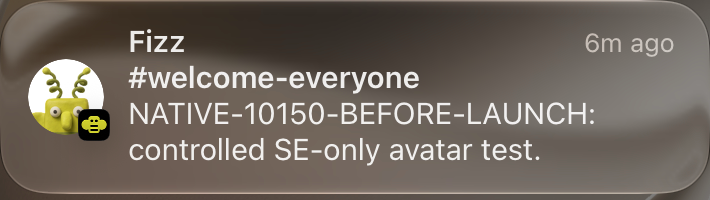 Authenticated HTTP avatar fetching and persistent HTTP cache reuse also passed on the SE. The first notification downloaded a relay thumbnail. After terminating the extension and expiring its separate avatar entry, the next notification displayed the avatar and refreshed that entry without another media request in the relay logs. The main app remained unopened throughout. The original app build and test profile were restored afterward. Automated tests cover slow and failed requests, stale images, removal, and account revocation; those cases have not all been exercised on the phone. ### Before merge - [x] Verify authenticated HTTP avatar fetching and cache reuse on iOS against a working relay media service. <!-- buzz-review-completed --> --------- Signed-off-by: Tom Brow <tomb@block.xyz> |
||
|
Tom Brow
|
868e2f8f32 |
refactor(push): one app profile per gateway (#8206)
Buzz push currently selects an application profile, such as `dogfood`, during client registration. We want each gateway to serve one Apple app configured by the operator instead. This removes profile selection from the client, relay, and gateway, while allowing internal and public gateways to use their own Apple identities. This PR implements that model in the Buzz source and upstream deployment chart. Discovery, enrollment, grants, and leases no longer carry an application-profile selector. Each gateway has one configured Apple application and APNs transport. The protocol changes are incompatible with the old registration format, so relays advertise `buzz-push-v1` instead of `nip-pl`. Old clients do not discover the new push capability. Updated clients use separate Keychain records and register again. The [push notes](https://github.com/block/buzz/blob/push-capability-v1/docs/buzz-push.md) describe the experimental contract. Landing this PR is the first step. Publish the matching gateway image and upstream chart, then land the [shared chart update](https://github.com/squareup/cash-helm-charts/pull/5740) and [gateway deployment update](https://github.com/squareup/builderbot-platform-core-infrastructure/pull/1085). Before cutover, stop old gateway instances and check legacy registration state. Migrations refuse to proceed if old gateway installations or active relay leases remain; they do not delete that state. Physical-device verification remains necessary before production activation. ### Validation Gateway and focused Flutter push tests pass, as do the Swift package, simulator build, and native notification/enrichment tests. A local relay advertises `buzz-push-v1` without `nip-pl` or `app_profiles`. The PostgreSQL suite passed 868 tests; its two migration-test failures were corrected and pass a focused rerun together with the gateway cutover guard. Chart rendering and release-contract checks pass. Desktop JavaScript tests, desktop and web builds, native desktop compilation, mobile analysis/tests, and desktop native tests pass. The full Rust unit lane and prescribed `just test` command pass, including workspace integration tests against task-isolated local services. The production overlay now requires an explicitly supplied APNs topic, with omission and rendered-value regression coverage. The corrected Swift checksum assertion passes the complete package suite: 78 XCTest tests and 42 Swift Testing tests. No physical-device enrollment or production cutover is claimed. Local merge validation: the embedded migration test and formatting pass after reserving profile migration 0060 behind rollback migration 0059. The local pre-push Rust lane failed ACP timing/steering tests (`idle_resets_on_stdout_activity`, `keepalive_resets_idle_past_deadline`, and the failed/missing-outcome steering tests). ACP and its dependency manifests are unchanged by this branch; all four pass in an isolated single-thread rerun. The documented local-check exception skips only the Rust pre-push lane for publication; required CI remains mandatory. Mobile and desktop pre-push lanes passed. Combined migration validation: after rollback 0059 landed, the main merge preserves profile migration 0060 and both embedded migration assertions. The focused migration test and formatting pass. The next local push again failed only the unchanged ACP idle/keepalive timing tests (1053 passed, 2 failed, 3 ignored); other lanes passed. Publication uses the same documented local Rust-lane exception; required CI remains mandatory. Follow-up review fix: removed the legacy profile column from the copied-lease fixture. All four event-follow-up contract tests pass on isolated PostgreSQL databases, covering desired and migrated schemas in dual and app-only modes. Formatting passes. Publication retains the prior passing local-lane evidence and uses the authorized pre-push exception for the known unrelated ACP timing failures; required CI remains mandatory. --------- Signed-off-by: Tom Brow <tomb@block.xyz> |
||
|
Tom Brow
|
779af8886c |
fix(mobile): fail open when age checks are unavailable (#7714)
Age-check errors previously blocked Buzz startup. Normal app startup now proceeds immediately; only a valid under-18 response from the current launch request can restrict access. Age check enforcement remains disabled at compile time by default. Builds can opt in with `--dart-define=BUZZ_AGE_GATING_ENABLED=true`. --------- Signed-off-by: Tom Brow <tomb@block.xyz> |
||
|
Tom Brow
|
f78a32cf03 |
feat(mobile): hard-block under-18 users on the store age signal (#4665)
### What changed? Buzz mobile checks the app-store age signal at launch and hard-blocks the app behind a full-screen 18+ notice when the store says the signed-in person is under 18. No age signal (e.g. declined permission, indeterminate value, unsupported OS versions) results in no block. The age value is never persisted. It is read, used to compute one boolean, and discarded. Nothing is written to disk, and neither the age value nor the range is logged or sent to analytics. Platform notes: - **New dependency `com.google.android.play:age-signals:0.0.4`.** This is the only way to read the Play signal. Its AAR declares `minSdkVersion 23`, below the app's 24, so it forces **no minSdk bump**, and it self-declares its own consent activity, so **no AndroidManifest change** is needed. - **iOS entitlement and linking.** `DeclaredAgeRange` autolinks from the import. `Runner.entitlements` now declares `com.apple.developer.declared-age-range`, and the call remains behind `#available(iOS 26.0, *)`. ### Why? App stores now expose a declared-age range, and Buzz's Terms require users to be 18 or older. This wires the store signal to that rule with the smallest change that is defensible. Absent signals, declined or undeterminable results, and unsupported OS versions allow the app through. A transient native request failure does not become evidence that access is allowed: the app remains gated until a retry produces a result. Only an affirmative under-18 signal produces the permanent restriction screen. ### How is it tested? Added tests: - [`age_signal_provider_test`](https://github.com/block/buzz/tree/main/mobile/test/features/age_gate) covers the 17/18 boundary, open-ended ranges, no-signal, transient recovery, bounded retry exhaustion, malformed payloads, and request-once behavior - [`age_gate_app_test`](https://github.com/block/buzz/tree/main/mobile/test/features/age_gate) proves authenticated content remains unmounted while the signal is pending or retryable, and verifies the retry path - [`age_restriction_page_test`](https://github.com/block/buzz/tree/main/mobile/test/features/age_gate) asserts the block screen offers no bypass affordance - [`community_provider_test`](https://github.com/block/buzz/tree/main/mobile/test/shared/community) verifies age restriction clears push state, persists inactive leases, and retries a failed tombstone - [`AgeSignalPayloadTest`](https://github.com/block/buzz/tree/main/mobile/android/app/src/test/kotlin/xyz/block/buzz/mobile) pins the Android success payload to exactly `{status, ageUpper}` and verifies failures return the distinct retryable platform error ### Deployment note Enable the Declared Age Range capability and regenerate signing profiles carrying the entitlement. This relops/App Store Connect task is not performed by this PR. *🤖 This PR was authored [with an agent](codex://threads/019e5128-536b-73b3-8348-88651123f6da).* | Age restriction screen | | --- | | <img src="https://github.com/user-attachments/assets/5b0f48b1-df9b-4a60-9800-80b33f128535" alt="Age restriction screen" width="320"> | --------- Signed-off-by: Tom Brow <tomb@block.xyz> Co-authored-by: npub12wpjffj7q5qjsky5jvk4ldwlxmse5xll3d8gytk4wqd0c5y7jvwspg37n6 <538324a65e0501285894932d5fb5df36e19a1bff8b4e822ed5701afc509e931d@buzz.block.builderlab.xyz> Co-authored-by: npub1tquskdu6yc4h8l7xxtceculxw600grekeq0xg2ukqfrwl7vrzg3quz3gmp <58390b379a262b73ffc632f19c73e6769ef40f36c81e642b960246eff9831222@buzz.block.builderlab.xyz> Co-authored-by: Codex <noreply@openai.com> |
||
|
Tom Brow
|
c432a111ca |
feat(mobile): push notifications MVP (#6269)
This PR implements MVP, iOS-only,
[NIP-PL](
|
