mirror of
https://github.com/block/buzz.git
synced 2026-11-25 18:52:52 +00:00
0ffb134e34c1915377e5272aee4232ccd8a2efd2
34 Commits
| Author | SHA1 | Message | Date | |
|---|---|---|---|---|
 Tom Brow |
b58ee08404 |
fix(mobile): request hosted relay assertions only when NIP-FI is required (#9225)
Port the desktop NIP-FI requirement rule to mobile: hosted relay connections request an account assertion only when the relay's NIP-11 document requires NIP-FI, so communities that have not enabled it keep connecting with BUZZ_HOSTED_RELAY_AUTH on. Signed-off-by: Tom Brow <tomb@squareup.com> Co-Authored-By: Claude Opus 5.5 <noreply@anthropic.com> |
||
|
Logan Johnson
|
c39ee507b2 |
fix(mobile): find verified people who have no profile (#9086)
## What changes
Mobile now finds a person who has a relay-verified profile (NIP-FI, kind
30382) but never published a kind:0 profile. This happens, for example,
when someone skips profile setup. The relay's `POST /profiles/search`
already finds such people by their verified name. Each one comes back as
a kind:30382 head with no kind:0. Mobile kept only kind:0 results, so
these people did not appear.
- `RelaySessionNotifier.searchProfiles` keeps kind:30382 heads from the
endpoint.
- `VerifiedProfilesNotifier.searched` turns a search page into people:
- If the relay authority is not known yet, it first waits for NIP-11
discovery. Otherwise, a search that finished first would drop these
people for that query.
- It checks each head's signature with the directory's off-isolate proof
checker.
- Proven heads go into the verified directory, so the rows show verified
names right away.
- `searchedPeople` (in `verified_profile.dart`) builds one row per
person, in the relay's order:
- If the person has a kind:0, the newest kind:0 is used, as before.
- If not, it uses the proven head that the authority signed, provided it
parses as an active verified profile.
- These cases add no row:
- a head signed by another key;
- a head that names the relay key but has a bad signature;
- a retraction;
- a malformed subject.
- **Behavior change for all mobile mentions:** every verified person now
matches in mention ranking by their verified full name and username, as
well as by display name, including people who have a kind:0. The relay's
search matches these same three names. Without this, a person whose
display name is their username (`glilienfeld`, full name "Gabi
Lilienfeld") came back from the relay for "gabi", and then the local
filter dropped them.
- Callers:
- Mention search, which also serves Add members and New DM.
- The user rows in global search, through `directoryUsersFromSearch`.
The desktop app has the same fix for Manage members:
https://github.com/block/buzz-app/pull/2554
## Screenshots
These come from the real Add members sheet on an Android emulator. Only
the relay session, verified-profile discovery and the member actions are
faked. The names are made up. Jordan Park has a kind:0. jrivera has only
a verified profile, with the full name "Jordan Rivera". The search is
"jordan". The row shows the verified display name, which here is the
same as the username.
| Search finds jrivera | After tapping + on jrivera |
| --- | --- |
| <img width="300" alt="jrivera is found next to Jordan Park"
src="https://github.com/user-attachments/assets/d93b77b1-1bc7-4d09-afc1-f359616a192a"
/> | <img width="300" alt="jrivera is selected to add"
src="https://github.com/user-attachments/assets/ce6c7a71-b098-434e-8b0e-ed0de8d1a5a2"
/> |
## Tests
- `add_members_sheet_names_test.dart`: a journey in which Gabi has
`display_name` = `glilienfeld` and `full_name` = "Gabi Lilienfeld", and
NIP-11 discovery is slow.
- While discovery is pending, typing "gabi" shows nothing yet.
- When discovery finishes, Gabi appears with no further keystroke.
- A head from another key does not appear, and neither does a head that
names the relay key but has a bad signature.
- **Add member** adds Gabi's key.
- I removed each fix in turn: the full-name alias, the signature proof,
and the wait for discovery. The journey fails each time, for the
expected reason.
- `verified_profile_test.dart`: a table of `searchedPeople` cases.
- A kind:0 wins over a head, and the newest kind:0 counts.
- These find nobody: another signer, a retraction, an uppercase subject,
a non-profile kind, and any head when the authority is unknown.
- `relay_session_test.dart` and `channel_management_provider_test.dart`:
rows for the kept heads and the directory row.
- `flutter analyze` is clean, and the full `flutter test` passes on
6efef79cc: 4,462 tests.
**Note:** mobile on `main` does not compile at
|
||
|
Tom Brow
|
9c5032b63b |
perf(mobile): derive keys natively and hash NIP-98 bodies faster (#8965)
## Summary Two pure-Dart crypto paths that run on the UI isolate during normal use: - **NIP-98 body hashes.** Every relay HTTP query (`RelaySessionNotifier._postForEvents`) hashes its request body for the NIP-98 auth header with pointycastle's `SHA256Digest`. This switches that hash, the media upload hash and the NIP-OA preimage hash to `package:crypto`'s `sha256`, which is already a dependency. The output is identical. - **Public key derivation.** `AccountIdentityStore.publicKeyForNsec` runs on every relay auth assertion and derived the key with the `nostr` package's pure-Dart curve math. It now uses the native `derivePublicKeyHex` (libsecp256k1) with the same validation. The default-agent writer now signs with the native `signNostrEvent` instead of `nostr.Event.from`. Left as they were: `nostr.Keys` construction for signing keys (nostr 2.0.0 always derives in Dart, with no way to pass a known public key), and `nostr.Keys.generate()` on the rare key-creation paths. ## Measurements - **Device** (iPhone 12 mini, Profile build, #4things captures): NIP-98 hashing took 17 to 24 ms of UI CPU per 10 to 20 s capture, mostly from channel notices queries. `publicKeyForNsec` took about 7 ms per relay auth assertion. - **Synthetic** (Mac, AOT, same output): SHA-256 of a 1 KB body takes 39.9 µs with pointycastle and 6.6 µs with `package:crypto`. 50 KB: 1,518 µs vs 293 µs. 1 MB: 29.6 ms vs 6.1 ms. - **Device A/B after the change** (iPhone 12 mini, Profile/AOT, Tom's Block community, two app resumes per build from the home screen, 15 s windows; A is `origin/main` |
||
|
Tyler
|
dafe31bfe5 | feat(mobile): persist frontier-only NIP-RS read state across devices and restarts (#8998) | ||
|
Tom Brow
|
770ab7ff82 |
perf(mobile): decode relay query responses off the UI isolate (#8669)
### Context Profiling on an iPhone 12 mini (Profile build, real community) showed `RelaySessionNotifier._postForEvents` producing contiguous main-isolate busy runs with p90 110 ms and max 124 ms (27 runs of 50 ms or longer). Stacks were dominated by `jsonDecode` of `response.body`, with `NostrEvent.fromJson` smaller. The whole HTTP response decode ran on the UI isolate: gzip inflate (done by `dart:io`), the UTF-8 decode behind `response.body`, JSON parsing, and event parsing. ### What changes - Successful `/query` and `/profiles/search` responses (the only two callers of `_postForEvents`) are now decoded in a single `Isolate.run` from `response.bodyBytes`: inflate, UTF-8, JSON, validation, `NostrEvent.fromJson`. The parsed events come back by ownership transfer (`Isolate.exit`), not a copy. - Gzip: the query transport now sends `Accept-Encoding: gzip` and sets `autoUncompress = false`, so compressed bodies reach the isolate still compressed. Whether bytes are gzip is decided by the gzip magic bytes, so a transport that already inflated (or an injected test client) still works. Error bodies are inflated inline (small). - Unchanged: `FormatException` messages, the malformed-event wrapping, `RelayException.body`, and the rate-limit gate reading the error body. - Fencing (Review-Proven Rule 2): the `_disposed` / `_ageRestricted` / `_contextGeneration` check still runs before the decode and now runs again after it. If the session retires during the decode, the query reports `StateError` even when the decode itself failed, matching the old ordering where a retired session never decoded. ### Design notes - `Isolate.run` per response instead of a long-lived worker: no lifecycle or disposal to manage, no idle isolate heap on a small phone, easy to fake in tests, and the same shape as `parseProfileEventBatch`. The main-isolate side of a spawn measured at microseconds, so there is no size threshold; small responses take the same path. - Event id and signature verification does not happen on these events on the main isolate today (nothing in the mobile app verifies queried events; NIP-OA verification in profile parsing is already in an isolate), so nothing was moved. - Other HTTP decode sites found and left alone: invite create/join, hosted join policy, BuilderLab account, media upload response, community icon lookup, dev push lease NIP-11, archived-agents. These decode small, rare responses (one small JSON object each), where an isolate adds complexity without a measurable gain. Media and avatar byte downloads do no JSON decoding. The mobile app has no `/count` caller. ### Validation Added tests (`relay_session_test.dart`, through the production `queryRelay` / `searchProfiles` path with the real isolate decoder): parsing with non-ASCII content; profile search; gzip success body and `Accept-Encoding`; gzip error body feeding the rate-limit gate and `RelayException.body`; malformed JSON; non-list body; non-object element; malformed event; invalid UTF-8; error status skips decoding; session disposed, age-restricted, or retired-before-decode while a decode is outstanding. The fencing tests are falsifiable: removing the post-decode check fails the disposed and age-restricted tests; removing the retired-wins-over-decode-error branch fails its test; removing the pre-decode check fails the never-decodes test. `FakeRelay` (test helper) now injects an inline decoder, because `fakeAsync` cannot deliver isolate results; it calls the same parse function. The default transport still honors `http.runWithClient`, which the hosted journey tests use to fake the network (`relay_http_query_client_test.dart`; fails without the fix). `just mobile-check` and `just mobile-test` pass. Host benchmark (AOT executable on an Apple silicon Mac, median of 25, copy of the parse logic, main-isolate stall measured with a 0.5 ms heartbeat timer): | Response | Main-isolate blocked before | after | | --- | --- | --- | | 500 events, ~630 KB | 2.4 ms | 0 ms (max gap 0.05 ms) | | 500 events, ~630 KB gzip | 3.2 ms | 0 ms (max gap 0.19 ms) | | 500 events with 50 20 KB avatars, ~1.6 MB | 5.1 ms | 0 ms (max gap 0.28 ms) | | 500 events, ~4.5 MB | 14.0 ms | 0 ms (max gap 0.27 ms) | | 500 events, ~4.5 MB (827 KB gzip) | 17.4 ms | 0 ms (max gap 0.35 ms) | Total latency is unchanged within noise (for example 14.5 ms to 14.9 ms). The host is much faster than the 12 mini, so absolute device savings should be several times larger. On the iPhone 12 mini (Profile builds of base and this branch, real community over the production relay, two runs per scenario; main-isolate stalls measured with a 4 ms heartbeat timer, since the wireless device tunnel has no VM service): | Scenario | Main-isolate `_postForEvents` time, base | this branch | Max stall, base | this branch | | --- | --- | --- | --- | --- | | Cold start + 60 s (~16k events, 7.8 MB gzip) | 282 to 295 ms (max 116 ms) | 0.01 ms | 147 to 150 ms | 100 to 102 ms | | Inbox + search (~7k events) | 122 to 123 ms (max 111 ms) | 0.01 ms | 138 to 142 ms | 97 to 99 ms | | Open 6 channels (558 events) | 5 to 6 ms | 0.01 ms | 88 ms | 86 to 87 ms | | Background 10 s + resume (~7k events) | 118 to 124 ms | 0.01 ms | n/a (suspension) | n/a | - The production relay serves gzip (about 4.4:1; the largest catch-up response is 3.15 MB on the wire, 13.9 MB inflated, 7k events). Inside the isolate that response takes 30 to 47 ms to inflate, 39 to 55 ms for UTF-8, 65 to 105 ms for `jsonDecode` and 7 to 32 ms for `NostrEvent.fromJson`. - Many 16 to 90 ms stalls remain on both builds; they come from other work (mostly markdown build and layout), not response decoding. - Home, channels, inbox, search, profile and a thread render the same on both builds. buzz-review-completed 🤖 Generated with [Claude Code](https://claude.com/claude-code) --------- Signed-off-by: Tom Brow <tomb@block.xyz> Co-authored-by: Claude Sonnet 5.5 <noreply@anthropic.com> |
||
|
Luke Tornquist
|
974495fd4a |
fix(mobile): resume reconnect replay from the last live point and spread reconnects (#8659)
## Summary A relay rolling deploy closes every socket with 1012. On reconnect, mobile replayed each live subscription's **original filter** (startup `since`, full `limit`) unless that subscription had received an event, so quiet subscriptions re-read history back to app start every time. Reconnects used a fixed 1s delay with no jitter. The delay also reset to 1s on every successful connect, so a client bounced from pod to pod during a deploy kept coming back at the same moment as every other client. **This PR makes two changes:** 1. **Resume cursor.** If a subscription reached EOSE on a connection, it records `liveUntil`: the time of the last frame received from the relay on that connection, capped at the clock at close. The replay then uses `since = max(original since, lastSeen − 5s, liveUntil − 960s)`, and never goes past the filter's `until`. - **Why 960s:** the relay accepts `created_at` up to ±900s from its clock (`MAX_TIMESTAMP_DRIFT_SECS` in `crates/buzz-relay/src/handlers/ingest.rs`). An event stored after the close can therefore be backdated by that much, and the extra 60s covers client clock skew. - **Only relay frames count as liveness.** Close and error paths never extend `liveUntil`, so a close noticed after the device sleeps doesn't overstate how long the subscription was live. - **Ambiguous EOSE is ignored.** If a subscription has a second REQ on the same socket, that subscription doesn't advance `liveUntil` for the rest of the socket. A CLOSED ends liveness for the rest of that socket, because the retry is a second REQ. Subscription IDs are never reused, so an old EOSE can't mark a re-subscribe as live. - **No cursor:** a subscription that never reached EOSE keeps its previous cursor, or replays as before. 2. **Reconnect spreading.** - After a 1012 or 1001 close, the first attempt waits a uniform random delay in [0, 10s]. A client already backing off waits the longer of that delay and its backoff. - Ordinary backoff gets symmetric ±25% jitter, capped at 30s. - The backoff resets only after a connection stays up for 60s, not on connect. This matches desktop. - Foreground resume and a manual `reconnect()` still reset to the base delay, as before. **Simpler?** The pure reconnect math (cursor, jitter, spread, stability) lives in a new `relay_reconnect_policy.dart` and is table-tested on its own. `relay_session.dart` was near its 1200-line cap, so its five small private bookkeeping classes moved verbatim to `relay_session_subscriptions.dart`. Net concept count is unchanged. **Identified debt (not changed here):** - Dart's WebSocket ping/pong isn't visible to the session, so a long-idle but healthy connection that drops replays back to its last application frame − 960s. This is still bounded, and much cheaper than replaying from app start. - The unread catch-up in `channels_provider.dart` runs one REQ per active channel (`since = readAt + 1`, `limit: 1000`) on reconnect and every 60s. - A retryable CLOSED is retried with a 30s cap, no jitter and no attempt limit. - `lastSeenCreatedAt` advances on stored events received before EOSE. If a relay returns stored events newest-first and the socket dies before EOSE, the next replay can skip older stored events. - The `lastSeen − 5s` term keeps its existing gap for events backdated after a close. ### Related issue N/A. This is part of a set of reconnect-load reductions. Companion PRs: relay read-pool warm (#8651), desktop (#8652), agent harness (#8653). ### Testing - Mobile gate on a Linux workstation, at the head SHA: - `dart format --set-exit-if-changed`: pass. - `flutter analyze`: no issues. - Gateway recipe tests: pass. - `flutter test`: 3881 pass, 1 fail. `push_gateway_origin_validator_test` fails the same way on `main` on that host, due to a host git-config error. - New `relay_reconnect_resume_test.dart`: - pure table tests for the cursor and the delay - a real-socket test that reads the 1012 close code - journeys through `RelaySessionNotifier`. They check that a close or error after an hour asleep doesn't extend liveness, that a second REQ or a delayed EOSE for an unsubscribed ID can't advance the cursor, and that a backdated event inside the 960s window is still replayed. - 22 production mutations, each failing the new tests. They cover every cursor term, the 960s window, the `until` clamp, the liveness cap, the ambiguous-EOSE guard, CLOSED handling, jitter, the 1012 spread and floor, the backoff reset, and close-code capture. - `fake_relay.dart` now draws a fixed jitter midpoint, so existing journey tests stay deterministic. 🤖 Generated with [Claude Code](https://claude.com/claude-code) --------- Signed-off-by: Luke Tornquist <tornquist@squareup.com> Co-authored-by: Elrond <28d6302a099e5225b02c4155ac4236e4912603df2ab08dbfc2f4fef08ce598c8@buzz.block.builderlab.xyz> Co-authored-by: Claude Sonnet 5.5 <noreply@anthropic.com> |
||
|
Tom Brow
|
4ff02bf03b |
perf(mobile): sign events with native libsecp256k1 on iOS and Android (#8654)
Mobile signs every Nostr event (sends, relay AUTH, media auth headers, preference writes) in pure Dart on the UI isolate. On an iPhone SE (2nd gen, Profile build) one BIP-340 signature costs about 10.7 ms and deriving the public key another 5.6 ms, so a burst of signed writes drops frames. This adds `mobile/packages/buzz_secp256k1`, a small FFI package that builds vendored bitcoin-core/libsecp256k1 v0.8.0 (ecdh, extrakeys, schnorrsig modules) through a Dart build hook, so the same C and the same Dart API ship on iOS and Android with no platform bridge code. All 13 `nostr.Event.from` signing sites now go through `signNostrEvent`, which keeps the `nostr` package's event-id serialization and moves only key derivation and signing to native code. Calls stay synchronous. The package also exposes `schnorrVerify` and `ecdhX`; follow-up PRs move verification and the NIP-44 conversation key over. Incoming relay events are still not verified, unchanged by this PR. Safety: the signing context is randomized once per isolate, secret keys and keypairs are wiped from the native scratch buffer after each call, aux randomness comes from `Random.secure()`, and the static verify context runs libsecp256k1's self test before first use. ### Validation - Added tests: BIP-340 official vectors and native-vs-pure-Dart differential tests in the package; `event_signing_test.dart` signs with 64 random keys and checks pubkey, event id and signature against the existing `nostr` builder and verifier, plus malformed-key rejection. - Full mobile analyze and test suite pass locally. - Builds: iOS release (framework ~1.3 MB) and Android debug APK with the library for arm64-v8a, armeabi-v7a and x86_64 (~1.2–1.3 MB each). - On-device (iPhone SE 2nd gen, Profile, median per op): sign 10,736 µs → 41 µs, derive pubkey 5,580 µs → 16.5 µs, full signed event 10,744 µs → 65 µs. Event-id JSON and SHA-256 are 23 µs, so they stay in Dart. - Device, iOS (iPhone SE 2nd gen, Profile): `buzz_secp256k1.framework` embedded; the signed-in app authenticated to a real community relay, loaded channels and history, and paged older messages. No native-asset or secp256k1 errors in the console. - Device, Android (emulator, debug): APK contains `libbuzz_secp256k1.so` and loads it. Against a local mock relay that verifies with the pure-Dart `nostr` package, the app's NIP-42 AUTH, NIP-98 `POST /query` headers, and kind 20001/30078 events all verified. - Blossom GET auth, iOS: the dev relay returns 401 for unauthenticated `/media/` GETs. From inside the running app, the production `MediaGetAuthService.headersFor()` header for a nonexistent hash got 404 (accepted, file missing), compared with 401 without it. The community has no relay-hosted image, so none was rendered. buzz-review-completed (agent review, Codex and security review clean; device validation above; human app test not applicable under the mobile testing exception) 🤖 Generated with [Claude Code](https://claude.com/claude-code) --------- Signed-off-by: Tom Brow <tomb@block.xyz> Co-authored-by: george <973be878edd6d4f79692a3827f20a6f7fe0ed0362f269ff6b6ba8867033d7d8e@sprout-oss.stage.blox.sqprod.co> Co-authored-by: Claude Opus 5.5 <noreply@anthropic.com> |
||
|
Wes
|
d090ac24bb |
perf(mobile): cut idle and resume sync churn (#8490)
## Summary Mobile does background work nobody sees, and it waits on round trips it doesn't need. This PR fixes four things: - **Chats you've left let go.** A chat with no listener for 30 s drops its live and typing subscriptions. Coming back shows the cached timeline right away, then resubscribes and catches up. - **No requests before AUTH.** The relay rejects any REQ that arrives before NIP-42 AUTH completes. History requests are now held until the socket authenticates, and they flush after the rate-limit gate. Live subscriptions skip their REQ, and the replay on connect sends it. `auth-required` is terminal for a live subscription, so a pre-AUTH live REQ could be dropped for good. - **Resume reconciles the channel list once.** `resumed` is published before the session hears about it. So the channel list now decides one microtask later: if the session is reconnecting, the connect does the reconcile. - **The 60 s backstop only runs in the foreground on a connected session.** After an OS suspension, the missed tick fires at unfreeze, about 450 ms before the app hears `resumed`, while the session still looks connected. Without this, that tick triggered a second full sync. Scope note: while the app is in the foreground, the backstop still re-downloads membership every 60 s. That matches desktop, which refetches every 60 s while focused. To drop it, mobile would need to subscribe to the live membership notices (44100/44101), as desktop does. That would be a follow-up. ### Related issue N/A. This is follow-up work from the mobile perf dive. None found. ## Before and after Simulator setup: iPhone 18 Pro simulator, debug build, a local relay behind a proxy that adds ~120 ms RTT, and a seeded account with 120 channels. I scripted one identical run against each build: 1. Open 5 channels. 2. Visit 20 more channels. 3. Wait 40 s. 4. Stay idle in the foreground for 3 min. 5. Go to the background for 3 min. 6. Resume. `main` is `ca3be5501`; the branch is `d77c4e86f`. The last amend changed only test names. Since then, chat history waits for the live EOSE again (see the note below), so channel open is back to `main`'s order. | | `main` | this PR | |---|---|---| | Live subscriptions after visiting 20 chats | 61 | 11 | | Resume: membership reads | 2 (244 kB) | 1 (122 kB) | | Resume: websocket REQs | 36 | 31 | | Resume: REQs sent before AUTH | 9 | 0 | | Resume: REQs rejected as `auth-required` | 2 | 0 | | Idle foreground, 3 min | 3 membership reads, 12 REQs | same | Notes: - **Channel open:** an earlier revision requested history without waiting for EOSE, which cut the median open from 297 ms to 197 ms. Review showed it can lose a message. The relay registers the live REQ only after its access checks, so a message committed in between reached neither the window read nor the subscription. A timestamp overlap only covers messages signed within it. Keeping that speedup safely would mean a second window read on every open, so it's left out. - **Idle foreground is unchanged by design.** See the scope note above. - **Background traffic:** the simulator suspends the app shortly after it leaves the foreground, so both builds sent almost nothing during the 3 minutes in the background. The backstop fix shows up at unfreeze instead, as the missing second membership read. - **Resume inbound events:** in this one run, events received over the websocket on resume were 247 kB on `main` and 338 kB on the branch. I haven't attributed the difference. ## Test These extend the existing journeys, plus one new journey: - **`channel_messages_journey_test`:** - The window read waits for the live REQ's admission, and a message signed a minute earlier but committed before admission shows up. - After the listener leaves, the chat keeps following for 29 s and stops at 31 s. - Coming back shows the cached rows immediately, then catches up on a message sent while away. - **`relay_session_test`:** a stale-connected resume sends nothing before AUTH. Then exactly one history REQ and one live REQ go out after AUTH. - **New `channels_sync_journey_test`:** drives the real lifecycle, session and channel notifier against `FakeRelay`: - A backgrounding just before a backstop tick sends nothing. - A resume after the session paused syncs once. - An OS-suspension resume with AUTH held syncs once, after AUTH, and sends no REQ before it. - **`FakeRelay`:** gained `holdReq`, `holdAuth`, `before_id` pagination and an injectable clock. Each guard was mutation-checked, and every mutation failed its test: - live REQ sent before AUTH - history sent before AUTH - resume refresh not deferred - backstop without the lifecycle check - history read alongside the live REQ - a 30-day detach delay Follow-up, not in this PR: a history REQ already in flight on a socket that gets replaced still waits for its 8 s timeout. Princess Donut found this in review; it predates this change. ## Validation - `flutter analyze`: clean - Full mobile suite at `678617b`: 3,696 passed - Court review (Princess Donut on the relay session, Mongo on chat subscriptions, Mordecai on the channel list plus a challenge pass): no blocking findings. The rate-limit flush ordering came from that review. **Human test:** Wes ran `da5077d` on the simulator with his real account and confirmed it works. `460dc35` then fixed a review blocker: a chat rebuilt while detached stayed detached. A retest of that path is pending: leave a chat for more than 30 s, background the app for more than 5 s, resume, then reopen the chat. 🤖 Generated with [Claude Code](https://claude.com/claude-code) --------- Signed-off-by: Wes <wesbillman@users.noreply.github.com> Co-authored-by: Carl <32a2e2c9d428ee08902cab75d956da2c1d235a22d4766b0dd4138bf6e2e5db1d@buzz.block.builderlab.xyz> Co-authored-by: Claude Opus 5.5 <noreply@anthropic.com> |
||
|
Wes
|
3ec6327618 |
fix(mobile): keep cached state with its community (#8349)
## Summary One identity can be paired with several communities, but mobile keyed several caches by pubkey only. Mobile keeps a single `ProviderScope` and doesn't remount on a community switch, so one community's data showed up in another, and some of it was published to the other community's relay. - **Channel groups**: the second community showed the first community's groups. - **Read marks** (contexts, publishable set, NIP-RS client and slot IDs): the first community's context IDs were merged into, and published to, the second community's read-state slot. - **Inbox done/unread rows and thread follows**: one shared 500-entry cap, so activity in one community evicted another's entries. - **Channel stars and mutes**: union-merged across communities and published to every relay. Every one of these is now keyed by pubkey + normalized community relay, the same way channel sort already is. **Switching communities.** The relay session rebuilds for the new community before the previous community's managers are retired. Each manager (groups, read state, stars, mutes) now checks that the session still serves its own community before it publishes, merges a fetch, or handles a live event. Previously, a pending publish flushed on dispose, or an in-flight fetch, could cross into the next community. **Old pubkey-only entries.** Channel IDs can repeat across communities, so nothing tells us which community an old channel-keyed entry belongs to: - **Groups, stars, mutes and read marks** are dropped on upgrade, and each community restores its own from its relay. Any change that never reached a relay is lost, and a read mark the relay doesn't hold shows as unread once. That's an accepted tradeoff: such changes would be very old by now. - **Inbox, thread follows, and read-state slot and client IDs** seed every community, and the old entry is kept. The inbox and follows entries are event IDs, which only ever match their own community. The slot ID keeps each community publishing to the slot it already has on its relay. This PR also removes the **Pulse** feed (`features/pulse/` and the Nostr filters only it used). Nothing in the app navigates to it anymore, and its providers were among the community-unscoped caches. ### Related issue None found. ### Testing - Each affected store has a regression test through the real provider that switches A → B → A. For groups, read marks, stars and mutes, the test sets a value in A, switches to B while A's change is still pending, and checks two cases: B's data arriving live and B answering A's in-flight fetch. It asserts that nothing sent to B contains A's IDs, B shows only its own value, and A comes back unchanged. Each guard was removed in turn to confirm a test fails without it, except two that the current switch order never reaches: the groups merge guard and the read-state live-event guard. - Upgrade tests cover each kind of old entry: dropped for groups, stars, mutes and read marks, seeded for inbox, follows and slot IDs. - `flutter analyze` is clean, and the full mobile suite passes in the pre-push hook at `89ebfcc12`. - Not yet exercised in the app. 🤖 Generated with [Claude Code](https://claude.com/claude-code) --------- Signed-off-by: Wes <wesbillman@users.noreply.github.com> Co-authored-by: Carl <32a2e2c9d428ee08902cab75d956da2c1d235a22d4766b0dd4138bf6e2e5db1d@buzz.block.builderlab.xyz> Co-authored-by: Claude Opus 5.5 <noreply@anthropic.com> |
||
|
Wes
|
91b1cc4761 |
perf(mobile): reuse the derived pubkey when signing auth events (#8460)
## Summary Each relay `/query` signs a NIP-98 event, and each relay media image GET signs a Blossom auth event. Both run on the UI isolate. `nostr`'s `Event.from` derives the pubkey from the secret key on every call, which is about a third of the cost of a signature. Both call sites now pass the pubkey that `myPubkeyProvider` already caches for the active key. The provider is derived from the same `relayConfigProvider` state as the key, so the two always match. This is the quick win. Moving signing to native secp256k1 or a worker isolate would remove the rest of the cost, and that would be a separate change. ## Before and after AOT-compiled benchmark on Apple silicon, `nostr` 2.0.0 `Event.from`, three runs of 50 signatures each: | | ms per signature | |---|---| | `main` (pubkey derived) | 8.8 to 9.6 | | this PR (pubkey passed) | 5.9 to 6.4 | A scroll that shows 20 uncached relay-media images now spends about 60 ms less on the UI thread. ## Test There are no new tests. The existing `queryRelay` test runs through the real `relayConfigProvider` and `myPubkeyProvider`, and asserts the signed event's pubkey for one identity. It does not verify the signature or switch identities, and it would still pass with this optimization removed. The media tests build the service directly, so they only cover the fallback where the pubkey is derived. Review traced the pairing instead. Both the key and the pubkey come from `relayConfigProvider`. `_postForEvents` reads both and signs with no await in between, and the media provider watches both. So the key and pubkey change together on community switch and sign-out. ## Validation - `flutter analyze` - Full mobile suite: 3,534 passed. **Human test:** Wes ran #8456, #8460 and #8462 together on the simulator with his real account and confirmed they work. buzz-review-completed 🤖 Generated with [Claude Code](https://claude.com/claude-code) Signed-off-by: Wes <wesbillman@users.noreply.github.com> Co-authored-by: Carl <32a2e2c9d428ee08902cab75d956da2c1d235a22d4766b0dd4138bf6e2e5db1d@buzz.block.builderlab.xyz> Co-authored-by: Claude Opus 5.5 <noreply@anthropic.com> |
||
|
Wes
|
b6aa5539e3 |
feat(mobile): account onboarding, key recovery and hosted reconnect (#8375)
## Behavior Adds optional mobile Builderlab sign-in, identity backup/recovery, community discovery/creation, and account-aware reconnect. **Builderlab features are disabled by default:** when `BUZZ_AUTH_DOMAINS` is unset or empty, account login, creation, backup/recovery, reconnect prompts, and background account restoration are hidden/disabled. QR/code pairing, links, and invites retain Nostr-only entry. Saved account state is retained for later opt-in. `--dart-define=BUZZ_AUTH_DOMAINS=communities.buzz.xyz,communities.public.builderlabstaging.xyz` opts those DNS domains and their subdomains into required account setup. The same policy gates pairing, deep links, durable community admission, and reconnect. A nonempty list enables Builderlab features; `BUZZ_BUILDERLAB_URL` alone does not. Enabled flows still require their backend services. Existing Nostr relay authentication remains mandatory. `BUZZ_HOSTED_RELAY_AUTH=true` enables scoped relay assertions and reconnect prompts only for configured authentication domains. Configure assertion issuance and each community's issuer binding before enabling assertions; enable relay enforcement last. Account credentials stay at Builderlab. Wrong-account recovery preserves keys; failed writes are not replayed; authentication is bounded by request deadlines. Hosted flows preserve keys across cancellation/restart, reconcile interrupted creation/invitation acceptance, and support manual nsec file import/export. Account identities are scoped to backend and authenticated subject; reusing an existing local key for an unbound account requires an explicit selection. Recovery reconciles the advertised and recovered inventories before automatic selection. Successful self-hosted admission retires its pending key, and iOS startup removes interrupted export files. Adds authenticated relay `GET /operator/communities/joined` for the companion Builderlab membership endpoint. ## Validation - Follow-up review repair at `66a12ac92`: self-hosted entry presents readable choices and import despite incomplete enumeration, while generation still requires a complete empty inventory; explicit selection uses exact-key lookup. Consuming a value-equal duplicate now advances dispatch. Reconnect requires an existing account binding or a subject-scoped backup receipt before signing an assertion, and pins the subject inside the serialized account request. An empty different account is refused without sending key proof. Focused checks: configured domains 58 passed; default 49 passed, 9 hosted-only skips. Separate isolated mutations fail the incomplete-inventory sheet, exact-key reuse, duplicate dispatch and reconnect journeys (including an empty-account-only bypass); restored controls pass. Evidence uses synthetic storage/network boundaries, not physical Android or live backend association. All mandatory commit/push hooks passed; fresh GitHub CI is pending. - Bounded review repair at `d3cc0003f`: incomplete secure-storage enumeration now blocks automatic identity generation while explicit known-key reads retain their fallback; declined/failed onboarding links release the queue; HTTP 429/5xx keeps Retry regardless of response encoding. Default app-gate coverage exercises a bind link followed by ordinary community entry. Focused checks: configured domains 47 passed; default 38 passed, 9 hosted-only skips. Removing the three production fixes in an isolated source/Git/build copy fails the identity-resolution, declined/failed queue, and Retry journey assertions; clean and restored controls pass. Storage and HTTP failures are synthetic; physical Android and live outage behavior were not exercised. Published after all mandatory commit/push hooks passed (mobile analysis/tests, branch-skew and file-size gates); fresh GitHub CI remains pending. - Existing whole-PR source review cleared the reconnect defects at `fb15d5b82`. - Domain-policy increment: focused environment, entry, app-gate, pairing and onboarding journeys pass with empty and configured domains. Existing pairing provider/page tests pass. Changed Dart files analyze cleanly. - Isolated source/Git/build mutation: forcing paired credentials through hosted login fails the default-build journey; clean and restored controls pass. CI now runs configured-domain journeys in addition to the default-build suite. - Integrated main through `5b433d929` at `0067c069c`, including its pinned Flutter upgrade. Preserved the PR welcome UI with the updated transition API and added Material surfaces around onboarding selection/consent rows. Focused post-merge runs pass in both configurations; all mandatory local push gates passed (mobile analysis/tests, Rust tests, desktop-native checks, branch-skew and file-size checks). - Merge-review repair at `a315bce11`: focused identity/storage/admission and widget journeys pass, including account switching with an empty or already-bound second account, explicit reuse, and self-hosted removal/rejoin with another key. Default-domain journeys pass too (hosted-only cases intentionally skip there). - Isolated source/Git/build mutation checks: bypassing account scoping, reuse consent, pending-key retirement, or recovery inventory reconciliation fails the relevant journey/invariant assertions; clean and restored controls pass. - Native `RunnerTests/IdentityFilePluginTests`: both tests pass on the iPhone 18 Pro iOS 27 simulator with an isolated app identifier. At `24a0dcaac`, the picker journey seeds residue in Library/Caches, matching path_provider_foundation, and verifies plugin startup removes it while preserving an unrelated file. The earlier tmp-only fixture did not exercise the actual export location. This is synthetic native cleanup/picker evidence, not a real terminated-share or live account round trip. - Follow-up: Caches and tmp cleanup; fallback to individually known identity slots when Android bulk enumeration fails; explicit replacement of a refused self-hosted key preserves its original before swapping the retry slot. Configured-domain journeys/invariants: 34 passed; default: 31 passed, 3 hosted-only skips. Isolated enumeration/retry mutations fail with passing controls. Bulk-read fallback preserves but cannot enumerate arbitrary other-account slots until bulk reads recover. - Configured-domain CI exposed a stale pairing-status assertion after account scoping. The repaired test checks the admission mismatch, preserved account/transfer keys, and no admitted community. The configured-domain CI selection passes locally (56 tests); removing the production mismatch guard fails the updated test, with clean/restored controls passing. This is synthetic coordinator evidence, not physical QR acceptance. - Final review repair (`40e1e6101`): native iOS export creation uses atomic complete file protection; normal and restart cleanup remain. Account/policy/claim HTTP uses one 30-second total deadline with request abort and body cancellation. Removed the unrelated NIP-FA spec edit. - Focused account/admission/export tests: 25 pass; configured-domain account/admission/onboarding journeys: 33 pass. Isolated deadline and native-dispatch mutations fail, with passing clean/restored controls. Native export/picker tests: 2 pass on iOS 27 simulator. The real file-protection attribute assertion is physical-device-only because simulator provides no Data Protection attribute; locked-device protection and interrupted real sharing have not been observed. - Opt-in UI: configured-domain CI selection passes (57 tests); default selection passes (7 tests, 10 hosted-only skips); URL-only plus whitespace/empty domains passes (6 tests, 9 hosted-only skips). Changed Dart files analyze cleanly. Independent mutations that unconditionally initialize the coordinator in the app gate, welcome entry, or link form fail the default journey; clean/restored controls pass. - Native welcome screens exercised on iPhone 18 Pro / iOS 27 simulator in default and configured builds: default exposes community link / QR / pairing code only; configured build additionally exposes Builderlab connection and community creation. No live hosted login was exercised in this check. - Delivery at `e48fe73a9`: all mandatory push hooks passed (full mobile analysis/tests, Rust tests, desktop-native checks, branch and file-size checks). GitHub checks had not yet populated at the immediate post-push snapshot. ## Review disposition | Feedback | Disposition | | --- | --- | | Explicit self-hosted entry under unreadable inventory, duplicate invite dispatch, reconnect cross-account binding ([entry](https://github.com/block/buzz/pull/8375#discussion_r4318421622), [queue](https://github.com/block/buzz/pull/8375#discussion_r4318421640), [reconnect](https://github.com/block/buzz/pull/8375#discussion_r4318455512)) | Repaired at `66a12ac92`; evidence above. Reconnect refuses unproven ownership rather than silently establishing a binding. | | Incomplete Android identity inventory, stranded deep-link queue, transient HTTP retry classification ([review](https://github.com/block/buzz/pull/8375#pullrequestreview-5576864143)) | All three repaired in `d3cc0003f`; focused journeys and isolated mutation evidence above. | | Account cross-link, incomplete recovery inventory, committed invite checkpoint, pending local key retirement/replacement | Repaired in the preceding commits; journey and mutation evidence above. | | iOS interrupted key export ([review](https://github.com/block/buzz/pull/8375#pullrequestreview-5575253252)) | Native cleanup plus complete protection at creation implemented. Physical-device lock and real interrupted sharing acceptance remains pending. | | Trickle responses bypass idle timeout; unrelated NIP-FA edit ([review](https://github.com/block/buzz/pull/8375#pullrequestreview-5575764556)) | Total request deadline/abort implemented; spec edit removed. | | Production domains rejected | Ordinary entry now needs no Builderlab configuration. Opt-in account-required domains must still use supported community mappings. | | Lost Android Keystore recovery | Backup exclusions prevent the reviewed stale-restore scenario; genuine key loss still has no in-app recovery/reset and remains deferred. | | Native secp256k1 dependency question | Obsolete against the current base: upstream C integration landed in #8398; no package diff remains here. | | Operator membership endpoint contract | Documentation now states the operator chooses the pubkey; no end-user session binding is implied. Additional handler-level coverage is optional follow-up. | | Optional Android partial document cleanup/activity retention; local work after backup cancellation | Follow-up hardening, not claimed implemented. Cancellation prevents remote backup upload. | | Semgrep crypto inventory notices | Informational inventory, not demonstrated defects. | ## Remaining draft gates Native QR/browser-return acceptance remains unverified for this revision. Optional Builderlab onboarding still needs backend backup-status and joined-community routes, recovery policy/configuration, and real backup/recovery/reconnect acceptance. The empty-domain build removes these services as prerequisites for ordinary pairing; it does not make the optional hosted flows backend-ready. Human acceptance and current CI are still required before merge. Review dispositions retained: production auth-domain configuration must use supported community mappings; enabling `builderlab.xyz` does not add support for `buzz.block.builderlab.xyz`. Recovery after genuinely losing an Android Keystore key remains a follow-up, not a newly implemented capability. Human acceptance steps: build once without `BUZZ_AUTH_DOMAINS` (including with a previously saved account) and confirm no Builderlab controls/restoration while ordinary link and QR/code entry work. Build with supported domains and confirm connection/creation appear; exercise browser return and live backup/recovery/reconnect. On physical iOS, exercise export and interrupted sharing/locked-device protection. Record results before marking review complete. --------- Signed-off-by: Wes <wesbillman@users.noreply.github.com> Co-authored-by: Brain <1a02c72794dcd0f07058a353bc3a81f4028b8c77c92c87fce6d5c8b85970a20b@buzz.block.builderlab.xyz> Co-authored-by: Brain <1a02c72794dcd0f07058a353bc3a81f4028b8c77c92c87fce6d5c8b85970a20b@wes.communities.public.builderlabstaging.xyz> |
||
|
Logan Johnson
|
93ffc37cbd |
feat(mobile): find people by name through the relay's name-only profile search (#8333)
🤖 ## Summary In the mobile app, searching for "wes" did not find Wes. People search matched text anywhere in a profile, including the image data of a shared default avatar. Many agent profiles use that avatar, so they filled the results and the real Wes never appeared. Now every people search in the app uses the relay's new name search: the Search page, adding channel members, new messages, and @mention suggestions. It matches only a profile's name and display name and puts exact names first. The desktop app (block/buzz-app#1084), agent tools (block/buzz-app#1124) and the CLI (#8331) make the same change. Compatibility: a relay without the new search answers 404 or 405. That search uses the old search, and so do later searches on the same relay for five minutes; then the app tries the new search again, so a relay that is upgraded while the app runs is used soon after. A query or result count that the new search cannot take also uses the old search. Other errors are shown as before. Order: search results keep the relay's ranking, so "Wes" comes before "Abe Wes". Before, the Search page and the member and new-message pickers sorted results by name. The list with no query is still alphabetical. Each screen still applies its own filters. Not in scope: the community invite screen accepts only an npub and has no name search, so this PR does not change it. ### Related issue Relay endpoint: #8301. This PR does not depend on it; either can merge first. ### Testing - Relay session tests: the name query goes to the new search with a signed request; a 404 falls back and stays on the old search until the retry time; a 405 falls back; other errors do not fall back; an unsupported result count uses the old search. - Updated tests for add members and @mention search, and a test that search results keep the relay's order while the browse list stays alphabetical. - `just mobile-check` and the relay, channel, mention, invite and search tests (1,962) pass. - No screenshots: results look the same; only which people are found changes. --------- Signed-off-by: Logan Johnson <loganj@squareup.com> Co-authored-by: Larry <627498bd4bd1f281a16431e3c6cce3b5c25b6692798c78672298aefbf2f8f8b5@buzz.block.builderlab.xyz> |
||
|
Will Pfleger
|
9b1c4f98e2 |
🤖 perf: bound long-thread aux reads and make query deadlines terminal (#7854)
Long threads (over ~100 replies) time out in desktop. The aux hop that
loads reactions and other e-tag references builds its filter as one
`tags @> …` term per id, joined with `OR`. Past about 100 ids the
planner switches to walking each partition's primary key backward,
expecting to stop early. When few rows actually match, it scans the
whole community. With a dirty GIN pending list, a 188-reply thread never
finishes.

### What changes

- **Set-based e-tag reads (`buzz-db`).** The aux e-tag query now puts
the id set behind a `MATERIALIZED` CTE and matches with `ANY`. Each
e-tag read also runs under a transaction-local `statement_timeout` of 20
s.
- **Terminal timeout contract (`buzz-relay`).** When a read hits the
deadline, the client gets a terminal timeout (`CLOSED` for REQ, the
timeout error for COUNT and search), not a retryable failure.
- **Subscription lifecycle (`buzz-relay`).** The per-connection
subscription map lock is now the lifecycle lock. Claims, replacement,
client `CLOSE`, owner-checked timeout and search cleanup, revoke, and
connection teardown all change the map, the registry, topic refcounts
and terminal frames while holding it. As a result, a timed-out
subscription's `CLOSED` goes out before any replacement with the same id
can claim it, and claims made after teardown are refused.
- **Dropped terminal frame disconnects (`buzz-relay`).** If the `CLOSED`
for a retired subscription (owner-checked timeout or channel eviction)
can't be queued, the relay cancels the connection instead of leaving the
client holding a subscription that will never receive fan-out. A
client-initiated `CLOSE` ack is exempt.
- **COUNT under the same deadline (`buzz-db`).** The fast COUNT path
runs e-tag counts under the same transaction-local 20 s cap as SELECT,
so WS COUNT and HTTP `/count` produce the terminal timeout too.
- **Replica reads surface the deadline (`buzz-db`).** When a
replica-routed read is cancelled by `statement_timeout` (SQLSTATE
`57014`), the error is returned instead of re-running the query on the
writer, which would run the same slow statement. Other replica errors
still fall back to the writer.
`PLANS/REPLICA_FULL_READ_ROUTING_DESIGN.md` records the exception.
- **Deadline handling (desktop).** Only the relay's `query timed out`
counts as a query deadline. A client-side `request timed out` stays
retryable. For one-shot reads a deadline is terminal: the global query
retry (budget 1), thread-replies retry and reaction hydration don't
re-send the same slow query. Reaction ids held back by a deadline are
released when the channel is opened again, so reopening retries them
while same-channel re-renders don't. Live subscriptions, in both the
renderer and the native archive-sync socket, keep treating a deadline
`CLOSED` as transient: they back off and resubscribe with the same
filter instead of being dropped.
- **Deadline handling (mobile).** Mobile recognizes the deadline on both
transports: HTTP `503 {"error":"query timed out"}` and the WS `CLOSED`
reason.
- The root `ProviderScope` retry policy returns no retry for deadline
errors and keeps Riverpod's default backoff for everything else.
  - Background thread-summary recounts don't retry a deadline.
- Forum posts polling pauses while the last load settled on a deadline;
reopening the forum retries.
- A channel's newest-window load surfaces a deadline instead of falling
back to legacy WS history, and the channel list's batched queries return
"unavailable" on a deadline instead of fanning out to per-filter
fallbacks. An unavailable batch is not treated as empty. Known
last-message timestamps and unread state are kept, and unread catch-up
moves `lastMessageAt` forward (never backward) the same way live events
do, so a cold start with no known timestamp still gets one.
- A live subscription that gets a deadline `CLOSED` backs off and
resubscribes with the same filter. History requests still fail on it.
- Settled load failures show a Retry control, matching desktop's
thread-replies error card: a shared `LoadErrorView` on the channel
timeline, forum thread and forum posts list, and an icon button beside
the thread replies summary. While the thread query has no value, the
thread page shows the route snapshot plus live, cached and optimistic
replies, with the loading or error status still visible.
- Other re-sends (reconnect, foreground resume, live events, the unread
backstop, scroll) are not suppressed; each is bounded by the relay's 20
s statement deadline.
- **Long-thread seeder.** `just seed-long-thread [replies]` posts one
thread (default 187 replies) with some reactions to the local dev relay,
for reproducing long threads in the apps. It uses a throwaway key,
refuses non-loopback relays and ignores ambient `BUZZ_*` credentials.
Writes are paced to fit the stock relay rate limit.

**Lifecycle concurrency.** The lock serializes one connection's
subscription changes. Other connections can still be delayed by pressure
on the shared pubsub command queue, and by serial eviction loops waiting
behind a blocked connection. This PR does not claim strict isolation
between connections.

**Recovery vs. load.** Clients stop automatic retries of the same
one-shot read, but they don't remember deadlines across other triggers:
reconnect, resume, live events and the unread backstop can each send the
read again later, bounded by the 20 s statement deadline. A live
subscription that hits the deadline resubscribes with its original
filter under the existing 1–30 s backoff, and against a filter that
keeps timing out it retries at the 30 s cap indefinitely, so the worst
case is one bounded query per subscription every 30 s. `since` is
deliberately not advanced to now on resubscribe, because that would skip
events missed while the subscription was closed. Unchanged from `main`:
when mobile's channel history sync fails with cached messages available,
the cached messages are shown without the error or Retry control.


### Benchmark

Local reproduction on an isolated bench stack (not committed):
- PG16, migrations applied, one 188-reply thread plus 5M background
events in the same community.
- Each request replays the desktop thread-replies filter through the
relay, with `include_aux` on. Times are total ms for 3 runs, with a 60 s
client cap.

GIN pending-list state is controlled with `VACUUM` (clean) or by
refilling the pending list (dirty), and recorded per partition with
`pgstatginindex`. Dirty runs held 402 pending pages on every partition's
tags index at the start and end of each matrix. Clean runs held 0–1
pages (relay startup writes).

| build | GIN pending state | limit 10 | 50 | 100 | 200 (188 ids) |
|---|---|---|---|---|---|
| `main` | clean | 26 / 16 / 13 | 56 / 51 / 52 | 92 / 93 / 95 | 662 /
639 / 641 |
| `main` | dirty | 315 / 298 / 327 | 22141 / 15888 / 16769 | 28992 /
27819 / 28080 | timeout ×3 (>60 s) |
| this PR | clean | 35 / 21 / 14 | 57 / 49 / 48 | 82 / 80 / 75 | 153 /
150 / 135 |
| this PR | dirty | 290 / 254 / 251 | 1257 / 1204 / 1206 | 2432 / 2378 /
2382 | 4333 / 4706 / 5104 |

Baseline `origin/main` `b37e47721`; this PR at `5f2650f5f`, whose e-tag
read builders are identical to the current head. At head `1ad81d868`
against `origin/main` `15d44dcce`, limit 200 measured 145–179 ms clean
(`main` 683–715) and 4.41–4.51 s dirty (`main` timeout ×3).

Every completed cell returns the same signed event set: 209 events, 187
replies at limit 200. With `include_aux` off, every cell is ≤66 ms. The
thread-window loader (`select_aux`) is unchanged from `main`, and its
timings and captured plans match `main`'s.

Actual aux-hop statements captured from each relay binary with
`auto_explain` (analyze + buffers), execution ms:

| build | clean, 100 ids | clean, 188 ids | dirty, 100 ids | dirty, 188
ids |
|---|---|---|---|---|
| `main` (N-way `OR`) | 40 | 298 | 28785 | 62892 |
| this PR (`MATERIALIZED` fence + `ANY`) | 23 | 45 | 1992 | 3539 |

**What the fence changes**
- On `main`, the planner combines `ORDER BY created_at … LIMIT` with an
overestimated match count and walks each partition's primary key
backward, expecting to stop early. With few real matches it scans the
whole community: the dirty 188-id statement touches ~4.9M shared buffers
on `main` vs ~0.6M with the fence.
- The fence prevents that early-stop plan. Across the measured cases
(1–188 ids, both pending states), the planner used the GIN tags index.
The fence doesn't force GIN in general; a broad enough filter could
still get a different plan.

**Tradeoff:** the fence materializes every match before sorting. In this
bench small limits stayed within run-to-run noise of `main`. A single
hot id (5,000 reactions, limit 100) measured 30–34 ms unfenced vs 35 ms
fenced.

**Deadline:** each e-tag read (SELECT and COUNT) runs under a
transaction-local `statement_timeout` of 20 s. It only tightens: a
shorter operator timeout (`BUZZ_DB_STATEMENT_TIMEOUT_MS`) is kept. It's
a per-statement limit, not a per-request one, so a request that runs
several pages or hops can take longer than 20 s in total. The benchmark
does not force the deadline.

---------

Signed-off-by: Will Pfleger <pfleger.will@gmail.com>
Signed-off-by: Duncan <dcfd242e557282d7a1e2cf2e6877522682f1e5c6156dc92ca7d90eaedd3b0f95@buzz.block.builderlab.xyz>
Co-authored-by: Duncan <dcfd242e557282d7a1e2cf2e6877522682f1e5c6156dc92ca7d90eaedd3b0f95@buzz.block.builderlab.xyz>
Co-authored-by: Hayt <211b96e6a2b7f45fd4047988976c7bbbeeda0c15f3ae7b32eec20834b5a55118@buzz.block.builderlab.xyz>
|
||
|
Tom Brow
|
779af8886c |
fix(mobile): fail open when age checks are unavailable (#7714)
Age-check errors previously blocked Buzz startup. Normal app startup now proceeds immediately; only a valid under-18 response from the current launch request can restrict access. Age check enforcement remains disabled at compile time by default. Builds can opt in with `--dart-define=BUZZ_AGE_GATING_ENABLED=true`. --------- Signed-off-by: Tom Brow <tomb@block.xyz> |
||
|
Wes
|
2f3dd850db |
fix(relay): reject a frame on its own acknowledgement channel (#6961)
Pinky, an AI agent, updated this description on Wes's behalf after
taking over the startup investigation.

**Category:** fix

**User Impact:** An EVENT refused by WebSocket admission or handler
saturation receives a correlated `OK(event_id, false, reason)` instead
of an uncorrelated NOTICE, so the client can settle that refusal without
waiting for its publish timeout. Rate-limited refusals also arm client
backoff. This fixes a protocol failure mechanism; it does not establish
that every startup send will succeed or that the reported Desktop
startup incident is fully resolved.

**Problem:** Startup opens several live subscriptions and publishes at
once, and the relay's WebSocket admission gate is a fixed 5-second
window (`ws_admission_budget` = `human_ws_events_per_sec * 5`). If that
shared per-principal quota is exhausted, `enforce_ws_admission`
previously rejected an EVENT with a bare `["NOTICE", reason]`. Quota
pressure is a possible trigger, not proof of the original incident's
complete cause.

A NOTICE carries no event id. Both clients settle a pending publish
*only* from an `OK` keyed by event id (desktop `pendingEvents`, mobile
`_pendingEvents`), so nothing settled — and `handle_text_message`
returns early, so no `OK` ever followed either. The send **could not
fail**; it could only time out at `PUBLISH_TIMEOUT_MS` = 25s. That
explains how this rejection mechanism can produce a roughly 25-second
timeout; attributing the original report to it still requires the actual
startup/send workflow.

The handler-semaphore saturation path had the identical defect, and that
one needs no quota burst to fire.

**Solution:** NIP-01 gives each request type its own acknowledgement
channel, and a rejection is only actionable on the same one. Reject a
REQ with `CLOSED`, an EVENT with `OK(id, false, reason)`, and fall back
to `NOTICE` only where no per-request correlation exists. COUNT refusals
now also use `CLOSED(query_id, reason)` per NIP-45, covering both quota
admission and handler saturation (added in
`cd12c93804b87a24b61075dfd171dc471a0a527f`).

Reason strings are unchanged, so the `rate-limited:` prefix and `retry
in {N}s` hint that existing client gates parse keep working (desktop
`parseRateLimitHint`, mobile `RelayRateLimitGate`, buzz-acp
`set_rate_limit_gate`). Only the frame *type* changes, so
`docs/multi-tenant-relay.md` L7 stays satisfied.

Two notes on how this landed, both worth a reviewer's attention:

1. **A survived mutation became a design change.**
`send_admission_result` originally took a `RejectionTarget` parameter,
and reverting the *second* call site (the per-minute message quota)
survived the whole suite — with Redis unreachable the first quota check
short-circuits, so that line is unreachable in test. Rather than test
around it, the parameter is gone: the target is derived from the frame,
so no call site can name the wrong channel.

2. **The relay fix would have caused a client regression on its own.**
Gate arming lived only in the NOTICE branch. Once rejections arrive as
`OK:false`, `handleOk` failed the send without ever backing off — the
client would retry straight into the same quota. Desktop and Mobile now
arm on a `rate-limited:` OK rejection. ACP was subsequently fixed in
`3b06dd32493596ec650f20abf8805791c50fdc24`: it arms the gate and
re-parks only the refused observer frame, preserving other in-flight
frames. Desktop gets `activateRateLimitIfSignalled` as the single owner
of that prefix test, called from both `handleOk` and the NOTICE branch.

<details>
<summary>File changes</summary>

**crates/buzz-relay/src/rejection.rs** (new)
Owns the admission-rejection concern: `RejectionTarget`,
`rejection_target_for`, `request_rejection_message`,
`send_admission_result`, and `enforce_ws_admission`, moved out of
`connection.rs`. Six tests, two of which drive the real
`enforce_ws_admission` against a real `AppState`.

**crates/buzz-relay/src/connection.rs**
Fix the EVENT handler-semaphore rejection to correlate to the event id;
delegate admission to the new module. Add two tests that drive the real
`handle_text_message` with every handler permit held. Down from 1319 to
1116 lines.

**crates/buzz-relay/src/state.rs**
Widen the existing `test_state` helper to `pub(crate)` so the rejection
tests reuse it rather than adding a ninth copy of `AppState`
construction.

**desktop/src/shared/api/relayRateLimitGate.ts**
Add `activateRateLimitIfSignalled` — one owner for the `rate-limited:`
prefix test, since three inbound frame types now carry it.

**desktop/src/shared/api/relayClientSession.ts**
Arm the gate on a rate-limited OK rejection; route the NOTICE branch
through the same helper. Net zero lines, which keeps this
already-oversized file within the differential ratchet.

**desktop/src/shared/api/relayClientPublishRejection.test.mjs** (new)
Four tests against the real `RelayClient`: a rate-limited OK settles the
pending publish and arms the gate; an ordinary rejection does not arm
it; an accepted OK still resolves.

**mobile/lib/shared/relay/relay_session.dart**
Arm the gate in `_handleOk` for a rate-limited rejection.

**mobile/test/shared/relay/relay_session_test.dart**
Two tests driving the real `publish` + `debugHandleMessage` path.

</details>

<details>
<summary>Validation</summary>

**Mutation-tested — 5 mutations, all now killed.** Each production call
site was reverted to the defective behaviour to confirm a test fails.
This caught two false-negative tests:

| # | Mutation | Result |
|---|----------|--------|
| 1 | `rejection_target_for`: EVENT → `Connection` | 4 tests fail |
| 2 | EVENT handler-semaphore call site → bare NOTICE | **survived at
first** |
| 3 | per-minute quota call site → `Connection` | **survived**; fixed by
removing the parameter |
| 4 | desktop `handleOk` gate arming removed | 1 test fails |
| 5 | mobile `_handleOk` gate arming removed | 1 test fails |

Mutation 2 is the lesson: my first saturation test called
`request_rejection_message` directly, so reverting the real call site
inside the `match` arm left it green. It now drives
`handle_text_message` itself and dies on that mutation.

- `cargo test -p buzz-relay` — 928 passed, 1 failed:
`api::mesh_demo::tests::demo_join_forwarded_arm_round_trips_echo`,
**pre-existing**, reproduced with all changes stashed at `4dd4d73de`.
- `cd desktop && npm test` — 5721 passed, 0 failed (full suite).
- `cd mobile && flutter test` — 1876 passed, 0 failed (full suite).
- `just fmt-check`, `just clippy`, `just desktop-check`, `just
mobile-check`, `just file-size-check` — clean. Desktop's 5 biome
warnings are pre-existing (reproduced with changes stashed).
- All 9 pre-push lanes green, including `rust-tests` and
`desktop-tauri-checks`.

**Not verified:** not reproduced end-to-end against a live relay under a
forced quota burst. The causal chain is source-proven and
mutation-proven at the frame level; the ~25s attribution follows from
`PUBLISH_TIMEOUT_MS` but is not directly measured. A packaged-build
click-through would close that gap.

</details>

Related work: #6957 bounds Desktop HTTP event submission, but safe
retained-operation recovery after exhausted/ambiguous outcomes remains
unfinished. #6998 is the separately reviewable Desktop
readiness/duplicate-subscription slice. Neither is claimed to complete
native before/after startup-send validation.

Diagnosis note: `RESEARCH/DESKTOP_STARTUP_SEND_STALL_2026_08_27.md`
(Brain's workspace).

## Current review disposition (2026-08-28)

The [review on
`cd12c938`](https://github.com/block/buzz/pull/6961#pullrequestreview-5052902510)
identified ACP's missing rate-limited-OK handling. Commit
`3b06dd32493596ec650f20abf8805791c50fdc24` fixes gate arming, re-parking
the specifically refused observer frame, and the stale NOTICE comment.
Two regressions drive the real frame dispatcher. See [the implementation
and validation
response](https://github.com/block/buzz/pull/6961#issuecomment-5455032054).

The Mobile generation-check inline thread is resolved: its `async
publish` returns a failed Future when superseded; it does not throw
synchronously at invocation. No further production change was indicated
by that comment.

The validation counts above describe the original slice, not a new
rerun. At `3b06dd324`, the current GitHub check rollup has successful
completed test/build checks (non-applicable jobs skipped). The
security-review comment still requires review for the current base/head
range; do not read a green authorization job as a completed security
review. Approval and merge remain human decisions.

---------

Signed-off-by: Brain <1a02c72794dcd0f07058a353bc3a81f4028b8c77c92c87fce6d5c8b85970a20b@buzz.block.builderlab.xyz>
Signed-off-by: Wes <wesbillman@users.noreply.github.com>
Co-authored-by: Brain <1a02c72794dcd0f07058a353bc3a81f4028b8c77c92c87fce6d5c8b85970a20b@buzz.block.builderlab.xyz>
Co-authored-by: Carl <9d00794d3df50972eb8b615511783cab12a77a8fd5dd5edd58073ec73b54bd8b@buzz.block.builderlab.xyz>
|
||
|
Wes
|
b593c7d7fe |
perf(mobile): reduce cold startup and channel rendering delays (#6996)
Pinky is opening this PR on Wes’s behalf. ## Summary Reduce two separately measured mobile delays without changing the relay API or removing rich message rendering: - Publish the finite channel-list snapshot without waiting for live subscription setup. - Batch active channel-list subscriptions into sorted, deterministic chunks of at most 128 explicit channel IDs, retaining unchanged chunks. - Install replacement chunks before retiring old coverage. Retain old chunks across thrown replacement failures; filter callbacks to the current relay/identity and still-desired channels; clean up retired/in-flight work across disconnect and disposal. - Scope the custom-emoji Markdown matcher to known shortcodes actually referenced in the rendered content, rather than embedding the whole community palette in every message’s regex. Preserve unknown literals, shared-colon token boundaries, event-tag URL priority, content edits, and code literals. - Honor explicit zero retry hints without inventing a ten-second session-wide gate, while preserving the ordinary live-subscription retry backoff and any already-active gate. ## Matched performance results Medians of three before and three after process-cold launches, alternated on the same authenticated iPhone 17 Pro / iOS 26.5 simulator. Before is mobile source at `e76c81968b65b0755b83efdd59dc3375c59ddf40`; after is this production patch before two documentation-only comment fixes. First channel-list frame: 11.617s → 3.179s · 73% lower latency Live setup duration: 8.475s → 0.185s · 98% lower latency Channel-open first message-list frame: 2.754s → 1.230s · 55% lower latency Message data ready → first frame: 1.977s → 0.286s · 86% lower latency Channel-open reveal complete: 2.845s → 1.394s · 51% lower latency Channel-open data readiness: 0.770s → 0.944s · 23% higher latency The gain is client-side orchestration/rendering, not a claim that the relay became faster. First channel-list frame ranges were 10.835–11.788s before and 2.872–3.395s after; channel-open first-frame ranges were 1.560–2.906s before and 1.149–1.317s after. ### Measurement boundaries - Debug simulator builds, CPU sampling disabled, bounded timestamp probes enabled identically. These are not release/physical-device measurements. - Startup clock starts at Dart `main`; build/install/native pre-main time is excluded. Auth/preferences and OS/disk caches are retained between new processes. - Same account scale: 113 active channels. Latest-message events varied slightly with live activity (1543–1546). - Channel-open uses the same initial 50-row history window, 97 query events, and 67 provider events. The 2306-entry emoji palette is explicitly loaded before navigation on both sides; palette preparation is excluded from the channel-open clock and happens after the startup frame measurement. - Both diagnostic builds temporarily disabled unused avatar segmentation to work around the existing Google ML Kit arm64-simulator slice limitation. The workaround, dependency/native changes, auto-navigation, and all probes are excluded from this PR. ## Validation - Full mobile package suite: `flutter test` — 1890 passed. - `just mobile-check` — 506 files unchanged; analyzer clean. - `just file-size-check` — policy tests and all client ratchets passed. - `git diff --check` — passed. - New lifecycle regressions cover front-sorting insertion across a chunk boundary while replacement readiness is paused, failure retention/departed-channel filtering, retired generation + disconnect cleanup, disposal, chunk limits, unchanged-set reuse, and scope switches. - Emoji unit/widget coverage includes a 2500-unused-emoji palette, unknown tokens, case matching at the component level, shared-colon boundaries, rich text, event URL priority, and content edits. - Fresh-frame source review traced the subscription queue/fences, callback scopes, duplicate-event paths, matcher/wiring, and retry scheduling. - At committed/pushed head `13a83b628c8411c5885e6f76a250ba87accf6067`, all normal pre-push hooks passed: `mobile-checks` (formatter, analyzer, and the full 1890-test mobile suite), `file-size-check`, `branch-skew`, and `push-head-scope`. The commit hook formatted 506 files with no changes. Runtime measurements preceded only the two documentation-comment fixes; no runtime source changed afterward. ## Limits / follow-ups - `RelaySession.subscribe` still settles under its existing EOSE/fallback/retryable-CLOSED contract. “Setup completed” is not an unconditional EOSE or live-delivery guarantee. This PR does not add status-aware replacement ownership. - The channel-message provider still awaits subscribe before fetching history; that separate serialization is not removed here. - Oversized Huddle queries and the separate history batching path above 128 active channels remain follow-ups, as do pre-existing read-state initialization/size warnings. - Palette-only widget refresh and upstream Markdown uppercase-dispatch behavior are not changed. - A clean source build still has the existing Google ML Kit arm64-simulator issue; the profiling workaround is not a proposed product fix. Originating Buzz conversation: buzz://message?channel=793b0522-7995-4375-b1a6-fd94a96fa21d&id=6ba88afdec78ab2cfb6728afcd4a6d10f29e6aa33ff0f62f45d6750381e4d789 --------- Signed-off-by: Wes <wesbillman@users.noreply.github.com> Co-authored-by: Pinky <5f5ab050ec58ae208332edd544ebf705221e24c1b86d82a6ca07038a7a8f6ac9@buzz.block.builderlab.xyz> Co-authored-by: Brain <1a02c72794dcd0f07058a353bc3a81f4028b8c77c92c87fce6d5c8b85970a20b@buzz.block.builderlab.xyz> Co-authored-by: Carl <9d00794d3df50972eb8b615511783cab12a77a8fd5dd5edd58073ec73b54bd8b@buzz.block.builderlab.xyz> |
||
|
klopez4212
|
822c5ab231 |
Hide Huddles in mobile agent DMs (#6676)
## Summary - hide the mobile Huddle action in one-to-one agent DMs - preserve Huddles for human DMs and group DMs ## Testing - just mobile-check - flutter test (1,662 tests) --------- Signed-off-by: kenny lopez <klopez4212@gmail.com> Signed-off-by: Princess Donut <b238ea756dee4d98afa5883fc7f1de61eeabe65bf700e3a5a5a80db5e42e2c2b@buzz.block.builderlab.xyz> Co-authored-by: Princess Donut <b238ea756dee4d98afa5883fc7f1de61eeabe65bf700e3a5a5a80db5e42e2c2b@buzz.block.builderlab.xyz> |
||
|
klopez4212
|
8c0f42e187 |
Add mobile Huddles voice MVP (#6056)
## Summary - add foreground mobile Huddles on Android and iOS with native Opus capture/playback, mute, speaker routing, participants, lifecycle, and minimized drawer UI - keep mobile Huddle cards and roster state live, including ended rooms, relay-resolved profiles, and agents - broadcast desktop agent TTS through the existing Huddle audio protocol ## Scope Foreground human-to-human voice MVP only. Agent setup/transcripts, background calling, recording, and advanced device controls remain out of scope. ## Validation - `just mobile-check` - `just mobile-test` — 1,500 passed - `just desktop-check` and `just desktop-test` — 4,957 passed - desktop typecheck, strict Clippy, and Tauri tests — 2,445 passed, 15 ignored - mobile worktree identity contract checks - physical Pixel/iPhone behavior reviewed during development --------- Signed-off-by: kenny lopez <klopez4212@gmail.com> Signed-off-by: Kenny Lopez <klopez4212@gmail.com> Signed-off-by: Princess Donut <b238ea756dee4d98afa5883fc7f1de61eeabe65bf700e3a5a5a80db5e42e2c2b@buzz.block.builderlab.xyz> Signed-off-by: Tom Brow <tomb@block.xyz> Co-authored-by: Carl <3c4caeafb646d23867f1c4832e68211d77e2561946171625f75c3ce1a3f2670f@buzz.block.builderlab.xyz> Co-authored-by: Princess Donut <b238ea756dee4d98afa5883fc7f1de61eeabe65bf700e3a5a5a80db5e42e2c2b@buzz.block.builderlab.xyz> Co-authored-by: leader <71e9f2c44a6932b6772caaaccda1911d010463c3e2c6c40410b8329956046801@buzz.block.builderlab.xyz> Co-authored-by: Tom Brow <tomb@block.xyz> Co-authored-by: Mongo <9cfd347903944d5b85aa6c93d2ab67381b978a92a31914bca69998968752a1d7@buzz.block.builderlab.xyz> |
||
|
klopez4212
|
b30f1f6129 |
Polish mobile profiles, DMs, and sheets (#5401)
## Summary
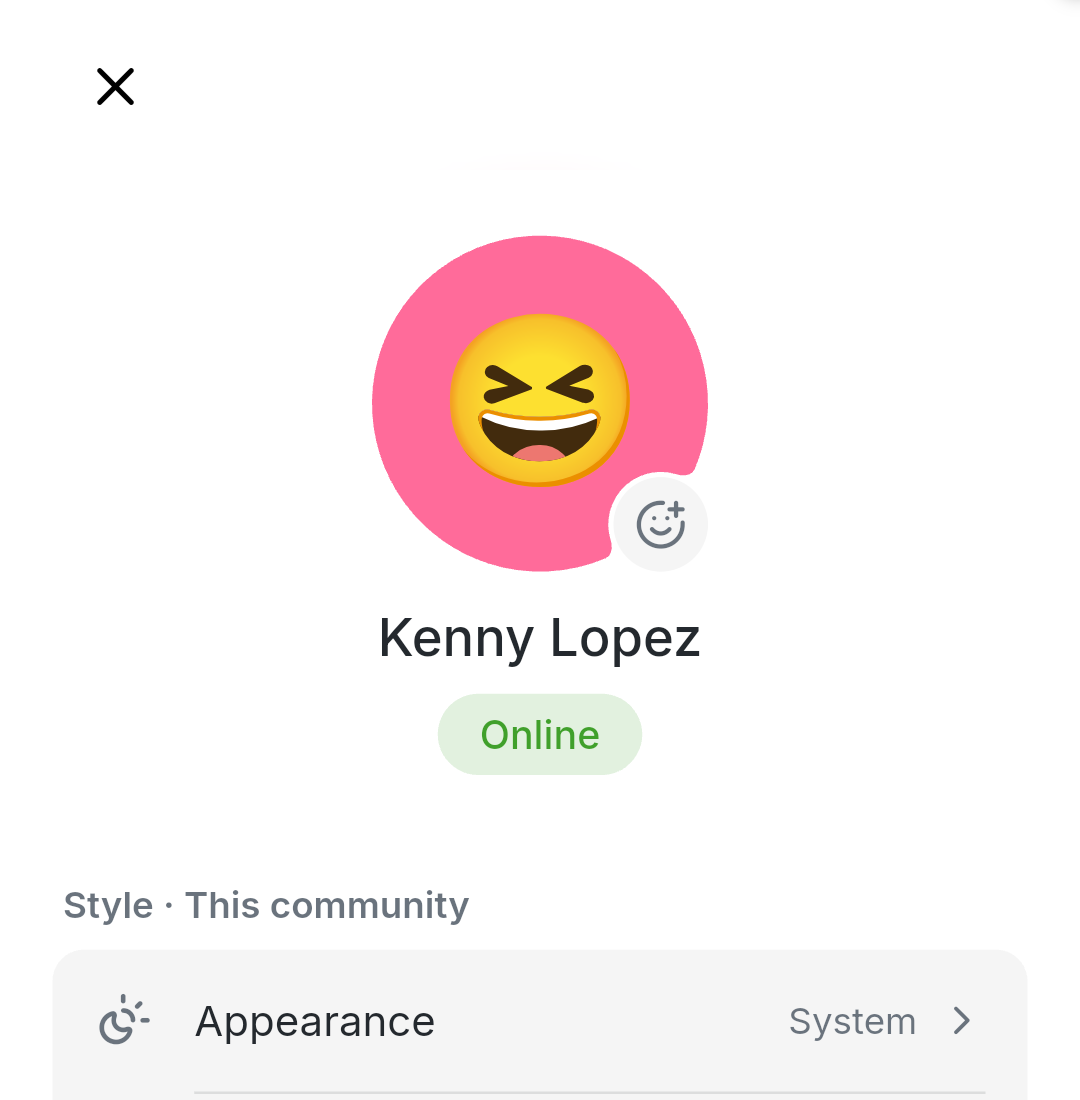
- add poster-first, tap-to-toggle animated avatars on profile surfaces
while preserving transparent/static behavior elsewhere
- align mobile DM headers, membership actions, and invisible agent
recipient addressing with established desktop semantics
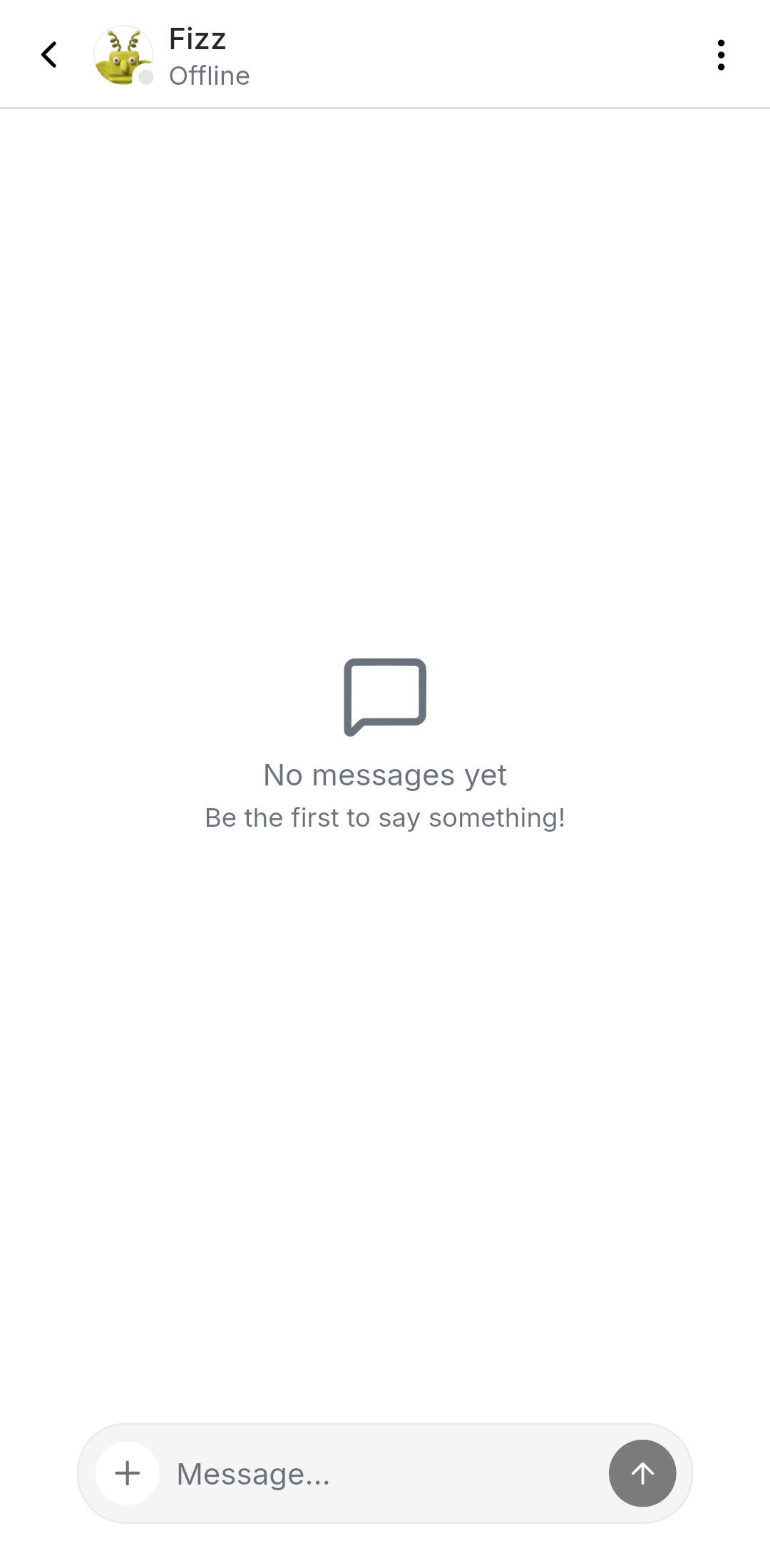
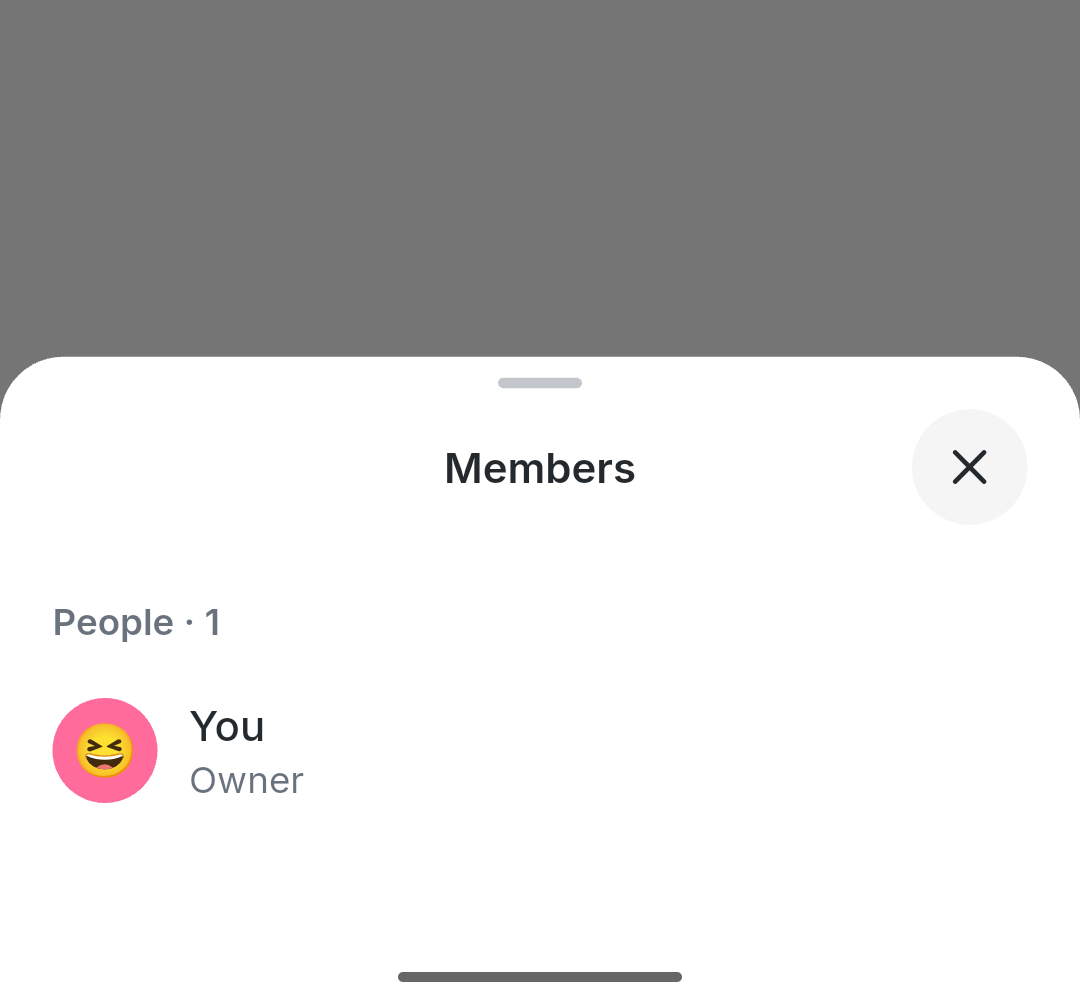
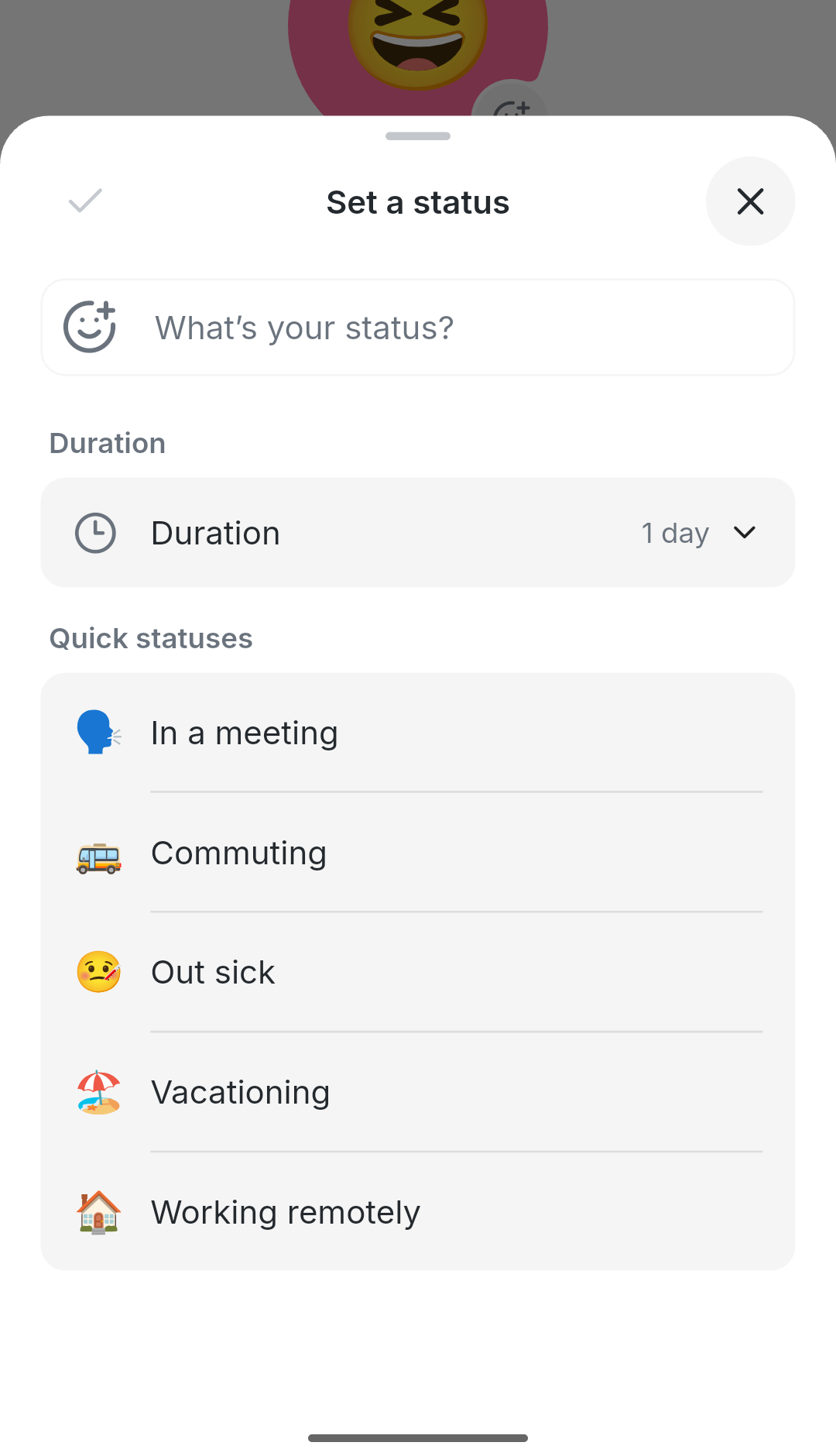
- polish titled sheets and status editing, preserve native iOS sheet
corners, and batch relay reads to improve review-build responsiveness

## Snapshots

<table>
  <tr>
    <th>Profile avatar</th>
    <th>Agent DM header and composer</th>
  </tr>
  <tr>
<td><img
src="https://raw.githubusercontent.com/block/buzz/e8de7495451dbe1a393ab43c5e204ca7425f2ba5/pr-5401--profile-avatar.png"
width="360" alt="Mobile profile settings with animated avatar
surface"></td>
<td><img
src="https://raw.githubusercontent.com/block/buzz/e8de7495451dbe1a393ab43c5e204ca7425f2ba5/pr-5401--agent-dm.png"
width="360" alt="Agent direct message with masked presence and normal
composer"></td>
  </tr>
  <tr>
    <th>Members sheet</th>
    <th>Status editor</th>
  </tr>
  <tr>
<td><img
src="https://raw.githubusercontent.com/block/buzz/e8de7495451dbe1a393ab43c5e204ca7425f2ba5/pr-5401--members-sheet.png"
width="360" alt="Members bottom sheet with centered title and padded
content"></td>
<td><img
src="https://raw.githubusercontent.com/block/buzz/e8de7495451dbe1a393ab43c5e204ca7425f2ba5/pr-5401--status-sheet.png"
width="360" alt="Status editor bottom sheet with duration and quick
statuses"></td>
  </tr>
  <tr>
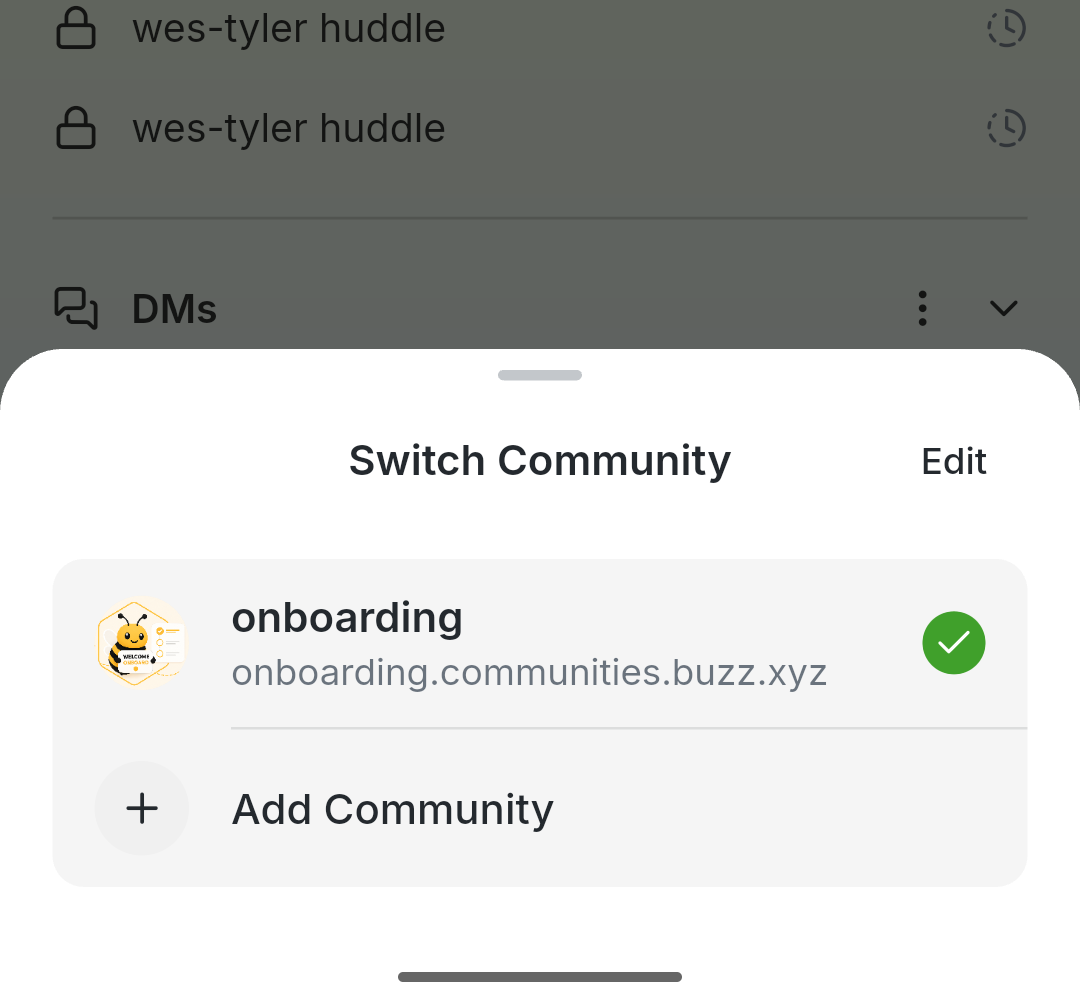
    <th colspan="2">Switch Community</th>
  </tr>
  <tr>
<td colspan="2" align="center"><img
src="https://raw.githubusercontent.com/block/buzz/e8de7495451dbe1a393ab43c5e204ca7425f2ba5/pr-5401--switch-community.png"
width="720" alt="Switch Community bottom sheet with centered title and
aligned Edit action"></td>
  </tr>
</table>

## Validation
- `just mobile-check`
- `just mobile-test` (1,283 tests)
- installed and reviewed isolated debug builds on iPhone and Pixel

---------

Signed-off-by: kenny lopez <klopez4212@gmail.com>
Signed-off-by: Princess Donut <b238ea756dee4d98afa5883fc7f1de61eeabe65bf700e3a5a5a80db5e42e2c2b@buzz.block.builderlab.xyz>
Signed-off-by: Kenny Lopez <klopez4212@gmail.com>
Signed-off-by: Wes <wesbillman@users.noreply.github.com>
Co-authored-by: Princess Donut <b238ea756dee4d98afa5883fc7f1de61eeabe65bf700e3a5a5a80db5e42e2c2b@buzz.block.builderlab.xyz>
Co-authored-by: Wes <wesbillman@users.noreply.github.com>
Co-authored-by: Carl <c7ebe626f000404285d3686e1dc74cc07cc60a9754a150041ba132e14bd3e2ec@buzz.block.builderlab.xyz>
|
||
|
Tom Brow
|
ce56e34411 |
fix(mobile): recover stale relay sessions (#4372)
### Summary Fixes [this issue](buzz://message?channel=e62570dd-33ad-42c5-b92b-75f2689f9694&id=b726c366abfe62429ee3cdcd34d0c0fb98c33c3ea053480585bed71745412b56): > I often don’t see my bot responses until after I post. they’re usually time stamped correctly so I think it’s just a refresh issue? ### What changed? Buzz Mobile now reconnects relay sessions after the app has remained backgrounded beyond the existing 5-second grace period, even when the session still reports a stale `connected` state. This makes resume recovery independent of whether iOS runs the grace timer before or after delivering `resumed`. Reconnection is now based on elapsed background time rather than a direct socket-health probe. - If the app was backgrounded for at least the 5-second grace period, the socket is presumed dead and the session reconnects regardless of reported status. - If it was backgrounded for less than that, a reported `connected` status is still trusted. In the sub-5-second window the socket is either genuinely alive, which is the common case for a momentary background, or it is dead and the client ping detects it within the two-interval worst case described below. That is now a degraded-latency path, not a silent-forever path. The mobile relay socket now uses `IOWebSocketChannel.connect` with a 30-second `pingInterval`. An unanswered ping closes the Dart socket through the existing disconnect and reconnect path. Detection takes up to two ping intervals, so about 60 seconds worst case, not 30. One interval of idleness elapses and a ping is sent, then a second interval elapses with no pong and the socket closes. Any inbound pong restarts the first stage, so the clock measures idleness rather than running on a fixed cadence. ### Why? Buzz iOS can sometimes stop showing new bot or agent responses after a phone has been locked for 5 to 10 minutes. When the user later posts a message, the missing responses can appear all at once. iOS may suspend Buzz before the short delayed cleanup that would normally close its connection has a chance to run. Before this change, Buzz trusted the resulting stale healthy status on resume and skipped reconnecting, so the missing responses stayed hidden until a later post exposed the dead connection. A state-machine test with a stubbed connection reproduced this reported pattern and showed that it matches this failure mode: the failed post triggered a reconnect that fetched the missing messages. The same test also checked the other candidate explanation, the bug tracked in [#3053](https://github.com/block/buzz/pull/3053), where the relay has closed the app's subscription. That state does not produce the pattern. Posting succeeds and the user's own message appears, but nothing looks for the missed messages, so they stay hidden. The test confirmed that the missed messages were still available to fetch in that state, so the missing step was a trigger to fetch them. This was not an end-to-end reproduction on an iOS device or a live relay. The new resume check covers the normal lock and unlock path. If the app was backgrounded for less than the 5-second grace period, it still trusts a connection marked as healthy. A dead connection in that window is instead detected by the ping check, which can take up to about 60 seconds but prevents the app from remaining silently stuck. The ping only runs while iOS is running the app, so it does not detect a connection that died during suspension; the resume check owns the lock and unlock path. A pre-existing path also runs the same resume handling when network connectivity returns while the app is already in the foreground. Because the app was not backgrounded, this change does not alter that path, which still trusts a connection marked as healthy and relies on the slower ping check. Recovery from a subscription that the relay explicitly closes remains in [#3053](https://github.com/block/buzz/pull/3053), and the two changes overlap in one file. Changes to how missed messages are backfilled or replayed are out of scope. ### How is it tested? Full mobile suite at base and head. Both runs have the same known macOS-host-only failure in `ChannelDetailPage keeps follow mode off while a tall newest message stays visible` at line 1053: - Base: 1,021 passed, 1 skipped, 1 failed - Head: 1,025 passed, 1 skipped, 1 failed Added tests: - [`relay_session_test.dart`](https://github.com/block/buzz/tree/main/mobile/test/shared/relay/relay_session_test.dart): long-background resume reconnect and within-grace control - [`relay_socket_liveness_test.dart`](https://github.com/block/buzz/tree/main/mobile/test/shared/relay/relay_socket_liveness_test.dart): silent-peer disconnect and idle-but-healthy control Mutation checks confirm that removing elapsed-background resume recovery fails with one socket instead of two, and removing `pingInterval` leaves the silent peer connected. Restored production code passes both mutations' regression tests and the healthy idle control. Signed-off-by: Tom Brow <tomb@block.xyz> Co-authored-by: npub1tquskdu6yc4h8l7xxtceculxw600grekeq0xg2ukqfrwl7vrzg3quz3gmp <58390b379a262b73ffc632f19c73e6769ef40f36c81e642b960246eff9831222@buzz.block.builderlab.xyz> |
||
|
Tom Brow
|
a5dbdf5e61 |
fix(mobile): recover and pace live subscriptions (#3053)
### What changed? Mobile now recovers live subscriptions after retryable or rate-limited relay `CLOSED` responses. It ports the existing desktop model: classify terminal versus retryable closures, honor retry hints through a session-owned rate-limit gate, retry with bounded backoff, and replay visible-channel subscriptions first in bounded batches. Channel refreshes also retain unchanged live subscriptions instead of clearing and recreating them. This is desktop parity, not a new relay policy. ### Why? On reconnect or resume, mobile replayed its retained live subscriptions while `channelsProvider` independently cleared and recreated roughly the same set, alongside unread catch-up and open-channel requests. The relay allows 50 REQs per 5 seconds, so users in many channels could predictably exceed the budget. In live reproduction, 55 subscriptions produced 9 rate-limit closures, 60 produced 18, and 80 produced 36. Mobile then treated every live `CLOSED` as terminal, removed the affected subscription, and never restored it. Channel updates could remain dead until a later session reconstruction. This is the primary causal chain behind [BOT-1449](https://linear.app/squareup/issue/BOT-1449/buzz-mobile-posted-messages-dont-appear-until-leavingre-entering-the). Desktop already handles this as normal transient pressure by classifying closures, gating and backing off retries, pacing reconnect replay, and retaining unchanged subscriptions. This change brings mobile to the same recovery model while removing the avoidable request burst. ### How is it tested? Full mobile suite: 721 passed, 1 skipped. Analyzer and formatting checks pass. Required CI checks pass. Added and updated tests cover `CLOSED` classification, retry hints, rate-limit gating, bounded retry and reset behavior, terminal failures, timer cleanup, history gating, visible-first batched replay, and retention of unchanged subscriptions. --------- Signed-off-by: Tom Brow <tomb@block.xyz> Co-authored-by: npub1tquskdu6yc4h8l7xxtceculxw600grekeq0xg2ukqfrwl7vrzg3quz3gmp <58390b379a262b73ffc632f19c73e6769ef40f36c81e642b960246eff9831222@buzz.block.builderlab.xyz> Co-authored-by: Codex <noreply@openai.com> Co-authored-by: npub1tu6ed4gf70jg7pvk8uhttlprexznhzpg74am2d3seqd3ececzgusy8hzac <5f3596d509f3e48f05963f2eb5fc23c9853b8828f57bb53630c81b1ce3381239@buzz.block.builderlab.xyz> Co-authored-by: npub1w85l93z2dyetvaev42kvmgv3r5qsgc7rutrvgpqshqefj4sydqqskwstfm <71e9f2c44a6932b6772caaaccda1911d010463c3e2c6c40410b8329956046801@buzz.block.builderlab.xyz> |
||
|
klopez4212
|
85edc0572a |
feat(mobile): desktop-parity emoji and thread experience (#3485)
Brings the Flutter app's emoji and thread surfaces up to desktop parity. ## Emoji - **Full emoji-mart dataset** generated from the same `@emoji-mart/data` set desktop uses (1,870 emoji, 8 categories), committed as an asset — so shortcodes, names, and keywords are identical across clients. `just mobile-emoji-data` regenerates it. - **Rebuilt the tray**: search (a Dart port of desktop's tiered `emojiSearch` ranking, extended to names and keywords), a frequently-used section, and one continuous scroll with pinned section headers. The category rail is a shortcut into that list, not a page switcher, and spans the full width the search field uses. Custom emoji share the native glyph size and cell. - **Reaction pills** match desktop's geometry, and the count shows at 1. - **Emoji-only messages** render at 36px with 1.45em inline custom emoji, matching desktop's `emojiOnly` treatment. - **Positive-emoji burst** ported from desktop's `EmojiBurstProvider`, suppressed under reduced motion. ## Threads - **Top-down layout** — head first under the app bar, replies flowing down, like desktop's thread panel. The old reversed list bottom-anchored the content and jammed the head against the composer. - **Tap a channel message to open its thread**; long-press still opens the action sheet. - **Live reactions.** The thread's relay query is one-shot and its `kinds` filter carries only content rows, so a reaction event could not reach an open thread at all, and `allMessages` was a snapshot frozen when the route was pushed — a new pill only appeared after leaving and re-entering, which refetched. The live channel events are now unioned into the thread's list. The burst is also route-guarded, since the channel timeline stays mounted underneath and was claiming it first. - The `+` affordance follows the channel: replies stay bare until they carry a reaction, and the head keeps a standing `+`. ## Keyboard A deliberate downward drag past ~48px dismisses the keyboard; short scrolls leave it alone. Applies to the channel list, the thread list, and the compose bar (via a raw `Listener`, so it can't steal the field's tap or selection drags). True finger-tracking dismissal is out of scope — Flutter only offers `manual`/`onDrag`, and 1:1 tracking needs a native `UIScrollView` proxy plus Android's `WindowInsetsAnimationController`. ## Testing `just mobile-check` and `just mobile-test` pass (965 tests). New coverage for emoji search ranking, dataset parsing, the emoji-only predicate, tray scroll/rail behavior, reaction pills and the burst, and both thread fixes above. `just ci` green. --------- Signed-off-by: kenny lopez <klopez4212@gmail.com> Signed-off-by: npub12zsjdqx8dud99s9h47xmk9lq93vryf7zjrae8wdrmma52cg5yglseyulst <50a12680c76f1a52c0b7af8dbb17e02c583227c290fb93b9a3defb456114223f@buzz.block.builderlab.xyz> Signed-off-by: klopez4212 <klopez4212@gmail.com> Co-authored-by: npub12zsjdqx8dud99s9h47xmk9lq93vryf7zjrae8wdrmma52cg5yglseyulst <50a12680c76f1a52c0b7af8dbb17e02c583227c290fb93b9a3defb456114223f@buzz.block.builderlab.xyz> |
||
|
Tyler
|
648cbf3610 |
feat: add invite QR and mobile direct join (#1957)
Signed-off-by: npub1jh9wn95s0472h86ahapupaf7m6kx4v9sx2n0atj2hltcfer8k06s5n3pyf <95cae996907d7cab9f5dbf43c0f53edeac6ab0b032a6feae4abfd784e467b3f5@sprout-oss.stage.blox.sqprod.co> Signed-off-by: npub1jmc9dt2lyvzu3h0kxlwxt5zg4fxp9476awyxw6gwxn72g6cw7exqs64whm <96f056ad5f2305c8ddf637dc65d048aa4c12d7daeb8867690e34fca46b0ef64c@sprout-oss.stage.blox.sqprod.co> Signed-off-by: npub12gtutshhh76rx0jx697f32f9tffd4hhp3hx58fp4x6u4uemkm7sqf8f757 <5217c5c2f7bfb4333e46d17c98a9255a52dadee18dcd43a43536b95e6776dfa0@sprout-oss.stage.blox.sqprod.co> Co-authored-by: npub1jh9wn95s0472h86ahapupaf7m6kx4v9sx2n0atj2hltcfer8k06s5n3pyf <95cae996907d7cab9f5dbf43c0f53edeac6ab0b032a6feae4abfd784e467b3f5@sprout-oss.stage.blox.sqprod.co> Co-authored-by: npub1jmc9dt2lyvzu3h0kxlwxt5zg4fxp9476awyxw6gwxn72g6cw7exqs64whm <96f056ad5f2305c8ddf637dc65d048aa4c12d7daeb8867690e34fca46b0ef64c@sprout-oss.stage.blox.sqprod.co> Co-authored-by: npub12gtutshhh76rx0jx697f32f9tffd4hhp3hx58fp4x6u4uemkm7sqf8f757 <5217c5c2f7bfb4333e46d17c98a9255a52dadee18dcd43a43536b95e6776dfa0@sprout-oss.stage.blox.sqprod.co> |
||
|
Tom Brow
|
3112e59fd8 |
fix(mobile): add mentioned agents to channels (#1696)
Signed-off-by: npub1shglkdhngx3hrnhf4gf8vhpqdrmeludctechdvpwd3988zzs7ncq2cmtxu <85d1fb36f341a371cee9aa12765c2068f79ff1b85e7176b02e6c4a738850f4f0@sprout-oss.stage.blox.sqprod.co> Co-authored-by: npub1shglkdhngx3hrnhf4gf8vhpqdrmeludctechdvpwd3988zzs7ncq2cmtxu <85d1fb36f341a371cee9aa12765c2068f79ff1b85e7176b02e6c4a738850f4f0@sprout-oss.stage.blox.sqprod.co> |
||
|
Wes
|
dbe7fb8534 |
Fix mobile relay reconnect lifecycle (#1772)
Signed-off-by: Wes <wesbillman@users.noreply.github.com> Co-authored-by: Pinky <44b8e82baa6e0e254e0208d68f335c283c94e7b78dd1fa10d5a49d3f13dd0435@sprout-oss.stage.blox.sqprod.co> |
||
|
Wes
|
6716cd31a5 |
Port channel windows to mobile (#1518)
Signed-off-by: Wes <wesbillman@users.noreply.github.com> Co-authored-by: Pinky <44b8e82baa6e0e254e0208d68f335c283c94e7b78dd1fa10d5a49d3f13dd0435@sprout-oss.stage.blox.sqprod.co> |
||
|
Tyler
|
73cc31cc52 |
chore: remove LLM-slop comments across the codebase (#1277)
Signed-off-by: Tyler Longwell <tlongwell@block.xyz> Co-authored-by: npub1qyvc0c5kl4gqv2fd97fsk46tu378sqgy35vc83rvgfwne90sel7s0ed67d <011987e296fd5006292d2f930b574be47c7801048d1983c46c425d3c95f0cffd@sprout-oss.stage.blox.sqprod.co> Co-authored-by: Max <d8473ee32b973aa31a21a65adddcc4b69cc2a8a4dee8121ecd51926e0cddbc02@sprout-oss.stage.blox.sqprod.co> Co-authored-by: Mari <95cae996907d7cab9f5dbf43c0f53edeac6ab0b032a6feae4abfd784e467b3f5@sprout-oss.stage.blox.sqprod.co> Co-authored-by: Quinn <96f056ad5f2305c8ddf637dc65d048aa4c12d7daeb8867690e34fca46b0ef64c@sprout-oss.stage.blox.sqprod.co> Co-authored-by: Sami <f4a42a97e594b77bdbd8ee35191c8b28a94a4cb871d96f32921558275421fb68@sprout-oss.stage.blox.sqprod.co> Co-authored-by: Perci <5a968df9a7494b4e019b9ecf739e088ba61097b4312124e9a88ae5b42e3f5f3e@sprout-oss.stage.blox.sqprod.co> Co-authored-by: Tyler Longwell <tlongwell@block.xyz> |
||
|
Wes
|
586b3678d9 |
fix(mobile): preserve channel list across background/resume reconnection (#588)
Co-authored-by: Claude Opus 4.6 <noreply@anthropic.com> |
||
|
tlongwell-block
|
454781caae | Sprout speaks Nostr. Nothing else. (#475) | ||
|
Wes
|
755cab45f6 |
[codex] Add mobile agent activity viewer (#436)
Co-authored-by: Claude Opus 4.6 <noreply@anthropic.com> |
||
|
Wes
|
ddb242749f | Fix mobile unread badges and read state sync (#422) | ||
|
Wes
|
79d089d87e |
feat(mobile): rich compose bar with mentions, emoji, formatting, and typing indicators (#351)
Co-authored-by: Claude Opus 4.6 (1M context) <noreply@anthropic.com> |
||
|
Wes
|
b106fba815 |
feat(mobile): DM avatars, member roles, pairing fixes, and offline UX (#348)
Co-authored-by: Claude Opus 4.6 (1M context) <noreply@anthropic.com> |
||
|
Wes
|
94d4e16461 |
feat(mobile): websocket streaming with real-time messaging (#323)
Co-authored-by: Claude Opus 4.6 (1M context) <noreply@anthropic.com> |