mirror of
https://github.com/block/buzz.git
synced 2026-11-24 18:21:59 +00:00
21802f019e19e2836f35da660e090511b6ccf32b
6 Commits
| Author | SHA1 | Message | Date | |
|---|---|---|---|---|
 Tom Brow |
9e40bf5d79 |
perf(mobile): don't treat a Control Center pull as a resume (#9443)
Pulling down Control Center or Notification Center, answering a system alert, or glancing at the app switcher moves the app to `inactive` and straight back to `resumed`. The app never leaves the foreground and the socket stays connected, but every resume listener treated it as a return from the background. Each glance re-read the channel list (memberships, metadata, unread catch-up), the four settings documents (mutes, stars, sections, sort) and the Me groups, and tore down and rebuilt the community presence subscription. On a heavy Builderlab account that is about 2.6 MB per glance. This adds `appForegroundProvider`, which follows the app lifecycle but ignores `inactive`. The resume refreshes and both presence providers watch it instead of the raw lifecycle, so they run only when the app actually comes back from the background. Camera capture keeps watching the raw lifecycle, since it has to release the camera while the app is inactive. ### Validation Added tests: the channel sync journey test now pulls the app through `inactive` and back without leaving the foreground and expects no membership read; it fails without this change (2 reads instead of 1). The existing resume and background cases in that test still pass unchanged. A second step lets a failed list read's retry come due while the app is `inactive`; it is read then, not left for a resume that no longer comes (it fails without the read gate change, 8 reads instead of 9). Full mobile test suite passes. On an iPhone 12 mini signed in to Block's Builderlab (instrumented profile build), pulling Control Center down and dismissing it: | | Downloaded after dismissing it | | --- | --- | | Before | 2.6 MB (rosters 1.5 MB, latest messages 0.7 MB, channel metadata 183 KB, settings, presence resubscribe) | | After | 6.5 KB (live typing and presence only) | The same run covered cold start, 5 minutes idle on Messages, and a resume after 60 s in the background; the resume still refreshed the channel list, read state and settings documents as before (2.8 MB HTTP, 2.1 MB WebSocket). ### Regressions None expected. A real return from the background still goes through `hidden`/`paused` first, so it triggers every refresh it did before. The only behavior change is for `inactive` alone: no refetch, and the user's presence no longer flips through a republish of `online`. A channel-list read that comes due during `inactive` (a membership notice or a retry) now runs then instead of waiting for a resume, since the socket is still connected. A missed live event during a Control Center glance is still caught by the next real resume or reconnect, as before for any time in the foreground. --------- Signed-off-by: Tom Brow <tomb@squareup.com> Co-authored-by: Tom Brow <tomb@squareup.com> Co-authored-by: studio <dc2fc481343672df31a689840c09299972e704dac592e0da6f18486646a7ee3e@localhost> |
||
|
Wes
|
fffd8ca957 |
fix(mobile): recover Solo sync silently instead of showing a retry banner (#8701)
## Problem The mobile Solo section could display "Live updates stopped. Your saved chats are still available." with a **Retry live updates** button. Any failed Solo head refresh raised this banner. That includes the refresh that runs on app resume before the relay has reconnected, and an 8s history timeout. In those cases the live subscription itself was still healthy. A later successful refresh did not clear the banner, so it stayed up until someone tapped Retry. ## Change - Remove the banner along with `MeSync.syncClosed` and `meSyncWarningProvider`. Saved chats stay visible the whole time. - `meGroupsProvider`: on app resume, an interrupted reader (terminal CLOSED or a failed read) resubscribes on its own while the relay is connected. Before the relay reconnects, the existing rebuild-on-reconnect still owns recovery. A healthy reader keeps doing a plain head refresh. - Home's pull-to-refresh (`ChannelsPage` with the Solo sliver) now also restarts the Solo reader. Before this change, that path refreshed channels only, so in the shipped layout the banner was the only manual recovery. - The no-snapshot `_MeRetry` state and the offline-save warning are unchanged. ## Validation - `flutter analyze` is clean. - The pre-push `mobile-checks` passed. - The journey step in `offline_save_page_test.dart` closes the subscription, cycles background and foreground, asserts a new subscription, and checks that a newer event delivered on it is saved. Removing the `subscriptionClosed` recovery branch fails it. - The new `channels_page_test.dart` case drags to refresh with a Solo sliver and asserts the Solo reader restarts. Removing the invalidation fails it. - Not yet exercised in the running app. That is checklist steps 2 and 3. Reviewed by the Royal Court agents (provider lifecycle, recovery/UX, independent challenge); the one blocker (Home pull-to-refresh) is fixed here. 🤖 Generated with [Claude Code](https://claude.com/claude-code) Signed-off-by: Wes <wesbillman@users.noreply.github.com> Co-authored-by: Claude Opus 5.5 <noreply@anthropic.com> Co-authored-by: Carl <32a2e2c9d428ee08902cab75d956da2c1d235a22d4766b0dd4138bf6e2e5db1d@buzz.block.builderlab.xyz> |
||
|
Tom Brow
|
ccfc1490e4 |
perf(mobile): verify signatures with native libsecp256k1 (#8657)
The app already verifies signatures in a few places: NIP-OA agent
profiles and owner attestations, Solo `me_*` records (agent inventory,
archived agents, assistants, sync), and pairing events. Each used
`nostr.Event.fromJson`'s pure-Dart BIP-340 verify, about 11.2 ms per
event on an iPhone SE (2nd gen, Profile). This routes them through
`verifiedNostrEventFromJson` and `verifySchnorrHex`, which keep the same
checks (timestamp range, canonical id, Schnorr signature) and the same
`nostr` exception types, with the signature check in libsecp256k1 (40
µs). NIP-OA owner authorizations are now signed with `signSchnorrHex`,
which removes the last pure-Dart Schnorr call in `lib`.
Incoming relay events are still not verified; that stays a separate
decision.
A native trace showed pure-Dart Schnorr verify in `me_sync` and `nip_oa`
costs 100-125 ms per foreground. This PR moves exactly those sites.
### Validation
- Added tests: the native verifier accepts a valid event and rejects
tampered content, a wrong signature, a different pubkey, malformed and
short signatures, and a zero timestamp, each also rejected by the
pure-Dart verifier. Hex Schnorr helpers are checked in both directions
against `nostr.Schnorr`.
- Focused existing validation: crypto, NIP-OA, Solo/me, pairing and
agent tests pass. `just mobile-install mobile-check mobile-test` passes
at
|
||
|
Tom Brow
|
8161a7cad0 |
perf(mobile): derive public keys with native libsecp256k1 (#8655)
Follows #8654. Deriving an x-only public key from a secret key with `nostr.Keys(secret).public` costs about 5.6 ms in pure Dart on an iPhone SE (2nd gen, Profile). The app does it in 10 places, including relay config, the signed-event relay's `pubkey` getter, push lease checks, status updates, and the settings identity row's `build` method. This routes all of them through `derivePublicKeyHex` from #8654, which takes 16.5 µs on the same device. Behavior is unchanged for valid keys: output is the same lowercase hex. For a malformed or out-of-range key the thrown type changes from nostr's `InvalidKeyException` to `ArgumentError`; every affected site either catches all errors or rethrows its own `FormatException`/`StateError`, and nothing in `lib` or `test` matches on the old type. Sites that need a full `nostr.Keys` object (key generation, `AccountIdentityStore`) are unchanged. ### Validation - `derivePublicKeyHex` is checked against `nostr.Keys` for 64 random keys in #8654's `event_signing_test.dart`. - Full mobile analyze and test suite pass on this branch after rebasing onto main, including the package's own tests. - iPhone 12 mini, Profile build of this stack (with #8656 and #8657 on top): paired to the internal Buzz community through Desktop; relay auth, identity row, avatar, and channel/DM/inbox loading all worked under the derived key. buzz-review-completed (agent review, Codex and security review clean; device validation above; human app test not applicable under the mobile testing exception) 🤖 Generated with [Claude Code](https://claude.com/claude-code) --------- Signed-off-by: Tom Brow <tomb@block.xyz> Co-authored-by: george <973be878edd6d4f79692a3827f20a6f7fe0ed0362f269ff6b6ba8867033d7d8e@sprout-oss.stage.blox.sqprod.co> Co-authored-by: Claude Opus 5.5 <noreply@anthropic.com> |
||
|
Tom Brow
|
4ff02bf03b |
perf(mobile): sign events with native libsecp256k1 on iOS and Android (#8654)
Mobile signs every Nostr event (sends, relay AUTH, media auth headers, preference writes) in pure Dart on the UI isolate. On an iPhone SE (2nd gen, Profile build) one BIP-340 signature costs about 10.7 ms and deriving the public key another 5.6 ms, so a burst of signed writes drops frames. This adds `mobile/packages/buzz_secp256k1`, a small FFI package that builds vendored bitcoin-core/libsecp256k1 v0.8.0 (ecdh, extrakeys, schnorrsig modules) through a Dart build hook, so the same C and the same Dart API ship on iOS and Android with no platform bridge code. All 13 `nostr.Event.from` signing sites now go through `signNostrEvent`, which keeps the `nostr` package's event-id serialization and moves only key derivation and signing to native code. Calls stay synchronous. The package also exposes `schnorrVerify` and `ecdhX`; follow-up PRs move verification and the NIP-44 conversation key over. Incoming relay events are still not verified, unchanged by this PR. Safety: the signing context is randomized once per isolate, secret keys and keypairs are wiped from the native scratch buffer after each call, aux randomness comes from `Random.secure()`, and the static verify context runs libsecp256k1's self test before first use. ### Validation - Added tests: BIP-340 official vectors and native-vs-pure-Dart differential tests in the package; `event_signing_test.dart` signs with 64 random keys and checks pubkey, event id and signature against the existing `nostr` builder and verifier, plus malformed-key rejection. - Full mobile analyze and test suite pass locally. - Builds: iOS release (framework ~1.3 MB) and Android debug APK with the library for arm64-v8a, armeabi-v7a and x86_64 (~1.2–1.3 MB each). - On-device (iPhone SE 2nd gen, Profile, median per op): sign 10,736 µs → 41 µs, derive pubkey 5,580 µs → 16.5 µs, full signed event 10,744 µs → 65 µs. Event-id JSON and SHA-256 are 23 µs, so they stay in Dart. - Device, iOS (iPhone SE 2nd gen, Profile): `buzz_secp256k1.framework` embedded; the signed-in app authenticated to a real community relay, loaded channels and history, and paged older messages. No native-asset or secp256k1 errors in the console. - Device, Android (emulator, debug): APK contains `libbuzz_secp256k1.so` and loads it. Against a local mock relay that verifies with the pure-Dart `nostr` package, the app's NIP-42 AUTH, NIP-98 `POST /query` headers, and kind 20001/30078 events all verified. - Blossom GET auth, iOS: the dev relay returns 401 for unauthenticated `/media/` GETs. From inside the running app, the production `MediaGetAuthService.headersFor()` header for a nonexistent hash got 404 (accepted, file missing), compared with 401 without it. The community has no relay-hosted image, so none was rendered. buzz-review-completed (agent review, Codex and security review clean; device validation above; human app test not applicable under the mobile testing exception) 🤖 Generated with [Claude Code](https://claude.com/claude-code) --------- Signed-off-by: Tom Brow <tomb@block.xyz> Co-authored-by: george <973be878edd6d4f79692a3827f20a6f7fe0ed0362f269ff6b6ba8867033d7d8e@sprout-oss.stage.blox.sqprod.co> Co-authored-by: Claude Opus 5.5 <noreply@anthropic.com> |
||
|
klopez4212
|
b1d60f98e2 |
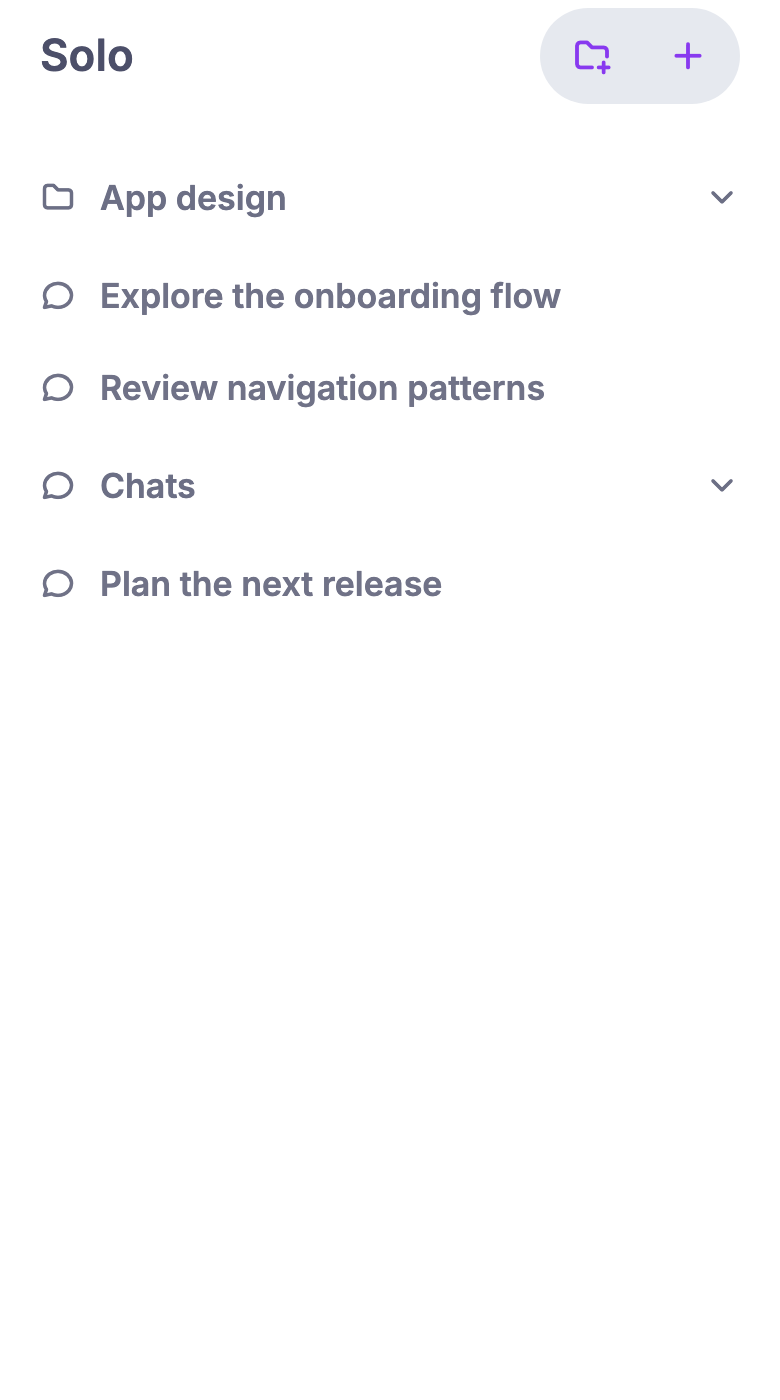
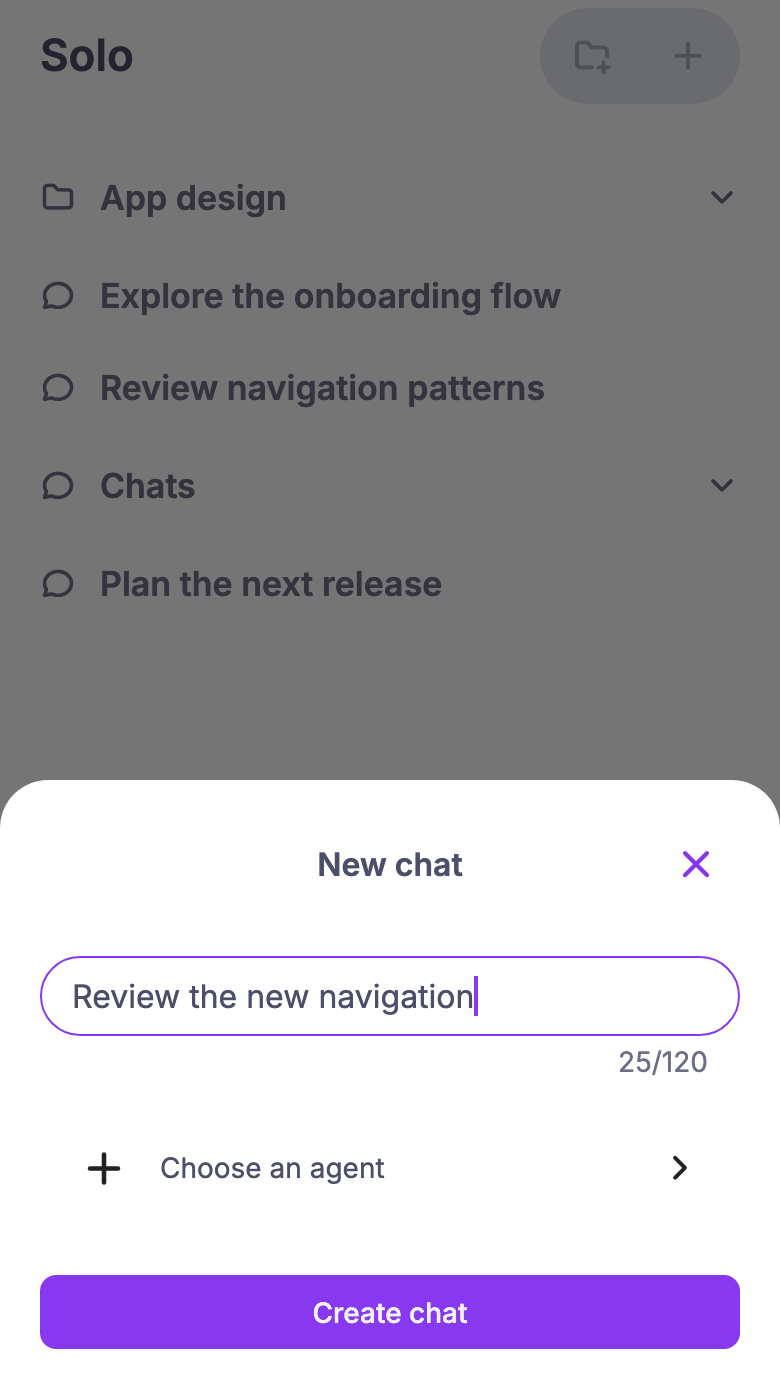
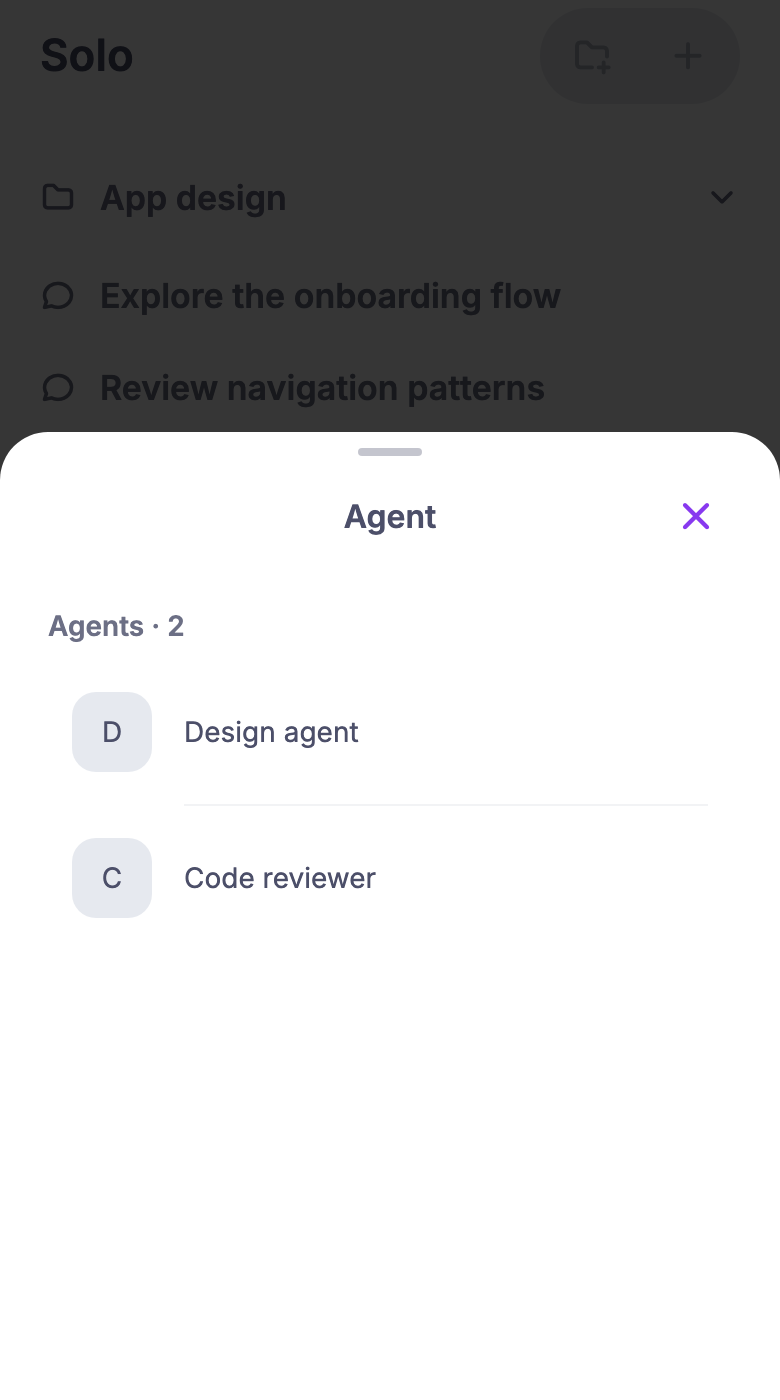
Bring synced Solo chats and projects to mobile (#8337)
## Summary Bring desktop Solo chats and project organization to mobile, with synced collapsible sections, shared unread highlights and tab badges, agent selection, shared search, native iOS creation sheets, and inline typing bubbles that transition into replies. Resolve Solo placement for every chat entry route, retain encrypted organization snapshots for offline reading, and let users resume or discard unfinished chat and project setup without deleting existing messages. ### Related issue Related: #6565; expandable agent transcripts remain separate work. ### Testing - Fresh Solo read state seeds each active chat from its captured initial last-message timestamp before exposing row/section/tab unread state. Baselines survive intervening channel updates and reset across identity/community boundaries while surviving read-state readiness changes. Regressions cover multiple chats, events before read-state readiness and during/after seeding, and identity changes; removing either the seed or the display gate fails them. - Chat completion reconciles a retained Solo-save journal even when placement is already confirmed. False/throwing cleanup regressions ensure the outer intent remains until reconciliation and only one placement is published. Typing terminal-close loops remain bounded; the retry budget resets after an uninterrupted eight-second health interval or transport reconnect. - Typing retry budgets reset after sustained recovery; invalid Solo updates retain cached rows with a retry warning that survives failed refreshes. Project names use the editors’ 120-grapheme limit, including emoji and combining characters. Regression coverage exercises repeated recovery, invalid live/refresh heads, and character-limit boundaries. - Rebased onto current main, preserving the newer Search controls, Huddle timeline filtering, and message-media layout. - Failed project journal writes reload storage before claiming recovery and reopen the entered name for retry. Typing subscription rejections are caught; terminal closures clear stale indicators and retry with a bounded backoff, canceled on disposal. Regression tests cover both false/throwing storage writes and initial/late subscription rejection. - Explicit ordinary destinations skip optional Solo lookup waits. Generic destinations perform one bounded lookup in the destination (search no longer duplicates it); an unavailable classification falls back to ordinary sending per the product owner's explicit choice. Positively identified Solo destinations use Solo providers. - Terminal Solo subscription closure preserves cached rows and exposes live-update Retry. Page coverage verifies warning visibility, usable rows during recovery, and a subsequent terminal close. Removing the warning or the immediate ordinary-route guard fails its regression. - Generic channel entries share an ordinary default when Solo classification is unavailable, per the requested product behavior. Known Solo placement takes precedence; callers can explicitly require unresolved placement to remain blocked. Bounded initial lookup preserves known Solo deep-link routing. - Dirty newest snapshots and offline-save warnings survive transport reconnects; Retry persists that same event even if the relay returns an older head. Community changes replace the service, and agent-directory reconnect refresh remains intact. - Pending-save discard reloads failed removals. Repeated reconnect testing confirms typing subscriptions are released on provider rebuild and disposal; removing the existing cleanup fails the regression. - Ordinary Home/create routes explicitly preserve private-channel sending during Solo failures; identified Solo sends use the Solo sender and explicit unresolved routes remain fail-closed. Solo unread replies beyond the initial 200-event page are loaded through the oldest-unread boundary. - Chat/project/agent cleanup reloads failed removals, retains same-process recovery, and protects replaced records. False/throw regressions verify retries do not duplicate creation or membership. Route, unread, and cleanup guard-removal mutations each fail their regression. - Ordinary channels, DMs, and forums remain sendable when optional Solo sync fails; explicit unresolved placement stays blocked. Controlled cache races retain the newest verified snapshot, keep usable chats visible, and retry offline persistence without stale writes. Both protection-removal regressions fail as expected. - Confirmed journal cleanup checks false/throwing removal and exact-record identity. Interrupted agent choices are visible immediately, identify the saved agent, and cover Resume/Later/Discard with accessible name/key-fallback controls. - Notification deep links preserve the contiguous history cursor; same-second messages infer the newest agent consistently. Failed offline-cache writes surface Retry, with false/throwing storage failures and offline restart covered. - Composite history cursors cover 350 same-second events plus older history; removing the ID cursor makes the regression fail. Agent changes now journal before granting access, with restart/failure and Resume/Later/Discard widget coverage. Signed malformed profiles remain isolated. - Native iOS avatar tests passed on the simulator: visible-row loading, three-request concurrency, streamed byte limits, response validation, downsampling/pixel limits, cancellation, and visible avatar updates. - Solo and Home share observed-event/read-marker logic. Widget coverage verifies unread rows, collapsed-section indicators, the tab badge before first Solo visit, message/thread reads, forced unread, and filtering archived/nonmember/unplaced chats. - Chat intent is saved before ownership and organization preflight; tests cover interrupted ownership lookup and a disconnect while the native creation form is open. - Mobile analysis, formatting, file-size checks, and full mobile tests passed at `1d4c41354`. - Project creation persists its encrypted name/UUID before connectivity checks or relay reads. Restart tests cover Resume/Later/Discard, scope isolation, stale-intent rejection, and lost acknowledgements. Removing the pre-network save makes all four production-flow regressions fail. - Regression coverage includes notification/Activity routing, inline replies, unknown-placement send protection, restart recovery/discard, and encrypted offline cache isolation/refresh. - Earlier feature build exercised on a physical iPhone with existing account/community data; review follow-ups have not been reinstalled on the device. UIKit agent-row accessibility checks passed on an iOS simulator. - Earlier cross-platform `just ci` stopped on the existing `buzz-acp` test `signals_cancel_startup_turn_and_pending_stdin_without_hanging` (process exit-code assertion); no Rust production changes are included in this PR. ### Remaining review limitation Agent discovery is bounded to 10 pages / 1,000 profiles with automatic retries disabled. Owner-scoped discovery remains open because the current relay ignores `#auth` filters; supporting that query requires a relay change. ### Snapshots Sample data, shared Flutter/Android surface. Native iOS uses platform sheets and controls. | Solo: projects and chats | New chat | Choose an agent | | --- | --- | --- | | <img src="https://raw.githubusercontent.com/block/buzz/d9b29aa079a3b9a88e8ed89b70df8d6af06fa41b/pr-8337--01-solo.png" width="240" alt="Solo with collapsible projects and chats" /> | <img src="https://raw.githubusercontent.com/block/buzz/d9b29aa079a3b9a88e8ed89b70df8d6af06fa41b/pr-8337--02-new-chat.png" width="240" alt="New chat form" /> | <img src="https://raw.githubusercontent.com/block/buzz/d9b29aa079a3b9a88e8ed89b70df8d6af06fa41b/pr-8337--03-agent-picker.png" width="240" alt="Agent selection list" /> | --------- Signed-off-by: kenny lopez <klopez4212@gmail.com> Signed-off-by: Logan Johnson <loganj@squareup.com> Co-authored-by: Terp <5856f6900e8e0a4e0ea1f4f8d2ee33e4753d2119bc122f94ecafc660b46c0511@buzz.block.builderlab.xyz> Co-authored-by: Logan Johnson <loganj@squareup.com> Co-authored-by: Larry <627498bd4bd1f281a16431e3c6cce3b5c25b6692798c78672298aefbf2f8f8b5@buzz.block.builderlab.xyz> |