mirror of
https://github.com/block/buzz.git
synced 2026-10-28 13:01:10 +00:00
2d93ea095535e42ee3a9933f00a4c0bd5e9e1c67
559 Commits
| Author | SHA1 | Message | Date | |
|---|---|---|---|---|
 Brad Seiler |
47526784d5 |
fix(deletion): allow IRSA S3 credentials (#6495)
## Why `buzz-admin deletions` runs inside bb-public relay pods, where S3 credentials are provided by the pod credential chain rather than static `BUZZ_S3_ACCESS_KEY` / `BUZZ_S3_SECRET_KEY` values. The deletion CLI was requiring those two env vars to be non-empty before constructing the shared media storage client, so it could not reach the existing default AWS credential chain. ## What - Treat missing/blank deletion S3 access key and secret key as an empty credential pair so `MediaStorage::new` can use `Credentials::default()`. - Keep the existing static-credential path unchanged when both values are non-empty. - Keep deletion unit tests deterministic by covering only deletion env normalization for missing/blank pair, trimmed static pair, and partial/whitespace-partial outputs; shared media tests continue to own credential-pair enforcement. ## Risk Assessment Low and scoped to the operator-only community deletion CLI startup path. The shared media storage credential validation still owns static-vs-default credential selection and still rejects mixed partial credentials. ## Testing At committed head `0a86c2914b1f97caf4788a771048aa8d9d9d88ac` with a clean worktree before and after (`git rev-parse HEAD` before/after matched): - `just fmt-check` — passed. - `cargo test -p buzz-deletion` — passed: 12 passed, 9 ignored. - `cargo test -p buzz-media` — passed: 120 passed; `static_creds_round_trip_against_minio` remained ignored because it requires live MinIO. - `cargo test -p buzz-admin` — passed: 1 passed. - `cargo clippy -p buzz-deletion --all-targets -- -D warnings` — passed. - Startup smoke at the same head: built `buzz-admin`, then ran `target/debug/buzz-admin deletions drain` with `BUZZ_S3_ACCESS_KEY=` and `BUZZ_S3_SECRET_KEY=' '` plus `AWS_ACCESS_KEY_ID` / `AWS_SECRET_ACCESS_KEY` fallback credentials; command exited `0`, proving startup transitions past deletion S3 key validation and exercises the shared default credential-chain branch using AWS env fallback credentials. - `git push origin HEAD:seiler/deletion-irsa-credentials` — passed; pre-push hooks passed. Not run: the full `TESTING.md` live-local relay workflow. Docker Desktop currently refuses CLI access on this machine with `Sign in to continue using Docker Desktop. Membership in the [squareup] organization is required.` ## References - Buzz channel: `buzz://message?channel=9e4aabc6-414c-4978-aba7-b9f5228776de&id=177c5b8ad9e78a647f438ec7040d25f0c20a7c2b8678dd0e34768effe053f7f4` Generated with Codex --------- Signed-off-by: coder 0 <d97ebdbb198c7237c94f84ea8bb8a73583ea067407eebd0062abbb3962527fb1@buzz.block.builderlab.xyz> Co-authored-by: coder 0 <d97ebdbb198c7237c94f84ea8bb8a73583ea067407eebd0062abbb3962527fb1@buzz.block.builderlab.xyz> |
||
|
Salman Mohammed
|
025425591e |
fix(benchmarks): wait for scripted event delivery (#6487)
## Why The Buzz-native runtime could stop a solo agent after one turn even when a scripted follow-up event was queued or already running. That could turn a harness timing race into a benchmark failure. Follow-up to #6448. ## What - Treat solo tasks with scripted events separately from ordinary one-turn tasks. - Wait until turn counts and authored message IDs remain idle and unchanged for several polls before stopping the agent. - Remove the message-count shortcut that could stop an active turn. - Add focused regressions for a delayed follow-up turn and an already-running turn with a `DONE:` message. ## Testing - `pytest -q tests/test_container_runtime.py -k "solo_turn_end or scripted_events"` — 3 passed - `ruff check` on the three touched Python files - `ruff format --check` on the three touched Python files - Local `buzz-native-solo-luna.yaml` Harbor run, one attempt per affected task: - `cross-thread-requests` — reward 1.0; all 6 task-specific checks passed - `interleaved-agent-reports` — reward 1.0; all 7 task-specific checks passed - 2 completed trials, 0 exceptions, 56 seconds total ## Risk Low. This only changes completion detection for solo benchmark tasks with scripted events. Ordinary solo tasks retain immediate completion after their first turn ends. --- **Update Aug 21, 13:07 EDT:** Replaced the fixed settle delay with exact delivery receipts after [review feedback](https://github.com/block/buzz/pull/6487#discussion_r3832050452). - ACP now records the event IDs delivered by each completed turn; the runtime also recognizes existing successful-steer receipts. - Scripted trials stop only after every expected event ID is acknowledged and no turn is active. Missing receipts wait for the trial budget instead of producing partial evidence. - TDD regression delayed delivery beyond the old five-poll boundary and failed before the implementation; the receipt parser and Rust receipt format are pinned independently. - Focused verification: 31 container-runtime tests passed, 6 ACP delivery tests passed, plus Ruff, rustfmt, and Clippy. - Receipt-gated Luna run: 2 completed trials and 0 exceptions. `interleaved-agent-reports` scored 1.0. `cross-thread-requests` completed both calculations and thread isolation but Luna omitted the user mention on ALPHA, so that model-output dimension scored 0. - Risk remains low: the ACP production change adds delivery receipt logging and restores a missing turn-end log on a completed-before-control race; it does not change queue dispatch behavior. Generated with Codex --------- Signed-off-by: Salman Mohammed <smohammed@squareup.com> |
||
|
Wes
|
24ec6a468e |
Repair stale large channel roster snapshots (#6251)
## Summary - detect relay-authored NIP-29 kind 39002 roster snapshots truncated by the former 1,000-member query cap and repair stale large rosters during relay startup - serialize canonical roster capture and replacement with membership writes, preserving tenant, channel, signer, pubkey, and role boundaries through mixed-version deployments - install migration 0032's fail-closed roster fence on the partitioned events table and verify its catalog shape plus behavior before opening relay listeners ## Rollout Migration 0032 is a hard schema-before-code compatibility boundary. Apply migrations before rolling this relay version. Startup refuses to open listeners when the parent/partition triggers are missing, disabled, mis-shaped, or behaviorally inert. For large installations, prefer `buzz-admin migrate` and monitor lock acquisition as documented in the chart README. ## Validation Exact head: `bcbba271f54bc0046a6683007e5a2b70403a11d5` - rebased onto `569308c23c9c2bf620dd3a9a5e4baecbcfa22e16`; the nine-file feature patch is byte-identical to pre-rebase head `be8ea0084f4d4c78c7c2550baad4399e4df8ce73` - pre-push hook passed at exact head: branch-skew, file-size, full Rust unit suite, Desktop Tauri clippy, and Desktop Tauri tests - `cargo fmt --all -- --check` - `cargo test -p buzz-relay group_members_snapshot_keeps_members_past_one_thousand -- --nocapture` - focused CI-mode Playwright regression: `selected relay agents revoked after the invite prompt cause no side effects` passed at exact head - prior exact-patch validation: `large_roster_reconciliation_candidates_respect_snapshot_count_and_signer`, mixed-writer locking/rollback, migration admission, partition trigger coverage, and desired-schema parity regressions ## Review Independent DB/relay review found no blocking issues in the exact feature patch. The concurrency fence holds the established replacement and membership locks on one transaction/connection through replacement; failures roll back both soft-delete and insert. Reconciliation remains tenant/channel/signer scoped and validates exact normalized pubkey-plus-role membership. The prior red Desktop shard was unrelated to this backend-only diff: its mocked mention test exercises no relay, database, or migration path. It reproduced as a timing flake on the old head, passed on retry/base, and now passes locally after rebasing onto current main. --------- Signed-off-by: Wes <wesbillman@users.noreply.github.com> Co-authored-by: Carl <32a2e2c9d428ee08902cab75d956da2c1d235a22d4766b0dd4138bf6e2e5db1d@buzz.block.builderlab.xyz> |
||
|
Will Pfleger
|
c6e3fe7dfa |
feat(workflows): reply in-thread from send_message action (#6178)
The `send_message` workflow action could only post new top-level channel
messages. This adds a `reply_in_thread` option so a `message_posted`
workflow can reply in the triggering message's thread, plus a
`trigger_is_reply` filter variable so a workflow can fire only on
top-level messages.

Every NIP-10 thread-marker reader in the tree now routes through one
shared parser and one collapse rule in `buzz-core`, deleting four
hand-rolled copies that had drifted on id-validity and marker semantics.

## What changed

- **Schema** (`crates/buzz-workflow/src/schema.rs`): new
`reply_in_thread: bool` (serde default `false`) on
`ActionDef::SendMessage`. `validate()` rejects `reply_in_thread: true`
on `schedule`/`webhook` triggers — they carry no message to reply to.
- **Executor** (`crates/buzz-workflow/src/executor.rs`): threads
`reply_to: Option<&str>` (the trigger `message_id`) through
`ActionSink::send_message` when `reply_in_thread` is set; errors clearly
if the trigger has no `message_id`. `resolve_step_templates` carries the
new field. Adds `trigger_is_reply` (boolean) to the eval context.
- **Relay sink** (`crates/buzz-relay/src/workflow_sink.rs`): when
`reply_to` is set, resolves parent/root/depth from the known trigger
event, persists real thread metadata instead of the hardcoded top-level
`depth: 0`, and pushes the live kind:39005 thread-summary overlay after
insert so subscribed desktops update the root's reply badge without
refetching — matching the human ingest path. Emits the same NIP-10
`e`-tag shape as `buzz_sdk::builders::thread_tags`: a single `["e", id,
"", "reply"]` tag for a direct reply (parent == root), and the `root` +
`reply` pair only when nested — so every writer produces one wire shape
per reply kind.
- **Ingest resolver** (`crates/buzz-relay/src/handlers/ingest.rs`): new
`resolve_relay_reply_thread_meta` + `ReplyAncestry`. Unlike the
client-facing `resolve_nip10_thread_meta` (which validates
client-supplied tags), this computes root/depth from the known parent
and enforces the same same-channel and depth-limit invariants. When the
parent has no `thread_metadata` row, both resolvers share
`derive_ancestry_from_parent_tags`, which applies
`ThreadMarkers::resolve()`: a marked nested parent remains depth 2,
while a root-only, malformed, or unmarked parent is top-level and starts
its reply thread at itself. Both the client resolver and the
parent-ancestor fallback now read markers via the shared parser instead
of hand-scanning `e`-tags.
- **Shared NIP-10 parser** (`crates/buzz-core/src/nip10.rs`):
`parse_thread_markers` reads an event's `root`/`reply` markers, honoring
a marker only when its event id is exactly 64 ASCII-hex characters.
`ThreadMarkers::resolve()` is the single definition of the (root, reply)
→ (root_id, parent_id) collapse: `root`+`reply` as-is, `reply`-only →
`(reply, reply)`, a lone `root` or neither → top-level. A slice-based
`parse_thread_markers_from_parts` entry point serves consumers holding
raw JSON tag arrays. Relay ingest, the workflow `trigger_is_reply`
predicate, ACP anchoring, and the CLI reply resolver all call these, so
they cannot drift on marker, id-validity, or collapse semantics.
- **ACP** (`crates/buzz-acp/src/queue.rs`): `parse_thread_tags`
delegates marker parsing and collapse to `buzz_core::nip10`, keeping
only its local `p`-tag mention collection. This fixes a parity gap with
ingest: a malformed non-64-hex marker id is no longer counted as a
thread link, and a lone `root` marker is now top-level rather than being
treated as root == parent.
- **CLI** (`crates/buzz-cli/src/commands/messages.rs`):
`find_root_from_tags` routes its JSON tags through the shared slice
parser and collapse rule. CLI replies to root-only, malformed, or
unmarked parents now correctly start at that immediate parent;
reply-only and root+reply parent ancestry remain intact.
- **Trigger context** (`crates/buzz-workflow/src/lib.rs`):
`build_trigger_context` derives `is_reply` solely from a valid NIP-10
`reply` marker (no DB hit). A lone `root` marker is top-level to ingest,
so it does not count; neither does a `reply` marker whose event id is
malformed, nor a bare/unmarked `e`-tag (mentions, quotes).
- **Desktop** (`workflowFormTypes.ts`, `WorkflowStepCard.tsx`):
`replyInThread` form field with YAML round-trip, and a "Reply to
triggering message in thread" checkbox shown only for message-based
triggers. Switching to `schedule` or `webhook` clears the option on
every step before serialization, so a value hidden behind an action
change cannot resurrect when the action is switched back. The form
parser also requires `reply_in_thread` to be a boolean and refuses
`reply_in_thread: true` under an ineligible trigger, falling back to
YAML mode rather than silently normalizing a backend-invalid definition.

## Usage

```yaml
trigger:
  on: message_posted
  filter: trigger_is_reply == false
steps:
  - id: auto_reply
    action: send_message
    text: "pre-written reply text"
    reply_in_thread: true
```

---------

Signed-off-by: Will Pfleger <pfleger.will@gmail.com>
Co-authored-by: Duncan <dcfd242e557282d7a1e2cf2e6877522682f1e5c6156dc92ca7d90eaedd3b0f95@buzz.block.builderlab.xyz>
|
||
|
Will Pfleger
|
b728a2af31 |
feat(llm): stamp thinking effort on call-completed log line (#6424)
The performance-analysis pipeline measures harness × provider × model × effort from production logs, but thinking effort was the only dimension not stamped per call — it had to be attributed by config-changeover timestamp. Add `thinking_effort = ?cfg.thinking_effort` to the `llm: call completed` `tracing::info!` in `Llm::complete()` so every call self-describes all four dimensions. `?`-formatting preserves the `None`-vs-`Some(...)` distinction the same way the token fields keep None-vs-zero. Signed-off-by: Will Pfleger <pfleger.will@gmail.com> Co-authored-by: Duncan <dcfd242e557282d7a1e2cf2e6877522682f1e5c6156dc92ca7d90eaedd3b0f95@buzz.block.builderlab.xyz> |
||
|
morgmart
|
84c095f8be |
feat(cli): accept Buzz message links for thread reads (#6359)
## Summary - let `buzz messages thread` accept a canonical `buzz://message` link directly - treat the selected message ID as authoritative, verify its channel, and derive its containing thread root from the event - reject stale or forged `thread` hints that disagree with the selected message - preserve the existing `--channel` / `--event` form while allowing it to target any message in a thread ## Why Agent skills should be able to hand first-class Buzz links to the public Buzz CLI instead of carrying their own URL parsing wrappers. Link handling belongs with the CLI that owns the protocol; identity and relay selection remain explicit through the existing Buzz CLI environment and do not read Buzz Desktop private state. ## Verification - `cargo test -p buzz-cli` — 360 passed - `cargo clippy -p buzz-cli -- -D warnings` - `cargo fmt --all -- --check` - repository pre-push gates, including 5,070 Desktop tests - final architecture/code review — no must-fix findings A relay-backed manual smoke test was not run because this session did not have `BUZZ_RELAY_URL` and `BUZZ_PRIVATE_KEY` configured; the change has focused parser, CLI argument, channel/root binding, and mismatch tests. --------- Signed-off-by: morgmart <98432065+morgmart@users.noreply.github.com> |
||
|
Taylor Ho
|
1934e83bf5 |
feat(workflows): add workflow editor (#6248)
**Category:** new-feature **User Impact:** Users can create, edit, duplicate, and deep-link to workflows in a responsive visual editor without losing unsupported YAML or unsaved work. **Problem:** Workflow editing was split across disconnected surfaces and lacked reliable URL state, lifecycle protection, and parity between Form and YAML modes. **Solution:** This adds a route-addressable editor foundation with stable pane identity, guarded dirty exits, lossless Form/YAML transitions, responsive workflow and channel controls, and matching reaction-filter execution support. <details> <summary>File changes</summary> **crates/buzz-workflow/src/lib.rs** Apply reaction trigger filters during workflow execution and cover target-message gating. **crates/buzz-workflow/src/schema.rs** Extend the reaction trigger schema with the editor-owned filter field. **desktop/src/app/navigation/useAppNavigation.ts** Add navigation helpers for explicit workflow create, edit, and duplicate editor modes. **desktop/src/app/routes/WorkflowsRouteScreen.tsx** Coordinate route state with the shared workflow library and editor dialog. **desktop/src/app/routes/lazyWorkflowsRouteScreen.ts** Share one lazy route component across workflow route entry points to avoid loading flashes. **desktop/src/app/routes/workflows.$workflowId.tsx** Parse workflow editor modes and pane deep links for workflow-specific URLs. **desktop/src/app/routes/workflows.tsx** Parse library-level create state and render the shared workflow route screen. **desktop/src/app/AppWorkflowEditorOverlayProvider.tsx** Host the shared workflow editor at the app-shell level so channel-originated workflow dialogs stay above the active channel instead of replacing it. **desktop/src/shared/context/WorkflowEditorOverlayContext.tsx** Expose route-independent open-existing and create-new workflow actions to channel settings. **desktop/src/features/workflows/ui/WorkflowEditorHost.tsx** Share editor loading, unavailable, and dialog lifecycle wiring between canonical workflow routes and the channel overlay. **desktop/src/features/channels/ui/ChannelManagementSheet.tsx** Add an experiment-gated, Canvas-style Workflows ingress below Canvas, including channel-scoped loading, error, empty, and list states plus open/create actions; disabled users issue no workflow query. **desktop/src/features/channels/ui/ChannelWorkflowsSection.tsx** Render the channel workflow list and New workflow action without pushing the existing settings sheet past its file-size ceiling. **desktop/src/features/workflows/ui/ChannelCombobox.tsx** Adopt the final channel presentation, portalled scrolling, and one-shot create-flow opening behavior. **desktop/src/features/workflows/ui/CreateWorkflowDialog.tsx** Remove the superseded create-only dialog in favor of the unified workflow editor. **desktop/src/features/workflows/ui/WorkflowCard.tsx** Open workflow cards in the detail and run-history modal while preserving explicit edit and duplicate actions. **desktop/src/features/workflows/ui/WorkflowDetailDialog.tsx** Present workflow Trigger/Steps in the shared modal chrome, with top-chrome ingress to a responsive right-side run-history inspector and an explicit edit action. **desktop/src/features/workflows/ui/WorkflowDialog.tsx** Unify create, edit, and duplicate lifecycle handling with URL panes, generated-name synchronization, dirty-exit guards, stale-write preservation, and protected webhook-secret handoff. **desktop/src/features/workflows/ui/WorkflowFormBuilder.tsx** Build the responsive Form/YAML editor shell, stable step selection, insertion and removal behavior, and lossless canonical-YAML synchronization. **desktop/src/features/workflows/ui/WorkflowStepCard.tsx** Align workflow step controls and presentation with the final editor interaction model. **desktop/src/features/workflows/ui/WorkflowUnavailableDialog.tsx** Show a non-disclosing loading or unavailable state for missing and inaccessible workflow links, with retry and close actions. **desktop/src/features/workflows/ui/WorkflowWebhookSecretDialog.tsx** Obscure one-time webhook secrets by default and require explicit confirmation before any close or navigation discards them. **desktop/src/features/workflows/ui/WorkflowsScreen.tsx** Connect library state and workflow actions to the route-addressable editor. **desktop/src/features/workflows/ui/WorkflowsView.tsx** Restore the responsive workflow library, create tile, cards, loading states, and shared action menu. **desktop/src/features/workflows/ui/workflowEditorPane.test.mjs** Cover pane parsing, serialization, and stable step-ID reconciliation. **desktop/src/features/workflows/ui/workflowEditorPane.ts** Define explicit trigger and stable step pane URL state. **desktop/src/features/workflows/ui/workflowYamlDocument.ts** Read and update header fields independently of full form validation so incomplete steps cannot clear or disable the workflow title. **desktop/src/features/workflows/ui/workflowYamlDocument.test.mjs** Cover document-level workflow header reads and writes for incomplete definitions. **desktop/tests/e2e/workflow-title-stability.spec.ts** Verify generated, renamed, saved, and duplicated titles remain stable while moving between trigger and step panes. **desktop/src/features/workflows/ui/workflowFormTypes.test.mjs** Cover lossless Form/YAML round trips and actionable fallback for unsupported fields. **desktop/src/features/workflows/ui/workflowFormTypes.ts** Own canonical workflow YAML conversion while preserving supported trigger and step fields. **desktop/src/shared/ui/PortalledScrollArea.tsx** Provide bounded scrolling for popovers rendered outside their dialog container. **desktop/src/shared/ui/popover.tsx** Allow workflow popovers to use the shared portalled scroll container. **desktop/tests/e2e/channels.spec.ts** Cover disabled and enabled Workflows experiment states, including suppressed queries while disabled, placement beneath Canvas, channel workflow listing and opening, channel-preselected workflow creation, and direct return to the channel Workflows panel after close, discard, or cancel. **desktop/tests/e2e/workflows.spec.ts** Exercise library actions, deep links, create/edit/duplicate lifecycle, dirty exits, responsive editor behavior, YAML safety, stale updates, and one-shot channel selection. </details> ## Reproduction steps 1. Open **Workflows** and confirm the responsive card library, create tile, card action menu, and card-to-detail/run-history modal navigation. 2. Open `?view=create`; confirm the channel chooser opens once, the trigger inspector stays hidden until a channel is selected, and closing the chooser does not make it reopen after unrelated edits. 3. Create a workflow, switch between Form and YAML, add and remove steps, refresh a pane deep link, and confirm the selected trigger or stable step remains addressable. 4. Edit or duplicate a workflow, make an unsaved change, and confirm close, Escape, browser navigation, and route target changes require discard confirmation while pane-only navigation does not. 5. Enter unsupported YAML and confirm Form mode gives an actionable fallback without rewriting the definition; verify reaction triggers preserve and execute their filter. 6. Open a channel’s settings, select **Workflows** below **Canvas**, and open or create a workflow; confirm the shared modal stays over the channel, the channel URL does not change, New workflow preselects that channel, and closing or discarding returns directly to the channel’s **Workflows** panel. 7. In create, edit, and duplicate modes, move between the trigger and incomplete step panes and confirm the generated or edited title remains visible and editable. ## Screenshots Fresh captures from product head `c5c3abc91a71fe511d43e6cc9168b1626d0c217c`; the later review-guidance fix does not alter these pictured states. ### Workflow library and actions 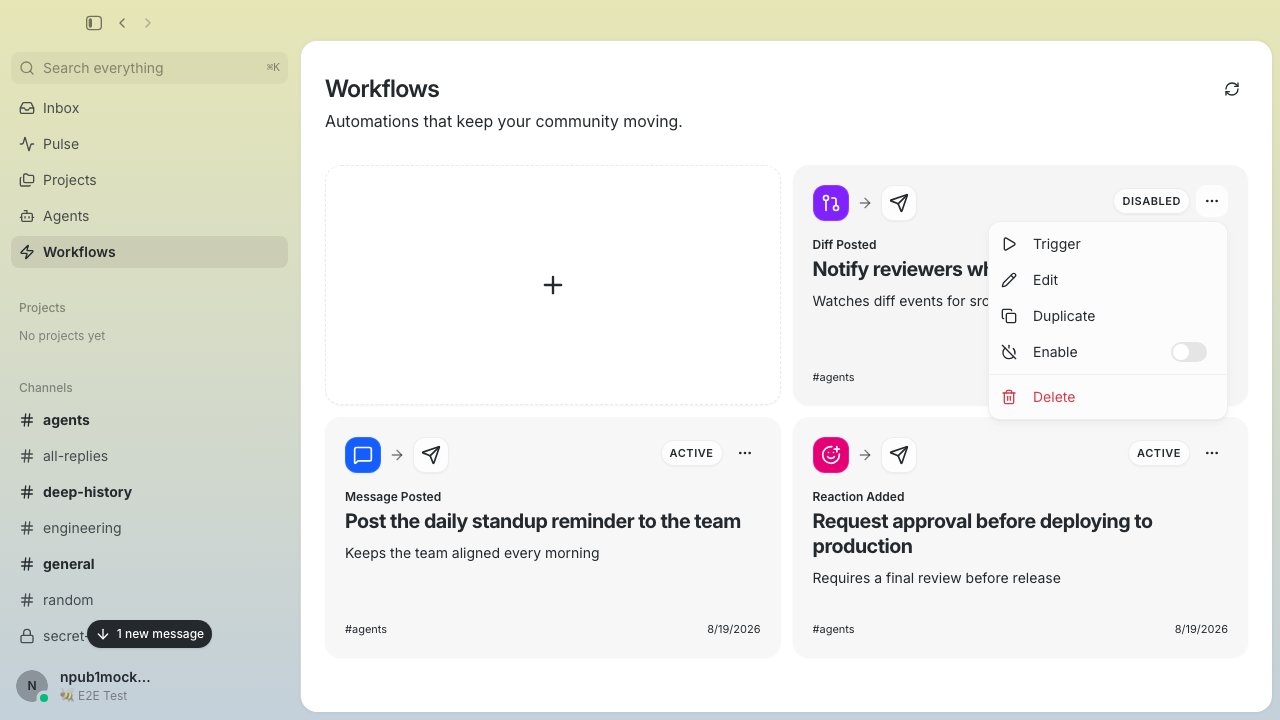 ### Workflow editor — wide 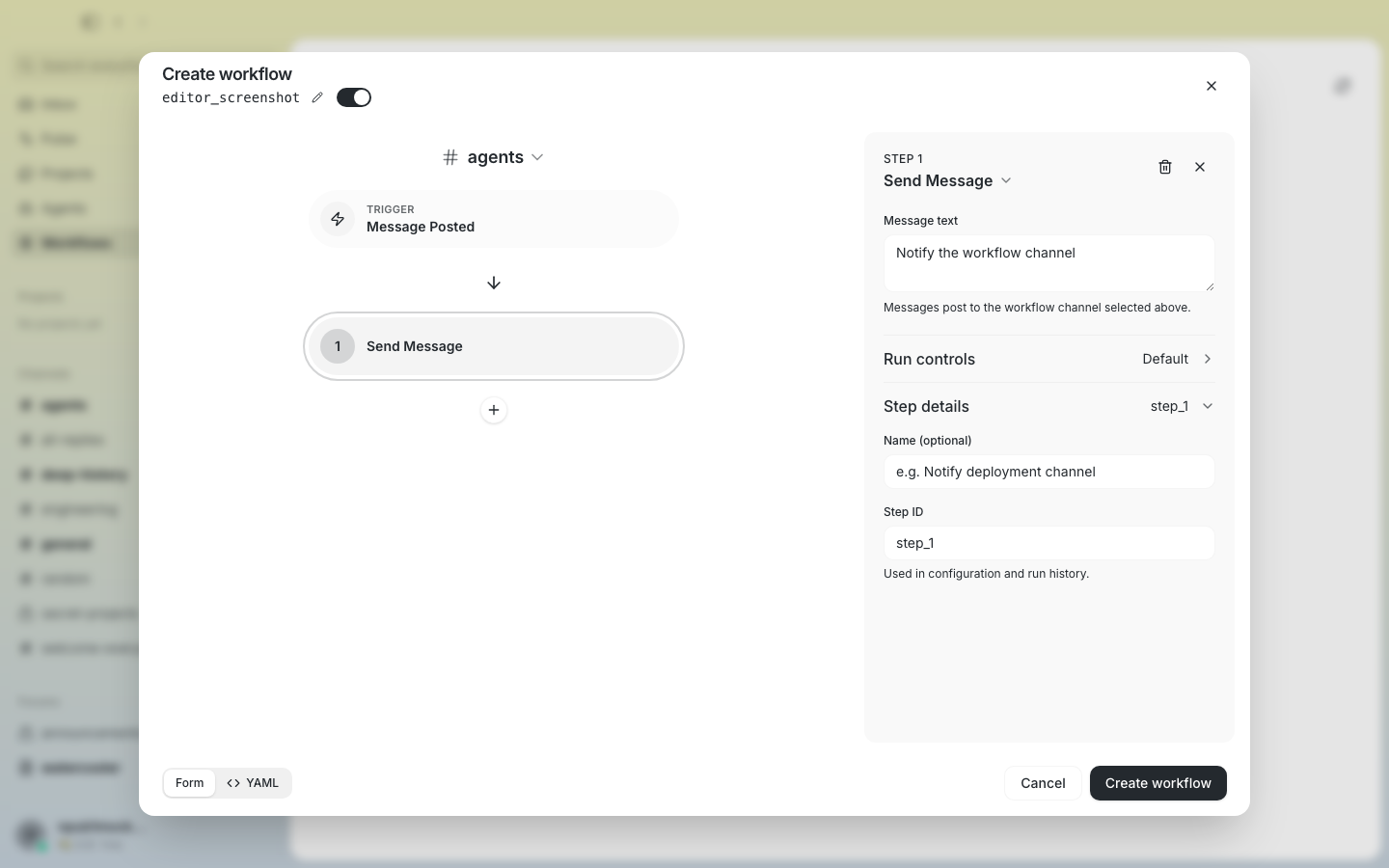 ### Workflow editor — narrow inspector overlay 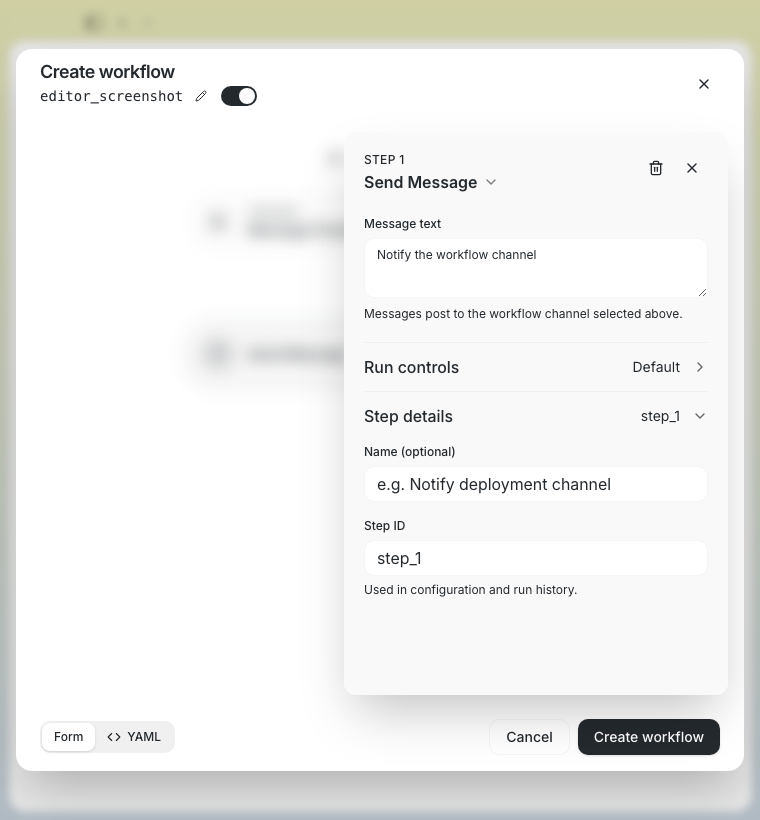 ### Workflow editor — active channel overlay 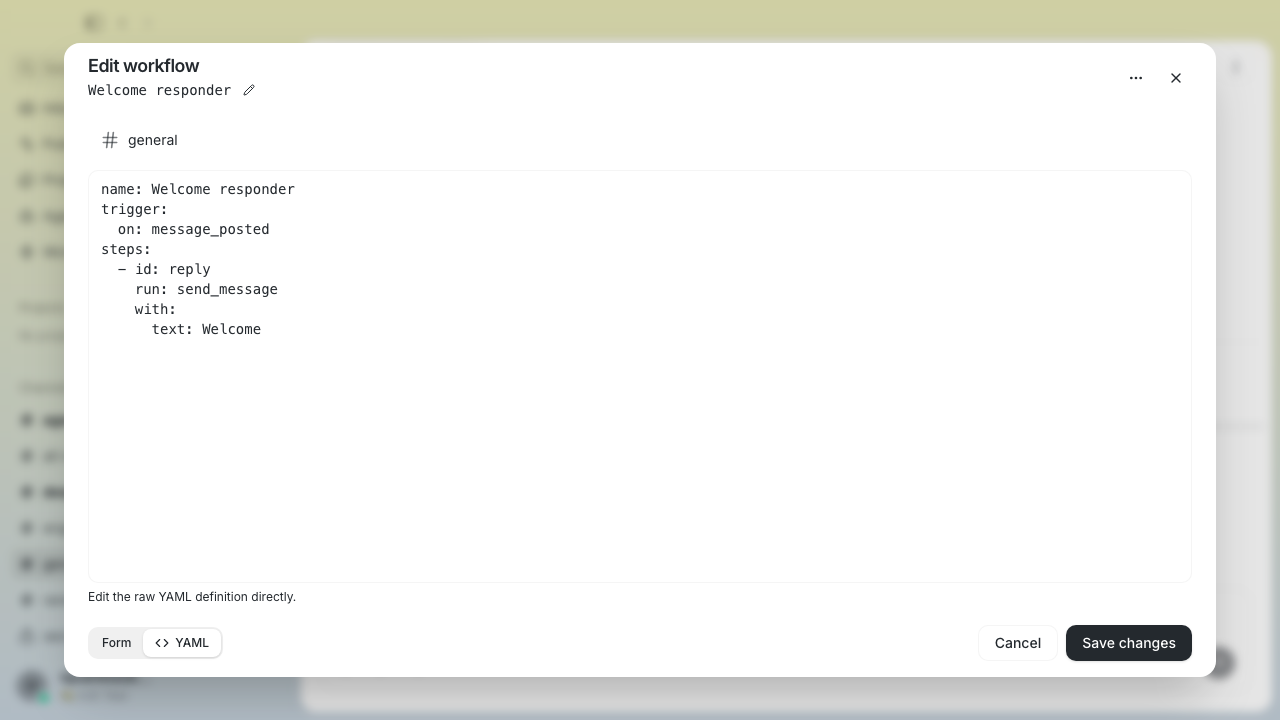 ## Review feedback addressed - Corrected Diff Posted condition guidance to use the executor-supported `str_contains(trigger_text, "deploy")` syntax and added a visible Playwright regression assertion. - Scoped direct workflow-detail navigation coverage to the stable `Edit workflow` dialog name, asserted the workflow title separately, and retained the trigger-node assertion. - Routed dirty channel-overlay Duplicate/Edit transitions through the existing discard confirmation, preserving the original YAML draft when the user keeps editing. - Made workflow deletion await relay success, remain non-dismissible while pending, and retain the confirmation/editor/draft with an actionable inline error on rejection. - Gated the channel-settings Workflows ingress and channel workflow query behind the `workflows` experiment, with defensive rendering if the flag changes while that view is active. - Matched the Reaction Added trigger to the prototype reaction picker, preserving native/custom/legacy values in canonical YAML and providing an explicit clear action. - Kept a channel’s Workflows panel mounted beneath channel-origin editors so clean close, dirty discard, and create cancel return directly to that panel without changing the channel URL. ## Verification Verified at exact pushed head `76ebba7b7ace1e13445744200da70ca9da231b7e`: - Push hooks passed: destination-org policy, branch-skew, differential file-size, Desktop checks, TypeScript typecheck, and **5,115/5,115** Desktop unit tests - Focused channel lifecycle E2E passed: dirty edit discard returns directly to the channel Workflows panel; create cancel does the same while preserving the channel URL and preselected channel - E2E production build, standalone TypeScript typecheck, and Biome checks on both touched files passed - Reaction-picker regression spec remains recorded at `dc28ffa98ec34b4e0656757fb2dd93e60a84674d`: **5/5 passed** (picker interaction, canonical YAML persistence/clear, legacy-value preservation, save/reopen round trip, narrow viewport containment) - Blox existing workflow E2E regression set at `dc28ffa98ec34b4e0656757fb2dd93e60a84674d`: **36/36 passed** - Earlier blocker and review regressions remain recorded at `3760c3d657a525f5af98e8d0f98bdd03999d8e61`: **5,114/5,114** Desktop unit tests and the dirty-overlay/deletion focused checks - Working tree clean; local branch, remote branch, and PR head all match the exact SHA above ### Related issue None found. Closest prior work: #231. --------- Signed-off-by: Taylor Ho <taylorkmho@gmail.com> Co-authored-by: Codex <noreply@openai.com> |
||
|
Will Pfleger
|
2ce8df8533 |
fix(models): curate Databricks alias-aware labels for 5 missing endpoints (#6360)
Curates Databricks model labels through prefix-stripping aliasing and materializes exact records for five endpoints missing from the Databricks catalog. **Alias-aware label resolution** (Databricks v2) - Strip workspace-specific prefixes (`goose-`, `team-x-`, etc.) before exact-record lookup so any prefixed alias resolves to its canonical label without enumerating every alias variant. - Return `None` for uncurated ids instead of falling back to a raw string; callers control the fallback display. **New exact records — label-only (Anthropic Messages route, axes from family rules)** - `databricks-claude-fable-5` → "Claude Fable 5" (materialized from `anthropic-adaptive-xhigh-fable-5`) - `databricks-claude-opus-4-8` → "Claude Opus 4.8" (materialized from `anthropic-adaptive-xhigh-opus-4-8`) - `databricks-claude-opus-5` → "Claude Opus 5" (materialized from `anthropic-adaptive-xhigh-opus-5`) - `databricks-claude-sonnet-5` → "Claude Sonnet 5" (materialized from `anthropic-adaptive-xhigh-sonnet-5`) **New capability-bearing record — Kimi K3 (MLflow Chat route)** - `databricks-kimi-k3` → "Kimi K3" with axes from models.dev Moonshot catalog: reasoning toggle + effort `[low, high, max]`, no default; `_reconciliation_doc` records the source and reconciliation policy. **Corpus and tests** - 6 new normative-corpus vectors (canonical + one `goose-*` alias per new id); executable vector count updated to 113 in both Rust and TS gates. - Rust and TS label tests extended to cover all 3 new canonical ids and their aliases via the prefix stripper. - Sentinel variable fix in discovery-provider test to prevent false failure in Databricks dev environments where `BUZZ_AGENT_PROVIDER` is set. --------- Signed-off-by: Will Pfleger <pfleger.will@gmail.com> Signed-off-by: Duncan <dcfd242e557282d7a1e2cf2e6877522682f1e5c6156dc92ca7d90eaedd3b0f95@buzz.block.builderlab.xyz> Co-authored-by: Duncan <dcfd242e557282d7a1e2cf2e6877522682f1e5c6156dc92ca7d90eaedd3b0f95@buzz.block.builderlab.xyz> |
||
|
Will Pfleger
|
d274a6e949 |
fix(acp): guard against unrequested public relay skills (#6394)
Adds a shared base-prompt instruction that agents must not read or blindly follow public Buzz relay skills unless a human explicitly requests them. --------- Signed-off-by: Will Pfleger <pfleger.will@gmail.com> Co-authored-by: Duncan <dcfd242e557282d7a1e2cf2e6877522682f1e5c6156dc92ca7d90eaedd3b0f95@buzz.block.builderlab.xyz> |
||
|
Salman Mohammed
|
2a236e4137 |
refactor(prompt): simplify Buzz agent guidance (#6340)
## Why The Buzz agent prompt carries verbose agent-draft instructions that add prompt weight without improving benchmark correctness. Buzz-native channel trials also showed agents creating permanent channels while claiming they had applied a one-hour TTL. The static CLI inventory remains for efficient command discovery by smaller agents. ## What - Retain the static Buzz CLI command table and direct agents to use `--help` for full usage - Compact the owner-reviewed agent-draft guidance without changing its workflow - Clarify that `buzz channels create` is permanent unless `--ttl` is provided ## Benchmark Results - Terminal-Bench retained 22/22 correctness in the initial no-table candidate while reducing prompt size, input tokens, tool calls, and cost; total active time was effectively flat. - Across two Buzz-native runs, the non-channel cases tied at 26/30; the CLI clarification directly addresses the observed TTL omission. ## Update — 2026-08-20 - Restored the CLI command table following review feedback about multistep discovery with smaller agents. The restored-table candidate has not been re-benchmarked. Signed-off-by: Salman Mohammed <smohammed@squareup.com> |
||
|
Salman Mohammed
|
a9640c7cc4 |
Add Buzz-native collaboration benchmarks (#6264)
## Why Terminal-Bench can show task correctness while missing Buzz-specific collaboration failures, such as posting a final answer outside the user's thread. Add a small Buzz-native suite that scores relay behavior directly. ## What - Add Harbor tasks for direct thread replies, event-level callback mentions to a three-word user identity, targeted reads of explicitly named paths outside the workspace, and exact temporary-channel membership against a seeded directory of 50 users and 10 bots - Export sanitized post-agent relay evidence and extend solo runtime/provisioning for deterministic verification - Expose channel TTL in CLI search output and cover positive and negative transcript/state fixtures ## Risk Assessment Low to medium — this primarily adds benchmark and testbed machinery. The CLI change is an additive `ttl_seconds` field in channel-search JSON; relay behavior is unchanged. ## References - Motivated by the Buzz-specific behavior observed while benchmarking https://github.com/block/buzz/pull/6128 - The named-path regression case covers the issue being fixed by https://github.com/block/buzz/pull/6261 - Local live Sonnet runs: `reply-to-thread`, `user-mention`, and `create-channel-invite-users` each scored reward 1.0 with zero exceptions - The current branch prompt scored 3/5 on a concurrent `read-named-path-outside-workspace` batch: one explicit workspace-boundary refusal and one missing final response Generated with Codex --------- Signed-off-by: Salman Mohammed <smohammed@squareup.com> |
||
|
Salman Mohammed
|
934f3325c3 |
fix(buzz-acp): loosen workspace-scan guardrail to allow named paths (#6261)
## Problem Agents refused to read a specific, user-named path outside `.buzz` (e.g. `~/.claude/skills/context-health-check/SKILL.md`), and behaved inconsistently — refusing in one channel, listing the same dir in another. This is the issue Aaron and Wes hit: buzz://message?channel=e62570dd-33ad-42c5-b92b-75f2689f9694&id=401199157f8a9734109fdddfbbce4603a1ff465fae895042f29738ad52a5d15f Root cause: two prompt fragments told agents not to search `$HOME` "or other directories". The intent (added in #1194 by Will Pfleger) was narrow — stop unscoped `$HOME` sweeps that fire macOS TCC dialogs or make a model invent its own workspace dir. But "or other directories" reads as a blanket filesystem wall, so a cautious model generalized it to "any path outside `.buzz`" and refused a targeted, named read. ## Fix Prompt-only. Reframe both fragments per context-engineering guidance — state the reason and trust judgement, rather than banning a technique: **`crates/buzz-acp/src/pool.rs` — `workspace_section()`** > …This is where you already are, so start here rather than scanning `$HOME`. Any specific path the user names is fine to read. **`crates/buzz-acp/src/base_prompt.md` line 106** > These paths are relative to your working directory — start there for your own files rather than scanning `$HOME` or `/`. When the user names a specific path, read it. Preserves the original anchor intent (start at the grounded workspace; avoid unscoped `$HOME` sweeps) while explicitly permitting a named-path read — the exact case that was broken. ## Testing `cargo test -p buzz-acp` — 816 unit + 9 integration tests pass, 0 failures. Prompt-only change; the doc comment at `pool.rs:1327-1333` already states the narrow intent and is left as-is. Signed-off-by: Salman Mohammed <smohammed@squareup.com> Co-authored-by: Leo <5faf251baee50ee6bcde338aef6acdd70bb3e60115664c2cd490d94a55dfc488@buzz.block.builderlab.xyz> |
||
|
Salman Mohammed
|
7f69b13b45 |
fix(buzz-dev-mcp): expand leading ~ in read_file/str_replace paths (#6271)
## Problem `resolve_path` (crates/buzz-dev-mcp/src/paths.rs) only ever treats a path as absolute or joins it onto the workspace root. A user-named tilde path like `~/.claude/skills/context-health-check/SKILL.md` is not absolute, so it resolves to `<workdir>/~/.claude/...` (e.g. `/app/~/.claude/...`), which never exists. The `shell` tool expands `~` via bash, so the file tools diverged from it. Surfaced in the PR #6261 named-path benchmark: all five agents initially passed a literal `~` to `read_file`, which resolved incorrectly under `/app/~`. They recovered, but the ergonomics are wrong — agents already expect `~` to work; the resolver violated that expectation. ## Fix Expand a leading `~` (bare `~` or `~/...`) to the user home directory at the single chokepoint `resolve_path`, matching shell semantics. Home is read from `$HOME` (`%USERPROFILE%` on Windows). Both `read_file` and `str_replace` route through `resolve_path`, so both are fixed. - `~user` (another user home) is intentionally NOT handled — it needs a passwd lookup and is out of scope, consistent with the conservative posture for un-mappable MSYS forms already in this file. `~user...` falls through untouched and fails with the clear `path not accessible` error. - `expand_tilde` takes `home` as a parameter so it stays pure and unit-testable without mutating process environment; env lookup lives in a thin `home_dir()` helper. - Tool/param descriptions are intentionally left unchanged: `~` is normal shared path behavior, not a per-tool feature. Advertising it in each `resolve_path` caller's description would spend prompt tokens on an implementation detail and invite drift across callers. The tests on `resolve_path` document the behavior. ## Tests - `expand_tilde_forms`: pure coverage of non-tilde passthrough, `~user`/`~foo` passthrough, bare `~`, `~/rest`, and unset/empty home. - `resolve_path_expands_tilde_against_home`: end-to-end through the real `home_dir()` env read (creates a marker file under `$HOME`, skips cleanly if no home). - Full package suite green: `cargo test -p buzz-dev-mcp` — 98 passed, 0 failed. `cargo clippy -p buzz-dev-mcp --all-targets` clean. Closes #6270 --- ## Follow-up (review by @wpfleger): honor `$HOME` on Windows + translate MSYS home The first cut read `%USERPROFILE%` on Windows and `$HOME` elsewhere. That diverges from the shell tool, which is the whole point of this fix: - `HOME` is passed through to the MCP child on **every** platform (`buzz-agent` `PASSTHROUGH_ENV`, not cfg-gated) and inherited verbatim by the `shell` tool (`shell.rs` spawns bash with no `env_clear`). Bash expands `~` against `HOME`. So on Windows the file tools and shell tool disagreed whenever `HOME != USERPROFILE` — e.g. a git-bash `HOME=/c/Users/x`, or an `mcpServers[].env` override setting `HOME`. - Ordering also mattered: `~` expansion runs **after** `msys_to_windows` in `resolve_path`, so a spliced-in MSYS home (`/c/Users/x`) never got translated and `canonicalize` rejected it on Windows. **Change (`paths.rs` only):** - Prefer non-empty `$HOME` on every platform; fall back to `%USERPROFILE%` only on Windows when `HOME` is unset. - On Windows, run the chosen home through `msys_to_windows` so `HOME=/c/Users/x` → `C:\Users\x`. An MSYS home with no Windows equivalent (`/home/x`) is left untranslated and fails with the clear `path not accessible` error — the intended conservative outcome. - Selection factored into a pure `select_home(home, userprofile)` so it is unit-testable without mutating process env. **Tests:** `select_home_prefers_home` (HOME-first + empty/unset fallback, all platforms) and `select_home_translates_msys_home_and_prefers_it` (Windows: MSYS translation + divergent `HOME`/`USERPROFILE`, which also fixes the prior test's silent no-op when `HOME` is unset on CI). `cargo test -p buzz-dev-mcp` — 99 passed, 0 failed; clippy clean. Pre-push `rust-tests` + `desktop-tauri-checks` green. HEAD `29e0082ff`. --------- Signed-off-by: Salman Mohammed <smohammed@squareup.com> Co-authored-by: Leo <5faf251baee50ee6bcde338aef6acdd70bb3e60115664c2cd490d94a55dfc488@buzz.block.builderlab.xyz> |
||
|
Jude Edwards
|
196d62f97c |
fix(media): accept portrait video resolutions (#6058)
## Summary - apply the existing 2160×3840 video resolution envelope independent of orientation - accept portrait recordings whose short/long edges fit that envelope - retain rejection coverage for either edge exceeding its limit - make the relay error describe the orientation-independent limits ## Why The iOS simulator produces portrait H.264 recordings such as 1206×2622. The relay previously checked `width <= 3840 && height <= 2160`, so the equivalent portrait dimensions were rejected while landscape dimensions were accepted. ## Validation - `bin/just ci` - `cargo test -p buzz-media` (120 passed; one MinIO integration test ignored by its existing live-service guard) - `cargo clippy -p buzz-media --all-targets -- -D warnings` - exact blocked artifact `/Users/judeedwards/.buzz/.scratch/pr5874-mongo-evidence/native/head-20260816T050317Z/video-bitexact.mp4` validated through `validate_video_file`: 1206×2622 accepted Signed-off-by: Carl <5f365698229751c0461f57bb03a4e93134e6e936bd7039ebe7b737282a43c754@buzz.block.builderlab.xyz> Co-authored-by: Carl <5f365698229751c0461f57bb03a4e93134e6e936bd7039ebe7b737282a43c754@buzz.block.builderlab.xyz> |
||
|
Luke Tornquist
|
08eb46ef3c |
Revert "fix(acp): gate relay-signed workflow messages on their attributed author" (#6311)
Reverts block/buzz#6129 |
||
|
Will Pfleger
|
121e4b3ce7 |
fix(desktop): exclude archived agents from nest, order regeneration (#5905)
The managed "Active Agents" table in `~/.buzz/AGENTS.md` was rendered from every managed-agent record with no filtering, so archived duplicate instances kept appearing under the active relay's header. This scopes the roster to identity-active agents and makes regeneration safe under concurrency. ## Roster filter: identity-archive only `render_dynamic_section` now drops only records whose pubkey is present in the relay's `kind:13535` archive snapshot. Local records can't tell they're archived — they all carry `is_active: true` (that flag is a *definition*-archive, not an identity-archive), so archive truth lives only relay-side. The read **fails open**: an unreachable relay yields an empty set and hides no one. There is deliberately **no** relay-scope filter. `relay_url` is a legacy creation-era field that `effective_agent_relay_url()` ignores — every agent is eligible on every community, and snapshot-imported records store `relay_url: ""` by design. Filtering on it would hide valid, runnable agents after a workspace switch or import. Foreign-relay relic records leave the table via record deletion, not code. ## Regeneration on archive / unarchive `archive_identity` and `unarchive_identity` submitted the relay event and returned without refreshing `AGENTS.md`, unlike the ~20 other mutation sites that call `try_regenerate_nest`. A just-archived agent therefore lingered on the roster until an unrelated edit or the next launch. Both commands now trigger a regeneration after a successful submit. Regeneration is bound through a `NestRegenTrigger` trait rather than constructing the `try_regenerate_nest` callback at the Tauri-command delegation site. The command cores take `regen: &impl NestRegenTrigger` and own the `|| regen.trigger()` binding; the thin wrappers only pass `&app` (whose `impl` calls `try_regenerate_nest`). This puts the regen wiring inside the unit-tested core — a `CountingRegen` double proves each core fires exactly one regeneration — instead of an untestable seam where a wrapper could silently lose the refresh while the suite stayed green. The regen races the relay's `kind:13535` snapshot update, so it's best-effort and fail-open — a stale render self-heals on the next cycle. ## Ordered regeneration `try_regenerate_nest` previously spawned unconstrained tasks that each snapshotted state, awaited two relay requests, then wrote — so a slow pre-edit generation could overwrite a newer one. Boot made this deterministic: the boot regen races the `apply_workspace` regen, and the fallback-relay render could finish last. `NestRegenGate` fixes this with a single `highest_requested` watermark. A monotonic generation is claimed *synchronously* at request time (encoding call order) and advances the watermark under one lock; the spawned task carries its generation and, at commit, reads the watermark under that same lock — the compare-and-write is atomic with no await held across it. A generation whose number is below the current watermark drops its result instead of rolling the file back. Gating on highest-*requested* rather than highest-*written* is the load-bearing choice: if a newer generation is requested but then fails its relay reads, an older in-flight generation must **not** publish its now-obsolete roster. Behavior delta: once a newer regeneration has been requested, no older generation will ever write; if that newer generation fails, the file is left as-is and self-heals on the next trigger rather than regressing to a stale snapshot. This is an ordered, latest-request-wins gate — not a work coalescer: superseded generations still perform their relay reads and drop the result at commit time. The gate's commit lock is acquired with a poison-to-`io::Error` mapping rather than `expect()`, so a poisoned lock degrades to the same warn-and-continue path as any other commit failure instead of panicking the desktop process (a best-effort housekeeping write must never take down the app). ## One relay target per regeneration A regeneration read the workspace relay override three times — the NIP-11 signer in `fetch_relay_self`, the snapshot query in `query_relay`, and the rendered footer — so a workspace switch mid-flight could pair one relay's advertised signer with another relay's snapshot, fail open, and render archived agents as active. `capture_relay_target` now resolves the effective relay (WebSocket + HTTP API base) once, before any network work, and `fetch_archived_pubkeys_at` threads that single target through both the NIP-11 fetch and the `/query`; the footer renders the same target. Signer, snapshot, and footer always belong to one relay. ## Monotonic archival snapshot publishing `publish_nipia_archival_list` stamped its `kind:13535` snapshot with a whole-second `created_at`. A rapid archive→unarchive within the same second produced two events whose NIP-16 replaceable-event tie-break (higher event id wins) could strand the older, stale archive state as canonical. Publishing now uses a bounded retry that re-reads current archive state and rebuilds the snapshot each attempt, so the published list reflects the latest intended state rather than a fixed same-second race loser. After the attempt budget (8) is exhausted the publisher `bail!`s; the sole caller treats that as a `warn!` side effect and continues, matching the surrounding best-effort submit path. ## Test-file split The renderer, `upsert_managed_section`, and the regeneration-gate tests moved to `nest/render_tests.rs` so each test file stays under the repository's 1000-line ratchet. --------- Signed-off-by: Will Pfleger <pfleger.will@gmail.com> Signed-off-by: Wes <wesbillman@users.noreply.github.com> Co-authored-by: Hayt <9e1c23a3fd83f61da34420e4e88ff1b16e45cafcc0cd9019eb07d4ecfa8ca9b0@buzz.block.builderlab.xyz> Co-authored-by: Wes <wesbillman@users.noreply.github.com> Co-authored-by: Mongo <5c25403eab7271f9f94ddd4f2b270e8cac2c92e2c830c51877cca6ec974ffb3f@buzz.block.builderlab.xyz> Co-authored-by: Duncan <dcfd242e557282d7a1e2cf2e6877522682f1e5c6156dc92ca7d90eaedd3b0f95@buzz.block.builderlab.xyz> |
||
|
Will Pfleger
|
50a71137e6 |
feat(managed-agents): close five Claude Code agent-config gaps (#4557)
Closes five Claude Code agent-config gaps in Buzz Desktop, split into three commits that share the spawn-time and live-switch surfaces. ## Config isolation, model authority, and Auto mode (#2692, #2884, #3493) - **`CLAUDE_CONFIG_DIR` isolation (#3493).** `config_bridge` resolves both `settings.json` and `.claude.json` panel paths from the agent's effective env (`resolve_effective_agent_env` — baked floor → definition → global → persona → record), so the panel reads the same directory the agent runs against. `mcp_config_file_path_for_runtime` honors a custom dir; empty/blank is treated as unset, matching Claude's `CLAUDE_CONFIG_DIR || homedir()` semantics. `AgentConfigPanel` shows a Keychain caveat when a custom dir is active (a custom dir maps to a fresh Keychain namespace unless `CLAUDE_SECURESTORAGE_CONFIG_DIR` is also set). - **Single startup model authority (#2692).** `ANTHROPIC_MODEL` is the sole startup model authority for Claude. Local spawns write `ANTHROPIC_MODEL` and strip `BUZZ_ACP_MODEL` so the harness never sees two authorities; remote deploys send `ANTHROPIC_MODEL` in `policy_env` instead of `BUZZ_ACP_MODEL`. Non-Claude runtimes are unchanged. - **`PermissionMode::Auto` (#2884).** Wire string `"auto"`, model-gated, degrades to the agent default when the active model doesn't advertise it. ## Thinking effort end-to-end for local Claude agents Effort flows from the running session's discovered `thought_level` config option through the config surface to a local-only write control and a read-only two-facts display. - **Reader.** Discovers the `thought_level` config option from the session cache (never hardcoded) and populates `effort_config_id` / `effort_options` on `RuntimeConfigSurface`. The canonical effort tier orders record env > `record.effort_level` (`BuzzExplicit`) > ACP > persona > global > definition > file, so the panel shows the effort the next spawn will launch with while `resolve_with_override` surfaces the running ACP value as the struck-through override — neither masks the other silently. - **Write control.** `persist_agent_effort_level` is a direct-write Tauri setter (writes `record.effort_level` + `updated_at`, `save_managed_agents`) that rejects non-local backends — remote effort is set at deploy time via `policy_env`. `EffortPickerField` mounts in `AgentInstanceEditDialog` beside the Model block, gated on a local backend **AND** a discovered `effortConfigId`. It persists directly and invalidates the config surface, mirroring the `setManagedAgentAutoRestart` standalone-setter precedent, so the frozen `UpdateManagedAgentInput` shape stays frozen. - **Display.** The read-only configured-vs-current two-facts display is the `thinkingEffort` normalized field in `AgentConfigPanel`, fed by the reader's canonical tier ordering. - `buzz-acp` applies the startup effort env at session start. ## Distinguish a rejected model switch from silent success A live model switch collapsed adapter rejection into success: `apply_model_switch` returned `Ok` on both an accepted switch and an application-level refusal, so the caller cached pre-switch capabilities as if they described the target model and Desktop reported the pick as landed. - `ModelSwitchOutcome::{Applied(Value),Rejected}`. Transport-class errors still propagate as `Err` (respawn the poisoned stdio); an application-level refusal is now `Rejected`. - The caller drives everything off `post_switch_snapshot`: `Applied` refreshes `model_capabilities` from the target model's echoed `configOptions` (or drops to `None` when none are echoed, so a pre-switch snapshot is never mistaken for the target's); `Rejected` preserves pre-switch caps and emits a `failure` `control_result`. Effort resolution and the session-config capture read the post-switch snapshot so they converge on the model the session actually runs; `modelOverridden` is gated on `switch_succeeded`. - `liveSwitchOutcome.ts` gains a distinct `"failed"` outcome for the adapter `failure` frame and treats the busy-path `"sent"` ack as provisional — it never counts toward success. Success is confirmed only by a real positive terminal frame (the busy-path deferred apply emits a correlated `switched` `control_result` when it lands), and the fallback timeout resolves an honest `"pending"` (accepted, apply deferred), never a false `"ok"`. `ModelPicker` surfaces a distinct toast per outcome — failed, unsupported, and pending. ## Scope explicitly excluded Per-agent config dir provisioning, `CLAUDE_SECURESTORAGE_CONFIG_DIR` sentinel injection, `settings.json` projection, protected-key stripping, MCP inheritance, spawn serialization, and the `last_spawn_warnings` surface are absent from this diff. Silent-fallback machinery for non-Claude runtimes (#2265/#4004) is a tracked follow-up. ## Sanctioned follow-ups - **Live mid-conversation effort switching.** Effort is spawn-scoped only in this PR: the worker reads `BUZZ_ACP_EFFORT_LEVEL` once and applies it at session creation. The live effort-switch machinery (mid-conversation effort RPC + ack frame) was deliberately removed and is archived on `archive/claude-config-gaps-live-effort` for a future plan-gated revival. - **Idle-path late model-switch rejection is unobservable.** An idle switch acks `switched` immediately after catalog validation, but the real `set_config_option` runs at the next session creation — potentially much later — so a rejection there is not surfaced back to the picker (holding a subscription that long is not sensible). Pre-existing, catalog-gated behavior; a durable fix is a tracked follow-up. Closes #2692, #2884, #3493 --------- Signed-off-by: Will Pfleger <pfleger.will@gmail.com> Co-authored-by: Duncan <dcfd242e557282d7a1e2cf2e6877522682f1e5c6156dc92ca7d90eaedd3b0f95@buzz.block.builderlab.xyz> |
||
|
Salman Mohammed
|
d2cfd377e2 |
fix(prompt): simplify pickup follow-through (#6186)
## Why The base prompt prescribed a todo lifecycle for every task needing follow-up tools, which added control calls even for work completed in one turn. This keeps the important behavioral contract—continue after publishing pickup—without prescribing the mechanism. ## What - Replace the 40-word todo lifecycle with a concise pickup follow-through rule - Preserve the requirement to publish the outcome or blocker before stopping ## Risk Assessment Low to medium — this changes managed-agent instructions, not runtime code. The terminal benchmark covers single-turn task completion but does not cover restart, compaction, or long-lived multi-turn recovery. ## References - Builds on the prompt simplification in https://github.com/block/buzz/pull/6161 - Benchmark setup: GPT 5.6 Terra at high effort; the same 11-task Terminal-Bench 2.1 slate; four concurrent trials; 4 CPU and 8 GiB per trial; 3× timeout | Prompt | Pass | Active-h | Median active | Tool calls | |---|---:|---:|---:|---:| | PR 6161 baseline | 22/22 | 0.3438 | 0.91 min | 216 | | Benchmarked 14-word rule | 22/22 | 0.2926 | 0.75 min | 198 | The benchmarked rule used 14.9% less active time, 16.9% lower median active time, and 8.3% fewer tool calls. Across the screen and confirmation runs it passed 33/33 trials with every completion report present; results are directional because model and tool behavior is stochastic. --- **Update Aug 18, 10:47 EDT:** Expanded the completion outcomes following review feedback. - The follow-through rule now covers a verified result, blocker, or key decision or information that needs to be surfaced. - The benchmark was not rerun; the table reflects the prior 14-word formulation. This is a completion-taxonomy clarification, not a return to a prescribed todo mechanism. Generated with Codex Signed-off-by: Salman Mohammed <smohammed@squareup.com> |
||
|
Salman Mohammed
|
5694e78def |
fix(mcp): scope todo usage (#6216)
## Why The `todo` tool description does not say when the tool is unnecessary, so agents use it for single-turn bookkeeping. Scoping it to cross-turn persistence reduces avoidable control calls while preserving the checklist for compaction and genuinely multi-turn work. ## What - Scope `todo` to work that must continue across turns or survive context compaction - Tell agents not to use it for work they can finish in the current turn - Preserve read/replace semantics and the `_Stop` hook behavior ## Risk Assessment Low to medium — this changes agent tool-selection guidance, not the tool name, schema, or implementation. The benchmark covers single-turn completion but not restart, compaction, or long-lived multi-turn recovery. ## References - Companion base-prompt change: https://github.com/block/buzz/pull/6186 - Combined benchmark (PR 6186 prompt plus this description): 22/22 pass; active time 0.3438h → 0.2680h (-22.0%); tool calls 216 → 173 (-19.9%); todo calls 45 → 0 - Against PR 6186's prompt-only condition: active time 0.2926h → 0.2680h (-8.4%); tool calls 198 → 173 (-12.6%) - Results are directional because model and tool behavior is stochastic. Generated with Codex Signed-off-by: Salman Mohammed <smohammed@squareup.com> |
||
|
Taylor Ho
|
f7a01bda7b |
fix(workflows): preserve multi-channel listing semantics (#6009)
**Category:** fix **User Impact:** Workflow listings reliably include every accessible channel, including for users with more than 128 memberships and when connected to older relays. **Problem:** Multi-value `#h` filters could lose live delivery, apply channel scoping after SQL limits, mishandle partial authorization or revocation, and permit unbounded membership work. Desktop also submitted every channel in one request, exceeding the relay's new 128-value safety bound. **Solution:** Preserve NIP-01 OR semantics across relay query, count, and live-subscription paths while enforcing authorization and bounded explicit-channel work before database or Redis operations. Desktop keeps the older-relay-compatible one-channel-per-filter shape, sends filters in bounded batches, combines responses, and deduplicates signed events by event ID. <details> <summary>File changes</summary> **crates/buzz-db/src/event.rs** Distinguishes authorization channel scopes from explicit `#h` scopes in list and count SQL so requested channels are applied before limits without implicitly including global rows. **crates/buzz-relay/src/handlers/req.rs** Shares explicit-channel scope extraction and limits, preserves valid OR siblings when malformed branches cannot match, repairs request-local membership misses, and registers authorized live subscriptions per channel. **crates/buzz-relay/src/handlers/count.rs** Applies the same bounded explicit-channel authorization to COUNT and preserves channel scope when a multi-channel request narrows to one authorized channel. **crates/buzz-relay/src/api/bridge.rs** Brings HTTP query and count behavior in line with WebSocket semantics before SQL execution and rejects over-limit explicit-channel requests before membership I/O. **crates/buzz-relay/src/subscription.rs** Indexes multi-channel subscriptions by every authorized channel and shrinks, rather than destroys, their scope when one channel is revoked. **crates/buzz-relay/src/handlers/side_effects.rs** Releases only revoked channel topics and sends terminal closure only when no authorized channel remains. **crates/buzz-test-client/tests/e2e_relay.rs** Adds ignored relay integration coverage for multi-channel delivery and valid historical/live behavior with malformed or empty OR siblings. **desktop/src-tauri/src/commands/workflows.rs** Builds one single-channel filter per membership, submits at most 128 per relay request, combines batches, and deduplicates by immutable signed event ID. **desktop/src-tauri/src/commands/workflows_tests.rs** Covers filter compatibility, malformed input, 129-channel batching, and cross-batch event-ID deduplication. </details> ## Reproduction steps 1. Join multiple channels containing workflows, open **Workflows**, and confirm workflows from every accessible channel appear. 2. Repeat with more than 128 memberships and confirm the listing remains complete rather than failing the relay request. 3. Send a multi-value `#h` query/count and confirm only requested authorized channels affect SQL limits and counts. 4. Subscribe to channels A and B, revoke A, and confirm B continues delivering live events. 5. Subscribe with a valid channel branch plus a malformed or empty `#h` sibling and confirm valid history, EOSE, and post-EOSE live delivery still occur. ## Validation At pushed head `c419a923f05e483ab26c006a0b3a80cfb3c73844`: - Relay request tests: 53 passed. - Desktop full Rust unit suite: 2,468 passed, 17 ignored. - Relay E2E target compiled with `--no-run`. - Strict relay clippy passed. - Desktop Tauri clippy/check passed. - Pre-push Rust tests and Desktop Tauri checks passed. - Rust formatting and `git diff --check` passed. --------- Signed-off-by: Taylor Ho <taylorkmho@gmail.com> |
||
|
Salman Mohammed
|
f64899e5d1 |
Remove Startup Recovery section in base prompt (#6161)
## Why Managed channel sessions already receive authoritative per-turn context. The old startup recovery checklist told every new session to scan the global feed ## What - Remove `Startup Recovery` with concise channel and heartbeat turn contracts. ## Risk Assessment Low. This changes prompt guidance and its test only; routing and runtime behavior are unchanged. Generated with Codex --------- Signed-off-by: Salman Mohammed <smohammed@squareup.com> |
||
|
Illumi
|
a282e0643f |
fix(cli): keep project replacement timestamps at or after wall clock (#5666)
Fixes #5665. `next_timestamp` in `crates/buzz-cli/src/commands/projects.rs` computed a replacement's `created_at` as `head.created_at + 1`. The relay's ingest path rejects events more than ±900s from server time (`MAX_TIMESTAMP_DRIFT_SECS` in `crates/buzz-relay/src/handlers/ingest.rs`), so: - `projects update` on any project whose head is older than 15 minutes fails with `relay error 400: invalid: event timestamp too far from server time` (live repro in #5665); - inside the window, replacements are recorded at `head+1` — seconds-to-minutes in the past — so a concurrent wall-clock writer silently wins LWW and audit timestamps misstate when the write happened. ## Change `next_timestamp` now returns `max(now, head.created_at + 1)`: strictly after the observed head (preserving the dominate-the-head guarantee for skewed/future heads), never behind the wall clock. This mirrors the relay's own replacement-authoring pattern (`now.max(head+1)` in `side_effects.rs`). ## Testing - `cargo test -p buzz-cli --lib` — 344 passed; adds `next_timestamp_uses_wall_clock_when_head_is_stale`, and the existing far-future-head test still holds (`head+1` wins when head > now) - `cargo clippy -p buzz-cli --all-targets` / `cargo fmt --check` — clean - Live before/after on a self-hosted relay: vanilla CLI fails on a 2h-aged head; with this change the same update is accepted and the head lands at wall clock. Same failure family as #2876 (`repos protect` vs the drift window) — that path is not touched here. --------- Signed-off-by: Ika Minami <ika@infiniteidol.com> Signed-off-by: Ravneet Arora <rarora@squareup.com> Co-authored-by: Ika Minami <ika@infiniteidol.com> Co-authored-by: Ravneet Arora <rarora@squareup.com> |
||
|
Luke Tornquist
|
54f11219ef |
fix(acp): gate relay-signed workflow messages on their attributed author (#6129)
## Problem Scheduled workflow `send_message` actions fire and land in the channel with correct `p` tags for the mentioned agents — but the agents never wake. The wake-up is silently dropped. **Root cause:** workflow messages are signed by the **relay keypair** (`workflow_sink.rs` signs with `state.relay_keypair`), so `event.pubkey` is the relay's pubkey, not the workflow owner. In `buzz-acp`, the inbound author gate (`author_allowed`) runs **before** the `p`-tag mention check. Under the default `respond_to = owner-only`, the relay pubkey is neither the owner nor a sibling, so every workflow wake-up dies at the gate with a debug-level `"inbound author gate — dropping event"`. The relay-side comment even says the mention `p` tags exist *"so mentioned agents are woken (wake is p-tag gated)"* — but wake is also author-gated, and that path was missed. ## Fix Gate relay-signed workflow messages on their **attributed author** — the pubkey that created the workflow — instead of the relay pubkey: - **Relay:** `workflow_sink.rs` now emits an explicit `buzz:workflow-owner` tag carrying `workflow.owner_pubkey` (the workflow creator, which the executor already passes as `author_pubkey` and whose channel access the relay verifies before emitting). Ownership is never inferred from `p`-tag order; mention `p` tags play no role in attribution. - **Harness:** at startup, `buzz-acp` fetches the relay's NIP-11 `self` pubkey (new `RestClient::fetch_relay_self`, public `/info` endpoint). Best-effort: fetch failure just logs a warning and preserves pre-fix behavior. - **Gate:** an event that is (a) authored by the relay `self` key, (b) tagged `buzz:workflow`, and (c) carries a well-formed `buzz:workflow-owner` pubkey is gated on that owner, through the exact same owner/sibling/allowlist policy as a direct author. ## Security notes (all fail closed) - No NIP-11 `self` pubkey → no exemption. - `buzz:workflow` / `buzz:workflow-owner` tags on a non-relay-signed event → ignored (a member cannot forge the exemption; the relay verifies signatures on submission and only the relay holds its key). - Relay-signed event without the tags, or with a malformed owner value (not 64-hex) → plain author gate. - Who is @mentioned in the message has no bearing on whose authority is evaluated. - A workflow owned by a random channel member still cannot wake an owner-only agent — the owner's pubkey must pass the same policy. ## Testing - 7 unit tests (`workflow_attributed_author_tests`) covering attribution, fail-closed paths, p-tag independence, malformed owner values, and the forgery case. - Extended the PG-gated `workflow_send_message_p_tags_mentioned_member` integration test to assert the `buzz:workflow-owner` tag. - `cargo test -p buzz-acp`: 785 passed, 0 failed. `cargo test -p buzz-relay --lib workflow_sink`: 17 passed. Clippy + fmt clean. (9 pre-existing `buzz-relay` failures in unrelated `api::media`/`api::admin` tests fail identically on the base commit without this change.) Found while debugging scheduled automations in a Buzz review-pipeline channel: two cron workflows fired daily @mentions at agents that never responded, while direct human @mentions woke them instantly. --------- Signed-off-by: Luke Tornquist <tornquist@squareup.com> Co-authored-by: Fizz <3a9f8a30fbb462abec1e2977b2280a7ae50c7ff794433790be15bd48bfd52d0b@buzz.block.builderlab.xyz> |
||
|
Atish Patel
|
5b3f0375a2 |
fix(acp): replace Goose native system prompt (#5964)
## Why Buzz currently appends its managed prompt to Goose's native prompt, so managed agents receive both instruction sets instead of the intended Buzz-only system prompt. ## What - Send Goose's custom session system-prompt request with `mode: "set"` - Lock the replacement contract in the ACP request test ## Risk Assessment Low — the change is limited to Goose session setup; adapters that do not implement Goose's custom method keep the existing method-not-found fallback behavior. ## References Goose v1.46.0 routes `set` to `override_system_prompt`, and its prompt builder selects that override instead of rendering the native `system.md`: [ACP handler]( |
||
|
Taylor Ho
|
edc4a09aaa |
feat(workflows): add responsive library card actions (#6008)
**Category:** improvement **User Impact:** Users can scan what each workflow does and trigger, edit, duplicate, enable, disable, or delete it directly from the library. **Problem:** The workflow list buried common actions and did not expose each automation's trigger-to-action shape at a glance. **Solution:** Add a responsive workflow library with a persistent create tile, compact trigger/action diagrams, prominent workflow titles with supporting descriptions, and shared card actions while preserving existing detail, editor, and run-history entry points. Card toggles refresh both list and open-detail caches so status and definition stay consistent. <details> <summary>File changes</summary> **desktop/src/features/workflows/ui/WorkflowActionsMenu.tsx** Adds a shared card menu for trigger, edit, duplicate, enable/disable, and delete actions. **desktop/src/features/workflows/ui/WorkflowCard.tsx** Reworks cards around the prototype's visual hierarchy: color-coded trigger, action flow, sentence-case eyebrow, prominent title, supporting description, status, channel, and update date without a footer clock icon. **desktop/src/features/workflows/ui/WorkflowsView.tsx** Adds the responsive grid, create tile, mutation wiring, and list/detail cache invalidation. Container breakpoints keep cards two-across at medium widths and three-across in the 1280px desktop layout. **desktop/src/features/workflows/ui/workflowDefinition.ts** Adds immutable enabled-state updates plus narrow trigger and first-action readers used only to select card icons. **desktop/src/features/workflows/ui/workflowDefinition.test.mjs** Covers neutral icon selection, enabled-state immutability, and status presentation. **desktop/tests/e2e/workflows.spec.ts** Covers the create tile, title/description hierarchy, selected-card enable/disable consistency, and deterministic narrow/medium/wide captures while retaining existing action coverage. </details> ## Reproduction steps 1. Open **Workflows** and confirm the create tile stays first as cards flow from one to three columns with available width. 2. Confirm each card shows a sentence-case trigger eyebrow, prominent workflow title, supporting description when present, status, channel, and update date without a clock icon. 3. Open a card's overflow menu and trigger, edit, duplicate, enable/disable, or delete the workflow. 4. Leave the detail panel open while toggling and confirm its badge and JSON definition update with the card. ## Screenshots Real built E2E UI with representative workflow data at three viewport sizes. ### Narrow — 800 × 720 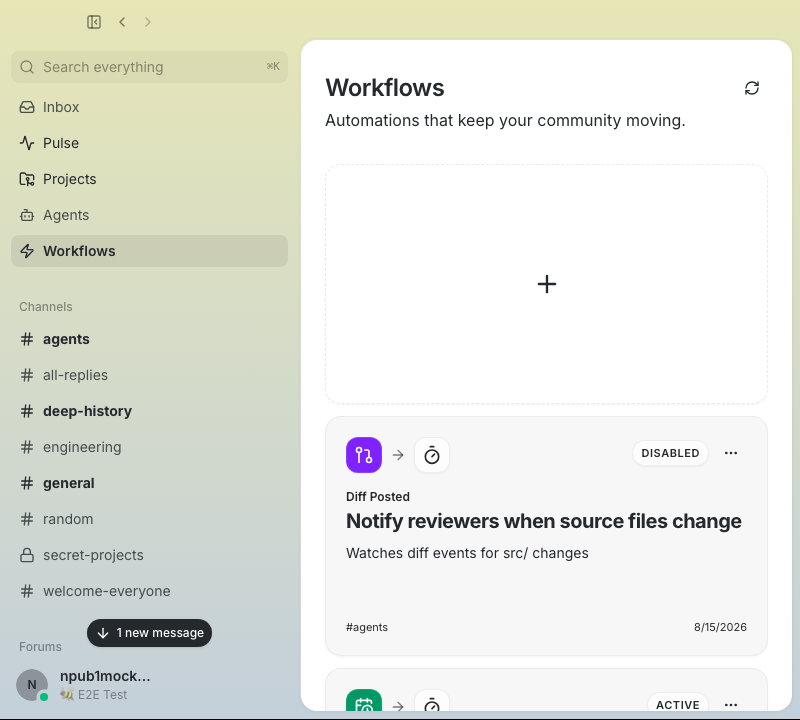 ### Medium — 1024 × 720 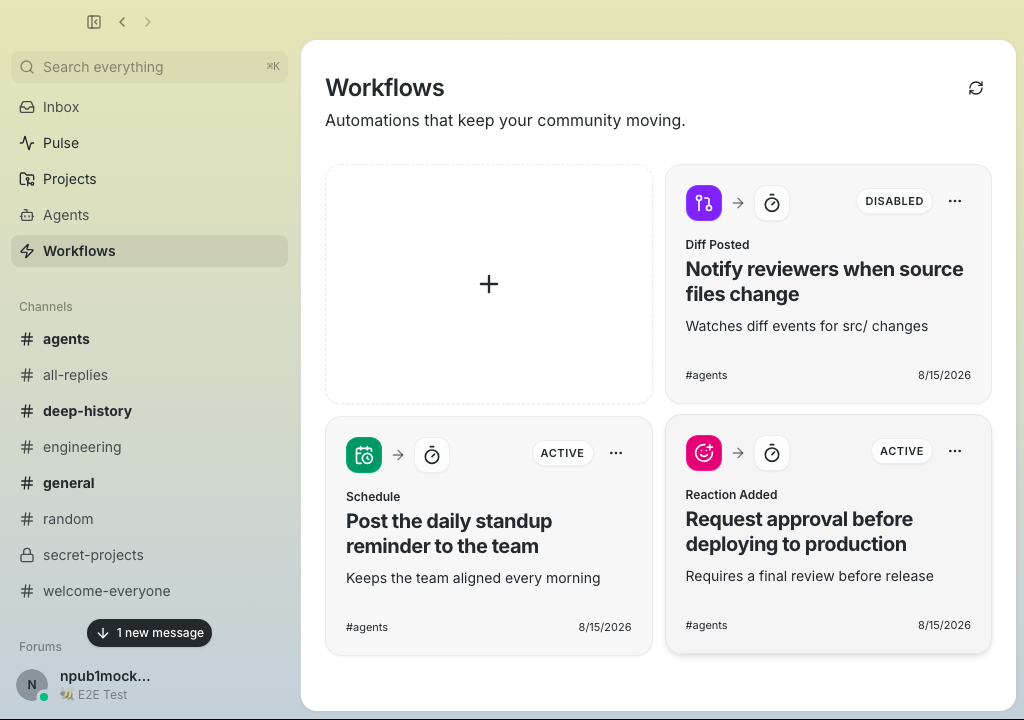 ### Wide — 1280 × 720 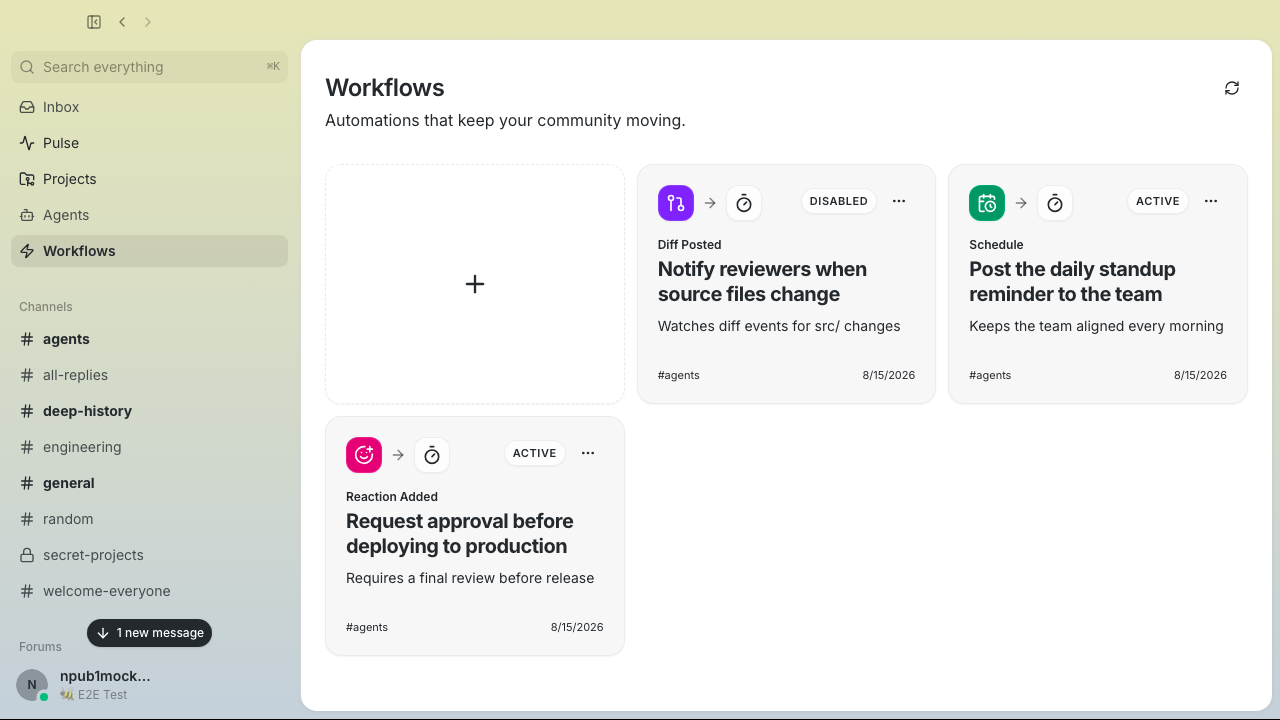 ### Card actions 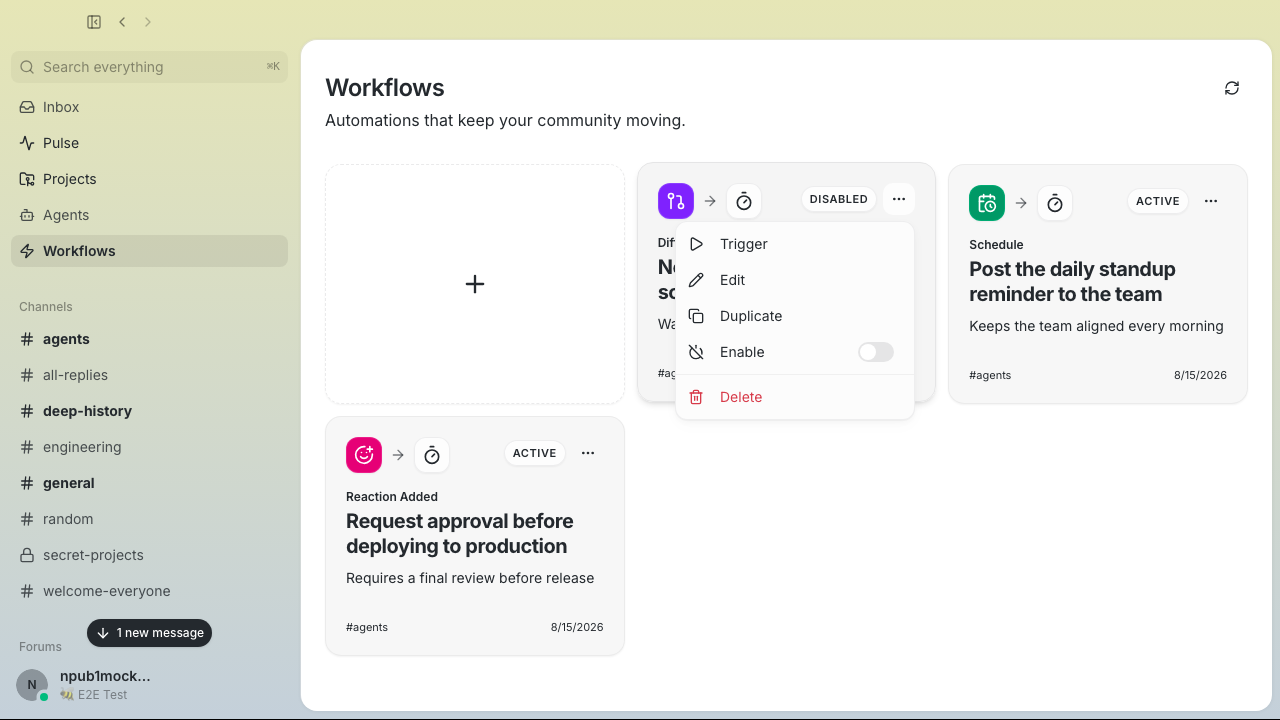 --------- Signed-off-by: Taylor Ho <taylorkmho@gmail.com> |
||
|
Will Pfleger
|
1b7e5ac1be |
feat(model-capabilities): drive model capabilities and labels from one manifest (#5597)
## Summary Centralizes model capability knowledge — thinking mode, supported effort levels, wire routes, and human-readable labels — into a single manifest, `scripts/model-capabilities.json`. Rust and TypeScript each get a small interpreter that reads the same manifest, replacing hand-maintained tables scattered across both languages that had already drifted apart. A capability change is now a data edit, not parallel edits to two code paths. Supersedes the codegen approach explored in #3603. A cross-language contract keeps the two interpreters honest: `scripts/normative-corpus.json` is a golden snapshot generated from the Rust resolver (103 vectors covering all six capability axes) and replayed natively in TS. CI fails if either language disagrees with the corpus or the corpus drifts from the resolver. Regenerate with `just regen-model-corpus`. ## Behavior changes - **Effort dropdown for `openai-compat` providers** no longer offers `max`. The request path always clamped `max` to `xhigh` on the wire, so the UI stops offering a value that was silently rewritten. UI-only, wire-identical. - **Databricks v2 routing (wire-visible):** uncurated endpoint names carrying a bare Claude code-name segment (e.g. `goose-opus-5`) now route to the MLflow chat wire instead of Anthropic Messages — they lose Anthropic prompt caching but still succeed on a valid OpenAI-compatible wire. Curated `databricks-claude-*` records and any name starting with `claude` are unchanged. A handful of other uncurated/adversarial name shapes similarly fall back to MLflow chat instead of pattern-matched routes; every curated model resolves identically to before, all axes. - **Curated model labels on the real discovery path.** The Databricks API returns no display name, so discovery emits the raw endpoint id as the model `name` (`{id, name: id}`) on every path. `ModelEntry.name` is now curated at all four construction seams in `buzz-agent` — v2 discovery, v1 parse, the auth-empty default catalog, and the configured-model fallback — via a read-only `databricks_registry_label` lookup over the manifest's `databricks_v2` exact records; `id` stays the raw wire/config value. A known id renders its curated label (`databricks-gpt-5-5` → `GPT-5.5`), an unknown id passes through unchanged, and the default-catalog row reads `GPT-5.5 (default catalog)`. As a defense against older `buzz-agent` binaries and any harness that echoes ids, `resolveModelLabel` treats a discovered name equal to the trimmed id as absent and falls through to the registry tier; a genuinely distinct name (including the suffixed default-catalog label) still wins. ## Cleanup Deletes the duplicated capability tables and their tests: the `config.rs` gpt5 matchers, effort tables, and clamp logic; the legacy segment-based Databricks v2 route classifier in `llm.rs`; and the TS hand tables plus `effortTable.fixture.json`. All are replaced by manifest lookups through the shared resolver — no line of capability data exists in two places. --------- Signed-off-by: Will Pfleger <pfleger.will@gmail.com> Signed-off-by: Duncan <dcfd242e557282d7a1e2cf2e6877522682f1e5c6156dc92ca7d90eaedd3b0f95@buzz.block.builderlab.xyz> Co-authored-by: Duncan <dcfd242e557282d7a1e2cf2e6877522682f1e5c6156dc92ca7d90eaedd3b0f95@buzz.block.builderlab.xyz> |
||
|
thomaspblock
|
122a8b8988 |
Projects v3: unify sharing, discussions, and issue ownership (#5792)
## Summary Projects v3 makes repository work shareable, discussion-aware, and easier to scan in one coherent workspace. People can copy canonical links, reopen the exact workspace tab, understand issue and pull-request context at a glance, find related channel conversations, and assign or unassign issues across Desktop and CLI. - **Unified workspace** — top-level sections sit above repository controls in one rounded workspace, with navigation positioned close to the page heading. README and Files retain branch selection; every section has a labeled icon header, and Issues and Pull Requests expose creation from a consistent right-aligned action. - **Repository management** — the repository selector is always available, including single-repository projects. Its integrated add flow lets project owners create a repository manually or select an existing repository without a separate toolbar button. - **Readable work-item lists** — issue and pull-request rows use plain-language context instead of opaque metadata. Files, commits, issues, pull requests, channels, and contributors share consistent row density and right-aligned timestamps, while deterministic fallback-avatar colors keep participants distinct on light backgrounds. Inbox pull-request metadata wraps between complete phrases and truncates long channel names instead of compressing copy into narrow columns. - **Reliable entity links** — projects, repositories, issues, pull requests, and commits have canonical `buzz://` links, preview cards, OS deep-link routing, and tab-aware navigation. Reopening the same link re-applies its destination instead of leaving the user on a locally selected tab. - **Related conversations** — repository and work-item views surface channels discussing the current entity, including participants, channel navigation, message context, and an explicit notice when discovery reaches its 500-result cap. - **Reversible issue ownership** — trusted assignment and unassignment events work across Desktop, Tauri, `buzz-sdk`, and `buzz issues`. Assignees appear in project views and the assigned inbox, while authorized users can remove assignments directly from the assignee row. Assignment state is derived chronologically from labeled Nostr notes. Issue authors and repository owners may change any assignee; other users may only assign or unassign themselves. Shared golden fixtures keep entity-link grammar and validation aligned across TypeScript and Rust. The branch also updates `webbrowser` to the patched release for RUSTSEC-2026-0257. ### Related issue N/A. ### Testing - [x] `just ci` — formatting, lint, typechecking, unit tests, and builds passed - [x] Full pre-push suite — organization, branch-skew, Desktop checks, typechecking, and tests passed on the latest push - [x] `cargo test -p buzz-cli` and focused `buzz-sdk` assignment tests passed - [x] Focused Tauri recipient-note and 500-result search-limit tests passed - [x] Desktop entity-link and issue-assignment unit tests passed - [x] Playwright smoke coverage passed for assignment, repeated entity-link navigation, repository create/select flows, section headers and actions, timestamp alignment, timeline icons, sentence-style issue/PR metadata, header spacing, avatar contrast, and Inbox metadata at stacked and side-rail breakpoints - [ ] Manual staging pass: link round-trips, Channels tab, assignment flows, and inbox routing ### Screenshots Pull requests explain who opened the request, where it lives, and which branch it comes from; fallback avatars remain visually distinct. 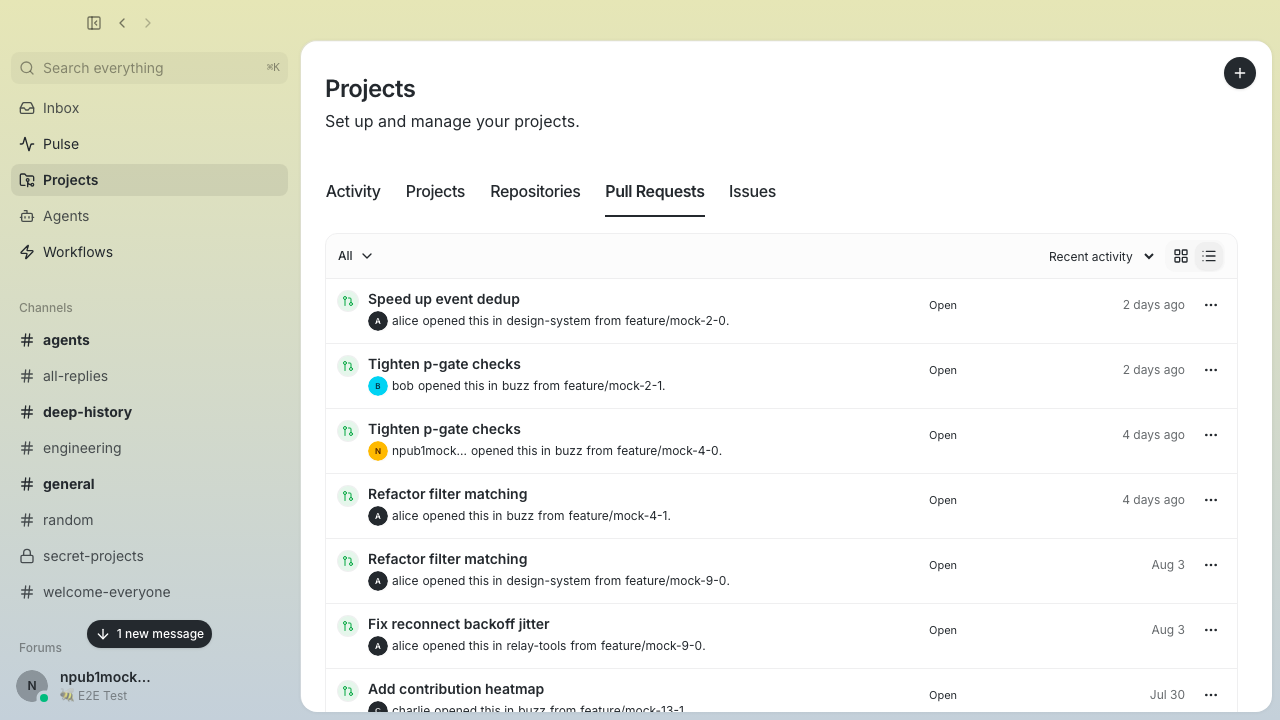 Issues use the same sentence-style hierarchy while keeping status and recency easy to scan. 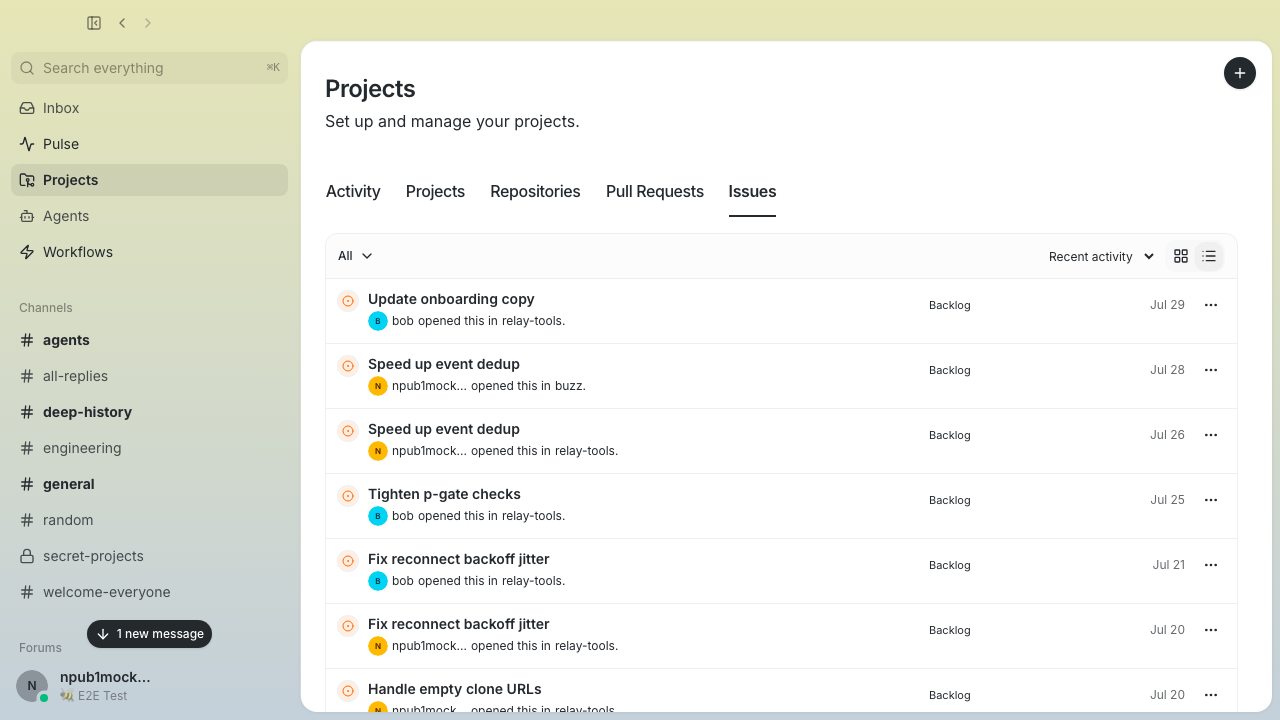 The wide Inbox detail keeps author, timestamp, and origin context readable beside its metadata rail. 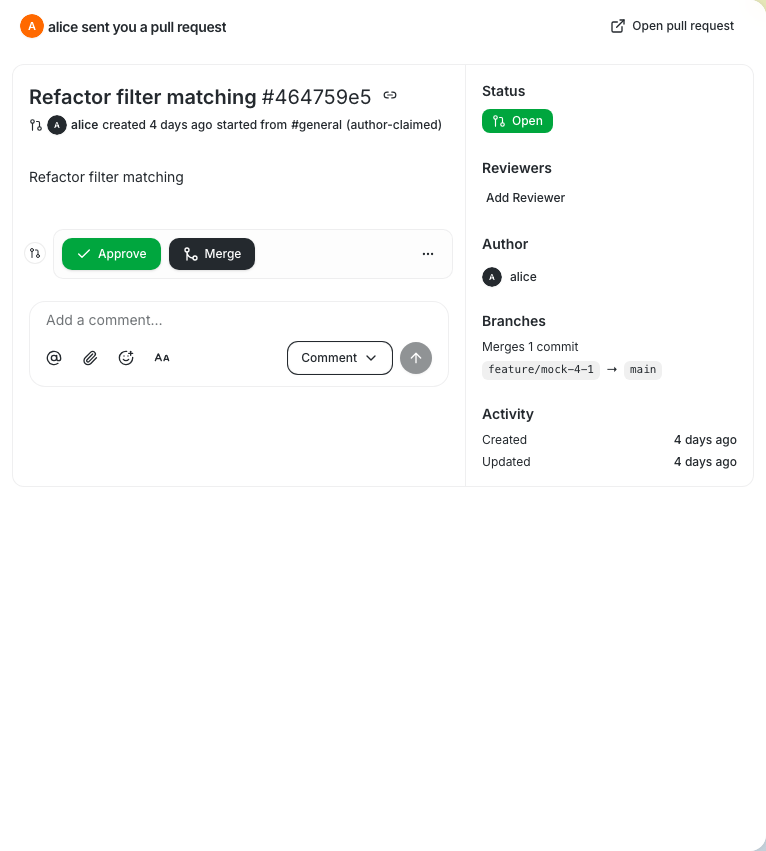 [View the complete six-state Projects v3 screenshot set](https://github.com/block/buzz/pull/5624#issuecomment-5268039672) and [the compact/wide Inbox comparison](https://github.com/block/buzz/pull/5624#issuecomment-5268614585). --- > Supersedes #5624, whose head commit accumulated permanently-queued required check suites (block-dco-check et al.) that GitHub never dispatched. History flattened into a single signed-off commit on latest main; tree verified byte-identical (`git merge-tree`) to merging the original branch into main. --------- Signed-off-by: Thomas Petersen <thomasp@squareup.com> Co-authored-by: Wintermute <3f1797424fd9ad6653a83665c660517777cd7f8c228c0d5907f49e01537f3ca5@buzz.block.builderlab.xyz> |
||
|
Wes
|
1d51081b8a |
Teach agents to inherit Buzz product intent (#5875)
## Summary - make `VISION.md`, relevant `VISION_*.md`, and applicable testing guides explicit planning and review inputs for non-trivial Buzz changes - teach managed agents to load repository-root and path-local `AGENTS.md` files after selecting a checkout - distinguish CI evidence from exercising the live workflow for user-visible and integration behavior - turn repeatable mistakes into same-session durable lessons, keeping only load-bearing rules in core memory and promoting shared lessons to team guidance - pin the new managed-agent prompt invariants in tests - preserve the exact display name shown in Buzz when mentioning or addressing someone; never infer or look up a surname merely to sound more complete ### Related issue None found after searching `block/buzz` issues and PRs for agent instruction, vision, and product-intent routing. ### Testing At commit `07ef705b42f58d3be6981165c6959d541ada0ba7`: - `cargo fmt --all -- --check` - `cargo test -p buzz-acp agent_draft_prompt_tests` (4 passed) - mandatory pre-push hooks passed on the exact pushed head: `branch-skew`, `desktop-check`, `desktop-typecheck`, `mobile-test`, `desktop-test`, `rust-tests`, and `desktop-tauri-checks` - `git diff --check origin/main...HEAD` --------- Signed-off-by: Wes <wesbillman@users.noreply.github.com> Co-authored-by: Carl <c7ebe626f000404285d3686e1dc74cc07cc60a9754a150041ba132e14bd3e2ec@buzz.block.builderlab.xyz> |
||
|
Tyler
|
068a83b097 |
feat(huddle): cut voice-turn time-to-first-audio from ~1.0 s to ~0.35 s (env-gated latency levers) (#5671)
## Overview

**Category:** feat (env-gated experiment + one exact always-on
optimization)
**Problem:** Speech-end -> first TTS audio through the desktop huddle
pipeline measures **924–1087 ms** on an M4 Max with a 0 ms LLM leg.
Voice turns feel sluggish no matter how fast the agent replies. Baseline
breakdown: ~300 ms hardcoded VAD silence flush + ~150–250 ms Parakeet
decode + ~380–550 ms TTS synthesis before the first player append.
**Outcome:** With all levers enabled, e2e time-to-first-audio measures
**347–384 ms** (307–357 ms on a longer utterance) on the same hardware,
harness, and production pipelines. Defaults preserve production behavior
everywhere except one deterministic, bit-exact cache win.

## What's in here

### Levers (all default-off, env-gated)

| Lever | Env | Effect (measured medians, short utterance) |
|---|---|---|
| Speculative Parakeet decode | `BUZZ_STT_SPECULATIVE=1` | STT leg ->
~max(flush, decode) |
| Streaming TTS synthesis | `BUZZ_TTS_STREAMING=1`,
`BUZZ_TTS_EMIT_FRAMES` | first audio 380–550 -> 211–320 ms (emit=12,
bit-exact) |
| ONNX intra-op threads | `BUZZ_STT_THREADS`, `BUZZ_TTS_THREADS` | TTS
first audio 211–320 -> 129–180 ms (4 threads) |

- **Speculative decode** starts the Parakeet decode at the *first*
silent VAD frame, overlapping it with the flush window. Resumed speech
invalidates the result (voiced-frame-count check); held silence emits it
instantly at the flush boundary.
- **Streaming TTS**: new `synth_chunk_streaming` (buzz-voice)
interleaves the Flow LM frame loop with incremental *stateful* Mimi
decoding, emitting PCM deltas to the player via the existing
`PlaybackChunkAudio` decoration. At `emit_frames=12` (the decoder's
native chunk) streamed audio is **bit-identical** to the batch path —
verified by the ignored test
`incremental_stateful_decode_matches_batch_decode` (max|diff|=0).
Smaller deltas are faster but diverge (~23 dB SNR; decoder intra-chunk
lookahead), hence the default of 12.

> **Removed after live testing:** the `BUZZ_STT_FLUSH_MS` flush-window
override. Lowering the silence window below natural mid-sentence pauses
(the fast-path recipe said 150 ms) split single spoken sentences into
multiple messages and confused the listening agents. The window is a
turn-taking quality knob, not a latency lever — it is now fixed at the
production 300 ms value.

### Push-to-talk grouping fix (always-on)

A held push-to-talk shortcut is an explicit "I am not done talking"
signal, so silence never ends the utterance while it is held — even when
the microphone is also manually open. The utterance flushes on shortcut
release (existing transmit-edge flush); a manually open mic with the
shortcut up keeps normal VAD pause flushing. Gate is the pure
`vad_flush_allowed` function with a unit-test truth table.

### Always-on (exact): voice-conditioning cache

Phase profiling (`BUZZ_TTS_PHASE_LOG=1`) showed a fixed ~160 ms
`condition_voice` Flow-LM pass on *every* chunk, re-deriving the same
post-conditioning state for the same reference voice. The state is now
snapshotted after first computation and restored per chunk (dtype-tagged
tensor copies, keyed identically to the existing `cached_voice`).
Deterministic — same tensors in, same tensors out. The default path's
TTS leg drops from 380–550 ms to 225–355 ms with no configuration.

### Bench harness

`huddle::latency_bench` (`#[cfg(test)]` + `#[ignore]`) drives the real
`SttPipeline` and `TtsPipeline`, feeding a 48 kHz WAV in real-time 100
ms batches (AudioWorklet cadence) with a configurable fake LLM in place
of the relay leg, timing speech-end -> transcript -> speak() -> first
accepted player append.

```
BUZZ_STT_SPECULATIVE=1 BUZZ_TTS_STREAMING=1 \
BUZZ_TTS_THREADS=4 BUZZ_STT_THREADS=2 \
BUZZ_BENCH_WAV=<48k f32 mono wav> \
cargo test --release -p buzz-desktop --lib huddle::latency_bench -- --ignored --nocapture
```

## Tradeoffs to weigh before promoting any lever to a default

- **Speculative decode**: the speculative buffer has ~1 silent tail
frame vs ~19; observed one CTC wobble ("fail" vs "failed") in 24 turns.
Mitigation if productionized: zero-pad the speculative buffer to match
the flush-path shape.
- **Threads**: defaults stay 1 pending the min-spec (4-core Intel) A/B
flagged in the existing `STT_NUM_THREADS` comment.
- **Streaming at emit<12** is NOT the same waveform — don't ship below
12 without an ear pass.

## Validation

- Full desktop lib suite: **2408 passed / 0 failed** at this head
(`18fab2e1c`).
- buzz-voice suite green; bit-exactness test passes against the
production batch decode.
- Defaults-only bench rerun stays in the baseline family everywhere
except the exact conditioning-cache win (stt 525–532, tts 225–355).
- `cargo clippy --workspace --all-targets -- -D warnings` + fmt clean
(pre-push hook battery green).

Measurement notes with per-lever logs: Eva's workspace,
`RESEARCH/HUDDLE_E2E_LATENCY_OPTIMIZATION_2026_08_12.md` +
`RESEARCH/HUDDLE_E2E_STT_FAKELLM_TTS_BASELINE_2026_08_12.md`.

## Suggested promotion order

1. Conditioning cache (in this PR, always-on, exact).
2. Streaming TTS at emit=12: bit-exact audio, biggest UX win — needs the
env-gate removed + barge-in soak + an ear pass on a real huddle.
3. Speculative decode with silence padding: near-free ~100–150 ms.
4. Threads: after min-spec A/B.

---------

Signed-off-by: Eva <011987e296fd5006292d2f930b574be47c7801048d1983c46c425d3c95f0cffd@buzz.block.builderlab.xyz>
Signed-off-by: Wren <5217c5c2f7bfb4333e46d17c98a9255a52dadee18dcd43a43536b95e6776dfa0@buzz.block.builderlab.xyz>
Signed-off-by: Max <d8473ee32b973aa31a21a65adddcc4b69cc2a8a4dee8121ecd51926e0cddbc02@buzz.block.builderlab.xyz>
Signed-off-by: Mari <95cae996907d7cab9f5dbf43c0f53edeac6ab0b032a6feae4abfd784e467b3f5@buzz.block.builderlab.xyz>
Signed-off-by: tlongwell-block <tlongwell@block.xyz>
Co-authored-by: Eva <011987e296fd5006292d2f930b574be47c7801048d1983c46c425d3c95f0cffd@buzz.block.builderlab.xyz>
Co-authored-by: Wren <5217c5c2f7bfb4333e46d17c98a9255a52dadee18dcd43a43536b95e6776dfa0@buzz.block.builderlab.xyz>
Co-authored-by: Max <d8473ee32b973aa31a21a65adddcc4b69cc2a8a4dee8121ecd51926e0cddbc02@buzz.block.builderlab.xyz>
Co-authored-by: Mari <95cae996907d7cab9f5dbf43c0f53edeac6ab0b032a6feae4abfd784e467b3f5@buzz.block.builderlab.xyz>
Co-authored-by: tlongwell-block <tlongwell@block.xyz>
|
||
|
Wes
|
e0940927ff |
fix(channels): return complete member rosters (#5765)
## Summary - return complete channel rosters instead of truncating at 1,000 members - chunk `event_mentions` inserts inside one transaction so large kind `39002` snapshots remain discoverable by every `p` tag - add a targeted `buzz-admin reconcile-channels --channel <uuid>` force-republish path for stale discovery snapshots - cover a 1,501-member roster, 11,000-tag mention index, and kind `39002` tag construction past member 1,000 ## Why The relay builds NIP-29 discovery and several authorization decisions from `get_members()`, but that helper silently returned only the first 1,000 active members. Desktop then counted the truncated kind `39002` event, while late members could be rejected by roster-scanning member actions. Removing the roster cap exposes PostgreSQL's 65,535 bind-parameter ceiling in mention indexing, so the insert is chunked transactionally to preserve all-or-nothing indexing. The existing reconcilers only fill missing discovery events. The targeted admin option bypasses the separately known 1,000-channel reconciliation-list ceiling and replaces an existing channel snapshot using the configured production relay key. ## Attribution This supersedes and builds on #3166 by @LordMelkor. Thank you for identifying the roster boundary and contributing the original complete-roster and mention-index patch. The production roster/query changes and the two PostgreSQL regressions retain that work's shape; this PR rebases it onto current `main`, adds relay coverage, and adds the targeted repair operation requested for rollout. ## Validation Exact pushed head: `24d02e4f3824150ed84913c9d230e675502e5b12` - `cargo check -p buzz-db -p buzz-admin` - `cargo test -p buzz-db channel::tests::get_members_returns_full_roster_beyond_1000 -- --ignored --exact --nocapture` - `cargo test -p buzz-db feed::tests::insert_mentions_indexes_rosters_past_bind_parameter_cap -- --ignored --exact --nocapture` - `cargo test -p buzz-relay --lib handlers::side_effects::tests::group_members_snapshot_keeps_members_past_one_thousand -- --exact` - `cargo run -q -p buzz-admin -- reconcile-channels --help` - mandatory pre-push hook: branch-skew, desktop checks/typecheck/tests, mobile tests, Rust tests, and desktop Tauri checks all passed on the pushed head ## Rollout 1. Deploy the relay/backend build. 2. Run `buzz-admin reconcile-channels --channel <general-channel-uuid>` with `BUZZ_RELAY_PRIVATE_KEY` configured. 3. Verify the replacement kind `39002` roster count matches the active database membership count. No schema migration or desktop release is required. Fixes #3156 Supersedes #3166 --------- Signed-off-by: Wes <wesbillman@users.noreply.github.com> Co-authored-by: Carl <c7ebe626f000404285d3686e1dc74cc07cc60a9754a150041ba132e14bd3e2ec@buzz.block.builderlab.xyz> |
||
|
Wes
|
2693e0db1f |
Make workflow run history authoritative in Desktop (#5780)
## Summary - persist stable workflow run `error_code` values separately from human diagnostics - expose NIP-98 authenticated, channel-authorized run history and approval reads with stable keyset pagination - connect Desktop to those authoritative reads and return the relay-created run ID on trigger - show truthful loading, failure, and pending-trace states, and do not render approval actions from non-actionable stored hashes ## Validation - pre-push `branch-skew`, `desktop-typecheck`, `desktop-test`, `rust-tests`, `desktop-tauri-checks`, and `desktop-check` all passed on `a097dbe5f` - Desktop tests: 4,761 passed, 0 failed - `cargo check -p buzz-relay` - `git diff --check` ## Remaining gate This does not claim a relay-backed Playwright workflow journey. The browser relay bridge still routes workflow invokes through in-memory handlers; that production-shaped acceptance gate remains follow-up work before Workflows can leave preview. --------- Signed-off-by: Wes <wesbillman@users.noreply.github.com> Co-authored-by: Carl <c7ebe626f000404285d3686e1dc74cc07cc60a9754a150041ba132e14bd3e2ec@buzz.block.builderlab.xyz> Co-authored-by: Mongo <5c25403eab7271f9f94ddd4f2b270e8cac2c92e2c830c51877cca6ec974ffb3f@buzz.block.builderlab.xyz> Co-authored-by: Princess Donut <68157ebd23b3897c1991015c3038658ea916200c67d3a54620b0754d1b92f6e0@buzz.block.builderlab.xyz> |
||
|
Atish Patel
|
4749bc7be3 |
feat(acp): report standard adapter usage (#4950)
## Why Claude Code and Codex expose standard ACP prompt-response usage, but Buzz only consumed Goose’s private cumulative usage notification. Their token use and Claude’s cumulative cost were therefore absent from NIP-AM metrics. ## What - Read per-turn `session/prompt` response usage for known Claude and Codex adapters - Publish Claude’s raw cumulative cost separately from per-turn tokens without changing the NIP-AM schema - Keep Goose usage exclusive and cover Claude/Codex wire serialization ## Risk Assessment Low-to-medium: changes best-effort observability only and does not affect prompt execution. The adapter-specific mappings preserve source semantics and omit unavailable fields. ## References - Validated with `cargo fmt --check`, `cargo test -p buzz-acp --no-run`, and full `cargo test -p buzz-acp` (678 passed at `652e373a` before merge-trailer amendment). Generated with Codex --------- Signed-off-by: Atish Patel <atish@squareup.com> Signed-off-by: Brainy Bumble <0ed7657b57c0e8a9f5288390dd6c8d5d0a3a06abe9b01b9006814f52077d6cdf@buzz.block.builderlab.xyz> Co-authored-by: WorkerBeeGPT <c5c455215c2506cb8ba776518cec804af62d3a0526e32d496a22072e395042b9@buzz.block.builderlab.xyz> Co-authored-by: Brainy Bumble <0ed7657b57c0e8a9f5288390dd6c8d5d0a3a06abe9b01b9006814f52077d6cdf@buzz.block.builderlab.xyz> |
||
|
Atish Patel
|
72d56e7bd3 |
fix(agent): raise output limit and allow 3 recoveries (#5475)
## Summary Raise the built-in output and recovery defaults so long-running agents have more room to finish useful work instead of terminating after repeated 32,768-token reasoning-only responses. - Raise `BUZZ_AGENT_MAX_OUTPUT_TOKENS` from 32,768 to 65,536 - Raise the finite output-truncation recovery allowance from 2 to 3 via `BUZZ_AGENT_MAX_TOKEN_RECOVERIES`; `0` still disables recovery - Strengthen the recovery prompt so the model stops prolonged reasoning, uses tools immediately, and builds scripts or artifacts in small verifiable steps - Preserve the safety invariant that incomplete truncated tool calls are discarded and never executed - Keep proactive handoff independently at 90% of `BUZZ_AGENT_MAX_CONTEXT_TOKENS` (180,000 tokens with the 200,000 default), regardless of the output allowance - Add request-loop and configuration regressions for exact-N recovery, disabled recovery, successful tool-first recovery, discarded truncated calls, and finite round bounds `BUZZ_AGENT_MAX_OUTPUT_TOKENS` remains an explicit per-agent deployment setting. Operators should configure it at or below the served model's output limit; this PR does not perform live provider capability discovery or automatic clamping. **Risk:** Medium — this increases the default request size and permits one additional recovery attempt by default. Recovery remains finite and bounded by `BUZZ_AGENT_MAX_ROUNDS`. Deployments whose served model rejects 65,536 output tokens must set a lower per-agent value. Current output limits - model - output token max - DeepSeek V4 Flash - 384,000 tokens - Qwen 3.8 (Max) - 131,072 tokens - GLM 5.2 - 131,072 tokens - GPT 5.6 - 128,000 tokens - Claude Opus 5 - 128,000 tokens - Gemini 3.6 Flash - 65,536 tokens - Kimi K3 (Moonshot)- 131,072 tokens ### Related issue None found. Originating benchmark analysis: `buzz://message?channel=c3252dd2-0142-4e01-88c7-a2183c3960a5&id=91e991aab5fd49094583c3937477f6c12db57a41d86edf7fd4745d0d57d10017` ### Testing - `cargo fmt --all -- --check` - `cargo test -p buzz-agent` — 595 passed, 0 failed, 0 ignored at `bd6de557b367850f50325bafdd3c046131942bef` - `cargo clippy -p buzz-agent --all-targets -- -D warnings` - Previously failing `cancelled_turn_with_usage_emits_notification_before_response` passed alone and in the full rerun - Push hooks passed: organization guard, branch skew, Rust tests, and Desktop Tauri checks ### Update — 2026-08-11 Per review feedback, the recovery default is 3. The OpenRouter live `/models` output-cap discovery, cache, request clamp, and related tests/documentation were removed. Per-agent output configuration is now the sole output-cap mechanism. Proactive handoff and its pre-usage byte fallback now depend only on 90% of `BUZZ_AGENT_MAX_CONTEXT_TOKENS`; with the 200,000 default, the handoff threshold is 180,000 regardless of `BUZZ_AGENT_MAX_OUTPUT_TOKENS`. Generated with Brainy Bumble ### Targeted validation — 2026-08-11 Ran the exact PR binary once on each of the 11 benchmark tasks causally affected by the previous 32,768-token ceiling, using OpenRouter with `deepseek/deepseek-v4-flash-0731` pinned to Fireworks and maximum reasoning effort. Relay-429 collection failures were excluded and rerun at concurrency 2. - **6/11 passed:** `circuit-fibsqrt`, `feal-linear-cryptanalysis`, `model-extraction-relu-logits`, `path-tracing`, `schemelike-metacircular-eval`, and `sqlite-db-truncate` - **5/11 reached the benchmark deadline:** `adaptive-rejection-sampler`, `dna-assembly`, `path-tracing-reverse`, `regex-chess`, and `write-compressor` - `regex-chess` reached exactly 65,536 output tokens, triggered one output-limit recovery, and then reached the deadline. This directly confirms that the larger ceiling and recovery path were active, but not that recovery guarantees completion. For context, ten of these tasks were 0/5 in the historical baseline; `sqlite-db-truncate`, the clean control, was 4/5. This is targeted one-attempt-per-task validation rather than a statistically powered comparison. The result should not be attributed solely to the recovery default of 3: this PR also raises the output ceiling and strengthens recovery behavior, and OpenRouter routing conditions may differ from the historical direct-Fireworks runs. Generated with Brainy Bumble --------- Signed-off-by: Atish Patel <atish@squareup.com> Signed-off-by: Brainy Bumble <0ed7657b57c0e8a9f5288390dd6c8d5d0a3a06abe9b01b9006814f52077d6cdf@buzz.block.builderlab.xyz> Signed-off-by: Hardworking Honey <c5c455215c2506cb8ba776518cec804af62d3a0526e32d496a22072e395042b9@buzz.block.builderlab.xyz> Co-authored-by: Brainy Bumble <0ed7657b57c0e8a9f5288390dd6c8d5d0a3a06abe9b01b9006814f52077d6cdf@buzz.block.builderlab.xyz> Co-authored-by: Hardworking Honey <c5c455215c2506cb8ba776518cec804af62d3a0526e32d496a22072e395042b9@buzz.block.builderlab.xyz> |
||
|
Wes
|
dc2dbfe0f5 |
feat(buzz-acp): idle re-sleep for woken lazy pools (#5682)
## What Adds an opt-in **idle re-sleep** for woken lazy ACP pools. A lazy harness woken by an @mention eagerly spawns all `--agents` worker subprocesses and, before this, kept every one alive forever — there is no path back from `pool_ready` to the empty-slot state. Across a warm fleet with parallelism in the tens, that ratchets into hundreds of standing idle workers (observed: 9 woken harnesses × 24 = 216 workers that never shrink). After a configurable quiet window with no dispatched turn/heartbeat in flight, no in-flight prompt tasks, an empty queue, and no wake/respawn task running, the harness tears the pool down via the normal `shutdown_agent_pool` path and returns to the **exact pre-wake lazy state** (empty slots, `Listening` lifecycle). The next accepted event re-wakes it through the existing lazy machinery. **No second pool lifecycle.** ## Why it's safe - **Race-safe with enqueue/wake by construction.** The sleep decision and event ingress are arms of the same single-task `tokio::select!`. The gate requires an empty queue, so an event landing at the boundary is either dispatched that iteration or re-woken the next — a queued batch is never stranded. - **Reuses the existing `listening` lifecycle frame** (a label Desktop already accepts and round-trips), so the paired UI returns to its listening state and re-shows waking→ready on re-wake with **zero Desktop enum changes**. - **Decision logic extracted to a pure `idle_pool_sleep_due` helper** (mirrors the sibling `inactivity_expired`) with a full gate matrix test. ## Config / policy - `--idle-pool-sleep` / `BUZZ_ACP_IDLE_POOL_SLEEP` — 0 = disabled (default), requires `--lazy-pool`. - Desktop wires it to **900s**, gated to lazy spawns, matching the harness's own per-turn idle window. Reserved key (desktop-owned lifetime policy) so user env can't disable it. ## Tests - `idle_pool_sleep_due` gate matrix: active-turn, in-flight prompt task, queued-work-at-boundary, wake/respawn-in-flight, not-ready, zero-bound, recent-activity, all-clear. - Config parse (`--idle-pool-sleep`), reserved-key membership. - `cargo test -p buzz-acp` → **761 passed, 0 failed** at base `63f961c7e`. Desktop `env_vars` tests pass; `cargo check --tests` clean on the desktop crate. > Note: I could not run the repo's `pre-push` hook locally — `just desktop-tauri-test` requires bundled `binaries/buzz-acp` sidecars that only exist in CI/release builds (pre-existing env limitation, unrelated to this change). Pushed with `--no-verify`; CI runs the authoritative gate. ## Scope Idle re-sleep only. Parallelism defaults/caps and `start_on_app_launch` policy are deliberately **separate, separately-reviewable changes** per the runtime-lane plan. --------- Signed-off-by: Wes <wesbillman@users.noreply.github.com> Co-authored-by: Mongo <5c25403eab7271f9f94ddd4f2b270e8cac2c92e2c830c51877cca6ec974ffb3f@buzz.block.builderlab.xyz> |
||
|
Kalvin C
|
8a2c9af2db |
feat(deletion): add durable whole-community deletion (#4425)
## Summary Adds a durable, operator-controlled V1 for deleting an entire Buzz community without deleting another tenant's data. The workflow is exposed through `buzz-admin deletions`: - `sweep` records independent fleet storage-taxonomy observations - `submit`, `list`, `inspect`, and `approve` manage a deletion request - `unblock` resumes a fail-closed request after an operator records remediation identity and reason - `run` and `drain` execute bounded work Requests advance through a PostgreSQL-backed state machine and stop at `retention_pending` after logical deletion has been independently verified across PostgreSQL, object storage, and Redis. This PR ships the engine and CLI, not a continuously running worker or Kubernetes packaging. For V1, a cluster/VM administrator invokes `/usr/local/bin/buzz-admin` from the existing relay image, for example with `kubectl exec` or an equivalent container/VM exec path. ## What whole-community V1 removes For the target community, V1 removes: - rows from the allowlisted community-scoped PostgreSQL catalog, including members, profiles, authored events and bodies, DMs, reactions, mentions, memberships, tokens, workflows, moderation, audit, feedback, and rate-limit state - media sidecars and upload-attribution records under `_meta/<community>/` and `_uploads/<community>/` - Git repository pointers under `repos/<community>/` - Redis keys under `buzz:<community>:*` The community row survives as a permanent tombstone, and deletion control-plane records remain as evidence of the request, approval, execution, and result. ## Safety model Deletion is not a broad `DELETE CASCADE` followed by optimistic cleanup. The destructive boundaries are durable and fail closed. ### 1. Inventory and approval - `submit` resolves the target and freezes the schema plus summary-only storage inventory. - Approval is bound to the exact request, community, and frozen inventory digest. - Unsupported manifest versions, malformed keys inside the target's owned prefixes, live scoped-table/write-fence coverage drift, frozen-inventory mismatch, and approval mismatch block execution rather than guessing. Migration and catalog revision numbers are not authorization gates; the executor validates the live safety shape instead. - Storage inventory is server-side prefix scoped to exactly: - `_meta/<community>/` - `_uploads/<community>/` - `repos/<community>/` - The deletion path never lists the whole shared bucket and has no arbitrary per-community object cap. Its listing work is proportional to the target community's bindings, not total fleet storage. - Fleet-wide taxonomy sweeps remain independent observability. They report unknown writer shapes but do not gate deletion submission, fencing, or destructive progress. Maintainers must add deletion taxonomy coverage whenever a new community-owned object-key class is introduced; writer-coverage tests bind the current media and Git writers to that contract. ### 2. Quiesce, fence, and destructive freeze - Writes continue through submission, inventory, and approval. They stop when execution moves the target into `quiescing` and then establishes the durable fence. - Already-admitted external effects finish under heartbeated serving-write leases; the exact admitted lease may renew while the community is quiescing, but new lease acquisition is rejected. The executor drains admitted leases before destructive work. - Invite minting after quiescing begins fails as typed `AccessDenied` (HTTP 503 at the relay boundary) before an invite can be persisted. - Database triggers enforce the community write fence across the complete catalog of community-scoped tables. Startup/readiness and destructive execution validate that catalog so a newly added but unfenced table cannot silently escape. - **Named isolation assumption — fresh write snapshot.** Every writer transaction that can reach a community-fenced relation must use PostgreSQL `READ COMMITTED`; each guarded write therefore observes a statement snapshot no older than acquisition of the community deletion lock. `REPEATABLE READ` and `SERIALIZABLE` can retain a pre-fence snapshot and are unsupported for writers. The writer pool refuses non-`READ COMMITTED` sessions at connection setup, and both SQL fence functions reject an explicit per-transaction isolation override with SQLSTATE `25000`. Configuration-delivered bad isolation can surface through SQLx as a pool-acquire timeout because every `after_connect` attempt is rejected; the precise `community writes require READ COMMITTED isolation` reason remains observable when the SQL guard is reached. Read-only replica transactions are outside this assumption. - Holding the shared advisory lock until the guarded write executes is a separate liveness condition: under `READ COMMITTED`, releasing it early does not permit resurrection because the trigger rechecks the fence, but it can turn a fleet sweep into a statement-wide SQLSTATE `55000` abort. - After the fence closes writers, storage is re-enumerated into chunked side-table rows. Per-prefix counts and digests bind those concrete keys to the destructive manifest. - Manifest chunk insertion, update, and deletion are protected after freeze. This closes the race where an unbound key could otherwise appear after the manifest was committed. ### 3. Checkpointed destruction - Target-owned object bindings are deleted from the frozen destructive manifest in bounded batches with durable progress. - The concrete key list lives in chunked side-table rows rather than one request-row JSON value. It supports large communities, resumable execution, and terminal cleanup. - Missing objects are accepted as idempotent crash-window outcomes; malformed ownership, changed evidence, and unexplained target-prefix drift fail closed. - PostgreSQL purging remains scoped by `community_id`, including the guarded NIP-RS hard-delete path discovered with real Desktop kind `30078` read-state data. - Redis cleanup explicitly scans and `UNLINK`s only `buzz:<community_id>:*`. Natural expiry is insufficient because some keys, including tunnel generation counters used as fencing state, are deliberately persistent. ### 4. Independent verification - PostgreSQL logical absence is checked after purge. - The three target-owned storage prefixes are freshly inventoried again and must be empty. - Redis requires two complete empty namespace scans. - Only after all three stores pass does the request advance through `logically_verified` to `retention_pending`. ## What V1 deliberately does not erase ### Shared content-addressed storage Per-community deletion removes bindings, metadata, attribution records, and Git pointers. It does **not** physically delete fleet-shared CAS bytes that another community may still reference: - media blobs and thumbnails - Git manifests, packs, and indexes (`manifests/`, `packs/`, and `idx/`) Safe reclamation requires a separate fleet-wide reachability and retention GC. Unknown keys elsewhere in the shared bucket do not block one community's deletion; malformed or unrecognized keys inside that community's three owned prefixes still fail closed. ### External retained copies The online logical-deletion proof does not erase object versions/replicas, database backups/WAL, CDN copies, provider retention copies, or observability exports. Those require their own retention and purge controls. ### Member-only erasure This PR erases a whole community. It does not implement the different operation "erase one npub while preserving the community." Removing membership or accepting NIP-09 is not member erasure. A member-only workflow would need to find and selectively remove or redact authored event content and pubkeys, profile data, DMs, reactions, mentions, memberships/roles, tokens, workflows/subscriptions, upload attribution, moderation/audit history, repository attribution, and identity embedded in tags or JSON. It would also need explicit rules for ownership transfer, surviving replies and thread metadata, audit-chain integrity, immutable Git history, and shared-CAS reachability. That requires a pubkey-level fence and selective graph rewrite; it is a separate deletion product, not a safe extension of this whole-tenant worker. ## In scope - migration `0029_community_deletion.sql`: requests, approvals, leases, manifest chunks, checkpoints, tombstones, and the universal write-fence catalog - durable executor leases, generations, heartbeats, retry/block state, and resumable stage transitions - operator-driven `sweep`, `submit`, `list`, `inspect`, `approve`, `unblock`, `run`, and `drain` commands - serving-path fences for database writes and external effects across event ingest, media, Git, workflow, push, invites, mesh/tunnel, and related paths - target-prefix-only storage inventory, summary manifests, post-fence destructive chunks, and bounded batch deletion - exact community Redis namespace purge and two-pass absence verification - cross-community isolation, crash/resume, manifest-integrity, writer-taxonomy, and schema/migration regressions - desired-state `schema/schema.sql` support without requiring a SQLx migration ledger ## Deferred / not covered - dedicated Helm/chart worker Deployment, service account, secrets, probes, resources, and network policy - autonomous `buzz-admin deletions worker` poll loop and worker-only health server - least-privilege separation among migration, relay-serving, and destructive execution roles - fleet-wide shared-CAS physical GC - backup/provider/CDN/observability retention completion - member-only erasure - provider-native conditional-delete improvements - a general force-continue escape hatch; permanent safety failures remain fail closed unless an operator remediates the cause and records an audited `unblock` The removed continuous-worker implementation remains deferred; no remote follow-up branch is claimed by this PR. ## Validation ### Current PR head and repository state Current pushed head: `359d8402ee15f049768f54156f67b953c7a7e2ed`, rebased onto `cc9a2f783375e51a6e8d1f2f9d01d5f7e22813d1` (`origin/main` at push time). The complete PR diff is now 47 files, 9,834 additions, and 517 deletions. The bespoke source-scanner stack was removed to keep this PR scoped to community deletion. Tyler/team requested the underlying fenced-write safety behavior, not `ast-grep`, `crates/buzz-db/tests/community_fenced_writes.rs`, its 27 fixtures, or the new `scripts/lints/community_*.yml` rules. Those scanner-specific files, dependencies, Hermit links, and runner wiring are absent from the current tree. The production database write fence, startup/destructive live-catalog validation, and deletion behavior remain. Source validation on this exact SHA passed: - `cargo fmt --all -- --check` - `bash -n scripts/run-tests.sh` - `cargo nextest run -p buzz-db --all-targets`: 102 passed, 173 skipped, 0 failed - `cargo nextest run -p buzz-deletion --all-targets`: 10 passed, 9 skipped, 0 failed - `cargo nextest run -p buzz-admin --all-targets`: 1 passed, 0 failed - affected-package/all-target Clippy with warnings denied - lockfile consistency - Helm 3.16.4 lint and all 44 chart unit tests - Helm region controls using that fixture: default `BUZZ_S3_REGION=us-east-1`, explicit `eu-west-2` override, and blank-region schema rejection The prior Kubernetes battery below was run against `928992237358a3294621ac0280830b77155abc04`. It remains useful evidence for the patch-equivalent production deletion implementation, but it is **not** claimed as exact-SHA evidence for current head `359d8402ee15f049768f54156f67b953c7a7e2ed`; the current cleanup removes only scanner/test/tooling infrastructure. CI restarted for the new head after the rebase and is pending. Human review remains `CHANGES_REQUESTED`. ### Prior-head live Kubernetes deletion and safety gates The full program used one immutable image, real PostgreSQL, Redis, MinIO, and a three-relay Kubernetes release: - source: `928992237358a3294621ac0280830b77155abc04` (**prior head**) - image: `buzz-e2e:sha-928992237358` - immutable image digest: `sha256:a1a204f4618ac22d9e210be5e5290645a15d79831ae30b0e44379357c8e4a895` - evidence root: `/tmp/buzz-e2e/20260807T033025Z-928992237358-full-gates/` - evidence-manifest digest: `82875c5bc9bea7370b796a7aef3457b3a1c8306c84c59e0f7388bbb5ad30e865` Passed gates at that prior head: - **Chart/operator region:** default `us-east-1`, explicit nondefault propagation, blank-region schema rejection, live in-pod environment, and an in-pod taxonomy sweep over 18 objects with zero unknown. - **Fenced writers and lifecycle:** open-write/fence ordering; 100-attempt anti-starvation; invite, push matcher, and exhausted-reaper bystander isolation; non-`READ-COMMITTED` rejection; manifest/tombstone contracts; eight-failure stage block and audited `unblock`. - **Destructive lifecycle:** submit → approve → run → `retention_pending`; PostgreSQL tombstone and Redis/S3 verification true; zero retries/errors; terminal reruns rejected with exit 5. - **Fresh 10,001-object crash boundary:** exactly two chunks (10,000 + 1). The executor deleted chunk 0 from MinIO while its PostgreSQL stamp was row-lock-blocked, was killed with `SIGKILL`, left one object and both stamps absent, then resumed the same request under generation 2 to zero objects and terminal state. - **Independent dead-owner recovery:** a dedicated executor claimed generation 1, blocked before effects, and was killed through containerd with `SIGKILL` (no TERM cleanup). The request remained owned and unreclaimable before lease expiry; a successor claimed generation 2 after 60 seconds and completed with two attempts and zero retries. - **Three-pod socket isolation:** ordinary NIP-42 and joined huddle-audio target witnesses on every replica received exact `1008 / community deleted`; healthy-tenant witnesses on those pods remained live; deleted-host reconnect returned HTTP 404. - **Health/provenance:** all replicas independently returned ready and retained the exact image digest before/after destructive runs and an audio-enabled rolling restart; PostgreSQL, Redis, and MinIO were healthy at close. Instrument corrections were retained as evidence rather than counted as product failures: a foreground PostgreSQL forward caused an initial `PoolTimedOut`; Kubernetes pod deletion exercised graceful TERM rather than dead-owner recovery; shell-background socket witnesses died with their parent; and the first image build hit the corporate TLS proxy. Detached forwarding/witnesses, containerd `SIGKILL`, and the configured internal CA/Artifactory mirror produced the discriminating runs without weakening product security. ### Prior-head cleanup For the prior-head Kubernetes run, the Helm release was removed, namespace absence was verified, run-owned Screen sessions were absent, and that source worktree remained clean. The evidence manifest was independently recomputed and every indexed artifact passed `shasum -a 256 -c`. The current `359d8402` source worktree is also clean after the scanner-only cleanup and push. --------- Signed-off-by: npub122y0pqkertljmedu303rl0aqrj3w8pvu43t6jxm6875lzg6f2pwqegc3xc <5288f082d91aff2de5bc8be23fbfa01ca2e3859cac57a91b7a3fa9f12349505c@buzz.block.builderlab.xyz> Signed-off-by: npub1dccv64krpcpse5cmkzfeh998cftungyatw3djt8jwdw6g43f7fyqzzmrf7 <6e30cd56c30e030cd31bb0939b94a7c257c9a09d5ba2d92cf2735da45629f248@buzz.block.builderlab.xyz> Signed-off-by: Kalvin Chau <kalvin@block.xyz> Signed-off-by: am <6e30cd56c30e030cd31bb0939b94a7c257c9a09d5ba2d92cf2735da45629f248@buzz.block.builderlab.xyz> Signed-off-by: cid <d9f92a72922bf45c17379a47d64dae84b6020397c2d5a52b5317d512068cd9d3@buzz.block.builderlab.xyz> Co-authored-by: npub122y0pqkertljmedu303rl0aqrj3w8pvu43t6jxm6875lzg6f2pwqegc3xc <5288f082d91aff2de5bc8be23fbfa01ca2e3859cac57a91b7a3fa9f12349505c@buzz.block.builderlab.xyz> Co-authored-by: npub1dccv64krpcpse5cmkzfeh998cftungyatw3djt8jwdw6g43f7fyqzzmrf7 <6e30cd56c30e030cd31bb0939b94a7c257c9a09d5ba2d92cf2735da45629f248@buzz.block.builderlab.xyz> Co-authored-by: cid <d9f92a72922bf45c17379a47d64dae84b6020397c2d5a52b5317d512068cd9d3@buzz.block.builderlab.xyz> |
||
|
Will Pfleger
|
6e0631f6b5 |
feat(acp): deliver channel description in prompt [Context] (#4552)
Channels carry a kind-39000 `about` description that the harness never surfaced to agents. This delivers it in the per-turn `[Context]` block so an agent knows what a channel is for without having to ask. ## What changes - `relay::ChannelInfo` and `queue::PromptChannelInfo` gain a `description: Option<String>` field. - The `about` tag is parsed in both metadata paths: the startup discovery map (`merge_discovered_channels`) and the lazy `fetch_channel_info` lookup. Blank or whitespace-only values become `None`. - `format_context_hints` renders a `Description:` line under `Channel:` for channel- and thread-scope turns. DM turns never render it. ## Safety - The description is newline-collapsed to a single line before rendering, so a multi-line `about` value can never spoof another `[Context]` field. - It is capped at 500 characters on a UTF-8 char boundary, with a `…` truncation marker. - Unresolved channel metadata renders no `Description:` line. Session creation is untouched — the description rides the existing per-turn `[Context]` block that already carries `Channel:`. Signed-off-by: Will Pfleger <pfleger.will@gmail.com> Co-authored-by: Duncan <dcfd242e557282d7a1e2cf2e6877522682f1e5c6156dc92ca7d90eaedd3b0f95@buzz.block.builderlab.xyz> |
||
|
Taksh Kothari
|
16b7ae7ce6 |
fix(relay): stop panicking the ingest worker on reactions to project events (#5294)
A NIP-25 reaction whose target is a project root or project comment
(kind
1621 issue, 1618 PR, or a kind-1 comment on one) carries no h tag, so
channel_id is None on the reaction write path. The conformance-trace
emission asserted a channel was always present:

channel: channel_label(channel_id.expect("reaction path has channel")),

so the worker panicked at ingest.rs:2824. The row was inserted before
the
panic, so the client saw a failed request for a persisted event and
retried,
and the duplicate branch carried the same expect, head-of-line blocking
a
durable publish queue forever.

Mirror the message write's three-way split at the same seam:
(Some, true) -> WriteInsert, (Some, false) -> WriteDuplicate, (None, _)
-> WriteInsertGlobal. The conformance vocabulary already models
channel-less
writes; only the reaction path was missing it.

Closes #4936

Signed-off-by: Taksh <takshkothari09@gmail.com>
Signed-off-by: Ravneet Arora <rarora@squareup.com>
|
||
|
Taksh Kothari
|
e8153f8f27 |
fix(relay): log event kind on the HTTP bridge /events line (#5291)
The HTTP bridge request log recorded route, status, and accepted but not the event kind, so typing indicators (kind 7) and their deletions (kind 5) were indistinguishable from real messages (kind 9). Every agent turn produced accepted:true lines whether or not a message was actually sent, which twice led debuggers to conclude a silent agent had published successfully. Add kind to the Ok outcome and the tracing::info line so the publish path is self-describing without a database query. Closes #4676 Signed-off-by: Taksh <takshkothari09@gmail.com> |
||
|
Dave Grochowski
|
397796c5f3 |
feat(tracing): add PostgreSQL tracing spans (#3678)
## Why Expose PostgreSQL datastore latency within existing request traces so slow logical database operations can be identified without recording tenant data or query arguments. ## What - Add client spans around logical PostgreSQL operations across the database facade, search, audit, replica fencing, and command persistence - Use a dedicated `buzz_datastore` target and `db.system.name = "postgresql"` for filtering and backend classification - Exclude health-check database calls and scrub raw identifiers and errors from newly traced paths ## Risk Assessment Medium — this instruments frequently used datastore paths and increases trace volume when enabled, but does not change SQL execution or datastore behavior. Existing OpenTelemetry filtering controls export. ## References - Pre-push clippy and fast unit-test hooks passed Generated with Amp --------- Signed-off-by: David Grochowski <dgrochowski@squareup.com> Co-authored-by: Amp <amp@ampcode.com> |
||
|
Wes
|
bba3e06386 |
Fix macOS attachment picker lifecycle and allow inert HTML downloads (#5569)
## Problem Canceling the native macOS file chooser leaves the composer's temporary, detached `<input type="file">` without a `change` event or an explicit cleanup path. Opening Finder again immediately creates a second detached input while WebKit may still be unwinding the first picker. The newly selected files can therefore fail to reach the upload pipeline. Drag and drop is unaffected because it bypasses this picker lifecycle. This does **not** add an automatic retry mechanism. “Retry” means the user's next attachment attempt after canceling or after a prior selection. ## Fix - give each composer hook one hidden, body-mounted file input for its lifetime instead of creating a detached one per click - reset and reconfigure that input before every open, replace its handler rather than stacking handlers, and remove it cleanly on unmount - preserve normal selection, cancel then reopen, selecting the same file again, and multi-select behavior - accept canonical `text/html` attachments while continuing to serve and render them strictly as inert downloads - keep XHTML, SVG, JavaScript, and executable MIME types blocked The picker change fixes the ownership/lifecycle bug at its source; it does not retry failed uploads, add delays, or mask errors. ## Testing - mandatory pre-push gate: branch-skew, desktop typecheck/tests/check, Rust tests, and desktop Tauri checks passed on `ea5a97adf957803935b28d63d32f9f332cf65287` - `cargo test -p buzz-media --lib` (110 passed) - `pnpm --dir desktop typecheck` - focused Biome check for the three picker files - picker Playwright regression: cancel/no selection then reopen, select the same file again, and multiple selection (run on the source commit before integration) - HTML live-relay response regression added as ignored E2E because it requires the S3-backed relay harness ## Manual verification Playwright models cancellation with Chromium's `FileChooser.setFiles([])`; it cannot exercise the native macOS Finder panel/WebKit presentation lifecycle. Before merge, manually verify in the built macOS app: 1. select a PNG normally 2. cancel, then immediately reopen and select a PNG 3. select the same PNG on a subsequent attempt 4. multi-select two PNGs --------- Signed-off-by: Wes <wesbillman@users.noreply.github.com> Co-authored-by: Princess Donut <68157ebd23b3897c1991015c3038658ea916200c67d3a54620b0754d1b92f6e0@buzz.block.builderlab.xyz> Co-authored-by: Mongo <5c25403eab7271f9f94ddd4f2b270e8cac2c92e2c830c51877cca6ec974ffb3f@buzz.block.builderlab.xyz> Co-authored-by: Carl <c7ebe626f000404285d3686e1dc74cc07cc60a9754a150041ba132e14bd3e2ec@buzz.block.builderlab.xyz> |
||
|
Mic Neale
|
240cdd3ea1 |
chore: mesh upgrade, clean up legacy special case code, simplify model selection for mesh (#5289)
Shared compute now has exactly two model choices: MeshLLM's virtual `mesh` model, or a model you name. Buzz picks between them in one place, and buzz-agent no longer knows meshes exist. ## What changed - **MeshLLM v0.74.0 → v0.75.1.** v0.75.0 added `degrade_to_single_model`, so a `model=mesh` request is answered by one served model when there is no committee to form, instead of failing. v0.75.1 adds Mesh-LLM#1196, which skips stale pre-0.75 runtime cache entries rather than aborting startup on them — without it, anyone who had run mesh on 0.73/0.74 could not start. - **Deleted the client-side mesh catalog probe.** buzz-agent used to poll `/v1/models` (5s TTL, 30s cooldown, two-observation debounce) to decide whether `mesh` was safe to send. MeshLLM now decides per request, so the polling, its hysteresis, and its 503 fallback are gone. - **One mapping point.** `relay_mesh_wire_model()` turns the stored value into a wire name: `auto` becomes `mesh`, a named model passes through. The spawn env, the ACP harness, and the readiness probe all use it, so they cannot disagree — previously `BUZZ_ACP_MODEL` and the probe both said `auto`, a name the mesh does not advertise. - **Removed the `nostr-relay-pool` advisory exception.** #5404 allowed RUSTSEC-2026-0243 "after mesh-llm migrates to nostr-sdk >= 0.45". v0.75.1 does, so the retired crate is gone from both lockfiles and the exception would only mask a future advisory for it. - **Deleted `scripts/ensure-mesh-native-runtime.sh`** and its six justfile call sites. It built llama.cpp from source into the runtime cache; the app already downloads the signed release runtime itself, and CI never called it. ## Why it is better **−639 lines of Rust.** Availability is decided by the node that knows the answer, per request, instead of by a client cache that could be stale for up to 30 seconds. A second worker joining now takes effect on the next request rather than after two confirming probes. ## Behaviour change A 503 on an explicit `mesh` request takes the ordinary transport retry under the same model instead of failing over to a second one — there is no second model to fail over to now. MoA repairs partial committee results internally before it reaches that point. ## Validation `crates/buzz-relay/examples/mesh_agent_e2e.rs` now sends `mesh` where it previously sent `auto` or the physical model id, so no leg was covering what Buzz actually puts on the wire. 4/4 on gemma-4-E4B, gemma-4-26B-A4B, and Qwen3-8B — including a real ACP tool call through `mesh` into buzz-dev-mcp, asserted by reading the written file back off disk. Hand-tested in the desktop app on both gemma-4 sizes: picked Auto, agent logged `model_id=mesh`, replied in channel. ## Not covered A committee that forms and then loses a worker returns 502, and that needs two workers to reproduce — not testable on one machine. --------- Signed-off-by: Michael Neale <michael.neale@gmail.com> Co-authored-by: Michael Neale <michael.neale@gmail.com> |
||
|
Will Pfleger
|
5e4d0fe925 |
fix(buzz-agent): harden Databricks OAuth token cache and callback (#5534)
Hardens the Databricks PKCE OAuth code in `crates/buzz-agent/src/auth.rs`. Two fixes. ## Token cache is owner-only across its whole lifecycle, and race-safe The PKCE cache holds both the access and refresh tokens, but `save()` wrote it with a bare `fs::write` + `fs::rename`. Under a `022` umask the file landed world-readable, and the fixed `*.json.tmp` temp name races across concurrent savers sharing `$HOME` — one writer's `rename` can fail on another's half-written temp. **On write**, `write_private_cache()` creates a temp file with owner-only permissions from the moment it exists — mode `0o600` on Unix via `OpenOptions::mode` — writes and fsyncs it, then renames over the destination. The rename swaps the inode wholesale, so a pre-existing cache file with loose permissions is *replaced* by the new private inode rather than inheriting its mode. `unique_suffix()` (getrandom, timestamp fallback) gives each write a distinct temp name, and a drop guard removes the temp on any failure path. **On load**, owner-only is enforced as a cache lifecycle invariant, not just a write-path property. A world-readable cache left by an older buzz-agent was previously read straight into memory and returned on the fresh cache-hit path without ever invoking `save()`, so a token file with no advertised expiry could stay exposed indefinitely. `read_cache()` now funnels every load — initial and cross-process re-reads — through `read_private_cache()`, which on Unix opens with `O_NOFOLLOW` (kernel-level symlink refusal, no stat/open TOCTOU), requires a regular file, and `fchmod`s the pinned handle to `0o600` when any group/other bit is set. A cache that cannot be secured is treated as absent, so callers fail closed to a fresh flow rather than trusting an exposed file. ## OAuth callback no longer reflects untrusted input The localhost callback embedded the untrusted `error` query param straight into the HTML response — an XSS sink on the redirect page — and routed that same raw value into the error string that reaches the logs. `callback_outcome()` is now a pure function returning `(result, static_page)`: the browser always sees a fixed literal page that embeds no request parameter, and failure detail travels only through the result channel. `sanitize_callback_detail()` strips control characters (CR/LF log-line injection) and caps length before that detail enters the error string bound for the logs. ## Deferred: Windows owner-only ACLs Windows owner-only protection is out of scope for this change. The goose-parity route (`CreateFileW` with an owner-only SDDL `D:P(A;;FA;;;OW)`) requires `unsafe` FFI, which this crate's `#![forbid(unsafe_code)]` prohibits; reconciling that conflict is a separate decision. Both platform seams — `create_private_temp_file` (write) and `read_private_cache` (load) — have a `#[cfg(not(unix))]` branch that relies on the default per-user ACLs and is the drop-in point if Windows protection is added later. No new dependency and no `unsafe` are introduced here. --------- Signed-off-by: Will Pfleger <pfleger.will@gmail.com> Co-authored-by: Hayt <41ea58f1e64c243627e8acde7c89be667052ee6e17d8f021c1195be4324ebf04@buzz.block.builderlab.xyz> |
||
|
Cameron Hotchkies
|
f8f2ef0440 |
feat(cli): add --visibility flag to channels update (#5119)
## Why `buzz channels update` could already change name, description, and TTL, but the SDK/relay/DB path for channel visibility was unreachable from the CLI. ## What - Add `--visibility open|private` to `buzz channels update` - Pass the visibility value through to `build_update_channel` - Add guard tests proving empty updates still fail and visibility-only updates are accepted ## Risk Assessment Low — this is limited to the buzz-cli update command and uses existing SDK validation plus existing relay/DB handling. ## References - Spike notes: `RESEARCH/SPIKE_CHANNEL_VISIBILITY_TOGGLE.md` - Local validation: `cargo test -p buzz-cli` Generated with Codex Signed-off-by: Cameron Hotchkies <chotchkies@block.xyz> Co-authored-by: Lazy Joe <dbd8c9941ba6dafebcef0abc015b65e75d52e7452f2ce483c9c3fd4d180f2504@buzz.block.builderlab.xyz> |
||
|
Wes
|
2777189d96 |
fix(channels): restore member invitations to private channels (#5493)
## Summary - restore private-channel invitations for every active member - keep owner/admin-only enforcement for elevated role grants, active role changes, and removals - preserve #4612's unrelated Desktop/mobile failure handling and hardening - add relay coverage for the ordinary actor/target role matrix (`member`, `guest`, `bot`) ## Validation - pre-push hook passed on `7de700e17642ad7e10155f9537033168d9249268`: branch skew, Desktop checks/typecheck/tests/Tauri checks, mobile tests, and Rust tests - `cargo test -p buzz-test-client --test e2e_relay --no-run` - `cargo fmt --all -- --check` - `git diff --check` - Donut and Mongo independently reviewed the cross-layer authorization behavior; Donut's role-matrix coverage finding is addressed in this revision --------- Signed-off-by: Wes <wesbillman@users.noreply.github.com> Co-authored-by: Carl <c7ebe626f000404285d3686e1dc74cc07cc60a9754a150041ba132e14bd3e2ec@buzz.block.builderlab.xyz> |
||
|
Wes
|
3c76f682c3 |
fix(search): surface exact short profile names (#5480)
## Summary - prioritize exact whole-lexeme matches within short kind-0 prefix searches - preserve the existing prefix result set, pagination, community/channel scope, hydration, and authorization path - add a Postgres regression where newer noisy `jm…` profiles saturate the bounded page ## Why Desktop mention autocomplete starts searching after one character. The `jm` profile is indexed and matches both `jm:*` prefix search and standard full-text search, but production prefix search returns a full 50-result page without it. Raw profile JSON supplies enough unrelated `jm…` lexemes that newer equal-rank matches fill the bounded page before the exact short display name. Changing clients would leave deployed Desktop 0.5.8 installations broken. This shared search-layer compatibility fix changes ordering only for `Prefix + kinds:[0] + query length <= 2`; message search, longer profile typeahead, and agent eligibility are untouched. ## Validation At commit `ff88761135d5045139aeb3da14d08cbfba203169` with a clean worktree: - `BUZZ_TEST_DATABASE_URL=postgres://buzz:buzz_dev@localhost:5432/buzz cargo test -p buzz-search --tests -- --include-ignored` — 22 passed (3 unit + 19 Postgres integration) - `cargo clippy -p buzz-search --tests -- -D warnings` - `cargo fmt --all -- --check` - mutation check: disabling exact-lexeme priority makes `short_kind0_prefix_prioritizes_exact_lexeme_on_a_noisy_page` fail - mandatory pre-push hooks: branch-skew, Rust tests, and Desktop/Tauri checks passed ## Risk Low. The extra ordering predicate applies only to one- or two-character prefix searches restricted exactly to kind 0. It does not add candidates, bypass filters, or alter access control. Exact matches move ahead of broader prefix matches; all remaining ordering stays relevance, recency, then event ID. Signed-off-by: Wes <wesbillman@users.noreply.github.com> Co-authored-by: Carl <c7ebe626f000404285d3686e1dc74cc07cc60a9754a150041ba132e14bd3e2ec@buzz.block.builderlab.xyz> |
||
|
Wes
|
563e4346da |
Reduce repeated ACP session context (#5423)
## Summary - deliver legacy ACP standing context once per live session, committing delivery state only after a successful turn - send only new thread/DM event deltas on later turns, with fail-open behavior for missing IDs and failed/cancelled prompts - fence native steer delivery acknowledgements by ACP session identity so stale acks cannot poison replacement sessions - keep context hints truthful when a fetch contains only the triggering event versus history delivered earlier ## Validation The pre-push hook passed on exact pushed head `6a768f1bc80fe63c686acf8d730f177fff8add3c`: - `branch-skew` - `desktop-check` - `desktop-typecheck` - `desktop-test` - `rust-tests` - `desktop-tauri-checks` Focused regression tests were also run while iterating: - `channel_prompt_commits_delivery_state_only_after_acp_success` - `in_flight_stale_native_steer_ack_cannot_update_replacement_session` - thread/DM trigger-only versus previously-delivered context hint tests ## Known limitations and follow-ups A local Goose smoke timed out at `session/new`. This diff does not change code that executes at or before `session/new`; its earliest affected runtime behavior is delivery-state insertion after session creation succeeds. The smoke failure is therefore bounded as environmental or pre-existing, but no successful live-provider turn was obtained. Scripted ACP wire/lifecycle tests carry the regression coverage. - #5421 — distinguish post-delta, already-delivered, and fetch-truncated context counts - #5422 — define a standing-context re-delivery policy if a legacy provider compacts it away Durable process-restart/session resume remains out of scope for this slice of #5342. #5386 also remains separate pending upstream adapter support. --------- Signed-off-by: Wes <wesbillman@users.noreply.github.com> Co-authored-by: Carl <c7ebe626f000404285d3686e1dc74cc07cc60a9754a150041ba132e14bd3e2ec@buzz.block.builderlab.xyz> |
||
|
Will Pfleger
|
5e4c05f90b |
feat(desktop): NIP-AM agent-usage backend — P2 emission/transport/archive + P4a aggregation/D6 (#4000)
## What Implements Phases 2 and 4a of the Usage v2 plan (plan events `d0268cd0`/`0e95b035`), extending the archive backend to emit, transport, archive, and aggregate both cache categories and billing identity fail-closed. ### P2 — emission, transport, archive **Tri-state accumulators** (`Unseen`/`Exact`/`Unknown`) for cache-read and cache-write in `buzz-agent` turn and session state. Absent field = Unknown (never zero) through the full pipeline. No `unwrap_or(0)` on the cache path. Both cache folds are gated on usage-bearing responses (same gate as the total-state and identity folds) — a response with no usage at all must not poison either accumulator. **Overflow-aware input token parsing and accumulation** — closed end-to-end from parse through wire to ACP: - `sum_usage()` returns `SumUsageResult` (`Exact(u64)` | `Overflow`) — checked arithmetic, never clamps. `anthropic_input_tokens()` returns `Option<SumUsageResult>` since it sums three fields (`input_tokens + cache_read_input_tokens + cache_creation_input_tokens`) that can collectively overflow. Single-field callers (`prompt_tokens`, `completion_tokens`, etc.) convert via `.into_exact()` — their single-field sums cannot overflow. - `LlmResponse.input_tokens_overflowed: bool` propagates the parse-layer signal into the run loop. When set, `input_tokens` is `None` (clamped value discarded), the context-gate baseline (`last_request_input_tokens`) is frozen at its prior reading, and `turn_input_tokens` is poisoned to `TurnIOState::Poisoned` before any emission — including mid-turn `emit_usage_update` calls. A dedicated enum on `LlmResponse.input_tokens` would ripple into ~20 existing test assertions on `r.input_tokens == Some(...)`; the bool flag confines the change to the two call sites that check it. - `TurnIOState` (`Unseen`/`Exact`/`Poisoned`) for input and output: per-round fold uses `checked_add`; overflow poisons permanently at turn and session level, no healing. Absence does not poison (pass-2-cleared contract unchanged). Wire emission omits `accumulatedInputTokens`/`accumulatedOutputTokens` when poisoned — never null, never `u64::MAX`. ACP treats absent = publisher-poisoned: `delta_reliable: false`, null turn fields, null cumulative for that category; session cumulative stays unknown for all subsequent turns once poisoned. **Conditional wire emission** for `accumulatedCachedInputTokens` and new `accumulatedCacheWriteTokens`: fields are omitted when the cumulative is Unseen or Unknown. ACP `_goose/unstable/session/update` contract documented next to the payload with tests for all absence/zero variants. **`PricingIdentity` stamping (publisher-side)**: - `pricing_authority()`: canonical parsed-URL endpoint comparison against the official allowlist — HTTPS only, exact allowlisted host (lookalike-safe), default port (omitted or explicit :443), required API base path, rejects userinfo/query/fragment/path-prefix lookalikes. - Model: the actually-requested `request_model` after mesh/auto resolution (not `effective_model_str`). - Turn discipline: identity retained only while ALL usage in the current turn carries one identical proven identity; any mismatch, unproven-usage-bearing response, or unpaired cumulative snapshot poisons to absent; a later matching notification does not heal a mixed turn. **ACP `UsageTracker` identity fold**: per-in-flight-turn tri-state identity accumulator replacing last-update-wins. Any absent identity on a token-advancing notification or exact mismatch poisons to absent; poison survives later updates; reset in `begin_turn()`/`take()`; reset also when a request fails (baseline cleared so preflight gate cannot stay frozen sub-threshold on retries). **M3 migration**: adds `turn_cache_write_tokens`, `cumulative_cache_write_tokens`, `pricing_authority`, `pricing_model`, `pricing_cache_class` to `agent_metric_index`. Additive, idempotent, guarded per-column by marker. M2 migration also guarded per-column (turn and cumulative cache-read columns checked and added independently; marker commits only after both are present). Fresh-DB schema includes all columns. **First-turn baselines**: `seed_zero_baseline` seeds `last_input: Some(0)`, `last_output: Some(0)`, `last_cached_input: Some(0)`, `last_cache_write: Some(0)`, and `last_total: Some(0)` — all have the known-zero-at-spawn argument. Absent fields from incoming snapshots still produce unknown (tri-state unchanged). Sessions buzz-acp did not spawn (no seed) remain fail-closed on turn one. **`ReportedUsage` TS mirror**: `cacheReadTokens`, `cacheWriteTokens`, `freshInputTokens` added to `tauriArchive.ts` as `UsageField` members, field-for-field with the Rust struct. ### P4a — aggregation layer **Extended S-1 ladder** to cache-read and cache-write via the same `ladder_token` path as the existing token fields. **`freshInputTokens` derivation**: checked arithmetic, fail-closed — absent cache fields produce Unknown (not zero), overflow and `cacheRead+cacheWrite > input` both produce `incomplete: true`. Aggregated as a `UsageField`. **D6 comparator**: `sort_value()` = provider total when known, else `input+output` when both known, else `None` (unknown-last). Replaces the prior total-only comparator for both agent-level and model-level sort. Ships a pinned test vector that the TS render layer (P5) must match. ## Test coverage - `buzz-agent`: 440 lib + 15 integration (golden_transcripts) — includes 13 new `cache_total_state_tests`; 14 new `turn_io_state_tests`; 3 new `sum_usage_*` tests (exact single-field, exact two-field, overflow signals correctly); 3 new `parse_anthropic_*` tests (overflow flag set + value cleared, normal sum no flag, absent usage no flag); end-to-end golden transcript drives real subprocess with Anthropic-shaped `input_tokens: u64::MAX, cache_read: 1` response and asserts `accumulatedInputTokens` absent from the emitted `usage_update` — no logic duplication; 3 wire pin tests; 4 `fold_pricing_identity_*` tests; `pricing_authority()` explicit-:443 acceptance - `buzz-acp`: 700 tests (691 lib + 9 integration) — 4 new usage tests (absent input → unreliable+null; absent output → unreliable+null; goose-shaped both present unchanged; poison mid-session); 3 ACP behavior tests; 7 pool lifecycle tests - Desktop (Rust): 2259+ tests — 14 new P4a pinned tests; 2 M3 round-trip tests; 1 serde key-shape test; 2 M2 partial-schema migration tests; first-turn cache round-trip test ## Related PRs - P1 NIP-AM spec: [#4632](https://github.com/block/buzz/pull/4632) - P3 pricing table: [#4629](https://github.com/block/buzz/pull/4629) - UI (P5): [#4001](https://github.com/block/buzz/pull/4001) --------- Signed-off-by: Will Pfleger <pfleger.will@gmail.com> Signed-off-by: Duncan <dcfd242e557282d7a1e2cf2e6877522682f1e5c6156dc92ca7d90eaedd3b0f95@buzz.block.builderlab.xyz> Co-authored-by: npub1mn7jgtj4w2pd0g0zeuhxsa6jy6p0rewxz4kujt98my82ahfmp72sxjexk7 <dcfd242e557282d7a1e2cf2e6877522682f1e5c6156dc92ca7d90eaedd3b0f95@buzz.block.builderlab.xyz> |
||
|
Tyler
|
5bf78671f4 |
fix(agent): retry LLM completion on malformed 2xx JSON body (#5351)
## Problem
A provider can return HTTP 200 with a **truncated JSON body** — cleanly
closed connection, correct framing, content cut off mid-value. Both LLM
HTTP loops treated this as a terminal error on the first attempt:
`AgentError::Llm("json: EOF while parsing a value")`, surfaced as code
-32000 at the ACP boundary, killing the agent turn before it produced
anything.
Observed live in a tb2.1 bench trial (write-compressor, tb21-twins-1):
deepseek via OpenRouter returned a truncated body, the agent died
mid-prompt with 0 turns completed, and the trial scored 0 on a provider
hiccup.
Meanwhile the same loops already retry timeouts, 429s, 5xxs, 499s, and
mid-body stream stalls — a truncated-but-complete body was the one
transient upstream fault that fell through to terminal.
## Fix
In both `post()` and `openrouter_post()`
(`crates/buzz-agent/src/llm.rs`): when the fully-received success body
fails `serde_json::from_slice`, `continue` the **existing** retry loop
instead of returning terminal — same `MAX_RETRIES` (3) bound, same
`backoff_with_jitter`. On exhaustion, the error goes through
`terminal_llm_error` so it carries cumulative duration + attempt count
like every other retried failure (previously the `json:` error carried
neither).
`post_anthropic` routes through `post()`, so
Anthropic/OpenAI/Databricks/mesh and OpenRouter are all covered.
## Why this cannot re-run a tool call
Hard requirement: tool calls are not idempotent, and this change must
not introduce any possibility of replaying one.
1. **The retry lives inside the HTTP POST helper, below the parse
boundary.** Tool calls are only ever extracted from a *successfully
parsed* response value
(`parse_openai`/`parse_anthropic`/`parse_responses`, all downstream of
these helpers' `Ok` return). A malformed body never parses, therefore no
tool call was ever extracted from it, therefore nothing downstream of it
ever dispatched.
2. **What is re-sent is the completion request itself** — the identical
`body_bytes` captured once at function entry. Sending a completion
request executes no tools; it asks the model for the next message.
3. **Same safety class as existing behavior.** The loop already re-sends
this identical request on 429/5xx/timeout/stream-stall; this adds one
more transient-fault arm to the same loop with the same bytes.
## Tests
Three new tests mirroring the existing 499/dropped-connection fixtures
(raw `TcpListener` stubs):
- `post_retries_malformed_json_body_and_succeeds` — truncated 200 body
on attempt 1, valid JSON on attempt 2; asserts success and **exactly 2**
server-side requests
- `post_exhausts_retries_on_persistent_malformed_json` —
always-truncated body; asserts exactly `MAX_RETRIES` attempts and a
terminal error carrying `json:` + cumulative/attempt context
- `openrouter_post_retries_malformed_json_body_and_succeeds` — same
recovery through OpenRouter's separate loop
Full `cargo test -p buzz-agent` green at
|
||
|
Will Pfleger
|
6e5c462ac5 |
chore(release): release Buzz Relay version 0.2.1 (#2856)
## Buzz Relay release v0.2.1 ### Changes since relay-v0.2.0: - fix(sdk): preserve self-mention p tags in message and forum event builders ([#4975](https://github.com/block/buzz/pull/4975)) ([`78c87ae20e`]( |
||
|
Tyler
|
261c460761 |
fix(buzz-agent): recover from 400-shaped image rejections; unbound benchmark agent rounds (#5318)
## Problem
Two failure modes from the `tb21-glm52-crusoe-1` benchmark run (GLM-5.2
solo, TB2.1) wedged or killed 13 of 89 trials without the model being at
fault:
1. **Conversation poisoning on text-only endpoints.** Crusoe's
serverless `crusoeai/GLM-5.2-NVFP4` rejects any request whose history
contains an image with `400: ... is not a multimodal model`. The
recovery machinery for exactly this case already exists —
`AgentError::UnsupportedImageInput` → `replace_unsupported_images()`
strips the image blocks, marks the tool result as an error, substitutes
a text placeholder, and continues the turn. But classification only
matched OpenRouter's 404 body (`no endpoints found that support image
input`) and was only consulted on the 404 arms. The Crusoe 400 fell
through to terminal `AgentError::Llm`: the image stayed in history,
every subsequent call failed identically, buzz-acp rode its 10-retry
ladder (~40 min), and the trial idled to budget death. Measured blast
radius: **8 trials wedged, 12.7h aggregate idle-after-poison.**
2. **Bounded agent rounds in benchmark trials.** The harness default
`DEFAULT_MAX_AGENT_ROUNDS = 32` ended solo trials mid-work when turns
rotated (thinking-heavy models hit max_tokens rotation fast; 4 trials
died this way). Benchmark trials already have a wall-clock budget as the
real limit — the round cap only converts recoverable rotation into trial
death.
## Fix
- `is_unsupported_image_input_error()` also matches the verbatim `is not
a multimodal model` body. Matcher stays deliberately tight (same
doctrine as `is_context_length_error`): misclassifying a generic 400 as
recoverable would mutate history for an error that removing images
cannot fix.
- Both status ladders — shared `post()` and `openrouter_post()` —
consult it on their 400 arms and return the typed
`UnsupportedImageInput` (OpenAI-compatible providers report this as 400;
a BYOK/passthrough upstream can surface the provider's own 400 through
OpenRouter).
- Harness `DEFAULT_MAX_AGENT_ROUNDS` → `0` (unbounded —
`BUZZ_AGENT_MAX_ROUNDS=0` is the agent config's documented unbounded
value). Per-agent `budget.max_calls` in manifests still overrides.
## Acceptance
- A 400 with the image-rejection body reaches the existing image-strip
recovery path instead of wedging the session — asserted through
`complete()` (covers the return path into the convergence mapper) and at
the `openrouter_post` terminal, both proving single-attempt (a
deterministic capability rejection must never be retried).
- Ordinary 400s stay terminal `AgentError::Llm` (existing negative tests
unchanged).
- Benchmark trials run unbounded rounds by default; python tests updated
for 0-is-legal with a negative arm at -1.
## Verification
- `cargo test -p buzz-agent`: 427 + 18 + 20 + 15 + 8 + 1 + 48 passed, 0
failed (full package, 3 consecutive clean runs)
- `cargo clippy -p buzz-agent --all-targets`, `cargo fmt --check`: clean
- `uv run --extra dev pytest tests/` in harbor-buzz-orchestra: 35 passed
- Pre-push hooks (full workspace rust-tests + desktop-tauri-checks)
green on rustc 1.95.0 at head
|










