mirror of
https://github.com/block/buzz.git
synced 2026-11-25 02:31:36 +00:00
2e3bebe9b6ee703a2e69178ac656a9b141b785bb
8 Commits
| Author | SHA1 | Message | Date | |
|---|---|---|---|---|
 Tom Brow |
2e3bebe9b6 |
feat(mobile): enroll Android devices for push (#9811)
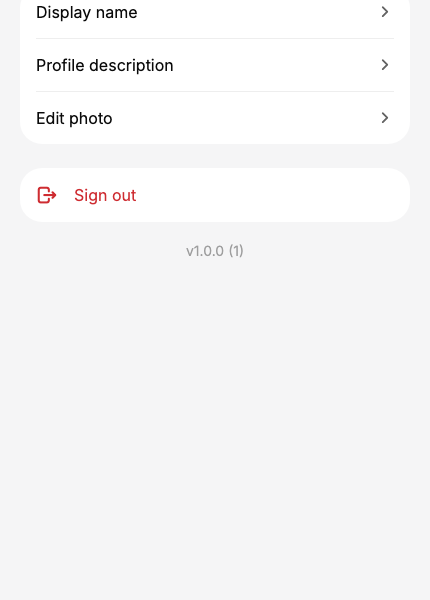
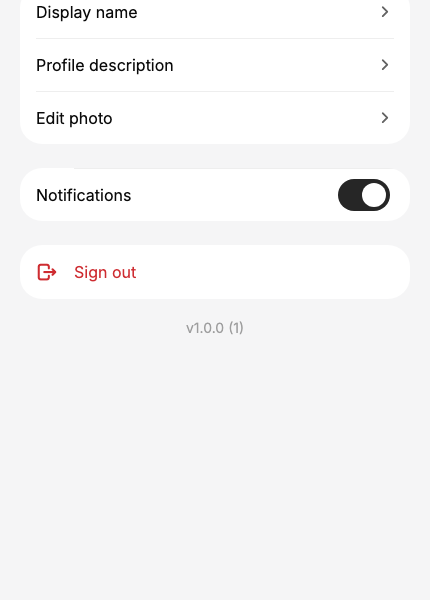
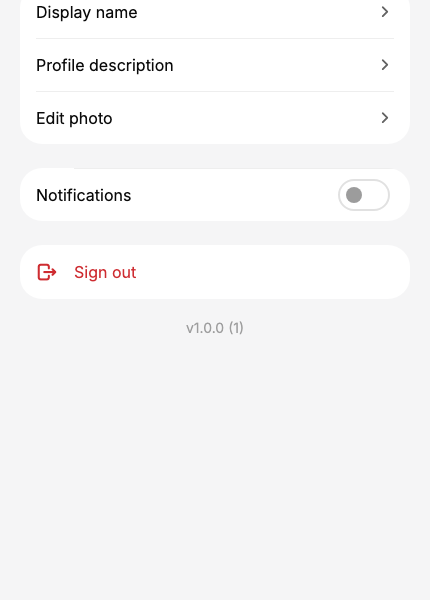
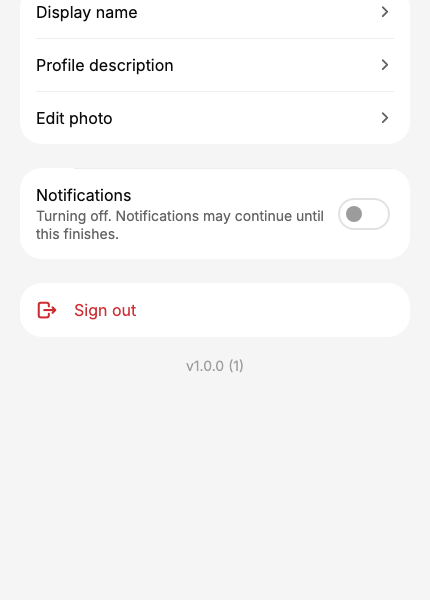
## Summary Ticket 7 of the [Android push plan](https://github.com/block/buzz/blob/main/PLANS/ANDROID_PUSH.md). Android phones can now enroll with the push gateway and publish a relay lease, through the same shared push layer iOS uses. The wake handling side is ticket 6, [#9804 Android push wake handling](https://github.com/block/buzz/pull/9804). - The phone gets an FCM token, then generates a sign-only P-256 Keystore key whose attestation challenge is the SHA-256 of the enrollment transcript. The chain goes to the gateway at enrollment. Every later installation call (delegate, rotate endpoint, revoke delegation, revoke installation) is signed with that key over the transcript bytes the gateway builds. - A rotated FCM token rotates the endpoint. Signing out revokes the delegation and the installation. The first enrollment waits a short random time. - Android 13+ asks for the notification permission at the same point iOS does. Declining keeps the app working. - A phone that cannot attest (no hardware attestation, unlocked bootloader, unlisted boot key) keeps working, and Settings says push is unavailable on this phone. - The relay lease keeps the fixed `transport` value iOS sends. - Firebase config is the same build-time setting [#9804 Android push wake handling](https://github.com/block/buzz/pull/9804) adds: four `BUZZ_FIREBASE_*` environment variables become the string resources Firebase reads. Nothing is committed, and builds without them still work (push reports unavailable). The Gradle hunks (permission, config block, `firebase-messaging` dependency) are copied from that PR verbatim so the two merge cleanly, including its `lifecycle-process` line, which this PR does not use. - The token and permission calls use their own `buzz/push_registration` channel, because Android's notification-open handler from that PR already owns `buzz/push` and a channel has one native handler. - The gateway gets an `enroll_android` transcript vector so Dart and Rust agree on the exact bytes. Enrollment state is journaled before each network attempt, so a lost response resumes with byte-identical requests instead of leaving an orphaned installation. ### Related issue None found. Builds on [#9560 enroll Android installations](https://github.com/block/buzz/pull/9560) and [#9562 verify Key Attestation](https://github.com/block/buzz/pull/9562). ### Validation Journey tests cover first enrollment, a second relay, reuse and renewal, lost responses, token rotation, an installation the gateway dropped, a lost Keystore key, a phone that cannot attest, and sign-out revocation, against a fake gateway that keeps the real gateway's semantics. Transcripts replay the shared vectors byte for byte. A settings journey checks the Notifications row and the unavailable row on Android, and a resume table checks the FCM token refresh: it runs while the relay reconnects, but not when push is off or the relay doesn't offer push. On a physical Pixel 9a (debug build, a local test gateway on a local Postgres, reached over `adb reverse`), the real Keystore key and hardware attestation chain enrolled and delegated, and the gateway accepted the attestation. The same session then ran: a signed delivery authorized against the delegation, endpoint rotation and re-delegation at the next epoch, rotating back, delegation revocation, installation revocation, and re-enrolling the same FCM token afterwards. The notification prompt appears when registration starts, before the token is fetched: <img src="https://github.com/user-attachments/assets/2aed92fe-20c1-4658-b990-51c3f3c96120" width="270" alt="Android notification permission prompt"> Not validated on the device: the FCM wake itself (the local gateway has no credentials to call FCM, so the delivery was authorized and then failed at the FCM hop), lease publication to a relay, and the in-app unavailable row, which only the widget tests exercise. A relay-backed run needs a signed-in test community on the phone. ### Settings while turning off Turning notifications off sends a relay tombstone. Until the relay accepts it, the row now says so, on both platforms. An Android build without a gateway also keeps a saved opt-in visible so it can still be turned off; once off, the row goes away. These are rendered from the Settings journey test. | | Before | After | |---|---|---| | Android build without a gateway, saved opt-in | <img src="https://raw.githubusercontent.com/block/buzz/47220acf78ad21639d2a3a8b79be3f0272e74db2/pr-9811--01-before-config-less.png" width="270" alt="Before: no Notifications row"> | <img src="https://raw.githubusercontent.com/block/buzz/47220acf78ad21639d2a3a8b79be3f0272e74db2/pr-9811--02-after-config-less.png" width="270" alt="After: Notifications row with the switch on"> | | After turning off, relay has not accepted yet | <img src="https://raw.githubusercontent.com/block/buzz/47220acf78ad21639d2a3a8b79be3f0272e74db2/pr-9811--03-before-turning-off.png" width="270" alt="Before: plain off switch"> | <img src="https://raw.githubusercontent.com/block/buzz/47220acf78ad21639d2a3a8b79be3f0272e74db2/pr-9811--04-after-turning-off.png" width="270" alt="After: Turning off. Notifications may continue until this finishes."> | ### Regressions - iOS enrollment is unchanged: the shared bridge only branches to the Dart authority on Android. iOS gains the pending opt-out subtitle, and its opt-out now also tombstones after a gateway change using the saved lease id. - The Android app gains the `firebase-messaging` dependency and a `POST_NOTIFICATIONS` permission. Backups exclude the push preferences file. ### Known limits - An FCM token rotation while the app is running is picked up on the next resume or launch, because the wake service owns the single messaging service. It could call into the registration plugin once both Android push PRs merge. - After an endpoint rotation, only the active community's lease is republished. Other enabled communities' grants are void until each is opened, the same way their leases lapse at grant expiry today. --------- Signed-off-by: Tom Brow <tomb@block.xyz> Co-authored-by: studio <dc2fc481343672df31a689840c09299972e704dac592e0da6f18486646a7ee3e@buzz.block.builderlab.xyz> Co-authored-by: studio <dc2fc481343672df31a689840c09299972e704dac592e0da6f18486646a7ee3e@localhost> |
||
|
Tom Brow
|
0636d21479 |
feat(mobile): report push gateway replies the app cannot read (#9806)
Reports push gateway replies the app cannot read, the last explicit
error report from [the diagnostic reporting
spec](https://github.com/block/buzz/blob/main/docs/mobile-diagnostic-reporting.md)
still missing.
The gateway is called from native code (`BuzzDevPushEnrollmentDriver`),
and Dart used to see every native failure as one code. Native now fails
with its own `gateway_response_invalid` code when a reply does not match
the gateway's protocol (bad JSON, a 2xx status other than the one the
gateway sends for that call, or a challenge, installation or delegation
reply with missing or invalid fields), carrying no text from the reply.
Dart reports that as a push gateway response error and rethrows as
before.
- **Not reported:** status mismatches (including 4xx and 5xx), timeouts
and offline failures, which the spec counts as routine; local-state
failures such as an App Attest key mismatch; and a plausible challenge
that has already expired by the device's clock, since a phone whose
clock runs fast would otherwise report on every retry. An expiry no real
challenge could have (zero, negative or a relative TTL) is still
reported. Local enrollment logs keep the fixed name of the failing
route.
- **Attribution:** the report goes through the signing member, so an
enrollment that finishes after a community switch names no one else.
## Validation
- `push_bridge_test.dart`: an unreadable reply is reported once and
enrollment still fails; routine native codes report nothing.
- `BuzzDevPushEnrollmentDriverTests`: bad JSON and an unexpected 2xx
fail as an unreadable reply; a 503 stays a status mismatch; a plausible
but expired challenge is not an unreadable reply, while an expiry of 0,
-1 or 300 is.
- `notification_toggle_test.dart`: an unreadable reply during the
notification journey files one report while the member matches and none
after it changes.
Full-app run on an iPhone 17 Pro simulator at
|
||
|
Tom Brow
|
3ff4154ca6 |
fix(mobile): back off push bootstrap retries (#9092)
When push setup fails, the app retried every 5 seconds forever. On an iPhone 12 mini whose push gateway enrollment is refused (a CDN 403 on the installation challenge), each retry refetched the relay's NIP-11 document over a new TLS connection and logged the whole HTML refusal. That is about 720 attempts and roughly 14 MB of traffic an hour for as long as the app stays open, with no way to succeed. Push registration, lease publication and tombstone retries now back off: each consecutive failure of the same attempt doubles the delay from 5 seconds up to 15 minutes, with jitter between half and all of it so devices that failed together don't retry together. A success (including a renewal), a different attempt, or a channel-grammar retry (which keeps its 5-minute delay) ends the streak. The first retry still comes within 5 seconds, so a brief blip recovers as quickly as before. ### Validation - Added tests: `repeated failures back off exponentially up to a cap` checks every delay's bounds at both jitter extremes over 12 failures, `a success ends the failure streak`, and `a different attempt starts its own backoff`. The first fails when the gate goes back to a fixed delay. - Existing push suite passes. - On the 12 mini before this change: `Push lease bootstrap failed` with the 403 page and a fresh NIP-11 fetch every 5 seconds for the whole session. 🤖 Generated with [Claude Code](https://claude.com/claude-code) --------- Signed-off-by: Tom Brow <tomb@squareup.com> Co-authored-by: Tom Brow <tomb@squareup.com> Co-authored-by: studio <dc2fc481343672df31a689840c09299972e704dac592e0da6f18486646a7ee3e@buzz.block.builderlab.xyz> |
||
|
Tom Brow
|
f167c4c3e1 |
fix(push): accept canonical channel UUIDs across versions (#8609)
Starter channels use UUIDv5 IDs, but mobile push accepted only UUIDv4 channel IDs, so building a subscription that included a starter channel threw locally. After #8608, no non-v4 ID reaches mobile push today: positive `#h` filters cover joined DMs only, and mutes are limited to subscribed channels. This PR is therefore a safety net for future starter-channel subscriptions, and it prepares mobile for a relay that accepts them. Mobile now accepts canonical lowercase, hyphenated UUIDs of any version in subscriptions. It recognizes both the current `uuid-v4-lowercase` relay descriptor and a future `uuid-lowercase` descriptor. Against a `uuid-v4-lowercase` relay, mobile checks positive and mute channel filters before enrollment or publication, keeps the desired filters, and rechecks relay capabilities every five minutes instead of sending a lease the relay would reject. The relay is unchanged. It keeps validating and advertising `uuid-v4-lowercase`. Installed mobile builds reject any other `h_grammar`, and they parse the descriptor before renewal, opt-out and revocation, so changing the advertisement now would leave their leases active until expiry. The relay validation and advertisement change will follow in a separate PR once those builds have drained. `docs/buzz-push.md` records this sequencing. ### Validation - Regression tests reproduced the UUIDv5 rejection in Dart before the fix. Added coverage checks positive and mute filters, persisted subscription round trips, encrypted lease content, malformed IDs, retained bounds, parsing of both descriptor grammars, and pre-publication rejection of non-v4 IDs against a `uuid-v4-lowercase` relay. - Mobile push tests on the current head: 104 passed, 4 skipped. `flutter analyze` on the push code and tests is clean. - Before the split, exercised actual mobile lease construction, NIP44 encryption and NIP42 publication against an isolated local relay. The relay half of that exercise is no longer part of this PR. - Relay source is identical to `main`, so the relay serves the same descriptor that installed builds parse today. The standing mobile test exception applies. Agent review and changed-behavior exercise are complete. buzz-review-completed --------- Signed-off-by: Tom Brow <tomb@block.xyz> Co-authored-by: george <973be878edd6d4f79692a3827f20a6f7fe0ed0362f269ff6b6ba8867033d7d8e@sprout-oss.stage.blox.sqprod.co> |
||
|
Tom Brow
|
5996e5dd8b |
fix(mobile): isolate push setup failures from app rendering (#8610)
Push subscription setup ran synchronously inside the root widget build, so an invalid subscription could replace the entire app with Flutter's error surface. Push initialization and the cold-start native notification read could also prevent the app from rendering. Keep push work independent of the app subtree, observe asynchronous persistence failures, and retain the original errors and stack traces. Setup retries use bounded backoff; Settings shows a failure and offers manual retry without resetting navigation. Retry preserves a healthy revocation worker, and community-removal callbacks follow a recovered worker so lease cleanup continues after setup recovery. Related: [#8608](https://github.com/block/buzz/pull/8608) fixes the specific unrelated-mute input that exposed this startup coupling. ### Validation Added Flutter journeys cover invalid subscriptions, asynchronous storage failure, dependency initialization failure, retry exhaustion and manual recovery, navigation preservation, accessible retry actions, and pending/failed native startup reads with notification-target recovery. Both original rendering regressions failed before the fix. Community-removal coverage also verifies cleanup after a worker initialization failure and after retrying healthy setup; that regression failed before the worker fix. The full mobile suite passed (3,782 tests; 19 existing skips), as did the four unconfigured-build tests and static analysis. The corrected head also passed the full pre-push mobile checks and tests, plus 42 focused push and community tests. Rendered widget evidence uses mocked native platform channels; no device APNs delivery test was performed. Rendered Flutter widget evidence with synthetic data and mocked native platform views. ### Setup failure The app remains usable and Settings offers a retry after push initialization fails. 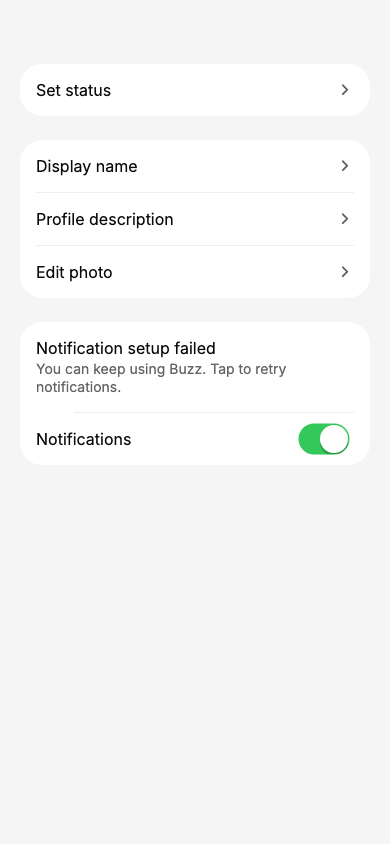 ### Recovery Retry clears the error without replacing the navigator or leaving Settings. 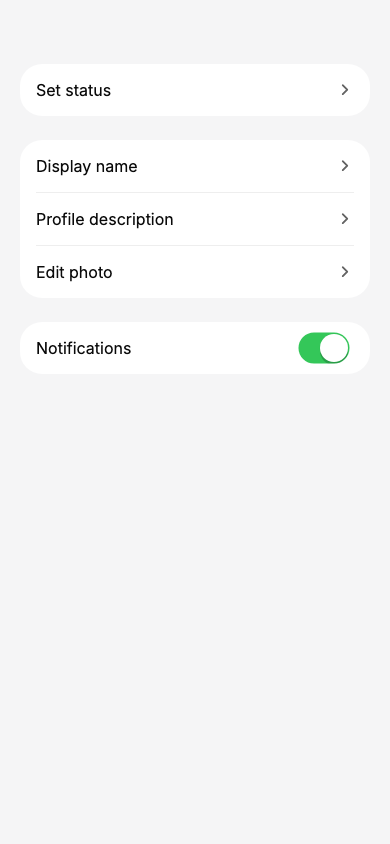 <!-- buzz-review-completed --> --------- Signed-off-by: Tom Brow <tomb@block.xyz> |
||
|
Tom Brow
|
c09730e874 |
fix(mobile): keep notification toggle usable and match row height (#8223)
Turning Notifications off invalidated the relay capability provider because it watched the entire saved community. If the redundant NIP-11 request stalled or failed, the switch became disabled and reopening Settings did not recover it. Discovery now follows community identity and connection status, so preference and lease bookkeeping retain the validated capability while a real reconnect still refreshes it. Each opt-in also starts a fresh active lease immediately instead of waiting for the old renewal timer. Failed attempts retain their gate until the retry delay expires, preventing rebuilds from bypassing backoff. Notifications now has the same single-line height as Set status, with the full switch hit area and one combined accessibility label. This follows [#8201](https://github.com/block/buzz/pull/8201); no duplicate open PR was found. ### Validation Added iOS widget regressions mount the production settings page and push bootstrap with production storage logic, signing, and lease publication. They verify a higher-generation active replacement after off/on with accepted, failed, and pending cleanup, plus closing/reopening Settings, switch and row taps, 2× text, accessibility, and rediscovery on reconnect. A gate test verifies that rebuilds cannot bypass failure backoff. Both UI failures and the missing active replacement were reproduced before their fixes. Mobile dependency installation, formatting/static checks, 3,234 configured tests, and three unconfigured-build tests passed. Captures use the real Flutter settings widget at 375pt width, with synthetic data and mocked native/network boundaries. Native navigation is outside the capture. No device installation or deployment was performed. After merge, validate the candidate on iOS: compare Notifications with Set status, toggle off then immediately on, close/reopen Settings while off and turn on, and repeat after reconnect. Confirm delivery resumes after opt-in. ### Layout Flutter widget captures with synthetic data; native navigation is excluded. | Before | After | | --- | --- | | 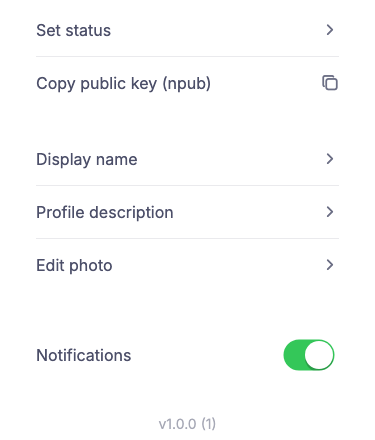 | 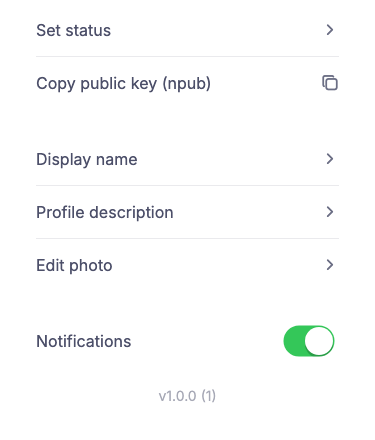 | --------- Signed-off-by: Tom Brow <tomb@block.xyz> |
||
|
Tom Brow
|
76f7e5ef0c |
feat(push): make gateway origin configurable (#7261)
Make the push gateway origin configurable across the relay, gateway, mobile client, and deployment chart. This is a fresh deployment. The gateway has only run on personal development infrastructure, and push has no existing enabled users. Legacy migration, configured-to-unconfigured mobile transitions, and rolling upgrades from pre-launch gateway binaries are not supported. Populated pre-launch databases are rejected with an informative error before migrations run; their data is untouched. Mobile builds may omit the gateway URL, leaving push unavailable. Once push is enabled, subsequent builds must retain that configuration. ### Validation - All applicable CI checks pass at `5f546cfaf403f0386f146d213adfb4392f4ec29c`, including Rust, mobile/Swift, desktop/integration, security, image builds, and Helm checks. An unrelated agent cancellation test passed on retry. - PostgreSQL CI passed 384 tests, including the production-entry-point regression for refusing populated pre-launch databases before migrations, fresh initialization, and subsequent initialized deployments. - Focused local validation passed all 10 gateway PostgreSQL tests under the CI discovery filter and all 3 unconfigured-mobile tests. Repository-wide PostgreSQL discovery validation and the complete pre-push hooks passed. - Physical-device APNs/App Attest behavior and deployment to a live cluster were not verified in this work. --------- Signed-off-by: Tom Brow <tomb@block.xyz> Co-authored-by: Codex <noreply@openai.com> |
||
|
Tom Brow
|
c432a111ca |
feat(mobile): push notifications MVP (#6269)
This PR implements MVP, iOS-only,
[NIP-PL](
|