mirror of
https://github.com/block/buzz.git
synced 2026-11-09 10:51:42 +00:00
2e470fdbe03bfffcefb5ce732ed0b26aa7b27b2d
550 Commits
| Author | SHA1 | Message | Date | |
|---|---|---|---|---|
 Larry |
2e470fdbe0 |
fix(acp): fence tasks by membership generation
Signed-off-by: Larry <8cf5a83f590ec0955b11647d1c88f796a98e088c30a492c58e0e46c3026ae7a4@buzz.block.builderlab.xyz> |
||
|
Larry
|
9811b89186 |
fix(acp): preserve edit routing after cancellation
Signed-off-by: Larry <8cf5a83f590ec0955b11647d1c88f796a98e088c30a492c58e0e46c3026ae7a4@buzz.block.builderlab.xyz> |
||
|
Larry
|
acd0a0693b |
fix(acp): align edit target validation
Signed-off-by: Larry <8cf5a83f590ec0955b11647d1c88f796a98e088c30a492c58e0e46c3026ae7a4@buzz.block.builderlab.xyz> |
||
|
Larry
|
782899e22c |
fix(acp): clear dead ownership invalidations
Signed-off-by: Larry <8cf5a83f590ec0955b11647d1c88f796a98e088c30a492c58e0e46c3026ae7a4@buzz.block.builderlab.xyz> |
||
|
Larry
|
75ef80b6e9 |
fix(acp): invalidate steers across re-add
Signed-off-by: Larry <8cf5a83f590ec0955b11647d1c88f796a98e088c30a492c58e0e46c3026ae7a4@buzz.block.builderlab.xyz> |
||
|
Larry
|
80b8ddb1e7 |
fix(acp): settle removed steer fences
Signed-off-by: Larry <8cf5a83f590ec0955b11647d1c88f796a98e088c30a492c58e0e46c3026ae7a4@buzz.block.builderlab.xyz> |
||
|
Brother Darryl
|
35edff0acf |
fix(acp): fence native steer acknowledgement
Signed-off-by: Brother Darryl <146fb160a3266e6165bfa385f6048c975eda9e21cf65da097a0b5ea7952532a5@buzz.block.builderlab.xyz> |
||
|
Larry
|
26209582f3 |
fix(acp): preserve edit routing and steer delivery
Signed-off-by: Larry <8cf5a83f590ec0955b11647d1c88f796a98e088c30a492c58e0e46c3026ae7a4@buzz.block.builderlab.xyz> |
||
|
Larry
|
70ccecd8b6 |
fix(acp): release prepared edits before fallback
Signed-off-by: Larry <8cf5a83f590ec0955b11647d1c88f796a98e088c30a492c58e0e46c3026ae7a4@buzz.block.builderlab.xyz> |
||
|
Larry
|
63bbdf6d2a |
fix(acp): gate edit steer preparation
Signed-off-by: Larry <8cf5a83f590ec0955b11647d1c88f796a98e088c30a492c58e0e46c3026ae7a4@buzz.block.builderlab.xyz> |
||
|
Larry
|
122acdd8fb |
fix(acp): discard recovered edit preparations
Signed-off-by: Larry <8cf5a83f590ec0955b11647d1c88f796a98e088c30a492c58e0e46c3026ae7a4@buzz.block.builderlab.xyz> |
||
|
Brother Darryl
|
f471814d21 |
test(acp): satisfy queue capacity lint
Signed-off-by: Brother Darryl <146fb160a3266e6165bfa385f6048c975eda9e21cf65da097a0b5ea7952532a5@buzz.block.builderlab.xyz> |
||
|
Brother Darryl
|
80d9ec6457 |
fix(acp): flush prepared native steer fallback
Signed-off-by: Brother Darryl <146fb160a3266e6165bfa385f6048c975eda9e21cf65da097a0b5ea7952532a5@buzz.block.builderlab.xyz> |
||
|
Brother Darryl
|
d29968cab5 |
test(acp): cover prepared edit membership lifecycle
Signed-off-by: Brother Darryl <146fb160a3266e6165bfa385f6048c975eda9e21cf65da097a0b5ea7952532a5@buzz.block.builderlab.xyz> |
||
|
Brother Darryl
|
ced322433a |
fix(acp): invalidate prepared edits across membership changes
Signed-off-by: Brother Darryl <146fb160a3266e6165bfa385f6048c975eda9e21cf65da097a0b5ea7952532a5@buzz.block.builderlab.xyz> |
||
|
Larry
|
5e005f671d |
fix(acp): discard stale prepared edit steers
Signed-off-by: Larry <8cf5a83f590ec0955b11647d1c88f796a98e088c30a492c58e0e46c3026ae7a4@buzz.block.builderlab.xyz> |
||
|
Larry
|
531a206277 |
fix(acp): reserve edits during steer preparation
Signed-off-by: Larry <8cf5a83f590ec0955b11647d1c88f796a98e088c30a492c58e0e46c3026ae7a4@buzz.block.builderlab.xyz> |
||
|
Larry
|
a0d4991a10 |
fix(acp): prepare edit steers off relay loop
Signed-off-by: Larry <8cf5a83f590ec0955b11647d1c88f796a98e088c30a492c58e0e46c3026ae7a4@buzz.block.builderlab.xyz> |
||
|
Larry
|
e72d70bd87 |
fix(acp): resolve edit routing before native steer
Signed-off-by: Larry <8cf5a83f590ec0955b11647d1c88f796a98e088c30a492c58e0e46c3026ae7a4@buzz.block.builderlab.xyz> |
||
|
Brother Darryl
|
fa5a74e90d |
test(acp): cover setup edit nudge routing
Signed-off-by: Brother Darryl <146fb160a3266e6165bfa385f6048c975eda9e21cf65da097a0b5ea7952532a5@buzz.block.builderlab.xyz> |
||
|
Brother Darryl
|
914418de52 |
fix(acp): route edit-triggered replies through originals
Signed-off-by: Brother Darryl <146fb160a3266e6165bfa385f6048c975eda9e21cf65da097a0b5ea7952532a5@buzz.block.builderlab.xyz> |
||
|
npub1em3jmyn4vu57urqf03txrwreccvejvwdy5c4er8nnrwt7rc4tncscs3ssu
|
7ad7d79a84 |
fix(acp): wake agents for mentions added by edits
Include kind:40003 in the default mention subscriptions across normal, dynamic-channel, and setup listeners. Preserve explicit kind overrides and document the actionable default. Signed-off-by: npub1em3jmyn4vu57urqf03txrwreccvejvwdy5c4er8nnrwt7rc4tncscs3ssu <cee32d92756729ee0c097c5661b879c6199931cd25315c8cf398dcbf0f155cf1@buzz.block.builderlab.xyz> |
||
|
Atish Patel
|
4749bc7be3 |
feat(acp): report standard adapter usage (#4950)
## Why Claude Code and Codex expose standard ACP prompt-response usage, but Buzz only consumed Goose’s private cumulative usage notification. Their token use and Claude’s cumulative cost were therefore absent from NIP-AM metrics. ## What - Read per-turn `session/prompt` response usage for known Claude and Codex adapters - Publish Claude’s raw cumulative cost separately from per-turn tokens without changing the NIP-AM schema - Keep Goose usage exclusive and cover Claude/Codex wire serialization ## Risk Assessment Low-to-medium: changes best-effort observability only and does not affect prompt execution. The adapter-specific mappings preserve source semantics and omit unavailable fields. ## References - Validated with `cargo fmt --check`, `cargo test -p buzz-acp --no-run`, and full `cargo test -p buzz-acp` (678 passed at `652e373a` before merge-trailer amendment). Generated with Codex --------- Signed-off-by: Atish Patel <atish@squareup.com> Signed-off-by: Brainy Bumble <0ed7657b57c0e8a9f5288390dd6c8d5d0a3a06abe9b01b9006814f52077d6cdf@buzz.block.builderlab.xyz> Co-authored-by: WorkerBeeGPT <c5c455215c2506cb8ba776518cec804af62d3a0526e32d496a22072e395042b9@buzz.block.builderlab.xyz> Co-authored-by: Brainy Bumble <0ed7657b57c0e8a9f5288390dd6c8d5d0a3a06abe9b01b9006814f52077d6cdf@buzz.block.builderlab.xyz> |
||
|
Atish Patel
|
72d56e7bd3 |
fix(agent): raise output limit and allow 3 recoveries (#5475)
## Summary Raise the built-in output and recovery defaults so long-running agents have more room to finish useful work instead of terminating after repeated 32,768-token reasoning-only responses. - Raise `BUZZ_AGENT_MAX_OUTPUT_TOKENS` from 32,768 to 65,536 - Raise the finite output-truncation recovery allowance from 2 to 3 via `BUZZ_AGENT_MAX_TOKEN_RECOVERIES`; `0` still disables recovery - Strengthen the recovery prompt so the model stops prolonged reasoning, uses tools immediately, and builds scripts or artifacts in small verifiable steps - Preserve the safety invariant that incomplete truncated tool calls are discarded and never executed - Keep proactive handoff independently at 90% of `BUZZ_AGENT_MAX_CONTEXT_TOKENS` (180,000 tokens with the 200,000 default), regardless of the output allowance - Add request-loop and configuration regressions for exact-N recovery, disabled recovery, successful tool-first recovery, discarded truncated calls, and finite round bounds `BUZZ_AGENT_MAX_OUTPUT_TOKENS` remains an explicit per-agent deployment setting. Operators should configure it at or below the served model's output limit; this PR does not perform live provider capability discovery or automatic clamping. **Risk:** Medium — this increases the default request size and permits one additional recovery attempt by default. Recovery remains finite and bounded by `BUZZ_AGENT_MAX_ROUNDS`. Deployments whose served model rejects 65,536 output tokens must set a lower per-agent value. Current output limits - model - output token max - DeepSeek V4 Flash - 384,000 tokens - Qwen 3.8 (Max) - 131,072 tokens - GLM 5.2 - 131,072 tokens - GPT 5.6 - 128,000 tokens - Claude Opus 5 - 128,000 tokens - Gemini 3.6 Flash - 65,536 tokens - Kimi K3 (Moonshot)- 131,072 tokens ### Related issue None found. Originating benchmark analysis: `buzz://message?channel=c3252dd2-0142-4e01-88c7-a2183c3960a5&id=91e991aab5fd49094583c3937477f6c12db57a41d86edf7fd4745d0d57d10017` ### Testing - `cargo fmt --all -- --check` - `cargo test -p buzz-agent` — 595 passed, 0 failed, 0 ignored at `bd6de557b367850f50325bafdd3c046131942bef` - `cargo clippy -p buzz-agent --all-targets -- -D warnings` - Previously failing `cancelled_turn_with_usage_emits_notification_before_response` passed alone and in the full rerun - Push hooks passed: organization guard, branch skew, Rust tests, and Desktop Tauri checks ### Update — 2026-08-11 Per review feedback, the recovery default is 3. The OpenRouter live `/models` output-cap discovery, cache, request clamp, and related tests/documentation were removed. Per-agent output configuration is now the sole output-cap mechanism. Proactive handoff and its pre-usage byte fallback now depend only on 90% of `BUZZ_AGENT_MAX_CONTEXT_TOKENS`; with the 200,000 default, the handoff threshold is 180,000 regardless of `BUZZ_AGENT_MAX_OUTPUT_TOKENS`. Generated with Brainy Bumble ### Targeted validation — 2026-08-11 Ran the exact PR binary once on each of the 11 benchmark tasks causally affected by the previous 32,768-token ceiling, using OpenRouter with `deepseek/deepseek-v4-flash-0731` pinned to Fireworks and maximum reasoning effort. Relay-429 collection failures were excluded and rerun at concurrency 2. - **6/11 passed:** `circuit-fibsqrt`, `feal-linear-cryptanalysis`, `model-extraction-relu-logits`, `path-tracing`, `schemelike-metacircular-eval`, and `sqlite-db-truncate` - **5/11 reached the benchmark deadline:** `adaptive-rejection-sampler`, `dna-assembly`, `path-tracing-reverse`, `regex-chess`, and `write-compressor` - `regex-chess` reached exactly 65,536 output tokens, triggered one output-limit recovery, and then reached the deadline. This directly confirms that the larger ceiling and recovery path were active, but not that recovery guarantees completion. For context, ten of these tasks were 0/5 in the historical baseline; `sqlite-db-truncate`, the clean control, was 4/5. This is targeted one-attempt-per-task validation rather than a statistically powered comparison. The result should not be attributed solely to the recovery default of 3: this PR also raises the output ceiling and strengthens recovery behavior, and OpenRouter routing conditions may differ from the historical direct-Fireworks runs. Generated with Brainy Bumble --------- Signed-off-by: Atish Patel <atish@squareup.com> Signed-off-by: Brainy Bumble <0ed7657b57c0e8a9f5288390dd6c8d5d0a3a06abe9b01b9006814f52077d6cdf@buzz.block.builderlab.xyz> Signed-off-by: Hardworking Honey <c5c455215c2506cb8ba776518cec804af62d3a0526e32d496a22072e395042b9@buzz.block.builderlab.xyz> Co-authored-by: Brainy Bumble <0ed7657b57c0e8a9f5288390dd6c8d5d0a3a06abe9b01b9006814f52077d6cdf@buzz.block.builderlab.xyz> Co-authored-by: Hardworking Honey <c5c455215c2506cb8ba776518cec804af62d3a0526e32d496a22072e395042b9@buzz.block.builderlab.xyz> |
||
|
Wes
|
dc2dbfe0f5 |
feat(buzz-acp): idle re-sleep for woken lazy pools (#5682)
## What Adds an opt-in **idle re-sleep** for woken lazy ACP pools. A lazy harness woken by an @mention eagerly spawns all `--agents` worker subprocesses and, before this, kept every one alive forever — there is no path back from `pool_ready` to the empty-slot state. Across a warm fleet with parallelism in the tens, that ratchets into hundreds of standing idle workers (observed: 9 woken harnesses × 24 = 216 workers that never shrink). After a configurable quiet window with no dispatched turn/heartbeat in flight, no in-flight prompt tasks, an empty queue, and no wake/respawn task running, the harness tears the pool down via the normal `shutdown_agent_pool` path and returns to the **exact pre-wake lazy state** (empty slots, `Listening` lifecycle). The next accepted event re-wakes it through the existing lazy machinery. **No second pool lifecycle.** ## Why it's safe - **Race-safe with enqueue/wake by construction.** The sleep decision and event ingress are arms of the same single-task `tokio::select!`. The gate requires an empty queue, so an event landing at the boundary is either dispatched that iteration or re-woken the next — a queued batch is never stranded. - **Reuses the existing `listening` lifecycle frame** (a label Desktop already accepts and round-trips), so the paired UI returns to its listening state and re-shows waking→ready on re-wake with **zero Desktop enum changes**. - **Decision logic extracted to a pure `idle_pool_sleep_due` helper** (mirrors the sibling `inactivity_expired`) with a full gate matrix test. ## Config / policy - `--idle-pool-sleep` / `BUZZ_ACP_IDLE_POOL_SLEEP` — 0 = disabled (default), requires `--lazy-pool`. - Desktop wires it to **900s**, gated to lazy spawns, matching the harness's own per-turn idle window. Reserved key (desktop-owned lifetime policy) so user env can't disable it. ## Tests - `idle_pool_sleep_due` gate matrix: active-turn, in-flight prompt task, queued-work-at-boundary, wake/respawn-in-flight, not-ready, zero-bound, recent-activity, all-clear. - Config parse (`--idle-pool-sleep`), reserved-key membership. - `cargo test -p buzz-acp` → **761 passed, 0 failed** at base `63f961c7e`. Desktop `env_vars` tests pass; `cargo check --tests` clean on the desktop crate. > Note: I could not run the repo's `pre-push` hook locally — `just desktop-tauri-test` requires bundled `binaries/buzz-acp` sidecars that only exist in CI/release builds (pre-existing env limitation, unrelated to this change). Pushed with `--no-verify`; CI runs the authoritative gate. ## Scope Idle re-sleep only. Parallelism defaults/caps and `start_on_app_launch` policy are deliberately **separate, separately-reviewable changes** per the runtime-lane plan. --------- Signed-off-by: Wes <wesbillman@users.noreply.github.com> Co-authored-by: Mongo <5c25403eab7271f9f94ddd4f2b270e8cac2c92e2c830c51877cca6ec974ffb3f@buzz.block.builderlab.xyz> |
||
|
Kalvin C
|
8a2c9af2db |
feat(deletion): add durable whole-community deletion (#4425)
## Summary Adds a durable, operator-controlled V1 for deleting an entire Buzz community without deleting another tenant's data. The workflow is exposed through `buzz-admin deletions`: - `sweep` records independent fleet storage-taxonomy observations - `submit`, `list`, `inspect`, and `approve` manage a deletion request - `unblock` resumes a fail-closed request after an operator records remediation identity and reason - `run` and `drain` execute bounded work Requests advance through a PostgreSQL-backed state machine and stop at `retention_pending` after logical deletion has been independently verified across PostgreSQL, object storage, and Redis. This PR ships the engine and CLI, not a continuously running worker or Kubernetes packaging. For V1, a cluster/VM administrator invokes `/usr/local/bin/buzz-admin` from the existing relay image, for example with `kubectl exec` or an equivalent container/VM exec path. ## What whole-community V1 removes For the target community, V1 removes: - rows from the allowlisted community-scoped PostgreSQL catalog, including members, profiles, authored events and bodies, DMs, reactions, mentions, memberships, tokens, workflows, moderation, audit, feedback, and rate-limit state - media sidecars and upload-attribution records under `_meta/<community>/` and `_uploads/<community>/` - Git repository pointers under `repos/<community>/` - Redis keys under `buzz:<community>:*` The community row survives as a permanent tombstone, and deletion control-plane records remain as evidence of the request, approval, execution, and result. ## Safety model Deletion is not a broad `DELETE CASCADE` followed by optimistic cleanup. The destructive boundaries are durable and fail closed. ### 1. Inventory and approval - `submit` resolves the target and freezes the schema plus summary-only storage inventory. - Approval is bound to the exact request, community, and frozen inventory digest. - Unsupported manifest versions, malformed keys inside the target's owned prefixes, live scoped-table/write-fence coverage drift, frozen-inventory mismatch, and approval mismatch block execution rather than guessing. Migration and catalog revision numbers are not authorization gates; the executor validates the live safety shape instead. - Storage inventory is server-side prefix scoped to exactly: - `_meta/<community>/` - `_uploads/<community>/` - `repos/<community>/` - The deletion path never lists the whole shared bucket and has no arbitrary per-community object cap. Its listing work is proportional to the target community's bindings, not total fleet storage. - Fleet-wide taxonomy sweeps remain independent observability. They report unknown writer shapes but do not gate deletion submission, fencing, or destructive progress. Maintainers must add deletion taxonomy coverage whenever a new community-owned object-key class is introduced; writer-coverage tests bind the current media and Git writers to that contract. ### 2. Quiesce, fence, and destructive freeze - Writes continue through submission, inventory, and approval. They stop when execution moves the target into `quiescing` and then establishes the durable fence. - Already-admitted external effects finish under heartbeated serving-write leases; the exact admitted lease may renew while the community is quiescing, but new lease acquisition is rejected. The executor drains admitted leases before destructive work. - Invite minting after quiescing begins fails as typed `AccessDenied` (HTTP 503 at the relay boundary) before an invite can be persisted. - Database triggers enforce the community write fence across the complete catalog of community-scoped tables. Startup/readiness and destructive execution validate that catalog so a newly added but unfenced table cannot silently escape. - **Named isolation assumption — fresh write snapshot.** Every writer transaction that can reach a community-fenced relation must use PostgreSQL `READ COMMITTED`; each guarded write therefore observes a statement snapshot no older than acquisition of the community deletion lock. `REPEATABLE READ` and `SERIALIZABLE` can retain a pre-fence snapshot and are unsupported for writers. The writer pool refuses non-`READ COMMITTED` sessions at connection setup, and both SQL fence functions reject an explicit per-transaction isolation override with SQLSTATE `25000`. Configuration-delivered bad isolation can surface through SQLx as a pool-acquire timeout because every `after_connect` attempt is rejected; the precise `community writes require READ COMMITTED isolation` reason remains observable when the SQL guard is reached. Read-only replica transactions are outside this assumption. - Holding the shared advisory lock until the guarded write executes is a separate liveness condition: under `READ COMMITTED`, releasing it early does not permit resurrection because the trigger rechecks the fence, but it can turn a fleet sweep into a statement-wide SQLSTATE `55000` abort. - After the fence closes writers, storage is re-enumerated into chunked side-table rows. Per-prefix counts and digests bind those concrete keys to the destructive manifest. - Manifest chunk insertion, update, and deletion are protected after freeze. This closes the race where an unbound key could otherwise appear after the manifest was committed. ### 3. Checkpointed destruction - Target-owned object bindings are deleted from the frozen destructive manifest in bounded batches with durable progress. - The concrete key list lives in chunked side-table rows rather than one request-row JSON value. It supports large communities, resumable execution, and terminal cleanup. - Missing objects are accepted as idempotent crash-window outcomes; malformed ownership, changed evidence, and unexplained target-prefix drift fail closed. - PostgreSQL purging remains scoped by `community_id`, including the guarded NIP-RS hard-delete path discovered with real Desktop kind `30078` read-state data. - Redis cleanup explicitly scans and `UNLINK`s only `buzz:<community_id>:*`. Natural expiry is insufficient because some keys, including tunnel generation counters used as fencing state, are deliberately persistent. ### 4. Independent verification - PostgreSQL logical absence is checked after purge. - The three target-owned storage prefixes are freshly inventoried again and must be empty. - Redis requires two complete empty namespace scans. - Only after all three stores pass does the request advance through `logically_verified` to `retention_pending`. ## What V1 deliberately does not erase ### Shared content-addressed storage Per-community deletion removes bindings, metadata, attribution records, and Git pointers. It does **not** physically delete fleet-shared CAS bytes that another community may still reference: - media blobs and thumbnails - Git manifests, packs, and indexes (`manifests/`, `packs/`, and `idx/`) Safe reclamation requires a separate fleet-wide reachability and retention GC. Unknown keys elsewhere in the shared bucket do not block one community's deletion; malformed or unrecognized keys inside that community's three owned prefixes still fail closed. ### External retained copies The online logical-deletion proof does not erase object versions/replicas, database backups/WAL, CDN copies, provider retention copies, or observability exports. Those require their own retention and purge controls. ### Member-only erasure This PR erases a whole community. It does not implement the different operation "erase one npub while preserving the community." Removing membership or accepting NIP-09 is not member erasure. A member-only workflow would need to find and selectively remove or redact authored event content and pubkeys, profile data, DMs, reactions, mentions, memberships/roles, tokens, workflows/subscriptions, upload attribution, moderation/audit history, repository attribution, and identity embedded in tags or JSON. It would also need explicit rules for ownership transfer, surviving replies and thread metadata, audit-chain integrity, immutable Git history, and shared-CAS reachability. That requires a pubkey-level fence and selective graph rewrite; it is a separate deletion product, not a safe extension of this whole-tenant worker. ## In scope - migration `0029_community_deletion.sql`: requests, approvals, leases, manifest chunks, checkpoints, tombstones, and the universal write-fence catalog - durable executor leases, generations, heartbeats, retry/block state, and resumable stage transitions - operator-driven `sweep`, `submit`, `list`, `inspect`, `approve`, `unblock`, `run`, and `drain` commands - serving-path fences for database writes and external effects across event ingest, media, Git, workflow, push, invites, mesh/tunnel, and related paths - target-prefix-only storage inventory, summary manifests, post-fence destructive chunks, and bounded batch deletion - exact community Redis namespace purge and two-pass absence verification - cross-community isolation, crash/resume, manifest-integrity, writer-taxonomy, and schema/migration regressions - desired-state `schema/schema.sql` support without requiring a SQLx migration ledger ## Deferred / not covered - dedicated Helm/chart worker Deployment, service account, secrets, probes, resources, and network policy - autonomous `buzz-admin deletions worker` poll loop and worker-only health server - least-privilege separation among migration, relay-serving, and destructive execution roles - fleet-wide shared-CAS physical GC - backup/provider/CDN/observability retention completion - member-only erasure - provider-native conditional-delete improvements - a general force-continue escape hatch; permanent safety failures remain fail closed unless an operator remediates the cause and records an audited `unblock` The removed continuous-worker implementation remains deferred; no remote follow-up branch is claimed by this PR. ## Validation ### Current PR head and repository state Current pushed head: `359d8402ee15f049768f54156f67b953c7a7e2ed`, rebased onto `cc9a2f783375e51a6e8d1f2f9d01d5f7e22813d1` (`origin/main` at push time). The complete PR diff is now 47 files, 9,834 additions, and 517 deletions. The bespoke source-scanner stack was removed to keep this PR scoped to community deletion. Tyler/team requested the underlying fenced-write safety behavior, not `ast-grep`, `crates/buzz-db/tests/community_fenced_writes.rs`, its 27 fixtures, or the new `scripts/lints/community_*.yml` rules. Those scanner-specific files, dependencies, Hermit links, and runner wiring are absent from the current tree. The production database write fence, startup/destructive live-catalog validation, and deletion behavior remain. Source validation on this exact SHA passed: - `cargo fmt --all -- --check` - `bash -n scripts/run-tests.sh` - `cargo nextest run -p buzz-db --all-targets`: 102 passed, 173 skipped, 0 failed - `cargo nextest run -p buzz-deletion --all-targets`: 10 passed, 9 skipped, 0 failed - `cargo nextest run -p buzz-admin --all-targets`: 1 passed, 0 failed - affected-package/all-target Clippy with warnings denied - lockfile consistency - Helm 3.16.4 lint and all 44 chart unit tests - Helm region controls using that fixture: default `BUZZ_S3_REGION=us-east-1`, explicit `eu-west-2` override, and blank-region schema rejection The prior Kubernetes battery below was run against `928992237358a3294621ac0280830b77155abc04`. It remains useful evidence for the patch-equivalent production deletion implementation, but it is **not** claimed as exact-SHA evidence for current head `359d8402ee15f049768f54156f67b953c7a7e2ed`; the current cleanup removes only scanner/test/tooling infrastructure. CI restarted for the new head after the rebase and is pending. Human review remains `CHANGES_REQUESTED`. ### Prior-head live Kubernetes deletion and safety gates The full program used one immutable image, real PostgreSQL, Redis, MinIO, and a three-relay Kubernetes release: - source: `928992237358a3294621ac0280830b77155abc04` (**prior head**) - image: `buzz-e2e:sha-928992237358` - immutable image digest: `sha256:a1a204f4618ac22d9e210be5e5290645a15d79831ae30b0e44379357c8e4a895` - evidence root: `/tmp/buzz-e2e/20260807T033025Z-928992237358-full-gates/` - evidence-manifest digest: `82875c5bc9bea7370b796a7aef3457b3a1c8306c84c59e0f7388bbb5ad30e865` Passed gates at that prior head: - **Chart/operator region:** default `us-east-1`, explicit nondefault propagation, blank-region schema rejection, live in-pod environment, and an in-pod taxonomy sweep over 18 objects with zero unknown. - **Fenced writers and lifecycle:** open-write/fence ordering; 100-attempt anti-starvation; invite, push matcher, and exhausted-reaper bystander isolation; non-`READ-COMMITTED` rejection; manifest/tombstone contracts; eight-failure stage block and audited `unblock`. - **Destructive lifecycle:** submit → approve → run → `retention_pending`; PostgreSQL tombstone and Redis/S3 verification true; zero retries/errors; terminal reruns rejected with exit 5. - **Fresh 10,001-object crash boundary:** exactly two chunks (10,000 + 1). The executor deleted chunk 0 from MinIO while its PostgreSQL stamp was row-lock-blocked, was killed with `SIGKILL`, left one object and both stamps absent, then resumed the same request under generation 2 to zero objects and terminal state. - **Independent dead-owner recovery:** a dedicated executor claimed generation 1, blocked before effects, and was killed through containerd with `SIGKILL` (no TERM cleanup). The request remained owned and unreclaimable before lease expiry; a successor claimed generation 2 after 60 seconds and completed with two attempts and zero retries. - **Three-pod socket isolation:** ordinary NIP-42 and joined huddle-audio target witnesses on every replica received exact `1008 / community deleted`; healthy-tenant witnesses on those pods remained live; deleted-host reconnect returned HTTP 404. - **Health/provenance:** all replicas independently returned ready and retained the exact image digest before/after destructive runs and an audio-enabled rolling restart; PostgreSQL, Redis, and MinIO were healthy at close. Instrument corrections were retained as evidence rather than counted as product failures: a foreground PostgreSQL forward caused an initial `PoolTimedOut`; Kubernetes pod deletion exercised graceful TERM rather than dead-owner recovery; shell-background socket witnesses died with their parent; and the first image build hit the corporate TLS proxy. Detached forwarding/witnesses, containerd `SIGKILL`, and the configured internal CA/Artifactory mirror produced the discriminating runs without weakening product security. ### Prior-head cleanup For the prior-head Kubernetes run, the Helm release was removed, namespace absence was verified, run-owned Screen sessions were absent, and that source worktree remained clean. The evidence manifest was independently recomputed and every indexed artifact passed `shasum -a 256 -c`. The current `359d8402` source worktree is also clean after the scanner-only cleanup and push. --------- Signed-off-by: npub122y0pqkertljmedu303rl0aqrj3w8pvu43t6jxm6875lzg6f2pwqegc3xc <5288f082d91aff2de5bc8be23fbfa01ca2e3859cac57a91b7a3fa9f12349505c@buzz.block.builderlab.xyz> Signed-off-by: npub1dccv64krpcpse5cmkzfeh998cftungyatw3djt8jwdw6g43f7fyqzzmrf7 <6e30cd56c30e030cd31bb0939b94a7c257c9a09d5ba2d92cf2735da45629f248@buzz.block.builderlab.xyz> Signed-off-by: Kalvin Chau <kalvin@block.xyz> Signed-off-by: am <6e30cd56c30e030cd31bb0939b94a7c257c9a09d5ba2d92cf2735da45629f248@buzz.block.builderlab.xyz> Signed-off-by: cid <d9f92a72922bf45c17379a47d64dae84b6020397c2d5a52b5317d512068cd9d3@buzz.block.builderlab.xyz> Co-authored-by: npub122y0pqkertljmedu303rl0aqrj3w8pvu43t6jxm6875lzg6f2pwqegc3xc <5288f082d91aff2de5bc8be23fbfa01ca2e3859cac57a91b7a3fa9f12349505c@buzz.block.builderlab.xyz> Co-authored-by: npub1dccv64krpcpse5cmkzfeh998cftungyatw3djt8jwdw6g43f7fyqzzmrf7 <6e30cd56c30e030cd31bb0939b94a7c257c9a09d5ba2d92cf2735da45629f248@buzz.block.builderlab.xyz> Co-authored-by: cid <d9f92a72922bf45c17379a47d64dae84b6020397c2d5a52b5317d512068cd9d3@buzz.block.builderlab.xyz> |
||
|
Will Pfleger
|
6e0631f6b5 |
feat(acp): deliver channel description in prompt [Context] (#4552)
Channels carry a kind-39000 `about` description that the harness never surfaced to agents. This delivers it in the per-turn `[Context]` block so an agent knows what a channel is for without having to ask. ## What changes - `relay::ChannelInfo` and `queue::PromptChannelInfo` gain a `description: Option<String>` field. - The `about` tag is parsed in both metadata paths: the startup discovery map (`merge_discovered_channels`) and the lazy `fetch_channel_info` lookup. Blank or whitespace-only values become `None`. - `format_context_hints` renders a `Description:` line under `Channel:` for channel- and thread-scope turns. DM turns never render it. ## Safety - The description is newline-collapsed to a single line before rendering, so a multi-line `about` value can never spoof another `[Context]` field. - It is capped at 500 characters on a UTF-8 char boundary, with a `…` truncation marker. - Unresolved channel metadata renders no `Description:` line. Session creation is untouched — the description rides the existing per-turn `[Context]` block that already carries `Channel:`. Signed-off-by: Will Pfleger <pfleger.will@gmail.com> Co-authored-by: Duncan <dcfd242e557282d7a1e2cf2e6877522682f1e5c6156dc92ca7d90eaedd3b0f95@buzz.block.builderlab.xyz> |
||
|
Taksh Kothari
|
16b7ae7ce6 |
fix(relay): stop panicking the ingest worker on reactions to project events (#5294)
A NIP-25 reaction whose target is a project root or project comment
(kind
1621 issue, 1618 PR, or a kind-1 comment on one) carries no h tag, so
channel_id is None on the reaction write path. The conformance-trace
emission asserted a channel was always present:

channel: channel_label(channel_id.expect("reaction path has channel")),

so the worker panicked at ingest.rs:2824. The row was inserted before
the
panic, so the client saw a failed request for a persisted event and
retried,
and the duplicate branch carried the same expect, head-of-line blocking
a
durable publish queue forever.

Mirror the message write's three-way split at the same seam:
(Some, true) -> WriteInsert, (Some, false) -> WriteDuplicate, (None, _)
-> WriteInsertGlobal. The conformance vocabulary already models
channel-less
writes; only the reaction path was missing it.

Closes #4936

Signed-off-by: Taksh <takshkothari09@gmail.com>
Signed-off-by: Ravneet Arora <rarora@squareup.com>
|
||
|
Taksh Kothari
|
e8153f8f27 |
fix(relay): log event kind on the HTTP bridge /events line (#5291)
The HTTP bridge request log recorded route, status, and accepted but not the event kind, so typing indicators (kind 7) and their deletions (kind 5) were indistinguishable from real messages (kind 9). Every agent turn produced accepted:true lines whether or not a message was actually sent, which twice led debuggers to conclude a silent agent had published successfully. Add kind to the Ok outcome and the tracing::info line so the publish path is self-describing without a database query. Closes #4676 Signed-off-by: Taksh <takshkothari09@gmail.com> |
||
|
Dave Grochowski
|
397796c5f3 |
feat(tracing): add PostgreSQL tracing spans (#3678)
## Why Expose PostgreSQL datastore latency within existing request traces so slow logical database operations can be identified without recording tenant data or query arguments. ## What - Add client spans around logical PostgreSQL operations across the database facade, search, audit, replica fencing, and command persistence - Use a dedicated `buzz_datastore` target and `db.system.name = "postgresql"` for filtering and backend classification - Exclude health-check database calls and scrub raw identifiers and errors from newly traced paths ## Risk Assessment Medium — this instruments frequently used datastore paths and increases trace volume when enabled, but does not change SQL execution or datastore behavior. Existing OpenTelemetry filtering controls export. ## References - Pre-push clippy and fast unit-test hooks passed Generated with Amp --------- Signed-off-by: David Grochowski <dgrochowski@squareup.com> Co-authored-by: Amp <amp@ampcode.com> |
||
|
Wes
|
bba3e06386 |
Fix macOS attachment picker lifecycle and allow inert HTML downloads (#5569)
## Problem Canceling the native macOS file chooser leaves the composer's temporary, detached `<input type="file">` without a `change` event or an explicit cleanup path. Opening Finder again immediately creates a second detached input while WebKit may still be unwinding the first picker. The newly selected files can therefore fail to reach the upload pipeline. Drag and drop is unaffected because it bypasses this picker lifecycle. This does **not** add an automatic retry mechanism. “Retry” means the user's next attachment attempt after canceling or after a prior selection. ## Fix - give each composer hook one hidden, body-mounted file input for its lifetime instead of creating a detached one per click - reset and reconfigure that input before every open, replace its handler rather than stacking handlers, and remove it cleanly on unmount - preserve normal selection, cancel then reopen, selecting the same file again, and multi-select behavior - accept canonical `text/html` attachments while continuing to serve and render them strictly as inert downloads - keep XHTML, SVG, JavaScript, and executable MIME types blocked The picker change fixes the ownership/lifecycle bug at its source; it does not retry failed uploads, add delays, or mask errors. ## Testing - mandatory pre-push gate: branch-skew, desktop typecheck/tests/check, Rust tests, and desktop Tauri checks passed on `ea5a97adf957803935b28d63d32f9f332cf65287` - `cargo test -p buzz-media --lib` (110 passed) - `pnpm --dir desktop typecheck` - focused Biome check for the three picker files - picker Playwright regression: cancel/no selection then reopen, select the same file again, and multiple selection (run on the source commit before integration) - HTML live-relay response regression added as ignored E2E because it requires the S3-backed relay harness ## Manual verification Playwright models cancellation with Chromium's `FileChooser.setFiles([])`; it cannot exercise the native macOS Finder panel/WebKit presentation lifecycle. Before merge, manually verify in the built macOS app: 1. select a PNG normally 2. cancel, then immediately reopen and select a PNG 3. select the same PNG on a subsequent attempt 4. multi-select two PNGs --------- Signed-off-by: Wes <wesbillman@users.noreply.github.com> Co-authored-by: Princess Donut <68157ebd23b3897c1991015c3038658ea916200c67d3a54620b0754d1b92f6e0@buzz.block.builderlab.xyz> Co-authored-by: Mongo <5c25403eab7271f9f94ddd4f2b270e8cac2c92e2c830c51877cca6ec974ffb3f@buzz.block.builderlab.xyz> Co-authored-by: Carl <c7ebe626f000404285d3686e1dc74cc07cc60a9754a150041ba132e14bd3e2ec@buzz.block.builderlab.xyz> |
||
|
Mic Neale
|
240cdd3ea1 |
chore: mesh upgrade, clean up legacy special case code, simplify model selection for mesh (#5289)
Shared compute now has exactly two model choices: MeshLLM's virtual `mesh` model, or a model you name. Buzz picks between them in one place, and buzz-agent no longer knows meshes exist. ## What changed - **MeshLLM v0.74.0 → v0.75.1.** v0.75.0 added `degrade_to_single_model`, so a `model=mesh` request is answered by one served model when there is no committee to form, instead of failing. v0.75.1 adds Mesh-LLM#1196, which skips stale pre-0.75 runtime cache entries rather than aborting startup on them — without it, anyone who had run mesh on 0.73/0.74 could not start. - **Deleted the client-side mesh catalog probe.** buzz-agent used to poll `/v1/models` (5s TTL, 30s cooldown, two-observation debounce) to decide whether `mesh` was safe to send. MeshLLM now decides per request, so the polling, its hysteresis, and its 503 fallback are gone. - **One mapping point.** `relay_mesh_wire_model()` turns the stored value into a wire name: `auto` becomes `mesh`, a named model passes through. The spawn env, the ACP harness, and the readiness probe all use it, so they cannot disagree — previously `BUZZ_ACP_MODEL` and the probe both said `auto`, a name the mesh does not advertise. - **Removed the `nostr-relay-pool` advisory exception.** #5404 allowed RUSTSEC-2026-0243 "after mesh-llm migrates to nostr-sdk >= 0.45". v0.75.1 does, so the retired crate is gone from both lockfiles and the exception would only mask a future advisory for it. - **Deleted `scripts/ensure-mesh-native-runtime.sh`** and its six justfile call sites. It built llama.cpp from source into the runtime cache; the app already downloads the signed release runtime itself, and CI never called it. ## Why it is better **−639 lines of Rust.** Availability is decided by the node that knows the answer, per request, instead of by a client cache that could be stale for up to 30 seconds. A second worker joining now takes effect on the next request rather than after two confirming probes. ## Behaviour change A 503 on an explicit `mesh` request takes the ordinary transport retry under the same model instead of failing over to a second one — there is no second model to fail over to now. MoA repairs partial committee results internally before it reaches that point. ## Validation `crates/buzz-relay/examples/mesh_agent_e2e.rs` now sends `mesh` where it previously sent `auto` or the physical model id, so no leg was covering what Buzz actually puts on the wire. 4/4 on gemma-4-E4B, gemma-4-26B-A4B, and Qwen3-8B — including a real ACP tool call through `mesh` into buzz-dev-mcp, asserted by reading the written file back off disk. Hand-tested in the desktop app on both gemma-4 sizes: picked Auto, agent logged `model_id=mesh`, replied in channel. ## Not covered A committee that forms and then loses a worker returns 502, and that needs two workers to reproduce — not testable on one machine. --------- Signed-off-by: Michael Neale <michael.neale@gmail.com> Co-authored-by: Michael Neale <michael.neale@gmail.com> |
||
|
Will Pfleger
|
5e4d0fe925 |
fix(buzz-agent): harden Databricks OAuth token cache and callback (#5534)
Hardens the Databricks PKCE OAuth code in `crates/buzz-agent/src/auth.rs`. Two fixes. ## Token cache is owner-only across its whole lifecycle, and race-safe The PKCE cache holds both the access and refresh tokens, but `save()` wrote it with a bare `fs::write` + `fs::rename`. Under a `022` umask the file landed world-readable, and the fixed `*.json.tmp` temp name races across concurrent savers sharing `$HOME` — one writer's `rename` can fail on another's half-written temp. **On write**, `write_private_cache()` creates a temp file with owner-only permissions from the moment it exists — mode `0o600` on Unix via `OpenOptions::mode` — writes and fsyncs it, then renames over the destination. The rename swaps the inode wholesale, so a pre-existing cache file with loose permissions is *replaced* by the new private inode rather than inheriting its mode. `unique_suffix()` (getrandom, timestamp fallback) gives each write a distinct temp name, and a drop guard removes the temp on any failure path. **On load**, owner-only is enforced as a cache lifecycle invariant, not just a write-path property. A world-readable cache left by an older buzz-agent was previously read straight into memory and returned on the fresh cache-hit path without ever invoking `save()`, so a token file with no advertised expiry could stay exposed indefinitely. `read_cache()` now funnels every load — initial and cross-process re-reads — through `read_private_cache()`, which on Unix opens with `O_NOFOLLOW` (kernel-level symlink refusal, no stat/open TOCTOU), requires a regular file, and `fchmod`s the pinned handle to `0o600` when any group/other bit is set. A cache that cannot be secured is treated as absent, so callers fail closed to a fresh flow rather than trusting an exposed file. ## OAuth callback no longer reflects untrusted input The localhost callback embedded the untrusted `error` query param straight into the HTML response — an XSS sink on the redirect page — and routed that same raw value into the error string that reaches the logs. `callback_outcome()` is now a pure function returning `(result, static_page)`: the browser always sees a fixed literal page that embeds no request parameter, and failure detail travels only through the result channel. `sanitize_callback_detail()` strips control characters (CR/LF log-line injection) and caps length before that detail enters the error string bound for the logs. ## Deferred: Windows owner-only ACLs Windows owner-only protection is out of scope for this change. The goose-parity route (`CreateFileW` with an owner-only SDDL `D:P(A;;FA;;;OW)`) requires `unsafe` FFI, which this crate's `#![forbid(unsafe_code)]` prohibits; reconciling that conflict is a separate decision. Both platform seams — `create_private_temp_file` (write) and `read_private_cache` (load) — have a `#[cfg(not(unix))]` branch that relies on the default per-user ACLs and is the drop-in point if Windows protection is added later. No new dependency and no `unsafe` are introduced here. --------- Signed-off-by: Will Pfleger <pfleger.will@gmail.com> Co-authored-by: Hayt <41ea58f1e64c243627e8acde7c89be667052ee6e17d8f021c1195be4324ebf04@buzz.block.builderlab.xyz> |
||
|
Cameron Hotchkies
|
f8f2ef0440 |
feat(cli): add --visibility flag to channels update (#5119)
## Why `buzz channels update` could already change name, description, and TTL, but the SDK/relay/DB path for channel visibility was unreachable from the CLI. ## What - Add `--visibility open|private` to `buzz channels update` - Pass the visibility value through to `build_update_channel` - Add guard tests proving empty updates still fail and visibility-only updates are accepted ## Risk Assessment Low — this is limited to the buzz-cli update command and uses existing SDK validation plus existing relay/DB handling. ## References - Spike notes: `RESEARCH/SPIKE_CHANNEL_VISIBILITY_TOGGLE.md` - Local validation: `cargo test -p buzz-cli` Generated with Codex Signed-off-by: Cameron Hotchkies <chotchkies@block.xyz> Co-authored-by: Lazy Joe <dbd8c9941ba6dafebcef0abc015b65e75d52e7452f2ce483c9c3fd4d180f2504@buzz.block.builderlab.xyz> |
||
|
Wes
|
2777189d96 |
fix(channels): restore member invitations to private channels (#5493)
## Summary - restore private-channel invitations for every active member - keep owner/admin-only enforcement for elevated role grants, active role changes, and removals - preserve #4612's unrelated Desktop/mobile failure handling and hardening - add relay coverage for the ordinary actor/target role matrix (`member`, `guest`, `bot`) ## Validation - pre-push hook passed on `7de700e17642ad7e10155f9537033168d9249268`: branch skew, Desktop checks/typecheck/tests/Tauri checks, mobile tests, and Rust tests - `cargo test -p buzz-test-client --test e2e_relay --no-run` - `cargo fmt --all -- --check` - `git diff --check` - Donut and Mongo independently reviewed the cross-layer authorization behavior; Donut's role-matrix coverage finding is addressed in this revision --------- Signed-off-by: Wes <wesbillman@users.noreply.github.com> Co-authored-by: Carl <c7ebe626f000404285d3686e1dc74cc07cc60a9754a150041ba132e14bd3e2ec@buzz.block.builderlab.xyz> |
||
|
Wes
|
3c76f682c3 |
fix(search): surface exact short profile names (#5480)
## Summary - prioritize exact whole-lexeme matches within short kind-0 prefix searches - preserve the existing prefix result set, pagination, community/channel scope, hydration, and authorization path - add a Postgres regression where newer noisy `jm…` profiles saturate the bounded page ## Why Desktop mention autocomplete starts searching after one character. The `jm` profile is indexed and matches both `jm:*` prefix search and standard full-text search, but production prefix search returns a full 50-result page without it. Raw profile JSON supplies enough unrelated `jm…` lexemes that newer equal-rank matches fill the bounded page before the exact short display name. Changing clients would leave deployed Desktop 0.5.8 installations broken. This shared search-layer compatibility fix changes ordering only for `Prefix + kinds:[0] + query length <= 2`; message search, longer profile typeahead, and agent eligibility are untouched. ## Validation At commit `ff88761135d5045139aeb3da14d08cbfba203169` with a clean worktree: - `BUZZ_TEST_DATABASE_URL=postgres://buzz:buzz_dev@localhost:5432/buzz cargo test -p buzz-search --tests -- --include-ignored` — 22 passed (3 unit + 19 Postgres integration) - `cargo clippy -p buzz-search --tests -- -D warnings` - `cargo fmt --all -- --check` - mutation check: disabling exact-lexeme priority makes `short_kind0_prefix_prioritizes_exact_lexeme_on_a_noisy_page` fail - mandatory pre-push hooks: branch-skew, Rust tests, and Desktop/Tauri checks passed ## Risk Low. The extra ordering predicate applies only to one- or two-character prefix searches restricted exactly to kind 0. It does not add candidates, bypass filters, or alter access control. Exact matches move ahead of broader prefix matches; all remaining ordering stays relevance, recency, then event ID. Signed-off-by: Wes <wesbillman@users.noreply.github.com> Co-authored-by: Carl <c7ebe626f000404285d3686e1dc74cc07cc60a9754a150041ba132e14bd3e2ec@buzz.block.builderlab.xyz> |
||
|
Wes
|
563e4346da |
Reduce repeated ACP session context (#5423)
## Summary - deliver legacy ACP standing context once per live session, committing delivery state only after a successful turn - send only new thread/DM event deltas on later turns, with fail-open behavior for missing IDs and failed/cancelled prompts - fence native steer delivery acknowledgements by ACP session identity so stale acks cannot poison replacement sessions - keep context hints truthful when a fetch contains only the triggering event versus history delivered earlier ## Validation The pre-push hook passed on exact pushed head `6a768f1bc80fe63c686acf8d730f177fff8add3c`: - `branch-skew` - `desktop-check` - `desktop-typecheck` - `desktop-test` - `rust-tests` - `desktop-tauri-checks` Focused regression tests were also run while iterating: - `channel_prompt_commits_delivery_state_only_after_acp_success` - `in_flight_stale_native_steer_ack_cannot_update_replacement_session` - thread/DM trigger-only versus previously-delivered context hint tests ## Known limitations and follow-ups A local Goose smoke timed out at `session/new`. This diff does not change code that executes at or before `session/new`; its earliest affected runtime behavior is delivery-state insertion after session creation succeeds. The smoke failure is therefore bounded as environmental or pre-existing, but no successful live-provider turn was obtained. Scripted ACP wire/lifecycle tests carry the regression coverage. - #5421 — distinguish post-delta, already-delivered, and fetch-truncated context counts - #5422 — define a standing-context re-delivery policy if a legacy provider compacts it away Durable process-restart/session resume remains out of scope for this slice of #5342. #5386 also remains separate pending upstream adapter support. --------- Signed-off-by: Wes <wesbillman@users.noreply.github.com> Co-authored-by: Carl <c7ebe626f000404285d3686e1dc74cc07cc60a9754a150041ba132e14bd3e2ec@buzz.block.builderlab.xyz> |
||
|
Will Pfleger
|
5e4c05f90b |
feat(desktop): NIP-AM agent-usage backend — P2 emission/transport/archive + P4a aggregation/D6 (#4000)
## What Implements Phases 2 and 4a of the Usage v2 plan (plan events `d0268cd0`/`0e95b035`), extending the archive backend to emit, transport, archive, and aggregate both cache categories and billing identity fail-closed. ### P2 — emission, transport, archive **Tri-state accumulators** (`Unseen`/`Exact`/`Unknown`) for cache-read and cache-write in `buzz-agent` turn and session state. Absent field = Unknown (never zero) through the full pipeline. No `unwrap_or(0)` on the cache path. Both cache folds are gated on usage-bearing responses (same gate as the total-state and identity folds) — a response with no usage at all must not poison either accumulator. **Overflow-aware input token parsing and accumulation** — closed end-to-end from parse through wire to ACP: - `sum_usage()` returns `SumUsageResult` (`Exact(u64)` | `Overflow`) — checked arithmetic, never clamps. `anthropic_input_tokens()` returns `Option<SumUsageResult>` since it sums three fields (`input_tokens + cache_read_input_tokens + cache_creation_input_tokens`) that can collectively overflow. Single-field callers (`prompt_tokens`, `completion_tokens`, etc.) convert via `.into_exact()` — their single-field sums cannot overflow. - `LlmResponse.input_tokens_overflowed: bool` propagates the parse-layer signal into the run loop. When set, `input_tokens` is `None` (clamped value discarded), the context-gate baseline (`last_request_input_tokens`) is frozen at its prior reading, and `turn_input_tokens` is poisoned to `TurnIOState::Poisoned` before any emission — including mid-turn `emit_usage_update` calls. A dedicated enum on `LlmResponse.input_tokens` would ripple into ~20 existing test assertions on `r.input_tokens == Some(...)`; the bool flag confines the change to the two call sites that check it. - `TurnIOState` (`Unseen`/`Exact`/`Poisoned`) for input and output: per-round fold uses `checked_add`; overflow poisons permanently at turn and session level, no healing. Absence does not poison (pass-2-cleared contract unchanged). Wire emission omits `accumulatedInputTokens`/`accumulatedOutputTokens` when poisoned — never null, never `u64::MAX`. ACP treats absent = publisher-poisoned: `delta_reliable: false`, null turn fields, null cumulative for that category; session cumulative stays unknown for all subsequent turns once poisoned. **Conditional wire emission** for `accumulatedCachedInputTokens` and new `accumulatedCacheWriteTokens`: fields are omitted when the cumulative is Unseen or Unknown. ACP `_goose/unstable/session/update` contract documented next to the payload with tests for all absence/zero variants. **`PricingIdentity` stamping (publisher-side)**: - `pricing_authority()`: canonical parsed-URL endpoint comparison against the official allowlist — HTTPS only, exact allowlisted host (lookalike-safe), default port (omitted or explicit :443), required API base path, rejects userinfo/query/fragment/path-prefix lookalikes. - Model: the actually-requested `request_model` after mesh/auto resolution (not `effective_model_str`). - Turn discipline: identity retained only while ALL usage in the current turn carries one identical proven identity; any mismatch, unproven-usage-bearing response, or unpaired cumulative snapshot poisons to absent; a later matching notification does not heal a mixed turn. **ACP `UsageTracker` identity fold**: per-in-flight-turn tri-state identity accumulator replacing last-update-wins. Any absent identity on a token-advancing notification or exact mismatch poisons to absent; poison survives later updates; reset in `begin_turn()`/`take()`; reset also when a request fails (baseline cleared so preflight gate cannot stay frozen sub-threshold on retries). **M3 migration**: adds `turn_cache_write_tokens`, `cumulative_cache_write_tokens`, `pricing_authority`, `pricing_model`, `pricing_cache_class` to `agent_metric_index`. Additive, idempotent, guarded per-column by marker. M2 migration also guarded per-column (turn and cumulative cache-read columns checked and added independently; marker commits only after both are present). Fresh-DB schema includes all columns. **First-turn baselines**: `seed_zero_baseline` seeds `last_input: Some(0)`, `last_output: Some(0)`, `last_cached_input: Some(0)`, `last_cache_write: Some(0)`, and `last_total: Some(0)` — all have the known-zero-at-spawn argument. Absent fields from incoming snapshots still produce unknown (tri-state unchanged). Sessions buzz-acp did not spawn (no seed) remain fail-closed on turn one. **`ReportedUsage` TS mirror**: `cacheReadTokens`, `cacheWriteTokens`, `freshInputTokens` added to `tauriArchive.ts` as `UsageField` members, field-for-field with the Rust struct. ### P4a — aggregation layer **Extended S-1 ladder** to cache-read and cache-write via the same `ladder_token` path as the existing token fields. **`freshInputTokens` derivation**: checked arithmetic, fail-closed — absent cache fields produce Unknown (not zero), overflow and `cacheRead+cacheWrite > input` both produce `incomplete: true`. Aggregated as a `UsageField`. **D6 comparator**: `sort_value()` = provider total when known, else `input+output` when both known, else `None` (unknown-last). Replaces the prior total-only comparator for both agent-level and model-level sort. Ships a pinned test vector that the TS render layer (P5) must match. ## Test coverage - `buzz-agent`: 440 lib + 15 integration (golden_transcripts) — includes 13 new `cache_total_state_tests`; 14 new `turn_io_state_tests`; 3 new `sum_usage_*` tests (exact single-field, exact two-field, overflow signals correctly); 3 new `parse_anthropic_*` tests (overflow flag set + value cleared, normal sum no flag, absent usage no flag); end-to-end golden transcript drives real subprocess with Anthropic-shaped `input_tokens: u64::MAX, cache_read: 1` response and asserts `accumulatedInputTokens` absent from the emitted `usage_update` — no logic duplication; 3 wire pin tests; 4 `fold_pricing_identity_*` tests; `pricing_authority()` explicit-:443 acceptance - `buzz-acp`: 700 tests (691 lib + 9 integration) — 4 new usage tests (absent input → unreliable+null; absent output → unreliable+null; goose-shaped both present unchanged; poison mid-session); 3 ACP behavior tests; 7 pool lifecycle tests - Desktop (Rust): 2259+ tests — 14 new P4a pinned tests; 2 M3 round-trip tests; 1 serde key-shape test; 2 M2 partial-schema migration tests; first-turn cache round-trip test ## Related PRs - P1 NIP-AM spec: [#4632](https://github.com/block/buzz/pull/4632) - P3 pricing table: [#4629](https://github.com/block/buzz/pull/4629) - UI (P5): [#4001](https://github.com/block/buzz/pull/4001) --------- Signed-off-by: Will Pfleger <pfleger.will@gmail.com> Signed-off-by: Duncan <dcfd242e557282d7a1e2cf2e6877522682f1e5c6156dc92ca7d90eaedd3b0f95@buzz.block.builderlab.xyz> Co-authored-by: npub1mn7jgtj4w2pd0g0zeuhxsa6jy6p0rewxz4kujt98my82ahfmp72sxjexk7 <dcfd242e557282d7a1e2cf2e6877522682f1e5c6156dc92ca7d90eaedd3b0f95@buzz.block.builderlab.xyz> |
||
|
Tyler
|
5bf78671f4 |
fix(agent): retry LLM completion on malformed 2xx JSON body (#5351)
## Problem
A provider can return HTTP 200 with a **truncated JSON body** — cleanly
closed connection, correct framing, content cut off mid-value. Both LLM
HTTP loops treated this as a terminal error on the first attempt:
`AgentError::Llm("json: EOF while parsing a value")`, surfaced as code
-32000 at the ACP boundary, killing the agent turn before it produced
anything.
Observed live in a tb2.1 bench trial (write-compressor, tb21-twins-1):
deepseek via OpenRouter returned a truncated body, the agent died
mid-prompt with 0 turns completed, and the trial scored 0 on a provider
hiccup.
Meanwhile the same loops already retry timeouts, 429s, 5xxs, 499s, and
mid-body stream stalls — a truncated-but-complete body was the one
transient upstream fault that fell through to terminal.
## Fix
In both `post()` and `openrouter_post()`
(`crates/buzz-agent/src/llm.rs`): when the fully-received success body
fails `serde_json::from_slice`, `continue` the **existing** retry loop
instead of returning terminal — same `MAX_RETRIES` (3) bound, same
`backoff_with_jitter`. On exhaustion, the error goes through
`terminal_llm_error` so it carries cumulative duration + attempt count
like every other retried failure (previously the `json:` error carried
neither).
`post_anthropic` routes through `post()`, so
Anthropic/OpenAI/Databricks/mesh and OpenRouter are all covered.
## Why this cannot re-run a tool call
Hard requirement: tool calls are not idempotent, and this change must
not introduce any possibility of replaying one.
1. **The retry lives inside the HTTP POST helper, below the parse
boundary.** Tool calls are only ever extracted from a *successfully
parsed* response value
(`parse_openai`/`parse_anthropic`/`parse_responses`, all downstream of
these helpers' `Ok` return). A malformed body never parses, therefore no
tool call was ever extracted from it, therefore nothing downstream of it
ever dispatched.
2. **What is re-sent is the completion request itself** — the identical
`body_bytes` captured once at function entry. Sending a completion
request executes no tools; it asks the model for the next message.
3. **Same safety class as existing behavior.** The loop already re-sends
this identical request on 429/5xx/timeout/stream-stall; this adds one
more transient-fault arm to the same loop with the same bytes.
## Tests
Three new tests mirroring the existing 499/dropped-connection fixtures
(raw `TcpListener` stubs):
- `post_retries_malformed_json_body_and_succeeds` — truncated 200 body
on attempt 1, valid JSON on attempt 2; asserts success and **exactly 2**
server-side requests
- `post_exhausts_retries_on_persistent_malformed_json` —
always-truncated body; asserts exactly `MAX_RETRIES` attempts and a
terminal error carrying `json:` + cumulative/attempt context
- `openrouter_post_retries_malformed_json_body_and_succeeds` — same
recovery through OpenRouter's separate loop
Full `cargo test -p buzz-agent` green at
|
||
|
Will Pfleger
|
6e5c462ac5 |
chore(release): release Buzz Relay version 0.2.1 (#2856)
## Buzz Relay release v0.2.1 ### Changes since relay-v0.2.0: - fix(sdk): preserve self-mention p tags in message and forum event builders ([#4975](https://github.com/block/buzz/pull/4975)) ([`78c87ae20e`]( |
||
|
Tyler
|
261c460761 |
fix(buzz-agent): recover from 400-shaped image rejections; unbound benchmark agent rounds (#5318)
## Problem
Two failure modes from the `tb21-glm52-crusoe-1` benchmark run (GLM-5.2
solo, TB2.1) wedged or killed 13 of 89 trials without the model being at
fault:
1. **Conversation poisoning on text-only endpoints.** Crusoe's
serverless `crusoeai/GLM-5.2-NVFP4` rejects any request whose history
contains an image with `400: ... is not a multimodal model`. The
recovery machinery for exactly this case already exists —
`AgentError::UnsupportedImageInput` → `replace_unsupported_images()`
strips the image blocks, marks the tool result as an error, substitutes
a text placeholder, and continues the turn. But classification only
matched OpenRouter's 404 body (`no endpoints found that support image
input`) and was only consulted on the 404 arms. The Crusoe 400 fell
through to terminal `AgentError::Llm`: the image stayed in history,
every subsequent call failed identically, buzz-acp rode its 10-retry
ladder (~40 min), and the trial idled to budget death. Measured blast
radius: **8 trials wedged, 12.7h aggregate idle-after-poison.**
2. **Bounded agent rounds in benchmark trials.** The harness default
`DEFAULT_MAX_AGENT_ROUNDS = 32` ended solo trials mid-work when turns
rotated (thinking-heavy models hit max_tokens rotation fast; 4 trials
died this way). Benchmark trials already have a wall-clock budget as the
real limit — the round cap only converts recoverable rotation into trial
death.
## Fix
- `is_unsupported_image_input_error()` also matches the verbatim `is not
a multimodal model` body. Matcher stays deliberately tight (same
doctrine as `is_context_length_error`): misclassifying a generic 400 as
recoverable would mutate history for an error that removing images
cannot fix.
- Both status ladders — shared `post()` and `openrouter_post()` —
consult it on their 400 arms and return the typed
`UnsupportedImageInput` (OpenAI-compatible providers report this as 400;
a BYOK/passthrough upstream can surface the provider's own 400 through
OpenRouter).
- Harness `DEFAULT_MAX_AGENT_ROUNDS` → `0` (unbounded —
`BUZZ_AGENT_MAX_ROUNDS=0` is the agent config's documented unbounded
value). Per-agent `budget.max_calls` in manifests still overrides.
## Acceptance
- A 400 with the image-rejection body reaches the existing image-strip
recovery path instead of wedging the session — asserted through
`complete()` (covers the return path into the convergence mapper) and at
the `openrouter_post` terminal, both proving single-attempt (a
deterministic capability rejection must never be retried).
- Ordinary 400s stay terminal `AgentError::Llm` (existing negative tests
unchanged).
- Benchmark trials run unbounded rounds by default; python tests updated
for 0-is-legal with a negative arm at -1.
## Verification
- `cargo test -p buzz-agent`: 427 + 18 + 20 + 15 + 8 + 1 + 48 passed, 0
failed (full package, 3 consecutive clean runs)
- `cargo clippy -p buzz-agent --all-targets`, `cargo fmt --check`: clean
- `uv run --extra dev pytest tests/` in harbor-buzz-orchestra: 35 passed
- Pre-push hooks (full workspace rust-tests + desktop-tauri-checks)
green on rustc 1.95.0 at head
|
||
|
Wes
|
6a17d035f7 |
Revert "fix(acp): reject unattended permission requests" (#5323)
Reverts block/buzz#4609 |
||
|
Tyler
|
c7b663680a |
fix(buzz-agent): budget summarizer reasoning separately so it cannot starve the handoff summary (#5248)
## Problem
The handoff summarizer sends `max_tokens: 8192`
(`HANDOFF_MAX_OUTPUT_TOKENS`) with no reasoning budget separation. On
reasoning models, thinking tokens count against that cap: the model can
spend the entire budget reasoning, length-stop with empty `content`, and
`summarize()` — which only reads `content` — reports an empty summary.
The handoff then degrades to lossy history truncation.
Observed on deepseek-v4-flash during a terminal-bench 2.1 run
(tb21-solo-3, 89 tasks): **13 consecutive handoff attempts across 5
trials failed exactly this way** (`handoff returned empty summary;
truncating`), each burning ~3 minutes of full-cap reasoning, before a
stochastically-short reasoning run finally fit. circuit-fibsqrt alone: 5
failures, 5 truncations, then success on attempt 6. video-processing
failed its task by one frame after 3 context truncations.
## Fix
`openrouter_summary_body` now grants reasoning its own equal-sized
budget and excludes it from the response:
- `reasoning.max_tokens = max_output_tokens` — thinking gets a dedicated
budget instead of competing with the summary text
- `reasoning.exclude = true` — reasoning is never in the response body;
`summarize()` only reads `content`
- `max_tokens = max_output_tokens * 2` — the total cap covers both
budgets, so the text budget the caller asked for is actually available
for text
Non-reasoning endpoints ignore the `reasoning` object. Deliberately not
paired with `provider.require_parameters`, for the reasons documented at
`apply_openrouter_mutations` (it hard-404s valid model ids).
The prior test
`openrouter_summary_carries_neither_reasoning_nor_provider` asserted
`reasoning` absent from the summary body — that assertion guarded
against *effort-based* reasoning leaking in from config (the body is
built independently of `cfg`, which is still true and still tested:
`reasoning.effort` stays unset). Replaced with
`openrouter_summary_budgets_reasoning_separately_and_carries_no_provider`.
## Verification
- `cargo test -p buzz-agent`: 422 unit + 110 integration tests pass at
|
||
|
Tyler
|
2b873cf208 |
Recover from max-token response truncation (#5223)
## Summary - treat provider `max_tokens` as an interrupted assistant response and continue the same turn with actionable feedback - discard tool calls from truncated responses, including malformed partial arguments, so they are neither executed nor replayed with invalid tool-result pairing - bound recovery to two retries while preserving normal finite `max_rounds` accounting ## Verification - `cargo fmt --all -- --check` - `cargo test -p buzz-agent` (422 unit tests plus all package integration/doc suites passed) - `cargo clippy -p buzz-agent --all-targets -- -D warnings` ## Notes The pre-push repository-wide hook also ran. Its Rust tests passed (2,270 passed, 14 ignored), but its `buzz-db` unit-test build was blocked because local rustc 1.89 is below sqlx 0.9's rustc 1.94 requirement. The affected package suite above is green on the exact pushed commit. Originating Buzz channel: `c3252dd2-0142-4e01-88c7-a2183c3960a5` Signed-off-by: Wren <5217c5c2f7bfb4333e46d17c98a9255a52dadee18dcd43a43536b95e6776dfa0@buzz.block.builderlab.xyz> Co-authored-by: Wren <5217c5c2f7bfb4333e46d17c98a9255a52dadee18dcd43a43536b95e6776dfa0@buzz.block.builderlab.xyz> |
||
|
Brad Groux
|
78c87ae20e |
fix(sdk): preserve self-mention p tags in message and forum event builders (#4975)
## What users saw `buzz messages send` silently removed an explicitly supplied self-mention. The caller passed `--mention <sender-pubkey>` and received `accepted:true`, but the signed event had no matching `p` tag and `mention_pubkeys` was empty. ## Why it happened `nostr` 0.44 strips `p` tags matching the signer's pubkey by default. The codebase already opts out with `.allow_self_tagging()` for identity archive and unarchive requests, but the message and forum builders that accept mentions did not. The library therefore removed the tag during signing after the CLI had validated the explicit mention. ## What changed Added `.allow_self_tagging()` to all three event builders that accept mention tags: - `build_message` (kind 9) - `build_forum_post` (kind 45001) - `build_forum_comment` (kind 45003) An explicit mention now survives signing even when it matches the sender. ## How this was tested Added one regression test per builder. Each test signs with the same key included in the mention list and asserts that the resulting event preserves the self-referential `p` tag. Validation at `cd0f30bca`: ```text ./bin/cargo fmt --all -- --check cargo test -p buzz-sdk --lib cargo test -p buzz-cli --lib cargo clippy -p buzz-sdk -p buzz-cli --all-targets -- -D warnings ``` All 257 `buzz-sdk` tests and all 321 `buzz-cli` tests passed, and formatting and strict Clippy checks completed successfully. ## Scope and non-goals - Does not change mention validation, deduplication, or channel-member checks. - Does not change `normalize_mention_pubkeys`, which is not used by the messages-send path. - Does not add a dropped-mentions output field because the explicit tags are now preserved. Closes #4906. --------- Signed-off-by: Brad Groux <bradgroux@hotmail.com> Signed-off-by: npub17q2gdupkvswvk5kprwc7plergm4gn295uw6fe4mjyjv53ahuhtnq02jd3f <f01486f036641ccb52c11bb1e0ff2346ea89a8b4e3b49cd772249948f6fcbae6@digitalmeld.communities.buzz.xyz> Signed-off-by: Brad Groux <3053586+BradGroux@users.noreply.github.com> Signed-off-by: Wes <wesbillman@users.noreply.github.com> Co-authored-by: npub17q2gdupkvswvk5kprwc7plergm4gn295uw6fe4mjyjv53ahuhtnq02jd3f <f01486f036641ccb52c11bb1e0ff2346ea89a8b4e3b49cd772249948f6fcbae6@digitalmeld.communities.buzz.xyz> Co-authored-by: Wes <wesbillman@users.noreply.github.com> Co-authored-by: Carl <c7ebe626f000404285d3686e1dc74cc07cc60a9754a150041ba132e14bd3e2ec@buzz.block.builderlab.xyz> |
||
|
Taylor Ho
|
1922d49cb2 |
feat(desktop): adding rich link previews to messages (#3818)
## Overview **Category:** improvement **User impact:** Link previews appear in the composer and travel as privacy-safe sender-authored snapshots, so recipients never contact the linked site merely by opening a conversation. **Problem:** Cold-cache link paste could freeze the composer before the URL painted; recipient-side unfurling leaked visits; invalid or unresolved preview work could interfere with sending or leave dead cards behind. **Solution:** Paint pasted links before starting cold resolver work, resolve only in the sender's composer, attach only complete validated snapshots at Send, and render authored snapshots without recipient fallback fetching. ## Behavior - **Cold paste stays responsive:** bare and angle-bracket URL paste paths commit the visible link before resolver work begins. - **Sender-only fetching:** metadata is resolved while composing; recipients render only the sender-authored snapshot. - **Send never waits:** pending, failed, invalid, and unsendable previews are omitted. They do not block or cancel the message. - **Terminal misses disappear:** failed, timed-out, or 404 resolver results remove the composer card while preserving visible link text. - **Display-text links work:** Markdown links such as `[review the pull request](…)` produce and send the same snapshots as bare URLs. - **Compact and Rich presentation:** Compact remains the default; Rich preserves source description line breaks and paragraphs. - **Immediate draft-wide dismissal:** clicking × immediately hides all previews for the draft, suppresses links pasted later, and emits only `["link-preview", "none"]`. No confirmation detour. Suppression resets after send or clearing the draft. - **Zero recipient fallback:** missing, stale, malformed, off-relay, unsupported, or suppressed snapshots remain ordinary visible links; recipients never regenerate them. ## Implementation - Resolve previews from deferred composer URL state so paste can paint first. - Upload finished preview media to the active community relay and snapshot only valid, sendable media references. - Atomically capture ready snapshots at submit time; never append a late preview after send. - Validate snapshot and suppression tags in desktop/native and relay ingestion, rejecting duplicate or mixed forms. - Render composer previews as stable 55px attachment cards at desktop and narrow widths. - Add deterministic E2E coverage for cold paste, ready/pending/failed/invalid previews, display-text links, multiline Rich descriptions, immediate dismissal, later-pasted links, and suppression reset. ## Validation Validated head: `9807ba8952f190e76153834abf8ab61dd40be5e2` - Push hooks passed: `check-push-org`, branch skew, desktop check, mobile tests, desktop tests, Rust tests, and desktop Tauri checks. - Focused screenshot E2E at the validated head: 5/5 passed across Compact/Rich composer and recipient states, 800px/420px geometry, display-text links, multiline descriptions, and immediate dismissal. - PR CI was triggered for this exact head and is currently running; completed checks are green at the time of this update. - Worktree is clean and both PR head and validated branch resolve to `9807ba895…`. ## Screenshots ### Compact composer | Loading | Ready | |---|---| | 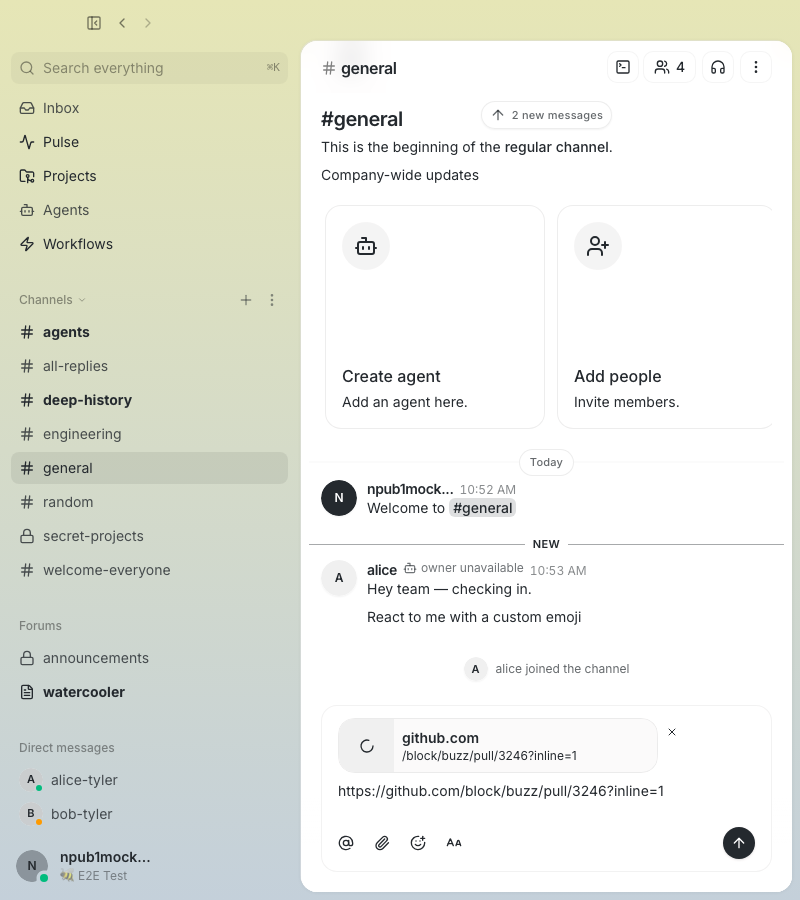 | 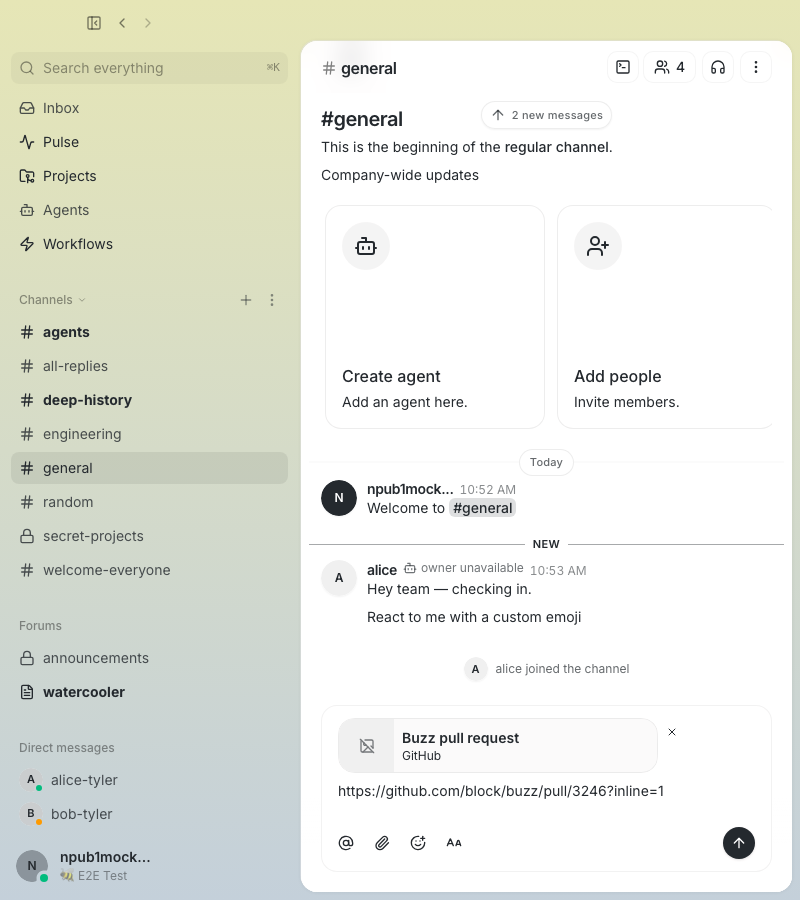 | ### Rich composer | Loading | Ready | |---|---| | 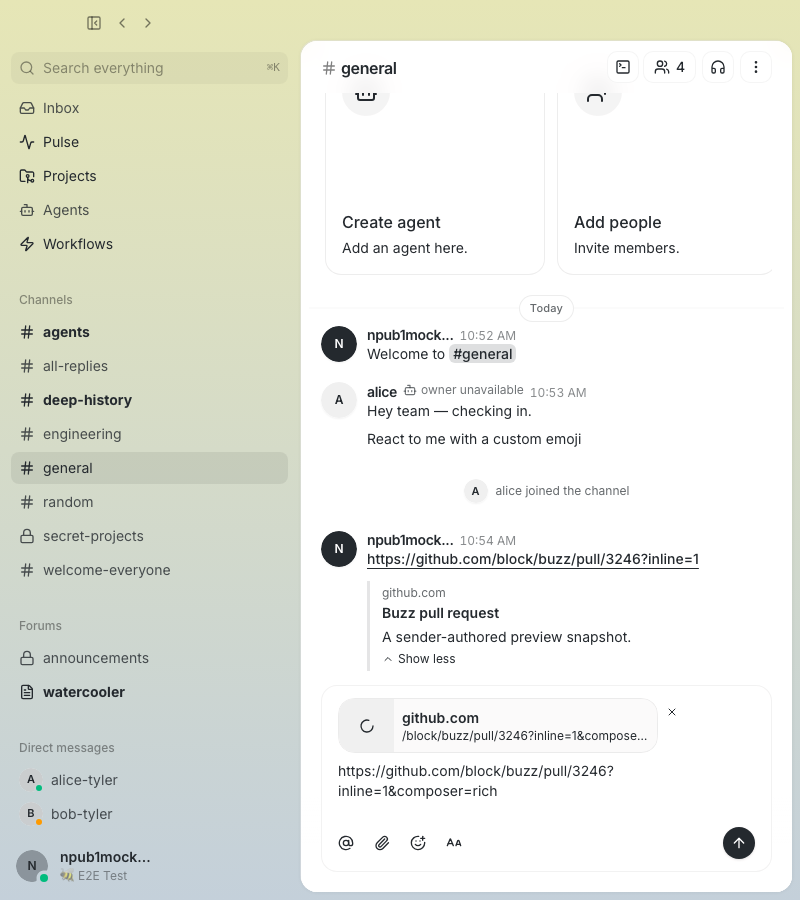 | 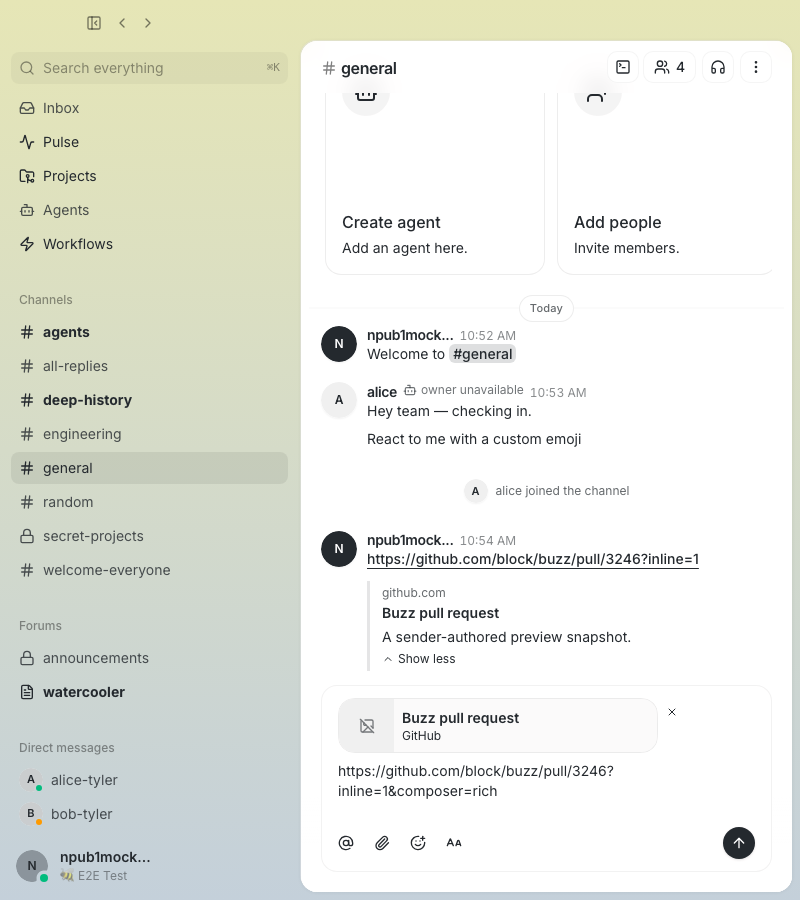 | ### Responsive composer | 800px loading | 800px ready | |---|---| | 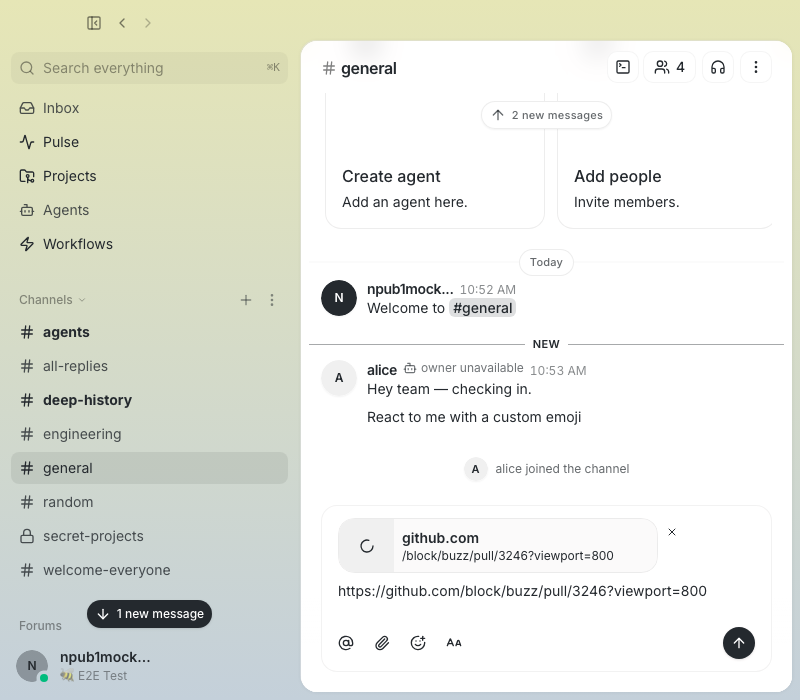 | 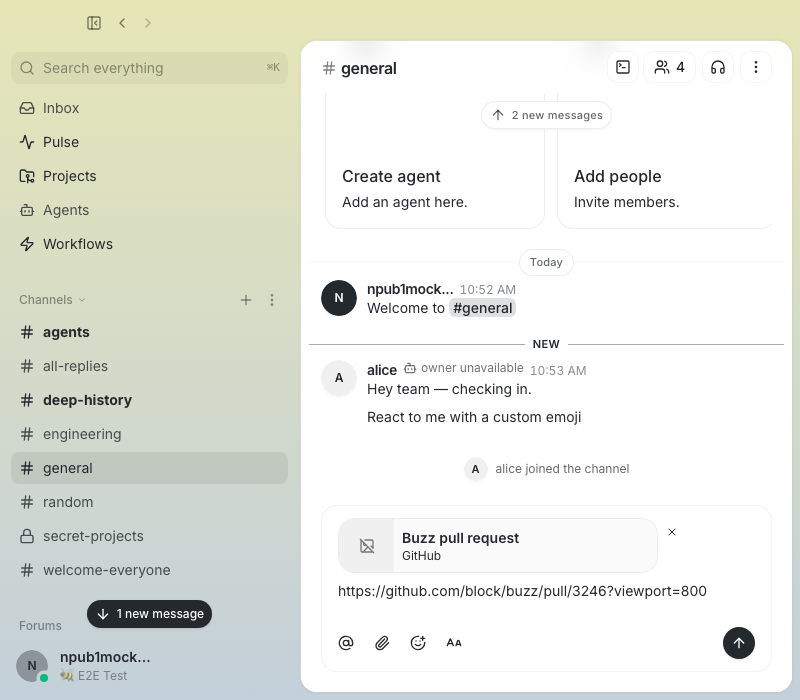 | | 420px loading | 420px ready | |---|---| | 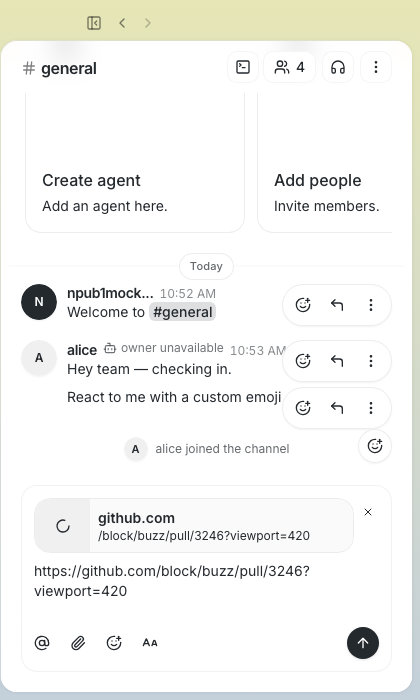 | 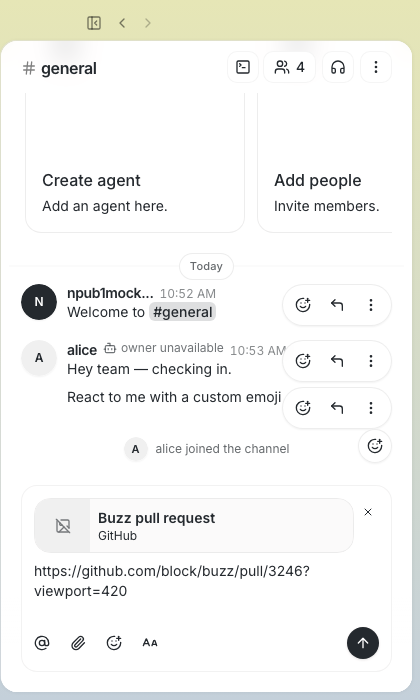 | ### Recipient presentation | Compact | Rich | |---|---| | 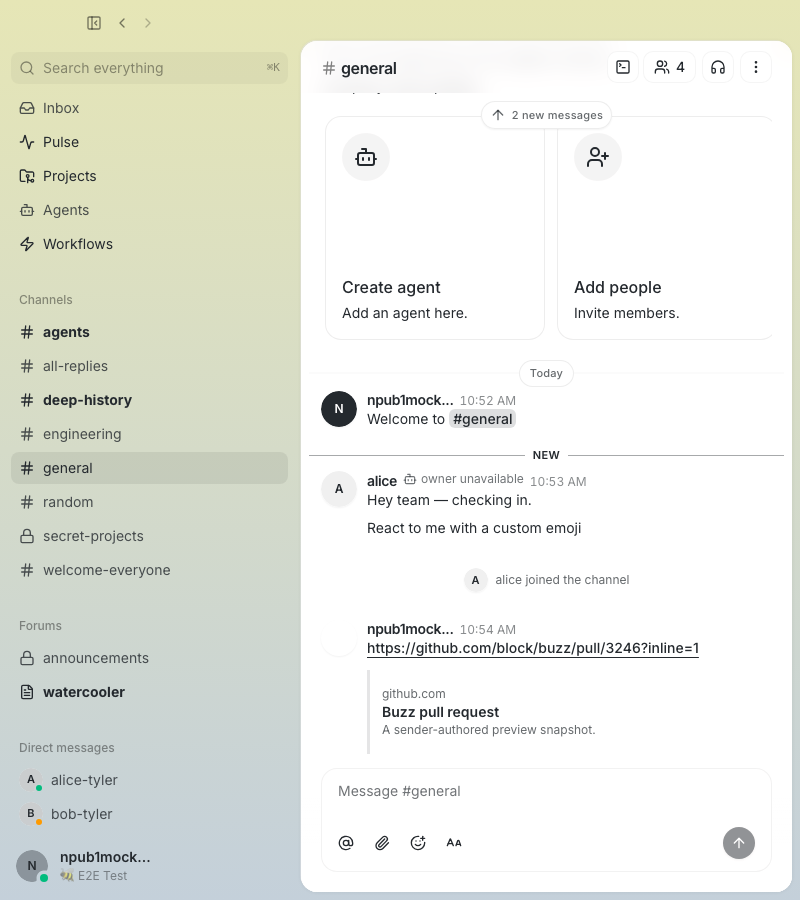 | 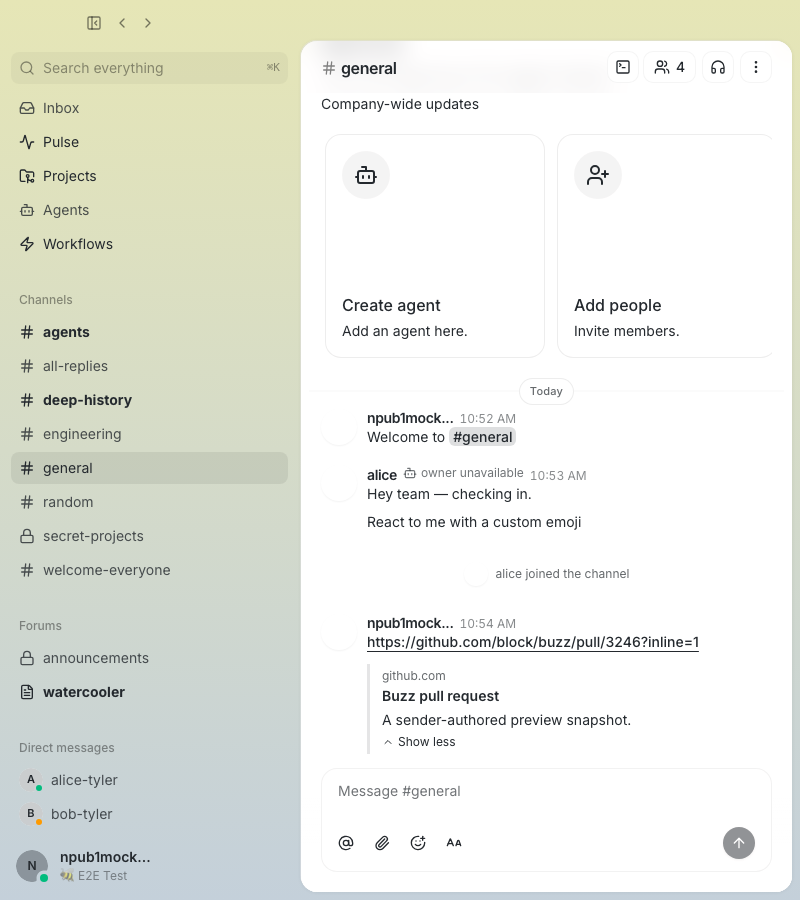 | ### Display-text Markdown link | Composer | Recipient | |---|---| | 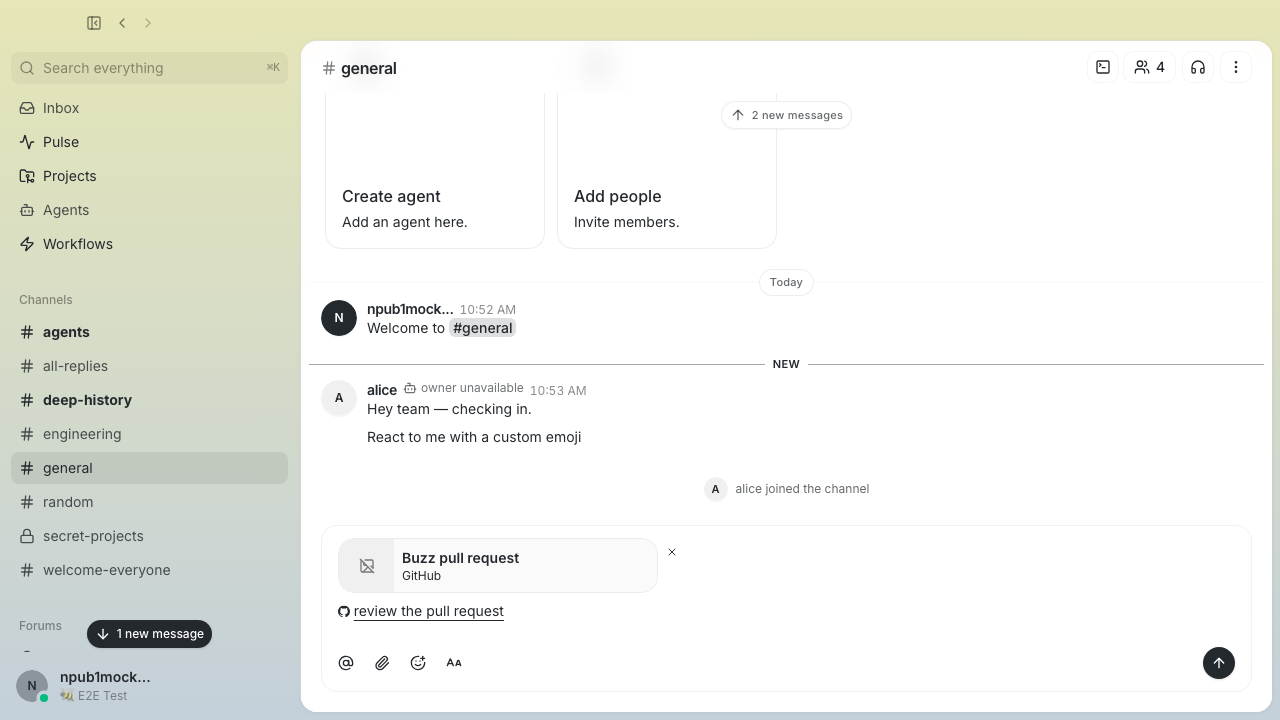 | 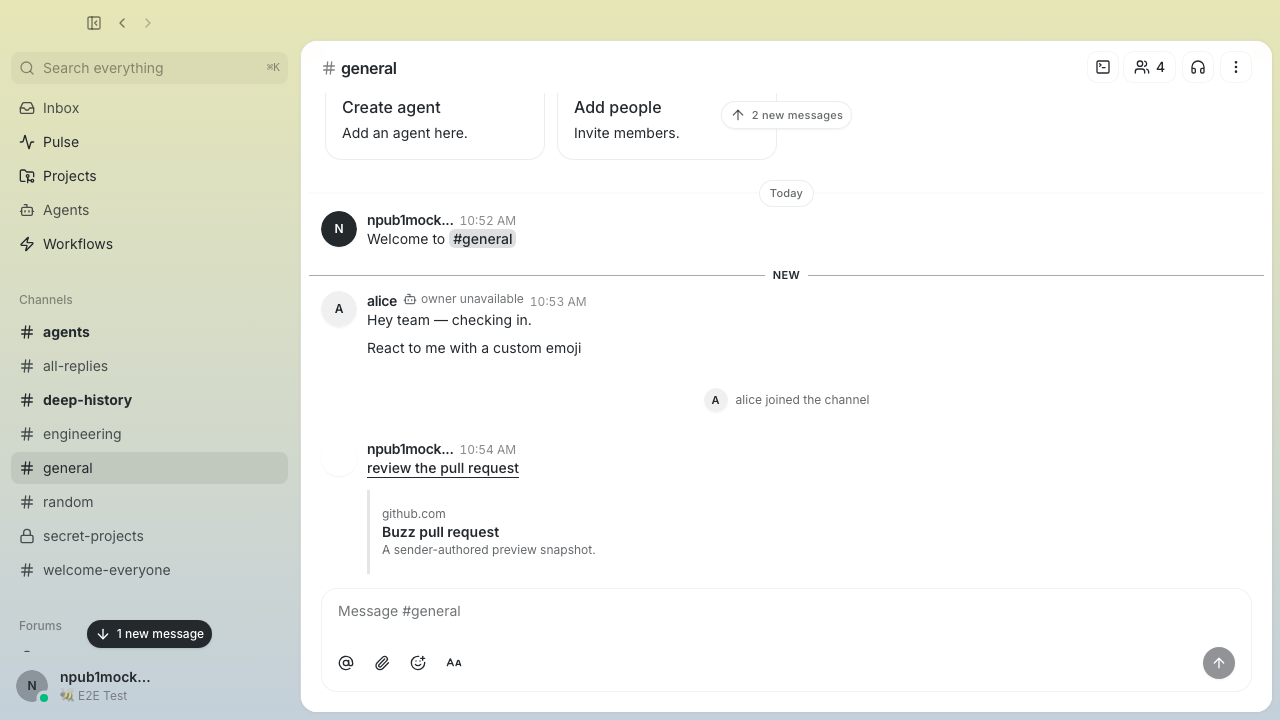 | ### Rich multiline description 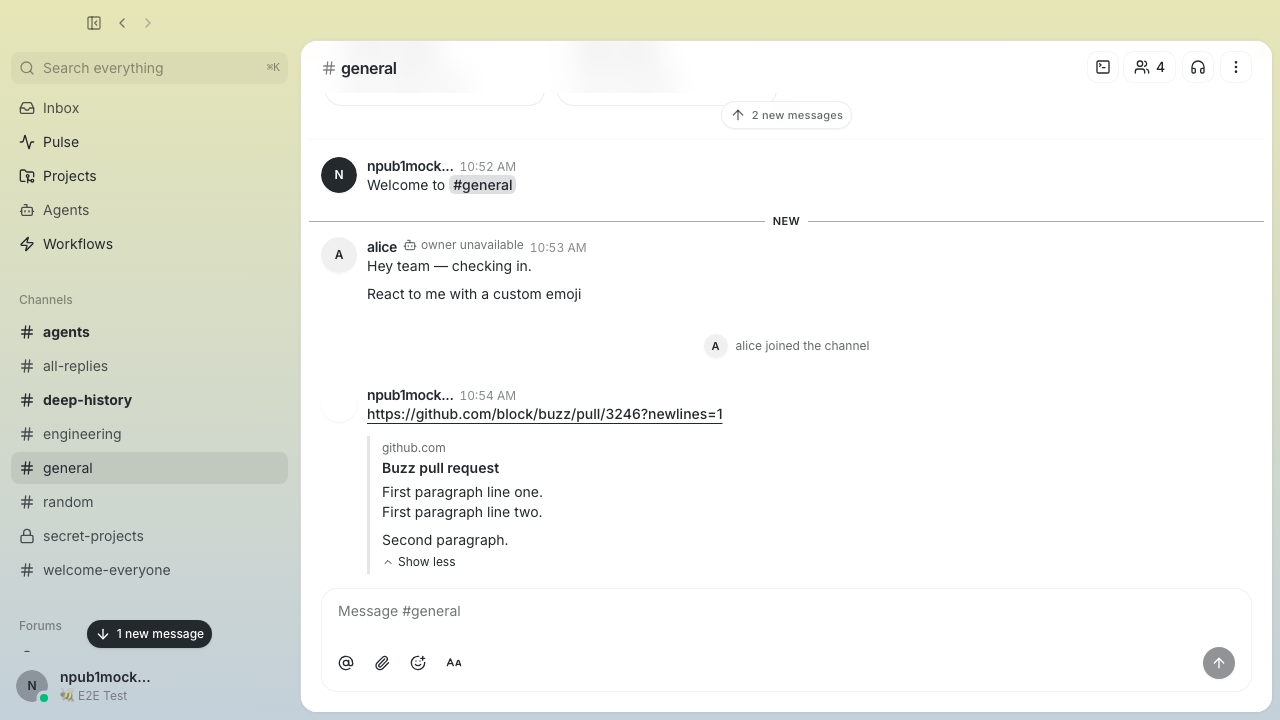 ### Immediate dismissal | Before × | Immediately after × | |---|---| | 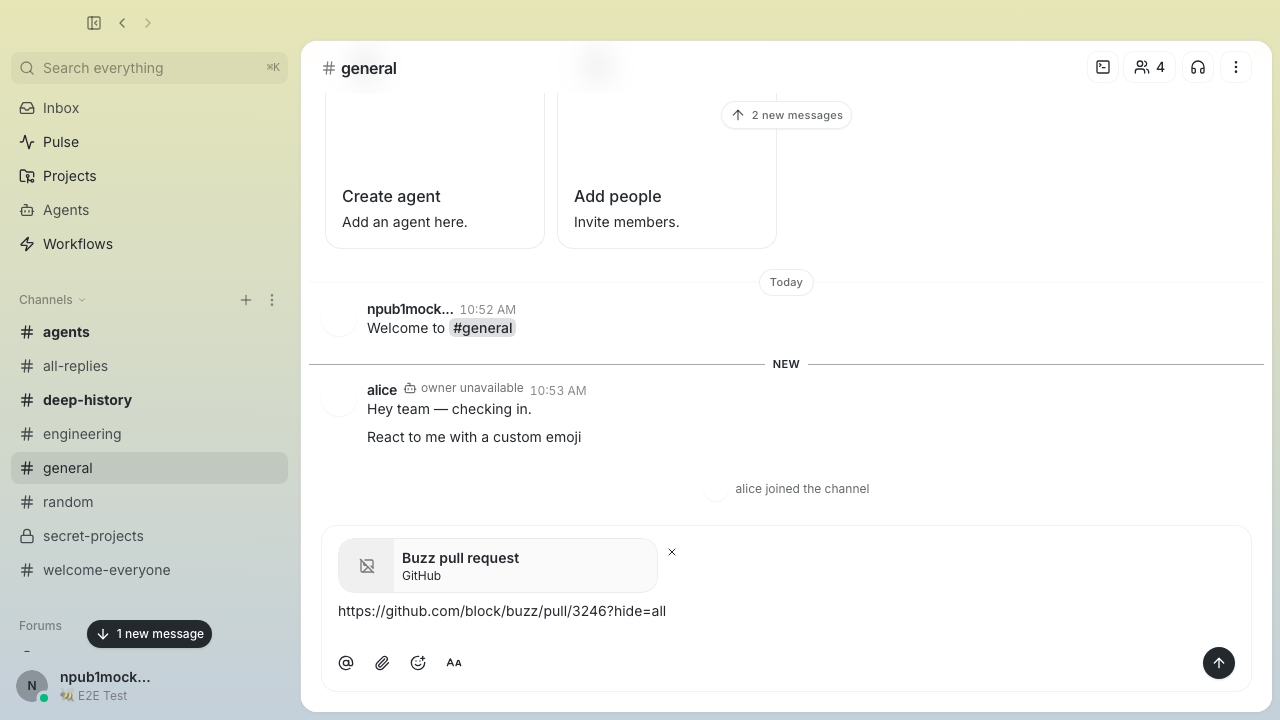 | 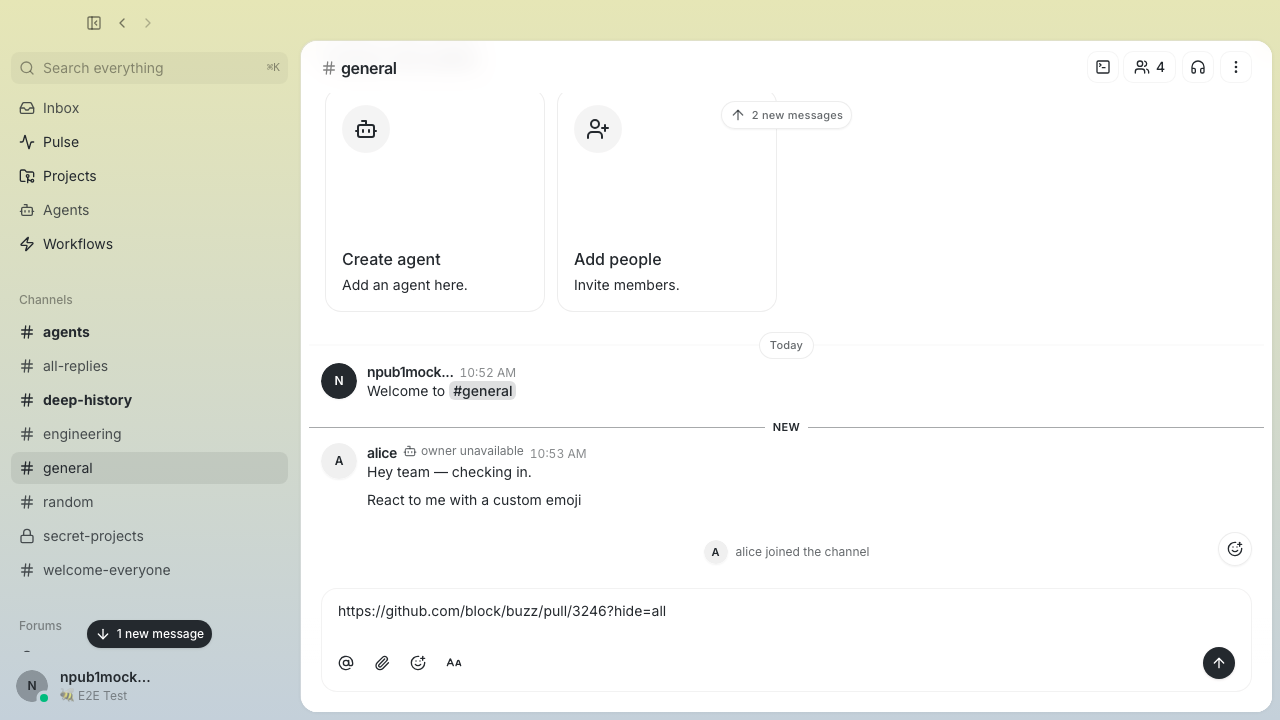 | --------- Signed-off-by: Taylor Ho <taylorkmho@gmail.com> |
||
|
Will Pfleger
|
742e8d1197 |
fix(buzz-agent): Responses reasoning summary, Anthropic display:summarized, ACP v2 messageId (#5195)
Three pre-existing gaps in the buzz-agent observer feed fixed together
per Will's ruling ("all 3 in the current PR"):

1. **OpenAI/DBv2-GPT route** — `responses_body` never requested
`reasoning.summary`; GPT-family models billed thinking tokens but
returned `summary: []`.
2. **Anthropic/DBv2-Claude route** — `anthropic_thinking_config()` never
sent `thinking.display`; newest Claude models (Opus 5, Sonnet 5, Fable
5, Mythos 5, Opus 4.7/4.8, Mythos Preview) default to
`display:"omitted"`, returning thinking blocks with an empty `thinking`
field — observer rendered nothing.
3. **ACP v2 compliance** — buzz-agent negotiates ACP v2 but emitted
`agent_thought_chunk` and `agent_message_chunk` without `messageId`,
which ACP v2's `ContentChunk` requires (`messageId` + `content` both
required at schema head `d13d1baa`).

## Changes

**`crates/buzz-agent/src/config.rs`**
- New `ThinkingSummary` enum (`Auto`/`Concise`/`Detailed`) with
`BUZZ_AGENT_THINKING_SUMMARY` env var (default `Auto`); mirrors
`BUZZ_AGENT_THINKING_EFFORT` pattern
- `anthropic_thinking_config()` now emits `"display": "summarized"` in
both the adaptive shape and the manual-budget shape whenever thinking is
enabled
- Rewrote `is_adaptive_thinking_model` and `anthropic_thinking_config`
doc comments to match Anthropic's exact three-way per-model terminology
(doc:
https://platform.claude.com/docs/en/build-with-claude/thinking-troubleshooting#supported-models):
- Opus 4.6/4.7/4.8, Sonnet 4.6: **Off** — thinking OFF by default;
`type:"adaptive"` required to enable
- Opus 5, Sonnet 5: **On** — thinking on by default, can be disabled; we
still send `type:"adaptive"` to activate `output_config.effort`
- Fable 5, Mythos 5, Mythos Preview: **Always on** — thinking cannot be
disabled; we still send `type:"adaptive"` to activate
`output_config.effort`

**`crates/buzz-agent/src/llm.rs`**
- `responses_body` emits `reasoning.summary` alongside
`reasoning.effort` when effort is set (gated — no bare
`reasoning:{summary}` without effort)
- Covers both the pure-OpenAI Responses path and the DBv2 GPT-family
Responses path

**`crates/buzz-agent/src/agent.rs`**
- `agent_thought_chunk` carries `"messageId":
format!("{run_id}-thought-{round}")`
- `agent_message_chunk` carries `"messageId":
format!("{run_id}-message-{round}")`
- The two IDs are distinct (thought and assistant are two logical
messages per the ACP v2 Message ID RFD)
- `run_id` is a fresh random token per `session/prompt` invocation so
IDs are session-unique across multiple prompts

**`crates/buzz-agent/src/lib.rs`**
- `run_id` plumbed into `RunCtx` (was already generated in `run_prompt`,
just not threaded through)

**`crates/buzz-agent/tests/golden_transcripts.rs`**
- `test_acp_v2_chunks_carry_message_id` — negotiates v2, drives two
consecutive `session/prompt` calls, asserts: both chunk types carry
non-empty `messageId`; thought and message IDs are **distinct**; IDs do
**not** recur across the two prompts in the same ACP session

**`desktop/src-tauri/src/managed_agents/env_vars.rs`**
- `BUZZ_AGENT_THINKING_SUMMARY` added to `is_safe_to_reveal` allowlist

**`desktop/src-tauri/src/commands/agent_config_tests.rs`**
- Tests for `BUZZ_AGENT_THINKING_SUMMARY` allowlist entry
(case-insensitive)

## Tests added

- `parse_thinking_summary_round_trips_all_values`
- `parse_thinking_summary_unset_and_empty_yield_auto`
- `parse_thinking_summary_is_case_insensitive`
- `parse_thinking_summary_rejects_unknown_value`
- `thinking_summary_as_str_mapping`
- `responses_body_summary_present_iff_effort_set`
- `responses_body_emits_configured_summary_mode`
- `responses_body_concise_summary_mode`
- `anthropic_thinking_config_adaptive_emits_display_summarized`
- `anthropic_thinking_config_manual_budget_emits_display_summarized`
- `test_acp_v2_chunks_carry_message_id` (integration test — two-prompt
cross-session case)

## Notes

- **DBv2 gateway parity for `display`**: unverified — the DBv2 Claude
route proxies Anthropic Messages shape, but whether the gateway passes
`thinking.display` through is not confirmed. Flagged here rather than
blocking on it.
- buzz-acp and Desktop TS are unchanged — they already parse `messageId`
as optional and will pick it up from the wire automatically.
- Chat Completions and OpenRouter paths: untouched.

---------

Signed-off-by: Will Pfleger <pfleger.will@gmail.com>
Co-authored-by: Duncan <dcfd242e557282d7a1e2cf2e6877522682f1e5c6156dc92ca7d90eaedd3b0f95@buzz.block.builderlab.xyz>
|
||
|
Will Pfleger
|
b2ac66cde8 |
refactor(cli): replace probe/decider/detail split with single typed extractor (#5191)
Replaces the four-helper auth resolution path with two focused functions and adds production async tests that count relay round-trips. **Before:** `resolve_auth` called `resolve_auth_from_profile` (warn-emitting probe into a throwaway sink) → `resolve_auth_deciding` (re-classified the same profile) → `handle_auth_failure` → `auth_failure_detail` (third classification). `Option<Option<&Value>>` encoded a sentinel for unreachable state; tests exercised only the pure sync helper, not the actual fetch count. **After:** - `extract_auth(profile, target, signer) -> Result<[String;4], AuthFailure>` — pure typed extractor; `AuthFailure` now covers `NoProfile` and `NoTagsArray` inline, no separate helper needed - `resolve_auth()` is now the linear state machine: self-check → fetch + extract → on failure: fetch again → route final `Err` to `CliError::Usage` (default) or one admin warning (`--admin`). No throwaway sinks, no duplicate classification, no sentinel type. - Five async tests drive the production resolver through a counted Axum test server on `POST /query` and assert on both return value and exact fetch count: first success (1), retry success (2), double failure / no `--admin` (2 + `Err`), double failure / `--admin` (2 + `Ok(None)` + one warning), self path (0). Two parser tests pin `--admin` on both `archive` and `unarchive`. - `--admin` short help text corrected to describe when the flag takes effect (after extraction fails, not unconditionally). 341 tests passing, clippy clean, fmt clean. --------- Signed-off-by: Will Pfleger <pfleger.will@gmail.com> Co-authored-by: Duncan <dcfd242e557282d7a1e2cf2e6877522682f1e5c6156dc92ca7d90eaedd3b0f95@buzz.block.builderlab.xyz> |
||
|
Will Pfleger
|
346ae8cadc |
fix(buzz-agent): escalate LLM timeouts per retry and log per-call latency (#5130)
Non-streaming LLM calls (`"stream": false`) through slow model/provider combinations routinely take longer than the fixed `BUZZ_AGENT_LLM_TIMEOUT_SECS` window (default 240 s) to return their first response byte. The retry loop then re-ran the identical 240 s bet three times, failed the turn, and the ACP harness requeued the whole turn from scratch: agents spent 30+ minutes producing nothing while every attempt died at the same wall. And because the LLM path only logged WARN lines on failure, a healthy-but-slow call was indistinguishable from a wedged one. ### Timeout handling - **Per-attempt escalation**: the per-request budget doubles after each timeout failure (`base × 2^n`, capped at `max(1200 s, base)` — `escalated_timeout()` in `llm.rs`), shared by the main `post()` loop and `openrouter_post()`. Non-timeout retryables (429/5xx/connect) do not escalate. A call that needs six minutes now succeeds on a later attempt instead of never. - **Per-request total timeouts**: enforcement moved from the client-level `read_timeout` to `RequestBuilder::timeout()` on each LLM request, so escalated budgets aren't silently floored by the shared client and each attempt's bound covers connect through body completion. Timeout error messages were updated to match the new semantics and still point at `BUZZ_AGENT_LLM_TIMEOUT_SECS`. ### Observability - One INFO line per completed LLM call: model, provider, `duration_ms`, `input_tokens`, `cached_input_tokens`, `output_tokens`. Slowness and prompt-cache effectiveness are now visible in harness logs without waiting for a failure, and `None` vs `0` token reports stay distinguishable. Handoff summarization calls log the same line with duration only. - The agent main loop wraps the call in a `session_id` tracing span so each line is attributable to a session. --------- Signed-off-by: Will Pfleger <pfleger.will@gmail.com> |
||
|
Kalvin C
|
c293b3cd40 |
fix(agent): resolve oauth cache home cross-platform (#5151)
## Summary - resolve the OAuth cache home directory with the repository's platform-aware `dirs` convention - preserve the existing `.config/buzz-agent/oauth` cache layout on macOS and Linux - make the cache-path regression assertion portable across path separators ## Problem `buzz-agent` read only `$HOME` when constructing the OAuth token cache path. Packaged Windows processes do not guarantee that Unix variable, so OAuth source construction failed with `oauth cache: $HOME not set` even though Windows had a valid user profile. ## Validation Independent reviewers validated exact commit `836d820483b141b7291170cb33535ac7cb49b2eb` on Windows/MSVC with `HOME` unset and `USERPROFILE` present: - `cargo +1.94.1 clippy -p buzz-agent --all-targets --locked -- -D warnings` - `cargo +1.94.1 fmt --all -- --check` - `git diff --check f53bbd1..836d820` - `auth::` tests: 11/11 passed with `HOME` unset - full package lib target: 396 passed / 2 failed; identical-base controls classified both as pre-existing Windows failures The changed regression fails on the base with `$HOME not set` and passes on this branch. `dirs 6.0.0` was already locked by other workspace crates; the lockfile change adds only the `buzz-agent` dependency edge. Signed-off-by: Kalvin C <kalvinnchau@users.noreply.github.com> |














