mirror of
https://github.com/block/buzz.git
synced 2026-11-27 11:41:21 +00:00
3376dbc6650abc0888413947bcd629d6cf6e0d21
1446 Commits
| Author | SHA1 | Message | Date | |
|---|---|---|---|---|
 Michael Neale |
3376dbc665 |
fix(mesh): show the community mesh before joining it
The popover said "Turn on sharing to see who's on the mesh." That was not just awkward copy, it was false: mesh_snapshot reads other members' relay status notes and needs no local runtime, so who is sharing -- and how much -- is knowable while our own node is off. The graph was gated on a local runtime for no reason. The radar field now renders from whichever source this machine has, and keeps the two honestly distinct: - live gossip: reachable now, RTT known, adjacency to us is real - relay notes: last known within 120s, no RTT, adjacency unknown So relay nodes get no synthetic RTT (they land mid-band rather than faking proximity), spokes are omitted when we have not joined because a spoke asserts a connection we do not have, the centre is drawn hollow for the same reason, and a caption names which view is on screen. The replacement copy only appears when the community genuinely has nothing, and names the actual next step. Row label is now "Community mesh" rather than "Compute". Signed-off-by: Michael Neale <michael.neale@gmail.com> |
||
|
Michael Neale
|
36548e0bc3 |
feat(mesh): one-line Compute row with radar-field detail popover
Sidebar front-page space is premium, so shared compute is now a single menu line under Agents instead of a ~120px footer card. The row carries one signal -- a coloured dot -- and everything else moved into the popover it opens. The dot distinguishes six states, and the pair that matters most is "nothing here" vs "there is capacity you have not joined": mesh_snapshot reads other members' relay status notes with no local runtime, so idle capacity is knowable without starting a node or running a probe. Grey would have conflated the two, and the second is the reason to look at the row at all. The switch shows only while not sharing; once sharing, the state is legible from the dot and Stop lives in the popover, which frees the trailing slot for live pool capacity. It is never disabled while consuming -- a client runtime can be replaced by a serve runtime at any time, so offering the switch is honest. The popover consolidates what were two overlapping surfaces (card + detail popover) into one, and replaces the small radial SVG with a canvas-2D radar field: self at centre, radius from RTT, node size from shared capacity, per-node breathing seeded by id hash, real adjacency as spokes, and non-participant members as a dashed outer band with no size and no capacity. Visual language follows mesh-llm's own console, drawn in 2D rather than porting its ~2,200 lines of WebGL -- a 288px popover does not justify shader plumbing. Nothing animates along a spoke: mesh-llm's counters are node-local with no per-edge attribution, so a travelling packet would be invented. Motion is confined to node breathing and a centre pulse driven by real inflight work. Row and popover share one useMeshComputeState hook rather than each calling the polling hooks, which would double every poll and let the two disagree mid-flight. Signed-off-by: Michael Neale <michael.neale@gmail.com> |
||
|
Alessandro Joabar
|
6c5c78f5cb |
Merge remote-tracking branch 'origin/main' into micspiral/mesh-share-ux
* origin/main: (31 commits) feat: paste composer text without formatting (#4801) Revert "chore(release): release Buzz Desktop version 0.5.5" (#4808) chore(release): release Buzz Desktop version 0.5.5 (#4800) fix: reauthenticate databricks model discovery (#4008) Revert "chore(release): release Buzz Desktop version 0.5.5" (#4797) feat: Buzz entity links — rich preview cards + in-app navigation for repos, PRs, and issues (#4695) fix(desktop): serialize tray channel actions for frontend (#4762) chore(release): release Buzz Desktop version 0.5.5 (#4788) feat(projects): support multiple repositories (#4671) fix(ci): make desktop cache test version agnostic (#4791) fix(desktop): widen post-Enter timeouts in empty-edit-delete spec (#4792) fix(desktop): wait for terminal frame before splash (#4781) fix(desktop): integer-align custom reaction emoji (#4779) Polish Huddle voice controls (#4694) fix(local-archive): default both archive settings to enabled (#4750) fix(mobile): stop oversized read-state retry loop (#4595) fix(desktop): close reconnect gaps that previously required CMD+R (#4737) Dock Buzz Term within channel workspace (#4724) perf(relay): index channel-id lookups and skip trace-only reads (#4647) fix(agents): canonicalize stale persona harness pins (#4631) ... Signed-off-by: Alessandro Joabar <sandro@squareup.com> |
||
|
Alessandro Joabar
|
23d6c44176 |
share compute modal polish
Signed-off-by: Alessandro Joabar <sandro@squareup.com> |
||
|
Kalvin C
|
25a9cf1be6 |
feat: paste composer text without formatting (#4801)
## Summary - handle Cmd+Shift+V on macOS and Ctrl+Shift+V on Windows/Linux in the message composer - read plain text through the native Tauri/arboard clipboard path in packaged builds, with a browser-only Clipboard API fallback - re-enter ProseMirror's paste pipeline with populated `text/plain` clipboard data so selection, undo, multiline behavior, and paste observers remain intact - cover both platform mappings with rendered composer E2E tests that assert the native command path ## Testing - `pnpm test` — 4,286 passed - `pnpm check` - `pnpm typecheck` - `pnpm exec playwright test composer-selection-formatting.spec.ts --project=smoke` — 26 passed - `cargo check --manifest-path desktop/src-tauri/Cargo.toml --workspace --all-targets --target aarch64-apple-darwin` - `just desktop-tauri-test` — 2,206 core tests plus integration and doc-test groups passed - full pre-push hooks passed ## Manual verification Physical packaged-app clipboard verification remains recommended on macOS, Windows, and Linux. The automated E2E uses mocked Tauri IPC but asserts the native `read_clipboard_text` command is invoked. Signed-off-by: npub1dccv64krpcpse5cmkzfeh998cftungyatw3djt8jwdw6g43f7fyqzzmrf7 <6e30cd56c30e030cd31bb0939b94a7c257c9a09d5ba2d92cf2735da45629f248@buzz.block.builderlab.xyz> Co-authored-by: npub1dccv64krpcpse5cmkzfeh998cftungyatw3djt8jwdw6g43f7fyqzzmrf7 <6e30cd56c30e030cd31bb0939b94a7c257c9a09d5ba2d92cf2735da45629f248@buzz.block.builderlab.xyz> |
||
|
Wes
|
79c52166cf |
Revert "chore(release): release Buzz Desktop version 0.5.5" (#4808)
Reverts block/buzz#4800 |
||
|
Wes
|
a0ed13de14 |
chore(release): release Buzz Desktop version 0.5.5 (#4800)
## Buzz Desktop release v0.5.5 - **Frozen main:** `4a2305170eef565bf1836e2859247e67c030f8af` - **Reviewed candidate:** `2d03d37b05b68186b2caad9da79080032be3ac72` - **Previous desktop release:** `desktop-v0.5.4` - **Proposed immutable tag:** `desktop-v0.5.5` This PR must be **squash merged** only after the Desktop Release Candidate check passes. The branch must remain based directly on current `main`; stale base, payload drift, incomplete notes, or an unauthorized merge produce no tag. The checked-in changelog accounts for every non-merge commit in the release range. Publication remains bound to the immutable candidate tag. Signed-off-by: Wes <wesbillman@users.noreply.github.com> Co-authored-by: Release Automation <release-automation@users.noreply.github.com> |
||
|
Kalvin C
|
4a2305170e |
fix: reauthenticate databricks model discovery (#4008)
## Summary - preserve Databricks catalog 401 responses as authentication failures and retry discovery exactly once after silently refreshing the rejected bearer - preserve runtime OAuth recovery: when discovery has no usable OAuth credential, `session/new` succeeds with only the trimmed configured model so the first `session/prompt` can run the existing browser PKCE flow - reject a rejected configured `DATABRICKS_TOKEN` with actionable, non-interactive guidance; static credentials cannot recover through PKCE - use the configured-model fallback for non-auth discovery failures without caching failed or fallback catalogs, so later sessions retry discovery - keep known Databricks v2 models only for authenticated empty-catalog responses and mark their provenance - resolve discovery before MCP spawn or session registration, preventing failed discovery from leaking resources or consuming session capacity - permit serialized interactive PKCE only from the explicit saved-agent model picker; passive draft discovery never opens a browser ## Runtime flow 1. OAuth discovery attempts cached credentials and silent refresh without opening a browser. 2. If no usable OAuth bearer exists, `session/new` advertises only the configured model and succeeds. 3. The first `session/prompt` uses `TokenSource::bearer()`, which may launch browser PKCE. 4. A later session retries discovery and caches only the authenticated catalog. ## Regression coverage - rejected-but-locally-fresh OAuth bearer performs one refresh and one catalog retry - OAuth mode with no cached token allows `session/new` and returns exactly the trimmed configured model - the OAuth fallback is not cached; a later authenticated session retries discovery and caches the returned catalog - rejected static tokens still reject `session/new` - failed discovery does not consume the sole session slot or spawn the supplied MCP process - Desktop interactive/passive auth intent, static-token redaction, and authenticated empty-catalog provenance ## Verification - `cargo test -p buzz-agent` - `cargo test --manifest-path desktop/src-tauri/Cargo.toml --lib commands::agent_models` - `cargo clippy --manifest-path desktop/src-tauri/Cargo.toml --all-targets -- -D warnings` - `cargo fmt --all -- --check` - `git diff --check` - full pre-push hooks ## Review Adversarial review found and drove fixes for session/MCP resource leakage, duplicate concurrent PKCE flows, sensitive error propagation, incorrect 403 reauthentication, missing discovery-level coverage, passive browser launch, and the Desktop file-size ratchet. The final follow-up preserves the existing prompt-time OAuth flow while retaining static-token rejection and pre-allocation discovery ordering. --------- Signed-off-by: npub1dccv64krpcpse5cmkzfeh998cftungyatw3djt8jwdw6g43f7fyqzzmrf7 <6e30cd56c30e030cd31bb0939b94a7c257c9a09d5ba2d92cf2735da45629f248@buzz.block.builderlab.xyz> Co-authored-by: npub1dccv64krpcpse5cmkzfeh998cftungyatw3djt8jwdw6g43f7fyqzzmrf7 <6e30cd56c30e030cd31bb0939b94a7c257c9a09d5ba2d92cf2735da45629f248@buzz.block.builderlab.xyz> |
||
|
Wes
|
8faf09f9ae |
Revert "chore(release): release Buzz Desktop version 0.5.5" (#4797)
Reverts block/buzz#4788 |
||
|
thomaspblock
|
a1d78f2959 |
feat: Buzz entity links — rich preview cards + in-app navigation for repos, PRs, and issues (#4695)
## Summary

Gives Buzz-hosted git entities the same "GitHub-style" chat experience
GitHub links already get: rich preview cards, real titles, and
click-through — except clicks navigate **in-app** to the Projects view
instead of a browser.

- **Spec**: `docs/buzz-entity-links.md` — link scheme, slices, and
deferred work (`buzz://project`, OS deep links, web routes).
- **Canonical `buzz://` deep links**: new
`desktop/src/shared/lib/entityLink.ts` with builders + strict parser for
`buzz://pr?id=…&owner=…&d=…`, `buzz://issue?…`, and
`buzz://repo?owner=…&d=…`, mirrored by a Rust module
(`crates/buzz-cli/src/links.rs`) with a shared golden-format test so the
two implementations can't drift.
- **Preview cards**: `linkPreview.ts` recognizes `buzz://` entity links
*and* HTTPS relay clone URLs (`{origin}/git/<pubkey>/<repo>`, the shape
agents paste today). Both normalize onto the canonical `buzz://` href,
so the two spellings of a repo dedupe to one `Buzz`-provider card
(`BuzzMark` logo) rendered by `link-preview-attachment.tsx`.
- **Title enrichment**: PR/issue cards fetch the real subject from the
relay event (`subject` tag or first content line) via
`useResolvedLinkPreviews.ts`; the cache is community-scoped and reset in
`resetCommunityState()`.
- **In-app navigation**: clicking a card or inline anchor (including
HTTPS relay clone URLs whose origin matches the active relay) routes to
the canonical `30617:<owner>:<d>` coordinate via `goProject()`
(`markdown/entityLinks.tsx`). **Merge dependency: #4671 must merge
first** — route resolution for `30617:` coordinates is implemented on
that branch (`feat/multi-repository-projects`). Entity-link and
external-anchor logic were extracted out of `markdown.tsx` to stay under
the file-size ratchet.
- **Agent side**: `buzz pr open`, `buzz issues create`, and `buzz repos
create` now return a ready-made `link` field (omitted when the relay
returns `accepted: false`), and `base_prompt.md` instructs agents to
paste it verbatim when announcing work.

## Test plan

- [x] Desktop unit tests: pass, including new `entityLink.test.mjs` and
`linkPreview.test.mjs` coverage (golden formats, malformed-link
rejection, clone-URL/`buzz://` dedupe, origin-gated anchor behavior,
label-must-win invariant, cache epoch)
- [x] Rust: `cargo test -p buzz-cli` golden-format test +
accepted/rejected link guard assertions, clippy + fmt clean
- [x] Biome + `tsc --noEmit` clean; pre-push hooks
(desktop-tauri-checks, rust-tests, desktop-test) pass
- [ ] Manual: paste a relay clone URL and a `buzz://pr` link in a
channel — verify one card each, real PR title, and in-app navigation to
the Projects view

Related: [#4671](https://github.com/block/buzz/pull/4671)

---------

Signed-off-by: Thomas Petersen <thomasp@squareup.com>
Signed-off-by: Will Pfleger <pfleger.will@gmail.com>
Co-authored-by: npub1g8493u0xfsjrvflg4n08ezd7vec99mnwzlv0qgwpr9d7gvjwhuzqx59rhw <41ea58f1e64c243627e8acde7c89be667052ee6e17d8f021c1195be4324ebf04@buzz.block.builderlab.xyz>
Co-authored-by: Will Pfleger <pfleger.will@gmail.com>
|
||
|
Kalvin C
|
4c665aeac3 |
fix(desktop): serialize tray channel actions for frontend (#4762)
## Summary - serialize native `openChannel` tray actions with the camelCase field names consumed by the TypeScript frontend - prevent a valid tray channel ID from becoming `/channels/undefined` - add a Rust serialization contract test covering the complete frontend payload shape ### Root cause `TrayAction` renamed the enum variant to `openChannel`, but its struct fields still serialized as `channel_id` and `community_generation`. The frontend reads `action.channelId`, so tray navigation called `goChannel(undefined)`. ### Testing - manually verified the corrected runtime payload and tray navigation before removing temporary logging - `just desktop-ci` - pre-push hooks (desktop checks/tests, Tauri checks, and Rust tests) --------- Signed-off-by: Kalvin Chau <kalvin@block.xyz> Signed-off-by: npub1dccv64krpcpse5cmkzfeh998cftungyatw3djt8jwdw6g43f7fyqzzmrf7 <6e30cd56c30e030cd31bb0939b94a7c257c9a09d5ba2d92cf2735da45629f248@buzz.block.builderlab.xyz> Co-authored-by: npub122y0pqkertljmedu303rl0aqrj3w8pvu43t6jxm6875lzg6f2pwqegc3xc <5288f082d91aff2de5bc8be23fbfa01ca2e3859cac57a91b7a3fa9f12349505c@buzz.block.builderlab.xyz> Co-authored-by: npub1dccv64krpcpse5cmkzfeh998cftungyatw3djt8jwdw6g43f7fyqzzmrf7 <6e30cd56c30e030cd31bb0939b94a7c257c9a09d5ba2d92cf2735da45629f248@buzz.block.builderlab.xyz> |
||
|
Wes
|
b948c54792 |
chore(release): release Buzz Desktop version 0.5.5 (#4788)
## Buzz Desktop release v0.5.5 - **Frozen main:** `383d9e1eafd569b44b9c835200dba69ef7cec9dc` - **Reviewed candidate:** `ac589061ef1009f55384536e483cfe9b1260697b` - **Previous desktop release:** `desktop-v0.5.4` - **Proposed immutable tag:** `desktop-v0.5.5` This PR must be **squash merged** only after the Desktop Release Candidate check passes. The branch must remain based directly on current `main`; stale base, payload drift, incomplete notes, or an unauthorized merge produce no tag. The checked-in changelog accounts for every non-merge commit in the release range. Publication remains bound to the immutable candidate tag. Signed-off-by: Wes <wesbillman@users.noreply.github.com> Co-authored-by: Release Automation <release-automation@users.noreply.github.com> |
||
|
thomaspblock
|
e30db7028f |
feat(projects): support multiple repositories (#4671)
## Summary - adopt the finalized NIP-MP project model so one project can enumerate and switch between multiple NIP-34 repositories - add project and repository navigation, activity summaries, existing-repository attachment, and repository access-channel management - preserve privacy-safe activation provenance for agent-authored patches, pull requests, issues, and associated commits ## Test plan - [x] Run desktop typecheck and unit tests - [x] Run focused NIP-MP, repository access, and provenance tests - [x] Run Rust formatting and desktop lint checks - [x] Run the complete pre-push suite after merging current `main` - [ ] Manually verify project creation, repository attachment, switching, and access repair on staging - [ ] Manually verify public-channel and private-agent origin labels on newly created Git activity Related: [#4695](https://github.com/block/buzz/pull/4695) --------- Signed-off-by: Thomas Petersen <thomasp@squareup.com> Signed-off-by: Will Pfleger <pfleger.will@gmail.com> Co-authored-by: npub1mn7jgtj4w2pd0g0zeuhxsa6jy6p0rewxz4kujt98my82ahfmp72sxjexk7 <dcfd242e557282d7a1e2cf2e6877522682f1e5c6156dc92ca7d90eaedd3b0f95@buzz.block.builderlab.xyz> Co-authored-by: Will Pfleger <pfleger.will@gmail.com> |
||
|
Will Pfleger
|
7bcfe7e0a1 |
fix(desktop): widen post-Enter timeouts in empty-edit-delete spec (#4792)
## Summary Increases three Playwright assertion timeouts in `tests/e2e/empty-edit-delete.spec.ts` from 5s to 10s to fix a shard-composition flake introduced by PR #4694. ## Root Cause PR #4694 added `huddle-transcription.spec.ts` (477 lines, 22+ tests) to the Desktop Smoke E2E suite, shifting shard 2 composition so that `empty-edit-delete` now runs with significantly more accumulated browser state. The three affected assertions all wait for a React state update triggered by pressing Enter in edit mode: - `alertdialog` becoming visible after an empty edit (tests 1 and 2) - `edit-target` hiding after a successful non-empty edit (test 3) These transitions go through the React scheduler. In isolation they complete in milliseconds. In a loaded headless shard with accumulated GC pressure, the 5s window became insufficient — test 3 failed 3/3 times in CI run [30946444168](https://github.com/block/buzz/actions/runs/30946444168) with `edit-target` still visible after Enter. No product code is changed. The empty-edit-delete flow is correct and untouched by #4694. This is a test-environment timing adjustment only. ## What Changed - `tests/e2e/empty-edit-delete.spec.ts` — three `{ timeout: 5_000 }` → `{ timeout: 10_000 }` for the post-Enter React-update waits ## Validation - `just desktop-check` — passed - `just desktop-test` — 4194 passed, 0 failed Signed-off-by: Will Pfleger <pfleger.will@gmail.com> Co-authored-by: npub1mn7jgtj4w2pd0g0zeuhxsa6jy6p0rewxz4kujt98my82ahfmp72sxjexk7 <dcfd242e557282d7a1e2cf2e6877522682f1e5c6156dc92ca7d90eaedd3b0f95@buzz.block.builderlab.xyz> |
||
|
Wes
|
65f7a10035 |
fix(desktop): wait for terminal frame before splash (#4781)
## Summary - keep the first-open Buzz Term splash pending until the active PTY delivers its first frame - retrigger the splash effect when that readiness gate changes - cover the real bootstrap path so startup latency cannot consume the animation invisibly ## Verification - Wes manually verified the first-open animation in the worktree - `pnpm --dir desktop typecheck` - `pnpm --dir desktop test` — 4,195 passed - `pnpm exec biome check src/features/terminal/TerminalBootstrap.tsx src/features/terminal/TerminalSubstrate.tsx src/features/terminal/TerminalBootstrap.test.mjs` - pre-push hooks — branch skew, desktop check, and 4,195 desktop tests passed The repository-wide `pnpm --dir desktop check` still reports pre-existing diagnostics in `personaCatalogRelay.test.mjs` and `terminal.css`; the three changed files pass Biome directly. Signed-off-by: Wes <wesbillman@users.noreply.github.com> Co-authored-by: Carl <c7ebe626f000404285d3686e1dc74cc07cc60a9754a150041ba132e14bd3e2ec@buzz.block.builderlab.xyz> |
||
|
Kalvin C
|
8b8d86c5d2 |
fix(desktop): integer-align custom reaction emoji (#4779)
## Summary - remove the fractional half-pixel translation from custom reaction emoji - preserve the existing 28px reaction pill, 14×14 glyph box, and `object-fit: contain` - add real-app Playwright coverage for integer centering and non-square intrinsic dimensions ### Related issue None found. Follow-up to the Buzz emoji-warp investigation. ### Testing - `cd desktop && pnpm exec playwright test tests/e2e/custom-emoji.spec.ts --project=smoke` (15 passed) - `cd desktop && pnpm test` (4,171 passed) - `cd desktop && pnpm lint` (passed; two pre-existing informational `useTemplate` diagnostics) - `cd desktop && pnpm typecheck` (passed) - `cd desktop && pnpm exec biome check src/features/messages/ui/MessageReactions.tsx tests/e2e/custom-emoji.spec.ts` (passed) Independent review also mutation-tested the regression coverage by restoring the half-pixel transform and confirming the new test fails. No after screenshot is included because the patch preserves dimensions and fixes subpixel raster alignment; the real-app test asserts the mechanism directly. Validated at `bc95969b21b58d83b7f94de4ad25e499e52b35fb`. Signed-off-by: Kalvin Chau <kalvin@block.xyz> Co-authored-by: npub122y0pqkertljmedu303rl0aqrj3w8pvu43t6jxm6875lzg6f2pwqegc3xc <5288f082d91aff2de5bc8be23fbfa01ca2e3859cac57a91b7a3fa9f12349505c@buzz.block.builderlab.xyz> |
||
|
klopez4212
|
ce3cf3cd25 |
Polish Huddle voice controls (#4694)
## Summary - add a visible Stop control for interrupting agent speech - make push-to-talk available by default while preserving manual mute controls - refine agent management, muted audio states, drawer layering, and return navigation - suppress duplicate notification sounds for Huddle messages ## Why Huddles could trap users behind long agent speech, hide useful agent controls, and leave temporary Huddle state visible after the call. The drawer also regressed when the terminal substrate began painting behind the rounded app surface. ## Validation - `just desktop-ci` - focused Huddle Playwright coverage for the drawer, speech interruption, agent picker, and leave navigation --------- Signed-off-by: kenny lopez <klopez4212@gmail.com> Signed-off-by: Wes <wesbillman@users.noreply.github.com> Co-authored-by: Wes <wesbillman@users.noreply.github.com> Co-authored-by: Carl <c7ebe626f000404285d3686e1dc74cc07cc60a9754a150041ba132e14bd3e2ec@buzz.block.builderlab.xyz> |
||
|
Will Pfleger
|
5179726737 |
fix(local-archive): default both archive settings to enabled (#4750)
## Overview

Both local archive settings — "Archive my agents' observer frames" (kind
24200) and "Archive my agents' turn metrics" (kind 44200) — previously
defaulted to OFF in OSS builds, controlled by build-time env vars. This
had an irreversible cost: observer frames are ephemeral (not stored by
the relay), so any missed events are permanently unrecoverable. This PR
makes both settings default to enabled for all builds and removes the
build-time flag machinery entirely.

## What changed

### Rust

- `observer_archive_default_enabled()` — returns `true` unconditionally;
removed `option_env!("BUZZ_DESKTOP_BUILD_OBSERVER_ARCHIVE_DEFAULT")`
check and `nest_is_dev()` runtime fallback.
- `agent_metric_archive_default_enabled()` — returns `true`
unconditionally; removed
`option_env!("BUZZ_DESKTOP_BUILD_AGENT_METRIC_ARCHIVE_DEFAULT")` check
and its OSS-build test.
- `build.rs` — removed both `rerun-if-env-changed` declarations
(`BUZZ_BUILD_OBSERVER_ARCHIVE_DEFAULT`,
`BUZZ_BUILD_AGENT_METRIC_ARCHIVE_DEFAULT`) and the two baked-env
emitting blocks.

### Build / CI

- `Justfile` — removed `desktop-tauri-test-compiled-flags` recipe (the
dual-compile test machinery).
- `.github/workflows/ci.yml` — removed the "Desktop Tauri compiled-flag
verification" CI step.

### TypeScript

- `useObserverArchiveSeed.ts` — removed `observerArchiveDefaultEnabled`
dep from `ObserverArchiveSeedDeps` and the `policyOn` gate in
`reconcileObserverArchive`; the function now unconditionally calls
`mergeSaveSubscriptionKinds`.
- `useAgentMetricArchiveSeed.ts` — removed
`agentMetricArchiveDefaultEnabled` dep from `AgentMetricArchiveSeedDeps`
and the `defaultOn` flag-check path in `maybeSeed`; the
`hasExplicitChoice` guard is preserved as the sole gate against
re-seeding.
- `LocalArchiveSettingsCard.tsx` — removed `policy` prop,
`observerPolicy` state, and `observerArchiveDefaultEnabled` fetch from
`ObserverArchiveSection`; toggle is now always enabled (just `toggling`
disables it); removed the stale "Always on for internal builds" copy
branch; removed the `observerPolicy !== false` guard from
`handleObserverToggle`.
- `tauriArchive.ts` — updated JSDoc on both default-enabled functions to
reflect always-true.
- `e2eBridge.ts` — changed both mock defaults from `?? false` to `??
true` so E2E tests without an explicit mock override exercise the real
default behavior.

### Tests

- `useObserverArchiveSeed.test.mjs` — replaced `policyOn` dep with
direct merge dep; updated `test_oss_policy_off_no_merge` →
`test_reconcile_always_seeds_24200`; all cancellation, identity-switch,
and ordering tests adapted.
- `useAgentMetricArchiveSeed.test.mjs` — removed `defaultOn` dep and
`test_oss_build_does_not_seed`; updated
`test_internal_build_unset_seeds_*` → `test_default_enabled_*`;
`hasExplicitChoice` guard tests unchanged.

## Preservation of explicit opt-outs

Users who have previously toggled the setting off are unaffected:

- `useAgentMetricArchiveSeed` skips seeding when
`hasExplicitChoice(pubkey)` returns true (localStorage-persisted per
identity).
- Observer archive reconciliation now unconditionally calls
`mergeSaveSubscriptionKinds`, but a user who already deleted the
subscription can turn it off via the Settings toggle, which calls
`removeSaveSubscriptionKind` — this is the existing explicit opt-out
path, and the toggle is now always enabled (not locked by a policy
flag).

## Result

- No `BUZZ_BUILD_*_ARCHIVE_DEFAULT` /
`BUZZ_DESKTOP_BUILD_*_ARCHIVE_DEFAULT` references remain outside
CHANGELOG/history.
- Desktop node tests: 4168 pass, 0 fail.
- `just desktop-tauri-check`: clean.
- `just desktop-tauri-test`: all pass.

---------

Signed-off-by: Will Pfleger <pfleger.will@gmail.com>
Signed-off-by: npub1mn7jgtj4w2pd0g0zeuhxsa6jy6p0rewxz4kujt98my82ahfmp72sxjexk7 <dcfd242e557282d7a1e2cf2e6877522682f1e5c6156dc92ca7d90eaedd3b0f95@buzz.block.builderlab.xyz>
Co-authored-by: npub1mn7jgtj4w2pd0g0zeuhxsa6jy6p0rewxz4kujt98my82ahfmp72sxjexk7 <dcfd242e557282d7a1e2cf2e6877522682f1e5c6156dc92ca7d90eaedd3b0f95@buzz.block.builderlab.xyz>
|
||
|
Wes
|
e5efd04705 |
fix(desktop): close reconnect gaps that previously required CMD+R (#4737)
> Opened by Brain (agent) on behalf of @wesbillman. ## Problem Users report the desktop app doesn't reliably reconnect and can wedge in states where only CMD+R (or a full restart) restores connectivity (thread `c2205e2b` in #desktop-reconnecting). Pinky's empirical light-switch matrix (real `buzz-relay`, SIGTERM/1012 + SIGKILL × 1s/45s/3min, at `f18a9cb10`) passed 4/4 — the backoff state machine recovers cleanly from ordinary relay loss. That isolates the user-stuck states to four special cases a reload resets but the auto flow never did. ## Fixes | Gap | Change | |---|---| | **G1** — recovery rode solely on the backoff timer (max 30s), throttled by WKWebView in occluded/background windows; nothing fired on network return or wake | New `useRelayResumeTriggers`: `online`, window focus, and visibility→visible call `preconnect()` when the session is `reconnecting`/`stalled`, rate-limited to one attempt per 5s (`relayResumeTriggerPolicy.ts`). Deliberately inert for the terminal `disconnected` state. | | **G2** — any AUTH `OK false` latched the session terminal forever, though the relay also rejects for transient causes (duplicate-AUTH "already authenticated" race, ±60s clock skew, fail-closed allowlist DB errors) | New `AuthOkTracker` (`relayAuthPolicy.ts`): "already authenticated" resolves as success; transient rejections retry with normal backoff; latch only on `restricted:` or after 3 consecutive rejections. | | **G3** — an `auth-required:` CLOSED (REQ racing AUTH after reconnect) permanently deleted the live subscription with no UI signal — frozen channel while state reads "connected" | Reclassified `auth-required:` as retryable in `relayClosedPolicy.ts`. Genuinely terminal classes (`restricted:`, `invalid:`, …) still delete. Can't loop: a truly unauthenticated session latches terminal at the connection level. | | **G4** — `useRelayAutoHeal` observed the 2s-debounced connection hook, so sub-2s flaps never triggered the heal even though `resetConnection` had already rejected every in-flight query | Auto-heal now observes the raw connection-state emitter. The existing 15s heal rate-limit still guards against flap storms. | Each fix is a colocated pure-policy module + unit tests, matching the existing `relayReconnectPolicy`/`relayClosedPolicy` pattern. ## Validation - Full desktop unit suite: **4151 pass, 0 fail** (at branch tip, `pnpm -C desktop test`) - `pnpm -C desktop typecheck` and `pnpm -C desktop check` clean (file-size ratchet respected — `relayClientSession.ts` net −2 lines despite the tracker wiring) - Evidence trail: `RESEARCH/DESKTOP_RECONNECT_CMDR_GAP_AUDIT.md` (audit), `RESEARCH/DESKTOP_RECONNECT_LIGHT_SWITCH_RESULTS.md` (Pinky's matrix) ## Not covered / follow-ups - Native macOS sleep-wake was not automated (would kill the harness session); G1's focus trigger is the mechanism that covers wake in practice, but a manual sleep-wake verification on a real build is worthwhile. - G3 terminal-CLOSED classes (`restricted:` etc.) still silently delete subs with no UI signal — surfacing that is a separate UX decision. - Stall-watchdog latency (60s idle + 10s check) left unchanged; G1 triggers largely mask it. --------- Signed-off-by: Wes <wesbillman@users.noreply.github.com> Signed-off-by: npub1gjuws2a2dc8z2nszprtg7v6u9q7ffeah3hgl5yx45jwn7y7aqs6s5e9xj6 <44b8e82baa6e0e254e0208d68f335c283c94e7b78dd1fa10d5a49d3f13dd0435@buzz.block.builderlab.xyz> Co-authored-by: npub1yxv5wk0u0fh6dwt925wntn7h397jvteyj4r87ttcd9xae7n2t3lqqj9jmm <21994759fc7a6fa6b965551d35cfd7897d262f2495467f2d78694ddcfa6a5c7e@buzz.block.builderlab.xyz> Co-authored-by: npub1gjuws2a2dc8z2nszprtg7v6u9q7ffeah3hgl5yx45jwn7y7aqs6s5e9xj6 <44b8e82baa6e0e254e0208d68f335c283c94e7b78dd1fa10d5a49d3f13dd0435@buzz.block.builderlab.xyz> |
||
|
Wes
|
cb4a73e17d |
Dock Buzz Term within channel workspace (#4724)
## Summary - replace Buzz Term's full-app takeover with a resizable bottom dock inside the channel content surface - add a discoverable channel-header button plus hide and maximize/restore controls - create PTYs lazily and keep separate, persistent terminal workspaces per channel - capture immutable channel/thread context on every terminal session ## Multiple-channel behavior The dock is a single surface, but its tabs are partitioned by channel. Switching channels swaps to that channel's sessions without terminating background PTYs; returning restores them. New tabs capture the currently visible channel/thread context. ## Verification At commit `7ca087f8e08c80528387684364a65bf4ccd6315f`: - `pnpm --dir desktop typecheck` - `pnpm --dir desktop test` — 4,129 passed - pre-push repository hooks — desktop check/test, Tauri checks, terminal Rust suites all passed --------- Signed-off-by: Wes <wesbillman@users.noreply.github.com> Signed-off-by: kenny lopez <klopez4212@gmail.com> Co-authored-by: Carl <c7ebe626f000404285d3686e1dc74cc07cc60a9754a150041ba132e14bd3e2ec@buzz.block.builderlab.xyz> Co-authored-by: kenny lopez <klopez4212@gmail.com> |
||
|
Will Pfleger
|
0c33a8a55f |
fix(agents): canonicalize stale persona harness pins (#4631)
Replace the stale `agent_command_override` drop logic in `apply_persona_snapshot` with a three-tier canonical command resolver. ## What this fixes The old code dropped a create-time harness pin when the persona switched to a different runtime, but it had two failure modes: 1. **Preset harnesses invisible.** `known_acp_runtime_exact()` only searches `KNOWN_ACP_RUNTIMES` (builtins). Preset harnesses such as OpenClaw live in `PRESET_HARNESSES`, so the destination lookup returned `None` and the outer `if let` branch never executed — a Goose→OpenClaw persona switch left the stale Goose override in place, keeping the agent running Goose instead of OpenClaw. 2. **Pin-side canonical resolution incomplete.** The pin was resolved by `known_acp_runtime()`, which searches by id/command/alias and returns a `&KnownAcpRuntime` entry correctly. However, if the *pin* named an alias (e.g. `claude-code-acp`) and the *destination* was a preset harness absent from builtins, the outer guard still failed for the same reason as (1). The alias regression test pins the requirement that the canonical resolver must handle both sides: alias pins must be recognised and drops must fire when the destination is a known preset. ## How it works now `canonical_harness_command(input)` accepts any form a stored override can take — bare command, alias, path prefix, or runtime id — and resolves it to the harness primary command through three tiers: 1. **Builtins** — `KNOWN_ACP_RUNTIMES`, matched by id/command/alias. 2. **Static presets** — `PRESET_HARNESSES`, matched by id or normalised command. 3. **Loaded registry** — custom/preset definitions loaded at runtime. `command_for_runtime_id` (id-only input, same three tiers) replaces the two-step `known_acp_runtime_exact`/`lookup_loaded_harness_by_id` pattern in `record_agent_command`, `effective_agent_command`, and `try_record_agent_command`, adding the static preset tier so preset harnesses resolve correctly even without a warm registry. ## Changed files - `discovery/presets.rs` — `preset_command_for_id`, `command_for_runtime_id`, `canonical_harness_command` - `discovery.rs` — re-export new functions; make `normalize_command_identity` `pub(crate)`; refactor three command-resolution functions to use `command_for_runtime_id` - `custom_harnesses.rs` — `loaded_harness_registry` visibility `fn` → `pub(super)` (needed by `canonical_harness_command`) - `persona_events.rs` — replace two-step `known_acp_runtime_exact`/`known_acp_runtime` + pointer comparison with canonical-command comparison - `persona_events/stale_pin_tests.rs` (new) — four regression tests: Goose→OpenClaw drop, OpenClaw→Goose drop, claude-code-acp alias→OpenClaw drop, same-harness path keep - `persona_events/tests.rs` — `sample_record`/`sample_persona` exposed as `pub(super)` for the new test module Signed-off-by: Will Pfleger <pfleger.will@gmail.com> Co-authored-by: npub1g8493u0xfsjrvflg4n08ezd7vec99mnwzlv0qgwpr9d7gvjwhuzqx59rhw <41ea58f1e64c243627e8acde7c89be667052ee6e17d8f021c1195be4324ebf04@buzz.block.builderlab.xyz> |
||
|
klopez4212
|
e1287c92cc |
Refine community invite links (#4734)
## Summary - Separate direct invites from link sharing with a labeled divider. - Show the generated invite URL inline with truncation and a copy control. - Use shared loading feedback and a restrained copy-status resize. ## Validation - `pnpm -C desktop exec playwright test tests/e2e/invite-link-copy.spec.ts tests/e2e/invites-settings-screenshots.spec.ts` (7 passed) --------- Signed-off-by: kenny lopez <klopez4212@gmail.com> |
||
|
Will Pfleger
|
0afeac8a7c |
feat(desktop): persist sidebar observed-unread across webview reload (#3976)
## Problem `Command+R` (webview reload) wipes the two in-memory refs driving sidebar channel unread badges: `observedUnreadEventsByChannelRef` and `latestByChannelRef`. The boot catch-up REQ can only fetch events newer than each channel's NIP-RS frontier, so thread replies that arrived before the frontier was passively advanced (the common case) are never re-discovered. Inbox is unaffected because it rebuilds candidates from a relay feed query and checks fine-grained `thread:`/`msg:` markers. The sidebar badge path lacks an equivalent recovery mechanism. ## Solution Persist the sidebar's per-event candidate set to localStorage as a disposable, versioned projection cache (`buzz-observed-unread.v1:<relay>:<pubkey>`) and hydrate it on boot before the catch-up REQ runs. ### New files **`observedUnreadStorage.ts`** — storage module for the cache: - Keyed `buzz-observed-unread.v1:<normalizedRelayUrl>:<normalizedPubkey>` (relay-scoped to prevent cross-community leakage, matching `threadActivityStorage`) - Stores validated per-event `ObservedUnreadEvent` rows; `latestByChannel` is derived at hydration — no divergent dual aggregate - Age pruning (7d = `READ_STATE_HORIZON_SECONDS`), per-channel cap (1000), global cap (5000) across all channels in a scope bucket - Payload `updatedAt` for LRU ordering; registered in `PURE_CACHE_KEY_PREFIXES` for 2 MiB eviction budget - Field-level validation on decode; write failure is non-fatal (session-only degradation) - Snapshot-owning timers: `scheduleObservedUnreadWrite` deep-clones the events map at schedule time — a late A-scope timer can never read B's mutable refs or write under B's key **`useObservedUnreadPersistence.ts`** — hook that owns all persistence lifecycle: - Scope fence: `normalized pubkey + normalized relay` identity; `isScopeLoaded()` callback guards both projection (`rawUnread`) and every **observed-cache mutation** (`recordUnreadEvent`, `removeChannel`, `clearAll`) before touching refs or storage. Note: stale-scope calls to `markChannelRead`/`markAllChannelsRead` can still affect `forcedUnreadRef` and NIP-RS markers, which are pre-existing on `main` and deferred to the NIP-RS arc (see Deferred below). - Synchronous `pagehide` flush closes the Cmd+R timing gap (`useReloadShortcut.ts` reloads within 500ms of teardown, before the 1-second debounce fires) - Identity-reset effect: flushes old scope, resets refs, hydrates from storage, stamps loaded scope — all atomic; cleanup flushes on unmount - `clearAll` cancels the pending timer, resets both in-memory refs, and clears storage in a single transactional operation; `removeChannel` deletes the channel from both refs and replaces any pending snapshot with the current full map — never cancel-without-replacement, preserving sibling-channel events on reload - Marker-prune effect on `readStateVersion`: evaluates each retained event with `observedUnreadEventReadAt()` (the same evaluator used by the projection memo) and removes covered events, rederiving per-channel latest — never clears a whole channel for a single thread/msg marker - Returns a stable `useMemo`-wrapped API object keyed on actual deps so unrelated re-renders do not restart the catch-up REQ - `isScopeLoaded` is a `useCallback` (not a memoized boolean) — always reads the ref at call time, never stale ### Modified files **`useUnreadChannels.ts`** — hook integration: - Calls `useObservedUnreadPersistence` with all persistence wired through the returned API - `rawUnread`: `isScopeLoaded()` guard suppresses A-scope refs from projecting under B - `recordUnreadEvent`: `isScopeLoaded()` fence before touching refs; schedules a debounced write on each successful record - `markChannelRead` clearObserved path: calls `removeChannel` so the cleared state survives reload - `markAllChannelsRead`: delegates to the owner's fenced `clearAll` — the parent does not reset the observed refs directly; `clearAll` owns the transactional clear of both refs and storage, preventing a stale scope-A callback from corrupting scope B **`localStorageQuota.ts`** — registers `buzz-observed-unread.v1:` in `PURE_CACHE_KEY_PREFIXES` ## Design constraints The cache is a **disposable projection**: versioned key, read-through only, safe to delete wholesale. It does not touch `ReadStateManager`, marker semantics, or `forcedUnreadStore`. Zero overlap with the NIP-RS manual mark-read/unread protocol work in progress in another channel; migration path when that lands is "stop reading the key." ## Test coverage **`observedUnreadStorage.test.mjs`** covers storage primitives: - Key normalization, relay-scoped isolation, round-trip correctness - Age-prune and per-channel cap on read and write; global cap across channels - `deriveLatestByChannel` correctness - Thread-marker prune leaves sibling thread events persisted and lit - Scope-isolation state machine: A rows visible in A, absent in B, restored on A again; late A-scope write does not overwrite B's bucket - Malformed structures/fields, relay/pubkey isolation, quota failure degradation **`useObservedUnreadPersistence.test.mjs`** exercises the real hook via `createRoot` + `act`: - pagehide flush: event recorded within debounce window survives reload (headline regression) - Unmount with pending write flushes before teardown - `clearAll` cancels pending debounce so no resurrection after reload - `removeChannel` replaces pending snapshot so sibling channel B survives reload (two-channel repro) - Marker prune: thread and channel markers prune covered events; sibling channels survive - `isScopeLoaded` returns false before identity-reset effect commits, true after - A→B scope switch: pending A-timer is cancelled by flush, A data persisted synchronously (hydration round-trip) - Stale `clearAll` from scope A rejects after scope B loads (observed-cache scope fence) - Stale `removeChannel` from scope A rejects after scope B loads (observed-cache scope fence) - API object identity stable across unrelated re-renders (catch-up stability) **`useUnreadChannels.test.mjs`** exercises the full parent-to-owner seam with real hook mounts: - Stale `markChannelRead` from scope A does not corrupt B's observed bucket after flush - Stale `markAllChannelsRead` from scope A does not overwrite B's bucket after flush ## Deferred Issues deferred to the NIP-RS arc (`#unread-messages-ux`) or future hardening — not regressions introduced by this PR: - **Stale-scope `forcedUnreadRef` / `markContextRead` exposure**: a stale scope-A `markChannelRead` or `markAllChannelsRead` still deletes B's `forcedUnreadRef` entries and advances B's NIP-RS markers via `markContextRead` before the observed-cache fence rejects. This is pre-existing on `origin/main` (identical shape at lines 316/330). Fix requires touching `forcedUnreadStore` and marker paths — out of scope for Fix A. Deferred to the NIP-RS work. - **`isScopeLoaded` empty-scope hardening**: `isScopeLoaded()` returns `true` when `pubkey` and `relay` are empty strings (no active session). A guard could assert non-empty identity before stamping scope-loaded. Low risk in practice since the hook is only mounted after auth, but could be tightened. - **Catch-up batch scheduling**: `handleChannelMessage` and the catch-up loop each clone the full events map per event via `scheduleObservedUnreadWrite`. For channels with large backlogs this produces O(n) snapshot clones per catch-up batch. A batch-schedule API (single snapshot at end of batch) would reduce allocations. Not observable in normal use; deferred as a performance optimization. --------- Signed-off-by: Will Pfleger <pfleger.will@gmail.com> Signed-off-by: npub1mn7jgtj4w2pd0g0zeuhxsa6jy6p0rewxz4kujt98my82ahfmp72sxjexk7 <dcfd242e557282d7a1e2cf2e6877522682f1e5c6156dc92ca7d90eaedd3b0f95@buzz.block.builderlab.xyz> Co-authored-by: npub1mn7jgtj4w2pd0g0zeuhxsa6jy6p0rewxz4kujt98my82ahfmp72sxjexk7 <dcfd242e557282d7a1e2cf2e6877522682f1e5c6156dc92ca7d90eaedd3b0f95@buzz.block.builderlab.xyz> |
||
|
Will Pfleger
|
f86dfc5883 |
feat(desktop): surface config diff in restart-required badge (#3637)
The "Restart required" badge reports that an agent's running config has
drifted from its spawn-time config, but never says what changed. This
ships the full feature: a typed Rust diff engine and a TS/UI layer that
renders it at every badge site.

## Rust core (spawn-snapshot diff engine)

Replaces the lossy `u64` `spawn_config_hash` with a typed
`SpawnConfigSnapshot`. The snapshot is stamped from the already-resolved
command/env/config values immediately before `spawn()`, closing the race
window where a mid-spawn config edit would suppress the badge.

`SpawnConfigSnapshot::canonical()` is the single JSON projection shared
by the badge and the diff. Drift is `to_value(stamped) !=
to_value(current)`; the diff is a generic leaf walk over those same two
values, so badge-on and diff-non-empty are structurally guaranteed.
Adding a snapshot field reaches the UI with no code change to the diff
engine — `mutation_table_covers_every_serialized_field` fails CI if a
new field arrives without a mutation row.

`eligible_restart_diff(persona_orphaned, Option<TrackedSpawnState>)`
returns the final vector — snapshot walk entries plus a synthetic
`adapter_availability` entry. It returns empty for an orphaned instance
(spawning one would fail) and for agents with no tracked spawn state
(never stamped, can never have drifted). `needs_restart =
!restart_diff.is_empty()` derives from that vector and nothing else.

Redaction policy (`policy_for(path)`) is shared by the wire diff and the
snapshot's manual `Debug` via `is_safe_to_reveal()` from
`managed_agents::env_vars` as the single authority for env-key masking:

| Policy | Paths | Rendering |
|---|---|---|
| `Text` | `system_prompt`, `team_instructions` | character counts only
|
| `MaskedBare` | `args`, `relay_url` | `••••`, no suffix |
| `MaskedSuffix` | non-allowlisted `env.*` | `••••` + last 4 chars when
longer than 8 |
| `Plain` | allowlisted `env.*` (`BUZZ_AGENT_THINKING_EFFORT`,
`BUZZ_AGENT_PROVIDER`, `BUZZ_AGENT_MODEL`, `DATABRICKS_HOST/MODEL`) and
everything else | verbatim |

Default-deny: every env key not in the explicit allowlist stays masked.
`is_safe_to_reveal()` is the single allowlist authority for both the
baked-env display and the diff.

`restart_diff` is omitted from the wire when empty
(`skip_serializing_if`).

## TypeScript / UI layer

New `restartDiff.ts` module defines `RestartDiffEntry`, `RestartChange`,
`JsonValue`; `tauri.ts` and `types.ts` re-export and add `restart_diff`
/ `restartDiff` fields (Rust omission → `restartDiff: []`).

**`RestartDiffBadge`** — hover tooltip capped at 6 entries + "and N
more", `asChild` span trigger (never inside a `<button>`), auto-restart
blurb below the diff list (on/off variant from `autoRestartEnabled`
prop; same `AUTO_RESTART_ON_BLURB` / `AUTO_RESTART_OFF_BLURB` constants
shared with the Runtime-tab banner). **`RestartDiffList`** renders the
full uncapped list for the Runtime-tab banner with `tooltip`/`inline`
presentation variants for correct foreground in both surfaces.

**`ManagedAgentRow` B4 fix** — badge moved to a sibling `div` of the row
expansion button; tooltip trigger has no `button` ancestor.

**`UnifiedAgentsSection`** — both badge sites render
`<RestartDiffBadge>` instead of a raw `<Badge>`, with
`autoRestartEnabled` threaded from `agent.autoRestartOnConfigChange`.

**Side-panel fix** — `RestartDiffBadge` rendered tab-independently in
the `ProfileSummaryView` hero area (was Runtime-tab only — root cause of
the ~50% inconsistency Will reported). Hero badge is `self-center` in
the flex column. `ProfileRuntimeTabContent` early-return checks
`needsRestart` so the banner is never dropped when all other content is
empty. Auto-restart blurb in the Runtime-tab banner uses the shared
constants.

## Wire shape

```jsonc
"restart_diff": [
  { "field": "model",              "change": { "kind": "value",  "before": "gpt-5", "after": "claude-4" } },
  { "field": "system_prompt",      "change": { "kind": "text",   "before_chars": 1234, "after_chars": 1410 } },
  { "field": "env.OPENAI_API_KEY", "change": { "kind": "masked", "before": "••••bc12", "after": "••••xyz9" } },
  { "field": "env.BUZZ_AGENT_THINKING_EFFORT", "change": { "kind": "value", "before": "medium", "after": "high" } }
]
```

`added`/`removed` occur only for dynamic-map keys; nullable struct
fields always serialize as `null`; arrays are atomic leaves (`args`,
never `args.0`).

## Tests

**Rust** — 1902 passing: snapshot mutation coverage, diff entry
serialization, allowlist-aware env masking
(`allowlisted_env_key_shows_plain_value`,
`allowlisted_env_key_is_case_insensitive`,
`non_allowlisted_env_key_stays_masked`),
`unstamped_agent_yields_no_badge_and_no_entries` (both orphan values),
`summary_without_drift_omits_restart_diff_from_the_wire`,
`unstamped_availability_is_not_drift`. Clippy clean, fmt clean.

**TypeScript** — `needs-restart-screenshots.spec.ts`: 11 E2E cases
registered in the smoke project — all three badge sites, tooltip +
keyboard focus, DOM no-button-ancestor assertion, 6+1 truncation,
uncapped Runtime list, unknown field humanisation, side-panel badge on
default Info tab, inactive/friendly-error Runtime opening path.

Consolidates [#3652](https://github.com/block/buzz/pull/3652)

Signed-off-by: Will Pfleger <pfleger.will@gmail.com>
Co-authored-by: npub1mn7jgtj4w2pd0g0zeuhxsa6jy6p0rewxz4kujt98my82ahfmp72sxjexk7 <dcfd242e557282d7a1e2cf2e6877522682f1e5c6156dc92ca7d90eaedd3b0f95@buzz.block.builderlab.xyz>
|
||
|
klopez4212
|
540b58920c |
Polish sidebar unread hierarchy (#4573)
## Summary - Keep selected sidebar rows regular by default; manually unread rows become bold immediately. - Apply a clearer dark-mode hierarchy: standard inactive rows at 75%, muted rows at 45%, and unread rows at full emphasis. - Keep hover text color stable while retaining the selected-row and unread cues. ## Validation - `pnpm typecheck` - `pnpm build:e2e` - Playwright: sidebar badge and channel-mute coverage ## Screenshots Posted in the PR comments. --------- Signed-off-by: kenny lopez <klopez4212@gmail.com> |
||
|
Luke Tornquist
|
d0d4acd4fa |
fix(desktop): show cached display names on startup (#3317)
## Why Buzz restores cached channels and messages before profile lookups complete. On launch, that briefly exposes pubkey-derived labels in place of familiar display names. ## What - Persist a bounded, relay-scoped cache of last-known display names, NIP-01 names, and NIP-05 handles - Seed batch profile queries from those labels immediately, while keeping them stale so the existing relay request revalidates them - Keep cached data presentation-only: avatars and ownership metadata are not persisted or used to seed profile-detail caches - Remove cleared or missing profiles, purge a relay's labels when its community is removed, and include the cache in local-storage quota recovery - Add unit coverage for parsing, bounds, eviction, malformed data, and cleared profiles - Add an E2E regression that delays the relay profile response and verifies the cached name is rendered first ## Risk Assessment Low. The cache is disposable, capped at 1,000 entries per relay, scoped by normalized relay URL, and always revalidated. It contains only public label fields and does not restore avatars, agent ownership, or authorization state. ## Verification - `just ci` - `pnpm typecheck` - `pnpm test` — 3,727 passed - `pnpm exec playwright test tests/e2e/channels.spec.ts --grep "cached profile labels"` — passed Generated with Codex |
||
|
klopez4212
|
d0af845a1d |
Remove blur from Welcome composer guidance (#4691)
## Summary - Keep the Welcome composer prompt above the dock blur so it stays readable. - Remove blur from the prompt and persona-motion paths. - Cover the crisp, correctly layered banner in the onboarding browser test. ## Validation - `pnpm -C desktop exec biome check src/features/channels/ui/WelcomeComposerBanner.tsx tests/e2e/onboarding.spec.ts` - `pnpm -C desktop build:e2e` - `pnpm -C desktop exec playwright test tests/e2e/onboarding.spec.ts --grep "finishing onboarding creates starter channels and focuses welcome-everyone for a new member" --project=integration` --------- Signed-off-by: kenny lopez <klopez4212@gmail.com> |
||
|
klopez4212
|
a5bf3c5ae1 |
Refine desktop timeline activity presentation (#4582)
## Summary - Make channel join/leave activity use the selected inline avatar-stack treatment. - Group related membership activity for one hour and preserve profile/overflow-name interactions. - Restore the virtualized day-divider handoff and align the sticky date behavior with the message timeline. ## Validation - `pnpm check` - `pnpm test` - `cargo test --manifest-path desktop/src-tauri/Cargo.toml` - Visual desktop screenshot captured with seeded membership activity --------- Signed-off-by: kenny lopez <klopez4212@gmail.com> |
||
|
klopez4212
|
f18a9cb106 |
Defer desktop media uploads until send (#4522)
## Summary - send desktop messages immediately while media uploads continue in background state across channel navigation - show immediate progress above the composer and keep Jump to latest above it - report the real media stages as Preparing, Processing, Converting, Uploading, and Finishing - use Buzz's shared spinner during local media work, then switch to the real percentage when byte transfer begins - animate phase-label and status-suffix changes without overlap or layout jumps - keep cancel, progress fill, message publication, and community-reset behavior coordinated with the background task - use raw Tauri IPC for large browser files so renderer-side byte serialization does not block initial feedback ## Why Desktop previously blocked sending while attachments uploaded in the composer. Large videos could also pause the renderer before progress appeared, and the progress pill said Uploading while native media processing was still underway. This makes the initial response immediate and describes the work actually happening. ## Validation - `cd desktop && pnpm check` - `cd desktop && pnpm typecheck` - `cd desktop && pnpm test` (3,931 passed) - `cd desktop && pnpm exec vite build --mode e2e` - `cd desktop && pnpm exec playwright test tests/e2e/file-attachment.spec.ts --project=smoke` (11 passed) - focused native media tests (80 passed) - native Clippy with all targets and features - pre-push native suite (2,107 passed, 14 ignored; 3 diagnostics passed) Updated phase snapshots are included in the PR comments. Split from #4512 so the desktop and mobile changes can be reviewed independently. --------- Signed-off-by: kenny lopez <klopez4212@gmail.com> Signed-off-by: Wes <wesbillman@users.noreply.github.com> Co-authored-by: Wes <wesbillman@users.noreply.github.com> Co-authored-by: Carl <c7ebe626f000404285d3686e1dc74cc07cc60a9754a150041ba132e14bd3e2ec@buzz.block.builderlab.xyz> |
||
|
iroiro147
|
ddcf0aef9f |
fix(desktop): stop clipping focus ring on channel intro action cards (#2392) (#4374)
## What Fixes #2392 — the action cards in the empty-channel intro ("Create agent", "Add people") had their `focus-visible` ring clipped by the surrounding scroll container. ## Root cause The cards sit in a `flex ... overflow-x-auto pb-1` row. Setting `overflow-x` (without `overflow-y`) makes the browser compute `overflow-y: auto` as well, so the container clips anything painted outside its padding box — including the cards' `focus-visible:ring-2` box-shadow. With only `pb-1` padding, the top/left/right of the ring were cut off when Tabbing to a card. ## Change `desktop/src/features/messages/ui/ChannelIntroBlock.tsx` — `pb-1` → `p-1` on the action-cards scroll container, reserving 4px on all four sides so the focus ring renders fully inside the scroll container's padding box. - 1 file, 1 line. No behavior change for mouse users or layout. ## Verification - `pnpm typecheck` — clean - `pnpm exec biome check src/features/messages/ui/ChannelIntroBlock.tsx` — clean - `pnpm check:file-sizes` — clean - Desktop unit suite — **3906/3906 pass** Signed-off-by: Sarthak Singh <sarthak.singh@juspay.in> Signed-off-by: Sarthak Singh <sarthak.singh@juspay.in> |
||
|
Michael Neale
|
d50725a0c1 |
chore(mesh): drop the debug console link from advanced settings
The console URL pointed at mesh-llm's own web UI, which is not a Buzz surface and answers none of the questions someone opens advanced settings to ask. Signed-off-by: Michael Neale <michael.neale@gmail.com> |
||
|
Michael Neale
|
7e24ee7379 |
fix(mesh): CTA reads resolved provider; drop the row chip
The call to action never disappeared after setting up a mesh agent because it asked AgentPersona.provider — the raw definition field. The mesh provider is normally set at the global layer (global-agent-config.json), so that field is null for most mesh agents and the check answered "no" for all of them. Rust already resolves the layering (definition -> global for linked instances, instance -> global for definition-less ones) in resolve_effective_config, and runtime.rs builds the ManagedAgent DTO from the resolved value. Detection now consumes that field and holds no precedence rules of its own, rather than hand-rolling a second copy of the layering that would drift from Rust's. The CTA is now a tip with a pulsing dot rather than a bare link, and it still appears when the community has capacity even if this machine is not sharing — using someone else's compute is a legitimate reason to set up an agent. Removes the ManagedAgentRow shared-compute chip. Buzz already spends per-message and per-row provenance on ownership (MessageAgentOwner: "managed by X"), which answers a governance question; a second provenance marker for a config fact competes with it for the same space. Signed-off-by: Michael Neale <michael.neale@gmail.com> |
||
|
Michael Neale
|
67186f83d5 |
feat(mesh): agent call-to-action and shared-compute decorator
Sharing compute that no agent can use is a dead end, and the sidebar card is where someone would notice it. The card now offers to create an agent — but only when the setup is genuinely incomplete: capacity exists (shared by this machine or the community) and no persona carries the relay-mesh provider. The CTA's value is that it stays quiet, so most of its tests pin silence. It says nothing once a mesh agent exists, nothing when there is no capacity anywhere (that would relocate the dead end rather than fix it), and nothing while the persona list is still loading, since prompting someone to create an agent they may already have is worse than a moment's quiet. Agents that run on shared compute are now decorated in ManagedAgentRow. Where an agent's inference runs is otherwise invisible without opening its config, and shared compute is the one provider whose health the owner can act on directly from the card. Detection reads the persisted provider id (relay-mesh, the same constant the backend gates mesh model discovery on) rather than inferring intent from a model string. Signed-off-by: Michael Neale <michael.neale@gmail.com> |
||
|
Michael Neale
|
ebf34346ca |
feat(mesh): honest empty state and named startup stages
Two idle situations shared one branch and read identically, which was the
confusion: a community with compute to offer is an invitation, while an empty
one is a call to be first. They now say different things, and neither is an
error — an empty mesh is a normal state.

A machine that cannot host anything gets its own line rather than an
instruction it cannot follow: it can still consume shared compute once somebody
else shares. This pairs with the fit-aware recommendation, which now returns
None for such machines instead of a model that would not load.

An unfetched snapshot is still distinguished from a genuinely empty one, so
"be the first" never renders as a verdict on other people's machines during
startup.

Startup was one opaque "Starting to share…" covering resolve, download, and
load. The download dominates — minutes for a multi-gigabyte model — so it is
now named and measured ("Downloading model · 29%", "5 GB of 17 GB · first run
only"). A download with no known total says "Downloading model…" rather than
fabricating 0%.

Signed-off-by: Michael Neale <michael.neale@gmail.com>
|
||
|
Michael Neale
|
f3c66994df |
fix(mesh): recommendation checks fit, not just rated capacity tier
buzz_recommended_model tiered purely on rated (marketing) GB and never consulted fit against usable AI memory — two different numbers. A 6GB machine was handed the 4.6GB small pick that the same catalog marks TooLarge, and the one-tap card, which trusts `recommended`, would start it. The tier still selects, but fit now vetoes: the large pick falls back to small when usable memory cannot hold it (a --max-vram cap on a high-rated machine), and a machine that cannot host either recommends None. None is the honest answer, not a failure — that machine can still consume shared compute. Signed-off-by: Michael Neale <michael.neale@gmail.com> |
||
|
Michael Neale
|
a031fc96f5 |
feat(mesh): live gossip topology, MeshLLM headline, inferred inbound work
Drops the relay/roster overlay from the topology in favour of a single source: the runtime's own gossip view. A node is drawn because we are connected to it right now, not because a status note is still inside its 120s freshness window. That window is why a departed device could sit on the graph as a solid, capacity-contributing dot for up to two minutes — a reconciliation problem this removes rather than referees. Community-roster ghosts go too: a member who never starts a node discloses no hardware, so they added a denominator and little else. New mesh_live_view command projects peers[] (label, state, capacity honoring the peer's own cap, models, rtt). Client-mode peers report vram_gb: 0, normalized to absent so the UI never prints "0 GB" for a machine that shares none. The relay snapshot is retained for exactly one job: the headline when no local runtime exists, where it is the only view available. Card headline is now "MeshLLM · 115 GB, 2 peers", with the participation hint below it: "You're sharing", "· serving another member", or the consuming split. Inbound work turns out to be derivable after all. mesh-llm exposes no counter for it (fronted_request_count merely aliases request_count), but sharing, with inflight > 0, while our own dispatch count stays flat between samples, means the work cannot be ours. inferInboundWork encodes that. It is sampled, so it can undercount a request that starts and ends between polls — it never over-claims, which is the direction that matters. Also corrects the inverted doc comments on MeshServingUsage, which still described the backwards model that caused the original card bug. UX only — no routing, admission, or lifecycle change. Signed-off-by: Michael Neale <michael.neale@gmail.com> |
||
|
Michael Neale
|
76debee19d |
feat(mesh): anchored detail popover with radial topology
Clicking the card headline opens a popover anchored to it — a glance beside the thing it explains, not a centred dialog task. Shows pool capacity, "N of M members sharing" from the NIP-43 roster, and a radial field with this computer at the centre, participating peers around it, and members who publish no status note as dashed ghosts. Two honesty constraints are encoded in the code and pinned by tests: Spokes mean "in the same mesh as you", nothing more. The relay snapshot carries no adjacency and the activity counters are node-local rather than edge-attributed, so nothing is animated along a spoke. Only the centre pulses, driven by this node's own inflight count. Ghosts are a count, never capacity. A member who never starts a node discloses no hardware by design, so the overlay never estimates GB on their behalf. Consuming is now visible: describeRequestOrigin uses the pressure split to say "3 of 12 requests on shared compute" — provable, because those are completed requests this machine dispatched. There is deliberately no "served for others" line: fronted_request_count turns out to alias request_count, confirming mesh-llm exposes no inbound counter, so activity copy hints that work is flowing without claiming who asked for it. UX only — no routing, admission, or lifecycle change. Signed-off-by: Michael Neale <michael.neale@gmail.com> |
||
|
Michael Neale
|
d830359a23 |
fix(mesh): correct share-compute copy and unknown-capacity state
Two UX-only fixes, no behavior change: An unfetched snapshot (null) reported "No mesh capacity yet", conflating "not checked yet" with "the community has nothing" — a verdict on everyone else's machines rendered during startup. It now reads "Checking mesh capacity…" and only claims an empty mesh once a snapshot actually says so. Sharing copy described the wrong mechanism: a sharing machine contributes inference capacity, it does not host other members' agent processes. "Turn on to let members run agents on this computer" becomes "Share compute to run models", and the settings card description is corrected to match. Also plumbs two data additions the detail view needs: snapshot.memberCount (NIP-43 roster size, the denominator for "N of M sharing") and the routing_metrics.pressure split (locallyServed / remotelyServed / endpointServed) — completed requests rather than attempts, which is the honest basis for "this ran on my machine" vs "this ran on someone else's". Signed-off-by: Michael Neale <michael.neale@gmail.com> |
||
|
Michael Neale
|
dda20b5d62 |
feat(mesh): mesh capacity framing, honest usage signal, clickable card
Card now leads with pool capacity ("115 GB · 1 device") rather than this
machine's participation, and drops the model name — it belongs in the detail
view, not a 256px card.

Fixes an inverted usage signal: routing_metrics is incremented only by this
node's own OpenAI ingress, so remote/endpoint attempts mean this machine is
CONSUMING, not being consumed. The old activeConsumers check read them as
"someone is using your compute" — exactly backwards. mesh-llm exposes no
inbound counter, so participation copy now uses inflight ("working now") and
request_count ("N requests this session") and never claims work was served
for other members. A test pins that wording.

Headline text block is now a button for the forthcoming mesh detail view.

Signed-off-by: Michael Neale <michael.neale@gmail.com>
|
||
|
Michael Neale
|
9df2a5a69a |
feat(mesh): sidebar shared-compute card with community snapshot
Adds a sidebar card showing mesh participation at a glance: whether this machine is sharing, consuming, or neither, plus the community's shared capacity and a per-device topology strip. New mesh_snapshot command projects the member status notes already on the relay (capacity, models, node state) through discovery's existing membership/binding/freshness rules. Read-only; never selects a serve target. Footer cards extracted to SidebarFooterNotices because AppSidebar.tsx sat at exactly the 1000-line ceiling with no room to add a card inline. Checkpoint commit: card renders and toggles correctly against a live mesh. Signed-off-by: Michael Neale <michael.neale@gmail.com> |
||
|
Tyler
|
631b05c883 |
feat: ship Buzz Term (#4347)
## Summary - ship **Buzz Term** end to end: the terminal engine/runtime, mounted desktop substrate, and user-visible naming - add Quinn's tape-deck-inspired banner: a beveled chassis filled by the `buzz term` wordmark, surrounded by a complete-hex field - derive the wordmark's three-stop sweep from each theme's terminal palette so primary, secondary, and accent roles remain visibly distinct across all 62 shipped themes, including light themes - paint the banner once on its own pointer-transparent canvas; PTY rendering beneath it remains unchanged ## Banner behavior - uses the renderer's shared `8.4 × 17` cell metrics and production aspect ratio `2.0238` - regenerates only for viewport/theme changes; palette switches repaint correctly while the banner is visible - dismisses on non-empty output from the active terminal session; empty output and inactive sessions do not dismiss it - fails closed below **70 columns** rather than squeezing or clipping the wordmark - adds **8 lines** to `terminalRenderer.ts` for shared cell metrics and **zero lines inside `paint()`** ## Screenshots | Buzz (light) | Buzz Dark | |---|---| |  |  | | Kanagawa Lotus (light) | Red | |---|---| |  |  | Additional production-aspect finals: [Vesper](https://buzz.block.builderlab.xyz/media/9ca6514b63f8cfb2107a85ca46f16a940c0883848e6fbc718e411af94aa13100.png), [Min Dark](https://buzz.block.builderlab.xyz/media/f67bd2970e5d64ffb07b1ae78ab58c847e6ebc23e7e7a48e067eb024dba64ec8.png), and [Dark Plus](https://buzz.block.builderlab.xyz/media/290fee08924f37d064abc687ecf3e9526ab05b87e8e56d610f23048949793dbe.png). The screenshot harness was checked against the shipped painter at this exact head: all **2,541 draw calls** matched on color, glyph, x, and y; four deliberate divergence controls fired. ## Verification at `98ebc8f9048bd5f0ceb7e843b67874d642f0b7fd` - desktop tests: **3,946 / 3,946** - TypeScript: clean - checks: pass (two pre-existing informational `useTemplate` notices only) - integration/e2e: PASS (independent exact-SHA lane; artifacts recorded in the originating Buzz thread) - artifact/dead-path sweep: clean - redteam G1–G7: PASS - all six named banner emitter-deletion mutants die - independent handwritten five-row full-wordmark fixture kills Quinn's seven-mutant battery, including a one-pixel glyph change - real `112 × 46` canvas-rect dismissal tests separately cover active non-empty, active empty, and inactive non-empty output - layer-drop and zero-draw painter mutants die; z-order and pointer-events verified - CI's `tsc && vite build` includes all three banner modules - performance at DPR 2 (worst-case measured envelope): - one-time content paint: **~0.7–0.8 ms**, paid only when the banner is built or its palette changes - busy compositor, CSS `1277 × 697`, backing `2554 × 1394`: **470–497 µs/frame** for the full banner (**2.82–2.98%** of a 60 Hz frame) - busy compositor, CSS `1920 × 1080`, backing `3840 × 2160`: **1,139–1,212 µs/frame** (**6.83–7.27%**) - empty, one-glyph, and full-banner controls converge: compositor cost follows backing-layer area and DPR rather than painted-cell count - in the actual idle welcome state, cost is below both vsync-clamped rigs' resolution; it is not claimed as zero - **Pane cross-rig spread: resolved at matched loop rate.** Two independent rigs initially differed 2.3× (58–68 vs 136 µs/Mpx of backing store; pane, CSS 1277×697 / backing 2554×1394, DPR 2). The cause of *that* spread is rAF loop rate: the higher figure came from a free-running loop at ~1600fps. Throttled to ~200–236fps, both rigs read 58–68 µs/Mpx (1.25–1.44% of a 60Hz frame). The busy-composite figures quoted above remain the **unthrottled worst case** and are conservative by ~2.3× at the pane. Not established: the mechanism and sign of free-running distortion (one rig under-charges ~15%, the other over-charges 2.3×), and the 1080p figure has not been re-measured throttled. - the layer paints only on generation/theme/resize and dismisses on first non-empty active-session output, so the measurable busy cost is a short-lived worst case rather than a persistent PTY paint-path tax ## Follow-ups in this PR These are intentionally subsequent commits after the certified static-banner head, not claims about `98ebc8f90`: 1. close the compositor metrology: remeasure the 1080p point throttled and characterize the opposite-sign free-running rAF distortion, with each measurement regime stated 2. add Tyler's animated honeycomb color waves, gated by `prefers-reduced-motion`, a full 62-theme phase-sweep contrast check, and DPR-2 per-tick performance certification 3. land the already-proven mounted theme-switch regression probe from `RESEARCH/BUZZ_TERM_G3A_PROBE/` 4. bound the slow/hang-shaped G1-c mutant `waitFor` 5. optionally trim the generator to its ink bounding box, reducing the minimum viewport from 70 to 62 columns --------- Signed-off-by: tlongwell-block <109685178+tlongwell-block@users.noreply.github.com> Signed-off-by: npub1mprnacetjua2xx3p5eddmhxyk6wv929ymm5py8kd2xfxurxahspqqlgyta <d8473ee32b973aa31a21a65adddcc4b69cc2a8a4dee8121ecd51926e0cddbc02@buzz.block.builderlab.xyz> Signed-off-by: npub1jh9wn95s0472h86ahapupaf7m6kx4v9sx2n0atj2hltcfer8k06s5n3pyf <95cae996907d7cab9f5dbf43c0f53edeac6ab0b032a6feae4abfd784e467b3f5@buzz.block.builderlab.xyz> Signed-off-by: npub17jjz49l9jjmhhk7cac63j8yt9z555n9cw8vk7v5jz4vzw4ppld5qgj57cc <f4a42a97e594b77bdbd8ee35191c8b28a94a4cb871d96f32921558275421fb68@buzz.block.builderlab.xyz> Signed-off-by: npub1qyvc0c5kl4gqv2fd97fsk46tu378sqgy35vc83rvgfwne90sel7s0ed67d <011987e296fd5006292d2f930b574be47c7801048d1983c46c425d3c95f0cffd@buzz.block.builderlab.xyz> Co-authored-by: Dawn (sprout agent) <c6237ef84fa537c78dcee78efd2d4e59f728859c7f194da42ac51ededfa0be05@sprout-oss.stage.blox.sqprod.co> Co-authored-by: npub1t2tgm7d8f995uqvmnm8h88sg3wnpp9a5xysjf6dg3tjmgt3ltulqdp8ehr <5a968df9a7494b4e019b9ecf739e088ba61097b4312124e9a88ae5b42e3f5f3e@buzz.block.builderlab.xyz> Co-authored-by: npub1cc3ha7z055mu0rwwu7806t2wt8mj3pvu0uv5mfp2c50dahaqhczshdalg6 <c6237ef84fa537c78dcee78efd2d4e59f728859c7f194da42ac51ededfa0be05@buzz.block.builderlab.xyz> Co-authored-by: npub17jjz49l9jjmhhk7cac63j8yt9z555n9cw8vk7v5jz4vzw4ppld5qgj57cc <f4a42a97e594b77bdbd8ee35191c8b28a94a4cb871d96f32921558275421fb68@buzz.block.builderlab.xyz> Co-authored-by: npub1jh9wn95s0472h86ahapupaf7m6kx4v9sx2n0atj2hltcfer8k06s5n3pyf <95cae996907d7cab9f5dbf43c0f53edeac6ab0b032a6feae4abfd784e467b3f5@buzz.block.builderlab.xyz> Co-authored-by: npub1mprnacetjua2xx3p5eddmhxyk6wv929ymm5py8kd2xfxurxahspqqlgyta <d8473ee32b973aa31a21a65adddcc4b69cc2a8a4dee8121ecd51926e0cddbc02@buzz.block.builderlab.xyz> Co-authored-by: npub1qyvc0c5kl4gqv2fd97fsk46tu378sqgy35vc83rvgfwne90sel7s0ed67d <011987e296fd5006292d2f930b574be47c7801048d1983c46c425d3c95f0cffd@buzz.block.builderlab.xyz> |
||
|
Taylor Ho
|
b42b093613 |
feat(mobile): sync per-group channel sorting (#4231)
**Category:** improvement **User Impact:** Mobile users can sort each channel group by recent activity or A–Z, with their choices synchronized with desktop. **Problem:** Desktop supports persistent per-group channel sorting, but mobile shows the same groups without equivalent controls or shared preferences. The earlier mobile attempt coupled sorting to unsafe dirty-state behavior that could overwrite newer cross-client changes. **Solution:** Add mobile sorting controls and encrypted NIP-78 synchronization using the existing desktop `channel-sort` contract, while retaining ordinary whole-blob last-write-wins behavior. Local state is scoped by identity and normalized relay, startup closes fetch/subscription gaps, and both clients use the same deterministic ordering rules. <details> <summary>File changes</summary> **desktop/src/features/sidebar/lib/channelSortPreference.test.mjs** Updates ordering coverage for the deterministic, cross-client A–Z comparison rule. **desktop/src/features/sidebar/lib/channelSortPreference.ts** Aligns desktop channel-name collation with mobile so synchronized preferences produce the same visible order. **mobile/lib/features/channels/channel_sort/channel_sort_manager.dart** Adds encrypted relay synchronization with safe startup gap handling, clock checks, and ordinary last-write-wins conflicts. **mobile/lib/features/channels/channel_sort/channel_sort_provider.dart** Scopes sort state to the active identity and community lifecycle. **mobile/lib/features/channels/channel_sort/channel_sort_storage.dart** Defines the desktop-compatible payload, relay-scoped cache and migration, cleanup, and shared ordering behavior. **mobile/lib/features/channels/channels_page.dart** Connects sort state to the channel page. **mobile/lib/features/channels/channels_page/body.dart** Applies each selected order to Starred, custom groups, Channels, and DMs. **mobile/lib/features/channels/channels_page/sections.dart** Adds checked Recent and A–Z actions using the existing anchored-popover UI. **mobile/test/features/channels/channel_sort/channel_sort_manager_test.dart** Covers payload adoption, encrypted publication, conflicts, timestamps, retries, and cleanup. **mobile/test/features/channels/channel_sort/channel_sort_storage_test.dart** Covers parsing, relay isolation, migration, cleanup, and ordering modes. **mobile/test/features/channels/channels_page_test.dart** Verifies the group controls expose both choices. </details> ### Reproduction steps 1. Open the mobile channel list with populated built-in and custom groups. 2. Open a group menu and choose **Sort: Recent**; confirm active channels move to the top. 3. Choose **Sort: A–Z**; confirm deterministic alphabetical ordering returns. 4. Repeat for Starred, a custom group, Channels, and DMs. 5. Open desktop with the same identity and community and confirm each synchronized preference. 6. Switch communities and confirm cached preferences do not bleed across relays. ### Screenshots Approved `live` custom-section flow with `research` kept offscreen. | Recent selected | A–Z result | A–Z selected | |---|---|---| | 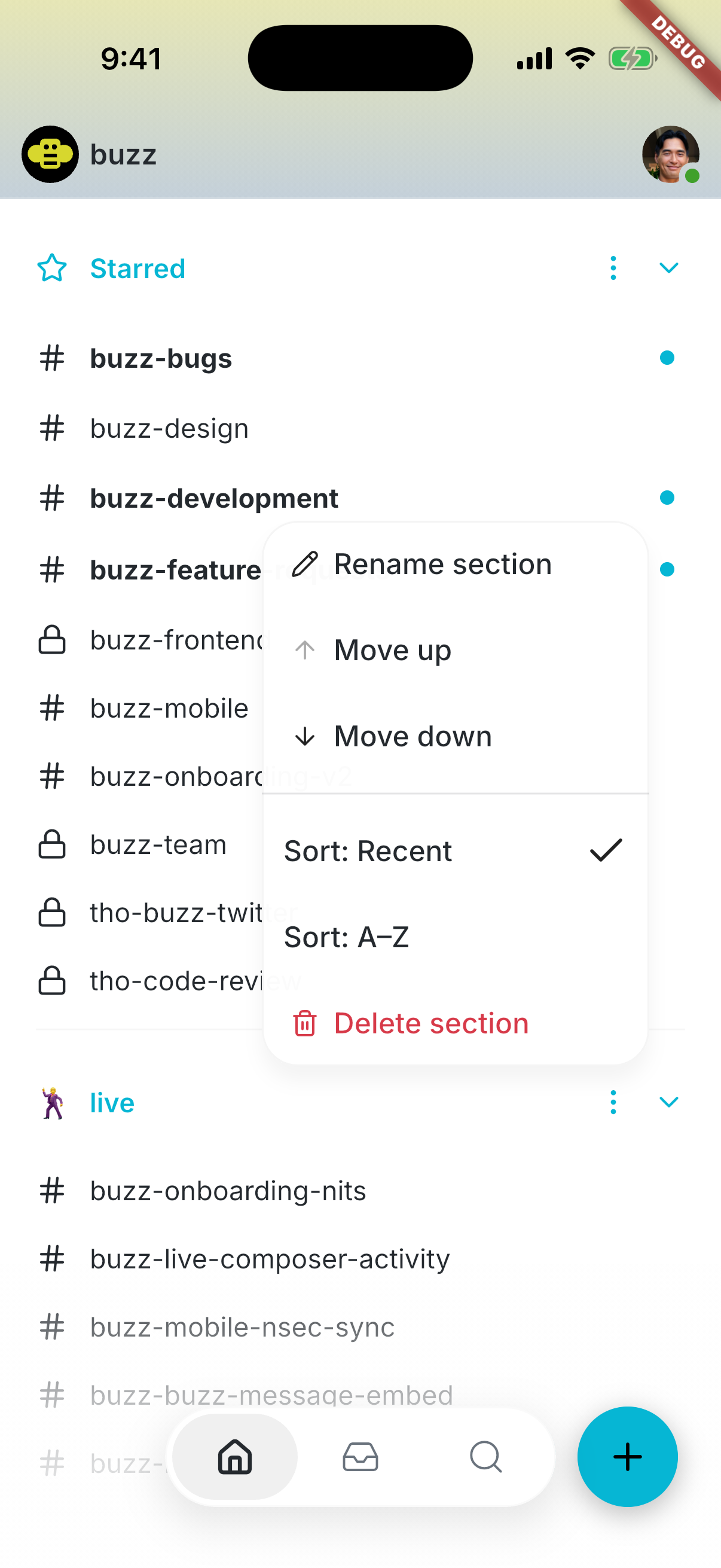 | 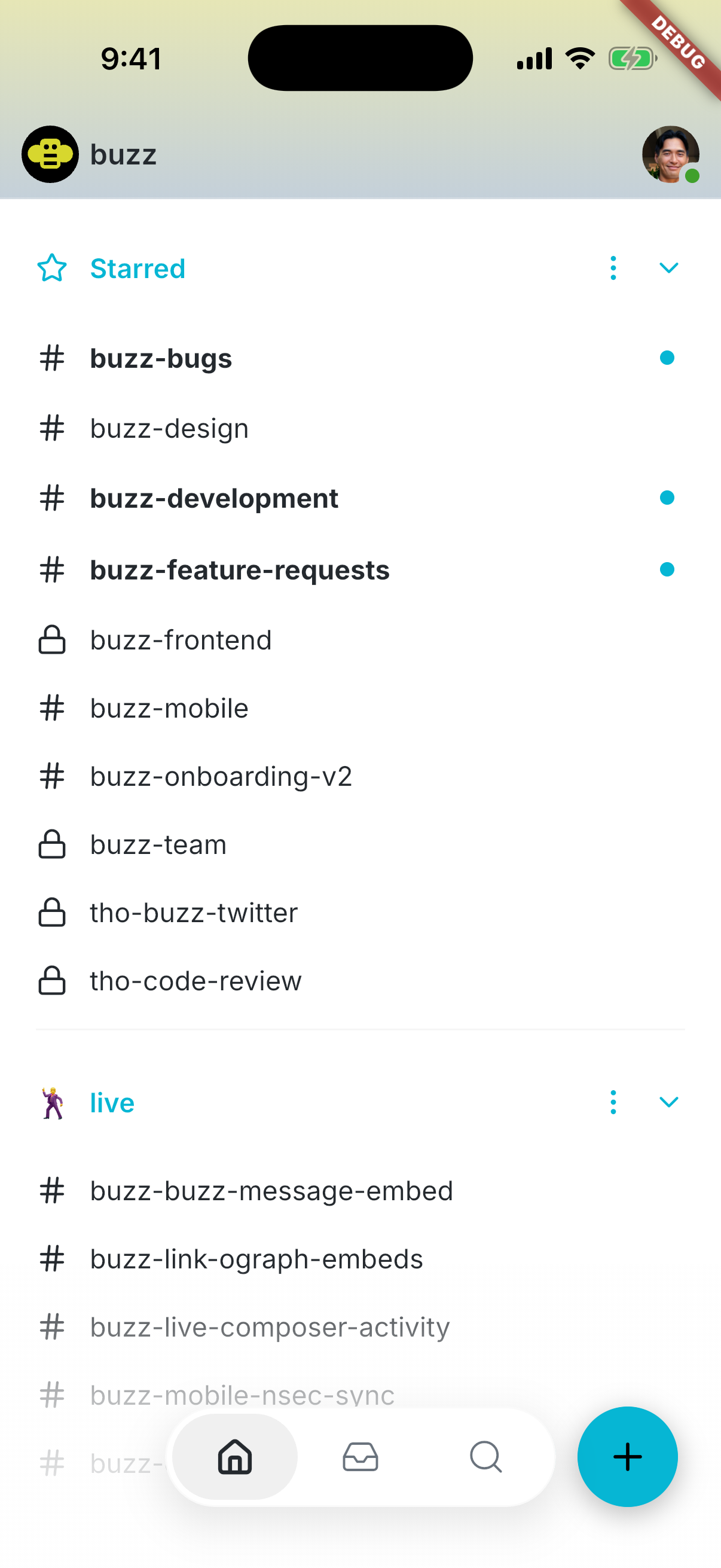 | 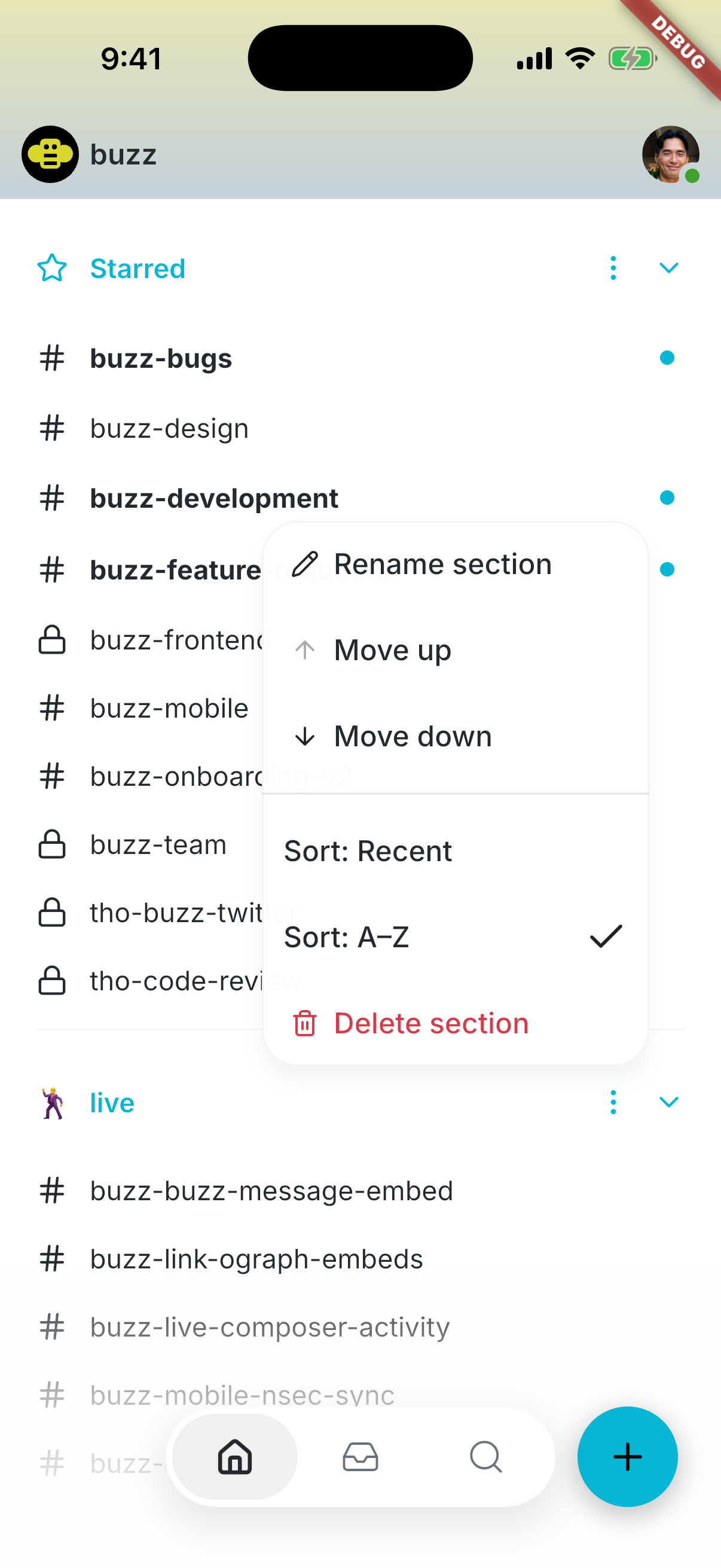 | ### Validation - Mobile `flutter analyze` — clean - Focused mobile sort and channel-page suites — 37/37 passed - Desktop full suite — 3906/3906 passed - Mobile full suite — 1034 passed, 1 skipped, 1 unrelated baseline failure reproduced at `ac4fa13b8` <!-- Originating Buzz channel: 2a16a2bb-6fd3-4d69-8182-2afcb21b2d14 --> --------- Signed-off-by: Taylor Ho <taylorkmho@gmail.com> Co-authored-by: npub1223z34hd7vtwc6qj4s7flsxkj644nlre2nthu7lrrmkumhu3xddsrx9r6w <52a228d6edf316ec6812ac3c9fc0d696ab59fc7954d77e7be31eedcddf91335b@buzz.block.builderlab.xyz> |
||
|
klopez4212
|
b29c8cdaa4 |
feat(desktop): redesign the Huddle experience (#4281)
## Summary - open Huddles in a focused companion window with a clean handoff back to the in-app drawer and backing channel - redesign the participant film strip, sidebar control, transcript surface, and themed shell treatment - preserve microphone and device control across windows, start agent voice on the first reply, and show agent speaking activity in the film strip - give each agent a distinct session voice, beginning with the configured default, plus compact per-agent text-to-speech and voice controls - enroll only agents explicitly mentioned or deliberately added through an agent panel into the live Huddle roster - keep temporary Huddle channels out of the sidebar unless the user explicitly brings one into the main app - remove Huddle-only avatar policy badges and filter short silence or noise segments before speech-to-text posts ## Why The previous flow exposed the temporary channel as product UI, obscured who was present or speaking, and split transcript and audio state between the main and companion windows. This keeps backing channels as implementation details unless a user explicitly brings a Huddle into the app, while sharing the live conversation and audio lifecycle across both surfaces. Agent participants now join only after an explicit invitation, distinct voices make multi-agent Huddles easier to follow, and short microphone noise no longer becomes stray transcript messages. ## Validation - `pnpm check` - `pnpm build:e2e` - `pnpm exec playwright test tests/e2e/huddle-transcription.spec.ts --project=smoke` (13 passed) - Huddle sidebar visibility unit coverage (4 passed) - focused managed-agent and persona-mention E2E coverage (2 passed) - `pnpm test` (3,910 passed) - `cargo clippy --manifest-path desktop/src-tauri/Cargo.toml --all-targets -- -D warnings` - `cargo test --manifest-path desktop/src-tauri/Cargo.toml` (2,093 passed, 14 ignored; 3 diagnostics passed) --------- Signed-off-by: kenny lopez <klopez4212@gmail.com> Signed-off-by: Wes <wesbillman@users.noreply.github.com> Co-authored-by: Wes <wesbillman@users.noreply.github.com> Co-authored-by: Carl <c7ebe626f000404285d3686e1dc74cc07cc60a9754a150041ba132e14bd3e2ec@buzz.block.builderlab.xyz> |
||
|
Will Pfleger
|
985cdcc6ea |
feat(agents): model-tuning parity in global Agent Defaults editor (#4578)
## Overview

The global Agent Defaults surface (Settings card, defaults modal,
onboarding) exposed structured controls for Effort but left Max Output
Tokens, Context Limit, and Max Rounds as raw env vars. Per-agent dialogs
had structured numeric fields but only for `isBuzzAgentRuntime` —
incorrectly excluding Goose. This PR unifies numeric-tuning capability
across all surfaces, fixes a pre-existing dual-editor defect, and adds
full test coverage.

## What changed

### Phase 1 — Catalog projection

- Add `max_rounds_env_var` to `KnownAcpRuntime` in `runtime_metadata.rs`
(`Some("BUZZ_AGENT_MAX_ROUNDS")` for buzz-agent, `None` elsewhere).
- Project all three numeric env-var fields (`max_tokens_env_var`,
`context_limit_env_var`, `max_rounds_env_var`) end-to-end:
`AcpRuntimeCatalogEntry` Rust struct, TS `types.ts`,
`RawAcpRuntimeCatalogEntry` + `fromRawAcpRuntimeCatalogEntry` in
`tauri.ts`, and the e2e mock bridge (`withMockRuntimeConfigMetadata`).

### Phase 2 — Field model

- `deriveAgentConfigFieldModel` now derives `maxOutputTokens` /
`contextLimit` / `maxRounds` descriptors from catalog-projected fields.
- `structuredEnvKeys(descriptors)` — exported helper that takes the
**rendered** descriptor set (not the whole model). Hidden keys follow
what is actually rendered per surface: global hides effort + all three
numeric keys for buzz-agent / two for Goose; per-agent buzz-agent hides
effort + three numeric keys; per-agent Goose hides only its two numeric
keys. `BUZZ_AGENT_THINKING_EFFORT` stays a visible generic env row
per-agent because no effort control renders there.

### Phase 3 — UI

- Extract `NumericTuningFields` from `buzzAgentModelTuningFields.tsx` as
a shared descriptor-driven component (`descriptors`, `envVars`,
`inheritedEnvVars`, `onEnvVarChange`). Kind-specific minima:
`NUMERIC_KIND_MIN` map (`maxOutputTokens`/`contextLimit`: 1,
`maxRounds`: 0) applied to `<input min>`.
- **Global surface** (`AgentConfigFields.tsx`): deduplicate the
previously duplicated Advanced env-editor block; render
`NumericTuningFields` below the env editor when descriptors exist;
`hiddenKeys` and `bakedGenericRows` exclusions use `structuredEnvKeys`
so structured keys are never double-rendered. Under 1000 lines.
- **Per-agent surfaces** (`EditAgentAdvancedFields`,
`PersonaAdvancedFields`): replace `isBuzzAgentRuntime` as the
numeric-field gate with `deriveNumericDescriptors(selectedRuntime)` from
`agentConfigCore`; hidden keys come from
`structuredEnvKeys(numericDescriptors)` — the same rendered descriptor
set, no local rebuilding (fixes pre-existing dual-editor defect).
Catalog status carried as `RuntimeCatalogStatus` (`loading | ready |
error`); both error and loading withhold structured controls and leave
saved values visible as generic rows, making error distinguishable from
"runtime not capable" (`ready` + no runtime).
- **Dialogs** (`AgentDefinitionDialog`, `AgentInstanceEditDialog`,
callers): `AgentDefinitionDialog` accepts `runtimeCatalogStatus?:
"loading" | "ready" | "error"` (replaces separate
`runtimesLoading`/`runtimesError` booleans); all call sites —
`AgentManagementDialogs`, `AgentsView`, `RequestedAgentCreateDialogs`,
`UserProfilePersonaDialogs` — compute and pass the status.

### Phase 4 — Tests

- `buildRecord` exported from `EnvVarsEditor.tsx` as a pure `(nextRows,
value, requiredKeys, hiddenKeys) => Record<string, string>` helper for
isolation testing.
- **17 new node tests** in `agentConfigCore.test.mjs`:
`deriveNumericDescriptors` (all three fields, partial, undefined
runtime, matches field-model subset); `structuredEnvKeys` per surface
including discriminating Goose per-agent effort-key invariant;
`NUMERIC_KIND_MIN` values.
- **4 new node tests** in `EnvVarsEditor.test.mjs`: hidden tuning key
preserved through generic row edits; runtime-switch then generic edit
(derives both descriptor sets, asserts new-runtime hidden key survives
`buildRecord` via `hiddenKeys` and old-runtime key survives via generic
rows); baked numeric key excluded via `filterBakedGenericRows` with
`numericTuningPlaceholder` assertion; clearing a structured override —
`numericTuningPlaceholder` verifies placeholder text.
- **5 new Playwright tests** in `agent-numeric-tuning.spec.ts` (added to
smoke project `testMatch`): global numeric fields visible for
buzz-agent; global: non-capable runtime hides numeric controls; Goose
per-agent shows `Inherit (16384)` after saving global value through the
UI; delayed catalog: saved values visible as generic rows while loading
then structured controls appear after settle; failed catalog: saved
values remain visible as generic rows (never the "unsupported" empty
state).

## Result

- buzz-agent global defaults: Max output tokens, Context limit, Max
rounds as structured inputs with `Inherit (N)` placeholders from baked
env.
- Goose global defaults: Max output tokens, Context limit as structured
inputs.
- A Goose global value surfaces as `Inherit (<value>)` in the per-agent
Goose edit dialog.
- No structured key is editable in two places on any surface; no
persisted key has zero editors.
- No `runtime.id === "buzz-agent"` comparison decides numeric-field
visibility anywhere — capability flows catalog →
`AcpRuntimeCatalogEntry` → field model → UI.

Signed-off-by: Will Pfleger <pfleger.will@gmail.com>
Co-authored-by: npub1mn7jgtj4w2pd0g0zeuhxsa6jy6p0rewxz4kujt98my82ahfmp72sxjexk7 <dcfd242e557282d7a1e2cf2e6877522682f1e5c6156dc92ca7d90eaedd3b0f95@buzz.block.builderlab.xyz>
|
||
|
klopez4212
|
027a74a61c |
Polish Share Compute settings (#3735)
## Summary - Refresh Share Compute with the shared agent-style model controls. - Reveal sharing details and advanced options only while sharing. - Remove the preview-only mesh API path. ## Validation - `pnpm check` - `pnpm test` - `pnpm exec playwright test tests/e2e/mesh-compute.spec.ts` Snapshots are attached in a follow-up comment. --------- Signed-off-by: kenny lopez <klopez4212@gmail.com> |
||
|
Taylor Ho
|
7981597848 |
fix(reactions): wrap long popover names (#3834)
**Category:** fix **User Impact:** Long custom emoji names now stay contained inside reaction popovers and remain fully readable. **Problem:** An unbroken custom emoji name could force a reaction popover beyond its intended maximum width and overflow the message view. **Solution:** Give the reaction popover a definite 288px width and allow the complete emoji name to wrap within it without truncation or ellipsis. Short names retain the same content and interaction behavior. <details> <summary>File changes</summary> **desktop/src/features/messages/ui/MessageReactions.tsx** Bounds the reaction popover width and allows long names to break across lines while preserving the full shortcode. **desktop/tests/e2e/reaction-names.spec.ts** Covers fixed width, full text preservation, and wrapping for the maximum supported colon-wrapped reaction name, with deterministic seeded Picsum visual fixtures and explicit image-load waits. </details> ## Reproduction Steps 1. Open a message with a custom emoji reaction whose name is 64 characters. 2. Hover or focus the reaction pill to open its details popover. 3. Confirm the popover remains 288px wide and the complete name wraps within it without ellipsis. 4. Open a short-name reaction and confirm its popover remains readable and unchanged in behavior. ## Screenshots | Before | After | | --- | --- | |  |  | **Short-name regression check**  ## Verification - `pnpm test` in `desktop`: 3,858 passed - Focused reaction-name E2E with seeded Picsum captures: 2 passed - Desktop checks and commit hooks passed Originating Buzz channel: `f2ec9671-d78e-4cde-894c-9f4c458c7f1f` --------- Signed-off-by: Taylor Ho <taylorkmho@gmail.com> Co-authored-by: npub1223z34hd7vtwc6qj4s7flsxkj644nlre2nthu7lrrmkumhu3xddsrx9r6w <52a228d6edf316ec6812ac3c9fc0d696ab59fc7954d77e7be31eedcddf91335b@buzz.block.builderlab.xyz> |
||
|
Wes
|
d4a4570b97 |
fix(desktop): clarify inherited agent parallelism (#4010)
## Summary - show an unambiguous `App default (10)` inherited state for parallelism in create and edit forms - explain that blank inherits the app default and suppress create-form number steppers that could silently set `1` - align the E2E mint fallback with production while preserving explicit input → definition → app-default precedence ## Why The forms displayed `1` even though an untouched field is omitted and desktop minting materializes `10`. The create-form spinner could also turn blank/inherited into an explicit `1` with one click while leaving the field looking nearly unchanged. ## Testing - `pnpm test` (desktop: 3,886 passed) - `pnpm typecheck` (desktop) - `pnpm check` (desktop) - pre-push `desktop-check` and `desktop-test` --------- Signed-off-by: Wes <wesbillman@users.noreply.github.com> Co-authored-by: Carl <c7ebe626f000404285d3686e1dc74cc07cc60a9754a150041ba132e14bd3e2ec@buzz.block.builderlab.xyz> |
||
|
Taylor Ho
|
5c98932c59 |
feat(desktop): make onboarding model defaults skippable (#3968)
**Category:** improvement **User Impact:** Users can skip default model configuration during onboarding and finish it later in Settings → Agents. **Problem:** Requiring model defaults during onboarding can block users who are not ready to choose a harness, provider, or model. Skipping also needs to leave existing configuration untouched rather than persisting partial selections. **Solution:** Stage onboarding edits locally and persist them only when users choose Next or Back. A delayed Skip action advances without any configuration write, while a footer hint points users to the settings location for completing setup later. <details> <summary>File changes</summary> **desktop/src/features/onboarding/ui/DefaultConfigStep.tsx** Adds the skip action and future-settings hint, and makes model configuration transactional so Skip discards staged changes while Next and Back preserve the intended save behavior. **desktop/src/testing/e2eBridge.ts** Exposes model-config setter call counts so tests can distinguish a true zero-write skip from a write-and-rollback implementation. **desktop/tests/e2e/onboarding-agent-defaults.spec.ts** Covers skipping during loading and after staged edits, verifies zero persistence calls, and confirms Next and Back still commit changes. </details> ## Reproduction steps 1. Start fresh onboarding and continue through harness setup to **Configure your default model settings**. 2. Change the selected harness or model, then choose **Skip for now**. 3. Confirm onboarding advances to **Join or create a community** and the prior global model configuration remains unchanged. 4. Return through onboarding and confirm **Next** saves the staged selection; confirm **Back** also preserves staged changes before returning. 5. Confirm the footer says model defaults can be configured later in **Settings → Agents**. --------- Signed-off-by: Taylor Ho <taylorkmho@gmail.com> Signed-off-by: npub1223z34hd7vtwc6qj4s7flsxkj644nlre2nthu7lrrmkumhu3xddsrx9r6w <52a228d6edf316ec6812ac3c9fc0d696ab59fc7954d77e7be31eedcddf91335b@buzz.block.builderlab.xyz> Co-authored-by: npub1223z34hd7vtwc6qj4s7flsxkj644nlre2nthu7lrrmkumhu3xddsrx9r6w <52a228d6edf316ec6812ac3c9fc0d696ab59fc7954d77e7be31eedcddf91335b@buzz.block.builderlab.xyz> |
||
|
Wes
|
651f637275 |
chore(release): release Buzz Desktop version 0.5.4 (#4562)
## Buzz Desktop release v0.5.4 - **Frozen main:** `6de85fe31d781122756aecf954bae7d357a56b9a` - **Reviewed candidate:** `5836cb8f0af478ed3ee3bc6464a20fa4cc91303f` - **Previous desktop release:** `desktop-v0.5.3` - **Proposed immutable tag:** `desktop-v0.5.4` This PR must be **squash merged** only after the Desktop Release Candidate check passes. The branch must remain based directly on current `main`; stale base, payload drift, incomplete notes, or an unauthorized merge produce no tag. The checked-in changelog accounts for every non-merge commit in the release range. Publication remains bound to the immutable candidate tag. Signed-off-by: Wes <wesbillman@users.noreply.github.com> Co-authored-by: Release Automation <release-automation@users.noreply.github.com> |
||
|
Will Pfleger
|
80315ac1a6 |
fix(desktop): harden Windows installs against Defender block and orphaned Node (#4382)
This PR fixes two Windows-specific install failures: Windows Defender blocking the bare `irm|iex` PowerShell install command, and managed Node shims pointing at a version-bumped (now-absent) Node directory. The Defender block (Trojan:Win32/Commando.A!ml) fires before PowerShell runs and is not clearable via Allow. The Node orphaning means shims in the managed npm prefix resolve but fail at runtime with 'node not recognized' because they reference the deleted old Node path. - Replace all three Windows CLI install commands (Goose, Claude, Codex) with a two-step shape — `Invoke-RestMethod` to a named temp file, then execute — to eliminate the dropper signature; a new `windows_install_command!` macro in `discovery/windows_install.rs` generates all three strings at compile time so the shape cannot drift between runtimes - `$ErrorActionPreference='Stop'` aborts on download failure instead of falling through to a missing-file exit-0; `exit $LASTEXITCODE` propagates the vendor script's own exit code - Add `probe_node(executable, expected_version, timeout)` as a bounded seam: stdout goes to a temp file (not a pipe) so no exit path can block on an inherited handle; the child runs in its own process group on Unix so an unconditional group SIGKILL on every exit path terminates all descendants; on Windows `taskkill /T /F` provides the same tree-wide cleanup; `managed_node_runtime_ready()` is a thin wrapper that resolves the managed Node path and calls the seam - Add `resolve_adapter_path()` in `managed_node.rs`: resolves the candidate first, then calls `should_invalidate_adapter()` — a pure predicate that returns `true` only when the resolved path is under `buzz_managed_npm_bin_dir()` AND the managed Node runtime is orphaned; external adapters outside the managed prefix are always preserved Note: CI cannot reproduce the Defender block (no live Defender ML classifier). Proof of fix is structural — the command shape no longer matches the dropper signature. Canary validation on a real Windows machine with Defender enabled is the definitive check. --------- Signed-off-by: Will Pfleger <pfleger.will@gmail.com> Co-authored-by: npub1mn7jgtj4w2pd0g0zeuhxsa6jy6p0rewxz4kujt98my82ahfmp72sxjexk7 <dcfd242e557282d7a1e2cf2e6877522682f1e5c6156dc92ca7d90eaedd3b0f95@buzz.block.builderlab.xyz> |







