mirror of
https://github.com/block/buzz.git
synced 2026-11-24 18:21:59 +00:00
3d97535120cd4e18ecd01542e4f7fbcadbf9301c
3 Commits
| Author | SHA1 | Message | Date | |
|---|---|---|---|---|
 Tom Brow |
a2d4ba0267 |
feat(mobile): use HTTP/2 on iOS through app-wide URLSessions (#8897)
On iOS, Buzz's HTTP traffic now uses HTTP/2. Dart's `dart:io` client speaks only HTTP/1.1, so every feature's client opened its own connections to the relay, which sits behind Cloudflare and offers HTTP/2. On a slow link those extra handshakes, and the HTTP/1.1 head-of-line queueing, are a large share of cold-start time. ### What changes - iOS HTTP goes through two app-wide `NSURLSession`s via [cupertino_http](https://pub.dev/packages/cupertino_http) (`lib/shared/http/app_http_client.dart`): one for API traffic (relay queries, NIP-11, account, admission, pairing) and one for media (image/video/voice downloads and uploads). Requests to a host multiplex over one connection per session. Media has its own session so image bytes can't starve queries on a shared HTTP/2 connection: in prototype measurements with a single shared session, the channel-list batch query finished *later* than on HTTP/1.1. - Callers keep owning and closing their clients; on iOS `close()` leaves the shared session open. Both sessions are ephemeral with no URL cache and no cookies, so apart from the protocol (and native gzip, inflated off the Dart isolate) behavior matches `dart:io`. - Android, and tests, keep `http.Client()` unchanged, including `http.runWithClient` overrides. - Because closing a client no longer cancels a request on a shared session, the relay query client (both `/query` posts and bounded snapshot reads) and the dev push-lease fetch abort their request on timeout instead. - Non-`https` requests (`http://` media and community icons from other clients, local dev relays) stay on the handle's own `dart:io` client, because App Transport Security would block cleartext loads through URLSession. An HTTPS URL that redirects to `http://` is the one case that newly fails on iOS (URLSession follows the redirect and ATS blocks the downgrade); we accept that rather than follow redirects in Dart. - URLSession failures arrive as `NSErrorClientException`, not `SocketException`, so pairing and invite-join error messages now also recognize `NSURLErrorDomain` offline, TLS and timeout codes. - cupertino_http 3.0.1+ requires native_toolchain_c 0.19 and hooks 2.x, so `buzz_secp256k1` moves to those. Its build hook compiles unchanged. ### What gets better, and what doesn't get worse - **Better:** on a slow link, requests reuse one warm connection per session instead of paying TCP+TLS setup each time, so they complete where `main` times out (see the table). On Wi-Fi, small queries are slightly faster. - **Not worse:** request semantics, caching (none) and cookies (none) match `dart:io`; Android and tests are untouched; timed-out requests are aborted so they can't keep using bandwidth on the shared connection; offline errors keep their friendly messages. The accepted regression is HTTPS-to-HTTP redirects on iOS, above. WebSockets stay on `dart:io`. Android (Cronet) is a possible follow-up using the same seam. ### Validation Added tests: shared-session handles don't close the session; off iOS the transport honors `http.runWithClient`; NSURLError code classification; timed-out relay queries and bounded snapshot reads abort their request; cleartext requests stay off the shared session. Focused existing validation: full mobile suite (the only failures are 11 push/notification tests that fail identically on `main` on the same machine), `flutter analyze`, `buzz_secp256k1` package tests (27/27), and an iOS release build. On-device A/B on an iPhone 12 mini against the internal prod relay over WARP, comparing cold starts of `main` and this branch (profile builds with local-only request timing, 3 cold starts each): | | `main` | this branch | |---|---|---| | Wi-Fi: first query done (median) | 0.31s | 0.25s | | Wi-Fi: small-query latency (median) | 0.22s | 0.18s | | NLC Edge: requests completed in 90s | 0, 0, 0 (29–30 failed) | 12, 14, 16 (5–7 failed) | | NLC Edge: first request done | never | 6.3–7.0s | On Wi-Fi the two are about even. Under Edge, every HTTP/1.1 request on `main` hit its timeout while still opening a connection, and each retry started a fresh TCP+TLS handshake. The branch reuses one connection, so queries complete. Connection counts weren't measured on the device, since no proxy was in the path. Cold-cache demo on an iOS simulator (this branch, app caches and cached prefs wiped before launch): avatars, community icons, channel lists, public channel images, a DM image and custom emoji, video playback, reactions, and an image and video upload with progress all load. The DM image and clip are synthetic test media. https://github.com/user-attachments/assets/039d1a25-46f2-4e0e-b147-f96d0cfabd40 buzz-review-completed (agent review and device validation done; the human-test step is not applicable under Tom's standing exception for mobile changes) --------- Signed-off-by: Tom Brow <tomb@squareup.com> Co-authored-by: Tom Brow <tomb@squareup.com> Co-authored-by: studio <dc2fc481343672df31a689840c09299972e704dac592e0da6f18486646a7ee3e@buzz.block.builderlab.xyz> Co-authored-by: Claude Opus 5.5 <noreply@anthropic.com> |
||
|
Tom Brow
|
12f3d51001 |
feat(mobile): one Builderlab per build, internal and public distributions (#9224)
The mobile app can now be built as a public build or an internal build, set explicitly with `BUZZ_DISTRIBUTION=internal|public`. Each build trusts exactly one Builderlab (`BUZZ_BUILDERLAB_URL`), and sends that Builderlab's relay assertions only to the relays in `BUZZ_BUILDERLAB_RELAYS`. The three settings are set together or not at all; with none set, the app is a Nostr-only development build. The decision is recorded in `docs/adr/0001-internal-and-public-mobile-builds.md`, and the terms are defined in `CONTEXT.md`. Before this change, one build supported a public Builderlab and an organization Builderlab at the same time, with two sessions. An organization's members could reach public communities from the organization's app. ### Behavior - **Public build:** QR pairing, email sign-in and multiple communities are unchanged. It has no knowledge of any organization. An organization's relay already rejects clients that can't present its Builderlab's assertion, and the public build relies on that. - **Internal build:** the first screen has a single **Sign in** button that goes straight to the organization's single sign-on and then joins the organization's community. There is no QR pairing, community link or community creation, and the community switcher is hidden. Only the exact relay hosts listed in `BUZZ_BUILDERLAB_RELAYS` are reachable. - **Identity (internal):** a member whose account has no Nostr identity yet gets a new key on first sign-in; the first relay assertion binds it, and the app backs it up to the organization automatically. A member whose account is already bound uses that key from this device, or restores it from the organization's backup. If neither is possible, Sign in says it couldn't restore the identity and saves nothing. - **Sign-out (internal):** a destructive **Sign out** row at the bottom of Settings, the build's only way out. It removes the community, closes Settings and returns to Sign in. The Builderlab session is cleared from storage immediately and can never be reused to sign back in. The relay push-stop keeps the retired credential in memory only, for up to 10 minutes, and uses it only to get an assertion for a key that is already bound. It is a best-effort request. - **Upgrade to an internal build:** a saved public Builderlab session is cleared. Communities on other relays are hidden, not deleted, and their keys stay on the device. - `BUZZ_HOSTED_RELAY_AUTH` is unchanged here. ### Screenshots (internal build) | Sign in | Community menu | Settings | | --- | --- | --- | |  |  |  | Gateway-side push revocation, which needs no Builderlab session, is planned as a separate PR. ### Validation Added tests: - An internal-build journey: one Sign in creates and binds a key, and a retry after a cancelled join reuses it. The app uploads that key's backup itself. Sign out from Settings closes it and returns to the landing, which ends the session, and Sign in then restores the same identity from the backup. Communities on other relays stay stored but hidden. - Internal Sign in for a bound account: the key on this device, a key restored from backup, and no backup (clear error, nothing saved). Each guard was shown to fail when removed. - Organization relay assertions: assertions go only to exact listed hosts, not subdomains. After sign-out, only a push stop for a bound key gets an assertion, and nothing can sign back in. Proven to fail without the fix. - Builderlab build setting parsing. CI runs the internal and public journeys in their own lanes with those settings. The full suite passes in the default configuration. The full suite isn't meant to run under the internal configuration, because most fixtures use relays that an internal build hides. Automated full-app run on an iPhone 17 Pro simulator at the current head: - Public build, upgraded in place over a signed-in install: home loads, a channel opens and a message sends. - Internal build: a fresh install shows only Sign in. With a saved organization community, the community menu has no Switch community, and Settings → Sign out → confirm returns to Sign in. Real single sign-on can't run in the simulator. 🤖 Generated with [Claude Code](https://claude.com/claude-code) --------- Signed-off-by: Tom Brow <tomb@squareup.com> Co-authored-by: Tom Brow <tomb@squareup.com> Co-authored-by: studio <dc2fc481343672df31a689840c09299972e704dac592e0da6f18486646a7ee3e@buzz.block.builderlab.xyz> Co-authored-by: Claude Opus 5.5 <noreply@anthropic.com> Co-authored-by: studio <dc2fc481343672df31a689840c09299972e704dac592e0da6f18486646a7ee3e@localhost> |
||
|
Tom Brow
|
fa395e9e80 |
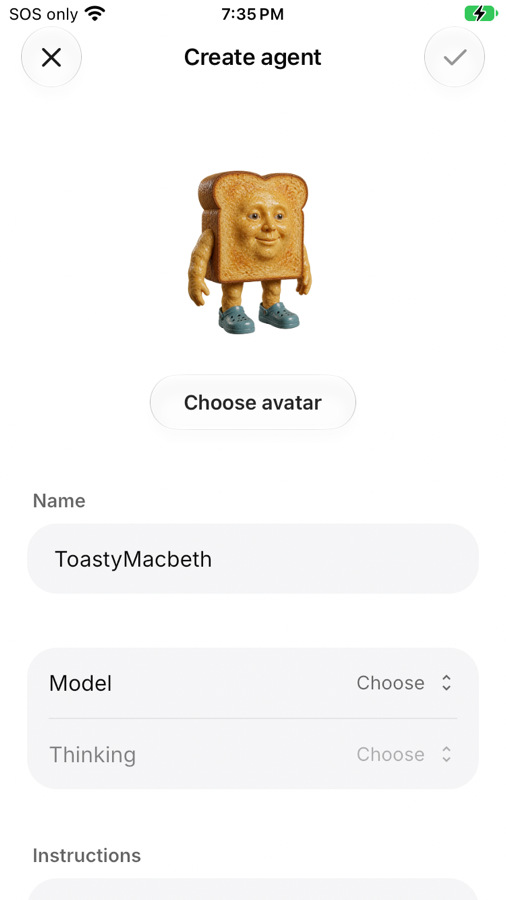
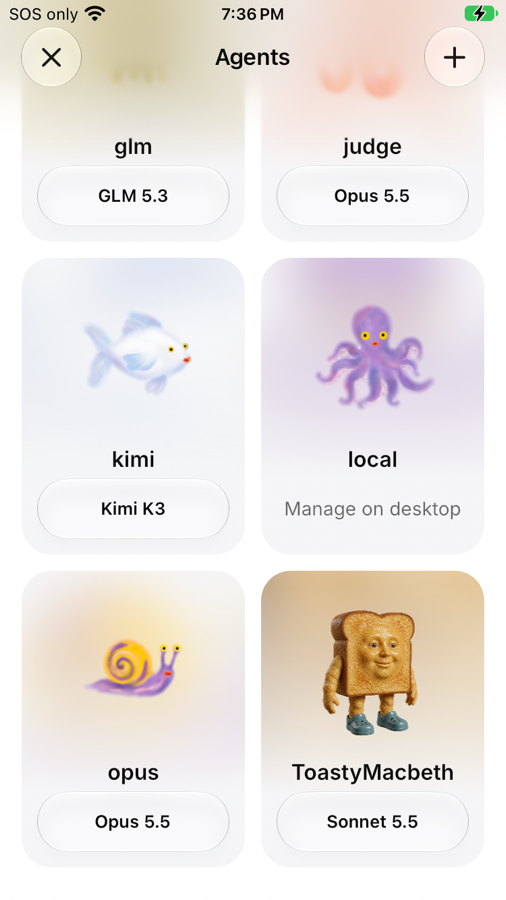
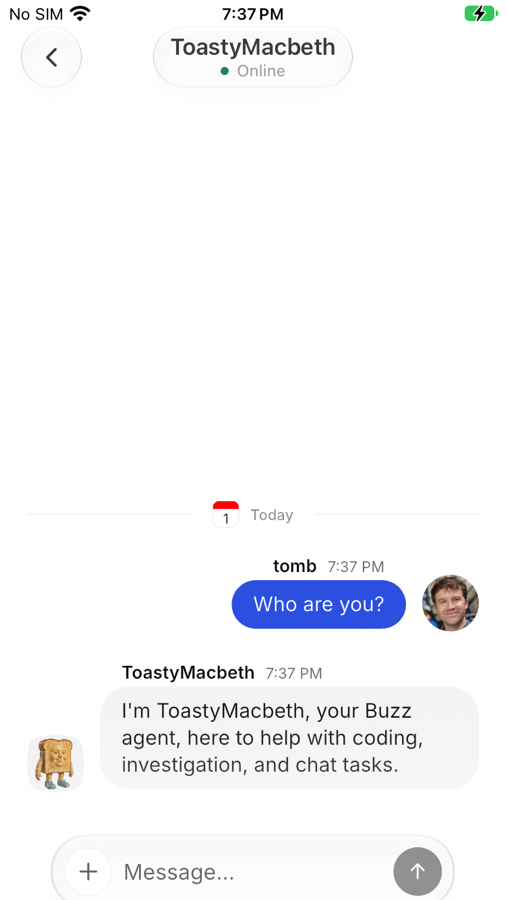
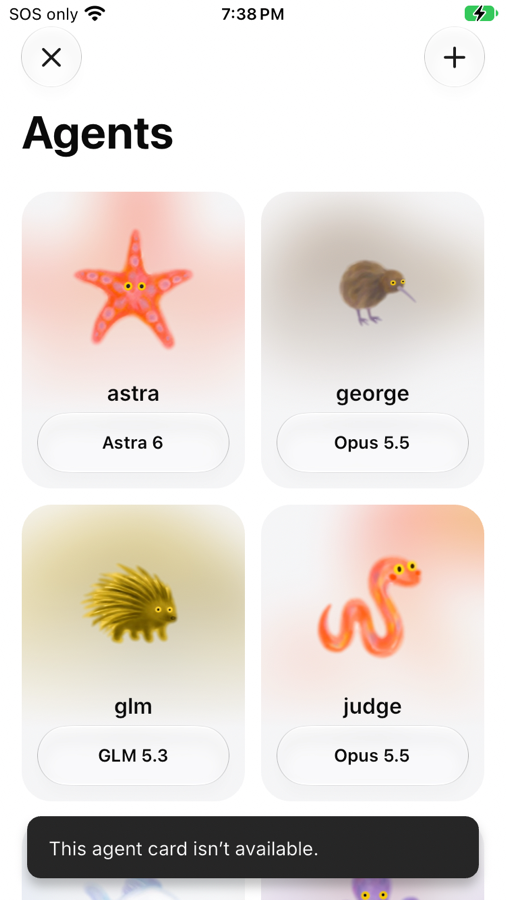
feat(mobile): open a prefilled Create agent form from Builderlab agent cards (#8912)
Builderlab agent cards (printed for the event, and generated at the kiosk) carry a QR to a share page, `app.builderlab.xyz/a/<id>`. Its **Add to Buzz** button opens `buzz://agent/new?card=<id>`, which no Buzz client handled until now. This PR makes mobile handle it. ### Behavior - Opening the link shows the Agents page, then a Create agent form prefilled from the card. Everything stays editable, and nothing is created until the user taps Create. - The app fetches the card's `agent.json` from the avatars CDN for this build's Builderlab environment (production or staging). The link carries only the card id, never a host, so the QR stays small no matter how long a card's instructions get. - `agent.json` is validated against the card schema. `id` (matching the link), `name` and `avatarUrl` (an https URL) are required. `instructions`, `model` and `reasoningEffort` are optional (published cards don't have them yet) and left for the user when absent. A missing required field or a wrongly typed known field rejects the card; any other key is ignored whatever its type, including `v` and `description` (Buzz agents have no description to prefill), so Builderlab can add fields without breaking released apps. The model and effort are preselected only if the live catalog offers them. The card id is opaque: any non-empty id is accepted and percent-encoded into the URL. - The fetch uses the same limits as image downloads, now shared in `bounded_fetch.dart`: aborted after 20 s without a byte or 5 min overall, and rejected over 2 MB. `MediaImageProvider` now calls the same helper, with no behavior change. - The link waits for sign-in, then reloads the registry for the signed-in account before anything else. It's dropped with a message if the card is unavailable (403/404), invalid, can't be loaded (any other response), or an agent setup is unfinished, including a setup saved before a sign-in the link triggered. - A link that arrives while Agents shows only its list replaces that page instead of stacking a second one. If a form or sheet is open there, the link is dropped with "Finish or close what’s open in Agents, then reopen the link." and the open work is kept. ### Demo Simulator (iPhone 17 Pro, debug build of this branch plus the sign-in fix from [#8914](https://github.com/block/buzz/pull/8914) and the hidden debug banner from [#8915](https://github.com/block/buzz/pull/8915), signed in to Builderlab, remote-agent-pilot), recorded in one take with idle time trimmed: the card's share page in Safari, Add to Buzz, the prefilled Create agent form, a model, thinking level and instructions, Create, then a message and the agent's reply. https://github.com/user-attachments/assets/e66aae17-884a-4e68-a1b8-ecb40562be1d ### Validation Added tests: - Table tests for the link shape (only `?card=<id>` with an opaque id; the inline `#` form, extra parameters and dot segments are rejected) and for reading `agent.json` (a published card, a card with instructions and model defaults, unknown keys of any type ignored, including `v`, `description`, arrays, objects and null, and invalid cards: missing or mismatched required fields, wrong types, and non-https or relative avatars). - Table tests for fetching: the request goes to this build's CDN without following redirects, with the id percent-encoded as one path segment; 403/404, a redirect, a 500, a network error, declared and streamed oversize bodies, non-JSON and a JSON array each give a specific message. The image loader's existing stall, deadline, cap and cancel tests now cover the shared helper. - A journey test from link to Create against a fake CDN: prefill and edit, then submit; an unavailable card; a failed model catalog whose Retry then preselects the card's model; a Builderlab account change while the card loads, which drops the draft; a v1 card with no instructions and an unknown model; an unfinished setup; a link arriving while a Create form with edits is open, which keeps the form and its edits; and a link arriving while Agents is open. Disabling the https or id check makes the table test fail, and removing either the account recheck or the loaded-catalog check fails the journey. The journey runs through the production root scope (removing its link handler fails it) and runs in CI's configured-authentication-domains step. Full mobile check and test suite pass locally. Live data: a real staging card's `agent.json` (`av_MioTAG6dm7q3Zcm0UV2j8A`) has the v1 shape the table test uses, and an unknown id returns 403 from the CDN. Live run on an iPhone SE (build of 63ed54c749, Builderlab sign-in enabled, remote-agent-pilot, signed in as builderlab@tombrow.com) with a real production card, [ToastyMacbeth](https://app.builderlab.xyz/a/av_lrmRlJR6ylrQKvJkoLWCOQ) (a v1 card with no instructions and an extra `description` key): - Opening `buzz://agent/new?card=av_lrmRlJR6ylrQKvJkoLWCOQ` from a cold start opens Create agent prefilled with the card's name and avatar. - After choosing a model and adding instructions, Create adds the agent with the card avatar, and it replies in a DM. - An unknown card id shows "This agent card isn’t available." | Prefilled | Created | Reply | Unknown card | | --- | --- | --- | --- | | <img src="https://raw.githubusercontent.com/block/buzz/b9222db494758c3e536b8e2011032ba7cec86daa/pr-8912--01-prefilled.png" width="200"> | <img src="https://raw.githubusercontent.com/block/buzz/b9222db494758c3e536b8e2011032ba7cec86daa/pr-8912--02-created.png" width="200"> | <img src="https://raw.githubusercontent.com/block/buzz/b9222db494758c3e536b8e2011032ba7cec86daa/pr-8912--03-reply.png" width="200"> | <img src="https://raw.githubusercontent.com/block/buzz/b9222db494758c3e536b8e2011032ba7cec86daa/pr-8912--04-unavailable.png" width="200"> | Before this PR, the app had no handler for `buzz://agent/new`, so the link did nothing. A separate widget test covers a link that needs Builderlab sign-in first: once sign-in lands, a setup saved for that account blocks the card, which is never fetched. Removing the registry reload fails it, as does removing the busy-Agents guard for the journey step above. ### Before merge - [x] Human live check waived under the repository owner's standing testing exception. In its place, agent-driven full-app runs exercised the flow end to end: the iPhone SE device run and the simulator demo above (a real card's share page, **Add to Buzz**, the prefilled form, Create and a reply from the agent). Limitation: those runs predate [ |