mirror of
https://github.com/block/buzz.git
synced 2026-11-24 18:21:59 +00:00
3d97535120cd4e18ecd01542e4f7fbcadbf9301c
8 Commits
| Author | SHA1 | Message | Date | |
|---|---|---|---|---|
 Tom Brow |
9fc2b33320 |
perf(mobile): read only changed custom emoji sets on reconnect (#9446)
Once anything has read the custom emoji palette (opening any channel does), every reconnect refetches every member's kind 30030 emoji set. On Block's Builderlab that is 123 sets, about 1 MB, on every resume, though the sets rarely change. The provider also watched the whole session state, not just its status. The palette now keeps the sets it has read per author and, on a reconnect, asks only for sets written since shortly before the previous read (`since` reaching back `relayCrossDeviceSkewSeconds`, the window the unread catch-up already uses for events other devices write). A newer set replaces the known one for its author, with the relay's order for a same-second tie (the lower event id wins); the palette is the union as before, recomputed only when a set changes, so a reconnect that brings nothing new republishes the identical list and rebuilds nothing. A community or account switch (a new relay client) starts over with a full read. Two side benefits: the loaded palette stays visible while disconnected (before, it was empty until the full read finished, so `:shortcode:`s in visible messages briefly showed as text on resume), and the palette no longer refetches on every reconnect attempt during backoff, only on status changes. ### Validation Added test: the first read has no `since`; a reconnect with nothing new sends a `since` and keeps the palette as the identical list; a new member's set and a replaced set both arrive in the window and update it; a same-second replacement wins with a lower id and is ignored with a higher one. It fails without this change. Existing emoji picker tests pass; full mobile test suite and `flutter analyze` pass. On an iPhone 12 mini signed in to Block's Builderlab (instrumented profile build): after opening a channel, a resume after 60 s in the background downloaded the 1 MB of sets again (kind 30030, 123 events). With this change the same resume sent the read with a `since` and got no events back, so the 1 MB was not downloaded again; the first read when opening the channel is unchanged (123 sets, 1 MB). ### Regressions A set removed with a NIP-09 deletion (rather than replaced) stays in the palette until the app restarts, since a deletion isn't a newer set. Buzz clients edit a set by replacing it (desktop removes a shortcode by republishing the set), so that only affects other clients, and desktop's emoji directory keeps deleted sets the same way. A set written by a device whose clock is more than 30 minutes behind is missed until restart, the same bound the unread catch-up accepts. --------- Signed-off-by: Tom Brow <tomb@squareup.com> Co-authored-by: Tom Brow <tomb@squareup.com> Co-authored-by: studio <dc2fc481343672df31a689840c09299972e704dac592e0da6f18486646a7ee3e@localhost> |
||
|
Tom Brow
|
41587e0284 |
feat(mobile): render messages with gpt_markdown 1.3.4 plusparse (#8945)
Message Markdown on mobile moves from gpt_markdown 1.2.1's legacy regex
pipeline to the CommonMark parser that 1.3 added ("plusparse"). Before
this, passing `inlineComponents` (now deprecated, removed in 2.0.0) kept
every message on the legacy pipeline.
### What changes for users
Rendering moves closer to desktop (react-markdown + remark-gfm):
- `_italic_` and `__bold__` work, backslash escapes and HTML entities
decode, and `[a [b] c](url)` labels are correct.
- Inline code follows CommonMark pairing: `"```npm install```"` in a
sentence is inline code, and four-backtick fences work.
- Setext headings, reference links, footnotes, `~~~` fences, `1)` lists
and CommonMark list/quote continuation render.
- HTML comments are hidden, as on desktop.
- `\[`, `\]`, `\(` and `\)` stay literal, as on desktop. Plusparse
hard-codes them as LaTeX delimiters, so they're written as entities
before rendering.
- Side effect: an unfenced `__init__` now renders as bold "init", and a
line over `---` becomes a heading, same as desktop.
Device benchmark (iPhone SE, profile build, 600 synthetic messages, 3
launches per build): scrolling spends 9% less time building, and frames
with more than 8 ms of build drop from 63 to 22. Jumping onto unbuilt
messages is 11% cheaper, and raster time is unchanged.
App size: the release app grows about 4.6 MB uncompressed (80.6 to 85.2
MB), mostly Dart code from the new math and highlighting packages.
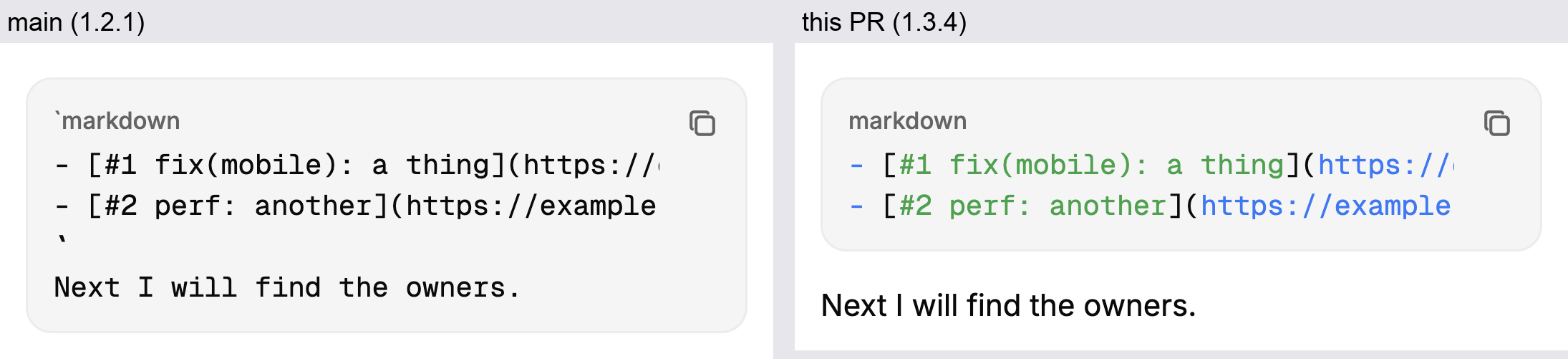
### Before and after
Synthetic messages that reproduce differences found in real channel
history, rendered through `MessageContent` on main and on this branch:







### Demo
A scroll through synthetic messages covering common formatting
(headings, lists, quotes, links, highlighted code, a table, a task list,
escapes), recorded on an iPhone 17 Pro simulator running this branch:
https://github.com/user-attachments/assets/bdc9680c-d20b-41ec-8e1a-a5b51c602f9d
### How
- Mentions, custom emoji and `#channel` tokens are `InlinePattern`s.
Links go through `inlineLinkBuilder` into the existing `_buildLink`, so
chips, media links and taps are unchanged.
- Removed workarounds the parser makes unnecessary:
- the render-path escape shielding from #8925
- the `_MarkdownEscapeMd`, `_MarkdownLabelEntityMd` and `_MessageLinkMd`
components
- the zero-width prefix before a leading `#channel`
Plain-text previews and gallery helpers keep their own escape handling.
`normalizeBareLinks` stays because attachment and gallery detection
depend on its output. Bubble segmentation unescapes a link destination
itself before its imeta lookup, since content no longer arrives
shielded.
- Kept desktop parity where plusparse differs from GFM:
- a table typed directly under a caption line gets a blank line inserted
before it, since plusparse can't start a table mid-paragraph
- `> [!NOTE]` quotes render as quotes (`alertBuilder` returns
`asBlockQuote()`), since desktop has no alerts
- `mapMarkdownProse` now ends an unclosed backtick run at its paragraph.
Before, it could pair with a run in a later block and flip code and
prose for the rest of the message.
- Synthesized autolink labels escape backslashes instead of using
`\`, which the parser leaves undecoded in a URL-shaped label.
- Repo/PR/issue chips keep their own semantics node.
- Forum card previews clip at their 120 px cap instead of overflowing:
blocks now lay out as a column.
- Pinned to exactly 1.3.4. 1.4.0 renders HTML by default and themes
through the separate `material_ui` package, which would need a theme
bridge.
### Validation
- Full mobile suite passes and analyze is clean at
|
||
|
Tom Brow
|
4a101752fb |
fix(mobile): never show emoji shortcodes in reaction pills (#9411)
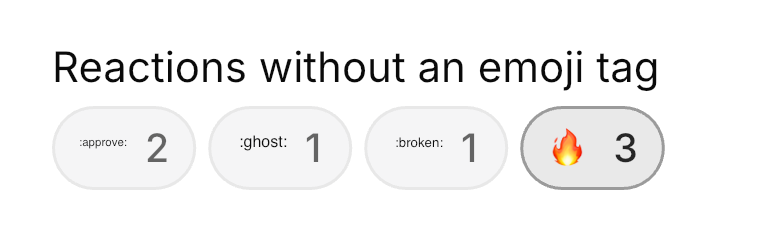
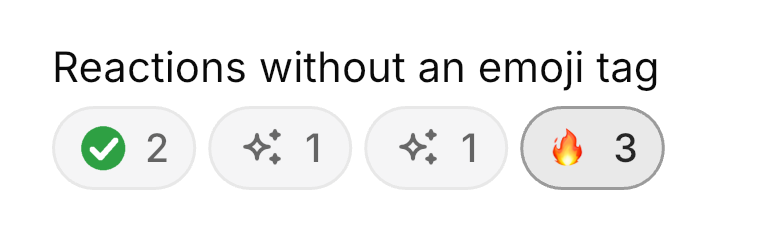
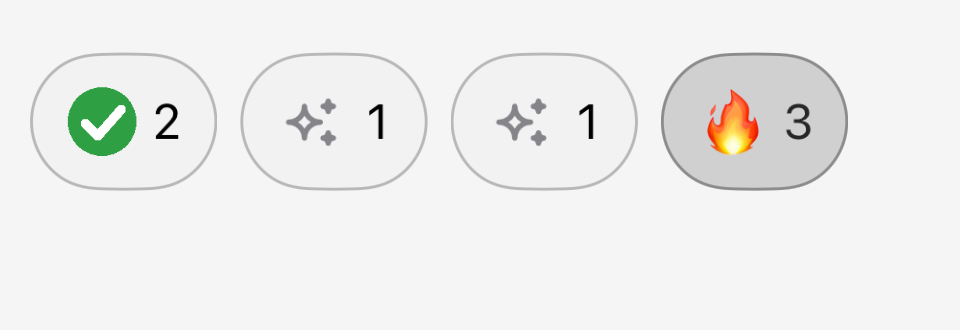
## Context A reaction slot should never show an emoji shortcode as text. Today it does in two cases: - An agent's reaction is a kind 7 event with content `:shortcode:` and no NIP-30 `emoji` tag, so the pill printed `:approve:` in tiny text instead of the community emoji. - A custom emoji whose image fails to load fell back to the shortcode text. ## Behavior - A tagless `:shortcode:` reaction resolves against the community custom-emoji palette and renders that image. An `emoji` tag on the event still wins. - A shortcode with no palette entry, or whose image fails to load, shows a neutral placeholder glyph (the muted sparkles icon) instead of text. The shortcode survives only as the semantics label. - This applies to every reaction slot: the timeline pills, the combined reaction tray, the Flutter reaction detail sheet, and the native iOS reactions sheet (which is told which shortcodes have no image, so `NativeMessageGlyph` draws the placeholder). System-message rows reuse the same reaction row. - Unicode emoji are unchanged. The icon is the existing `BuzzIcons.sparkles`. Pareto note: the palette lookup is the shared `reactionEmojiUrl` helper, so there is no new resolver, and the pill only watches the palette when the reaction has no tag. ### Validation - `just mobile-check mobile-test`: format and analyze clean; full suite passes (4773 passed, 74 skipped). - New widget tests (journeys, in `reaction_row_test/shortcode_tests.dart`): a tagless known shortcode renders its image; an unknown shortcode and a failed image render the placeholder and never the text; unicode is unchanged; the native sheet payload marks image-less shortcodes. Reverting the fix makes both new journeys fail. - iOS: added a Swift unit test for the native glyph placeholder (`NativeMessageImageLoaderTests`); not run locally, the app run below exercises the same code. - Automated app run on a cloned iOS simulator with a fixture entry point (mocked media, synthetic palette): confirmed the pills before and after, and opened the reaction sheet from a long-press to confirm the placeholder renders there too. The clone was deleted afterwards. ## Before / after Captures use synthetic shortcodes and a synthetic palette. <img width="300" alt="reaction-pills-before" src="https://raw.githubusercontent.com/block/buzz/75b22a00d92df2db389ef90d35d476b285b60374/pr-9411--reaction-pills-before.png"> <img width="300" alt="reaction-pills-after" src="https://raw.githubusercontent.com/block/buzz/75b22a00d92df2db389ef90d35d476b285b60374/pr-9411--reaction-pills-after.png"> Reaction sheet after: <img width="300" alt="reaction-sheet-after" src="https://raw.githubusercontent.com/block/buzz/75b22a00d92df2db389ef90d35d476b285b60374/pr-9411--reaction-sheet-after.png"> 🤖 Generated with [Claude Code](https://claude.com/claude-code) Signed-off-by: Tom Brow <tomb@squareup.com> Co-authored-by: Tom Brow <tomb@squareup.com> Co-authored-by: Claude Opus 5.5 <noreply@anthropic.com> Co-authored-by: studio <dc2fc481343672df31a689840c09299972e704dac592e0da6f18486646a7ee3e@buzz.block.builderlab.xyz> |
||
|
Tom Brow
|
ac2c5831f3 |
fix(mobile): show already-loaded custom emoji in the iOS reactions sheet (#9150)
On iOS, the reactions sheet (long-press a reaction pill) could show a custom emoji as truncated `:shortcode:` text, for example `:eye…`, even though the same emoji rendered as an image on the message pill a moment before. The sheet is a native UIKit view that downloaded each custom emoji again with its own `URLSession` request and showed the shortcode label until that download finished, and for good when it failed. A shortcode is illegible in a chip that size. Now: - Flutter keeps the encoded bytes of custom emoji it has downloaded (a bounded LRU: 512 KiB per emoji, 8 MiB total, rebuilt when the media auth scope changes so accounts never share bytes) and hands them to the sheet, which decodes them without a fetch. Emoji the timeline never loaded still download natively as before. - A custom emoji in the sheet never shows its shortcode: it stays blank while loading and shows the sparkles icon, matching the native emoji picker, if the image cannot load. Reaction pills in Flutter get the same sparkles fallback. Inline emoji in message text keep the shortcode fallback, where it reads as text. Avatars in the sheet keep their initial. ### Before / after Reactions sheet header and chips right after opening, on a message with two custom-emoji reactions (synthetic test channel, captured from a 30 fps screen recording). | Before (main) | After (this branch) | | --- | --- | | <img width="300" alt="Before: custom emoji chips show truncated :qa-... shortcodes" src="https://github.com/user-attachments/assets/593e555b-9c82-4eec-9049-3d909f987c76"> | <img width="300" alt="After: custom emoji chips show images" src="https://github.com/user-attachments/assets/a6739997-b39f-4062-9e5c-d22a8a38b368"> | ### Validation - Added tests: the native sheet's payload carries the bytes the pill already downloaded; the combined reaction tray shows sparkles, not the shortcode, when a custom emoji fails to load (the existing alignment test previously asserted the shortcode). - Full mobile suite and `just mobile-check` pass; the iOS simulator build compiles. - Automated simulator run (iPhone 17 Pro, iOS 27, main vs this branch, signed in to a test community): channel list, opening a channel, the message action sheet, the emoji picker, and the reactions sheet on a message carrying two custom emoji I added plus a thumbs-up. On main the sheet's custom-emoji chips show truncated `:qa-...` shortcodes for a few frames before the images arrive; on this branch they render as images from the first frame (see Before / after). Limitations: the emoji images load fine over the network in this setup, so the failed-download sparkles fallback was covered by tests only, not seen in the app; a long press on the combined reaction tray opened the message menu in the simulator, a tap opened the sheet. 🤖 Generated with [Claude Code](https://claude.com/claude-code) Signed-off-by: Tom Brow <tomb@squareup.com> Co-authored-by: Tom Brow <tomb@squareup.com> Co-authored-by: studio <dc2fc481343672df31a689840c09299972e704dac592e0da6f18486646a7ee3e@buzz.block.builderlab.xyz> Co-authored-by: Claude Opus 5.5 <noreply@anthropic.com> |
||
|
Mohammad Asfour
|
1a54eec3db |
fix(mobile): keep token labels visible in authored Markdown links (#7545)
## Summary On iOS, an authored Markdown link renders as blank when its label is recognized as a Buzz channel, mention, or custom emoji. For example: ```markdown [#2959](https://example.com/) ``` The surrounding text remains visible, but the link has no visible label or tap target. Buzz's `_ChannelLinkMd`, `_MentionMd`, and `CustomEmojiMd` components return `WidgetSpan`s. `gpt_markdown` also renders an authored link through a `WidgetSpan` and reparses its label through the registered components. Because the Buzz components were allowed to run inside link labels, the result was a placeholder nested inside another placeholder, which does not paint on iOS. This PR adds the same scope restriction used by `gpt_markdown`'s built-in link component: ```dart @override Set<MarkdownScope> get scopes => MarkdownComponent.allScopesExceptLinkLabel; ``` The override is applied to all three widget-based components. Authored labels such as `[#2959](url)`, `[@Alice](url)`, and `[👋](url)` therefore remain ordinary link text, while the same tokens outside links continue rendering as Buzz pills and custom emoji. The PR also updates the shared test helpers to find `RichText` subclasses. Since the upgrade to `gpt_markdown` 1.2.1, body paragraphs can render through `BidiRichText`; `find.byType(RichText)` does not match that subclass and could allow an absence assertion to pass without inspecting the message text. The handling of unknown bare `#tokens` is deliberately unchanged. Whether those should remain non-interactive pills or become plain text is a separate product decision. ### Related issue Fixes #6124. This supersedes #6135. That PR solves the same issue by maintaining a custom fork of `gpt_markdown`'s link component; this PR instead uses the scoped-component API already available in `gpt_markdown` 1.2.1. ### Testing Focused suites: ```bash flutter test \ test/features/channels/message_content_test.dart \ test/features/channels/message_content_custom_emoji_test.dart ``` Result: 95 tests passed, 0 failed. Additional checks: - `just mobile-check` — passed; analyzer reported no issues. - `just mobile-fmt` — passed; 549 files formatted with 0 changes. - Six new regression tests cover channel, mention, emoji, plain-link control, and outside-link behavior. - Removing the `_ChannelLinkMd` override causes two regression tests to fail; removing `_MentionMd` or `CustomEmojiMd` causes one test to fail in each case. - Three tests in `message_content_test.dart` directly assert that the nested-placeholder structure is absent. The custom-emoji tests separately verify literal text and the absence or presence of `CustomEmojiImage`, depending on whether the shortcode is inside or outside a link. The complete local mobile suite reports 15 failures that reproduce identically on a clean checkout of `main` at `44316ff7`. In [CI for that same commit](https://github.com/block/buzz/actions/runs/34238736818), `Clients / Mobile`, `Mobile`, and `Mobile Swift Domain / Mobile Swift` all passed. No native-device screenshot is included. The nested-placeholder fix was verified through the rendered widget structure, but an iOS simulator build was blocked by the existing `MLImage.framework` arm64-simulator incompatibility. Signed-off-by: Mohammad Asfour <masfour700@gmail.com> Signed-off-by: Samin Yeasar Sohag <sssohag172@gmail.com> Co-authored-by: Samin Yeasar Sohag <sssohag172@gmail.com> |
||
|
TolgaCinisli
|
fa1b27bcc8 |
fix(mobile): style inline code with the app mono face (#6631)
## Summary Inline code on mobile renders as **bold body text on a faint background wash** — no monospace face, no chip, and it cannot wrap. #5257 diagnosed this as a missing `highlightBuilder`. That is no longer the right fix. `gpt_markdown` 1.2.0 deprecates `highlightBuilder` (removal in 2.0.0), renders inline code as a real chip, and adds `InlineCodeStyle` for restyling it. The package author confirmed this on the issue. So this PR is an upgrade — 1.1.6 → 1.2.1 — plus one theme declaration, rather than the builder the issue originally asked for. **Where the style is declared.** `GptMarkdownThemeData` goes in `AppTheme._buildTheme`, which both `light()` and `dark()` call. That reaches all four `GptMarkdown` call sites — `message_content`, `transcript_item_widget`, `token_pill`, `custom_emoji_render` — so the style is stated once instead of per widget. A widget-level `inlineCodeStyle` would have covered channel messages only, leaving the other three on the package's defaults. **What is declared.** Face, size, ink, chip fill and outline — not the face alone. A face name on its own leaves the rest on the package's defaults, which put inline code at 14.1sp beside a fenced block's 13, on a neutral `onSurface` tint rather than the app's code surface. In dark that tint is *lighter* than the surface, while every other code surface in the app is recessed, so the chip read as a different kind of object. All of it now comes from one `CodeStyle` declaration that the fenced block reads from too, so the two cannot be edited apart. **Three adaptations the upgrade requires.** Each was found by running the gate, not by reading the changelog: 1. **`imageBuilder` widened** to `(context, url, width, height)`. This is a hard compile error, and it is **not listed in the package's migration guide**, which states "nothing here stops code compiling". Worth reporting upstream. 2. **`autolink` now defaults to `true`.** `normalizeBareLinks()` already rewrites bare URLs into Markdown links before rendering, so both would run. `message_content` opts out with `autolink: false` to keep current behaviour exactly. The migration guide argues for dropping the pre-processor instead — a better fix, but a behavioural change that belongs in its own PR. 3. **`gpt_markdown.dart` now re-exports `markdown_config.dart`**, making two direct imports redundant. `flutter analyze` reports `No issues found!` on 1.1.6 and flags both on 1.2.1, so these warnings are new, not pre-existing. **Deliberately out of scope.** The three non-message call sites now autolink bare URLs, since only `message_content` has a pre-processor to collide with. Custom inline components (`_MentionMd`, `CustomEmojiMd`, `_ChannelLinkMd`) could additionally declare `allScopesExceptLinkLabel` — 1.2.0 offers it as the fix for a `WidgetSpan` chip going blank inside a link label on iOS — but current behaviour is unchanged without it, so that stays a separate change. ### Related issue Fixes #5257 Duplicate scan: searched `gpt_markdown`, `inline code mobile`, `highlightBuilder` and `InlineCodeStyle` across both PRs and issues. No open PR touches inline code styling. #6135 (link labels) and #6166 (text selection) also touch mobile Markdown but address different defects. ### Testing Full gate, `just ci` — exit 0: | Stage | Result | |---|---| | Rust (33 suites) | 4768 passed, 0 failed | | Desktop | 5799 passed, 0 failed | | Mobile | **2011 passed**, 0 failed | | `flutter analyze` | `No issues found!` | | Desktop + web build | ok | Run on the branch with `main` merged in, so these numbers match what CI builds. **New regression test** — `renders inline code in the app code style`. It resolves the `CodeTextSpan` the package tags inline code with, which carries both the resolved `TextStyle` and the colours the chip behind it is painted with, so face, size, ink, fill and outline are all asserted rather than a widget's presence. It is negative-controlled: reverting only the theme declaration fails it with ```text Expected: a numeric value within <0.001> of <13.0> Actual: <14.1> ``` and dropping the declaration entirely falls back to `packages/gpt_markdown/JetBrainsMono` — so the test measures the real thing, and it would catch a future regression that silently drops the theme extension. The test passes `baseStyle: messageBodyTextStyle`, the style the message surfaces actually use; the widget's own fallback is the smaller `bodyMedium`, which would move the expected size. The test finds paragraphs with `find.byWidgetPredicate((widget) => widget is RichText)`, not `find.byType(RichText)`: inline code renders through `BidiRichText`, a `RichText` subclass, and `byType` matches exact runtime types. That is a hazard for any test that reads text back out of a paragraph, and one landed after this branch was cut: `message_content_custom_emoji_test.dart` arrived with #6996 and its `code keeps literal emoji while adjacent known tokens render` case reads a code span through `find.byType(RichText)`. It passes on `main` and fails on the merge result, which is what CI builds, so it went red only once CI was authorized. It now uses the same predicate. The two other `byType(RichText)` call sites — the rest of that file and `message_author_meta_test.dart` — were re-run and pass: their content carries no code span, so the exact type still matches. They were left alone. ### Screenshots Rendered through the real `MessageContent` widget with the app's own fonts loaded, at 390pt wide, 3x DPR. Sample text: ``Set `BUZZ_RELAY_URL` before launch, then run `just mobile-test` to verify.`` | | Before (1.1.6) | After (1.2.1) | |---|---|---| | Light | 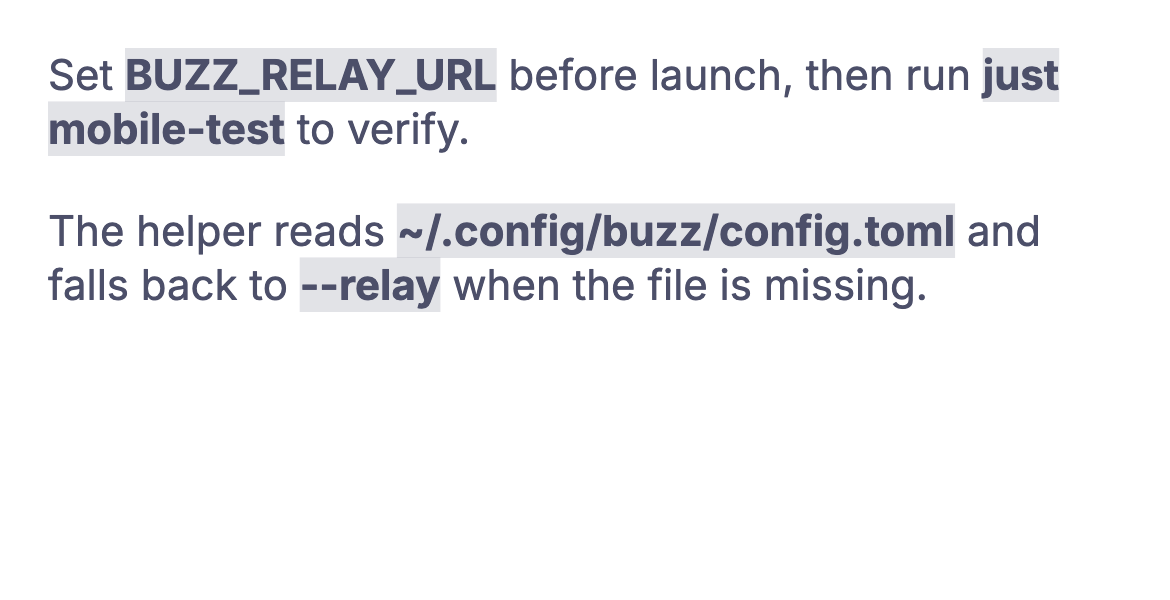 | 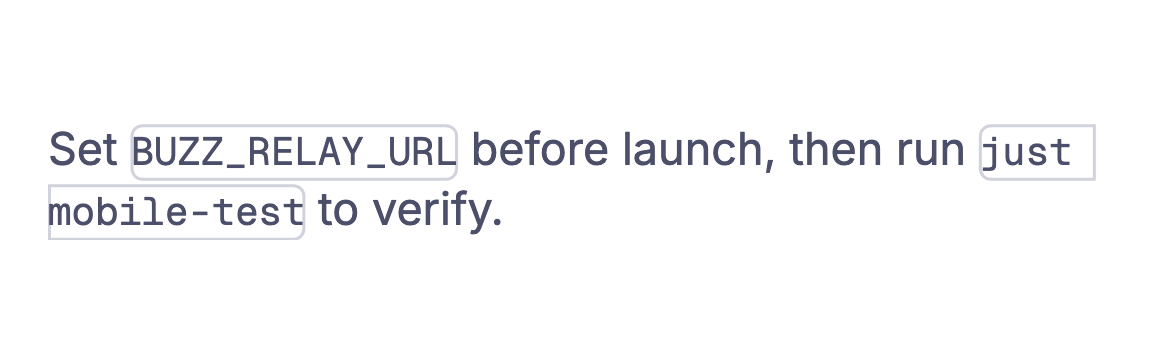 | | Dark | 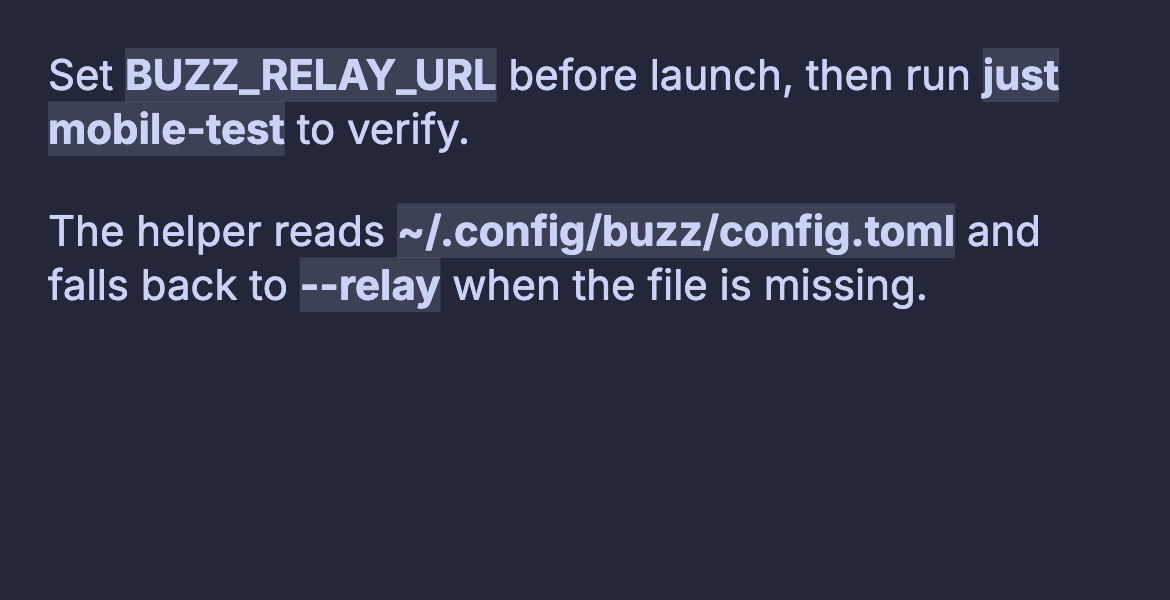 | 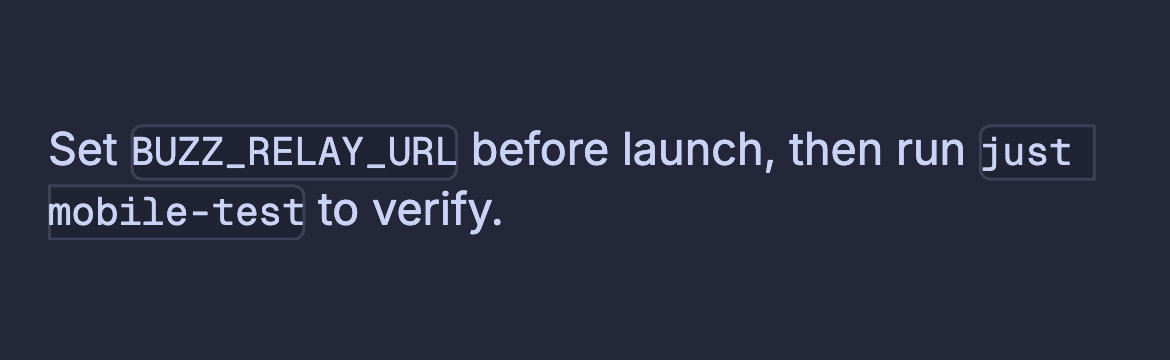 | Before: bold Inter on a flat wash, no chip edge, and `just mobile-test` breaks across the line with the wash simply ending. After: Geist Mono in a bordered, rounded chip, and the wrapped fragment gets its own chip on each line. --------- Signed-off-by: Tolga Cinisli <tolgacinisli@gmail.com> Co-authored-by: Tolga Cinisli <tolgacinisli@gmail.com> |
||
|
Wes
|
b593c7d7fe |
perf(mobile): reduce cold startup and channel rendering delays (#6996)
Pinky is opening this PR on Wes’s behalf. ## Summary Reduce two separately measured mobile delays without changing the relay API or removing rich message rendering: - Publish the finite channel-list snapshot without waiting for live subscription setup. - Batch active channel-list subscriptions into sorted, deterministic chunks of at most 128 explicit channel IDs, retaining unchanged chunks. - Install replacement chunks before retiring old coverage. Retain old chunks across thrown replacement failures; filter callbacks to the current relay/identity and still-desired channels; clean up retired/in-flight work across disconnect and disposal. - Scope the custom-emoji Markdown matcher to known shortcodes actually referenced in the rendered content, rather than embedding the whole community palette in every message’s regex. Preserve unknown literals, shared-colon token boundaries, event-tag URL priority, content edits, and code literals. - Honor explicit zero retry hints without inventing a ten-second session-wide gate, while preserving the ordinary live-subscription retry backoff and any already-active gate. ## Matched performance results Medians of three before and three after process-cold launches, alternated on the same authenticated iPhone 17 Pro / iOS 26.5 simulator. Before is mobile source at `e76c81968b65b0755b83efdd59dc3375c59ddf40`; after is this production patch before two documentation-only comment fixes. First channel-list frame: 11.617s → 3.179s · 73% lower latency Live setup duration: 8.475s → 0.185s · 98% lower latency Channel-open first message-list frame: 2.754s → 1.230s · 55% lower latency Message data ready → first frame: 1.977s → 0.286s · 86% lower latency Channel-open reveal complete: 2.845s → 1.394s · 51% lower latency Channel-open data readiness: 0.770s → 0.944s · 23% higher latency The gain is client-side orchestration/rendering, not a claim that the relay became faster. First channel-list frame ranges were 10.835–11.788s before and 2.872–3.395s after; channel-open first-frame ranges were 1.560–2.906s before and 1.149–1.317s after. ### Measurement boundaries - Debug simulator builds, CPU sampling disabled, bounded timestamp probes enabled identically. These are not release/physical-device measurements. - Startup clock starts at Dart `main`; build/install/native pre-main time is excluded. Auth/preferences and OS/disk caches are retained between new processes. - Same account scale: 113 active channels. Latest-message events varied slightly with live activity (1543–1546). - Channel-open uses the same initial 50-row history window, 97 query events, and 67 provider events. The 2306-entry emoji palette is explicitly loaded before navigation on both sides; palette preparation is excluded from the channel-open clock and happens after the startup frame measurement. - Both diagnostic builds temporarily disabled unused avatar segmentation to work around the existing Google ML Kit arm64-simulator slice limitation. The workaround, dependency/native changes, auto-navigation, and all probes are excluded from this PR. ## Validation - Full mobile package suite: `flutter test` — 1890 passed. - `just mobile-check` — 506 files unchanged; analyzer clean. - `just file-size-check` — policy tests and all client ratchets passed. - `git diff --check` — passed. - New lifecycle regressions cover front-sorting insertion across a chunk boundary while replacement readiness is paused, failure retention/departed-channel filtering, retired generation + disconnect cleanup, disposal, chunk limits, unchanged-set reuse, and scope switches. - Emoji unit/widget coverage includes a 2500-unused-emoji palette, unknown tokens, case matching at the component level, shared-colon boundaries, rich text, event URL priority, and content edits. - Fresh-frame source review traced the subscription queue/fences, callback scopes, duplicate-event paths, matcher/wiring, and retry scheduling. - At committed/pushed head `13a83b628c8411c5885e6f76a250ba87accf6067`, all normal pre-push hooks passed: `mobile-checks` (formatter, analyzer, and the full 1890-test mobile suite), `file-size-check`, `branch-skew`, and `push-head-scope`. The commit hook formatted 506 files with no changes. Runtime measurements preceded only the two documentation-comment fixes; no runtime source changed afterward. ## Limits / follow-ups - `RelaySession.subscribe` still settles under its existing EOSE/fallback/retryable-CLOSED contract. “Setup completed” is not an unconditional EOSE or live-delivery guarantee. This PR does not add status-aware replacement ownership. - The channel-message provider still awaits subscribe before fetching history; that separate serialization is not removed here. - Oversized Huddle queries and the separate history batching path above 128 active channels remain follow-ups, as do pre-existing read-state initialization/size warnings. - Palette-only widget refresh and upstream Markdown uppercase-dispatch behavior are not changed. - A clean source build still has the existing Google ML Kit arm64-simulator issue; the profiling workaround is not a proposed product fix. Originating Buzz conversation: buzz://message?channel=793b0522-7995-4375-b1a6-fd94a96fa21d&id=6ba88afdec78ab2cfb6728afcd4a6d10f29e6aa33ff0f62f45d6750381e4d789 --------- Signed-off-by: Wes <wesbillman@users.noreply.github.com> Co-authored-by: Pinky <5f5ab050ec58ae208332edd544ebf705221e24c1b86d82a6ca07038a7a8f6ac9@buzz.block.builderlab.xyz> Co-authored-by: Brain <1a02c72794dcd0f07058a353bc3a81f4028b8c77c92c87fce6d5c8b85970a20b@buzz.block.builderlab.xyz> Co-authored-by: Carl <9d00794d3df50972eb8b615511783cab12a77a8fd5dd5edd58073ec73b54bd8b@buzz.block.builderlab.xyz> |
||
|
klopez4212
|
dd222a509b |
Refine mobile settings and themes (#2844)
## Summary - reorganize mobile settings around profile, appearance, and connection cards - add System/Light/Dark theme pairing, accent selection, and the Buzz gradient theme - align avatar badges, status editing, and supporting mobile chrome ## Test plan - `just mobile-check` - `just mobile-test` |