🤖 This fixes two problems with the same cause. Since #3268, the relay
can answer an unpinned `/query` from the Aurora read replica, as long as
the replica has proved it's within `BUZZ_REPLICA_READ_MAX_AGE_MS` (1000
ms) of the writer. That's fine for display reads, but it doesn't
guarantee a client sees its own write.

**Problem 1: channel creation (Wes's report).** Right after creating a
channel, the desktop read back the channel's kind:39000 metadata by
`#d`. If that read landed on a replica that hadn't replayed the event
yet, it failed with `channel created but metadata not yet available`.
The channel existed, but the chosen template (canvas, agents) was never
applied.

**Problem 2: member lists.** After any membership change, the
member-list refetch could also hit a lagging replica. The relay returned
the list from before the change, and the desktop cached it as fresh for
five minutes (`CHANNEL_MEMBERS_STALE_TIME_MS`). Someone just removed
could still show as a member, or someone just added could be missing.

## Fix 1: metadata read-backs go to the writer

`channel_metadata_filter` is a shared builder that adds `"consistency":
"strong"`, so the relay serves the read from the writer. It follows the
same pattern as the canvas head reads. All four metadata read-backs that
follow a write use it: `create_channel`, `update_channel`,
`fetch_starter_channel_metadata` (its retry and fallback are unchanged)
and the open-DM refetch in `dms.rs`. A unit test fails if the flag is
removed from the builder.

The template's agent-add step also reads channel members (kind:39002)
right after create. `get_channel_members` takes an opt-in
`read_your_writes` flag that sends `"consistency": "strong"`. Only
`createChannelManagedAgents` sets it on that path, so the agent-add step
sees the creator's membership.

## Fix 2: a 31-second writer-read window after membership changes

Every membership write the desktop makes calls
`noteChannelMembershipChange` for each channel it changed:

- the native write wrappers `createChannel`, `openDm`, `joinChannel`,
`leaveChannel`, `addChannelMembers`, `removeChannelMember` and
`changeChannelMemberRole`
- the Bestie conversation open
- huddle agent add and remove, for both the huddle channel and its
parent
- `ensure_starter_channels` and `sync_agents_to_active_huddle`. Both
return every channel they created, joined or changed in
`changed_channel_ids`, including ones that landed before a later step
failed. The original error text is rethrown unchanged.
- live join, leave, removed and `admin_kick` system messages, and
member-added and member-removed notifications
- a report kick resolved from the Admin Console, once the relay confirms
it succeeded and only when the report's channel is in the active
community. The kick goes through the admin HTTP API, not a channel
event. Ban, timeout and their lifts only change `community_bans`, not
channel membership, so they need no record.

For 31 seconds after a change, measured on `performance.now()`,
`getChannelMembers` for that channel sends `readYourWrites`. Why 31
seconds: the relay caps its replica staleness budget at
`FENCE_STALENESS` (30 s), so once the window closes, no supported
configuration can serve the pre-change list. The constant's comment ties
it to `FENCE_STALENESS`. One app-level listener cancels any roster fetch
already in flight and refetches. When it registers, it also refreshes
every channel whose window is still open. All other member-list reads
still use the replica.

**Community switch.** The window map is cleared when the community
changes. Each awaited write captures a generation through
`beginChannelMembershipWrite()` before its first native call, and the
reset advances it. So a write that settles after a community switch
records nothing in the new community. Live events don't need this fence,
because the reset disconnects the relay client first and frames from the
old connection are dropped.

## Coverage

- A Rust test drives `ensure_starter_channels` against a stub relay that
accepts the creates but never serves metadata, and checks that both
created starter channels are still reported.
- Desktop tests cover the writer-read window, the Admin Console kick,
and writes that settle after a community switch.
- The desktop E2E test bridge (`desktop/src/testing/e2eBridge.ts`)
mirrors the strong reads and `changed_channel_ids`, so E2E runs exercise
the fixed behavior.

This doesn't address the smaller race in the relay's per-pod
accessible-channels cache, and it doesn't change mobile.

---------

Signed-off-by: Will Pfleger <pfleger.will@gmail.com>
Co-authored-by: Duncan <dcfd242e557282d7a1e2cf2e6877522682f1e5c6156dc92ca7d90eaedd3b0f95@buzz.block.builderlab.xyz>
Prepared by Brain on Wes’s behalf.

## Summary

Reduce startup request amplification and let quota-refused background
work recover without changing relay quotas or bypassing the existing
Send gate.

- Coalesce nest regeneration into one worker plus the latest pending
generation. Keep the stale-write fence; bound the archive read so an old
workspace cannot strand newer work.
- Claim pending channel subscriptions before awaiting setup; cancel
removed/unmounted entries and preserve still-owned subscriptions across
reconnect handoff.
- Recheck extended cooldown deadlines before retry dispatch; distinguish
an explicit zero-second hint from a missing hint.
- Recover native finite/unread queries within their original caller
deadline and a three-retry budget, preserving verified unique events,
complete filters and terminal errors.
- Pace renderer initial/live-CLOSED REQs at one per 250ms: visible
channel and explicitly interactive TTS/read-state/observer owners first,
then live-only auxiliaries, then background history. Publication and
finite queries bypass this queue. Reconnect replay now promotes explicit
interactive owners alongside the visible channel with stable
registration-order ties; its existing capped batches and cooldown remain
intact.

**Scope at `867495426`:** 39 source/test files, including 15 production
files (+665/-235) and 24 test/fixture files. The diagnostic recorder,
HTTP instrumentation, trace launcher and raw captures are deliberately
excluded. No profile reset, grouping, quota increase or new global
scheduler.

## Before / after evidence

These are observations from instrumented, human-operated development
Tauri/Vite runs against a production relay, plus explicitly identified
controlled regressions—not a packaged-release startup benchmark.

| Measurement | Before | After | Evidence boundary |
| --- | --- | --- | --- |
| Archive snapshot requests (kind 13535) | 290 | 3 | Recorder-only
baseline → nest-only intermediate candidate; unequal 67.436s / 39.273s
captures and hydration differences |
| Archive responses: HTTP 200 / 429 | 277 / 13 | 3 / 0 | Same
baseline/nest-only captures; not a claim that all quota pressure
disappeared |
| Successful archive responses’ advertised content-length sum |
21,208,505 bytes | 229,695 bytes | Header values, not actual transferred
bytes |
| 154-channel StrictMode replay | 308 REQs | 154 REQs | Controlled real
React hook → real session → mocked Tauri transport regression |
| Add one channel while 154 setups are pending | 309 REQs | 155 REQs |
Same production-boundary regression; ordinary mount remains 154 → 154 |
| Broad renderer request burst / spacing | 110 broad REQs within
10.766ms in pre-drain capture | 250.061ms minimum / 252.131ms median
between broad REQ writes in final longer capture | Different attended
runs; pacing rather than a universal request-rate cap |
| Native unread query outcomes | Baseline: 8 EOSE / 146 quota CLOSED out
of 154 queries | Final longer run: all 156 observed queries reach EOSE;
eight refused queries each recover after two refusals | Different
runs/workloads; query completion, not badge rendering |

### Timing metrics

| Observation | Measured value |
| --- | ---: |
| Baseline’s two accepted chat EVENT socket writes → positive OK |
173.340ms / 85.556ms |
| Nest-only intermediate candidate’s two accepted writes → positive OK |
277.854ms / 78.775ms |
| Final candidate, short run, accepted chat writes → positive OK |
80.636ms / 77.506ms |
| Final candidate, longer run, accepted chat writes → positive OK |
120.712ms / 86.895ms |
| Last initial EOSE among 163 observed broad channel registrations,
longer run | 64.550s after trace start |
| Last EOSE among 156 observed native unread queries, longer run |
73.972s after trace start |
| Native retry waits after 3s then 0s hints, longer run |
3000.7–3002.8ms, then 2001.5–2002.6ms |
| Renderer finite-query retry after a 2s hint, longer run | 2061.365ms |

Both Sends in each final run were accepted, with no recorded negative
OK. Every quota-refused query in the longer run subsequently completed
the same query. Its two Sends happened early (17.878s and 21.655s), not
near the end. These small samples do not support a percentage latency
improvement.

**Tradeoffs and limits**
- 296 background subscriptions imply about 74s of paced registration
before extra cooldowns/high-priority work. The longer capture observed
163 registrations; it did not independently enumerate the expected
membership set or record a queue-empty marker.
- This is not a global 4-REQ/s cap: finite queries, native requests and
reconnect replay are outside the drain and still share relay quota.
Quota refusals recover rather than disappear.
- Socket-write → OK starts after composer submission and any publisher
gate wait. No click-to-visible, launch-to-usable or badge-paint latency
is claimed.
- Native EOSE is not proof of command return, classification, React
state application or visible unread badges. Existing per-channel kinds,
since floors, limits, h-less routing, unread lease/scope guard and
eight-query concurrency remain intact.
- The attended measurements belong to the instrumented candidate, not a
fresh release run of this fixes-only commit. At the initial packaging
checkpoint (`1bf3d060`), eighteen of twenty files were byte-identical;
the other two removed diagnostic gate calls and isolated the nest test’s
temporary paths. The subsequent interactive priority/reconnect and
readiness fixes have controlled hook/session/browser evidence, not
another attended voice/performance run.

### Evidence provenance (captures retained locally, not uploaded)

| Capture | SHA-256 |
| --- | --- |
| Baseline `STARTUP_20260921T194814Z_98811.jsonl` |
`f4f0a89ad9aea91084bd6a7432510488166de4cbc906600d88c26d557f380994` |
| Nest-only `STARTUP_20260921T202610Z_28642.jsonl` |
`ce517b02a3f717c36d96b36bb8616e8fa80b03b12b356bacfd40475925ea3f3e` |
| Final short `STARTUP_20260922T013628Z_13506.jsonl` |
`bfea6f3cf80cd7b7e4e676632a3df2f16271fade5bfa0edec72b7bcbbe7839ff` |
| Final longer `STARTUP_20260922T014637Z_15846.jsonl` |
`f4abece613d108c4c2fe3cb808e633a0486bdc9993ca92323822dc00c3fae6ec` |

Final instrumented build fingerprint:
`b0b4fc27d793c3e643f4e10289b5afdb4620ee2e13a8b33fa0595dd3417fd5ca`. All
observed dropped-record counters in these final captures were zero.
Source manifests and offline correlation analyses are retained locally;
no raw captures, profile data or agent sessions are part of this PR.

## Validation

Current head: `86749542657a60abdfe82eed5cc576d3e162fe5d`, based on
`77729abfb692b25a0f4ec4a69add86af2e32c0dd`.

Review follow-ups:
- `8842dbd8`: explicit interactive TTS admission using the existing
main-window owner, independent of companion/timeline selection.
Real-hook/session/IPC coverage with 296 cold owners proves initial and
CLOSED priority, unchanged filters/cooldown/pacing, background progress
and deduplicated speech.
- `8cb088106`: reconnect preserves interactive priority even with no
visible channel. Stable ordering among foreground ties; real
hook/session reconnect regressions cover cooldown, capped batching, all
297 owners, deduplication and unmount cancellation. Independent reviewer
mutation restored the prior replay implementation, failed both reconnect
rows, then passed the restored candidate.
- `68e76d7c`: read-state and observer reuse interactive priority. Stop
and ModelPicker wait on the existing observer owner inside send
callbacks, after installing result listeners/deadlines. No new owner,
timer or scheduler; inherited CLOSED/fallback/error semantics remain,
rather than a new strict EOSE guarantee. The real Stop panel browser
probe holds observer IPC across the click and checks
observer-before-control order and correlated outcome. ModelPicker
component ordering is source-reviewed only.
- Mock live admission now replays matching stored history with
per-filter time/limit constraints, deduplication, untagged auxiliary
channel fallback and authoritative explicit h-tags. Kind-specific
fixture admission waits and retry-resolving hover actions fix
startup-dependent test setup without weakening event/badge assertions.
- `48e9c0dad` and `867495426`: steady-state scroll-prepend setup
observes live admission, subsequent head dispatch, successful/idle query
completion and initial bottom geometry. Phase-2 genuine-growth and ≤32px
anchor assertions are unchanged. This isolates steady-state prepending:
it **does not fix or certify production early-scroll/head-reset
behavior**.

Current validation:
- Normal push hooks at `867495426`: **6,582/6,582 renderer tests**, zero
failed/skipped/cancelled; lint/static checks, typecheck and differential
file-size gate passed. Native source is unchanged from the earlier
checkpoint; no new native run is claimed for these renderer/test
follow-ups.
- E2E build passed at `48e9c0dad` plus the exact subsequently committed
test-only delta (spec blob `469be2eed868c677ba80b859cc871208000fee60`).
The completed affected-smoke run passed **153/153** across
agent-control, badge, entity links, messaging, profile status and scroll
history; the full scroll file additionally passed twice (**36/36**). No
full CI-smoke pass is claimed from this six-file local run.
- Pinky independently reviewed production and test follow-ups, including
the final scroll spec blob `469be2eed868c677ba80b859cc871208000fee60`,
with no blocking finding. Review is source evidence, not an independent
test run.
- **Not merge-ready:** new-head required CI must complete, exact-range
security review requires authorization, and GitHub currently reports
REVIEW_REQUIRED; fresh exact-head reviewer approval is still needed. No
approval, dismissal or merge performed. No new packaged/native audio,
launch-to-usable or badge-paint observation is claimed.

Initial fixes-only checkpoint validation
(`1bf3d06024d284a63326fdd353baced0842aeb81`):

- Pre-commit formatting hooks passed; worktree clean.
- Renderer package hooks: 6,570 tests passed, zero
failed/skipped/cancelled; lint/static checks, TypeScript and
differential file-size gate passed.
- Native package hook passed: default and mesh-enabled all-target
Clippy, then the complete native workspace test suite. App library:
3,222 passed / 0 failed / 19 ignored; terminal/integration suites
passed. The real nest trigger/stalled-body test passed on macOS.
- Independent whole-change source review: no blocking findings at this
commit; all 20 file hashes matched the committed blobs and
review/validation manifests.
- Regression coverage includes real hook/session cancellation,
StrictMode/membership re-entry, reconnect ownership, extended/zero
cooldowns, burst pacing, auxiliary readiness (including EOSE before IPC
settles), native socket refusal/retry/deadline/cancellation, unread
fetch/classification and real nest trigger/HTTP/file persistence.
- Earlier isolated renderer mutations that started readiness before
enqueue or removed auxiliary priority each failed the real presence
regression; restored controls passed. No native mutation claim.
- Nest fixture uses explicit app-data/nest paths instead of assuming
Windows known-folder APIs obey HOME/APPDATA. Windows runtime execution
is not claimed; CI/build results remain separate.

Originating conversation:
buzz://message?channel=46ced308-71df-495d-a144-4ebf08334703&id=bc43c3422a3b0b2141268d0fa149b898421c824992b662aed8b73c4eee50404f

No approval or merge recommendation is implied by opening this PR.

---------

Signed-off-by: Brain <1a02c72794dcd0f07058a353bc3a81f4028b8c77c92c87fce6d5c8b85970a20b@buzz.block.builderlab.xyz>
Co-authored-by: Brain <1a02c72794dcd0f07058a353bc3a81f4028b8c77c92c87fce6d5c8b85970a20b@buzz.block.builderlab.xyz>
## Overview

**Category:** fix

**User Impact:** Agent avatars and empty agent-team placeholders now
keep the same intentional squircle silhouette at every size on desktop,
while human avatars remain circular.

**Problem:** Desktop agent avatars used percentage-rounded rectangles,
which made the silhouette vary by surface and required each avatar
implementation to recreate the shape. Empty team placeholders also drew
a regular CSS border inside the clip, leaving straight inset edges that
looked like a cropped square. **Solution:** Reuse one normalized SVG
clip path across desktop artwork. Empty team placeholders use a
separately clipped squircle outline behind the clipped surface, so both
the fill and outline follow the canonical silhouette.

> **Scope correction:** Mobile is deferred from this PR because a real
Flutter capture could not be obtained reliably in the current build
environment. Previously attached mobile images were hand-composed
synthetic layouts, not captures from the running app; they have been
removed and must not be treated as validation. The mobile implementation
is being reverted in one follow-up commit so it can be reapplied and
verified separately.

### Related issue

Follow-up to #7106.

## Changes

<details>
<summary>File changes</summary>

**desktop/src/features/agents/ui/AgentCreationPreview.tsx**
Applies the shared squircle clip to agent creation preview images and
fallbacks.


**desktop/src/features/agents/ui/AgentSessionToolItem/CompactMessageSummary.tsx**
Uses the shared agent-avatar silhouette in compact session summaries.

**desktop/src/features/agents/ui/IdentityInitialsAvatar.tsx**
Clips agent initials with the normalized squircle instead of a
percentage radius.

**desktop/src/features/agents/ui/TeamIdentityCard.tsx**
Uses the shared squircle for agent identities and gives empty teams a
separately clipped squircle outline instead of a regular inset border.


**desktop/src/features/agents/ui/activityRenderClasses/UserMessageBubble.tsx**
Keeps agent avatars in activity message bubbles on the canonical
silhouette.

**desktop/src/features/home/ui/InboxListPane.tsx**
Applies the shared clip to agent avatars in the inbox list.

**desktop/src/features/home/ui/InboxMessageRow.tsx**
Applies the shared clip to agent avatars in inbox message rows.

**desktop/src/features/huddle/components/ParticipantList.tsx**
Uses the normalized squircle for agent participants while preserving
circular human avatars.

**desktop/src/features/messages/ui/MessageRow.tsx**
Clips agent message avatars through the shared definition.

**desktop/src/features/messages/ui/SystemMessageAvatars.tsx**
Uses the canonical agent shape in system-message avatar groups.

**desktop/src/features/messages/ui/TypingIndicatorRow.tsx**
Uses the canonical agent shape in typing indicators.

**desktop/src/features/profile/ui/ProfileAvatar.tsx**
Scales the same squircle to the larger agent profile avatar.

**desktop/src/features/profile/ui/SelectedRecipientChip.tsx**
Uses the shared shape for selected agent recipients.

**desktop/src/features/projects/ui/IssueAssigneesRow.tsx**
Applies the agent squircle to issue assignees without changing human
avatar geometry.

**desktop/src/features/projects/ui/ProjectCards.tsx**
Uses the canonical shape for agent avatars on project cards.

**desktop/src/features/projects/ui/ProjectEntityListRow.tsx**
Uses the canonical shape for agent identities in project entity lists.

**desktop/src/features/projects/ui/ProjectsActivityFeed.tsx**
Uses the shared clip for agent avatars in project activity.

**desktop/src/features/projects/ui/ProjectsOverviewRail.tsx**
Uses the shared clip for agent avatars in the project overview rail.

**desktop/src/main.tsx**
Mounts the single shared SVG clip-path definition once for the desktop
application.

**desktop/src/shared/lib/cn.ts**
Registers `rounded-squircle` in the border-radius class group so
shadcn-style `cn(...)` composition resolves it against `rounded-full` by
normal last-class precedence.

**desktop/src/shared/styles/globals/utilities.css**
Registers the reusable Tailwind `rounded-squircle` utility and
references the normalized SVG clip path without agent-specific CSS
selectors.

**desktop/src/shared/ui/AvatarClipPaths.tsx**
Owns the reusable normalized object-bounding-box `rounded-squircle` path
so all desktop sizes reuse one definition.

**desktop/src/shared/ui/UserAvatar.tsx**
Routes the existing squircle shape option through the shared SVG clip.

**desktop/tests/e2e/agents.spec.ts**
Verifies team facepile and empty-team placeholder surfaces/outlines use
the canonical clip without a rectangular border.

**desktop/tests/e2e/messaging.spec.ts**
Verifies agent message and profile avatars reuse one clip definition and
scale across rendered sizes.

</details>

## Reproduction steps

1. Run the desktop app and open a channel containing both agent and
human messages.
2. Compare agent avatars in the message list, inbox, huddle
participants, projects, and profile panel. Agent images and fallbacks
should share one smooth squircle silhouette at each size; human avatars
should remain circular.
3. Open **Agents** and inspect an empty agent-team card. Its placeholder
fill and outline should both be smooth squircles, with no straight inset
cropped-square edges.
4. Open an agent profile from a message and confirm the larger profile
avatar keeps the same proportions as the smaller message avatar.

## Testing

- Desktop Biome check passed for the changed empty-team component and
Agents E2E spec.
- Desktop typecheck and differential file-size check passed.
- Full desktop unit suite passed: 6,453 tests.
- Full Agents integration spec passed: 37/37, including the empty-team
outline regression.
- Post-rebase pre-push gates passed at `304b159a2`: desktop checks,
TypeScript typecheck, differential file-size gate, and all 6,453 desktop
unit tests.
- The shadcn-aligned `rounded-squircle` registration passed changed-file
Biome, desktop TypeScript/build, and pre-push desktop checks at
`27e0c12d3`; the full desktop unit suite passed 6,459/6,459.

## Screenshots

Screenshots are temporarily omitted. The previous captures used the
desktop E2E mock bridge and were not evidence from a live running app,
so they were removed.

---------

Signed-off-by: Taylor Ho <taylorkmho@gmail.com>
Co-authored-by: Carl <acda9e433d19dcd0e6b6840f7f4b98f3a56f1fab98049d444c087019e6d36560@buzz.block.builderlab.xyz>
Co-authored-by: Rizz <302abe414ca6e3134763d2539bfcf145aea2a63fe5f8455204ed602fd40cf381@buzz.block.builderlab.xyz>
🤖
## Summary

Every Buzz account is identified by a long public key. Before this
change, when someone had no display name, surfaces fell back to
inconsistent labels — mostly raw hex fragments like `abcd1234…wxyz`,
sometimes a generic role label with no key — so the same person looked
different from surface to surface, and nothing looked like an npub
address. This PR applies the npub identity foundation from #7488 to the
everyday surfaces: a person without a display name now falls back to the
same compact npub everywhere — `npub1xxxx…yyyy`, the human-readable
spelling of their public key (first 8 + last 4 characters of the full
npub) — across messages and mentions, reactions, huddles, member and
participant lists, the sidebar and channel activity, search, projects,
tray, notifications, and workflow surfaces.

- **Mentions and messages**: key-only mention chips render the compact
npub. Pasting a copied mention back still re-binds it byte-exactly to
the identity it declares, for both the new npub chips and legacy
hex-truncated chips copied by older clients — wrong, missing, or
tampered key qualification is rejected instead of silently degrading to
plain text.
- **Reactions and huddles**: huddle reaction events and the huddle
roster/participants render the compact npub for unnamed participants;
workflow reaction triggers describe authors with the same form.
- **Members and sidebar**: channel and community member lists,
add-member results and invites, the members sidebar, the
channel-activity popover, search, projects (assignees/reviewers/PR
panels), the tray menu, and desktop notifications all fall back to the
compact npub; titles and aria labels keep the machine-readable full
labels.
- **Profile labels**: panel/popover display names and owner handles fall
back to the compact npub (never raw hex) when there is no name;
linked-event (nevent) message metadata shows the npub-shaped author
fallback while the event lookup and event IDs are unchanged.
- **Workflows**: author-picker secondary labels, step destination keys,
and trigger-author references render compact npubs; event and blob IDs
keep their existing hex compacts (they are not identities).
- **Avatars stay distinct**: fallback avatars for key-only identities
derive initials from the key's tail, so prefixed role labels like
"Participant npub1…" no longer collapse every unnamed participant onto
the same initials; people with names keep their name initials.

Preserved exactly: display names and distinct avatars, internal hex keys
(storage/API forms unchanged), clipboard identity roundtrips, event/blob
ID compaction, private keys (no nsec path is touched), and nevent link
handling.

Scope: this PR changes what identity labels **display**, not identity
controls — profile/settings copy controls, the respond-to allowlist,
workflow key fields, and agent dialogs are the sibling slice #7489, and
the shared primitives (`canonicalNpub`, `truncateNpub`, the `<PubKey>`
gate, strict input parsing) come from the foundation #7488.

### Related issue

- Fixes: N/A. Searched existing issues/PRs for duplicates — none found;
the related work is the npub identity stack this slice belongs to.
- Base/dependency: stacks on #7488 (foundation) — this PR does not stand
alone on main.
- #7489 is a sibling slice on the same #7488 base
(profile/agent/workflow controls), not a dependency: this PR does not
require #7489, and #7489 does not require this PR — both only require
#7488.

### Testing

At exact head `4763cbeae1dd521309755e6d61f657324cb98667` (base:
`fix/desktop-npub-identity-d1a` @
`5f3a4a8111998c8aa41ad77cf66992bd1c85343c`; 71 files, +656/−189 —
production +277/−136, test support +379/−53):

- At this head: targeted `mentions.spec.ts` (1/1), the e2e build,
typecheck, and biome — green.
- 9 changed/related unit files: 100/100 green; typecheck, e2e build,
biome, and px text/truncation checks clean; huddle-roster focused run
green; channel-activity e2e 11/11; mutation checks confirm the fallback
wiring (removing it collapses shared initials and drops fallback rows).
- Known pre-existing local e2e failures, unchanged by this PR and
reproduced identically at the upstream merge-base: huddle-transcription
voice-menu attribution (25 pass / 1 fail) and the
`workflow-local-controls` 438px caret drift. Not claimed green locally.
- Update at head `236af9e6137386737e84d3a474d6bc808a704c50` (test-only
follow-ups `1143af345` + `236af9e6`): the `workflow-local-controls`
races were fixed in the test drivers, and the 438px diff was shown to be
a stale Darwin snapshot baseline (name-row enable switch already absent
and `message_posted` already MessageSquare at recording commit
`9390e11c9`) and refreshed — the focused screenshot test, including
keyboard/caret assertions, now passes locally (twice). The full spec was
not rerun after the snapshot refresh; the huddle-transcription item
above is unchanged.

Label/copy text changes are asserted by the e2e specs (`mentions`,
`mention-recipients`, `pubkey-display-screenshots`,
`huddle-transcription`, `channel-activity-popover`,
`workflow-local-controls`) rather than new screenshots; the screenshot
spec pins the compact npub text forms.

### Task provenance

Buzz channel: `1f0e4a3d-7e01-4efe-bb16-843b357f85c9`

Task:
buzz://message?channel=1f0e4a3d-7e01-4efe-bb16-843b357f85c9&id=86b34eb4bd84a1472419e9af22636c011c0fe273e3c196f967d7a36996e149b6

---------

Signed-off-by: Logan Johnson <loganj@squareup.com>
Co-authored-by: Larry <627498bd4bd1f281a16431e3c6cce3b5c25b6692798c78672298aefbf2f8f8b5@buzz.block.builderlab.xyz>
## Summary

- show status and huddle emoji beside names in DMs and message rows
- provide accessible tooltips, fallback status emoji, and profile-menu
icon replacement
- add the desktop status editor with preset durations, a ShadCN
calendar, and a capped half-hour time menu

## Validation

- desktop checks, typecheck, and file-size guard
- 5,802 desktop tests
- focused Playwright coverage (3 passed)
- E2E build and native Builderlab staging verification

Updated visual snapshots are attached in the PR comments.

---------

Signed-off-by: kenny lopez <klopez4212@gmail.com>
Signed-off-by: Princess Donut <b238ea756dee4d98afa5883fc7f1de61eeabe65bf700e3a5a5a80db5e42e2c2b@buzz.block.builderlab.xyz>
Co-authored-by: Princess Donut <b238ea756dee4d98afa5883fc7f1de61eeabe65bf700e3a5a5a80db5e42e2c2b@buzz.block.builderlab.xyz>
## Summary

- render every agent/AI identity as a 30% squircle across desktop and
mobile while keeping human avatars circular
- propagate agent identity through message, thread, profile, reaction,
member, DM, search, workflow, project, huddle, forum, pulse, and
agent-management surfaces
- preserve squircle geometry for fallbacks, focus/status treatments,
add-agent controls, and overlapping avatar outlines (`calc(30% + 2px)`
for the outer background)

### Related issue

None found. This change was requested and visually reviewed in the
originating Buzz thread.

### Testing

- `just desktop-test` — 5,799 passed
- `just mobile-test` — 2,008 passed
- pre-push gates passed at `0d59d77b120dcb90aac2f918e422c11c9fa5353b`:
desktop check, TypeScript typecheck, desktop full test suite, mobile
format/analyze and full test suite, Rust tests, Tauri checks, and
differential file-size gate
- deterministic desktop visual sweep covered channel messages/thread
summaries; thread, subthread, and sub-subthread depths; reactions and
reactor popovers; hover/full profiles; added-to-channel activity;
channel members/settings; agent library/team overlaps; agent creation;
mention autocomplete; and DM header/sidebar/settings

### UI evidence

The complete labeled visual matrix is available in the originating Buzz
review thread. GitHub-hosted copies will be added in a follow-up PR
comment using the repository screenshot script.

---------

Signed-off-by: Fizz <dae5f6af70b8695a8b83c8deae555f63be41630ec2b8cd493e41a439c9527dd8@buzz.block.builderlab.xyz>
Co-authored-by: Fizz <dae5f6af70b8695a8b83c8deae555f63be41630ec2b8cd493e41a439c9527dd8@buzz.block.builderlab.xyz>
## Problem

With a huddle open, Buzz Desktop becomes extremely slow and laggy
(Tyler, live report, 2026-08-14). Root-caused and runtime-convicted on
the instrumented rig in #buzz-conversational-agents:

- The Rust playout loop emits `huddle-speaker-levels` over Tauri IPC
every 50 ms, unconditionally, for the whole life of a huddle
(`playout.rs` `SPEAKER_LEVEL_TICK_MS = 50`).
- Each event deserializes to a fresh object, so `setRemoteSpeakerLevels`
updates state at 20 Hz even in silence.
- `HuddleProvider` wraps the entire main app and its context value was
an inline object literal — never memoized. Every level tick minted a new
context identity, re-rendering **every** `useHuddle()` consumer,
including `ChannelScreen` and message rows.

**Measured (A/B, silent one-participant huddle, same channel/state):**
~41 sustained ChannelScreen renders/sec unsuppressed vs ~4/sec with only
the speaker-level setState suppressed — the 20 Hz path is ~90% of the
load. Receipts: `driver-render-counter-unsuppressed.jsonl` /
`-suppressed.jsonl` on the rig, verified independently. The same
main-thread churn starves the relay client's 16 ms event-flush timer,
which is the delayed/bursty message hydration and thread-panel stalls
seen alongside the lag.

## Fix (minimal, no behavior change for meters)

1. **Split the high-frequency fields** (`micLevel`, `activeSpeakers`,
`speakerLevels`) out of `HuddleContextValue` into a new
`HuddleLevelsContext`, consumed via `useHuddleLevels()` only by the
three meter components (`HuddleBar`, `HuddleRoomHeader`,
`HuddleProfileControl`).
2. **Memoize the main context value** so provider re-renders no longer
mint a new identity for the ~everything that consumes `useHuddle()`.
3. **Extract the mic-level analyser** into `useMicLevelAnalyser` — the
level pipeline now lives in one place, and `HuddleContext.tsx` stays
under the file-size ratchet (977 lines).

Level meters keep their 20-30 Hz updates. Everything else re-renders
only when a value it actually consumes changes.

## Acceptance bar

With this fix, a silent open huddle should hold `ChannelScreen` at idle
render rates (single digits/sec), and message hydration should stay live
during huddles. The rig's render-counter + four-clock instrumentation
can verify on this branch.

## Validation

- `pnpm typecheck` clean
- `biome check` clean (repo leftovers in sidebar tests are preexisting
on main)
- full desktop suite: **4,775 passed, 0 failed** at the final tree
- file-size ratchet passes (was the reason for the analyser extraction)
- lefthook pre-commit (desktop-fix + signoff) passed on commit

Not yet done: live-local A/B rerun on this branch — the rig (Wren/Max)
has the instrumentation ready and can convict/acquit the fix with the
same probe that convicted the bug.

Base: `068a83b0` (main). Co-developed with runtime evidence from Wren
and instrumentation by Max.

Signed-off-by: Eva <011987e296fd5006292d2f930b574be47c7801048d1983c46c425d3c95f0cffd@buzz.block.builderlab.xyz>
Co-authored-by: Eva <011987e296fd5006292d2f930b574be47c7801048d1983c46c425d3c95f0cffd@buzz.block.builderlab.xyz>
## Overview

**Category:** feat (env-gated experiment + one exact always-on
optimization)
**Problem:** Speech-end -> first TTS audio through the desktop huddle
pipeline measures **924–1087 ms** on an M4 Max with a 0 ms LLM leg.
Voice turns feel sluggish no matter how fast the agent replies. Baseline
breakdown: ~300 ms hardcoded VAD silence flush + ~150–250 ms Parakeet
decode + ~380–550 ms TTS synthesis before the first player append.
**Outcome:** With all levers enabled, e2e time-to-first-audio measures
**347–384 ms** (307–357 ms on a longer utterance) on the same hardware,
harness, and production pipelines. Defaults preserve production behavior
everywhere except one deterministic, bit-exact cache win.

## What's in here

### Levers (all default-off, env-gated)

| Lever | Env | Effect (measured medians, short utterance) |
|---|---|---|
| Speculative Parakeet decode | `BUZZ_STT_SPECULATIVE=1` | STT leg ->
~max(flush, decode) |
| Streaming TTS synthesis | `BUZZ_TTS_STREAMING=1`,
`BUZZ_TTS_EMIT_FRAMES` | first audio 380–550 -> 211–320 ms (emit=12,
bit-exact) |
| ONNX intra-op threads | `BUZZ_STT_THREADS`, `BUZZ_TTS_THREADS` | TTS
first audio 211–320 -> 129–180 ms (4 threads) |

- **Speculative decode** starts the Parakeet decode at the *first*
silent VAD frame, overlapping it with the flush window. Resumed speech
invalidates the result (voiced-frame-count check); held silence emits it
instantly at the flush boundary.
- **Streaming TTS**: new `synth_chunk_streaming` (buzz-voice)
interleaves the Flow LM frame loop with incremental *stateful* Mimi
decoding, emitting PCM deltas to the player via the existing
`PlaybackChunkAudio` decoration. At `emit_frames=12` (the decoder's
native chunk) streamed audio is **bit-identical** to the batch path —
verified by the ignored test
`incremental_stateful_decode_matches_batch_decode` (max|diff|=0).
Smaller deltas are faster but diverge (~23 dB SNR; decoder intra-chunk
lookahead), hence the default of 12.

> **Removed after live testing:** the `BUZZ_STT_FLUSH_MS` flush-window
override. Lowering the silence window below natural mid-sentence pauses
(the fast-path recipe said 150 ms) split single spoken sentences into
multiple messages and confused the listening agents. The window is a
turn-taking quality knob, not a latency lever — it is now fixed at the
production 300 ms value.

### Push-to-talk grouping fix (always-on)

A held push-to-talk shortcut is an explicit "I am not done talking"
signal, so silence never ends the utterance while it is held — even when
the microphone is also manually open. The utterance flushes on shortcut
release (existing transmit-edge flush); a manually open mic with the
shortcut up keeps normal VAD pause flushing. Gate is the pure
`vad_flush_allowed` function with a unit-test truth table.

### Always-on (exact): voice-conditioning cache

Phase profiling (`BUZZ_TTS_PHASE_LOG=1`) showed a fixed ~160 ms
`condition_voice` Flow-LM pass on *every* chunk, re-deriving the same
post-conditioning state for the same reference voice. The state is now
snapshotted after first computation and restored per chunk (dtype-tagged
tensor copies, keyed identically to the existing `cached_voice`).
Deterministic — same tensors in, same tensors out. The default path's
TTS leg drops from 380–550 ms to 225–355 ms with no configuration.

### Bench harness

`huddle::latency_bench` (`#[cfg(test)]` + `#[ignore]`) drives the real
`SttPipeline` and `TtsPipeline`, feeding a 48 kHz WAV in real-time 100
ms batches (AudioWorklet cadence) with a configurable fake LLM in place
of the relay leg, timing speech-end -> transcript -> speak() -> first
accepted player append.

```
BUZZ_STT_SPECULATIVE=1 BUZZ_TTS_STREAMING=1 \
BUZZ_TTS_THREADS=4 BUZZ_STT_THREADS=2 \
BUZZ_BENCH_WAV=<48k f32 mono wav> \
cargo test --release -p buzz-desktop --lib huddle::latency_bench -- --ignored --nocapture
```

## Tradeoffs to weigh before promoting any lever to a default

- **Speculative decode**: the speculative buffer has ~1 silent tail
frame vs ~19; observed one CTC wobble ("fail" vs "failed") in 24 turns.
Mitigation if productionized: zero-pad the speculative buffer to match
the flush-path shape.
- **Threads**: defaults stay 1 pending the min-spec (4-core Intel) A/B
flagged in the existing `STT_NUM_THREADS` comment.
- **Streaming at emit<12** is NOT the same waveform — don't ship below
12 without an ear pass.

## Validation

- Full desktop lib suite: **2408 passed / 0 failed** at this head
(`18fab2e1c`).
- buzz-voice suite green; bit-exactness test passes against the
production batch decode.
- Defaults-only bench rerun stays in the baseline family everywhere
except the exact conditioning-cache win (stt 525–532, tts 225–355).
- `cargo clippy --workspace --all-targets -- -D warnings` + fmt clean
(pre-push hook battery green).

Measurement notes with per-lever logs: Eva's workspace,
`RESEARCH/HUDDLE_E2E_LATENCY_OPTIMIZATION_2026_08_12.md` +
`RESEARCH/HUDDLE_E2E_STT_FAKELLM_TTS_BASELINE_2026_08_12.md`.

## Suggested promotion order

1. Conditioning cache (in this PR, always-on, exact).
2. Streaming TTS at emit=12: bit-exact audio, biggest UX win — needs the
env-gate removed + barge-in soak + an ear pass on a real huddle.
3. Speculative decode with silence padding: near-free ~100–150 ms.
4. Threads: after min-spec A/B.

---------

Signed-off-by: Eva <011987e296fd5006292d2f930b574be47c7801048d1983c46c425d3c95f0cffd@buzz.block.builderlab.xyz>
Signed-off-by: Wren <5217c5c2f7bfb4333e46d17c98a9255a52dadee18dcd43a43536b95e6776dfa0@buzz.block.builderlab.xyz>
Signed-off-by: Max <d8473ee32b973aa31a21a65adddcc4b69cc2a8a4dee8121ecd51926e0cddbc02@buzz.block.builderlab.xyz>
Signed-off-by: Mari <95cae996907d7cab9f5dbf43c0f53edeac6ab0b032a6feae4abfd784e467b3f5@buzz.block.builderlab.xyz>
Signed-off-by: tlongwell-block <tlongwell@block.xyz>
Co-authored-by: Eva <011987e296fd5006292d2f930b574be47c7801048d1983c46c425d3c95f0cffd@buzz.block.builderlab.xyz>
Co-authored-by: Wren <5217c5c2f7bfb4333e46d17c98a9255a52dadee18dcd43a43536b95e6776dfa0@buzz.block.builderlab.xyz>
Co-authored-by: Max <d8473ee32b973aa31a21a65adddcc4b69cc2a8a4dee8121ecd51926e0cddbc02@buzz.block.builderlab.xyz>
Co-authored-by: Mari <95cae996907d7cab9f5dbf43c0f53edeac6ab0b032a6feae4abfd784e467b3f5@buzz.block.builderlab.xyz>
Co-authored-by: tlongwell-block <tlongwell@block.xyz>
Fixes#3677.
## Problem
The renderer never quiesces: recurring timers, query polling, and
re-render tickers run at full rate whether the window is visible,
hidden, or minimized. Measured on a live installed app: **27.5% mean
renderer CPU visible vs 28.7% hidden** (60×1s `ps` samples of the
WebContent process; `sample(1)` dominated by
`WebCore::timerFired`/ThreadTimers, microtask checkpoints, JSON parsing,
style matching). Matches all three reproductions in #3677 (macOS
prerelease, Linux/WebKitGTK A/B/A minimize test, stable macOS).
Per-timer instrumentation (dev build, wrapped
`setInterval`/`setTimeout`/rAF) attributed the recurring work: `useNow`
60 fires/min, 40 active TanStack refetch intervals, agent-turn pruning
12/min, auto-restart ticks, huddle/reminder polls — none
visibility-gated.
## Fix (two-tier gating, standard mechanisms only)
Two separate signals in `desktop/src/shared/lib/useDocumentVisible.ts`,
because they mean different things and (see residuals) are delivered
differently on macOS:
- **`useDocumentVisible`** — true Page Visibility only
(`document.visibilityState`). Gates local UI work that must keep running
on a visible-but-unfocused window: `useNow` relative clocks, agent-turn
pruning, huddle bar state/model-status polling, auto-restart tick.
Hidden ⇒ paused; `useNow` snaps to fresh `Date.now()` on return.
- **`useAppFocused`** — visible AND `document.hasFocus()`. Gates network
refetch polling only (`useFocusedRefetchInterval`, ~15 query families:
forum/home/agents/channels/templates/emoji/user-status/projects/workflows/persona-catalog/pulse/presence-list).
TanStack's `focusManager` is wired to this signal (idempotent, single
install) with `refetchOnWindowFocus: true`, so stale queries refresh
promptly on return. Deliberate side effect, documented in code: query
retries pause on blur; mutations and the presence heartbeat (`retry: 0`)
are unaffected.
- **Never gated:** reminder due-notification poll (fires while
hidden/unfocused — extracted to `reminderNotificationPoll.ts` with
regression test), huddle pipeline hot-start (`check_pipeline_hotstart`
survives backgrounding for the duration of a huddle), relay stall
watchdog, presence heartbeat. Live WebSocket delivery untouched
throughout.
- Huddle model-status indicator now clears only on huddle phase end, not
on visibility/focus changes.
## Validation
- Instrumented dev build, populated channel, fires/min:
**visible+focused** unchanged (`useNow 60 / prune 12 / watchdog 6 /
query 4 / auto-restart 4 / low-rate huddle/reminder/presence`);
**visible+blurred**: query polls 0, UI clocks continue (`useNow 60 /
prune 12`), reminders 2, presence live; **truly hidden**: only watchdog
6, reminders 2, presence ~2 — everything else 0. Return restored
visible+focused, selection preserved, queries refreshed.
- Hide-vs-blur decomposition (instrumented probe instance,
AppleScript-driven): on macOS WKWebView, Cmd-H / minimize / full
occlusion did **not** reliably produce `visibilityState === "hidden"` —
they reliably produced focus loss. The CPU-dominant quiescence path on
macOS is therefore the focus gate; the visibility gate is exercised
fully on platforms that report hidden (e.g. WebKitGTK minimize per the
Linux repro).
- Gate-regression tests: signal separation, `useNow` hidden-pause +
fresh-snap on return, focus-gated interval pause/resume-with-refresh,
reminder delivery while hidden+unfocused (5 new, plus primitive wiring
tests).
- Push gate: desktop check, typecheck, full desktop suite **4549/4549**
at `1237548d1`.
## Known residuals
- **macOS hidden-signal limitation:** because WKWebView rarely reports
`hidden` on app-hide/minimize, hidden-only consumers (`useNow`, prune,
huddle UI polls) may keep ticking on macOS when the app is hidden. These
are cheap local timers; the expensive network polling still quiesces via
focus loss, which is what the measured 28% CPU was attributed to. If the
residual local-timer cost proves measurable, the follow-up is bridging
Tauri window hidden/minimized events into the visibility signal.
- End-to-end CPU confirmation on a packaged build is the post-merge
follow-up (against the 28% idle baseline).
- Visible-state costs (skeleton animation pileups on stuck loading
views, per-poll JSON payload churn) are intentionally out of scope —
separate follow-up issue.
---------
Signed-off-by: Wes <wesbillman@users.noreply.github.com>
Co-authored-by: Meeseeks <2e96988f190ed1bd3c568760103aa4cadb2bc6195b832e252c984392c89039bd@buzz.block.builderlab.xyz>
## Summary

- add a visible Stop control for interrupting agent speech
- make push-to-talk available by default while preserving manual mute
controls
- refine agent management, muted audio states, drawer layering, and
return navigation
- suppress duplicate notification sounds for Huddle messages

## Why

Huddles could trap users behind long agent speech, hide useful agent
controls, and leave temporary Huddle state visible after the call. The
drawer also regressed when the terminal substrate began painting behind
the rounded app surface.

## Validation

- `just desktop-ci`
- focused Huddle Playwright coverage for the drawer, speech
interruption, agent picker, and leave navigation

---------

Signed-off-by: kenny lopez <klopez4212@gmail.com>
Signed-off-by: Wes <wesbillman@users.noreply.github.com>
Co-authored-by: Wes <wesbillman@users.noreply.github.com>
Co-authored-by: Carl <c7ebe626f000404285d3686e1dc74cc07cc60a9754a150041ba132e14bd3e2ec@buzz.block.builderlab.xyz>
## Summary

- open Huddles in a focused companion window with a clean handoff back
to the in-app drawer and backing channel
- redesign the participant film strip, sidebar control, transcript
surface, and themed shell treatment
- preserve microphone and device control across windows, start agent
voice on the first reply, and show agent speaking activity in the film
strip
- give each agent a distinct session voice, beginning with the
configured default, plus compact per-agent text-to-speech and voice
controls
- enroll only agents explicitly mentioned or deliberately added through
an agent panel into the live Huddle roster
- keep temporary Huddle channels out of the sidebar unless the user
explicitly brings one into the main app
- remove Huddle-only avatar policy badges and filter short silence or
noise segments before speech-to-text posts

## Why

The previous flow exposed the temporary channel as product UI, obscured
who was present or speaking, and split transcript and audio state
between the main and companion windows. This keeps backing channels as
implementation details unless a user explicitly brings a Huddle into the
app, while sharing the live conversation and audio lifecycle across both
surfaces. Agent participants now join only after an explicit invitation,
distinct voices make multi-agent Huddles easier to follow, and short
microphone noise no longer becomes stray transcript messages.

## Validation

- `pnpm check`
- `pnpm build:e2e`
- `pnpm exec playwright test tests/e2e/huddle-transcription.spec.ts
--project=smoke` (13 passed)
- Huddle sidebar visibility unit coverage (4 passed)
- focused managed-agent and persona-mention E2E coverage (2 passed)
- `pnpm test` (3,910 passed)
- `cargo clippy --manifest-path desktop/src-tauri/Cargo.toml
--all-targets -- -D warnings`
- `cargo test --manifest-path desktop/src-tauri/Cargo.toml` (2,093
passed, 14 ignored; 3 diagnostics passed)

---------

Signed-off-by: kenny lopez <klopez4212@gmail.com>
Signed-off-by: Wes <wesbillman@users.noreply.github.com>
Co-authored-by: Wes <wesbillman@users.noreply.github.com>
Co-authored-by: Carl <c7ebe626f000404285d3686e1dc74cc07cc60a9754a150041ba132e14bd3e2ec@buzz.block.builderlab.xyz>
## Context

On the first huddle after launching Buzz Desktop, a live agent reply can
arrive after agent membership is known but before the initial
TTS-enabled state has loaded. The subscription previously released
buffered messages at the membership boundary, so that first reply was
evaluated while speech was still disabled and was silently skipped.
Later replies worked, and later huddles usually worked because the state
was already warm.

## Summary

Hold initial live agent replies until both authoritative agent
membership and the initial TTS state are known. This preserves the first
eligible reply after a cold app launch without changing live-only
routing, ordering, or fail-closed behavior.

## Changes

- Replace the membership-only startup gate with a two-signal readiness
gate for membership and TTS state.
- Release buffered live messages in arrival order only after both
signals resolve.
- Drop buffered messages if either initial lookup fails.
- Add a deterministic regression for the observed ordering: membership
resolves first, TTS enables second, and the first reply is spoken.

## Related issue

None found.

## Testing

Manual validation in the daily-driver build confirmed that the first
agent reply is spoken in the first huddle after a fresh app launch.

The regression scenario was also run against both revisions:

```text
main: FAIL — actual spoken replies: []; expected: ["first agent reply"]
PR:   PASS — 10 passed, 0 failed
```

## Screenshots

N/A, nonvisual speech behavior.

## Reviewer-reproducible examples

1. Quit Buzz Desktop completely.
2. Reopen it with Pocket TTS enabled.
3. Start the first huddle of the session with a running agent.
4. Send a prompt that produces a spoken agent reply immediately after
the huddle starts.
5. Confirm the first reply is spoken, not only the second reply.
6. Stop the huddle, start another one, and confirm subsequent huddles
retain the same behavior.

For a deterministic red/green check, run the same
membership-before-TTS-state ordering from `desktop/`.

On `main`:

```bash
node --import ./test-loader.mjs --experimental-strip-types --input-type=module -e '
import assert from "node:assert/strict";
import { createInitialMembershipGate, createOrderedSpeaker } from "./src/features/huddle/lib/ttsLiveMessages.ts";
const spoken = [];
const speaker = createOrderedSpeaker(async text => spoken.push(text), error => { throw error; }, false);
const gate = createInitialMembershipGate(text => speaker.enqueue(text, 1));
gate.push("first agent reply");
gate.succeed();
speaker.setEnabled(true);
await new Promise(resolve => setTimeout(resolve, 0));
console.log("spoken:", JSON.stringify(spoken));
assert.deepEqual(spoken, ["first agent reply"]);
'
```

Observed failure:

```text
spoken: []
AssertionError: Expected values to be strictly deep-equal
```

On this PR branch:

```bash
node --import ./test-loader.mjs --experimental-strip-types --input-type=module -e '
import assert from "node:assert/strict";
import { createInitialTtsReadinessGate, createOrderedSpeaker } from "./src/features/huddle/lib/ttsLiveMessages.ts";
const spoken = [];
const speaker = createOrderedSpeaker(async text => spoken.push(text), error => { throw error; }, false);
const gate = createInitialTtsReadinessGate(text => speaker.enqueue(text, 1));
gate.push("first agent reply");
gate.markMembershipKnown();
speaker.setEnabled(true);
gate.markTtsStateKnown();
await new Promise(resolve => setTimeout(resolve, 0));
console.log("spoken:", JSON.stringify(spoken));
assert.deepEqual(spoken, ["first agent reply"]);
'
```

Observed output:

```text
spoken: ["first agent reply"]
```

---------

Signed-off-by: John Tennant <jtennant@squareup.com>
Relands **#2467** (extract `buzz-voice` crate) and **#3208** (Pocket
voice settings) onto main, after #3266 and #3180 merged.

## Why a fresh PR
The repo is squash-only with delete-branch-on-merge. Squashing #3266
deleted `jtennant/pocket-tts-2026-04`, which was #2467's base — GitHub
auto-closed #2467 and it cannot be reopened. Squash merges also sever
ancestry, so GitHub's natural merge-base reports phantom conflicts for
the whole remaining stack.

## Content provenance
- Byte-identical to the blessed `jt/buzz-voice-refactor` branch
(`93029c577`, tree `6729e0eff` — reviewed by Dawn (#2467) and Max
(#3208) at exact heads) **except** the three files where #3180 and #3208
genuinely interact.
- Three-file resolution (union of both sides):
- `huddle/mod.rs` — #3180's pipeline re-exports + #3208's
`agent_tts_routing` imports.
- `huddle/state.rs` — `reset_preserving_generation` preserves both
`huddle_generation` (#3180) and `tts_enabled` (#3208); test sets merged
into one `tests` module.
- `desktop/src/testing/e2eBridge.ts` — both switch arms kept; no
duplicate case labels.

## Verification at cf32dacd7
- `cargo test` (desktop/src-tauri, pinned 1.95.0): **2047 + 3 pass / 0
fail** (14 ignored: 8 keychain, 4 real_relay, 2 flag-gated)
- `cargo clippy --all-targets -- -D warnings`: clean; `cargo fmt
--check`: clean
- `cargo check --workspace` (root, includes new `buzz-voice` member):
clean; `cargo test -p buzz-voice`: 5/0
- `pnpm test`: **3885 / 0**; `tsc --noEmit`: clean; lint: clean

The 3180×3208 interaction resolution is getting an independent team
re-review before merge.

Buzz channel: buzz-desktop-voice `fd5fb402-b651-4238-89b1-bb3e2fa4dc96`,
thread `b4798ecc`.

Signed-off-by: npub1qyvc0c5kl4gqv2fd97fsk46tu378sqgy35vc83rvgfwne90sel7s0ed67d <011987e296fd5006292d2f930b574be47c7801048d1983c46c425d3c95f0cffd@buzz.block.builderlab.xyz>
Co-authored-by: npub1qyvc0c5kl4gqv2fd97fsk46tu378sqgy35vc83rvgfwne90sel7s0ed67d <011987e296fd5006292d2f930b574be47c7801048d1983c46c425d3c95f0cffd@buzz.block.builderlab.xyz>
## Context
Before this change, every huddle initialized with transcription off.
Joining or adding an agent did not enable it, so the agent could not
receive spoken conversation until a person clicked the transcript
control. Starting a huddle from an agent DM could also omit that agent,
and adding an agent who already belonged to the parent channel could
attempt an unnecessary role change and show a warning.
Agent detection uses authoritative huddle membership. A participant
counts as an agent when the ephemeral membership identifies it with the
`bot` role, or when the existing agent identity model identifies the
participant in an agent DM.
## Summary
Buzz now enables transcription once when the first authoritative agent
is present. After that initial automatic action, explicit user control
is authoritative: manual ON or OFF survives membership refreshes,
reconnects, and UI remounts. Removing the last agent does not change the
current transcription state.
Agent-DM huddles enroll the agent automatically. Adding an agent who
already belongs to the parent channel preserves the existing parent role
and completes without a role-mutation warning.
| Scenario | Before | With this change |
| --- | --- | --- |
| First authoritative agent joins or is hydrated | Transcription stays
off | Transcription turns on once |
| User explicitly turns transcription on or off | Manual control exists
without an agent policy | The explicit choice suppresses later automatic
changes |
| Last agent leaves | No defined agent-presence behavior | The current
transcription state remains unchanged |
| Huddle starts from an agent DM | The agent can be omitted | The known
agent is enrolled automatically |
| Added agent already belongs to the parent channel | Buzz can attempt a
role rewrite and warn | Existing parent membership and role are
preserved |
| Transcription is active | The control is not visually distinct | The
control is highlighted and exposes `aria-pressed=true` |
## Changes
- Derive agent presence from authoritative bot-role huddle membership
and known agent-DM identity.
- Apply the one-time auto-enable rule during create, join, membership
hydration, reconnect, pipeline startup, and local agent addition.
- Preserve explicit user state and use huddle-generation guards so stale
asynchronous work cannot alter a replacement huddle.
- Keep backend and React transcription state synchronized, with a
visible and accessible active control.
- Enroll known agent-DM participants and make parent-channel membership
updates idempotent.
- Cover hydration ordering, reconnects, remounts, explicit OFF,
last-agent removal, DM enrollment, existing membership, and active
styling.
## Related issue
None found.
## Testing
Manual validation in `pending-seed` confirmed the product contract:
1. Started a huddle from the owned, running Fizz agent DM.
2. Confirmed the authoritative roster contained the human and Fizz as an
agent.
3. Confirmed transcription enabled without clicking the control: `Stop
transcript`, `aria-pressed=true`, with the highlighted active
background.
4. Turned transcription off and confirmed `Start transcript`,
`aria-pressed=false` remained stable.
5. Removed Fizz while transcription was off and confirmed the state
stayed off.
6. Left the huddle cleanly.
## Screenshots
The same control has distinct active and inactive states.
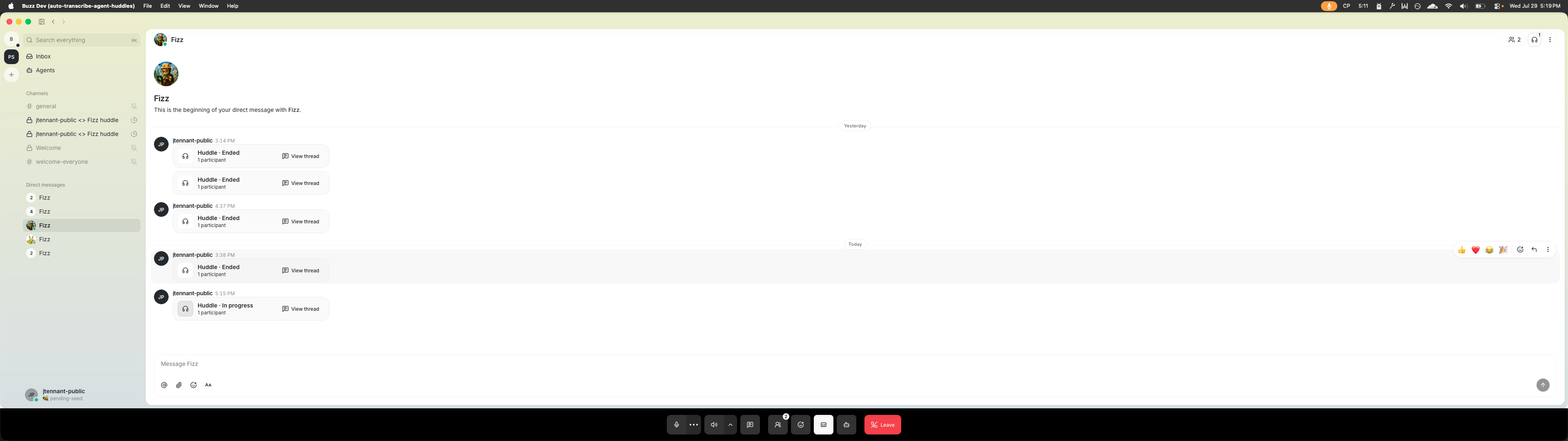
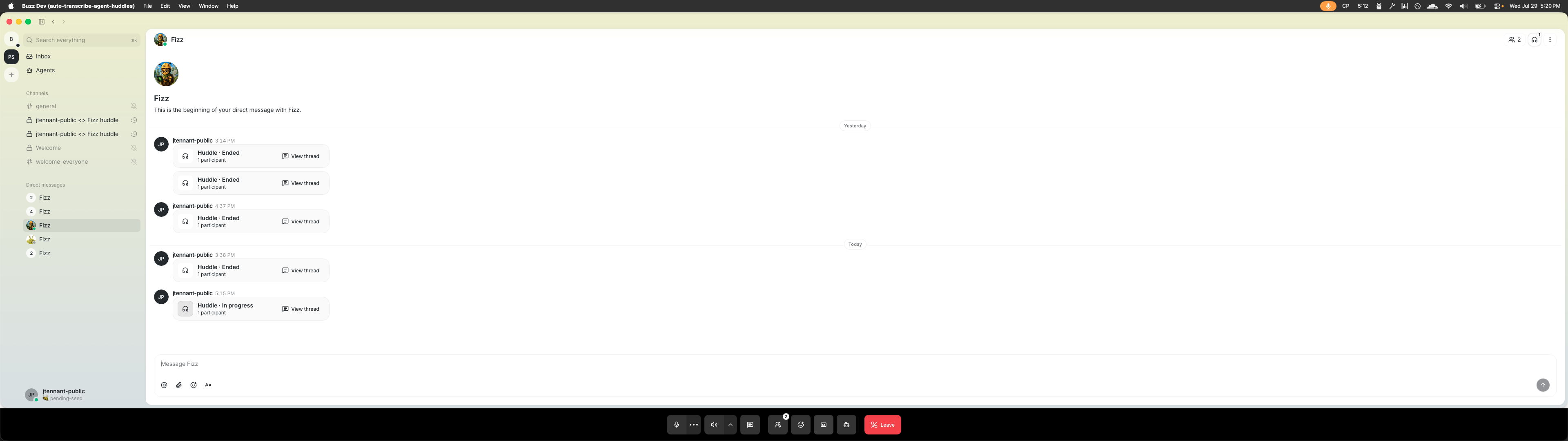
## Reviewer-reproducible examples
From a fresh checkout:
```bash
pnpm --dir desktop build:e2e
pnpm --dir desktop exec playwright test tests/e2e/huddle-transcription.spec.ts --project=smoke
pnpm --dir desktop exec playwright test tests/e2e/mentions.spec.ts --project=smoke --grep "system agent profile exposes owned agent actions|system agent avatar exposes owned agent actions|owned bot profile exposes message and huddle actions|owned agent mention profile exposes message and huddle actions"
```
The huddle scenario exercises initial authoritative hydration, exactly
one automatic enable, explicit OFF persistence, unchanged state after
last-agent removal, newer events winning over delayed hydration,
agent-DM enrollment, and idempotent parent membership. It also asserts
`aria-pressed` and distinct computed active styling.
---------
Signed-off-by: John Tennant <jtennant@squareup.com>
Signed-off-by: npub1jh9wn95s0472h86ahapupaf7m6kx4v9sx2n0atj2hltcfer8k06s5n3pyf <95cae996907d7cab9f5dbf43c0f53edeac6ab0b032a6feae4abfd784e467b3f5@buzz.block.builderlab.xyz>
Co-authored-by: npub1jh9wn95s0472h86ahapupaf7m6kx4v9sx2n0atj2hltcfer8k06s5n3pyf <95cae996907d7cab9f5dbf43c0f53edeac6ab0b032a6feae4abfd784e467b3f5@buzz.block.builderlab.xyz>
## Summary

- Preserve plain-string errors returned by Tauri and show an actionable
message when huddle audio is unavailable in the relay deployment.
- Use one error formatter across channel, timeline, wave, and profile
huddle actions while preserving other relay and device errors.
- Complete the huddle lifecycle when audio setup fails after publishing
a start event, preventing peers and reloaded clients from reconstructing
a phantom active huddle.
- Cover unavailable-audio formatting and START → rollback-END
reconstruction with regression tests.

## Behavior

The Tauri huddle commands reject with a plain string. Several desktop
toast call sites only preserved JavaScript `Error` objects, so the relay
message was discarded and replaced with “Failed to join huddle.”

The desktop now recognizes `huddle_audio_unavailable` and the current
relay message, then shows:

> Huddle audio isn’t available on this server. Ask an administrator to
turn it on.

Other relay and device messages remain intact, including microphone
errors.

`start_huddle` also publishes `KIND_HUDDLE_STARTED` before audio setup.
If setup fails, rollback now publishes `KIND_HUDDLE_ENDED` through the
normal end-and-archive path before resetting local state. This makes the
failed start observable to lifecycle reconstruction and prevents stale
join affordances.

## Checks

- `cd desktop && pnpm test` — 3,405 passed
- `cd desktop/src-tauri && cargo test` — 1,560 passed, 13 ignored; 3
diagnostic tests passed
- `cd desktop && pnpm exec playwright test tests/e2e/channels.spec.ts
--project=smoke --grep 'huddle rollback end event'` — passed
- `just desktop-tauri-check`
- `cd desktop && pnpm typecheck`
- `cd desktop && pnpm check`
- Pre-commit and pre-push hooks


