mirror of
https://github.com/block/buzz.git
synced 2026-11-24 18:21:59 +00:00
4e4ac3efd832ebfe167f4d6c2da84c4e73c03ab2
6 Commits
| Author | SHA1 | Message | Date | |
|---|---|---|---|---|
 Will Pfleger |
df21064800 |
feat(auth): tolerate client clocks up to 120 s off (#9485)
Lets clients whose clocks are up to 120 s off sign in to NIP-FI communities and stay connected. **Relay** - NIP-42 AUTH and NIP-98 HTTP Auth accept `created_at` within ±120 s, using a shared `buzz_auth::TIMESTAMP_TOLERANCE_SECS`. This covers relay login, audio admission, bridge, admin, invites, NIP-FI policy and Git. - `DEFAULT_REPLAY_TTL_SECS` goes from 120 to 250 s: a 2 × 120 s window, plus 1 s for the inclusive whole-second bounds, plus a 9 s budget for the clock difference between relay pods. A compile-time assert checks the arithmetic. The 9 s is an operational assumption about NTP-synced pods, and the doc comment says so. No `deploy/` override exists. - Media (kind 24242): - Both modes accept `created_at` up to 120 s in the future and an `expiration` greater than `now − 120`. - Strict: the 120 s age limit and the 60 s lifetime cap. - Permissive: keeps its 3600 s age allowance and has no lifetime cap. - `buzz-auth` and `buzz-media` read the time through a `wall_now()` that tests can pin (a `#[cfg(test)]` thread-local), so boundary tests are exact. - Git transport: comments only. It still reuses one proof per session, so the reuse window now matches ±120 s. **CLI** - The desktop-provider lane asks the desktop app for the assertion every time and keeps no copy, so the desktop's cache owns each token's deadline. It looks the token up again after signing and sends that one, so a provider may hand out a new token on every call. - The direct-mint cache sets its deadline to `min(request_start + (exp − iat), receipt + (exp − local_now))`, on a monotonic clock. `request_start` is when the attempt that got the reply was sent, not the start of the retry loop. - An assertion with no local lifetime left is never returned or sent. The cache asks again, up to 3 times, then fails with an auth error that points at the computer's clock. An assertion without a readable `iat` is refused. `iat` may be fractional (a NumericDate); the lifetime is `max(0, floor(exp − iat))` whole seconds. **Cache reuse (CLI, Flutter, iOS):** each cached token records when it arrived on both the monotonic and the wall clock. It is reused only while `max(monotonic elapsed, wall elapsed)` since arrival is under its budget (`refresh point − receipt`, on the monotonic clock). A negative wall elapsed counts as 0. The monotonic clocks used here stop while the device sleeps, so the wall clock ends reuse after a sleep; setting the wall clock back can't stretch a token, because the monotonic bound still applies. **Mobile** - Flutter `HostedRelayAuth`: the same lifetime rule, on a monotonic clock, for async acquisition and for the synchronous `cachedHeaders` media path. A token with no local lifetime left is never sent: issuance is retried up to 3 times, then fails as `unavailable`. A token without a readable `iat` fails as `invalidResponse`. - Flutter refusal hint: the account client reads `Date` when a 403's headers arrive, before the body (`boundedHttpResponse` gains an `onHeaders` callback). The 403 stays `AccountFailure.denied` even if its body is then lost, late or too large. The hint is stored with the refusal it explains (`HostedRelayAuth.failureClockHint`), cleared when that community next gets a token or the account session changes, and left alone by other communities' issuance. The account client records a 403's hint only for the acquisition whose own request was refused (`BuilderlabAccountClient.observingRefusals`), so an unrelated account call, such as the organization key backup, never supplies a sign-in's hint. When the offset is over 115 s, the reconnect and organization banners add "Your device's clock looks about N minutes off, which can cause this. Check your date and time settings." - iOS `BuzzRelayAssertionIssuer`: the same lifetime rule, on `systemUptime`. An assertion without a readable `iat` is refused. - iOS push enrollment: a new grant's window starts 120 s in the past, so `not_before = now − 120` and `expires_at = now − 120 + lifetime`. A fast phone then neither signs a `not_before` the gateway hasn't reached nor goes over its 30-day maximum. A resumed journal resubmits the installation expiry it already attested, byte for byte. The delegation, which is signed fresh each time, expires at the earlier of that expiry and `not_before + lifetime`, so a journal written by an older client on a fast phone still gets a grant the gateway accepts. The saved grant records the delegation's expiry. - Flutter and iOS already sign a fresh proof with a `nonce` on every issuer attempt, so their retries needed no change. **Specs:** NIP-FA proof bounds (120 s old / 120 s future), plus NIP-FI Git (`±120s`), media freshness, the media read residual and the media trace row. `desktop/` is untouched. Not exercised live: Git clone/push, audio join and push delivery with a skewed client clock. --------- Signed-off-by: Will Pfleger <wpfleger@block.xyz> Signed-off-by: Tom Brow <tomb@squareup.com> Co-authored-by: Hayt <211b96e6a2b7f45fd4047988976c7bbbeeda0c15f3ae7b32eec20834b5a55118@buzz.block.builderlab.xyz> Co-authored-by: Tom Brow <tomb@block.xyz> Co-authored-by: Tom Brow <tomb@squareup.com> |
||
|
Tom Brow
|
794ee64183 |
fix(ios): mint hosted NIP-FI assertions in the notification extension (#9228)
Share the hosted Builderlab session with the iOS notification extension so it can mint hosted NIP-FI assertions. The extension queries a hosted relay without an assertion first and mints only after a NIP-FI challenge, for a key the account is already bound to. Credential headers never follow redirects, and flag-off builds clear a previously shared session. Signed-off-by: Tom Brow <tomb@squareup.com> Co-Authored-By: Claude Opus 5.5 <noreply@anthropic.com> |
||
|
John Matthew Tennant
|
b894fb02ff |
fix(mobile): show transparent avatars without a black background (#9105)
## Summary Transparent PNG and GIF avatars render on a black background in mobile avatars and iOS notification avatars. Both load the relay's small thumbnail, which was always a JPEG with no alpha channel. [block/buzz#9003](https://github.com/block/buzz/pull/9003) makes relays write a `{sha}.thumb.webp` thumbnail that keeps transparency, alongside the `{sha}.thumb.jpg` that every relay writes. This PR loads the WebP first. - `MediaImage` with `preferThumbnail` tries `.thumb.webp`, then `.thumb.jpg`, then the original. Only a 404 moves on to the next source; any other failure still shows the error widget. Missing thumbnails are remembered as before, so later builds skip straight to the source that exists. - `BuzzNotificationAvatarLoader` follows the same order for notification avatars. Relays without 9003, and images uploaded before it, keep rendering from the JPEG as they do today. ### Screenshots A transparent PNG avatar rendered by `MediaImage` on the same relay, before and after (widget harness on an iOS simulator). | Before | After | | --- | --- | |  |  | ### Related issue AIDA-2308 (internal). The desktop counterpart is [block/buzz-app#2477](https://github.com/block/buzz-app/pull/2477). ### Testing - `missing thumbnails fall back to the JPEG, then the original` (`avatar_image_test.dart`): when the relay 404s every thumbnail, the avatar requests the WebP, then the JPEG, then the original. When the WebP fails with a 500, the avatar shows its fallback and requests neither the JPEG nor the original. - The relay thumbnail journey tests run against a relay that 404s `.thumb.webp`, so they cover the older-relay path end to end. - `BuzzNotificationAvatarLoaderTests` checks the WebP-then-JPEG thumbnail order for relay media, and that non-relay media gets no thumbnails. 🤖 Generated with [Claude Code](https://claude.com/claude-code) Signed-off-by: John Tennant <jtennant@squareup.com> Co-authored-by: Simone <0828be588d5c9c4d092c5b1cf01761d5aef63d6b104807fd8e8284d517dd1a99@buzz.block.builderlab.xyz> Co-authored-by: Claude Opus 5.5 <noreply@anthropic.com> |
||
|
Tom Brow
|
1b9b307176 |
fix(mobile): renew expired assertions for native media and drop retired-session avatars (#9134)
Follow-up to [#9069 media auth](https://github.com/block/buzz/pull/9069), which merged at its approved head. This PR carries the fixes for the last review round on that PR. ### Changes - **Native media reads renew an expired assertion** (Carl's [recommended blocker](https://github.com/block/buzz/pull/9069#discussion_r4485183400)). Voice notes and posterless video previews hand headers to native code. They now use `freshNativeMediaHeadersProvider`, which awaits `HostedRelayAuth.headersForUrl` and so asks for a new assertion once the cached one has expired. Before, while the socket stayed up they sent none and the relay refused the read. If the renewal fails, the read falls back to cached headers and the relay decides. The voice-note player's `headers` callback is now `FutureOr`. Both the iOS authenticated download and the Android native load await it, then recheck their generation, so a cancel during a slow renewal never starts the stale load. - **Notification avatars drop a retired organization session** ([review thread](https://github.com/block/buzz/pull/9069#discussion_r4485125609)). When an avatar download finishes after the organization session that issued its assertion was replaced, BuzzPushKit removes the cached response and refuses the avatar. - **Test:** cached reads never present a signed-out or replaced account's assertion ([optional note](https://github.com/block/buzz/pull/9069#discussion_r4485183412)). Not changed: native reaction-detail avatars still use the cached assertion. After it expires they fall back to initials. ### Validation - Each new test was checked to fail with the code it guards reverted: - `replacedOrganizationSessionRefusesAvatar` (BuzzPushKit): a session replaced mid-download must be refused. - `fresh native media headers renew an expired assertion`: covers renewal and the fallback when renewal fails. - `remote voice notes renew an expired relay assertion`: a journey through `VoiceNoteAttachment`; it fails when the attachment is switched back to the synchronous provider. - `Android defers remote auth until playback starts`: now cancels during a slow renewal and expects no native load. - `an issued assertion serves cached reads for the relay`: now signs out and restores a replacement account. It fails without the account check. - `swift test` (69 tests) passes. The full mobile suite (`just mobile-install mobile-check mobile-test`) passes with these commits on main as of [#9069 media auth](https://github.com/block/buzz/pull/9069). - The automated full-app simulator run from [#9069 media auth](https://github.com/block/buzz/pull/9069) covers the surrounding flows. This change is limited to the header source for voice notes and video previews, and none of the test communities enforce the hosted assertion, so a simulator run would not show the difference. No end-to-end run against a relay that enforces the assertion. 🤖 Generated with [Claude Code](https://claude.com/claude-code) --------- Signed-off-by: Tom Brow <tomb@squareup.com> Co-authored-by: Tom Brow <tomb@squareup.com> Co-authored-by: studio <dc2fc481343672df31a689840c09299972e704dac592e0da6f18486646a7ee3e@buzz.block.builderlab.xyz> Co-authored-by: Claude Opus 5.5 <noreply@anthropic.com> |
||
|
Tom Brow
|
97ede701c0 |
fix(mobile): send hosted relay assertion from native media and tombstone paths (#9069)
Follow-up to https://github.com/block/buzz/pull/9056, from an audit for other places that miss the hosted relay assertion. Hosted and organization relays require `Nostr-Federated-Identity` on every non-exempt HTTP request and WebSocket upgrade. The Dart `HostedRelayHttpClient` adds it, but anything that downloads or connects outside that client has to add it itself. The notification service extension and the iOS emoji picker both missed it, and these places do too: - **Voice notes** (`just_audio`, mainly Android) and **video preview first frames** fetch media natively with only the Blossom `Authorization` header. Both now use `nativeMediaHeadersProvider` from https://github.com/block/buzz/pull/9056. - **Push-lease tombstones**: removing a community, and the durable revocation outbox, open a one-off relay socket with no headers. A hosted relay refuses the upgrade, so the lease is never revoked and the outbox keeps retrying. Both now ask `HostedRelayAuth` for that community's own assertion, because the community being removed may not be the active session. - **Notification avatars** (iOS notification service extension): relay-hosted sender avatars were fetched with Blossom auth only. The loader now takes the same `BuzzRelayAssertionIssuer` the resolver uses for `/query`. Signed requests already refuse redirects. The iOS Me-chat agent picker also fetched avatars with no headers, but https://github.com/block/buzz/pull/9079 removed that native screen, so this PR no longer touches it. ### Validation - Added tests, each checked to fail when the code it guards is reverted: - A queued push-lease revocation and a community-removal tombstone both send `Nostr-Federated-Identity` on the WebSocket upgrade, as background requests. Runs against a local relay socket that handles NIP-42 auth. - A notification avatar on an organization relay is downloaded with the issued assertion (BuzzPushKit). - Issuing for a second community keeps the first one's cached assertion. A background request records no failure, never backs up the key, and its failure never reaches the active community's reconnect waiting on it. - Background issuance never binds an unbound account to its key, bypasses the shared assertion cache (each attempt gets a fresh assertion, and foreground use never inherits one that skipped the key backup), and its failure is never handed to a foreground caller waiting on it. When it can't get an assertion it sends none, so a non-enforcing relay still accepts the tombstone. - A notification avatar whose organization session is replaced mid-download is refused and dropped from the cache (BuzzPushKit). - Voice notes and posterless video previews renew an expired assertion before the native fetch, and fall back to cached headers if renewal fails. A voice-note attachment journey binds the production provider. - Cached reads never present a signed-out or replaced account's assertion. - `flutter analyze` is clean. `swift test` passes for the BuzzPushKit avatar loader tests, and `flutter build ios --simulator --debug` succeeds. - Full mobile suite (`just mobile-check` and `just mobile-test`) passes at 2c84940832. - Automated full-app run on an iOS simulator (debug build of this PR before it was rebuilt on main, signed in to the internal Builderlab community with two more communities saved). Passed: launch and channel list, image attachments and avatars in a channel, New chat sheet kept open for about 80 seconds before the agent list was opened (all agent avatars loaded, so headers are requested per download), dismiss and reopen, background and resume, switching to a second community (its icon and avatars loaded), and removing a community. The native New chat sheet is unreachable in the normal flow on this branch (a new chat opens the Flutter draft page; the native sheet only opens when resuming an unfinished chat), so that check ran with a temporary local bypass that was reverted. Limits: none of these communities requires the hosted relay assertion in this build, so the run shows the Swift-to-Dart header bridge, the per-relay cache and the tombstone path cause no regression, not that the assertion is sent or accepted. No voice note, video preview or deleted message was reachable. Screenshots are omitted because they show internal channel content. - Limitations: no end-to-end run against a hosted relay. Simulator sign-in to a hosted relay needs SSO, so a hosted-relay run needs a device build. 🤖 Generated with [Claude Code](https://claude.com/claude-code) --------- Signed-off-by: Tom Brow <tomb@squareup.com> Co-authored-by: Tom Brow <tomb@squareup.com> Co-authored-by: Claude Opus 5.5 <noreply@anthropic.com> Co-authored-by: studio <dc2fc481343672df31a689840c09299972e704dac592e0da6f18486646a7ee3e@buzz.block.builderlab.xyz> |
||
|
Tom Brow
|
fea02d174d |
fix(ios): fetch profiles and avatars in notification extension (#8369)
A notification can arrive from someone whose profile the main app has never loaded. The iOS notification extension now fetches and caches sender profiles, channel details, and avatars itself. The main app supplies account configuration and Keychain credentials only. After resolving the message, the extension allows 1.5 seconds for sender and channel details. It uses available stale data when a refresh is slow or fails, delivers once, and lets late results update its private cache. Profiles, channel details, and avatar refresh checks share a one-hour freshness threshold. A verified avatar removal clears the previous image. Account removal prevents further use of that sign-in's cached data. Profile, channel metadata, and membership use separate bounded downloads, so an oversized roster cannot discard the smaller records. Sender enrichment can finish while channel requests are pending. A successful partial channel refresh atomically removes its old counterpart, preventing a mixed group identity or recipient count. Group-specific notification presentation still requires a verified recipient count. The [specification](https://github.com/block/buzz/blob/native-notification-enrichment/docs/native-notification-enrichment.md) describes the display, caching, and account-removal behavior. General persistent image caching in Flutter remains separate. ### Validation [Hosted CI](https://github.com/block/buzz/actions/runs/38780108487) passed on the final commit, including all Flutter shards, Android, the full iOS release and simulator builds, and native controls/push-navigation tests. The [current-commit security review](https://github.com/block/buzz/pull/8369#issuecomment-6197508385) found no issues. The native package passed 159 tests, including new coverage for cache freshness, avatar replacement and removal, sign-in isolation, concurrent storage, late results, single delivery, bounded downloads, and SVG validation. A regression test exposed identical HTTP authentication event IDs for requests in the same second; each request now includes a unique nonce, matching the Dart and CLI clients. Full local CI passed before that small authentication fix. The complete native suite and signed device build passed again on the latest commit, including response-size limits, overlapping avatar downloads, canonical relay-origin matching, independent profile/channel refreshes, account-key changes before and during requests, and a single initial snapshot read across 64 accounts, signed IPv6 avatar authorities, and partial channel refreshes. Focused Flutter regression tests passed 198 tests with three configuration-specific skips; seven avatar widget tests also passed. Flutter analysis is clean, and the notification extension builds for the simulator. On an iPhone SE, the notification displayed the sender name, avatar, channel, and message before the updated main app was opened. Repeat notifications used a byte-identical private cache. Three notifications delivered together displayed the avatar after the authentication fix. The next notification also displayed correctly after terminating the extension process. The existing generic-push design can select the same newest unread message for several pushes; this change does not alter message selection. 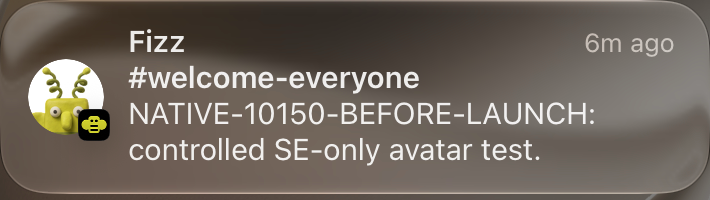 Authenticated HTTP avatar fetching and persistent HTTP cache reuse also passed on the SE. The first notification downloaded a relay thumbnail. After terminating the extension and expiring its separate avatar entry, the next notification displayed the avatar and refreshed that entry without another media request in the relay logs. The main app remained unopened throughout. The original app build and test profile were restored afterward. Automated tests cover slow and failed requests, stale images, removal, and account revocation; those cases have not all been exercised on the phone. ### Before merge - [x] Verify authenticated HTTP avatar fetching and cache reuse on iOS against a working relay media service. <!-- buzz-review-completed --> --------- Signed-off-by: Tom Brow <tomb@block.xyz> |
