mirror of
https://github.com/block/buzz.git
synced 2026-11-24 10:12:19 +00:00
4e4ac3efd832ebfe167f4d6c2da84c4e73c03ab2
11 Commits
| Author | SHA1 | Message | Date | |
|---|---|---|---|---|
 Tom Brow |
bf9ce1432e |
feat(mobile): add diagnostic reporting module with crash capture (#9613)
Step one of [mobile diagnostic reporting](https://github.com/block/buzz/blob/main/docs/mobile-diagnostic-reporting.md), first piece: the reporting module, plus capture of crashes and uncaught errors. A build given a `BUZZ_SENTRY_DSN` now reports native crashes, Flutter framework errors and uncaught asynchronous Dart errors to that Sentry project, attributed to the signed-in member's public key. A build without one (every build made from this repository alone) uses a do-nothing reporter and never initializes the SDK, as [ADR 0007](https://github.com/block/buzz/blob/main/docs/adr/0007-diagnostic-reporting-follows-the-destination.md) requires. A destination the SDK cannot parse is treated as none, so a configuration mistake never stops the app from starting. ### What's in it - **One interface** in `mobile/lib/shared/diagnostics/`: report an error, count a networking event, leave a breadcrumb, and set the member. It has a Sentry-backed and a do-nothing implementation. Only this folder imports the SDK. The explicit error reports and the networking counts that use it come in the next PRs. - **Startup** wraps `runBuzzApp` and installs the SDK's crash and error handlers only when a usable destination is set: one with an HTTP(S) host, a public key and a project, which the native SDKs also require. On Android, the manifest removes the SDK's startup performance provider, which would otherwise run before that check. - **Member:** set from the active community's key, changed when the account switches, cleared on sign-out. Adding the Builderlab origin and account subject is left to a later PR. Every report also carries a random per-install identifier the app creates on first launch, as its own `install.id` tag, signed in or not, so a device's reports can be matched to its members. It lives in a file that device backups and transfers skip, so a phone restored from another gets its own: on Android in the app's files directory, excluded in both backup rule sets; on iOS in an Application Support folder that a small native call marks as excluded from backup (not the caches folder, which iOS can clear when storage runs low). Set on the SDK scope, it also reaches native crash and hang reports. With no member set (before sign-in or after sign-out), the SDK also fills the report's user with its own random per-install identifier, on Dart and native reports alike. - **One filter** runs on every Dart report, breadcrumb and count before it leaves the device: - It replaces every error's own text with fixed wording, since an error can quote its input, a server's response body or a URL. The error keeps its type, mechanism type and stack trace. - It drops what the SDK adds about the failing platform call (`mechanism.data`) and the failing widget (`flutter_error_details`), which can quote what is on screen. - It removes URL query strings and fragments, and keeps only tags and count attributes on the allowed list. - It drops every breadcrumb except networking events and the SDK's foreground/background entries. - **SDK options:** personal data, screenshots, view hierarchy, replay and tracing stay off. The SDK's session records stay on, for a crash-free rate. A session begins each time the app starts or returns after 30 seconds or more in the background; the SDK sends a record when it begins, an update each time an error is counted, and a last one when it ends, carrying the start time, error count, outcome, time from start to end, release, environment and the random per-install identifier. Native auto-breadcrumbs, Android's network-change breadcrumbs (VPN state, signal strength, bandwidth; turned off in the manifest, since the Flutter bridge leaves them on), Cocoa's network breadcrumbs (which keep each request's query and reach native crash reports) and print breadcrumbs are off. With print breadcrumbs on, the SDK would replace `debugPrint` in non-debug builds with one that prints nothing. - **Main-thread hangs:** iOS app hang tracking, Android ANR detection and iOS watchdog-termination tracking are set on explicitly, at the SDK's default thresholds. iOS reports the main thread blocked, fully or mostly, for 2 s or more while the app is active, including freezes it recovers from; a hang still going when the system kills the app is sent on the next launch as a fatal hang, and watchdog-termination tracking reports a foreground run that ended with nothing else to explain it. Android reports only system-declared ANRs: on Android 11 and later, the most recent one that ended the process (read on the next launch, when the system kept a thread dump); before 11, after 5 s once the system marks the app not responding. So recoverable freezes are reported on iOS, and on Android only before 11 once the system marks the app not responding. Dart runs on the main thread, so blocking Dart work shows up with the main thread's stack; Dart frames need the Dart debug symbols at the destination, as crashes do. The spec now has a bullet and a user story for this. - **What the filter does not cover:** native crashes and app hangs are captured and sent by the native SDKs, which never call the Dart filter. They carry stack traces and, for a native exception, its reason text. No app code puts content in a native exception today. The spec now says this. - **Reporting never blocks the app or reaches it with an error:** every call returns at once, and a failure inside reporting is dropped with a `debugPrint`. ### Regressions None for builds without a destination, which includes every build from this repository: they run the same startup with one extra synchronous check, and the SDK is never initialized. The SDK still adds to the app's binary size on both platforms. With a destination, the first frame waits for the SDK to start, native SDK included, and for the install ID to be read from (or, on first launch, written to) a small file. On a debug simulator build the first frame came about 0.3 s later (median of 6 cold launches: 768 ms with a destination, 431 ms without), measured before the install ID was added. Device builds will differ. Uncaught errors still reach Flutter's default handling, and the SDK sends in the background. ### Validation Added tests (`test/shared/diagnostics/diagnostic_reporting_test.dart`): - A table of inputs run through the production Sentry options callbacks: SDK HTTP and navigation breadcrumbs are dropped, network breadcrumbs keep only their four attributes, URLs lose their query string and fragment, unknown tags and count attributes are dropped, and the privacy and breadcrumb options stay off. - Errors sent through a real SDK hub, with the SDK's own platform-error processor and Flutter error integration, into an in-memory transport: for a parse failure, a bad argument, a server response and a platform failure, the serialized event keeps the type and stack but none of the error's text; a real framework build error leaves out the widget text. - A release-mode check that `debugPrint` keeps printing with reporting on. - A build with no destination, one the SDK cannot parse, one without a public key or one without an HTTP(S) host starts the do-nothing reporter and the SDK stays disabled. - Reporting calls whose SDK calls throw, either synchronously or asynchronously, never reach the caller. - Hang detection is on and its thresholds equal the SDK's defaults. - An installation keeps one install ID across launches, a new installation gets a new one, and the filter keeps the `install.id` tag. - Signing in, switching accounts and signing out change the member that later reports are attributed to. I checked that each guard is real by removing it: the print-breadcrumb setting, the destination check, the error-text replacement, the `mechanism.data` and `flutter_error_details` removal, the network-breadcrumb setting, the dropped-failure catch and the tag filter each made a test fail. End to end on an iPhone 17 Pro simulator, with a local server standing in as the destination and a throwaway probe (not committed) that made an HTTPS request with a secret in its query, then raised an uncaught Dart error and a framework error with secrets in their text, then crashed natively: - All four reports arrived (two Dart, one framework, one native crash on the next launch), and none of the secrets appeared in any envelope. - Dart reports carried only the foreground/background breadcrumb; the native crash carried none. - As a control, a build with Cocoa's network breadcrumbs switched back on put the request's secret query and fragment into the native crash report, so that setting is what keeps them out. - `debugPrint` lines still appeared in the device log. Hangs, on a fresh iPhone 17 Pro simulator with no debugger attached and the same local server: a throwaway probe busy-looped the main isolate for 5 s after the first frame. The SDK sent an `App Hang Fully Blocked` event ("App hanging between 5.7 and 6.5 seconds", mechanism `AppHang`) carrying the main thread's stack: Flutter engine frames around 12 frames of Dart code. This was a debug build, where Dart is compiled just in time, so those frames have no image to symbolicate against; in release builds they fall in the app's compiled Dart framework and need its debug symbols at the destination. Install ID, rechecked after moving it to its own file, on a fresh simulator with the same local server, launched twice with a probe that raised a Dart error and then crashed natively: both Dart errors and the native crash carried the same `install.id`, while the signed-out user was the SDK's own identifier. The ID file was in the backup-excluded `Library/Application Support/Diagnostics` folder, not in the app's preferences. The merged Android debug manifest has neither of the SDK's startup providers and has the network-change setting off. The NDK preload provider is still merged in, but it does nothing unless its own manifest flag is set, and it isn't. Full mobile suite passes. Dart errors are captured in the main Flutter engine only; the iOS sheets that start their own engine are out of scope for this PR (native crashes while they are open are still caught), as the spec now says. iOS simulator and Android debug builds with a destination set both build; on iOS the SDK resolves through Swift Package Manager. --------- Signed-off-by: Tom Brow <tomb@squareup.com> Signed-off-by: Tom Brow <tomb@block.xyz> Co-authored-by: studio <dc2fc481343672df31a689840c09299972e704dac592e0da6f18486646a7ee3e@localhost> |
||
|
Tom Brow
|
52cb6818fa |
perf(mobile): keep remote images on disk and show small ones as thumbnails (#9158)
## Summary The mobile app now saves remote images on disk. After a relaunch, avatars, custom emoji, message attachments and agent artwork show immediately. The app does not download them again. Small images on a relay now load only the relay's thumbnail. The app never downloads the full-size upload to show a small image. ## Why Before this change, the app kept remote images only in memory. Each cold launch downloaded every image again. On a slow connection, attachments showed a "Loading image" placeholder for a long time. Also, when a relay had no thumbnail for an image, the app downloaded the full-size upload. That upload can be up to 20 MiB, for an avatar that is a few dozen points wide. ## What changes ### Images on disk - `MediaImageProvider` reads and writes a `MediaDiskCache`. Each account in each community has its own cache, at `<root>/communities/<community id>/media/<signer pubkey>`. The cache is built on `flutter_cache_manager`, with a JSON index. - On iOS, the root is the app group's `Library/Caches` (from a new `buzz/app_group` method channel). App extensions can then read the same cache. On other platforms, the root is the app cache directory. - Each cache holds a maximum of 250 MB. When it is full, the least recently used images go first. `MediaCacheIndex` measures each file when it writes it, because `flutter_cache_manager` limits only the number of files. Every disk read marks the file used, and every write schedules eviction, including a refresh that replaces bytes the package already holds in memory (by default the package does neither for those). - The cache does not save an image that is larger than 5 MiB. The app still shows that image from memory. Thus, one large image cannot push out all the others. - Relay media URLs contain a content hash, so their bytes never change. The cache keeps them until it evicts them. For other URLs, the cache shows the saved image, and then gets a new copy in the background after one week. A maximum of two of these refreshes run at the same time. The app decodes a refreshed image before it replaces the saved copy. - When you remove a community, the app deletes its cache. When a community gets a new signing key, the app deletes the media of the old account. At launch, the app also deletes caches of communities and accounts that are no longer present. - Startup does not wait for the cache. The cache directory resolves in the background. Image reads wait for it for a maximum of 3 seconds. ### Thumbnails for small images - A small relay image loads the relay's WebP thumbnail. If the relay has no WebP thumbnail, the image loads the JPEG thumbnail. If the relay has neither, the widget shows its placeholder (initials for an avatar, an empty tile for artwork). - Native avatars drawn by UIKit (the navigation bar, the community icon on the create button, and the New DM and Add Members pickers) use the same choice, through a new `smallMediaImageProviders`. They try the same thumbnails, fall back the same way, and show initials when neither thumbnail exists. Before, they downloaded the full-size upload and only decoded it small. - Larger layouts and the full-screen viewer load the full-size upload, as before. ### Agent artwork - Preset agent artwork (the tray, flight, video placeholder, avatar hero and the avatar editor's blurred backdrop) now loads through `MediaImage`, so it uses the disk cache too. - The create-agent and empty-bestie pages warm the same `MediaImageProvider` that their widgets read, through a new `mediaImageProviderFor(ref, url)`. - No code in `mobile/lib` uses `Image.network` or `NetworkImage` now. ## Demo A cold relaunch (the app is stopped, then started) into a synthetic "QA demo" Solo chat that holds a few generated images. Shown at half speed. Before: the attachment shows a "Loading image" placeholder while it downloads. https://github.com/user-attachments/assets/107f43a3-63d0-40c3-bd80-4ea9d7897a97 After: the attachment shows with the chat, from disk. https://github.com/user-attachments/assets/d3985bb2-838c-4efa-93cb-44cef51f677d ## Tests - `test/shared/relay/media_disk_cache_test.dart` follows one journey through the real provider and a real cache in a temporary directory. The first launch downloads and saves. An offline relaunch shows the full-size image, its thumbnail and an external image from disk, and the oversized image goes back to the network. Eight days later, only the external image refreshes. Removing the community deletes its directory. - A second test checks the order of eviction when the cache is full, that a file read from disk is evicted after files that were not, and that replacing a file's bytes after eviction last ran evicts again when the cache goes over budget. - `community_provider_test` checks that launch deletes orphan media directories, that a new signing key deletes only the old account's media, and that removing a community deletes its media. - `avatar_image_test` checks that a missing WebP thumbnail falls back to the JPEG thumbnail, and that an avatar with no thumbnail shows its initials. - `native_avatar_image_test` checks the same for native avatars: a WebP 404 paints the JPEG thumbnail, the full-size upload is never requested, a relay with no thumbnail paints initials and is not asked again, and any other failure stops at the initials. - `flutter analyze` and the full mobile test suite pass. - Automated app runs on an iPhone 17 Pro simulator (iOS 27): the channel list, a DM, Home, the Agents grid and an agent details sheet show their images. After a relaunch, the images came from disk and the app wrote no new files. In the "QA demo" chat, a new image from the app showed immediately. - Automated run of the native-thumbnail fix on an iPhone 17 Pro simulator (iOS 27): the native New DM picker shows photo avatars, and the cache gained only relay `.thumb.webp` entries for them, no full-size uploads. After a cold relaunch, the picker showed the same avatars within about 1.5 seconds, and the cache directory gained no files. The avatar editor backdrop was not exercised in the app. The test community has no remote agents, and the backdrop tests cover only emoji and picked-image selections. ## Before merge - [x] Automated simulator run of this head: avatars and agent artwork show their thumbnails, and a cold relaunch shows images from disk. 🤖 Generated with [Claude Code](https://claude.com/claude-code) --------- Signed-off-by: Tom Brow <tomb@squareup.com> Co-authored-by: Tom Brow <tomb@squareup.com> Co-authored-by: Claude Opus 5.5 <noreply@anthropic.com> Co-authored-by: studio <dc2fc481343672df31a689840c09299972e704dac592e0da6f18486646a7ee3e@localhost> |
||
|
Will Pfleger
|
65e864301d |
feat: send a User-Agent on relay WebSocket upgrades (#9246)
Relay WebSocket clients in this repo now send a `User-Agent` of the form `<name>/<version>` on the upgrade request. The version comes from the build. | Client | User-Agent | |---|---| | `buzz-acp` | `buzz-acp/<crate version>` | | `buzz-cli` | `buzz-cli/<crate version>` | | `buzz-ws-client` (default) | `buzz-ws-client/<crate version>` | | `buzz-pairing-cli` | `buzz-pairing-cli/<crate version>` | | `buzz-audio-client` (default) | `buzz-audio-client/<crate version>` | | mobile (relay and huddle sockets) | `Buzz-Mobile/<app version>` | - **`buzz-ws-client`**: every connect path sends the default. A `User-Agent` in the caller's `connect_with_headers` headers replaces it, so other consumers can identify themselves without any new API. `buzz-cli` uses this to send its own name. - **`buzz-audio-client`**: keeps a `User-Agent` already on the host-supplied request, and adds its default otherwise. - **Mobile**: `openRelayWebSocket` sets the HTTP client's `userAgent`, which also covers the huddle transport. Startup waits up to 500 ms for the app version from `package_info_plus` before the app runs, so the first socket carries it; if the lookup fails or times out, the value is `Buzz-Mobile`. Each client has a test asserting the header on the upgrade request. --------- Signed-off-by: Will Pfleger <wpfleger@block.xyz> Co-authored-by: Hayt <211b96e6a2b7f45fd4047988976c7bbbeeda0c15f3ae7b32eec20834b5a55118@buzz.block.builderlab.xyz> |
||
|
Tom Brow
|
fa395e9e80 |
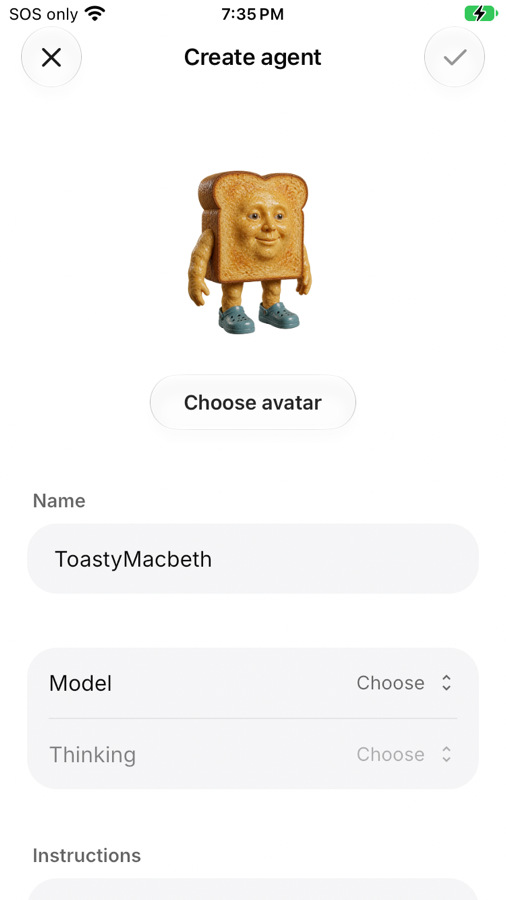
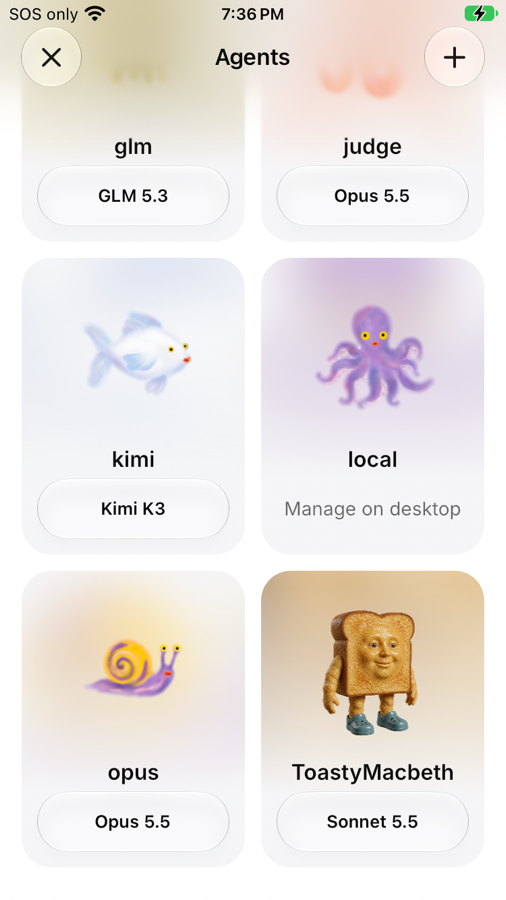
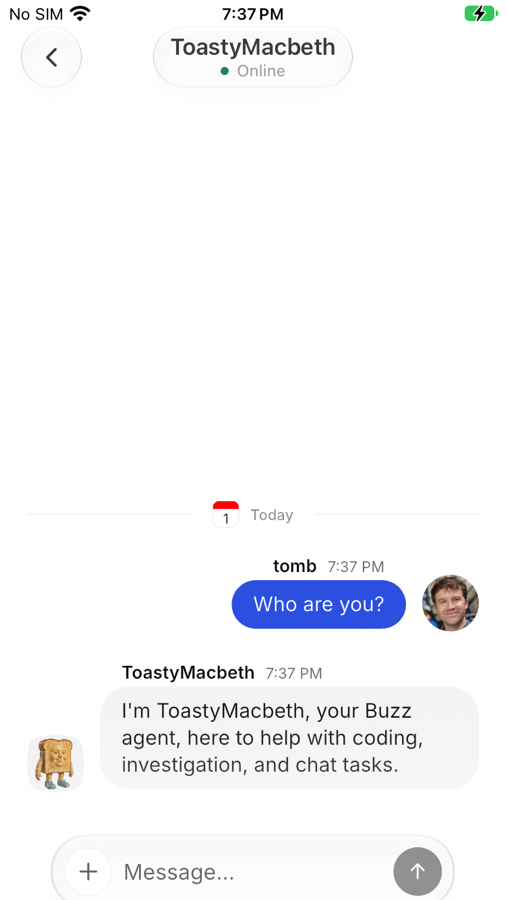
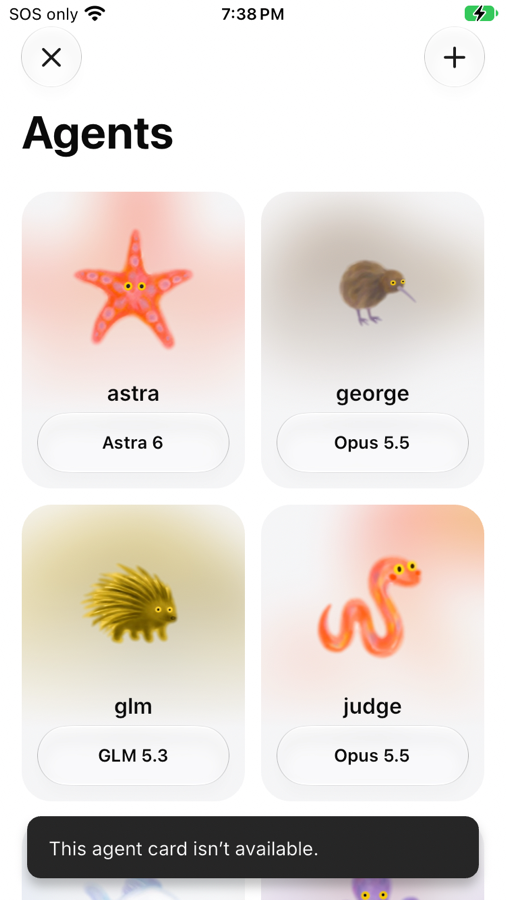
feat(mobile): open a prefilled Create agent form from Builderlab agent cards (#8912)
Builderlab agent cards (printed for the event, and generated at the kiosk) carry a QR to a share page, `app.builderlab.xyz/a/<id>`. Its **Add to Buzz** button opens `buzz://agent/new?card=<id>`, which no Buzz client handled until now. This PR makes mobile handle it. ### Behavior - Opening the link shows the Agents page, then a Create agent form prefilled from the card. Everything stays editable, and nothing is created until the user taps Create. - The app fetches the card's `agent.json` from the avatars CDN for this build's Builderlab environment (production or staging). The link carries only the card id, never a host, so the QR stays small no matter how long a card's instructions get. - `agent.json` is validated against the card schema. `id` (matching the link), `name` and `avatarUrl` (an https URL) are required. `instructions`, `model` and `reasoningEffort` are optional (published cards don't have them yet) and left for the user when absent. A missing required field or a wrongly typed known field rejects the card; any other key is ignored whatever its type, including `v` and `description` (Buzz agents have no description to prefill), so Builderlab can add fields without breaking released apps. The model and effort are preselected only if the live catalog offers them. The card id is opaque: any non-empty id is accepted and percent-encoded into the URL. - The fetch uses the same limits as image downloads, now shared in `bounded_fetch.dart`: aborted after 20 s without a byte or 5 min overall, and rejected over 2 MB. `MediaImageProvider` now calls the same helper, with no behavior change. - The link waits for sign-in, then reloads the registry for the signed-in account before anything else. It's dropped with a message if the card is unavailable (403/404), invalid, can't be loaded (any other response), or an agent setup is unfinished, including a setup saved before a sign-in the link triggered. - A link that arrives while Agents shows only its list replaces that page instead of stacking a second one. If a form or sheet is open there, the link is dropped with "Finish or close what’s open in Agents, then reopen the link." and the open work is kept. ### Demo Simulator (iPhone 17 Pro, debug build of this branch plus the sign-in fix from [#8914](https://github.com/block/buzz/pull/8914) and the hidden debug banner from [#8915](https://github.com/block/buzz/pull/8915), signed in to Builderlab, remote-agent-pilot), recorded in one take with idle time trimmed: the card's share page in Safari, Add to Buzz, the prefilled Create agent form, a model, thinking level and instructions, Create, then a message and the agent's reply. https://github.com/user-attachments/assets/e66aae17-884a-4e68-a1b8-ecb40562be1d ### Validation Added tests: - Table tests for the link shape (only `?card=<id>` with an opaque id; the inline `#` form, extra parameters and dot segments are rejected) and for reading `agent.json` (a published card, a card with instructions and model defaults, unknown keys of any type ignored, including `v`, `description`, arrays, objects and null, and invalid cards: missing or mismatched required fields, wrong types, and non-https or relative avatars). - Table tests for fetching: the request goes to this build's CDN without following redirects, with the id percent-encoded as one path segment; 403/404, a redirect, a 500, a network error, declared and streamed oversize bodies, non-JSON and a JSON array each give a specific message. The image loader's existing stall, deadline, cap and cancel tests now cover the shared helper. - A journey test from link to Create against a fake CDN: prefill and edit, then submit; an unavailable card; a failed model catalog whose Retry then preselects the card's model; a Builderlab account change while the card loads, which drops the draft; a v1 card with no instructions and an unknown model; an unfinished setup; a link arriving while a Create form with edits is open, which keeps the form and its edits; and a link arriving while Agents is open. Disabling the https or id check makes the table test fail, and removing either the account recheck or the loaded-catalog check fails the journey. The journey runs through the production root scope (removing its link handler fails it) and runs in CI's configured-authentication-domains step. Full mobile check and test suite pass locally. Live data: a real staging card's `agent.json` (`av_MioTAG6dm7q3Zcm0UV2j8A`) has the v1 shape the table test uses, and an unknown id returns 403 from the CDN. Live run on an iPhone SE (build of 63ed54c749, Builderlab sign-in enabled, remote-agent-pilot, signed in as builderlab@tombrow.com) with a real production card, [ToastyMacbeth](https://app.builderlab.xyz/a/av_lrmRlJR6ylrQKvJkoLWCOQ) (a v1 card with no instructions and an extra `description` key): - Opening `buzz://agent/new?card=av_lrmRlJR6ylrQKvJkoLWCOQ` from a cold start opens Create agent prefilled with the card's name and avatar. - After choosing a model and adding instructions, Create adds the agent with the card avatar, and it replies in a DM. - An unknown card id shows "This agent card isn’t available." | Prefilled | Created | Reply | Unknown card | | --- | --- | --- | --- | | <img src="https://raw.githubusercontent.com/block/buzz/b9222db494758c3e536b8e2011032ba7cec86daa/pr-8912--01-prefilled.png" width="200"> | <img src="https://raw.githubusercontent.com/block/buzz/b9222db494758c3e536b8e2011032ba7cec86daa/pr-8912--02-created.png" width="200"> | <img src="https://raw.githubusercontent.com/block/buzz/b9222db494758c3e536b8e2011032ba7cec86daa/pr-8912--03-reply.png" width="200"> | <img src="https://raw.githubusercontent.com/block/buzz/b9222db494758c3e536b8e2011032ba7cec86daa/pr-8912--04-unavailable.png" width="200"> | Before this PR, the app had no handler for `buzz://agent/new`, so the link did nothing. A separate widget test covers a link that needs Builderlab sign-in first: once sign-in lands, a setup saved for that account blocks the card, which is never fetched. Removing the registry reload fails it, as does removing the busy-Agents guard for the journey step above. ### Before merge - [x] Human live check waived under the repository owner's standing testing exception. In its place, agent-driven full-app runs exercised the flow end to end: the iPhone SE device run and the simulator demo above (a real card's share page, **Add to Buzz**, the prefilled form, Create and a reply from the agent). Limitation: those runs predate [ |
||
|
Tom Brow
|
5996e5dd8b |
fix(mobile): isolate push setup failures from app rendering (#8610)
Push subscription setup ran synchronously inside the root widget build, so an invalid subscription could replace the entire app with Flutter's error surface. Push initialization and the cold-start native notification read could also prevent the app from rendering. Keep push work independent of the app subtree, observe asynchronous persistence failures, and retain the original errors and stack traces. Setup retries use bounded backoff; Settings shows a failure and offers manual retry without resetting navigation. Retry preserves a healthy revocation worker, and community-removal callbacks follow a recovered worker so lease cleanup continues after setup recovery. Related: [#8608](https://github.com/block/buzz/pull/8608) fixes the specific unrelated-mute input that exposed this startup coupling. ### Validation Added Flutter journeys cover invalid subscriptions, asynchronous storage failure, dependency initialization failure, retry exhaustion and manual recovery, navigation preservation, accessible retry actions, and pending/failed native startup reads with notification-target recovery. Both original rendering regressions failed before the fix. Community-removal coverage also verifies cleanup after a worker initialization failure and after retrying healthy setup; that regression failed before the worker fix. The full mobile suite passed (3,782 tests; 19 existing skips), as did the four unconfigured-build tests and static analysis. The corrected head also passed the full pre-push mobile checks and tests, plus 42 focused push and community tests. Rendered widget evidence uses mocked native platform channels; no device APNs delivery test was performed. Rendered Flutter widget evidence with synthetic data and mocked native platform views. ### Setup failure The app remains usable and Settings offers a retry after push initialization fails. 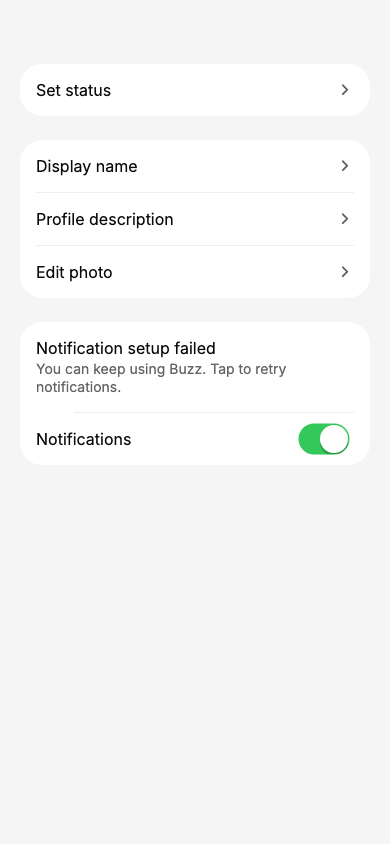 ### Recovery Retry clears the error without replacing the navigator or leaving Settings. 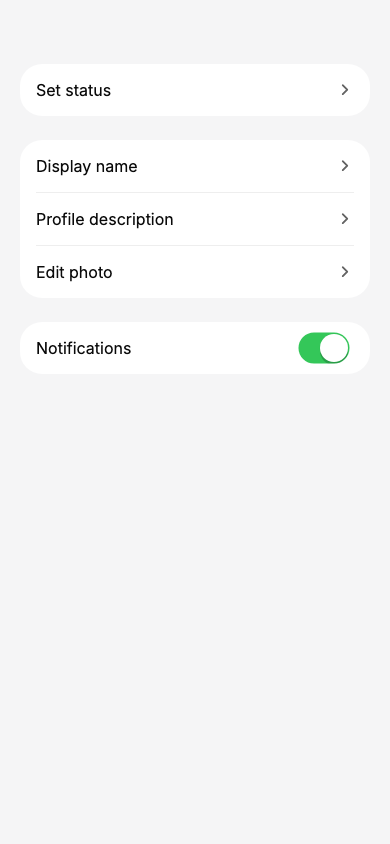 <!-- buzz-review-completed --> --------- Signed-off-by: Tom Brow <tomb@block.xyz> |
||
|
Will Pfleger
|
9b1c4f98e2 |
🤖 perf: bound long-thread aux reads and make query deadlines terminal (#7854)
Long threads (over ~100 replies) time out in desktop. The aux hop that
loads reactions and other e-tag references builds its filter as one
`tags @> …` term per id, joined with `OR`. Past about 100 ids the
planner switches to walking each partition's primary key backward,
expecting to stop early. When few rows actually match, it scans the
whole community. With a dirty GIN pending list, a 188-reply thread never
finishes.

### What changes

- **Set-based e-tag reads (`buzz-db`).** The aux e-tag query now puts
the id set behind a `MATERIALIZED` CTE and matches with `ANY`. Each
e-tag read also runs under a transaction-local `statement_timeout` of 20
s.
- **Terminal timeout contract (`buzz-relay`).** When a read hits the
deadline, the client gets a terminal timeout (`CLOSED` for REQ, the
timeout error for COUNT and search), not a retryable failure.
- **Subscription lifecycle (`buzz-relay`).** The per-connection
subscription map lock is now the lifecycle lock. Claims, replacement,
client `CLOSE`, owner-checked timeout and search cleanup, revoke, and
connection teardown all change the map, the registry, topic refcounts
and terminal frames while holding it. As a result, a timed-out
subscription's `CLOSED` goes out before any replacement with the same id
can claim it, and claims made after teardown are refused.
- **Dropped terminal frame disconnects (`buzz-relay`).** If the `CLOSED`
for a retired subscription (owner-checked timeout or channel eviction)
can't be queued, the relay cancels the connection instead of leaving the
client holding a subscription that will never receive fan-out. A
client-initiated `CLOSE` ack is exempt.
- **COUNT under the same deadline (`buzz-db`).** The fast COUNT path
runs e-tag counts under the same transaction-local 20 s cap as SELECT,
so WS COUNT and HTTP `/count` produce the terminal timeout too.
- **Replica reads surface the deadline (`buzz-db`).** When a
replica-routed read is cancelled by `statement_timeout` (SQLSTATE
`57014`), the error is returned instead of re-running the query on the
writer, which would run the same slow statement. Other replica errors
still fall back to the writer.
`PLANS/REPLICA_FULL_READ_ROUTING_DESIGN.md` records the exception.
- **Deadline handling (desktop).** Only the relay's `query timed out`
counts as a query deadline. A client-side `request timed out` stays
retryable. For one-shot reads a deadline is terminal: the global query
retry (budget 1), thread-replies retry and reaction hydration don't
re-send the same slow query. Reaction ids held back by a deadline are
released when the channel is opened again, so reopening retries them
while same-channel re-renders don't. Live subscriptions, in both the
renderer and the native archive-sync socket, keep treating a deadline
`CLOSED` as transient: they back off and resubscribe with the same
filter instead of being dropped.
- **Deadline handling (mobile).** Mobile recognizes the deadline on both
transports: HTTP `503 {"error":"query timed out"}` and the WS `CLOSED`
reason.
- The root `ProviderScope` retry policy returns no retry for deadline
errors and keeps Riverpod's default backoff for everything else.
  - Background thread-summary recounts don't retry a deadline.
- Forum posts polling pauses while the last load settled on a deadline;
reopening the forum retries.
- A channel's newest-window load surfaces a deadline instead of falling
back to legacy WS history, and the channel list's batched queries return
"unavailable" on a deadline instead of fanning out to per-filter
fallbacks. An unavailable batch is not treated as empty. Known
last-message timestamps and unread state are kept, and unread catch-up
moves `lastMessageAt` forward (never backward) the same way live events
do, so a cold start with no known timestamp still gets one.
- A live subscription that gets a deadline `CLOSED` backs off and
resubscribes with the same filter. History requests still fail on it.
- Settled load failures show a Retry control, matching desktop's
thread-replies error card: a shared `LoadErrorView` on the channel
timeline, forum thread and forum posts list, and an icon button beside
the thread replies summary. While the thread query has no value, the
thread page shows the route snapshot plus live, cached and optimistic
replies, with the loading or error status still visible.
- Other re-sends (reconnect, foreground resume, live events, the unread
backstop, scroll) are not suppressed; each is bounded by the relay's 20
s statement deadline.
- **Long-thread seeder.** `just seed-long-thread [replies]` posts one
thread (default 187 replies) with some reactions to the local dev relay,
for reproducing long threads in the apps. It uses a throwaway key,
refuses non-loopback relays and ignores ambient `BUZZ_*` credentials.
Writes are paced to fit the stock relay rate limit.

**Lifecycle concurrency.** The lock serializes one connection's
subscription changes. Other connections can still be delayed by pressure
on the shared pubsub command queue, and by serial eviction loops waiting
behind a blocked connection. This PR does not claim strict isolation
between connections.

**Recovery vs. load.** Clients stop automatic retries of the same
one-shot read, but they don't remember deadlines across other triggers:
reconnect, resume, live events and the unread backstop can each send the
read again later, bounded by the 20 s statement deadline. A live
subscription that hits the deadline resubscribes with its original
filter under the existing 1–30 s backoff, and against a filter that
keeps timing out it retries at the 30 s cap indefinitely, so the worst
case is one bounded query per subscription every 30 s. `since` is
deliberately not advanced to now on resubscribe, because that would skip
events missed while the subscription was closed. Unchanged from `main`:
when mobile's channel history sync fails with cached messages available,
the cached messages are shown without the error or Retry control.


### Benchmark

Local reproduction on an isolated bench stack (not committed):
- PG16, migrations applied, one 188-reply thread plus 5M background
events in the same community.
- Each request replays the desktop thread-replies filter through the
relay, with `include_aux` on. Times are total ms for 3 runs, with a 60 s
client cap.

GIN pending-list state is controlled with `VACUUM` (clean) or by
refilling the pending list (dirty), and recorded per partition with
`pgstatginindex`. Dirty runs held 402 pending pages on every partition's
tags index at the start and end of each matrix. Clean runs held 0–1
pages (relay startup writes).

| build | GIN pending state | limit 10 | 50 | 100 | 200 (188 ids) |
|---|---|---|---|---|---|
| `main` | clean | 26 / 16 / 13 | 56 / 51 / 52 | 92 / 93 / 95 | 662 /
639 / 641 |
| `main` | dirty | 315 / 298 / 327 | 22141 / 15888 / 16769 | 28992 /
27819 / 28080 | timeout ×3 (>60 s) |
| this PR | clean | 35 / 21 / 14 | 57 / 49 / 48 | 82 / 80 / 75 | 153 /
150 / 135 |
| this PR | dirty | 290 / 254 / 251 | 1257 / 1204 / 1206 | 2432 / 2378 /
2382 | 4333 / 4706 / 5104 |

Baseline `origin/main` `b37e47721`; this PR at `5f2650f5f`, whose e-tag
read builders are identical to the current head. At head `1ad81d868`
against `origin/main` `15d44dcce`, limit 200 measured 145–179 ms clean
(`main` 683–715) and 4.41–4.51 s dirty (`main` timeout ×3).

Every completed cell returns the same signed event set: 209 events, 187
replies at limit 200. With `include_aux` off, every cell is ≤66 ms. The
thread-window loader (`select_aux`) is unchanged from `main`, and its
timings and captured plans match `main`'s.

Actual aux-hop statements captured from each relay binary with
`auto_explain` (analyze + buffers), execution ms:

| build | clean, 100 ids | clean, 188 ids | dirty, 100 ids | dirty, 188
ids |
|---|---|---|---|---|
| `main` (N-way `OR`) | 40 | 298 | 28785 | 62892 |
| this PR (`MATERIALIZED` fence + `ANY`) | 23 | 45 | 1992 | 3539 |

**What the fence changes**
- On `main`, the planner combines `ORDER BY created_at … LIMIT` with an
overestimated match count and walks each partition's primary key
backward, expecting to stop early. With few real matches it scans the
whole community: the dirty 188-id statement touches ~4.9M shared buffers
on `main` vs ~0.6M with the fence.
- The fence prevents that early-stop plan. Across the measured cases
(1–188 ids, both pending states), the planner used the GIN tags index.
The fence doesn't force GIN in general; a broad enough filter could
still get a different plan.

**Tradeoff:** the fence materializes every match before sorting. In this
bench small limits stayed within run-to-run noise of `main`. A single
hot id (5,000 reactions, limit 100) measured 30–34 ms unfenced vs 35 ms
fenced.

**Deadline:** each e-tag read (SELECT and COUNT) runs under a
transaction-local `statement_timeout` of 20 s. It only tightens: a
shorter operator timeout (`BUZZ_DB_STATEMENT_TIMEOUT_MS`) is kept. It's
a per-statement limit, not a per-request one, so a request that runs
several pages or hops can take longer than 20 s in total. The benchmark
does not force the deadline.

---------

Signed-off-by: Will Pfleger <pfleger.will@gmail.com>
Signed-off-by: Duncan <dcfd242e557282d7a1e2cf2e6877522682f1e5c6156dc92ca7d90eaedd3b0f95@buzz.block.builderlab.xyz>
Co-authored-by: Duncan <dcfd242e557282d7a1e2cf2e6877522682f1e5c6156dc92ca7d90eaedd3b0f95@buzz.block.builderlab.xyz>
Co-authored-by: Hayt <211b96e6a2b7f45fd4047988976c7bbbeeda0c15f3ae7b32eec20834b5a55118@buzz.block.builderlab.xyz>
|
||
|
Tom Brow
|
f78a32cf03 |
feat(mobile): hard-block under-18 users on the store age signal (#4665)
### What changed? Buzz mobile checks the app-store age signal at launch and hard-blocks the app behind a full-screen 18+ notice when the store says the signed-in person is under 18. No age signal (e.g. declined permission, indeterminate value, unsupported OS versions) results in no block. The age value is never persisted. It is read, used to compute one boolean, and discarded. Nothing is written to disk, and neither the age value nor the range is logged or sent to analytics. Platform notes: - **New dependency `com.google.android.play:age-signals:0.0.4`.** This is the only way to read the Play signal. Its AAR declares `minSdkVersion 23`, below the app's 24, so it forces **no minSdk bump**, and it self-declares its own consent activity, so **no AndroidManifest change** is needed. - **iOS entitlement and linking.** `DeclaredAgeRange` autolinks from the import. `Runner.entitlements` now declares `com.apple.developer.declared-age-range`, and the call remains behind `#available(iOS 26.0, *)`. ### Why? App stores now expose a declared-age range, and Buzz's Terms require users to be 18 or older. This wires the store signal to that rule with the smallest change that is defensible. Absent signals, declined or undeterminable results, and unsupported OS versions allow the app through. A transient native request failure does not become evidence that access is allowed: the app remains gated until a retry produces a result. Only an affirmative under-18 signal produces the permanent restriction screen. ### How is it tested? Added tests: - [`age_signal_provider_test`](https://github.com/block/buzz/tree/main/mobile/test/features/age_gate) covers the 17/18 boundary, open-ended ranges, no-signal, transient recovery, bounded retry exhaustion, malformed payloads, and request-once behavior - [`age_gate_app_test`](https://github.com/block/buzz/tree/main/mobile/test/features/age_gate) proves authenticated content remains unmounted while the signal is pending or retryable, and verifies the retry path - [`age_restriction_page_test`](https://github.com/block/buzz/tree/main/mobile/test/features/age_gate) asserts the block screen offers no bypass affordance - [`community_provider_test`](https://github.com/block/buzz/tree/main/mobile/test/shared/community) verifies age restriction clears push state, persists inactive leases, and retries a failed tombstone - [`AgeSignalPayloadTest`](https://github.com/block/buzz/tree/main/mobile/android/app/src/test/kotlin/xyz/block/buzz/mobile) pins the Android success payload to exactly `{status, ageUpper}` and verifies failures return the distinct retryable platform error ### Deployment note Enable the Declared Age Range capability and regenerate signing profiles carrying the entitlement. This relops/App Store Connect task is not performed by this PR. *🤖 This PR was authored [with an agent](codex://threads/019e5128-536b-73b3-8348-88651123f6da).* | Age restriction screen | | --- | | <img src="https://github.com/user-attachments/assets/5b0f48b1-df9b-4a60-9800-80b33f128535" alt="Age restriction screen" width="320"> | --------- Signed-off-by: Tom Brow <tomb@block.xyz> Co-authored-by: npub12wpjffj7q5qjsky5jvk4ldwlxmse5xll3d8gytk4wqd0c5y7jvwspg37n6 <538324a65e0501285894932d5fb5df36e19a1bff8b4e822ed5701afc509e931d@buzz.block.builderlab.xyz> Co-authored-by: npub1tquskdu6yc4h8l7xxtceculxw600grekeq0xg2ukqfrwl7vrzg3quz3gmp <58390b379a262b73ffc632f19c73e6769ef40f36c81e642b960246eff9831222@buzz.block.builderlab.xyz> Co-authored-by: Codex <noreply@openai.com> |
||
|
Tom Brow
|
c432a111ca |
feat(mobile): push notifications MVP (#6269)
This PR implements MVP, iOS-only,
[NIP-PL](
|
||
|
Tom Brow
|
6eff84d127 |
fix(mobile): join starter channels after accepting invite (#5915)
### What changed? After a new mobile invite claim succeeds, Buzz now best-effort ensures membership in the same public starter channels as desktop: - `#general` - `#welcome-everyone` Missing starters use desktop's deterministic per-relay IDs and exact public channel configuration, so concurrent mobile and desktop setup converges safely. Setup failures do not invalidate or retry an already successful invite claim, and failure for one starter does not block the other. The success sheet offers **Continue to #welcome-everyone** when that channel is available. Mobile does not create the private `Welcome` channel because it cannot provision the desktop Welcome agents that make that channel useful. This PR is stacked on #6145 because it deliberately reuses that PR's open-channel directory and join behavior. Once #6145 merges, this PR can be retargeted to `main` without changing its BUZZ-12 diff. Fixes [BUZZ-12](https://linear.app/squareup/issue/BUZZ-12/bug-community-appears-empty-after-using-invite-link-on-mobile). ### How is it tested? - Desktop/mobile deterministic starter-ID parity coverage. - Existing-channel join and missing-channel creation coverage. - Duplicate-create convergence and per-channel failure isolation coverage. - Invite success remains successful when starter setup fails. - Widget coverage for continuing directly into `#welcome-everyone`. - Focused invite/deep-link tests: 23 passed. - `just mobile-check`: passed. - `just mobile-test`: 1,483 passed. - Pre-push repository checks: passed. --------- Signed-off-by: Tom Brow <tomb@block.xyz> Co-authored-by: Codex <noreply@openai.com> |
||
|
Wes
|
3eabe74c61 |
feat(mobile): align design language with desktop and polish UI (#321)
Co-authored-by: Claude Opus 4.6 (1M context) <noreply@anthropic.com> |
||
|
Wes
|
a444fb9516 |
feat(mobile): scaffold Flutter app with Riverpod & Catppuccin theme (#306)
Co-authored-by: Claude Opus 4.6 (1M context) <noreply@anthropic.com> |