mirror of
https://github.com/block/buzz.git
synced 2026-11-24 10:12:19 +00:00
4e4ac3efd832ebfe167f4d6c2da84c4e73c03ab2
16 Commits
| Author | SHA1 | Message | Date | |
|---|---|---|---|---|
 Diem Nguyen |
c18bed1f46 |
fix(mobile): name the cause of account-unavailable sign-in errors (#9628)
## Problem Organization sign-in can fail with `Couldn't sign in (account-unavailable)`. That code covers several different failures, so a screenshot can't tell them apart: - the account server can't be reached at all (DNS, connection, or TLS failure, or a timeout), for example when a required VPN profile isn't applied to the app; - a redirect, since the client doesn't follow redirects, so an access-proxy login page lands here; - a 5xx from the server. ## Change - `BuilderlabAccountClient` records why a request failed as `unavailable`, in `lastUnavailableCause`, and logs it. It follows the existing `lastRejectedRequest` pattern. The cause is one of: - a transport category: `unreachable`, `insecure`, `timedOut` (reusing `transportFailure`), or `network` as the fallback; - the status code, such as `http302`. - `OrganizationSignIn` saves the cause at the moment the exchange fails, so later account requests can't change it. It adds the cause to the failure code, for example `account-unavailable-http302` or `account-unavailable-unreachable`. Each new attempt clears it. - The organization sign-in page now ends its failure message with advice for that cause instead of "Try again.": - unreachable, timeout, TLS failure, redirect: "Check your network or VPN connection, then try again." - a 5xx: "The sign-in service is unavailable. Try again later." - The in-app banner keeps "Try again.": its capsule clips longer messages at default text size, and the existing banner layout test caught that. - Unexpected statuses are classified as soon as the headers arrive, so a slow or oversized error body can't hide the status. | Before | After | |---|---| |  |  | The log line contains only the host, route, and cause. It has no headers, credentials, or response bodies. ## Validation - A new journey test in `organization_sign_in_test.dart` covers an exchange that fails with a 302, a 503, and a client exception, then a successful retry. With the cause capture removed, the test fails (`Expected: 'account-unavailable-http302'`, `Actual: 'account-unavailable'`). - The same test checks the advice for each cause. The internal-build landing tests pass with `--dart-define=BUZZ_DISTRIBUTION=internal`. - The screenshots come from the real `PairingPage` rendered in a scratch widget test with a 390×844 surface, cropped. The scratch test isn't committed. - `just mobile-check` passes, and the full `flutter test` run passes: +5018, 71 skipped. - Not yet done: a device run that reproduces an unreachable account server and captures the new message on screen. 🤖 Generated with [Claude Code](https://claude.com/claude-code) --------- Signed-off-by: Diem Nguyen <diem@squareup.com> Co-authored-by: Claude Opus 5.5 <noreply@anthropic.com> |
||
|
Will Pfleger
|
df21064800 |
feat(auth): tolerate client clocks up to 120 s off (#9485)
Lets clients whose clocks are up to 120 s off sign in to NIP-FI communities and stay connected. **Relay** - NIP-42 AUTH and NIP-98 HTTP Auth accept `created_at` within ±120 s, using a shared `buzz_auth::TIMESTAMP_TOLERANCE_SECS`. This covers relay login, audio admission, bridge, admin, invites, NIP-FI policy and Git. - `DEFAULT_REPLAY_TTL_SECS` goes from 120 to 250 s: a 2 × 120 s window, plus 1 s for the inclusive whole-second bounds, plus a 9 s budget for the clock difference between relay pods. A compile-time assert checks the arithmetic. The 9 s is an operational assumption about NTP-synced pods, and the doc comment says so. No `deploy/` override exists. - Media (kind 24242): - Both modes accept `created_at` up to 120 s in the future and an `expiration` greater than `now − 120`. - Strict: the 120 s age limit and the 60 s lifetime cap. - Permissive: keeps its 3600 s age allowance and has no lifetime cap. - `buzz-auth` and `buzz-media` read the time through a `wall_now()` that tests can pin (a `#[cfg(test)]` thread-local), so boundary tests are exact. - Git transport: comments only. It still reuses one proof per session, so the reuse window now matches ±120 s. **CLI** - The desktop-provider lane asks the desktop app for the assertion every time and keeps no copy, so the desktop's cache owns each token's deadline. It looks the token up again after signing and sends that one, so a provider may hand out a new token on every call. - The direct-mint cache sets its deadline to `min(request_start + (exp − iat), receipt + (exp − local_now))`, on a monotonic clock. `request_start` is when the attempt that got the reply was sent, not the start of the retry loop. - An assertion with no local lifetime left is never returned or sent. The cache asks again, up to 3 times, then fails with an auth error that points at the computer's clock. An assertion without a readable `iat` is refused. `iat` may be fractional (a NumericDate); the lifetime is `max(0, floor(exp − iat))` whole seconds. **Cache reuse (CLI, Flutter, iOS):** each cached token records when it arrived on both the monotonic and the wall clock. It is reused only while `max(monotonic elapsed, wall elapsed)` since arrival is under its budget (`refresh point − receipt`, on the monotonic clock). A negative wall elapsed counts as 0. The monotonic clocks used here stop while the device sleeps, so the wall clock ends reuse after a sleep; setting the wall clock back can't stretch a token, because the monotonic bound still applies. **Mobile** - Flutter `HostedRelayAuth`: the same lifetime rule, on a monotonic clock, for async acquisition and for the synchronous `cachedHeaders` media path. A token with no local lifetime left is never sent: issuance is retried up to 3 times, then fails as `unavailable`. A token without a readable `iat` fails as `invalidResponse`. - Flutter refusal hint: the account client reads `Date` when a 403's headers arrive, before the body (`boundedHttpResponse` gains an `onHeaders` callback). The 403 stays `AccountFailure.denied` even if its body is then lost, late or too large. The hint is stored with the refusal it explains (`HostedRelayAuth.failureClockHint`), cleared when that community next gets a token or the account session changes, and left alone by other communities' issuance. The account client records a 403's hint only for the acquisition whose own request was refused (`BuilderlabAccountClient.observingRefusals`), so an unrelated account call, such as the organization key backup, never supplies a sign-in's hint. When the offset is over 115 s, the reconnect and organization banners add "Your device's clock looks about N minutes off, which can cause this. Check your date and time settings." - iOS `BuzzRelayAssertionIssuer`: the same lifetime rule, on `systemUptime`. An assertion without a readable `iat` is refused. - iOS push enrollment: a new grant's window starts 120 s in the past, so `not_before = now − 120` and `expires_at = now − 120 + lifetime`. A fast phone then neither signs a `not_before` the gateway hasn't reached nor goes over its 30-day maximum. A resumed journal resubmits the installation expiry it already attested, byte for byte. The delegation, which is signed fresh each time, expires at the earlier of that expiry and `not_before + lifetime`, so a journal written by an older client on a fast phone still gets a grant the gateway accepts. The saved grant records the delegation's expiry. - Flutter and iOS already sign a fresh proof with a `nonce` on every issuer attempt, so their retries needed no change. **Specs:** NIP-FA proof bounds (120 s old / 120 s future), plus NIP-FI Git (`±120s`), media freshness, the media read residual and the media trace row. `desktop/` is untouched. Not exercised live: Git clone/push, audio join and push delivery with a skewed client clock. --------- Signed-off-by: Will Pfleger <wpfleger@block.xyz> Signed-off-by: Tom Brow <tomb@squareup.com> Co-authored-by: Hayt <211b96e6a2b7f45fd4047988976c7bbbeeda0c15f3ae7b32eec20834b5a55118@buzz.block.builderlab.xyz> Co-authored-by: Tom Brow <tomb@block.xyz> Co-authored-by: Tom Brow <tomb@squareup.com> |
||
|
klopez4212
|
a82d596fc2 |
mobile: show account communities in the switcher and sync saved destinations (#9262)
## Summary Switch Community currently shows only device-saved communities, leaving account destinations behind a separate Find step. It now merges saved communities with supported account destinations directly, keeps Add Community, and removes the redundant Find action from that Add route. Initial onboarding and identity recovery keep their discovery entry. Find lists supported account addresses before hosted identity setup; hosted selection still performs binding, backup, and admission, while external selection opens the existing identity flow. Mobile also saves QR/address additions and explicit removals through Builder Lab's existing known-communities account APIs. A per-account local journal retries transient failures, survives restarts, pauses in the background, and fences requests against account changes. External secure addresses use the existing self-hosted entry flow; account destinations never imply membership or bypass admission. Remote list omissions do not delete local identities. Explicit additions store an account owner and revision atomically with local credentials. Legacy/unclaimed destinations remain local-only until explicitly added while signed in; signing into another account never claims retained destinations. Restart reconciliation lets a committed re-add supersede an older removal even if the retry-journal write failed. Local deletion and its credential-free account-removal intent commit in one storage write, independent of the account-only retry journal. Removing one of several local identities owned by the same account at an address retains its account destination until that account’s last identity is removed. Another account’s saved identity does not block removal or lose its credentials during recovery. Offline edits retain the stored account subject without treating it as network authorization. Discovery-only intent survives browser callbacks, app restart, and retry. Onboarding recovery controls have a Material ancestor in the actual route. Pending status is fenced to the current subject; interrupted older removals offer explicit local completion, and denied requests offer browser reauthentication. Same-host ports have distinct labels and confirmations, and unsupported hosted ports are excluded. This changes the mobile client and its public-build CI test list only: no relay endpoints, events, migrations, or backend deployment. ### Related issue No duplicate found among open known-communities/switcher issues and PRs. Related picker editing work: #6632 (renaming communities). ### Testing Validated after merging main (`02535e1b53`) at `c4ee037f7e710962f176540abf88d26e98c2823c`. Wes’s follow-up fixes cover push-revocation commit ordering, same-account removal confirmation, and recovery after completed hosted admission. The merge also preserves main’s toolbar and session protections; a test override now accepts the updated relay subscription parameter. - Formatting, static analysis, and differential file-size checks pass. - Prior full CI and security review passed on `3adb117aae`; security checks also passed on `cf3836ecb`. Fresh CI and security review are required for this head. - Mutation checks fail when either the initiating-account removal guard or the rendered-status subject fence is removed; both guards were restored before final validation. - CI explicitly runs the public-only account discovery and synchronization journeys. - Added journeys cover paused removal across A→B, offline restart, journal read/write failures, duplicate local identities in either removal order, delayed status reads across accounts, real browser handoff after denial, unbound external discovery, and local same-host port removal. - Earlier journeys cover pairing acknowledgement and restart after journal-write failure, same-subject setup completion, offline/rejected removal with reopen/retry, and fresh external-only/mixed account entry. - Regression coverage includes discovery deduplication and retry, hosted and external selection, Add without Find, account-only removal, shared authentication/removal persistence, restart recovery, latest-intent ordering, account changes, and retry pause/resume. - `just mobile-check`, `just file-size-check`, and `just mobile-test`: 4,954 default-build tests passed (71 skipped), plus 27 crypto-package tests. - Full public-account suite: 5,012 passed, 12 skipped, one pre-existing failure in `fullscreen_onboarding_test.dart` ("Home stays hidden until community choice and admission"). The same assertion was reproduced on clean base `8cce12f591`: expected both communities imported, actual only the selected community. - Follow-up regression journeys cover both A/B same-address removal orderings, recovery preserving B’s saved key, the production onboarding widget composition, and retained discovery intent with callback/retry plus normal-sign-in controls. - Native/live-account and human testing remain outstanding. The tests use fake network/storage boundaries; live account API behavior, cross-device synchronization, native accessibility, and timeout/late-server-commit ordering still require integration verification. - The three expanded recovery/removal journeys pass and each fails when the corresponding fix is removed. A durably journaled revocation now finishes the confirmed removal even if the account changes during journaling; pre-journal account mismatches still abort. Confirmation copy counts only same-account identities. Explicit account recovery retires a completed join target while preserving in-progress targets. ### Preview Sample-data Flutter widget renders: saved-only and combined lists. These illustrate the picker layout, not a device session or live account sync. | Saved-only | Combined | | --- | --- | |  |  | ### Manual verification 1. Sign into a public account with a community saved on another device. Open Switch Community; verify it appears alongside local choices and Add. 2. Select a hosted and an external community; verify the existing identity/admission flow opens. Add should not offer Find again. 3. Add a community by QR/address, then check the account list on desktop. Remove it on mobile and verify the account entry disappears while other devices retain their local credentials. 4. Repeat removal offline, restart, then reconnect/resume. Verify the queued removal reaches the account service without switching identities. 5. On a fresh device, verify external-only and mixed account lists offer external entry. Check two ports on the same host remain distinguishable. 6. Sign out of account A and into B; retained A destinations must not upload to B. Explicitly add a B destination and verify it syncs. 7. Reject or interrupt account removal; verify visible pending/failure status. A denied session must open browser sign-in through “Sign in again” and retry after exchange; setup-required accounts retain their setup action. 8. Keep two local identities owned by the same account at one address; removing the first must keep the account entry, and removing the last must queue account removal. Repeat with A and B at that address; removing A must preserve B’s saved credentials and still sync A’s removal. 9. Restart offline with a stored account, add/remove an external community, then reconnect as the same account and verify convergence. Explicit sign-out must not claim new local-only entries. 10. Start Find my communities, restart during browser authentication, then return or retry. External destinations must appear before hosted identity setup; normal sign-in must retain its identity checks. --------- Signed-off-by: kenny lopez <klopez4212@gmail.com> Signed-off-by: Tom Brow <tomb@squareup.com> Co-authored-by: Terp <5856f6900e8e0a4e0ea1f4f8d2ee33e4753d2119bc122f94ecafc660b46c0511@buzz.block.builderlab.xyz> Co-authored-by: Tom Brow <tomb@block.xyz> Co-authored-by: Tom Brow <tomb@squareup.com> Co-authored-by: studio <dc2fc481343672df31a689840c09299972e704dac592e0da6f18486646a7ee3e@localhost> |
||
|
Tom Brow
|
5b92e02e2a |
fix(mobile): sign out from Settings in every build, keeping keys on the device (#9421)
Public and Nostr-only builds had no way to sign out. The only route was
Switch community → Edit, remove every community, then tap Back to get a
"Sign out of BuilderLab?" prompt. Removing a community that way also
deletes its key from the phone, even when the user never exported or
backed it up.
Settings now ends with **Sign out** in every build (internal builds
already had it). After confirming:
- Each community's key is first copied into this device's saved
identities, the same thing internal Sign out already did. Sign-in offers
them again, so signing out never destroys a key that may exist nowhere
else. If saving fails, nothing is removed.
- In a public build, the Builderlab session ends next, before anything
is removed. The Sign in landing that follows never shows the old
session, and nothing started there can be cancelled by it. If the
session or a pending browser sign-in can't be cleared, including a saved
session not yet restored after launch, Sign out stops with an error and
keeps every community. Ending the session never waits behind a pending
account request, such as a stalled session check at launch, and no such
request can restore the session once it finishes later. This path never
shows the hosted setup page over Settings. The removed communities'
push-lease tombstones still publish afterwards: the outbox authenticates
them with the push-stop credential the session leaves behind for 10
minutes, including a saved session that was never restored (an offline
launch), even when a first cleanup attempt failed partway.
- Every community is removed, the active one last, so removing the
others never switches to (and connects) another community on the way
out.
- A Sign out failure now shows its error in Settings. The row used
Settings' outer context, so the snackbar went to the page underneath.
Nothing else changes: the switcher, per-community Remove and the
onboarding landing's Back → "Sign out of BuilderLab?" path behave as
before. Internal Sign out keeps its behavior (one community, key kept,
the landing then ends the organization session). The only new UI is one
row at the bottom of Settings.
| Before | After |
| --- | --- |
| <img width="300" alt="before"
src="https://github.com/user-attachments/assets/f49f7869-3401-4e05-aa7b-debe7a7d425c">
| <img width="300" alt="after"
src="https://github.com/user-attachments/assets/99731c6a-035e-447b-987a-7fa0d8e767cc">
|
Demo (public build, simulator): Sign out → confirm → back at the Buzz
landing, signed out of Builderlab.
https://github.com/user-attachments/assets/da64082b-3b73-46d0-8578-771fca7dec22
### Validation
- Added tests: `settings_sign_out_test.dart`, a Settings journey with
two communities whose keys aren't backed up. Cancelling keeps
everything. Confirming removes both (active last) and both keys end up
in saved identities. The root swaps Settings for the real
`OnboardingAppEntry` as the app does. The authenticated root is wrapped
in the real `HostedAppGate`, and no route may be pushed while Sign out
runs. In a public build it fails three ways, each showing the error in
Settings and removing nothing: a saved session that isn't restored yet
can't be deleted, a restored one can't be deleted, and a pending browser
sign-in can't be cleared. Then, with revocations held pending, the
landing appears with the session already gone and no "Signed in as", and
releasing the revocations changes nothing. It runs in the default lane
and in the CI public-build lane (added to `_ci-clients.yml`). Confirmed
it fails when the key save is removed, when the session ends after the
landing appears, when sign-out goes through the flow's published stages,
when a failed clear is detected only by a missing in-memory session,
when a browser cleanup failure is swallowed, and when the error goes to
the page underneath.
- `organization_relay_auth_test.dart`: a push stop still gets an
assertion after signing out a saved session that was never restored,
including a failed cleanup followed by a successful retry (fails without
the fix).
- Sign-out never waits on a pending account request: the Settings
journey holds `/v1/auth/me` during the final sign-out and checks that
its later completion restores nothing (without the fix, Sign out stalls
and both communities stay). `builderlab_account_test.dart` covers a
session check already pending, one that starts while the session is
being deleted, an exchange queued before the sign-out, and an account
request during the removal that must not share the credential with the
notification extension again.
- Focused existing validation: `internal_build_entry_test.dart` with the
internal-build defines passes.
- Full `just mobile-test` (4,848 passed, 74 skipped) and `just
mobile-check` are clean.
- Automated app run at
([d36150c](
|
||
|
Tom Brow
|
a2d4ba0267 |
feat(mobile): use HTTP/2 on iOS through app-wide URLSessions (#8897)
On iOS, Buzz's HTTP traffic now uses HTTP/2. Dart's `dart:io` client speaks only HTTP/1.1, so every feature's client opened its own connections to the relay, which sits behind Cloudflare and offers HTTP/2. On a slow link those extra handshakes, and the HTTP/1.1 head-of-line queueing, are a large share of cold-start time. ### What changes - iOS HTTP goes through two app-wide `NSURLSession`s via [cupertino_http](https://pub.dev/packages/cupertino_http) (`lib/shared/http/app_http_client.dart`): one for API traffic (relay queries, NIP-11, account, admission, pairing) and one for media (image/video/voice downloads and uploads). Requests to a host multiplex over one connection per session. Media has its own session so image bytes can't starve queries on a shared HTTP/2 connection: in prototype measurements with a single shared session, the channel-list batch query finished *later* than on HTTP/1.1. - Callers keep owning and closing their clients; on iOS `close()` leaves the shared session open. Both sessions are ephemeral with no URL cache and no cookies, so apart from the protocol (and native gzip, inflated off the Dart isolate) behavior matches `dart:io`. - Android, and tests, keep `http.Client()` unchanged, including `http.runWithClient` overrides. - Because closing a client no longer cancels a request on a shared session, the relay query client (both `/query` posts and bounded snapshot reads) and the dev push-lease fetch abort their request on timeout instead. - Non-`https` requests (`http://` media and community icons from other clients, local dev relays) stay on the handle's own `dart:io` client, because App Transport Security would block cleartext loads through URLSession. An HTTPS URL that redirects to `http://` is the one case that newly fails on iOS (URLSession follows the redirect and ATS blocks the downgrade); we accept that rather than follow redirects in Dart. - URLSession failures arrive as `NSErrorClientException`, not `SocketException`, so pairing and invite-join error messages now also recognize `NSURLErrorDomain` offline, TLS and timeout codes. - cupertino_http 3.0.1+ requires native_toolchain_c 0.19 and hooks 2.x, so `buzz_secp256k1` moves to those. Its build hook compiles unchanged. ### What gets better, and what doesn't get worse - **Better:** on a slow link, requests reuse one warm connection per session instead of paying TCP+TLS setup each time, so they complete where `main` times out (see the table). On Wi-Fi, small queries are slightly faster. - **Not worse:** request semantics, caching (none) and cookies (none) match `dart:io`; Android and tests are untouched; timed-out requests are aborted so they can't keep using bandwidth on the shared connection; offline errors keep their friendly messages. The accepted regression is HTTPS-to-HTTP redirects on iOS, above. WebSockets stay on `dart:io`. Android (Cronet) is a possible follow-up using the same seam. ### Validation Added tests: shared-session handles don't close the session; off iOS the transport honors `http.runWithClient`; NSURLError code classification; timed-out relay queries and bounded snapshot reads abort their request; cleartext requests stay off the shared session. Focused existing validation: full mobile suite (the only failures are 11 push/notification tests that fail identically on `main` on the same machine), `flutter analyze`, `buzz_secp256k1` package tests (27/27), and an iOS release build. On-device A/B on an iPhone 12 mini against the internal prod relay over WARP, comparing cold starts of `main` and this branch (profile builds with local-only request timing, 3 cold starts each): | | `main` | this branch | |---|---|---| | Wi-Fi: first query done (median) | 0.31s | 0.25s | | Wi-Fi: small-query latency (median) | 0.22s | 0.18s | | NLC Edge: requests completed in 90s | 0, 0, 0 (29–30 failed) | 12, 14, 16 (5–7 failed) | | NLC Edge: first request done | never | 6.3–7.0s | On Wi-Fi the two are about even. Under Edge, every HTTP/1.1 request on `main` hit its timeout while still opening a connection, and each retry started a fresh TCP+TLS handshake. The branch reuses one connection, so queries complete. Connection counts weren't measured on the device, since no proxy was in the path. Cold-cache demo on an iOS simulator (this branch, app caches and cached prefs wiped before launch): avatars, community icons, channel lists, public channel images, a DM image and custom emoji, video playback, reactions, and an image and video upload with progress all load. The DM image and clip are synthetic test media. https://github.com/user-attachments/assets/039d1a25-46f2-4e0e-b147-f96d0cfabd40 buzz-review-completed (agent review and device validation done; the human-test step is not applicable under Tom's standing exception for mobile changes) --------- Signed-off-by: Tom Brow <tomb@squareup.com> Co-authored-by: Tom Brow <tomb@squareup.com> Co-authored-by: studio <dc2fc481343672df31a689840c09299972e704dac592e0da6f18486646a7ee3e@buzz.block.builderlab.xyz> Co-authored-by: Claude Opus 5.5 <noreply@anthropic.com> |
||
|
Tom Brow
|
12f3d51001 |
feat(mobile): one Builderlab per build, internal and public distributions (#9224)
The mobile app can now be built as a public build or an internal build, set explicitly with `BUZZ_DISTRIBUTION=internal|public`. Each build trusts exactly one Builderlab (`BUZZ_BUILDERLAB_URL`), and sends that Builderlab's relay assertions only to the relays in `BUZZ_BUILDERLAB_RELAYS`. The three settings are set together or not at all; with none set, the app is a Nostr-only development build. The decision is recorded in `docs/adr/0001-internal-and-public-mobile-builds.md`, and the terms are defined in `CONTEXT.md`. Before this change, one build supported a public Builderlab and an organization Builderlab at the same time, with two sessions. An organization's members could reach public communities from the organization's app. ### Behavior - **Public build:** QR pairing, email sign-in and multiple communities are unchanged. It has no knowledge of any organization. An organization's relay already rejects clients that can't present its Builderlab's assertion, and the public build relies on that. - **Internal build:** the first screen has a single **Sign in** button that goes straight to the organization's single sign-on and then joins the organization's community. There is no QR pairing, community link or community creation, and the community switcher is hidden. Only the exact relay hosts listed in `BUZZ_BUILDERLAB_RELAYS` are reachable. - **Identity (internal):** a member whose account has no Nostr identity yet gets a new key on first sign-in; the first relay assertion binds it, and the app backs it up to the organization automatically. A member whose account is already bound uses that key from this device, or restores it from the organization's backup. If neither is possible, Sign in says it couldn't restore the identity and saves nothing. - **Sign-out (internal):** a destructive **Sign out** row at the bottom of Settings, the build's only way out. It removes the community, closes Settings and returns to Sign in. The Builderlab session is cleared from storage immediately and can never be reused to sign back in. The relay push-stop keeps the retired credential in memory only, for up to 10 minutes, and uses it only to get an assertion for a key that is already bound. It is a best-effort request. - **Upgrade to an internal build:** a saved public Builderlab session is cleared. Communities on other relays are hidden, not deleted, and their keys stay on the device. - `BUZZ_HOSTED_RELAY_AUTH` is unchanged here. ### Screenshots (internal build) | Sign in | Community menu | Settings | | --- | --- | --- | |  |  |  | Gateway-side push revocation, which needs no Builderlab session, is planned as a separate PR. ### Validation Added tests: - An internal-build journey: one Sign in creates and binds a key, and a retry after a cancelled join reuses it. The app uploads that key's backup itself. Sign out from Settings closes it and returns to the landing, which ends the session, and Sign in then restores the same identity from the backup. Communities on other relays stay stored but hidden. - Internal Sign in for a bound account: the key on this device, a key restored from backup, and no backup (clear error, nothing saved). Each guard was shown to fail when removed. - Organization relay assertions: assertions go only to exact listed hosts, not subdomains. After sign-out, only a push stop for a bound key gets an assertion, and nothing can sign back in. Proven to fail without the fix. - Builderlab build setting parsing. CI runs the internal and public journeys in their own lanes with those settings. The full suite passes in the default configuration. The full suite isn't meant to run under the internal configuration, because most fixtures use relays that an internal build hides. Automated full-app run on an iPhone 17 Pro simulator at the current head: - Public build, upgraded in place over a signed-in install: home loads, a channel opens and a message sends. - Internal build: a fresh install shows only Sign in. With a saved organization community, the community menu has no Switch community, and Settings → Sign out → confirm returns to Sign in. Real single sign-on can't run in the simulator. 🤖 Generated with [Claude Code](https://claude.com/claude-code) --------- Signed-off-by: Tom Brow <tomb@squareup.com> Co-authored-by: Tom Brow <tomb@squareup.com> Co-authored-by: studio <dc2fc481343672df31a689840c09299972e704dac592e0da6f18486646a7ee3e@buzz.block.builderlab.xyz> Co-authored-by: Claude Opus 5.5 <noreply@anthropic.com> Co-authored-by: studio <dc2fc481343672df31a689840c09299972e704dac592e0da6f18486646a7ee3e@localhost> |
||
|
Tom Brow
|
bf13f7c83b |
fix(ios): mint NIP-FI assertions in the notification extension (#8982)
Organization relays that enforce NIP-FI (federated identity) require a `Nostr-Federated-Identity` assertion on `/query`. The iOS notification service extension signed its `/query` with NIP-98 only, so the relay answered `401` and every push from an enforcing organization relay showed the generic "You have a new message." body. The app already mints these assertions in Dart from its organization account session, but that session lives in the app's own keychain, and assertions last minutes, so a cached one is useless by the time a push arrives. This change lets the extension mint its own: - **App:** whenever the organization `BuilderlabAccountClient` adopts or clears its session, the app writes or deletes a device-only keychain item in the group it already shares with the extension. The item holds the organization origin, the session credential and the organization's exact relay hosts (from `BUZZ_ORGANIZATION_RELAYS`). Builds without an organization never write it. - **Extension:** for a community whose relay host is one of those exact hosts, `BuzzRelayAssertionIssuer` requests an assertion from the organization issuer (`/api/goose/v1/buzz/identity/assertions`, session credential plus NIP-98 with the community's account key, the same request the app makes), checks it was issued for that key, and caches it in-process until 30 seconds before expiry. Both `/query` paths (message lookup and sender/channel enrichment) send it. Other relays get no header and never see the session. - Signing out awaits removal of the shared copy and fails if removal fails; each restore that finds no session retries the removal. - If issuance fails or the user is signed out, the extension sends the query without the header and the relay refuses it, which keeps today's generic fallback. Not covered here: relay-hosted avatars on enforcing relays still load without the assertion (the notification text and title are unaffected), hosted Builderlab communities, and Android. ### Validation Added tests: - `testOrganizationRelayQueriesCarryMintedAssertion`: against a stub relay that answers `401` without the assertion, two organization pushes resolve with message body and sender name from a single issuance, a non-organization relay gets neither the header nor the session, and after sign-out the notification falls back. Removing the header from the query path makes this test fail. - `testOrganizationAssertionIssuanceFailuresSendNoHeader`: refused, wrong-key, expired and header-injection responses produce no header. Subdomains and other ports of the organization relay host are never sent the session. - `builderlab_account_test.dart`: the shared copy follows exchange, restore and clear; a failed removal fails sign-out, and the next restore retries it. Focused existing validation: the full BuzzPushKit suite, the hosted Dart tests, `flutter analyze`, and an iOS device build of the app and extension. Not yet validated: a live push from the Block relay on a device. ## Before merge Live device push test: waived by Tom (2026-11-03). 🤖 Generated with [Claude Code](https://claude.com/claude-code) --------- Signed-off-by: Tom Brow <tomb@squareup.com> Co-authored-by: Tom Brow <tomb@squareup.com> Co-authored-by: Claude Opus 5.5 <noreply@anthropic.com> |
||
|
John Matthew Tennant
|
33eaa73c83 |
fix(mobile): let users sign out after leaving all communities (#8993)
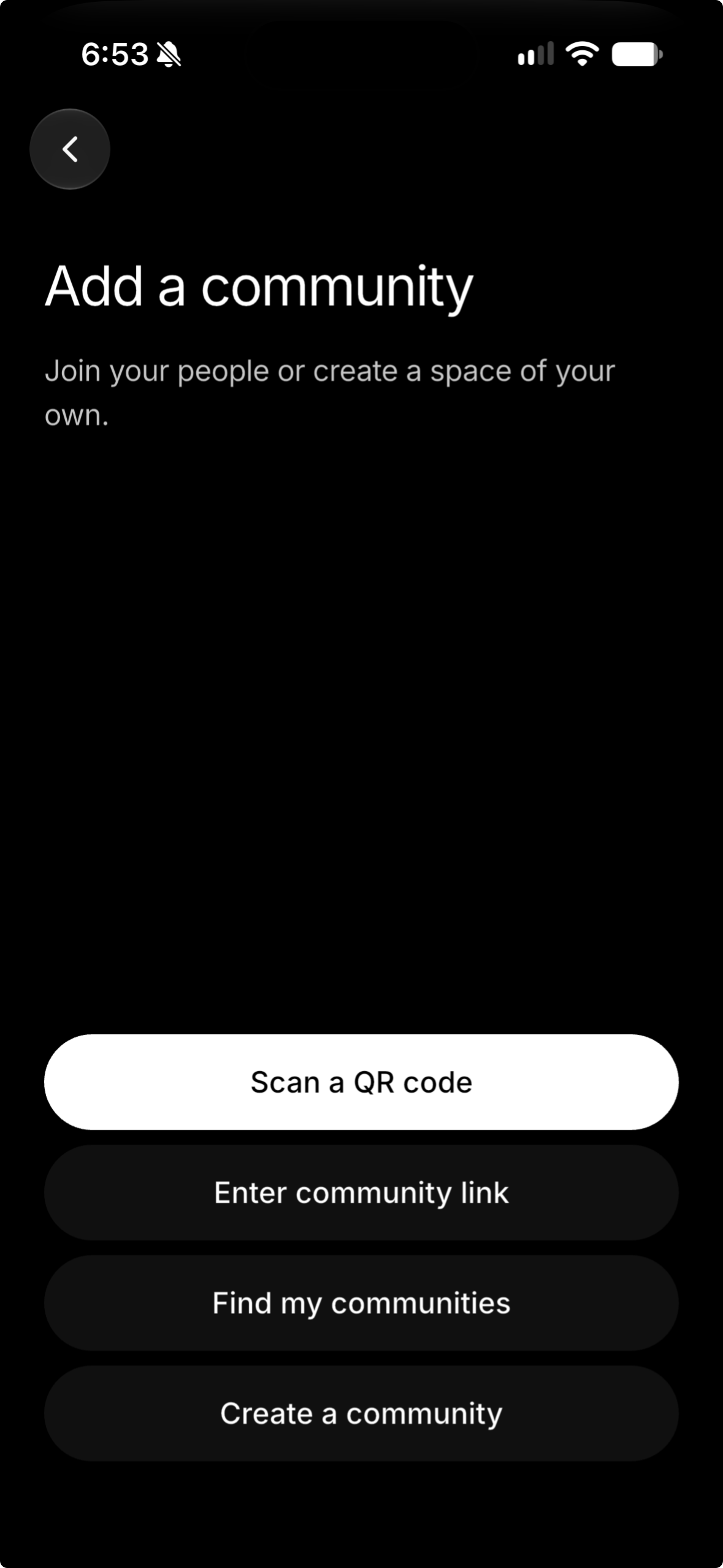
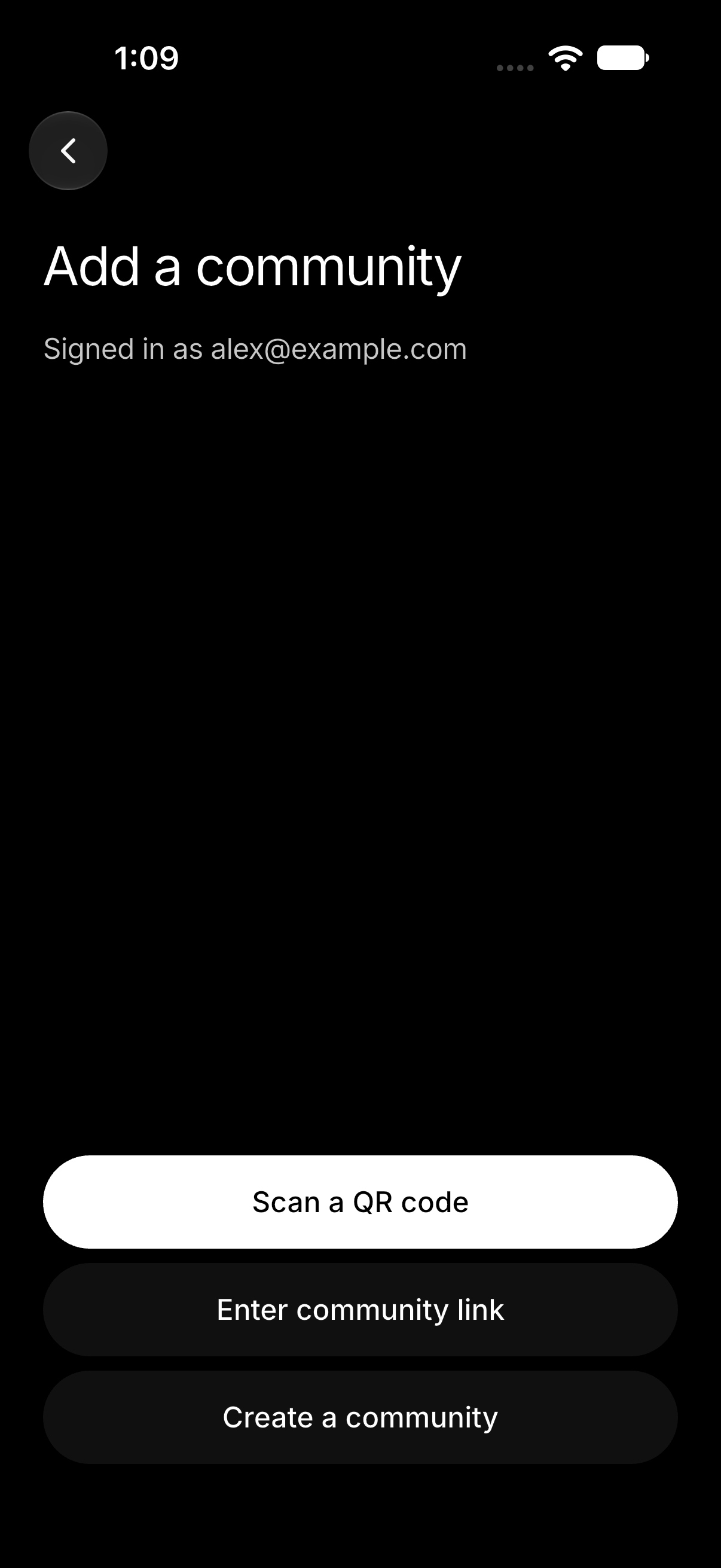
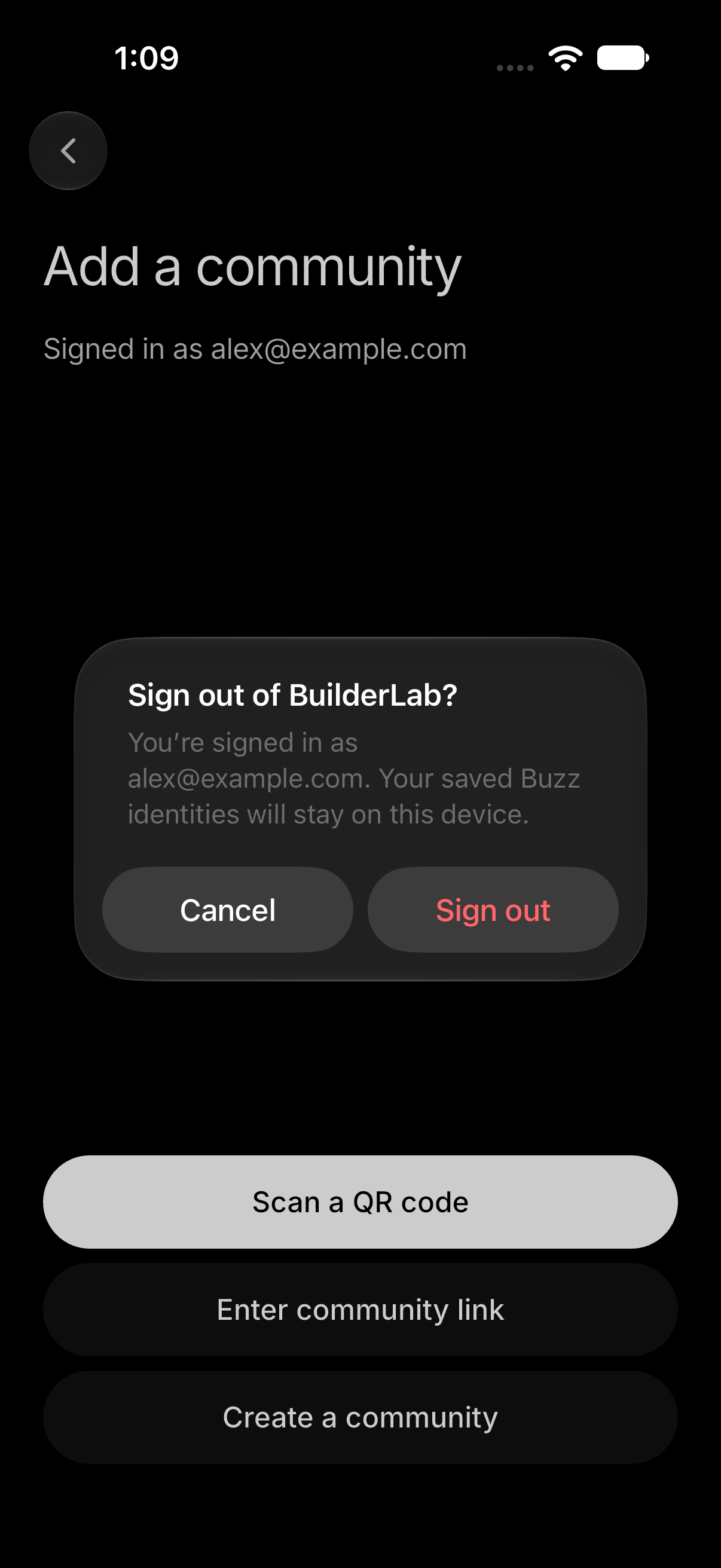
## Summary Fixes a dead-end in signed-in mobile onboarding: after leaving every community, Back kept returning to the same Add a community screen without a way to end the account session. Show “Signed in as [email]” on that screen. Back asks “Sign out of BuilderLab?” with the email; Cancel keeps the session, and Sign out returns to the welcome screen while retaining saved Buzz identities. Nested Back and Add community from an existing session keep their navigation behavior. ### Related issue None found in the existing issue and PR search for onboarding sign-out. ### Testing The new widget journey failed before the change and passes through the real onboarding widgets, account client, storage and flow with external HTTP/browser boundaries mocked. It covers nested Back, Cancel, system Back, durable session removal, retained identity/backup, and starting email sign-in again. The existing hosted onboarding journey also covers accounts without an email. On iPhone 18 Pro simulator (iOS 27), rendered the production onboarding screen and native confirmation using a disposable account fixture. Live browser account selection has not been verified; this clears the app session, not website cookies. To reproduce on an auth-enabled mobile build: sign in, leave all communities, check the displayed email, tap Back, and choose Cancel. Tap Back again and choose Sign out. The yellow welcome screen should appear, with email sign-in available. ## Screenshots Before, from the original reported phone screen: <img src="https://raw.githubusercontent.com/block/buzz/07440b3b10c3f48a6fd19c923f2ee5ba66d574f0/pr-8993--before.png" alt="Before: account state not shown" width="300"> After: Signed-in landing and native sign-out confirmation, using a disposable account: <img src="https://raw.githubusercontent.com/block/buzz/a4e18c85bc3a19d971b08ff595ba6b081c67e20f/pr-8993--landing.png" alt="Signed-in landing" width="300"> <img src="https://raw.githubusercontent.com/block/buzz/a4e18c85bc3a19d971b08ff595ba6b081c67e20f/pr-8993--confirmation.png" alt="Sign-out confirmation" width="300"> --------- Signed-off-by: Aaron <f425b86c3b780d43f8d9cf1802429d04dd985bf92eac44fca9468b5ad3887c5e@buzz.block.builderlab.xyz> Signed-off-by: John Tennant <jtennant@squareup.com> Co-authored-by: Aaron <f425b86c3b780d43f8d9cf1802429d04dd985bf92eac44fca9468b5ad3887c5e@buzz.block.builderlab.xyz> |
||
|
Tom Brow
|
da93ce3f62 |
fix(mobile): open the public Builderlab login the iOS bridge allows (#8914)
On main, "or sign in with email" on iOS fails immediately with "We could not finish connecting. You can try again." No Builderlab page opens. [#8700](https://github.com/block/buzz/pull/8700) changed the iOS browser bridge so the public account hosts (`app.builderlab.xyz`, `app.builderlabstaging.xyz`) may only open `/auth/native`. The Dart side still opens `/api/goose/v1/auth/login` for them, so the bridge rejects every public sign-in before presenting a browser. Every iOS build since #8700 is affected; organization sign-in on tenant hosts is not. The matching Dart change was Wes's [#8712](https://github.com/block/buzz/pull/8712). It was merged into the #8700 branch, but main's squash of #8700 kept only the bridge half. This PR restores #8712 on top of main: - The public account opens `/auth/native` (state, S256 challenge, callback and retained invite unchanged, without the CLI-only `type`/`product` parameters). Organization tenants keep `/api/goose/v1/auth/login`. - A saved session whose account still needs web setup goes through the same browser handoff, keeping its subject and destination. Android has no path allowlist in its browser plugin, so it needs no change. ### Validation - Reproduced on an iPhone 17 Pro (iOS 27) simulator with a main-based debug build: "or sign in with email" fails instantly. With this change applied, the same build shows the system "Buzz wants to use app.builderlab.xyz to sign in" prompt, then the login.builderlab.xyz "Welcome back to Buzz" page, which confirms production serves `/auth/native`. - Restored #8712's tests on top of main's current tests: the browser test checks the public login URL and its exact parameters, and the hosted invite journey runs for both a fresh account and a saved account that still needs setup, asserting `/auth/native` and that the invite is retained. Without the Dart fix, these fail. - Mobile format and analyze pass; the hosted onboarding journeys and `shared/hosted` tests pass with the CI auth-domain configuration. 🤖 Generated with [Claude Code](https://claude.com/claude-code) --------- Signed-off-by: Tom Brow <tomb@squareup.com> Signed-off-by: Wes <wesbillman@users.noreply.github.com> Co-authored-by: Tom Brow <tomb@squareup.com> Co-authored-by: Wes <wesbillman@users.noreply.github.com> Co-authored-by: Claude Opus 5.5 <noreply@anthropic.com> Co-authored-by: Brain <1a02c72794dcd0f07058a353bc3a81f4028b8c77c92c87fce6d5c8b85970a20b@buzz.block.builderlab.xyz> |
||
|
Tom Brow
|
9d1b684455 |
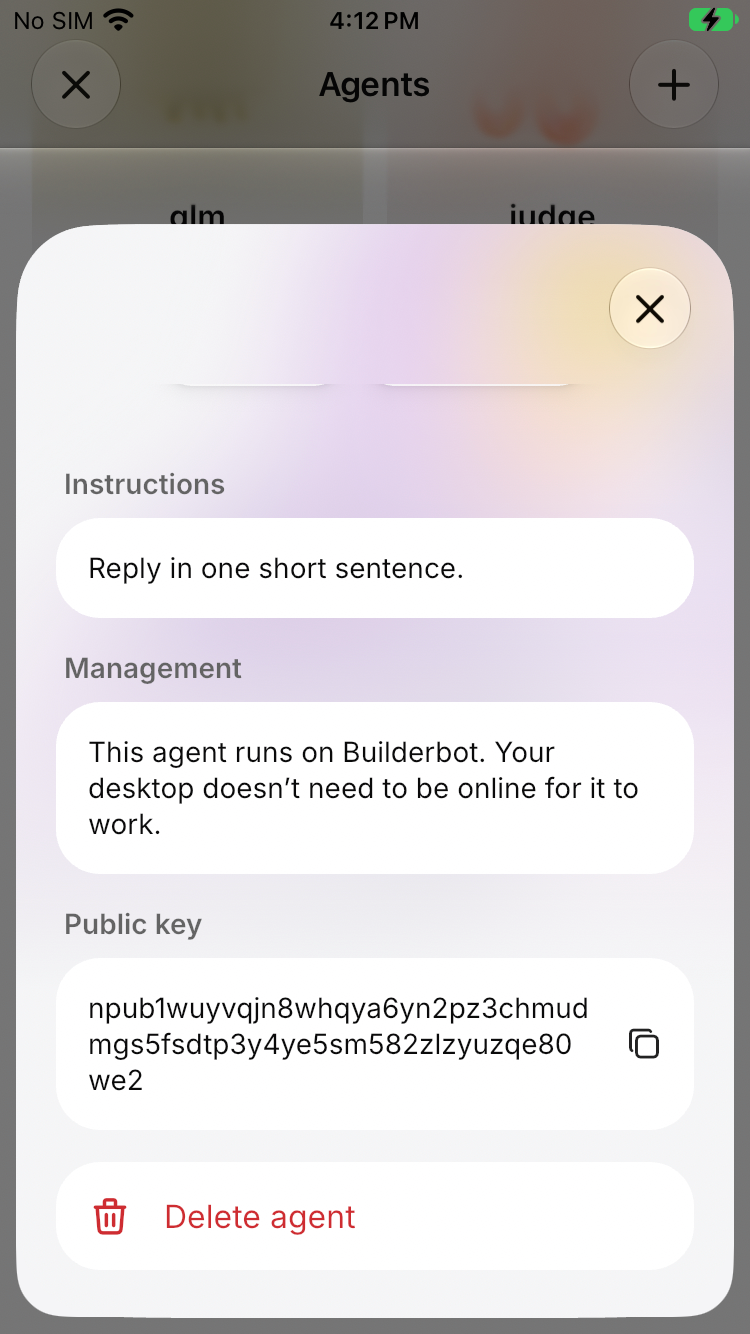
fix(mobile): show remote agent instructions from the registry (#8908)
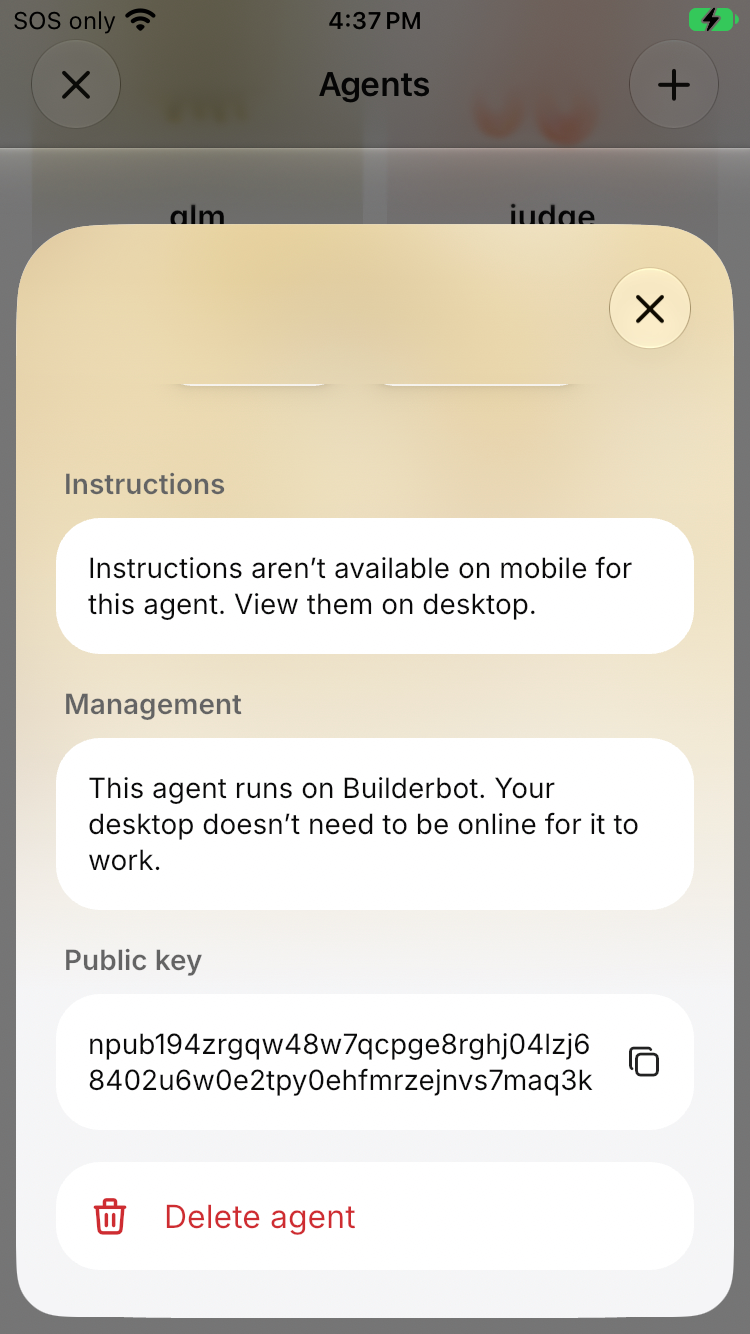
After creating a remote (Builderbot) agent with instructions on mobile, its profile said "Instructions aren't available on mobile for this agent." Two causes: - Mobile called `list-agents` without `include_instructions: true`, so registry rows had no `agent_instructions`. Desktop already sends this flag. - The profile read instructions only from published desktop agent config, which remote agents don't have. Now mobile requests instructions in `list-agents` (both the listing and the post-create readback). For an agent in the active community owner's registry listing, the profile shows the row's `agent_instructions`. Like desktop, a missing field means "No instructions set." Desktop agents keep the published-config path. Because listings now carry instructions (up to 20,000 characters each), `list-agents` gets a 4 MB response bound instead of 64 KB. The delete-retry journal, which lives in plain preferences, drops instructions before it's written. ### Before / after iPhone SE, remote-agent-pilot community: profile of an agent just created on mobile with the instructions "Reply in one short sentence." | Before (main) | After (this PR) | | --- | --- | | <img src="https://raw.githubusercontent.com/block/buzz/5d7333ea429e6c8c8aae93846d23c3a2bb9bda25/pr-8908--before-instructions.png" width="300"> | <img src="https://raw.githubusercontent.com/block/buzz/5d7333ea429e6c8c8aae93846d23c3a2bb9bda25/pr-8908--after-instructions.png" width="300"> | ### Validation - Extended `agents_sheet_test.dart`: the remote-agent case asserts the `include_instructions` flag and that the profile shows the registry text. It fails without the fix. - New/extended tests for the larger `list-agents` bound and the retry journal; each fails with its fix reverted. - `just mobile-check` and the mobile test suite pass. - iPhone SE (release build, remote-agent-pilot community): created an agent with instructions on mobile, then opened its profile, which showed them. Deleted the test agent afterward. buzz-review-completed (manual testing waived by Tom) 🤖 Generated with [Claude Code](https://claude.com/claude-code) --------- Signed-off-by: Tom Brow <tomb@squareup.com> Co-authored-by: Tom Brow <tomb@squareup.com> Co-authored-by: Claude Opus 5.5 <noreply@anthropic.com> |
||
|
Tom Brow
|
db4478e8d2 |
feat(mobile): organization sign-in for NIP-FI relays (#8700)
Block is turning on NIP-FI enforcement on the Block relay. Desktop gets organization sign-in in block/buzz-app#1424. Mobile can already attach NIP-FI assertions, but only for Builderlab-hosted communities, through the build's single Builderlab account. The dogfood build needs that account for public hosted communities, so it can't simply be pointed at the Block tenant. This adds a separate **organization realm**, configured at build time: - `BUZZ_ORGANIZATION_URL`: the tenant's HTTPS origin (for example `https://block.builderlab.xyz`). - `BUZZ_ORGANIZATION_RELAYS`: the exact relay hosts that trust that tenant. The two must be set together. The app refuses to start if they're malformed, overlap a hosted community, or reuse the hosted origin. Without them, nothing changes. For a configured relay: - The app keeps its own organization session and signs in through the browser at the tenant's existing login (`/api/goose/v1/auth/login`). Block SSO happens there. - It requests assertions from the same `/v1/buzz/identity/assertions` route that hosted communities use, and attaches them to the relay socket, HTTP, media, huddle and remote-agent requests. - Unlike the hosted path, it doesn't require an identity backup before the first binding. As on desktop, the tenant binds the member's existing key on first issuance. A key already bound to a different one is refused before any request is sent. - When signed out, it connects without an assertion and lets the relay decide. A bottom banner offers **Sign in**. After sign-in, the relay reconnects with a fresh assertion. Hosted communities keep their existing banner and flow. The tenant accepts only the registered `xyz.block.buzz.mobile:/auth/callback` return URL, so both realms share it. Each `BrowserAuth` owner leaves callbacks whose `state` belongs to another owner's attempt to that owner. ### Before merge - [ ] Kenny Lopez reviews the visible changes. ### Validation Added tests (`organization_relay_auth_test.dart`): - Configuration parsing and exact host matching. - An assertion is issued for the exact relay and key, then cached. - A different bound key is refused. - Signed out connects without an assertion. - Other relays never receive the assertion. - The shared callback is routed between the hosted and organization owners. Full `mobile-check` and `mobile-test` pass. RunnerTests pass locally except `testNativeNavigationTitleExpandsAgainAtTop`, which this PR doesn't touch. Added tests (`organization_sign_in_test.dart`, `relay_auth_isolation_test.dart`, `builderlab_account_test.dart`), each failing without its fix: - Concurrent account restores at cold start share one adopted account. - An exchange from a cancelled attempt never changes a newer sign-in. - Storage failures while clearing the intent or cancelling leave the busy state. - An unreadable saved organization session is replaced by signing in again. - A stalled organization issuer never delays a hosted relay's assertion. This test needs `BUZZ_AUTH_DOMAINS` and skips without it. CI's configured-auth-domains step doesn't list it yet, because that workflow change needs a token with `workflow` scope. Added tests also cover a restore after an offline start (the banner clears once a relay retry restores the session) and the iOS bridge allowlist (`/auth/native` and tenant login on Builderlab subdomains; other hosts, paths, ports, userinfo and fragments refused). Simulator (iPhone 17, iOS 27) with the dogfood defines against the production Block relay `buzz.block.builderlab.xyz`, on a WARP Mac: - The app starts with the organization configuration and connects to the relay while signed out, showing the organization **Sign in** banner. - **Sign in** opens the system sign-in session for `block.builderlab.xyz`, and the banner shows **Finishing organization sign-in…**. Cancelling returns to **Sign in** with no error. Before the bridge fix, no browser opened and the banner reported that sign-in did not finish. - The bottom banners (organization sign-in, hosted reconnect, and the sign-in recovery row) now sit above Home's floating Search/New bar, which used to cover **Sign in**. A journey test checks the banner clears the bar, and fails without the fix.  - The simulator run stopped at the system consent prompt (SSO does not work in the simulator). The app calls were driven through the VM service (the same `signIn()`/`cancel()` the banner buttons call) because the simulator could not be tapped. Device (iPhone 12 mini) against bb-block staging in enforce mode, where every probe without an assertion gets 401: - Signed out, the organization banner shows and the app stays responsive. Cancel at the consent prompt returns to **Sign in**, and retry works. - Block SSO through Okta completes, and the relay admits the reconnect with the assertion. - After relaunch the app connects, loads channel history, and shows no banner for over 60 seconds. - Before the restore fix, 2 of 4 cold starts showed "cannot use this community with this key" although the session was valid. With it, 8 of 8 cold starts connected. Known limitation: adding an enforcing organization relay by community link is tracked in #8791. The dogfood build enables this in squareup/buzz-releases (`tomb/dogfood-organization-sign-in`). App Store builds stay unchanged. 🤖 Generated with [Claude Code](https://claude.com/claude-code) --------- Signed-off-by: Tom Brow <tomb@squareup.com> Co-authored-by: Tom Brow <tomb@squareup.com> Co-authored-by: Claude Opus 5.5 <noreply@anthropic.com> |
||
|
klopez4212
|
0cde1fe2f4 |
Make mobile Agents a full-page owned-agent directory (#8693)
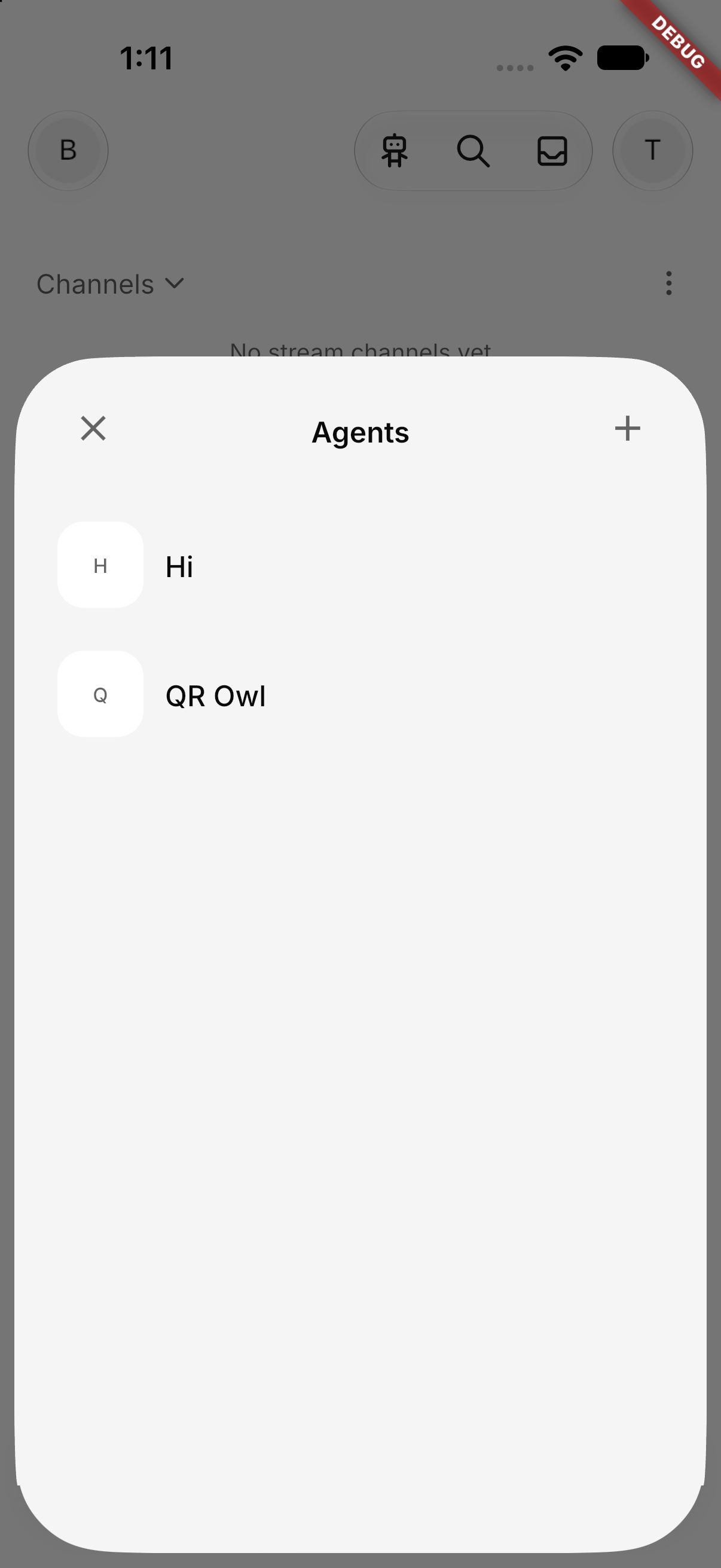
Replace the mobile Agents sheet with a full-page directory of verified owned agents. Add dedicated creation and avatar pages with catalog-backed model selection, reuse the profile emoji/photo/camera controls, and expose Builderbot model settings while labeling desktop agents “Manage on desktop.” Share one account-scoped model catalog across editable cards and retries. Choose Bestie from the agent profile using the shared encrypted main-agent record (text-only action, filled star once selected), and move confirmed deletion to a top-left trash control with native iOS glass. Include uploaded avatars in owner registrations so desktop can display them. Validation: mobile analysis and all 3,958 hosted-enabled app tests passed; default-build tests run by the push hook. Earlier iPhone build installed and iterated with the user; the current iOS build succeeds, but final changes still need a device pass. Independent review found no new blockers. Actual camera capture and live Bestie sync remain unconfirmed; the existing shared `main-agent` wire format and Bestie terminology are retained. ### Snapshots Widget-harness captures with test data (not native iOS chrome). | Agents directory | Image avatar editor | | --- | --- | |  |  | --------- Signed-off-by: kenny lopez <klopez4212@gmail.com> Co-authored-by: Terp <5856f6900e8e0a4e0ea1f4f8d2ee33e4753d2119bc122f94ecafc660b46c0511@buzz.block.builderlab.xyz> |
||
|
Tom Brow
|
a7e65c91da |
feat(mobile): choose remote agent models and gate agents on Builderlab sign-in (#8650)
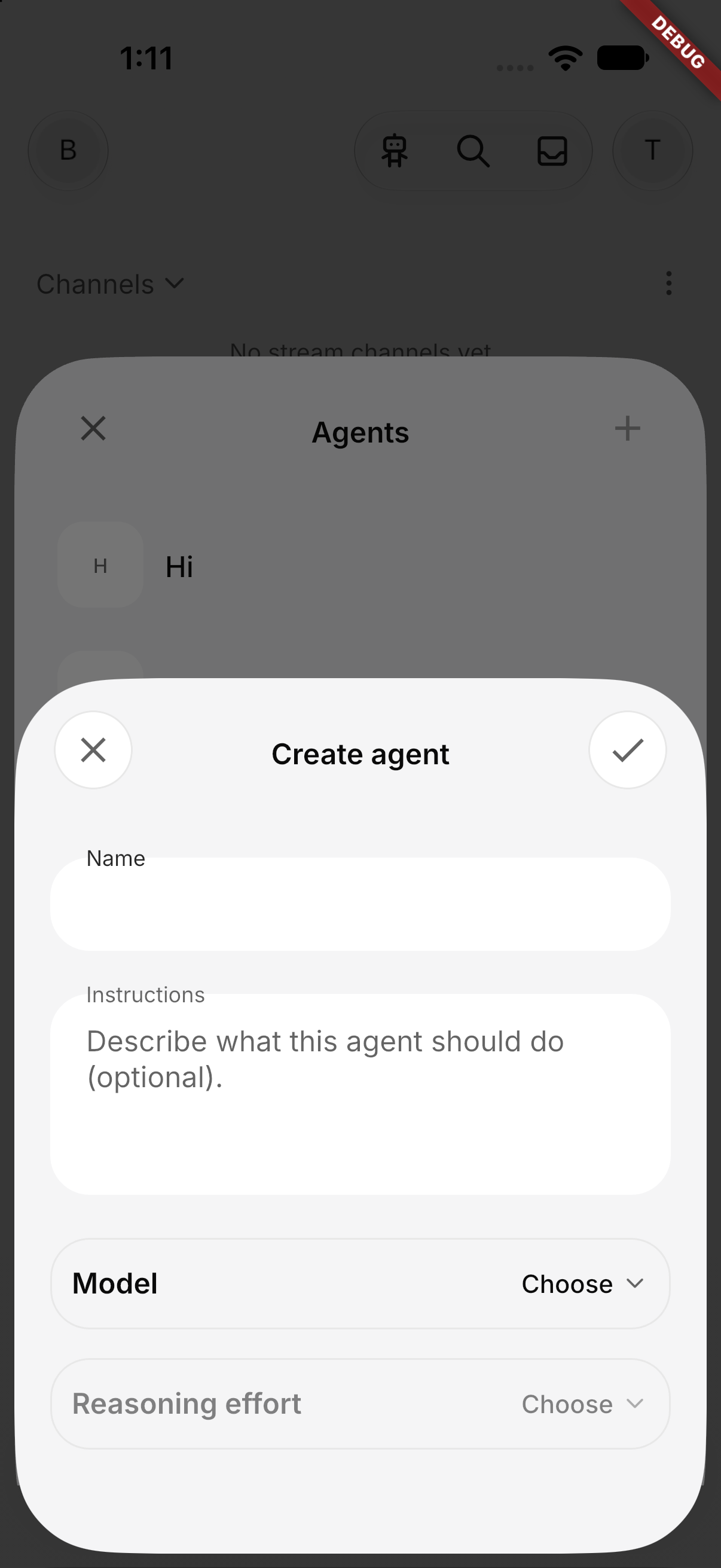
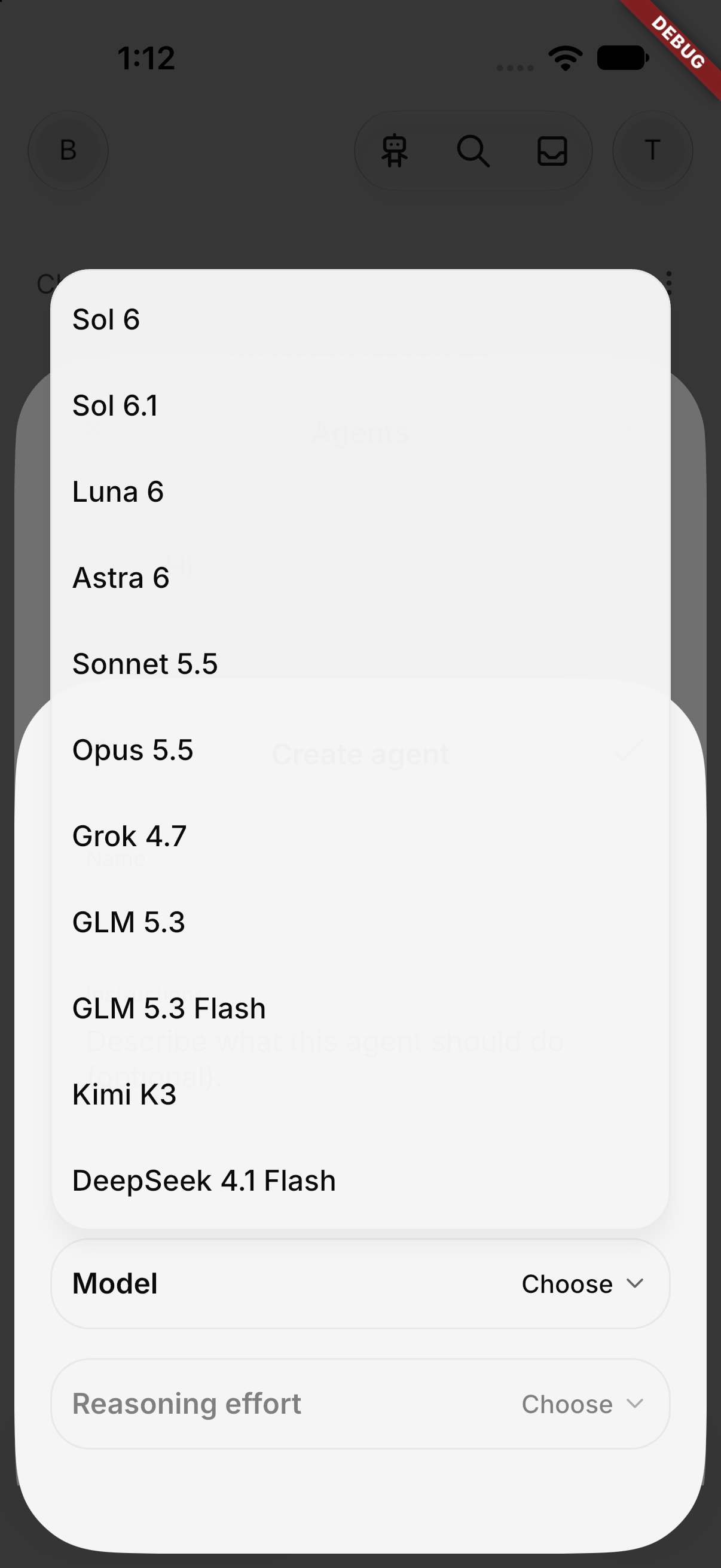
Follow-up to [#8626](https://github.com/block/buzz/pull/8626). Mobile remote-agent creation now matches desktop. - **Model and reasoning effort:** Create agent has Model and Reasoning effort menus. Their options come from the remote service's catalog, and nothing is preselected (same as desktop). The server checks the selection against the catalog again before registering, and saves it on the agent. - **Builderlab gate:** creating a remote agent requires a hosted community and Builderlab sign-in. The Agents directory, community bots and the Bestie chooser stay available without it. Signing out closes an open Create agent sheet; the Agents sheet stays open. - **Enrollment:** `attest-agent` enrolls the agent in the requested community, as on desktop, so the separate `add-buzz-subscription` call is gone. - **Quieter progress:** spinners replace the progress bars and the "Working…" label. Status and success text ("is ready", "Remote agent deleted.", setup steps) is gone, and only failures show text. Refreshing an already-loaded agent list no longer blanks it. - **Shared setting menu:** `BuzzSettingMenu` is a bordered setting row that opens a Material 3 menu spanning the row's width. Opening it dismisses the keyboard. The channel-TTL setting in Create channel uses it too. Agent avatars and QR/link-based creation follow in stacked PRs. Editing existing agents comes later. | Agents | Create | Model menu | | --- | --- | --- | | <img src="https://raw.githubusercontent.com/block/buzz/d0bee87c45d30b9bdd2163a75966ccd5d64f322a/pr-8650--1-agents.png" width="240"> | <img src="https://raw.githubusercontent.com/block/buzz/d0bee87c45d30b9bdd2163a75966ccd5d64f322a/pr-8650--2-create.png" width="240"> | <img src="https://raw.githubusercontent.com/block/buzz/d0bee87c45d30b9bdd2163a75966ccd5d64f322a/pr-8650--3-model-menu.png" width="240"> | ### Validation - Checked on the staging iOS simulator with a Builderlab account: the Agents list, the Create sheet, and the model and effort menus (including with the keyboard open). - Added tests: catalog-gated model selection (including switching models clears an unsupported effort), the Builderlab sign-in gate, controller creation and resume with a model, a failed listing reported instead of an empty registry, and create sheet busy and failure states (including the catalog reload after a rejected create). - The hosted-only agent tests are skipped without Builderlab defines, which `mobile-test` doesn't pass. They pass locally with the staging defines (20/20). - Not covered: Android. 🤖 Generated with [Claude Code](https://claude.com/claude-code) Signed-off-by: Tom Brow <tomb@block.xyz> Co-authored-by: george <973be878edd6d4f79692a3827f20a6f7fe0ed0362f269ff6b6ba8867033d7d8e@sprout-oss.stage.blox.sqprod.co> |
||
|
Wes
|
5a8102ee5b |
fix(mobile): preserve invite onboarding and offer identity setup (#8617)
## Summary Cold-start iOS invite links could open the welcome screen without continuing sign-in, and accounts without a stored backup had no explicit identity setup choice. Forward scene launch URLs to `app_links`, offer creation for an unbound account with no backups, and offer matching-key import for an existing binding without a backup. Existing key storage, binding, backup, and admission checks remain in use. Discover saved hosted destinations using `known-communities/list` and remember successfully admitted destinations with `known-communities/add`. Saved destinations are not membership proof; normal admission and the existing failed-claim membership reconciliation remain separate. A failed save preserves the intent and local community for idempotent retry. ### Related issue Related to #8599 (QR-first mobile onboarding) and #8601 (invite policy consent; overlapping setup UI). No exact duplicate found in the open onboarding PR / identity-backup issue search. ### Validation before the latest main integration - 48 tests passed across five focused files: `hosted_journeys_test`, `hosted_communities_test`, `hosted_communities_flow_test`, `hosted_environment_flow_test`, and `hosted_multi_backup_recovery_test`. Test defines enable hosted domains and the push gateway. - Four additional pairing handoff tests passed with hosted domains enabled after updating their shared HTTP fixture for community saving. - Targeted Dart analysis: no issues. Required pre-commit and pre-push hooks passed, including the broader mobile analysis/test lane and file-size checks. - Native iOS build passed during iteration. On an isolated iOS simulator, a terminated app opened from an invite automatically entered browser login; human recording confirmed login continued into identity setup and new identity creation. - Human staging testing on October 27 passed invite entry with an existing email/password and new identity, community entry, messaging, cold restart, and recovery on two separate clean iOS simulators. These results apply to build `ff2138fc325790e0af4d9a64b2ed033fae3a8295`; the backend backup-upload blocker described previously is no longer blocking that tested flow. - Fresh-account signup through an invite is deferred. Physical-camera QR scanning, native regression/mutation coverage, independent review, and native retesting after the latest main integration remain outstanding. - Known limitation: failed-claim membership reconciliation still calls `communities/joined`; its endpoint/response contract needs alignment with the supported backend before that fallback is considered ready. The successful primary recovery path does not prove this fallback. - No account reset tooling, environment-specific credentials, generated dependency files, or recording artifacts are included. ### Current review fixes and validation Head `9902a98d42904a4a7d44a79541d81ceb94d8eac3` addresses the two review blockers and both small import races: - Hosted imports explain a linked-account key mismatch; the shared self-hosted/occupied-device message remains unchanged. The linked-account journey enters the wrong key through the actual sheet, checks the visible error and empty storage, then imports the correct key. - Closing the import sheet while its operation is pending now waits for that operation and resumes successful setup. The new-account journey covers creation and import, including dismissal while awaiting the status response, binding, backup receipt, and retry. - An unbound account with newly appeared backups refuses direct import, preserving recovery's receipt-before-adoption rule. The existing multiple-backup invariant covers matching and different imported keys. - The configured route journey uses host labels and its existing fake account now supports destination saving; the real-account journeys separately exercise persistence. 53 tests passed across six focused files with CI's `BUZZ_AUTH_DOMAINS=buzz.xyz,builderlab.xyz,builderlabstaging.xyz` and push-gateway define. In a separate clone with independent Git metadata/build output, restoring the old production import paths failed the three intended regressions; restoring the fixes passed all 43 tests in that control. Required pre-commit and pre-push hooks passed, including mobile analysis/tests and file-size checks. Hosted CI and native retesting of this head are still pending. The earlier independent review was at `10815e5d9`; these fixes still need reviewer confirmation. Optional accessibility and import-navigation refinements are deferred. Fresh signup, authenticated production add/list and the membership fallback remain open as described above. ### Staging testing and production configuration Staging selection is build configuration, not a changed production default. `HostedEnvironment` is unchanged by this PR: `BUZZ_BUILDERLAB_URL` defaults to `https://app.builderlab.xyz`; `BUZZ_AUTH_DOMAINS` is empty by default (hosted account features disabled). Builds that enable production hosted domains receive these onboarding behavior fixes after merge. This PR does not deploy anything or redirect production builds to staging. Check out this PR (`gh pr checkout 8617` in a dedicated `block/buzz` checkout/worktree), install dependencies per `mobile/README.md`, and boot a clean iOS simulator. With the repository-pinned Flutter toolchain: ```sh . ./bin/activate-hermit ./scripts/mobile-worktree-overrides.sh cd mobile flutter run -d <clean-simulator-udid> \ --dart-define=BUZZ_BUILDERLAB_URL=https://app.builderlabstaging.xyz \ --dart-define=BUZZ_AUTH_DOMAINS=communities.public.builderlabstaging.xyz \ --dart-define=BUZZ_DEBUG_PRIVATE_LOGIN=true ``` Private login requests an ephemeral browser session only in debug builds. Hosted relay assertions remain off by default; this test does not validate assertion-enabled admission. Generated local Xcode settings, dependency metadata, credentials, and simulator state are not included in the PR. - Invite test: open a valid public-staging invite in the simulator browser, choose **Accept invite in Buzz**, sign in or sign up, complete identity setup, enter the community, and send a message. - Recovery test: preserve that simulator, start another clean simulator with the same build, choose **or sign in with email**, and sign into the same account. Verify the recovered public key matches, the saved community and earlier message return, and a new message sends. - Fresh signup: repeat invite entry using a new account. This still needs human verification. Keep this PR draft while the listed validation gaps remain. --------- Signed-off-by: Wes <wesbillman@users.noreply.github.com> Co-authored-by: Brain <1a02c72794dcd0f07058a353bc3a81f4028b8c77c92c87fce6d5c8b85970a20b@buzz.block.builderlab.xyz> |
||
|
Tom Brow
|
d4a07063c8 |
feat(mobile): manage Builderlab remote agents (#8626)
Adds Builderlab remote agents to mobile: a member signed in to Builderlab can list, create and delete their own hosted agents from the channels header, and active remote agents show as Online. Everything is gated by `HostedEnvironment.enabled` (the build-time `BUZZ_AUTH_DOMAINS` define). App Store and internal release builds do not set it, so they render and fetch nothing new. ### Behavior - **Agents** button in the channels header (native iOS bar and Material header) for hosted communities only. It opens a sheet listing the community's agents; tapping one pushes its profile inside the same sheet. - **Create**: for the member's own agents (the NIP-OA owner is the member, not the community). Registers the agent with Beekeeper, attests it to the community, saves optional private instructions, subscribes it to the relay, then publishes the kind 30177 registration with a NIP-OA owner proof. A failed step resumes with the same agent identity on retry; instructions stay in secure storage, never in preferences. - **Delete**: removes the relay registration, confirms it is gone, then deletes the Beekeeper agent. A partial failure keeps a retry row in the list. - **Presence**: an ACTIVE agent with a live kind 30177 registration on the active relay shows Online in profiles, channel rows, DMs and mentions, since remote agents wake on messages. Local presence data is unchanged. - Sign-in reuses the shared hosted flow. The account's saved Buzz key must match the server binding; nothing is adopted or rewritten. - `BuilderlabAccountClient` gains an allowlist for the six Beekeeper routes desktop already uses. Not included from the prototype: the separate entrypoint and second sign-in, test-community creation, staging-only hosts, QR-code agent links, and the USB proxy. ### Validation - Added tests: build-time gate, account/key binding before listing, setup resume with private instructions, deletion contract and retry, owner-proof verification, status parsing, presented presence requiring a live registration in the active community and following registration publish and removal (mutation-checked), account-change clearing, load retry, recovery of a pending setup whose instructions were lost, a lost registration response that can only resume with the same idempotency key (from any community), an HTTP-rejected registration that can be discarded, deletion of other agents while a setup is unfinished, rejection of owner proofs whose signed conditions or profile signature fail, registration publish and removal over a loopback WebSocket relay for an `http://`-saved community, and widget tests for in-sheet detail navigation, creation overlay with failure then resume, and delete confirmation. - The new tests also run in the CI lane with `BUZZ_AUTH_DOMAINS` configured, so the enabled path is covered. - Full mobile format, analyze and test suite pass locally. - Independent agent review: no gate leak or key-handling issue found; its robustness findings (discarding a setup that never got a server identity, clearing registry state on account change, retrying a skipped load, guarded notifications) are fixed; discard and account change have added tests. - Simulator: a `BUZZ_AUTH_DOMAINS` debug build launches to Builderlab sign-in. The signed-in flow was not re-run on this branch. - Codex Security Review: an earlier head received a published review, and its two findings were fixed. On |
||
|
Wes
|
b6aa5539e3 |
feat(mobile): account onboarding, key recovery and hosted reconnect (#8375)
## Behavior Adds optional mobile Builderlab sign-in, identity backup/recovery, community discovery/creation, and account-aware reconnect. **Builderlab features are disabled by default:** when `BUZZ_AUTH_DOMAINS` is unset or empty, account login, creation, backup/recovery, reconnect prompts, and background account restoration are hidden/disabled. QR/code pairing, links, and invites retain Nostr-only entry. Saved account state is retained for later opt-in. `--dart-define=BUZZ_AUTH_DOMAINS=communities.buzz.xyz,communities.public.builderlabstaging.xyz` opts those DNS domains and their subdomains into required account setup. The same policy gates pairing, deep links, durable community admission, and reconnect. A nonempty list enables Builderlab features; `BUZZ_BUILDERLAB_URL` alone does not. Enabled flows still require their backend services. Existing Nostr relay authentication remains mandatory. `BUZZ_HOSTED_RELAY_AUTH=true` enables scoped relay assertions and reconnect prompts only for configured authentication domains. Configure assertion issuance and each community's issuer binding before enabling assertions; enable relay enforcement last. Account credentials stay at Builderlab. Wrong-account recovery preserves keys; failed writes are not replayed; authentication is bounded by request deadlines. Hosted flows preserve keys across cancellation/restart, reconcile interrupted creation/invitation acceptance, and support manual nsec file import/export. Account identities are scoped to backend and authenticated subject; reusing an existing local key for an unbound account requires an explicit selection. Recovery reconciles the advertised and recovered inventories before automatic selection. Successful self-hosted admission retires its pending key, and iOS startup removes interrupted export files. Adds authenticated relay `GET /operator/communities/joined` for the companion Builderlab membership endpoint. ## Validation - Follow-up review repair at `66a12ac92`: self-hosted entry presents readable choices and import despite incomplete enumeration, while generation still requires a complete empty inventory; explicit selection uses exact-key lookup. Consuming a value-equal duplicate now advances dispatch. Reconnect requires an existing account binding or a subject-scoped backup receipt before signing an assertion, and pins the subject inside the serialized account request. An empty different account is refused without sending key proof. Focused checks: configured domains 58 passed; default 49 passed, 9 hosted-only skips. Separate isolated mutations fail the incomplete-inventory sheet, exact-key reuse, duplicate dispatch and reconnect journeys (including an empty-account-only bypass); restored controls pass. Evidence uses synthetic storage/network boundaries, not physical Android or live backend association. All mandatory commit/push hooks passed; fresh GitHub CI is pending. - Bounded review repair at `d3cc0003f`: incomplete secure-storage enumeration now blocks automatic identity generation while explicit known-key reads retain their fallback; declined/failed onboarding links release the queue; HTTP 429/5xx keeps Retry regardless of response encoding. Default app-gate coverage exercises a bind link followed by ordinary community entry. Focused checks: configured domains 47 passed; default 38 passed, 9 hosted-only skips. Removing the three production fixes in an isolated source/Git/build copy fails the identity-resolution, declined/failed queue, and Retry journey assertions; clean and restored controls pass. Storage and HTTP failures are synthetic; physical Android and live outage behavior were not exercised. Published after all mandatory commit/push hooks passed (mobile analysis/tests, branch-skew and file-size gates); fresh GitHub CI remains pending. - Existing whole-PR source review cleared the reconnect defects at `fb15d5b82`. - Domain-policy increment: focused environment, entry, app-gate, pairing and onboarding journeys pass with empty and configured domains. Existing pairing provider/page tests pass. Changed Dart files analyze cleanly. - Isolated source/Git/build mutation: forcing paired credentials through hosted login fails the default-build journey; clean and restored controls pass. CI now runs configured-domain journeys in addition to the default-build suite. - Integrated main through `5b433d929` at `0067c069c`, including its pinned Flutter upgrade. Preserved the PR welcome UI with the updated transition API and added Material surfaces around onboarding selection/consent rows. Focused post-merge runs pass in both configurations; all mandatory local push gates passed (mobile analysis/tests, Rust tests, desktop-native checks, branch-skew and file-size checks). - Merge-review repair at `a315bce11`: focused identity/storage/admission and widget journeys pass, including account switching with an empty or already-bound second account, explicit reuse, and self-hosted removal/rejoin with another key. Default-domain journeys pass too (hosted-only cases intentionally skip there). - Isolated source/Git/build mutation checks: bypassing account scoping, reuse consent, pending-key retirement, or recovery inventory reconciliation fails the relevant journey/invariant assertions; clean and restored controls pass. - Native `RunnerTests/IdentityFilePluginTests`: both tests pass on the iPhone 18 Pro iOS 27 simulator with an isolated app identifier. At `24a0dcaac`, the picker journey seeds residue in Library/Caches, matching path_provider_foundation, and verifies plugin startup removes it while preserving an unrelated file. The earlier tmp-only fixture did not exercise the actual export location. This is synthetic native cleanup/picker evidence, not a real terminated-share or live account round trip. - Follow-up: Caches and tmp cleanup; fallback to individually known identity slots when Android bulk enumeration fails; explicit replacement of a refused self-hosted key preserves its original before swapping the retry slot. Configured-domain journeys/invariants: 34 passed; default: 31 passed, 3 hosted-only skips. Isolated enumeration/retry mutations fail with passing controls. Bulk-read fallback preserves but cannot enumerate arbitrary other-account slots until bulk reads recover. - Configured-domain CI exposed a stale pairing-status assertion after account scoping. The repaired test checks the admission mismatch, preserved account/transfer keys, and no admitted community. The configured-domain CI selection passes locally (56 tests); removing the production mismatch guard fails the updated test, with clean/restored controls passing. This is synthetic coordinator evidence, not physical QR acceptance. - Final review repair (`40e1e6101`): native iOS export creation uses atomic complete file protection; normal and restart cleanup remain. Account/policy/claim HTTP uses one 30-second total deadline with request abort and body cancellation. Removed the unrelated NIP-FA spec edit. - Focused account/admission/export tests: 25 pass; configured-domain account/admission/onboarding journeys: 33 pass. Isolated deadline and native-dispatch mutations fail, with passing clean/restored controls. Native export/picker tests: 2 pass on iOS 27 simulator. The real file-protection attribute assertion is physical-device-only because simulator provides no Data Protection attribute; locked-device protection and interrupted real sharing have not been observed. - Opt-in UI: configured-domain CI selection passes (57 tests); default selection passes (7 tests, 10 hosted-only skips); URL-only plus whitespace/empty domains passes (6 tests, 9 hosted-only skips). Changed Dart files analyze cleanly. Independent mutations that unconditionally initialize the coordinator in the app gate, welcome entry, or link form fail the default journey; clean/restored controls pass. - Native welcome screens exercised on iPhone 18 Pro / iOS 27 simulator in default and configured builds: default exposes community link / QR / pairing code only; configured build additionally exposes Builderlab connection and community creation. No live hosted login was exercised in this check. - Delivery at `e48fe73a9`: all mandatory push hooks passed (full mobile analysis/tests, Rust tests, desktop-native checks, branch and file-size checks). GitHub checks had not yet populated at the immediate post-push snapshot. ## Review disposition | Feedback | Disposition | | --- | --- | | Explicit self-hosted entry under unreadable inventory, duplicate invite dispatch, reconnect cross-account binding ([entry](https://github.com/block/buzz/pull/8375#discussion_r4318421622), [queue](https://github.com/block/buzz/pull/8375#discussion_r4318421640), [reconnect](https://github.com/block/buzz/pull/8375#discussion_r4318455512)) | Repaired at `66a12ac92`; evidence above. Reconnect refuses unproven ownership rather than silently establishing a binding. | | Incomplete Android identity inventory, stranded deep-link queue, transient HTTP retry classification ([review](https://github.com/block/buzz/pull/8375#pullrequestreview-5576864143)) | All three repaired in `d3cc0003f`; focused journeys and isolated mutation evidence above. | | Account cross-link, incomplete recovery inventory, committed invite checkpoint, pending local key retirement/replacement | Repaired in the preceding commits; journey and mutation evidence above. | | iOS interrupted key export ([review](https://github.com/block/buzz/pull/8375#pullrequestreview-5575253252)) | Native cleanup plus complete protection at creation implemented. Physical-device lock and real interrupted sharing acceptance remains pending. | | Trickle responses bypass idle timeout; unrelated NIP-FA edit ([review](https://github.com/block/buzz/pull/8375#pullrequestreview-5575764556)) | Total request deadline/abort implemented; spec edit removed. | | Production domains rejected | Ordinary entry now needs no Builderlab configuration. Opt-in account-required domains must still use supported community mappings. | | Lost Android Keystore recovery | Backup exclusions prevent the reviewed stale-restore scenario; genuine key loss still has no in-app recovery/reset and remains deferred. | | Native secp256k1 dependency question | Obsolete against the current base: upstream C integration landed in #8398; no package diff remains here. | | Operator membership endpoint contract | Documentation now states the operator chooses the pubkey; no end-user session binding is implied. Additional handler-level coverage is optional follow-up. | | Optional Android partial document cleanup/activity retention; local work after backup cancellation | Follow-up hardening, not claimed implemented. Cancellation prevents remote backup upload. | | Semgrep crypto inventory notices | Informational inventory, not demonstrated defects. | ## Remaining draft gates Native QR/browser-return acceptance remains unverified for this revision. Optional Builderlab onboarding still needs backend backup-status and joined-community routes, recovery policy/configuration, and real backup/recovery/reconnect acceptance. The empty-domain build removes these services as prerequisites for ordinary pairing; it does not make the optional hosted flows backend-ready. Human acceptance and current CI are still required before merge. Review dispositions retained: production auth-domain configuration must use supported community mappings; enabling `builderlab.xyz` does not add support for `buzz.block.builderlab.xyz`. Recovery after genuinely losing an Android Keystore key remains a follow-up, not a newly implemented capability. Human acceptance steps: build once without `BUZZ_AUTH_DOMAINS` (including with a previously saved account) and confirm no Builderlab controls/restoration while ordinary link and QR/code entry work. Build with supported domains and confirm connection/creation appear; exercise browser return and live backup/recovery/reconnect. On physical iOS, exercise export and interrupted sharing/locked-device protection. Record results before marking review complete. --------- Signed-off-by: Wes <wesbillman@users.noreply.github.com> Co-authored-by: Brain <1a02c72794dcd0f07058a353bc3a81f4028b8c77c92c87fce6d5c8b85970a20b@buzz.block.builderlab.xyz> Co-authored-by: Brain <1a02c72794dcd0f07058a353bc3a81f4028b8c77c92c87fce6d5c8b85970a20b@wes.communities.public.builderlabstaging.xyz> |