**Category:** new-feature
**User Impact:** Workflow authors can build filtered, runtime-aware
automations, understand them at a glance, and get a clear warning before
turning on workflows likely to run often.
**Problem:** Workflow setup exposed raw configuration without enough
help composing message templates, filtering triggers, or understanding
saved behavior; activation could also make a broadly triggered workflow
live without explaining its likely frequency.
**Solution:** Batch 3 adds local, deterministic template variables,
trigger filters, and semantic summaries, then refines cards and
activation around configured behavior and a risk-aware warning boundary.
Scheduling remains the already-shipped implementation, advanced
expressions remain lossless, and network-backed identity/message
enrichment stays in Batch 4.
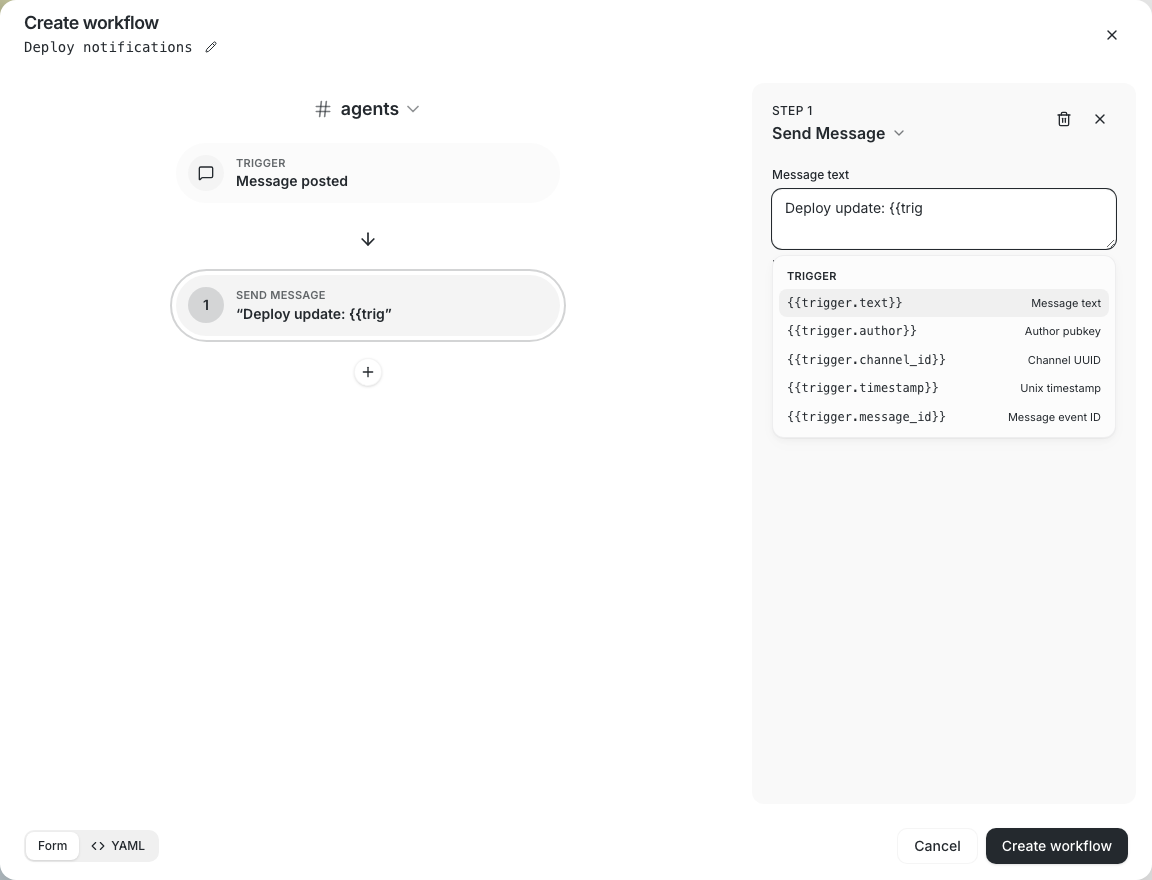
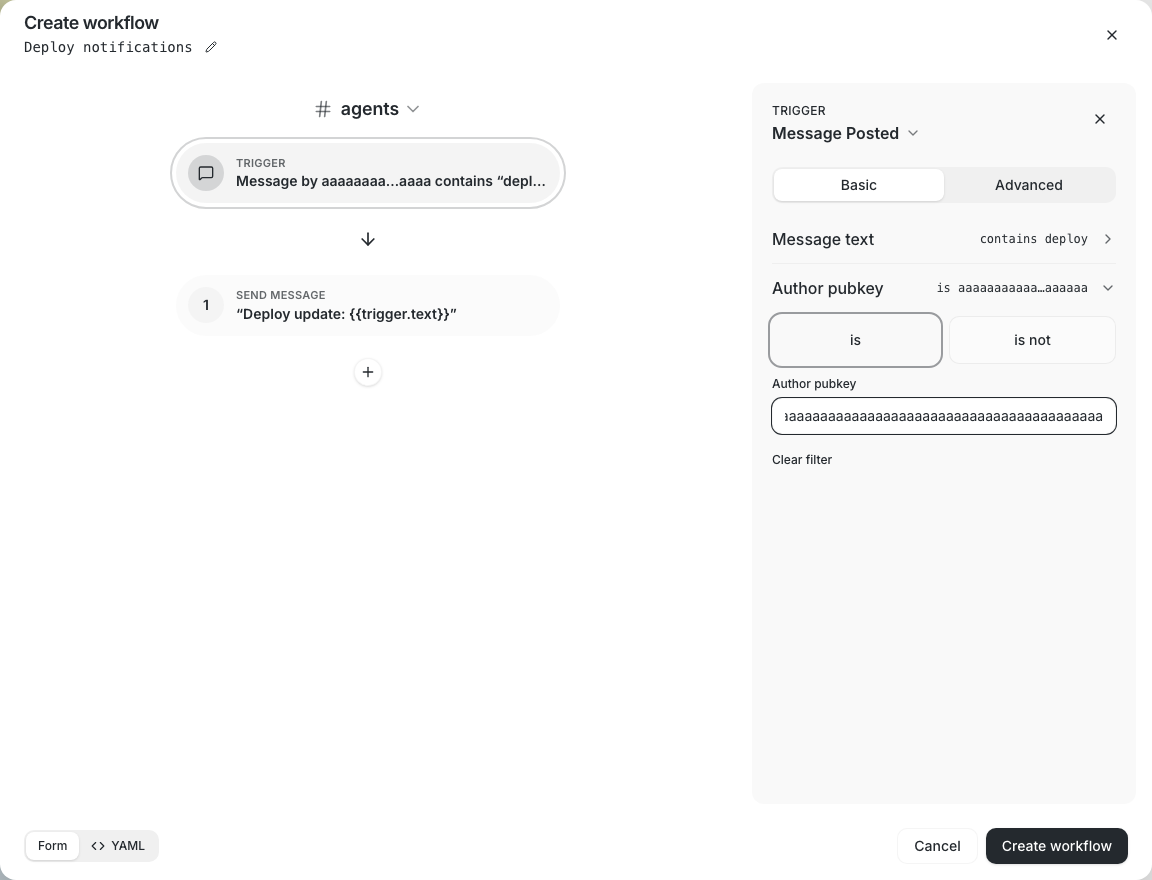
| Message inputs | Trigger filters |
| --- | --- |
| Caret-aware, keyboard-accessible suggestions expose trigger-local
values and safe prior-step outputs in `send_message.text`. | Structured
conditions and validated manual IDs block invalid submission while
preserving advanced expressions. |
| 
| 
|
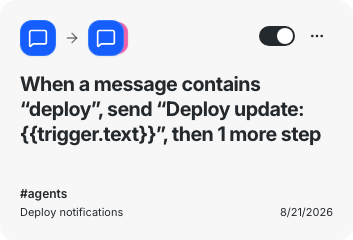
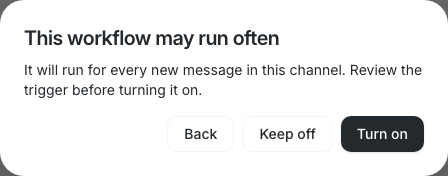
| Workflow cards | Risk-aware activation |
| --- | --- |
| Semantic labels, channel-first hierarchy, configured reaction/action
visuals, real step stacks, and compact status controls make behavior
scannable. | Broad message and frequent schedule triggers explain the
risk before **Turn on**; narrowly scoped triggers proceed without
unnecessary ceremony. |
| 
| 
|
## Changes
<details>
<summary>File changes</summary>
**desktop/src/features/workflows/ui/WorkflowActionsMenu.tsx**
Separates direct card status controls from secondary actions while
retaining modal status actions.
**desktop/src/features/workflows/ui/WorkflowCard.tsx**
Adds semantic behavior, channel-first hierarchy, configured
reaction/action visuals, real subsequent-step stacks, status controls,
and reduced-motion-aware trigger feedback.
**desktop/src/features/workflows/ui/WorkflowDialog.tsx**
Warns before activating broadly triggered workflows while allowing
narrowly scoped workflows to proceed directly.
**desktop/src/features/workflows/ui/WorkflowFormBuilder.tsx**
Connects structured trigger filters and template-aware step inputs while
preserving schedules, trigger transitions, and selected YAML authority.
**desktop/src/features/workflows/ui/WorkflowStepCard.tsx**
Replaces generic labels with deterministic configured-step descriptions.
**desktop/src/features/workflows/ui/WorkflowTemplateTextarea.tsx**
Adds caret-aware variable suggestions with keyboard navigation and focus
restoration.
**desktop/src/features/workflows/ui/WorkflowTriggerConditions.tsx**
Adds structured local filters, validated author/message IDs, and a
lossless advanced-expression fallback.
**desktop/src/features/workflows/ui/workflowActivationWarning.ts** and
**workflowActivationWarning.test.mjs**
Classify broad message and frequent schedule triggers for contextual
activation warnings.
**desktop/src/features/workflows/ui/workflowConditionExpression.ts** and
**workflowConditionExpression.test.mjs**
Model and cover parsing, serialization, validation, and
advanced-expression preservation.
**desktop/src/features/workflows/ui/workflowDefinition.ts** and
**workflowDefinition.test.mjs**
Preserve trigger/step configuration and derive deterministic card
metadata across YAML round trips.
**desktop/src/features/workflows/ui/workflowStepDescription.ts** and
**workflowStepDescription.test.mjs**
Generate and cover local step summaries.
**desktop/src/features/workflows/ui/workflowTemplateVariables.ts** and
**workflowTemplateVariables.test.mjs**
Define and cover trigger-specific, order-bounded variables and caret
insertion.
**desktop/src/features/workflows/ui/workflowTriggerDescription.ts** and
**workflowTriggerDescription.test.mjs**
Generate and cover semantic trigger summaries without network lookups.
**desktop/tests/e2e/workflow-local-controls.spec.ts** and snapshot
Cover filters, IDs, advanced expressions, autocomplete, activation
choices, summaries, and YAML authority.
**desktop/tests/e2e/workflow-reaction-picker.spec.ts**
Covers configured reaction emoji in workflow nodes and summaries.
**desktop/tests/e2e/workflows.spec.ts**
Covers risk-aware activation warnings, direct safe creation,
duplication, and card status controls.
</details>
## Reproduction steps
1. Create a message-posted workflow in **Workflows**, add a Send message
step, and type `{{trig`; verify keyboard-selectable variables insert at
the caret.
2. Configure message-text and manual ID filters; verify malformed IDs
block submission and advanced expressions survive Form/YAML transitions.
3. Create a broad message workflow; verify **Back** persists nothing,
**Keep off** saves it disabled, and **Turn on** enables it. Confirm a
narrowly triggered webhook skips the warning.
4. Inspect the saved card; verify its channel, semantic behavior,
configured actions/reaction, real step stack, and status are
understandable without opening YAML.
## Validation
Validated at exact clean head `f99503819889b95ee3c61657c5c3850aae35481e`
on base `24ec6a468ec9d0d425ee58fbfc4d416412c446ad`.
- Focused workflow regressions passed 59/60 locally; the only local miss
was a 438-pixel macOS snapshot drift, while the checked-in Linux
baseline comes from the failing CI artifact. Repository pre-push gates
and E2E build/typecheck passed.
- A broader 36-test smoke invocation had 31 passes and five unrelated
pre-existing expectation/snapshot failures, so it is not claimed as
fully green. Adversarial fixes are recorded in [round
one](https://github.com/block/buzz/pull/6470#issuecomment-5366366670)
and [round
two](https://github.com/block/buzz/pull/6470#issuecomment-5366407535).
---------
Signed-off-by: Taylor Ho <taylorkmho@gmail.com>
Signed-off-by: Rizz <302abe414ca6e3134763d2539bfcf145aea2a63fe5f8455204ed602fd40cf381@buzz.block.builderlab.xyz>
Co-authored-by: Rizz <302abe414ca6e3134763d2539bfcf145aea2a63fe5f8455204ed602fd40cf381@buzz.block.builderlab.xyz>
Co-authored-by: Carl <acda9e433d19dcd0e6b6840f7f4b98f3a56f1fab98049d444c087019e6d36560@buzz.block.builderlab.xyz>
Co-authored-by: Mongo <5398c5fd039b963ce132b3e078e7c4af097dd997517bb5e14c2682fe68c25197@buzz.block.builderlab.xyz>
The `send_message` workflow action could only post new top-level channel
messages. This adds a `reply_in_thread` option so a `message_posted`
workflow can reply in the triggering message's thread, plus a
`trigger_is_reply` filter variable so a workflow can fire only on
top-level messages.

Every NIP-10 thread-marker reader in the tree now routes through one
shared parser and one collapse rule in `buzz-core`, deleting four
hand-rolled copies that had drifted on id-validity and marker semantics.

## What changed

- **Schema** (`crates/buzz-workflow/src/schema.rs`): new
`reply_in_thread: bool` (serde default `false`) on
`ActionDef::SendMessage`. `validate()` rejects `reply_in_thread: true`
on `schedule`/`webhook` triggers — they carry no message to reply to.
- **Executor** (`crates/buzz-workflow/src/executor.rs`): threads
`reply_to: Option<&str>` (the trigger `message_id`) through
`ActionSink::send_message` when `reply_in_thread` is set; errors clearly
if the trigger has no `message_id`. `resolve_step_templates` carries the
new field. Adds `trigger_is_reply` (boolean) to the eval context.
- **Relay sink** (`crates/buzz-relay/src/workflow_sink.rs`): when
`reply_to` is set, resolves parent/root/depth from the known trigger
event, persists real thread metadata instead of the hardcoded top-level
`depth: 0`, and pushes the live kind:39005 thread-summary overlay after
insert so subscribed desktops update the root's reply badge without
refetching — matching the human ingest path. Emits the same NIP-10
`e`-tag shape as `buzz_sdk::builders::thread_tags`: a single `["e", id,
"", "reply"]` tag for a direct reply (parent == root), and the `root` +
`reply` pair only when nested — so every writer produces one wire shape
per reply kind.
- **Ingest resolver** (`crates/buzz-relay/src/handlers/ingest.rs`): new
`resolve_relay_reply_thread_meta` + `ReplyAncestry`. Unlike the
client-facing `resolve_nip10_thread_meta` (which validates
client-supplied tags), this computes root/depth from the known parent
and enforces the same same-channel and depth-limit invariants. When the
parent has no `thread_metadata` row, both resolvers share
`derive_ancestry_from_parent_tags`, which applies
`ThreadMarkers::resolve()`: a marked nested parent remains depth 2,
while a root-only, malformed, or unmarked parent is top-level and starts
its reply thread at itself. Both the client resolver and the
parent-ancestor fallback now read markers via the shared parser instead
of hand-scanning `e`-tags.
- **Shared NIP-10 parser** (`crates/buzz-core/src/nip10.rs`):
`parse_thread_markers` reads an event's `root`/`reply` markers, honoring
a marker only when its event id is exactly 64 ASCII-hex characters.
`ThreadMarkers::resolve()` is the single definition of the (root, reply)
→ (root_id, parent_id) collapse: `root`+`reply` as-is, `reply`-only →
`(reply, reply)`, a lone `root` or neither → top-level. A slice-based
`parse_thread_markers_from_parts` entry point serves consumers holding
raw JSON tag arrays. Relay ingest, the workflow `trigger_is_reply`
predicate, ACP anchoring, and the CLI reply resolver all call these, so
they cannot drift on marker, id-validity, or collapse semantics.
- **ACP** (`crates/buzz-acp/src/queue.rs`): `parse_thread_tags`
delegates marker parsing and collapse to `buzz_core::nip10`, keeping
only its local `p`-tag mention collection. This fixes a parity gap with
ingest: a malformed non-64-hex marker id is no longer counted as a
thread link, and a lone `root` marker is now top-level rather than being
treated as root == parent.
- **CLI** (`crates/buzz-cli/src/commands/messages.rs`):
`find_root_from_tags` routes its JSON tags through the shared slice
parser and collapse rule. CLI replies to root-only, malformed, or
unmarked parents now correctly start at that immediate parent;
reply-only and root+reply parent ancestry remain intact.
- **Trigger context** (`crates/buzz-workflow/src/lib.rs`):
`build_trigger_context` derives `is_reply` solely from a valid NIP-10
`reply` marker (no DB hit). A lone `root` marker is top-level to ingest,
so it does not count; neither does a `reply` marker whose event id is
malformed, nor a bare/unmarked `e`-tag (mentions, quotes).
- **Desktop** (`workflowFormTypes.ts`, `WorkflowStepCard.tsx`):
`replyInThread` form field with YAML round-trip, and a "Reply to
triggering message in thread" checkbox shown only for message-based
triggers. Switching to `schedule` or `webhook` clears the option on
every step before serialization, so a value hidden behind an action
change cannot resurrect when the action is switched back. The form
parser also requires `reply_in_thread` to be a boolean and refuses
`reply_in_thread: true` under an ineligible trigger, falling back to
YAML mode rather than silently normalizing a backend-invalid definition.

## Usage

```yaml
trigger:
  on: message_posted
  filter: trigger_is_reply == false
steps:
  - id: auto_reply
    action: send_message
    text: "pre-written reply text"
    reply_in_thread: true
```

---------

Signed-off-by: Will Pfleger <pfleger.will@gmail.com>
Co-authored-by: Duncan <dcfd242e557282d7a1e2cf2e6877522682f1e5c6156dc92ca7d90eaedd3b0f95@buzz.block.builderlab.xyz>
**Category:** new-feature
**User Impact:** Users can create, edit, duplicate, and deep-link to
workflows in a responsive visual editor without losing unsupported YAML
or unsaved work.
**Problem:** Workflow editing was split across disconnected surfaces and
lacked reliable URL state, lifecycle protection, and parity between Form
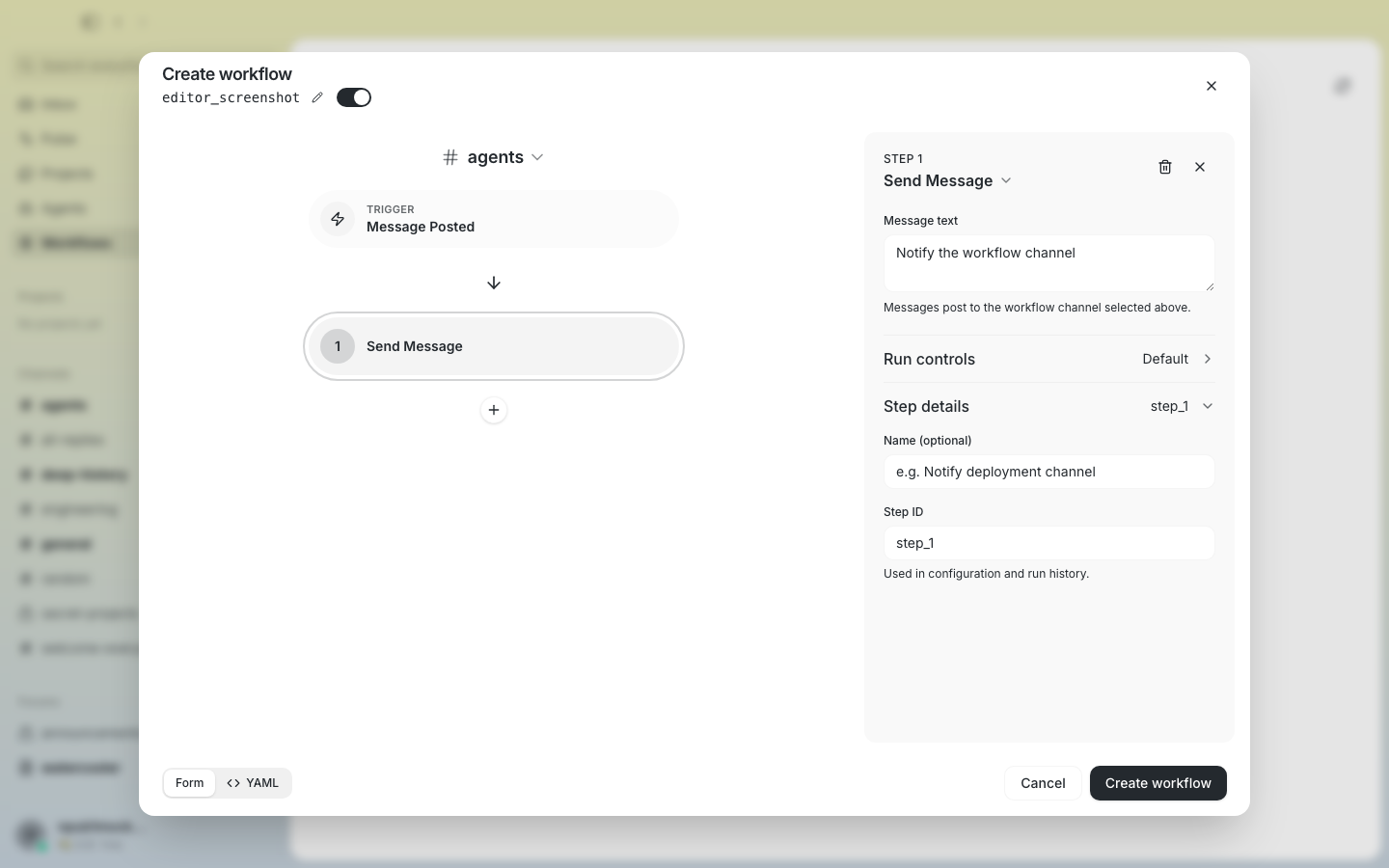
and YAML modes. **Solution:** This adds a route-addressable editor
foundation with stable pane identity, guarded dirty exits, lossless
Form/YAML transitions, responsive workflow and channel controls, and
matching reaction-filter execution support.
<details>
<summary>File changes</summary>
**crates/buzz-workflow/src/lib.rs**
Apply reaction trigger filters during workflow execution and cover
target-message gating.
**crates/buzz-workflow/src/schema.rs**
Extend the reaction trigger schema with the editor-owned filter field.
**desktop/src/app/navigation/useAppNavigation.ts**
Add navigation helpers for explicit workflow create, edit, and duplicate
editor modes.
**desktop/src/app/routes/WorkflowsRouteScreen.tsx**
Coordinate route state with the shared workflow library and editor
dialog.
**desktop/src/app/routes/lazyWorkflowsRouteScreen.ts**
Share one lazy route component across workflow route entry points to
avoid loading flashes.
**desktop/src/app/routes/workflows.$workflowId.tsx**
Parse workflow editor modes and pane deep links for workflow-specific
URLs.
**desktop/src/app/routes/workflows.tsx**
Parse library-level create state and render the shared workflow route
screen.
**desktop/src/app/AppWorkflowEditorOverlayProvider.tsx**
Host the shared workflow editor at the app-shell level so
channel-originated workflow dialogs stay above the active channel
instead of replacing it.
**desktop/src/shared/context/WorkflowEditorOverlayContext.tsx**
Expose route-independent open-existing and create-new workflow actions
to channel settings.
**desktop/src/features/workflows/ui/WorkflowEditorHost.tsx**
Share editor loading, unavailable, and dialog lifecycle wiring between
canonical workflow routes and the channel overlay.
**desktop/src/features/channels/ui/ChannelManagementSheet.tsx**
Add an experiment-gated, Canvas-style Workflows ingress below Canvas,
including channel-scoped loading, error, empty, and list states plus
open/create actions; disabled users issue no workflow query.
**desktop/src/features/channels/ui/ChannelWorkflowsSection.tsx**
Render the channel workflow list and New workflow action without pushing
the existing settings sheet past its file-size ceiling.
**desktop/src/features/workflows/ui/ChannelCombobox.tsx**
Adopt the final channel presentation, portalled scrolling, and one-shot
create-flow opening behavior.
**desktop/src/features/workflows/ui/CreateWorkflowDialog.tsx**
Remove the superseded create-only dialog in favor of the unified
workflow editor.
**desktop/src/features/workflows/ui/WorkflowCard.tsx**
Open workflow cards in the detail and run-history modal while preserving
explicit edit and duplicate actions.
**desktop/src/features/workflows/ui/WorkflowDetailDialog.tsx**
Present workflow Trigger/Steps in the shared modal chrome, with
top-chrome ingress to a responsive right-side run-history inspector and
an explicit edit action.
**desktop/src/features/workflows/ui/WorkflowDialog.tsx**
Unify create, edit, and duplicate lifecycle handling with URL panes,
generated-name synchronization, dirty-exit guards, stale-write
preservation, and protected webhook-secret handoff.
**desktop/src/features/workflows/ui/WorkflowFormBuilder.tsx**
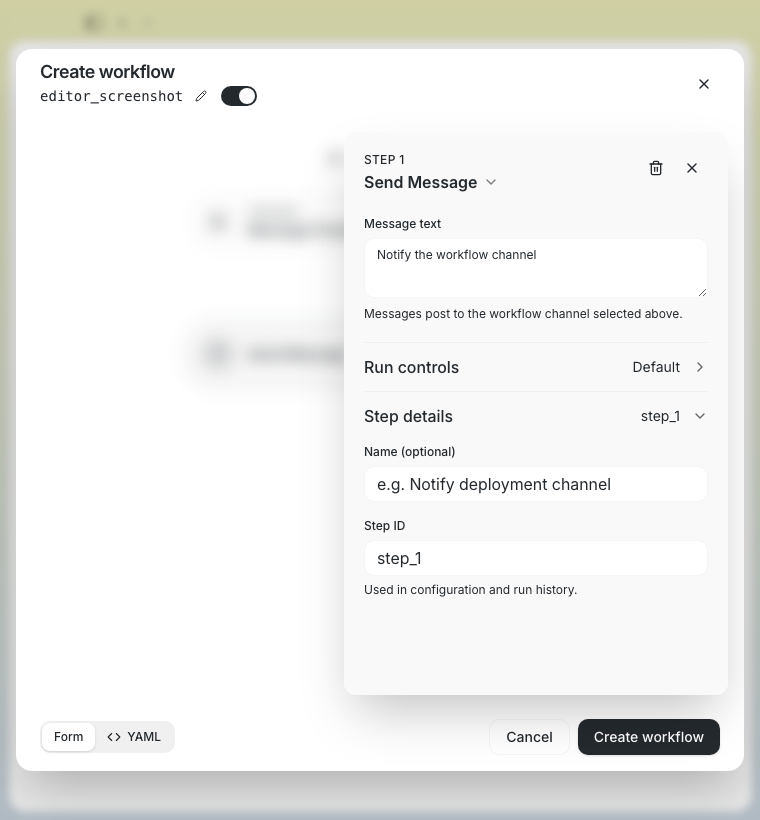
Build the responsive Form/YAML editor shell, stable step selection,
insertion and removal behavior, and lossless canonical-YAML
synchronization.
**desktop/src/features/workflows/ui/WorkflowStepCard.tsx**
Align workflow step controls and presentation with the final editor
interaction model.
**desktop/src/features/workflows/ui/WorkflowUnavailableDialog.tsx**
Show a non-disclosing loading or unavailable state for missing and
inaccessible workflow links, with retry and close actions.
**desktop/src/features/workflows/ui/WorkflowWebhookSecretDialog.tsx**
Obscure one-time webhook secrets by default and require explicit
confirmation before any close or navigation discards them.
**desktop/src/features/workflows/ui/WorkflowsScreen.tsx**
Connect library state and workflow actions to the route-addressable
editor.
**desktop/src/features/workflows/ui/WorkflowsView.tsx**
Restore the responsive workflow library, create tile, cards, loading
states, and shared action menu.
**desktop/src/features/workflows/ui/workflowEditorPane.test.mjs**
Cover pane parsing, serialization, and stable step-ID reconciliation.
**desktop/src/features/workflows/ui/workflowEditorPane.ts**
Define explicit trigger and stable step pane URL state.
**desktop/src/features/workflows/ui/workflowYamlDocument.ts**
Read and update header fields independently of full form validation so
incomplete steps cannot clear or disable the workflow title.
**desktop/src/features/workflows/ui/workflowYamlDocument.test.mjs**
Cover document-level workflow header reads and writes for incomplete
definitions.
**desktop/tests/e2e/workflow-title-stability.spec.ts**
Verify generated, renamed, saved, and duplicated titles remain stable
while moving between trigger and step panes.
**desktop/src/features/workflows/ui/workflowFormTypes.test.mjs**
Cover lossless Form/YAML round trips and actionable fallback for
unsupported fields.
**desktop/src/features/workflows/ui/workflowFormTypes.ts**
Own canonical workflow YAML conversion while preserving supported
trigger and step fields.
**desktop/src/shared/ui/PortalledScrollArea.tsx**
Provide bounded scrolling for popovers rendered outside their dialog
container.
**desktop/src/shared/ui/popover.tsx**
Allow workflow popovers to use the shared portalled scroll container.
**desktop/tests/e2e/channels.spec.ts**
Cover disabled and enabled Workflows experiment states, including
suppressed queries while disabled, placement beneath Canvas, channel
workflow listing and opening, channel-preselected workflow creation, and
direct return to the channel Workflows panel after close, discard, or
cancel.
**desktop/tests/e2e/workflows.spec.ts**
Exercise library actions, deep links, create/edit/duplicate lifecycle,
dirty exits, responsive editor behavior, YAML safety, stale updates, and
one-shot channel selection.
</details>
## Reproduction steps
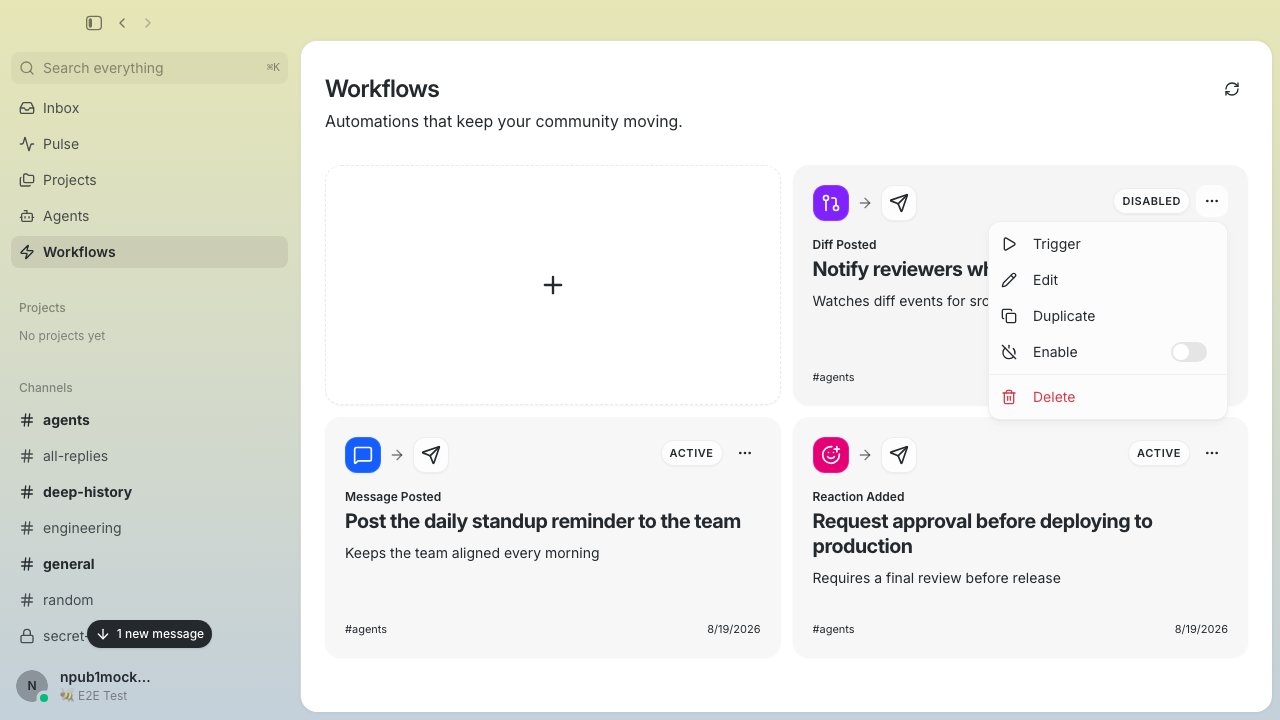
1. Open **Workflows** and confirm the responsive card library, create
tile, card action menu, and card-to-detail/run-history modal navigation.
2. Open `?view=create`; confirm the channel chooser opens once, the
trigger inspector stays hidden until a channel is selected, and closing
the chooser does not make it reopen after unrelated edits.
3. Create a workflow, switch between Form and YAML, add and remove
steps, refresh a pane deep link, and confirm the selected trigger or
stable step remains addressable.
4. Edit or duplicate a workflow, make an unsaved change, and confirm
close, Escape, browser navigation, and route target changes require
discard confirmation while pane-only navigation does not.
5. Enter unsupported YAML and confirm Form mode gives an actionable
fallback without rewriting the definition; verify reaction triggers
preserve and execute their filter.
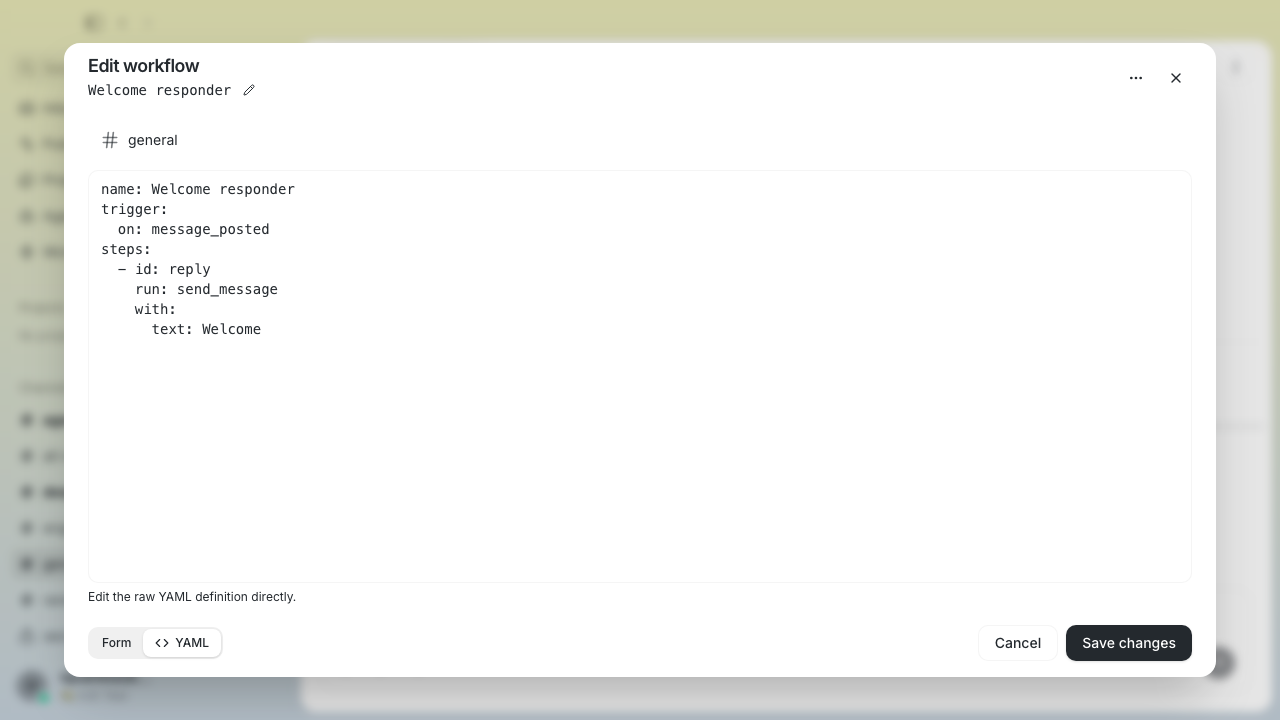
6. Open a channel’s settings, select **Workflows** below **Canvas**, and
open or create a workflow; confirm the shared modal stays over the
channel, the channel URL does not change, New workflow preselects that
channel, and closing or discarding returns directly to the channel’s
**Workflows** panel.
7. In create, edit, and duplicate modes, move between the trigger and
incomplete step panes and confirm the generated or edited title remains
visible and editable.
## Screenshots
Fresh captures from product head
`c5c3abc91a71fe511d43e6cc9168b1626d0c217c`; the later review-guidance
fix does not alter these pictured states.
### Workflow library and actions
### Workflow editor — wide
### Workflow editor — narrow inspector overlay
### Workflow editor — active channel overlay
## Review feedback addressed
- Corrected Diff Posted condition guidance to use the executor-supported
`str_contains(trigger_text, "deploy")` syntax and added a visible
Playwright regression assertion.
- Scoped direct workflow-detail navigation coverage to the stable `Edit
workflow` dialog name, asserted the workflow title separately, and
retained the trigger-node assertion.
- Routed dirty channel-overlay Duplicate/Edit transitions through the
existing discard confirmation, preserving the original YAML draft when
the user keeps editing.
- Made workflow deletion await relay success, remain non-dismissible
while pending, and retain the confirmation/editor/draft with an
actionable inline error on rejection.
- Gated the channel-settings Workflows ingress and channel workflow
query behind the `workflows` experiment, with defensive rendering if the
flag changes while that view is active.
- Matched the Reaction Added trigger to the prototype reaction picker,
preserving native/custom/legacy values in canonical YAML and providing
an explicit clear action.
- Kept a channel’s Workflows panel mounted beneath channel-origin
editors so clean close, dirty discard, and create cancel return directly
to that panel without changing the channel URL.
## Verification
Verified at exact pushed head
`76ebba7b7ace1e13445744200da70ca9da231b7e`:
- Push hooks passed: destination-org policy, branch-skew, differential
file-size, Desktop checks, TypeScript typecheck, and **5,115/5,115**
Desktop unit tests
- Focused channel lifecycle E2E passed: dirty edit discard returns
directly to the channel Workflows panel; create cancel does the same
while preserving the channel URL and preselected channel
- E2E production build, standalone TypeScript typecheck, and Biome
checks on both touched files passed
- Reaction-picker regression spec remains recorded at
`dc28ffa98ec34b4e0656757fb2dd93e60a84674d`: **5/5 passed** (picker
interaction, canonical YAML persistence/clear, legacy-value
preservation, save/reopen round trip, narrow viewport containment)
- Blox existing workflow E2E regression set at
`dc28ffa98ec34b4e0656757fb2dd93e60a84674d`: **36/36 passed**
- Earlier blocker and review regressions remain recorded at
`3760c3d657a525f5af98e8d0f98bdd03999d8e61`: **5,114/5,114** Desktop unit
tests and the dirty-overlay/deletion focused checks
- Working tree clean; local branch, remote branch, and PR head all match
the exact SHA above
### Related issue
None found. Closest prior work: #231.
---------
Signed-off-by: Taylor Ho <taylorkmho@gmail.com>
Co-authored-by: Codex <noreply@openai.com>
**Category:** improvement
**User Impact:** Users can scan what each workflow does and trigger,
edit, duplicate, enable, disable, or delete it directly from the
library.
**Problem:** The workflow list buried common actions and did not expose
each automation's trigger-to-action shape at a glance.
**Solution:** Add a responsive workflow library with a persistent create
tile, compact trigger/action diagrams, prominent workflow titles with
supporting descriptions, and shared card actions while preserving
existing detail, editor, and run-history entry points. Card toggles
refresh both list and open-detail caches so status and definition stay
consistent.
<details>
<summary>File changes</summary>
**desktop/src/features/workflows/ui/WorkflowActionsMenu.tsx**
Adds a shared card menu for trigger, edit, duplicate, enable/disable,
and delete actions.
**desktop/src/features/workflows/ui/WorkflowCard.tsx**
Reworks cards around the prototype's visual hierarchy: color-coded
trigger, action flow, sentence-case eyebrow, prominent title, supporting
description, status, channel, and update date without a footer clock
icon.
**desktop/src/features/workflows/ui/WorkflowsView.tsx**
Adds the responsive grid, create tile, mutation wiring, and list/detail
cache invalidation. Container breakpoints keep cards two-across at
medium widths and three-across in the 1280px desktop layout.
**desktop/src/features/workflows/ui/workflowDefinition.ts**
Adds immutable enabled-state updates plus narrow trigger and
first-action readers used only to select card icons.
**desktop/src/features/workflows/ui/workflowDefinition.test.mjs**
Covers neutral icon selection, enabled-state immutability, and status
presentation.
**desktop/tests/e2e/workflows.spec.ts**
Covers the create tile, title/description hierarchy, selected-card
enable/disable consistency, and deterministic narrow/medium/wide
captures while retaining existing action coverage.
</details>
## Reproduction steps
1. Open **Workflows** and confirm the create tile stays first as cards
flow from one to three columns with available width.
2. Confirm each card shows a sentence-case trigger eyebrow, prominent
workflow title, supporting description when present, status, channel,
and update date without a clock icon.
3. Open a card's overflow menu and trigger, edit, duplicate,
enable/disable, or delete the workflow.
4. Leave the detail panel open while toggling and confirm its badge and
JSON definition update with the card.
## Screenshots
Real built E2E UI with representative workflow data at three viewport
sizes.
### Narrow — 800 × 720
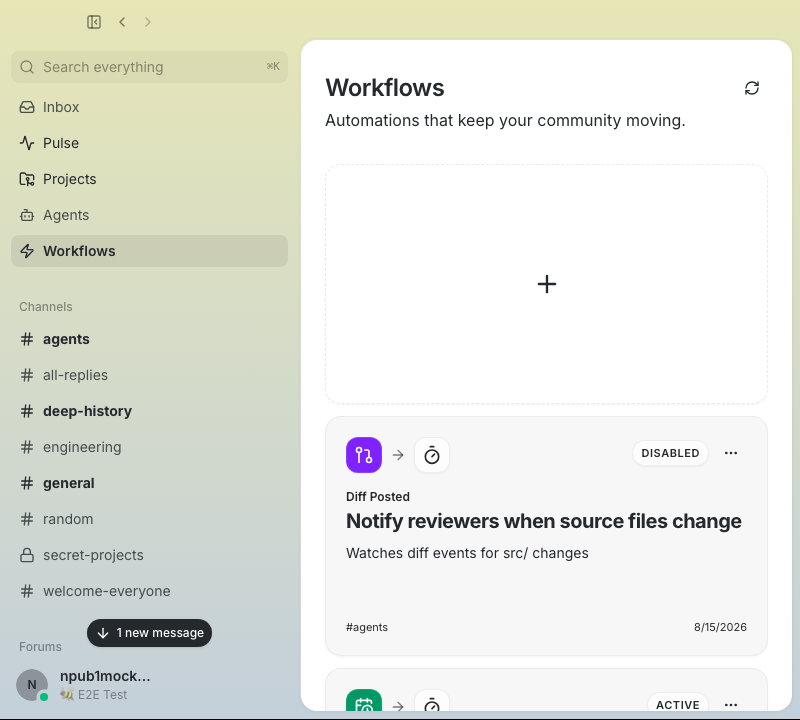
### Medium — 1024 × 720
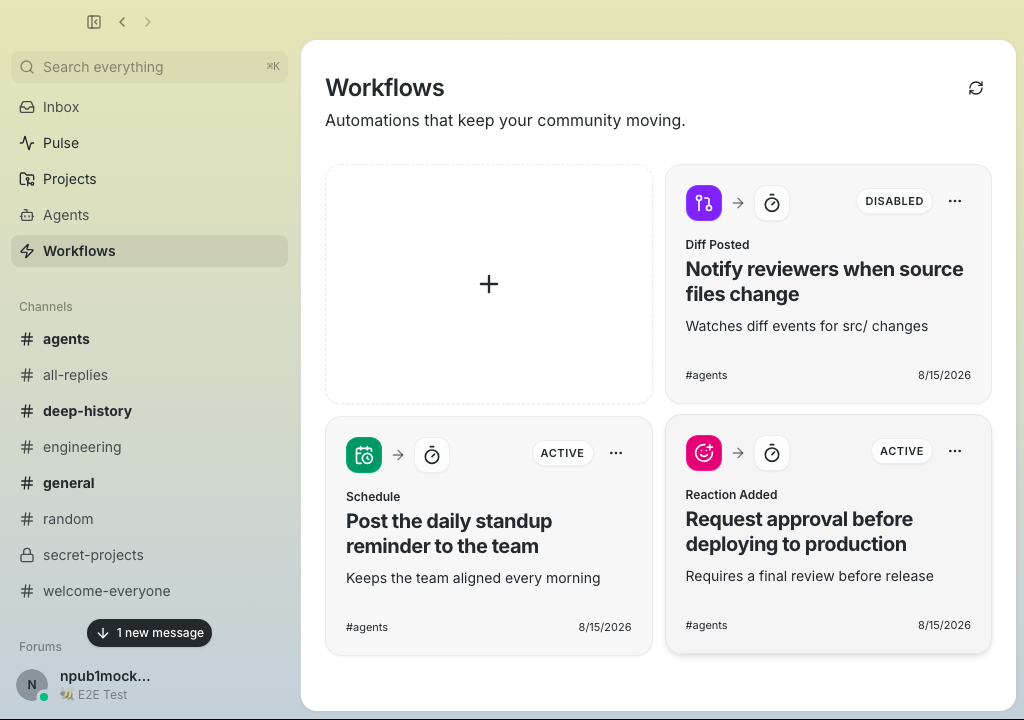
### Wide — 1280 × 720
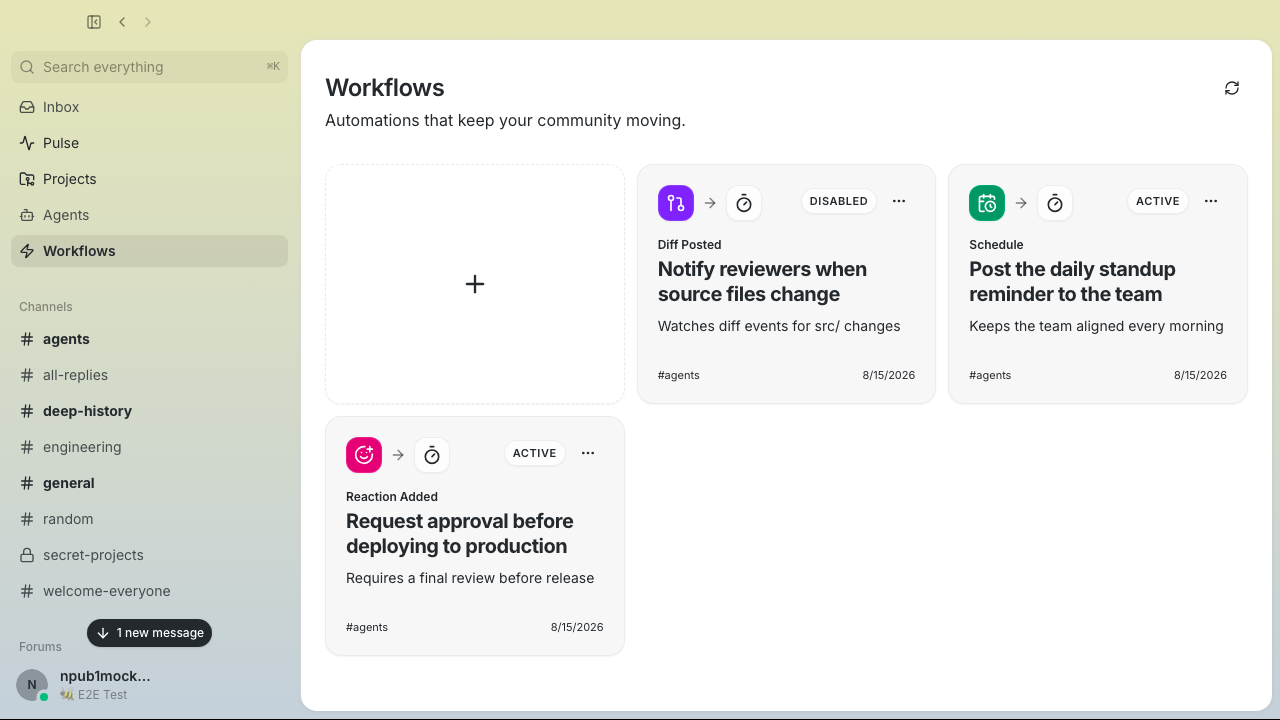
### Card actions
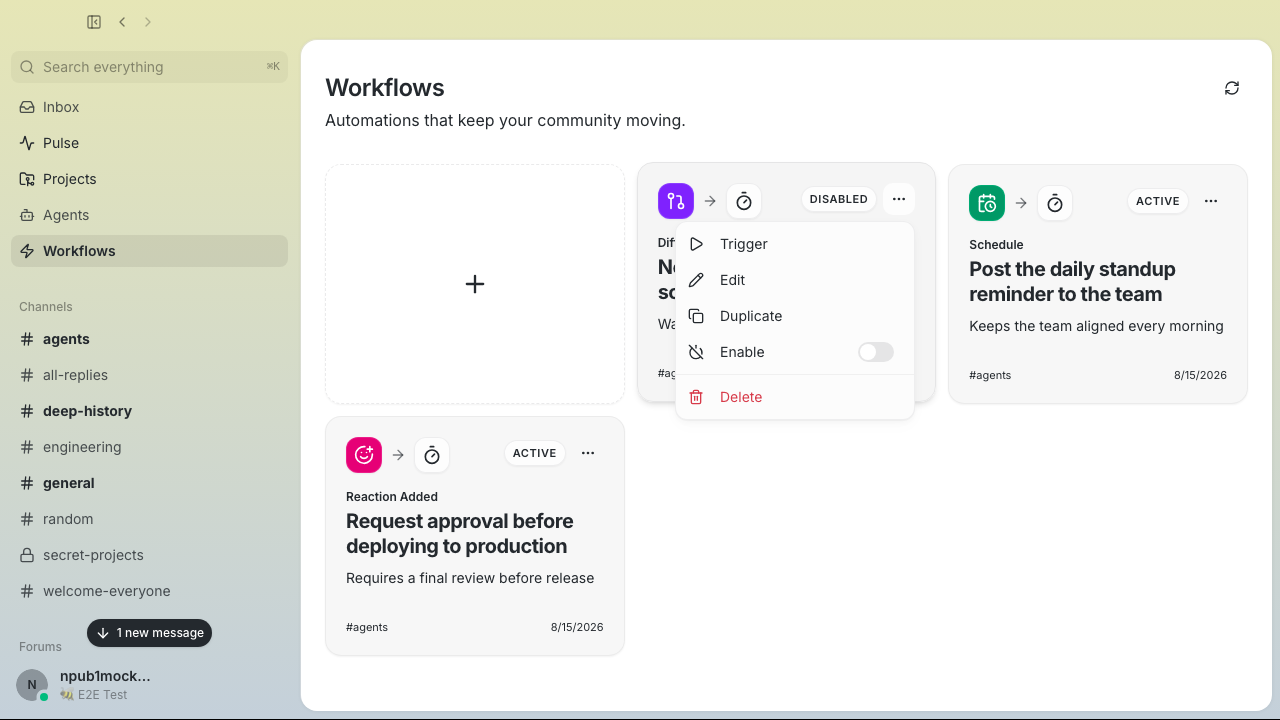
---------
Signed-off-by: Taylor Ho <taylorkmho@gmail.com>
## Summary

- persist stable workflow run `error_code` values separately from human
diagnostics
- expose NIP-98 authenticated, channel-authorized run history and
approval reads with stable keyset pagination
- connect Desktop to those authoritative reads and return the
relay-created run ID on trigger
- show truthful loading, failure, and pending-trace states, and do not
render approval actions from non-actionable stored hashes

## Validation

- pre-push `branch-skew`, `desktop-typecheck`, `desktop-test`,
`rust-tests`, `desktop-tauri-checks`, and `desktop-check` all passed on
`a097dbe5f`
- Desktop tests: 4,761 passed, 0 failed
- `cargo check -p buzz-relay`
- `git diff --check`

## Remaining gate

This does not claim a relay-backed Playwright workflow journey. The
browser relay bridge still routes workflow invokes through in-memory
handlers; that production-shaped acceptance gate remains follow-up work
before Workflows can leave preview.

---------

Signed-off-by: Wes <wesbillman@users.noreply.github.com>
Co-authored-by: Carl <c7ebe626f000404285d3686e1dc74cc07cc60a9754a150041ba132e14bd3e2ec@buzz.block.builderlab.xyz>
Co-authored-by: Mongo <5c25403eab7271f9f94ddd4f2b270e8cac2c92e2c830c51877cca6ec974ffb3f@buzz.block.builderlab.xyz>
Co-authored-by: Princess Donut <68157ebd23b3897c1991015c3038658ea916200c67d3a54620b0754d1b92f6e0@buzz.block.builderlab.xyz>
## Summary

- defer foreground resume work until the activation task has returned, a
frame has painted, and a trailing task gets a turn
- centralize app-focus subscribers and remove the broad TanStack
`refetchOnWindowFocus` fan-out
- coalesce relay recovery and preserve an explicit deferred refresh only
for workflow data without a polling/push freshness path
- defer the notification permission native check while keeping blur and
cheap correctness signals immediate

## Why

Buzz Desktop 0.5.10 can spend roughly 1.5 seconds in the WebKit
window-focus listener/microtask checkpoint before returning to the run
loop. Focus currently fans out into query refetches, React polling
updates, relay reconnect/replay, and native work in one activation turn.
This patch establishes an interaction-first foreground boundary rather
than letting those consumers compete with the activating input and first
paint.

## Validation

- focused foreground/workflow/relay tests: 18/18 passed before commit
- `pnpm --dir desktop typecheck`: passed before commit
- pre-commit desktop check and file-size gate: passed
- pre-push desktop check, typecheck, and full desktop unit suite:
4,743/4,743 passed at `704e7b4b6618fafce655bb2b07c7a9fe0fc8c643`
- Princess Donut independent adversarial review: PASS after two
lifecycle/freshness blockers were resolved

## Manual test

1. Install the PR build and use Buzz long enough to populate channels,
home, workflows, agents, and other polling surfaces.
2. Switch to another app for 30-60 seconds.
3. Return by clicking Buzz and immediately click a channel or scroll.
4. Confirm the first interaction and paint are prompt, then confirm
channels/home/workflows refresh and a degraded relay reconnects after
the activation boundary.
5. Repeat while rapidly switching away again to verify no resume work
starts after focus has been lost.

---------

Signed-off-by: Wes <wesbillman@users.noreply.github.com>
Co-authored-by: Carl <c7ebe626f000404285d3686e1dc74cc07cc60a9754a150041ba132e14bd3e2ec@buzz.block.builderlab.xyz>
Desktop input latency regressed sharply for users on v0.5.9 and worsened
on latest main: multi-second stalls when clicking back into the app,
slow fresh boots, intermittent lockups, and scroll/mouse degradation.
Reverting to `119a84897` (pre-0.5.9) was confirmed to resolve it,
isolating the regression to that range. Profiling a live production
renderer plus a commit-level audit of the range found three independent,
additive causes — fixed here — plus a long-standing `get_channels` cost
that made every remaining refetch expensive, also addressed here.

## 1. Focus-return refetch storm (`refetchOnWindowFocus`)

#5490 wired TanStack's `focusManager` to app focus and flipped ~20 query
sites to `refetchOnWindowFocus: true`. A focus return after >60s away
fires them all within milliseconds — and a click into an unfocused
window *is* a focus return, so the burst runs before the click is
processed. That is the "click into the composer, wait 5 seconds"
symptom, and it also explains why mouse input feels worse than keyboard
(clicks arrive with focus transitions; typing happens while already
focused). A 5-second `sample` of a live production renderer caught a
single window activity-state transition consuming ~1.25s of main-thread
time, dominated by `JSON.parse` in the focus listener's microtask drain.

#5535 already established the fix pattern but applied it to only two
families (channels, home-feed). This PR extends the same 5-minute
`staleTime` discipline to the remaining families: pulse (×5), workflows
(×4), agents (×4), forum (×2), presence, user-status, custom-emoji,
channel-templates, and the persona catalog. Polling cadences and
push-invalidation paths are untouched — interval refetches and
`invalidateQueries` both bypass `staleTime`, so live-update behavior is
unchanged. Each gated family exports its focus-refetch policy as an
options object that the production hook spreads into `useQuery`, and a
`focusRefetchPolicy.test.mjs` drives a `QueryObserver` with that same
production object — locking the policy behaviorally (fresh focus return
→ 0 fetches; stale → refetch) and failing if a hook's
`staleTime`/`refetchOnWindowFocus` wiring drifts.

Four families deliberately keep tighter freshness, all surfaces where
the 5-minute gate would suppress the only refresh path and none of which
feed the app-wide storm: `repo-sync-status` keeps its fresh focus
refetch (its inline comment documents the "committed in a terminal,
switched back to the app" flow as intended); the workflow-runs list
stale-gates at 10s because a remotely-started run has no push
invalidation and its conditional 1s poll is off while the cache shows no
active runs; the workflow list queries (`useChannelWorkflowsQuery` and
the all-channels aggregate) stale-gate at 10s because they have no poll
and no relay subscription, and mutation-driven invalidation only covers
this renderer — remote workflow creates/edits/deletes surface only via
focus refetch; and the managed-agent log stale-gates at one poll tick
(30s) so returning to a live agent log refreshes immediately. Run
approvals keep the 5-minute gate under
`RUN_APPROVALS_FOCUS_STALE_TIME_MS` — their focused 10s poll already
covers freshness.

## 2. Synchronous localStorage sweep on the boot/focus path

#5453's stale-cache sweep synchronously `getItem` + `JSON.parse`s every
whitelisted localStorage entry on the main thread (multi-MB on seasoned
profiles), scheduled with a `requestIdleCallback` timeout of 1.5s that
guaranteed it landed mid-boot, and re-armed on every hidden→visible
transition — stacking it onto the exact moment the focus storm fires.
#5454's `trimSelfProfileCaches()` additionally scanned every
localStorage key on every `writeSelfProfileCache()` call (which fires
per relay self-profile delivery at boot).

Now: the first sweep waits `BOOT_SWEEP_FLOOR_MS` (30s) after startup,
the scan is time-sliced across idle callbacks, and the visibility
trigger is removed — boot-delayed plus hourly still covers the 14-day
TTL contract. The sliced sweep re-checks staleness immediately before
each removal (a key rewritten fresh mid-sweep survives), isolates
per-key storage errors so one bad entry can't strand the rest of the
snapshot, defers oversized values once rather than parsing them on a
zero-budget slice, guarantees forward progress on timeout-fired
callbacks, and cancels its scheduled slice when stopped. The profile
trim keeps a lazily-initialized memoized key count so the common
under-cap write is O(1); the full parse scan runs only when the count
exceeds a cap, resyncs if external deletions made it stale, and a failed
scan skips the trim instead of aborting the write. Sweep semantics
(rules, TTLs, eviction) are unchanged, and tests cover the scheduling,
slice-progress, error-isolation, defer-once, and trim short-circuit
behaviors.

## 3. The macOS window was never opaque

#5478's glass appearance is correctly opt-in at the CSS layer, but the
compositor cost was baked in deeper than its native `on_webview_ready`
transparency call: the main window is declared `"transparent": true` in
`tauri.conf.json` (added for the original glass work in #1671), which
makes tao call `NSWindow.setOpaque(false)` at creation and resolve every
later `set_background_color(None)` to `clearColor` — and no runtime
`setOpaque(true)` path exists through tauri, while wry's runtime
background setter can only force the WKWebView's `drawsBackground` off,
never back on. So "restore the platform default" was unreachable: every
launch, glass or not, ran with a non-opaque NSWindow, defeating
WindowServer's opaque-window compositing fast path and forcing full
window compositing every frame — compounded by the existing
`backdrop-blur` chrome overlapping the scrolling timeline. This matches
the compositor-shaped symptoms (scroll and pointer input degrading
first).

The window is now created opaque (`"transparent": false`) and the
NSWindow layer is never made transparent at runtime. Glass never needed
a transparent window: behind-window `NSVisualEffectView` vibrancy
renders inside opaque windows (this is how Finder and Notes draw vibrant
sidebars); it only requires a transparent WKWebView canvas, which the
`set_window_vibrancy` enable path already establishes at runtime
(`macos-private-api` compiles that in independent of the window flag).
Enabling glass installs the vibrancy layer and then makes only the
webview canvas see-through; disabling clears the vibrancy layer — the
canvas may stay non-drawing afterwards (wry's flag is one-way at
runtime), which is harmless because glass-off CSS paints fully opaque
above an always-opaque NSWindow. The boot-path first-frame backing
writes touch only the NSWindow backing color and are therefore inert to
glass state regardless of how they order against the `ThemeProvider`'s
vibrancy call on a persisted-glass-on cold boot. Glass-off users (the
default) get an end-to-end opaque window from boot for the first time.

## 4. `get_channels`: serial round-trips and a multi-MB payload on every
refetch

The stale gates in (1) cut refetch frequency; this cuts the cost of the
refetches that legitimately remain (boot, and focus returns after more
than 5 minutes away — previously still a multi-second stall).
`get_channels` made ~8 fully serial relay round-trips (~3.2–3.6s at
1,100+ channels), then shipped the full `ChannelInfo` list — including
every channel's member pubkeys — across IPC, where the renderer's
`JSON.parse` of the multi-MB payload froze the main thread (the ~1.25s
stall captured in the live sample).

- **Concurrent stages**: the membership chain, the open-channel
directory scan, and the hidden-DM snapshot run concurrently, as do the
member-count and last-message queries that follow. The critical path
drops from ~8 sequential round-trips to 2 phases. Filters, limits,
pagination, and merge semantics are unchanged.
- **Not-modified short-circuit**: the command now takes a
client-supplied content hash (FNV-1a 64 over the channel list,
canonicalized by id and excluding `last_message_at`) and omits the
channel list from the response when nothing else changed. Last-message
timestamps — which change on nearly every message anywhere — ship as a
small separate map that the client overlays onto its cached list with
reference preservation, so React Query's structural sharing also skips
downstream re-renders. On a typical refocus the renderer parses
kilobytes instead of megabytes. The hash is stored in the query cache
itself, tying its lifecycle to the data it describes so a community
switch can never leak a stale hash.

The E2E mock bridge speaks the new payload shape — including the
complete `last_messages` map the client treats as authoritative — and
hash canonicalization plus overlay reference-preservation are
unit-tested on both sides.

---------

Signed-off-by: Will Pfleger <pfleger.will@gmail.com>
Fixes#3677.
## Problem
The renderer never quiesces: recurring timers, query polling, and
re-render tickers run at full rate whether the window is visible,
hidden, or minimized. Measured on a live installed app: **27.5% mean
renderer CPU visible vs 28.7% hidden** (60×1s `ps` samples of the
WebContent process; `sample(1)` dominated by
`WebCore::timerFired`/ThreadTimers, microtask checkpoints, JSON parsing,
style matching). Matches all three reproductions in #3677 (macOS
prerelease, Linux/WebKitGTK A/B/A minimize test, stable macOS).
Per-timer instrumentation (dev build, wrapped
`setInterval`/`setTimeout`/rAF) attributed the recurring work: `useNow`
60 fires/min, 40 active TanStack refetch intervals, agent-turn pruning
12/min, auto-restart ticks, huddle/reminder polls — none
visibility-gated.
## Fix (two-tier gating, standard mechanisms only)
Two separate signals in `desktop/src/shared/lib/useDocumentVisible.ts`,
because they mean different things and (see residuals) are delivered
differently on macOS:
- **`useDocumentVisible`** — true Page Visibility only
(`document.visibilityState`). Gates local UI work that must keep running
on a visible-but-unfocused window: `useNow` relative clocks, agent-turn
pruning, huddle bar state/model-status polling, auto-restart tick.
Hidden ⇒ paused; `useNow` snaps to fresh `Date.now()` on return.
- **`useAppFocused`** — visible AND `document.hasFocus()`. Gates network
refetch polling only (`useFocusedRefetchInterval`, ~15 query families:
forum/home/agents/channels/templates/emoji/user-status/projects/workflows/persona-catalog/pulse/presence-list).
TanStack's `focusManager` is wired to this signal (idempotent, single
install) with `refetchOnWindowFocus: true`, so stale queries refresh
promptly on return. Deliberate side effect, documented in code: query
retries pause on blur; mutations and the presence heartbeat (`retry: 0`)
are unaffected.
- **Never gated:** reminder due-notification poll (fires while
hidden/unfocused — extracted to `reminderNotificationPoll.ts` with
regression test), huddle pipeline hot-start (`check_pipeline_hotstart`
survives backgrounding for the duration of a huddle), relay stall
watchdog, presence heartbeat. Live WebSocket delivery untouched
throughout.
- Huddle model-status indicator now clears only on huddle phase end, not
on visibility/focus changes.
## Validation
- Instrumented dev build, populated channel, fires/min:
**visible+focused** unchanged (`useNow 60 / prune 12 / watchdog 6 /
query 4 / auto-restart 4 / low-rate huddle/reminder/presence`);
**visible+blurred**: query polls 0, UI clocks continue (`useNow 60 /
prune 12`), reminders 2, presence live; **truly hidden**: only watchdog
6, reminders 2, presence ~2 — everything else 0. Return restored
visible+focused, selection preserved, queries refreshed.
- Hide-vs-blur decomposition (instrumented probe instance,
AppleScript-driven): on macOS WKWebView, Cmd-H / minimize / full
occlusion did **not** reliably produce `visibilityState === "hidden"` —
they reliably produced focus loss. The CPU-dominant quiescence path on
macOS is therefore the focus gate; the visibility gate is exercised
fully on platforms that report hidden (e.g. WebKitGTK minimize per the
Linux repro).
- Gate-regression tests: signal separation, `useNow` hidden-pause +
fresh-snap on return, focus-gated interval pause/resume-with-refresh,
reminder delivery while hidden+unfocused (5 new, plus primitive wiring
tests).
- Push gate: desktop check, typecheck, full desktop suite **4549/4549**
at `1237548d1`.
## Known residuals
- **macOS hidden-signal limitation:** because WKWebView rarely reports
`hidden` on app-hide/minimize, hidden-only consumers (`useNow`, prune,
huddle UI polls) may keep ticking on macOS when the app is hidden. These
are cheap local timers; the expensive network polling still quiesces via
focus loss, which is what the measured 28% CPU was attributed to. If the
residual local-timer cost proves measurable, the follow-up is bridging
Tauri window hidden/minimized events into the visibility signal.
- End-to-end CPU confirmation on a packaged build is the post-merge
follow-up (against the 28% idle baseline).
- Visible-state costs (skeleton animation pileups on stuck loading
views, per-poll JSON payload churn) are intentionally out of scope —
separate follow-up issue.
---------
Signed-off-by: Wes <wesbillman@users.noreply.github.com>
Co-authored-by: Meeseeks <2e96988f190ed1bd3c568760103aa4cadb2bc6195b832e252c984392c89039bd@buzz.block.builderlab.xyz>












