mirror of
https://github.com/block/buzz.git
synced 2026-11-11 03:41:13 +00:00
52cb6818face2bcc1a2aeaceb44d183b6ff9f2e9
5 Commits
| Author | SHA1 | Message | Date | |
|---|---|---|---|---|
 Luke Tornquist |
e3a0f3d59d |
feat(cli): send NIP-FI evidence via credential chain and Buzz desktop (#8999)
## Summary

Relays that enforce federated identity (NIP-FI) reject every protected
`buzz` CLI request with `401`. The CLI never sends
`Nostr-Federated-Identity`. This PR gives the CLI a credential chain,
lets it present NIP-FI evidence, and lets it take its identity from Buzz
desktop. Relays without NIP-FI behave exactly as before.

**Credential chain** (`crates/buzz-cli/src/credentials.rs`)
- Raw `Keys` are replaced by `Credentials`, which provide the public
key, signing through nostr's `NostrSigner`, NIP-44, and the NIP-OA auth
tag. NIP-FI evidence comes through `evidence(relay)`.
- The explicit key (`--private-key` / `BUZZ_PRIVATE_KEY`) is the first
link. A later link can add a signer that holds no local key (a desktop
provider, for example) without reshaping callers.
- Operations that need key material rather than a signature are
purpose-bound methods instead of a key accessor:
  - `engram_d_tag` (the NIP-AE HMAC over the conversation key)
- the relay-scoped GIF customer id (random and fixed for the process
when there is no local key)
- `buzz mem` now encrypts, decrypts and derives the `d` tag through the
provider. Invalid ciphertext skips an entry; a signer failure aborts, so
an unavailable credential never reads as empty memory.
`buzz_core::engram` gains the composable steps behind it: `encode_body`,
`event_builder`, `validate_envelope` and `check_d_tag`. `build_event`
and `validate_and_decrypt` are unchanged wrappers, so `buzz-acp` and
desktop callers don't move.
- Agent-management drafts (`agent_management.rs`) encrypt and sign
through the provider.

**Evidence on every protected request**
(`crates/buzz-cli/src/client.rs`)
- A single `authorize` helper gets the NIP-FI assertion first, then
signs the proof just before sending, so a slow mint cannot age it past
NIP-98's 60 s window. It sets these on every protected route:
`Authorization` (NIP-98 or Blossom kind:24242), `x-auth-tag`, and
`Nostr-Federated-Identity: Bearer …`. The routes are `/query`, `/count`,
`/events` (stored and moderation), `/upload`, `/media/upload`,
`/media/*`, `get_authed`, `post_json_authed` and
`post_json_once_authed`.
- Exempt routes (`get_public`) are unchanged.
- The WebSocket publish sends the header on the upgrade via
`connect_authenticated_with_headers`. NIP-42 AUTH signs through the
signer (`buzz-ws-client` now takes `NostrSigner`; `&Keys` callers
compile unchanged).
- An upgrade denial is an HTTP response under NIP-FI.
`WsClientError::upgrade_rejection` returns its status and body, which
map like any other relay error, so a `403` still says whether evidence
or authorization was refused. A denial after NIP-42 (such as a key
mismatch) is a 1008 close; `WsClientError::PolicyClose` keeps its reason
and the CLI reports it as an `auth_error`.
- The WebSocket publish caps each network phase as a whole, writes
included: connect, AUTH challenge (with any Pongs), AUTH send plus OK,
EVENT send plus OK, and a best-effort close. NIP-42 signing between
phases is bounded by the signer. The relay drops a socket not signed in
within 5 s, so a sign-in that is throttled or comes back after the
socket closed reconnects and signs the new challenge, at most 3
connections. Each connection fetches current NIP-FI evidence for its
upgrade, and a throttled sign-in is waited out between connections, so a
dead challenge is never signed. EVENT is signed before connecting and
sent once, after AUTH succeeds. Running out is `unavailable` (exit 2,
`retryable:true`).
- Relay traffic follows no redirects: reqwest strips `Authorization`
across origins but not `x-auth-tag` or `Nostr-Federated-Identity`, so a
3xx is returned as a relay error. Credential header values are marked
sensitive.

**Headless evidence source**
(`crates/buzz-cli/src/federated_identity.rs`)
- Set `BUZZ_FEDERATED_IDENTITY_TOKEN` (your own NIP-FA sign-in session:
a human session for your key, not an agent grant) and
`BUZZ_FEDERATED_IDENTITY_ADAPTER` (the adapter base) to enable it. Both
are env only: command lines are visible to other local users.
- The CLI requests an assertion and the adapter mints it, through `POST
{adapter}/v1/identity/assertions` with a NIP-98 proof in
`Nostr-Authorization` (NIP-FA §Relay assertion).
- It checks the returned pubkey and expiry, parses the assertion as a
compact JWS (three base64url segments, JSON header with `alg`, JSON
payload), and requires its `exp` to equal `expires_at`. It caches one
assertion per process, bound to the relay when credentials are resolved,
and re-mints at the earlier of half-life and 30 s before expiry; the
desktop link caches and refreshes its assertion by the same rule.
Concurrent callers share one mint. An HTTP proof is signed again, after
current evidence, when the assertion changed while it was signed or the
evidence check aged it 30 s or more, up to 3 rounds, then fails as
`unavailable` (retryable).
- Compared with the separate rules before: a 300 s assertion now
refreshes at 150 s (was 270 s) on both links, a 40 s adapter assertion
at 10 s (was 20 s), and a 20 s desktop assertion is kept for 10 s
instead of fetched on every lookup. Desktop assertions now need a
readable JWS header with `alg` and a non-empty signature segment. An
unsupported headless relay URL now fails when credentials are resolved.
- The token goes only to the adapter origin (https, or http on
loopback), never follows a redirect, and never appears in errors or
`Debug`.
- A mint retries network errors, `429` and any `5xx` up to three
attempts with jittered backoff (or the adapter's `Retry-After` on
`429`/`503`, as delta-seconds or any HTTP-date form, capped at 30 s), on
every path (reads, post-once, moderation, stored events, WebSocket). It
then fails as `CliError::Adapter` (`adapter_error`, exit 2,
`retryable:true`). Relay retry loops never repeat it. A stored write
keeps `delivery_unknown` when any earlier attempt may have been
delivered, so a later adapter failure never invites a re-sign. Relay
mutation retries are otherwise unchanged.
- An explicit port 80 relay URL (read numerically from the authority, on
any scheme) is a usage error: `wss://host` means port 443, and NIP-FA
has no relay on port 80.
- A refusal is never retried: a non-transient status with an unreadable
or truncated body is still a refusal.
- Each NIP-FA denial code maps to an `auth_error` with a specific
message.
- These settings belong to the explicit key: without one they are not
read, and when the desktop link wins a warning names them.
- If an enforcing relay answers `401` and no assertion was sent, the CLI
returns an `auth_error` that names both settings, or, for a desktop
user, says to sign in to the community in Buzz. A desktop user's `403`
hint no longer mentions `BUZZ_AUTH_TAG`.

**What got simpler**
- About ten request sites built `Authorization` and `x-auth-tag`
themselves. Five copies of the 401/403 error-mapping block are now one
`relay_error`.
- The `sign_nip98` / `sign_blossom_*` helpers are gone. Proofs are a
three-case `Proof` enum consumed by `authorize`.
- `BuzzClient::keys()` (raw secret access from every command) is
removed. Commands use `public_key()`, `sign_event` or a purpose-bound
credentials method.

**Desktop credential provider**
(`crates/buzz-cli/src/desktop_provider.rs`,
`docs/local-credential-provider.md`)

Buzz desktop is a credential provider in the chain, after an explicit
key:

1. An inherited `BUZZ_CREDENTIAL_PROVIDER` token (set by the desktop for
the agents it launches). It decides the identity: when it is revoked,
not bound to the relay or unreachable, the command fails. A paired
token, which acts as the human, is never tried. That keeps a
well-behaved CLI from acting as the owner by accident; it is not a
boundary against an agent that can run its own commands as the owner's
OS user, and the contract says so with the mitigations.
2. Otherwise, a paired token stored in the OS keychain (`keyring`; macOS
native keychain, Linux Secret Service; no file fallback). A desktop that
answers `denied` or `unavailable` fails the command; only an unreachable
or unconfirmed advertisement is skipped. Revoked entries are forgotten.

New commands: `buzz auth desktop pair` and `buzz auth desktop unpair`.
The help no longer marks `BUZZ_PRIVATE_KEY` as required.

The CLI talks to the desktop over the loopback contract in
`docs/local-credential-provider.md` (NIP-46-shaped envelopes,
`Buzz-Credential-Provider` version header, same-user check on the
listening socket for paired and inherited tokens, via `/usr/sbin/lsof`
on macOS, given 5 s; a check that runs out of time is a retryable
`unavailable`, a wrong owner is refused). Every response's `id` must
match its request, error envelopes included. Paired tokens live only in
the keychain, survive desktop restarts, and are harness-neutral for
agents.

- **Relay binding:** tokens bind the whole relay URL (`http`/`https`
read as `ws`/`wss`, lowercase host, no default port, `/` for an empty
path; path and query count). The CLI sends that URL in `pair` and
`federated_identity`; NIP-FA audience canonicalization is the desktop's.
- **Rate limits:** a `rate_limited` answer refuses before acting, so the
CLI re-sends after `retry_after` (capped at 30 s), up to four times,
except a NIP-42 sign-in, whose wait goes to the WebSocket reconnect. A
re-sent NIP-42, NIP-98 or Blossom proof is re-dated (new id, Blossom
`expiration` moved with it); content events are re-sent exactly. If it
is still throttled, the command fails as `rate_limited` (exit 2,
`retryable:true`), not `auth_error`, whether the throttled call was
NIP-98, event signing, NIP-42 or encryption. Transport failures are
never re-sent, and relay commands are never replayed. A `buzz mem` list
that is throttled partway through completes.
- **Memory:** a `nip44_decrypt` answered with `invalid_request` is
invalid ciphertext, so `buzz mem` skips that entry (NIP-AE filtering);
any other provider failure aborts.
- **Keychain changes:** each change reloads the map under a short
`flock` on `~/.buzz-foundation/cli-pairings.lock` (directory forced to
`0700`, lock opened with `O_NOFOLLOW`) and changes only its own
instance; the lock is never held across the approval wait. An unreadable
entry is refused, never overwritten; `unpair` with no instance clears
it.

### Related

Related:
[block/buzz-app#2260](https://github.com/block/buzz-app/pull/2260) (the
desktop side of the provider contract)

---------

Signed-off-by: Luke Tornquist <tornquist@squareup.com>
Signed-off-by: Will Pfleger <wpfleger@block.xyz>
Co-authored-by: Will Pfleger <wpfleger@squareup.com>
Co-authored-by: Elrond <28d6302a099e5225b02c4155ac4236e4912603df2ab08dbfc2f4fef08ce598c8@buzz.block.builderlab.xyz>
Co-authored-by: Claude Opus 5.5 <noreply@anthropic.com>
Co-authored-by: Will Pfleger <wpfleger@block.xyz>
Co-authored-by: Hayt <211b96e6a2b7f45fd4047988976c7bbbeeda0c15f3ae7b32eec20834b5a55118@buzz.block.builderlab.xyz>
Co-authored-by: Duncan <dcfd242e557282d7a1e2cf2e6877522682f1e5c6156dc92ca7d90eaedd3b0f95@buzz.block.builderlab.xyz>
|
||
|
Taylor Ho
|
edc4a09aaa |
feat(workflows): add responsive library card actions (#6008)
**Category:** improvement **User Impact:** Users can scan what each workflow does and trigger, edit, duplicate, enable, disable, or delete it directly from the library. **Problem:** The workflow list buried common actions and did not expose each automation's trigger-to-action shape at a glance. **Solution:** Add a responsive workflow library with a persistent create tile, compact trigger/action diagrams, prominent workflow titles with supporting descriptions, and shared card actions while preserving existing detail, editor, and run-history entry points. Card toggles refresh both list and open-detail caches so status and definition stay consistent. <details> <summary>File changes</summary> **desktop/src/features/workflows/ui/WorkflowActionsMenu.tsx** Adds a shared card menu for trigger, edit, duplicate, enable/disable, and delete actions. **desktop/src/features/workflows/ui/WorkflowCard.tsx** Reworks cards around the prototype's visual hierarchy: color-coded trigger, action flow, sentence-case eyebrow, prominent title, supporting description, status, channel, and update date without a footer clock icon. **desktop/src/features/workflows/ui/WorkflowsView.tsx** Adds the responsive grid, create tile, mutation wiring, and list/detail cache invalidation. Container breakpoints keep cards two-across at medium widths and three-across in the 1280px desktop layout. **desktop/src/features/workflows/ui/workflowDefinition.ts** Adds immutable enabled-state updates plus narrow trigger and first-action readers used only to select card icons. **desktop/src/features/workflows/ui/workflowDefinition.test.mjs** Covers neutral icon selection, enabled-state immutability, and status presentation. **desktop/tests/e2e/workflows.spec.ts** Covers the create tile, title/description hierarchy, selected-card enable/disable consistency, and deterministic narrow/medium/wide captures while retaining existing action coverage. </details> ## Reproduction steps 1. Open **Workflows** and confirm the create tile stays first as cards flow from one to three columns with available width. 2. Confirm each card shows a sentence-case trigger eyebrow, prominent workflow title, supporting description when present, status, channel, and update date without a clock icon. 3. Open a card's overflow menu and trigger, edit, duplicate, enable/disable, or delete the workflow. 4. Leave the detail panel open while toggling and confirm its badge and JSON definition update with the card. ## Screenshots Real built E2E UI with representative workflow data at three viewport sizes. ### Narrow — 800 × 720 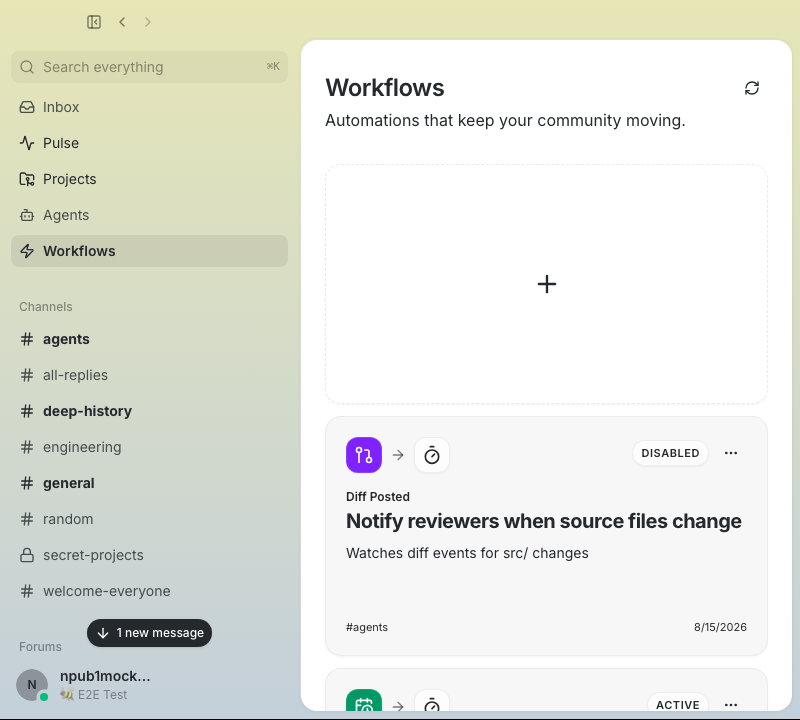 ### Medium — 1024 × 720 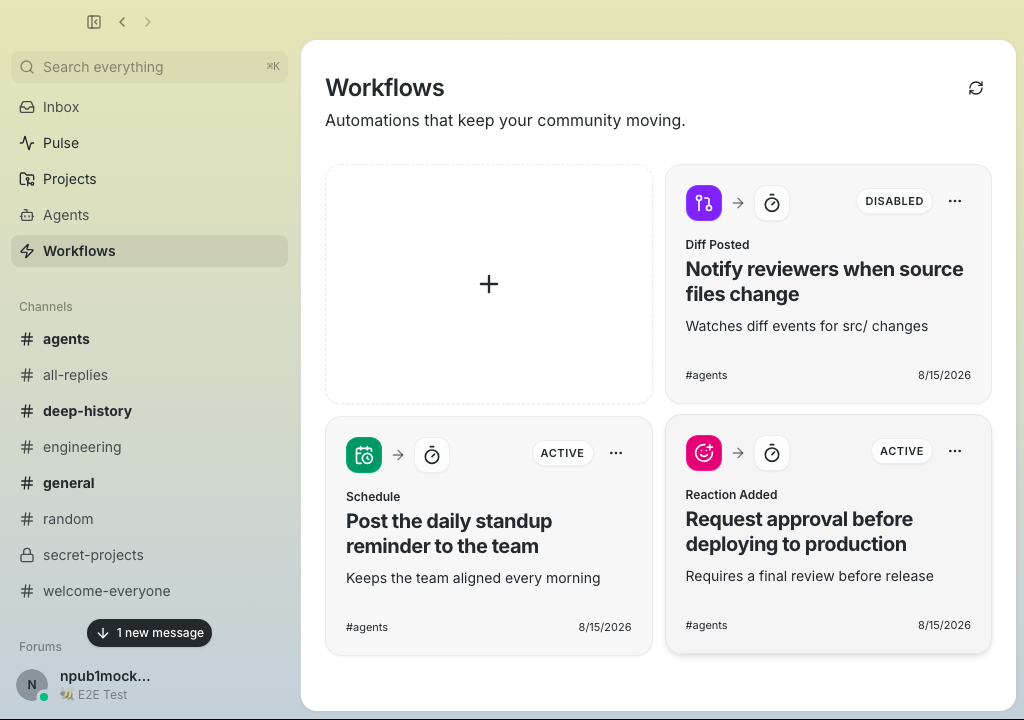 ### Wide — 1280 × 720 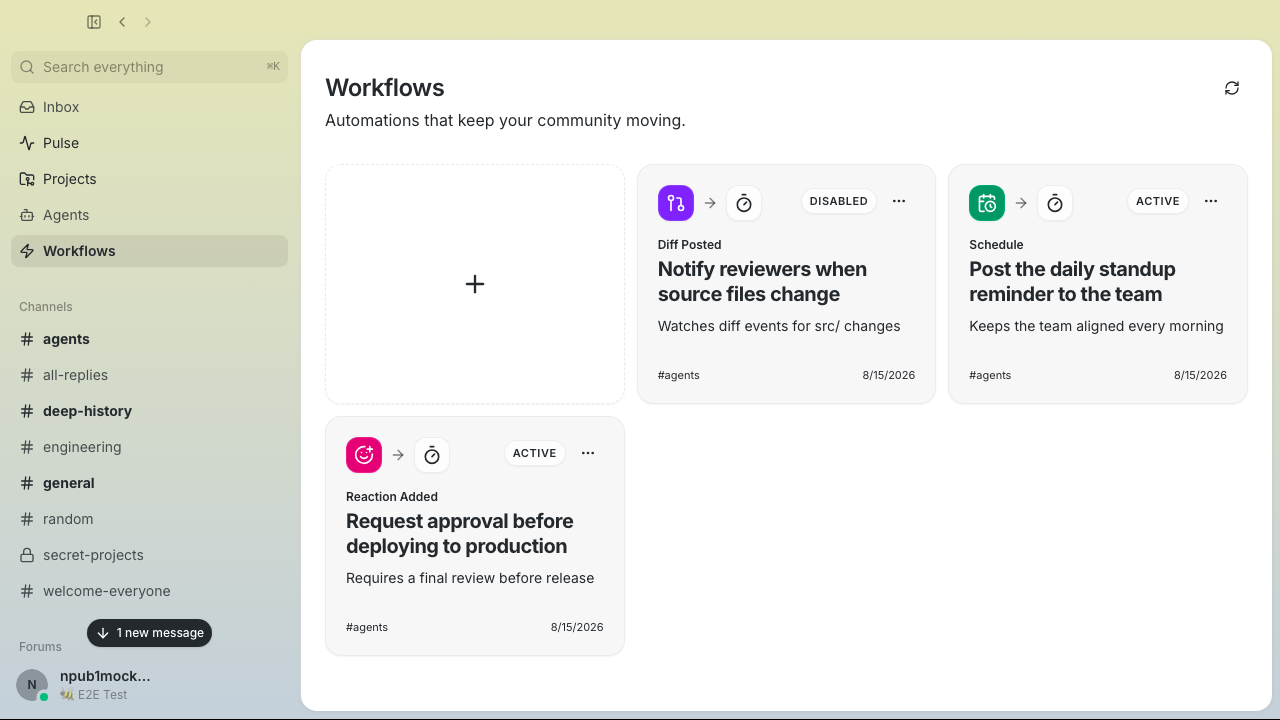 ### Card actions 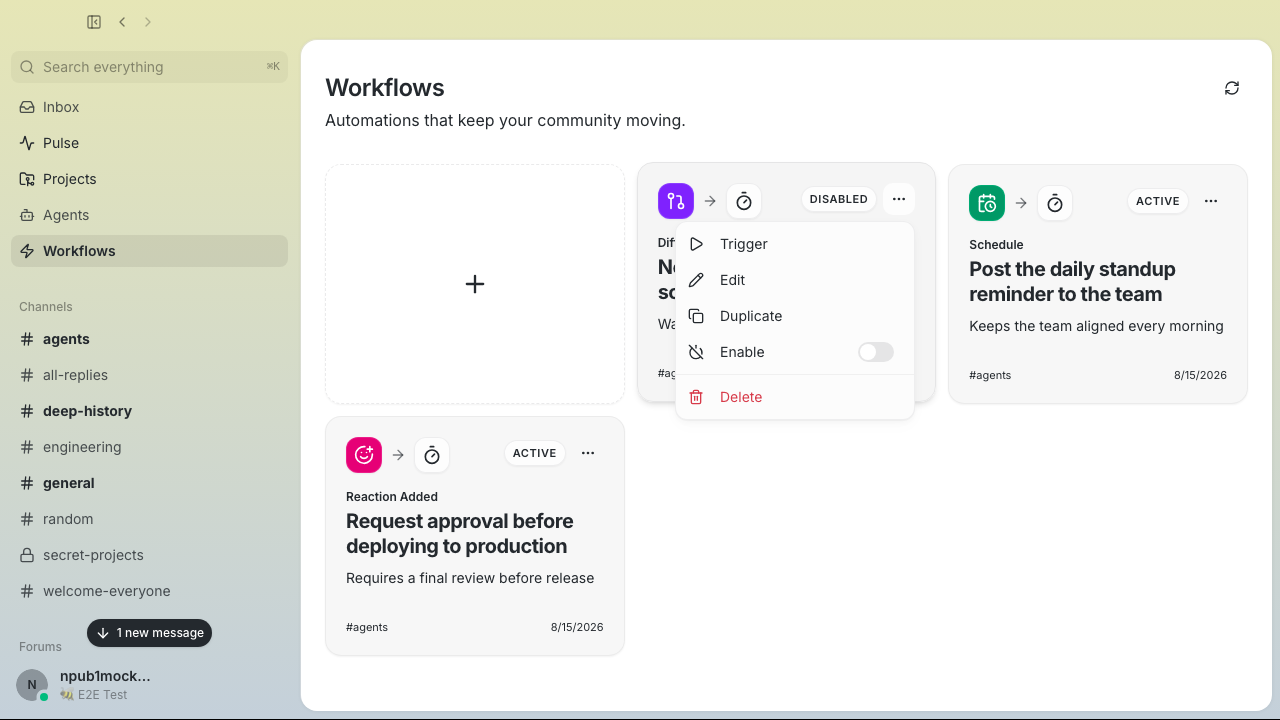 --------- Signed-off-by: Taylor Ho <taylorkmho@gmail.com> |
||
|
Tyler
|
73cc31cc52 |
chore: remove LLM-slop comments across the codebase (#1277)
Signed-off-by: Tyler Longwell <tlongwell@block.xyz> Co-authored-by: npub1qyvc0c5kl4gqv2fd97fsk46tu378sqgy35vc83rvgfwne90sel7s0ed67d <011987e296fd5006292d2f930b574be47c7801048d1983c46c425d3c95f0cffd@sprout-oss.stage.blox.sqprod.co> Co-authored-by: Max <d8473ee32b973aa31a21a65adddcc4b69cc2a8a4dee8121ecd51926e0cddbc02@sprout-oss.stage.blox.sqprod.co> Co-authored-by: Mari <95cae996907d7cab9f5dbf43c0f53edeac6ab0b032a6feae4abfd784e467b3f5@sprout-oss.stage.blox.sqprod.co> Co-authored-by: Quinn <96f056ad5f2305c8ddf637dc65d048aa4c12d7daeb8867690e34fca46b0ef64c@sprout-oss.stage.blox.sqprod.co> Co-authored-by: Sami <f4a42a97e594b77bdbd8ee35191c8b28a94a4cb871d96f32921558275421fb68@sprout-oss.stage.blox.sqprod.co> Co-authored-by: Perci <5a968df9a7494b4e019b9ecf739e088ba61097b4312124e9a88ae5b42e3f5f3e@sprout-oss.stage.blox.sqprod.co> Co-authored-by: Tyler Longwell <tlongwell@block.xyz> |
||
|
tlongwell-block
|
762ca43d26 |
fix(cli): use relay workflow id on create (#872)
Signed-off-by: Tyler Longwell <tlongwell@squareup.com> Co-authored-by: npub1mprnacetjua2xx3p5eddmhxyk6wv929ymm5py8kd2xfxurxahspqqlgyta <d8473ee32b973aa31a21a65adddcc4b69cc2a8a4dee8121ecd51926e0cddbc02@sprout-oss.stage.blox.sqprod.co> Co-authored-by: npub1qyvc0c5kl4gqv2fd97fsk46tu378sqgy35vc83rvgfwne90sel7s0ed67d <011987e296fd5006292d2f930b574be47c7801048d1983c46c425d3c95f0cffd@sprout-oss.stage.blox.sqprod.co> |
||
|
Will Pfleger
|
d99ad131f1 |
refactor: rename sprout backend to buzz (#958)
Signed-off-by: Will Pfleger <pfleger.will@gmail.com> Signed-off-by: Will Pfleger <wpfleger@block.xyz> Signed-off-by: Will Pfleger <wpfleger@squareup.com> Signed-off-by: Will Pfleger <wpfleger96@gmail.com> Co-authored-by: npub1mn7jgtj4w2pd0g0zeuhxsa6jy6p0rewxz4kujt98my82ahfmp72sxjexk7 <dcfd242e557282d7a1e2cf2e6877522682f1e5c6156dc92ca7d90eaedd3b0f95@sprout-oss.stage.blox.sqprod.co> Co-authored-by: npub1fgdl5qqnh3k3f2xkqrvt7cujalhm623x4s7fdjdj5yrtp5fzjl9qrjpucw <4a1bfa0013bc6d14a8d600d8bf6392efefbd2a26ac3c96c9b2a106b0d12297ca@sprout-oss.stage.blox.sqprod.co> Co-authored-by: npub16v54tttfqacx9ycvc3k0ut0npj564ahcuajzy6qjvh57ntmsf4uq4806j2 <d32955ad69077062930cc46cfe2df30ca9aaf6f8e76422681265e9e9af704d78@sprout-oss.stage.blox.sqprod.co> Co-authored-by: Will Pfleger <wpfleger96@gmail.com> |



