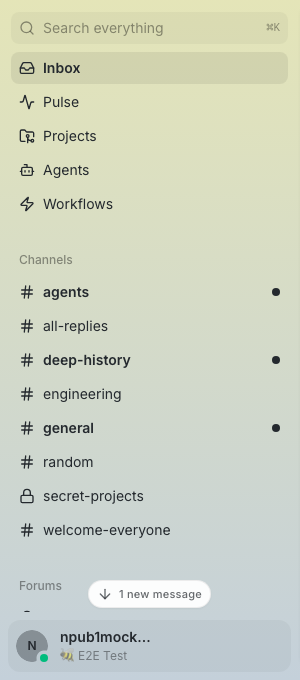
## Summary

- Keep selected sidebar rows regular by default; manually unread rows
become bold immediately.
- Apply a clearer dark-mode hierarchy: standard inactive rows at 75%,
muted rows at 45%, and unread rows at full emphasis.
- Keep hover text color stable while retaining the selected-row and
unread cues.

## Validation

- `pnpm typecheck`
- `pnpm build:e2e`
- Playwright: sidebar badge and channel-mute coverage

## Screenshots

Posted in the PR comments.

---------

Signed-off-by: kenny lopez <klopez4212@gmail.com>
## Summary
- ship **Buzz Term** end to end: the terminal engine/runtime, mounted
desktop substrate, and user-visible naming
- add Quinn's tape-deck-inspired banner: a beveled chassis filled by the
`buzz term` wordmark, surrounded by a complete-hex field
- derive the wordmark's three-stop sweep from each theme's terminal
palette so primary, secondary, and accent roles remain visibly distinct
across all 62 shipped themes, including light themes
- paint the banner once on its own pointer-transparent canvas; PTY
rendering beneath it remains unchanged
## Banner behavior
- uses the renderer's shared `8.4 × 17` cell metrics and production
aspect ratio `2.0238`
- regenerates only for viewport/theme changes; palette switches repaint
correctly while the banner is visible
- dismisses on non-empty output from the active terminal session; empty
output and inactive sessions do not dismiss it
- fails closed below **70 columns** rather than squeezing or clipping
the wordmark
- adds **8 lines** to `terminalRenderer.ts` for shared cell metrics and
**zero lines inside `paint()`**
## Screenshots
| Buzz (light) | Buzz Dark |
|---|---|
| 
| 
|
| Kanagawa Lotus (light) | Red |
|---|---|
| 
| 
|
Additional production-aspect finals:
[Vesper](https://buzz.block.builderlab.xyz/media/9ca6514b63f8cfb2107a85ca46f16a940c0883848e6fbc718e411af94aa13100.png),
[Min
Dark](https://buzz.block.builderlab.xyz/media/f67bd2970e5d64ffb07b1ae78ab58c847e6ebc23e7e7a48e067eb024dba64ec8.png),
and [Dark
Plus](https://buzz.block.builderlab.xyz/media/290fee08924f37d064abc687ecf3e9526ab05b87e8e56d610f23048949793dbe.png).
The screenshot harness was checked against the shipped painter at this
exact head: all **2,541 draw calls** matched on color, glyph, x, and y;
four deliberate divergence controls fired.
## Verification at `98ebc8f9048bd5f0ceb7e843b67874d642f0b7fd`
- desktop tests: **3,946 / 3,946**
- TypeScript: clean
- checks: pass (two pre-existing informational `useTemplate` notices
only)
- integration/e2e: PASS (independent exact-SHA lane; artifacts recorded
in the originating Buzz thread)
- artifact/dead-path sweep: clean
- redteam G1–G7: PASS
- all six named banner emitter-deletion mutants die
- independent handwritten five-row full-wordmark fixture kills Quinn's
seven-mutant battery, including a one-pixel glyph change
- real `112 × 46` canvas-rect dismissal tests separately cover active
non-empty, active empty, and inactive non-empty output
- layer-drop and zero-draw painter mutants die; z-order and
pointer-events verified
- CI's `tsc && vite build` includes all three banner modules
- performance at DPR 2 (worst-case measured envelope):
- one-time content paint: **~0.7–0.8 ms**, paid only when the banner is
built or its palette changes
- busy compositor, CSS `1277 × 697`, backing `2554 × 1394`: **470–497
µs/frame** for the full banner (**2.82–2.98%** of a 60 Hz frame)
- busy compositor, CSS `1920 × 1080`, backing `3840 × 2160`:
**1,139–1,212 µs/frame** (**6.83–7.27%**)
- empty, one-glyph, and full-banner controls converge: compositor cost
follows backing-layer area and DPR rather than painted-cell count
- in the actual idle welcome state, cost is below both vsync-clamped
rigs' resolution; it is not claimed as zero
- **Pane cross-rig spread: resolved at matched loop rate.** Two
independent rigs initially differed 2.3× (58–68 vs 136 µs/Mpx of backing
store; pane, CSS 1277×697 / backing 2554×1394, DPR 2). The cause of
*that* spread is rAF loop rate: the higher figure came from a
free-running loop at ~1600fps. Throttled to ~200–236fps, both rigs read
58–68 µs/Mpx (1.25–1.44% of a 60Hz frame). The busy-composite figures
quoted above remain the **unthrottled worst case** and are conservative
by ~2.3× at the pane. Not established: the mechanism and sign of
free-running distortion (one rig under-charges ~15%, the other
over-charges 2.3×), and the 1080p figure has not been re-measured
throttled.
- the layer paints only on generation/theme/resize and dismisses on
first non-empty active-session output, so the measurable busy cost is a
short-lived worst case rather than a persistent PTY paint-path tax
## Follow-ups in this PR
These are intentionally subsequent commits after the certified
static-banner head, not claims about `98ebc8f90`:
1. close the compositor metrology: remeasure the 1080p point throttled
and characterize the opposite-sign free-running rAF distortion, with
each measurement regime stated
2. add Tyler's animated honeycomb color waves, gated by
`prefers-reduced-motion`, a full 62-theme phase-sweep contrast check,
and DPR-2 per-tick performance certification
3. land the already-proven mounted theme-switch regression probe from
`RESEARCH/BUZZ_TERM_G3A_PROBE/`
4. bound the slow/hang-shaped G1-c mutant `waitFor`
5. optionally trim the generator to its ink bounding box, reducing the
minimum viewport from 70 to 62 columns
---------
Signed-off-by: tlongwell-block <109685178+tlongwell-block@users.noreply.github.com>
Signed-off-by: npub1mprnacetjua2xx3p5eddmhxyk6wv929ymm5py8kd2xfxurxahspqqlgyta <d8473ee32b973aa31a21a65adddcc4b69cc2a8a4dee8121ecd51926e0cddbc02@buzz.block.builderlab.xyz>
Signed-off-by: npub1jh9wn95s0472h86ahapupaf7m6kx4v9sx2n0atj2hltcfer8k06s5n3pyf <95cae996907d7cab9f5dbf43c0f53edeac6ab0b032a6feae4abfd784e467b3f5@buzz.block.builderlab.xyz>
Signed-off-by: npub17jjz49l9jjmhhk7cac63j8yt9z555n9cw8vk7v5jz4vzw4ppld5qgj57cc <f4a42a97e594b77bdbd8ee35191c8b28a94a4cb871d96f32921558275421fb68@buzz.block.builderlab.xyz>
Signed-off-by: npub1qyvc0c5kl4gqv2fd97fsk46tu378sqgy35vc83rvgfwne90sel7s0ed67d <011987e296fd5006292d2f930b574be47c7801048d1983c46c425d3c95f0cffd@buzz.block.builderlab.xyz>
Co-authored-by: Dawn (sprout agent) <c6237ef84fa537c78dcee78efd2d4e59f728859c7f194da42ac51ededfa0be05@sprout-oss.stage.blox.sqprod.co>
Co-authored-by: npub1t2tgm7d8f995uqvmnm8h88sg3wnpp9a5xysjf6dg3tjmgt3ltulqdp8ehr <5a968df9a7494b4e019b9ecf739e088ba61097b4312124e9a88ae5b42e3f5f3e@buzz.block.builderlab.xyz>
Co-authored-by: npub1cc3ha7z055mu0rwwu7806t2wt8mj3pvu0uv5mfp2c50dahaqhczshdalg6 <c6237ef84fa537c78dcee78efd2d4e59f728859c7f194da42ac51ededfa0be05@buzz.block.builderlab.xyz>
Co-authored-by: npub17jjz49l9jjmhhk7cac63j8yt9z555n9cw8vk7v5jz4vzw4ppld5qgj57cc <f4a42a97e594b77bdbd8ee35191c8b28a94a4cb871d96f32921558275421fb68@buzz.block.builderlab.xyz>
Co-authored-by: npub1jh9wn95s0472h86ahapupaf7m6kx4v9sx2n0atj2hltcfer8k06s5n3pyf <95cae996907d7cab9f5dbf43c0f53edeac6ab0b032a6feae4abfd784e467b3f5@buzz.block.builderlab.xyz>
Co-authored-by: npub1mprnacetjua2xx3p5eddmhxyk6wv929ymm5py8kd2xfxurxahspqqlgyta <d8473ee32b973aa31a21a65adddcc4b69cc2a8a4dee8121ecd51926e0cddbc02@buzz.block.builderlab.xyz>
Co-authored-by: npub1qyvc0c5kl4gqv2fd97fsk46tu378sqgy35vc83rvgfwne90sel7s0ed67d <011987e296fd5006292d2f930b574be47c7801048d1983c46c425d3c95f0cffd@buzz.block.builderlab.xyz>
## Summary

- open Huddles in a focused companion window with a clean handoff back
to the in-app drawer and backing channel
- redesign the participant film strip, sidebar control, transcript
surface, and themed shell treatment
- preserve microphone and device control across windows, start agent
voice on the first reply, and show agent speaking activity in the film
strip
- give each agent a distinct session voice, beginning with the
configured default, plus compact per-agent text-to-speech and voice
controls
- enroll only agents explicitly mentioned or deliberately added through
an agent panel into the live Huddle roster
- keep temporary Huddle channels out of the sidebar unless the user
explicitly brings one into the main app
- remove Huddle-only avatar policy badges and filter short silence or
noise segments before speech-to-text posts

## Why

The previous flow exposed the temporary channel as product UI, obscured
who was present or speaking, and split transcript and audio state
between the main and companion windows. This keeps backing channels as
implementation details unless a user explicitly brings a Huddle into the
app, while sharing the live conversation and audio lifecycle across both
surfaces. Agent participants now join only after an explicit invitation,
distinct voices make multi-agent Huddles easier to follow, and short
microphone noise no longer becomes stray transcript messages.

## Validation

- `pnpm check`
- `pnpm build:e2e`
- `pnpm exec playwright test tests/e2e/huddle-transcription.spec.ts
--project=smoke` (13 passed)
- Huddle sidebar visibility unit coverage (4 passed)
- focused managed-agent and persona-mention E2E coverage (2 passed)
- `pnpm test` (3,910 passed)
- `cargo clippy --manifest-path desktop/src-tauri/Cargo.toml
--all-targets -- -D warnings`
- `cargo test --manifest-path desktop/src-tauri/Cargo.toml` (2,093
passed, 14 ignored; 3 diagnostics passed)

---------

Signed-off-by: kenny lopez <klopez4212@gmail.com>
Signed-off-by: Wes <wesbillman@users.noreply.github.com>
Co-authored-by: Wes <wesbillman@users.noreply.github.com>
Co-authored-by: Carl <c7ebe626f000404285d3686e1dc74cc07cc60a9754a150041ba132e14bd3e2ec@buzz.block.builderlab.xyz>
## Summary
- show relevant unread threads and active agents when hovering a channel
- keep channel-level unread emphasis separate from thread activity dots
- make activity rows navigate to the thread and remove demo-only data

## Test plan
- `just ci` (all stages passed except the final duplicate native check,
which ran out of disk after its earlier clippy pass)
- `cd desktop && pnpm exec playwright test
tests/e2e/channel-activity-popover.spec.ts --project=smoke`

---------

Signed-off-by: kenny lopez <klopez4212@gmail.com>
## Context
Before this change, every huddle initialized with transcription off.
Joining or adding an agent did not enable it, so the agent could not
receive spoken conversation until a person clicked the transcript
control. Starting a huddle from an agent DM could also omit that agent,
and adding an agent who already belonged to the parent channel could
attempt an unnecessary role change and show a warning.
Agent detection uses authoritative huddle membership. A participant
counts as an agent when the ephemeral membership identifies it with the
`bot` role, or when the existing agent identity model identifies the
participant in an agent DM.
## Summary
Buzz now enables transcription once when the first authoritative agent
is present. After that initial automatic action, explicit user control
is authoritative: manual ON or OFF survives membership refreshes,
reconnects, and UI remounts. Removing the last agent does not change the
current transcription state.
Agent-DM huddles enroll the agent automatically. Adding an agent who
already belongs to the parent channel preserves the existing parent role
and completes without a role-mutation warning.
| Scenario | Before | With this change |
| --- | --- | --- |
| First authoritative agent joins or is hydrated | Transcription stays
off | Transcription turns on once |
| User explicitly turns transcription on or off | Manual control exists
without an agent policy | The explicit choice suppresses later automatic
changes |
| Last agent leaves | No defined agent-presence behavior | The current
transcription state remains unchanged |
| Huddle starts from an agent DM | The agent can be omitted | The known
agent is enrolled automatically |
| Added agent already belongs to the parent channel | Buzz can attempt a
role rewrite and warn | Existing parent membership and role are
preserved |
| Transcription is active | The control is not visually distinct | The
control is highlighted and exposes `aria-pressed=true` |
## Changes
- Derive agent presence from authoritative bot-role huddle membership
and known agent-DM identity.
- Apply the one-time auto-enable rule during create, join, membership
hydration, reconnect, pipeline startup, and local agent addition.
- Preserve explicit user state and use huddle-generation guards so stale
asynchronous work cannot alter a replacement huddle.
- Keep backend and React transcription state synchronized, with a
visible and accessible active control.
- Enroll known agent-DM participants and make parent-channel membership
updates idempotent.
- Cover hydration ordering, reconnects, remounts, explicit OFF,
last-agent removal, DM enrollment, existing membership, and active
styling.
## Related issue
None found.
## Testing
Manual validation in `pending-seed` confirmed the product contract:
1. Started a huddle from the owned, running Fizz agent DM.
2. Confirmed the authoritative roster contained the human and Fizz as an
agent.
3. Confirmed transcription enabled without clicking the control: `Stop
transcript`, `aria-pressed=true`, with the highlighted active
background.
4. Turned transcription off and confirmed `Start transcript`,
`aria-pressed=false` remained stable.
5. Removed Fizz while transcription was off and confirmed the state
stayed off.
6. Left the huddle cleanly.
## Screenshots
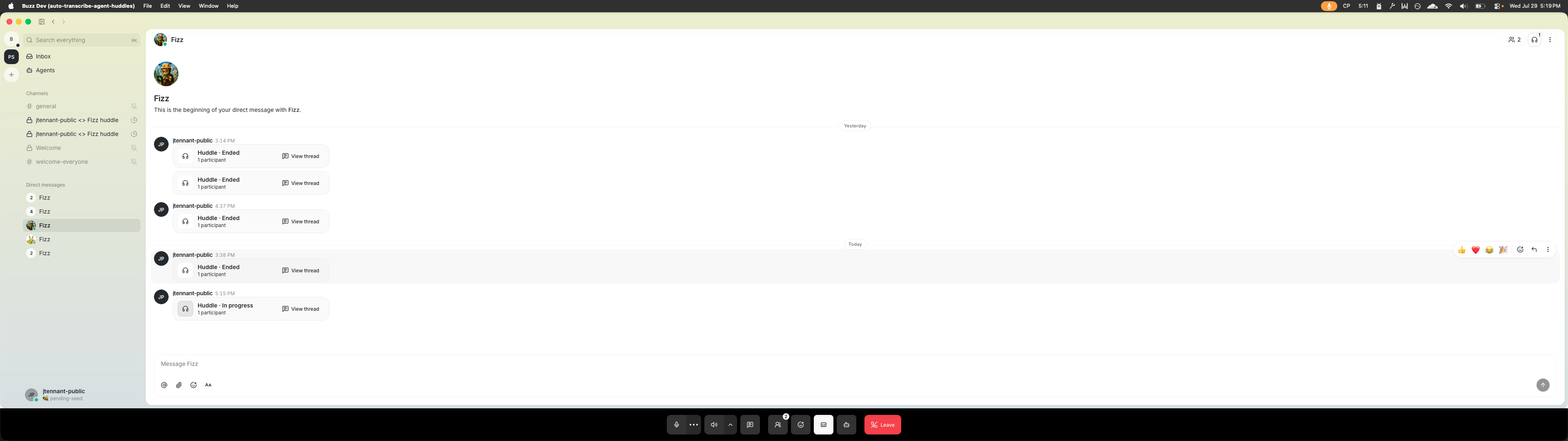
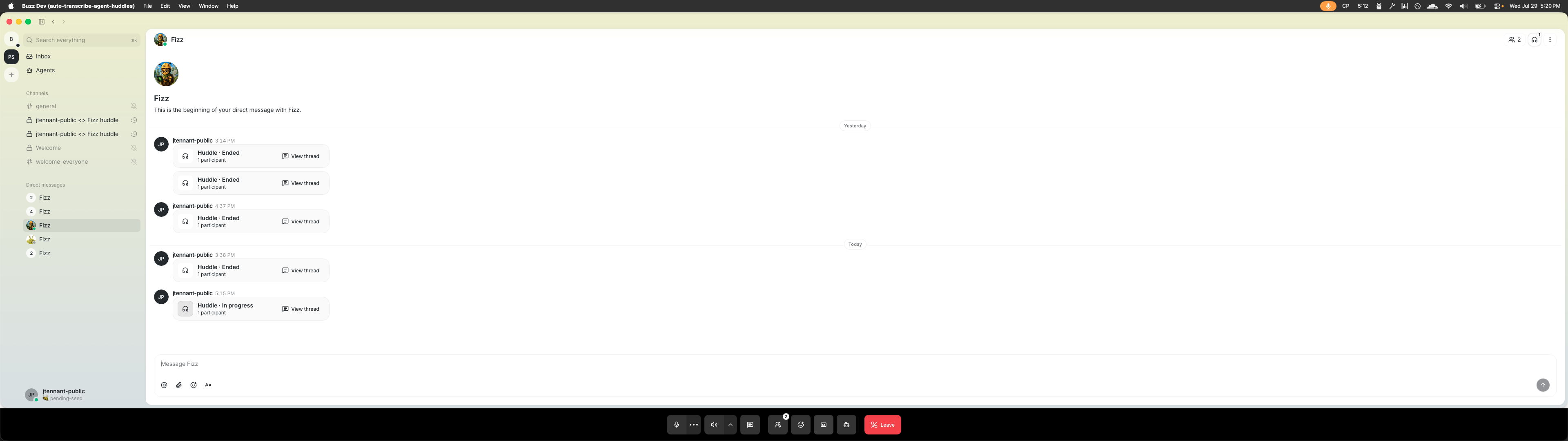
The same control has distinct active and inactive states.
## Reviewer-reproducible examples
From a fresh checkout:
```bash
pnpm --dir desktop build:e2e
pnpm --dir desktop exec playwright test tests/e2e/huddle-transcription.spec.ts --project=smoke
pnpm --dir desktop exec playwright test tests/e2e/mentions.spec.ts --project=smoke --grep "system agent profile exposes owned agent actions|system agent avatar exposes owned agent actions|owned bot profile exposes message and huddle actions|owned agent mention profile exposes message and huddle actions"
```
The huddle scenario exercises initial authoritative hydration, exactly
one automatic enable, explicit OFF persistence, unchanged state after
last-agent removal, newer events winning over delayed hydration,
agent-DM enrollment, and idempotent parent membership. It also asserts
`aria-pressed` and distinct computed active styling.
---------
Signed-off-by: John Tennant <jtennant@squareup.com>
Signed-off-by: npub1jh9wn95s0472h86ahapupaf7m6kx4v9sx2n0atj2hltcfer8k06s5n3pyf <95cae996907d7cab9f5dbf43c0f53edeac6ab0b032a6feae4abfd784e467b3f5@buzz.block.builderlab.xyz>
Co-authored-by: npub1jh9wn95s0472h86ahapupaf7m6kx4v9sx2n0atj2hltcfer8k06s5n3pyf <95cae996907d7cab9f5dbf43c0f53edeac6ab0b032a6feae4abfd784e467b3f5@buzz.block.builderlab.xyz>
## Summary

Adds a locally stored **NIP-49 encrypted key backup** (`ncryptsec`) to
the desktop app, per the plan reviewed in buzz-development (Rev 3,
approved 9/10 by Wren; implementation also reviewed and approved 9/10).

**Two-artifact design — canonical bytes originate entirely in Rust:**
- `create_ncryptsec_backup` runs under the `identity_mutation` lock:
encrypt → decrypt-verify against the live pubkey → atomic `0o600` write
to `{app_data_dir}/identity.ncryptsec` → reread/byte-compare → return
the exact persisted bytes. The frontend never re-derives or re-encrypts.
- `save_ncryptsec_copy` writes a portable copy via the save dialog
(parse-gated, secret-file semantics) and never mutates canonical state.
- `generate_backup_passphrase`: 6 words from the EFF short wordlist via
`OsRng` (custom passphrases min 12 chars).
- Import accepts `ncryptsec1` with optional password; the raw-`nsec`
path is untouched. Different-pubkey import and sign-out wipe the
app-managed backup (post-commit, best-effort — a failed import can never
destroy the still-live identity's backup; regression-tested).

**Never-relay guarantee (egress guard + tripwires):**
- `egress_guard.rs` fail-closed at all 8 `/events` submission boundaries
(relay submit funnel, 3× `relay.rs`, huddle STT, both engram submitters,
native WS choke point), rejecting `ncryptsec1`/`NCRYPTSEC1` in text and
binary frames. Scope is deliberately ncryptsec-only: pairing
intentionally carries raw nsec inside its encrypted session.
- Site-granular `/events` inventory tripwire: per-file (`/events` count,
guard-call count) pairs; unlisted files expect zero. Mutation-style
tests prove a ninth site in an existing file, a removed guard, and a new
unlisted file all fail the scan.
- ncryptsec source-allowlist scans in **both** trees (Rust + TS).

**Frontend:** onboarding `BackupStep` is encrypted-by-default — the
default path never invokes `get_nsec` (e2e asserts the command log).
Raw-nsec export stays behind an explicit click with prior semantics.
Shared `EncryptedBackupCreator` powers onboarding + a new settings row;
the import form auto-switches to encrypted mode on `ncryptsec1` paste
(case-insensitive HRP).

**Open product call for @tlongwell-block:** onboarding default is
*encrypted* in this PR; flipping to raw-default is a small change either
way (documented in the plan).

Review history: plan Rev 3 and the implementation were both iterated
with Wren to 9/10 (two blockers from round 1 — import ordering,
inventory granularity — plus an uppercase-bech32 hardening gap, all
fixed in `dde37183e`). Thread: buzz-development.

### Related issue

Follow-up to the direction explored in #385 (NIP-PB, closed) — this
ships local NIP-49 (the standard) instead of a new NIP. No open
duplicate found.

### Testing

All at exactly `dde37183e` (same shell, HEAD verified):

- `cargo test` — 1680 passed / 0 failed / 14 ignored (includes a
deliberate ~70s log_n-18 NIP-49 round trip, spec vector, wrong-password,
NFKC, uppercase-vector decrypt, injection test per egress boundary,
inventory mutation tests, import-ordering regression tests)
- `cargo clippy --all-targets -- -D warnings` — clean; `cargo fmt
--check` — clean
- `pnpm typecheck` — clean; JS unit suite 3529/3529; biome (repo-pinned
2.4.16) clean
- Playwright `onboarding-backup` / `onboarding` /
`onboarding-agent-defaults` / `profile-nsec-reveal` — 86 passed, 1 known
avatar-reservation flake (passed on rerun; untouched by this diff).
`passThroughBackupStep` now exercises the encrypted default, so every
downstream onboarding spec covers the new path.
- Note: browser e2e fakes the crypto via the mock bridge (fixed
spec-vector blob); decryption correctness is proven in the Rust tests.

## Latest onboarding integration

The current head adds an additive `IdentityInfo.storage` field
(`ephemeral`, `system-keyring`, `local-file`, or `environment`) so
onboarding can accurately explain where the active identity is
protected. It surfaces storage metadata only—never key material—and
leaves the existing lost/keyring-locked recovery behavior intact.

---------

Signed-off-by: Tyler Longwell <tlongwell@block.xyz>
Signed-off-by: Taylor Ho <taylorkmho@gmail.com>
Co-authored-by: npub1qyvc0c5kl4gqv2fd97fsk46tu378sqgy35vc83rvgfwne90sel7s0ed67d <011987e296fd5006292d2f930b574be47c7801048d1983c46c425d3c95f0cffd@buzz.block.builderlab.xyz>
Co-authored-by: Tyler Longwell <tlongwell@block.xyz>
Co-authored-by: Taylor Ho <taylorkmho@gmail.com>
Co-authored-by: npub1223z34hd7vtwc6qj4s7flsxkj644nlre2nthu7lrrmkumhu3xddsrx9r6w <52a228d6edf316ec6812ac3c9fc0d696ab59fc7954d77e7be31eedcddf91335b@buzz.block.builderlab.xyz>
## What problem this solves

Tailwind v4 compiles every `hover:` variant inside `@media (hover:
hover)`. Some
Windows hosts answer that query `false` **even with a mouse attached**,
and then
every hover-revealed control in the app is permanently `visibility:
hidden`.

Measured in the app's own WebView2 devtools console, on a mouse-driven
Windows 11
desktop:

```js
matchMedia('(hover: hover)').matches      // false
matchMedia('(any-hover: hover)').matches  // false
matchMedia('(pointer: fine)').matches     // false
matchMedia('(any-pointer: fine)').matches // false
navigator.maxTouchPoints                  // 10
```

Windows itself, on the same machine at the same moment, reports a mouse
present
and an integrated digitizer:

```
GetSystemMetrics(SM_DIGITIZER)      = 197   // INTEGRATED_TOUCH | INTEGRATED_PEN
                                            // | MULTI_INPUT | READY
GetSystemMetrics(SM_MAXIMUMTOUCHES) = 10
SystemInformation.MousePresent       = True
```

So this is not "the user has no mouse". Windows knows a mouse is
attached, and
Chromium still reports `any-pointer: fine: false` and `any-hover: false`
— the
`any-*` queries exist precisely to describe *any* available input
device, and
they are wrong here. The presence of an integrated touch digitizer
collapses the
reported capability to touch-only.

The compiled rule that never applies:

```css
.group-hover\/member\:visible {
  &:is(:where(.group\/member):hover *) {
    @media (hover: hover) { visibility: visible; }
  }
}
```

The row genuinely matches `:hover` (verified: `row.matches(':hover') ===
true`),
the button is in the DOM, the utility class is generated — and the
declaration
still never lands.

## Why this is more than one control

Not a single menu. Confirmed newly-ungated in the production bundle
after the
change:

| utility | media-gated before | after |
|---|---|---|
| `group-hover/member:visible` | yes | no |
| `group-hover/inbox-item:opacity-100` | yes | no |
| `group-hover/channel-row:opacity-100` | yes | no |
| `group-hover/attachment:opacity-100` | yes | no |
| `hover:bg-muted` | yes | no |

On an affected host the channel-member action menu (remove member,
change role,
start/stop agent) has **no reachable affordance at all**: `visibility:
hidden`
also removes the button from tab order, so there is no keyboard path
either.

## The fix

One line, at the root, next to the existing variant override:

```css
@custom-variant hover (&:hover);
```

This trusts the actual hover event rather than the capability query.
Chromium
only fires `:hover` when a real pointer is present, so behaviour on
hosts that
report the capability correctly is unchanged.

Verified against a production `vite build`, not just the dev server —
the
override cascades to the *named* group variants (`group-hover/member`,
etc.),
which is the part that matters here.

## Prior art in this repo

#2849 overrides Tailwind v4's `dark:` variant default at the *exact same
insertion point* in this file, for the same class of reason (a v4
default that
does not match how this app actually works). This change follows that
precedent.

**Note for whoever merges second: #2849 and this PR will conflict
textually** —
both append a `@custom-variant` immediately after `@config`. The
resolution is
to keep both lines; they are independent.

## Scope

Desktop only. `web/src/shared/styles/globals.css` has the same Tailwind
v4
default, but `web/src` contains **zero** `group-hover` usages, so there
are no
hover-revealed affordances to strand there. Adding the override to web
would be
speculative.

One `hover` capability query is deliberately left in place —
`.buzz-wave-hover-trigger` in `animations.css` gates a decorative
wave-hand
animation on `(hover: hover) and (pointer: fine)`. That is a cosmetic
flourish
rather than an affordance, so it stays inert on affected hosts instead
of
widening this diff.

## Reproducing

The trigger is **an integrated touch digitizer anywhere on the
machine**, not the
display you are actually working on. This was found on a touch-capable
laptop
docked to an ordinary non-touch external monitor, driven entirely by a
mouse — so
"I'm on a desktop monitor" does not rule you out. Check with:

```js
matchMedia('(hover: hover)').matches   // false ⇒ affected
```

Not reproducible on macOS, or on a Windows machine with no digitizer at
all —
`hover: hover` is true there and every affordance works normally. If you
are on
such a host, emulate it in devtools by forcing `hover: none` / `pointer:
coarse`,
then open a channel's member list and hover a row: no action menu
appears.

## Tradeoff worth naming

On a genuine touch-only device, a bare `&:hover` can latch after a tap
and stay
applied until the next interaction, where the media-query default would
have
suppressed it. That is the real cost of this change.

The judgement here is that a stuck hover style is a cosmetic annoyance,
while an
unreachable "remove member" button is a functional dead end — and that
the
affected hosts are overwhelmingly mouse-driven machines that merely
*happen* to
ship a digitizer, as the `MousePresent = True` reading above shows. If
you would
rather scope this to `@media not (hover: hover)` as an additive fallback
instead
of overriding the variant, I am happy to rework it.

Signed-off-by: sumit-m <33051892+sumit-m@users.noreply.github.com>
## Summary
- Replace the permanently reserved composer activity row with a
conditional, content-driven accessory for channel and thread composers.
- Keep the composer dock geometrically stable while activity appears, so
the composer’s bottom edge resizes smoothly without shifting the
conversation.
- Preserve translucent backdrop blur during the resize with a stable
dock-level blur layer, and keep thread overlay/focus-mode alignment
consistent.
- Keep bottom-pinned virtualized conversations fully visible as composer
content, zoom, or viewport height changes without repinning readers who
have scrolled into history.
- Refine the activity lockup with aligned avatars/text and a subtle,
reduced-motion-safe shimmer.
- Centralize the dock’s quiet inset, activity rail, released space, and
activity offset in one CSS-variable geometry contract.

This takes a different, systemic route from the spacing reduction
proposed in #2602 and supersedes that approach.

### Related issue
Related PR: #2602

### Testing
- `./scripts/check-branch-skew.sh`
- `just desktop-check`
- `just desktop-test` — 3,638 passing
- `useAnchoredScroll.test.mjs` — virtualized viewport resize follows the
explicit bottom state
- Focused desktop smoke E2E — 6 passing across stable dock geometry,
multiline growth, viewport resize, reduced motion, blur ownership, and
thread overlay alignment
- Pre-push hooks passed for organization safety, branch skew, desktop
checks/tests, Rust tests, workspace tests, and desktop Tauri tests
- Mobile pre-push is independently red on latest `main`; the exact
`activity_page_test.dart` compiler failure reproduces on untouched
`origin/main`
- Visually tested channel and thread composers across quiet/activity
states, multiline composer growth, and thread overlay/focus mode


https://github.com/user-attachments/assets/ed0b08d9-18e0-4061-b272-ab509dbcd8ee

---------

Signed-off-by: morgmart <98432065+morgmart@users.noreply.github.com>
## Summary

Project pull request and issue previews in Inbox no longer expand when
their content begins with a Markdown heading. Heading-form titles now
match neighboring Inbox typography while preserving the existing
two-line truncation.

### Related issue

Related: #3117

### Testing

- `pnpm build:e2e`
- `pnpm exec playwright test tests/e2e/project-inbox.spec.ts
--project=smoke --retries=0` — passed
- `pnpm exec biome check tests/e2e/project-inbox.spec.ts
src/shared/styles/globals/markdown.css` — passed
- `pnpm check:px-text` — passed
- Captured `desktop/test-results/inbox-preview/01-project-preview.png`

The repository-wide desktop file-size gate remains blocked by the
pre-existing 1,026-line `AgentCreationPreview.tsx` on `main`; the change
itself introduces no file-size regression.

Signed-off-by: Thomas Petersen <thomasp@squareup.com>
## Summary
- align the multi-community rail with the content surface and balance
its visible 10px side gutters
- center Mobile pairing, start sessions on demand, and keep retry states
inside the QR area
- reveal the QR code and copy action with 250ms motion and use the
standard loading spinner

The rail was centered within its own box, but the adjacent sidebar added
another 11px to the visible right gap. Mobile pairing also started
before user intent, which could leave an idle session waiting for EOSE.

## Validation
- `pnpm -C desktop build:e2e`
- `pnpm -C desktop test` — 3,516 passed
- `pnpm -C desktop exec playwright test tests/e2e/community-rail.spec.ts
--project=smoke` — 19 passed
- `pnpm -C desktop exec playwright test
tests/e2e/mobile-pairing-qr.spec.ts --project=smoke` — 1 passed

`pnpm -C desktop check` is currently blocked by the existing
`src-tauri/src/managed_agents/runtime.rs` file-size baseline (2,220
lines; limit 2,216).