mirror of
https://github.com/block/buzz.git
synced 2026-11-25 10:42:26 +00:00
5bd9d2c5d2912d9c8dbdcdf710d643a1d8ad91a2
33 Commits
| Author | SHA1 | Message | Date | |
|---|---|---|---|---|
 Wes |
5079c770fe |
fix(workflows): make deletion persistent and retryable (#7735)
## Summary Fix workflow deletion leaving its definition queryable, and make public deletion acceptance agree atomically with executable/definition state. - Delete the executable workflow and soft-delete its definition under the existing coordinate lock, in the same transaction as kind-5 acceptance and mention indexing. Failed deletion leaves no public accepted event; identical retries can succeed. Legacy already-stored failed requests still repair. - Choose one committed dispatch/audit owner for concurrent identical requests. Completed duplicates remain silent. Preserve owner/community isolation, newer revisions, orphan cleanup, and intentional backdated recreation. - Align Desktop confirmation and architecture documentation with recreation semantics. Add deterministic PostgreSQL, live WebSocket, and Desktop regressions. No schema migration or new retry/delivery subsystem. ## Current validation Head: `40d86ddab0853ffb292316653b22c3fd4f983f0c`. - **Exact clean head:** live relay workflow-deletion E2E **4/4 passed**. All applicable normal pre-push hooks passed: Rust unit suites, full Desktop unit suite, Desktop lint/typecheck, Tauri clippy/tests, and file-size/branch checks. No hook bypass. - **Pre-commit implementation tree, then committed at this head:** full discovered DB/relay PostgreSQL lane **351/351 passed**; built Desktop deletion Playwright smoke **3/3 passed** (success, failure preserving editor/draft, corrected confirmation copy). - **Deterministic mutation evidence:** unchanged previous relay `659b79282` fails both new regressions: concurrent identical requests produce two normal/dispatch-owner responses, and rejected deletion leaves one public event. Both controls pass. Fixed relay passes all four. - **Independent source review:** transaction/authorization/lock-order and regression/cleanup lanes clear. Reviewers did not run tests independently. ## Honest limits / merge gates The broad pre-commit DB/relay/test-client selection passed **1,215/1,216**; the untouched mesh-demo echo test returned HTTP 504 instead of 200. It remains outside this repair and is not counted green. Initial hook attempts also exposed an untouched Desktop inventory ordering assertion and unidentified ACP/agent test failures; standalone package reruns and the final complete hooks passed without changing those packages. Causes are not established. The previous Desktop CI shard failed before tests on a Hermit `just` download (HTTP 500). New-head CI/security review and reviewer disposition remain required. No deployment, fresh interactive Desktop session, full local `just ci`, or multi-replica runtime validation claimed. Postgres/Redis validation used task-owned local containers, fresh identities, and disposable fixtures. ## Compatibility No automatic cleanup of existing workflows: repeating deletion repairs definitions left by the old path. Canonical UUID coordinates and legacy name fallback (`LIMIT 1` for duplicate names) are unchanged. Backdated recreation remains intentional per [Tyler’s decision](https://github.com/block/buzz/pull/7735#issuecomment-5729881295), not an irreversible tombstone. Mention-index failure now rolls back the complete deletion rather than best-effort accepting partial work. Detailed reviewer disposition and evidence: https://github.com/block/buzz/pull/7735#issuecomment-5737367825 --------- Signed-off-by: Wes <wesbillman@users.noreply.github.com> Co-authored-by: Carl <32a2e2c9d428ee08902cab75d956da2c1d235a22d4766b0dd4138bf6e2e5db1d@buzz.block.builderlab.xyz> Co-authored-by: Mordecai <f314b6033b6e13df94c8e9e1187d3666b6b9ce54e66ee986e31cdaa909e8dcbc@buzz.block.builderlab.xyz> |
||
|
Logan Johnson
|
2226b6f95b |
fix(desktop): npub identity controls across profile, agents, and workflows (#7489)
🤖 ## Summary Building on #7488's npub foundation, this PR finishes the identity display change for the controls where you actually manage people and keys: profile, settings, agent access, and workflows. Everywhere in these surfaces, an identity key shows — and copies — as its canonical npub (npub is the human-readable encoding of a Nostr public key: the compact `npub1j57...fjmv` form where space is tight, the full npub where the whole key matters), and accepts npub as input. After this change: - Profile panel: the public-key row and the managed-by / declared-owner copies show the full npub. If a key can't be encoded, you see "Unavailable" with no copy button — never a raw or partial key. - Settings: the identity card shows and copies the npub. The hosted-communities account identity derives from the bound key (`pubkey_hex`) — the same authority as the mismatch gate and hosted operations — so the display can never disagree with what the app acts on; an unusable hex falls back to a neutral label instead of rendering the unverified server npub. The connected claim and a community's Connect action require that same usable bound key to match the local one — with no usable binding the card cannot claim connected or start Connect, while the community list, linking, and delete/rebind recovery stay available. - Hosted create/onboarding: the account and device identity rows in the create flow and owner onboarding derive from the same authoritative fields (bound key / local key), with the same neutral fallback; readiness requires a usable bound key that matches the local one. - Respond-to allowlist (controls who may respond to an agent): entries can be typed or pasted as hex or npub; both spellings of the same key are recognized as one entry and dedupe. Search results, chips, and remove buttons use the compact npub. - Workflow key fields: to/from keys display as npubs in the form and save back as canonical hex. Templates like `{{trigger.author}}`, roles, and free text pass through untouched; placeholders accept both spellings. - Recipient and agent dialogs: the verify popover is npub-only (the raw-hex line is gone); denied-membership screens never show a raw key. - The Rust-side truncated display name (used for native surfaces) shows the same compact npub, so those surfaces match the web UI. Internal representation is unchanged: keys are still stored, sent, and matched as canonical 64-character hex — npub is a display and input spelling, normalized to hex at the boundary, so existing data and integrations keep working. Bound-key usability and comparison use one normalized form (trimmed, lowercased, 64 hex characters; npub rejected), so padded or mixed-case spellings of the same key match. Display names, private keys, and event IDs are untouched. ## Details - `respondToAllowlist` / `RespondToField`: npub entries normalize to canonical hex; cross-form dedupe; compact npub in rows and chips; direct-add accepts npub and stores canonical hex. - `workflowFormTypes` / `WorkflowStepCard`: hex → npub for display, npub → canonical hex on save; templates, roles, and free text pass through in both directions (roundtrip-tested). - `UserProfilePanelFields`, `ProfileSettingsCard`, `HostedCommunitiesSettingsCard`, `MembershipDenied`, `SelectedRecipientChip`, `AddAgentToChannelDialog`: npub display and copy; invalid keys → "Unavailable" with no copy; hosted identity rows derive from the bound `pubkey_hex` (create/onboarding rows from the bound and local keys), never the unverified server npub; connected/readiness/Connect gates use the same usable-bound-key predicate, and the settings Connect invocation callback re-checks it before starting. - `src-tauri/src/commands/identity.rs`: `truncated_display_name` compacts to the first 8 + last 4 characters of the npub (above a 12-char threshold), mirroring `truncateNpub`. - e2e: profile key rows and clipboard polls assert npub forms and raw-hex suppression; the display-screenshots spec pins the npub-only popover; hosted specs drive the real settings card, create flow, and onboarding rows through their real providers, and the unlinked/npub-only identity cases assert no connected claim and no Connect action. ### Related issue - Fixes: N/A. No separate issue; the related work is the stack below. - Stack: builds on #7488 (shared npub foundation), now merged; this PR is rebased onto main and stands on its own. ### Testing At head `303c90ffa` (base: main `bfc38485`; 24 files, +1125/−146): - Focused unit suites (respondToAllowlist, workflowFormTypes, hostedCommunityApi bound-key helpers) green; mutation-checked — dropping allowlist canonicalization fails the dedupe case, and dropping bound-key normalization fails the npub-in-hex and padded same-key cases. - Full desktop unit suite 6,477/6,477, `desktop-typecheck`, `desktop-check` (formatting fixed narrowly with `biome check --write` on the touched files only), and a fresh E2E build at the current head; the add-community + hosted-communities-settings specs 18/18 and onboarding integration 69/69 on a fresh dedicated port, with focused new-case runs 4+4 covering padded same-key (ready, Connect kept — no false rebind) and npub-in-hex (neutral label, recovery, no Connect) across the settings card, create flow, and first-community onboarding, plus the unlinked-account settings regression asserting Connect cannot occur. - `cargo fmt`/clippy (both feature sets) and `cargo test identity` (71 pass) passed at the earlier full-change head; since then, the only production changes in this PR's delta are the hosted identity display authority and its fail-closed bound-key gating/normalization above (base-side fixes carry #7488's receipts) — every other change is test-only. ### Task provenance Buzz channel: `1f0e4a3d-7e01-4efe-bb16-843b357f85c9` Task: buzz://message?channel=1f0e4a3d-7e01-4efe-bb16-843b357f85c9&id=86b34eb4bd84a1472419e9af22636c011c0fe273e3c196f967d7a36996e149b6 --------- Signed-off-by: Logan Johnson <loganj@squareup.com> Co-authored-by: Larry <627498bd4bd1f281a16431e3c6cce3b5c25b6692798c78672298aefbf2f8f8b5@buzz.block.builderlab.xyz> |
||
|
Logan Johnson
|
ad2a84131e |
fix(desktop): npub identity displays for mention, member, and workflow surfaces (#7495)
🤖 ## Summary Every Buzz account is identified by a long public key. Before this change, when someone had no display name, surfaces fell back to inconsistent labels — mostly raw hex fragments like `abcd1234…wxyz`, sometimes a generic role label with no key — so the same person looked different from surface to surface, and nothing looked like an npub address. This PR applies the npub identity foundation from #7488 to the everyday surfaces: a person without a display name now falls back to the same compact npub everywhere — `npub1xxxx…yyyy`, the human-readable spelling of their public key (first 8 + last 4 characters of the full npub) — across messages and mentions, reactions, huddles, member and participant lists, the sidebar and channel activity, search, projects, tray, notifications, and workflow surfaces. - **Mentions and messages**: key-only mention chips render the compact npub. Pasting a copied mention back still re-binds it byte-exactly to the identity it declares, for both the new npub chips and legacy hex-truncated chips copied by older clients — wrong, missing, or tampered key qualification is rejected instead of silently degrading to plain text. - **Reactions and huddles**: huddle reaction events and the huddle roster/participants render the compact npub for unnamed participants; workflow reaction triggers describe authors with the same form. - **Members and sidebar**: channel and community member lists, add-member results and invites, the members sidebar, the channel-activity popover, search, projects (assignees/reviewers/PR panels), the tray menu, and desktop notifications all fall back to the compact npub; titles and aria labels keep the machine-readable full labels. - **Profile labels**: panel/popover display names and owner handles fall back to the compact npub (never raw hex) when there is no name; linked-event (nevent) message metadata shows the npub-shaped author fallback while the event lookup and event IDs are unchanged. - **Workflows**: author-picker secondary labels, step destination keys, and trigger-author references render compact npubs; event and blob IDs keep their existing hex compacts (they are not identities). - **Avatars stay distinct**: fallback avatars for key-only identities derive initials from the key's tail, so prefixed role labels like "Participant npub1…" no longer collapse every unnamed participant onto the same initials; people with names keep their name initials. Preserved exactly: display names and distinct avatars, internal hex keys (storage/API forms unchanged), clipboard identity roundtrips, event/blob ID compaction, private keys (no nsec path is touched), and nevent link handling. Scope: this PR changes what identity labels **display**, not identity controls — profile/settings copy controls, the respond-to allowlist, workflow key fields, and agent dialogs are the sibling slice #7489, and the shared primitives (`canonicalNpub`, `truncateNpub`, the `<PubKey>` gate, strict input parsing) come from the foundation #7488. ### Related issue - Fixes: N/A. Searched existing issues/PRs for duplicates — none found; the related work is the npub identity stack this slice belongs to. - Base/dependency: stacks on #7488 (foundation) — this PR does not stand alone on main. - #7489 is a sibling slice on the same #7488 base (profile/agent/workflow controls), not a dependency: this PR does not require #7489, and #7489 does not require this PR — both only require #7488. ### Testing At exact head `4763cbeae1dd521309755e6d61f657324cb98667` (base: `fix/desktop-npub-identity-d1a` @ `5f3a4a8111998c8aa41ad77cf66992bd1c85343c`; 71 files, +656/−189 — production +277/−136, test support +379/−53): - At this head: targeted `mentions.spec.ts` (1/1), the e2e build, typecheck, and biome — green. - 9 changed/related unit files: 100/100 green; typecheck, e2e build, biome, and px text/truncation checks clean; huddle-roster focused run green; channel-activity e2e 11/11; mutation checks confirm the fallback wiring (removing it collapses shared initials and drops fallback rows). - Known pre-existing local e2e failures, unchanged by this PR and reproduced identically at the upstream merge-base: huddle-transcription voice-menu attribution (25 pass / 1 fail) and the `workflow-local-controls` 438px caret drift. Not claimed green locally. - Update at head `236af9e6137386737e84d3a474d6bc808a704c50` (test-only follow-ups `1143af345` + `236af9e6`): the `workflow-local-controls` races were fixed in the test drivers, and the 438px diff was shown to be a stale Darwin snapshot baseline (name-row enable switch already absent and `message_posted` already MessageSquare at recording commit `9390e11c9`) and refreshed — the focused screenshot test, including keyboard/caret assertions, now passes locally (twice). The full spec was not rerun after the snapshot refresh; the huddle-transcription item above is unchanged. Label/copy text changes are asserted by the e2e specs (`mentions`, `mention-recipients`, `pubkey-display-screenshots`, `huddle-transcription`, `channel-activity-popover`, `workflow-local-controls`) rather than new screenshots; the screenshot spec pins the compact npub text forms. ### Task provenance Buzz channel: `1f0e4a3d-7e01-4efe-bb16-843b357f85c9` Task: buzz://message?channel=1f0e4a3d-7e01-4efe-bb16-843b357f85c9&id=86b34eb4bd84a1472419e9af22636c011c0fe273e3c196f967d7a36996e149b6 --------- Signed-off-by: Logan Johnson <loganj@squareup.com> Co-authored-by: Larry <627498bd4bd1f281a16431e3c6cce3b5c25b6692798c78672298aefbf2f8f8b5@buzz.block.builderlab.xyz> |
||
|
Arjun Mahanti
|
bc006f6708 |
feat: render agent avatars as squircles (#7106)
## Summary - render every agent/AI identity as a 30% squircle across desktop and mobile while keeping human avatars circular - propagate agent identity through message, thread, profile, reaction, member, DM, search, workflow, project, huddle, forum, pulse, and agent-management surfaces - preserve squircle geometry for fallbacks, focus/status treatments, add-agent controls, and overlapping avatar outlines (`calc(30% + 2px)` for the outer background) ### Related issue None found. This change was requested and visually reviewed in the originating Buzz thread. ### Testing - `just desktop-test` — 5,799 passed - `just mobile-test` — 2,008 passed - pre-push gates passed at `0d59d77b120dcb90aac2f918e422c11c9fa5353b`: desktop check, TypeScript typecheck, desktop full test suite, mobile format/analyze and full test suite, Rust tests, Tauri checks, and differential file-size gate - deterministic desktop visual sweep covered channel messages/thread summaries; thread, subthread, and sub-subthread depths; reactions and reactor popovers; hover/full profiles; added-to-channel activity; channel members/settings; agent library/team overlaps; agent creation; mention autocomplete; and DM header/sidebar/settings ### UI evidence The complete labeled visual matrix is available in the originating Buzz review thread. GitHub-hosted copies will be added in a follow-up PR comment using the repository screenshot script. --------- Signed-off-by: Fizz <dae5f6af70b8695a8b83c8deae555f63be41630ec2b8cd493e41a439c9527dd8@buzz.block.builderlab.xyz> Co-authored-by: Fizz <dae5f6af70b8695a8b83c8deae555f63be41630ec2b8cd493e41a439c9527dd8@buzz.block.builderlab.xyz> |
||
|
Taylor Ho
|
e760c51820 |
feat(workflows): discover trigger filter values (#6712)
**Category:** improvement **User Impact:** Workflow authors can discover people and messages while configuring trigger filters, then see readable enriched labels instead of raw identifiers. **Problem:** Author and message filters required users to know and paste raw public keys or event IDs, and configured workflows surfaced those opaque values afterward. **Solution:** Add network-backed pickers and presentation enrichment while keeping deterministic local public-key and event-ID fallbacks authoritative whenever discovery is unavailable or untrusted. Related issue: none found. <details> <summary>File changes</summary> **desktop/src/features/workflows/ui/WorkflowAuthorPicker.tsx** Adds channel-aware author discovery, profile search, keyboard navigation, loading states, and deterministic public-key fallback selection. **desktop/src/features/workflows/ui/WorkflowCard.tsx** Uses enriched trigger presentation when building the workflow card’s readable summary. **desktop/src/features/workflows/ui/WorkflowDialog.tsx** Keeps Escape scoped to an active filter picker before allowing the inspector or dialog to close. **desktop/src/features/workflows/ui/WorkflowFormBuilder.tsx** Threads channel context into trigger filters and renders enriched author/message summaries in the workflow sequence. **desktop/src/features/workflows/ui/WorkflowMessagePicker.tsx** Adds paged channel-history discovery, message search, exact event lookup, profile labels, keyboard navigation, and bounded results. **desktop/src/features/workflows/ui/WorkflowRichTriggerDescription.tsx** Renders compact author identity details and loading presentation inside trigger summaries. **desktop/src/features/workflows/ui/WorkflowTriggerConditions.tsx** Connects author and message filter accordions to their pickers while preserving selected and excluded condition semantics. **desktop/src/features/workflows/ui/useWorkflowAuthorPresentation.ts** Resolves configured author keys to trusted display labels with deterministic fallbacks. **desktop/src/features/workflows/ui/useWorkflowTriggerPresentation.ts** Enriches configured message IDs only after validating the fetched event and channel. **desktop/src/features/workflows/ui/workflowAuthorCandidates.test.mjs** Covers author candidate normalization, ordering, deduplication, and fallback behavior. **desktop/src/features/workflows/ui/workflowAuthorCandidates.ts** Builds stable author candidates from channel members, profiles, and raw public keys. **desktop/src/features/workflows/ui/workflowConditionExpression.ts** Allows message IDs to participate in basic trigger-filter parsing. **desktop/src/features/workflows/ui/workflowDefinition.ts** Accepts enriched trigger text when generating workflow card labels. **desktop/src/features/workflows/ui/workflowMessageCandidates.test.mjs** Covers event validation, source merging, deterministic ordering, and exact-lookup enrichment boundaries. **desktop/src/features/workflows/ui/workflowMessageCandidates.ts** Validates message candidates by event kind, channel, and exact event ID before permitting enrichment. **desktop/src/features/workflows/ui/workflowTriggerDescription.test.mjs** Covers readable selected/excluded author and message descriptions plus loading fallbacks. **desktop/src/features/workflows/ui/workflowTriggerDescription.ts** Builds concise enriched trigger descriptions while retaining stable raw-ID fallbacks. **desktop/tests/e2e/workflow-local-controls.spec.ts** Exercises picker discovery, selection toggles, Escape ownership, bounded scrolling, and enriched workflow summaries. </details> ## Reproduction steps 1. Open Workflows and create a workflow for a channel with members and message history. 2. Choose **Reaction Added** as the trigger and expand **Author**. 3. Confirm channel members and fetched profile results are discoverable, searchable, and keyboard accessible; choose one. 4. Expand **Message**, confirm recent channel messages appear in a bounded list, and choose one. 5. Toggle either selected filter between **is** and **is not**, then collapse the inspector and confirm the sequence summary stays readable. 6. Add a send-message step and create the workflow; confirm its card uses the resolved author and message labels. 7. Repeat while discovery is unavailable and confirm raw public keys/event IDs remain selectable and authoritative. ## Screenshots ### Author discovery 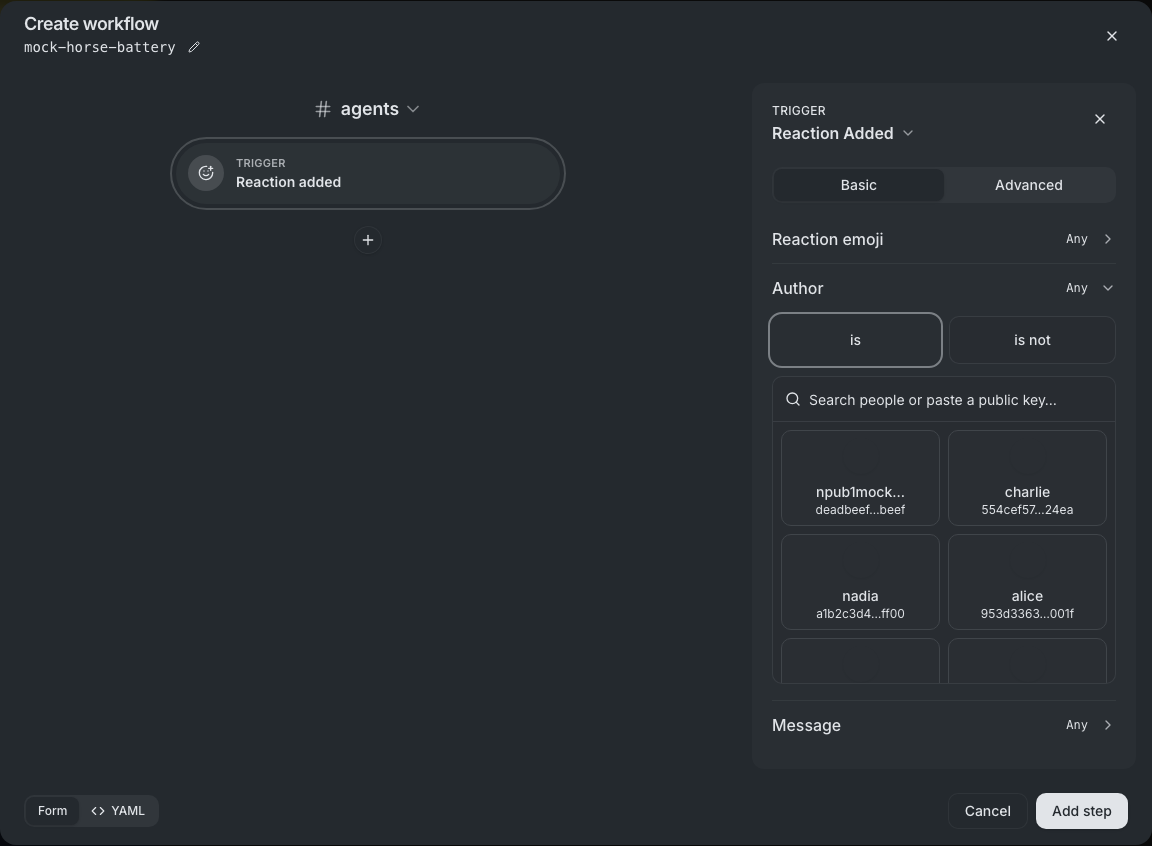 ### Message discovery 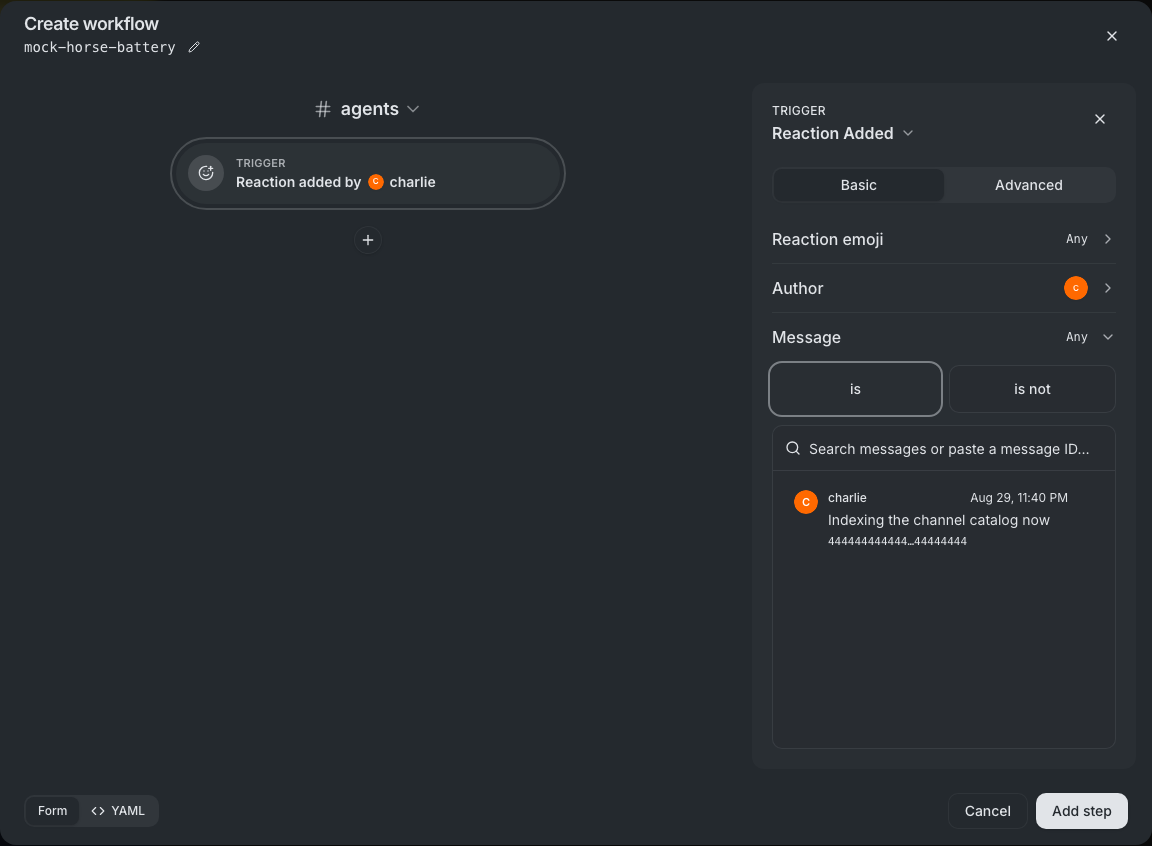 ### Selected filter summaries 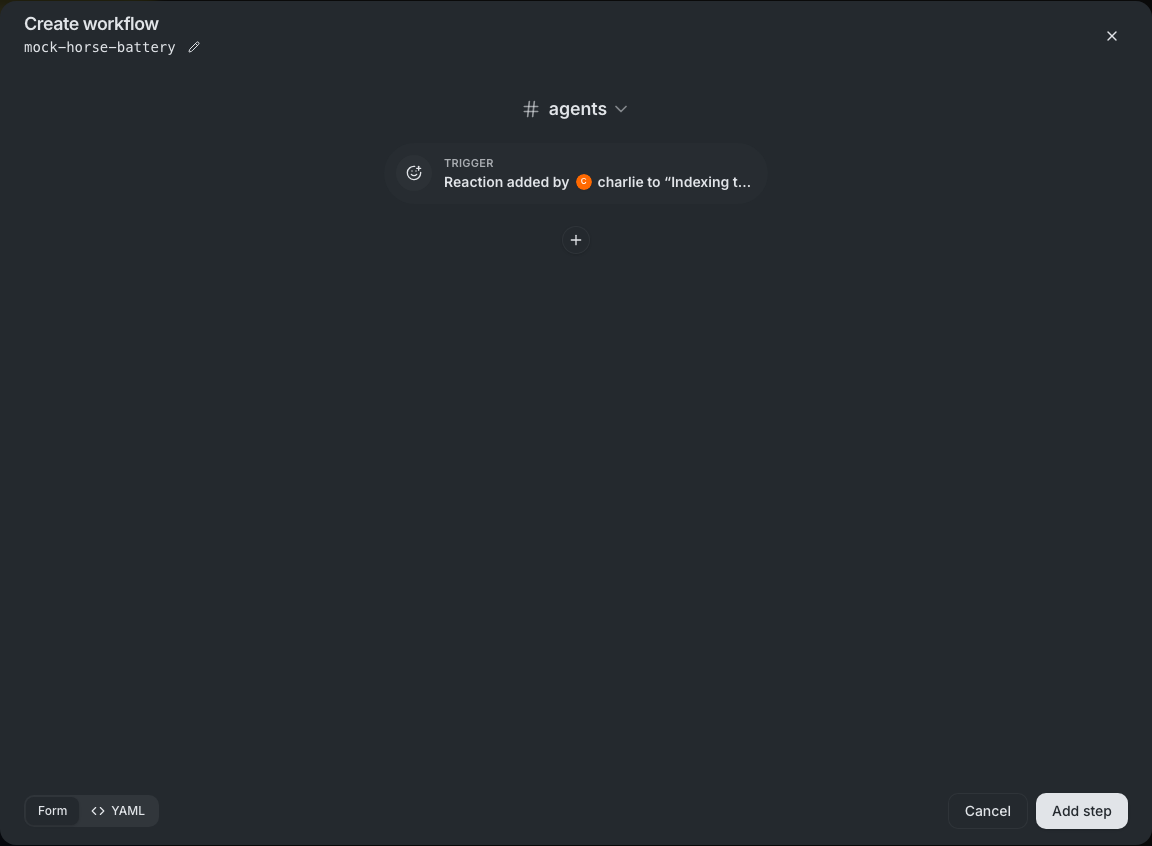 ### Enriched workflow card 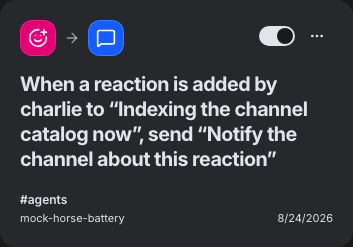 --------- Signed-off-by: Taylor Ho <taylorkmho@gmail.com> Co-authored-by: Carl <acda9e433d19dcd0e6b6840f7f4b98f3a56f1fab98049d444c087019e6d36560@buzz.block.builderlab.xyz> Co-authored-by: Princess Donut <0366ccd5ee09c2779a9d6bd6683daa17c16a508a51f6a7e7314018dab8fdc49b@buzz.block.builderlab.xyz> Co-authored-by: Rizz <302abe414ca6e3134763d2539bfcf145aea2a63fe5f8455204ed602fd40cf381@buzz.block.builderlab.xyz> |
||
|
Taylor Ho
|
0e48ff2691 |
feat(workflows): clarify workflow setup and activation (#6470)
**Category:** new-feature **User Impact:** Workflow authors can build filtered, runtime-aware automations, understand them at a glance, and get a clear warning before turning on workflows likely to run often. **Problem:** Workflow setup exposed raw configuration without enough help composing message templates, filtering triggers, or understanding saved behavior; activation could also make a broadly triggered workflow live without explaining its likely frequency. **Solution:** Batch 3 adds local, deterministic template variables, trigger filters, and semantic summaries, then refines cards and activation around configured behavior and a risk-aware warning boundary. Scheduling remains the already-shipped implementation, advanced expressions remain lossless, and network-backed identity/message enrichment stays in Batch 4. | Message inputs | Trigger filters | | --- | --- | | Caret-aware, keyboard-accessible suggestions expose trigger-local values and safe prior-step outputs in `send_message.text`. | Structured conditions and validated manual IDs block invalid submission while preserving advanced expressions. | | 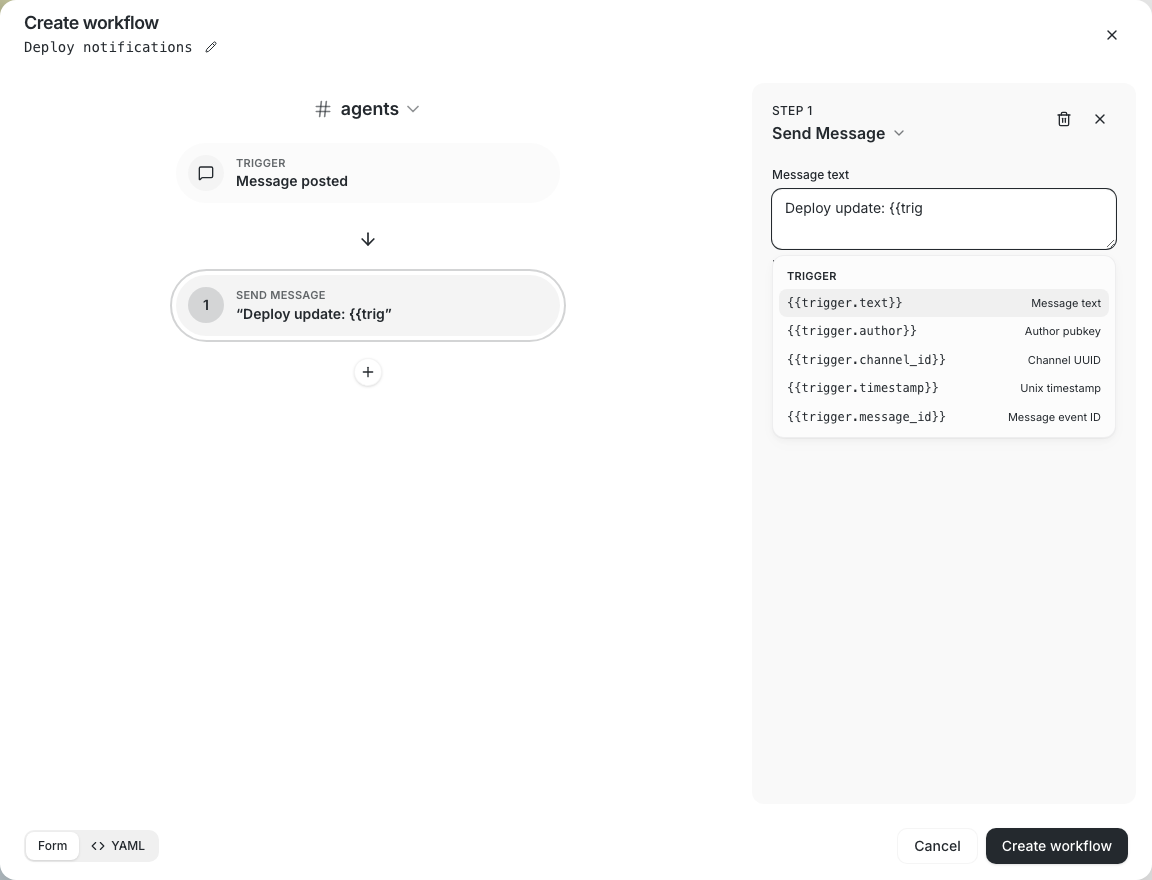 | 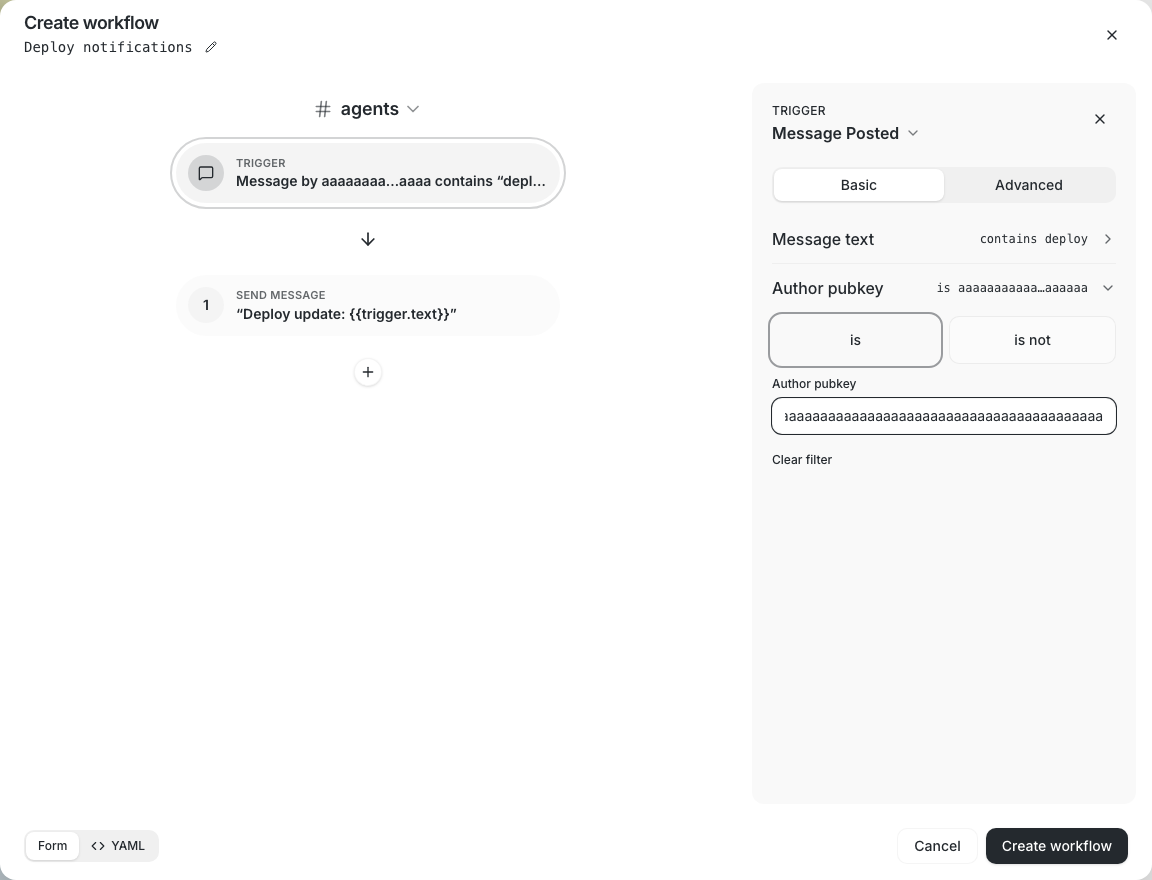 | | Workflow cards | Risk-aware activation | | --- | --- | | Semantic labels, channel-first hierarchy, configured reaction/action visuals, real step stacks, and compact status controls make behavior scannable. | Broad message and frequent schedule triggers explain the risk before **Turn on**; narrowly scoped triggers proceed without unnecessary ceremony. | | 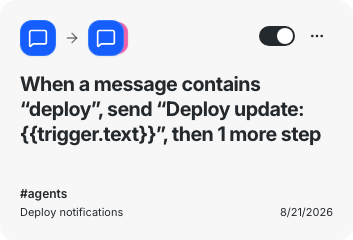 | 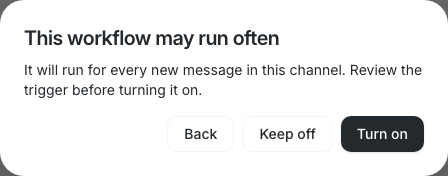 | ## Changes <details> <summary>File changes</summary> **desktop/src/features/workflows/ui/WorkflowActionsMenu.tsx** Separates direct card status controls from secondary actions while retaining modal status actions. **desktop/src/features/workflows/ui/WorkflowCard.tsx** Adds semantic behavior, channel-first hierarchy, configured reaction/action visuals, real subsequent-step stacks, status controls, and reduced-motion-aware trigger feedback. **desktop/src/features/workflows/ui/WorkflowDialog.tsx** Warns before activating broadly triggered workflows while allowing narrowly scoped workflows to proceed directly. **desktop/src/features/workflows/ui/WorkflowFormBuilder.tsx** Connects structured trigger filters and template-aware step inputs while preserving schedules, trigger transitions, and selected YAML authority. **desktop/src/features/workflows/ui/WorkflowStepCard.tsx** Replaces generic labels with deterministic configured-step descriptions. **desktop/src/features/workflows/ui/WorkflowTemplateTextarea.tsx** Adds caret-aware variable suggestions with keyboard navigation and focus restoration. **desktop/src/features/workflows/ui/WorkflowTriggerConditions.tsx** Adds structured local filters, validated author/message IDs, and a lossless advanced-expression fallback. **desktop/src/features/workflows/ui/workflowActivationWarning.ts** and **workflowActivationWarning.test.mjs** Classify broad message and frequent schedule triggers for contextual activation warnings. **desktop/src/features/workflows/ui/workflowConditionExpression.ts** and **workflowConditionExpression.test.mjs** Model and cover parsing, serialization, validation, and advanced-expression preservation. **desktop/src/features/workflows/ui/workflowDefinition.ts** and **workflowDefinition.test.mjs** Preserve trigger/step configuration and derive deterministic card metadata across YAML round trips. **desktop/src/features/workflows/ui/workflowStepDescription.ts** and **workflowStepDescription.test.mjs** Generate and cover local step summaries. **desktop/src/features/workflows/ui/workflowTemplateVariables.ts** and **workflowTemplateVariables.test.mjs** Define and cover trigger-specific, order-bounded variables and caret insertion. **desktop/src/features/workflows/ui/workflowTriggerDescription.ts** and **workflowTriggerDescription.test.mjs** Generate and cover semantic trigger summaries without network lookups. **desktop/tests/e2e/workflow-local-controls.spec.ts** and snapshot Cover filters, IDs, advanced expressions, autocomplete, activation choices, summaries, and YAML authority. **desktop/tests/e2e/workflow-reaction-picker.spec.ts** Covers configured reaction emoji in workflow nodes and summaries. **desktop/tests/e2e/workflows.spec.ts** Covers risk-aware activation warnings, direct safe creation, duplication, and card status controls. </details> ## Reproduction steps 1. Create a message-posted workflow in **Workflows**, add a Send message step, and type `{{trig`; verify keyboard-selectable variables insert at the caret. 2. Configure message-text and manual ID filters; verify malformed IDs block submission and advanced expressions survive Form/YAML transitions. 3. Create a broad message workflow; verify **Back** persists nothing, **Keep off** saves it disabled, and **Turn on** enables it. Confirm a narrowly triggered webhook skips the warning. 4. Inspect the saved card; verify its channel, semantic behavior, configured actions/reaction, real step stack, and status are understandable without opening YAML. ## Validation Validated at exact clean head `f99503819889b95ee3c61657c5c3850aae35481e` on base `24ec6a468ec9d0d425ee58fbfc4d416412c446ad`. - Focused workflow regressions passed 59/60 locally; the only local miss was a 438-pixel macOS snapshot drift, while the checked-in Linux baseline comes from the failing CI artifact. Repository pre-push gates and E2E build/typecheck passed. - A broader 36-test smoke invocation had 31 passes and five unrelated pre-existing expectation/snapshot failures, so it is not claimed as fully green. Adversarial fixes are recorded in [round one](https://github.com/block/buzz/pull/6470#issuecomment-5366366670) and [round two](https://github.com/block/buzz/pull/6470#issuecomment-5366407535). --------- Signed-off-by: Taylor Ho <taylorkmho@gmail.com> Signed-off-by: Rizz <302abe414ca6e3134763d2539bfcf145aea2a63fe5f8455204ed602fd40cf381@buzz.block.builderlab.xyz> Co-authored-by: Rizz <302abe414ca6e3134763d2539bfcf145aea2a63fe5f8455204ed602fd40cf381@buzz.block.builderlab.xyz> Co-authored-by: Carl <acda9e433d19dcd0e6b6840f7f4b98f3a56f1fab98049d444c087019e6d36560@buzz.block.builderlab.xyz> Co-authored-by: Mongo <5398c5fd039b963ce132b3e078e7c4af097dd997517bb5e14c2682fe68c25197@buzz.block.builderlab.xyz> |
||
|
Will Pfleger
|
c6e3fe7dfa |
feat(workflows): reply in-thread from send_message action (#6178)
The `send_message` workflow action could only post new top-level channel
messages. This adds a `reply_in_thread` option so a `message_posted`
workflow can reply in the triggering message's thread, plus a
`trigger_is_reply` filter variable so a workflow can fire only on
top-level messages.

Every NIP-10 thread-marker reader in the tree now routes through one
shared parser and one collapse rule in `buzz-core`, deleting four
hand-rolled copies that had drifted on id-validity and marker semantics.

## What changed

- **Schema** (`crates/buzz-workflow/src/schema.rs`): new
`reply_in_thread: bool` (serde default `false`) on
`ActionDef::SendMessage`. `validate()` rejects `reply_in_thread: true`
on `schedule`/`webhook` triggers — they carry no message to reply to.
- **Executor** (`crates/buzz-workflow/src/executor.rs`): threads
`reply_to: Option<&str>` (the trigger `message_id`) through
`ActionSink::send_message` when `reply_in_thread` is set; errors clearly
if the trigger has no `message_id`. `resolve_step_templates` carries the
new field. Adds `trigger_is_reply` (boolean) to the eval context.
- **Relay sink** (`crates/buzz-relay/src/workflow_sink.rs`): when
`reply_to` is set, resolves parent/root/depth from the known trigger
event, persists real thread metadata instead of the hardcoded top-level
`depth: 0`, and pushes the live kind:39005 thread-summary overlay after
insert so subscribed desktops update the root's reply badge without
refetching — matching the human ingest path. Emits the same NIP-10
`e`-tag shape as `buzz_sdk::builders::thread_tags`: a single `["e", id,
"", "reply"]` tag for a direct reply (parent == root), and the `root` +
`reply` pair only when nested — so every writer produces one wire shape
per reply kind.
- **Ingest resolver** (`crates/buzz-relay/src/handlers/ingest.rs`): new
`resolve_relay_reply_thread_meta` + `ReplyAncestry`. Unlike the
client-facing `resolve_nip10_thread_meta` (which validates
client-supplied tags), this computes root/depth from the known parent
and enforces the same same-channel and depth-limit invariants. When the
parent has no `thread_metadata` row, both resolvers share
`derive_ancestry_from_parent_tags`, which applies
`ThreadMarkers::resolve()`: a marked nested parent remains depth 2,
while a root-only, malformed, or unmarked parent is top-level and starts
its reply thread at itself. Both the client resolver and the
parent-ancestor fallback now read markers via the shared parser instead
of hand-scanning `e`-tags.
- **Shared NIP-10 parser** (`crates/buzz-core/src/nip10.rs`):
`parse_thread_markers` reads an event's `root`/`reply` markers, honoring
a marker only when its event id is exactly 64 ASCII-hex characters.
`ThreadMarkers::resolve()` is the single definition of the (root, reply)
→ (root_id, parent_id) collapse: `root`+`reply` as-is, `reply`-only →
`(reply, reply)`, a lone `root` or neither → top-level. A slice-based
`parse_thread_markers_from_parts` entry point serves consumers holding
raw JSON tag arrays. Relay ingest, the workflow `trigger_is_reply`
predicate, ACP anchoring, and the CLI reply resolver all call these, so
they cannot drift on marker, id-validity, or collapse semantics.
- **ACP** (`crates/buzz-acp/src/queue.rs`): `parse_thread_tags`
delegates marker parsing and collapse to `buzz_core::nip10`, keeping
only its local `p`-tag mention collection. This fixes a parity gap with
ingest: a malformed non-64-hex marker id is no longer counted as a
thread link, and a lone `root` marker is now top-level rather than being
treated as root == parent.
- **CLI** (`crates/buzz-cli/src/commands/messages.rs`):
`find_root_from_tags` routes its JSON tags through the shared slice
parser and collapse rule. CLI replies to root-only, malformed, or
unmarked parents now correctly start at that immediate parent;
reply-only and root+reply parent ancestry remain intact.
- **Trigger context** (`crates/buzz-workflow/src/lib.rs`):
`build_trigger_context` derives `is_reply` solely from a valid NIP-10
`reply` marker (no DB hit). A lone `root` marker is top-level to ingest,
so it does not count; neither does a `reply` marker whose event id is
malformed, nor a bare/unmarked `e`-tag (mentions, quotes).
- **Desktop** (`workflowFormTypes.ts`, `WorkflowStepCard.tsx`):
`replyInThread` form field with YAML round-trip, and a "Reply to
triggering message in thread" checkbox shown only for message-based
triggers. Switching to `schedule` or `webhook` clears the option on
every step before serialization, so a value hidden behind an action
change cannot resurrect when the action is switched back. The form
parser also requires `reply_in_thread` to be a boolean and refuses
`reply_in_thread: true` under an ineligible trigger, falling back to
YAML mode rather than silently normalizing a backend-invalid definition.

## Usage

```yaml
trigger:
  on: message_posted
  filter: trigger_is_reply == false
steps:
  - id: auto_reply
    action: send_message
    text: "pre-written reply text"
    reply_in_thread: true
```

---------

Signed-off-by: Will Pfleger <pfleger.will@gmail.com>
Co-authored-by: Duncan <dcfd242e557282d7a1e2cf2e6877522682f1e5c6156dc92ca7d90eaedd3b0f95@buzz.block.builderlab.xyz>
|
||
|
Taylor Ho
|
1934e83bf5 |
feat(workflows): add workflow editor (#6248)
**Category:** new-feature **User Impact:** Users can create, edit, duplicate, and deep-link to workflows in a responsive visual editor without losing unsupported YAML or unsaved work. **Problem:** Workflow editing was split across disconnected surfaces and lacked reliable URL state, lifecycle protection, and parity between Form and YAML modes. **Solution:** This adds a route-addressable editor foundation with stable pane identity, guarded dirty exits, lossless Form/YAML transitions, responsive workflow and channel controls, and matching reaction-filter execution support. <details> <summary>File changes</summary> **crates/buzz-workflow/src/lib.rs** Apply reaction trigger filters during workflow execution and cover target-message gating. **crates/buzz-workflow/src/schema.rs** Extend the reaction trigger schema with the editor-owned filter field. **desktop/src/app/navigation/useAppNavigation.ts** Add navigation helpers for explicit workflow create, edit, and duplicate editor modes. **desktop/src/app/routes/WorkflowsRouteScreen.tsx** Coordinate route state with the shared workflow library and editor dialog. **desktop/src/app/routes/lazyWorkflowsRouteScreen.ts** Share one lazy route component across workflow route entry points to avoid loading flashes. **desktop/src/app/routes/workflows.$workflowId.tsx** Parse workflow editor modes and pane deep links for workflow-specific URLs. **desktop/src/app/routes/workflows.tsx** Parse library-level create state and render the shared workflow route screen. **desktop/src/app/AppWorkflowEditorOverlayProvider.tsx** Host the shared workflow editor at the app-shell level so channel-originated workflow dialogs stay above the active channel instead of replacing it. **desktop/src/shared/context/WorkflowEditorOverlayContext.tsx** Expose route-independent open-existing and create-new workflow actions to channel settings. **desktop/src/features/workflows/ui/WorkflowEditorHost.tsx** Share editor loading, unavailable, and dialog lifecycle wiring between canonical workflow routes and the channel overlay. **desktop/src/features/channels/ui/ChannelManagementSheet.tsx** Add an experiment-gated, Canvas-style Workflows ingress below Canvas, including channel-scoped loading, error, empty, and list states plus open/create actions; disabled users issue no workflow query. **desktop/src/features/channels/ui/ChannelWorkflowsSection.tsx** Render the channel workflow list and New workflow action without pushing the existing settings sheet past its file-size ceiling. **desktop/src/features/workflows/ui/ChannelCombobox.tsx** Adopt the final channel presentation, portalled scrolling, and one-shot create-flow opening behavior. **desktop/src/features/workflows/ui/CreateWorkflowDialog.tsx** Remove the superseded create-only dialog in favor of the unified workflow editor. **desktop/src/features/workflows/ui/WorkflowCard.tsx** Open workflow cards in the detail and run-history modal while preserving explicit edit and duplicate actions. **desktop/src/features/workflows/ui/WorkflowDetailDialog.tsx** Present workflow Trigger/Steps in the shared modal chrome, with top-chrome ingress to a responsive right-side run-history inspector and an explicit edit action. **desktop/src/features/workflows/ui/WorkflowDialog.tsx** Unify create, edit, and duplicate lifecycle handling with URL panes, generated-name synchronization, dirty-exit guards, stale-write preservation, and protected webhook-secret handoff. **desktop/src/features/workflows/ui/WorkflowFormBuilder.tsx** Build the responsive Form/YAML editor shell, stable step selection, insertion and removal behavior, and lossless canonical-YAML synchronization. **desktop/src/features/workflows/ui/WorkflowStepCard.tsx** Align workflow step controls and presentation with the final editor interaction model. **desktop/src/features/workflows/ui/WorkflowUnavailableDialog.tsx** Show a non-disclosing loading or unavailable state for missing and inaccessible workflow links, with retry and close actions. **desktop/src/features/workflows/ui/WorkflowWebhookSecretDialog.tsx** Obscure one-time webhook secrets by default and require explicit confirmation before any close or navigation discards them. **desktop/src/features/workflows/ui/WorkflowsScreen.tsx** Connect library state and workflow actions to the route-addressable editor. **desktop/src/features/workflows/ui/WorkflowsView.tsx** Restore the responsive workflow library, create tile, cards, loading states, and shared action menu. **desktop/src/features/workflows/ui/workflowEditorPane.test.mjs** Cover pane parsing, serialization, and stable step-ID reconciliation. **desktop/src/features/workflows/ui/workflowEditorPane.ts** Define explicit trigger and stable step pane URL state. **desktop/src/features/workflows/ui/workflowYamlDocument.ts** Read and update header fields independently of full form validation so incomplete steps cannot clear or disable the workflow title. **desktop/src/features/workflows/ui/workflowYamlDocument.test.mjs** Cover document-level workflow header reads and writes for incomplete definitions. **desktop/tests/e2e/workflow-title-stability.spec.ts** Verify generated, renamed, saved, and duplicated titles remain stable while moving between trigger and step panes. **desktop/src/features/workflows/ui/workflowFormTypes.test.mjs** Cover lossless Form/YAML round trips and actionable fallback for unsupported fields. **desktop/src/features/workflows/ui/workflowFormTypes.ts** Own canonical workflow YAML conversion while preserving supported trigger and step fields. **desktop/src/shared/ui/PortalledScrollArea.tsx** Provide bounded scrolling for popovers rendered outside their dialog container. **desktop/src/shared/ui/popover.tsx** Allow workflow popovers to use the shared portalled scroll container. **desktop/tests/e2e/channels.spec.ts** Cover disabled and enabled Workflows experiment states, including suppressed queries while disabled, placement beneath Canvas, channel workflow listing and opening, channel-preselected workflow creation, and direct return to the channel Workflows panel after close, discard, or cancel. **desktop/tests/e2e/workflows.spec.ts** Exercise library actions, deep links, create/edit/duplicate lifecycle, dirty exits, responsive editor behavior, YAML safety, stale updates, and one-shot channel selection. </details> ## Reproduction steps 1. Open **Workflows** and confirm the responsive card library, create tile, card action menu, and card-to-detail/run-history modal navigation. 2. Open `?view=create`; confirm the channel chooser opens once, the trigger inspector stays hidden until a channel is selected, and closing the chooser does not make it reopen after unrelated edits. 3. Create a workflow, switch between Form and YAML, add and remove steps, refresh a pane deep link, and confirm the selected trigger or stable step remains addressable. 4. Edit or duplicate a workflow, make an unsaved change, and confirm close, Escape, browser navigation, and route target changes require discard confirmation while pane-only navigation does not. 5. Enter unsupported YAML and confirm Form mode gives an actionable fallback without rewriting the definition; verify reaction triggers preserve and execute their filter. 6. Open a channel’s settings, select **Workflows** below **Canvas**, and open or create a workflow; confirm the shared modal stays over the channel, the channel URL does not change, New workflow preselects that channel, and closing or discarding returns directly to the channel’s **Workflows** panel. 7. In create, edit, and duplicate modes, move between the trigger and incomplete step panes and confirm the generated or edited title remains visible and editable. ## Screenshots Fresh captures from product head `c5c3abc91a71fe511d43e6cc9168b1626d0c217c`; the later review-guidance fix does not alter these pictured states. ### Workflow library and actions 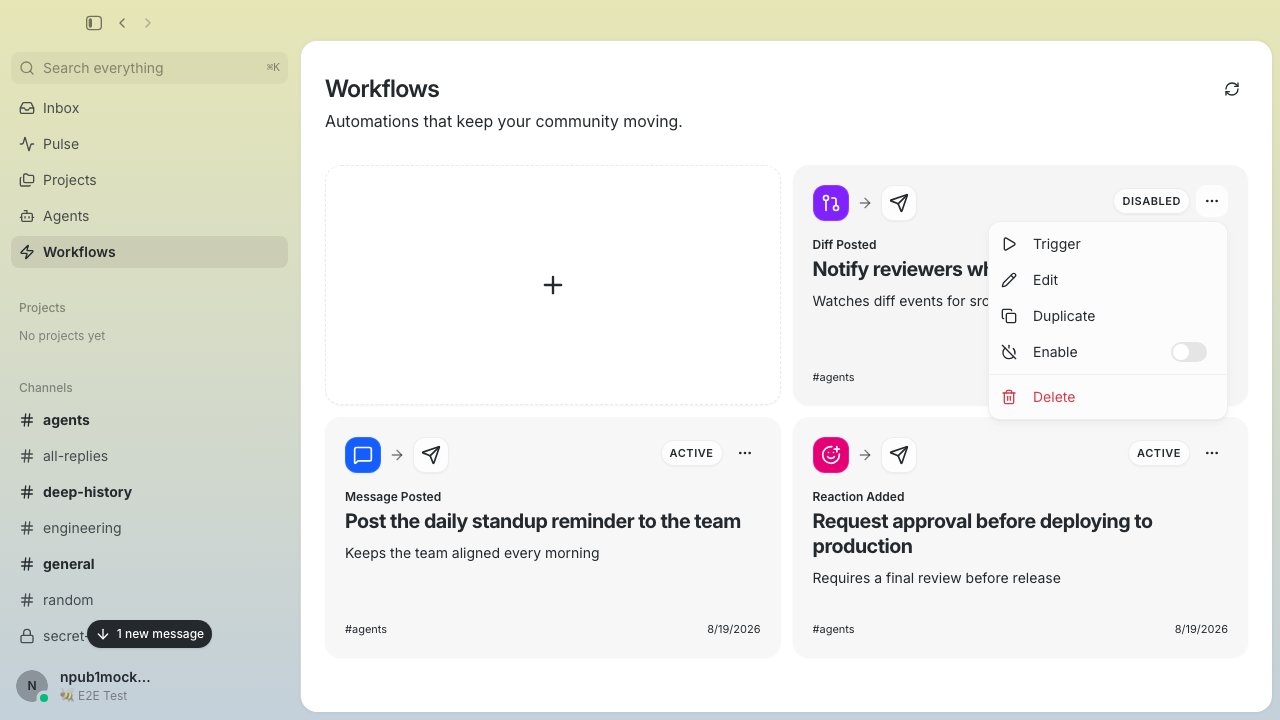 ### Workflow editor — wide 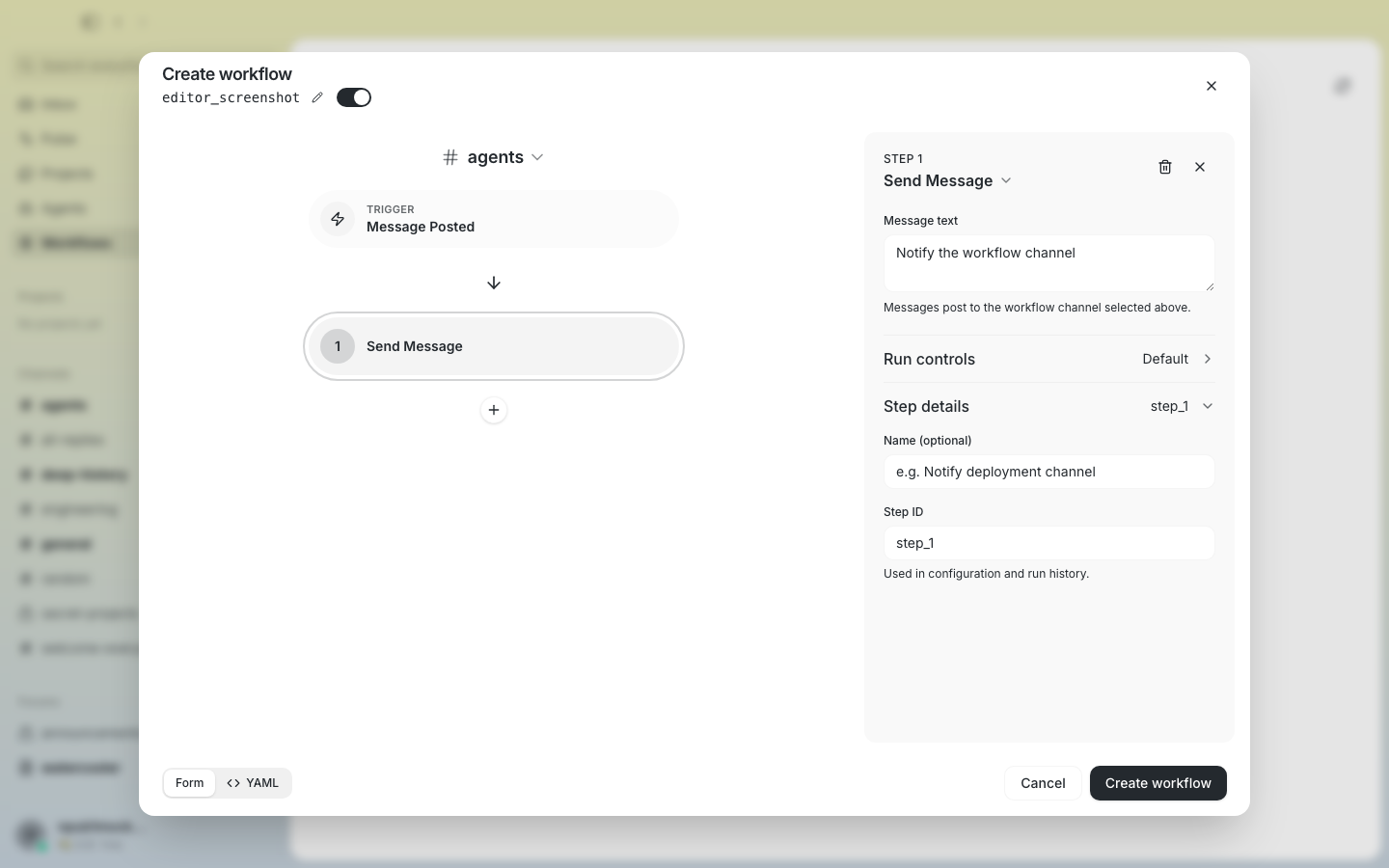 ### Workflow editor — narrow inspector overlay 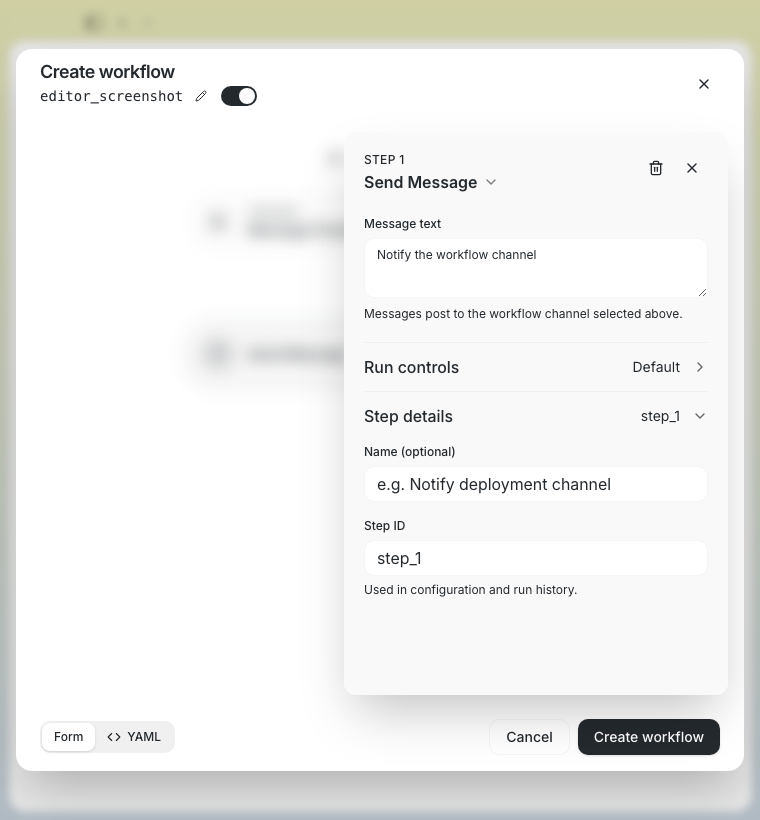 ### Workflow editor — active channel overlay 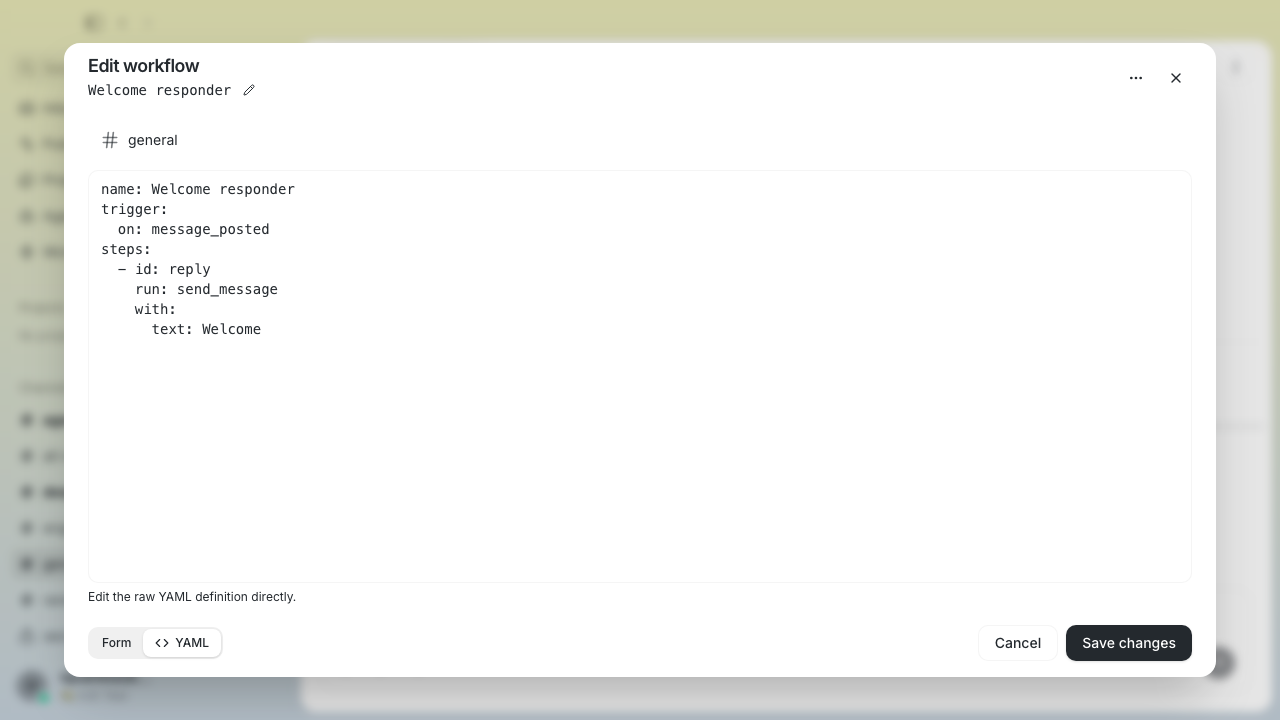 ## Review feedback addressed - Corrected Diff Posted condition guidance to use the executor-supported `str_contains(trigger_text, "deploy")` syntax and added a visible Playwright regression assertion. - Scoped direct workflow-detail navigation coverage to the stable `Edit workflow` dialog name, asserted the workflow title separately, and retained the trigger-node assertion. - Routed dirty channel-overlay Duplicate/Edit transitions through the existing discard confirmation, preserving the original YAML draft when the user keeps editing. - Made workflow deletion await relay success, remain non-dismissible while pending, and retain the confirmation/editor/draft with an actionable inline error on rejection. - Gated the channel-settings Workflows ingress and channel workflow query behind the `workflows` experiment, with defensive rendering if the flag changes while that view is active. - Matched the Reaction Added trigger to the prototype reaction picker, preserving native/custom/legacy values in canonical YAML and providing an explicit clear action. - Kept a channel’s Workflows panel mounted beneath channel-origin editors so clean close, dirty discard, and create cancel return directly to that panel without changing the channel URL. ## Verification Verified at exact pushed head `76ebba7b7ace1e13445744200da70ca9da231b7e`: - Push hooks passed: destination-org policy, branch-skew, differential file-size, Desktop checks, TypeScript typecheck, and **5,115/5,115** Desktop unit tests - Focused channel lifecycle E2E passed: dirty edit discard returns directly to the channel Workflows panel; create cancel does the same while preserving the channel URL and preselected channel - E2E production build, standalone TypeScript typecheck, and Biome checks on both touched files passed - Reaction-picker regression spec remains recorded at `dc28ffa98ec34b4e0656757fb2dd93e60a84674d`: **5/5 passed** (picker interaction, canonical YAML persistence/clear, legacy-value preservation, save/reopen round trip, narrow viewport containment) - Blox existing workflow E2E regression set at `dc28ffa98ec34b4e0656757fb2dd93e60a84674d`: **36/36 passed** - Earlier blocker and review regressions remain recorded at `3760c3d657a525f5af98e8d0f98bdd03999d8e61`: **5,114/5,114** Desktop unit tests and the dirty-overlay/deletion focused checks - Working tree clean; local branch, remote branch, and PR head all match the exact SHA above ### Related issue None found. Closest prior work: #231. --------- Signed-off-by: Taylor Ho <taylorkmho@gmail.com> Co-authored-by: Codex <noreply@openai.com> |
||
|
Taylor Ho
|
edc4a09aaa |
feat(workflows): add responsive library card actions (#6008)
**Category:** improvement **User Impact:** Users can scan what each workflow does and trigger, edit, duplicate, enable, disable, or delete it directly from the library. **Problem:** The workflow list buried common actions and did not expose each automation's trigger-to-action shape at a glance. **Solution:** Add a responsive workflow library with a persistent create tile, compact trigger/action diagrams, prominent workflow titles with supporting descriptions, and shared card actions while preserving existing detail, editor, and run-history entry points. Card toggles refresh both list and open-detail caches so status and definition stay consistent. <details> <summary>File changes</summary> **desktop/src/features/workflows/ui/WorkflowActionsMenu.tsx** Adds a shared card menu for trigger, edit, duplicate, enable/disable, and delete actions. **desktop/src/features/workflows/ui/WorkflowCard.tsx** Reworks cards around the prototype's visual hierarchy: color-coded trigger, action flow, sentence-case eyebrow, prominent title, supporting description, status, channel, and update date without a footer clock icon. **desktop/src/features/workflows/ui/WorkflowsView.tsx** Adds the responsive grid, create tile, mutation wiring, and list/detail cache invalidation. Container breakpoints keep cards two-across at medium widths and three-across in the 1280px desktop layout. **desktop/src/features/workflows/ui/workflowDefinition.ts** Adds immutable enabled-state updates plus narrow trigger and first-action readers used only to select card icons. **desktop/src/features/workflows/ui/workflowDefinition.test.mjs** Covers neutral icon selection, enabled-state immutability, and status presentation. **desktop/tests/e2e/workflows.spec.ts** Covers the create tile, title/description hierarchy, selected-card enable/disable consistency, and deterministic narrow/medium/wide captures while retaining existing action coverage. </details> ## Reproduction steps 1. Open **Workflows** and confirm the create tile stays first as cards flow from one to three columns with available width. 2. Confirm each card shows a sentence-case trigger eyebrow, prominent workflow title, supporting description when present, status, channel, and update date without a clock icon. 3. Open a card's overflow menu and trigger, edit, duplicate, enable/disable, or delete the workflow. 4. Leave the detail panel open while toggling and confirm its badge and JSON definition update with the card. ## Screenshots Real built E2E UI with representative workflow data at three viewport sizes. ### Narrow — 800 × 720 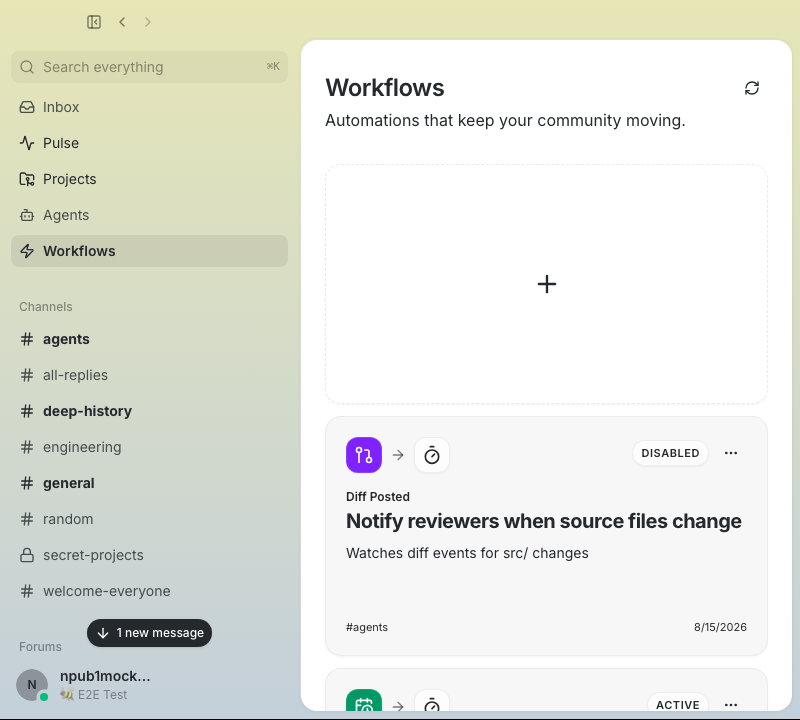 ### Medium — 1024 × 720 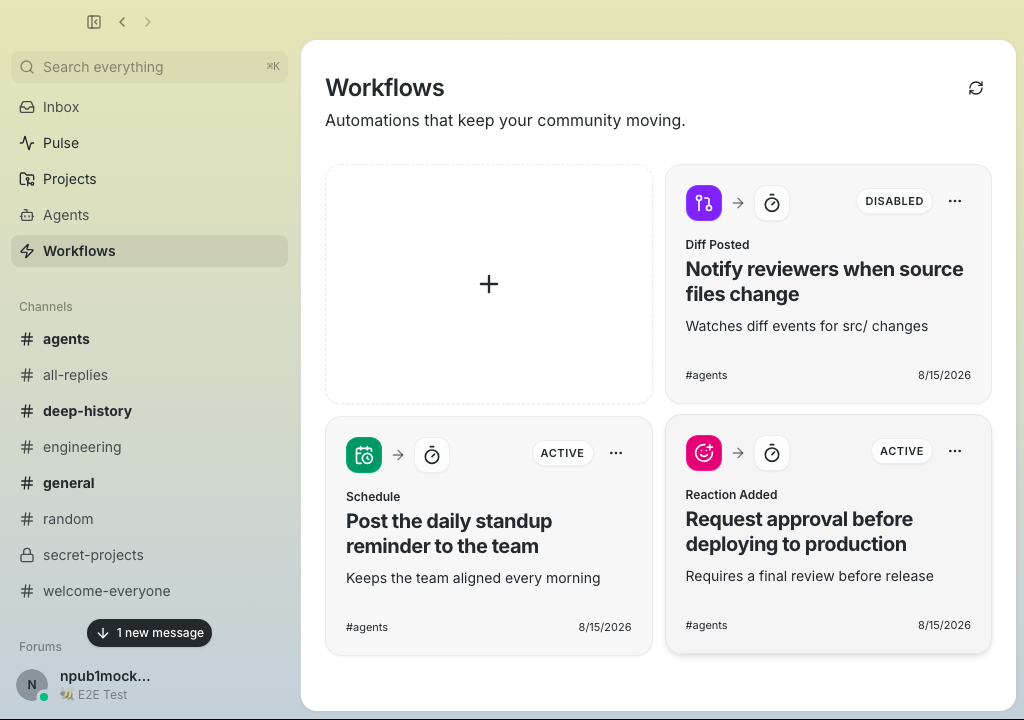 ### Wide — 1280 × 720 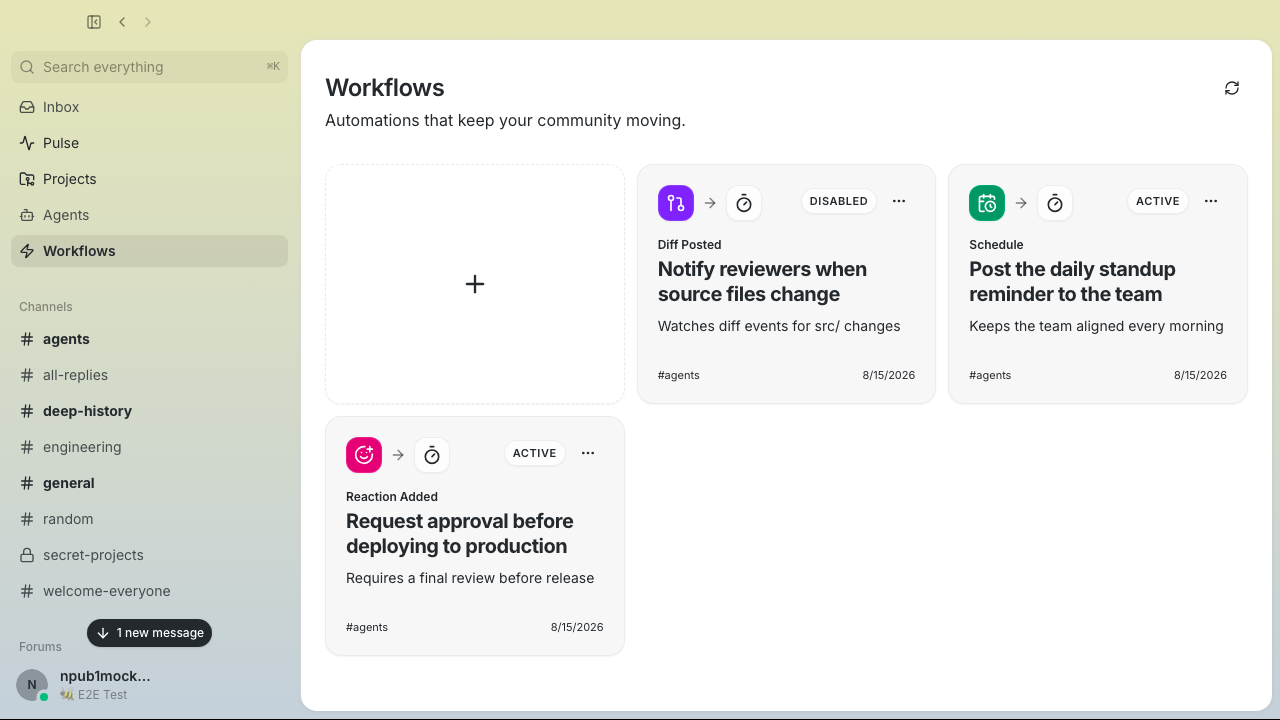 ### Card actions 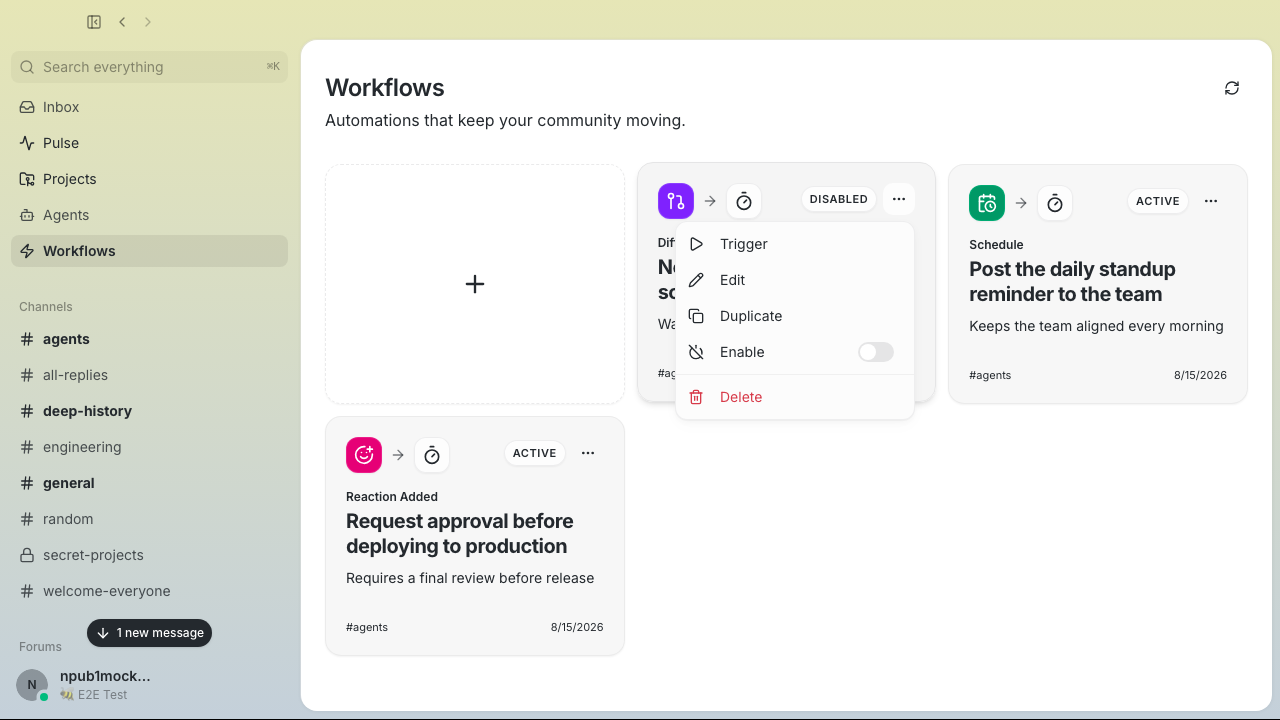 --------- Signed-off-by: Taylor Ho <taylorkmho@gmail.com> |
||
|
Wes
|
2693e0db1f |
Make workflow run history authoritative in Desktop (#5780)
## Summary - persist stable workflow run `error_code` values separately from human diagnostics - expose NIP-98 authenticated, channel-authorized run history and approval reads with stable keyset pagination - connect Desktop to those authoritative reads and return the relay-created run ID on trigger - show truthful loading, failure, and pending-trace states, and do not render approval actions from non-actionable stored hashes ## Validation - pre-push `branch-skew`, `desktop-typecheck`, `desktop-test`, `rust-tests`, `desktop-tauri-checks`, and `desktop-check` all passed on `a097dbe5f` - Desktop tests: 4,761 passed, 0 failed - `cargo check -p buzz-relay` - `git diff --check` ## Remaining gate This does not claim a relay-backed Playwright workflow journey. The browser relay bridge still routes workflow invokes through in-memory handlers; that production-shaped acceptance gate remains follow-up work before Workflows can leave preview. --------- Signed-off-by: Wes <wesbillman@users.noreply.github.com> Co-authored-by: Carl <c7ebe626f000404285d3686e1dc74cc07cc60a9754a150041ba132e14bd3e2ec@buzz.block.builderlab.xyz> Co-authored-by: Mongo <5c25403eab7271f9f94ddd4f2b270e8cac2c92e2c830c51877cca6ec974ffb3f@buzz.block.builderlab.xyz> Co-authored-by: Princess Donut <68157ebd23b3897c1991015c3038658ea916200c67d3a54620b0754d1b92f6e0@buzz.block.builderlab.xyz> |
||
|
Wes
|
59f613c404 |
fix(desktop): defer foreground resume work (#5696)
## Summary - defer foreground resume work until the activation task has returned, a frame has painted, and a trailing task gets a turn - centralize app-focus subscribers and remove the broad TanStack `refetchOnWindowFocus` fan-out - coalesce relay recovery and preserve an explicit deferred refresh only for workflow data without a polling/push freshness path - defer the notification permission native check while keeping blur and cheap correctness signals immediate ## Why Buzz Desktop 0.5.10 can spend roughly 1.5 seconds in the WebKit window-focus listener/microtask checkpoint before returning to the run loop. Focus currently fans out into query refetches, React polling updates, relay reconnect/replay, and native work in one activation turn. This patch establishes an interaction-first foreground boundary rather than letting those consumers compete with the activating input and first paint. ## Validation - focused foreground/workflow/relay tests: 18/18 passed before commit - `pnpm --dir desktop typecheck`: passed before commit - pre-commit desktop check and file-size gate: passed - pre-push desktop check, typecheck, and full desktop unit suite: 4,743/4,743 passed at `704e7b4b6618fafce655bb2b07c7a9fe0fc8c643` - Princess Donut independent adversarial review: PASS after two lifecycle/freshness blockers were resolved ## Manual test 1. Install the PR build and use Buzz long enough to populate channels, home, workflows, agents, and other polling surfaces. 2. Switch to another app for 30-60 seconds. 3. Return by clicking Buzz and immediately click a channel or scroll. 4. Confirm the first interaction and paint are prompt, then confirm channels/home/workflows refresh and a degraded relay reconnects after the activation boundary. 5. Repeat while rapidly switching away again to verify no resume work starts after focus has been lost. --------- Signed-off-by: Wes <wesbillman@users.noreply.github.com> Co-authored-by: Carl <c7ebe626f000404285d3686e1dc74cc07cc60a9754a150041ba132e14bd3e2ec@buzz.block.builderlab.xyz> |
||
|
Will Pfleger
|
f35930104b |
fix(desktop): remove 0.5.9+ perf regressions, speed up get_channels (#5599)
Desktop input latency regressed sharply for users on v0.5.9 and worsened on latest main: multi-second stalls when clicking back into the app, slow fresh boots, intermittent lockups, and scroll/mouse degradation. Reverting to `119a84897` (pre-0.5.9) was confirmed to resolve it, isolating the regression to that range. Profiling a live production renderer plus a commit-level audit of the range found three independent, additive causes — fixed here — plus a long-standing `get_channels` cost that made every remaining refetch expensive, also addressed here. ## 1. Focus-return refetch storm (`refetchOnWindowFocus`) #5490 wired TanStack's `focusManager` to app focus and flipped ~20 query sites to `refetchOnWindowFocus: true`. A focus return after >60s away fires them all within milliseconds — and a click into an unfocused window *is* a focus return, so the burst runs before the click is processed. That is the "click into the composer, wait 5 seconds" symptom, and it also explains why mouse input feels worse than keyboard (clicks arrive with focus transitions; typing happens while already focused). A 5-second `sample` of a live production renderer caught a single window activity-state transition consuming ~1.25s of main-thread time, dominated by `JSON.parse` in the focus listener's microtask drain. #5535 already established the fix pattern but applied it to only two families (channels, home-feed). This PR extends the same 5-minute `staleTime` discipline to the remaining families: pulse (×5), workflows (×4), agents (×4), forum (×2), presence, user-status, custom-emoji, channel-templates, and the persona catalog. Polling cadences and push-invalidation paths are untouched — interval refetches and `invalidateQueries` both bypass `staleTime`, so live-update behavior is unchanged. Each gated family exports its focus-refetch policy as an options object that the production hook spreads into `useQuery`, and a `focusRefetchPolicy.test.mjs` drives a `QueryObserver` with that same production object — locking the policy behaviorally (fresh focus return → 0 fetches; stale → refetch) and failing if a hook's `staleTime`/`refetchOnWindowFocus` wiring drifts. Four families deliberately keep tighter freshness, all surfaces where the 5-minute gate would suppress the only refresh path and none of which feed the app-wide storm: `repo-sync-status` keeps its fresh focus refetch (its inline comment documents the "committed in a terminal, switched back to the app" flow as intended); the workflow-runs list stale-gates at 10s because a remotely-started run has no push invalidation and its conditional 1s poll is off while the cache shows no active runs; the workflow list queries (`useChannelWorkflowsQuery` and the all-channels aggregate) stale-gate at 10s because they have no poll and no relay subscription, and mutation-driven invalidation only covers this renderer — remote workflow creates/edits/deletes surface only via focus refetch; and the managed-agent log stale-gates at one poll tick (30s) so returning to a live agent log refreshes immediately. Run approvals keep the 5-minute gate under `RUN_APPROVALS_FOCUS_STALE_TIME_MS` — their focused 10s poll already covers freshness. ## 2. Synchronous localStorage sweep on the boot/focus path #5453's stale-cache sweep synchronously `getItem` + `JSON.parse`s every whitelisted localStorage entry on the main thread (multi-MB on seasoned profiles), scheduled with a `requestIdleCallback` timeout of 1.5s that guaranteed it landed mid-boot, and re-armed on every hidden→visible transition — stacking it onto the exact moment the focus storm fires. #5454's `trimSelfProfileCaches()` additionally scanned every localStorage key on every `writeSelfProfileCache()` call (which fires per relay self-profile delivery at boot). Now: the first sweep waits `BOOT_SWEEP_FLOOR_MS` (30s) after startup, the scan is time-sliced across idle callbacks, and the visibility trigger is removed — boot-delayed plus hourly still covers the 14-day TTL contract. The sliced sweep re-checks staleness immediately before each removal (a key rewritten fresh mid-sweep survives), isolates per-key storage errors so one bad entry can't strand the rest of the snapshot, defers oversized values once rather than parsing them on a zero-budget slice, guarantees forward progress on timeout-fired callbacks, and cancels its scheduled slice when stopped. The profile trim keeps a lazily-initialized memoized key count so the common under-cap write is O(1); the full parse scan runs only when the count exceeds a cap, resyncs if external deletions made it stale, and a failed scan skips the trim instead of aborting the write. Sweep semantics (rules, TTLs, eviction) are unchanged, and tests cover the scheduling, slice-progress, error-isolation, defer-once, and trim short-circuit behaviors. ## 3. The macOS window was never opaque #5478's glass appearance is correctly opt-in at the CSS layer, but the compositor cost was baked in deeper than its native `on_webview_ready` transparency call: the main window is declared `"transparent": true` in `tauri.conf.json` (added for the original glass work in #1671), which makes tao call `NSWindow.setOpaque(false)` at creation and resolve every later `set_background_color(None)` to `clearColor` — and no runtime `setOpaque(true)` path exists through tauri, while wry's runtime background setter can only force the WKWebView's `drawsBackground` off, never back on. So "restore the platform default" was unreachable: every launch, glass or not, ran with a non-opaque NSWindow, defeating WindowServer's opaque-window compositing fast path and forcing full window compositing every frame — compounded by the existing `backdrop-blur` chrome overlapping the scrolling timeline. This matches the compositor-shaped symptoms (scroll and pointer input degrading first). The window is now created opaque (`"transparent": false`) and the NSWindow layer is never made transparent at runtime. Glass never needed a transparent window: behind-window `NSVisualEffectView` vibrancy renders inside opaque windows (this is how Finder and Notes draw vibrant sidebars); it only requires a transparent WKWebView canvas, which the `set_window_vibrancy` enable path already establishes at runtime (`macos-private-api` compiles that in independent of the window flag). Enabling glass installs the vibrancy layer and then makes only the webview canvas see-through; disabling clears the vibrancy layer — the canvas may stay non-drawing afterwards (wry's flag is one-way at runtime), which is harmless because glass-off CSS paints fully opaque above an always-opaque NSWindow. The boot-path first-frame backing writes touch only the NSWindow backing color and are therefore inert to glass state regardless of how they order against the `ThemeProvider`'s vibrancy call on a persisted-glass-on cold boot. Glass-off users (the default) get an end-to-end opaque window from boot for the first time. ## 4. `get_channels`: serial round-trips and a multi-MB payload on every refetch The stale gates in (1) cut refetch frequency; this cuts the cost of the refetches that legitimately remain (boot, and focus returns after more than 5 minutes away — previously still a multi-second stall). `get_channels` made ~8 fully serial relay round-trips (~3.2–3.6s at 1,100+ channels), then shipped the full `ChannelInfo` list — including every channel's member pubkeys — across IPC, where the renderer's `JSON.parse` of the multi-MB payload froze the main thread (the ~1.25s stall captured in the live sample). - **Concurrent stages**: the membership chain, the open-channel directory scan, and the hidden-DM snapshot run concurrently, as do the member-count and last-message queries that follow. The critical path drops from ~8 sequential round-trips to 2 phases. Filters, limits, pagination, and merge semantics are unchanged. - **Not-modified short-circuit**: the command now takes a client-supplied content hash (FNV-1a 64 over the channel list, canonicalized by id and excluding `last_message_at`) and omits the channel list from the response when nothing else changed. Last-message timestamps — which change on nearly every message anywhere — ship as a small separate map that the client overlays onto its cached list with reference preservation, so React Query's structural sharing also skips downstream re-renders. On a typical refocus the renderer parses kilobytes instead of megabytes. The hash is stored in the query cache itself, tying its lifecycle to the data it describes so a community switch can never leak a stale hash. The E2E mock bridge speaks the new payload shape — including the complete `last_messages` map the client treats as authoritative — and hash canonicalization plus overlay reference-preservation are unit-tested on both sides. --------- Signed-off-by: Will Pfleger <pfleger.will@gmail.com> |
||
|
Wes
|
07a3c768d6 |
fix(desktop): quiesce renderer polling while hidden (#3677) (#5490)
Fixes #3677. ## Problem The renderer never quiesces: recurring timers, query polling, and re-render tickers run at full rate whether the window is visible, hidden, or minimized. Measured on a live installed app: **27.5% mean renderer CPU visible vs 28.7% hidden** (60×1s `ps` samples of the WebContent process; `sample(1)` dominated by `WebCore::timerFired`/ThreadTimers, microtask checkpoints, JSON parsing, style matching). Matches all three reproductions in #3677 (macOS prerelease, Linux/WebKitGTK A/B/A minimize test, stable macOS). Per-timer instrumentation (dev build, wrapped `setInterval`/`setTimeout`/rAF) attributed the recurring work: `useNow` 60 fires/min, 40 active TanStack refetch intervals, agent-turn pruning 12/min, auto-restart ticks, huddle/reminder polls — none visibility-gated. ## Fix (two-tier gating, standard mechanisms only) Two separate signals in `desktop/src/shared/lib/useDocumentVisible.ts`, because they mean different things and (see residuals) are delivered differently on macOS: - **`useDocumentVisible`** — true Page Visibility only (`document.visibilityState`). Gates local UI work that must keep running on a visible-but-unfocused window: `useNow` relative clocks, agent-turn pruning, huddle bar state/model-status polling, auto-restart tick. Hidden ⇒ paused; `useNow` snaps to fresh `Date.now()` on return. - **`useAppFocused`** — visible AND `document.hasFocus()`. Gates network refetch polling only (`useFocusedRefetchInterval`, ~15 query families: forum/home/agents/channels/templates/emoji/user-status/projects/workflows/persona-catalog/pulse/presence-list). TanStack's `focusManager` is wired to this signal (idempotent, single install) with `refetchOnWindowFocus: true`, so stale queries refresh promptly on return. Deliberate side effect, documented in code: query retries pause on blur; mutations and the presence heartbeat (`retry: 0`) are unaffected. - **Never gated:** reminder due-notification poll (fires while hidden/unfocused — extracted to `reminderNotificationPoll.ts` with regression test), huddle pipeline hot-start (`check_pipeline_hotstart` survives backgrounding for the duration of a huddle), relay stall watchdog, presence heartbeat. Live WebSocket delivery untouched throughout. - Huddle model-status indicator now clears only on huddle phase end, not on visibility/focus changes. ## Validation - Instrumented dev build, populated channel, fires/min: **visible+focused** unchanged (`useNow 60 / prune 12 / watchdog 6 / query 4 / auto-restart 4 / low-rate huddle/reminder/presence`); **visible+blurred**: query polls 0, UI clocks continue (`useNow 60 / prune 12`), reminders 2, presence live; **truly hidden**: only watchdog 6, reminders 2, presence ~2 — everything else 0. Return restored visible+focused, selection preserved, queries refreshed. - Hide-vs-blur decomposition (instrumented probe instance, AppleScript-driven): on macOS WKWebView, Cmd-H / minimize / full occlusion did **not** reliably produce `visibilityState === "hidden"` — they reliably produced focus loss. The CPU-dominant quiescence path on macOS is therefore the focus gate; the visibility gate is exercised fully on platforms that report hidden (e.g. WebKitGTK minimize per the Linux repro). - Gate-regression tests: signal separation, `useNow` hidden-pause + fresh-snap on return, focus-gated interval pause/resume-with-refresh, reminder delivery while hidden+unfocused (5 new, plus primitive wiring tests). - Push gate: desktop check, typecheck, full desktop suite **4549/4549** at `1237548d1`. ## Known residuals - **macOS hidden-signal limitation:** because WKWebView rarely reports `hidden` on app-hide/minimize, hidden-only consumers (`useNow`, prune, huddle UI polls) may keep ticking on macOS when the app is hidden. These are cheap local timers; the expensive network polling still quiesces via focus loss, which is what the measured 28% CPU was attributed to. If the residual local-timer cost proves measurable, the follow-up is bridging Tauri window hidden/minimized events into the visibility signal. - End-to-end CPU confirmation on a packaged build is the post-merge follow-up (against the 28% idle baseline). - Visible-state costs (skeleton animation pileups on stuck loading views, per-poll JSON payload churn) are intentionally out of scope — separate follow-up issue. --------- Signed-off-by: Wes <wesbillman@users.noreply.github.com> Co-authored-by: Meeseeks <2e96988f190ed1bd3c568760103aa4cadb2bc6195b832e252c984392c89039bd@buzz.block.builderlab.xyz> |
||
|
Tyler
|
2cc0eb5396 |
perf(desktop): GUI performance sweep — async offload, poll reduction, render stabilization (#1641)
Signed-off-by: Tyler Longwell <tlongwell@block.xyz> Co-authored-by: npub17jjz49l9jjmhhk7cac63j8yt9z555n9cw8vk7v5jz4vzw4ppld5qgj57cc <f4a42a97e594b77bdbd8ee35191c8b28a94a4cb871d96f32921558275421fb68@sprout-oss.stage.blox.sqprod.co> Co-authored-by: Tyler Longwell <tlongwell@block.xyz> Co-authored-by: npub12gtutshhh76rx0jx697f32f9tffd4hhp3hx58fp4x6u4uemkm7sqf8f757 <5217c5c2f7bfb4333e46d17c98a9255a52dadee18dcd43a43536b95e6776dfa0@sprout-oss.stage.blox.sqprod.co> Co-authored-by: npub1cc3ha7z055mu0rwwu7806t2wt8mj3pvu0uv5mfp2c50dahaqhczshdalg6 <c6237ef84fa537c78dcee78efd2d4e59f728859c7f194da42ac51ededfa0be05@sprout-oss.stage.blox.sqprod.co> Co-authored-by: npub1jh9wn95s0472h86ahapupaf7m6kx4v9sx2n0atj2hltcfer8k06s5n3pyf <95cae996907d7cab9f5dbf43c0f53edeac6ab0b032a6feae4abfd784e467b3f5@sprout-oss.stage.blox.sqprod.co> Co-authored-by: npub1t2tgm7d8f995uqvmnm8h88sg3wnpp9a5xysjf6dg3tjmgt3ltulqdp8ehr <5a968df9a7494b4e019b9ecf739e088ba61097b4312124e9a88ae5b42e3f5f3e@sprout-oss.stage.blox.sqprod.co> Co-authored-by: npub1jmc9dt2lyvzu3h0kxlwxt5zg4fxp9476awyxw6gwxn72g6cw7exqs64whm <96f056ad5f2305c8ddf637dc65d048aa4c12d7daeb8867690e34fca46b0ef64c@sprout-oss.stage.blox.sqprod.co> Co-authored-by: npub1mprnacetjua2xx3p5eddmhxyk6wv929ymm5py8kd2xfxurxahspqqlgyta <d8473ee32b973aa31a21a65adddcc4b69cc2a8a4dee8121ecd51926e0cddbc02@sprout-oss.stage.blox.sqprod.co> |
||
|
Tyler
|
14fba21e57 |
Multi-tenant Buzz relay: community_id as a server-resolved key (comprehensive rewrite) (#1321)
Signed-off-by: tlongwell-block <109685178+tlongwell-block@users.noreply.github.com> Signed-off-by: npub1jh9wn95s0472h86ahapupaf7m6kx4v9sx2n0atj2hltcfer8k06s5n3pyf <95cae996907d7cab9f5dbf43c0f53edeac6ab0b032a6feae4abfd784e467b3f5@sprout-oss.stage.blox.sqprod.co> Signed-off-by: Tyler Longwell <tlongwell@block.xyz> Signed-off-by: npub1t2tgm7d8f995uqvmnm8h88sg3wnpp9a5xysjf6dg3tjmgt3ltulqdp8ehr <5a968df9a7494b4e019b9ecf739e088ba61097b4312124e9a88ae5b42e3f5f3e@sprout-oss.stage.blox.sqprod.co> Signed-off-by: npub17jjz49l9jjmhhk7cac63j8yt9z555n9cw8vk7v5jz4vzw4ppld5qgj57cc <f4a42a97e594b77bdbd8ee35191c8b28a94a4cb871d96f32921558275421fb68@sprout-oss.stage.blox.sqprod.co> Co-authored-by: Eva <011987e296fd5006292d2f930b574be47c7801048d1983c46c425d3c95f0cffd@sprout-oss.stage.blox.sqprod.co> Co-authored-by: Mari <95cae996907d7cab9f5dbf43c0f53edeac6ab0b032a6feae4abfd784e467b3f5@sprout-oss.stage.blox.sqprod.co> Co-authored-by: Sami <f4a42a97e594b77bdbd8ee35191c8b28a94a4cb871d96f32921558275421fb68@sprout-oss.stage.blox.sqprod.co> Co-authored-by: Max <d8473ee32b973aa31a21a65adddcc4b69cc2a8a4dee8121ecd51926e0cddbc02@sprout-oss.stage.blox.sqprod.co> Co-authored-by: Quinn <96f056ad5f2305c8ddf637dc65d048aa4c12d7daeb8867690e34fca46b0ef64c@sprout-oss.stage.blox.sqprod.co> Co-authored-by: Dawn <c6237ef84fa537c78dcee78efd2d4e59f728859c7f194da42ac51ededfa0be05@sprout-oss.stage.blox.sqprod.co> Co-authored-by: Tyler Longwell <tlongwell@block.xyz> Co-authored-by: Sami <sami@sprout-oss.stage.blox.sqprod.co> Co-authored-by: npub1t2tgm7d8f995uqvmnm8h88sg3wnpp9a5xysjf6dg3tjmgt3ltulqdp8ehr <5a968df9a7494b4e019b9ecf739e088ba61097b4312124e9a88ae5b42e3f5f3e@sprout-oss.stage.blox.sqprod.co> |
||
|
Tyler
|
73cc31cc52 |
chore: remove LLM-slop comments across the codebase (#1277)
Signed-off-by: Tyler Longwell <tlongwell@block.xyz> Co-authored-by: npub1qyvc0c5kl4gqv2fd97fsk46tu378sqgy35vc83rvgfwne90sel7s0ed67d <011987e296fd5006292d2f930b574be47c7801048d1983c46c425d3c95f0cffd@sprout-oss.stage.blox.sqprod.co> Co-authored-by: Max <d8473ee32b973aa31a21a65adddcc4b69cc2a8a4dee8121ecd51926e0cddbc02@sprout-oss.stage.blox.sqprod.co> Co-authored-by: Mari <95cae996907d7cab9f5dbf43c0f53edeac6ab0b032a6feae4abfd784e467b3f5@sprout-oss.stage.blox.sqprod.co> Co-authored-by: Quinn <96f056ad5f2305c8ddf637dc65d048aa4c12d7daeb8867690e34fca46b0ef64c@sprout-oss.stage.blox.sqprod.co> Co-authored-by: Sami <f4a42a97e594b77bdbd8ee35191c8b28a94a4cb871d96f32921558275421fb68@sprout-oss.stage.blox.sqprod.co> Co-authored-by: Perci <5a968df9a7494b4e019b9ecf739e088ba61097b4312124e9a88ae5b42e3f5f3e@sprout-oss.stage.blox.sqprod.co> Co-authored-by: Tyler Longwell <tlongwell@block.xyz> |
||
|
klopez4212
|
092546495d | Polish desktop navigation chrome (#1238) | ||
|
Tyler
|
c488d8452c |
desktop: move global search into sidebar header and remove vestigial top band (#1150)
Signed-off-by: Tyler Longwell <tlongwell@block.xyz> Co-authored-by: Tyler Longwell <tlongwell@block.xyz> |
||
|
Taylor Ho
|
c22c54e7ae |
fix(desktop): restore timeline zoom via rem tokens + chat-as-base type scale (#1052)
Signed-off-by: Taylor Ho <taylorkmho@gmail.com> Co-authored-by: npub1223z34hd7vtwc6qj4s7flsxkj644nlre2nthu7lrrmkumhu3xddsrx9r6w <52a228d6edf316ec6812ac3c9fc0d696ab59fc7954d77e7be31eedcddf91335b@sprout-oss.stage.blox.sqprod.co> Co-authored-by: npub14vtk7pvazqrq9639qu7e560wnqtl0d53ca4gjuvq6jzf3k2el23qqlwa7f <ab176f059d100602ea25073d9a69ee9817f7b691c76a897180d48498d959faa2@sprout-oss.stage.blox.sqprod.co> |
||
|
klopez4212
|
9f99e62d40 | Polish desktop visual details (#1067) | ||
|
klopez4212
|
19656fff46 | Normalize desktop icon sizing (#999) | ||
|
Wes
|
a25ca5d1bf |
Desktop #806 follow-ups: panel/inbox fixes + top-bar backdrop (#814)
Signed-off-by: Wes <wesbillman@users.noreply.github.com> Co-authored-by: Brain <21994759fc7a6fa6b965551d35cfd7897d262f2495467f2d78694ddcfa6a5c7e@sprout-oss.stage.blox.sqprod.co> |
||
|
thomaspblock
|
d77b111b15 |
Update desktop navigation chrome and search (#779)
Co-authored-by: Cursor <cursoragent@cursor.com> |
||
|
Will Pfleger
|
839097112c | fix(deps): migrate Tailwind CSS from v3 to v4 (#711) | ||
|
thomaspblock
|
f94e44c382 |
Polish compact desktop headers (#514)
Co-authored-by: Cursor <cursoragent@cursor.com> |
||
|
Wes
|
d26fda9e4d |
refactor(desktop): standardize UI with shadcn components (#379)
Co-authored-by: Claude Opus 4.6 (1M context) <noreply@anthropic.com> |
||
|
Wes
|
725dc351d7 |
Desktop UX polish: chat input, agent bulk actions, starting badge (#378)
Co-authored-by: Claude Opus 4.6 (1M context) <noreply@anthropic.com> |
||
|
Wes
|
e10d4529de | Add router-backed app navigation and skeleton loading states (#259) | ||
|
Wes
|
9b0bba2810 | [codex] Polish workflow and agent run history UX (#253) | ||
|
Wes
|
c0421a50ed | [codex] Add workflow UI parity (#250) | ||
|
Wes
|
53c2223ba5 | [codex] Improve desktop startup shell loading (#241) | ||
|
Wes
|
5923a7ba1c |
feat(desktop): workflow builder UI with form editor, CRUD, and channel picker (#231)
Co-authored-by: Claude Opus 4.6 (1M context) <noreply@anthropic.com> |
||
|
Wes
|
ddd54a6e84 |
feat: add Workflows UI surface (#217)
Co-authored-by: Claude Opus 4.6 (1M context) <noreply@anthropic.com> |















