mirror of
https://github.com/block/buzz.git
synced 2026-11-24 10:12:19 +00:00
5bd9d2c5d2912d9c8dbdcdf710d643a1d8ad91a2
11 Commits
| Author | SHA1 | Message | Date | |
|---|---|---|---|---|
 Tom Brow |
3689241672 |
feat(mobile): reply to a message from its iOS notification (#9439)
On iOS, a notification that shows a channel or DM message now offers
**Reply**. The user types a reply in the notification and sends it
without opening the app.
- The reply goes in a subthread under the notified message (its thread
root is the message's own root, or the message itself when top-level). A
Solo chat takes no thread replies, so there it goes at the chat's top
level.
- It always mentions the notified message's sender, so the person or
agent being answered is notified. Typed `@name` text stays plain, since
a notification has no mention autocomplete.
- It is sent by the app's own send path. iOS starts the Flutter engine
when it wakes the app in the background, and the reply reopens the relay
connection (closed after the background grace period), waiting a bounded
time for it before sending.
- A sent reply marks the conversation read **up to the notified
message** (newer messages stay unread) and clears that notification and
earlier ones from the same conversation.
- An unsent reply (offline, relay error, timeout, a channel the user
isn't in) keeps the typed text as a draft, after any draft already
there, and shows a "Reply not sent" notification that opens the
conversation.
For now only notifications from the community selected in the app offer
Reply: replying must not switch communities, and the app can only reach
the selected one. Forum posts and fallback notifications that show no
message offer none. The design and the options considered are in
`docs/adr/0004-notification-reply.md`.
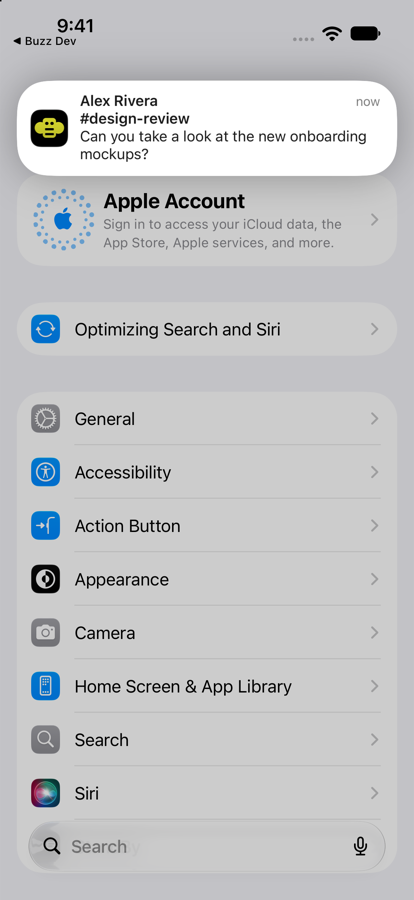
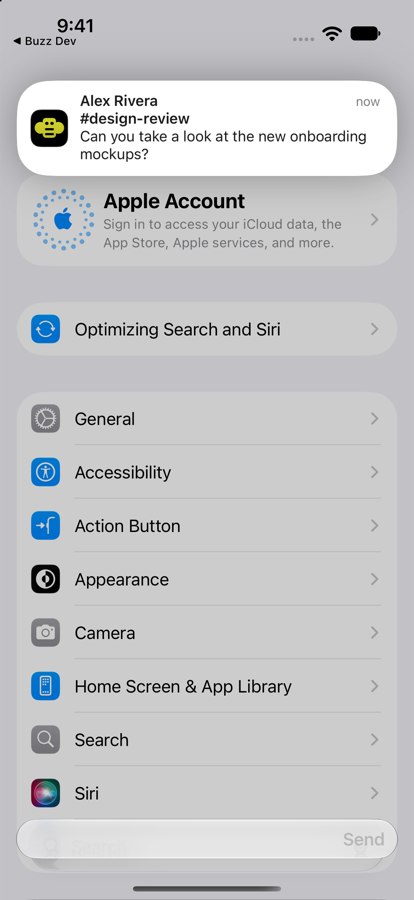
### Before / after
Long-pressing a message notification (synthetic names and text). Before
has no reply field (captured by sending the notification without its new
reply category, which is how main presents it); after shows one with
Send.
| Before | After |
| --- | --- |
|
|
|
### Demo
With the app backgrounded past the relay grace period, replying from the
notification lands the reply in a subthread under the message:
https://github.com/user-attachments/assets/37df7e28-aa46-4521-938e-8af5faa77b83
### Regressions
Nothing existing changes unless the user taps Reply. Notifications gain
a category and a small reply context in `userInfo`; tapping a
notification still opens the conversation as before. The relay reconnect
only happens for a pending reply and then falls back to the normal
background disconnect, so idle background behavior and network use are
unchanged. Reply failures end in a draft and a "Reply not sent"
notification rather than touching other state.
### Validation
- End to end on an iOS 27 simulator against a real community: with the
app backgrounded past the relay grace period, replied from the
notification; the reply appeared in a subthread under the message,
mentioning its sender. The demo above was recorded before the review
fixes (session hold, community fence, origin-community drafts, composer
draft sync); the same run was repeated on the current head,
|
||
|
Tom Brow
|
2b428f56b8 |
feat(mobile): share into Buzz from the iOS share sheet (#9433)
Lets people share screenshots, screen recordings, photos, URLs and text from any iOS app into Buzz. Today Buzz doesn't appear in the share sheet at all. - **Plain Buzz icon:** opens a new Solo chat with the items in its composer. - **Suggested conversation:** iOS offers channels and DMs the person recently sent top-level messages in. Choosing one opens that conversation with the items in its composer. When the conversation is already open, the share goes to that page's composer instead of opening a second one; if another page covers it, Buzz stays where it is and shows "Go back to that conversation to finish sharing", and the items join the draft when the person goes back. - The share extension has no UI and sends nothing. It copies the items into the app group and opens Buzz, which prefills the normal composer, so drafts, attachments, mentions and failed-send handling all stay the app's (see [the ADR](https://github.com/block/buzz/blob/mobile-share-extension-design/docs/adr/0003-share-hands-off-to-the-conversation.md)). - If the conversation already has a draft, Buzz asks whether to add the shared items to it or replace it. - A share to a conversation that's no longer available (a removed community or channel, or an unreadable share) shows "That conversation isn't available". A share while signed out shows "Sign in to share". Suggestions come from an outgoing `INSendMessageIntent` the app donates after a top-level send or a new Solo chat. The notification extension no longer donates incoming messages, so receiving a message never makes a conversation a suggestion; it still turns the push into a communication notification with the sender's avatar. Both use the same conversation identifier, now the plain community and channel IDs instead of a hash, because the extension needs to hand the identifier back to the app. | Before | After | | --- | --- | | <img alt="Share sheet without Buzz" src="https://github.com/user-attachments/assets/452fac1b-7e87-44c3-a442-099f78d0e07b" width="300"> | <img alt="Share sheet with Buzz" src="https://github.com/user-attachments/assets/54b9775d-29b4-49a5-8ab9-5fda8718a02f" width="300"> | | Buzz icon: new Solo chat | Suggested DM with a draft | After Add | | --- | --- | --- | | <img alt="New Solo chat with the shared photo" src="https://github.com/user-attachments/assets/c5da4d8b-1dd8-4e30-9e92-9dba515b3623" width="250"> | <img alt="Add to your draft prompt" src="https://github.com/user-attachments/assets/2f879f8a-3b9f-48e0-b963-2828e90dc9fe" width="250"> | <img alt="Draft with the shared link and photo added" src="https://github.com/user-attachments/assets/12832006-85c5-4447-98b5-62932552c931" width="250"> | https://github.com/user-attachments/assets/b9d380fa-e802-4ed7-89a8-592a03784c8f ### Regressions - Nothing changes for people who never use the share sheet, except that sending a top-level message or starting a Solo chat now makes one local `INInteraction.donate` call (skipped while the age restriction is on, which still purges every interaction). - Communication notifications look the same. Dropping the incoming donation removes work (and a deletion fence) from the notification extension's time budget. - The share hand-off reuses the existing deep link dispatcher. A share link is a new link type; notification and message links take the same paths as before. ### Validation - Added tests: - Dispatcher hand-off: a share to a suggested channel opens it with the shared text and files; shares to a removed community, an unlisted channel, an unknown manifest version or a missing manifest show the error and delete the pending share; share links accept only the extension's UUID ids. - Composer delivery: with an existing draft, Add appends the shared text on a new line and attaches the file, Replace clears the draft first, and the app group copy is deleted either way. - Notification presenter: specializes the notification from the intent, or falls back to the ordinary content when that throws (replaces the donation and deletion-fence tests). - Full mobile Flutter suite and BuzzPushKit Swift tests pass. - Automated app run on an iPhone 17 Pro simulator (iOS 27, dev relay test community), recorded above: sent a DM, shared a photo from Photos with the Buzz icon from a cold start (new Solo chat with the photo attached), then handed a link and photo to a DM that had a draft and chose Add. Also checked that a share's pending files are deleted after delivery. - Limitation: the iOS simulator never shows share-sheet conversation suggestions (it has no `coreduetd`), so the suggested-DM step in the video is staged by writing the same pending share and link the extension writes. Choosing a real suggestion still needs a check on a device. - Known gaps, all confined to sharing: suggestions have no avatar image yet; a suggestion for a conversation left after signing out shows "isn't available"; choosing Later in the unfinished-chat dialog keeps the share until the next new chat; and a pending share the app never receives (for example when Buzz doesn't open) stays in the app group. ### Before merge - [x] On a real iPhone, choose a suggested conversation in the share sheet and confirm the shared items open in that conversation's composer (the simulator can't show suggestions). Waived before merge: the managed test iPhone shows no share-sheet suggestions for any app, so this will be checked on a personal phone after landing. --------- Signed-off-by: Tom Brow <tomb@squareup.com> Co-authored-by: Tom Brow <tomb@squareup.com> |
||
|
Tom Brow
|
794ee64183 |
fix(ios): mint hosted NIP-FI assertions in the notification extension (#9228)
Share the hosted Builderlab session with the iOS notification extension so it can mint hosted NIP-FI assertions. The extension queries a hosted relay without an assertion first and mints only after a NIP-FI challenge, for a key the account is already bound to. Credential headers never follow redirects, and flag-off builds clear a previously shared session. Signed-off-by: Tom Brow <tomb@squareup.com> Co-Authored-By: Claude Opus 5.5 <noreply@anthropic.com> |
||
|
Tom Brow
|
97ede701c0 |
fix(mobile): send hosted relay assertion from native media and tombstone paths (#9069)
Follow-up to https://github.com/block/buzz/pull/9056, from an audit for other places that miss the hosted relay assertion. Hosted and organization relays require `Nostr-Federated-Identity` on every non-exempt HTTP request and WebSocket upgrade. The Dart `HostedRelayHttpClient` adds it, but anything that downloads or connects outside that client has to add it itself. The notification service extension and the iOS emoji picker both missed it, and these places do too: - **Voice notes** (`just_audio`, mainly Android) and **video preview first frames** fetch media natively with only the Blossom `Authorization` header. Both now use `nativeMediaHeadersProvider` from https://github.com/block/buzz/pull/9056. - **Push-lease tombstones**: removing a community, and the durable revocation outbox, open a one-off relay socket with no headers. A hosted relay refuses the upgrade, so the lease is never revoked and the outbox keeps retrying. Both now ask `HostedRelayAuth` for that community's own assertion, because the community being removed may not be the active session. - **Notification avatars** (iOS notification service extension): relay-hosted sender avatars were fetched with Blossom auth only. The loader now takes the same `BuzzRelayAssertionIssuer` the resolver uses for `/query`. Signed requests already refuse redirects. The iOS Me-chat agent picker also fetched avatars with no headers, but https://github.com/block/buzz/pull/9079 removed that native screen, so this PR no longer touches it. ### Validation - Added tests, each checked to fail when the code it guards is reverted: - A queued push-lease revocation and a community-removal tombstone both send `Nostr-Federated-Identity` on the WebSocket upgrade, as background requests. Runs against a local relay socket that handles NIP-42 auth. - A notification avatar on an organization relay is downloaded with the issued assertion (BuzzPushKit). - Issuing for a second community keeps the first one's cached assertion. A background request records no failure, never backs up the key, and its failure never reaches the active community's reconnect waiting on it. - Background issuance never binds an unbound account to its key, bypasses the shared assertion cache (each attempt gets a fresh assertion, and foreground use never inherits one that skipped the key backup), and its failure is never handed to a foreground caller waiting on it. When it can't get an assertion it sends none, so a non-enforcing relay still accepts the tombstone. - A notification avatar whose organization session is replaced mid-download is refused and dropped from the cache (BuzzPushKit). - Voice notes and posterless video previews renew an expired assertion before the native fetch, and fall back to cached headers if renewal fails. A voice-note attachment journey binds the production provider. - Cached reads never present a signed-out or replaced account's assertion. - `flutter analyze` is clean. `swift test` passes for the BuzzPushKit avatar loader tests, and `flutter build ios --simulator --debug` succeeds. - Full mobile suite (`just mobile-check` and `just mobile-test`) passes at 2c84940832. - Automated full-app run on an iOS simulator (debug build of this PR before it was rebuilt on main, signed in to the internal Builderlab community with two more communities saved). Passed: launch and channel list, image attachments and avatars in a channel, New chat sheet kept open for about 80 seconds before the agent list was opened (all agent avatars loaded, so headers are requested per download), dismiss and reopen, background and resume, switching to a second community (its icon and avatars loaded), and removing a community. The native New chat sheet is unreachable in the normal flow on this branch (a new chat opens the Flutter draft page; the native sheet only opens when resuming an unfinished chat), so that check ran with a temporary local bypass that was reverted. Limits: none of these communities requires the hosted relay assertion in this build, so the run shows the Swift-to-Dart header bridge, the per-relay cache and the tombstone path cause no regression, not that the assertion is sent or accepted. No voice note, video preview or deleted message was reachable. Screenshots are omitted because they show internal channel content. - Limitations: no end-to-end run against a hosted relay. Simulator sign-in to a hosted relay needs SSO, so a hosted-relay run needs a device build. 🤖 Generated with [Claude Code](https://claude.com/claude-code) --------- Signed-off-by: Tom Brow <tomb@squareup.com> Co-authored-by: Tom Brow <tomb@squareup.com> Co-authored-by: Claude Opus 5.5 <noreply@anthropic.com> Co-authored-by: studio <dc2fc481343672df31a689840c09299972e704dac592e0da6f18486646a7ee3e@buzz.block.builderlab.xyz> |
||
|
Tom Brow
|
bf13f7c83b |
fix(ios): mint NIP-FI assertions in the notification extension (#8982)
Organization relays that enforce NIP-FI (federated identity) require a `Nostr-Federated-Identity` assertion on `/query`. The iOS notification service extension signed its `/query` with NIP-98 only, so the relay answered `401` and every push from an enforcing organization relay showed the generic "You have a new message." body. The app already mints these assertions in Dart from its organization account session, but that session lives in the app's own keychain, and assertions last minutes, so a cached one is useless by the time a push arrives. This change lets the extension mint its own: - **App:** whenever the organization `BuilderlabAccountClient` adopts or clears its session, the app writes or deletes a device-only keychain item in the group it already shares with the extension. The item holds the organization origin, the session credential and the organization's exact relay hosts (from `BUZZ_ORGANIZATION_RELAYS`). Builds without an organization never write it. - **Extension:** for a community whose relay host is one of those exact hosts, `BuzzRelayAssertionIssuer` requests an assertion from the organization issuer (`/api/goose/v1/buzz/identity/assertions`, session credential plus NIP-98 with the community's account key, the same request the app makes), checks it was issued for that key, and caches it in-process until 30 seconds before expiry. Both `/query` paths (message lookup and sender/channel enrichment) send it. Other relays get no header and never see the session. - Signing out awaits removal of the shared copy and fails if removal fails; each restore that finds no session retries the removal. - If issuance fails or the user is signed out, the extension sends the query without the header and the relay refuses it, which keeps today's generic fallback. Not covered here: relay-hosted avatars on enforcing relays still load without the assertion (the notification text and title are unaffected), hosted Builderlab communities, and Android. ### Validation Added tests: - `testOrganizationRelayQueriesCarryMintedAssertion`: against a stub relay that answers `401` without the assertion, two organization pushes resolve with message body and sender name from a single issuance, a non-organization relay gets neither the header nor the session, and after sign-out the notification falls back. Removing the header from the query path makes this test fail. - `testOrganizationAssertionIssuanceFailuresSendNoHeader`: refused, wrong-key, expired and header-injection responses produce no header. Subdomains and other ports of the organization relay host are never sent the session. - `builderlab_account_test.dart`: the shared copy follows exchange, restore and clear; a failed removal fails sign-out, and the next restore retries it. Focused existing validation: the full BuzzPushKit suite, the hosted Dart tests, `flutter analyze`, and an iOS device build of the app and extension. Not yet validated: a live push from the Block relay on a device. ## Before merge Live device push test: waived by Tom (2026-11-03). 🤖 Generated with [Claude Code](https://claude.com/claude-code) --------- Signed-off-by: Tom Brow <tomb@squareup.com> Co-authored-by: Tom Brow <tomb@squareup.com> Co-authored-by: Claude Opus 5.5 <noreply@anthropic.com> |
||
|
Tom Brow
|
d263e2c7f7 |
fix(mobile): resolve iOS pushes on a fresh connection and retry a stale one (#8722)
## Summary

iOS users were seeing a run of push notifications that just said
"Reconnect to your relay now". That is the push gateway's fixed APNs
body. It shows when the Notification Service Extension (NSE) can't fetch
the message from the relay.

On-device logs from one affected iPhone over a full day showed 12 of 385
NSE runs fail to resolve. Each failed relay `/query`: 10 hit the 8
second timeout and 2 got `NSURLErrorNetworkConnectionLost` (-1005). All
12 ran on a reused pooled connection from `URLSession.shared` in a
long-lived NSE process. That process lived for hours while the network
path changed between VPN and cellular. Of the fresh connections, 0 of
473 failed.

This change:

- Gives each notification its own ephemeral session, so it never
inherits a pooled connection. The session is cancelled when the
extension finishes or expires.
- Retries `/query` once if it times out or loses its connection
mid-request. The retry uses a new session and a freshly signed NIP-98
proof, because the relay rejects a replayed proof. Other failures (HTTP
errors, offline, cancellation) are not retried. The retry is bounded to
one attempt, so the worst case is about 16 seconds, inside the NSE's
roughly 30 second budget.
- Replaces the gateway body with "You have a new message." when the NSE
can't resolve the push. The restricted fallback ("Open Buzz to view this
message.") is unchanged, and so is the gateway payload.

### Related issue

N/A. Reported in Buzz #buzz-mobile.

### Validation

- Added tests in `BuzzPushNotificationResolverTests`:
- A timeout or -1005 is retried once, on a new session and with a
different `Authorization` proof, and resolves.
  - Repeated timeouts stop after 2 attempts.
  - `notConnectedToInternet` is not retried.
- The retry is skipped if the account key changed during the first
attempt.
- `cancel()` (called when the NSE finishes or expires) stops a pending
retry.
- Each new test fails when the behavior it covers is removed: the retry,
the new session, the account recheck, or the cancel guard.
- The full BuzzPushKit `swift test` suite passes.
- A debug simulator build of Runner and the NotificationService
extension succeeded.
- An agent review of the diff found no blockers. Its suggestions to
create the session per `didReceive` and to cancel it on expiry are
included.
- Limitations:
- The NSE target has no unit tests, so the fallback text and the session
lifecycle are covered only by build and review.
- I couldn't send a real push through the NSE. Test phones run a
personal-team bundle that isn't the gateway's APNs topic. In the
simulator, `simctl push` needs notification permission, which the app
only requests after joining a community.
- Under the mobile testing exception, the human-test step does not
apply.

🤖 Generated with [Claude Code](https://claude.com/claude-code)

---------

Signed-off-by: Tom Brow <tomb@squareup.com>
Co-authored-by: Tom Brow <tomb@squareup.com>
Co-authored-by: studio <dc2fc481343672df31a689840c09299972e704dac592e0da6f18486646a7ee3e@localhost>
Co-authored-by: Claude Opus 5.5 <noreply@anthropic.com>
|
||
|
Tom Brow
|
3debf18f14 |
fix(ios): supply missing push notification sound at handoff (#8443)
Temporarily default missing notification sound until the [gateway fix](https://github.com/block/buzz/pull/8431) is deployed. Preserve any sound already provided by APNs. ### Validation Final build 10151: automation verified the push banner on a real iPhone 12 mini against the unchanged staging gateway, and Tom confirmed hearing the sound. iOS build, two existing handoff tests, and normal pre-push passed. ### Before merge - [x] Verify notification delivery and sound on the final iPhone build. Replaces [#8429](https://github.com/block/buzz/pull/8429) with the identical commit to obtain a fresh owner review. The prior review requested tests; this temporary workaround intentionally adds no tests or helper at the author's request. [Prior review response](https://github.com/block/buzz/pull/8429#issuecomment-6256498498). --------- Signed-off-by: Tom Brow <tomb@block.xyz> |
||
|
Tom Brow
|
fea02d174d |
fix(ios): fetch profiles and avatars in notification extension (#8369)
A notification can arrive from someone whose profile the main app has never loaded. The iOS notification extension now fetches and caches sender profiles, channel details, and avatars itself. The main app supplies account configuration and Keychain credentials only. After resolving the message, the extension allows 1.5 seconds for sender and channel details. It uses available stale data when a refresh is slow or fails, delivers once, and lets late results update its private cache. Profiles, channel details, and avatar refresh checks share a one-hour freshness threshold. A verified avatar removal clears the previous image. Account removal prevents further use of that sign-in's cached data. Profile, channel metadata, and membership use separate bounded downloads, so an oversized roster cannot discard the smaller records. Sender enrichment can finish while channel requests are pending. A successful partial channel refresh atomically removes its old counterpart, preventing a mixed group identity or recipient count. Group-specific notification presentation still requires a verified recipient count. The [specification](https://github.com/block/buzz/blob/native-notification-enrichment/docs/native-notification-enrichment.md) describes the display, caching, and account-removal behavior. General persistent image caching in Flutter remains separate. ### Validation [Hosted CI](https://github.com/block/buzz/actions/runs/38780108487) passed on the final commit, including all Flutter shards, Android, the full iOS release and simulator builds, and native controls/push-navigation tests. The [current-commit security review](https://github.com/block/buzz/pull/8369#issuecomment-6197508385) found no issues. The native package passed 159 tests, including new coverage for cache freshness, avatar replacement and removal, sign-in isolation, concurrent storage, late results, single delivery, bounded downloads, and SVG validation. A regression test exposed identical HTTP authentication event IDs for requests in the same second; each request now includes a unique nonce, matching the Dart and CLI clients. Full local CI passed before that small authentication fix. The complete native suite and signed device build passed again on the latest commit, including response-size limits, overlapping avatar downloads, canonical relay-origin matching, independent profile/channel refreshes, account-key changes before and during requests, and a single initial snapshot read across 64 accounts, signed IPv6 avatar authorities, and partial channel refreshes. Focused Flutter regression tests passed 198 tests with three configuration-specific skips; seven avatar widget tests also passed. Flutter analysis is clean, and the notification extension builds for the simulator. On an iPhone SE, the notification displayed the sender name, avatar, channel, and message before the updated main app was opened. Repeat notifications used a byte-identical private cache. Three notifications delivered together displayed the avatar after the authentication fix. The next notification also displayed correctly after terminating the extension process. The existing generic-push design can select the same newest unread message for several pushes; this change does not alter message selection. 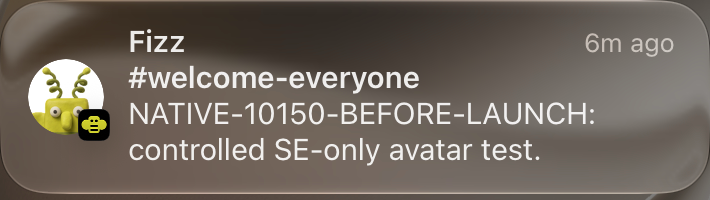 Authenticated HTTP avatar fetching and persistent HTTP cache reuse also passed on the SE. The first notification downloaded a relay thumbnail. After terminating the extension and expiring its separate avatar entry, the next notification displayed the avatar and refreshed that entry without another media request in the relay logs. The main app remained unopened throughout. The original app build and test profile were restored afterward. Automated tests cover slow and failed requests, stale images, removal, and account revocation; those cases have not all been exercised on the phone. ### Before merge - [x] Verify authenticated HTTP avatar fetching and cache reuse on iOS against a working relay media service. <!-- buzz-review-completed --> --------- Signed-off-by: Tom Brow <tomb@block.xyz> |
||
|
Tom Brow
|
779af8886c |
fix(mobile): fail open when age checks are unavailable (#7714)
Age-check errors previously blocked Buzz startup. Normal app startup now proceeds immediately; only a valid under-18 response from the current launch request can restrict access. Age check enforcement remains disabled at compile time by default. Builds can opt in with `--dart-define=BUZZ_AGE_GATING_ENABLED=true`. --------- Signed-off-by: Tom Brow <tomb@block.xyz> |
||
|
Tom Brow
|
f78a32cf03 |
feat(mobile): hard-block under-18 users on the store age signal (#4665)
### What changed? Buzz mobile checks the app-store age signal at launch and hard-blocks the app behind a full-screen 18+ notice when the store says the signed-in person is under 18. No age signal (e.g. declined permission, indeterminate value, unsupported OS versions) results in no block. The age value is never persisted. It is read, used to compute one boolean, and discarded. Nothing is written to disk, and neither the age value nor the range is logged or sent to analytics. Platform notes: - **New dependency `com.google.android.play:age-signals:0.0.4`.** This is the only way to read the Play signal. Its AAR declares `minSdkVersion 23`, below the app's 24, so it forces **no minSdk bump**, and it self-declares its own consent activity, so **no AndroidManifest change** is needed. - **iOS entitlement and linking.** `DeclaredAgeRange` autolinks from the import. `Runner.entitlements` now declares `com.apple.developer.declared-age-range`, and the call remains behind `#available(iOS 26.0, *)`. ### Why? App stores now expose a declared-age range, and Buzz's Terms require users to be 18 or older. This wires the store signal to that rule with the smallest change that is defensible. Absent signals, declined or undeterminable results, and unsupported OS versions allow the app through. A transient native request failure does not become evidence that access is allowed: the app remains gated until a retry produces a result. Only an affirmative under-18 signal produces the permanent restriction screen. ### How is it tested? Added tests: - [`age_signal_provider_test`](https://github.com/block/buzz/tree/main/mobile/test/features/age_gate) covers the 17/18 boundary, open-ended ranges, no-signal, transient recovery, bounded retry exhaustion, malformed payloads, and request-once behavior - [`age_gate_app_test`](https://github.com/block/buzz/tree/main/mobile/test/features/age_gate) proves authenticated content remains unmounted while the signal is pending or retryable, and verifies the retry path - [`age_restriction_page_test`](https://github.com/block/buzz/tree/main/mobile/test/features/age_gate) asserts the block screen offers no bypass affordance - [`community_provider_test`](https://github.com/block/buzz/tree/main/mobile/test/shared/community) verifies age restriction clears push state, persists inactive leases, and retries a failed tombstone - [`AgeSignalPayloadTest`](https://github.com/block/buzz/tree/main/mobile/android/app/src/test/kotlin/xyz/block/buzz/mobile) pins the Android success payload to exactly `{status, ageUpper}` and verifies failures return the distinct retryable platform error ### Deployment note Enable the Declared Age Range capability and regenerate signing profiles carrying the entitlement. This relops/App Store Connect task is not performed by this PR. *🤖 This PR was authored [with an agent](codex://threads/019e5128-536b-73b3-8348-88651123f6da).* | Age restriction screen | | --- | | <img src="https://github.com/user-attachments/assets/5b0f48b1-df9b-4a60-9800-80b33f128535" alt="Age restriction screen" width="320"> | --------- Signed-off-by: Tom Brow <tomb@block.xyz> Co-authored-by: npub12wpjffj7q5qjsky5jvk4ldwlxmse5xll3d8gytk4wqd0c5y7jvwspg37n6 <538324a65e0501285894932d5fb5df36e19a1bff8b4e822ed5701afc509e931d@buzz.block.builderlab.xyz> Co-authored-by: npub1tquskdu6yc4h8l7xxtceculxw600grekeq0xg2ukqfrwl7vrzg3quz3gmp <58390b379a262b73ffc632f19c73e6769ef40f36c81e642b960246eff9831222@buzz.block.builderlab.xyz> Co-authored-by: Codex <noreply@openai.com> |
||
|
Tom Brow
|
c432a111ca |
feat(mobile): push notifications MVP (#6269)
This PR implements MVP, iOS-only,
[NIP-PL](
|


