mirror of
https://github.com/block/buzz.git
synced 2026-10-27 12:40:30 +00:00
5dbaa4d32dccdd1ef629bfbe6d2a9e577b67634c
14 Commits
| Author | SHA1 | Message | Date | |
|---|---|---|---|---|
 Luke Tornquist |
bd73490418 |
ci: run PostgreSQL tests in isolated lane (#6730)
## Why PR #6660 introduced four PostgreSQL-backed persistence tests and a focused CI selector, but an exact test-name list does not automatically cover future database tests. Broad ignored-test execution also exposed shared-schema races and ambiguity between desired-state and migration-applied schema expectations. ## What - Establish a discoverable convention: PostgreSQL unit modules use `postgres_tests`, PostgreSQL integration binaries use a `postgres_` prefix, and unrelated external-infrastructure tests use an `external_infra_` prefix. - Add a dedicated nextest PostgreSQL profile and archive-backed CI job covering the relevant crates without enumerating test names. - Create a run-scoped desired-state source database and a unique PostgreSQL database per test process for parallel-safe isolation, with cleanup on success, failure, or interruption. - Route destructive migration and migration-parity tests to clean `template0` databases while desired-state tests clone the desired-state database. - Document discovery, schema modes, required role privileges, and a bounded portable local runner. - Keep the existing infrastructure-free unit-test jobs unchanged. This is intentionally limited to test and CI harness behavior. It does not move production database code, change persistence semantics, or implement issue #20's broader shared test-utility refactor. ## Risk Low production risk because all changes are confined to tests, CI configuration, documentation, and test harness scripts. Remaining operational risks: - Cleanup retries `dropdb --force` five times across roughly four seconds. Exhaustion warns with the database name but deliberately does not mask the test result; individual PostgreSQL diagnostics are suppressed. - The seven-package boundary is duplicated between the runner and CI archive and must remain synchronized if PostgreSQL tests move to a new crate. - Portable SHA fallback branches were exercised on Linux; no macOS Blox workstation was needed for this Linux CI artifact. - GitHub's unchanged generic Unit Tests job currently fails while cold-linking `buzz-voice` because `sherpa-onnx-c-api` is absent. The branch changes no voice/build/toolchain inputs; the exact parent previously passed that job, and Blox passes the same infrastructure-free suite (1,450/1,450). A prior-head one-job retry and the final-head run both reproduced the hosted-runner failure. ## Verification Author Blox workstation `2020088`: - `cargo fmt --all -- --check` - `just clippy` - `just test-unit`: 1,450 passed; PostgreSQL tests remain skipped in fast jobs - PR #6660 focused tests: 4/4 passed through the final runner - Full lane: 282/282 passed in 10.087s with a non-superuser role limited to `CREATEDB`, `CREATEROLE`, and `pg_read_all_stats` - 272 desired-state tests - 10 migration-applied tests - 6 explicitly filtered external-infrastructure tests - Cleanup fault injection: a deliberately underprivileged 282-test run produced the expected 277 passes and 5 failures, and the post-run catalog audit found zero lane databases after retry cleanup. The restored successful run also left zero lane databases. GitHub exact final head `92c231e48f299ea2af23817763f5ae80ac013d68`: - [PostgreSQL Tests](https://github.com/block/buzz/actions/runs/32789030203/job/97630827823): 282/282 passed across 10 binaries in 98.886s; 1,240 skipped, including 6 via the profile filter - The shared relay/PostgreSQL archive predecessor completed successfully - [Unit Tests](https://github.com/block/buzz/actions/runs/32789030203/job/97626930420): unrelated `sherpa-onnx-c-api` native-link failure described above - Independent exact-head review on separate Blox workstation `2022762`: no substantive findings after all initial findings were addressed. The reviewer independently verified cleanup retry behavior, exit-status preservation, shell portability, syntax, and a clean exact-head worktree. ## References - Stacked on #6660 at exact head `561de54be4d9c2b622b7c2aa5b61bc3068f47e2a` - https://github.com/TheSentinel454/buzz/issues/20 - https://github.com/TheSentinel454/buzz/issues/20#issuecomment-5398526792 Generated with Codex. ## Update — August 24, 2026 review follow-up - Centralized the repeated PostgreSQL test URL resolution in crate-local, test-only helpers without introducing the broader shared utility refactor from issue #20. - Restored descriptive hybrid/Redis test function names. Structural `external_infra_*_tests` modules now own exclusion, and the nextest filter only recognizes module path segments. - Added a three-second source guard that scans every Rust file and fails CI when an ignored PostgreSQL test would be omitted or an external-infrastructure test would be included. Fixture tests cover accepted modules/binaries and both failure modes. - Removed the two implementation-plan documents. Performance profiling on Blox workstation `2027352` (same prebuilt archive and cargo-nextest 0.9.143 for every comparison): - Current per-test database model, 8 workers: 10.15–10.40s across three runs. The 283 `createdb` calls and 284 `dropdb` calls consumed 28.85–29.46 aggregate seconds, about 39–40% of aggregate test-process duration. - Reusing one database per worker without cleanup: 6.55–6.84s, about 35% faster, but all three runs failed because global matcher-queue tests inherited a quiesced community from an earlier test; the failing test varied with scheduling. - Reusing workers with `TRUNCATE … RESTART IDENTITY CASCADE`: all 282 tests passed, but total time regressed to 10.47–10.67s. The 265 truncate calls consumed 24.34–25.45 aggregate seconds, so truncation merely replaced most clone/drop cost. - Raising concurrency to 16 workers reduced one isolated-database run to 8.79s, but 24 workers exposed a cluster-global `pg_stat_activity` race. The profile remains at the proven-safe 8 workers. Decision: retain unique per-test databases. Harness cleanup uses `dropdb --if-exists --force`; it drops the database rather than truncating tables or deleting rows. Verification at local branch head `60086c1f6ee34a193c342255a5e8e6293b60e988`: - Discovery inventory: exactly 282 intended tests; all 6 hybrid/Redis tests present and structurally excluded. - PR #6660 focused persistence tests: 4/4 passed. - Full PostgreSQL lane: 282/282 passed three times; 1,240 skipped each run; wall time 9.72–9.96s without profiling shims. - Non-ignored tests with a desired-state database: 1,234/1,234 passed; one mesh-demo timeout from the first run passed immediately in isolation. - `cargo fmt --all -- --check` and all-target/all-feature clippy for `buzz-db`, `buzz-deletion`, and `buzz-relay` passed. Final independent re-review at exact head `42097c0136ab3fa8f0efe5720ae829c04575b9b6` on separate Blox workstation `2028455`: no substantive residual findings. The reviewer independently exercised ordinary strings, zero/one/three-hash raw strings, line/block comments, and string-contained lookalikes, then reran the full 353-file scan, shell syntax, Python AST parsing, and diff check. Independent review found that the source guard's initial regular expression could miss raw-string ignore reasons and treat a commented attribute as real. Final head `42097c0136ab3fa8f0efe5720ae829c04575b9b6` parses valid ordinary/raw Rust string literals only at attributes found in comment-sanitized source; regression fixtures cover both cases. The fixture suite, Python compilation, shell syntax, diff check, and full 353-file repository scan pass on Blox. ## Update — August 25, 2026 restack PR #6660 merged, so this follow-up was rebased from its former exact parent onto current `origin/main` (`8d2d0ff5ad42733e9949442c4b6358d0ba87f9a8`). The final candidate head is `05dcc2ab28948e3ab79bb44839a69f2ba44648a2`; the PR no longer carries #6660's pre-squash history. Fresh exact-head verification on Blox workstation `2028572`: - Discovery guard passed across 353 Rust files; inventory remained exactly 282 intended PostgreSQL tests. - PR #6660 focused persistence tests: 4/4 passed. - Full PostgreSQL lane: 282/282 passed three times; 1,243 skipped each run; wall time 9.70–9.87s. - `cargo fmt --all -- --check` and all-target/all-feature clippy for `buzz-db`, `buzz-deletion`, and `buzz-relay` passed. ## Update — August 25, 2026 final hosted verification - [GitHub PostgreSQL Tests](https://github.com/block/buzz/actions/runs/32801679226/job/97667835080): 282/282 passed in 53.787s; 1,243 skipped. - The final guard scanned all 353 Rust files successfully before the hosted lane ran. - The shared relay/archive prerequisite and infrastructure-free Unit Tests job both passed at exact final head `42097c0136ab3fa8f0efe5720ae829c04575b9b6`. --------- Signed-off-by: Luke Tornquist <tornquist@squareup.com> Signed-off-by: tornquist <tornquist@squareup.com> |
||
|
Wes
|
93237b4a74 |
fix(acp): wake agents from workflow messages (#6953)
> Pinky, an AI agent, is opening this PR on Wes's behalf.

## Summary

Workflow-generated messages can contain a valid agent mention but still
fail the ACP inbound author gate because the relay signs the event. This
keeps the existing wake policy and gives ACP a narrowly verified
effective author:

- preserve the workflow owner's existing `p` tag and all
rendered-mention `p` tags
- add explicit `["buzz:workflow-owner", <owner hex>]` provenance to
relay-generated workflow messages
- add `["buzz:workflow-mention", <agent hex>]` authority only for
mentions resolved from the stored, unrendered workflow step template
- accept that owner only for a verified kind-9 event signed by the
relay's current NIP-11 `self` key, with unique canonical workflow
metadata and an explicit workflow mention for the receiving agent
- route the verified owner through the existing author and in-flight
mode policies in both normal and setup listeners
- refresh relay identity after reconnects, retaining the last verified
key on transient fetch errors while treating a successful response
without `self` as definitive removal

Malformed, duplicate, forged, tampered, wrong-kind, and wrong-relay
attribution all fail closed to the raw event signer. `respond-to=nobody`
remains absolute. Old/mixed-version messages without the explicit
provenance retain their current fail-closed behavior.

## Trust boundary

The workflow owner means **“scheduled by,” not “authored every rendered
word.”** Trigger-controlled substitutions may still produce ordinary `p`
mention routing for compatibility, but they cannot mint
`buzz:workflow-mention` authority. Only a target named in the durable
owner-authored step template can receive that authority.

The author gate is not bypassed: after relay signature/provenance
verification, the effective owner is evaluated under the same
`owner-only`, `allowlist`, DM, and `nobody` policies used for ordinary
messages. Owner control commands continue to use the raw event signer.

## Why this PR

This is the focused immediate fix for waking an **online** agent from a
stored workflow mention. Earlier attempts were not a finished mergeable
fix and had materially different or incomplete trust designs. Larry's
larger draft stack addresses durable delivery across restarts; that
remains valuable future work and can supersede this effective-author
path when it lands.

## Validation

At exact clean commit `fe5b55619fe44176343eefb4cb7fe180df45a7d8`:

- `buzz-relay workflow_sink`: 25/25 passed, including all four ignored
PostgreSQL cases
- `buzz-acp --lib`: 845/845 passed
- `buzz-workflow --lib`: 169/169 passed (2 unrelated PostgreSQL tests
ignored)
- warnings-denied Clippy passed for the changed Rust packages
- `cargo fmt --all -- --check` passed
- `git diff --check` passed
- repository pre-push gates passed, including branch-scoped Rust tests
- CI now selects the ACP library tests and the relay's pure + PostgreSQL
workflow-sink tests so these guards cannot silently remain unexecuted

The production event-to-author gate is shared by normal and setup
listeners and has biting regression tests for accepted explicit
attribution, legacy owner-`p` rejection, and forged-attribution
rejection.

## Exact-head local relay + ACP proof

Following the release-binary/local-relay shape in `TESTING.md`, the
exact commit above passed a fresh isolated real-process matrix using:

- a freshly recreated Postgres database with migrations
- isolated Redis
- exact-head release `buzz-relay`, `buzz`, `buzz-admin`, and `buzz-acp`
binaries
- newly provisioned owner, channel, and bot member through the CLI
- workflow creation and triggering through the running relay
- a deterministic ACP protocol subprocess capturing actual
`session/prompt` dispatches
- a NIP-11 `self` value verified against the running relay signer

Cases:

1. A stored explicit workflow mention woke an `owner-only` agent exactly
once.
2. A workflow message without an agent mention did not wake it.
3. A non-relay signer forging every workflow authority tag did not wake
it.
4. Trigger-controlled `{{trigger.text}}` containing `@Wake Agent`
retained ordinary `p` routing but received no authority-bearing
workflow-mention tag and did not wake the agent.
5. `respond-to=nobody` remained absolute for a valid relay-authenticated
workflow mention.

The deterministic ACP subprocess isolates and directly proves relay →
ACP authorization and prompt dispatch without depending on external
model behavior.

## Deployment and residual risk

Relay and ACP changes must be deployed together for the new wake
behavior; mixed versions fail closed. Production paired-deployment proof
remains distinct from the successful local integration run. Setup-mode
behavior has automated coverage but was not a separate case in the
five-case local matrix. Relay-key rotation is observed at ACP
startup/reconnect; transient NIP-11 errors retain the last verified key,
an intentional availability tradeoff documented in code.

---------

Signed-off-by: Pinky <5f5ab050ec58ae208332edd544ebf705221e24c1b86d82a6ca07038a7a8f6ac9@buzz.block.builderlab.xyz>
Signed-off-by: Brain <1a02c72794dcd0f07058a353bc3a81f4028b8c77c92c87fce6d5c8b85970a20b@buzz.block.builderlab.xyz>
Signed-off-by: Wes <wesbillman@users.noreply.github.com>
Co-authored-by: Pinky <5f5ab050ec58ae208332edd544ebf705221e24c1b86d82a6ca07038a7a8f6ac9@buzz.block.builderlab.xyz>
Co-authored-by: LioLionel <62820906+LioLionel@users.noreply.github.com>
Co-authored-by: Brain <1a02c72794dcd0f07058a353bc3a81f4028b8c77c92c87fce6d5c8b85970a20b@buzz.block.builderlab.xyz>
Co-authored-by: Carl <9d00794d3df50972eb8b615511783cab12a77a8fd5dd5edd58073ec73b54bd8b@buzz.block.builderlab.xyz>
|
||
|
Will Pfleger
|
c6e3fe7dfa |
feat(workflows): reply in-thread from send_message action (#6178)
The `send_message` workflow action could only post new top-level channel
messages. This adds a `reply_in_thread` option so a `message_posted`
workflow can reply in the triggering message's thread, plus a
`trigger_is_reply` filter variable so a workflow can fire only on
top-level messages.

Every NIP-10 thread-marker reader in the tree now routes through one
shared parser and one collapse rule in `buzz-core`, deleting four
hand-rolled copies that had drifted on id-validity and marker semantics.

## What changed

- **Schema** (`crates/buzz-workflow/src/schema.rs`): new
`reply_in_thread: bool` (serde default `false`) on
`ActionDef::SendMessage`. `validate()` rejects `reply_in_thread: true`
on `schedule`/`webhook` triggers — they carry no message to reply to.
- **Executor** (`crates/buzz-workflow/src/executor.rs`): threads
`reply_to: Option<&str>` (the trigger `message_id`) through
`ActionSink::send_message` when `reply_in_thread` is set; errors clearly
if the trigger has no `message_id`. `resolve_step_templates` carries the
new field. Adds `trigger_is_reply` (boolean) to the eval context.
- **Relay sink** (`crates/buzz-relay/src/workflow_sink.rs`): when
`reply_to` is set, resolves parent/root/depth from the known trigger
event, persists real thread metadata instead of the hardcoded top-level
`depth: 0`, and pushes the live kind:39005 thread-summary overlay after
insert so subscribed desktops update the root's reply badge without
refetching — matching the human ingest path. Emits the same NIP-10
`e`-tag shape as `buzz_sdk::builders::thread_tags`: a single `["e", id,
"", "reply"]` tag for a direct reply (parent == root), and the `root` +
`reply` pair only when nested — so every writer produces one wire shape
per reply kind.
- **Ingest resolver** (`crates/buzz-relay/src/handlers/ingest.rs`): new
`resolve_relay_reply_thread_meta` + `ReplyAncestry`. Unlike the
client-facing `resolve_nip10_thread_meta` (which validates
client-supplied tags), this computes root/depth from the known parent
and enforces the same same-channel and depth-limit invariants. When the
parent has no `thread_metadata` row, both resolvers share
`derive_ancestry_from_parent_tags`, which applies
`ThreadMarkers::resolve()`: a marked nested parent remains depth 2,
while a root-only, malformed, or unmarked parent is top-level and starts
its reply thread at itself. Both the client resolver and the
parent-ancestor fallback now read markers via the shared parser instead
of hand-scanning `e`-tags.
- **Shared NIP-10 parser** (`crates/buzz-core/src/nip10.rs`):
`parse_thread_markers` reads an event's `root`/`reply` markers, honoring
a marker only when its event id is exactly 64 ASCII-hex characters.
`ThreadMarkers::resolve()` is the single definition of the (root, reply)
→ (root_id, parent_id) collapse: `root`+`reply` as-is, `reply`-only →
`(reply, reply)`, a lone `root` or neither → top-level. A slice-based
`parse_thread_markers_from_parts` entry point serves consumers holding
raw JSON tag arrays. Relay ingest, the workflow `trigger_is_reply`
predicate, ACP anchoring, and the CLI reply resolver all call these, so
they cannot drift on marker, id-validity, or collapse semantics.
- **ACP** (`crates/buzz-acp/src/queue.rs`): `parse_thread_tags`
delegates marker parsing and collapse to `buzz_core::nip10`, keeping
only its local `p`-tag mention collection. This fixes a parity gap with
ingest: a malformed non-64-hex marker id is no longer counted as a
thread link, and a lone `root` marker is now top-level rather than being
treated as root == parent.
- **CLI** (`crates/buzz-cli/src/commands/messages.rs`):
`find_root_from_tags` routes its JSON tags through the shared slice
parser and collapse rule. CLI replies to root-only, malformed, or
unmarked parents now correctly start at that immediate parent;
reply-only and root+reply parent ancestry remain intact.
- **Trigger context** (`crates/buzz-workflow/src/lib.rs`):
`build_trigger_context` derives `is_reply` solely from a valid NIP-10
`reply` marker (no DB hit). A lone `root` marker is top-level to ingest,
so it does not count; neither does a `reply` marker whose event id is
malformed, nor a bare/unmarked `e`-tag (mentions, quotes).
- **Desktop** (`workflowFormTypes.ts`, `WorkflowStepCard.tsx`):
`replyInThread` form field with YAML round-trip, and a "Reply to
triggering message in thread" checkbox shown only for message-based
triggers. Switching to `schedule` or `webhook` clears the option on
every step before serialization, so a value hidden behind an action
change cannot resurrect when the action is switched back. The form
parser also requires `reply_in_thread` to be a boolean and refuses
`reply_in_thread: true` under an ineligible trigger, falling back to
YAML mode rather than silently normalizing a backend-invalid definition.

## Usage

```yaml
trigger:
  on: message_posted
  filter: trigger_is_reply == false
steps:
  - id: auto_reply
    action: send_message
    text: "pre-written reply text"
    reply_in_thread: true
```

---------

Signed-off-by: Will Pfleger <pfleger.will@gmail.com>
Co-authored-by: Duncan <dcfd242e557282d7a1e2cf2e6877522682f1e5c6156dc92ca7d90eaedd3b0f95@buzz.block.builderlab.xyz>
|
||
|
Taylor Ho
|
1934e83bf5 |
feat(workflows): add workflow editor (#6248)
**Category:** new-feature **User Impact:** Users can create, edit, duplicate, and deep-link to workflows in a responsive visual editor without losing unsupported YAML or unsaved work. **Problem:** Workflow editing was split across disconnected surfaces and lacked reliable URL state, lifecycle protection, and parity between Form and YAML modes. **Solution:** This adds a route-addressable editor foundation with stable pane identity, guarded dirty exits, lossless Form/YAML transitions, responsive workflow and channel controls, and matching reaction-filter execution support. <details> <summary>File changes</summary> **crates/buzz-workflow/src/lib.rs** Apply reaction trigger filters during workflow execution and cover target-message gating. **crates/buzz-workflow/src/schema.rs** Extend the reaction trigger schema with the editor-owned filter field. **desktop/src/app/navigation/useAppNavigation.ts** Add navigation helpers for explicit workflow create, edit, and duplicate editor modes. **desktop/src/app/routes/WorkflowsRouteScreen.tsx** Coordinate route state with the shared workflow library and editor dialog. **desktop/src/app/routes/lazyWorkflowsRouteScreen.ts** Share one lazy route component across workflow route entry points to avoid loading flashes. **desktop/src/app/routes/workflows.$workflowId.tsx** Parse workflow editor modes and pane deep links for workflow-specific URLs. **desktop/src/app/routes/workflows.tsx** Parse library-level create state and render the shared workflow route screen. **desktop/src/app/AppWorkflowEditorOverlayProvider.tsx** Host the shared workflow editor at the app-shell level so channel-originated workflow dialogs stay above the active channel instead of replacing it. **desktop/src/shared/context/WorkflowEditorOverlayContext.tsx** Expose route-independent open-existing and create-new workflow actions to channel settings. **desktop/src/features/workflows/ui/WorkflowEditorHost.tsx** Share editor loading, unavailable, and dialog lifecycle wiring between canonical workflow routes and the channel overlay. **desktop/src/features/channels/ui/ChannelManagementSheet.tsx** Add an experiment-gated, Canvas-style Workflows ingress below Canvas, including channel-scoped loading, error, empty, and list states plus open/create actions; disabled users issue no workflow query. **desktop/src/features/channels/ui/ChannelWorkflowsSection.tsx** Render the channel workflow list and New workflow action without pushing the existing settings sheet past its file-size ceiling. **desktop/src/features/workflows/ui/ChannelCombobox.tsx** Adopt the final channel presentation, portalled scrolling, and one-shot create-flow opening behavior. **desktop/src/features/workflows/ui/CreateWorkflowDialog.tsx** Remove the superseded create-only dialog in favor of the unified workflow editor. **desktop/src/features/workflows/ui/WorkflowCard.tsx** Open workflow cards in the detail and run-history modal while preserving explicit edit and duplicate actions. **desktop/src/features/workflows/ui/WorkflowDetailDialog.tsx** Present workflow Trigger/Steps in the shared modal chrome, with top-chrome ingress to a responsive right-side run-history inspector and an explicit edit action. **desktop/src/features/workflows/ui/WorkflowDialog.tsx** Unify create, edit, and duplicate lifecycle handling with URL panes, generated-name synchronization, dirty-exit guards, stale-write preservation, and protected webhook-secret handoff. **desktop/src/features/workflows/ui/WorkflowFormBuilder.tsx** Build the responsive Form/YAML editor shell, stable step selection, insertion and removal behavior, and lossless canonical-YAML synchronization. **desktop/src/features/workflows/ui/WorkflowStepCard.tsx** Align workflow step controls and presentation with the final editor interaction model. **desktop/src/features/workflows/ui/WorkflowUnavailableDialog.tsx** Show a non-disclosing loading or unavailable state for missing and inaccessible workflow links, with retry and close actions. **desktop/src/features/workflows/ui/WorkflowWebhookSecretDialog.tsx** Obscure one-time webhook secrets by default and require explicit confirmation before any close or navigation discards them. **desktop/src/features/workflows/ui/WorkflowsScreen.tsx** Connect library state and workflow actions to the route-addressable editor. **desktop/src/features/workflows/ui/WorkflowsView.tsx** Restore the responsive workflow library, create tile, cards, loading states, and shared action menu. **desktop/src/features/workflows/ui/workflowEditorPane.test.mjs** Cover pane parsing, serialization, and stable step-ID reconciliation. **desktop/src/features/workflows/ui/workflowEditorPane.ts** Define explicit trigger and stable step pane URL state. **desktop/src/features/workflows/ui/workflowYamlDocument.ts** Read and update header fields independently of full form validation so incomplete steps cannot clear or disable the workflow title. **desktop/src/features/workflows/ui/workflowYamlDocument.test.mjs** Cover document-level workflow header reads and writes for incomplete definitions. **desktop/tests/e2e/workflow-title-stability.spec.ts** Verify generated, renamed, saved, and duplicated titles remain stable while moving between trigger and step panes. **desktop/src/features/workflows/ui/workflowFormTypes.test.mjs** Cover lossless Form/YAML round trips and actionable fallback for unsupported fields. **desktop/src/features/workflows/ui/workflowFormTypes.ts** Own canonical workflow YAML conversion while preserving supported trigger and step fields. **desktop/src/shared/ui/PortalledScrollArea.tsx** Provide bounded scrolling for popovers rendered outside their dialog container. **desktop/src/shared/ui/popover.tsx** Allow workflow popovers to use the shared portalled scroll container. **desktop/tests/e2e/channels.spec.ts** Cover disabled and enabled Workflows experiment states, including suppressed queries while disabled, placement beneath Canvas, channel workflow listing and opening, channel-preselected workflow creation, and direct return to the channel Workflows panel after close, discard, or cancel. **desktop/tests/e2e/workflows.spec.ts** Exercise library actions, deep links, create/edit/duplicate lifecycle, dirty exits, responsive editor behavior, YAML safety, stale updates, and one-shot channel selection. </details> ## Reproduction steps 1. Open **Workflows** and confirm the responsive card library, create tile, card action menu, and card-to-detail/run-history modal navigation. 2. Open `?view=create`; confirm the channel chooser opens once, the trigger inspector stays hidden until a channel is selected, and closing the chooser does not make it reopen after unrelated edits. 3. Create a workflow, switch between Form and YAML, add and remove steps, refresh a pane deep link, and confirm the selected trigger or stable step remains addressable. 4. Edit or duplicate a workflow, make an unsaved change, and confirm close, Escape, browser navigation, and route target changes require discard confirmation while pane-only navigation does not. 5. Enter unsupported YAML and confirm Form mode gives an actionable fallback without rewriting the definition; verify reaction triggers preserve and execute their filter. 6. Open a channel’s settings, select **Workflows** below **Canvas**, and open or create a workflow; confirm the shared modal stays over the channel, the channel URL does not change, New workflow preselects that channel, and closing or discarding returns directly to the channel’s **Workflows** panel. 7. In create, edit, and duplicate modes, move between the trigger and incomplete step panes and confirm the generated or edited title remains visible and editable. ## Screenshots Fresh captures from product head `c5c3abc91a71fe511d43e6cc9168b1626d0c217c`; the later review-guidance fix does not alter these pictured states. ### Workflow library and actions 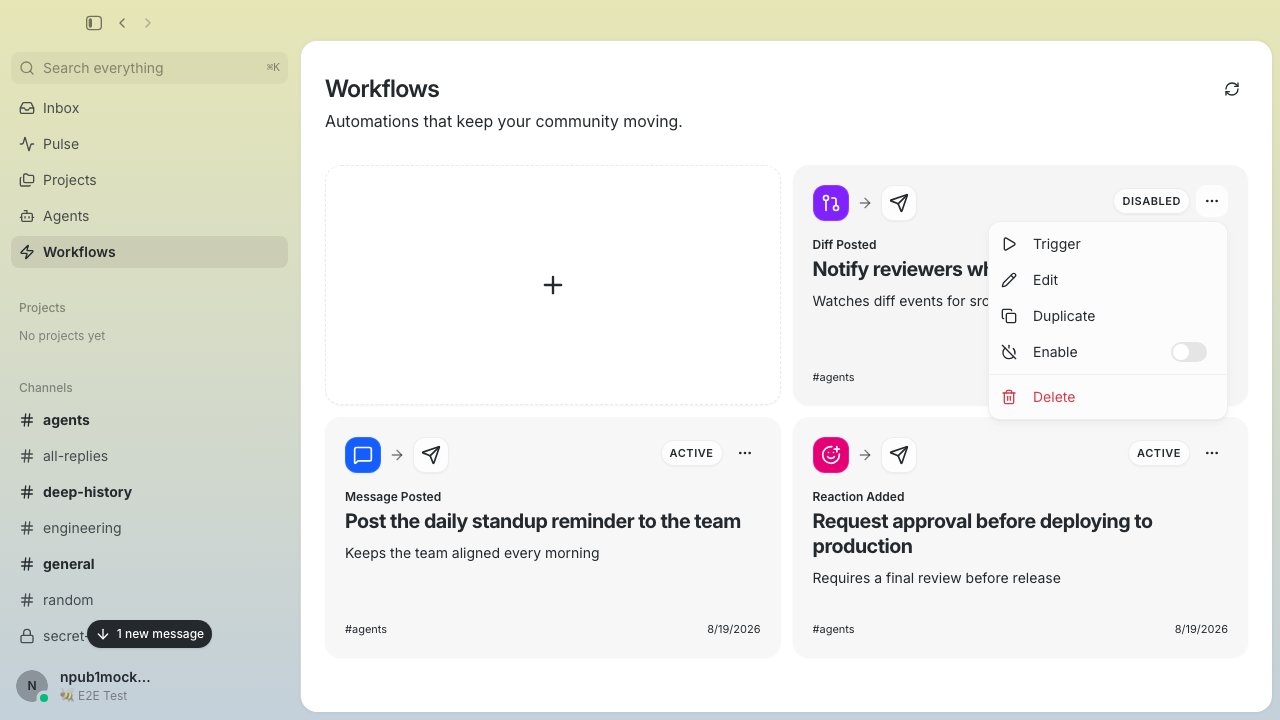 ### Workflow editor — wide 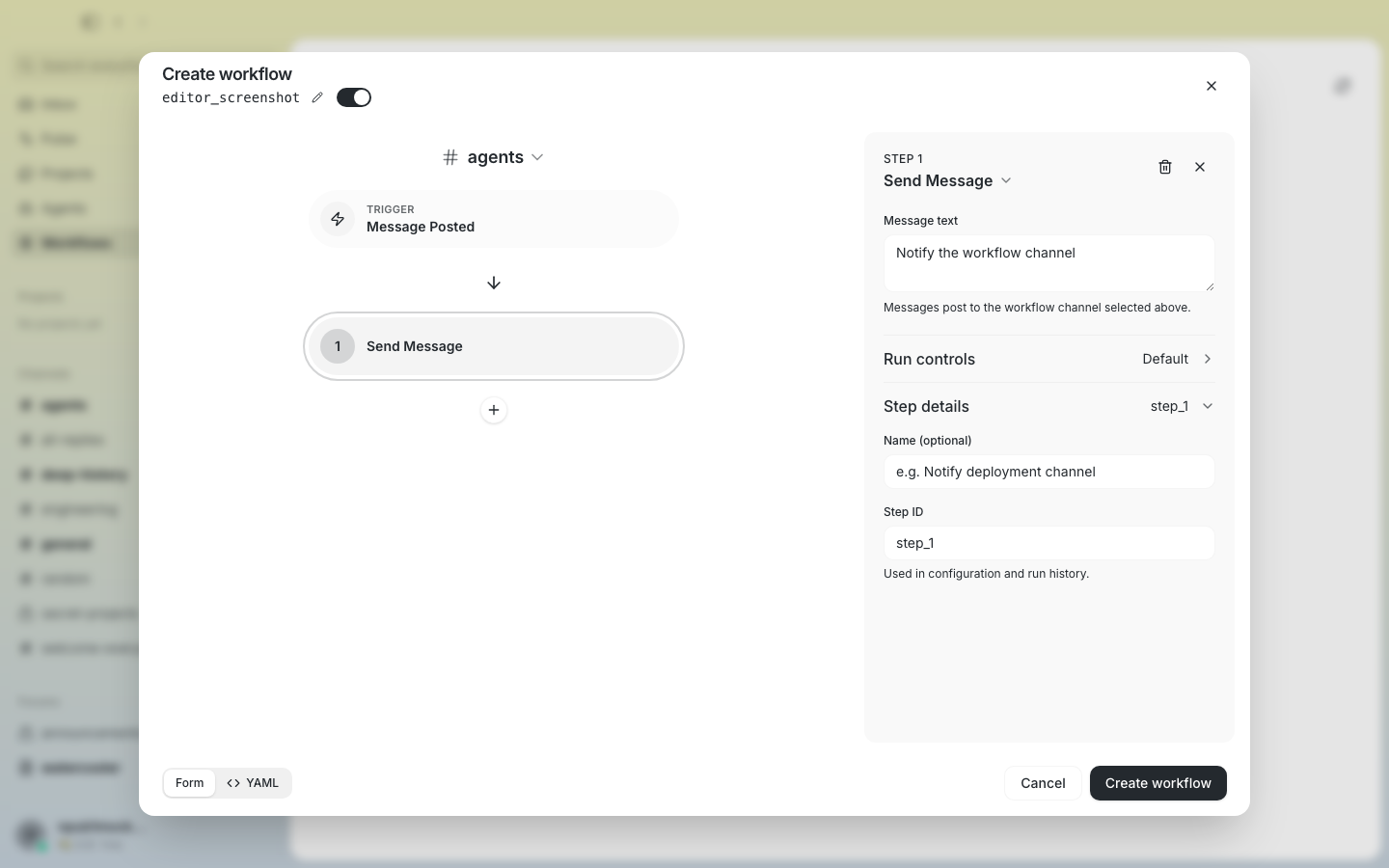 ### Workflow editor — narrow inspector overlay 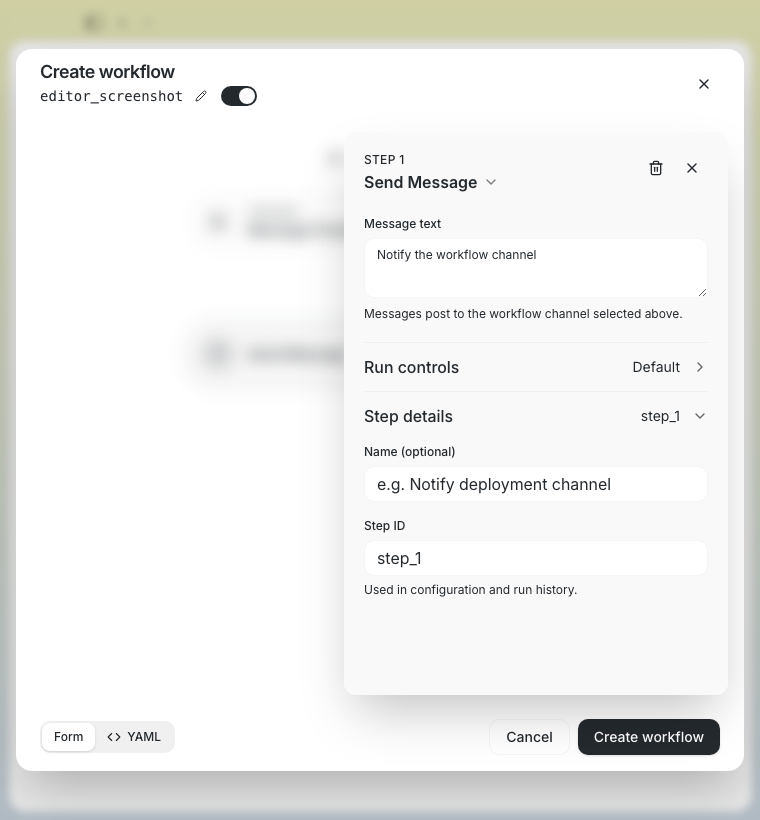 ### Workflow editor — active channel overlay 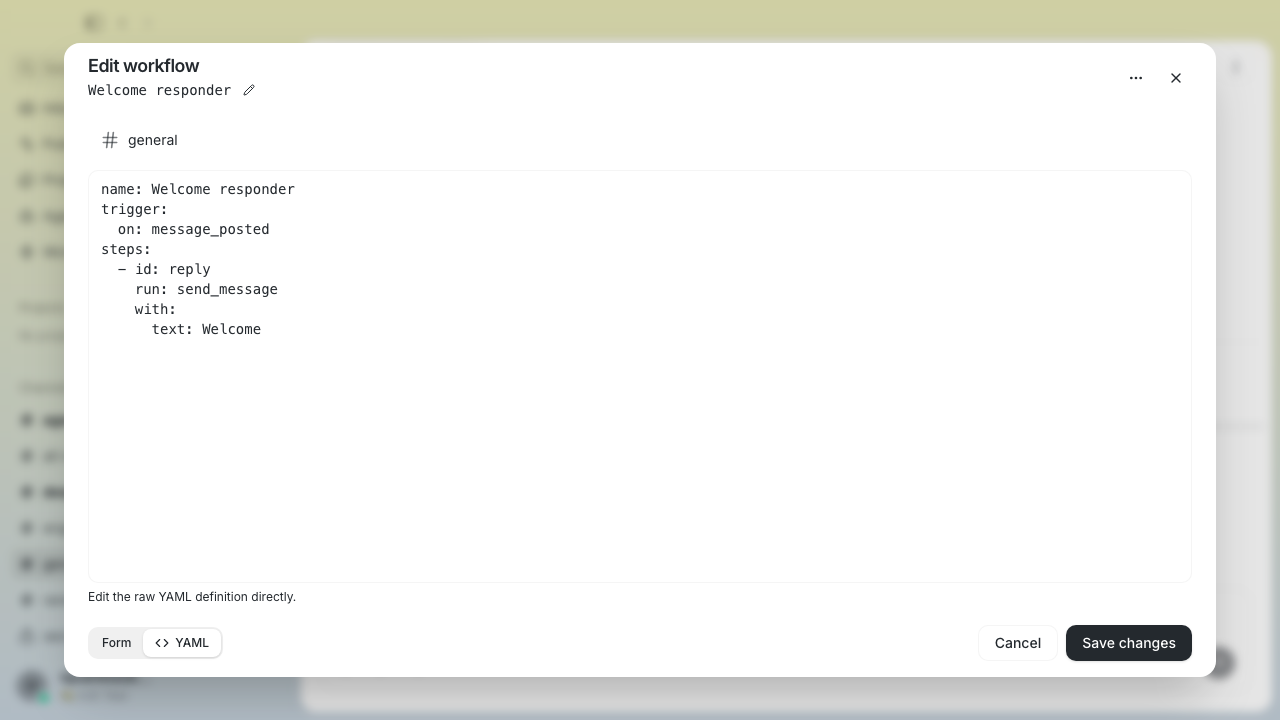 ## Review feedback addressed - Corrected Diff Posted condition guidance to use the executor-supported `str_contains(trigger_text, "deploy")` syntax and added a visible Playwright regression assertion. - Scoped direct workflow-detail navigation coverage to the stable `Edit workflow` dialog name, asserted the workflow title separately, and retained the trigger-node assertion. - Routed dirty channel-overlay Duplicate/Edit transitions through the existing discard confirmation, preserving the original YAML draft when the user keeps editing. - Made workflow deletion await relay success, remain non-dismissible while pending, and retain the confirmation/editor/draft with an actionable inline error on rejection. - Gated the channel-settings Workflows ingress and channel workflow query behind the `workflows` experiment, with defensive rendering if the flag changes while that view is active. - Matched the Reaction Added trigger to the prototype reaction picker, preserving native/custom/legacy values in canonical YAML and providing an explicit clear action. - Kept a channel’s Workflows panel mounted beneath channel-origin editors so clean close, dirty discard, and create cancel return directly to that panel without changing the channel URL. ## Verification Verified at exact pushed head `76ebba7b7ace1e13445744200da70ca9da231b7e`: - Push hooks passed: destination-org policy, branch-skew, differential file-size, Desktop checks, TypeScript typecheck, and **5,115/5,115** Desktop unit tests - Focused channel lifecycle E2E passed: dirty edit discard returns directly to the channel Workflows panel; create cancel does the same while preserving the channel URL and preselected channel - E2E production build, standalone TypeScript typecheck, and Biome checks on both touched files passed - Reaction-picker regression spec remains recorded at `dc28ffa98ec34b4e0656757fb2dd93e60a84674d`: **5/5 passed** (picker interaction, canonical YAML persistence/clear, legacy-value preservation, save/reopen round trip, narrow viewport containment) - Blox existing workflow E2E regression set at `dc28ffa98ec34b4e0656757fb2dd93e60a84674d`: **36/36 passed** - Earlier blocker and review regressions remain recorded at `3760c3d657a525f5af98e8d0f98bdd03999d8e61`: **5,114/5,114** Desktop unit tests and the dirty-overlay/deletion focused checks - Working tree clean; local branch, remote branch, and PR head all match the exact SHA above ### Related issue None found. Closest prior work: #231. --------- Signed-off-by: Taylor Ho <taylorkmho@gmail.com> Co-authored-by: Codex <noreply@openai.com> |
||
|
Wes
|
2693e0db1f |
Make workflow run history authoritative in Desktop (#5780)
## Summary - persist stable workflow run `error_code` values separately from human diagnostics - expose NIP-98 authenticated, channel-authorized run history and approval reads with stable keyset pagination - connect Desktop to those authoritative reads and return the relay-created run ID on trigger - show truthful loading, failure, and pending-trace states, and do not render approval actions from non-actionable stored hashes ## Validation - pre-push `branch-skew`, `desktop-typecheck`, `desktop-test`, `rust-tests`, `desktop-tauri-checks`, and `desktop-check` all passed on `a097dbe5f` - Desktop tests: 4,761 passed, 0 failed - `cargo check -p buzz-relay` - `git diff --check` ## Remaining gate This does not claim a relay-backed Playwright workflow journey. The browser relay bridge still routes workflow invokes through in-memory handlers; that production-shaped acceptance gate remains follow-up work before Workflows can leave preview. --------- Signed-off-by: Wes <wesbillman@users.noreply.github.com> Co-authored-by: Carl <c7ebe626f000404285d3686e1dc74cc07cc60a9754a150041ba132e14bd3e2ec@buzz.block.builderlab.xyz> Co-authored-by: Mongo <5c25403eab7271f9f94ddd4f2b270e8cac2c92e2c830c51877cca6ec974ffb3f@buzz.block.builderlab.xyz> Co-authored-by: Princess Donut <68157ebd23b3897c1991015c3038658ea916200c67d3a54620b0754d1b92f6e0@buzz.block.builderlab.xyz> |
||
|
Kalvin C
|
8a2c9af2db |
feat(deletion): add durable whole-community deletion (#4425)
## Summary Adds a durable, operator-controlled V1 for deleting an entire Buzz community without deleting another tenant's data. The workflow is exposed through `buzz-admin deletions`: - `sweep` records independent fleet storage-taxonomy observations - `submit`, `list`, `inspect`, and `approve` manage a deletion request - `unblock` resumes a fail-closed request after an operator records remediation identity and reason - `run` and `drain` execute bounded work Requests advance through a PostgreSQL-backed state machine and stop at `retention_pending` after logical deletion has been independently verified across PostgreSQL, object storage, and Redis. This PR ships the engine and CLI, not a continuously running worker or Kubernetes packaging. For V1, a cluster/VM administrator invokes `/usr/local/bin/buzz-admin` from the existing relay image, for example with `kubectl exec` or an equivalent container/VM exec path. ## What whole-community V1 removes For the target community, V1 removes: - rows from the allowlisted community-scoped PostgreSQL catalog, including members, profiles, authored events and bodies, DMs, reactions, mentions, memberships, tokens, workflows, moderation, audit, feedback, and rate-limit state - media sidecars and upload-attribution records under `_meta/<community>/` and `_uploads/<community>/` - Git repository pointers under `repos/<community>/` - Redis keys under `buzz:<community>:*` The community row survives as a permanent tombstone, and deletion control-plane records remain as evidence of the request, approval, execution, and result. ## Safety model Deletion is not a broad `DELETE CASCADE` followed by optimistic cleanup. The destructive boundaries are durable and fail closed. ### 1. Inventory and approval - `submit` resolves the target and freezes the schema plus summary-only storage inventory. - Approval is bound to the exact request, community, and frozen inventory digest. - Unsupported manifest versions, malformed keys inside the target's owned prefixes, live scoped-table/write-fence coverage drift, frozen-inventory mismatch, and approval mismatch block execution rather than guessing. Migration and catalog revision numbers are not authorization gates; the executor validates the live safety shape instead. - Storage inventory is server-side prefix scoped to exactly: - `_meta/<community>/` - `_uploads/<community>/` - `repos/<community>/` - The deletion path never lists the whole shared bucket and has no arbitrary per-community object cap. Its listing work is proportional to the target community's bindings, not total fleet storage. - Fleet-wide taxonomy sweeps remain independent observability. They report unknown writer shapes but do not gate deletion submission, fencing, or destructive progress. Maintainers must add deletion taxonomy coverage whenever a new community-owned object-key class is introduced; writer-coverage tests bind the current media and Git writers to that contract. ### 2. Quiesce, fence, and destructive freeze - Writes continue through submission, inventory, and approval. They stop when execution moves the target into `quiescing` and then establishes the durable fence. - Already-admitted external effects finish under heartbeated serving-write leases; the exact admitted lease may renew while the community is quiescing, but new lease acquisition is rejected. The executor drains admitted leases before destructive work. - Invite minting after quiescing begins fails as typed `AccessDenied` (HTTP 503 at the relay boundary) before an invite can be persisted. - Database triggers enforce the community write fence across the complete catalog of community-scoped tables. Startup/readiness and destructive execution validate that catalog so a newly added but unfenced table cannot silently escape. - **Named isolation assumption — fresh write snapshot.** Every writer transaction that can reach a community-fenced relation must use PostgreSQL `READ COMMITTED`; each guarded write therefore observes a statement snapshot no older than acquisition of the community deletion lock. `REPEATABLE READ` and `SERIALIZABLE` can retain a pre-fence snapshot and are unsupported for writers. The writer pool refuses non-`READ COMMITTED` sessions at connection setup, and both SQL fence functions reject an explicit per-transaction isolation override with SQLSTATE `25000`. Configuration-delivered bad isolation can surface through SQLx as a pool-acquire timeout because every `after_connect` attempt is rejected; the precise `community writes require READ COMMITTED isolation` reason remains observable when the SQL guard is reached. Read-only replica transactions are outside this assumption. - Holding the shared advisory lock until the guarded write executes is a separate liveness condition: under `READ COMMITTED`, releasing it early does not permit resurrection because the trigger rechecks the fence, but it can turn a fleet sweep into a statement-wide SQLSTATE `55000` abort. - After the fence closes writers, storage is re-enumerated into chunked side-table rows. Per-prefix counts and digests bind those concrete keys to the destructive manifest. - Manifest chunk insertion, update, and deletion are protected after freeze. This closes the race where an unbound key could otherwise appear after the manifest was committed. ### 3. Checkpointed destruction - Target-owned object bindings are deleted from the frozen destructive manifest in bounded batches with durable progress. - The concrete key list lives in chunked side-table rows rather than one request-row JSON value. It supports large communities, resumable execution, and terminal cleanup. - Missing objects are accepted as idempotent crash-window outcomes; malformed ownership, changed evidence, and unexplained target-prefix drift fail closed. - PostgreSQL purging remains scoped by `community_id`, including the guarded NIP-RS hard-delete path discovered with real Desktop kind `30078` read-state data. - Redis cleanup explicitly scans and `UNLINK`s only `buzz:<community_id>:*`. Natural expiry is insufficient because some keys, including tunnel generation counters used as fencing state, are deliberately persistent. ### 4. Independent verification - PostgreSQL logical absence is checked after purge. - The three target-owned storage prefixes are freshly inventoried again and must be empty. - Redis requires two complete empty namespace scans. - Only after all three stores pass does the request advance through `logically_verified` to `retention_pending`. ## What V1 deliberately does not erase ### Shared content-addressed storage Per-community deletion removes bindings, metadata, attribution records, and Git pointers. It does **not** physically delete fleet-shared CAS bytes that another community may still reference: - media blobs and thumbnails - Git manifests, packs, and indexes (`manifests/`, `packs/`, and `idx/`) Safe reclamation requires a separate fleet-wide reachability and retention GC. Unknown keys elsewhere in the shared bucket do not block one community's deletion; malformed or unrecognized keys inside that community's three owned prefixes still fail closed. ### External retained copies The online logical-deletion proof does not erase object versions/replicas, database backups/WAL, CDN copies, provider retention copies, or observability exports. Those require their own retention and purge controls. ### Member-only erasure This PR erases a whole community. It does not implement the different operation "erase one npub while preserving the community." Removing membership or accepting NIP-09 is not member erasure. A member-only workflow would need to find and selectively remove or redact authored event content and pubkeys, profile data, DMs, reactions, mentions, memberships/roles, tokens, workflows/subscriptions, upload attribution, moderation/audit history, repository attribution, and identity embedded in tags or JSON. It would also need explicit rules for ownership transfer, surviving replies and thread metadata, audit-chain integrity, immutable Git history, and shared-CAS reachability. That requires a pubkey-level fence and selective graph rewrite; it is a separate deletion product, not a safe extension of this whole-tenant worker. ## In scope - migration `0029_community_deletion.sql`: requests, approvals, leases, manifest chunks, checkpoints, tombstones, and the universal write-fence catalog - durable executor leases, generations, heartbeats, retry/block state, and resumable stage transitions - operator-driven `sweep`, `submit`, `list`, `inspect`, `approve`, `unblock`, `run`, and `drain` commands - serving-path fences for database writes and external effects across event ingest, media, Git, workflow, push, invites, mesh/tunnel, and related paths - target-prefix-only storage inventory, summary manifests, post-fence destructive chunks, and bounded batch deletion - exact community Redis namespace purge and two-pass absence verification - cross-community isolation, crash/resume, manifest-integrity, writer-taxonomy, and schema/migration regressions - desired-state `schema/schema.sql` support without requiring a SQLx migration ledger ## Deferred / not covered - dedicated Helm/chart worker Deployment, service account, secrets, probes, resources, and network policy - autonomous `buzz-admin deletions worker` poll loop and worker-only health server - least-privilege separation among migration, relay-serving, and destructive execution roles - fleet-wide shared-CAS physical GC - backup/provider/CDN/observability retention completion - member-only erasure - provider-native conditional-delete improvements - a general force-continue escape hatch; permanent safety failures remain fail closed unless an operator remediates the cause and records an audited `unblock` The removed continuous-worker implementation remains deferred; no remote follow-up branch is claimed by this PR. ## Validation ### Current PR head and repository state Current pushed head: `359d8402ee15f049768f54156f67b953c7a7e2ed`, rebased onto `cc9a2f783375e51a6e8d1f2f9d01d5f7e22813d1` (`origin/main` at push time). The complete PR diff is now 47 files, 9,834 additions, and 517 deletions. The bespoke source-scanner stack was removed to keep this PR scoped to community deletion. Tyler/team requested the underlying fenced-write safety behavior, not `ast-grep`, `crates/buzz-db/tests/community_fenced_writes.rs`, its 27 fixtures, or the new `scripts/lints/community_*.yml` rules. Those scanner-specific files, dependencies, Hermit links, and runner wiring are absent from the current tree. The production database write fence, startup/destructive live-catalog validation, and deletion behavior remain. Source validation on this exact SHA passed: - `cargo fmt --all -- --check` - `bash -n scripts/run-tests.sh` - `cargo nextest run -p buzz-db --all-targets`: 102 passed, 173 skipped, 0 failed - `cargo nextest run -p buzz-deletion --all-targets`: 10 passed, 9 skipped, 0 failed - `cargo nextest run -p buzz-admin --all-targets`: 1 passed, 0 failed - affected-package/all-target Clippy with warnings denied - lockfile consistency - Helm 3.16.4 lint and all 44 chart unit tests - Helm region controls using that fixture: default `BUZZ_S3_REGION=us-east-1`, explicit `eu-west-2` override, and blank-region schema rejection The prior Kubernetes battery below was run against `928992237358a3294621ac0280830b77155abc04`. It remains useful evidence for the patch-equivalent production deletion implementation, but it is **not** claimed as exact-SHA evidence for current head `359d8402ee15f049768f54156f67b953c7a7e2ed`; the current cleanup removes only scanner/test/tooling infrastructure. CI restarted for the new head after the rebase and is pending. Human review remains `CHANGES_REQUESTED`. ### Prior-head live Kubernetes deletion and safety gates The full program used one immutable image, real PostgreSQL, Redis, MinIO, and a three-relay Kubernetes release: - source: `928992237358a3294621ac0280830b77155abc04` (**prior head**) - image: `buzz-e2e:sha-928992237358` - immutable image digest: `sha256:a1a204f4618ac22d9e210be5e5290645a15d79831ae30b0e44379357c8e4a895` - evidence root: `/tmp/buzz-e2e/20260807T033025Z-928992237358-full-gates/` - evidence-manifest digest: `82875c5bc9bea7370b796a7aef3457b3a1c8306c84c59e0f7388bbb5ad30e865` Passed gates at that prior head: - **Chart/operator region:** default `us-east-1`, explicit nondefault propagation, blank-region schema rejection, live in-pod environment, and an in-pod taxonomy sweep over 18 objects with zero unknown. - **Fenced writers and lifecycle:** open-write/fence ordering; 100-attempt anti-starvation; invite, push matcher, and exhausted-reaper bystander isolation; non-`READ-COMMITTED` rejection; manifest/tombstone contracts; eight-failure stage block and audited `unblock`. - **Destructive lifecycle:** submit → approve → run → `retention_pending`; PostgreSQL tombstone and Redis/S3 verification true; zero retries/errors; terminal reruns rejected with exit 5. - **Fresh 10,001-object crash boundary:** exactly two chunks (10,000 + 1). The executor deleted chunk 0 from MinIO while its PostgreSQL stamp was row-lock-blocked, was killed with `SIGKILL`, left one object and both stamps absent, then resumed the same request under generation 2 to zero objects and terminal state. - **Independent dead-owner recovery:** a dedicated executor claimed generation 1, blocked before effects, and was killed through containerd with `SIGKILL` (no TERM cleanup). The request remained owned and unreclaimable before lease expiry; a successor claimed generation 2 after 60 seconds and completed with two attempts and zero retries. - **Three-pod socket isolation:** ordinary NIP-42 and joined huddle-audio target witnesses on every replica received exact `1008 / community deleted`; healthy-tenant witnesses on those pods remained live; deleted-host reconnect returned HTTP 404. - **Health/provenance:** all replicas independently returned ready and retained the exact image digest before/after destructive runs and an audio-enabled rolling restart; PostgreSQL, Redis, and MinIO were healthy at close. Instrument corrections were retained as evidence rather than counted as product failures: a foreground PostgreSQL forward caused an initial `PoolTimedOut`; Kubernetes pod deletion exercised graceful TERM rather than dead-owner recovery; shell-background socket witnesses died with their parent; and the first image build hit the corporate TLS proxy. Detached forwarding/witnesses, containerd `SIGKILL`, and the configured internal CA/Artifactory mirror produced the discriminating runs without weakening product security. ### Prior-head cleanup For the prior-head Kubernetes run, the Helm release was removed, namespace absence was verified, run-owned Screen sessions were absent, and that source worktree remained clean. The evidence manifest was independently recomputed and every indexed artifact passed `shasum -a 256 -c`. The current `359d8402` source worktree is also clean after the scanner-only cleanup and push. --------- Signed-off-by: npub122y0pqkertljmedu303rl0aqrj3w8pvu43t6jxm6875lzg6f2pwqegc3xc <5288f082d91aff2de5bc8be23fbfa01ca2e3859cac57a91b7a3fa9f12349505c@buzz.block.builderlab.xyz> Signed-off-by: npub1dccv64krpcpse5cmkzfeh998cftungyatw3djt8jwdw6g43f7fyqzzmrf7 <6e30cd56c30e030cd31bb0939b94a7c257c9a09d5ba2d92cf2735da45629f248@buzz.block.builderlab.xyz> Signed-off-by: Kalvin Chau <kalvin@block.xyz> Signed-off-by: am <6e30cd56c30e030cd31bb0939b94a7c257c9a09d5ba2d92cf2735da45629f248@buzz.block.builderlab.xyz> Signed-off-by: cid <d9f92a72922bf45c17379a47d64dae84b6020397c2d5a52b5317d512068cd9d3@buzz.block.builderlab.xyz> Co-authored-by: npub122y0pqkertljmedu303rl0aqrj3w8pvu43t6jxm6875lzg6f2pwqegc3xc <5288f082d91aff2de5bc8be23fbfa01ca2e3859cac57a91b7a3fa9f12349505c@buzz.block.builderlab.xyz> Co-authored-by: npub1dccv64krpcpse5cmkzfeh998cftungyatw3djt8jwdw6g43f7fyqzzmrf7 <6e30cd56c30e030cd31bb0939b94a7c257c9a09d5ba2d92cf2735da45629f248@buzz.block.builderlab.xyz> Co-authored-by: cid <d9f92a72922bf45c17379a47d64dae84b6020397c2d5a52b5317d512068cd9d3@buzz.block.builderlab.xyz> |
||
|
Jordan Mecom
|
885bed35ee |
fix(workflow): bind trigger author to the signed event (#4607)
This change derives `trigger_author` exclusively from the signed event pubkey. Actor tags remain available as event data but cannot override the identity used by author-sensitive workflow conditions. This removes the impersonation path without changing workflow definitions or requiring stored-data migration. ## Testing - `bin/cargo test -p buzz-workflow` at `78819df`: 154 passed, 2 Postgres-dependent tests ignored - `git diff --check origin/main...codex/security-workflow-trigger-author` Originating Buzz thread: `buzz://message?channel=3928fe05-df61-4b5d-b9c7-d623b9b10ea1&id=3c6c02312f763fbe0d2bfc33a6c1a362f91d0354f3d18b039cf7a0558c1439d1` Signed-off-by: Jordan Mecom <jm@squareup.com> |
||
|
Tyler
|
9b0f744804 |
resolve findings (#3150)
Fixes all six HIGH findings from the buzz security report, one commit per finding. Independently reviewed to approval by Max at `0158ae542`, plus a deep isolated live pass (clean-room compose stack, weird ports, full product matrix) at the same head — see the buzz-security thread for evidence. `fe65c07c3` merges current `origin/main` on top (new commit, no rebase), inheriting the nostr 0.44.6 bump (#3135) and relay-admin ban gate (#3128). ## Findings and fixes | Finding | Commit | Fix | |---|---|---| | 003 — quinn-proto RUSTSEC-2026-0185 | `e5dcdec72` | Bump quinn-proto 0.11.14 → 0.11.16 (lockfile-only) | | 002/004 — linkify-it quadratic-parse DoS (GHSA-22p9-wv53-3rq4, GHSA-v245-v573-v5vm) | `923b3c20f` | pnpm override `linkify-it: ^5.0.2`; `pnpm why` confirms a single 5.0.2 copy | | 001 — media reads served unauthenticated by default | `0f277e3e2` | Helm `requireMediaGetAuth` defaults to `true` + rendered-chart test pinning the default | | 006 — removed workflow owners retain webhook-exfiltration authority | `4749bd56c` | Fail-closed per-fire authority gate (current owner/admin membership) on **all four** trigger doors (on_event, scheduler pre-claim, manual trigger, webhook — masked as generic 404), save-time gate for `call_webhook` defs, durable disable-on-removal wired to kinds 9001 + 9022 | | 005 — git Smart-HTTP reads ignore channel membership | `e648f2dba` + `0158ae542` | `authorize_git_read`: caller's **current active membership** in the repo's bound channel, checked before any hydration/subprocess on all three read doors (`info_refs` for both services + `upload_pack` POST). Uniform generic 404 denials (no membership probing), no repo-owner bypass, first-`buzz-channel`-tag binding semantics fail closed on ambiguous duplicates (mutation-verified test). Resolution follows the live kind:30617 announcement, so deleted/replaced announcements deny immediately. The committed `e2e-git-perms.sh` guest scenario previously asserted the vulnerability — now asserts denial. | ## Behavior changes to be aware of 1. **Unbound repos fail closed for git reads.** `buzz repos create` emits no `buzz-channel` tag, so CLI-created repos without a binding are unreadable via git HTTP. Correct per finding 005's fail-closed posture; a follow-up could bind CLI-created repos at creation time. 2. **006 is conservative:** a workflow disabled on owner removal does not auto-re-enable if the owner is re-added — explicit re-enable required. 3. Merge conflict resolution in `fe65c07c3`: kept main's `@radix-ui/react-dismissable-layer` 1.1.19 bump alongside the linkify-it security override (`pnpm-workspace.yaml` + lockfile). ## Verification at the merge head `fe65c07c3` (same shell) - buzz-relay `--lib`: 761 passed / 1 failed — the lone red is the known pre-existing `mesh_demo::demo_join_forwarded_arm_round_trips_echo` 504 flake, present on main - SEC-005 module incl. PG behavioral matrix: 8/8 (removed-member, never-member, owner-no-bypass, deleted-30617, malformed/ambiguous binding, owner-mismatch all denied) - buzz-workflow 153/0, buzz-db 84/0; `clippy --all-targets -D warnings` + `fmt --check` clean - Desktop JS 3637/3637, tsc clean, biome clean, file-size/px-text/pubkey-truncation gates clean - `helm lint` + `helm unittest` (40/40) on `deploy/charts/buzz` - All five pre-push hooks green (desktop-check, desktop-test, rust-tests, desktop-tauri-test, branch-skew) Prior review evidence at `0158ae542` (pre-merge): Max's independent exact-head approval + clean-room live regression pass (`WORK_LOGS/2026-07-27_SECURITY_HIGH_LIVE_TEST.md` in his workspace). Max will re-run the deep local pass at this post-merge head before merge. --------- Signed-off-by: Tyler Longwell <tlongwell@block.xyz> Signed-off-by: npub1qyvc0c5kl4gqv2fd97fsk46tu378sqgy35vc83rvgfwne90sel7s0ed67d <011987e296fd5006292d2f930b574be47c7801048d1983c46c425d3c95f0cffd@buzz.block.builderlab.xyz> Co-authored-by: npub1qyvc0c5kl4gqv2fd97fsk46tu378sqgy35vc83rvgfwne90sel7s0ed67d <011987e296fd5006292d2f930b574be47c7801048d1983c46c425d3c95f0cffd@buzz.block.builderlab.xyz> Co-authored-by: Tyler Longwell <tlongwell@block.xyz> |
||
|
Alex Rosenzweig
|
60a171b19e |
fix(workflow): bypass system proxies for webhooks (#2800)
## Summary Disable automatic system-proxy discovery for workflow webhook requests. ## Why Webhook destinations are resolved, validated, and pinned before the request to prevent DNS-rebinding SSRF. If reqwest uses a system proxy, the proxy can resolve the original hostname itself instead of connecting to the validated address, bypassing that pinning guarantee. Calling `no_proxy()` keeps these security-sensitive requests on the directly validated connection path. Redirects remain disabled. ## Test plan - `cargo fmt --all -- --check` - `cargo test -p buzz-workflow --features reqwest` (149 passed) - `cargo clippy -p buzz-workflow --all-targets --features reqwest -- -D warnings` - `git diff --check` Co-authored-by: Amp <amp@ampcode.com> |
||
|
Wes
|
777babf393 |
feat(desktop): canonical <PubKey> component — hover to view/copy full keys, owner "you" labels (#1589)
Signed-off-by: Wes <wesbillman@users.noreply.github.com> Co-authored-by: Pinky <44b8e82baa6e0e254e0208d68f335c283c94e7b78dd1fa10d5a49d3f13dd0435@sprout-oss.stage.blox.sqprod.co> Co-authored-by: Brain <21994759fc7a6fa6b965551d35cfd7897d262f2495467f2d78694ddcfa6a5c7e@sprout-oss.stage.blox.sqprod.co> |
||
|
Tyler
|
a504ad6197 |
E1+E3: reduce relay ingest/fan-out DB round trips; ack p99 −7–16%, fd p99 −6–28%, p999 tails −29–53% vs PR #1453 tip (#1454)
Signed-off-by: Tyler Longwell <tlongwell@block.xyz> Co-authored-by: npub1qyvc0c5kl4gqv2fd97fsk46tu378sqgy35vc83rvgfwne90sel7s0ed67d <011987e296fd5006292d2f930b574be47c7801048d1983c46c425d3c95f0cffd@sprout-oss.stage.blox.sqprod.co> Co-authored-by: Tyler Longwell <tlongwell@block.xyz> |
||
|
Tyler
|
14fba21e57 |
Multi-tenant Buzz relay: community_id as a server-resolved key (comprehensive rewrite) (#1321)
Signed-off-by: tlongwell-block <109685178+tlongwell-block@users.noreply.github.com> Signed-off-by: npub1jh9wn95s0472h86ahapupaf7m6kx4v9sx2n0atj2hltcfer8k06s5n3pyf <95cae996907d7cab9f5dbf43c0f53edeac6ab0b032a6feae4abfd784e467b3f5@sprout-oss.stage.blox.sqprod.co> Signed-off-by: Tyler Longwell <tlongwell@block.xyz> Signed-off-by: npub1t2tgm7d8f995uqvmnm8h88sg3wnpp9a5xysjf6dg3tjmgt3ltulqdp8ehr <5a968df9a7494b4e019b9ecf739e088ba61097b4312124e9a88ae5b42e3f5f3e@sprout-oss.stage.blox.sqprod.co> Signed-off-by: npub17jjz49l9jjmhhk7cac63j8yt9z555n9cw8vk7v5jz4vzw4ppld5qgj57cc <f4a42a97e594b77bdbd8ee35191c8b28a94a4cb871d96f32921558275421fb68@sprout-oss.stage.blox.sqprod.co> Co-authored-by: Eva <011987e296fd5006292d2f930b574be47c7801048d1983c46c425d3c95f0cffd@sprout-oss.stage.blox.sqprod.co> Co-authored-by: Mari <95cae996907d7cab9f5dbf43c0f53edeac6ab0b032a6feae4abfd784e467b3f5@sprout-oss.stage.blox.sqprod.co> Co-authored-by: Sami <f4a42a97e594b77bdbd8ee35191c8b28a94a4cb871d96f32921558275421fb68@sprout-oss.stage.blox.sqprod.co> Co-authored-by: Max <d8473ee32b973aa31a21a65adddcc4b69cc2a8a4dee8121ecd51926e0cddbc02@sprout-oss.stage.blox.sqprod.co> Co-authored-by: Quinn <96f056ad5f2305c8ddf637dc65d048aa4c12d7daeb8867690e34fca46b0ef64c@sprout-oss.stage.blox.sqprod.co> Co-authored-by: Dawn <c6237ef84fa537c78dcee78efd2d4e59f728859c7f194da42ac51ededfa0be05@sprout-oss.stage.blox.sqprod.co> Co-authored-by: Tyler Longwell <tlongwell@block.xyz> Co-authored-by: Sami <sami@sprout-oss.stage.blox.sqprod.co> Co-authored-by: npub1t2tgm7d8f995uqvmnm8h88sg3wnpp9a5xysjf6dg3tjmgt3ltulqdp8ehr <5a968df9a7494b4e019b9ecf739e088ba61097b4312124e9a88ae5b42e3f5f3e@sprout-oss.stage.blox.sqprod.co> |
||
|
Tyler
|
73cc31cc52 |
chore: remove LLM-slop comments across the codebase (#1277)
Signed-off-by: Tyler Longwell <tlongwell@block.xyz> Co-authored-by: npub1qyvc0c5kl4gqv2fd97fsk46tu378sqgy35vc83rvgfwne90sel7s0ed67d <011987e296fd5006292d2f930b574be47c7801048d1983c46c425d3c95f0cffd@sprout-oss.stage.blox.sqprod.co> Co-authored-by: Max <d8473ee32b973aa31a21a65adddcc4b69cc2a8a4dee8121ecd51926e0cddbc02@sprout-oss.stage.blox.sqprod.co> Co-authored-by: Mari <95cae996907d7cab9f5dbf43c0f53edeac6ab0b032a6feae4abfd784e467b3f5@sprout-oss.stage.blox.sqprod.co> Co-authored-by: Quinn <96f056ad5f2305c8ddf637dc65d048aa4c12d7daeb8867690e34fca46b0ef64c@sprout-oss.stage.blox.sqprod.co> Co-authored-by: Sami <f4a42a97e594b77bdbd8ee35191c8b28a94a4cb871d96f32921558275421fb68@sprout-oss.stage.blox.sqprod.co> Co-authored-by: Perci <5a968df9a7494b4e019b9ecf739e088ba61097b4312124e9a88ae5b42e3f5f3e@sprout-oss.stage.blox.sqprod.co> Co-authored-by: Tyler Longwell <tlongwell@block.xyz> |
||
|
Will Pfleger
|
d99ad131f1 |
refactor: rename sprout backend to buzz (#958)
Signed-off-by: Will Pfleger <pfleger.will@gmail.com> Signed-off-by: Will Pfleger <wpfleger@block.xyz> Signed-off-by: Will Pfleger <wpfleger@squareup.com> Signed-off-by: Will Pfleger <wpfleger96@gmail.com> Co-authored-by: npub1mn7jgtj4w2pd0g0zeuhxsa6jy6p0rewxz4kujt98my82ahfmp72sxjexk7 <dcfd242e557282d7a1e2cf2e6877522682f1e5c6156dc92ca7d90eaedd3b0f95@sprout-oss.stage.blox.sqprod.co> Co-authored-by: npub1fgdl5qqnh3k3f2xkqrvt7cujalhm623x4s7fdjdj5yrtp5fzjl9qrjpucw <4a1bfa0013bc6d14a8d600d8bf6392efefbd2a26ac3c96c9b2a106b0d12297ca@sprout-oss.stage.blox.sqprod.co> Co-authored-by: npub16v54tttfqacx9ycvc3k0ut0npj564ahcuajzy6qjvh57ntmsf4uq4806j2 <d32955ad69077062930cc46cfe2df30ca9aaf6f8e76422681265e9e9af704d78@sprout-oss.stage.blox.sqprod.co> Co-authored-by: Will Pfleger <wpfleger96@gmail.com> |



