mirror of
https://github.com/block/buzz.git
synced 2026-11-24 18:21:59 +00:00
5f80ee1968246aa86ea62c44560dc9dbbf0f5a70
50 Commits
| Author | SHA1 | Message | Date | |
|---|---|---|---|---|
 Tom Brow |
bf9ce1432e |
feat(mobile): add diagnostic reporting module with crash capture (#9613)
Step one of [mobile diagnostic reporting](https://github.com/block/buzz/blob/main/docs/mobile-diagnostic-reporting.md), first piece: the reporting module, plus capture of crashes and uncaught errors. A build given a `BUZZ_SENTRY_DSN` now reports native crashes, Flutter framework errors and uncaught asynchronous Dart errors to that Sentry project, attributed to the signed-in member's public key. A build without one (every build made from this repository alone) uses a do-nothing reporter and never initializes the SDK, as [ADR 0007](https://github.com/block/buzz/blob/main/docs/adr/0007-diagnostic-reporting-follows-the-destination.md) requires. A destination the SDK cannot parse is treated as none, so a configuration mistake never stops the app from starting. ### What's in it - **One interface** in `mobile/lib/shared/diagnostics/`: report an error, count a networking event, leave a breadcrumb, and set the member. It has a Sentry-backed and a do-nothing implementation. Only this folder imports the SDK. The explicit error reports and the networking counts that use it come in the next PRs. - **Startup** wraps `runBuzzApp` and installs the SDK's crash and error handlers only when a usable destination is set: one with an HTTP(S) host, a public key and a project, which the native SDKs also require. On Android, the manifest removes the SDK's startup performance provider, which would otherwise run before that check. - **Member:** set from the active community's key, changed when the account switches, cleared on sign-out. Adding the Builderlab origin and account subject is left to a later PR. Every report also carries a random per-install identifier the app creates on first launch, as its own `install.id` tag, signed in or not, so a device's reports can be matched to its members. It lives in a file that device backups and transfers skip, so a phone restored from another gets its own: on Android in the app's files directory, excluded in both backup rule sets; on iOS in an Application Support folder that a small native call marks as excluded from backup (not the caches folder, which iOS can clear when storage runs low). Set on the SDK scope, it also reaches native crash and hang reports. With no member set (before sign-in or after sign-out), the SDK also fills the report's user with its own random per-install identifier, on Dart and native reports alike. - **One filter** runs on every Dart report, breadcrumb and count before it leaves the device: - It replaces every error's own text with fixed wording, since an error can quote its input, a server's response body or a URL. The error keeps its type, mechanism type and stack trace. - It drops what the SDK adds about the failing platform call (`mechanism.data`) and the failing widget (`flutter_error_details`), which can quote what is on screen. - It removes URL query strings and fragments, and keeps only tags and count attributes on the allowed list. - It drops every breadcrumb except networking events and the SDK's foreground/background entries. - **SDK options:** personal data, screenshots, view hierarchy, replay and tracing stay off. The SDK's session records stay on, for a crash-free rate. A session begins each time the app starts or returns after 30 seconds or more in the background; the SDK sends a record when it begins, an update each time an error is counted, and a last one when it ends, carrying the start time, error count, outcome, time from start to end, release, environment and the random per-install identifier. Native auto-breadcrumbs, Android's network-change breadcrumbs (VPN state, signal strength, bandwidth; turned off in the manifest, since the Flutter bridge leaves them on), Cocoa's network breadcrumbs (which keep each request's query and reach native crash reports) and print breadcrumbs are off. With print breadcrumbs on, the SDK would replace `debugPrint` in non-debug builds with one that prints nothing. - **Main-thread hangs:** iOS app hang tracking, Android ANR detection and iOS watchdog-termination tracking are set on explicitly, at the SDK's default thresholds. iOS reports the main thread blocked, fully or mostly, for 2 s or more while the app is active, including freezes it recovers from; a hang still going when the system kills the app is sent on the next launch as a fatal hang, and watchdog-termination tracking reports a foreground run that ended with nothing else to explain it. Android reports only system-declared ANRs: on Android 11 and later, the most recent one that ended the process (read on the next launch, when the system kept a thread dump); before 11, after 5 s once the system marks the app not responding. So recoverable freezes are reported on iOS, and on Android only before 11 once the system marks the app not responding. Dart runs on the main thread, so blocking Dart work shows up with the main thread's stack; Dart frames need the Dart debug symbols at the destination, as crashes do. The spec now has a bullet and a user story for this. - **What the filter does not cover:** native crashes and app hangs are captured and sent by the native SDKs, which never call the Dart filter. They carry stack traces and, for a native exception, its reason text. No app code puts content in a native exception today. The spec now says this. - **Reporting never blocks the app or reaches it with an error:** every call returns at once, and a failure inside reporting is dropped with a `debugPrint`. ### Regressions None for builds without a destination, which includes every build from this repository: they run the same startup with one extra synchronous check, and the SDK is never initialized. The SDK still adds to the app's binary size on both platforms. With a destination, the first frame waits for the SDK to start, native SDK included, and for the install ID to be read from (or, on first launch, written to) a small file. On a debug simulator build the first frame came about 0.3 s later (median of 6 cold launches: 768 ms with a destination, 431 ms without), measured before the install ID was added. Device builds will differ. Uncaught errors still reach Flutter's default handling, and the SDK sends in the background. ### Validation Added tests (`test/shared/diagnostics/diagnostic_reporting_test.dart`): - A table of inputs run through the production Sentry options callbacks: SDK HTTP and navigation breadcrumbs are dropped, network breadcrumbs keep only their four attributes, URLs lose their query string and fragment, unknown tags and count attributes are dropped, and the privacy and breadcrumb options stay off. - Errors sent through a real SDK hub, with the SDK's own platform-error processor and Flutter error integration, into an in-memory transport: for a parse failure, a bad argument, a server response and a platform failure, the serialized event keeps the type and stack but none of the error's text; a real framework build error leaves out the widget text. - A release-mode check that `debugPrint` keeps printing with reporting on. - A build with no destination, one the SDK cannot parse, one without a public key or one without an HTTP(S) host starts the do-nothing reporter and the SDK stays disabled. - Reporting calls whose SDK calls throw, either synchronously or asynchronously, never reach the caller. - Hang detection is on and its thresholds equal the SDK's defaults. - An installation keeps one install ID across launches, a new installation gets a new one, and the filter keeps the `install.id` tag. - Signing in, switching accounts and signing out change the member that later reports are attributed to. I checked that each guard is real by removing it: the print-breadcrumb setting, the destination check, the error-text replacement, the `mechanism.data` and `flutter_error_details` removal, the network-breadcrumb setting, the dropped-failure catch and the tag filter each made a test fail. End to end on an iPhone 17 Pro simulator, with a local server standing in as the destination and a throwaway probe (not committed) that made an HTTPS request with a secret in its query, then raised an uncaught Dart error and a framework error with secrets in their text, then crashed natively: - All four reports arrived (two Dart, one framework, one native crash on the next launch), and none of the secrets appeared in any envelope. - Dart reports carried only the foreground/background breadcrumb; the native crash carried none. - As a control, a build with Cocoa's network breadcrumbs switched back on put the request's secret query and fragment into the native crash report, so that setting is what keeps them out. - `debugPrint` lines still appeared in the device log. Hangs, on a fresh iPhone 17 Pro simulator with no debugger attached and the same local server: a throwaway probe busy-looped the main isolate for 5 s after the first frame. The SDK sent an `App Hang Fully Blocked` event ("App hanging between 5.7 and 6.5 seconds", mechanism `AppHang`) carrying the main thread's stack: Flutter engine frames around 12 frames of Dart code. This was a debug build, where Dart is compiled just in time, so those frames have no image to symbolicate against; in release builds they fall in the app's compiled Dart framework and need its debug symbols at the destination. Install ID, rechecked after moving it to its own file, on a fresh simulator with the same local server, launched twice with a probe that raised a Dart error and then crashed natively: both Dart errors and the native crash carried the same `install.id`, while the signed-out user was the SDK's own identifier. The ID file was in the backup-excluded `Library/Application Support/Diagnostics` folder, not in the app's preferences. The merged Android debug manifest has neither of the SDK's startup providers and has the network-change setting off. The NDK preload provider is still merged in, but it does nothing unless its own manifest flag is set, and it isn't. Full mobile suite passes. Dart errors are captured in the main Flutter engine only; the iOS sheets that start their own engine are out of scope for this PR (native crashes while they are open are still caught), as the spec now says. iOS simulator and Android debug builds with a destination set both build; on iOS the SDK resolves through Swift Package Manager. --------- Signed-off-by: Tom Brow <tomb@squareup.com> Signed-off-by: Tom Brow <tomb@block.xyz> Co-authored-by: studio <dc2fc481343672df31a689840c09299972e704dac592e0da6f18486646a7ee3e@localhost> |
||
|
Tom Brow
|
b0e55606f2 |
perf(mobile): stop following presence for people no longer shown (#9480)
[#9444](https://github.com/block/buzz/pull/9444) narrows the live presence subscription (kind 20001) to the people the app has shown this session. That set only grows, so scrolling through a long DM list or opening many profiles keeps receiving presence for people who are no longer on screen, and each new person reopens the subscription with everyone seen so far. This was raised in [Jude's review](https://github.com/block/buzz/pull/9444#pullrequestreview-5896221680). With this change, presence follows only who is on screen now: - `track` returns a release callback. DM rows and profile sheets release when they unmount. Counts are per person, so someone shown in a DM row and an open profile sheet stays followed until both are gone. - A person nobody has shown for at least 30 seconds is retired: dropped from the tracked set and the cache, and the live subscription is replaced with one for the people still shown. A sweep every 30 seconds retires everyone whose own 30 seconds are up, so each person stays followed for 30 to 60 seconds after their release and the subscription narrows at most once per 30 seconds. Scrolling back within 30 seconds keeps the current subscription. - A read that started before someone was retired doesn't fill in their presence if they are shown again; they wait for a read of their own. - When nobody is shown, the stream closes, and the next person shown opens a new one immediately. - Switching communities keeps following people still on screen, instead of dropping everyone. ### Regressions - **Mention picker ranking.** The picker reads the presence cache without tracking anyone itself, so it ranks by presence only for people currently on screen (before, also for anyone shown earlier in the session). Keeping a retired person's last value would show stale presence, which is worse. - **Dot pop-in.** A retired person's dot is missing when they come back (scrolling back after 30 seconds, or switching the Home filter to Solo and back after 30 seconds) until the replacement subscription is ready and their snapshot read returns. On a slow link that can take seconds. Before, the dot stayed for the whole session. - **Network.** A retirement costs one replacement REQ and a CLOSE, at most once per 30 seconds of scrolling. A person shown again after being retired costs one snapshot read, the same as the first time they were shown. - **Reliability.** Narrowing uses #9444's replacement path (the old stream stays until the new one is ready), so a failed narrowing keeps the wider stream and the poll retries it. ### Validation iPhone 12 mini on Builderlab (measured on [ |
||
|
Tom Brow
|
d1a8c3607d |
perf(mobile): use HTTP/2 on Android through app-wide Cronet engines (#9435)
Follows #8897 (iOS HTTP/2), now on main. ## What Android gets the same app-wide shared sessions as iOS, backed by Cronet (`cronet_http`) instead of `NSURLSession`: - One Cronet engine per traffic class (API, media), so requests to a host multiplex over one HTTP/2 connection and gzip is inflated natively, off the Dart isolate. - HTTP/2 on, HTTP cache off, QUIC off. QUIC would be a separate behavior change, and `cronet_http`'s changelog lists DNS failures with QUIC on cellular. - Streamed uploads (media and voice notes) stay on `dart:io` on Android: `CronetClient` reads a request body into memory before sending it, which would break upload progress and copy large attachments in full. - If no Cronet provider is available (no Google Play services), the engine fails to build and the app keeps `dart:io`, as today. - Transport error classification covers Cronet failures alongside `NSURLSession` ones, so invite and pairing errors keep their friendly messages. ## Measurements Android emulator (API 36, arm64), profile builds of this branch and main, signed in to the Feedback community. 8 cold starts per build, alternating builds in blocks of 4. Times are for relay `/query` requests started in the first 8 s. | | main (`dart:io`) | this branch (Cronet) | |---|---|---| | First query response | 6.99 s | 1.99 s | | Startup burst settled | 8.36 s | 2.78 s | | Burst after the first connection | 1.44 s | 0.77 s | | Query latency after the first connection, median / p90 | 165 / 1567 ms | 106 / 158 ms | **Unexplained stall:** most of main's startup gap is a ~5 s stall before its first response on every cold start. Its cause is unconfirmed; my guess is `dart:io` loading its CA store on the emulator, which HTTP/2 itself wouldn't fix, so the first two rows likely overstate the win on real devices. The rows after the first connection exclude the stall and are the fairer comparison. I also tried emulated EDGE throttling, but the emulator's throttle did not slow its traffic, so there are no slow-link numbers yet. ## Regressions None found. Devices without Play services keep `dart:io`. Cleartext `http://` requests keep the handle's own `dart:io` client, as on iOS. ## Testing - Full mobile suite passes (`flutter test`, 4784 tests). - Automated app run on the emulator: onboarding, Feedback nsec import, channel and DM list load, and 16 cold starts with request timing. Media loading wasn't separately exercised. - No visible UI change, so no screenshots. --------- Signed-off-by: Tom Brow <tomb@squareup.com> Co-authored-by: Tom Brow <tomb@squareup.com> |
||
|
Tom Brow
|
a2d4ba0267 |
feat(mobile): use HTTP/2 on iOS through app-wide URLSessions (#8897)
On iOS, Buzz's HTTP traffic now uses HTTP/2. Dart's `dart:io` client speaks only HTTP/1.1, so every feature's client opened its own connections to the relay, which sits behind Cloudflare and offers HTTP/2. On a slow link those extra handshakes, and the HTTP/1.1 head-of-line queueing, are a large share of cold-start time. ### What changes - iOS HTTP goes through two app-wide `NSURLSession`s via [cupertino_http](https://pub.dev/packages/cupertino_http) (`lib/shared/http/app_http_client.dart`): one for API traffic (relay queries, NIP-11, account, admission, pairing) and one for media (image/video/voice downloads and uploads). Requests to a host multiplex over one connection per session. Media has its own session so image bytes can't starve queries on a shared HTTP/2 connection: in prototype measurements with a single shared session, the channel-list batch query finished *later* than on HTTP/1.1. - Callers keep owning and closing their clients; on iOS `close()` leaves the shared session open. Both sessions are ephemeral with no URL cache and no cookies, so apart from the protocol (and native gzip, inflated off the Dart isolate) behavior matches `dart:io`. - Android, and tests, keep `http.Client()` unchanged, including `http.runWithClient` overrides. - Because closing a client no longer cancels a request on a shared session, the relay query client (both `/query` posts and bounded snapshot reads) and the dev push-lease fetch abort their request on timeout instead. - Non-`https` requests (`http://` media and community icons from other clients, local dev relays) stay on the handle's own `dart:io` client, because App Transport Security would block cleartext loads through URLSession. An HTTPS URL that redirects to `http://` is the one case that newly fails on iOS (URLSession follows the redirect and ATS blocks the downgrade); we accept that rather than follow redirects in Dart. - URLSession failures arrive as `NSErrorClientException`, not `SocketException`, so pairing and invite-join error messages now also recognize `NSURLErrorDomain` offline, TLS and timeout codes. - cupertino_http 3.0.1+ requires native_toolchain_c 0.19 and hooks 2.x, so `buzz_secp256k1` moves to those. Its build hook compiles unchanged. ### What gets better, and what doesn't get worse - **Better:** on a slow link, requests reuse one warm connection per session instead of paying TCP+TLS setup each time, so they complete where `main` times out (see the table). On Wi-Fi, small queries are slightly faster. - **Not worse:** request semantics, caching (none) and cookies (none) match `dart:io`; Android and tests are untouched; timed-out requests are aborted so they can't keep using bandwidth on the shared connection; offline errors keep their friendly messages. The accepted regression is HTTPS-to-HTTP redirects on iOS, above. WebSockets stay on `dart:io`. Android (Cronet) is a possible follow-up using the same seam. ### Validation Added tests: shared-session handles don't close the session; off iOS the transport honors `http.runWithClient`; NSURLError code classification; timed-out relay queries and bounded snapshot reads abort their request; cleartext requests stay off the shared session. Focused existing validation: full mobile suite (the only failures are 11 push/notification tests that fail identically on `main` on the same machine), `flutter analyze`, `buzz_secp256k1` package tests (27/27), and an iOS release build. On-device A/B on an iPhone 12 mini against the internal prod relay over WARP, comparing cold starts of `main` and this branch (profile builds with local-only request timing, 3 cold starts each): | | `main` | this branch | |---|---|---| | Wi-Fi: first query done (median) | 0.31s | 0.25s | | Wi-Fi: small-query latency (median) | 0.22s | 0.18s | | NLC Edge: requests completed in 90s | 0, 0, 0 (29–30 failed) | 12, 14, 16 (5–7 failed) | | NLC Edge: first request done | never | 6.3–7.0s | On Wi-Fi the two are about even. Under Edge, every HTTP/1.1 request on `main` hit its timeout while still opening a connection, and each retry started a fresh TCP+TLS handshake. The branch reuses one connection, so queries complete. Connection counts weren't measured on the device, since no proxy was in the path. Cold-cache demo on an iOS simulator (this branch, app caches and cached prefs wiped before launch): avatars, community icons, channel lists, public channel images, a DM image and custom emoji, video playback, reactions, and an image and video upload with progress all load. The DM image and clip are synthetic test media. https://github.com/user-attachments/assets/039d1a25-46f2-4e0e-b147-f96d0cfabd40 buzz-review-completed (agent review and device validation done; the human-test step is not applicable under Tom's standing exception for mobile changes) --------- Signed-off-by: Tom Brow <tomb@squareup.com> Co-authored-by: Tom Brow <tomb@squareup.com> Co-authored-by: studio <dc2fc481343672df31a689840c09299972e704dac592e0da6f18486646a7ee3e@buzz.block.builderlab.xyz> Co-authored-by: Claude Opus 5.5 <noreply@anthropic.com> |
||
|
Tom Brow
|
41587e0284 |
feat(mobile): render messages with gpt_markdown 1.3.4 plusparse (#8945)
Message Markdown on mobile moves from gpt_markdown 1.2.1's legacy regex
pipeline to the CommonMark parser that 1.3 added ("plusparse"). Before
this, passing `inlineComponents` (now deprecated, removed in 2.0.0) kept
every message on the legacy pipeline.
### What changes for users
Rendering moves closer to desktop (react-markdown + remark-gfm):
- `_italic_` and `__bold__` work, backslash escapes and HTML entities
decode, and `[a [b] c](url)` labels are correct.
- Inline code follows CommonMark pairing: `"```npm install```"` in a
sentence is inline code, and four-backtick fences work.
- Setext headings, reference links, footnotes, `~~~` fences, `1)` lists
and CommonMark list/quote continuation render.
- HTML comments are hidden, as on desktop.
- `\[`, `\]`, `\(` and `\)` stay literal, as on desktop. Plusparse
hard-codes them as LaTeX delimiters, so they're written as entities
before rendering.
- Side effect: an unfenced `__init__` now renders as bold "init", and a
line over `---` becomes a heading, same as desktop.
Device benchmark (iPhone SE, profile build, 600 synthetic messages, 3
launches per build): scrolling spends 9% less time building, and frames
with more than 8 ms of build drop from 63 to 22. Jumping onto unbuilt
messages is 11% cheaper, and raster time is unchanged.
App size: the release app grows about 4.6 MB uncompressed (80.6 to 85.2
MB), mostly Dart code from the new math and highlighting packages.
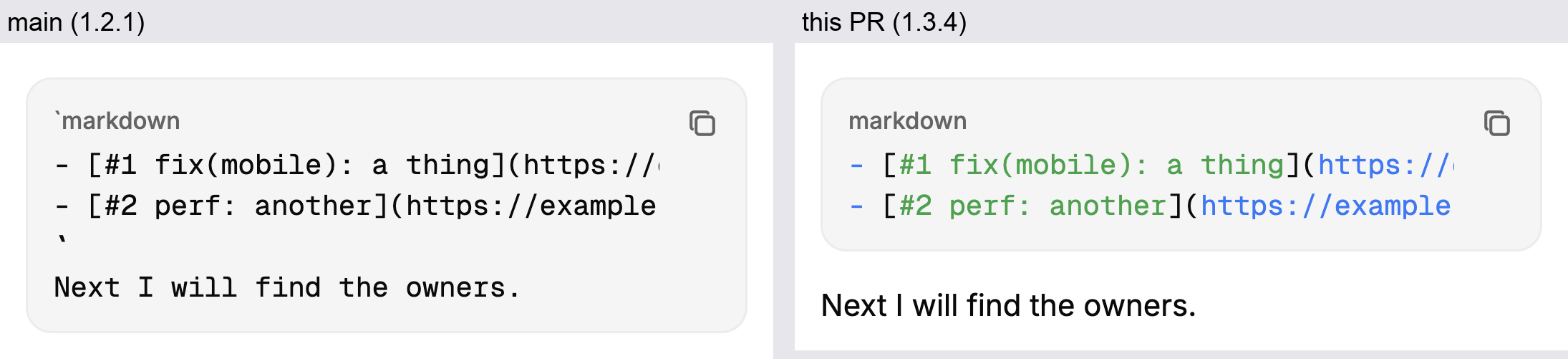
### Before and after
Synthetic messages that reproduce differences found in real channel
history, rendered through `MessageContent` on main and on this branch:







### Demo
A scroll through synthetic messages covering common formatting
(headings, lists, quotes, links, highlighted code, a table, a task list,
escapes), recorded on an iPhone 17 Pro simulator running this branch:
https://github.com/user-attachments/assets/bdc9680c-d20b-41ec-8e1a-a5b51c602f9d
### How
- Mentions, custom emoji and `#channel` tokens are `InlinePattern`s.
Links go through `inlineLinkBuilder` into the existing `_buildLink`, so
chips, media links and taps are unchanged.
- Removed workarounds the parser makes unnecessary:
- the render-path escape shielding from #8925
- the `_MarkdownEscapeMd`, `_MarkdownLabelEntityMd` and `_MessageLinkMd`
components
- the zero-width prefix before a leading `#channel`
Plain-text previews and gallery helpers keep their own escape handling.
`normalizeBareLinks` stays because attachment and gallery detection
depend on its output. Bubble segmentation unescapes a link destination
itself before its imeta lookup, since content no longer arrives
shielded.
- Kept desktop parity where plusparse differs from GFM:
- a table typed directly under a caption line gets a blank line inserted
before it, since plusparse can't start a table mid-paragraph
- `> [!NOTE]` quotes render as quotes (`alertBuilder` returns
`asBlockQuote()`), since desktop has no alerts
- `mapMarkdownProse` now ends an unclosed backtick run at its paragraph.
Before, it could pair with a run in a later block and flip code and
prose for the rest of the message.
- Synthesized autolink labels escape backslashes instead of using
`\`, which the parser leaves undecoded in a URL-shaped label.
- Repo/PR/issue chips keep their own semantics node.
- Forum card previews clip at their 120 px cap instead of overflowing:
blocks now lay out as a column.
- Pinned to exactly 1.3.4. 1.4.0 renders HTML by default and themes
through the separate `material_ui` package, which would need a theme
bridge.
### Validation
- Full mobile suite passes and analyze is clean at
|
||
|
klopez4212
|
cb69ad9e4f |
Adapt iPhone Duo layouts, rail navigation, and native sheets (#8568)
Duo keeps conversations and Settings details open across closed, book and flat postures. Book mode splits at the fold; flattening restores the sidebar. Native rail controls, full-width navigation backdrops and sheet-local safe areas keep content aligned. Ordinary iPhones remain single-pane in portrait and landscape; tablet and Duo split layouts remain enabled. Includes the recovered preview's matching pane widths, Buzz empty-pane mark, stable Settings chevrons, Bestie pane routing and Duo-only upward New menu attachment. Current main's Activity redesign, Search content fade and unread-navigation button are retained. Menu selection checks sit beside their labels. Shared mobile changes remain in scope: the native iOS status editor, Appearance preview layout, avatar crop preservation, onboarding footer layout, profile/invite sheet geometry and nested conversation navigation. This PR is not exclusively Duo-gated. Nested navigator observers preserve recording cancellation and navigation callbacks; crop resizing preserves the selected image region. iOS 27.1 APIs remain compile-time and runtime gated. Validation on the reconciled source: Flutter analysis, Activity/Home journeys, the full mobile test suite, file-size checks and Swift package tests. The iPhone single-pane fix was also exercised on an iPhone 18 Pro simulator before reconciliation. Fresh hosted CI and physical-device confirmation of the reconciled build are separate and remain pending. --------- Signed-off-by: kenny lopez <klopez4212@gmail.com> Signed-off-by: Tom Brow <tomb@squareup.com> Co-authored-by: Terp <5856f6900e8e0a4e0ea1f4f8d2ee33e4753d2119bc122f94ecafc660b46c0511@buzz.block.builderlab.xyz> Co-authored-by: Claude Opus 5.5 <noreply@anthropic.com> Co-authored-by: Tom Brow <tomb@block.xyz> Co-authored-by: Tom Brow <tomb@squareup.com> |
||
|
Tom Brow
|
402bd1897f |
fix(mobile): bump Flutter to 3.47.9 for Android TLS fix (#9309)
Flutter 3.47.7's bundled Dart TLS verifier on Android misses Android's compromised-intermediate blocklist and, on Android 14+, reads the older CA directory ([GHSA-frr6-h895-5pxp](https://github.com/dart-lang/sdk/security/advisories/GHSA-frr6-h895-5pxp)). An on-path attacker can therefore impersonate the relay to Android builds with a certificate chained to the compromised eMudhra intermediates. Flutter 3.47.8+ ships the patched verifier. This bumps the hermit pin to the latest patch, 3.47.9 (Dart 3.13.7), and raises the SDK floor in `pubspec.yaml` and CONTRIBUTING to match. Tracked in BSEC-29. iOS and macOS use Apple's certificate verification and aren't affected by this advisory. Patch-level bump within 3.47: no source, formatter or dependency changes were needed; `pubspec.lock` only changes the Flutter floor. No visible change, so no screenshots. ### Validation - `flutter analyze`: no issues. `dart format`: no changes. - Full mobile suite on 3.47.9: 4,596 passed, 67 skipped. - Not done: an Android device run that repeats the eMudhra interception test against a 3.47.9 build. 🤖 Generated with [Claude Code](https://claude.com/claude-code) Signed-off-by: Tom Brow <tomb@squareup.com> Co-authored-by: Tom Brow <tomb@squareup.com> |
||
|
Tom Brow
|
52cb6818fa |
perf(mobile): keep remote images on disk and show small ones as thumbnails (#9158)
## Summary The mobile app now saves remote images on disk. After a relaunch, avatars, custom emoji, message attachments and agent artwork show immediately. The app does not download them again. Small images on a relay now load only the relay's thumbnail. The app never downloads the full-size upload to show a small image. ## Why Before this change, the app kept remote images only in memory. Each cold launch downloaded every image again. On a slow connection, attachments showed a "Loading image" placeholder for a long time. Also, when a relay had no thumbnail for an image, the app downloaded the full-size upload. That upload can be up to 20 MiB, for an avatar that is a few dozen points wide. ## What changes ### Images on disk - `MediaImageProvider` reads and writes a `MediaDiskCache`. Each account in each community has its own cache, at `<root>/communities/<community id>/media/<signer pubkey>`. The cache is built on `flutter_cache_manager`, with a JSON index. - On iOS, the root is the app group's `Library/Caches` (from a new `buzz/app_group` method channel). App extensions can then read the same cache. On other platforms, the root is the app cache directory. - Each cache holds a maximum of 250 MB. When it is full, the least recently used images go first. `MediaCacheIndex` measures each file when it writes it, because `flutter_cache_manager` limits only the number of files. Every disk read marks the file used, and every write schedules eviction, including a refresh that replaces bytes the package already holds in memory (by default the package does neither for those). - The cache does not save an image that is larger than 5 MiB. The app still shows that image from memory. Thus, one large image cannot push out all the others. - Relay media URLs contain a content hash, so their bytes never change. The cache keeps them until it evicts them. For other URLs, the cache shows the saved image, and then gets a new copy in the background after one week. A maximum of two of these refreshes run at the same time. The app decodes a refreshed image before it replaces the saved copy. - When you remove a community, the app deletes its cache. When a community gets a new signing key, the app deletes the media of the old account. At launch, the app also deletes caches of communities and accounts that are no longer present. - Startup does not wait for the cache. The cache directory resolves in the background. Image reads wait for it for a maximum of 3 seconds. ### Thumbnails for small images - A small relay image loads the relay's WebP thumbnail. If the relay has no WebP thumbnail, the image loads the JPEG thumbnail. If the relay has neither, the widget shows its placeholder (initials for an avatar, an empty tile for artwork). - Native avatars drawn by UIKit (the navigation bar, the community icon on the create button, and the New DM and Add Members pickers) use the same choice, through a new `smallMediaImageProviders`. They try the same thumbnails, fall back the same way, and show initials when neither thumbnail exists. Before, they downloaded the full-size upload and only decoded it small. - Larger layouts and the full-screen viewer load the full-size upload, as before. ### Agent artwork - Preset agent artwork (the tray, flight, video placeholder, avatar hero and the avatar editor's blurred backdrop) now loads through `MediaImage`, so it uses the disk cache too. - The create-agent and empty-bestie pages warm the same `MediaImageProvider` that their widgets read, through a new `mediaImageProviderFor(ref, url)`. - No code in `mobile/lib` uses `Image.network` or `NetworkImage` now. ## Demo A cold relaunch (the app is stopped, then started) into a synthetic "QA demo" Solo chat that holds a few generated images. Shown at half speed. Before: the attachment shows a "Loading image" placeholder while it downloads. https://github.com/user-attachments/assets/107f43a3-63d0-40c3-bd80-4ea9d7897a97 After: the attachment shows with the chat, from disk. https://github.com/user-attachments/assets/d3985bb2-838c-4efa-93cb-44cef51f677d ## Tests - `test/shared/relay/media_disk_cache_test.dart` follows one journey through the real provider and a real cache in a temporary directory. The first launch downloads and saves. An offline relaunch shows the full-size image, its thumbnail and an external image from disk, and the oversized image goes back to the network. Eight days later, only the external image refreshes. Removing the community deletes its directory. - A second test checks the order of eviction when the cache is full, that a file read from disk is evicted after files that were not, and that replacing a file's bytes after eviction last ran evicts again when the cache goes over budget. - `community_provider_test` checks that launch deletes orphan media directories, that a new signing key deletes only the old account's media, and that removing a community deletes its media. - `avatar_image_test` checks that a missing WebP thumbnail falls back to the JPEG thumbnail, and that an avatar with no thumbnail shows its initials. - `native_avatar_image_test` checks the same for native avatars: a WebP 404 paints the JPEG thumbnail, the full-size upload is never requested, a relay with no thumbnail paints initials and is not asked again, and any other failure stops at the initials. - `flutter analyze` and the full mobile test suite pass. - Automated app runs on an iPhone 17 Pro simulator (iOS 27): the channel list, a DM, Home, the Agents grid and an agent details sheet show their images. After a relaunch, the images came from disk and the app wrote no new files. In the "QA demo" chat, a new image from the app showed immediately. - Automated run of the native-thumbnail fix on an iPhone 17 Pro simulator (iOS 27): the native New DM picker shows photo avatars, and the cache gained only relay `.thumb.webp` entries for them, no full-size uploads. After a cold relaunch, the picker showed the same avatars within about 1.5 seconds, and the cache directory gained no files. The avatar editor backdrop was not exercised in the app. The test community has no remote agents, and the backdrop tests cover only emoji and picked-image selections. ## Before merge - [x] Automated simulator run of this head: avatars and agent artwork show their thumbnails, and a cold relaunch shows images from disk. 🤖 Generated with [Claude Code](https://claude.com/claude-code) --------- Signed-off-by: Tom Brow <tomb@squareup.com> Co-authored-by: Tom Brow <tomb@squareup.com> Co-authored-by: Claude Opus 5.5 <noreply@anthropic.com> Co-authored-by: studio <dc2fc481343672df31a689840c09299972e704dac592e0da6f18486646a7ee3e@localhost> |
||
|
Tom Brow
|
985de41f14 |
feat(mobile): show NIP-FI verified names (#8858)
Stacked on #8700. Review only the last commit until #8700 merges. NIP-FI relays can publish a relay-signed verified name for each member who signs in with an organization assertion (kind 30382, specified in #8745 and implemented in the relay in #8774). Desktop shows these names in block/buzz-app#2005. Mobile showed only self-declared kind 0 names, so a verified Block name looked no different from one anyone could set. This adds verified names to mobile, following the spec and the desktop client's validation rules. **What people see** - A verified member's name is the issuer-verified display name wherever mobile resolves names through identity names (message headers, threads, DM titles, member lists). - Message headers and the profile sheet show a verification mark. The profile sheet also shows the full name when present, "Verified by {issuer}", "Last verified {time ago}", and marks the record as cached when it hasn't been reconciled with the relay on this connection. Verification is described as historical, never as current access. - Nothing changes on relays that don't advertise `federated_identity.public_profile`, and marks never come from kind 0 or NIP-05. **How it works** - NIP-11 discovery decides whether marks may show: a successful response without `public_profile` hides them (cached records are kept), and a failed or malformed response keeps the last state. Discovery refreshes on connect and every 5 minutes while names are tracked. - Subjects are tracked as the profile cache resolves them, and fetched in batches of up to 128 with `{kinds:[30382], authors:[self], #d:[...]}`. Live updates and retractions apply on the same subscription. A full batch that omits subjects is not treated as proof they have no record. - Each event's id and signature are verified (in an isolate) before use, and it must be authored by the community's NIP-11 `self` key with exactly the specified tags (plus the optional `full_name` the relay emits). Names follow the spec's NFC and character rules; `unorm_dart` (MIT, pure Dart) is added for the NFC check because Dart has no built-in normalizer. - The cache is per community and is cleared when the relay's `self` key changes. **Not yet covered** - Some surfaces still read the kind 0 name directly: the members sheet initial, and search and inbox rows. The mark isn't shown in search rows, inbox rows, or member tiles. (The mention picker now matches, ranks and inserts by the verified name and shows the mark, and it also offers cached verified people outside the channel whose kind 0 name differs.) - NIP-FI says clients MUST show `issuer_label` beside every verified name. Here it appears only in the mark's tooltip and accessibility label and in the profile sheet, and verified names reaching DM titles and member lists show no mark or issuer. Follow-up: show the issuer inline wherever a verified name is shown. - Live updates are coalesced to the newest per subject before signature proof, ordered by unverified `created_at`/`id`. Only a misbehaving relay could exploit this (the subscription is `authors:[self]`), and it could already withhold events. Follow-up: prove first, then coalesce among valid events. - The verified `username` isn't shown beside the name in message headers (the NIP-05 handle still is). - Collision qualification relies on the existing name-disambiguation policy rather than the spec's exact self-declared-name rule. ### Validation Added tests: - Validation: discovery enabled, disabled and malformed; wrong author; mismatched or duplicate `d`/`p`; extra or duplicate tags; invalid usernames; non-NFC and whitespace-padded names; `verified_at` after `created_at`; bad signatures; retractions. - Directory: discovery gating, batching, truncation, live retraction, reconnect reconciliation, and disable hiding cached records. - Directory failures: a pre-EOSE flood, failed proof retried on refresh, oversized events (by total size, id or signature) dropped before proof, live events coalesced, a retry before or after the first EOSE never proving absence, a retry during proof not promoting records to checked, and a newer signed malformed projection clearing the older one. - Mention picker: a verified name finds, ranks and inserts the verified person; the self-declared name still finds them; a verified person outside the channel is found by verified name even when an impostor copies that name into kind 0. - Identity names: a verified name outranks the kind 0 name. - UI: the mark in message headers and the profile sheet details, no mark for a cached record, and a single accessible label. Full `mobile-check` and `mobile-test` pass. **Live relay (checked 2026-11-01):** not yet run end to end. - Staging now advertises the feature: the bb-block staging relay's NIP-11 (`buzz.block.builderlabstaging.xyz`) has `federated_identity.public_profile` with `kind: 30382` and `multiple_issuers: false`, bound to `self` `f7f4df94…dcf1`. So #8774 is deployed and enabled there. The other staging relays (`communities.public.builderlabstaging.xyz` and its `team.` host) advertise no `federated_identity`, and the client shows nothing on them. - I couldn't confirm that real 30382 events are served or render them. The relay requires NIP-42 auth plus a client-attached NIP-FI assertion, which needs an interactive Builderlab/Okta sign-in on a physical device. SSO doesn't work in the iOS simulator. The remaining step is a device run signed in to the staging Block community, with screenshots of a verified name, its mark and its details. **Shipping behind discovery gating:** this is safe. The client reads and shows verified names only when a successful NIP-11 discovery advertises `public_profile` bound to `self`. It accepts only kind 30382 events signed by that key that pass id and signature verification and strict shape checks. On every relay without the feature, which is every relay but bb-block staging today, it shows nothing new and changes no names. A failed or malformed discovery never turns the feature on, and it marks cached records as unchecked, which hides their mark. The subscription and reconciliation paths are covered by the tests above, and Carl's review reran retry probes through the real `RelaySessionNotifier`. 🤖 Generated with [Claude Code](https://claude.com/claude-code) --------- Signed-off-by: Tom Brow <tomb@squareup.com> Co-authored-by: Tom Brow <tomb@squareup.com> Co-authored-by: Claude Sonnet 5.5 <noreply@anthropic.com> |
||
|
Tom Brow
|
4ff02bf03b |
perf(mobile): sign events with native libsecp256k1 on iOS and Android (#8654)
Mobile signs every Nostr event (sends, relay AUTH, media auth headers, preference writes) in pure Dart on the UI isolate. On an iPhone SE (2nd gen, Profile build) one BIP-340 signature costs about 10.7 ms and deriving the public key another 5.6 ms, so a burst of signed writes drops frames. This adds `mobile/packages/buzz_secp256k1`, a small FFI package that builds vendored bitcoin-core/libsecp256k1 v0.8.0 (ecdh, extrakeys, schnorrsig modules) through a Dart build hook, so the same C and the same Dart API ship on iOS and Android with no platform bridge code. All 13 `nostr.Event.from` signing sites now go through `signNostrEvent`, which keeps the `nostr` package's event-id serialization and moves only key derivation and signing to native code. Calls stay synchronous. The package also exposes `schnorrVerify` and `ecdhX`; follow-up PRs move verification and the NIP-44 conversation key over. Incoming relay events are still not verified, unchanged by this PR. Safety: the signing context is randomized once per isolate, secret keys and keypairs are wiped from the native scratch buffer after each call, aux randomness comes from `Random.secure()`, and the static verify context runs libsecp256k1's self test before first use. ### Validation - Added tests: BIP-340 official vectors and native-vs-pure-Dart differential tests in the package; `event_signing_test.dart` signs with 64 random keys and checks pubkey, event id and signature against the existing `nostr` builder and verifier, plus malformed-key rejection. - Full mobile analyze and test suite pass locally. - Builds: iOS release (framework ~1.3 MB) and Android debug APK with the library for arm64-v8a, armeabi-v7a and x86_64 (~1.2–1.3 MB each). - On-device (iPhone SE 2nd gen, Profile, median per op): sign 10,736 µs → 41 µs, derive pubkey 5,580 µs → 16.5 µs, full signed event 10,744 µs → 65 µs. Event-id JSON and SHA-256 are 23 µs, so they stay in Dart. - Device, iOS (iPhone SE 2nd gen, Profile): `buzz_secp256k1.framework` embedded; the signed-in app authenticated to a real community relay, loaded channels and history, and paged older messages. No native-asset or secp256k1 errors in the console. - Device, Android (emulator, debug): APK contains `libbuzz_secp256k1.so` and loads it. Against a local mock relay that verifies with the pure-Dart `nostr` package, the app's NIP-42 AUTH, NIP-98 `POST /query` headers, and kind 20001/30078 events all verified. - Blossom GET auth, iOS: the dev relay returns 401 for unauthenticated `/media/` GETs. From inside the running app, the production `MediaGetAuthService.headersFor()` header for a nonexistent hash got 404 (accepted, file missing), compared with 401 without it. The community has no relay-hosted image, so none was rendered. buzz-review-completed (agent review, Codex and security review clean; device validation above; human app test not applicable under the mobile testing exception) 🤖 Generated with [Claude Code](https://claude.com/claude-code) --------- Signed-off-by: Tom Brow <tomb@block.xyz> Co-authored-by: george <973be878edd6d4f79692a3827f20a6f7fe0ed0362f269ff6b6ba8867033d7d8e@sprout-oss.stage.blox.sqprod.co> Co-authored-by: Claude Opus 5.5 <noreply@anthropic.com> |
||
|
Wes
|
b6aa5539e3 |
feat(mobile): account onboarding, key recovery and hosted reconnect (#8375)
## Behavior Adds optional mobile Builderlab sign-in, identity backup/recovery, community discovery/creation, and account-aware reconnect. **Builderlab features are disabled by default:** when `BUZZ_AUTH_DOMAINS` is unset or empty, account login, creation, backup/recovery, reconnect prompts, and background account restoration are hidden/disabled. QR/code pairing, links, and invites retain Nostr-only entry. Saved account state is retained for later opt-in. `--dart-define=BUZZ_AUTH_DOMAINS=communities.buzz.xyz,communities.public.builderlabstaging.xyz` opts those DNS domains and their subdomains into required account setup. The same policy gates pairing, deep links, durable community admission, and reconnect. A nonempty list enables Builderlab features; `BUZZ_BUILDERLAB_URL` alone does not. Enabled flows still require their backend services. Existing Nostr relay authentication remains mandatory. `BUZZ_HOSTED_RELAY_AUTH=true` enables scoped relay assertions and reconnect prompts only for configured authentication domains. Configure assertion issuance and each community's issuer binding before enabling assertions; enable relay enforcement last. Account credentials stay at Builderlab. Wrong-account recovery preserves keys; failed writes are not replayed; authentication is bounded by request deadlines. Hosted flows preserve keys across cancellation/restart, reconcile interrupted creation/invitation acceptance, and support manual nsec file import/export. Account identities are scoped to backend and authenticated subject; reusing an existing local key for an unbound account requires an explicit selection. Recovery reconciles the advertised and recovered inventories before automatic selection. Successful self-hosted admission retires its pending key, and iOS startup removes interrupted export files. Adds authenticated relay `GET /operator/communities/joined` for the companion Builderlab membership endpoint. ## Validation - Follow-up review repair at `66a12ac92`: self-hosted entry presents readable choices and import despite incomplete enumeration, while generation still requires a complete empty inventory; explicit selection uses exact-key lookup. Consuming a value-equal duplicate now advances dispatch. Reconnect requires an existing account binding or a subject-scoped backup receipt before signing an assertion, and pins the subject inside the serialized account request. An empty different account is refused without sending key proof. Focused checks: configured domains 58 passed; default 49 passed, 9 hosted-only skips. Separate isolated mutations fail the incomplete-inventory sheet, exact-key reuse, duplicate dispatch and reconnect journeys (including an empty-account-only bypass); restored controls pass. Evidence uses synthetic storage/network boundaries, not physical Android or live backend association. All mandatory commit/push hooks passed; fresh GitHub CI is pending. - Bounded review repair at `d3cc0003f`: incomplete secure-storage enumeration now blocks automatic identity generation while explicit known-key reads retain their fallback; declined/failed onboarding links release the queue; HTTP 429/5xx keeps Retry regardless of response encoding. Default app-gate coverage exercises a bind link followed by ordinary community entry. Focused checks: configured domains 47 passed; default 38 passed, 9 hosted-only skips. Removing the three production fixes in an isolated source/Git/build copy fails the identity-resolution, declined/failed queue, and Retry journey assertions; clean and restored controls pass. Storage and HTTP failures are synthetic; physical Android and live outage behavior were not exercised. Published after all mandatory commit/push hooks passed (mobile analysis/tests, branch-skew and file-size gates); fresh GitHub CI remains pending. - Existing whole-PR source review cleared the reconnect defects at `fb15d5b82`. - Domain-policy increment: focused environment, entry, app-gate, pairing and onboarding journeys pass with empty and configured domains. Existing pairing provider/page tests pass. Changed Dart files analyze cleanly. - Isolated source/Git/build mutation: forcing paired credentials through hosted login fails the default-build journey; clean and restored controls pass. CI now runs configured-domain journeys in addition to the default-build suite. - Integrated main through `5b433d929` at `0067c069c`, including its pinned Flutter upgrade. Preserved the PR welcome UI with the updated transition API and added Material surfaces around onboarding selection/consent rows. Focused post-merge runs pass in both configurations; all mandatory local push gates passed (mobile analysis/tests, Rust tests, desktop-native checks, branch-skew and file-size checks). - Merge-review repair at `a315bce11`: focused identity/storage/admission and widget journeys pass, including account switching with an empty or already-bound second account, explicit reuse, and self-hosted removal/rejoin with another key. Default-domain journeys pass too (hosted-only cases intentionally skip there). - Isolated source/Git/build mutation checks: bypassing account scoping, reuse consent, pending-key retirement, or recovery inventory reconciliation fails the relevant journey/invariant assertions; clean and restored controls pass. - Native `RunnerTests/IdentityFilePluginTests`: both tests pass on the iPhone 18 Pro iOS 27 simulator with an isolated app identifier. At `24a0dcaac`, the picker journey seeds residue in Library/Caches, matching path_provider_foundation, and verifies plugin startup removes it while preserving an unrelated file. The earlier tmp-only fixture did not exercise the actual export location. This is synthetic native cleanup/picker evidence, not a real terminated-share or live account round trip. - Follow-up: Caches and tmp cleanup; fallback to individually known identity slots when Android bulk enumeration fails; explicit replacement of a refused self-hosted key preserves its original before swapping the retry slot. Configured-domain journeys/invariants: 34 passed; default: 31 passed, 3 hosted-only skips. Isolated enumeration/retry mutations fail with passing controls. Bulk-read fallback preserves but cannot enumerate arbitrary other-account slots until bulk reads recover. - Configured-domain CI exposed a stale pairing-status assertion after account scoping. The repaired test checks the admission mismatch, preserved account/transfer keys, and no admitted community. The configured-domain CI selection passes locally (56 tests); removing the production mismatch guard fails the updated test, with clean/restored controls passing. This is synthetic coordinator evidence, not physical QR acceptance. - Final review repair (`40e1e6101`): native iOS export creation uses atomic complete file protection; normal and restart cleanup remain. Account/policy/claim HTTP uses one 30-second total deadline with request abort and body cancellation. Removed the unrelated NIP-FA spec edit. - Focused account/admission/export tests: 25 pass; configured-domain account/admission/onboarding journeys: 33 pass. Isolated deadline and native-dispatch mutations fail, with passing clean/restored controls. Native export/picker tests: 2 pass on iOS 27 simulator. The real file-protection attribute assertion is physical-device-only because simulator provides no Data Protection attribute; locked-device protection and interrupted real sharing have not been observed. - Opt-in UI: configured-domain CI selection passes (57 tests); default selection passes (7 tests, 10 hosted-only skips); URL-only plus whitespace/empty domains passes (6 tests, 9 hosted-only skips). Changed Dart files analyze cleanly. Independent mutations that unconditionally initialize the coordinator in the app gate, welcome entry, or link form fail the default journey; clean/restored controls pass. - Native welcome screens exercised on iPhone 18 Pro / iOS 27 simulator in default and configured builds: default exposes community link / QR / pairing code only; configured build additionally exposes Builderlab connection and community creation. No live hosted login was exercised in this check. - Delivery at `e48fe73a9`: all mandatory push hooks passed (full mobile analysis/tests, Rust tests, desktop-native checks, branch and file-size checks). GitHub checks had not yet populated at the immediate post-push snapshot. ## Review disposition | Feedback | Disposition | | --- | --- | | Explicit self-hosted entry under unreadable inventory, duplicate invite dispatch, reconnect cross-account binding ([entry](https://github.com/block/buzz/pull/8375#discussion_r4318421622), [queue](https://github.com/block/buzz/pull/8375#discussion_r4318421640), [reconnect](https://github.com/block/buzz/pull/8375#discussion_r4318455512)) | Repaired at `66a12ac92`; evidence above. Reconnect refuses unproven ownership rather than silently establishing a binding. | | Incomplete Android identity inventory, stranded deep-link queue, transient HTTP retry classification ([review](https://github.com/block/buzz/pull/8375#pullrequestreview-5576864143)) | All three repaired in `d3cc0003f`; focused journeys and isolated mutation evidence above. | | Account cross-link, incomplete recovery inventory, committed invite checkpoint, pending local key retirement/replacement | Repaired in the preceding commits; journey and mutation evidence above. | | iOS interrupted key export ([review](https://github.com/block/buzz/pull/8375#pullrequestreview-5575253252)) | Native cleanup plus complete protection at creation implemented. Physical-device lock and real interrupted sharing acceptance remains pending. | | Trickle responses bypass idle timeout; unrelated NIP-FA edit ([review](https://github.com/block/buzz/pull/8375#pullrequestreview-5575764556)) | Total request deadline/abort implemented; spec edit removed. | | Production domains rejected | Ordinary entry now needs no Builderlab configuration. Opt-in account-required domains must still use supported community mappings. | | Lost Android Keystore recovery | Backup exclusions prevent the reviewed stale-restore scenario; genuine key loss still has no in-app recovery/reset and remains deferred. | | Native secp256k1 dependency question | Obsolete against the current base: upstream C integration landed in #8398; no package diff remains here. | | Operator membership endpoint contract | Documentation now states the operator chooses the pubkey; no end-user session binding is implied. Additional handler-level coverage is optional follow-up. | | Optional Android partial document cleanup/activity retention; local work after backup cancellation | Follow-up hardening, not claimed implemented. Cancellation prevents remote backup upload. | | Semgrep crypto inventory notices | Informational inventory, not demonstrated defects. | ## Remaining draft gates Native QR/browser-return acceptance remains unverified for this revision. Optional Builderlab onboarding still needs backend backup-status and joined-community routes, recovery policy/configuration, and real backup/recovery/reconnect acceptance. The empty-domain build removes these services as prerequisites for ordinary pairing; it does not make the optional hosted flows backend-ready. Human acceptance and current CI are still required before merge. Review dispositions retained: production auth-domain configuration must use supported community mappings; enabling `builderlab.xyz` does not add support for `buzz.block.builderlab.xyz`. Recovery after genuinely losing an Android Keystore key remains a follow-up, not a newly implemented capability. Human acceptance steps: build once without `BUZZ_AUTH_DOMAINS` (including with a previously saved account) and confirm no Builderlab controls/restoration while ordinary link and QR/code entry work. Build with supported domains and confirm connection/creation appear; exercise browser return and live backup/recovery/reconnect. On physical iOS, exercise export and interrupted sharing/locked-device protection. Record results before marking review complete. --------- Signed-off-by: Wes <wesbillman@users.noreply.github.com> Co-authored-by: Brain <1a02c72794dcd0f07058a353bc3a81f4028b8c77c92c87fce6d5c8b85970a20b@buzz.block.builderlab.xyz> Co-authored-by: Brain <1a02c72794dcd0f07058a353bc3a81f4028b8c77c92c87fce6d5c8b85970a20b@wes.communities.public.builderlabstaging.xyz> |
||
|
Tom Brow
|
819dd7924f |
fix(mobile): bump Flutter 3.47, resolving memory leak (#8419)
With accessibility semantics active, opening and leaving channels
retained disposed composer overlay states through Flutter’s semantics
traversal map. Those states kept departed route and message trees alive.
This upgrades the pinned Flutter SDK from 3.41.7 to 3.47.7, which
includes [the upstream
fix](
|
||
|
klopez4212
|
b1d60f98e2 |
Bring synced Solo chats and projects to mobile (#8337)
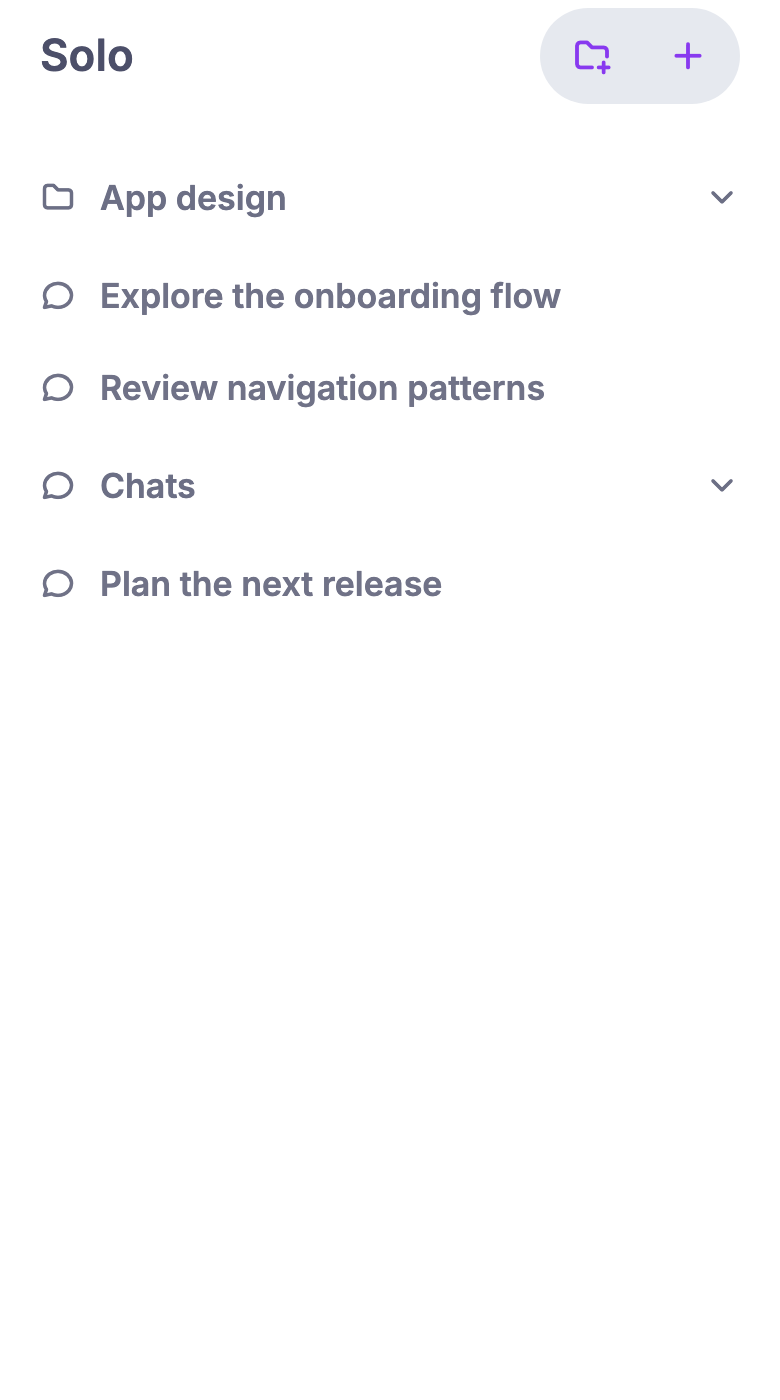
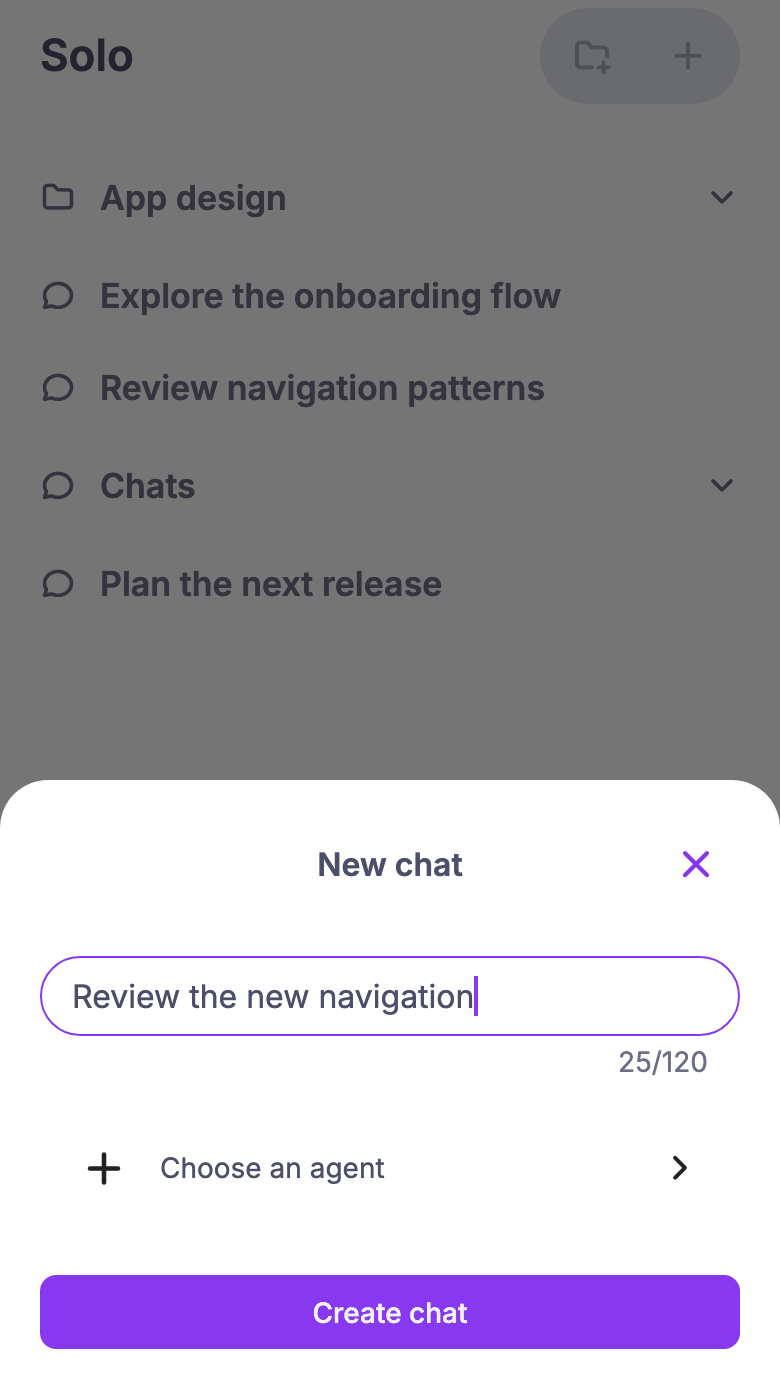
## Summary Bring desktop Solo chats and project organization to mobile, with synced collapsible sections, shared unread highlights and tab badges, agent selection, shared search, native iOS creation sheets, and inline typing bubbles that transition into replies. Resolve Solo placement for every chat entry route, retain encrypted organization snapshots for offline reading, and let users resume or discard unfinished chat and project setup without deleting existing messages. ### Related issue Related: #6565; expandable agent transcripts remain separate work. ### Testing - Fresh Solo read state seeds each active chat from its captured initial last-message timestamp before exposing row/section/tab unread state. Baselines survive intervening channel updates and reset across identity/community boundaries while surviving read-state readiness changes. Regressions cover multiple chats, events before read-state readiness and during/after seeding, and identity changes; removing either the seed or the display gate fails them. - Chat completion reconciles a retained Solo-save journal even when placement is already confirmed. False/throwing cleanup regressions ensure the outer intent remains until reconciliation and only one placement is published. Typing terminal-close loops remain bounded; the retry budget resets after an uninterrupted eight-second health interval or transport reconnect. - Typing retry budgets reset after sustained recovery; invalid Solo updates retain cached rows with a retry warning that survives failed refreshes. Project names use the editors’ 120-grapheme limit, including emoji and combining characters. Regression coverage exercises repeated recovery, invalid live/refresh heads, and character-limit boundaries. - Rebased onto current main, preserving the newer Search controls, Huddle timeline filtering, and message-media layout. - Failed project journal writes reload storage before claiming recovery and reopen the entered name for retry. Typing subscription rejections are caught; terminal closures clear stale indicators and retry with a bounded backoff, canceled on disposal. Regression tests cover both false/throwing storage writes and initial/late subscription rejection. - Explicit ordinary destinations skip optional Solo lookup waits. Generic destinations perform one bounded lookup in the destination (search no longer duplicates it); an unavailable classification falls back to ordinary sending per the product owner's explicit choice. Positively identified Solo destinations use Solo providers. - Terminal Solo subscription closure preserves cached rows and exposes live-update Retry. Page coverage verifies warning visibility, usable rows during recovery, and a subsequent terminal close. Removing the warning or the immediate ordinary-route guard fails its regression. - Generic channel entries share an ordinary default when Solo classification is unavailable, per the requested product behavior. Known Solo placement takes precedence; callers can explicitly require unresolved placement to remain blocked. Bounded initial lookup preserves known Solo deep-link routing. - Dirty newest snapshots and offline-save warnings survive transport reconnects; Retry persists that same event even if the relay returns an older head. Community changes replace the service, and agent-directory reconnect refresh remains intact. - Pending-save discard reloads failed removals. Repeated reconnect testing confirms typing subscriptions are released on provider rebuild and disposal; removing the existing cleanup fails the regression. - Ordinary Home/create routes explicitly preserve private-channel sending during Solo failures; identified Solo sends use the Solo sender and explicit unresolved routes remain fail-closed. Solo unread replies beyond the initial 200-event page are loaded through the oldest-unread boundary. - Chat/project/agent cleanup reloads failed removals, retains same-process recovery, and protects replaced records. False/throw regressions verify retries do not duplicate creation or membership. Route, unread, and cleanup guard-removal mutations each fail their regression. - Ordinary channels, DMs, and forums remain sendable when optional Solo sync fails; explicit unresolved placement stays blocked. Controlled cache races retain the newest verified snapshot, keep usable chats visible, and retry offline persistence without stale writes. Both protection-removal regressions fail as expected. - Confirmed journal cleanup checks false/throwing removal and exact-record identity. Interrupted agent choices are visible immediately, identify the saved agent, and cover Resume/Later/Discard with accessible name/key-fallback controls. - Notification deep links preserve the contiguous history cursor; same-second messages infer the newest agent consistently. Failed offline-cache writes surface Retry, with false/throwing storage failures and offline restart covered. - Composite history cursors cover 350 same-second events plus older history; removing the ID cursor makes the regression fail. Agent changes now journal before granting access, with restart/failure and Resume/Later/Discard widget coverage. Signed malformed profiles remain isolated. - Native iOS avatar tests passed on the simulator: visible-row loading, three-request concurrency, streamed byte limits, response validation, downsampling/pixel limits, cancellation, and visible avatar updates. - Solo and Home share observed-event/read-marker logic. Widget coverage verifies unread rows, collapsed-section indicators, the tab badge before first Solo visit, message/thread reads, forced unread, and filtering archived/nonmember/unplaced chats. - Chat intent is saved before ownership and organization preflight; tests cover interrupted ownership lookup and a disconnect while the native creation form is open. - Mobile analysis, formatting, file-size checks, and full mobile tests passed at `1d4c41354`. - Project creation persists its encrypted name/UUID before connectivity checks or relay reads. Restart tests cover Resume/Later/Discard, scope isolation, stale-intent rejection, and lost acknowledgements. Removing the pre-network save makes all four production-flow regressions fail. - Regression coverage includes notification/Activity routing, inline replies, unknown-placement send protection, restart recovery/discard, and encrypted offline cache isolation/refresh. - Earlier feature build exercised on a physical iPhone with existing account/community data; review follow-ups have not been reinstalled on the device. UIKit agent-row accessibility checks passed on an iOS simulator. - Earlier cross-platform `just ci` stopped on the existing `buzz-acp` test `signals_cancel_startup_turn_and_pending_stdin_without_hanging` (process exit-code assertion); no Rust production changes are included in this PR. ### Remaining review limitation Agent discovery is bounded to 10 pages / 1,000 profiles with automatic retries disabled. Owner-scoped discovery remains open because the current relay ignores `#auth` filters; supporting that query requires a relay change. ### Snapshots Sample data, shared Flutter/Android surface. Native iOS uses platform sheets and controls. | Solo: projects and chats | New chat | Choose an agent | | --- | --- | --- | | <img src="https://raw.githubusercontent.com/block/buzz/d9b29aa079a3b9a88e8ed89b70df8d6af06fa41b/pr-8337--01-solo.png" width="240" alt="Solo with collapsible projects and chats" /> | <img src="https://raw.githubusercontent.com/block/buzz/d9b29aa079a3b9a88e8ed89b70df8d6af06fa41b/pr-8337--02-new-chat.png" width="240" alt="New chat form" /> | <img src="https://raw.githubusercontent.com/block/buzz/d9b29aa079a3b9a88e8ed89b70df8d6af06fa41b/pr-8337--03-agent-picker.png" width="240" alt="Agent selection list" /> | --------- Signed-off-by: kenny lopez <klopez4212@gmail.com> Signed-off-by: Logan Johnson <loganj@squareup.com> Co-authored-by: Terp <5856f6900e8e0a4e0ea1f4f8d2ee33e4753d2119bc122f94ecafc660b46c0511@buzz.block.builderlab.xyz> Co-authored-by: Logan Johnson <loganj@squareup.com> Co-authored-by: Larry <627498bd4bd1f281a16431e3c6cce3b5c25b6692798c78672298aefbf2f8f8b5@buzz.block.builderlab.xyz> |
||
|
klopez4212
|
bbcbd7ce13 |
Preview Tabler icons in the mobile app (#8109)
## Summary Preview buzz-app's Tabler icon style in the mobile app, replacing app-drawn Lucide glyphs across channels, messages, activity, search, and settings. A shared `BuzzIcons` mapping uses the bundled Tabler 3.46.0 outline font, matching buzz-app's version, with its MIT license and source documented. Native UIKit controls retain SF Symbols. The former 300/500 navigation glyphs use Tabler's standard outline; existing selection colors and labels remain. ### Related issue No matching Tabler mobile migration issue or PR found. Related native iOS controls: #8055. ### Testing - Pre-push mobile analysis, formatting, file-size checks, and the full mobile test suite passed. - 194 focused widget tests passed, including channels, home, search, settings, and message content. - Light and dark community-settings renders inspected. - Signed iPhone Release build succeeded; installed and launched as Buzz Tabler on a physical iPhone. - Full `just ci` attempted; stopped during Rust clippy compilation because the Mac ran low on disk space. Full repository validation is not claimed. Signed-off-by: kenny lopez <klopez4212@gmail.com> |
||
|
Will Pfleger
|
f7ff4294fa |
feat(nip-fi): harden Blossom kind-24242 verifier to NIP-FI spec (#7288)
Brings `buzz-media`, `buzz-relay`, all first-party kind-24242 minters, and desktop token minting into compliance with [NIP-FI §kind-24242](https://github.com/block/buzz/blob/main/docs/nips/NIP-FI.md). ## What changed **`buzz-media/src/auth.rs`** - Add `BlossomStrictness` enum (`Strict` | `Permissive`). `Strict` applies full NIP-FI rules (active modes); `Permissive` preserves pre-NIP-FI Off-mode behavior byte-identical [FI-INV-15]. - Rewrite `verify_blossom_auth_event_for_verb` with count-based cardinality: exactly one `t`/`expiration`/`server` in `Strict`; duplicate `x` also rejected. `Permissive` keeps main's boolean semantics exactly: any valued `t` other than the verb (including `""`) rejects, valueless `t` is ignored. - `Strict`: mandatory `server` tag on all proofs (upload + read); absent or mismatched → `evidence_rejected` (`ServerMismatch`). - `Strict`: 60-second proof window (`now - created_at <= 60s`, `expiration <= created_at + 60s`). `Permissive`: 3600s / optional server. - **[F1]** Permissive server validation uses any-match semantics: a proof with multiple `server` tags is accepted if any tag matches the bound host. This restores origin/main base behavior. Strict duplicate-rejection unchanged. - **[F1 compat]** Permissive server gate uses `server_values.is_empty()` (valued tags only) rather than `server_count > 0` (includes valueless tags). A lone valueless `["server"]` tag is treated as absent in Permissive/Off mode, matching pre-NIP-FI base behavior [FI-INV-15]. - **[F4]** Valueless `x` tags in Strict get reads are tracked before `filter_map` so they cannot become absent scope (host-wide authorization). Any `x` tag present in Strict must contain the exact requested sha256. - **[F3 unit]** Cases A–D in `auth.rs` are helper-level unit tests: they call `verify_blossom_upload_auth` and `verify_upload_hash_only` directly. They do not enter the upload pipeline (`process_upload`/`process_video_upload`). Retained as helper evidence. **`buzz-media/src/error.rs`** - Add `DuplicateTag(&'static str)` variant. - Add `blossom_denial_kind()` method: classifies each auth error as `MissingEvidence`, `EvidenceRejected`, or `AuthorizationDenied`. Non-auth errors return `None`. - `IntoResponse` retains the legacy JSON 401 shape [FI-INV-15]. **`buzz-relay/src/api/media.rs`** - Add `MediaDenial(MediaError, BlossomStrictness)` wrapper mapping to byte-exact NIP-FI fixed responses in `Strict`; falls through to legacy JSON in `Permissive`. - `blossom_strictness_from_state()` selects `Strict` when `state.config.nip_fi.is_enforce()`, otherwise `Permissive`. Strictness is threaded through the `admit_nip_fi_http_on_state` NIP-98 closures on upload and read, and through the post-admission X-SHA-256, hash-binding, and membership denials. - `extract_blossom_auth` keeps first-value `Authorization` extraction; Enforce rejects repeated fields at the `admit_nip_fi_http` cardinality gate, and Off keeps legacy behavior [FI-INV-15]. - Both membership-denial call sites use `media_denial(RelayMembershipRequired, strictness)` so Strict mode produces the correct fixed-text response. - `upload_blob` serving-write fence conversion (`:406`) uses `map_err(|e| media_denial(e, strictness))` — a community fence committed between auth admission and lease acquisition no longer resets Strict to Permissive. - Mode-driven regressions in `mod postgres_tests` (selected by the nextest `postgres-ci` profile via `test(/postgres_tests::/)`, `#[ignore = "requires Postgres"]`), run through the full relay router with a real Enforce verifier and assertion: Enforce rejects Permissive-only proofs (300s lifetime, missing `server` tag) on both upload routes and reads with `evidence rejected`; Off accepts the same proofs with pre-NIP-FI responses; DenyProtected answers 503 before any proof check; membership denials are `authorization denied` text/plain in Enforce and exact legacy JSON 403 in Off, with a member positive control. GET and HEAD are each discriminated (HEAD with a suppressed body). Both upload routes pin the handler's `X-SHA-256` missing/malformed/unsigned and post-body hash-mismatch denials in both modes. Off rejects an empty-valued `t` beside a valid one with legacy 401 JSON in either order, and ignores a valueless one. Exact status, Content-Type, challenge, and body bytes are pinned. **`buzz-media/src/upload.rs`** (`mod minio_tests`) - **[F3 pipeline]** Four tests exercising the actual post-body call sites (`process_upload` `:85`, `process_video_upload` `:413`) with real MinIO I/O: buffered/streaming × expired-proof-accept + mismatched-hash-reject. The positive cases use `fresh_strict_upload_auth` (`created_at = now-58`, `expiration = now+2`, lifetime = 60s) — Strict-admissible at sign time — followed by a real 3s sleep so the proof is expired when the upload completes. `nostr::Timestamp::now()` reads the OS wall clock directly; paused Tokio time does not advance it. The negative cases use a pre-expired proof with a mismatched `x` tag. All four are `#[ignore = "requires MinIO"]`; no CI lane runs them automatically. **`buzz-media/src/validation.rs`** - `minimal_valid_mp4()` promoted to `#[cfg(test)] pub(crate)` — a 618-byte pre-computed H.264/avc1 fast-start MP4 available to all `buzz-media` test modules; smoke-tested by `test_minimal_valid_mp4_passes_validate_video_file`. **`desktop/src-tauri/src/commands/media.rs`** - `sign_blossom_upload_auth`: `server` tag mandatory; upload expiry 60s (was 3600s/300s). - `MEDIA_GET_AUTH_EXPIRY_SECS`: 60s (was 600s). **`desktop/src-tauri/src/media_proxy.rs`** - Single re-mint+retry on 401/403 for range requests; non-auth failures do not retry. **`crates/buzz-cli/src/client.rs`** - Read expiry: 60s (was 600s). Upload expiry: 60s. `server` tag mandatory on upload. **`crates/buzz-dev-mcp/src/view_image.rs`** - `MEDIA_GET_AUTH_EXPIRY_SECS`: 60s (was 600s). Test updated. **`mobile/lib/shared/relay/media_auth.dart`** - `_mediaGetAuthLifetimeSeconds`: 60 (was 600). Refresh margin updated. **`mobile/lib/shared/relay/media_upload.dart`** - `_uploadAuthLifetimeSeconds`: 60 (was 300). `server` tag mandatory. **`mobile/lib/features/channels/media_viewer_page/video_viewer.dart`** - **[F2]** Remove Android-specific `VideoPlayerController.networkUrl` streaming path. `video_player_android` 2.9.5 freezes headers into static `DefaultHttpDataSource` request properties — a 60s proof minted at controller creation time becomes stale on seeks. All platforms use the authenticated local-file download path. - **[F2 transport]** `unawaited(request.sink.close())` before `client.send()`. `AbortableStreamedRequest` carries no request body; without closing the sink, `IOClient.send()` awaits `stream.pipe(ioRequest)` which blocks until the sink ends — every video download hung in loading indefinitely on every platform. - **[F2 pending-ctrl]** `pendingController` ref set before the first `await (initialize())`, cleared in all exit paths. Effect cleanup disposes `pendingController.value` so a close-during-init releases the native player even if the initialized event never arrives. - **[F2r(a)]** On native init failure (post-create, pre-initialized-event), the inner catch starts disposal detached via `unawaited(localController.dispose().catchError(...))` — the `.catchError` handler absorbs any disposal exception so it does not reach the test error zone — then rethrows the original load error. `video_player` 2.11.1 completes the init future with an error without disposing the native player. - **[F2r(b)]** Non-2xx error body cancelled via `_cancelVideoResponse()` (subscribe+cancel) instead of `drain()`. `drain()` waits for the upstream to close; a stalled server body blocked `initializeVideo` indefinitely. - **[F2r(d)]** `unawaited(localController.dispose().catchError(...))` in the catch — not `await`. Two failure mechanisms exist: (1) when `createWithOptions()` throws, `_creatingCompleter` is never completed and `await dispose()` deadlocks at `:682-683`, blocking the outer catch from setting error state. (2) when `createWithOptions()` succeeds but initialization fails, `dispose()` runs but its thrown exception becomes an unhandled async error reaching the test zone. Both are fixed: `unawaited` lets the outer catch run immediately and set `error.value`; `.catchError(...)` on the detached disposal future absorbs any disposal exception. **`mobile/test/features/channels/media_viewer_page/video_viewer_test.dart`** - `_FinalizingFakeClient`: calls `request.finalize().drain()` — a test without the sink fix times out because the drain never completes, validating the transport contract. - F2r(a): `forceInitError=true` fake emits `PlatformException` on subscribe; `disposeCallCount >= 1` verifies disposal even on init failure. - F2r(b): `stalledBody` `StreamController` with `onCancel` Completer (bounded completion signal, not a sleep). Asserts: (1) `bodyStreamCancelled=true` while body stream is still open (impossible with `drain()`); (2) error UI visible while body remains open. Restoring `drain()` breaks both. - F2r(c): `neverInitialize=true` fake never sends initialized event; unmount asserts `disposeCallCount >= 1` via `pendingController`. Distinct from the event-error case. - F2r(d): `forceCreateError=true` fake throws `PlatformException` from `createWithOptions()` itself (before any player ID is returned). Asserts error UI visible within a bounded deadline. With the old `await dispose()` the outer catch is blocked — `error.value` is never set and the error UI assertion fails at the deadline; with `unawaited(dispose())` the error text appears immediately. **`mobile/test/features/channels/media_viewer_page/video_viewer_transport_test.dart`** (separate file) - Real-IO loopback probes using `flutter_test` (not `package:test`) to avoid `depend_on_referenced_packages` lint. No `TestWidgetsFlutterBinding` — no HttpClient override interfering with `dart:io`. - Probe 1: `HttpServer.bind(loopbackIPv4, 0)` reads the full request body before replying. Without `sink.close()`, `req.drain()` hangs and the test times out. - Probe 2: server signals request arrival via a Completer (not a sleep); abort fires after confirmed arrival; `client.send()` must throw `RequestAbortedException` (typed assertion) within a bounded 5s deadline. **`scripts/test-video-upload.sh`** - Proof minted with `+60` expiry and mandatory `server` tag. **`buzz-test-client/tests/e2e_media*.rs`** + **`buzz-relay/src/api/media.rs` test fixtures** - All fixtures updated to 55s expiry + `server` tag. **`RELEASING.md`** - New "NIP-FI upload proof freshness (relay floor)" section documenting that 60s proofs require the first relay release carrying this PR's post-body hash-only check (the first tag > `v0.2.1` — update once cut) for reliable large-file uploads. Operators on older self-hosted relays (≤ `v0.2.1`) must upgrade before receiving these clients. ## Finding 3: 60s upload proofs vs old-relay compatibility Desktop/CLI/mobile upload proofs are now 60s. Older relays re-run full expiry verification after the body is transferred. A valid upload whose body transfer takes >60s will fail on an old relay. **Resolution (relay floor prerequisite):** `RELEASING.md` requires that verified supported deployments (relay releases confirmed to carry the post-body hash-only check, commit `75e9bef748`) be in place before distributing 60s-proof client builds. Unknown or unverified self-hosted relay deployments are excluded from distribution until they upgrade. This makes the verified-deployment status a prerequisite for release distribution, not a post-distribution advisory. The concrete tag (`> v0.2.1`) is to be recorded once cut. ## Sequencing note Builds on #7264 (merged): Blossom strictness is derived from its `config.nip_fi` mode in this PR, so enabling `BUZZ_NIP_FI_MODE=enforce` activates the strict verifier with no further wiring. ## GIF compatibility exception An unauthenticated Off-mode request on a configured tenant with no GIF provider changes from 404 to 401 (base `gifs.rs:269-275` checked an unconfigured provider first; the current code authenticates first). All other Off-mode Blossom responses are byte-identical to pre-NIP-FI behavior. --------- Signed-off-by: Will Pfleger <pfleger.will@gmail.com> Signed-off-by: Duncan <dcfd242e557282d7a1e2cf2e6877522682f1e5c6156dc92ca7d90eaedd3b0f95@buzz.block.builderlab.xyz> Co-authored-by: Duncan <dcfd242e557282d7a1e2cf2e6877522682f1e5c6156dc92ca7d90eaedd3b0f95@buzz.block.builderlab.xyz> |
||
|
Tom Brow
|
7c789dee09 |
Fix Apple Silicon iOS simulator builds (#7646)
Apple Silicon simulator builds fail because MLImage and MLKit contain device-labelled ARM64 objects. Enable the Flutter ML Kit package's upstream compatibility helper, which restores device labels for iPhone builds. This preserves the MLKit-based functionality (avatar background removal) and complements the notification-extension linker isolation in #7187. Adds a complete iOS simulator build to CI to catch this build regression. --------- Signed-off-by: Tom Brow <tomb@block.xyz> |
||
|
TolgaCinisli
|
fa1b27bcc8 |
fix(mobile): style inline code with the app mono face (#6631)
## Summary Inline code on mobile renders as **bold body text on a faint background wash** — no monospace face, no chip, and it cannot wrap. #5257 diagnosed this as a missing `highlightBuilder`. That is no longer the right fix. `gpt_markdown` 1.2.0 deprecates `highlightBuilder` (removal in 2.0.0), renders inline code as a real chip, and adds `InlineCodeStyle` for restyling it. The package author confirmed this on the issue. So this PR is an upgrade — 1.1.6 → 1.2.1 — plus one theme declaration, rather than the builder the issue originally asked for. **Where the style is declared.** `GptMarkdownThemeData` goes in `AppTheme._buildTheme`, which both `light()` and `dark()` call. That reaches all four `GptMarkdown` call sites — `message_content`, `transcript_item_widget`, `token_pill`, `custom_emoji_render` — so the style is stated once instead of per widget. A widget-level `inlineCodeStyle` would have covered channel messages only, leaving the other three on the package's defaults. **What is declared.** Face, size, ink, chip fill and outline — not the face alone. A face name on its own leaves the rest on the package's defaults, which put inline code at 14.1sp beside a fenced block's 13, on a neutral `onSurface` tint rather than the app's code surface. In dark that tint is *lighter* than the surface, while every other code surface in the app is recessed, so the chip read as a different kind of object. All of it now comes from one `CodeStyle` declaration that the fenced block reads from too, so the two cannot be edited apart. **Three adaptations the upgrade requires.** Each was found by running the gate, not by reading the changelog: 1. **`imageBuilder` widened** to `(context, url, width, height)`. This is a hard compile error, and it is **not listed in the package's migration guide**, which states "nothing here stops code compiling". Worth reporting upstream. 2. **`autolink` now defaults to `true`.** `normalizeBareLinks()` already rewrites bare URLs into Markdown links before rendering, so both would run. `message_content` opts out with `autolink: false` to keep current behaviour exactly. The migration guide argues for dropping the pre-processor instead — a better fix, but a behavioural change that belongs in its own PR. 3. **`gpt_markdown.dart` now re-exports `markdown_config.dart`**, making two direct imports redundant. `flutter analyze` reports `No issues found!` on 1.1.6 and flags both on 1.2.1, so these warnings are new, not pre-existing. **Deliberately out of scope.** The three non-message call sites now autolink bare URLs, since only `message_content` has a pre-processor to collide with. Custom inline components (`_MentionMd`, `CustomEmojiMd`, `_ChannelLinkMd`) could additionally declare `allScopesExceptLinkLabel` — 1.2.0 offers it as the fix for a `WidgetSpan` chip going blank inside a link label on iOS — but current behaviour is unchanged without it, so that stays a separate change. ### Related issue Fixes #5257 Duplicate scan: searched `gpt_markdown`, `inline code mobile`, `highlightBuilder` and `InlineCodeStyle` across both PRs and issues. No open PR touches inline code styling. #6135 (link labels) and #6166 (text selection) also touch mobile Markdown but address different defects. ### Testing Full gate, `just ci` — exit 0: | Stage | Result | |---|---| | Rust (33 suites) | 4768 passed, 0 failed | | Desktop | 5799 passed, 0 failed | | Mobile | **2011 passed**, 0 failed | | `flutter analyze` | `No issues found!` | | Desktop + web build | ok | Run on the branch with `main` merged in, so these numbers match what CI builds. **New regression test** — `renders inline code in the app code style`. It resolves the `CodeTextSpan` the package tags inline code with, which carries both the resolved `TextStyle` and the colours the chip behind it is painted with, so face, size, ink, fill and outline are all asserted rather than a widget's presence. It is negative-controlled: reverting only the theme declaration fails it with ```text Expected: a numeric value within <0.001> of <13.0> Actual: <14.1> ``` and dropping the declaration entirely falls back to `packages/gpt_markdown/JetBrainsMono` — so the test measures the real thing, and it would catch a future regression that silently drops the theme extension. The test passes `baseStyle: messageBodyTextStyle`, the style the message surfaces actually use; the widget's own fallback is the smaller `bodyMedium`, which would move the expected size. The test finds paragraphs with `find.byWidgetPredicate((widget) => widget is RichText)`, not `find.byType(RichText)`: inline code renders through `BidiRichText`, a `RichText` subclass, and `byType` matches exact runtime types. That is a hazard for any test that reads text back out of a paragraph, and one landed after this branch was cut: `message_content_custom_emoji_test.dart` arrived with #6996 and its `code keeps literal emoji while adjacent known tokens render` case reads a code span through `find.byType(RichText)`. It passes on `main` and fails on the merge result, which is what CI builds, so it went red only once CI was authorized. It now uses the same predicate. The two other `byType(RichText)` call sites — the rest of that file and `message_author_meta_test.dart` — were re-run and pass: their content carries no code span, so the exact type still matches. They were left alone. ### Screenshots Rendered through the real `MessageContent` widget with the app's own fonts loaded, at 390pt wide, 3x DPR. Sample text: ``Set `BUZZ_RELAY_URL` before launch, then run `just mobile-test` to verify.`` | | Before (1.1.6) | After (1.2.1) | |---|---|---| | Light | 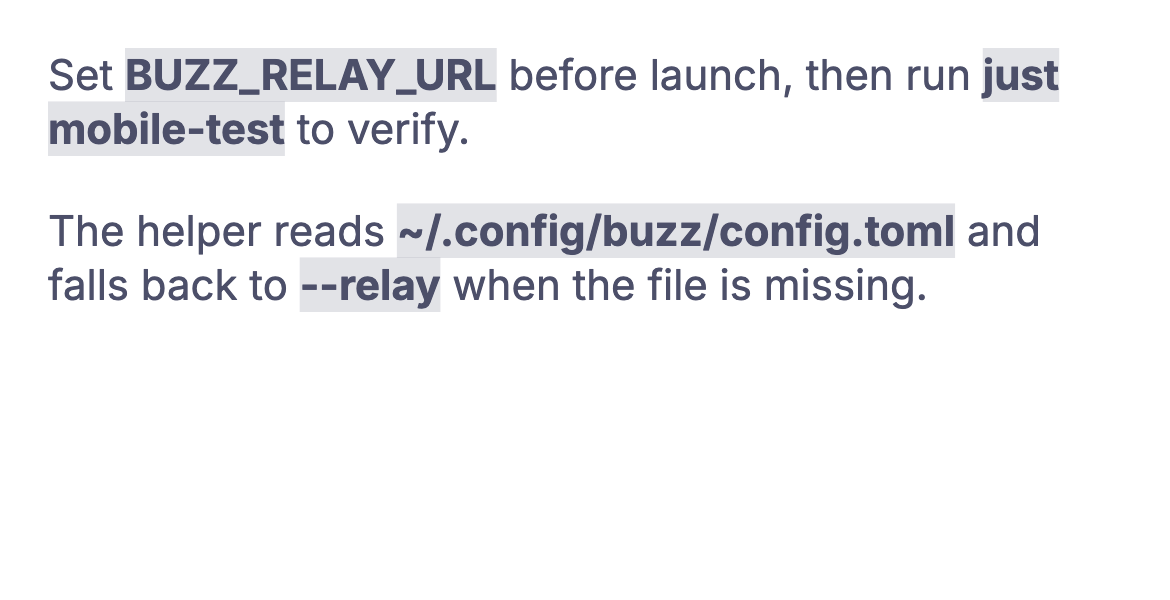 | 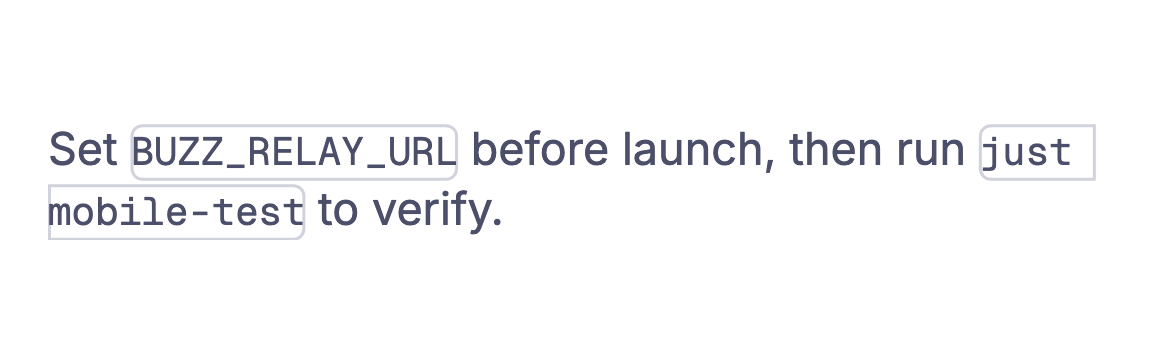 | | Dark |  |  | Before: bold Inter on a flat wash, no chip edge, and `just mobile-test` breaks across the line with the wash simply ending. After: Geist Mono in a bordered, rounded chip, and the wrapped fragment gets its own chip on each line. --------- Signed-off-by: Tolga Cinisli <tolgacinisli@gmail.com> Co-authored-by: Tolga Cinisli <tolgacinisli@gmail.com> |
||
|
klopez4212
|
6f5ec4a731 |
Add mobile voice notes (#7121)
## Summary - add iOS and Android voice-note recording and preview directly in the mobile composer - add waveform playback, scrubbing, speed controls, haptics, and one-shot playback in chat - package recordings in a canonical H.264/AAC MP4 envelope on both platforms so existing relays accept them - preserve the shared composer interaction and attachment-card treatment across mobile platforms Mobile counterpart to #6978. ## Testing - `just ci` - `just mobile-check` - `just mobile-test` (2,026 tests) - Android debug build compiled, installed, launched, and Voice note verified in the attachment menu on Pixel 10 - signed iOS device build installed on iPhone --------- Signed-off-by: kenny lopez <klopez4212@gmail.com> Signed-off-by: Princess Donut <b238ea756dee4d98afa5883fc7f1de61eeabe65bf700e3a5a5a80db5e42e2c2b@buzz.block.builderlab.xyz> Signed-off-by: Kenny Lopez <klopez4212@gmail.com> Signed-off-by: Carl <3c4caeafb646d23867f1c4832e68211d77e2561946171625f75c3ce1a3f2670f@buzz.block.builderlab.xyz> Co-authored-by: Princess Donut <b238ea756dee4d98afa5883fc7f1de61eeabe65bf700e3a5a5a80db5e42e2c2b@buzz.block.builderlab.xyz> Co-authored-by: Carl <acda9e433d19dcd0e6b6840f7f4b98f3a56f1fab98049d444c087019e6d36560@buzz.block.builderlab.xyz> Co-authored-by: Carl <3c4caeafb646d23867f1c4832e68211d77e2561946171625f75c3ce1a3f2670f@buzz.block.builderlab.xyz> |
||
|
Wes
|
b593c7d7fe |
perf(mobile): reduce cold startup and channel rendering delays (#6996)
Pinky is opening this PR on Wes’s behalf. ## Summary Reduce two separately measured mobile delays without changing the relay API or removing rich message rendering: - Publish the finite channel-list snapshot without waiting for live subscription setup. - Batch active channel-list subscriptions into sorted, deterministic chunks of at most 128 explicit channel IDs, retaining unchanged chunks. - Install replacement chunks before retiring old coverage. Retain old chunks across thrown replacement failures; filter callbacks to the current relay/identity and still-desired channels; clean up retired/in-flight work across disconnect and disposal. - Scope the custom-emoji Markdown matcher to known shortcodes actually referenced in the rendered content, rather than embedding the whole community palette in every message’s regex. Preserve unknown literals, shared-colon token boundaries, event-tag URL priority, content edits, and code literals. - Honor explicit zero retry hints without inventing a ten-second session-wide gate, while preserving the ordinary live-subscription retry backoff and any already-active gate. ## Matched performance results Medians of three before and three after process-cold launches, alternated on the same authenticated iPhone 17 Pro / iOS 26.5 simulator. Before is mobile source at `e76c81968b65b0755b83efdd59dc3375c59ddf40`; after is this production patch before two documentation-only comment fixes. First channel-list frame: 11.617s → 3.179s · 73% lower latency Live setup duration: 8.475s → 0.185s · 98% lower latency Channel-open first message-list frame: 2.754s → 1.230s · 55% lower latency Message data ready → first frame: 1.977s → 0.286s · 86% lower latency Channel-open reveal complete: 2.845s → 1.394s · 51% lower latency Channel-open data readiness: 0.770s → 0.944s · 23% higher latency The gain is client-side orchestration/rendering, not a claim that the relay became faster. First channel-list frame ranges were 10.835–11.788s before and 2.872–3.395s after; channel-open first-frame ranges were 1.560–2.906s before and 1.149–1.317s after. ### Measurement boundaries - Debug simulator builds, CPU sampling disabled, bounded timestamp probes enabled identically. These are not release/physical-device measurements. - Startup clock starts at Dart `main`; build/install/native pre-main time is excluded. Auth/preferences and OS/disk caches are retained between new processes. - Same account scale: 113 active channels. Latest-message events varied slightly with live activity (1543–1546). - Channel-open uses the same initial 50-row history window, 97 query events, and 67 provider events. The 2306-entry emoji palette is explicitly loaded before navigation on both sides; palette preparation is excluded from the channel-open clock and happens after the startup frame measurement. - Both diagnostic builds temporarily disabled unused avatar segmentation to work around the existing Google ML Kit arm64-simulator slice limitation. The workaround, dependency/native changes, auto-navigation, and all probes are excluded from this PR. ## Validation - Full mobile package suite: `flutter test` — 1890 passed. - `just mobile-check` — 506 files unchanged; analyzer clean. - `just file-size-check` — policy tests and all client ratchets passed. - `git diff --check` — passed. - New lifecycle regressions cover front-sorting insertion across a chunk boundary while replacement readiness is paused, failure retention/departed-channel filtering, retired generation + disconnect cleanup, disposal, chunk limits, unchanged-set reuse, and scope switches. - Emoji unit/widget coverage includes a 2500-unused-emoji palette, unknown tokens, case matching at the component level, shared-colon boundaries, rich text, event URL priority, and content edits. - Fresh-frame source review traced the subscription queue/fences, callback scopes, duplicate-event paths, matcher/wiring, and retry scheduling. - At committed/pushed head `13a83b628c8411c5885e6f76a250ba87accf6067`, all normal pre-push hooks passed: `mobile-checks` (formatter, analyzer, and the full 1890-test mobile suite), `file-size-check`, `branch-skew`, and `push-head-scope`. The commit hook formatted 506 files with no changes. Runtime measurements preceded only the two documentation-comment fixes; no runtime source changed afterward. ## Limits / follow-ups - `RelaySession.subscribe` still settles under its existing EOSE/fallback/retryable-CLOSED contract. “Setup completed” is not an unconditional EOSE or live-delivery guarantee. This PR does not add status-aware replacement ownership. - The channel-message provider still awaits subscribe before fetching history; that separate serialization is not removed here. - Oversized Huddle queries and the separate history batching path above 128 active channels remain follow-ups, as do pre-existing read-state initialization/size warnings. - Palette-only widget refresh and upstream Markdown uppercase-dispatch behavior are not changed. - A clean source build still has the existing Google ML Kit arm64-simulator issue; the profiling workaround is not a proposed product fix. Originating Buzz conversation: buzz://message?channel=793b0522-7995-4375-b1a6-fd94a96fa21d&id=6ba88afdec78ab2cfb6728afcd4a6d10f29e6aa33ff0f62f45d6750381e4d789 --------- Signed-off-by: Wes <wesbillman@users.noreply.github.com> Co-authored-by: Pinky <5f5ab050ec58ae208332edd544ebf705221e24c1b86d82a6ca07038a7a8f6ac9@buzz.block.builderlab.xyz> Co-authored-by: Brain <1a02c72794dcd0f07058a353bc3a81f4028b8c77c92c87fce6d5c8b85970a20b@buzz.block.builderlab.xyz> Co-authored-by: Carl <9d00794d3df50972eb8b615511783cab12a77a8fd5dd5edd58073ec73b54bd8b@buzz.block.builderlab.xyz> |
||
|
klopez4212
|
9aa332af03 |
Add inline profile camera capture (#6680)
## Summary - add inline profile photo capture with smooth avatar-to-viewfinder transitions - add close, flip, shutter, retry, and use-photo states with haptics and front-camera mirroring - polish iOS liquid-glass controls and avatar editor motion ### Related issue Follow-up to #6583. ### Testing - just mobile-check - just mobile-test (1,743 tests) - built, installed, and launched on Pixel 10 and iPhone Air --------- Signed-off-by: kenny lopez <klopez4212@gmail.com> Signed-off-by: Code Reviewer <037593536284cf40e221c96c931e9877d4166d54f6bb84e5341a86d7fd5d05a4@buzz.block.builderlab.xyz> Signed-off-by: Perci <5a968df9a7494b4e019b9ecf739e088ba61097b4312124e9a88ae5b42e3f5f3e@buzz.block.builderlab.xyz> Signed-off-by: Max <d8473ee32b973aa31a21a65adddcc4b69cc2a8a4dee8121ecd51926e0cddbc02@buzz.block.builderlab.xyz> Signed-off-by: Wren <5217c5c2f7bfb4333e46d17c98a9255a52dadee18dcd43a43536b95e6776dfa0@buzz.block.builderlab.xyz> Signed-off-by: Meli <5aaa86bce934fc3445fc254aab560a40923f10252f92107e665073dede0e04d3@buzz.block.builderlab.xyz> Signed-off-by: morgmart <98432065+morgmart@users.noreply.github.com> Co-authored-by: Code Reviewer <037593536284cf40e221c96c931e9877d4166d54f6bb84e5341a86d7fd5d05a4@buzz.block.builderlab.xyz> Co-authored-by: Tyler <109685178+tlongwell-block@users.noreply.github.com> Co-authored-by: Perci <5a968df9a7494b4e019b9ecf739e088ba61097b4312124e9a88ae5b42e3f5f3e@buzz.block.builderlab.xyz> Co-authored-by: Max <d8473ee32b973aa31a21a65adddcc4b69cc2a8a4dee8121ecd51926e0cddbc02@buzz.block.builderlab.xyz> Co-authored-by: Wren <5217c5c2f7bfb4333e46d17c98a9255a52dadee18dcd43a43536b95e6776dfa0@buzz.block.builderlab.xyz> Co-authored-by: Meli <5aaa86bce934fc3445fc254aab560a40923f10252f92107e665073dede0e04d3@buzz.block.builderlab.xyz> Co-authored-by: morgmart <98432065+morgmart@users.noreply.github.com> Co-authored-by: Claude <noreply@anthropic.com> |
||
|
klopez4212
|
a0298539f7 |
Add mobile profile editing (#6583)
## Summary - add mobile editing for display name, profile description, and profile photo - support image positioning, emoji backgrounds, and animated avatar capture with native iOS controls - refine settings navigation, profile motion, and the connection identity row ## Testing - `just mobile-check` - `just mobile-test` (1,685 tests) --------- Signed-off-by: kenny lopez <klopez4212@gmail.com> Signed-off-by: Kenny Lopez <klopez4212@gmail.com> Co-authored-by: Carl <3c4caeafb646d23867f1c4832e68211d77e2561946171625f75c3ce1a3f2670f@buzz.block.builderlab.xyz> |
||
|
klopez4212
|
ffb12d3b05 |
Fix mobile thread tail and iOS channel header (#6399)
## Summary - Hide the thread Latest control once the lazy tail is fully reached. - Polish the mobile channel header and use native iOS liquid glass for Back. - Keep the two-line header aligned and safe at larger text sizes. ## Validation - `just mobile-check` - `flutter test` (1,553 tests) - Signed iPhone build installed and launched --------- Signed-off-by: kenny lopez <klopez4212@gmail.com> Co-authored-by: Carl <3c4caeafb646d23867f1c4832e68211d77e2561946171625f75c3ce1a3f2670f@buzz.block.builderlab.xyz> |
||
|
Taylor Ho
|
d8281b9c93 |
feat(mobile): require device authentication for identity export (#5116)
**Category:** new-feature **User Impact:** Mobile users must confirm with Face ID, biometrics, or their device passcode before sending their Buzz identity to Desktop. **Problem:** A signed-in phone could send its full identity, including the `nsec`, to a desktop without fresh local verification. **Solution:** Require OS device authentication before opening the identity-recovery scanner, retain that authorization only for the active pairing session and short pairing window, and require fresh authentication again if it expires before the identity payload is sent. Normal app opening, identity import, and community removal remain unchanged. ## Screencasts | Enable Face ID | Use Face ID | | --- | --- | | 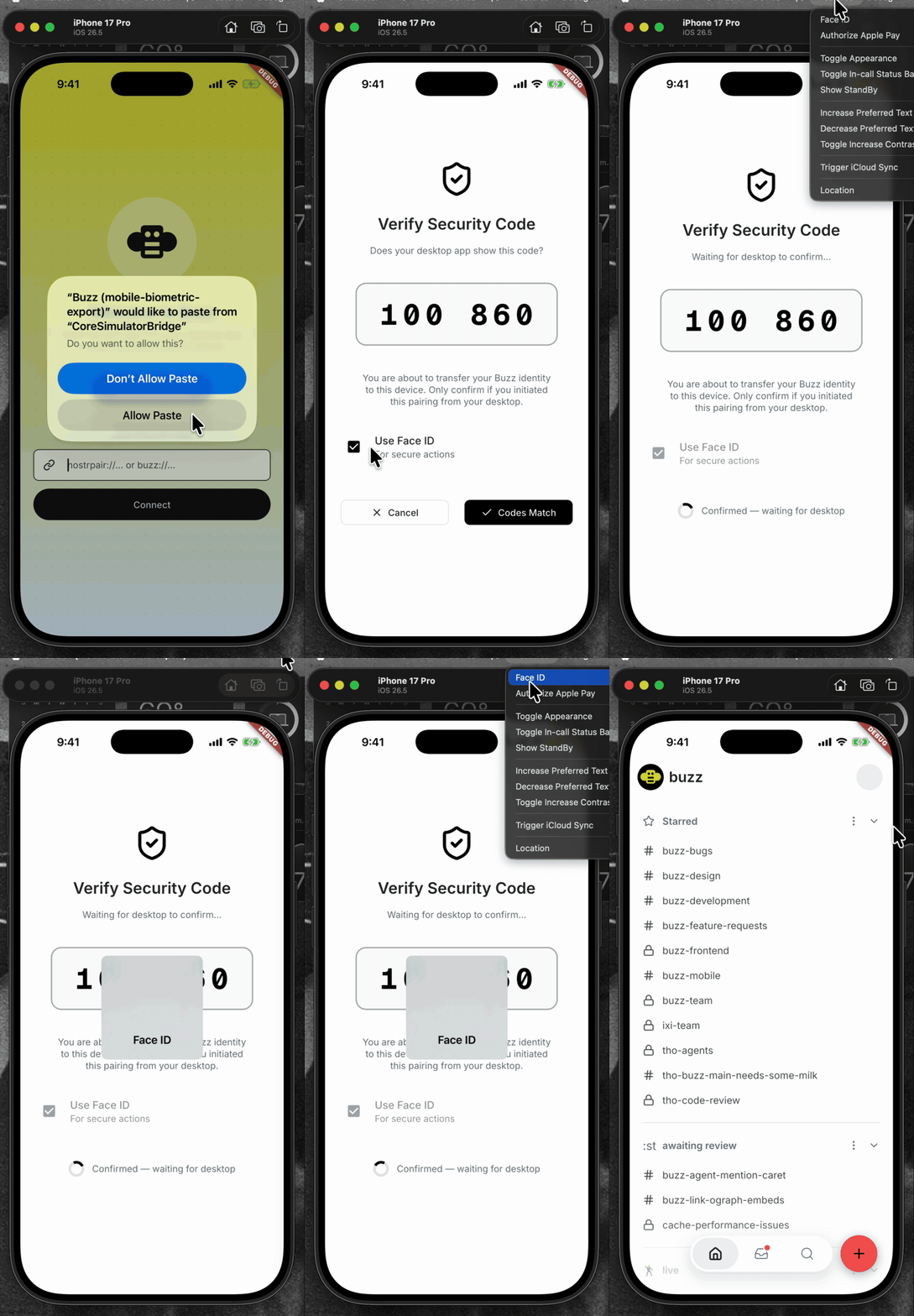 | 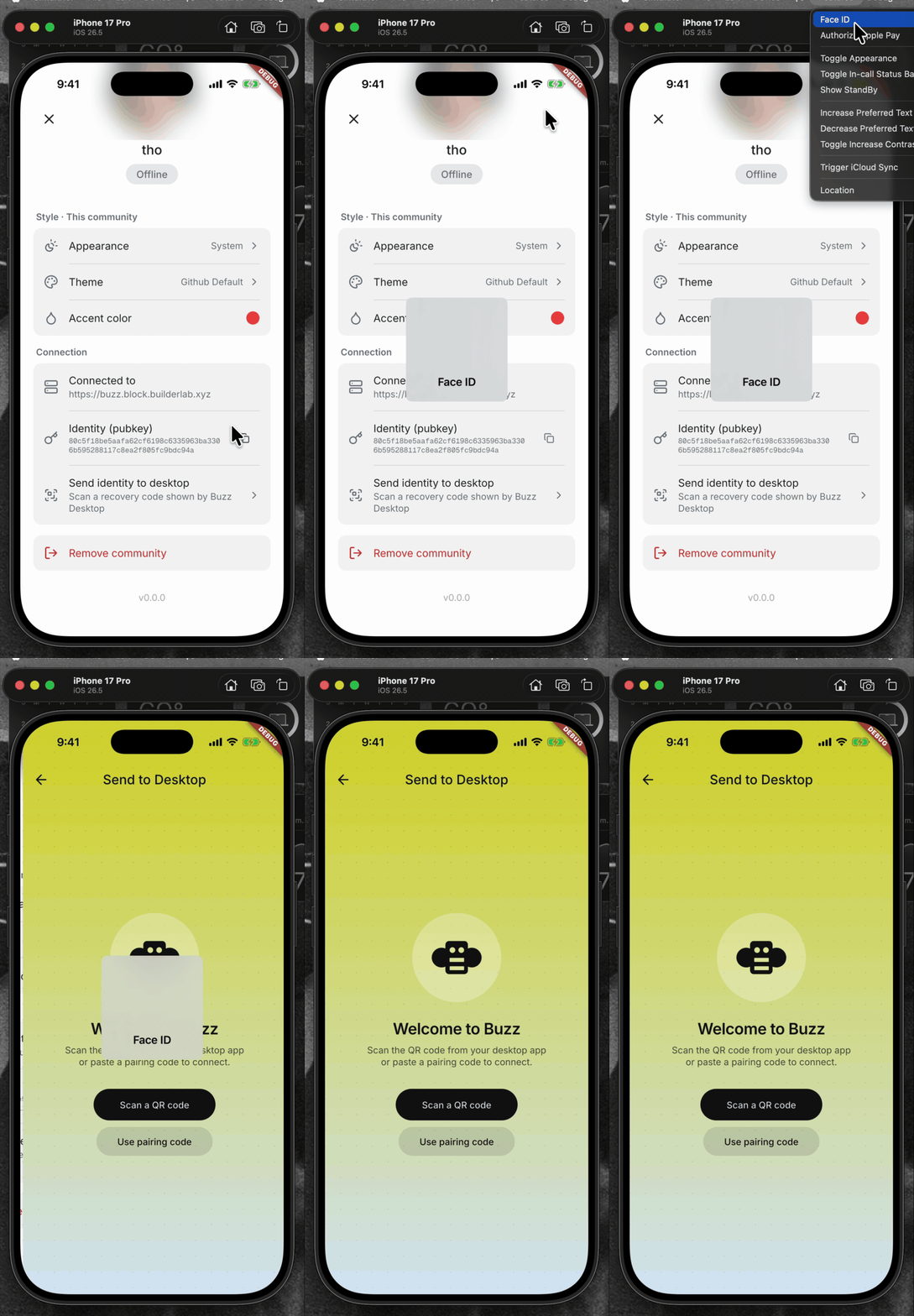 | <details> <summary>File changes</summary> **Android and iOS integration** - `mobile/android/app/build.gradle.kts` declares the AppCompat dependency required by the biometric activity theme. - `mobile/android/app/src/main/kotlin/xyz/block/buzz/mobile/MainActivity.kt` uses the activity type required by the system authentication prompt. - `mobile/android/app/src/main/res/values/styles.xml` and `mobile/android/app/src/main/res/values-night/styles.xml` use the compatible launch theme. - `mobile/ios/Podfile.lock` records the native local-authentication dependency. - `mobile/ios/Runner/Info.plist` explains why Buzz requests Face ID access. **Identity policy and pairing flow** - `mobile/lib/shared/security/sensitive_action_authorizer.dart` wraps OS authentication and maps platform errors to stable app-level outcomes. - `mobile/lib/shared/community/community.dart` and `mobile/lib/shared/community/community_storage.dart` persist the sensitive-action policy. - `mobile/lib/features/invites/invite_join_provider.dart` assigns the explicit policy for invite-created communities. - `mobile/lib/features/pairing/pairing_provider.dart` gates export, binds grants to the active community/session, reauthenticates expired grants, and clears grants on every terminal path. - `mobile/lib/features/pairing/pairing_page.dart` lets users choose biometric protection while importing an identity. - `mobile/lib/features/settings/settings_page.dart` wires pairing into settings. - `mobile/lib/features/settings/settings_page/connection_section.dart` authenticates before opening export recovery and bounds the foreground-resume wait. - `mobile/pubspec.yaml` and `mobile/pubspec.lock` add and lock `local_auth`. **Coverage** - `mobile/test/shared/security/sensitive_action_authorizer_test.dart` covers native result mapping, unsupported devices, and single-flight behavior. - `mobile/test/shared/community/community_test.dart` and `mobile/test/shared/community/community_storage_test.dart` cover policy defaults and persistence. - `mobile/test/features/invites/invite_join_provider_test.dart` covers the invite policy. - `mobile/test/features/pairing/pairing_page_test.dart` covers import protection controls. - `mobile/test/features/pairing/pairing_provider_test.dart` covers export/import authorization, stale/reset/concurrent guards, malformed payload cleanup, and no-export failure paths. - `mobile/test/features/settings/connection_section_test.dart` covers the tap gate, lifecycle resume, and timeout behavior. </details> ## Reproduction steps 1. Pair an identity into the mobile app. 2. Open Settings and choose “Send identity to desktop.” 3. Verify Face ID, biometrics, or the device passcode is required before the recovery scanner opens. 4. Cancel device authentication and verify the scanner does not open and no identity transfer begins. 5. Authenticate, scan a Desktop recovery code, confirm the SAS, and verify the identity transfer completes. ## Validation At `be5620f5f10aa6cc16e86a4f01f102f3d9aeef9b`: - `cd mobile && ../bin/flutter analyze` — no issues - `cd mobile && ../bin/flutter test` — 1,368 tests passed - `cd mobile/android && JAVA_HOME=$(/usr/libexec/java_home -v 21) ./gradlew app:assembleDebug` — debug APK assembled successfully --------- Signed-off-by: Taylor Ho <taylorkmho@gmail.com> |
||
|
Tom Brow
|
ce56e34411 |
fix(mobile): recover stale relay sessions (#4372)
### Summary Fixes [this issue](buzz://message?channel=e62570dd-33ad-42c5-b92b-75f2689f9694&id=b726c366abfe62429ee3cdcd34d0c0fb98c33c3ea053480585bed71745412b56): > I often don’t see my bot responses until after I post. they’re usually time stamped correctly so I think it’s just a refresh issue? ### What changed? Buzz Mobile now reconnects relay sessions after the app has remained backgrounded beyond the existing 5-second grace period, even when the session still reports a stale `connected` state. This makes resume recovery independent of whether iOS runs the grace timer before or after delivering `resumed`. Reconnection is now based on elapsed background time rather than a direct socket-health probe. - If the app was backgrounded for at least the 5-second grace period, the socket is presumed dead and the session reconnects regardless of reported status. - If it was backgrounded for less than that, a reported `connected` status is still trusted. In the sub-5-second window the socket is either genuinely alive, which is the common case for a momentary background, or it is dead and the client ping detects it within the two-interval worst case described below. That is now a degraded-latency path, not a silent-forever path. The mobile relay socket now uses `IOWebSocketChannel.connect` with a 30-second `pingInterval`. An unanswered ping closes the Dart socket through the existing disconnect and reconnect path. Detection takes up to two ping intervals, so about 60 seconds worst case, not 30. One interval of idleness elapses and a ping is sent, then a second interval elapses with no pong and the socket closes. Any inbound pong restarts the first stage, so the clock measures idleness rather than running on a fixed cadence. ### Why? Buzz iOS can sometimes stop showing new bot or agent responses after a phone has been locked for 5 to 10 minutes. When the user later posts a message, the missing responses can appear all at once. iOS may suspend Buzz before the short delayed cleanup that would normally close its connection has a chance to run. Before this change, Buzz trusted the resulting stale healthy status on resume and skipped reconnecting, so the missing responses stayed hidden until a later post exposed the dead connection. A state-machine test with a stubbed connection reproduced this reported pattern and showed that it matches this failure mode: the failed post triggered a reconnect that fetched the missing messages. The same test also checked the other candidate explanation, the bug tracked in [#3053](https://github.com/block/buzz/pull/3053), where the relay has closed the app's subscription. That state does not produce the pattern. Posting succeeds and the user's own message appears, but nothing looks for the missed messages, so they stay hidden. The test confirmed that the missed messages were still available to fetch in that state, so the missing step was a trigger to fetch them. This was not an end-to-end reproduction on an iOS device or a live relay. The new resume check covers the normal lock and unlock path. If the app was backgrounded for less than the 5-second grace period, it still trusts a connection marked as healthy. A dead connection in that window is instead detected by the ping check, which can take up to about 60 seconds but prevents the app from remaining silently stuck. The ping only runs while iOS is running the app, so it does not detect a connection that died during suspension; the resume check owns the lock and unlock path. A pre-existing path also runs the same resume handling when network connectivity returns while the app is already in the foreground. Because the app was not backgrounded, this change does not alter that path, which still trusts a connection marked as healthy and relies on the slower ping check. Recovery from a subscription that the relay explicitly closes remains in [#3053](https://github.com/block/buzz/pull/3053), and the two changes overlap in one file. Changes to how missed messages are backfilled or replayed are out of scope. ### How is it tested? Full mobile suite at base and head. Both runs have the same known macOS-host-only failure in `ChannelDetailPage keeps follow mode off while a tall newest message stays visible` at line 1053: - Base: 1,021 passed, 1 skipped, 1 failed - Head: 1,025 passed, 1 skipped, 1 failed Added tests: - [`relay_session_test.dart`](https://github.com/block/buzz/tree/main/mobile/test/shared/relay/relay_session_test.dart): long-background resume reconnect and within-grace control - [`relay_socket_liveness_test.dart`](https://github.com/block/buzz/tree/main/mobile/test/shared/relay/relay_socket_liveness_test.dart): silent-peer disconnect and idle-but-healthy control Mutation checks confirm that removing elapsed-background resume recovery fails with one socket instead of two, and removing `pingInterval` leaves the silent peer connected. Restored production code passes both mutations' regression tests and the healthy idle control. Signed-off-by: Tom Brow <tomb@block.xyz> Co-authored-by: npub1tquskdu6yc4h8l7xxtceculxw600grekeq0xg2ukqfrwl7vrzg3quz3gmp <58390b379a262b73ffc632f19c73e6769ef40f36c81e642b960246eff9831222@buzz.block.builderlab.xyz> |
||
|
klopez4212
|
85edc0572a |
feat(mobile): desktop-parity emoji and thread experience (#3485)
Brings the Flutter app's emoji and thread surfaces up to desktop parity. ## Emoji - **Full emoji-mart dataset** generated from the same `@emoji-mart/data` set desktop uses (1,870 emoji, 8 categories), committed as an asset — so shortcodes, names, and keywords are identical across clients. `just mobile-emoji-data` regenerates it. - **Rebuilt the tray**: search (a Dart port of desktop's tiered `emojiSearch` ranking, extended to names and keywords), a frequently-used section, and one continuous scroll with pinned section headers. The category rail is a shortcut into that list, not a page switcher, and spans the full width the search field uses. Custom emoji share the native glyph size and cell. - **Reaction pills** match desktop's geometry, and the count shows at 1. - **Emoji-only messages** render at 36px with 1.45em inline custom emoji, matching desktop's `emojiOnly` treatment. - **Positive-emoji burst** ported from desktop's `EmojiBurstProvider`, suppressed under reduced motion. ## Threads - **Top-down layout** — head first under the app bar, replies flowing down, like desktop's thread panel. The old reversed list bottom-anchored the content and jammed the head against the composer. - **Tap a channel message to open its thread**; long-press still opens the action sheet. - **Live reactions.** The thread's relay query is one-shot and its `kinds` filter carries only content rows, so a reaction event could not reach an open thread at all, and `allMessages` was a snapshot frozen when the route was pushed — a new pill only appeared after leaving and re-entering, which refetched. The live channel events are now unioned into the thread's list. The burst is also route-guarded, since the channel timeline stays mounted underneath and was claiming it first. - The `+` affordance follows the channel: replies stay bare until they carry a reaction, and the head keeps a standing `+`. ## Keyboard A deliberate downward drag past ~48px dismisses the keyboard; short scrolls leave it alone. Applies to the channel list, the thread list, and the compose bar (via a raw `Listener`, so it can't steal the field's tap or selection drags). True finger-tracking dismissal is out of scope — Flutter only offers `manual`/`onDrag`, and 1:1 tracking needs a native `UIScrollView` proxy plus Android's `WindowInsetsAnimationController`. ## Testing `just mobile-check` and `just mobile-test` pass (965 tests). New coverage for emoji search ranking, dataset parsing, the emoji-only predicate, tray scroll/rail behavior, reaction pills and the burst, and both thread fixes above. `just ci` green. --------- Signed-off-by: kenny lopez <klopez4212@gmail.com> Signed-off-by: npub12zsjdqx8dud99s9h47xmk9lq93vryf7zjrae8wdrmma52cg5yglseyulst <50a12680c76f1a52c0b7af8dbb17e02c583227c290fb93b9a3defb456114223f@buzz.block.builderlab.xyz> Signed-off-by: klopez4212 <klopez4212@gmail.com> Co-authored-by: npub12zsjdqx8dud99s9h47xmk9lq93vryf7zjrae8wdrmma52cg5yglseyulst <50a12680c76f1a52c0b7af8dbb17e02c583227c290fb93b9a3defb456114223f@buzz.block.builderlab.xyz> |
||
|
klopez4212
|
7dfea2634f |
Add mobile message image galleries (#3312)
## What - group uploaded photos into full-width message carousels - add a fullscreen viewer with pinch zoom, double-tap reset, swipe-down dismissal, a centered filmstrip, and image actions - preload nearby display-sized images for smoother swiping and keep each upload as its own avatar-backed message ## Validation - `just mobile-check` - `flutter test test/features/channels/message_content_test.dart` - iOS 26.5 simulator gesture pass --------- Signed-off-by: kenny lopez <klopez4212@gmail.com> |
||
|
klopez4212
|
8398468ec9 |
Refine the mobile message composer (#2730)
## Summary - replace the mobile composer sheet with a compact expanding capsule - add vertically stacked attachment actions and an inline camera preview - align suggestion, formatting, and send treatments with desktop ## Validation - `just mobile-check` - `just mobile-test` (541 passed, 1 skipped) --------- Signed-off-by: npub102wg7q285p64ch2fjvstmf2ntn2sz3c4u5hmwatalc76mhsuauysftjtfj <7a9c8f0147a0755c5d499320bda5535cd5014715e52fb7757dfe3dadde1cef09@buzz.block.builderlab.xyz> Co-authored-by: npub102wg7q285p64ch2fjvstmf2ntn2sz3c4u5hmwatalc76mhsuauysftjtfj <7a9c8f0147a0755c5d499320bda5535cd5014715e52fb7757dfe3dadde1cef09@buzz.block.builderlab.xyz> |
||
|
Tom Brow
|
37f65c08dc |
fix(mobile): handle buzz:// links (#1826)
Signed-off-by: Tom Brow <tomb@block.xyz> Signed-off-by: npub1shglkdhngx3hrnhf4gf8vhpqdrmeludctechdvpwd3988zzs7ncq2cmtxu <85d1fb36f341a371cee9aa12765c2068f79ff1b85e7176b02e6c4a738850f4f0@sprout-oss.stage.blox.sqprod.co> Co-authored-by: Goose <opensource@block.xyz> Co-authored-by: npub1shglkdhngx3hrnhf4gf8vhpqdrmeludctechdvpwd3988zzs7ncq2cmtxu <85d1fb36f341a371cee9aa12765c2068f79ff1b85e7176b02e6c4a738850f4f0@sprout-oss.stage.blox.sqprod.co> |
||
|
Tom Brow
|
7b6e12657d |
fix(mobile): fix agent avatars on mobile (#1837)
Signed-off-by: npub1ux8n2yfs8qfvgd75s7kyhar2mztac355v6vmrz4juc9l3msw4pgstums9e <e18f3511303812c437d487ac4bf46ad897dc46946699b18ab2e60bf8ee0ea851@sprout-oss.stage.blox.sqprod.co> Co-authored-by: npub1ux8n2yfs8qfvgd75s7kyhar2mztac355v6vmrz4juc9l3msw4pgstums9e <e18f3511303812c437d487ac4bf46ad897dc46946699b18ab2e60bf8ee0ea851@sprout-oss.stage.blox.sqprod.co> |
||
|
Tom Brow
|
fdd366bc18 |
chore(release): release Buzz Mobile version 0.3.33 (#1828)
Signed-off-by: npub1shglkdhngx3hrnhf4gf8vhpqdrmeludctechdvpwd3988zzs7ncq2cmtxu <85d1fb36f341a371cee9aa12765c2068f79ff1b85e7176b02e6c4a738850f4f0@sprout-oss.stage.blox.sqprod.co> Co-authored-by: npub1shglkdhngx3hrnhf4gf8vhpqdrmeludctechdvpwd3988zzs7ncq2cmtxu <85d1fb36f341a371cee9aa12765c2068f79ff1b85e7176b02e6c4a738850f4f0@sprout-oss.stage.blox.sqprod.co> |
||
|
Will Pfleger
|
1fc7488ea5 |
Serialize managed agent PATH tests (#1777)
Signed-off-by: Will Pfleger <pfleger.will@gmail.com> |
||
|
Will Pfleger
|
3b78dc5690 | feat(mobile+desktop): two-tier Slack-style app icon badge (#802) | ||
|
Will Pfleger
|
56c504a4c7 | feat: code block rendering, syntax highlighting, and compose fixes (#803) | ||
|
renovate[bot]
|
fbbb2d1d6e |
fix(deps): update dependency pointycastle to v4 (#687)
Co-authored-by: renovate[bot] <29139614+renovate[bot]@users.noreply.github.com> Co-authored-by: Will Pfleger <wpfleger@block.xyz> Co-authored-by: Will Pfleger <pfleger.will@gmail.com> |
||
|
renovate[bot]
|
0faf89816c |
fix(deps): update dependency package_info_plus to v10 (#686)
Co-authored-by: renovate[bot] <29139614+renovate[bot]@users.noreply.github.com> |
||
|
renovate[bot]
|
e968aa6bbc | fix(deps): update dependency flutter_secure_storage to v10 (#684) | ||
|
renovate[bot]
|
75af57c92c |
fix(deps): update dependency connectivity_plus to v7 (#683)
Co-authored-by: renovate[bot] <29139614+renovate[bot]@users.noreply.github.com> |
||
|
thomaspblock
|
3973080dce |
Refine conversation visual affordances (#615)
Co-authored-by: Cursor <cursoragent@cursor.com> |
||
|
Wes
|
1d926355b2 |
feat: show app version in mobile settings (#425)
Co-authored-by: Claude Opus 4.6 <noreply@anthropic.com> |
||
|
Wes
|
57186963e3 |
feat(mobile): multi-workspace support (#408)
Co-authored-by: Claude Opus 4.6 <noreply@anthropic.com> |
||
|
Wes
|
30adbad810 |
feat(mobile): day dividers, video upload, emoji picker & UX polish (#396)
Co-authored-by: Claude Opus 4.6 (1M context) <noreply@anthropic.com> |
||
|
Wes
|
e2c94a8538 |
feat(mobile): image upload + media viewer parity with desktop (#384)
Co-authored-by: Claude Opus 4.7 (1M context) <noreply@anthropic.com> |
||
|
Wes
|
fc67dac4c6 |
feat: NIP-AB device pairing — Phase 2 (desktop + mobile UI) (#343)
Co-authored-by: Claude Opus 4.6 (1M context) <noreply@anthropic.com> |
||
|
Wes
|
a43c6df878 |
feat(mobile): upgrade mobile_scanner to v7 (Apple Vision) (#336)
Co-authored-by: Claude Opus 4.6 (1M context) <noreply@anthropic.com> |
||
|
Wes
|
3d48be8777 |
[codex] Add mobile chat timeline rendering and hardening (#327)
Co-authored-by: Claude Opus 4.6 (1M context) <noreply@anthropic.com> |
||
|
Wes
|
94d4e16461 |
feat(mobile): websocket streaming with real-time messaging (#323)
Co-authored-by: Claude Opus 4.6 (1M context) <noreply@anthropic.com> |
||
|
Wes
|
3eabe74c61 |
feat(mobile): align design language with desktop and polish UI (#321)
Co-authored-by: Claude Opus 4.6 (1M context) <noreply@anthropic.com> |
||
|
Wes
|
4c37a57cfe |
feat(mobile): QR/code pairing flow with security hardening (#317)
Co-authored-by: Claude Opus 4.6 (1M context) <noreply@anthropic.com> |
||
|
Wes
|
08be36471e |
feat(mobile): add channel list with relay integration (#315)
Co-authored-by: Claude Opus 4.6 (1M context) <noreply@anthropic.com> |
||
|
Wes
|
a444fb9516 |
feat(mobile): scaffold Flutter app with Riverpod & Catppuccin theme (#306)
Co-authored-by: Claude Opus 4.6 (1M context) <noreply@anthropic.com> |