mirror of
https://github.com/block/buzz.git
synced 2026-11-27 19:52:31 +00:00
6b0dfc1957fb6cb87d40b5c3bd6570aa7e8a896e
27 Commits
| Author | SHA1 | Message | Date | |
|---|---|---|---|---|
 Tom Brow |
309f5827b1 |
fix(push-gateway): keep Android enrollment retryable across replay races and restarts (#9893)
Follow-up to [#9811 enroll Android devices for push](https://github.com/block/buzz/pull/9811), covering the gateway side of its non-blocking review comments. Two enrollment states could make an Android phone discard a key its committed installation still holds, after which its fresh enrollment hits `409 installation_conflict` for the installation's whole lifetime (up to about 30 days of no push). Both now answer in a way the client already treats as "keep the key and retry". - **Enrollment replay racing the original request** ([review comment](https://github.com/block/buzz/pull/9811#discussion_r4648232889)). Enrollment consumed its challenge in one statement and created the installation in another. A client that timed out between them and replayed the same signed request found a spent challenge and no installation, and got `404 not_authorized`. Consuming the challenge and creating the installation are now one transaction. A concurrent replay locks the challenge row before judging its expiry, so it waits even when the challenge expires meanwhile, then returns the installation the first request committed, or enrolls itself if that request rolled back or was cancelled. A request that finds its challenge expired deletes it before answering `404`, so a slower request that read its clock earlier cannot spend it afterwards. A refused creation (`409`) also leaves the challenge unspent. - **Enrollment before the attestation status list loads.** A restarted gateway has no status list until its first refresh (and a list past its grace period is equally unusable), so every Android chain was refused with `401 invalid_attestation`, which the client treats as final. The verifier now reports a missing or stale list as unavailable, and enrollment answers `503 temporarily_unavailable` before spending anything. A listed certificate is still refused. - **NIP-PL** now specifies Android enrollment: the `android_attestation` chain and FCM token request, the `buzz.push.enroll.android.v1` transcript whose SHA-256 is the Keystore attestation challenge, what the gateway checks in the chain, and the SHA256withECDSA signature Android installation calls carry in `assertion`. It also records the two behaviors above, corrects the enrollment body ceiling for the Android chain allowance, names the transcript separator as one LF byte, and says a client stores its installation handle before delegating (replay recovery ends once a delegation extends the installation's expiry). ### Validation Added tests: - [`enrollment_replay_waits_for_an_uncommitted_enrollment`]( |
||
|
Tom Brow
|
2e3bebe9b6 |
feat(mobile): enroll Android devices for push (#9811)
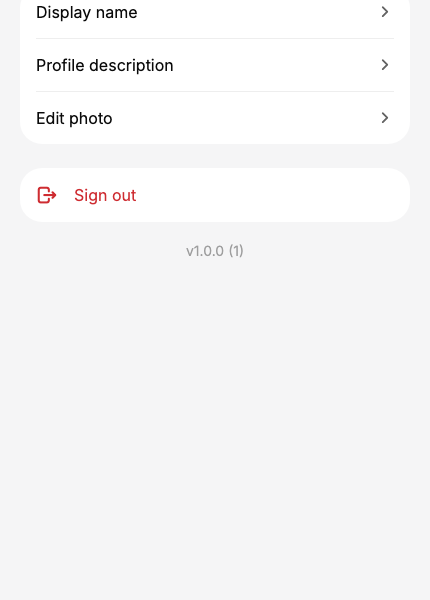
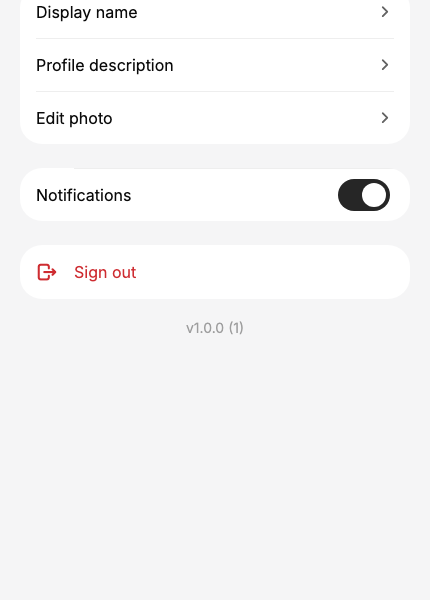
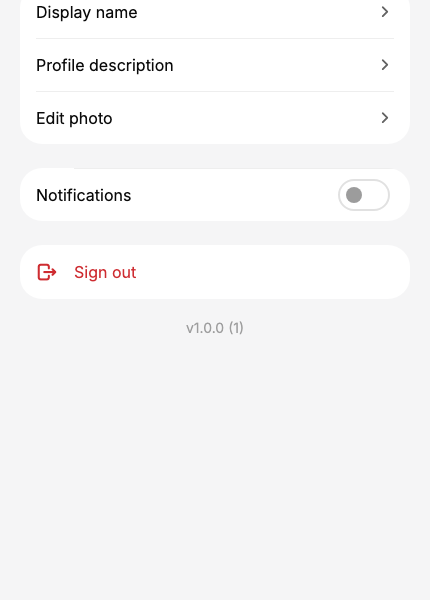
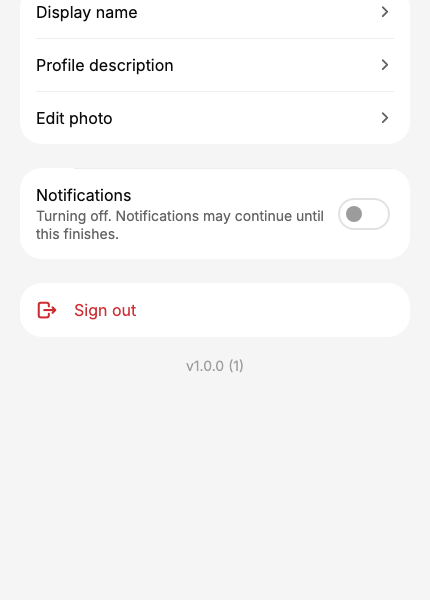
## Summary Ticket 7 of the [Android push plan](https://github.com/block/buzz/blob/main/PLANS/ANDROID_PUSH.md). Android phones can now enroll with the push gateway and publish a relay lease, through the same shared push layer iOS uses. The wake handling side is ticket 6, [#9804 Android push wake handling](https://github.com/block/buzz/pull/9804). - The phone gets an FCM token, then generates a sign-only P-256 Keystore key whose attestation challenge is the SHA-256 of the enrollment transcript. The chain goes to the gateway at enrollment. Every later installation call (delegate, rotate endpoint, revoke delegation, revoke installation) is signed with that key over the transcript bytes the gateway builds. - A rotated FCM token rotates the endpoint. Signing out revokes the delegation and the installation. The first enrollment waits a short random time. - Android 13+ asks for the notification permission at the same point iOS does. Declining keeps the app working. - A phone that cannot attest (no hardware attestation, unlocked bootloader, unlisted boot key) keeps working, and Settings says push is unavailable on this phone. - The relay lease keeps the fixed `transport` value iOS sends. - Firebase config is the same build-time setting [#9804 Android push wake handling](https://github.com/block/buzz/pull/9804) adds: four `BUZZ_FIREBASE_*` environment variables become the string resources Firebase reads. Nothing is committed, and builds without them still work (push reports unavailable). The Gradle hunks (permission, config block, `firebase-messaging` dependency) are copied from that PR verbatim so the two merge cleanly, including its `lifecycle-process` line, which this PR does not use. - The token and permission calls use their own `buzz/push_registration` channel, because Android's notification-open handler from that PR already owns `buzz/push` and a channel has one native handler. - The gateway gets an `enroll_android` transcript vector so Dart and Rust agree on the exact bytes. Enrollment state is journaled before each network attempt, so a lost response resumes with byte-identical requests instead of leaving an orphaned installation. ### Related issue None found. Builds on [#9560 enroll Android installations](https://github.com/block/buzz/pull/9560) and [#9562 verify Key Attestation](https://github.com/block/buzz/pull/9562). ### Validation Journey tests cover first enrollment, a second relay, reuse and renewal, lost responses, token rotation, an installation the gateway dropped, a lost Keystore key, a phone that cannot attest, and sign-out revocation, against a fake gateway that keeps the real gateway's semantics. Transcripts replay the shared vectors byte for byte. A settings journey checks the Notifications row and the unavailable row on Android, and a resume table checks the FCM token refresh: it runs while the relay reconnects, but not when push is off or the relay doesn't offer push. On a physical Pixel 9a (debug build, a local test gateway on a local Postgres, reached over `adb reverse`), the real Keystore key and hardware attestation chain enrolled and delegated, and the gateway accepted the attestation. The same session then ran: a signed delivery authorized against the delegation, endpoint rotation and re-delegation at the next epoch, rotating back, delegation revocation, installation revocation, and re-enrolling the same FCM token afterwards. The notification prompt appears when registration starts, before the token is fetched: <img src="https://github.com/user-attachments/assets/2aed92fe-20c1-4658-b990-51c3f3c96120" width="270" alt="Android notification permission prompt"> Not validated on the device: the FCM wake itself (the local gateway has no credentials to call FCM, so the delivery was authorized and then failed at the FCM hop), lease publication to a relay, and the in-app unavailable row, which only the widget tests exercise. A relay-backed run needs a signed-in test community on the phone. ### Settings while turning off Turning notifications off sends a relay tombstone. Until the relay accepts it, the row now says so, on both platforms. An Android build without a gateway also keeps a saved opt-in visible so it can still be turned off; once off, the row goes away. These are rendered from the Settings journey test. | | Before | After | |---|---|---| | Android build without a gateway, saved opt-in | <img src="https://raw.githubusercontent.com/block/buzz/47220acf78ad21639d2a3a8b79be3f0272e74db2/pr-9811--01-before-config-less.png" width="270" alt="Before: no Notifications row"> | <img src="https://raw.githubusercontent.com/block/buzz/47220acf78ad21639d2a3a8b79be3f0272e74db2/pr-9811--02-after-config-less.png" width="270" alt="After: Notifications row with the switch on"> | | After turning off, relay has not accepted yet | <img src="https://raw.githubusercontent.com/block/buzz/47220acf78ad21639d2a3a8b79be3f0272e74db2/pr-9811--03-before-turning-off.png" width="270" alt="Before: plain off switch"> | <img src="https://raw.githubusercontent.com/block/buzz/47220acf78ad21639d2a3a8b79be3f0272e74db2/pr-9811--04-after-turning-off.png" width="270" alt="After: Turning off. Notifications may continue until this finishes."> | ### Regressions - iOS enrollment is unchanged: the shared bridge only branches to the Dart authority on Android. iOS gains the pending opt-out subtitle, and its opt-out now also tombstones after a gateway change using the saved lease id. - The Android app gains the `firebase-messaging` dependency and a `POST_NOTIFICATIONS` permission. Backups exclude the push preferences file. ### Known limits - An FCM token rotation while the app is running is picked up on the next resume or launch, because the wake service owns the single messaging service. It could call into the registration plugin once both Android push PRs merge. - After an endpoint rotation, only the active community's lease is republished. Other enabled communities' grants are void until each is opened, the same way their leases lapse at grant expiry today. --------- Signed-off-by: Tom Brow <tomb@block.xyz> Co-authored-by: studio <dc2fc481343672df31a689840c09299972e704dac592e0da6f18486646a7ee3e@buzz.block.builderlab.xyz> Co-authored-by: studio <dc2fc481343672df31a689840c09299972e704dac592e0da6f18486646a7ee3e@localhost> |
||
|
Tom Brow
|
81b4054e5d |
fix(push-gateway): answer 429, not 404, when the delivery quota is exhausted (#9803)
When an endpoint's delivery quota is exhausted, both authority stores
returned `AuthorityError::Rejected`, so `/v1/deliveries` answered `404
invalid_grant`. NIP-PL already specifies `429 {"error":"rate_limited"}`
for this case.

The 404 matters because the relay treats a 404 on a retry attempt as a
terminal replay and completes the wake, so a throttled wake was silently
dropped. On a first attempt it failed the wake. A 429 takes the relay's
existing retry-with-backoff path instead.

### Change
- Memory and Postgres stores return `RateLimited` on quota exhaustion.
`http.rs` already maps that to `429 rate_limited`.
- The rate-limited attempt still charges no quota and consumes no
auth-event or request-id fence, so the relay's retry with the same
request id is admitted once the window reopens.
- No doc change: NIP-PL and the deployment doc already describe 429.

### Validation
- Memory store: an exhausted quota returns `RateLimited`, leaves replay
rows and the quota counter unchanged, and the same auth event and
request id are admitted after the window.
- Postgres (ignored test, run locally against a temporary database): the
quota-ceiling race test now also asserts the loser is `RateLimited`.
- HTTP: the eleventh delivery under a quota of ten answers `429
{"error":"rate_limited"}` and reaches no transport.
- With the two store lines reverted, all three tests fail.

### Regressions
None expected. Only the quota-exhaustion result changes; grant,
authority and replay failures still collapse to `404 invalid_grant`.

---------

Signed-off-by: Tom Brow <tomb@block.xyz>
Co-authored-by: studio <dc2fc481343672df31a689840c09299972e704dac592e0da6f18486646a7ee3e@buzz.block.builderlab.xyz>
|
||
|
Tom Brow
|
eae69483fd |
fix(push-gateway): retry, don't drop, a delivery replayed while its first attempt is in flight (#9802)
The relay gives up on a push gateway delivery call after 2 seconds and
retries the same `request_id` with a fresh NIP-98 event. A gateway send
can take much longer than that: an FCM token mint has a 15 second
deadline, and the APNs and FCM sends each have a 15 second timeout. A
retry that arrived while the first attempt was still sending hit the
request replay fence and got `404 invalid_grant`. The relay reads a 404
on a retry as "the earlier attempt already finished" and completes the
wake. If the first attempt then failed retryably, nothing ever sent the
wake, and the notification was silently lost.
This change makes the gateway tell an in-flight request apart from a
finished one:
- Admission records the request id as in flight. A terminal outcome
marks it finished, and a retryable outcome releases it, as before.
- A replay of an in-flight id now gets `503
{"status":"retry","retry_after_seconds":5}`. Nothing is sent and no
quota is charged, so the relay's existing 503 path retries with backoff.
- A replay of a finished id still gets 404, so the relay's existing
handling of a finished attempt is unchanged.
Postgres gets a `finished` column on
`push_gateway_delivery_request_replays` (gateway migration 0009,
mirrored in relay migration 0105). It defaults to `true`, and the
gateway writes `false` explicitly on admission. Rows written before this
migration, or by an older gateway during a rollout or rollback,
therefore keep today's behavior. The constant default adds the column
without rewriting the table.
### Validation
-
[`replay_while_first_attempt_is_in_flight_is_retried_not_dropped`](
|
||
|
Tom Brow
|
5268caa866 |
feat(push-gateway): mint FCM tokens through AWS workload identity federation (#9692)
## Summary Block's GCP projects forbid service account keys, so the push gateway can now get its FCM access token by federating its AWS identity (Google workload identity federation), with no key file. - `BUZZ_PUSH_FCM_SERVICE_ACCOUNT_PATH` is renamed `BUZZ_PUSH_FCM_CREDENTIALS_PATH` (no deployment sets it yet). The file is dispatched on its JSON `type`: `service_account` keeps today's JWT flow; `external_account` is Google's standard AWS credential configuration, the file Block's `identity-federation-aws` Terraform module generates. - Only the minting step changed. `TokenSource` caching, refresh, backoff and the Rejected/Unavailable split are as they were. - A federated mint: AWS credentials (EKS Pod Identity, IRSA or static env keys; no EC2 metadata), a SigV4-signed STS `GetCallerIdentity` subject token, Google STS, then `generateAccessToken` for the FCM scope. One 15 s deadline covers the whole chain. - Faults: network errors, 5xx and 429 on any hop are Unavailable; other 4xx are Rejected. - Startup checks the file's shape and the AWS environment but calls neither AWS nor Google, so an outage can't stop the gateway from serving iOS. The first mint's result is logged once. - Helm: `android.fcmServiceAccount` is renamed `android.fcmCredentials`, mounted as `credentials.json`. ## Validation - New tests drive `TokenSource` against fake AWS, Google STS and impersonation servers: the full chain, each hop's failure classification, a failed refresh keeping a valid cached token, the overall deadline, and config rejection cases. - SigV4 known-answer tests use AWS's documented example credentials, checked against an independent implementation. Checked live against the dev Firebase project from a local AWS identity: the federated mint succeeds and FCM accepts the resulting token. Not yet run from a gateway pod. --------- Signed-off-by: Tom Brow <tomb@block.xyz> Co-authored-by: studio <dc2fc481343672df31a689840c09299972e704dac592e0da6f18486646a7ee3e@buzz.block.builderlab.xyz> |
||
|
Tom Brow
|
47c9a672d7 |
perf(push-gateway): evict the oldest signed-call window without scanning (#9799)
The push gateway's signed-call limiter keeps one counter per attested key, capped at 100,000 keys. Once the map was full, every call from a key not already in it scanned the whole map (once to drop expired windows, again to find the oldest), all while holding the limiter's lock. Under heavy load from many new keys, that serialized each signed call behind a 100,000-entry scan. The limiter now keeps a queue of window starts, oldest first, and evicts from its front. A key whose window restarts leaves a stale entry behind, which eviction skips; the queue is compacted once stale entries make up half of it, so a call stays O(1) amortized. Rate-limit behavior is unchanged, except that a full map now drops one oldest window per new key instead of every expired window at once. The map and the queue share one copy of each key; the queue can reach about twice the map's entries before compaction, so memory stays bounded. Follow-up from #9562. ### Validation | 1,000 new keys on a full map (release build) | Time | | --- | --- | | Before | 277 ms (about 0.28 ms per call, under the lock) | | After | 0.11 ms | - [`a_full_map_drops_the_key_with_the_oldest_window`](https://github.com/block/buzz/blob/push-gateway-limiter-eviction/crates/buzz-push-gateway/src/signed_call_limiter.rs) checks that eviction picks the oldest window. - [`eviction_skips_a_restarted_window`](https://github.com/block/buzz/blob/push-gateway-limiter-eviction/crates/buzz-push-gateway/src/signed_call_limiter.rs) checks that eviction skips a stale entry and keeps a key whose window just restarted. - [`restarted_windows_do_not_grow_the_queue`](https://github.com/block/buzz/blob/push-gateway-limiter-eviction/crates/buzz-push-gateway/src/signed_call_limiter.rs) checks that compaction bounds the queue when one key keeps restarting its window. --------- Signed-off-by: Tom Brow <tomb@block.xyz> Co-authored-by: studio <dc2fc481343672df31a689840c09299972e704dac592e0da6f18486646a7ee3e@buzz.block.builderlab.xyz> |
||
|
Luke Tornquist
|
379b501124 |
feat(push-gateway): declarative desired-state schema, one file per table (#8328)
## Summary Gives the push gateway a declarative desired-state schema in the same layout the relay uses since #8131: a `\i` manifest plus one file per table, the shape SchemaBot reads. - `crates/buzz-push-gateway/schema/schema.sql`: an ordered `\i` manifest and nothing else. - `crates/buzz-push-gateway/schema/tables/public/<table>.sql`: the end state of migrations `0001`–`0008` for all six gateway tables. That includes `0007`'s `installations.platform` column and `0008`'s dropped delegation → installation foreign key (#9610), so the delegation table declares no `REFERENCES`. Each file holds only its `CREATE TABLE` and plain `CREATE [UNIQUE] INDEX` statements. - `src/postgres.rs`: the six table names are now one `GATEWAY_TABLES` constant shared by readiness and the runtime-role GRANT, instead of two hand-copied lists. - `src/postgres/desired_schema_postgres_tests.rs` adds two tests: - `desired_state_schema_layout_is_complete_and_schemabot_shaped` (no infra needed). It checks that the manifest includes every file exactly once and holds only `\i` lines, that each table file creates exactly one table, and that indexes use a plain `CREATE INDEX` on that table. - `desired_state_schema_matches_migrations` (PostgreSQL lane). It builds one probe database from `schema.sql` through the real `bin/pgschema apply` and another through `GATEWAY_MIGRATOR`. It then requires the two `public` catalogs to match: table set, columns from `pg_attribute` (full type with typmod via `format_type`, default, nullability, identity, generation, collation), table options (persistence, RLS flags, `reloptions`), constraints (`pg_get_constraintdef`) and index shapes (`pg_get_indexdef` + `indoption`). Neither probe may hold functions, non-internal triggers, policies, views, sequences or user types, and the declared table set must equal `GATEWAY_TABLES`. It compares the whole `public` catalog, not a list of tables, so a future migration that changes `public` tables, columns, table options, constraints or indexes without a matching `schema/` change fails CI. It doesn't cover data-only migrations or objects outside `public` (other schemas, roles, database settings). Probe databases are created from `template0` and dropped even when an assertion, `pgschema` or setup fails; the original failure is re-raised unchanged. Connection details, including the password, come from the resolved `PgConnectOptions`, so percent-encoded credentials, `?password=` and Unix-socket URLs reach `pgschema` the way SQLx sees them. `pgschema` 1.7.4 builds an unquoted keyword DSN, so a password or socket path with whitespace, a quote, `=` or a backslash isn't supported (noted in the test). ## Not changed The gateway still migrates itself at startup: bootstrap guard, then SQLx migrations, then runtime-role grants. The guard and grants are operational steps, not desired-state DDL, so they stay in code. No `schemabot.yaml` is added: SchemaBot isn't configured for the relay or the gateway yet, so the yaml for both waits until that server-side setup exists. The manifest header notes that the relay's post-pgschema reconcile step (root `AGENTS.md` gotcha #7) doesn't apply, because the gateway schema has no seed DML or storage parameters. SchemaBot compatibility is not proven here. The parity test shows the files are equivalent under `pgschema`. Since #9610 the gateway schema has no foreign keys, so the earlier inline-FK caveat is gone. `docs/database.md` Rule 4 now lists the gateway `schema/` directory as a schema location. ## What got simpler To read the gateway's schema today you have to replay eight migrations: two CHECK rewrites, two dropped UNIQUE constraints, a dropped column, an added column and a dropped foreign key. After this PR it's one declarative file per table, in the same convention as the relay. There is no new runtime path and no new abstraction, and the duplicated table list in `postgres.rs` collapses to one constant. ## Testing At `c4336392` (rebased on main after #9610; mirrors gateway `0007`/`0008`; reads the `pgschema` password from a copy with a URL-safe host and username, so a `PGHOST` or default-search socket no longer panics and a `/role` username no longer drops the password): - `cargo fmt --all -- --check` and `cargo clippy -p buzz-push-gateway --all-targets -- -D warnings`: pass. - `cargo test -p buzz-push-gateway --lib desired_schema`: pass, including `resolved_password_reads_through_a_socket_host_and_slash_username`. Removing the username normalization makes that test fail. - `scripts/postgres-test-run.sh -p buzz-push-gateway --lib --tests`: 17/17 passed, including `desired_state_schema_matches_migrations`. At `df3ff104` (password from resolved connect options), same workstation: - fmt, clippy (`-D warnings`, with and without `personal-dev-app-attest`): pass. `cargo nextest run -p buzz-push-gateway`: 80/80, and 82/82 with the feature. `scripts/postgres-test-run.sh -p buzz-push-gateway --lib --tests`: 13/13. - `?password=`: with `PGPASSWORD` unset, `postgres://<role>:wrong@localhost/postgres?password=<encoded p@ss:w/rd#x>` passes the parity test, so `pgschema` gets the query-parameter password that SQLx uses. A wrong `?password=` is rejected (`28P01`). - The CHECK-bound falsification still fails with `constraint parity mismatch`. Every run leaves 0 probe databases. At `f937924a` (probe cleanup and connection-URL follow-up), on a Linux workstation against PostgreSQL 16 with the repo's pinned `bin/pgschema`: - `cargo fmt --all -- --check`, plus `cargo clippy -p buzz-push-gateway --all-targets -- -D warnings` with and without `--features personal-dev-app-attest`: pass. - `cargo nextest run -p buzz-push-gateway`: 60/60 passed, and 62/62 with `personal-dev-app-attest`. `scripts/postgres-test-run.sh -p buzz-push-gateway --lib --tests`: 12/12 passed. - Probe cleanup: with a CHECK bound changed (2048→4096), the previous test code fails and leaves both `push_gateway_{desired,migrated}_*` databases behind. The new code fails with the same `constraint parity mismatch` panic and leaves none. A table file that makes `pgschema apply` fail (`no_such_column`) also reports `pgschema apply failed: ... column "no_such_column" does not exist` and leaves none. - Connection URLs: the parity test passes as a role whose password is `p@ss:w/rd#%x`, given percent-encoded in the URL with `PGPASSWORD` unset. It also passes over `postgres://<user>@%2Fvar%2Frun%2Fpostgresql:5432/postgres` (Unix socket, peer auth). Earlier, at `ee2745cb78`: - `scripts/postgres-test-packages.sh` discovers `buzz-push-gateway`. The parity test lives under a `*_postgres_tests` module so the `postgres-ci` nextest filter selects it. - `cargo fmt --all -- --check` and `cargo clippy -p buzz-push-gateway --all-targets -- -D warnings` both pass. - `cargo nextest run -p buzz-push-gateway`: 60/60 passed, including the layout test. - `scripts/postgres-test-run.sh -p buzz-push-gateway`: 12/12 passed, including `desired_state_schema_matches_migrations`. - Falsification checks: - Dropping the partial predicate from `push_gateway_installations_active_token` makes the parity test fail with an index-shape mismatch. - Adding an unmirrored `0007` migration (`ADD COLUMN probe TEXT`) makes the parity test fail with a column mismatch. Mirroring the column in the table file makes it pass again. - Putting `CREATE TABLE` DDL in `schema.sql` makes the layout test fail. - A `0007` adding `probe VARCHAR(64)` mirrored as `VARCHAR(128)` fails with a column mismatch (typmod); mirroring it exactly passes. - An unmirrored `0007` `ALTER COLUMN expires_at TYPE TIMESTAMP` fails with a column mismatch. - An unmirrored `0007` `ENABLE ROW LEVEL SECURITY` fails with a table-option mismatch. - A `0007` creating a function and trigger fails the "only tables and indexes" check. Known gap: `sqlx::migrate!` doesn't notice a *new* migration file on an incremental build. The crate has no `build.rs` `rerun-if-changed`, and neither does any other crate in the workspace. For the `0007` check above I touched `src/postgres.rs` to force the macro to re-expand. Clean CI builds aren't affected. buzz-review-completed --------- Signed-off-by: Elrond <28d6302a099e5225b02c4155ac4236e4912603df2ab08dbfc2f4fef08ce598c8@buzz.block.builderlab.xyz> Co-authored-by: Elrond <28d6302a099e5225b02c4155ac4236e4912603df2ab08dbfc2f4fef08ce598c8@buzz.block.builderlab.xyz> Co-authored-by: Claude Opus 5.5 <noreply@anthropic.com> |
||
|
Luke Tornquist
|
bc3023a050 |
push-gateway: drop the delegation → installation foreign key (#9610)
## Summary Retire the last foreign key in the push gateway schema: `push_gateway_delegations.installation_id → push_gateway_installations(id)`. This follows `docs/database.md` Rule 2 and the relay FK retirement work (#9399, #9404). - **Gateway migration 0008** drops the constraint. - **Relay migration 0101** drops the relay's legacy copy (Rule 4: gateway schema changes go in both). `schema/tables/public/push_gateway_delegations.sql` loses the inline `REFERENCES`. ## Required stop Every gateway and rollback target must run #9627 (`44cdd9fe`) or later before this merges and deploys. #9627 makes the reaper lock expired installations before it deletes their delegations. Without the FK, an older reaper can leave an orphaned delegation. This is step 2 of the Rule 5 retirement sequence; #9627 is step 1. ## Why the app already enforces the reference | Path | Check | |---|---| | `upsert_delegation` (only delegation insert) | Locks the installation `FOR UPDATE` in the same transaction; rejects a missing or revoked one. | | `create_installation` (replaces expired installations) | Locks the matching installations `FOR UPDATE`, deletes their delegations, then the installations. | | `reap_expired` | Locks expired installations `FOR UPDATE`, deletes their delegations, then the installations (#9627). | | `authorize_delivery` | Reads the installation through the delegation; a missing installation is `Rejected`. | | `revoke_delegation` | Updates the delegation only; an orphan has no effect. | | `revoke_installation`, `rotate_endpoint`, `advance_assertion_counter` | Update the installation; they never delete it. | The relay never reads or writes the `push_gateway_*` tables (the gateway requires its own database), so dropping the relay copy changes no relay behavior. ## Tests The gateway tests run against the migrated schema, which no longer has the FK, so they prove the app check. - `migrated_schema_has_no_foreign_keys` (new): the gateway schema has no foreign keys after migrations. It fails if gateway migration 0008 is removed. - `delegation_for_missing_installation_is_rejected` and `reaper_deletes_delegation_committed_while_it_waits` (from #9627) now run without the FK. - `reaper_retains_revocation_tombstones_until_authority_expiry`: its hand-built schema drops the FK too. - Relay: `push_gateway_delegations` joins the constraint parity check in `admin_schema_parity_between_desired_state_and_migrations`, and the migration count test covers 0101. ## Validation Blox at `33f7df90` (before the rename to 0101; CI covers the rebased head): - `cargo fmt --check`, clippy (`buzz-push-gateway`, `buzz-db`, all targets), gateway unit tests, `buzz-db` migration unit tests: pass. - `scripts/postgres-test-run.sh -p buzz-push-gateway --lib --tests`: 16/16 pass. - `buzz-db` Postgres tests for migrations, parity, push, floor retirement and retained guards: 56/56 pass, including `admin_schema_parity_between_desired_state_and_migrations`. - Must-fail check: with gateway migration 0008 removed, `migrated_schema_has_no_foreign_keys` fails (1 foreign key vs 0). ## Coordination - On main after #8696, #9398 and #9710 (relay 0095–0100). #9627 shipped this PR's reaper fix and tests separately, so this PR is the schema drop only. - Renumbered to relay 0101 after #9710 took 0098–0100 (rename only; file contents unchanged). #9690 and #9621 also add a relay 0098; whichever merges second renumbers. - #8328 adds the gateway's declarative schema with the inline FK. Whichever PR merges second removes it there. ## What got simpler One fewer database object. Every gateway reference check now lives in one place: the gateway's own transactions. buzz-review-completed 🤖 Generated with [Claude Code](https://claude.com/claude-code) Signed-off-by: Luke Tornquist <tornquist@squareup.com> Co-authored-by: Elrond <28d6302a099e5225b02c4155ac4236e4912603df2ab08dbfc2f4fef08ce598c8@buzz.block.builderlab.xyz> Co-authored-by: Claude Opus 5.5 <noreply@anthropic.com> |
||
|
Tom Brow
|
25b58ab98f |
feat(push-gateway): verify Android Key Attestation (#9562)
## What and why Ticket 3 of the Android push plan ([design PR #9555](https://github.com/block/buzz/pull/9555)). The gateway now verifies Android Key Attestation at enrollment instead of rejecting every Android chain, and rate limits signed installation calls per attested key. Stacked on [#9560](https://github.com/block/buzz/pull/9560) (Android enrollment and FCM wakes). This PR's base is that branch; it will be retargeted once that merges. - **Chain.** It must end at a configured Google attestation root (Google's [published hardware roots](https://developer.android.com/privacy-and-security/security-key-attestation#root_certificate) are built in, pinned by public key), with valid signatures and issuer links, CA issuers above the attestation key certificate, and no SHA-1 signatures. The attestation key certificate itself is exempt from the CA flags, because some factory keyboxes issue it with CA:FALSE and digitalSignature only (Google's Sony Xperia 10 III sample); a Keystore leaf still cannot act as an issuer, since the extension is refused above the leaf. Validity is enforced for Remote Key Provisioning chains; Google tells verifiers to keep trusting the long-expired factory chains, which the revocation list covers instead. The attestation extension must be in the leaf and nowhere else. The leaf key must be EC P-256; it becomes the installation's signing key. - **KeyDescription.** Attestation and KeyMint security levels must be TrustedEnvironment or StrongBox. The challenge must equal SHA-256 of the enrollment transcript. Key properties (generated, EC, P-256, sign-only) and the root of trust come only from the hardware-enforced list. The bootloader must be locked, and the boot state Verified, or SelfSigned with a verified boot key on an operator-configured list. The application id (the one software-enforced value) must name exactly the configured package with a configured signing digest. - **Revocation.** A background task fetches Google's status list at startup and then on its cache lifetime (5 minutes to 1 day), with a 30 second timeout, an 8 MiB size cap, capped exponential backoff and jitter. Any REVOKED or SUSPENDED serial in the chain is rejected. With no list yet, or a list older than the grace period, enrollment fails closed. Enrollment reads an in-memory snapshot and never waits on a fetch. - **Rate limit.** Signed installation calls (delegate, revoke delegation, rotate endpoint, revoke installation, on both platforms) are limited per attested key. A call is counted only after its signature verifies, so forged requests cannot spend another installation's allowance. Counters are in memory per replica, bounded to 100,000 keys. - **Dependencies.** None added. `x509-parser` gains its `verify-aws` feature, which uses the `aws-lc-rs` the crate already depends on. ## Configuration All optional; Android stays off unless the ticket 2 settings are present. Documented in `docs/push-gateway-deployment.md` and `.env.example` with example values only, and passed through `deploy/charts/buzz-push-gateway` (disabled by default, schema-checked, covered by `tests/runtime-options.sh`). - `BUZZ_PUSH_ANDROID_BOOT_KEY_DIGESTS`: SHA-256 digests of verified boot keys accepted with a SelfSigned boot state. Empty by default, so a default gateway accepts stock Android only. - `BUZZ_PUSH_ANDROID_ATTESTATION_ROOTS_PATH`: PEM bundle replacing the built-in roots, for a reviewed root rollout. In the chart, `android.attestationRoots.secretName` and `secretKey` mount it from a Secret; an empty name keeps the built-in roots. - `BUZZ_PUSH_ANDROID_REVOCATION_GRACE_SECONDS`: default 604800 (7 days), minimum 3600. - `BUZZ_PUSH_SIGNED_CALL_WINDOW_SECONDS` and `BUZZ_PUSH_SIGNED_CALL_MAX_CALLS`: defaults 60 and 30. ## Tests - `cargo test -p buzz-push-gateway` (all pass, 18 ignored), `cargo fmt --all --check`, `cargo clippy -p buzz-push-gateway --all-targets -- -D warnings`, and the chart tests (`render.sh`, `release-contract.sh`). - Key Attestation chains are generated in the tests with a test root injected as the configured root, and run through the production verifier. One table rejects: unlocked bootloader, Unverified, Failed, SelfSigned with an unlisted key, boot key only in the software list (two variants), key properties only in the software list, extra key purposes, wrong curve, wrong package, two packages, wrong signing digest, wrong challenge, software-backed key (two variants), unknown root, forged leaf signature, expired provisioned intermediate, extension repeated above the leaf, non-P-256 leaf, a CA:FALSE certificate issuing the attestation key certificate. Another accepts Verified with any boot key, SelfSigned with a listed key, StrongBox and TrustedEnvironment, an expired factory intermediate, and a CA:FALSE, digitalSignature attestation key certificate. Revoked leaf, intermediate and root, a missing list and a stale list are rejected. The status list parser and refresh (backoff, cap, keeping the last list through failures) run against a scripted fake source; no test touches the network. - The per-key rate limit runs through the public router: forged calls do not spend the allowance, the fourth authentic call is refused whatever its kind, and another installation is unaffected. - Break check: disabling the locked-bootloader guard and the rate limit turned `rejected_attestations` and the rate limit test red; restored. ## Not here The app side (ticket 7) generates the Keystore key and sends the chain. The end to end run on a physical Android phone against a test gateway is also still to do. --------- Signed-off-by: Tom Brow <tomb@squareup.com> |
||
|
Luke Tornquist
|
44cdd9feef |
push-gateway: lock expired installations before reaping (#9627)
## What The push gateway reaper deletes expired delegations and then expired installations in two statements. A delegation writer (`upsert_delegation`) that holds the installation lock can commit a new child between them. With the foreign key, the installation delete then fails, and the reap transaction rolls back. This PR locks the expired installations with `FOR UPDATE` first, as every authority mutation does. It then deletes their delegations and the installations by id. A writer that was holding the lock commits first, and the delete sees its child. A later writer finds the parent gone and is rejected. No schema change. This is the code half of #9610. The gateway image with this change must run everywhere before the delegation foreign key is dropped. ## Tests Blox at `20b66f8f`: fmt, clippy, and the push-gateway PostgreSQL tests (15/15) pass. - `reaper_deletes_delegation_committed_while_it_waits`: a writer holds the installation lock and inserts a child. The reaper starts and waits. The writer commits. The reaper deletes both rows. - `delegation_for_missing_installation_is_rejected`: `upsert_delegation` for an unknown installation returns `Rejected` and writes nothing. ## What got simpler The reaper now uses the same lock order as every other authority write. The child delete no longer needs a correlated subquery. buzz-review-completed 🤖 Generated with [Claude Code](https://claude.com/claude-code) Signed-off-by: Luke Tornquist <tornquist@squareup.com> Co-authored-by: Elrond <28d6302a099e5225b02c4155ac4236e4912603df2ab08dbfc2f4fef08ce598c8@buzz.block.builderlab.xyz> Co-authored-by: Claude Opus 5.5 <noreply@anthropic.com> |
||
|
Tom Brow
|
6b4a398829 |
feat(push-gateway): enroll Android installations and send FCM wakes (#9560)
## What and why Ticket 2 of the Android push plan ([design PR #9555](https://github.com/block/buzz/pull/9555)). The gateway now enrolls Android installations and wakes them through FCM, next to the existing iOS path. Builds on [#9557](https://github.com/block/buzz/pull/9557) (platform-neutral `/v1/deliveries` route), now merged. - **Platform.** The enrollment request has no platform field. The gateway derives it from which attestation is present (App Attest object or Android attestation chain) and records it in a new `push_gateway_installations.platform` column (`ios` or `android`). It lives only in gateway state; the relay never sees it. - **Android enrollment transcript.** Key Attestation fixes the challenge at key generation, so the client signs nothing at enrollment and sends no `key_id`. The attestation challenge must equal SHA-256 of a canonical JSON transcript under domain `buzz.push.enroll.android.v1` with `v`, `audience`, `challenge_id`, `challenge`, `endpoint`, `endpoint_epoch` and `expires_at`. The gateway derives the key id as SHA-256 of the attested 65-byte uncompressed P-256 key. A request whose `key_id` presence doesn't match its platform gets 400. The iOS transcript (`buzz.push.enroll.v1`) is unchanged. - **Signed calls.** iOS keeps App Attest assertions. After enrollment, an Android installation signs every call (delegate, revoke delegation, rotate endpoint, revoke installation) with its attested Keystore key: ECDSA P-256, DER, over the same transcript bytes iOS signs. High-S signatures are accepted since Keystore does not normalize. There is no counter; the single-use challenge inside the transcript is the replay protection. - **FCM sender.** HTTP v1, high priority, data-only, compiled-in payload (no relay-supplied bytes), one constant collapse key, TTL from the delivery expiry. OAuth access tokens come from the service account key (RS256 JWT bearer). Outcomes map onto the existing delivery outcome classes and metrics (`push_gateway_fcm_*`). - **Token refresh.** A cached token keeps serving until it expires. Once it is due for refresh, one background task fetches a new one, so a wake never waits on a refresh while a valid token exists. A failed fetch keeps the current token and backs off 5 s before the next attempt. Only a cold cache (no unexpired token) makes a wake wait on the token request, single-flighted. A 401 discards the cached token only if it is still the one FCM refused, so a late 401 can't drop a newer token. - **Retries.** 429 and `QUOTA_EXCEEDED` retry after at least 60 s (FCM's hint if longer). 500, 502, 503 and 504 retry. - **Attestation seam.** Android Key Attestation verification sits behind a trait. Tests use a test-only verifier compiled under `cfg(test)`, so production configuration cannot select it. The production verifier fails closed: a gateway configured for Android starts but rejects every Android enrollment until ticket 3. - **Migration.** Expand-only `ADD COLUMN platform TEXT NOT NULL DEFAULT 'ios' CHECK (...)`: the deployed gateway's inserts stay valid and existing rows become iOS. `SET LOCAL lock_timeout` (5 s) and `statement_timeout` (30 s) bound the table lock wait and the CHECK validation scan. No triggers, functions, foreign keys or backfills. Mirrored as gateway `0007` and relay `0093` plus `schema/tables/public`, per docs/database.md. ## Configuration All four are optional and must be supplied together (a partial set fails startup). Documented in `docs/push-gateway-deployment.md` and `.env.example` with example values only. - `BUZZ_PUSH_ANDROID_PACKAGE_NAME` - `BUZZ_PUSH_ANDROID_SIGNING_CERT_DIGESTS` - `BUZZ_PUSH_FCM_PROJECT_ID` - `BUZZ_PUSH_FCM_SERVICE_ACCOUNT_PATH` ## Tests - `cargo test -p buzz-push-gateway` (92 passed, 18 ignored; 94 passed with `personal-dev-app-attest`; iOS rows unchanged), `cargo fmt --check`, `cargo clippy -p buzz-push-gateway -p buzz-db --all-targets -- -D warnings`. - New HTTP tests with a fake FCM sender: Android enroll, delegate, deliver, rotate endpoint and revoke; signed-call rows for wrong key, altered transcript and reused challenge; platform derivation and bad attestations. - Postgres (ignored, run locally): gateway migration test (existing and old-gateway inserts become `ios`, bad value rejected); relay `admin_schema_parity_between_desired_state_and_migrations` now covers `push_gateway_installations` columns, indexes and constraints; the `runtime::migration::postgres_tests` set passes single-threaded. - Break check: making signature verification always succeed turned two tests red (the signed-call rejection rows and the signature unit test); restored. - Token cache tests against a local fake token endpoint with a controlled clock: a due refresh keeps serving the valid token even when it fails; a late 401 does not discard a refreshed token; a queued background refresh honors a foreground failure's backoff. The FCM response table covers 429 with and without an error body, and 502/504 HTML pages. - Android enrollment rows: `key_id` present on Android (400), wrong transcript binding, a 65-byte non-point key, an over-long chain, and exact replay. - Break checks for every new guard (no background refresh, blocking while due, failure dropping the token, unconditional 401 clear, no quota floor, no 502/504 retry, the queued-refresh backoff check, Android requiring `key_id`, skipping the P-256 point check): each turned at least one test red; restored. ## Not here (ticket 3) Real Key Attestation verification (Google roots, revocation list, boot state, boot-key list, app identity). Per-key rate limiting is also left for ticket 3, since it did not fall out of this change. The Helm chart does not pass the Android settings yet. --------- Signed-off-by: Tom Brow <tomb@squareup.com> Co-authored-by: Tom Brow <tomb@squareup.com> |
||
|
Tom Brow
|
9398918fa5 |
feat(push-gateway): accept deliveries on a platform-neutral route (#9557)
First slice of the Android push plan ([design PR](https://github.com/block/buzz/pull/9555)). The push gateway should serve every platform from one delivery route, so the relay never learns an installation's platform (see ADR 0004 in the design PR). ### What changes - The gateway accepts deliveries at `POST /v1/deliveries`. `POST /v1/deliveries/apns` keeps working unchanged as an alias until relays have moved over. - `BUZZ_PUSH_GATEWAY_DELIVERY_URL` accepts either path. The deployment guide and NIP-PL describe `/v1/deliveries` as the route to use. `.env.example` and the compose template stay on `/v1/deliveries/apns`, because released relays (`relay-v0.3.0` and older `sha-` images) refuse to start with the new path even with push disabled, and the public gateway doesn't route it yet. A later change moves them over. - Signature binding: the gateway already verified only the method and the signed URL's path (not scheme, host or port). It compared that path to a constant. It now compares it to the route the request arrived on, so a request signed for one route is rejected on the other. Each route accepts only requests signed for its own path. - The lease `transport` value, priority classes and the delivery request body are unchanged, and nothing about the device platform reaches the relay. ### Regressions None expected. iOS keeps working: the alias route behaves exactly as before, and relays configured with the old URL keep signing and sending to it. The signed path check is equivalent on that route, since it now compares against the same path the old constant held. Rollout order matters. Don't point a relay at `/v1/deliveries` until (1) its gateway runs this change and (2) for `push.buzz.xyz`, the edge path allowlist in front of the gateway admits `/v1/deliveries`. Today that edge answers `403 RBAC: access denied` there. The relay also needs a build that includes this parser. An old gateway's 404 or the edge's 403 is a permanent failure for the relay (on a retry, it counts as replay-terminal), so those notifications are dropped, not retried. ### Validation - Gateway delivery tests are table-driven across both routes: path-not-origin binding, signed URL modifiers and non-HTTP schemes, request queries, method and path routing, and new cross-route rows (signed for `/v1/deliveries`, sent to the alias, and the reverse, both rejected). - Relay config tests cover both paths over HTTP and HTTPS, plus rejected variants (trailing slash, query, fragment, credentials, other paths, HTTPS ports). - Ran the gateway crate's tests, the relay crate's unit tests (single-threaded, because the default parallel run of the whole lib hung in untouched tests waiting on shared env locks), formatting and clippy for both crates, and the repository's pre-push checks. - Relay tests that need Postgres were not run locally. --------- Signed-off-by: Tom Brow <tomb@squareup.com> Co-authored-by: Tom Brow <tomb@squareup.com> Co-authored-by: studio <dc2fc481343672df31a689840c09299972e704dac592e0da6f18486646a7ee3e@localhost> |
||
|
Tom Brow
|
713b864e2f |
fix(push-gateway): log which App Attest certificate check failed (#8671)
[#8630](https://github.com/block/buzz/pull/8630) made App Attest rejections log which check failed. In production, an internal iPhone's fresh enrollments now log `reason: certificate` with `detail: invalid certificate path or structure`. That detail still covers about eight distinct failures: a non-array or empty `x5c`, a bad configured root, a malformed or duplicate-extension certificate, any webpki path rejection (untrusted issuer, expiry, unsupported critical extension and so on), and a key-usage mismatch. So the logs still cannot say why this device's attestation is rejected while other devices enroll normally. Each certificate failure now carries a `CertificateCheck`, and the existing warning's `detail` names it: - `x5c is not a non-empty array` - `invalid configured root` - `invalid encoding at x5c[i]` - `invalid key usage at x5c[i]` - `path rejected: <webpki error>`, for example `CertExpired { time: .., not_after: .. }` or `UnknownIssuer` The webpki error includes only its variant and, for validity errors, the timestamps it compared. It includes no certificate bytes or device identifiers. The `reason` stays `certificate`, and the HTTP response stays a uniform `invalid_attestation`. ### Validation - Added tests: a table test runs each signed bad-chain case through the production `verify_chain` and asserts the exact check: wrong usage, expired, unknown critical extension, duplicate extension, trailing bytes, empty chain, and a bad root. Swapping the key-usage result for another check fails it. The shared certificate constraint corpus now builds its chains from the same case list. - The full push gateway suite passes locally. Clippy is clean. The local pre-push `rust-tests` lane failed only in `buzz-relay` tests, which do not depend on this crate, so I skipped it for the push and am relying on CI for it. 🤖 Generated with [Claude Code](https://claude.com/claude-code) --------- Signed-off-by: Tom Brow <tomb@block.xyz> |
||
|
Tom Brow
|
c477663211 |
fix(push-gateway): log which App Attest check rejected a device (#8630)
When the push gateway rejected a device's App Attest attestation or assertion, it logged the reason only at debug level. In production that left a bare `401 invalid_attestation` in the access logs, with no sign of which check failed. We hit this diagnosing an internal iPhone that never received push. Its enrollments failed with repeated `401`s, and the gateway logs could not say why. Rejections now log at warn level with: - `operation`: `attestation` or `assertion` - `reason`: the existing category, for example `certificate` or `identity` - `detail`: the specific failed check, for example `invalid AAGUID` or `invalid App ID` Malformed base64 now has its own `encoding` reason. The size, base64 and challenge checks that run before full verification now take the same path. Previously they rejected without logging anything. Without `RUST_LOG`, the gateway now defaults to `error,buzz_push_gateway=warn`, which keeps every target's errors plus the gateway's own warnings. Previously the default showed only errors, and the Helm chart sets no `RUST_LOG`, so a default deployment would have dropped these warnings. The HTTP response is unchanged and stays a uniform `invalid_attestation`. The logged fields are fixed strings, with no device or request data. Companion iOS PR [#8629](https://github.com/block/buzz/pull/8629) stops a device from replaying the same rejected enrollment indefinitely. ### Validation - Added tests: a single-test binary checks the emitted JSON warning (level, operation, reason, detail) through `AppAttestVerifier::verify_attestation`, for malformed base64, an empty proof, and malformed CBOR. Another checks that the default filter keeps gateway warnings and dependency errors, drops dependency warnings, and still honors an explicit `RUST_LOG`. Both fail when the warning is downgraded to debug or the default filter loses its `error` fallback. - The existing push gateway suite passes locally, including the App Attest rejection tests. Clippy is clean. 🤖 Generated with [Claude Code](https://claude.com/claude-code) --------- Signed-off-by: Tom Brow <tomb@block.xyz> |
||
|
Matt Toohey
|
8216db1c71 |
chore(toolchain): bump Rust to 1.98.1 for macOS 27 proc-macro loading (#8598)
## Summary
Bump the pinned Rust toolchain from 1.95.0 to 1.98.1 so release builds
work on macOS 27 hosts.
Rust ≤ 1.97 strips Apple-target artifacts with its bundled
`llvm-objcopy`, which leaves the Mach-O `LC_SYMTAB` string pool
(`__LINKEDIT`) only 4-byte aligned. macOS 27's dyld refuses to `dlopen`
such images (`mis-aligned LINKEDIT string pool`). Because cargo applies
the release profile's default `strip = "debuginfo"` to proc-macro dylibs
too, `cargo build --release` of any crate that uses sqlx macros
(`buzz-db`, `buzz-relay`, `buzz-admin`, …) fails on macOS 27: rustc
cannot load `libsqlx_macros-*.dylib`. Dev builds pass because the dev
profile does not strip, which is why this only shows up as a
release/packaging failure.
The fix (llvm/llvm-project#203680, pulled into rustc by
rust-lang/rust#158410 for rust-lang/rust#157750) first shipped in Rust
1.98.0 and was never backported to 1.97.x. `block/buzz-app` pinned
1.98.1 for the same failure in block/buzz-app#529. With this bump the
`CARGO_PROFILE_RELEASE_BUILD_OVERRIDE_STRIP=none` / custom-linker
workarounds people have been using locally are no longer needed.
### What changes
Two commits: the toolchain bump (with the desktop clippy fixes), then
the workspace clippy fixes.
| Location | Change |
|---|---|
| `rust-toolchain.toml` | `channel = "1.95.0"` → `"1.98.1"` (profile
unchanged) |
| `Dockerfile`, `Dockerfile.push-gateway` | `ARG RUST_VERSION=1.95` →
`1.98` |
| `Dockerfile.sprig` | `rust:1.98-alpine3.22` with the manifest-list
digest verified on Docker Hub (shared by the `1.98` and `1.98.1` tags) |
| `.github/workflows/release.yml` | `dtolnay/rust-toolchain` pinned to
the tip of its `1.98.1` branch (`18f04874`) for the Windows desktop
release job |
| `benchmarks/harbor-buzz-orchestra` | `RUST_IMAGE = rust:1.98-alpine` |
| `_ci-rust.yml`, `windows-canary.yml`, `app_state_tests.rs` | stale
"1.95" comments reworded; the `unknown_lints` allow stays with a
version-agnostic rationale |
| `desktop/src-tauri` | lints clippy 1.98 newly raises under `-D
warnings`: `chunks_exact_to_as_chunks` at five fixed-width PCM/UTF-16
decoders, `needless_borrows_for_generic_args` on the `Copy` `norm`
closure in `config_bridge/reader.rs`, and a redundant `Engine as _`
import in `hpke_key_backup_tests.rs` that `use super::*` already
provides |
| Workspace crates (9) | the 30 lints clippy 1.98 newly raises in `cargo
clippy --workspace --all-targets -- -D warnings`, listed below |
Workspace lint fixes:
| Lint | Sites | Fix |
|---|---|---|
| `result_large_err` (20) | `buzz-relay` `api/git/transport.rs` (8),
`api/git/settings.rs` (6), `api/gifs.rs`, `api/workflows.rs`,
`api/profiles.rs`; `buzz-push-gateway` `verify_installation_assertion` |
Clippy 1.98 now checks `async fn`s, so every `async fn … -> Result<_,
axum::response::Response>` trips it. These follow the existing allow
pattern in `api/media.rs` and `nip_fi_http.rs` ("Response is the natural
error type for axum handlers"): module-level in the two git files,
per-function elsewhere. Boxing `Response` would touch every handler for
no runtime benefit. |
| `chunks_exact_to_as_chunks` (3) | `buzz-media` MP4 brand scan;
`buzz-voice` npy f32 reader and stereo test fixture | `chunks_exact(N)`
→ `as_chunks::<N>().0` |
| `question_mark` (3) | `buzz-acp` queue flush fallback and
slash-command mention skip; `buzz-agent` `find_git_root` | `match … {
None => return None }` → `?` |
| `useless_format` (2) | `buzz-auth` nip_fi startup test policies |
`format!("…")` → `"…".to_string()` |
| `useless_borrows_in_formatting` (1) | `buzz-pairing-cli` secret print
| drop the borrow |
| `manual_noop_waker` (1) | `buzz-sdk` broker test `block_on` |
`Waker::noop()` (stable since 1.85) |
All `as_chunks` rewrites keep `chunks_exact`'s remainder-dropping
semantics, and `as_chunks` is stable since 1.88, which is the MSRV.
One change in `api/git/transport.rs` is not a lint fix. Staging that
file trips the pre-commit secret scanner on its existing test-only ES256
fixture (`GIT_TEST_EC_PEM`), and the scanner only honours a suppression
marker on the flagged line. So the `\`-continued string literal is
rewritten as a byte-identical `concat!` whose `BEGIN` line carries
`sadscan:disable kingfisher.privkey.2`.
Left as is on purpose: `Cargo.toml` `rust-version = "1.88.0"` (MSRV
floor, a separate concern), the README/CONTRIBUTING "1.88+" text, Hermit
(no Rust packages there), the lockfiles, and the `(1.95.0)` comment in
`scripts/start-isolated-test-relay.sh` (the pre-commit secret scanner
flags that file's pre-existing dev-only `DATABASE_URL` whenever it is
staged).
### Related issue
Fixes #8074
### Testing
All under rustc/clippy 1.98.1 on a macOS 27 host (Darwin 27.0.0,
aarch64), with no `RUSTFLAGS` / `SDKROOT` / strip overrides in the
environment:
- `cargo build --release -p buzz-db` (the #8074 repro: the release
profile strips the proc-macro dylib): **builds**. The resulting
`libsqlx_macros-*.dylib` (14 MB) has `LC_SYMTAB stroff % 8 == 0` per
`otool -l`. The same build on 1.95.0 died with `mis-aligned LINKEDIT
string pool`.
- `just clippy` (workspace, `-D warnings`) and `cargo fmt --check`
(workspace and `desktop/src-tauri`): pass
- `just desktop-tauri-clippy` (default and `mesh-llm` feature sets):
pass
- `just test-unit`: every crate passes. The `buzz-acp` binary failed
only under pre-push lane contention; rerun solo it is 1060 passed, 0
failed.
- `just desktop-tauri-test`: 3422 passed, 0 failed
- After the lint fixes: lib/bin unit tests for `buzz-acp`, `buzz-agent`,
`buzz-auth`, `buzz-media`, `buzz-voice`, `buzz-sdk`, `buzz-pairing-cli`,
and `buzz-relay`'s `api:
|
||
|
Bradley Axen
|
d676c7b8db |
fix(deps): bump p256 to 0.14 for RUSTSEC-2026-0387 (#8592)
## Summary RustSec published [RUSTSEC-2026-0387](https://rustsec.org/advisories/RUSTSEC-2026-0387) against `crypto-bigint`. Some of its operations meant to be constant-time could compile to code that branches on secret values. Since the advisory came out, `cargo-deny check` reports advisories as failed. That breaks `Security Domain / Security` on `main` and on every PR that runs the Rust security job (for example #8575 and #8579). `crypto-bigint` 0.5.5 came in only through `p256` 0.13 → `elliptic-curve` 0.13 in `buzz-push-gateway`. The advisory has no 0.5.x fix; the patched line is 0.7.6+. This PR moves `buzz-push-gateway` to `p256` 0.14, which uses `crypto-bigint` 0.7.9. | Advisory | Crate | Change | |---|---|---| | [RUSTSEC-2026-0387](https://rustsec.org/advisories/RUSTSEC-2026-0387) | `crypto-bigint` | 0.5.5 → 0.7.9 (via `p256` 0.13.2 → 0.14.0) | **Code changes:** `p256` 0.14 renamed the SEC1 encoder from `ToEncodedPoint::to_encoded_point` to `ToSec1Point::to_sec1_point`. The gateway calls it in two places, both to re-encode an App Attest public key as uncompressed SEC1 bytes. The tests call it in five more. Nothing else in the gateway's API use changed. **Lockfile:** only the `p256` dependency chain changes: `ecdsa`, `elliptic-curve`, `ff`, `group`, `primeorder`, `rfc6979` and `sec1` move up a minor version. `primefield` and `wnaf` are added. The old `der`/`spki`/`pkcs8`/`pem-rfc7468`/`const-oid` 0.x versions that only this chain used are removed. `desktop/src-tauri/Cargo.lock` and the `buzz-feature-flags` fixture lockfile don't contain `crypto-bigint`, so they're unchanged. **Exposure, for context:** in production the gateway uses `p256` only to verify App Attest signatures against public keys. Signing with a private key happens only in tests. So the timing issue didn't realistically apply here, but the bump clears the advisory instead of ignoring it. ### Related issue N/A. I searched open and closed PRs for `RUSTSEC-2026-0387` and `crypto-bigint` and found none. ### Testing - `cargo-deny check`: `advisories ok, bans ok, licenses ok, sources ok`. On `origin/main` the Security job fails on this advisory. - `cargo test -p buzz-push-gateway --all-features`: 82 passed, 18 ignored (the same tests are `#[ignore]` on `main`). - `cargo clippy -p buzz-push-gateway --all-targets --all-features -- -D warnings` is clean. - `cargo check --workspace --all-targets` passes. 🤖 Generated with [Claude Code](https://claude.com/claude-code) Signed-off-by: Bradley Axen <baxen@squareup.com> Co-authored-by: ART <ea39c1c8acf57180161ef4ba4ed68abf8589f5291956b909a5aa991fc66664ca@buzz.block.builderlab.xyz> Co-authored-by: Claude Opus 5.5 <noreply@anthropic.com> |
||
|
Luke Tornquist
|
fcdabcf774 |
docs(db): database target architecture and schema-change rules (#8273)
## Summary Adds `docs/database.md`, which covers two things: - **The target architecture.** `schema/tables/public/` is the declarative source of truth, written within the constraints that out-of-band, online schema tools can apply. Deployments at scale apply schema changes out of band; auto-migration stays supported for smaller and self-hosted deployments, and `migrations/` stays. The database has no triggers, functions, or foreign keys; that behavior lives in the owning application transaction or in durable application work. Data repair runs through the backfill framework in `docs/data-backfills.md`, not through migrations. - **Rules for schema changes made now:** 1. Add no triggers, functions, procedures, rules, or foreign keys, with no exceptions. New tenant-owned tables are fenced by community admission in the application. Startup and deletion validation already tolerate missing fences, but desired-state bootstraps still attach a fence trigger to every `community_id` table, so a new tenant-owned table is blocked until that loop stops (part of the fence-retirement work). The doc includes checklists for adding a tenant-owned table and a provenance-only table. 2. Migrations change schema only. They never mutate existing rows. Until the backfill framework ships, a repair may be a reviewed, idempotent, batched one-off script in `scripts/maintenance/` that takes the community deletion lock and touches only active communities. A repair that writes historical channel events must keep replica routing closed until its WAL has replayed. 3. Update every schema location: `migrations/`, `schema/tables/public/`, the manifest and sibling directories, the pgschema reconcile script where it applies, and both homes of the existing `push_gateway_*` tables (the target is for the gateway to own its tables alone). Never edit a merged migration. Add catalog-level parity tests for what you touch. 4. Every migration must be safe for the relay that is currently deployed, under both supported modes: auto-migration at startup and out-of-band application. Either way the old relay runs against the new schema for a while. Because auto-migration can apply expand and contract in one boot, a contract migration must fail closed when its backfill has not run, and a contract that depends on a writer release (such as dropping a trigger whose work moved into the app) must name that release as a required stop in the release notes, because no row check can prove it. The order is expand, deploy, backfill, then contract. The doc includes a table of changes that break the old relay and the safe form of each. 5. Bound every lock, build `migrations/` indexes concurrently (the declarative schema uses plain `CREATE INDEX`), and keep changes within what out-of-band apply can make online. AGENTS.md (Product Contract), ARCHITECTURE.md (buzz-db), and new path-local `migrations/AGENTS.md`, `schema/AGENTS.md` (a pointer), and `crates/buzz-push-gateway/migrations/AGENTS.md` point to the doc. The path-local files mean agents editing those directories get the rules automatically. AGENTS.md also had a stale claim that migrations are "auto-applied on relay startup". This PR corrects it: `BUZZ_AUTO_MIGRATE` defaults off in the binary and on in the Helm chart, and both modes are supported. ## What got simpler The rules were scattered across `schema/schema.sql` comments, AGENTS.md Common Gotcha #7, the backfill spec, `docs/thread-window-deployment.md`, and test names. They now live in one document, and the rest link to it. No code changes. ## Testing This PR changes documentation only. I checked links and diffs, and every claim in the doc points to code at the base commit: the layout and parity tests in `crates/buzz-db/src/runtime/migration.rs`, `EXPECTED_SCOPED_TABLES` and the serving-catalog check in `crates/buzz-db/src/store/deletion.rs`, and `BUZZ_AUTO_MIGRATE` in `crates/buzz-relay/src/main.rs`. The new `AGENTS.md` files aren't `.sql`, so neither the sqlx migrator nor the schema layout test picks them up; CI's layout, migration-count, and deletion-parity tests pass. At an earlier head, a real relay against isolated PostgreSQL 17 showed that a new unfenced `community_id` table serves normally and makes community deletion report `unknown=<table>`. Since then, the fence requirement at startup was removed on main; the doc now cites `migration_schema_fence_objects_are_optional_for_serving_and_deletion` for that. --------- Signed-off-by: Elrond <28d6302a099e5225b02c4155ac4236e4912603df2ab08dbfc2f4fef08ce598c8@buzz.block.builderlab.xyz> Co-authored-by: Elrond <28d6302a099e5225b02c4155ac4236e4912603df2ab08dbfc2f4fef08ce598c8@buzz.block.builderlab.xyz> |
||
|
Tom Brow
|
305fb7b5cd |
fix(push-gateway): request default notification sound (#8431)
Push banners arrive silently because the gateway's fixed APNs body never requests a sound, even though the iOS app requests sound permission. Add `aps.sound: "default"` to that constant so ordinary alerts request the system sound even if the notification extension is not invoked. Preserve the existing alert text, mutable-content flag, and class-blind, content-free delivery contract; synchronize its normative specification and executable models. Companion client workaround: [#8429](https://github.com/block/buzz/pull/8429). This gateway change also covers the original-payload fallback and requires no mobile source change. Sound remains subject to iOS settings and authorization. It does not bypass Focus or Silent Mode, select critical alerts, or guarantee vibration. Every public-profile wake requests the same sound, including generic/restricted fallback banners. ### Validation - Extended the real HTTP transport test: reproduced missing sound (`null` versus `default`) before the fix, then passed with the fix. All 79 runnable gateway library tests pass; 17 infrastructure/manual tests remain ignored. - Added a guard against drift between the emitted bytes, NIP-PL, and both formal models. Fixed-payload and stateful-delivery models and mutation checks pass. - Inspected the 0.24.0 (7) iOS source: sound permission is requested; ordinary enrichment and restricted fallback copy incoming content. A macOS UserNotifications probe confirms copy retention, but does not test iOS Intents or audible device delivery. - Focused existing native resolver/handoff tests pass (35 tests on macOS). These cover resolution and fallback behavior, not iOS sound playback. - Deployed exact head [ |
||
|
Tom Brow
|
5397ea49e2 |
fix(push): verify extended App Attest proofs with a focused owned module (#8329)
## Summary Apple SDK 27.1 device captures include authenticator extension data that the current verifier rejects. Replace the general appattest dependency with a private gateway module that verifies the complete original bytes, frames enrollment and assertions separately, and accepts well-formed optional extensions without SDK-specific length or flag allowlists. The module retains established signature, P-256, CBOR, and certificate-chain libraries. App identity, exact enrollment environment, credential/key binding, nonce, challenge, and increasing-counter checks remain enforced. Bounded parsing rejects ambiguous duplicate keys, truncation, trailing data, and oversized inputs. Fixture helpers are test-only. Adapted code retains both upstream MIT notices and source provenance. Category/version properties remain authenticated observations under the chosen compatibility-release policy. This does not implement Apple's additional distribution-category/version enforcement; introducing those restrictions requires a separately defined deployment policy. The [verification contract](https://github.com/block/buzz/blob/app-attest-owned-verifier/docs/app-attest-compatibility.md) records this and other limits. Related: https://github.com/block/buzz/pull/8020 addresses assertion extension handling. This change also covers enrollment extensions, credential-key parsing, and certificate validation. ### Validation - Gateway suites: 77 default tests and 79 personal-development tests passed, plus startup policy and Clippy. - Added signed enrollment/certificate, generated CBOR mutation, maximum-counter, and PostgreSQL race/replay coverage. All 12 isolated Postgres tests passed. Apple's historical fixture is tested structurally, not accepted as a current enrollment. Positive synthetic leaf certificates are generated at test time. - Protected SDK 26.5/27.1 enrollments and assertions pass the verifier, including the same key across SDK upgrades; development enrollment rejects under production policy. Captures are personal-development identities, not supported production-identity evidence. - Full local CI passed Rust tests and reached 6,828 passing desktop JS tests before an unchanged 10 ms focus-timer test failed; its five-test file passed in isolation. The pre-push native suite had 3,421 passes and an unchanged 300 ms child-PID test failure, also passing in isolation. Prior ACP timing flakes and these unrelated hook exceptions do not waive required CI. - Windows CI exposed a missing system OpenSSL installation for the test fixture generator. The test dependency now builds bundled OpenSSL; all 30 focused App Attest tests pass locally. [Current-head CI](https://github.com/block/buzz/actions/runs/38636062347) passed, including Windows Rust, PostgreSQL, and desktop integration tests. - [Prior-head Codex review](https://github.com/block/buzz/pull/8329#issuecomment-6177515598) found no major issues. Carl subsequently identified a dropped credential-length workaround; fixed in [ |
||
|
Tom Brow
|
868e2f8f32 |
refactor(push): one app profile per gateway (#8206)
Buzz push currently selects an application profile, such as `dogfood`, during client registration. We want each gateway to serve one Apple app configured by the operator instead. This removes profile selection from the client, relay, and gateway, while allowing internal and public gateways to use their own Apple identities. This PR implements that model in the Buzz source and upstream deployment chart. Discovery, enrollment, grants, and leases no longer carry an application-profile selector. Each gateway has one configured Apple application and APNs transport. The protocol changes are incompatible with the old registration format, so relays advertise `buzz-push-v1` instead of `nip-pl`. Old clients do not discover the new push capability. Updated clients use separate Keychain records and register again. The [push notes](https://github.com/block/buzz/blob/push-capability-v1/docs/buzz-push.md) describe the experimental contract. Landing this PR is the first step. Publish the matching gateway image and upstream chart, then land the [shared chart update](https://github.com/squareup/cash-helm-charts/pull/5740) and [gateway deployment update](https://github.com/squareup/builderbot-platform-core-infrastructure/pull/1085). Before cutover, stop old gateway instances and check legacy registration state. Migrations refuse to proceed if old gateway installations or active relay leases remain; they do not delete that state. Physical-device verification remains necessary before production activation. ### Validation Gateway and focused Flutter push tests pass, as do the Swift package, simulator build, and native notification/enrichment tests. A local relay advertises `buzz-push-v1` without `nip-pl` or `app_profiles`. The PostgreSQL suite passed 868 tests; its two migration-test failures were corrected and pass a focused rerun together with the gateway cutover guard. Chart rendering and release-contract checks pass. Desktop JavaScript tests, desktop and web builds, native desktop compilation, mobile analysis/tests, and desktop native tests pass. The full Rust unit lane and prescribed `just test` command pass, including workspace integration tests against task-isolated local services. The production overlay now requires an explicitly supplied APNs topic, with omission and rendered-value regression coverage. The corrected Swift checksum assertion passes the complete package suite: 78 XCTest tests and 42 Swift Testing tests. No physical-device enrollment or production cutover is claimed. Local merge validation: the embedded migration test and formatting pass after reserving profile migration 0060 behind rollback migration 0059. The local pre-push Rust lane failed ACP timing/steering tests (`idle_resets_on_stdout_activity`, `keepalive_resets_idle_past_deadline`, and the failed/missing-outcome steering tests). ACP and its dependency manifests are unchanged by this branch; all four pass in an isolated single-thread rerun. The documented local-check exception skips only the Rust pre-push lane for publication; required CI remains mandatory. Mobile and desktop pre-push lanes passed. Combined migration validation: after rollback 0059 landed, the main merge preserves profile migration 0060 and both embedded migration assertions. The focused migration test and formatting pass. The next local push again failed only the unchanged ACP idle/keepalive timing tests (1053 passed, 2 failed, 3 ignored); other lanes passed. Publication uses the same documented local Rust-lane exception; required CI remains mandatory. Follow-up review fix: removed the legacy profile column from the copied-lease fixture. All four event-follow-up contract tests pass on isolated PostgreSQL databases, covering desired and migrated schemas in dual and app-only modes. Formatting passes. Publication retains the prior passing local-lane evidence and uses the authorized pre-push exception for the known unrelated ACP timing failures; required CI remains mandatory. --------- Signed-off-by: Tom Brow <tomb@block.xyz> |
||
|
Tom Brow
|
781d39510c |
feat(push): support configurable HTTP(S) delivery URLs (#7877)
The relay can use a configurable HTTP(S) gateway delivery URL and signs the same URL it sends. The gateway verifies NIP-98 against the received request URL, including authority, port, path and query. App Attest, scoped grants, replay checks and delivery quotas are unchanged. Forwarding proxies must preserve Host and supply the original request scheme through X-Forwarded-Proto. The NIP relay-delivery wording now defines the configured HTTP(S) URL as the signed URL and labels the public URL as an example. <!-- buzz-review-completed --> --------- Signed-off-by: Tom Brow <tomb@block.xyz> |
||
|
Tom Brow
|
0ef7a2222e |
fix(mobile-infra): render push grant lifetimes as decimal in chart 0.3.2 (#7820)
A valid 30-day push gateway grant lifetime could render in scientific notation (e.g. `2.592e+06`) in the chart, which the gateway binary does not accept. Always ormat the integer as decimal text, preserving the strict gateway parser. ### Testing Added regression coverage that feeds actual Helm-rendered environment values into the production config parser. Covers defaults, values files, command-line overrides, exact lifetime boundaries, and invalid input rejection. The default case failed before the fix and passes afterward. Signed-off-by: Tom Brow <tomb@block.xyz> |
||
|
Tom Brow
|
7e96f91229 |
feat(mobile-infra): support development App Attest (#7744)
Development-signed iOS apps cannot enroll with the current gateway because their Apple App Attest AAGUID is rejected. Add an explicit personal development build feature and environment setting so a development gateway can use a developer's own application identity and sandbox APNs credentials. Ordinary gateway builds remain production-only. Special builds also default to production, enforce exactly the selected signed AAGUID, and retain certificate-chain, pinned-root, nonce, app-ID, key, credential-ID, and counter verification. Document the matching mobile signing configuration and expose the feature through an optional Docker build argument. ### Validation The development image deployed successfully to a personal Railway stack; private readiness, enrollment challenges, authenticated relay access, and APNs sandbox TLS/HTTP2 connectivity passed. Signed-off-by: Tom Brow <tomb@block.xyz> |
||
|
Tom Brow
|
76f7e5ef0c |
feat(push): make gateway origin configurable (#7261)
Make the push gateway origin configurable across the relay, gateway, mobile client, and deployment chart. This is a fresh deployment. The gateway has only run on personal development infrastructure, and push has no existing enabled users. Legacy migration, configured-to-unconfigured mobile transitions, and rolling upgrades from pre-launch gateway binaries are not supported. Populated pre-launch databases are rejected with an informative error before migrations run; their data is untouched. Mobile builds may omit the gateway URL, leaving push unavailable. Once push is enabled, subsequent builds must retain that configuration. ### Validation - All applicable CI checks pass at `5f546cfaf403f0386f146d213adfb4392f4ec29c`, including Rust, mobile/Swift, desktop/integration, security, image builds, and Helm checks. An unrelated agent cancellation test passed on retry. - PostgreSQL CI passed 384 tests, including the production-entry-point regression for refusing populated pre-launch databases before migrations, fresh initialization, and subsequent initialized deployments. - Focused local validation passed all 10 gateway PostgreSQL tests under the CI discovery filter and all 3 unconfigured-mobile tests. Repository-wide PostgreSQL discovery validation and the complete pre-push hooks passed. - Physical-device APNs/App Attest behavior and deployment to a live cluster were not verified in this work. --------- Signed-off-by: Tom Brow <tomb@block.xyz> Co-authored-by: Codex <noreply@openai.com> |
||
|
Luke Tornquist
|
bd73490418 |
ci: run PostgreSQL tests in isolated lane (#6730)
## Why PR #6660 introduced four PostgreSQL-backed persistence tests and a focused CI selector, but an exact test-name list does not automatically cover future database tests. Broad ignored-test execution also exposed shared-schema races and ambiguity between desired-state and migration-applied schema expectations. ## What - Establish a discoverable convention: PostgreSQL unit modules use `postgres_tests`, PostgreSQL integration binaries use a `postgres_` prefix, and unrelated external-infrastructure tests use an `external_infra_` prefix. - Add a dedicated nextest PostgreSQL profile and archive-backed CI job covering the relevant crates without enumerating test names. - Create a run-scoped desired-state source database and a unique PostgreSQL database per test process for parallel-safe isolation, with cleanup on success, failure, or interruption. - Route destructive migration and migration-parity tests to clean `template0` databases while desired-state tests clone the desired-state database. - Document discovery, schema modes, required role privileges, and a bounded portable local runner. - Keep the existing infrastructure-free unit-test jobs unchanged. This is intentionally limited to test and CI harness behavior. It does not move production database code, change persistence semantics, or implement issue #20's broader shared test-utility refactor. ## Risk Low production risk because all changes are confined to tests, CI configuration, documentation, and test harness scripts. Remaining operational risks: - Cleanup retries `dropdb --force` five times across roughly four seconds. Exhaustion warns with the database name but deliberately does not mask the test result; individual PostgreSQL diagnostics are suppressed. - The seven-package boundary is duplicated between the runner and CI archive and must remain synchronized if PostgreSQL tests move to a new crate. - Portable SHA fallback branches were exercised on Linux; no macOS Blox workstation was needed for this Linux CI artifact. - GitHub's unchanged generic Unit Tests job currently fails while cold-linking `buzz-voice` because `sherpa-onnx-c-api` is absent. The branch changes no voice/build/toolchain inputs; the exact parent previously passed that job, and Blox passes the same infrastructure-free suite (1,450/1,450). A prior-head one-job retry and the final-head run both reproduced the hosted-runner failure. ## Verification Author Blox workstation `2020088`: - `cargo fmt --all -- --check` - `just clippy` - `just test-unit`: 1,450 passed; PostgreSQL tests remain skipped in fast jobs - PR #6660 focused tests: 4/4 passed through the final runner - Full lane: 282/282 passed in 10.087s with a non-superuser role limited to `CREATEDB`, `CREATEROLE`, and `pg_read_all_stats` - 272 desired-state tests - 10 migration-applied tests - 6 explicitly filtered external-infrastructure tests - Cleanup fault injection: a deliberately underprivileged 282-test run produced the expected 277 passes and 5 failures, and the post-run catalog audit found zero lane databases after retry cleanup. The restored successful run also left zero lane databases. GitHub exact final head `92c231e48f299ea2af23817763f5ae80ac013d68`: - [PostgreSQL Tests](https://github.com/block/buzz/actions/runs/32789030203/job/97630827823): 282/282 passed across 10 binaries in 98.886s; 1,240 skipped, including 6 via the profile filter - The shared relay/PostgreSQL archive predecessor completed successfully - [Unit Tests](https://github.com/block/buzz/actions/runs/32789030203/job/97626930420): unrelated `sherpa-onnx-c-api` native-link failure described above - Independent exact-head review on separate Blox workstation `2022762`: no substantive findings after all initial findings were addressed. The reviewer independently verified cleanup retry behavior, exit-status preservation, shell portability, syntax, and a clean exact-head worktree. ## References - Stacked on #6660 at exact head `561de54be4d9c2b622b7c2aa5b61bc3068f47e2a` - https://github.com/TheSentinel454/buzz/issues/20 - https://github.com/TheSentinel454/buzz/issues/20#issuecomment-5398526792 Generated with Codex. ## Update — August 24, 2026 review follow-up - Centralized the repeated PostgreSQL test URL resolution in crate-local, test-only helpers without introducing the broader shared utility refactor from issue #20. - Restored descriptive hybrid/Redis test function names. Structural `external_infra_*_tests` modules now own exclusion, and the nextest filter only recognizes module path segments. - Added a three-second source guard that scans every Rust file and fails CI when an ignored PostgreSQL test would be omitted or an external-infrastructure test would be included. Fixture tests cover accepted modules/binaries and both failure modes. - Removed the two implementation-plan documents. Performance profiling on Blox workstation `2027352` (same prebuilt archive and cargo-nextest 0.9.143 for every comparison): - Current per-test database model, 8 workers: 10.15–10.40s across three runs. The 283 `createdb` calls and 284 `dropdb` calls consumed 28.85–29.46 aggregate seconds, about 39–40% of aggregate test-process duration. - Reusing one database per worker without cleanup: 6.55–6.84s, about 35% faster, but all three runs failed because global matcher-queue tests inherited a quiesced community from an earlier test; the failing test varied with scheduling. - Reusing workers with `TRUNCATE … RESTART IDENTITY CASCADE`: all 282 tests passed, but total time regressed to 10.47–10.67s. The 265 truncate calls consumed 24.34–25.45 aggregate seconds, so truncation merely replaced most clone/drop cost. - Raising concurrency to 16 workers reduced one isolated-database run to 8.79s, but 24 workers exposed a cluster-global `pg_stat_activity` race. The profile remains at the proven-safe 8 workers. Decision: retain unique per-test databases. Harness cleanup uses `dropdb --if-exists --force`; it drops the database rather than truncating tables or deleting rows. Verification at local branch head `60086c1f6ee34a193c342255a5e8e6293b60e988`: - Discovery inventory: exactly 282 intended tests; all 6 hybrid/Redis tests present and structurally excluded. - PR #6660 focused persistence tests: 4/4 passed. - Full PostgreSQL lane: 282/282 passed three times; 1,240 skipped each run; wall time 9.72–9.96s without profiling shims. - Non-ignored tests with a desired-state database: 1,234/1,234 passed; one mesh-demo timeout from the first run passed immediately in isolation. - `cargo fmt --all -- --check` and all-target/all-feature clippy for `buzz-db`, `buzz-deletion`, and `buzz-relay` passed. Final independent re-review at exact head `42097c0136ab3fa8f0efe5720ae829c04575b9b6` on separate Blox workstation `2028455`: no substantive residual findings. The reviewer independently exercised ordinary strings, zero/one/three-hash raw strings, line/block comments, and string-contained lookalikes, then reran the full 353-file scan, shell syntax, Python AST parsing, and diff check. Independent review found that the source guard's initial regular expression could miss raw-string ignore reasons and treat a commented attribute as real. Final head `42097c0136ab3fa8f0efe5720ae829c04575b9b6` parses valid ordinary/raw Rust string literals only at attributes found in comment-sanitized source; regression fixtures cover both cases. The fixture suite, Python compilation, shell syntax, diff check, and full 353-file repository scan pass on Blox. ## Update — August 25, 2026 restack PR #6660 merged, so this follow-up was rebased from its former exact parent onto current `origin/main` (`8d2d0ff5ad42733e9949442c4b6358d0ba87f9a8`). The final candidate head is `05dcc2ab28948e3ab79bb44839a69f2ba44648a2`; the PR no longer carries #6660's pre-squash history. Fresh exact-head verification on Blox workstation `2028572`: - Discovery guard passed across 353 Rust files; inventory remained exactly 282 intended PostgreSQL tests. - PR #6660 focused persistence tests: 4/4 passed. - Full PostgreSQL lane: 282/282 passed three times; 1,243 skipped each run; wall time 9.70–9.87s. - `cargo fmt --all -- --check` and all-target/all-feature clippy for `buzz-db`, `buzz-deletion`, and `buzz-relay` passed. ## Update — August 25, 2026 final hosted verification - [GitHub PostgreSQL Tests](https://github.com/block/buzz/actions/runs/32801679226/job/97667835080): 282/282 passed in 53.787s; 1,243 skipped. - The final guard scanned all 353 Rust files successfully before the hosted lane ran. - The shared relay/archive prerequisite and infrastructure-free Unit Tests job both passed at exact final head `42097c0136ab3fa8f0efe5720ae829c04575b9b6`. --------- Signed-off-by: Luke Tornquist <tornquist@squareup.com> Signed-off-by: tornquist <tornquist@squareup.com> |
||
|
Tom Brow
|
c432a111ca |
feat(mobile): push notifications MVP (#6269)
This PR implements MVP, iOS-only,
[NIP-PL](
|
||
|
Tyler
|
1c006822e4 |
feat(push): add public APNs gateway (#1770)
Signed-off-by: npub12gtutshhh76rx0jx697f32f9tffd4hhp3hx58fp4x6u4uemkm7sqf8f757 <5217c5c2f7bfb4333e46d17c98a9255a52dadee18dcd43a43536b95e6776dfa0@sprout-oss.stage.blox.sqprod.co> Co-authored-by: npub12gtutshhh76rx0jx697f32f9tffd4hhp3hx58fp4x6u4uemkm7sqf8f757 <5217c5c2f7bfb4333e46d17c98a9255a52dadee18dcd43a43536b95e6776dfa0@sprout-oss.stage.blox.sqprod.co> |