mirror of
https://github.com/block/buzz.git
synced 2026-11-28 04:01:45 +00:00
6b0dfc1957fb6cb87d40b5c3bd6570aa7e8a896e
7 Commits
| Author | SHA1 | Message | Date | |
|---|---|---|---|---|
 Tom Brow |
2e3bebe9b6 |
feat(mobile): enroll Android devices for push (#9811)
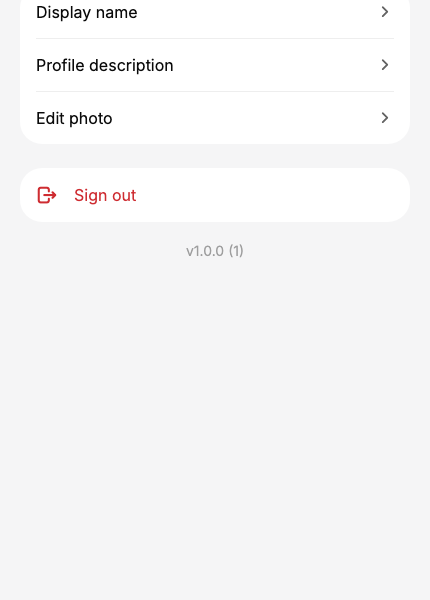
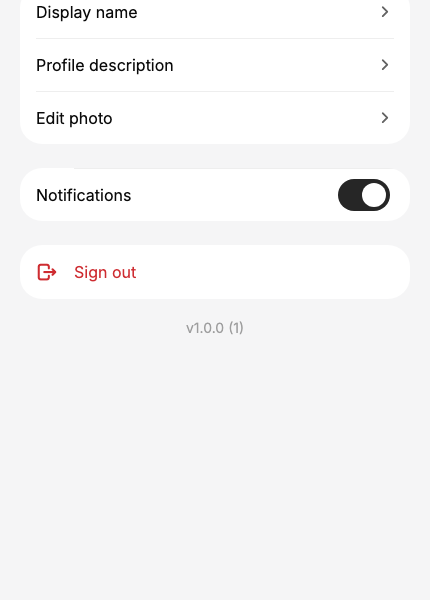
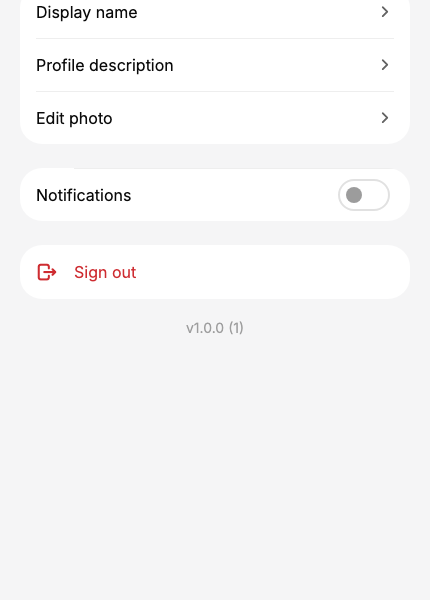
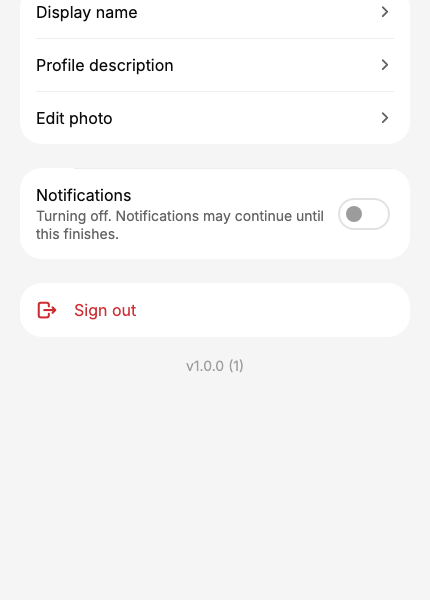
## Summary Ticket 7 of the [Android push plan](https://github.com/block/buzz/blob/main/PLANS/ANDROID_PUSH.md). Android phones can now enroll with the push gateway and publish a relay lease, through the same shared push layer iOS uses. The wake handling side is ticket 6, [#9804 Android push wake handling](https://github.com/block/buzz/pull/9804). - The phone gets an FCM token, then generates a sign-only P-256 Keystore key whose attestation challenge is the SHA-256 of the enrollment transcript. The chain goes to the gateway at enrollment. Every later installation call (delegate, rotate endpoint, revoke delegation, revoke installation) is signed with that key over the transcript bytes the gateway builds. - A rotated FCM token rotates the endpoint. Signing out revokes the delegation and the installation. The first enrollment waits a short random time. - Android 13+ asks for the notification permission at the same point iOS does. Declining keeps the app working. - A phone that cannot attest (no hardware attestation, unlocked bootloader, unlisted boot key) keeps working, and Settings says push is unavailable on this phone. - The relay lease keeps the fixed `transport` value iOS sends. - Firebase config is the same build-time setting [#9804 Android push wake handling](https://github.com/block/buzz/pull/9804) adds: four `BUZZ_FIREBASE_*` environment variables become the string resources Firebase reads. Nothing is committed, and builds without them still work (push reports unavailable). The Gradle hunks (permission, config block, `firebase-messaging` dependency) are copied from that PR verbatim so the two merge cleanly, including its `lifecycle-process` line, which this PR does not use. - The token and permission calls use their own `buzz/push_registration` channel, because Android's notification-open handler from that PR already owns `buzz/push` and a channel has one native handler. - The gateway gets an `enroll_android` transcript vector so Dart and Rust agree on the exact bytes. Enrollment state is journaled before each network attempt, so a lost response resumes with byte-identical requests instead of leaving an orphaned installation. ### Related issue None found. Builds on [#9560 enroll Android installations](https://github.com/block/buzz/pull/9560) and [#9562 verify Key Attestation](https://github.com/block/buzz/pull/9562). ### Validation Journey tests cover first enrollment, a second relay, reuse and renewal, lost responses, token rotation, an installation the gateway dropped, a lost Keystore key, a phone that cannot attest, and sign-out revocation, against a fake gateway that keeps the real gateway's semantics. Transcripts replay the shared vectors byte for byte. A settings journey checks the Notifications row and the unavailable row on Android, and a resume table checks the FCM token refresh: it runs while the relay reconnects, but not when push is off or the relay doesn't offer push. On a physical Pixel 9a (debug build, a local test gateway on a local Postgres, reached over `adb reverse`), the real Keystore key and hardware attestation chain enrolled and delegated, and the gateway accepted the attestation. The same session then ran: a signed delivery authorized against the delegation, endpoint rotation and re-delegation at the next epoch, rotating back, delegation revocation, installation revocation, and re-enrolling the same FCM token afterwards. The notification prompt appears when registration starts, before the token is fetched: <img src="https://github.com/user-attachments/assets/2aed92fe-20c1-4658-b990-51c3f3c96120" width="270" alt="Android notification permission prompt"> Not validated on the device: the FCM wake itself (the local gateway has no credentials to call FCM, so the delivery was authorized and then failed at the FCM hop), lease publication to a relay, and the in-app unavailable row, which only the widget tests exercise. A relay-backed run needs a signed-in test community on the phone. ### Settings while turning off Turning notifications off sends a relay tombstone. Until the relay accepts it, the row now says so, on both platforms. An Android build without a gateway also keeps a saved opt-in visible so it can still be turned off; once off, the row goes away. These are rendered from the Settings journey test. | | Before | After | |---|---|---| | Android build without a gateway, saved opt-in | <img src="https://raw.githubusercontent.com/block/buzz/47220acf78ad21639d2a3a8b79be3f0272e74db2/pr-9811--01-before-config-less.png" width="270" alt="Before: no Notifications row"> | <img src="https://raw.githubusercontent.com/block/buzz/47220acf78ad21639d2a3a8b79be3f0272e74db2/pr-9811--02-after-config-less.png" width="270" alt="After: Notifications row with the switch on"> | | After turning off, relay has not accepted yet | <img src="https://raw.githubusercontent.com/block/buzz/47220acf78ad21639d2a3a8b79be3f0272e74db2/pr-9811--03-before-turning-off.png" width="270" alt="Before: plain off switch"> | <img src="https://raw.githubusercontent.com/block/buzz/47220acf78ad21639d2a3a8b79be3f0272e74db2/pr-9811--04-after-turning-off.png" width="270" alt="After: Turning off. Notifications may continue until this finishes."> | ### Regressions - iOS enrollment is unchanged: the shared bridge only branches to the Dart authority on Android. iOS gains the pending opt-out subtitle, and its opt-out now also tombstones after a gateway change using the saved lease id. - The Android app gains the `firebase-messaging` dependency and a `POST_NOTIFICATIONS` permission. Backups exclude the push preferences file. ### Known limits - An FCM token rotation while the app is running is picked up on the next resume or launch, because the wake service owns the single messaging service. It could call into the registration plugin once both Android push PRs merge. - After an endpoint rotation, only the active community's lease is republished. Other enabled communities' grants are void until each is opened, the same way their leases lapse at grant expiry today. --------- Signed-off-by: Tom Brow <tomb@block.xyz> Co-authored-by: studio <dc2fc481343672df31a689840c09299972e704dac592e0da6f18486646a7ee3e@buzz.block.builderlab.xyz> Co-authored-by: studio <dc2fc481343672df31a689840c09299972e704dac592e0da6f18486646a7ee3e@localhost> |
||
|
Tom Brow
|
c477663211 |
fix(push-gateway): log which App Attest check rejected a device (#8630)
When the push gateway rejected a device's App Attest attestation or assertion, it logged the reason only at debug level. In production that left a bare `401 invalid_attestation` in the access logs, with no sign of which check failed. We hit this diagnosing an internal iPhone that never received push. Its enrollments failed with repeated `401`s, and the gateway logs could not say why. Rejections now log at warn level with: - `operation`: `attestation` or `assertion` - `reason`: the existing category, for example `certificate` or `identity` - `detail`: the specific failed check, for example `invalid AAGUID` or `invalid App ID` Malformed base64 now has its own `encoding` reason. The size, base64 and challenge checks that run before full verification now take the same path. Previously they rejected without logging anything. Without `RUST_LOG`, the gateway now defaults to `error,buzz_push_gateway=warn`, which keeps every target's errors plus the gateway's own warnings. Previously the default showed only errors, and the Helm chart sets no `RUST_LOG`, so a default deployment would have dropped these warnings. The HTTP response is unchanged and stays a uniform `invalid_attestation`. The logged fields are fixed strings, with no device or request data. Companion iOS PR [#8629](https://github.com/block/buzz/pull/8629) stops a device from replaying the same rejected enrollment indefinitely. ### Validation - Added tests: a single-test binary checks the emitted JSON warning (level, operation, reason, detail) through `AppAttestVerifier::verify_attestation`, for malformed base64, an empty proof, and malformed CBOR. Another checks that the default filter keeps gateway warnings and dependency errors, drops dependency warnings, and still honors an explicit `RUST_LOG`. Both fail when the warning is downgraded to debug or the default filter loses its `error` fallback. - The existing push gateway suite passes locally, including the App Attest rejection tests. Clippy is clean. 🤖 Generated with [Claude Code](https://claude.com/claude-code) --------- Signed-off-by: Tom Brow <tomb@block.xyz> |
||
|
Tom Brow
|
5397ea49e2 |
fix(push): verify extended App Attest proofs with a focused owned module (#8329)
## Summary Apple SDK 27.1 device captures include authenticator extension data that the current verifier rejects. Replace the general appattest dependency with a private gateway module that verifies the complete original bytes, frames enrollment and assertions separately, and accepts well-formed optional extensions without SDK-specific length or flag allowlists. The module retains established signature, P-256, CBOR, and certificate-chain libraries. App identity, exact enrollment environment, credential/key binding, nonce, challenge, and increasing-counter checks remain enforced. Bounded parsing rejects ambiguous duplicate keys, truncation, trailing data, and oversized inputs. Fixture helpers are test-only. Adapted code retains both upstream MIT notices and source provenance. Category/version properties remain authenticated observations under the chosen compatibility-release policy. This does not implement Apple's additional distribution-category/version enforcement; introducing those restrictions requires a separately defined deployment policy. The [verification contract](https://github.com/block/buzz/blob/app-attest-owned-verifier/docs/app-attest-compatibility.md) records this and other limits. Related: https://github.com/block/buzz/pull/8020 addresses assertion extension handling. This change also covers enrollment extensions, credential-key parsing, and certificate validation. ### Validation - Gateway suites: 77 default tests and 79 personal-development tests passed, plus startup policy and Clippy. - Added signed enrollment/certificate, generated CBOR mutation, maximum-counter, and PostgreSQL race/replay coverage. All 12 isolated Postgres tests passed. Apple's historical fixture is tested structurally, not accepted as a current enrollment. Positive synthetic leaf certificates are generated at test time. - Protected SDK 26.5/27.1 enrollments and assertions pass the verifier, including the same key across SDK upgrades; development enrollment rejects under production policy. Captures are personal-development identities, not supported production-identity evidence. - Full local CI passed Rust tests and reached 6,828 passing desktop JS tests before an unchanged 10 ms focus-timer test failed; its five-test file passed in isolation. The pre-push native suite had 3,421 passes and an unchanged 300 ms child-PID test failure, also passing in isolation. Prior ACP timing flakes and these unrelated hook exceptions do not waive required CI. - Windows CI exposed a missing system OpenSSL installation for the test fixture generator. The test dependency now builds bundled OpenSSL; all 30 focused App Attest tests pass locally. [Current-head CI](https://github.com/block/buzz/actions/runs/38636062347) passed, including Windows Rust, PostgreSQL, and desktop integration tests. - [Prior-head Codex review](https://github.com/block/buzz/pull/8329#issuecomment-6177515598) found no major issues. Carl subsequently identified a dropped credential-length workaround; fixed in [ |
||
|
Tom Brow
|
868e2f8f32 |
refactor(push): one app profile per gateway (#8206)
Buzz push currently selects an application profile, such as `dogfood`, during client registration. We want each gateway to serve one Apple app configured by the operator instead. This removes profile selection from the client, relay, and gateway, while allowing internal and public gateways to use their own Apple identities. This PR implements that model in the Buzz source and upstream deployment chart. Discovery, enrollment, grants, and leases no longer carry an application-profile selector. Each gateway has one configured Apple application and APNs transport. The protocol changes are incompatible with the old registration format, so relays advertise `buzz-push-v1` instead of `nip-pl`. Old clients do not discover the new push capability. Updated clients use separate Keychain records and register again. The [push notes](https://github.com/block/buzz/blob/push-capability-v1/docs/buzz-push.md) describe the experimental contract. Landing this PR is the first step. Publish the matching gateway image and upstream chart, then land the [shared chart update](https://github.com/squareup/cash-helm-charts/pull/5740) and [gateway deployment update](https://github.com/squareup/builderbot-platform-core-infrastructure/pull/1085). Before cutover, stop old gateway instances and check legacy registration state. Migrations refuse to proceed if old gateway installations or active relay leases remain; they do not delete that state. Physical-device verification remains necessary before production activation. ### Validation Gateway and focused Flutter push tests pass, as do the Swift package, simulator build, and native notification/enrichment tests. A local relay advertises `buzz-push-v1` without `nip-pl` or `app_profiles`. The PostgreSQL suite passed 868 tests; its two migration-test failures were corrected and pass a focused rerun together with the gateway cutover guard. Chart rendering and release-contract checks pass. Desktop JavaScript tests, desktop and web builds, native desktop compilation, mobile analysis/tests, and desktop native tests pass. The full Rust unit lane and prescribed `just test` command pass, including workspace integration tests against task-isolated local services. The production overlay now requires an explicitly supplied APNs topic, with omission and rendered-value regression coverage. The corrected Swift checksum assertion passes the complete package suite: 78 XCTest tests and 42 Swift Testing tests. No physical-device enrollment or production cutover is claimed. Local merge validation: the embedded migration test and formatting pass after reserving profile migration 0060 behind rollback migration 0059. The local pre-push Rust lane failed ACP timing/steering tests (`idle_resets_on_stdout_activity`, `keepalive_resets_idle_past_deadline`, and the failed/missing-outcome steering tests). ACP and its dependency manifests are unchanged by this branch; all four pass in an isolated single-thread rerun. The documented local-check exception skips only the Rust pre-push lane for publication; required CI remains mandatory. Mobile and desktop pre-push lanes passed. Combined migration validation: after rollback 0059 landed, the main merge preserves profile migration 0060 and both embedded migration assertions. The focused migration test and formatting pass. The next local push again failed only the unchanged ACP idle/keepalive timing tests (1053 passed, 2 failed, 3 ignored); other lanes passed. Publication uses the same documented local Rust-lane exception; required CI remains mandatory. Follow-up review fix: removed the legacy profile column from the copied-lease fixture. All four event-follow-up contract tests pass on isolated PostgreSQL databases, covering desired and migrated schemas in dual and app-only modes. Formatting passes. Publication retains the prior passing local-lane evidence and uses the authorized pre-push exception for the known unrelated ACP timing failures; required CI remains mandatory. --------- Signed-off-by: Tom Brow <tomb@block.xyz> |
||
|
Tom Brow
|
781d39510c |
feat(push): support configurable HTTP(S) delivery URLs (#7877)
The relay can use a configurable HTTP(S) gateway delivery URL and signs the same URL it sends. The gateway verifies NIP-98 against the received request URL, including authority, port, path and query. App Attest, scoped grants, replay checks and delivery quotas are unchanged. Forwarding proxies must preserve Host and supply the original request scheme through X-Forwarded-Proto. The NIP relay-delivery wording now defines the configured HTTP(S) URL as the signed URL and labels the public URL as an example. <!-- buzz-review-completed --> --------- Signed-off-by: Tom Brow <tomb@block.xyz> |
||
|
Tom Brow
|
7e96f91229 |
feat(mobile-infra): support development App Attest (#7744)
Development-signed iOS apps cannot enroll with the current gateway because their Apple App Attest AAGUID is rejected. Add an explicit personal development build feature and environment setting so a development gateway can use a developer's own application identity and sandbox APNs credentials. Ordinary gateway builds remain production-only. Special builds also default to production, enforce exactly the selected signed AAGUID, and retain certificate-chain, pinned-root, nonce, app-ID, key, credential-ID, and counter verification. Document the matching mobile signing configuration and expose the feature through an optional Docker build argument. ### Validation The development image deployed successfully to a personal Railway stack; private readiness, enrollment challenges, authenticated relay access, and APNs sandbox TLS/HTTP2 connectivity passed. Signed-off-by: Tom Brow <tomb@block.xyz> |
||
|
Tom Brow
|
c432a111ca |
feat(mobile): push notifications MVP (#6269)
This PR implements MVP, iOS-only,
[NIP-PL](
|