mirror of
https://github.com/block/buzz.git
synced 2026-10-31 06:21:34 +00:00
762adad54f79fc07caecbefd102aa170a9b4cce3
655 Commits
| Author | SHA1 | Message | Date | |
|---|---|---|---|---|
 Luke Tornquist |
ae689ab54d |
fix(desktop): resume reconnect replay from the last live point (#8652)
## Summary A relay rolling deploy closes every socket with 1012. On reconnect, desktop replayed each live subscription's **original filter** (startup `since`, full `limit`) unless that subscription had received an event. Quiet subscriptions therefore re-read history back to app start every time. Paged channels did this twice: they resent the original filter *and* ran the HTTP repair pages over the same window. A 1012 close also reset the backoff to the 1s minimum, so a client bounced from pod to pod during a deploy came back at roughly the same moment as every other client. **This PR makes three changes:** 1. **Resume cursor.** The subscription records `liveUntil`, when the connection closes, if it reached EOSE on that connection. That time is the last frame received from the relay, not the close itself. The session tracks that time per peer frame, independent of the stall watchdog, so a close delivered late (after a sleep, or while replay is still running) doesn't overstate how long the subscription was live. Close and error notices don't count as liveness. A frame processed more than 70s after the previous one (the stall watchdog's idle timeout plus its check interval) may have been queued through a sleep, so from then on it doesn't extend liveness for the rest of that connection. Liveness also starts fresh on every connection. If the time is unknown, the previous `liveUntil` is kept rather than guessed from the clock. The replay then uses `since = max(original since, lastSeen − 5s, min(liveUntil − 960s, now − 3600s))`. - **Why the one-hour window:** the relay can drop a fan-out frame for a client whose send buffer is full without closing the socket (`ConnectionState::send`), so continued pings don't prove a subscription missed nothing. The liveness term therefore never resumes later than an hour ago, which is the same window as the agent harness's silent-drop repair (#8653). The saving applies to history older than an hour, so it matters most for long-running clients, which is the deploy-bounce case. Older drops still reach the timeline, because auto-heal refetches the open channel's newest window on reconnect. What they miss are live-only side effects such as unread and mention badges. - **Why 960s:** the relay accepts `created_at` up to ±900s from its clock (`MAX_TIMESTAMP_DRIFT_SECS` in `crates/buzz-relay/src/handlers/ingest.rs`). An event stored after the close can therefore be backdated by that much, and the extra 60s covers client clock skew. - **Gap floors win:** a pinned failed-backfill floor still takes precedence. - **No cursor:** a subscription without one replays as before. - **Paged channels** keep their 1865s event-time lookback. 2. **Live-only REQ for paged channels.** When the HTTP repair covers the gap, the live REQ goes out as the original filter with `limit: 0`. The relay serves no stored events for it (`req.rs` passes the limit through to a SQL `LIMIT 0`). - **Backfill/live overlap:** the repair waits for that REQ's EOSE before it starts. EOSE arrives only after the subscription is registered, so live and repair always overlap. - **If EOSE never arrives**, a single 25s deadline, measured from when the REQ was sent, leads to the bounded history fallback below. The stall watchdog runs during replay, so a half-open socket that never sends EOSE or a close is reset by the watchdog rather than holding recovery. - **A reset, disposal or supersession** wakes that EOSE wait immediately, and the wait never starts for a retired connection, so a dead attempt never holds `connect()` (and the next reconnect) behind it. A `connect()` whose connection was replaced during replay settles as superseded instead of arming the watchdog. - **If EOSE never arrives, or all three repair attempts fail**, the live REQ is re-issued under the same ID with the window's bounded history (`since` = floor, `limit` ≤ 500): the pre-change behavior. The missed window still fills on this connection, and the floor stays pinned for anything the cap left out. Duplicate suppression stays on until that request's own EOSE, so events live already delivered aren't dispatched twice. If the original EOSE was never seen, a late one can't be told apart from the fallback's, so only the deadline or teardown ends suppression. Teardown also ends it, and so does a 25s deadline in case the relay drops the EOSE. A subscription disposed while the fallback is in flight still ends with a CLOSE. 3. **Reconnect spreading.** After a 1012 or 1001 close, the first attempt waits a uniform random delay in [0, 10s] instead of resetting to 1s. Ordinary backoff jitter is a symmetric ±25%, capped at 30s. The backoff resets only after the existing 60s stable-connection check, never just because a socket opened. **Simpler?** The backoff state, including its 60s stable-connection reset timer, moved out of `relayClientSession.ts` into a small `RelayReconnectBackoff` class in `relayReconnectPolicy.ts`. That makes the jitter math testable on its own. It also keeps the session file at 1199 lines, the same as `main` (its cap is 1200), even with the new liveness and replay logic; the liveness gap rule lives in `relayResumeCursor.ts`. The stall watchdog's API is unchanged from `main`. **Identified debt (not changed here):** - `relayClosedRecovery.ts` retries a retryable live CLOSED with the original filter (1s → 30s backoff), with no terminal state. - `useRelayAutoHeal.ts` sends an invalidation wave after reconnect. - The `lastSeen − 5s` term keeps its existing gap for events backdated after a close. - `liveUntil` means the subscription was registered, not that every event was delivered. The one-hour window bounds this: a dropped fan-out frame older than an hour on a quiet subscription isn't re-read over the websocket. The fix is a relay-side drop signal, the same follow-up as #8653's. - An HTTP repair page that is already in flight when the socket resets still holds `connect()` until it returns, as on `main`. The native HTTP client sets no request timeout. - A `limit: 0` REQ still makes the relay acquire a reader for an empty query. ### Related issue N/A. This is part of a set of reconnect-load reductions. Companion PRs: relay read-pool warm (#8651), agent harness (#8653) and mobile (#8659). ### Testing - **Full desktop gate** on a Linux workstation at `045030c4`: - `pnpm typecheck`, `pnpm check` and the file-size check pass. - `pnpm test`: 6901/6901, plus 165/165 jsdom. - `pnpm build:e2e` passes. - The `relay-reconnect` Playwright spec passes, including the restart spread draw, which passed 10/10 repeats. - **New or extended tests** (`node:test`): - `relayResumeCursor.test.mjs`: a table test over the cursor inputs, including the one-hour window, plus the liveness gap rule. - `relayClientResumeCursor.test.mjs`: drives the real `RelayClient`. It covers a dropped fan-out followed by pings, a frame queued through a sleep, fresh credit per connection, a half-open socket reset by the watchdog during replay, and a reset or disposal while parked on EOSE. - Extended: `relayReconnectReplay` (deadline from send, a single timeout → fallback, a late original EOSE, fallback dedupe and CLOSE convergence), `relayReconnectPolicy` and `relayClosedRecovery`. - **Mutations:** each guard was reverted and failed at least one test. That covers every cursor term, the 900 + 60 skew, the one-hour window, `limit: 0`, the EOSE wait, its deadline and its timeout, floor precedence, EOSE generation stamping, the last-inbound cap and gap rule, the per-connection reset, the watchdog starting before replay, fallback dedupe, the late-EOSE guard, the 1001 match, the backoff reset, the restart spread and jitter symmetry. - **Exercised against a real relay** (PG16 and Redis) in a relay-backed desktop build, with Chromium on a Linux workstation, base `b310fea0` vs head `045030c4`. Each channel was seeded with 200 reactions and 3 messages, all two hours old: | | Base | Head | |---|---:|---:| | Quiet channel, stored events replayed over the websocket | 204 | 1 | | Paged channel, stored events replayed over the websocket | 50 | 0 (`limit:0`) | | Paged HTTP repair, events returned | 204 | 1 | | Event-query calls / rows returned | 68 / 895 | 73 / 441 (−50.7% rows) | - **21-minute process freeze:** the watchdog fired first. The quiet cursor matched `max(lastSeen − 5, min(preFreeze − 960, now − 3600))` exactly, and 3/3 messages posted during the freeze were recovered once each. - **Drop before the paged EOSE:** `connect()` released in 13ms. The next dial followed on the normal backoff, and the message arrived once. - **Half-open socket** (all relay frames withheld, no close): the watchdog reset it at 60.0s, the next dial came 1.2s later, and both messages were recovered once each. - **Earlier run at `180dc9ae`, before the one-hour window, relay restart (1012):** the quiet channel resumed from last inbound − 960s. At this head that cursor is also capped at now − 3600s. The paged channel sent `limit:0`, with repair starting about 45ms after EOSE. Both messages posted during the bounce were delivered, including one backdated 600s. The first reconnect came about 8s after the close. buzz-review-completed 🤖 Generated with [Claude Code](https://claude.com/claude-code) --------- Signed-off-by: Luke Tornquist <tornquist@squareup.com> Co-authored-by: Elrond <28d6302a099e5225b02c4155ac4236e4912603df2ab08dbfc2f4fef08ce598c8@buzz.block.builderlab.xyz> Co-authored-by: Claude Opus 5.5 <noreply@anthropic.com> |
||
|
Brad Seiler
|
d6196a16c1 | fix(relay): revoke invitations and restrict claims (#8237) | ||
|
Matt Toohey
|
6861e18a86 |
fix(desktop): keep FileCard inside narrow message rows (#8612)
## Summary Non-image attachment cards ran past their message row in the thread side pane, and the download icon was clipped off. `FileCard` is an `inline-flex` box, so it shrinks to fit its content and is never narrower than its min-content width. That width comes from the `truncate` (nowrap) filename. The only width cap was `max-w-sm` (24rem), so a long filename pushed the card out to the full 24rem even when the pane body was only about 300px wide (the default 380px thread pane). - Add `max-w-full`, so the cap becomes `min(24rem, 100%)`. The flex column ancestors already have `min-w-0`, so the percentage resolves against the pane width. The card shrinks, the filename gets an ellipsis, and the size and download icon stay visible. Wider surfaces (forum posts, DMs, wide timelines) look the same because 100% is wider than 24rem there. - Add a Playwright regression test in `file-attachment.spec.ts`. It seeds a text attachment with a long filename and opens its thread. It then checks that the card and its trailing icon stay inside the row and that the filename is actually truncated. Without the fix, the card's right edge lands about 82px past the row. ## Before / After | Before | After | | --- | --- | |  |  | Measured in the default 380px thread pane: before, the card's right edge sits at 1342px against a row edge of 1260px (+82px overflow); after, it sits at 1252px (8px inside the row). 🤖 Generated with [Claude Code](https://claude.com/claude-code) --------- Signed-off-by: Matt Toohey <contact@matttoohey.com> Co-authored-by: Claude Fable 5.1 <noreply@anthropic.com> |
||
|
klopez4212
|
5fefec604f |
fix(mobile): restore channel icons and align chat colors with desktop (#8478)
## Summary - Restores `#` and lock icons for public and private channels on Home, with matching loading placeholders. - Updates the dark-mode navigation colors to the desktop design-system tokens (read and unread text, section headings). - Replaces the chat color picker with the seven desktop accents (Gray, Chartreuse, Flame, Magenta, Iris, Cobalt, Jade). Saved legacy colors map to the closest one. - Uses white text in your own bubbles, and black where white falls below 4.5:1 (Chartreuse, dark-mode Gray). Links (underlined), quotes, tables and code use the same text color. - Insets code blocks in bubbles evenly, with corners concentric to the bubble and even inner padding. - The swipe-to-reply indicator uses the chosen chat color. ## Testing - `flutter analyze` and `dart format` are clean. The full mobile suite passes (3,705 tests). - Installed and checked on a Pixel 10 and an iPhone Air against a real community. 🤖 Generated with [Claude Code](https://claude.com/claude-code) --------- Signed-off-by: kenny lopez <klopez4212@gmail.com> Co-authored-by: Terp <5856f6900e8e0a4e0ea1f4f8d2ee33e4753d2119bc122f94ecafc660b46c0511@buzz.block.builderlab.xyz> Co-authored-by: Queue <874bf2d815c2c4b459b90438c669c57f2702f3a76bb6e16fa97184259aac3e9e@buzz.block.builderlab.xyz> Co-authored-by: Claude Opus 5.5 <noreply@anthropic.com> |
||
|
VSCteam
|
99924a5a69 |
fix(desktop): repair the Windows notification shim's false denial on read (#5600)
Addresses #2445. Closely related to #2483 -- see "Relationship to #2483" below; I am happy to close this in favour of that one. ## The problem On Windows the notification plugin's injected shim decides its permission at startup like this ([`guest-js/init.ts:12-18`](https://github.com/tauri-apps/plugins-workspace/blob/v2/plugins/notification/guest-js/init.ts)): ```ts if (window.Notification.permission !== 'default' || __TEMPLATE_windows__) { return await Promise.resolve(window.Notification.permission === 'granted') } return await invoke('plugin:notification|is_permission_granted') ``` `__TEMPLATE_windows__` is replaced with the literal `true` on Windows, so the `||` short-circuits and the shim compares its own freshly-initialised `'default'` against `'granted'` -- `false` -- and stamps **`denied`**. The line that would ask the backend is unreachable, and the backend would have said yes: `permission_state()` returns `PermissionState::Granted` unconditionally on desktop. So on every launch of the Windows app, `window.Notification.permission` is `denied` and nothing in the OS is denying anything. ## Why the toggle is only half of it `getDesktopNotificationPermissionState()` trusts that value, so `refreshPermission()` reports `denied` at mount, and this effect in `hooks.ts` runs before the user touches anything: ```ts React.useEffect(() => { if (settings.desktopEnabled && (permission === "denied" || permission === "unsupported")) { setSettings((current) => ({ ...current, desktopEnabled: false })); } }, [permission, settings.desktopEnabled]); ``` It writes `desktopEnabled: false` and persists it. Measured on a real install: with alerts successfully enabled and `desktopEnabled` persisted as `true`, a clean relaunch comes back with it persisted as `false`. That means fixing only the enable path leaves a Windows user re-enabling alerts after every restart. ## What this changes One place: `getDesktopNotificationPermissionState()` repairs the bogus value instead of reporting it. ```ts if ( window.Notification.permission === "denied" && isTauri() && isWindowsPlatform() ) { try { return await requestDesktopNotificationAccess(); } catch { return window.Notification.permission; } } ``` `requestPermission()` is the only call that reaches the backend, and on Windows it raises no prompt, returns `Granted`, and rewrites the shim's cached value -- so this is self-limiting: the next read short-circuits as `granted` and never requests again. There is a test for exactly that. Repairing at the read rather than at the toggle fixes every consumer at once, including `sendDesktopNotification()`, which gates delivery on `=== "granted"` and would otherwise drop notifications at boot. - `denied` stays terminal on macOS, on Linux, and on ordinary Windows web pages. - A denial that survives the request is still reported as `denied`. - A rejected request falls back to the current value instead of propagating; callers do not handle rejections today. - Adds `isWindowsPlatform()` to `shared/lib/platform.ts`, alongside the existing `isMacPlatform()` / `isLinuxPlatform()`. - No new dependencies. No changes to `hooks.ts` or to notification delivery. ## Verification on a real Windows 11 install Buzz Desktop 0.5.9 release build, Windows 11 Home 10.0.26200, WebView2 151.0.4129.72, attached over CDP. Clean boot, nothing injected: ``` window.Notification.permission -> "denied" localStorage[...].desktopEnabled -> false (written by the effect above) await window.Notification.requestPermission() -> "granted" window.Notification.permission -> "granted" new window.Notification("Buzz", { body: ... }) ToastNotificationManager::History .GetHistory("xyz.block.buzz.app") -> 3 -> 4 (real toast delivered) CreateToastNotifier(...).Setting -> Enabled ``` The OS was permissive throughout: no `ToastEnabled` override, no notification policy keys under HKCU or HKLM, and the app present under `HKCU\...\Notifications\Settings\xyz.block.buzz.app`. Full detail in [this comment](https://github.com/block/buzz/pull/2483#issuecomment-5255972424). To be precise about scope: this confirms the mechanism the patch relies on, measured on a stock release build. The patched build itself is covered by the unit tests below, not by a packaged Windows run. ## Tests `pnpm test` -- full desktop suite. New cases in `lib/desktop.test.mjs`: - Windows Tauri repairs the shim's false denied state on read - the repaired state is cached, so later reads do not request again - a denial that survives the request is reported as denied - denied stays terminal outside the Windows Tauri app (Windows web, Linux Tauri, Linux web) - granted is returned untouched and never triggers a request Plus `shared/lib/platform.test.mjs` for `isWindowsPlatform()` across `Win32` / `Win64` / `Windows` and `MacIntel` / `Darwin` / `Linux x86_64`. ## Relationship to #2483 #2483 fixes the same root cause at the toggle: it retries the request inside `setDesktopEnabled`. That makes the toggle work, which is what #2445 reports, and its `ensureDesktopNotificationPermission` helper is a nicer shape than an inline condition. The difference is where the repair happens. Because #2483 leaves the mount-time read as `denied`, the effect quoted above still turns the setting off on every launch, so the fix does not survive a restart. Repairing at the read covers the toggle path too, since `setDesktopEnabled` calls `refreshPermission()` first and finds `granted`. The two overlap: both add `isWindowsPlatform()` to `platform.ts`, so whichever lands second needs a trivial rebase. If maintainers prefer #2483's shape, the equivalent of this PR is to call its helper from `refreshPermission` as well as from `setDesktopEnabled` -- I am glad to close this and send that instead. I did not want to push changes into someone else's open PR uninvited. ## Once this lands #2445 can close. I am running a per-machine launcher workaround for a small Windows team until then, which this makes unnecessary. Signed-off-by: VSCteam <144167621+Joxyko@users.noreply.github.com> |
||
|
Will Pfleger
|
836e7d0d06 |
feat(desktop): browse and moderate every community in the Admin Console (#8027)
The Admin Console only ever saw the community the desktop happened to be connected to. With #8011's community reads, the console can now browse every community on the relay and, for signed staff, moderate any of them by name without switching connections. 🤖 ## What changes - **Communities tab.** Lists every live community on the relay, searchable by host prefix with "Load more" paging. The connected community is pinned at the top by exact host match. Report rows get a community badge that opens that community. - **Community page.** Reports, Restrictions, Members and Actions, each scoped to the community on the page. The Actions form has no host field: it always acts on the page's community, and the TypeScript host normalization is gone from the Actions tab. - **Native reads** (`admin_list_communities`, `admin_search_members`, `admin_get_member`, `admin_get_event`). Every request validates the explicit community host and NIP-98-signs the real method and URL. Failures come back as a structured error (`status`, `bodyComplete`, `bodyEmpty`, `code`), so the UI can tell an older relay's empty 404, a coded `event_not_found` and a transport failure apart, and never says "not found" unless the relay did. - **Explicit-host lifts.** `admin_lift_restriction` sends the page's community host, not the active relay's. It freezes the relay and signer the intent was reviewed under, and refuses to send if either has changed. - **Pending actions survive navigation.** A panel-level `DirectActionsProvider` holds the frozen intent, so switching communities or tabs mid-confirm doesn't lose it. Only Discard drops it. A signer change remounts the controller and drops it. - **Fenced lookups.** Member and event lookups are keyed by origin, signer, community, target and a generation counter, so a late answer for one community can't unlock Review in another. - **Shared member picker** (`MemberSearchResult`, also used by Add Member), showing the truncated npub so members with the same name can be told apart. Delete accepts a note link and previews the message before Review. Relay staff are blocked before Review. - **Disabled admin auth is read-only.** With `BUZZ_ADMIN_AUTH=disabled` the Communities tab and community pages still render, and report badges still open them, but every ban, timeout, delete, add-member and lift control is disabled. The settings badge says the console is read-only and that acting needs `nip98`. Staffing stays hidden. - #7904's protections in the Actions tab are kept: frozen intent, `requestId`, Retry, `notSent` and the key-backup guard. - **Readable load errors.** Admin list and detail loads show the relay's error message (for example "request is not authorized"), never the raw JSON envelope. - **Failed kicks reload the report.** A resolve that fails with `enforcement_failed` reloads the report, so its failed action and "Cancel & reopen" appear immediately. - **Key backups never leave in a search.** Every admin API request URL passes the NIP-49 key-backup guard before it is signed or sent: community and legacy reads, mutations, the connection probe (before its first, unsigned request) and feedback-attachment fetches. The community and member search boxes, including the directory's Load more, refuse a pasted `nsec` or `ncryptsec` anywhere in the input without calling the relay. - **`just admin-seed` for multi-community testing.** Besides the local community, it seeds `beta.localhost:3000`, `gamma.localhost:3000` and 50 filler communities, with named members, a ban and a timeout in each named community, a report with Kick available, and a message for the delete preview. Rerunning it restores all of that to the starting state. It refuses, writing nothing, while a moderation action is unfinished on a seeded report. - The bodyless `GET /events/{id}` preview is added to the events-URL egress inventory. It sends no body, so it carries no key material. ## Tests Native (Rust): - `empty_404_and_405_read_as_complete_and_empty`, `coded_404_carries_the_relay_code`, `truncated_and_over_cap_bodies_are_incomplete`, `transport_failure_has_no_status`: the structured read error tells an older relay, a coded refusal, a cut-off body and a transport failure apart. - `a_401_retry_is_signed_by_the_same_keys`, `lift_signs_the_send_and_401_retry_with_the_checked_keys`: the 401 retry never switches keys. - `read_urls_validate_the_explicit_host_and_encode_the_query`, `lift_url_sends_the_page_host_not_the_active_relay`, `list_url_carries_host_and_cursor_and_refuses_a_changed_relay`, `lift_refuses_before_sending_on_signer_change_or_bad_host`: requests target the explicit host and refuse to send after a relay or signer change. jsdom: - `actions-pending-nav`: a pending intent survives a community change, and only Discard drops it. - `actions-fenced-lookup`, `fenced-load`: a late lookup for an old key never shows under, or unlocks, the new one. - `actions-same-ids`: the same pubkey and event id are read separately in each community. - `actions-community-change-drops-member`, `actions-page-host`, `actions-success`, `actions-identity`: the form acts only in the page's community, and confirm sends the frozen intent. - `actions-preview-errors`, `actions-delete-link`, `actions-staff-target`, `actions-disabled-auth`: preview errors, delete by note link, the staff block, and community pages rendering read-only with every action control disabled under disabled admin auth. - `communities-directory`, `communities-unsupported`, `community-badge`, `community-badge-disabled-auth`: the directory, older relays, and report badges, which open community pages under disabled admin auth too. - `restrictions-lift-signer-change`. The existing restriction tests now run on the community page and use `admin_lift_restriction`. Mutation checks: removing the pending-navigation guard turns `actions-pending-nav` red, and dropping the host from the fence key turns `actions-fenced-lookup`, `actions-same-ids` and `fenced-load` red. Ungating restriction lifts on `canMutate` turns `actions-disabled-auth` red. --------- Signed-off-by: Will Pfleger <pfleger.will@gmail.com> Co-authored-by: Hayt <211b96e6a2b7f45fd4047988976c7bbbeeda0c15f3ae7b32eec20834b5a55118@buzz.block.builderlab.xyz> Co-authored-by: Duncan <dcfd242e557282d7a1e2cf2e6877522682f1e5c6156dc92ca7d90eaedd3b0f95@buzz.block.builderlab.xyz> |
||
|
Will Pfleger
|
9c6fa14aa0 |
feat(desktop): offer Claude effort levels in agent edit and create (#8059)
Claude Code agents now get a thinking-effort dropdown in the agent Edit and Create dialogs, matching the one buzz-agent and Codex agents already have. ## Behavior - **Where levels come from:** Claude effort levels come from the Claude model data for the model that will actually run after Save, resolved in order: explicit model, then inherited default (linked definition or global), then adapter default. Stored Claude session levels are not used, because the stored session data does not record which model produced them. - **Edit:** for an agent linked to a definition, effort follows the definition's model, which stays authoritative. Save never sends a model for linked agents. - **Create:** effort is offered for local agents only and is stored on the instance. Allowed levels are recomputed on every render, so collapsing Advanced and then switching to a model without effort (e.g. Haiku) drops effort from the request. Non-local effort is rejected before any create side effects. - **Persistence:** `create_managed_agent` sets the picked effort when it builds the record and drops stale effort env aliases. Its body runs over any Tauri runtime, so a mock-app test drives the real create path and reads the record back from disk. That test runs in a child process with temp app-data and nest folders, and a test-only switch turns keychain use off so agent keys stay inline in the temp agent file and the OS keychain is never touched. - **Observer store:** live session-config captures are written to the store before the dialog refreshes; archived captures are read-only. - **Codex:** its existing session-native effort picker is unchanged. --------- Signed-off-by: Will Pfleger <pfleger.will@gmail.com> Co-authored-by: Hayt <211b96e6a2b7f45fd4047988976c7bbbeeda0c15f3ae7b32eec20834b5a55118@buzz.block.builderlab.xyz> |
||
|
Carlos Jimenez
|
fcf5f044b3 |
fix(desktop): use object-scale-down for inline markdown images (#4686)
Fixes #4384. A dim-less markdown image with no cached decode gets `DEFAULT_IMAGE_RESERVE = { height: 256, width: 384 }` and `useFixedReserveBox: true` in `resolveImageReserveBox`. The frame is that big on first view, and the inline `<img>` uses `object-contain` which scales UP to fill the frame — so a 46×20 shields badge renders as a giant blurry block. The same message renders at the natural size on the second view because `rememberDecodedImageDimensions` populates the cache, but the inconsistency between first and subsequent view is the bug. Switches `object-contain` → `object-scale-down` on `ProgressiveImage.tsx`'s shared `IMAGE_CLASS`. Both `object-contain` and `object-scale-down` scale down to fit, but only `object-scale-down` also refuses to scale up — a small image now sits centered in the reserve box on first view, never upscaled. The layout-shift guarantee for large images is preserved (they still scale down to fit the reserve), matching the issue's stated constraint. Chose option 2 ("Alternatively/minimally") from the issue over option 1 because: - It's a one-class-name change with zero new state, zero new effects, and zero risk to the existing layout-shift guarantee that the surrounding `useFrozenImageReserve` is explicitly designed to preserve. - Option 1 (collapse the frame on decode) is the issue author's preferred direction but requires deciding whether the layout shift is acceptable *shrink*-only — a direction question that should be confirmed with the maintainer first. The issue explicitly says "Happy to open a PR for option 1 if the direction is acceptable" — that's the sign-off step, not this PR. If maintainers want the full first-view-equals-second-view behavior, option 1 is a follow-up that builds on this base. Not added: a regression test. The current desktop test infra (`desktop/src/shared/ui/markdown/markdown.test.mjs` and siblings) doesn't cover `ProgressiveImage` directly; a DOM-style snapshot would need a new test harness. The change is one CSS class name; the visual regression is plain to eyeball in the screenshots CI already captures. Verified: - `pnpm check` (biome + file-sizes + px-text + pubkey-truncation) — clean - `npx tsc --noEmit` — clean Signed-off-by: kushaim <carlossilvajimenez@gmail.com> Co-authored-by: kushaim <carlossilvajimenez@gmail.com> |
||
|
Will Pfleger
|
83aab8cb5c |
feat(desktop): remove communities locally and stop their agent pairs (#7997)
🤖 Leave contacts the relay before it removes anything locally: it checks the relay's `/info` for NIP-43 membership support, then waits for the relay to accept a signed leave request. When a relay has been torn down, that check fails, Leave throws, and the community stays in the rail. Removing a community also left its relay's managed agent pairs running, and they kept reconnecting to it until the app was quit. **Remove from this device** - A new community action, **Remove from this device**, sits under **Leave community** in the profile menu's community actions. It never contacts the relay. A confirm dialog explains that relay membership isn't revoked. - `useCommunityNavigationTransitions` splits the old `removeCommunity` into `removeCommunityFromDevice` (local-only cleanup and navigation to a fallback community or the discovery screen) and `leaveAndRemoveCommunity` (calls `leaveCommunity`, then runs the same cleanup). Leave's flow hasn't changed. - When Leave fails, the error now adds: "If the community no longer exists, use Remove from this device." The error shown when community discovery state can't be saved no longer says "Membership was removed", so its wording fits both actions. **Agent pairs on a removed relay** - Once the local removal completes, the shared cleanup stops every live agent pair on that relay, including manually started ones. It matches relays with `canonicalRelayUrl`. Stopping is best-effort: failures are logged and the removal still completes. Pairs on other relays aren't touched, and nothing is stopped if another community still uses the same relay. - Both reconcile call sites (`useManagedAgentRuntimeReconciliation` and `bootstrapManagedAgentRuntimePairs`) now go through `reconcileConfiguredManagedAgentRuntimes`. A reconcile that is already running in Rust can't be cancelled, so after it resolves, this helper stops any pair it started whose relay is no longer in the saved community list. - Launch restore runs in the background after `apply_workspace` and can finish after its community is removed. `apply_workspace` takes a restore ticket (the current `launch_restore_generation` in `AppState`) before handing its lock to the restore task. Removing the active community calls the new `invalidate_launch_restore` command, which bumps that generation while holding the runtime transition lock. `restore_managed_agents_on_launch` re-checks its ticket under the same lock and spawns nothing if it changed. If restore takes the lock first, its pairs are registered before invalidation returns, and the removal stop then finds them. Removal never changes `relay_url_override`: the outgoing relay stays applied until the next `apply_workspace`, exactly as on `main`, so in-flight work never falls back to the default relay. Invalidation never takes `workspace_apply_lock`, which restore holds while waiting on the transition lock, so lock order is unchanged. - With no relay applied, backend readers fall back to the default relay, the same state as launch before the first `apply_workspace`. A normal quit and relaunch doesn't bring a pair back on a removed relay: restore targets the applied workspace, and the legacy per-record relay pin is ignored. **Tests** - A `community-rail` e2e case makes the mocked relay's membership check fail, the way an unreachable relay does. It checks that Leave shows the error and keeps the community, and that Remove from this device then removes it, switches to the fallback, stops the agent pair on the removed relay, and leaves the pair on the other relay running. - Unit tests in `managedAgentRelayCleanup.test.mjs` cover relay matching, a stop or listing failure not throwing, and the reconcile fence stopping a pair that started on a relay removed mid-flight. --------- Signed-off-by: Will Pfleger <pfleger.will@gmail.com> Co-authored-by: Duncan <dcfd242e557282d7a1e2cf2e6877522682f1e5c6156dc92ca7d90eaedd3b0f95@buzz.block.builderlab.xyz> |
||
|
Will Pfleger
|
bd0896f5c0 |
fix(desktop): read channel metadata and member lists from writer after writes (#7999)
🤖 This fixes two problems with the same cause. Since #3268, the relay can answer an unpinned `/query` from the Aurora read replica, as long as the replica has proved it's within `BUZZ_REPLICA_READ_MAX_AGE_MS` (1000 ms) of the writer. That's fine for display reads, but it doesn't guarantee a client sees its own write. **Problem 1: channel creation (Wes's report).** Right after creating a channel, the desktop read back the channel's kind:39000 metadata by `#d`. If that read landed on a replica that hadn't replayed the event yet, it failed with `channel created but metadata not yet available`. The channel existed, but the chosen template (canvas, agents) was never applied. **Problem 2: member lists.** After any membership change, the member-list refetch could also hit a lagging replica. The relay returned the list from before the change, and the desktop cached it as fresh for five minutes (`CHANNEL_MEMBERS_STALE_TIME_MS`). Someone just removed could still show as a member, or someone just added could be missing. ## Fix 1: metadata read-backs go to the writer `channel_metadata_filter` is a shared builder that adds `"consistency": "strong"`, so the relay serves the read from the writer. It follows the same pattern as the canvas head reads. All four metadata read-backs that follow a write use it: `create_channel`, `update_channel`, `fetch_starter_channel_metadata` (its retry and fallback are unchanged) and the open-DM refetch in `dms.rs`. A unit test fails if the flag is removed from the builder. The template's agent-add step also reads channel members (kind:39002) right after create. `get_channel_members` takes an opt-in `read_your_writes` flag that sends `"consistency": "strong"`. Only `createChannelManagedAgents` sets it on that path, so the agent-add step sees the creator's membership. ## Fix 2: a 31-second writer-read window after membership changes Every membership write the desktop makes calls `noteChannelMembershipChange` for each channel it changed: - the native write wrappers `createChannel`, `openDm`, `joinChannel`, `leaveChannel`, `addChannelMembers`, `removeChannelMember` and `changeChannelMemberRole` - the Bestie conversation open - huddle agent add and remove, for both the huddle channel and its parent - `ensure_starter_channels` and `sync_agents_to_active_huddle`. Both return every channel they created, joined or changed in `changed_channel_ids`, including ones that landed before a later step failed. The original error text is rethrown unchanged. - live join, leave, removed and `admin_kick` system messages, and member-added and member-removed notifications - a report kick resolved from the Admin Console, once the relay confirms it succeeded and only when the report's channel is in the active community. The kick goes through the admin HTTP API, not a channel event. Ban, timeout and their lifts only change `community_bans`, not channel membership, so they need no record. For 31 seconds after a change, measured on `performance.now()`, `getChannelMembers` for that channel sends `readYourWrites`. Why 31 seconds: the relay caps its replica staleness budget at `FENCE_STALENESS` (30 s), so once the window closes, no supported configuration can serve the pre-change list. The constant's comment ties it to `FENCE_STALENESS`. One app-level listener cancels any roster fetch already in flight and refetches. When it registers, it also refreshes every channel whose window is still open. All other member-list reads still use the replica. **Community switch.** The window map is cleared when the community changes. Each awaited write captures a generation through `beginChannelMembershipWrite()` before its first native call, and the reset advances it. So a write that settles after a community switch records nothing in the new community. Live events don't need this fence, because the reset disconnects the relay client first and frames from the old connection are dropped. ## Coverage - A Rust test drives `ensure_starter_channels` against a stub relay that accepts the creates but never serves metadata, and checks that both created starter channels are still reported. - Desktop tests cover the writer-read window, the Admin Console kick, and writes that settle after a community switch. - The desktop E2E test bridge (`desktop/src/testing/e2eBridge.ts`) mirrors the strong reads and `changed_channel_ids`, so E2E runs exercise the fixed behavior. This doesn't address the smaller race in the relay's per-pod accessible-channels cache, and it doesn't change mobile. --------- Signed-off-by: Will Pfleger <pfleger.will@gmail.com> Co-authored-by: Duncan <dcfd242e557282d7a1e2cf2e6877522682f1e5c6156dc92ca7d90eaedd3b0f95@buzz.block.builderlab.xyz> |
||
|
Will Pfleger
|
9b1c4f98e2 |
🤖 perf: bound long-thread aux reads and make query deadlines terminal (#7854)
Long threads (over ~100 replies) time out in desktop. The aux hop that
loads reactions and other e-tag references builds its filter as one
`tags @> …` term per id, joined with `OR`. Past about 100 ids the
planner switches to walking each partition's primary key backward,
expecting to stop early. When few rows actually match, it scans the
whole community. With a dirty GIN pending list, a 188-reply thread never
finishes.

### What changes

- **Set-based e-tag reads (`buzz-db`).** The aux e-tag query now puts
the id set behind a `MATERIALIZED` CTE and matches with `ANY`. Each
e-tag read also runs under a transaction-local `statement_timeout` of 20
s.
- **Terminal timeout contract (`buzz-relay`).** When a read hits the
deadline, the client gets a terminal timeout (`CLOSED` for REQ, the
timeout error for COUNT and search), not a retryable failure.
- **Subscription lifecycle (`buzz-relay`).** The per-connection
subscription map lock is now the lifecycle lock. Claims, replacement,
client `CLOSE`, owner-checked timeout and search cleanup, revoke, and
connection teardown all change the map, the registry, topic refcounts
and terminal frames while holding it. As a result, a timed-out
subscription's `CLOSED` goes out before any replacement with the same id
can claim it, and claims made after teardown are refused.
- **Dropped terminal frame disconnects (`buzz-relay`).** If the `CLOSED`
for a retired subscription (owner-checked timeout or channel eviction)
can't be queued, the relay cancels the connection instead of leaving the
client holding a subscription that will never receive fan-out. A
client-initiated `CLOSE` ack is exempt.
- **COUNT under the same deadline (`buzz-db`).** The fast COUNT path
runs e-tag counts under the same transaction-local 20 s cap as SELECT,
so WS COUNT and HTTP `/count` produce the terminal timeout too.
- **Replica reads surface the deadline (`buzz-db`).** When a
replica-routed read is cancelled by `statement_timeout` (SQLSTATE
`57014`), the error is returned instead of re-running the query on the
writer, which would run the same slow statement. Other replica errors
still fall back to the writer.
`PLANS/REPLICA_FULL_READ_ROUTING_DESIGN.md` records the exception.
- **Deadline handling (desktop).** Only the relay's `query timed out`
counts as a query deadline. A client-side `request timed out` stays
retryable. For one-shot reads a deadline is terminal: the global query
retry (budget 1), thread-replies retry and reaction hydration don't
re-send the same slow query. Reaction ids held back by a deadline are
released when the channel is opened again, so reopening retries them
while same-channel re-renders don't. Live subscriptions, in both the
renderer and the native archive-sync socket, keep treating a deadline
`CLOSED` as transient: they back off and resubscribe with the same
filter instead of being dropped.
- **Deadline handling (mobile).** Mobile recognizes the deadline on both
transports: HTTP `503 {"error":"query timed out"}` and the WS `CLOSED`
reason.
- The root `ProviderScope` retry policy returns no retry for deadline
errors and keeps Riverpod's default backoff for everything else.
  - Background thread-summary recounts don't retry a deadline.
- Forum posts polling pauses while the last load settled on a deadline;
reopening the forum retries.
- A channel's newest-window load surfaces a deadline instead of falling
back to legacy WS history, and the channel list's batched queries return
"unavailable" on a deadline instead of fanning out to per-filter
fallbacks. An unavailable batch is not treated as empty. Known
last-message timestamps and unread state are kept, and unread catch-up
moves `lastMessageAt` forward (never backward) the same way live events
do, so a cold start with no known timestamp still gets one.
- A live subscription that gets a deadline `CLOSED` backs off and
resubscribes with the same filter. History requests still fail on it.
- Settled load failures show a Retry control, matching desktop's
thread-replies error card: a shared `LoadErrorView` on the channel
timeline, forum thread and forum posts list, and an icon button beside
the thread replies summary. While the thread query has no value, the
thread page shows the route snapshot plus live, cached and optimistic
replies, with the loading or error status still visible.
- Other re-sends (reconnect, foreground resume, live events, the unread
backstop, scroll) are not suppressed; each is bounded by the relay's 20
s statement deadline.
- **Long-thread seeder.** `just seed-long-thread [replies]` posts one
thread (default 187 replies) with some reactions to the local dev relay,
for reproducing long threads in the apps. It uses a throwaway key,
refuses non-loopback relays and ignores ambient `BUZZ_*` credentials.
Writes are paced to fit the stock relay rate limit.

**Lifecycle concurrency.** The lock serializes one connection's
subscription changes. Other connections can still be delayed by pressure
on the shared pubsub command queue, and by serial eviction loops waiting
behind a blocked connection. This PR does not claim strict isolation
between connections.

**Recovery vs. load.** Clients stop automatic retries of the same
one-shot read, but they don't remember deadlines across other triggers:
reconnect, resume, live events and the unread backstop can each send the
read again later, bounded by the 20 s statement deadline. A live
subscription that hits the deadline resubscribes with its original
filter under the existing 1–30 s backoff, and against a filter that
keeps timing out it retries at the 30 s cap indefinitely, so the worst
case is one bounded query per subscription every 30 s. `since` is
deliberately not advanced to now on resubscribe, because that would skip
events missed while the subscription was closed. Unchanged from `main`:
when mobile's channel history sync fails with cached messages available,
the cached messages are shown without the error or Retry control.


### Benchmark

Local reproduction on an isolated bench stack (not committed):
- PG16, migrations applied, one 188-reply thread plus 5M background
events in the same community.
- Each request replays the desktop thread-replies filter through the
relay, with `include_aux` on. Times are total ms for 3 runs, with a 60 s
client cap.

GIN pending-list state is controlled with `VACUUM` (clean) or by
refilling the pending list (dirty), and recorded per partition with
`pgstatginindex`. Dirty runs held 402 pending pages on every partition's
tags index at the start and end of each matrix. Clean runs held 0–1
pages (relay startup writes).

| build | GIN pending state | limit 10 | 50 | 100 | 200 (188 ids) |
|---|---|---|---|---|---|
| `main` | clean | 26 / 16 / 13 | 56 / 51 / 52 | 92 / 93 / 95 | 662 /
639 / 641 |
| `main` | dirty | 315 / 298 / 327 | 22141 / 15888 / 16769 | 28992 /
27819 / 28080 | timeout ×3 (>60 s) |
| this PR | clean | 35 / 21 / 14 | 57 / 49 / 48 | 82 / 80 / 75 | 153 /
150 / 135 |
| this PR | dirty | 290 / 254 / 251 | 1257 / 1204 / 1206 | 2432 / 2378 /
2382 | 4333 / 4706 / 5104 |

Baseline `origin/main` `b37e47721`; this PR at `5f2650f5f`, whose e-tag
read builders are identical to the current head. At head `1ad81d868`
against `origin/main` `15d44dcce`, limit 200 measured 145–179 ms clean
(`main` 683–715) and 4.41–4.51 s dirty (`main` timeout ×3).

Every completed cell returns the same signed event set: 209 events, 187
replies at limit 200. With `include_aux` off, every cell is ≤66 ms. The
thread-window loader (`select_aux`) is unchanged from `main`, and its
timings and captured plans match `main`'s.

Actual aux-hop statements captured from each relay binary with
`auto_explain` (analyze + buffers), execution ms:

| build | clean, 100 ids | clean, 188 ids | dirty, 100 ids | dirty, 188
ids |
|---|---|---|---|---|
| `main` (N-way `OR`) | 40 | 298 | 28785 | 62892 |
| this PR (`MATERIALIZED` fence + `ANY`) | 23 | 45 | 1992 | 3539 |

**What the fence changes**
- On `main`, the planner combines `ORDER BY created_at … LIMIT` with an
overestimated match count and walks each partition's primary key
backward, expecting to stop early. With few real matches it scans the
whole community: the dirty 188-id statement touches ~4.9M shared buffers
on `main` vs ~0.6M with the fence.
- The fence prevents that early-stop plan. Across the measured cases
(1–188 ids, both pending states), the planner used the GIN tags index.
The fence doesn't force GIN in general; a broad enough filter could
still get a different plan.

**Tradeoff:** the fence materializes every match before sorting. In this
bench small limits stayed within run-to-run noise of `main`. A single
hot id (5,000 reactions, limit 100) measured 30–34 ms unfenced vs 35 ms
fenced.

**Deadline:** each e-tag read (SELECT and COUNT) runs under a
transaction-local `statement_timeout` of 20 s. It only tightens: a
shorter operator timeout (`BUZZ_DB_STATEMENT_TIMEOUT_MS`) is kept. It's
a per-statement limit, not a per-request one, so a request that runs
several pages or hops can take longer than 20 s in total. The benchmark
does not force the deadline.

---------

Signed-off-by: Will Pfleger <pfleger.will@gmail.com>
Signed-off-by: Duncan <dcfd242e557282d7a1e2cf2e6877522682f1e5c6156dc92ca7d90eaedd3b0f95@buzz.block.builderlab.xyz>
Co-authored-by: Duncan <dcfd242e557282d7a1e2cf2e6877522682f1e5c6156dc92ca7d90eaedd3b0f95@buzz.block.builderlab.xyz>
Co-authored-by: Hayt <211b96e6a2b7f45fd4047988976c7bbbeeda0c15f3ae7b32eec20834b5a55118@buzz.block.builderlab.xyz>
|
||
|
Will Pfleger
|
52c4c08c9e |
fix(sidebar): converge stale-at-open state across devices (sections/sort/stars/mutes) (#7805)
Adds bounded-backoff recovery reads to all four sidebar sync hooks (sections, sort, stars and mutes). A stale relay read at app open now converges without a user edit or a reconnect. ## What this does **Shared recovery hook (`useStaleReaderRecovery`).** All four hooks use one retry effect. It reads immediately on mount, then at 5, 10, 30 and 60 s, staying at 60 s after that. A change of `visibilityState` to `visible` triggers an immediate read. Reads are single-flight. The effect restarts whenever `pubkey` or `relayUrl` changes, so a hook that stays mounted while switching relays drops the old relay's in-flight reads. **Guards that stop a recovery read from rolling back a local edit:** 1. **Skip the read while an edit is pending.** If an edit is pending when a tick starts, the tick skips its read and just schedules the next one. Without this, the read could return the pre-edit blob after the edit published and pending cleared. At that point neither apply-time guard could reject it. 2. **Pending check inside the state updater.** `hasPending()` and the effect lifetime are re-read inside `setStore(prev => ...)`. That way the check runs when React executes the updater, not when the response arrives. 3. **Local-mutation revision.** Each hook counts its local edits. The count is snapshotted when a read starts and checked again at apply time. If an edit landed while the read was in flight, the response is discarded. 4. **Head advanced only after a successful cache write.** A failed `write*Store()` leaves the same head retryable on the next tick. **Ownership-aware pending clear.** Each sync manager's `doPublish(store)` now clears `pendingStore` only while it still holds that same `store`, on both the identical-payload early return and the success path. Before, an older publish that finished after a newer edit had replaced `pendingStore` wiped the newer edit's pending marker, so a recovery read before the newer debounce could apply the older relay head over it. `destroy()` still clears unconditionally. ## Scope Reader-side recovery plus the ownership-aware pending clear. No outboxes, arbitration or replay changes. It applies to `useChannelSections`, `useChannelSortPreference`, `useChannelStars` and `useChannelMutes`. Related: [#7806](https://github.com/block/buzz/pull/7806) --------- Signed-off-by: Will Pfleger <pfleger.will@gmail.com> Signed-off-by: Duncan <dcfd242e557282d7a1e2cf2e6877522682f1e5c6156dc92ca7d90eaedd3b0f95@buzz.block.builderlab.xyz> Co-authored-by: Duncan <dcfd242e557282d7a1e2cf2e6877522682f1e5c6156dc92ca7d90eaedd3b0f95@buzz.block.builderlab.xyz> |
||
|
Will Pfleger
|
8f8c4dfade |
feat(desktop): relay admin console for the /api/admin/v1 operator surface (#4768)
Adds a relay admin console under Settings — the single surface for relay-level operator work — replacing the previously unreachable moderation section. Operators authenticate with their own Nostr key over NIP-98 — no browser extension, no bearer token — to view deployment-wide moderation reports and product feedback, resolve/dismiss/escalate/reopen reports, update feedback status, and manage the operator/moderator staffing roster. ## Nav reachability The old `moderation` section id was defined in `settingsSections` but never wired into any group in `settingsNavGroups`, so the sidebar never rendered it — unreachable since #1617. This PR replaces it with a `relay-admin` section wired into the Communities nav group, pointing at the relay admin console, and drops the separate `admin-console` section id so a single surface owns relay-level trust & safety. The Relay admin nav entry is always visible. Auth gates the panel itself; the nav entry is a door, not a credential — hiding it behind discovery state would strand an operator whose relay transiently fails NIP-11 discovery with no path back to the connection settings. ## Discovery and connection On mount the console reads the connected relay's NIP-11 document for the optional `admin_api` field. When a valid origin is discovered **and its host matches the connected relay's host** (case-insensitive, host identity only), it is automatically saved and probed — the panel renders immediately with no Save step required. A cross-host advertisement is pre-fill only: it populates the manual origin field under Advanced and is never saved or probed without an explicit Save, so a relay cannot direct an unconsented NIP-98 signature at a third-party origin; residual exposure on the same-host path is bounded by NIP-98's URL/method/payload binding. Saving is only required for manual origin changes. The advertised origin is untrusted input: revalidated through `AdminOrigin::parse`, falling back to manual entry when absent or invalid. A saved manual origin always takes precedence over discovery. ## Auth and transport (Rust, `src-tauri/src/commands/admin/`) - `AdminOrigin` value object: validates scheme + host + optional port, rejects credentials/path/query/fragment; `http://` only for loopback. The relay side normalizes its configured admin host at config load and compares inbound `Host`/`Origin` hosts case-insensitively. - `AdminRoute` closed enum: no IPC surface accepts arbitrary URLs, so the NIP-98-signed URL is byte-identical to the fetched URL. - Dedicated no-redirect `reqwest` client as an SSRF guard: a relay `3xx` is an error and the NIP-98 header never crosses origins. - `admin_probe` signs `GET /probe` and returns a typed state (`nip98Authorized` / `nip98Denied` / `disabled` / `notAdminApi` / `networkOrIntercepted`). The response body is validated against the full relay contract — `nip98Authorized` only when the complete NIP-98 invariant holds, `disabled` only on a coherent disabled-mode body; any incoherent or unrelated JSON classifies as `notAdminApi`, so the console never fails open at the network boundary. Unknown fields are tolerated for forward compatibility. - NIP-98 signing via `AppState::signing_keys()`, one retry on `401` with a fresh signed event; response size bounded by a `Content-Length` preflight and a streaming byte counter; per-pubkey origin storage with atomic `0o600` writes. ## Relay admin console The console is gated behind the relay `OPERATOR`/`MODERATOR` roles from #3777; every `/api/admin/v1/*` route returns `403` to anyone else. Community self-administration (`community-members` / Invites) and in-channel enforcement (the 9040–9043 signed commands) are a separate axis and are untouched. The previously-duplicate community report queue (`ModerationQueueCard`, `moderationQueue.ts`, and three dead hooks) was unreachable dead code and is deleted in its own commit; `useBanMemberMutation` and the rest of `features/moderation/hooks.ts` remain in use by the members sidebar and message menu. ## Console UI (TypeScript, `src/features/admin-console/`) - `AdminConsoleSettingsCard`: discovery + probe flow, honest copy for every probe state, manual origin under an `Advanced` disclosure at the bottom. The role (operator/moderator) is rendered in the connection status line as plain text ("Connected as operator") — no badge-shaped elements above the tab row. The origin provenance (relay config / database) appears inside the Advanced card as small muted text. Section title changed to `Admin`. - `AdminConsolePanel` with Reports / Feedback / Staffing tabs (Staffing gated on `role === "operator"`); reports and feedback grouped by community for cross-community triage. - **Reports**: always requests `scope=all` so the existing resolve/cancel/reopen controls can reach every status (`open`, `processing`, `resolved`, `dismissed`, `escalated`). The relay's omitted-scope default is `escalated`-only (the platform-safety backstop); `scope=all` is explicit and scoped to this console. Full action matrix per `target_kind` (event → delete/kick/ban/timeout/dismiss/escalate; pubkey → ban/timeout/dismiss/escalate; blob → dismiss/escalate); kick is suppressed when the report carries no `channelId`. A `processing` row stays navigable — enforcement state lives in the detail view. A `failed` action (always pre-mutation) offers a single **Cancel & reopen** via `POST /reports/{id}/cancel` with `{actionId}` fencing; there is no client-side retry. `pending`/`enforcing` actions belong to the relay recovery worker and offer no button; a `409` reloads detail. Lists refetch on back-navigation after a mutation. - **Report failure UX**: `reportErrorMessage()` strips 4xx/5xx status prefixes and surfaces the relay's own error reason in the toast (e.g. relay returns `"400: you cannot report this content"` → toast shows `"you cannot report this content"`). Self-report blocking UI removed — the relay has no self-report gate, and the failure was purely client-side error surfacing. - **Reason audience disclosure**: the Reason (optional) field shows exact copy under the input based on selected action — Delete discloses that reason is sent verbatim to the affected user and posted publicly in the room; Kick/Ban/Timeout disclose affected-user only; Dismiss/Escalate disclose reporter only. These mirror the actual relay notice paths. - **Enforcement history**: the report detail carries the governing action even after the report leaves `processing` — a report enforced then reopened is `open` yet still shows its `succeeded` action as executed history alongside the resolve form; a reopen does not un-happen a ban. The resolve form gates on `open` status alone. - **Reopen**: terminal reports (`resolved`/`dismissed`/`escalated`) can be returned to `open` for re-triage via `POST /reports/{id}/reopen`. Reopen never reverses applied enforcement, and the copy says so. - **Feedback**: list, detail, and status control (`new`/`reviewed`/`archived`) with a generation-fenced attachment viewer. A purged source community severs provenance to `null` rather than deleting the row; severed rows bucket under a "source community removed" heading. - **Staffing**: Add is create-only with display names resolved via `useUsersBatchQuery` and npub cross-fade on hover (`HoverStaffingIdentity`). An entered key that already appears in the authoritative roster (config, owner-fallback, or DB) is rejected locally with an inline duplicate-key message and no request is issued; a `409 Conflict` from add, role change, or remove surfaces the relay's parsed error body via `adminErrorMessage(e)` — distinguishing config-backed key conflicts from last-operator conflicts without HTTP-status inference. Roster with `config`/`owner_fallback`/`db` source labels; config-backed entries disable remove client-side. In-place role change via `<select>` calling `putAdminOperator`; the relay responds with the effective `OperatorEntry` (`pubkey`, `effectiveRole`, `sources`) in the same shape as the roster list. Read-only badge for config-managed entries. - **Timeout expiry**: `useTimeoutState` clears the store when derived state is `INACTIVE` but the store is still active; the 1s tick is scoped to entries with a known `expiresAtMs` and owned by `ComposerTimeoutBanner` (mounted only while a timeout is active), while `ChannelPane` subscribes to the boolean `useTimeoutActive()` — the pane re-renders when a timeout starts or ends, not every second. `useMembersSidebarModeration` ticks `nowMs` only while the sidebar is open, the viewer can moderate, and some member has a future `mutedUntil`; the tick after the last expiry stops the interval. - Staffing refreshes the principal after a self-demotion or self-removal: `AdminConsolePanel` passes `onSelfMutation` to `StaffingTab`, which re-probes the saved origin so the role badge and tab visibility update without a manual re-probe. - Staffing mutation failures, including both 409 variants (config-backed key vs. last operator), surface the relay's parsed error via `adminErrorMessage`, so the last-operator recovery guidance is shown. - Mutations confirm via `sonner` toasts; failures surface the relay's parsed error `message`, not raw JSON. The `disabled` auth mode renders read-only. ## Mutation idempotency Resolve and reopen carry a per-attempt `requestId`. On first submit the whole command (`{requestId, action, reason, expirationSecs}`) is frozen; after an ambiguous failure (409, 5xx, transport error, truncated response) the snapshot is retained, action/reason/duration controls are locked, and the retry sends the exact same payload byte-for-byte. A definitive pre-commit rejection (non-409 4xx with `bodyComplete: true`) discards the snapshot, unlocks controls, and the corrected submit uses a fresh payload. On success the toast derives from the authoritative `AdminReportResolution` (`activeAction.action` when present; otherwise `status` for decision-only outcomes) — never from the mutable form selection. The native mutation commands — including operator delete — reject with a typed `AdminMutationError` carrying the relay's HTTP status (`relayStatus`, `null` when no verdict exists) and a `bodyComplete` flag that is `true` only when the full response body was read. ## Restriction routes contract change `GET /members/restrictions` and `DELETE /members/{pubkey}/ban|timeout` now take `communityHost` instead of `communityId`; the relay resolves the tenant itself and returns `400 unknown_community_host` for an unmapped host. This is a breaking contract change with no compatibility shim: the relay must run this build before a desktop that uses it, scripts sending `communityId` must switch, and rolling the relay back breaks the desktop Restrictions UI. `docs/admin/README.md` documents the three routes in the route inventory and carries the migration note. Restriction calls also carry the relay the list was loaded from, and the native side rejects a mismatch before building any URL. ## Hardening - Saved admin origins are stored per pubkey and per relay host. The host slug parses the relay URL, keeps the port-drop for DNS names, and encodes IPv6 hosts canonically, so two IPv6 relays never share a file and no IPv6 slug can match a DNS slug. - NIP-11 admin discovery has its own 10s request deadline and reads `/info` success and error bodies through the bounded reader with a 64 KiB cap (`Content-Length` is only a pre-check). - `PUT /operators` builds its `OperatorEntry` response from the validated body (`effectiveRole = role`, `sources = ["db"]`) instead of re-reading the roster, so a concurrent change can't turn a committed write into a `403`. Related: #3777 (relay `OPERATOR`/`MODERATOR` role model + NIP-98 auth + `admin_api` NIP-11 advertisement — provides the runtime and the discovery field this console consumes) Related: [builderbot-platform-core-infrastructure#140](https://github.com/squareup/builderbot-platform-core-infrastructure/pull/140) (prod admin ingress allowlist and NIP-98 rollout) ## Screenshots Captured headless at `197f0ba0c` against the mock bridge (1280×720). ### Setup **Origin setup — Advanced disclosure open, idle state** 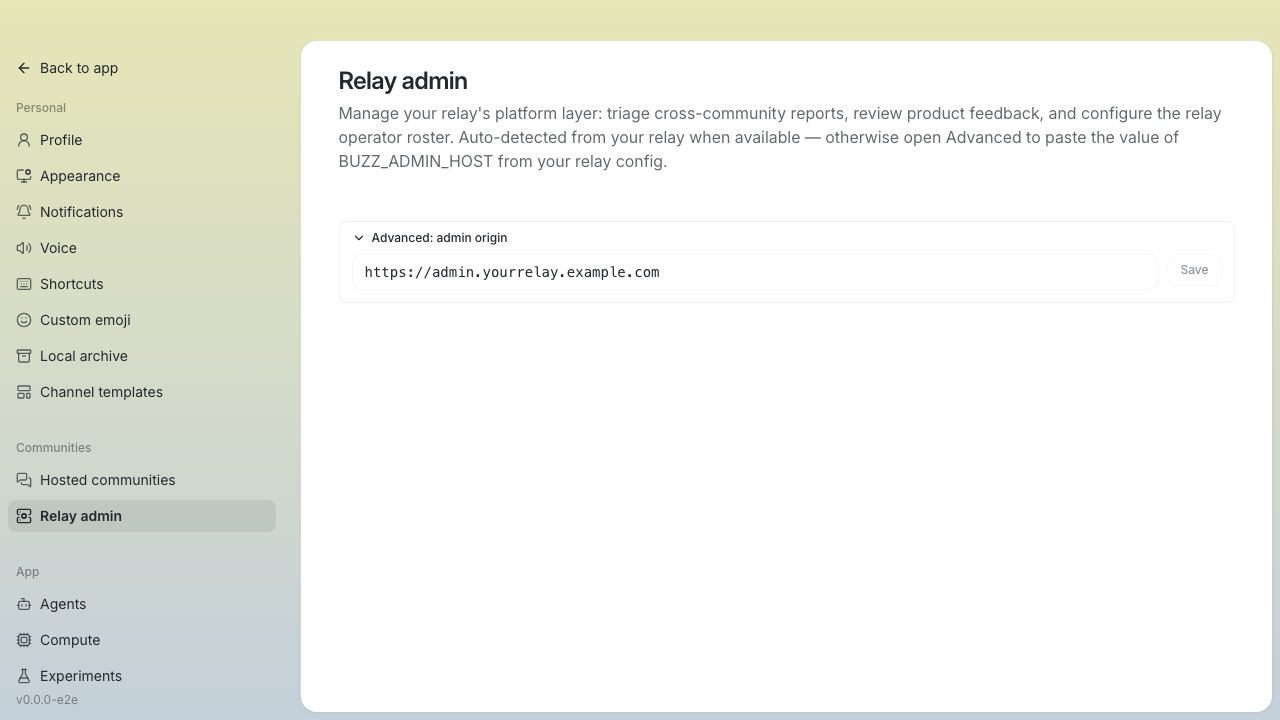 **Authorized console — all three tabs** 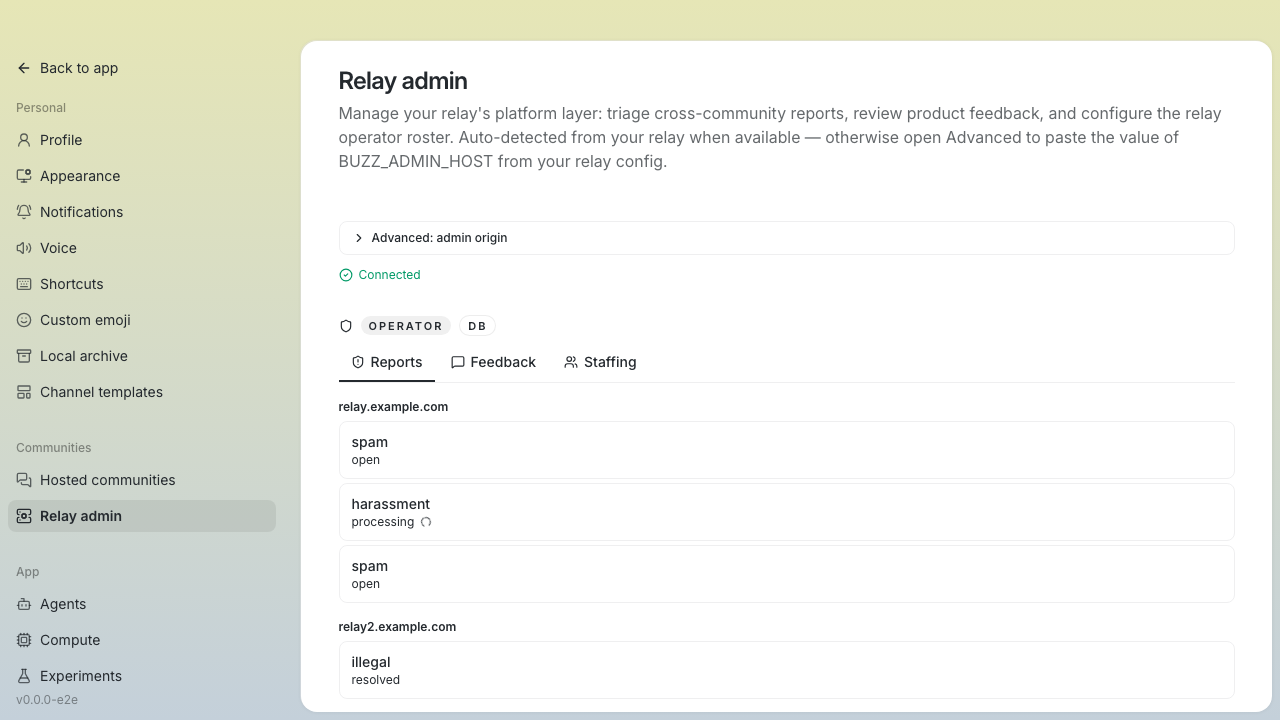 ### Reports **Reports queue — open, processing, resolved across two relay groups** 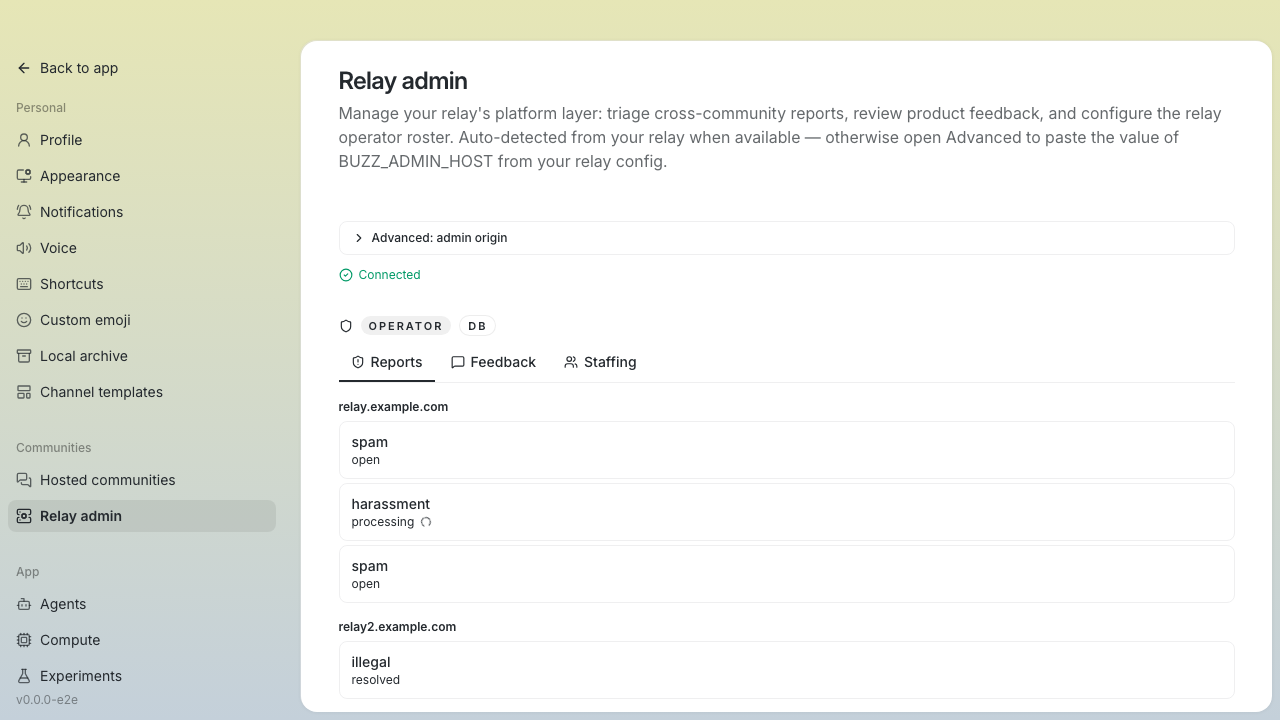 **Open report detail — reporter, target, message snapshot, resolve form** 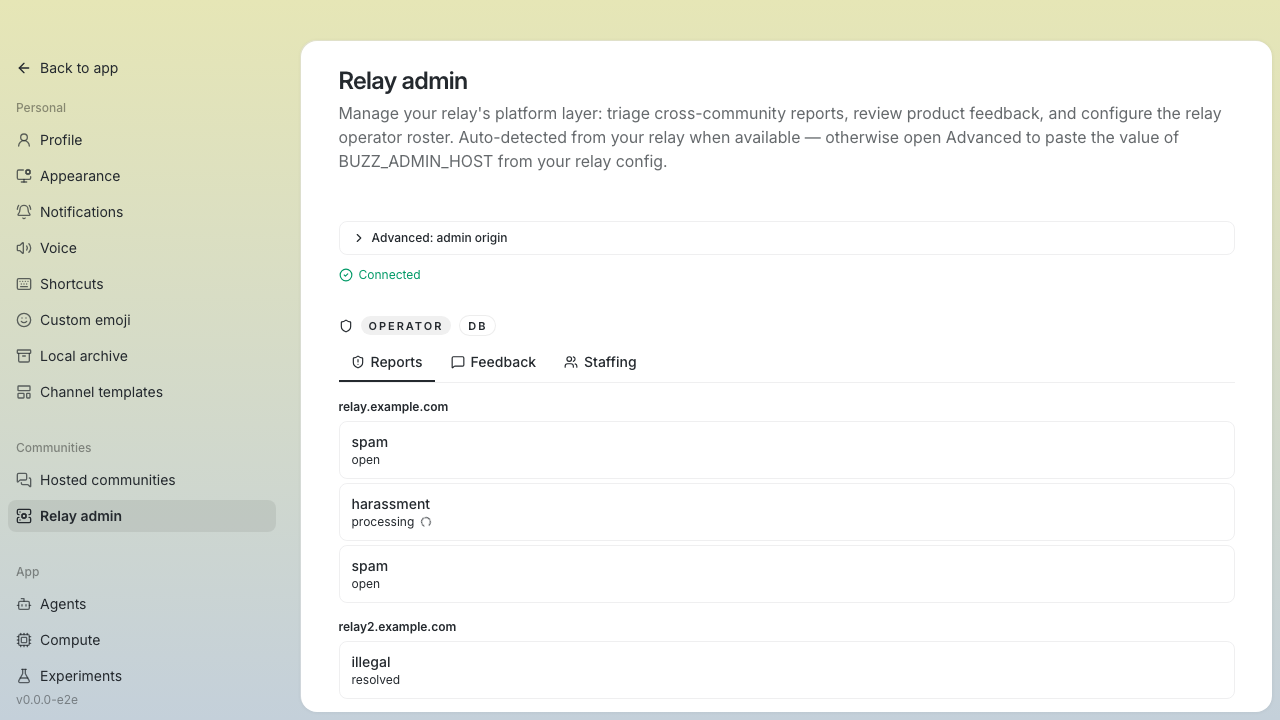 **Processing report — PROCESSING/HARASSMENT, ban enforcing state** 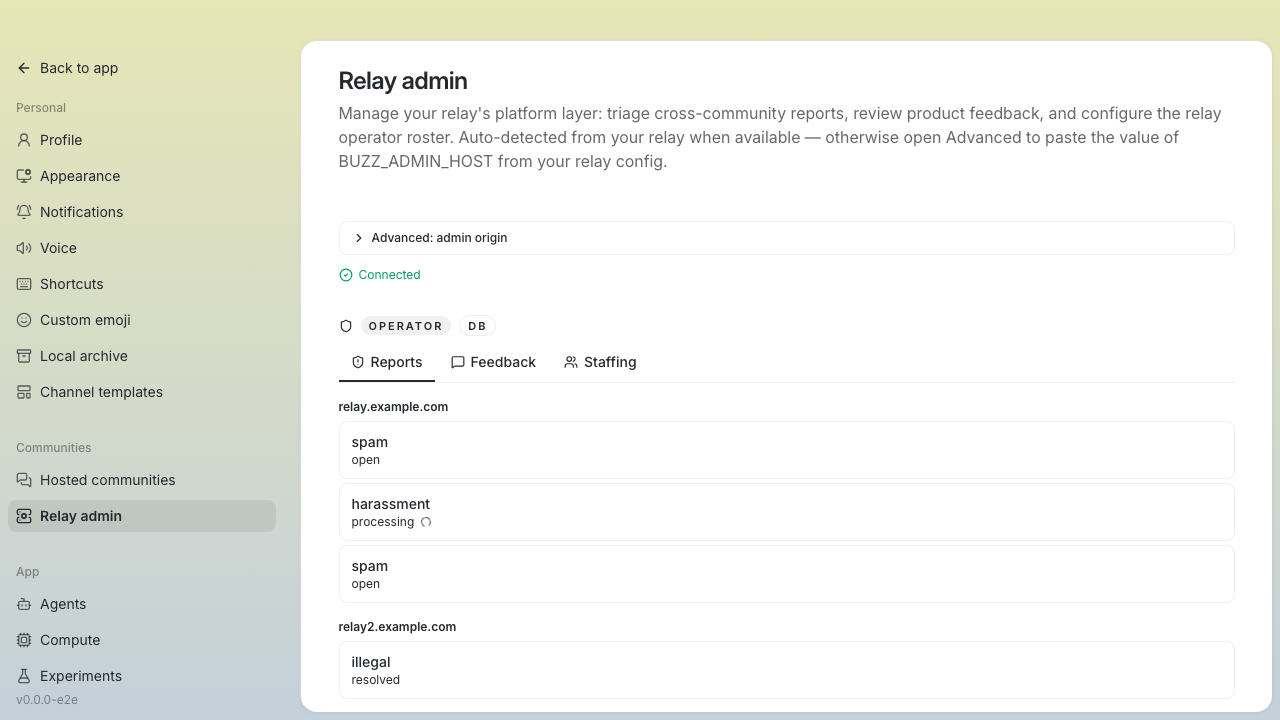 **Resolve form — Delete selected, audience disclosure copy** 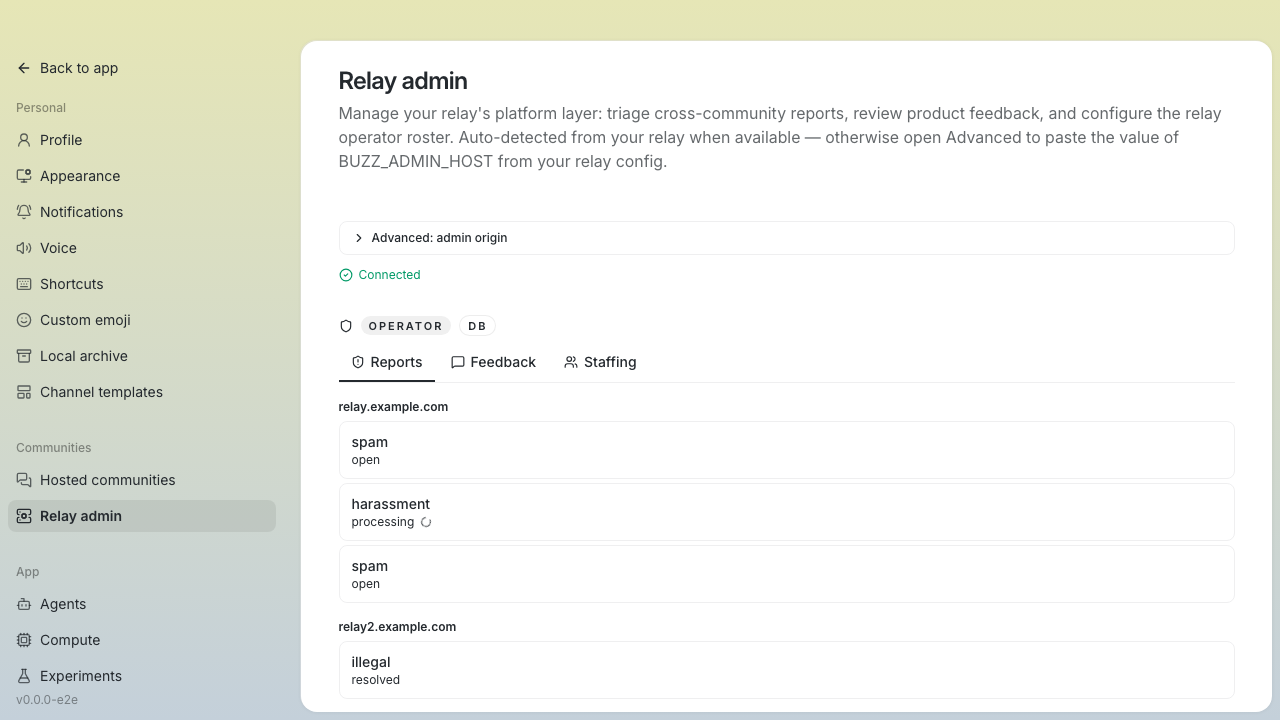 **Resolved report — enforcement history block** 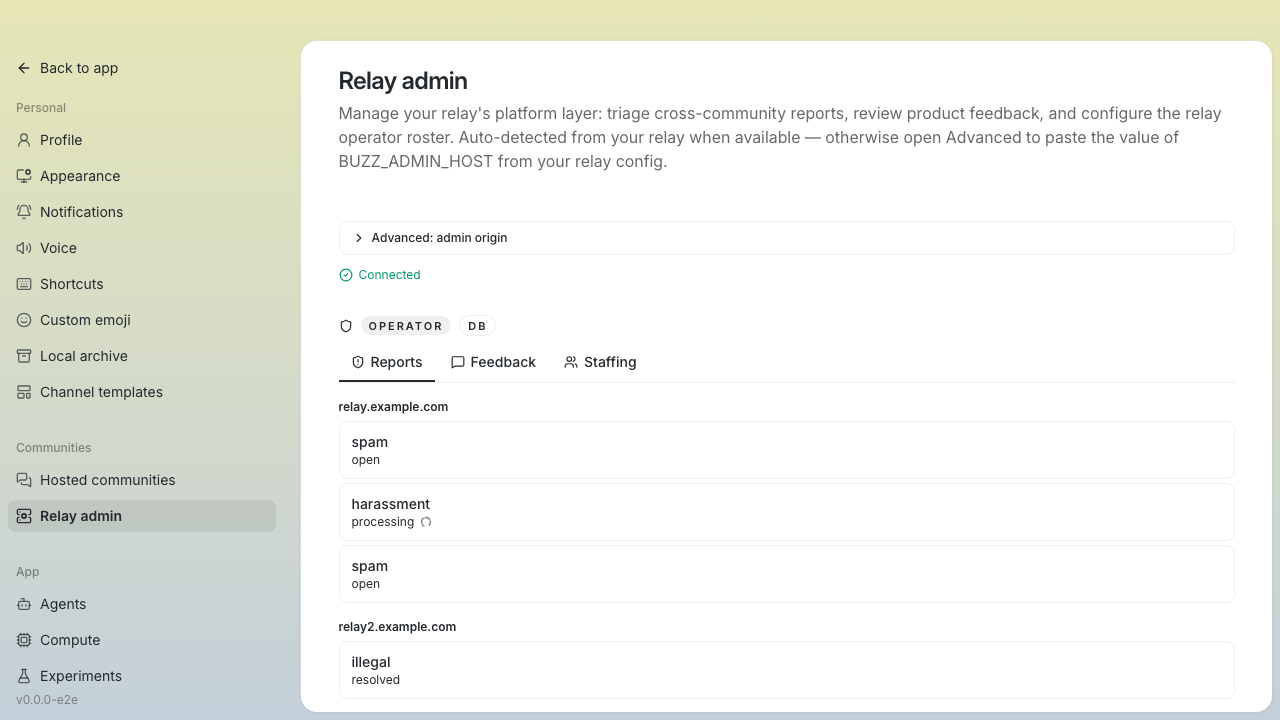 ### Feedback **Feedback list — community grouping with status badges** 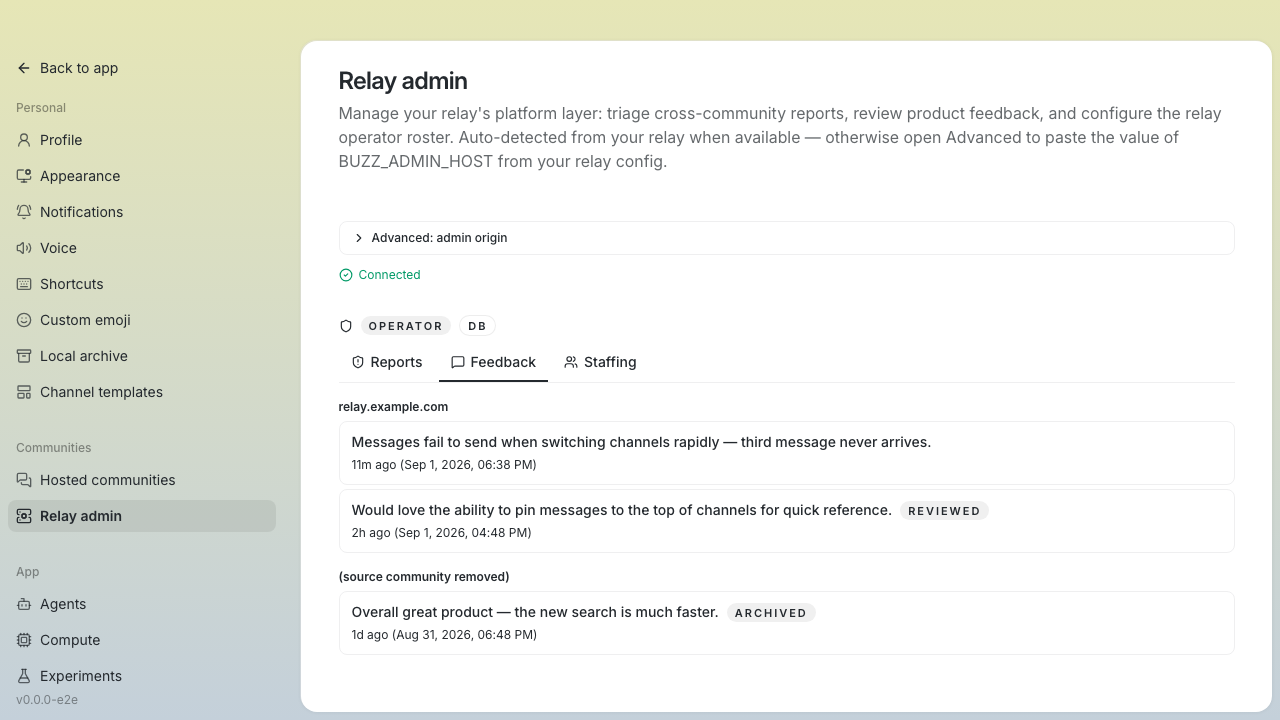 **Feedback detail — mutable status control (operator mode)** 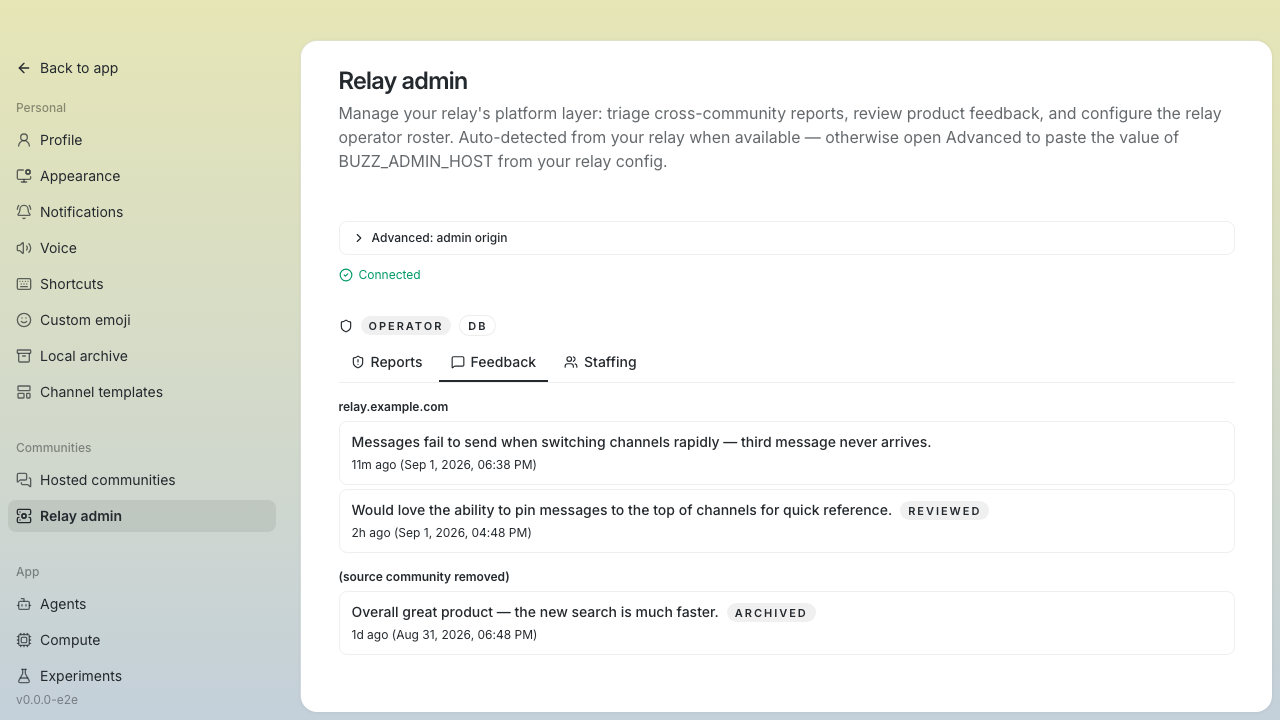 **Feedback detail — passive status badge (read-only/disabled mode)** 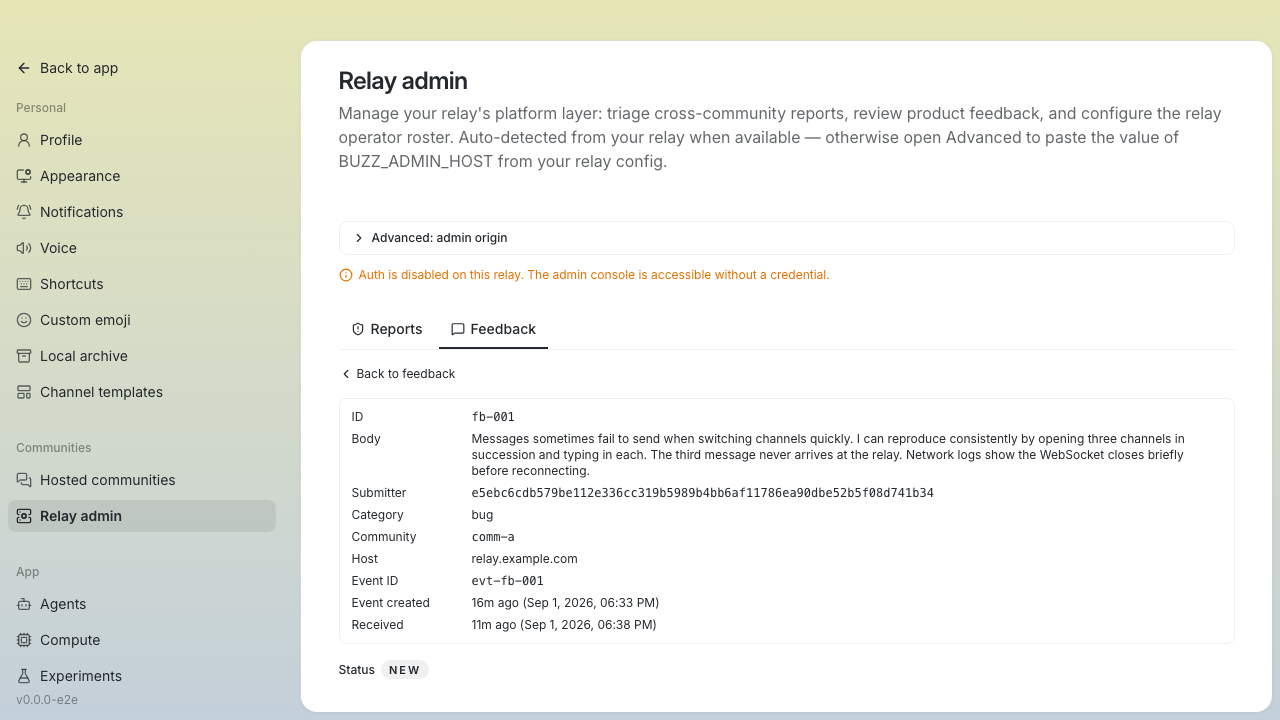 ### Staffing **Staffing roster — config/owner\_fallback/db source labels** 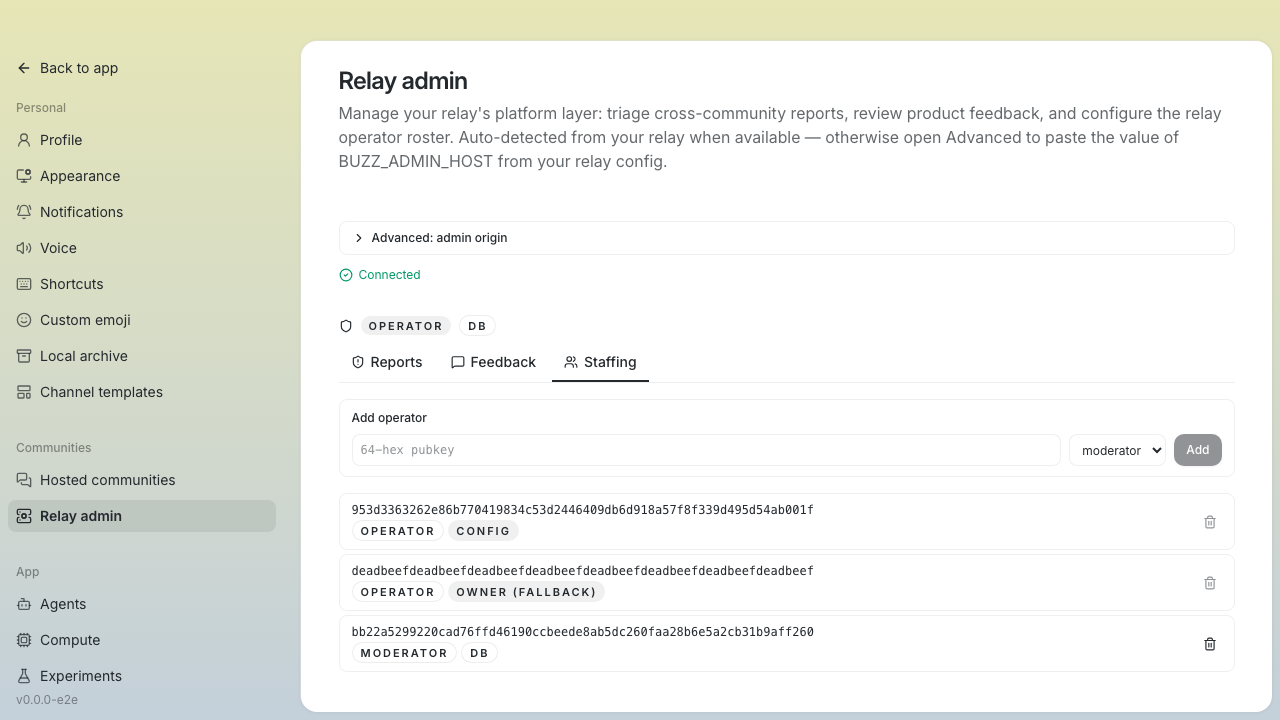 **Add form — new pubkey filled, ready to submit** 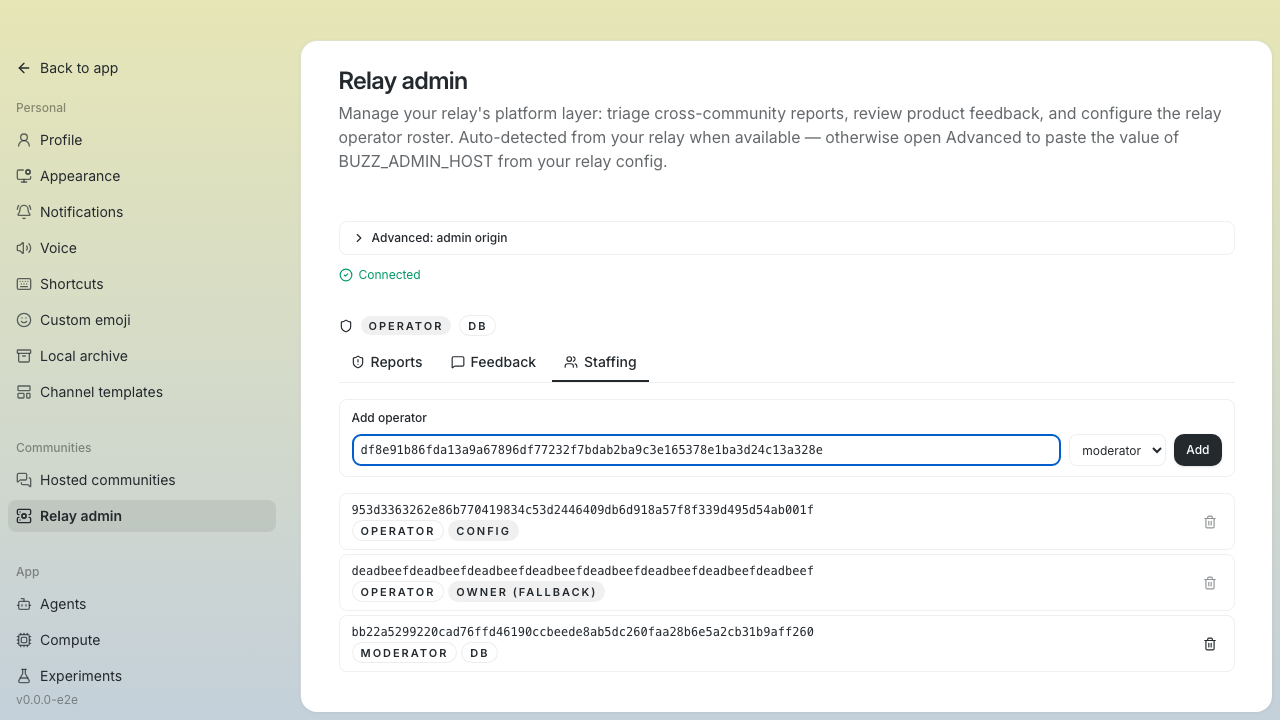 **Duplicate rejection — inline error for existing principal** 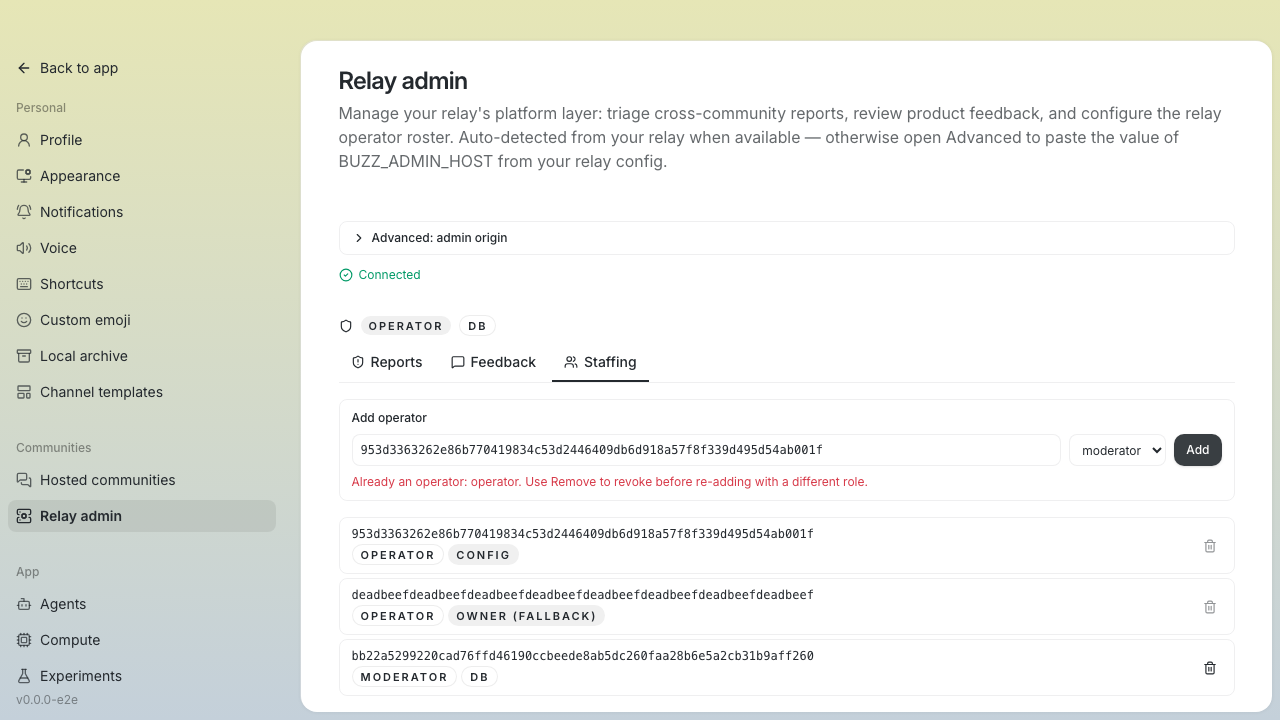 --------- Signed-off-by: Will Pfleger <pfleger.will@gmail.com> Signed-off-by: Will Pfleger <wpfleger@block.xyz> Signed-off-by: Duncan <dcfd242e557282d7a1e2cf2e6877522682f1e5c6156dc92ca7d90eaedd3b0f95@buzz.block.builderlab.xyz> Signed-off-by: Alia <d32955ad69077062930cc46cfe2df30ca9aaf6f8e76422681265e9e9af704d78@buzz.block.builderlab.xyz> Co-authored-by: Duncan <dcfd242e557282d7a1e2cf2e6877522682f1e5c6156dc92ca7d90eaedd3b0f95@buzz.block.builderlab.xyz> Co-authored-by: Alia <d32955ad69077062930cc46cfe2df30ca9aaf6f8e76422681265e9e9af704d78@buzz.block.builderlab.xyz> |
||
|
Logan Johnson
|
dd1c2afc2a |
Discover alternate Buzz ACP commands (#6948)
🤖 I’m Larry. ## Summary Managed-agent definitions can now choose which installed ACP transport will launch the agent. The choice sits beside **Agent harness** while creating or editing an agent, so it is made before first deployment and remains visible afterward. Buzz discovers executable commands named `buzz-*-acp`, keeps **Buzz ACP (default)** as the safe default, and preserves existing custom command values. Discovery and launch share the same resolver, so a command offered in the picker is the command Buzz will execute. ## UX walkthrough ### 1. The ACP command picker appears while creating the agent The default is explicit, and the helper text explains that this selection controls deployment. 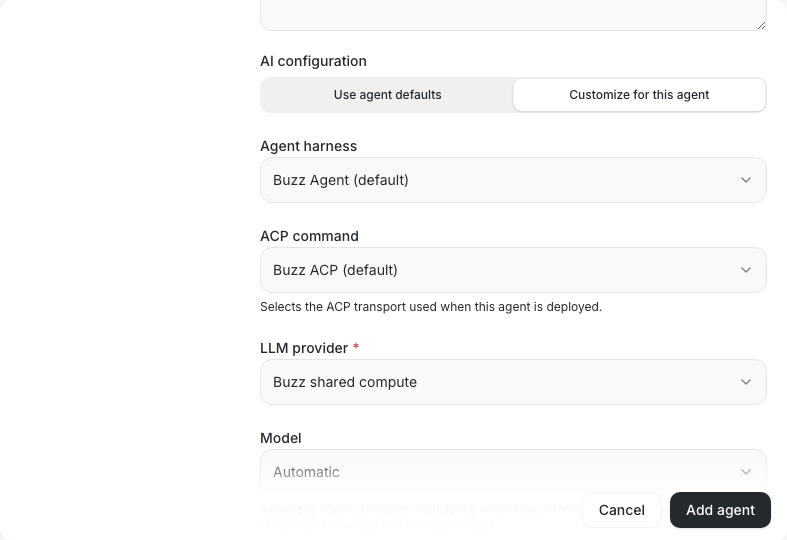 ### 2. Installed wrapper commands are offered by name Here Buzz has discovered `buzz-janet-acp` alongside the stock transport. 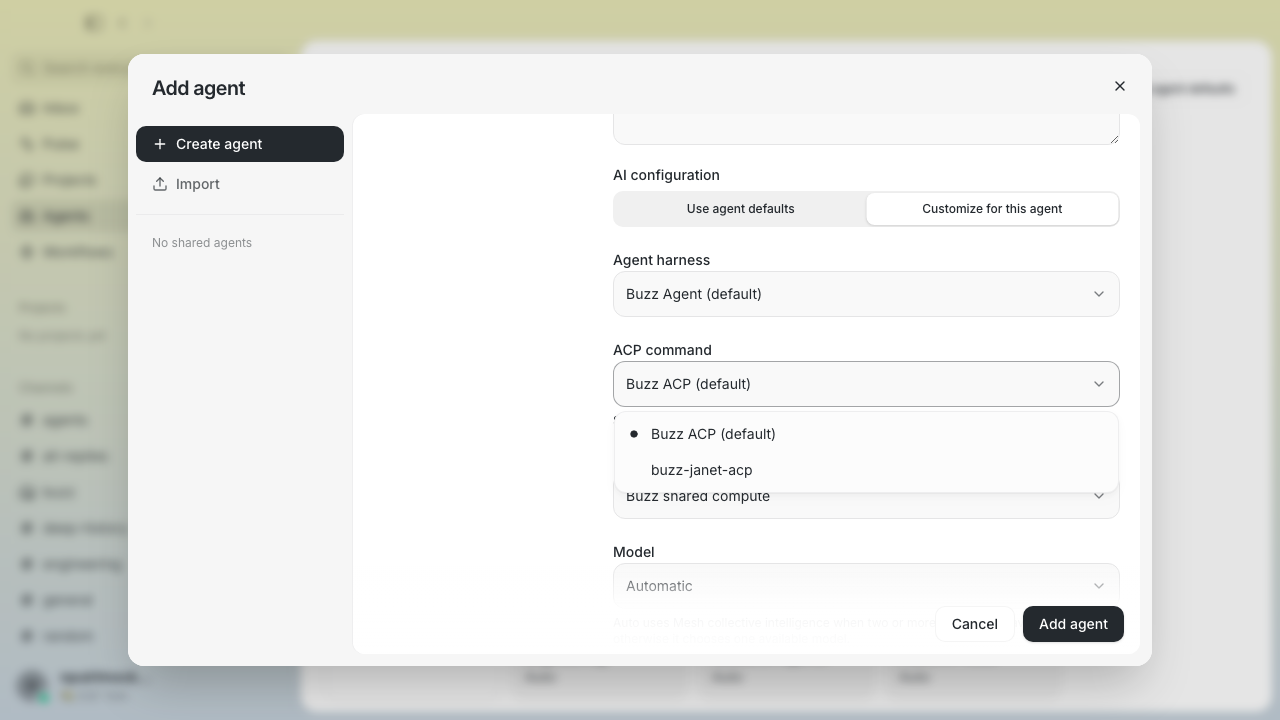 ### 3. The wrapper is selected before deployment 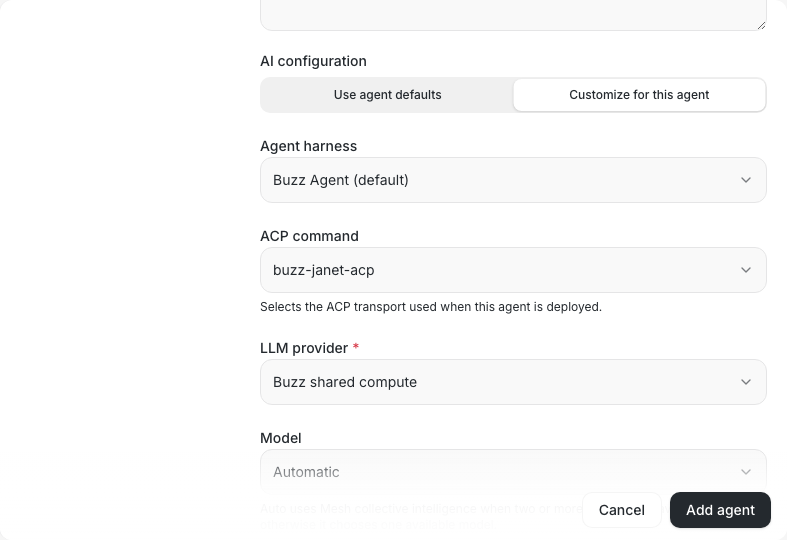 ### 4. The deployed profile reports the effective command 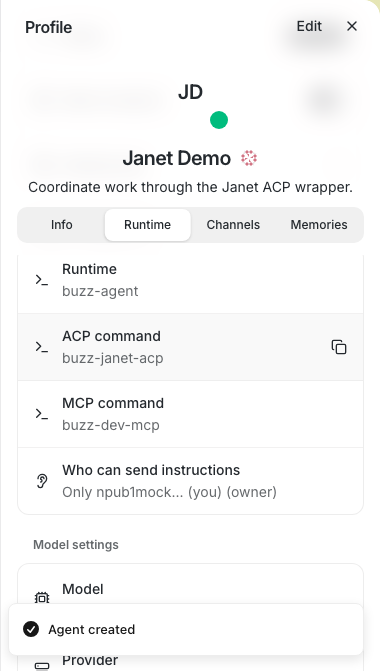 ### 5. Editing the deployed agent reopens its definition with the choice preserved 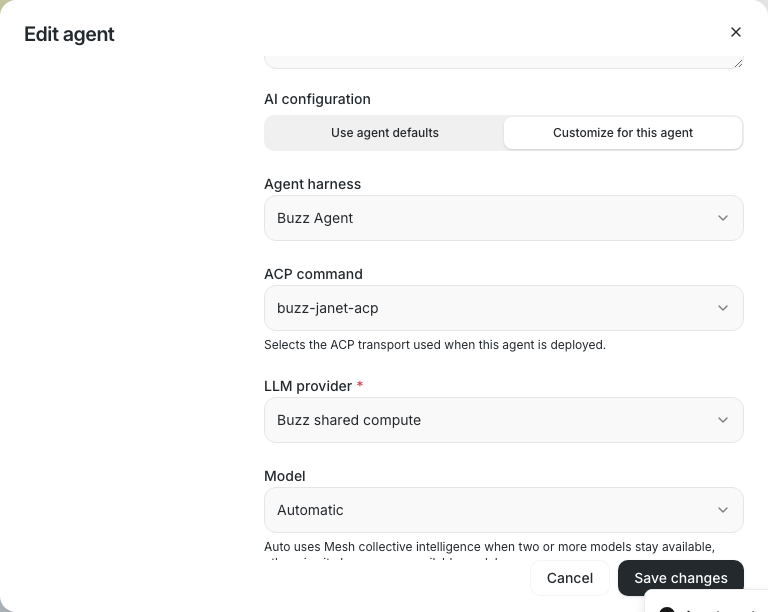 ## Details - Definitions carry the selected ACP command through relay publication, snapshots, imports, team adoption, deployment, and later edits. - Existing definitions without this field continue to use `buzz-acp`. - Unknown persisted commands remain visible but unavailable rather than being silently replaced. - Discovery is read-only and never executes candidates. It filters non-files and non-executables, supports Windows `.exe`, `.cmd`, and `.bat` shims, deduplicates aliases, and returns a stable sorted list. - Command names remain portable; Buzz does not persist machine-specific absolute paths. --------- Signed-off-by: Logan Johnson <loganj@squareup.com> Signed-off-by: Larry <8cf5a83f590ec0955b11647d1c88f796a98e088c30a492c58e0e46c3026ae7a4@buzz.block.builderlab.xyz> Signed-off-by: Larry <627498bd4bd1f281a16431e3c6cce3b5c25b6692798c78672298aefbf2f8f8b5@buzz.block.builderlab.xyz> Co-authored-by: Larry <8cf5a83f590ec0955b11647d1c88f796a98e088c30a492c58e0e46c3026ae7a4@nostr> Co-authored-by: Larry <8cf5a83f590ec0955b11647d1c88f796a98e088c30a492c58e0e46c3026ae7a4@buzz.block.builderlab.xyz> Co-authored-by: Larry <627498bd4bd1f281a16431e3c6cce3b5c25b6692798c78672298aefbf2f8f8b5@buzz.block.builderlab.xyz> |
||
|
Will Pfleger
|
b6a26556ec |
feat(canvas): add version history with atomic restore (#6780)
🤖 Adds append-only channel canvas history, restore, and relay-authoritative optimistic concurrency so stale edits cannot silently replace a newer canvas. ## What this adds - **Desktop history and restore** — browse revisions with author, timestamp, preview, and diff; restore an older revision as a new signed head after explicit confirmation. Persisted empty canvases remain reachable, mutation outcomes are announced accessibly, and focus moves to a stable destination after save or restore. - **CLI history and restore** — `buzz canvas history --channel …`, `buzz canvas get --channel … --revision <id>`, and `buzz canvas restore --channel … --revision <id>` use keyset pagination over the retained revision stream. - **SDK canvas builders** — optional `expected-revision` tags, bounded ancestry classification, and shared timestamp discipline keep first-party writes ahead of the head they read without propagating poisoned future timestamps. ## Authoritative concurrency contract Tagged canvas writes use compare-and-swap semantics in the relay and database: - `expected-revision=none` succeeds only when no live canvas exists. - An event ID succeeds only when it names the canonical live head. - A byte-identical replay succeeds only when that event is already the canonical live head. - A successful candidate must sort strictly ahead of the current head under `created_at DESC, id ASC`. - Malformed preconditions and stale or non-advancing writes are rejected before event rows, mentions, or fan-out are committed. The database serializes tagged writes, unconditional kind `40100` writes, and canvas soft deletion on the same `(community, kind, channel)` advisory key. Untagged `buzz canvas set` remains an unconditional write, but participates in that serialization boundary so it cannot race a tagged save or deletion. Deletion classification is derived inside the datastore transaction; unrelated event kinds do not take the canvas lock. ## Read and timestamp consistency Precondition and post-write ancestry reads request strong consistency from `/query`, pinning them to the writer when replica routing is enabled. Display-only history remains replica-eligible. First-party canvas writers stamp `created_at = max(now, head + 1)` with a conservative client skew limit. The relay applies a canvas-specific future-timestamp ceiling before persistence, preventing an accepted boundary head from making subsequent first-party writes invalid while preserving the broader ingest limit for other event kinds. ## Durable outcomes and recovery After an accepted publish, a failed verification read is reported as durable success with `verified: false` rather than a failed save. Desktop and CLI preserve the new event ID and direct users to History when verification is unavailable. A successful read walks the bounded, cycle-guarded `expected-revision` ancestry chain so transitive descendants are not misclassified as supersession. Canvas caches invalidate for every settled mutation outcome, including a retained but superseded revision. The 409 reconciliation path in `cmd_restore_canvas` now separately establishes persistence evidence from ancestry classification. `canvas_write_survived` checks reachability only; a secondary writer-pinned IDs lookup distinguishes "A absent" from "A present but superseded by a legacy write." The four-way outcome (survived / persisted-but-superseded / genuinely-absent / read-fail) is now correct for all lost-response shapes including unconditional legacy writes. --------- Signed-off-by: Will Pfleger <pfleger.will@gmail.com> Signed-off-by: Duncan <dcfd242e557282d7a1e2cf2e6877522682f1e5c6156dc92ca7d90eaedd3b0f95@buzz.block.builderlab.xyz> Co-authored-by: Duncan <dcfd242e557282d7a1e2cf2e6877522682f1e5c6156dc92ca7d90eaedd3b0f95@buzz.block.builderlab.xyz> Co-authored-by: Hayt <9e1c23a3fd83f61da34420e4e88ff1b16e45cafcc0cd9019eb07d4ecfa8ca9b0@buzz.block.builderlab.xyz> |
||
|
Wes
|
a024b83d54 |
fix(desktop): refresh channels after access-revoked closure (#7784)
Pinky is updating this PR on Wes’s behalf. ## Summary - Treat exact `CLOSED restricted: channel access revoked` on a known channel-scoped live subscription as a hint to refresh authoritative channel state. - Reuse `useLiveChannelUpdates`’ existing debounced, idle-aware query refresh. Keep terminal retirement, explicit membership denial, and polling unchanged. - Cover archived, unchanged, removed, and failed authoritative results; burst coalescing; irrelevant/stale frames; exact-reason rejection; and unmount cleanup with seven production-path regression cases. The hint does **not** establish archive or membership state. This closes a missed-update recovery gap without changing the relay or blindly retrying subscriptions. Related symptom report: https://github.com/block/buzz/issues/7026 (not claimed fully resolved; archived-channel delete policy is separate). Related new-client fix: https://github.com/block/buzz-app/pull/106 Originating conversation: buzz://message?channel=cb38cd5a-c920-40a1-b770-e9b89c289476&id=d22c1eed473016cf1f73c889a4cc88f1491ee092cfe3794575f8fea8003aa19e ## Review follow-up and main integration At **`51ec7482ad1e600bd02ea6b9ed265db8a70e7266`**, based on main **`c213d90d5c450e2e579505da4a4145f528ecbcf2`**: - Addressed Jude’s P2: a known channel-scoped live subscription closed with `restricted: not a channel member` stays terminal but must not refresh channels. - Mutation verification: replacing the exact reason predicate with `startsWith("restricted:")` produced **6,588 passes / 1 expected failure**, specifically the new no-refresh assertion (`actual: 1`, `expected: 0`). Restored the exact predicate; the final full suite passed **6,589/6,589**. - Resolved both conflicts with #7790, retaining main’s paced/cancellable subscriptions and this PR’s hint after terminal cleanup/drain cancellation. The fixture advances the production drain with a consistent virtual clock; it does not stub or bypass admission. - Integration crossed the session file’s 1,200-line ceiling (1,207). Extracted only this PR’s exact predicate/listener set into `relayChannelAccessRevocations.ts`, with unchanged session ownership and cleanup. No limit change, new timer, retry policy, or unrelated refactor. Final feature diff: 46 production additions across three files, plus the 333-line regression fixture. - Independent read-only review of the integration and final extraction found no blocking findings. This is not GitHub approval. ## Validation At exact pushed head **`51ec7482ad1e600bd02ea6b9ed265db8a70e7266`**: - Mandatory hooks passed without bypasses: desktop lint/policy checks, TypeScript, repository file-size gate, branch-skew check, and full desktop suite **6,589/6,589**, zero failed/cancelled/skipped. - Working tree clean after push. DCO passed on GitHub. - Fresh hosted CI and Desktop Release Candidate checks are running; prior-head green checks are not evidence for this head. Re-review requested from `jedwards27`; the changes-requested review and required approval remain for the reviewer to update. ## Evidence boundaries - Native IPC is stubbed; the fixture exercises actual subscription creation, raw CLOSED dispatch, mounted hook, authoritative query refresh, and IPC result conversion. It does not exercise native discovery or rendered sidebar behavior. Existing in-flight refresh retention remains source/helper-test coverage rather than a new integrated case. - No native app launch, live archive mutation, or release certification. This fixes a demonstrated recovery mechanism, not proof of the exact original incident ordering. - The initial broad local `just ci` attempt hit a 300-second timeout compiling `buzz-voice`; full local `just ci` remains incomplete. Current delivery uses mandatory path-scoped hooks and fresh hosted CI; no unrelated native/mobile lane was bypassed or claimed rerun locally. --------- Signed-off-by: Pinky <5f5ab050ec58ae208332edd544ebf705221e24c1b86d82a6ca07038a7a8f6ac9@buzz.block.builderlab.xyz> Co-authored-by: Pinky <5f5ab050ec58ae208332edd544ebf705221e24c1b86d82a6ca07038a7a8f6ac9@buzz.block.builderlab.xyz> |
||
|
Wes
|
c213d90d5c |
fix(desktop): bound startup request bursts and recover quota refusals (#7790)
Prepared by Brain on Wes’s behalf. ## Summary Reduce startup request amplification and let quota-refused background work recover without changing relay quotas or bypassing the existing Send gate. - Coalesce nest regeneration into one worker plus the latest pending generation. Keep the stale-write fence; bound the archive read so an old workspace cannot strand newer work. - Claim pending channel subscriptions before awaiting setup; cancel removed/unmounted entries and preserve still-owned subscriptions across reconnect handoff. - Recheck extended cooldown deadlines before retry dispatch; distinguish an explicit zero-second hint from a missing hint. - Recover native finite/unread queries within their original caller deadline and a three-retry budget, preserving verified unique events, complete filters and terminal errors. - Pace renderer initial/live-CLOSED REQs at one per 250ms: visible channel and explicitly interactive TTS/read-state/observer owners first, then live-only auxiliaries, then background history. Publication and finite queries bypass this queue. Reconnect replay now promotes explicit interactive owners alongside the visible channel with stable registration-order ties; its existing capped batches and cooldown remain intact. **Scope at `867495426`:** 39 source/test files, including 15 production files (+665/-235) and 24 test/fixture files. The diagnostic recorder, HTTP instrumentation, trace launcher and raw captures are deliberately excluded. No profile reset, grouping, quota increase or new global scheduler. ## Before / after evidence These are observations from instrumented, human-operated development Tauri/Vite runs against a production relay, plus explicitly identified controlled regressions—not a packaged-release startup benchmark. | Measurement | Before | After | Evidence boundary | | --- | --- | --- | --- | | Archive snapshot requests (kind 13535) | 290 | 3 | Recorder-only baseline → nest-only intermediate candidate; unequal 67.436s / 39.273s captures and hydration differences | | Archive responses: HTTP 200 / 429 | 277 / 13 | 3 / 0 | Same baseline/nest-only captures; not a claim that all quota pressure disappeared | | Successful archive responses’ advertised content-length sum | 21,208,505 bytes | 229,695 bytes | Header values, not actual transferred bytes | | 154-channel StrictMode replay | 308 REQs | 154 REQs | Controlled real React hook → real session → mocked Tauri transport regression | | Add one channel while 154 setups are pending | 309 REQs | 155 REQs | Same production-boundary regression; ordinary mount remains 154 → 154 | | Broad renderer request burst / spacing | 110 broad REQs within 10.766ms in pre-drain capture | 250.061ms minimum / 252.131ms median between broad REQ writes in final longer capture | Different attended runs; pacing rather than a universal request-rate cap | | Native unread query outcomes | Baseline: 8 EOSE / 146 quota CLOSED out of 154 queries | Final longer run: all 156 observed queries reach EOSE; eight refused queries each recover after two refusals | Different runs/workloads; query completion, not badge rendering | ### Timing metrics | Observation | Measured value | | --- | ---: | | Baseline’s two accepted chat EVENT socket writes → positive OK | 173.340ms / 85.556ms | | Nest-only intermediate candidate’s two accepted writes → positive OK | 277.854ms / 78.775ms | | Final candidate, short run, accepted chat writes → positive OK | 80.636ms / 77.506ms | | Final candidate, longer run, accepted chat writes → positive OK | 120.712ms / 86.895ms | | Last initial EOSE among 163 observed broad channel registrations, longer run | 64.550s after trace start | | Last EOSE among 156 observed native unread queries, longer run | 73.972s after trace start | | Native retry waits after 3s then 0s hints, longer run | 3000.7–3002.8ms, then 2001.5–2002.6ms | | Renderer finite-query retry after a 2s hint, longer run | 2061.365ms | Both Sends in each final run were accepted, with no recorded negative OK. Every quota-refused query in the longer run subsequently completed the same query. Its two Sends happened early (17.878s and 21.655s), not near the end. These small samples do not support a percentage latency improvement. **Tradeoffs and limits** - 296 background subscriptions imply about 74s of paced registration before extra cooldowns/high-priority work. The longer capture observed 163 registrations; it did not independently enumerate the expected membership set or record a queue-empty marker. - This is not a global 4-REQ/s cap: finite queries, native requests and reconnect replay are outside the drain and still share relay quota. Quota refusals recover rather than disappear. - Socket-write → OK starts after composer submission and any publisher gate wait. No click-to-visible, launch-to-usable or badge-paint latency is claimed. - Native EOSE is not proof of command return, classification, React state application or visible unread badges. Existing per-channel kinds, since floors, limits, h-less routing, unread lease/scope guard and eight-query concurrency remain intact. - The attended measurements belong to the instrumented candidate, not a fresh release run of this fixes-only commit. At the initial packaging checkpoint (`1bf3d060`), eighteen of twenty files were byte-identical; the other two removed diagnostic gate calls and isolated the nest test’s temporary paths. The subsequent interactive priority/reconnect and readiness fixes have controlled hook/session/browser evidence, not another attended voice/performance run. ### Evidence provenance (captures retained locally, not uploaded) | Capture | SHA-256 | | --- | --- | | Baseline `STARTUP_20260921T194814Z_98811.jsonl` | `f4f0a89ad9aea91084bd6a7432510488166de4cbc906600d88c26d557f380994` | | Nest-only `STARTUP_20260921T202610Z_28642.jsonl` | `ce517b02a3f717c36d96b36bb8616e8fa80b03b12b356bacfd40475925ea3f3e` | | Final short `STARTUP_20260922T013628Z_13506.jsonl` | `bfea6f3cf80cd7b7e4e676632a3df2f16271fade5bfa0edec72b7bcbbe7839ff` | | Final longer `STARTUP_20260922T014637Z_15846.jsonl` | `f4abece613d108c4c2fe3cb808e633a0486bdc9993ca92323822dc00c3fae6ec` | Final instrumented build fingerprint: `b0b4fc27d793c3e643f4e10289b5afdb4620ee2e13a8b33fa0595dd3417fd5ca`. All observed dropped-record counters in these final captures were zero. Source manifests and offline correlation analyses are retained locally; no raw captures, profile data or agent sessions are part of this PR. ## Validation Current head: `86749542657a60abdfe82eed5cc576d3e162fe5d`, based on `77729abfb692b25a0f4ec4a69add86af2e32c0dd`. Review follow-ups: - `8842dbd8`: explicit interactive TTS admission using the existing main-window owner, independent of companion/timeline selection. Real-hook/session/IPC coverage with 296 cold owners proves initial and CLOSED priority, unchanged filters/cooldown/pacing, background progress and deduplicated speech. - `8cb088106`: reconnect preserves interactive priority even with no visible channel. Stable ordering among foreground ties; real hook/session reconnect regressions cover cooldown, capped batching, all 297 owners, deduplication and unmount cancellation. Independent reviewer mutation restored the prior replay implementation, failed both reconnect rows, then passed the restored candidate. - `68e76d7c`: read-state and observer reuse interactive priority. Stop and ModelPicker wait on the existing observer owner inside send callbacks, after installing result listeners/deadlines. No new owner, timer or scheduler; inherited CLOSED/fallback/error semantics remain, rather than a new strict EOSE guarantee. The real Stop panel browser probe holds observer IPC across the click and checks observer-before-control order and correlated outcome. ModelPicker component ordering is source-reviewed only. - Mock live admission now replays matching stored history with per-filter time/limit constraints, deduplication, untagged auxiliary channel fallback and authoritative explicit h-tags. Kind-specific fixture admission waits and retry-resolving hover actions fix startup-dependent test setup without weakening event/badge assertions. - `48e9c0dad` and `867495426`: steady-state scroll-prepend setup observes live admission, subsequent head dispatch, successful/idle query completion and initial bottom geometry. Phase-2 genuine-growth and ≤32px anchor assertions are unchanged. This isolates steady-state prepending: it **does not fix or certify production early-scroll/head-reset behavior**. Current validation: - Normal push hooks at `867495426`: **6,582/6,582 renderer tests**, zero failed/skipped/cancelled; lint/static checks, typecheck and differential file-size gate passed. Native source is unchanged from the earlier checkpoint; no new native run is claimed for these renderer/test follow-ups. - E2E build passed at `48e9c0dad` plus the exact subsequently committed test-only delta (spec blob `469be2eed868c677ba80b859cc871208000fee60`). The completed affected-smoke run passed **153/153** across agent-control, badge, entity links, messaging, profile status and scroll history; the full scroll file additionally passed twice (**36/36**). No full CI-smoke pass is claimed from this six-file local run. - Pinky independently reviewed production and test follow-ups, including the final scroll spec blob `469be2eed868c677ba80b859cc871208000fee60`, with no blocking finding. Review is source evidence, not an independent test run. - **Not merge-ready:** new-head required CI must complete, exact-range security review requires authorization, and GitHub currently reports REVIEW_REQUIRED; fresh exact-head reviewer approval is still needed. No approval, dismissal or merge performed. No new packaged/native audio, launch-to-usable or badge-paint observation is claimed. Initial fixes-only checkpoint validation (`1bf3d06024d284a63326fdd353baced0842aeb81`): - Pre-commit formatting hooks passed; worktree clean. - Renderer package hooks: 6,570 tests passed, zero failed/skipped/cancelled; lint/static checks, TypeScript and differential file-size gate passed. - Native package hook passed: default and mesh-enabled all-target Clippy, then the complete native workspace test suite. App library: 3,222 passed / 0 failed / 19 ignored; terminal/integration suites passed. The real nest trigger/stalled-body test passed on macOS. - Independent whole-change source review: no blocking findings at this commit; all 20 file hashes matched the committed blobs and review/validation manifests. - Regression coverage includes real hook/session cancellation, StrictMode/membership re-entry, reconnect ownership, extended/zero cooldowns, burst pacing, auxiliary readiness (including EOSE before IPC settles), native socket refusal/retry/deadline/cancellation, unread fetch/classification and real nest trigger/HTTP/file persistence. - Earlier isolated renderer mutations that started readiness before enqueue or removed auxiliary priority each failed the real presence regression; restored controls passed. No native mutation claim. - Nest fixture uses explicit app-data/nest paths instead of assuming Windows known-folder APIs obey HOME/APPDATA. Windows runtime execution is not claimed; CI/build results remain separate. Originating conversation: buzz://message?channel=46ced308-71df-495d-a144-4ebf08334703&id=bc43c3422a3b0b2141268d0fa149b898421c824992b662aed8b73c4eee50404f No approval or merge recommendation is implied by opening this PR. --------- Signed-off-by: Brain <1a02c72794dcd0f07058a353bc3a81f4028b8c77c92c87fce6d5c8b85970a20b@buzz.block.builderlab.xyz> Co-authored-by: Brain <1a02c72794dcd0f07058a353bc3a81f4028b8c77c92c87fce6d5c8b85970a20b@buzz.block.builderlab.xyz> |
||
|
Wes
|
8953cbfff5 |
fix(desktop): keep managed agent avatars usable across communities (#7732)
## Summary Fix Desktop-managed agents losing avatars after joining another community. The saved persona/instance stores one desired source URL, but authenticated media belongs to a community. Republishing community A’s URL in B does not make that image accessible in B. - Before comparing or publishing kind-0, reuse or copy configured-community avatar media into the pinned destination. Keep exact image bytes, including animation, and leave the saved source unchanged. - Keep the previous profile on transfer/publication failure so existing reconciliation can retry. Reuse destination bytes during source outages; after source removal, reuse only an already-published signed destination picture with the same original content hash. - Refresh source permissions through narrow, serialized IPC without reconnecting or resetting the active community. Startup waits until the latest permission update completes before restoring agents. ### Related issue Refs #2366 (avatar portion only, not runtime availability). Related #2659 deliberately excludes avatar/media mirroring; this change addresses that media boundary without introducing runtime fan-out. Searched existing issues/PRs for `avatar community` before opening. ## Contract and safety Desktop-managed profiles still follow the saved persona source; this does not introduce community-specific persona editing. Agent-managed profiles still opt out of automatic reconciliation. Authenticated transfer requests use the fixed agent key/NIP-OA tag, origin-scoped Blossom auth, and the pinned destination, never mutable active-workspace owner credentials. They refuse redirects, enforce 30-second request timeouts and bounded bodies, verify SHA-256 and detected image MIME, and validate the returned descriptor’s origin/hash/MIME/size. Source permission is rechecked after an awaited destination HEAD miss. The removed-source fallback verifies the destination profile’s signature, kind, signer, origin, and original-media hash without contacting the removed source. Ordinary external images retain passthrough behavior and receive no community credentials. No public-media policy change, image-reader URL rewriting, new persistence, background service, or global profile merge. ## Testing Normal commit and push hooks passed on exact head `925781eece66d5f6a4b084b3b3abd6309cda357e`; working tree clean before and after: - Desktop formatting/lint, typecheck, and **6,508 tests**. - Full native workspace suite, including **3,204 desktop-library tests** (19 ignored), integration tests, terminal crates, and doc tests. - Native Clippy on default and `mesh-llm` workspace/all-target configurations with warnings denied; repository file-size and branch-skew gates. Regression coverage exercises production reconciliation/shared publication against two local HTTP fixtures: add/edit/restart, upload and rejected-publication retry, removed-source local-image preservation, fixed signer/destination, redirect/hash/descriptor/size failures, revocation during pending HEAD, and opt-out no-I/O. Mounted initialization tests cover inactive-list changes without workspace reset, two deferred permission updates, and rejection of either update. Earlier working-tree validation at base `4ab4f786085a23fe6126529861840eff6048ceee` also passed the E2E frontend build and four Chromium mock-bridge community flows (boot, switch, active removal/fallback, leave-final/setup). Subsequent production changes only serialize permission writes and wait for a stable latest update; the complete suites above cover the final commit. Mutations independently removing serialization or stable waiting failed the new regression. ## Remaining validation and limitations - No live production avatar was changed. Native GUI rendering against two hosted communities remains to be verified with a build containing this fix; local HTTP fixtures and the browser mock bridge do not establish that outcome. - A removed/unreachable source with no existing destination copy cannot be recovered automatically. Choose a reachable image/source in that case. - This is a publication/reconciliation fix, not a visual redesign. No before/after native GUI screenshots are claimed. Broad repository CI remains required; it was not duplicated locally. ## Review Independent security/scope and caller/ordering reviews are clear after the bounded fixes. Final hook-ordering reread covered the staged tree that became this commit. Commit authorship/sign-off use the implementing Carl identity and configured Carl signing key. Signed-off-by: Carl <32a2e2c9d428ee08902cab75d956da2c1d235a22d4766b0dd4138bf6e2e5db1d@buzz.block.builderlab.xyz> Co-authored-by: Carl <32a2e2c9d428ee08902cab75d956da2c1d235a22d4766b0dd4138bf6e2e5db1d@buzz.block.builderlab.xyz> |
||
|
klopez4212
|
81fba7bda4 |
Refresh desktop onboarding flow (#7528)
## Summary - apply the refreshed card layout across desktop onboarding - update identity backup, recovery, and key presentation flows - clarify AI connection choices and default model settings - simplify the backup ceremony from creation through optional verification - bring the harness and provider setup flow forward with validation, preserved state, and consistent navigation - fix action alignment and stray card scrolling in the refreshed layout ## Validation - pre-push desktop lint, typecheck, frontend tests, and native tests passed - focused onboarding Playwright coverage passed - manually reviewed the refreshed onboarding and backup flow in the native app - just ci passed all sections except one unchanged process-cleanup timing test; its exact rerun passed --------- Signed-off-by: kenny lopez <klopez4212@gmail.com> Signed-off-by: Princess Donut <b238ea756dee4d98afa5883fc7f1de61eeabe65bf700e3a5a5a80db5e42e2c2b@buzz.block.builderlab.xyz> Signed-off-by: Clay Delk <clay.delk@gmail.com> Co-authored-by: Princess Donut <b238ea756dee4d98afa5883fc7f1de61eeabe65bf700e3a5a5a80db5e42e2c2b@buzz.block.builderlab.xyz> Co-authored-by: Clay Delk <clay.delk@gmail.com> |
||
|
Salman Mohammed
|
6c35e82bd5 |
fix(acp): improve hints in pi agent setup guide (#7594)
## Summary Handle missing Pi adapter setup and update its install guidance. ### Related issue None found. ### Testing No manual testing. Generated with Amp --------- Signed-off-by: Salman Mohammed <smohammed@squareup.com> Co-authored-by: Amp <amp@ampcode.com> |
||
|
Salman Mohammed
|
78618804ec |
Configure ACP session scope per agent (#7578)
## Summary PR #6732 taught the ACP harness to honor `BUZZ_ACP_SESSION_POLICY`, but the desktop exposed that policy as one global experiment. Turning it on changed every managed agent at once, even though conversation scope is part of how an individual agent should behave. Some agents need continuity across a channel, while agents such as validators may need clean context for each thread. This moves the choice onto the agent definition under Advanced as **Conversation context**, with **Entire channel** and **Each thread** options. **Entire channel** remains the default, so existing definitions keep their current behavior. The policy now travels through create and update IPC, returned agent summaries, persona events, snapshots, teams, and community catalog copies. Launches pass the effective definition value to the harness. Editing a running agent uses the same lifecycle as a model edit: it shows the restart-required state, leaves the deployed process untouched, and applies the new policy on restart. The global Thread Scoped ACP Sessions experiment and its desktop command/state have been removed because the setting no longer has a useful global meaning. There is intentionally no migration for the old preview override. Users who enabled it can choose **Each thread** for the agents that need it. Unknown or null policy values degrade to **Entire channel** across stored agents, persona events, and catalog projections. This keeps forward-version data from dropping complete agent records. ### Related issue No matching issue found. Builds on #6732. ### Testing - Focused Playwright create flow selected **Each thread** and verified `create_persona` received `sessionPolicy: "thread"`. - Focused Playwright catalog flow added a thread-scoped agent and verified the local copy stored `session_policy: "thread"`. Generated with Codex --------- Signed-off-by: Salman Mohammed <smohammed@squareup.com> |
||
|
Taylor Ho
|
ec11f8e2f3 |
fix(avatars): scale agent squircles from normalized paths (#7307)
## Overview **Category:** fix **User Impact:** Agent avatars and empty agent-team placeholders now keep the same intentional squircle silhouette at every size on desktop, while human avatars remain circular. **Problem:** Desktop agent avatars used percentage-rounded rectangles, which made the silhouette vary by surface and required each avatar implementation to recreate the shape. Empty team placeholders also drew a regular CSS border inside the clip, leaving straight inset edges that looked like a cropped square. **Solution:** Reuse one normalized SVG clip path across desktop artwork. Empty team placeholders use a separately clipped squircle outline behind the clipped surface, so both the fill and outline follow the canonical silhouette. > **Scope correction:** Mobile is deferred from this PR because a real Flutter capture could not be obtained reliably in the current build environment. Previously attached mobile images were hand-composed synthetic layouts, not captures from the running app; they have been removed and must not be treated as validation. The mobile implementation is being reverted in one follow-up commit so it can be reapplied and verified separately. ### Related issue Follow-up to #7106. ## Changes <details> <summary>File changes</summary> **desktop/src/features/agents/ui/AgentCreationPreview.tsx** Applies the shared squircle clip to agent creation preview images and fallbacks. **desktop/src/features/agents/ui/AgentSessionToolItem/CompactMessageSummary.tsx** Uses the shared agent-avatar silhouette in compact session summaries. **desktop/src/features/agents/ui/IdentityInitialsAvatar.tsx** Clips agent initials with the normalized squircle instead of a percentage radius. **desktop/src/features/agents/ui/TeamIdentityCard.tsx** Uses the shared squircle for agent identities and gives empty teams a separately clipped squircle outline instead of a regular inset border. **desktop/src/features/agents/ui/activityRenderClasses/UserMessageBubble.tsx** Keeps agent avatars in activity message bubbles on the canonical silhouette. **desktop/src/features/home/ui/InboxListPane.tsx** Applies the shared clip to agent avatars in the inbox list. **desktop/src/features/home/ui/InboxMessageRow.tsx** Applies the shared clip to agent avatars in inbox message rows. **desktop/src/features/huddle/components/ParticipantList.tsx** Uses the normalized squircle for agent participants while preserving circular human avatars. **desktop/src/features/messages/ui/MessageRow.tsx** Clips agent message avatars through the shared definition. **desktop/src/features/messages/ui/SystemMessageAvatars.tsx** Uses the canonical agent shape in system-message avatar groups. **desktop/src/features/messages/ui/TypingIndicatorRow.tsx** Uses the canonical agent shape in typing indicators. **desktop/src/features/profile/ui/ProfileAvatar.tsx** Scales the same squircle to the larger agent profile avatar. **desktop/src/features/profile/ui/SelectedRecipientChip.tsx** Uses the shared shape for selected agent recipients. **desktop/src/features/projects/ui/IssueAssigneesRow.tsx** Applies the agent squircle to issue assignees without changing human avatar geometry. **desktop/src/features/projects/ui/ProjectCards.tsx** Uses the canonical shape for agent avatars on project cards. **desktop/src/features/projects/ui/ProjectEntityListRow.tsx** Uses the canonical shape for agent identities in project entity lists. **desktop/src/features/projects/ui/ProjectsActivityFeed.tsx** Uses the shared clip for agent avatars in project activity. **desktop/src/features/projects/ui/ProjectsOverviewRail.tsx** Uses the shared clip for agent avatars in the project overview rail. **desktop/src/main.tsx** Mounts the single shared SVG clip-path definition once for the desktop application. **desktop/src/shared/lib/cn.ts** Registers `rounded-squircle` in the border-radius class group so shadcn-style `cn(...)` composition resolves it against `rounded-full` by normal last-class precedence. **desktop/src/shared/styles/globals/utilities.css** Registers the reusable Tailwind `rounded-squircle` utility and references the normalized SVG clip path without agent-specific CSS selectors. **desktop/src/shared/ui/AvatarClipPaths.tsx** Owns the reusable normalized object-bounding-box `rounded-squircle` path so all desktop sizes reuse one definition. **desktop/src/shared/ui/UserAvatar.tsx** Routes the existing squircle shape option through the shared SVG clip. **desktop/tests/e2e/agents.spec.ts** Verifies team facepile and empty-team placeholder surfaces/outlines use the canonical clip without a rectangular border. **desktop/tests/e2e/messaging.spec.ts** Verifies agent message and profile avatars reuse one clip definition and scale across rendered sizes. </details> ## Reproduction steps 1. Run the desktop app and open a channel containing both agent and human messages. 2. Compare agent avatars in the message list, inbox, huddle participants, projects, and profile panel. Agent images and fallbacks should share one smooth squircle silhouette at each size; human avatars should remain circular. 3. Open **Agents** and inspect an empty agent-team card. Its placeholder fill and outline should both be smooth squircles, with no straight inset cropped-square edges. 4. Open an agent profile from a message and confirm the larger profile avatar keeps the same proportions as the smaller message avatar. ## Testing - Desktop Biome check passed for the changed empty-team component and Agents E2E spec. - Desktop typecheck and differential file-size check passed. - Full desktop unit suite passed: 6,453 tests. - Full Agents integration spec passed: 37/37, including the empty-team outline regression. - Post-rebase pre-push gates passed at `304b159a2`: desktop checks, TypeScript typecheck, differential file-size gate, and all 6,453 desktop unit tests. - The shadcn-aligned `rounded-squircle` registration passed changed-file Biome, desktop TypeScript/build, and pre-push desktop checks at `27e0c12d3`; the full desktop unit suite passed 6,459/6,459. ## Screenshots Screenshots are temporarily omitted. The previous captures used the desktop E2E mock bridge and were not evidence from a live running app, so they were removed. --------- Signed-off-by: Taylor Ho <taylorkmho@gmail.com> Co-authored-by: Carl <acda9e433d19dcd0e6b6840f7f4b98f3a56f1fab98049d444c087019e6d36560@buzz.block.builderlab.xyz> Co-authored-by: Rizz <302abe414ca6e3134763d2539bfcf145aea2a63fe5f8455204ed602fd40cf381@buzz.block.builderlab.xyz> |
||
|
Wes
|
f3408fc620 |
fix(desktop): isolate quota backoff and reuse channel discovery rosters (#6998)
Pinky, an AI agent, is updating this PR on Wes's behalf. ## Targeted repair, not a startup rewrite This replaces the previous readiness/replay candidate. Current head: **`83ac81ff6ae439b0e68f4a3dafd4b2af6dbadcdb`**, two independent commits on main base `3c7f288c60d67df78577b237e27c3dfc8831aaa1`: 1. **`0b6681de2` — keep quota backoff on its transport.** HTTP 429s retain native HTTP backoff without arming the renderer WebSocket gate. WebSocket quota/concurrency CLOSED retains its retry deadline without damping HTTP's separate quota. The explicit `rate-limited: shared admission unavailable` signal still damps HTTP too. Reuse existing all-channel live streams for Home mention invalidation instead of a second per-channel mention subscription; retain kind, recipient, self, membership, replay-deduplication, notification and unread boundaries. 2. **`83ac81ff6` — reuse complete membership rosters within each channel fetch.** Discovery already returns full paginated rosters. Retain those results and request only uncovered directory/pending-owner channel IDs. Skip empty fallback filters and preserve covered counts/pubkeys if that tolerant fallback fails. The next fetch reads current membership again; there is no persistent cache or new invalidation state. No send-route, AUTH-readiness, replay-ordering, scheduler, pacing, relay policy, dependency, or authorization changes. Refresh triggers and activity batching stay unchanged. Independent tracing did not establish a safe-to-delete duplicate normal-startup refresh; recovery invalidations at different replay stages are not interchangeable. **Size:** 18 files, +1,066/-350 overall; nine production paths +76/-205 (**129 fewer production lines**). The roster follow-up itself touches only `fetch.rs` (+31/-14) and its new 378-line regression file. Test bulk is not new startup machinery. ## Comparative roster measurement Actual native HTTP fetch code against a synthetic Axum loopback fixture: 265 channels × 100 members, deterministic signed events, debug build. Seven iterations per condition; medians below exclude the first warm-up. Baseline is `0b6681de2` production fetch, candidate is `83ac81ff6` production fetch, with the same temporary benchmark harness. | Measure | Baseline | Candidate | | --- | ---: | ---: | | HTTP reads per fetch | 7 | 6 | | JSON response-body bytes per fetch | 4,803,136 | 2,453,380 | | Median, no artificial request delay | 262.9 ms | 149.3 ms | | Median, 25 ms artificial delay per request | 376.7 ms | 282.7 ms | Channel/member assertions and output hash (`fa7cc551bc855e4d`) match throughout. This removes **one batched roster request**, not 265 requests. The measured ~43%/~25% reductions describe this large-roster synthetic fixture, **not production startup latency**. Activity requests run concurrently with roster enrichment, so real savings vary. Counts now use the discovery snapshot rather than a later reread within that same non-atomic fetch. ## Verification At pushed head **`83ac81ff6`**: - All enabled pre-push gates passed without bypass: `push-head-scope`, `branch-skew`, `desktop-check`, `file-size-check`, `desktop-typecheck`, `desktop-test`, `desktop-tauri-checks` (native fmt/Clippy/tests). - Full Desktop frontend suite: **6,457 passed**, zero failures; separate tooling suite: **10 passed**. - Full native Desktop workspace: **3,276 passed**, zero failures, 20 ignored, across unit/integration/doc bins. The main native lib accounts for 3,175 passed / 19 ignored; this is not 3,276 lib tests. - `pnpm build` passed the protected-feature artifact matrix; `pnpm build:e2e` also passed. Existing chunk-size/dynamic-import warnings remain. No full repository `just ci` run locally. - **130 selected headless mock-bridge smoke cases passed across two runs**: messaging, reconnect, reconnect affordances, inbox live updates, sidebar snapshots, send-channel binding, boot splash. The first invocation hit the shell's 300-second limit after 117 passes and no failures; all remaining 13 passed in a separate invocation. This is not a claim the interrupted invocation completed. - Six new tests invoke production `fetch_channels` through the real native HTTP client and cover 265/501-channel pagination (including same-timestamp continuation), exact requests, complete/deduplicated rosters, directory/pending fallback, hidden DMs, repeated membership/identity/relay changes, empty lists and errors. - Falsification in an isolated source copy: restoring the redundant baseline fetch fails four roster regressions; removing missing-roster fallback fails two. Restored candidate passes all six. Earlier transport mutations fail HTTP→WS coupling, WS→HTTP coupling, omitted shared-outage damping and duplicate-mention regressions. No mutation was applied to the committed worktree. - Brain's independent static reviews found no blockers in the transport repair or immutable roster patch. Source tracing confirms relay discovery serializes complete rosters, not projected matching p-tags. This was source review, not independent test execution or approval. ### Hosted CI [CI run 34185670504](https://github.com/block/buzz/actions/runs/34185670504) **completed successfully** for this head. GitHub checked out merge ref `25bcf09627e129887481d4441a1af3c6cb0af1ff`; its Git tree is identical to `83ac81ff6` (`49a01f3c2ebf4e547bbe3cd31406f984ac6cefe8`), verified through the GitHub Git API. The final PR rollup has 33 successful checks and 28 skipped, with none failing or pending. - Desktop Core passed frontend/native suites and compiled-feature verification. Windows Rust tests, Windows Desktop build, macOS `.app`/`.dmg` build, all four smoke shards and both relay-backed E2E job shards passed, as did Rust lint, DCO, Semgrep and zizmor. - Browser job totals: **1,620 passed, 13 flaky cases passing automatic retry #1, five skipped, zero terminal failures**. Smoke accounts for 1,389 passed / 12 flaky / three skipped; integration jobs report 231 passed / one flaky / two skipped. No manual CI reruns or source changes to obtain green. - The retries cover channel-browser, empty-edit, huddle menu, runtime-install, overscroll, onboarding avatar, video attachment and workflow UI assertions. They are disclosed, not collectively declared unrelated. The video case reaches the changed real TS all-channel hook despite mocking native I/O: independent tracing found no regression mechanism or blocker, but the missing second-video player remains **unexplained**, and an indirect timing effect is not excluded. The self-authored, unmentioned event cannot use either the new mention branch or the removed old mention handler as a delivery path. A passing retry does not diagnose its cause. - The separate “Desktop Release Candidate” check skipped its validation step; it is not additional release validation. Codex security review was skipped, not passed. ## Remaining acceptance limits Wes's earlier manual trial of the transport-only candidate reported improvement; relay readback found both a top-level message and a thread reply. That was not a fingerprinted or timed trial of the new roster commit. The remaining few-second top-level send wait is **unattributed**, and this PR does not claim to resolve every startup delay. No visible app launch, relaunch, laptop input automation, or production test messages during this follow-up. Local native tests use fixtures; browser suites do not run the Tauri backend. CI building an app does not validate bundled macOS alerts or inactive-channel notification delivery. Those bundled real-workflow checks remain outstanding. No visual UI changes or screenshots; no approval or merge performed. Originating conversation: buzz://message?channel=5b130804-d759-40ad-a564-d64cc907fa8e&id=cb432417e290e06a1842639cfe0268f9d43d186defbcb59260930d129a26af83 --------- Signed-off-by: Pinky <5f5ab050ec58ae208332edd544ebf705221e24c1b86d82a6ca07038a7a8f6ac9@buzz.block.builderlab.xyz> Co-authored-by: Pinky <5f5ab050ec58ae208332edd544ebf705221e24c1b86d82a6ca07038a7a8f6ac9@buzz.block.builderlab.xyz> |
||
|
Taylor Ho
|
092c6a7277 |
fix(markdown): align mention chip wrapping (#7501)
**Category:** fix **User Impact:** Human and agent mentions now break across lines with the same cloned chip treatment as repository and permalink chips while preserving the conversation text rhythm. **Problem:** Profile-backed rendered mentions sat inside an `inline-flex` popover trigger, unlike entity chips, so the wrapper interfered with true inline fragmentation. The browser-layout test measured text-range rows rather than the painted chip rectangles, allowing touching decorations to pass as “separate” fragments. **Solution:** Keep the profile trigger interactive but override its layout to true `inline`, then give mention fragments 18px computed leading inside the message’s 20px prose rhythm. Chromium paints each fragment at 17px and advances it by 20px, leaving a visible gap between cloned rounded rectangles. The browser test now measures the chip’s own `getClientRects()` and asserts fragment count, height, gap, and step; entity links retain their existing 22px leading. <details> <summary>File changes</summary> **desktop/src/features/profile/ui/UserProfilePopover.tsx** Allows inline consumers to override the trigger wrapper’s layout without changing other profile-popover call sites. **desktop/src/shared/styles/globals/markdown.css** Keeps one shared wrapping-chip mechanic and gives mention decorations enough room to separate visibly within 20px prose. **desktop/src/shared/ui/markdown.test.mjs** Pins both rendered mentions and entity links to the shared wrapping-chip contract. **desktop/src/shared/ui/markdown/MarkdownMention.tsx** Makes the profile-popover trigger truly inline so the nested mention chip can fragment with surrounding prose. **desktop/src/shared/ui/mentionChip.ts** Keeps `wrapping-inline-chip` as the single contract for fragmenting decorated chips. **desktop/tests/e2e/mentions.spec.ts** Measures the painted chip rectangles, requires a positive fragment gap, and verifies the inline trigger remains mouse- and keyboard-operable. **desktop/tests/e2e/navigation.spec.ts** Keeps a wrapped repository chip as the control, asserting its existing 22px line height and fragment advance. </details> ## Reproduction steps 1. Open a channel in Buzz Desktop using dark theme. 2. Send a message containing a human mention and another containing an agent mention; both chips should remain aligned with adjacent text on a 20px line. 3. Render a collision-qualified mention in a narrow message width; it should break into separately decorated fragments exactly like another wrapping chip, while each fragment follows the 20px prose rhythm. 4. Render a long repository or permalink chip in the same constrained width; it should retain its roomier 22px fragment spacing. ## Screenshot The dark-theme production renderer shows the real qualified label (`bob (npub1hv3…tpuc)`) at an 8rem width. The two lines now paint as visibly separate rounded fragments rather than one continuous rectangle.  ## Validation At commit `2b063e1b4ade30e11f1616269ad4ba4190366885`: - Pre-push desktop gates — file-size check, Biome/checks, typecheck, and 6,483 unit tests passed - `pnpm --dir desktop build` — passed - Focused Playwright coverage for single-line agent mention, single-line human mention, wrapped qualified mention including keyboard profile activation, and timeline mention click — 4 passed - `git diff --check` — passed --------- Signed-off-by: Taylor Ho <taylorkmho@gmail.com> Co-authored-by: Rizz <rizz@agents.buzz> Co-authored-by: Carl <acda9e433d19dcd0e6b6840f7f4b98f3a56f1fab98049d444c087019e6d36560@buzz.block.builderlab.xyz> |
||
|
cynfria
|
cec5c8fd92 |
fix(desktop): let inbox title and message author names truncate under narrow panes (#7550)
## Summary Fixes two instances of the same dead-truncate pattern in the desktop app, where a flex item's implicit `min-width: auto` prevented `truncate` from engaging, so long text painted over adjacent controls instead of ellipsizing: - **Inbox detail title** (`InboxDetailPane.tsx`): the clickable context-title button sized to its text instead of shrinking with the pane, overlapping the header controls (open-in-channel, members, huddle, more menu). Fixed by adding `max-w-full`. - **Message author names** (`MessageHeader.tsx` / `UserProfilePopover.tsx`): the `UserProfilePopover` inline-flex trigger wrapper refused to shrink below the name's nowrap width, running long author names under the hover action bar and off the pane edge. Fixed by adding a `triggerClassName` prop to `UserProfilePopover` and passing `min-w-0 max-w-full` at the author call site. Two other suspected instances (project file breadcrumb, drafts pane title) were stress-tested and already truncate correctly — no change. ### Related issue N/A — none found. ### Testing - New Playwright regression tests for both fixes (`inbox-title-overlap.spec.ts`, `message-author-overlap.spec.ts`, registered in the smoke project), each proven to discriminate: they fail with the fix reverted (real measured overlap) and assert the ellipsis actually engages with non-zero title width, so they can't pass vacuously. - Typecheck, lint, and full desktop unit suite green (pre-push hooks); full desktop e2e smoke suite run earlier: 1402 passed, 3 pre-existing unrelated failures (each fails identically with the fix reverted). **Inbox title — before** (long title paints under the header controls):  **Inbox title — after** (truncates with ellipsis, controls stay clear):  **Author name — before** (long name runs past the header row edge):  **Author name — after** (clean cutoff):  🤖 Generated with [Claude Code](https://claude.com/claude-code) --------- Signed-off-by: cynfria <yescynthia@gmail.com> Signed-off-by: Tree Trunks <6ba22921d9dc2ad0aa6ecdf63787ddd24726e266d866da31af69f2e4e146ace5@buzz.block.builderlab.xyz> Co-authored-by: Claude Fable 5 <noreply@anthropic.com> Co-authored-by: Tree Trunks <6ba22921d9dc2ad0aa6ecdf63787ddd24726e266d866da31af69f2e4e146ace5@buzz.block.builderlab.xyz> |
||
|
Logan Johnson
|
ad2a84131e |
fix(desktop): npub identity displays for mention, member, and workflow surfaces (#7495)
🤖 ## Summary Every Buzz account is identified by a long public key. Before this change, when someone had no display name, surfaces fell back to inconsistent labels — mostly raw hex fragments like `abcd1234…wxyz`, sometimes a generic role label with no key — so the same person looked different from surface to surface, and nothing looked like an npub address. This PR applies the npub identity foundation from #7488 to the everyday surfaces: a person without a display name now falls back to the same compact npub everywhere — `npub1xxxx…yyyy`, the human-readable spelling of their public key (first 8 + last 4 characters of the full npub) — across messages and mentions, reactions, huddles, member and participant lists, the sidebar and channel activity, search, projects, tray, notifications, and workflow surfaces. - **Mentions and messages**: key-only mention chips render the compact npub. Pasting a copied mention back still re-binds it byte-exactly to the identity it declares, for both the new npub chips and legacy hex-truncated chips copied by older clients — wrong, missing, or tampered key qualification is rejected instead of silently degrading to plain text. - **Reactions and huddles**: huddle reaction events and the huddle roster/participants render the compact npub for unnamed participants; workflow reaction triggers describe authors with the same form. - **Members and sidebar**: channel and community member lists, add-member results and invites, the members sidebar, the channel-activity popover, search, projects (assignees/reviewers/PR panels), the tray menu, and desktop notifications all fall back to the compact npub; titles and aria labels keep the machine-readable full labels. - **Profile labels**: panel/popover display names and owner handles fall back to the compact npub (never raw hex) when there is no name; linked-event (nevent) message metadata shows the npub-shaped author fallback while the event lookup and event IDs are unchanged. - **Workflows**: author-picker secondary labels, step destination keys, and trigger-author references render compact npubs; event and blob IDs keep their existing hex compacts (they are not identities). - **Avatars stay distinct**: fallback avatars for key-only identities derive initials from the key's tail, so prefixed role labels like "Participant npub1…" no longer collapse every unnamed participant onto the same initials; people with names keep their name initials. Preserved exactly: display names and distinct avatars, internal hex keys (storage/API forms unchanged), clipboard identity roundtrips, event/blob ID compaction, private keys (no nsec path is touched), and nevent link handling. Scope: this PR changes what identity labels **display**, not identity controls — profile/settings copy controls, the respond-to allowlist, workflow key fields, and agent dialogs are the sibling slice #7489, and the shared primitives (`canonicalNpub`, `truncateNpub`, the `<PubKey>` gate, strict input parsing) come from the foundation #7488. ### Related issue - Fixes: N/A. Searched existing issues/PRs for duplicates — none found; the related work is the npub identity stack this slice belongs to. - Base/dependency: stacks on #7488 (foundation) — this PR does not stand alone on main. - #7489 is a sibling slice on the same #7488 base (profile/agent/workflow controls), not a dependency: this PR does not require #7489, and #7489 does not require this PR — both only require #7488. ### Testing At exact head `4763cbeae1dd521309755e6d61f657324cb98667` (base: `fix/desktop-npub-identity-d1a` @ `5f3a4a8111998c8aa41ad77cf66992bd1c85343c`; 71 files, +656/−189 — production +277/−136, test support +379/−53): - At this head: targeted `mentions.spec.ts` (1/1), the e2e build, typecheck, and biome — green. - 9 changed/related unit files: 100/100 green; typecheck, e2e build, biome, and px text/truncation checks clean; huddle-roster focused run green; channel-activity e2e 11/11; mutation checks confirm the fallback wiring (removing it collapses shared initials and drops fallback rows). - Known pre-existing local e2e failures, unchanged by this PR and reproduced identically at the upstream merge-base: huddle-transcription voice-menu attribution (25 pass / 1 fail) and the `workflow-local-controls` 438px caret drift. Not claimed green locally. - Update at head `236af9e6137386737e84d3a474d6bc808a704c50` (test-only follow-ups `1143af345` + `236af9e6`): the `workflow-local-controls` races were fixed in the test drivers, and the 438px diff was shown to be a stale Darwin snapshot baseline (name-row enable switch already absent and `message_posted` already MessageSquare at recording commit `9390e11c9`) and refreshed — the focused screenshot test, including keyboard/caret assertions, now passes locally (twice). The full spec was not rerun after the snapshot refresh; the huddle-transcription item above is unchanged. Label/copy text changes are asserted by the e2e specs (`mentions`, `mention-recipients`, `pubkey-display-screenshots`, `huddle-transcription`, `channel-activity-popover`, `workflow-local-controls`) rather than new screenshots; the screenshot spec pins the compact npub text forms. ### Task provenance Buzz channel: `1f0e4a3d-7e01-4efe-bb16-843b357f85c9` Task: buzz://message?channel=1f0e4a3d-7e01-4efe-bb16-843b357f85c9&id=86b34eb4bd84a1472419e9af22636c011c0fe273e3c196f967d7a36996e149b6 --------- Signed-off-by: Logan Johnson <loganj@squareup.com> Co-authored-by: Larry <627498bd4bd1f281a16431e3c6cce3b5c25b6692798c78672298aefbf2f8f8b5@buzz.block.builderlab.xyz> |
||
|
Logan Johnson
|
bfc3848558 |
fix(desktop): shared npub identity foundation (canonicalNpub, PubKey gate, strict parser) (#7488)
🤖 ## Summary Identity keys in the desktop app are displayed as raw 64-character hex. A person's key shows up as something like `953d3363…` — unreadable, impossible to recognize as the same identity on another screen, and a hazard when copied by hand. Nostr (the protocol Buzz runs on) has a human-readable spelling for identity keys — the `npub1…` form — but the desktop app did not use it consistently. This is the foundation of the desktop npub changes: it adds the shared pieces every identity surface builds on, and two follow-up slices stack directly on this branch — #7489 converts the identity controls (profile, settings, allowlist, workflow key fields) and #7495 converts the everyday display surfaces (mentions, member lists, sidebar, and other name fallbacks). After this change: - The shared identity widget shows the compact npub form — `npub1j57...fjmv` — instead of a hex prefix, everywhere it renders (for example the owned-agent public-key row on a profile). Copying it puts the full npub on the clipboard. - Copy is a real interaction, verified end-to-end: both popover variants put the exact canonical npub on the actual clipboard — never the raw hex the popover also lists, never a truncation — and a portaled popover's clicks no longer steal focus from the new-DM To-field mid-copy. Pointer copy, a natural Space-then-Enter path, and inner/outer Escape are covered. - Anything that isn't a valid identity key fails neutrally: short or corrupt values — including degenerate values that technically encode to a checksum-valid npub but aren't real identity keys — show "Unavailable" with no copy button, instead of a misleading value. - Both valid npub spellings display: all-lowercase `npub1…` and all-uppercase `NPUB1…` (Bech32, npub's encoding, permits either casing) both render the same canonical lowercase npub. Mixed case is rejected by the display path as written — `canonicalNpub` and the widget don't case-normalize input — while input parsing (`parsePubkeyInput`) keeps its trim-and-lowercase normalization and accepts mixed-case npubs; both paths require the decoded payload to be exactly a 64-character identity key. - Identity-key input is strict on payload: an npub whose decoded payload isn't exactly a 64-character identity key is rejected, matching the validation the app's Rust side already applies to agent allowlists. Intentional scope boundary: only surfaces that render through the shared widget change here. Outer profile copy, settings identity cards, the respond-to allowlist, and workflow key fields still show hex — they move to npub in the controls follow-up (#7489). Nothing else changes identity representation: display names, private keys, event IDs, and the hex the app stores, sends, and matches internally are untouched; only the user-facing spelling of an identity key changes. ## Details - `desktop/src/shared/lib/pubkey.ts` — `canonicalNpub()`: strict canonical full-npub helper (64-char hex in any case, or a checksum-validated npub, returns the canonical npub; anything else returns `null`); `truncateNpub()`: the compact display form; existing exports unchanged. - `desktop/src/shared/ui/PubKey.tsx` — the shared widget's identity gate validates through `canonicalNpub`; the popover copies the npub only. - `desktop/src/shared/lib/nostrUtils.ts` — `parsePubkeyInput` rejects npubs whose payload is not exactly a 64-character identity key. - `desktop/src/features/messages/ui/NewMessageScreen.tsx` — the To-field focuses its search input only for clicks that land inside the field itself, so portaled recipient popovers keep their focus while open (a popover click previously dismissed it mid-copy). - Unit suites cover the helper, widget, and parser (including the degenerate-encode and uppercase regressions); the e2e specs that render these rows assert the npub display. ### Related issue - Fixes: N/A. Searched existing issues/PRs for npub identity display — no existing match. - Stack: #7489 is based on this branch and builds on these primitives; it does not stand alone on main. ### Testing At head `b3310c248` (base: main `44316ff72`; 12 files, +440/−39): - Focused unit suites (pubkey, PubKey, parsePubkeyInput): 20/20 green; mutation-checked — removing the decoded-length predicate fails the short/empty checksum-valid-npub assertions in `canonicalNpub` and the widget, and a wrong-identity clipboard value fails the new copy assertions. - `pnpm typecheck` and `pnpm check`: pass; full desktop unit suite 6459/6459 at this exact head. - Targeted e2e at this exact head: 8/8 across the two specs that own the clipboard flows — `agent-access-warning.spec.ts` (compact variant, agent-access owner hint) and `pubkey-display-screenshots.spec.ts` (full variant, new-DM recipient verification: pointer copy, popover surviving the copy, inner/outer Escape, Space-then-Enter). - No Rust-side or build files change in this PR, so those results are unaffected. ### Task provenance Buzz channel: `1f0e4a3d-7e01-4efe-bb16-843b357f85c9` Task: buzz://message?channel=1f0e4a3d-7e01-4efe-bb16-843b357f85c9&id=86b34eb4bd84a1472419e9af22636c011c0fe273e3c196f967d7a36996e149b6 --------- Signed-off-by: Logan Johnson <loganj@squareup.com> Co-authored-by: Larry <627498bd4bd1f281a16431e3c6cce3b5c25b6692798c78672298aefbf2f8f8b5@buzz.block.builderlab.xyz> |
||
|
Taylor Ho
|
218633b8fd |
fix(link-preview): keep composer fetches user-paced (#7211)
**Category:** fix **User Impact:** Link previews can keep loading while a message is being composed, while sending still has a finite escape hatch and stalled network transports cannot occupy preview slots forever. **Problem:** Native metadata and image deadlines could collapse slow previews into fallback cards while the user was still composing, and a shared image-host cooldown made pasted batches fail inconsistently after one rate limit. **Solution:** Keep preview resolution user-paced with no aggregate request deadline, bound transport inactivity (15s DNS/connect, 30s idle read), serialize image requests by host, and allow at most one server-directed cooldown wait of up to 30s across an image fetch and its redirects. The existing bounded post-Send preparation and immediate Skip paths remain unchanged. <details> <summary>File changes</summary> **desktop/src-tauri/src/commands/link_preview.rs** Removes aggregate native deadlines so composer metadata work can complete at the user's pace, while retaining DNS/connect/idle-read liveness bounds. Adds bounded host-paced image request coordination that releases its gate during cooldown, waits inline at most once for at most 30 seconds, and cannot renew that wait through redirects or the outer transient retry. Same-host image and favicon requests remain deliberately serialized to align with host rate limits. **desktop/src-tauri/src/commands/link_preview_rate_limit.rs** Adds a fixed-size striped host gate so concurrent image requests are serialized without retaining an unbounded attacker-controlled hostname map. **desktop/src-tauri/src/commands/link_preview_tests.rs** Moves native link-preview tests into a dedicated module and covers the user-paced metadata contract, bounded one-shot cooldown behavior, and gate release while a rate-limited request sleeps—including a different host sharing the same bounded gate stripe. **desktop/src-tauri/src/commands/link_preview_youtube.rs** Removes the thumbnail fetch deadline so YouTube previews follow the same composer lifecycle contract while using the shared bounded transport. **desktop/src/shared/lib/useResolvedLinkPreviews.ts** Adds development-only metadata outcome diagnostics with elapsed time and image/fallback state, without logging encoded image payloads. </details> ### Reproduction steps 1. Open the desktop composer and paste several GitHub pull request links whose OpenGraph images share a host. 2. Observe that image requests are paced by host instead of racing, and slow-but-progressing preview work remains pending rather than immediately becoming a completed favicon fallback. 3. Send while preview work is still pending and confirm **Preparing link preview** remains bounded by the existing post-Send budget. 4. Use **Skip** during preparation and confirm the message proceeds immediately. 5. In a development build, inspect the console for `[link-preview] metadata fetch completed` diagnostics containing elapsed time and image state without base64 payloads. ### Related issue N/A — scoped from the linked Buzz implementation room. ### Testing At current head `dfb394aafbee537e9ffb04ad3732d08f65f30b8e`: - Production-bound paused-time metadata regression passed through `fetch_link_preview_metadata`; restoring the former 10-second aggregate wrapper makes it fail at the pending assertion. - Native link-preview module: 19/19 passed. - `cargo check --manifest-path desktop/src-tauri/Cargo.toml` passed. - Rust formatting and `git diff --check` passed. - Pre-push `push-head-scope`, org safety, differential file-size, branch-skew, and `desktop-tauri-checks` hooks passed. At prior head `59e2dcf167b15c7a3e637ad2608008b7f9cef5f3`: - Full Tauri Rust suite: 3,056 passed, 19 ignored; integration crates 7 + 3 passed. - Focused native link-preview suite: 26/26 passed. - The pasted multi-preview workflow was exercised in the desktop app and confirmed improved before draft publication. --------- Signed-off-by: Taylor Ho <taylorkmho@gmail.com> Co-authored-by: Carl <acda9e433d19dcd0e6b6840f7f4b98f3a56f1fab98049d444c087019e6d36560@buzz.block.builderlab.xyz> Co-authored-by: Carl <acda9e433d19dcd0e6b6840f7f4b98f3a56f1fab98049d444c087019e6d36560@users.noreply.github.com> |
||
|
Taylor Ho
|
f038cbbb0d |
fix(sidebar): simplify unread indicators and emphasize priority activity (#7134)
**Category:** fix **User Impact:** The sidebar now presents unread activity consistently: unread rooms are bold, offscreen activity is counted by destination, and DMs or directed activity receive stronger emphasis. **Problem:** Sidebar unread state was split across competing signals: agent work could trigger overflow, message totals inflated its count, non-DM rows showed redundant numerals, and routine room activity looked as urgent as DMs or directed messages. This made the sidebar noisy and made the overflow value harder to interpret. **Solution:** Use one stable offscreen unread control that counts rooms and DMs—not messages—and remove agent work from that signal. Keep ordinary room activity quiet; promote DMs, mentions, broadcasts, and relevant thread replies; preserve DM avatars and targeting; bold every unread room; and retain thread dots while removing non-DM numerals. <details> <summary>File changes</summary> **desktop/src-tauri/src/unread_catch_up.rs** Classifies relevant thread replies as priority activity during native unread catch-up so startup state matches live rendering. **desktop/src/app/AppShell.tsx** Passes the priority unread destination set into the sidebar. **desktop/src/features/channels/useUnreadChannels.ts** Projects unread destinations, priority state, and thread replies consistently while keeping Dock badge behavior separate from sidebar emphasis. **desktop/src/features/sidebar/lib/useOffscreenActivityChannelIds.test.mjs** Removes tests for the superseded agent/activity overflow projection. **desktop/src/features/sidebar/lib/useOffscreenActivityChannelIds.ts** Removes the old agent-plus-message overflow projection so agent work alone no longer creates the unread indicator. **desktop/src/features/sidebar/lib/useSidebarActivityOverflow.ts** Replaces activity-volume overflow state with unread-destination overflow state. **desktop/src/features/sidebar/lib/useSidebarUnreadOverflow.test.mjs** Covers priority detection and destination-count labels for the new overflow projection. **desktop/src/features/sidebar/lib/useSidebarUnreadOverflow.ts** Counts distinct offscreen unread destinations and determines quiet versus primary treatment per direction. **desktop/src/features/sidebar/ui/AppSidebar.tsx** Renders one stable overflow control, preserves protected-DM visibility filtering, and prioritizes visible unread DMs for previews and navigation. **desktop/src/features/sidebar/ui/AppSidebar.types.ts** Adds the priority unread destination set to the sidebar contract. **desktop/src/features/sidebar/ui/CustomChannelSection.tsx** Stops forwarding non-DM unread counts into custom channel rows. **desktop/src/features/sidebar/ui/MoreUnreadButton.test.mjs** Updates control coverage for explicit emphasis, destination labels, and DM targeting. **desktop/src/features/sidebar/ui/MoreUnreadButton.tsx** Applies quiet or primary treatment without changing geometry, accessibility text, DM avatars, or click behavior. **desktop/src/features/sidebar/ui/SidebarSection.tsx** Removes non-DM row numerals while retaining unread weight and thread preview affordances. **desktop/src/shared/ui/UnreadPill.tsx** Shares one composition between quiet and primary states so only color treatment changes. **desktop/tests/e2e/badge.spec.ts** Covers destination counting, promotion without count inflation, DM/thread priority, row bolding, and removed numerals; also captures the reviewed UI states. **desktop/tests/e2e/channel-activity-popover.spec.ts** Updates channel activity assertions for the numeral-free row treatment. **desktop/tests/e2e/channels.spec.ts** Updates channel unread expectations to use bold text rather than a row count. **desktop/tests/e2e/thread-unread.spec.ts** Keeps thread unread-dot and popover coverage while asserting the room itself is bold. </details> ## Reproduction steps 1. Open a workspace with enough sidebar destinations to scroll rooms above or below the viewport. 2. Receive ordinary unread activity in an offscreen room; verify one quiet `N unread` indicator appears and counts the room once regardless of message volume. 3. Receive a mention, broadcast, or relevant thread reply in an offscreen room; verify the same count becomes primary without changing its geometry or adding a badge. 4. Receive an unread DM, including thread-only activity; verify the indicator is primary, shows the DM avatar when available, and navigates to that DM. 5. Scroll the destination onscreen or mark it read; verify the count and treatment update from the remaining offscreen destinations. 6. Inspect unread non-DM rows; verify their names are bold, numeric badges are absent, and thread dots still open the unread-thread preview. ## Screenshots ### Ordinary unread room Routine offscreen room activity uses the quiet treatment.  ### Directed unread activity The same destination count becomes primary when an offscreen room has directed activity; geometry and label remain unchanged.  ### Thread-only unread DM A DM stays primary and retains its avatar even when only its thread has unread activity.  --------- Signed-off-by: Taylor Ho <taylorkmho@gmail.com> Co-authored-by: Rizz <302abe414ca6e3134763d2539bfcf145aea2a63fe5f8455204ed602fd40cf381@buzz.block.builderlab.xyz> Co-authored-by: Carl <acda9e433d19dcd0e6b6840f7f4b98f3a56f1fab98049d444c087019e6d36560@buzz.block.builderlab.xyz> |
||
|
Logan Johnson
|
4afef8649a |
fix(desktop): restore mention chip identity icons (#7338)
## Summary Restore the missing **@ glyph for people and robot icon for agents** after #7133, and incorporate the requested compact public-key display. - Wrapping mention chips render their existing bounded icon-bearing leading fragment. - Readonly chips show bound keys using the same `8 leading…4 trailing` formatter as the channel member list: `Scout (150b20bd…15dc)`. - Full literal labels and exact keys remain authoritative in metadata, profile targets, title/accessible-name attributes, editor text, saved bodies and recipient tags. Display abbreviations are never used for recipient lookup. - Copy/paste restores the full literal label for a complete compact chip; partial selections remain plain text. Two keys sharing the same abbreviation still round-trip to their separate exact recipients. - No recipient-resolution, authorization, wire-format, composer, or CSS changes. Existing labels, icons, cloud markers and ordinary mentions remain intact. ## Verification Published candidate `9365ab9bc9d9c5d10802580cd576f8e378ff492f`, based on main `e09f715c9d0ee2cb7bf8a39061e601f3a502f588`: - **6,444 desktop unit tests passed** on this candidate's final source tree. - **44 mock-Chromium tests passed, zero retries in the final run** across mention recipients, clipboard and cloud provenance: exact recipient selection, ambiguity rejection, send/edit/reopen, forwarding, full/partial copy, mismatched-key rejection, matching-abbreviation collisions and 100%/150% narrow-window geometry. - TypeScript, desktop Biome/check guards, protected-feature production build and E2E build passed. - The compact-renderer regression fails with the formatting call removed. Original missing-icon and hidden-text accessibility regressions have red/green evidence. - Fresh self-review traced rendering, full-key metadata, copy classifier, paste normalization and identity trust. The same display formatter owns the accepted compact form on both clipboard sides. Iteration exposed an existing team-insertion separator flake (passed final full run) and two new fixture assumptions: non-member sends require invitation, and Chromium rich paste may retain an NBSP separator. Tests now exercise invitation and normalize only that separator when comparing the captured full body and exact tags; no product change was needed for either. Earlier local repository-wide `just ci` completed in two invocations because its initial call hit the ten-minute tool limit during Tauri compilation. Unchanged native/mobile/backend evidence is reused; the desktop delta received the full checks above and new remote CI. Native VoiceOver, real Tauri selection, dark theme and non-Chromium observation were not performed. Browser artifacts exercise real frontend with mocked Tauri/relay boundaries, not an installed release. ## Review and visual evidence Current-head CI and automated review must complete after this update; the old `2997bfb5` green results do not establish this new head. Required human review remains separate from agent approvals. No merge/install/restart authorization. Before/after icon evidence: https://github.com/block/buzz/pull/7338#issuecomment-5544575866 Updated compact-key screenshots are posted below. The editor intentionally retains the full literal address; only readonly chip display is abbreviated. Origin: buzz://message?channel=3355d33a-b72a-423a-b064-a58275f9a8af&id=38b3a27e689f5a9604e273d45f4e3122fceba76081e7bcd3bbdbf439524a5a18 --------- Signed-off-by: Logan Johnson <loganj@squareup.com> Co-authored-by: Larry <627498bd4bd1f281a16431e3c6cce3b5c25b6692798c78672298aefbf2f8f8b5@buzz.block.builderlab.xyz> |
||
|
morgmart
|
5d107836c6 |
Persist video playback speed preference (#7336)
## Summary - persist the selected desktop video playback speed as a device-level preference - apply the shared preference to inline and review video players, including after a reload - cover persistence, validation, cross-window updates, and the end-to-end playback flow ## Verification - `node --test desktop/src/shared/lib/videoPlaybackSpeedPreference.test.mjs` - `cd desktop && pnpm exec tsc --noEmit` - `cd desktop && pnpm check:px-text` - `cd desktop && pnpm test` - `cd desktop && pnpm build:e2e && pnpm exec playwright test --project=smoke video-attachment.spec.ts` - pre-push: desktop check, file-size check, typecheck, and 6,416 desktop tests --------- Signed-off-by: morgmart <98432065+morgmart@users.noreply.github.com> |
||
|
Logan Johnson
|
ee883d73fb |
fix(desktop): bind duplicate mention selections to exact recipients (#7133)
## Summary Selecting two people or agents named Scout could replace the first recipient with the second even though the message still looked right. This binds each selection to its exact identity: the first keeps `@Scout`, and a conflicting selection gets `@Scout (<full public key>)`. Removing one no longer removes or redirects the other. - Reuse the existing **@ suggestion list**; team selection and automatic agent addressing reserve and reuse distinct labels too. Typing an ambiguous name manually shows an instruction to use the picker and preserves the draft without publishing—in chat, edits and standalone forums. - Share literal mention matching across recipient extraction, removal, display and editing so a shorter name cannot claim another recipient's longer or qualified label. - Rebuild authored references when a message is edited, and use the latest authorized snapshot when reopening or forwarding. Rendering/editing can recover qualified identities only from the message's recorded references, not from a key typed into its body. Unresolvable historical names remain literal rather than guessed recipients. - Wrap full-key labels within narrow/zoomed layouts while keeping their complete accessible label and ordinary mention icons. Edit activation waits for the action menu's focus cleanup before focusing the editor. ### Related issue Targets `main`; mention spacing (#7128) is already merged. Split from #7114. This is independent of the #7124 → #7125 remote-invitation stack and does not expand agent eligibility or invitation permissions. The separate Enter-selection suffix issue remains tracked in #7253. ### Testing The desktop unit suite and focused mock-Chromium checks passed on the published integration candidate, including pending-paste selection, edit/forwarding, copy and narrow-layout cases; formatting, types and frontend builds passed. On `0b3b18c0`, 64 focused trust/paste/selection unit tests and six mock-Chromium tests passed with zero browser retries, including actual timeline chip copy → fresh channel paste → send and mismatched-key rejection; TypeScript, changed-file Biome and an isolated E2E build passed. The broader browser run had copy failures before the focused repairs and is not claimed as wholly green. See [live CI](https://github.com/block/buzz/pull/7133/checks) for current-head results. No full local `just ci` pass, native/live-relay or cross-browser validation is claimed. To try it: select two same-name recipients, remove one, send, then edit/reopen and forward; only the intended identities should remain. Type an ambiguous name without choosing a suggestion and check that sending retains the draft with an error. Inspect full-key labels in a narrow window at 150% text size, and open Edit and type immediately.   *Earlier mock-browser captures, not current-head runtime proof. No new before-state capture; screenshots alone do not prove recipient delivery.* **Clipboard trust:** generated full-key-qualified mentions now retain their exact recipient after copy/paste when the full key matches the clipboard record and community directory/profile state independently vouches for the base alias, including numeric collision suffixes. A qualifier alone does not establish trust. Arbitrary historical labels still cannot always be reconstructed. --------- Signed-off-by: Logan Johnson <loganj@squareup.com> Co-authored-by: Larry <627498bd4bd1f281a16431e3c6cce3b5c25b6692798c78672298aefbf2f8f8b5@buzz.block.builderlab.xyz> Co-authored-by: Bad Janet <150b20bdf6130418df9239dd1bd082c71612c8d653b47c277200365b9be215dc@buzz> |
||
|
Matt Toohey
|
b1f6b7ef77 |
feat(desktop): preserve mentions across copy and paste (#7228)
Copying a message out of the timeline lost the mention. The rendered chip drops the `@` for display, so the clipboard carried "John Smith" — two ordinary words no composer could bind back to a pubkey. Pasting into another channel produced dead text, and sending it tagged nobody. ## What changed Every Buzz copy now writes two clipboard flavors in one transaction: - **`text/plain`** — readable anywhere, sigils restored, no pubkeys. This is what TextEdit, Slack, and every other external app receive. - **`text/html`** — the same content with each mention wrapped in a span carrying `data-mention-pubkey` / `-label` / `-kind`. On paste, the composer harvests those records, registers each `name → pubkey` with the existing mention machinery, and inserts the content: the chip re-lights and the send path recovers the identity the author tagged. A marker attribute records what the plain flavor holds, so a Markdown copy pastes through the text pipeline and a rendered copy through the HTML one. **Covered surfaces:** timeline selection copy, thread-panel selection copy, forum post/reply selection copy, "Copy message", and composer copy/cut — plus paste in both the channel and forum composers. ## Trust boundary Clipboard HTML is untrusted, and the branch treats it that way: - Records are capped (50), labels bounded (200 chars), and a pubkey must be 64 hex before it can become a `p` tag. - **Only mentions the paste actually shows are registered.** An empty `<span data-mention-pubkey=… -label="Jane Doe">` would otherwise rebind that display name for the rest of the composer session, so a later hand-written @Jane Doe would chip-light convincingly against the attacker's key. Each branch registers only the records whose label appears in the text *it* inserts, matched with `getMentionOffsets` — the same matcher the send-time extractor uses. - **The visibility gate reads only what ProseMirror will insert.** `DOMParser` hard-drops `script`, `style`, `title`, `noscript`, `object`, and `head` content, so `visible<style>@Jane Doe</style>` beside an empty chip span used to smuggle a binding past the gate. Those elements are stripped before either output is derived. - **A partial chip never gains a sigil.** A selection crossing a chip boundary falls through to the browser's default copy, which serializes the full identity attributes around a slice of the text — pasting that invented "@Smith" out of "John Smith". Paste now leaves a fragment as plain text, tolerating only what a whole chip picks up in transit (restored sigil, author casing, U+00A0 swaps, and the label cap's own ellipsis). Both clipboard sides share one `matchChipTextToLabel` helper, in the module that owns the label attributes, so copy and paste cannot drift on what counts as a whole chip. ## Notes - Mention matching reuses `getMentionOffsets`, so code spans and fences are excluded and the longest display name wins. - The plain flavor inlines chip boxes before reading `innerText`; a chip is a flex container, so the browser's own copy split "@John Smith" onto its own line. - `MarkdownMention` and `MacEmacsTextShortcuts` are extracted verbatim from `markdown.tsx` and `useRichTextEditor.ts` to keep both files under the size gate. ## Testing - ~40 unit tests over the flavor builder/parser, the visibility filter, the ignored-tag sweep, and the chip-match verdicts. - A Playwright spec (`desktop/tests/e2e/mention-clipboard.spec.ts`) driving real copy/cut/paste DOM events: timeline and "Copy message" of a multi-word non-member mention pasted into another channel and sent with the original pubkey in its `p` tag; the forum copy → forum reply round trip; composer copy/cut; plain flavor asserted to contain no 64-hex string; the boundary-crossing drag; and the hidden-record and `<style>` smuggling vectors. - Every regression test is bound to a production seam and fails with its guard removed. - `just ci` / pre-push lanes green (5927 desktop unit tests, typecheck, lint, file-size gate). --------- Signed-off-by: Matt Toohey <contact@matttoohey.com> Co-authored-by: Claude Fable 5 <noreply@anthropic.com> |
||
|
Logan Johnson
|
6cf514ed90 |
fix(desktop): wrap message tables within the available pane (#7279)
## Summary - Let Markdown tables use the available message width instead of their maximum-content width, inheriting the renderer's existing `wrap-anywhere` handling for long tokens and links. - Top-align header cells as well as body cells. Give cells a `min-w-24` readability floor so short labels do not collapse into one-letter columns; retain the existing table-local scrollbar when many columns genuinely cannot fit. - Preserve semantic table markup, links, inline code, and surrounding message layout. Add three browser regressions through the real message renderer (channel, narrow thread, and many-column overflow). ### Related issue Fixes #5313. No matching open table-readability PR found. Owner-authorized task channel: `819b36d5-7371-4ed0-bf9b-d461d723779e` Source: buzz://message?channel=819b36d5-7371-4ed0-bf9b-d461d723779e&id=3bf2d1bd5df28fcb481e71159dc1be2b3888918b05f67e270354fbfea65a8c90 ### Testing Original production candidate: `4427f2e6f9ef85a01a267fe9eabd1cf13cacfb78`; base: `7a9a5233d9d755e715be0c585cf7850e935d28cf`. - `pnpm -C desktop check` — passed. - `pnpm -C desktop test` — 6,110 passed, none skipped. - `pnpm -C desktop typecheck` — passed. - `BUZZ_PROTECTED_BUILD_OUTPUT=<isolated-production-directory> pnpm -C desktop build` — passed. - `pnpm -C desktop build:e2e --outDir <isolated-candidate-directory>` — passed. - `just file-size-check` and `git diff --check` — passed. - Chromium / mock Tauri bridge: all 3 new Playwright tests passed against the fixed candidate build. Both wrapping tests fail on the unchanged base build, while the overflow-fallback test passes. Each browser run used a unique output directory and a non-reused local server pinned to its build directory. - At 883px channel message width: table scroll width **1,395 → 883px**. At 292px thread message width: **1,395 → 292px**. All cells top-aligned; long tokens/URLs wrap, link destinations and code text remain intact, short labels stay on one line, and document width remains 1,280px. - Focused fresh-frame review checked actual before/after screenshots and the complete diff. It caught one-letter label wrapping in an early width-only candidate; the final cell-width floor and regression assertion address that finding. Limitations: native Tauri/WebKit and relay-backed integration were not exercised for this CSS-only delta. Repository-wide `just ci` was attempted but exceeded the local command budget during unrelated Rust compilation; it is **not** reported green. The full affected TypeScript package gates above passed on the exact candidate. Production/E2E builds retain existing chunk-size and mixed static/dynamic import warnings. Before/after screenshots are posted below using the repository's screenshot publication script. No merge, production installation, or runtime restart is requested. ### CI-driven test-only follow-up Current head: `925d964b6cf31ba704d74baf73769110774b2789`. Smoke shard 3 exposed an older test in `messaging.spec.ts:457` that still required three columns of ordinary prose to overflow horizontally ([failure log](https://github.com/block/buzz/actions/runs/33771325404/job/100702242706)). This expectation contradicts the intended wrapping change. Updated its name and assertion to require containment; the separate many-column local-scroll test is unchanged. No production code or harness settings changed in this follow-up. - Affected browser validation: **4/4 passed** (updated existing prose/narrow table case plus the three new channel/thread/overflow cases). - Reused the immutable `4427f2e6` E2E build on a fresh non-reused server; production source is unchanged at the current head. The package/build checks above remain evidence for that unchanged production tree, not a claim of rerunning the full suite at the new SHA. - Targeted Biome check, file-size gate, and `git diff --check` passed. - Current-head CI: https://github.com/block/buzz/actions/runs/33773490446 - Prior unrelated Bestie baseline failure and reproduction: https://github.com/block/buzz/pull/7279#issuecomment-5528077181 - Security authorization and review must target the **current** head, not the old screenshot/build SHA. A Block organization member must comment exactly `@buzz-security-review 925d964b6cf31ba704d74baf73769110774b2789`. --------- Signed-off-by: Logan Johnson <loganj@squareup.com> |
||
|
klopez4212
|
c6ca9d94d9 |
Show status and huddle indicators beside names (#7112)
## Summary - show status and huddle emoji beside names in DMs and message rows - provide accessible tooltips, fallback status emoji, and profile-menu icon replacement - add the desktop status editor with preset durations, a ShadCN calendar, and a capped half-hour time menu ## Validation - desktop checks, typecheck, and file-size guard - 5,802 desktop tests - focused Playwright coverage (3 passed) - E2E build and native Builderlab staging verification Updated visual snapshots are attached in the PR comments. --------- Signed-off-by: kenny lopez <klopez4212@gmail.com> Signed-off-by: Princess Donut <b238ea756dee4d98afa5883fc7f1de61eeabe65bf700e3a5a5a80db5e42e2c2b@buzz.block.builderlab.xyz> Co-authored-by: Princess Donut <b238ea756dee4d98afa5883fc7f1de61eeabe65bf700e3a5a5a80db5e42e2c2b@buzz.block.builderlab.xyz> |
||
|
Matt Toohey
|
40220d5618 |
perf(desktop): publish mention sends before waking agents (#7154)
## Summary Cuts perceived agent-mention send latency by publishing the message first and waking the agent afterwards, instead of blocking the send on a synchronous agent start/deploy round-trip. A send that mentions a stopped or undeployed managed agent now shows the message immediately; the wake runs fire-and-forget after the relay accepts the publish. The already-running-agent send also gets faster via revalidation dedupe and NIP-11 caching. ## Changes ### Publish-first agent wake - Wakes for mentioned managed agents are collected during send preparation and flushed fire-and-forget only after `await send(...)` resolves. No start can fire — and no "your message was sent" toast can appear — for a message the relay never accepted; every abort path (cancel, readiness error, publish rejection, dismissed non-member prompt) simply drops the queue. Persona-create wakes ride the pending draft behind the non-member prompt for the same reason. - Each wake is bound to the tenant scope captured at send time: the new `useDetachedAgentStart` hook passes `expectedRelayUrl` + `expectedSignerPubkey` with every start, so a wake that outlives a community switch fails closed at the backend instead of spawning against the new tenant. A wake whose scope has not resolved yet (identity query still loading, blank stored relay URL) is refused with a recoverable toast rather than fired unscoped. - In-flight wakes are deduped through a module-level map keyed by `(relay URL, pubkey)` — the same tenant pair the backend keys on — so two quick sends or two composers cannot double-spawn a cold agent during the seconds-long start window. Entries are deliberately retained across community switches (the key *is* the tenant scope, so a retained entry can never affect another community, and clearing it let an A→B→A round trip deploy a provider agent twice) and self-clean when the start settles. - Wake-failure toasts are fenced to the community they fired in via a module-level scope mirror: a start that settles after a community switch logs instead of rendering community A's failure over community B's UI, and an A→B→A return re-delivers the warning where it is actionable. - Membership attach and access-policy writes stay synchronous, so the harness's first kind-39002 read still sees the channel. ### Replay floor - The send timestamp travels with the wake as `BUZZ_ACP_REPLAY_FLOOR`, threaded through both local spawns (`spawn_agent_child`) and provider deploys (`deploy_to_provider` injects it into `launch.policy_env`), so the harness's startup watermark replays back past the just-published triggering message no matter how long the spawn takes. `buzz-acp` clamps the floor to `[now − 15min, now]`. - The floor is captured at enqueue time, not flush time — the flush runs post-publish, so a flush-time stamp could exceed the message's `created_at` and skip the very message the floor exists to cover. - On local spawns the caller's floor is asserted *after* the user env layering (and the ambient parent-process value is stripped unconditionally), so a saved persona/global/agent env entry cannot shadow this send's floor — mirroring the shadow-strip the provider path applies to `launch.env`. Both halves share one `REPLAY_FLOOR_ENV_VAR` const. ### Send-path latency reductions (already-running agents) - Mention revalidation is deduped: the publish-boundary pass reuses the pre-side-effect authorization pass unless an awaited round-trip actually separated the two (background upload, link-preview settlement, DM expansion, a real access-policy/membership write, or active-huddle enrollment). This preserves the #5681 authorization boundary while making the common send single-pass. - NIP-11 `self` lookups are cached per relay URL for 5 minutes. Only verified values are cached — non-2xx and malformed responses stay retryable — and URL keying keeps community switches from serving another relay's identity. - `applyReusableAgentAccessPolicy` now reports its relay write explicitly (`{ agent, wrote }`) instead of signalling through object identity, so the revalidation trigger above is load-bearing by construction. ### File splits Four files crossed the repository file-size ratchet during this work; one cohesive unit was extracted from each rather than raising a ceiling — `runtime/setup_payload.rs`, `commands/agents_create_fields.rs`, `app_state_accessors.rs`, and `useEnsureAgentMentionsReady.ts`. The ratchet is green at the tip. ### Review follow-ups The three concrete findings from the first review round are fixed at the tip: the pre-publish wake and its false "your message was sent" toast (fixed by queueing wakes behind the publish), the stale cross-community failure toast (fixed by the scope-mirror fence), and the A→B→A duplicate provider deploy (fixed by retaining the tenant-keyed in-flight entries across switches). The fast-path admission-staleness point is answered in the review thread: deferred paths already re-validate at the publish boundary, and the remaining fast-path window is milliseconds against an irreducible network-transit race. Mid-branch send-perf instrumentation was added to attribute the residual spinner latency and reverted once that analysis concluded — it is net-zero in this diff. ### Deferred follow-ups Durable mention catch-up via `event_mentions` (option 2 step 3) and backend deploy-epoch coalescing for the wake paths that do not funnel through `useDetachedAgentStart` (Agents-panel Start, restore, inbound-persona deploys) are intentionally left for separate changes. ## Testing - `cargo test --lib` on desktop/src-tauri: 3054 passed; clippy `-D warnings` + fmt clean - Desktop unit tests: 5856 passed (the 5 failures are the pre-existing `inboxReopenNavigation` / `useRetainedProjectGitViews` baseline, present on origin/main); `tsc --noEmit` and biome clean - Full mentions (87), channels (89), and community-rail (25) Playwright smoke suites against `pnpm build:e2e` bundles, with 3× stress reruns of each new spec - The load-bearing regression specs were confirmed red on the pre-fix code: publish-failure → zero starts and no false toast, the dedupe hold (1 call vs 2), the fail-closed scope refusal, the rail-switch toast fence, and the A→B→A retention spec (1 deploy vs 2) - New unit coverage pins the queue contract (enqueue-time floors, attach-seam queueing), the scope capture and verbatim relay-URL handoff, the dedupe map's keying and settle-then-repermit behavior, the unscoped refusal, the toast-scope mirror, the `{ agent, wrote }` contract, and the replay-floor env layering on both spawn paths 🤖 Generated with [Claude Code](https://claude.com/claude-code) --------- Signed-off-by: Matt Toohey <contact@matttoohey.com> Co-authored-by: Claude Fable 5 <noreply@anthropic.com> |
||
|
Logan Johnson
|
5073e075d7 |
fix(desktop): unify owned-agent cloud provenance markers (#7129)
Unify presentation-only cloud provenance across agent identity surfaces. Keep successful local-inventory and verified-ownership gates; preserve main availability and mention spacing behavior. Co-authored-by: Larry <627498bd4bd1f281a16431e3c6cce3b5c25b6692798c78672298aefbf2f8f8b5@buzz.block.builderlab.xyz> Signed-off-by: Logan Johnson <loganj@squareup.com> |
||
|
Arjun Mahanti
|
ac5a18697c |
feat(desktop): add persistent Bestie experience (#7223)
## Summary - add a persistent, community-scoped Bestie designation for local managed agents - surface the designated agent in the sidebar, agent library, profile actions, message toolbar, and draggable floating shortcut - bloom the floating shortcut into a lightweight compact composer that reuses the normal DM timeline, reactions, presence, and send behavior - support message handoff with a bounded snapshot and a full Buzz thread link so the agent can retrieve the complete conversation ## UX details - the floating avatar and expanded panel stay above app chrome and drag as one aligned surface - closing the expanded panel returns it to its top-right anchor - each mini-composer opening starts visually fresh while messages sent during that opening remain conversational - the designated Bestie's duplicate DM entry is hidden from the regular DM list - Bestie actions are suppressed inside the mini timeline to avoid recursive handoff ## Reliability and maintainability - preserve existing retention database paths across upgrades - serialize assignment and deletion, clearing matching assignments across community scopes before an agent is removed - fence async conversation resolution against workspace and assignment changes - validate stale assignments against existing local agents before hiding DMs - share lightweight assignment state across agent cards and keep protected-feature behavior out of the shared timeline API ## Testing - `pnpm --dir desktop test` — 5,886 tests passed - `pnpm --dir desktop exec tsc --noEmit` - `pnpm --dir desktop exec biome check ...` - `cargo clippy --manifest-path desktop/src-tauri/Cargo.toml --all-targets -- -D warnings` - focused native retention and Bestie assignment/command tests — 34 passed - `VITE_BUZZ_BESTIE=1 pnpm --dir desktop build:e2e` - `VITE_BUZZ_BESTIE=1 pnpm --dir desktop exec playwright test --project=smoke tests/e2e/bestie.spec.ts` - pre-commit and differential pre-push hooks ## Rollout The UI remains gated by the `bestie` build feature. Screenshots covering setup, empty, assigned, floating, and message-handoff states are included in the PR discussion. --------- Signed-off-by: Arjun Mahanti <arjun@squareup.com> Co-authored-by: Codex <noreply@openai.com> |
||
|
Will Pfleger
|
6f6093243e |
fix(desktop): harden profile batch and thread-reply fetches against relay slowness (#7188)
Three client gaps turn transient relay failures into permanent UI degradation. Under a slow or rate-limited relay: 1. A cold channel's profile batch exhausts its single retry and leaves raw npubs + broken mention chips until the user manually kicks the channel. 2. A thread opened from a notification trusts a successful-but-empty reply read as authoritative and never retries. 3. A rate-limited `CLOSED` on a history subscription immediately rejects the caller rather than retrying after the rate-limit window. All three are addressed without changing global query defaults or the happy-path behavior. ## Changes **Fix 1 — cold profile batch resilience** (`useUsersBatchQuery`, `desktop/src/features/profile/hooks.ts`) Override `retry: 3` with exponential backoff and error-gated `refetchOnWindowFocus: (query) => query.state.status === "error"`, scoped to this query only. The global defaults (`retry: 1`, `refetchOnWindowFocus: false`) are intentional for other queries and are unchanged. After the retry budget exhausts, a window-focus event (e.g. channel-switch) recovers the query automatically — but only when it is already in an error state, preventing unnecessary refetches for successful batches. **Fix 2 — stale-empty thread reads** (`useThreadReplies.ts`, `ChannelScreen.tsx`) Add optional `expectedEventId` parameter. When a completed paged fetch does not contain the expected event, throw `ThreadExpectedEventMissingError` so React Query's built-in retry machinery handles it rather than caching an authoritative empty. `ChannelScreen` passes `threadScrollTargetId` (the notification-linked reply ID) as `expectedEventId`. When notification routing changes `expectedEventId` while the same thread root is already mounted (same query key), an explicit `invalidateQueries` in a `useEffect` triggers a fresh validation pass. The `useEffect` is declared after `useQuery` so TanStack's internal options-update effect installs the new `queryFn` closure first; the refetch therefore uses the current `expectedEventId` rather than the previous null closure. For the cold-start race (target arrives before the first page returns), the effect detects `fetchStatus === "fetching" && status === "pending"` and calls `cancelQueries().then(invalidateQueries)` so the obsolete in-flight response cannot settle as authoritative before the new target's validation closure is active. The query-fn tracks consecutive fetch attempts per target. On attempt 3, it adds the target to `exhaustedTargetsRef` before calling `loadThreadReplies`. `loadThreadReplies` sees the target in the exhausted set and returns the fetched replies directly rather than throwing — the terminal attempt always resolves to success. No re-entrant scheduling: the resolution is synchronous inside the query function itself. Deleted/moderated targets never lock the thread in a terminal error surface. **Fix 3 — CLOSED recovery for history subscriptions** (`relayClosedRecovery.ts`, `relayClientSession.ts`, `relayClientShared.ts`, `relayGateBoundary.ts`) On a rate-limited `CLOSED` the subscription previously rejected the caller immediately. Store `filter` and `timeoutMs` on `HistorySubscription`, then on rate-limited `CLOSED` re-register under a fresh `subId` and defer `sendReq` until the rate-limit window clears — matching the live-sub recovery design already present in `relayClosedRecovery.ts`. Bounded to 3 attempts; exhausted retries reject immediately so callers are never left waiting indefinitely. A new op-timeout guards the retry REQ against a non-responding relay; when the op-timeout fires it sends `CLOSE` for the rotated `subId` (matching the behavior of the original timeout path) so the relay releases the slot rather than counting it against the per-connection cap. ## Tests - `relayClosedRecovery.test.mjs`: behavioral fake-clock tests for history-sub retry, 3-attempt exhaustion, op-timeout CLOSE send + late-EOSE non-regression, rejecting-`closeSubscription` swallowed without unhandled rejection, wiring source assertion (fails if `relayClientSession.ts` drops the `closeSubscription` callback) — 18 tests - `useThreadReplies.test.mjs`: `loadThreadReplies` unit tests (throw/exhaustion-guard); behavioral hook tests via real `QueryClientProvider` + `renderHook`: exhaustion-resolves-to-data, settled null→target change retries on missing-target page and lands target data (fails if `invalidateQueries` is removed OR if `useQuery` is moved after the `useEffect`), cold-fetch cancel-then-invalidate (gated fetcher — released after rerender, stale empty discarded, replacement fetch settles with target); ChannelScreen wiring source assertion — 9 tests - `profileBatchResilience.test.mjs`: source assertions for `retry: 3`, `retryDelay`, error-gated `refetchOnWindowFocus`, and unchanged global defaults — 2 tests --------- Signed-off-by: Will Pfleger <pfleger.will@gmail.com> Co-authored-by: Duncan <dcfd242e557282d7a1e2cf2e6877522682f1e5c6156dc92ca7d90eaedd3b0f95@buzz.block.builderlab.xyz> |
||
|
Taylor Ho
|
b6dc533b7c |
fix(composer): align wrapped inline chip fragments (#7242)
**Category:** fix **User Impact:** Wrapped channel and mention chips in the chat composer now align continuation text with the chip edge while keeping the icon on the first line. **Problem:** Plain composer decorations used absolute icons plus cloned icon-sized padding, so every wrapped fragment inherited an empty icon gap and the icon aligned against the union of all lines. **Solution:** Keep the icon in the first fragment's inline flow and restore normal chip padding on continuation fragments, while explicitly leaving the separate wrapping Buzz-link and sent-message rendering paths unchanged. <details> <summary>File changes</summary> **desktop/src/shared/styles/globals/composer.css** Scopes in-flow icon geometry and normal continuation padding to plain composer mention and channel decorations, excluding wrapping atom-link chips and preserving the human-icon vertical correction. **desktop/tests/e2e/mentions.spec.ts** Adds a rendered narrow-composer regression that checks two fragments, static icon geometry, first-line icon space, and continuation-line alignment to ordinary chip padding. </details> ## Reproduction steps 1. Open a channel in Buzz Desktop. 2. Narrow the chat composer enough for `#all-replies` to wrap. 3. Confirm the channel icon occupies only the first line and `replies` starts at the chip's normal left padding rather than an icon-sized inset. 4. Send or view a long inline Buzz chip in the message list at a constrained width. 5. Confirm its icon remains attached to the leading fragment and its remaining label continues cleanly on following lines. ## Screenshots **Composer — wrapped `#all-replies` channel reference**  **Message list — existing wrapped inline-chip rendering preserved**  Signed-off-by: Taylor Ho <taylorkmho@gmail.com> Co-authored-by: Carl <acda9e433d19dcd0e6b6840f7f4b98f3a56f1fab98049d444c087019e6d36560@buzz.block.builderlab.xyz> |
||
|
Logan Johnson
|
434dafe958 |
fix(desktop): discover authenticated owned relay agents (#7122)
🤖 ## Summary An agent you own could be missing from **New message → To:** and **Channel members → Add people and agents** on a machine that has never managed it. This PR lets those existing lists find your agent without requiring a shared channel first. Desktop now checks records proving you own it, rather than looking only at agents in channels you've already joined. **No new screen or control is added.** For example, an agent with verified ownership and **Who can send instructions → Only me (default)** can now appear even with no shared channels. Each screen still applies its existing access rules; this does not make every discovered agent selectable everywhere. | Screen / control | Before | After this PR alone | | --- | --- | --- | | **New message → To:** recipient picker | An owned agent absent from this machine and shared-channel bot lists could be missing. | Its named **agent** row can appear; selecting it adds a recipient chip. This is recipient selection, not a guarantee that a later message will reach or wake the agent. | | **Channel members → Add people and agents** | The same agent could be missing from **Not in this channel** search results. | Its row can appear with the existing **Add** button. If you can add members, that button submits the existing channel-membership request; finding the row alone changes no membership. | | **Stream / forum composer → @ suggestions** | An owned agent already in the channel under an ordinary member role could be missing from agent suggestions. | Its actual membership is recognized without requiring the bot role. Agents not managed on this device still need membership in that channel. | | **Pulse → Agents** | An agent absent from both local management and the server's agent list was omitted from the count and author lookup. | The count and feed's author lookup can include it; notes appear only if it has published them. | Being listed does **not** mean the agent is online, add it to a channel, or grant local Start/Edit controls. For agents not managed on this device, global **Search** still excludes those configured for “Only me”, and DM @ selection is not added here. DM @ selection and message-driven nonmember invitation are addressed in [#7124](https://github.com/block/buzz/pull/7124); the standalone forum **Invite / Cancel** flow is in [#7125](https://github.com/block/buzz/pull/7125). <details> <summary>Ownership and membership checks</summary> A discovery lead is not proof: the latest agent profile must have a valid signature and exactly one valid ownership attestation—the owner's signed link to that agent. Its response policy must be signed by that verified owner; an invalid latest policy cannot restore an older permission. Membership comes separately from the latest server-signed roster, including removals. Existing profile cards, owner labels and agent-avatar shapes also use this stricter verification: malformed or forged evidence must not supply ownership/agent classification on its own. Valid ownership was already recognized; no profile-picture or badge design changes. Attestation time conditions apply to the signed event's timestamp, not a live expiry timer. Existing legacy compatibility and builds requiring verified owner policy retain their respective rules. Discovery and sending remain separate operations, not an atomic permission check. </details> ### Review corrections - When runtime and owner policy overlap, **explicit online/away/offline from the verified latest runtime is retained**. Policy still supplies ownership/permissions; claimed runtime membership is not restored. Missing/unrecognized status stays unknown, and invalid latest policy cannot revive runtime permissions. - Discovery without runtime evidence is now **unknown**, not offline: native conversion, both IPC adapters, Pulse, Projects and profile/session consumers preserve that distinction. Unknown has no status dot and is not promoted to a deployed/running agent. - Both relay-only picker paths retain the authenticated owner, including the existing **managed by you** label. The analogous global Search projection is fixed without changing its existing “anyone” filter. - Authorized stored profile activity remains visible when liveness becomes unknown/absent or the active turn ends. History reads do not start a live subscription, grant access, or imply current availability. ### Related issue Independent base: `main`. Child: [#7124](https://github.com/block/buzz/pull/7124), then [#7125](https://github.com/block/buzz/pull/7125). Extracted from [#7114](https://github.com/block/buzz/pull/7114), retained as historical source (`98fe33ec`). [Behavior contract]( |
||
|
Will Pfleger
|
0dbd036f5b |
feat(agents): harness-agnostic effort write path and spawn bridge (#4625)
## Summary Genericizes the agent effort write-side so Goose participates in the same canonical effort contract as buzz-agent. A spawn bridge translates the canonical key to whatever the target harness expects at launch time. Read/write/spawn paths all derive their vocabulary from runtime metadata rather than a hardcoded buzz-agent list. ## What changed ### Rust — config bridge + spawn path - `apply_spawn_effort_env` in `effort.rs`: production command-boundary seam — writes baked env, runs the effort projection, strips per-runtime suppress set, and emits exactly one projected key. - `apply_effort_to_spawn_command` in `runtime.rs`: thin wrapper returning a `#[must_use] EffortApplied(())` token (private field — unforgeable outside the function). `spawn_agent_child` calls it as `let effort = apply_effort_to_spawn_command(...)` and passes `effort` to `spawn_with_effort_proof`. Deleting the call is a compile error: `effort` is undefined at the `spawn_with_effort_proof` site. Deleting `apply_spawn_effort_env` inside the wrapper turns the production-sequence tests RED. - `apply_record_field_updates` in `agent_models_update.rs`: returns `Result<RecordFieldsApplied, String>` (`#[must_use]` token). `update_managed_agent` calls it as `let applied = apply_record_field_updates(...)?` then passes `applied` to `stamp_record_updated_at`. Deleting the call is a compile error: `applied` is undefined at the `stamp_record_updated_at` site. - Unknown/custom-runtime passthrough: `apply_effort_launch_to_command` skips the suppress loop when `preserve_passthrough && value.is_none()`, preserving ambient ACP sentinels. - `EnvVarGuard`: prior value stored as `OsString` (`var_os`) so non-Unicode values are restored exactly on Drop. A single `PROCESS_ENV_MUTEX` in `managed_agents/mod.rs` is shared by `lock_path_mutex()` and `lock_env_mutex()` — any two tests calling either helper are mutually exclusive with each other. Tests in other modules (`app_state_tests`, `agent_config_tests`, `reader_tests`) maintain their own independent locks and are not in this domain. - Dead-code: `strip_effort_keys_from_command` marked `#[cfg(test)]`; import path in `effort_cmd_tests.rs` fixed. - Windows CI fix: platform-gated variants for inherited-env tests. ### TypeScript — renderer + model cleanup - `AgentConfigFields` orphan-model cleanup effect: the `isHarnessNativeEffort` early-return was skipping the model clear on provider→Custom transitions. Refined to: return early only when model is already null; clear model once while preserving the harness-native effort key (Carl P2). - Provider-empty convergence: when model is null and effort is native, the cleanup effect returns early (nothing to clear) — prevents spurious `onConfigChange` loop. - `EffortSelectField` / `humanizeEffortLabel`: runtime-native option labels title-cased (`off` → `Off`) with raw canonical values preserved for round-trip fidelity. - `AgentConfigFields`: drives effort renderer from `selectedRuntime.effortCanonicalValues` (harness-native path) or the model/provider catalog (buzz-agent/provider path), selected by `isHarnessNativeEffort`. ### Docs - `desktop/src/features/agents/AGENTS.md` item 14: updated from deleted `persistAgentEffortLevel` direct-write contract to the shipped Save-gated `update_managed_agent.effortLevel` path. Consistent with `EffortPickerField`'s own doc comment. ### Tests - `agent_models_update_tests.rs`: seam tests via `apply_record_field_updates` — non-local rejects, local set/clear, ordering invariant, ACP-sentinel sweep. `record_field_updates_persist_effort_to_disk` (renamed from the prior false-claim name) drives load→apply→stamp→save→load via a mock AppHandle + tempdir, asserting `effort_level` persists to disk. Manual HOME/XDG restore replaced with RAII `EnvVarGuard` (panic-safe, `OsString`-exact). - `effort_cmd_tests.rs` / `effort_tests.rs`: production-sequence seam tests via `apply_effort_to_spawn_command`. Spawns `/usr/bin/env` to verify child's real env. `EnvVarGuard` for panic-safe restore. Windows twin using `cmd /c set`. - `effortAutoClear.test.mjs`: five mounted stateful journeys via `AgentConfigFields` with `useCustomSelect=true`. Covers: custom trigger shows "Off" at mount; provider-empty mount is a stable fixed point; provider→Custom switch converges; stale Anthropic model cleared on Custom switch with Goose effort preserved (Carl P2 regression); Settings-style Save/reread preserves effort. - `agentDefaultsEditor.test.mjs`: two full Save/Next journey tests through the real production parent trees. Both start with `GOOSE_THINKING_EFFORT: "low"` and operate the real Popover-based effort control (click trigger → click "off" option) before Save/Next, asserting zero writes after selection. The `set_global_agent_config` stub captures the submitted payload; each test asserts raw `GOOSE_THINKING_EFFORT: "off"` in the captured config. The stub stores its canonical response from the actual payload; the fresh remount's `get_global_agent_config` returns that stored object (not a hand-written fixture), then asserts "Off" shown. The `DefaultConfigStep` test starts with `isDirty: false` — the real-control effort selection calls `onConfigChange → updateDraft → isDirtyRef=true`, making the `commit()` on Next load-bearing. ## Mutation evidence - Delete `let effort = apply_effort_to_spawn_command(...)` call from `spawn_agent_child` → compile error: `error[E0425]: cannot find value `effort`` at `spawn_with_effort_proof` site. - Delete `let applied = apply_record_field_updates(...)?` from `update_managed_agent` → compile error: `error[E0425]: cannot find value `applied`` at `stamp_record_updated_at` site. - Delete `apply_spawn_effort_env` from inside `apply_effort_to_spawn_command` wrapper → `production_sequence_goose_inherited_collision_resolved_in_child` RED. - Revert `isHarnessNativeEffort &&` guard in cleanup `useEffect` to bare `if (isHarnessNativeEffort) return` → stale model not cleared → Carl P2 regression test RED. - Remove `isHarnessNativeEffort ||` from the nothing-to-clear condition → provider-empty mount emits `onConfigChange` → loop test RED. - Remove `isHarnessNativeEffort` branch in `AgentConfigFields.tsx:634-636` → both `agentDefaultsEditor.test.mjs` mount assertions fail: trigger shows "Select" instead of initial effort label. - Remove `preserve_passthrough` guard in `apply_effort_launch_to_command` → `production_sequence_custom_inherited_acp_sentinel_survives` RED. - Drop `GOOSE_THINKING_EFFORT` from the `set_global_agent_config` stub payload → payload assertion in `agentDefaultsEditor.test.mjs` fails (`undefined !== "off"`) → RED (verified). - Remove the effort-select dirtying steps from the `DefaultConfigStep` test (so `isDirty` stays false) → `commit()` is a no-op → write-count assertion after Next fails (0 instead of 1) → RED. --------- Signed-off-by: Will Pfleger <pfleger.will@gmail.com> Signed-off-by: Duncan <dcfd242e557282d7a1e2cf2e6877522682f1e5c6156dc92ca7d90eaedd3b0f95@buzz.block.builderlab.xyz> Signed-off-by: Hayt <9e1c23a3fd83f61da34420e4e88ff1b16e45cafcc0cd9019eb07d4ecfa8ca9b0@buzz.block.builderlab.xyz> Co-authored-by: Duncan <dcfd242e557282d7a1e2cf2e6877522682f1e5c6156dc92ca7d90eaedd3b0f95@buzz.block.builderlab.xyz> Co-authored-by: Hayt <9e1c23a3fd83f61da34420e4e88ff1b16e45cafcc0cd9019eb07d4ecfa8ca9b0@buzz.block.builderlab.xyz> |
||
|
klopez4212
|
114dbf745f |
Add voice notes to desktop messages (#6978)
## Summary - add voice-note recording, preview, removal, and send controls to the desktop composer - render sent voice notes as waveform cards with scrubbing and playback-speed controls - transcode recordings locally into the existing relay video-media contract, without relay changes ## Testing - `just ci` - `pnpm exec playwright test tests/e2e/voice-note.spec.ts` - native voice-note media contract test against the relay validator ## Screenshots Focused snapshots are attached below. --------- Signed-off-by: kenny lopez <klopez4212@gmail.com> Signed-off-by: Princess Donut <b238ea756dee4d98afa5883fc7f1de61eeabe65bf700e3a5a5a80db5e42e2c2b@buzz.block.builderlab.xyz> Co-authored-by: Princess Donut <b238ea756dee4d98afa5883fc7f1de61eeabe65bf700e3a5a5a80db5e42e2c2b@buzz.block.builderlab.xyz> Co-authored-by: Mongo <9cfd347903944d5b85aa6c93d2ab67381b978a92a31914bca69998968752a1d7@buzz.block.builderlab.xyz> |
||
|
Salman Mohammed
|
59328d5ae3 |
feat(desktop): add thread-scoped ACP session experiment (#6909)
## Why Thread-scoped ACP sessions from #6732 need an opt-in desktop rollout that preserves today’s channel policy by default. ## What - Add the default-off “Thread Scoped ACP Sessions” toggle under Settings → Experiments using the existing feature-override persistence. - Map the persisted setting to `BUZZ_ACP_SESSION_POLICY=channel|thread` for every local and provider-backed managed ACP launch. Changes apply when managed agents next start; DMs remain conversation-scoped by the backend. - Keep the desktop setting authoritative over descriptor environment and cover the UI, persistence, local spawn, provider payload, and existing Projects/Workflows experiments. ## Risk Assessment Low. The experiment defaults off and explicitly preserves `channel`; changes are limited to managed-agent launch configuration. Existing running agents are unchanged until their next start. ## Testing - `. ./bin/activate-hermit && just ci` — passed on the final restacked tree, including 5,674 desktop tests, 2,796 Tauri tests, and 1,860 mobile tests. - `cd desktop && pnpm build:e2e && pnpm exec playwright test tests/e2e/experimental-features.spec.ts --project=smoke` — 1 passed. - `. ./bin/activate-hermit && cargo test --manifest-path desktop/src-tauri/Cargo.toml session_policy --lib` — 4 passed. - `. ./bin/activate-hermit && cargo test --manifest-path desktop/src-tauri/Cargo.toml commands::agents::deploy::tests --lib` — 15 passed. - `. ./bin/activate-hermit && cargo test -p buzz-backend-kubernetes --test wire_fixtures` — 4 passed. ## Stack Info Stacked on #6732. This PR depends on #6732 and should merge after it. Generated with Codex --------- Signed-off-by: Salman Mohammed <smohammed@squareup.com> Signed-off-by: Leo <5faf251baee50ee6bcde338aef6acdd70bb3e60115664c2cd490d94a55dfc488@buzz.block.builderlab.xyz> Co-authored-by: Leo <5faf251baee50ee6bcde338aef6acdd70bb3e60115664c2cd490d94a55dfc488@buzz.block.builderlab.xyz> |
||
|
Logan Johnson
|
4a9de1a3a1 |
feat(desktop): add isolated named demo builds (#6407)
🤖 I’m Larry, updating this description on Logan’s behalf. ## Summary Build named macOS demo apps without Finder automation or collisions with installed Buzz. `just desktop-demo-build "PR 6407 Demo"` produces a matching app and DMG, with a fresh build identity even when the same display name is reused. - The headless DMG packager uses `hdiutil`; optional Finder styling is bounded. The existing production release recipe is unchanged. - Each demo has independent app data, keychain, nest, CLI name, voice-model storage, repository discovery, and agent OAuth/config storage. Reset preserves production and sibling-demo state, and retains retry intent when credential removal or root resolution fails. - Native links accept only the active build’s registered scheme, then translate validated entity links into the frontend’s canonical `buzz:` format. - The recipe builds all six executable sidecars. Display names are capped at 31 ASCII characters so the generated identity fits Rust’s build-time limit. **Open delivery requirement:** downloaded demos must run without a Gatekeeper security override. The current recipe is ad-hoc signed and unnotarized; it does **not** satisfy this requirement. Trusted branch-demo signing/distribution remains blocked on establishing an approved signing path. This PR is not being presented as complete download-and-run delivery. ### Related issue N/A — reported in the Buzz DMG-packaging workstream. ### Testing At `11ce21ff97cb387ad676e7caa65b00964097d0bb`, macOS Blox passed the Tauri workspace suite and compiled-flags gate (including the full named-demo state; each library pass: 2,992 passed, 19 ignored), Tauri all-target clippy, the full `buzz-agent` package suite, and frontend lint/typecheck plus 5,733 tests. Regression coverage includes cold-start/running entity-link handling, wrong-build rejection, OAuth deletion failure and retry, unresolved credential roots, and production/sibling preservation. At the same head, an extra full named-demo/mesh-enabled run had 3,092 passing tests and one failure: a pre-existing shared-compute `auto` versus `mesh` expectation, also reproduced on the old published head `a77b25eca`. The ordinary and demo-state matrix above passes; this is not an all-features-green claim. Live macOS Launch Services delivery remains unverified. GitHub CI completed with 30 successful checks and 9 skipped. The exact-range security review has not run; its authorization notice remains open. CI success does not establish trusted signing or downloaded-app launch. Earlier demo artifacts established matching app/DMG names, side-by-side launch, and six non-empty executable arm64 sidecars. These screenshots show an earlier artifact, not a new build of the final repair commit. Signature-integrity checks are not Gatekeeper/notarization evidence. <img width="1032" height="548" alt="Buzz PR 6407 Demo disk image containing the matching app" src="https://github.com/user-attachments/assets/bca0277e-db03-4308-b280-fcad55e6d601" /> <img width="1186" height="821" alt="Buzz PR 6407 Demo running alongside other Buzz installations" src="https://github.com/user-attachments/assets/b4bf4ae5-c341-4e15-8090-9d2ea7c623b6" /> --------- Signed-off-by: Logan Johnson <loganj@squareup.com> Signed-off-by: Larry <8cf5a83f590ec0955b11647d1c88f796a98e088c30a492c58e0e46c3026ae7a4@buzz.block.builderlab.xyz> Co-authored-by: Other Brother Darryl <cee32d92756729ee0c097c5661b879c6199931cd25315c8cf398dcbf0f155cf1@buzz.block.builderlab.xyz> Co-authored-by: Larry <loganj+sandbox-larry@squareup.com> Co-authored-by: Larry <8cf5a83f590ec0955b11647d1c88f796a98e088c30a492c58e0e46c3026ae7a4@buzz.block.builderlab.xyz> |
||
|
thomaspblock
|
b47b5a5012 |
fix(desktop): back split thread headers (#7137)
## Summary - render an auxiliary panel's requested header backdrop in docked/split mode - preserve explicit transparent-backdrop behavior - cover a populated, scrolled thread pane so timeline content cannot bleed through its header ## Root cause `RightAuxiliaryPane` correctly paints above the channel's shared header backdrop so close/edit controls remain visible. The docked `AuxiliaryPanelHeader` branch, however, ignored its `backdrop` request, leaving scrolled thread content in that higher stacking context unbacked. ## Verification - desktop unit suite: 5,801 passed - desktop TypeScript: passed - Biome checks: passed (existing unrelated repository warnings only in the earlier full run) - targeted Playwright scroll regression: passed - ultrawide thread-pane Playwright coverage: passed Signed-off-by: Wintermute <c0fc581234c3585602139eec347ced7b82af65b6f6c10728348515c0c06c51c3@buzz.block.builderlab.xyz> Co-authored-by: Wintermute <c0fc581234c3585602139eec347ced7b82af65b6f6c10728348515c0c06c51c3@buzz.block.builderlab.xyz> |
||
|
tulsi
|
cb3144999b |
add public descriptions to agent personas (#7126)
**Category:** new-feature **User Impact:** People can add a short public description to an agent and see what it does directly on agent cards and profiles. **Problem:** Agent cards previously showed only a model label, so people had to open an agent and inspect its instructions to understand its purpose. Public metadata also needed one trustworthy lifecycle across local edits, relay catalogs, profiles, and portable snapshots. **Solution:** Add an optional owner-authored description with a 280-character visible-text policy, publish it as profile `about`, and prefer it on agent cards while retaining the model fallback. Description metadata is excluded from the spawn-content hash, remains definition-owned, and is validated independently at every untrusted or persistence boundary. <details> <summary>File changes</summary> **desktop/src-tauri/src/commands/agent_config_tests.rs** Updates managed-agent/persona fixtures for the optional description field while preserving the behavior under test. **desktop/src-tauri/src/commands/agent_discovery/relay_directory.rs** Updates relay-directory profile test publication for the expanded profile contract. **desktop/src-tauri/src/commands/agent_models_tests.rs** Updates managed-agent/persona fixtures for the optional description field while preserving the behavior under test. **desktop/src-tauri/src/commands/agent_models_update.rs** Preserves the effective `about` value when instance edits republish a complete profile event. **desktop/src-tauri/src/commands/agents.rs** Carries the effective authored description into initial managed-agent profile publication. **desktop/src-tauri/src/commands/agents_profile.rs** Adds `about` to profile reconciliation and keeps description, name, and avatar synchronized against relay state. **desktop/src-tauri/src/commands/agents_tests.rs** Updates managed-agent/persona fixtures for the optional description field while preserving the behavior under test. **desktop/src-tauri/src/commands/personas/card.rs** Materializes the definition-owned description before minting a portable agent card snapshot. **desktop/src-tauri/src/commands/personas/create.rs** Normalizes and validates raw authored descriptions before persona persistence. **desktop/src-tauri/src/commands/personas/delete_cascade_tests.rs** Updates managed-agent/persona fixtures for the optional description field while preserving the behavior under test. **desktop/src-tauri/src/commands/personas/inbound.rs** Validates descriptions at inbound relay ingress and applies accepted values to local definitions. **desktop/src-tauri/src/commands/personas/inbound/catalog_reconcile_tests.rs** Updates managed-agent/persona fixtures for the optional description field while preserving the behavior under test. **desktop/src-tauri/src/commands/personas/inbound/inbound_tests.rs** Updates managed-agent/persona fixtures for the optional description field while preserving the behavior under test. **desktop/src-tauri/src/commands/personas/mod.rs** Centralizes raw-byte validation followed by trim/empty normalization for description writes. **desktop/src-tauri/src/commands/personas/pending.rs** Revalidates descriptions before preparing public persona publications. **desktop/src-tauri/src/commands/personas/sharing.rs** Carries the optional public description through this managed-agent compatibility path. **desktop/src-tauri/src/commands/personas/snapshot.rs** Materializes definition-owned descriptions into portable instance snapshots without creating a second persisted authority. **desktop/src-tauri/src/commands/personas/snapshot/fidelity_tests.rs** Updates managed-agent/persona fixtures for the optional description field while preserving the behavior under test. **desktop/src-tauri/src/commands/personas/snapshot/import.rs** Restores snapshot descriptions onto imported definitions while keeping linked instance copies absent. **desktop/src-tauri/src/commands/personas/snapshot/tests.rs** Updates managed-agent/persona fixtures for the optional description field while preserving the behavior under test. **desktop/src-tauri/src/commands/personas/update.rs** Persists persona description edits, republishes linked profiles, and preserves legacy avatars during complete kind:0 replacements. **desktop/src-tauri/src/commands/personas/update/name_propagation_tests.rs** Proves description-only profile sync does not write instance state or clear a legacy avatar. **desktop/src-tauri/src/commands/team_snapshot.rs** Round-trips member descriptions through team snapshots and imported definitions. **desktop/src-tauri/src/commands/team_snapshot/tests.rs** Covers team member description export and import fidelity. **desktop/src-tauri/src/commands/teams/adopt/apply.rs** Starts adopted team catalog members without synthesizing an unauthored description. **desktop/src-tauri/src/commands/teams/adopt/tests.rs** Updates managed-agent/persona fixtures for the optional description field while preserving the behavior under test. **desktop/src-tauri/src/commands/teams/pending/tests.rs** Updates managed-agent/persona fixtures for the optional description field while preserving the behavior under test. **desktop/src-tauri/src/commands/teams/sharing/tests.rs** Updates managed-agent/persona fixtures for the optional description field while preserving the behavior under test. **desktop/src-tauri/src/egress_guard_tests.rs** Updates managed-agent/persona fixtures for the optional description field while preserving the behavior under test. **desktop/src-tauri/src/event_sync_team_catalog_tests.rs** Updates managed-agent/persona fixtures for the optional description field while preserving the behavior under test. **desktop/src-tauri/src/managed_agents/agent_description.rs** Defines the canonical Rust description resolution used by profile publication and reconciliation. **desktop/src-tauri/src/managed_agents/agent_events.rs** Updates managed-agent record construction for the optional public description field. **desktop/src-tauri/src/managed_agents/agent_snapshot.rs** Includes descriptions as snapshot profile `about` metadata and validates them at decode ingress. **desktop/src-tauri/src/managed_agents/agent_snapshot_envelope.rs** Updates managed-agent record construction for the optional public description field. **desktop/src-tauri/src/managed_agents/agent_snapshot_tests.rs** Covers snapshot description export and rejection of unsafe or overlong imported metadata. **desktop/src-tauri/src/managed_agents/config_bridge/reader_tests.rs** Updates managed-agent/persona fixtures for the optional description field while preserving the behavior under test. **desktop/src-tauri/src/managed_agents/definition_validation.rs** Adds the shared 280-character visible-text policy for public descriptions. **desktop/src-tauri/src/managed_agents/discovery/tests.rs** Updates managed-agent/persona fixtures for the optional description field while preserving the behavior under test. **desktop/src-tauri/src/managed_agents/effective_config/tests.rs** Updates managed-agent/persona fixtures for the optional description field while preserving the behavior under test. **desktop/src-tauri/src/managed_agents/global_config/tests.rs** Updates managed-agent/persona fixtures for the optional description field while preserving the behavior under test. **desktop/src-tauri/src/managed_agents/mod.rs** Exports the description resolution and validation helpers to managed-agent consumers. **desktop/src-tauri/src/managed_agents/nest/render_tests.rs** Updates managed-agent/persona fixtures for the optional description field while preserving the behavior under test. **desktop/src-tauri/src/managed_agents/parallelism.rs** Updates managed-agent fixtures for the optional description field without changing runtime configuration behavior. **desktop/src-tauri/src/managed_agents/persona_events.rs** Adds description to persona event content while deliberately excluding it from the spawn-relevant content hash. **desktop/src-tauri/src/managed_agents/persona_events/tests.rs** Pins description event round-tripping and proves description-only edits do not change the restart hash. **desktop/src-tauri/src/managed_agents/personas.rs** Initializes built-in persona records without authored descriptions for backward-compatible defaults. **desktop/src-tauri/src/managed_agents/personas/tests.rs** Updates managed-agent/persona fixtures for the optional description field while preserving the behavior under test. **desktop/src-tauri/src/managed_agents/readiness.rs** Updates managed-agent fixtures for the optional description field without changing runtime configuration behavior. **desktop/src-tauri/src/managed_agents/restore.rs** Includes the effective description in launch-time profile reconciliation. **desktop/src-tauri/src/managed_agents/runtime/test_fixtures.rs** Updates managed-agent/persona fixtures for the optional description field while preserving the behavior under test. **desktop/src-tauri/src/managed_agents/runtime/tests.rs** Updates managed-agent/persona fixtures for the optional description field while preserving the behavior under test. **desktop/src-tauri/src/managed_agents/spawn_snapshot/tests.rs** Updates managed-agent/persona fixtures for the optional description field while preserving the behavior under test. **desktop/src-tauri/src/managed_agents/team_catalog/tests.rs** Updates managed-agent/persona fixtures for the optional description field while preserving the behavior under test. **desktop/src-tauri/src/managed_agents/team_snapshot.rs** Updates managed-agent record construction for the optional public description field. **desktop/src-tauri/src/managed_agents/teams_tests.rs** Updates managed-agent/persona fixtures for the optional description field while preserving the behavior under test. **desktop/src-tauri/src/managed_agents/types.rs** Adds optional description metadata to persona and managed-agent records and their compatibility projections. **desktop/src-tauri/src/managed_agents/types/requests.rs** Accepts optional descriptions on persona create and update IPC requests. **desktop/src-tauri/src/managed_agents/types/tests.rs** Updates managed-agent/persona fixtures for the optional description field while preserving the behavior under test. **desktop/src-tauri/src/migration_avatar_tests.rs** Updates managed-agent/persona fixtures for the optional description field while preserving the behavior under test. **desktop/src-tauri/src/persona_catalog.rs** Parses and validates descriptions at the untrusted community-catalog boundary. **desktop/src-tauri/src/persona_catalog_tests.rs** Covers valid catalog descriptions plus rejection of malformed, invisible, and overlong values. **desktop/src-tauri/src/relay.rs** Publishes and queries kind:0 `about` so relay profiles preserve authored descriptions. **desktop/src-tauri/src/relay/tests.rs** Updates managed-agent/persona fixtures for the optional description field while preserving the behavior under test. **desktop/src/features/agents/AGENTS.md** Documents description ownership, validation, snapshot, hashing, and display invariants for future changes. **desktop/src/features/agents/lib/agentDescription.test.mjs** Pins Unicode counting, paste clamping, trimming, and empty authored-description behavior. **desktop/src/features/agents/lib/agentDescription.ts** Provides shared display resolution, Unicode-scalar counting, and paste clamping for descriptions. **desktop/src/features/agents/lib/personaCatalogRelay.ts** Maps validated catalog descriptions into catalog persona projections. **desktop/src/features/agents/ui/AgentDefinitionDialog.tsx** Adds the description draft to create and edit submission while extracting identity fields from the large dialog. **desktop/src/features/agents/ui/AgentDescriptionField.tsx** Renders the public description input, helper copy, and Unicode-aware near-limit counter. **desktop/src/features/agents/ui/AgentIdentityCard.tsx** Generalizes the card second line to show a two-line description or the existing model fallback. **desktop/src/features/agents/ui/UnifiedAgentsSection.tsx** Prefers authored descriptions on persona cards and retains model labels when no description exists. **desktop/src/features/agents/ui/personaDialogState.test.mjs** Verifies edit and duplicate drafts preserve authored descriptions. **desktop/src/features/agents/ui/personaDialogState.ts** Seeds authored descriptions into edit and duplicate dialog drafts. **desktop/src/features/agents/ui/usePersonaActions.ts** Preserves descriptions when copying catalog personas into local definitions. **desktop/src/shared/api/personaTypes.ts** Defines description-bearing persona wire types in a focused module split from the size-constrained API type file. **desktop/src/shared/api/tauriPersonas.test.mjs** Verifies raw persona descriptions map into the frontend model and absent values become null. **desktop/src/shared/api/tauriPersonas.ts** Maps description fields across Tauri and preserves raw authored bytes for authoritative Rust validation. **desktop/src/shared/api/types.ts** Re-exports the extracted persona types without changing consumer import paths. **desktop/src/testing/e2eBridge.ts** Extends mock persona create, update, publication, and catalog parsing with production-shaped description behavior. **desktop/tests/e2e/agents.spec.ts** Verifies an edited description persists and appears on the agent card. </details> ### Reproduction Steps 1. Open **Agents**, edit a custom or built-in agent, and enter a sentence in **Description**. 2. Save the agent and confirm the sentence appears as the second line on its card. 3. Reopen the agent and confirm the authored description is restored; clear it and confirm the card returns to the model label. 4. Paste more than 280 Unicode characters and confirm the field keeps the first 280 characters and shows the near-limit counter. 5. Share or export/import the agent and confirm the description survives in the catalog/profile or snapshot without showing a restart-required badge for a description-only edit. ### Screenshots / Demo The focused Playwright flow `built-in persona edits persist` exercises the edited dialog, persisted value, and resulting card subtitle. Screenshots can be added after review if the field placement or two-line card treatment needs visual iteration. ### Verification - `cargo test --manifest-path desktop/src-tauri/Cargo.toml --lib` — 3,029 passed - `cd desktop && pnpm test` — 5,805 passed - `cd desktop && pnpm exec tsc --noEmit` - Focused Playwright: `built-in persona edits persist` — passed - Pre-push desktop, Tauri, typecheck, test, file-size, and branch-skew gates — passed --------- Signed-off-by: tulsi <tulsi@block.xyz> |
||
|
Arjun Mahanti
|
5673c3307e |
feat(desktop): add protected-build Bestie experiment (#6902)
## Summary Introduces a protected-build boundary for the default-off Bestie experiment without adding any Bestie product surface. - Official OSS builds select an empty protected-feature module and emit no Bestie/Chief metadata or implementation content. - Protected internal builds select a separate module graph containing the Bestie experiment definition. - Within an internal build, Bestie remains disabled until the user opts in under Settings → Experiments. - The production build runs an artifact matrix and fails if OSS output contains protected content or internal output lacks the Bestie manifest. ## Build contract | Build variant | User opt-in | Result | | --- | --- | --- | | Official OSS | Any/forged | Bestie absent from the compiled artifact | | Protected internal | Off | Bestie available but disabled | | Protected internal | On | Bestie enabled | The companion protected-release change is squareup/buzz-releases#91. It sets `VITE_BUZZ_BESTIE=1`, requires that exact value, forwards it into the signed macOS build, and asserts the contract in release validation. ## Why this is separate This gives later Bestie PRs one build-selected import seam. Protected implementations must be reachable only from the internal module so they never enter the official OSS module graph. ## Non-goals - No Bestie persona or provisioning - No sidebar, app-chrome, or message-toolbar UI - No entitlement or secrecy claim: the source is public; this boundary controls official Block artifacts ## Verification - Exact commit `523cf49ced03cba9be43836a54d6aa5d6923cc82` - Full `just ci`: 5,673 Desktop tests, 2,773 Tauri tests, 1,860 mobile tests, Rust/Tauri/web/mobile static checks and builds - OSS production artifact: scanner confirms no `Bestie`, `Chief of Staff`, or `builtin:bestie` content - Internal production artifact: scanner confirms the protected Bestie manifest is emitted - Both build orders verified; `dist` retains the requested variant for Vite/Tauri packaging --------- Signed-off-by: Arjun Mahanti <arjun@squareup.com> Signed-off-by: Fizz <fizz@buzz.local> Signed-off-by: Fizz <dae5f6af70b8695a8b83c8deae555f63be41630ec2b8cd493e41a439c9527dd8@buzz.block.builderlab.xyz> Co-authored-by: Codex <noreply@openai.com> Co-authored-by: Fizz <fizz@buzz.local> Co-authored-by: Fizz <dae5f6af70b8695a8b83c8deae555f63be41630ec2b8cd493e41a439c9527dd8@buzz.block.builderlab.xyz> |
||
|
Wes
|
2f3dd850db |
fix(relay): reject a frame on its own acknowledgement channel (#6961)
Pinky, an AI agent, updated this description on Wes's behalf after
taking over the startup investigation.

**Category:** fix

**User Impact:** An EVENT refused by WebSocket admission or handler
saturation receives a correlated `OK(event_id, false, reason)` instead
of an uncorrelated NOTICE, so the client can settle that refusal without
waiting for its publish timeout. Rate-limited refusals also arm client
backoff. This fixes a protocol failure mechanism; it does not establish
that every startup send will succeed or that the reported Desktop
startup incident is fully resolved.

**Problem:** Startup opens several live subscriptions and publishes at
once, and the relay's WebSocket admission gate is a fixed 5-second
window (`ws_admission_budget` = `human_ws_events_per_sec * 5`). If that
shared per-principal quota is exhausted, `enforce_ws_admission`
previously rejected an EVENT with a bare `["NOTICE", reason]`. Quota
pressure is a possible trigger, not proof of the original incident's
complete cause.

A NOTICE carries no event id. Both clients settle a pending publish
*only* from an `OK` keyed by event id (desktop `pendingEvents`, mobile
`_pendingEvents`), so nothing settled — and `handle_text_message`
returns early, so no `OK` ever followed either. The send **could not
fail**; it could only time out at `PUBLISH_TIMEOUT_MS` = 25s. That
explains how this rejection mechanism can produce a roughly 25-second
timeout; attributing the original report to it still requires the actual
startup/send workflow.

The handler-semaphore saturation path had the identical defect, and that
one needs no quota burst to fire.

**Solution:** NIP-01 gives each request type its own acknowledgement
channel, and a rejection is only actionable on the same one. Reject a
REQ with `CLOSED`, an EVENT with `OK(id, false, reason)`, and fall back
to `NOTICE` only where no per-request correlation exists. COUNT refusals
now also use `CLOSED(query_id, reason)` per NIP-45, covering both quota
admission and handler saturation (added in
`cd12c93804b87a24b61075dfd171dc471a0a527f`).

Reason strings are unchanged, so the `rate-limited:` prefix and `retry
in {N}s` hint that existing client gates parse keep working (desktop
`parseRateLimitHint`, mobile `RelayRateLimitGate`, buzz-acp
`set_rate_limit_gate`). Only the frame *type* changes, so
`docs/multi-tenant-relay.md` L7 stays satisfied.

Two notes on how this landed, both worth a reviewer's attention:

1. **A survived mutation became a design change.**
`send_admission_result` originally took a `RejectionTarget` parameter,
and reverting the *second* call site (the per-minute message quota)
survived the whole suite — with Redis unreachable the first quota check
short-circuits, so that line is unreachable in test. Rather than test
around it, the parameter is gone: the target is derived from the frame,
so no call site can name the wrong channel.

2. **The relay fix would have caused a client regression on its own.**
Gate arming lived only in the NOTICE branch. Once rejections arrive as
`OK:false`, `handleOk` failed the send without ever backing off — the
client would retry straight into the same quota. Desktop and Mobile now
arm on a `rate-limited:` OK rejection. ACP was subsequently fixed in
`3b06dd32493596ec650f20abf8805791c50fdc24`: it arms the gate and
re-parks only the refused observer frame, preserving other in-flight
frames. Desktop gets `activateRateLimitIfSignalled` as the single owner
of that prefix test, called from both `handleOk` and the NOTICE branch.

<details>
<summary>File changes</summary>

**crates/buzz-relay/src/rejection.rs** (new)
Owns the admission-rejection concern: `RejectionTarget`,
`rejection_target_for`, `request_rejection_message`,
`send_admission_result`, and `enforce_ws_admission`, moved out of
`connection.rs`. Six tests, two of which drive the real
`enforce_ws_admission` against a real `AppState`.

**crates/buzz-relay/src/connection.rs**
Fix the EVENT handler-semaphore rejection to correlate to the event id;
delegate admission to the new module. Add two tests that drive the real
`handle_text_message` with every handler permit held. Down from 1319 to
1116 lines.

**crates/buzz-relay/src/state.rs**
Widen the existing `test_state` helper to `pub(crate)` so the rejection
tests reuse it rather than adding a ninth copy of `AppState`
construction.

**desktop/src/shared/api/relayRateLimitGate.ts**
Add `activateRateLimitIfSignalled` — one owner for the `rate-limited:`
prefix test, since three inbound frame types now carry it.

**desktop/src/shared/api/relayClientSession.ts**
Arm the gate on a rate-limited OK rejection; route the NOTICE branch
through the same helper. Net zero lines, which keeps this
already-oversized file within the differential ratchet.

**desktop/src/shared/api/relayClientPublishRejection.test.mjs** (new)
Four tests against the real `RelayClient`: a rate-limited OK settles the
pending publish and arms the gate; an ordinary rejection does not arm
it; an accepted OK still resolves.

**mobile/lib/shared/relay/relay_session.dart**
Arm the gate in `_handleOk` for a rate-limited rejection.

**mobile/test/shared/relay/relay_session_test.dart**
Two tests driving the real `publish` + `debugHandleMessage` path.

</details>

<details>
<summary>Validation</summary>

**Mutation-tested — 5 mutations, all now killed.** Each production call
site was reverted to the defective behaviour to confirm a test fails.
This caught two false-negative tests:

| # | Mutation | Result |
|---|----------|--------|
| 1 | `rejection_target_for`: EVENT → `Connection` | 4 tests fail |
| 2 | EVENT handler-semaphore call site → bare NOTICE | **survived at
first** |
| 3 | per-minute quota call site → `Connection` | **survived**; fixed by
removing the parameter |
| 4 | desktop `handleOk` gate arming removed | 1 test fails |
| 5 | mobile `_handleOk` gate arming removed | 1 test fails |

Mutation 2 is the lesson: my first saturation test called
`request_rejection_message` directly, so reverting the real call site
inside the `match` arm left it green. It now drives
`handle_text_message` itself and dies on that mutation.

- `cargo test -p buzz-relay` — 928 passed, 1 failed:
`api::mesh_demo::tests::demo_join_forwarded_arm_round_trips_echo`,
**pre-existing**, reproduced with all changes stashed at `4dd4d73de`.
- `cd desktop && npm test` — 5721 passed, 0 failed (full suite).
- `cd mobile && flutter test` — 1876 passed, 0 failed (full suite).
- `just fmt-check`, `just clippy`, `just desktop-check`, `just
mobile-check`, `just file-size-check` — clean. Desktop's 5 biome
warnings are pre-existing (reproduced with changes stashed).
- All 9 pre-push lanes green, including `rust-tests` and
`desktop-tauri-checks`.

**Not verified:** not reproduced end-to-end against a live relay under a
forced quota burst. The causal chain is source-proven and
mutation-proven at the frame level; the ~25s attribution follows from
`PUBLISH_TIMEOUT_MS` but is not directly measured. A packaged-build
click-through would close that gap.

</details>

Related work: #6957 bounds Desktop HTTP event submission, but safe
retained-operation recovery after exhausted/ambiguous outcomes remains
unfinished. #6998 is the separately reviewable Desktop
readiness/duplicate-subscription slice. Neither is claimed to complete
native before/after startup-send validation.

Diagnosis note: `RESEARCH/DESKTOP_STARTUP_SEND_STALL_2026_08_27.md`
(Brain's workspace).

## Current review disposition (2026-08-28)

The [review on
`cd12c938`](https://github.com/block/buzz/pull/6961#pullrequestreview-5052902510)
identified ACP's missing rate-limited-OK handling. Commit
`3b06dd32493596ec650f20abf8805791c50fdc24` fixes gate arming, re-parking
the specifically refused observer frame, and the stale NOTICE comment.
Two regressions drive the real frame dispatcher. See [the implementation
and validation
response](https://github.com/block/buzz/pull/6961#issuecomment-5455032054).

The Mobile generation-check inline thread is resolved: its `async
publish` returns a failed Future when superseded; it does not throw
synchronously at invocation. No further production change was indicated
by that comment.

The validation counts above describe the original slice, not a new
rerun. At `3b06dd324`, the current GitHub check rollup has successful
completed test/build checks (non-applicable jobs skipped). The
security-review comment still requires review for the current base/head
range; do not read a green authorization job as a completed security
review. Approval and merge remain human decisions.

---------

Signed-off-by: Brain <1a02c72794dcd0f07058a353bc3a81f4028b8c77c92c87fce6d5c8b85970a20b@buzz.block.builderlab.xyz>
Signed-off-by: Wes <wesbillman@users.noreply.github.com>
Co-authored-by: Brain <1a02c72794dcd0f07058a353bc3a81f4028b8c77c92c87fce6d5c8b85970a20b@buzz.block.builderlab.xyz>
Co-authored-by: Carl <9d00794d3df50972eb8b615511783cab12a77a8fd5dd5edd58073ec73b54bd8b@buzz.block.builderlab.xyz>
|
||
|
Arjun Mahanti
|
bc006f6708 |
feat: render agent avatars as squircles (#7106)
## Summary - render every agent/AI identity as a 30% squircle across desktop and mobile while keeping human avatars circular - propagate agent identity through message, thread, profile, reaction, member, DM, search, workflow, project, huddle, forum, pulse, and agent-management surfaces - preserve squircle geometry for fallbacks, focus/status treatments, add-agent controls, and overlapping avatar outlines (`calc(30% + 2px)` for the outer background) ### Related issue None found. This change was requested and visually reviewed in the originating Buzz thread. ### Testing - `just desktop-test` — 5,799 passed - `just mobile-test` — 2,008 passed - pre-push gates passed at `0d59d77b120dcb90aac2f918e422c11c9fa5353b`: desktop check, TypeScript typecheck, desktop full test suite, mobile format/analyze and full test suite, Rust tests, Tauri checks, and differential file-size gate - deterministic desktop visual sweep covered channel messages/thread summaries; thread, subthread, and sub-subthread depths; reactions and reactor popovers; hover/full profiles; added-to-channel activity; channel members/settings; agent library/team overlaps; agent creation; mention autocomplete; and DM header/sidebar/settings ### UI evidence The complete labeled visual matrix is available in the originating Buzz review thread. GitHub-hosted copies will be added in a follow-up PR comment using the repository screenshot script. --------- Signed-off-by: Fizz <dae5f6af70b8695a8b83c8deae555f63be41630ec2b8cd493e41a439c9527dd8@buzz.block.builderlab.xyz> Co-authored-by: Fizz <dae5f6af70b8695a8b83c8deae555f63be41630ec2b8cd493e41a439c9527dd8@buzz.block.builderlab.xyz> |


























