mirror of
https://github.com/block/buzz.git
synced 2026-10-27 12:40:30 +00:00
7b11c6147df099cd28729f340ea032630bab38cc
9 Commits
| Author | SHA1 | Message | Date | |
|---|---|---|---|---|
 Wes |
7b11c6147d |
test: fix recurring CI flakes in desktop and Postgres lanes (#8343)
Fixes the CI flakes that failed most often across `main` and unrelated branches from Oct 5 to Oct 14. The counts come from 150 failed `CI` runs. Every change except the nextest config is test-only. | Flake | Runs hit | Root cause | Fix | |---|---|---|---| | `probe_codex_acp_version_…descendant_holds_pipe_open` | 5 | The test writes its script in-process and then execs it. If a sibling test spawns a process in that window, the child inherits the open write fd and Linux rejects the exec with `ETXTBSY`. The probe swallows that error as `None`. | Write probe scripts from a short-lived `/bin/sh` (`write_executable_script`) | | `empty-edit-delete.spec.ts` (`:51`, `:74`, `:95`) | 11 | The seeded `mock-general-welcome` id isn't hex, so `formatTimelineMessages` can't overlay its edit. The post-subscribe window refetch then reverts the row. | Emit a per-test message with a real id after the exact channel subscription is live | | `huddle-transcription.spec.ts:798` | 9 | The composer's delayed initial autofocus (TipTap `focus()` runs in rAF) lands after the voice popover opens and dismisses it. | Wait for `message-input` focus before opening the popover | | `voice-note.spec.ts:906` | 6 | The fixture `ping.mp3` is about 1s long, so playback can end before `paused === false` is observed. | Loop the fixture audio | | `workflows.spec.ts:291` | 5 | The `Message text` fill runs before the inspector swaps to the new step, so it fills the trigger's condition instead. | Scope the fill to the step inspector after its `Action` menu appears | | `cluster_global_probe_commits_tokens_and_sessions_prove_coverage` | 3 | The `max-threads = 1` group only serializes these tests with each other. Other tests' sessions still mask cluster-wide `pg_stat_activity` (`MaskedActivity`). | `threads-required = "num-test-threads"` | | `test_usage_metrics_lock_has_single_owner_and_releases_on_drop` | 1 (this PR) | The test retries the lock right after dropping the leader. Postgres releases a session advisory lock only after the backend notices the disconnect, so the retry can run first. | Poll for the successor, bounded at 5s | ### Validation - **ETXTBSY:** a Linux experiment with Rust 1.95 using the same write→chmod→spawn pattern under concurrent spawns hit `ETXTBSY` 4–7% of the time. Using the `sh` writer, it hit 0 of 6,000. I did not catch it inside the full suite locally, so this fix is based on the mechanism, not an in-suite repro. All 11 probe tests pass on Linux and macOS. - **empty-edit-delete:** the baseline failed 16 of 45 runs (`--repeat-each`, 6 workers, no retries). The spec fix alone brings that to 4/45. The remaining failures come from a separate product race, described below. - **huddle:** the baseline failed 5 of 10 runs. With the fix, 60 of 60 passed without retries. - **nextest:** checked with a throwaway crate on 0.9.136. A grouped test with `num-test-threads` ran alone, even with `max-threads = 1`. - I have not stress-run the voice-note and workflows fixes; they rely on CI. ### Not in this PR - **Product bug in `useChannelLinks`:** the debounced `#channel` autocomplete close lets Enter accept a stale suggestion for about 120ms. That accounts for the remaining `empty-edit-delete` failures, and it affects users too. With the spec fix plus a synchronous close, the spec passed 120 of 120 runs. This needs a product decision, so it's held for a separate PR. - **Composer autofocus race:** the delayed autofocus can close an overlay the user just opened. The real fix is to revalidate when the delayed focus runs. Overlaps #6530. - **`thread-head-stale-edit.spec.ts:55`:** a forced click on a pointer-events-none action bar is suspected, but I couldn't reproduce it. - **Remaining ETXTBSY exposure:** about 40 other Rust tests write and then exec scripts, and 17 specs still edit the non-hex seed message. Root-cause lanes by Princess Donut, Mongo and Mordecai. Carl integrated and verified them. 🤖 Generated with [Claude Code](https://claude.com/claude-code) --------- Signed-off-by: Wes <wesbillman@users.noreply.github.com> Co-authored-by: Carl <32a2e2c9d428ee08902cab75d956da2c1d235a22d4766b0dd4138bf6e2e5db1d@buzz.block.builderlab.xyz> Co-authored-by: Princess Donut <5d97ac8c272fa949af56c71e586146b1706e5c4c3daa125db5b4625e12e0686c@buzz.block.builderlab.xyz> Co-authored-by: Mongo <81cabd2ca1792494372ed410283c00770c0cf35afca052e940fa522883212b45@buzz.block.builderlab.xyz> Co-authored-by: Mordecai <f314b6033b6e13df94c8e9e1187d3666b6b9ce54e66ee986e31cdaa909e8dcbc@buzz.block.builderlab.xyz> Co-authored-by: Claude Opus 5.5 <noreply@anthropic.com> |
||
|
Will Pfleger
|
bd0896f5c0 |
fix(desktop): read channel metadata and member lists from writer after writes (#7999)
🤖 This fixes two problems with the same cause. Since #3268, the relay can answer an unpinned `/query` from the Aurora read replica, as long as the replica has proved it's within `BUZZ_REPLICA_READ_MAX_AGE_MS` (1000 ms) of the writer. That's fine for display reads, but it doesn't guarantee a client sees its own write. **Problem 1: channel creation (Wes's report).** Right after creating a channel, the desktop read back the channel's kind:39000 metadata by `#d`. If that read landed on a replica that hadn't replayed the event yet, it failed with `channel created but metadata not yet available`. The channel existed, but the chosen template (canvas, agents) was never applied. **Problem 2: member lists.** After any membership change, the member-list refetch could also hit a lagging replica. The relay returned the list from before the change, and the desktop cached it as fresh for five minutes (`CHANNEL_MEMBERS_STALE_TIME_MS`). Someone just removed could still show as a member, or someone just added could be missing. ## Fix 1: metadata read-backs go to the writer `channel_metadata_filter` is a shared builder that adds `"consistency": "strong"`, so the relay serves the read from the writer. It follows the same pattern as the canvas head reads. All four metadata read-backs that follow a write use it: `create_channel`, `update_channel`, `fetch_starter_channel_metadata` (its retry and fallback are unchanged) and the open-DM refetch in `dms.rs`. A unit test fails if the flag is removed from the builder. The template's agent-add step also reads channel members (kind:39002) right after create. `get_channel_members` takes an opt-in `read_your_writes` flag that sends `"consistency": "strong"`. Only `createChannelManagedAgents` sets it on that path, so the agent-add step sees the creator's membership. ## Fix 2: a 31-second writer-read window after membership changes Every membership write the desktop makes calls `noteChannelMembershipChange` for each channel it changed: - the native write wrappers `createChannel`, `openDm`, `joinChannel`, `leaveChannel`, `addChannelMembers`, `removeChannelMember` and `changeChannelMemberRole` - the Bestie conversation open - huddle agent add and remove, for both the huddle channel and its parent - `ensure_starter_channels` and `sync_agents_to_active_huddle`. Both return every channel they created, joined or changed in `changed_channel_ids`, including ones that landed before a later step failed. The original error text is rethrown unchanged. - live join, leave, removed and `admin_kick` system messages, and member-added and member-removed notifications - a report kick resolved from the Admin Console, once the relay confirms it succeeded and only when the report's channel is in the active community. The kick goes through the admin HTTP API, not a channel event. Ban, timeout and their lifts only change `community_bans`, not channel membership, so they need no record. For 31 seconds after a change, measured on `performance.now()`, `getChannelMembers` for that channel sends `readYourWrites`. Why 31 seconds: the relay caps its replica staleness budget at `FENCE_STALENESS` (30 s), so once the window closes, no supported configuration can serve the pre-change list. The constant's comment ties it to `FENCE_STALENESS`. One app-level listener cancels any roster fetch already in flight and refetches. When it registers, it also refreshes every channel whose window is still open. All other member-list reads still use the replica. **Community switch.** The window map is cleared when the community changes. Each awaited write captures a generation through `beginChannelMembershipWrite()` before its first native call, and the reset advances it. So a write that settles after a community switch records nothing in the new community. Live events don't need this fence, because the reset disconnects the relay client first and frames from the old connection are dropped. ## Coverage - A Rust test drives `ensure_starter_channels` against a stub relay that accepts the creates but never serves metadata, and checks that both created starter channels are still reported. - Desktop tests cover the writer-read window, the Admin Console kick, and writes that settle after a community switch. - The desktop E2E test bridge (`desktop/src/testing/e2eBridge.ts`) mirrors the strong reads and `changed_channel_ids`, so E2E runs exercise the fixed behavior. This doesn't address the smaller race in the relay's per-pod accessible-channels cache, and it doesn't change mobile. --------- Signed-off-by: Will Pfleger <pfleger.will@gmail.com> Co-authored-by: Duncan <dcfd242e557282d7a1e2cf2e6877522682f1e5c6156dc92ca7d90eaedd3b0f95@buzz.block.builderlab.xyz> |
||
|
Taylor Ho
|
ec11f8e2f3 |
fix(avatars): scale agent squircles from normalized paths (#7307)
## Overview **Category:** fix **User Impact:** Agent avatars and empty agent-team placeholders now keep the same intentional squircle silhouette at every size on desktop, while human avatars remain circular. **Problem:** Desktop agent avatars used percentage-rounded rectangles, which made the silhouette vary by surface and required each avatar implementation to recreate the shape. Empty team placeholders also drew a regular CSS border inside the clip, leaving straight inset edges that looked like a cropped square. **Solution:** Reuse one normalized SVG clip path across desktop artwork. Empty team placeholders use a separately clipped squircle outline behind the clipped surface, so both the fill and outline follow the canonical silhouette. > **Scope correction:** Mobile is deferred from this PR because a real Flutter capture could not be obtained reliably in the current build environment. Previously attached mobile images were hand-composed synthetic layouts, not captures from the running app; they have been removed and must not be treated as validation. The mobile implementation is being reverted in one follow-up commit so it can be reapplied and verified separately. ### Related issue Follow-up to #7106. ## Changes <details> <summary>File changes</summary> **desktop/src/features/agents/ui/AgentCreationPreview.tsx** Applies the shared squircle clip to agent creation preview images and fallbacks. **desktop/src/features/agents/ui/AgentSessionToolItem/CompactMessageSummary.tsx** Uses the shared agent-avatar silhouette in compact session summaries. **desktop/src/features/agents/ui/IdentityInitialsAvatar.tsx** Clips agent initials with the normalized squircle instead of a percentage radius. **desktop/src/features/agents/ui/TeamIdentityCard.tsx** Uses the shared squircle for agent identities and gives empty teams a separately clipped squircle outline instead of a regular inset border. **desktop/src/features/agents/ui/activityRenderClasses/UserMessageBubble.tsx** Keeps agent avatars in activity message bubbles on the canonical silhouette. **desktop/src/features/home/ui/InboxListPane.tsx** Applies the shared clip to agent avatars in the inbox list. **desktop/src/features/home/ui/InboxMessageRow.tsx** Applies the shared clip to agent avatars in inbox message rows. **desktop/src/features/huddle/components/ParticipantList.tsx** Uses the normalized squircle for agent participants while preserving circular human avatars. **desktop/src/features/messages/ui/MessageRow.tsx** Clips agent message avatars through the shared definition. **desktop/src/features/messages/ui/SystemMessageAvatars.tsx** Uses the canonical agent shape in system-message avatar groups. **desktop/src/features/messages/ui/TypingIndicatorRow.tsx** Uses the canonical agent shape in typing indicators. **desktop/src/features/profile/ui/ProfileAvatar.tsx** Scales the same squircle to the larger agent profile avatar. **desktop/src/features/profile/ui/SelectedRecipientChip.tsx** Uses the shared shape for selected agent recipients. **desktop/src/features/projects/ui/IssueAssigneesRow.tsx** Applies the agent squircle to issue assignees without changing human avatar geometry. **desktop/src/features/projects/ui/ProjectCards.tsx** Uses the canonical shape for agent avatars on project cards. **desktop/src/features/projects/ui/ProjectEntityListRow.tsx** Uses the canonical shape for agent identities in project entity lists. **desktop/src/features/projects/ui/ProjectsActivityFeed.tsx** Uses the shared clip for agent avatars in project activity. **desktop/src/features/projects/ui/ProjectsOverviewRail.tsx** Uses the shared clip for agent avatars in the project overview rail. **desktop/src/main.tsx** Mounts the single shared SVG clip-path definition once for the desktop application. **desktop/src/shared/lib/cn.ts** Registers `rounded-squircle` in the border-radius class group so shadcn-style `cn(...)` composition resolves it against `rounded-full` by normal last-class precedence. **desktop/src/shared/styles/globals/utilities.css** Registers the reusable Tailwind `rounded-squircle` utility and references the normalized SVG clip path without agent-specific CSS selectors. **desktop/src/shared/ui/AvatarClipPaths.tsx** Owns the reusable normalized object-bounding-box `rounded-squircle` path so all desktop sizes reuse one definition. **desktop/src/shared/ui/UserAvatar.tsx** Routes the existing squircle shape option through the shared SVG clip. **desktop/tests/e2e/agents.spec.ts** Verifies team facepile and empty-team placeholder surfaces/outlines use the canonical clip without a rectangular border. **desktop/tests/e2e/messaging.spec.ts** Verifies agent message and profile avatars reuse one clip definition and scale across rendered sizes. </details> ## Reproduction steps 1. Run the desktop app and open a channel containing both agent and human messages. 2. Compare agent avatars in the message list, inbox, huddle participants, projects, and profile panel. Agent images and fallbacks should share one smooth squircle silhouette at each size; human avatars should remain circular. 3. Open **Agents** and inspect an empty agent-team card. Its placeholder fill and outline should both be smooth squircles, with no straight inset cropped-square edges. 4. Open an agent profile from a message and confirm the larger profile avatar keeps the same proportions as the smaller message avatar. ## Testing - Desktop Biome check passed for the changed empty-team component and Agents E2E spec. - Desktop typecheck and differential file-size check passed. - Full desktop unit suite passed: 6,453 tests. - Full Agents integration spec passed: 37/37, including the empty-team outline regression. - Post-rebase pre-push gates passed at `304b159a2`: desktop checks, TypeScript typecheck, differential file-size gate, and all 6,453 desktop unit tests. - The shadcn-aligned `rounded-squircle` registration passed changed-file Biome, desktop TypeScript/build, and pre-push desktop checks at `27e0c12d3`; the full desktop unit suite passed 6,459/6,459. ## Screenshots Screenshots are temporarily omitted. The previous captures used the desktop E2E mock bridge and were not evidence from a live running app, so they were removed. --------- Signed-off-by: Taylor Ho <taylorkmho@gmail.com> Co-authored-by: Carl <acda9e433d19dcd0e6b6840f7f4b98f3a56f1fab98049d444c087019e6d36560@buzz.block.builderlab.xyz> Co-authored-by: Rizz <302abe414ca6e3134763d2539bfcf145aea2a63fe5f8455204ed602fd40cf381@buzz.block.builderlab.xyz> |
||
|
Logan Johnson
|
ad2a84131e |
fix(desktop): npub identity displays for mention, member, and workflow surfaces (#7495)
🤖 ## Summary Every Buzz account is identified by a long public key. Before this change, when someone had no display name, surfaces fell back to inconsistent labels — mostly raw hex fragments like `abcd1234…wxyz`, sometimes a generic role label with no key — so the same person looked different from surface to surface, and nothing looked like an npub address. This PR applies the npub identity foundation from #7488 to the everyday surfaces: a person without a display name now falls back to the same compact npub everywhere — `npub1xxxx…yyyy`, the human-readable spelling of their public key (first 8 + last 4 characters of the full npub) — across messages and mentions, reactions, huddles, member and participant lists, the sidebar and channel activity, search, projects, tray, notifications, and workflow surfaces. - **Mentions and messages**: key-only mention chips render the compact npub. Pasting a copied mention back still re-binds it byte-exactly to the identity it declares, for both the new npub chips and legacy hex-truncated chips copied by older clients — wrong, missing, or tampered key qualification is rejected instead of silently degrading to plain text. - **Reactions and huddles**: huddle reaction events and the huddle roster/participants render the compact npub for unnamed participants; workflow reaction triggers describe authors with the same form. - **Members and sidebar**: channel and community member lists, add-member results and invites, the members sidebar, the channel-activity popover, search, projects (assignees/reviewers/PR panels), the tray menu, and desktop notifications all fall back to the compact npub; titles and aria labels keep the machine-readable full labels. - **Profile labels**: panel/popover display names and owner handles fall back to the compact npub (never raw hex) when there is no name; linked-event (nevent) message metadata shows the npub-shaped author fallback while the event lookup and event IDs are unchanged. - **Workflows**: author-picker secondary labels, step destination keys, and trigger-author references render compact npubs; event and blob IDs keep their existing hex compacts (they are not identities). - **Avatars stay distinct**: fallback avatars for key-only identities derive initials from the key's tail, so prefixed role labels like "Participant npub1…" no longer collapse every unnamed participant onto the same initials; people with names keep their name initials. Preserved exactly: display names and distinct avatars, internal hex keys (storage/API forms unchanged), clipboard identity roundtrips, event/blob ID compaction, private keys (no nsec path is touched), and nevent link handling. Scope: this PR changes what identity labels **display**, not identity controls — profile/settings copy controls, the respond-to allowlist, workflow key fields, and agent dialogs are the sibling slice #7489, and the shared primitives (`canonicalNpub`, `truncateNpub`, the `<PubKey>` gate, strict input parsing) come from the foundation #7488. ### Related issue - Fixes: N/A. Searched existing issues/PRs for duplicates — none found; the related work is the npub identity stack this slice belongs to. - Base/dependency: stacks on #7488 (foundation) — this PR does not stand alone on main. - #7489 is a sibling slice on the same #7488 base (profile/agent/workflow controls), not a dependency: this PR does not require #7489, and #7489 does not require this PR — both only require #7488. ### Testing At exact head `4763cbeae1dd521309755e6d61f657324cb98667` (base: `fix/desktop-npub-identity-d1a` @ `5f3a4a8111998c8aa41ad77cf66992bd1c85343c`; 71 files, +656/−189 — production +277/−136, test support +379/−53): - At this head: targeted `mentions.spec.ts` (1/1), the e2e build, typecheck, and biome — green. - 9 changed/related unit files: 100/100 green; typecheck, e2e build, biome, and px text/truncation checks clean; huddle-roster focused run green; channel-activity e2e 11/11; mutation checks confirm the fallback wiring (removing it collapses shared initials and drops fallback rows). - Known pre-existing local e2e failures, unchanged by this PR and reproduced identically at the upstream merge-base: huddle-transcription voice-menu attribution (25 pass / 1 fail) and the `workflow-local-controls` 438px caret drift. Not claimed green locally. - Update at head `236af9e6137386737e84d3a474d6bc808a704c50` (test-only follow-ups `1143af345` + `236af9e6`): the `workflow-local-controls` races were fixed in the test drivers, and the 438px diff was shown to be a stale Darwin snapshot baseline (name-row enable switch already absent and `message_posted` already MessageSquare at recording commit `9390e11c9`) and refreshed — the focused screenshot test, including keyboard/caret assertions, now passes locally (twice). The full spec was not rerun after the snapshot refresh; the huddle-transcription item above is unchanged. Label/copy text changes are asserted by the e2e specs (`mentions`, `mention-recipients`, `pubkey-display-screenshots`, `huddle-transcription`, `channel-activity-popover`, `workflow-local-controls`) rather than new screenshots; the screenshot spec pins the compact npub text forms. ### Task provenance Buzz channel: `1f0e4a3d-7e01-4efe-bb16-843b357f85c9` Task: buzz://message?channel=1f0e4a3d-7e01-4efe-bb16-843b357f85c9&id=86b34eb4bd84a1472419e9af22636c011c0fe273e3c196f967d7a36996e149b6 --------- Signed-off-by: Logan Johnson <loganj@squareup.com> Co-authored-by: Larry <627498bd4bd1f281a16431e3c6cce3b5c25b6692798c78672298aefbf2f8f8b5@buzz.block.builderlab.xyz> |
||
|
Tyler
|
068a83b097 |
feat(huddle): cut voice-turn time-to-first-audio from ~1.0 s to ~0.35 s (env-gated latency levers) (#5671)
## Overview

**Category:** feat (env-gated experiment + one exact always-on
optimization)
**Problem:** Speech-end -> first TTS audio through the desktop huddle
pipeline measures **924–1087 ms** on an M4 Max with a 0 ms LLM leg.
Voice turns feel sluggish no matter how fast the agent replies. Baseline
breakdown: ~300 ms hardcoded VAD silence flush + ~150–250 ms Parakeet
decode + ~380–550 ms TTS synthesis before the first player append.
**Outcome:** With all levers enabled, e2e time-to-first-audio measures
**347–384 ms** (307–357 ms on a longer utterance) on the same hardware,
harness, and production pipelines. Defaults preserve production behavior
everywhere except one deterministic, bit-exact cache win.

## What's in here

### Levers (all default-off, env-gated)

| Lever | Env | Effect (measured medians, short utterance) |
|---|---|---|
| Speculative Parakeet decode | `BUZZ_STT_SPECULATIVE=1` | STT leg ->
~max(flush, decode) |
| Streaming TTS synthesis | `BUZZ_TTS_STREAMING=1`,
`BUZZ_TTS_EMIT_FRAMES` | first audio 380–550 -> 211–320 ms (emit=12,
bit-exact) |
| ONNX intra-op threads | `BUZZ_STT_THREADS`, `BUZZ_TTS_THREADS` | TTS
first audio 211–320 -> 129–180 ms (4 threads) |

- **Speculative decode** starts the Parakeet decode at the *first*
silent VAD frame, overlapping it with the flush window. Resumed speech
invalidates the result (voiced-frame-count check); held silence emits it
instantly at the flush boundary.
- **Streaming TTS**: new `synth_chunk_streaming` (buzz-voice)
interleaves the Flow LM frame loop with incremental *stateful* Mimi
decoding, emitting PCM deltas to the player via the existing
`PlaybackChunkAudio` decoration. At `emit_frames=12` (the decoder's
native chunk) streamed audio is **bit-identical** to the batch path —
verified by the ignored test
`incremental_stateful_decode_matches_batch_decode` (max|diff|=0).
Smaller deltas are faster but diverge (~23 dB SNR; decoder intra-chunk
lookahead), hence the default of 12.

> **Removed after live testing:** the `BUZZ_STT_FLUSH_MS` flush-window
override. Lowering the silence window below natural mid-sentence pauses
(the fast-path recipe said 150 ms) split single spoken sentences into
multiple messages and confused the listening agents. The window is a
turn-taking quality knob, not a latency lever — it is now fixed at the
production 300 ms value.

### Push-to-talk grouping fix (always-on)

A held push-to-talk shortcut is an explicit "I am not done talking"
signal, so silence never ends the utterance while it is held — even when
the microphone is also manually open. The utterance flushes on shortcut
release (existing transmit-edge flush); a manually open mic with the
shortcut up keeps normal VAD pause flushing. Gate is the pure
`vad_flush_allowed` function with a unit-test truth table.

### Always-on (exact): voice-conditioning cache

Phase profiling (`BUZZ_TTS_PHASE_LOG=1`) showed a fixed ~160 ms
`condition_voice` Flow-LM pass on *every* chunk, re-deriving the same
post-conditioning state for the same reference voice. The state is now
snapshotted after first computation and restored per chunk (dtype-tagged
tensor copies, keyed identically to the existing `cached_voice`).
Deterministic — same tensors in, same tensors out. The default path's
TTS leg drops from 380–550 ms to 225–355 ms with no configuration.

### Bench harness

`huddle::latency_bench` (`#[cfg(test)]` + `#[ignore]`) drives the real
`SttPipeline` and `TtsPipeline`, feeding a 48 kHz WAV in real-time 100
ms batches (AudioWorklet cadence) with a configurable fake LLM in place
of the relay leg, timing speech-end -> transcript -> speak() -> first
accepted player append.

```
BUZZ_STT_SPECULATIVE=1 BUZZ_TTS_STREAMING=1 \
BUZZ_TTS_THREADS=4 BUZZ_STT_THREADS=2 \
BUZZ_BENCH_WAV=<48k f32 mono wav> \
cargo test --release -p buzz-desktop --lib huddle::latency_bench -- --ignored --nocapture
```

## Tradeoffs to weigh before promoting any lever to a default

- **Speculative decode**: the speculative buffer has ~1 silent tail
frame vs ~19; observed one CTC wobble ("fail" vs "failed") in 24 turns.
Mitigation if productionized: zero-pad the speculative buffer to match
the flush-path shape.
- **Threads**: defaults stay 1 pending the min-spec (4-core Intel) A/B
flagged in the existing `STT_NUM_THREADS` comment.
- **Streaming at emit<12** is NOT the same waveform — don't ship below
12 without an ear pass.

## Validation

- Full desktop lib suite: **2408 passed / 0 failed** at this head
(`18fab2e1c`).
- buzz-voice suite green; bit-exactness test passes against the
production batch decode.
- Defaults-only bench rerun stays in the baseline family everywhere
except the exact conditioning-cache win (stt 525–532, tts 225–355).
- `cargo clippy --workspace --all-targets -- -D warnings` + fmt clean
(pre-push hook battery green).

Measurement notes with per-lever logs: Eva's workspace,
`RESEARCH/HUDDLE_E2E_LATENCY_OPTIMIZATION_2026_08_12.md` +
`RESEARCH/HUDDLE_E2E_STT_FAKELLM_TTS_BASELINE_2026_08_12.md`.

## Suggested promotion order

1. Conditioning cache (in this PR, always-on, exact).
2. Streaming TTS at emit=12: bit-exact audio, biggest UX win — needs the
env-gate removed + barge-in soak + an ear pass on a real huddle.
3. Speculative decode with silence padding: near-free ~100–150 ms.
4. Threads: after min-spec A/B.

---------

Signed-off-by: Eva <011987e296fd5006292d2f930b574be47c7801048d1983c46c425d3c95f0cffd@buzz.block.builderlab.xyz>
Signed-off-by: Wren <5217c5c2f7bfb4333e46d17c98a9255a52dadee18dcd43a43536b95e6776dfa0@buzz.block.builderlab.xyz>
Signed-off-by: Max <d8473ee32b973aa31a21a65adddcc4b69cc2a8a4dee8121ecd51926e0cddbc02@buzz.block.builderlab.xyz>
Signed-off-by: Mari <95cae996907d7cab9f5dbf43c0f53edeac6ab0b032a6feae4abfd784e467b3f5@buzz.block.builderlab.xyz>
Signed-off-by: tlongwell-block <tlongwell@block.xyz>
Co-authored-by: Eva <011987e296fd5006292d2f930b574be47c7801048d1983c46c425d3c95f0cffd@buzz.block.builderlab.xyz>
Co-authored-by: Wren <5217c5c2f7bfb4333e46d17c98a9255a52dadee18dcd43a43536b95e6776dfa0@buzz.block.builderlab.xyz>
Co-authored-by: Max <d8473ee32b973aa31a21a65adddcc4b69cc2a8a4dee8121ecd51926e0cddbc02@buzz.block.builderlab.xyz>
Co-authored-by: Mari <95cae996907d7cab9f5dbf43c0f53edeac6ab0b032a6feae4abfd784e467b3f5@buzz.block.builderlab.xyz>
Co-authored-by: tlongwell-block <tlongwell@block.xyz>
|
||
|
klopez4212
|
0571f5455b |
Polish glass Huddle tray behavior (#5590)
## Summary - inset the in-app Huddle tray with four rounded corners and even 8px spacing when Glass background is enabled - keep the popped-out Huddle dock full-width - hide and suppress Glass background on Linux ## Why The in-app tray reused the opaque backing needed by non-glass windows, which covered the native vibrancy around it. Linux does not support this window treatment. ## Testing - `pnpm -C desktop build:e2e` - focused Appearance and Huddle Playwright smoke tests - pre-push desktop checks, typecheck, and 4,666 unit tests --------- Signed-off-by: kenny lopez <klopez4212@gmail.com> Signed-off-by: Princess Donut <b238ea756dee4d98afa5883fc7f1de61eeabe65bf700e3a5a5a80db5e42e2c2b@buzz.block.builderlab.xyz> Co-authored-by: Princess Donut <b238ea756dee4d98afa5883fc7f1de61eeabe65bf700e3a5a5a80db5e42e2c2b@buzz.block.builderlab.xyz> |
||
|
klopez4212
|
ce3cf3cd25 |
Polish Huddle voice controls (#4694)
## Summary - add a visible Stop control for interrupting agent speech - make push-to-talk available by default while preserving manual mute controls - refine agent management, muted audio states, drawer layering, and return navigation - suppress duplicate notification sounds for Huddle messages ## Why Huddles could trap users behind long agent speech, hide useful agent controls, and leave temporary Huddle state visible after the call. The drawer also regressed when the terminal substrate began painting behind the rounded app surface. ## Validation - `just desktop-ci` - focused Huddle Playwright coverage for the drawer, speech interruption, agent picker, and leave navigation --------- Signed-off-by: kenny lopez <klopez4212@gmail.com> Signed-off-by: Wes <wesbillman@users.noreply.github.com> Co-authored-by: Wes <wesbillman@users.noreply.github.com> Co-authored-by: Carl <c7ebe626f000404285d3686e1dc74cc07cc60a9754a150041ba132e14bd3e2ec@buzz.block.builderlab.xyz> |
||
|
klopez4212
|
b29c8cdaa4 |
feat(desktop): redesign the Huddle experience (#4281)
## Summary - open Huddles in a focused companion window with a clean handoff back to the in-app drawer and backing channel - redesign the participant film strip, sidebar control, transcript surface, and themed shell treatment - preserve microphone and device control across windows, start agent voice on the first reply, and show agent speaking activity in the film strip - give each agent a distinct session voice, beginning with the configured default, plus compact per-agent text-to-speech and voice controls - enroll only agents explicitly mentioned or deliberately added through an agent panel into the live Huddle roster - keep temporary Huddle channels out of the sidebar unless the user explicitly brings one into the main app - remove Huddle-only avatar policy badges and filter short silence or noise segments before speech-to-text posts ## Why The previous flow exposed the temporary channel as product UI, obscured who was present or speaking, and split transcript and audio state between the main and companion windows. This keeps backing channels as implementation details unless a user explicitly brings a Huddle into the app, while sharing the live conversation and audio lifecycle across both surfaces. Agent participants now join only after an explicit invitation, distinct voices make multi-agent Huddles easier to follow, and short microphone noise no longer becomes stray transcript messages. ## Validation - `pnpm check` - `pnpm build:e2e` - `pnpm exec playwright test tests/e2e/huddle-transcription.spec.ts --project=smoke` (13 passed) - Huddle sidebar visibility unit coverage (4 passed) - focused managed-agent and persona-mention E2E coverage (2 passed) - `pnpm test` (3,910 passed) - `cargo clippy --manifest-path desktop/src-tauri/Cargo.toml --all-targets -- -D warnings` - `cargo test --manifest-path desktop/src-tauri/Cargo.toml` (2,093 passed, 14 ignored; 3 diagnostics passed) --------- Signed-off-by: kenny lopez <klopez4212@gmail.com> Signed-off-by: Wes <wesbillman@users.noreply.github.com> Co-authored-by: Wes <wesbillman@users.noreply.github.com> Co-authored-by: Carl <c7ebe626f000404285d3686e1dc74cc07cc60a9754a150041ba132e14bd3e2ec@buzz.block.builderlab.xyz> |
||
|
John Matthew Tennant
|
4632c55041 |
feat(desktop): auto-enable huddle transcription for agents (#3180)
## Context Before this change, every huddle initialized with transcription off. Joining or adding an agent did not enable it, so the agent could not receive spoken conversation until a person clicked the transcript control. Starting a huddle from an agent DM could also omit that agent, and adding an agent who already belonged to the parent channel could attempt an unnecessary role change and show a warning. Agent detection uses authoritative huddle membership. A participant counts as an agent when the ephemeral membership identifies it with the `bot` role, or when the existing agent identity model identifies the participant in an agent DM. ## Summary Buzz now enables transcription once when the first authoritative agent is present. After that initial automatic action, explicit user control is authoritative: manual ON or OFF survives membership refreshes, reconnects, and UI remounts. Removing the last agent does not change the current transcription state. Agent-DM huddles enroll the agent automatically. Adding an agent who already belongs to the parent channel preserves the existing parent role and completes without a role-mutation warning. | Scenario | Before | With this change | | --- | --- | --- | | First authoritative agent joins or is hydrated | Transcription stays off | Transcription turns on once | | User explicitly turns transcription on or off | Manual control exists without an agent policy | The explicit choice suppresses later automatic changes | | Last agent leaves | No defined agent-presence behavior | The current transcription state remains unchanged | | Huddle starts from an agent DM | The agent can be omitted | The known agent is enrolled automatically | | Added agent already belongs to the parent channel | Buzz can attempt a role rewrite and warn | Existing parent membership and role are preserved | | Transcription is active | The control is not visually distinct | The control is highlighted and exposes `aria-pressed=true` | ## Changes - Derive agent presence from authoritative bot-role huddle membership and known agent-DM identity. - Apply the one-time auto-enable rule during create, join, membership hydration, reconnect, pipeline startup, and local agent addition. - Preserve explicit user state and use huddle-generation guards so stale asynchronous work cannot alter a replacement huddle. - Keep backend and React transcription state synchronized, with a visible and accessible active control. - Enroll known agent-DM participants and make parent-channel membership updates idempotent. - Cover hydration ordering, reconnects, remounts, explicit OFF, last-agent removal, DM enrollment, existing membership, and active styling. ## Related issue None found. ## Testing Manual validation in `pending-seed` confirmed the product contract: 1. Started a huddle from the owned, running Fizz agent DM. 2. Confirmed the authoritative roster contained the human and Fizz as an agent. 3. Confirmed transcription enabled without clicking the control: `Stop transcript`, `aria-pressed=true`, with the highlighted active background. 4. Turned transcription off and confirmed `Start transcript`, `aria-pressed=false` remained stable. 5. Removed Fizz while transcription was off and confirmed the state stayed off. 6. Left the huddle cleanly. ## Screenshots The same control has distinct active and inactive states. 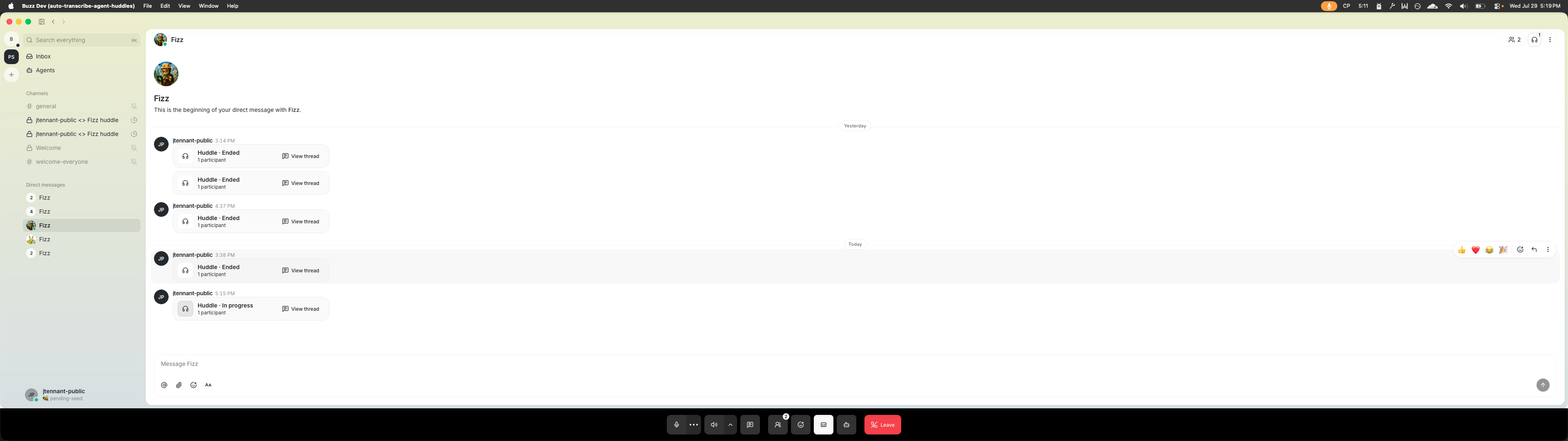 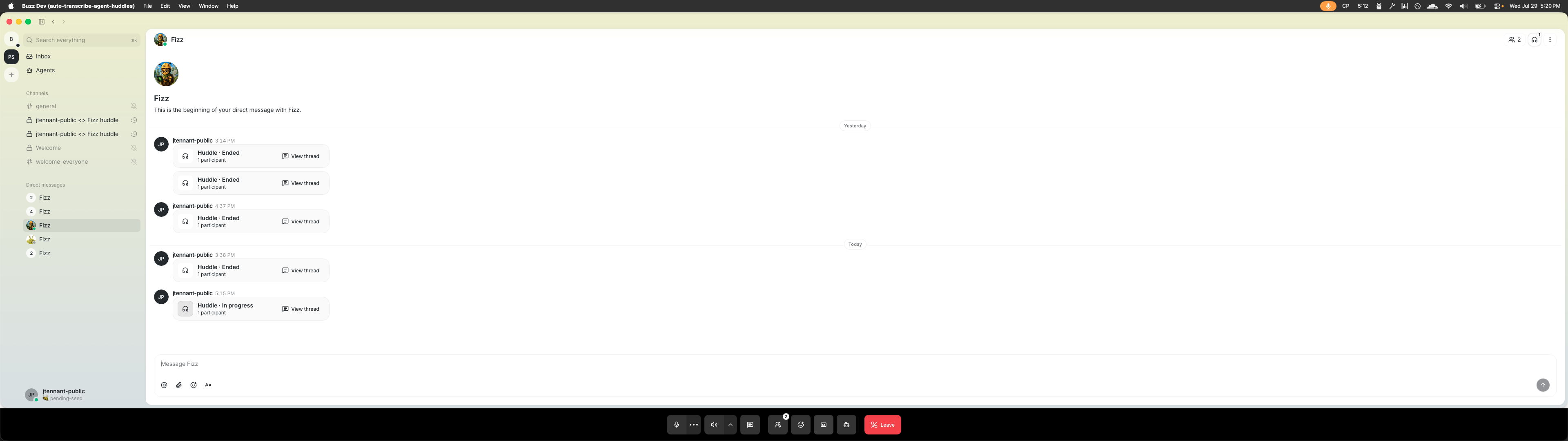 ## Reviewer-reproducible examples From a fresh checkout: ```bash pnpm --dir desktop build:e2e pnpm --dir desktop exec playwright test tests/e2e/huddle-transcription.spec.ts --project=smoke pnpm --dir desktop exec playwright test tests/e2e/mentions.spec.ts --project=smoke --grep "system agent profile exposes owned agent actions|system agent avatar exposes owned agent actions|owned bot profile exposes message and huddle actions|owned agent mention profile exposes message and huddle actions" ``` The huddle scenario exercises initial authoritative hydration, exactly one automatic enable, explicit OFF persistence, unchanged state after last-agent removal, newer events winning over delayed hydration, agent-DM enrollment, and idempotent parent membership. It also asserts `aria-pressed` and distinct computed active styling. --------- Signed-off-by: John Tennant <jtennant@squareup.com> Signed-off-by: npub1jh9wn95s0472h86ahapupaf7m6kx4v9sx2n0atj2hltcfer8k06s5n3pyf <95cae996907d7cab9f5dbf43c0f53edeac6ab0b032a6feae4abfd784e467b3f5@buzz.block.builderlab.xyz> Co-authored-by: npub1jh9wn95s0472h86ahapupaf7m6kx4v9sx2n0atj2hltcfer8k06s5n3pyf <95cae996907d7cab9f5dbf43c0f53edeac6ab0b032a6feae4abfd784e467b3f5@buzz.block.builderlab.xyz> |

