mirror of
https://github.com/block/buzz.git
synced 2026-10-29 13:31:44 +00:00
7fb8d8f490a8a6fe524a62b918264482b2da9556
107 Commits
| Author | SHA1 | Message | Date | |
|---|---|---|---|---|
 John Tennant |
7fb8d8f490 |
Load GitHub changes and reviews in experimental task channels
Signed-off-by: John Tennant <jtennant@squareup.com> |
||
|
John Tennant
|
7f23539ed6 |
Document task assignee metadata
Signed-off-by: John Tennant <jtennant@squareup.com> |
||
|
John Tennant
|
d2d58107df |
Clarify standalone task channel creation
Signed-off-by: John Tennant <jtennant@squareup.com> |
||
|
John Tennant
|
6767cce8d2 |
Prototype channel-backed task views
Signed-off-by: John Tennant <jtennant@squareup.com> |
||
|
John Tennant
|
bdd89522ca |
docs: capture unresolved branch binding flow
Signed-off-by: John Tennant <jtennant@squareup.com> |
||
|
John Tennant
|
8a2a19d4cb |
docs: note automatic branch channel resolution
Signed-off-by: John Tennant <jtennant@squareup.com> |
||
|
John Tennant
|
11e7e74ccb |
docs: clarify branch channel reuse
Signed-off-by: John Tennant <jtennant@squareup.com> |
||
|
John Tennant
|
ecee0b8ec7 |
docs: model branch-backed task relationships
Signed-off-by: John Tennant <jtennant@squareup.com> |
||
|
John Tennant
|
60cf9bbe7a |
docs: require task experiment guidance
Signed-off-by: John Tennant <jtennant@squareup.com> |
||
|
John Tennant
|
ebd6825db1 |
docs: show task experiment note
Signed-off-by: John Tennant <jtennant@squareup.com> |
||
|
John Tennant
|
f90baaac09 |
docs: link task canvases to experiment
Signed-off-by: John Tennant <jtennant@squareup.com> |
||
|
John Tennant
|
397f3dfc20 |
docs: clarify channel link placeholders
Signed-off-by: John Tennant <jtennant@squareup.com> |
||
|
John Tennant
|
8cfcb9a14f |
docs: separate task origin from messages
Signed-off-by: John Tennant <jtennant@squareup.com> |
||
|
John Tennant
|
d9560aca66 |
docs: link task creation conversations
Signed-off-by: John Tennant <jtennant@squareup.com> |
||
|
John Tennant
|
67ac941a74 |
docs: keep canvas schema self-explanatory
Signed-off-by: John Tennant <jtennant@squareup.com> |
||
|
John Tennant
|
d4d3411029 |
docs: trim canvas metadata guidance
Signed-off-by: John Tennant <jtennant@squareup.com> |
||
|
John Tennant
|
3bb26c1dcf |
docs: define task canvas metadata
Signed-off-by: John Tennant <jtennant@squareup.com> |
||
|
John Tennant
|
dba8cb4058 |
docs: describe channel-backed task experiment
Signed-off-by: John Tennant <jtennant@squareup.com> |
||
|
Jordan Mecom
|
4d447b9c20 |
Add generic information-flow control core (#7293)
Adds a dependency-free `ifc-core` crate implementing reader-set confidentiality labels and monotonic per-computation flow state. - Defines flow ordering, join, and meet over caller-supplied principal universes. - Fails closed for unknown or cross-universe input and checks reader widening at egress. - Includes property tests for lattice laws and monotonic taint, plus the design paper that motivates the broker integration. The crate deliberately contains no Buzz, Nostr, channel, membership, or grant policy; those remain in the Buzz adapter. --------- Signed-off-by: Jordan Mecom <jm@squareup.com> |
||
|
Logan Johnson
|
4afef8649a |
fix(desktop): restore mention chip identity icons (#7338)
## Summary Restore the missing **@ glyph for people and robot icon for agents** after #7133, and incorporate the requested compact public-key display. - Wrapping mention chips render their existing bounded icon-bearing leading fragment. - Readonly chips show bound keys using the same `8 leading…4 trailing` formatter as the channel member list: `Scout (150b20bd…15dc)`. - Full literal labels and exact keys remain authoritative in metadata, profile targets, title/accessible-name attributes, editor text, saved bodies and recipient tags. Display abbreviations are never used for recipient lookup. - Copy/paste restores the full literal label for a complete compact chip; partial selections remain plain text. Two keys sharing the same abbreviation still round-trip to their separate exact recipients. - No recipient-resolution, authorization, wire-format, composer, or CSS changes. Existing labels, icons, cloud markers and ordinary mentions remain intact. ## Verification Published candidate `9365ab9bc9d9c5d10802580cd576f8e378ff492f`, based on main `e09f715c9d0ee2cb7bf8a39061e601f3a502f588`: - **6,444 desktop unit tests passed** on this candidate's final source tree. - **44 mock-Chromium tests passed, zero retries in the final run** across mention recipients, clipboard and cloud provenance: exact recipient selection, ambiguity rejection, send/edit/reopen, forwarding, full/partial copy, mismatched-key rejection, matching-abbreviation collisions and 100%/150% narrow-window geometry. - TypeScript, desktop Biome/check guards, protected-feature production build and E2E build passed. - The compact-renderer regression fails with the formatting call removed. Original missing-icon and hidden-text accessibility regressions have red/green evidence. - Fresh self-review traced rendering, full-key metadata, copy classifier, paste normalization and identity trust. The same display formatter owns the accepted compact form on both clipboard sides. Iteration exposed an existing team-insertion separator flake (passed final full run) and two new fixture assumptions: non-member sends require invitation, and Chromium rich paste may retain an NBSP separator. Tests now exercise invitation and normalize only that separator when comparing the captured full body and exact tags; no product change was needed for either. Earlier local repository-wide `just ci` completed in two invocations because its initial call hit the ten-minute tool limit during Tauri compilation. Unchanged native/mobile/backend evidence is reused; the desktop delta received the full checks above and new remote CI. Native VoiceOver, real Tauri selection, dark theme and non-Chromium observation were not performed. Browser artifacts exercise real frontend with mocked Tauri/relay boundaries, not an installed release. ## Review and visual evidence Current-head CI and automated review must complete after this update; the old `2997bfb5` green results do not establish this new head. Required human review remains separate from agent approvals. No merge/install/restart authorization. Before/after icon evidence: https://github.com/block/buzz/pull/7338#issuecomment-5544575866 Updated compact-key screenshots are posted below. The editor intentionally retains the full literal address; only readonly chip display is abbreviated. Origin: buzz://message?channel=3355d33a-b72a-423a-b064-a58275f9a8af&id=38b3a27e689f5a9604e273d45f4e3122fceba76081e7bcd3bbdbf439524a5a18 --------- Signed-off-by: Logan Johnson <loganj@squareup.com> Co-authored-by: Larry <627498bd4bd1f281a16431e3c6cce3b5c25b6692798c78672298aefbf2f8f8b5@buzz.block.builderlab.xyz> |
||
|
Logan Johnson
|
e7e29937a1 |
feat(desktop): invite owned agents from standalone forums (#7125)
## Summary In Desktop's standalone Forums, selecting an owned agent from another device could leave a post or reply unsendable if the agent had not joined the forum. This adds **Invite / Cancel** to the send flow so you can resolve membership without leaving your draft. - **Invite** checks response policy and your permission to add members, adds the agent to the forum, waits for refreshed membership, then rechecks authorization before posting to the original destination. Membership is forum-wide, not limited to one post. - **Cancel / Escape** keeps the text, attachments and selected recipients for retry. Unlike chat's **Do nothing / Send anyway**, this dialog has no reference-only send choice. Invite is disabled while pending; Cancel remains available. - Leaving the source post/reply cancels its pending invitation, even if you return. Errors remain visible, focus returns to the initiating editor when appropriate, and late completion cannot resume a cancelled post or interfere with a newer attempt. - A rejected send restores text, uploaded media and exact selected recipients to the source draft only if no newer edit, deletion, upload intent or send supersedes it. Clipboard verification settles before recipient capture, with stale edits/navigation fenced out. ### Related issue Targets `main` after #7124 merged. This PR reuses its publication checks and draft protection; the five forum commits have been replayed unchanged onto the merged parent. Owned-agent discovery (#7122) is already merged. Split from #7114. Forum creation/templates, channel-less Notes and local-agent management are unchanged. Duplicate-name binding from #7133 is already merged and retained by this stack. Inviting does not start a remote agent or promise that it is online or will reply. ### Testing Forum composer lifecycle tests, including clipboard-settlement cases, and TypeScript/changed-file formatting checks passed after the restack. Earlier invitation, focus and transport-recovery browser coverage is retained, not claimed as a fresh full browser run on this head. See [live CI](https://github.com/block/buzz/pull/7125/checks) for current-head results. Browser evidence uses mock IPC; no full local `just ci` pass or native/live-relay validation is claimed. To try it: open a forum post or reply, select an owned nonmember agent and send. Cancel, then retry without reselecting; Invite should add that agent before posting. Deny the add to check the visible error and retained draft. Navigate away/back during a pending invitation or rejected send; no stale publication or overwrite of a newer draft should occur. 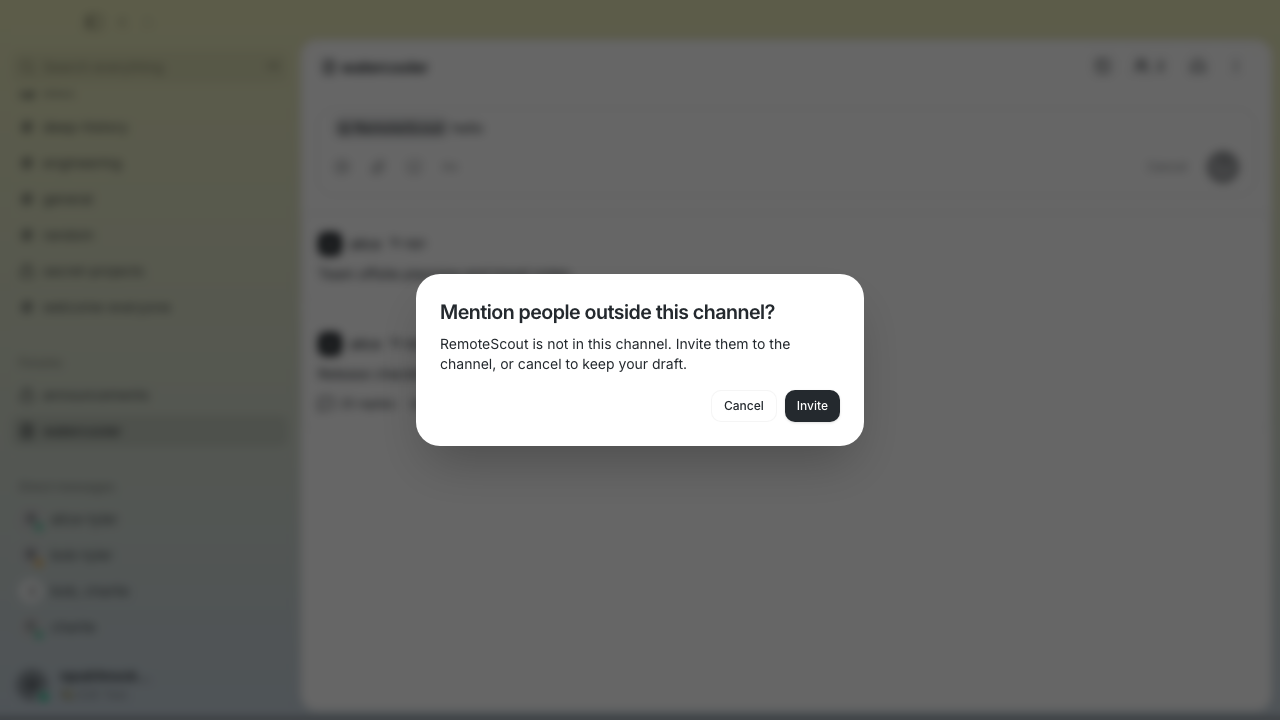 *Earlier mock-browser capture, not current-head runtime proof. [Error and successful-post captures](https://github.com/block/buzz/pull/7125#issuecomment-5513883462); no before-state/native capture available.* **Limits:** cancellation cannot undo accepted membership changes or dispatched posts; authorization and publication are not atomic. Recovery is same-window, subject to browser storage limits, and is not a durable in-flight send journal: reload/crash can lose a pending snapshot. Cross-window coordination and in-flight upload custody are unchanged. The parent's legacy member-agent compatibility does not establish ownership for nonmember invitations. --------- Signed-off-by: Logan Johnson <loganj@squareup.com> Co-authored-by: Larry <627498bd4bd1f281a16431e3c6cce3b5c25b6692798c78672298aefbf2f8f8b5@buzz.block.builderlab.xyz> |
||
|
Logan Johnson
|
d595806fc3 |
fix(desktop): authorize remote mentions at publication (#7124)
🤖
## Summary
In Buzz Desktop, you could own an agent running on another device but be
unable to mention it in a channel where it had not yet joined: it was
filtered out before you could invite it. A selected agent could also
disappear from the message's recipients when permissions changed. This
lets you select an eligible agent in the existing **@ menu**, invite it
from the message composer, and send to that agent—or see an error and
keep your draft rather than silently sending without it.
#### Where the experience changes
| Screen / control | Before → after |
| --- | --- |
| A channel's **Message #…** composer, or a message's **Reply in thread
to …** composer | Type `@` (or use the existing @ button), choose your
agent, write the message and press **Send message**. An owned agent not
yet in the channel can now reach the existing **“Mention people outside
this channel?”** dialog when its response settings allow you to address
it. |
| That dialog's **Invite** button | Previously the membership
requirement could block the agent before the invitation. Now Invite
checks permission to add it, adds it as an agent member of the
**channel** (not just the thread), then rechecks membership and response
permission before sending the waiting message. An agent already in the
channel needs no invitation. |
| Existing direct message, or the new-message screen with the **To:**
field | A mention is checked against the conversation the message will
actually enter, including a newly created direct message, rather than
the old or not-yet-created destination. This does not add an Invite
control to direct messages. |
| Editing a message / sending attachments | The selected agent remains
part of the send or edit attempt through attachment upload and the final
permission check. Lost permission produces a visible error instead of
dropping that recipient. |
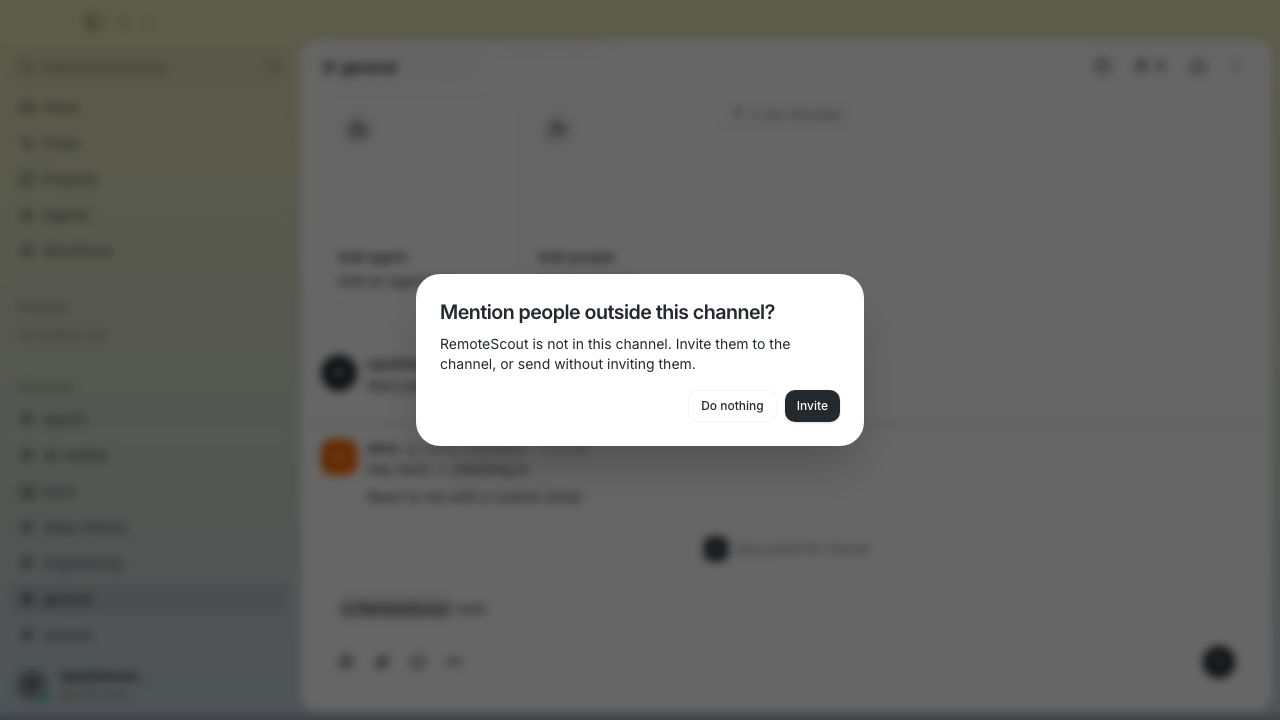
**Invite is not the only chat choice.** The existing **Do nothing**
button sends the message *without inviting or notifying the nonmembers*;
their names remain references in the text. Where you cannot invite, that
choice is labelled **Send anyway**. To abandon the send instead, dismiss
the dialog with Escape. Invitation actions are disabled while
preparation is pending, preventing duplicate clicks.
**Leaving and returning must not resurrect a cancelled send.** Switching
threads or leaving the composer cancels its pending invitation, even if
you return to the same thread. Cancellation before dispatch sends no
message; an accepted membership change cannot be automatically undone.
An ordinary send without a pending invitation remains bound to its
original destination rather than following you into another
conversation.
**Failed sends must not overwrite your next draft.** If you leave a
thread, return and replace or deliberately clear its draft while an
older send is pending, the older failure cannot restore deleted text,
recipients or files; success cannot erase the newer draft—even if its
text is identical. An untouched draft cleared automatically for sending
remains recoverable on failure. This protection also covers reopening
the composer and starting a newer send.
The channel timeline also keeps its existing **new-messages / Jump to
latest** button available when newer messages are waiting to be
displayed. For example, after sharing a reply to the channel and closing
the thread panel, you can click the catch-up button to reveal buffered
messages. Closing the thread does **not** guarantee the shared row
appears automatically or force you away from reading history.
### Related issue
Built on [#7122](https://github.com/block/buzz/pull/7122), base branch
`split/owned-agent-discovery`, which lets Desktop find and verify owned
agents independently of this device. Current integration head:
`1144465d00273cf74b7c22544ae5a3299bd98560`, built on exact published
root `3a56d17824522580fe04cae463b54f4c7ba66021`. Root #7122 has its own
CI and security gates; this PR must not land ahead of that dependency.
Finding an agent is not channel membership, online status or a promise
of a reply. This PR changes what the existing message controls can do
with those agents; it adds no profile, presence, cloud marker or remote
start/stop UI.
Standalone forum post/reply **Invite / Cancel** is added separately in
[#7125](https://github.com/block/buzz/pull/7125); here those composers
only gain visible authorization errors. Same-name selection/binding
fixes ([#7133](https://github.com/block/buzz/pull/7133)) and mention
spacing ([#7128](https://github.com/block/buzz/pull/7128)) are not
included.
Extracted from [#7114](https://github.com/block/buzz/pull/7114)
(historical source `98fe33ec`). [Behavior and draft-recovery
contract](
|
||
|
Logan Johnson
|
ee883d73fb |
fix(desktop): bind duplicate mention selections to exact recipients (#7133)
## Summary Selecting two people or agents named Scout could replace the first recipient with the second even though the message still looked right. This binds each selection to its exact identity: the first keeps `@Scout`, and a conflicting selection gets `@Scout (<full public key>)`. Removing one no longer removes or redirects the other. - Reuse the existing **@ suggestion list**; team selection and automatic agent addressing reserve and reuse distinct labels too. Typing an ambiguous name manually shows an instruction to use the picker and preserves the draft without publishing—in chat, edits and standalone forums. - Share literal mention matching across recipient extraction, removal, display and editing so a shorter name cannot claim another recipient's longer or qualified label. - Rebuild authored references when a message is edited, and use the latest authorized snapshot when reopening or forwarding. Rendering/editing can recover qualified identities only from the message's recorded references, not from a key typed into its body. Unresolvable historical names remain literal rather than guessed recipients. - Wrap full-key labels within narrow/zoomed layouts while keeping their complete accessible label and ordinary mention icons. Edit activation waits for the action menu's focus cleanup before focusing the editor. ### Related issue Targets `main`; mention spacing (#7128) is already merged. Split from #7114. This is independent of the #7124 → #7125 remote-invitation stack and does not expand agent eligibility or invitation permissions. The separate Enter-selection suffix issue remains tracked in #7253. ### Testing The desktop unit suite and focused mock-Chromium checks passed on the published integration candidate, including pending-paste selection, edit/forwarding, copy and narrow-layout cases; formatting, types and frontend builds passed. On `0b3b18c0`, 64 focused trust/paste/selection unit tests and six mock-Chromium tests passed with zero browser retries, including actual timeline chip copy → fresh channel paste → send and mismatched-key rejection; TypeScript, changed-file Biome and an isolated E2E build passed. The broader browser run had copy failures before the focused repairs and is not claimed as wholly green. See [live CI](https://github.com/block/buzz/pull/7133/checks) for current-head results. No full local `just ci` pass, native/live-relay or cross-browser validation is claimed. To try it: select two same-name recipients, remove one, send, then edit/reopen and forward; only the intended identities should remain. Type an ambiguous name without choosing a suggestion and check that sending retains the draft with an error. Inspect full-key labels in a narrow window at 150% text size, and open Edit and type immediately. 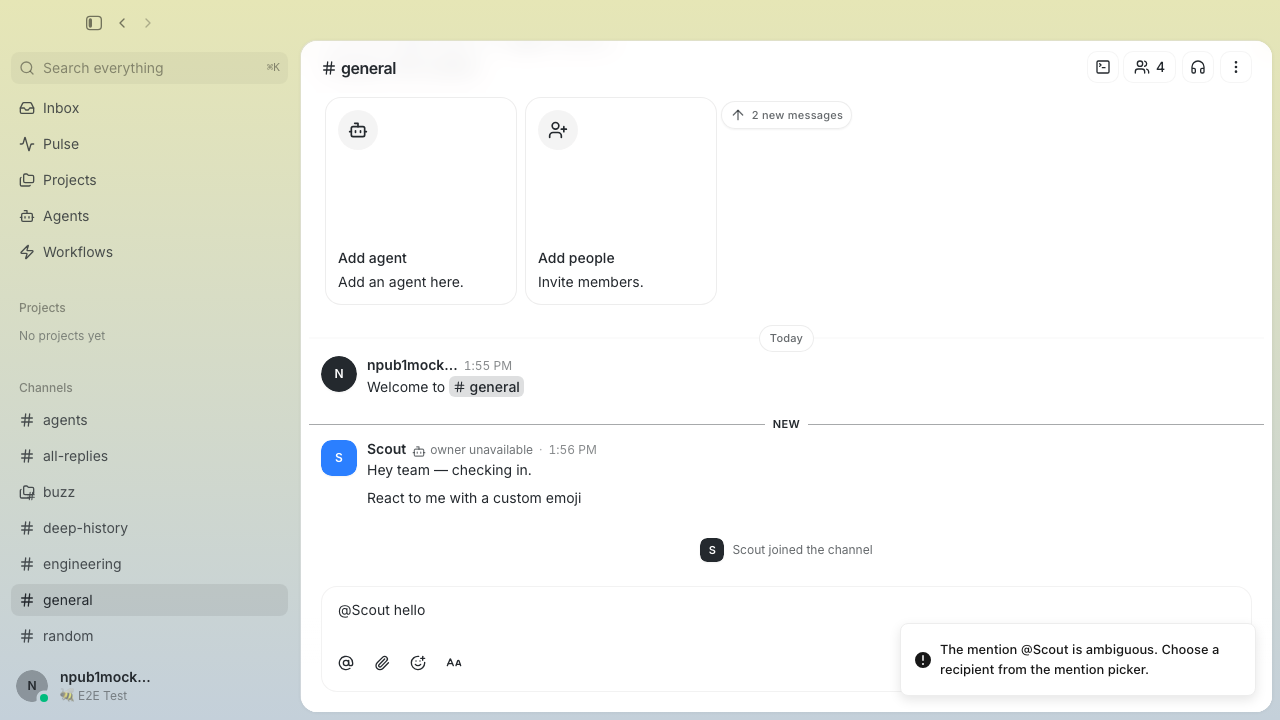 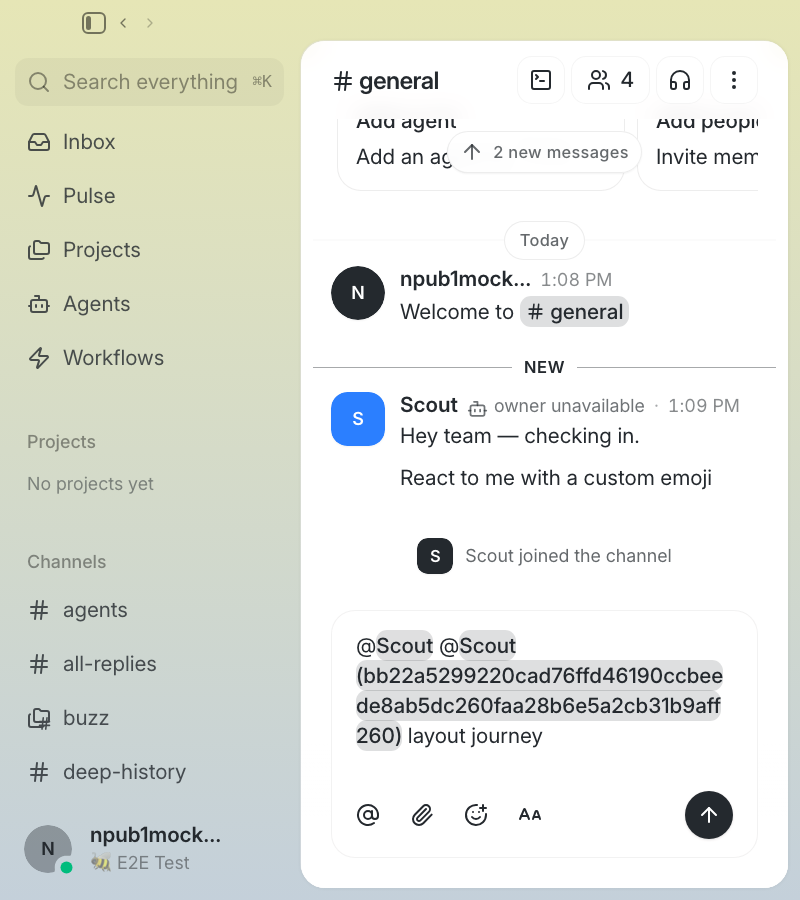 *Earlier mock-browser captures, not current-head runtime proof. No new before-state capture; screenshots alone do not prove recipient delivery.* **Clipboard trust:** generated full-key-qualified mentions now retain their exact recipient after copy/paste when the full key matches the clipboard record and community directory/profile state independently vouches for the base alias, including numeric collision suffixes. A qualifier alone does not establish trust. Arbitrary historical labels still cannot always be reconstructed. --------- Signed-off-by: Logan Johnson <loganj@squareup.com> Co-authored-by: Larry <627498bd4bd1f281a16431e3c6cce3b5c25b6692798c78672298aefbf2f8f8b5@buzz.block.builderlab.xyz> Co-authored-by: Bad Janet <150b20bdf6130418df9239dd1bd082c71612c8d653b47c277200365b9be215dc@buzz> |
||
|
Matt Toohey
|
b1f6b7ef77 |
feat(desktop): preserve mentions across copy and paste (#7228)
Copying a message out of the timeline lost the mention. The rendered chip drops the `@` for display, so the clipboard carried "John Smith" — two ordinary words no composer could bind back to a pubkey. Pasting into another channel produced dead text, and sending it tagged nobody. ## What changed Every Buzz copy now writes two clipboard flavors in one transaction: - **`text/plain`** — readable anywhere, sigils restored, no pubkeys. This is what TextEdit, Slack, and every other external app receive. - **`text/html`** — the same content with each mention wrapped in a span carrying `data-mention-pubkey` / `-label` / `-kind`. On paste, the composer harvests those records, registers each `name → pubkey` with the existing mention machinery, and inserts the content: the chip re-lights and the send path recovers the identity the author tagged. A marker attribute records what the plain flavor holds, so a Markdown copy pastes through the text pipeline and a rendered copy through the HTML one. **Covered surfaces:** timeline selection copy, thread-panel selection copy, forum post/reply selection copy, "Copy message", and composer copy/cut — plus paste in both the channel and forum composers. ## Trust boundary Clipboard HTML is untrusted, and the branch treats it that way: - Records are capped (50), labels bounded (200 chars), and a pubkey must be 64 hex before it can become a `p` tag. - **Only mentions the paste actually shows are registered.** An empty `<span data-mention-pubkey=… -label="Jane Doe">` would otherwise rebind that display name for the rest of the composer session, so a later hand-written @Jane Doe would chip-light convincingly against the attacker's key. Each branch registers only the records whose label appears in the text *it* inserts, matched with `getMentionOffsets` — the same matcher the send-time extractor uses. - **The visibility gate reads only what ProseMirror will insert.** `DOMParser` hard-drops `script`, `style`, `title`, `noscript`, `object`, and `head` content, so `visible<style>@Jane Doe</style>` beside an empty chip span used to smuggle a binding past the gate. Those elements are stripped before either output is derived. - **A partial chip never gains a sigil.** A selection crossing a chip boundary falls through to the browser's default copy, which serializes the full identity attributes around a slice of the text — pasting that invented "@Smith" out of "John Smith". Paste now leaves a fragment as plain text, tolerating only what a whole chip picks up in transit (restored sigil, author casing, U+00A0 swaps, and the label cap's own ellipsis). Both clipboard sides share one `matchChipTextToLabel` helper, in the module that owns the label attributes, so copy and paste cannot drift on what counts as a whole chip. ## Notes - Mention matching reuses `getMentionOffsets`, so code spans and fences are excluded and the longest display name wins. - The plain flavor inlines chip boxes before reading `innerText`; a chip is a flex container, so the browser's own copy split "@John Smith" onto its own line. - `MarkdownMention` and `MacEmacsTextShortcuts` are extracted verbatim from `markdown.tsx` and `useRichTextEditor.ts` to keep both files under the size gate. ## Testing - ~40 unit tests over the flavor builder/parser, the visibility filter, the ignored-tag sweep, and the chip-match verdicts. - A Playwright spec (`desktop/tests/e2e/mention-clipboard.spec.ts`) driving real copy/cut/paste DOM events: timeline and "Copy message" of a multi-word non-member mention pasted into another channel and sent with the original pubkey in its `p` tag; the forum copy → forum reply round trip; composer copy/cut; plain flavor asserted to contain no 64-hex string; the boundary-crossing drag; and the hidden-record and `<style>` smuggling vectors. - Every regression test is bound to a production seam and fails with its guard removed. - `just ci` / pre-push lanes green (5927 desktop unit tests, typecheck, lint, file-size gate). --------- Signed-off-by: Matt Toohey <contact@matttoohey.com> Co-authored-by: Claude Fable 5 <noreply@anthropic.com> |
||
|
Will Pfleger
|
752cbfc037 |
docs(nip-fi): add Blossom kind-24242 media possession-proof exception (#7278)
Adds the media/Blossom possession-proof exception section to
\`docs/nips/NIP-FI.md\`.

## What this changes

Encodes the condition set confirmed by Thufir's security review
(2026-09-03) as normative MUSTs in NIP-FI. Kind-24242 Blossom auth
events are admitted as the NIP-FI pairing possession proof for **media
routes only** — a named, bounded exception with an explicit precedent
fence against expansion.

### Scope fence

Kind-24242 proofs are valid only on:

| Proof type (`t` tag) | Valid route | Method |
|---|---|---|
| `upload` | `PUT /upload` (and temporary alias `PUT /media/upload`
until removed) | PUT |
| `get` | `GET /media/{hash…}`, `HEAD /media/{hash…}` | GET, HEAD |

All other protected routes MUST reject kind-24242 proofs.

### Upload proofs

Exactly one `x` tag over consumed body bytes; temporal check precedes
body consumption.

### Read proofs (the relaxation Will approved)

Host-wide MAY: no `x` required. Exactly one `server` tag matching the
resolved tenant host is a MUST. Optional `x` must match parent hash if
present.

Named residual (verbatim in spec): within at most 60 seconds from
minting (plus 5s future-skew), a captured full header set allows reading
any media blob on exactly one tenant host — read-only,
membership-checked, revocable, not state-changing, not cross-tenant.

### Freshness (Thufir option 2)

- `created_at <= now + 5s` (bounded future skew)
- `now - created_at <= 60s`
- Exactly one `expiration`, valid at admission, satisfying `expiration
<= created_at + 60s`

### Transport/cardinality

Exactly one each of `Authorization` (Nostr scheme), `t`, `expiration`,
`server`; `x` at most once; reject any duplicate, malformed, or
conflicting instance.

### Per-request pairing

Full assertion verification, exact key equality between assertion
`nostr_pubkey` and kind-24242 signer, deny-map enforcement on every
request. Stub gap named.

### Compliance note

PR #7264 implementation is explicitly non-compliant until the bounded
hardening task lands (named gaps: multi-tag acceptance, 3600s window,
optional `server`).

## Behavioral oracle

`FI-TRACE-HTTP-INGRESS` extended to cover kind-24242 admission and
denial cases.

## Scope

Docs-only. No code changes. The code hardening is a separate follow-on
task.

---------

Signed-off-by: Will Pfleger <pfleger.will@gmail.com>
Co-authored-by: Duncan <dcfd242e557282d7a1e2cf2e6877522682f1e5c6156dc92ca7d90eaedd3b0f95@buzz.block.builderlab.xyz>
|
||
|
Logan Johnson
|
5073e075d7 |
fix(desktop): unify owned-agent cloud provenance markers (#7129)
Unify presentation-only cloud provenance across agent identity surfaces. Keep successful local-inventory and verified-ownership gates; preserve main availability and mention spacing behavior. Co-authored-by: Larry <627498bd4bd1f281a16431e3c6cce3b5c25b6692798c78672298aefbf2f8f8b5@buzz.block.builderlab.xyz> Signed-off-by: Logan Johnson <loganj@squareup.com> |
||
|
Logan Johnson
|
d5a73b9f35 |
fix(desktop): derive agent availability from relay presence (#7127)
🤖 ## Requested rebase published — |
||
|
Logan Johnson
|
44d19f59a5 |
fix(desktop): preserve spacing after multi-word mentions (#7128)
🤖
## Summary
In Buzz Desktop, choosing a multi-word name and immediately continuing a
sentence could swallow the space after the mention: `Hey @Alice
Chenhello`. This keeps the separator, so the same action produces `Hey
@Alice Chen hello` without moving the caret or repairing the name by
hand.
The editor recognizes the complete selected label, including its
internal spaces, and settles the autocomplete caret after the trailing
separator. Deliberately moving left or clicking inside the label still
lets you edit there; this is not a rule that forces every caret to the
end of a mention.
### Related issue
Independent base: `main`. Child:
[#7133](https://github.com/block/buzz/pull/7133), whose disambiguated
labels also contain spaces. Extracted from
[#7114](https://github.com/block/buzz/pull/7114), retained as historical
source (`98fe33ec`).
[Behavior
contract](
|
||
|
Will Pfleger
|
c328202cb0 |
docs(nip-fi): document Git smart-HTTP credential exemption (#7268)
Amend NIP-FI HTTP ingress with an explicit Git smart-HTTP credential-helper exemption. The exception covers method binding, endpoint-URL binding, and the `payload` tag requirement for `info/refs`, `git-upload-pack`, and `git-receive-pack`, while preserving per-request NIP-FI assertion, key pairing, and deny-map enforcement. The spec records Git's credential-protocol limitation, the required compensating controls, and the rule that this exception is limited to these endpoints and is superseded by per-request signing. Related: [PR #7264](https://github.com/block/buzz/pull/7264) Signed-off-by: Will Pfleger <pfleger.will@gmail.com> |
||
|
Will Pfleger
|
187df22252 |
docs(nip-fi): adopt deny-until-TTL and extend enforcement to HTTP ingress (#7254)
Spec revision following two decisions: Option B admin deny (2026-09-02) and the HTTP ingress ruling (2026-09-02). Revises `docs/nips/NIP-FI.md` only. Follows #7214 (merged spec v2). ## What changed ### Admin disconnect: session-only → deny-until-TTL The disconnect operation proceeds in two steps, in order: 1. Insert a memory-resident deny entry keyed by `(iss, target_pubkey)` with absolute expiry `until` — atomically combined with the `(iss, jti)` replay-identity reservation as one all-or-nothing mutation. If the deny set is at capacity (per-issuer bound), the relay rejects `503`; neither the jti nor the deny entry is recorded, and the caller may safely retry the same signed command. 2. Close all live WebSocket connections for the target pubkey, synchronously. The single atomic admission mutation (jti reservation + deny-entry insertion) lives inside `VerifyCommandJwt` step 7, after all pure authorization checks. The endpoint only closes sessions on success. This ordering ensures a capacity failure leaves no state behind and makes the retry-safe 503 contract implementable. The deny set is RAM-cache only — no durable storage, no schema changes. The same operational posture as the JWKS snapshot. A relay restart MAY forget active entries; the issuer SHOULD re-push still-active deny entries on observed restart (same publish/cache pattern as JWKS). If the issuer stops issuing assertions and re-push completes before any expired-entry reconnection attempt, residual exposure after restart is bounded by `max(0, min(exp, iat + maximum_assertion_age) - now)`. If the issuer continues issuing or re-push does not complete in time, that formula does not apply and access may continue beyond it. **`until` claim:** Required on the disconnect command JWT. Because an assertion accepted at the future-skew boundary (`iat <= now + skew`) remains valid until `iat + maximum_assertion_age`, the latest possible authority deadline is `now + skew + maximum_assertion_age`. The relay enforces `until <= now + skew + maximum_assertion_age`. A value above this ceiling rejects `400`; a past `until` still closes live sessions — absent an active same-key entry it creates no future denial, while an active entry remains unchanged under the merge rule. **Capacity and eviction (per-issuer):** The relay MUST bound the deny set size **per issuer**. Capacity exhaustion under one issuer MUST NOT cause rejection of another issuer's commands; the `503` capacity check is evaluated against the command's own issuer bound. Implementations MUST evict only expired entries; when an issuer's partition is at capacity and all entries are still active, the relay MUST reject the new command `503` without removing any existing entry. There is no LRU eviction of active denies. **Issuer-global deny:** The deny entry applies to admission across all communities served by the relay under that issuer. Identity-level revocation is intentionally not community-partial. **Cross-replica propagation:** In a deployment with multiple relay processes, the deployment MUST propagate both the session-close and the deny entry to every process serving admissions for the issuer's communities. The mechanism is deployment-defined (e.g. the existing inter-process message bus, same posture as JWKS convergence). Propagation is asynchronous with no protocol-level completion bound. The issuer re-push duty is the recovery path for lost propagation, exactly as for relay restart. **Response shape:** A successful disconnect responds `{"disconnected": true}` regardless of how many sessions were closed. No session count is returned; a count would aggregate activity across communities and constitute an information leak. **Admission procedure:** Step 5 registers the session's proven `k` before the deny-set check (new step 6) — ensuring any connection that straddles a concurrent disconnect is caught by one side or the other. `FI-TRACE-DENY-SET` oracle covers the per-issuer capacity rule and the straddling termination requirement. ### HTTP ingress enforcement Without explicit enforcement, a protected HTTP surface (bridge, invites, media, git) with NIP-98-only authorization allows a principal holding an active key to mint fresh NIP-98 events indefinitely — NIP-98 proves key possession only, not identity. Without assertion verification there is no expiry bound; the key remains valid for as long as it is accepted. **Pairing rule:** in enforce mode, a protected HTTP request MUST carry both: ``` Authorization: Nostr <base64-NIP-98-event> Nostr-Federated-Identity: Bearer <compact-JWS> ``` The NIP-98 pubkey MUST equal the assertion `nostr_pubkey` claim. Missing, mismatched, or invalid evidence of either kind denies, fail closed. **Verification:** reuses `VerifyAssertion` unchanged — offline, same JWKS, same claim requirements, same denial classes. **Per-request:** HTTP is sessionless; every request re-verifies. No session lifetime, no cached admission. The cumulative residual bound applies per request. **Deny-set applicability:** the deny-until-TTL entry introduced above is consulted per HTTP request identically to WebSocket admission. **Protected surface:** deployment-configured set of routes, fail-closed default (unclassifiable routes treated as protected). No normative route names in the spec. `FI-TRACE-HTTP-INGRESS` oracle added. Security considerations updated with HTTP ingress bypass analysis. NIP-98 source reference added. ### Other changes - `authorization_denied` rejection table row updated to "active deny-set entry for pubkey". - Discovery: `maximum_residual_upstream_revocation_seconds` remains `null` — the deny-until-TTL model is best-effort RAM state and provides no unconditional finite revocation bound. - Rejection and privacy: explicit sentence for HTTP denial path. - Client-attached transport: opening sentence generalized to cover both WebSocket and HTTP. ## Scope Single file: `docs/nips/NIP-FI.md`. No code changes. References #7214. Channel: buzz-enterprise-identity-spec-v2 (#a6fe0b1c-987a-43c5-a974-71ee36678d78). --------- Signed-off-by: Will Pfleger <pfleger.will@gmail.com> Signed-off-by: Duncan <dcfd242e557282d7a1e2cf2e6877522682f1e5c6156dc92ca7d90eaedd3b0f95@buzz.block.builderlab.xyz> Co-authored-by: Duncan <dcfd242e557282d7a1e2cf2e6877522682f1e5c6156dc92ca7d90eaedd3b0f95@buzz.block.builderlab.xyz> |
||
|
Logan Johnson
|
83e5962984 |
fix(desktop): keep explicit agent profiles bound to their exact key (#7131)
🤖
## Summary
In Buzz Desktop, clicking a message from stopped agent A could open
running agent B—and B's controls—because both shared a persona (an agent
definition). This now opens the author you clicked and only that agent's
own controls, so you can inspect an old message without being redirected
to a different running agent.
An explicit public key—the identifier for one agent—now stays exact
across message authors, members, DMs, deep links and Instances rows,
including stopped, archived and relay-only agents. Local controls come
only from a matching local record for that key. A relay-only A cannot
borrow B's Start/Stop/Edit controls or configuration.
Deliberately opening a **persona** is different: it can still select a
representative that respects archived instances or offer Start when none
remains. The change removes competing historical-persona redirects
rather than adding another identity exception.
### Related issue
Independent base: `main`; no stack parent or child among the
replacements. Extracted from
[#7114](https://github.com/block/buzz/pull/7114), retained as historical
source (`98fe33ec`).
[Behavior
contract](
|
||
|
Logan Johnson
|
434dafe958 |
fix(desktop): discover authenticated owned relay agents (#7122)
🤖 ## Summary An agent you own could be missing from **New message → To:** and **Channel members → Add people and agents** on a machine that has never managed it. This PR lets those existing lists find your agent without requiring a shared channel first. Desktop now checks records proving you own it, rather than looking only at agents in channels you've already joined. **No new screen or control is added.** For example, an agent with verified ownership and **Who can send instructions → Only me (default)** can now appear even with no shared channels. Each screen still applies its existing access rules; this does not make every discovered agent selectable everywhere. | Screen / control | Before | After this PR alone | | --- | --- | --- | | **New message → To:** recipient picker | An owned agent absent from this machine and shared-channel bot lists could be missing. | Its named **agent** row can appear; selecting it adds a recipient chip. This is recipient selection, not a guarantee that a later message will reach or wake the agent. | | **Channel members → Add people and agents** | The same agent could be missing from **Not in this channel** search results. | Its row can appear with the existing **Add** button. If you can add members, that button submits the existing channel-membership request; finding the row alone changes no membership. | | **Stream / forum composer → @ suggestions** | An owned agent already in the channel under an ordinary member role could be missing from agent suggestions. | Its actual membership is recognized without requiring the bot role. Agents not managed on this device still need membership in that channel. | | **Pulse → Agents** | An agent absent from both local management and the server's agent list was omitted from the count and author lookup. | The count and feed's author lookup can include it; notes appear only if it has published them. | Being listed does **not** mean the agent is online, add it to a channel, or grant local Start/Edit controls. For agents not managed on this device, global **Search** still excludes those configured for “Only me”, and DM @ selection is not added here. DM @ selection and message-driven nonmember invitation are addressed in [#7124](https://github.com/block/buzz/pull/7124); the standalone forum **Invite / Cancel** flow is in [#7125](https://github.com/block/buzz/pull/7125). <details> <summary>Ownership and membership checks</summary> A discovery lead is not proof: the latest agent profile must have a valid signature and exactly one valid ownership attestation—the owner's signed link to that agent. Its response policy must be signed by that verified owner; an invalid latest policy cannot restore an older permission. Membership comes separately from the latest server-signed roster, including removals. Existing profile cards, owner labels and agent-avatar shapes also use this stricter verification: malformed or forged evidence must not supply ownership/agent classification on its own. Valid ownership was already recognized; no profile-picture or badge design changes. Attestation time conditions apply to the signed event's timestamp, not a live expiry timer. Existing legacy compatibility and builds requiring verified owner policy retain their respective rules. Discovery and sending remain separate operations, not an atomic permission check. </details> ### Review corrections - When runtime and owner policy overlap, **explicit online/away/offline from the verified latest runtime is retained**. Policy still supplies ownership/permissions; claimed runtime membership is not restored. Missing/unrecognized status stays unknown, and invalid latest policy cannot revive runtime permissions. - Discovery without runtime evidence is now **unknown**, not offline: native conversion, both IPC adapters, Pulse, Projects and profile/session consumers preserve that distinction. Unknown has no status dot and is not promoted to a deployed/running agent. - Both relay-only picker paths retain the authenticated owner, including the existing **managed by you** label. The analogous global Search projection is fixed without changing its existing “anyone” filter. - Authorized stored profile activity remains visible when liveness becomes unknown/absent or the active turn ends. History reads do not start a live subscription, grant access, or imply current availability. ### Related issue Independent base: `main`. Child: [#7124](https://github.com/block/buzz/pull/7124), then [#7125](https://github.com/block/buzz/pull/7125). Extracted from [#7114](https://github.com/block/buzz/pull/7114), retained as historical source (`98fe33ec`). [Behavior contract]( |
||
|
Will Pfleger
|
04babf0265 |
chore(db): drop Phase-A NIP-FI relay-side authority ledger (#7221)
Removes the dead relay-side authority ledger introduced by migrations 0041 and 0042, and the dead `require_attested_key` verifier knob from `buzz-auth`. Both are unreachable by design under NIP-FI spec v2 (#7214, squash `d4420eb47`), which makes OSS Buzz stateless for identity: the relay neither stores nor verifies an authority chain. ## What changes **`migrations/0044_drop_nip_fi_ledger.sql`** Drops all fifteen NIP-FI ledger tables and their trigger functions using `CASCADE` to resolve the circular deferred FK between `identity_bindings` and `identity_lifecycle_history`. Drops proceed in FK dependency order: selectors → history/bindings → enrollment_policies/receipts → parallel drop of auth tables. Restores `community_write_fence_excluded_table` to its pre-0041 body (removes NIP-FI table names from the exclusion array). **`schema/schema.sql`** Removes the NIP-FI section (~1885 lines of tables, functions, and triggers) and updates `community_write_fence_excluded_table` to match. **`crates/buzz-db/src/runtime/migration.rs`** - Updates the `embedded_migrator_contains_consolidated_initial_schema` sanity check: count 43→44, adds 0044 assertion block (verifies `DROP TABLE` statements and absence of NIP-FI names from `schema.sql`). - Removes ~2580 lines of NIP-FI Postgres integration tests (all `#[tokio::test] #[ignore = "requires Postgres"]` from the 0041/0042 behavioral coverage). - Removes the `extract_excluded_table_array` drift check (0042 body no longer matches `schema.sql` by design). - Adds `migration_0044_drops_populated_nip_fi_ledger_cleanly`: runs migrations to 0042, seeds rows in `authorization_operation_receipts` and `authorization_invalidation_domains`, then runs to 0044 and verifies all fifteen NIP-FI tables are absent. **`crates/buzz-auth/src/nip_fi/config.rs`** Removes `require_attested_key: bool` from `IssuerPolicy` — field, constructor parameter, accessor, and its contribution to `derive_assertion_policy_id`. **`crates/buzz-auth/src/nip_fi/verifier.rs`** `parse_nostr_pubkey_claim` no longer takes a `policy` parameter. The `None` (absent claim) arm now returns `Err(VerifierError::ClaimRejected)` unconditionally instead of conditionally on `policy.require_attested_key()`. **`crates/buzz-auth/src/nip_fi/verifier/tests.rs`** - Removes `missing_nostr_pubkey_denies_under_attested_key_policy` (the sole `require_attested_key: true` call site). - Removes `false,` from all eleven `IssuerPolicy::new` call sites. - Injects `nostr_pubkey` by default in `mint_signed_by` (spec v2 requires it unconditionally). - Updates `valid_access_token_verifies` to assert `asserted_key().is_some()`. **`crates/buzz-auth/src/nip_fi/startup/tests.rs` + `jwks/tests.rs`** Removes `false,` from all `IssuerPolicy::new` call sites and adds `nostr_pubkey` to all token-minting helpers. ## Verification - Fresh-DB migration run to head: all migrations apply cleanly in sequence. - Populated-0041/0042-DB migration through 0044: seeds rows in live NIP-FI tables, verifies all fifteen are dropped without error. Closes the dead-code inventory item from the spec-v2 cleanup plan (channel `48374f48`). Follows #7214. --------- Signed-off-by: Will Pfleger <pfleger.will@gmail.com> Signed-off-by: Duncan <dcfd242e557282d7a1e2cf2e6877522682f1e5c6156dc92ca7d90eaedd3b0f95@buzz.block.builderlab.xyz> Co-authored-by: Duncan <dcfd242e557282d7a1e2cf2e6877522682f1e5c6156dc92ca7d90eaedd3b0f95@buzz.block.builderlab.xyz> |
||
|
Will Pfleger
|
d4420eb47f |
docs(nip-fi): rewrite NIP-FI as stateless OSS Buzz spec v2 (#7214)
Rewrites `docs/nips/NIP-FI.md` as a stateless spec and deletes the five companion profiles (NIP-FI-CONF, NIP-FI-DELEG, NIP-FI-EDGE, NIP-FI-LIFECYCLE, NIP-FI-MODEL) that presuppose relay-side state. ## What changes ### `docs/nips/NIP-FI.md` — full rewrite The relay-side authority engine (bindings, receipts, lifecycle, invalidation, leases, delegation, enrollment modes, TOFU) is removed. The spec settles exactly five things: 1. **Assertion contract**: JWT claims (`iss`, `sub`, `nostr_pubkey`, `aud` (required), `iat`/`exp`, finite TTL bounds), npub binding semantics, required NIP-42 proof-of-key pairing. Evidence rules (assertion-key-mismatch → `authorization_denied`, freshness) preserved from v1. 2. **Verification**: offline against configured per-issuer JWKS snapshots; multi-issuer; fail-closed on missing/expired/unverifiable. Cites `crates/buzz-auth/src/nip_fi/` (PR 3 / `70895b355`) as implementing the assertion-verification procedure. The `require_attested_key` flag in `IssuerPolicy` is the enforcement primitive for the unconditional `nostr_pubkey` requirement; conformance requires forcing it true for every issuer — follow-on code outside this PR. 3. **Session policy**: required finite `max_connection_lifetime_seconds` knob with no permissive default; re-auth on every reconnect; no in-band renewal. 4. **Admin disconnect API**: session-only normative text with a dedicated `VerifyCommandJwt` procedure — distinct `typ: nip-fi-command+jwt`, signed `method`/`path` binding, normative `maximum_command_age` bound (0 < value ≤ 60 s), atomic `(iss, jti)` reservation as the final admission step after all pure checks. Non-normative note documents cumulative residual access: `max(0, min(exp, iat + maximum_assertion_age) - now)` assuming issuance stops; states that previously issued assertions remain valid for reconnection until their authority expires; states that continued issuance extends access with no protocol-level bound. Non-normative note documents the session-only vs deny-until-TTL trade-off. This verifier and endpoint are follow-on code. 5. **Deletions**: bindings, enrollment, lifecycle, receipts, leases, invalidation, delegation gone. "Out of scope" section names every issuer and deployment concern explicitly. ### Companion profiles deleted NIP-FI-CONF, NIP-FI-DELEG, NIP-FI-EDGE, NIP-FI-LIFECYCLE, NIP-FI-MODEL — all presuppose relay-side binding/lifecycle state. ## What does NOT change The entire `crates/buzz-auth/src/nip_fi/` Rust crate (PR 3 / `70895b355`) implements the assertion-verification procedure described in this spec. No Rust code changes in this PR. The `require_attested_key` enforcement integration and the `VerifyCommandJwt` / disconnect endpoint implementation are explicit follow-on code work. ## Follow-on work (separate PRs after spec merges) - `require_attested_key` forced-true startup enforcement - `VerifyCommandJwt` implementation and disconnect endpoint - Down-migration dropping migrations 0041/0042 (0042 before 0041 per FK order) - `schema.sql` NIP-FI sections removed - `buzz-db` migration test blocks cleaned up --------- Signed-off-by: Will Pfleger <pfleger.will@gmail.com> Co-authored-by: Duncan <dcfd242e557282d7a1e2cf2e6877522682f1e5c6156dc92ca7d90eaedd3b0f95@buzz.block.builderlab.xyz> |
||
|
Tom Brow
|
42b42447b0 |
feat(mobile): prepare buzz-push-gateway for deployment (#7158)
A few things to prepare for deploying the Buzz push gateway as implemented in #6269: - Cut `buzz-push-gateway` chart `0.2.0` from the current config (certificate auth, dogfood client) - Datadog-compatible metrics - Align the desired schema, metrics docs, and production ingress guidance with the current dogfood deployment contract ## Links - [BUZZ-17: Publish the MVP-compatible gateway chart](https://linear.app/squareup/issue/BUZZ-17/publish-the-mvp-compatible-gateway-chart) - [BUZZ-26: Add Datadog-compatible push-gateway metrics and correct source drift](https://linear.app/squareup/issue/BUZZ-26/add-datadog-compatible-push-gateway-metrics-and-correct-source-drift) --------- Signed-off-by: Tom Brow <tomb@block.xyz> Co-authored-by: Codex <noreply@openai.com> |
||
|
Luke Tornquist
|
3ed623bb21 |
feat(db): configurable writer session timeouts (lock, idle-txn, statement) (#6229)
## Why A wedged relay boot pod holding a relation lock can park every other writer in the fleet behind it: DB load pins at pool capacity in `Lock:relation` waits while CPU stays flat, and nothing server-side releases the lock until the holder dies. We hit exactly this in production — ~1,400 sessions queued behind one crash-looping pod's boot transaction for ~20 minutes until kubelet killed the container. ## What Applies session-level Postgres timeouts to every **writer** connection inside the existing single `after_connect` hook in `buzz-db`, all env-tunable through the same `Config::from_env → DbConfig` path as the existing pool-size knobs: | Env var | GUC | Default | Effect | |---|---|---|---| | `BUZZ_DB_LOCK_TIMEOUT_MS` | `lock_timeout` | 5000 | statements waiting on any lock fail fast instead of parking behind a wedged holder | | `BUZZ_DB_IDLE_TXN_TIMEOUT_MS` | `idle_in_transaction_session_timeout` | 60000 | reaps wedged clients idling inside an open transaction while holding locks | | `BUZZ_DB_STATEMENT_TIMEOUT_MS` | `statement_timeout` | 0 (off) | opt-in runaway-statement cap; off by default because startup migrations/backfills legitimately run long statements | `0` disables a timeout (Postgres semantics) and deliberately passes through the env parsing — unlike the pool-size knobs where `0` falls back to the default. The reader pool is untouched: replica sessions never take contended locks and already fail acquire in 150 ms. Deployers tune these via plain env vars (`.env`, or `relay.extraEnv` in the Helm chart) — no code changes needed. ## Behavior change to note With the 5 s default `lock_timeout`, a boot-time migration or backfill that waits >5 s on a lock now errors (surfacing in logs / crash-looping the pod) instead of stalling silently. That is the intended visible-failure-over-fleet-stall tradeoff; deployers with slow contended migrations can set `BUZZ_DB_LOCK_TIMEOUT_MS=0`. ## Testing - `cargo test -p buzz-db -p buzz-relay` — buzz-db green; buzz-relay has 9 failures that also fail on clean `main` in this environment (api::admin/api::media/mesh_demo — unrelated, pre-existing). - New config test covers override / `0`-passthrough / invalid-fallback for all three env vars. - Extended the existing `writer_pool_safety_hook_is_single_and_composed` source-shape test so the timeouts can't drift out of the single `after_connect` hook (SQLx replaces hooks — a second hook would silently disarm the floor guard). - `cargo fmt --check` and `cargo clippy --all-targets` clean for the touched crates. Closest existing PR/issue: none found. --- **Update Aug 28, 17:06 EDT:** Rebased onto `main` at `a3730784fc` and addressed the latest correctness review. - Ported the timeout policy onto the refactored `buzz-db::runtime` pool constructor and kept the shared env overlay for relay, admin, deletion, and audit writers. - Migration/schema-destruction connections now disable `lock_timeout` and `statement_timeout` for their intentional long wait/DDL path. This supersedes the earlier “Behavior change to note”: contended boot migrations wait for the current migration owner rather than crash-looping after five seconds. - The audit worker now preserves and retries the same entry on PostgreSQL `55P03` lock timeouts, using exponential backoff capped at one second. Other database errors retain the existing terminal error behavior, and retries emit `buzz_audit_log_lock_retries_total`. - Added CI-backed PostgreSQL regressions for writer GUC installation/migration exemption, audit-pool lock timeouts, and worker recovery. The worker regression holds the real audit advisory lock past `lock_timeout`, observes a retry, releases the lock, and proves the original entry is appended exactly once. Current verification supersedes the earlier testing notes: workspace Rust clippy passed with warnings denied; all nine infrastructure-free backend unit-test lanes passed; all three focused PostgreSQL regressions passed against PostgreSQL 17; formatting, diff checks, file-size guards, and desktop frontend checks passed. The Linux Blox workstation could not run the unrelated Tauri native lane because `glib-2.0` is absent, so that platform check is left to PR CI. --- **Update Aug 31, 11:09 EDT:** Rebased onto current `main` at `c3132c3ee9` and reran the requested audit-lock contention scenario on Blox at head `896c3fe9ed`. - `git range-diff` reports both PR commits unchanged by the rebase; the branch remains two commits and the worktree is clean. - `cargo fmt --all -- --check` and clippy with warnings denied passed for `buzz-db`, `buzz-relay`, `buzz-admin`, and `buzz-deletion`. - All three focused PostgreSQL 17 regressions passed: writer session timeout/migration exemption, audit writer timeout bounds, and audit worker recovery of the original entry exactly once. - Live protocol verification used a head-built relay and CLI, native PostgreSQL 17/Redis, `BUZZ_DB_LOCK_TIMEOUT_MS=300`, and an eight-second hold on the community audit advisory lock. The real message was accepted and persisted once while the lock was held; its audit-row count remained zero during contention while retries accumulated. After release, exactly one `event_created` audit row appeared and remained exactly one after an additional two-second duplicate check. The run recorded nine lock-timeout retries, zero audit failures, and event ID `7f8c4ffae28e78555fcf2d56396d6e6c01b3712e5411288dc79e9a54af9d9444`. Generated with Codex --------- Signed-off-by: Luke Tornquist <tornquist@squareup.com> |
||
|
Tom Brow
|
c432a111ca |
feat(mobile): push notifications MVP (#6269)
This PR implements MVP, iOS-only,
[NIP-PL](
|
||
|
Will Pfleger
|
86b9142a09 |
refactor(relay): NIP-98 admin auth with Operator/Moderator roles and NIP-11 discovery (#3777)
Adds authenticated, role-based moderation to the relay admin API. On
`main` the admin API is read-only and gated only by `Host`/`Origin`
matching; this branch adds NIP-98 authentication, a two-tier
Operator/Moderator principal model, mutation and staffing endpoints, and
NIP-11 auto-discovery so clients never type the admin URL by hand.

## Authentication (`BUZZ_ADMIN_AUTH`)

`BUZZ_ADMIN_AUTH` accepts `nip98` or `disabled`. Leaving it unset
defaults to `nip98` (fail-secure). Configuration fails closed: any other
value aborts startup, while a lingering `BUZZ_ADMIN_TOKEN` is ignored
with a startup warning — token (bearer) authentication is not supported.
`Host`/`Origin` matching is retained in every mode as defense-in-depth.

- **`nip98`** (default) — per-request signed NIP-98 (kind 27235) events,
resolved to an Operator or Moderator principal with per-person
attribution and individual revocability. Read-write per resolved
principal.
- **`disabled`** — no credential; relies entirely on network-layer
controls (reverse proxy, VPN, firewall) and logs a `WARN` on every boot.
Always read-only: `authorize()` resolves no principal, so mutation and
staffing routes always `403`.

## Roles

Buzz has two independent authority axes after this change.
**Relay-level** roles (new here) are deployment-global: they act across
every community on the relay, through the admin API. **Community-level**
roles (pre-existing, unchanged by this PR) are tenant-scoped: they act
inside one community, through signed Nostr moderation commands.

### Relay level (new)

| Role | Description |
|---|---|
| **Operator** | Full control of the deployment's moderation surface:
read all reports, feedback, and attachments across every community;
resolve reports with enforcement (`delete`/`kick`/`ban`/`timeout`) or
decisions (`dismiss`/`escalate`); reopen and cancel; update feedback
status; and manage the Operator/Moderator roster via the staffing
endpoints. |
| **Moderator** | Day-to-day triage: everything an Operator can do
except staffing — cannot view or change the roster. |

How a pubkey acquires a relay role (resolution order; config always
outranks DB):

1. Listed in `RELAY_OPERATOR_PUBKEYS` → **Operator** (source `config`)
2. Equals `RELAY_OWNER_PUBKEY` while `RELAY_OPERATOR_PUBKEYS` is empty →
**Operator** (source `owner_fallback`, a break-glass grant for
self-hosters that deactivates once any operator is configured)
3. Row in the `relay_operators` table → **Operator** or **Moderator**
(source `db`, managed via the staffing endpoints)
4. No match → `403`

### Community level (pre-existing, unchanged)

| Role | Description |
|---|---|
| **Owner** (community) | Full authority within their community: every
moderation action (delete, kick, ban/unban, timeout/untimeout, resolve
reports, view queue) plus member, role, and invite management. No guard
rails. |
| **Admin** (community) | Same community-wide moderation capabilities as
owner, except an admin cannot ban or time out the owner or a fellow
admin — only the owner may action an admin. Manages members and invites;
only the owner grants the admin role. |
| **Member** (community) | Standard participant; no moderation
capability. |
| **Owner / Admin** (channel) | Channel-local authority only: delete
messages and kick users within their own channel. |
| **Member / Guest / Bot** (channel) | No moderation authority. |

There is no community-level Moderator tier in v1; relay-level Moderator
is the only role by that name.

## Escalation scoping

The operator report queue is an escalation backstop, not the community's
day-to-day triage surface (per `VISION_MODERATION`, the severe class is
the platform's to review rather than the community's). Two rules enforce
that:

- **Escalated-by-default listing.** `GET /reports` with no `status`
parameter returns only `escalated` reports. An explicit
`status=<open|resolved|dismissed|escalated>` filter is always honored as
given, and full visibility across every status stays available for
platform-safety and legal review via `scope=all` (which lists reports
regardless of status). `scope` accepts only `all` and is ignored when an
explicit `status` is present.
- **Auto-escalated `illegal` reports.** Member reports whose category is
`illegal` are ingested with `status=escalated` rather than `open`, so
the severe class reaches the operator backstop without waiting for a
community admin to forward it. Every other category still lands `open`.
Auto-escalation only sets the queue status — it records no moderator
decision and stamps no resolver, so an auto-escalated report is
indistinguishable downstream from an admin-escalated one: the reopen
route returns it to `open` on the same terms, keyed only on status,
never on how the report became escalated.

## Principal resolution and NIP-98 admission

`resolve_admin_principal()` returns `AdminPrincipal { pubkey, role,
source }` per the resolution order above; `None` never falls through as
a role. Admission is ordered so the replay guard is a privilege, not a
public surface: signature/URL/method/payload-hash verification first,
roster check second, and only then is the deployment-scoped replay id
atomically consumed — a validly-signing but unrostered key never
allocates a replay slot. Redis failure fails closed.

## Report resolution, recovery, and enforcement provenance

`POST /reports/{id}/resolve` is a crash-safe enforcement state machine:
decision-only outcomes (`dismiss`/`escalate`) are a single
CAS-plus-audit transaction; enforcement
(`delete`/`kick`/`ban`/`timeout`) claims the report
(`open`→`processing`), runs the durable mutation, then finalizes — a
re-drive resumes at the step marker and converges to exactly-one
enforcement, fenced by a lease and an outbox claim token.

Person-directed enforcement on an `event`-kind report derives its target
from the stored event's author (server-owned truth, never the reporter's
`p` tag) via a single `derive_enforcement_target` shared by the HTTP
driver and the recovery worker. If the reported event was purged before
its author could be read, person-directed actions are rejected pre-claim
and the report stays `open`; `delete` needs only the event id and is
exempt.

`GET /reports/{id}` and the resolve response carry an `activeAction`
field surfacing the enforcement that actually executed — a report
dismissed after a reopen still reports the ban that ran. `POST
/reports/{id}/reopen` returns a terminal report to `open` (idempotent on
`requestId`). `POST /reports/{id}/cancel` is the sole recovery path for
a pre-mutation `failed` action, attributed via
`relay_admin_actions.cancelled_by`.

## Feedback

`GET /feedback` and `/feedback/{id}` survive a tenant purge: provenance
columns are severed to `NULL` rather than cascade-deleted, and the
attachment path fails closed to `404` on a severed row. `PATCH
/feedback/{id}` updates lifecycle `status`
(`new`/`reviewed`/`archived`).

## Staffing and probe

`GET/PUT/DELETE /operators/{pubkey}` are Operator-only; mutating a
config-backed pubkey returns `409 Conflict`. `GET /operators` returns
the union of config and DB principals with per-entry `source`. `GET
/probe` reports auth mode, role, source, `canAct`, and `canStaff` for
the desktop console.

## NIP-11 auto-discovery

The NIP-11 relay-information document gains an optional `admin_api`
field carrying the canonical admin origin (`scheme://host[:port]`, no
path), present iff `BUZZ_ADMIN_HOST` is set and omitted otherwise. The
scheme follows the same loopback rule as NIP-98 `u`-tag verification via
a shared `scheme_for_host` helper, so the advertised origin and the
origin the relay verifies against can never diverge.

## Operator API origin decoupling

`RELAY_OPERATOR_API_ORIGIN` is no longer required at boot when
`RELAY_OPERATOR_PUBKEYS` is set — it is used only by the
community-provisioning endpoints, which fail closed at request time
(with a boot-time `WARN`) until it is set. The admin console needs no
origin.

## Admin-web adaptation

The standalone `admin-web` dashboard signs each request as a NIP-98
event via a NIP-07 browser extension, discovers the auth mode with a
single unauthenticated probe (`200` → `disabled`, anything else →
`nip98`, fail-secure), and carries no token entry surface. Playwright
coverage exercises the NIP-98 and CSP paths.

## Security hardening

Three findings from security review are folded in:

- **Append-only roster audit.** `PUT`/`DELETE /operators/{pubkey}`
mutate the deployment-wide root of trust, but the upsert overwrites
`role`/`added_by` in place and the delete removes the only row — so a
grant→revoke sequence left no trace of who was ever granted or by whom.
Each mutation now writes an `relay_operator_audit` row (actor, target,
`grant`/`revoke`, pre-image `prev_role`, `new_role`, timestamp) inside
the same transaction as the mutation. A per-target transaction-scoped
advisory lock serializes concurrent mutations of the same pubkey before
the pre-image read, so the recorded `prev_role` is always the true
predecessor even under a concurrent-grant race. Chronology is keyed on a
`BIGINT GENERATED ALWAYS AS IDENTITY` `seq` column, not the wall clock:
the serializing lock guarantees insertion order and `seq` captures it,
so ordered reads (`ORDER BY seq`) follow the true privilege chain even
across a backward NTP step that a `clock_timestamp()` ordering would
invert. `created_at` (`clock_timestamp()`) is retained as informational
occurrence time only. Append-only by construction — no `UPDATE`/`DELETE`
path and no API surface. A no-op delete writes nothing.
- **`expirationSecs` overflow.** The timeout path built `Utc::now() +
Duration::seconds(secs as i64)` from an attacker-controlled `u64`:
`i64::MAX` panicked the handler, and a wrapped-negative magnitude minted
a *past* expiry that still passed validation. `compute_timeout_until`
now rejects zero, rejects magnitudes above a documented
`MAX_TIMEOUT_SECS` (365 days), and uses checked
`try_seconds`/`checked_add_signed` so no input can panic or produce a
past expiry — over-cap, zero, `i64::MAX`, and wrapping-negative inputs
all return a clean `4xx`.
- **Uppercase-hex config-backed bypass.** Config pubkeys are lowercased
at parse, but the `409` immutability check raw-string-compared the path
param while `decode_hex_pubkey` accepted uppercase — so `PUT
/operators/{UPPERCASE}` skipped the guard and wrote a shadow row for the
same 32 bytes. The validated param is now canonicalized (lowercased)
before the `409` check, DB write, `DELETE`, and response body.

## Migrations

- `0035_relay_operators.sql` — `relay_operators` roster table
(deployment-global), `actor_authority` on `moderation_actions`,
`processing` status plus `active_action_id` on `moderation_reports`,
`status` on `product_feedback`.
- `0036_relay_admin_actions.sql` — enforcement-action table with a
`request_id` idempotency key, a `step_marker` for crash recovery, and a
`cancelled_by` attribution column.
- `0037_relay_admin_action_lease.sql` — lease fencing for the action
worker.
- `0038_relay_admin_outbox_claim_token.sql` — fenced claim token on the
outbox worker.
- `0039_relay_operator_audit.sql` — append-only `relay_operator_audit`
trail for roster mutations (see Security hardening).

`docs/admin/README.md` documents the full principal model, NIP-98 event
requirements, capabilities by role, the startup error matrix, and the
discovery field.

## Production blast radius

A relay without `BUZZ_ADMIN_HOST` is completely unaffected — the admin
surface stays disabled and `BUZZ_ADMIN_AUTH` is ignored; a lingering
`BUZZ_ADMIN_TOKEN` logs a startup warning and must be removed. Where
`BUZZ_ADMIN_HOST` **is** set, unset `BUZZ_ADMIN_AUTH` defaults to
`nip98` (per-person signed auth); `BUZZ_ADMIN_AUTH=disabled` reproduces
`main`'s prior `Host`/`Origin`-only gating but is read-only (mutation
routes `403`). The five migrations add tables and columns without
touching existing data.

---

Related: [block/buzz#4768](https://github.com/block/buzz/pull/4768)
(desktop admin console consuming the `admin_api` field),
[squareup/bb-public#339](https://github.com/squareup/bb-public/pull/339)
(Phase 4 rollout config)

---------

Signed-off-by: Will Pfleger <pfleger.will@gmail.com>
Signed-off-by: Duncan <dcfd242e557282d7a1e2cf2e6877522682f1e5c6156dc92ca7d90eaedd3b0f95@buzz.block.builderlab.xyz>
Co-authored-by: Duncan <dcfd242e557282d7a1e2cf2e6877522682f1e5c6156dc92ca7d90eaedd3b0f95@buzz.block.builderlab.xyz>
|
||
|
Will Pfleger
|
953a1798b2 |
feat(auth): add NIP-FI canonical assertion verifier and contracts (#6776)
The closed, provider-neutral contract layer at the root of the NIP-FI federated-identity dependency graph — Phase A, PR 1 of the plan. It has no dependencies on any other PR and defines no database schema, migration, runtime JWKS fetching, binding resolution, enrollment, or request/proof binding; those belong to later PRs. ## What this adds - **Multi-issuer assertion-policy config** (`IssuerRegistry`, `IssuerPolicy`) keyed by exact `iss`. Identity is issuer-qualified `(iss, sub)` throughout — equal `sub` under different `iss` are distinct identities. The subject coordinate is fixed to the JWT `sub` claim (`SUBJECT_CLAIM`), never configurable, so no deployment can seal a mutable attribute like `email` as identity. Issuer URL and audience remain deployment configuration. - **The two deterministic semantic contract identities** — `AssertionPolicyId = H(canonical assertion-policy contract)` and `TransportContractId = H(canonical transport contract)` — derived by length-prefixed, domain-separated SHA-256 so a semantic change moves exactly its owning ID while benign JWKS rotation never changes policy lineage. Set-valued policy inputs (audiences, algorithms, subject-class values, scope capture) are canonicalized before derivation, so the ID is invariant under permutation and duplication. Config fields that a freshness class never reads are rejected at construction (an `offline-jwt` policy cannot carry `maximum_status_age`), so the canonical encoding stays total over valid configs and semantically identical policies always derive one ID. - **The single canonical verifier** (`FederatedAssertionVerifier`, `FI-INV-16`) producing the origin-sealed, provider-neutral `VerifiedAssertion` normalized result. Its constructor is crate-private, so unverified claims cannot be promoted into authority. The issuer→JWKS authority is entirely crate-owned: `AssertionKeySet` has no public constructor and `IssuerKeySource` is sealed, so no downstream crate can relabel one issuer's keys as another's. The authenticated key set is bounded (`MAX_JWKS_KEYS`) and the bound is folded into `AssertionPolicyId`, so an unbounded attacker-controlled `kid` scan cannot be driven; every snapshot requires a finite positive hard deadline. - **Sealed revalidation dependencies** — `RevalidationDependencies` carries the key-snapshot hard deadline and a `ConfidentialAssertion` handle to the exact compact JWS (no `Debug`/`Display`/`serde` leak, sole read path `compact_jws()`), so a changed snapshot can revalidate the same evidence: a retained key revalidates, a removed key denies. - **The privacy-preserving four-class denial contract** (`DenialClass`, `FI-INV-13`) with the byte-exact Nostr text, HTTP status, body, `Content-Type`, and `WWW-Authenticate` values fixed by the spec's rejection table. An unreadable required current dependency maps to `authorization_unavailable`/503, never to rejected evidence, and rejected evidence never masquerades as a 503 at either end of the pipeline: all bounded, dependency-independent checks (compact structure, header, signature shape, policy, algorithm, token class) precede key-source lookup, and all offline validation (token-class, key, signature, audience, claims, time) completes before any status-witness deferral. A wrong-`typ` or structurally malformed token, or malformed/invalidly-signed input naming a current-status issuer, therefore denies with `evidence_rejected`/403 rather than being reported as a 503 availability signal. ## Corrections applied to the mined source Mined from the `buzz-auth` verifier core in [#1476](https://github.com/block/buzz/pull/1476) and corrected to the settled spec (the merged `docs/nips/NIP-FI*.md`, [#5946](https://github.com/block/buzz/pull/5946)), which settled after #1476 was written: - Token-class selection with exact `typ` enforcement. Two classes are offered: `at+jwt` and `nip-fi+jwt`. There is deliberately no generic/absent-`typ` "named compatibility" class: it cannot be proven disjoint from an OIDC ID token by claim presence alone (an issuer can mint an ID token carrying `client_id`), and the only authenticated discriminator is `typ`, which such a mode declines to constrain. - OIDC ID-token denial — denies even when `iss`, `aud`, and `sub` match, via exact `typ` mismatch against every accepted class. - The fixed `nostr_pubkey` claim accepted only as lowercase hex of exactly one 32-byte key; bech32 and other aliases deny. - Resource-owner / client-subject ambiguity denial and required `client_id` for `at+jwt`. - JWK admissibility: a key's `use` and, when present, `key_ops` must authorize signature verification (a key restricted to other operations such as `encrypt` is rejected), and the selected JOSE algorithm is bound to the key's required family and curve (ES256↔EC/P-256, ES384↔EC/P-384, EdDSA↔OKP/Ed25519, RS/PS↔RSA). The JWK `alg` is advisory; the actual key material is what signs, so a JWK declaring a matching `alg` over mismatched material (a different family or curve) is rejected before signature verification. - Spec-exact time arithmetic (`now < exp`, `iat <= now + skew`, `now < iat + maximum_assertion_age`, equality at expiry is expired). `exp`/`iat`/`nbf` accept finite integer or fractional RFC 7519 `NumericDate` values with checked, overflow-safe conversion; non-finite and out-of-range values deny. ## Verification In-crate tests in `crates/buzz-auth/src/nip_fi/verifier/tests.rs` sign real ES256 assertions against a fixed test key and cover: the happy path, exact-wire-text for all four denial classes, deterministic and semantic contract IDs, canonicalization invariance, token-class enforcement including ID-token denial, JWK `key_ops` rejection, `nostr_pubkey` hex handling, time bounds, and multi-issuer selection (same subject across distinct issuers yields distinct identities and policy IDs). They also cover the round-3 contracts: the key-set bound (oversized rejected, at-bound accepted, empty rejected), fixed-`sub` identity (identity is `sub` not a configured `email`; a token without `sub` denies), offline-before-deferral (invalid-signature, wrong-audience, malformed-claim, and expired under a current-status issuer each deny 403/`evidence_rejected`), and the revalidation contracts (dependencies carry the deadline and exact JWS; a retained key revalidates, a removed key denies). And the round-4 contracts: algorithm↔key-material binding, covered exactly per accepted algorithm (a table-driven matrix asserts every policy-acceptable algorithm — ES256, ES384, EdDSA, RS256/384/512, PS256/384/512 — matches only its required family/curve and rejects every other, so each mapping mutation fails individually; and an ES256 token against P-384, RSA, and Ed25519 material each deny `InvalidKey`); malformed evidence classified before key lookup (wrong-`typ`, two-segment, four-segment, empty-signature, and non-base64url-signature tokens against an empty source deny 403 not 503); `maximum_status_age` inapplicable under offline-jwt rejected at construction while current-status still requires it; and fractional `NumericDate` (finite fractional `iat`/`exp`/`nbf` within bounds verify, non-finite and out-of-range deny). Compile-fail doctests guard the sealed authority seam (`AssertionKeySet::new`, `IssuerKeySource`) and the absence of the named-compatibility token class. ## Notes - `Co-authored-by` attribution is preserved for the mined author. The #1476 `buzz-auth` commits are authored by Cea Stapleton Cordasco (the salvage map records #1476 under Franco; the git history on that PR is Cea's — surfacing for the attribution/closure record). - Amends `docs/nips/NIP-FI.md` to remove the "named compatibility access token" class and its `FI-TRACE-TOKEN-CLASS` oracle reference, so the normative spec matches the two-class root implementation (a generic/absent `typ` cannot be proven disjoint from an OIDC ID token). Removal-only, no neighbor redesign; a `docs/nips/` grep confirms no dangling cross-reference to the class remains. - Adds `jsonwebtoken 10.4.0` (`aws_lc_rs`) as a workspace dependency. Dependencies: none. --------- Signed-off-by: Will Pfleger <pfleger.will@gmail.com> Signed-off-by: Duncan <dcfd242e557282d7a1e2cf2e6877522682f1e5c6156dc92ca7d90eaedd3b0f95@buzz.block.builderlab.xyz> Co-authored-by: Cea Stapleton Cordasco <261786559+cea@users.noreply.github.com> Co-authored-by: Duncan <dcfd242e557282d7a1e2cf2e6877522682f1e5c6156dc92ca7d90eaedd3b0f95@buzz.block.builderlab.xyz> |
||
|
klopez4212
|
8471049c43 |
feat(desktop): add KLIPY GIF search to composers (#5554)
## Summary - Supersedes #1913 with a KLIPY-hosted URL implementation. - Adds KLIPY GIF search and trending results to desktop message and forum composers. - Keeps selected GIFs hosted by KLIPY; Buzz stores only the external URL and media metadata (no imeta tag, since relays only accept hash-backed local `/media/` entries). - Aligns the Emoji/GIF picker with Buzz's standard segmented control, theme surfaces, and motion behavior. ## Relay-to-provider boundary - The relay proxies KLIPY search/share so the `BUZZ_KLIPY_API_KEY` never reaches the desktop; the key stays server-side behind a redacted `Debug` impl. - The dedicated GIF `reqwest` client sets `redirect::Policy::none()`. Because the API key rides in the request path, following a provider `3xx` could replay a key-bearing URL to an attacker-chosen host (an SSRF/key-disclosure primitive). With redirects disabled, a `3xx` returns as a non-success status that the handlers map to a generic `502`; the `Location` target is never read or forwarded. - Admission reuses the established NIP-98, membership, replay, and per-pubkey rate-limit gates, with an upstream response-size cap and allowlisting so KLIPY error bodies never cross the relay boundary. ## Accessibility - Under `prefers-reduced-motion: reduce`, the picker grid renders a static provider poster (a normalized `jpg` asset) instead of the animated preview, or a named static placeholder when no poster is available. It reacts to preference changes while mounted. `no-preference` keeps the animated preview. - Selected GIFs carry their title through `ImetaMedia`'s `displayLabel`, so the composer thumbnail, preview dialog, editor, lightbox, and remove control all derive one non-empty accessible name instead of an empty `Attachment ` label. Ordinary hashed uploads keep their existing hash-derived names. --------- Signed-off-by: kenny lopez <klopez4212@gmail.com> Signed-off-by: Kenny Lopez <klopez4212@gmail.com> Signed-off-by: Will Pfleger <pfleger.will@gmail.com> Signed-off-by: Duncan <dcfd242e557282d7a1e2cf2e6877522682f1e5c6156dc92ca7d90eaedd3b0f95@buzz.block.builderlab.xyz> Signed-off-by: Hayt <9e1c23a3fd83f61da34420e4e88ff1b16e45cafcc0cd9019eb07d4ecfa8ca9b0@buzz.block.builderlab.xyz> Co-authored-by: Princess Donut <b238ea756dee4d98afa5883fc7f1de61eeabe65bf700e3a5a5a80db5e42e2c2b@buzz.block.builderlab.xyz> Co-authored-by: Duncan <dcfd242e557282d7a1e2cf2e6877522682f1e5c6156dc92ca7d90eaedd3b0f95@buzz.block.builderlab.xyz> Co-authored-by: Will Pfleger <pfleger.will@gmail.com> Co-authored-by: Hayt <9e1c23a3fd83f61da34420e4e88ff1b16e45cafcc0cd9019eb07d4ecfa8ca9b0@buzz.block.builderlab.xyz> |
||
|
Luke Tornquist
|
f249710331 |
Qualify canonical relay images for staged delivery (#6781)
## Why Phase 1 of progressive delivery needs an explicit eligibility boundary before deployment automation can safely consume relay artifacts. Today the canonical Docker workflow can publish independently of the same-SHA CI result, the relay does not expose its source/build identity, and the Helm chart only renders mutable tags. The existing `ghcr.io/block/buzz-staging-dev` workflow in #6709 remains a manual pre-merge preview lane. It is deliberately not a canonical promotion input. ## What changed - Compile the full source SHA and GitHub Actions build identity into canonical relay binaries and expose it at `/_status`. - Gate creation of tagged multi-architecture manifests on the latest exact-SHA `CI` push run succeeding on `main` or `release`. - Preserve the signed SLSA provenance and add a signed, release-only deployment-eligibility predicate with source, build run, qualifying CI run, and exact compatible Buzz chart version. - Keep failed or pending builds untagged and without an eligibility predicate; preview-package artifacts are excluded by package and signer contract. - Add optional `image.digest` support to Buzz chart `0.1.8`, retaining the existing tag fallback. - Document verification and the intentional boundary between image/chart compatibility and backwards-compatible database migrations. ## Risk and rollout Canonical tag publication now waits for same-SHA CI and fails closed when the newest matching run fails. Per-architecture blobs may remain untagged after a failed qualification; they are not promotion inputs. Debug manifests are also CI-gated but do not receive the release eligibility predicate. There are no migration or schema-orchestration changes. The companion BuilderBot infrastructure PR will pin a separately verified canonical main digest and expose a read-only running-deployment inspection command. Signed eligibility is available only for artifacts published after this workflow lands. ## Verification - Blox: workflow contract fixtures, including stale-green rejection and predicate structure - Blox: `actionlint` for `ci.yml` and `docker.yml` - Blox: 46 Helm unit tests, chart lint, and production/quickstart render fixtures - Blox: relay status unit test, workspace Rust formatting, and workspace all-target clippy - Live evidence: exact-SHA CI selector chose successful run `32857345153` for source `9d1e4b257657f382d3111ce748f3da8d063b7671` - Existing canonical digest provenance verified with `gh attestation verify` ## References - #6709 — developer-preview precursor; intentionally separate from canonical eligibility - `docs/deployment-identity.md` *Generated with Codex* --------- Signed-off-by: Luke Tornquist <tornquist@squareup.com> |
||
|
Brad Seiler
|
931747c9c4 |
Add staging dev relay image workflow (#6709)
## Summary Adds a manual, collaborator-triggered workflow for publishing pre-merge Buzz relay runtime images for bb-block staging. - Resolves a canonical `block/buzz` branch or tag to an immutable commit SHA before checkout. - Builds the relay runtime image for `linux/amd64` and `linux/arm64` and publishes a single OCI index. - Tags each publication uniquely as `dev-sha-<full SHA>-run-<run_id>-<run_attempt>` so no tag is ever reused against the immutable-tag utility ECR pull-through cache (rebuilds of the same SHA aren't byte-identical, given mutable base tags and `apt-get update`). - Uses the staging-only `ghcr.io/block/buzz-staging-dev` namespace, which maps to a distinct utility ECR pull-through path. - Restricts dispatch to `block/buzz` on `refs/heads/main`; job permissions are narrowly scoped to `contents: read` plus `packages: write`. - Emits a deployment summary with the exact BPCI `repository` and unique `tag` values, plus the merged manifest digest. - Keeps the existing production/release image workflow unchanged. The first real workflow run must confirm GHCR package creation/access and utility ECR pull-through import for the new package. --------- Signed-off-by: Brad Seiler <seiler@squareup.com> Signed-off-by: Will Pfleger <pfleger.will@gmail.com> Signed-off-by: tornquist <tornquist@squareup.com> Co-authored-by: coder 0 <d97ebdbb198c7237c94f84ea8bb8a73583ea067407eebd0062abbb3962527fb1@buzz.block.builderlab.xyz> Co-authored-by: Duncan <dcfd242e557282d7a1e2cf2e6877522682f1e5c6156dc92ca7d90eaedd3b0f95@buzz.block.builderlab.xyz> Co-authored-by: Will Pfleger <pfleger.will@gmail.com> Co-authored-by: tornquist <tornquist@squareup.com> |
||
|
Tyler
|
2d280376ad |
perf(desktop): persist channel heads, collapse thread reads and reply sends (#6572)
## Summary
Lands the build-now items from the desktop latency plan
(#ui-performance-deep-dive) as one change. Every perceived-latency hot
path a user hits on launch, channel open, thread open, and reply send
drops one or more round trips.
**A1 — persisted channel heads (the big one).** Native WAL SQLite cache
(`desktop/src-tauri/src/channel_head_cache.rs`) keyed by `{pubkey,
relayUrl}` scope, 32 rows/scope LRU, 1 MiB per-row drop cap,
schema-version reset, corrupt-row tolerance, checkpointed on shutdown.
Three blocking-pool commands: `channel_head_cache_load` / `_store` /
`_clear`. On the renderer side, `CommunityQueryProvider` kicks off
hydration of up to 12 heads when it constructs the query client — the
app, splash and relay preconnect mount immediately; only
`useChannelMessagesQuery` awaits the seed (`channelHeadHydration`), then
consumes a one-shot hydrated gate so a hydrated channel pays **zero**
`get_channel_window` calls on mount and exactly **one** on the
post-subscription refresh, whose response replaces page zero wholesale.
That refresh fires whether live-subscription setup succeeds or fails,
and is sequenced behind hydration so it is always a distinct
authoritative fetch (see Review follow-ups). Bounds-only persisted heads
(zero rows) are not hydrated and take the cold loading path. The
timeline loading latch recognizes native-hydrated rows as restart-safe
so they paint immediately instead of holding a skeleton. The cache is a
paint accelerator only — the relay response is always authoritative.
Replaces the legacy localStorage `messageSnapshot.ts` (removed, -401
lines).
Kill switch: `VITE_BUZZ_CHANNEL_HEAD_CACHE=off` at build time or
`localStorage["buzz-channel-head-cache"] = "off"` at runtime. Cache is
cleared on community removal and scoped per identity, so a replaced
signer never sees the previous identity's rows.
**B1 — thread aux in one response.** Relay thread filters accept
`include_aux`; the bridge appends the same authorized two-hop
reactions/edits/deletions closure a channel window gets
(`build_aux_query` shared with the window path). Renderer
`useThreadReplies` drops its two follow-up aux fetches. `next_cursor` is
computed from reply-kind rows only since aux rows are unpaged.
Documented in `docs/bridge-channel-window.md`. Thread queries keep
`staleTime: 0` (`bcfe04e2f`): an earlier revision raised it to 30s,
which CI's `thread-unread.spec.ts` caught — once the user leaves a
channel, the live subscription stops feeding that thread's cache, so a
reopen must always take the (now single) authoritative read.
**B2 — cached root on reply send.** `send_channel_message` gains
`root_event_id`; when the renderer already holds the parent (channel or
thread cache) it passes the NIP-10 root, and native signs without the
relay round trip that `resolve_thread_ref` used to make. Strict hex
parse; `root_event_id` requires `parent_event_id`; absent root falls
back to the existing relay resolution. The renderer never sends a
guessed root.
**B4** general HTTP pool idle 10s→300s, max idle per host 1→2. **B5**
relay preconnect fires as soon as identity is ready instead of waiting
for `requestIdleCallback`. One e2e test (`relay-reconnect.spec.ts`
"service restart close resets accumulated backoff") had been relying on
the idle-callback batching to skip past its own seeded dial failures
before the channel list painted; `8133d70bb` makes it wait for the
connected state instead (test-only, still fails with the 1012 backoff
reset disabled). **B6** profile freshness 60s→10 min (both the in-memory
entry check and the query `staleTime`). Tradeoff: another user's
display-name/avatar edit can take up to 10 min to propagate to a client
that already holds their profile (relay reconnect refetches
`users-batch` but resolves from the still-fresh per-pubkey entry); your
own edits still evict the entry immediately (`evictUsersBatchEntries` in
`useUpdateProfileMutation`).
### Related issue
Follows #6456/#6457/#6459/#6460 (already merged). #6455 is the
measurement instrument and is intentionally not folded in. No duplicate
PR found.
### Review follow-ups
Addressing Carl's reviews
[5001114109](https://github.com/block/buzz/pull/6572#pullrequestreview-5001114109)
and
[5002596542](https://github.com/block/buzz/pull/6572#pullrequestreview-5002596542),
each pushed as new commits (no rebase):
- `4f06b7770` fix(desktop): mount app while channel heads hydrate;
always revalidate — provider no longer gates children on the cache load;
`refreshAfterSubscribe` runs on subscribe failure too; bounds-only heads
skipped at seed; seed merges into an existing window store. +3 tests.
- `35834cb31` fix(relay): drain aux closure hops across the page clamp —
`query_all_pages` walks the `(created_at, id)` keyset via
`until`/`before_id` until a short page (`AUX_PAGE_LIMIT` =
`DEFAULT_MAX_PAGE_LIMIT`, `AUX_MAX_PAGES` = 64 warn+truncate) so
one-shot `limit: 1000` newest-first no longer drops the oldest
edits/deletions. +3 tests; `docs/bridge-channel-window.md` updated.
- `db21b0531` merge of `origin/main` `e23632941` (#6558, #6312 — no
overlap).
- `5a5566c0f` fix(desktop): sequence post-subscribe refresh behind
channel head hydration — `refreshChannelWindowMessages` awaits
`channelHeadHydration()` and, for a hydration-seeded query (`data !==
undefined && dataUpdatedAt === 0`), the in-flight snapshot fetch before
invalidating. Without this, a subscription that settles before the
SQLite load invalidated a data-less in-flight query; TanStack dedupes
that onto the existing fetch (`query-core` `fetch()` only cancels when
`state.data` exists), which returned the seeded snapshot — 0
authoritative fetches. Regression test reproduces Carl's exact ordering
(fails at `35834cb31` with 0 calls), plus a cold-channel guard that the
fix does not double-fetch.
- `b129231c8` fix(desktop): let concurrent post-hydration refreshes
share one window fetch — found independently by Max and Wren reviewing
`5a5566c0f`: subscribe settlement + reconnect both wake on the same
snapshot promise and both invalidate; the second (default
`cancelRefetch: true`) cancelled and replaced the first authoritative
fetch (3 queryFn calls, not 2, and the cancelled Tauri invoke still hits
the relay). The seeded branch now invalidates with `cancelRefetch:
false` so a second waker joins the in-flight fetch; cold/warm keep the
default (`test_canceled_stale_fetch_cannot_overwrite_catch_up_window`
relies on it). Concurrent regression test fails at `5a5566c0f` with 3.
### Testing
At `b129231c8` (PR head; verified in one shell with `git rev-parse HEAD`
= `b129231c8`): `pnpm check`, `tsc --noEmit`, desktop unit 5,393 / 0,
Playwright `boot-splash` + `channel-head-restart` + `relay-reconnect` +
`relay-reconnect-affordance` + `thread-unread` 34 / 34 on a fresh
`build:e2e`, pre-push hooks green.
At `5a5566c0f`: `pnpm check`, `tsc --noEmit`, desktop unit 5,392 / 0,
Playwright `boot-splash` + `channel-head-restart` + `relay-reconnect` +
`relay-reconnect-affordance` + `thread-unread` 34 / 34 on a fresh
`build:e2e`, pre-push hooks green.
At `35834cb31`: desktop unit 5,390 / 0; `cargo test -p buzz-relay --lib`
910 / 0; fmt + clippy `-D warnings` clean; Playwright 32 / 32 (same
specs minus affordance); GitHub CI green on every job except Smoke (3)
(unrelated project-review row-count + messaging timing flake, per Carl)
and Unit Tests (sherpa cache skeleton, below).
Earlier, all at `8133d70bb` (this PR head is `0c492366d` =
|
||
|
Tyler
|
d97780b477 |
docs(nips): comprehensive NIP-FI — core + claimable profiles (EDGE/LIFECYCLE/DELEG/CONF) (#5946)
## What Comprehensive NIP-FI against `main`: one normative core plus four separately claimable profiles, replacing the single-document structure of #3726 (which was based on #1485's branch, not `main`). Six documents, 1,975 lines, docs only. - **`NIP-FI.md` (core, 632 lines)** — issuer-qualified identity `(iss, sub)`, independent Nostr proof, client-attached assertion, partial bijection with durable tombstones, atomic final admission, bounded leases, private denials with a closed response vocabulary, retire/revoke/rotate, two contract identities (`assertion_policy_id`, `transport_contract_id`), per-policy `skew` / `maximum_assertion_age` / `maximum_status_age` with missing configuration denying, a closed token-class rule (`at+jwt`, `nip-fi+jwt`, named compatibility; ID tokens always deny), declared freshness class (`offline-jwt` | `current-status`), server-declared body authorization relevance (NIP-98 payload-binding fix, including a `payload` tag on an irrelevant-body operation), BCP 14, "equivalent" defined over identity / bounds / provenance classes, a compact non-normative worked wire example, and a non-normative comparison with DPoP, mTLS-bound tokens, and HTTP Message Signatures. FI-INV-01..16 are normative core text. The behavioral-oracle table lists exactly 30 oracle IDs, one per row, with no shorthand. - **`NIP-FI-EDGE.md`** — trusted-edge surface: the `trusted-proxy-hmac-v2` envelope + canonicalization, or a private authenticated-edge adapter under a reviewed contract; `authorization_domain_id` derivation (exact 16 RFC 9562 UUID bytes); `proof_transport_code` registry (0x01 NIP-42, 0x02 NIP-98; 0x03 Git smart-HTTP and 0x04 Blossom reserved pending their transport contracts; 0x05–0x7f unassigned pending published stable specifications) + extension procedure; body-acquisition bounds; three normative test vectors. An independent Nostr proof (the NIP-98 event in `Authorization`, which reaches the verifier byte-identical, or the NIP-42 event after connect) is the only decision input outside the MAC; absent or incomplete provenance on an edge-required route is `missing_evidence`, present-but-failing provenance is `evidence_rejected`. Header-trust-without-provenance is nonconformant. - **`NIP-FI-LIFECYCLE.md`** — provision / disable / re-enable / administrative expiry (`binding_not_after`) / pending-replacement lineage, one conformance trace per privileged transition; every binding-creating transition declares whether it continues or establishes a grant; a private-condition table for CONF enumeration agreement. - **`NIP-FI-DELEG.md`** — delegated agents; explicit temporal boundaries matching core's inclusive-`nbf`/exclusive-`exp` idiom, with the delegated `skew` configured by this profile; lease deadline anchored to the lease issue instant; strict path separation — a delegated request carries no assertion or provenance field, so it cannot traverse an edge-provenance route and uses ingress on which NIP-FI-EDGE is not required. - **`NIP-FI-CONF.md`** — conformance evidence: an immutable claim tuple including the governing document revision and exit fixture digest; the complete 16-row denial-fixture enumeration with three mechanical enumeration-agreement checks; mutation adequacy with a countable denominator — one retained killed mutant per literal oracle-table row (30 core + 6 EDGE + 11 LIFECYCLE + 7 DELEG + 4 CONF = 58), rows selected structurally by their first cell, never by section title, with the release gate and CONF's own oracle rows stated in the same listed-oracle terms and a mutant defined for CONF's own report- and suite-subject oracles; an interoperability exit test compared over signing inputs (per-transport NIP-01 serialization for the NIP-98 and NIP-42 proofs; decoded protected header and claims as JSON values for the assertion), with a shared exit fixture pinning complete pre-signature header/claim JSON and complete unsigned event fields for both transports, and mandatory negative controls. `FI-CONF-INTEROP-EXIT` is `deferred` with reason `no-independent-implementation` until a second independent implementation exists; the canonical fixture is editor-authored at `docs/nips/fixtures/nip-fi-conf-exit.json` and is **not in this PR** — until it is published a claim records `pending-canonical-fixture`, valid only while the exit test is deferred. Explicit not-applicable dispositions, including `offline-jwt` deployments for the two current-status oracles and absence of a revocation-bounded external capability projection for `FI-TRACE-CAPABILITY-REVOCATION`. - **`NIP-FI-MODEL.md`** — non-normative companion; defines no requirement or conformance claim and is not claimable. ## Why The prior draft rated 9 (soundness) / 6 (minimalness) / 7 (elegance) / 7 (correctness) in adversarial + comparative review. This restructure keeps the two-invariant spine untouched, makes everything else a claimable profile, and collapses five stacked versioning mechanisms into two contract identities. Mutation adequacy counts one mutant per literal oracle-table row — a set two implementers enumerate identically — instead of "each normative requirement," which had four defensible readings. Resolved product calls (owner-approved): 1. Enrollment/denial posture is private — boolean enrollment discovery, TOFU extension claim not self-advertised, `key_mismatch → authorization_denied` joins the denial anonymity set, and replayed evidence is classed `authorization_denied` so resubmission reveals nothing about commit. 2. Revocation honesty — only `current-status` deployments may advertise an unconditional residual-revocation bound; `offline-jwt` advertises unbounded/unknown. Access tokens keep RFC 9068 `at+jwt`; `nip-fi+jwt` is reserved for a separately minted Buzz assertion. ## Acceptance bar - Nothing in core is deletable without losing a stated core guarantee. - From the core document plus the CONF exit fixture, a second implementer can produce a valid request equal over the request compared object (signing inputs), and a byte-exact public denial per class — no reference implementation. - Every oracle-table row ships a retained killed mutant satisfying only the entry it was selected for. - Both deployment profiles (trusted proxy = EDGE, client-held OIDC = core client-attached) pass the same lifecycle conformance suite. ## Status Ready at head |
||
|
klopez4212
|
076081bfc6 |
Rename Bumble agent to Pollen (#5864)
## Summary - Rename the built-in Bumble agent to Pollen across desktop, onboarding, docs, and test fixtures. - Migrate existing stock definitions and instances in place while preserving customized fields and the stable persona coordinate. - Reserve the Pollen name by removing it from Fizz's generated-name pool. ## Validation - Pre-push desktop checks, typecheck, 4,791 frontend tests, Tauri clippy, and 2,432 native tests - Desktop E2E build --------- Signed-off-by: kenny lopez <klopez4212@gmail.com> Signed-off-by: Kenny Lopez <klopez4212@gmail.com> Signed-off-by: Wes <wesbillman@users.noreply.github.com> Co-authored-by: Carl <3c4caeafb646d23867f1c4832e68211d77e2561946171625f75c3ce1a3f2670f@buzz.block.builderlab.xyz> Co-authored-by: Wes <wesbillman@users.noreply.github.com> Co-authored-by: Carl <c7ebe626f000404285d3686e1dc74cc07cc60a9754a150041ba132e14bd3e2ec@buzz.block.builderlab.xyz> |
||
|
thomaspblock
|
122a8b8988 |
Projects v3: unify sharing, discussions, and issue ownership (#5792)
## Summary Projects v3 makes repository work shareable, discussion-aware, and easier to scan in one coherent workspace. People can copy canonical links, reopen the exact workspace tab, understand issue and pull-request context at a glance, find related channel conversations, and assign or unassign issues across Desktop and CLI. - **Unified workspace** — top-level sections sit above repository controls in one rounded workspace, with navigation positioned close to the page heading. README and Files retain branch selection; every section has a labeled icon header, and Issues and Pull Requests expose creation from a consistent right-aligned action. - **Repository management** — the repository selector is always available, including single-repository projects. Its integrated add flow lets project owners create a repository manually or select an existing repository without a separate toolbar button. - **Readable work-item lists** — issue and pull-request rows use plain-language context instead of opaque metadata. Files, commits, issues, pull requests, channels, and contributors share consistent row density and right-aligned timestamps, while deterministic fallback-avatar colors keep participants distinct on light backgrounds. Inbox pull-request metadata wraps between complete phrases and truncates long channel names instead of compressing copy into narrow columns. - **Reliable entity links** — projects, repositories, issues, pull requests, and commits have canonical `buzz://` links, preview cards, OS deep-link routing, and tab-aware navigation. Reopening the same link re-applies its destination instead of leaving the user on a locally selected tab. - **Related conversations** — repository and work-item views surface channels discussing the current entity, including participants, channel navigation, message context, and an explicit notice when discovery reaches its 500-result cap. - **Reversible issue ownership** — trusted assignment and unassignment events work across Desktop, Tauri, `buzz-sdk`, and `buzz issues`. Assignees appear in project views and the assigned inbox, while authorized users can remove assignments directly from the assignee row. Assignment state is derived chronologically from labeled Nostr notes. Issue authors and repository owners may change any assignee; other users may only assign or unassign themselves. Shared golden fixtures keep entity-link grammar and validation aligned across TypeScript and Rust. The branch also updates `webbrowser` to the patched release for RUSTSEC-2026-0257. ### Related issue N/A. ### Testing - [x] `just ci` — formatting, lint, typechecking, unit tests, and builds passed - [x] Full pre-push suite — organization, branch-skew, Desktop checks, typechecking, and tests passed on the latest push - [x] `cargo test -p buzz-cli` and focused `buzz-sdk` assignment tests passed - [x] Focused Tauri recipient-note and 500-result search-limit tests passed - [x] Desktop entity-link and issue-assignment unit tests passed - [x] Playwright smoke coverage passed for assignment, repeated entity-link navigation, repository create/select flows, section headers and actions, timestamp alignment, timeline icons, sentence-style issue/PR metadata, header spacing, avatar contrast, and Inbox metadata at stacked and side-rail breakpoints - [ ] Manual staging pass: link round-trips, Channels tab, assignment flows, and inbox routing ### Screenshots Pull requests explain who opened the request, where it lives, and which branch it comes from; fallback avatars remain visually distinct.  Issues use the same sentence-style hierarchy while keeping status and recency easy to scan.  The wide Inbox detail keeps author, timestamp, and origin context readable beside its metadata rail.  [View the complete six-state Projects v3 screenshot set](https://github.com/block/buzz/pull/5624#issuecomment-5268039672) and [the compact/wide Inbox comparison](https://github.com/block/buzz/pull/5624#issuecomment-5268614585). --- > Supersedes #5624, whose head commit accumulated permanently-queued required check suites (block-dco-check et al.) that GitHub never dispatched. History flattened into a single signed-off commit on latest main; tree verified byte-identical (`git merge-tree`) to merging the original branch into main. --------- Signed-off-by: Thomas Petersen <thomasp@squareup.com> Co-authored-by: Wintermute <3f1797424fd9ad6653a83665c660517777cd7f8c228c0d5907f49e01537f3ca5@buzz.block.builderlab.xyz> |
||
|
Taksh Kothari
|
60ae74b656 |
fix(desktop): use WEBKIT_DMABUF_RENDERER_FORCE_SHM for NVIDIA/AppImage (#3654) (#4505)
## Summary - Heuristic and `--safe-rendering` now set `WEBKIT_DMABUF_RENDERER_FORCE_SHM=1` instead of `WEBKIT_DISABLE_DMABUF_RENDERER=1` - Legacy `DISABLE_DMABUF` stays owned so operators can still set `=0`/`=1` and take over the decision - Linux troubleshooting docs updated to match (#3654) ## Test plan - [ ] unit tests in `webkit_rendering::tests` - [ ] On NVIDIA + WebKitGTK 2.52: workspace switch no longer SIGSEGVs where the distro NVIDIA guard does not fire (Debian/Ubuntu proprietary-NVIDIA may still crash — #3654 stays open for that path) - [ ] `WEBKIT_DISABLE_DMABUF_RENDERER=0` still stands the heuristic down --------- Signed-off-by: Taksh <takshkothari09@gmail.com> Signed-off-by: Will Pfleger <pfleger.will@gmail.com> Co-authored-by: Alia <d32955ad69077062930cc46cfe2df30ca9aaf6f8e76422681265e9e9af704d78@buzz.block.builderlab.xyz> Co-authored-by: Will Pfleger <pfleger.will@gmail.com> |
||
|
Jordan Mecom
|
769ac70b74 |
fix(media): require authenticated reads (#4610)
This change requires a valid signed Blossom authorization request and current relay membership for every media GET and HEAD request. It removes the unauthenticated compatibility path and updates desktop reads to send the required authorization. This blocks anonymous retrieval and access after relay-membership revocation. It does not yet bind a blob to its originating channel, so someone removed from a private channel can still read a known blob while remaining a relay member. That channel-ACL follow-up remains required before closing the full finding. ## Testing - `git diff --check origin/main...codex/security-media-read-auth` - Rebased onto `origin/main` at `5c98932` - Full CI pending Originating Buzz thread: `buzz://message?channel=3928fe05-df61-4b5d-b9c7-d623b9b10ea1&id=3c6c02312f763fbe0d2bfc33a6c1a362f91d0354f3d18b039cf7a0558c1439d1` --------- Signed-off-by: Jordan Mecom <jm@squareup.com> Signed-off-by: Alex Rosenzweig <arosenzweig@squareup.com> Signed-off-by: Eli Foster <efoster@squareup.com> Co-authored-by: Eli Foster <efoster@squareup.com> Co-authored-by: Claude Opus 5 <noreply@anthropic.com> |
||
|
Will Pfleger
|
6c40ce394f |
feat(desktop): cap OpenClaw agent parallelism at 5 (#4019)
OpenClaw connects to a single shared Gateway daemon. Spawning the
default 10 ACP workers per agent is both resource-expensive and
architecturally wrong — each worker opens a separate gateway connection.
Tyler's ruling: cap at 5, lower if needed.

## Contract

Store the requested value (1–32) verbatim at every persistence and wire
boundary. Apply `effective = min(requested, harness_cap)` only at the
four enforcement points:

| Boundary | Implementation |
|---|---|
| Local spawn | `BUZZ_ACP_AGENTS` env var in child `Command` |
| Remote deploy | `launch.policy_env["BUZZ_ACP_AGENTS"]` + legacy
`parallelism` field |
| Restart badge | `SpawnConfigSnapshot.parallelism` stores effective
value; the diff surface displays what actually runs |
| UI copy | Amber hint when requested > cap; no `max` attribute, no
save-path clamp |

`BUZZ_ACP_AGENTS` is added to `RESERVED_ENV_KEYS` — the Desktop resolves
the effective value into `policy_env`; a user-supplied override in `env`
would bypass the cap and is silently stripped.

## Changes

**`managed_agents/parallelism.rs`** (new) — policy core:
- `OPENCLAW_MAX_PARALLELISM = 5`
- `harness_max_parallelism(command)` — keyed on
`normalize_command_identity` so path prefixes, `.exe` suffixes, and
other cosmetic differences are ignored
- `effective_parallelism(command, value)` — identity for uncapped
harnesses
- `acp_agents_value(command, parallelism)` — `env("BUZZ_ACP_AGENTS", …)`
helper

**`runtime.rs`** — spawn clamp: `BUZZ_ACP_AGENTS =
acp_agents_value(effective_command, record.parallelism)`

**`agents_deploy.rs`** — deploy egress clamp: `build_deploy_payload`
resolves `effective_parallelism` once from `descriptor.command`; both
`launch.policy_env["BUZZ_ACP_AGENTS"]` and the legacy top-level
`parallelism` field use that value — the two are always consistent
regardless of stale `record.agent_command` pins

**`spawn_snapshot.rs`** — `from_inputs` stores
`effective_parallelism(&descriptor.command, record.parallelism)` in the
`parallelism` field. Over-cap edits that don't change the pool (e.g. 10
→ 8, both clamp to 5 on OpenClaw) produce equal snapshots; cap crossings
(8 → 3) produce different snapshots.

**`AcpRuntimeCatalogEntry.max_parallelism: Option<u32>`** — derived from
the static definition command, not the probed `entry.command` (which may
be `null` for unavailable entries), so unavailable OpenClaw entries
still carry the cap. Propagated through all four catalog constructors
(builtin discovery, preset catalog construction, custom discovery,
custom-save response), IPC types
(`RawAcpRuntimeCatalogEntry.max_parallelism`), and the frontend catalog
type.

**UI** — `EditAgentAdvancedFields` and `PersonaAdvancedFields` show an
amber hint when `selectedRuntime.maxParallelism` is set and the current
value exceeds it. Cap and label come from the catalog entry — no
hardcoded 5 in TS. No `max` attribute on inputs; the input stays
`type="text"` with 1–32 copy.

**Docs** — `docs/remote-agents.md`: `BUZZ_ACP_AGENTS` moved from the
deliberately-non-reserved section to reserved; new contract documented.
`desktop/src/features/agents/AGENTS.md`: command-keyed execution policy
documented as the sanctioned second metadata source feeding the catalog
projection.

## Tests

**Rust** (`parallelism.rs`):
- `policy_table` — `harness_max_parallelism` and `effective_parallelism`
across all openclaw variants and uncapped harnesses
- `acp_agents_value_openclaw_above_cap_is_capped` — spawn-env seam
- `override_direction_*` — both override directions (openclaw runtime +
goose override; goose runtime + openclaw override)
- `summary_persona_inherited_*` — live persona wins over stale
`agent_command`
- `snapshot_export_carries_requested_definition_parallelism` — requested
value travels wire/sync unchanged

**Rust** (`spawn_snapshot/tests.rs`):
- `openclaw_above_cap_parallelism_snapshots_equal` — stored 10 vs 8,
both clamp to 5 → snapshots equal
- `openclaw_cap_crossing_parallelism_snapshots_differ` — 8 (clamps to 5)
vs 3 → snapshots differ

**Rust** (`discovery/presets.rs`):
- `openclaw_preset_unavailable_carries_max_parallelism` /
`openclaw_preset_available_carries_max_parallelism` — catalog metadata
present with `command: null` and with a resolved path

**Rust** (`agents_deploy.rs`):
- `launch_block_openclaw_over_cap_policy_env_is_capped` — direct
`launch.policy_env` seam
-
`deploy_payload_json_stale_goose_record_live_openclaw_descriptor_both_capped`
— stale `record.agent_command=goose`, live descriptor=openclaw: both
fields cap to 5
-
`deploy_payload_json_stale_openclaw_record_live_goose_descriptor_both_uncapped`
— stale `record.agent_command=openclaw`, live descriptor=goose: both
fields pass through requested
- `deploy_payload_json_explicit_openclaw_override_both_capped` —
explicit `agent_command_override=openclaw`: both fields cap to 5

**Rust** (`persona_events/stale_pin_tests.rs`):
- `apply_persona_snapshot_goose_to_custom_harness_drops_stale_goose_pin`
— custom-direction stale-pin drop (builtin pin → loaded custom harness
via `update_loaded_harness_registry`)

**TypeScript** (`agentParallelism.test.mjs`):
- `parallelismCapHint` — at/below cap (null), above cap (hint includes
label and cap value), singular form for cap=1, uncapped harness (null)

**TypeScript** (`tauri.test.mjs`):
- `fromRawAcpRuntimeCatalogEntry` round-trips `max_parallelism` →
`maxParallelism`; absent when `undefined`

---------

Signed-off-by: Will Pfleger <pfleger.will@gmail.com>
Co-authored-by: npub1mn7jgtj4w2pd0g0zeuhxsa6jy6p0rewxz4kujt98my82ahfmp72sxjexk7 <dcfd242e557282d7a1e2cf2e6877522682f1e5c6156dc92ca7d90eaedd3b0f95@buzz.block.builderlab.xyz>
|
||
|
Wes
|
067c085f37 |
Define private managed agent wire protocol (#4593)
## Summary - reserve kind `30179` for owner-private managed-agent aggregates - define the fail-closed owner-self NIP-44 v2 envelope and versioned payload codec - bind runnable identity/configuration to complete signed `30175`/`30177` recovery projections - validate NIP-OA owner→agent attestations and reject self-attestation - document NIP-PMA authority, migration prerequisites, privacy, and deployment order - keep generic relay ingest closed until private storage and atomic aggregate CAS exist ## Safety boundary This is the inert protocol/codec slice only. It does not publish secrets, change agent authority, migrate local records, or enable kind `30179` ingestion. The relay regression test proves generic EVENT ingest still rejects the kind. The finalized migration plan adds later prerequisites for relay-private storage/CAS, runtime lease/fencing, Desktop cutover, and harness authentication. Those belong in staged follow-up PRs rather than expanding this inert foundation. ## Validation At commit `67f0ea4ebb8d3ccba3a3eb9374e89a7178913f74`: - `cargo test -p buzz-core` — 246 unit + 2 doc tests passed - `cargo test -p buzz-relay private_managed_agent_kind_remains_rejected_until_atomic_ingest_exists` — passed - push hooks: Rust tests and desktop checks passed (`2145` desktop tests passed, `14` ignored) - `cargo fmt --all -- --check` - `git diff --check` ## Review Princess Donut cleared security/data integrity with no remaining high/medium findings. Mongo cleared migration compatibility and wire grammar. The later runtime lease/fencing protocol was also adversarially cleared as a plan; implementation slices still require independent evidence before activation. Deterministic plaintext/signed-projection/auth-tag interoperability vectors remain a valuable follow-up, not an S0 merge gate; random NIP-44 ciphertext is intentionally not snapshotted. --------- Signed-off-by: Wes <wesbillman@users.noreply.github.com> Co-authored-by: Carl <c7ebe626f000404285d3686e1dc74cc07cc60a9754a150041ba132e14bd3e2ec@buzz.block.builderlab.xyz> |