mirror of
https://github.com/block/buzz.git
synced 2026-11-24 18:21:59 +00:00
8b6bc9beb5aee3f0b33fd3cdee22a01174df6f6b
23 Commits
| Author | SHA1 | Message | Date | |
|---|---|---|---|---|
 klopez4212 |
a82d596fc2 |
mobile: show account communities in the switcher and sync saved destinations (#9262)
## Summary Switch Community currently shows only device-saved communities, leaving account destinations behind a separate Find step. It now merges saved communities with supported account destinations directly, keeps Add Community, and removes the redundant Find action from that Add route. Initial onboarding and identity recovery keep their discovery entry. Find lists supported account addresses before hosted identity setup; hosted selection still performs binding, backup, and admission, while external selection opens the existing identity flow. Mobile also saves QR/address additions and explicit removals through Builder Lab's existing known-communities account APIs. A per-account local journal retries transient failures, survives restarts, pauses in the background, and fences requests against account changes. External secure addresses use the existing self-hosted entry flow; account destinations never imply membership or bypass admission. Remote list omissions do not delete local identities. Explicit additions store an account owner and revision atomically with local credentials. Legacy/unclaimed destinations remain local-only until explicitly added while signed in; signing into another account never claims retained destinations. Restart reconciliation lets a committed re-add supersede an older removal even if the retry-journal write failed. Local deletion and its credential-free account-removal intent commit in one storage write, independent of the account-only retry journal. Removing one of several local identities owned by the same account at an address retains its account destination until that account’s last identity is removed. Another account’s saved identity does not block removal or lose its credentials during recovery. Offline edits retain the stored account subject without treating it as network authorization. Discovery-only intent survives browser callbacks, app restart, and retry. Onboarding recovery controls have a Material ancestor in the actual route. Pending status is fenced to the current subject; interrupted older removals offer explicit local completion, and denied requests offer browser reauthentication. Same-host ports have distinct labels and confirmations, and unsupported hosted ports are excluded. This changes the mobile client and its public-build CI test list only: no relay endpoints, events, migrations, or backend deployment. ### Related issue No duplicate found among open known-communities/switcher issues and PRs. Related picker editing work: #6632 (renaming communities). ### Testing Validated after merging main (`02535e1b53`) at `c4ee037f7e710962f176540abf88d26e98c2823c`. Wes’s follow-up fixes cover push-revocation commit ordering, same-account removal confirmation, and recovery after completed hosted admission. The merge also preserves main’s toolbar and session protections; a test override now accepts the updated relay subscription parameter. - Formatting, static analysis, and differential file-size checks pass. - Prior full CI and security review passed on `3adb117aae`; security checks also passed on `cf3836ecb`. Fresh CI and security review are required for this head. - Mutation checks fail when either the initiating-account removal guard or the rendered-status subject fence is removed; both guards were restored before final validation. - CI explicitly runs the public-only account discovery and synchronization journeys. - Added journeys cover paused removal across A→B, offline restart, journal read/write failures, duplicate local identities in either removal order, delayed status reads across accounts, real browser handoff after denial, unbound external discovery, and local same-host port removal. - Earlier journeys cover pairing acknowledgement and restart after journal-write failure, same-subject setup completion, offline/rejected removal with reopen/retry, and fresh external-only/mixed account entry. - Regression coverage includes discovery deduplication and retry, hosted and external selection, Add without Find, account-only removal, shared authentication/removal persistence, restart recovery, latest-intent ordering, account changes, and retry pause/resume. - `just mobile-check`, `just file-size-check`, and `just mobile-test`: 4,954 default-build tests passed (71 skipped), plus 27 crypto-package tests. - Full public-account suite: 5,012 passed, 12 skipped, one pre-existing failure in `fullscreen_onboarding_test.dart` ("Home stays hidden until community choice and admission"). The same assertion was reproduced on clean base `8cce12f591`: expected both communities imported, actual only the selected community. - Follow-up regression journeys cover both A/B same-address removal orderings, recovery preserving B’s saved key, the production onboarding widget composition, and retained discovery intent with callback/retry plus normal-sign-in controls. - Native/live-account and human testing remain outstanding. The tests use fake network/storage boundaries; live account API behavior, cross-device synchronization, native accessibility, and timeout/late-server-commit ordering still require integration verification. - The three expanded recovery/removal journeys pass and each fails when the corresponding fix is removed. A durably journaled revocation now finishes the confirmed removal even if the account changes during journaling; pre-journal account mismatches still abort. Confirmation copy counts only same-account identities. Explicit account recovery retires a completed join target while preserving in-progress targets. ### Preview Sample-data Flutter widget renders: saved-only and combined lists. These illustrate the picker layout, not a device session or live account sync. | Saved-only | Combined | | --- | --- | |  |  | ### Manual verification 1. Sign into a public account with a community saved on another device. Open Switch Community; verify it appears alongside local choices and Add. 2. Select a hosted and an external community; verify the existing identity/admission flow opens. Add should not offer Find again. 3. Add a community by QR/address, then check the account list on desktop. Remove it on mobile and verify the account entry disappears while other devices retain their local credentials. 4. Repeat removal offline, restart, then reconnect/resume. Verify the queued removal reaches the account service without switching identities. 5. On a fresh device, verify external-only and mixed account lists offer external entry. Check two ports on the same host remain distinguishable. 6. Sign out of account A and into B; retained A destinations must not upload to B. Explicitly add a B destination and verify it syncs. 7. Reject or interrupt account removal; verify visible pending/failure status. A denied session must open browser sign-in through “Sign in again” and retry after exchange; setup-required accounts retain their setup action. 8. Keep two local identities owned by the same account at one address; removing the first must keep the account entry, and removing the last must queue account removal. Repeat with A and B at that address; removing A must preserve B’s saved credentials and still sync A’s removal. 9. Restart offline with a stored account, add/remove an external community, then reconnect as the same account and verify convergence. Explicit sign-out must not claim new local-only entries. 10. Start Find my communities, restart during browser authentication, then return or retry. External destinations must appear before hosted identity setup; normal sign-in must retain its identity checks. --------- Signed-off-by: kenny lopez <klopez4212@gmail.com> Signed-off-by: Tom Brow <tomb@squareup.com> Co-authored-by: Terp <5856f6900e8e0a4e0ea1f4f8d2ee33e4753d2119bc122f94ecafc660b46c0511@buzz.block.builderlab.xyz> Co-authored-by: Tom Brow <tomb@block.xyz> Co-authored-by: Tom Brow <tomb@squareup.com> Co-authored-by: studio <dc2fc481343672df31a689840c09299972e704dac592e0da6f18486646a7ee3e@localhost> |
||
|
Tom Brow
|
1a5c6939c5 |
perf(mobile): save the open-channel directory and catch it up (#9513)
Search and invite recovery read a community's open-channel directory (every open, listed channel's kind 39000 metadata) from the relay, and match names on the device. Until now the app kept that directory in memory for 30 seconds only, so every search session after that, and the first search after every launch, downloaded the whole directory again. This follows [#9466 directory-only search load](https://github.com/block/buzz/pull/9466) and [#9457 directory keeps message times](https://github.com/block/buzz/pull/9457), which made each of those downloads cheaper; this one makes most of them unnecessary. Now the directory is saved in a file per community and account, next to the image cache, and search reads it from there: - **What's saved.** Only the latest revision of each open, listed, non-DM channel. The relay's directory read also returns the user's own private, unlisted and DM channels; those are never held or saved as the directory, and a channel whose latest revision is no longer discoverable drops out. - **First read.** The first time search opens, the app downloads the whole directory, as before, and saves it. - **Catch-up.** When search opens later, it shows the saved copy at once. At most once a minute, it asks the relay in the background only for directory changes since the newest saved one, or since the last read started by the device clock if that is earlier (less a minute of overlap), and merges them in. The relay can stamp a busy channel's metadata minutes ahead of wall time, so the newest saved stamp alone could skip channels created meanwhile. A catch-up that brings back nothing new saves nothing and leaves the list alone, and a search opened while a background read is still running shares it rather than starting another. - **Offline open.** A search opened before the session connects shows the saved copy and runs its check on the next connect. - **Daily full read.** Once the last full read is a day old (or dated in the future, by a clock since set back), the next check downloads the whole directory in the background and replaces the saved copy, which drops channels that became private or unlisted or were deleted. A catch-up can't see those: the relay never serves them to a non-member. - **Gone on open.** Opening a saved result that the relay no longer serves (private or deleted) drops it from the directory at once, and no directory read already in flight (background check, list refresh or Retry) brings it back. A restore from disk never overrides a full read already running, and a background read never displaces one. - **Invite recovery** still downloads the whole directory, as on main: it needs fresh memberships, and its read also refreshes the saved copy. - **Cleanup.** Signing out of a community, replacing its account, or leaving it deletes the file. The saved events omit signatures (the relay signed them; the copy is a cache of what it served). The file's JSON is encoded and decoded off the UI isolate, and an unavailable caches directory (or one that takes over 3 seconds) just means no saved copy. A file that is unreadable, from another version, or over 20,000 channels or 16 MiB is discarded and read again from the relay. There is no relay change. `CONTEXT.md` gains an "Open-channel directory" entry. ### Validation | Workflow (small community, 63 open channels) | Directory bytes before | Directory bytes after | | --- | --- | --- | | First search after install | 39.5 KB (2 requests) | 39.5 KB (2 requests) | | Search again 2 minutes later | 39.5 KB (2 requests) | 0.6 KB (2 requests) | | Relaunch, then search | 39.5 KB (2 requests) | 0.6 KB (2 requests) | Measured on an iOS simulator signed in to a test community, with a temporary local counter on each relay query response (not part of this PR), main at [ |
||
|
Tom Brow
|
a2d4ba0267 |
feat(mobile): use HTTP/2 on iOS through app-wide URLSessions (#8897)
On iOS, Buzz's HTTP traffic now uses HTTP/2. Dart's `dart:io` client speaks only HTTP/1.1, so every feature's client opened its own connections to the relay, which sits behind Cloudflare and offers HTTP/2. On a slow link those extra handshakes, and the HTTP/1.1 head-of-line queueing, are a large share of cold-start time. ### What changes - iOS HTTP goes through two app-wide `NSURLSession`s via [cupertino_http](https://pub.dev/packages/cupertino_http) (`lib/shared/http/app_http_client.dart`): one for API traffic (relay queries, NIP-11, account, admission, pairing) and one for media (image/video/voice downloads and uploads). Requests to a host multiplex over one connection per session. Media has its own session so image bytes can't starve queries on a shared HTTP/2 connection: in prototype measurements with a single shared session, the channel-list batch query finished *later* than on HTTP/1.1. - Callers keep owning and closing their clients; on iOS `close()` leaves the shared session open. Both sessions are ephemeral with no URL cache and no cookies, so apart from the protocol (and native gzip, inflated off the Dart isolate) behavior matches `dart:io`. - Android, and tests, keep `http.Client()` unchanged, including `http.runWithClient` overrides. - Because closing a client no longer cancels a request on a shared session, the relay query client (both `/query` posts and bounded snapshot reads) and the dev push-lease fetch abort their request on timeout instead. - Non-`https` requests (`http://` media and community icons from other clients, local dev relays) stay on the handle's own `dart:io` client, because App Transport Security would block cleartext loads through URLSession. An HTTPS URL that redirects to `http://` is the one case that newly fails on iOS (URLSession follows the redirect and ATS blocks the downgrade); we accept that rather than follow redirects in Dart. - URLSession failures arrive as `NSErrorClientException`, not `SocketException`, so pairing and invite-join error messages now also recognize `NSURLErrorDomain` offline, TLS and timeout codes. - cupertino_http 3.0.1+ requires native_toolchain_c 0.19 and hooks 2.x, so `buzz_secp256k1` moves to those. Its build hook compiles unchanged. ### What gets better, and what doesn't get worse - **Better:** on a slow link, requests reuse one warm connection per session instead of paying TCP+TLS setup each time, so they complete where `main` times out (see the table). On Wi-Fi, small queries are slightly faster. - **Not worse:** request semantics, caching (none) and cookies (none) match `dart:io`; Android and tests are untouched; timed-out requests are aborted so they can't keep using bandwidth on the shared connection; offline errors keep their friendly messages. The accepted regression is HTTPS-to-HTTP redirects on iOS, above. WebSockets stay on `dart:io`. Android (Cronet) is a possible follow-up using the same seam. ### Validation Added tests: shared-session handles don't close the session; off iOS the transport honors `http.runWithClient`; NSURLError code classification; timed-out relay queries and bounded snapshot reads abort their request; cleartext requests stay off the shared session. Focused existing validation: full mobile suite (the only failures are 11 push/notification tests that fail identically on `main` on the same machine), `flutter analyze`, `buzz_secp256k1` package tests (27/27), and an iOS release build. On-device A/B on an iPhone 12 mini against the internal prod relay over WARP, comparing cold starts of `main` and this branch (profile builds with local-only request timing, 3 cold starts each): | | `main` | this branch | |---|---|---| | Wi-Fi: first query done (median) | 0.31s | 0.25s | | Wi-Fi: small-query latency (median) | 0.22s | 0.18s | | NLC Edge: requests completed in 90s | 0, 0, 0 (29–30 failed) | 12, 14, 16 (5–7 failed) | | NLC Edge: first request done | never | 6.3–7.0s | On Wi-Fi the two are about even. Under Edge, every HTTP/1.1 request on `main` hit its timeout while still opening a connection, and each retry started a fresh TCP+TLS handshake. The branch reuses one connection, so queries complete. Connection counts weren't measured on the device, since no proxy was in the path. Cold-cache demo on an iOS simulator (this branch, app caches and cached prefs wiped before launch): avatars, community icons, channel lists, public channel images, a DM image and custom emoji, video playback, reactions, and an image and video upload with progress all load. The DM image and clip are synthetic test media. https://github.com/user-attachments/assets/039d1a25-46f2-4e0e-b147-f96d0cfabd40 buzz-review-completed (agent review and device validation done; the human-test step is not applicable under Tom's standing exception for mobile changes) --------- Signed-off-by: Tom Brow <tomb@squareup.com> Co-authored-by: Tom Brow <tomb@squareup.com> Co-authored-by: studio <dc2fc481343672df31a689840c09299972e704dac592e0da6f18486646a7ee3e@buzz.block.builderlab.xyz> Co-authored-by: Claude Opus 5.5 <noreply@anthropic.com> |
||
|
Tom Brow
|
52cb6818fa |
perf(mobile): keep remote images on disk and show small ones as thumbnails (#9158)
## Summary The mobile app now saves remote images on disk. After a relaunch, avatars, custom emoji, message attachments and agent artwork show immediately. The app does not download them again. Small images on a relay now load only the relay's thumbnail. The app never downloads the full-size upload to show a small image. ## Why Before this change, the app kept remote images only in memory. Each cold launch downloaded every image again. On a slow connection, attachments showed a "Loading image" placeholder for a long time. Also, when a relay had no thumbnail for an image, the app downloaded the full-size upload. That upload can be up to 20 MiB, for an avatar that is a few dozen points wide. ## What changes ### Images on disk - `MediaImageProvider` reads and writes a `MediaDiskCache`. Each account in each community has its own cache, at `<root>/communities/<community id>/media/<signer pubkey>`. The cache is built on `flutter_cache_manager`, with a JSON index. - On iOS, the root is the app group's `Library/Caches` (from a new `buzz/app_group` method channel). App extensions can then read the same cache. On other platforms, the root is the app cache directory. - Each cache holds a maximum of 250 MB. When it is full, the least recently used images go first. `MediaCacheIndex` measures each file when it writes it, because `flutter_cache_manager` limits only the number of files. Every disk read marks the file used, and every write schedules eviction, including a refresh that replaces bytes the package already holds in memory (by default the package does neither for those). - The cache does not save an image that is larger than 5 MiB. The app still shows that image from memory. Thus, one large image cannot push out all the others. - Relay media URLs contain a content hash, so their bytes never change. The cache keeps them until it evicts them. For other URLs, the cache shows the saved image, and then gets a new copy in the background after one week. A maximum of two of these refreshes run at the same time. The app decodes a refreshed image before it replaces the saved copy. - When you remove a community, the app deletes its cache. When a community gets a new signing key, the app deletes the media of the old account. At launch, the app also deletes caches of communities and accounts that are no longer present. - Startup does not wait for the cache. The cache directory resolves in the background. Image reads wait for it for a maximum of 3 seconds. ### Thumbnails for small images - A small relay image loads the relay's WebP thumbnail. If the relay has no WebP thumbnail, the image loads the JPEG thumbnail. If the relay has neither, the widget shows its placeholder (initials for an avatar, an empty tile for artwork). - Native avatars drawn by UIKit (the navigation bar, the community icon on the create button, and the New DM and Add Members pickers) use the same choice, through a new `smallMediaImageProviders`. They try the same thumbnails, fall back the same way, and show initials when neither thumbnail exists. Before, they downloaded the full-size upload and only decoded it small. - Larger layouts and the full-screen viewer load the full-size upload, as before. ### Agent artwork - Preset agent artwork (the tray, flight, video placeholder, avatar hero and the avatar editor's blurred backdrop) now loads through `MediaImage`, so it uses the disk cache too. - The create-agent and empty-bestie pages warm the same `MediaImageProvider` that their widgets read, through a new `mediaImageProviderFor(ref, url)`. - No code in `mobile/lib` uses `Image.network` or `NetworkImage` now. ## Demo A cold relaunch (the app is stopped, then started) into a synthetic "QA demo" Solo chat that holds a few generated images. Shown at half speed. Before: the attachment shows a "Loading image" placeholder while it downloads. https://github.com/user-attachments/assets/107f43a3-63d0-40c3-bd80-4ea9d7897a97 After: the attachment shows with the chat, from disk. https://github.com/user-attachments/assets/d3985bb2-838c-4efa-93cb-44cef51f677d ## Tests - `test/shared/relay/media_disk_cache_test.dart` follows one journey through the real provider and a real cache in a temporary directory. The first launch downloads and saves. An offline relaunch shows the full-size image, its thumbnail and an external image from disk, and the oversized image goes back to the network. Eight days later, only the external image refreshes. Removing the community deletes its directory. - A second test checks the order of eviction when the cache is full, that a file read from disk is evicted after files that were not, and that replacing a file's bytes after eviction last ran evicts again when the cache goes over budget. - `community_provider_test` checks that launch deletes orphan media directories, that a new signing key deletes only the old account's media, and that removing a community deletes its media. - `avatar_image_test` checks that a missing WebP thumbnail falls back to the JPEG thumbnail, and that an avatar with no thumbnail shows its initials. - `native_avatar_image_test` checks the same for native avatars: a WebP 404 paints the JPEG thumbnail, the full-size upload is never requested, a relay with no thumbnail paints initials and is not asked again, and any other failure stops at the initials. - `flutter analyze` and the full mobile test suite pass. - Automated app runs on an iPhone 17 Pro simulator (iOS 27): the channel list, a DM, Home, the Agents grid and an agent details sheet show their images. After a relaunch, the images came from disk and the app wrote no new files. In the "QA demo" chat, a new image from the app showed immediately. - Automated run of the native-thumbnail fix on an iPhone 17 Pro simulator (iOS 27): the native New DM picker shows photo avatars, and the cache gained only relay `.thumb.webp` entries for them, no full-size uploads. After a cold relaunch, the picker showed the same avatars within about 1.5 seconds, and the cache directory gained no files. The avatar editor backdrop was not exercised in the app. The test community has no remote agents, and the backdrop tests cover only emoji and picked-image selections. ## Before merge - [x] Automated simulator run of this head: avatars and agent artwork show their thumbnails, and a cold relaunch shows images from disk. 🤖 Generated with [Claude Code](https://claude.com/claude-code) --------- Signed-off-by: Tom Brow <tomb@squareup.com> Co-authored-by: Tom Brow <tomb@squareup.com> Co-authored-by: Claude Opus 5.5 <noreply@anthropic.com> Co-authored-by: studio <dc2fc481343672df31a689840c09299972e704dac592e0da6f18486646a7ee3e@localhost> |
||
|
Tom Brow
|
f6f6d9a673 |
chore(mobile): delete dead code with no remaining UI path (#8880)
## Summary Deletes mobile code that no longer has a user-reachable path and has no counterpart in buzz-app, so it is unlikely to come back for parity. Net: 104 files, about 5,500 lines removed. No intended behavior change. - **iOS native message menu and action surface:** `NativeMessageMenu.swift` and `NativeMessageActionSurface.swift`, the `message`/`supportsMessage` coordinator branches, and the Dart selection hook. Dart stopped creating this view in [#8280](https://github.com/block/buzz/pull/8280). The native reactions sheet in the same coordinator is kept. - **Old home quick-actions launcher and `ComposeMorphIcon`:** only instantiated in tests since the nav-bar creation actions replaced them. - **Retired local theme stack:** `ThemeNotifier`, `AccentNotifier`, `SchemeNotifier`, `adaptive_theme.dart`, `AccentPickerPage`, the appearance-mode sheet and their helpers. These predate per-community theme sync. The legacy prefs migration in `community_theme_preference.dart` is kept. - **Unused widgets:** `ProfileAvatar` and `MaskedAvatarBadge`. - **Push permission-status plumbing:** the iOS `notificationAuthorizationStatus`/`openNotificationSettings` handlers, plus the uncalled strict age-gate snapshot registration and its Swift `syncAgeGatePushSnapshot` path. - **Orphaned files** with no importer: `profile_text_edit_sheet`, `editor_option_button`, `retained_page_transition`, `tappable_flapping_bee`, `agent_model_info`, `community_bot_profiles`, `sheet_divider`, `success_haptic`. - **Uncalled helpers:** the `pickAndUpload*`/camera helpers in `media_upload.dart`, unused `NostrFilters` builders, `mediaGetHeadersFor*`, and about 20 other uncalled functions, providers and styles. - **Removed-UI leftovers:** the never-wired invite directory providers, `AuthNotifier.signOut` and `removeActiveCommunityForSignOut` (the Sign out row is gone), `renameCommunity`, `HomePage.profilePageBuilder`/`SettingsPage.embedded`, and the create-forum branches of the create-channel sheet. Forum viewing is unchanged. Tests that only covered deleted code are removed. Tests of surviving code that used deleted helpers as drivers were repointed to the surviving API. An audit of `mobile/android` found no dead Kotlin, resources, manifest entries or Gradle dependencies, so Android code is unchanged. ## Validation - `flutter analyze`: no issues. - After rebasing onto main ([ |
||
|
Wes
|
75854111b8 |
fix(mobile): retain invite keys and reject incomplete onboarding (#8753)
Self-hosted invite claims retain the generated identity in secure storage before the HTTP request and reuse it after a lost response or restart. Saving or reopening an existing destination retires the matching journal. Sign-out/removal deletes all matching pending key copies before removing the saved community, preserving the community for retry if cleanup fails. Pairing verifies that relay authentication completed before saving/activating a destination or reporting success. On iOS 16, hosted entry permits recovery and reuse of backed-up identities, including binding a recovered identity with a confirmed backup receipt. Paths requiring a new secure backup explain the iOS 17 requirement before generating or binding a new key. Self-hosted entry remains available. ### Validation - Initial focused entry/recovery files: 83 passed, 1 skipped. Review-fix focused storage, community, invite and hosted files: 82 passed, 1 skipped; extended invite journey: 17 passed, 1 skipped. - Final hosted journey extension: 20 passed, including both bound and unbound recovery with native sealing unavailable. - Isolated mutations removing invite retention, pairing validation, journal removal/re-entry cleanup or restoring the blanket platform gate fail their intended regressions. Restored controls pass. - iOS simulator build passed on the original integration base; final native/device acceptance remains outstanding. - Carl and three specialist reviewers found no source-review blockers at `323cec6ea2`. `a55a246857` adds analyzer fixes, copy cleanup and the recovered-unbound journey coverage. Reviewers did not run tests or the app. - Fixed a push-hook timeout in `4564b3562a`: idle serial queues now release completed futures, avoiding scheduler retention across widget tests while preserving in-flight ordering and failure isolation. The existing dispatcher journey fails promptly before the fix and passes afterward; Carl reviewed this delta with no blockers. Focused dispatcher/invite/storage checks passed, and all 20 hosted journeys passed with hosted auth enabled. - Mandatory pre-push checks passed at `4564b3562a` (scope, branch skew, file size, mobile analysis/tests and crypto package checks); GitHub head verified at that commit. ### Remaining acceptance Draft pending agent/device and human acceptance. Exercise interrupted one-use invite claim and retry across restart, sign-out then reopen without restoring the removed identity, rejected self-hosted pairing, iOS 16 backed-up identity recovery (including binding), and iOS 16 new setup blocked before key creation. Synthetic network/storage boundaries do not prove native durability or live server behavior. Hosted CI results are not claimed here. Optional follow-ups remain outside this patch: pruning provably unadmitted journals, malformed-record recovery, avoiding an iOS 16 dead-end device-key selection, and pre-existing removal/push-revocation ordering. This PR contains three existing-path fixes. The two organization-login fixes depend on #8700 and remain separate: its stale parent conflicts with main in unrelated relay code, and the required branch-skew hook prevents publishing that stack unchanged. This PR does not refresh that parent or change deployment policy. --------- Signed-off-by: Wes <wesbillman@users.noreply.github.com> Co-authored-by: Brain <1a02c72794dcd0f07058a353bc3a81f4028b8c77c92c87fce6d5c8b85970a20b@buzz.block.builderlab.xyz> |
||
|
Wes
|
ab73cd9fb5 |
perf(mobile): restore cached channels before community sync (#8580)
## Summary Returning to a previously visited community shows its saved channel list immediately, including offline, while membership and unread state refresh in the background. Initial revalidation failures keep the list visible and retry every 60 seconds without overlapping background attempts. After successful history revalidation, ordinary reconnects use metadata-only refreshes. A reconnect arriving during a background request queues one follow-up attempt; timer ticks never queue overlapping work. History deadlines retain the full-revalidation retry until history succeeds. Snapshots are disposable, versioned and scoped by canonical relay URL and signing identity, capped at 2 MB / 2,000 member channels. They include hidden-DM IDs and prefer fresher in-memory state. Community removal and identity replacement retire outstanding writes; re-adding unchanged credentials preserves the current cache and writer. Startup sweeps orphan snapshots without waiting for disk acknowledgement; community mutations also sweep orphan snapshots, including data restored without secure community records. Cache-delete failures do not block sign-out or strand push revocation; deletion is attempted before journaling and retried by orphan cleanup. Successfully persisted unchanged snapshots skip disk writes; failed writes remain retryable. The cold path reuses fetched membership rosters, overlaps profile/latest-message requests, shares verified DM profiles with avatars, and fetches the own profile once per authenticated connection. Community connection work overlaps the switching animation; avatar hydration no longer gates landing. Full channel refreshes also revalidate cached DM participant profiles so relay-side name changes reach labels and avatars; metadata-only reconnects and background refreshes reuse admitted profiles. Me-chat and invite starter recovery use an explicit fresh membership fetch that propagates errors while leaving the cached list visible. Cached layout/read preferences permit immediate landing; newer cross-device preferences may update ordering or badges after reveal. Integrated with main’s #8490 idle/resume changes: hidden chats detach live subscriptions, background membership polling stays quiet, and each resume reconciles once. Chat history follows main’s live-admission-first ordering to avoid missing messages committed during relay admission; cached community landing remains immediate. ## Validation - `just mobile-install mobile-check mobile-test`: clean analysis; 3,778 tests passed, 19 skipped; four checks for builds without push configuration passed. File-size and diff checks passed. - Provider/storage journeys cover offline startup, failed initial revalidation recovering live delivery, bounded retries, lightweight reconnects, scope isolation, default-port URLs, padded/mismatched stored credentials, credential replacement, backup-restored orphan data, removal races, failed platform deletes and failed writes. - Follow-up regressions cover interrupted native Me-chat lookup, invite failure propagation, retry after an initial list failure, history deadlines, queued reconnects, escaped-path keys, unchanged credential re-adds and non-blocking startup cleanup. Reverting each of the eight behavior/caller/cleanup-order fixes fails its corresponding regression. - DM-name regression changes only the relay profile, verifies a full refresh updates the channel label and shared profile cache, and confirms ordinary reconnects avoid another profile request. The original cache-only implementation fails this regression. - Original signed-in iPhone 18 Pro debug simulator measurements: Buzz's 413 channels went from 6.26–6.30 s to approximately 1.5 s on returning; all three warmed communities switched in 1.47–1.54 s. Real socket pause restored the cached list offline and retained it on reconnect. These are debug simulator observations, not release-device benchmarks. - Integration with current main also passes the real-session resume/background/AUTH and live-admission/detach journeys. - Follow-up failure paths were exercised with deterministic provider/storage tests and widget journeys; the running simulator was not modified during this follow-up. Human acceptance remains pending; this PR stays draft. Try switching among previously visited communities, opening a channel, restarting and repeating. First visits and oversized snapshots require network loading. Cached metadata can be stale until refresh; it lives in ordinary preferences without additional application-level encryption. The snapshot contains no message bodies or credentials. Persistent disk-deletion failures can leave metadata until a later cleanup succeeds. --------- Signed-off-by: Star Lord <b89298dbe87c6b3fd8a425b535d9d161f23c88d555a47925ae0b04dfe02b201e@buzz.block.builderlab.xyz> Co-authored-by: Star Lord <b89298dbe87c6b3fd8a425b535d9d161f23c88d555a47925ae0b04dfe02b201e@buzz.block.builderlab.xyz> Co-authored-by: Rocket <0c41329ade659e01801116549bc617351689892a382bc864a1186dc9191293a7@buzz.block.builderlab.xyz> Co-authored-by: Groot <f4c08302591916fb4b80926bf7e18d22eef8aa0c877e4e841acc46405a45700b@buzz.block.builderlab.xyz> Co-authored-by: Mantis <530af7635ef7d0e1a5189d234338db88cb4ef1ede7119b4ebb4fb05c3eafe3b1@buzz.block.builderlab.xyz> |
||
|
Tom Brow
|
dc4cdc4990 |
fix(mobile): reset community notification preferences (#8455)
Community notification choices now use `pushNotificationsEnabledV2`, defaulting ON when absent. This gives every installed community a fresh enabled preference, including communities previously disabled. Subsequent explicit OFF choices persist per community through reloads and reconnects. Previous values are deliberately discarded, not migrated or preserved. There is no migration or compatibility read. Enabled communities enter the existing APNs enrollment and active relay lease publication path when connected to a push-capable relay. iOS still controls notification display authorization. Notification eligibility and lease addressing are unchanged. Related work: [#8425](https://github.com/block/buzz/pull/8425). ### Validation - Extended the settings integration test to load a saved community with the previous preference OFF and no new preference and verify native enrollment plus decrypted active lease publication, then OFF across reconnect and ON again. - The focused model test proves both previous values are ignored and new-key OFF wins even when the previous key says ON. A temporary compatibility-fallback mutation failed this test as expected; the implementation was restored unchanged. - Added storage coverage for independent community choices across reloads; updated existing model round-trip coverage for the new key. - Mobile dependency setup, formatting, analysis, and the full mobile suite passed, including gateway-unconfigured coverage. - Agent review found no blockers. Enrollment coverage uses the real Flutter bootstrap, storage, signing, and lease construction with mocked native and relay boundaries; no physical-device or live APNs delivery test was run. The fresh enabled preference is an intentional product exception to the general zero-notification default in VISION.md. Subsequent user choices and existing eligibility filters remain authoritative. <!-- buzz-review-completed --> --------- Signed-off-by: Tom Brow <tomb@block.xyz> |
||
|
Tom Brow
|
8f2c7710e9 |
fix(mobile): default community push notifications to on (#8425)
New mobile communities currently require a manual Settings opt-in before push can start. Default that local preference to on for new communities and stored records without a preference. Preserve every saved `true` or `false`, including values written by older clients. Older default-off values are indistinguishable from explicit opt-outs, so this does not migrate them to on. Push still requires a configured gateway, authenticated connectivity, and a valid relay capability. iOS continues to control display authorization through its existing permission prompt. Notification eligibility and subscriptions are unchanged. Settings retains its existing opt-out control for enabled communities even when capability is unavailable. Drafted from the 0.24 baseline; release-branch inclusion is a separate decision. ### Related issue Closest related issue: #3238 (synced defaults). This change is limited to the mobile device-local community preference; no duplicate found. ### Validation - Added or updated coverage for new and missing preferences, saved true/false persistence, opt-out after restart, capability-gated registration, and Settings without a configured gateway. - Full configured mobile suite: 3,499 passed, 4 skipped. Separate no-gateway suite: 4 passed. Flutter analysis passed. - Existing permission-denied and unsupported-relay tests passed as part of the mobile suite. No physical-device or end-to-end APNs validation performed. - Full local repository gate passed (formatting, lint, unit tests, desktop/web builds, Tauri checks/tests, and mobile tests). - Follow-up review edits: restored the original VISION.md wording and shared the default in one private Community constant. All 43 focused community/bootstrap tests passed. <!-- buzz-review-completed --> --------- Signed-off-by: Tom Brow <tomb@block.xyz> |
||
|
Tom Brow
|
394d4a434b |
fix(mobile): normalize relay URL before disabling push (#8201)
Communities joined with a `ws://` or `wss://` relay URL cannot disable push: the opt-out path passes that URL directly to the HTTP-only NIP-11 fetcher, fails before publishing the inactive lease, and leaves the durable retry pending. This was reproduced in USB logs from TestFlight 0.20.1 (49). Normalize the URL with the existing push relay HTTP helper before fetching metadata, matching the revocation outbox's handling. No settings UI changes. Related: #8199 removes the status text but does not fix this synchronization failure; no duplicate fix found. ### Validation Four regression cases exercise the real community deactivator through its HTTP boundary. The WebSocket cases fail with the device's exact exception before the fix; all four pass afterward. All 37 focused community/revocation tests and targeted Flutter analysis pass. An initial full mobile run had three failures (recount timing and native export timeout/order); all three passed in isolated reruns. The full mobile checks and test suite passed on retry. The local repository-wide gate stopped during Rust compilation without a final result; a full local pass is not claimed. [GitHub CI](https://github.com/block/buzz/actions/runs/37865048873) passed, including mobile tests, Android build, Swift tests, iOS simulator build, and unsigned iOS release build. [Codex review](https://github.com/block/buzz/pull/8201#issuecomment-6071795750) reported no major issues. The installed TestFlight build is unchanged. After this fix lands, validate that upgrading the same installation clears its existing pending opt-out and leaves the relay lease inactive, without toggling notifications back on. Signed-off-by: Tom Brow <tomb@block.xyz> |
||
|
klopez4212
|
d2da104d94 |
feat(mobile): add animated community switcher (#8076)
## Summary Replace the community switch sheet with a two-column picker. Selection enlarges the avatar, waits with the voice-note loader for destination channel content and layout to settle, then follows a curved path into the header. Cache raster icons at a maximum 512-pixel size and accept only resource-free emoji SVGs. Cancel timed-out or disposed downloads without delaying content readiness. Animate Edit badges in place, and open Add Community on the pairing welcome page. Community removal lives only in the switcher’s Edit mode. Keep the flow shared across Android/iOS, with native iOS controls and removal confirmation, and clear navigation backgrounds at rest. ### Related issue Related to #8070 (community icon refresh/caching). ### Testing - 122 focused Flutter regression tests and seven native iOS tests passed after merging the latest navigation changes from `main`. Earlier feature build installed and launched on a physical iPhone. - Full mobile pre-push checks passed; regression coverage includes gradient rendering, rejected/oversized icons, bounded persisted raster decoding, SVG resource rejection and cache migration, timeout/disposal cancellation, disconnected destination channels, degraded unread-history settlement, and switching while icons refresh. Full `just ci` stopped during Rust checks for low disk space. Hosted CI remains required. - [Grid and Edit previews](https://github.com/block/buzz/pull/8076#issuecomment-5977838957). --------- Signed-off-by: kenny lopez <klopez4212@gmail.com> |
||
|
Tom Brow
|
662014d544 |
fix(mobile): stale community selection during mobile invite setup (#7951)
Buzz sets up starter channels when a person accepts an invite. If the phone already had a saved community, the first attempt could fail. Retry could then succeed. A delayed read could replace the new active community with the old one. The read now leaves the saved selection unchanged. The fix also delays channel-status updates until the channel provider finishes initialization. ### Before and after Controlled Flutter app captures against local relays, with the same delayed storage read. The before capture restores the pre-fix active-community provider in the test harness. The after capture uses the fixed provider. These are separate from the native iOS validation below. | Before: first attempt fails | After: first attempt succeeds | | --- | --- | |  |  | ### Validation - Regression tests reproduce the delayed-read ordering and passing timing control; removing the channel sequencing safeguards makes their regressions fail. - Production app against local relays passes the forced race on the first attempt. - Native iOS simulator with an existing saved community accepted the original invite using a fresh identity, joined on the first attempt, and opened the welcome channel without Retry. Signed-off-by: Tom Brow <tomb@block.xyz> |
||
|
Tom Brow
|
4af2324d85 |
fix(mobile): keep relay sessions stable during push lease updates (#7745)
Enabling push notifications could repeatedly reset the relay session: reserving a lease generation updates community metadata, which rebuilt the relay configuration even though the connection identity was unchanged. This made the avatar and inbox flash and prevented the new lease from publishing. Select only the community ID, relay URL, and signing identity as configuration dependencies. Push bookkeeping keeps the session intact; real community, URL, and identity changes still notify listeners. ### Validation The production-provider regression test failed before the fix and passes afterward; 48 focused mobile tests and static analysis pass. A personal signed profile build on a physical iPhone published a fresh lease and received a background notification with the actual message text. The user confirmed the flashing stopped and tapping the notification opened the correct community/channel and highlighted the exact message. Signed-off-by: Tom Brow <tomb@block.xyz> |
||
|
Tom Brow
|
779af8886c |
fix(mobile): fail open when age checks are unavailable (#7714)
Age-check errors previously blocked Buzz startup. Normal app startup now proceeds immediately; only a valid under-18 response from the current launch request can restrict access. Age check enforcement remains disabled at compile time by default. Builds can opt in with `--dart-define=BUZZ_AGE_GATING_ENABLED=true`. --------- Signed-off-by: Tom Brow <tomb@block.xyz> |
||
|
Tom Brow
|
76f7e5ef0c |
feat(push): make gateway origin configurable (#7261)
Make the push gateway origin configurable across the relay, gateway, mobile client, and deployment chart. This is a fresh deployment. The gateway has only run on personal development infrastructure, and push has no existing enabled users. Legacy migration, configured-to-unconfigured mobile transitions, and rolling upgrades from pre-launch gateway binaries are not supported. Populated pre-launch databases are rejected with an informative error before migrations run; their data is untouched. Mobile builds may omit the gateway URL, leaving push unavailable. Once push is enabled, subsequent builds must retain that configuration. ### Validation - All applicable CI checks pass at `5f546cfaf403f0386f146d213adfb4392f4ec29c`, including Rust, mobile/Swift, desktop/integration, security, image builds, and Helm checks. An unrelated agent cancellation test passed on retry. - PostgreSQL CI passed 384 tests, including the production-entry-point regression for refusing populated pre-launch databases before migrations, fresh initialization, and subsequent initialized deployments. - Focused local validation passed all 10 gateway PostgreSQL tests under the CI discovery filter and all 3 unconfigured-mobile tests. Repository-wide PostgreSQL discovery validation and the complete pre-push hooks passed. - Physical-device APNs/App Attest behavior and deployment to a live cluster were not verified in this work. --------- Signed-off-by: Tom Brow <tomb@block.xyz> Co-authored-by: Codex <noreply@openai.com> |
||
|
Tom Brow
|
f78a32cf03 |
feat(mobile): hard-block under-18 users on the store age signal (#4665)
### What changed? Buzz mobile checks the app-store age signal at launch and hard-blocks the app behind a full-screen 18+ notice when the store says the signed-in person is under 18. No age signal (e.g. declined permission, indeterminate value, unsupported OS versions) results in no block. The age value is never persisted. It is read, used to compute one boolean, and discarded. Nothing is written to disk, and neither the age value nor the range is logged or sent to analytics. Platform notes: - **New dependency `com.google.android.play:age-signals:0.0.4`.** This is the only way to read the Play signal. Its AAR declares `minSdkVersion 23`, below the app's 24, so it forces **no minSdk bump**, and it self-declares its own consent activity, so **no AndroidManifest change** is needed. - **iOS entitlement and linking.** `DeclaredAgeRange` autolinks from the import. `Runner.entitlements` now declares `com.apple.developer.declared-age-range`, and the call remains behind `#available(iOS 26.0, *)`. ### Why? App stores now expose a declared-age range, and Buzz's Terms require users to be 18 or older. This wires the store signal to that rule with the smallest change that is defensible. Absent signals, declined or undeterminable results, and unsupported OS versions allow the app through. A transient native request failure does not become evidence that access is allowed: the app remains gated until a retry produces a result. Only an affirmative under-18 signal produces the permanent restriction screen. ### How is it tested? Added tests: - [`age_signal_provider_test`](https://github.com/block/buzz/tree/main/mobile/test/features/age_gate) covers the 17/18 boundary, open-ended ranges, no-signal, transient recovery, bounded retry exhaustion, malformed payloads, and request-once behavior - [`age_gate_app_test`](https://github.com/block/buzz/tree/main/mobile/test/features/age_gate) proves authenticated content remains unmounted while the signal is pending or retryable, and verifies the retry path - [`age_restriction_page_test`](https://github.com/block/buzz/tree/main/mobile/test/features/age_gate) asserts the block screen offers no bypass affordance - [`community_provider_test`](https://github.com/block/buzz/tree/main/mobile/test/shared/community) verifies age restriction clears push state, persists inactive leases, and retries a failed tombstone - [`AgeSignalPayloadTest`](https://github.com/block/buzz/tree/main/mobile/android/app/src/test/kotlin/xyz/block/buzz/mobile) pins the Android success payload to exactly `{status, ageUpper}` and verifies failures return the distinct retryable platform error ### Deployment note Enable the Declared Age Range capability and regenerate signing profiles carrying the entitlement. This relops/App Store Connect task is not performed by this PR. *🤖 This PR was authored [with an agent](codex://threads/019e5128-536b-73b3-8348-88651123f6da).* | Age restriction screen | | --- | | <img src="https://github.com/user-attachments/assets/5b0f48b1-df9b-4a60-9800-80b33f128535" alt="Age restriction screen" width="320"> | --------- Signed-off-by: Tom Brow <tomb@block.xyz> Co-authored-by: npub12wpjffj7q5qjsky5jvk4ldwlxmse5xll3d8gytk4wqd0c5y7jvwspg37n6 <538324a65e0501285894932d5fb5df36e19a1bff8b4e822ed5701afc509e931d@buzz.block.builderlab.xyz> Co-authored-by: npub1tquskdu6yc4h8l7xxtceculxw600grekeq0xg2ukqfrwl7vrzg3quz3gmp <58390b379a262b73ffc632f19c73e6769ef40f36c81e642b960246eff9831222@buzz.block.builderlab.xyz> Co-authored-by: Codex <noreply@openai.com> |
||
|
Tom Brow
|
c432a111ca |
feat(mobile): push notifications MVP (#6269)
This PR implements MVP, iOS-only,
[NIP-PL](
|
||
|
Tom Brow
|
6eff84d127 |
fix(mobile): join starter channels after accepting invite (#5915)
### What changed? After a new mobile invite claim succeeds, Buzz now best-effort ensures membership in the same public starter channels as desktop: - `#general` - `#welcome-everyone` Missing starters use desktop's deterministic per-relay IDs and exact public channel configuration, so concurrent mobile and desktop setup converges safely. Setup failures do not invalidate or retry an already successful invite claim, and failure for one starter does not block the other. The success sheet offers **Continue to #welcome-everyone** when that channel is available. Mobile does not create the private `Welcome` channel because it cannot provision the desktop Welcome agents that make that channel useful. This PR is stacked on #6145 because it deliberately reuses that PR's open-channel directory and join behavior. Once #6145 merges, this PR can be retargeted to `main` without changing its BUZZ-12 diff. Fixes [BUZZ-12](https://linear.app/squareup/issue/BUZZ-12/bug-community-appears-empty-after-using-invite-link-on-mobile). ### How is it tested? - Desktop/mobile deterministic starter-ID parity coverage. - Existing-channel join and missing-channel creation coverage. - Duplicate-create convergence and per-channel failure isolation coverage. - Invite success remains successful when starter setup fails. - Widget coverage for continuing directly into `#welcome-everyone`. - Focused invite/deep-link tests: 23 passed. - `just mobile-check`: passed. - `just mobile-test`: 1,483 passed. - Pre-push repository checks: passed. --------- Signed-off-by: Tom Brow <tomb@block.xyz> Co-authored-by: Codex <noreply@openai.com> |
||
|
klopez4212
|
8c0f42e187 |
Add mobile Huddles voice MVP (#6056)
## Summary - add foreground mobile Huddles on Android and iOS with native Opus capture/playback, mute, speaker routing, participants, lifecycle, and minimized drawer UI - keep mobile Huddle cards and roster state live, including ended rooms, relay-resolved profiles, and agents - broadcast desktop agent TTS through the existing Huddle audio protocol ## Scope Foreground human-to-human voice MVP only. Agent setup/transcripts, background calling, recording, and advanced device controls remain out of scope. ## Validation - `just mobile-check` - `just mobile-test` — 1,500 passed - `just desktop-check` and `just desktop-test` — 4,957 passed - desktop typecheck, strict Clippy, and Tauri tests — 2,445 passed, 15 ignored - mobile worktree identity contract checks - physical Pixel/iPhone behavior reviewed during development --------- Signed-off-by: kenny lopez <klopez4212@gmail.com> Signed-off-by: Kenny Lopez <klopez4212@gmail.com> Signed-off-by: Princess Donut <b238ea756dee4d98afa5883fc7f1de61eeabe65bf700e3a5a5a80db5e42e2c2b@buzz.block.builderlab.xyz> Signed-off-by: Tom Brow <tomb@block.xyz> Co-authored-by: Carl <3c4caeafb646d23867f1c4832e68211d77e2561946171625f75c3ce1a3f2670f@buzz.block.builderlab.xyz> Co-authored-by: Princess Donut <b238ea756dee4d98afa5883fc7f1de61eeabe65bf700e3a5a5a80db5e42e2c2b@buzz.block.builderlab.xyz> Co-authored-by: leader <71e9f2c44a6932b6772caaaccda1911d010463c3e2c6c40410b8329956046801@buzz.block.builderlab.xyz> Co-authored-by: Tom Brow <tomb@block.xyz> Co-authored-by: Mongo <9cfd347903944d5b85aa6c93d2ab67381b978a92a31914bca69998968752a1d7@buzz.block.builderlab.xyz> |
||
|
Taylor Ho
|
d8281b9c93 |
feat(mobile): require device authentication for identity export (#5116)
**Category:** new-feature **User Impact:** Mobile users must confirm with Face ID, biometrics, or their device passcode before sending their Buzz identity to Desktop. **Problem:** A signed-in phone could send its full identity, including the `nsec`, to a desktop without fresh local verification. **Solution:** Require OS device authentication before opening the identity-recovery scanner, retain that authorization only for the active pairing session and short pairing window, and require fresh authentication again if it expires before the identity payload is sent. Normal app opening, identity import, and community removal remain unchanged. ## Screencasts | Enable Face ID | Use Face ID | | --- | --- | | 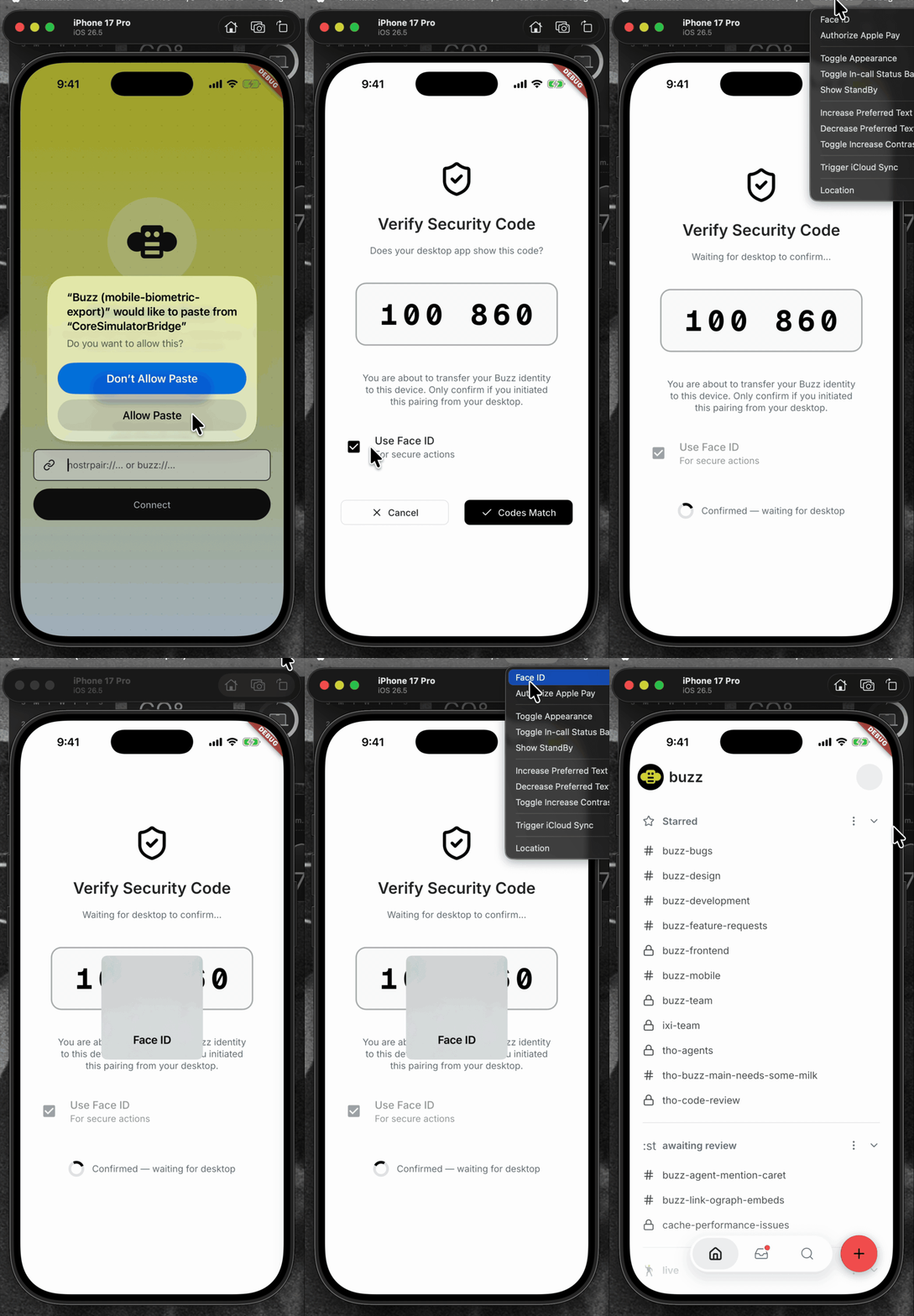 | 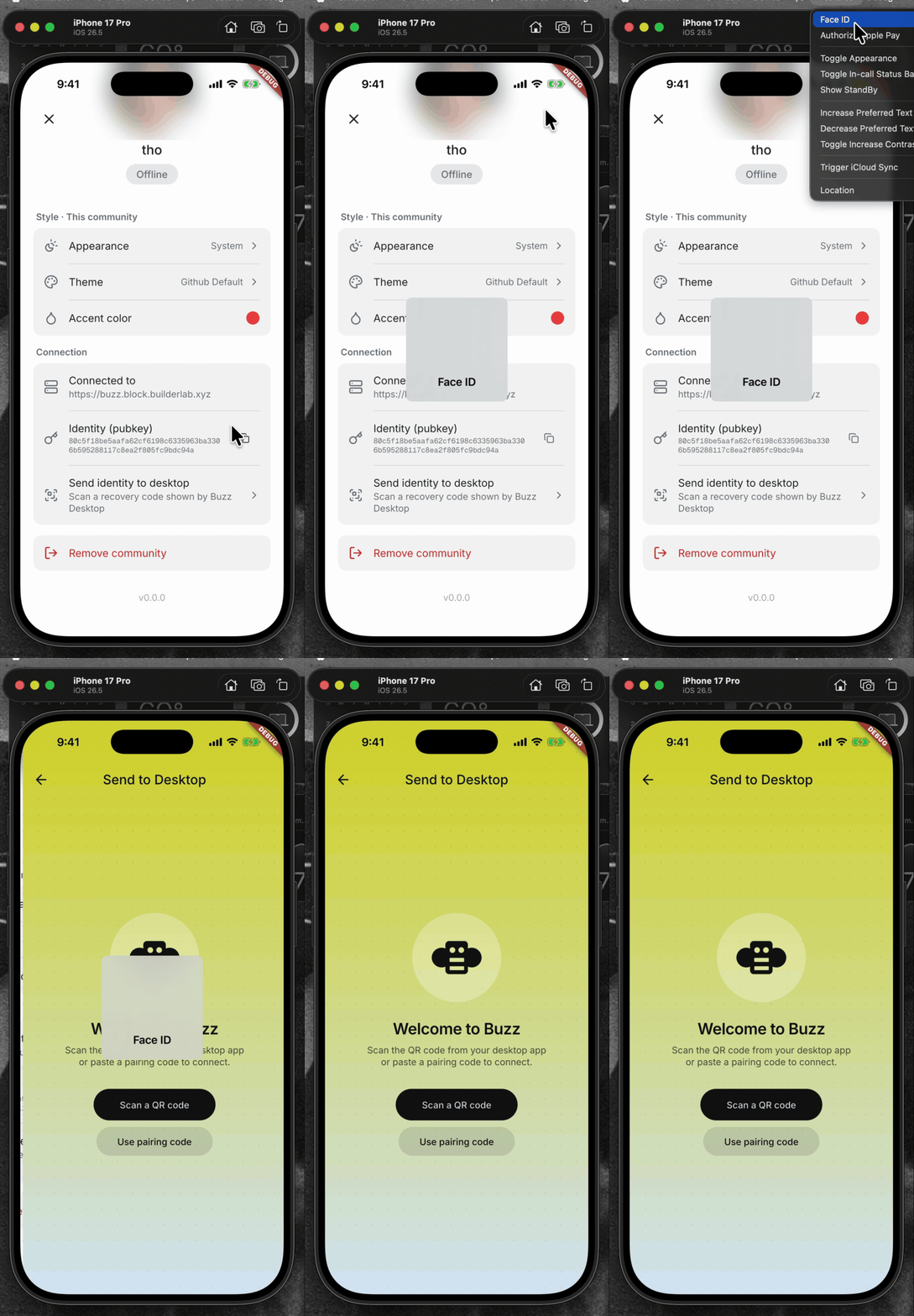 | <details> <summary>File changes</summary> **Android and iOS integration** - `mobile/android/app/build.gradle.kts` declares the AppCompat dependency required by the biometric activity theme. - `mobile/android/app/src/main/kotlin/xyz/block/buzz/mobile/MainActivity.kt` uses the activity type required by the system authentication prompt. - `mobile/android/app/src/main/res/values/styles.xml` and `mobile/android/app/src/main/res/values-night/styles.xml` use the compatible launch theme. - `mobile/ios/Podfile.lock` records the native local-authentication dependency. - `mobile/ios/Runner/Info.plist` explains why Buzz requests Face ID access. **Identity policy and pairing flow** - `mobile/lib/shared/security/sensitive_action_authorizer.dart` wraps OS authentication and maps platform errors to stable app-level outcomes. - `mobile/lib/shared/community/community.dart` and `mobile/lib/shared/community/community_storage.dart` persist the sensitive-action policy. - `mobile/lib/features/invites/invite_join_provider.dart` assigns the explicit policy for invite-created communities. - `mobile/lib/features/pairing/pairing_provider.dart` gates export, binds grants to the active community/session, reauthenticates expired grants, and clears grants on every terminal path. - `mobile/lib/features/pairing/pairing_page.dart` lets users choose biometric protection while importing an identity. - `mobile/lib/features/settings/settings_page.dart` wires pairing into settings. - `mobile/lib/features/settings/settings_page/connection_section.dart` authenticates before opening export recovery and bounds the foreground-resume wait. - `mobile/pubspec.yaml` and `mobile/pubspec.lock` add and lock `local_auth`. **Coverage** - `mobile/test/shared/security/sensitive_action_authorizer_test.dart` covers native result mapping, unsupported devices, and single-flight behavior. - `mobile/test/shared/community/community_test.dart` and `mobile/test/shared/community/community_storage_test.dart` cover policy defaults and persistence. - `mobile/test/features/invites/invite_join_provider_test.dart` covers the invite policy. - `mobile/test/features/pairing/pairing_page_test.dart` covers import protection controls. - `mobile/test/features/pairing/pairing_provider_test.dart` covers export/import authorization, stale/reset/concurrent guards, malformed payload cleanup, and no-export failure paths. - `mobile/test/features/settings/connection_section_test.dart` covers the tap gate, lifecycle resume, and timeout behavior. </details> ## Reproduction steps 1. Pair an identity into the mobile app. 2. Open Settings and choose “Send identity to desktop.” 3. Verify Face ID, biometrics, or the device passcode is required before the recovery scanner opens. 4. Cancel device authentication and verify the scanner does not open and no identity transfer begins. 5. Authenticate, scan a Desktop recovery code, confirm the SAS, and verify the identity transfer completes. ## Validation At `be5620f5f10aa6cc16e86a4f01f102f3d9aeef9b`: - `cd mobile && ../bin/flutter analyze` — no issues - `cd mobile && ../bin/flutter test` — 1,368 tests passed - `cd mobile/android && JAVA_HOME=$(/usr/libexec/java_home -v 21) ./gradlew app:assembleDebug` — debug APK assembled successfully --------- Signed-off-by: Taylor Ho <taylorkmho@gmail.com> |
||
|
klopez4212
|
8abc2baf0b |
Add mobile community invites (#5641)
## Summary - add a permission-gated mobile community invite page - create, copy, and natively share configurable invite links - invite a validated npub directly with member/admin role selection - reuse Buzz profile actions, search styling, settings rows, and modal sheets ## Validation - `just mobile-check` - `flutter test` (1,275 tests) - Pixel and iPhone review builds installed and launched --------- Signed-off-by: kenny lopez <klopez4212@gmail.com> Signed-off-by: Kenny Lopez <klopez4212@gmail.com> Signed-off-by: Fast Fizz <2df81cb51f05a9d5387ef24d7b9ecb8fcdfcd1c70ffabc67061c9596e1b5b1c4@buzz.block.builderlab.xyz> Co-authored-by: Carl <3c4caeafb646d23867f1c4832e68211d77e2561946171625f75c3ce1a3f2670f@buzz.block.builderlab.xyz> Co-authored-by: Fast Fizz <2df81cb51f05a9d5387ef24d7b9ecb8fcdfcd1c70ffabc67061c9596e1b5b1c4@buzz.block.builderlab.xyz> |
||
|
klopez4212
|
871a3b3772 |
Refine mobile community switching and discovery (#2967)
## Summary - Redesign community switching with relay-provided avatars, selected-state checks, edit-to-remove controls, and confirmation. - Bring desktop-inspired pairing onboarding to mobile with QR scanning as the primary action, an expandable pairing-code flow, and a tappable flapping bee. - Polish Search and Activity headers, filter chips, typography, keyboard stability, and Android adaptive-icon sizing. ## Validation - `just mobile-check` - `just mobile-test` — 661 passed, 1 skipped - Pixel 10 snapshot review |
||
|
Wes
|
3e76481a14 |
refactor(clients): standardize product naming on community (#1858)
Signed-off-by: Wes <wesbillman@users.noreply.github.com> Co-authored-by: Pinky <44b8e82baa6e0e254e0208d68f335c283c94e7b78dd1fa10d5a49d3f13dd0435@sprout-oss.stage.blox.sqprod.co> |

