Apple Silicon simulator builds fail because MLImage and MLKit contain
device-labelled ARM64 objects.

Enable the Flutter ML Kit package's upstream compatibility helper, which
restores device labels for iPhone builds. This preserves the MLKit-based
functionality (avatar background removal) and complements the
notification-extension linker isolation in #7187.

Adds a complete iOS simulator build to CI to catch this build
regression.

---------

Signed-off-by: Tom Brow <tomb@block.xyz>
## Summary
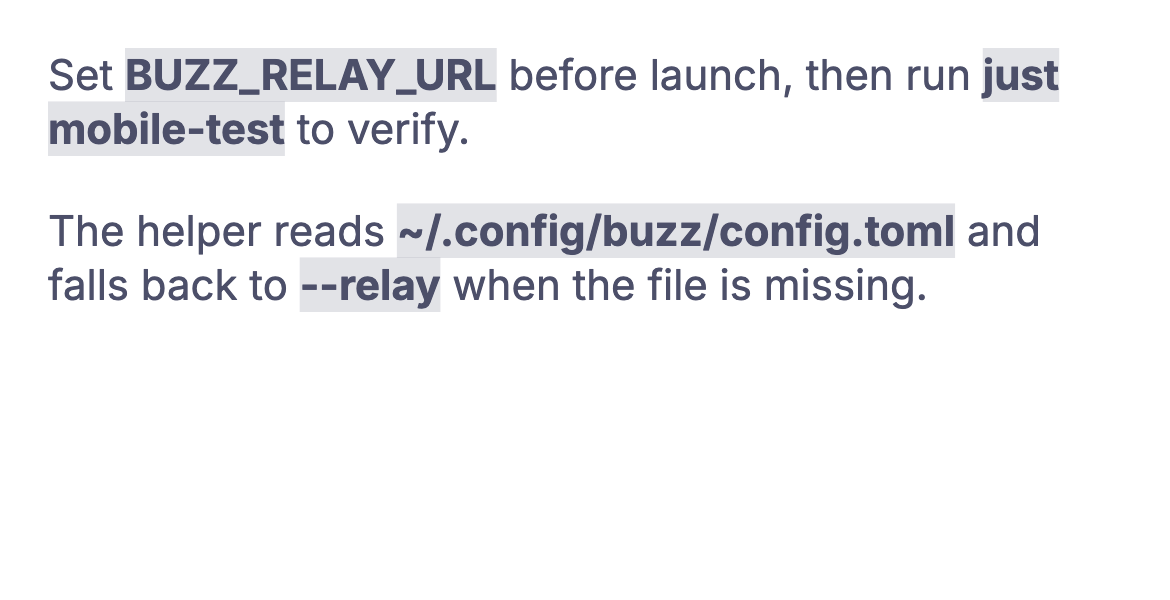
Inline code on mobile renders as **bold body text on a faint background
wash** — no monospace face, no chip, and it cannot wrap. #5257 diagnosed
this as a missing `highlightBuilder`.
That is no longer the right fix. `gpt_markdown` 1.2.0 deprecates
`highlightBuilder` (removal in 2.0.0), renders inline code as a real
chip, and adds `InlineCodeStyle` for restyling it. The package author
confirmed this on the issue. So this PR is an upgrade — 1.1.6 → 1.2.1 —
plus one theme declaration, rather than the builder the issue originally
asked for.
**Where the style is declared.** `GptMarkdownThemeData` goes in
`AppTheme._buildTheme`, which both `light()` and `dark()` call. That
reaches all four `GptMarkdown` call sites — `message_content`,
`transcript_item_widget`, `token_pill`, `custom_emoji_render` — so the
style is stated once instead of per widget. A widget-level
`inlineCodeStyle` would have covered channel messages only, leaving the
other three on the package's defaults.
**What is declared.** Face, size, ink, chip fill and outline — not the
face alone. A face name on its own leaves the rest on the package's
defaults, which put inline code at 14.1sp beside a fenced block's 13, on
a neutral `onSurface` tint rather than the app's code surface. In dark
that tint is *lighter* than the surface, while every other code surface
in the app is recessed, so the chip read as a different kind of object.
All of it now comes from one `CodeStyle` declaration that the fenced
block reads from too, so the two cannot be edited apart.
**Three adaptations the upgrade requires.** Each was found by running
the gate, not by reading the changelog:
1. **`imageBuilder` widened** to `(context, url, width, height)`. This
is a hard compile error, and it is **not listed in the package's
migration guide**, which states "nothing here stops code compiling".
Worth reporting upstream.
2. **`autolink` now defaults to `true`.** `normalizeBareLinks()` already
rewrites bare URLs into Markdown links before rendering, so both would
run. `message_content` opts out with `autolink: false` to keep current
behaviour exactly. The migration guide argues for dropping the
pre-processor instead — a better fix, but a behavioural change that
belongs in its own PR.
3. **`gpt_markdown.dart` now re-exports `markdown_config.dart`**, making
two direct imports redundant. `flutter analyze` reports `No issues
found!` on 1.1.6 and flags both on 1.2.1, so these warnings are new, not
pre-existing.
**Deliberately out of scope.** The three non-message call sites now
autolink bare URLs, since only `message_content` has a pre-processor to
collide with. Custom inline components (`_MentionMd`, `CustomEmojiMd`,
`_ChannelLinkMd`) could additionally declare `allScopesExceptLinkLabel`
— 1.2.0 offers it as the fix for a `WidgetSpan` chip going blank inside
a link label on iOS — but current behaviour is unchanged without it, so
that stays a separate change.
### Related issue
Fixes#5257
Duplicate scan: searched `gpt_markdown`, `inline code mobile`,
`highlightBuilder` and `InlineCodeStyle` across both PRs and issues. No
open PR touches inline code styling. #6135 (link labels) and #6166 (text
selection) also touch mobile Markdown but address different defects.
### Testing
Full gate, `just ci` — exit 0:
| Stage | Result |
|---|---|
| Rust (33 suites) | 4768 passed, 0 failed |
| Desktop | 5799 passed, 0 failed |
| Mobile | **2011 passed**, 0 failed |
| `flutter analyze` | `No issues found!` |
| Desktop + web build | ok |
Run on the branch with `main` merged in, so these numbers match what CI
builds.
**New regression test** — `renders inline code in the app code style`.
It resolves the `CodeTextSpan` the package tags inline code with, which
carries both the resolved `TextStyle` and the colours the chip behind it
is painted with, so face, size, ink, fill and outline are all asserted
rather than a widget's presence. It is negative-controlled: reverting
only the theme declaration fails it with
```text
Expected: a numeric value within <0.001> of <13.0>
Actual: <14.1>
```
and dropping the declaration entirely falls back to
`packages/gpt_markdown/JetBrainsMono` — so the test measures the real
thing, and it would catch a future regression that silently drops the
theme extension.
The test passes `baseStyle: messageBodyTextStyle`, the style the message
surfaces actually use; the widget's own fallback is the smaller
`bodyMedium`, which would move the expected size.
The test finds paragraphs with `find.byWidgetPredicate((widget) =>
widget is RichText)`, not `find.byType(RichText)`: inline code renders
through `BidiRichText`, a `RichText` subclass, and `byType` matches
exact runtime types.
That is a hazard for any test that reads text back out of a paragraph,
and one landed after this branch was cut:
`message_content_custom_emoji_test.dart` arrived with #6996 and its
`code keeps literal emoji while adjacent known tokens render` case reads
a code span through `find.byType(RichText)`. It passes on `main` and
fails on the merge result, which is what CI builds, so it went red only
once CI was authorized. It now uses the same predicate. The two other
`byType(RichText)` call sites — the rest of that file and
`message_author_meta_test.dart` — were re-run and pass: their content
carries no code span, so the exact type still matches. They were left
alone.
### Screenshots
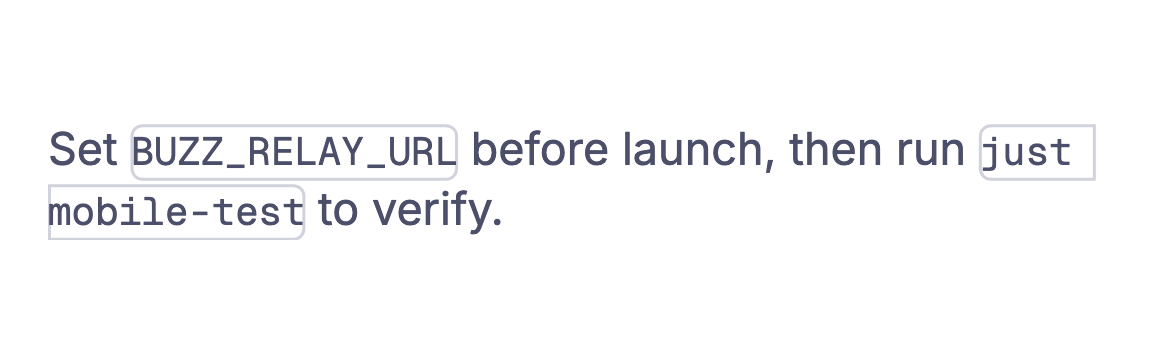
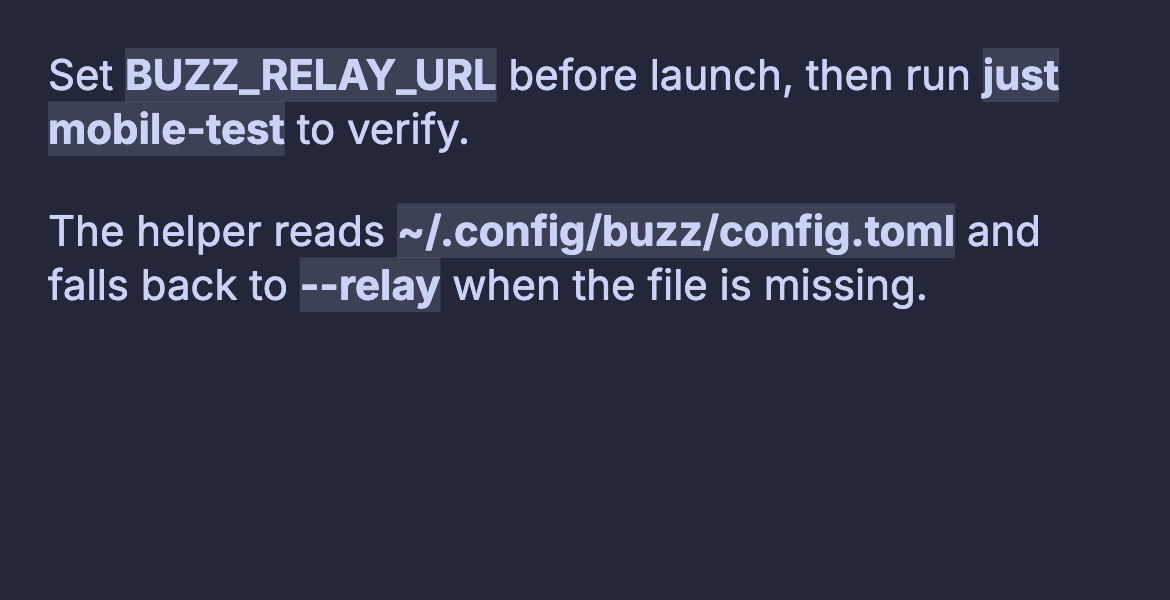
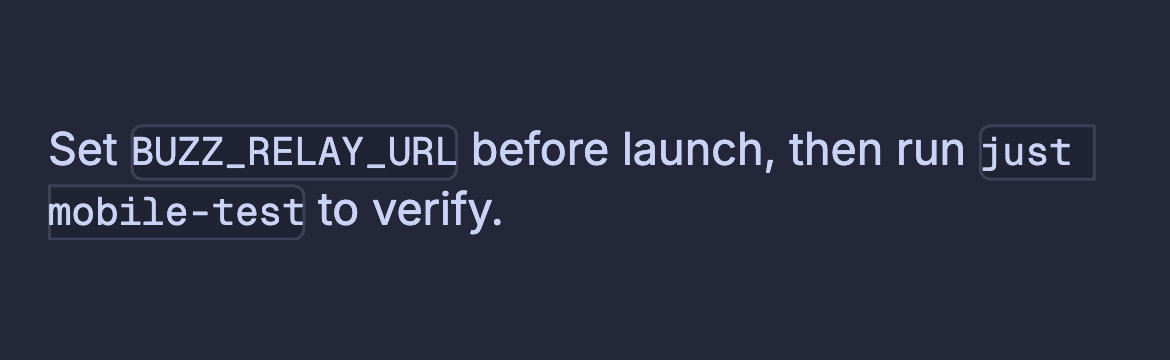
Rendered through the real `MessageContent` widget with the app's own
fonts loaded, at 390pt wide, 3x DPR. Sample text: ``Set `BUZZ_RELAY_URL`
before launch, then run `just mobile-test` to verify.``
| | Before (1.1.6) | After (1.2.1) |
|---|---|---|
| Light |
|
|
| Dark |
|
|
Before: bold Inter on a flat wash, no chip edge, and `just mobile-test`
breaks across the line with the wash simply ending. After: Geist Mono in
a bordered, rounded chip, and the wrapped fragment gets its own chip on
each line.
---------
Signed-off-by: Tolga Cinisli <tolgacinisli@gmail.com>
Co-authored-by: Tolga Cinisli <tolgacinisli@gmail.com>
Pinky is opening this PR on Wes’s behalf.

## Summary

Reduce two separately measured mobile delays without changing the relay
API or removing rich message rendering:

- Publish the finite channel-list snapshot without waiting for live
subscription setup.
- Batch active channel-list subscriptions into sorted, deterministic
chunks of at most 128 explicit channel IDs, retaining unchanged chunks.
- Install replacement chunks before retiring old coverage. Retain old
chunks across thrown replacement failures; filter callbacks to the
current relay/identity and still-desired channels; clean up
retired/in-flight work across disconnect and disposal.
- Scope the custom-emoji Markdown matcher to known shortcodes actually
referenced in the rendered content, rather than embedding the whole
community palette in every message’s regex. Preserve unknown literals,
shared-colon token boundaries, event-tag URL priority, content edits,
and code literals.
- Honor explicit zero retry hints without inventing a ten-second
session-wide gate, while preserving the ordinary live-subscription retry
backoff and any already-active gate.

## Matched performance results

Medians of three before and three after process-cold launches,
alternated on the same authenticated iPhone 17 Pro / iOS 26.5 simulator.
Before is mobile source at `e76c81968b65b0755b83efdd59dc3375c59ddf40`;
after is this production patch before two documentation-only comment
fixes.

First channel-list frame: 11.617s → 3.179s · 73% lower latency

Live setup duration: 8.475s → 0.185s · 98% lower latency

Channel-open first message-list frame: 2.754s → 1.230s · 55% lower
latency

Message data ready → first frame: 1.977s → 0.286s · 86% lower latency

Channel-open reveal complete: 2.845s → 1.394s · 51% lower latency

Channel-open data readiness: 0.770s → 0.944s · 23% higher latency

The gain is client-side orchestration/rendering, not a claim that the
relay became faster. First channel-list frame ranges were 10.835–11.788s
before and 2.872–3.395s after; channel-open first-frame ranges were
1.560–2.906s before and 1.149–1.317s after.

### Measurement boundaries

- Debug simulator builds, CPU sampling disabled, bounded timestamp
probes enabled identically. These are not release/physical-device
measurements.
- Startup clock starts at Dart `main`; build/install/native pre-main
time is excluded. Auth/preferences and OS/disk caches are retained
between new processes.
- Same account scale: 113 active channels. Latest-message events varied
slightly with live activity (1543–1546).
- Channel-open uses the same initial 50-row history window, 97 query
events, and 67 provider events. The 2306-entry emoji palette is
explicitly loaded before navigation on both sides; palette preparation
is excluded from the channel-open clock and happens after the startup
frame measurement.
- Both diagnostic builds temporarily disabled unused avatar segmentation
to work around the existing Google ML Kit arm64-simulator slice
limitation. The workaround, dependency/native changes, auto-navigation,
and all probes are excluded from this PR.

## Validation

- Full mobile package suite: `flutter test` — 1890 passed.
- `just mobile-check` — 506 files unchanged; analyzer clean.
- `just file-size-check` — policy tests and all client ratchets passed.
- `git diff --check` — passed.
- New lifecycle regressions cover front-sorting insertion across a chunk
boundary while replacement readiness is paused, failure
retention/departed-channel filtering, retired generation + disconnect
cleanup, disposal, chunk limits, unchanged-set reuse, and scope
switches.
- Emoji unit/widget coverage includes a 2500-unused-emoji palette,
unknown tokens, case matching at the component level, shared-colon
boundaries, rich text, event URL priority, and content edits.
- Fresh-frame source review traced the subscription queue/fences,
callback scopes, duplicate-event paths, matcher/wiring, and retry
scheduling.
- At committed/pushed head `13a83b628c8411c5885e6f76a250ba87accf6067`,
all normal pre-push hooks passed: `mobile-checks` (formatter, analyzer,
and the full 1890-test mobile suite), `file-size-check`, `branch-skew`,
and `push-head-scope`. The commit hook formatted 506 files with no
changes. Runtime measurements preceded only the two
documentation-comment fixes; no runtime source changed afterward.

## Limits / follow-ups

- `RelaySession.subscribe` still settles under its existing
EOSE/fallback/retryable-CLOSED contract. “Setup completed” is not an
unconditional EOSE or live-delivery guarantee. This PR does not add
status-aware replacement ownership.
- The channel-message provider still awaits subscribe before fetching
history; that separate serialization is not removed here.
- Oversized Huddle queries and the separate history batching path above
128 active channels remain follow-ups, as do pre-existing read-state
initialization/size warnings.
- Palette-only widget refresh and upstream Markdown uppercase-dispatch
behavior are not changed.
- A clean source build still has the existing Google ML Kit
arm64-simulator issue; the profiling workaround is not a proposed
product fix.

Originating Buzz conversation:
buzz://message?channel=793b0522-7995-4375-b1a6-fd94a96fa21d&id=6ba88afdec78ab2cfb6728afcd4a6d10f29e6aa33ff0f62f45d6750381e4d789

---------

Signed-off-by: Wes <wesbillman@users.noreply.github.com>
Co-authored-by: Pinky <5f5ab050ec58ae208332edd544ebf705221e24c1b86d82a6ca07038a7a8f6ac9@buzz.block.builderlab.xyz>
Co-authored-by: Brain <1a02c72794dcd0f07058a353bc3a81f4028b8c77c92c87fce6d5c8b85970a20b@buzz.block.builderlab.xyz>
Co-authored-by: Carl <9d00794d3df50972eb8b615511783cab12a77a8fd5dd5edd58073ec73b54bd8b@buzz.block.builderlab.xyz>
## Summary

- Hide the thread Latest control once the lazy tail is fully reached.
- Polish the mobile channel header and use native iOS liquid glass for
Back.
- Keep the two-line header aligned and safe at larger text sizes.

## Validation

- `just mobile-check`
- `flutter test` (1,553 tests)
- Signed iPhone build installed and launched

---------

Signed-off-by: kenny lopez <klopez4212@gmail.com>
Co-authored-by: Carl <3c4caeafb646d23867f1c4832e68211d77e2561946171625f75c3ce1a3f2670f@buzz.block.builderlab.xyz>
**Category:** new-feature
**User Impact:** Mobile users must confirm with Face ID, biometrics, or
their device passcode before sending their Buzz identity to Desktop.
**Problem:** A signed-in phone could send its full identity, including
the `nsec`, to a desktop without fresh local verification.
**Solution:** Require OS device authentication before opening the
identity-recovery scanner, retain that authorization only for the active
pairing session and short pairing window, and require fresh
authentication again if it expires before the identity payload is sent.
Normal app opening, identity import, and community removal remain
unchanged.
## Screencasts
| Enable Face ID | Use Face ID |
| --- | --- |
| 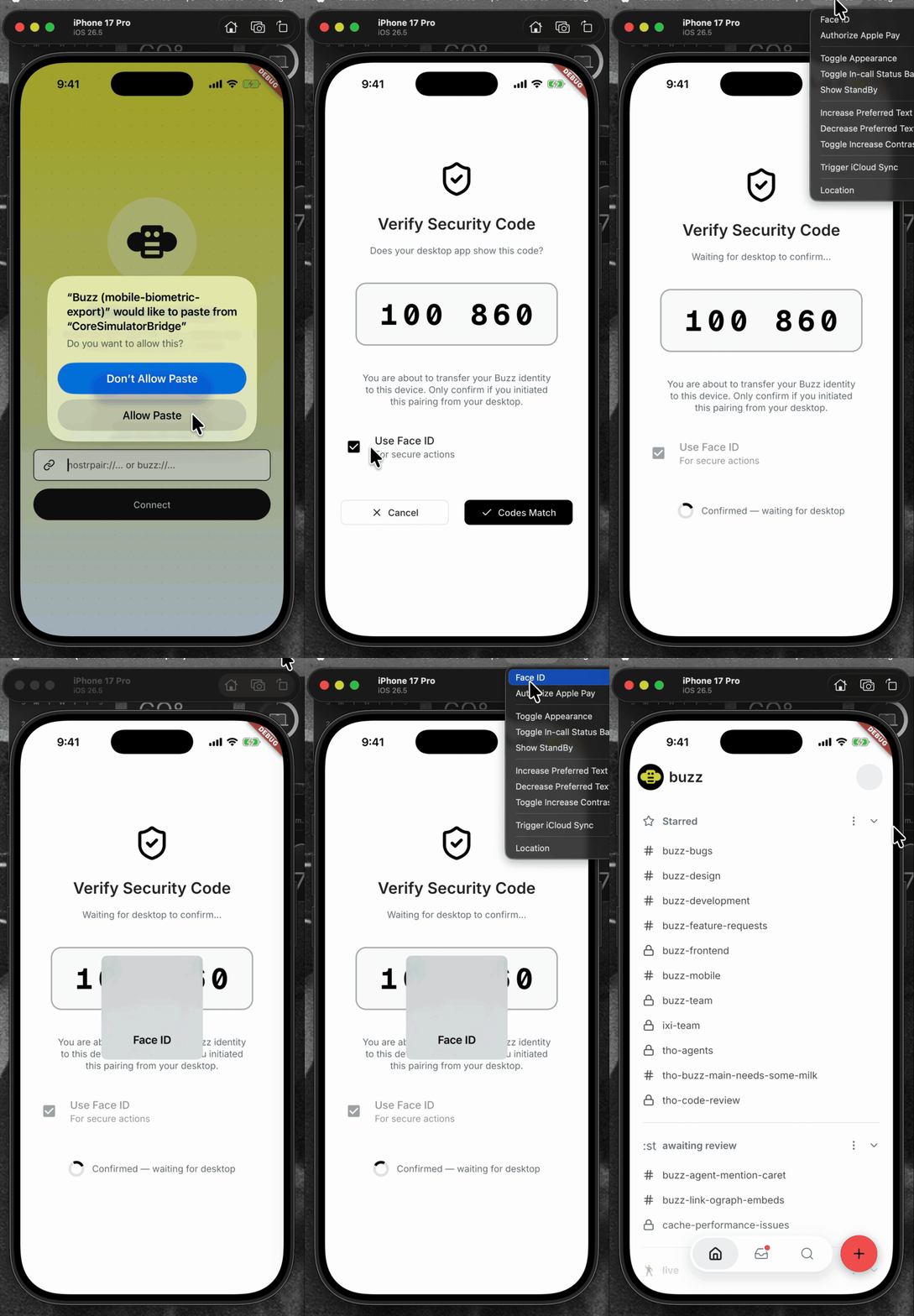
| 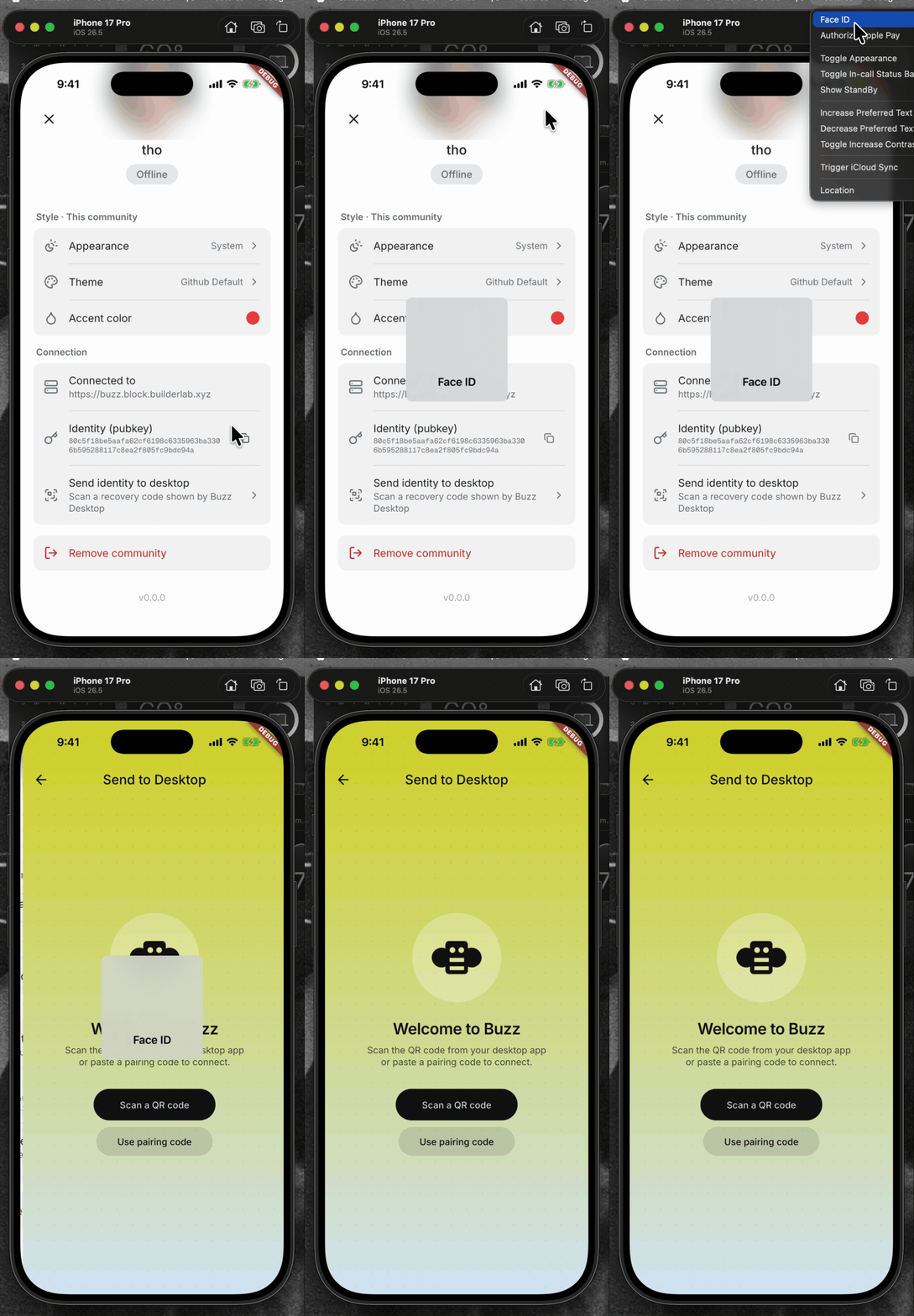
|
<details>
<summary>File changes</summary>
**Android and iOS integration**
- `mobile/android/app/build.gradle.kts` declares the AppCompat
dependency required by the biometric activity theme.
-
`mobile/android/app/src/main/kotlin/xyz/block/buzz/mobile/MainActivity.kt`
uses the activity type required by the system authentication prompt.
- `mobile/android/app/src/main/res/values/styles.xml` and
`mobile/android/app/src/main/res/values-night/styles.xml` use the
compatible launch theme.
- `mobile/ios/Podfile.lock` records the native local-authentication
dependency.
- `mobile/ios/Runner/Info.plist` explains why Buzz requests Face ID
access.
**Identity policy and pairing flow**
- `mobile/lib/shared/security/sensitive_action_authorizer.dart` wraps OS
authentication and maps platform errors to stable app-level outcomes.
- `mobile/lib/shared/community/community.dart` and
`mobile/lib/shared/community/community_storage.dart` persist the
sensitive-action policy.
- `mobile/lib/features/invites/invite_join_provider.dart` assigns the
explicit policy for invite-created communities.
- `mobile/lib/features/pairing/pairing_provider.dart` gates export,
binds grants to the active community/session, reauthenticates expired
grants, and clears grants on every terminal path.
- `mobile/lib/features/pairing/pairing_page.dart` lets users choose
biometric protection while importing an identity.
- `mobile/lib/features/settings/settings_page.dart` wires pairing into
settings.
- `mobile/lib/features/settings/settings_page/connection_section.dart`
authenticates before opening export recovery and bounds the
foreground-resume wait.
- `mobile/pubspec.yaml` and `mobile/pubspec.lock` add and lock
`local_auth`.
**Coverage**
- `mobile/test/shared/security/sensitive_action_authorizer_test.dart`
covers native result mapping, unsupported devices, and single-flight
behavior.
- `mobile/test/shared/community/community_test.dart` and
`mobile/test/shared/community/community_storage_test.dart` cover policy
defaults and persistence.
- `mobile/test/features/invites/invite_join_provider_test.dart` covers
the invite policy.
- `mobile/test/features/pairing/pairing_page_test.dart` covers import
protection controls.
- `mobile/test/features/pairing/pairing_provider_test.dart` covers
export/import authorization, stale/reset/concurrent guards, malformed
payload cleanup, and no-export failure paths.
- `mobile/test/features/settings/connection_section_test.dart` covers
the tap gate, lifecycle resume, and timeout behavior.
</details>
## Reproduction steps
1. Pair an identity into the mobile app.
2. Open Settings and choose “Send identity to desktop.”
3. Verify Face ID, biometrics, or the device passcode is required before
the recovery scanner opens.
4. Cancel device authentication and verify the scanner does not open and
no identity transfer begins.
5. Authenticate, scan a Desktop recovery code, confirm the SAS, and
verify the identity transfer completes.
## Validation
At `be5620f5f10aa6cc16e86a4f01f102f3d9aeef9b`:
- `cd mobile && ../bin/flutter analyze` — no issues
- `cd mobile && ../bin/flutter test` — 1,368 tests passed
- `cd mobile/android && JAVA_HOME=$(/usr/libexec/java_home -v 21)
./gradlew app:assembleDebug` — debug APK assembled successfully
---------
Signed-off-by: Taylor Ho <taylorkmho@gmail.com>
### Summary

Fixes [this
issue](buzz://message?channel=e62570dd-33ad-42c5-b92b-75f2689f9694&id=b726c366abfe62429ee3cdcd34d0c0fb98c33c3ea053480585bed71745412b56):
> I often don’t see my bot responses until after I post. they’re usually
time stamped correctly so I think it’s just a refresh issue?

### What changed?

Buzz Mobile now reconnects relay sessions after the app has remained
backgrounded beyond the existing 5-second grace period, even when the
session still reports a stale `connected` state. This makes resume
recovery independent of whether iOS runs the grace timer before or after
delivering `resumed`.

Reconnection is now based on elapsed background time rather than a
direct socket-health probe.
- If the app was backgrounded for at least the 5-second grace period,
the socket is presumed dead and the session reconnects regardless of
reported status.
- If it was backgrounded for less than that, a reported `connected`
status is still trusted.

In the sub-5-second window the socket is either genuinely alive, which
is the common case for a momentary background, or it is dead and the
client ping detects it within the two-interval worst case described
below. That is now a degraded-latency path, not a silent-forever path.

The mobile relay socket now uses `IOWebSocketChannel.connect` with a
30-second `pingInterval`. An unanswered ping closes the Dart socket
through the existing disconnect and reconnect path.

Detection takes up to two ping intervals, so about 60 seconds worst
case, not 30. One interval of idleness elapses and a ping is sent, then
a second interval elapses with no pong and the socket closes. Any
inbound pong restarts the first stage, so the clock measures idleness
rather than running on a fixed cadence.

### Why?

Buzz iOS can sometimes stop showing new bot or agent responses after a
phone has been locked for 5 to 10 minutes. When the user later posts a
message, the missing responses can appear all at once. iOS may suspend
Buzz before the short delayed cleanup that would normally close its
connection has a chance to run. Before this change, Buzz trusted the
resulting stale healthy status on resume and skipped reconnecting, so
the missing responses stayed hidden until a later post exposed the dead
connection.

A state-machine test with a stubbed connection reproduced this reported
pattern and showed that it matches this failure mode: the failed post
triggered a reconnect that fetched the missing messages. The same test
also checked the other candidate explanation, the bug tracked in
[#3053](https://github.com/block/buzz/pull/3053), where the relay has
closed the app's subscription. That state does not produce the pattern.
Posting succeeds and the user's own message appears, but nothing looks
for the missed messages, so they stay hidden. The test confirmed that
the missed messages were still available to fetch in that state, so the
missing step was a trigger to fetch them. This was not an end-to-end
reproduction on an iOS device or a live relay.

The new resume check covers the normal lock and unlock path. If the app
was backgrounded for less than the 5-second grace period, it still
trusts a connection marked as healthy. A dead connection in that window
is instead detected by the ping check, which can take up to about 60
seconds but prevents the app from remaining silently stuck. The ping
only runs while iOS is running the app, so it does not detect a
connection that died during suspension; the resume check owns the lock
and unlock path.

A pre-existing path also runs the same resume handling when network
connectivity returns while the app is already in the foreground. Because
the app was not backgrounded, this change does not alter that path,
which still trusts a connection marked as healthy and relies on the
slower ping check.

Recovery from a subscription that the relay explicitly closes remains in
[#3053](https://github.com/block/buzz/pull/3053), and the two changes
overlap in one file. Changes to how missed messages are backfilled or
replayed are out of scope.

### How is it tested?

Full mobile suite at base and head. Both runs have the same known
macOS-host-only failure in `ChannelDetailPage keeps follow mode off
while a tall newest message stays visible` at line 1053:

- Base: 1,021 passed, 1 skipped, 1 failed
- Head: 1,025 passed, 1 skipped, 1 failed

Added tests:

-
[`relay_session_test.dart`](https://github.com/block/buzz/tree/main/mobile/test/shared/relay/relay_session_test.dart):
long-background resume reconnect and within-grace control
-
[`relay_socket_liveness_test.dart`](https://github.com/block/buzz/tree/main/mobile/test/shared/relay/relay_socket_liveness_test.dart):
silent-peer disconnect and idle-but-healthy control

Mutation checks confirm that removing elapsed-background resume recovery
fails with one socket instead of two, and removing `pingInterval` leaves
the silent peer connected. Restored production code passes both
mutations' regression tests and the healthy idle control.

Signed-off-by: Tom Brow <tomb@block.xyz>
Co-authored-by: npub1tquskdu6yc4h8l7xxtceculxw600grekeq0xg2ukqfrwl7vrzg3quz3gmp <58390b379a262b73ffc632f19c73e6769ef40f36c81e642b960246eff9831222@buzz.block.builderlab.xyz>
Brings the Flutter app's emoji and thread surfaces up to desktop parity.

## Emoji

- **Full emoji-mart dataset** generated from the same `@emoji-mart/data`
set desktop uses (1,870 emoji, 8 categories), committed as an asset — so
shortcodes, names, and keywords are identical across clients. `just
mobile-emoji-data` regenerates it.
- **Rebuilt the tray**: search (a Dart port of desktop's tiered
`emojiSearch` ranking, extended to names and keywords), a
frequently-used section, and one continuous scroll with pinned section
headers. The category rail is a shortcut into that list, not a page
switcher, and spans the full width the search field uses. Custom emoji
share the native glyph size and cell.
- **Reaction pills** match desktop's geometry, and the count shows at 1.
- **Emoji-only messages** render at 36px with 1.45em inline custom
emoji, matching desktop's `emojiOnly` treatment.
- **Positive-emoji burst** ported from desktop's `EmojiBurstProvider`,
suppressed under reduced motion.

## Threads

- **Top-down layout** — head first under the app bar, replies flowing
down, like desktop's thread panel. The old reversed list bottom-anchored
the content and jammed the head against the composer.
- **Tap a channel message to open its thread**; long-press still opens
the action sheet.
- **Live reactions.** The thread's relay query is one-shot and its
`kinds` filter carries only content rows, so a reaction event could not
reach an open thread at all, and `allMessages` was a snapshot frozen
when the route was pushed — a new pill only appeared after leaving and
re-entering, which refetched. The live channel events are now unioned
into the thread's list. The burst is also route-guarded, since the
channel timeline stays mounted underneath and was claiming it first.
- The `+` affordance follows the channel: replies stay bare until they
carry a reaction, and the head keeps a standing `+`.

## Keyboard

A deliberate downward drag past ~48px dismisses the keyboard; short
scrolls leave it alone. Applies to the channel list, the thread list,
and the compose bar (via a raw `Listener`, so it can't steal the field's
tap or selection drags).

True finger-tracking dismissal is out of scope — Flutter only offers
`manual`/`onDrag`, and 1:1 tracking needs a native `UIScrollView` proxy
plus Android's `WindowInsetsAnimationController`.

## Testing

`just mobile-check` and `just mobile-test` pass (965 tests). New
coverage for emoji search ranking, dataset parsing, the emoji-only
predicate, tray scroll/rail behavior, reaction pills and the burst, and
both thread fixes above. `just ci` green.

---------

Signed-off-by: kenny lopez <klopez4212@gmail.com>
Signed-off-by: npub12zsjdqx8dud99s9h47xmk9lq93vryf7zjrae8wdrmma52cg5yglseyulst <50a12680c76f1a52c0b7af8dbb17e02c583227c290fb93b9a3defb456114223f@buzz.block.builderlab.xyz>
Signed-off-by: klopez4212 <klopez4212@gmail.com>
Co-authored-by: npub12zsjdqx8dud99s9h47xmk9lq93vryf7zjrae8wdrmma52cg5yglseyulst <50a12680c76f1a52c0b7af8dbb17e02c583227c290fb93b9a3defb456114223f@buzz.block.builderlab.xyz>
## What
- group uploaded photos into full-width message carousels
- add a fullscreen viewer with pinch zoom, double-tap reset, swipe-down
dismissal, a centered filmstrip, and image actions
- preload nearby display-sized images for smoother swiping and keep each
upload as its own avatar-backed message

## Validation
- `just mobile-check`
- `flutter test test/features/channels/message_content_test.dart`
- iOS 26.5 simulator gesture pass

---------

Signed-off-by: kenny lopez <klopez4212@gmail.com>






