Provider-access reconciliation runs in the post-commit section of
apply_workspace, after relay/keys/scope have committed. The previous
.await? propagated any reconciliation failure as a command Err, causing
the frontend to treat the workspace as unapplied and clear appliedKey —
while the new scope was already active. This contradicted the
applied/degraded contract and the useCommunityInit error-handling
assumption.

Fix: replace .await? with a match that returns WorkspaceApplyResult
with applied: true and blocked: Some(reason) on reconciliation failure.
Dependent post-commit steps (event sync, agent restore) remain
unreached on this path, preserving #4053's fail-closed intent. The
frontend parks on the loading gate with a truthful error and the same
retry-by-reapply semantics as the catch block.

Changes:
- scope.rs: add blocked: Option<String> field to WorkspaceApplyResult,
  add applied_but_blocked() constructor, document the three states
- workspace.rs: replace .await? with match; return applied_but_blocked
  on reconciliation failure; update command doc comment
- useCommunityInit.ts: handle blocked after the !applied branch; update
  catch-block comment (reconcile failures no longer arrive as Err)
- tauri.ts: add blocked?: string | null to ApplyWorkspaceResult type
- e2eBridge.ts: add blocked: null to apply_workspace mock result
- runtime_commands_tests.rs: add three new tests covering the new state
  and the three-state distinction

Co-authored-by: Will Pfleger <pfleger.will@gmail.com>
Signed-off-by: Will Pfleger <pfleger.will@gmail.com>
**Category:** new-feature
**User Impact:** People who lose a desktop identity can securely restore
it from a signed-in Buzz phone without creating a replacement identity.
**Problem:** A fresh or identity-lost desktop could not recover its
existing full Buzz identity from an already-authorized phone.
**Solution:** Add a SAS-confirmed reverse NIP-AB transfer, durable
desktop import, a dedicated mobile recovery entry point, and clearer
desktop recovery dialogs with tested loading, drag-and-drop, and failure
states.
https://github.com/user-attachments/assets/e9215c9c-80d0-462f-9161-0fa184ca2f74
<details>
<summary>File changes</summary>
**crates/buzz-core/src/pairing/session.rs**
Adds the reverse encrypted payload and source-completion state
transitions used for phone-to-desktop recovery.
**desktop/src-tauri/src/commands/identity.rs**
Exposes the existing guarded identity commit path for recovery imports.
**desktop/src-tauri/src/commands/pairing.rs**
Adds recovery-mode pairing, durable nsec import, start serialization,
stale-task protection, and explicit rejection of unsupported recovery
payloads.
**desktop/src-tauri/src/lib.rs**
Registers the recovery pairing command.
**desktop/src/app/App.tsx**
Refreshes the recovered identity before continuing onboarding.
**desktop/src/features/onboarding/machineOnboarding.ts**
Adds recovery transitions to the onboarding state machine.
**desktop/src/features/onboarding/ui/BackupPasswordTimeline.tsx**
Adds the visual backup-to-password-to-unlock progression.
**desktop/src/features/onboarding/ui/IdentityRecoveryPairing.tsx**
Implements QR generation, copy fallback, SAS confirmation, cancellation,
expiry, and completion UI.
**desktop/src/features/onboarding/ui/MachineOnboardingFlow.tsx**
Connects private-key, phone, and backup recovery paths to the onboarding
flow.
**desktop/src/features/onboarding/ui/NostrKeyImportForm.tsx**
Polishes recovery dialogs, backup drag-and-drop, loading stability, and
security copy.
**desktop/src/shared/api/tauri.ts**
Keeps the existing pairing API surface focused on standard
desktop-to-mobile pairing.
**desktop/src/shared/api/tauriPairing.ts**
Adds the recovery pairing invoke without growing the ratcheted shared
API file.
**desktop/src/testing/e2eBridge.ts**
Mocks recovery pairing commands and lifecycle events for browser tests.
**desktop/tests/e2e/identity-lost.spec.ts**
Covers lost-identity entry, QR/copy recovery, SAS, cancellation, expiry,
success, errors, backup import, drag-and-drop, and screenshots.
**desktop/tests/e2e/onboarding.spec.ts**
Verifies recovered identities continue through harness setup without
replacement-key side effects.
**mobile/lib/features/pairing/pairing_page.dart**
Adds recovery-only scanning and explicit identity-handoff warnings.
**mobile/lib/features/pairing/pairing_provider.dart**
Recognizes recovery codes, returns the signed-in nsec after mutual SAS
approval, and waits for desktop completion.
**mobile/lib/features/settings/settings_page.dart**
Accepts the recovery route builder at the app composition boundary to
preserve feature isolation.
**mobile/lib/features/settings/settings_page/connection_section.dart**
Adds the signed-in “Send identity to desktop” settings action.
**mobile/test/features/pairing/pairing_page_test.dart**
Covers recovery-only validation and handoff messaging.
**mobile/test/features/pairing/pairing_provider_test.dart**
Covers reverse payload encryption, confirmation ordering, success,
failure, timeout, and cleanup.
</details>
## Reproduction steps
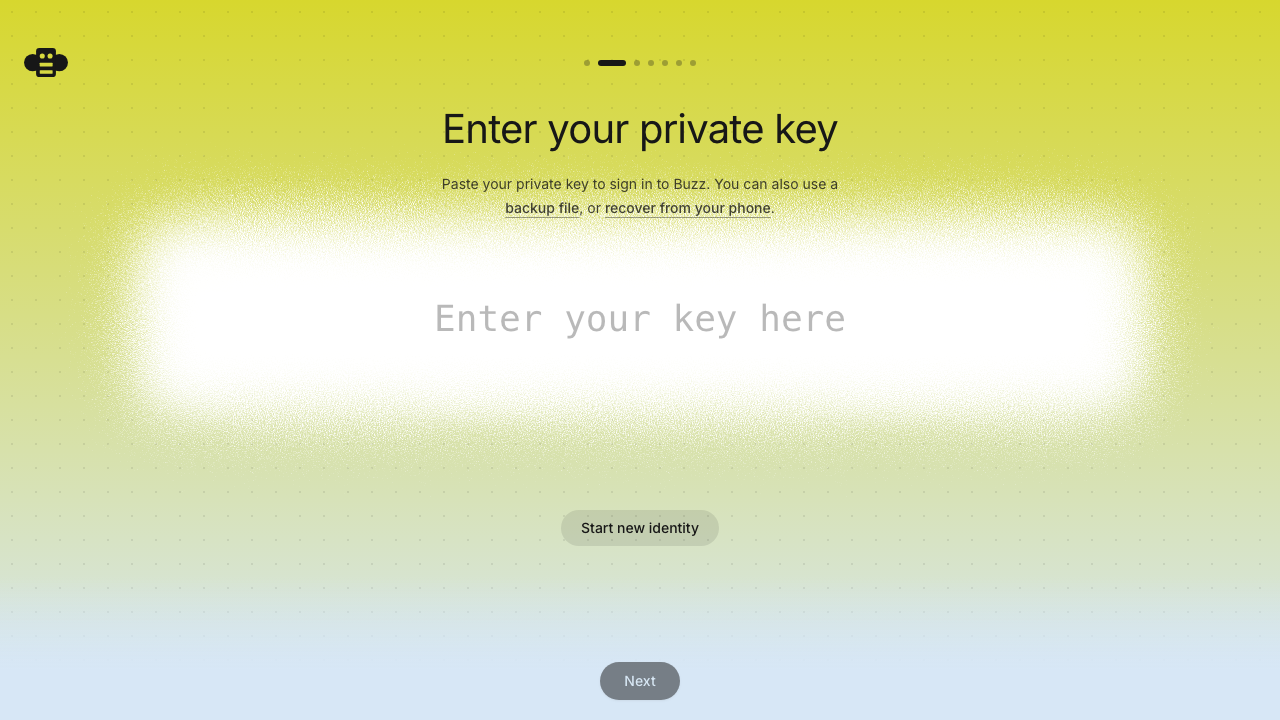
1. Launch Buzz Desktop with identity-lost state and choose **Recover
from your phone**.
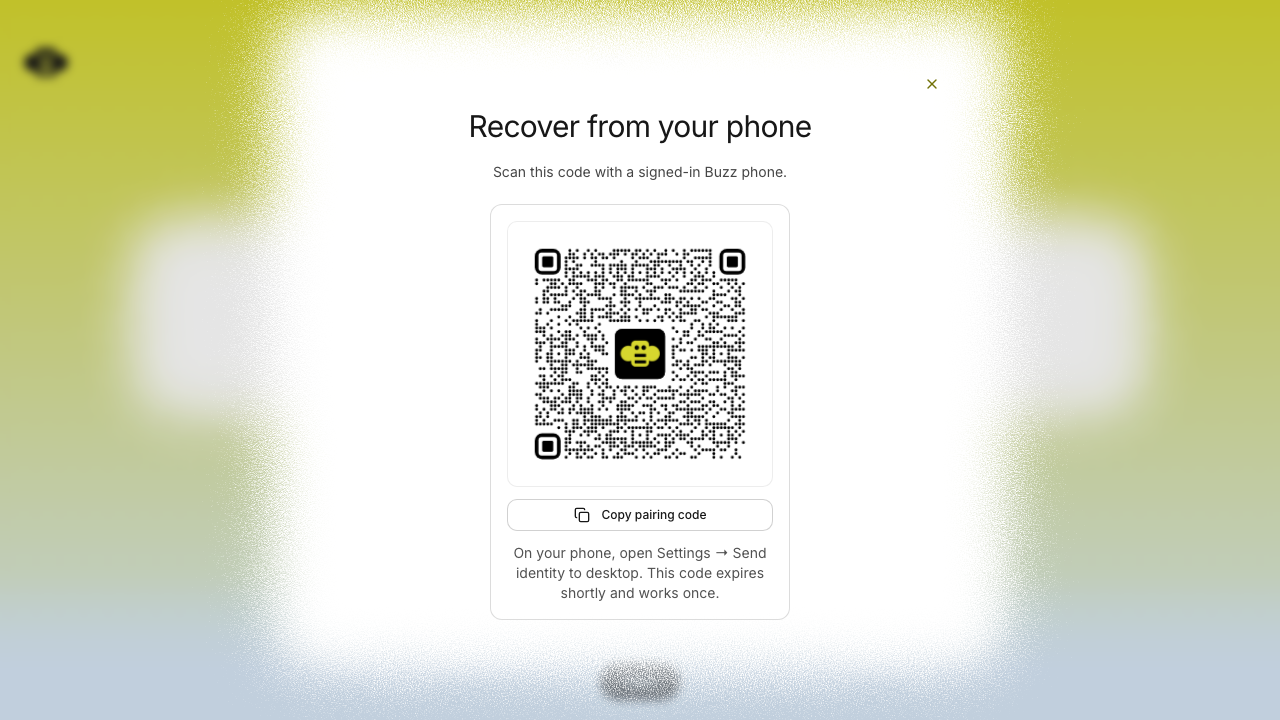
2. Confirm the QR and persistent **Copy pairing code** fallback appear
without layout shift.
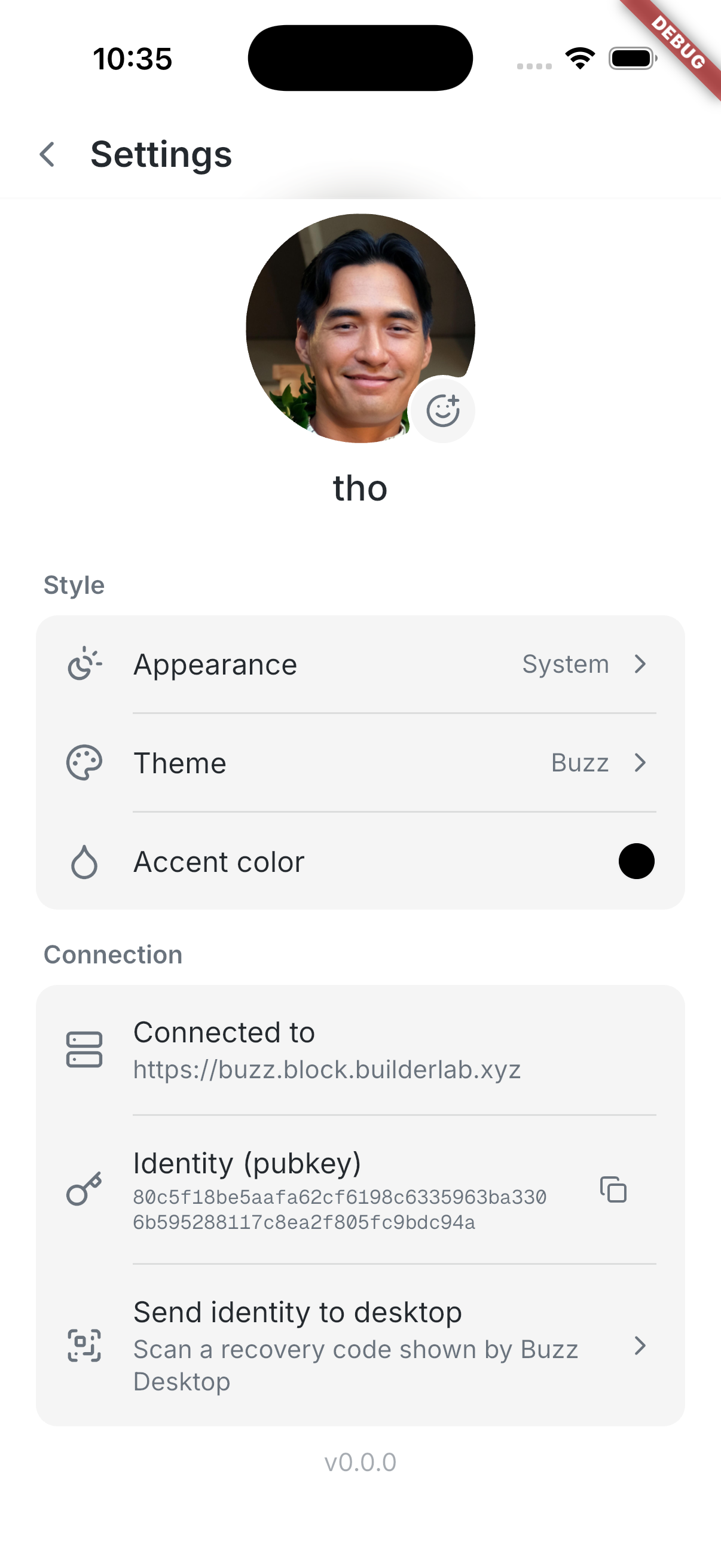
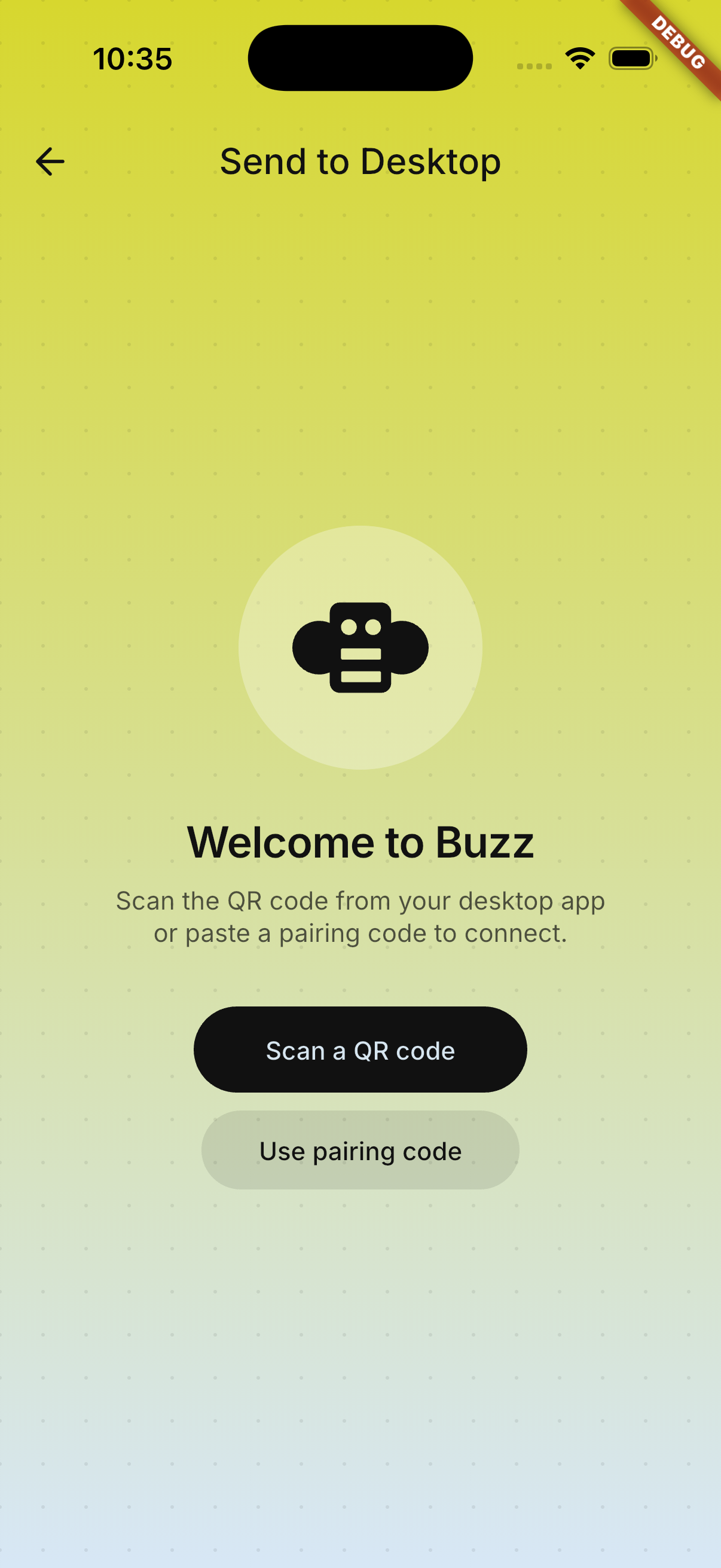
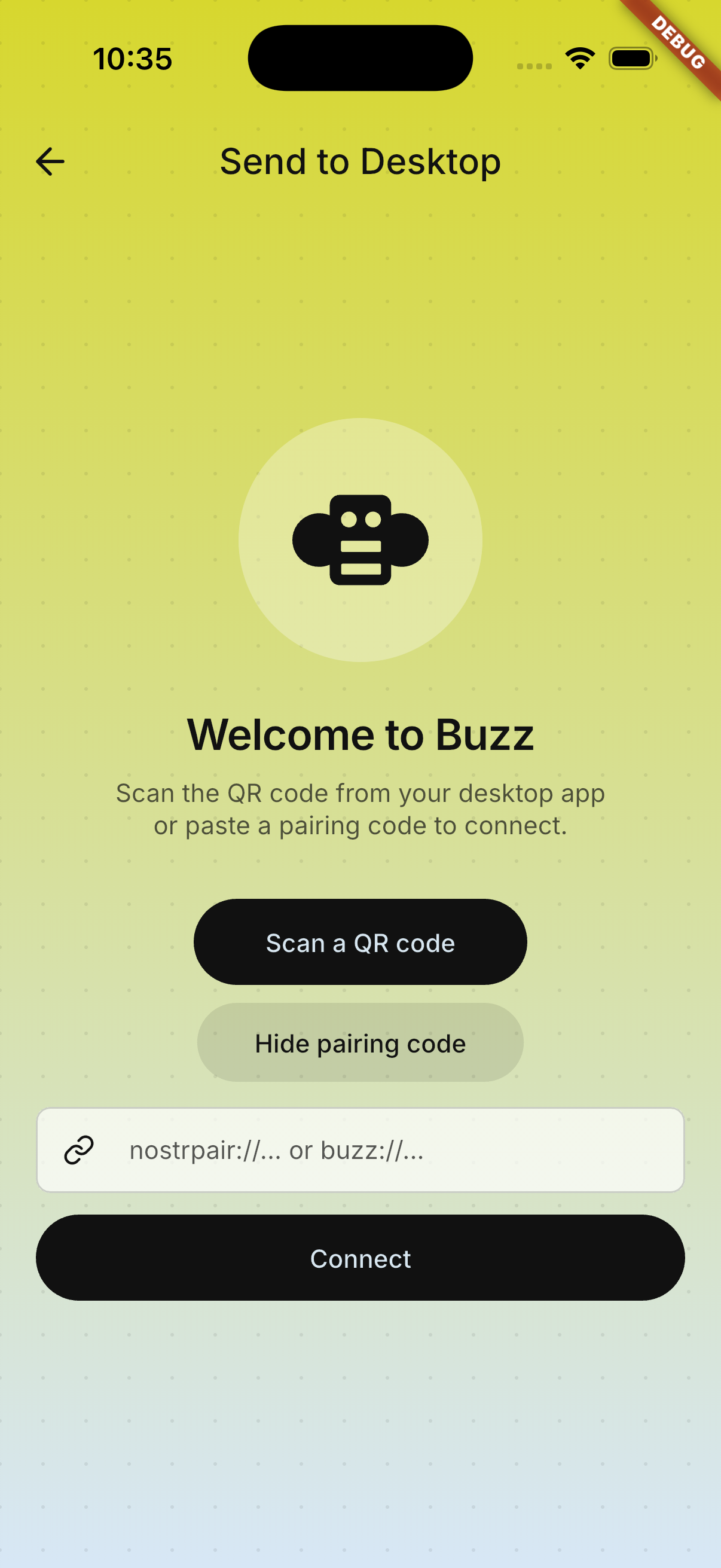
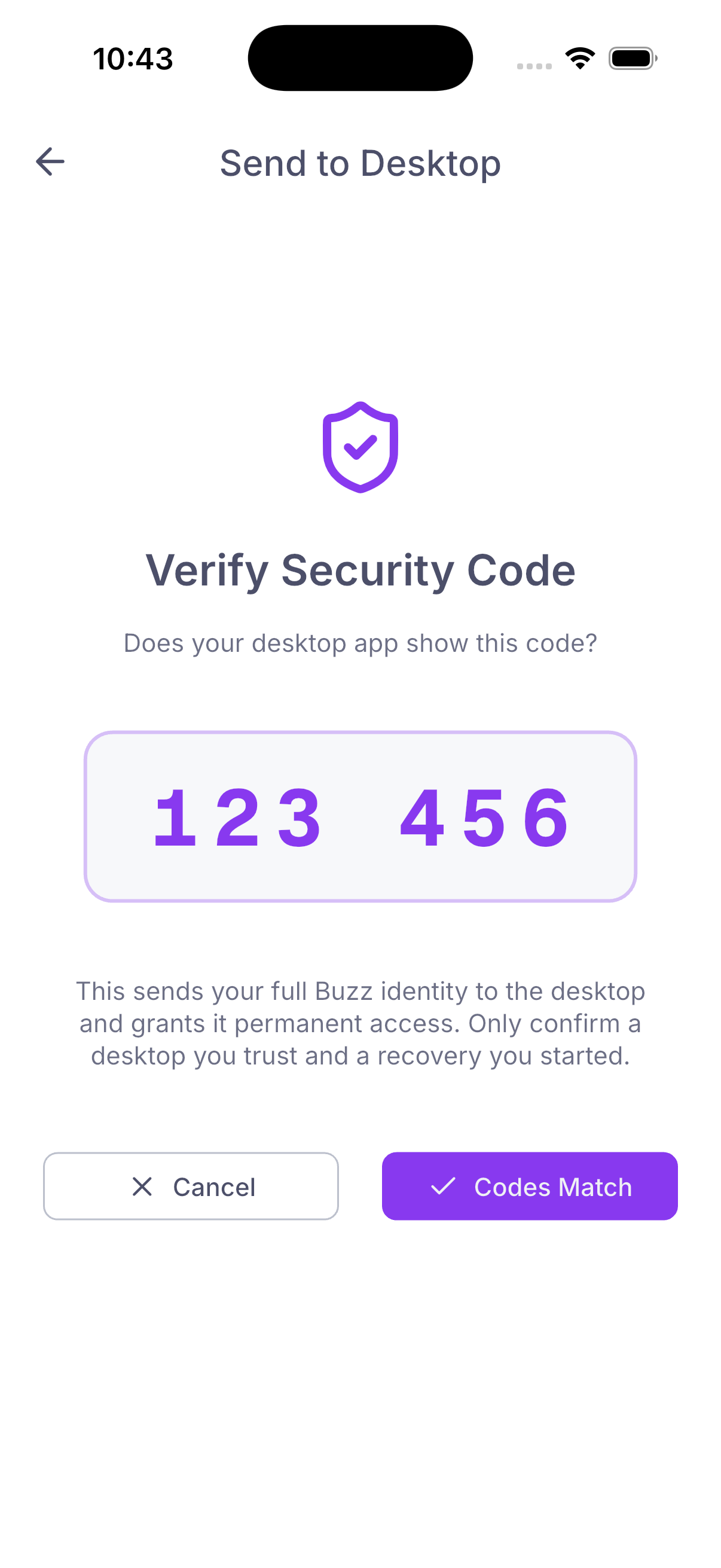
3. On a signed-in phone, open **Settings → Send identity to desktop**,
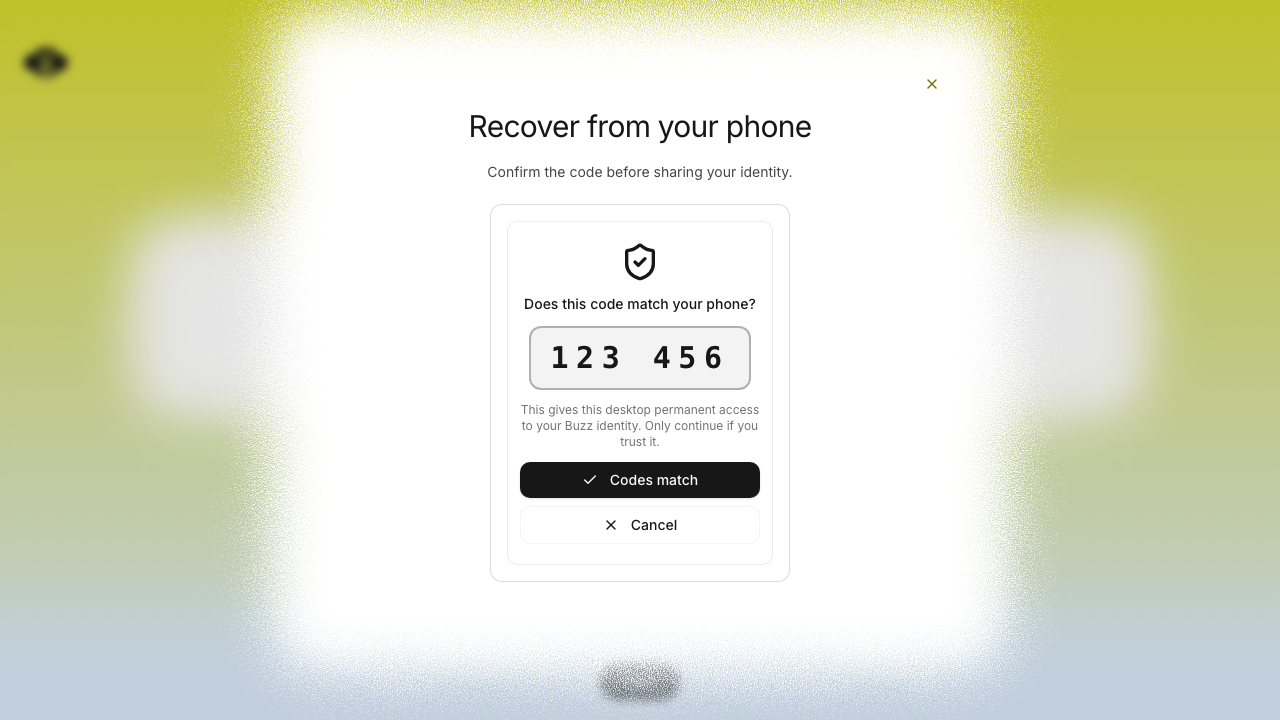
scan or paste the recovery code, and compare the six-digit SAS on both
devices.
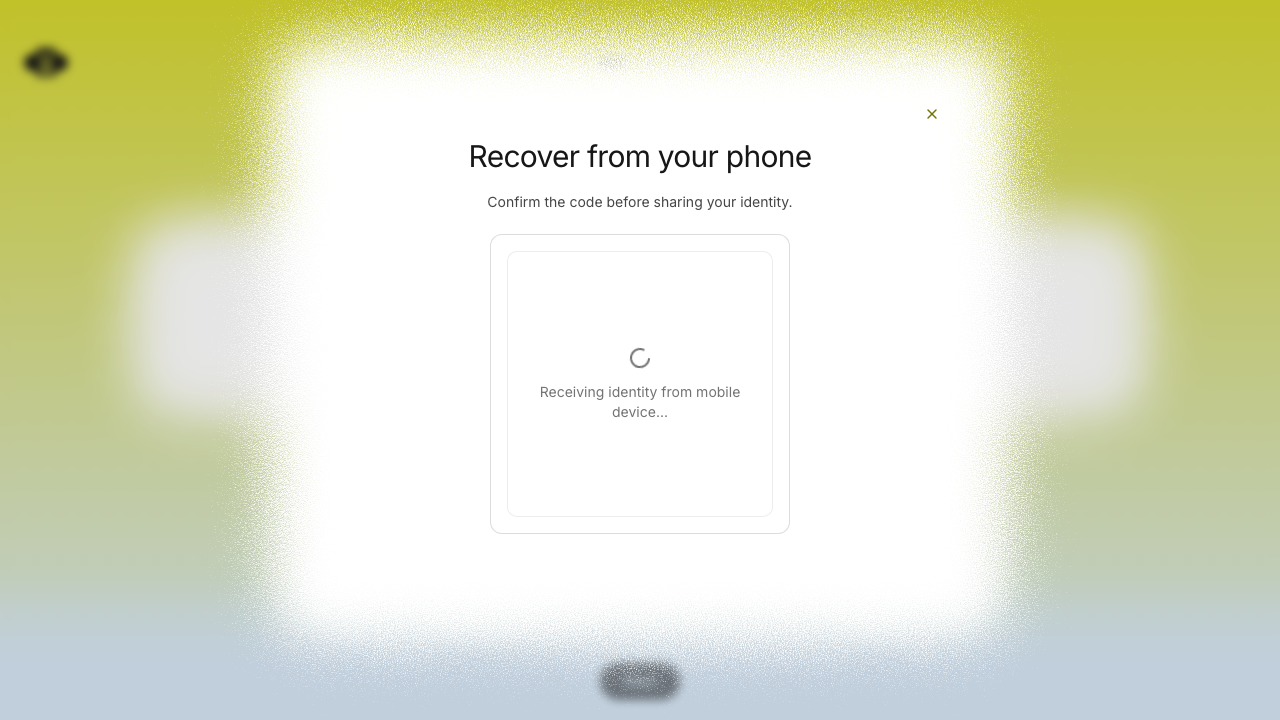
4. Confirm on both sides and verify Desktop restores the identity and
continues to harness setup.
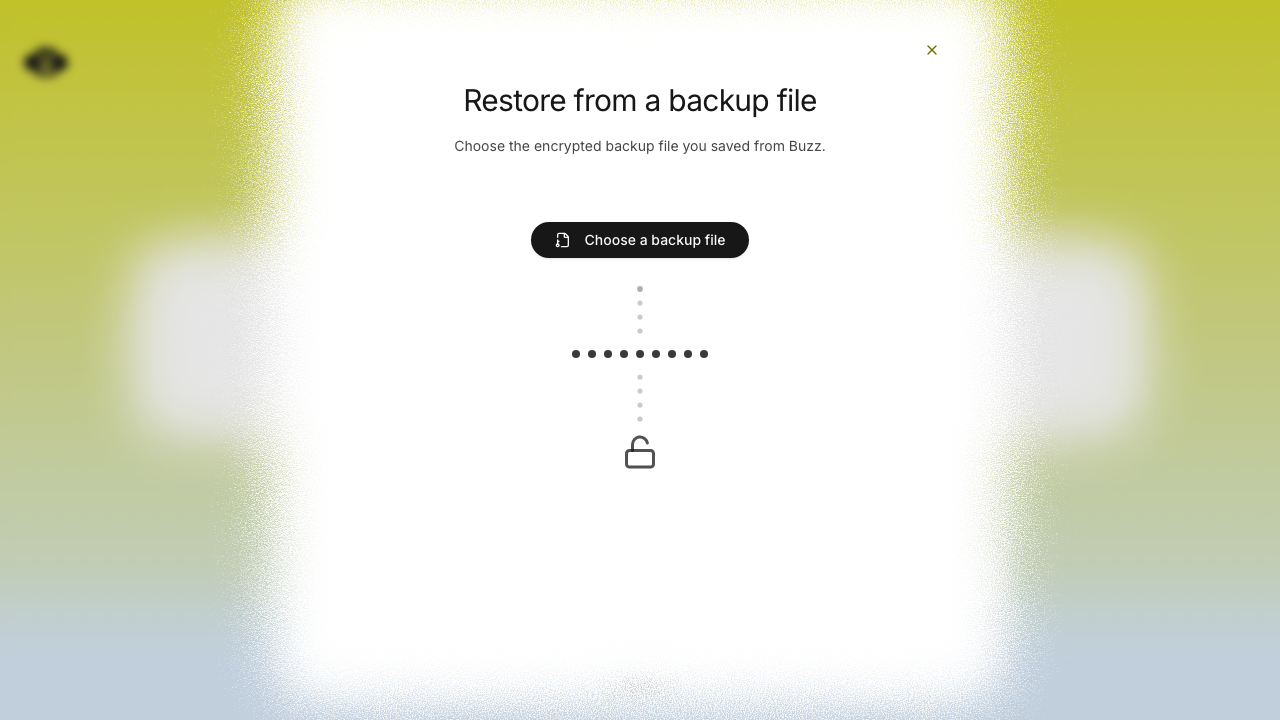
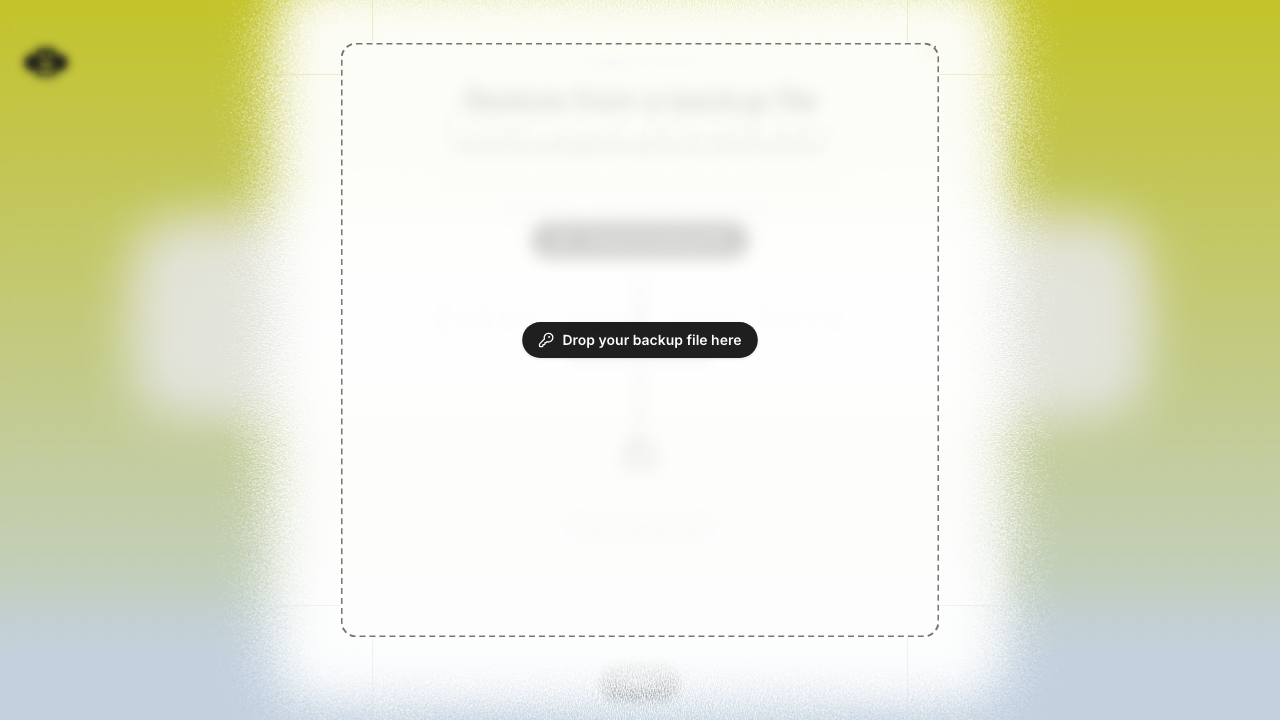
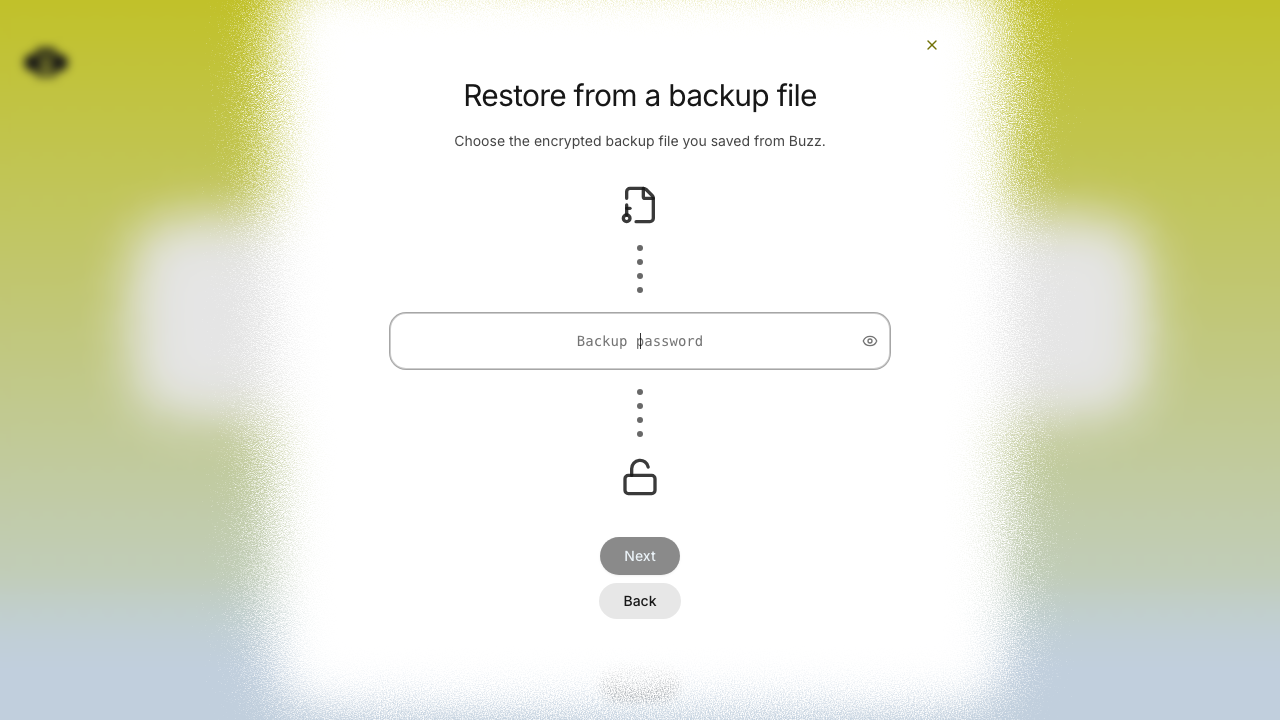
5. Repeat from identity-lost state with **Recover from a backup file**;
verify picker and drag-and-drop both advance to password entry and
restore the encrypted backup.
6. Exercise cancellation, mismatched/unsupported codes, expired
sessions, and an invalid backup; verify each returns actionable,
non-stuck UI.
## Screenshots
### Desktop phone recovery — complete flow
| Recovery entry | Pairing QR | Code match | Receiving identity |
|---|---|---|---|
| 
| 
| 
| 
|
### iOS Simulator — complete handoff flow
| Settings entry | Recovery scanner | Manual recovery code | Code
confirmation |
|---|---|---|---|
| 
| 
| 
| 
|
### Encrypted backup recovery — adjusted file flow
| File picker | Drag-and-drop target | Password step |
|---|---|---|
| 
| 
| 
|
## Verification
- `cargo test -p buzz-core pairing` — 71 passed
- `just mobile-test` — 1,169 passed
- `pnpm build:e2e && pnpm exec playwright test identity-lost.spec.ts
--project=smoke` — 15 passed
- Full pre-push gates — desktop checks, desktop unit tests, Rust tests,
Tauri checks, and mobile tests passed
---------
Signed-off-by: Taylor Ho <taylorkmho@gmail.com>
Co-authored-by: npub1223z34hd7vtwc6qj4s7flsxkj644nlre2nthu7lrrmkumhu3xddsrx9r6w <52a228d6edf316ec6812ac3c9fc0d696ab59fc7954d77e7be31eedcddf91335b@buzz.block.builderlab.xyz>
Co-authored-by: Carl <acda9e433d19dcd0e6b6840f7f4b98f3a56f1fab98049d444c087019e6d36560@buzz.block.builderlab.xyz>
* origin/main: (24 commits)
  fix(reactions): support max-length custom emoji (#3833)
  feat(desktop): allow leaving your final community (#3621)
  fix(buzz-agent): recover from context-window 400s instead of sticking (#4946)
  docs(persona-pack): fix stale desktop import instructions (#4500)
  fix(desktop): route macos notification clicks (#4799)
  feat(mobile): sync themes per community (#3767)
  feat(desktop): sync themes per community (#3653)
  feat(desktop): cap OpenClaw agent parallelism at 5 (#4019)
  fix(buzz-agent): scope handoff cap per turn, not per session lifetime (#4805)
  Fix mobile message timeline bounce (#4862)
  Polish mobile bottom sheets and profile cards (#4911)
  Fix media attachment actions (#4849)
  fix(desktop): remove join API token control (#4897)
  fix(desktop): allow shared agent mentions (#4913)
  Polish mobile top navigation (#4778)
  fix(release): tag immutable desktop candidates (#4811)
  fix(channels): restrict private-channel invitations (#4612)
  fix(acp): reject unattended permission requests (#4609)
  fix(workflow): bind trigger author to the signed event (#4607)
  fix(git): revoke access for banned relay members (#4608)
  ...

Co-authored-by: Will Pfleger <pfleger.will@gmail.com>
Signed-off-by: Will Pfleger <pfleger.will@gmail.com>

# Conflicts:
#	desktop/src-tauri/src/managed_agents/runtime.rs
OpenClaw connects to a single shared Gateway daemon. Spawning the
default 10 ACP workers per agent is both resource-expensive and
architecturally wrong — each worker opens a separate gateway connection.
Tyler's ruling: cap at 5, lower if needed.

## Contract

Store the requested value (1–32) verbatim at every persistence and wire
boundary. Apply `effective = min(requested, harness_cap)` only at the
four enforcement points:

| Boundary | Implementation |
|---|---|
| Local spawn | `BUZZ_ACP_AGENTS` env var in child `Command` |
| Remote deploy | `launch.policy_env["BUZZ_ACP_AGENTS"]` + legacy
`parallelism` field |
| Restart badge | `SpawnConfigSnapshot.parallelism` stores effective
value; the diff surface displays what actually runs |
| UI copy | Amber hint when requested > cap; no `max` attribute, no
save-path clamp |

`BUZZ_ACP_AGENTS` is added to `RESERVED_ENV_KEYS` — the Desktop resolves
the effective value into `policy_env`; a user-supplied override in `env`
would bypass the cap and is silently stripped.

## Changes

**`managed_agents/parallelism.rs`** (new) — policy core:
- `OPENCLAW_MAX_PARALLELISM = 5`
- `harness_max_parallelism(command)` — keyed on
`normalize_command_identity` so path prefixes, `.exe` suffixes, and
other cosmetic differences are ignored
- `effective_parallelism(command, value)` — identity for uncapped
harnesses
- `acp_agents_value(command, parallelism)` — `env("BUZZ_ACP_AGENTS", …)`
helper

**`runtime.rs`** — spawn clamp: `BUZZ_ACP_AGENTS =
acp_agents_value(effective_command, record.parallelism)`

**`agents_deploy.rs`** — deploy egress clamp: `build_deploy_payload`
resolves `effective_parallelism` once from `descriptor.command`; both
`launch.policy_env["BUZZ_ACP_AGENTS"]` and the legacy top-level
`parallelism` field use that value — the two are always consistent
regardless of stale `record.agent_command` pins

**`spawn_snapshot.rs`** — `from_inputs` stores
`effective_parallelism(&descriptor.command, record.parallelism)` in the
`parallelism` field. Over-cap edits that don't change the pool (e.g. 10
→ 8, both clamp to 5 on OpenClaw) produce equal snapshots; cap crossings
(8 → 3) produce different snapshots.

**`AcpRuntimeCatalogEntry.max_parallelism: Option<u32>`** — derived from
the static definition command, not the probed `entry.command` (which may
be `null` for unavailable entries), so unavailable OpenClaw entries
still carry the cap. Propagated through all four catalog constructors
(builtin discovery, preset catalog construction, custom discovery,
custom-save response), IPC types
(`RawAcpRuntimeCatalogEntry.max_parallelism`), and the frontend catalog
type.

**UI** — `EditAgentAdvancedFields` and `PersonaAdvancedFields` show an
amber hint when `selectedRuntime.maxParallelism` is set and the current
value exceeds it. Cap and label come from the catalog entry — no
hardcoded 5 in TS. No `max` attribute on inputs; the input stays
`type="text"` with 1–32 copy.

**Docs** — `docs/remote-agents.md`: `BUZZ_ACP_AGENTS` moved from the
deliberately-non-reserved section to reserved; new contract documented.
`desktop/src/features/agents/AGENTS.md`: command-keyed execution policy
documented as the sanctioned second metadata source feeding the catalog
projection.

## Tests

**Rust** (`parallelism.rs`):
- `policy_table` — `harness_max_parallelism` and `effective_parallelism`
across all openclaw variants and uncapped harnesses
- `acp_agents_value_openclaw_above_cap_is_capped` — spawn-env seam
- `override_direction_*` — both override directions (openclaw runtime +
goose override; goose runtime + openclaw override)
- `summary_persona_inherited_*` — live persona wins over stale
`agent_command`
- `snapshot_export_carries_requested_definition_parallelism` — requested
value travels wire/sync unchanged

**Rust** (`spawn_snapshot/tests.rs`):
- `openclaw_above_cap_parallelism_snapshots_equal` — stored 10 vs 8,
both clamp to 5 → snapshots equal
- `openclaw_cap_crossing_parallelism_snapshots_differ` — 8 (clamps to 5)
vs 3 → snapshots differ

**Rust** (`discovery/presets.rs`):
- `openclaw_preset_unavailable_carries_max_parallelism` /
`openclaw_preset_available_carries_max_parallelism` — catalog metadata
present with `command: null` and with a resolved path

**Rust** (`agents_deploy.rs`):
- `launch_block_openclaw_over_cap_policy_env_is_capped` — direct
`launch.policy_env` seam
-
`deploy_payload_json_stale_goose_record_live_openclaw_descriptor_both_capped`
— stale `record.agent_command=goose`, live descriptor=openclaw: both
fields cap to 5
-
`deploy_payload_json_stale_openclaw_record_live_goose_descriptor_both_uncapped`
— stale `record.agent_command=openclaw`, live descriptor=goose: both
fields pass through requested
- `deploy_payload_json_explicit_openclaw_override_both_capped` —
explicit `agent_command_override=openclaw`: both fields cap to 5

**Rust** (`persona_events/stale_pin_tests.rs`):
- `apply_persona_snapshot_goose_to_custom_harness_drops_stale_goose_pin`
— custom-direction stale-pin drop (builtin pin → loaded custom harness
via `update_loaded_harness_registry`)

**TypeScript** (`agentParallelism.test.mjs`):
- `parallelismCapHint` — at/below cap (null), above cap (hint includes
label and cap value), singular form for cap=1, uncapped harness (null)

**TypeScript** (`tauri.test.mjs`):
- `fromRawAcpRuntimeCatalogEntry` round-trips `max_parallelism` →
`maxParallelism`; absent when `undefined`

---------

Signed-off-by: Will Pfleger <pfleger.will@gmail.com>
Co-authored-by: npub1mn7jgtj4w2pd0g0zeuhxsa6jy6p0rewxz4kujt98my82ahfmp72sxjexk7 <dcfd242e557282d7a1e2cf2e6877522682f1e5c6156dc92ca7d90eaedd3b0f95@buzz.block.builderlab.xyz>
Adopt spawn_hash → spawn_snapshot rename from main; migrate spawn_config_hash: 0
test fixtures to prospective_spawn_config_snapshot() calls in global_agent_config
tests, epoch tests, and runtime_commands tests.

Co-authored-by: Will Pfleger <pfleger.will@gmail.com>
Signed-off-by: Will Pfleger <pfleger.will@gmail.com>
The "Restart required" badge reports that an agent's running config has
drifted from its spawn-time config, but never says what changed. This
ships the full feature: a typed Rust diff engine and a TS/UI layer that
renders it at every badge site.

## Rust core (spawn-snapshot diff engine)

Replaces the lossy `u64` `spawn_config_hash` with a typed
`SpawnConfigSnapshot`. The snapshot is stamped from the already-resolved
command/env/config values immediately before `spawn()`, closing the race
window where a mid-spawn config edit would suppress the badge.

`SpawnConfigSnapshot::canonical()` is the single JSON projection shared
by the badge and the diff. Drift is `to_value(stamped) !=
to_value(current)`; the diff is a generic leaf walk over those same two
values, so badge-on and diff-non-empty are structurally guaranteed.
Adding a snapshot field reaches the UI with no code change to the diff
engine — `mutation_table_covers_every_serialized_field` fails CI if a
new field arrives without a mutation row.

`eligible_restart_diff(persona_orphaned, Option<TrackedSpawnState>)`
returns the final vector — snapshot walk entries plus a synthetic
`adapter_availability` entry. It returns empty for an orphaned instance
(spawning one would fail) and for agents with no tracked spawn state
(never stamped, can never have drifted). `needs_restart =
!restart_diff.is_empty()` derives from that vector and nothing else.

Redaction policy (`policy_for(path)`) is shared by the wire diff and the
snapshot's manual `Debug` via `is_safe_to_reveal()` from
`managed_agents::env_vars` as the single authority for env-key masking:

| Policy | Paths | Rendering |
|---|---|---|
| `Text` | `system_prompt`, `team_instructions` | character counts only
|
| `MaskedBare` | `args`, `relay_url` | `••••`, no suffix |
| `MaskedSuffix` | non-allowlisted `env.*` | `••••` + last 4 chars when
longer than 8 |
| `Plain` | allowlisted `env.*` (`BUZZ_AGENT_THINKING_EFFORT`,
`BUZZ_AGENT_PROVIDER`, `BUZZ_AGENT_MODEL`, `DATABRICKS_HOST/MODEL`) and
everything else | verbatim |

Default-deny: every env key not in the explicit allowlist stays masked.
`is_safe_to_reveal()` is the single allowlist authority for both the
baked-env display and the diff.

`restart_diff` is omitted from the wire when empty
(`skip_serializing_if`).

## TypeScript / UI layer

New `restartDiff.ts` module defines `RestartDiffEntry`, `RestartChange`,
`JsonValue`; `tauri.ts` and `types.ts` re-export and add `restart_diff`
/ `restartDiff` fields (Rust omission → `restartDiff: []`).

**`RestartDiffBadge`** — hover tooltip capped at 6 entries + "and N
more", `asChild` span trigger (never inside a `<button>`), auto-restart
blurb below the diff list (on/off variant from `autoRestartEnabled`
prop; same `AUTO_RESTART_ON_BLURB` / `AUTO_RESTART_OFF_BLURB` constants
shared with the Runtime-tab banner). **`RestartDiffList`** renders the
full uncapped list for the Runtime-tab banner with `tooltip`/`inline`
presentation variants for correct foreground in both surfaces.

**`ManagedAgentRow` B4 fix** — badge moved to a sibling `div` of the row
expansion button; tooltip trigger has no `button` ancestor.

**`UnifiedAgentsSection`** — both badge sites render
`<RestartDiffBadge>` instead of a raw `<Badge>`, with
`autoRestartEnabled` threaded from `agent.autoRestartOnConfigChange`.

**Side-panel fix** — `RestartDiffBadge` rendered tab-independently in
the `ProfileSummaryView` hero area (was Runtime-tab only — root cause of
the ~50% inconsistency Will reported). Hero badge is `self-center` in
the flex column. `ProfileRuntimeTabContent` early-return checks
`needsRestart` so the banner is never dropped when all other content is
empty. Auto-restart blurb in the Runtime-tab banner uses the shared
constants.

## Wire shape

```jsonc
"restart_diff": [
  { "field": "model",              "change": { "kind": "value",  "before": "gpt-5", "after": "claude-4" } },
  { "field": "system_prompt",      "change": { "kind": "text",   "before_chars": 1234, "after_chars": 1410 } },
  { "field": "env.OPENAI_API_KEY", "change": { "kind": "masked", "before": "••••bc12", "after": "••••xyz9" } },
  { "field": "env.BUZZ_AGENT_THINKING_EFFORT", "change": { "kind": "value", "before": "medium", "after": "high" } }
]
```

`added`/`removed` occur only for dynamic-map keys; nullable struct
fields always serialize as `null`; arrays are atomic leaves (`args`,
never `args.0`).

## Tests

**Rust** — 1902 passing: snapshot mutation coverage, diff entry
serialization, allowlist-aware env masking
(`allowlisted_env_key_shows_plain_value`,
`allowlisted_env_key_is_case_insensitive`,
`non_allowlisted_env_key_stays_masked`),
`unstamped_agent_yields_no_badge_and_no_entries` (both orphan values),
`summary_without_drift_omits_restart_diff_from_the_wire`,
`unstamped_availability_is_not_drift`. Clippy clean, fmt clean.

**TypeScript** — `needs-restart-screenshots.spec.ts`: 11 E2E cases
registered in the smoke project — all three badge sites, tooltip +
keyboard focus, DOM no-button-ancestor assertion, 6+1 truncation,
uncapped Runtime list, unknown field humanisation, side-panel badge on
default Info tab, inactive/friendly-error Runtime opening path.

Consolidates [#3652](https://github.com/block/buzz/pull/3652)

Signed-off-by: Will Pfleger <pfleger.will@gmail.com>
Co-authored-by: npub1mn7jgtj4w2pd0g0zeuhxsa6jy6p0rewxz4kujt98my82ahfmp72sxjexk7 <dcfd242e557282d7a1e2cf2e6877522682f1e5c6156dc92ca7d90eaedd3b0f95@buzz.block.builderlab.xyz>
## Summary

- send desktop messages immediately while media uploads continue in
background state across channel navigation
- show immediate progress above the composer and keep Jump to latest
above it
- report the real media stages as Preparing, Processing, Converting,
Uploading, and Finishing
- use Buzz's shared spinner during local media work, then switch to the
real percentage when byte transfer begins
- animate phase-label and status-suffix changes without overlap or
layout jumps
- keep cancel, progress fill, message publication, and community-reset
behavior coordinated with the background task
- use raw Tauri IPC for large browser files so renderer-side byte
serialization does not block initial feedback

## Why

Desktop previously blocked sending while attachments uploaded in the
composer. Large videos could also pause the renderer before progress
appeared, and the progress pill said Uploading while native media
processing was still underway. This makes the initial response immediate
and describes the work actually happening.

## Validation

- `cd desktop && pnpm check`
- `cd desktop && pnpm typecheck`
- `cd desktop && pnpm test` (3,931 passed)
- `cd desktop && pnpm exec vite build --mode e2e`
- `cd desktop && pnpm exec playwright test
tests/e2e/file-attachment.spec.ts --project=smoke` (11 passed)
- focused native media tests (80 passed)
- native Clippy with all targets and features
- pre-push native suite (2,107 passed, 14 ignored; 3 diagnostics passed)

Updated phase snapshots are included in the PR comments.

Split from #4512 so the desktop and mobile changes can be reviewed
independently.

---------

Signed-off-by: kenny lopez <klopez4212@gmail.com>
Signed-off-by: Wes <wesbillman@users.noreply.github.com>
Co-authored-by: Wes <wesbillman@users.noreply.github.com>
Co-authored-by: Carl <c7ebe626f000404285d3686e1dc74cc07cc60a9754a150041ba132e14bd3e2ec@buzz.block.builderlab.xyz>
Resolves two conflicts against main:

AppShell.tsx: HEAD had const { activeCommunity, reinitKey } = communitiesHook
for the composite workspace key; origin/main added useHuddlePresentation()
destructuring from the Huddle redesign (#4281). Resolution keeps both: the
composite key is required for useManagedAgentRuntimeReconciliation, and the
Huddle hooks are needed for the new Huddle UI.

MeshComputeSettingsCard.tsx: HEAD had the Stop using shared compute affordance
plus the legacy inline model section; origin/main (#3735) replaced the inline
model section with the MeshModelPicker component. Resolution keeps the Stop
button block and adopts the MeshModelPicker layout, discarding the replaced
inline model controls.

Also corrects the false comment at runtime_commands_tests.rs:342-345 that
claimed compensate_drain is covered by the desktop integration test suite.
The compensation round-trip requires an AppHandle; the codebase has no
tauri::test harness and no AppHandle mock. The honest coverage statement is:
drain-prefix contract proven by unit test, restart path integration-only.

Co-authored-by: Will Pfleger <pfleger.will@gmail.com>
Signed-off-by: Will Pfleger <pfleger.will@gmail.com>
## Overview

The global Agent Defaults surface (Settings card, defaults modal,
onboarding) exposed structured controls for Effort but left Max Output
Tokens, Context Limit, and Max Rounds as raw env vars. Per-agent dialogs
had structured numeric fields but only for `isBuzzAgentRuntime` —
incorrectly excluding Goose. This PR unifies numeric-tuning capability
across all surfaces, fixes a pre-existing dual-editor defect, and adds
full test coverage.

## What changed

### Phase 1 — Catalog projection

- Add `max_rounds_env_var` to `KnownAcpRuntime` in `runtime_metadata.rs`
(`Some("BUZZ_AGENT_MAX_ROUNDS")` for buzz-agent, `None` elsewhere).
- Project all three numeric env-var fields (`max_tokens_env_var`,
`context_limit_env_var`, `max_rounds_env_var`) end-to-end:
`AcpRuntimeCatalogEntry` Rust struct, TS `types.ts`,
`RawAcpRuntimeCatalogEntry` + `fromRawAcpRuntimeCatalogEntry` in
`tauri.ts`, and the e2e mock bridge (`withMockRuntimeConfigMetadata`).

### Phase 2 — Field model

- `deriveAgentConfigFieldModel` now derives `maxOutputTokens` /
`contextLimit` / `maxRounds` descriptors from catalog-projected fields.
- `structuredEnvKeys(descriptors)` — exported helper that takes the
**rendered** descriptor set (not the whole model). Hidden keys follow
what is actually rendered per surface: global hides effort + all three
numeric keys for buzz-agent / two for Goose; per-agent buzz-agent hides
effort + three numeric keys; per-agent Goose hides only its two numeric
keys. `BUZZ_AGENT_THINKING_EFFORT` stays a visible generic env row
per-agent because no effort control renders there.

### Phase 3 — UI

- Extract `NumericTuningFields` from `buzzAgentModelTuningFields.tsx` as
a shared descriptor-driven component (`descriptors`, `envVars`,
`inheritedEnvVars`, `onEnvVarChange`). Kind-specific minima:
`NUMERIC_KIND_MIN` map (`maxOutputTokens`/`contextLimit`: 1,
`maxRounds`: 0) applied to `<input min>`.
- **Global surface** (`AgentConfigFields.tsx`): deduplicate the
previously duplicated Advanced env-editor block; render
`NumericTuningFields` below the env editor when descriptors exist;
`hiddenKeys` and `bakedGenericRows` exclusions use `structuredEnvKeys`
so structured keys are never double-rendered. Under 1000 lines.
- **Per-agent surfaces** (`EditAgentAdvancedFields`,
`PersonaAdvancedFields`): replace `isBuzzAgentRuntime` as the
numeric-field gate with `deriveNumericDescriptors(selectedRuntime)` from
`agentConfigCore`; hidden keys come from
`structuredEnvKeys(numericDescriptors)` — the same rendered descriptor
set, no local rebuilding (fixes pre-existing dual-editor defect).
Catalog status carried as `RuntimeCatalogStatus` (`loading | ready |
error`); both error and loading withhold structured controls and leave
saved values visible as generic rows, making error distinguishable from
"runtime not capable" (`ready` + no runtime).
- **Dialogs** (`AgentDefinitionDialog`, `AgentInstanceEditDialog`,
callers): `AgentDefinitionDialog` accepts `runtimeCatalogStatus?:
"loading" | "ready" | "error"` (replaces separate
`runtimesLoading`/`runtimesError` booleans); all call sites —
`AgentManagementDialogs`, `AgentsView`, `RequestedAgentCreateDialogs`,
`UserProfilePersonaDialogs` — compute and pass the status.

### Phase 4 — Tests

- `buildRecord` exported from `EnvVarsEditor.tsx` as a pure `(nextRows,
value, requiredKeys, hiddenKeys) => Record<string, string>` helper for
isolation testing.
- **17 new node tests** in `agentConfigCore.test.mjs`:
`deriveNumericDescriptors` (all three fields, partial, undefined
runtime, matches field-model subset); `structuredEnvKeys` per surface
including discriminating Goose per-agent effort-key invariant;
`NUMERIC_KIND_MIN` values.
- **4 new node tests** in `EnvVarsEditor.test.mjs`: hidden tuning key
preserved through generic row edits; runtime-switch then generic edit
(derives both descriptor sets, asserts new-runtime hidden key survives
`buildRecord` via `hiddenKeys` and old-runtime key survives via generic
rows); baked numeric key excluded via `filterBakedGenericRows` with
`numericTuningPlaceholder` assertion; clearing a structured override —
`numericTuningPlaceholder` verifies placeholder text.
- **5 new Playwright tests** in `agent-numeric-tuning.spec.ts` (added to
smoke project `testMatch`): global numeric fields visible for
buzz-agent; global: non-capable runtime hides numeric controls; Goose
per-agent shows `Inherit (16384)` after saving global value through the
UI; delayed catalog: saved values visible as generic rows while loading
then structured controls appear after settle; failed catalog: saved
values remain visible as generic rows (never the "unsupported" empty
state).

## Result

- buzz-agent global defaults: Max output tokens, Context limit, Max
rounds as structured inputs with `Inherit (N)` placeholders from baked
env.
- Goose global defaults: Max output tokens, Context limit as structured
inputs.
- A Goose global value surfaces as `Inherit (<value>)` in the per-agent
Goose edit dialog.
- No structured key is editable in two places on any surface; no
persisted key has zero editors.
- No `runtime.id === "buzz-agent"` comparison decides numeric-field
visibility anywhere — capability flows catalog →
`AcpRuntimeCatalogEntry` → field model → UI.

Signed-off-by: Will Pfleger <pfleger.will@gmail.com>
Co-authored-by: npub1mn7jgtj4w2pd0g0zeuhxsa6jy6p0rewxz4kujt98my82ahfmp72sxjexk7 <dcfd242e557282d7a1e2cf2e6877522682f1e5c6156dc92ca7d90eaedd3b0f95@buzz.block.builderlab.xyz>
Nine files were over the gate limit after the workspace-scoped store
implementation. Trims/extractions to get all under limit:

- app_state_tests.rs: move scope lifecycle tests to app_state_scope_tests.rs
- app_state.rs: move pending_owned_channels methods to identity_storage.rs
- AppShell.tsx: inline reconciliation key as String(reinitKey) (1 line vs 3)
- tauri.ts: type alias ApplyWorkspaceResult + biome-ignore format to keep
  the applyCommunity body under the limit
- runtime.rs: restructure scope capture to save a net line
- storage.rs: trim doc comments on _at variants to single-liners
- mesh_llm.rs: make scope_impl pub(crate) mod; fold scope relay capture
  inside check_mesh_runtime_relay_scope; remove verbose comments
- migration.rs: extract scoped migration helpers to migration_scope.rs via
  include!(); trim SHARED_AGENT_FILES/DIRS block comments
- migration_tests.rs: trim explanatory comments to save net 33 lines

Co-authored-by: Will Pfleger <pfleger.will@gmail.com>
Signed-off-by: Will Pfleger <pfleger.will@gmail.com>
Surfaces the degraded-apply result from the backend all the way to the UI:

tauri.ts:
- Add WorkspaceApplyResult interface { applied: boolean; degraded: string[] }
- applyCommunity() now returns Promise<WorkspaceApplyResult> instead of
  Promise<void>; passes typed result through from apply_workspace command.

useCommunityInit.ts:
- Consumes applyResult from applyCommunity instead of discarding void.
- applied: false (drain-failed) → park on the loading gate so the user
  can retry via a workspace switch; the specific degradation messages are
  shown as the error.
- applied: true with degraded entries → console.warn (informational;
  workspace IS active; post-commit step failed gracefully).
- Existing catch block still handles genuine Tauri errors (poisoned lock,
  invalid nsec, etc.) unchanged.

Co-authored-by: Will Pfleger <pfleger.will@gmail.com>
Signed-off-by: Will Pfleger <pfleger.will@gmail.com>
Windows installs of Goose and other harnesses failed at exactly five
minutes with an empty error (#2401). The 300s ceiling was killing
installs that were working, just slowly — the Goose step pulls a ~79MB
release asset, and Windows Defender scans every file npm extracts. When
the ceiling fired it discarded the output it had already read, so the
user got a bare timeout string and no way to tell a hang from a large
download.

## The ceiling

`INSTALL_TIMEOUT` is 900s, and the error names the limit: `install
command exceeded the 15m ceiling and was terminated`. It stays a pure
wall-clock ceiling with no inactivity kill — nothing observable
distinguishes a hung installer from one silently transferring a large
artifact, so silence alone never kills an install. A ceiling kill
remains non-retryable; re-running a command that already burned 15
minutes costs the user more time with no plausible path to success.

The child's exit and both stream drains fold into one resumable settle
governed by a single deadline. Waiting on the drains outside that
deadline would let a descendant that outlived the install shell hold the
output pipes — and the per-runtime install guard behind them — open with
no bound, which is the failure the ceiling exists to prevent. So the
deadline path terminates the process group on the normal-exit branch
too: a leader that exited with a real status still gets its stragglers
killed, and the guard cannot stick either way. Whether the leader had
already exited only decides the verdict — its real status outranks a
timeout.

The install shell is a session leader and its descendants inherit the
output pipes, so signalling only the leader left them running and the
drains blocked on a pipe nobody would close. Escalation keys off the
*group's* liveness rather than the leader's, since a descendant that
ignores SIGTERM outlives the leader and would otherwise never receive
the group SIGKILL. Reaping the killed child and finishing the drains
share one bounded grace, so a termination that failed outright cannot
extend the ceiling that just fired.

## Output capture

Each stream drains into a bounded capture that is *shared* with the
reader rather than returned by it, so whatever arrived before a stall is
readable at the ceiling — exactly when the output matters most. Output
of any size costs a fixed amount of memory.

One capture holds two independently bounded views of the same bytes:

| View | Head / tail | Cut marker |
|------|-------------|------------|
| UI (`InstallStepResult`) | 512 B / 1024 B | `... (N bytes omitted)
...` |
| Log file | 128 KiB / 128 KiB | `... [N bytes omitted at cap] ...` |

The UI budget is screen space; the log's is disk. Both markers are
inline, so neither ever implies completeness it does not have. Both ends
are cut at arbitrary byte offsets, so a partial character is trimmed and
the partial token each cut left behind is dropped — the marker's byte
count includes both trims.

## Install log

`steps` carries only the last attempt of each step, truncated for
display. Everything else — earlier retries, the prerequisite step that
actually broke, the managed-Node bootstrap — used to be discarded.
`InstallReporter` now appends one self-contained record per attempt of
per step to `install-<runtime-id>.log` beside the agent logs, and
`InstallRuntimeResult.log_path` carries the file to the UI, where a
failure message ends with `Full log: <path>`.

Each record is bounded independently by the log-scale capture that
produced it, so a first attempt that printed megabytes cannot push out
the later record explaining the failure; the run's total is bounded by
steps × attempts × per-record cap. Every early return builds its result
through one `InstallReporter::failed` helper, so no failure path can
omit the log pointer, and synthesized steps go through `record_step` — a
step that reaches the UI without passing it would be invisible in the
file.

Install output can echo a registry token or proxy credential from the
environment it ran in, and the file is written unattended. Redaction
keys off the *names* of the environment variables the install inherited,
snapshotted once per run, rather than a list of known secret value
prefixes: a credential with no recognisable shape is exactly the one a
prefix match misses. Three name rules apply, because the variables need
different treatment:

| Rule | Variables | Redacted |
|------|-----------|----------|
| URL userinfo | `HTTP_PROXY`, `HTTPS_PROXY`, `ALL_PROXY`,
`NPM_CONFIG_PROXY`, `NPM_CONFIG_HTTPS_PROXY`, `NPM_CONFIG_REGISTRY` |
`user:password` only |
| Exact name | `NPM_CONFIG_KEY`, `NPM_CONFIG__AUTH`, `NPM_CONFIG_OTP` |
whole value |
| Marker substring | `*TOKEN*`, `*SECRET*`, `*PASSWORD*`, `*_PAT`, … |
whole value, 8-byte floor |

A proxy or registry keeps its host and port, because an install that
fails behind one is diagnosable only if the record still says which one
it went through, and a bare `user@` with no password is not treated as a
credential. npm's own settings are listed by exact name rather than
matched on `KEY` or `AUTH` substrings — both occur throughout an
ordinary environment on values that are paths and people's names — and
they bypass the 8-byte floor, since a six-digit one-time password is a
credential at that length. Matching is case-insensitive, which is what
npm's lowercase `npm_config_*` spelling needs. `0o600` is set by the
create rather than a later `chmod`, which would leave a window where the
umask decides. A runtime id that cannot safely be a filename yields no
log rather than a sanitized one — a rewritten id could collide with
another runtime's log.

The file holds exactly one run. A run opens its own session after the
runtime id has been canonically resolved — the previous file rotates to
`.1` and any older `.1` is removed before the rename, since a rename
that will not replace its destination would otherwise wedge rotation
permanently on Windows. The session writes a header naming the runtime,
the app version (`app.package_info().version` on the Rust side — cannot
be mocked or fail), the OS (`std::env::consts::OS`), and the start time:
a Windows failure and a macOS one on the same runtime are different
bugs, and a stale app version explains a failure that no longer
reproduces. Each record carries its attempt's elapsed time.

## Live output line

A 15-minute ceiling with nothing behind it but a spinner is
indistinguishable from a hang. The same drain seam feeds an
`acp-install-output` event carrying the newest complete line, and the
three install entry points — Doctor harness rows, the harness catalog
dialog, and onboarding runtime cards — render it under the spinner with
`aria-live="polite"`.

Ordering is keyed on a `seq` monotonic across the whole install, not on
the attempt number, which restarts at 1 for every step: keyed on
attempt, one step succeeding on attempt 2 would make the next step's
attempt-1 output look stale and freeze the display for the rest of the
install. Each executed attempt begins with an unthrottled `line: null`
clear signal, so a stale failure line cannot sit under the spinner while
the retry runs. Events are otherwise throttled to four per second, and
the throttle *retains* the newest pending line and flushes it when the
window reopens rather than dropping it — at an attempt boundary a drop
would silently eat the new attempt's first line.

The subscription is mounted for the runtime's whole lifetime rather than
started when the install begins. The install command is invoked from the
click handler, so the clear and a fast command's first lines can be
emitted before React has committed the pending state, and nothing
replays them — a subscription that waited for that state would lose the
entire output of a short install. The run boundary resets the ordering
key when the install settles, since `seq` restarts for the next run, and
the line renders only while installing, so a straggler from a finishing
drain cannot appear under a fresh Install button.

The 15-minute ceiling deliberately stops waiting on stuck drain threads
— a hung installer must not freeze the app. That means a drain thread
can outlive its `InstallReporter`. Without a generation guard, a drain
that calls `offer` after the run settles would publish an event with the
run's high `seq`, poison the permanent listener's React state, and cause
the next install's restarted `seq=0` events to be rejected. `Live` now
carries a `lifecycle: Arc<RwLock<bool>>`; drain threads hold a **shared
read guard** from the admission check through the `(self.emit)(...)`
call, making the check-then-emit pair atomic with respect to shutdown.
`InstallReporter::drop` takes the **exclusive write guard** and stores
`false` — this blocks until every in-flight drain publication releases
its read guard, then prevents any new admission. Deactivation is
bounded: the write lock holds only for the flag store, so it can block
at most for the duration of one emit call (microseconds to low
milliseconds). Rust drops locals in reverse-declaration order, so
`reporter` drops before `_guard`, ensuring the exclusive write completes
before the per-runtime concurrency guard releases and a new install can
start.

## Also

Install result types move to `desktop/src/shared/api/installTypes.ts`,
following the existing `searchTypes.ts` / `workflowTypes.ts` convention,
and are re-exported from `tauri.ts` and `types.ts` — both already over
the file-size cap, so neither can grow to carry them.

Two comments described `AdapterOutdated` as applying only to the
deprecated package; it also covers a version below the supported floor.

Report: #2401

---------

Signed-off-by: Will Pfleger <pfleger.will@gmail.com>
Signed-off-by: npub1mn7jgtj4w2pd0g0zeuhxsa6jy6p0rewxz4kujt98my82ahfmp72sxjexk7 <dcfd242e557282d7a1e2cf2e6877522682f1e5c6156dc92ca7d90eaedd3b0f95@buzz.block.builderlab.xyz>
Co-authored-by: npub1mn7jgtj4w2pd0g0zeuhxsa6jy6p0rewxz4kujt98my82ahfmp72sxjexk7 <dcfd242e557282d7a1e2cf2e6877522682f1e5c6156dc92ca7d90eaedd3b0f95@buzz.block.builderlab.xyz>
## Summary
- Adds a pure-TS operator parser (`from:` / `in:` / `after:` /
`before:`) with unit tests. Invalid date tokens stay in the FTS text.
- Extends `search_messages` so the desktop can send `authors` / `since`
/ `until` (and existing `#h`) on the filter the relay already
understands.
- Wires topbar search to strip operators from the prefix query, resolve
`in:` against local channels and `from:` against hex pubkeys / known
agents, then pass the structured fields through.

This is part 1 of #2853 (parser + command plumbing). Autocomplete chips
/ richer `from:@name` resolution can follow in a second PR.

## Test plan
- [x] `node --import ./test-loader.mjs --experimental-strip-types --test
src/features/search/lib/parseSearchOperators.test.mjs`
- [x] Added `search_messages_filter_emits_operator_fields` unit test
(full `buzz-desktop` crate build needs local sidecar binaries in this
environment)
- [ ] Manual: topbar `deploy from:<hex> after:2024-01-01` emits
authors/since on the bridge filter and returns narrowed hits

Made with [Cursor](https://cursor.com)

---------

Signed-off-by: Jatinder Mahajan <jatinder.mahajan@certifyos.com>
Co-authored-by: Jatinder Mahajan <jatinder.mahajan@certifyos.com>
Co-authored-by: Cursor <cursoragent@cursor.com>
Co-authored-by: Will Pfleger <pfleger.will@gmail.com>
## Summary

Introduces a single effective-config resolver that makes agent
definitions authoritative for model, provider, system prompt, and
relay-mesh routing on linked instances. Stale materialized record bytes
are never consulted at spawn, deploy, readiness, hash, card summary, or
mesh preflight.

**Resolution semantics (field-specific):**
- **model/provider (linked):** definition → global. `None` = inherit
global default. Record value never consulted.
- **model/provider (definition-less):** instance → global.
- **system_prompt (linked):** strictly from definition; blank = no
prompt. No global tier for prompt.
- **system_prompt (definition-less):** from the instance.
- **relay-mesh preflight (both):** driven by the same
`resolve_effective_config` resolution spawn's mesh env consults. For a
linked instance the record's own `provider`/`model`/`relay_mesh` bytes
are never consulted; for a definition-less instance with no provider of
its own, the legacy marker and env preset are the last fallback (see
below).
- **Orphaned (linked record, definition missing):** spawn, deploy, and
mesh preflight blocked with actionable user-facing error.

**Changes:**
- New `effective_config` resolver module with `ConfigSource` metadata
(`definition`, `global`, `instance_legacy`)
- All consumers routed through the single resolver: local spawn, deploy,
readiness, spawn hash, card summary, relay-mesh preflight (interactive
start and restore-on-launch)
- `apply_persona_snapshot` no longer preserves stale record
model/provider when definition is blank
- Backend `update_managed_agent` blocks model/provider/prompt writes for
linked records
- Frontend omits model/provider/systemPrompt submission for linked
instances; system prompt override hidden
- `model_source` field added to `ManagedAgentSummary` so card labels
distinguish inherited (`Default model (X)`) from explicit
- Spawn hash now digests resolved model/provider (not raw record fields)
so global default changes trip the restart badge even for runtimes
without `model_env_var`
- Orphan spawn/deploy/mesh-preflight blocked with jargon-free error
("This agent's configuration is missing — it may still be syncing or was
deleted on another device")
- `EffectiveAgentConfig::relay_mesh_model_id()` and
`resolve_effective_relay_mesh_model_id()` added; both mesh preflights
(`start_local_agent_with_preflight`, `restore_managed_agents_on_launch`)
call this instead of the deleted
`relay_mesh_config`/`relay_mesh_model_id` record-byte sniffs
- Legacy relay-mesh records keep their mesh routing. Two shipped
generations predate `provider: "relay-mesh"` and are never rewritten on
load: the typed `relay_mesh` marker (added when `ManagedAgentRecord` had
no `provider` field), and before it the mesh preset written directly
into `env_vars`. `resolve_definition_less` falls back to the marker,
then to the env preset, so these records still resolve to mesh instead
of silently misrouting to an unrelated provider while their stale env
bytes reach the child. The fallback is skipped when the record carries
an explicit `provider` — that states current intent, including a switch
away from mesh — and `resolve_linked` has no legacy fallback at all
- The env discriminator accepts both spellings of the two sentinels
renamed in the Jun-11 window without a record migration: the provider
env key (`BUZZ_AGENT_PROVIDER`, previously `SPROUT_AGENT_PROVIDER`) and
the api-key value (`buzz-mesh-local`, previously `sprout-mesh-local`).
Each is independent, since a record can straddle the window; the current
provider-key spelling wins when both are present
- Dead `persona_field_with_record_fallback` and wrapper
`persona_snapshot_with_agent_config_fallback` deleted; callers use
`persona_snapshot` directly
- New resolver/deploy/hash/write-guard/mesh-preflight tests, including
switch-away and global-inheritance regressions for both mesh preflight
call sites, per-class legacy-mesh resolution (typed marker and env
preset, in every rename-window spelling combination), and the paired
assertions that a linked instance's legacy mesh bytes stay inert

---------

Signed-off-by: Will Pfleger <pfleger.will@gmail.com>
Co-authored-by: npub1mn7jgtj4w2pd0g0zeuhxsa6jy6p0rewxz4kujt98my82ahfmp72sxjexk7 <dcfd242e557282d7a1e2cf2e6877522682f1e5c6156dc92ca7d90eaedd3b0f95@buzz.block.builderlab.xyz>
## Why

Installing the Codex, Claude, or Goose desktop app does not install the
command-line harness Buzz needs. The current UI makes that distinction
unclear, links some missing-CLI states to adapter documentation, and can
report a successful install from the installer exit code even when
runtime discovery still fails. On Windows, Buzz also invokes Goose's
Bash installer, which writes the executable somewhere Buzz does not
discover.

## What

- distinguish missing vendor CLIs from missing or outdated ACP adapters
in runtime metadata and UI guidance
- link Codex, Claude Code, and Goose missing-CLI states to their
official CLI installation documentation
- explain in Settings, onboarding, and agent configuration that the
desktop app alone is not sufficient
- use Goose's official PowerShell installer on Windows
- refresh PATH and rediscover the requested runtime after installation,
keeping the control retryable if the runtime is still unavailable
- add Rust and Playwright regression coverage for Windows installer
selection, CLI/adapter guidance, false-success prevention, verified
installs, and onboarding copy

## Risk Assessment

Medium. This changes desktop onboarding and runtime installation
behavior. Successful installs now require the runtime catalog to verify
availability; previously hidden discovery failures will surface as
actionable errors instead of a false success state.

## References

- [Codex CLI installation](https://developers.openai.com/codex/cli/)
- [Claude Code
installation](https://code.claude.com/docs/en/getting-started)
- [Goose
installation](https://goose-docs.ai/docs/getting-started/installation/)
- Follow-up to #2563 and #2587

## Validation

- `just desktop-typecheck`
- `just desktop-test` — 3,455 passed
- focused Rust post-install verification tests
- focused Playwright Doctor/onboarding coverage (in progress; CI and
local sequential rerun will provide final results)

Generated with Codex

---------

Signed-off-by: Atish Patel <atish@squareup.com>
Co-authored-by: Codex <noreply@openai.com>
Co-authored-by: Goose <opensource@block.xyz>











