mirror of
https://github.com/block/buzz.git
synced 2026-11-28 04:01:45 +00:00
9f56569f6fd7f080ee9d4da3a5bff32375fc1719
36 Commits
| Author | SHA1 | Message | Date | |
|---|---|---|---|---|
 Tom Brow |
9f56569f6f |
test(mobile): hold a push wake claim past the deadline instead of timing it (#9919)
## Summary The push wake journey test checked the case where storage is still claiming messages when the wake's budget runs out by giving every claim a 100 ms delay and racing it against a 700 ms budget. On a loaded machine a claim could land just after the 250 ms claim grace, be recorded as shown, and never be returned, so the test's "partial plus rest is everything" check failed intermittently. The test now holds exactly one claim open until the wake has answered, then releases it, and checks: - the held message is not in the wake's notifications; - its community is reported as failed, so the wake is incomplete; - every other message is shown exactly once across this wake and the next. A new `HeldClaimShownMessageStore` test helper holds the claim. No production code changes. ## Validation Test-only change. The rewritten case passed 3 of 3 consecutive runs locally. --------- Signed-off-by: Tom Brow <tomb@block.xyz> Co-authored-by: studio <dc2fc481343672df31a689840c09299972e704dac592e0da6f18486646a7ee3e@localhost> |
||
|
Tom Brow
|
d4c0729a86 |
fix(mobile): Android push follow-ups from enrollment review (#9892)
Follow-ups from the review of #9811 (Android push enrollment): the review items that were safe to leave for after merge. - **A timed-out gateway call is now aborted.** The 15 s timeout used to abandon the POST while it kept running, so a retry could race the original request at the gateway. The gateway client now sends through `boundedHttpResponse`, which aborts the request at the deadline (and caps the reply size). - **An Android gateway reply the app can't read is reported to diagnostics,** as #9806 does for iOS. Malformed replies (no JSON object, missing fields, or an oversized reply with the expected status) throw `AndroidPushGatewayResponseInvalid`, which `enrollBuzzPush` reports under the push gateway operation. Refusals and transport failures stay unreported, and a refusal keeps its status even when its body is over the cap. - **The delegation sweep after enrollment keeps the enrolling relay while it is still wanted.** It now sweeps with the desired relays plus the enrolling origin, but only while `stillWanted()` holds, so an opt-out that landed during the delegation still sees that delegation revoked. - **Tests for two paths that had none:** an opt-out that lands while the gateway answers the delegation ends the attempt quietly (no lease, delegation revoked, no failure retry), and an opted-out iOS community enrolls nothing. Two other items from the review, both Codex findings on an earlier head of #9811 (reusing a revoked grant after a lost re-delegation; deleting a key after a lost renewal), were already fixed and tested before #9811 merged, so nothing changes here for them. ### Validation Added tests: - [the enrolling relay keeps its delegation before the caller lists it]( |
||
|
Tom Brow
|
5825a7a81f |
feat(mobile): handle Android push wakes (#9804)
Ticket 6 of the [Android push design](https://github.com/block/buzz/pull/9555), building on [#9558 resolve push wakes](https://github.com/block/buzz/pull/9558). Enrollment (FCM token registration, ticket 7) landed separately in [#9811 enroll Android push](https://github.com/block/buzz/pull/9811), which also carries the Firebase build config, `POST_NOTIFICATIONS` and the auto-init switch. ## What it does A data-only FCM message wakes the app with no content. This PR turns that wake into notifications natively, with no UI: - `PushWakeService` (a `FirebaseMessagingService`) treats both a message and the deleted-messages callback as "sync now". - If the app is in the foreground it does nothing. Otherwise it starts a headless Flutter engine on `androidPushWakeMain`, which runs ticket 5's `resolvePushWake` and hands the notifications back to native code to post. - If nothing has been posted after 2 s, a generic "New activity" notification appears in the "Other" channel. The real result replaces it silently, or removes it when there is nothing to show. An 8 s native watchdog ends a run whose Dart side hangs. - One run per process. A wake that arrives mid-run joins it and sets the rerun flag from ticket 5. - Channels: Direct messages, Mentions, Other. Each conversation is one `MessagingStyle` notification, grouped under the app. Existing messages in a conversation are recovered from the active notification so a new wake appends instead of replacing. - Tapping opens the conversation through the existing push deep-link path (`pendingPushNotificationLink`), for a cold start and for a running app. This also turns on the cold-start tap handoff for Android, which was iOS-only. - The headless path sends the NIP-FI header that org-protected relays need, using the same `HostedRelayAuth` as the foreground app (background mode: a fresh assertion per wake that never records foreground failures). `resolvePushWake` gets one optional `relayHeaders` hook for it. ## Decisions - **Firebase config is build-time and never committed.** `BUZZ_FIREBASE_APP_ID`, `BUZZ_FIREBASE_API_KEY`, `BUZZ_FIREBASE_PROJECT_ID` and `BUZZ_FIREBASE_SENDER_ID` become string resources (no google-services plugin or JSON file). All four or none: a partial set fails the build, and a build with none works but has no push wake. Documented in `mobile/README.md`. - **The wake only reads the saved account session.** Its account clients share the foreground app's record, so they never save, replace or delete it. A rejected credential is dropped from the wake's memory only, which keeps a sign-in that finished mid-wake. - **No FCM token before enrollment.** Firebase Messaging's auto-init is off, so a configured build does not register with Firebase at launch. Ticket 7 requests the token when the app enrolls. - **Notifications disabled means the wake is skipped entirely**, so nothing is claimed as shown and the next wake after the user re-enables them still delivers. - **Debug hook.** Debug builds include an exported receiver that runs the same code path as the FCM service, for testing without Firebase. ## Known gaps - The foreground app does not yet write the shown-message record, so a message already read in the app can notify again after the app is backgrounded. This needs its own ticket. - `PushWakeService` is now the app's only messaging service, so it should hand `onNewToken` to the registration plugin from [#9811 enroll Android push](https://github.com/block/buzz/pull/9811). It doesn't yet. - Follow-ups now that enrollment is on main: real FCM wakes run one at a time and never join a run; a blocked or silent "Other" channel mutes a slow DM; a stale generic can make one message alert twice; NIP-FI issuance can use the whole wake budget; a consumed tap replays after process death; cold engine start registers every plugin. - Follow-ups from review: - A confirmed age restriction isn't applied to Android wakes, and the Android purge doesn't cancel posted notifications. - One unreadable entry, or a throw from `notify`, sends the whole batch, already recorded as shown, to the generic notification. - The foreground check can lag about 700 ms behind the app becoming visible. - There is no group summary, so below Android 16 several conversations show as separate cards. - On API 24 and 25 the notifications have no priority or defaults, so they don't sound. - A stall delivering the result over the channel can still use up the 1 s reserve before the watchdog. - A shown-message claim writes its marker before its watermark and prune I/O, so a stall past the 250 ms claim grace loses the message (from [#9558 Dart wake-to-notifications](https://github.com/block/buzz/pull/9558)). - A live tap during cold start can be handled before the startup tap, and the tap's target is carried in extras any app can send. - The native side has no JVM tests yet, although `app/src/test/kotlin` exists and CI runs it. A payload-contract test for `WakeNotification.fromDart` and a test of the production `_headlessRelayHeaders` wiring are follow-ups. The device runs below cover the native side, and the Dart side (payload shape, joined runs, header hook, cold-start tap) has tests. ### Validation Run on a Pixel 9a (Android 17) against a local fake relay with test data only, using a profile (AOT) build with the debug hook, since debug (JIT) builds start the Dart engine in 4 to 5 s and say little about real latency. Timings come from the `BuzzPushWake` log tags, measured from the start of the wake. | Scenario | Result | | --- | --- | | Cold wake, process killed, one DM | Notification posted at 2.0 s (engine 0.9 s, Dart ready 1.8 s), three runs within 0.1 s of each other | | Wake while the process is warm | Posted at 0.4 s | | Two conversations in one wake | One grouped notification card, each conversation its own `MessagingStyle`, posted at 2.1 s | | Relay answers in 2.4 s | Generic "New activity" at 2.0 s, replaced by the real notification at 5.8 s, generic removed, replacement did not beep (the system's `notification_alert` event shows no sound for it, while the generic did beep) | | Relay answers in 3.5 s (over the 3 s request limit) | Generic stays at 5.0 s, nothing is claimed | | Next wake after that, relay healthy | Real notification at 0.4 s and the stale generic is gone (the case fixed in `c786957`) | | Relay accepts the connection and never answers | Dart's own 3 s request timeout ends the wake at 5.0 s as incomplete, generic stays | | App in the foreground | Wake ignored, no notification; after backgrounding, the next wake delivers | | Tap, app running in background | The existing deep-link provider receives the right community, channel and message; notification dismisses | | Tap, process killed | Same | | 10 wakes in a row, debug build, app process kept alive | Network threads stay at 3 and total threads flat (53 to 58). Before the switch to dart:io, each wake left about 2 Cronet threads behind (3 to 11 over 5 wakes) | An earlier run on an Android 36 emulator gave the same behavior. Not exercised: the FCM service itself (it is not exported and there is no Firebase config), so the deleted-messages callback was not triggered, though it calls the same entry as the debug hook. The 8 s native watchdog was not reached: a hung relay is always ended earlier by Dart's request timeout, and only a hung Dart isolate would trigger it. NIP-FI against an org-protected relay is covered only by unit tests. The tap was checked up to the deep-link provider, not to the chat screen, because the fake relay does not serve the channel list the app needs to open it. On a debug (JIT) build the main thread is busy for several seconds starting the engine, so the 2 s generic timer, which runs on that thread, fired at 5.3 s. Added tests: [`android_push_wake_test.dart`](https://github.com/block/buzz/blob/android-push-wake-handling/mobile/test/shared/push/android_push_wake_test.dart) covers the native payload, joined and sequential wakes, the relay header hook, and a community whose headers fail. [`push_bridge_test.dart`](https://github.com/block/buzz/blob/android-push-wake-handling/mobile/test/shared/push/push_bridge_test.dart) covers the Android cold-start tap. ### Screenshots Before: no notification (nothing handles wakes). After, with test data, on the Pixel 9a (two conversations grouped) and on the emulator (one conversation after a cold wake): <img src="https://github.com/user-attachments/assets/d3d98784-fecc-4757-a867-0a93d5a210a5" width="300" alt="Two conversations grouped on a Pixel"> <img src="https://github.com/user-attachments/assets/1e7fea3c-7f72-4f8d-90d1-8c289cf1b740" width="300" alt="One conversation after a cold wake on an emulator"> ## Regressions - Adds the `POST_NOTIFICATIONS` permission and the Firebase Messaging and `lifecycle-process` dependencies, so the Android build and APK grow. The runtime permission prompt is not part of this PR. - Debug builds ship an exported broadcast receiver that can trigger a wake. Release builds do not include it. --------- Signed-off-by: Tom Brow <tomb@block.xyz> Co-authored-by: studio <dc2fc481343672df31a689840c09299972e704dac592e0da6f18486646a7ee3e@localhost:3000> Co-authored-by: studio <dc2fc481343672df31a689840c09299972e704dac592e0da6f18486646a7ee3e@localhost> |
||
|
Tom Brow
|
9a9d579460 |
feat(mobile): resolve push wakes into notifications in Dart (#9558)
Ticket 5 of the [Android push design](https://github.com/block/buzz/pull/9555). It builds on [#9556 Dart body formatter](https://github.com/block/buzz/pull/9556), now merged. Native posting, the 2 s generic notification, the foreground check and FCM are ticket 6 and are not here. ## What it does `resolvePushWake` is the Dart half of an Android push wake. A wake carries no content, so it means "sync now": the function reads the saved communities, signs a `/query` to each relay (the same NIP-98 request the app uses), fetches what is newer than the last shown message, applies the same eligibility rules as the iOS resolver, and returns every eligible unshown message with title, body (ticket 4's formatter), conversation id, navigation target and category (direct message or mention). It is plain Dart: no Flutter UI and no Riverpod app state, so a headless engine can run it. - Eligibility is a port of the iOS `PushLeaseMatcher`, applied to the same subscriptions the app already syncs: self-authored messages and muted DMs are ignored (mutes reach the subscriptions for DMs only, as on iOS), and a message tagging more than 20 people is dropped. Only joined DMs and `#p` mentions notify. - Results are bounded: newest 20 overall, newest 8 per conversation. Messages cut by the caps are still recorded as shown, so a later wake does not bring them back. - `PushWakeRunner` runs one wake at a time per process. A wake that arrives mid-run sets a rerun flag, and every waiting caller gets one result with the notifications of every pass. ## Decisions - **Shown record.** One empty marker file per message, created exclusively. That is atomic across isolates and processes with no lock, and the foreground app can write the same record through the same `claim`. The newest time is the maximum of the marker names, so it can never move backwards (a separate cursor file would lose updates between concurrent writers). Markers older than 15 minutes before the newest are deleted. The app's other stores don't fit: `shared_preferences` has no atomic read-modify-write across isolates, and secure storage has none either. File locks were avoided because POSIX locks are per process, and the app and the background engine share a process. - **Claim before post.** `claim` is the post decision, so a message is returned at most once. If native posting then fails, the message is not offered again, as on iOS. - **Claim oldest first.** Each claim can advance the newest time, and claim rejects anything more than 15 minutes older, so messages are claimed oldest first. A wake cut short leaves only messages newer than everything it claimed, which the next fetch still covers. - **Fetch window.** Fetches start 15 minutes before the newest shown message, the same reorder window the iOS cache uses, and claim rejects anything older. With no record yet, the fetch looks back 15 minutes only, so a new install or community doesn't dump history. - **Timeouts.** 3 s per fetch request, 1.5 s for the sender and channel name lookup (which runs after messages are claimed, so a slow lookup costs only names), 5 s overall from entry, well under the ~8 s native watchdog. On expiry it returns what it has. `PushWakeResult.incomplete` lists communities that couldn't be read; with no notifications it tells the caller to use its generic fallback. Communities that failed record nothing, so the next wake retries them. - **Paging.** A relay answers each filter's newest `limit` events, so a page filled by messages that can't notify could hide an eligible one. A subscription whose 50-event page comes back full is read again below its oldest event, up to 5 pages per community; a community that stops at the cap, or whose later page fails, is reported incomplete and keeps what it read. A page over the 4 MiB cap is asked for again with half the events. - **Fresh reads.** Message filters ask for `"consistency": "strong"`, so a wake for a message that has just arrived isn't answered by a replica that lacks it. That costs one writer read per community per wake. - **Deadline.** The 5 s budget runs from entry, reading the community list included, and no request may outlast it. Claims already running get 250 ms to finish, and what a community claimed before the deadline is still returned. - **Thread target.** A reply opens its direct parent's thread, as the in-app inbox does; a broadcast reply opens the channel. - **Transport.** HTTP `/query` rather than a WebSocket: one round trip per community, no connection to keep, and the same request the iOS resolver sends. ## Regressions Nothing existing changes: the new files are not referenced by app code yet, so there is no runtime effect until ticket 6 wires them in. Bugs stay inside the new wake path. ## Open questions - Organization-protected relays need a federated-identity header, which the iOS extension gets from a shared session. The headless path sends none yet, so such a community is reported as failed. Wiring it belongs with ticket 6 or 7. - Before ticket 6 calls this: the notifications setting is read only at entry, where iOS rechecks before posting; and Solo chat titles get a `#` where iOS and the app show none. A wake the deadline cuts short claims oldest first, so it can show older messages and leave the newest for another wake that nothing prompts (each winning claim lists the store directory again, so a long offline backlog on slow storage is where this bites). Ticket 6 can rerun when a wake is incomplete but returned notifications, or batch the claims: oldest first, all markers created before one listing that checks and prunes, cap overflow still recorded. A claim that storage never answers can still be lost after the 250 ms grace. - First-wake baseline: with no shown record yet, a wake looks back only 15 minutes, so a phone's first wake after a longer outage (still inside the relay's delivery window) can miss the message that caused it and report complete. Ticket 7 owns the fix: write a bounded baseline at enrollment, before wakes are turned on. - A wake reads the community snapshot at entry; rechecking the saved community, identity and push preference just before posting is on ticket 6's list, before ticket 7 turns wakes on. - Sender names come only from profiles their authors signed. Channel titles come from kind 39000 events whose id and signature check out, but nothing yet checks that the signing key is the relay's, because the community record has no relay key. That check belongs with ticket 7's enrollment work, which learns the relay key. Until then a relay could only mislabel a notification the user is already entitled to. ### Validation Added tests: - `push_wake_journey_test.dart`: journeys against a fake relay (only `/query` over HTTP is fake): DM and mention notify; self-authored, muted, hellthread, unrelated and text-less messages don't; already shown doesn't repeat; several messages across two conversations after one wake; a missed wake recovered by the next; a catch-up after a quiet spell returns messages more than 15 minutes apart; several communities, including a wake stopped partway by a failed claim whose leftover message is far newer than the one claimed; per-conversation and overall caps without resurfacing; slow, silent and unreachable relays return inside the budget and recover on the next wake; two wakes in different "isolates" never notify twice; the app recording a message during a run is respected; a wake mid-run reruns once and loses or repeats nothing, and is reported incomplete when no budget is left to rerun. - The journeys now also cover: an eligible DM and mention behind a page of messages that can't notify; an oversized page retried at half size; a relay past the page cap, and a later page failing, both leaving the community unfinished; message reads pinned to the writer; reply and broadcast-reply tap targets; unsigned or forged names falling back to short keys; a community list that never loads, and storage that stalls one community's claim, both ending at the budget. - `shown_message_store_test.dart`: concurrent claims, the reorder window, future-dated messages, pruning. Break checks: removing the hellthread rule fails the first journey; making marker creation non-exclusive fails the concurrent-claim test and the two-isolate journey; claiming newest first fails the catch-up and partial-wake steps; dropping the skipped-rerun flag fails the rerun journey. --------- Signed-off-by: Tom Brow <tomb@squareup.com> Signed-off-by: Tom Brow <tomb@block.xyz> Co-authored-by: studio <dc2fc481343672df31a689840c09299972e704dac592e0da6f18486646a7ee3e@localhost> |
||
|
Tom Brow
|
2e3bebe9b6 |
feat(mobile): enroll Android devices for push (#9811)
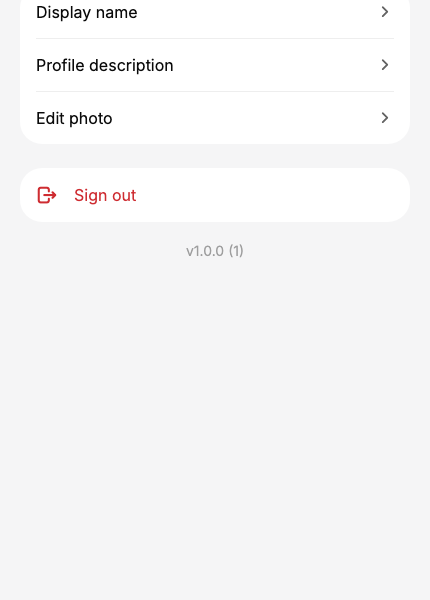
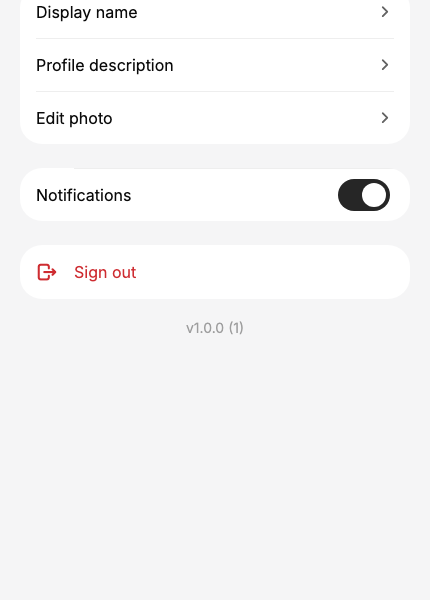
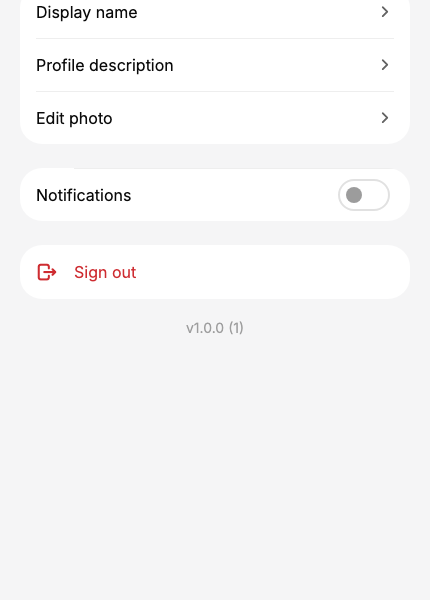
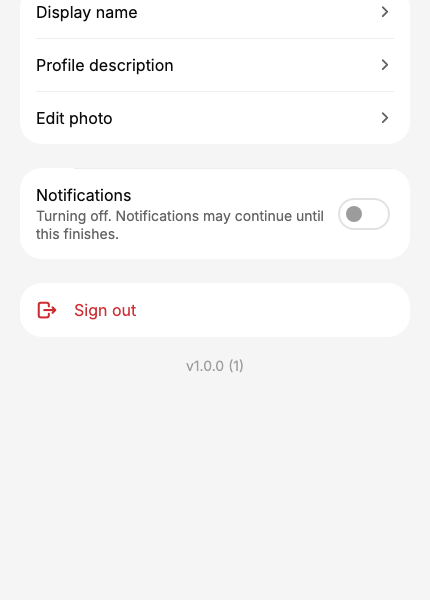
## Summary Ticket 7 of the [Android push plan](https://github.com/block/buzz/blob/main/PLANS/ANDROID_PUSH.md). Android phones can now enroll with the push gateway and publish a relay lease, through the same shared push layer iOS uses. The wake handling side is ticket 6, [#9804 Android push wake handling](https://github.com/block/buzz/pull/9804). - The phone gets an FCM token, then generates a sign-only P-256 Keystore key whose attestation challenge is the SHA-256 of the enrollment transcript. The chain goes to the gateway at enrollment. Every later installation call (delegate, rotate endpoint, revoke delegation, revoke installation) is signed with that key over the transcript bytes the gateway builds. - A rotated FCM token rotates the endpoint. Signing out revokes the delegation and the installation. The first enrollment waits a short random time. - Android 13+ asks for the notification permission at the same point iOS does. Declining keeps the app working. - A phone that cannot attest (no hardware attestation, unlocked bootloader, unlisted boot key) keeps working, and Settings says push is unavailable on this phone. - The relay lease keeps the fixed `transport` value iOS sends. - Firebase config is the same build-time setting [#9804 Android push wake handling](https://github.com/block/buzz/pull/9804) adds: four `BUZZ_FIREBASE_*` environment variables become the string resources Firebase reads. Nothing is committed, and builds without them still work (push reports unavailable). The Gradle hunks (permission, config block, `firebase-messaging` dependency) are copied from that PR verbatim so the two merge cleanly, including its `lifecycle-process` line, which this PR does not use. - The token and permission calls use their own `buzz/push_registration` channel, because Android's notification-open handler from that PR already owns `buzz/push` and a channel has one native handler. - The gateway gets an `enroll_android` transcript vector so Dart and Rust agree on the exact bytes. Enrollment state is journaled before each network attempt, so a lost response resumes with byte-identical requests instead of leaving an orphaned installation. ### Related issue None found. Builds on [#9560 enroll Android installations](https://github.com/block/buzz/pull/9560) and [#9562 verify Key Attestation](https://github.com/block/buzz/pull/9562). ### Validation Journey tests cover first enrollment, a second relay, reuse and renewal, lost responses, token rotation, an installation the gateway dropped, a lost Keystore key, a phone that cannot attest, and sign-out revocation, against a fake gateway that keeps the real gateway's semantics. Transcripts replay the shared vectors byte for byte. A settings journey checks the Notifications row and the unavailable row on Android, and a resume table checks the FCM token refresh: it runs while the relay reconnects, but not when push is off or the relay doesn't offer push. On a physical Pixel 9a (debug build, a local test gateway on a local Postgres, reached over `adb reverse`), the real Keystore key and hardware attestation chain enrolled and delegated, and the gateway accepted the attestation. The same session then ran: a signed delivery authorized against the delegation, endpoint rotation and re-delegation at the next epoch, rotating back, delegation revocation, installation revocation, and re-enrolling the same FCM token afterwards. The notification prompt appears when registration starts, before the token is fetched: <img src="https://github.com/user-attachments/assets/2aed92fe-20c1-4658-b990-51c3f3c96120" width="270" alt="Android notification permission prompt"> Not validated on the device: the FCM wake itself (the local gateway has no credentials to call FCM, so the delivery was authorized and then failed at the FCM hop), lease publication to a relay, and the in-app unavailable row, which only the widget tests exercise. A relay-backed run needs a signed-in test community on the phone. ### Settings while turning off Turning notifications off sends a relay tombstone. Until the relay accepts it, the row now says so, on both platforms. An Android build without a gateway also keeps a saved opt-in visible so it can still be turned off; once off, the row goes away. These are rendered from the Settings journey test. | | Before | After | |---|---|---| | Android build without a gateway, saved opt-in | <img src="https://raw.githubusercontent.com/block/buzz/47220acf78ad21639d2a3a8b79be3f0272e74db2/pr-9811--01-before-config-less.png" width="270" alt="Before: no Notifications row"> | <img src="https://raw.githubusercontent.com/block/buzz/47220acf78ad21639d2a3a8b79be3f0272e74db2/pr-9811--02-after-config-less.png" width="270" alt="After: Notifications row with the switch on"> | | After turning off, relay has not accepted yet | <img src="https://raw.githubusercontent.com/block/buzz/47220acf78ad21639d2a3a8b79be3f0272e74db2/pr-9811--03-before-turning-off.png" width="270" alt="Before: plain off switch"> | <img src="https://raw.githubusercontent.com/block/buzz/47220acf78ad21639d2a3a8b79be3f0272e74db2/pr-9811--04-after-turning-off.png" width="270" alt="After: Turning off. Notifications may continue until this finishes."> | ### Regressions - iOS enrollment is unchanged: the shared bridge only branches to the Dart authority on Android. iOS gains the pending opt-out subtitle, and its opt-out now also tombstones after a gateway change using the saved lease id. - The Android app gains the `firebase-messaging` dependency and a `POST_NOTIFICATIONS` permission. Backups exclude the push preferences file. ### Known limits - An FCM token rotation while the app is running is picked up on the next resume or launch, because the wake service owns the single messaging service. It could call into the registration plugin once both Android push PRs merge. - After an endpoint rotation, only the active community's lease is republished. Other enabled communities' grants are void until each is opened, the same way their leases lapse at grant expiry today. --------- Signed-off-by: Tom Brow <tomb@block.xyz> Co-authored-by: studio <dc2fc481343672df31a689840c09299972e704dac592e0da6f18486646a7ee3e@buzz.block.builderlab.xyz> Co-authored-by: studio <dc2fc481343672df31a689840c09299972e704dac592e0da6f18486646a7ee3e@localhost> |
||
|
Tom Brow
|
0636d21479 |
feat(mobile): report push gateway replies the app cannot read (#9806)
Reports push gateway replies the app cannot read, the last explicit
error report from [the diagnostic reporting
spec](https://github.com/block/buzz/blob/main/docs/mobile-diagnostic-reporting.md)
still missing.
The gateway is called from native code (`BuzzDevPushEnrollmentDriver`),
and Dart used to see every native failure as one code. Native now fails
with its own `gateway_response_invalid` code when a reply does not match
the gateway's protocol (bad JSON, a 2xx status other than the one the
gateway sends for that call, or a challenge, installation or delegation
reply with missing or invalid fields), carrying no text from the reply.
Dart reports that as a push gateway response error and rethrows as
before.
- **Not reported:** status mismatches (including 4xx and 5xx), timeouts
and offline failures, which the spec counts as routine; local-state
failures such as an App Attest key mismatch; and a plausible challenge
that has already expired by the device's clock, since a phone whose
clock runs fast would otherwise report on every retry. An expiry no real
challenge could have (zero, negative or a relative TTL) is still
reported. Local enrollment logs keep the fixed name of the failing
route.
- **Attribution:** the report goes through the signing member, so an
enrollment that finishes after a community switch names no one else.
## Validation
- `push_bridge_test.dart`: an unreadable reply is reported once and
enrollment still fails; routine native codes report nothing.
- `BuzzDevPushEnrollmentDriverTests`: bad JSON and an unexpected 2xx
fail as an unreadable reply; a 503 stays a status mismatch; a plausible
but expired challenge is not an unreadable reply, while an expiry of 0,
-1 or 300 is.
- `notification_toggle_test.dart`: an unreadable reply during the
notification journey files one report while the member matches and none
after it changes.
Full-app run on an iPhone 17 Pro simulator at
|
||
|
Tom Brow
|
e2bbd8430c |
feat(mobile): report explicit diagnostic errors (#9673)
Step one of [mobile diagnostic
reporting](https://github.com/block/buzz/blob/main/docs/mobile-diagnostic-reporting.md),
second piece: the explicit error reports the spec lists, through the
reporter added in [#9613 diagnostic reporting
module](https://github.com/block/buzz/pull/9613). A build without a
destination (every build from this repository alone) still reports
nothing.
### What's in it
Each report carries its `operation` tag, the error's type and stack
trace, and no error text (the filter replaces it).
- **Event subscriber (`eventSubscriber`):** a subscriber that throws
while the relay session delivers a buffered batch is reported, and the
rest of the batch is still delivered. In a build without a destination
the error still surfaces as uncaught, so it fails the test that hit it
and prints in development, as before. Before, one throw dropped the rest
of the batch, and those events never came back because their delivery
keys were already recorded.
- **Relay frames (`relayFrame`):** a frame the socket can't decode, or
whose body isn't a JSON array, is reported instead of silently skipped.
- **Relay queries (`relayQuery`):** an HTTP query body that can't be
decoded, including the read-state snapshot.
- **Invalid-request rejections (`relayRejection`):** an `OK false` or
`CLOSED` whose reason starts with `invalid:`, reported as a fixed
`RelayInvalidRequest` with no relay text, including an `OK` with no
pending publish (a typing indicator, or a reply after a timeout).
Refusals the app handles as expected outcomes (an archived channel, an
Unarchive of a channel that is no longer archived, an open channel name
that is taken, an agent whose `policy:` refuses being added, a sole
owner's Leave refused as the last owner, a guest's Add Members refused
because only members can add people, an event whose timestamp is outside
the relay's window, so a wrong device clock does not report every
publish) are left out. The long-lived relay session, the short-lived
sockets (hosted admission, the self-hosted probe, one-shot publishes
such as agent registration and push tombstones) and the account
assertion requests made for a community's key (relay access and push
stop assertions) report frames and rejections the same way, except while
reports name a member other than the key they sign with. A removed or
inactive community's tombstone, or the probe of a community being
joined, then reports nothing rather than naming the wrong member. With
no member set (first run, or after the last community is removed) it
reports under the install identifier.
- **Account responses (`accountResponse`):** a Builderlab account
response that isn't a JSON object, or a 2xx exchange or `/v1/auth/me`
response missing its credential, subject or expiry. Non-2xx statuses are
expected outcomes and aren't reported.
- **Push gateway responses (`pushGatewayResponse`):** a malformed push
capability descriptor from the relay. A relay that leaves
`supported_extensions` out or sends none has no push and isn't reported,
and a fetch that finishes after a community switch has begun isn't
reported either, since it would name the next member. Push gateway
replies aren't reported yet.
- **Stored data (`storedData`):** a saved community list that can't be
read back.
- **Member on switch:** switching communities now looks the new member
up in storage, not in the provider's list, which can still be the
previous one while it reloads after sign-in. It reads storage before
tearing anything down, so a failed read leaves the switch unchanged and
retryable.
- **Filter:** also drops a report's additional data (`extra`). Nothing
sets it today.
- The spec's status line now says what is implemented.
- Event delivery moves from `relay_session.dart` into a part file,
unchanged apart from the subscriber guard, so the session stays under
its size limit.
### Regressions
None expected: each change only adds a report where an error was already
caught or skipped. The one behavior change is that a throwing event
subscriber no longer costs the rest of its batch.
### Validation
Added tests for each report site (relay session, socket frames, one-shot
publishes, read-state snapshot, closed-reason policy, account client,
push descriptor and capability provider, community storage), for the
relay session (member changed mid-request), one-shot sockets and
assertion requests reporting nothing while another member is set and
reporting with none set, for the member on switch and a switch whose
read fails then retries, and for the filter dropping additional data and
leaving a message-less event without one.
Full-app run on an iPhone 17 Pro simulator at
|
||
|
Tom Brow
|
34c8f5c7a5 |
feat(mobile): add Dart notification body formatter (#9556)
Adds a pure Dart function, `notificationBody`, that turns a message's Markdown content into the plain-text notification body defined by [ADR 0002](https://github.com/block/buzz/blob/main/docs/adr/0002-notification-message-text.md). It is a port of the Swift `BuzzPushNotificationResolver.previewBody` in `BuzzPushKit`, which today is the only implementation. Android notifications will be built from the app's Dart code, as in the [Android push design](https://github.com/block/buzz/pull/9555), and will reuse this function so the body reads the same on both platforms. Nothing calls it yet and the Swift side is unchanged. Notes on the port: - The cap stays at 256 UTF-16 code units, the same as iOS (the fixtures set `maxLength` to 256). - Dart's regex engine differs from the ICU one the Swift code uses (`\s`, `.` and `$`), so the patterns spell those out to keep identical results. Trimming also matches Swift's `whitespacesAndNewlines`, which trims U+200B and keeps U+FEFF, where Dart's `trim` does the opposite for both. - Truncation counts whole characters (extended grapheme clusters) via `package:characters`. ### Validation - A table-driven test runs every case in `test-fixtures/notification-body.json` (47 cases) and checks the fixture's `maxLength` against the function's cap. - Added tests: 8 rows in the shared fixture pin the ICU details the port must match. U+000B and U+0085 beside a marker keep it, U+000B and U+000C inside a run keep its markers, U+200B is trimmed at the edges and doesn't count toward the cap, and U+FEFF at the edges is kept. The Swift fixture test runs them too and passes them unchanged. - Proved falsifiable: with code-span and fence handling disabled, 18 fixture cases fail; restored, all pass. - `just mobile-install mobile-check mobile-test` passes. ### Regressions None: new code that nothing calls yet. The Swift formatter is untouched. Its fixture test now also runs the 8 new rows and passes them unchanged. --------- Signed-off-by: Tom Brow <tomb@squareup.com> Co-authored-by: studio <dc2fc481343672df31a689840c09299972e704dac592e0da6f18486646a7ee3e@localhost> |
||
|
klopez4212
|
a82d596fc2 |
mobile: show account communities in the switcher and sync saved destinations (#9262)
## Summary Switch Community currently shows only device-saved communities, leaving account destinations behind a separate Find step. It now merges saved communities with supported account destinations directly, keeps Add Community, and removes the redundant Find action from that Add route. Initial onboarding and identity recovery keep their discovery entry. Find lists supported account addresses before hosted identity setup; hosted selection still performs binding, backup, and admission, while external selection opens the existing identity flow. Mobile also saves QR/address additions and explicit removals through Builder Lab's existing known-communities account APIs. A per-account local journal retries transient failures, survives restarts, pauses in the background, and fences requests against account changes. External secure addresses use the existing self-hosted entry flow; account destinations never imply membership or bypass admission. Remote list omissions do not delete local identities. Explicit additions store an account owner and revision atomically with local credentials. Legacy/unclaimed destinations remain local-only until explicitly added while signed in; signing into another account never claims retained destinations. Restart reconciliation lets a committed re-add supersede an older removal even if the retry-journal write failed. Local deletion and its credential-free account-removal intent commit in one storage write, independent of the account-only retry journal. Removing one of several local identities owned by the same account at an address retains its account destination until that account’s last identity is removed. Another account’s saved identity does not block removal or lose its credentials during recovery. Offline edits retain the stored account subject without treating it as network authorization. Discovery-only intent survives browser callbacks, app restart, and retry. Onboarding recovery controls have a Material ancestor in the actual route. Pending status is fenced to the current subject; interrupted older removals offer explicit local completion, and denied requests offer browser reauthentication. Same-host ports have distinct labels and confirmations, and unsupported hosted ports are excluded. This changes the mobile client and its public-build CI test list only: no relay endpoints, events, migrations, or backend deployment. ### Related issue No duplicate found among open known-communities/switcher issues and PRs. Related picker editing work: #6632 (renaming communities). ### Testing Validated after merging main (`02535e1b53`) at `c4ee037f7e710962f176540abf88d26e98c2823c`. Wes’s follow-up fixes cover push-revocation commit ordering, same-account removal confirmation, and recovery after completed hosted admission. The merge also preserves main’s toolbar and session protections; a test override now accepts the updated relay subscription parameter. - Formatting, static analysis, and differential file-size checks pass. - Prior full CI and security review passed on `3adb117aae`; security checks also passed on `cf3836ecb`. Fresh CI and security review are required for this head. - Mutation checks fail when either the initiating-account removal guard or the rendered-status subject fence is removed; both guards were restored before final validation. - CI explicitly runs the public-only account discovery and synchronization journeys. - Added journeys cover paused removal across A→B, offline restart, journal read/write failures, duplicate local identities in either removal order, delayed status reads across accounts, real browser handoff after denial, unbound external discovery, and local same-host port removal. - Earlier journeys cover pairing acknowledgement and restart after journal-write failure, same-subject setup completion, offline/rejected removal with reopen/retry, and fresh external-only/mixed account entry. - Regression coverage includes discovery deduplication and retry, hosted and external selection, Add without Find, account-only removal, shared authentication/removal persistence, restart recovery, latest-intent ordering, account changes, and retry pause/resume. - `just mobile-check`, `just file-size-check`, and `just mobile-test`: 4,954 default-build tests passed (71 skipped), plus 27 crypto-package tests. - Full public-account suite: 5,012 passed, 12 skipped, one pre-existing failure in `fullscreen_onboarding_test.dart` ("Home stays hidden until community choice and admission"). The same assertion was reproduced on clean base `8cce12f591`: expected both communities imported, actual only the selected community. - Follow-up regression journeys cover both A/B same-address removal orderings, recovery preserving B’s saved key, the production onboarding widget composition, and retained discovery intent with callback/retry plus normal-sign-in controls. - Native/live-account and human testing remain outstanding. The tests use fake network/storage boundaries; live account API behavior, cross-device synchronization, native accessibility, and timeout/late-server-commit ordering still require integration verification. - The three expanded recovery/removal journeys pass and each fails when the corresponding fix is removed. A durably journaled revocation now finishes the confirmed removal even if the account changes during journaling; pre-journal account mismatches still abort. Confirmation copy counts only same-account identities. Explicit account recovery retires a completed join target while preserving in-progress targets. ### Preview Sample-data Flutter widget renders: saved-only and combined lists. These illustrate the picker layout, not a device session or live account sync. | Saved-only | Combined | | --- | --- | |  |  | ### Manual verification 1. Sign into a public account with a community saved on another device. Open Switch Community; verify it appears alongside local choices and Add. 2. Select a hosted and an external community; verify the existing identity/admission flow opens. Add should not offer Find again. 3. Add a community by QR/address, then check the account list on desktop. Remove it on mobile and verify the account entry disappears while other devices retain their local credentials. 4. Repeat removal offline, restart, then reconnect/resume. Verify the queued removal reaches the account service without switching identities. 5. On a fresh device, verify external-only and mixed account lists offer external entry. Check two ports on the same host remain distinguishable. 6. Sign out of account A and into B; retained A destinations must not upload to B. Explicitly add a B destination and verify it syncs. 7. Reject or interrupt account removal; verify visible pending/failure status. A denied session must open browser sign-in through “Sign in again” and retry after exchange; setup-required accounts retain their setup action. 8. Keep two local identities owned by the same account at one address; removing the first must keep the account entry, and removing the last must queue account removal. Repeat with A and B at that address; removing A must preserve B’s saved credentials and still sync A’s removal. 9. Restart offline with a stored account, add/remove an external community, then reconnect as the same account and verify convergence. Explicit sign-out must not claim new local-only entries. 10. Start Find my communities, restart during browser authentication, then return or retry. External destinations must appear before hosted identity setup; normal sign-in must retain its identity checks. --------- Signed-off-by: kenny lopez <klopez4212@gmail.com> Signed-off-by: Tom Brow <tomb@squareup.com> Co-authored-by: Terp <5856f6900e8e0a4e0ea1f4f8d2ee33e4753d2119bc122f94ecafc660b46c0511@buzz.block.builderlab.xyz> Co-authored-by: Tom Brow <tomb@block.xyz> Co-authored-by: Tom Brow <tomb@squareup.com> Co-authored-by: studio <dc2fc481343672df31a689840c09299972e704dac592e0da6f18486646a7ee3e@localhost> |
||
|
Tom Brow
|
8f3f4e266a |
test(mobile): run push tests without a gateway dart-define (#9423)
A plain `cd mobile && flutter test` failed 11 push and notification tests on a clean checkout of main, while CI passed. Agents running the full suite kept reporting them as "pre-existing, also fails on main", which hides real regressions in the same files. ### Root cause Push is gated on the compile-time `BUZZ_PUSH_GATEWAY_URL` define (`Env.pushGatewayConfigured`, since [#7261 configurable gateway](https://github.com/block/buzz/pull/7261) made the gateway optional). Without it the app is a push-less build: `readBuzzPushEndpointGrants()` returns no grants and `buzzPushLifecycleEnabled()` is false. CI's mobile shards, `just mobile-test` and the lefthook pre-push lane (which runs `just mobile-test`) all pass `--dart-define=BUZZ_PUSH_GATEWAY_URL=https://push.example`; a bare `flutter test` passes nothing. Each of the 11 was checked against that: - `notification_toggle_test` (5 cases) and `push_lease_revocation_outbox_test` "hosted relay assertion": no endpoint grants without a gateway (`Bad state: No element` at the grant lookup, `No endpoint grant exists for push lease tombstone`). - `push_bridge_test` "reads and exposes persisted endpoint grants" and "debug enrollment carries the configured relay and gateway URLs": the bridge returns `[]` before calling native (`Expected: an object with length of <1>, Actual: []`). - `push_bootstrap_test` "default push requires relay capability" and "new community starts registration": the lifecycle is disabled, so registration never starts (`Expected <1>, Actual <0>`). - `push_bridge_test` "development push gateway matches the compiled configuration": a stale test. It expected a `https://push.buzz.xyz` default that [#7261 configurable gateway](https://github.com/block/buzz/pull/7261) removed from the app; under CI's define both sides equal `push.example`, so it could never fail there. The same files pass on the same Mac with the define, so nothing is environmental. The `Unexpected native call takePendingNotificationResponse` log is unrelated noise: the toggle test's native mock didn't answer that call, which logs (and is caught) in CI too. ### Fix Tests get the gateway from a test hook instead of the define. `Env.pushGatewayUrl` becomes a getter over the compiled value with a `@visibleForTesting` `debugPushGatewayUrlOverride` (the same pattern as `debugUriStreamOverride`), and `test/flutter_test_config.dart` sets it for every test file. `push_unconfigured_build_test` sets it to `''`, so it runs in the main suite instead of being skipped there and run separately. CI, the Justfile, `scripts/flake-check.mjs` and the AGENTS/README check commands drop the define, so CI, `just mobile-test`, pre-push and a bare `flutter test` run the same thing. I chose this over documenting a canonical command because the define can't be made automatic: `flutter test` has no config file for defines, so any doc fix still leaves the obvious command red. A test hook makes every invocation agree. The stale test is replaced by one in the push-less file that binds the production read: with the override cleared, `Env.pushGatewayUrl` must equal the compiled `BUZZ_PUSH_GATEWAY_URL`. Now that CI compiles without the define, it fails if the app regains a built-in gateway default, which the old test never could. The toggle test's mock answers `takePendingNotificationResponse` with no pending response. What gets better: one test mode everywhere, and the push-less tests run in every run. Nothing gets worse: production reads the same compiled value (the override is never set outside tests, and an `aot-snapshot` probe shows AOT still folds the getter to the compiled constant and drops push-only code when the define is absent), and every test still runs in the push-capable mode CI used before. ### Validation - On a fresh origin/main worktree with the Hermit toolchain, a bare `flutter test` failed exactly these 11; the same files passed on the same machine with the define. - After the fix, the pre-push `just mobile-check` and `just mobile-test` (now a bare `flutter test` plus the recipe and secp256k1 checks) pass, with the push-less tests running instead of skipped. `scripts/flake-check.test.mjs` passes. - Falsifiability: re-adding a `defaultValue` to the compiled gateway fails the new no-default test, and removing `flutter_test_config.dart` brings back the other 10 failures. - Unrelated: an earlier full run also failed `community_provider_test` "discard orphan snapshots and image caches", which waits 500 ms for a background directory delete. The Mac was running other full suites at the time; the file passed 8 of 8 runs alone, with and without the define. It is not touched here. Signed-off-by: Tom Brow <tomb@squareup.com> Co-authored-by: Tom Brow <tomb@squareup.com> Co-authored-by: studio <dc2fc481343672df31a689840c09299972e704dac592e0da6f18486646a7ee3e@buzz.block.builderlab.xyz> |
||
|
klopez4212
|
cb69ad9e4f |
Adapt iPhone Duo layouts, rail navigation, and native sheets (#8568)
Duo keeps conversations and Settings details open across closed, book and flat postures. Book mode splits at the fold; flattening restores the sidebar. Native rail controls, full-width navigation backdrops and sheet-local safe areas keep content aligned. Ordinary iPhones remain single-pane in portrait and landscape; tablet and Duo split layouts remain enabled. Includes the recovered preview's matching pane widths, Buzz empty-pane mark, stable Settings chevrons, Bestie pane routing and Duo-only upward New menu attachment. Current main's Activity redesign, Search content fade and unread-navigation button are retained. Menu selection checks sit beside their labels. Shared mobile changes remain in scope: the native iOS status editor, Appearance preview layout, avatar crop preservation, onboarding footer layout, profile/invite sheet geometry and nested conversation navigation. This PR is not exclusively Duo-gated. Nested navigator observers preserve recording cancellation and navigation callbacks; crop resizing preserves the selected image region. iOS 27.1 APIs remain compile-time and runtime gated. Validation on the reconciled source: Flutter analysis, Activity/Home journeys, the full mobile test suite, file-size checks and Swift package tests. The iPhone single-pane fix was also exercised on an iPhone 18 Pro simulator before reconciliation. Fresh hosted CI and physical-device confirmation of the reconciled build are separate and remain pending. --------- Signed-off-by: kenny lopez <klopez4212@gmail.com> Signed-off-by: Tom Brow <tomb@squareup.com> Co-authored-by: Terp <5856f6900e8e0a4e0ea1f4f8d2ee33e4753d2119bc122f94ecafc660b46c0511@buzz.block.builderlab.xyz> Co-authored-by: Claude Opus 5.5 <noreply@anthropic.com> Co-authored-by: Tom Brow <tomb@block.xyz> Co-authored-by: Tom Brow <tomb@squareup.com> |
||
|
Will Pfleger
|
65e864301d |
feat: send a User-Agent on relay WebSocket upgrades (#9246)
Relay WebSocket clients in this repo now send a `User-Agent` of the form `<name>/<version>` on the upgrade request. The version comes from the build. | Client | User-Agent | |---|---| | `buzz-acp` | `buzz-acp/<crate version>` | | `buzz-cli` | `buzz-cli/<crate version>` | | `buzz-ws-client` (default) | `buzz-ws-client/<crate version>` | | `buzz-pairing-cli` | `buzz-pairing-cli/<crate version>` | | `buzz-audio-client` (default) | `buzz-audio-client/<crate version>` | | mobile (relay and huddle sockets) | `Buzz-Mobile/<app version>` | - **`buzz-ws-client`**: every connect path sends the default. A `User-Agent` in the caller's `connect_with_headers` headers replaces it, so other consumers can identify themselves without any new API. `buzz-cli` uses this to send its own name. - **`buzz-audio-client`**: keeps a `User-Agent` already on the host-supplied request, and adds its default otherwise. - **Mobile**: `openRelayWebSocket` sets the HTTP client's `userAgent`, which also covers the huddle transport. Startup waits up to 500 ms for the app version from `package_info_plus` before the app runs, so the first socket carries it; if the lookup fails or times out, the value is `Buzz-Mobile`. Each client has a test asserting the header on the upgrade request. --------- Signed-off-by: Will Pfleger <wpfleger@block.xyz> Co-authored-by: Hayt <211b96e6a2b7f45fd4047988976c7bbbeeda0c15f3ae7b32eec20834b5a55118@buzz.block.builderlab.xyz> |
||
|
Tom Brow
|
794ee64183 |
fix(ios): mint hosted NIP-FI assertions in the notification extension (#9228)
Share the hosted Builderlab session with the iOS notification extension so it can mint hosted NIP-FI assertions. The extension queries a hosted relay without an assertion first and mints only after a NIP-FI challenge, for a key the account is already bound to. Credential headers never follow redirects, and flag-off builds clear a previously shared session. Signed-off-by: Tom Brow <tomb@squareup.com> Co-Authored-By: Claude Opus 5.5 <noreply@anthropic.com> |
||
|
Tom Brow
|
b58ee08404 |
fix(mobile): request hosted relay assertions only when NIP-FI is required (#9225)
Port the desktop NIP-FI requirement rule to mobile: hosted relay connections request an account assertion only when the relay's NIP-11 document requires NIP-FI, so communities that have not enabled it keep connecting with BUZZ_HOSTED_RELAY_AUTH on. Signed-off-by: Tom Brow <tomb@squareup.com> Co-Authored-By: Claude Opus 5.5 <noreply@anthropic.com> |
||
|
Tom Brow
|
97ede701c0 |
fix(mobile): send hosted relay assertion from native media and tombstone paths (#9069)
Follow-up to https://github.com/block/buzz/pull/9056, from an audit for other places that miss the hosted relay assertion. Hosted and organization relays require `Nostr-Federated-Identity` on every non-exempt HTTP request and WebSocket upgrade. The Dart `HostedRelayHttpClient` adds it, but anything that downloads or connects outside that client has to add it itself. The notification service extension and the iOS emoji picker both missed it, and these places do too: - **Voice notes** (`just_audio`, mainly Android) and **video preview first frames** fetch media natively with only the Blossom `Authorization` header. Both now use `nativeMediaHeadersProvider` from https://github.com/block/buzz/pull/9056. - **Push-lease tombstones**: removing a community, and the durable revocation outbox, open a one-off relay socket with no headers. A hosted relay refuses the upgrade, so the lease is never revoked and the outbox keeps retrying. Both now ask `HostedRelayAuth` for that community's own assertion, because the community being removed may not be the active session. - **Notification avatars** (iOS notification service extension): relay-hosted sender avatars were fetched with Blossom auth only. The loader now takes the same `BuzzRelayAssertionIssuer` the resolver uses for `/query`. Signed requests already refuse redirects. The iOS Me-chat agent picker also fetched avatars with no headers, but https://github.com/block/buzz/pull/9079 removed that native screen, so this PR no longer touches it. ### Validation - Added tests, each checked to fail when the code it guards is reverted: - A queued push-lease revocation and a community-removal tombstone both send `Nostr-Federated-Identity` on the WebSocket upgrade, as background requests. Runs against a local relay socket that handles NIP-42 auth. - A notification avatar on an organization relay is downloaded with the issued assertion (BuzzPushKit). - Issuing for a second community keeps the first one's cached assertion. A background request records no failure, never backs up the key, and its failure never reaches the active community's reconnect waiting on it. - Background issuance never binds an unbound account to its key, bypasses the shared assertion cache (each attempt gets a fresh assertion, and foreground use never inherits one that skipped the key backup), and its failure is never handed to a foreground caller waiting on it. When it can't get an assertion it sends none, so a non-enforcing relay still accepts the tombstone. - A notification avatar whose organization session is replaced mid-download is refused and dropped from the cache (BuzzPushKit). - Voice notes and posterless video previews renew an expired assertion before the native fetch, and fall back to cached headers if renewal fails. A voice-note attachment journey binds the production provider. - Cached reads never present a signed-out or replaced account's assertion. - `flutter analyze` is clean. `swift test` passes for the BuzzPushKit avatar loader tests, and `flutter build ios --simulator --debug` succeeds. - Full mobile suite (`just mobile-check` and `just mobile-test`) passes at 2c84940832. - Automated full-app run on an iOS simulator (debug build of this PR before it was rebuilt on main, signed in to the internal Builderlab community with two more communities saved). Passed: launch and channel list, image attachments and avatars in a channel, New chat sheet kept open for about 80 seconds before the agent list was opened (all agent avatars loaded, so headers are requested per download), dismiss and reopen, background and resume, switching to a second community (its icon and avatars loaded), and removing a community. The native New chat sheet is unreachable in the normal flow on this branch (a new chat opens the Flutter draft page; the native sheet only opens when resuming an unfinished chat), so that check ran with a temporary local bypass that was reverted. Limits: none of these communities requires the hosted relay assertion in this build, so the run shows the Swift-to-Dart header bridge, the per-relay cache and the tombstone path cause no regression, not that the assertion is sent or accepted. No voice note, video preview or deleted message was reachable. Screenshots are omitted because they show internal channel content. - Limitations: no end-to-end run against a hosted relay. Simulator sign-in to a hosted relay needs SSO, so a hosted-relay run needs a device build. 🤖 Generated with [Claude Code](https://claude.com/claude-code) --------- Signed-off-by: Tom Brow <tomb@squareup.com> Co-authored-by: Tom Brow <tomb@squareup.com> Co-authored-by: Claude Opus 5.5 <noreply@anthropic.com> Co-authored-by: studio <dc2fc481343672df31a689840c09299972e704dac592e0da6f18486646a7ee3e@buzz.block.builderlab.xyz> |
||
|
Tom Brow
|
3ff4154ca6 |
fix(mobile): back off push bootstrap retries (#9092)
When push setup fails, the app retried every 5 seconds forever. On an iPhone 12 mini whose push gateway enrollment is refused (a CDN 403 on the installation challenge), each retry refetched the relay's NIP-11 document over a new TLS connection and logged the whole HTML refusal. That is about 720 attempts and roughly 14 MB of traffic an hour for as long as the app stays open, with no way to succeed. Push registration, lease publication and tombstone retries now back off: each consecutive failure of the same attempt doubles the delay from 5 seconds up to 15 minutes, with jitter between half and all of it so devices that failed together don't retry together. A success (including a renewal), a different attempt, or a channel-grammar retry (which keeps its 5-minute delay) ends the streak. The first retry still comes within 5 seconds, so a brief blip recovers as quickly as before. ### Validation - Added tests: `repeated failures back off exponentially up to a cap` checks every delay's bounds at both jitter extremes over 12 failures, `a success ends the failure streak`, and `a different attempt starts its own backoff`. The first fails when the gate goes back to a fixed delay. - Existing push suite passes. - On the 12 mini before this change: `Push lease bootstrap failed` with the 403 page and a fresh NIP-11 fetch every 5 seconds for the whole session. 🤖 Generated with [Claude Code](https://claude.com/claude-code) --------- Signed-off-by: Tom Brow <tomb@squareup.com> Co-authored-by: Tom Brow <tomb@squareup.com> Co-authored-by: studio <dc2fc481343672df31a689840c09299972e704dac592e0da6f18486646a7ee3e@buzz.block.builderlab.xyz> |
||
|
John Matthew Tennant
|
972e89ac89 |
fix(mobile): allow community removal without a cached push grant (#8978)
## Summary Fix community removal failing with “Expected exactly one endpoint grant for push lease revocation” when saved push state exists but the current build has no cached grant, including builds without a push gateway. When the community has a saved installation ID, journal its targeted revocation without requiring the grant. An unknown grant expiry stays unknown: retain cleanup credentials until the relay accepts the revocation. Existing known-expiry cleanup and legacy grant-based addressing remain unchanged. ### Related issue No matching open issue found. Follows [the durable revocation outbox](https://github.com/block/buzz/pull/8706). ### Testing The new regression fails with the reported error on the preceding implementation. It now verifies missing-grant enqueue, offline retry, persistence across restart, the exact lease address and eventual cleanup after acceptance. On a physical iPhone with the fix applied to the onboarding test build, the previously failing community removal succeeded. Unknown-expiry records retain their signing key in secure storage until successful revocation. Downgrading to a client that requires an integer expiry will reject those pending records. Signed-off-by: John Tennant <jtennant@squareup.com> Co-authored-by: Aaron <f425b86c3b780d43f8d9cf1802429d04dd985bf92eac44fca9468b5ad3887c5e@buzz.block.builderlab.xyz> |
||
|
Tom Brow
|
f6f6d9a673 |
chore(mobile): delete dead code with no remaining UI path (#8880)
## Summary Deletes mobile code that no longer has a user-reachable path and has no counterpart in buzz-app, so it is unlikely to come back for parity. Net: 104 files, about 5,500 lines removed. No intended behavior change. - **iOS native message menu and action surface:** `NativeMessageMenu.swift` and `NativeMessageActionSurface.swift`, the `message`/`supportsMessage` coordinator branches, and the Dart selection hook. Dart stopped creating this view in [#8280](https://github.com/block/buzz/pull/8280). The native reactions sheet in the same coordinator is kept. - **Old home quick-actions launcher and `ComposeMorphIcon`:** only instantiated in tests since the nav-bar creation actions replaced them. - **Retired local theme stack:** `ThemeNotifier`, `AccentNotifier`, `SchemeNotifier`, `adaptive_theme.dart`, `AccentPickerPage`, the appearance-mode sheet and their helpers. These predate per-community theme sync. The legacy prefs migration in `community_theme_preference.dart` is kept. - **Unused widgets:** `ProfileAvatar` and `MaskedAvatarBadge`. - **Push permission-status plumbing:** the iOS `notificationAuthorizationStatus`/`openNotificationSettings` handlers, plus the uncalled strict age-gate snapshot registration and its Swift `syncAgeGatePushSnapshot` path. - **Orphaned files** with no importer: `profile_text_edit_sheet`, `editor_option_button`, `retained_page_transition`, `tappable_flapping_bee`, `agent_model_info`, `community_bot_profiles`, `sheet_divider`, `success_haptic`. - **Uncalled helpers:** the `pickAndUpload*`/camera helpers in `media_upload.dart`, unused `NostrFilters` builders, `mediaGetHeadersFor*`, and about 20 other uncalled functions, providers and styles. - **Removed-UI leftovers:** the never-wired invite directory providers, `AuthNotifier.signOut` and `removeActiveCommunityForSignOut` (the Sign out row is gone), `renameCommunity`, `HomePage.profilePageBuilder`/`SettingsPage.embedded`, and the create-forum branches of the create-channel sheet. Forum viewing is unchanged. Tests that only covered deleted code are removed. Tests of surviving code that used deleted helpers as drivers were repointed to the surviving API. An audit of `mobile/android` found no dead Kotlin, resources, manifest entries or Gradle dependencies, so Android code is unchanged. ## Validation - `flutter analyze`: no issues. - After rebasing onto main ([ |
||
|
Tom Brow
|
a94ebece0e |
Revert "fix(mobile): push every message in your own Solo chats (#8615)" (#8690)
Reverts [#8615](https://github.com/block/buzz/pull/8615).
Mobile push for Solo chats returns to mention-only, matching buzz-app,
which alerts on every message only in DMs. This also removes the
lease-size guards #8615 added, since they existed to fit Solo chats into
the lease.
### Validation
- Clean revert of
|
||
|
Tom Brow
|
bad9d26142 |
fix(mobile): push every message in your own Solo chats (#8615)
## Summary Mobile push only covered Solo chats through explicit mentions. Solo chats are private streams rather than DMs, and the push lease subscribed channel-wide only to DMs. Agent replies in your own Solo chats therefore never woke the phone. The lease now subscribes channel-wide to the viewer's own joined, unarchived Solo chats, using the same predicate as the Solo tab, including older unlabelled Solo chats listed in the encrypted Solo record. Self-authored messages stay excluded through the existing lease ignores. Muted Solo chats stay out of the lease, like muted channels, so they push only on mention. The lease waits while the Solo record loads so an unresolved record never drops legacy Solo chats. If that record fails with no cached copy, DM and mention updates proceed without the legacy chats, which the Solo tab cannot list either, and they return when it recovers. Solo chats created by someone else still push only on mention, matching how they appear in the channel list. A lease is bounded by its channel count (750), by the relay's advertised plaintext and content sizes, and by NIP-44's 65535-byte plaintext ceiling. DMs always stay, as before. Solo chats fill the remaining room most recent first, sized with the publisher's own lease encoding, the exact NIP-44 payload length and the largest endpoint the relay accepts. Sizes are computed rather than built, so a relay's advertised limits never drive an allocation. Solo chats beyond the room push only on mention instead of failing the lease update or publication, and Notifications settings says how many. A relay too small even for DMs and mentions fails push setup visibly instead of saving a lease it would reject. Publication accepts only endpoint grants in the gateway's JSON-safe alphabet, so the sizing assumption holds. Thread replies outside DMs still do not push unless they mention you. That is a separate gap. ### Related issue None found. ### Validation - Added test: the desired lease includes joined DMs and the viewer's own Solo chats, and includes legacy Solo chats from the Solo record, and excludes archived and muted Solo chats, other people's Solo chats, and unlabelled private streams. It fails without the fix. - Added test: the sync provider holds the desired lease while the Solo record loads, proceeds without legacy chats if the record fails, and adds them once it arrives. It fails if loading is treated as empty or if a failure blocks updates. - Added tests: over the channel count, and over each size limit (relay plaintext, relay content, NIP-44 plaintext), the lease keeps every DM and exactly the newest Solo chats, reports the rest as omitted, and is accepted by `publishBuzzDevPushLease` with a grant at the relay's endpoint limit, while a max-length grant that JSON would escape is rejected as not a gateway grant. A relay advertising a 2^50-byte endpoint limit is sized without allocating. Each row fails if its guard is removed. - Added test: a relay whose content or plaintext limit cannot fit even the lease without Solo chats rejects that lease at publication, and the provider fails setup instead of saving it. It fails if the guard is removed. - Added test: the NIP-44 payload length matches real encryption at every padding boundary up to 65535 bytes. - Added test: Notifications settings shows "Older Solo chats notify only on mention" with the omitted count. It fails without the row. - Mobile lint and the full mobile test suite pass. - Not exercised end to end on a device. A signed dev build was installed on a test iPhone against a personal dev relay, but the phone's dev identity owns no assistant there, so the device could not create a Solo chat without exporting its key. This will be validated in dogfood. The relay matcher already handles channel-wide `#h` leases for DMs, and Solo messages use the same kind and scoping. buzz-review-completed 🤖 Generated with [Claude Code](https://claude.com/claude-code) --------- Signed-off-by: Tom Brow <tomb@block.xyz> Co-authored-by: Claude Opus 5.5 <noreply@anthropic.com> |
||
|
Tom Brow
|
f167c4c3e1 |
fix(push): accept canonical channel UUIDs across versions (#8609)
Starter channels use UUIDv5 IDs, but mobile push accepted only UUIDv4 channel IDs, so building a subscription that included a starter channel threw locally. After #8608, no non-v4 ID reaches mobile push today: positive `#h` filters cover joined DMs only, and mutes are limited to subscribed channels. This PR is therefore a safety net for future starter-channel subscriptions, and it prepares mobile for a relay that accepts them. Mobile now accepts canonical lowercase, hyphenated UUIDs of any version in subscriptions. It recognizes both the current `uuid-v4-lowercase` relay descriptor and a future `uuid-lowercase` descriptor. Against a `uuid-v4-lowercase` relay, mobile checks positive and mute channel filters before enrollment or publication, keeps the desired filters, and rechecks relay capabilities every five minutes instead of sending a lease the relay would reject. The relay is unchanged. It keeps validating and advertising `uuid-v4-lowercase`. Installed mobile builds reject any other `h_grammar`, and they parse the descriptor before renewal, opt-out and revocation, so changing the advertisement now would leave their leases active until expiry. The relay validation and advertisement change will follow in a separate PR once those builds have drained. `docs/buzz-push.md` records this sequencing. ### Validation - Regression tests reproduced the UUIDv5 rejection in Dart before the fix. Added coverage checks positive and mute filters, persisted subscription round trips, encrypted lease content, malformed IDs, retained bounds, parsing of both descriptor grammars, and pre-publication rejection of non-v4 IDs against a `uuid-v4-lowercase` relay. - Mobile push tests on the current head: 104 passed, 4 skipped. `flutter analyze` on the push code and tests is clean. - Before the split, exercised actual mobile lease construction, NIP44 encryption and NIP42 publication against an isolated local relay. The relay half of that exercise is no longer part of this PR. - Relay source is identical to `main`, so the relay serves the same descriptor that installed builds parse today. The standing mobile test exception applies. Agent review and changed-behavior exercise are complete. buzz-review-completed --------- Signed-off-by: Tom Brow <tomb@block.xyz> Co-authored-by: george <973be878edd6d4f79692a3827f20a6f7fe0ed0362f269ff6b6ba8867033d7d8e@sprout-oss.stage.blox.sqprod.co> |
||
|
Tom Brow
|
5996e5dd8b |
fix(mobile): isolate push setup failures from app rendering (#8610)
Push subscription setup ran synchronously inside the root widget build, so an invalid subscription could replace the entire app with Flutter's error surface. Push initialization and the cold-start native notification read could also prevent the app from rendering. Keep push work independent of the app subtree, observe asynchronous persistence failures, and retain the original errors and stack traces. Setup retries use bounded backoff; Settings shows a failure and offers manual retry without resetting navigation. Retry preserves a healthy revocation worker, and community-removal callbacks follow a recovered worker so lease cleanup continues after setup recovery. Related: [#8608](https://github.com/block/buzz/pull/8608) fixes the specific unrelated-mute input that exposed this startup coupling. ### Validation Added Flutter journeys cover invalid subscriptions, asynchronous storage failure, dependency initialization failure, retry exhaustion and manual recovery, navigation preservation, accessible retry actions, and pending/failed native startup reads with notification-target recovery. Both original rendering regressions failed before the fix. Community-removal coverage also verifies cleanup after a worker initialization failure and after retrying healthy setup; that regression failed before the worker fix. The full mobile suite passed (3,782 tests; 19 existing skips), as did the four unconfigured-build tests and static analysis. The corrected head also passed the full pre-push mobile checks and tests, plus 42 focused push and community tests. Rendered widget evidence uses mocked native platform channels; no device APNs delivery test was performed. Rendered Flutter widget evidence with synthetic data and mocked native platform views. ### Setup failure The app remains usable and Settings offers a retry after push initialization fails. 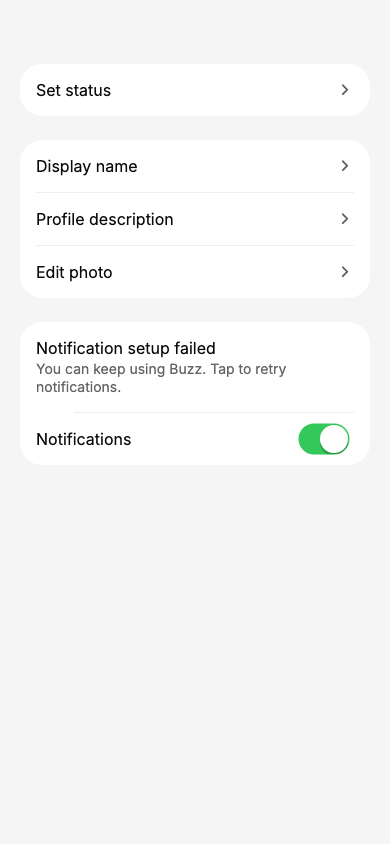 ### Recovery Retry clears the error without replacing the navigator or leaving Settings. 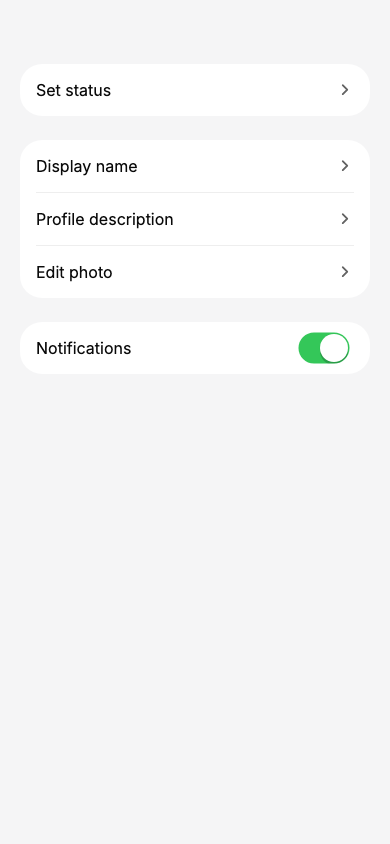 <!-- buzz-review-completed --> --------- Signed-off-by: Tom Brow <tomb@block.xyz> |
||
|
morgmart
|
209fcd2172 |
fix(mobile): ignore unrelated mutes when building push subscriptions (#8608)
## Summary Muting a starter channel (#welcome-everyone or #general) could leave the iOS app on a blank screen after launch. Starter channels use UUIDv5 IDs. Push subscription setup checked every synced mute against the lease's UUIDv4 channel grammar and threw `FormatException: Push subscription channel ID is invalid.` from `pushSubscriptionSyncProvider` during build, so the first frame never rendered. Whether you saw a blank screen depended on whether channels and mutes finished loading before the first frame. Mutes only feed the lease as ignore filters for subscribed (DM) channels, and mutes sync across every community and channel type. So the builder now matches mutes against the subscribed channels before using them, instead of validating every mute. Subscribed channel IDs are still validated as before. ### Related issue None found. ### Testing - Captured the failure on a dogfood iPhone build from the device system log, with a stack trace through `buildDesiredBuzzPushSubscriptions` and the muted ID `fee88e92-da9f-5958-a910-48db3264ad38` (#welcome-everyone). Unmuting that channel from desktop fixed the device immediately, which confirms the cause. - New regression test `ignores mutes outside the push channel grammar` fails on `main` with the same exception and passes with this change. - The pre-push `mobile-checks` hook (`just mobile-check && just mobile-test`) passed on this head. - Screenshots: not applicable. This changes no UI. It only stops a startup failure. 🤖 Generated with [Claude Code](https://claude.com/claude-code) Signed-off-by: morgmart <98432065+morgmart@users.noreply.github.com> Co-authored-by: Carl <c217fe6b9d958f41c3a5e030dccc7f626775a923089cb6491305eade75ea1f1b@buzz.block.builderlab.xyz> Co-authored-by: Claude Opus 5.5 <noreply@anthropic.com> |
||
|
Tom Brow
|
8f2c7710e9 |
fix(mobile): default community push notifications to on (#8425)
New mobile communities currently require a manual Settings opt-in before push can start. Default that local preference to on for new communities and stored records without a preference. Preserve every saved `true` or `false`, including values written by older clients. Older default-off values are indistinguishable from explicit opt-outs, so this does not migrate them to on. Push still requires a configured gateway, authenticated connectivity, and a valid relay capability. iOS continues to control display authorization through its existing permission prompt. Notification eligibility and subscriptions are unchanged. Settings retains its existing opt-out control for enabled communities even when capability is unavailable. Drafted from the 0.24 baseline; release-branch inclusion is a separate decision. ### Related issue Closest related issue: #3238 (synced defaults). This change is limited to the mobile device-local community preference; no duplicate found. ### Validation - Added or updated coverage for new and missing preferences, saved true/false persistence, opt-out after restart, capability-gated registration, and Settings without a configured gateway. - Full configured mobile suite: 3,499 passed, 4 skipped. Separate no-gateway suite: 4 passed. Flutter analysis passed. - Existing permission-denied and unsupported-relay tests passed as part of the mobile suite. No physical-device or end-to-end APNs validation performed. - Full local repository gate passed (formatting, lint, unit tests, desktop/web builds, Tauri checks/tests, and mobile tests). - Follow-up review edits: restored the original VISION.md wording and shared the default in one private Community constant. All 43 focused community/bootstrap tests passed. <!-- buzz-review-completed --> --------- Signed-off-by: Tom Brow <tomb@block.xyz> |
||
|
Tom Brow
|
fea02d174d |
fix(ios): fetch profiles and avatars in notification extension (#8369)
A notification can arrive from someone whose profile the main app has never loaded. The iOS notification extension now fetches and caches sender profiles, channel details, and avatars itself. The main app supplies account configuration and Keychain credentials only. After resolving the message, the extension allows 1.5 seconds for sender and channel details. It uses available stale data when a refresh is slow or fails, delivers once, and lets late results update its private cache. Profiles, channel details, and avatar refresh checks share a one-hour freshness threshold. A verified avatar removal clears the previous image. Account removal prevents further use of that sign-in's cached data. Profile, channel metadata, and membership use separate bounded downloads, so an oversized roster cannot discard the smaller records. Sender enrichment can finish while channel requests are pending. A successful partial channel refresh atomically removes its old counterpart, preventing a mixed group identity or recipient count. Group-specific notification presentation still requires a verified recipient count. The [specification](https://github.com/block/buzz/blob/native-notification-enrichment/docs/native-notification-enrichment.md) describes the display, caching, and account-removal behavior. General persistent image caching in Flutter remains separate. ### Validation [Hosted CI](https://github.com/block/buzz/actions/runs/38780108487) passed on the final commit, including all Flutter shards, Android, the full iOS release and simulator builds, and native controls/push-navigation tests. The [current-commit security review](https://github.com/block/buzz/pull/8369#issuecomment-6197508385) found no issues. The native package passed 159 tests, including new coverage for cache freshness, avatar replacement and removal, sign-in isolation, concurrent storage, late results, single delivery, bounded downloads, and SVG validation. A regression test exposed identical HTTP authentication event IDs for requests in the same second; each request now includes a unique nonce, matching the Dart and CLI clients. Full local CI passed before that small authentication fix. The complete native suite and signed device build passed again on the latest commit, including response-size limits, overlapping avatar downloads, canonical relay-origin matching, independent profile/channel refreshes, account-key changes before and during requests, and a single initial snapshot read across 64 accounts, signed IPv6 avatar authorities, and partial channel refreshes. Focused Flutter regression tests passed 198 tests with three configuration-specific skips; seven avatar widget tests also passed. Flutter analysis is clean, and the notification extension builds for the simulator. On an iPhone SE, the notification displayed the sender name, avatar, channel, and message before the updated main app was opened. Repeat notifications used a byte-identical private cache. Three notifications delivered together displayed the avatar after the authentication fix. The next notification also displayed correctly after terminating the extension process. The existing generic-push design can select the same newest unread message for several pushes; this change does not alter message selection.  Authenticated HTTP avatar fetching and persistent HTTP cache reuse also passed on the SE. The first notification downloaded a relay thumbnail. After terminating the extension and expiring its separate avatar entry, the next notification displayed the avatar and refreshed that entry without another media request in the relay logs. The main app remained unopened throughout. The original app build and test profile were restored afterward. Automated tests cover slow and failed requests, stale images, removal, and account revocation; those cases have not all been exercised on the phone. ### Before merge - [x] Verify authenticated HTTP avatar fetching and cache reuse on iOS against a working relay media service. <!-- buzz-review-completed --> --------- Signed-off-by: Tom Brow <tomb@block.xyz> |
||
|
Wes
|
b77ba86262 |
perf(mobile): cut test wall time and run mobile CI lanes in parallel (#8347)
## Problem Mobile pushes and PRs are slow. - **Pre-push takes ~133s on a mobile-only change.** About 115s of that is `flutter test`, and the finish time is set by a few files that wait on real clocks. - `push_presentation_export_test` (75s) and `push_presentation_recovery_test` (19s) sleep through the full 7.75s retry backoff. - `channel_messages_provider_test` (70s) sleeps through recount and ownership retry backoff on real time. - **The required Mobile CI job takes ~15–16 min.** It runs tests (390–430s on a 4-vCPU runner, 2 test files at a time) and then the Android debug APK build (~400s, no Gradle cache) back to back. - **Mobile Swift takes 18–21 min.** The unsigned release build (~4.5 min) waits behind the simulator tests. Pre-commit is ~3s and isn't part of the problem. ## Change **Tests** (each one still asserts what it did before) - **Push exports.** Production retries wait through `debugPushPresentationRetryWait`, which defaults to `Future.delayed`. The export and recovery tests skip the real waits and assert the exact 250ms → 4s backoff schedule instead. Export fixtures sign each event once per file. - **`channel_messages_provider_test`.** Every test runs on `fakeAsync`. A file-local `test` wrapper keeps the 90 call sites unchanged. Timers fire in their real order, and a test that waits on work outside fake time fails instead of hanging. Raising the production retry bound (`attempt < 2` → `3`) still fails the 5 exhausted-retry tests. - **`signed qualified caller`.** This test mounts the page 48 times and opens the profile sheet twice per mount. It now disables the sheet animation; it asserts which pubkey and labels show, not motion. **CI** - **Mobile runs as five parallel matrix lanes:** checks (format, analyze, unconfigured push test, recipe test), three `flutter test --total-shards=3` shards, and the Android build. The required `Mobile` gate still reads the combined result. - **Android restores a Gradle cache,** which is saved only on pushes to `main`. - **Mobile Swift builds the unsigned release** in a parallel lane beside the native build, tests and simulator checks. ## Validation Measured locally on an 18-core Mac with warm caches: | | Before | After | |---|---|---| | `flutter test` (full suite) | 115s | 74s | | Summed per-test time | 411s | 307s | | `push_presentation_export_test` | 75s | 38s | | `channel_messages_provider_test` | 70s | 22s | | Pre-push, mobile-only push | 133s | 95s | - The CI lane timings come from this PR's own run. - `actionlint` passes, and so do `scripts/test-ci-required-context-isolation.sh` and `scripts/ci-required-gates.test.mjs`. - The pre-push hook (format, analyze, full `flutter test`) passed on push. ## Not in this PR - `channel_detail_page_test` (~55s) is now the local long pole. Splitting it into shard files would let it run in parallel, but it is one 16k-line library with `part` files, so that is a separate refactor. - Caching Hermit and pub on macOS would cut ~100s of setup from each Mobile Swift lane. 🤖 Generated with [Claude Code](https://claude.com/claude-code) Signed-off-by: Wes <wesbillman@users.noreply.github.com> Co-authored-by: Carl <32a2e2c9d428ee08902cab75d956da2c1d235a22d4766b0dd4138bf6e2e5db1d@buzz.block.builderlab.xyz> Co-authored-by: Claude Opus 5.5 <noreply@anthropic.com> |
||
|
Tom Brow
|
7b9551aba8 |
fix(ios): open push replies in their containing thread (#8294)
Tapping a push notification for a thread reply currently opens the channel at its parent. Preserve the verified event's direct-parent thread ID through the iOS notification payload and Flutter bridge so the tap opens the containing thread and highlights that exact reply, even when newer replies have arrived. This matches Inbox's destination selection for nested replies; broadcast replies still open in the channel. Closest related work: https://github.com/block/buzz/pull/6159 (original push-tap routing). ### Validation - Follow-up [ |
||
|
Tom Brow
|
c09730e874 |
fix(mobile): keep notification toggle usable and match row height (#8223)
Turning Notifications off invalidated the relay capability provider because it watched the entire saved community. If the redundant NIP-11 request stalled or failed, the switch became disabled and reopening Settings did not recover it. Discovery now follows community identity and connection status, so preference and lease bookkeeping retain the validated capability while a real reconnect still refreshes it. Each opt-in also starts a fresh active lease immediately instead of waiting for the old renewal timer. Failed attempts retain their gate until the retry delay expires, preventing rebuilds from bypassing backoff. Notifications now has the same single-line height as Set status, with the full switch hit area and one combined accessibility label. This follows [#8201](https://github.com/block/buzz/pull/8201); no duplicate open PR was found. ### Validation Added iOS widget regressions mount the production settings page and push bootstrap with production storage logic, signing, and lease publication. They verify a higher-generation active replacement after off/on with accepted, failed, and pending cleanup, plus closing/reopening Settings, switch and row taps, 2× text, accessibility, and rediscovery on reconnect. A gate test verifies that rebuilds cannot bypass failure backoff. Both UI failures and the missing active replacement were reproduced before their fixes. Mobile dependency installation, formatting/static checks, 3,234 configured tests, and three unconfigured-build tests passed. Captures use the real Flutter settings widget at 375pt width, with synthetic data and mocked native/network boundaries. Native navigation is outside the capture. No device installation or deployment was performed. After merge, validate the candidate on iOS: compare Notifications with Set status, toggle off then immediately on, close/reopen Settings while off and turn on, and repeat after reconnect. Confirm delivery resumes after opt-in. ### Layout Flutter widget captures with synthetic data; native navigation is excluded. | Before | After | | --- | --- | | 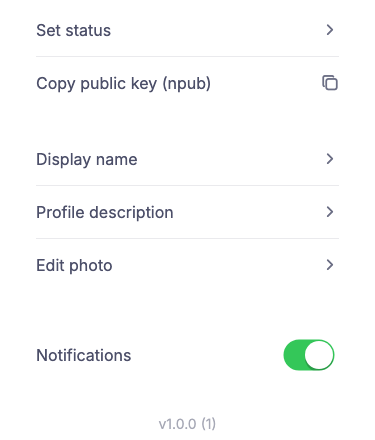 | 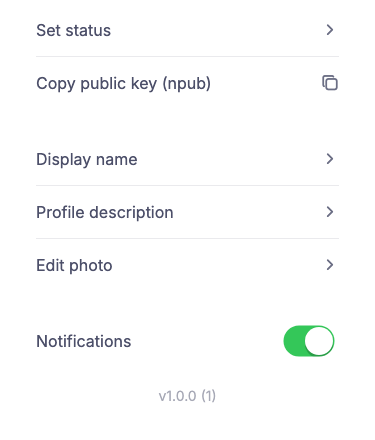 | --------- Signed-off-by: Tom Brow <tomb@block.xyz> |
||
|
Tom Brow
|
868e2f8f32 |
refactor(push): one app profile per gateway (#8206)
Buzz push currently selects an application profile, such as `dogfood`, during client registration. We want each gateway to serve one Apple app configured by the operator instead. This removes profile selection from the client, relay, and gateway, while allowing internal and public gateways to use their own Apple identities. This PR implements that model in the Buzz source and upstream deployment chart. Discovery, enrollment, grants, and leases no longer carry an application-profile selector. Each gateway has one configured Apple application and APNs transport. The protocol changes are incompatible with the old registration format, so relays advertise `buzz-push-v1` instead of `nip-pl`. Old clients do not discover the new push capability. Updated clients use separate Keychain records and register again. The [push notes](https://github.com/block/buzz/blob/push-capability-v1/docs/buzz-push.md) describe the experimental contract. Landing this PR is the first step. Publish the matching gateway image and upstream chart, then land the [shared chart update](https://github.com/squareup/cash-helm-charts/pull/5740) and [gateway deployment update](https://github.com/squareup/builderbot-platform-core-infrastructure/pull/1085). Before cutover, stop old gateway instances and check legacy registration state. Migrations refuse to proceed if old gateway installations or active relay leases remain; they do not delete that state. Physical-device verification remains necessary before production activation. ### Validation Gateway and focused Flutter push tests pass, as do the Swift package, simulator build, and native notification/enrichment tests. A local relay advertises `buzz-push-v1` without `nip-pl` or `app_profiles`. The PostgreSQL suite passed 868 tests; its two migration-test failures were corrected and pass a focused rerun together with the gateway cutover guard. Chart rendering and release-contract checks pass. Desktop JavaScript tests, desktop and web builds, native desktop compilation, mobile analysis/tests, and desktop native tests pass. The full Rust unit lane and prescribed `just test` command pass, including workspace integration tests against task-isolated local services. The production overlay now requires an explicitly supplied APNs topic, with omission and rendered-value regression coverage. The corrected Swift checksum assertion passes the complete package suite: 78 XCTest tests and 42 Swift Testing tests. No physical-device enrollment or production cutover is claimed. Local merge validation: the embedded migration test and formatting pass after reserving profile migration 0060 behind rollback migration 0059. The local pre-push Rust lane failed ACP timing/steering tests (`idle_resets_on_stdout_activity`, `keepalive_resets_idle_past_deadline`, and the failed/missing-outcome steering tests). ACP and its dependency manifests are unchanged by this branch; all four pass in an isolated single-thread rerun. The documented local-check exception skips only the Rust pre-push lane for publication; required CI remains mandatory. Mobile and desktop pre-push lanes passed. Combined migration validation: after rollback 0059 landed, the main merge preserves profile migration 0060 and both embedded migration assertions. The focused migration test and formatting pass. The next local push again failed only the unchanged ACP idle/keepalive timing tests (1053 passed, 2 failed, 3 ignored); other lanes passed. Publication uses the same documented local Rust-lane exception; required CI remains mandatory. Follow-up review fix: removed the legacy profile column from the copied-lease fixture. All four event-follow-up contract tests pass on isolated PostgreSQL databases, covering desired and migrated schemas in dual and app-only modes. Formatting passes. Publication retains the prior passing local-lane evidence and uses the authorized pre-push exception for the known unrelated ACP timing failures; required CI remains mandatory. --------- Signed-off-by: Tom Brow <tomb@block.xyz> |
||
|
Tom Brow
|
70d2ca7760 |
fix(mobile): tolerate unrelated NIP-11 relay metadata (#8160)
Relay capability additions such as `read_state_snapshot` currently make mobile push discovery reject otherwise valid NIP-11 documents. This blocks descriptor-dependent enrollment, lease updates, and remote revocation. Read unrelated top-level metadata permissively while preserving validation of the advertised `nip-pl` extension and the complete push descriptor. Each returned descriptor value is covered by compatibility tests; missing or malformed required push fields still fail. ### Validation - [Codex code review](https://github.com/block/buzz/pull/8160#issuecomment-6049355700) and [security review](https://github.com/block/buzz/pull/8160#issuecomment-6049486587) completed without findings on the final code. - Added 24 regression cases covering read-state metadata, arbitrary future metadata, HTTP discovery, missing/malformed push fields, and invalid extension advertisements. The six compatibility/discovery cases fail on unchanged main and pass with the fix. - All 55 focused descriptor, bootstrap, capability, and revocation tests pass. Mobile formatting and analysis pass. - Full mobile gate passes: 3,063 tests passed and four skipped with a configured gateway, plus all three tests for an unconfigured gateway build and the gateway recipe checks. - [Current-head CI](https://github.com/block/buzz/actions/runs/37706738403) passes, including Flutter tests, Android debug APK compilation, the complete iOS simulator app, and the unsigned iOS release build. - Production HTTP descriptor discovery against live personal-relay metadata passes without enrollment or relay changes. - Device enrollment, delivery, notification tap, and opt-out remain to be exercised in the updated iOS candidate. No relay or device state was changed. buzz-review-completed --------- Signed-off-by: Tom Brow <tomb@block.xyz> |
||
|
klopez4212
|
33f54de2dd |
feat(mobile): organize community and profile settings (#8056)
## Summary Move Invite, Appearance, and Remove community into a **Community settings** section in the community-avatar sheet, above the existing switcher. Keep the sheet untitled and use circle-minus for removal. Personal Settings groups **Set status** and **Copy public key (npub)** above an untitled card containing **Display name**, **Profile description**, and **Edit photo**. Remove the leading icons from status, public key, and Send identity to desktop; keep the latter in its own untitled card. Remove the avatar status badge and top Edit action, and rename the Theme page to **Appearance**. Opening the presence chip triggers selection haptics; copying plays native iOS success feedback and confirms with “Public key (npub) copied.” ### Testing - Mobile formatting, analysis, and file-size checks passed. - 111 affected widget tests passed; all 48 settings tests passed again after the final labels and icon changes. - Final release build installed and launched on a physical iPhone in the separate Buzz Community preview, retaining its existing test account. - Full repository `just ci` was blocked by local disk exhaustion during Rust compilation. The full mobile suite passed (2,609 passed, four skipped), plus three push-unconfigured tests. The presence and copy feedback passed focused widget tests and analysis, including native iOS success-channel coverage. ### Snapshots Light and dark Flutter widget renders with fixture data. Images are GitHub attachments, not committed to the repository. The personal-settings snapshots precede the final “(npub)” label clarification. | Surface | Light | Dark | | --- | --- | --- | | Community sheet | <img src="https://github.com/user-attachments/assets/d52a192e-bd40-4263-ac2d-05d589c7ebf2" width="280" alt="Community sheet, light"> | <img src="https://github.com/user-attachments/assets/8756ebe9-b6d4-4920-8fb7-1cb7ee8ef778" width="280" alt="Community sheet, dark"> | | Personal settings | <img src="https://github.com/user-attachments/assets/962b98bd-e4cf-4cd1-8948-69b349390ceb" width="280" alt="Personal settings, light"> | <img src="https://github.com/user-attachments/assets/223bb0a8-e10e-43b1-83ea-e0955af4627a" width="280" alt="Personal settings, dark"> | | Appearance | <img src="https://github.com/user-attachments/assets/334ba797-55cb-47ce-b677-0befafb7659b" width="280" alt="Appearance, light"> | <img src="https://github.com/user-attachments/assets/79b62503-d476-4dbc-8c75-8cee0ee37e98" width="280" alt="Appearance, dark"> | --------- Signed-off-by: kenny lopez <klopez4212@gmail.com> |
||
|
Tom Brow
|
fad4ff637a |
fix(mobile): hide notification settings without relay push capability (#8025)
Hide the iOS Notifications settings section for communities that have not enabled push unless their relay advertises valid push support. A build with a configured gateway previously showed the switch even when the relay could not support push. Communities where push is already enabled retain an off switch and iOS Settings recovery during discovery or when push support is unavailable. The section explains that support is unavailable instead of claiming notifications will arrive. Capability discovery keeps its existing refresh behavior. Returning after at least five seconds in the background reconnects the session and fetches capability again. Tom explicitly chose this behavior without new retries, polling, or refresh triggers. Companion client change for squareup/buzz-releases#104. Related: #7826 (broader notification availability diagnostics). ### Validation Settings widget tests cover hidden first-time opt-in during loading, absent capability, and discovery errors. Recovery tests exercise the real off switch for already-enabled communities in all three states, verifying persisted opt-out, the native snapshot writer, a durable pending relay tombstone after failure, and the iOS Settings link. They also verify that pending recovery stays visible after a relay failure and disappears only after opt-out confirmation. Tests without a gateway definition verify hidden first-time settings and disabled native registration. Mobile analysis and the mobile test suite passed. --------- Signed-off-by: Tom Brow <tomb@block.xyz> |
||
|
Tom Brow
|
b8aa0233f9 |
perf(mobile): verify notification cache events in background (#7650)
On iOS, Buzz stores verified profile and channel information for the notification extension. The extension uses this cache to show sender and channel names. Loading profiles or channels also updates the cache. Cache updates currently check event signatures on the UI thread, even when the caller does not wait for the update. This can delay taps and screen updates. This change moves those checks to a background worker. Signature checks, event selection, community boundaries, and the order of native writes are preserved. The worker accepts up to eight batches. When it is busy, later profile requests stay coalesced before fetching; profiles already loaded remain available immediately. Overlapping channel updates trigger a fresh joined-channel cache snapshot after the current export finishes, without delaying or restarting the channel screen. Queue saturation gets up to five retries per operation. Pending updates get their own recovery attempt even if the preceding export fails. Recovery fetches joined-channel data once and retries cache admission without repeating relay reads. It does not fetch the open-channel directory. Verified payloads are split into native-sized writes (256 profiles or 512 paired channels), keeping the same export ordering. Native profile/channel write failures retry the same verified chunk while retaining the export's queue position. All chunks share five retries with 7.75 seconds total backoff; other native errors fail immediately. Terminal failures are recorded, and later successful writes do not hide them. Captured batches keep their original community. Pending channel refetches are retired on a community switch and refreshed when the user returns. The cache remains best effort; prolonged failures can still prevent delivery. Tests through the production APIs reduced UI delay from 27–31 ms to below 0.3 ms for four profiles, and from 59–60 ms to below 0.3 ms for four channel and membership pairs. The native payloads were identical. This does not measure overall screen speed. Validation: 2,225 mobile tests passed (one skipped), along with 18 focused export tests, 12 recovery tests, 39 native Swift tests, 35 focused profile tests, and static analysis. Production regressions cover 13-entity bursts, invalid newer events, community rebuilds, reentrant refreshes, and terminal failures. Regression tests fail when producer recovery controls, terminal-failure draining, or member-only recovery scope are removed. --------- Signed-off-by: Tom Brow <tomb@block.xyz> |
||
|
Tom Brow
|
76f7e5ef0c |
feat(push): make gateway origin configurable (#7261)
Make the push gateway origin configurable across the relay, gateway, mobile client, and deployment chart. This is a fresh deployment. The gateway has only run on personal development infrastructure, and push has no existing enabled users. Legacy migration, configured-to-unconfigured mobile transitions, and rolling upgrades from pre-launch gateway binaries are not supported. Populated pre-launch databases are rejected with an informative error before migrations run; their data is untouched. Mobile builds may omit the gateway URL, leaving push unavailable. Once push is enabled, subsequent builds must retain that configuration. ### Validation - All applicable CI checks pass at `5f546cfaf403f0386f146d213adfb4392f4ec29c`, including Rust, mobile/Swift, desktop/integration, security, image builds, and Helm checks. An unrelated agent cancellation test passed on retry. - PostgreSQL CI passed 384 tests, including the production-entry-point regression for refusing populated pre-launch databases before migrations, fresh initialization, and subsequent initialized deployments. - Focused local validation passed all 10 gateway PostgreSQL tests under the CI discovery filter and all 3 unconfigured-mobile tests. Repository-wide PostgreSQL discovery validation and the complete pre-push hooks passed. - Physical-device APNs/App Attest behavior and deployment to a live cluster were not verified in this work. --------- Signed-off-by: Tom Brow <tomb@block.xyz> Co-authored-by: Codex <noreply@openai.com> |
||
|
Tom Brow
|
f78a32cf03 |
feat(mobile): hard-block under-18 users on the store age signal (#4665)
### What changed? Buzz mobile checks the app-store age signal at launch and hard-blocks the app behind a full-screen 18+ notice when the store says the signed-in person is under 18. No age signal (e.g. declined permission, indeterminate value, unsupported OS versions) results in no block. The age value is never persisted. It is read, used to compute one boolean, and discarded. Nothing is written to disk, and neither the age value nor the range is logged or sent to analytics. Platform notes: - **New dependency `com.google.android.play:age-signals:0.0.4`.** This is the only way to read the Play signal. Its AAR declares `minSdkVersion 23`, below the app's 24, so it forces **no minSdk bump**, and it self-declares its own consent activity, so **no AndroidManifest change** is needed. - **iOS entitlement and linking.** `DeclaredAgeRange` autolinks from the import. `Runner.entitlements` now declares `com.apple.developer.declared-age-range`, and the call remains behind `#available(iOS 26.0, *)`. ### Why? App stores now expose a declared-age range, and Buzz's Terms require users to be 18 or older. This wires the store signal to that rule with the smallest change that is defensible. Absent signals, declined or undeterminable results, and unsupported OS versions allow the app through. A transient native request failure does not become evidence that access is allowed: the app remains gated until a retry produces a result. Only an affirmative under-18 signal produces the permanent restriction screen. ### How is it tested? Added tests: - [`age_signal_provider_test`](https://github.com/block/buzz/tree/main/mobile/test/features/age_gate) covers the 17/18 boundary, open-ended ranges, no-signal, transient recovery, bounded retry exhaustion, malformed payloads, and request-once behavior - [`age_gate_app_test`](https://github.com/block/buzz/tree/main/mobile/test/features/age_gate) proves authenticated content remains unmounted while the signal is pending or retryable, and verifies the retry path - [`age_restriction_page_test`](https://github.com/block/buzz/tree/main/mobile/test/features/age_gate) asserts the block screen offers no bypass affordance - [`community_provider_test`](https://github.com/block/buzz/tree/main/mobile/test/shared/community) verifies age restriction clears push state, persists inactive leases, and retries a failed tombstone - [`AgeSignalPayloadTest`](https://github.com/block/buzz/tree/main/mobile/android/app/src/test/kotlin/xyz/block/buzz/mobile) pins the Android success payload to exactly `{status, ageUpper}` and verifies failures return the distinct retryable platform error ### Deployment note Enable the Declared Age Range capability and regenerate signing profiles carrying the entitlement. This relops/App Store Connect task is not performed by this PR. *🤖 This PR was authored [with an agent](codex://threads/019e5128-536b-73b3-8348-88651123f6da).* | Age restriction screen | | --- | | <img src="https://github.com/user-attachments/assets/5b0f48b1-df9b-4a60-9800-80b33f128535" alt="Age restriction screen" width="320"> | --------- Signed-off-by: Tom Brow <tomb@block.xyz> Co-authored-by: npub12wpjffj7q5qjsky5jvk4ldwlxmse5xll3d8gytk4wqd0c5y7jvwspg37n6 <538324a65e0501285894932d5fb5df36e19a1bff8b4e822ed5701afc509e931d@buzz.block.builderlab.xyz> Co-authored-by: npub1tquskdu6yc4h8l7xxtceculxw600grekeq0xg2ukqfrwl7vrzg3quz3gmp <58390b379a262b73ffc632f19c73e6769ef40f36c81e642b960246eff9831222@buzz.block.builderlab.xyz> Co-authored-by: Codex <noreply@openai.com> |
||
|
Tom Brow
|
c432a111ca |
feat(mobile): push notifications MVP (#6269)
This PR implements MVP, iOS-only,
[NIP-PL](
|