mirror of
https://github.com/block/buzz.git
synced 2026-11-24 10:12:19 +00:00
a82d596fc27fa24f35feee4b283be197c632c8ab
114 Commits
| Author | SHA1 | Message | Date | |
|---|---|---|---|---|
 Tom Brow |
02535e1b53 |
perf(mobile): stop replaying stored read state on every resume (#9090)
Every time the mobile app reconnects (for example after more than 5 seconds in the background), the read-state live subscription asked the relay for up to 500 stored read-state events. That re-downloaded every read-state slot on the account, then the snapshot fetched the same events again right after. On a heavy account (28 slots) that replay alone was about 1.4 MB per resume. The live subscription now uses `limit: 0`, so it only delivers changes. It still opens before the snapshot, so the snapshot covers anything published in between. The subscription can also go live after `subscribe` has returned: on a cold start with slow AUTH, `subscribe` returns on its 500 ms fallback before the REQ is registered, after a transient CLOSED (rate limit, capacity) the session reopens it on the same socket, and a reconnect replays it. With `limit: 0` nothing replays marks published in that gap, so the manager reads the snapshot every time the subscription reports ready, as the channel list's `limit: 0` subscription already does. The session keeps live subscriptions across reconnects and replays them on the new socket, so a reconnect no longer resubscribes: the replay's ready reads the snapshot, once per reconnect. The manager opens a new subscription only after losing one (a terminal CLOSED or a failed subscribe), on the next reconnect. All snapshot reads outside a publish go through one sync loop. Initialize and each ready ask that loop for a snapshot. A request made before the current pass starts its read joins that read, and a request made during the read runs one more pass, so a ready can't be swallowed by a read already in flight. This needs no generation or ready-transition checks, at the cost of an occasional extra read (for example a cold start whose ready lands after the 500 ms fallback, when the first read has already started). Snapshot reads are numbered in start order, including a publish's own read, and only a read newer than every settled one decides whether the last snapshot succeeded. An older read finishing late cannot clear the retry a newer failed read needs. A failed read waits for the next trigger: the publish it schedules, which reads the snapshot in full after a failure, or a later ready, resume or reconnect. A publish with nothing to send skips its snapshot ([#9093 skip redundant publish](https://github.com/block/buzz/pull/9093)) only when the last snapshot succeeded, so after a failed resume snapshot the next publish still retries it. A publish snapshot now notifies readers of the marks it merged, since unchanged slots publish nothing whose echo would. ### Accepted gap If the snapshot fails (timeout, discovery or HTTP error) on a device with no local journal, read state stays local until the next successful snapshot, which every resume, reconnect, subscription recovery and publish retries. Falling back to a stored replay on failure would close the gap, but it adds a late subscription path for a rare failure that already heals on its own. ### Validation - Added test: `live subscription replays nothing and opens before the snapshot`. It fails without the change (`limit` 500). - Added test: `a clean reconnect through the real session replays one REQ and reads the snapshot once, and a lost subscription is reopened` drives the real `RelaySessionNotifier` with a recording socket: the connected listener runs, then the session's replay, then EOSE. It fails against the previous revision of this PR (two `l-2` REQs and two snapshot reads per reconnect). After a terminal CLOSED, the next reconnect opens a new subscription and reads the snapshot. - Added test: `readies during a held snapshot read share one more read`. - Added test: `a mark published while the live subscription retries is read once it recovers` puts the subscription into retry, lets another device publish a mark, then reports it ready. It fails without the read on ready. - Added test: `a failed late-ready read is retried by the next publish`. It fails without the retry. - Added test: `a reconnect while the first snapshot downloads is not swallowed by the cold-start connect` lets the cold-start connect queue behind initialize, then reconnects while the first read is still downloading and has a peer publish a mark. It fails against the previous revision of this PR (the queued pass swallowed the reconnect) and passes with the sync loop. - Added test: `an older snapshot finishing late keeps a newer failed read's retry` holds a publish's snapshot read, fails a newer read, then lets the older one finish. It fails against the previous revision of this PR (the older success cleared the retry) and passes with the read ordering. - Added test: `a mark published before a slow cold-start REQ goes live is read then` lets `subscribe` return before ready, publishes a mark, then reports ready. It fails without the read on ready. - `a publish after a failed snapshot retries it, then skips again` replaces the earlier skipped-publish test and fails without the snapshot check. It also checks that the retried snapshot's new marks notify readers, which fails without the notify. - Read-state suite (95 tests), `flutter analyze` and the full mobile suite pass. - iPhone 12 mini, Profile build with [#9089 gzip snapshot](https://github.com/block/buzz/pull/9089) applied, Home backgrounded 12 s and resumed, websocket bytes received in the 15 s after resume: | | Websocket in | Read-state replay | | --- | --- | --- | | Before (gzip fix only) | 2,087 KB | 1,458 KB (28 events) | | After (gzip fix + this) | 575 KB | none | The table counts websocket bytes only. Each resume reads the read-state snapshot once over HTTP, before and after this change. Automated app run on the same phone: Home, a large channel and search resumed after the reconnect grace period, with no read-state errors logged. Read marks were not compared across devices. 🤖 Generated with [Claude Code](https://claude.com/claude-code) --------- Signed-off-by: Tom Brow <tomb@squareup.com> Co-authored-by: Tom Brow <tomb@squareup.com> Co-authored-by: studio <dc2fc481343672df31a689840c09299972e704dac592e0da6f18486646a7ee3e@buzz.block.builderlab.xyz> Co-authored-by: Claude Opus 5.5 <noreply@anthropic.com> |
||
|
Tom Brow
|
bf422ac8e1 |
perf(mobile): parse each event's thread reference once (#9460)
Every time code asked an event for its parent or thread root (`threadReference`, `parentEventId`), `parseThreadReference` walked its tags again and ran a 64-character hex regex over each `e` tag. The channel store asks that many times per event: - `_trimReplyOverlay` runs on every live event merged into the window and re-parsed every overlay event, twice. - `_reconcilePageSummaries` called `cachedThreadReplyIds(root)` once per row of a fetched page, and each call re-parsed every cached reply (twice per reply) to find that root's replies. A 200-row page did 200 full passes. Now: - `parseThreadReference` keeps its result per tag list in an `Expando`. Event tags are never changed after an event is built (nothing in `lib` mutates a `NostrEvent`'s tags), so the cached value always matches. - `_reconcilePageSummaries` indexes cached replies by root once, then reads each row's count from that map. `cachedThreadReplyIds` keeps its signature and result and shares the same code. ### Validation Full mobile test suite and `flutter analyze` pass. Existing thread-summary, reply-overlay and thread-reference tests cover the unchanged results. On the iPhone 12 mini (profile build, Builderlab), same scripted run on `main` and on this branch: open three threads from Activity, back out after each. | Dart CPU in thread-reference code | main | this branch | | --- | --- | --- | | First thread (not cached yet) | 5 ms | 2 ms | | Second thread (loads the channel window) | 27 ms, plus 18 ms trimming the reply overlay | 3 ms, plus 2 ms | | Third thread | 10 ms | 0 ms | The threads opened and showed the same replies in both runs, and the run covered a channel window load, live events arriving while a thread was open, and backing out to Home. ### Regressions None expected. Results are identical; the cache holds one small record per live tag list and is released with the event. Signed-off-by: Tom Brow <tomb@squareup.com> Co-authored-by: Tom Brow <tomb@squareup.com> Co-authored-by: studio <dc2fc481343672df31a689840c09299972e704dac592e0da6f18486646a7ee3e@buzz.block.builderlab.xyz> |
||
|
Tom Brow
|
9e40bf5d79 |
perf(mobile): don't treat a Control Center pull as a resume (#9443)
Pulling down Control Center or Notification Center, answering a system alert, or glancing at the app switcher moves the app to `inactive` and straight back to `resumed`. The app never leaves the foreground and the socket stays connected, but every resume listener treated it as a return from the background. Each glance re-read the channel list (memberships, metadata, unread catch-up), the four settings documents (mutes, stars, sections, sort) and the Me groups, and tore down and rebuilt the community presence subscription. On a heavy Builderlab account that is about 2.6 MB per glance. This adds `appForegroundProvider`, which follows the app lifecycle but ignores `inactive`. The resume refreshes and both presence providers watch it instead of the raw lifecycle, so they run only when the app actually comes back from the background. Camera capture keeps watching the raw lifecycle, since it has to release the camera while the app is inactive. ### Validation Added tests: the channel sync journey test now pulls the app through `inactive` and back without leaving the foreground and expects no membership read; it fails without this change (2 reads instead of 1). The existing resume and background cases in that test still pass unchanged. A second step lets a failed list read's retry come due while the app is `inactive`; it is read then, not left for a resume that no longer comes (it fails without the read gate change, 8 reads instead of 9). Full mobile test suite passes. On an iPhone 12 mini signed in to Block's Builderlab (instrumented profile build), pulling Control Center down and dismissing it: | | Downloaded after dismissing it | | --- | --- | | Before | 2.6 MB (rosters 1.5 MB, latest messages 0.7 MB, channel metadata 183 KB, settings, presence resubscribe) | | After | 6.5 KB (live typing and presence only) | The same run covered cold start, 5 minutes idle on Messages, and a resume after 60 s in the background; the resume still refreshed the channel list, read state and settings documents as before (2.8 MB HTTP, 2.1 MB WebSocket). ### Regressions None expected. A real return from the background still goes through `hidden`/`paused` first, so it triggers every refresh it did before. The only behavior change is for `inactive` alone: no refetch, and the user's presence no longer flips through a republish of `online`. A channel-list read that comes due during `inactive` (a membership notice or a retry) now runs then instead of waiting for a resume, since the socket is still connected. A missed live event during a Control Center glance is still caught by the next real resume or reconnect, as before for any time in the foreground. --------- Signed-off-by: Tom Brow <tomb@squareup.com> Co-authored-by: Tom Brow <tomb@squareup.com> Co-authored-by: studio <dc2fc481343672df31a689840c09299972e704dac592e0da6f18486646a7ee3e@localhost> |
||
|
Tom Brow
|
d1a8c3607d |
perf(mobile): use HTTP/2 on Android through app-wide Cronet engines (#9435)
Follows #8897 (iOS HTTP/2), now on main. ## What Android gets the same app-wide shared sessions as iOS, backed by Cronet (`cronet_http`) instead of `NSURLSession`: - One Cronet engine per traffic class (API, media), so requests to a host multiplex over one HTTP/2 connection and gzip is inflated natively, off the Dart isolate. - HTTP/2 on, HTTP cache off, QUIC off. QUIC would be a separate behavior change, and `cronet_http`'s changelog lists DNS failures with QUIC on cellular. - Streamed uploads (media and voice notes) stay on `dart:io` on Android: `CronetClient` reads a request body into memory before sending it, which would break upload progress and copy large attachments in full. - If no Cronet provider is available (no Google Play services), the engine fails to build and the app keeps `dart:io`, as today. - Transport error classification covers Cronet failures alongside `NSURLSession` ones, so invite and pairing errors keep their friendly messages. ## Measurements Android emulator (API 36, arm64), profile builds of this branch and main, signed in to the Feedback community. 8 cold starts per build, alternating builds in blocks of 4. Times are for relay `/query` requests started in the first 8 s. | | main (`dart:io`) | this branch (Cronet) | |---|---|---| | First query response | 6.99 s | 1.99 s | | Startup burst settled | 8.36 s | 2.78 s | | Burst after the first connection | 1.44 s | 0.77 s | | Query latency after the first connection, median / p90 | 165 / 1567 ms | 106 / 158 ms | **Unexplained stall:** most of main's startup gap is a ~5 s stall before its first response on every cold start. Its cause is unconfirmed; my guess is `dart:io` loading its CA store on the emulator, which HTTP/2 itself wouldn't fix, so the first two rows likely overstate the win on real devices. The rows after the first connection exclude the stall and are the fairer comparison. I also tried emulated EDGE throttling, but the emulator's throttle did not slow its traffic, so there are no slow-link numbers yet. ## Regressions None found. Devices without Play services keep `dart:io`. Cleartext `http://` requests keep the handle's own `dart:io` client, as on iOS. ## Testing - Full mobile suite passes (`flutter test`, 4784 tests). - Automated app run on the emulator: onboarding, Feedback nsec import, channel and DM list load, and 16 cold starts with request timing. Media loading wasn't separately exercised. - No visible UI change, so no screenshots. --------- Signed-off-by: Tom Brow <tomb@squareup.com> Co-authored-by: Tom Brow <tomb@squareup.com> |
||
|
Tom Brow
|
a2d4ba0267 |
feat(mobile): use HTTP/2 on iOS through app-wide URLSessions (#8897)
On iOS, Buzz's HTTP traffic now uses HTTP/2. Dart's `dart:io` client speaks only HTTP/1.1, so every feature's client opened its own connections to the relay, which sits behind Cloudflare and offers HTTP/2. On a slow link those extra handshakes, and the HTTP/1.1 head-of-line queueing, are a large share of cold-start time. ### What changes - iOS HTTP goes through two app-wide `NSURLSession`s via [cupertino_http](https://pub.dev/packages/cupertino_http) (`lib/shared/http/app_http_client.dart`): one for API traffic (relay queries, NIP-11, account, admission, pairing) and one for media (image/video/voice downloads and uploads). Requests to a host multiplex over one connection per session. Media has its own session so image bytes can't starve queries on a shared HTTP/2 connection: in prototype measurements with a single shared session, the channel-list batch query finished *later* than on HTTP/1.1. - Callers keep owning and closing their clients; on iOS `close()` leaves the shared session open. Both sessions are ephemeral with no URL cache and no cookies, so apart from the protocol (and native gzip, inflated off the Dart isolate) behavior matches `dart:io`. - Android, and tests, keep `http.Client()` unchanged, including `http.runWithClient` overrides. - Because closing a client no longer cancels a request on a shared session, the relay query client (both `/query` posts and bounded snapshot reads) and the dev push-lease fetch abort their request on timeout instead. - Non-`https` requests (`http://` media and community icons from other clients, local dev relays) stay on the handle's own `dart:io` client, because App Transport Security would block cleartext loads through URLSession. An HTTPS URL that redirects to `http://` is the one case that newly fails on iOS (URLSession follows the redirect and ATS blocks the downgrade); we accept that rather than follow redirects in Dart. - URLSession failures arrive as `NSErrorClientException`, not `SocketException`, so pairing and invite-join error messages now also recognize `NSURLErrorDomain` offline, TLS and timeout codes. - cupertino_http 3.0.1+ requires native_toolchain_c 0.19 and hooks 2.x, so `buzz_secp256k1` moves to those. Its build hook compiles unchanged. ### What gets better, and what doesn't get worse - **Better:** on a slow link, requests reuse one warm connection per session instead of paying TCP+TLS setup each time, so they complete where `main` times out (see the table). On Wi-Fi, small queries are slightly faster. - **Not worse:** request semantics, caching (none) and cookies (none) match `dart:io`; Android and tests are untouched; timed-out requests are aborted so they can't keep using bandwidth on the shared connection; offline errors keep their friendly messages. The accepted regression is HTTPS-to-HTTP redirects on iOS, above. WebSockets stay on `dart:io`. Android (Cronet) is a possible follow-up using the same seam. ### Validation Added tests: shared-session handles don't close the session; off iOS the transport honors `http.runWithClient`; NSURLError code classification; timed-out relay queries and bounded snapshot reads abort their request; cleartext requests stay off the shared session. Focused existing validation: full mobile suite (the only failures are 11 push/notification tests that fail identically on `main` on the same machine), `flutter analyze`, `buzz_secp256k1` package tests (27/27), and an iOS release build. On-device A/B on an iPhone 12 mini against the internal prod relay over WARP, comparing cold starts of `main` and this branch (profile builds with local-only request timing, 3 cold starts each): | | `main` | this branch | |---|---|---| | Wi-Fi: first query done (median) | 0.31s | 0.25s | | Wi-Fi: small-query latency (median) | 0.22s | 0.18s | | NLC Edge: requests completed in 90s | 0, 0, 0 (29–30 failed) | 12, 14, 16 (5–7 failed) | | NLC Edge: first request done | never | 6.3–7.0s | On Wi-Fi the two are about even. Under Edge, every HTTP/1.1 request on `main` hit its timeout while still opening a connection, and each retry started a fresh TCP+TLS handshake. The branch reuses one connection, so queries complete. Connection counts weren't measured on the device, since no proxy was in the path. Cold-cache demo on an iOS simulator (this branch, app caches and cached prefs wiped before launch): avatars, community icons, channel lists, public channel images, a DM image and custom emoji, video playback, reactions, and an image and video upload with progress all load. The DM image and clip are synthetic test media. https://github.com/user-attachments/assets/039d1a25-46f2-4e0e-b147-f96d0cfabd40 buzz-review-completed (agent review and device validation done; the human-test step is not applicable under Tom's standing exception for mobile changes) --------- Signed-off-by: Tom Brow <tomb@squareup.com> Co-authored-by: Tom Brow <tomb@squareup.com> Co-authored-by: studio <dc2fc481343672df31a689840c09299972e704dac592e0da6f18486646a7ee3e@buzz.block.builderlab.xyz> Co-authored-by: Claude Opus 5.5 <noreply@anthropic.com> |
||
|
Kalvin C
|
0bbcf3e7c2 |
fix(mobile): play short-delay animation frames at browser speed (#9432)
Some animated custom emoji play far faster on mobile than on desktop. Browsers show any animation frame with a delay of 10 ms or less for 100 ms. Firefox started this ([bug 207059](https://bugzilla.mozilla.org/show_bug.cgi?id=207059)). Chromium copied it (decoder comment: "use a duration of 100 ms for any frames that specify a duration of <= 10 ms"), and so did WebKit ([changeset 73295](https://trac.webkit.org/changeset/73295/webkit)). Flutter uses the delay as written ([flutter/flutter#130684](https://github.com/flutter/flutter/issues/130684)), so a GIF with 0 or 1 centisecond delays runs at the display refresh rate on mobile and at 10 fps on desktop. `MediaImageProvider` now wraps multi-frame codecs so frames of 10 ms or less get 100 ms. Every other frame keeps its own delay. Still images are passed through unchanged. Custom emoji, avatars and attachments all render through this provider. **Tests:** `flutter test test/shared/relay/media_image_test.dart` passes (24/24), and `flutter analyze` reports no issues on the changed files. The new test decodes a GIF with delays of 0, 1, 2 and 5 cs and expects 100, 100, 20 and 50 ms. It fails when the wrapper is removed. 🤖 Generated with [Claude Code](https://claude.com/claude-code) Signed-off-by: Kalvin Chau <kalvin@block.xyz> Co-authored-by: Claude Opus 5.5 <noreply@anthropic.com> |
||
|
Tom Brow
|
8f3f4e266a |
test(mobile): run push tests without a gateway dart-define (#9423)
A plain `cd mobile && flutter test` failed 11 push and notification tests on a clean checkout of main, while CI passed. Agents running the full suite kept reporting them as "pre-existing, also fails on main", which hides real regressions in the same files. ### Root cause Push is gated on the compile-time `BUZZ_PUSH_GATEWAY_URL` define (`Env.pushGatewayConfigured`, since [#7261 configurable gateway](https://github.com/block/buzz/pull/7261) made the gateway optional). Without it the app is a push-less build: `readBuzzPushEndpointGrants()` returns no grants and `buzzPushLifecycleEnabled()` is false. CI's mobile shards, `just mobile-test` and the lefthook pre-push lane (which runs `just mobile-test`) all pass `--dart-define=BUZZ_PUSH_GATEWAY_URL=https://push.example`; a bare `flutter test` passes nothing. Each of the 11 was checked against that: - `notification_toggle_test` (5 cases) and `push_lease_revocation_outbox_test` "hosted relay assertion": no endpoint grants without a gateway (`Bad state: No element` at the grant lookup, `No endpoint grant exists for push lease tombstone`). - `push_bridge_test` "reads and exposes persisted endpoint grants" and "debug enrollment carries the configured relay and gateway URLs": the bridge returns `[]` before calling native (`Expected: an object with length of <1>, Actual: []`). - `push_bootstrap_test` "default push requires relay capability" and "new community starts registration": the lifecycle is disabled, so registration never starts (`Expected <1>, Actual <0>`). - `push_bridge_test` "development push gateway matches the compiled configuration": a stale test. It expected a `https://push.buzz.xyz` default that [#7261 configurable gateway](https://github.com/block/buzz/pull/7261) removed from the app; under CI's define both sides equal `push.example`, so it could never fail there. The same files pass on the same Mac with the define, so nothing is environmental. The `Unexpected native call takePendingNotificationResponse` log is unrelated noise: the toggle test's native mock didn't answer that call, which logs (and is caught) in CI too. ### Fix Tests get the gateway from a test hook instead of the define. `Env.pushGatewayUrl` becomes a getter over the compiled value with a `@visibleForTesting` `debugPushGatewayUrlOverride` (the same pattern as `debugUriStreamOverride`), and `test/flutter_test_config.dart` sets it for every test file. `push_unconfigured_build_test` sets it to `''`, so it runs in the main suite instead of being skipped there and run separately. CI, the Justfile, `scripts/flake-check.mjs` and the AGENTS/README check commands drop the define, so CI, `just mobile-test`, pre-push and a bare `flutter test` run the same thing. I chose this over documenting a canonical command because the define can't be made automatic: `flutter test` has no config file for defines, so any doc fix still leaves the obvious command red. A test hook makes every invocation agree. The stale test is replaced by one in the push-less file that binds the production read: with the override cleared, `Env.pushGatewayUrl` must equal the compiled `BUZZ_PUSH_GATEWAY_URL`. Now that CI compiles without the define, it fails if the app regains a built-in gateway default, which the old test never could. The toggle test's mock answers `takePendingNotificationResponse` with no pending response. What gets better: one test mode everywhere, and the push-less tests run in every run. Nothing gets worse: production reads the same compiled value (the override is never set outside tests, and an `aot-snapshot` probe shows AOT still folds the getter to the compiled constant and drops push-only code when the define is absent), and every test still runs in the push-capable mode CI used before. ### Validation - On a fresh origin/main worktree with the Hermit toolchain, a bare `flutter test` failed exactly these 11; the same files passed on the same machine with the define. - After the fix, the pre-push `just mobile-check` and `just mobile-test` (now a bare `flutter test` plus the recipe and secp256k1 checks) pass, with the push-less tests running instead of skipped. `scripts/flake-check.test.mjs` passes. - Falsifiability: re-adding a `defaultValue` to the compiled gateway fails the new no-default test, and removing `flutter_test_config.dart` brings back the other 10 failures. - Unrelated: an earlier full run also failed `community_provider_test` "discard orphan snapshots and image caches", which waits 500 ms for a background directory delete. The Mac was running other full suites at the time; the file passed 8 of 8 runs alone, with and without the define. It is not touched here. Signed-off-by: Tom Brow <tomb@squareup.com> Co-authored-by: Tom Brow <tomb@squareup.com> Co-authored-by: studio <dc2fc481343672df31a689840c09299972e704dac592e0da6f18486646a7ee3e@buzz.block.builderlab.xyz> |
||
|
klopez4212
|
ef57fec4d2 |
Fix gallery video selection, thumbnails, and swipe dismissal (#9356)
## Summary Photos currently filters out videos, video messages without poster metadata stay grey until playback, and the native gallery rejects downward dismissal on video pages. - Include photos and videos in the native inline/popover pickers, system picker, and recent-media grid. Mixed selections retain their order and videos use the video upload path. Remove the redundant Video menu row on iOS and Android, whose Photos picker accepts both media types; reduce their menu height to four rows. Native pickers request the current asset representation to avoid compatibility transcoding and export up to three files concurrently, preserving order and cleaning up cancelled/failed batches. - Show local stills for queued videos. For older messages without posters, serialize thumbnail generation for the four rendered stack cards, bound/cancel downloads, remove temporary videos, and save stills in the existing account/community cache. Existing poster metadata is used directly. The native viewer uses the poster while loading instead of a play-button snapshot. - Allow downward dismissal on native video pages while preserving horizontal paging/scrubbing, zoomed-photo panning, and the accessible Close button. Fire selection-click haptics as a swipe begins rather than after the page settles, with no duplicate on completion or cancellation. Page-indicator changes retain immediate feedback. Replace visible video-loading text with the existing white arc-spinner treatment, implemented natively with reduced-motion and lifecycle handling. Completed swipes release the previous video player even after UIKit removes it from the active children. Legacy videos need one initial download (up to the existing 100 MB limit) to generate their cached preview. This does not start playback. ### Related issue Follow-up to merged #9259 and #9314. Searched open and closed gallery/video issues and PRs; no duplicate fix found. ### Testing - Full `just mobile-check` and `just mobile-test` passed at `12e6ed6ae3`: 4,688 Flutter tests (71 skipped), 4 unconfigured-push tests, and 27 crypto-package tests. File-size checks passed. Regressions cover mixed image/video upload routing, queued still previews, the rendered-card poster window, authenticated/cancelled downloads, caching/cleanup, and native poster loading. - Native gallery simulator regression fixture passed: photo/video dismissal guards, real MP4 decoding, paging, selected-only playback loading, and teardown. - Swift type-check of the native picker and its dependencies passed, with existing deprecation/capture warnings. - `just ci` passed its repository-wide lint/type checks. The unrelated Rust test rebuild was stopped after consuming about 13 GB to preserve remaining disk space; only that run's generated caches were removed. Release build at `fb09f9cb8` installed in place and launched on the physical iPhone Air as **Buzz Photo Stack**, with `BUZZ_NATIVE_PHOTO_ZOOM=true`. Existing app updated in place with the same bundle and Keychain identity; no uninstall or reset. Owner tested the physical-device preview and approved readiness for review. No before/after capture was produced. The simulator evidence above is an automated native fixture, not a full Buzz device journey. Native preparation follow-up: `scripts/test-mobile-picker-preparation.sh` passed on an iPhone Air simulator, covering bounded overlap, out-of-order completion, cancellation, and failure cleanup. The updated physical Air preview launched successfully with unchanged preferences metadata. Cloud-only assets may still require preparation. Loader/haptics follow-up native fixture passed: real video readiness hides the loader, error/retry and detach stop/restart it correctly, swipe start triggers one haptic before selection changes, and completion/cancellation/duplicate-start callbacks add none. Updated release installed and launched on the physical Air; owner approved the final preview for review. Review: focused code review and native regression checks completed; physical Air preview tested by the owner, who approved readiness. P2 follow-up: video presentation uses an already decoded poster or the source snapshot immediately, then forwards a pending poster asynchronously. Late poster updates are limited to the selected native page and do not restart playback. Added pending-provider presentation coverage and native late/stale-poster checks. This follow-up has not been installed on the physical preview yet. --------- Signed-off-by: kenny lopez <klopez4212@gmail.com> Co-authored-by: Terp <5856f6900e8e0a4e0ea1f4f8d2ee33e4753d2119bc122f94ecafc660b46c0511@buzz.block.builderlab.xyz> |
||
|
Tom Brow
|
0aca7588e3 | fix(mobile): join an open channel from the chat footer (#9253) | ||
|
Tom Brow
|
52cb6818fa |
perf(mobile): keep remote images on disk and show small ones as thumbnails (#9158)
## Summary The mobile app now saves remote images on disk. After a relaunch, avatars, custom emoji, message attachments and agent artwork show immediately. The app does not download them again. Small images on a relay now load only the relay's thumbnail. The app never downloads the full-size upload to show a small image. ## Why Before this change, the app kept remote images only in memory. Each cold launch downloaded every image again. On a slow connection, attachments showed a "Loading image" placeholder for a long time. Also, when a relay had no thumbnail for an image, the app downloaded the full-size upload. That upload can be up to 20 MiB, for an avatar that is a few dozen points wide. ## What changes ### Images on disk - `MediaImageProvider` reads and writes a `MediaDiskCache`. Each account in each community has its own cache, at `<root>/communities/<community id>/media/<signer pubkey>`. The cache is built on `flutter_cache_manager`, with a JSON index. - On iOS, the root is the app group's `Library/Caches` (from a new `buzz/app_group` method channel). App extensions can then read the same cache. On other platforms, the root is the app cache directory. - Each cache holds a maximum of 250 MB. When it is full, the least recently used images go first. `MediaCacheIndex` measures each file when it writes it, because `flutter_cache_manager` limits only the number of files. Every disk read marks the file used, and every write schedules eviction, including a refresh that replaces bytes the package already holds in memory (by default the package does neither for those). - The cache does not save an image that is larger than 5 MiB. The app still shows that image from memory. Thus, one large image cannot push out all the others. - Relay media URLs contain a content hash, so their bytes never change. The cache keeps them until it evicts them. For other URLs, the cache shows the saved image, and then gets a new copy in the background after one week. A maximum of two of these refreshes run at the same time. The app decodes a refreshed image before it replaces the saved copy. - When you remove a community, the app deletes its cache. When a community gets a new signing key, the app deletes the media of the old account. At launch, the app also deletes caches of communities and accounts that are no longer present. - Startup does not wait for the cache. The cache directory resolves in the background. Image reads wait for it for a maximum of 3 seconds. ### Thumbnails for small images - A small relay image loads the relay's WebP thumbnail. If the relay has no WebP thumbnail, the image loads the JPEG thumbnail. If the relay has neither, the widget shows its placeholder (initials for an avatar, an empty tile for artwork). - Native avatars drawn by UIKit (the navigation bar, the community icon on the create button, and the New DM and Add Members pickers) use the same choice, through a new `smallMediaImageProviders`. They try the same thumbnails, fall back the same way, and show initials when neither thumbnail exists. Before, they downloaded the full-size upload and only decoded it small. - Larger layouts and the full-screen viewer load the full-size upload, as before. ### Agent artwork - Preset agent artwork (the tray, flight, video placeholder, avatar hero and the avatar editor's blurred backdrop) now loads through `MediaImage`, so it uses the disk cache too. - The create-agent and empty-bestie pages warm the same `MediaImageProvider` that their widgets read, through a new `mediaImageProviderFor(ref, url)`. - No code in `mobile/lib` uses `Image.network` or `NetworkImage` now. ## Demo A cold relaunch (the app is stopped, then started) into a synthetic "QA demo" Solo chat that holds a few generated images. Shown at half speed. Before: the attachment shows a "Loading image" placeholder while it downloads. https://github.com/user-attachments/assets/107f43a3-63d0-40c3-bd80-4ea9d7897a97 After: the attachment shows with the chat, from disk. https://github.com/user-attachments/assets/d3985bb2-838c-4efa-93cb-44cef51f677d ## Tests - `test/shared/relay/media_disk_cache_test.dart` follows one journey through the real provider and a real cache in a temporary directory. The first launch downloads and saves. An offline relaunch shows the full-size image, its thumbnail and an external image from disk, and the oversized image goes back to the network. Eight days later, only the external image refreshes. Removing the community deletes its directory. - A second test checks the order of eviction when the cache is full, that a file read from disk is evicted after files that were not, and that replacing a file's bytes after eviction last ran evicts again when the cache goes over budget. - `community_provider_test` checks that launch deletes orphan media directories, that a new signing key deletes only the old account's media, and that removing a community deletes its media. - `avatar_image_test` checks that a missing WebP thumbnail falls back to the JPEG thumbnail, and that an avatar with no thumbnail shows its initials. - `native_avatar_image_test` checks the same for native avatars: a WebP 404 paints the JPEG thumbnail, the full-size upload is never requested, a relay with no thumbnail paints initials and is not asked again, and any other failure stops at the initials. - `flutter analyze` and the full mobile test suite pass. - Automated app runs on an iPhone 17 Pro simulator (iOS 27): the channel list, a DM, Home, the Agents grid and an agent details sheet show their images. After a relaunch, the images came from disk and the app wrote no new files. In the "QA demo" chat, a new image from the app showed immediately. - Automated run of the native-thumbnail fix on an iPhone 17 Pro simulator (iOS 27): the native New DM picker shows photo avatars, and the cache gained only relay `.thumb.webp` entries for them, no full-size uploads. After a cold relaunch, the picker showed the same avatars within about 1.5 seconds, and the cache directory gained no files. The avatar editor backdrop was not exercised in the app. The test community has no remote agents, and the backdrop tests cover only emoji and picked-image selections. ## Before merge - [x] Automated simulator run of this head: avatars and agent artwork show their thumbnails, and a cold relaunch shows images from disk. 🤖 Generated with [Claude Code](https://claude.com/claude-code) --------- Signed-off-by: Tom Brow <tomb@squareup.com> Co-authored-by: Tom Brow <tomb@squareup.com> Co-authored-by: Claude Opus 5.5 <noreply@anthropic.com> Co-authored-by: studio <dc2fc481343672df31a689840c09299972e704dac592e0da6f18486646a7ee3e@localhost> |
||
|
Will Pfleger
|
65e864301d |
feat: send a User-Agent on relay WebSocket upgrades (#9246)
Relay WebSocket clients in this repo now send a `User-Agent` of the form `<name>/<version>` on the upgrade request. The version comes from the build. | Client | User-Agent | |---|---| | `buzz-acp` | `buzz-acp/<crate version>` | | `buzz-cli` | `buzz-cli/<crate version>` | | `buzz-ws-client` (default) | `buzz-ws-client/<crate version>` | | `buzz-pairing-cli` | `buzz-pairing-cli/<crate version>` | | `buzz-audio-client` (default) | `buzz-audio-client/<crate version>` | | mobile (relay and huddle sockets) | `Buzz-Mobile/<app version>` | - **`buzz-ws-client`**: every connect path sends the default. A `User-Agent` in the caller's `connect_with_headers` headers replaces it, so other consumers can identify themselves without any new API. `buzz-cli` uses this to send its own name. - **`buzz-audio-client`**: keeps a `User-Agent` already on the host-supplied request, and adds its default otherwise. - **Mobile**: `openRelayWebSocket` sets the HTTP client's `userAgent`, which also covers the huddle transport. Startup waits up to 500 ms for the app version from `package_info_plus` before the app runs, so the first socket carries it; if the lookup fails or times out, the value is `Buzz-Mobile`. Each client has a test asserting the header on the upgrade request. --------- Signed-off-by: Will Pfleger <wpfleger@block.xyz> Co-authored-by: Hayt <211b96e6a2b7f45fd4047988976c7bbbeeda0c15f3ae7b32eec20834b5a55118@buzz.block.builderlab.xyz> |
||
|
Tom Brow
|
b58ee08404 |
fix(mobile): request hosted relay assertions only when NIP-FI is required (#9225)
Port the desktop NIP-FI requirement rule to mobile: hosted relay connections request an account assertion only when the relay's NIP-11 document requires NIP-FI, so communities that have not enabled it keep connecting with BUZZ_HOSTED_RELAY_AUTH on. Signed-off-by: Tom Brow <tomb@squareup.com> Co-Authored-By: Claude Opus 5.5 <noreply@anthropic.com> |
||
|
John Matthew Tennant
|
b894fb02ff |
fix(mobile): show transparent avatars without a black background (#9105)
## Summary Transparent PNG and GIF avatars render on a black background in mobile avatars and iOS notification avatars. Both load the relay's small thumbnail, which was always a JPEG with no alpha channel. [block/buzz#9003](https://github.com/block/buzz/pull/9003) makes relays write a `{sha}.thumb.webp` thumbnail that keeps transparency, alongside the `{sha}.thumb.jpg` that every relay writes. This PR loads the WebP first. - `MediaImage` with `preferThumbnail` tries `.thumb.webp`, then `.thumb.jpg`, then the original. Only a 404 moves on to the next source; any other failure still shows the error widget. Missing thumbnails are remembered as before, so later builds skip straight to the source that exists. - `BuzzNotificationAvatarLoader` follows the same order for notification avatars. Relays without 9003, and images uploaded before it, keep rendering from the JPEG as they do today. ### Screenshots A transparent PNG avatar rendered by `MediaImage` on the same relay, before and after (widget harness on an iOS simulator). | Before | After | | --- | --- | |  |  | ### Related issue AIDA-2308 (internal). The desktop counterpart is [block/buzz-app#2477](https://github.com/block/buzz-app/pull/2477). ### Testing - `missing thumbnails fall back to the JPEG, then the original` (`avatar_image_test.dart`): when the relay 404s every thumbnail, the avatar requests the WebP, then the JPEG, then the original. When the WebP fails with a 500, the avatar shows its fallback and requests neither the JPEG nor the original. - The relay thumbnail journey tests run against a relay that 404s `.thumb.webp`, so they cover the older-relay path end to end. - `BuzzNotificationAvatarLoaderTests` checks the WebP-then-JPEG thumbnail order for relay media, and that non-relay media gets no thumbnails. 🤖 Generated with [Claude Code](https://claude.com/claude-code) Signed-off-by: John Tennant <jtennant@squareup.com> Co-authored-by: Simone <0828be588d5c9c4d092c5b1cf01761d5aef63d6b104807fd8e8284d517dd1a99@buzz.block.builderlab.xyz> Co-authored-by: Claude Opus 5.5 <noreply@anthropic.com> |
||
|
Logan Johnson
|
c39ee507b2 |
fix(mobile): find verified people who have no profile (#9086)
## What changes
Mobile now finds a person who has a relay-verified profile (NIP-FI, kind
30382) but never published a kind:0 profile. This happens, for example,
when someone skips profile setup. The relay's `POST /profiles/search`
already finds such people by their verified name. Each one comes back as
a kind:30382 head with no kind:0. Mobile kept only kind:0 results, so
these people did not appear.
- `RelaySessionNotifier.searchProfiles` keeps kind:30382 heads from the
endpoint.
- `VerifiedProfilesNotifier.searched` turns a search page into people:
- If the relay authority is not known yet, it first waits for NIP-11
discovery. Otherwise, a search that finished first would drop these
people for that query.
- It checks each head's signature with the directory's off-isolate proof
checker.
- Proven heads go into the verified directory, so the rows show verified
names right away.
- `searchedPeople` (in `verified_profile.dart`) builds one row per
person, in the relay's order:
- If the person has a kind:0, the newest kind:0 is used, as before.
- If not, it uses the proven head that the authority signed, provided it
parses as an active verified profile.
- These cases add no row:
- a head signed by another key;
- a head that names the relay key but has a bad signature;
- a retraction;
- a malformed subject.
- **Behavior change for all mobile mentions:** every verified person now
matches in mention ranking by their verified full name and username, as
well as by display name, including people who have a kind:0. The relay's
search matches these same three names. Without this, a person whose
display name is their username (`glilienfeld`, full name "Gabi
Lilienfeld") came back from the relay for "gabi", and then the local
filter dropped them.
- Callers:
- Mention search, which also serves Add members and New DM.
- The user rows in global search, through `directoryUsersFromSearch`.
The desktop app has the same fix for Manage members:
https://github.com/block/buzz-app/pull/2554
## Screenshots
These come from the real Add members sheet on an Android emulator. Only
the relay session, verified-profile discovery and the member actions are
faked. The names are made up. Jordan Park has a kind:0. jrivera has only
a verified profile, with the full name "Jordan Rivera". The search is
"jordan". The row shows the verified display name, which here is the
same as the username.
| Search finds jrivera | After tapping + on jrivera |
| --- | --- |
| <img width="300" alt="jrivera is found next to Jordan Park"
src="https://github.com/user-attachments/assets/d93b77b1-1bc7-4d09-afc1-f359616a192a"
/> | <img width="300" alt="jrivera is selected to add"
src="https://github.com/user-attachments/assets/ce6c7a71-b098-434e-8b0e-ed0de8d1a5a2"
/> |
## Tests
- `add_members_sheet_names_test.dart`: a journey in which Gabi has
`display_name` = `glilienfeld` and `full_name` = "Gabi Lilienfeld", and
NIP-11 discovery is slow.
- While discovery is pending, typing "gabi" shows nothing yet.
- When discovery finishes, Gabi appears with no further keystroke.
- A head from another key does not appear, and neither does a head that
names the relay key but has a bad signature.
- **Add member** adds Gabi's key.
- I removed each fix in turn: the full-name alias, the signature proof,
and the wait for discovery. The journey fails each time, for the
expected reason.
- `verified_profile_test.dart`: a table of `searchedPeople` cases.
- A kind:0 wins over a head, and the newest kind:0 counts.
- These find nobody: another signer, a retraction, an uppercase subject,
a non-profile kind, and any head when the authority is unknown.
- `relay_session_test.dart` and `channel_management_provider_test.dart`:
rows for the kept heads and the directory row.
- `flutter analyze` is clean, and the full `flutter test` passes on
6efef79cc: 4,462 tests.
**Note:** mobile on `main` does not compile at
|
||
|
Tom Brow
|
5e36d65c9e |
fix(mobile): inflate gzip read-state snapshot responses (#9089)
On relays behind a CDN that gzips responses (the Builderlab relay does), mobile read state never synced. Every read-state snapshot fetch, and therefore every read-mark publish, failed with `FormatException: Unexpected extension byte`, so read marks made on the phone never reached other devices and each reconnect retried and failed again. The relay query transport deliberately leaves gzip bodies compressed so they can be inflated off the UI isolate (see `RelayHttpQueryClient`), but the snapshot path decoded the raw bytes with `utf8.decode`. It now uses `relayResponseText`, like the other query callers, for both the discovery and the snapshot responses. Heads-up for reviewers: with the snapshot working, a resume also pays for the full snapshot download on top of the existing read-state replay on the live subscription. A follow-up PR removes that replay. ### Validation - Added test: `inflates gzip discovery and snapshot bodies` serves both responses gzipped. Without the fix it fails with the same `Unexpected extension byte` error seen on the device. - Full mobile suite: all pass except the known stale `fullscreen_onboarding_test` case, which fails on main too. - iPhone 12 mini (Profile build, Builderlab community): before, every resume logged `snapshot failed` and `publish failed (journal retained)`. After, the snapshot on resume and the snapshot inside a publish both completed with no errors. - Automated app run on the same phone with this change: Home backgrounded past the reconnect grace period and resumed, then search and a large channel opened. No read-state errors logged. Read marks were not compared across devices. 🤖 Generated with [Claude Code](https://claude.com/claude-code) --------- Signed-off-by: Tom Brow <tomb@squareup.com> Co-authored-by: Tom Brow <tomb@squareup.com> Co-authored-by: studio <dc2fc481343672df31a689840c09299972e704dac592e0da6f18486646a7ee3e@buzz.block.builderlab.xyz> |
||
|
Tom Brow
|
9c5032b63b |
perf(mobile): derive keys natively and hash NIP-98 bodies faster (#8965)
## Summary Two pure-Dart crypto paths that run on the UI isolate during normal use: - **NIP-98 body hashes.** Every relay HTTP query (`RelaySessionNotifier._postForEvents`) hashes its request body for the NIP-98 auth header with pointycastle's `SHA256Digest`. This switches that hash, the media upload hash and the NIP-OA preimage hash to `package:crypto`'s `sha256`, which is already a dependency. The output is identical. - **Public key derivation.** `AccountIdentityStore.publicKeyForNsec` runs on every relay auth assertion and derived the key with the `nostr` package's pure-Dart curve math. It now uses the native `derivePublicKeyHex` (libsecp256k1) with the same validation. The default-agent writer now signs with the native `signNostrEvent` instead of `nostr.Event.from`. Left as they were: `nostr.Keys` construction for signing keys (nostr 2.0.0 always derives in Dart, with no way to pass a known public key), and `nostr.Keys.generate()` on the rare key-creation paths. ## Measurements - **Device** (iPhone 12 mini, Profile build, #4things captures): NIP-98 hashing took 17 to 24 ms of UI CPU per 10 to 20 s capture, mostly from channel notices queries. `publicKeyForNsec` took about 7 ms per relay auth assertion. - **Synthetic** (Mac, AOT, same output): SHA-256 of a 1 KB body takes 39.9 µs with pointycastle and 6.6 µs with `package:crypto`. 50 KB: 1,518 µs vs 293 µs. 1 MB: 29.6 ms vs 6.1 ms. - **Device A/B after the change** (iPhone 12 mini, Profile/AOT, Tom's Block community, two app resumes per build from the home screen, 15 s windows; A is `origin/main` |
||
|
ravarora2
|
7b3c2f95f2 |
fix(mobile): bound notices to loaded message history (#9062)
## Summary Mobile reads system notices older than its loaded message window, even though those notices cannot yet appear. Bound notice reads by the oldest loaded message's timestamp to avoid fetching history outside the loaded time range. A short or empty bounded response finishes that time range, rather than all notice history. Preserve the full boundary second, resume when older message pages load, and keep notices before the first message available at the start of history. Enforce the 2,000-notice cap before fetching reactions. Reuse cached reactions and deletions when older pages reveal their notices. For channels with fewer than 500 notices, scrolling back can now require one bounded notice read per older message page. Previously, one unbounded read covered the channel. ### Related issue Related: #8962, which changed how mobile loads and displays membership notices. No duplicate notice-bound PR found in the open mobile-notice title search. ### Testing Mutation checks: removing the production `since` argument or restoring the old unconditional history-end flag each made all four notice-range cases fail. Command: `cd mobile && flutter test --no-pub --dart-define=BUZZ_PUSH_GATEWAY_URL=https://push.example test/features/channels/channel_notices_journey_test.dart --name 'notice ranges'`. Replacing the captured message cursor with a fabricated maximum ID also fails the empty-range progress regression. Command: `cd mobile && flutter test --no-pub --dart-define=BUZZ_PUSH_GATEWAY_URL=https://push.example test/features/channels/channel_messages_provider_test.dart --name 'an empty notice range'`. A read-only prepared-query check on local Postgres 17.10 used a representative kind-40099 query. It held 22 event-related relation locks with `force_custom_plan` and 99 with `force_generic_plan`. The generic plan pruned seven of eight partitions during execution but retained the broader locks. These results do not establish lock reduction or throughput improvement under the relay's actual cached-plan workload; a relay load test remains pending. Native app scrolling against a live relay and human confirmation remain pending. For the device check, run `just mobile-dev` on a host with an iOS Simulator runtime. Connect to a local test relay and open a channel with more than 150 messages and interleaved topic notices. Scroll back through at least three message pages, then to the start. Check that visible notices remain in order and appear once. Disconnect during a page read, reconnect, and continue scrolling to check recovery. Generated with Codex --------- Signed-off-by: BuzzPRReviewAssistant1 <a581a7e8115222acdc32ffb14bfce55d48c24478d98e155f8eba126b69b83c7b@buzz.block.builderlab.xyz> Co-authored-by: BuzzPRReviewAssistant1 <a581a7e8115222acdc32ffb14bfce55d48c24478d98e155f8eba126b69b83c7b@buzz.block.builderlab.xyz> |
||
|
Logan Johnson
|
1055f79d04 |
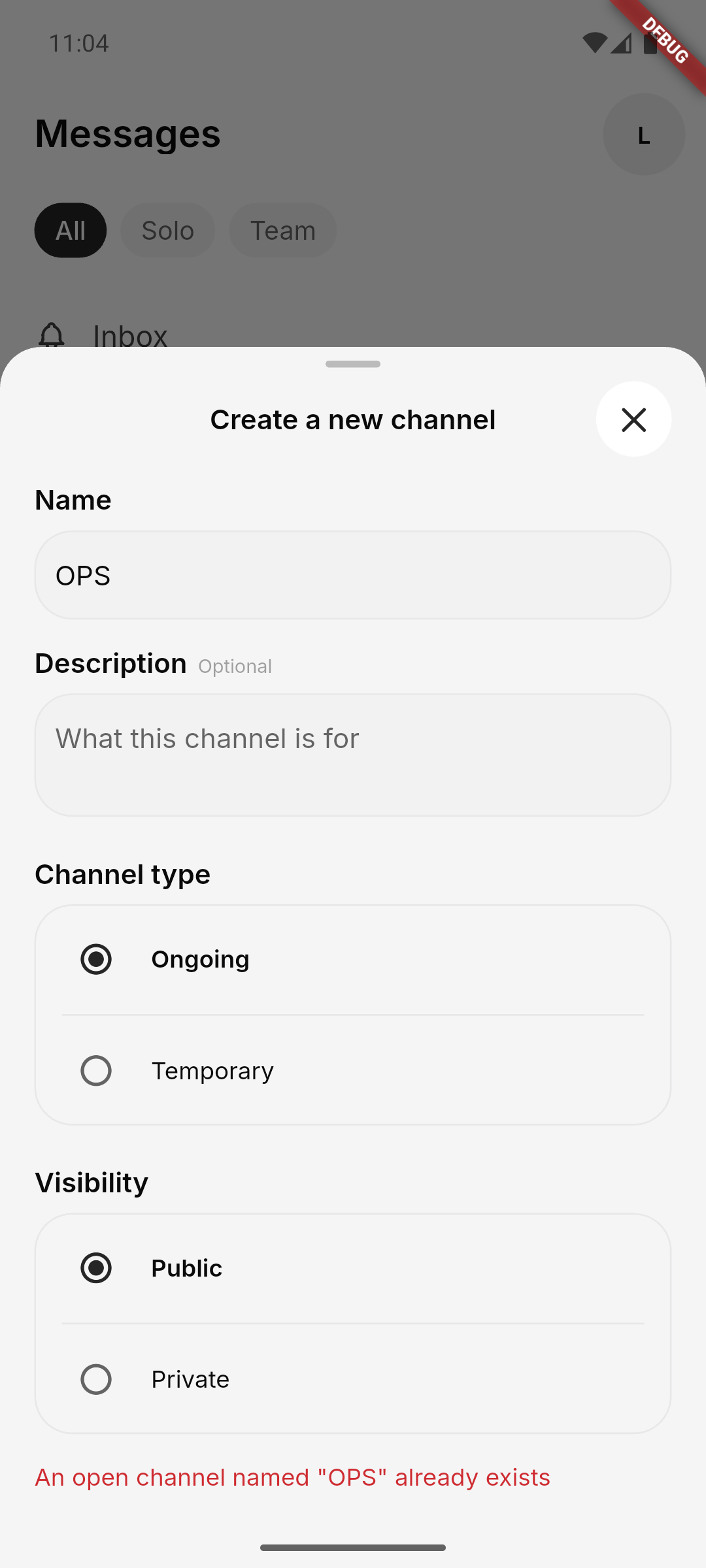
fix(mobile): show a taken channel name plainly and keep invites working (#8807)
## Summary
The relay is starting to refuse a new open channel when another channel
in the community already has that name
(https://github.com/block/buzz/pull/8782). Mobile handled that refusal
badly in two places:
- **Creating a channel with a taken name** showed raw error text:
`Exception: invalid: an open channel named "Launch" already exists`. The
create sheet now shows `An open channel named "Launch" already exists`
and stays open, so the user can pick another name.
- **Joining a community by invite could fail.** After an invite join,
the app joins two starter channels, `#general` and `#welcome-everyone`,
and creates either one if it can't find it. If an archived channel or a
forum already holds one of those names, the relay now refuses the
create, and the whole join failed. Now the app skips a starter whose
name is held by a channel it can't use, and the join succeeds. If the
holder is a live channel the app didn't see at first, the app joins that
channel.
Screenshots from an Android emulator against a local relay built from
https://github.com/block/buzz/pull/8782 are in the Testing section.
## Details
- **Error text.** A new `relayErrorMessage` helper
(`lib/shared/relay/relay_closed_policy.dart`) removes the `Exception: `
wrapper and the relay's machine prefix (`invalid:`, `blocked:`,
`duplicate:` and the other standard prefixes), then capitalizes the
first letter. Only the create sheet uses it. The other error paths are
unchanged.
- **Starter channels** (`ensureStarterChannels` in `lib/app.dart`).
After a taken-name refusal, the app reloads the channel list and looks
for the channel that holds the name:
- A live open stream with that name: join it.
- An archived channel or a forum: skip that starter. An archived channel
can't be joined, and a forum is the wrong type for a starter.
- No visible holder: fail as before. The setup stays retryable, because
the holder may not be visible yet.
- **Which channel counts as the holder.** Only a channel that can hold
the name under the relay's rule counts: open, not unlisted, a stream or
forum. Channels now carry the relay's "unlisted" flag for this. An
unlisted channel with the same name (for example, an unlisted forum the
user is in) doesn't hold the name, so the app doesn't skip the starter
because of it.
- **A starter that was archived.** Desktop and mobile create each
starter at the same fixed id. When the starter at that id is archived,
the relay refuses a new create there with `invalid: channel is
archived`. The app treats that as an archived starter and skips it,
unless a live channel with the name exists. When the relay answers
`duplicate` and the reload doesn't show the channel, the app reads the
channel at the fixed id and skips the starter only if that channel is
archived.
- If `#welcome-everyone` is skipped, the join opens no particular
channel. Both callers already handle that.
### Related issue
None found. Client side of https://github.com/block/buzz/pull/8782.
### Testing
Android emulator, debug build of
|
||
|
Spencer Lewis
|
83d0bd3203 |
fix(mobile): stop QR pairing to organization relays from hanging (#9001)
## Problem Pairing a phone to an organization relay by QR (for example Block's `buzz.block.builderlab.xyz`) never finishes. After the codes match and the phone confirms, it sits on the loading surface. About 2 minutes later it returns to the welcome screen with "Lost connection to pairing relay." The desktop stays on "Finishing pairing on your phone…". This reproduces every time on Buzz 0.27.0, iOS 27.2, with desktop 0.7.7 (internal tracking: AIDA-2420). There are two causes: 1. **Validation can never pass for organization relays.** After the payload arrives, `_validateCredentials` opens a plain `RelaySocket` without a `Nostr-Federated-Identity` assertion. Organization relays refuse that upgrade with HTTP 401 until organization sign-in, which a freshly pairing phone hasn't done. 2. **The failure hangs instead of erroring.** `RelaySocket.connect()` catches the failed `ready` but keeps `_channel`. The validator's `finally` then awaits `disconnect()` → `sink.close()` on a channel that never opened, and that never completes. The phone waits until the pairing relay's 120 s connection cap closes the socket, and `_handleDisconnected` reports that as a lost connection. Standalone repro with `web_socket_channel` 3.0.3 against the real relay: ``` ready failed: ... was not upgraded to websocket, HTTP status code: 401 sink.close() DID NOT COMPLETE within 30s (hang) ``` ## Change - `RelaySocket.connect()` drops a channel whose upgrade failed. - `disconnect()` waits at most `RelaySocket.closeTimeout` (2 s). An upgrade that is still pending (connect timeout 10 s) can outlive pairing's 8 s validation deadline, and its close never completes either. - `PairingNotifier` skips the pre-sign-in check for `OrganizationEnvironment.protects` relays. Admission is left to the saved community's session and the existing organization sign-in banner, which matches how the hosted branch already defers admission. The predicate is injectable (`organizationRelay`) for tests. Other relays are still validated before saving. Trade-off: an identity that the organization relay would reject is now saved, and that rejection only surfaces after organization sign-in. The hosted path has the same property. ## Related issue No existing GitHub issue covers this failure; searched open issues and PRs for pairing relay, lost connection and `_validateCredentials`. Closest: - #8043 / #8060 cover the same `_validateCredentials` path from the other side: a failed connect currently returns normally. They're complementary. With #8060 merged, organization relays would fail pairing with an explicit 401 instead of hanging, and this PR keeps them out of that pre-check. Whichever merges second needs a small rebase in `_validateCredentials`. - #3181 is a different failure in the same flow. ## Testing - New `relay_socket_liveness_test` cases check that `disconnect()` completes in three situations: after a refused (401) upgrade, after a timed-out handshake, and while the upgrade is still pending. - New `pairing_provider_test` case: a malformed key is rejected locally before anything is saved, an organization relay is saved without the relay check, and a non-organization relay is still validated and rejected. - Each new test fails with its fix removed. The failures were "disconnect() hung on a channel that never opened", "disconnect() hung on a pending upgrade", and `validated` being true. - `just mobile-check` and `just mobile-test` pass: 4229 passed, 40 skipped. - **Simulator run (iOS 27.0 simulator, iPhone 18 Pro, Block organization dart-defines) against desktop 0.7.7 on `buzz.block.builderlab.xyz`:** pairing completed (desktop reported the phone paired; identity transferred; community saved) instead of hanging until the pairing relay closed. The app then showed the organization sign-in banner and opened browser sign-in for block.builderlab.xyz, as expected. Okta in the simulator requires FastPass, so the final relay connection after sign-in was not exercised there. - Human device testing is still pending. ## Follow-up - Test on a real phone with an organization build. The simulator couldn't complete Okta FastPass, so the relay connection after organization sign-in still needs checking. --------- Signed-off-by: Spencer Lewis <slewis@squareup.com> Co-authored-by: Claude Opus 5.5 <noreply@anthropic.com> |
||
|
Tyler
|
dafe31bfe5 | feat(mobile): persist frontier-only NIP-RS read state across devices and restarts (#8998) | ||
|
Tom Brow
|
009dc103f6 |
perf(mobile): read the channel list after live changes, not every minute (#8910)
## Summary While the app is open, a 60s timer reads the whole channel list again: every membership roster, the channel metadata, and the unread catch-up. On the test account that is **about 4MB of JSON every minute** on the 12 mini, about 240MB an hour, whether or not anything changed. The live subscriptions already deliver what the list is built from, so this PR removes the timer. The list is read again when a live event says it may have changed: - a relay notice that tags this reader: added to a channel or a new DM (kind 44100), removed from one (44101), or a DM hidden or shown on another device (30622) - a metadata edit on a listed channel (kind 9002, now part of the live filter) - a system notice on a listed channel that changes the channel itself: archived (including the relay auto-archiving an idle ephemeral channel), unarchived, deleted, visibility, topic, purpose, TTL and similar. Member joins and leaves don't count. The read starts 2s after the last such event, and no later than 10s after the first, so a burst costs one read. Reads start at least 10s apart however busy the relay is. A read that fails is retried with backoff (5s, doubling up to 5 minutes), including the read after a resume or reconnect. Nothing is read in the background: launch, resume, reconnect and pull to refresh read the list as before. Live subscriptions ask for no stored events (`limit: 0`), so nothing sent while one is down is replayed. So: - Each list read opens the notice subscription before it reads, and the read covers anything sent before. - If the relay closes the notice subscription or a channel chunk for a reason that may clear (busy, rate-limited, timed out), the relay session reopens it itself, as before. The channel list now hears about that through `subscribeWithStatus`. - If the relay refuses one as over its subscription limit, only that REQ is retried, after a jittered backoff (5s, doubling up to 5 minutes). The backoff starts over once a reopened subscription has stayed up for a minute. Any other refusal (`restricted:`, `invalid:` and so on) can't succeed unchanged, so it is left alone until the next connection, as on main. - A reopened subscription that is still up when its read comes due counts as a change, so the list is read once to catch up on what it missed. If the relay admits a REQ and then closes it again, it triggers no reads. Known gaps, accepted: deleting a channel or kicking a member sends this reader no notice, and archived channels have no live coverage, so an unarchive done on another device isn't seen. An edit to a newly added channel that lands in the round trip between reading its metadata and its live subscription starting is also missed. The list catches up on the next launch, resume, reconnect or pull to refresh. Archiving or unarchiving on this device re-reads the list at once, as before. ## Measurements iPhone 12 mini on Wi-Fi against the internal relay, app open and idle, instrumented profile build (HTTP response bodies after decompression, websocket text in). Measured on an earlier revision of this PR, which read on a 60s tick only after a change. Idle behavior is the same now (no change, no read). | 10 idle minutes | main | this PR | | --- | --- | --- | | Channel list reads | 10 | 1 | | HTTP queries | 40 | 5 | | HTTP response bytes | 39.9MB | 4.0MB | | Websocket bytes in | 4.4MB | 1.1MB | On main, every tick read memberships (348KB), another 310KB query and the unread catch-up (3.3MB). With this PR, the only read in the window came right after another device hid or showed a DM (kind 30622), which is exactly the kind of change it should pick up. Sizes are JSON after decompression; the relay gzips responses, so wire bytes are smaller (not measured). [#8901](https://github.com/block/buzz/pull/8901) separately shrinks each read's unread catch-up; the two are independent. ## Testing - New journey test: with the app open and nothing changing, nothing is read. Adding the reader to a channel, renaming a listed channel, archiving or auto-archiving one and removing the reader each cause one read about 2s later, and a member joining causes none. A change right after a read waits out the 10s gap. A steady stream of changes is read after 10s and then no more than every 10s. A burst costs one read. A failed read is retried with backoff and then stops. - New journey test, for the notice subscription and for a channel chunk: the relay refuses it twice as over its limit while the list changes. It is retried with backoff, and once it has stayed up the list is read once to catch up. Later the relay drops it, and having stayed up it is reopened within about 5s and catches up again. Then it delivers live. The relay then closes it as busy while the list changes, and the list catches up once it is back; closed again right after reopening, it triggers no read until it stays up. Refused as `restricted:`, it is not retried. - The resume journey: a reconnect read and a resume read each fail once while a channel is added, and each is retried and shows the channel. - Each guard was removed once to confirm a test fails: the debounce, the max wait, the minimum gap, the read retry (including after reconnect and resume), the catch-up reads after a retry or a relay-session reopen, the still-up checks, the backoff restart, the background check, retrying only capacity refusals, and clearing refusals on a new connection. - The terminal-rejection tests expect a chunk refused as `restricted:` never to be retried on that connection or to cause a list or history read, and a new connection to retry it at once. - `just mobile-check` and `just mobile-test` pass. - Device: on the 12 mini, 10 idle minutes with the app open, before and after (table above). 🤖 Generated with [Claude Code](https://claude.com/claude-code) --------- Signed-off-by: Tom Brow <tomb@squareup.com> Co-authored-by: Tom Brow <tomb@squareup.com> Co-authored-by: Claude Opus 5.5 <noreply@anthropic.com> |
||
|
Tom Brow
|
fa395e9e80 |
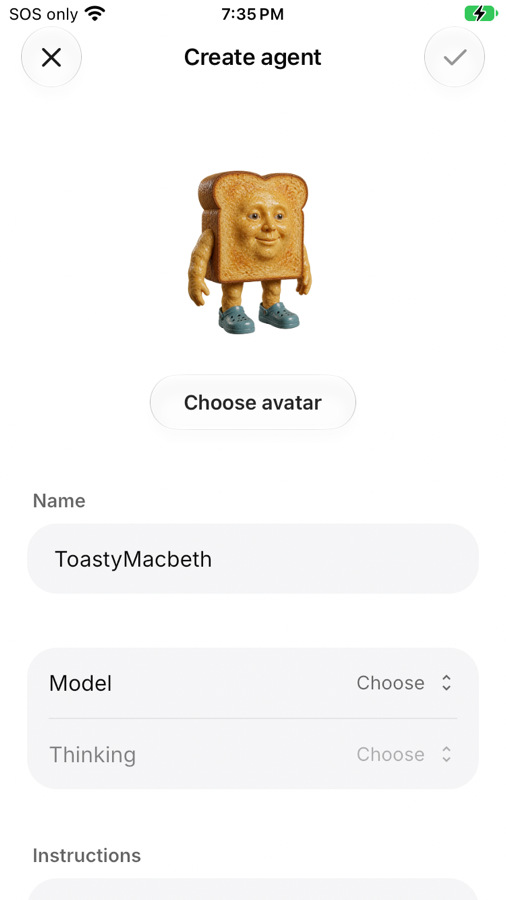
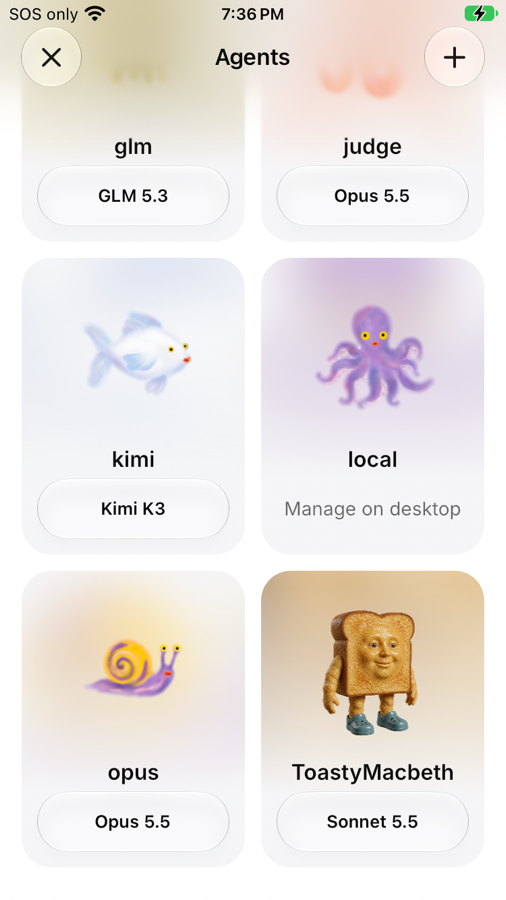
feat(mobile): open a prefilled Create agent form from Builderlab agent cards (#8912)
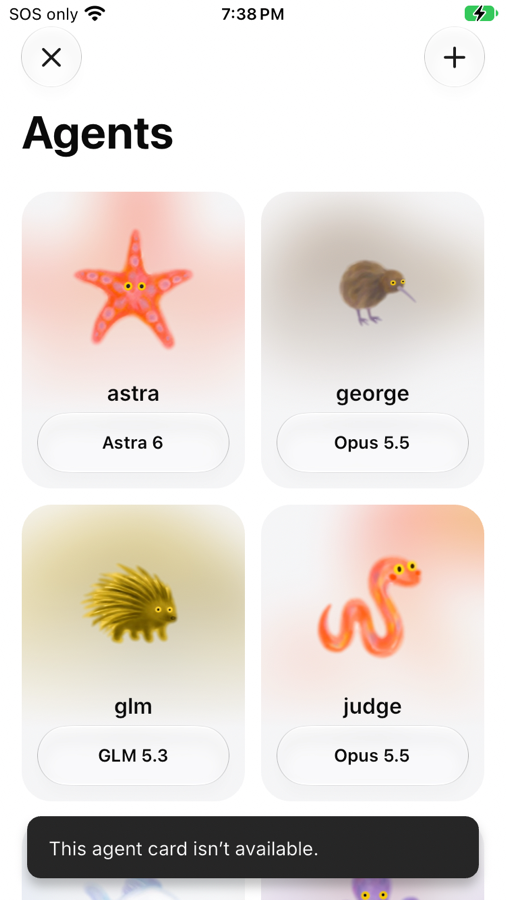
Builderlab agent cards (printed for the event, and generated at the kiosk) carry a QR to a share page, `app.builderlab.xyz/a/<id>`. Its **Add to Buzz** button opens `buzz://agent/new?card=<id>`, which no Buzz client handled until now. This PR makes mobile handle it. ### Behavior - Opening the link shows the Agents page, then a Create agent form prefilled from the card. Everything stays editable, and nothing is created until the user taps Create. - The app fetches the card's `agent.json` from the avatars CDN for this build's Builderlab environment (production or staging). The link carries only the card id, never a host, so the QR stays small no matter how long a card's instructions get. - `agent.json` is validated against the card schema. `id` (matching the link), `name` and `avatarUrl` (an https URL) are required. `instructions`, `model` and `reasoningEffort` are optional (published cards don't have them yet) and left for the user when absent. A missing required field or a wrongly typed known field rejects the card; any other key is ignored whatever its type, including `v` and `description` (Buzz agents have no description to prefill), so Builderlab can add fields without breaking released apps. The model and effort are preselected only if the live catalog offers them. The card id is opaque: any non-empty id is accepted and percent-encoded into the URL. - The fetch uses the same limits as image downloads, now shared in `bounded_fetch.dart`: aborted after 20 s without a byte or 5 min overall, and rejected over 2 MB. `MediaImageProvider` now calls the same helper, with no behavior change. - The link waits for sign-in, then reloads the registry for the signed-in account before anything else. It's dropped with a message if the card is unavailable (403/404), invalid, can't be loaded (any other response), or an agent setup is unfinished, including a setup saved before a sign-in the link triggered. - A link that arrives while Agents shows only its list replaces that page instead of stacking a second one. If a form or sheet is open there, the link is dropped with "Finish or close what’s open in Agents, then reopen the link." and the open work is kept. ### Demo Simulator (iPhone 17 Pro, debug build of this branch plus the sign-in fix from [#8914](https://github.com/block/buzz/pull/8914) and the hidden debug banner from [#8915](https://github.com/block/buzz/pull/8915), signed in to Builderlab, remote-agent-pilot), recorded in one take with idle time trimmed: the card's share page in Safari, Add to Buzz, the prefilled Create agent form, a model, thinking level and instructions, Create, then a message and the agent's reply. https://github.com/user-attachments/assets/e66aae17-884a-4e68-a1b8-ecb40562be1d ### Validation Added tests: - Table tests for the link shape (only `?card=<id>` with an opaque id; the inline `#` form, extra parameters and dot segments are rejected) and for reading `agent.json` (a published card, a card with instructions and model defaults, unknown keys of any type ignored, including `v`, `description`, arrays, objects and null, and invalid cards: missing or mismatched required fields, wrong types, and non-https or relative avatars). - Table tests for fetching: the request goes to this build's CDN without following redirects, with the id percent-encoded as one path segment; 403/404, a redirect, a 500, a network error, declared and streamed oversize bodies, non-JSON and a JSON array each give a specific message. The image loader's existing stall, deadline, cap and cancel tests now cover the shared helper. - A journey test from link to Create against a fake CDN: prefill and edit, then submit; an unavailable card; a failed model catalog whose Retry then preselects the card's model; a Builderlab account change while the card loads, which drops the draft; a v1 card with no instructions and an unknown model; an unfinished setup; a link arriving while a Create form with edits is open, which keeps the form and its edits; and a link arriving while Agents is open. Disabling the https or id check makes the table test fail, and removing either the account recheck or the loaded-catalog check fails the journey. The journey runs through the production root scope (removing its link handler fails it) and runs in CI's configured-authentication-domains step. Full mobile check and test suite pass locally. Live data: a real staging card's `agent.json` (`av_MioTAG6dm7q3Zcm0UV2j8A`) has the v1 shape the table test uses, and an unknown id returns 403 from the CDN. Live run on an iPhone SE (build of 63ed54c749, Builderlab sign-in enabled, remote-agent-pilot, signed in as builderlab@tombrow.com) with a real production card, [ToastyMacbeth](https://app.builderlab.xyz/a/av_lrmRlJR6ylrQKvJkoLWCOQ) (a v1 card with no instructions and an extra `description` key): - Opening `buzz://agent/new?card=av_lrmRlJR6ylrQKvJkoLWCOQ` from a cold start opens Create agent prefilled with the card's name and avatar. - After choosing a model and adding instructions, Create adds the agent with the card avatar, and it replies in a DM. - An unknown card id shows "This agent card isn’t available." | Prefilled | Created | Reply | Unknown card | | --- | --- | --- | --- | | <img src="https://raw.githubusercontent.com/block/buzz/b9222db494758c3e536b8e2011032ba7cec86daa/pr-8912--01-prefilled.png" width="200"> | <img src="https://raw.githubusercontent.com/block/buzz/b9222db494758c3e536b8e2011032ba7cec86daa/pr-8912--02-created.png" width="200"> | <img src="https://raw.githubusercontent.com/block/buzz/b9222db494758c3e536b8e2011032ba7cec86daa/pr-8912--03-reply.png" width="200"> | <img src="https://raw.githubusercontent.com/block/buzz/b9222db494758c3e536b8e2011032ba7cec86daa/pr-8912--04-unavailable.png" width="200"> | Before this PR, the app had no handler for `buzz://agent/new`, so the link did nothing. A separate widget test covers a link that needs Builderlab sign-in first: once sign-in lands, a setup saved for that account blocks the card, which is never fetched. Removing the registry reload fails it, as does removing the busy-Agents guard for the journey step above. ### Before merge - [x] Human live check waived under the repository owner's standing testing exception. In its place, agent-driven full-app runs exercised the flow end to end: the iPhone SE device run and the simulator demo above (a real card's share page, **Add to Buzz**, the prefilled form, Create and a reply from the agent). Limitation: those runs predate [ |
||
|
Tom Brow
|
97ff4e19d1 |
docs(mobile): describe the role split in the media image keys (#8932)
Follow-up to [#8913](https://github.com/block/buzz/pull/8913). Its review [noted](https://github.com/block/buzz/pull/8913#discussion_r4445612714) that three doc comments in `media_image.dart` still describe the old keys after that PR split direct and thumbnail-fallback loads: - The class doc now says the provider keys on `isThumbnailFallback` as well as url, scale and auth scope. - The `_cooldownUntil` doc says it is keyed by (url, isThumbnailFallback), like `_inFlight` but without auth. - The `_SharedFetch` doc says a download is shared per URL, auth scope and role. Comments only, no behavior change. `flutter analyze` is clean and the full mobile suite passes. No app run, since nothing executes differently. 🤖 Generated with [Claude Code](https://claude.com/claude-code) Signed-off-by: Tom Brow <tomb@squareup.com> Co-authored-by: Tom Brow <tomb@squareup.com> Co-authored-by: Claude Opus 5.5 <noreply@anthropic.com> |
||
|
Tom Brow
|
9f8913dd1b |
mobile: keep a thumbnail fallback apart from a direct load of the same URL (#8913)
## Summary Follow-up to [#8896](https://github.com/block/buzz/pull/8896), from its review threads. **A fallback and a direct load of the same thumbnail no longer share a download.** `MediaImageProvider.isThumbnailFallback` decides what a 404 means: for a thumbnail `MediaImage` picked in place of an original, it records a missing thumbnail so the next build loads the original; for any other URL it starts the 30s failure cooldown. It was left out of equality and the in-flight download key, so when a profile URL that is itself a thumbnail and a fallback to that same thumbnail were on screen together, both joined one download and only one of them ran its own 404 handling. Now each keeps its own provider and download, and each gets its own handling. The failure cooldown is keyed the same way. Before, a direct 404 of a thumbnail put its URL on cooldown (30s, up to 5 min with Retry-After), and an avatar that fell back to that thumbnail during the cooldown hit the cooldown error instead of a 404, so it showed initials instead of loading the original. Also: - Reworded the `preferThumbnail` doc so it no longer names community icons, which never set it. - Removed the community-icon avatar test, which fed a URL production never produces. ## Testing - New test: a direct thumbnail URL and a fallback to it, shown together, make two requests; after a 404 the direct URL is in cooldown and the fallback's original loads (not the initials). It fails with the fetch key change reverted. - New test: after a direct thumbnail 404, an avatar that falls back to the same thumbnail still loads the original. It fails with the cooldown key change reverted. - `just mobile-check` and `just mobile-test` pass. 🤖 Generated with [Claude Code](https://claude.com/claude-code) --------- Signed-off-by: Tom Brow <tomb@squareup.com> Co-authored-by: Tom Brow <tomb@squareup.com> Co-authored-by: Claude Opus 5.5 <noreply@anthropic.com> |
||
|
Tom Brow
|
464448c7b2 |
fix(mobile): resync read state from the last fetch, not the whole week (#8903)
## Summary Every read-state resync (each reconnect and each resume from background) fetches every read-state blob (kind 30078, `#t: read-state`) from the past week, then opens a live subscription with no `since`, which replays the same blobs again. Merging keeps the newest mark per context, so blobs from before the previous fetch add nothing. Each blob is a whole device's read marks, about 100KB for a heavy reader. A later fetch and the live subscription now start `relayCrossDeviceSkewSeconds` (1860s) before the last successful fetch was sent. The relay rejects a `created_at` more than 900s from its clock, and blobs come from other devices, so a writer 900s slow and this phone 900s fast are at most 1800s apart. Every blob stored since that fetch falls inside the window. A failed fetch keeps the earlier start. The first fetch of a manager still covers the whole horizon. Companion to [#8901](https://github.com/block/buzz/pull/8901) and [#8902](https://github.com/block/buzz/pull/8902), which do the same for the unread catch-up and the latest-message query. Measured on an iPhone 12 mini against the internal relay, resuming after 60s in the background (kind 30078 websocket bytes, instrumented profile build): | | main | this PR | | --- | --- | --- | | Read-state resync on resume | about 1.8MB (91 blobs, fetch plus subscription replay) | 415KB (4 blobs changed since the last fetch) | ## Testing - New test: the first fetch covers the horizon, the live subscription and later fetches start 1860s before the last successful fetch was sent, and a failed fetch keeps that start. Confirmed it fails without the fix and with the earlier 960s window. - New test: after the clock moves back, a resync whose fetch fails isn't retried on every later read; the next reconnect fetches the whole horizon. Confirmed it fails without the fix. - `just mobile-check` and `just mobile-test` pass. - Device: resumed the app on the 12 mini on Wi-Fi; the resync fetched only the 4 blobs stored since the previous fetch, and the live subscription replayed none. 🤖 Generated with [Claude Code](https://claude.com/claude-code) --------- Signed-off-by: Tom Brow <tomb@squareup.com> Co-authored-by: Tom Brow <tomb@squareup.com> Co-authored-by: Claude Opus 5.5 <noreply@anthropic.com> |
||
|
Tom Brow
|
220cec677a |
fix(mobile): keep community icons on originals and record thumbnail 404s at fetch (#8896)
Follow-up to #8879, addressing its review. ## Changes - **Community icons load the original again.** `AvatarImageContent` gained a `preferThumbnail` flag, off by default. People and agent avatars turn it on (as #8879 did for every caller); `CommunityAvatar` leaves it off. Community logos are often transparent PNGs, and the relay's JPEG thumbnail renders transparency black. This matches desktop, which shows community icons from the original. - **A missing thumbnail is recorded where its 404 arrives.** Before, only the mounted `Image`'s error builder recorded it. If the avatar scrolled away before a slow 404 came back, the thumbnail URL kept a 30s failure cooldown instead, and showing that avatar again at any size during the cooldown rendered initials and never requested the original. The fetch now records a 404 on a relay `/media/<sha256>.thumb.jpg` URL in the missing-thumbnail set and puts no cooldown on it. ## Tests Two journey tests in `avatar_image_test.dart`, both failing on main and passing here: - An avatar unmounts before its slow thumbnail 404 arrives, then mounts again at another size: it requests the original once, renders it (valid image bytes, no initials), and leaves no cooldown. - A 36pt `CommunityAvatar` with a relay-hosted icon requests and shows only the original. `flutter analyze` is clean. In the full local `flutter test` run, only 12 push and notification tests fail, and they fail the same way on main in this environment. 🤖 Generated with [Claude Code](https://claude.com/claude-code) --------- Signed-off-by: Tom Brow <tomb@squareup.com> Co-authored-by: Tom Brow <tomb@squareup.com> Co-authored-by: Claude Opus 5.5 <noreply@anthropic.com> |
||
|
Tom Brow
|
f6f6d9a673 |
chore(mobile): delete dead code with no remaining UI path (#8880)
## Summary Deletes mobile code that no longer has a user-reachable path and has no counterpart in buzz-app, so it is unlikely to come back for parity. Net: 104 files, about 5,500 lines removed. No intended behavior change. - **iOS native message menu and action surface:** `NativeMessageMenu.swift` and `NativeMessageActionSurface.swift`, the `message`/`supportsMessage` coordinator branches, and the Dart selection hook. Dart stopped creating this view in [#8280](https://github.com/block/buzz/pull/8280). The native reactions sheet in the same coordinator is kept. - **Old home quick-actions launcher and `ComposeMorphIcon`:** only instantiated in tests since the nav-bar creation actions replaced them. - **Retired local theme stack:** `ThemeNotifier`, `AccentNotifier`, `SchemeNotifier`, `adaptive_theme.dart`, `AccentPickerPage`, the appearance-mode sheet and their helpers. These predate per-community theme sync. The legacy prefs migration in `community_theme_preference.dart` is kept. - **Unused widgets:** `ProfileAvatar` and `MaskedAvatarBadge`. - **Push permission-status plumbing:** the iOS `notificationAuthorizationStatus`/`openNotificationSettings` handlers, plus the uncalled strict age-gate snapshot registration and its Swift `syncAgeGatePushSnapshot` path. - **Orphaned files** with no importer: `profile_text_edit_sheet`, `editor_option_button`, `retained_page_transition`, `tappable_flapping_bee`, `agent_model_info`, `community_bot_profiles`, `sheet_divider`, `success_haptic`. - **Uncalled helpers:** the `pickAndUpload*`/camera helpers in `media_upload.dart`, unused `NostrFilters` builders, `mediaGetHeadersFor*`, and about 20 other uncalled functions, providers and styles. - **Removed-UI leftovers:** the never-wired invite directory providers, `AuthNotifier.signOut` and `removeActiveCommunityForSignOut` (the Sign out row is gone), `renameCommunity`, `HomePage.profilePageBuilder`/`SettingsPage.embedded`, and the create-forum branches of the create-channel sheet. Forum viewing is unchanged. Tests that only covered deleted code are removed. Tests of surviving code that used deleted helpers as drivers were repointed to the surviving API. An audit of `mobile/android` found no dead Kotlin, resources, manifest entries or Gradle dependencies, so Android code is unchanged. ## Validation - `flutter analyze`: no issues. - After rebasing onto main ([ |
||
|
Tom Brow
|
2e0abbcc0c |
fix(mobile): let slow image downloads finish (#8881)
On a slow link, a large image could never appear. Every image fetch was aborted 30s after it started, even while bytes were still arriving, and a failed fetch then sat on a 30s cooldown before it could be retried. At 240 kbps, anything over about 900 KB could not finish. On a shaped iPhone SE, a 1.45 MB avatar was fetched, aborted at 30s and never shown. - **Abort stalls, not slow downloads.** A fetch is now aborted when no headers or body bytes arrive for 20s, so a dead connection still frees up quickly. A download that keeps making progress can run for up to 5 minutes, so a server that trickles bytes cannot hold a connection forever. The 20 MiB response cap still bounds its size. - **Cancel previews scrolled past in the iOS carousel.** The carousel loads at most four previews at a time, and a preview scrolled past kept its slot until its download ended. With the longer limit, four slow previews could block the visible one for minutes. Now the carousel drops a cancelled preview's pending image-cache entry, and with no one left listening, the image loader aborts its HTTP request. Scrolling back starts a fresh download with no failure cooldown. A download that another consumer, such as the full-screen viewer or a gallery prefetch, is still listening to keeps going, and its finished image is still cached. Closing the carousel aborts its pending previews the same way. - **Cancel gallery prefetches that leave the window.** The message gallery prefetches a few pages around the current one with two workers. Each prefetch used to hold its download until it ended, which also kept the carousel's cancel from aborting it. Now a prefetch that leaves the window, or whose gallery goes away, lets go and aborts the same way. ### Validation Added tests (each fails without its fix): - A body that trickles in for longer than the stall timeout still loads, and one that never ends is aborted at the overall cap. - In the iOS carousel, previews scrolled past abort their stalled downloads (before headers and mid-body), the next preview loads, and scrolling back starts a new download. The test fails if the carousel doesn't evict, if the loader doesn't abort, or if the abort leaves a cooldown. - Closing the carousel aborts its stalled previews. - In a message gallery, jumping to the end and back aborts both in-flight prefetches and moves the workers to the new window. - Abandoning a load another consumer still waits for keeps the finished image cached with no second fetch; abandoning one nobody else waits for aborts it. - Rapid scrolling releases each cancelled carousel load at once, and cancelled loads never reach UIKit. The full mobile suite passes. 🤖 Generated with [Claude Code](https://claude.com/claude-code) --------- Signed-off-by: Tom Brow <tomb@squareup.com> Co-authored-by: Tom Brow <tomb@squareup.com> Co-authored-by: Claude Opus 5.5 <noreply@anthropic.com> |
||
|
Tom Brow
|
90772a43e9 |
fix(mobile): keep avatars and images loading on slow links (#8879)
On a slow link, avatars in a channel could fail to appear entirely. Two causes: - **Duplicate downloads.** Each decode size is its own image-cache entry, so an avatar shown at two sizes (a message row and its reply summary) started two downloads of the same bytes, which then competed for bandwidth. The in-flight download is now shared per URL and auth service. - **Full-size avatars.** Avatars a few dozen points wide downloaded the original upload, which can be megabytes. The relay generates a JPEG thumbnail of at most 320px for every uploaded image, and desktop already loads it for small avatars. Mobile now does the same for any image format when an avatar is at most 240 physical pixels on each side. About 88% of relay-hosted avatars on the internal relay are PNG, with a median size of 337 KB. As on desktop, the thumbnail is a still JPEG: transparent areas render black and animation is lost. Rendered side by side, mobile and desktop look the same. If the relay returns 404 for a thumbnail (older or externally populated media), the avatar loads the original instead, as the notification extension's avatar loader already does. ### Before merge - [x] Kenny Lopez reviews the visible changes ([approved in Buzz #buzz-mobile](buzz://message?channel=9f18f3c6-b5e5-453d-b36d-65487913be0b&id=c8b01eaa3760e44c3b6583f2e02bec576d78679adfb364e5fe718cc0926bdc2d)). ### Validation On an iPhone SE (iOS 27.0.1) running a profile build, relay traffic went through a Mac-side proxy shaped to 200ms one-way latency, 240 kbps down and 200 kbps up. I opened a busy channel and logged each relay image fetch. Every fetch is aborted 30s after it starts, which [#8881](https://github.com/block/buzz/pull/8881) changes separately; with thumbnails the avatars below no longer come close to that limit. | Avatar | Before | After | | --- | --- | --- | | A | 1.45 MB, fetched twice; both aborted at 30s, never shown | 14.5 KB thumbnail, 3.6s | | B | aborted at 30s, never shown | 14.5 KB thumbnail, 4.1s | | C | 125 KB, fetched twice, 26s each | 21.5 KB thumbnail, 4.3s | | D | 46 KB, 11.1s | 24.7 KB thumbnail, 4.6s | Added tests (each fails without its fix): - One URL resolved at two decode sizes downloads once. - Small relay avatars request the thumbnail and large ones the original. - A thumbnail 404 falls back to the original, and other thumbnail failures show the avatar fallback. - The thumbnail URL is built only for relay-hosted blobs (`/media/<sha256>` with an optional extension), the same pattern desktop's `mediaUrl` uses. The full mobile suite passes. 🤖 Generated with [Claude Code](https://claude.com/claude-code) --------- Signed-off-by: Tom Brow <tomb@squareup.com> Co-authored-by: Tom Brow <tomb@squareup.com> Co-authored-by: Claude Opus 5.5 <noreply@anthropic.com> |
||
|
Tom Brow
|
b41caeb510 |
fix(mobile): time out relay connects that never finish the handshake (#8878)
When a phone's network silently stops working (crowded event Wi-Fi, a weak cell signal), Buzz Mobile can stay offline for minutes. In a device test, the app took 30s to notice the dead connection, then hid the channel's messages behind a loading skeleton. It tried to reconnect once, and that attempt hung for 5 minutes (303s). It never retried, because it only retries after an attempt fails. This PR gives every reconnect attempt a 10s limit. When an attempt runs out of time, the app closes it and tries again with its normal backoff. ### What was wrong Opening the relay connection has two code paths. The one used with hosted relay auth already had a 10s limit. The other path had none, so a stuck attempt waited for the operating system to give up, which takes minutes. Both paths now use the same limit. Each attempt also gets its own HTTP client, so a timed-out attempt is actually closed rather than left running in the background. ### Validation I tested on an iPhone SE (iOS 27.0.1) running a profile build, with its relay traffic routed through a Mac proxy that could silently drop everything. - **Before:** during a 5.6 minute outage, the app made one reconnect attempt, which hung for 303s. - **After:** during a 2.5 minute outage, each attempt gave up after 10s and the app kept retrying. It reconnected 36s after the network came back, a delay mostly set by the 30s cap on time between retries. Added tests: `relay_socket_liveness_test` now covers an attempt that never completes, with and without hosted relay auth headers. It checks that the attempt fails and that the abandoned connection is closed. The test fails without the fix. Two existing tests were opening real relay connections by accident or design: - `deep_link_dispatcher_test` now uses a fake channel list, like its neighboring tests. - `remote_agents_test` talks to a real local relay on purpose, so it now uses a real HTTP client instead of the test framework's mock. The full mobile test suite passes. 🤖 Generated with [Claude Code](https://claude.com/claude-code) --------- Signed-off-by: Tom Brow <tomb@squareup.com> Co-authored-by: Tom Brow <tomb@squareup.com> |
||
|
klopez4212
|
a12ad1cdd2 |
feat(mobile): refine agent profiles and model selection (#8773)
## Summary - Simplify agent profiles with Message/Bestie actions, relay-authored published instructions (unavailable without a config channel), management details, public-key copying, and a separate final Delete section. - Sort the Agents directory by name and mark the selected Bestie with a muted filled star. - Place Model and Thinking together below Name. Use native iOS Liquid Glass menus and preserve selection callbacks as controls become enabled. Related: #8685. ## Validation Full mobile checks passed. Regression coverage includes relay-author filtering, unavailable instructions, metadata retry, resizing native pickers, accurate deletion state, selection after loading, and Bestie switching. Real iOS simulator taps verified both pickers; the user confirmed the earlier iPhone build works. Review fixes were checked with widget journeys and the native UIKit resize/selection probe. <details> <summary>Previews</summary> Synthetic fixture renders: | Profile | Create agent | Bestie card | | --- | --- | --- | |  |  |  | Native iOS simulator interaction with a synthetic catalog:  </details> --------- Signed-off-by: kenny lopez <klopez4212@gmail.com> Co-authored-by: Terp <5856f6900e8e0a4e0ea1f4f8d2ee33e4753d2119bc122f94ecafc660b46c0511@buzz.block.builderlab.xyz> |
||
|
Tom Brow
|
e3b1ef0d84 |
docs(agents): mark desktop/ as legacy, not a reference for mobile (#8868)
Agents working on the mobile app have been looking at `desktop/` for implementation and design cues. `desktop/` will soon be superseded by [block/buzz-app](https://github.com/block/buzz-app), while mobile is current, so it should never serve as that reference. - Root `AGENTS.md`: labels `desktop/` as legacy in the repo layout, adds a callout at the top of the Desktop App section, adds the same guidance to the Mobile App section, and drops "matches desktop" from the mobile theme note. Mobile kind constants now sync with `crates/buzz-core/src/kind.rs` (also in the `nostr_models.dart` comment) instead of desktop. - `VISION_MOBILE.md`: replaces the line that allowed the desktop implementation to inform shared mobile rules, so the vision and agent guidance agree. Written intent still takes priority. ### Validation Documentation-only. Reviewed the diff and links. Codex review's one finding (the vision conflict) is addressed. buzz-review-completed 🤖 Generated with [Claude Code](https://claude.com/claude-code) --------- Signed-off-by: Tom Brow <tomb@squareup.com> Co-authored-by: Tom Brow <tomb@squareup.com> Co-authored-by: Claude Opus 5.5 <noreply@anthropic.com> |
||
|
Logan Johnson
|
547de61aa5 |
fix(mobile): show channel posts before a burst of join notices (#8798)
## Summary When many people join a channel at once, the mobile app could open that channel and show only a "… joined" line, with none of the channel's posts. You had to scroll up before any messages appeared. With this change, the posts always show first, and the join lines appear among them in the right places. The cause: the app loads the newest 50 timeline rows when a channel opens, and join notices counted toward those 50. A burst of 50 or more joins filled the whole first page. The app combines a run of joins into one line only when it draws the screen, so the user saw a single "Guest 10 joined … and 48 others" line. The app loads older rows only after the user scrolls. This is the mobile port of the desktop app's fix, https://github.com/block/buzz-app/pull/1983, which has already merged. It needs no relay change. - History pages no longer include join notices, so the first page is all posts. - The app reads join notices with a separate read, newest first, 500 per read. It reads down to the oldest post loaded so far, and continues after each older page loads. Like desktop, it stops after 2,000 notices. - Each notice read also reads the reactions on those notices, and any removals of those reactions. A page brings these back for its own rows, but notices are no longer on the pages, so they need their own read. These reads name the channel in `#h`, so a system channel, or an unlisted channel opened by a non-member, still returns them (NIP-CL). Deletions are also read without `#h`, because a deletion can be stored with no channel. Each read names at most 500 target ids, so it stays under the relay's 1 MiB request limit. A notice's reactions show even when they sort below the oldest loaded post. - Posts show as soon as their page loads. The notices follow and are merged into the timeline, so they do not replace rows that arrived live in the meantime. - A notice that is older than the oldest loaded post waits until its page loads. This prevents a join from showing at the top of the timeline with a gap of missing posts below it. - If a notice read fails, the posts still show. The next page load tries the notices again; if a page loaded while the read was running, the read runs once more right away. - The same applies to every system notice (joins, topic changes, channel created or archived), as they share one event kind. ### Related issue AIDA-2328. Desktop fix (merged): https://github.com/block/buzz-app/pull/1983. ### Testing Before (left, older build) and after (right, this branch) on the Android emulator, against a local relay. #general and #4things each have 4 posts followed by 60 joins: https://github.com/user-attachments/assets/53b80942-d8c3-4604-8b95-cc5ca7ab6946  - New `channel_messages_provider_test.dart` cases run against the real channel provider, with only relay responses faked: - A burst of 500+ joins does not hold posts back. If the first notice read fails, the posts still show. A later page read retries the notices and continues the descent. - Notices in the same second as the oldest loaded post follow the post's position within that second. - The descent stops at 2,000 notices. - A notice keeps its reactions, and a removed reaction stays removed. Reactions are read past the relay's 1,000-event page. The fake relay applies the NIP-CL rule, so a read without `#h` finds no channel reactions. - A page that loads while a notice read fails still gets its notices. - `just mobile-check` and the full `just mobile-test` pass at `7a38763af`. Not yet tested on a physical device, or on iOS. 🤖 Generated with [Claude Code](https://claude.com/claude-code) --------- Signed-off-by: Logan Johnson <loganj@squareup.com> Co-authored-by: Larry <627498bd4bd1f281a16431e3c6cce3b5c25b6692798c78672298aefbf2f8f8b5@buzz.block.builderlab.xyz> Co-authored-by: Claude Opus 5.5 <noreply@anthropic.com> |
||
|
klopez4212
|
f3a7bab098 |
Clarify mobile community onboarding and saved identity selection (#8729)
## Summary Make community onboarding easier to scan: shorten hosted hostname fallbacks, clarify Add Community instructions, and replace raw saved-key buttons with identity cards. Use white pages, grey cards, ghost secondary actions, standard page transitions, and a “Getting ready” screen during joining. Native profile setup keeps a horizontal modal transition. Identity cards load signed name/avatar metadata from saved communities without switching accounts; unavailable profiles use a neutral fallback. Cards show only the avatar, a 16px medium-weight name, and muted npub; community lists are omitted. Retiring profile setup closes its avatar editor too. ### Related issue Follow-up to #8687 and #8599; no duplicate PR found. ### Testing - Formatting and analysis passed. Full suite with hosted-auth defines: 4,019 passed, 5 skipped; includes profile-fetch and cancellation regressions. - Prior iOS device preview and native profile tests passed; hosted CI native Swift checks passed on the preceding head. Latest Dart fixes are not yet reinstalled on the phone. - Simulator walkthrough and owner-tested iPhone preview use sample identities and simulated admission. Sample-data previews; the identity snapshot shows the unavailable-profile fallback rendered by Flutter. Media is attached here only. | Community picker | Add Community | Saved identity | | --- | --- | --- | |  |  |  | --------- Signed-off-by: kenny lopez <klopez4212@gmail.com> Co-authored-by: Terp <5856f6900e8e0a4e0ea1f4f8d2ee33e4753d2119bc122f94ecafc660b46c0511@buzz.block.builderlab.xyz> |
||
|
Tom Brow
|
8161a7cad0 |
perf(mobile): derive public keys with native libsecp256k1 (#8655)
Follows #8654. Deriving an x-only public key from a secret key with `nostr.Keys(secret).public` costs about 5.6 ms in pure Dart on an iPhone SE (2nd gen, Profile). The app does it in 10 places, including relay config, the signed-event relay's `pubkey` getter, push lease checks, status updates, and the settings identity row's `build` method. This routes all of them through `derivePublicKeyHex` from #8654, which takes 16.5 µs on the same device. Behavior is unchanged for valid keys: output is the same lowercase hex. For a malformed or out-of-range key the thrown type changes from nostr's `InvalidKeyException` to `ArgumentError`; every affected site either catches all errors or rethrows its own `FormatException`/`StateError`, and nothing in `lib` or `test` matches on the old type. Sites that need a full `nostr.Keys` object (key generation, `AccountIdentityStore`) are unchanged. ### Validation - `derivePublicKeyHex` is checked against `nostr.Keys` for 64 random keys in #8654's `event_signing_test.dart`. - Full mobile analyze and test suite pass on this branch after rebasing onto main, including the package's own tests. - iPhone 12 mini, Profile build of this stack (with #8656 and #8657 on top): paired to the internal Buzz community through Desktop; relay auth, identity row, avatar, and channel/DM/inbox loading all worked under the derived key. buzz-review-completed (agent review, Codex and security review clean; device validation above; human app test not applicable under the mobile testing exception) 🤖 Generated with [Claude Code](https://claude.com/claude-code) --------- Signed-off-by: Tom Brow <tomb@block.xyz> Co-authored-by: george <973be878edd6d4f79692a3827f20a6f7fe0ed0362f269ff6b6ba8867033d7d8e@sprout-oss.stage.blox.sqprod.co> Co-authored-by: Claude Opus 5.5 <noreply@anthropic.com> |
||
|
Tom Brow
|
770ab7ff82 |
perf(mobile): decode relay query responses off the UI isolate (#8669)
### Context Profiling on an iPhone 12 mini (Profile build, real community) showed `RelaySessionNotifier._postForEvents` producing contiguous main-isolate busy runs with p90 110 ms and max 124 ms (27 runs of 50 ms or longer). Stacks were dominated by `jsonDecode` of `response.body`, with `NostrEvent.fromJson` smaller. The whole HTTP response decode ran on the UI isolate: gzip inflate (done by `dart:io`), the UTF-8 decode behind `response.body`, JSON parsing, and event parsing. ### What changes - Successful `/query` and `/profiles/search` responses (the only two callers of `_postForEvents`) are now decoded in a single `Isolate.run` from `response.bodyBytes`: inflate, UTF-8, JSON, validation, `NostrEvent.fromJson`. The parsed events come back by ownership transfer (`Isolate.exit`), not a copy. - Gzip: the query transport now sends `Accept-Encoding: gzip` and sets `autoUncompress = false`, so compressed bodies reach the isolate still compressed. Whether bytes are gzip is decided by the gzip magic bytes, so a transport that already inflated (or an injected test client) still works. Error bodies are inflated inline (small). - Unchanged: `FormatException` messages, the malformed-event wrapping, `RelayException.body`, and the rate-limit gate reading the error body. - Fencing (Review-Proven Rule 2): the `_disposed` / `_ageRestricted` / `_contextGeneration` check still runs before the decode and now runs again after it. If the session retires during the decode, the query reports `StateError` even when the decode itself failed, matching the old ordering where a retired session never decoded. ### Design notes - `Isolate.run` per response instead of a long-lived worker: no lifecycle or disposal to manage, no idle isolate heap on a small phone, easy to fake in tests, and the same shape as `parseProfileEventBatch`. The main-isolate side of a spawn measured at microseconds, so there is no size threshold; small responses take the same path. - Event id and signature verification does not happen on these events on the main isolate today (nothing in the mobile app verifies queried events; NIP-OA verification in profile parsing is already in an isolate), so nothing was moved. - Other HTTP decode sites found and left alone: invite create/join, hosted join policy, BuilderLab account, media upload response, community icon lookup, dev push lease NIP-11, archived-agents. These decode small, rare responses (one small JSON object each), where an isolate adds complexity without a measurable gain. Media and avatar byte downloads do no JSON decoding. The mobile app has no `/count` caller. ### Validation Added tests (`relay_session_test.dart`, through the production `queryRelay` / `searchProfiles` path with the real isolate decoder): parsing with non-ASCII content; profile search; gzip success body and `Accept-Encoding`; gzip error body feeding the rate-limit gate and `RelayException.body`; malformed JSON; non-list body; non-object element; malformed event; invalid UTF-8; error status skips decoding; session disposed, age-restricted, or retired-before-decode while a decode is outstanding. The fencing tests are falsifiable: removing the post-decode check fails the disposed and age-restricted tests; removing the retired-wins-over-decode-error branch fails its test; removing the pre-decode check fails the never-decodes test. `FakeRelay` (test helper) now injects an inline decoder, because `fakeAsync` cannot deliver isolate results; it calls the same parse function. The default transport still honors `http.runWithClient`, which the hosted journey tests use to fake the network (`relay_http_query_client_test.dart`; fails without the fix). `just mobile-check` and `just mobile-test` pass. Host benchmark (AOT executable on an Apple silicon Mac, median of 25, copy of the parse logic, main-isolate stall measured with a 0.5 ms heartbeat timer): | Response | Main-isolate blocked before | after | | --- | --- | --- | | 500 events, ~630 KB | 2.4 ms | 0 ms (max gap 0.05 ms) | | 500 events, ~630 KB gzip | 3.2 ms | 0 ms (max gap 0.19 ms) | | 500 events with 50 20 KB avatars, ~1.6 MB | 5.1 ms | 0 ms (max gap 0.28 ms) | | 500 events, ~4.5 MB | 14.0 ms | 0 ms (max gap 0.27 ms) | | 500 events, ~4.5 MB (827 KB gzip) | 17.4 ms | 0 ms (max gap 0.35 ms) | Total latency is unchanged within noise (for example 14.5 ms to 14.9 ms). The host is much faster than the 12 mini, so absolute device savings should be several times larger. On the iPhone 12 mini (Profile builds of base and this branch, real community over the production relay, two runs per scenario; main-isolate stalls measured with a 4 ms heartbeat timer, since the wireless device tunnel has no VM service): | Scenario | Main-isolate `_postForEvents` time, base | this branch | Max stall, base | this branch | | --- | --- | --- | --- | --- | | Cold start + 60 s (~16k events, 7.8 MB gzip) | 282 to 295 ms (max 116 ms) | 0.01 ms | 147 to 150 ms | 100 to 102 ms | | Inbox + search (~7k events) | 122 to 123 ms (max 111 ms) | 0.01 ms | 138 to 142 ms | 97 to 99 ms | | Open 6 channels (558 events) | 5 to 6 ms | 0.01 ms | 88 ms | 86 to 87 ms | | Background 10 s + resume (~7k events) | 118 to 124 ms | 0.01 ms | n/a (suspension) | n/a | - The production relay serves gzip (about 4.4:1; the largest catch-up response is 3.15 MB on the wire, 13.9 MB inflated, 7k events). Inside the isolate that response takes 30 to 47 ms to inflate, 39 to 55 ms for UTF-8, 65 to 105 ms for `jsonDecode` and 7 to 32 ms for `NostrEvent.fromJson`. - Many 16 to 90 ms stalls remain on both builds; they come from other work (mostly markdown build and layout), not response decoding. - Home, channels, inbox, search, profile and a thread render the same on both builds. buzz-review-completed 🤖 Generated with [Claude Code](https://claude.com/claude-code) --------- Signed-off-by: Tom Brow <tomb@block.xyz> Co-authored-by: Claude Sonnet 5.5 <noreply@anthropic.com> |
||
|
Luke Tornquist
|
974495fd4a |
fix(mobile): resume reconnect replay from the last live point and spread reconnects (#8659)
## Summary A relay rolling deploy closes every socket with 1012. On reconnect, mobile replayed each live subscription's **original filter** (startup `since`, full `limit`) unless that subscription had received an event, so quiet subscriptions re-read history back to app start every time. Reconnects used a fixed 1s delay with no jitter. The delay also reset to 1s on every successful connect, so a client bounced from pod to pod during a deploy kept coming back at the same moment as every other client. **This PR makes two changes:** 1. **Resume cursor.** If a subscription reached EOSE on a connection, it records `liveUntil`: the time of the last frame received from the relay on that connection, capped at the clock at close. The replay then uses `since = max(original since, lastSeen − 5s, liveUntil − 960s)`, and never goes past the filter's `until`. - **Why 960s:** the relay accepts `created_at` up to ±900s from its clock (`MAX_TIMESTAMP_DRIFT_SECS` in `crates/buzz-relay/src/handlers/ingest.rs`). An event stored after the close can therefore be backdated by that much, and the extra 60s covers client clock skew. - **Only relay frames count as liveness.** Close and error paths never extend `liveUntil`, so a close noticed after the device sleeps doesn't overstate how long the subscription was live. - **Ambiguous EOSE is ignored.** If a subscription has a second REQ on the same socket, that subscription doesn't advance `liveUntil` for the rest of the socket. A CLOSED ends liveness for the rest of that socket, because the retry is a second REQ. Subscription IDs are never reused, so an old EOSE can't mark a re-subscribe as live. - **No cursor:** a subscription that never reached EOSE keeps its previous cursor, or replays as before. 2. **Reconnect spreading.** - After a 1012 or 1001 close, the first attempt waits a uniform random delay in [0, 10s]. A client already backing off waits the longer of that delay and its backoff. - Ordinary backoff gets symmetric ±25% jitter, capped at 30s. - The backoff resets only after a connection stays up for 60s, not on connect. This matches desktop. - Foreground resume and a manual `reconnect()` still reset to the base delay, as before. **Simpler?** The pure reconnect math (cursor, jitter, spread, stability) lives in a new `relay_reconnect_policy.dart` and is table-tested on its own. `relay_session.dart` was near its 1200-line cap, so its five small private bookkeeping classes moved verbatim to `relay_session_subscriptions.dart`. Net concept count is unchanged. **Identified debt (not changed here):** - Dart's WebSocket ping/pong isn't visible to the session, so a long-idle but healthy connection that drops replays back to its last application frame − 960s. This is still bounded, and much cheaper than replaying from app start. - The unread catch-up in `channels_provider.dart` runs one REQ per active channel (`since = readAt + 1`, `limit: 1000`) on reconnect and every 60s. - A retryable CLOSED is retried with a 30s cap, no jitter and no attempt limit. - `lastSeenCreatedAt` advances on stored events received before EOSE. If a relay returns stored events newest-first and the socket dies before EOSE, the next replay can skip older stored events. - The `lastSeen − 5s` term keeps its existing gap for events backdated after a close. ### Related issue N/A. This is part of a set of reconnect-load reductions. Companion PRs: relay read-pool warm (#8651), desktop (#8652), agent harness (#8653). ### Testing - Mobile gate on a Linux workstation, at the head SHA: - `dart format --set-exit-if-changed`: pass. - `flutter analyze`: no issues. - Gateway recipe tests: pass. - `flutter test`: 3881 pass, 1 fail. `push_gateway_origin_validator_test` fails the same way on `main` on that host, due to a host git-config error. - New `relay_reconnect_resume_test.dart`: - pure table tests for the cursor and the delay - a real-socket test that reads the 1012 close code - journeys through `RelaySessionNotifier`. They check that a close or error after an hour asleep doesn't extend liveness, that a second REQ or a delayed EOSE for an unsubscribed ID can't advance the cursor, and that a backdated event inside the 960s window is still replayed. - 22 production mutations, each failing the new tests. They cover every cursor term, the 960s window, the `until` clamp, the liveness cap, the ambiguous-EOSE guard, CLOSED handling, jitter, the 1012 spread and floor, the backoff reset, and close-code capture. - `fake_relay.dart` now draws a fixed jitter midpoint, so existing journey tests stay deterministic. 🤖 Generated with [Claude Code](https://claude.com/claude-code) --------- Signed-off-by: Luke Tornquist <tornquist@squareup.com> Co-authored-by: Elrond <28d6302a099e5225b02c4155ac4236e4912603df2ab08dbfc2f4fef08ce598c8@buzz.block.builderlab.xyz> Co-authored-by: Claude Sonnet 5.5 <noreply@anthropic.com> |
||
|
Tom Brow
|
4ff02bf03b |
perf(mobile): sign events with native libsecp256k1 on iOS and Android (#8654)
Mobile signs every Nostr event (sends, relay AUTH, media auth headers, preference writes) in pure Dart on the UI isolate. On an iPhone SE (2nd gen, Profile build) one BIP-340 signature costs about 10.7 ms and deriving the public key another 5.6 ms, so a burst of signed writes drops frames. This adds `mobile/packages/buzz_secp256k1`, a small FFI package that builds vendored bitcoin-core/libsecp256k1 v0.8.0 (ecdh, extrakeys, schnorrsig modules) through a Dart build hook, so the same C and the same Dart API ship on iOS and Android with no platform bridge code. All 13 `nostr.Event.from` signing sites now go through `signNostrEvent`, which keeps the `nostr` package's event-id serialization and moves only key derivation and signing to native code. Calls stay synchronous. The package also exposes `schnorrVerify` and `ecdhX`; follow-up PRs move verification and the NIP-44 conversation key over. Incoming relay events are still not verified, unchanged by this PR. Safety: the signing context is randomized once per isolate, secret keys and keypairs are wiped from the native scratch buffer after each call, aux randomness comes from `Random.secure()`, and the static verify context runs libsecp256k1's self test before first use. ### Validation - Added tests: BIP-340 official vectors and native-vs-pure-Dart differential tests in the package; `event_signing_test.dart` signs with 64 random keys and checks pubkey, event id and signature against the existing `nostr` builder and verifier, plus malformed-key rejection. - Full mobile analyze and test suite pass locally. - Builds: iOS release (framework ~1.3 MB) and Android debug APK with the library for arm64-v8a, armeabi-v7a and x86_64 (~1.2–1.3 MB each). - On-device (iPhone SE 2nd gen, Profile, median per op): sign 10,736 µs → 41 µs, derive pubkey 5,580 µs → 16.5 µs, full signed event 10,744 µs → 65 µs. Event-id JSON and SHA-256 are 23 µs, so they stay in Dart. - Device, iOS (iPhone SE 2nd gen, Profile): `buzz_secp256k1.framework` embedded; the signed-in app authenticated to a real community relay, loaded channels and history, and paged older messages. No native-asset or secp256k1 errors in the console. - Device, Android (emulator, debug): APK contains `libbuzz_secp256k1.so` and loads it. Against a local mock relay that verifies with the pure-Dart `nostr` package, the app's NIP-42 AUTH, NIP-98 `POST /query` headers, and kind 20001/30078 events all verified. - Blossom GET auth, iOS: the dev relay returns 401 for unauthenticated `/media/` GETs. From inside the running app, the production `MediaGetAuthService.headersFor()` header for a nonexistent hash got 404 (accepted, file missing), compared with 401 without it. The community has no relay-hosted image, so none was rendered. buzz-review-completed (agent review, Codex and security review clean; device validation above; human app test not applicable under the mobile testing exception) 🤖 Generated with [Claude Code](https://claude.com/claude-code) --------- Signed-off-by: Tom Brow <tomb@block.xyz> Co-authored-by: george <973be878edd6d4f79692a3827f20a6f7fe0ed0362f269ff6b6ba8867033d7d8e@sprout-oss.stage.blox.sqprod.co> Co-authored-by: Claude Opus 5.5 <noreply@anthropic.com> |
||
|
Tom Brow
|
d4a07063c8 |
feat(mobile): manage Builderlab remote agents (#8626)
Adds Builderlab remote agents to mobile: a member signed in to Builderlab can list, create and delete their own hosted agents from the channels header, and active remote agents show as Online. Everything is gated by `HostedEnvironment.enabled` (the build-time `BUZZ_AUTH_DOMAINS` define). App Store and internal release builds do not set it, so they render and fetch nothing new. ### Behavior - **Agents** button in the channels header (native iOS bar and Material header) for hosted communities only. It opens a sheet listing the community's agents; tapping one pushes its profile inside the same sheet. - **Create**: for the member's own agents (the NIP-OA owner is the member, not the community). Registers the agent with Beekeeper, attests it to the community, saves optional private instructions, subscribes it to the relay, then publishes the kind 30177 registration with a NIP-OA owner proof. A failed step resumes with the same agent identity on retry; instructions stay in secure storage, never in preferences. - **Delete**: removes the relay registration, confirms it is gone, then deletes the Beekeeper agent. A partial failure keeps a retry row in the list. - **Presence**: an ACTIVE agent with a live kind 30177 registration on the active relay shows Online in profiles, channel rows, DMs and mentions, since remote agents wake on messages. Local presence data is unchanged. - Sign-in reuses the shared hosted flow. The account's saved Buzz key must match the server binding; nothing is adopted or rewritten. - `BuilderlabAccountClient` gains an allowlist for the six Beekeeper routes desktop already uses. Not included from the prototype: the separate entrypoint and second sign-in, test-community creation, staging-only hosts, QR-code agent links, and the USB proxy. ### Validation - Added tests: build-time gate, account/key binding before listing, setup resume with private instructions, deletion contract and retry, owner-proof verification, status parsing, presented presence requiring a live registration in the active community and following registration publish and removal (mutation-checked), account-change clearing, load retry, recovery of a pending setup whose instructions were lost, a lost registration response that can only resume with the same idempotency key (from any community), an HTTP-rejected registration that can be discarded, deletion of other agents while a setup is unfinished, rejection of owner proofs whose signed conditions or profile signature fail, registration publish and removal over a loopback WebSocket relay for an `http://`-saved community, and widget tests for in-sheet detail navigation, creation overlay with failure then resume, and delete confirmation. - The new tests also run in the CI lane with `BUZZ_AUTH_DOMAINS` configured, so the enabled path is covered. - Full mobile format, analyze and test suite pass locally. - Independent agent review: no gate leak or key-handling issue found; its robustness findings (discarding a setup that never got a server identity, clearing registry state on account change, retrying a skipped load, guarded notifications) are fixed; discard and account change have added tests. - Simulator: a `BUZZ_AUTH_DOMAINS` debug build launches to Builderlab sign-in. The signed-in flow was not re-run on this branch. - Codex Security Review: an earlier head received a published review, and its two findings were fixed. On |
||
|
Wes
|
d090ac24bb |
perf(mobile): cut idle and resume sync churn (#8490)
## Summary Mobile does background work nobody sees, and it waits on round trips it doesn't need. This PR fixes four things: - **Chats you've left let go.** A chat with no listener for 30 s drops its live and typing subscriptions. Coming back shows the cached timeline right away, then resubscribes and catches up. - **No requests before AUTH.** The relay rejects any REQ that arrives before NIP-42 AUTH completes. History requests are now held until the socket authenticates, and they flush after the rate-limit gate. Live subscriptions skip their REQ, and the replay on connect sends it. `auth-required` is terminal for a live subscription, so a pre-AUTH live REQ could be dropped for good. - **Resume reconciles the channel list once.** `resumed` is published before the session hears about it. So the channel list now decides one microtask later: if the session is reconnecting, the connect does the reconcile. - **The 60 s backstop only runs in the foreground on a connected session.** After an OS suspension, the missed tick fires at unfreeze, about 450 ms before the app hears `resumed`, while the session still looks connected. Without this, that tick triggered a second full sync. Scope note: while the app is in the foreground, the backstop still re-downloads membership every 60 s. That matches desktop, which refetches every 60 s while focused. To drop it, mobile would need to subscribe to the live membership notices (44100/44101), as desktop does. That would be a follow-up. ### Related issue N/A. This is follow-up work from the mobile perf dive. None found. ## Before and after Simulator setup: iPhone 18 Pro simulator, debug build, a local relay behind a proxy that adds ~120 ms RTT, and a seeded account with 120 channels. I scripted one identical run against each build: 1. Open 5 channels. 2. Visit 20 more channels. 3. Wait 40 s. 4. Stay idle in the foreground for 3 min. 5. Go to the background for 3 min. 6. Resume. `main` is `ca3be5501`; the branch is `d77c4e86f`. The last amend changed only test names. Since then, chat history waits for the live EOSE again (see the note below), so channel open is back to `main`'s order. | | `main` | this PR | |---|---|---| | Live subscriptions after visiting 20 chats | 61 | 11 | | Resume: membership reads | 2 (244 kB) | 1 (122 kB) | | Resume: websocket REQs | 36 | 31 | | Resume: REQs sent before AUTH | 9 | 0 | | Resume: REQs rejected as `auth-required` | 2 | 0 | | Idle foreground, 3 min | 3 membership reads, 12 REQs | same | Notes: - **Channel open:** an earlier revision requested history without waiting for EOSE, which cut the median open from 297 ms to 197 ms. Review showed it can lose a message. The relay registers the live REQ only after its access checks, so a message committed in between reached neither the window read nor the subscription. A timestamp overlap only covers messages signed within it. Keeping that speedup safely would mean a second window read on every open, so it's left out. - **Idle foreground is unchanged by design.** See the scope note above. - **Background traffic:** the simulator suspends the app shortly after it leaves the foreground, so both builds sent almost nothing during the 3 minutes in the background. The backstop fix shows up at unfreeze instead, as the missing second membership read. - **Resume inbound events:** in this one run, events received over the websocket on resume were 247 kB on `main` and 338 kB on the branch. I haven't attributed the difference. ## Test These extend the existing journeys, plus one new journey: - **`channel_messages_journey_test`:** - The window read waits for the live REQ's admission, and a message signed a minute earlier but committed before admission shows up. - After the listener leaves, the chat keeps following for 29 s and stops at 31 s. - Coming back shows the cached rows immediately, then catches up on a message sent while away. - **`relay_session_test`:** a stale-connected resume sends nothing before AUTH. Then exactly one history REQ and one live REQ go out after AUTH. - **New `channels_sync_journey_test`:** drives the real lifecycle, session and channel notifier against `FakeRelay`: - A backgrounding just before a backstop tick sends nothing. - A resume after the session paused syncs once. - An OS-suspension resume with AUTH held syncs once, after AUTH, and sends no REQ before it. - **`FakeRelay`:** gained `holdReq`, `holdAuth`, `before_id` pagination and an injectable clock. Each guard was mutation-checked, and every mutation failed its test: - live REQ sent before AUTH - history sent before AUTH - resume refresh not deferred - backstop without the lifecycle check - history read alongside the live REQ - a 30-day detach delay Follow-up, not in this PR: a history REQ already in flight on a socket that gets replaced still waits for its 8 s timeout. Princess Donut found this in review; it predates this change. ## Validation - `flutter analyze`: clean - Full mobile suite at `678617b`: 3,696 passed - Court review (Princess Donut on the relay session, Mongo on chat subscriptions, Mordecai on the channel list plus a challenge pass): no blocking findings. The rate-limit flush ordering came from that review. **Human test:** Wes ran `da5077d` on the simulator with his real account and confirmed it works. `460dc35` then fixed a review blocker: a chat rebuilt while detached stayed detached. A retest of that path is pending: leave a chat for more than 30 s, background the app for more than 5 s, resume, then reopen the chat. 🤖 Generated with [Claude Code](https://claude.com/claude-code) --------- Signed-off-by: Wes <wesbillman@users.noreply.github.com> Co-authored-by: Carl <32a2e2c9d428ee08902cab75d956da2c1d235a22d4766b0dd4138bf6e2e5db1d@buzz.block.builderlab.xyz> Co-authored-by: Claude Opus 5.5 <noreply@anthropic.com> |
||
|
Tom Brow
|
a93f3282cc |
perf(mobile): retain preference crypto across reconnects (#8442)
Foreground reconnects rebuild preference managers and repeatedly derive the same NIP-44 keys on the UI isolate. Retain the six crypto objects in providers scoped to relay configuration and identity while preserving manager refresh, subscription, and publication behavior. Community changes, key rotation, and sign-out invalidate the retained objects. RelayConfig normalizes the signing key once at its shared accessor, so identity, theme encryption, event signing, and NIP-42 authentication receive the same value, including when an active configuration key has surrounding whitespace. The identity-export authorization snapshot uses the same normalized key for the active-identity check and the outgoing recovery payload. The branch incorporates main's relay-scoped preference managers. ### Validation - Regression exercises six production crypto providers across reconnects, configuration/key changes, and sign-out. Reintroducing a session dependency makes it fail. - Added a loopback WebSocket regression that exercises actual RelaySocket NIP-42 authentication with a padded key and verifies its challenge, relay, pubkey and signature. It fails before shared key normalization. - Added a connected-theme regression for whitespace-padded keys, encryption round-trip, and a valid published event signature. It fails before the normalization fix. - Added padded-key identity export coverage through authorization, SAS confirmation, exactly one normalized payload, and successful completion. Separate relay-change and key-rotation tests verify both fresh and expired grants fail closed. The padded-key regression failed before the fix. - Current head: all 48 focused pairing/crypto/auth tests and mobile analysis passed. All [CI checks](https://github.com/block/buzz/actions/runs/39497098787) passed, including mobile test shards, Android, native Swift tests and release builds. Codex feedback is addressed; Jude approved this exact head after independent regression and mutation checks. Fresh [Codex security review](https://github.com/block/buzz/pull/8442#issuecomment-6300273942) found no concrete issues. - Previous head: 122 config/socket/crypto/theme tests, 44 read-state tests, and all [GitHub CI checks](https://github.com/block/buzz/actions/runs/39491550425) passed, including mobile test shards, Android, native Swift tests and release builds. - Original implementation: native iOS Debug build and full local repository checks passed. A paired simulator background/resume capture had no samples in the targeted crypto constructors or key derivation; an 82 ms UI frame remained. Debug/JIT, profiler overhead and shared-host activity prevent an overall speedup claim. The later normalization change is covered by the production-provider regression above. - Two image decode timing failures occurred in the initial local full suite; direct baseline/patch runs, the subsequent full repository run, and the latest full mobile suite passed. Cold-start credential validation is unchanged: padded persisted keys are rejected by AuthNotifier before RelayConfig is constructed. The normalization regressions cover active configurations and identity export, not broader persisted-key acceptance. <!-- buzz-review-completed --> --------- Signed-off-by: Tom Brow <tomb@block.xyz> |
||
|
klopez4212
|
c9e35f8ac7 |
fix(mobile): restore Solo chats from channel labels (#8466)
Restore Solo chats and project placement on mobile using `buzz.solo`
labels and creator metadata. Invalidate stale channel details when
identity changes so opening and sending preserve refreshed Solo
identity; shared chats retain ordinary sending. New mobile Solo chats
publish the discovery label, and the personal send guard enforces
ownership even when route hints or legacy placement suggest Solo.
The current desktop producer lives in `block/buzz-app`. [Contract
documentation](
|
||
|
Wes
|
3ec6327618 |
fix(mobile): keep cached state with its community (#8349)
## Summary One identity can be paired with several communities, but mobile keyed several caches by pubkey only. Mobile keeps a single `ProviderScope` and doesn't remount on a community switch, so one community's data showed up in another, and some of it was published to the other community's relay. - **Channel groups**: the second community showed the first community's groups. - **Read marks** (contexts, publishable set, NIP-RS client and slot IDs): the first community's context IDs were merged into, and published to, the second community's read-state slot. - **Inbox done/unread rows and thread follows**: one shared 500-entry cap, so activity in one community evicted another's entries. - **Channel stars and mutes**: union-merged across communities and published to every relay. Every one of these is now keyed by pubkey + normalized community relay, the same way channel sort already is. **Switching communities.** The relay session rebuilds for the new community before the previous community's managers are retired. Each manager (groups, read state, stars, mutes) now checks that the session still serves its own community before it publishes, merges a fetch, or handles a live event. Previously, a pending publish flushed on dispose, or an in-flight fetch, could cross into the next community. **Old pubkey-only entries.** Channel IDs can repeat across communities, so nothing tells us which community an old channel-keyed entry belongs to: - **Groups, stars, mutes and read marks** are dropped on upgrade, and each community restores its own from its relay. Any change that never reached a relay is lost, and a read mark the relay doesn't hold shows as unread once. That's an accepted tradeoff: such changes would be very old by now. - **Inbox, thread follows, and read-state slot and client IDs** seed every community, and the old entry is kept. The inbox and follows entries are event IDs, which only ever match their own community. The slot ID keeps each community publishing to the slot it already has on its relay. This PR also removes the **Pulse** feed (`features/pulse/` and the Nostr filters only it used). Nothing in the app navigates to it anymore, and its providers were among the community-unscoped caches. ### Related issue None found. ### Testing - Each affected store has a regression test through the real provider that switches A → B → A. For groups, read marks, stars and mutes, the test sets a value in A, switches to B while A's change is still pending, and checks two cases: B's data arriving live and B answering A's in-flight fetch. It asserts that nothing sent to B contains A's IDs, B shows only its own value, and A comes back unchanged. Each guard was removed in turn to confirm a test fails without it, except two that the current switch order never reaches: the groups merge guard and the read-state live-event guard. - Upgrade tests cover each kind of old entry: dropped for groups, stars, mutes and read marks, seeded for inbox, follows and slot IDs. - `flutter analyze` is clean, and the full mobile suite passes in the pre-push hook at `89ebfcc12`. - Not yet exercised in the app. 🤖 Generated with [Claude Code](https://claude.com/claude-code) --------- Signed-off-by: Wes <wesbillman@users.noreply.github.com> Co-authored-by: Carl <32a2e2c9d428ee08902cab75d956da2c1d235a22d4766b0dd4138bf6e2e5db1d@buzz.block.builderlab.xyz> Co-authored-by: Claude Opus 5.5 <noreply@anthropic.com> |
||
|
Wes
|
91b1cc4761 |
perf(mobile): reuse the derived pubkey when signing auth events (#8460)
## Summary Each relay `/query` signs a NIP-98 event, and each relay media image GET signs a Blossom auth event. Both run on the UI isolate. `nostr`'s `Event.from` derives the pubkey from the secret key on every call, which is about a third of the cost of a signature. Both call sites now pass the pubkey that `myPubkeyProvider` already caches for the active key. The provider is derived from the same `relayConfigProvider` state as the key, so the two always match. This is the quick win. Moving signing to native secp256k1 or a worker isolate would remove the rest of the cost, and that would be a separate change. ## Before and after AOT-compiled benchmark on Apple silicon, `nostr` 2.0.0 `Event.from`, three runs of 50 signatures each: | | ms per signature | |---|---| | `main` (pubkey derived) | 8.8 to 9.6 | | this PR (pubkey passed) | 5.9 to 6.4 | A scroll that shows 20 uncached relay-media images now spends about 60 ms less on the UI thread. ## Test There are no new tests. The existing `queryRelay` test runs through the real `relayConfigProvider` and `myPubkeyProvider`, and asserts the signed event's pubkey for one identity. It does not verify the signature or switch identities, and it would still pass with this optimization removed. The media tests build the service directly, so they only cover the fallback where the pubkey is derived. Review traced the pairing instead. Both the key and the pubkey come from `relayConfigProvider`. `_postForEvents` reads both and signs with no await in between, and the media provider watches both. So the key and pubkey change together on community switch and sign-out. ## Validation - `flutter analyze` - Full mobile suite: 3,534 passed. **Human test:** Wes ran #8456, #8460 and #8462 together on the simulator with his real account and confirmed they work. buzz-review-completed 🤖 Generated with [Claude Code](https://claude.com/claude-code) Signed-off-by: Wes <wesbillman@users.noreply.github.com> Co-authored-by: Carl <32a2e2c9d428ee08902cab75d956da2c1d235a22d4766b0dd4138bf6e2e5db1d@buzz.block.builderlab.xyz> Co-authored-by: Claude Opus 5.5 <noreply@anthropic.com> |
||
|
Wes
|
b6aa5539e3 |
feat(mobile): account onboarding, key recovery and hosted reconnect (#8375)
## Behavior Adds optional mobile Builderlab sign-in, identity backup/recovery, community discovery/creation, and account-aware reconnect. **Builderlab features are disabled by default:** when `BUZZ_AUTH_DOMAINS` is unset or empty, account login, creation, backup/recovery, reconnect prompts, and background account restoration are hidden/disabled. QR/code pairing, links, and invites retain Nostr-only entry. Saved account state is retained for later opt-in. `--dart-define=BUZZ_AUTH_DOMAINS=communities.buzz.xyz,communities.public.builderlabstaging.xyz` opts those DNS domains and their subdomains into required account setup. The same policy gates pairing, deep links, durable community admission, and reconnect. A nonempty list enables Builderlab features; `BUZZ_BUILDERLAB_URL` alone does not. Enabled flows still require their backend services. Existing Nostr relay authentication remains mandatory. `BUZZ_HOSTED_RELAY_AUTH=true` enables scoped relay assertions and reconnect prompts only for configured authentication domains. Configure assertion issuance and each community's issuer binding before enabling assertions; enable relay enforcement last. Account credentials stay at Builderlab. Wrong-account recovery preserves keys; failed writes are not replayed; authentication is bounded by request deadlines. Hosted flows preserve keys across cancellation/restart, reconcile interrupted creation/invitation acceptance, and support manual nsec file import/export. Account identities are scoped to backend and authenticated subject; reusing an existing local key for an unbound account requires an explicit selection. Recovery reconciles the advertised and recovered inventories before automatic selection. Successful self-hosted admission retires its pending key, and iOS startup removes interrupted export files. Adds authenticated relay `GET /operator/communities/joined` for the companion Builderlab membership endpoint. ## Validation - Follow-up review repair at `66a12ac92`: self-hosted entry presents readable choices and import despite incomplete enumeration, while generation still requires a complete empty inventory; explicit selection uses exact-key lookup. Consuming a value-equal duplicate now advances dispatch. Reconnect requires an existing account binding or a subject-scoped backup receipt before signing an assertion, and pins the subject inside the serialized account request. An empty different account is refused without sending key proof. Focused checks: configured domains 58 passed; default 49 passed, 9 hosted-only skips. Separate isolated mutations fail the incomplete-inventory sheet, exact-key reuse, duplicate dispatch and reconnect journeys (including an empty-account-only bypass); restored controls pass. Evidence uses synthetic storage/network boundaries, not physical Android or live backend association. All mandatory commit/push hooks passed; fresh GitHub CI is pending. - Bounded review repair at `d3cc0003f`: incomplete secure-storage enumeration now blocks automatic identity generation while explicit known-key reads retain their fallback; declined/failed onboarding links release the queue; HTTP 429/5xx keeps Retry regardless of response encoding. Default app-gate coverage exercises a bind link followed by ordinary community entry. Focused checks: configured domains 47 passed; default 38 passed, 9 hosted-only skips. Removing the three production fixes in an isolated source/Git/build copy fails the identity-resolution, declined/failed queue, and Retry journey assertions; clean and restored controls pass. Storage and HTTP failures are synthetic; physical Android and live outage behavior were not exercised. Published after all mandatory commit/push hooks passed (mobile analysis/tests, branch-skew and file-size gates); fresh GitHub CI remains pending. - Existing whole-PR source review cleared the reconnect defects at `fb15d5b82`. - Domain-policy increment: focused environment, entry, app-gate, pairing and onboarding journeys pass with empty and configured domains. Existing pairing provider/page tests pass. Changed Dart files analyze cleanly. - Isolated source/Git/build mutation: forcing paired credentials through hosted login fails the default-build journey; clean and restored controls pass. CI now runs configured-domain journeys in addition to the default-build suite. - Integrated main through `5b433d929` at `0067c069c`, including its pinned Flutter upgrade. Preserved the PR welcome UI with the updated transition API and added Material surfaces around onboarding selection/consent rows. Focused post-merge runs pass in both configurations; all mandatory local push gates passed (mobile analysis/tests, Rust tests, desktop-native checks, branch-skew and file-size checks). - Merge-review repair at `a315bce11`: focused identity/storage/admission and widget journeys pass, including account switching with an empty or already-bound second account, explicit reuse, and self-hosted removal/rejoin with another key. Default-domain journeys pass too (hosted-only cases intentionally skip there). - Isolated source/Git/build mutation checks: bypassing account scoping, reuse consent, pending-key retirement, or recovery inventory reconciliation fails the relevant journey/invariant assertions; clean and restored controls pass. - Native `RunnerTests/IdentityFilePluginTests`: both tests pass on the iPhone 18 Pro iOS 27 simulator with an isolated app identifier. At `24a0dcaac`, the picker journey seeds residue in Library/Caches, matching path_provider_foundation, and verifies plugin startup removes it while preserving an unrelated file. The earlier tmp-only fixture did not exercise the actual export location. This is synthetic native cleanup/picker evidence, not a real terminated-share or live account round trip. - Follow-up: Caches and tmp cleanup; fallback to individually known identity slots when Android bulk enumeration fails; explicit replacement of a refused self-hosted key preserves its original before swapping the retry slot. Configured-domain journeys/invariants: 34 passed; default: 31 passed, 3 hosted-only skips. Isolated enumeration/retry mutations fail with passing controls. Bulk-read fallback preserves but cannot enumerate arbitrary other-account slots until bulk reads recover. - Configured-domain CI exposed a stale pairing-status assertion after account scoping. The repaired test checks the admission mismatch, preserved account/transfer keys, and no admitted community. The configured-domain CI selection passes locally (56 tests); removing the production mismatch guard fails the updated test, with clean/restored controls passing. This is synthetic coordinator evidence, not physical QR acceptance. - Final review repair (`40e1e6101`): native iOS export creation uses atomic complete file protection; normal and restart cleanup remain. Account/policy/claim HTTP uses one 30-second total deadline with request abort and body cancellation. Removed the unrelated NIP-FA spec edit. - Focused account/admission/export tests: 25 pass; configured-domain account/admission/onboarding journeys: 33 pass. Isolated deadline and native-dispatch mutations fail, with passing clean/restored controls. Native export/picker tests: 2 pass on iOS 27 simulator. The real file-protection attribute assertion is physical-device-only because simulator provides no Data Protection attribute; locked-device protection and interrupted real sharing have not been observed. - Opt-in UI: configured-domain CI selection passes (57 tests); default selection passes (7 tests, 10 hosted-only skips); URL-only plus whitespace/empty domains passes (6 tests, 9 hosted-only skips). Changed Dart files analyze cleanly. Independent mutations that unconditionally initialize the coordinator in the app gate, welcome entry, or link form fail the default journey; clean/restored controls pass. - Native welcome screens exercised on iPhone 18 Pro / iOS 27 simulator in default and configured builds: default exposes community link / QR / pairing code only; configured build additionally exposes Builderlab connection and community creation. No live hosted login was exercised in this check. - Delivery at `e48fe73a9`: all mandatory push hooks passed (full mobile analysis/tests, Rust tests, desktop-native checks, branch and file-size checks). GitHub checks had not yet populated at the immediate post-push snapshot. ## Review disposition | Feedback | Disposition | | --- | --- | | Explicit self-hosted entry under unreadable inventory, duplicate invite dispatch, reconnect cross-account binding ([entry](https://github.com/block/buzz/pull/8375#discussion_r4318421622), [queue](https://github.com/block/buzz/pull/8375#discussion_r4318421640), [reconnect](https://github.com/block/buzz/pull/8375#discussion_r4318455512)) | Repaired at `66a12ac92`; evidence above. Reconnect refuses unproven ownership rather than silently establishing a binding. | | Incomplete Android identity inventory, stranded deep-link queue, transient HTTP retry classification ([review](https://github.com/block/buzz/pull/8375#pullrequestreview-5576864143)) | All three repaired in `d3cc0003f`; focused journeys and isolated mutation evidence above. | | Account cross-link, incomplete recovery inventory, committed invite checkpoint, pending local key retirement/replacement | Repaired in the preceding commits; journey and mutation evidence above. | | iOS interrupted key export ([review](https://github.com/block/buzz/pull/8375#pullrequestreview-5575253252)) | Native cleanup plus complete protection at creation implemented. Physical-device lock and real interrupted sharing acceptance remains pending. | | Trickle responses bypass idle timeout; unrelated NIP-FA edit ([review](https://github.com/block/buzz/pull/8375#pullrequestreview-5575764556)) | Total request deadline/abort implemented; spec edit removed. | | Production domains rejected | Ordinary entry now needs no Builderlab configuration. Opt-in account-required domains must still use supported community mappings. | | Lost Android Keystore recovery | Backup exclusions prevent the reviewed stale-restore scenario; genuine key loss still has no in-app recovery/reset and remains deferred. | | Native secp256k1 dependency question | Obsolete against the current base: upstream C integration landed in #8398; no package diff remains here. | | Operator membership endpoint contract | Documentation now states the operator chooses the pubkey; no end-user session binding is implied. Additional handler-level coverage is optional follow-up. | | Optional Android partial document cleanup/activity retention; local work after backup cancellation | Follow-up hardening, not claimed implemented. Cancellation prevents remote backup upload. | | Semgrep crypto inventory notices | Informational inventory, not demonstrated defects. | ## Remaining draft gates Native QR/browser-return acceptance remains unverified for this revision. Optional Builderlab onboarding still needs backend backup-status and joined-community routes, recovery policy/configuration, and real backup/recovery/reconnect acceptance. The empty-domain build removes these services as prerequisites for ordinary pairing; it does not make the optional hosted flows backend-ready. Human acceptance and current CI are still required before merge. Review dispositions retained: production auth-domain configuration must use supported community mappings; enabling `builderlab.xyz` does not add support for `buzz.block.builderlab.xyz`. Recovery after genuinely losing an Android Keystore key remains a follow-up, not a newly implemented capability. Human acceptance steps: build once without `BUZZ_AUTH_DOMAINS` (including with a previously saved account) and confirm no Builderlab controls/restoration while ordinary link and QR/code entry work. Build with supported domains and confirm connection/creation appear; exercise browser return and live backup/recovery/reconnect. On physical iOS, exercise export and interrupted sharing/locked-device protection. Record results before marking review complete. --------- Signed-off-by: Wes <wesbillman@users.noreply.github.com> Co-authored-by: Brain <1a02c72794dcd0f07058a353bc3a81f4028b8c77c92c87fce6d5c8b85970a20b@buzz.block.builderlab.xyz> Co-authored-by: Brain <1a02c72794dcd0f07058a353bc3a81f4028b8c77c92c87fce6d5c8b85970a20b@wes.communities.public.builderlabstaging.xyz> |
||
|
Tom Brow
|
819dd7924f |
fix(mobile): bump Flutter 3.47, resolving memory leak (#8419)
With accessibility semantics active, opening and leaving channels
retained disposed composer overlay states through Flutter’s semantics
traversal map. Those states kept departed route and message trees alive.
This upgrades the pinned Flutter SDK from 3.41.7 to 3.47.7, which
includes [the upstream
fix](
|
||
|
Logan Johnson
|
93ffc37cbd |
feat(mobile): find people by name through the relay's name-only profile search (#8333)
🤖 ## Summary In the mobile app, searching for "wes" did not find Wes. People search matched text anywhere in a profile, including the image data of a shared default avatar. Many agent profiles use that avatar, so they filled the results and the real Wes never appeared. Now every people search in the app uses the relay's new name search: the Search page, adding channel members, new messages, and @mention suggestions. It matches only a profile's name and display name and puts exact names first. The desktop app (block/buzz-app#1084), agent tools (block/buzz-app#1124) and the CLI (#8331) make the same change. Compatibility: a relay without the new search answers 404 or 405. That search uses the old search, and so do later searches on the same relay for five minutes; then the app tries the new search again, so a relay that is upgraded while the app runs is used soon after. A query or result count that the new search cannot take also uses the old search. Other errors are shown as before. Order: search results keep the relay's ranking, so "Wes" comes before "Abe Wes". Before, the Search page and the member and new-message pickers sorted results by name. The list with no query is still alphabetical. Each screen still applies its own filters. Not in scope: the community invite screen accepts only an npub and has no name search, so this PR does not change it. ### Related issue Relay endpoint: #8301. This PR does not depend on it; either can merge first. ### Testing - Relay session tests: the name query goes to the new search with a signed request; a 404 falls back and stays on the old search until the retry time; a 405 falls back; other errors do not fall back; an unsupported result count uses the old search. - Updated tests for add members and @mention search, and a test that search results keep the relay's order while the browse list stays alphabetical. - `just mobile-check` and the relay, channel, mention, invite and search tests (1,962) pass. - No screenshots: results look the same; only which people are found changes. --------- Signed-off-by: Logan Johnson <loganj@squareup.com> Co-authored-by: Larry <627498bd4bd1f281a16431e3c6cce3b5c25b6692798c78672298aefbf2f8f8b5@buzz.block.builderlab.xyz> |
||
|
klopez4212
|
b1d60f98e2 |
Bring synced Solo chats and projects to mobile (#8337)
## Summary Bring desktop Solo chats and project organization to mobile, with synced collapsible sections, shared unread highlights and tab badges, agent selection, shared search, native iOS creation sheets, and inline typing bubbles that transition into replies. Resolve Solo placement for every chat entry route, retain encrypted organization snapshots for offline reading, and let users resume or discard unfinished chat and project setup without deleting existing messages. ### Related issue Related: #6565; expandable agent transcripts remain separate work. ### Testing - Fresh Solo read state seeds each active chat from its captured initial last-message timestamp before exposing row/section/tab unread state. Baselines survive intervening channel updates and reset across identity/community boundaries while surviving read-state readiness changes. Regressions cover multiple chats, events before read-state readiness and during/after seeding, and identity changes; removing either the seed or the display gate fails them. - Chat completion reconciles a retained Solo-save journal even when placement is already confirmed. False/throwing cleanup regressions ensure the outer intent remains until reconciliation and only one placement is published. Typing terminal-close loops remain bounded; the retry budget resets after an uninterrupted eight-second health interval or transport reconnect. - Typing retry budgets reset after sustained recovery; invalid Solo updates retain cached rows with a retry warning that survives failed refreshes. Project names use the editors’ 120-grapheme limit, including emoji and combining characters. Regression coverage exercises repeated recovery, invalid live/refresh heads, and character-limit boundaries. - Rebased onto current main, preserving the newer Search controls, Huddle timeline filtering, and message-media layout. - Failed project journal writes reload storage before claiming recovery and reopen the entered name for retry. Typing subscription rejections are caught; terminal closures clear stale indicators and retry with a bounded backoff, canceled on disposal. Regression tests cover both false/throwing storage writes and initial/late subscription rejection. - Explicit ordinary destinations skip optional Solo lookup waits. Generic destinations perform one bounded lookup in the destination (search no longer duplicates it); an unavailable classification falls back to ordinary sending per the product owner's explicit choice. Positively identified Solo destinations use Solo providers. - Terminal Solo subscription closure preserves cached rows and exposes live-update Retry. Page coverage verifies warning visibility, usable rows during recovery, and a subsequent terminal close. Removing the warning or the immediate ordinary-route guard fails its regression. - Generic channel entries share an ordinary default when Solo classification is unavailable, per the requested product behavior. Known Solo placement takes precedence; callers can explicitly require unresolved placement to remain blocked. Bounded initial lookup preserves known Solo deep-link routing. - Dirty newest snapshots and offline-save warnings survive transport reconnects; Retry persists that same event even if the relay returns an older head. Community changes replace the service, and agent-directory reconnect refresh remains intact. - Pending-save discard reloads failed removals. Repeated reconnect testing confirms typing subscriptions are released on provider rebuild and disposal; removing the existing cleanup fails the regression. - Ordinary Home/create routes explicitly preserve private-channel sending during Solo failures; identified Solo sends use the Solo sender and explicit unresolved routes remain fail-closed. Solo unread replies beyond the initial 200-event page are loaded through the oldest-unread boundary. - Chat/project/agent cleanup reloads failed removals, retains same-process recovery, and protects replaced records. False/throw regressions verify retries do not duplicate creation or membership. Route, unread, and cleanup guard-removal mutations each fail their regression. - Ordinary channels, DMs, and forums remain sendable when optional Solo sync fails; explicit unresolved placement stays blocked. Controlled cache races retain the newest verified snapshot, keep usable chats visible, and retry offline persistence without stale writes. Both protection-removal regressions fail as expected. - Confirmed journal cleanup checks false/throwing removal and exact-record identity. Interrupted agent choices are visible immediately, identify the saved agent, and cover Resume/Later/Discard with accessible name/key-fallback controls. - Notification deep links preserve the contiguous history cursor; same-second messages infer the newest agent consistently. Failed offline-cache writes surface Retry, with false/throwing storage failures and offline restart covered. - Composite history cursors cover 350 same-second events plus older history; removing the ID cursor makes the regression fail. Agent changes now journal before granting access, with restart/failure and Resume/Later/Discard widget coverage. Signed malformed profiles remain isolated. - Native iOS avatar tests passed on the simulator: visible-row loading, three-request concurrency, streamed byte limits, response validation, downsampling/pixel limits, cancellation, and visible avatar updates. - Solo and Home share observed-event/read-marker logic. Widget coverage verifies unread rows, collapsed-section indicators, the tab badge before first Solo visit, message/thread reads, forced unread, and filtering archived/nonmember/unplaced chats. - Chat intent is saved before ownership and organization preflight; tests cover interrupted ownership lookup and a disconnect while the native creation form is open. - Mobile analysis, formatting, file-size checks, and full mobile tests passed at `1d4c41354`. - Project creation persists its encrypted name/UUID before connectivity checks or relay reads. Restart tests cover Resume/Later/Discard, scope isolation, stale-intent rejection, and lost acknowledgements. Removing the pre-network save makes all four production-flow regressions fail. - Regression coverage includes notification/Activity routing, inline replies, unknown-placement send protection, restart recovery/discard, and encrypted offline cache isolation/refresh. - Earlier feature build exercised on a physical iPhone with existing account/community data; review follow-ups have not been reinstalled on the device. UIKit agent-row accessibility checks passed on an iOS simulator. - Earlier cross-platform `just ci` stopped on the existing `buzz-acp` test `signals_cancel_startup_turn_and_pending_stdin_without_hanging` (process exit-code assertion); no Rust production changes are included in this PR. ### Remaining review limitation Agent discovery is bounded to 10 pages / 1,000 profiles with automatic retries disabled. Owner-scoped discovery remains open because the current relay ignores `#auth` filters; supporting that query requires a relay change. ### Snapshots Sample data, shared Flutter/Android surface. Native iOS uses platform sheets and controls. | Solo: projects and chats | New chat | Choose an agent | | --- | --- | --- | | <img src="https://raw.githubusercontent.com/block/buzz/d9b29aa079a3b9a88e8ed89b70df8d6af06fa41b/pr-8337--01-solo.png" width="240" alt="Solo with collapsible projects and chats" /> | <img src="https://raw.githubusercontent.com/block/buzz/d9b29aa079a3b9a88e8ed89b70df8d6af06fa41b/pr-8337--02-new-chat.png" width="240" alt="New chat form" /> | <img src="https://raw.githubusercontent.com/block/buzz/d9b29aa079a3b9a88e8ed89b70df8d6af06fa41b/pr-8337--03-agent-picker.png" width="240" alt="Agent selection list" /> | --------- Signed-off-by: kenny lopez <klopez4212@gmail.com> Signed-off-by: Logan Johnson <loganj@squareup.com> Co-authored-by: Terp <5856f6900e8e0a4e0ea1f4f8d2ee33e4753d2119bc122f94ecafc660b46c0511@buzz.block.builderlab.xyz> Co-authored-by: Logan Johnson <loganj@squareup.com> Co-authored-by: Larry <627498bd4bd1f281a16431e3c6cce3b5c25b6692798c78672298aefbf2f8f8b5@buzz.block.builderlab.xyz> |
||
|
klopez4212
|
d61fe2071d |
Use native UIKit scrolling for iOS photo carousels (#8361)
Builds on the mobile polish merged in #8359; this PR now targets `main`. On iOS, inline photo galleries now use a UIKit collection view for dragging, deceleration, and snapping. Photo taps retain the existing full-screen viewer and reply/more actions; gallery scrolling continues to fade the message avatar. The final photo stops at the full message gutter rather than the smaller gap between photos. Android keeps the current Flutter carousel. Visible cells subscribe to continuing frames from Flutter's existing authenticated image providers, preserving animated GIF/APNG/WebP media. Request IDs fence late frames and cancel subscriptions on reuse/disappearance/disposal. A four-slot bound includes retired unresolved loads until their transport terminates. Shared media fetches now use abortable HTTP requests with a 30-second deadline through response-body completion, so stalled requests release their slots without leaving live transports behind; native eager precaching is disabled so it cannot bypass that bound. Frame conversion coalesces to the newest pending frame. Native cells expose photo labels and positions to VoiceOver, support RTL, and preserve the selected photo during resizing. Validation: - Mobile formatting and analysis passed. - Native simulator regression checks passed for geometry, RTL, snapping, taps, frame replacement, cancellation, and resizing. The native CI lane now runs the carousel executable. - Full mobile suite and pre-push gates passed, including two-frame GIF delivery, delayed-provider bounds/cancellation, real HTTP stalled-header/body recovery with four requests maximum, disposal, and unconfigured-push tests. - Signed iPhone Release build of the frame/subscription implementation passed. Physical iPhone testing covered the earlier carousel/gutter revision; the new animation/cancellation changes have local Flutter and native simulator coverage, not a new physical-device journey. Preview-only signing overrides preserve its bundle/Keychain group; production entitlements are unchanged. Local provisioning excludes production push/App Attest capabilities. - Full `just ci` was started but stopped after unrelated Rust/desktop compilation consumed about 5 GB; broad CI is incomplete. Device build required local Xcode 27 workarounds: iOS 16 deployment target and a generated swift-secp256k1 cache compatibility edit. Neither changes repository source. --------- Signed-off-by: kenny lopez <klopez4212@gmail.com> Co-authored-by: Terp <5856f6900e8e0a4e0ea1f4f8d2ee33e4753d2119bc122f94ecafc660b46c0511@buzz.block.builderlab.xyz> |
||
|
Tom Brow
|
8222e99915 |
fix(mobile): keep thread references consistent across push and Inbox (#8332)
Follow-up to [#8294](https://github.com/block/buzz/pull/8294). Malformed trailing thread tags could make a notification open the right thread while Flutter indexed its reply elsewhere; uppercase references could similarly miss lowercase event IDs. Share one validated thread-reference parser between the mobile timeline, Inbox, and feed helper. It ignores malformed markers, keeps the last valid root/reply, and normalizes lookup IDs to lowercase. Native push parsing now uses the same casing. Existing thread fixtures use valid event IDs so they continue exercising real thread relationships. Add RunnerTests coverage for the production native-to-Flutter argument conversion, including buffered cold-start navigation and omitted optional thread IDs, and run it in the native CI lane. ### Validation - New parser and Inbox regressions cover malformed markers and uppercase references. Widget regressions open and highlight the exact reply for valid, uppercase, and trailing-malformed tags. - After integrating [#8106](https://github.com/block/buzz/pull/8106), Flutter analysis and the complete mobile suite pass: 3,337 tests, four existing skips. Integration preserves per-event read predicates and migrates incoming thread fixtures to valid IDs. An unchanged keyboard-history test also failed with main's original parser; recording reads before the scroll transition fixes its timing assumption while retaining visibility assertions. - Native package tests passed (127 tests), and both Runner bridge tests passed on an iOS simulator with Xcode 26.5. Removing the production `threadRootId` assignment made the bridge regression fail; restoring it passed. Native code is unchanged by the main integration. - [Current-head CI passed](https://github.com/block/buzz/actions/runs/38659307247), including Mobile and Mobile Swift. [Codex review](https://github.com/block/buzz/pull/8332#issuecomment-6181458528) and [security review](https://github.com/block/buzz/pull/8332#issuecomment-6181449235) found no issues on the integrated commit. [Owner approval](https://github.com/block/buzz/pull/8332#pullrequestreview-5526812957) covers the exact integrated commit. - Standards and spec reviews found no blockers, including the merge resolutions and test adjustments. Validation is scoped to mobile/native per VISION_MOBILE; unrelated repository-wide checks were stopped, not counted as passing. The bridge test covers serialization and buffering, not end-to-end APNs delivery or app launch. No new physical-device acceptance is claimed; routine post-merge dogfood remains human-owned. --------- Signed-off-by: Tom Brow <tomb@block.xyz> |