## Problem

`Command+R` (webview reload) wipes the two in-memory refs driving
sidebar channel unread badges: `observedUnreadEventsByChannelRef` and
`latestByChannelRef`. The boot catch-up REQ can only fetch events newer
than each channel's NIP-RS frontier, so thread replies that arrived
before the frontier was passively advanced (the common case) are never
re-discovered.

Inbox is unaffected because it rebuilds candidates from a relay feed
query and checks fine-grained `thread:`/`msg:` markers. The sidebar
badge path lacks an equivalent recovery mechanism.

## Solution

Persist the sidebar's per-event candidate set to localStorage as a
disposable, versioned projection cache
(`buzz-observed-unread.v1:<relay>:<pubkey>`) and hydrate it on boot
before the catch-up REQ runs.

### New files

**`observedUnreadStorage.ts`** — storage module for the cache:
- Keyed
`buzz-observed-unread.v1:<normalizedRelayUrl>:<normalizedPubkey>`
(relay-scoped to prevent cross-community leakage, matching
`threadActivityStorage`)
- Stores validated per-event `ObservedUnreadEvent` rows;
`latestByChannel` is derived at hydration — no divergent dual aggregate
- Age pruning (7d = `READ_STATE_HORIZON_SECONDS`), per-channel cap
(1000), global cap (5000) across all channels in a scope bucket
- Payload `updatedAt` for LRU ordering; registered in
`PURE_CACHE_KEY_PREFIXES` for 2 MiB eviction budget
- Field-level validation on decode; write failure is non-fatal
(session-only degradation)
- Snapshot-owning timers: `scheduleObservedUnreadWrite` deep-clones the
events map at schedule time — a late A-scope timer can never read B's
mutable refs or write under B's key

**`useObservedUnreadPersistence.ts`** — hook that owns all persistence
lifecycle:
- Scope fence: `normalized pubkey + normalized relay` identity;
`isScopeLoaded()` callback guards both projection (`rawUnread`) and
every **observed-cache mutation** (`recordUnreadEvent`, `removeChannel`,
`clearAll`) before touching refs or storage. Note: stale-scope calls to
`markChannelRead`/`markAllChannelsRead` can still affect
`forcedUnreadRef` and NIP-RS markers, which are pre-existing on `main`
and deferred to the NIP-RS arc (see Deferred below).
- Synchronous `pagehide` flush closes the Cmd+R timing gap
(`useReloadShortcut.ts` reloads within 500ms of teardown, before the
1-second debounce fires)
- Identity-reset effect: flushes old scope, resets refs, hydrates from
storage, stamps loaded scope — all atomic; cleanup flushes on unmount
- `clearAll` cancels the pending timer, resets both in-memory refs, and
clears storage in a single transactional operation; `removeChannel`
deletes the channel from both refs and replaces any pending snapshot
with the current full map — never cancel-without-replacement, preserving
sibling-channel events on reload
- Marker-prune effect on `readStateVersion`: evaluates each retained
event with `observedUnreadEventReadAt()` (the same evaluator used by the
projection memo) and removes covered events, rederiving per-channel
latest — never clears a whole channel for a single thread/msg marker
- Returns a stable `useMemo`-wrapped API object keyed on actual deps so
unrelated re-renders do not restart the catch-up REQ
- `isScopeLoaded` is a `useCallback` (not a memoized boolean) — always
reads the ref at call time, never stale

### Modified files

**`useUnreadChannels.ts`** — hook integration:
- Calls `useObservedUnreadPersistence` with all persistence wired
through the returned API
- `rawUnread`: `isScopeLoaded()` guard suppresses A-scope refs from
projecting under B
- `recordUnreadEvent`: `isScopeLoaded()` fence before touching refs;
schedules a debounced write on each successful record
- `markChannelRead` clearObserved path: calls `removeChannel` so the
cleared state survives reload
- `markAllChannelsRead`: delegates to the owner's fenced `clearAll` —
the parent does not reset the observed refs directly; `clearAll` owns
the transactional clear of both refs and storage, preventing a stale
scope-A callback from corrupting scope B

**`localStorageQuota.ts`** — registers `buzz-observed-unread.v1:` in
`PURE_CACHE_KEY_PREFIXES`

## Design constraints

The cache is a **disposable projection**: versioned key, read-through
only, safe to delete wholesale. It does not touch `ReadStateManager`,
marker semantics, or `forcedUnreadStore`. Zero overlap with the NIP-RS
manual mark-read/unread protocol work in progress in another channel;
migration path when that lands is "stop reading the key."

## Test coverage

**`observedUnreadStorage.test.mjs`** covers storage primitives:
- Key normalization, relay-scoped isolation, round-trip correctness
- Age-prune and per-channel cap on read and write; global cap across
channels
- `deriveLatestByChannel` correctness
- Thread-marker prune leaves sibling thread events persisted and lit
- Scope-isolation state machine: A rows visible in A, absent in B,
restored on A again; late A-scope write does not overwrite B's bucket
- Malformed structures/fields, relay/pubkey isolation, quota failure
degradation

**`useObservedUnreadPersistence.test.mjs`** exercises the real hook via
`createRoot` + `act`:
- pagehide flush: event recorded within debounce window survives reload
(headline regression)
- Unmount with pending write flushes before teardown
- `clearAll` cancels pending debounce so no resurrection after reload
- `removeChannel` replaces pending snapshot so sibling channel B
survives reload (two-channel repro)
- Marker prune: thread and channel markers prune covered events; sibling
channels survive
- `isScopeLoaded` returns false before identity-reset effect commits,
true after
- A→B scope switch: pending A-timer is cancelled by flush, A data
persisted synchronously (hydration round-trip)
- Stale `clearAll` from scope A rejects after scope B loads
(observed-cache scope fence)
- Stale `removeChannel` from scope A rejects after scope B loads
(observed-cache scope fence)
- API object identity stable across unrelated re-renders (catch-up
stability)

**`useUnreadChannels.test.mjs`** exercises the full parent-to-owner seam
with real hook mounts:
- Stale `markChannelRead` from scope A does not corrupt B's observed
bucket after flush
- Stale `markAllChannelsRead` from scope A does not overwrite B's bucket
after flush

## Deferred

Issues deferred to the NIP-RS arc (`#unread-messages-ux`) or future
hardening — not regressions introduced by this PR:

- **Stale-scope `forcedUnreadRef` / `markContextRead` exposure**: a
stale scope-A `markChannelRead` or `markAllChannelsRead` still deletes
B's `forcedUnreadRef` entries and advances B's NIP-RS markers via
`markContextRead` before the observed-cache fence rejects. This is
pre-existing on `origin/main` (identical shape at lines 316/330). Fix
requires touching `forcedUnreadStore` and marker paths — out of scope
for Fix A. Deferred to the NIP-RS work.
- **`isScopeLoaded` empty-scope hardening**: `isScopeLoaded()` returns
`true` when `pubkey` and `relay` are empty strings (no active session).
A guard could assert non-empty identity before stamping scope-loaded.
Low risk in practice since the hook is only mounted after auth, but
could be tightened.
- **Catch-up batch scheduling**: `handleChannelMessage` and the catch-up
loop each clone the full events map per event via
`scheduleObservedUnreadWrite`. For channels with large backlogs this
produces O(n) snapshot clones per catch-up batch. A batch-schedule API
(single snapshot at end of batch) would reduce allocations. Not
observable in normal use; deferred as a performance optimization.

---------

Signed-off-by: Will Pfleger <pfleger.will@gmail.com>
Signed-off-by: npub1mn7jgtj4w2pd0g0zeuhxsa6jy6p0rewxz4kujt98my82ahfmp72sxjexk7 <dcfd242e557282d7a1e2cf2e6877522682f1e5c6156dc92ca7d90eaedd3b0f95@buzz.block.builderlab.xyz>
Co-authored-by: npub1mn7jgtj4w2pd0g0zeuhxsa6jy6p0rewxz4kujt98my82ahfmp72sxjexk7 <dcfd242e557282d7a1e2cf2e6877522682f1e5c6156dc92ca7d90eaedd3b0f95@buzz.block.builderlab.xyz>
## Why

Buzz restores cached channels and messages before profile lookups
complete. On launch, that briefly exposes pubkey-derived labels in place
of familiar display names.

## What

- Persist a bounded, relay-scoped cache of last-known display names,
NIP-01 names, and NIP-05 handles
- Seed batch profile queries from those labels immediately, while
keeping them stale so the existing relay request revalidates them
- Keep cached data presentation-only: avatars and ownership metadata are
not persisted or used to seed profile-detail caches
- Remove cleared or missing profiles, purge a relay's labels when its
community is removed, and include the cache in local-storage quota
recovery
- Add unit coverage for parsing, bounds, eviction, malformed data, and
cleared profiles
- Add an E2E regression that delays the relay profile response and
verifies the cached name is rendered first

## Risk Assessment

Low. The cache is disposable, capped at 1,000 entries per relay, scoped
by normalized relay URL, and always revalidated. It contains only public
label fields and does not restore avatars, agent ownership, or
authorization state.

## Verification

- `just ci`
- `pnpm typecheck`
- `pnpm test` — 3,727 passed
- `pnpm exec playwright test tests/e2e/channels.spec.ts --grep "cached
profile labels"` — passed

Generated with Codex
## Summary

Adds a locally stored **NIP-49 encrypted key backup** (`ncryptsec`) to
the desktop app, per the plan reviewed in buzz-development (Rev 3,
approved 9/10 by Wren; implementation also reviewed and approved 9/10).

**Two-artifact design — canonical bytes originate entirely in Rust:**
- `create_ncryptsec_backup` runs under the `identity_mutation` lock:
encrypt → decrypt-verify against the live pubkey → atomic `0o600` write
to `{app_data_dir}/identity.ncryptsec` → reread/byte-compare → return
the exact persisted bytes. The frontend never re-derives or re-encrypts.
- `save_ncryptsec_copy` writes a portable copy via the save dialog
(parse-gated, secret-file semantics) and never mutates canonical state.
- `generate_backup_passphrase`: 6 words from the EFF short wordlist via
`OsRng` (custom passphrases min 12 chars).
- Import accepts `ncryptsec1` with optional password; the raw-`nsec`
path is untouched. Different-pubkey import and sign-out wipe the
app-managed backup (post-commit, best-effort — a failed import can never
destroy the still-live identity's backup; regression-tested).

**Never-relay guarantee (egress guard + tripwires):**
- `egress_guard.rs` fail-closed at all 8 `/events` submission boundaries
(relay submit funnel, 3× `relay.rs`, huddle STT, both engram submitters,
native WS choke point), rejecting `ncryptsec1`/`NCRYPTSEC1` in text and
binary frames. Scope is deliberately ncryptsec-only: pairing
intentionally carries raw nsec inside its encrypted session.
- Site-granular `/events` inventory tripwire: per-file (`/events` count,
guard-call count) pairs; unlisted files expect zero. Mutation-style
tests prove a ninth site in an existing file, a removed guard, and a new
unlisted file all fail the scan.
- ncryptsec source-allowlist scans in **both** trees (Rust + TS).

**Frontend:** onboarding `BackupStep` is encrypted-by-default — the
default path never invokes `get_nsec` (e2e asserts the command log).
Raw-nsec export stays behind an explicit click with prior semantics.
Shared `EncryptedBackupCreator` powers onboarding + a new settings row;
the import form auto-switches to encrypted mode on `ncryptsec1` paste
(case-insensitive HRP).

**Open product call for @tlongwell-block:** onboarding default is
*encrypted* in this PR; flipping to raw-default is a small change either
way (documented in the plan).

Review history: plan Rev 3 and the implementation were both iterated
with Wren to 9/10 (two blockers from round 1 — import ordering,
inventory granularity — plus an uppercase-bech32 hardening gap, all
fixed in `dde37183e`). Thread: buzz-development.

### Related issue

Follow-up to the direction explored in #385 (NIP-PB, closed) — this
ships local NIP-49 (the standard) instead of a new NIP. No open
duplicate found.

### Testing

All at exactly `dde37183e` (same shell, HEAD verified):

- `cargo test` — 1680 passed / 0 failed / 14 ignored (includes a
deliberate ~70s log_n-18 NIP-49 round trip, spec vector, wrong-password,
NFKC, uppercase-vector decrypt, injection test per egress boundary,
inventory mutation tests, import-ordering regression tests)
- `cargo clippy --all-targets -- -D warnings` — clean; `cargo fmt
--check` — clean
- `pnpm typecheck` — clean; JS unit suite 3529/3529; biome (repo-pinned
2.4.16) clean
- Playwright `onboarding-backup` / `onboarding` /
`onboarding-agent-defaults` / `profile-nsec-reveal` — 86 passed, 1 known
avatar-reservation flake (passed on rerun; untouched by this diff).
`passThroughBackupStep` now exercises the encrypted default, so every
downstream onboarding spec covers the new path.
- Note: browser e2e fakes the crypto via the mock bridge (fixed
spec-vector blob); decryption correctness is proven in the Rust tests.

## Latest onboarding integration

The current head adds an additive `IdentityInfo.storage` field
(`ephemeral`, `system-keyring`, `local-file`, or `environment`) so
onboarding can accurately explain where the active identity is
protected. It surfaces storage metadata only—never key material—and
leaves the existing lost/keyring-locked recovery behavior intact.

---------

Signed-off-by: Tyler Longwell <tlongwell@block.xyz>
Signed-off-by: Taylor Ho <taylorkmho@gmail.com>
Co-authored-by: npub1qyvc0c5kl4gqv2fd97fsk46tu378sqgy35vc83rvgfwne90sel7s0ed67d <011987e296fd5006292d2f930b574be47c7801048d1983c46c425d3c95f0cffd@buzz.block.builderlab.xyz>
Co-authored-by: Tyler Longwell <tlongwell@block.xyz>
Co-authored-by: Taylor Ho <taylorkmho@gmail.com>
Co-authored-by: npub1223z34hd7vtwc6qj4s7flsxkj644nlre2nthu7lrrmkumhu3xddsrx9r6w <52a228d6edf316ec6812ac3c9fc0d696ab59fc7954d77e7be31eedcddf91335b@buzz.block.builderlab.xyz>
Windows installs of Goose and other harnesses failed at exactly five
minutes with an empty error (#2401). The 300s ceiling was killing
installs that were working, just slowly — the Goose step pulls a ~79MB
release asset, and Windows Defender scans every file npm extracts. When
the ceiling fired it discarded the output it had already read, so the
user got a bare timeout string and no way to tell a hang from a large
download.

## The ceiling

`INSTALL_TIMEOUT` is 900s, and the error names the limit: `install
command exceeded the 15m ceiling and was terminated`. It stays a pure
wall-clock ceiling with no inactivity kill — nothing observable
distinguishes a hung installer from one silently transferring a large
artifact, so silence alone never kills an install. A ceiling kill
remains non-retryable; re-running a command that already burned 15
minutes costs the user more time with no plausible path to success.

The child's exit and both stream drains fold into one resumable settle
governed by a single deadline. Waiting on the drains outside that
deadline would let a descendant that outlived the install shell hold the
output pipes — and the per-runtime install guard behind them — open with
no bound, which is the failure the ceiling exists to prevent. So the
deadline path terminates the process group on the normal-exit branch
too: a leader that exited with a real status still gets its stragglers
killed, and the guard cannot stick either way. Whether the leader had
already exited only decides the verdict — its real status outranks a
timeout.

The install shell is a session leader and its descendants inherit the
output pipes, so signalling only the leader left them running and the
drains blocked on a pipe nobody would close. Escalation keys off the
*group's* liveness rather than the leader's, since a descendant that
ignores SIGTERM outlives the leader and would otherwise never receive
the group SIGKILL. Reaping the killed child and finishing the drains
share one bounded grace, so a termination that failed outright cannot
extend the ceiling that just fired.

## Output capture

Each stream drains into a bounded capture that is *shared* with the
reader rather than returned by it, so whatever arrived before a stall is
readable at the ceiling — exactly when the output matters most. Output
of any size costs a fixed amount of memory.

One capture holds two independently bounded views of the same bytes:

| View | Head / tail | Cut marker |
|------|-------------|------------|
| UI (`InstallStepResult`) | 512 B / 1024 B | `... (N bytes omitted)
...` |
| Log file | 128 KiB / 128 KiB | `... [N bytes omitted at cap] ...` |

The UI budget is screen space; the log's is disk. Both markers are
inline, so neither ever implies completeness it does not have. Both ends
are cut at arbitrary byte offsets, so a partial character is trimmed and
the partial token each cut left behind is dropped — the marker's byte
count includes both trims.

## Install log

`steps` carries only the last attempt of each step, truncated for
display. Everything else — earlier retries, the prerequisite step that
actually broke, the managed-Node bootstrap — used to be discarded.
`InstallReporter` now appends one self-contained record per attempt of
per step to `install-<runtime-id>.log` beside the agent logs, and
`InstallRuntimeResult.log_path` carries the file to the UI, where a
failure message ends with `Full log: <path>`.

Each record is bounded independently by the log-scale capture that
produced it, so a first attempt that printed megabytes cannot push out
the later record explaining the failure; the run's total is bounded by
steps × attempts × per-record cap. Every early return builds its result
through one `InstallReporter::failed` helper, so no failure path can
omit the log pointer, and synthesized steps go through `record_step` — a
step that reaches the UI without passing it would be invisible in the
file.

Install output can echo a registry token or proxy credential from the
environment it ran in, and the file is written unattended. Redaction
keys off the *names* of the environment variables the install inherited,
snapshotted once per run, rather than a list of known secret value
prefixes: a credential with no recognisable shape is exactly the one a
prefix match misses. Three name rules apply, because the variables need
different treatment:

| Rule | Variables | Redacted |
|------|-----------|----------|
| URL userinfo | `HTTP_PROXY`, `HTTPS_PROXY`, `ALL_PROXY`,
`NPM_CONFIG_PROXY`, `NPM_CONFIG_HTTPS_PROXY`, `NPM_CONFIG_REGISTRY` |
`user:password` only |
| Exact name | `NPM_CONFIG_KEY`, `NPM_CONFIG__AUTH`, `NPM_CONFIG_OTP` |
whole value |
| Marker substring | `*TOKEN*`, `*SECRET*`, `*PASSWORD*`, `*_PAT`, … |
whole value, 8-byte floor |

A proxy or registry keeps its host and port, because an install that
fails behind one is diagnosable only if the record still says which one
it went through, and a bare `user@` with no password is not treated as a
credential. npm's own settings are listed by exact name rather than
matched on `KEY` or `AUTH` substrings — both occur throughout an
ordinary environment on values that are paths and people's names — and
they bypass the 8-byte floor, since a six-digit one-time password is a
credential at that length. Matching is case-insensitive, which is what
npm's lowercase `npm_config_*` spelling needs. `0o600` is set by the
create rather than a later `chmod`, which would leave a window where the
umask decides. A runtime id that cannot safely be a filename yields no
log rather than a sanitized one — a rewritten id could collide with
another runtime's log.

The file holds exactly one run. A run opens its own session after the
runtime id has been canonically resolved — the previous file rotates to
`.1` and any older `.1` is removed before the rename, since a rename
that will not replace its destination would otherwise wedge rotation
permanently on Windows. The session writes a header naming the runtime,
the app version (`app.package_info().version` on the Rust side — cannot
be mocked or fail), the OS (`std::env::consts::OS`), and the start time:
a Windows failure and a macOS one on the same runtime are different
bugs, and a stale app version explains a failure that no longer
reproduces. Each record carries its attempt's elapsed time.

## Live output line

A 15-minute ceiling with nothing behind it but a spinner is
indistinguishable from a hang. The same drain seam feeds an
`acp-install-output` event carrying the newest complete line, and the
three install entry points — Doctor harness rows, the harness catalog
dialog, and onboarding runtime cards — render it under the spinner with
`aria-live="polite"`.

Ordering is keyed on a `seq` monotonic across the whole install, not on
the attempt number, which restarts at 1 for every step: keyed on
attempt, one step succeeding on attempt 2 would make the next step's
attempt-1 output look stale and freeze the display for the rest of the
install. Each executed attempt begins with an unthrottled `line: null`
clear signal, so a stale failure line cannot sit under the spinner while
the retry runs. Events are otherwise throttled to four per second, and
the throttle *retains* the newest pending line and flushes it when the
window reopens rather than dropping it — at an attempt boundary a drop
would silently eat the new attempt's first line.

The subscription is mounted for the runtime's whole lifetime rather than
started when the install begins. The install command is invoked from the
click handler, so the clear and a fast command's first lines can be
emitted before React has committed the pending state, and nothing
replays them — a subscription that waited for that state would lose the
entire output of a short install. The run boundary resets the ordering
key when the install settles, since `seq` restarts for the next run, and
the line renders only while installing, so a straggler from a finishing
drain cannot appear under a fresh Install button.

The 15-minute ceiling deliberately stops waiting on stuck drain threads
— a hung installer must not freeze the app. That means a drain thread
can outlive its `InstallReporter`. Without a generation guard, a drain
that calls `offer` after the run settles would publish an event with the
run's high `seq`, poison the permanent listener's React state, and cause
the next install's restarted `seq=0` events to be rejected. `Live` now
carries a `lifecycle: Arc<RwLock<bool>>`; drain threads hold a **shared
read guard** from the admission check through the `(self.emit)(...)`
call, making the check-then-emit pair atomic with respect to shutdown.
`InstallReporter::drop` takes the **exclusive write guard** and stores
`false` — this blocks until every in-flight drain publication releases
its read guard, then prevents any new admission. Deactivation is
bounded: the write lock holds only for the flag store, so it can block
at most for the duration of one emit call (microseconds to low
milliseconds). Rust drops locals in reverse-declaration order, so
`reporter` drops before `_guard`, ensuring the exclusive write completes
before the per-runtime concurrency guard releases and a new install can
start.

## Also

Install result types move to `desktop/src/shared/api/installTypes.ts`,
following the existing `searchTypes.ts` / `workflowTypes.ts` convention,
and are re-exported from `tauri.ts` and `types.ts` — both already over
the file-size cap, so neither can grow to carry them.

Two comments described `AdapterOutdated` as applying only to the
deprecated package; it also covers a version below the supported floor.

Report: #2401

---------

Signed-off-by: Will Pfleger <pfleger.will@gmail.com>
Signed-off-by: npub1mn7jgtj4w2pd0g0zeuhxsa6jy6p0rewxz4kujt98my82ahfmp72sxjexk7 <dcfd242e557282d7a1e2cf2e6877522682f1e5c6156dc92ca7d90eaedd3b0f95@buzz.block.builderlab.xyz>
Co-authored-by: npub1mn7jgtj4w2pd0g0zeuhxsa6jy6p0rewxz4kujt98my82ahfmp72sxjexk7 <dcfd242e557282d7a1e2cf2e6877522682f1e5c6156dc92ca7d90eaedd3b0f95@buzz.block.builderlab.xyz>
## Summary
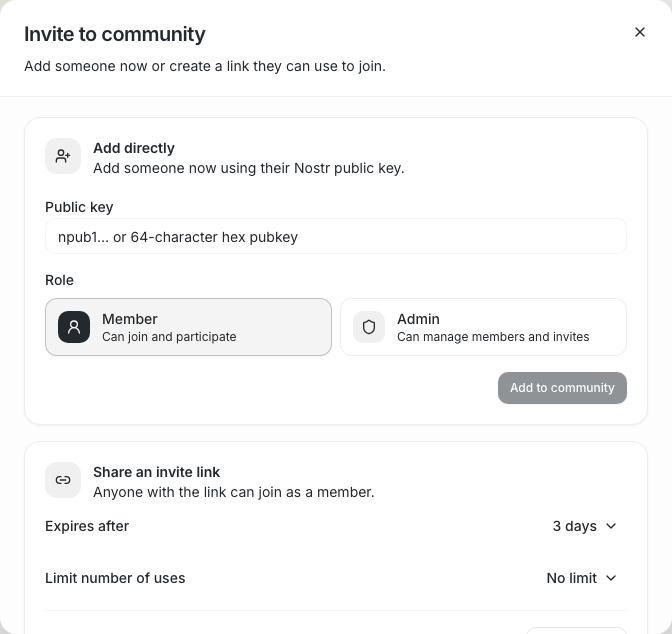
- restore direct community member adds in **Settings → Invites**
- keep one consolidated entry point: the dialog now supports both adding
someone directly and sharing an invite link
- accept npub or 64-character hex keys while preserving role hierarchy
(owners: Member/Admin; admins: Member only)
- verify an npub direct-add publishes the decoded hex key in a kind
`9030` NIP-IA event
## Why
The Invites consolidation left `AddMemberDialog` without a live mount
point, so the existing direct-add capability disappeared even though its
mutation path still existed. This reuses that implementation rather than
introducing a second one.
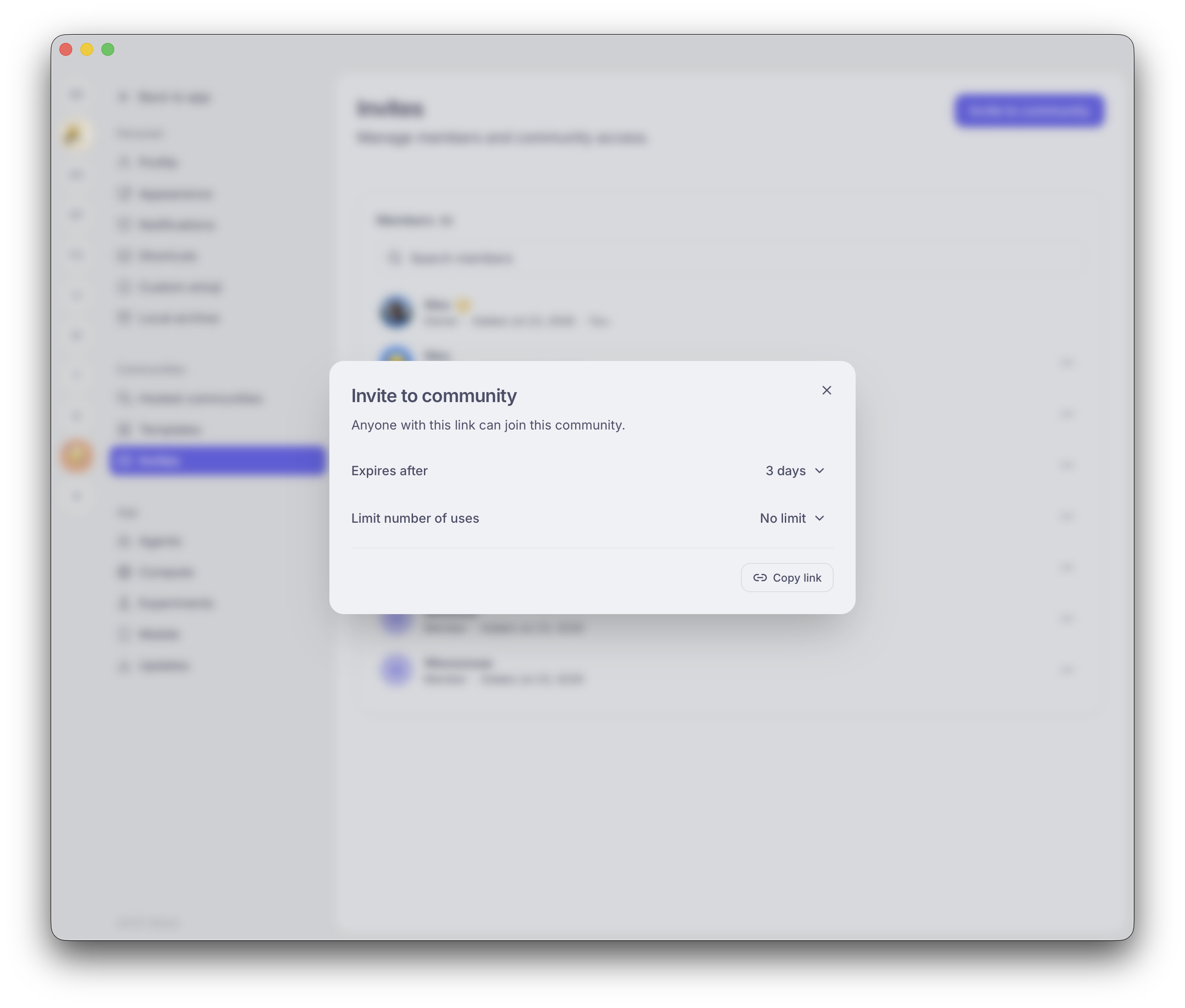
## Before and after
| Before | After |
| --- | --- |
| The consolidated dialog only offered a share link; there was no
direct-add path. | The same dialog now presents direct add and
share-link controls as one invitation flow. |
| 
| 
|
<details>
<summary>Before: Invites page entry point</summary>
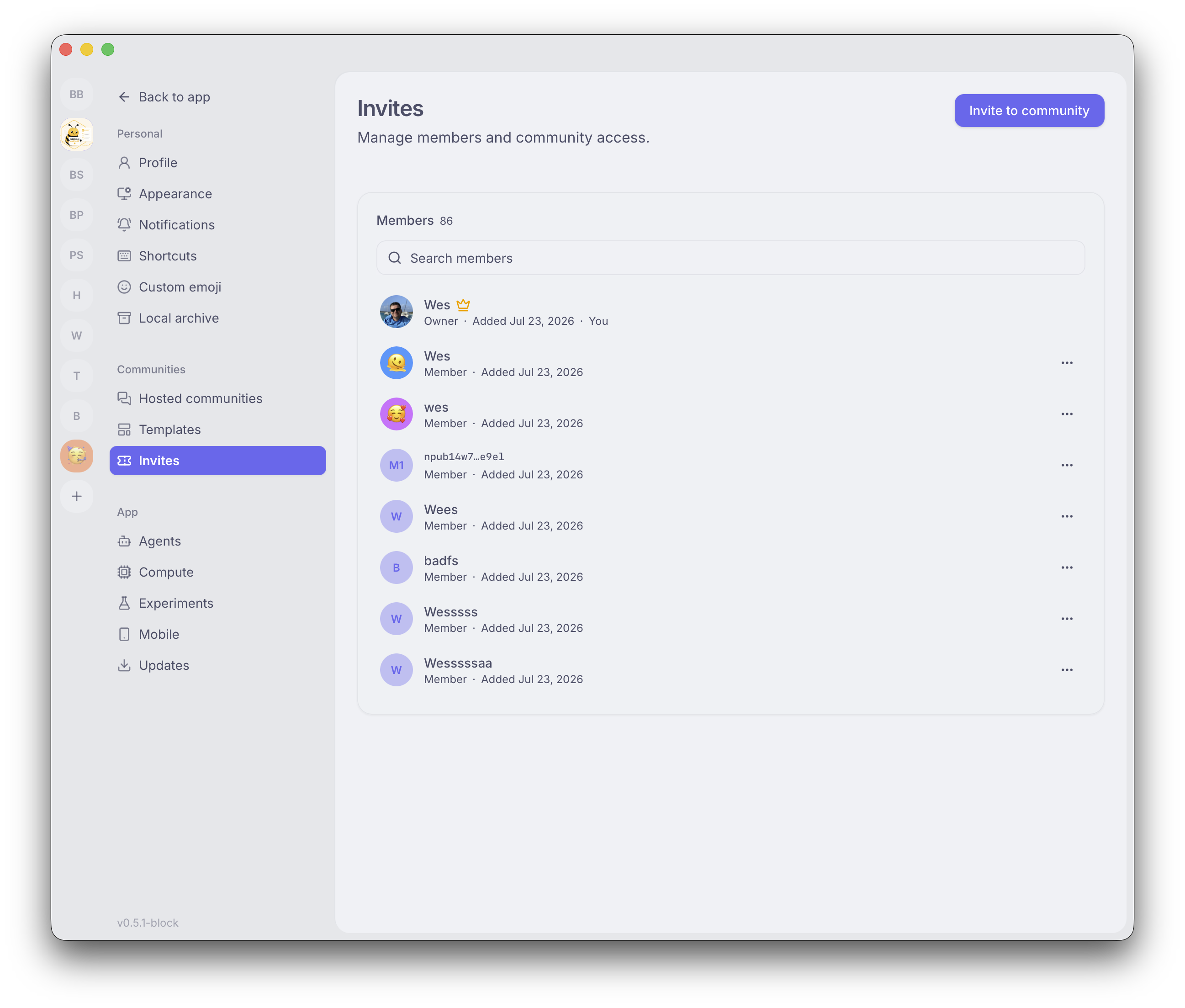
</details>
## Verification
- `pnpm --dir desktop build:e2e`
- `pnpm exec playwright test
tests/e2e/invites-settings-screenshots.spec.ts --project=smoke` — 4
passed
- targeted Biome check on modified files
- push hook: Desktop check and 3,783 Desktop tests passed
- GitHub CI green except Desktop E2E Relay still running at last status
snapshot
---------
Signed-off-by: Joah Gerstenberg <joah@squareup.com>
Signed-off-by: Wes <wesbillman@users.noreply.github.com>
Signed-off-by: kenny lopez <klopez4212@gmail.com>
Co-authored-by: Joah Gerstenberg <joah@squareup.com>
Co-authored-by: Amp <amp@ampcode.com>
Co-authored-by: Carl <c7ebe626f000404285d3686e1dc74cc07cc60a9754a150041ba132e14bd3e2ec@buzz.block.builderlab.xyz>
Co-authored-by: kenny lopez <klopez4212@gmail.com>
## Why

Hack-day feedback exposed a dangerous mismatch between the UI and the
underlying access model. The `Anyone` respond-to mode appeared as a
neutral dropdown choice, while a Buzz agent may act with the files,
accounts, and tools available on the machine where it runs.

People reasonably read this as sharing a bot in a channel. The current
UI did not explain that it can also share the agent's available access.

## What

- Reframes `respond-to` as **agent access** in user-facing UI.
- Uses plain audience labels: **Only me**, **Anyone**, and **Selected
people**.
- Warns for **both** sharing modes, not just `Anyone` — `Selected
people` also hands host access to someone other than the owner, so only
the audience phrase differs:
> Anyone can use this agent to access your computer, including files,
accounts, and connected tools.

> Selected people can use this agent to access your computer, including
files, accounts, and connected tools.
- Names the machine the agent actually runs on. A provider-backed
(remote) agent reads:
> Anyone can use this agent to access the server it runs on, including
any accounts and tools available there.

The remote wording deliberately omits the owner's files — those aren't
theirs to describe on a host they don't own.
- Places the warning below the selector for `Anyone`, but **after** the
people picker for `Selected people`, so it never sits between the user
and the selection they came to make.
- Removes Nostr, harness, pubkey, and `!shutdown` jargon from the
primary decision copy. Direct pubkey entry remains available as an
advanced path.
- Replaces the green open-access avatar dot with an amber warning marker
and accessible text. Selected access uses a separate blue status.
- Aligns the sidebar action and profile field with the same language.
- Records the shared-field disclosure contract in
`desktop/src/features/agents/AGENTS.md` so future surfaces do not
silently omit it.

## Design decisions

**Persistent inline warning, not a confirmation modal.** The setting
does not autosave; the consequence remains visible beside the selection
until the person chooses **Save access**. This gives the information
before commitment without adding a dismiss-and-confirm ritual that would
repeat in every create/edit surface.

**An unknown run location falls back to the local wording.** It does not
hedge with "computer or server". A remote host requires an installed
`buzz-backend-*` provider, and without one `WhereToRunSection` never
renders — so "server" would name a concept the owner has never been
shown. When it *is* remote, they picked that host from the selector
themselves. Surfaces never synthesize a run location they don't have.

**One resolution site, published through context.** `AgentDialog`
resolves the run location (`runLocationForBackend` from
`ManagedAgent.backend`, `runLocationForRunOn` from the create flow's
`WhereToRunDraft`) and publishes it via `AgentRunLocationContext`. It is
not threaded as a prop through `AgentDefinitionDialog` (1047 lines) or
`AgentInstanceEditDialog` (1228 lines) — neither uses the value, and
both are already over the file-size ceiling. Surfaces outside that tree
(`EditRespondToDialog`) pass the prop directly.

The copy follows the writing system's guidance for high-sensitivity
decisions: lead with the material consequence, use plain actor/action
language, keep helper text adjacent and persistent, and never rely on
color alone.

## Scope

Desktop only. The web and mobile clients do not currently expose this
setting. No protocol, gate, runtime, persistence, or backend behavior
changes.

This does not add team-scoped remote agents. It makes the current
local-or-remote access model honest while that product work remains
separate.

## Validation

- `pnpm exec biome check` and `pnpm exec tsc --noEmit` — clean
- `lib/agentAccessWarning.test.mjs` (8/8) — every mode × run-location
copy variant, both resolvers, unknown-reads-as-local, blank `runOn` is
not a provider
- `ui/respondToFieldContract.test.mjs` (8/8) — plain labels, both
warning positions, source-order guard that the `allowlist` warning
follows the picker, helper-not-inline-copy guard
- `agent-access-warning.spec.ts` (3/3) — native local, provider-backed
remote (asserts the server sentence and *not* "your computer"),
persona-backed edit; includes a bounding-box check that the `Selected
people` warning renders below the picker

---------

Signed-off-by: David Hamilton <daveh@squareup.com>
Signed-off-by: Clay Delk <clay.delk@gmail.com>
Co-authored-by: Clay Delk <clay.delk@gmail.com>
Co-authored-by: Claude Opus 5 (1M context) <noreply@anthropic.com>
## Summary
- Show all colon emoji autocomplete matches
- Rank exact and prefix shortcodes before weaker matches
- Add a regression test and screenshot

## Validation
- `pnpm test`
- `pnpm build`
- `pnpm exec playwright test --project=smoke
tests/e2e/custom-emoji.spec.ts --grep "exact standard shortcode"`
- `just desktop-tauri-clippy`

Native Tauri tests were attempted but could not link because the local
disk filled during compilation.

---------

Signed-off-by: kenny lopez <klopez4212@gmail.com>
## Summary
- recover already-full Buzz installs before desktop initialization
without deleting healthy caches
- enforce a global 2 MiB UTF-16 byte budget across disposable message,
channel, timeline-skeleton, and sidebar-skeleton caches, regardless of
relay count
- route all disposable cache writes through quota recovery and reserve
roughly 3 MiB of WebKit's observed ~5 MiB quota for durable state
- preserve communities, identities, preferences, drafts, and read state;
match only delimiter-qualified disposable namespaces

## Context
WebKit enforces an approximately 5 MiB per-origin localStorage quota and
Tauri does not expose an app-level knob to raise it to 50 MiB. Buzz
0.4.26 shipped reactive recovery for selected durable writes, but
disposable writers swallowed quota failures and their existing limits
were count-based per relay rather than byte-based per origin.

This PR handles both halves: upgrade recovery for already-wedged origins
and proactive global headroom so disposable snapshots cannot drive the
origin back to the cliff.

## Safety
- startup first probes a one-byte marker; healthy installs retain their
caches
- only if the marker write fails are the four relay-rehydratable cache
namespaces removed
- namespace matching requires the `v1:` delimiter, preventing future
`v10` or similarly named durable keys from matching
- oversized individual snapshots are rejected; crossing the global
budget evicts disposable snapshots only
- failed recovery leaves the marker absent, so the next launch retries

## Verification
- `pnpm test` — 3,670 passed
- `pnpm check`
- `pnpm typecheck`
- push hooks: branch-skew, desktop-check, desktop-test passed
- byte-budget tests cover UTF-16 accounting, multiple relays, oversized
writes, durable-state preservation, healthy startup, full startup,
marker retry, and namespace near misses

---------

Signed-off-by: Wes <wesbillman@users.noreply.github.com>
Co-authored-by: Carl <c7ebe626f000404285d3686e1dc74cc07cc60a9754a150041ba132e14bd3e2ec@buzz.block.builderlab.xyz>
## Summary

- preserve collapsed GFM table separator rows as literal text
- prevent `||---:|---|---||` from becoming an animated spoiler canvas
- leave normal spoilers and valid multiline tables unchanged

## Root cause

When table newlines are lost, adjacent row pipes become `||`. The
spoiler remark plugin interpreted the delimiter row between those pairs
as a hidden spoiler, so the reported "static" was the spoiler particle
animation rather than table layout churn.

## Safety

The guard only applies to a paragraph span made entirely of text that
exactly matches a multi-column GFM delimiter row. The narrow syntax
collision is that an intentional spoiler containing only a delimiter row
such as `||---|---||` now renders literally.

## Verification

- desktop pre-push checks passed (3,662 tests)
- desktop TypeScript typecheck passed
- independent review found no blocking issues

Signed-off-by: Wes <wesbillman@users.noreply.github.com>
Co-authored-by: Carl <c7ebe626f000404285d3686e1dc74cc07cc60a9754a150041ba132e14bd3e2ec@buzz.block.builderlab.xyz>
## Summary

- Replace all references to a specific corporate VPN product name with
generic "VPN" / "corporate VPN" / "VPN tunnel" / "VPN CLI" language
across 15 files (21 lines)
- Comment-only and doc-only changes — zero functional impact
- Keeps the OSS repo free of vendor-specific assumptions

`rg -i warp` returns zero hits after this change (excluding
`node_modules`, lockfiles).



