Restack after #3910: brings #3259's content under this PR so the
3259×3194 interaction is resolved once, here. Hand-resolved the two
predicted conflicts (rerere disabled, logical base 6186fc231):

- huddle/tts_settings.rs preview_pocket_voice: keep #3259's
  pocket_voice_reference() resolution + #3194's playback_speed
  thread-through into TtsPipeline::new_with_voice.
- testing/e2eBridge.ts: union of #3259's import/delete-voice arms and
  #3194's get/set playback-speed arms; 245 unique case labels, zero
  duplicates (checked programmatically).

MERGE ORDER CONSTRAINT: #3259 must land before this PR.

Co-authored-by: npub1qyvc0c5kl4gqv2fd97fsk46tu378sqgy35vc83rvgfwne90sel7s0ed67d <011987e296fd5006292d2f930b574be47c7801048d1983c46c425d3c95f0cffd@buzz.block.builderlab.xyz>
Signed-off-by: npub1qyvc0c5kl4gqv2fd97fsk46tu378sqgy35vc83rvgfwne90sel7s0ed67d <011987e296fd5006292d2f930b574be47c7801048d1983c46c425d3c95f0cffd@buzz.block.builderlab.xyz>
Relands **#2467** (extract `buzz-voice` crate) and **#3208** (Pocket
voice settings) onto main, after #3266 and #3180 merged.

## Why a fresh PR
The repo is squash-only with delete-branch-on-merge. Squashing #3266
deleted `jtennant/pocket-tts-2026-04`, which was #2467's base — GitHub
auto-closed #2467 and it cannot be reopened. Squash merges also sever
ancestry, so GitHub's natural merge-base reports phantom conflicts for
the whole remaining stack.

## Content provenance
- Byte-identical to the blessed `jt/buzz-voice-refactor` branch
(`93029c577`, tree `6729e0eff` — reviewed by Dawn (#2467) and Max
(#3208) at exact heads) **except** the three files where #3180 and #3208
genuinely interact.
- Three-file resolution (union of both sides):
- `huddle/mod.rs` — #3180's pipeline re-exports + #3208's
`agent_tts_routing` imports.
- `huddle/state.rs` — `reset_preserving_generation` preserves both
`huddle_generation` (#3180) and `tts_enabled` (#3208); test sets merged
into one `tests` module.
- `desktop/src/testing/e2eBridge.ts` — both switch arms kept; no
duplicate case labels.

## Verification at cf32dacd7
- `cargo test` (desktop/src-tauri, pinned 1.95.0): **2047 + 3 pass / 0
fail** (14 ignored: 8 keychain, 4 real_relay, 2 flag-gated)
- `cargo clippy --all-targets -- -D warnings`: clean; `cargo fmt
--check`: clean
- `cargo check --workspace` (root, includes new `buzz-voice` member):
clean; `cargo test -p buzz-voice`: 5/0
- `pnpm test`: **3885 / 0**; `tsc --noEmit`: clean; lint: clean

The 3180×3208 interaction resolution is getting an independent team
re-review before merge.

Buzz channel: buzz-desktop-voice `fd5fb402-b651-4238-89b1-bb3e2fa4dc96`,
thread `b4798ecc`.

Signed-off-by: npub1qyvc0c5kl4gqv2fd97fsk46tu378sqgy35vc83rvgfwne90sel7s0ed67d <011987e296fd5006292d2f930b574be47c7801048d1983c46c425d3c95f0cffd@buzz.block.builderlab.xyz>
Co-authored-by: npub1qyvc0c5kl4gqv2fd97fsk46tu378sqgy35vc83rvgfwne90sel7s0ed67d <011987e296fd5006292d2f930b574be47c7801048d1983c46c425d3c95f0cffd@buzz.block.builderlab.xyz>
## Context
Before this change, every huddle initialized with transcription off.
Joining or adding an agent did not enable it, so the agent could not
receive spoken conversation until a person clicked the transcript
control. Starting a huddle from an agent DM could also omit that agent,
and adding an agent who already belonged to the parent channel could
attempt an unnecessary role change and show a warning.
Agent detection uses authoritative huddle membership. A participant
counts as an agent when the ephemeral membership identifies it with the
`bot` role, or when the existing agent identity model identifies the
participant in an agent DM.
## Summary
Buzz now enables transcription once when the first authoritative agent
is present. After that initial automatic action, explicit user control
is authoritative: manual ON or OFF survives membership refreshes,
reconnects, and UI remounts. Removing the last agent does not change the
current transcription state.
Agent-DM huddles enroll the agent automatically. Adding an agent who
already belongs to the parent channel preserves the existing parent role
and completes without a role-mutation warning.
| Scenario | Before | With this change |
| --- | --- | --- |
| First authoritative agent joins or is hydrated | Transcription stays
off | Transcription turns on once |
| User explicitly turns transcription on or off | Manual control exists
without an agent policy | The explicit choice suppresses later automatic
changes |
| Last agent leaves | No defined agent-presence behavior | The current
transcription state remains unchanged |
| Huddle starts from an agent DM | The agent can be omitted | The known
agent is enrolled automatically |
| Added agent already belongs to the parent channel | Buzz can attempt a
role rewrite and warn | Existing parent membership and role are
preserved |
| Transcription is active | The control is not visually distinct | The
control is highlighted and exposes `aria-pressed=true` |
## Changes
- Derive agent presence from authoritative bot-role huddle membership
and known agent-DM identity.
- Apply the one-time auto-enable rule during create, join, membership
hydration, reconnect, pipeline startup, and local agent addition.
- Preserve explicit user state and use huddle-generation guards so stale
asynchronous work cannot alter a replacement huddle.
- Keep backend and React transcription state synchronized, with a
visible and accessible active control.
- Enroll known agent-DM participants and make parent-channel membership
updates idempotent.
- Cover hydration ordering, reconnects, remounts, explicit OFF,
last-agent removal, DM enrollment, existing membership, and active
styling.
## Related issue
None found.
## Testing
Manual validation in `pending-seed` confirmed the product contract:
1. Started a huddle from the owned, running Fizz agent DM.
2. Confirmed the authoritative roster contained the human and Fizz as an
agent.
3. Confirmed transcription enabled without clicking the control: `Stop
transcript`, `aria-pressed=true`, with the highlighted active
background.
4. Turned transcription off and confirmed `Start transcript`,
`aria-pressed=false` remained stable.
5. Removed Fizz while transcription was off and confirmed the state
stayed off.
6. Left the huddle cleanly.
## Screenshots
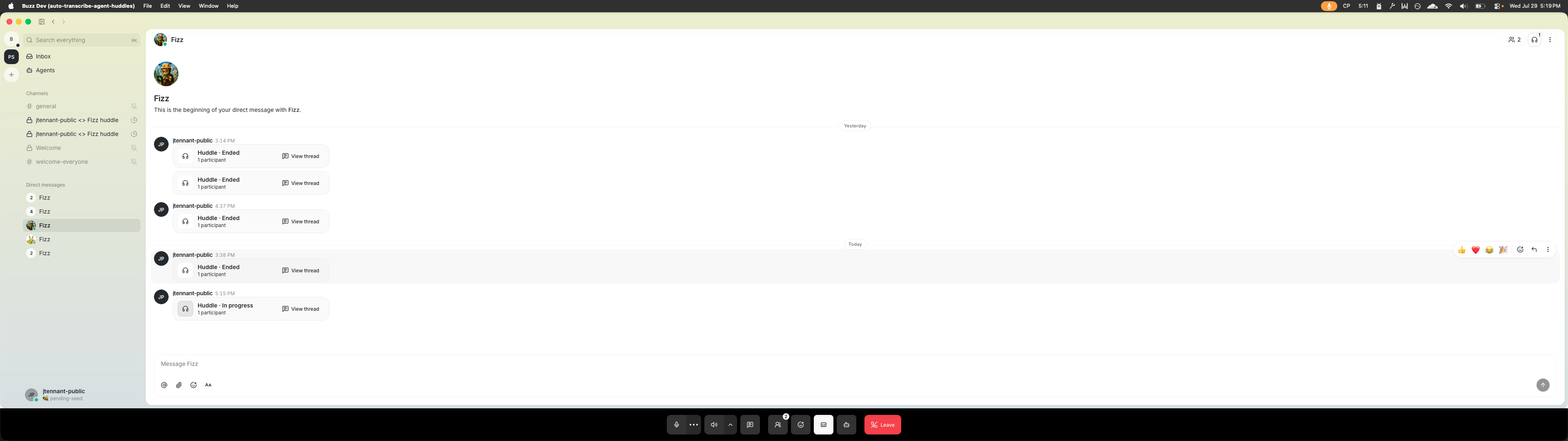
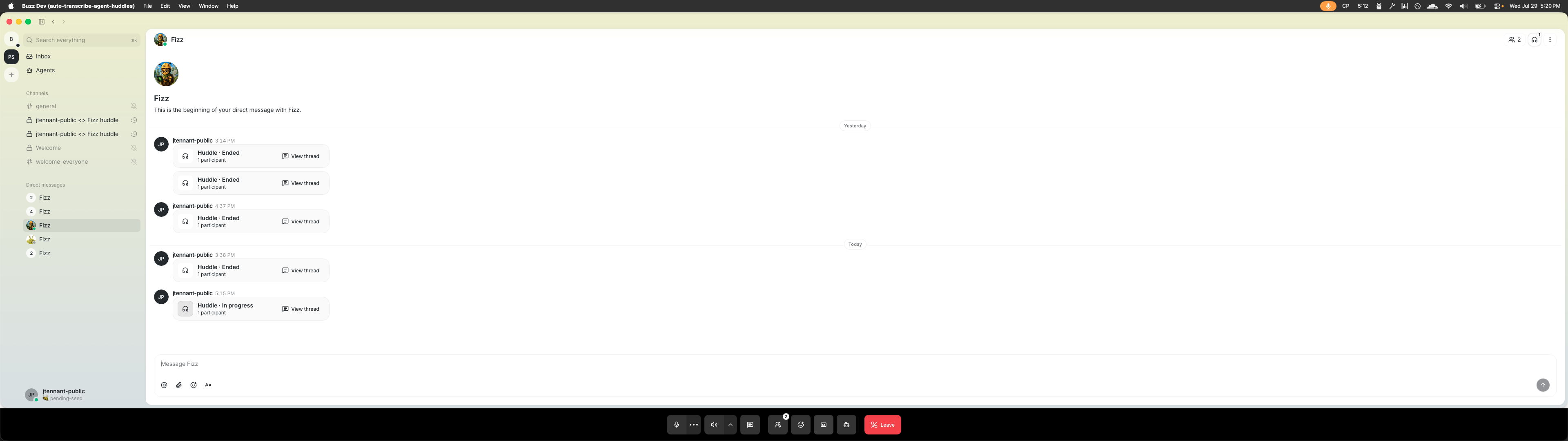
The same control has distinct active and inactive states.
## Reviewer-reproducible examples
From a fresh checkout:
```bash
pnpm --dir desktop build:e2e
pnpm --dir desktop exec playwright test tests/e2e/huddle-transcription.spec.ts --project=smoke
pnpm --dir desktop exec playwright test tests/e2e/mentions.spec.ts --project=smoke --grep "system agent profile exposes owned agent actions|system agent avatar exposes owned agent actions|owned bot profile exposes message and huddle actions|owned agent mention profile exposes message and huddle actions"
```
The huddle scenario exercises initial authoritative hydration, exactly
one automatic enable, explicit OFF persistence, unchanged state after
last-agent removal, newer events winning over delayed hydration,
agent-DM enrollment, and idempotent parent membership. It also asserts
`aria-pressed` and distinct computed active styling.
---------
Signed-off-by: John Tennant <jtennant@squareup.com>
Signed-off-by: npub1jh9wn95s0472h86ahapupaf7m6kx4v9sx2n0atj2hltcfer8k06s5n3pyf <95cae996907d7cab9f5dbf43c0f53edeac6ab0b032a6feae4abfd784e467b3f5@buzz.block.builderlab.xyz>
Co-authored-by: npub1jh9wn95s0472h86ahapupaf7m6kx4v9sx2n0atj2hltcfer8k06s5n3pyf <95cae996907d7cab9f5dbf43c0f53edeac6ab0b032a6feae4abfd784e467b3f5@buzz.block.builderlab.xyz>
## Why

A Buzz agent's assistant text and reasoning are never shown to anyone —
only what it posts through the CLI. A turn that runs fifteen tool calls
and never publishes is a silent failure: the requester waits on a result
that was produced and thrown away.

This adds an optional reminder at the end-of-turn gate, off by default.

Tyler asked for it in buzz-mesh; plan iterated to **9.5/10 with @Wren**
(Minimalness 9.7, Elegance 9.5, Correctness 9.3).

## What

`BUZZ_AGENT_REQUIRE_REPLY=1` (default off, per-agent opt-in). A turn
about to end with no recognized attempt to post gets a reminder and is
rerolled. **At most two, then the turn ends regardless** — the guard
catches accidental omission, it does not compel speech. The reminder
text explicitly licenses silence so it cannot fight the base prompt's
"silence is usually correct."

**This is not a new MCP hook.** `RunCtx::run` *is* the turn, so the two
per-turn locals need no plumbing, and every tool call already passes
through it with arguments visible. The objection is appended at the
existing `_Stop` gate and rides `push_hook_outputs_as_tool_results`, so
the model receives it as a lower-trust tool result with `{hook, server,
text}` attribution. No new trust path, no new lifecycle event, no
dev-mcp or CLI protocol change.

Earlier revisions of this plan needed four crates (a `_UserPromptSubmit`
hook, a marker file, a `buzz-cli` change, dev-mcp state). Tyler pointed
out the agent already knows both facts; that deleted all of it. Net
runtime change is ~35 lines in `agent.rs` + ~4 in `config.rs`.

### Recognition contract

A registered non-hook tool whose qualified name ends in `__shell`, whose
`command` argument contains `messages send` or `reactions add`.

- **The `__` separator is exact, not approximate.** Given `has()` +
`!is_hook()`, `ends_with("__shell")` is *provably equivalent* to a bare
name of `shell`: registration forbids `__` in server and bare names
(`mcp.rs:227,268`) and qnames are `{server}__{bare}`, so a trailing
`__shell` could only straddle the separator if the bare name began with
`_` — which `is_hook` excludes. Without the separator, `powershell` and
`noshell` would match.
- **Reads the structured `command` field**, not serialized arguments, so
a `description` that quotes a send cannot disarm the guard, and a
non-string `command` is rejected rather than coerced.
- **Detects an attempt, not a successful publish.** A failed send
already returns non-zero exit and error JSON — louder than this
reminder. The variable is named `buzz_reply_call_seen` so the code can't
pretend otherwise.
- **Checked after the per-turn tool-call cap**, since a discarded call
never ran.
- `messages send` also covers `messages send-diff`. Reactions count
because the base prompt directs agents to react rather than post a bare
acknowledgement.

**Known limits, both deliberate and documented:** a command assembled at
runtime (`$CMD`) or hidden in a wrapper script is missed; text that
merely quotes a send (`echo "buzz messages send"`) matches. Missing a
real post is the expensive direction and substring matching is the
forgiving one there. Neither edge is pinned by a test, so the matcher
stays free to improve.

### Budget

Reminders share `BUZZ_AGENT_STOP_MAX_REJECTIONS`, the existing outer cap
on every end-turn objection. Default 3 fits both; at 1 only one fits; at
0 the guard is off with the hooks. A round carrying both a hook
objection and a reminder costs one rejection and delivers both texts. An
independent budget would either violate that bound or need a second
arbitration rule.

## Prior art

- **#3467** (closed) built the same detector one layer up in `buzz-acp`
for a different remedy. None of its symbols are on main — this borrows
its permission to be coarse, but reads structured data that ACP didn't
have.
- **#3648** (open) detects turns with *no output at all*; a turn with
fifteen tool calls and no post counts as output there, so it does not
cover this case.
- **#3741** (merged) is mesh-only.

## Testing

**14 new tests.** 4 unit tests on the matcher; 10 integration tests
through the ACP wire harness: off by default, `=0` still off, opted-in
silent → exactly 2 reminders then `end_turn`, registered `fake__shell`
send → 0 reminders, hallucinated `fake__shell` → still reminded, publish
call truncated past the 64-call cap → still reminded, budget 1 → 1
reminder, budget 0 → off, combined `_Stop` hook objection + reminder →
one round both texts and after 2 reminders the hook objection continues
alone, unparseable `=true` → startup error naming the key.

**10 mutation checks, each breaking a specific named test** — neutralize
the nag cap, stop sharing the budget, neutralize `buzz_reply_call_seen`,
drop `has`/`is_hook`, ignore the flag, drop the `__`, drop `reactions
add`, read serialized args, move detection before truncation.

`tests/bin/fake_mcp.rs` gains `FAKE_MCP_SHELL_TOOL=1`: it previously
exposed no tool with a bare name of `shell`, so the satisfied-guard path
was untestable.

Full `cargo test -p buzz-agent` green at 9e0ae1f04; clippy `-D warnings`
and `cargo fmt --check` clean.

**Unrelated flake found:**
`cancelled_turn_with_usage_emits_notification_before_response`
(`tests/fake_llm.rs`) is timing-sensitive. Under 10 loaded cores it
fails **2/20 on this branch and 1/20 at unmodified
`origin/main@02be413b8`** — pre-existing, not caused by this change
(which is inert without the env var). Flagging so it isn't misattributed
to the next PR that's open when CI hits it.

## Docs

`crates/buzz-agent/README.md` is the primary home (env var, recognition
contract, limits, budget interaction). `docs/MCP_DRIVEN_HOOKS.md` gets a
short cross-reference explaining this is *not* a hook — otherwise
readers hunt for a `_ReplyGuard` tool that doesn't exist.

---------

Signed-off-by: tlongwell-block <109685178+tlongwell-block@users.noreply.github.com>
Signed-off-by: npub1mprnacetjua2xx3p5eddmhxyk6wv929ymm5py8kd2xfxurxahspqqlgyta <d8473ee32b973aa31a21a65adddcc4b69cc2a8a4dee8121ecd51926e0cddbc02@buzz.block.builderlab.xyz>
Co-authored-by: Dawn (sprout agent) <c6237ef84fa537c78dcee78efd2d4e59f728859c7f194da42ac51ededfa0be05@sprout-oss.stage.blox.sqprod.co>
Co-authored-by: npub1mprnacetjua2xx3p5eddmhxyk6wv929ymm5py8kd2xfxurxahspqqlgyta <d8473ee32b973aa31a21a65adddcc4b69cc2a8a4dee8121ecd51926e0cddbc02@buzz.block.builderlab.xyz>
## Context

Buzz Desktop currently installs an older Pocket TTS model bundle. The
current
bundle changes the tokenizer, learned BOS input, recurrent-state
contract, and
prompt behavior, so updating download URLs alone is not compatible.

## Summary

This PR upgrades Buzz Desktop to the current pinned Pocket TTS model. It
preserves existing product behavior and the hard 50-token model-input
limit
while adding the required runtime support, verified acquisition, and
crash-safe
cache migration.

## Changes

- Pins an immutable Pocket TTS revision, artifact names, exact byte
sizes,
  SHA-256 checksums, Mary reference voice, and license.
- Loads the bundle-matched SentencePiece tokenizer, learned BOS
embedding, and
  bundle-declared recurrent states.
- Uses one pinned Pocket TTS configuration; no precision or
model-version
  selector is added.
- Preserves the resident engine's exact `<= 50` token contract without
changing
  Desktop segmentation policy.
- Bumps the Pocket cache manifest to v4, verifies size and checksum
before
adoption, atomically swaps the cache, and recovers the last verified
cache
  after interrupted installs, including an incomplete final directory.
- Keeps acquisition, cache migration, worker adoption, and tests within
the
  existing Desktop implementation.
- Removes the obsolete model-quality harness, which was coupled to the
  superseded production prompt and model layout.

## Related issue

None.

## Testing

Manual listening completed on the exact Desktop build. The updated model
improved speech quality and resolved the phrase-start and sample-onset
artifacts. Reproducible integrity and model checks are below.

## Screenshots

N/A. This changes model installation and speech synthesis, not a visual
surface.

## Reviewer-reproducible examples

### Before and after model identity

```sh
git show 35305bfc8fd456ca9a17caa1ddbfaabd87d46981:desktop/src-tauri/src/huddle/models.rs \
  | grep -E 'sherpa-onnx-pocket-tts|TTS_MODEL_VERSION'

git show 211d17c58567448fe7ac95c4fa0ad2b88378849a:desktop/src-tauri/src/huddle/pocket_models.rs \
  | grep -E 'MODEL_REPOSITORY|MODEL_REVISION|MODEL_PRECISION|MAX_TOKENS'
```

The target branch identifies the January bundle. The PR branch
identifies the
immutable April revision, INT8 precision, and 50-token maximum.

### Deterministic runtime validation

Use the pinned artifacts listed in `pocket_models.rs` and run the
model-dependent Pocket tests with the model directory supplied by the
test environment. The checked-in long-sentence fixture must preserve its
expected 48 and 44 token split and produce non-silent PCM.

### Manual listening validation

John listened to an untrimmed Pocket TTS onset-stress clip generated
from the exact user-provided passage, with every sentence synthesized
separately and identical 100 ms digital-silence boundaries. The clip
used no leading period, onset trimming, gain adjustment, or loudness
normalization.

The updated model produced better-quality speech and resolved the
start-of-sample artifacts.

---------

Signed-off-by: John Tennant <jtennant@block.xyz>
Signed-off-by: npub1mprnacetjua2xx3p5eddmhxyk6wv929ymm5py8kd2xfxurxahspqqlgyta <d8473ee32b973aa31a21a65adddcc4b69cc2a8a4dee8121ecd51926e0cddbc02@buzz.block.builderlab.xyz>
Co-authored-by: John Tennant <jtennant@block.xyz>
Co-authored-by: npub1mprnacetjua2xx3p5eddmhxyk6wv929ymm5py8kd2xfxurxahspqqlgyta <d8473ee32b973aa31a21a65adddcc4b69cc2a8a4dee8121ecd51926e0cddbc02@buzz.block.builderlab.xyz>
## Summary

Adds a locally stored **NIP-49 encrypted key backup** (`ncryptsec`) to
the desktop app, per the plan reviewed in buzz-development (Rev 3,
approved 9/10 by Wren; implementation also reviewed and approved 9/10).

**Two-artifact design — canonical bytes originate entirely in Rust:**
- `create_ncryptsec_backup` runs under the `identity_mutation` lock:
encrypt → decrypt-verify against the live pubkey → atomic `0o600` write
to `{app_data_dir}/identity.ncryptsec` → reread/byte-compare → return
the exact persisted bytes. The frontend never re-derives or re-encrypts.
- `save_ncryptsec_copy` writes a portable copy via the save dialog
(parse-gated, secret-file semantics) and never mutates canonical state.
- `generate_backup_passphrase`: 6 words from the EFF short wordlist via
`OsRng` (custom passphrases min 12 chars).
- Import accepts `ncryptsec1` with optional password; the raw-`nsec`
path is untouched. Different-pubkey import and sign-out wipe the
app-managed backup (post-commit, best-effort — a failed import can never
destroy the still-live identity's backup; regression-tested).

**Never-relay guarantee (egress guard + tripwires):**
- `egress_guard.rs` fail-closed at all 8 `/events` submission boundaries
(relay submit funnel, 3× `relay.rs`, huddle STT, both engram submitters,
native WS choke point), rejecting `ncryptsec1`/`NCRYPTSEC1` in text and
binary frames. Scope is deliberately ncryptsec-only: pairing
intentionally carries raw nsec inside its encrypted session.
- Site-granular `/events` inventory tripwire: per-file (`/events` count,
guard-call count) pairs; unlisted files expect zero. Mutation-style
tests prove a ninth site in an existing file, a removed guard, and a new
unlisted file all fail the scan.
- ncryptsec source-allowlist scans in **both** trees (Rust + TS).

**Frontend:** onboarding `BackupStep` is encrypted-by-default — the
default path never invokes `get_nsec` (e2e asserts the command log).
Raw-nsec export stays behind an explicit click with prior semantics.
Shared `EncryptedBackupCreator` powers onboarding + a new settings row;
the import form auto-switches to encrypted mode on `ncryptsec1` paste
(case-insensitive HRP).

**Open product call for @tlongwell-block:** onboarding default is
*encrypted* in this PR; flipping to raw-default is a small change either
way (documented in the plan).

Review history: plan Rev 3 and the implementation were both iterated
with Wren to 9/10 (two blockers from round 1 — import ordering,
inventory granularity — plus an uppercase-bech32 hardening gap, all
fixed in `dde37183e`). Thread: buzz-development.

### Related issue

Follow-up to the direction explored in #385 (NIP-PB, closed) — this
ships local NIP-49 (the standard) instead of a new NIP. No open
duplicate found.

### Testing

All at exactly `dde37183e` (same shell, HEAD verified):

- `cargo test` — 1680 passed / 0 failed / 14 ignored (includes a
deliberate ~70s log_n-18 NIP-49 round trip, spec vector, wrong-password,
NFKC, uppercase-vector decrypt, injection test per egress boundary,
inventory mutation tests, import-ordering regression tests)
- `cargo clippy --all-targets -- -D warnings` — clean; `cargo fmt
--check` — clean
- `pnpm typecheck` — clean; JS unit suite 3529/3529; biome (repo-pinned
2.4.16) clean
- Playwright `onboarding-backup` / `onboarding` /
`onboarding-agent-defaults` / `profile-nsec-reveal` — 86 passed, 1 known
avatar-reservation flake (passed on rerun; untouched by this diff).
`passThroughBackupStep` now exercises the encrypted default, so every
downstream onboarding spec covers the new path.
- Note: browser e2e fakes the crypto via the mock bridge (fixed
spec-vector blob); decryption correctness is proven in the Rust tests.

## Latest onboarding integration

The current head adds an additive `IdentityInfo.storage` field
(`ephemeral`, `system-keyring`, `local-file`, or `environment`) so
onboarding can accurately explain where the active identity is
protected. It surfaces storage metadata only—never key material—and
leaves the existing lost/keyring-locked recovery behavior intact.

---------

Signed-off-by: Tyler Longwell <tlongwell@block.xyz>
Signed-off-by: Taylor Ho <taylorkmho@gmail.com>
Co-authored-by: npub1qyvc0c5kl4gqv2fd97fsk46tu378sqgy35vc83rvgfwne90sel7s0ed67d <011987e296fd5006292d2f930b574be47c7801048d1983c46c425d3c95f0cffd@buzz.block.builderlab.xyz>
Co-authored-by: Tyler Longwell <tlongwell@block.xyz>
Co-authored-by: Taylor Ho <taylorkmho@gmail.com>
Co-authored-by: npub1223z34hd7vtwc6qj4s7flsxkj644nlre2nthu7lrrmkumhu3xddsrx9r6w <52a228d6edf316ec6812ac3c9fc0d696ab59fc7954d77e7be31eedcddf91335b@buzz.block.builderlab.xyz>
Local `desktop-tauri-clippy` fails on macOS with dead-code errors for
`PROD_ORIGIN`, `DEV_ORIGIN`, and `is_trusted_media_origin`, which are
only used inside `#[cfg(target_os = "linux")] enable_media_capture`. The
items are intentionally platform-independent so unit tests run
everywhere. Added `cfg_attr` allow attribute to suppress the warnings on
non-Linux targets.

Since [#3607](https://github.com/block/buzz/pull/3607), this affects all
Rust developers on macOS.

Signed-off-by: Will Pfleger <pfleger.will@gmail.com>
Co-authored-by: d32955ad69077062930cc46cfe2df30ca9aaf6f8e76422681265e9e9af704d78 <d32955ad69077062930cc46cfe2df30ca9aaf6f8e76422681265e9e9af704d78@buzz.block.builderlab.xyz>
Team catalog projections (`kind:30178`) embed every member's system
prompt, so they need the same read gate personas already have: only the
author sees an unshared event. The gate was hardcoded to `kind:30175` at
six read surfaces plus the SQL pushdown, so rather than adding a second
special case it becomes kind-generic over `SHARED_GATED_KINDS = {30175,
30178}`.

## Kind 30178

New parameterized-replaceable kind, addressed by `(pubkey_o, 30178,
team_id)`. It embeds sanitized member projections instead of referencing
`kind:30175` heads — a foreign reader of a shared team could not
otherwise hydrate members whose own persona events are unshared or, for
built-ins, absent entirely. `kind:30176`'s wire body is untouched, so
device sync keeps its contract.

## Kind-generic shared gate

`buzz_core::kind` replaces `is_persona_shared_kind` /
`is_unshared_persona_event` / `persona_event_is_shared` with
`SHARED_GATED_KINDS` and the kind-agnostic `is_shared_gated_kind` /
`is_unshared_gated_event` / `event_is_shared`. Every read surface
consults the set:

| Surface | File |
|---|---|
| REQ historical delivery + `ids` lookup |
`crates/buzz-relay/src/handlers/req.rs` |
| Live fan-out | `crates/buzz-relay/src/handlers/event.rs` |
| COUNT fallback | `crates/buzz-relay/src/handlers/count.rs` |
| NIP-98 HTTP `/query`, `/count`, `/search` |
`crates/buzz-relay/src/api/bridge.rs` |
| Pre-`LIMIT` SQL pushdown | `crates/buzz-db/src/event.rs` |

The SQL clause generalizes from `kind != 30175` to `kind NOT IN (...)`
bound from `SHARED_GATED_KINDS`, still applied before `ORDER BY … LIMIT`
so a page of newer private events cannot starve an older shared one off
the candidate set. `EventQuery::persona_reader` is renamed
`shared_gated_reader` and `needs_persona_filtering` to
`needs_shared_gate_filtering` to match.

Because the `buzz-core` rename has consumers outside the relay, the four
desktop call sites of `persona_event_is_shared` travel with it:
`desktop/src-tauri/src/commands/personas/pending.rs`,
`desktop/src-tauri/src/event_sync.rs`, and two in
`desktop/src-tauri/src/managed_agents/persona_events.rs`. Each call is
unchanged apart from the name — the persona `shared` projection behaves
exactly as before.

## Ingest validation

`validate_persona_envelope` splits into two reusable pieces —
`validate_shared_tag` (exactly-two-element `["shared","true"]`, at most
one occurrence) and `single_bounded_d_tag` (exactly one `d` tag,
non-empty, `<=64` chars, no ASCII control characters or whitespace).
`validate_team_catalog_envelope` composes both; personas additionally
keep the slug grammar `^[a-z0-9][a-z0-9_-]{0,63}$`.

`kind:30178` deliberately does **not** get the slug grammar. Team ids
are UUIDs or built-in identifiers such as `builtin-team:welcome`, and
the colon is not slug-legal; rewriting ids to fit would break NIP-33
addressing against the team's own `kind:30176` head. The non-empty and
exactly-one checks are load-bearing regardless — without them generic
NIP-33 storage maps a missing `d` onto `(pubkey_o, 30178, "")` and every
team overwrites its predecessor.

The exact two-element `shared` shape is enforced because the SQL
visibility clause is JSONB containment (`tags @>
'[["shared","true"]]'`), which would match a three-element superset such
as `["shared","true","extra"]`.

`kind:30178` is also added to the `Scope::UsersWrite` allowlist and to
`is_global_only_kind`, so a stray `h` tag cannot channel-scope an
owner-authored definition.

## Deferred

`kind:30176` is deliberately not a gate member. Its writers never emit
`shared`, so catalog opt-in semantics do not describe it — it needs
owner-private reads driven by an authenticated principal set, tracked as
a separate follow-up.

## Tests

- 19 new `ingest.rs` unit tests covering the 30178 envelope (UUID and
colon `d` tags, 64-char boundary, non-ASCII bound,
empty/valueless/duplicate/missing `d`, embedded newline, `shared`
false/three-element/duplicate, scope and global-only membership).
- Persona regressions for the valueless `["d"]` shapes, since the
`d`-tag helper is shared by both validators.
- Existing `kind.rs` gate tests generalized and extended to assert the
gate applies to 30178 as it does to 30175.
- New `crates/buzz-test-client/tests/e2e_team_catalog.rs`: 9 WS-level
tests over a live relay covering author reads of unshared heads, foreign
omission from REQ, `ids`-lookup denial, COUNT existence-leak, share and
unshare transitions, and the mixed-kind filter case.
- `.github/workflows/ci.yml` adds `--test e2e_team_catalog` to the Relay
E2E job so the new suite runs.

## Docs

`docs/nips/NIP-AP.md` gains a "Team catalog projection: kind:30178"
section and an "Ingest validation: kind:30178" subsection, records the
gate as kind-generic, documents 30178 deletion vs. unshare semantics,
and adds a security note that sharing a team exposes every member's
instructions even when that member's own `kind:30175` head is unshared.

Signed-off-by: Will Pfleger <pfleger.will@gmail.com>
Windows installs of Goose and other harnesses failed at exactly five
minutes with an empty error (#2401). The 300s ceiling was killing
installs that were working, just slowly — the Goose step pulls a ~79MB
release asset, and Windows Defender scans every file npm extracts. When
the ceiling fired it discarded the output it had already read, so the
user got a bare timeout string and no way to tell a hang from a large
download.

## The ceiling

`INSTALL_TIMEOUT` is 900s, and the error names the limit: `install
command exceeded the 15m ceiling and was terminated`. It stays a pure
wall-clock ceiling with no inactivity kill — nothing observable
distinguishes a hung installer from one silently transferring a large
artifact, so silence alone never kills an install. A ceiling kill
remains non-retryable; re-running a command that already burned 15
minutes costs the user more time with no plausible path to success.

The child's exit and both stream drains fold into one resumable settle
governed by a single deadline. Waiting on the drains outside that
deadline would let a descendant that outlived the install shell hold the
output pipes — and the per-runtime install guard behind them — open with
no bound, which is the failure the ceiling exists to prevent. So the
deadline path terminates the process group on the normal-exit branch
too: a leader that exited with a real status still gets its stragglers
killed, and the guard cannot stick either way. Whether the leader had
already exited only decides the verdict — its real status outranks a
timeout.

The install shell is a session leader and its descendants inherit the
output pipes, so signalling only the leader left them running and the
drains blocked on a pipe nobody would close. Escalation keys off the
*group's* liveness rather than the leader's, since a descendant that
ignores SIGTERM outlives the leader and would otherwise never receive
the group SIGKILL. Reaping the killed child and finishing the drains
share one bounded grace, so a termination that failed outright cannot
extend the ceiling that just fired.

## Output capture

Each stream drains into a bounded capture that is *shared* with the
reader rather than returned by it, so whatever arrived before a stall is
readable at the ceiling — exactly when the output matters most. Output
of any size costs a fixed amount of memory.

One capture holds two independently bounded views of the same bytes:

| View | Head / tail | Cut marker |
|------|-------------|------------|
| UI (`InstallStepResult`) | 512 B / 1024 B | `... (N bytes omitted)
...` |
| Log file | 128 KiB / 128 KiB | `... [N bytes omitted at cap] ...` |

The UI budget is screen space; the log's is disk. Both markers are
inline, so neither ever implies completeness it does not have. Both ends
are cut at arbitrary byte offsets, so a partial character is trimmed and
the partial token each cut left behind is dropped — the marker's byte
count includes both trims.

## Install log

`steps` carries only the last attempt of each step, truncated for
display. Everything else — earlier retries, the prerequisite step that
actually broke, the managed-Node bootstrap — used to be discarded.
`InstallReporter` now appends one self-contained record per attempt of
per step to `install-<runtime-id>.log` beside the agent logs, and
`InstallRuntimeResult.log_path` carries the file to the UI, where a
failure message ends with `Full log: <path>`.

Each record is bounded independently by the log-scale capture that
produced it, so a first attempt that printed megabytes cannot push out
the later record explaining the failure; the run's total is bounded by
steps × attempts × per-record cap. Every early return builds its result
through one `InstallReporter::failed` helper, so no failure path can
omit the log pointer, and synthesized steps go through `record_step` — a
step that reaches the UI without passing it would be invisible in the
file.

Install output can echo a registry token or proxy credential from the
environment it ran in, and the file is written unattended. Redaction
keys off the *names* of the environment variables the install inherited,
snapshotted once per run, rather than a list of known secret value
prefixes: a credential with no recognisable shape is exactly the one a
prefix match misses. Three name rules apply, because the variables need
different treatment:

| Rule | Variables | Redacted |
|------|-----------|----------|
| URL userinfo | `HTTP_PROXY`, `HTTPS_PROXY`, `ALL_PROXY`,
`NPM_CONFIG_PROXY`, `NPM_CONFIG_HTTPS_PROXY`, `NPM_CONFIG_REGISTRY` |
`user:password` only |
| Exact name | `NPM_CONFIG_KEY`, `NPM_CONFIG__AUTH`, `NPM_CONFIG_OTP` |
whole value |
| Marker substring | `*TOKEN*`, `*SECRET*`, `*PASSWORD*`, `*_PAT`, … |
whole value, 8-byte floor |

A proxy or registry keeps its host and port, because an install that
fails behind one is diagnosable only if the record still says which one
it went through, and a bare `user@` with no password is not treated as a
credential. npm's own settings are listed by exact name rather than
matched on `KEY` or `AUTH` substrings — both occur throughout an
ordinary environment on values that are paths and people's names — and
they bypass the 8-byte floor, since a six-digit one-time password is a
credential at that length. Matching is case-insensitive, which is what
npm's lowercase `npm_config_*` spelling needs. `0o600` is set by the
create rather than a later `chmod`, which would leave a window where the
umask decides. A runtime id that cannot safely be a filename yields no
log rather than a sanitized one — a rewritten id could collide with
another runtime's log.

The file holds exactly one run. A run opens its own session after the
runtime id has been canonically resolved — the previous file rotates to
`.1` and any older `.1` is removed before the rename, since a rename
that will not replace its destination would otherwise wedge rotation
permanently on Windows. The session writes a header naming the runtime,
the app version (`app.package_info().version` on the Rust side — cannot
be mocked or fail), the OS (`std::env::consts::OS`), and the start time:
a Windows failure and a macOS one on the same runtime are different
bugs, and a stale app version explains a failure that no longer
reproduces. Each record carries its attempt's elapsed time.

## Live output line

A 15-minute ceiling with nothing behind it but a spinner is
indistinguishable from a hang. The same drain seam feeds an
`acp-install-output` event carrying the newest complete line, and the
three install entry points — Doctor harness rows, the harness catalog
dialog, and onboarding runtime cards — render it under the spinner with
`aria-live="polite"`.

Ordering is keyed on a `seq` monotonic across the whole install, not on
the attempt number, which restarts at 1 for every step: keyed on
attempt, one step succeeding on attempt 2 would make the next step's
attempt-1 output look stale and freeze the display for the rest of the
install. Each executed attempt begins with an unthrottled `line: null`
clear signal, so a stale failure line cannot sit under the spinner while
the retry runs. Events are otherwise throttled to four per second, and
the throttle *retains* the newest pending line and flushes it when the
window reopens rather than dropping it — at an attempt boundary a drop
would silently eat the new attempt's first line.

The subscription is mounted for the runtime's whole lifetime rather than
started when the install begins. The install command is invoked from the
click handler, so the clear and a fast command's first lines can be
emitted before React has committed the pending state, and nothing
replays them — a subscription that waited for that state would lose the
entire output of a short install. The run boundary resets the ordering
key when the install settles, since `seq` restarts for the next run, and
the line renders only while installing, so a straggler from a finishing
drain cannot appear under a fresh Install button.

The 15-minute ceiling deliberately stops waiting on stuck drain threads
— a hung installer must not freeze the app. That means a drain thread
can outlive its `InstallReporter`. Without a generation guard, a drain
that calls `offer` after the run settles would publish an event with the
run's high `seq`, poison the permanent listener's React state, and cause
the next install's restarted `seq=0` events to be rejected. `Live` now
carries a `lifecycle: Arc<RwLock<bool>>`; drain threads hold a **shared
read guard** from the admission check through the `(self.emit)(...)`
call, making the check-then-emit pair atomic with respect to shutdown.
`InstallReporter::drop` takes the **exclusive write guard** and stores
`false` — this blocks until every in-flight drain publication releases
its read guard, then prevents any new admission. Deactivation is
bounded: the write lock holds only for the flag store, so it can block
at most for the duration of one emit call (microseconds to low
milliseconds). Rust drops locals in reverse-declaration order, so
`reporter` drops before `_guard`, ensuring the exclusive write completes
before the per-runtime concurrency guard releases and a new install can
start.

## Also

Install result types move to `desktop/src/shared/api/installTypes.ts`,
following the existing `searchTypes.ts` / `workflowTypes.ts` convention,
and are re-exported from `tauri.ts` and `types.ts` — both already over
the file-size cap, so neither can grow to carry them.

Two comments described `AdapterOutdated` as applying only to the
deprecated package; it also covers a version below the supported floor.

Report: #2401

---------

Signed-off-by: Will Pfleger <pfleger.will@gmail.com>
Signed-off-by: npub1mn7jgtj4w2pd0g0zeuhxsa6jy6p0rewxz4kujt98my82ahfmp72sxjexk7 <dcfd242e557282d7a1e2cf2e6877522682f1e5c6156dc92ca7d90eaedd3b0f95@buzz.block.builderlab.xyz>
Co-authored-by: npub1mn7jgtj4w2pd0g0zeuhxsa6jy6p0rewxz4kujt98my82ahfmp72sxjexk7 <dcfd242e557282d7a1e2cf2e6877522682f1e5c6156dc92ca7d90eaedd3b0f95@buzz.block.builderlab.xyz>
## Summary

- Add Devin to the built-in preset harness catalog using the official
native ACP invocation: `devin acp`.
- Link setup guidance to Cognition's official Devin CLI documentation.
- Render a bundled, attributed Devin mark on a white canvas through
Buzz's existing runtime-icon system.
- Keep preset capability metadata in the Rust catalog; no duplicate
TypeScript runtime table or React runtime checks.
- Move the existing preset catalog and its focused tests into a Rust
submodule without changing existing preset behavior, keeping the touched
files within the repository's file-size limit.

### Related issue

Follow-up to the generic BYOH harness work in #2773.

### Scope

This is the small preset/data-entry follow-up described in the #2773
discussion. It uses the generic preset readiness contract and does not
add Devin-specific authentication probing, permission bypasses, model
switching, cloud handoff, or cloud Devin capability claims.

The preset supplies:

- ID: `devin`
- Executable: `devin`
- Arguments: `acp`
- Installation guidance: https://docs.devin.ai/cli

### Testing

Local verification was rerun at the final PR head,
`7bb9aa6e862a47a5062b5b8234fdb5ce2aae6c1d`.

- Focused Rust preset tests: 7 passed
- Desktop JavaScript tests: 3,768 passed
- Desktop lint, formatting, file-size, and text guards: passed
- Full Tauri test suite: 1,851 passed, 14 ignored
- Root Rust unit-test groups: passed
- Web production build: passed
- Mobile format, analyze, and test suites: passed
- Full repository `just ci`: passed

The branch also merges cleanly with the current Block `main`. The
upstream fork-triggered CI workflow is awaiting maintainer approval;
DCO, Semgrep OSS, and zizmor are passing.

The bundled SVG was rendered and visually inspected in both its source
dimensions and a 512px preview. The cross-language preset-logo guard
verifies that the Devin mapping exists and the asset is present on disk.

Signed-off-by: Mark Fenner <markfenner57@yahoo.com>
**Category:** new-feature
**User Impact:** Users can create, download, and verify a
password-protected backup of their private identity from desktop
Settings.

**Problem:** Buzz does not currently give signed-in users a
Settings-based path to protect or validate their private identity
independently of onboarding. **Solution:** Add a focused backup menu to
the private-key row, keep encryption and verification local in Rust, and
preserve completed encrypted backups briefly so native saves can be
retried without repeating encryption.

<details>
<summary>File changes</summary>

**desktop/src/features/settings/**
Adds the background backup lifecycle, create and test dialogs,
private-key menu integration, password handling, and focused unit
coverage.

**desktop/src/features/onboarding/ui/NsecMaskedDisplay.tsx**
Extends the masked private-key display with reusable overflow-menu
actions used by Settings.

**desktop/src/app/App.tsx**
Mounts the backup provider at app scope so encryption and save work
survive closing Settings or the modal.

**desktop/src/shared/api/tauriIdentity.ts**
Adds typed desktop bindings for local backup creation, save, selection,
and verification.

**desktop/src-tauri/src/key_backup.rs and
desktop/src-tauri/src/commands/identity.rs**
Implements local NIP-49 encryption, password generation, file handling,
and public-identity-only verification results.

**desktop/src-tauri/src/egress_guard.rs and guarded call sites**
Blocks encrypted secret material from relay, websocket, snapshot,
sharing, and huddle egress paths.

**desktop/src-tauri tests and fixtures**
Covers encryption, verification, file behavior, and fail-closed
no-egress protections.

**desktop/src/testing/e2eBridge.ts, desktop/tests/, and
desktop/playwright.config.ts**
Expands the mock native bridge and browser coverage across create,
retry, expiry, and current/different-identity verification states.

**desktop/src-tauri/Cargo.toml, Cargo.lock, and assets**
Adds the local cryptography/password-generation dependencies and
embedded short-word list.

</details>

## Reproduction steps

1. Run the desktop app and open **Settings → Profile → Identity**.
2. Open the private-key overflow menu and choose **Create backup**.
3. Enter or generate a valid password, submit, and confirm progress
continues if the dialog or Settings is closed.
4. Save the resulting `.ncryptsec` file; cancel and retry to confirm the
temporary download remains available.
5. Choose **Test backup**, select the file, enter a wrong password, then
retry with the correct password.
6. Confirm success identifies whether the backup matches the current
identity and displays only the public `npub`.

## Screenshots

| Settings identity | Private-key menu | Create backup |
|---|---|---|
| <img width="1280" height="720" alt="image"
src="https://github.com/user-attachments/assets/981e391b-6829-4081-95ca-ca75a369de71"
/> | <img width="1280" height="720" alt="image"
src="https://github.com/user-attachments/assets/7972c68e-7635-47d8-b0ad-9639390d3e6c"
/> | <img width="1280" height="720" alt="image"
src="https://github.com/user-attachments/assets/4709c8f7-cf02-46f1-bec9-b3f98fe56fb2"
/> |

| Encrypting | Download available | Test success |
|---|---|---|
| <img width="1280" height="720" alt="image"
src="https://github.com/user-attachments/assets/1ac3e934-2b4b-4135-bae6-126c715c8c59"
/> | <img width="1280" height="720" alt="image"
src="https://github.com/user-attachments/assets/cb6f07ee-a16f-44a5-b9a0-6b9fe0e4d40d"
/> | <img width="1280" height="720" alt="image"
src="https://github.com/user-attachments/assets/ea58b1b1-966c-46aa-8d59-92c9f06a25bd"
/> |

Visual review and additional states: [Buzz
thread](buzz://message?channel=50ca7ef1-201e-4159-9499-40de3964b7c3&id=87eceb5f0f82fd50c32e560de3d35be48e293760f6620718aafdcef289d475fe)

---------

Signed-off-by: Taylor Ho <taylorkmho@gmail.com>
Co-authored-by: npub1223z34hd7vtwc6qj4s7flsxkj644nlre2nthu7lrrmkumhu3xddsrx9r6w <52a228d6edf316ec6812ac3c9fc0d696ab59fc7954d77e7be31eedcddf91335b@buzz.block.builderlab.xyz>
## Summary

This is **part 1 of 2** split out from #3467 (per Tyler's request),
carrying only the mesh-scoped changes. The agent/ACP response-behavior
changes and the new `send_message` tool stay in #3467 as part 2. All
commits are @michaelneale's work, cherry-picked with authorship
preserved.

- Upgrade embedded Mesh to v0.74.0 (tag-pinned instead of commit rev)
and use canonical Gemma model IDs.
- Keep shared compute serving through member joins, roster changes, app
recovery, and community switching.
- Wait for actual model readiness and avoid resuming incomplete
downloads after quit.
- Leave `BUZZ_AGENT_THINKING_EFFORT` unset by default so each model's
chat template picks its own thinking default (`none` suppressed Gemma
tool-calling entirely; pinning `low` made Qwen3 burn ~4x output budget).
Explicit agent/persona/global values still win.

## Relationship to #3467

Contains the mesh commits from #3467 (`2cd640b23`, `0ad81c341`,
`ad13ed841`) rebased onto current main, with one deliberate exclusion:
the `crates/buzz-agent/src/llm.rs` reasoning→text parser change from
`2cd640b23` is **not** here. That change unconditionally affects every
OpenAI-compat/Responses provider, so it belongs with the reply-behavior
work in part 2, where it can be reviewed as what it is.

Not included (remaining in #3467 / part 2):
- typed `send_message` tool in dev-mcp + `BUZZ_ACP_SEND_MESSAGE_TOOL`
gating
- plain-reply delivery fallback in buzz-acp
(`BUZZ_ACP_DELIVER_PLAIN_REPLIES`)
- the mesh_agent_e2e P5/P6 rewrite (exists to prove the reply path)
- the two `env.insert` preset opt-ins in `relay_mesh.rs` for the flags
above
- the llm.rs parser change

This PR is independently mergeable; part 2's flags are all off by
default so it can land before or after.

## Testing

- `cargo test -p buzz-relay --locked` — 780 passed (one telemetry test
is order-sensitive under parallel default settings; passes in the
pre-push suite and standalone, unrelated to this diff — files untouched
here).
- `just desktop-tauri-test` (default features) — 1877 passed.
- `cargo test --locked --features mesh-llm` in `desktop/src-tauri` —
1961 passed, including the new relay-mesh preset and
coordinator/recovery tests.
- Both `Cargo.lock`s resolve with `--locked` against the v0.74.0 tag.
- Full pre-push hook suite green (rust-tests, desktop-check/test, tauri
checks).

Live validation of the mesh v0.74 upgrade itself is documented on #3467
(two-Mac cross-version test).

---------

Signed-off-by: Michael Neale <michael.neale@gmail.com>
Signed-off-by: Tyler Longwell <tlongwell@block.xyz>
Co-authored-by: Michael Neale <michael.neale@gmail.com>
Co-authored-by: Tyler Longwell <tlongwell@block.xyz>
Microphone/camera capture works on macOS (WKWebView) and Windows
(WebView2) but fails on Linux with `NotAllowedError`. WebKitGTK ships
with `enable-media-stream` off and a default `permission-request`
handler that denies every request.

This reaches the underlying `webkit2gtk::WebView` from
`on_webview_ready` and enables `enable-media-stream`, then installs a
**deny-by-default** `permission-request` handler: a `UserMedia` request
is allowed only from a trusted app origin (`tauri://localhost` in prod,
the Vite dev origin in debug) **and** when it targets an audio/video
device — everything else is denied. No-op on macOS/Windows.

- `webkit2gtk` is pinned to the version wry already uses (`=2.0.2`) so
there's a single shared copy of the native binding.

---------

Signed-off-by: Beckley <mattcbeckley@gmail.com>
## Summary

- Add a **macOS-only** monochrome Buzz menu-bar icon with **Running**
and **Recent** agent sections.
- Show each agent as one selectable macOS row with `Name · elapsed` and
its channel underneath.
- Keep completed work available for quick channel re-entry, alongside
New Channel, Open Buzz, and Quit Buzz.
- Keep the main window alive on close and restore it from both the menu
bar and the macOS Dock.
- Fence queued channel actions by community generation so an in-flight
action from the previous community cannot navigate the newly selected
community.
- Leave Windows and Linux unchanged; cross-platform tray lifecycle
support can follow with platform-specific validation.

<img width="812" height="760" alt="Buzz macOS agent menu"
src="https://github.com/user-attachments/assets/19bfd874-8f06-4496-bdda-7ed2e7b5733f"
/>

## Validation

- `cargo fmt --check`
- Desktop Tauri suite: 1,860 passed, 14 ignored after merging current
`main`
- Desktop tests: 3,769 passed
- Desktop lint, file-size, text, and pubkey checks pass (two
pre-existing informational template-literal notices)
- Regression coverage verifies stale `OpenChannel` actions are discarded
across community changes while `NewChannel` survives

## Manual validation remaining

A native macOS smoke test is still requested before merge: menu
appearance, elapsed updates, Running → Recent, channel navigation, New
Channel, minimized/closed/Dock restore, Open Buzz, and Quit. E2E stubs
the tray IPC and does not exercise the native menu.

---------

Signed-off-by: kenny lopez <klopez4212@gmail.com>
Signed-off-by: Wes <wesbillman@users.noreply.github.com>
Co-authored-by: Wes <wesbillman@users.noreply.github.com>
Co-authored-by: Carl <c7ebe626f000404285d3686e1dc74cc07cc60a9754a150041ba132e14bd3e2ec@buzz.block.builderlab.xyz>
Closes#3527.
Repos announced via vanilla NIP-34 (kind:30617 without a `buzz-channel`
tag) 404 forever: the SEC-005 read gate requires a channel-membership
ACL, and nothing tells the author why or how to fix it. Per the ruling
in the originating thread, this ships **bind/rebind tooling plus a
narrow author-only remediation carve-out** — the shelved owner-circle
approach is intentionally absent.
## Relay
- **`api/git/binding.rs` (new):** shared tri-state binding resolver —
`Bound(uuid)` / `NotBound` / `Broken`. First-tag, fail-closed: a
malformed `buzz-channel` tag is `Broken`, never conflated with "no tag".
Both gates use it.
- **Read gate (`transport.rs`):** a **never-bound** repo read by **its
own announcement author** still returns 404 (status byte-identical to
the generic denial) but the body carries remediation: `run: buzz repos
bind --id <repo> --channel <channel-uuid> — …`. This leaks nothing — the
author announced the repo, and only the author can rebind (30617 is
keyed by `(author, d)`). `Broken` bindings stay generic-denial for
everyone, including the author (revocation shape).
Bound-to-nonexistent-channel stays generic (phase 1; ingest validation
is phase 2).
- **Push gate (`policy.rs`):** unbound denial now returns
`GIT_NO_CHANNEL_BINDING_BODY`. A deploy-skew test pins that the body
carries both the new token (`no_channel_binding`) and the legacy phrase
(`"no channel binding"`) so already-shipped desktops keep matching.
**(Review r1, blocker 2)** `Broken` no longer collapses into "unbound":
it denies 403 `invalid channel binding` for *everyone — including the
announcement owner —* **before** the owner short-circuit, matching the
read gate's fail-closed posture. The remediation token stays
NotBound-only.
- **`ingest.rs`:** side-effect failure `warn!` → `error!` — prod runs
`RUST_LOG=error`, so these failures were invisible during triage.
## Contract
- **`buzz-core/git_perms.rs`:** `GIT_NO_CHANNEL_BINDING_TOKEN` /
`GIT_NO_CHANNEL_BINDING_BODY` consts as the declared cross-component
contract; relay tests and desktop matcher both build on them.
## CLI
- **`buzz repos bind --id <repo> --channel <uuid>`** — rebinds an
existing announcement, preserving other tags.
- **(Review r1, blocker 1)** **`--channel` on `buzz repos create`** —
optional; injects exactly one shape-validated `buzz-channel` tag at
creation via a pure `build_create_announcement` builder, so the primary
create command stops producing repos the relay 404s. UUID
existence/membership stays the relay's authority at git-access time
(same TOCTOU posture as `repos bind`). Overlaps with #3594 (open, head
6bbe38459) — happy to reconcile whichever lands first; this branch also
carries the bind path and tag preservation.
## Desktop
- **Rust:** new `commands/project_git_merge_error.rs` (extracted from
`project_git_workflow.rs` to respect the 1000-line ratchet); maps the
token to a structured `no_channel_binding` error carrying the bind
command.
- **TS:** new `features/projects/lib/projectBranchErrors.ts` + tests —
dual matcher (new token AND legacy spaced phrase);
`ProjectBranchDialogs.tsx` uses it.
## Tests / verification (at head f914c7066, base 581baa625)
- Workspace `cargo test` green; `clippy -D warnings` clean; desktop Rust
1859 pass; TS 3780 pass; tsc/biome/file-size checks pass. Pre-push hooks
re-ran all suites at the pushed head.
- Postgres-gated `sec005_read_gate_tests`: all 6 pass, including
`read_gate_gives_author_of_unbound_repo_remediation_body` — asserts 404
status, `text/plain` content-type, and exact body bytes, distinguishing
remediation from generic denial (a blind `is_err()` can't).
- **New (review r1):** `buzz-cli` emitted-event tests —
`create_with_channel_emits_exactly_one_binding_tag`,
`create_without_channel_emits_no_binding_tag`,
`create_rejects_malformed_channel_uuid` (266/266 pass). Postgres-gated
`push_gate_denies_owner_through_broken_binding` — owner +
malformed-first/valid-second binding → 403 generic body without the
remediation token; never-bound control stays 200, pinning the denial to
`Broken` specifically.
- e2e git tests now bind announcements to a real channel via a
`create_test_channel` helper.
---------
Signed-off-by: Tyler Longwell <tlongwell@block.xyz>
Co-authored-by: npub1qyvc0c5kl4gqv2fd97fsk46tu378sqgy35vc83rvgfwne90sel7s0ed67d <011987e296fd5006292d2f930b574be47c7801048d1983c46c425d3c95f0cffd@buzz.block.builderlab.xyz>
Co-authored-by: Tyler Longwell <tlongwell@block.xyz>
## Summary

- add one strict `BUZZ_S3_ADDRESSING_STYLE=path|virtual` setting shared
by media and Git/CAS storage
- preserve path-style defaults for bundled Compose/Helm MinIO while
supporting Railway's virtual-hosted bucket contract
- fail startup on invalid or non-Unicode values before dependency
connection, and validate the Helm value with the same two choices
- document operator mappings and why endpoint and bucket remain separate
for routing and SigV4 signing

## Best-practice rationale

AWS documents both URL forms and favors virtual-hosted addressing for
S3, while compatibility endpoints such as the bundled MinIO deployment
can require path style. `rust-s3` defaults to virtual/subdomain
addressing and provides `with_path_style()` for the explicit
compatibility case.

Some providers buckets only support as virtual-hosted bucket styles.
This PR therefore uses one explicit, provider-neutral switch rather than
endpoint heuristics or fallback behavior, while retaining `path` as
Buzz's backward-compatible default.

Sources:
-
https://docs.aws.amazon.com/AmazonS3/latest/userguide/VirtualHosting.html
- https://docs.rs/rust-s3/0.37.0/s3/bucket/struct.Bucket.html
- https://docs.railway.com/storage-buckets#url-style
-
https://github.com/minio/minio/blob/master/docs/config/README.md#domain

## Validation

- `cargo fmt --all`
- `cargo check --workspace --all-targets`
- targeted `buzz-media` and `buzz-relay` parsing/client-construction
tests for defaults, strict errors, and both URL styles
- Helm unittest: 45/45 passed
- Compose config/render validation passed
- local MinIO path-mode relay startup passed the Git A3 conformance
probe and became ready
- unreachable object storage failed startup and readiness never opened
- push hooks completed the broader Rust and desktop suites successfully

---------

Signed-off-by: npub122y0pqkertljmedu303rl0aqrj3w8pvu43t6jxm6875lzg6f2pwqegc3xc <5288f082d91aff2de5bc8be23fbfa01ca2e3859cac57a91b7a3fa9f12349505c@buzz.block.builderlab.xyz>
Signed-off-by: Kalvin Chau <kalvin@block.xyz>
Co-authored-by: npub122y0pqkertljmedu303rl0aqrj3w8pvu43t6jxm6875lzg6f2pwqegc3xc <5288f082d91aff2de5bc8be23fbfa01ca2e3859cac57a91b7a3fa9f12349505c@buzz.block.builderlab.xyz>
## Summary

First-class `Provider::OpenRouter` support joining the existing
anthropic/openai/databricks providers. Reuses the Chat Completions path
with targeted mutations for OpenRouter's routing contract.

**Core (`crates/buzz-agent`):**
- `Provider::OpenRouter` enum variant with `OPENROUTER_API_KEY`,
`BUZZ_AGENT_MODEL` → `OPENROUTER_MODEL` fallback, `OPENROUTER_BASE_URL`
env convention
- Body mutator: `reasoning: {effort}` when effort is configured, and
`max_completion_tokens` translated to OpenRouter's `max_tokens`
spelling; no `provider.require_parameters` filter (it routes only to
endpoints advertising every parameter in the body, which hard-404s a
valid model id); summaries get neither. `openai_body` is always called
with `effort=None` on the OpenRouter path — the `reasoning` object is
added by the mutator directly, so `reasoning_effort` is structurally
absent.
- Attribution headers: `HTTP-Referer: https://github.com/block/buzz`,
`X-OpenRouter-Title: Buzz`
- Error-inside-200 check in shared `parse_openai` (`finish_reason ==
"error"`)
- 401 auth handling: static API keys (`refresh_now` returns the same
token) fail terminal immediately with one wire request; PKCE/minting
sources get one retry with the fresh token.
- Status+`error_type` retry matrix (4-arm collapsed form): 429 (honor
`Retry-After`), 502 (retry), 503/`provider_overloaded` (honor
`Retry-After`), everything else including untyped 503 (bounded retries →
actionable routing message). 499 included matching shared `post()`
(#2175) for turn-timeout stall surfacing. Terminal failures wrapped in
`terminal_llm_error` for duration+attempt-count context.
- `anthropic/*` `cache_control` injection (model-gated, mixed-content
safe)
- Provider-agnostic `reasoning_details` opaque round-trip on
`HistoryItem::Assistant` for tool-call continuations — captured verbatim
in `parse_openai_with_reasoning_details`, replayed verbatim in
`openai_body`, byte-accounting charged. `provider_extra` passthrough
from `make_tool_call` composes independently.

**Desktop:**
- Readiness arms checking `OPENROUTER_API_KEY` + `OPENROUTER_MODEL`
- Model discovery via `{OPENROUTER_BASE_URL}/models` filtered on
`supported_parameters` contains `tools`
- Picker entry, credential config, effort table 3-file sync

**`desktop/src/features/agents/AGENTS.md`: no rules changed** — the
scoped rule requiring an explicit note is satisfied here.

Implements the gate-cleared plan from
`PLANS/OPENROUTER_PROVIDER_PLAN.md` (rev 3).

Signed-off-by: Will Pfleger <pfleger.will@gmail.com>
Co-authored-by: npub1mn7jgtj4w2pd0g0zeuhxsa6jy6p0rewxz4kujt98my82ahfmp72sxjexk7 <dcfd242e557282d7a1e2cf2e6877522682f1e5c6156dc92ca7d90eaedd3b0f95@buzz.block.builderlab.xyz>
## Problem

`common_binary_paths()` probes mise shims, `~/.local/bin`, volta, asdf,
and (further down `resolve_command_uncached`) nvm's default bin dir —
but not bun's global bin directory, `~/.bun/bin`.

bun's installer appends its bin dir to `~/.zshrc` / `~/.bashrc`, which
are **interactive**-only. A login shell never sources them, so
`find_via_login_shell()` can't recover the path either. That's the same
failure mode already called out in this file for nvm:

```rust
// Check nvm's default Node.js bin directory — nvm initializes via
// ~/.zshrc (interactive) which is not loaded by a login shell, so
// `node`, `npm`, and npm-global shims installed there are otherwise
// invisible.
```

So for a GUI-launched desktop app, every rung of the resolution ladder
misses a bun-installed CLI:

1. workspace dev dirs — no
2. `command_looks_like_path` — no, presets use bare names
3. Buzz-managed npm/node dirs — no
4. current process PATH — launchd's minimal PATH on a Finder launch
5. `find_via_login_shell` — `.zshrc` not sourced
6. `common_binary_paths()` — **`~/.bun/bin` absent**
7. nvm default bin — no

This matters because bun is a common install route for the agent CLIs
Buzz targets. Kimi Code in particular ships as an npm package
(`@moonshot-ai/kimi-code`), so `bun add -g` puts it at `~/.bun/bin/kimi`
— exactly where discovery doesn't look.

## Reproduction

On macOS with `codex` and `kimi` installed via bun, launching Buzz from
Finder:

- Kimi Code shows **"CLI needed"**
- both CLIs run fine in an interactive terminal

Probing the way `find_via_login_shell` does, in a clean environment:

```console
$ env -i HOME=$HOME /bin/zsh -l -c 'command -v -- codex; command -v -- kimi'
(nothing)
```

Launching the app with the bun dir on PATH resolves both immediately:

```console
$ env PATH="$HOME/.bun/bin:$PATH" /Applications/Buzz.app/Contents/MacOS/buzz-desktop
```

## Change

One entry appended to the home-relative list in `common_binary_paths()`.
It goes **last** so it cannot shadow a directory that already resolves —
the change can only add resolutions, never alter existing ones.

## Testing

`cargo fmt --check` passes.

I was not able to run the full `just ci` gate locally: `ring 0.17.14`
fails to build in this environment against the macOS 26.2 SDK (`cc`
error compiling `p256-nistz.c`), which is unrelated to this change.
Relying on CI for the rest — the diff adds one `PathBuf` to an existing
`Vec<PathBuf>` and introduces no new API.

## Notes

- Related to #3084, which adds `~/.kimi-code/bin` for the same class of
GUI-launch discovery failure. That covers Kimi's standalone installer;
this covers the bun/npm-global install route. They're complementary —
I've left a note on that PR.
- Only `~/.bun/bin` is added. bun's global packages live under
`~/.bun/install/global/node_modules` but are symlinked into
`~/.bun/bin`, so the single directory is sufficient.
- Worth noting `~/.bun/bin` contains no `node`/`npm`/`npx`, so appending
it can't shadow a system Node toolchain.

Signed-off-by: Xule Lin <43122877+linxule@users.noreply.github.com>
🤖
## Summary

Agent-authored mentions currently depend on matching visible `@Name`
text to channel profiles. That makes notification delivery ambiguous
when names collide or profiles change, and it encourages an extra
post-send lookup just to confirm that the intended `p` tags were
emitted.

This change makes `buzz messages send` mirror Desktop's existing model:
the message keeps a readable name in its content while the recipient
pubkey is supplied separately.

```bash
buzz messages send \
  --channel <UUID> \
  --content '@Alice could you review this?' \
  --mention <alice-hex-or-npub>
```

`--mention` is repeatable. The CLI normalizes and deduplicates explicit
pubkeys, merges them with any names it can resolve from the channel, and
gives explicit identities priority under the existing 50-mention limit.

Before uploading attachments, signing, or publishing, the command checks
every resulting pubkey against the channel's current membership:

- Members are mentioned normally.
- Non-members stop the send and produce an actionable error.
- `--allow-non-member-mentions` deliberately sends notifying `p` tags
without adding anyone to the channel.

Sending a message never changes membership. On success,
`mention_pubkeys` is read from the exact signed event and returned with
the relay response, so callers can verify the emitted recipients without
another query.

Managed-agent guidance teaches this single-command mention flow. Desktop
mention behavior and the Nostr event schema are unchanged. Forum
guidance is intentionally handled separately in #3596.

### Related issue

None found. This replaces the earlier guidance-only approach in this PR
with the underlying CLI behavior it required.

### Testing

- `cargo test -p buzz-sdk`
- `cargo test -p buzz-cli`
- `cargo test -p buzz-acp`
- `cargo test --manifest-path desktop/src-tauri/Cargo.toml`

---------

Signed-off-by: npub1fdupjvyregj3z2tx7gx5x6py04zw89jm5usef9lyea4f3vcgh8qq9zgkdz <4b78193083ca25112966f20d4368247d44e3965ba7219497e4cf6a98b308b9c0@buzz.block.builderlab.xyz>
Signed-off-by: npub13n66s06epmqf2kc3v373ez8hj65cuzyvxzjf93vwpervxqn2u7jq2qd9je <8cf5a83f590ec0955b11647d1c88f796a98e088c30a492c58e0e46c3026ae7a4@buzz.block.builderlab.xyz>
Co-authored-by: npub1fdupjvyregj3z2tx7gx5x6py04zw89jm5usef9lyea4f3vcgh8qq9zgkdz <4b78193083ca25112966f20d4368247d44e3965ba7219497e4cf6a98b308b9c0@buzz.block.builderlab.xyz>
Co-authored-by: npub13n66s06epmqf2kc3v373ez8hj65cuzyvxzjf93vwpervxqn2u7jq2qd9je <8cf5a83f590ec0955b11647d1c88f796a98e088c30a492c58e0e46c3026ae7a4@buzz.block.builderlab.xyz>
> Carl is updating this pull request on Wes's behalf.

## Summary

- upload an embedded raster avatar through the existing authenticated
media pipeline before minting or persisting an imported shared agent
- store and publish only the resulting hosted URL so agent kind:0
profiles remain within content limits

## Root cause

Snapshot import recovered raster avatar pixels as a large inline base64
data URL. That value was persisted and placed into the agent's kind:0
profile. The relay rejected the oversized profile, so other clients
could not resolve the imported agent's avatar.

## Scope

This is intentionally the forward fix only. It changes two Desktop files
and does **not** add migration or reconciliation behavior for previously
imported agents. Existing affected imports must be re-imported or fixed
manually.

## Validation

- successful pre-push Desktop suite: 1,863 passed, 14 ignored, 0 failed
- all pre-push Rust/Desktop gates green, including all-target clippy
- valid >256 KiB PNG import → production MIME detection/sanitization →
bounded signed kind:0 containing only the hosted URL
- upload failure, malformed data, and URL-only avatar cases covered
- independent fresh review by Princess Donut: clean, no blocking
findings

Signed-off-by: Wes <wesbillman@users.noreply.github.com>
Co-authored-by: Carl <c7ebe626f000404285d3686e1dc74cc07cc60a9754a150041ba132e14bd3e2ec@buzz.block.builderlab.xyz>


